Preparing Fusion Codes for
Perlmutter
Igor Sfiligoi
San Diego Supercomputer Center
Under contract with General Atomics
1
NUG 2022
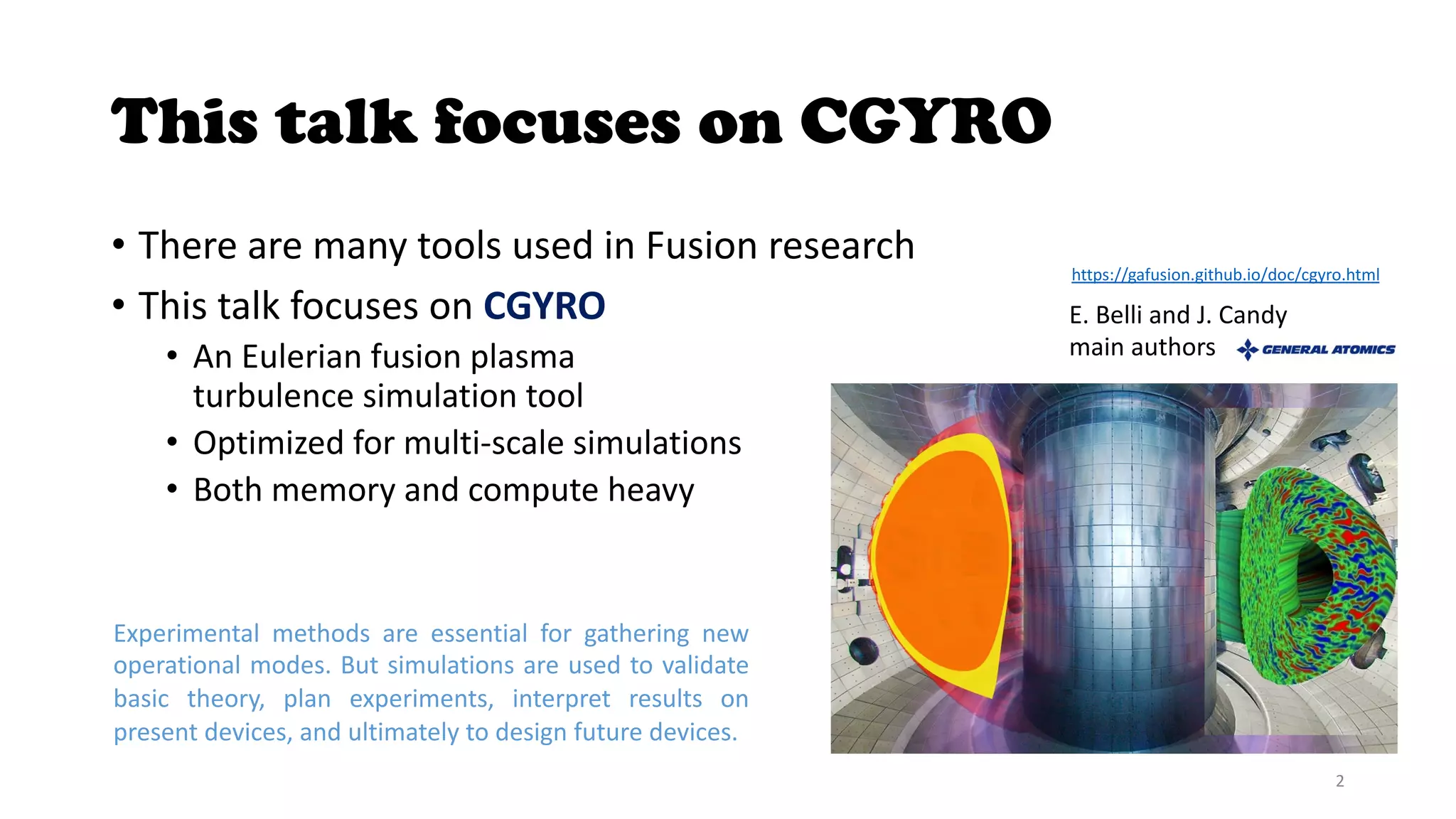
This talk focuses on CGYRO
• There are many tools used in Fusion research
• This talk focuses on CGYRO
• An Eulerian fusion plasma
turbulence simulation tool
• Optimized for multi-scale simulations
• Both memory and compute heavy
Experimental methods are essential for gathering new
operational modes. But simulations are used to validate
basic theory, plan experiments, interpret results on
present devices, and ultimately to design future devices.
E. Belli and J. Candy
main authors
https://gafusion.github.io/doc/cgyro.html
2
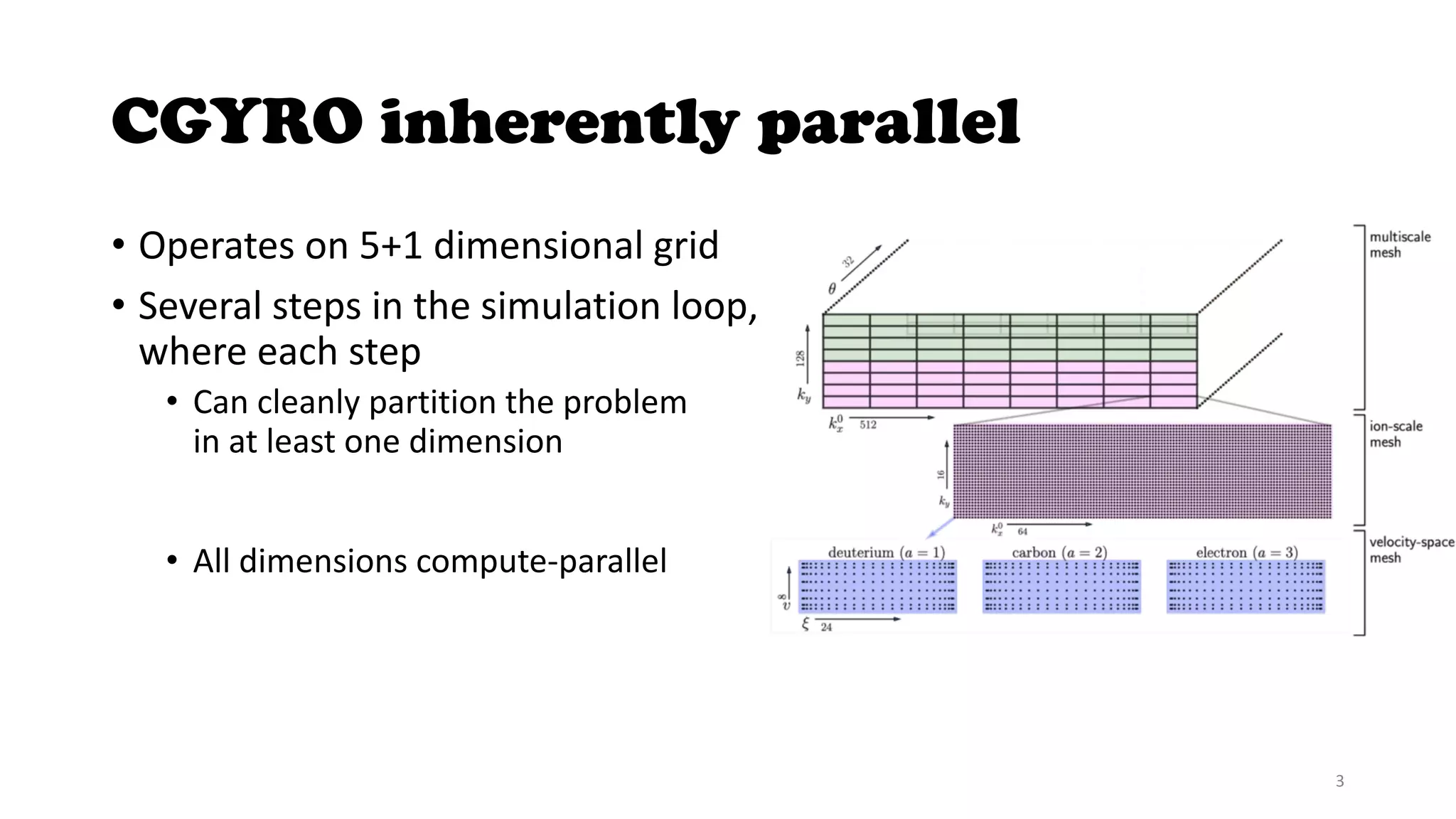
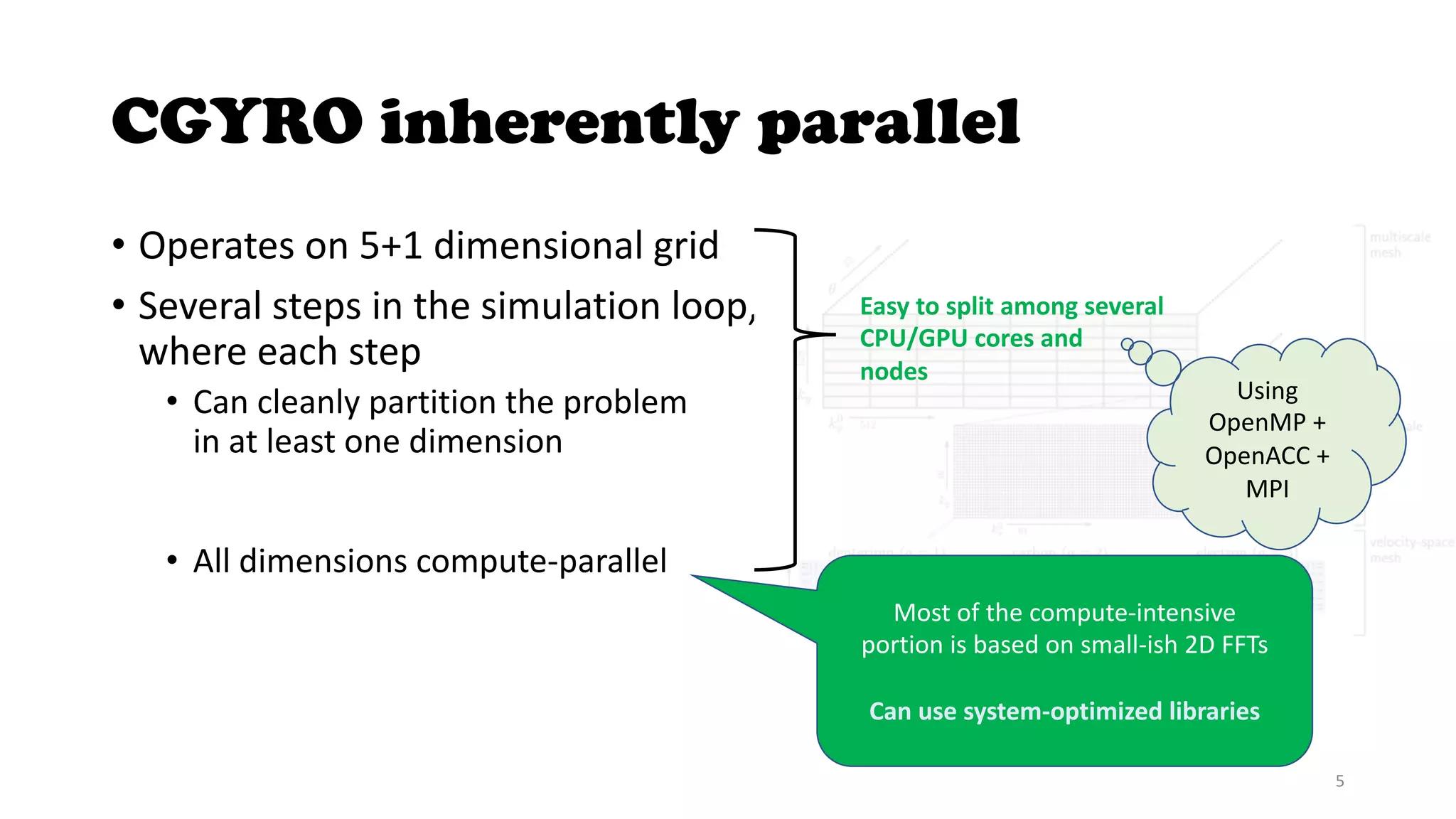
CGYRO inherently parallel
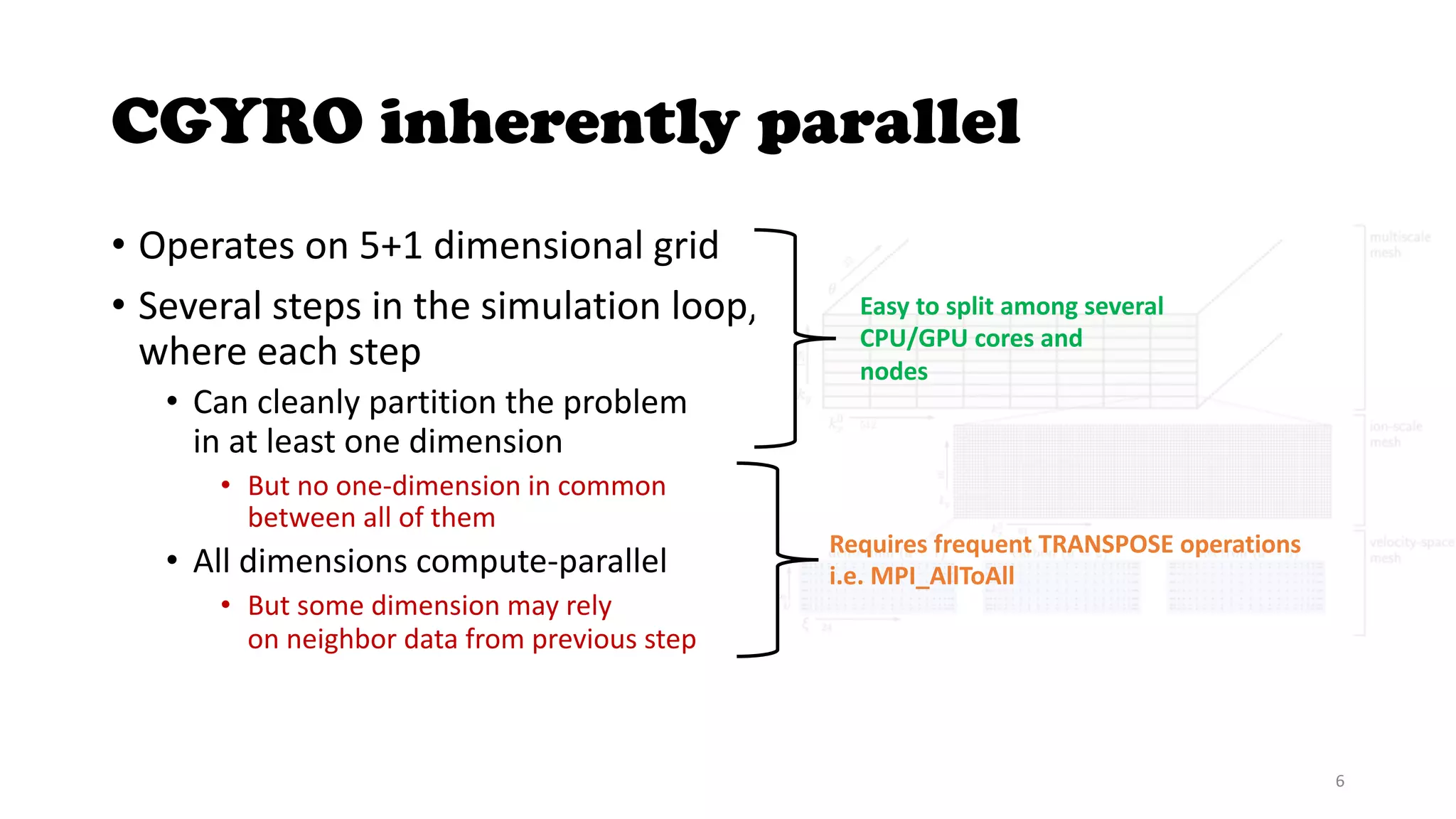
• Operates on 5+1 dimensional grid
• Several steps in the simulation loop,
where each step
• Can cleanly partition the problem
in at least one dimension
• But no one-dimension in common
between all of them
• All dimensions compute-parallel
• But some dimension may rely
on neighbor data from previous step
3
CGYRO inherently parallel
• Operates on 5+1 dimensional grid
• Several steps in the simulation loop,
where each step
• Can cleanly partition the problem
in at least one dimension
• But no one-dimension in common
between all of them
• All dimensions compute-parallel
• But some dimension may rely
on neighbor data from previous step
Easy to split among several
CPU/GPU cores and
nodes
4
CGYRO inherently parallel
• Operates on 5+1 dimensional grid
• Several steps in the simulation loop,
where each step
• Can cleanly partition the problem
in at least one dimension
• But no one-dimension in common
between all of them
• All dimensions compute-parallel
• But some dimension may rely
on neighbor data from previous step
Easy to split among several
CPU/GPU cores and
nodes
Most of the compute-intensive
portion is based on small-ish 2D FFTs
Can use system-optimized libraries
5
Using
OpenMP +
OpenACC +
MPI
CGYRO inherently parallel
• Operates on 5+1 dimensional grid
• Several steps in the simulation loop,
where each step
• Can cleanly partition the problem
in at least one dimension
• But no one-dimension in common
between all of them
• All dimensions compute-parallel
• But some dimension may rely
on neighbor data from previous step
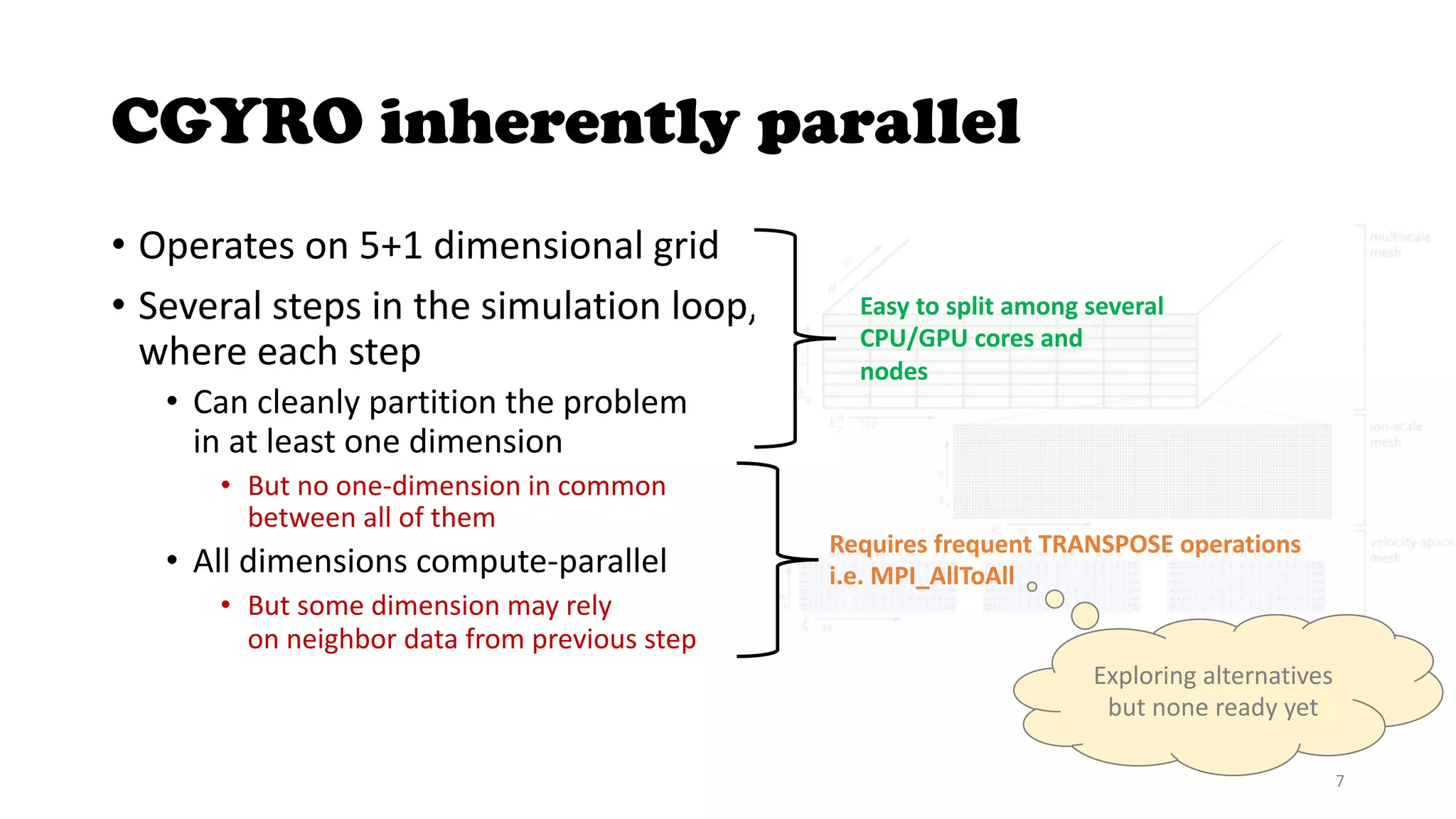
Requires frequent TRANSPOSE operations
i.e. MPI_AllToAll
Easy to split among several
CPU/GPU cores and
nodes
6
CGYRO inherently parallel
• Operates on 5+1 dimensional grid
• Several steps in the simulation loop,
where each step
• Can cleanly partition the problem
in at least one dimension
• But no one-dimension in common
between all of them
• All dimensions compute-parallel
• But some dimension may rely
on neighbor data from previous step
Requires frequent TRANSPOSE operations
i.e. MPI_AllToAll
Easy to split among several
CPU/GPU cores and
nodes
Exploring alternatives
but none ready yet
7
Cori and Perlmutter
• Cori was long a major CGYRO compute resource
• And we were very happy with KNL CPUs
• Lots of (slower) cores was always better than fewer marginally-faster cores
• CGYRO was ported to GPUs first for ORNL Titan
• Then improved for ORNL Summit
(Titan’s K80’s have severe limitations, like tiny memory and limited comm.)
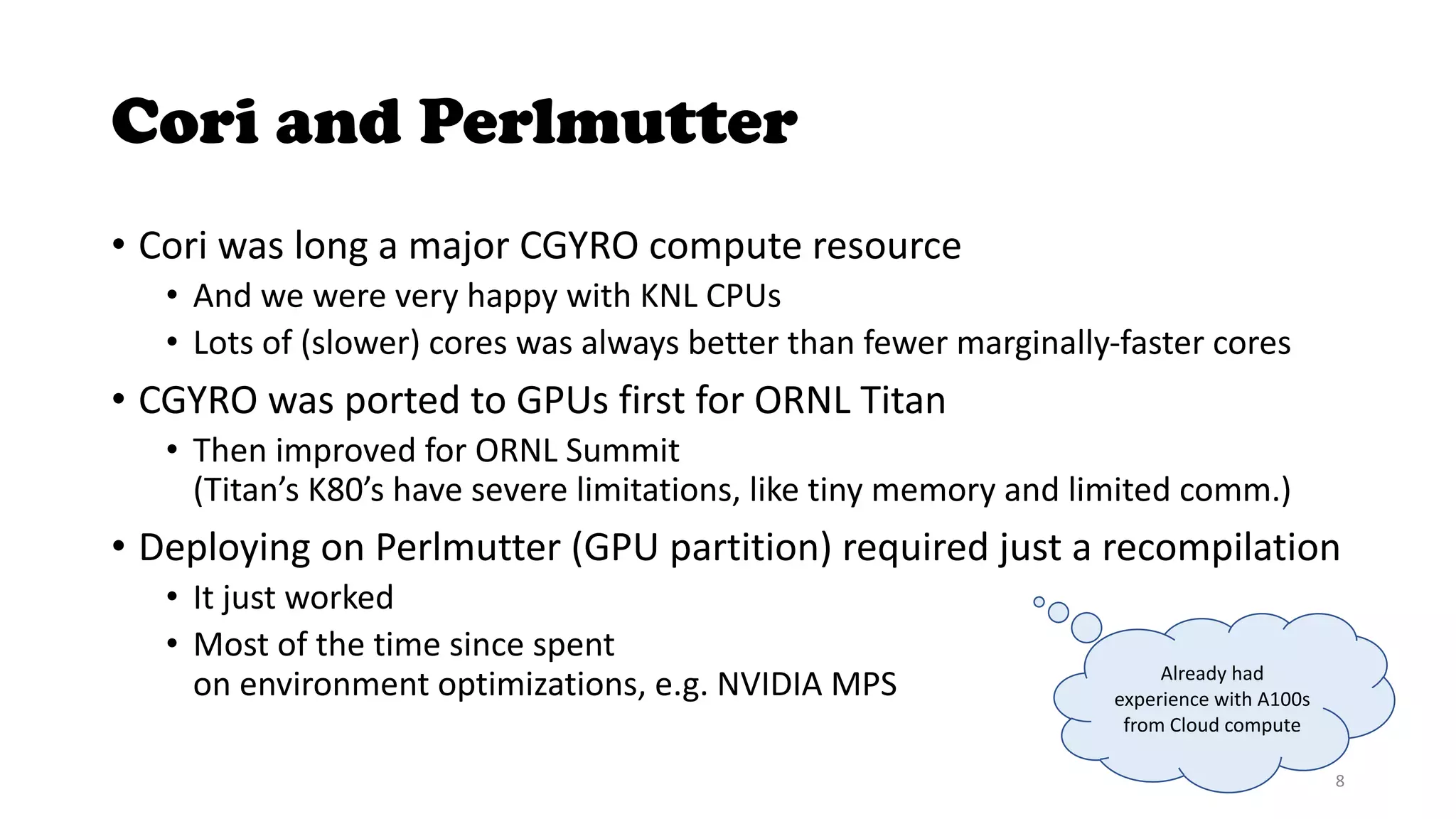
• Deploying on Perlmutter (GPU partition) required just a recompilation
• It just worked
• Most of the time since spent
on environment optimizations, e.g. NVIDIA MPS Already had
experience with A100s
from Cloud compute
8
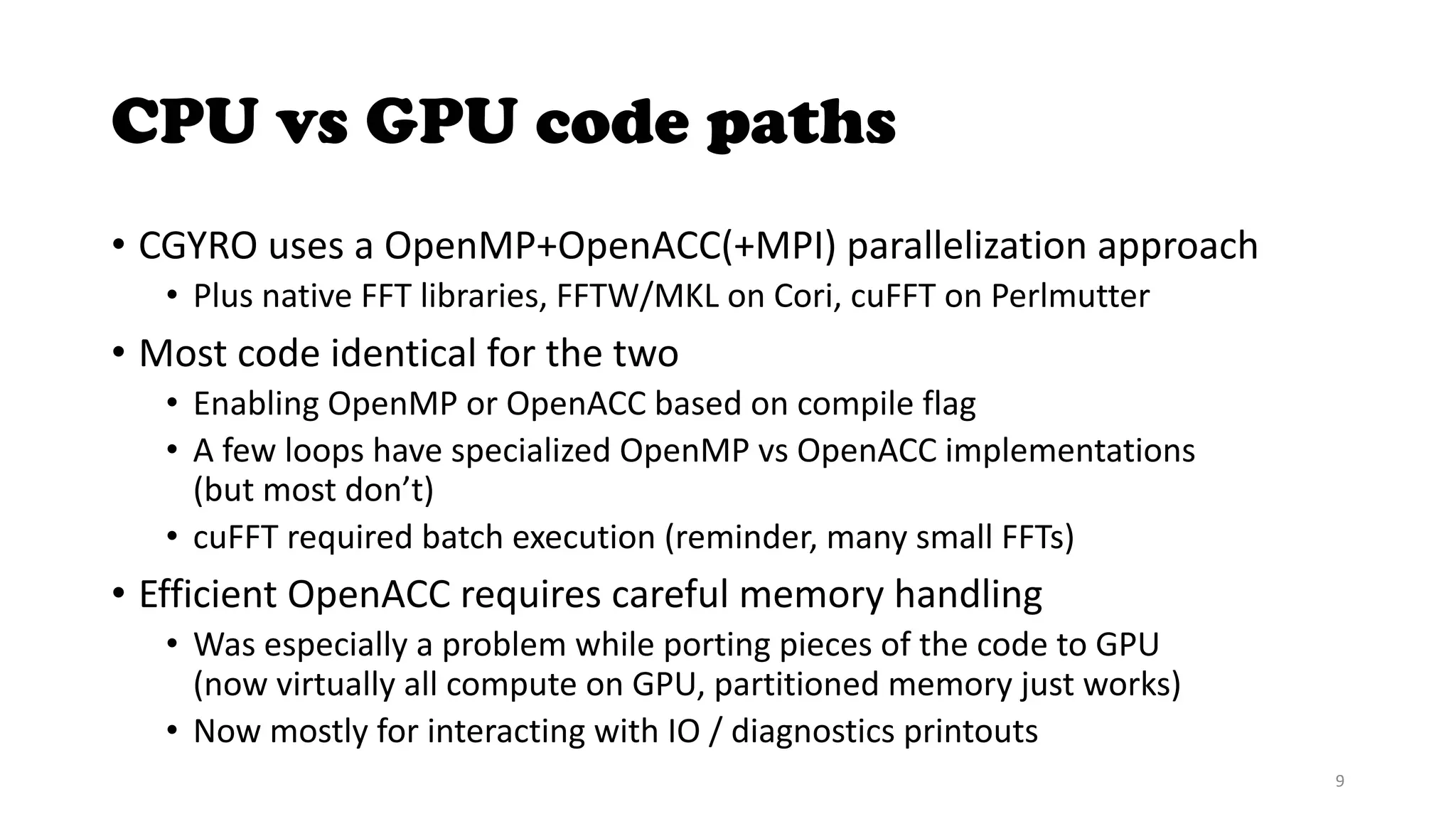
CPU vs GPU code paths
• CGYRO uses a OpenMP+OpenACC(+MPI) parallelization approach
• Plus native FFT libraries, FFTW/MKL on Cori, cuFFT on Perlmutter
• Most code identical for the two
• Enabling OpenMP or OpenACC based on compile flag
• A few loops have specialized OpenMP vs OpenACC implementations
(but most don’t)
• cuFFT required batch execution (reminder, many small FFTs)
• Efficient OpenACC requires careful memory handling
• Was especially a problem while porting pieces of the code to GPU
(now virtually all compute on GPU, partitioned memory just works)
• Now mostly for interacting with IO / diagnostics printouts
9
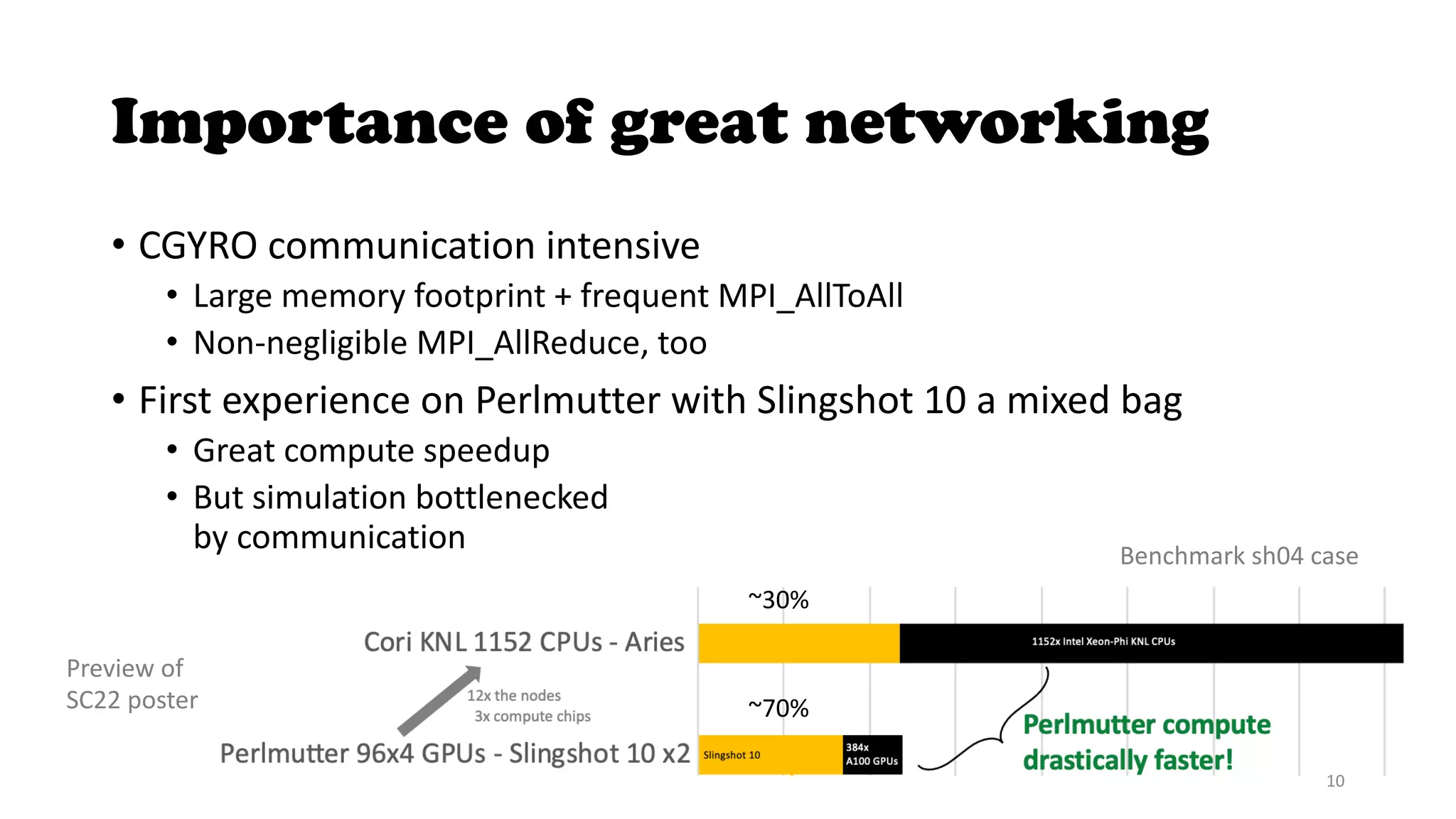
Importance of great networking
• CGYRO communication intensive
• Large memory footprint + frequent MPI_AllToAll
• Non-negligible MPI_AllReduce, too
• First experience on Perlmutter with Slingshot 10 a mixed bag
• Great compute speedup
• But simulation bottlenecked
by communication
~30%
~70%
Benchmark sh04 case
10
Preview of
SC22 poster
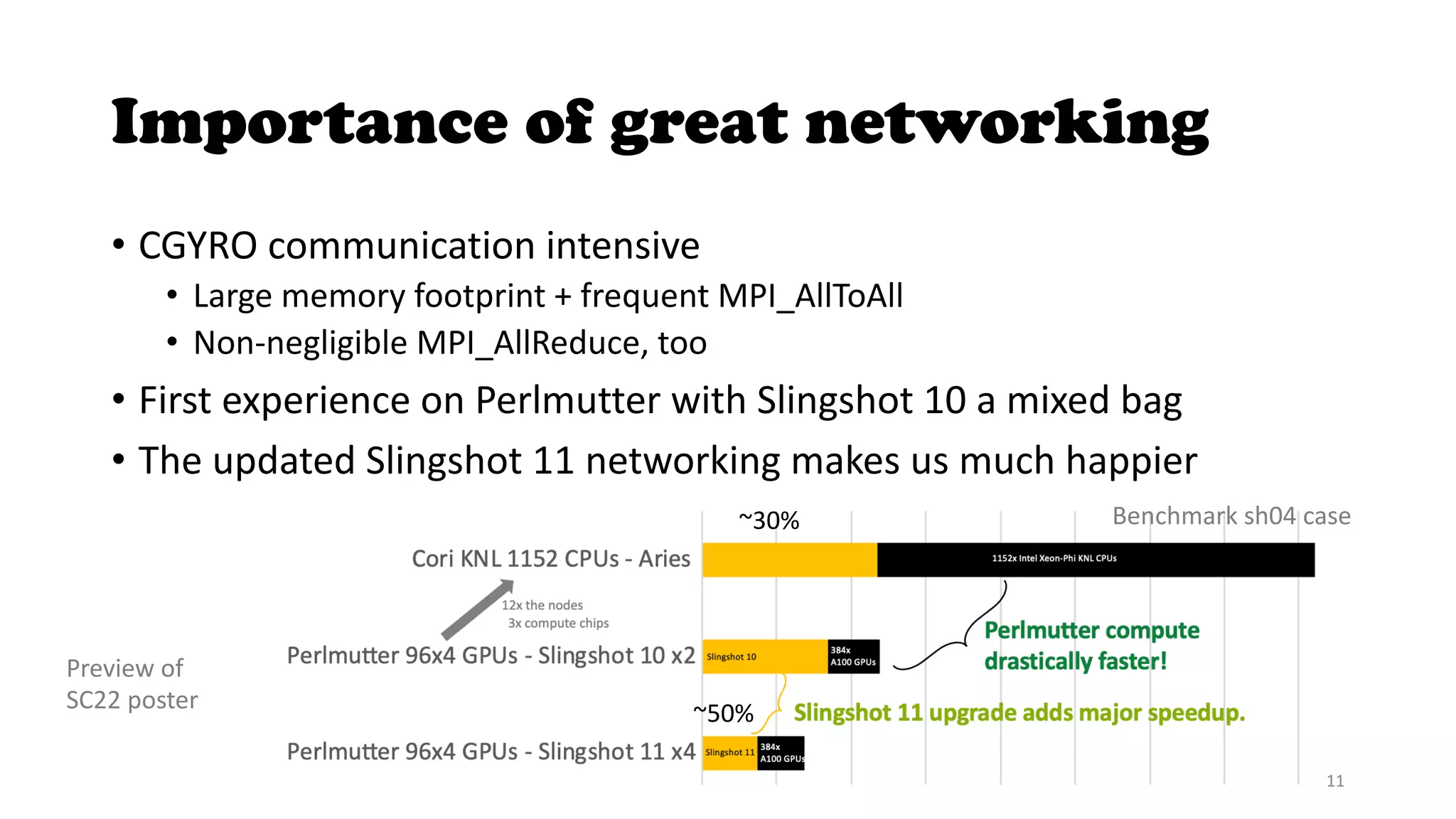
Importance of great networking
• CGYRO communication intensive
• Large memory footprint + frequent MPI_AllToAll
• Non-negligible MPI_AllReduce, too
• First experience on Perlmutter with Slingshot 10 a mixed bag
• The updated Slingshot 11 networking makes us much happier
~30%
~50%
Benchmark sh04 case
11
Preview of
SC22 poster
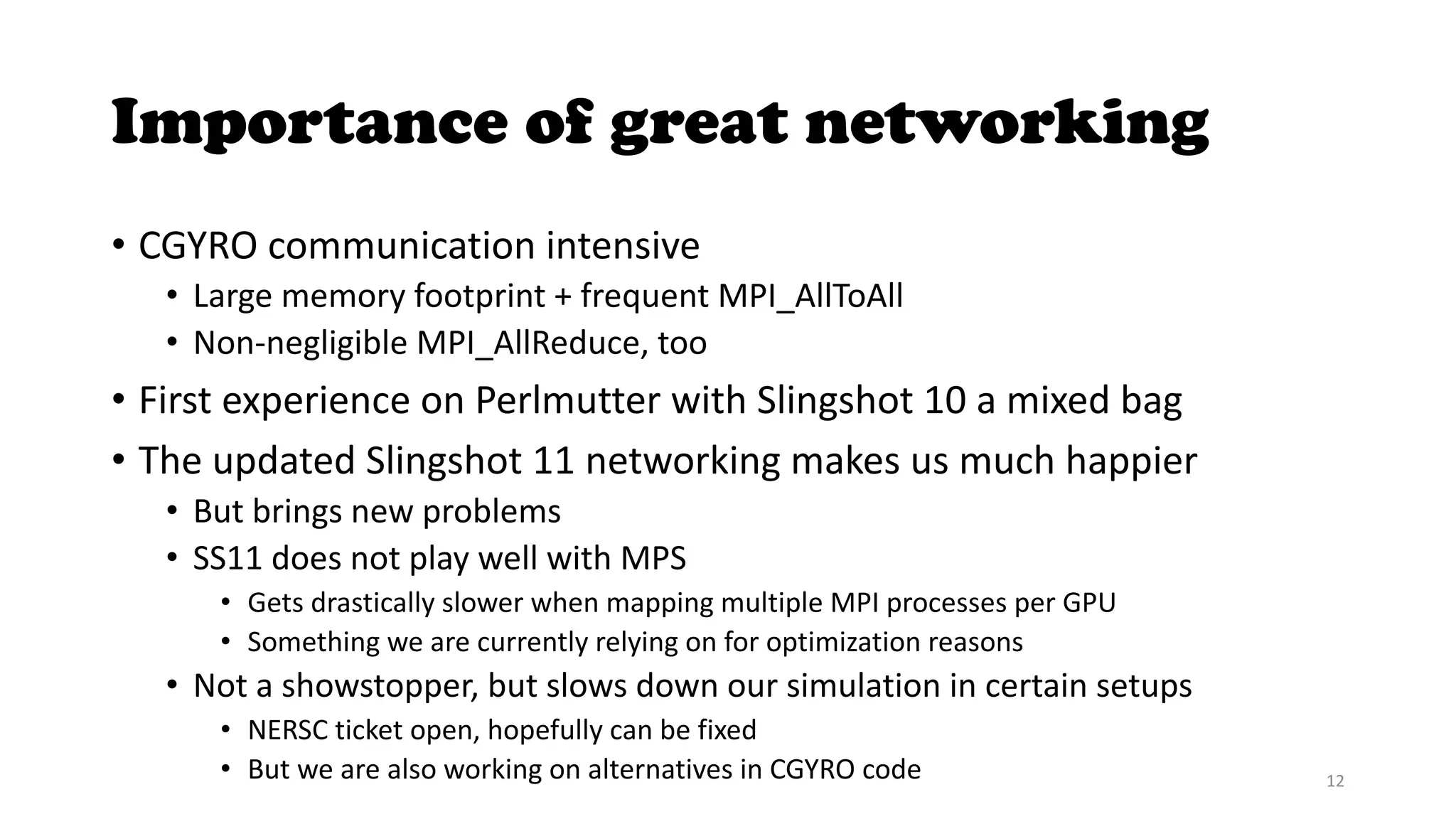
Importance of great networking
• CGYRO communication intensive
• Large memory footprint + frequent MPI_AllToAll
• Non-negligible MPI_AllReduce, too
• First experience on Perlmutter with Slingshot 10 a mixed bag
• The updated Slingshot 11 networking makes us much happier
• But brings new problems
• SS11 does not play well with MPS
• Gets drastically slower when mapping multiple MPI processes per GPU
• Something we are currently relying on for optimization reasons
• Not a showstopper, but slows down our simulation in certain setups
• NERSC ticket open, hopefully can be fixed
• But we are also working on alternatives in CGYRO code 12
Disk IO light
• CGYRO does not have much disk IO
• Updates results every O(10 mins)
• Checkpoints every O(1h)
• Uses MPI-mediated parallel writes
• Only a couple files, one per logical data type
13
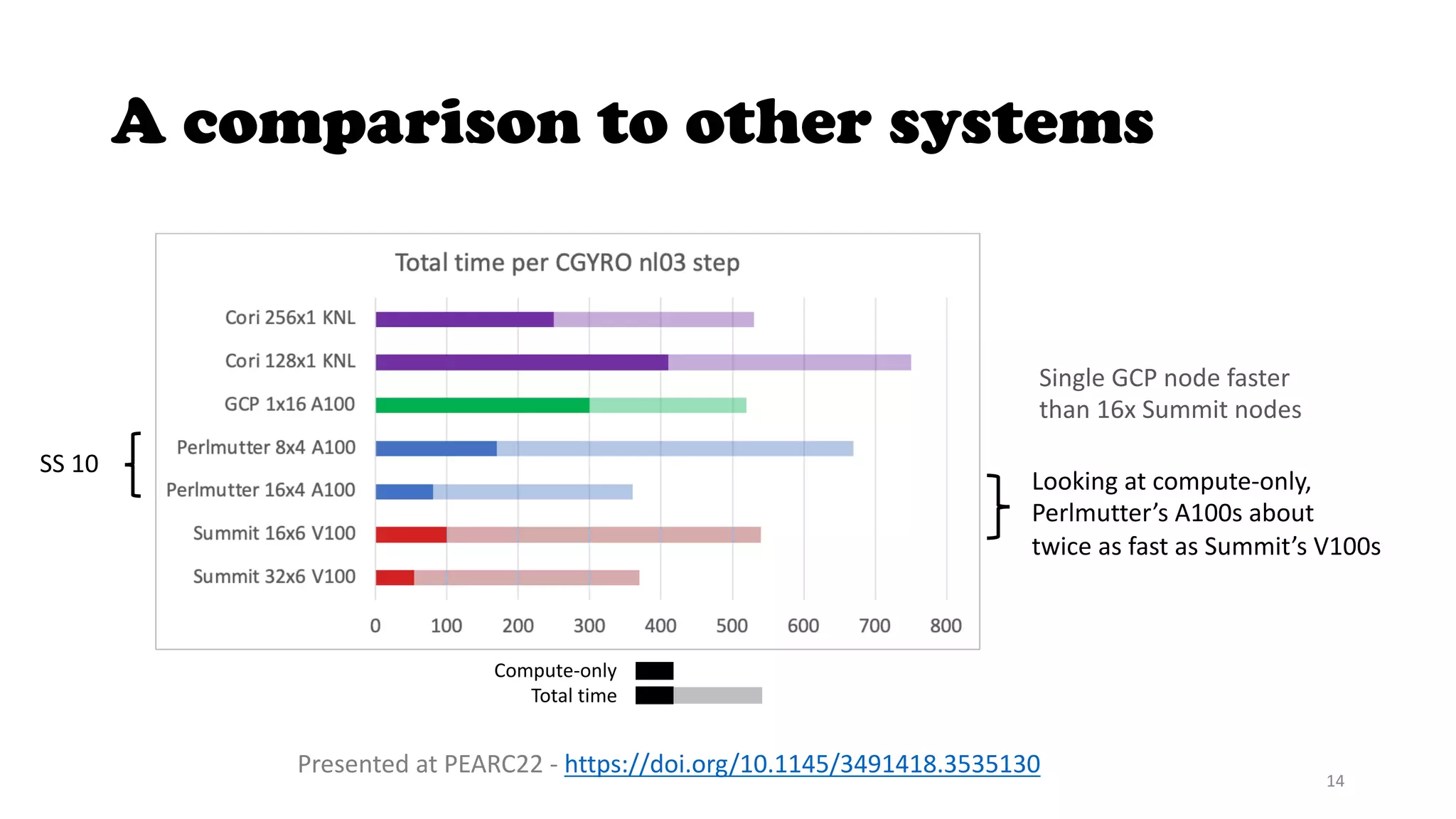
A comparison to other systems
14
Single GCP node faster
than 16x Summit nodes
Compute-only
Total time
SS 10
Presented at PEARC22 - https://doi.org/10.1145/3491418.3535130
Looking at compute-only,
Perlmutter’s A100s about
twice as fast as Summit’s V100s
Summary and Conclusions
• Fusion CGYRO users happy with transition from Cori to Perlmutter
• Much faster at equivalent chip count
• Porting required just a recompile
• Perlmutter still in deployment phase
• Had periods when things were not working too great
• But typically transient, hopefully will stabilize
• Waiting for the quotas to be raised (128 nodes is not a lot for CGYRO)
• Only known remaining annoyance is SS11+MPS interference
15
Acknowledgements
• This work was partially supported by
• The U.S. Department of Energy under awards DE-FG02-95ER54309,
DE-FC02-06ER54873 (Edge Simulation Laboratory) and
DE-SC0017992 (AToM SciDAC-4 project).
• The US National Science Foundation (NSF) Grant OAC-1826967.
• An award of computer time was provided by the INCITE program.
• This research used resources of the Oak Ridge Leadership Computing Facility,
which is an Office of Science User Facility supported under Contract DE-
AC05-00OR22725.
• Computing resources were also provided by the National Energy Research
Scientific Computing Center, which is an Office of Science User Facility
supported under Contract DE-AC02-05CH11231.
16

Preparing Fusion codes for Perlmutter - CGYRO

  • 1.
    Preparing Fusion Codesfor Perlmutter Igor Sfiligoi San Diego Supercomputer Center Under contract with General Atomics 1 NUG 2022
  • 2.
    This talk focuseson CGYRO • There are many tools used in Fusion research • This talk focuses on CGYRO • An Eulerian fusion plasma turbulence simulation tool • Optimized for multi-scale simulations • Both memory and compute heavy Experimental methods are essential for gathering new operational modes. But simulations are used to validate basic theory, plan experiments, interpret results on present devices, and ultimately to design future devices. E. Belli and J. Candy main authors https://gafusion.github.io/doc/cgyro.html 2
  • 3.
    CGYRO inherently parallel •Operates on 5+1 dimensional grid • Several steps in the simulation loop, where each step • Can cleanly partition the problem in at least one dimension • But no one-dimension in common between all of them • All dimensions compute-parallel • But some dimension may rely on neighbor data from previous step 3
  • 4.
    CGYRO inherently parallel •Operates on 5+1 dimensional grid • Several steps in the simulation loop, where each step • Can cleanly partition the problem in at least one dimension • But no one-dimension in common between all of them • All dimensions compute-parallel • But some dimension may rely on neighbor data from previous step Easy to split among several CPU/GPU cores and nodes 4
  • 5.
    CGYRO inherently parallel •Operates on 5+1 dimensional grid • Several steps in the simulation loop, where each step • Can cleanly partition the problem in at least one dimension • But no one-dimension in common between all of them • All dimensions compute-parallel • But some dimension may rely on neighbor data from previous step Easy to split among several CPU/GPU cores and nodes Most of the compute-intensive portion is based on small-ish 2D FFTs Can use system-optimized libraries 5 Using OpenMP + OpenACC + MPI
  • 6.
    CGYRO inherently parallel •Operates on 5+1 dimensional grid • Several steps in the simulation loop, where each step • Can cleanly partition the problem in at least one dimension • But no one-dimension in common between all of them • All dimensions compute-parallel • But some dimension may rely on neighbor data from previous step Requires frequent TRANSPOSE operations i.e. MPI_AllToAll Easy to split among several CPU/GPU cores and nodes 6
  • 7.
    CGYRO inherently parallel •Operates on 5+1 dimensional grid • Several steps in the simulation loop, where each step • Can cleanly partition the problem in at least one dimension • But no one-dimension in common between all of them • All dimensions compute-parallel • But some dimension may rely on neighbor data from previous step Requires frequent TRANSPOSE operations i.e. MPI_AllToAll Easy to split among several CPU/GPU cores and nodes Exploring alternatives but none ready yet 7
  • 8.
    Cori and Perlmutter •Cori was long a major CGYRO compute resource • And we were very happy with KNL CPUs • Lots of (slower) cores was always better than fewer marginally-faster cores • CGYRO was ported to GPUs first for ORNL Titan • Then improved for ORNL Summit (Titan’s K80’s have severe limitations, like tiny memory and limited comm.) • Deploying on Perlmutter (GPU partition) required just a recompilation • It just worked • Most of the time since spent on environment optimizations, e.g. NVIDIA MPS Already had experience with A100s from Cloud compute 8
  • 9.
    CPU vs GPUcode paths • CGYRO uses a OpenMP+OpenACC(+MPI) parallelization approach • Plus native FFT libraries, FFTW/MKL on Cori, cuFFT on Perlmutter • Most code identical for the two • Enabling OpenMP or OpenACC based on compile flag • A few loops have specialized OpenMP vs OpenACC implementations (but most don’t) • cuFFT required batch execution (reminder, many small FFTs) • Efficient OpenACC requires careful memory handling • Was especially a problem while porting pieces of the code to GPU (now virtually all compute on GPU, partitioned memory just works) • Now mostly for interacting with IO / diagnostics printouts 9
  • 10.
    Importance of greatnetworking • CGYRO communication intensive • Large memory footprint + frequent MPI_AllToAll • Non-negligible MPI_AllReduce, too • First experience on Perlmutter with Slingshot 10 a mixed bag • Great compute speedup • But simulation bottlenecked by communication ~30% ~70% Benchmark sh04 case 10 Preview of SC22 poster
  • 11.
    Importance of greatnetworking • CGYRO communication intensive • Large memory footprint + frequent MPI_AllToAll • Non-negligible MPI_AllReduce, too • First experience on Perlmutter with Slingshot 10 a mixed bag • The updated Slingshot 11 networking makes us much happier ~30% ~50% Benchmark sh04 case 11 Preview of SC22 poster
  • 12.
    Importance of greatnetworking • CGYRO communication intensive • Large memory footprint + frequent MPI_AllToAll • Non-negligible MPI_AllReduce, too • First experience on Perlmutter with Slingshot 10 a mixed bag • The updated Slingshot 11 networking makes us much happier • But brings new problems • SS11 does not play well with MPS • Gets drastically slower when mapping multiple MPI processes per GPU • Something we are currently relying on for optimization reasons • Not a showstopper, but slows down our simulation in certain setups • NERSC ticket open, hopefully can be fixed • But we are also working on alternatives in CGYRO code 12
  • 13.
    Disk IO light •CGYRO does not have much disk IO • Updates results every O(10 mins) • Checkpoints every O(1h) • Uses MPI-mediated parallel writes • Only a couple files, one per logical data type 13
  • 14.
    A comparison toother systems 14 Single GCP node faster than 16x Summit nodes Compute-only Total time SS 10 Presented at PEARC22 - https://doi.org/10.1145/3491418.3535130 Looking at compute-only, Perlmutter’s A100s about twice as fast as Summit’s V100s
  • 15.
    Summary and Conclusions •Fusion CGYRO users happy with transition from Cori to Perlmutter • Much faster at equivalent chip count • Porting required just a recompile • Perlmutter still in deployment phase • Had periods when things were not working too great • But typically transient, hopefully will stabilize • Waiting for the quotas to be raised (128 nodes is not a lot for CGYRO) • Only known remaining annoyance is SS11+MPS interference 15
  • 16.
    Acknowledgements • This workwas partially supported by • The U.S. Department of Energy under awards DE-FG02-95ER54309, DE-FC02-06ER54873 (Edge Simulation Laboratory) and DE-SC0017992 (AToM SciDAC-4 project). • The US National Science Foundation (NSF) Grant OAC-1826967. • An award of computer time was provided by the INCITE program. • This research used resources of the Oak Ridge Leadership Computing Facility, which is an Office of Science User Facility supported under Contract DE- AC05-00OR22725. • Computing resources were also provided by the National Energy Research Scientific Computing Center, which is an Office of Science User Facility supported under Contract DE-AC02-05CH11231. 16