ParallelStreams
Concurrent data processing in Java 8
David Gómez G.
@dgomezg
dgomezg@autentia.com
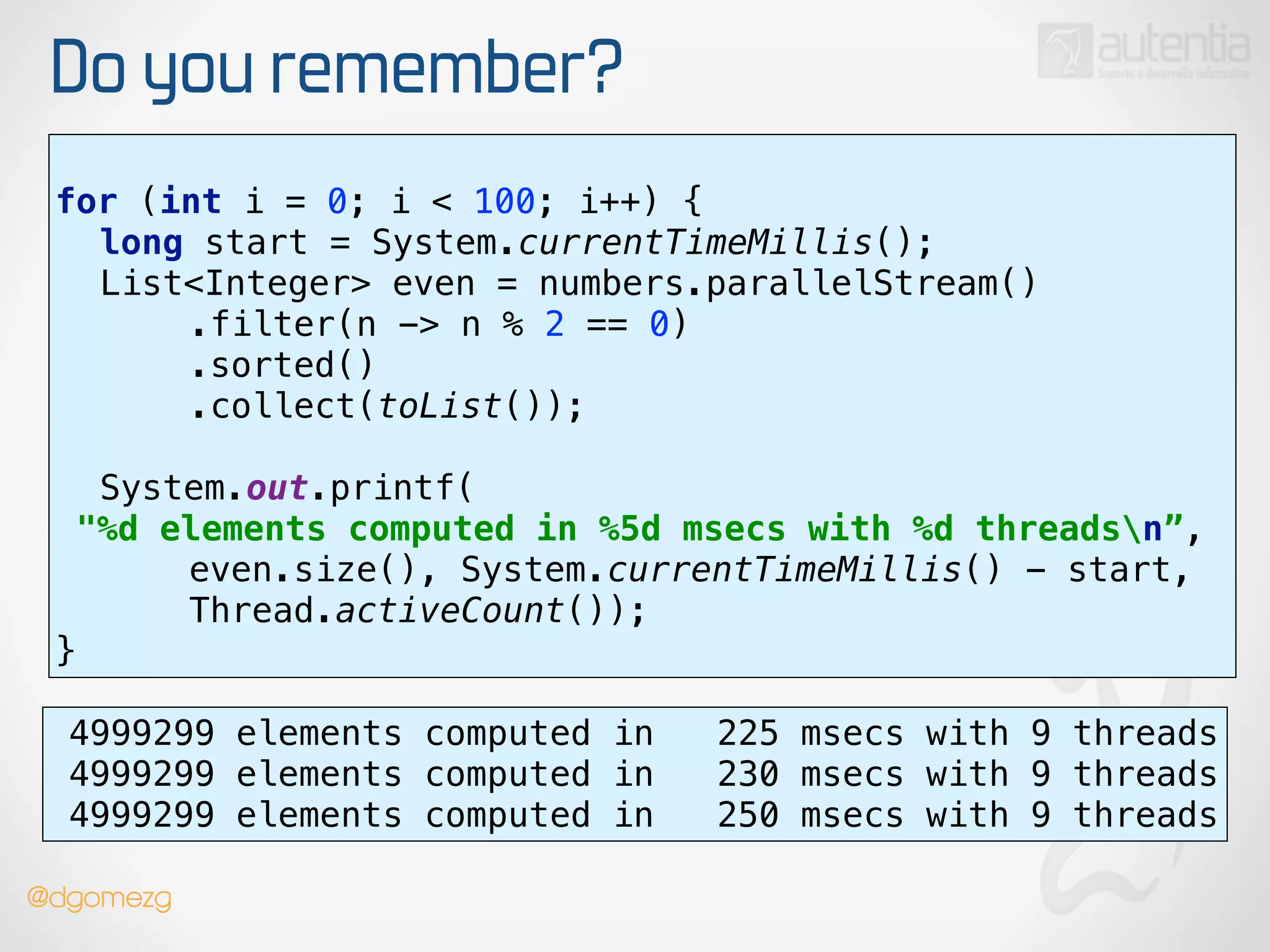
Do you remember?
use stream()
for (int i = 0; i < 100; i++) {

long start = System.currentTimeMillis();

List<Integer> even = numbers.parallelStream()

.filter(n -> n % 2 == 0)

.sorted()

.collect(toList());


System.out.printf(
"%d elements computed in %5d msecs with %d threadsn”,

even.size(), System.currentTimeMillis() - start,
Thread.activeCount());

}
4999299 elements computed in 225 msecs with 9 threads
4999299 elements computed in 230 msecs with 9 threads
4999299 elements computed in 250 msecs with 9 threads
@dgomezg
Previously on…
Streams?
What’s that?
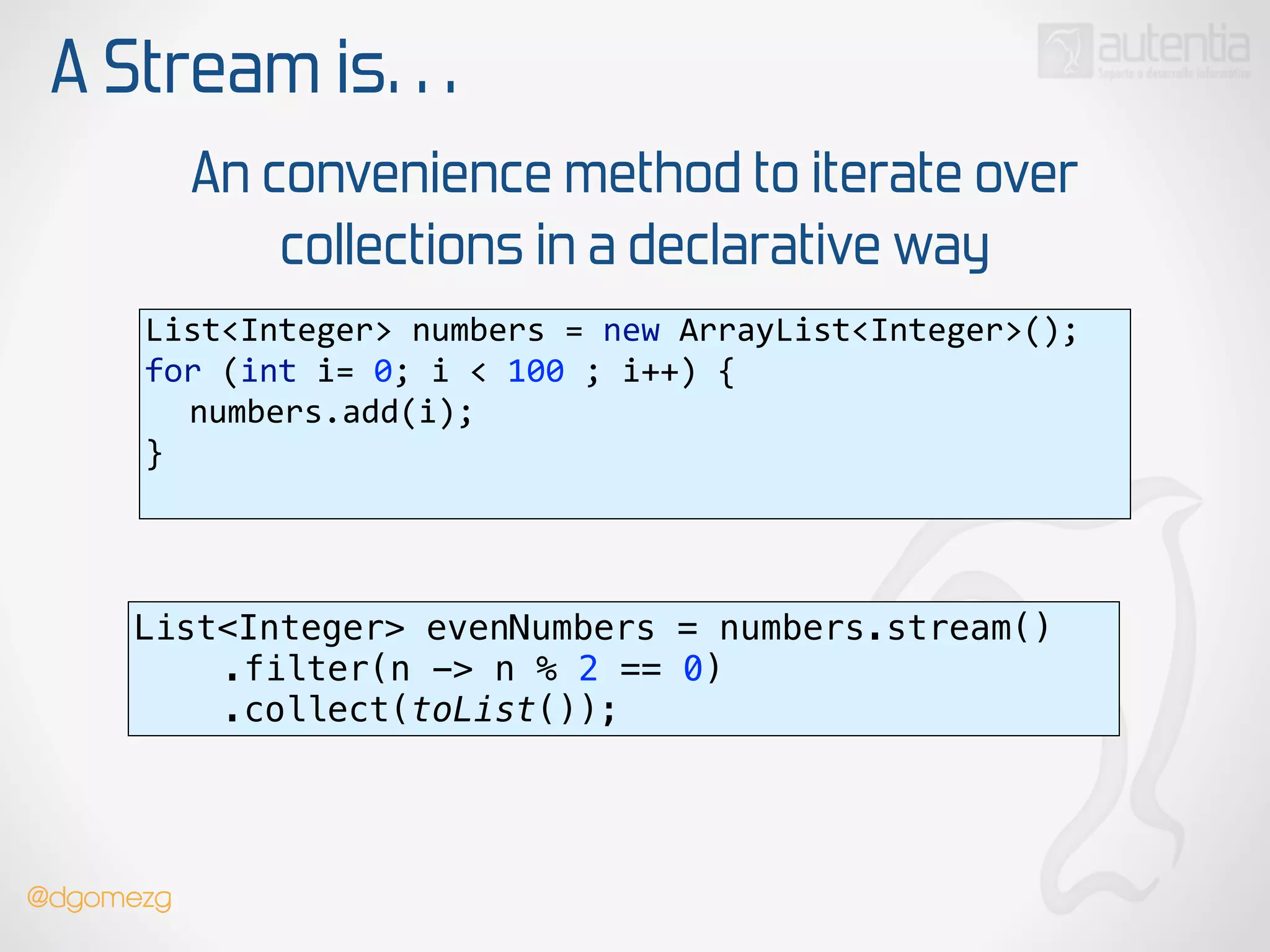
A Stream is…
An convenience method to iterate over
collections in a declarative way
List<Integer>  numbers  =  new  ArrayList<Integer>();

for  (int  i=  0;  i  <  100  ;  i++)  {

   numbers.add(i);

}  
List<Integer> evenNumbers = numbers.stream()

.filter(n -> n % 2 == 0)

.collect(toList());
@dgomezg
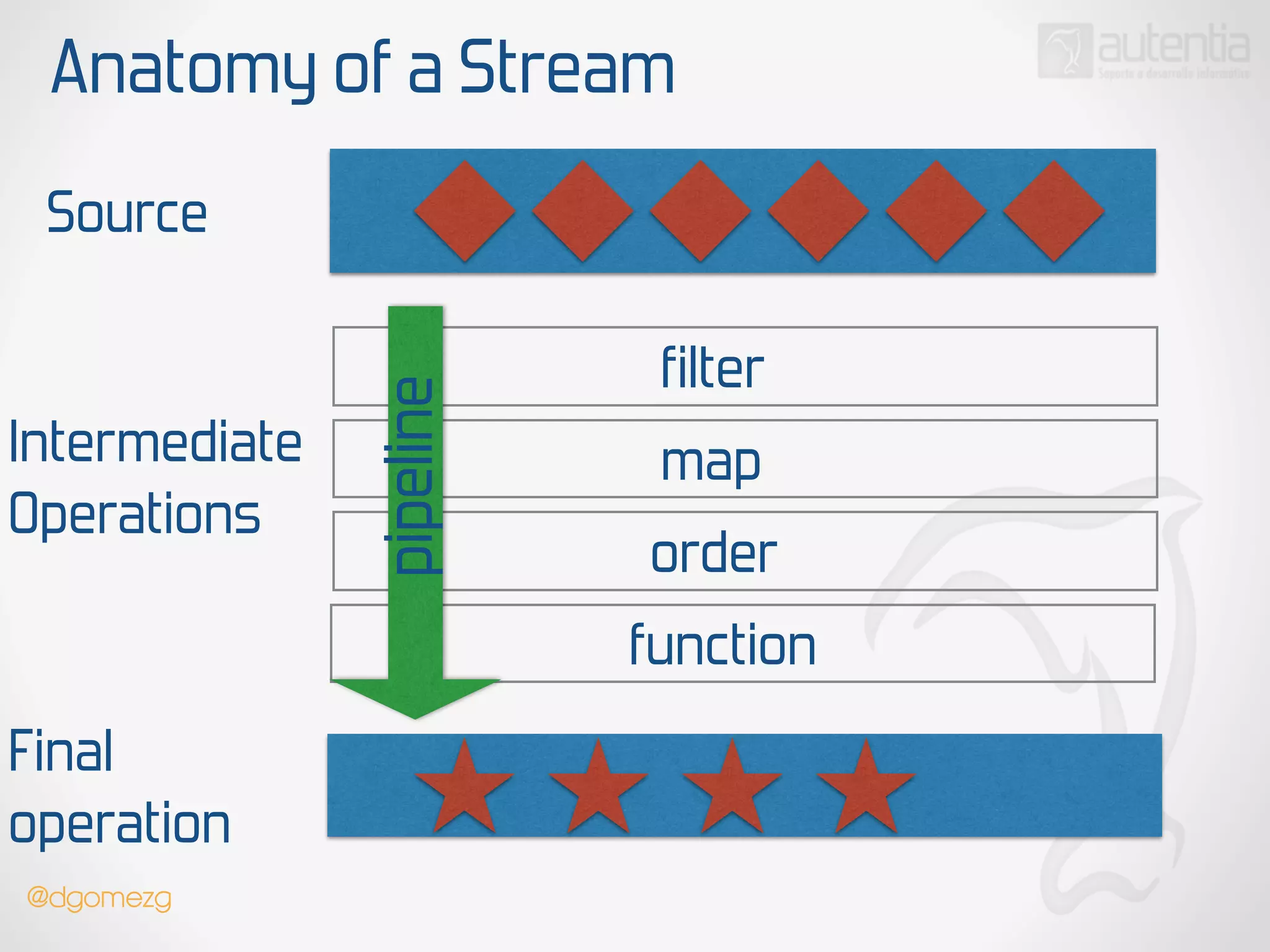
Anatomy of a Stream
Source
Intermediate
Operations
filter
map
order
function
Final
operation
pipeline
@dgomezg
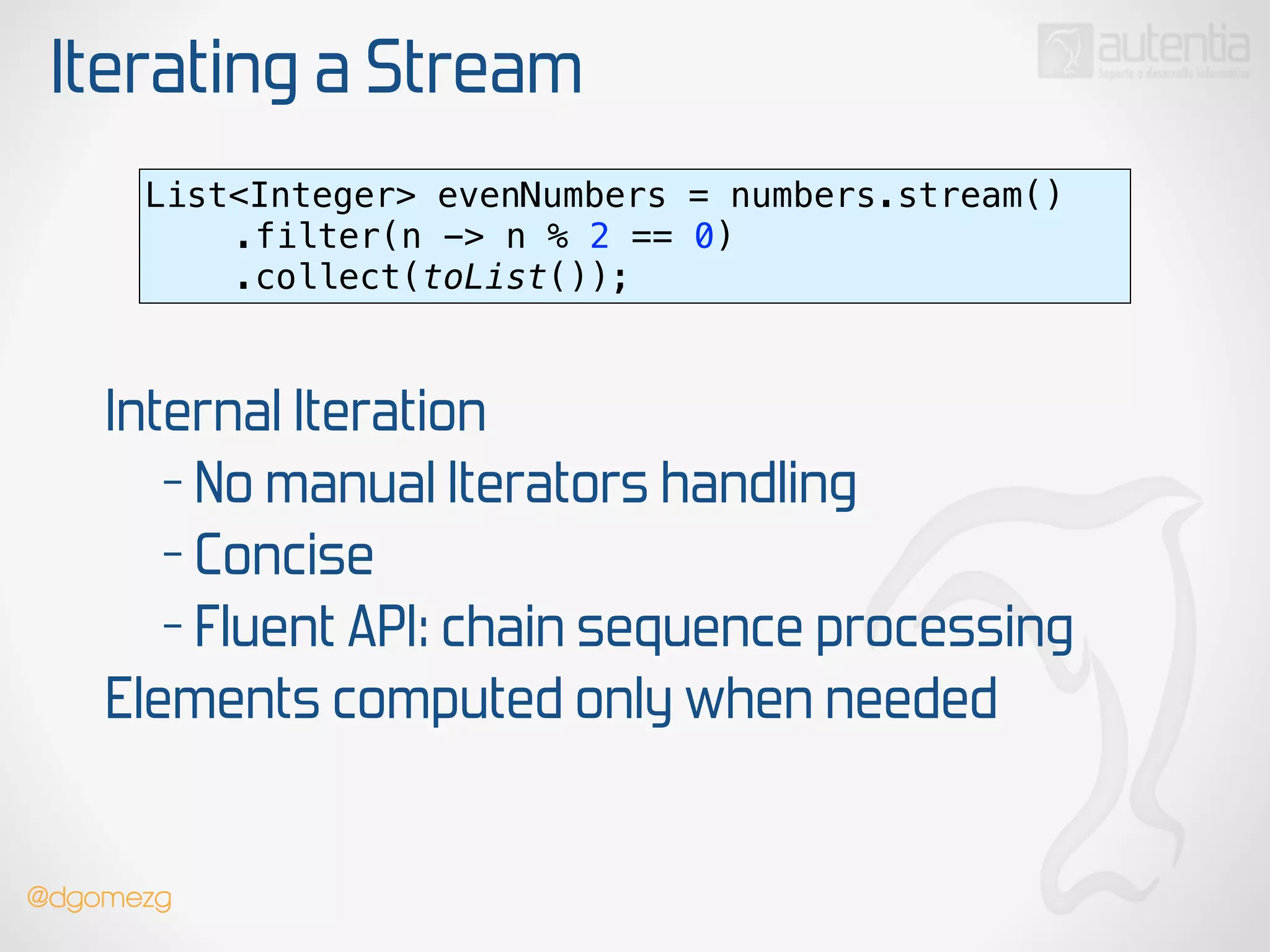
Iterating a Stream
List<Integer> evenNumbers = numbers.stream()

.filter(n -> n % 2 == 0)

.collect(toList());
Internal Iteration
- No manual Iterators handling
- Concise
- Fluent API: chain sequence processing
Elements computed only when needed
@dgomezg
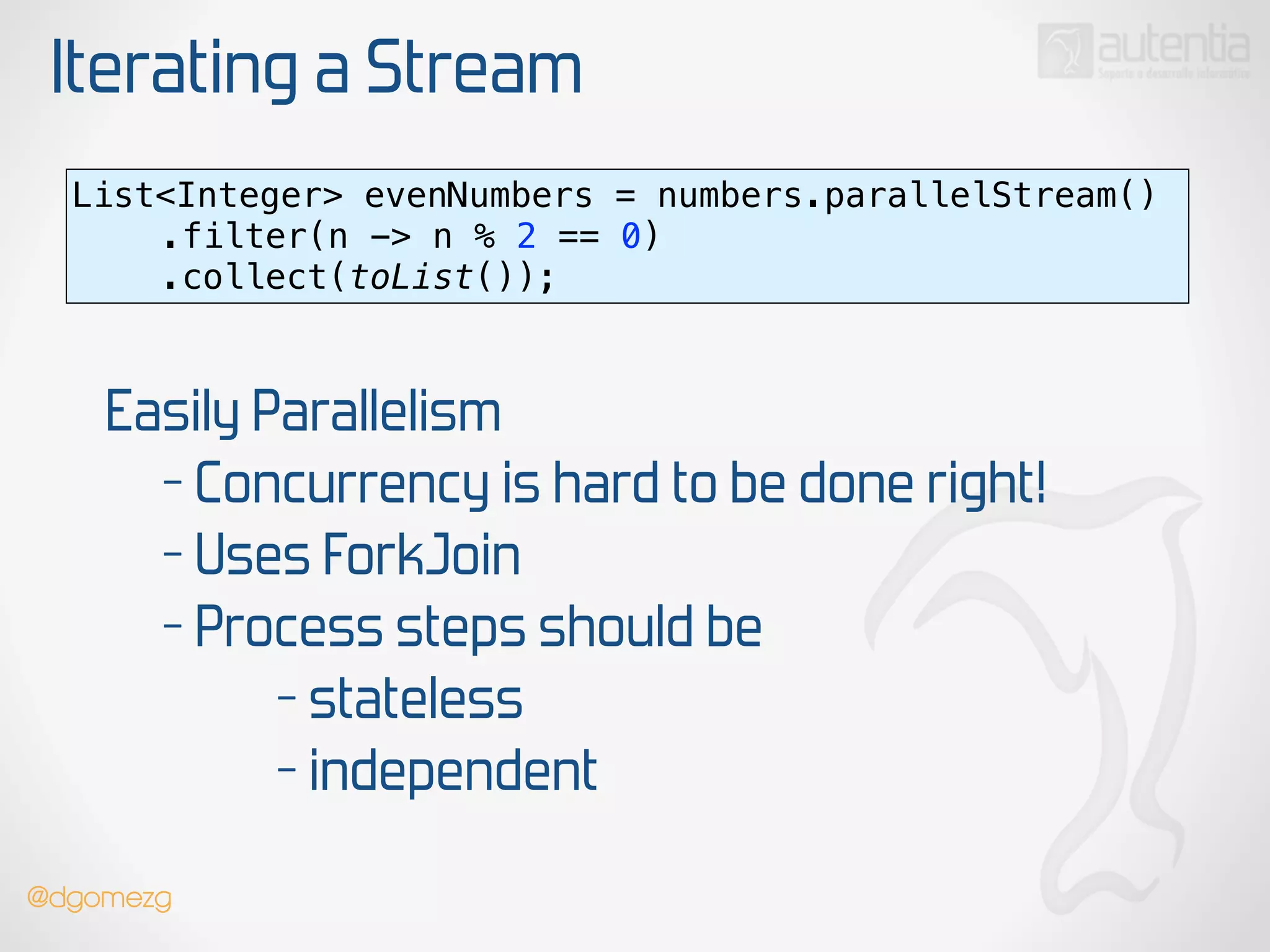
Iterating a Stream
List<Integer> evenNumbers = numbers.parallelStream()

.filter(n -> n % 2 == 0)

.collect(toList());
Easily Parallelism
- Concurrency is hard to be done right!
- Uses ForkJoin
- Process steps should be
- stateless
- independent
@dgomezg
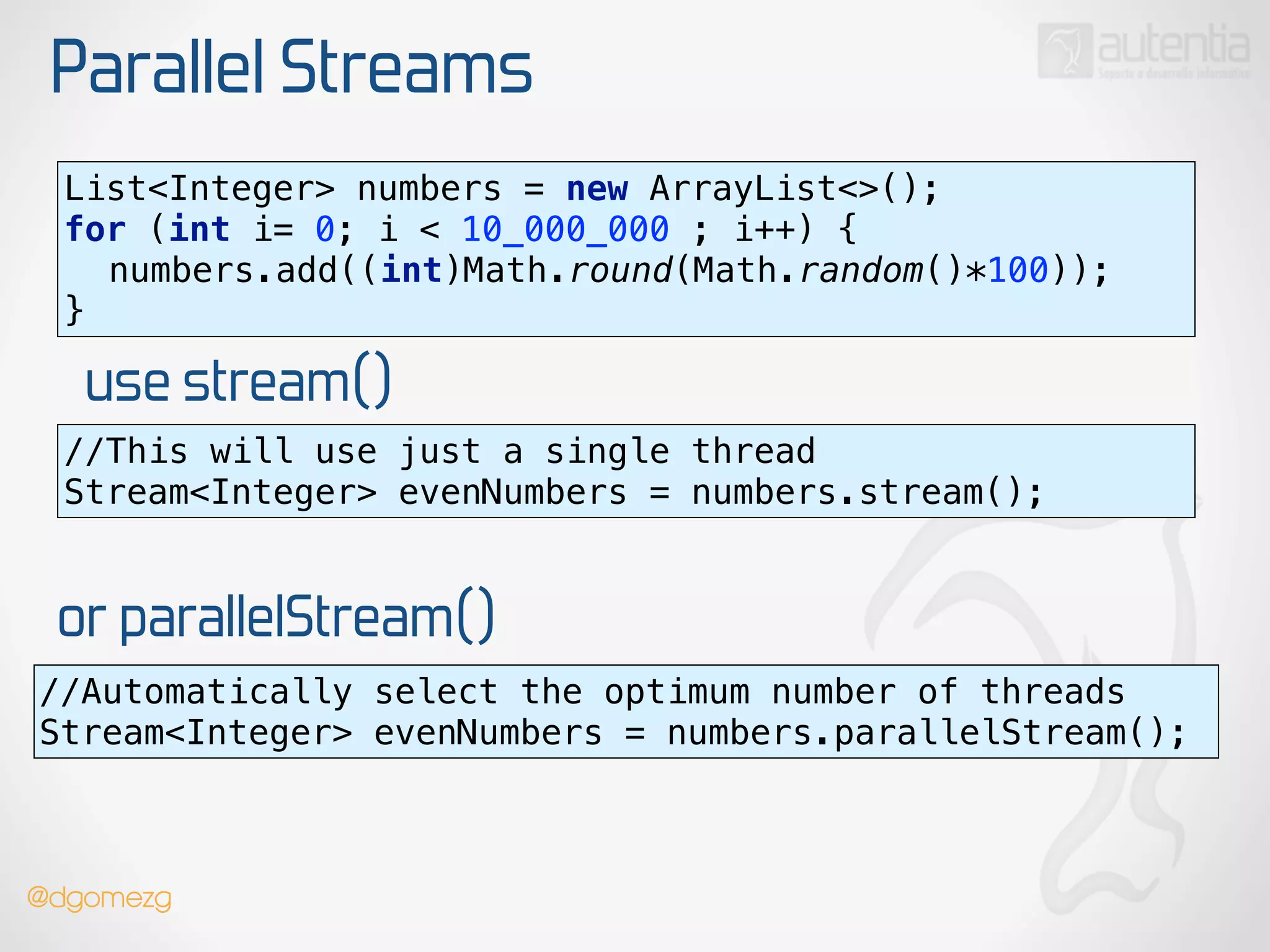
Parallel Streams
use stream()
List<Integer> numbers = new ArrayList<>();

for (int i= 0; i < 10_000_000 ; i++) {

numbers.add((int)Math.round(Math.random()*100));

}
//This will use just a single thread
Stream<Integer> evenNumbers = numbers.stream();
or parallelStream()
//Automatically select the optimum number of threads
Stream<Integer> evenNumbers = numbers.parallelStream();
@dgomezg
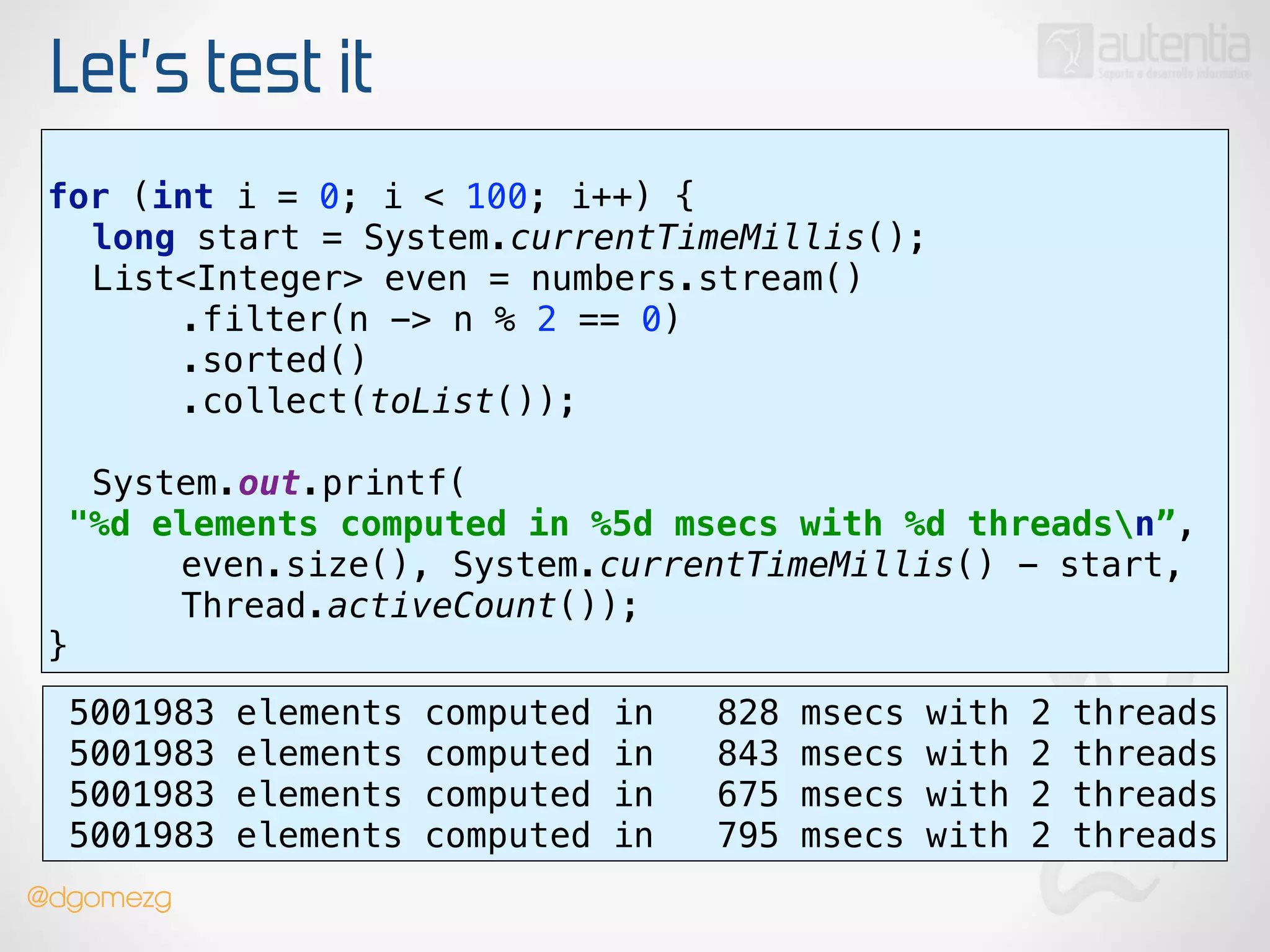
Let’s test it
use stream()
for (int i = 0; i < 100; i++) {

long start = System.currentTimeMillis();

List<Integer> even = numbers.stream()

.filter(n -> n % 2 == 0)

.sorted()

.collect(toList());


System.out.printf(
"%d elements computed in %5d msecs with %d threadsn”,

even.size(), System.currentTimeMillis() - start,
Thread.activeCount());

}
5001983 elements computed in 828 msecs with 2 threads
5001983 elements computed in 843 msecs with 2 threads
5001983 elements computed in 675 msecs with 2 threads
5001983 elements computed in 795 msecs with 2 threads
@dgomezg
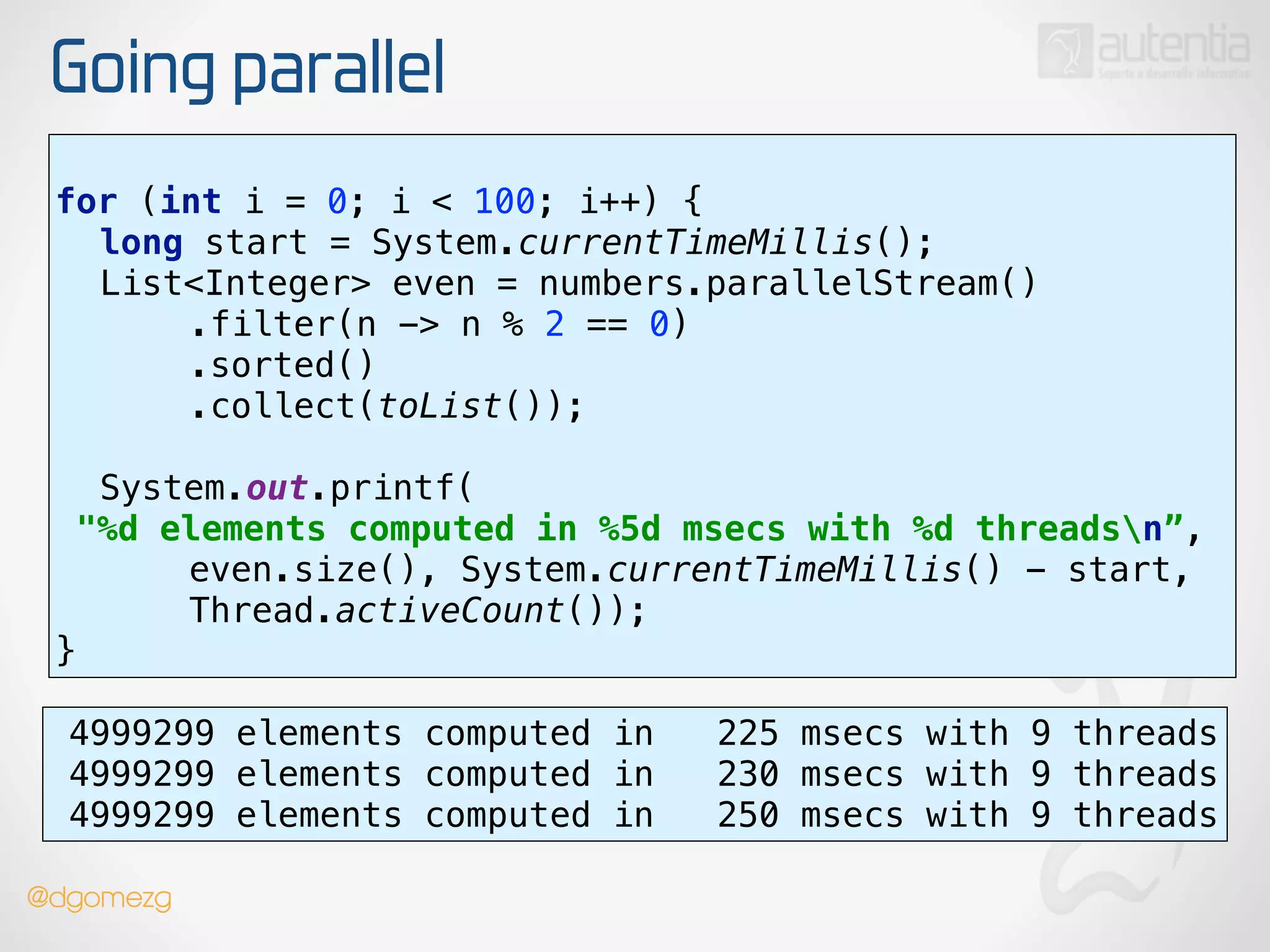
Going parallel
use stream()
for (int i = 0; i < 100; i++) {

long start = System.currentTimeMillis();

List<Integer> even = numbers.parallelStream()

.filter(n -> n % 2 == 0)

.sorted()

.collect(toList());


System.out.printf(
"%d elements computed in %5d msecs with %d threadsn”,

even.size(), System.currentTimeMillis() - start,
Thread.activeCount());

}
4999299 elements computed in 225 msecs with 9 threads
4999299 elements computed in 230 msecs with 9 threads
4999299 elements computed in 250 msecs with 9 threads
@dgomezg
Previously on…
http://www.slideshare.net/dgomezg/streams-en-java-8
Parallelism
Under the hood
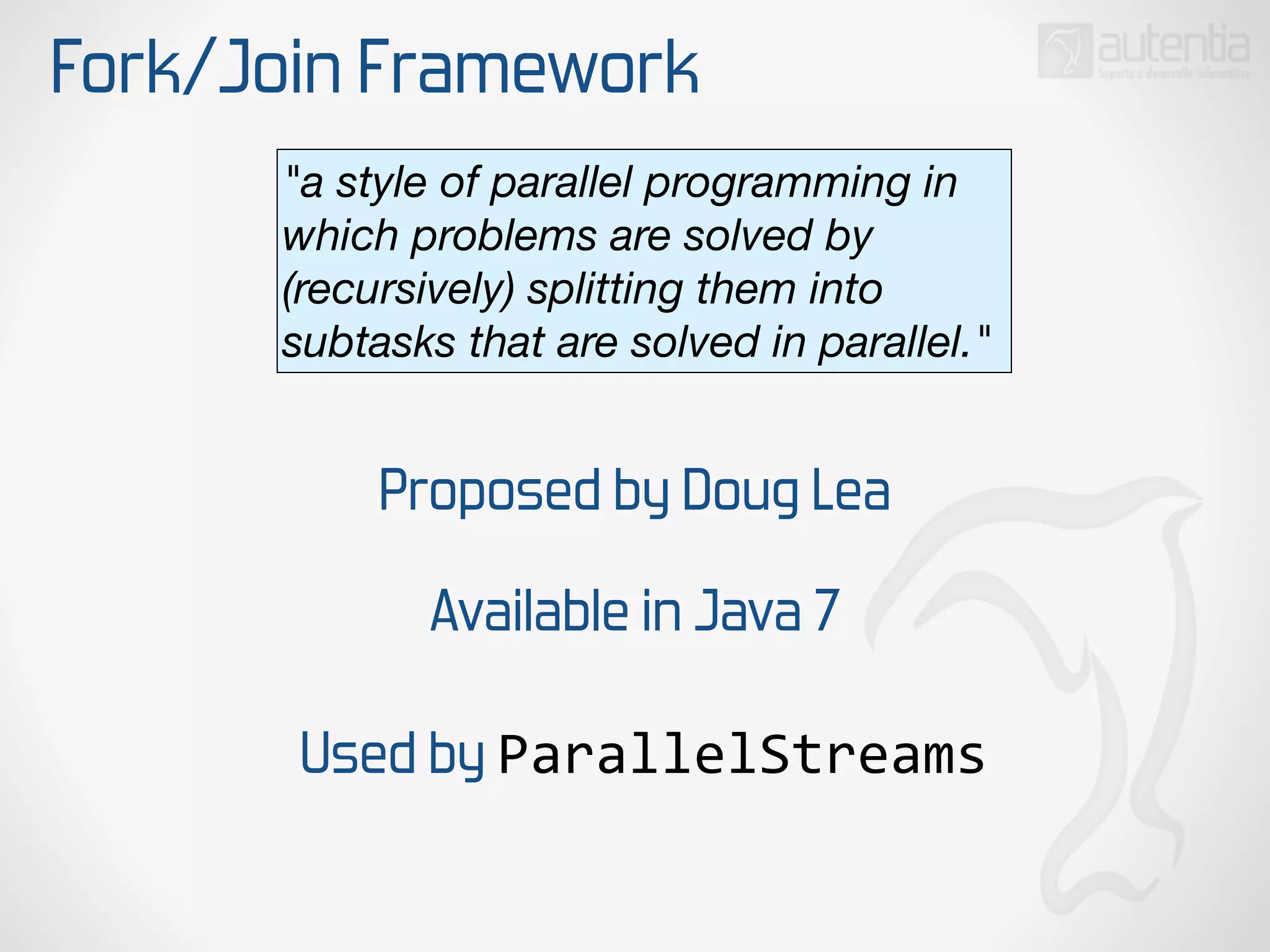
Fork/Join Framework
Proposed by Doug Lea
"a style of parallel programming in
which problems are solved by
(recursively) splitting them into
subtasks that are solved in parallel."
Available in Java 7
Used by ParallelStreams
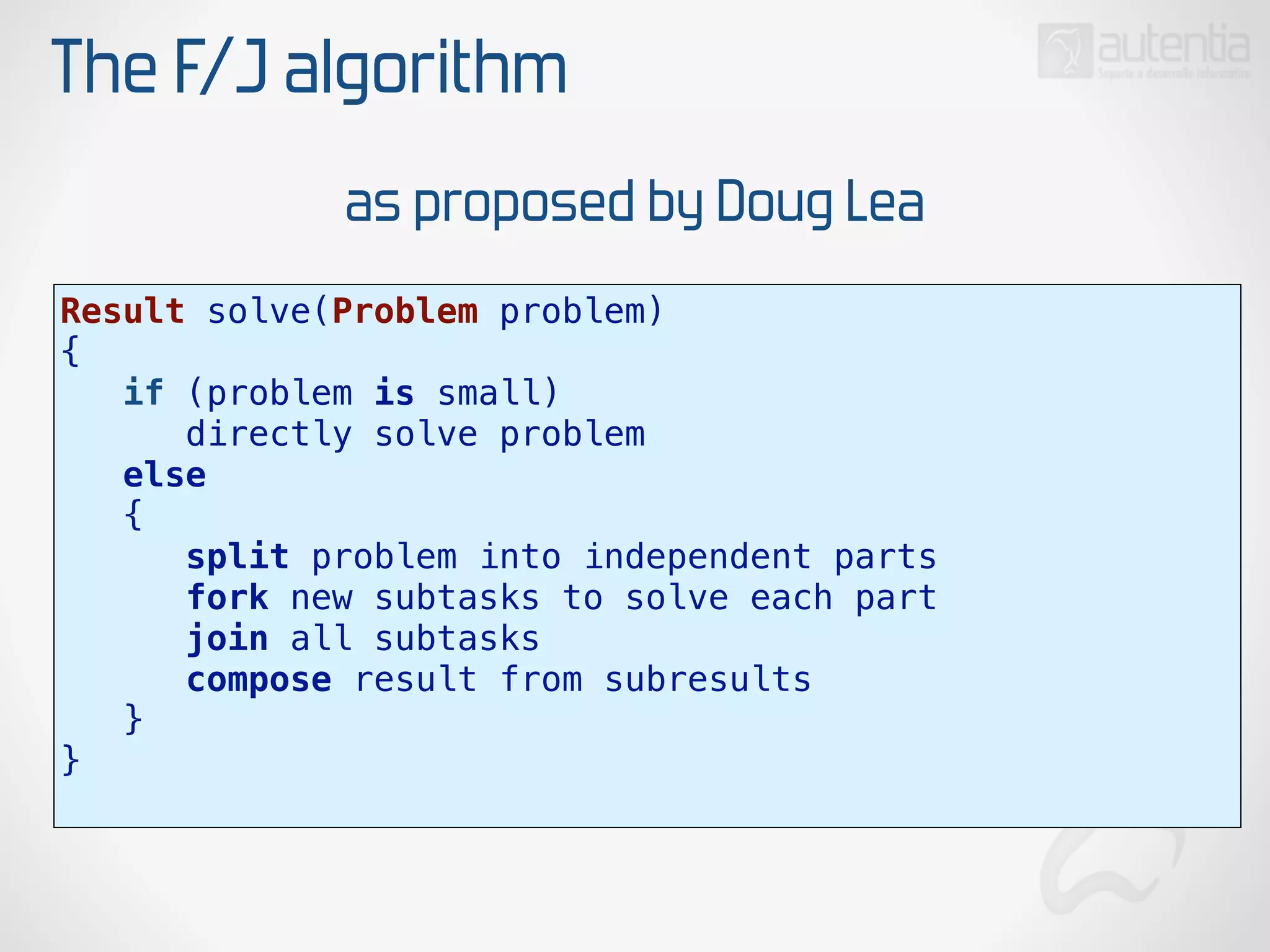
The F/J algorithm
Result solve(Problem problem)
{
if (problem is small)
directly solve problem
else
{
split problem into independent parts
fork new subtasks to solve each part
join all subtasks
compose result from subresults
}
}
as proposed by Doug Lea
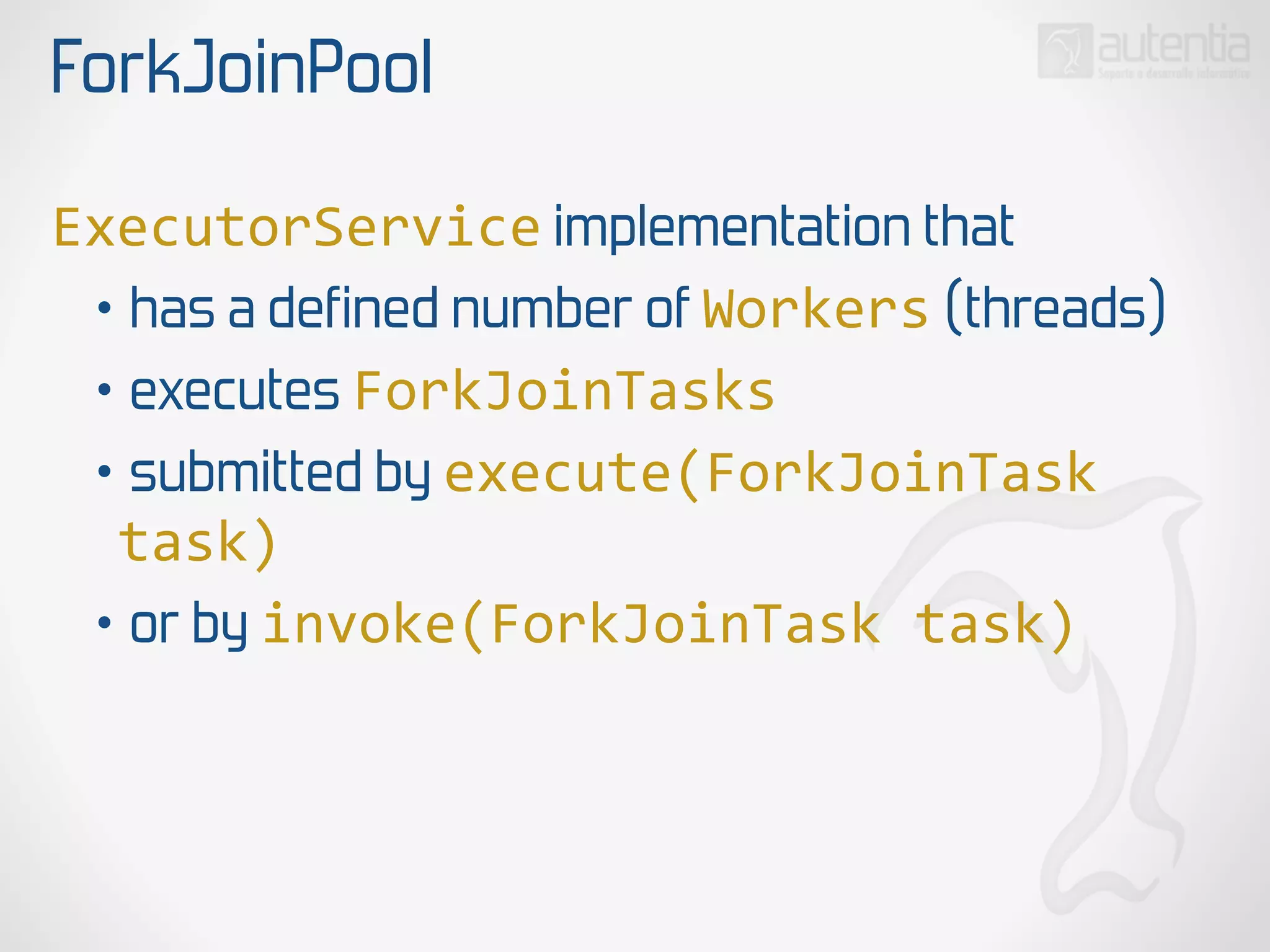
ForkJoinPool
ExecutorService implementation that
• has a defined number of Workers (threads)
• executes ForkJoinTasks
• submitted by execute(ForkJoinTask  
task)  
• or by invoke(ForkJoinTask  task)
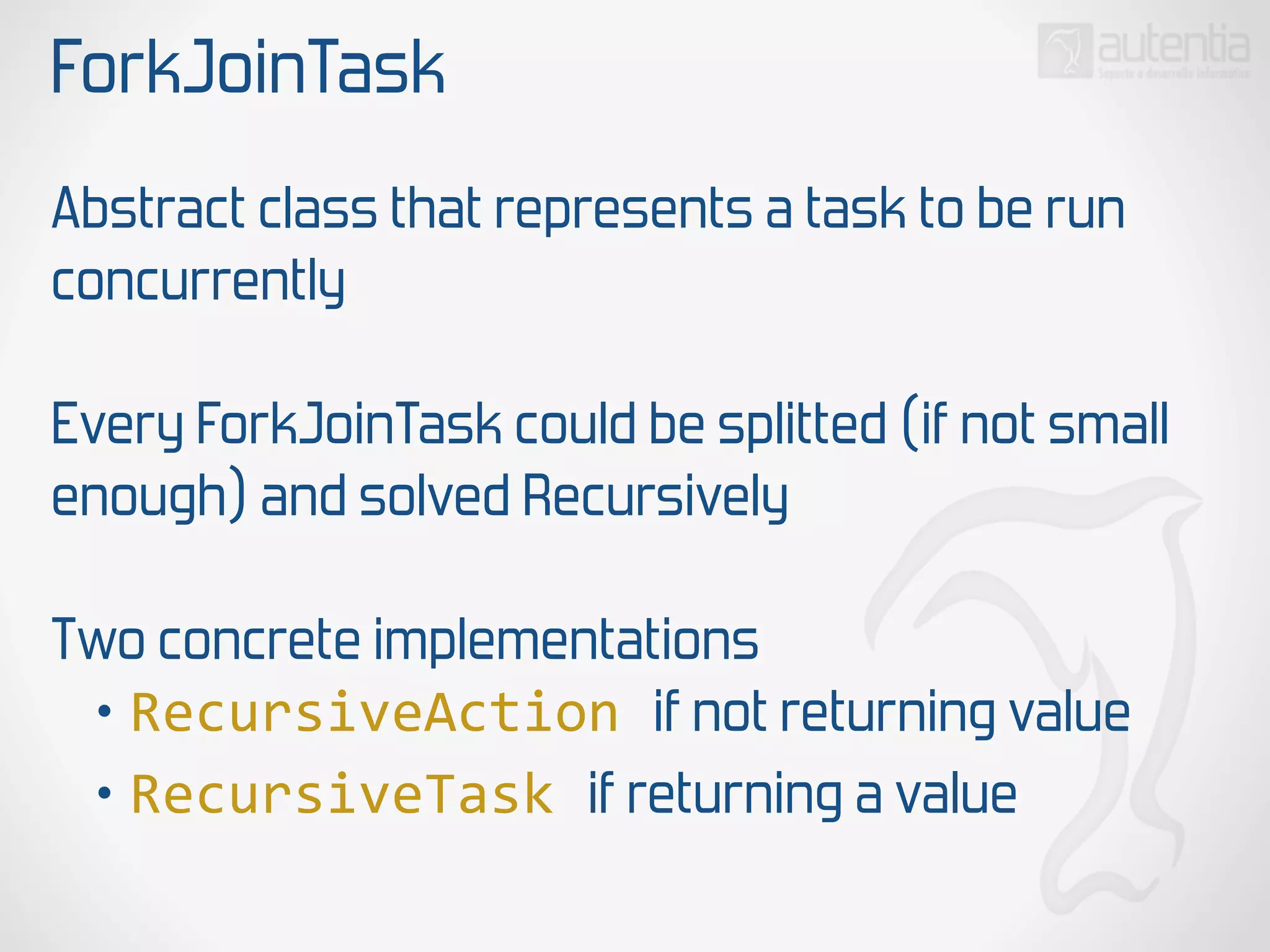
ForkJoinTask
Abstract class that represents a task to be run
concurrently
Every ForkJoinTask could be splitted (if not small
enough) and solved Recursively
Two concrete implementations
• RecursiveAction  if not returning value
• RecursiveTask  if returning a value
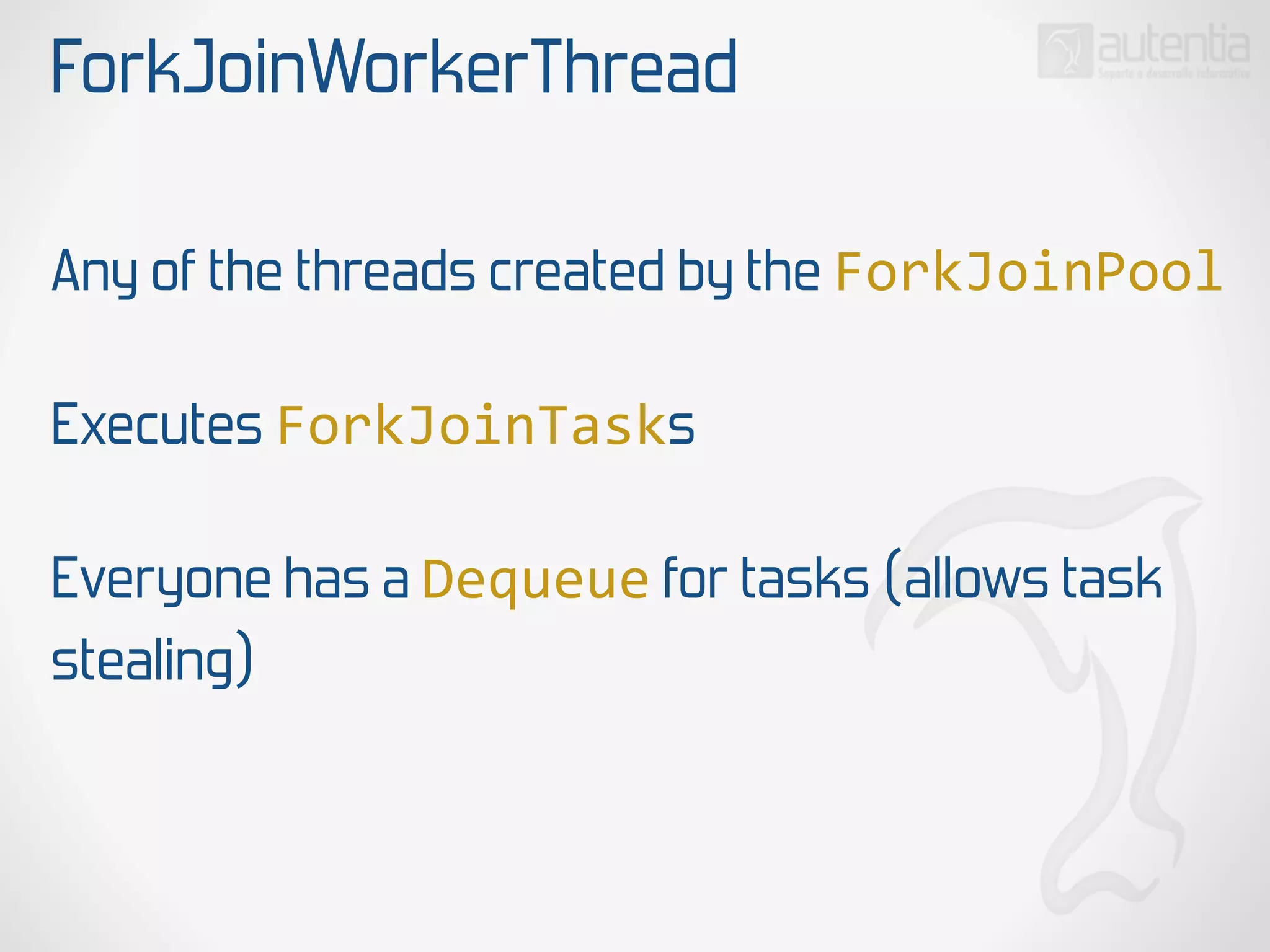
ForkJoinWorkerThread
Any of the threads created by the ForkJoinPool
Executes ForkJoinTasks
Everyone has a Dequeue for tasks (allows task
stealing)
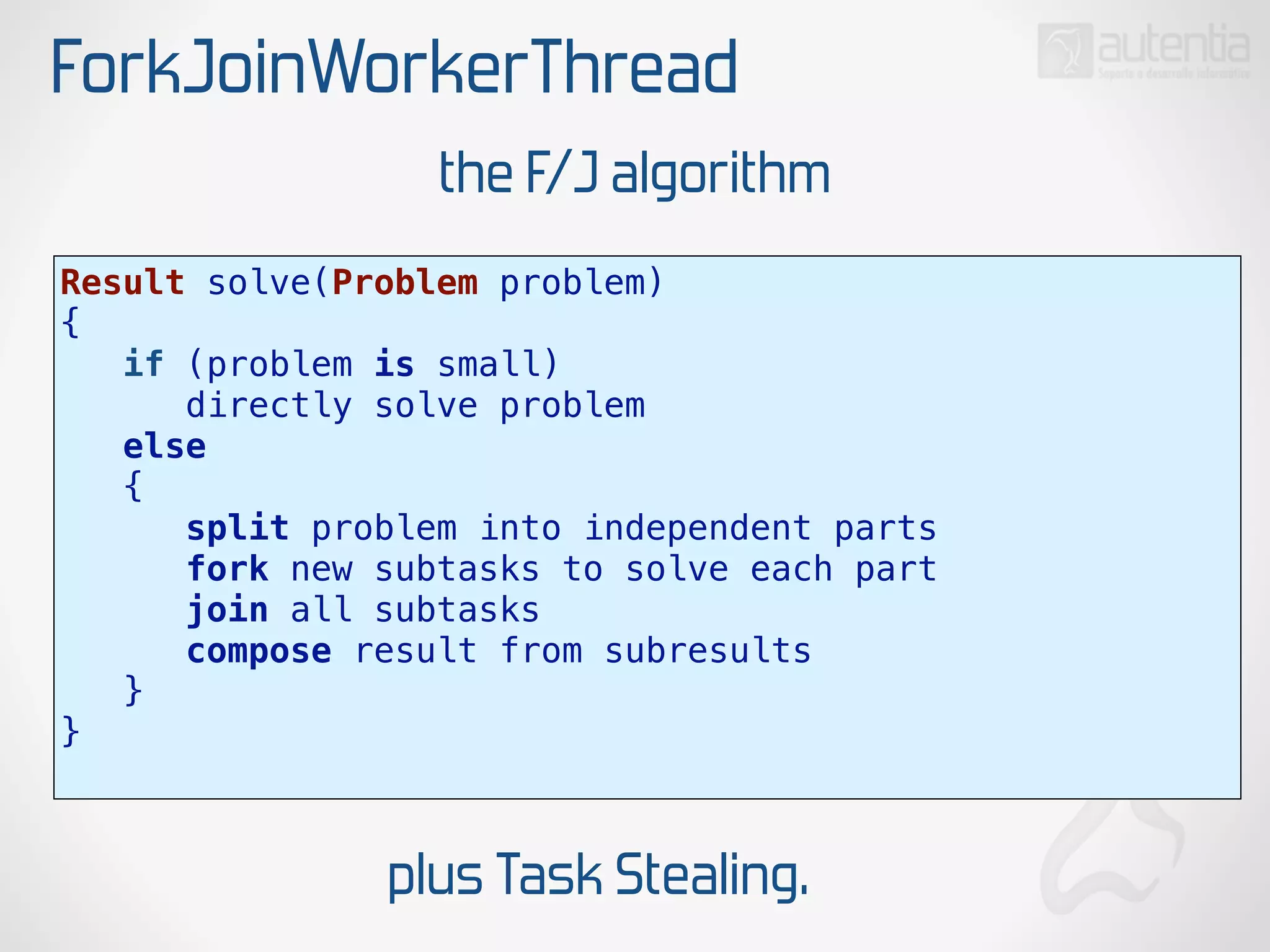
ForkJoinWorkerThread
Result solve(Problem problem)
{
if (problem is small)
directly solve problem
else
{
split problem into independent parts
fork new subtasks to solve each part
join all subtasks
compose result from subresults
}
}
the F/J algorithm
plus Task Stealing.
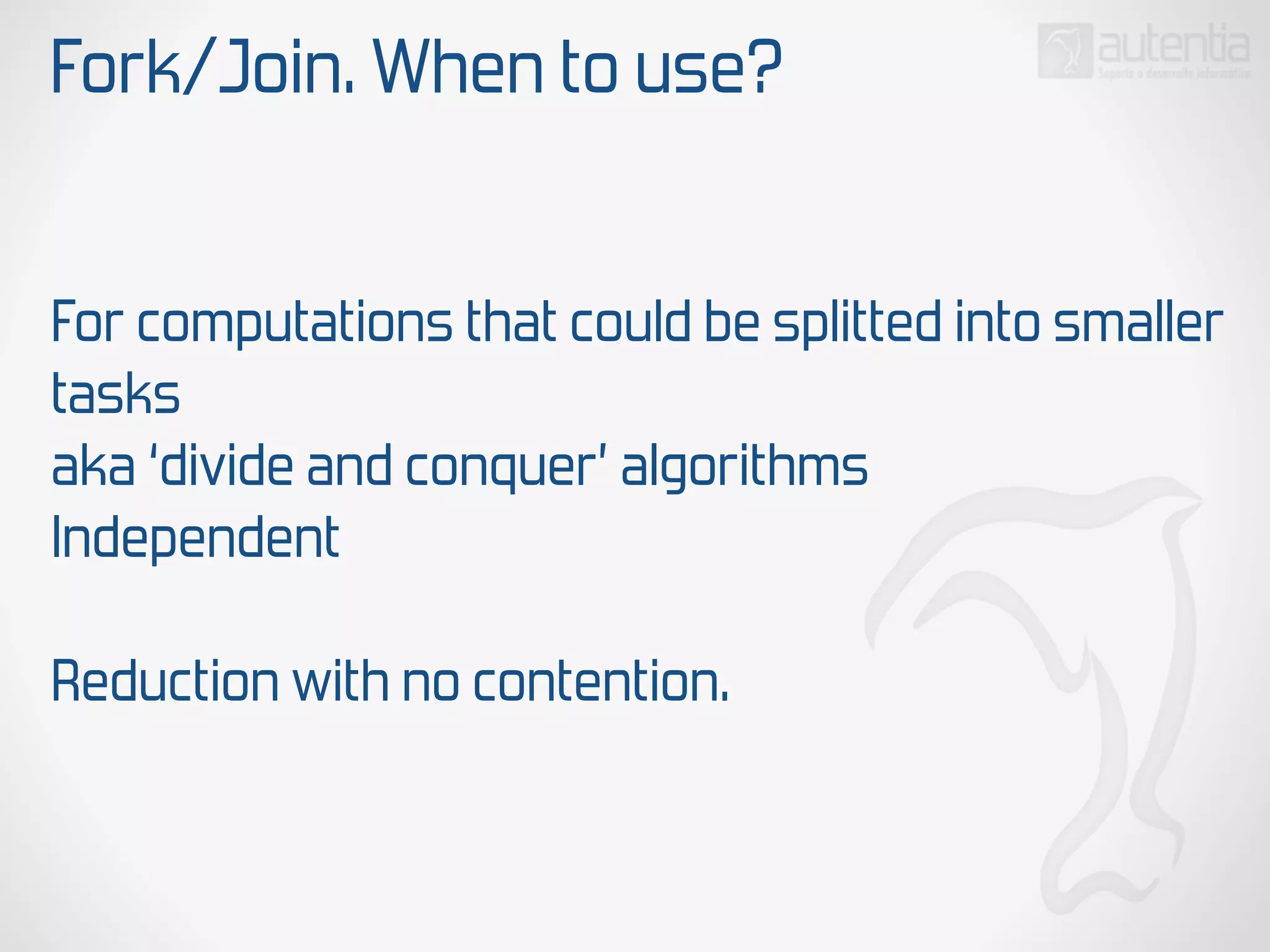
Fork/Join. When to use?
For computations that could be splitted into smaller
tasks
aka ‘divide and conquer’ algorithms
Independent
Reduction with no contention.
ParallelStreams
in action!
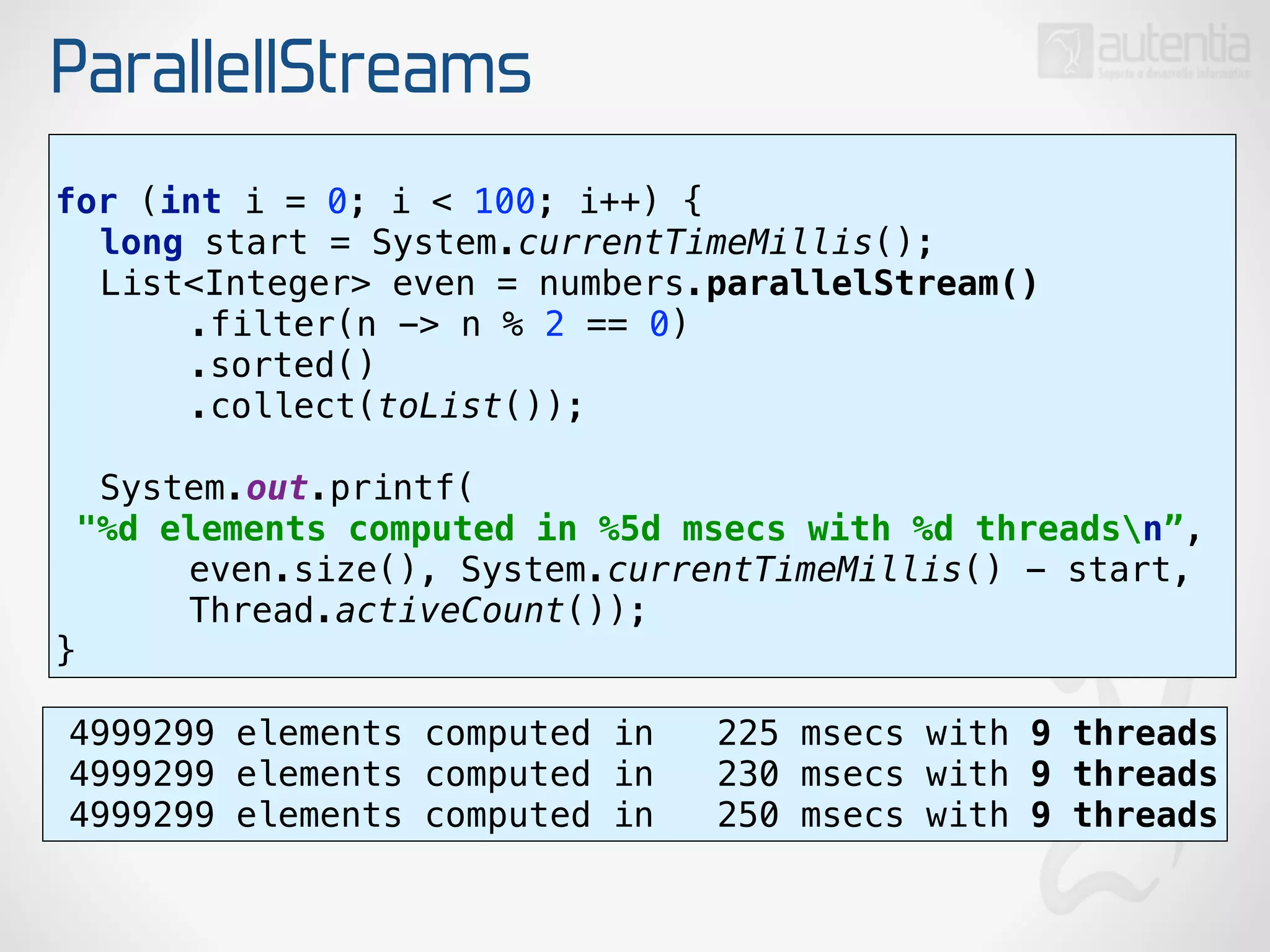
ParallellStreams
for (int i = 0; i < 100; i++) {

long start = System.currentTimeMillis();

List<Integer> even = numbers.parallelStream()

.filter(n -> n % 2 == 0)

.sorted()

.collect(toList());


System.out.printf(
"%d elements computed in %5d msecs with %d threadsn”,

even.size(), System.currentTimeMillis() - start,
Thread.activeCount());

}
4999299 elements computed in 225 msecs with 9 threads
4999299 elements computed in 230 msecs with 9 threads
4999299 elements computed in 250 msecs with 9 threads
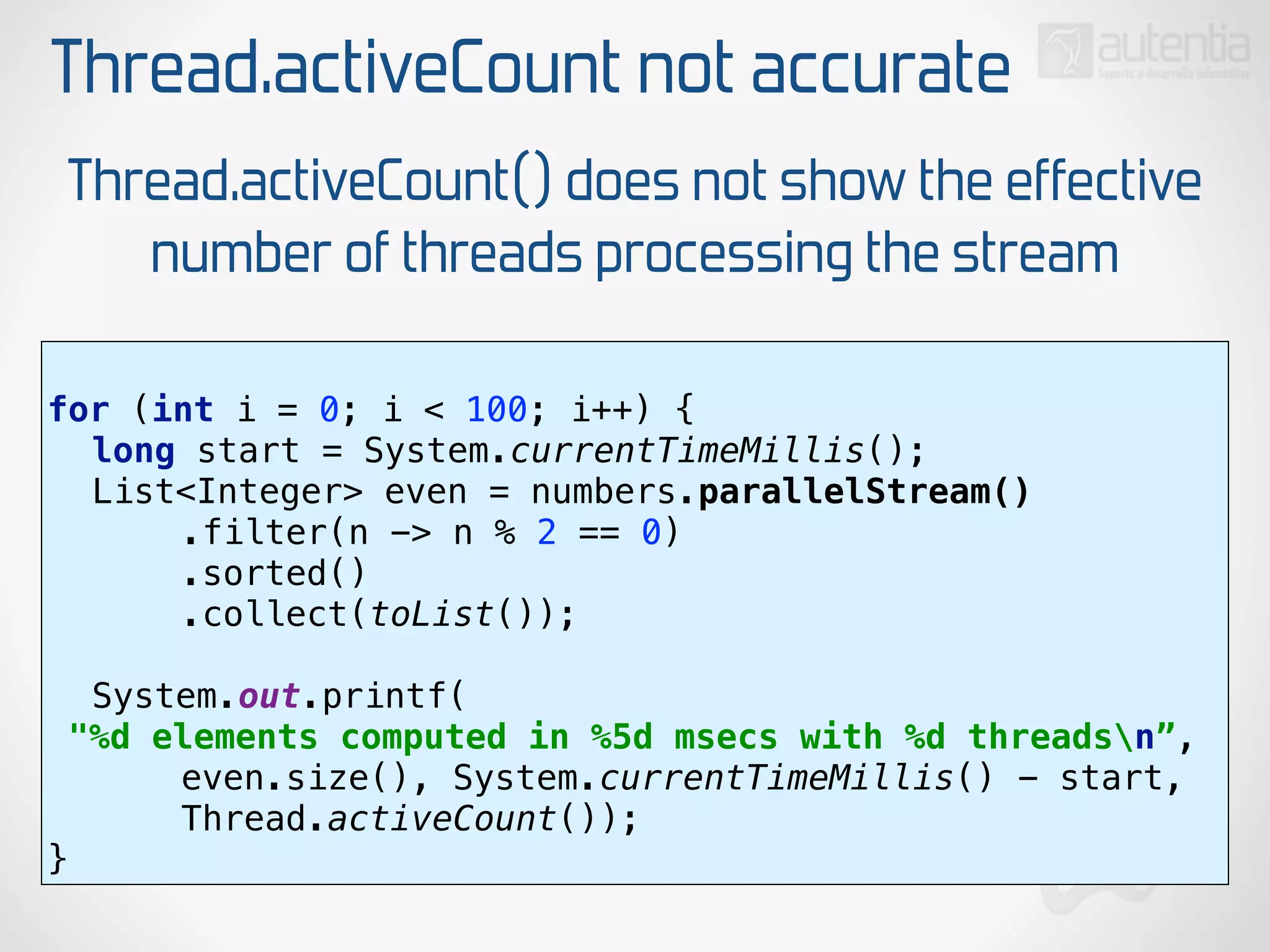
Thread.activeCount not accurate
for (int i = 0; i < 100; i++) {

long start = System.currentTimeMillis();

List<Integer> even = numbers.parallelStream()

.filter(n -> n % 2 == 0)

.sorted()

.collect(toList());


System.out.printf(
"%d elements computed in %5d msecs with %d threadsn”,

even.size(), System.currentTimeMillis() - start,
Thread.activeCount());

}
Thread.activeCount() does not show the effective
number of threads processing the stream
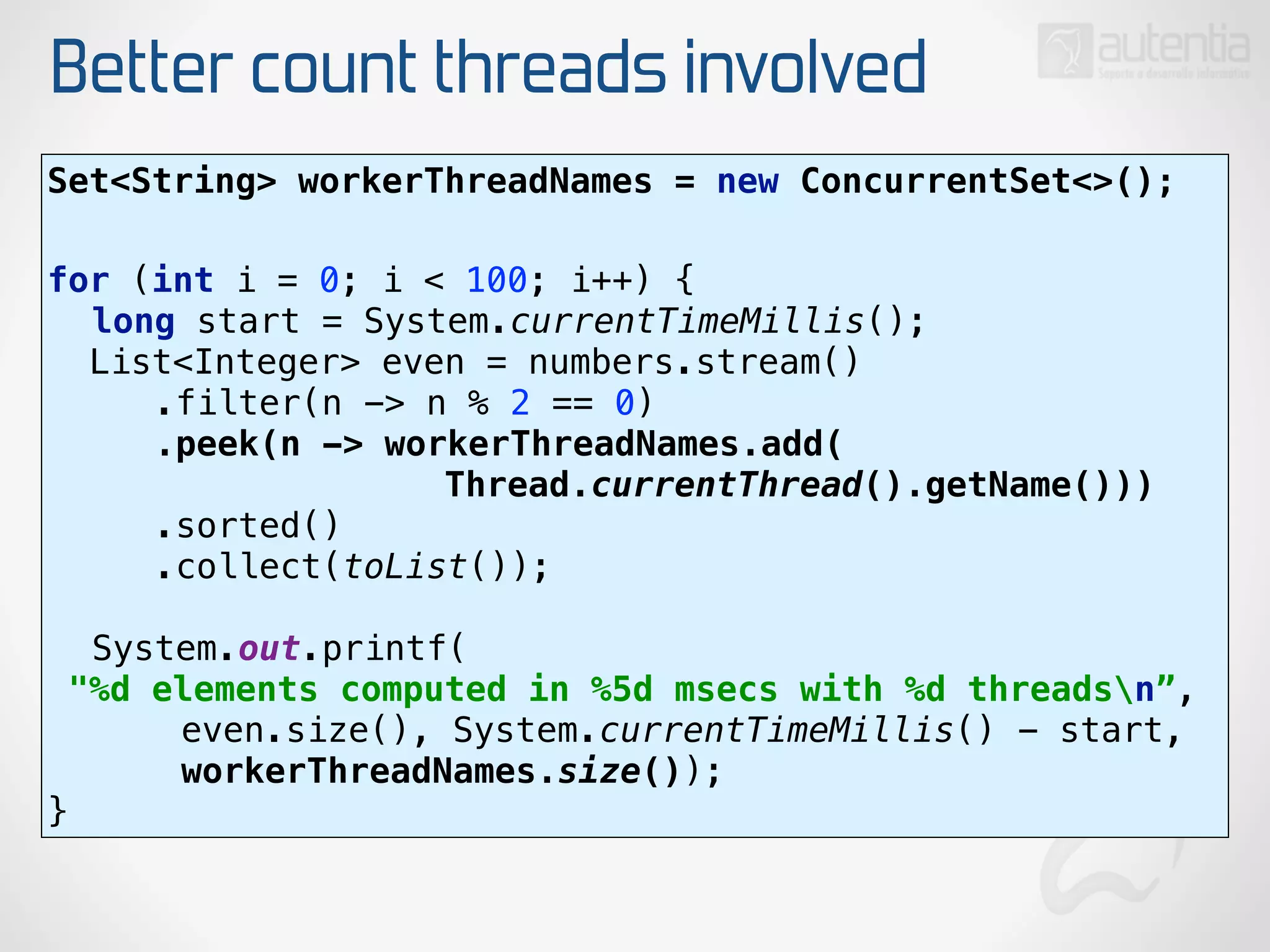
Better count threads involved
Set<String> workerThreadNames = new ConcurrentSet<>();

for (int i = 0; i < 100; i++) {

long start = System.currentTimeMillis();

List<Integer> even = numbers.stream()

.filter(n -> n % 2 == 0)

.peek(n -> workerThreadNames.add(
Thread.currentThread().getName()))

.sorted()

.collect(toList());


System.out.printf(
"%d elements computed in %5d msecs with %d threadsn”,

even.size(), System.currentTimeMillis() - start,
workerThreadNames.size());

}
Threads usage
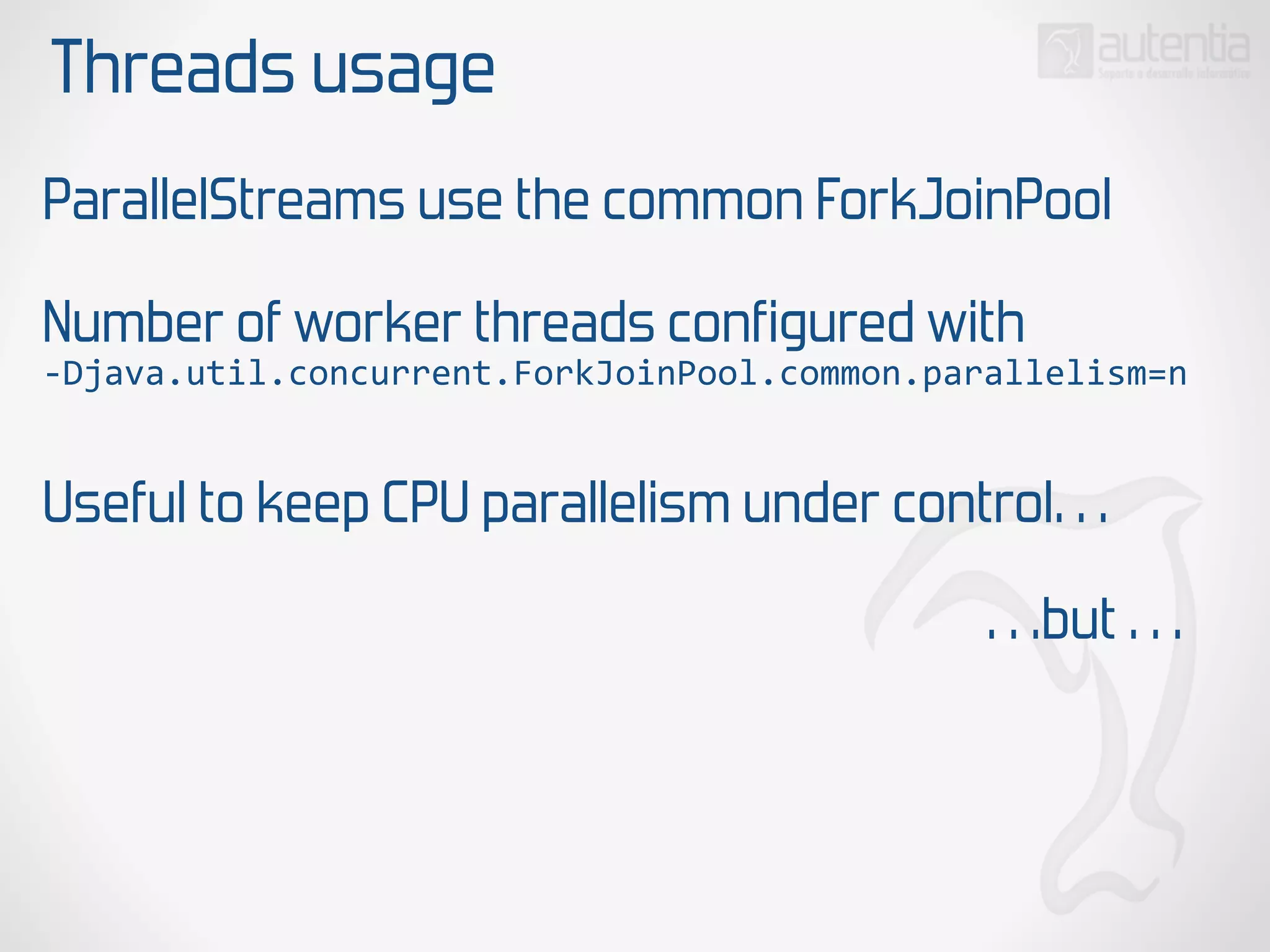
ParallelStreams use the common ForkJoinPool
Number of worker threads configured with
-­‐Djava.util.concurrent.ForkJoinPool.common.parallelism=n
Useful to keep CPU parallelism under control…
…but …
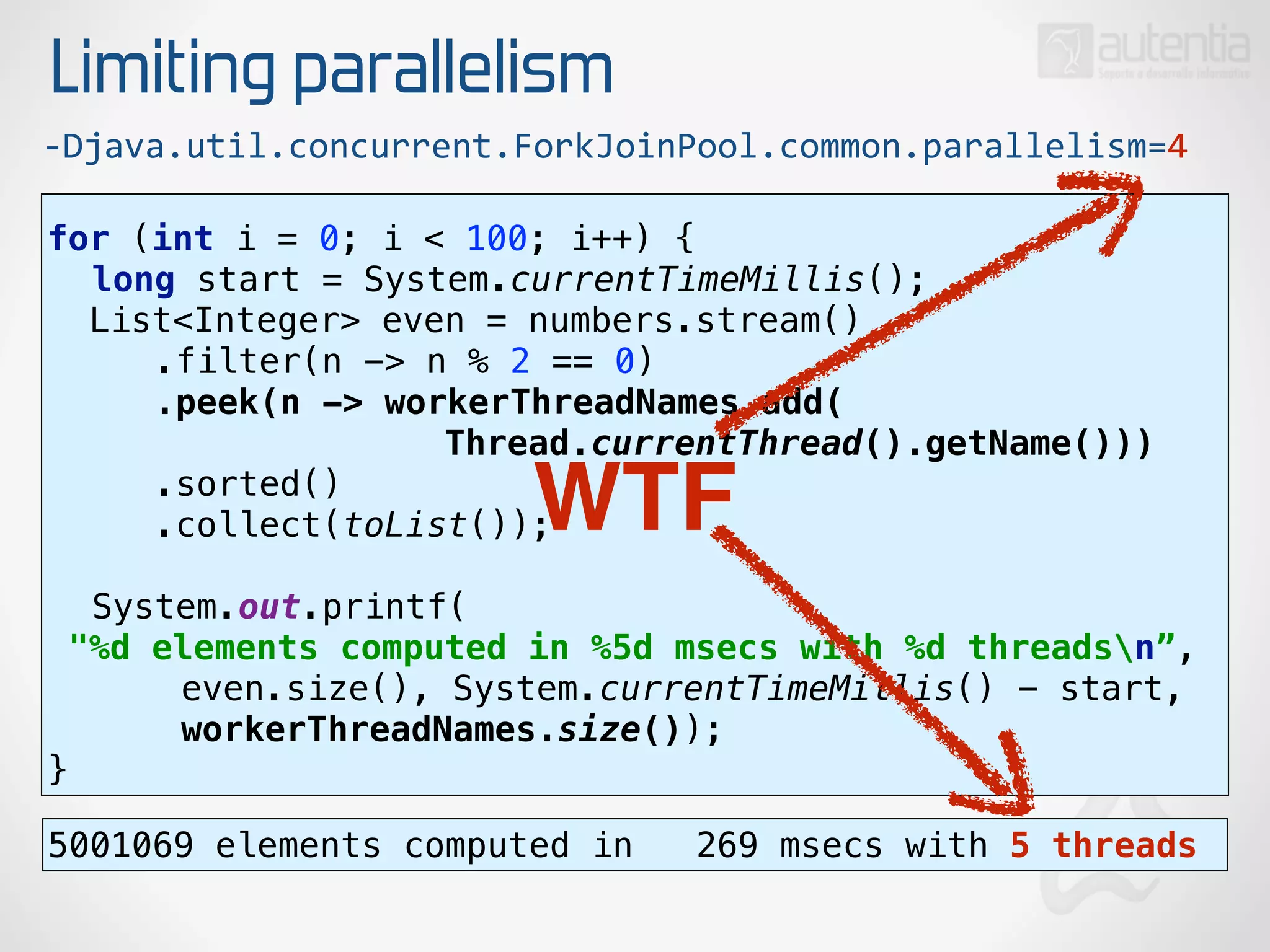
Limiting parallelism
for (int i = 0; i < 100; i++) {

long start = System.currentTimeMillis();

List<Integer> even = numbers.stream()

.filter(n -> n % 2 == 0)

.peek(n -> workerThreadNames.add(
Thread.currentThread().getName()))

.sorted()

.collect(toList());


System.out.printf(
"%d elements computed in %5d msecs with %d threadsn”,

even.size(), System.currentTimeMillis() - start,
workerThreadNames.size());

}
-­‐Djava.util.concurrent.ForkJoinPool.common.parallelism=4
5001069 elements computed in 269 msecs with 5 threads
WTF
Limiting parallelism
for (int i = 0; i < 100; i++) {

long start = System.currentTimeMillis();

List<Integer> even = numbers.stream()

.filter(n -> n % 2 == 0)

.peek(n -> workerThreadNames.add(
Thread.currentThread().getName()))

.sorted()

.collect(toList());


System.out.printf(
"%d elements computed in %5d msecs with %d threadsn”,

even.size(), System.currentTimeMillis() - start,
workerThreadNames.size());

}
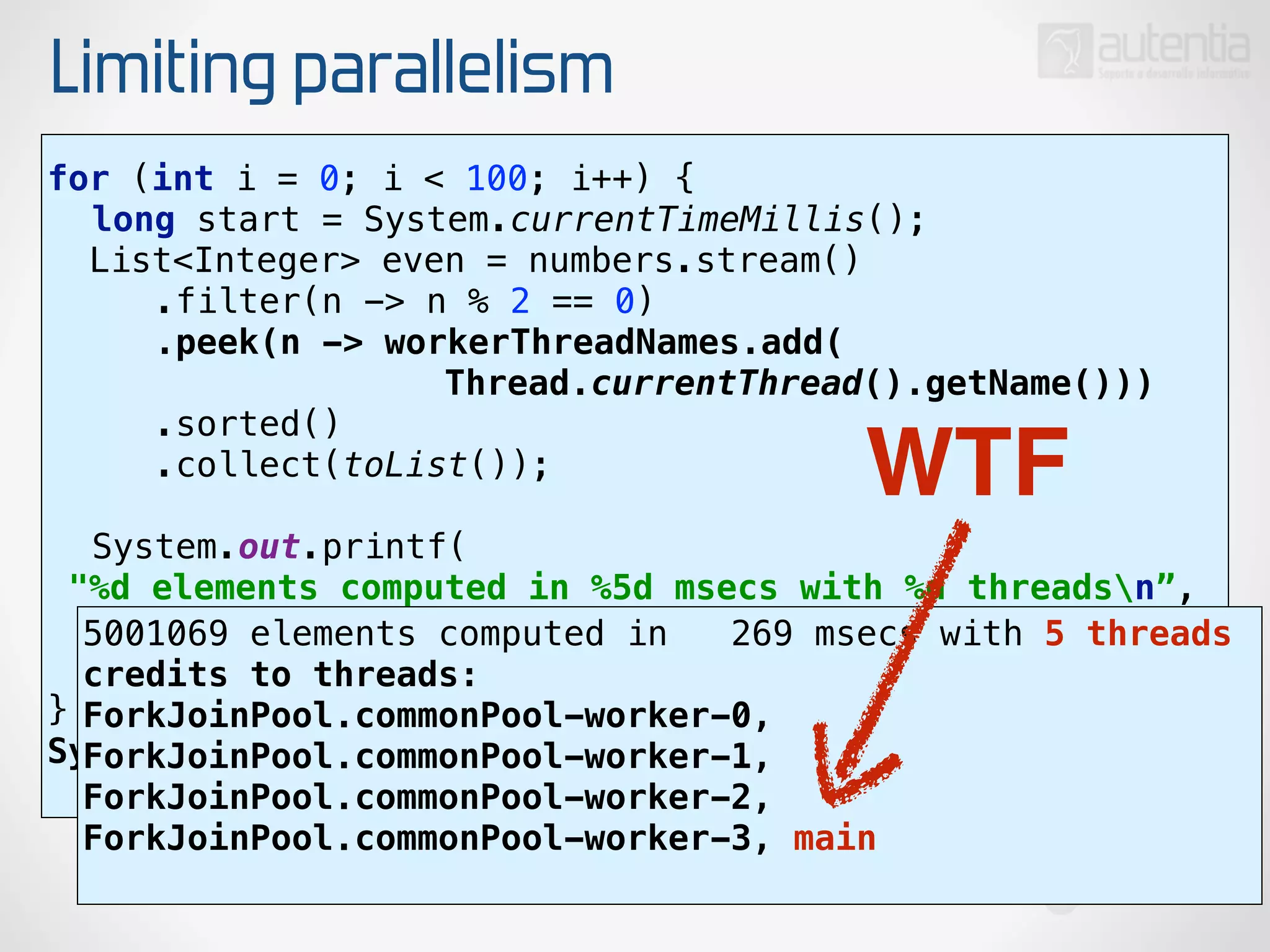
System.out.println("credits to threads: “
+ workerThreadNames);
5001069 elements computed in 269 msecs with 5 threads
credits to threads:
ForkJoinPool.commonPool-worker-0,
ForkJoinPool.commonPool-worker-1,
ForkJoinPool.commonPool-worker-2,
ForkJoinPool.commonPool-worker-3, main
WTF
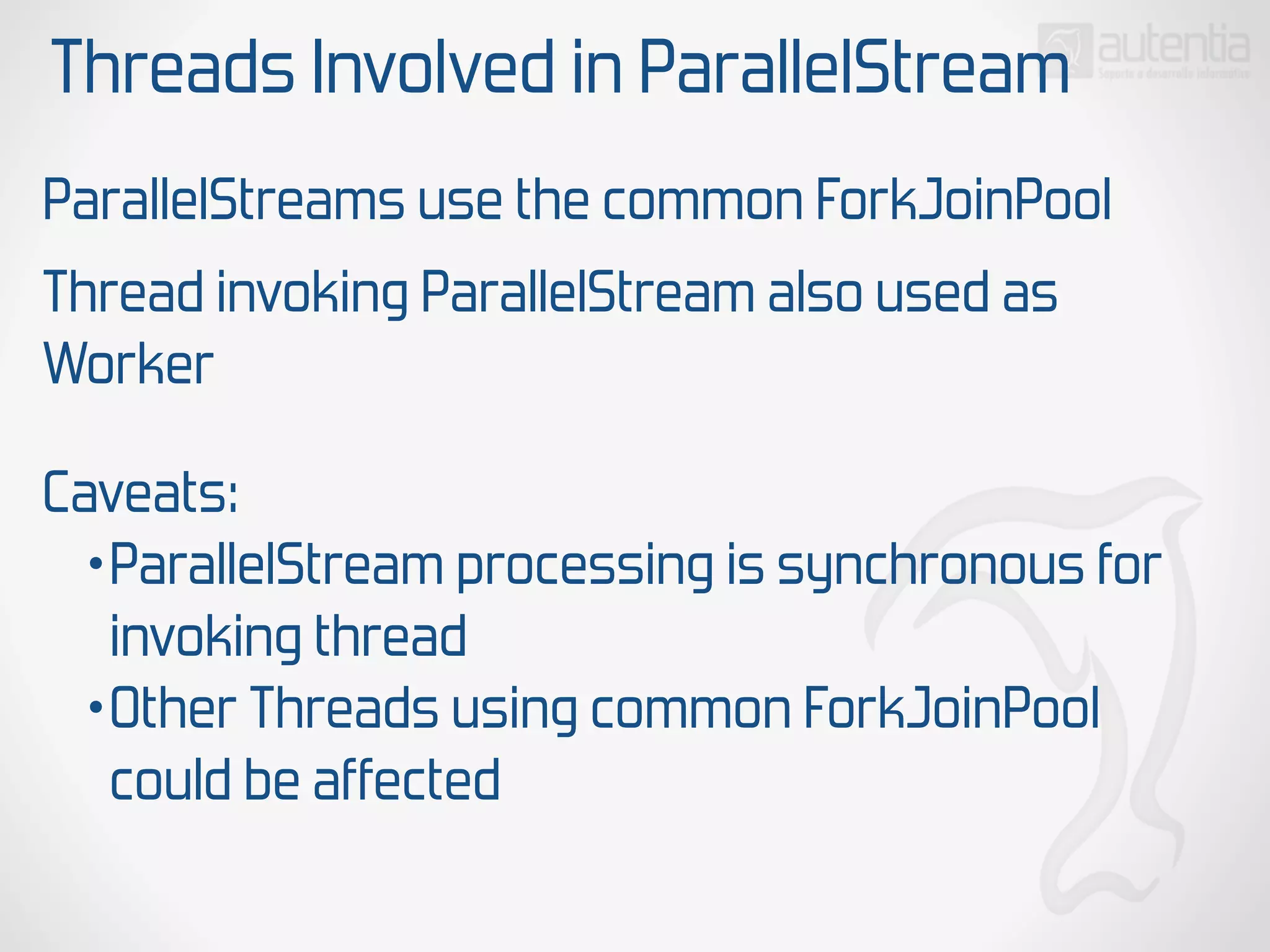
Threads Involved in ParallelStream
ParallelStreams use the common ForkJoinPool
Thread invoking ParallelStream also used as
Worker
Caveats:
•ParallelStream processing is synchronous for
invoking thread
•Other Threads using common ForkJoinPool
could be affected
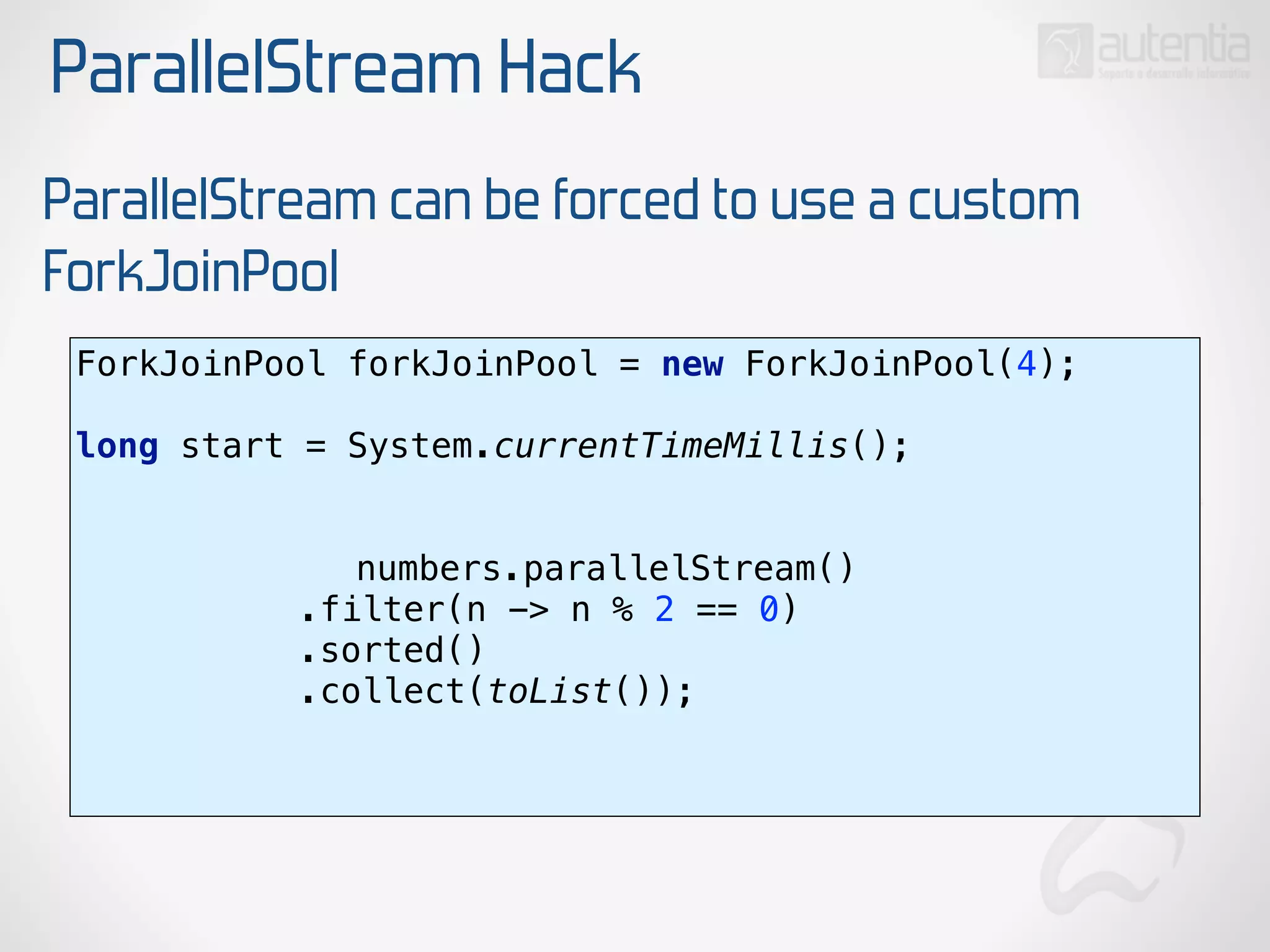
ParallelStream Hack
ParallelStream can be forced to use a custom
ForkJoinPool
ForkJoinPool forkJoinPool = new ForkJoinPool(4);


long start = System.currentTimeMillis();

numbers.parallelStream()

.filter(n -> n % 2 == 0)

.sorted()

.collect(toList());


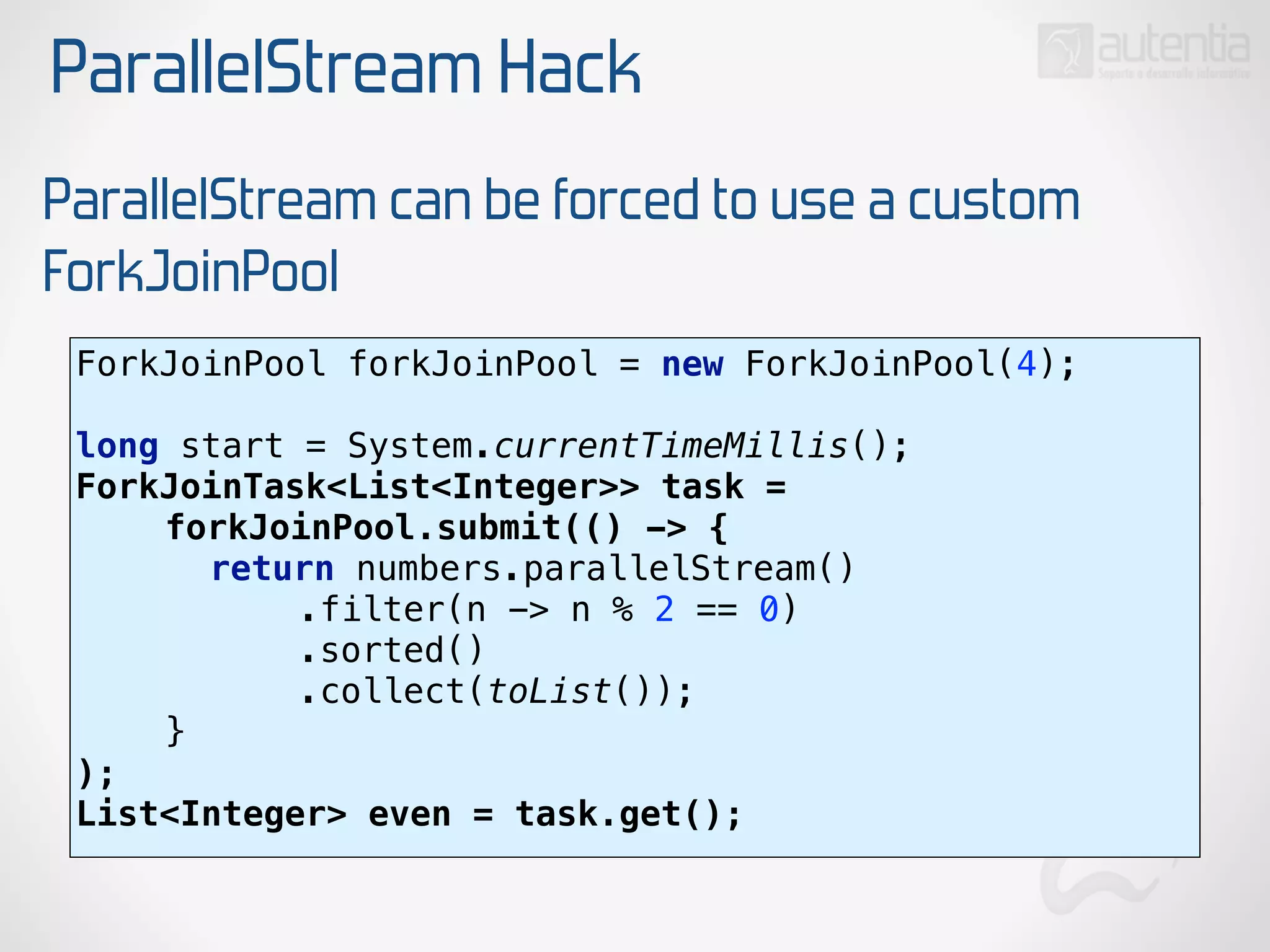
ParallelStream Hack
ParallelStream can be forced to use a custom
ForkJoinPool
ForkJoinPool forkJoinPool = new ForkJoinPool(4);


long start = System.currentTimeMillis();

ForkJoinTask<List<Integer>> task =

forkJoinPool.submit(() -> {

return numbers.parallelStream()

.filter(n -> n % 2 == 0)

.sorted()

.collect(toList());

}

);
List<Integer> even = task.get();
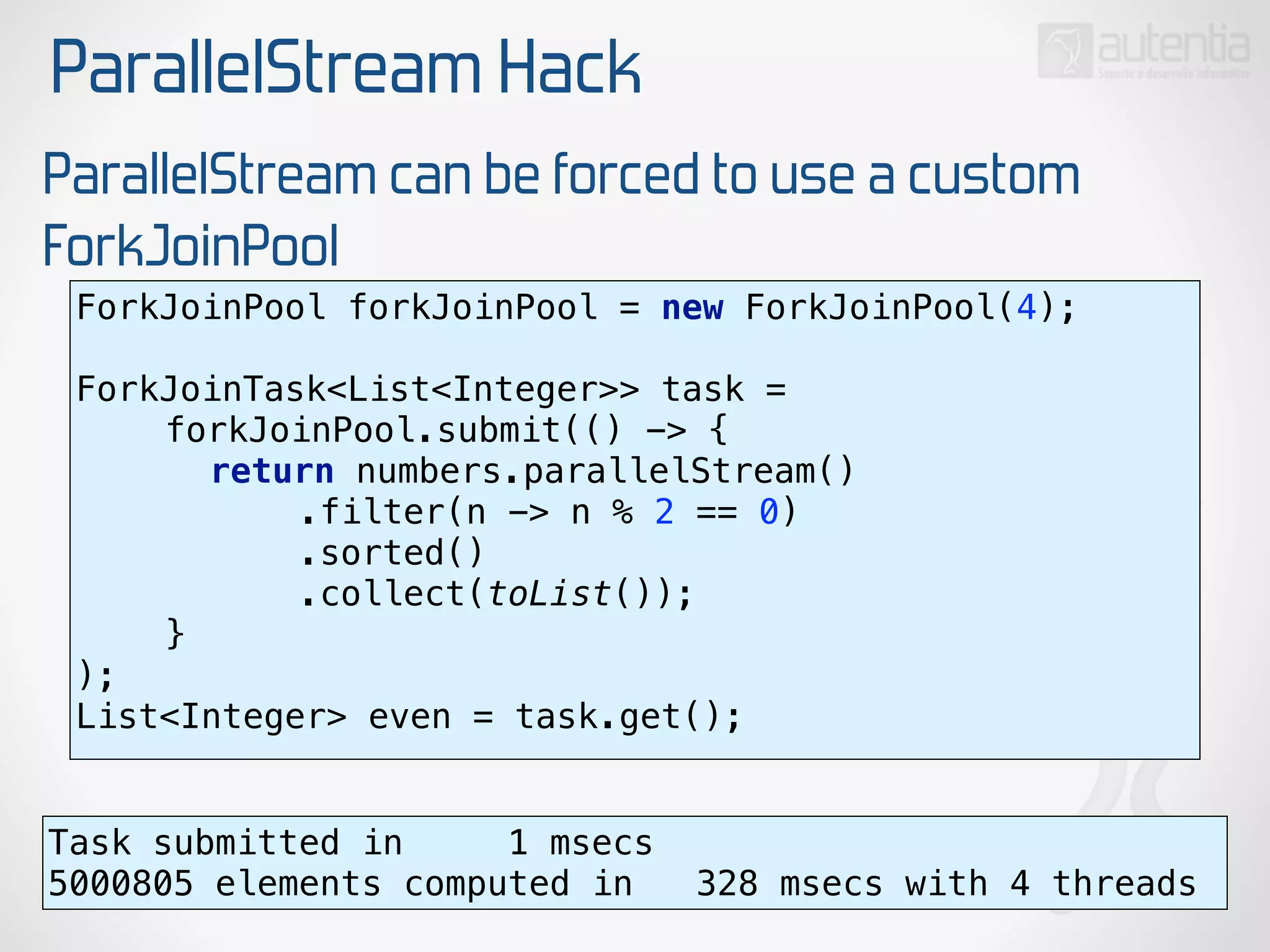
ParallelStream Hack
ParallelStream can be forced to use a custom
ForkJoinPool
ForkJoinPool forkJoinPool = new ForkJoinPool(4);


ForkJoinTask<List<Integer>> task =

forkJoinPool.submit(() -> {

return numbers.parallelStream()

.filter(n -> n % 2 == 0)

.sorted()

.collect(toList());

}

);
List<Integer> even = task.get();
Task submitted in 1 msecs
5000805 elements computed in 328 msecs with 4 threads
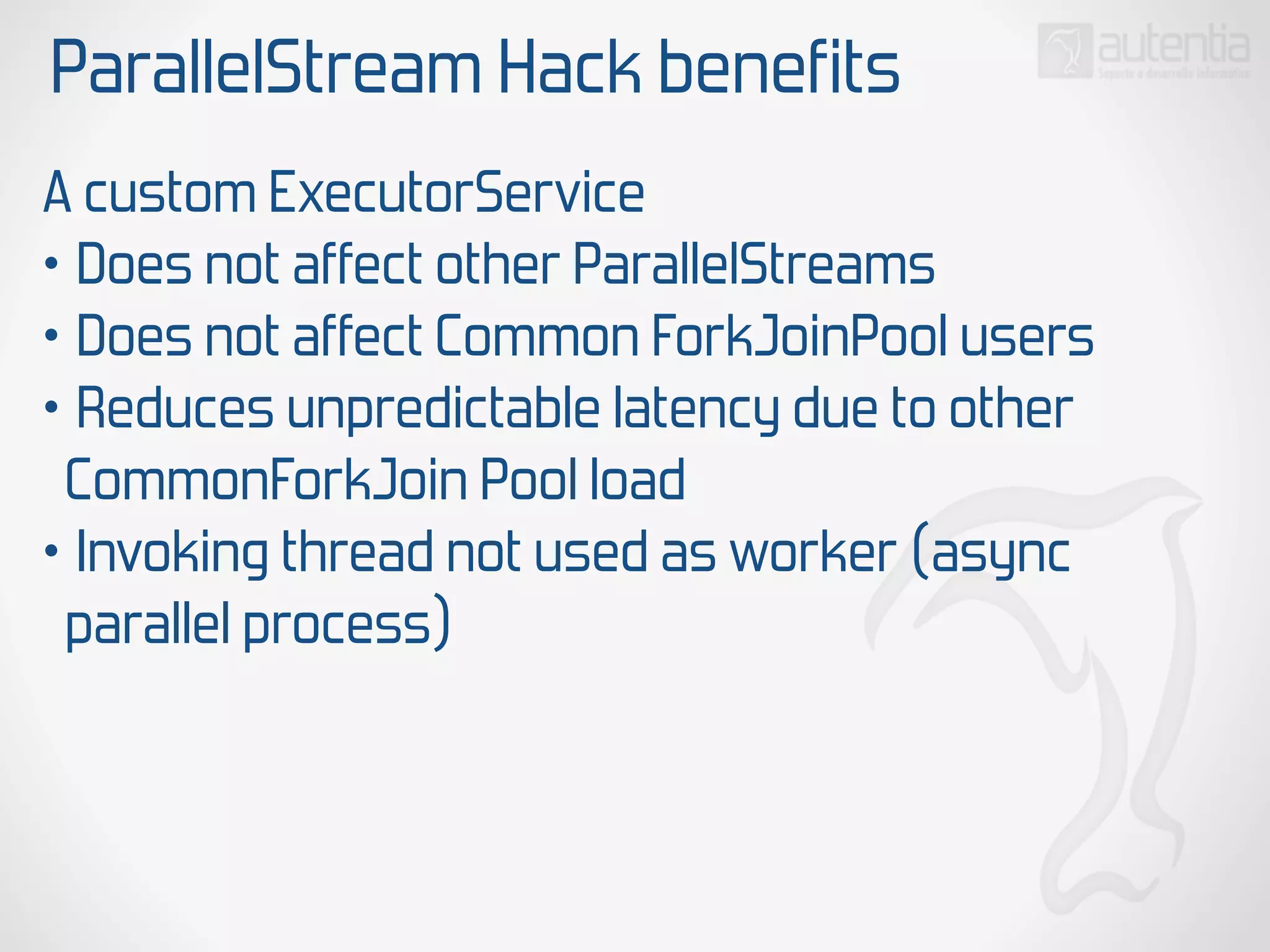
ParallelStream Hack benefits
A custom ExecutorService
• Does not affect other ParallelStreams
• Does not affect Common ForkJoinPool users
• Reduces unpredictable latency due to other
CommonForkJoin Pool load
• Invoking thread not used as worker (async
parallel process)
Problems derived from
Common ForkJoinPool
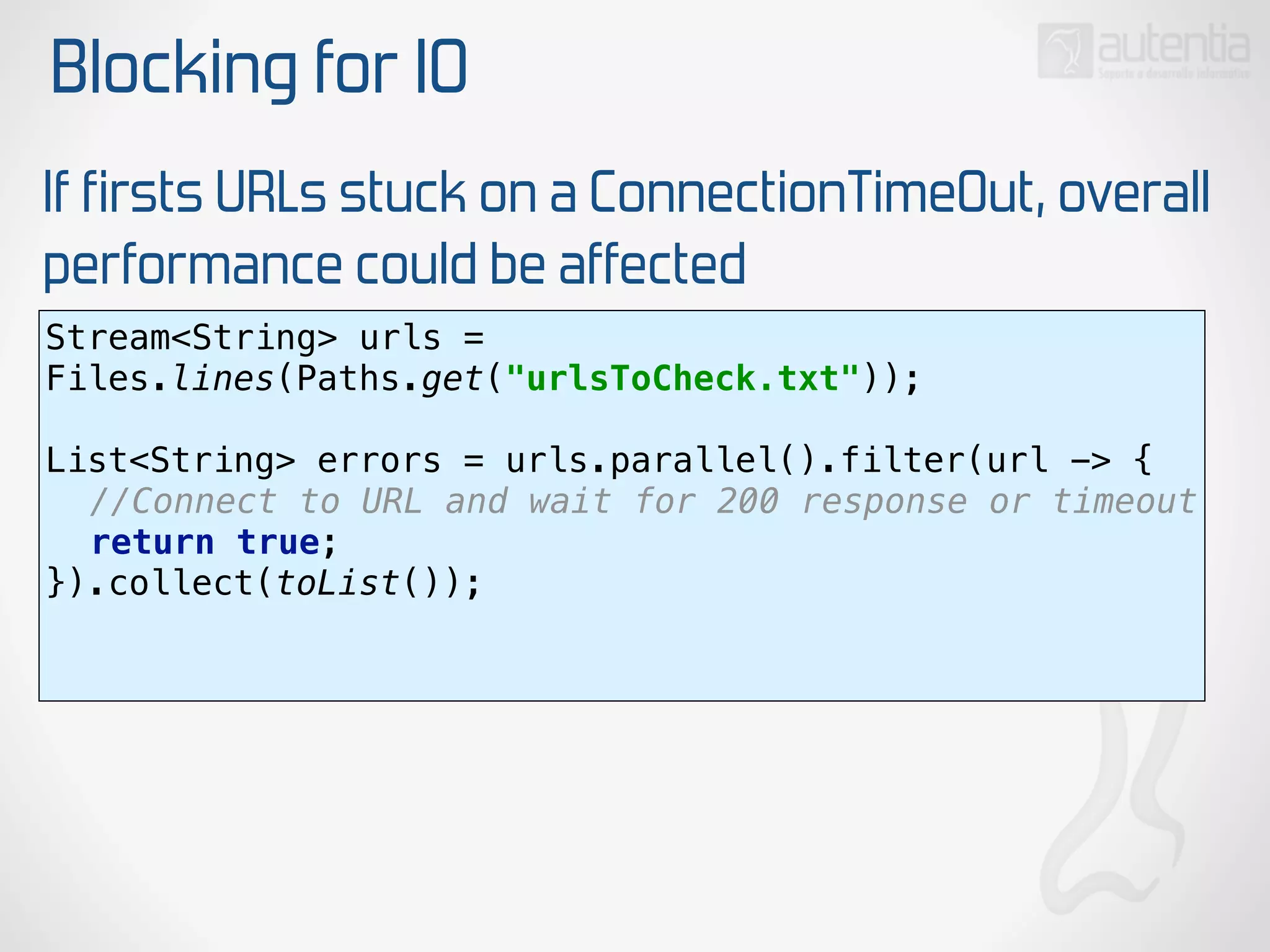
Blocking for IO
If firsts URLs stuck on a ConnectionTimeOut, overall
performance could be affected
Stream<String> urls =
Files.lines(Paths.get("urlsToCheck.txt"));


List<String> errors = urls.parallel().filter(url -> {

//Connect to URL and wait for 200 response or timeout

return true;

}).collect(toList());

Nested parallelStreams
Outer parallelStream could exhaust ForkJoin
Workers:
long start = System.currentTimeMillis();

IntStream.range(0, 10_000).parallel()
.forEach(i -> {

results[i][0] = (int) Math.round(Math.random() * 100);


IntStream.range(1, 9_999)
.parallel().forEach((int j) ->
results[i][j] =
(int) Math.round(Math.random() * 1000));


});

Process finalized in 22974 msecs
Process finalized in 22575 msecs
Process finalized in 22606 msecs
Nested parallelStreams
Outer parallelStream could exhaust ForkJoin
Workers:
long start = System.currentTimeMillis();

IntStream.range(0, 10_000).parallel()
.forEach(i -> {

results[i][0] = (int) Math.round(Math.random() * 100);


IntStream.range(1, 9_999)
.sequential().forEach((int j) ->
results[i][j] =
(int) Math.round(Math.random() * 1000));


});

Process finalized in 12491 msecs
Process finalized in 12589 msecs
Process finalized in 12798 msecs
Other performance
problems
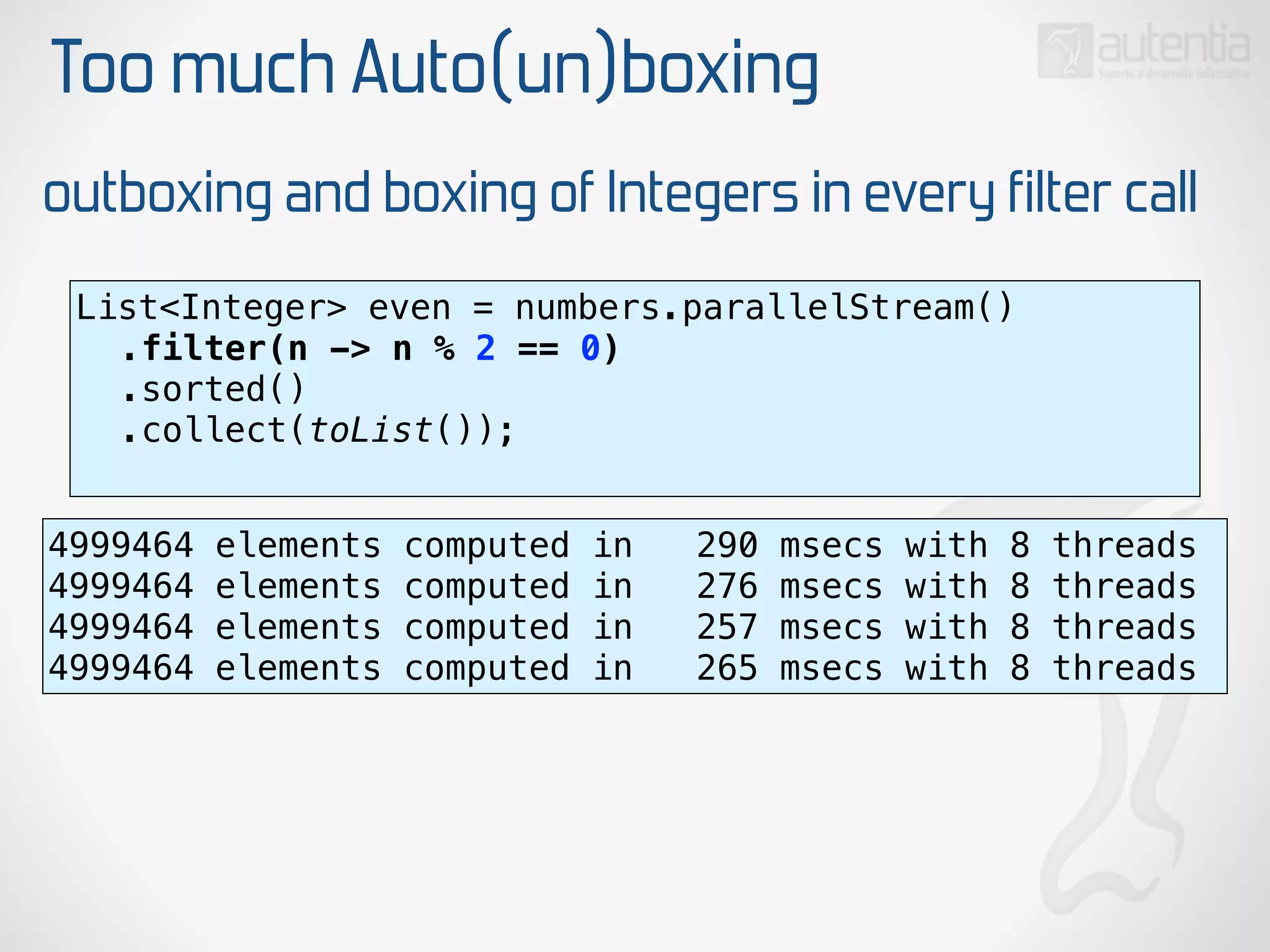
Too much Auto(un)boxing
outboxing and boxing of Integers in every filter call
List<Integer> even = numbers.parallelStream()

.filter(n -> n % 2 == 0)

.sorted()

.collect(toList());

4999464 elements computed in 290 msecs with 8 threads
4999464 elements computed in 276 msecs with 8 threads
4999464 elements computed in 257 msecs with 8 threads
4999464 elements computed in 265 msecs with 8 threads
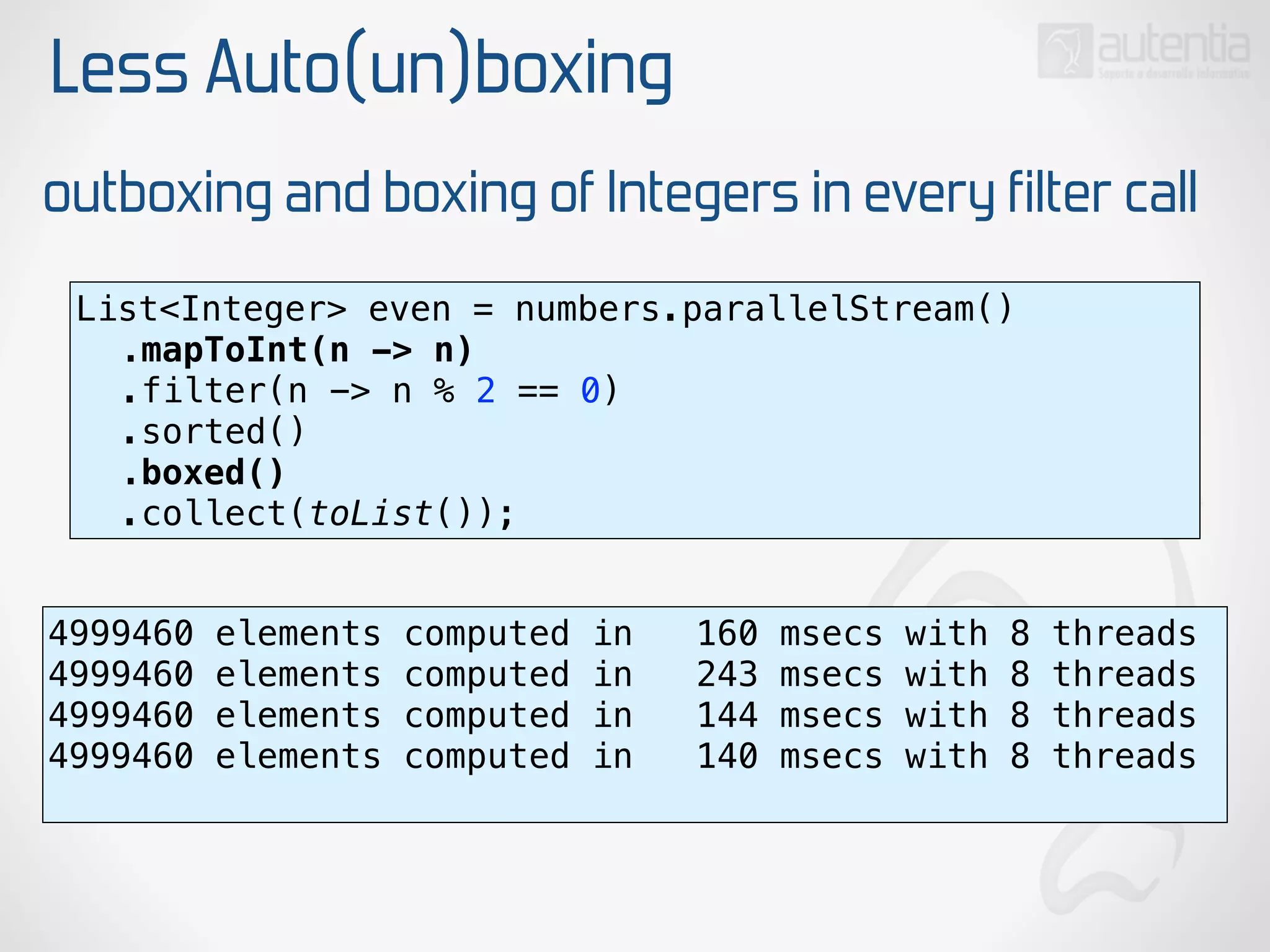
Less Auto(un)boxing
outboxing and boxing of Integers in every filter call
List<Integer> even = numbers.parallelStream()

.mapToInt(n -> n)

.filter(n -> n % 2 == 0)

.sorted()

.boxed()

.collect(toList());
4999460 elements computed in 160 msecs with 8 threads
4999460 elements computed in 243 msecs with 8 threads
4999460 elements computed in 144 msecs with 8 threads
4999460 elements computed in 140 msecs with 8 threads
Conclusions
Conclusions
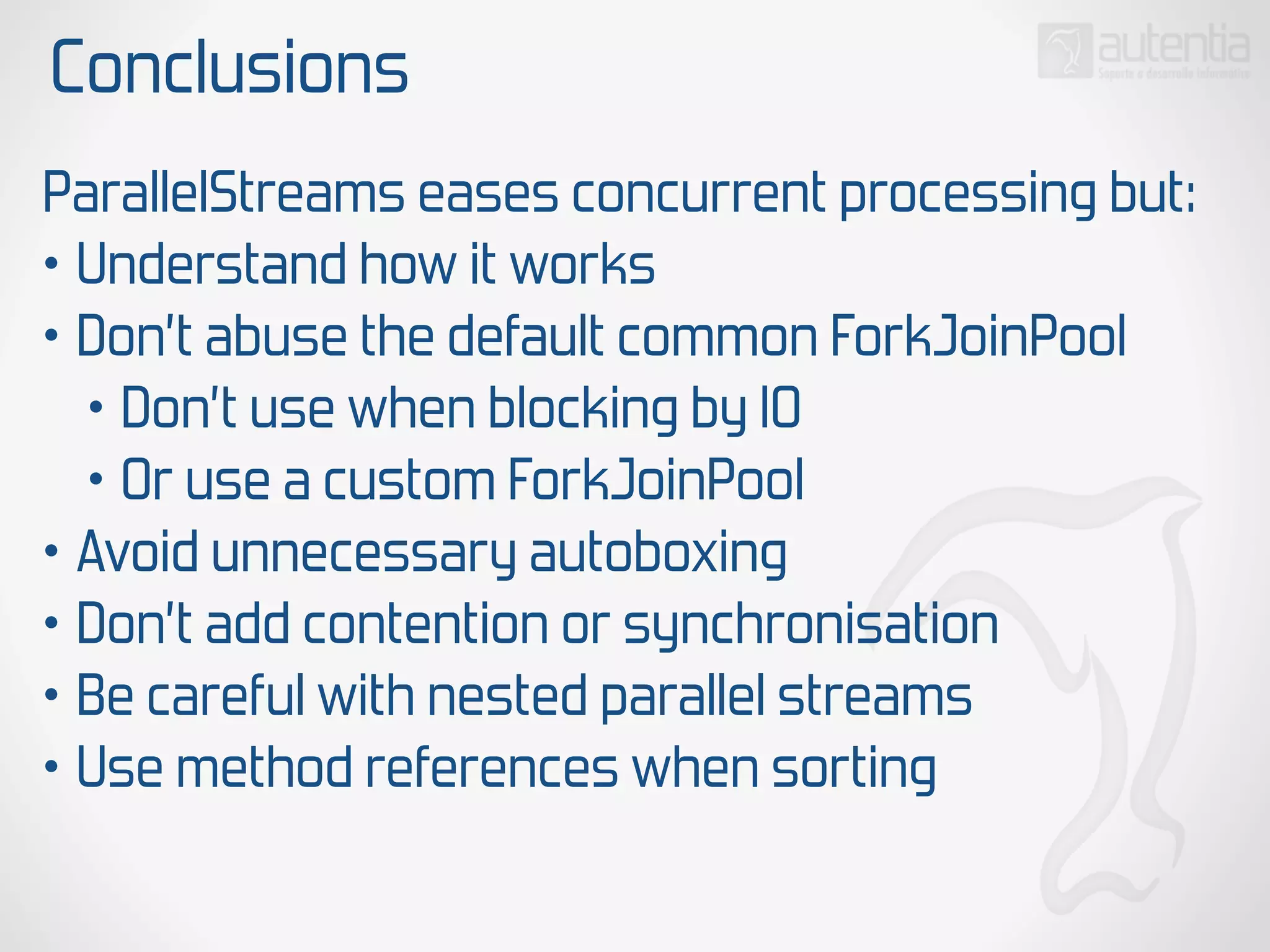
ParallelStreams eases concurrent processing but:
• Understand how it works
• Don’t abuse the default common ForkJoinPool
• Don’t use when blocking by IO
• Or use a custom ForkJoinPool
• Avoid unnecessary autoboxing
• Don’t add contention or synchronisation
• Be careful with nested parallel streams
• Use method references when sorting
Thank You.
@dgomezg
dgomezg@autentia.com

Parallel streams in java 8

  • 1.
    ParallelStreams Concurrent data processingin Java 8 David Gómez G. @dgomezg dgomezg@autentia.com
  • 2.
    Do you remember? usestream() for (int i = 0; i < 100; i++) {
 long start = System.currentTimeMillis();
 List<Integer> even = numbers.parallelStream()
 .filter(n -> n % 2 == 0)
 .sorted()
 .collect(toList()); 
 System.out.printf( "%d elements computed in %5d msecs with %d threadsn”,
 even.size(), System.currentTimeMillis() - start, Thread.activeCount());
 } 4999299 elements computed in 225 msecs with 9 threads 4999299 elements computed in 230 msecs with 9 threads 4999299 elements computed in 250 msecs with 9 threads @dgomezg
  • 3.
  • 4.
  • 5.
    A Stream is… Anconvenience method to iterate over collections in a declarative way List<Integer>  numbers  =  new  ArrayList<Integer>();
 for  (int  i=  0;  i  <  100  ;  i++)  {
   numbers.add(i);
 }   List<Integer> evenNumbers = numbers.stream()
 .filter(n -> n % 2 == 0)
 .collect(toList()); @dgomezg
  • 6.
    Anatomy of aStream Source Intermediate Operations filter map order function Final operation pipeline @dgomezg
  • 7.
    Iterating a Stream List<Integer>evenNumbers = numbers.stream()
 .filter(n -> n % 2 == 0)
 .collect(toList()); Internal Iteration - No manual Iterators handling - Concise - Fluent API: chain sequence processing Elements computed only when needed @dgomezg
  • 8.
    Iterating a Stream List<Integer>evenNumbers = numbers.parallelStream()
 .filter(n -> n % 2 == 0)
 .collect(toList()); Easily Parallelism - Concurrency is hard to be done right! - Uses ForkJoin - Process steps should be - stateless - independent @dgomezg
  • 9.
    Parallel Streams use stream() List<Integer>numbers = new ArrayList<>();
 for (int i= 0; i < 10_000_000 ; i++) {
 numbers.add((int)Math.round(Math.random()*100));
 } //This will use just a single thread Stream<Integer> evenNumbers = numbers.stream(); or parallelStream() //Automatically select the optimum number of threads Stream<Integer> evenNumbers = numbers.parallelStream(); @dgomezg
  • 10.
    Let’s test it usestream() for (int i = 0; i < 100; i++) {
 long start = System.currentTimeMillis();
 List<Integer> even = numbers.stream()
 .filter(n -> n % 2 == 0)
 .sorted()
 .collect(toList()); 
 System.out.printf( "%d elements computed in %5d msecs with %d threadsn”,
 even.size(), System.currentTimeMillis() - start, Thread.activeCount());
 } 5001983 elements computed in 828 msecs with 2 threads 5001983 elements computed in 843 msecs with 2 threads 5001983 elements computed in 675 msecs with 2 threads 5001983 elements computed in 795 msecs with 2 threads @dgomezg
  • 11.
    Going parallel use stream() for(int i = 0; i < 100; i++) {
 long start = System.currentTimeMillis();
 List<Integer> even = numbers.parallelStream()
 .filter(n -> n % 2 == 0)
 .sorted()
 .collect(toList()); 
 System.out.printf( "%d elements computed in %5d msecs with %d threadsn”,
 even.size(), System.currentTimeMillis() - start, Thread.activeCount());
 } 4999299 elements computed in 225 msecs with 9 threads 4999299 elements computed in 230 msecs with 9 threads 4999299 elements computed in 250 msecs with 9 threads @dgomezg
  • 12.
  • 13.
  • 14.
    Fork/Join Framework Proposed byDoug Lea "a style of parallel programming in which problems are solved by (recursively) splitting them into subtasks that are solved in parallel." Available in Java 7 Used by ParallelStreams
  • 15.
    The F/J algorithm Resultsolve(Problem problem) { if (problem is small) directly solve problem else { split problem into independent parts fork new subtasks to solve each part join all subtasks compose result from subresults } } as proposed by Doug Lea
  • 16.
    ForkJoinPool ExecutorService implementation that •has a defined number of Workers (threads) • executes ForkJoinTasks • submitted by execute(ForkJoinTask   task)   • or by invoke(ForkJoinTask  task)
  • 17.
    ForkJoinTask Abstract class thatrepresents a task to be run concurrently Every ForkJoinTask could be splitted (if not small enough) and solved Recursively Two concrete implementations • RecursiveAction  if not returning value • RecursiveTask  if returning a value
  • 18.
    ForkJoinWorkerThread Any of thethreads created by the ForkJoinPool Executes ForkJoinTasks Everyone has a Dequeue for tasks (allows task stealing)
  • 19.
    ForkJoinWorkerThread Result solve(Problem problem) { if(problem is small) directly solve problem else { split problem into independent parts fork new subtasks to solve each part join all subtasks compose result from subresults } } the F/J algorithm plus Task Stealing.
  • 20.
    Fork/Join. When touse? For computations that could be splitted into smaller tasks aka ‘divide and conquer’ algorithms Independent Reduction with no contention.
  • 21.
  • 22.
    ParallellStreams for (int i= 0; i < 100; i++) {
 long start = System.currentTimeMillis();
 List<Integer> even = numbers.parallelStream()
 .filter(n -> n % 2 == 0)
 .sorted()
 .collect(toList()); 
 System.out.printf( "%d elements computed in %5d msecs with %d threadsn”,
 even.size(), System.currentTimeMillis() - start, Thread.activeCount());
 } 4999299 elements computed in 225 msecs with 9 threads 4999299 elements computed in 230 msecs with 9 threads 4999299 elements computed in 250 msecs with 9 threads
  • 23.
    Thread.activeCount not accurate for(int i = 0; i < 100; i++) {
 long start = System.currentTimeMillis();
 List<Integer> even = numbers.parallelStream()
 .filter(n -> n % 2 == 0)
 .sorted()
 .collect(toList()); 
 System.out.printf( "%d elements computed in %5d msecs with %d threadsn”,
 even.size(), System.currentTimeMillis() - start, Thread.activeCount());
 } Thread.activeCount() does not show the effective number of threads processing the stream
  • 24.
    Better count threadsinvolved Set<String> workerThreadNames = new ConcurrentSet<>();
 for (int i = 0; i < 100; i++) {
 long start = System.currentTimeMillis();
 List<Integer> even = numbers.stream()
 .filter(n -> n % 2 == 0)
 .peek(n -> workerThreadNames.add( Thread.currentThread().getName()))
 .sorted()
 .collect(toList());
 
 System.out.printf( "%d elements computed in %5d msecs with %d threadsn”,
 even.size(), System.currentTimeMillis() - start, workerThreadNames.size());
 }
  • 25.
    Threads usage ParallelStreams usethe common ForkJoinPool Number of worker threads configured with -­‐Djava.util.concurrent.ForkJoinPool.common.parallelism=n Useful to keep CPU parallelism under control… …but …
  • 26.
    Limiting parallelism for (inti = 0; i < 100; i++) {
 long start = System.currentTimeMillis();
 List<Integer> even = numbers.stream()
 .filter(n -> n % 2 == 0)
 .peek(n -> workerThreadNames.add( Thread.currentThread().getName()))
 .sorted()
 .collect(toList());
 
 System.out.printf( "%d elements computed in %5d msecs with %d threadsn”,
 even.size(), System.currentTimeMillis() - start, workerThreadNames.size());
 } -­‐Djava.util.concurrent.ForkJoinPool.common.parallelism=4 5001069 elements computed in 269 msecs with 5 threads WTF
  • 27.
    Limiting parallelism for (inti = 0; i < 100; i++) {
 long start = System.currentTimeMillis();
 List<Integer> even = numbers.stream()
 .filter(n -> n % 2 == 0)
 .peek(n -> workerThreadNames.add( Thread.currentThread().getName()))
 .sorted()
 .collect(toList());
 
 System.out.printf( "%d elements computed in %5d msecs with %d threadsn”,
 even.size(), System.currentTimeMillis() - start, workerThreadNames.size());
 } System.out.println("credits to threads: “ + workerThreadNames); 5001069 elements computed in 269 msecs with 5 threads credits to threads: ForkJoinPool.commonPool-worker-0, ForkJoinPool.commonPool-worker-1, ForkJoinPool.commonPool-worker-2, ForkJoinPool.commonPool-worker-3, main WTF
  • 28.
    Threads Involved inParallelStream ParallelStreams use the common ForkJoinPool Thread invoking ParallelStream also used as Worker Caveats: •ParallelStream processing is synchronous for invoking thread •Other Threads using common ForkJoinPool could be affected
  • 29.
    ParallelStream Hack ParallelStream canbe forced to use a custom ForkJoinPool ForkJoinPool forkJoinPool = new ForkJoinPool(4);
 
 long start = System.currentTimeMillis();
 numbers.parallelStream()
 .filter(n -> n % 2 == 0)
 .sorted()
 .collect(toList());
 

  • 30.
    ParallelStream Hack ParallelStream canbe forced to use a custom ForkJoinPool ForkJoinPool forkJoinPool = new ForkJoinPool(4);
 
 long start = System.currentTimeMillis();
 ForkJoinTask<List<Integer>> task =
 forkJoinPool.submit(() -> {
 return numbers.parallelStream()
 .filter(n -> n % 2 == 0)
 .sorted()
 .collect(toList());
 }
 ); List<Integer> even = task.get();
  • 31.
    ParallelStream Hack ParallelStream canbe forced to use a custom ForkJoinPool ForkJoinPool forkJoinPool = new ForkJoinPool(4);
 
 ForkJoinTask<List<Integer>> task =
 forkJoinPool.submit(() -> {
 return numbers.parallelStream()
 .filter(n -> n % 2 == 0)
 .sorted()
 .collect(toList());
 }
 ); List<Integer> even = task.get(); Task submitted in 1 msecs 5000805 elements computed in 328 msecs with 4 threads
  • 32.
    ParallelStream Hack benefits Acustom ExecutorService • Does not affect other ParallelStreams • Does not affect Common ForkJoinPool users • Reduces unpredictable latency due to other CommonForkJoin Pool load • Invoking thread not used as worker (async parallel process)
  • 33.
  • 34.
    Blocking for IO Iffirsts URLs stuck on a ConnectionTimeOut, overall performance could be affected Stream<String> urls = Files.lines(Paths.get("urlsToCheck.txt"));
 
 List<String> errors = urls.parallel().filter(url -> {
 //Connect to URL and wait for 200 response or timeout
 return true;
 }).collect(toList());

  • 35.
    Nested parallelStreams Outer parallelStreamcould exhaust ForkJoin Workers: long start = System.currentTimeMillis();
 IntStream.range(0, 10_000).parallel() .forEach(i -> {
 results[i][0] = (int) Math.round(Math.random() * 100);
 
 IntStream.range(1, 9_999) .parallel().forEach((int j) -> results[i][j] = (int) Math.round(Math.random() * 1000));
 
 });
 Process finalized in 22974 msecs Process finalized in 22575 msecs Process finalized in 22606 msecs
  • 36.
    Nested parallelStreams Outer parallelStreamcould exhaust ForkJoin Workers: long start = System.currentTimeMillis();
 IntStream.range(0, 10_000).parallel() .forEach(i -> {
 results[i][0] = (int) Math.round(Math.random() * 100);
 
 IntStream.range(1, 9_999) .sequential().forEach((int j) -> results[i][j] = (int) Math.round(Math.random() * 1000));
 
 });
 Process finalized in 12491 msecs Process finalized in 12589 msecs Process finalized in 12798 msecs
  • 37.
  • 38.
    Too much Auto(un)boxing outboxingand boxing of Integers in every filter call List<Integer> even = numbers.parallelStream()
 .filter(n -> n % 2 == 0)
 .sorted()
 .collect(toList());
 4999464 elements computed in 290 msecs with 8 threads 4999464 elements computed in 276 msecs with 8 threads 4999464 elements computed in 257 msecs with 8 threads 4999464 elements computed in 265 msecs with 8 threads
  • 39.
    Less Auto(un)boxing outboxing andboxing of Integers in every filter call List<Integer> even = numbers.parallelStream()
 .mapToInt(n -> n)
 .filter(n -> n % 2 == 0)
 .sorted()
 .boxed()
 .collect(toList()); 4999460 elements computed in 160 msecs with 8 threads 4999460 elements computed in 243 msecs with 8 threads 4999460 elements computed in 144 msecs with 8 threads 4999460 elements computed in 140 msecs with 8 threads
  • 40.
  • 41.
    Conclusions ParallelStreams eases concurrentprocessing but: • Understand how it works • Don’t abuse the default common ForkJoinPool • Don’t use when blocking by IO • Or use a custom ForkJoinPool • Avoid unnecessary autoboxing • Don’t add contention or synchronisation • Be careful with nested parallel streams • Use method references when sorting
  • 42.