Our Puppet Story
Martin Schütte
May 5 2014
About DECK36
• Small team of 7 engineers
• Longstanding expertise in designing, implementing and operating
complex web systems
• Developing own data intelligence-focused tools and web services
• Offering our expert knowledge in Automation & Operation,
Architecture & Engineering, Analytics & Data Logistics
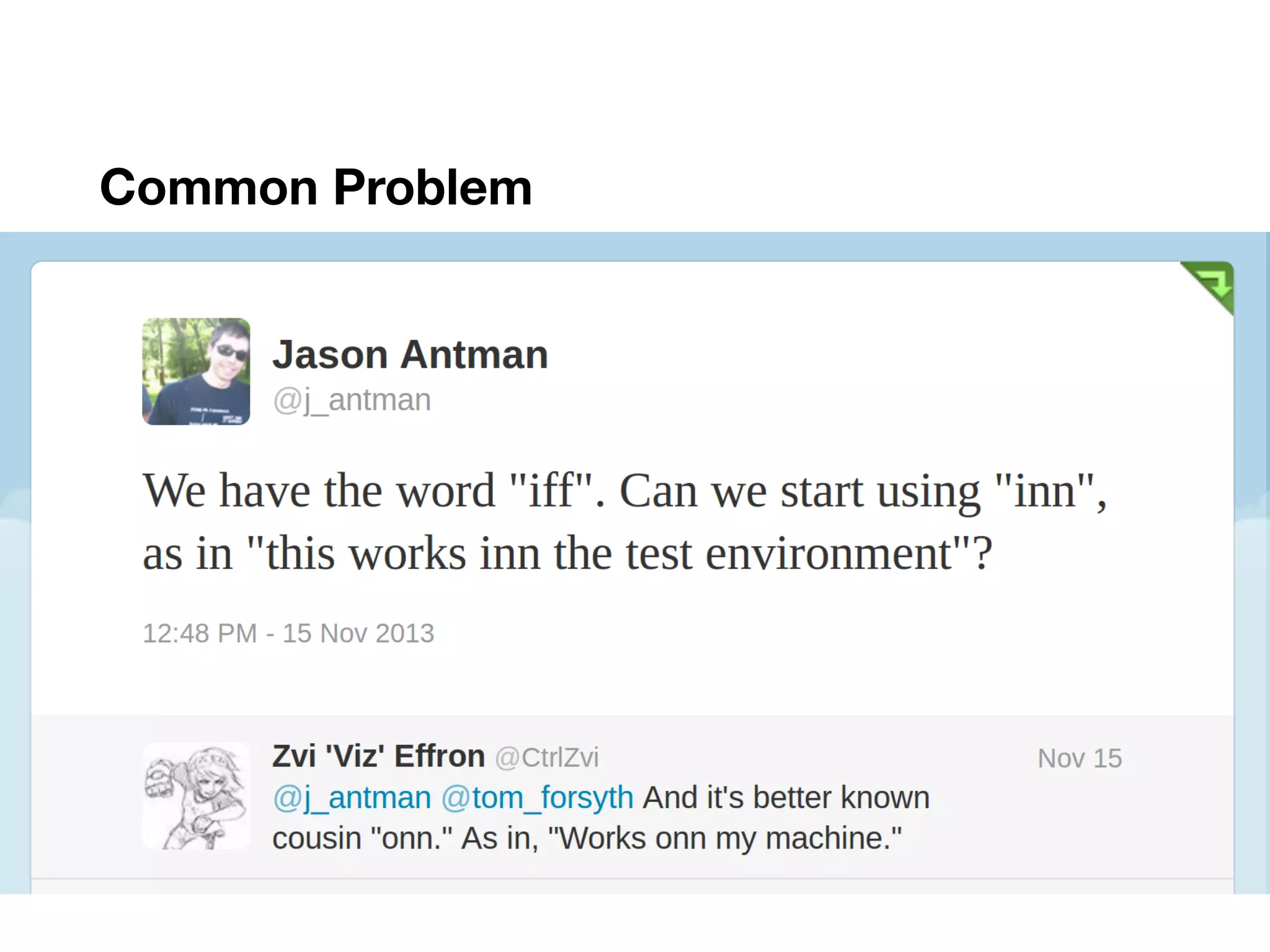
Common Problem
“We hired someone. How can
we reproduce our dev
environment?”
Vagrant
Vagrant
Configuration tool for VMs and Provisioning.
“Local cloud”
• Self service
• Instant provisioning
• Cost efficient
• Elastic
• Pay per use
Vagrant
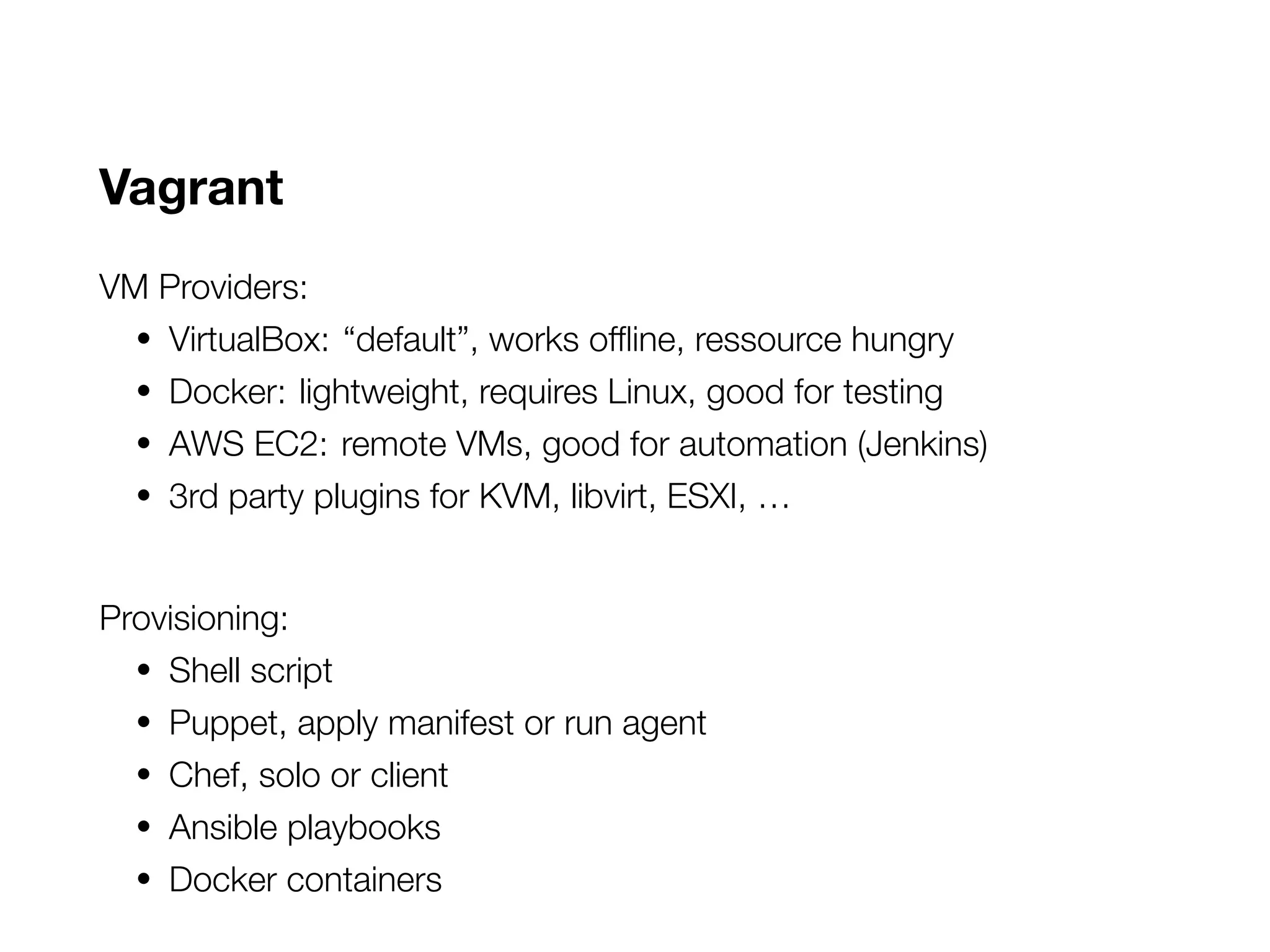
VM Providers:
• VirtualBox: “default”, works offline, ressource hungry
• Docker: lightweight, requires Linux, good for testing
• AWS EC2: remote VMs, good for automation (Jenkins)
• 3rd party plugins for KVM, libvirt, ESXI, …
Provisioning:
• Shell script
• Puppet, apply manifest or run agent
• Chef, solo or client
• Ansible playbooks
• Docker containers
“Synced folders are too slow.”
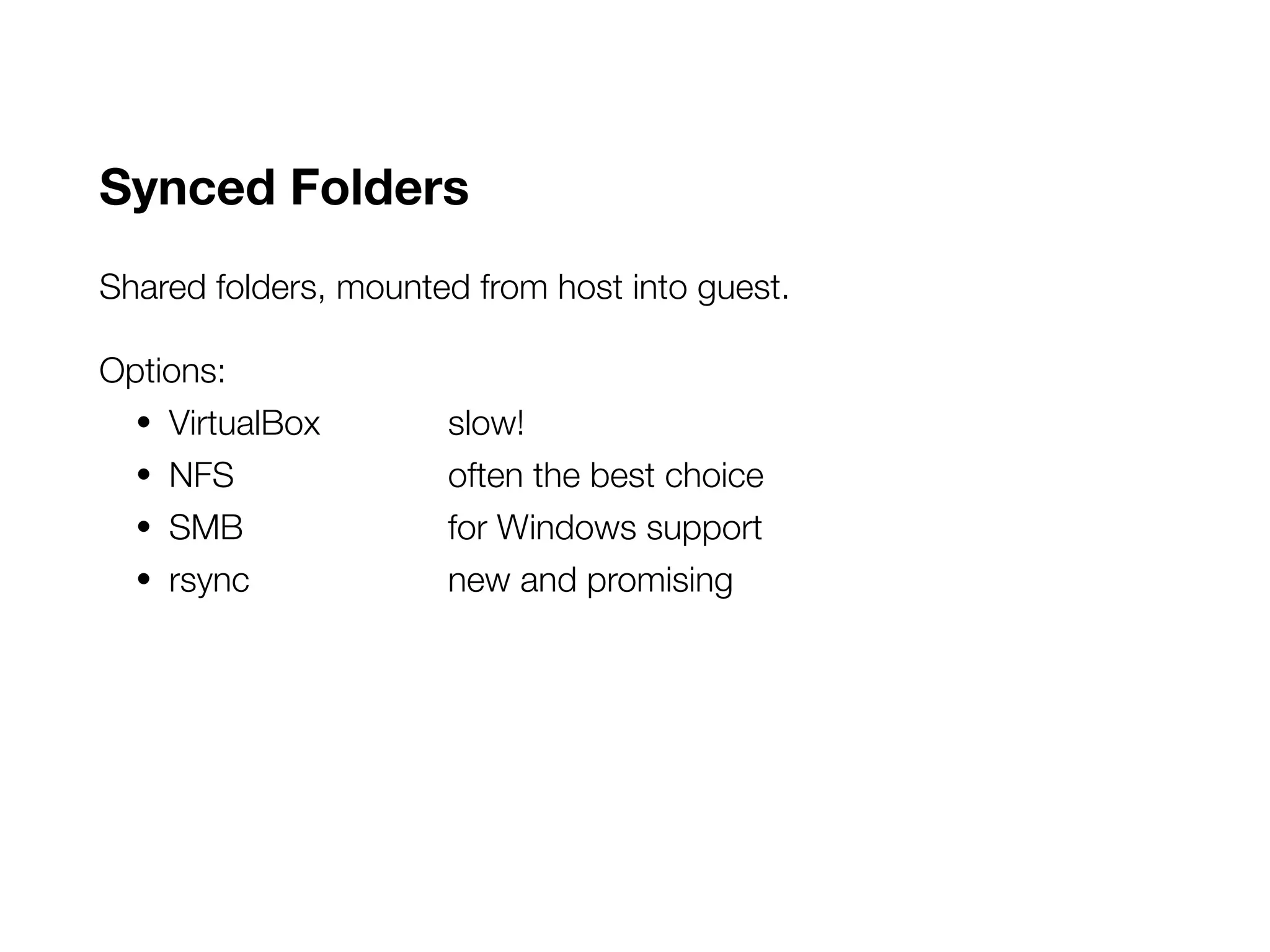
Synced Folders
Shared folders, mounted from host into guest.
Options:
• VirtualBox slow!
• NFS often the best choice
• SMB for Windows support
• rsync new and promising
“But our QA needs many VMs
and their machines are slow.”
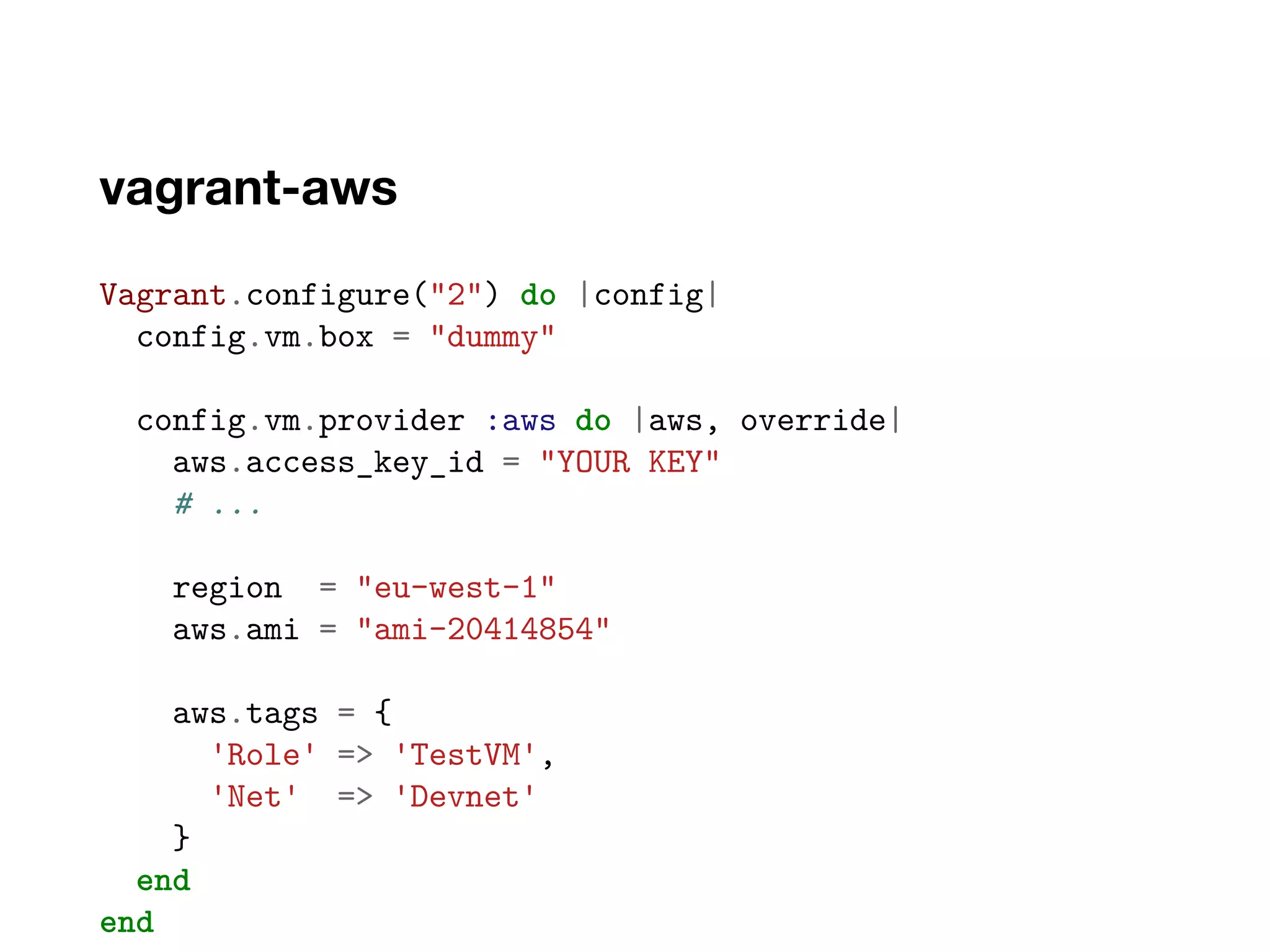
vagrant-aws
Vagrant.configure("2") do |config|
config.vm.box = "dummy"
config.vm.provider :aws do |aws, override|
aws.access_key_id = "YOUR KEY"
# ...
region = "eu-west-1"
aws.ami = "ami-20414854"
aws.tags = {
'Role' => 'TestVM',
'Net' => 'Devnet'
}
end
end
“How can we configure all
those VMs?”
Puppet
Puppet
• Configuration Management
• Declarative: Resources and Dependencies
“How should we manage write
access for multiple
Ops/DevOps?”
git workflows
• use git!
• use git hooks
• use per-user environments
for easy testing
• repos for testing/production
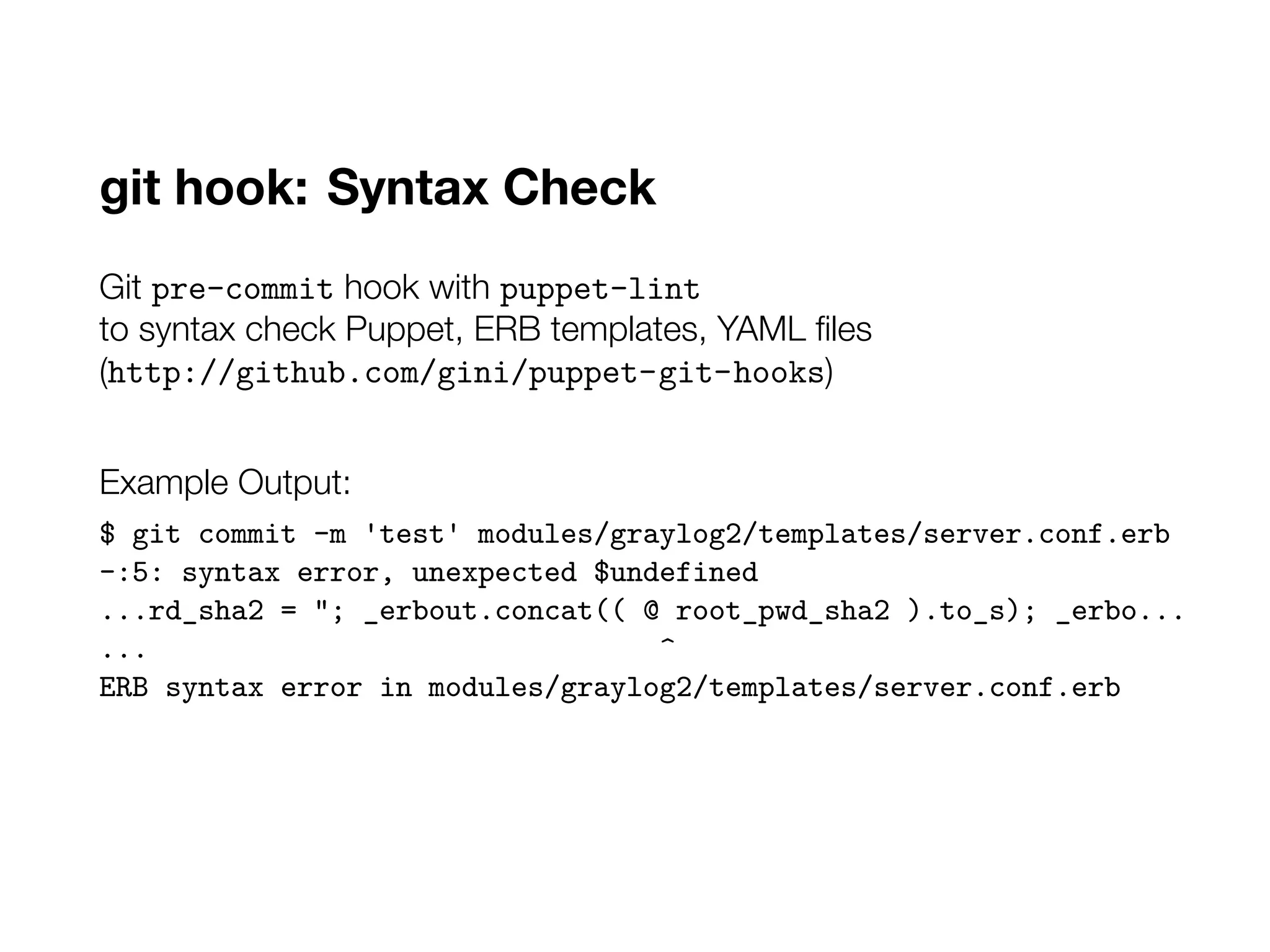
git hook: Syntax Check
Git pre-commit hook with puppet-lint
to syntax check Puppet, ERB templates, YAML files
(http://github.com/gini/puppet-git-hooks)
Example Output:
$ git commit -m 'test' modules/graylog2/templates/server.conf.erb
-:5: syntax error, unexpected $undefined
...rd_sha2 = "; _erbout.concat(( @ root_pwd_sha2 ).to_s); _erbo...
... ^
ERB syntax error in modules/graylog2/templates/server.conf.erb
environments
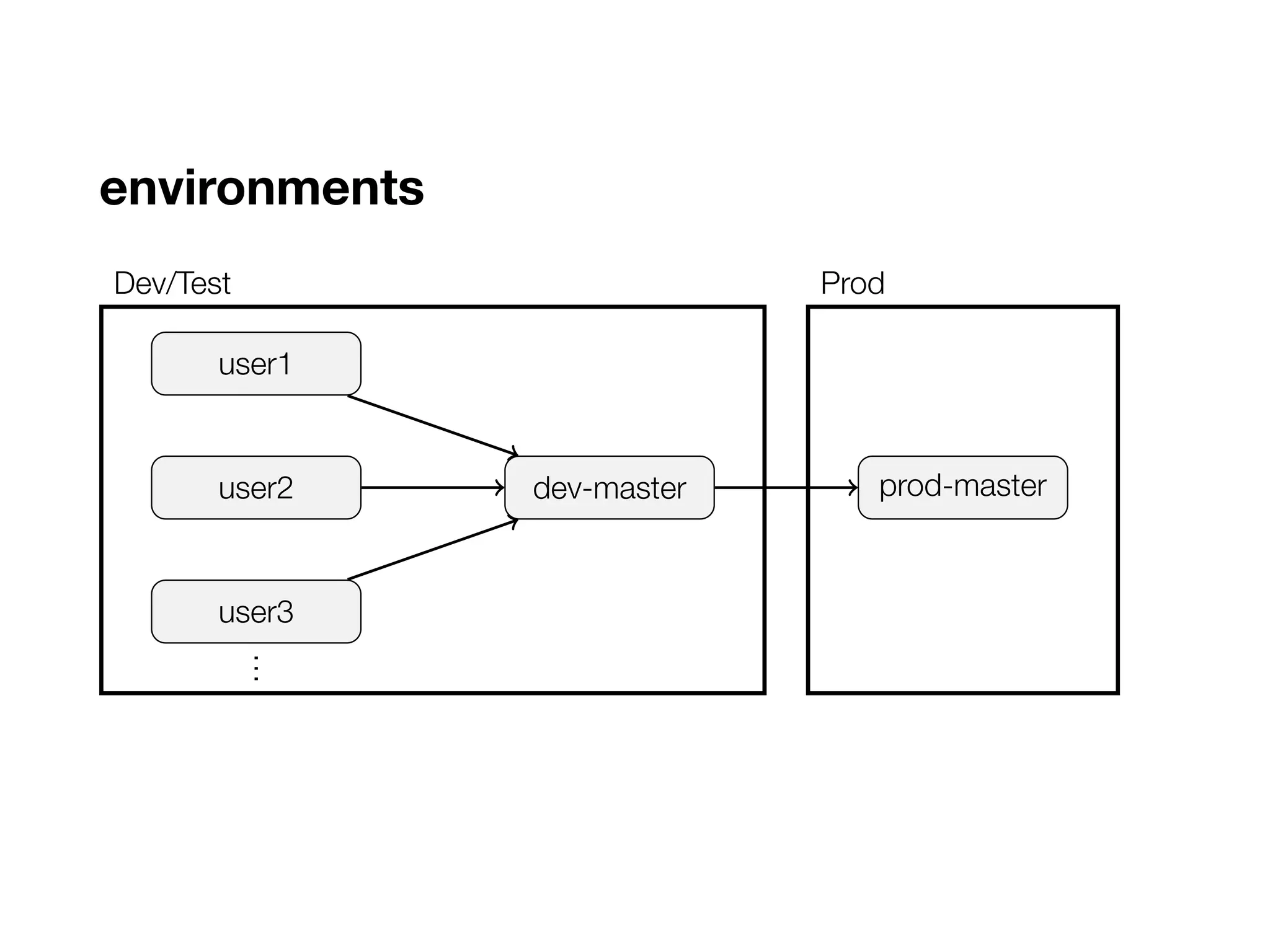
• per user env + production
⇒ easy testing with puppet agent -t --environment=user
• two servers for testing/production
Config File Environments:
puppet.conf
[mschuette]
modulepath = $confdir/environments/mschuette/modules
manifest = $confdir/environments/mschuette/manifests/site.pp
pluginsync = true
Directory Environments (Puppet >= 3.5.0):
puppet.conf
[main]
environmentpath = $confdir/environments
environments
..dev-master. prod-master.
user1
.user2 .
user3
.
…
.
Dev/Test
.
Prod
“But we cannot write and
maintain all those modules.”
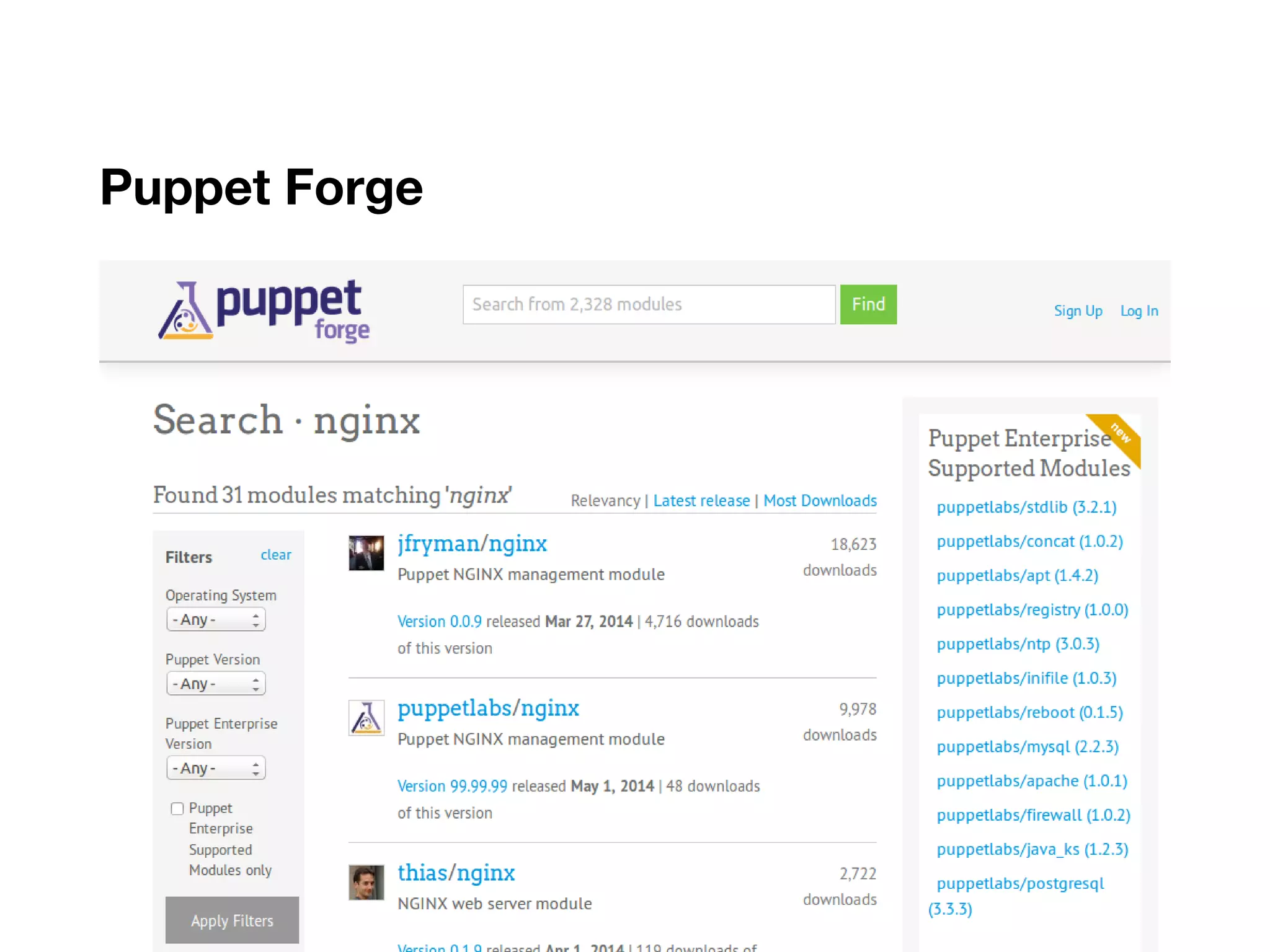
Puppet Forge
“How do we use inventory and
EC2 metadata in Puppet
manifests?”
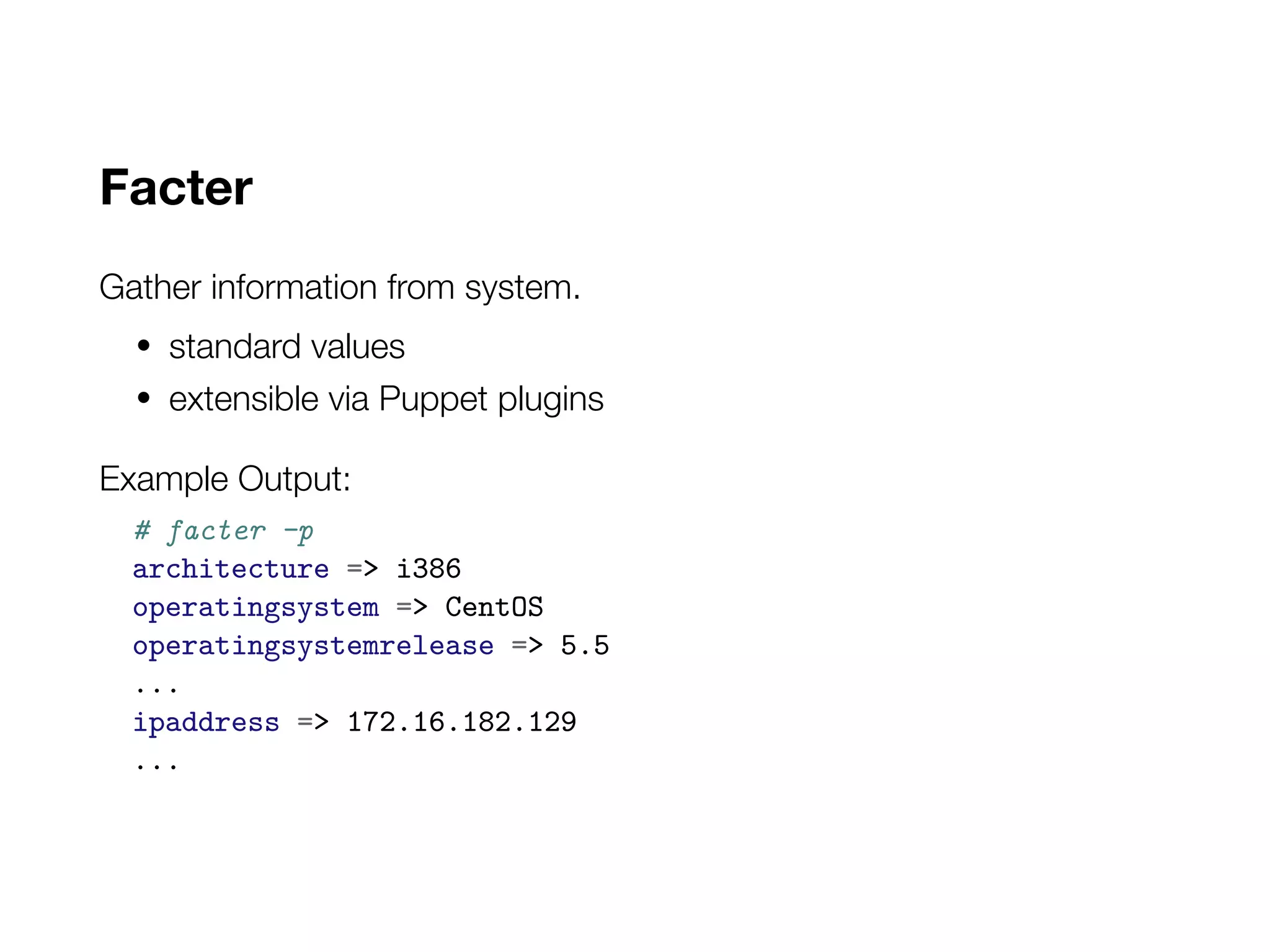
Facter
Gather information from system.
• standard values
• extensible via Puppet plugins
Example Output:
# facter -p
architecture => i386
operatingsystem => CentOS
operatingsystemrelease => 5.5
...
ipaddress => 172.16.182.129
...
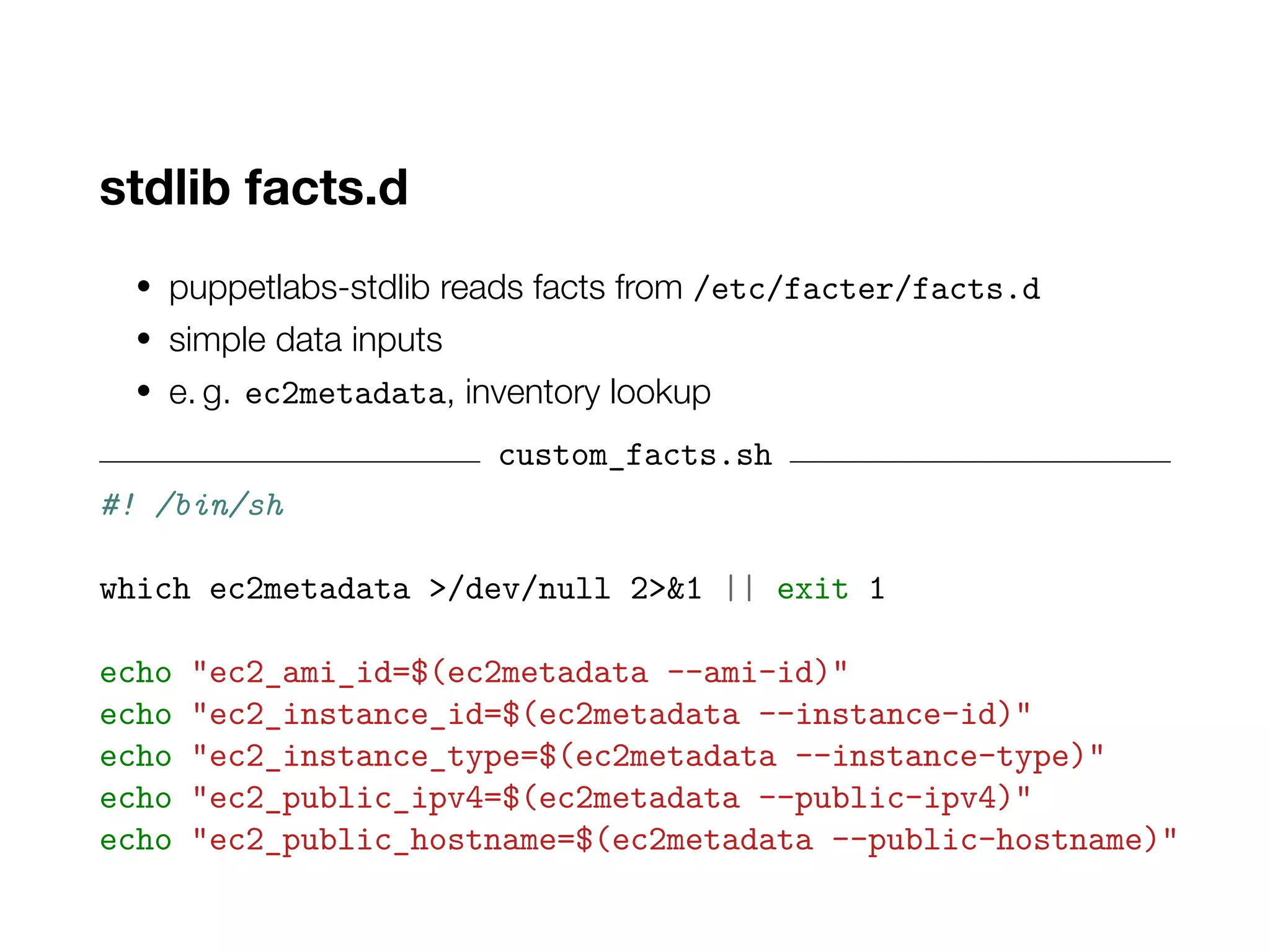
stdlib facts.d
• puppetlabs-stdlib reads facts from /etc/facter/facts.d
• simple data inputs
• e. g. ec2metadata, inventory lookup
custom_facts.sh
#! /bin/sh
which ec2metadata >/dev/null 2>&1 || exit 1
echo "ec2_ami_id=$(ec2metadata --ami-id)"
echo "ec2_instance_id=$(ec2metadata --instance-id)"
echo "ec2_instance_type=$(ec2metadata --instance-type)"
echo "ec2_public_ipv4=$(ec2metadata --public-ipv4)"
echo "ec2_public_hostname=$(ec2metadata --public-hostname)"
“There has to be a way to split
modules and config
parameters.”
Hiera
Hiera
• banish top scope variables
• use Hiera!
• structure with roles & profiles
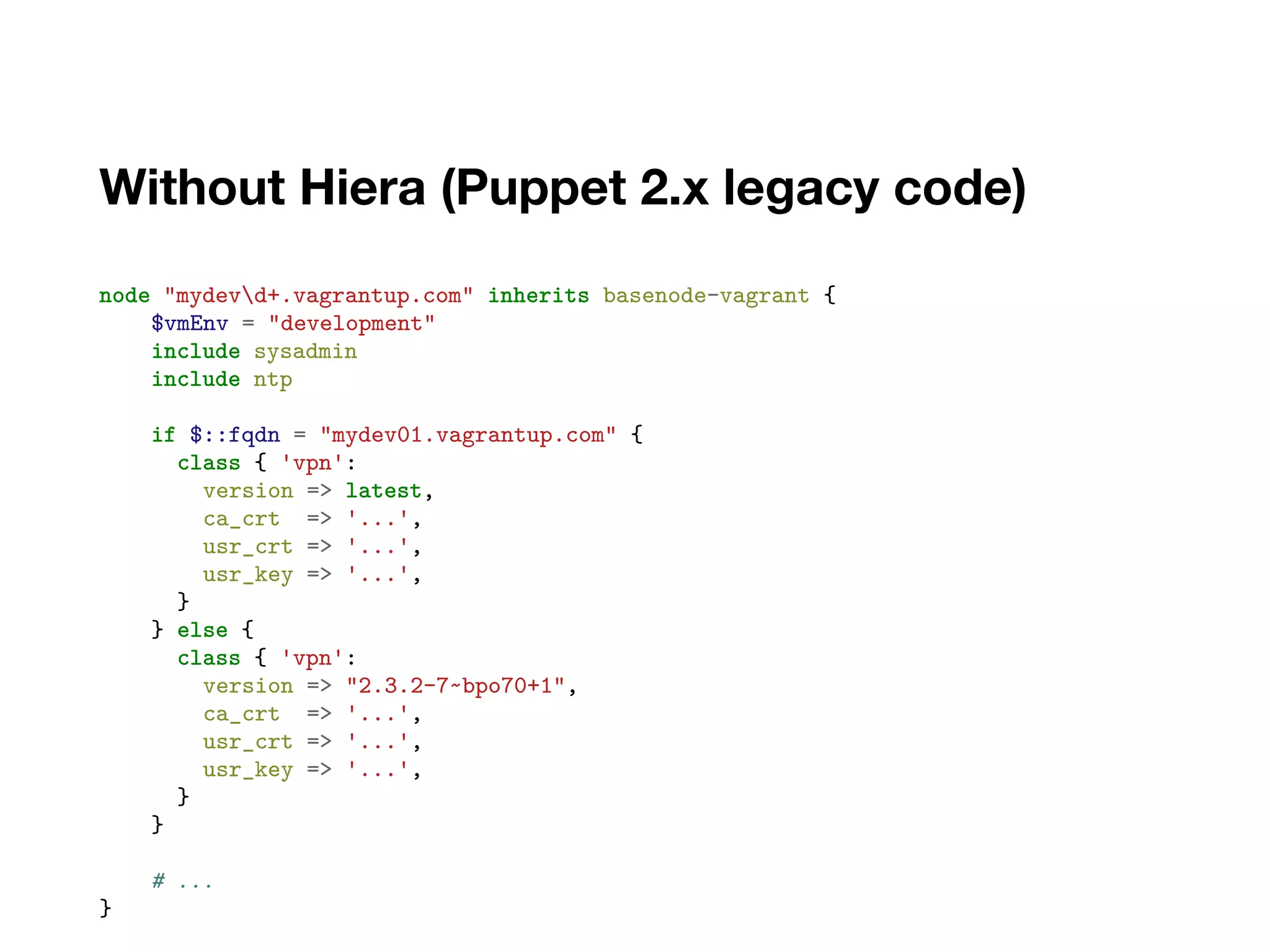
Without Hiera (Puppet 2.x legacy code)
node "mydevd+.vagrantup.com" inherits basenode-vagrant {
$vmEnv = "development"
include sysadmin
include ntp
if $::fqdn = "mydev01.vagrantup.com" {
class { 'vpn':
version => latest,
ca_crt => '...',
usr_crt => '...',
usr_key => '...',
}
} else {
class { 'vpn':
version => "2.3.2-7~bpo70+1",
ca_crt => '...',
usr_crt => '...',
usr_key => '...',
}
}
# ...
}
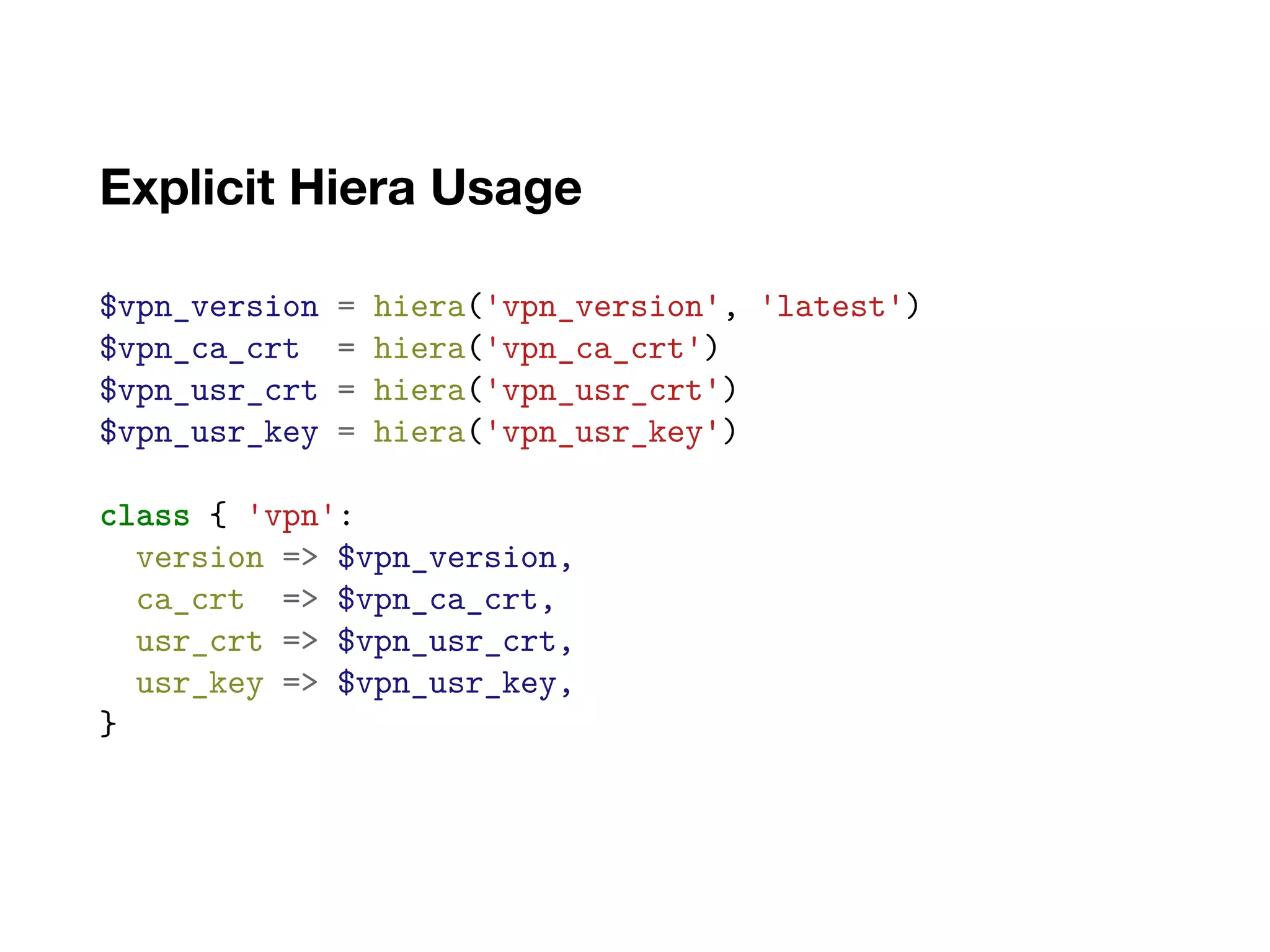
Explicit Hiera Usage
$vpn_version = hiera('vpn_version', 'latest')
$vpn_ca_crt = hiera('vpn_ca_crt')
$vpn_usr_crt = hiera('vpn_usr_crt')
$vpn_usr_key = hiera('vpn_usr_key')
class { 'vpn':
version => $vpn_version,
ca_crt => $vpn_ca_crt,
usr_crt => $vpn_usr_crt,
usr_key => $vpn_usr_key,
}
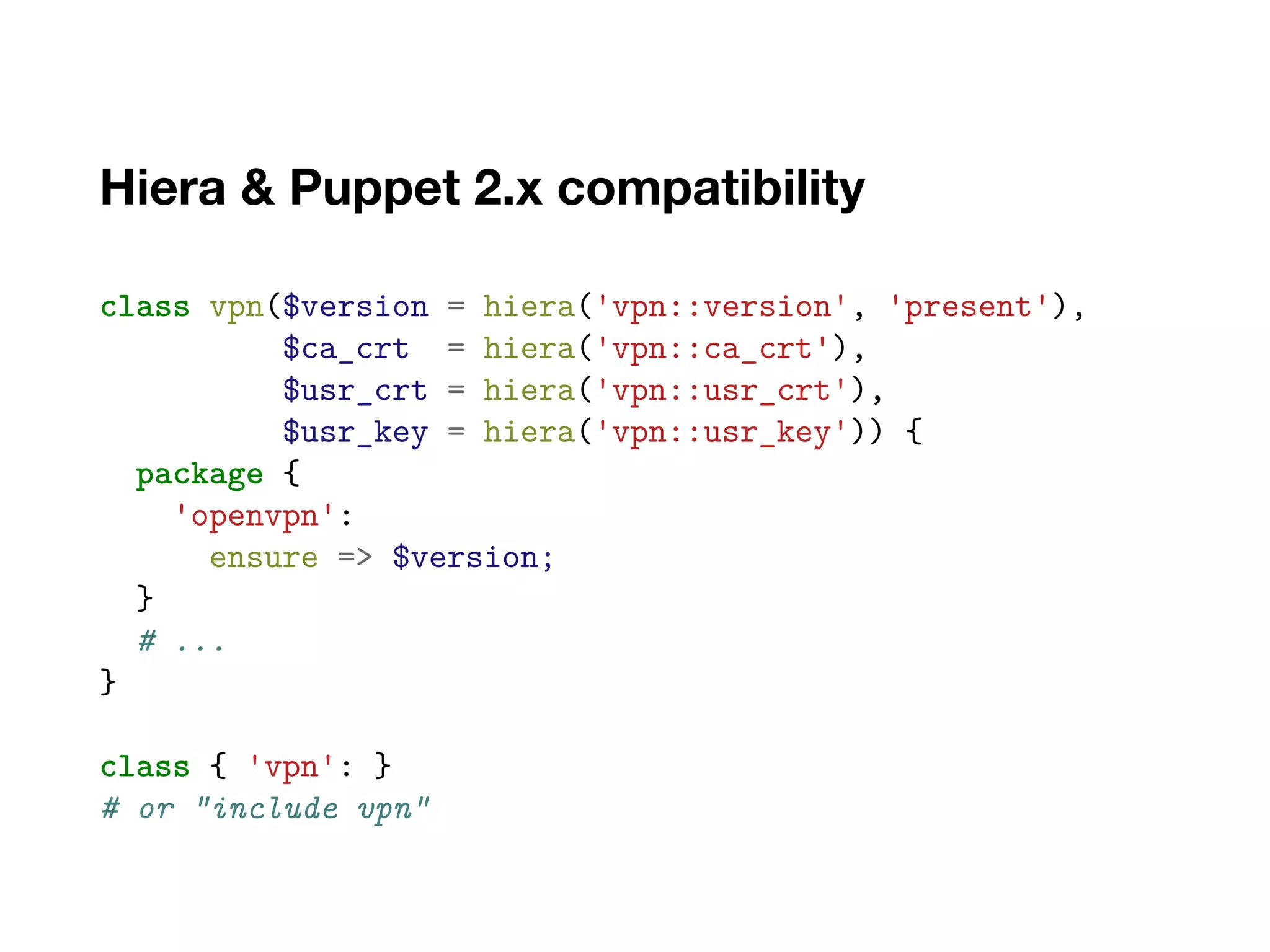
Hiera & Puppet 2.x compatibility
class vpn($version = hiera('vpn::version', 'present'),
$ca_crt = hiera('vpn::ca_crt'),
$usr_crt = hiera('vpn::usr_crt'),
$usr_key = hiera('vpn::usr_key')) {
package {
'openvpn':
ensure => $version;
}
# ...
}
class { 'vpn': }
# or "include vpn"
Puppet 3.x with Hiera
site.pp
hiera_include('include_classes', ['sysadmin'])
node default {
}
profile_vpn.yaml
include_classes:
- ntp
- vpn
vpn::version: present
vpn::ca_crt: ...
vpn::usr_crt: ...
vpn::usr_key: ...
“Our modules and manifests
grow too complex. How can we
structure them?”
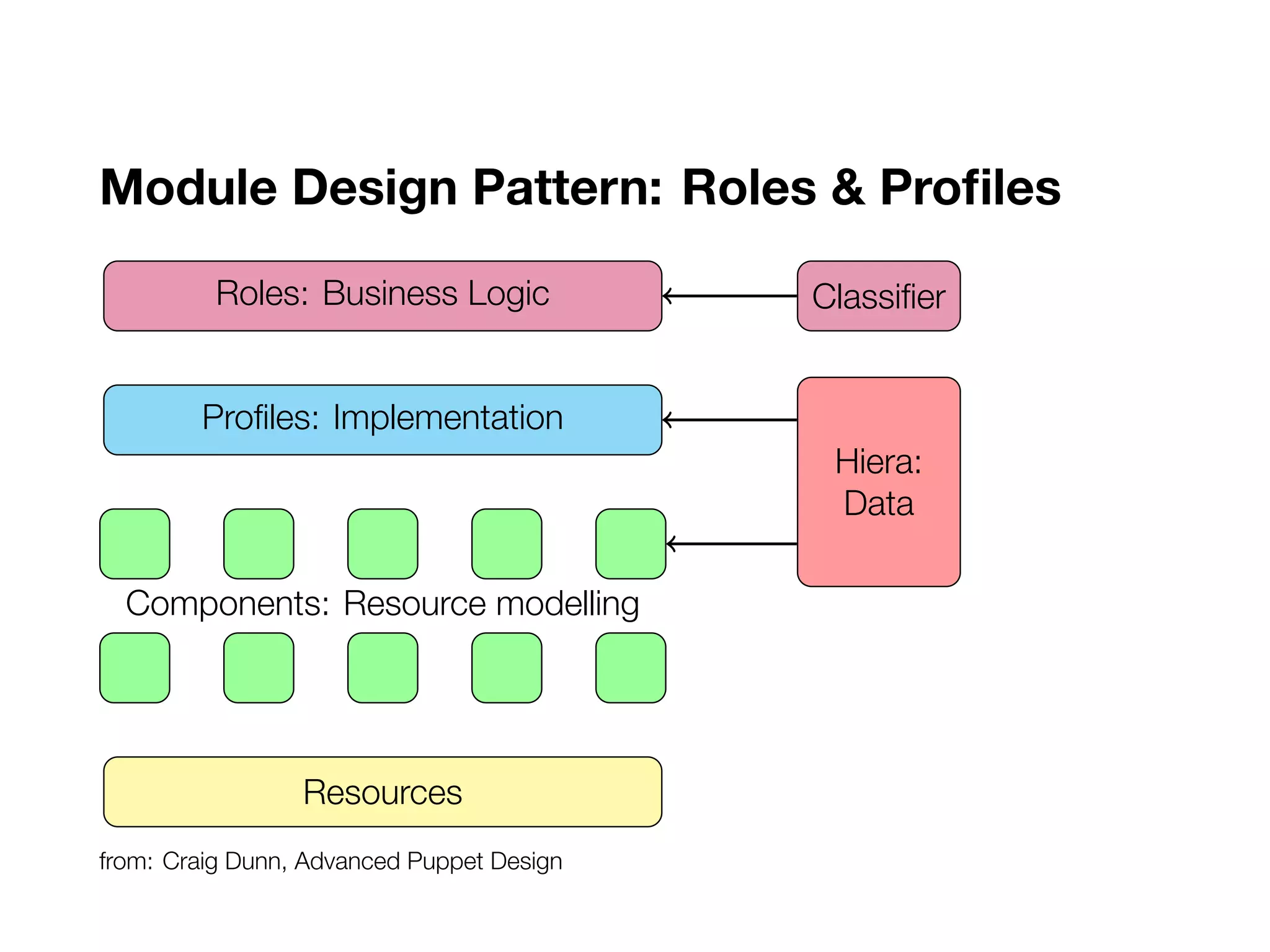
Module Design Pattern: Roles & Profiles
..Resources......
Components: Resource modelling
......
Profiles: Implementation
.
Roles: Business Logic
.
Hiera:
Data
.
Classifier
from: Craig Dunn, Advanced Puppet Design
“What other pitfalls will we
encounter?”
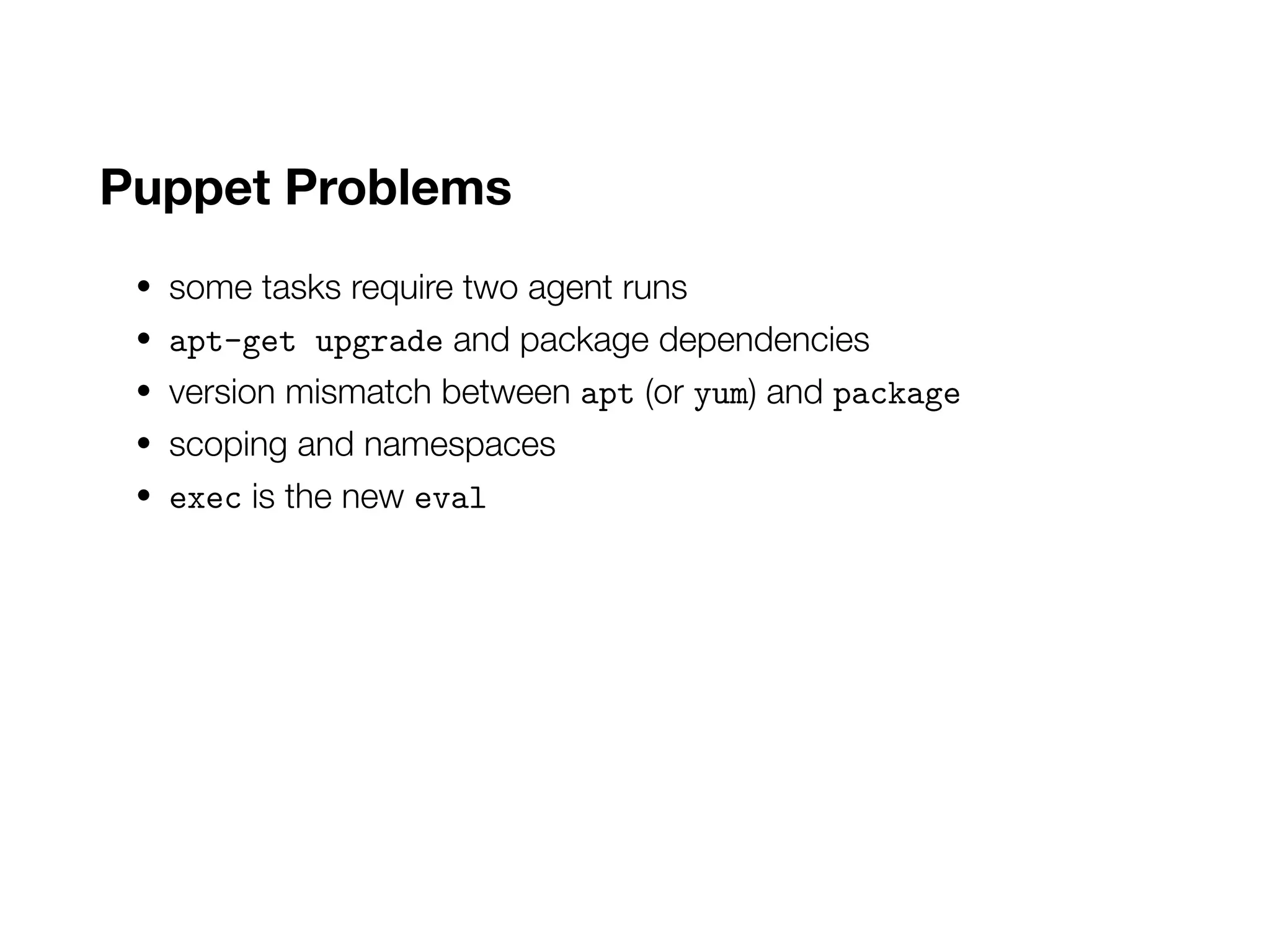
Puppet Problems
• some tasks require two agent runs
• apt-get upgrade and package dependencies
• version mismatch between apt (or yum) and package
• scoping and namespaces
• exec is the new eval
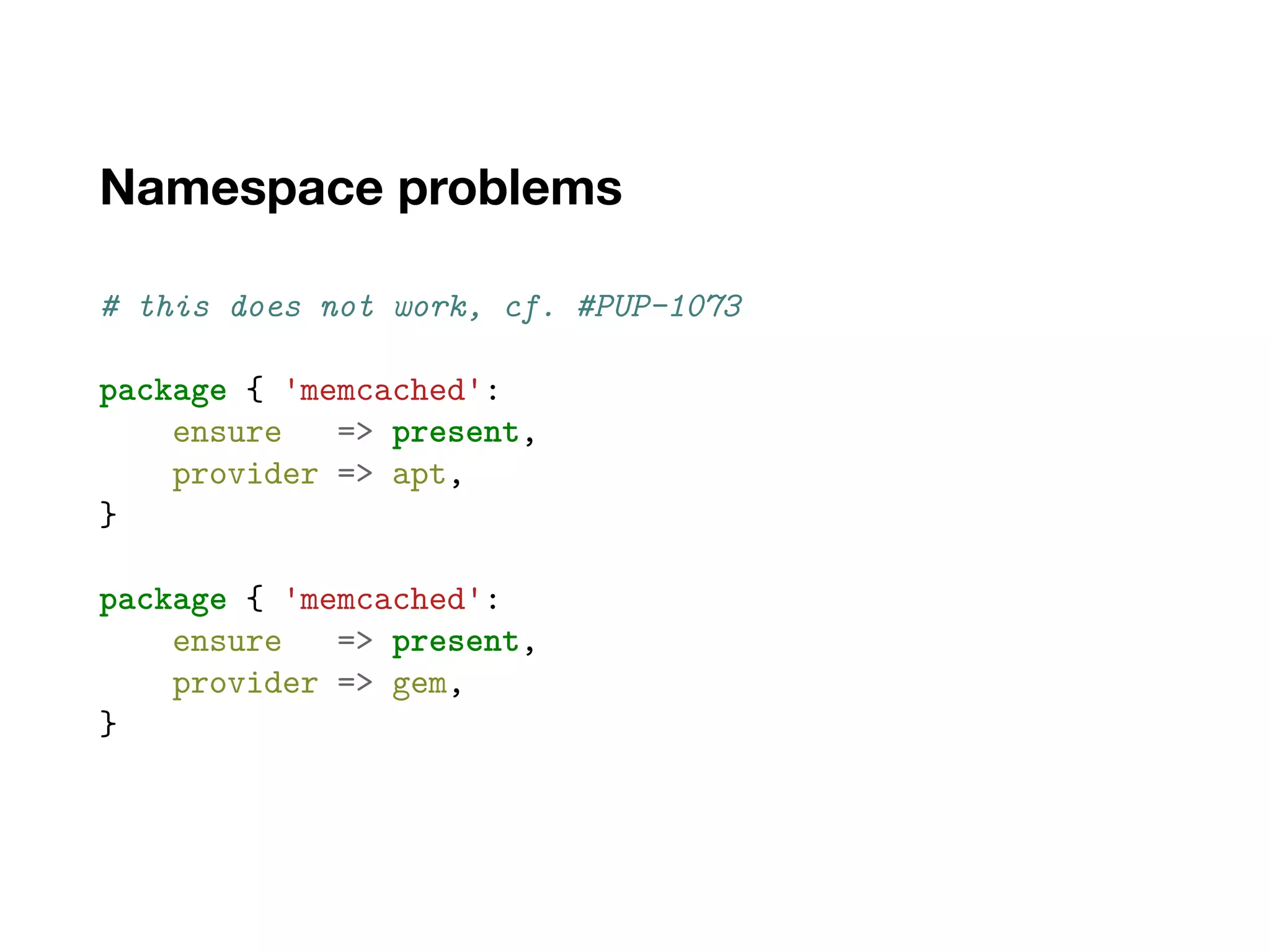
Namespace problems
# this does not work, cf. #PUP-1073
package { 'memcached':
ensure => present,
provider => apt,
}
package { 'memcached':
ensure => present,
provider => gem,
}
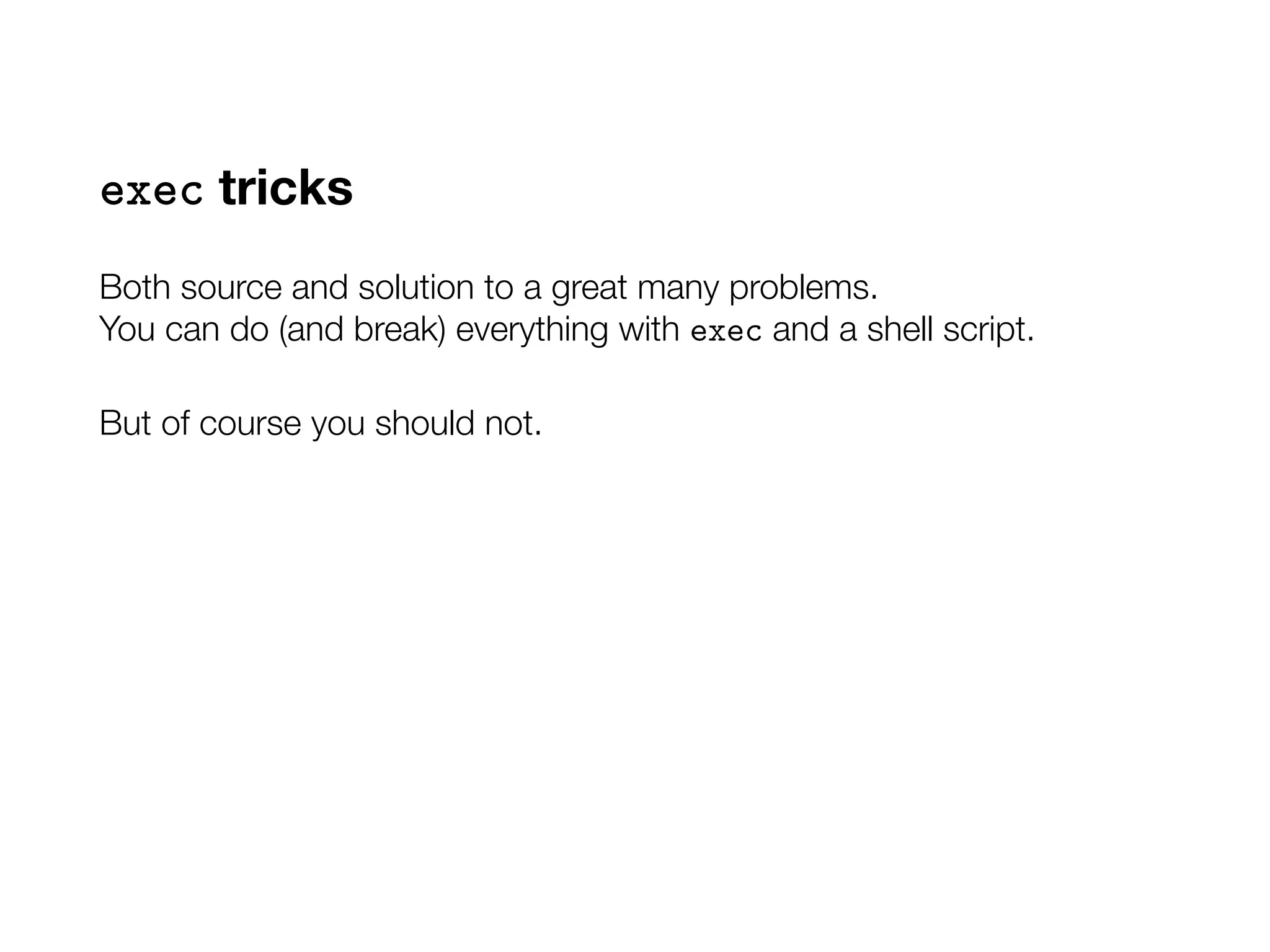
exec tricks
Both source and solution to a great many problems.
You can do (and break) everything with exec and a shell script.
But of course you should not.
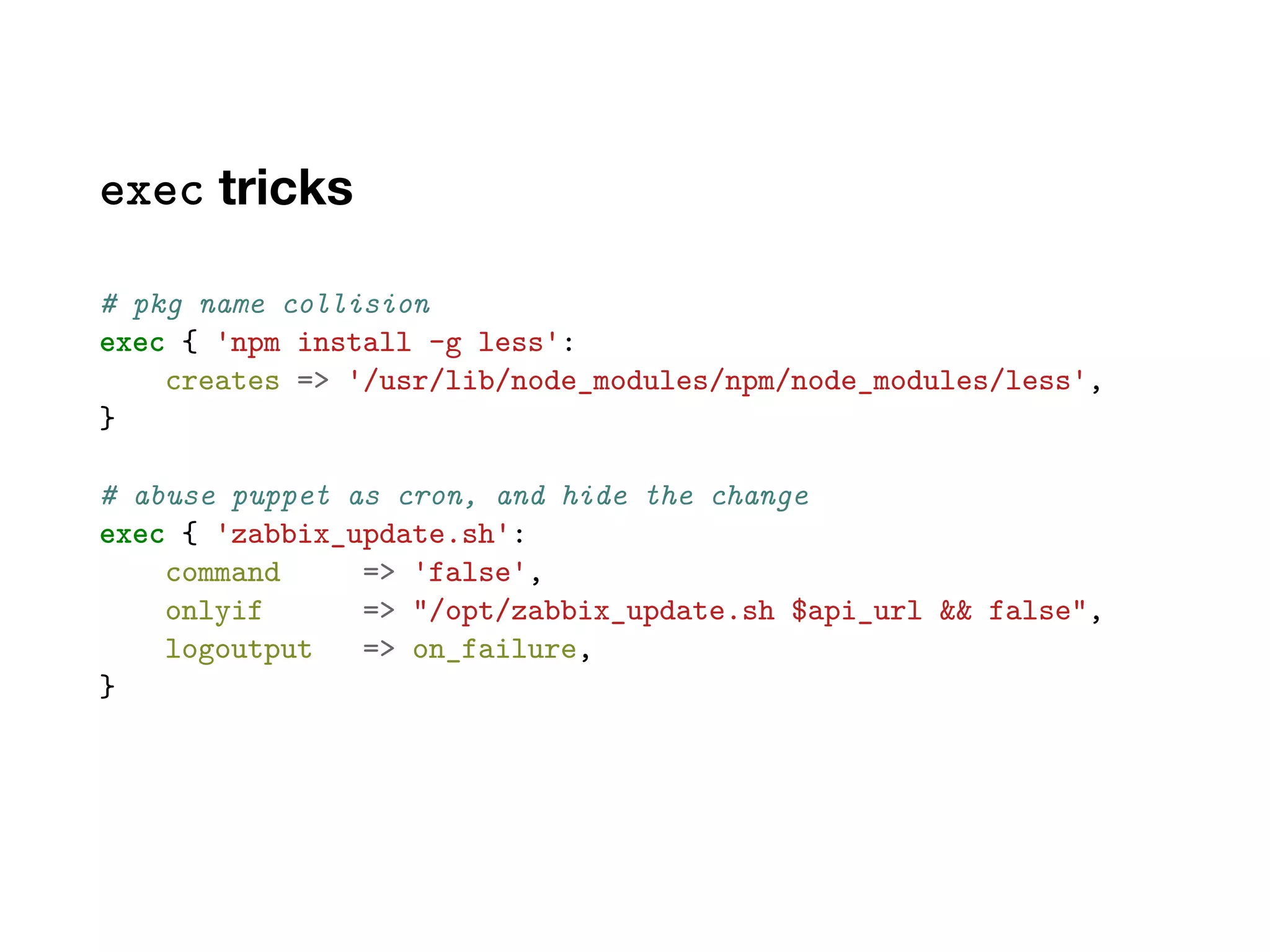
exec tricks
# pkg name collision
exec { 'npm install -g less':
creates => '/usr/lib/node_modules/npm/node_modules/less',
}
# abuse puppet as cron, and hide the change
exec { 'zabbix_update.sh':
command => 'false',
onlyif => "/opt/zabbix_update.sh $api_url && false",
logoutput => on_failure,
}
“How can we monitor
Puppet changes?”
Integration
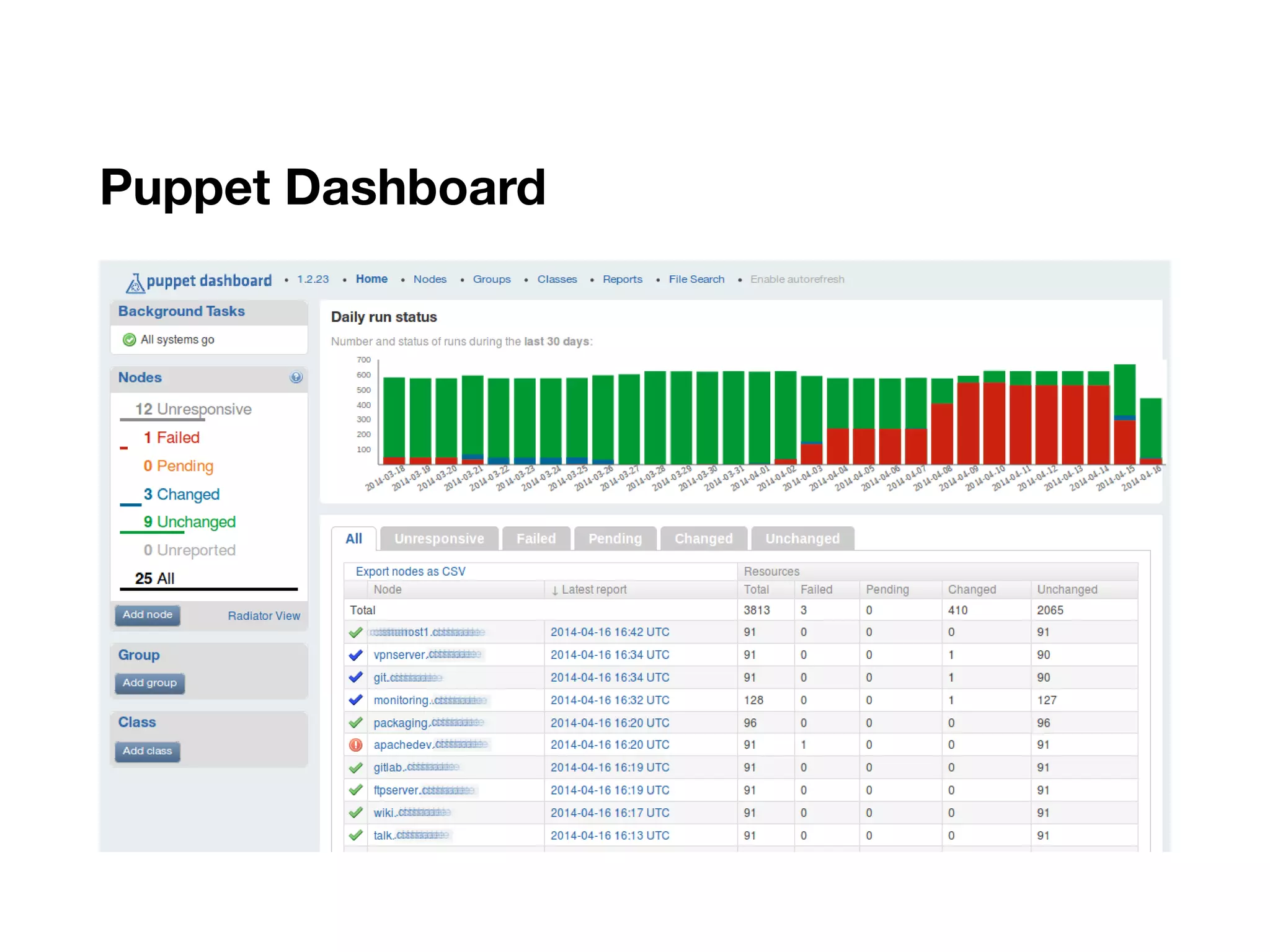
Puppet Dashboard
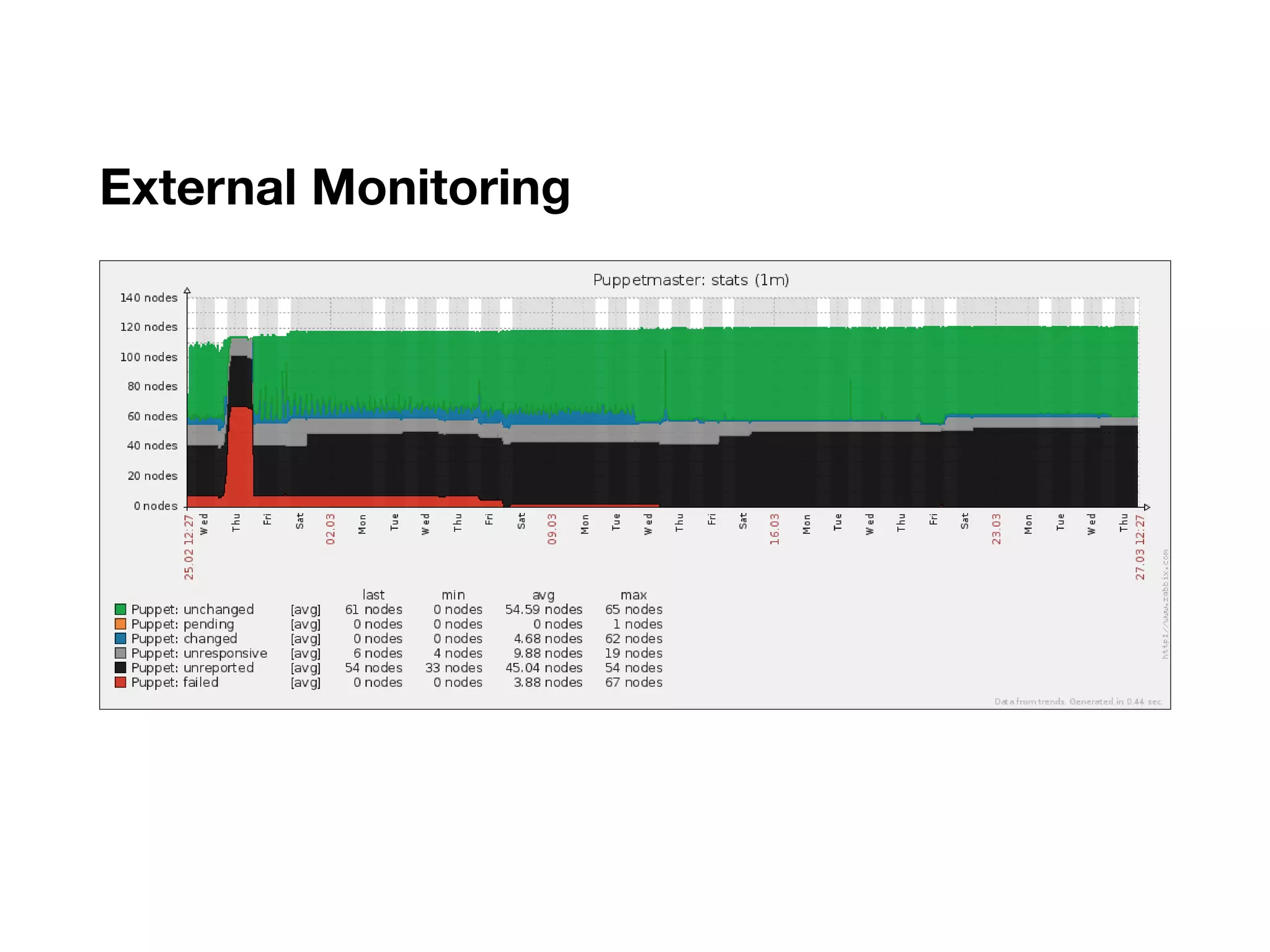
External Monitoring
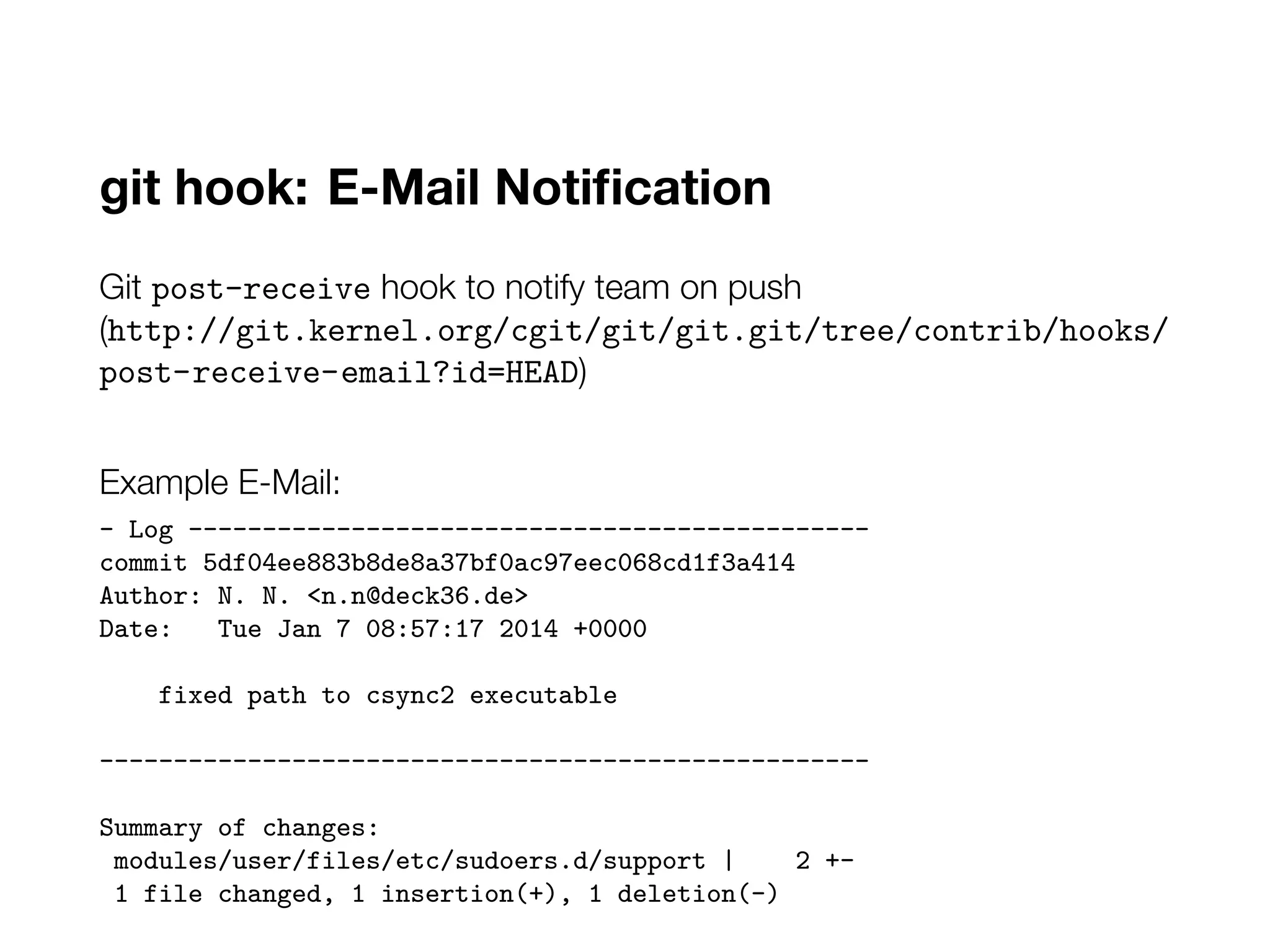
git hook: E-Mail Notification
Git post-receive hook to notify team on push
(http://git.kernel.org/cgit/git/git.git/tree/contrib/hooks/
post-receive-email?id=HEAD)
Example E-Mail:
- Log ----------------------------------------------
commit 5df04ee883b8de8a37bf0ac97eec068cd1f3a414
Author: N. N. <n.n@deck36.de>
Date: Tue Jan 7 08:57:17 2014 +0000
fixed path to csync2 executable
----------------------------------------------------
Summary of changes:
modules/user/files/etc/sudoers.d/support | 2 +-
1 file changed, 1 insertion(+), 1 deletion(-)
“How do we coordinate a
cluster restart?”
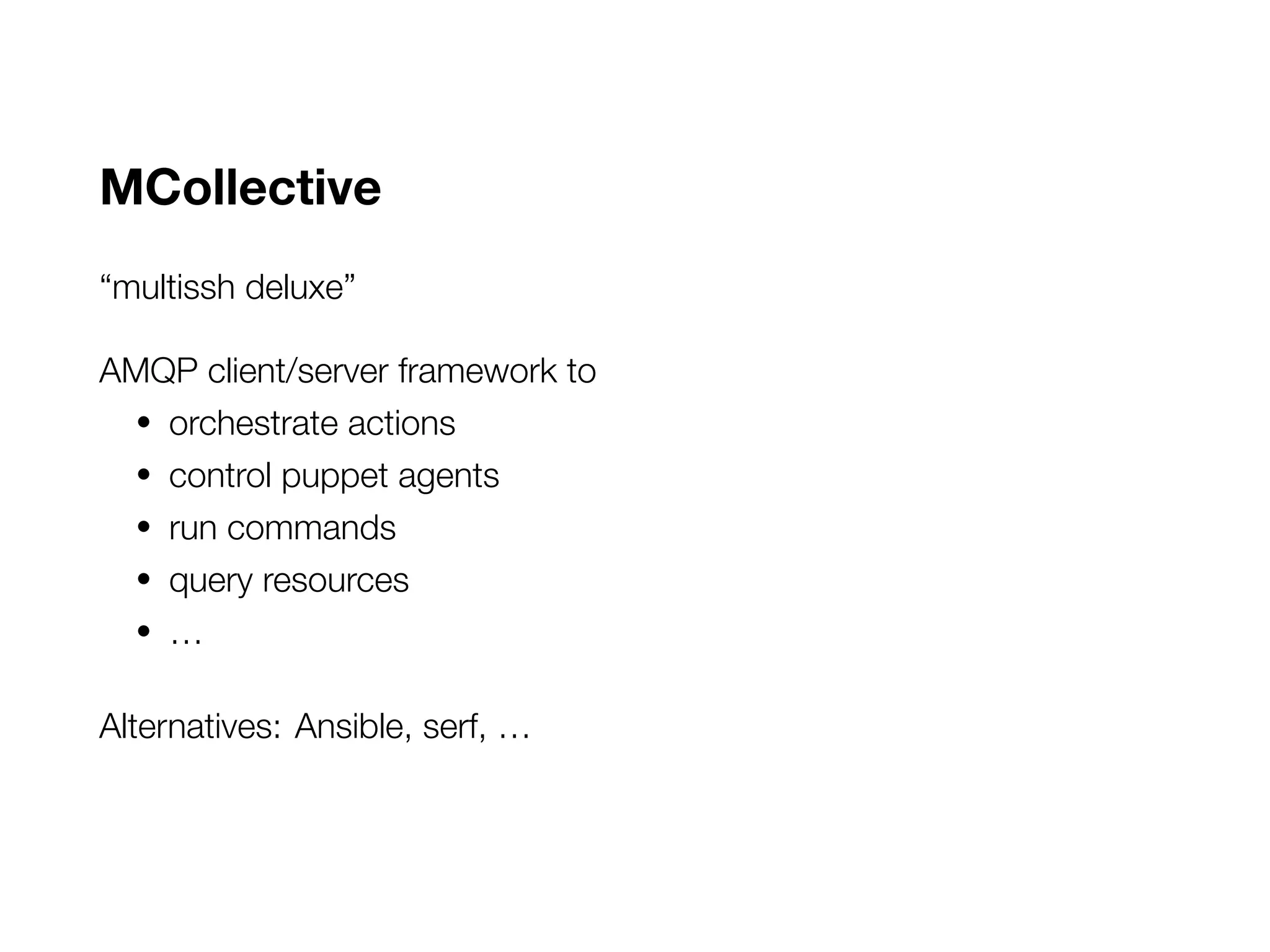
MCollective
“multissh deluxe”
AMQP client/server framework to
• orchestrate actions
• control puppet agents
• run commands
• query resources
• …
Alternatives: Ansible, serf, …
“Why do we still manually
configure DNS and
monitoring?”
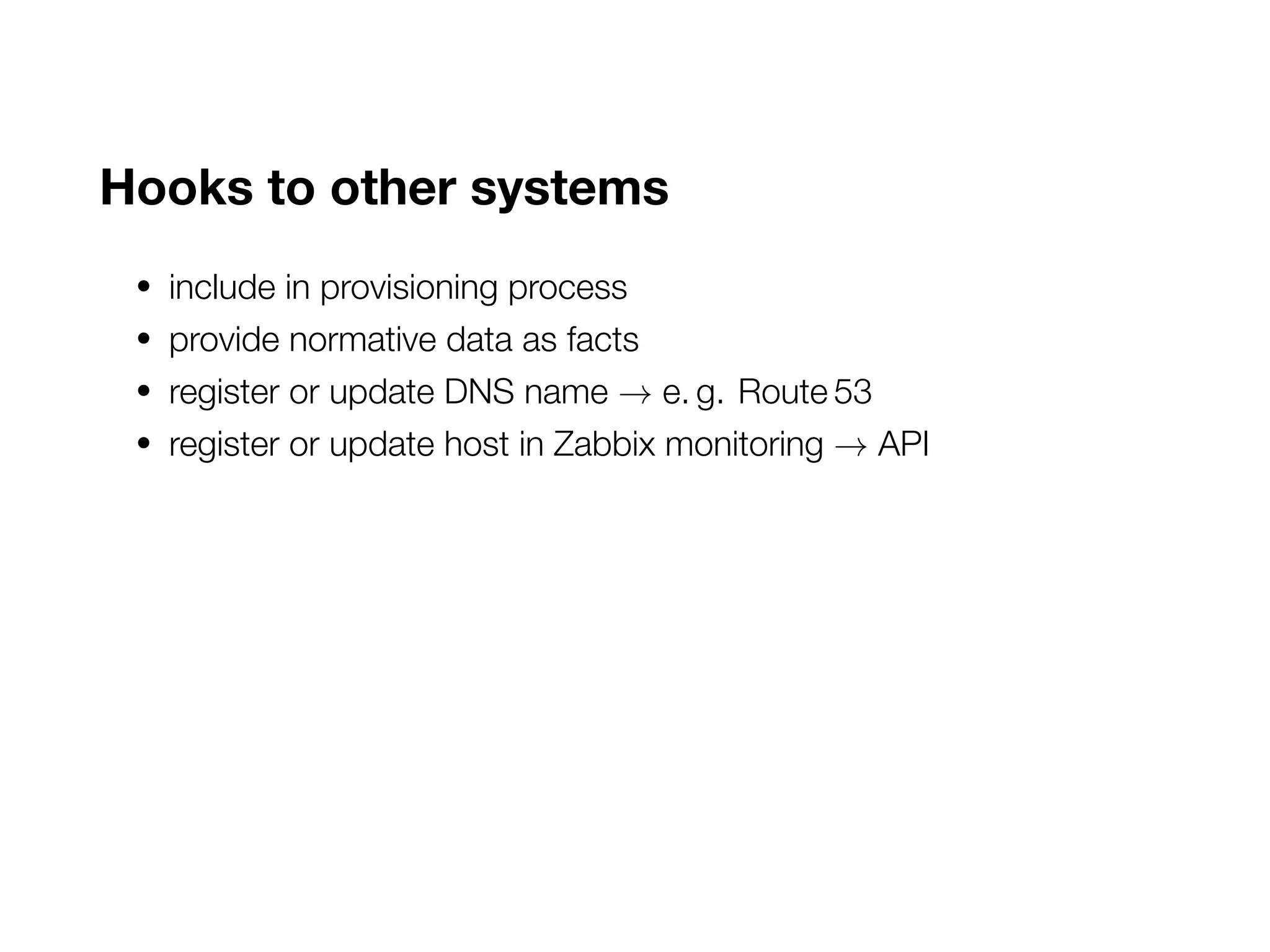
Hooks to other systems
• include in provisioning process
• provide normative data as facts
• register or update DNS name → e. g. Route 53
• register or update host in Zabbix monitoring → API
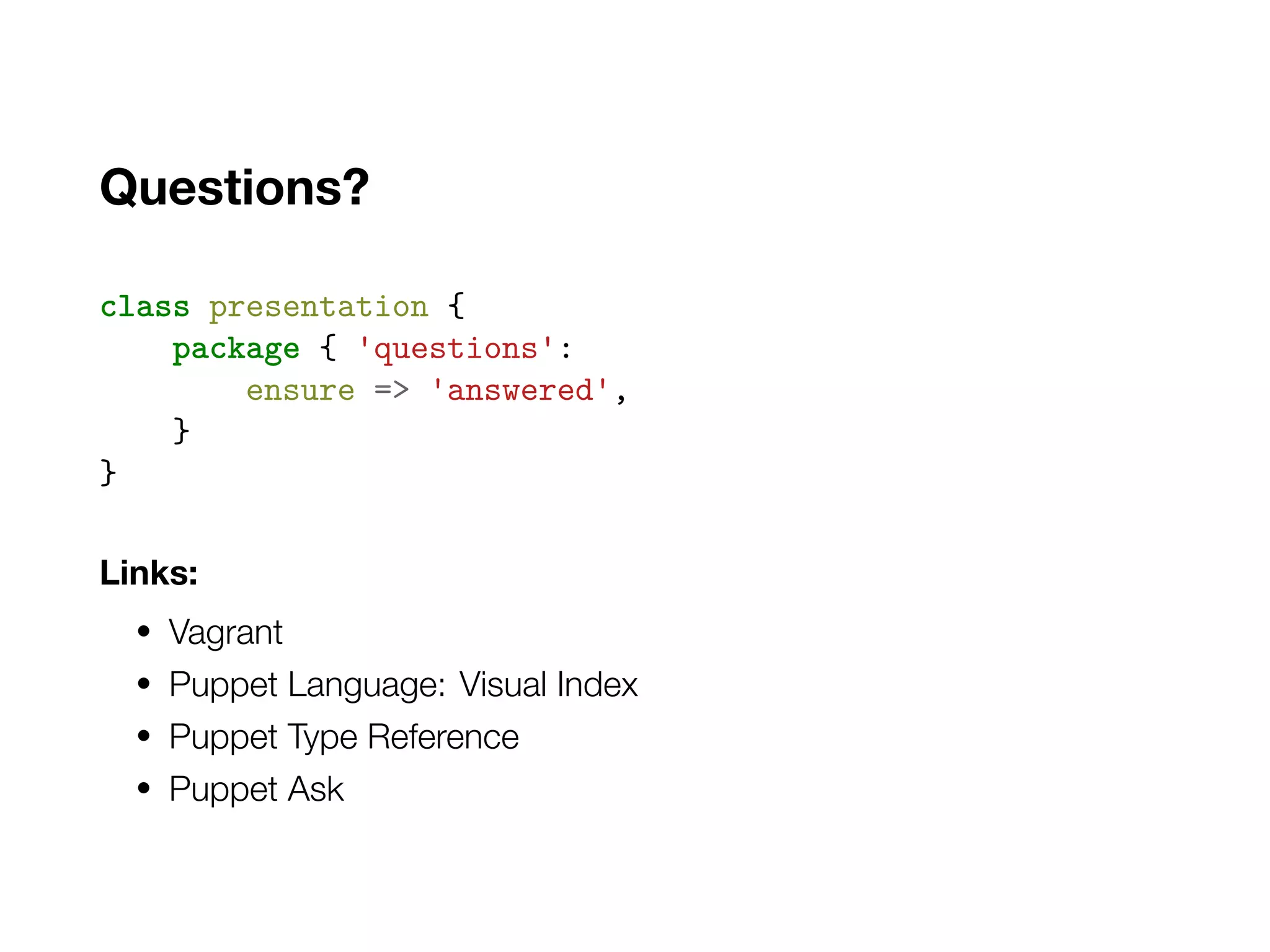
Questions?
class presentation {
package { 'questions':
ensure => 'answered',
}
}
Links:
• Vagrant
• Puppet Language: Visual Index
• Puppet Type Reference
• Puppet Ask
Thank You

Our Puppet Story (Linuxtag 2014)

  • 1.
    Our Puppet Story MartinSchütte May 5 2014
  • 2.
    About DECK36 • Smallteam of 7 engineers • Longstanding expertise in designing, implementing and operating complex web systems • Developing own data intelligence-focused tools and web services • Offering our expert knowledge in Automation & Operation, Architecture & Engineering, Analytics & Data Logistics
  • 3.
  • 4.
    “We hired someone.How can we reproduce our dev environment?”
  • 5.
  • 6.
    Vagrant Configuration tool forVMs and Provisioning. “Local cloud” • Self service • Instant provisioning • Cost efficient • Elastic • Pay per use
  • 7.
    Vagrant VM Providers: • VirtualBox:“default”, works offline, ressource hungry • Docker: lightweight, requires Linux, good for testing • AWS EC2: remote VMs, good for automation (Jenkins) • 3rd party plugins for KVM, libvirt, ESXI, … Provisioning: • Shell script • Puppet, apply manifest or run agent • Chef, solo or client • Ansible playbooks • Docker containers
  • 8.
  • 9.
    Synced Folders Shared folders,mounted from host into guest. Options: • VirtualBox slow! • NFS often the best choice • SMB for Windows support • rsync new and promising
  • 10.
    “But our QAneeds many VMs and their machines are slow.”
  • 11.
    vagrant-aws Vagrant.configure("2") do |config| config.vm.box= "dummy" config.vm.provider :aws do |aws, override| aws.access_key_id = "YOUR KEY" # ... region = "eu-west-1" aws.ami = "ami-20414854" aws.tags = { 'Role' => 'TestVM', 'Net' => 'Devnet' } end end
  • 12.
    “How can weconfigure all those VMs?”
  • 13.
  • 14.
    Puppet • Configuration Management •Declarative: Resources and Dependencies
  • 15.
    “How should wemanage write access for multiple Ops/DevOps?”
  • 16.
    git workflows • usegit! • use git hooks • use per-user environments for easy testing • repos for testing/production
  • 17.
    git hook: SyntaxCheck Git pre-commit hook with puppet-lint to syntax check Puppet, ERB templates, YAML files (http://github.com/gini/puppet-git-hooks) Example Output: $ git commit -m 'test' modules/graylog2/templates/server.conf.erb -:5: syntax error, unexpected $undefined ...rd_sha2 = "; _erbout.concat(( @ root_pwd_sha2 ).to_s); _erbo... ... ^ ERB syntax error in modules/graylog2/templates/server.conf.erb
  • 18.
    environments • per userenv + production ⇒ easy testing with puppet agent -t --environment=user • two servers for testing/production Config File Environments: puppet.conf [mschuette] modulepath = $confdir/environments/mschuette/modules manifest = $confdir/environments/mschuette/manifests/site.pp pluginsync = true Directory Environments (Puppet >= 3.5.0): puppet.conf [main] environmentpath = $confdir/environments
  • 19.
  • 20.
    “But we cannotwrite and maintain all those modules.”
  • 21.
  • 22.
    “How do weuse inventory and EC2 metadata in Puppet manifests?”
  • 23.
    Facter Gather information fromsystem. • standard values • extensible via Puppet plugins Example Output: # facter -p architecture => i386 operatingsystem => CentOS operatingsystemrelease => 5.5 ... ipaddress => 172.16.182.129 ...
  • 24.
    stdlib facts.d • puppetlabs-stdlibreads facts from /etc/facter/facts.d • simple data inputs • e. g. ec2metadata, inventory lookup custom_facts.sh #! /bin/sh which ec2metadata >/dev/null 2>&1 || exit 1 echo "ec2_ami_id=$(ec2metadata --ami-id)" echo "ec2_instance_id=$(ec2metadata --instance-id)" echo "ec2_instance_type=$(ec2metadata --instance-type)" echo "ec2_public_ipv4=$(ec2metadata --public-ipv4)" echo "ec2_public_hostname=$(ec2metadata --public-hostname)"
  • 25.
    “There has tobe a way to split modules and config parameters.”
  • 26.
  • 27.
    Hiera • banish topscope variables • use Hiera! • structure with roles & profiles
  • 28.
    Without Hiera (Puppet2.x legacy code) node "mydevd+.vagrantup.com" inherits basenode-vagrant { $vmEnv = "development" include sysadmin include ntp if $::fqdn = "mydev01.vagrantup.com" { class { 'vpn': version => latest, ca_crt => '...', usr_crt => '...', usr_key => '...', } } else { class { 'vpn': version => "2.3.2-7~bpo70+1", ca_crt => '...', usr_crt => '...', usr_key => '...', } } # ... }
  • 29.
    Explicit Hiera Usage $vpn_version= hiera('vpn_version', 'latest') $vpn_ca_crt = hiera('vpn_ca_crt') $vpn_usr_crt = hiera('vpn_usr_crt') $vpn_usr_key = hiera('vpn_usr_key') class { 'vpn': version => $vpn_version, ca_crt => $vpn_ca_crt, usr_crt => $vpn_usr_crt, usr_key => $vpn_usr_key, }
  • 30.
    Hiera & Puppet2.x compatibility class vpn($version = hiera('vpn::version', 'present'), $ca_crt = hiera('vpn::ca_crt'), $usr_crt = hiera('vpn::usr_crt'), $usr_key = hiera('vpn::usr_key')) { package { 'openvpn': ensure => $version; } # ... } class { 'vpn': } # or "include vpn"
  • 31.
    Puppet 3.x withHiera site.pp hiera_include('include_classes', ['sysadmin']) node default { } profile_vpn.yaml include_classes: - ntp - vpn vpn::version: present vpn::ca_crt: ... vpn::usr_crt: ... vpn::usr_key: ...
  • 32.
    “Our modules andmanifests grow too complex. How can we structure them?”
  • 33.
    Module Design Pattern:Roles & Profiles ..Resources...... Components: Resource modelling ...... Profiles: Implementation . Roles: Business Logic . Hiera: Data . Classifier from: Craig Dunn, Advanced Puppet Design
  • 34.
    “What other pitfallswill we encounter?”
  • 35.
    Puppet Problems • sometasks require two agent runs • apt-get upgrade and package dependencies • version mismatch between apt (or yum) and package • scoping and namespaces • exec is the new eval
  • 36.
    Namespace problems # thisdoes not work, cf. #PUP-1073 package { 'memcached': ensure => present, provider => apt, } package { 'memcached': ensure => present, provider => gem, }
  • 37.
    exec tricks Both sourceand solution to a great many problems. You can do (and break) everything with exec and a shell script. But of course you should not.
  • 38.
    exec tricks # pkgname collision exec { 'npm install -g less': creates => '/usr/lib/node_modules/npm/node_modules/less', } # abuse puppet as cron, and hide the change exec { 'zabbix_update.sh': command => 'false', onlyif => "/opt/zabbix_update.sh $api_url && false", logoutput => on_failure, }
  • 39.
    “How can wemonitor Puppet changes?”
  • 40.
  • 41.
  • 42.
  • 43.
    git hook: E-MailNotification Git post-receive hook to notify team on push (http://git.kernel.org/cgit/git/git.git/tree/contrib/hooks/ post-receive-email?id=HEAD) Example E-Mail: - Log ---------------------------------------------- commit 5df04ee883b8de8a37bf0ac97eec068cd1f3a414 Author: N. N. <n.n@deck36.de> Date: Tue Jan 7 08:57:17 2014 +0000 fixed path to csync2 executable ---------------------------------------------------- Summary of changes: modules/user/files/etc/sudoers.d/support | 2 +- 1 file changed, 1 insertion(+), 1 deletion(-)
  • 44.
    “How do wecoordinate a cluster restart?”
  • 45.
    MCollective “multissh deluxe” AMQP client/serverframework to • orchestrate actions • control puppet agents • run commands • query resources • … Alternatives: Ansible, serf, …
  • 46.
    “Why do westill manually configure DNS and monitoring?”
  • 47.
    Hooks to othersystems • include in provisioning process • provide normative data as facts • register or update DNS name → e. g. Route 53 • register or update host in Zabbix monitoring → API
  • 48.
    Questions? class presentation { package{ 'questions': ensure => 'answered', } } Links: • Vagrant • Puppet Language: Visual Index • Puppet Type Reference • Puppet Ask
  • 49.