OSI Model & TCP/IP Model
OSI Model
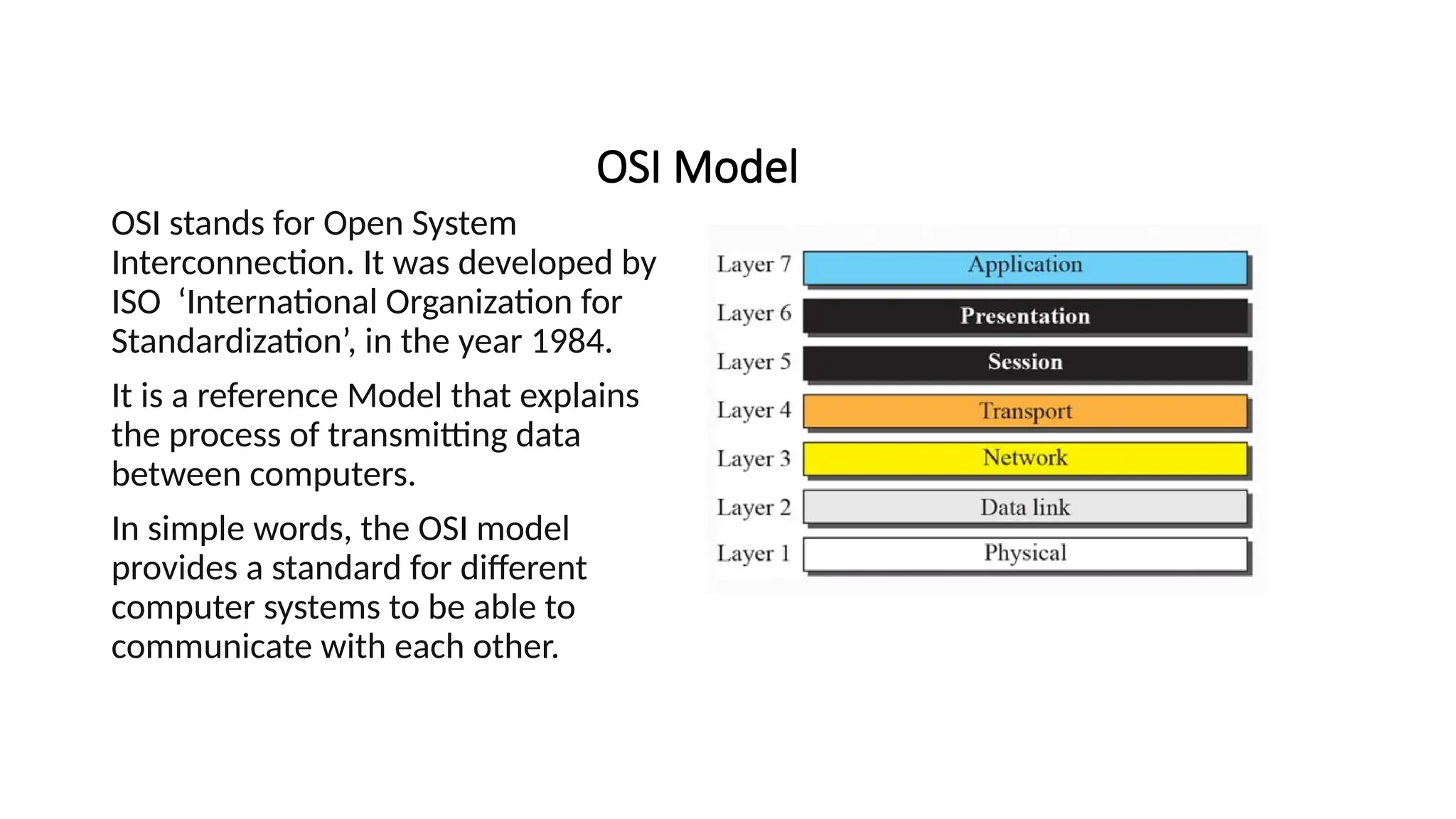
OSI stands for Open System
Interconnection. It was developed by
ISO ‘International Organization for
Standardization’, in the year 1984.
It is a reference Model that explains
the process of transmitting data
between computers.
In simple words, the OSI model
provides a standard for different
computer systems to be able to
communicate with each other.
OSI Model
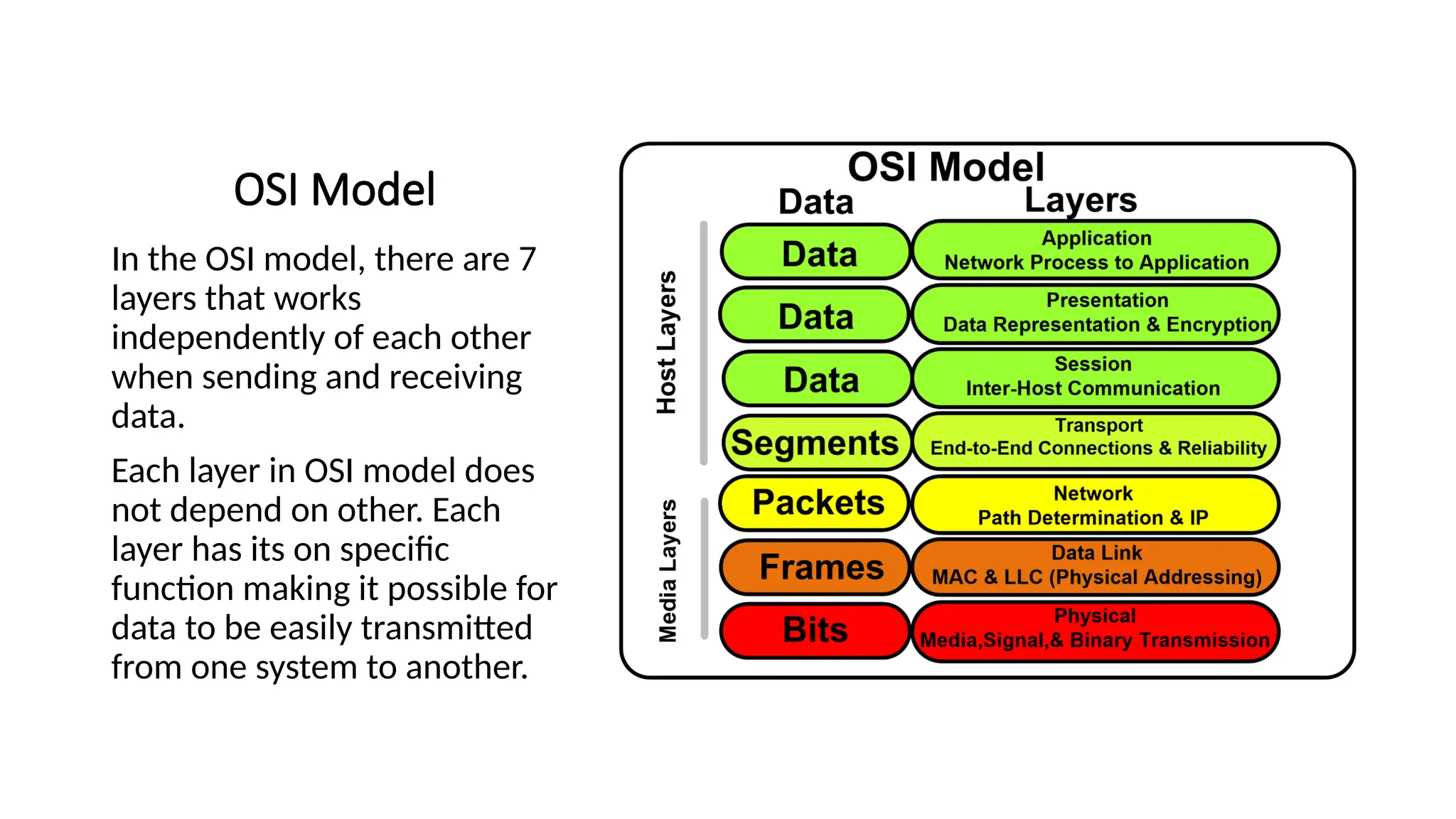
In the OSI model, there are 7
layers that works
independently of each other
when sending and receiving
data.
Each layer in OSI model does
not depend on other. Each
layer has its on specific
function making it possible for
data to be easily transmitted
from one system to another.
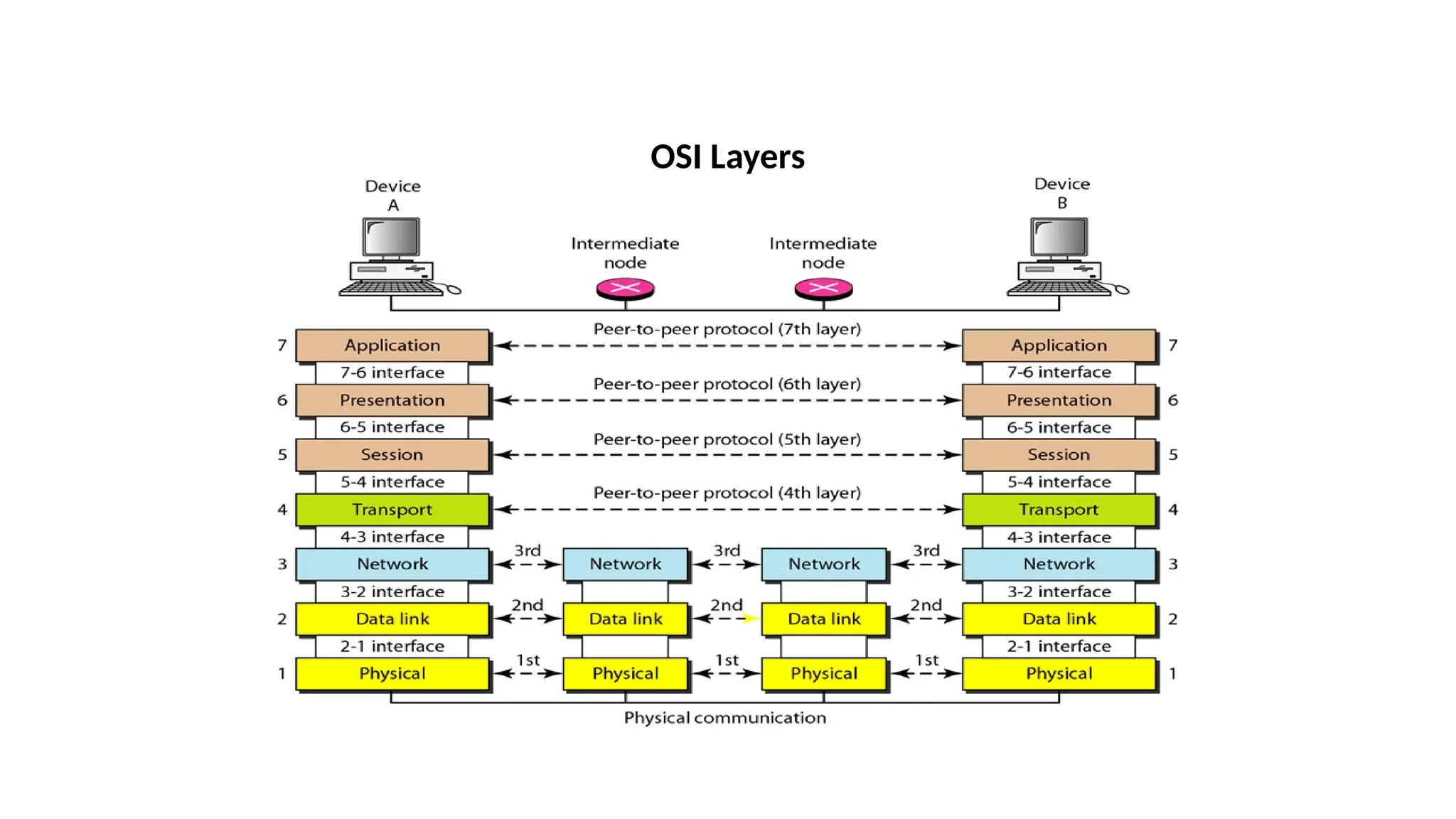
OSI Layers
Application Layer
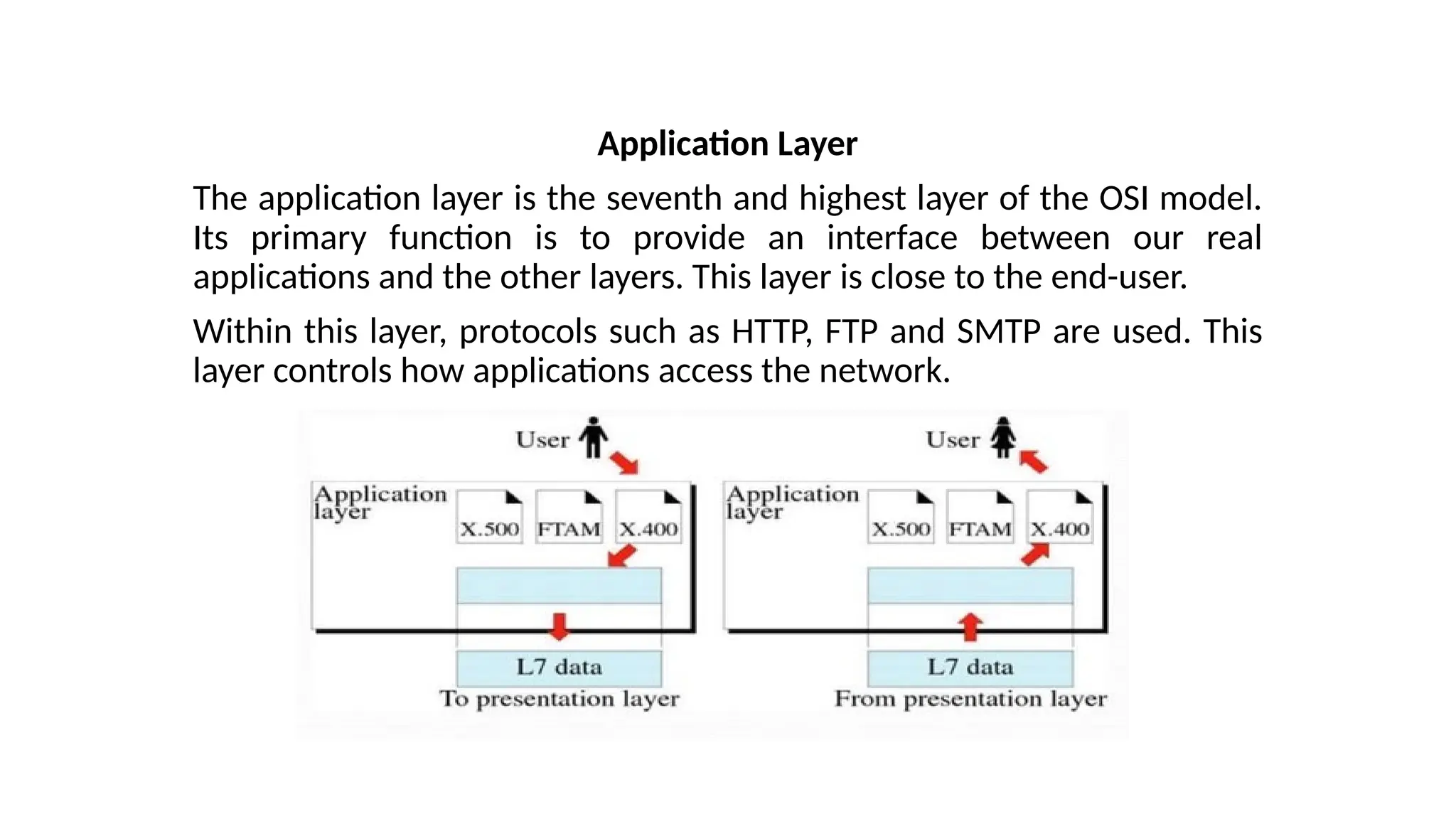
The application layer is the seventh and highest layer of the OSI model.
Its primary function is to provide an interface between our real
applications and the other layers. This layer is close to the end-user.
Within this layer, protocols such as HTTP, FTP and SMTP are used. This
layer controls how applications access the network.
Functions of Application Layer
 File transfer access: This application allows a user to
access files in remote host.
 Mail services: It provides various e-mail services.
 Directory services: This application provides the
distributed database sources and access for global
information about various objects and services.
Presentation layer
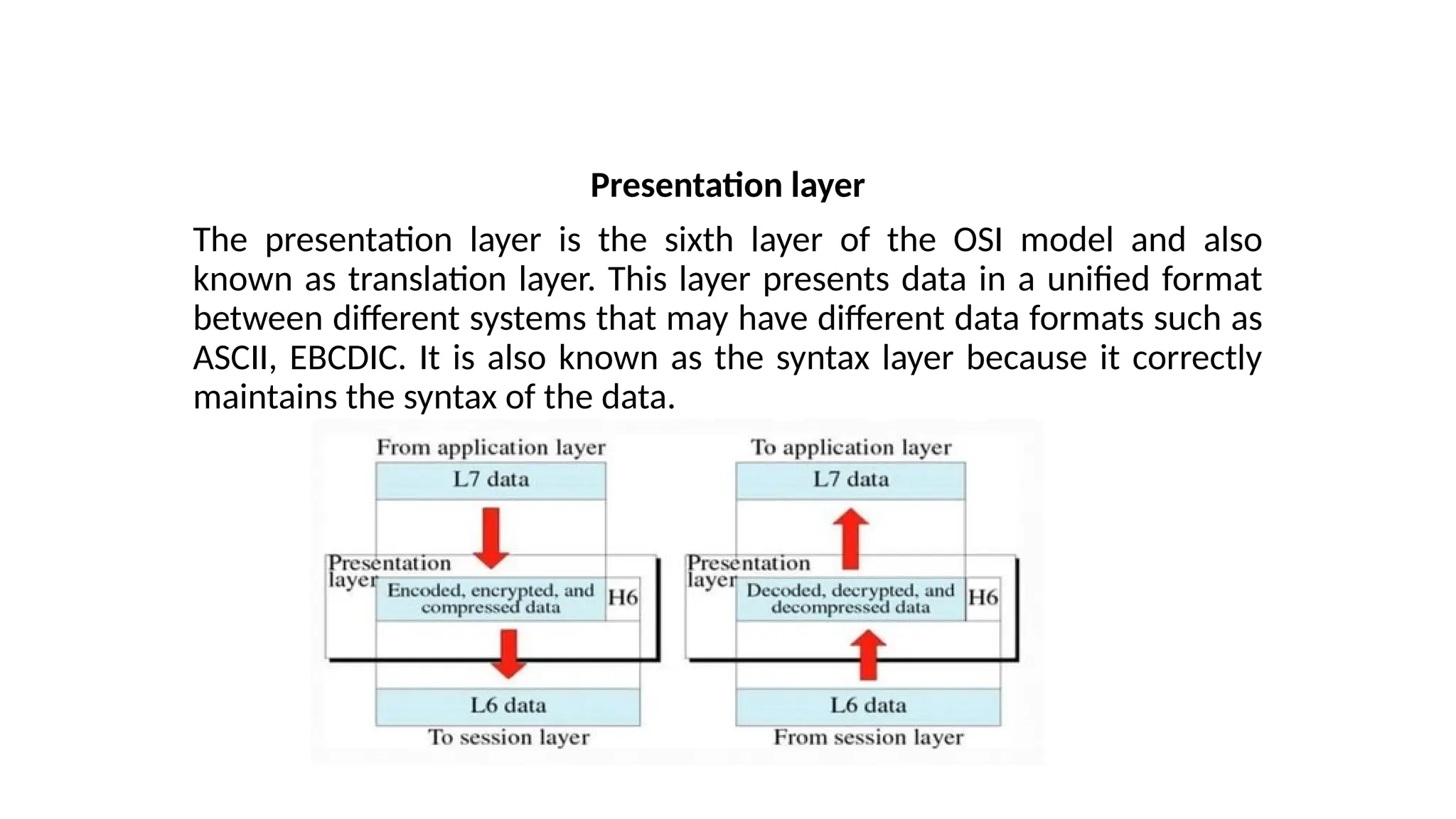
The presentation layer is the sixth layer of the OSI model and also
known as translation layer. This layer presents data in a unified format
between different systems that may have different data formats such as
ASCII, EBCDIC. It is also known as the syntax layer because it correctly
maintains the syntax of the data.
Functions of Presentation Layer
 Data Translation: Encoding and decoding data
 Data encryption: The Presentation Layer is used for
encrypting and decrypting data.
 Compression: Compression is crucial because it allows us
to reduce the size of data.
Session Layer
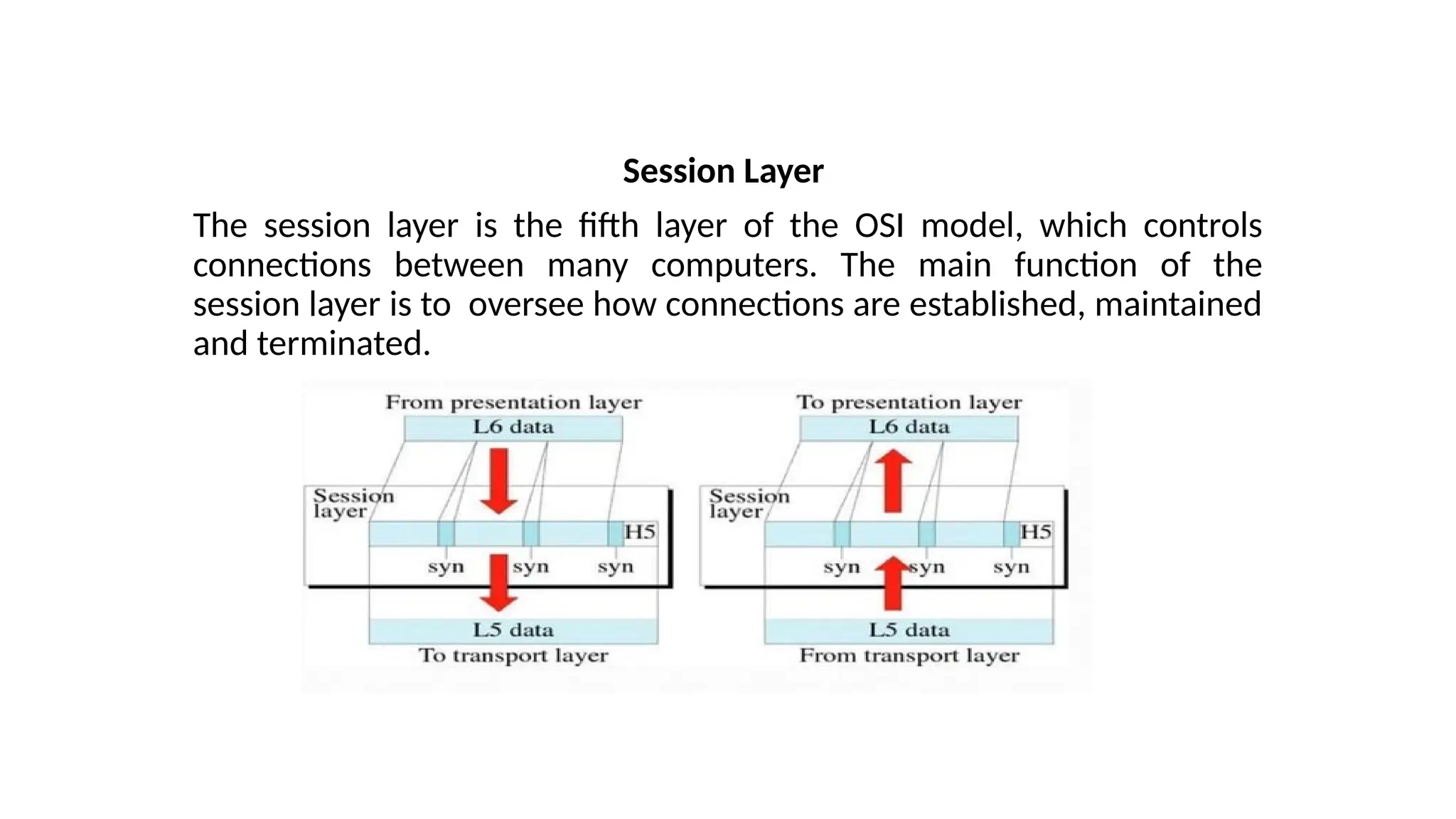
The session layer is the fifth layer of the OSI model, which controls
connections between many computers. The main function of the
session layer is to oversee how connections are established, maintained
and terminated.
Functions of Session Layer
 The primary function of the Session Layer is to establish,
maintain, and terminate sessions between two devices.
• Sends SYN packet- sender send request to server to
establish connection
• Receive ACK & SYN- Server send to sender for connection
established
• To end- Sender sends ACK
 Synchronization: meaning that whenever an error occurs
during transmission, the transmission is repeated.
Transport Layer
The transport layer is the fourth layer of the OSI model and it is also
known as the segment layer. This layer is responsible for transforming
data across the network correctly. It is also known as the end-to-end
layer because it provides a point-to-point connection for transferring
data.
This layer offers two types of services:
1. Connection-oriented Transmission: In this type of transmission the
receiving device sends an acknowledgment back to the source after
a packet or group of packets are received.
2. Connectionless Transmission: In this type of transmission the
receiver does not acknowledge receipt of a packet.
Functions of Transport layer
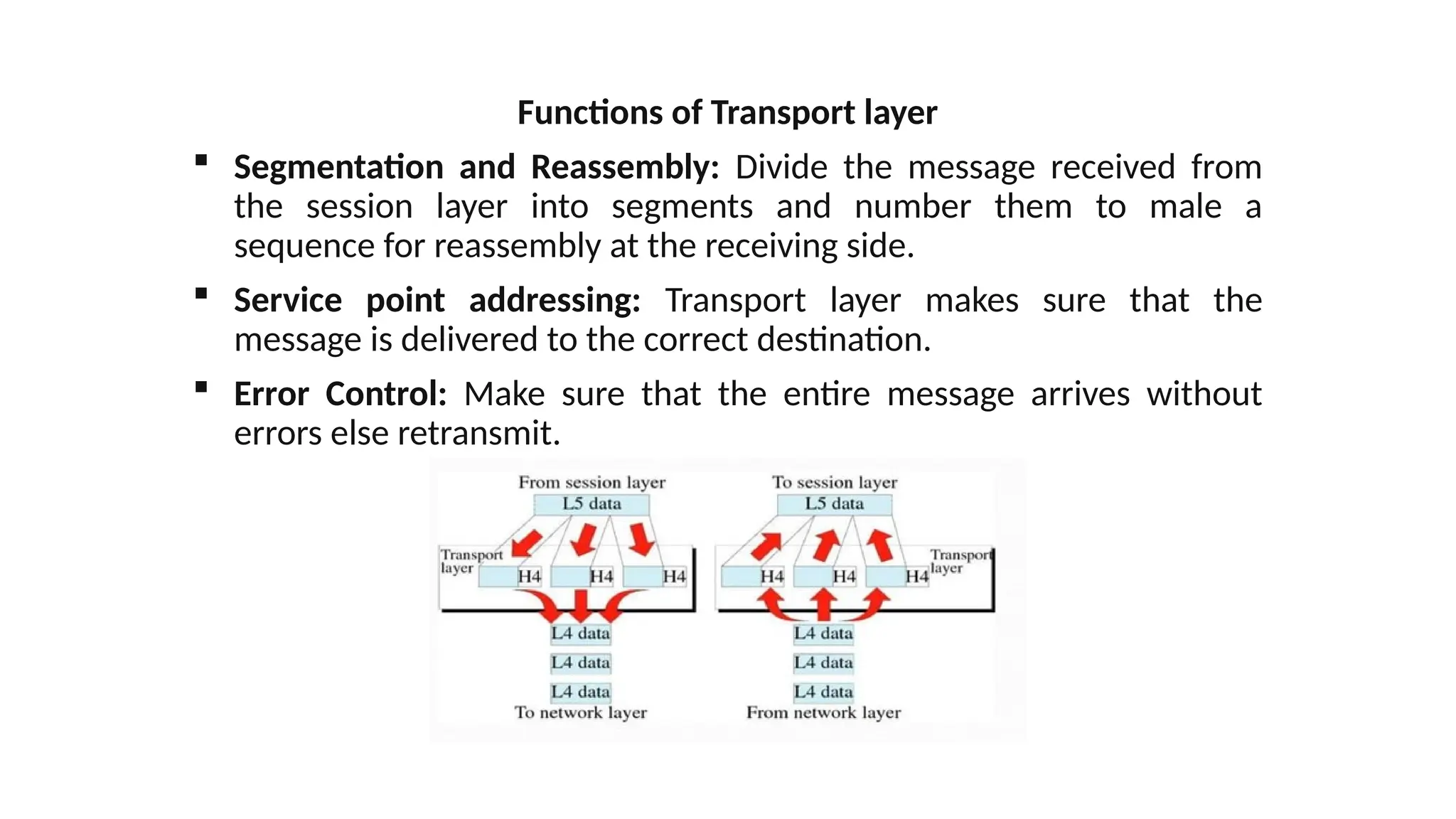
 Segmentation and Reassembly: Divide the message received from
the session layer into segments and number them to male a
sequence for reassembly at the receiving side.
 Service point addressing: Transport layer makes sure that the
message is delivered to the correct destination.
 Error Control: Make sure that the entire message arrives without
errors else retransmit.
Network Layer
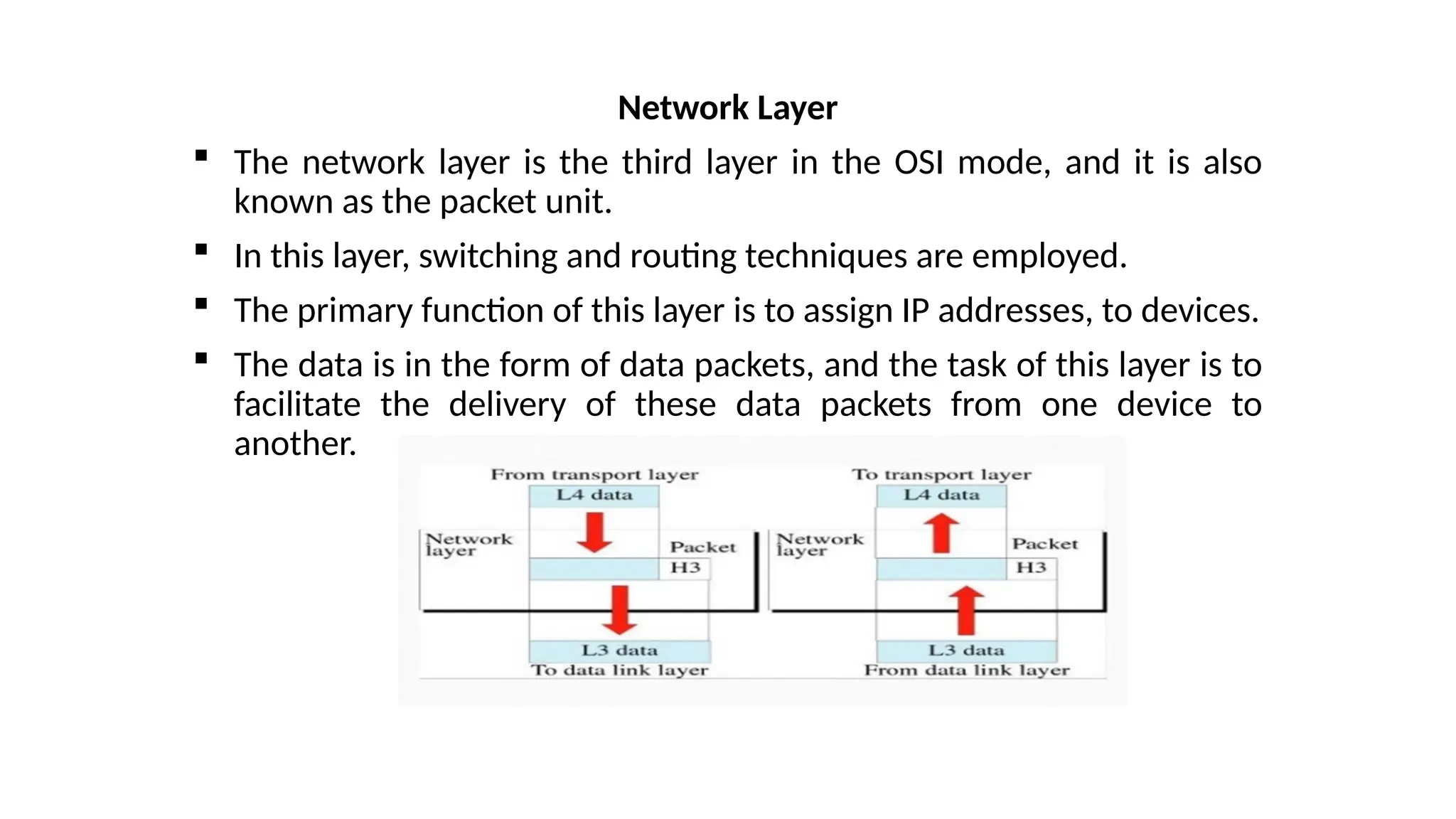
 The network layer is the third layer in the OSI mode, and it is also
known as the packet unit.
 In this layer, switching and routing techniques are employed.
 The primary function of this layer is to assign IP addresses, to devices.
 The data is in the form of data packets, and the task of this layer is to
facilitate the delivery of these data packets from one device to
another.
Functions of Network layer
 Logical addressing: Its primary task is to provide IP
addresses to devices.
 It adds the source and destination addresses to the header
of data packets. These addresses are used to identify
devices on the Internet.
 Routing: This layer is also responsible for routing. It
determines the best path for data packets to travel.
 Switching: It also performs for the source to destination
delivery of a packets across multiple networks.
Data Link Layer
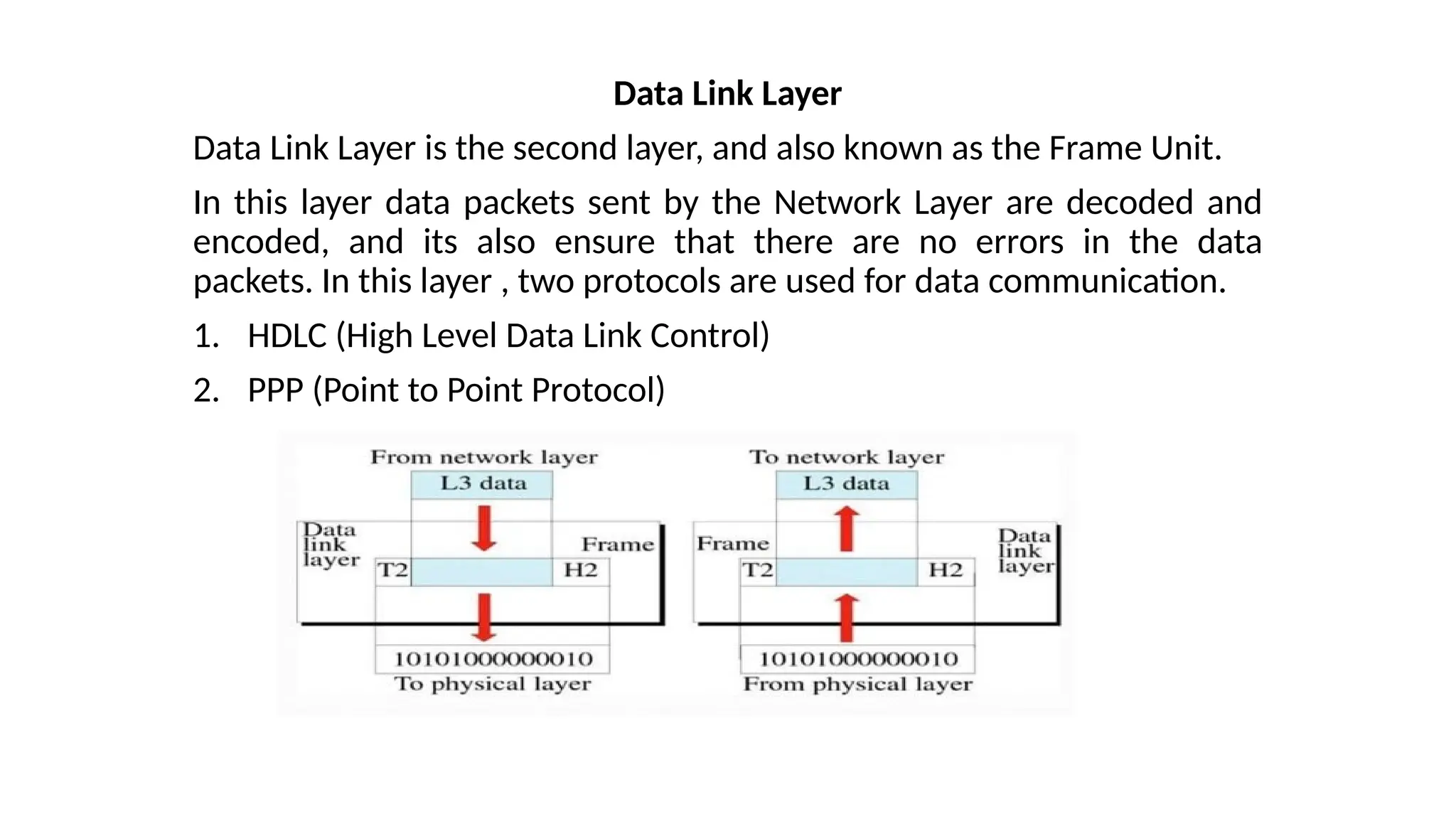
Data Link Layer is the second layer, and also known as the Frame Unit.
In this layer data packets sent by the Network Layer are decoded and
encoded, and its also ensure that there are no errors in the data
packets. In this layer , two protocols are used for data communication.
1. HDLC (High Level Data Link Control)
2. PPP (Point to Point Protocol)
Functions of Data Link Layer
 Framing: This layer encodes and decodes data packets, these data
packets are known as frames.
 Physical Addressing: Add a header to the frame to define the physical
address of the source and the destination.
 Flow Control: The primary function of datalink layer is to perform
flow control, maintaining a specific data rate from both the sender
and receiver to prevent data corruption.
 Error Control: It provides the mechanism of error control in which it
detect and retransmits damaged or lost frames.
 Access Control: It handles access control when two or more devices
are connected to a communication channel , determining which
device is granted access.
 Feedback: After transmitting the frames, the system waits for the
feedback.
Physical Layer
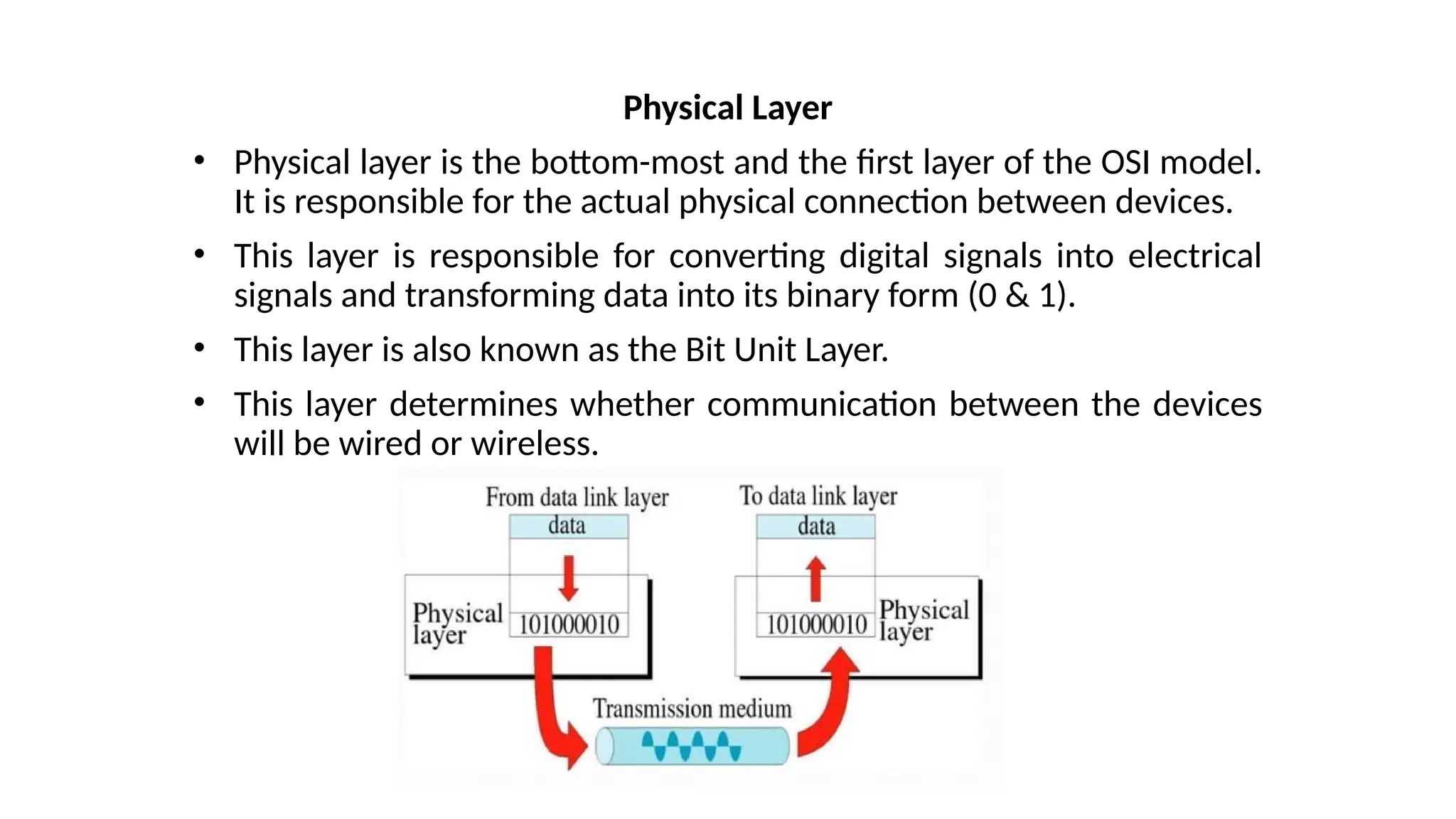
• Physical layer is the bottom-most and the first layer of the OSI model.
It is responsible for the actual physical connection between devices.
• This layer is responsible for converting digital signals into electrical
signals and transforming data into its binary form (0 & 1).
• This layer is also known as the Bit Unit Layer.
• This layer determines whether communication between the devices
will be wired or wireless.
Functions of Physical Layer
 Line configuration: The physical layer explains how two or more
devices are physically connected to each other.
 Transmission Mode: The physical layer also specifies which
transmission mode will be used between two devices in the network.
i.e. simplex, half-duplex, or full duplex .
 Network Topology: This layer determine the network topology.
 Data Rate: This layer indicates the data rate, specifying how many
bits will be transferred in one second.
 Multiplexing: is a way of sending multiple signals or streams of
information over a communications link at the same time in the form
of a single, complex signal.
TCP/IP Model
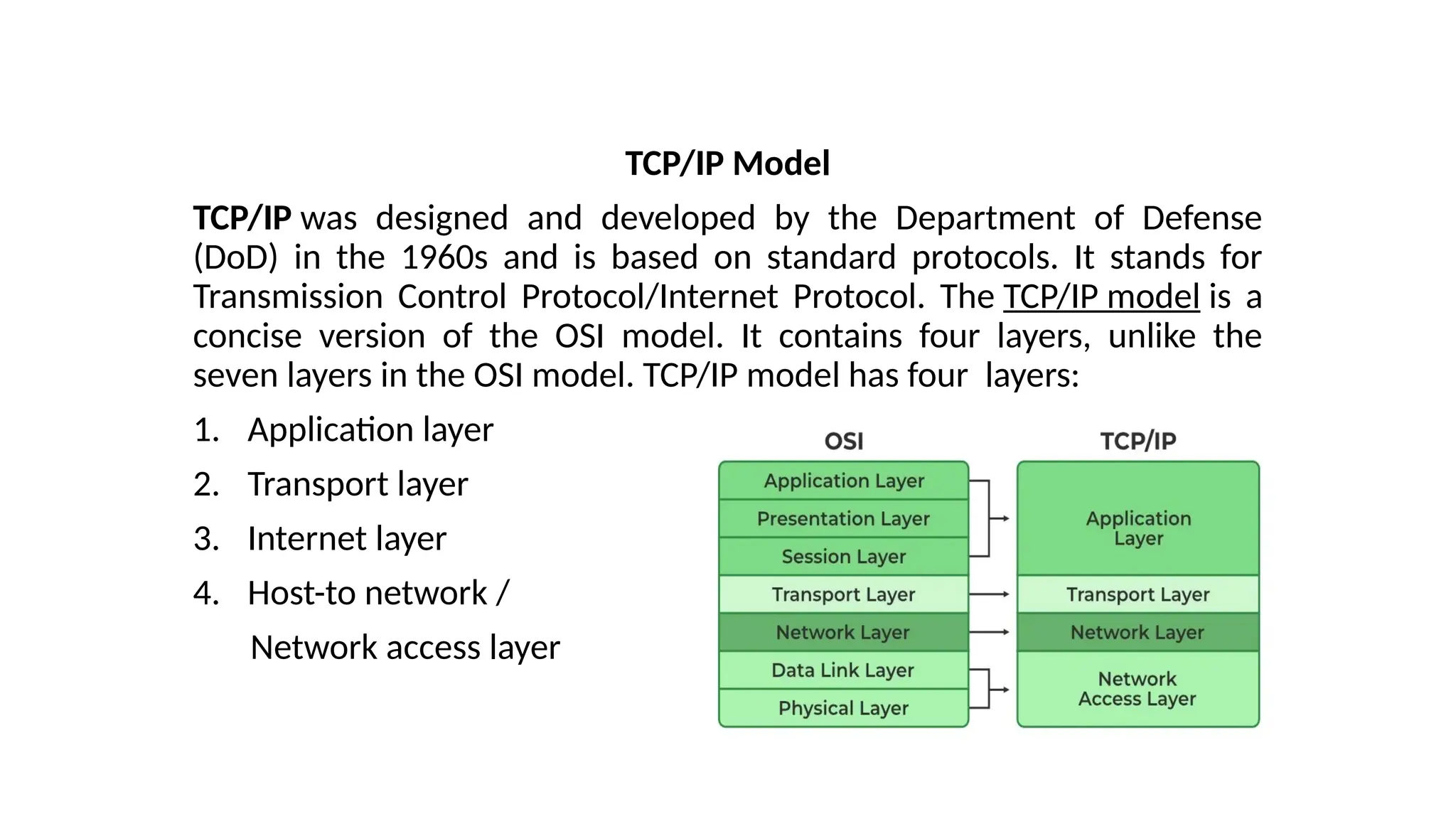
TCP/IP was designed and developed by the Department of Defense
(DoD) in the 1960s and is based on standard protocols. It stands for
Transmission Control Protocol/Internet Protocol. The TCP/IP model is a
concise version of the OSI model. It contains four layers, unlike the
seven layers in the OSI model. TCP/IP model has four layers:
1. Application layer
2. Transport layer
3. Internet layer
4. Host-to network /
Network access layer
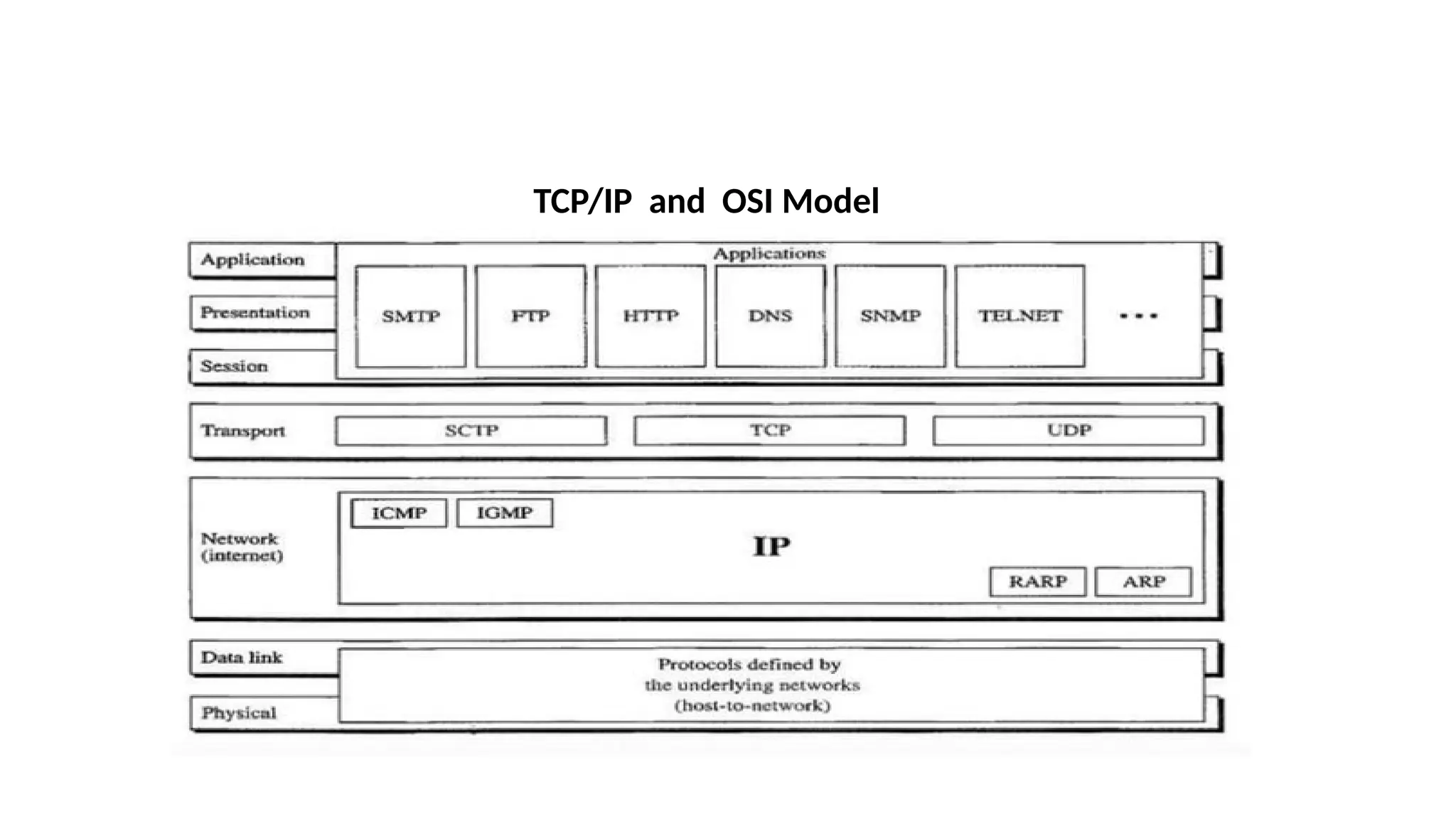
TCP/IP and OSI Model
Host to Network Layer
• It is the bottom layer of TCP/IP model also known as Network
Interface Layer.
• The purpose of this layer is to connect the host to the network.
• Internet Layer is a combination of physical layer and data link layer.
Internet Layer
Internet layer is similar to the network layer od OSI model in
functionality.
This layer is responsible for delivering IP packets to their destination.
An important protocol of this layer is IP(Internet Protocol).
Internet Protocol:
• It is unreliable and connectionless protocol.
• IP transports data in packets called datagrams.
• IP does not keep track of the routes.
Transport Layer
• Transport layer is similar in functionality to transport layer of OSI model.
• Transport layer of TCP/IP model also provides connection –oriented and
connectionless services.
1. Connection-oriented: TCP(Transmission Control Protocol)
Transport layer used TCP for reliable connection oriented service.
Functions of TCP:
2. Error control
3. Flow control
4. Sequencing
2. Connectionless: UDP(User Datagram Protocol)
• Transport layer used this protocol for unreliable connectionless
services,
• No assurance that packet reached.
• No sequencing and No error checking
• Useful in real time data transfer and quick transfer of large data.
• It follows that delivery is more important than accurate delivery.
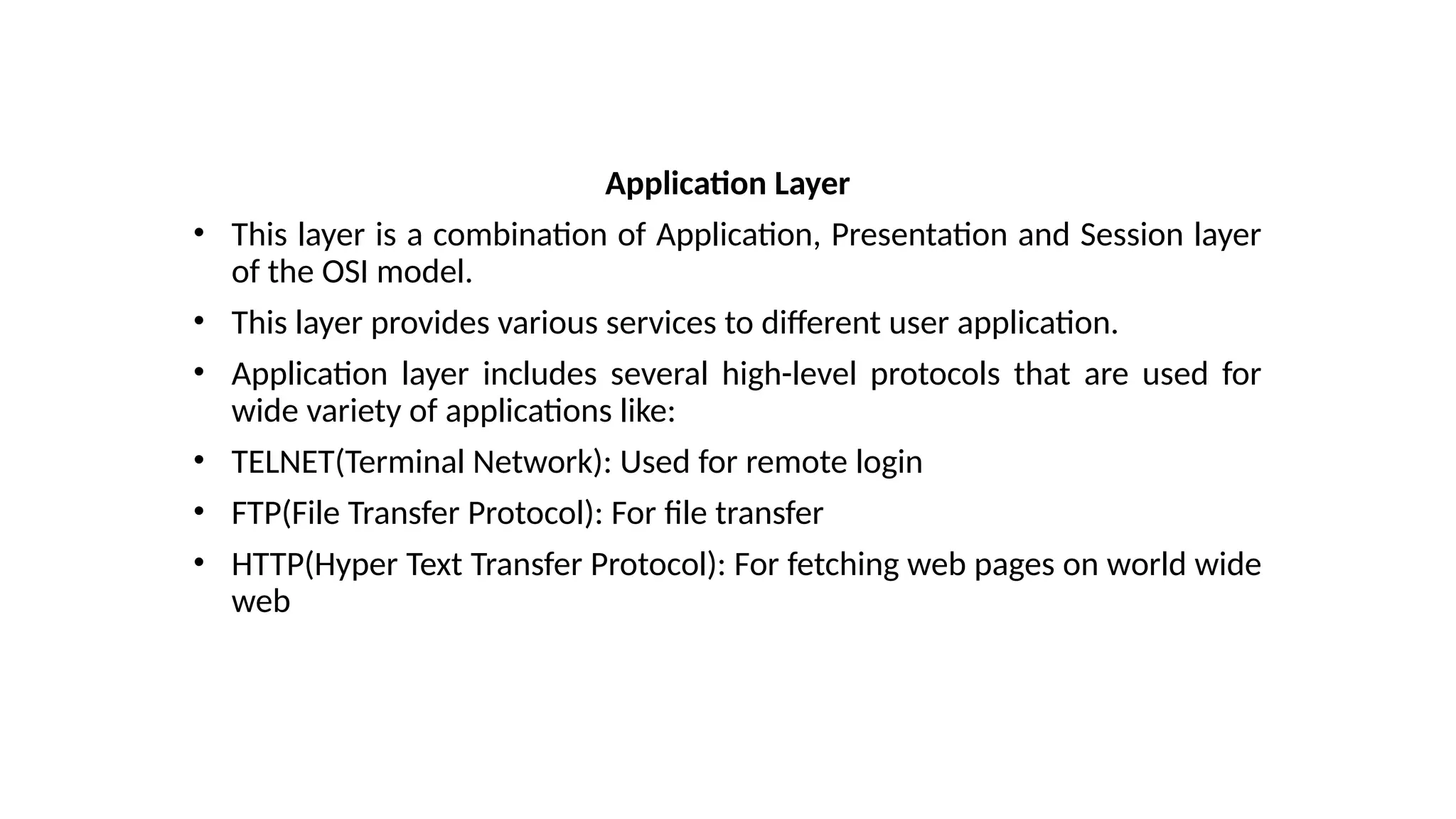
Application Layer
• This layer is a combination of Application, Presentation and Session layer
of the OSI model.
• This layer provides various services to different user application.
• Application layer includes several high-level protocols that are used for
wide variety of applications like:
• TELNET(Terminal Network): Used for remote login
• FTP(File Transfer Protocol): For file transfer
• HTTP(Hyper Text Transfer Protocol): For fetching web pages on world wide
web
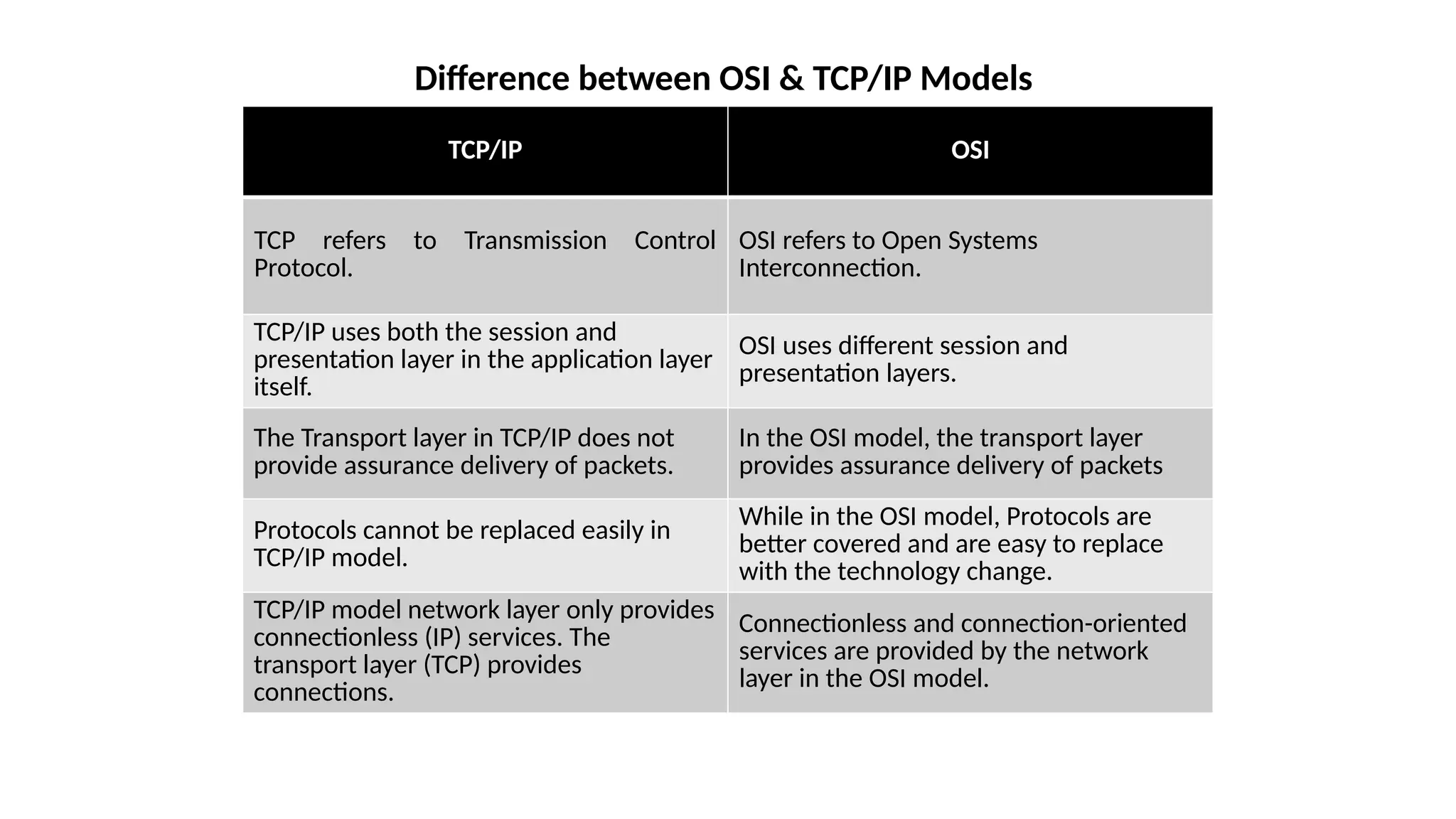
Difference between OSI & TCP/IP Models
TCP/IP OSI
TCP refers to Transmission Control
Protocol.
OSI refers to Open Systems
Interconnection.
TCP/IP uses both the session and
presentation layer in the application layer
itself.
OSI uses different session and
presentation layers.
The Transport layer in TCP/IP does not
provide assurance delivery of packets.
In the OSI model, the transport layer
provides assurance delivery of packets
Protocols cannot be replaced easily in
TCP/IP model.
While in the OSI model, Protocols are
better covered and are easy to replace
with the technology change.
TCP/IP model network layer only provides
connectionless (IP) services. The
transport layer (TCP) provides
connections.
Connectionless and connection-oriented
services are provided by the network
layer in the OSI model.

OSI model.pptx computer networking ,OSI model

  • 1.
    OSI Model &TCP/IP Model
  • 2.
    OSI Model OSI standsfor Open System Interconnection. It was developed by ISO ‘International Organization for Standardization’, in the year 1984. It is a reference Model that explains the process of transmitting data between computers. In simple words, the OSI model provides a standard for different computer systems to be able to communicate with each other.
  • 3.
    OSI Model In theOSI model, there are 7 layers that works independently of each other when sending and receiving data. Each layer in OSI model does not depend on other. Each layer has its on specific function making it possible for data to be easily transmitted from one system to another.
  • 4.
  • 5.
    Application Layer The applicationlayer is the seventh and highest layer of the OSI model. Its primary function is to provide an interface between our real applications and the other layers. This layer is close to the end-user. Within this layer, protocols such as HTTP, FTP and SMTP are used. This layer controls how applications access the network.
  • 6.
    Functions of ApplicationLayer  File transfer access: This application allows a user to access files in remote host.  Mail services: It provides various e-mail services.  Directory services: This application provides the distributed database sources and access for global information about various objects and services.
  • 7.
    Presentation layer The presentationlayer is the sixth layer of the OSI model and also known as translation layer. This layer presents data in a unified format between different systems that may have different data formats such as ASCII, EBCDIC. It is also known as the syntax layer because it correctly maintains the syntax of the data.
  • 8.
    Functions of PresentationLayer  Data Translation: Encoding and decoding data  Data encryption: The Presentation Layer is used for encrypting and decrypting data.  Compression: Compression is crucial because it allows us to reduce the size of data.
  • 9.
    Session Layer The sessionlayer is the fifth layer of the OSI model, which controls connections between many computers. The main function of the session layer is to oversee how connections are established, maintained and terminated.
  • 10.
    Functions of SessionLayer  The primary function of the Session Layer is to establish, maintain, and terminate sessions between two devices. • Sends SYN packet- sender send request to server to establish connection • Receive ACK & SYN- Server send to sender for connection established • To end- Sender sends ACK  Synchronization: meaning that whenever an error occurs during transmission, the transmission is repeated.
  • 11.
    Transport Layer The transportlayer is the fourth layer of the OSI model and it is also known as the segment layer. This layer is responsible for transforming data across the network correctly. It is also known as the end-to-end layer because it provides a point-to-point connection for transferring data. This layer offers two types of services: 1. Connection-oriented Transmission: In this type of transmission the receiving device sends an acknowledgment back to the source after a packet or group of packets are received. 2. Connectionless Transmission: In this type of transmission the receiver does not acknowledge receipt of a packet.
  • 12.
    Functions of Transportlayer  Segmentation and Reassembly: Divide the message received from the session layer into segments and number them to male a sequence for reassembly at the receiving side.  Service point addressing: Transport layer makes sure that the message is delivered to the correct destination.  Error Control: Make sure that the entire message arrives without errors else retransmit.
  • 13.
    Network Layer  Thenetwork layer is the third layer in the OSI mode, and it is also known as the packet unit.  In this layer, switching and routing techniques are employed.  The primary function of this layer is to assign IP addresses, to devices.  The data is in the form of data packets, and the task of this layer is to facilitate the delivery of these data packets from one device to another.
  • 14.
    Functions of Networklayer  Logical addressing: Its primary task is to provide IP addresses to devices.  It adds the source and destination addresses to the header of data packets. These addresses are used to identify devices on the Internet.  Routing: This layer is also responsible for routing. It determines the best path for data packets to travel.  Switching: It also performs for the source to destination delivery of a packets across multiple networks.
  • 15.
    Data Link Layer DataLink Layer is the second layer, and also known as the Frame Unit. In this layer data packets sent by the Network Layer are decoded and encoded, and its also ensure that there are no errors in the data packets. In this layer , two protocols are used for data communication. 1. HDLC (High Level Data Link Control) 2. PPP (Point to Point Protocol)
  • 16.
    Functions of DataLink Layer  Framing: This layer encodes and decodes data packets, these data packets are known as frames.  Physical Addressing: Add a header to the frame to define the physical address of the source and the destination.  Flow Control: The primary function of datalink layer is to perform flow control, maintaining a specific data rate from both the sender and receiver to prevent data corruption.  Error Control: It provides the mechanism of error control in which it detect and retransmits damaged or lost frames.  Access Control: It handles access control when two or more devices are connected to a communication channel , determining which device is granted access.  Feedback: After transmitting the frames, the system waits for the feedback.
  • 17.
    Physical Layer • Physicallayer is the bottom-most and the first layer of the OSI model. It is responsible for the actual physical connection between devices. • This layer is responsible for converting digital signals into electrical signals and transforming data into its binary form (0 & 1). • This layer is also known as the Bit Unit Layer. • This layer determines whether communication between the devices will be wired or wireless.
  • 18.
    Functions of PhysicalLayer  Line configuration: The physical layer explains how two or more devices are physically connected to each other.  Transmission Mode: The physical layer also specifies which transmission mode will be used between two devices in the network. i.e. simplex, half-duplex, or full duplex .  Network Topology: This layer determine the network topology.  Data Rate: This layer indicates the data rate, specifying how many bits will be transferred in one second.  Multiplexing: is a way of sending multiple signals or streams of information over a communications link at the same time in the form of a single, complex signal.
  • 19.
    TCP/IP Model TCP/IP wasdesigned and developed by the Department of Defense (DoD) in the 1960s and is based on standard protocols. It stands for Transmission Control Protocol/Internet Protocol. The TCP/IP model is a concise version of the OSI model. It contains four layers, unlike the seven layers in the OSI model. TCP/IP model has four layers: 1. Application layer 2. Transport layer 3. Internet layer 4. Host-to network / Network access layer
  • 20.
  • 21.
    Host to NetworkLayer • It is the bottom layer of TCP/IP model also known as Network Interface Layer. • The purpose of this layer is to connect the host to the network. • Internet Layer is a combination of physical layer and data link layer.
  • 22.
    Internet Layer Internet layeris similar to the network layer od OSI model in functionality. This layer is responsible for delivering IP packets to their destination. An important protocol of this layer is IP(Internet Protocol). Internet Protocol: • It is unreliable and connectionless protocol. • IP transports data in packets called datagrams. • IP does not keep track of the routes.
  • 23.
    Transport Layer • Transportlayer is similar in functionality to transport layer of OSI model. • Transport layer of TCP/IP model also provides connection –oriented and connectionless services. 1. Connection-oriented: TCP(Transmission Control Protocol) Transport layer used TCP for reliable connection oriented service. Functions of TCP: 2. Error control 3. Flow control 4. Sequencing
  • 24.
    2. Connectionless: UDP(UserDatagram Protocol) • Transport layer used this protocol for unreliable connectionless services, • No assurance that packet reached. • No sequencing and No error checking • Useful in real time data transfer and quick transfer of large data. • It follows that delivery is more important than accurate delivery.
  • 25.
    Application Layer • Thislayer is a combination of Application, Presentation and Session layer of the OSI model. • This layer provides various services to different user application. • Application layer includes several high-level protocols that are used for wide variety of applications like: • TELNET(Terminal Network): Used for remote login • FTP(File Transfer Protocol): For file transfer • HTTP(Hyper Text Transfer Protocol): For fetching web pages on world wide web
  • 26.
    Difference between OSI& TCP/IP Models TCP/IP OSI TCP refers to Transmission Control Protocol. OSI refers to Open Systems Interconnection. TCP/IP uses both the session and presentation layer in the application layer itself. OSI uses different session and presentation layers. The Transport layer in TCP/IP does not provide assurance delivery of packets. In the OSI model, the transport layer provides assurance delivery of packets Protocols cannot be replaced easily in TCP/IP model. While in the OSI model, Protocols are better covered and are easy to replace with the technology change. TCP/IP model network layer only provides connectionless (IP) services. The transport layer (TCP) provides connections. Connectionless and connection-oriented services are provided by the network layer in the OSI model.