Object Oriented Programming
using C++
Overview
 Problem Solving
 Features of an OOL
 Basic Syntax
 Programming Paradigms
Solving a Programming Problem
 Analysis
 Design
 Coding
 Management
 Programming paradigms
 Programming languages
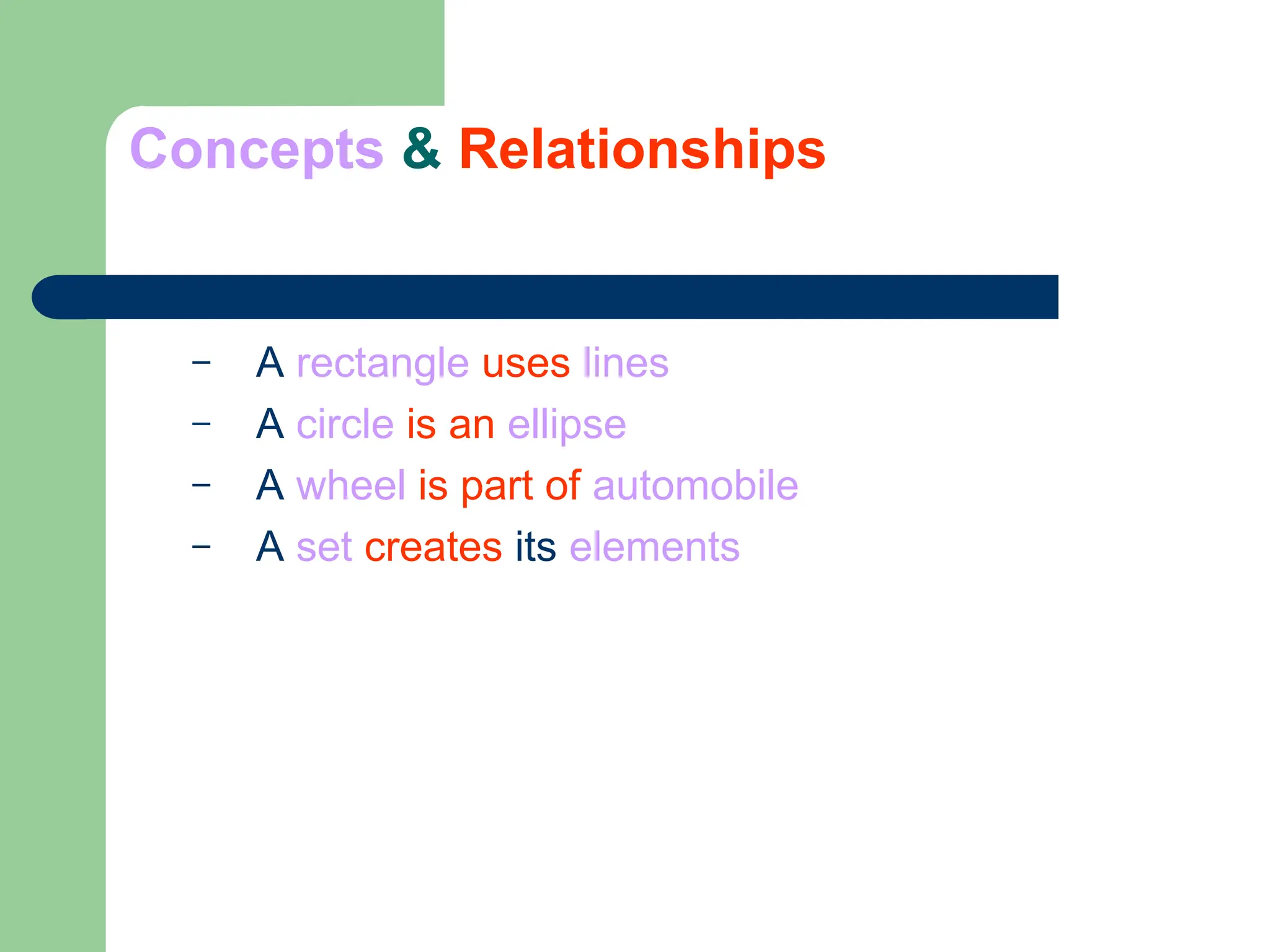
Concepts & Relationships
– A rectangle uses lines
– A circle is an ellipse
– A wheel is part of automobile
– A set creates its elements
Some Features of OOP languages
 An OOP language should support
– Easy Representation of
 Real-world objects
 Their States and Abilities
– Interaction with objects of same type
– Relations with objects of other type
– Polymorphism and Overloading
 Reusability of code
 Convenient type definitions
Basic Syntax
 Same as C
 Additional operators
 Additional keywords
Programming Paradigms
 Procedural Programming (functions)
 Modular Programming (namespaces)
 Object Oriented Programming (classes)
 Generic Programming (templates)
Procedural Programming
 A program is a list of instructions
 Concentration is on what is to be done?
 Problems created by global data
 No access control !!
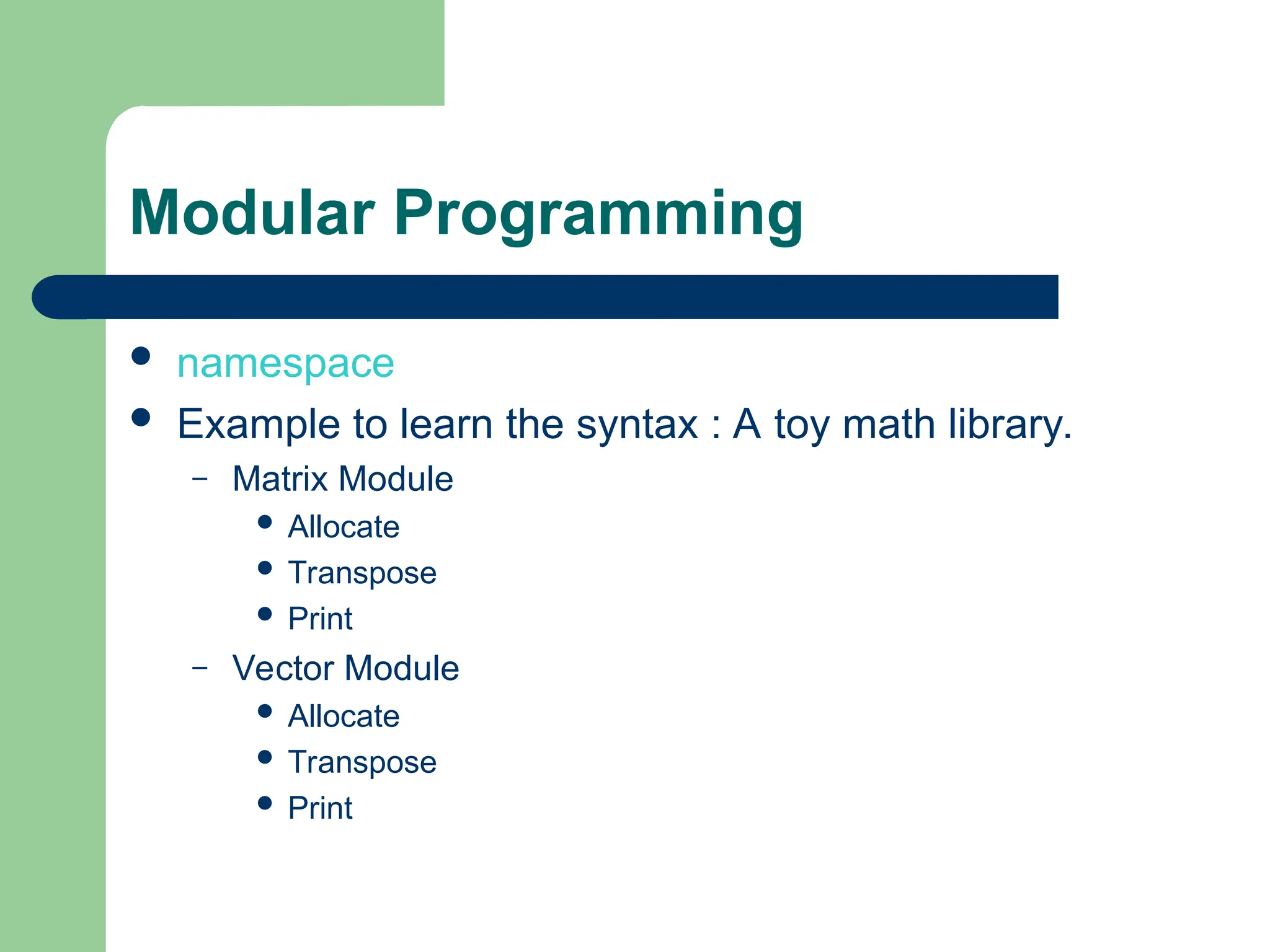
Modular Programming
 namespace
 Example to learn the syntax : A toy math library.
– Matrix Module
 Allocate
 Transpose
 Print
– Vector Module
 Allocate
 Transpose
 Print
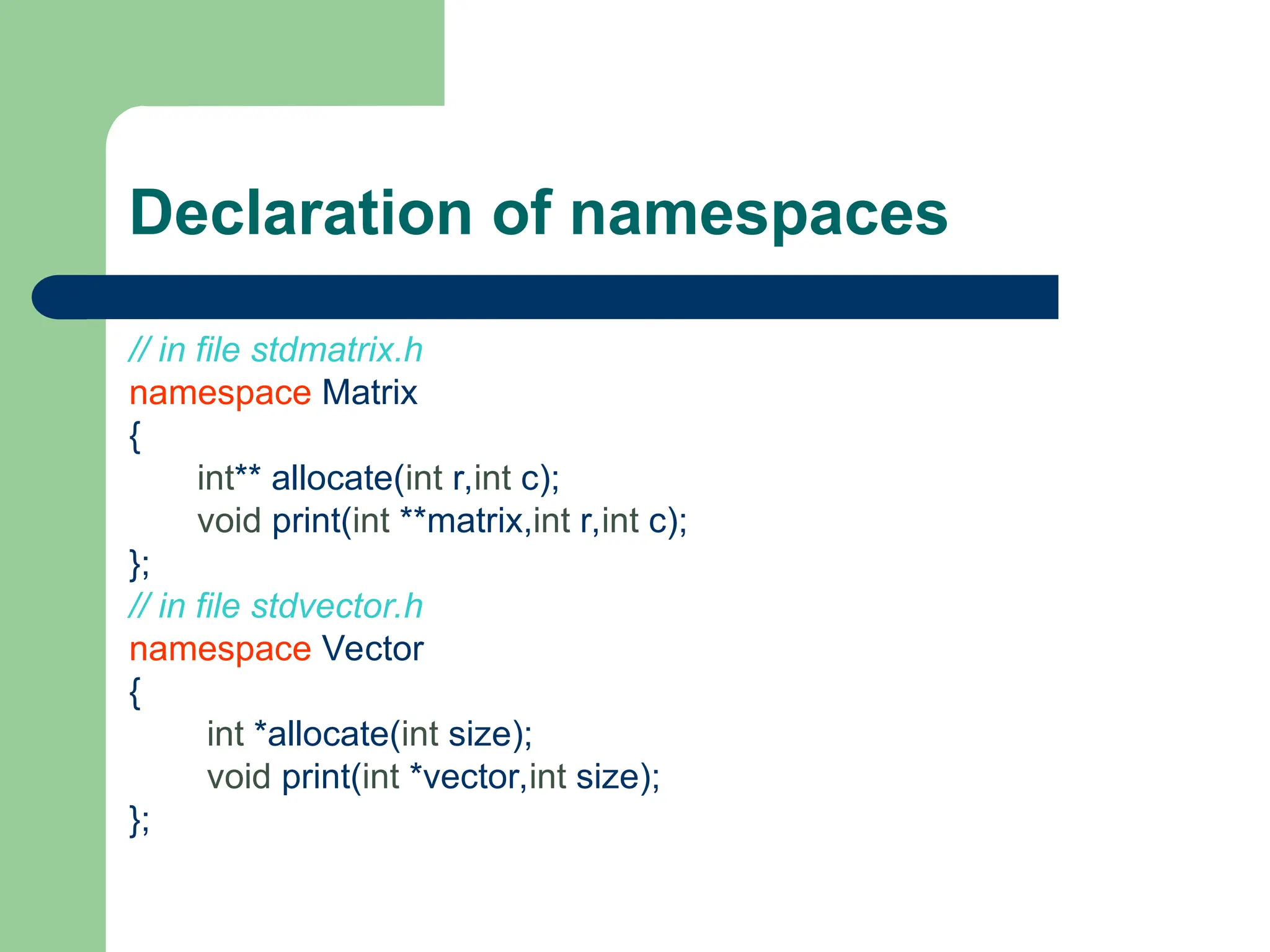
Declaration of namespaces
// in file stdmatrix.h
namespace Matrix
{
int** allocate(int r,int c);
void print(int **matrix,int r,int c);
};
// in file stdvector.h
namespace Vector
{
int *allocate(int size);
void print(int *vector,int size);
};
Definition of Matrix functions
int **Matrix::allocate(int r, int c)
{
int **mat;
mat = new int*[r];
for (int i = 0; i < r; i++)
mat[i] = new int[c];
return mat;
}
void Matrix::print(int **matrix,int r, int c)
{
for (int i = 0; i < r ; i++)
{
for (int j = 0; j < c ; j++)
printf("%d ",matrix[i][j]);
printf("n");
}
printf("n");
}
Definition of Vector functions
int *Vector::allocate(int size)
{
int *vec = new int[size];
return vec;
}
void Vector::print(int *vector,int size)
{
for (int i = 0; i < size; i++)
printf("%d ",vector[i]);
printf("n");
}
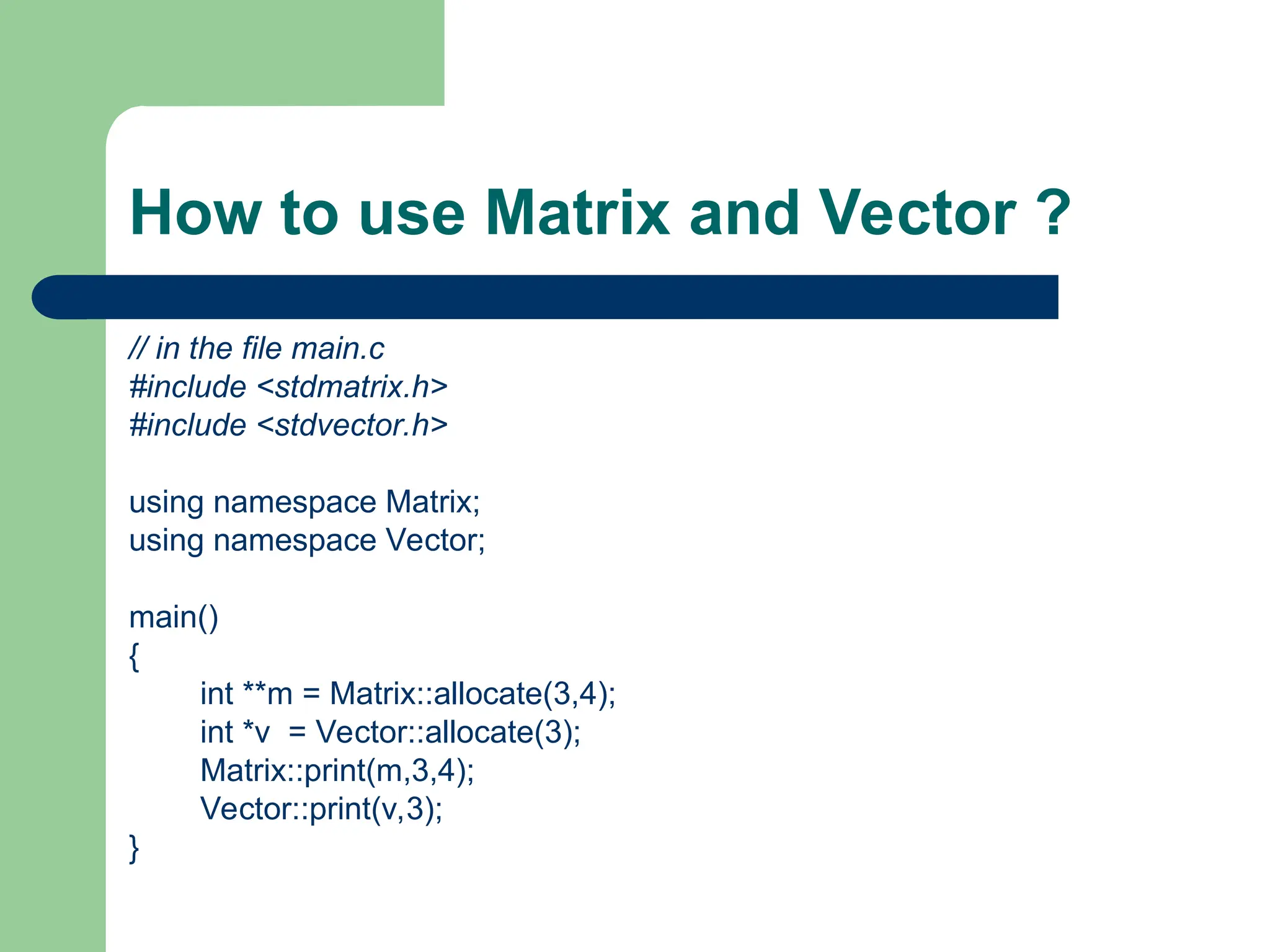
How to use Matrix and Vector ?
// in the file main.c
#include <stdmatrix.h>
#include <stdvector.h>
using namespace Matrix;
using namespace Vector;
main()
{
int **m = Matrix::allocate(3,4);
int *v = Vector::allocate(3);
Matrix::print(m,3,4);
Vector::print(v,3);
}
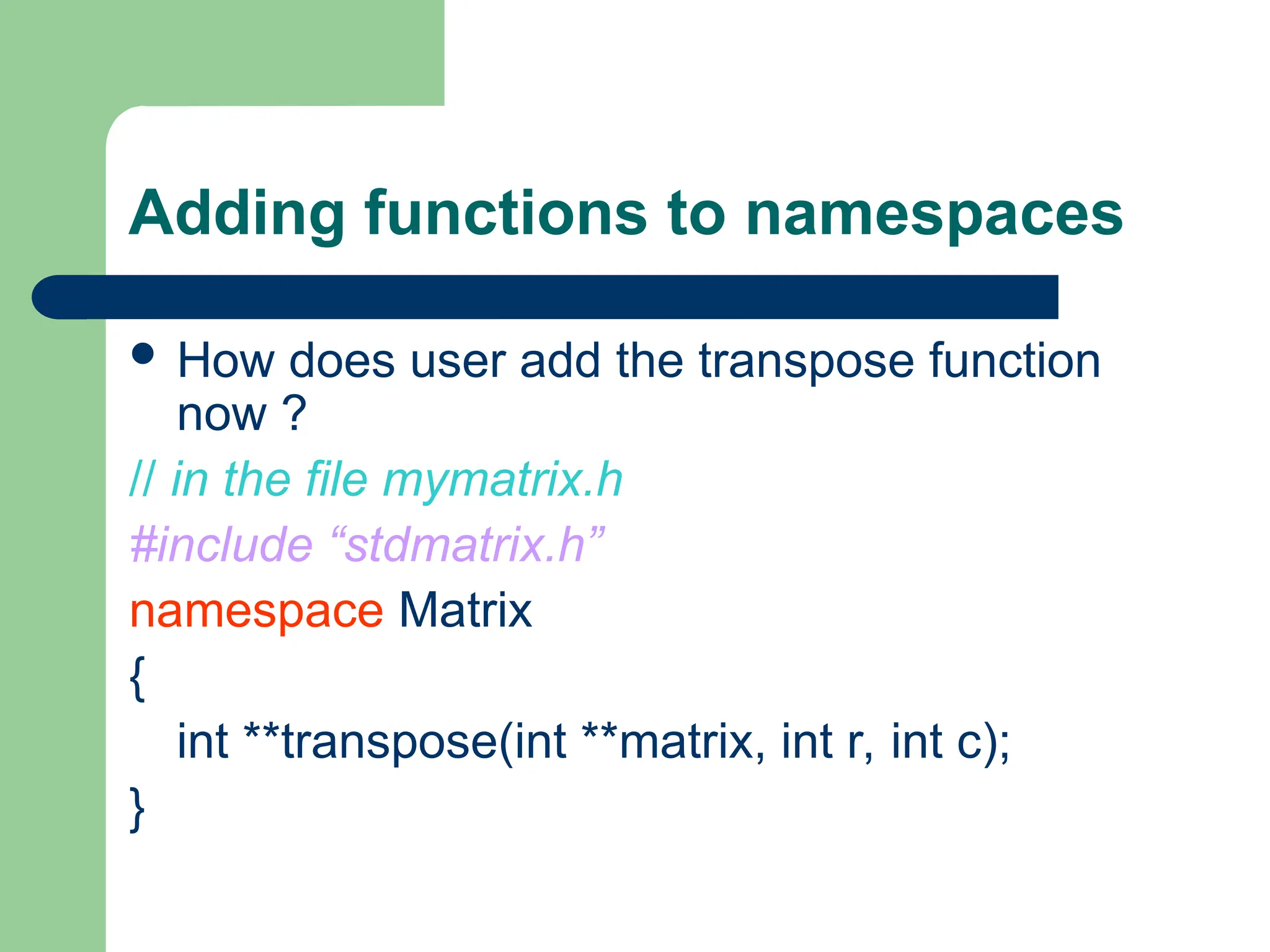
Adding functions to namespaces
 How does user add the transpose function
now ?
// in the file mymatrix.h
#include “stdmatrix.h”
namespace Matrix
{
int **transpose(int **matrix, int r, int c);
}
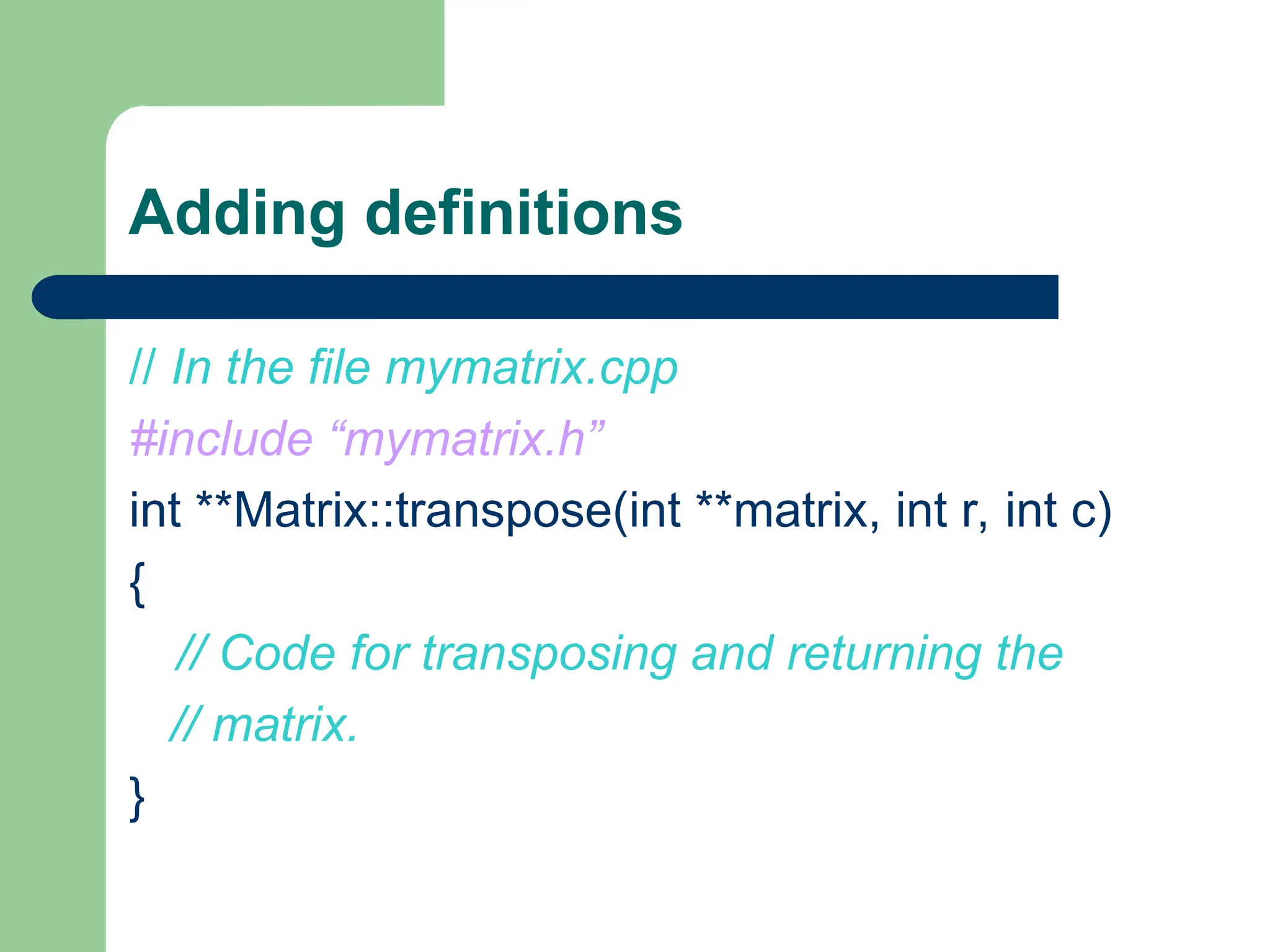
Adding definitions
// In the file mymatrix.cpp
#include “mymatrix.h”
int **Matrix::transpose(int **matrix, int r, int c)
{
// Code for transposing and returning the
// matrix.
}
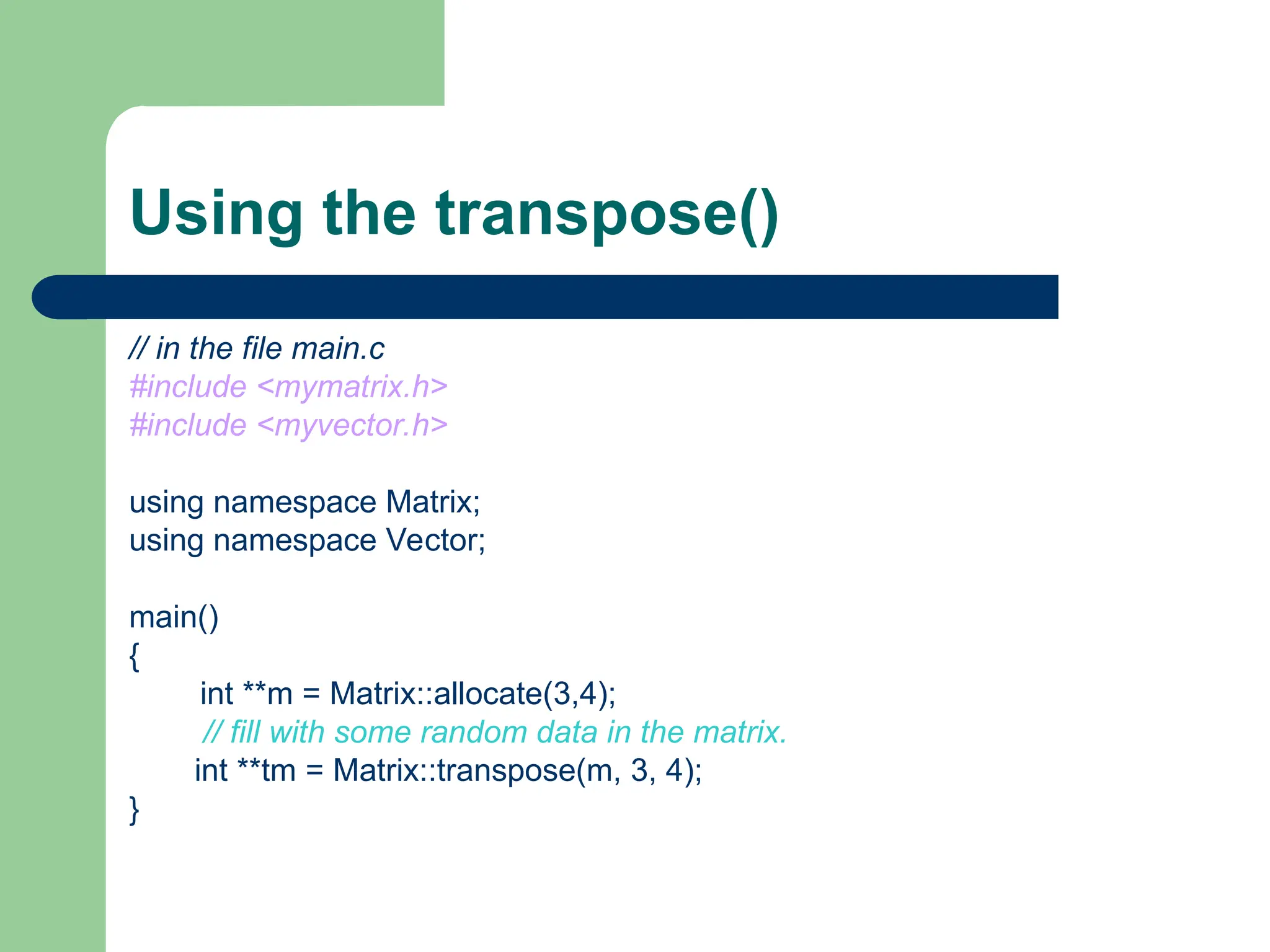
Using the transpose()
// in the file main.c
#include <mymatrix.h>
#include <myvector.h>
using namespace Matrix;
using namespace Vector;
main()
{
int **m = Matrix::allocate(3,4);
// fill with some random data in the matrix.
int **tm = Matrix::transpose(m, 3, 4);
}
Object Oriented Programming
 Class
 Object
 Overloading (operators, functions)
 Inheritance
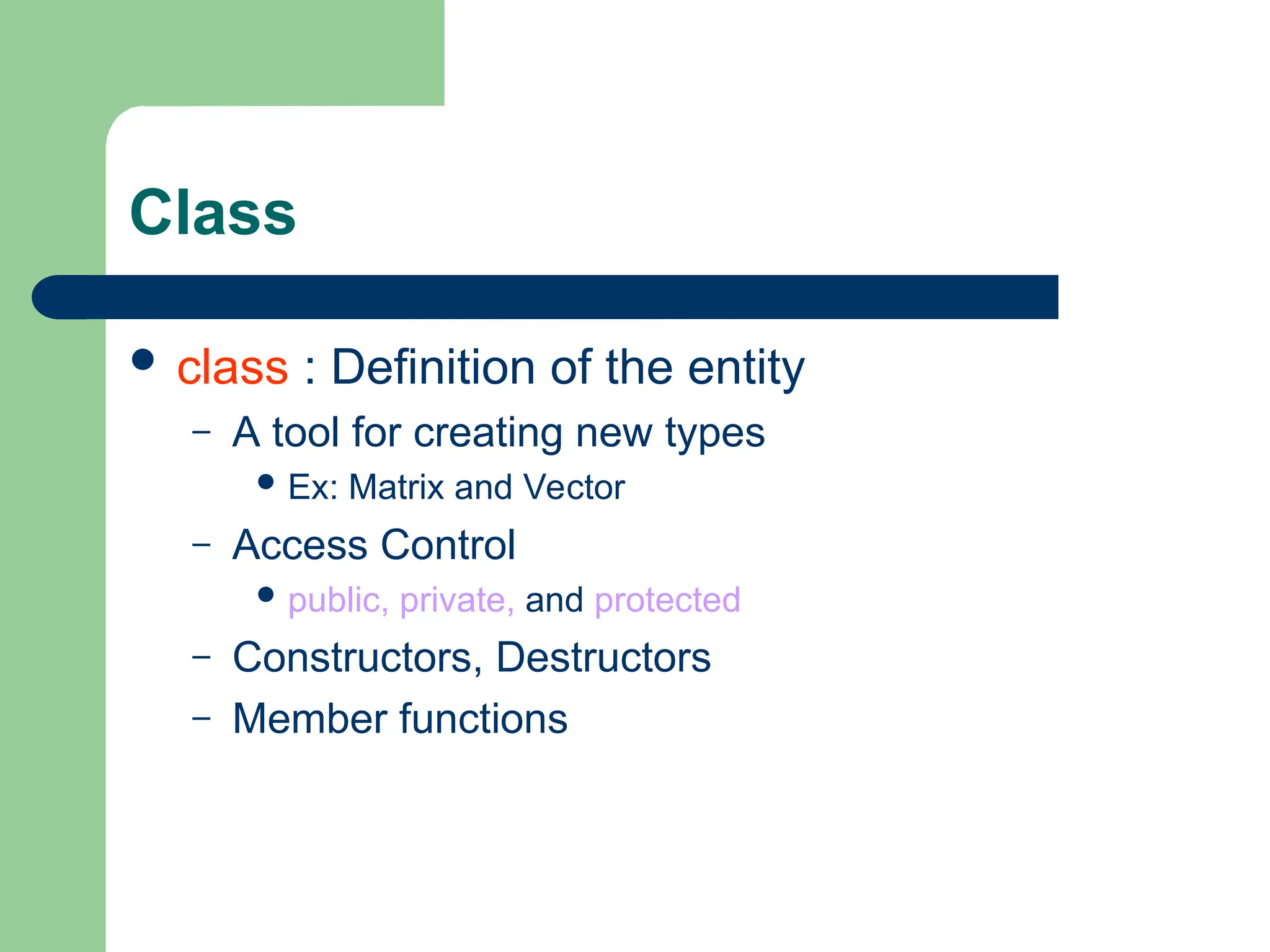
Class
 class : Definition of the entity
– A tool for creating new types
 Ex: Matrix and Vector
– Access Control
 public, private, and protected
– Constructors, Destructors
– Member functions
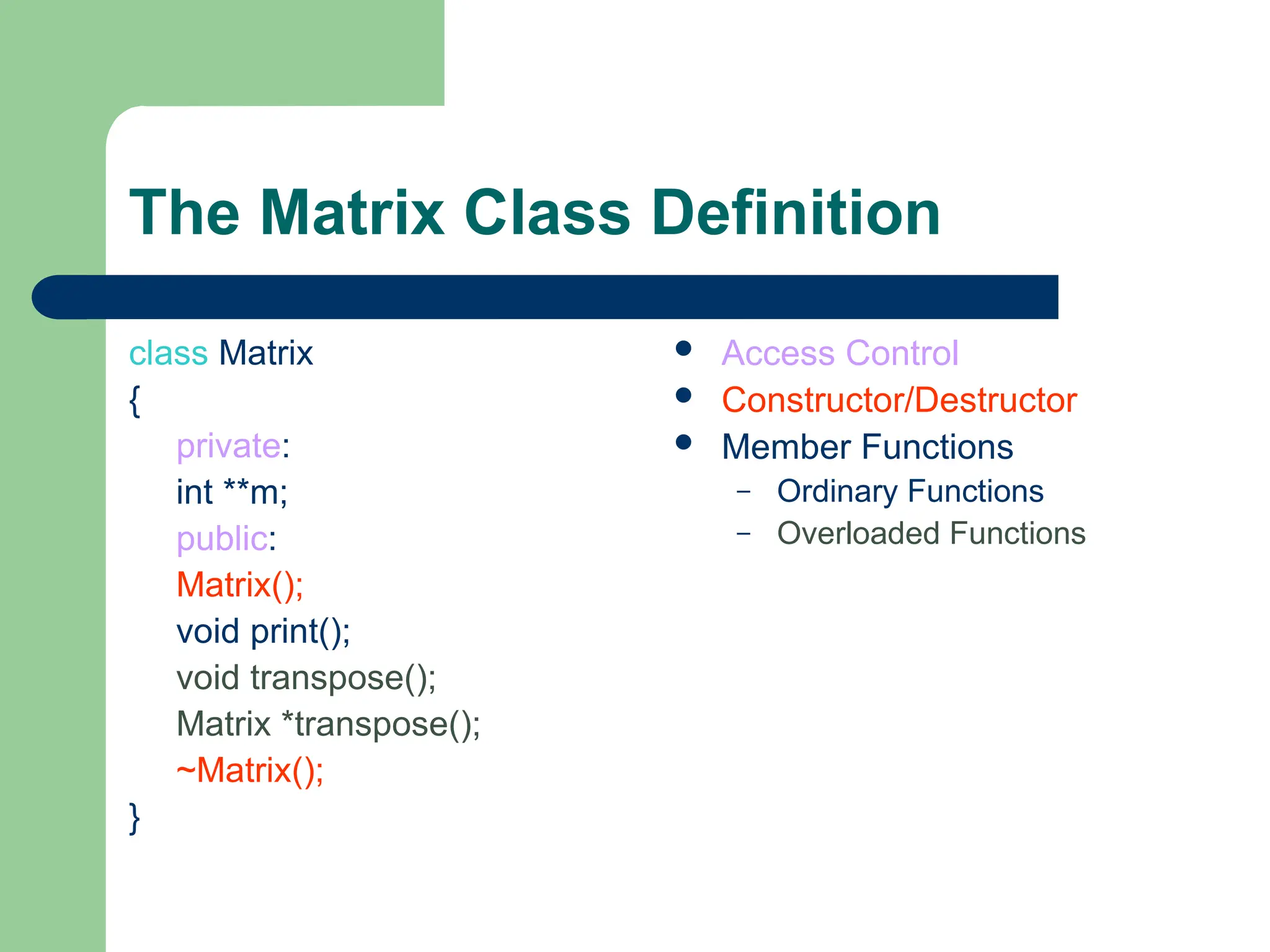
The Matrix Class Definition
class Matrix
{
private:
int **m;
public:
Matrix();
void print();
void transpose();
Matrix *transpose();
~Matrix();
}
 Access Control
 Constructor/Destructor
 Member Functions
– Ordinary Functions
– Overloaded Functions
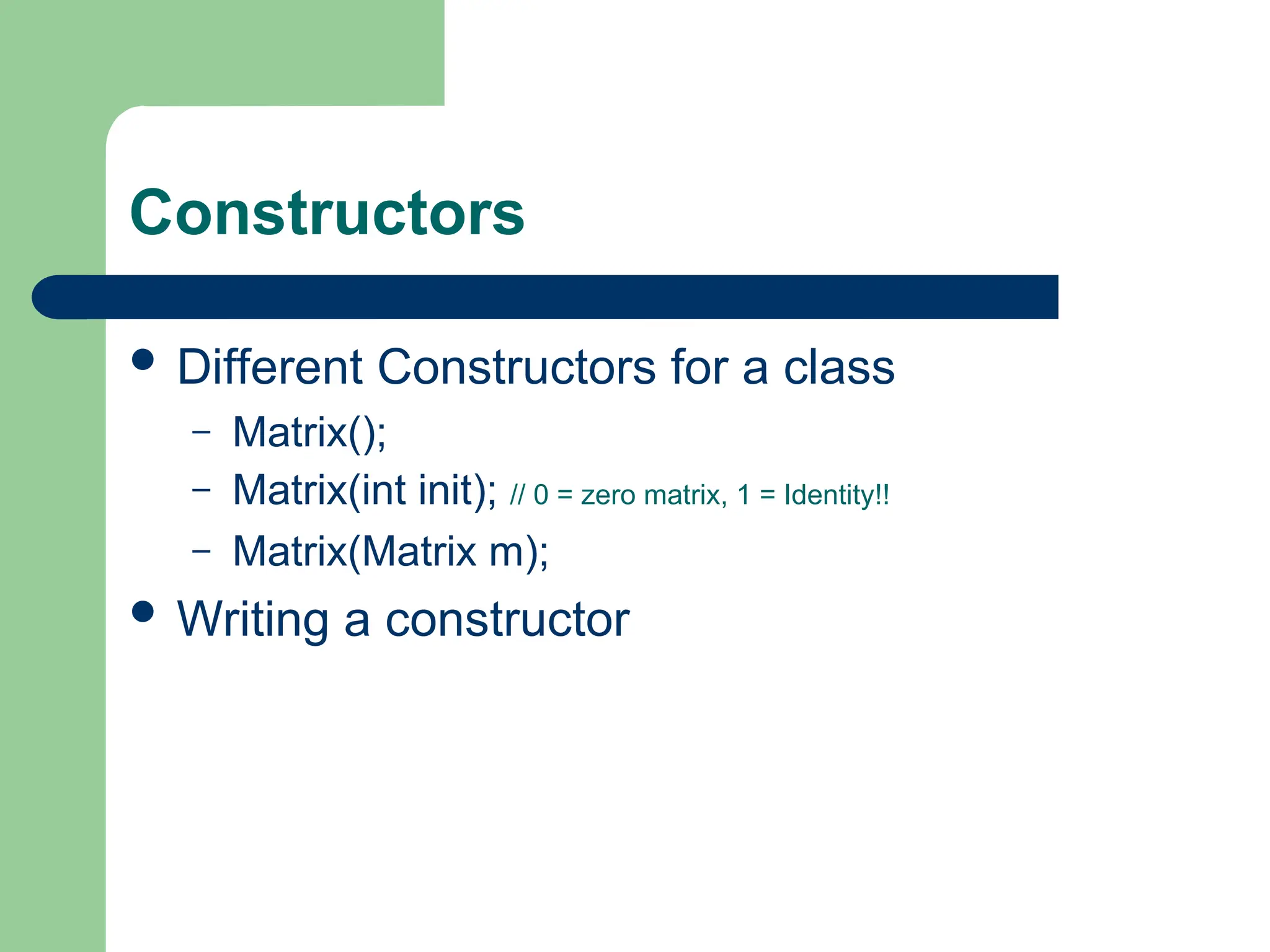
Constructors
 Different Constructors for a class
– Matrix();
– Matrix(int init); // 0 = zero matrix, 1 = Identity!!
– Matrix(Matrix m);
 Writing a constructor
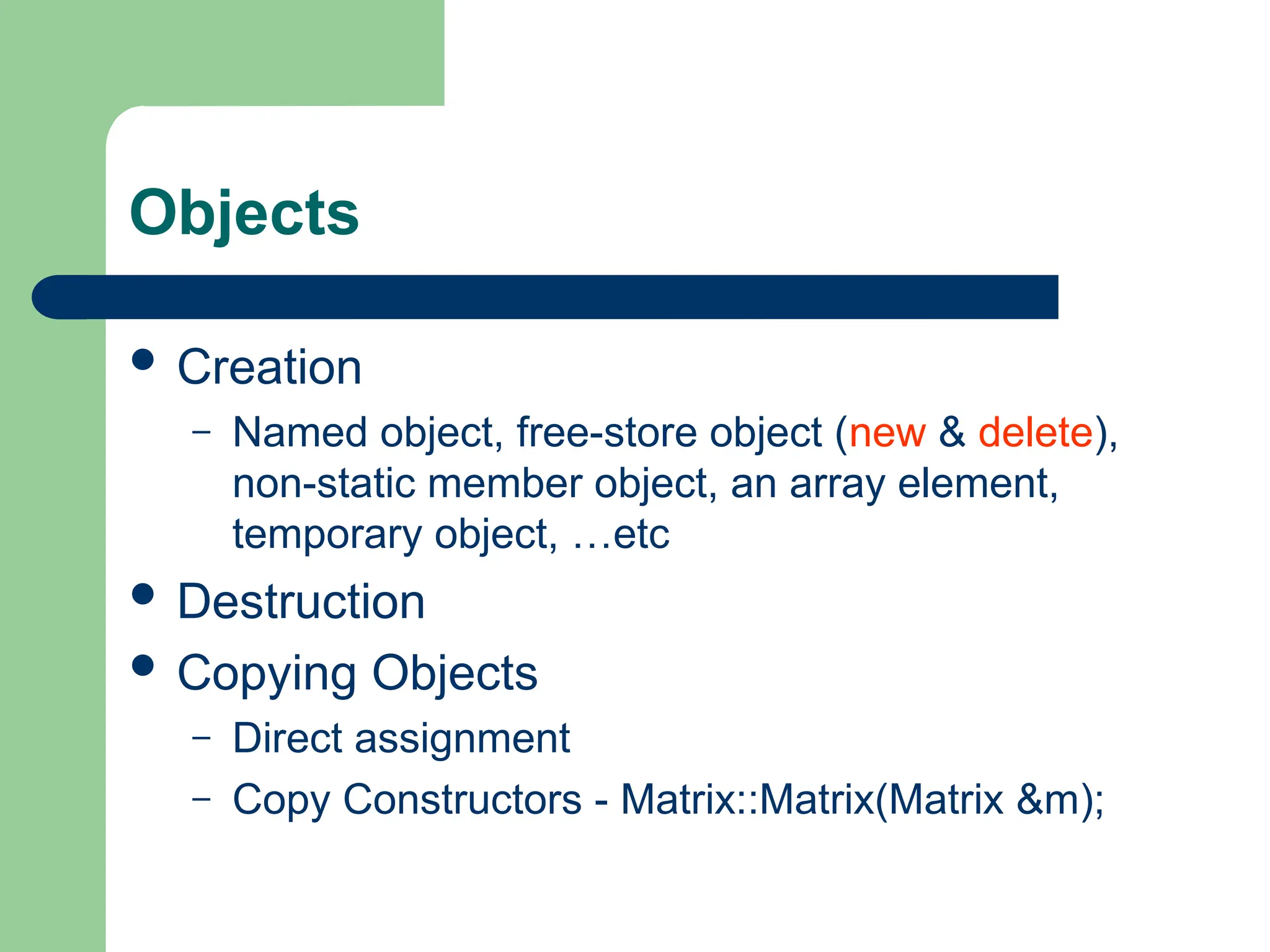
Objects
 Creation
– Named object, free-store object (new & delete),
non-static member object, an array element,
temporary object, …etc
 Destruction
 Copying Objects
– Direct assignment
– Copy Constructors - Matrix::Matrix(Matrix &m);
Creating Matrix Objects
Matrix m;
Matrix *m = new Matrix();
Matrix *n = m;
Matrix *n = new Matrix(m);
Matrix ma[10];
Matrix *mp = new Matrix[10];
Matrix *np = new Matrix[10](m);
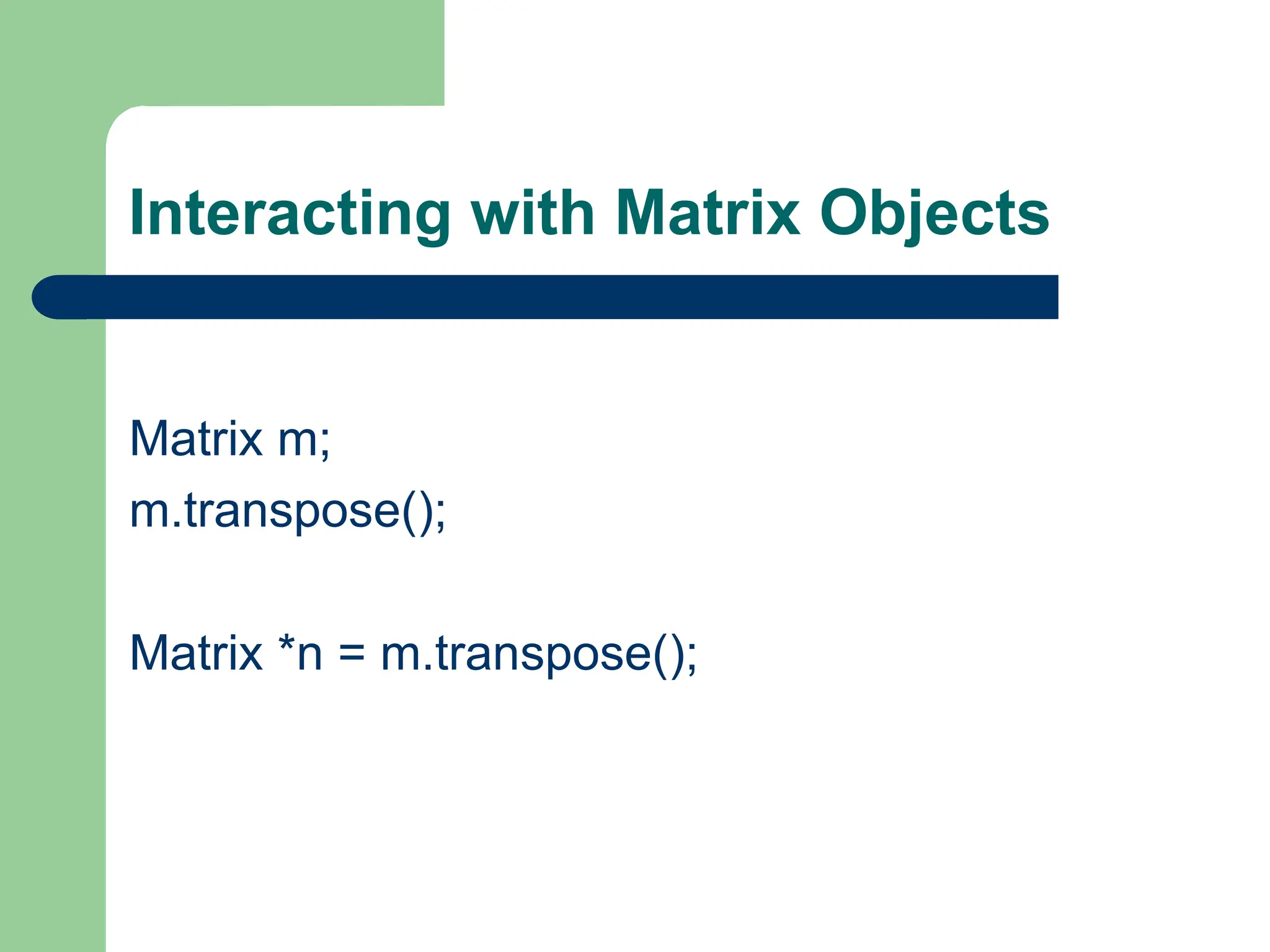
Interacting with Matrix Objects
Matrix m;
m.transpose();
Matrix *n = m.transpose();
Functions
 Static functions
 Constant functions and mutable
 Inline functions
 Helper functions
Operators
 Member and Non-Member Operators
 Unary
 Binary
– Matrix & operator+= (Matrix a) // member
– Matrix Matrix::operator + (Matrix b) // member
– Matrix operator + (Matrix a, Matrix b) //non-member
A Code Example
class Complex
{
private:
int real;
int imaginary;
public:
Complex(int r, int i= 0): real(r),imaginary(i);
Complex(const Complex& a);
int re() const;
int im() const;
void operator += (Complex a);
Complex operator + (Complex b);
void print();
};
The Code..
Complex(const Complex& a)
{
real = a.real;
imaginary = a.imaginary;
}
int re() const
{
return real;
}
int im() const
{
return imaginary;
}
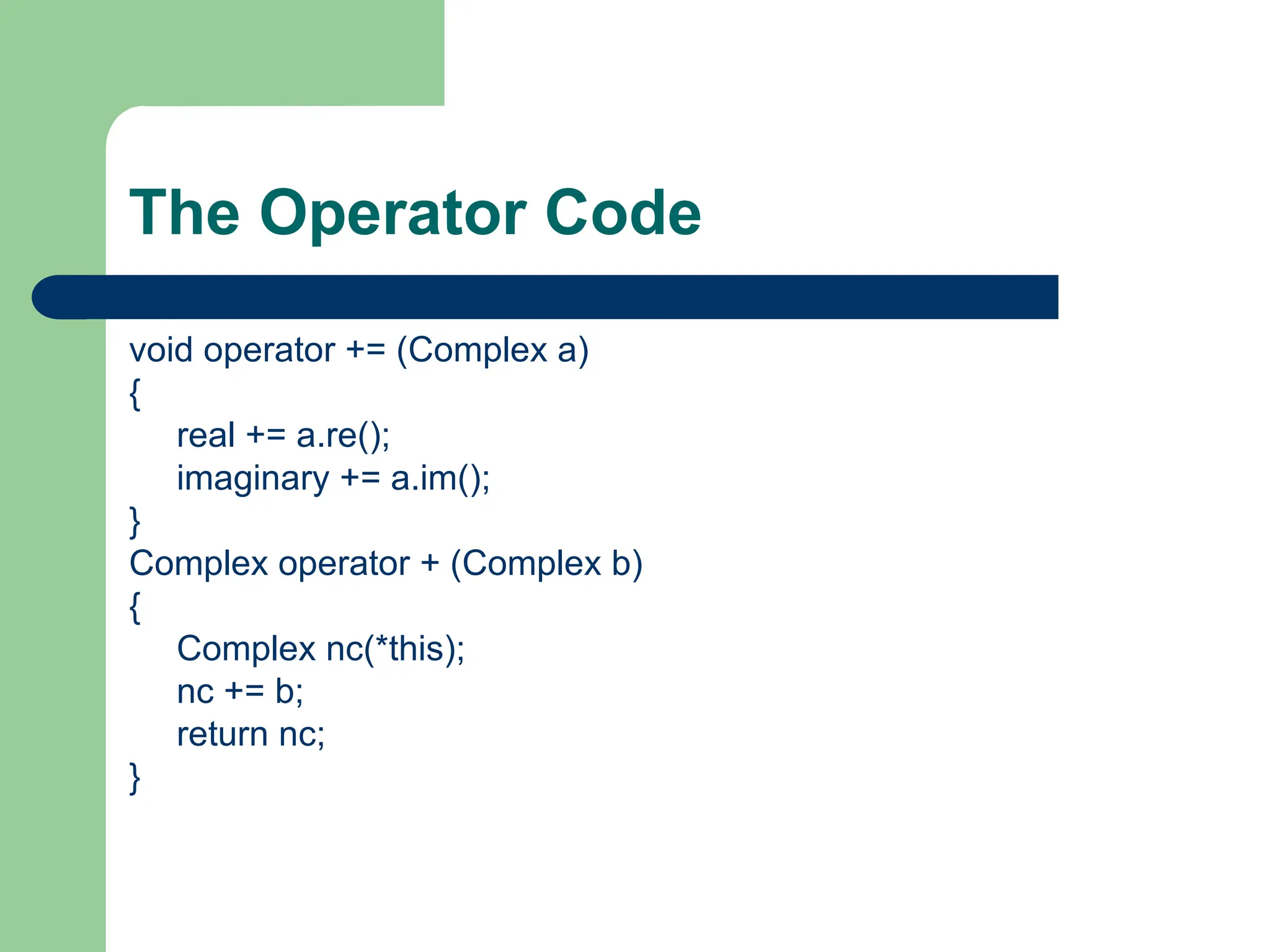
The Operator Code
void operator += (Complex a)
{
real += a.re();
imaginary += a.im();
}
Complex operator + (Complex b)
{
Complex nc(*this);
nc += b;
return nc;
}
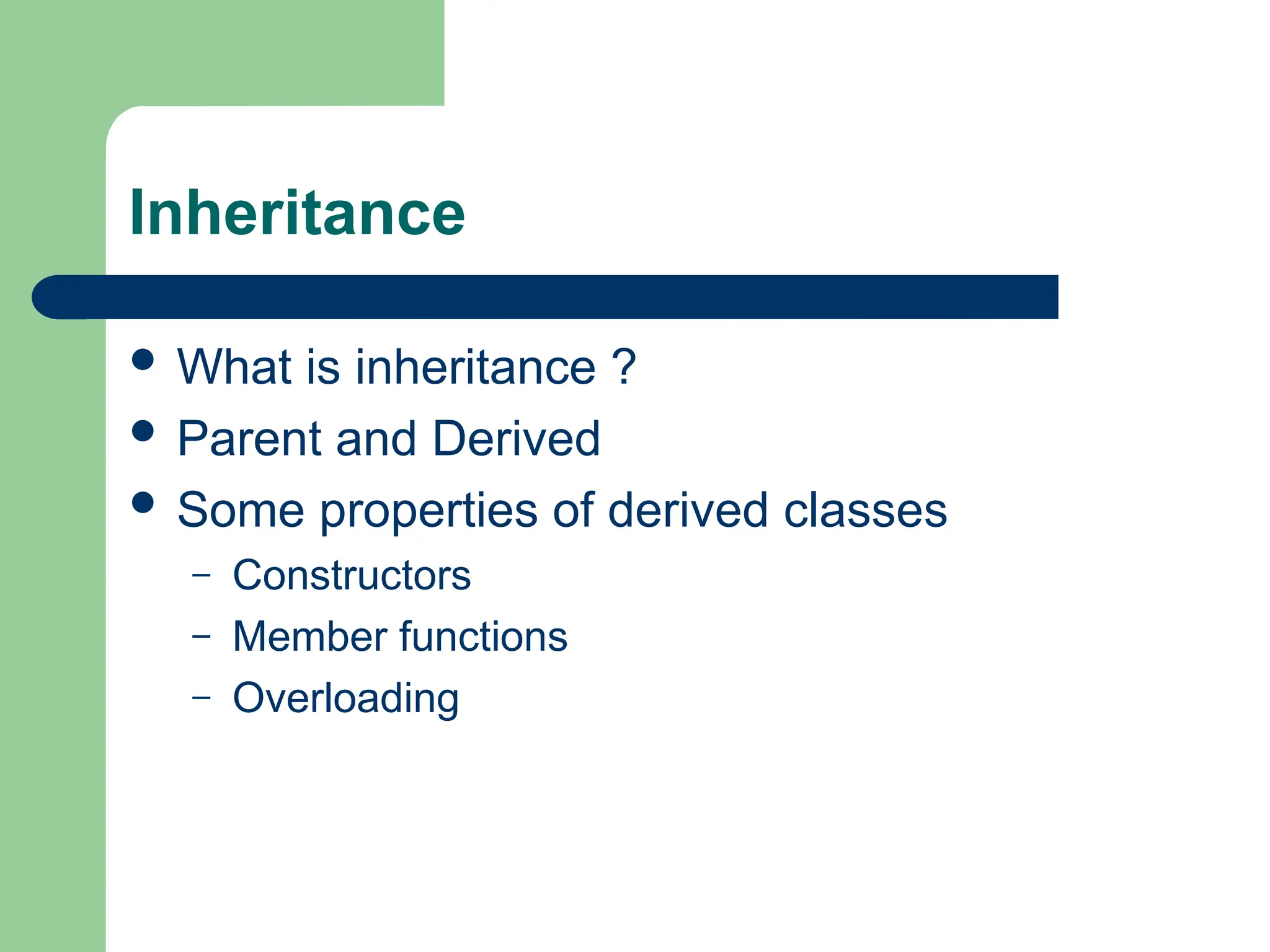
Inheritance
 What is inheritance ?
 Parent and Derived
 Some properties of derived classes
– Constructors
– Member functions
– Overloading
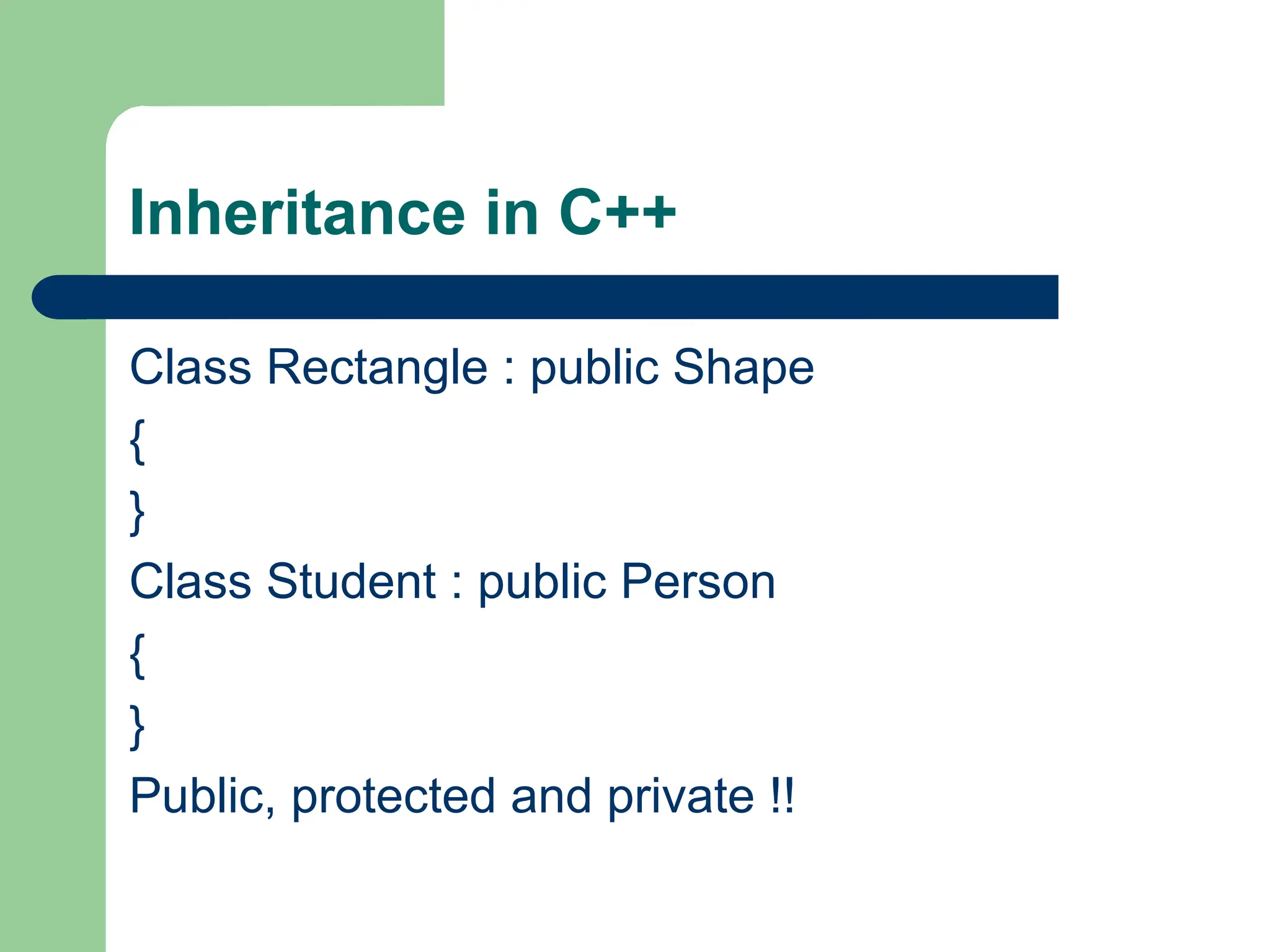
Inheritance in C++
Class Rectangle : public Shape
{
}
Class Student : public Person
{
}
Public, protected and private !!
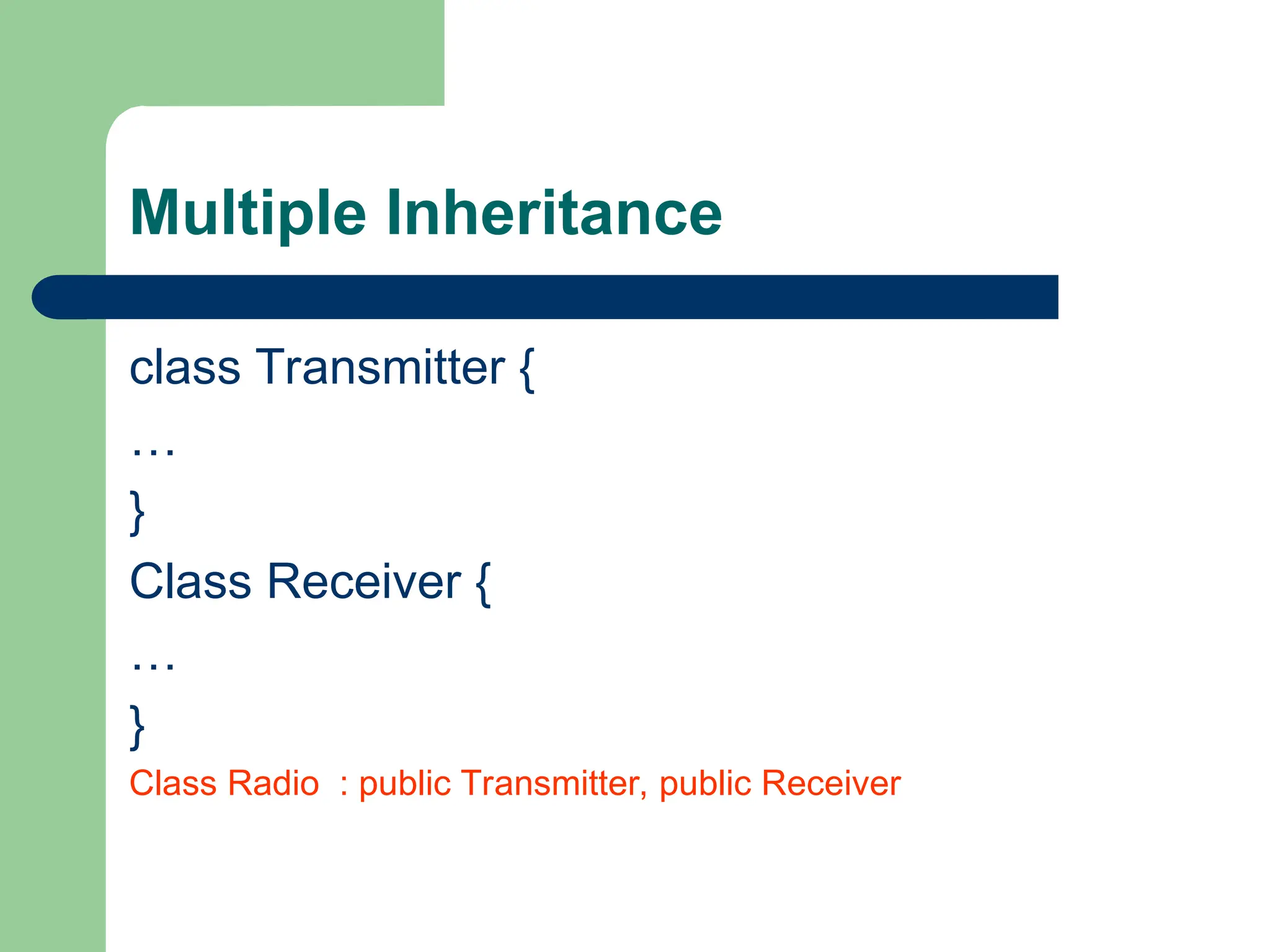
Multiple Inheritance
class Transmitter {
…
}
Class Receiver {
…
}
Class Radio : public Transmitter, public Receiver
Abstract Classes
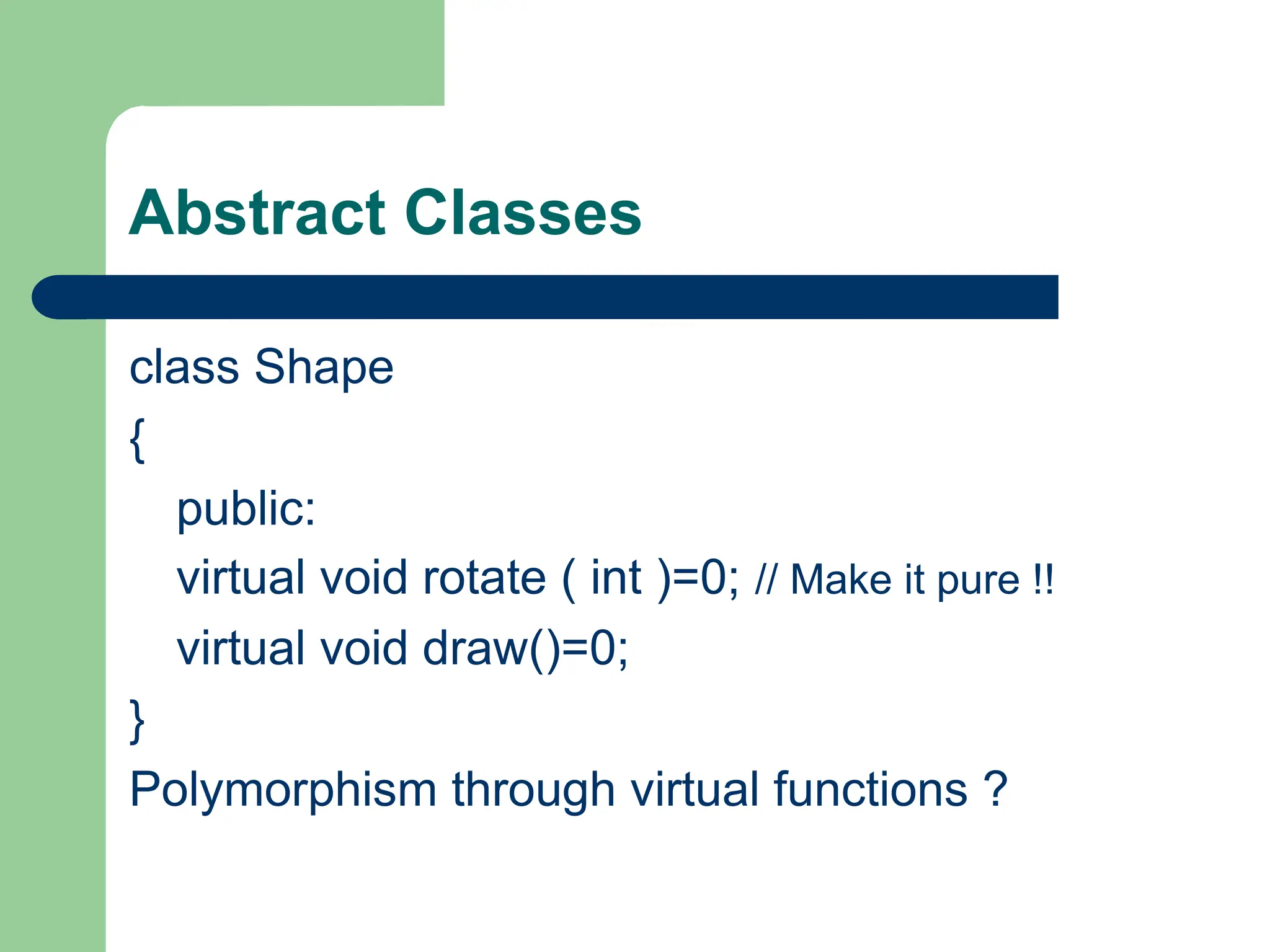
class Shape
{
public:
virtual void rotate ( int )=0; // Make it pure !!
virtual void draw()=0;
}
Polymorphism through virtual functions ?
Virtual Base Classes
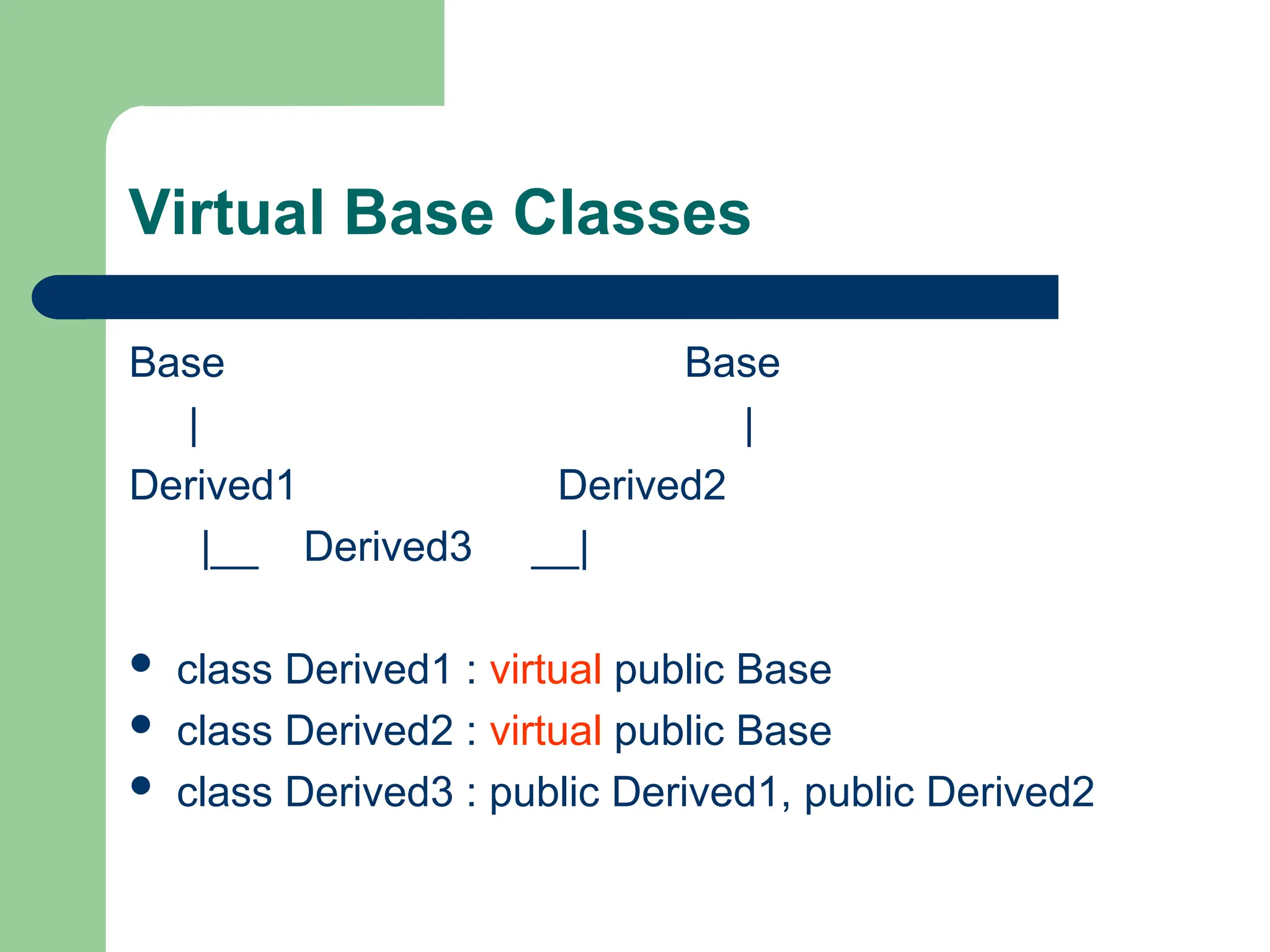
Base Base
| |
Derived1 Derived2
|__ Derived3 __|
 class Derived1 : virtual public Base
 class Derived2 : virtual public Base
 class Derived3 : public Derived1, public Derived2
Member Access Table
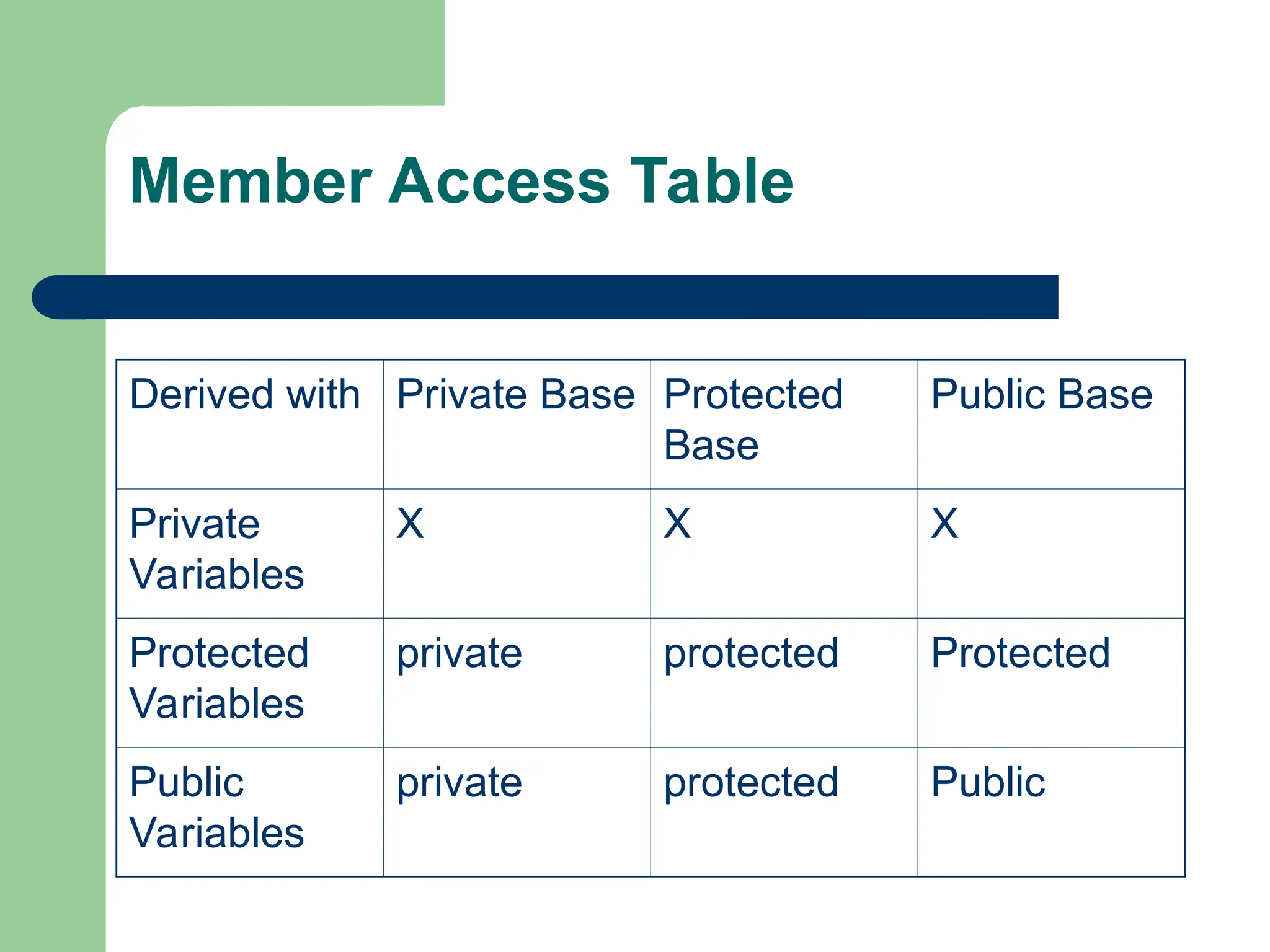
Derived with Private Base Protected
Base
Public Base
Private
Variables
X X X
Protected
Variables
private protected Protected
Public
Variables
private protected Public
Templates And Generic Programming
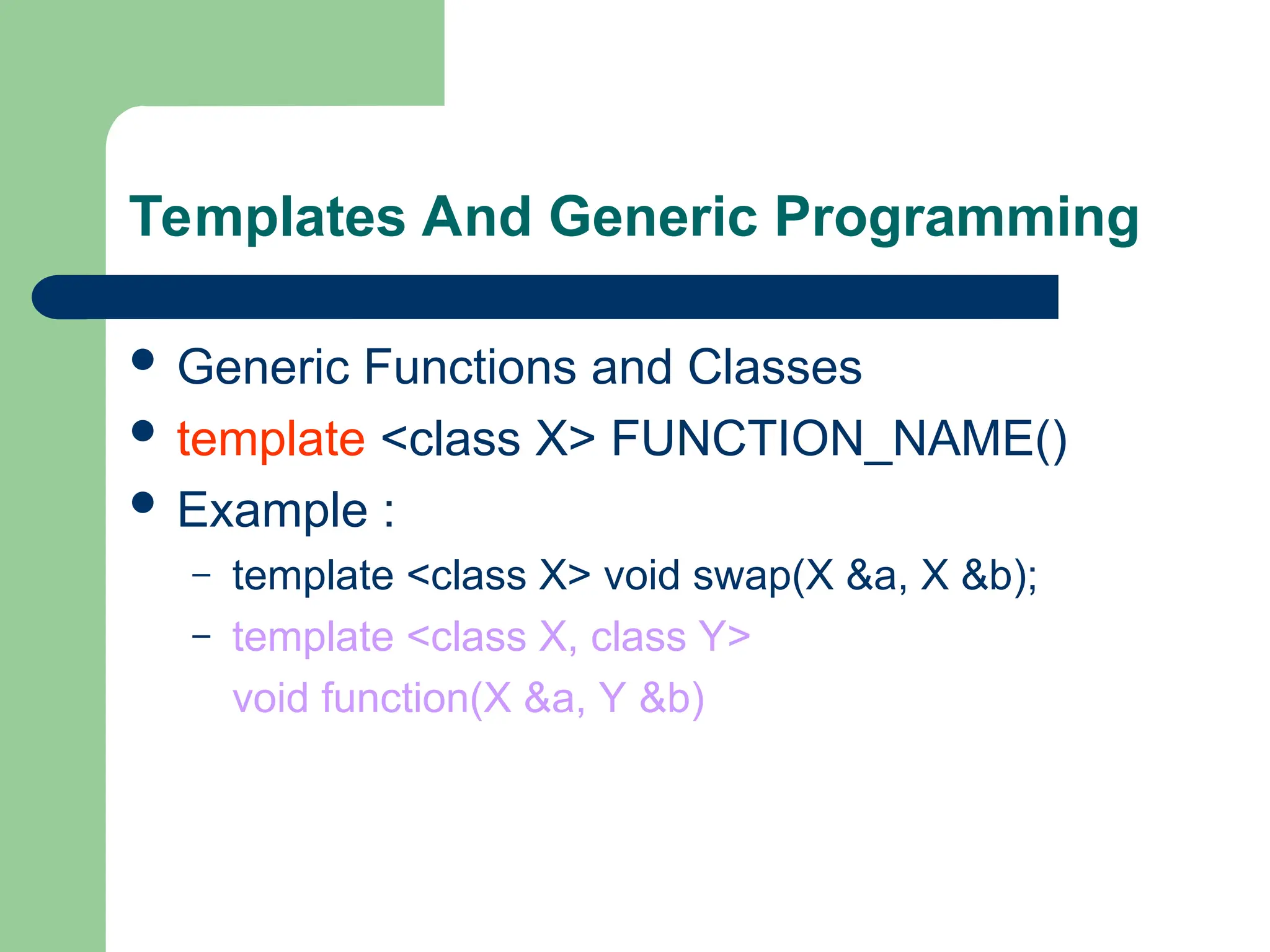
 Generic Functions and Classes
 template <class X> FUNCTION_NAME()
 Example :
– template <class X> void swap(X &a, X &b);
– template <class X, class Y>
void function(X &a, Y &b)
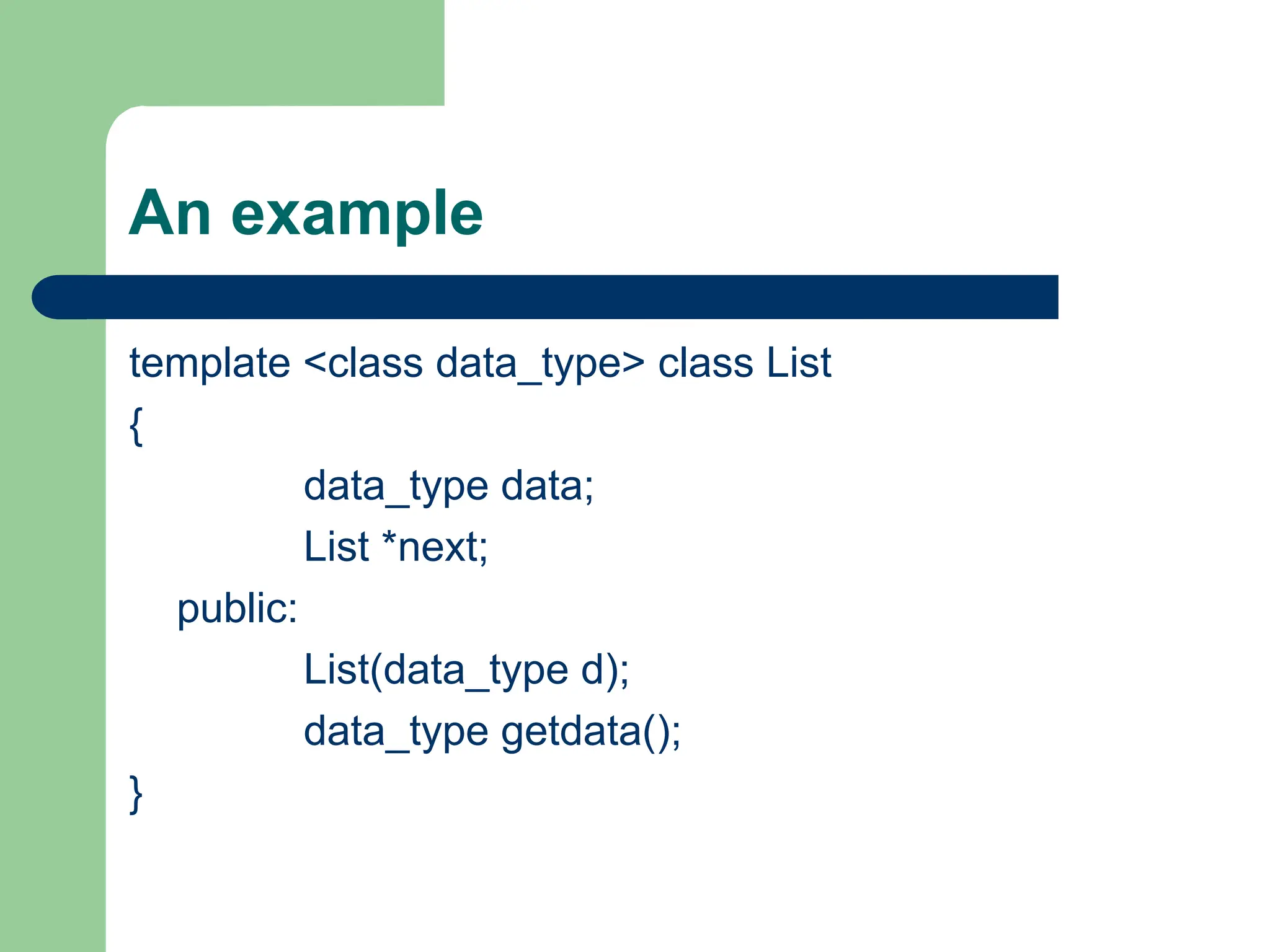
An example
template <class data_type> class List
{
data_type data;
List *next;
public:
List(data_type d);
data_type getdata();
}
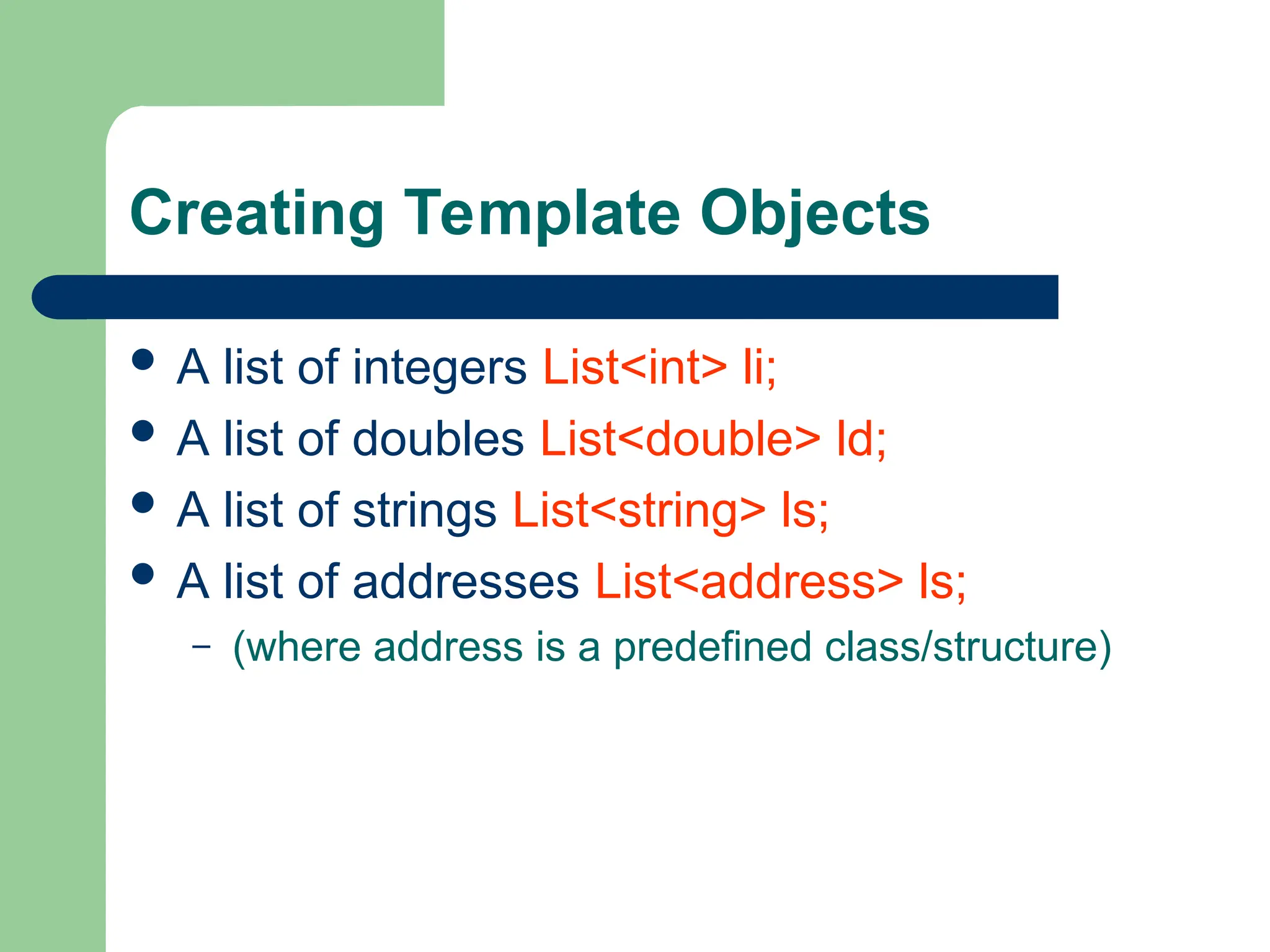
Creating Template Objects
 A list of integers List<int> li;
 A list of doubles List<double> ld;
 A list of strings List<string> ls;
 A list of addresses List<address> ls;
– (where address is a predefined class/structure)
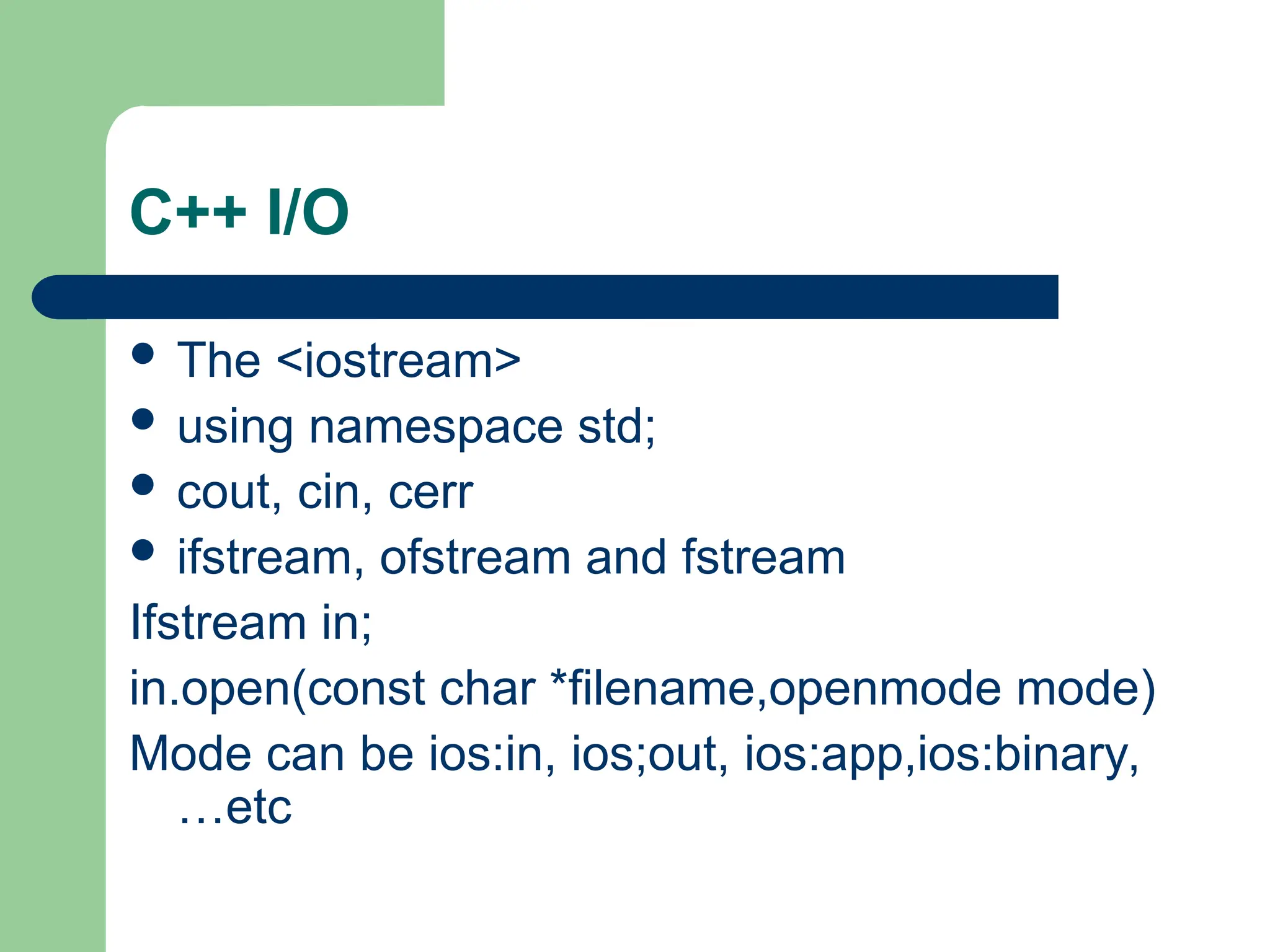
C++ I/O
 The <iostream>
 using namespace std;
 cout, cin, cerr
 ifstream, ofstream and fstream
Ifstream in;
in.open(const char *filename,openmode mode)
Mode can be ios:in, ios;out, ios:app,ios:binary,
…etc
File Reading and Writing
ifstream in;
double num;
char str[20];
in.read((char *)&num, sizeof(double));
in.read(str,10);
Using << and >> Operators.
in.getline();
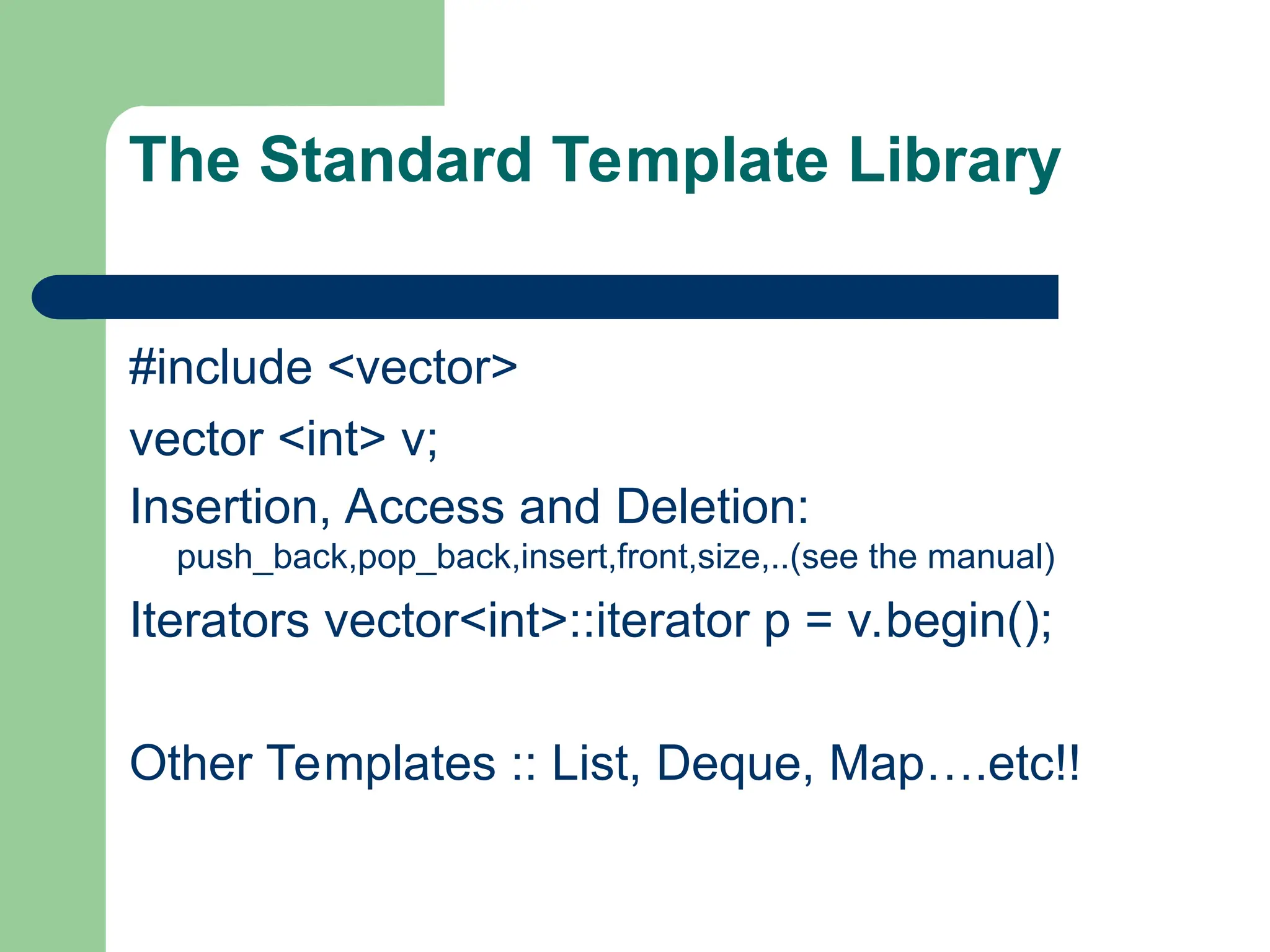
The Standard Template Library
#include <vector>
vector <int> v;
Insertion, Access and Deletion:
push_back,pop_back,insert,front,size,..(see the manual)
Iterators vector<int>::iterator p = v.begin();
Other Templates :: List, Deque, Map….etc!!
Basic Exception Handling
 Try
 Throw
 Catch
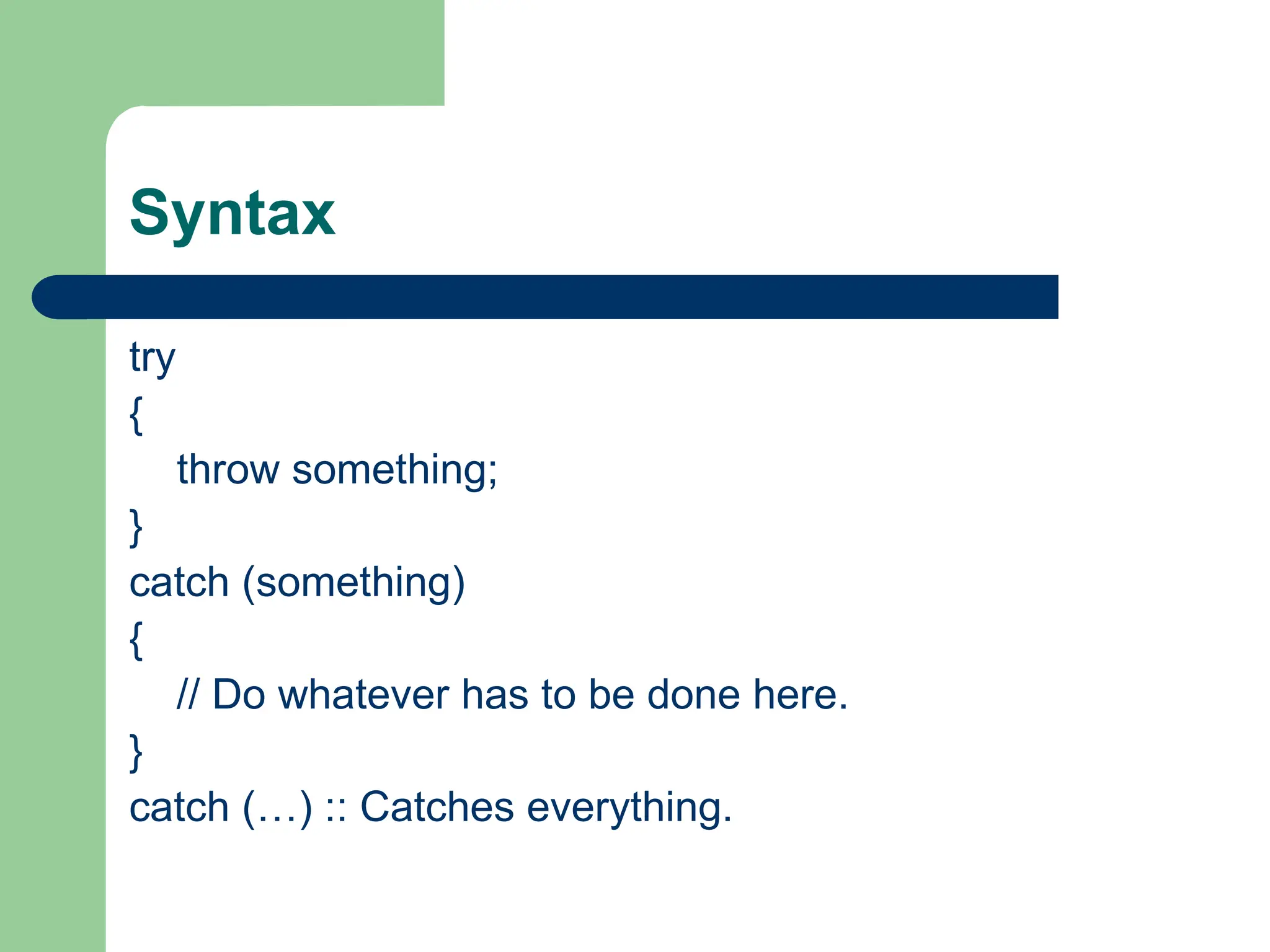
Syntax
try
{
throw something;
}
catch (something)
{
// Do whatever has to be done here.
}
catch (…) :: Catches everything.
Syntax
try
{
throw something;
}
catch (something)
{
// Do whatever has to be done here.
}
catch (…) :: Catches everything.

Object Oriented Programming using C++.ppt

  • 1.
  • 2.
    Overview  Problem Solving Features of an OOL  Basic Syntax  Programming Paradigms
  • 3.
    Solving a ProgrammingProblem  Analysis  Design  Coding  Management  Programming paradigms  Programming languages
  • 4.
    Concepts & Relationships –A rectangle uses lines – A circle is an ellipse – A wheel is part of automobile – A set creates its elements
  • 5.
    Some Features ofOOP languages  An OOP language should support – Easy Representation of  Real-world objects  Their States and Abilities – Interaction with objects of same type – Relations with objects of other type – Polymorphism and Overloading  Reusability of code  Convenient type definitions
  • 6.
    Basic Syntax  Sameas C  Additional operators  Additional keywords
  • 7.
    Programming Paradigms  ProceduralProgramming (functions)  Modular Programming (namespaces)  Object Oriented Programming (classes)  Generic Programming (templates)
  • 8.
    Procedural Programming  Aprogram is a list of instructions  Concentration is on what is to be done?  Problems created by global data  No access control !!
  • 9.
    Modular Programming  namespace Example to learn the syntax : A toy math library. – Matrix Module  Allocate  Transpose  Print – Vector Module  Allocate  Transpose  Print
  • 10.
    Declaration of namespaces //in file stdmatrix.h namespace Matrix { int** allocate(int r,int c); void print(int **matrix,int r,int c); }; // in file stdvector.h namespace Vector { int *allocate(int size); void print(int *vector,int size); };
  • 11.
    Definition of Matrixfunctions int **Matrix::allocate(int r, int c) { int **mat; mat = new int*[r]; for (int i = 0; i < r; i++) mat[i] = new int[c]; return mat; } void Matrix::print(int **matrix,int r, int c) { for (int i = 0; i < r ; i++) { for (int j = 0; j < c ; j++) printf("%d ",matrix[i][j]); printf("n"); } printf("n"); }
  • 12.
    Definition of Vectorfunctions int *Vector::allocate(int size) { int *vec = new int[size]; return vec; } void Vector::print(int *vector,int size) { for (int i = 0; i < size; i++) printf("%d ",vector[i]); printf("n"); }
  • 13.
    How to useMatrix and Vector ? // in the file main.c #include <stdmatrix.h> #include <stdvector.h> using namespace Matrix; using namespace Vector; main() { int **m = Matrix::allocate(3,4); int *v = Vector::allocate(3); Matrix::print(m,3,4); Vector::print(v,3); }
  • 14.
    Adding functions tonamespaces  How does user add the transpose function now ? // in the file mymatrix.h #include “stdmatrix.h” namespace Matrix { int **transpose(int **matrix, int r, int c); }
  • 15.
    Adding definitions // Inthe file mymatrix.cpp #include “mymatrix.h” int **Matrix::transpose(int **matrix, int r, int c) { // Code for transposing and returning the // matrix. }
  • 16.
    Using the transpose() //in the file main.c #include <mymatrix.h> #include <myvector.h> using namespace Matrix; using namespace Vector; main() { int **m = Matrix::allocate(3,4); // fill with some random data in the matrix. int **tm = Matrix::transpose(m, 3, 4); }
  • 17.
    Object Oriented Programming Class  Object  Overloading (operators, functions)  Inheritance
  • 18.
    Class  class :Definition of the entity – A tool for creating new types  Ex: Matrix and Vector – Access Control  public, private, and protected – Constructors, Destructors – Member functions
  • 19.
    The Matrix ClassDefinition class Matrix { private: int **m; public: Matrix(); void print(); void transpose(); Matrix *transpose(); ~Matrix(); }  Access Control  Constructor/Destructor  Member Functions – Ordinary Functions – Overloaded Functions
  • 20.
    Constructors  Different Constructorsfor a class – Matrix(); – Matrix(int init); // 0 = zero matrix, 1 = Identity!! – Matrix(Matrix m);  Writing a constructor
  • 21.
    Objects  Creation – Namedobject, free-store object (new & delete), non-static member object, an array element, temporary object, …etc  Destruction  Copying Objects – Direct assignment – Copy Constructors - Matrix::Matrix(Matrix &m);
  • 22.
    Creating Matrix Objects Matrixm; Matrix *m = new Matrix(); Matrix *n = m; Matrix *n = new Matrix(m); Matrix ma[10]; Matrix *mp = new Matrix[10]; Matrix *np = new Matrix[10](m);
  • 23.
    Interacting with MatrixObjects Matrix m; m.transpose(); Matrix *n = m.transpose();
  • 24.
    Functions  Static functions Constant functions and mutable  Inline functions  Helper functions
  • 25.
    Operators  Member andNon-Member Operators  Unary  Binary – Matrix & operator+= (Matrix a) // member – Matrix Matrix::operator + (Matrix b) // member – Matrix operator + (Matrix a, Matrix b) //non-member
  • 26.
    A Code Example classComplex { private: int real; int imaginary; public: Complex(int r, int i= 0): real(r),imaginary(i); Complex(const Complex& a); int re() const; int im() const; void operator += (Complex a); Complex operator + (Complex b); void print(); };
  • 27.
    The Code.. Complex(const Complex&a) { real = a.real; imaginary = a.imaginary; } int re() const { return real; } int im() const { return imaginary; }
  • 28.
    The Operator Code voidoperator += (Complex a) { real += a.re(); imaginary += a.im(); } Complex operator + (Complex b) { Complex nc(*this); nc += b; return nc; }
  • 29.
    Inheritance  What isinheritance ?  Parent and Derived  Some properties of derived classes – Constructors – Member functions – Overloading
  • 30.
    Inheritance in C++ ClassRectangle : public Shape { } Class Student : public Person { } Public, protected and private !!
  • 31.
    Multiple Inheritance class Transmitter{ … } Class Receiver { … } Class Radio : public Transmitter, public Receiver
  • 32.
    Abstract Classes class Shape { public: virtualvoid rotate ( int )=0; // Make it pure !! virtual void draw()=0; } Polymorphism through virtual functions ?
  • 33.
    Virtual Base Classes BaseBase | | Derived1 Derived2 |__ Derived3 __|  class Derived1 : virtual public Base  class Derived2 : virtual public Base  class Derived3 : public Derived1, public Derived2
  • 34.
    Member Access Table Derivedwith Private Base Protected Base Public Base Private Variables X X X Protected Variables private protected Protected Public Variables private protected Public
  • 35.
    Templates And GenericProgramming  Generic Functions and Classes  template <class X> FUNCTION_NAME()  Example : – template <class X> void swap(X &a, X &b); – template <class X, class Y> void function(X &a, Y &b)
  • 36.
    An example template <classdata_type> class List { data_type data; List *next; public: List(data_type d); data_type getdata(); }
  • 37.
    Creating Template Objects A list of integers List<int> li;  A list of doubles List<double> ld;  A list of strings List<string> ls;  A list of addresses List<address> ls; – (where address is a predefined class/structure)
  • 38.
    C++ I/O  The<iostream>  using namespace std;  cout, cin, cerr  ifstream, ofstream and fstream Ifstream in; in.open(const char *filename,openmode mode) Mode can be ios:in, ios;out, ios:app,ios:binary, …etc
  • 39.
    File Reading andWriting ifstream in; double num; char str[20]; in.read((char *)&num, sizeof(double)); in.read(str,10); Using << and >> Operators. in.getline();
  • 40.
    The Standard TemplateLibrary #include <vector> vector <int> v; Insertion, Access and Deletion: push_back,pop_back,insert,front,size,..(see the manual) Iterators vector<int>::iterator p = v.begin(); Other Templates :: List, Deque, Map….etc!!
  • 41.
    Basic Exception Handling Try  Throw  Catch
  • 42.
    Syntax try { throw something; } catch (something) { //Do whatever has to be done here. } catch (…) :: Catches everything.
  • 43.
    Syntax try { throw something; } catch (something) { //Do whatever has to be done here. } catch (…) :: Catches everything.

Editor's Notes

  • #3 Bike factory example Graphics Drawing Shapes example
  • #5 Physical objects, data storage components, human entities, collections of data, components in computer games
  • #8 Functions are also referred to as subroutines, subprograms or procedures.