Object-Oriented JavaScript (OOP-JS)


                Presented By Md.Shah Jalal
           Software Engineer @ EVOKNOW
                               jalalbd@mail.com
                          jalalbd.wordpress.com
                                           1
Presentation GOAL

   JavaScript has strong object-oriented programming
capabilities, even though some debates have taken place
   due to the differences in object-oriented JavaScript
               compared to other languages.

  This presentation will starts with an Introduction to
 object-oriented programming. And presentation main
objective is to create object and parse it in different way.


                                                           2
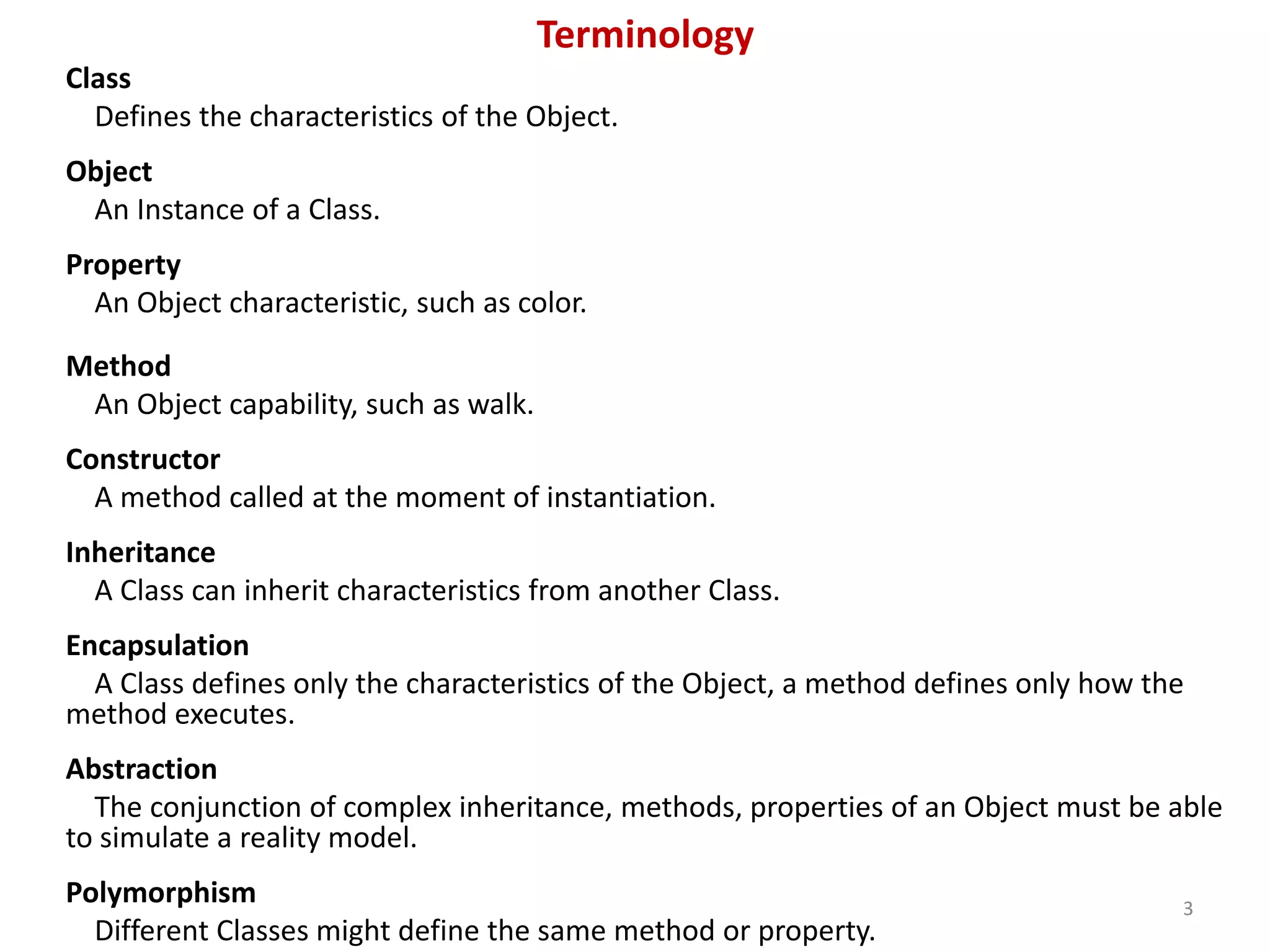
Terminology
Class
  Defines the characteristics of the Object.
Object
 An Instance of a Class.
Property
  An Object characteristic, such as color.

Method
 An Object capability, such as walk.
Constructor
  A method called at the moment of instantiation.
Inheritance
  A Class can inherit characteristics from another Class.
Encapsulation
  A Class defines only the characteristics of the Object, a method defines only how the
method executes.
Abstraction
  The conjunction of complex inheritance, methods, properties of an Object must be able
to simulate a reality model.
Polymorphism                                                                          3
  Different Classes might define the same method or property.
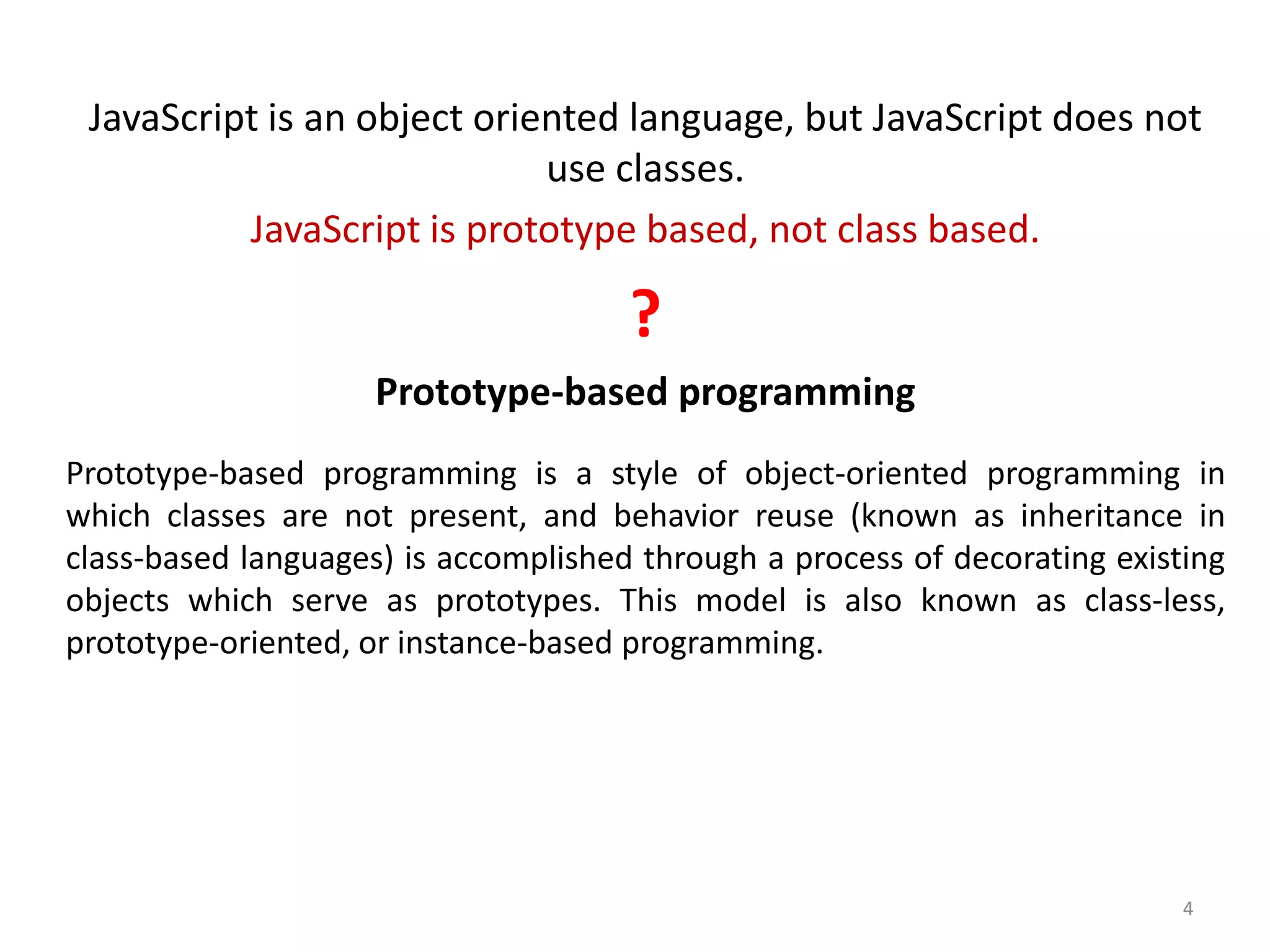
JavaScript is an object oriented language, but JavaScript does not
                             use classes.
          JavaScript is prototype based, not class based.

                                      ?
                     Prototype-based programming
Prototype-based programming is a style of object-oriented programming in
which classes are not present, and behavior reuse (known as inheritance in
class-based languages) is accomplished through a process of decorating existing
objects which serve as prototypes. This model is also known as class-less,
prototype-oriented, or instance-based programming.


                                                                            4
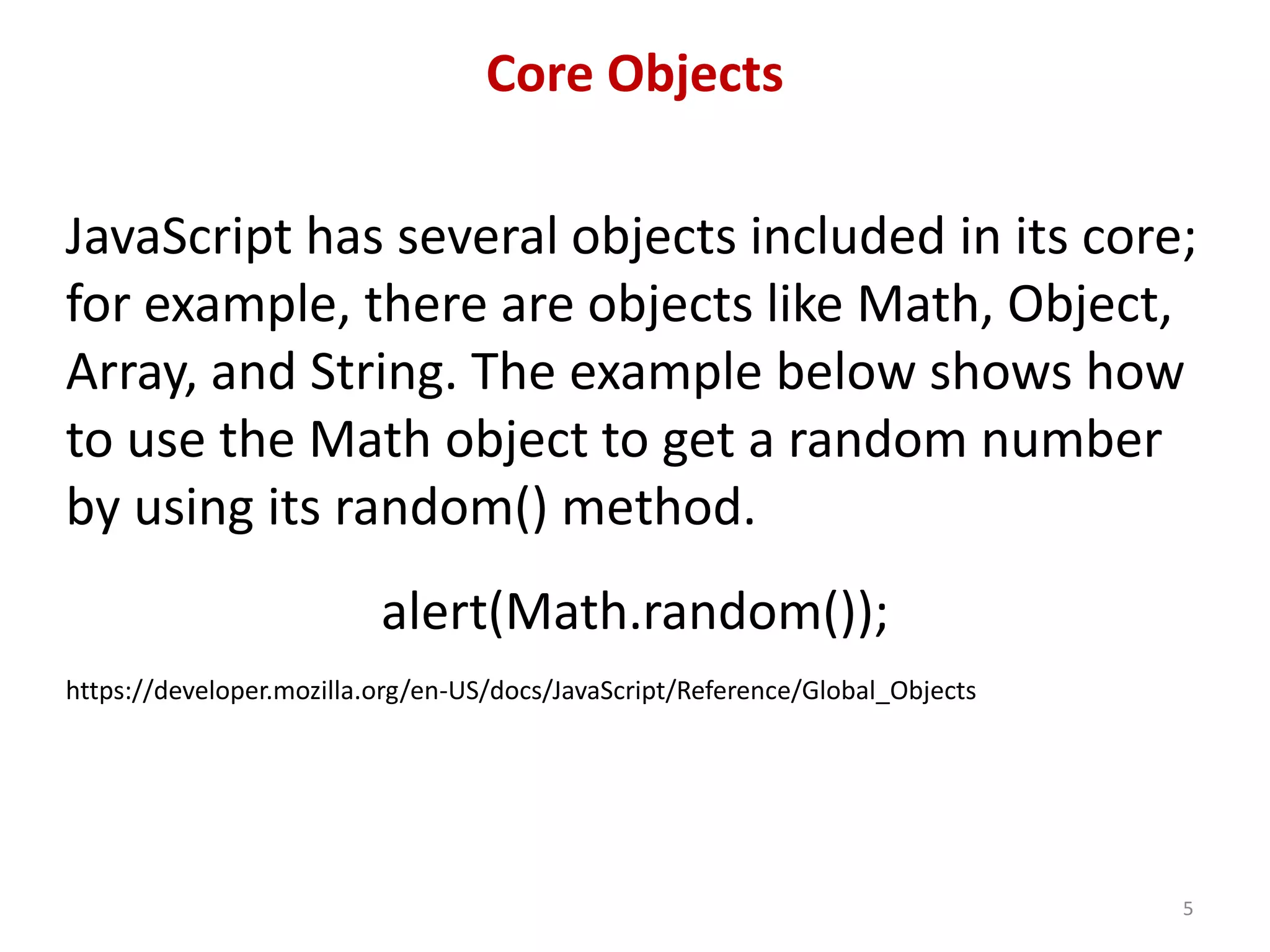
Core Objects

JavaScript has several objects included in its core;
for example, there are objects like Math, Object,
Array, and String. The example below shows how
to use the Math object to get a random number
by using its random() method.
                          alert(Math.random());
https://developer.mozilla.org/en-US/docs/JavaScript/Reference/Global_Objects


                                                                               5
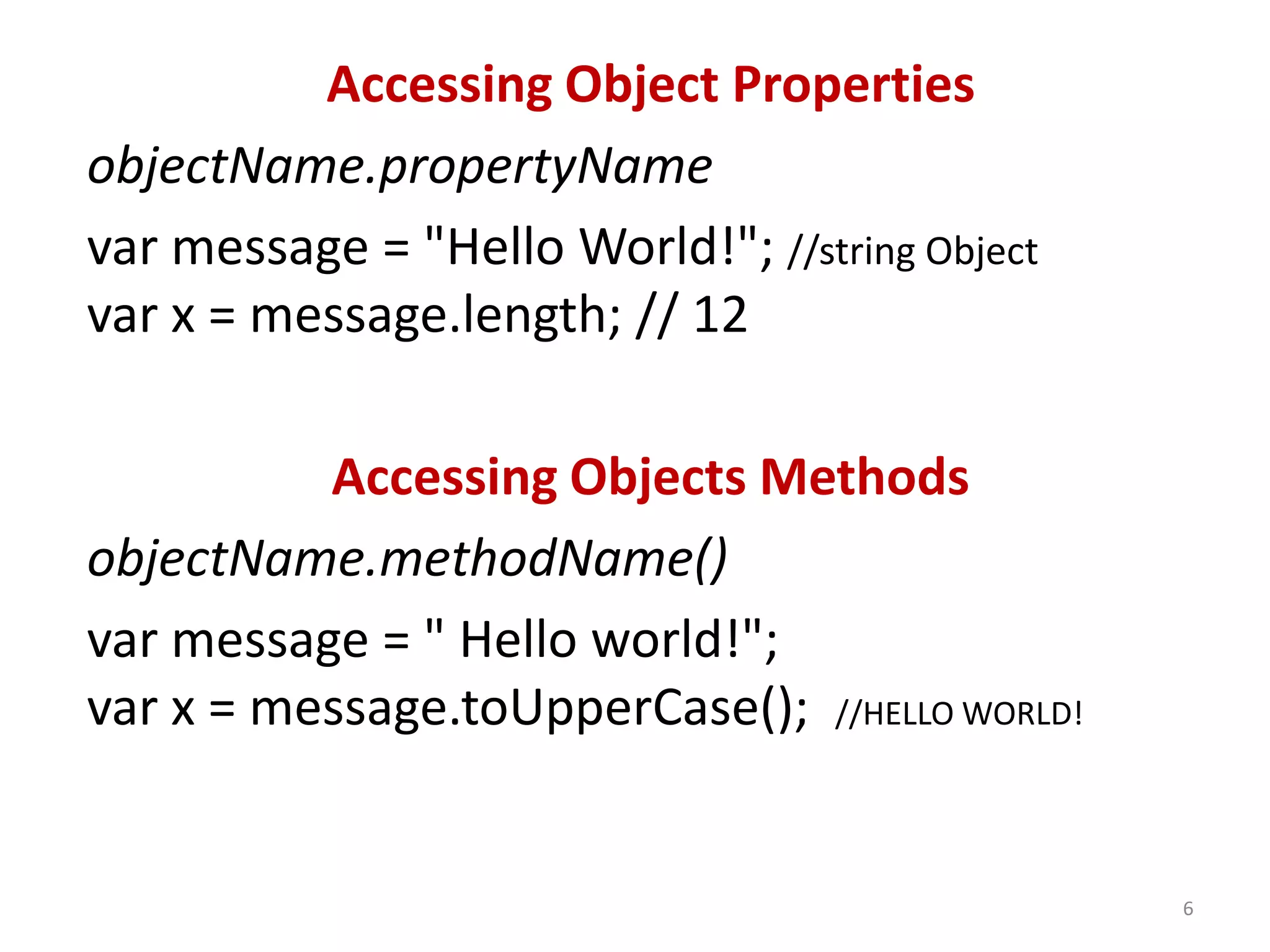
Accessing Object Properties
objectName.propertyName
var message = "Hello World!"; //string Object
var x = message.length; // 12

          Accessing Objects Methods
objectName.methodName()
var message = " Hello world!";
var x = message.toUpperCase(); //HELLO WORLD!


                                                6
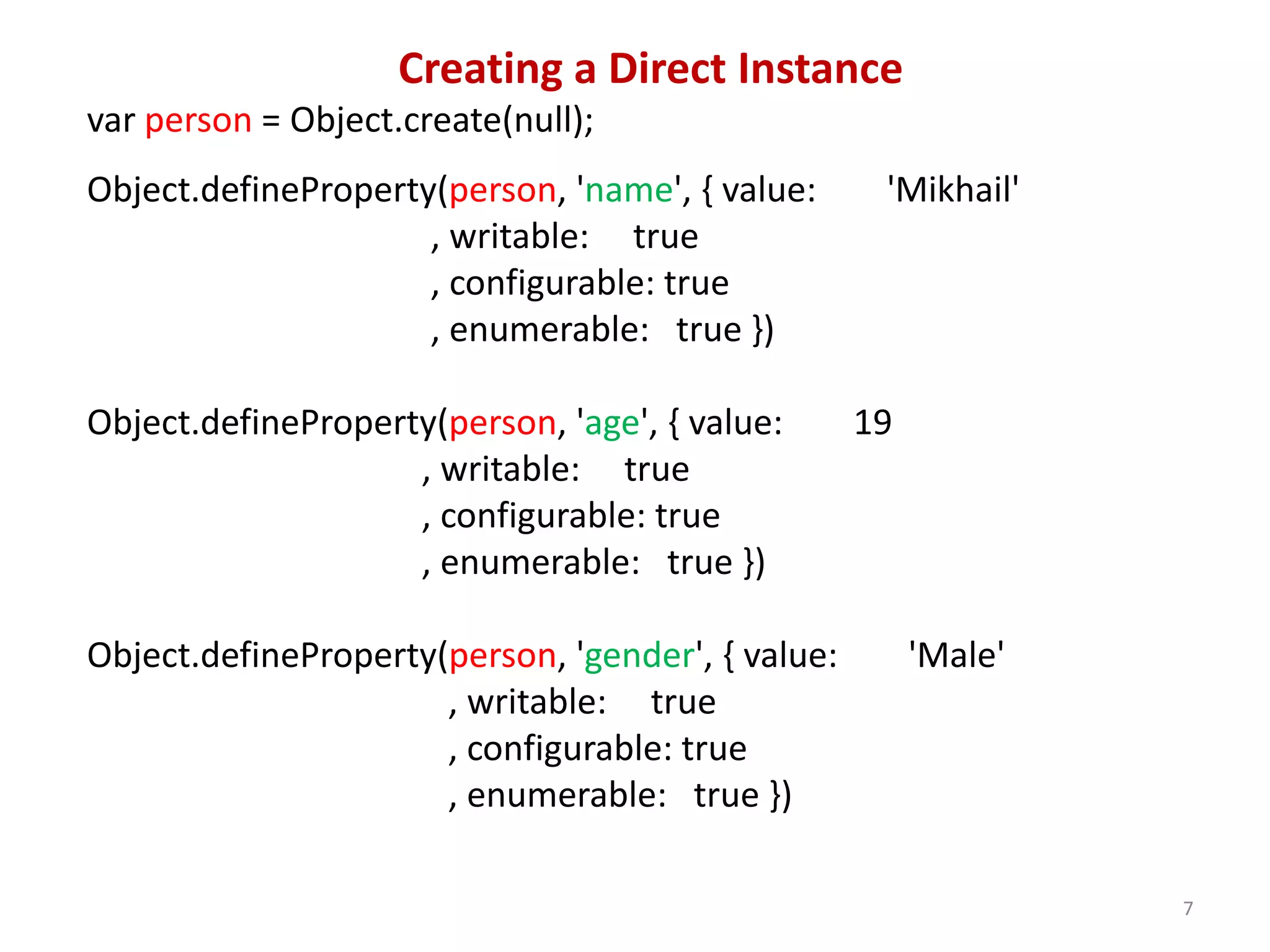
Creating a Direct Instance
var person = Object.create(null);
Object.defineProperty(person, 'name', { value:      'Mikhail'
                     , writable: true
                     , configurable: true
                     , enumerable: true })

Object.defineProperty(person, 'age', { value:      19
                    , writable: true
                    , configurable: true
                    , enumerable: true })

Object.defineProperty(person, 'gender', { value:        'Male'
                      , writable: true
                      , configurable: true
                      , enumerable: true })

                                                                 7
Creating a Direct Instance
var person = Object.create(null);
person['name'] = 'Jyoti';
person['age']     = 25;
person ['gender'] = 'Male';
alert("Name : "+ person.name+" Age : "+person.age+" Gender : "+person.gender);
person.name = 'Jalal';
person.age    = 26;
person.gender = 'Male';
alert("Name : "+ person.name+" Age : "+person.age+" Gender : "+person.gender);
alert(Object.getOwnPropertyNames(person)); // name,age,gender // array
alert(Object.getOwnPropertyNames(person).length);// 3


                                                                                 8
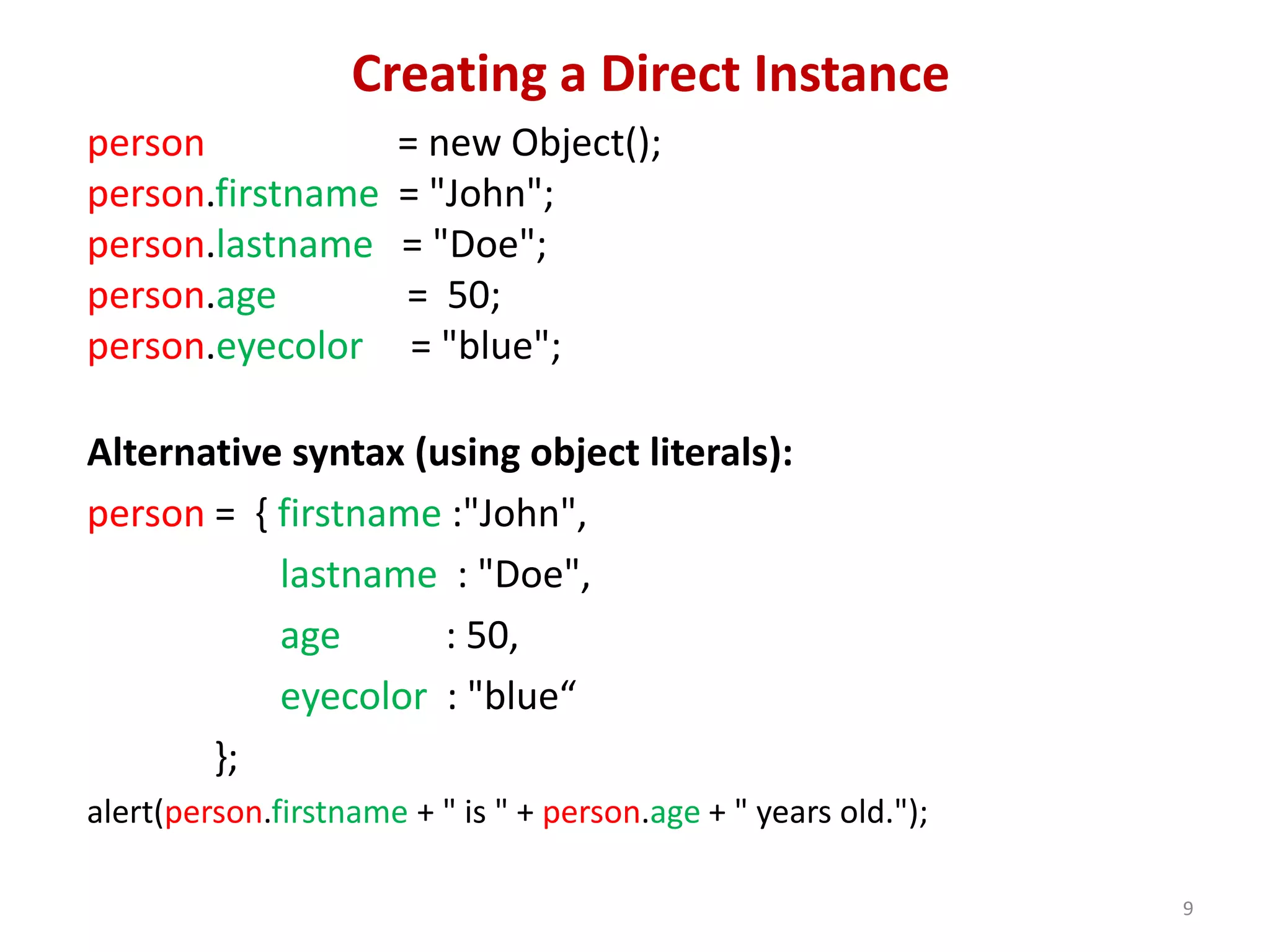
Creating a Direct Instance
person                = new Object();
person.firstname      = "John";
person.lastname       = "Doe";
person.age            = 50;
person.eyecolor        = "blue";

Alternative syntax (using object literals):
person = { firstname :"John",
           lastname : "Doe",
           age       : 50,
           eyecolor : "blue“
       };
alert(person.firstname + " is " + person.age + " years old.");

                                                                 9
Creating a Direct Instance
var person = {
        first_name : 'Shah'
        , last_name : 'Jalal'
        , age          : 19
        , gender       : 'Male'
        , get name() {
            return this.first_name + ' ' + this.last_name }
        , set name(new_name) { var names
            names = new_name.trim().split(/s+/)
            this.first_name = names['0'] || ''
            this.last_name = names['1'] || '' }
        }

alert(person.name);
person.name = 'Rushow Khan';
alert(person.name);                                           10
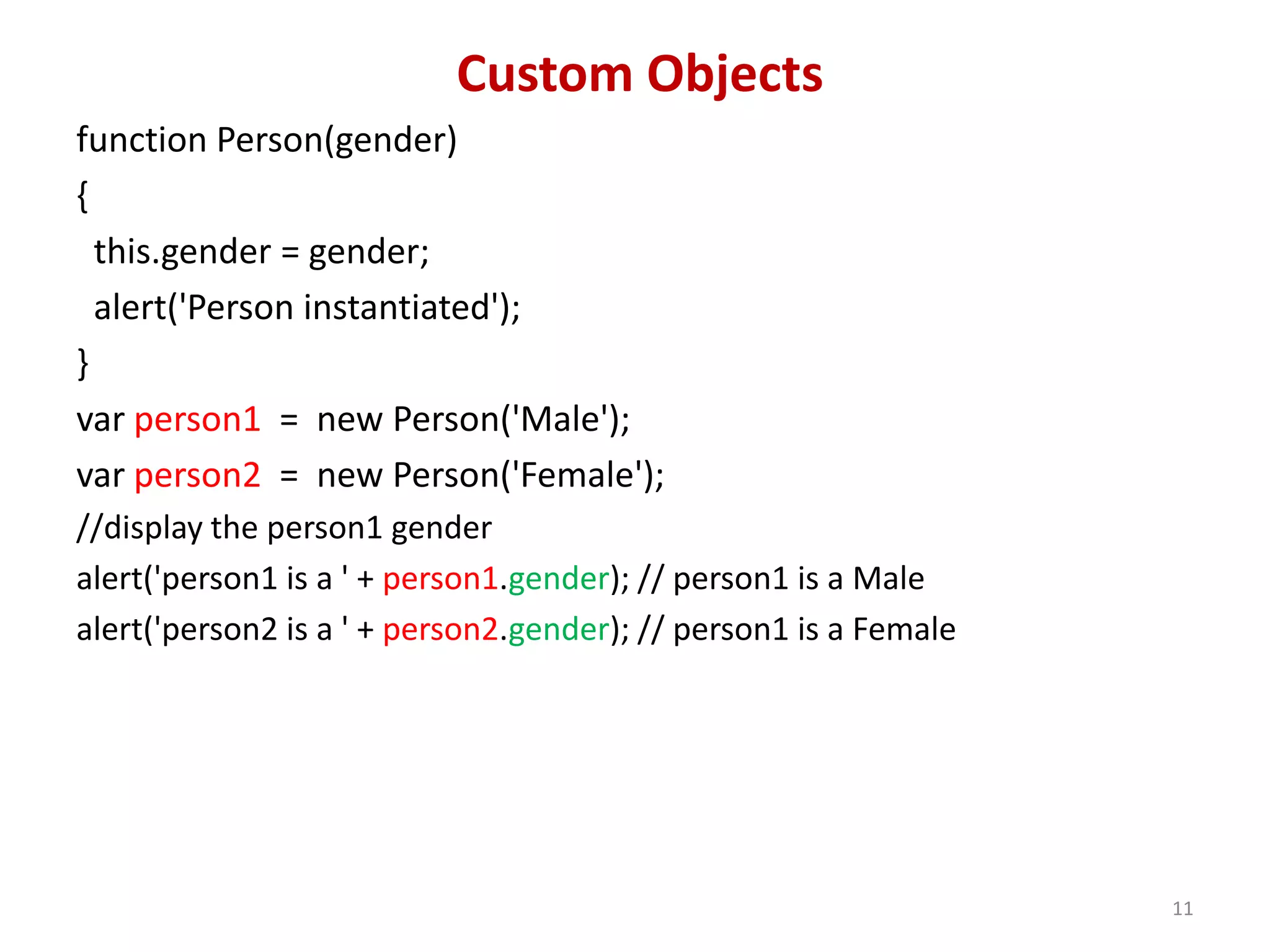
Custom Objects
function Person(gender)
{
  this.gender = gender;
  alert('Person instantiated');
}
var person1 = new Person('Male');
var person2 = new Person('Female');
//display the person1 gender
alert('person1 is a ' + person1.gender); // person1 is a Male
alert('person2 is a ' + person2.gender); // person1 is a Female


                                                                  11
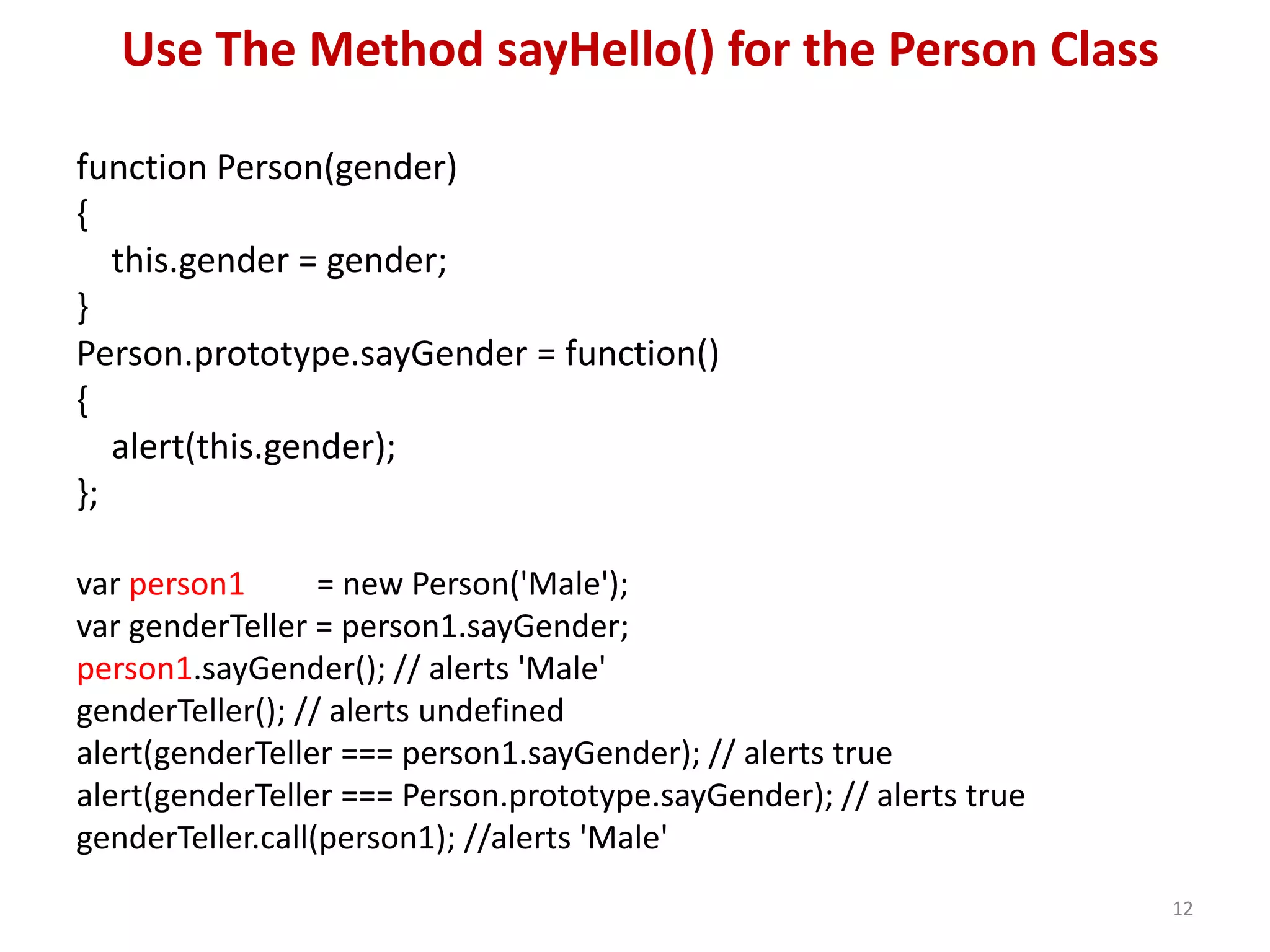
Use The Method sayHello() for the Person Class

function Person(gender)
{
   this.gender = gender;
}
Person.prototype.sayGender = function()
{
   alert(this.gender);
};

var person1       = new Person('Male');
var genderTeller = person1.sayGender;
person1.sayGender(); // alerts 'Male'
genderTeller(); // alerts undefined
alert(genderTeller === person1.sayGender); // alerts true
alert(genderTeller === Person.prototype.sayGender); // alerts true
genderTeller.call(person1); //alerts 'Male'
                                                                     12
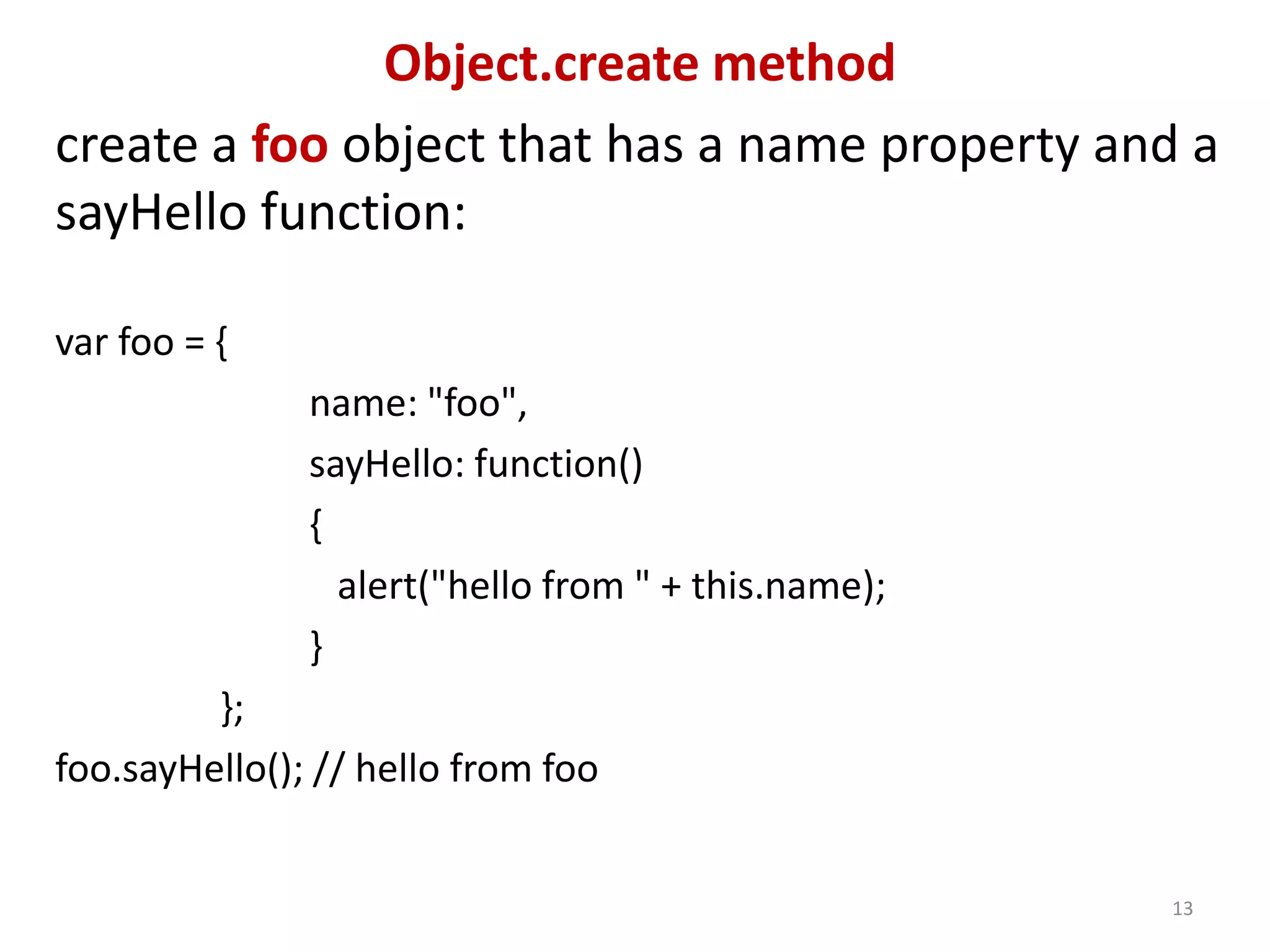
Object.create method
create a foo object that has a name property and a
sayHello function:

var foo = {
               name: "foo",
               sayHello: function()
               {
                 alert("hello from " + this.name);
               }
         };
foo.sayHello(); // hello from foo


                                                     13
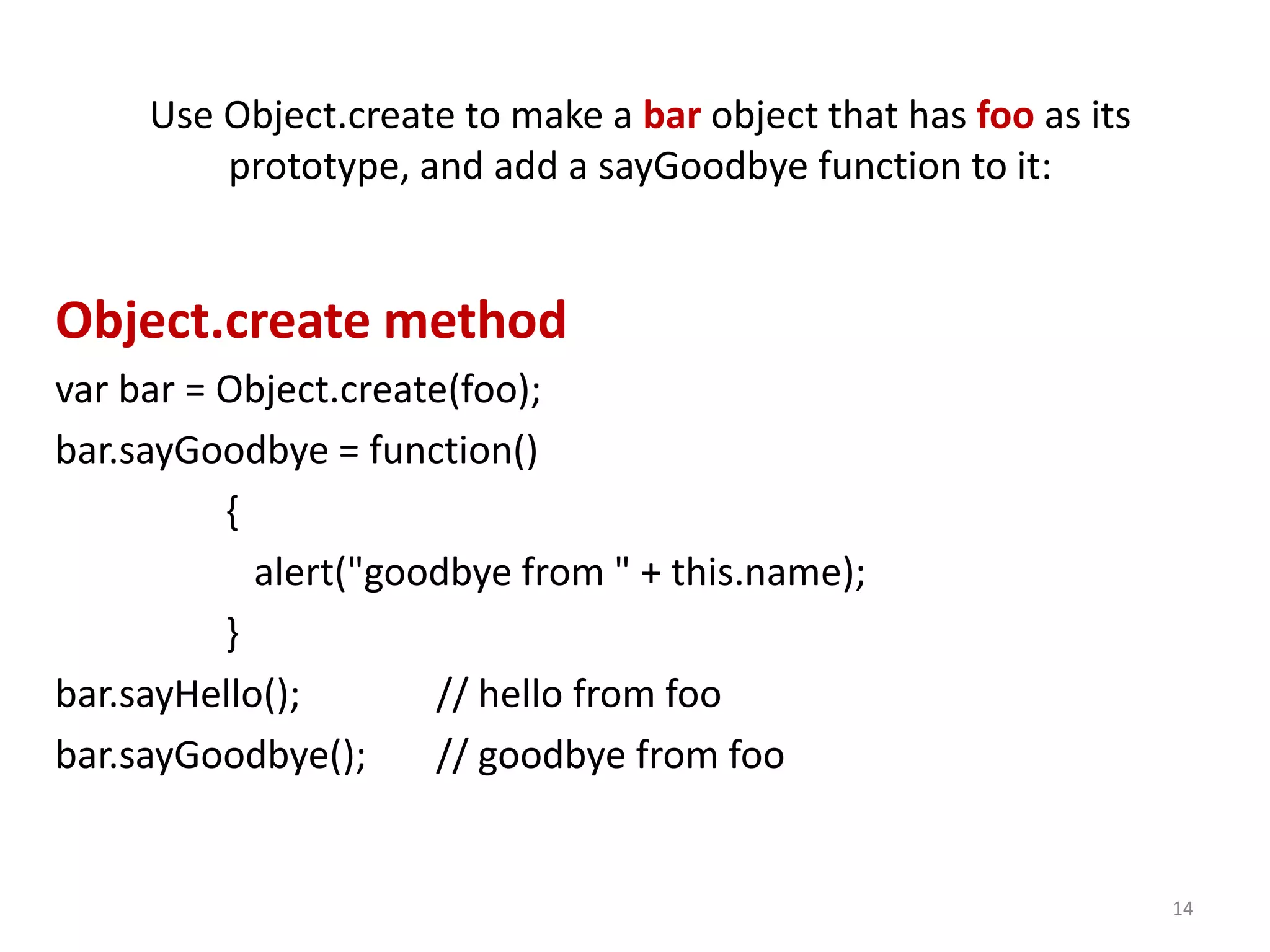
Use Object.create to make a bar object that has foo as its
         prototype, and add a sayGoodbye function to it:


Object.create method
var bar = Object.create(foo);
bar.sayGoodbye = function()
          {
            alert("goodbye from " + this.name);
          }
bar.sayHello();       // hello from foo
bar.sayGoodbye();     // goodbye from foo


                                                                  14
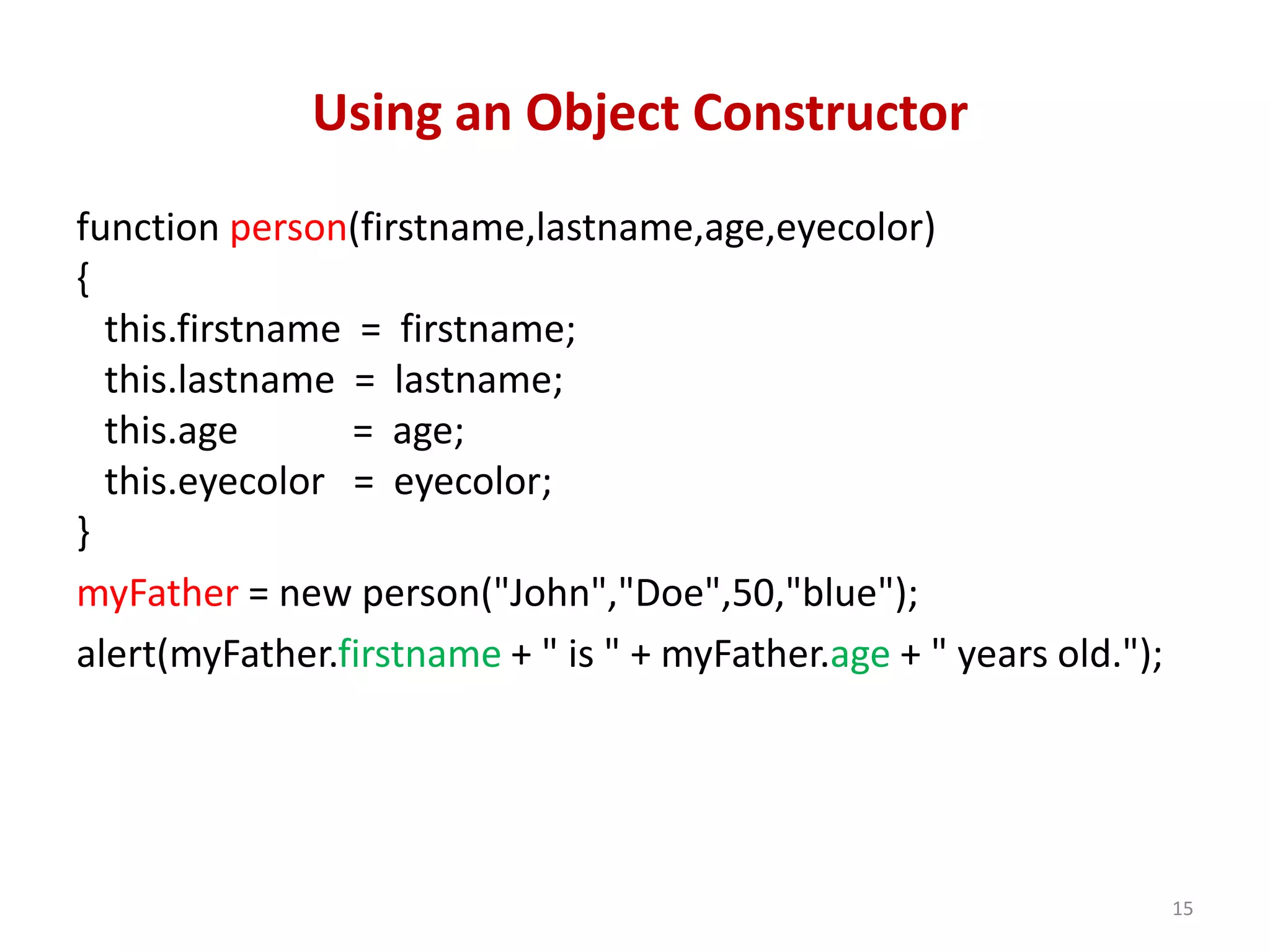
Using an Object Constructor
function person(firstname,lastname,age,eyecolor)
{
  this.firstname = firstname;
  this.lastname = lastname;
  this.age       = age;
  this.eyecolor = eyecolor;
}
myFather = new person("John","Doe",50,"blue");
alert(myFather.firstname + " is " + myFather.age + " years old.");


                                                                     15
JavaScript for...in Loop
function myFunction()
{
  var x;
  var txt="";
  var person = {fname:"John",lname:"Doe",age:25};

 for (x in person)
 {
        txt=txt + person[x];
        alert(txt);
 }
}
myFunction();
                                                    16
Multi dimensional
person = {
             firstname:"John",
             business:{
                          a:{
                               s:"software",
                               h:"hardware",
                               e:"electronics"
                            },
                          b:"garments"
                          c: ["A", "B", 2, 3]

                       }
        };
alert(person.firstname); // Jhon
alert(person.business.a.s); // software
alert(person.business.b);        // garments
alert(person.business.c[2]); // 2
console.log(person);                             17
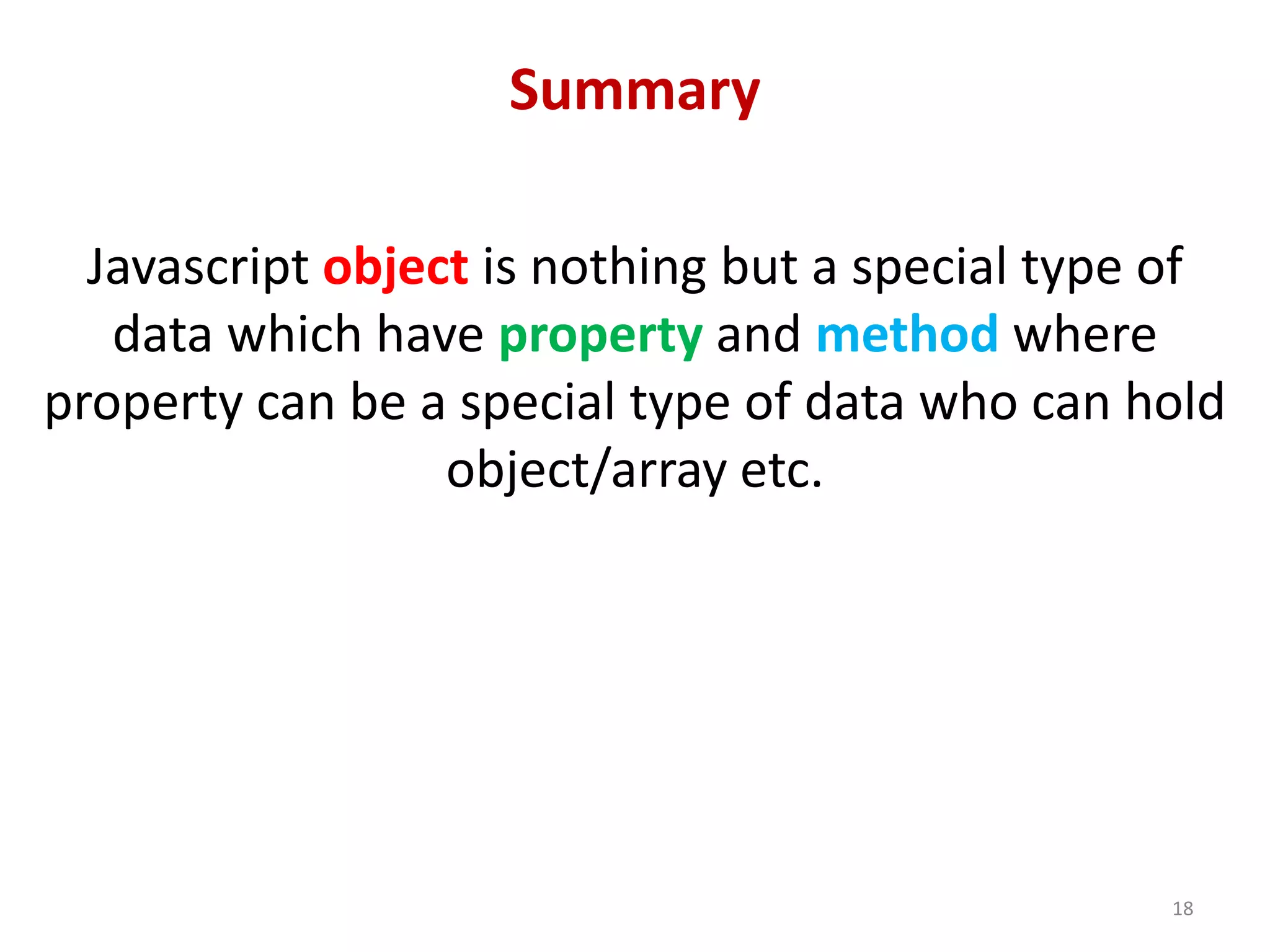
Summary

  Javascript object is nothing but a special type of
   data which have property and method where
property can be a special type of data who can hold
                  object/array etc.


                                                 18
Reference:
http://www.w3schools.com/js/js_objects.asp
https://developer.mozilla.org/en-US/docs/JavaScript/Introduction_to_Object-Oriented_JavaScript
https://developer.mozilla.org/en-US/docs/JavaScript/Reference/Global_Objects
https://developer.mozilla.org/en-US/docs/JavaScript/A_re-introduction_to_JavaScript
http://www.adobe.com/devnet/html5/articles/javascript-object-creation.html
http://killdream.github.com/blog/2011/10/understanding-javascript-oop/


                                                                                                 19

Object oriented javascript

  • 1.
    Object-Oriented JavaScript (OOP-JS) Presented By Md.Shah Jalal Software Engineer @ EVOKNOW jalalbd@mail.com jalalbd.wordpress.com 1
  • 2.
    Presentation GOAL JavaScript has strong object-oriented programming capabilities, even though some debates have taken place due to the differences in object-oriented JavaScript compared to other languages. This presentation will starts with an Introduction to object-oriented programming. And presentation main objective is to create object and parse it in different way. 2
  • 3.
    Terminology Class Definesthe characteristics of the Object. Object An Instance of a Class. Property An Object characteristic, such as color. Method An Object capability, such as walk. Constructor A method called at the moment of instantiation. Inheritance A Class can inherit characteristics from another Class. Encapsulation A Class defines only the characteristics of the Object, a method defines only how the method executes. Abstraction The conjunction of complex inheritance, methods, properties of an Object must be able to simulate a reality model. Polymorphism 3 Different Classes might define the same method or property.
  • 4.
    JavaScript is anobject oriented language, but JavaScript does not use classes. JavaScript is prototype based, not class based. ? Prototype-based programming Prototype-based programming is a style of object-oriented programming in which classes are not present, and behavior reuse (known as inheritance in class-based languages) is accomplished through a process of decorating existing objects which serve as prototypes. This model is also known as class-less, prototype-oriented, or instance-based programming. 4
  • 5.
    Core Objects JavaScript hasseveral objects included in its core; for example, there are objects like Math, Object, Array, and String. The example below shows how to use the Math object to get a random number by using its random() method. alert(Math.random()); https://developer.mozilla.org/en-US/docs/JavaScript/Reference/Global_Objects 5
  • 6.
    Accessing Object Properties objectName.propertyName varmessage = "Hello World!"; //string Object var x = message.length; // 12 Accessing Objects Methods objectName.methodName() var message = " Hello world!"; var x = message.toUpperCase(); //HELLO WORLD! 6
  • 7.
    Creating a DirectInstance var person = Object.create(null); Object.defineProperty(person, 'name', { value: 'Mikhail' , writable: true , configurable: true , enumerable: true }) Object.defineProperty(person, 'age', { value: 19 , writable: true , configurable: true , enumerable: true }) Object.defineProperty(person, 'gender', { value: 'Male' , writable: true , configurable: true , enumerable: true }) 7
  • 8.
    Creating a DirectInstance var person = Object.create(null); person['name'] = 'Jyoti'; person['age'] = 25; person ['gender'] = 'Male'; alert("Name : "+ person.name+" Age : "+person.age+" Gender : "+person.gender); person.name = 'Jalal'; person.age = 26; person.gender = 'Male'; alert("Name : "+ person.name+" Age : "+person.age+" Gender : "+person.gender); alert(Object.getOwnPropertyNames(person)); // name,age,gender // array alert(Object.getOwnPropertyNames(person).length);// 3 8
  • 9.
    Creating a DirectInstance person = new Object(); person.firstname = "John"; person.lastname = "Doe"; person.age = 50; person.eyecolor = "blue"; Alternative syntax (using object literals): person = { firstname :"John", lastname : "Doe", age : 50, eyecolor : "blue“ }; alert(person.firstname + " is " + person.age + " years old."); 9
  • 10.
    Creating a DirectInstance var person = { first_name : 'Shah' , last_name : 'Jalal' , age : 19 , gender : 'Male' , get name() { return this.first_name + ' ' + this.last_name } , set name(new_name) { var names names = new_name.trim().split(/s+/) this.first_name = names['0'] || '' this.last_name = names['1'] || '' } } alert(person.name); person.name = 'Rushow Khan'; alert(person.name); 10
  • 11.
    Custom Objects function Person(gender) { this.gender = gender; alert('Person instantiated'); } var person1 = new Person('Male'); var person2 = new Person('Female'); //display the person1 gender alert('person1 is a ' + person1.gender); // person1 is a Male alert('person2 is a ' + person2.gender); // person1 is a Female 11
  • 12.
    Use The MethodsayHello() for the Person Class function Person(gender) { this.gender = gender; } Person.prototype.sayGender = function() { alert(this.gender); }; var person1 = new Person('Male'); var genderTeller = person1.sayGender; person1.sayGender(); // alerts 'Male' genderTeller(); // alerts undefined alert(genderTeller === person1.sayGender); // alerts true alert(genderTeller === Person.prototype.sayGender); // alerts true genderTeller.call(person1); //alerts 'Male' 12
  • 13.
    Object.create method create afoo object that has a name property and a sayHello function: var foo = { name: "foo", sayHello: function() { alert("hello from " + this.name); } }; foo.sayHello(); // hello from foo 13
  • 14.
    Use Object.create tomake a bar object that has foo as its prototype, and add a sayGoodbye function to it: Object.create method var bar = Object.create(foo); bar.sayGoodbye = function() { alert("goodbye from " + this.name); } bar.sayHello(); // hello from foo bar.sayGoodbye(); // goodbye from foo 14
  • 15.
    Using an ObjectConstructor function person(firstname,lastname,age,eyecolor) { this.firstname = firstname; this.lastname = lastname; this.age = age; this.eyecolor = eyecolor; } myFather = new person("John","Doe",50,"blue"); alert(myFather.firstname + " is " + myFather.age + " years old."); 15
  • 16.
    JavaScript for...in Loop functionmyFunction() { var x; var txt=""; var person = {fname:"John",lname:"Doe",age:25}; for (x in person) { txt=txt + person[x]; alert(txt); } } myFunction(); 16
  • 17.
    Multi dimensional person ={ firstname:"John", business:{ a:{ s:"software", h:"hardware", e:"electronics" }, b:"garments" c: ["A", "B", 2, 3] } }; alert(person.firstname); // Jhon alert(person.business.a.s); // software alert(person.business.b); // garments alert(person.business.c[2]); // 2 console.log(person); 17
  • 18.
    Summary Javascriptobject is nothing but a special type of data which have property and method where property can be a special type of data who can hold object/array etc. 18
  • 19.