1
Network Test Automation
@otahi
2015-10-30
Net Ops Coding #1
2
Self Introduction
● @otahi
– A network engineer?
● Trying to be an SDN engineer
● Charged in (mainly) DC internal network
– Programmer
● Weekends and early mornings only + Weekdays
– Favorite language
● Ruby
3
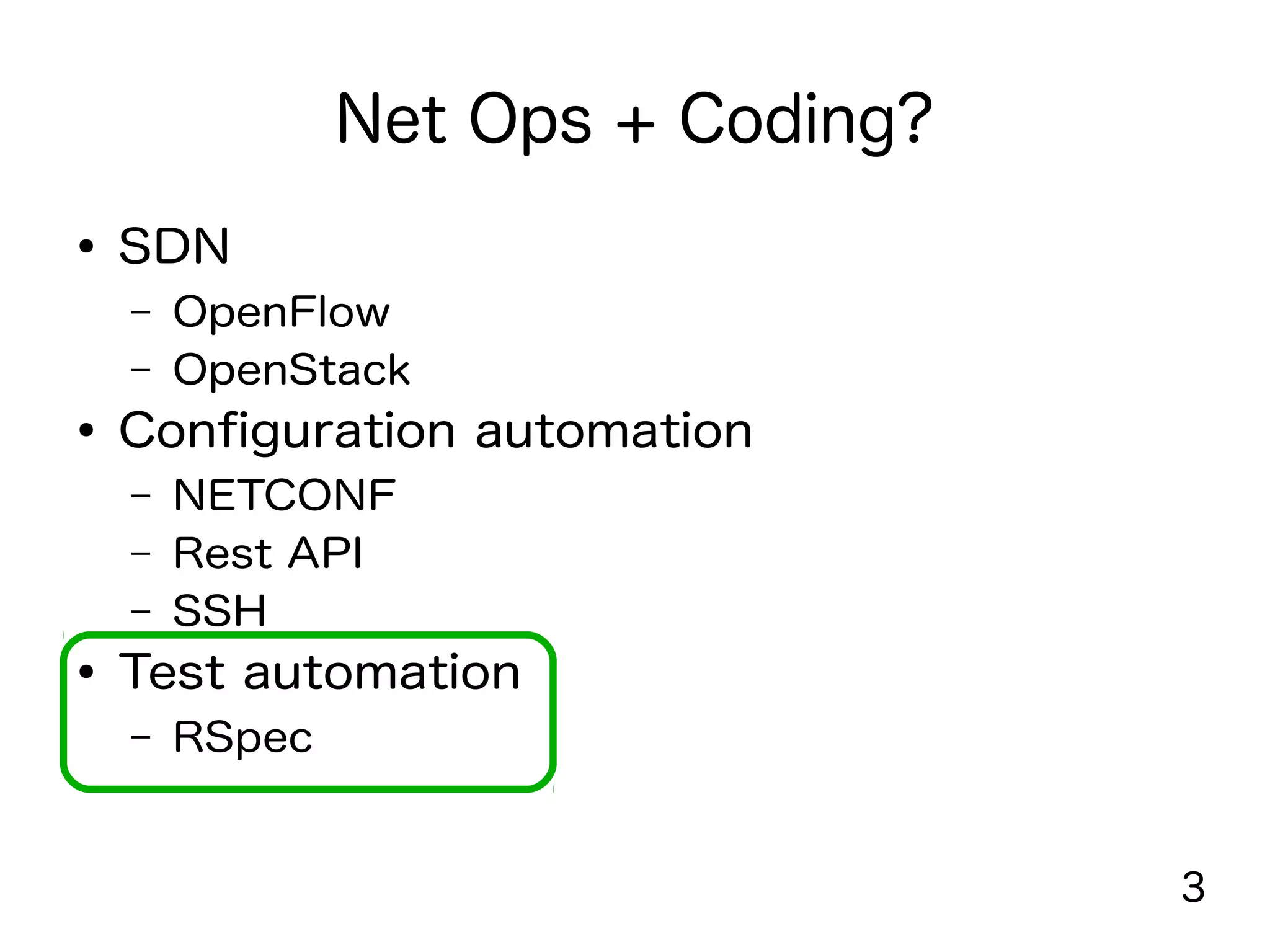
Net Ops + Coding?
● SDN
– OpenFlow
– OpenStack
● Configuration automation
– NETCONF
– Rest API
– SSH
● Test automation
– RSpec
4
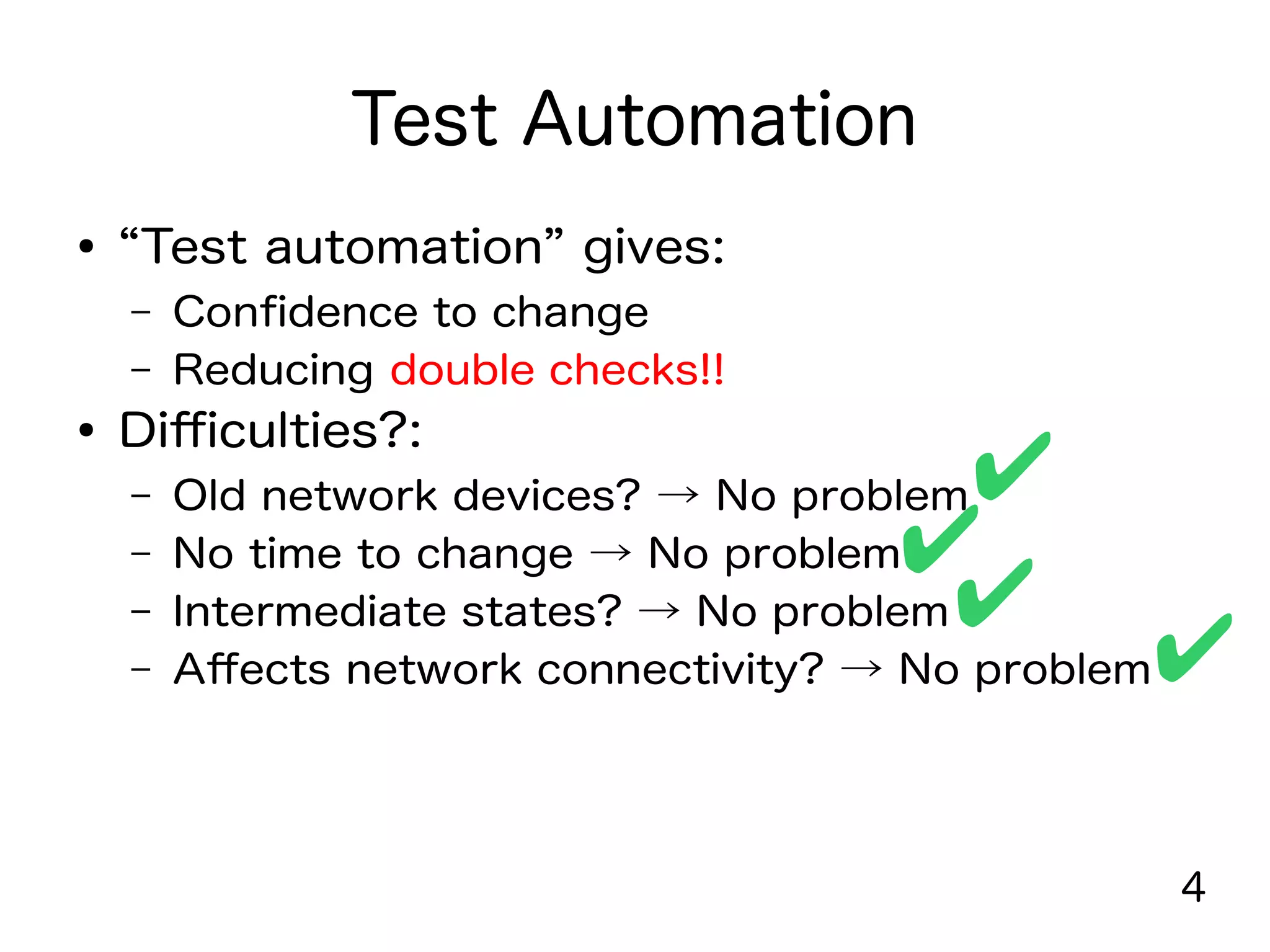
Test Automation
● “Test automation” gives:
– Confidence to change
– Reducing double checks!!
● Difficulties?:
– Old network devices? → No problem
– No time to change → No problem
– Intermediate states? → No problem
– Affects network connectivity? → No problem
✔
✔
✔
✔
5
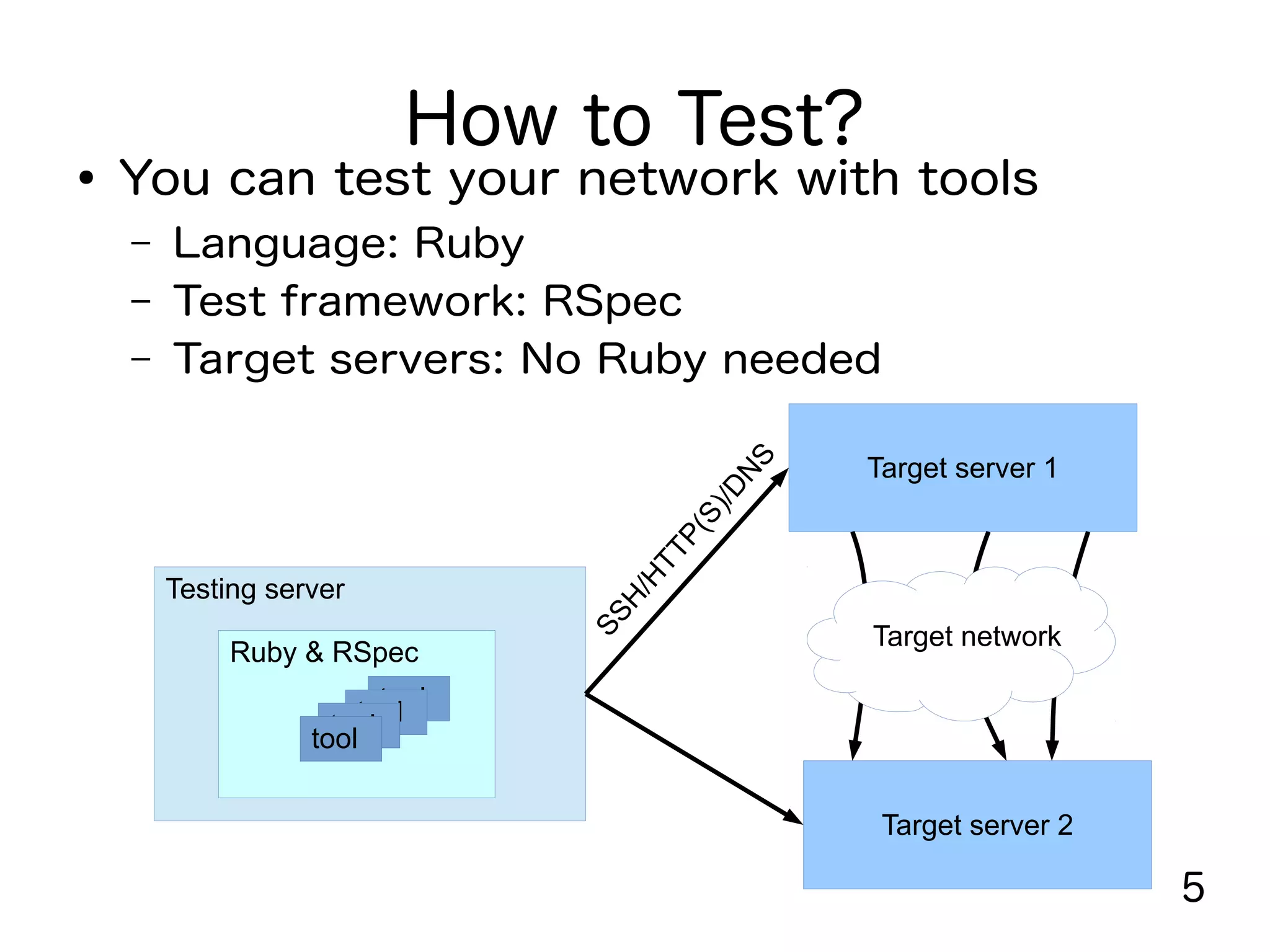
How to Test?
● You can test your network with tools
– Language: Ruby
– Test framework: RSpec
– Target servers: No Ruby needed
Testing server
Target server 1
Target server 2
Ruby & RSpec
tooltooltooltool
SSH/HTTP(S)/DNS
Target network
6
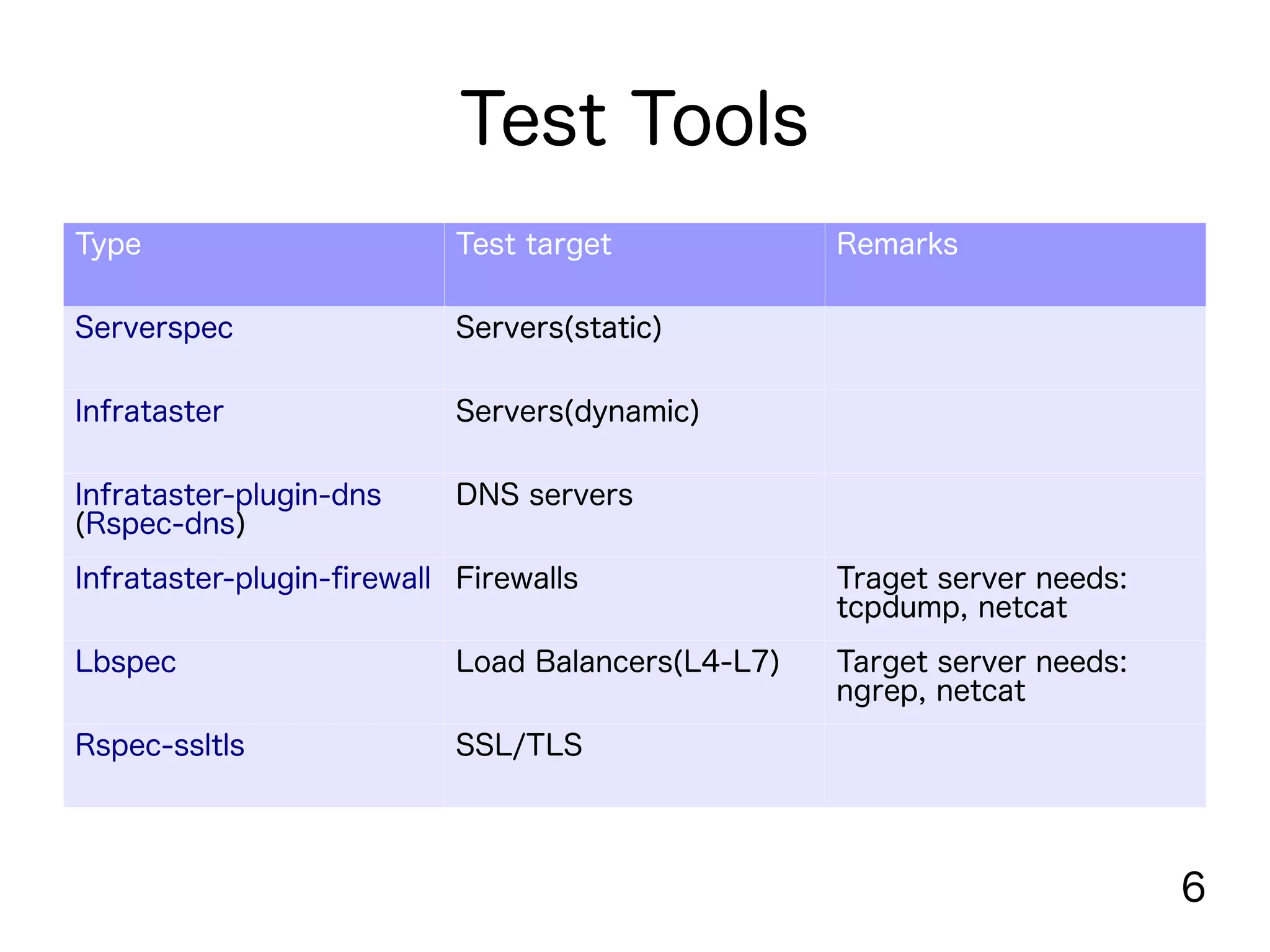
Test Tools
Type Test target Remarks
Serverspec Servers(static)
Infrataster Servers(dynamic)
Infrataster-plugin-dns
(Rspec-dns)
DNS servers
Infrataster-plugin-firewall Firewalls Traget server needs:
tcpdump, netcat
Lbspec Load Balancers(L4-L7) Target server needs:
ngrep, netcat
Rspec-ssltls SSL/TLS
7
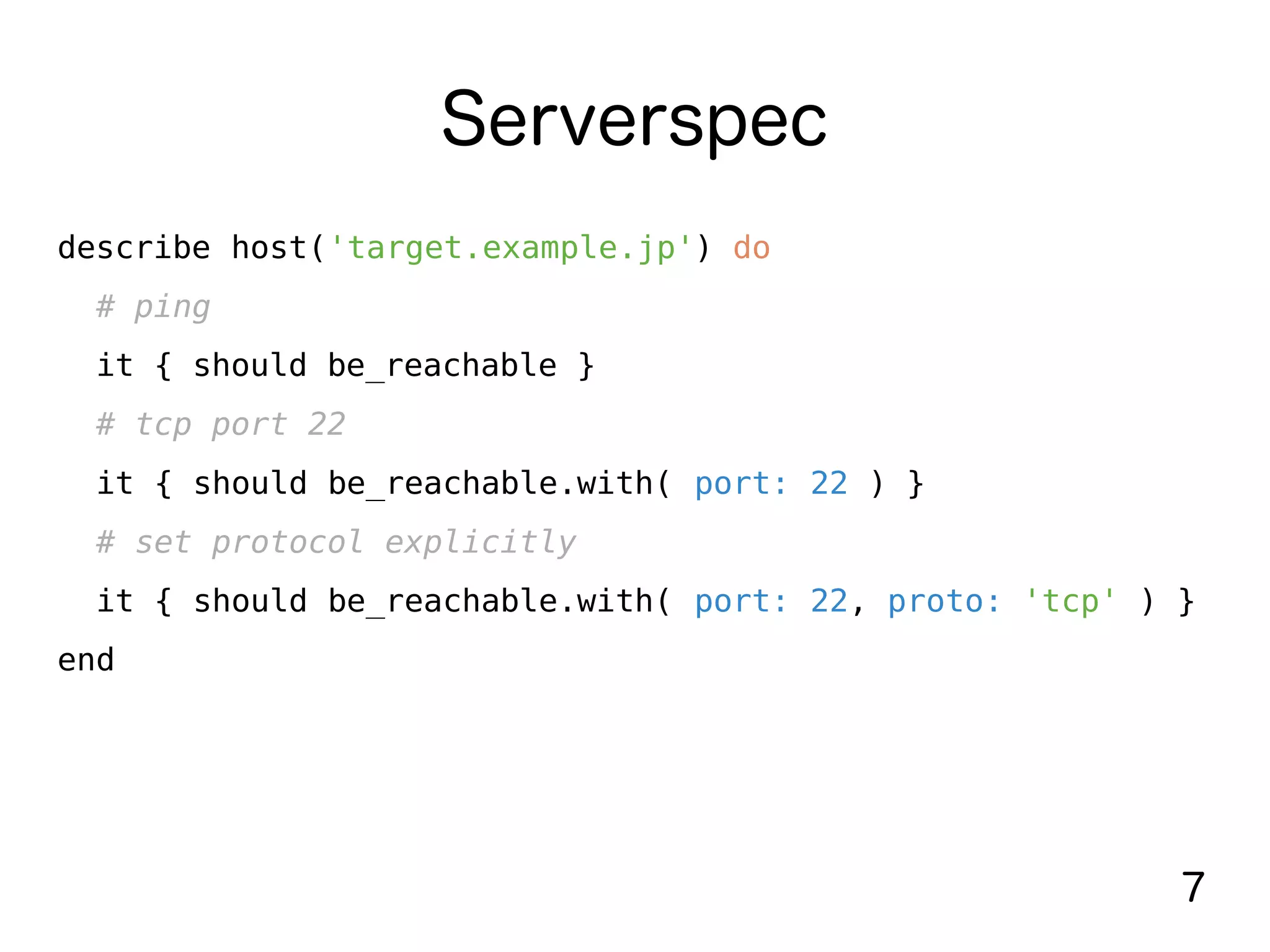
Serverspec
describe host('target.example.jp') do
# ping
it { should be_reachable }
# tcp port 22
it { should be_reachable.with( port: 22 ) }
# set protocol explicitly
it { should be_reachable.with( port: 22, proto: 'tcp' ) }
end
8
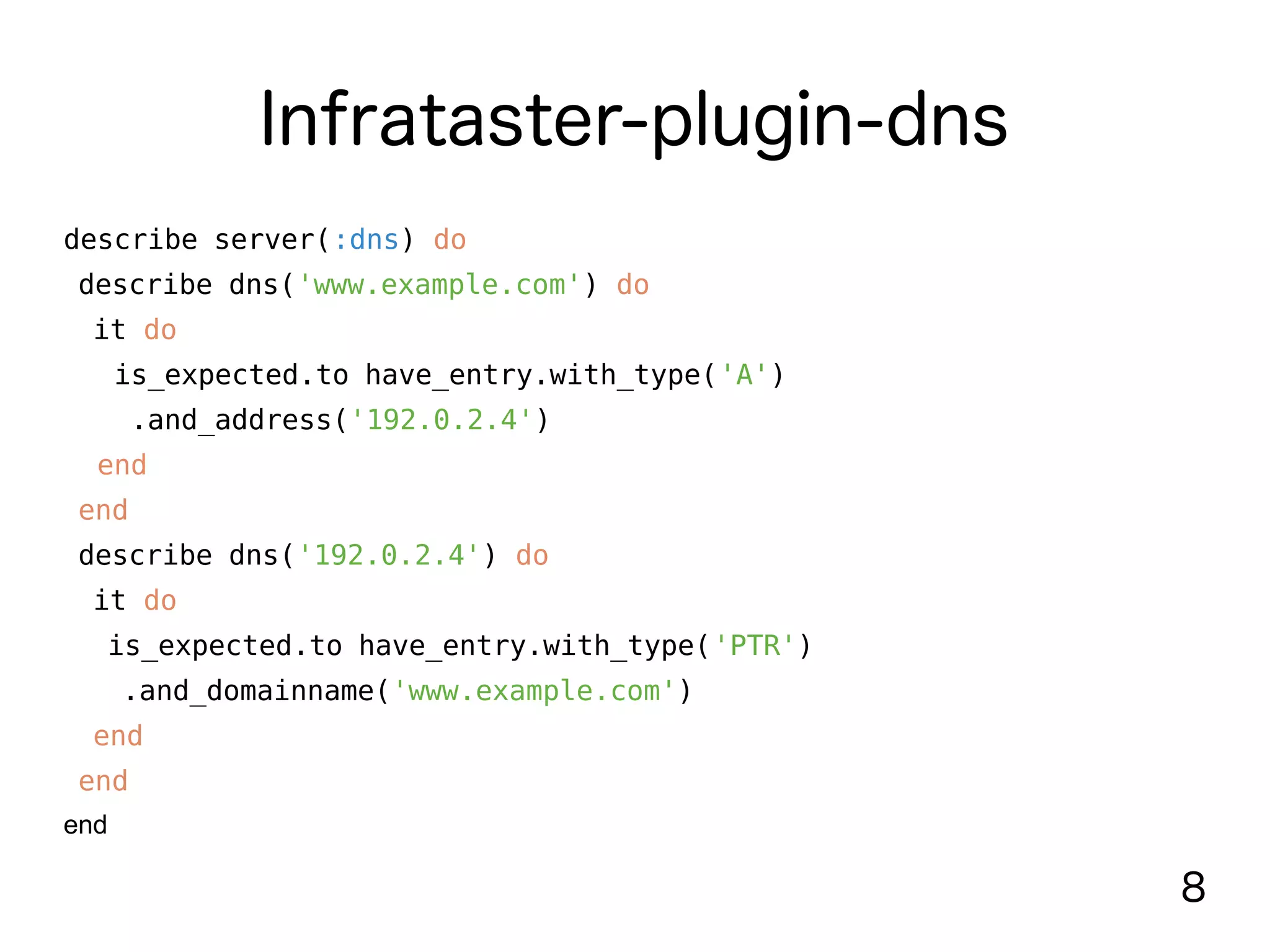
Infrataster-plugin-dns
describe server(:dns) do
describe dns('www.example.com') do
it do
is_expected.to have_entry.with_type('A')
.and_address('192.0.2.4')
end
end
describe dns('192.0.2.4') do
it do
is_expected.to have_entry.with_type('PTR')
.and_domainname('www.example.com')
end
end
end
9
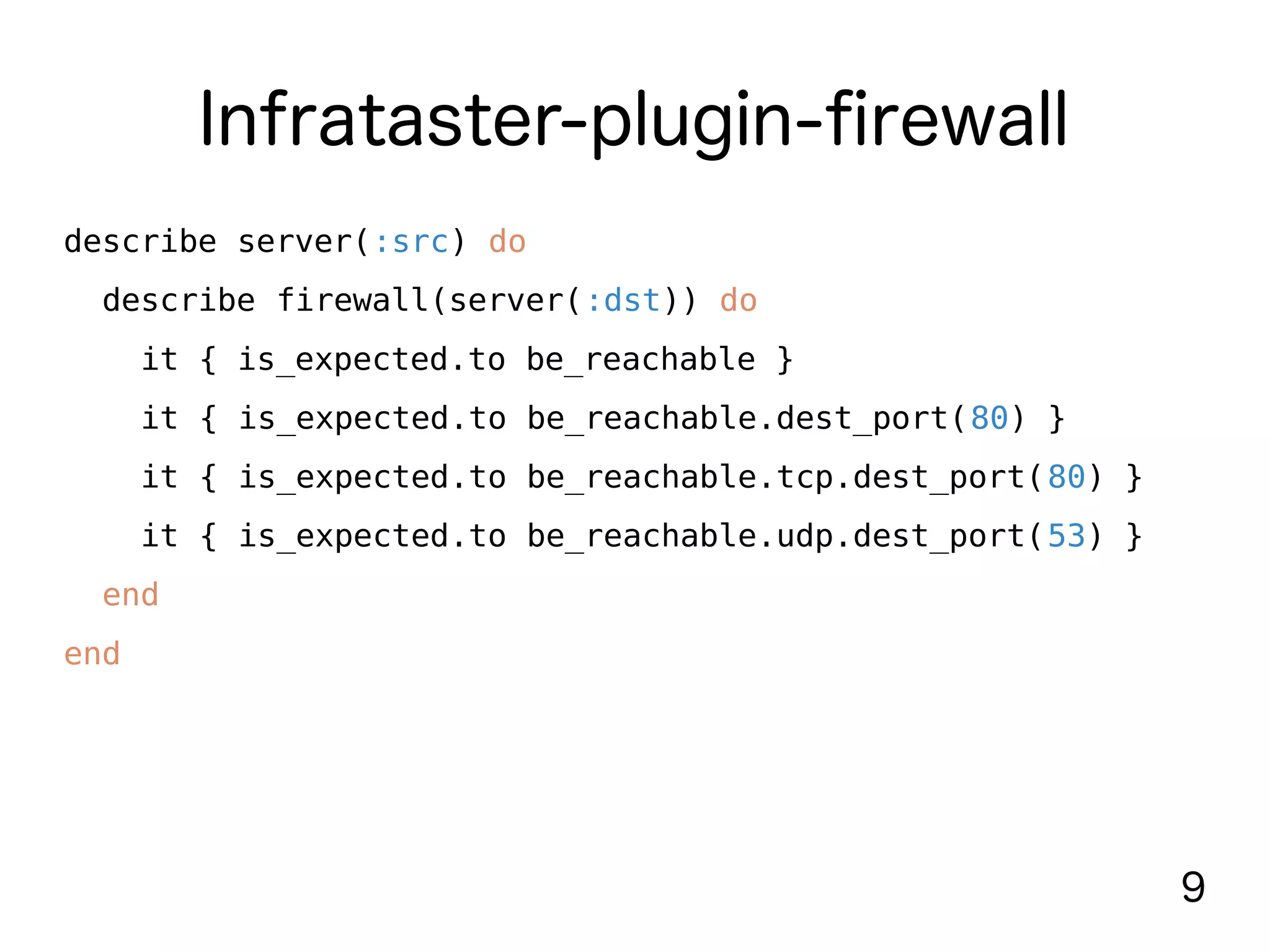
Infrataster-plugin-firewall
describe server(:src) do
describe firewall(server(:dst)) do
it { is_expected.to be_reachable }
it { is_expected.to be_reachable.dest_port(80) }
it { is_expected.to be_reachable.tcp.dest_port(80) }
it { is_expected.to be_reachable.udp.dest_port(53) }
end
end
10
Lbspec
describe 'vhost_c:80' do
it { should transfer(['node_b', 'node_c']])).port(80) }
it { should respond('404') }
end
describe 'loadbalancer' do
it do should healthcheck('node_c')
.include('/test/healthcheck').from('192.168.1.10')
end
end
11
Rspec-ssltls
describe 'www.example.com:443' do
it do
is_expected.to have_certificate
.subject(CN: '*.example.com').valid_at('2020/09/12 19:00:05 JST')
end
it { is_expected.to support_protocol('TLSv1_2') }
it { is_expected.to support_cipher('AES256-SHA').protocol('TLSv1') }
it { is_expected.to support_cipher('DES-CBC3-SHA').protocol('SSLv3') }
it do
is_expected.to choose_cipher('DES-CBC3-SHA')
.protocol('TLSv1')
.from(['AES256-SHA', 'AES128-SHA', 'DES-CBC3-SHA'])
end
end
12
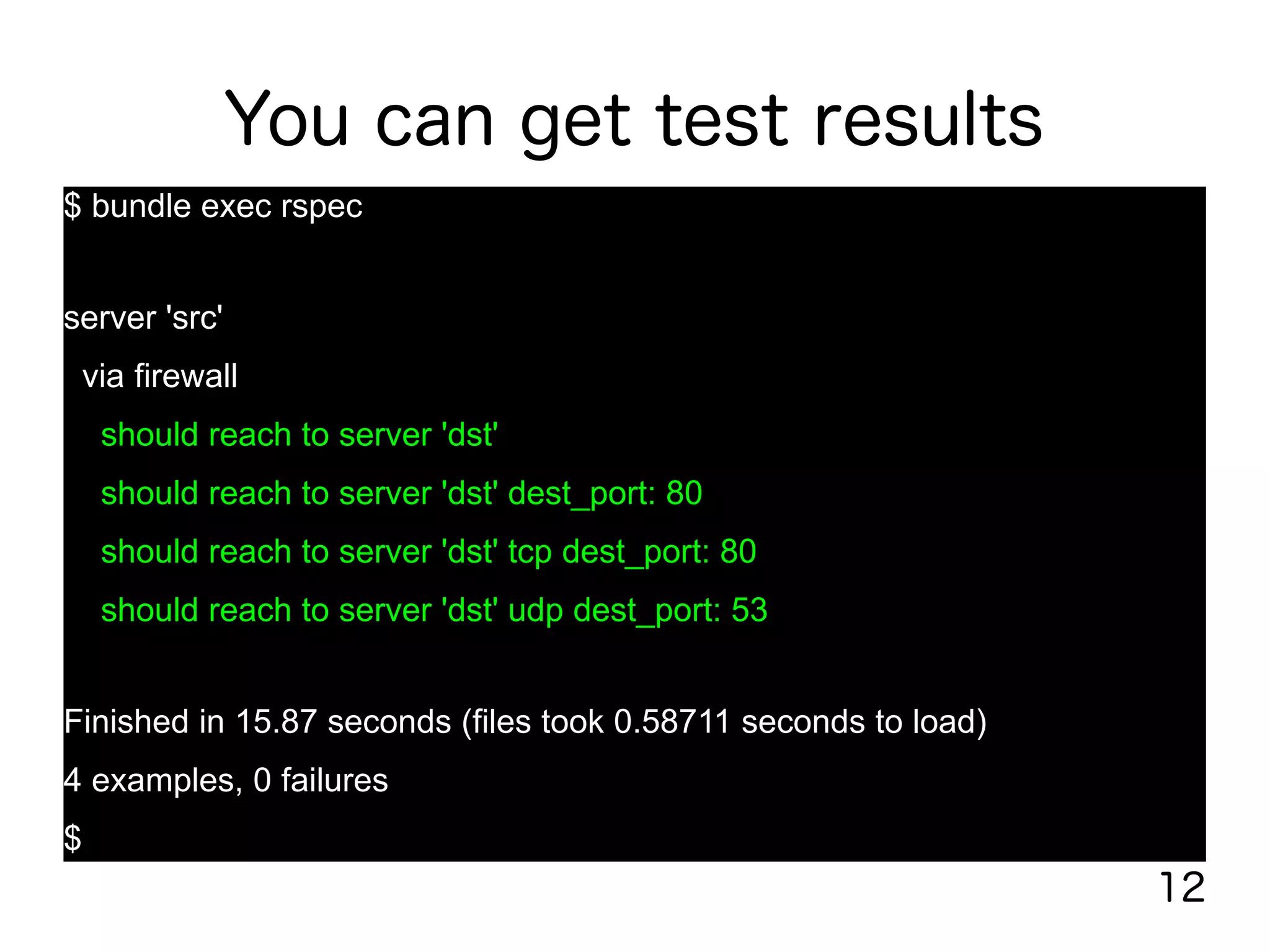
You can get test results
$ bundle exec rspec
server 'src'
via firewall
should reach to server 'dst'
should reach to server 'dst' dest_port: 80
should reach to server 'dst' tcp dest_port: 80
should reach to server 'dst' udp dest_port: 53
Finished in 15.87 seconds (files took 0.58711 seconds to load)
4 examples, 0 failures
$
13
Thank you!

Network Test Automation - Net Ops Coding 2015

  • 1.
  • 2.
    2 Self Introduction ● @otahi –A network engineer? ● Trying to be an SDN engineer ● Charged in (mainly) DC internal network – Programmer ● Weekends and early mornings only + Weekdays – Favorite language ● Ruby
  • 3.
    3 Net Ops +Coding? ● SDN – OpenFlow – OpenStack ● Configuration automation – NETCONF – Rest API – SSH ● Test automation – RSpec
  • 4.
    4 Test Automation ● “Testautomation” gives: – Confidence to change – Reducing double checks!! ● Difficulties?: – Old network devices? → No problem – No time to change → No problem – Intermediate states? → No problem – Affects network connectivity? → No problem ✔ ✔ ✔ ✔
  • 5.
    5 How to Test? ●You can test your network with tools – Language: Ruby – Test framework: RSpec – Target servers: No Ruby needed Testing server Target server 1 Target server 2 Ruby & RSpec tooltooltooltool SSH/HTTP(S)/DNS Target network
  • 6.
    6 Test Tools Type Testtarget Remarks Serverspec Servers(static) Infrataster Servers(dynamic) Infrataster-plugin-dns (Rspec-dns) DNS servers Infrataster-plugin-firewall Firewalls Traget server needs: tcpdump, netcat Lbspec Load Balancers(L4-L7) Target server needs: ngrep, netcat Rspec-ssltls SSL/TLS
  • 7.
    7 Serverspec describe host('target.example.jp') do #ping it { should be_reachable } # tcp port 22 it { should be_reachable.with( port: 22 ) } # set protocol explicitly it { should be_reachable.with( port: 22, proto: 'tcp' ) } end
  • 8.
    8 Infrataster-plugin-dns describe server(:dns) do describedns('www.example.com') do it do is_expected.to have_entry.with_type('A') .and_address('192.0.2.4') end end describe dns('192.0.2.4') do it do is_expected.to have_entry.with_type('PTR') .and_domainname('www.example.com') end end end
  • 9.
    9 Infrataster-plugin-firewall describe server(:src) do describefirewall(server(:dst)) do it { is_expected.to be_reachable } it { is_expected.to be_reachable.dest_port(80) } it { is_expected.to be_reachable.tcp.dest_port(80) } it { is_expected.to be_reachable.udp.dest_port(53) } end end
  • 10.
    10 Lbspec describe 'vhost_c:80' do it{ should transfer(['node_b', 'node_c']])).port(80) } it { should respond('404') } end describe 'loadbalancer' do it do should healthcheck('node_c') .include('/test/healthcheck').from('192.168.1.10') end end
  • 11.
    11 Rspec-ssltls describe 'www.example.com:443' do itdo is_expected.to have_certificate .subject(CN: '*.example.com').valid_at('2020/09/12 19:00:05 JST') end it { is_expected.to support_protocol('TLSv1_2') } it { is_expected.to support_cipher('AES256-SHA').protocol('TLSv1') } it { is_expected.to support_cipher('DES-CBC3-SHA').protocol('SSLv3') } it do is_expected.to choose_cipher('DES-CBC3-SHA') .protocol('TLSv1') .from(['AES256-SHA', 'AES128-SHA', 'DES-CBC3-SHA']) end end
  • 12.
    12 You can gettest results $ bundle exec rspec server 'src' via firewall should reach to server 'dst' should reach to server 'dst' dest_port: 80 should reach to server 'dst' tcp dest_port: 80 should reach to server 'dst' udp dest_port: 53 Finished in 15.87 seconds (files took 0.58711 seconds to load) 4 examples, 0 failures $
  • 13.