BCSE354E: Information
Security Management
Learning and Self Development
A. Avinash, Ph.D.
School of Computer Science and Engineering
Vellore Institute of Technology (VIT), Chennai
Knowledge and Skills Needed in Learning
and Self-Development
• Self-awareness: Understanding your own emotions, strengths,
weaknesses, needs, and drives.
• Learning strategies: Familiarity with different learning methods
such as active recall, spaced repetition, and the use of mnemonic
devices.
• Critical thinking: The ability to analyze information objectively,
evaluate different perspectives, and form reasoned conclusions.
• Time management: Effective management of one's time to
balance various commitments and enhance productivity.
• Goal setting: Ability to set SMART (Specific, Measurable,
Achievable, Relevant, and Time-bound) goals.
Knowledge and Skills Needed in Learning
and Self-Development
• Motivation and self-discipline: Drive and discipline to pursue
learning independently.
• Communication skills: Effective verbal and written
communication, including listening skills.
• Adaptability and resilience: Capability to handle change and
bounce back from setbacks.
• Technological proficiency: Competence in using digital tools
that facilitate learning (e.g., educational software, online
research).
• Metacognitive skills: Understanding one's own learning
processes and being able to adjust strategies accordingly.
Assessing Current Level of Knowledge,
Skills, and Competence
To evaluate one's current level in these areas, consider the
following:
• Self-assessment: Reflect on recent learning experiences. How
effective were they? Did you achieve your learning goals?
How well did you manage your time?
• Feedback from others: Seek feedback from peers, mentors,
or supervisors regarding your learning processes and
outcomes.
• Formal assessments: Use tools such as personality tests, skill
inventories, and performance reviews to gain a more objective
understanding of your skills.
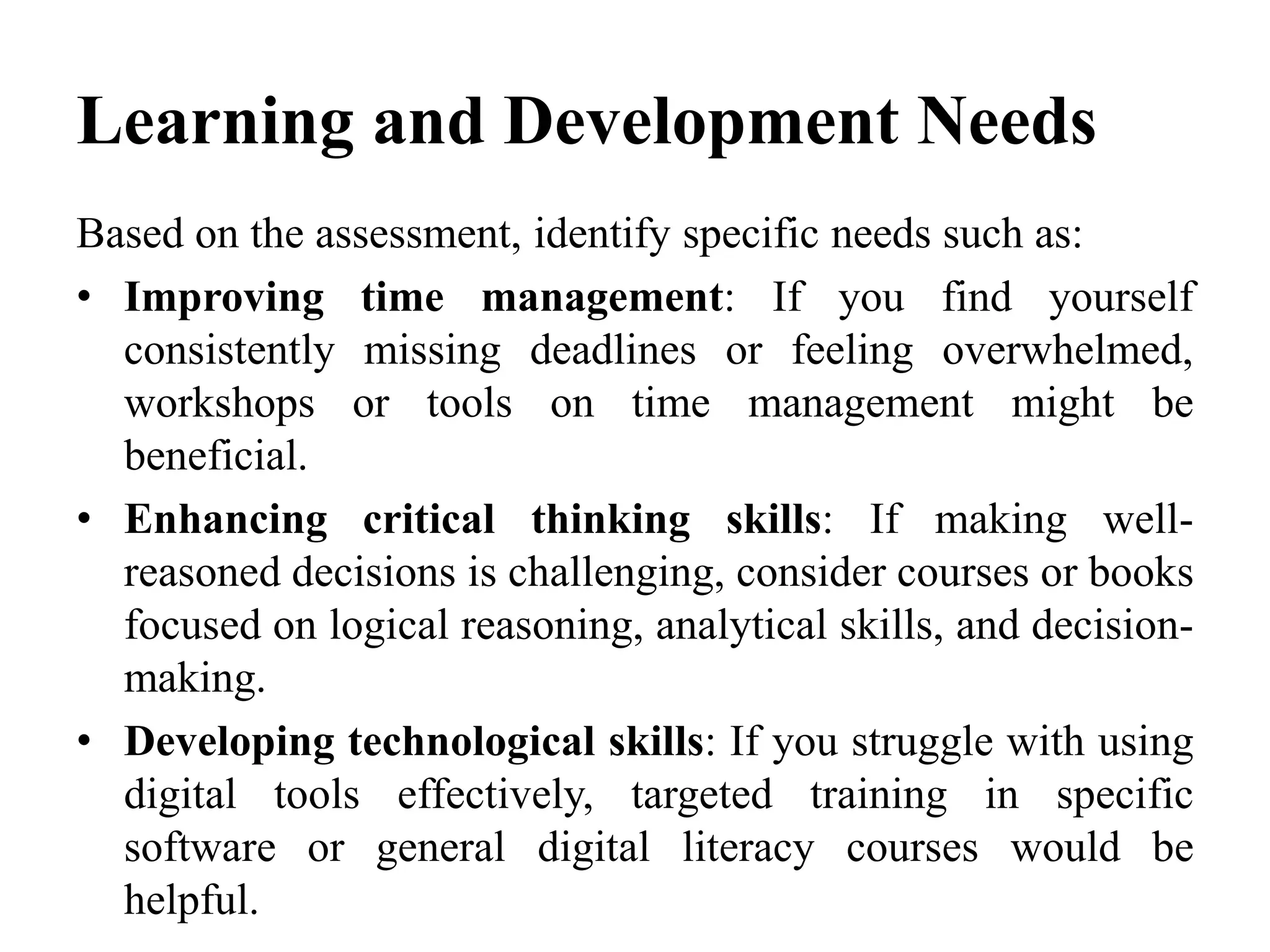
Learning and Development Needs
Based on the assessment, identify specific needs such as:
• Improving time management: If you find yourself
consistently missing deadlines or feeling overwhelmed,
workshops or tools on time management might be
beneficial.
• Enhancing critical thinking skills: If making well-
reasoned decisions is challenging, consider courses or books
focused on logical reasoning, analytical skills, and decision-
making.
• Developing technological skills: If you struggle with using
digital tools effectively, targeted training in specific
software or general digital literacy courses would be
helpful.
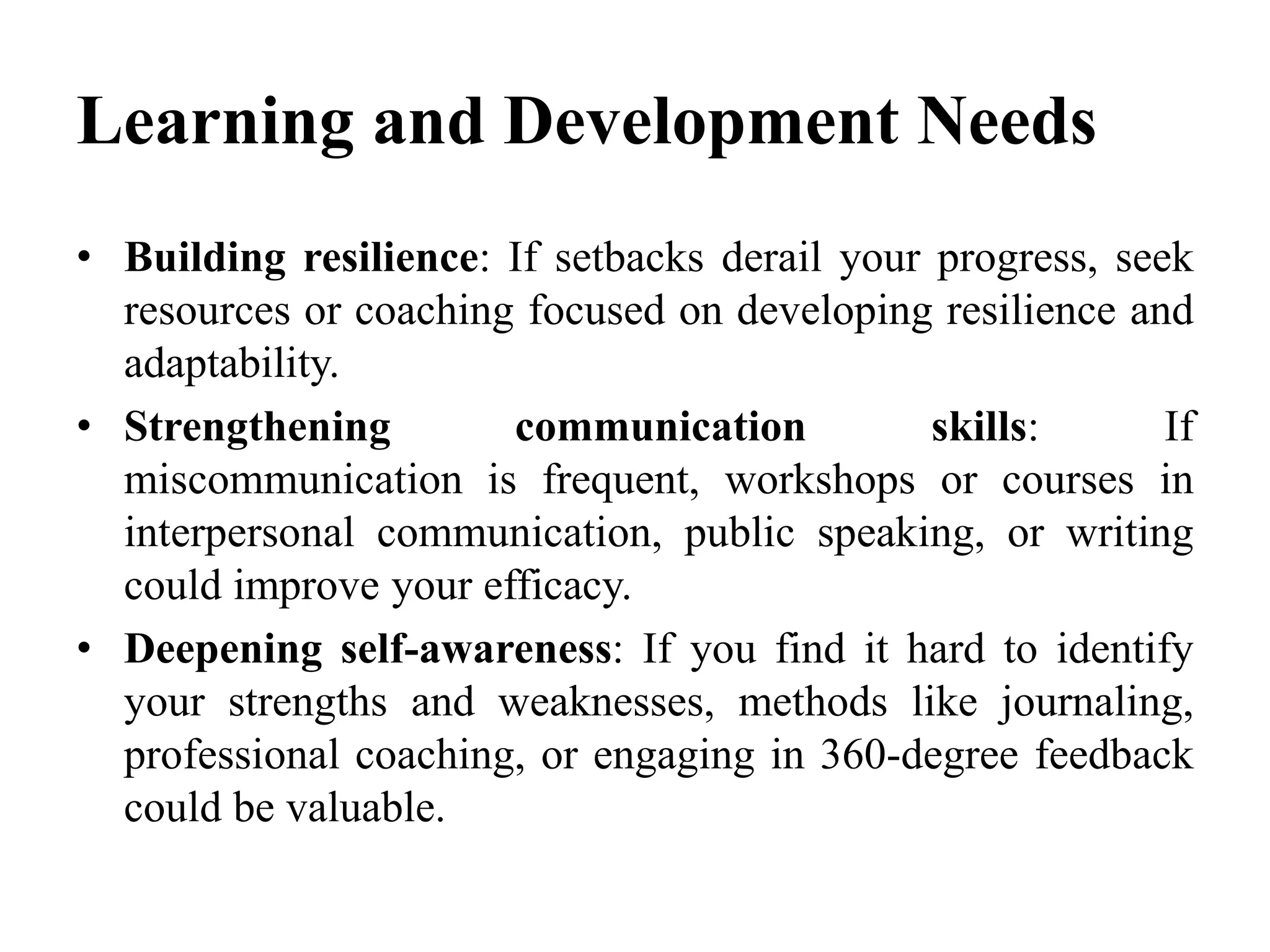
Learning and Development Needs
• Building resilience: If setbacks derail your progress, seek
resources or coaching focused on developing resilience and
adaptability.
• Strengthening communication skills: If
miscommunication is frequent, workshops or courses in
interpersonal communication, public speaking, or writing
could improve your efficacy.
• Deepening self-awareness: If you find it hard to identify
your strengths and weaknesses, methods like journaling,
professional coaching, or engaging in 360-degree feedback
could be valuable.
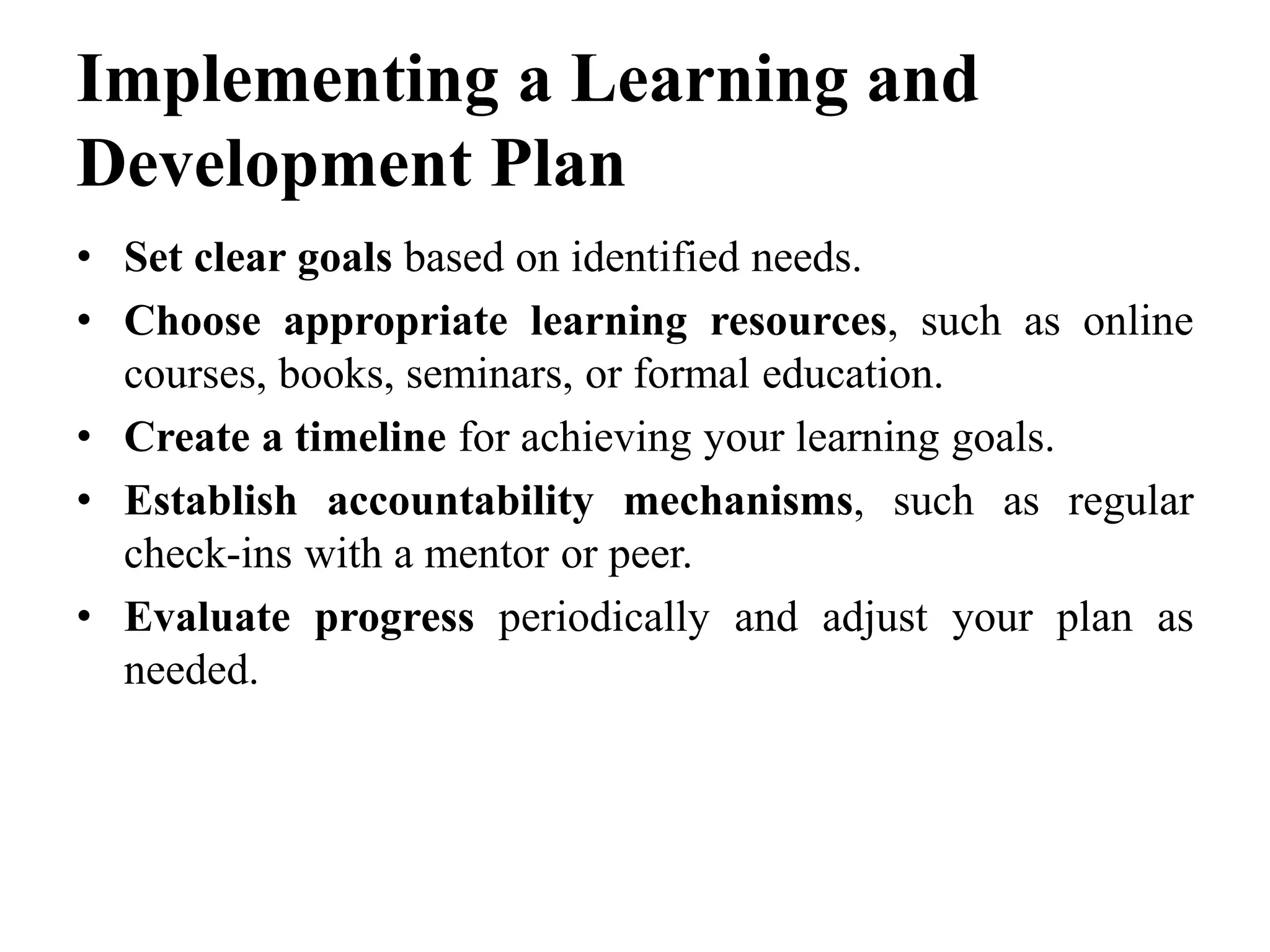
Implementing a Learning and
Development Plan
• Set clear goals based on identified needs.
• Choose appropriate learning resources, such as online
courses, books, seminars, or formal education.
• Create a timeline for achieving your learning goals.
• Establish accountability mechanisms, such as regular
check-ins with a mentor or peer.
• Evaluate progress periodically and adjust your plan as
needed.
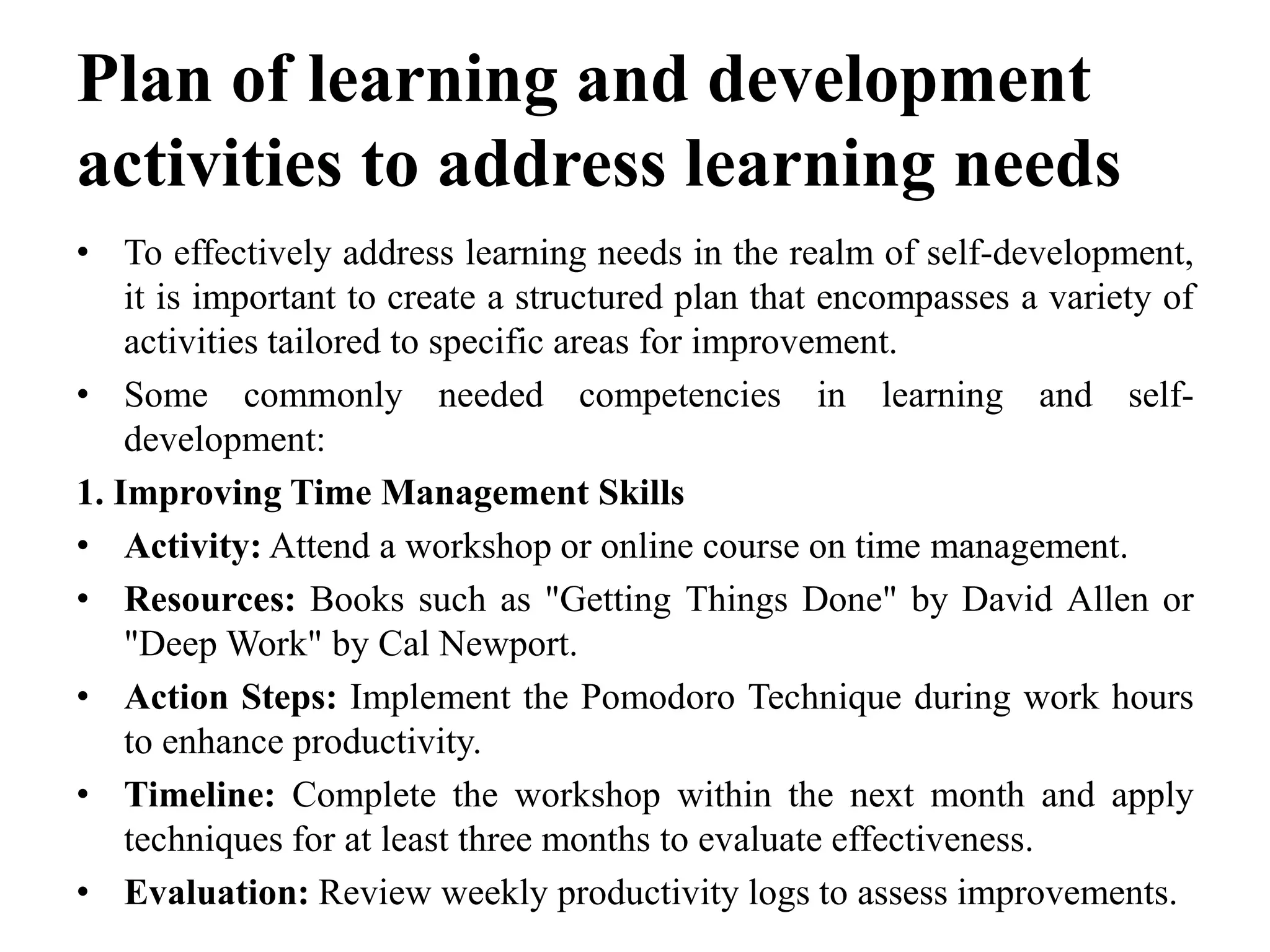
Plan of learning and development
activities to address learning needs
• To effectively address learning needs in the realm of self-development,
it is important to create a structured plan that encompasses a variety of
activities tailored to specific areas for improvement.
• Some commonly needed competencies in learning and self-
development:
1. Improving Time Management Skills
• Activity: Attend a workshop or online course on time management.
• Resources: Books such as "Getting Things Done" by David Allen or
"Deep Work" by Cal Newport.
• Action Steps: Implement the Pomodoro Technique during work hours
to enhance productivity.
• Timeline: Complete the workshop within the next month and apply
techniques for at least three months to evaluate effectiveness.
• Evaluation: Review weekly productivity logs to assess improvements.
Plan of learning and development
activities to address learning needs
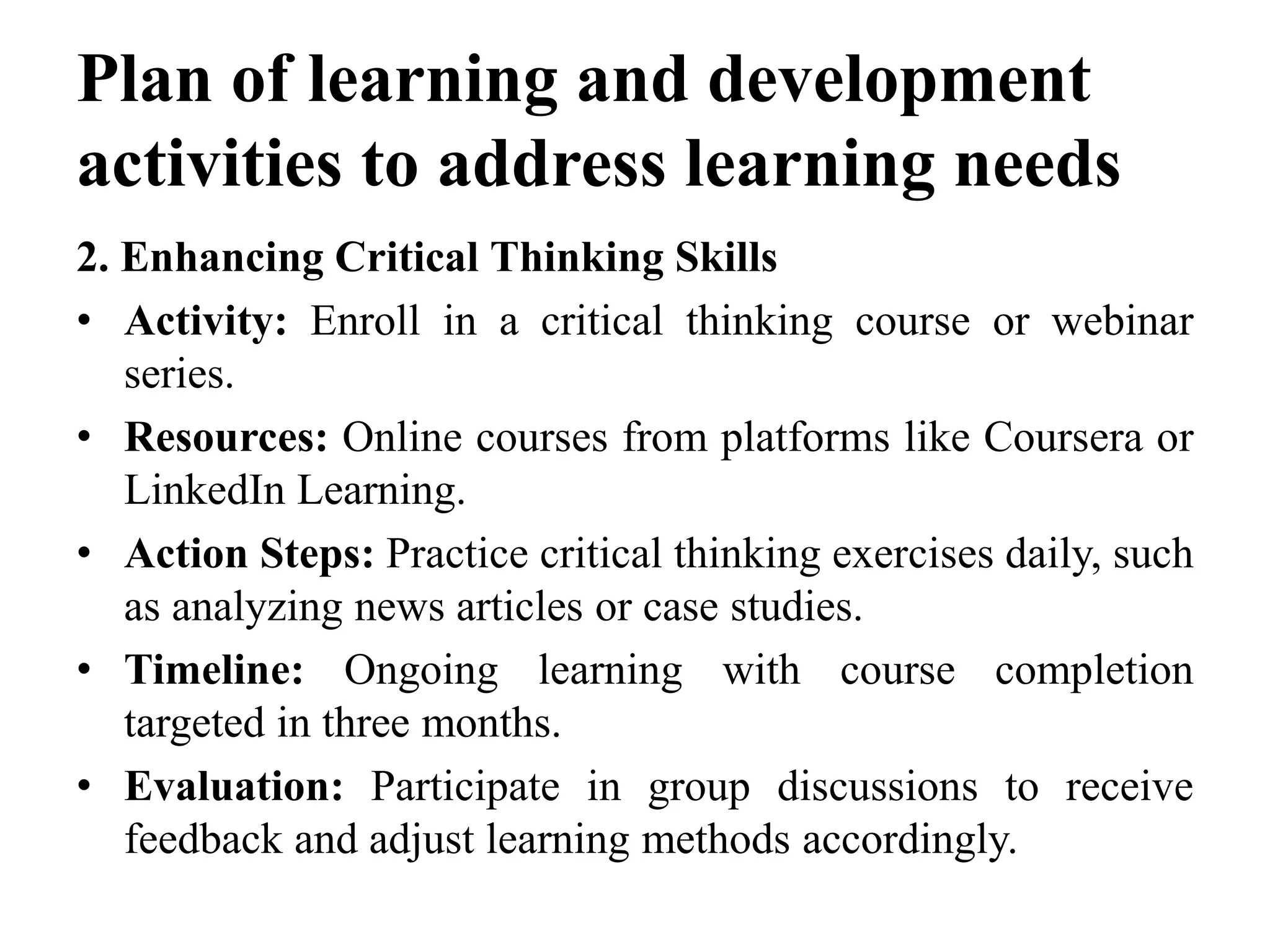
2. Enhancing Critical Thinking Skills
• Activity: Enroll in a critical thinking course or webinar
series.
• Resources: Online courses from platforms like Coursera or
LinkedIn Learning.
• Action Steps: Practice critical thinking exercises daily, such
as analyzing news articles or case studies.
• Timeline: Ongoing learning with course completion
targeted in three months.
• Evaluation: Participate in group discussions to receive
feedback and adjust learning methods accordingly.
Plan of learning and development
activities to address learning needs
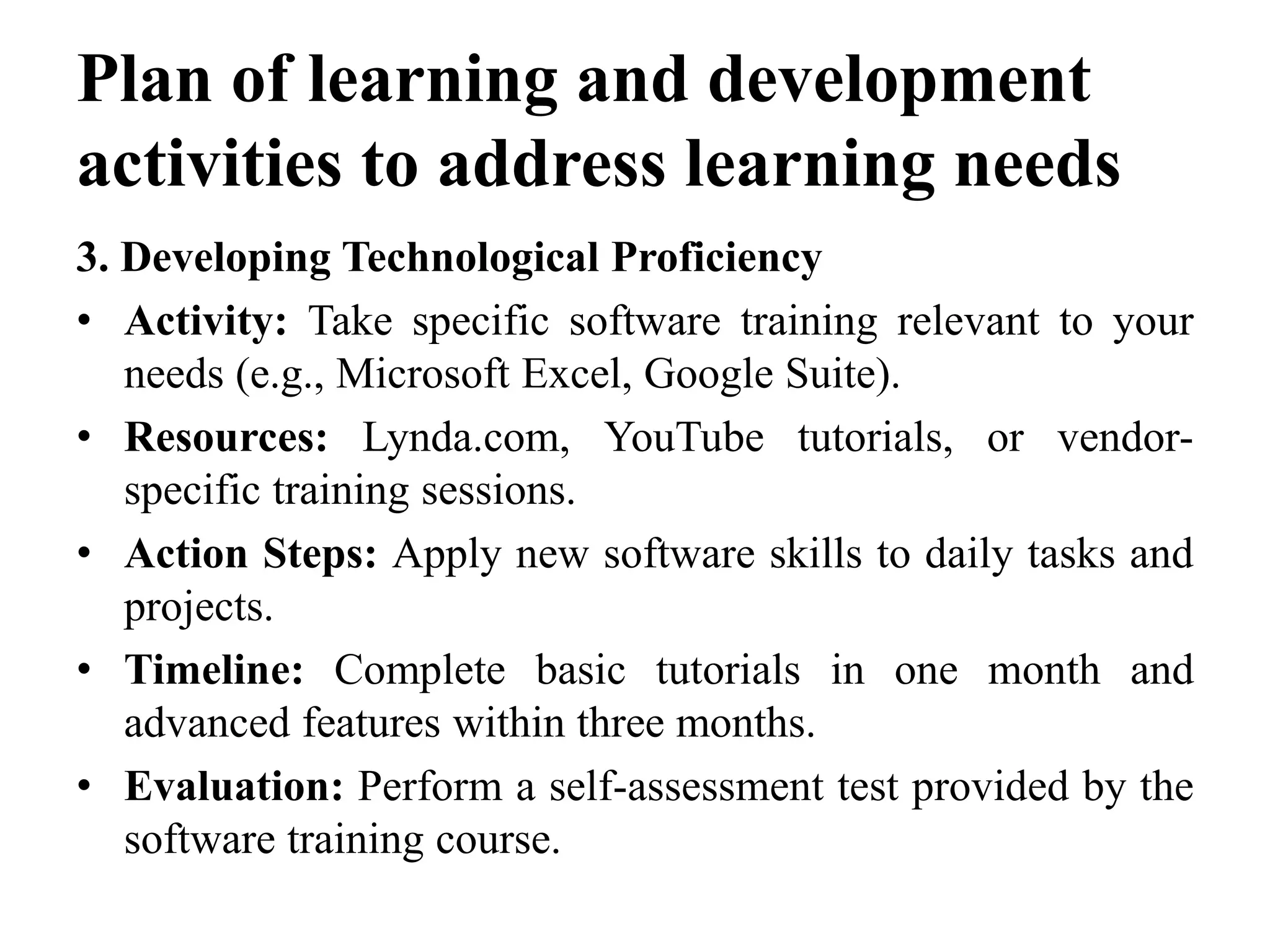
3. Developing Technological Proficiency
• Activity: Take specific software training relevant to your
needs (e.g., Microsoft Excel, Google Suite).
• Resources: Lynda.com, YouTube tutorials, or vendor-
specific training sessions.
• Action Steps: Apply new software skills to daily tasks and
projects.
• Timeline: Complete basic tutorials in one month and
advanced features within three months.
• Evaluation: Perform a self-assessment test provided by the
software training course.
Plan of learning and development
activities to address learning needs
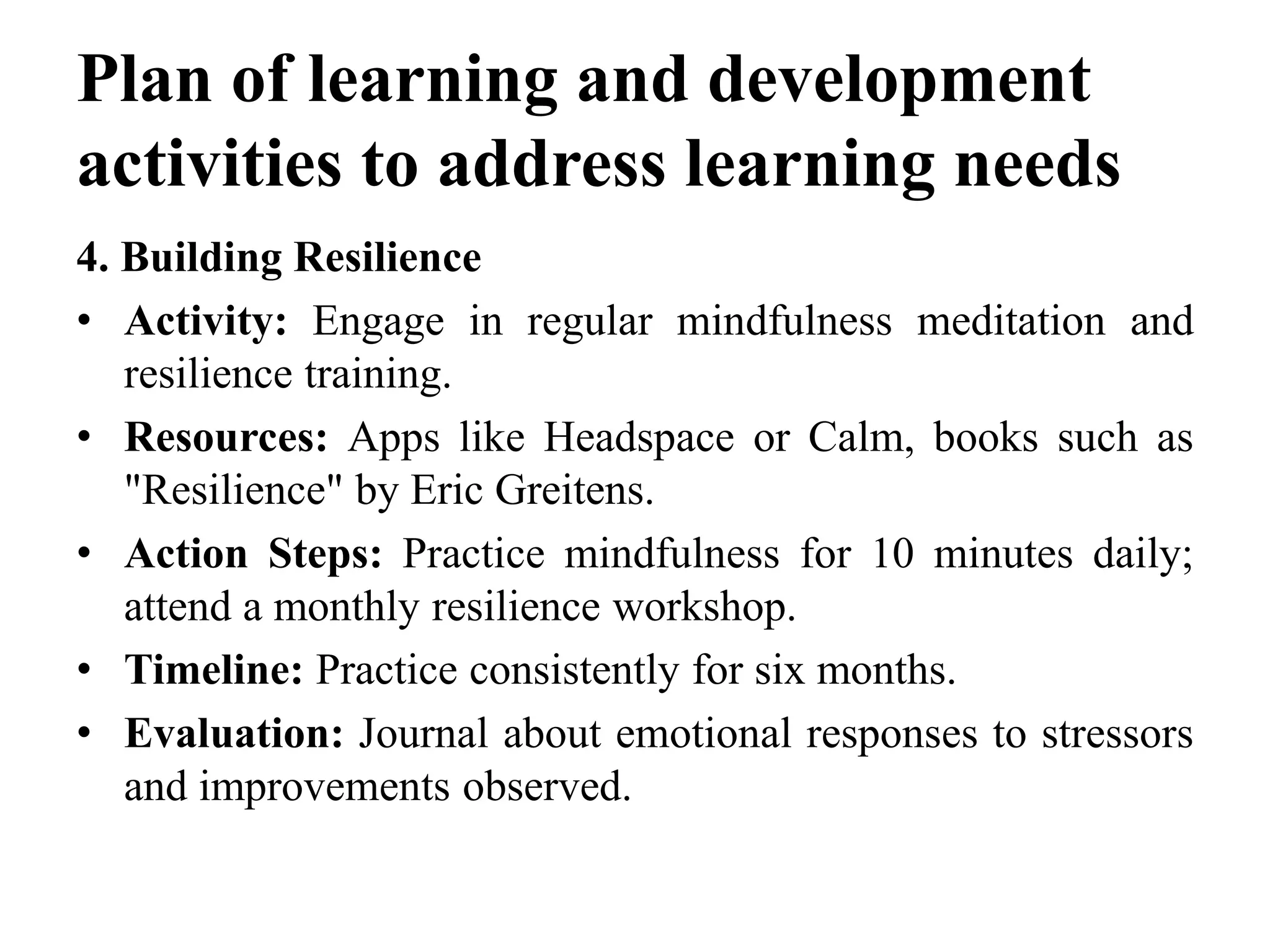
4. Building Resilience
• Activity: Engage in regular mindfulness meditation and
resilience training.
• Resources: Apps like Headspace or Calm, books such as
"Resilience" by Eric Greitens.
• Action Steps: Practice mindfulness for 10 minutes daily;
attend a monthly resilience workshop.
• Timeline: Practice consistently for six months.
• Evaluation: Journal about emotional responses to stressors
and improvements observed.
Plan of learning and development
activities to address learning needs
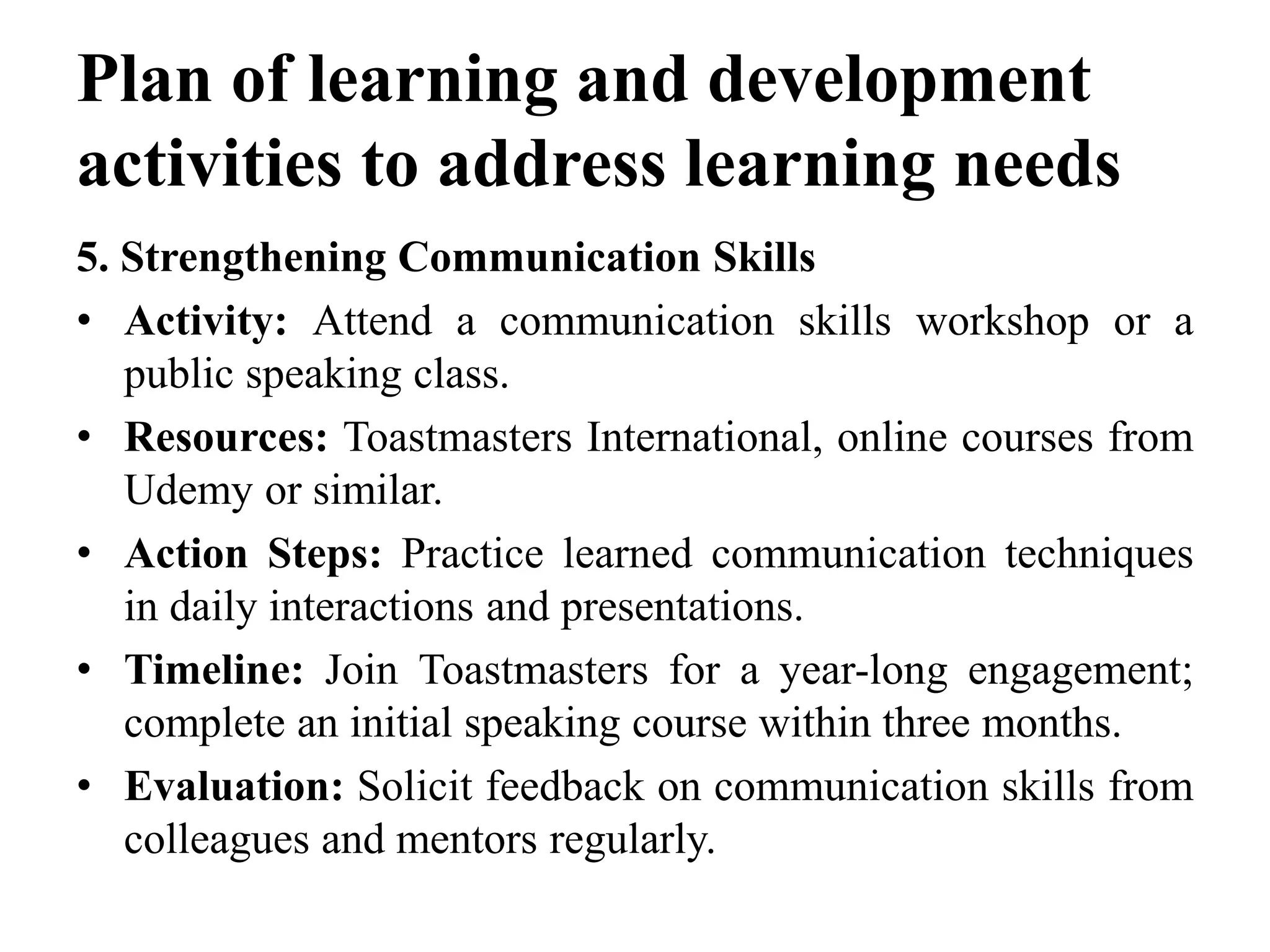
5. Strengthening Communication Skills
• Activity: Attend a communication skills workshop or a
public speaking class.
• Resources: Toastmasters International, online courses from
Udemy or similar.
• Action Steps: Practice learned communication techniques
in daily interactions and presentations.
• Timeline: Join Toastmasters for a year-long engagement;
complete an initial speaking course within three months.
• Evaluation: Solicit feedback on communication skills from
colleagues and mentors regularly.
Plan of learning and development
activities to address learning needs
6. Deepening Self-Awareness
• Activity: Engage in a 360-degree feedback process and
professional coaching.
• Resources: Coaching services, self-assessment tools, and
feedback surveys.
• Action Steps: Reflect on feedback and meet with a coach
bi-weekly.
• Timeline: Undertake this activity over six months.
• Evaluation: Assess changes in self-perception and feedback
from others after six months.
General Tips for Implementing the
Plan
• Stay Flexible: Be ready to adjust your plan based on
feedback and personal experience.
• Be Consistent: Regularity is key in developing skills; make
these activities part of your routine.
• Seek Support: Utilize mentors, peers, or a coach to provide
guidance and accountability.
• Document Progress: Keep a learning journal or a digital
record of what you learn and any reflections on your
experiences.
• Celebrate Achievements: Recognize milestones to stay
motivated

Module - 7 - Learning and Self Development.ppt

  • 1.
    BCSE354E: Information Security Management Learningand Self Development A. Avinash, Ph.D. School of Computer Science and Engineering Vellore Institute of Technology (VIT), Chennai
  • 2.
    Knowledge and SkillsNeeded in Learning and Self-Development • Self-awareness: Understanding your own emotions, strengths, weaknesses, needs, and drives. • Learning strategies: Familiarity with different learning methods such as active recall, spaced repetition, and the use of mnemonic devices. • Critical thinking: The ability to analyze information objectively, evaluate different perspectives, and form reasoned conclusions. • Time management: Effective management of one's time to balance various commitments and enhance productivity. • Goal setting: Ability to set SMART (Specific, Measurable, Achievable, Relevant, and Time-bound) goals.
  • 3.
    Knowledge and SkillsNeeded in Learning and Self-Development • Motivation and self-discipline: Drive and discipline to pursue learning independently. • Communication skills: Effective verbal and written communication, including listening skills. • Adaptability and resilience: Capability to handle change and bounce back from setbacks. • Technological proficiency: Competence in using digital tools that facilitate learning (e.g., educational software, online research). • Metacognitive skills: Understanding one's own learning processes and being able to adjust strategies accordingly.
  • 4.
    Assessing Current Levelof Knowledge, Skills, and Competence To evaluate one's current level in these areas, consider the following: • Self-assessment: Reflect on recent learning experiences. How effective were they? Did you achieve your learning goals? How well did you manage your time? • Feedback from others: Seek feedback from peers, mentors, or supervisors regarding your learning processes and outcomes. • Formal assessments: Use tools such as personality tests, skill inventories, and performance reviews to gain a more objective understanding of your skills.
  • 5.
    Learning and DevelopmentNeeds Based on the assessment, identify specific needs such as: • Improving time management: If you find yourself consistently missing deadlines or feeling overwhelmed, workshops or tools on time management might be beneficial. • Enhancing critical thinking skills: If making well- reasoned decisions is challenging, consider courses or books focused on logical reasoning, analytical skills, and decision- making. • Developing technological skills: If you struggle with using digital tools effectively, targeted training in specific software or general digital literacy courses would be helpful.
  • 6.
    Learning and DevelopmentNeeds • Building resilience: If setbacks derail your progress, seek resources or coaching focused on developing resilience and adaptability. • Strengthening communication skills: If miscommunication is frequent, workshops or courses in interpersonal communication, public speaking, or writing could improve your efficacy. • Deepening self-awareness: If you find it hard to identify your strengths and weaknesses, methods like journaling, professional coaching, or engaging in 360-degree feedback could be valuable.
  • 7.
    Implementing a Learningand Development Plan • Set clear goals based on identified needs. • Choose appropriate learning resources, such as online courses, books, seminars, or formal education. • Create a timeline for achieving your learning goals. • Establish accountability mechanisms, such as regular check-ins with a mentor or peer. • Evaluate progress periodically and adjust your plan as needed.
  • 8.
    Plan of learningand development activities to address learning needs • To effectively address learning needs in the realm of self-development, it is important to create a structured plan that encompasses a variety of activities tailored to specific areas for improvement. • Some commonly needed competencies in learning and self- development: 1. Improving Time Management Skills • Activity: Attend a workshop or online course on time management. • Resources: Books such as "Getting Things Done" by David Allen or "Deep Work" by Cal Newport. • Action Steps: Implement the Pomodoro Technique during work hours to enhance productivity. • Timeline: Complete the workshop within the next month and apply techniques for at least three months to evaluate effectiveness. • Evaluation: Review weekly productivity logs to assess improvements.
  • 9.
    Plan of learningand development activities to address learning needs 2. Enhancing Critical Thinking Skills • Activity: Enroll in a critical thinking course or webinar series. • Resources: Online courses from platforms like Coursera or LinkedIn Learning. • Action Steps: Practice critical thinking exercises daily, such as analyzing news articles or case studies. • Timeline: Ongoing learning with course completion targeted in three months. • Evaluation: Participate in group discussions to receive feedback and adjust learning methods accordingly.
  • 10.
    Plan of learningand development activities to address learning needs 3. Developing Technological Proficiency • Activity: Take specific software training relevant to your needs (e.g., Microsoft Excel, Google Suite). • Resources: Lynda.com, YouTube tutorials, or vendor- specific training sessions. • Action Steps: Apply new software skills to daily tasks and projects. • Timeline: Complete basic tutorials in one month and advanced features within three months. • Evaluation: Perform a self-assessment test provided by the software training course.
  • 11.
    Plan of learningand development activities to address learning needs 4. Building Resilience • Activity: Engage in regular mindfulness meditation and resilience training. • Resources: Apps like Headspace or Calm, books such as "Resilience" by Eric Greitens. • Action Steps: Practice mindfulness for 10 minutes daily; attend a monthly resilience workshop. • Timeline: Practice consistently for six months. • Evaluation: Journal about emotional responses to stressors and improvements observed.
  • 12.
    Plan of learningand development activities to address learning needs 5. Strengthening Communication Skills • Activity: Attend a communication skills workshop or a public speaking class. • Resources: Toastmasters International, online courses from Udemy or similar. • Action Steps: Practice learned communication techniques in daily interactions and presentations. • Timeline: Join Toastmasters for a year-long engagement; complete an initial speaking course within three months. • Evaluation: Solicit feedback on communication skills from colleagues and mentors regularly.
  • 13.
    Plan of learningand development activities to address learning needs 6. Deepening Self-Awareness • Activity: Engage in a 360-degree feedback process and professional coaching. • Resources: Coaching services, self-assessment tools, and feedback surveys. • Action Steps: Reflect on feedback and meet with a coach bi-weekly. • Timeline: Undertake this activity over six months. • Evaluation: Assess changes in self-perception and feedback from others after six months.
  • 14.
    General Tips forImplementing the Plan • Stay Flexible: Be ready to adjust your plan based on feedback and personal experience. • Be Consistent: Regularity is key in developing skills; make these activities part of your routine. • Seek Support: Utilize mentors, peers, or a coach to provide guidance and accountability. • Document Progress: Keep a learning journal or a digital record of what you learn and any reflections on your experiences. • Celebrate Achievements: Recognize milestones to stay motivated