Modular Macros for OCaml
Olivier Nicole
ENSTA ParisTech
nicole@ensta.fr
1 / 16
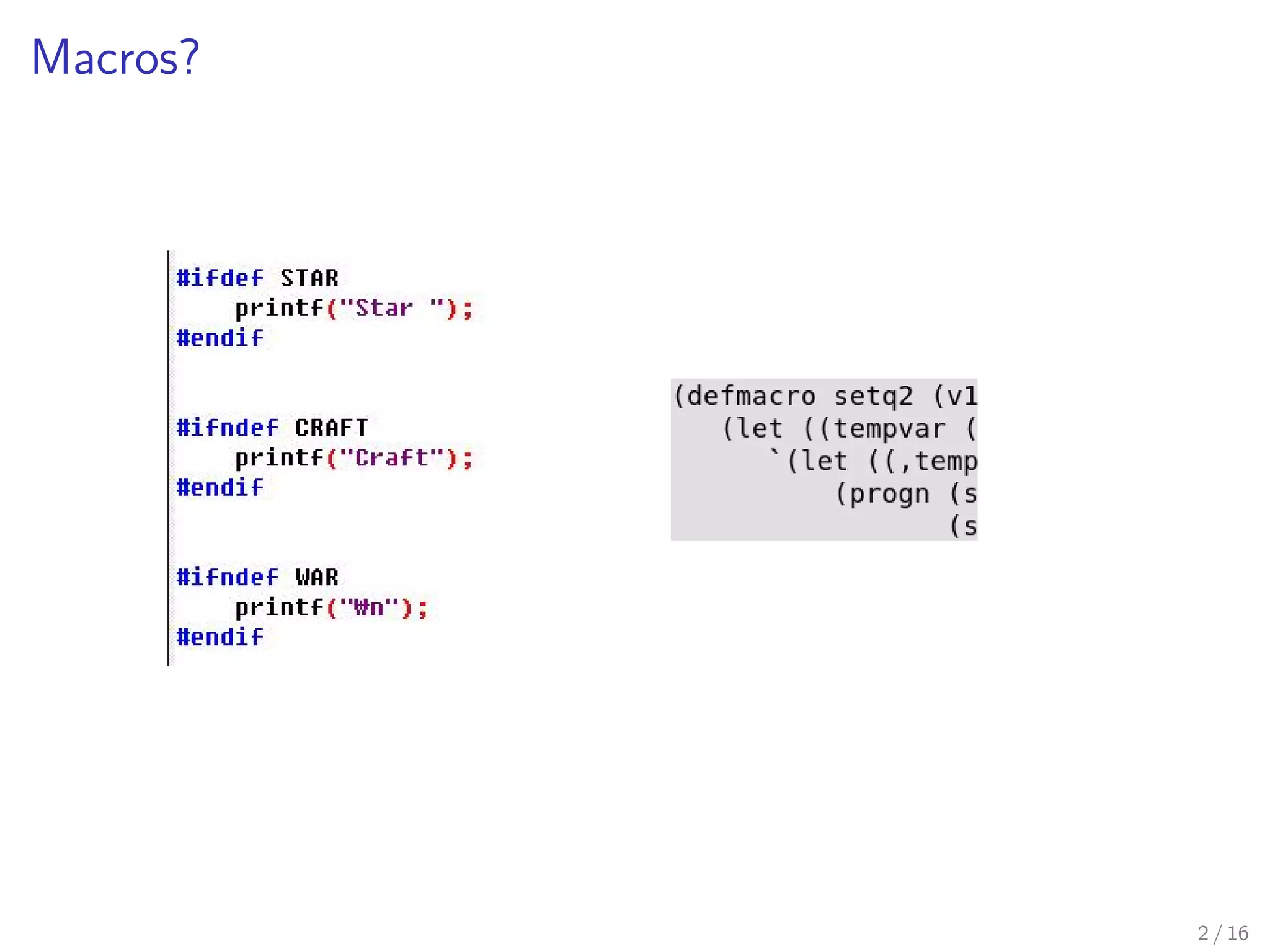
Macros?
2 / 16
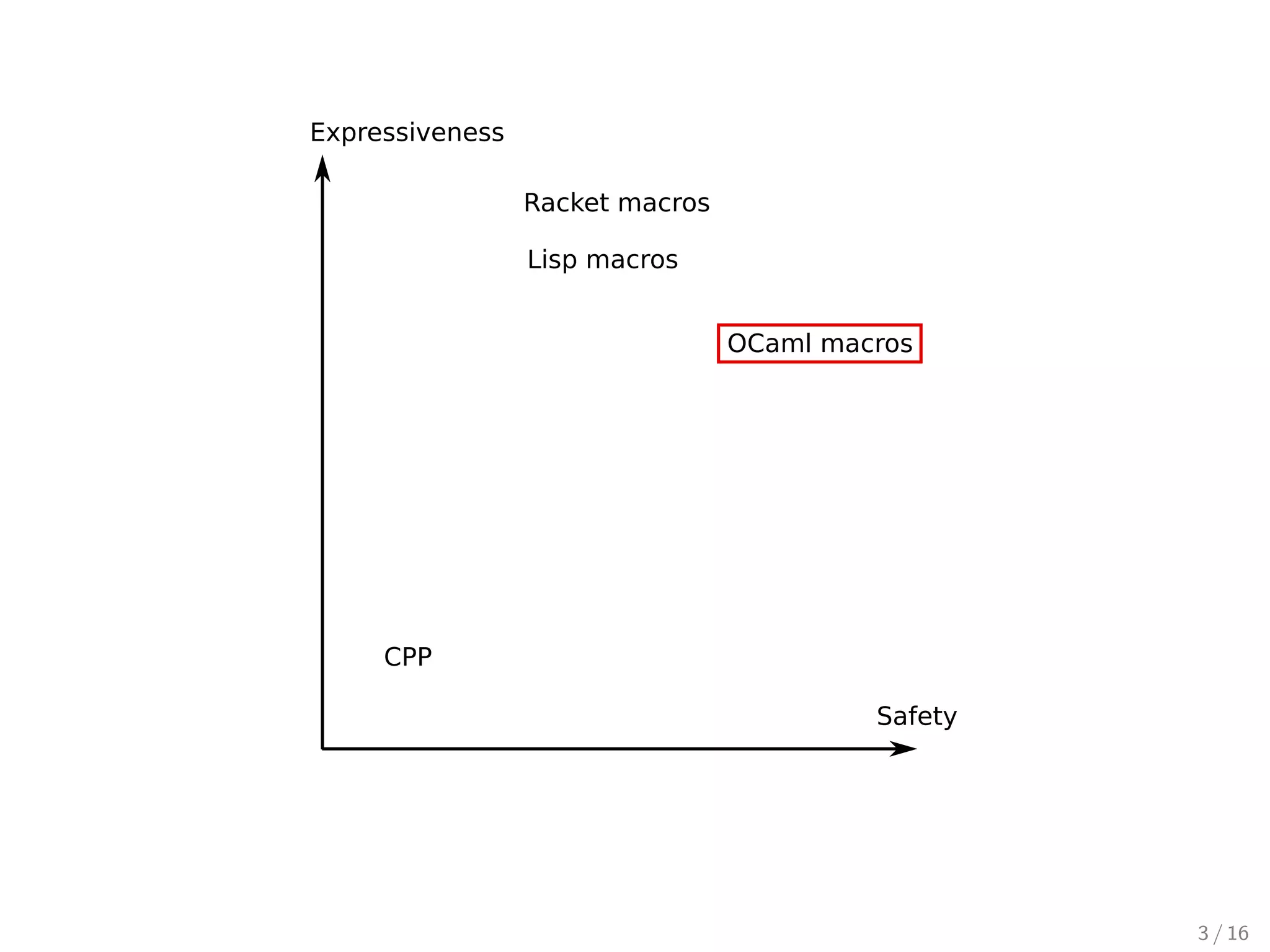
Safety
Expressiveness
CPP
Lisp macros
Racket macros
OCaml macros
3 / 16
Why should we care?
Domain-specific optimisations
4 / 16
Why should we care?
Domain-specific optimisations
strymonas: optimal stream processing [Kiselyov et al., POPL’17]
of_arr << arr >>
|> map (fun x →
<< $x * $x >>)
|> fold
(fun z a →
<< $a + $z >>)
<< 0 >>
5 / 16
Why should we care?
Domain-specific optimisations
strymonas: optimal stream processing [Kiselyov et al., POPL’17]
of_arr << arr >>
|> map (fun x →
<< $x * $x >>)
|> fold
(fun z a →
<< $a + $z >>)
<< 0 >>
let s_1 = ref 0 in
let arr_2 = arr in
for i_3 = 0 to Array.length
arr_2 -1 do
let el_4 = arr_2.(i_3) in
let t_5 = el_4 * el_4 in
s_1 := t_5 + !s_1
done;
!s_1
6 / 16
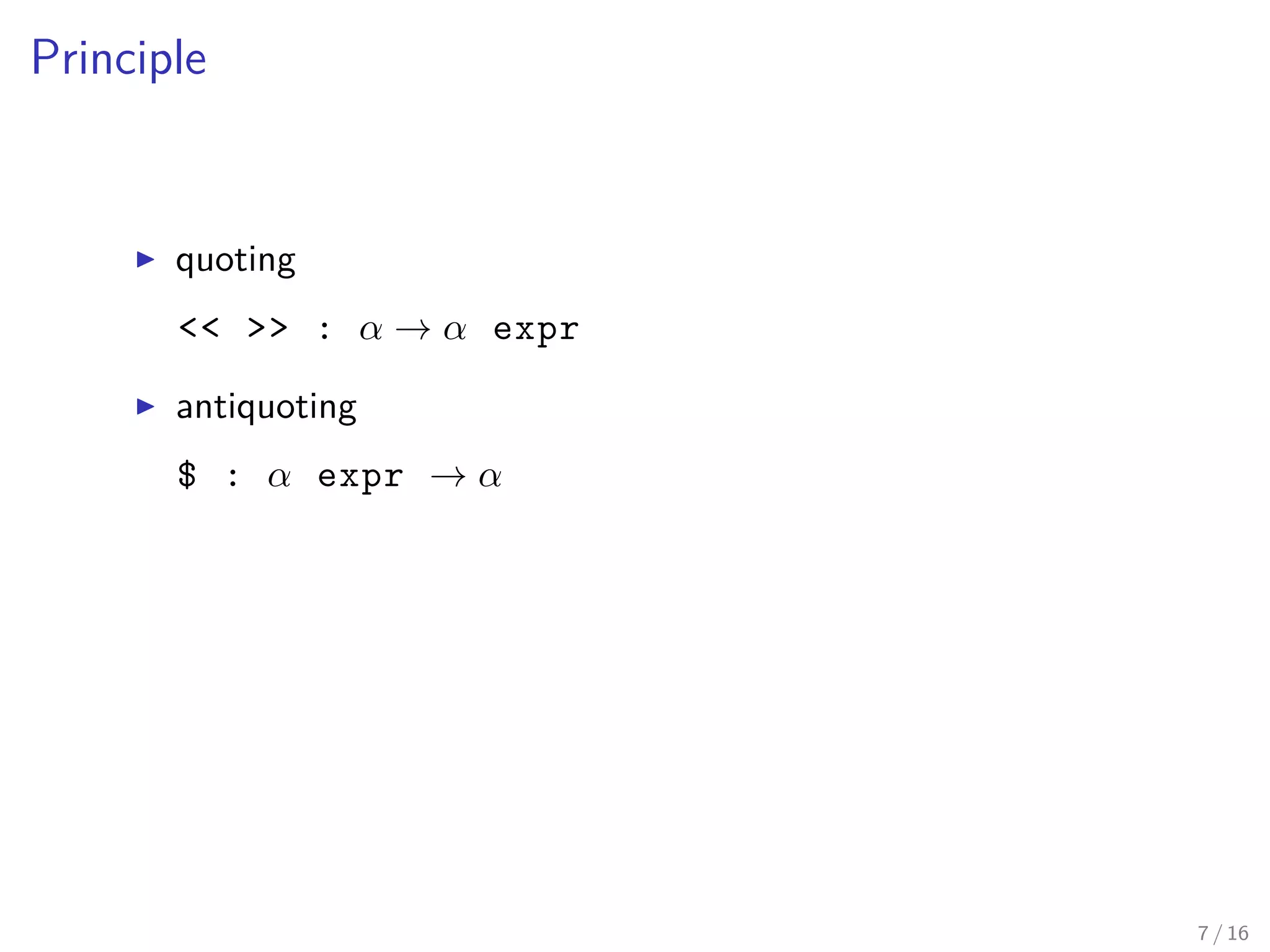
Principle
▶ quoting
<< >> : α → α expr
▶ antiquoting
$ : α expr → α
7 / 16
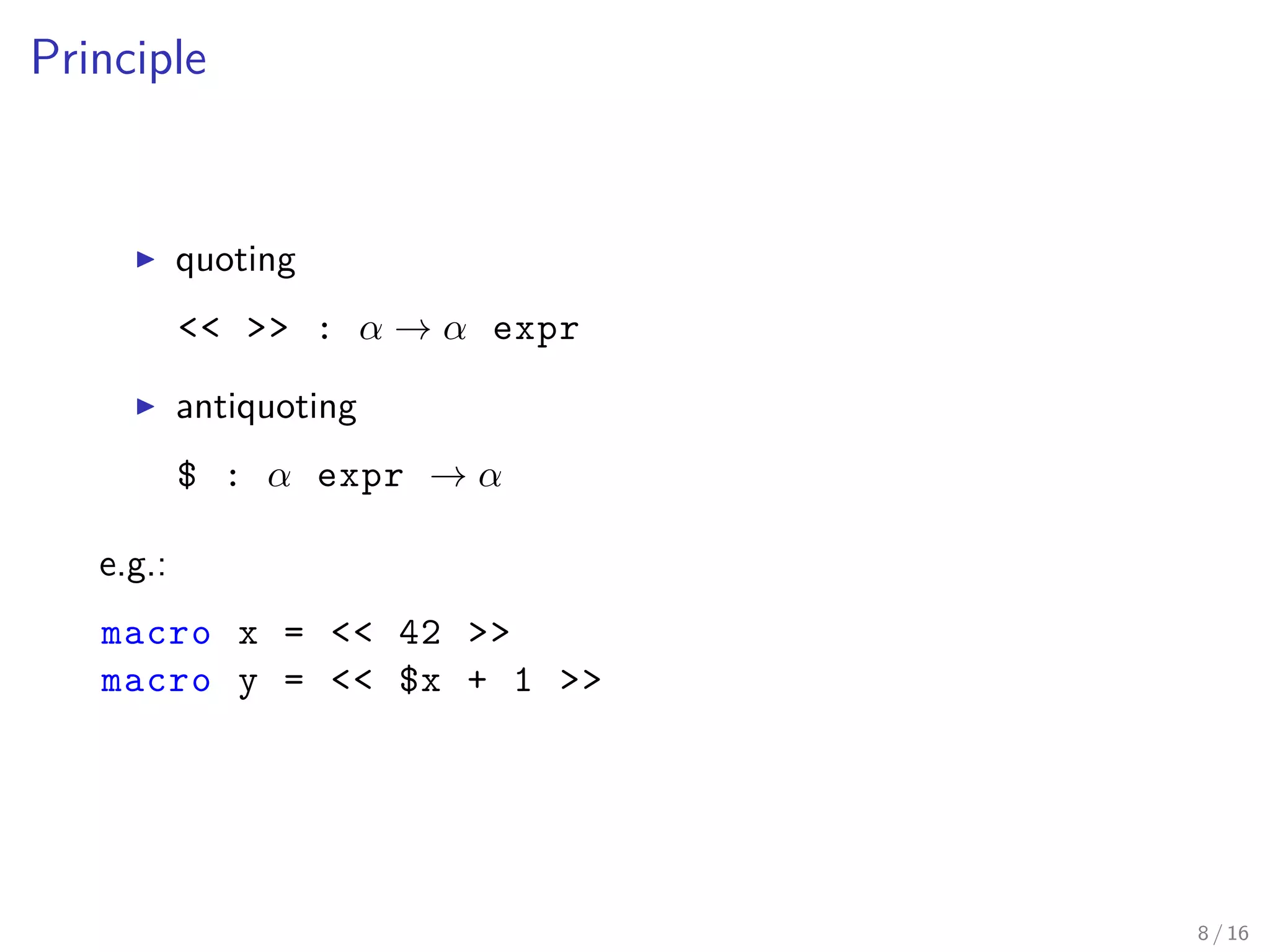
Principle
▶ quoting
<< >> : α → α expr
▶ antiquoting
$ : α expr → α
e.g.:
macro x = << 42 >>
macro y = << $x + 1 >>
8 / 16
Power function
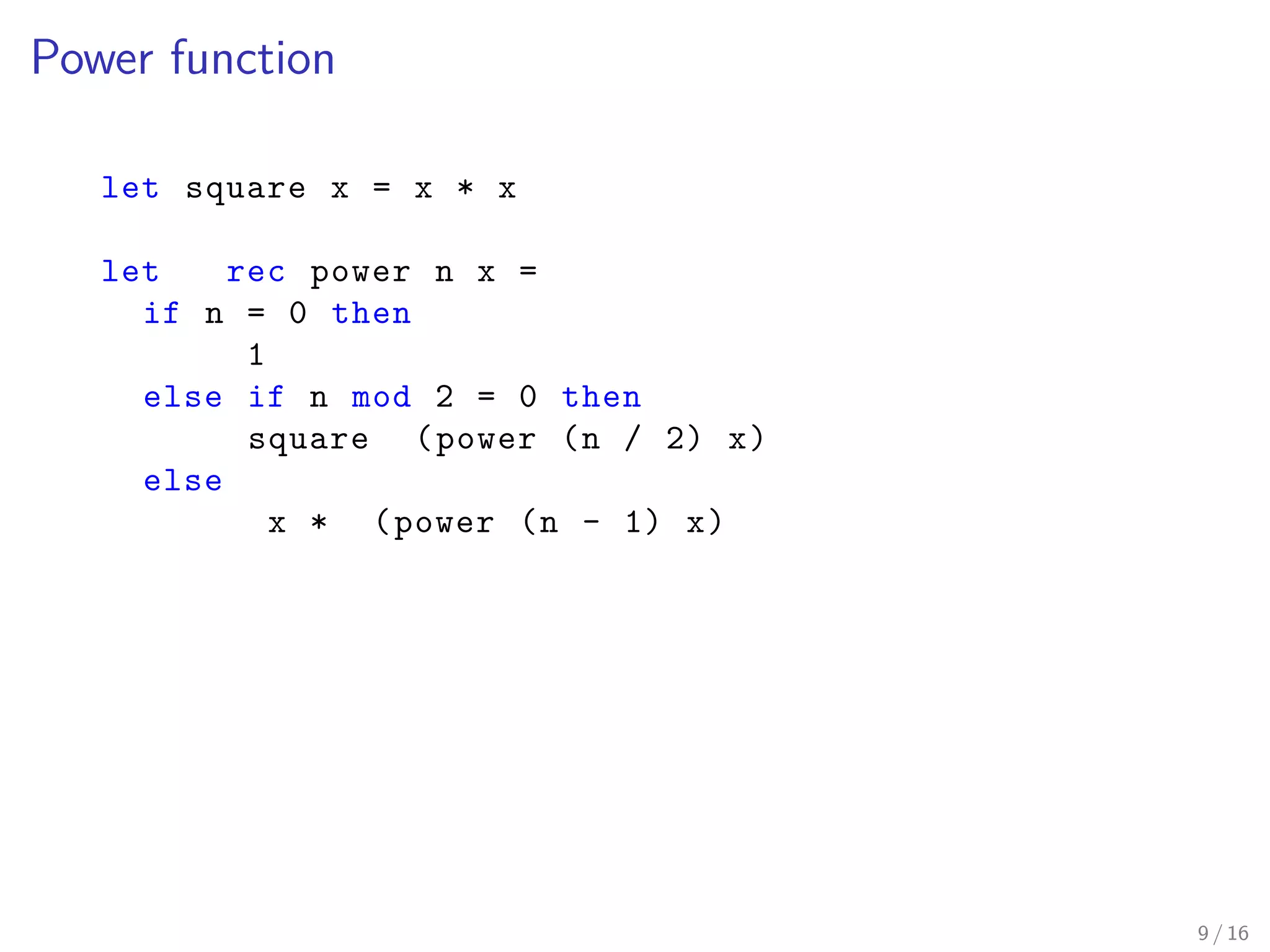
let square x = x * x
let rec power n x =
if n = 0 then
1
else if n mod 2 = 0 then
square (power (n / 2) x)
else
x * (power (n - 1) x)
9 / 16
Power function
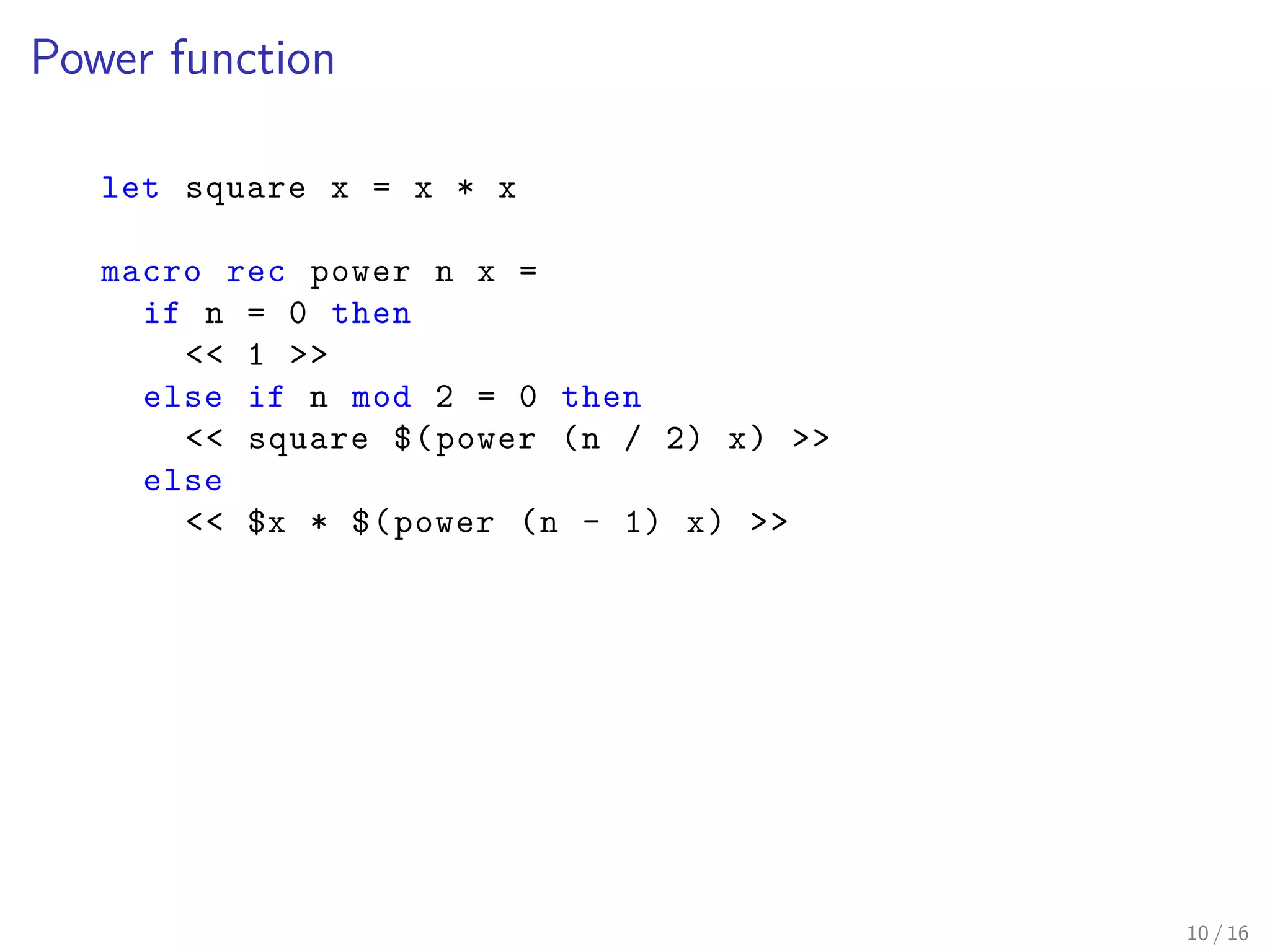
let square x = x * x
macro rec power n x =
if n = 0 then
<< 1 >>
else if n mod 2 = 0 then
<< square $(power (n / 2) x) >>
else
<< $x * $(power (n - 1) x) >>
10 / 16
Power function
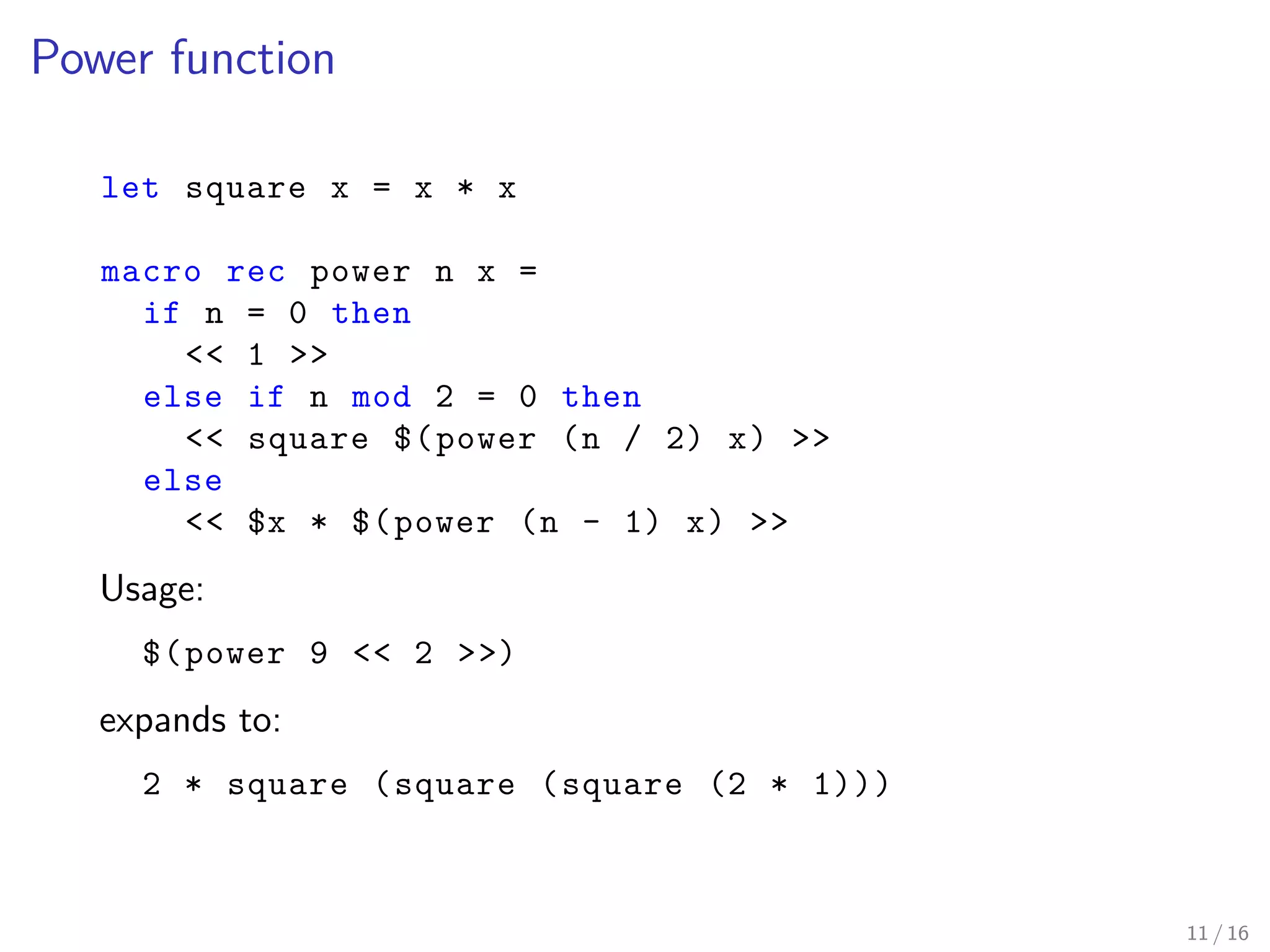
let square x = x * x
macro rec power n x =
if n = 0 then
<< 1 >>
else if n mod 2 = 0 then
<< square $(power (n / 2) x) >>
else
<< $x * $(power (n - 1) x) >>
Usage:
$(power 9 << 2 >>)
expands to:
2 * square (square (square (2 * 1)))
11 / 16
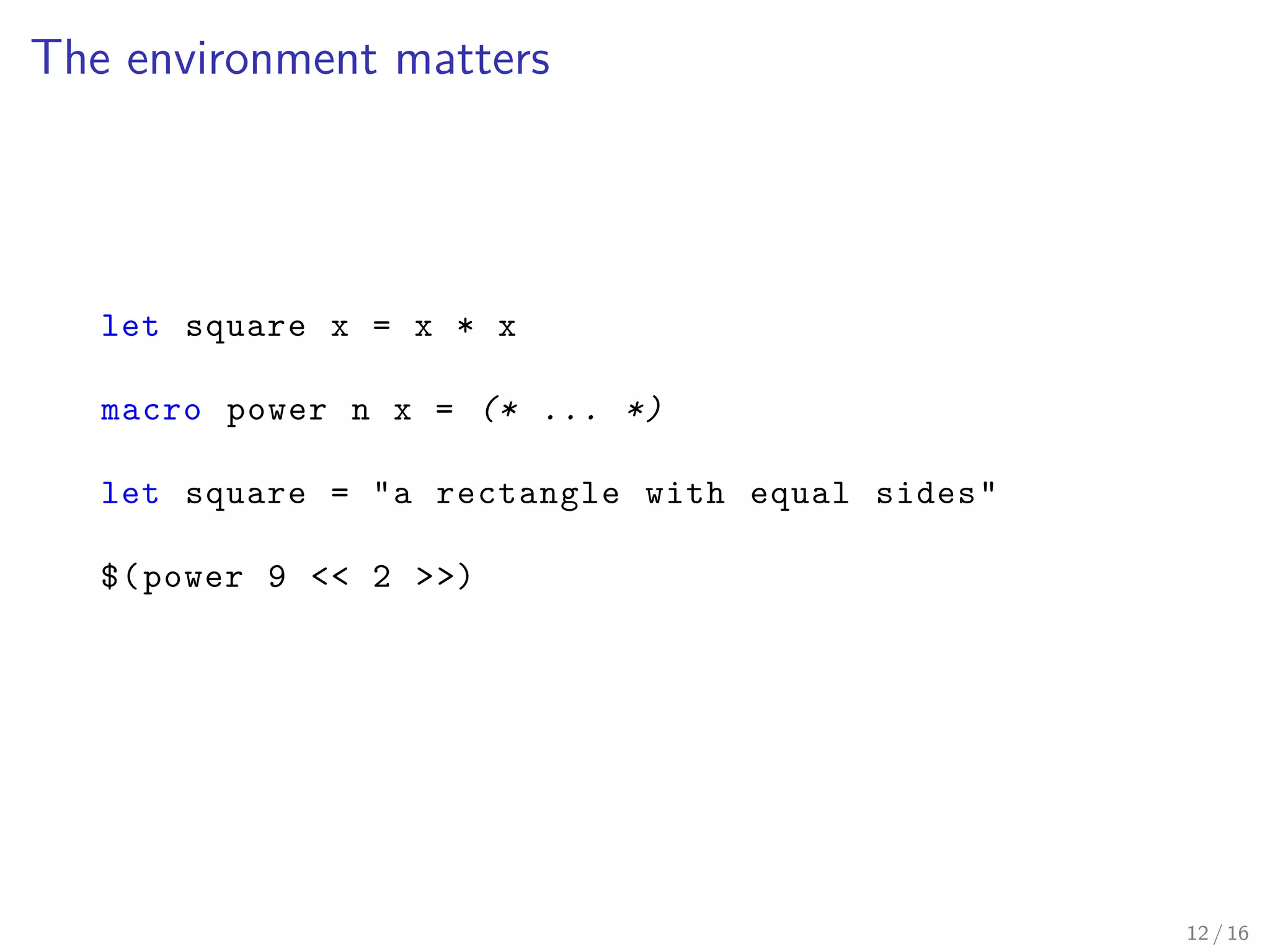
The environment matters
let square x = x * x
macro power n x = (* ... *)
let square = "a rectangle with equal sides"
$(power 9 << 2 >>)
12 / 16
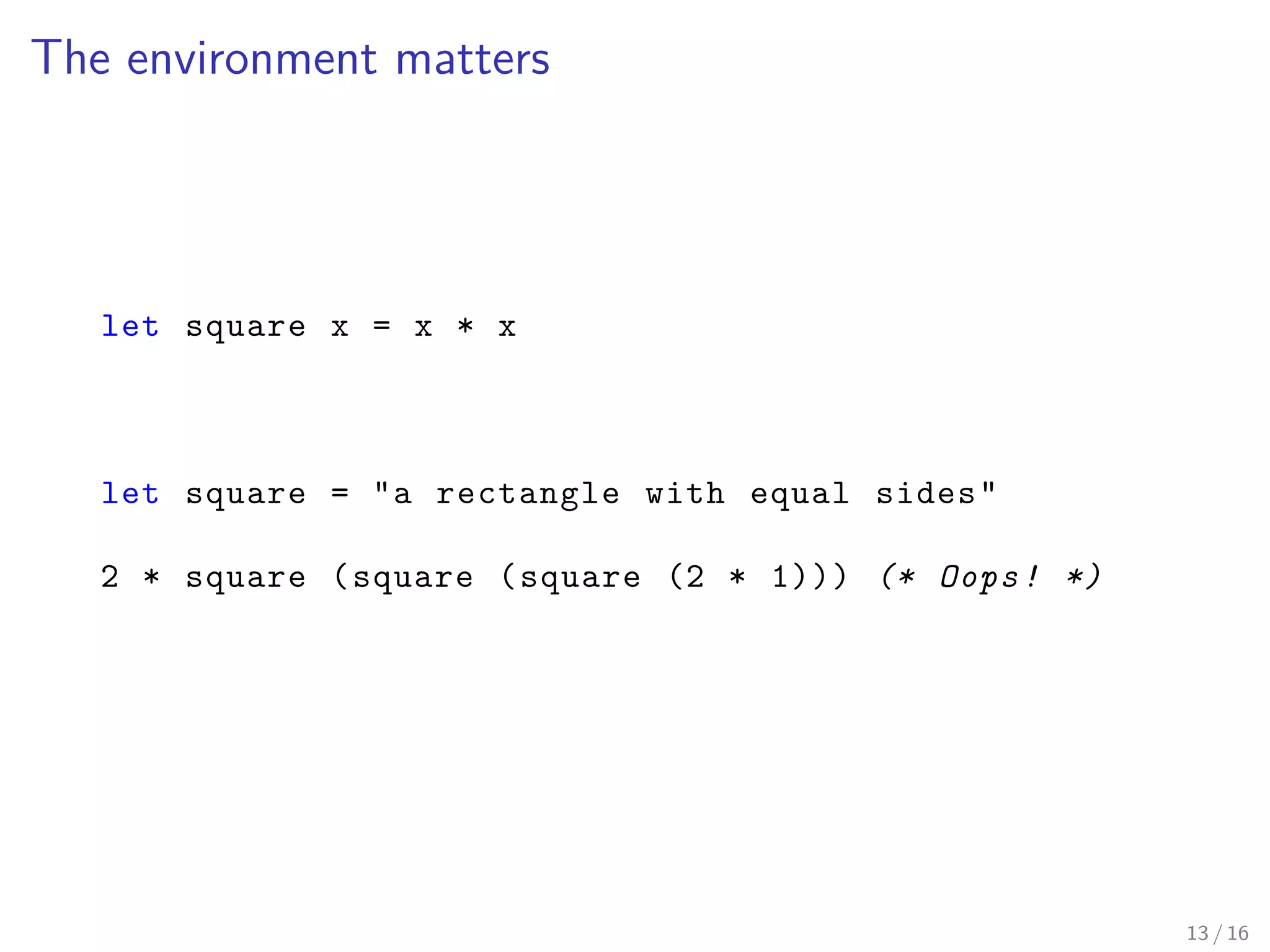
The environment matters
let square x = x * x
let square = "a rectangle with equal sides"
2 * square (square (square (2 * 1))) (* Oops! *)
13 / 16
The environment matters
let square x = x * x
let power = [| square |]
let square = "a rectangle with equal sides"
2 * power.(0) (power.(0) (power.(0) (2 * 1)))
14 / 16
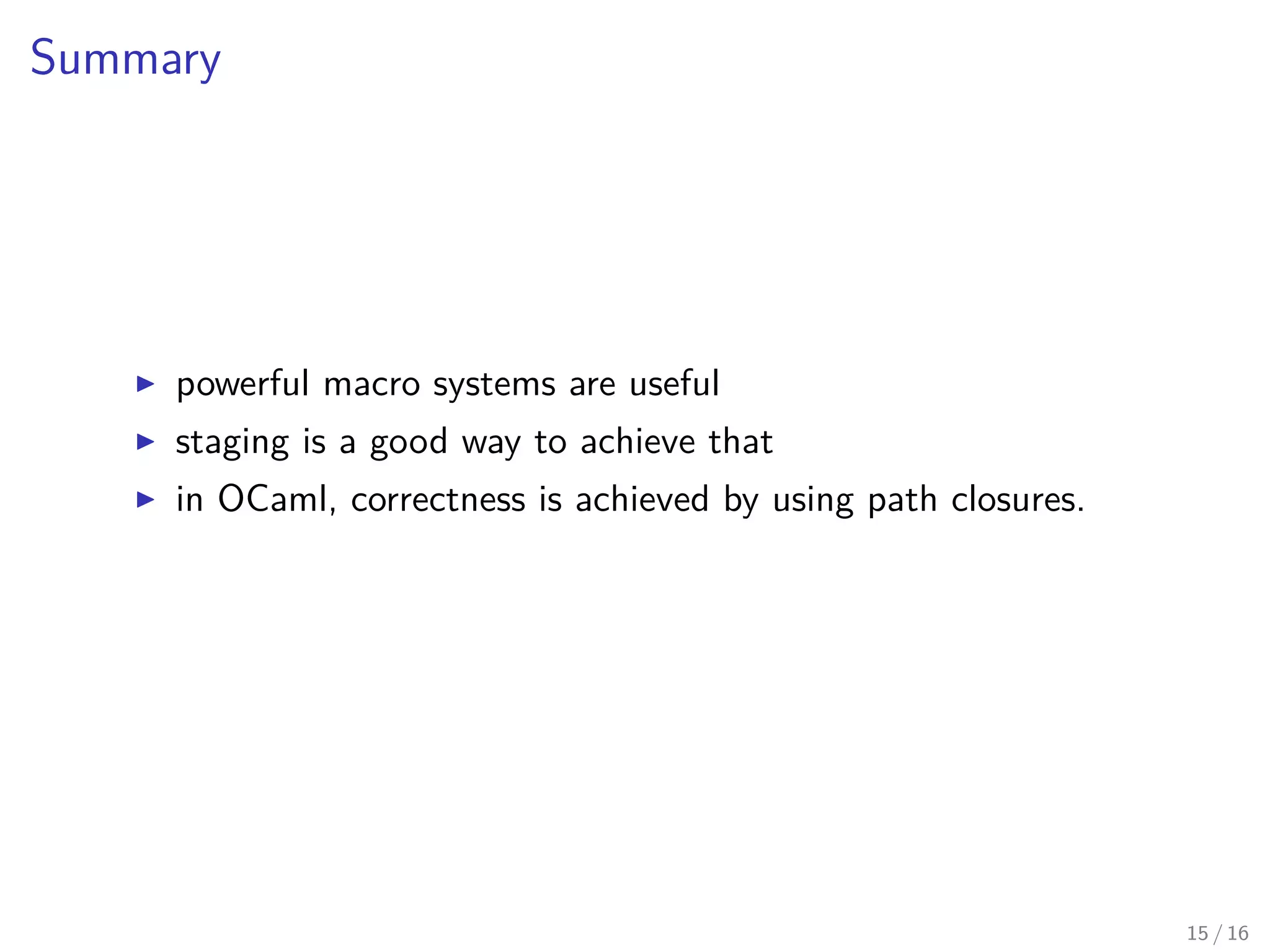
Summary
▶ powerful macro systems are useful
▶ staging is a good way to achieve that
▶ in OCaml, correctness is achieved by using path closures.
15 / 16
References
▶ Yallop and White, Modular Macros. OCaml Workshop ’15
▶ Kiselyov et al., Stream Fusion, to Completeness. POPL’17
Thanks!
16 / 16

Modular Macros for OCaml

  • 1.
    Modular Macros forOCaml Olivier Nicole ENSTA ParisTech nicole@ensta.fr 1 / 16
  • 2.
  • 3.
  • 4.
    Why should wecare? Domain-specific optimisations 4 / 16
  • 5.
    Why should wecare? Domain-specific optimisations strymonas: optimal stream processing [Kiselyov et al., POPL’17] of_arr << arr >> |> map (fun x → << $x * $x >>) |> fold (fun z a → << $a + $z >>) << 0 >> 5 / 16
  • 6.
    Why should wecare? Domain-specific optimisations strymonas: optimal stream processing [Kiselyov et al., POPL’17] of_arr << arr >> |> map (fun x → << $x * $x >>) |> fold (fun z a → << $a + $z >>) << 0 >> let s_1 = ref 0 in let arr_2 = arr in for i_3 = 0 to Array.length arr_2 -1 do let el_4 = arr_2.(i_3) in let t_5 = el_4 * el_4 in s_1 := t_5 + !s_1 done; !s_1 6 / 16
  • 7.
    Principle ▶ quoting << >>: α → α expr ▶ antiquoting $ : α expr → α 7 / 16
  • 8.
    Principle ▶ quoting << >>: α → α expr ▶ antiquoting $ : α expr → α e.g.: macro x = << 42 >> macro y = << $x + 1 >> 8 / 16
  • 9.
    Power function let squarex = x * x let rec power n x = if n = 0 then 1 else if n mod 2 = 0 then square (power (n / 2) x) else x * (power (n - 1) x) 9 / 16
  • 10.
    Power function let squarex = x * x macro rec power n x = if n = 0 then << 1 >> else if n mod 2 = 0 then << square $(power (n / 2) x) >> else << $x * $(power (n - 1) x) >> 10 / 16
  • 11.
    Power function let squarex = x * x macro rec power n x = if n = 0 then << 1 >> else if n mod 2 = 0 then << square $(power (n / 2) x) >> else << $x * $(power (n - 1) x) >> Usage: $(power 9 << 2 >>) expands to: 2 * square (square (square (2 * 1))) 11 / 16
  • 12.
    The environment matters letsquare x = x * x macro power n x = (* ... *) let square = "a rectangle with equal sides" $(power 9 << 2 >>) 12 / 16
  • 13.
    The environment matters letsquare x = x * x let square = "a rectangle with equal sides" 2 * square (square (square (2 * 1))) (* Oops! *) 13 / 16
  • 14.
    The environment matters letsquare x = x * x let power = [| square |] let square = "a rectangle with equal sides" 2 * power.(0) (power.(0) (power.(0) (2 * 1))) 14 / 16
  • 15.
    Summary ▶ powerful macrosystems are useful ▶ staging is a good way to achieve that ▶ in OCaml, correctness is achieved by using path closures. 15 / 16
  • 16.
    References ▶ Yallop andWhite, Modular Macros. OCaml Workshop ’15 ▶ Kiselyov et al., Stream Fusion, to Completeness. POPL’17 Thanks! 16 / 16