Confidential | © 2016 SunPower Corporation
Chetan Chaudhari, Tamir Lance, Gregory M. Kimball, Ben Bourne | May 2019
12th PV Performance Modeling and Monitoring Workshop (May 14-15, 2019)
MLPE Performance modeling
Module Level Power Electronics
2Confidential | © 2016 SunPower Corporation |
Yo Mr. White….
Like what is this
MLPE?
(condescendingly)
It is simple. It stands for
Module Level Power
Electronics. It is just a
switched mode power
supply. It …..
3Confidential | © 2016 SunPower Corporation |
MLPE - Module Level Power Electronics
• Key benefits
– Balance Of System component for NEC 690.12 (Rapid Shutdown) compliance1
– Increased shade tolerance
– Simplified PV system design
• MLPE market growing 14-18% annually 2
• Need for explicit model to study power and energy impact
1 – NEC 690.12.c 2017
2 – The Global PV Inverter and MLPE Landscape H2 2016, S. Moskowitz, GTM 2016
4Confidential | © 2016 SunPower Corporation |
What is PVMismatch?
• IV & PV curve trace calculator for PV system circuits3
3 – Mark Mikofski, Bennet Meyers, Chetan Chaudhari (2018). “PVMismatch Project: https://github.com/SunPower/PVMismatch". SunPower Corporation, Richmond, CA.
5Confidential | © 2016 SunPower Corporation |
What is PVMismatch?
• IV & PV curve trace calculator for PV system circuits
• Model chain
– Cell > Cell string > Module > String > System
– Module layout
3 – Mark Mikofski, Bennet Meyers, Chetan Chaudhari (2018). “PVMismatch Project: https://github.com/SunPower/PVMismatch". SunPower Corporation, Richmond, CA.
6Confidential | © 2016 SunPower Corporation |
What is PVMismatch?
• IV & PV curve trace calculator for PV system circuits
• Model chain
– Cell > Cell string > Module > String > System
– Module layout
– Bypass diodes
• Model inputs
– Cell technology characteristics
– Irradiance (suns)
– Temperature (cell temperature)
– Bypass device configuration
3 – Mark Mikofski, Bennet Meyers, Chetan Chaudhari (2018). “PVMismatch Project: https://github.com/SunPower/PVMismatch". SunPower Corporation, Richmond, CA.
7Confidential | © 2016 SunPower Corporation |
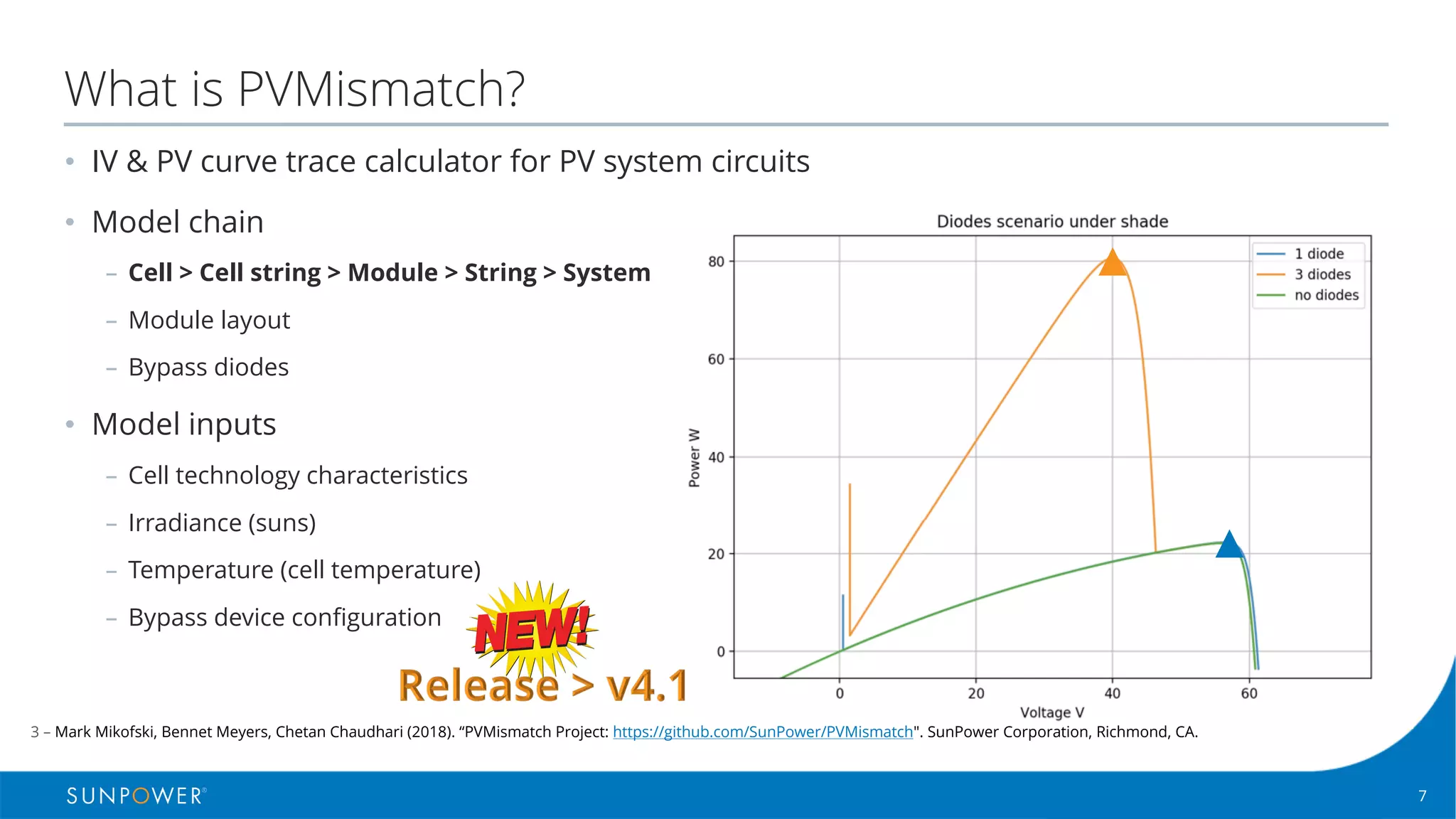
What is PVMismatch?
• IV & PV curve trace calculator for PV system circuits
• Model chain
– Cell > Cell string > Module > String > System
– Module layout
– Bypass diodes
• Model inputs
– Cell technology characteristics
– Irradiance (suns)
– Temperature (cell temperature)
– Bypass device configuration
3 – Mark Mikofski, Bennet Meyers, Chetan Chaudhari (2018). “PVMismatch Project: https://github.com/SunPower/PVMismatch". SunPower Corporation, Richmond, CA.
8Confidential | © 2016 SunPower Corporation |
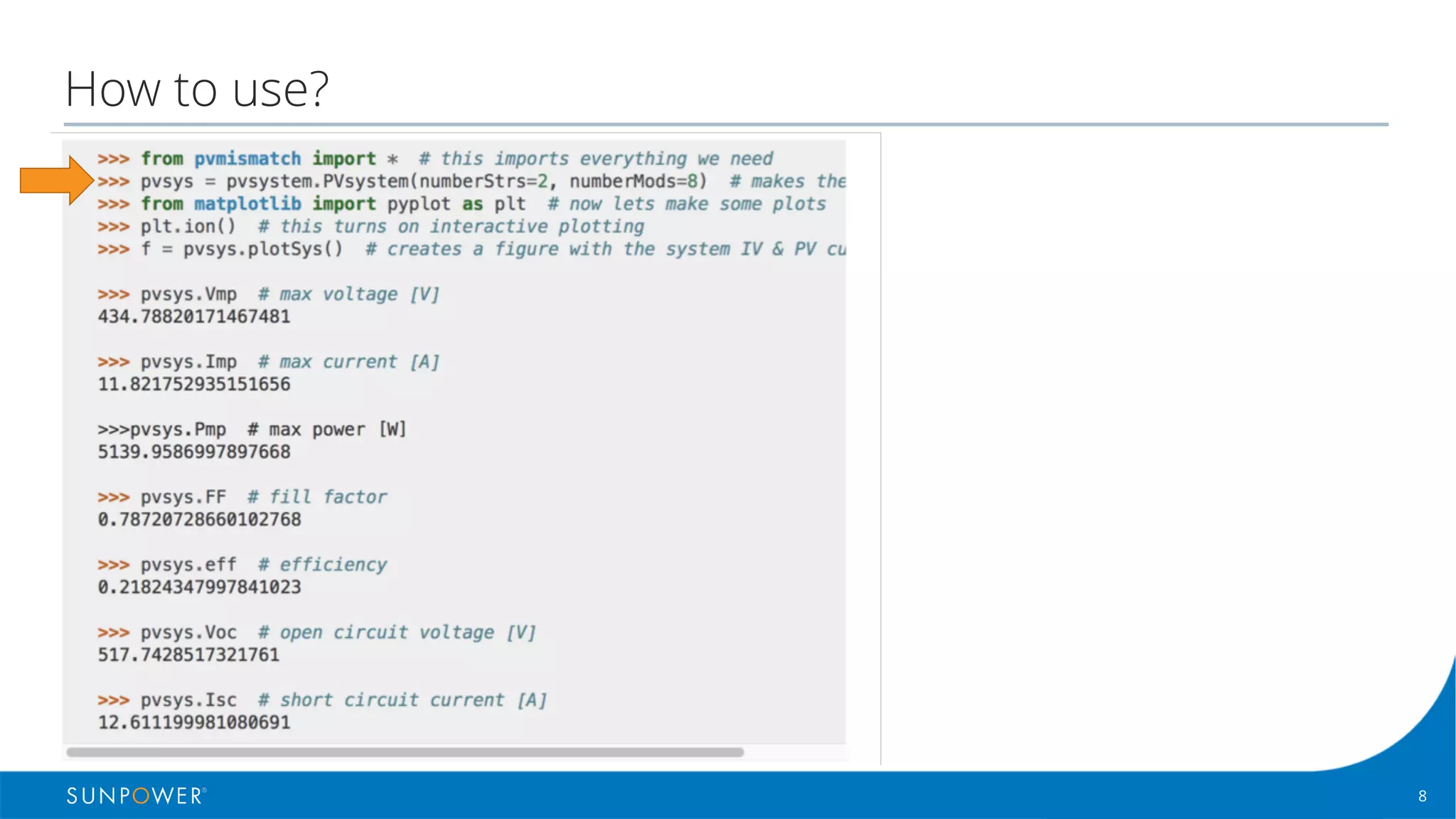
How to use?
9Confidential | © 2016 SunPower Corporation |
How to use?
10Confidential | © 2016 SunPower Corporation |
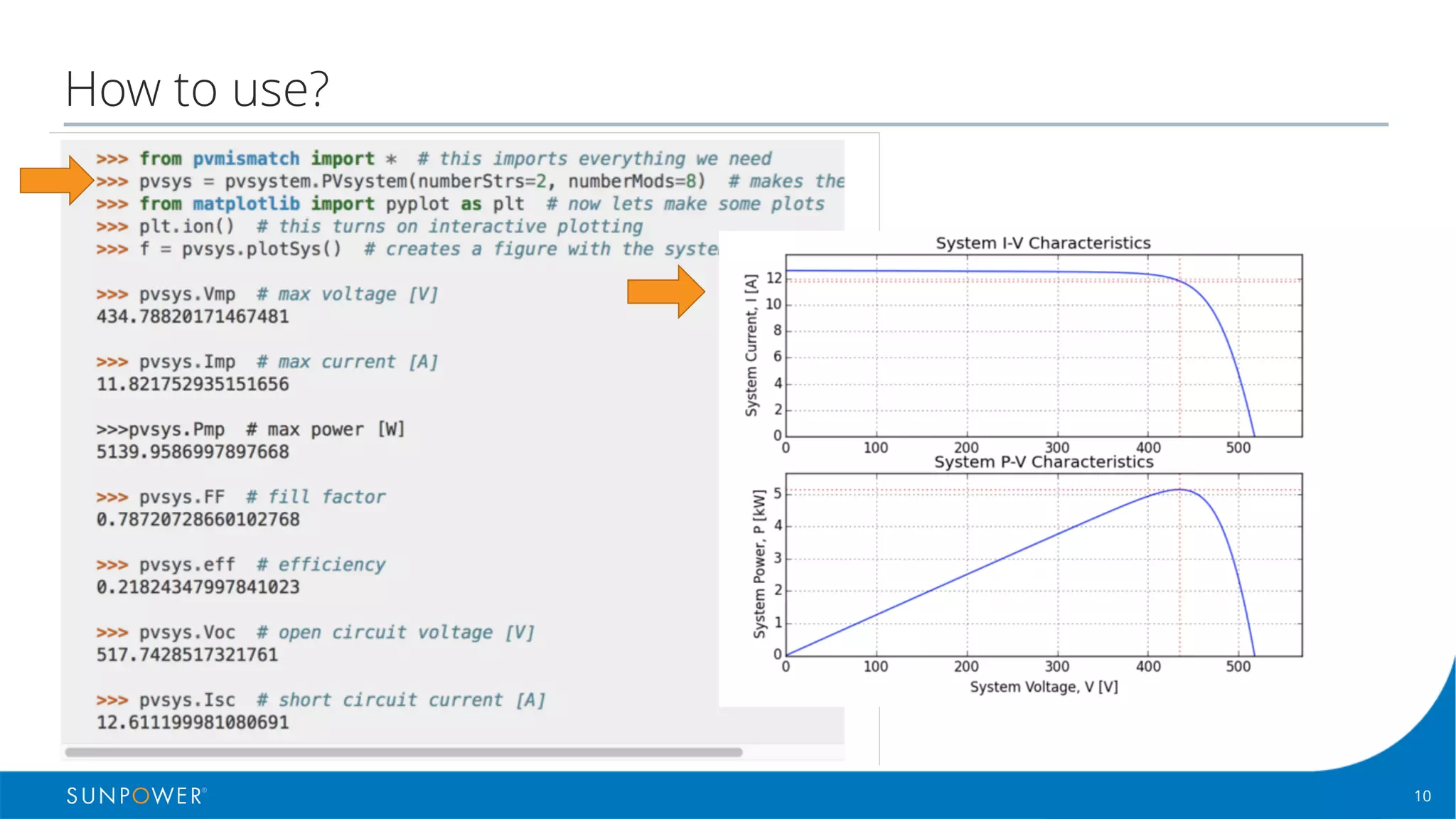
How to use?
11Confidential | © 2016 SunPower Corporation |
Case study
• Scenarios
– String inverter
– Power optimizers + String inverter
– Microinverters
N
Cell-level POA Irradiance map
12Confidential | © 2016 SunPower Corporation |
Case study
• Scenarios
– String inverter
– Power optimizers + String inverter
– Microinverters
• System configuration
– 10 modules x 6 strings
– Azimuth = South
– Tilt = 10 degree
– Location = Richmond, CA
• Shade
– Obstacle (SW)
– Inter row
N
Cell-level POA Irradiance map
13Confidential | © 2016 SunPower Corporation |
Case study
N• Scenarios
– String inverter
– Power optimizers + String inverter
– Microinverters
• System configuration
– 10 modules x 6 strings
– Azimuth = South
– Tilt = 10 degree
– Location = Richmond, CA
• Shade
– Obstacle (SW)
– Inter row
Come see Chetan at PVSC- 46 Tuesday June 18th
"PVOPEL: A Scalable Opto-Electrical Performance
Model of PV systems using Ray Tracing and
PVMismatch"
14Confidential | © 2016 SunPower Corporation |
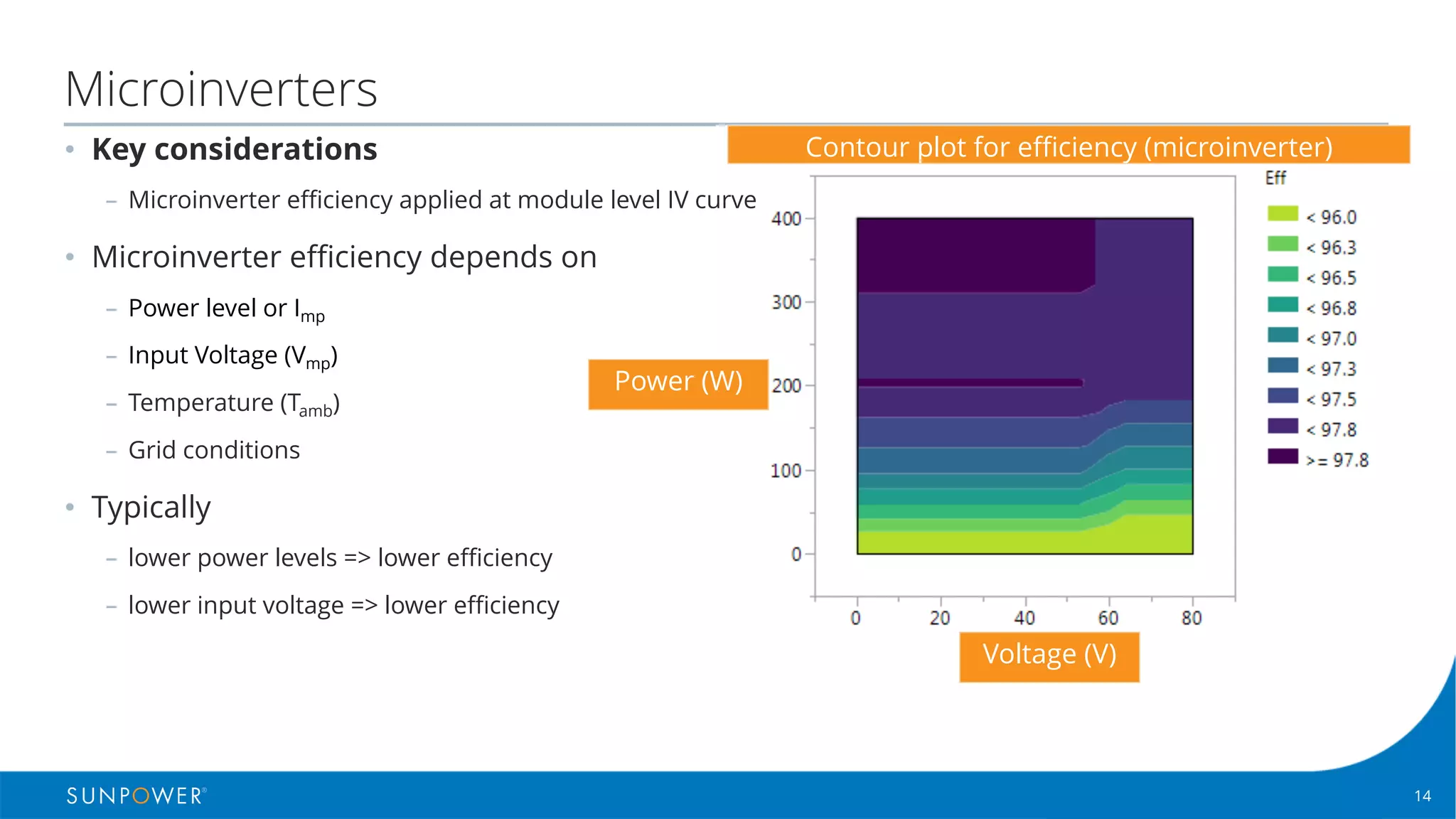
Microinverters
• Key considerations
– Microinverter efficiency applied at module level IV curve
• Microinverter efficiency depends on
– Power level or Imp
– Input Voltage (Vmp)
– Temperature (Tamb)
– Grid conditions
• Typically
– lower power levels => lower efficiency
– lower input voltage => lower efficiency
Voltage (V)
Power (W)
Contour plot for efficiency (microinverter)
15Confidential | © 2016 SunPower Corporation |
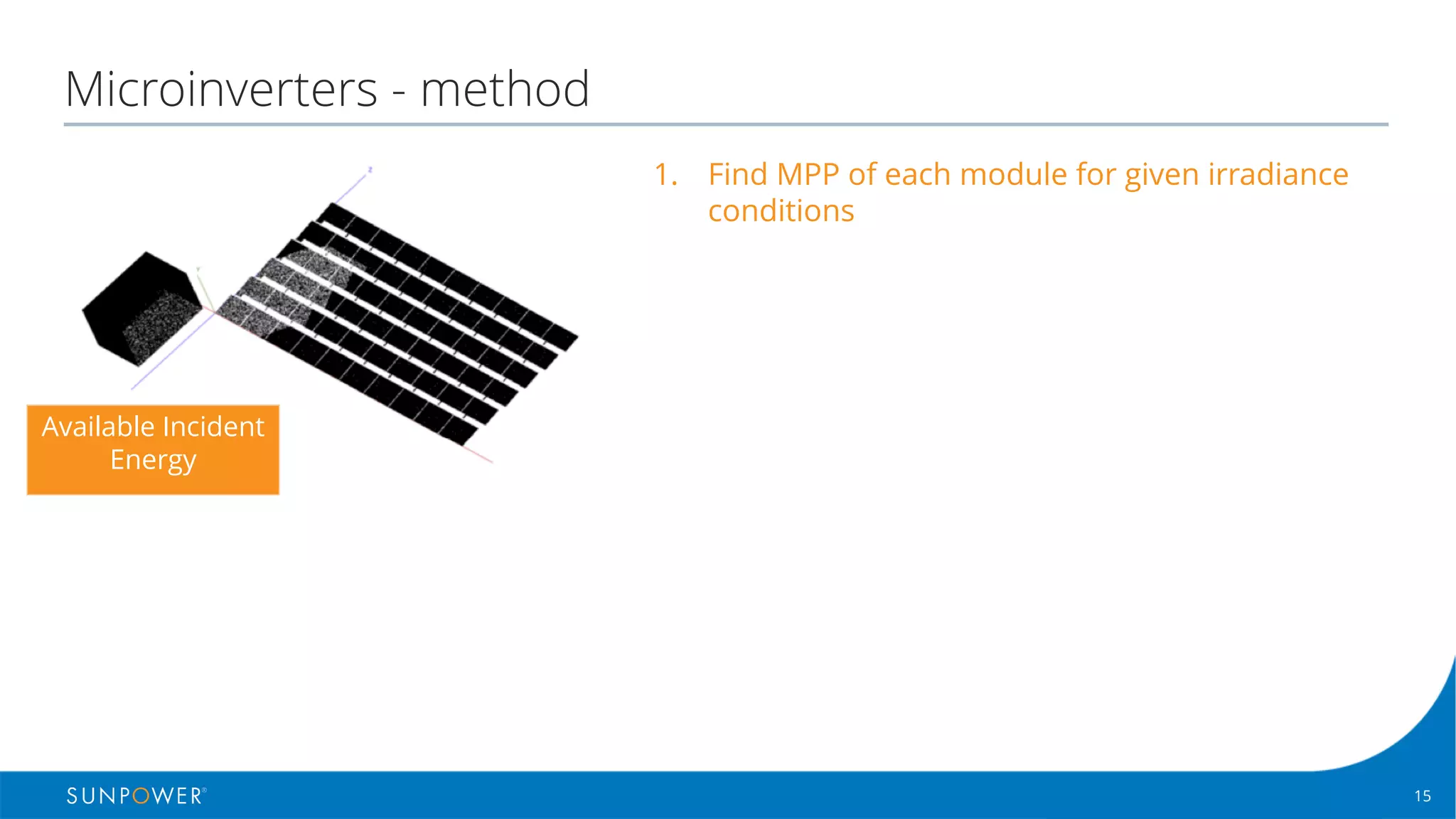
Microinverters - method
1. Find MPP of each module for given irradiance
conditions
Available Incident
Energy
16Confidential | © 2016 SunPower Corporation |
Microinverters - method
1. Find MPP of each module for given irradiance
conditions
2. Find efficiency loss for that power level
3. Calculate Pmpmod[MI]
Pmp map (MI)
Available Incident
Energy
17Confidential | © 2016 SunPower Corporation |
Microinverters - method
1. Find MPP of each module for given irradiance
conditions
2. Find efficiency loss for that power level
3. Calculate Pmpmod[MI]
4. Sum the Pmpmod[MI] across the array to get Pmpsys
Pmp map (MI)
Available Incident
Energy
18Confidential | © 2016 SunPower Corporation |
Microinverters - equations
𝑃 𝑚𝑝𝑠𝑦𝑠 = ' 𝑃 𝑚𝑝𝑚𝑜𝑑 𝑛 	×	𝑀𝐼𝐸𝑓𝑓(𝑃 𝑚𝑝𝑚𝑜𝑑 𝑛 , 𝑉 𝑚𝑝𝑚𝑜𝑑 𝑛 )	
5
678
Where
N	:	number	of	PV	modules
Pmpsys	:	System	Power
Pmpmod :	module	power	at	max.	power	point
Vmpmod :	module	voltage	at	max.	power	point
MIEff(power,	voltage)	:	microinverter efficiency	at	
given	operating	point
19Confidential | © 2016 SunPower Corporation |
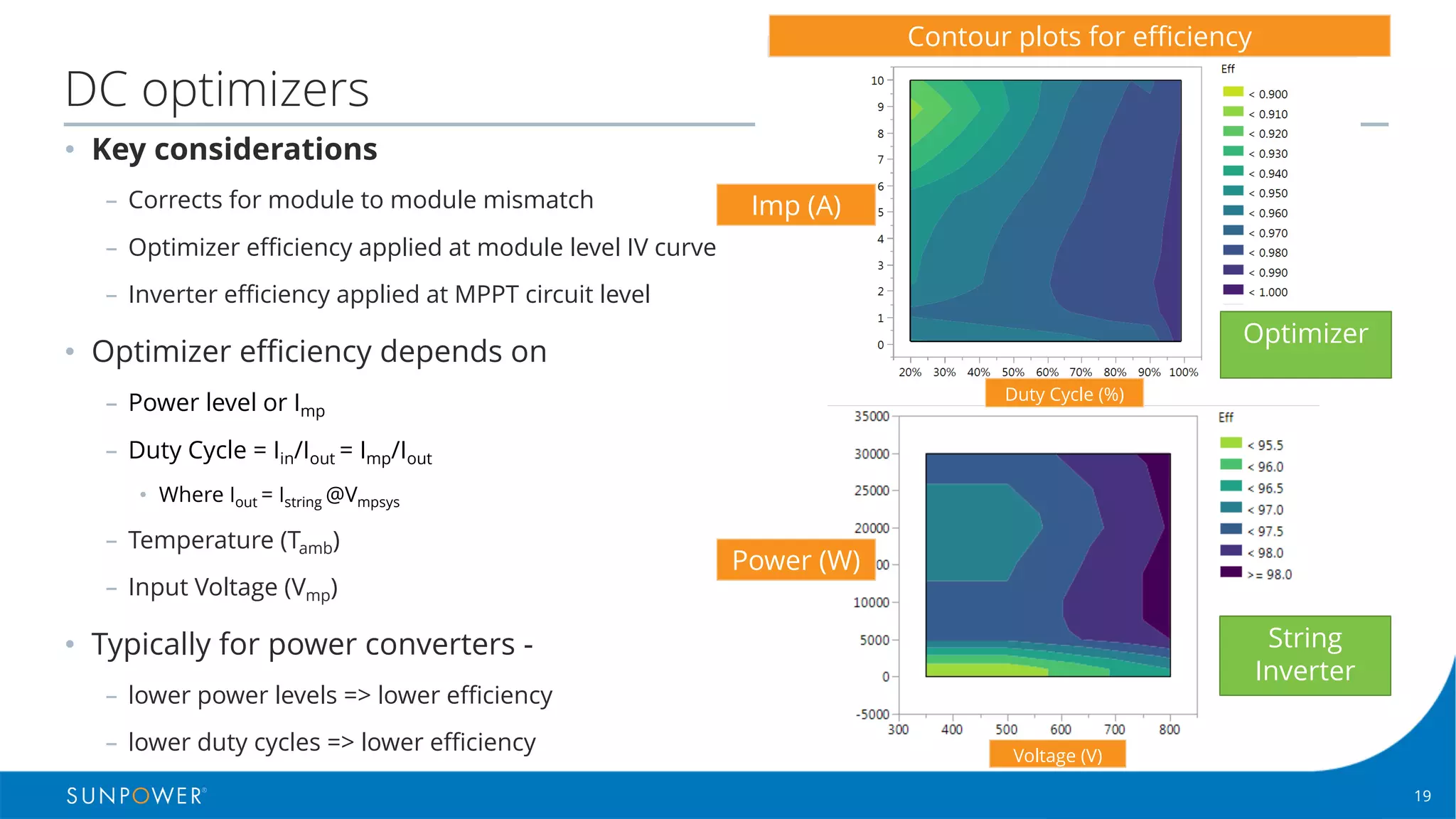
DC optimizers
• Key considerations
– Corrects for module to module mismatch
– Optimizer efficiency applied at module level IV curve
– Inverter efficiency applied at MPPT circuit level
• Optimizer efficiency depends on
– Power level or Imp
– Duty Cycle = Iin/Iout = Imp/Iout
• Where Iout = Istring @Vmpsys
– Temperature (Tamb)
– Input Voltage (Vmp)
• Typically for power converters -
– lower power levels => lower efficiency
– lower duty cycles => lower efficiency
Optimizer
String
Inverter
Power (W)
Duty Cycle (%)
Imp (A)
Contour plots for efficiency
Voltage (V)
20Confidential | © 2016 SunPower Corporation |
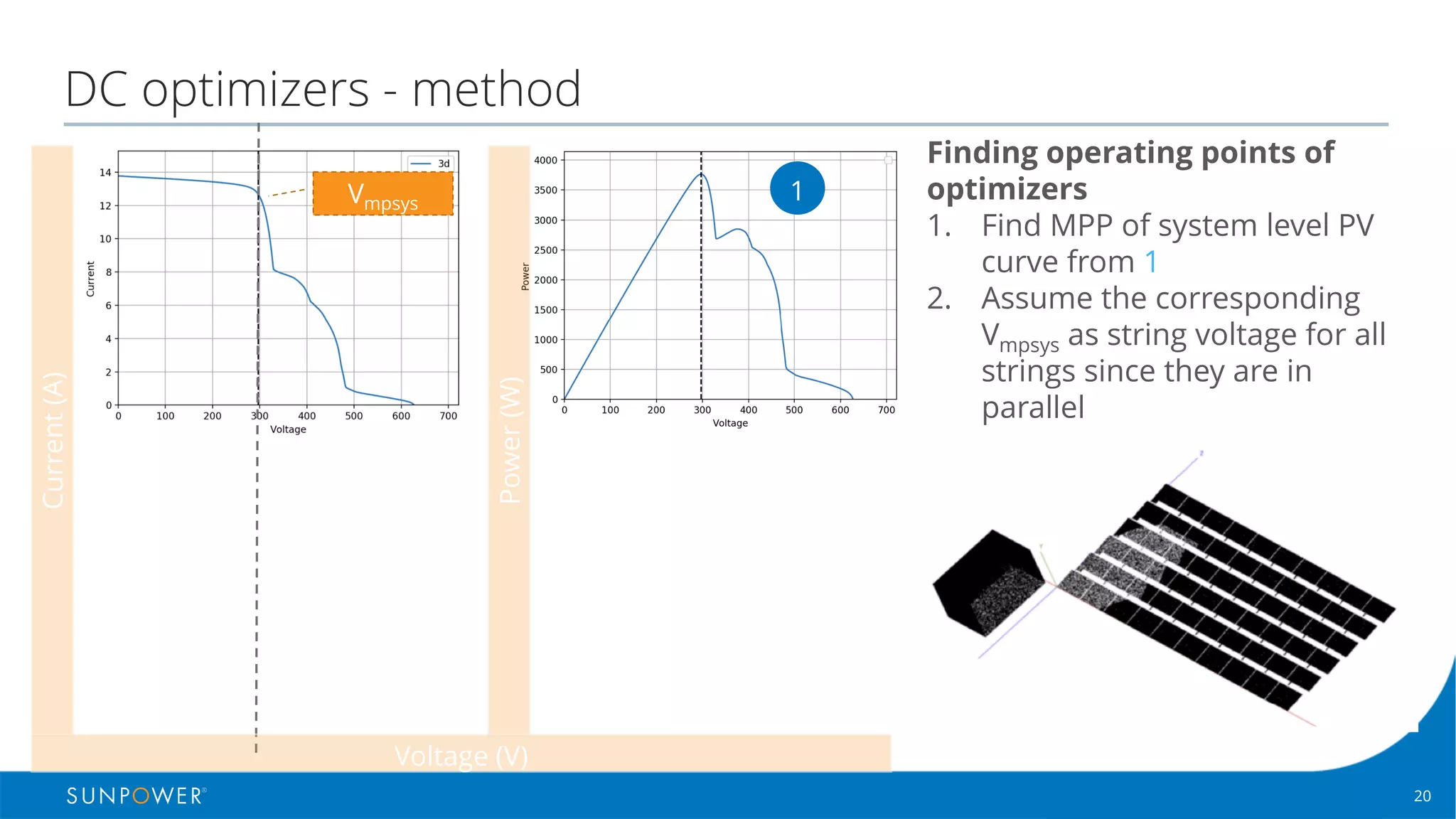
DC optimizers - method
1
Finding operating points of
optimizers
1. Find MPP of system level PV
curve from 1
2. Assume the corresponding
Vmpsys as string voltage for all
strings since they are in
parallel
Current(A)
Power(W)
Voltage (V)
Vmpsys
21Confidential | © 2016 SunPower Corporation |
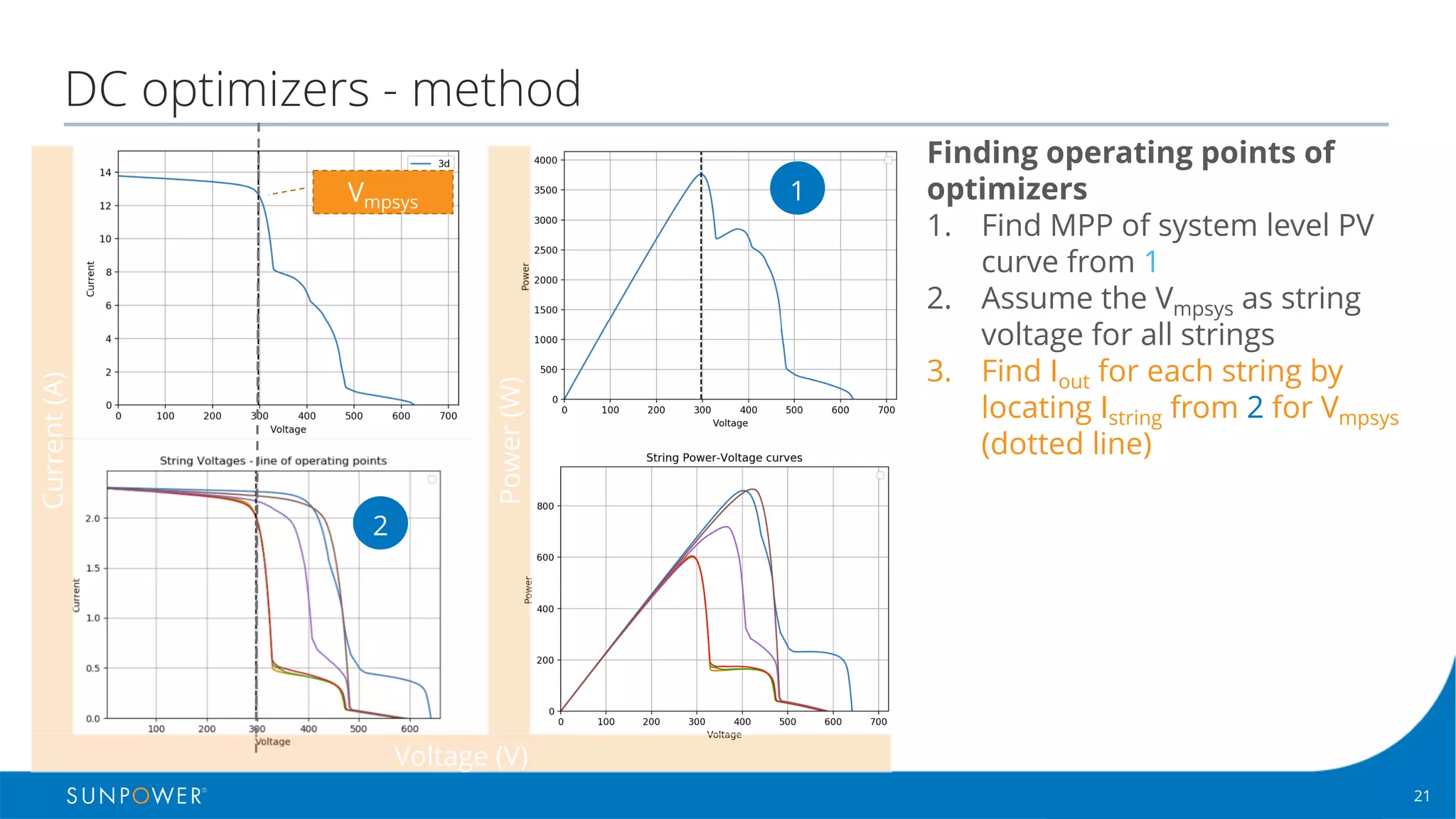
DC optimizers - method
1
2
Finding operating points of
optimizers
1. Find MPP of system level PV
curve from 1
2. Assume the Vmpsys as string
voltage for all strings
3. Find Iout for each string by
locating Istring from 2 for Vmpsys
(dotted line)
Current(A)
Power(W)
Voltage (V)
Vmpsys
22Confidential | © 2016 SunPower Corporation |
DC optimizers - method
1
2
Finding operating points of
optimizers
1. Find MPP of system level PV
curve from 1
2. Assume the Vmpsys as string
voltage for all strings
3. Find Iout for each string by
locating Istring from 2 for Vmpsys
(dotted line)
4. Calculate duty cycle and
efficiency for each optimizer
and adjust module Pmpmod[OPT]
Current(A)
Power(W)
Voltage (V)
23Confidential | © 2016 SunPower Corporation |
DC optimizers - method
1
2
Finding operating points of
optimizers
1. Find MPP of system level PV
curve from 1
2. Assume the Vmpsys as string
voltage for all strings
3. Find Iout for each string by
locating Istring from 2 for Vmpsys
(dotted line)
4. Calculate duty cycle and
efficiency for each optimizer
and adjust module Pmpmod[OPT]
5. Sum the Pmpmod[OPT] to get
Pmpsys[OPT]
Current(A)
Power(W)
Voltage (V)
24Confidential | © 2016 SunPower Corporation |
DC optimizers - method
1
2
Finding operating points of
optimizers
1. Find MPP of system level PV
curve from 1
2. Assume the Vmpsys as string
voltage for all strings
3. Find Iout for each string by
locating Istring from 2 for Vmpsys
(dotted line)
4. Calculate duty cycle and
efficiency for each optimizer
and adjust module Pmpmod[OPT]
5. Sum the Pmpmod[OPT] to get
Pmpsys[OPT]
6. Apply String inverter
efficiency to get power value
Current(A)
Power(W)
Voltage (V)
25Confidential | © 2016 SunPower Corporation |
DC optimizers - equations
Where
Isys :	PV	system	current	(A)
Vmpsys :	Voltage	at	max.	power	point	- system	level	(V)
Imp :	module	current	at	max.	power	point	(A)
Pmpmod	,	Vmpmod ,	Impmod :	module	power,	voltage	and	current	at	max.	power	point
OptEff(duty	cycle,	input	current)	:	optimizer	efficiency	at	given	duty	cycle	and	input	current	(%)
StrInvEff(power,	voltage)	:	string	inverter	efficiency	at		given	input	power	and	voltage	(%)
Psys :	System	Power	
𝐷𝑢𝑡𝑦𝐶𝑦𝑐𝑙𝑒 𝑛 = 𝐼 𝑚𝑝 𝑛
𝐼 𝑠𝑡𝑟𝑖𝑛𝑔 𝑠𝑡𝑟 																																															
… (2)	j
𝑃 𝑚𝑜𝑑 𝑛 = 𝑃 𝑚𝑝𝑚𝑜𝑑[𝑛]	∗ 𝑂𝑝𝑡𝐸𝑓𝑓(𝐷𝑢𝑡𝑦𝐶𝑦𝑙𝑒 𝑛 , 𝐼 𝑚𝑝𝑚𝑜𝑑 𝑛 ) … (3)
𝐼 𝑠𝑡𝑟𝑖𝑛𝑔 𝑠𝑡𝑟 = 𝐼 𝑠𝑦𝑠 	𝑉 𝑚𝑝𝑠𝑦𝑠 																																																																																																			
… (1)	
𝑃 𝑠𝑦𝑠 = (' 𝑃 𝑚𝑜𝑑 𝑛 		)	×	𝑆𝑡𝑟𝐼𝑛𝑣𝐸𝑓𝑓 𝑃 𝑚𝑝𝑚𝑜𝑑 𝑛 , 𝑉 𝑚𝑝𝑚𝑜𝑑 𝑛 		…	(4)
5
678
26Confidential | © 2016 SunPower Corporation |
Results – Hourly
Typical winter day
unshaded
27Confidential | © 2016 SunPower Corporation |
Results – Hourly
SW
obstacle
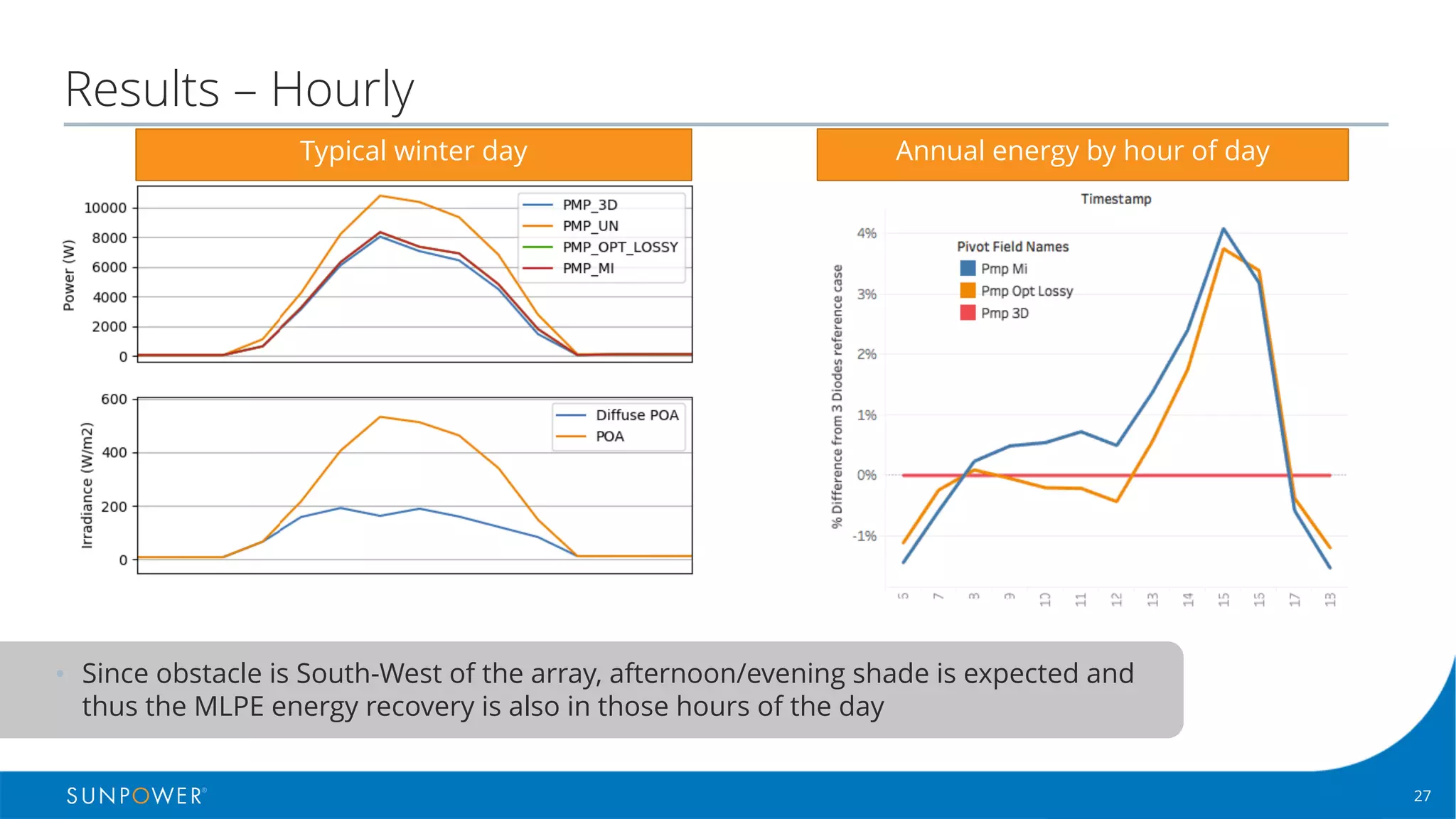
• Since obstacle is South-West of the array, afternoon/evening shade is expected and
thus the MLPE energy recovery is also in those hours of the day
Typical winter day Annual energy by hour of day
28Confidential | © 2016 SunPower Corporation |
Results – Monthly
29Confidential | © 2016 SunPower Corporation |
Results – Monthly
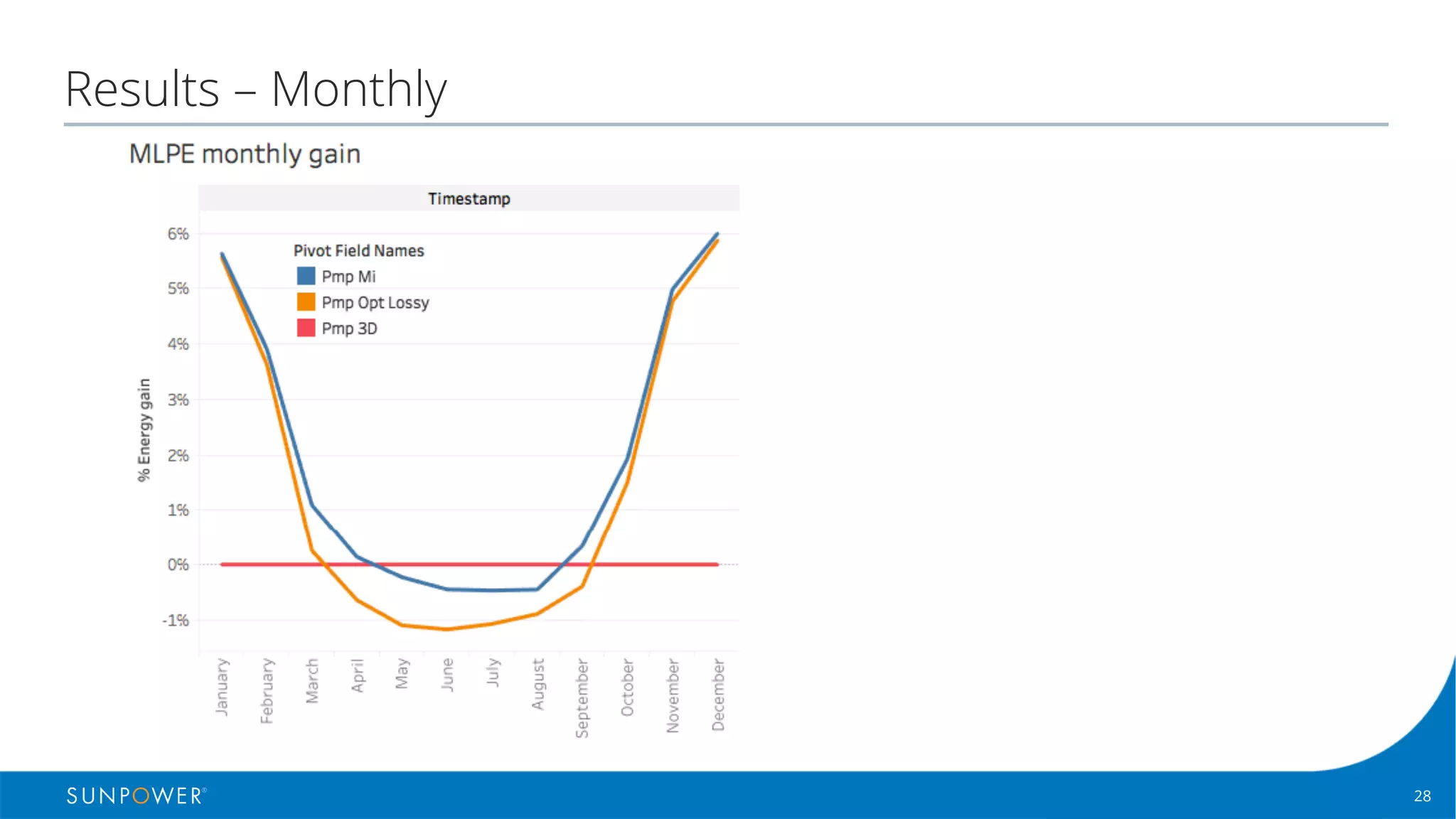
• Winter months can gain up to 6% energy using MI and Optimizers
• Summer months can see up to 1.5% losses in power train efficiency with lack of shading
30Confidential | © 2016 SunPower Corporation |
Results – Annual
31Confidential | © 2016 SunPower Corporation |
Results – Annual
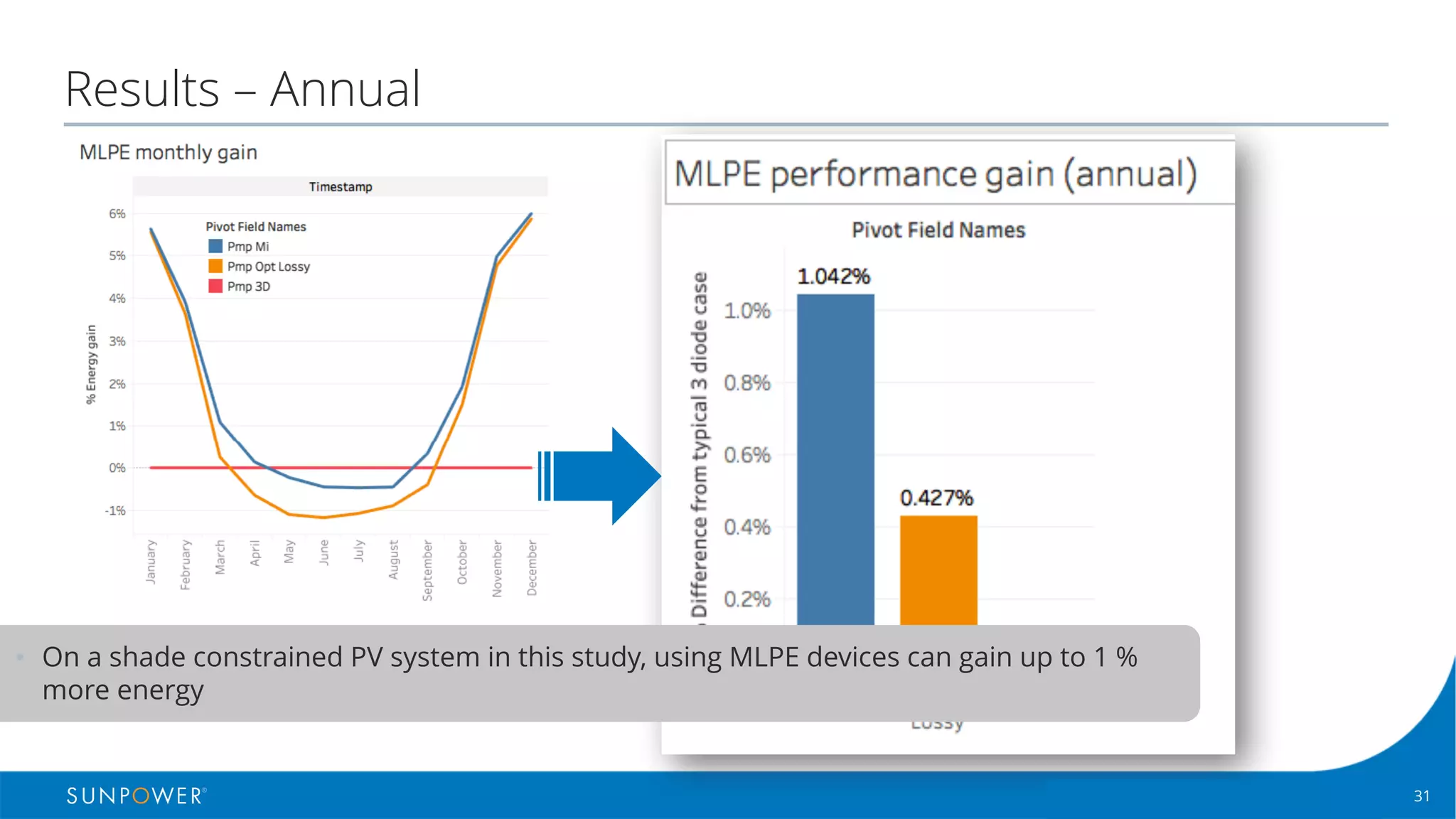
• On a shade constrained PV system in this study, using MLPE devices can gain up to 1 %
more energy
32Confidential | © 2016 SunPower Corporation |
Conclusions
• Using PVMismatch, MLPE based systems can be modeled in detail for variety of topologies
of MLPEs
33Confidential | © 2016 SunPower Corporation |
Conclusions
• Using PVMismatch, MLPE based systems can be modeled in detail for variety of topologies
of MLPEs
• Performance gains of MLPEs vary across the year for a given shading scene and annual
energy gives the most accurate measure of their performance.
34Confidential | © 2016 SunPower Corporation |
Conclusions
• Using PVMismatch, MLPE based systems can be modeled in detail for variety of topologies
of MLPEs
• Performance gains of MLPEs vary across the year for a given shading scene and annual
energy gives the most accurate measure of their performance.
• On a shade constrained PV system in this study, using MLPE devices can gain up to 1 %
more energy annually
35Confidential | © 2016 SunPower Corporation |
Acknowledgements
Special thanks to Mark Mikofski and Bennet Meyers for creating PVMismatch!
Thank You
Let’s change the way our world is powered.
Confidential | © 2016 SunPower Corporation

MLPE performance modeling

  • 1.
    Confidential | ©2016 SunPower Corporation Chetan Chaudhari, Tamir Lance, Gregory M. Kimball, Ben Bourne | May 2019 12th PV Performance Modeling and Monitoring Workshop (May 14-15, 2019) MLPE Performance modeling Module Level Power Electronics
  • 2.
    2Confidential | ©2016 SunPower Corporation | Yo Mr. White…. Like what is this MLPE? (condescendingly) It is simple. It stands for Module Level Power Electronics. It is just a switched mode power supply. It …..
  • 3.
    3Confidential | ©2016 SunPower Corporation | MLPE - Module Level Power Electronics • Key benefits – Balance Of System component for NEC 690.12 (Rapid Shutdown) compliance1 – Increased shade tolerance – Simplified PV system design • MLPE market growing 14-18% annually 2 • Need for explicit model to study power and energy impact 1 – NEC 690.12.c 2017 2 – The Global PV Inverter and MLPE Landscape H2 2016, S. Moskowitz, GTM 2016
  • 4.
    4Confidential | ©2016 SunPower Corporation | What is PVMismatch? • IV & PV curve trace calculator for PV system circuits3 3 – Mark Mikofski, Bennet Meyers, Chetan Chaudhari (2018). “PVMismatch Project: https://github.com/SunPower/PVMismatch". SunPower Corporation, Richmond, CA.
  • 5.
    5Confidential | ©2016 SunPower Corporation | What is PVMismatch? • IV & PV curve trace calculator for PV system circuits • Model chain – Cell > Cell string > Module > String > System – Module layout 3 – Mark Mikofski, Bennet Meyers, Chetan Chaudhari (2018). “PVMismatch Project: https://github.com/SunPower/PVMismatch". SunPower Corporation, Richmond, CA.
  • 6.
    6Confidential | ©2016 SunPower Corporation | What is PVMismatch? • IV & PV curve trace calculator for PV system circuits • Model chain – Cell > Cell string > Module > String > System – Module layout – Bypass diodes • Model inputs – Cell technology characteristics – Irradiance (suns) – Temperature (cell temperature) – Bypass device configuration 3 – Mark Mikofski, Bennet Meyers, Chetan Chaudhari (2018). “PVMismatch Project: https://github.com/SunPower/PVMismatch". SunPower Corporation, Richmond, CA.
  • 7.
    7Confidential | ©2016 SunPower Corporation | What is PVMismatch? • IV & PV curve trace calculator for PV system circuits • Model chain – Cell > Cell string > Module > String > System – Module layout – Bypass diodes • Model inputs – Cell technology characteristics – Irradiance (suns) – Temperature (cell temperature) – Bypass device configuration 3 – Mark Mikofski, Bennet Meyers, Chetan Chaudhari (2018). “PVMismatch Project: https://github.com/SunPower/PVMismatch". SunPower Corporation, Richmond, CA.
  • 8.
    8Confidential | ©2016 SunPower Corporation | How to use?
  • 9.
    9Confidential | ©2016 SunPower Corporation | How to use?
  • 10.
    10Confidential | ©2016 SunPower Corporation | How to use?
  • 11.
    11Confidential | ©2016 SunPower Corporation | Case study • Scenarios – String inverter – Power optimizers + String inverter – Microinverters N Cell-level POA Irradiance map
  • 12.
    12Confidential | ©2016 SunPower Corporation | Case study • Scenarios – String inverter – Power optimizers + String inverter – Microinverters • System configuration – 10 modules x 6 strings – Azimuth = South – Tilt = 10 degree – Location = Richmond, CA • Shade – Obstacle (SW) – Inter row N Cell-level POA Irradiance map
  • 13.
    13Confidential | ©2016 SunPower Corporation | Case study N• Scenarios – String inverter – Power optimizers + String inverter – Microinverters • System configuration – 10 modules x 6 strings – Azimuth = South – Tilt = 10 degree – Location = Richmond, CA • Shade – Obstacle (SW) – Inter row Come see Chetan at PVSC- 46 Tuesday June 18th "PVOPEL: A Scalable Opto-Electrical Performance Model of PV systems using Ray Tracing and PVMismatch"
  • 14.
    14Confidential | ©2016 SunPower Corporation | Microinverters • Key considerations – Microinverter efficiency applied at module level IV curve • Microinverter efficiency depends on – Power level or Imp – Input Voltage (Vmp) – Temperature (Tamb) – Grid conditions • Typically – lower power levels => lower efficiency – lower input voltage => lower efficiency Voltage (V) Power (W) Contour plot for efficiency (microinverter)
  • 15.
    15Confidential | ©2016 SunPower Corporation | Microinverters - method 1. Find MPP of each module for given irradiance conditions Available Incident Energy
  • 16.
    16Confidential | ©2016 SunPower Corporation | Microinverters - method 1. Find MPP of each module for given irradiance conditions 2. Find efficiency loss for that power level 3. Calculate Pmpmod[MI] Pmp map (MI) Available Incident Energy
  • 17.
    17Confidential | ©2016 SunPower Corporation | Microinverters - method 1. Find MPP of each module for given irradiance conditions 2. Find efficiency loss for that power level 3. Calculate Pmpmod[MI] 4. Sum the Pmpmod[MI] across the array to get Pmpsys Pmp map (MI) Available Incident Energy
  • 18.
    18Confidential | ©2016 SunPower Corporation | Microinverters - equations 𝑃 𝑚𝑝𝑠𝑦𝑠 = ' 𝑃 𝑚𝑝𝑚𝑜𝑑 𝑛 × 𝑀𝐼𝐸𝑓𝑓(𝑃 𝑚𝑝𝑚𝑜𝑑 𝑛 , 𝑉 𝑚𝑝𝑚𝑜𝑑 𝑛 ) 5 678 Where N : number of PV modules Pmpsys : System Power Pmpmod : module power at max. power point Vmpmod : module voltage at max. power point MIEff(power, voltage) : microinverter efficiency at given operating point
  • 19.
    19Confidential | ©2016 SunPower Corporation | DC optimizers • Key considerations – Corrects for module to module mismatch – Optimizer efficiency applied at module level IV curve – Inverter efficiency applied at MPPT circuit level • Optimizer efficiency depends on – Power level or Imp – Duty Cycle = Iin/Iout = Imp/Iout • Where Iout = Istring @Vmpsys – Temperature (Tamb) – Input Voltage (Vmp) • Typically for power converters - – lower power levels => lower efficiency – lower duty cycles => lower efficiency Optimizer String Inverter Power (W) Duty Cycle (%) Imp (A) Contour plots for efficiency Voltage (V)
  • 20.
    20Confidential | ©2016 SunPower Corporation | DC optimizers - method 1 Finding operating points of optimizers 1. Find MPP of system level PV curve from 1 2. Assume the corresponding Vmpsys as string voltage for all strings since they are in parallel Current(A) Power(W) Voltage (V) Vmpsys
  • 21.
    21Confidential | ©2016 SunPower Corporation | DC optimizers - method 1 2 Finding operating points of optimizers 1. Find MPP of system level PV curve from 1 2. Assume the Vmpsys as string voltage for all strings 3. Find Iout for each string by locating Istring from 2 for Vmpsys (dotted line) Current(A) Power(W) Voltage (V) Vmpsys
  • 22.
    22Confidential | ©2016 SunPower Corporation | DC optimizers - method 1 2 Finding operating points of optimizers 1. Find MPP of system level PV curve from 1 2. Assume the Vmpsys as string voltage for all strings 3. Find Iout for each string by locating Istring from 2 for Vmpsys (dotted line) 4. Calculate duty cycle and efficiency for each optimizer and adjust module Pmpmod[OPT] Current(A) Power(W) Voltage (V)
  • 23.
    23Confidential | ©2016 SunPower Corporation | DC optimizers - method 1 2 Finding operating points of optimizers 1. Find MPP of system level PV curve from 1 2. Assume the Vmpsys as string voltage for all strings 3. Find Iout for each string by locating Istring from 2 for Vmpsys (dotted line) 4. Calculate duty cycle and efficiency for each optimizer and adjust module Pmpmod[OPT] 5. Sum the Pmpmod[OPT] to get Pmpsys[OPT] Current(A) Power(W) Voltage (V)
  • 24.
    24Confidential | ©2016 SunPower Corporation | DC optimizers - method 1 2 Finding operating points of optimizers 1. Find MPP of system level PV curve from 1 2. Assume the Vmpsys as string voltage for all strings 3. Find Iout for each string by locating Istring from 2 for Vmpsys (dotted line) 4. Calculate duty cycle and efficiency for each optimizer and adjust module Pmpmod[OPT] 5. Sum the Pmpmod[OPT] to get Pmpsys[OPT] 6. Apply String inverter efficiency to get power value Current(A) Power(W) Voltage (V)
  • 25.
    25Confidential | ©2016 SunPower Corporation | DC optimizers - equations Where Isys : PV system current (A) Vmpsys : Voltage at max. power point - system level (V) Imp : module current at max. power point (A) Pmpmod , Vmpmod , Impmod : module power, voltage and current at max. power point OptEff(duty cycle, input current) : optimizer efficiency at given duty cycle and input current (%) StrInvEff(power, voltage) : string inverter efficiency at given input power and voltage (%) Psys : System Power 𝐷𝑢𝑡𝑦𝐶𝑦𝑐𝑙𝑒 𝑛 = 𝐼 𝑚𝑝 𝑛 𝐼 𝑠𝑡𝑟𝑖𝑛𝑔 𝑠𝑡𝑟 … (2) j 𝑃 𝑚𝑜𝑑 𝑛 = 𝑃 𝑚𝑝𝑚𝑜𝑑[𝑛] ∗ 𝑂𝑝𝑡𝐸𝑓𝑓(𝐷𝑢𝑡𝑦𝐶𝑦𝑙𝑒 𝑛 , 𝐼 𝑚𝑝𝑚𝑜𝑑 𝑛 ) … (3) 𝐼 𝑠𝑡𝑟𝑖𝑛𝑔 𝑠𝑡𝑟 = 𝐼 𝑠𝑦𝑠 𝑉 𝑚𝑝𝑠𝑦𝑠 … (1) 𝑃 𝑠𝑦𝑠 = (' 𝑃 𝑚𝑜𝑑 𝑛 ) × 𝑆𝑡𝑟𝐼𝑛𝑣𝐸𝑓𝑓 𝑃 𝑚𝑝𝑚𝑜𝑑 𝑛 , 𝑉 𝑚𝑝𝑚𝑜𝑑 𝑛 … (4) 5 678
  • 26.
    26Confidential | ©2016 SunPower Corporation | Results – Hourly Typical winter day unshaded
  • 27.
    27Confidential | ©2016 SunPower Corporation | Results – Hourly SW obstacle • Since obstacle is South-West of the array, afternoon/evening shade is expected and thus the MLPE energy recovery is also in those hours of the day Typical winter day Annual energy by hour of day
  • 28.
    28Confidential | ©2016 SunPower Corporation | Results – Monthly
  • 29.
    29Confidential | ©2016 SunPower Corporation | Results – Monthly • Winter months can gain up to 6% energy using MI and Optimizers • Summer months can see up to 1.5% losses in power train efficiency with lack of shading
  • 30.
    30Confidential | ©2016 SunPower Corporation | Results – Annual
  • 31.
    31Confidential | ©2016 SunPower Corporation | Results – Annual • On a shade constrained PV system in this study, using MLPE devices can gain up to 1 % more energy
  • 32.
    32Confidential | ©2016 SunPower Corporation | Conclusions • Using PVMismatch, MLPE based systems can be modeled in detail for variety of topologies of MLPEs
  • 33.
    33Confidential | ©2016 SunPower Corporation | Conclusions • Using PVMismatch, MLPE based systems can be modeled in detail for variety of topologies of MLPEs • Performance gains of MLPEs vary across the year for a given shading scene and annual energy gives the most accurate measure of their performance.
  • 34.
    34Confidential | ©2016 SunPower Corporation | Conclusions • Using PVMismatch, MLPE based systems can be modeled in detail for variety of topologies of MLPEs • Performance gains of MLPEs vary across the year for a given shading scene and annual energy gives the most accurate measure of their performance. • On a shade constrained PV system in this study, using MLPE devices can gain up to 1 % more energy annually
  • 35.
    35Confidential | ©2016 SunPower Corporation | Acknowledgements Special thanks to Mark Mikofski and Bennet Meyers for creating PVMismatch!
  • 36.
    Thank You Let’s changethe way our world is powered. Confidential | © 2016 SunPower Corporation