Lucas Cavalcanti

@lucascs
Microservices in
Clojure
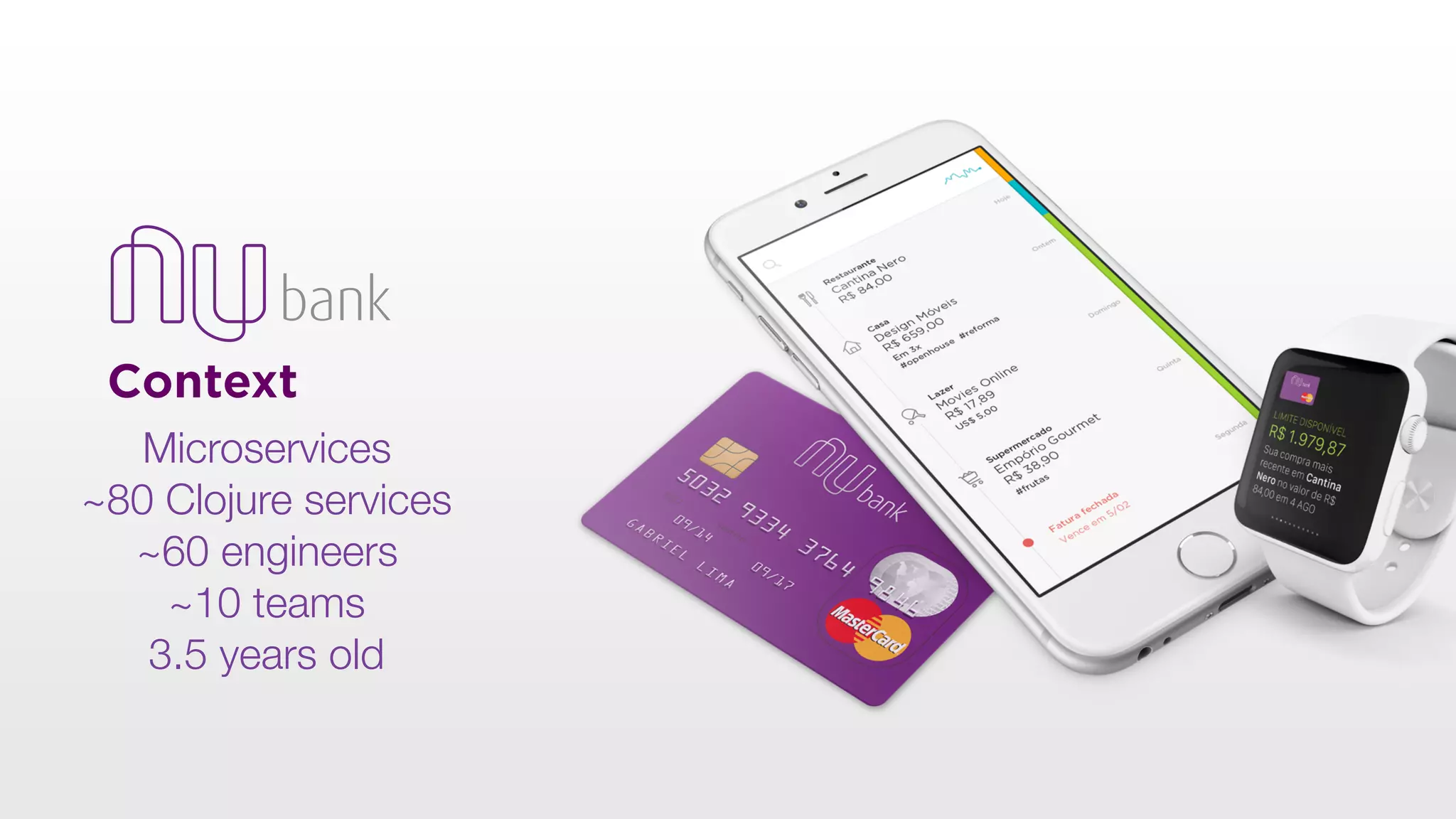
Context
Microservices
~80 Clojure services
~60 engineers
~10 teams
3.5 years old
OOP
Objects, the mainstream abstraction
Image @ http://www.eduardopires.net.br/2015/01/solid-teoria-e-pratica/
What about Functional Programming?
SÃO PAULO, BRASIL
TABLE OF CONTENTS
Immutability
Components
Pure Functions
Schemas
Ports and Adapters
SÃO PAULO, BRASIL
Immutability
SOUTHEAST BRAZIL REGION FROM SPACE
Immutability
Definition
“If I’m given a value, it’s guaranteed that it won’t ever change”
Technology choices
Immutability
Clojure
Immutability
All default data structures are immutable:
-Maps, Lists, Sets
-Records
Mutability is explicit: atoms/refs @, dynamic vars *…*
Datomic
Immutability
Datomic stores the changes/transactions, not just the
data
-append only
-db as a value
-everything is data (transaction, schema, entities)
Kafka
Immutability
Persistent Queues/Topics
-each consumer has its offset
-ability to replay messages
AWS + Docker
Immutability
Ability to spin machines with a given image/
configuration
-Each build generates a docker image
-Each deploy spins a new machine with the new
version
-As soon as the new version is healthy, old version is
killed. (blue-green deployment)
Components
SOUTHEAST BRAZIL REGION FROM SPACE
Components
https://github.com/stuartsierra/component
(defprotocol Database

(query [this query-str]))


(defrecord SomeDatabase [config-1 config-2 other-components]

component/Lifecycle

(start [this]

(assoc this :connection (connect! config-1 config-2 other-components)))


(stop [this]

(release! (:connection this))

(dissoc this :connection))


Database

(query [this query-str] (do-query! (:connection this) query-str)))
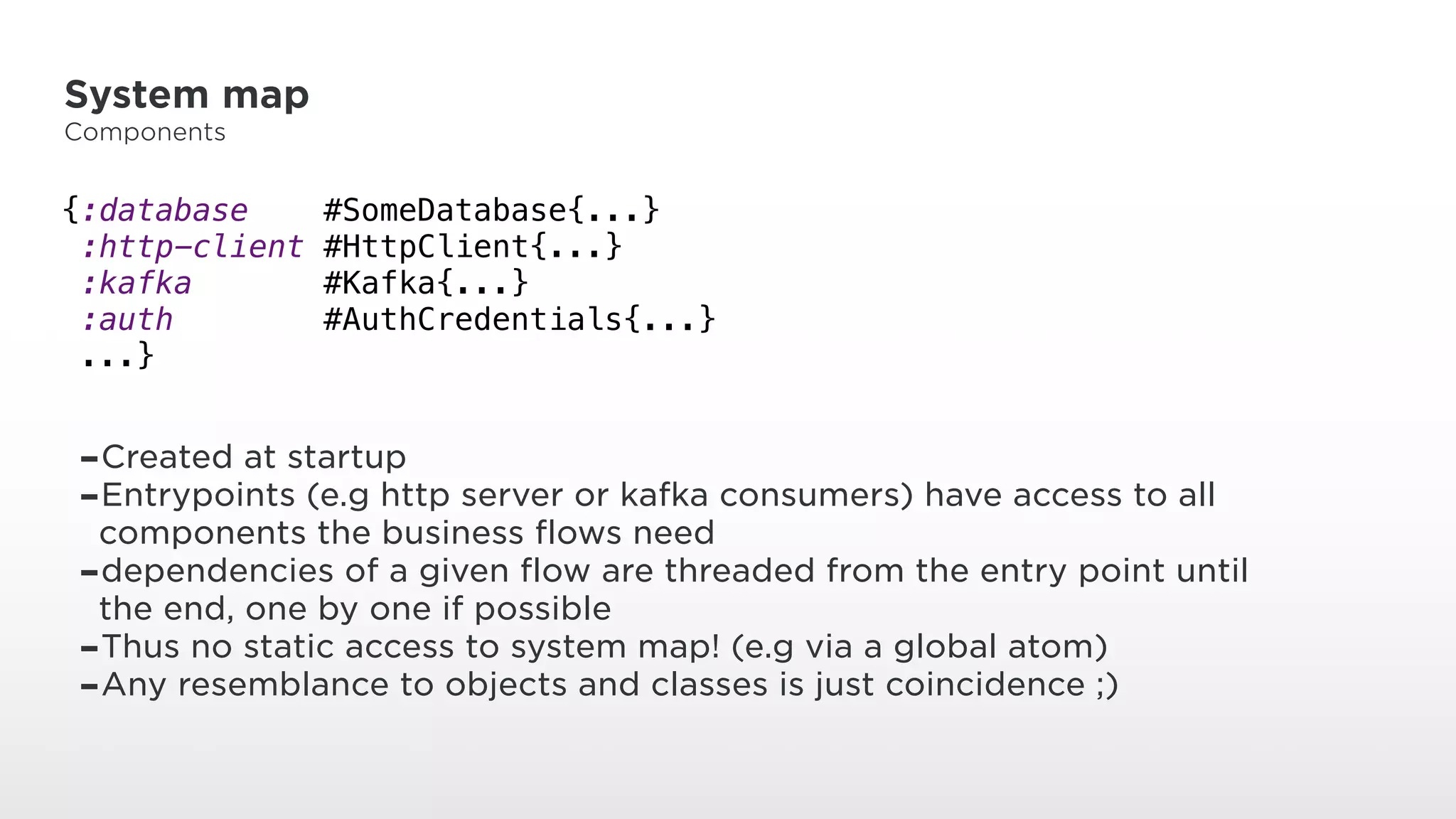
System map
Components
{:database #SomeDatabase{...}

:http-client #HttpClient{...}

:kafka #Kafka{...}

:auth #AuthCredentials{...}

...}
-Created at startup
-Entrypoints (e.g http server or kafka consumers) have access to all
components the business flows need
-dependencies of a given flow are threaded from the entry point until
the end, one by one if possible
-Thus no static access to system map! (e.g via a global atom)
-Any resemblance to objects and classes is just coincidence ;)
Pure functions
SOUTHEAST BRAZIL REGION FROM SPACE
Pure functions
Definition
"Given the same inputs, it will always produce the same output"
Simplicity
Pure functions
-easier to reason about, fewer moving pieces
-easier to test, less need for mocking values
-parallelizable by default, no need for locks or STMs
Datomic
Pure functions
-Datomic’s db as a value allows us to consider a function
that queries the database as a pure function
-db is a snapshot of the database at a certain point in time.
-So, querying the same db instance will always produce the
same result
Impure functions
Pure functions
-functions that produce side effects should be marked as
such. We use `!` at the end.
-split code which handles and transforms data from code
that handles side effects
-should be moved to the borders of the flow, if possible
-Consider returning a future/promise like value, so side
effect results can be composed (e.g with manifold or
finagle)
https://github.com/ztellman/manifold
https://github.com/twitter/finagle
Schema/Spec
SOUTHEAST BRAZIL REGION FROM SPACE
Schema
Legacy
Majority of our code base was written before clojure.spec existed,
so I’ll be talking about the Schema library instead. Most principles
apply to clojure.spec as well.
Schema/Spec
Documentation
-Clojure doesn’t force you to write types
-parameter names are not enough
-declaring types helps a lot when glancing at the function
-values can be verified against a schema
Function declaration
Schema/spec
-All pure functions declare schemas for parameters and
return value
-All impure functions declare for parameters and don’t
declare output type if it’s not relevant.
-Validated at runtime in dev/test environments, on every
function call
-Validation is off on production.
Wire formats
Schema/Spec
-Internal schemas are your domain models
-Wire schemas are how you expose data to other services/
clients
-If they are different, you can evolve internal schemas
without breaking clients
-Need an adapter layer
-wire schemas are always validated on entry/exit points,
specially in production
-single repository for all wire schemas (for all 60+ services)
-caveat: this repository has a really high churn. Beware
Growing Schemas
Spec-ulation
Please watch Rich Hickey’s talk at Clojure Conj 2016
Spec-ulation:
https://www.youtube.com/watch?v=oyLBGkS5ICk
Ports and Adapters
(a.k.a Hexagonal Architecture)
SOUTHEAST BRAZIL REGION FROM SPACE
Ports and Adapters
Definition
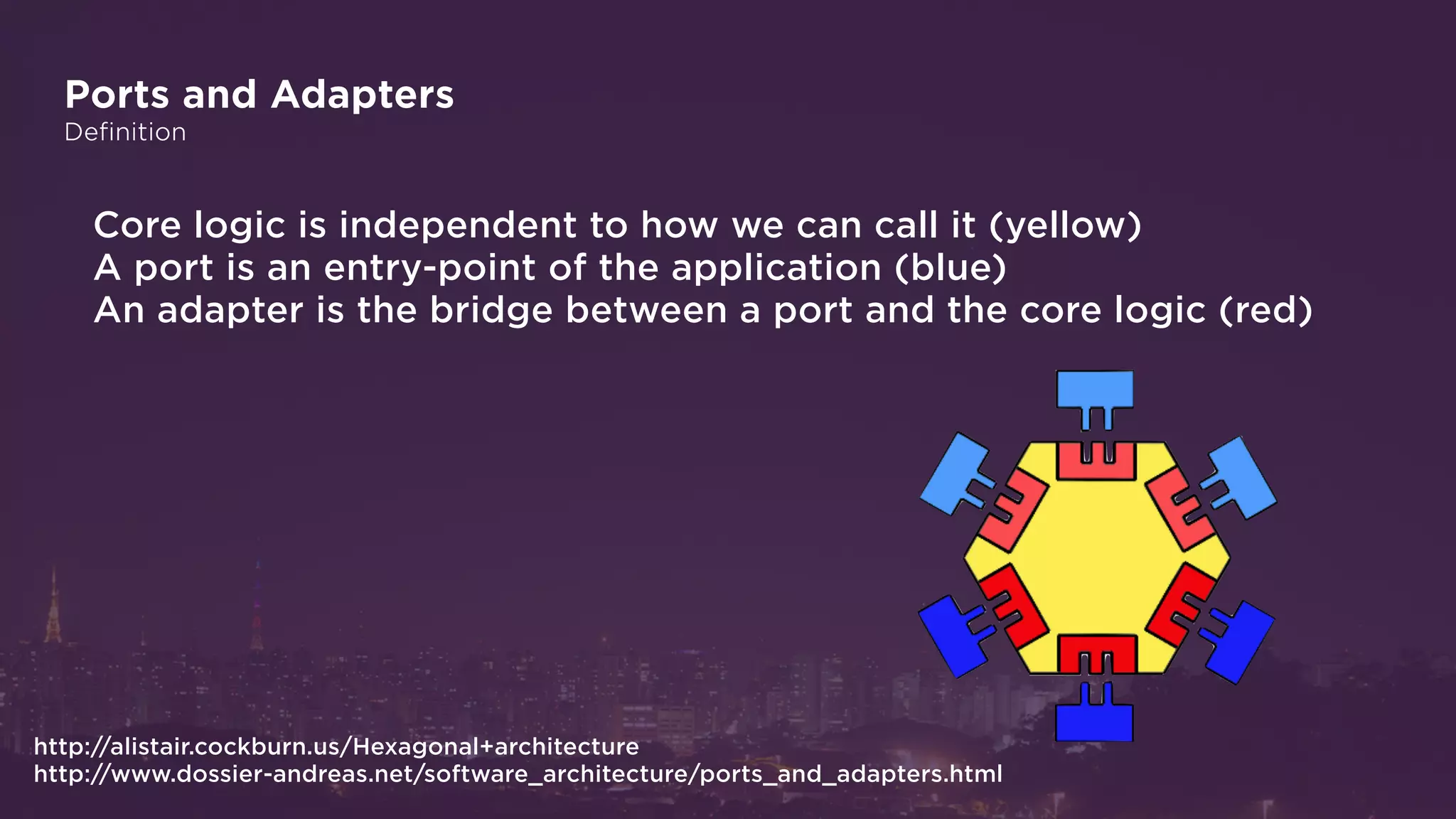
Core logic is independent to how we can call it (yellow)
A port is an entry-point of the application (blue)
An adapter is the bridge between a port and the core logic (red)
http://www.dossier-andreas.net/software_architecture/ports_and_adapters.html
http://alistair.cockburn.us/Hexagonal+architecture
Ports and Adapters (Nubank version)
Extended Definition
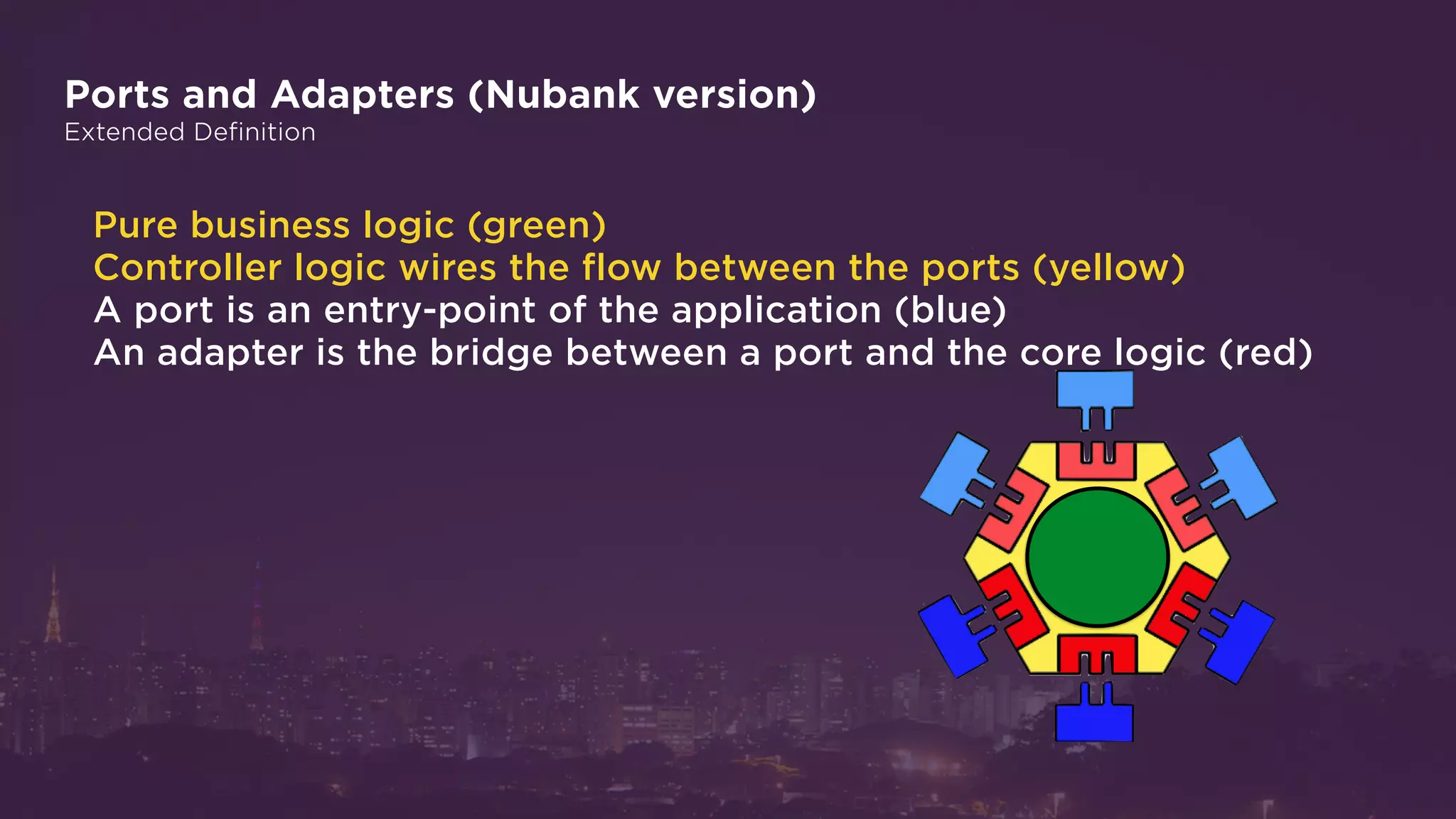
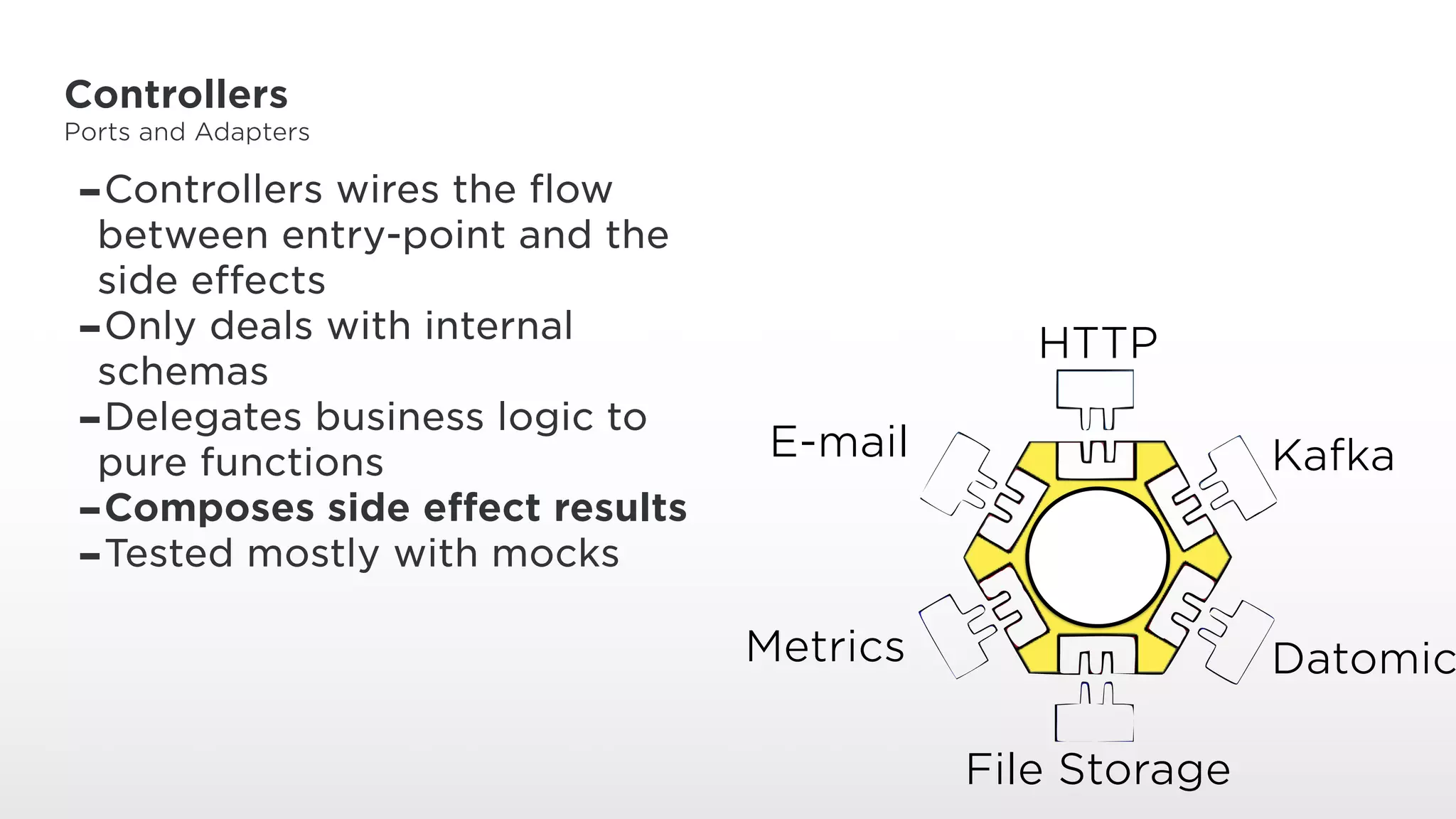
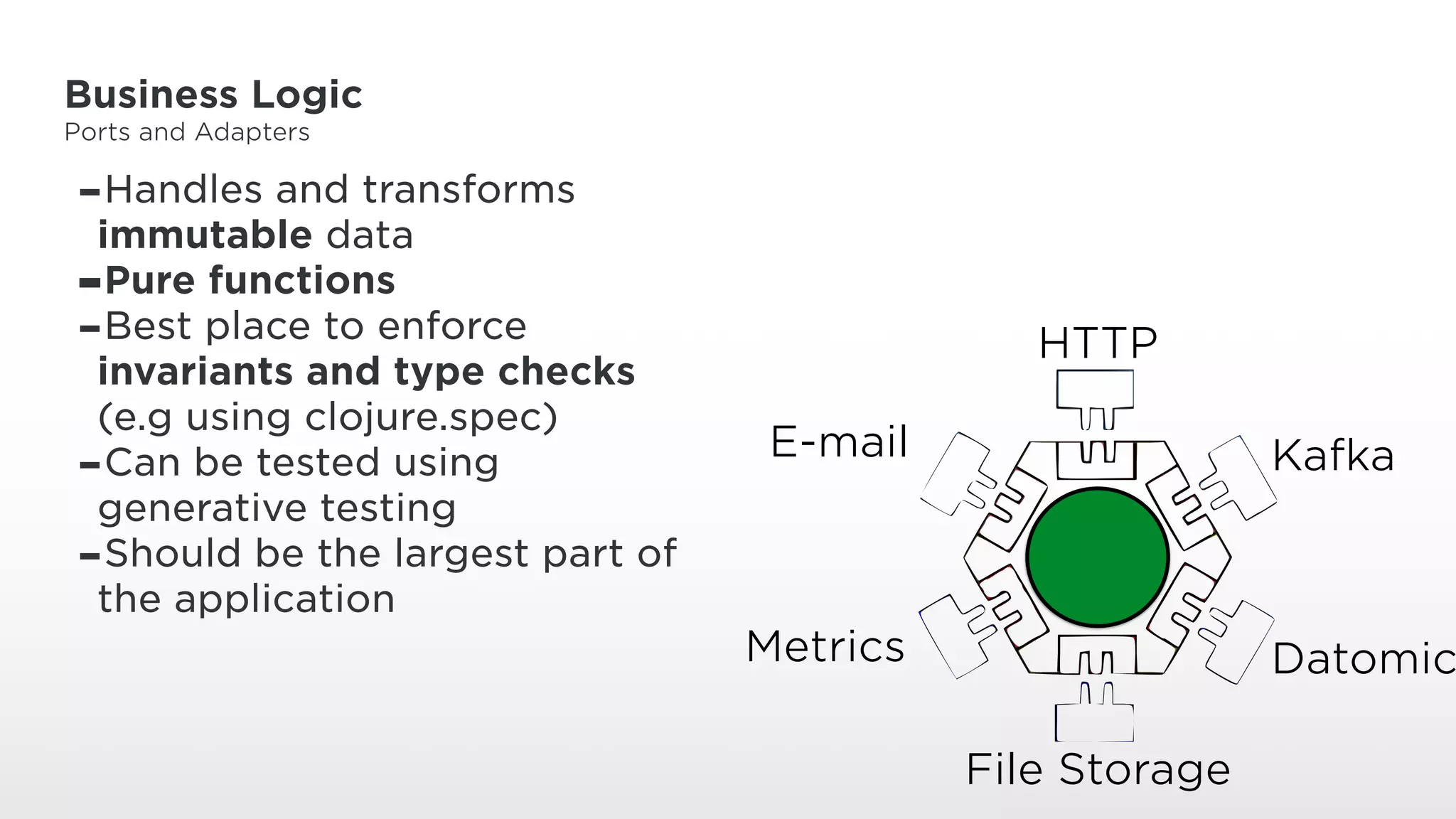
Pure business logic (green)
Controller logic wires the flow between the ports (yellow)
A port is an entry-point of the application (blue)
An adapter is the bridge between a port and the core logic (red)
Ports (Components)
Ports and Adapters
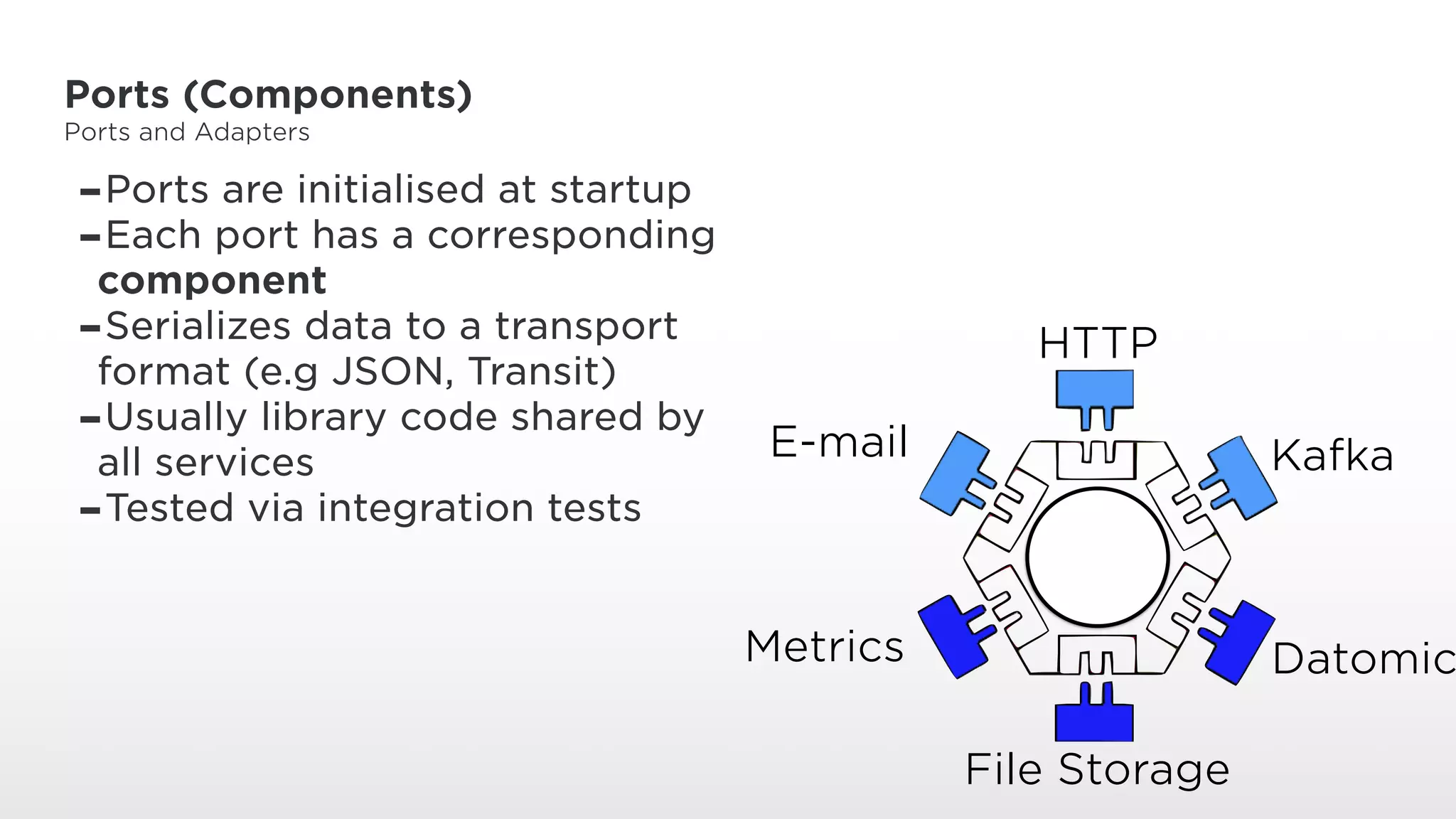
-Ports are initialised at startup
-Each port has a corresponding
component
-Serializes data to a transport
format (e.g JSON, Transit)
-Usually library code shared by
all services
-Tested via integration tests
HTTP
Kafka
Datomic
File Storage
Metrics
E-mail
Adapters (Diplomat)
Ports and Adapters
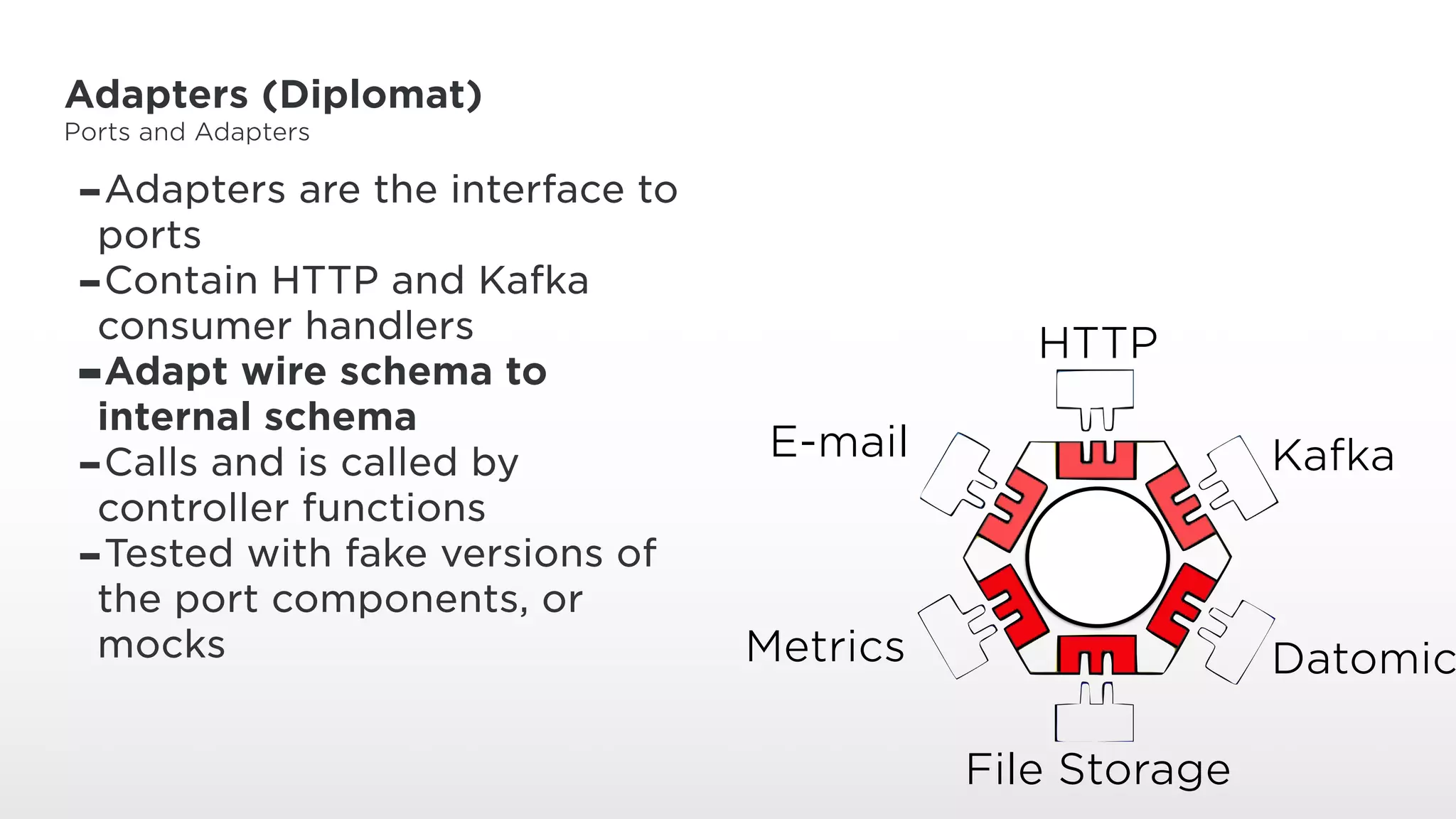
-Adapters are the interface to
ports
-Contain HTTP and Kafka
consumer handlers
-Adapt wire schema to
internal schema
-Calls and is called by
controller functions
-Tested with fake versions of
the port components, or
mocks
HTTP
Kafka
Datomic
File Storage
Metrics
E-mail
Controllers
Ports and Adapters
-Controllers wires the flow
between entry-point and the
side effects
-Only deals with internal
schemas
-Delegates business logic to
pure functions
-Composes side effect results
-Tested mostly with mocks
HTTP
Kafka
Datomic
File Storage
Metrics
E-mail
Business Logic
Ports and Adapters
-Handles and transforms
immutable data
-Pure functions
-Best place to enforce
invariants and type checks
(e.g using clojure.spec)
-Can be tested using
generative testing
-Should be the largest part of
the application
HTTP
Kafka
Datomic
File Storage
Metrics
E-mail
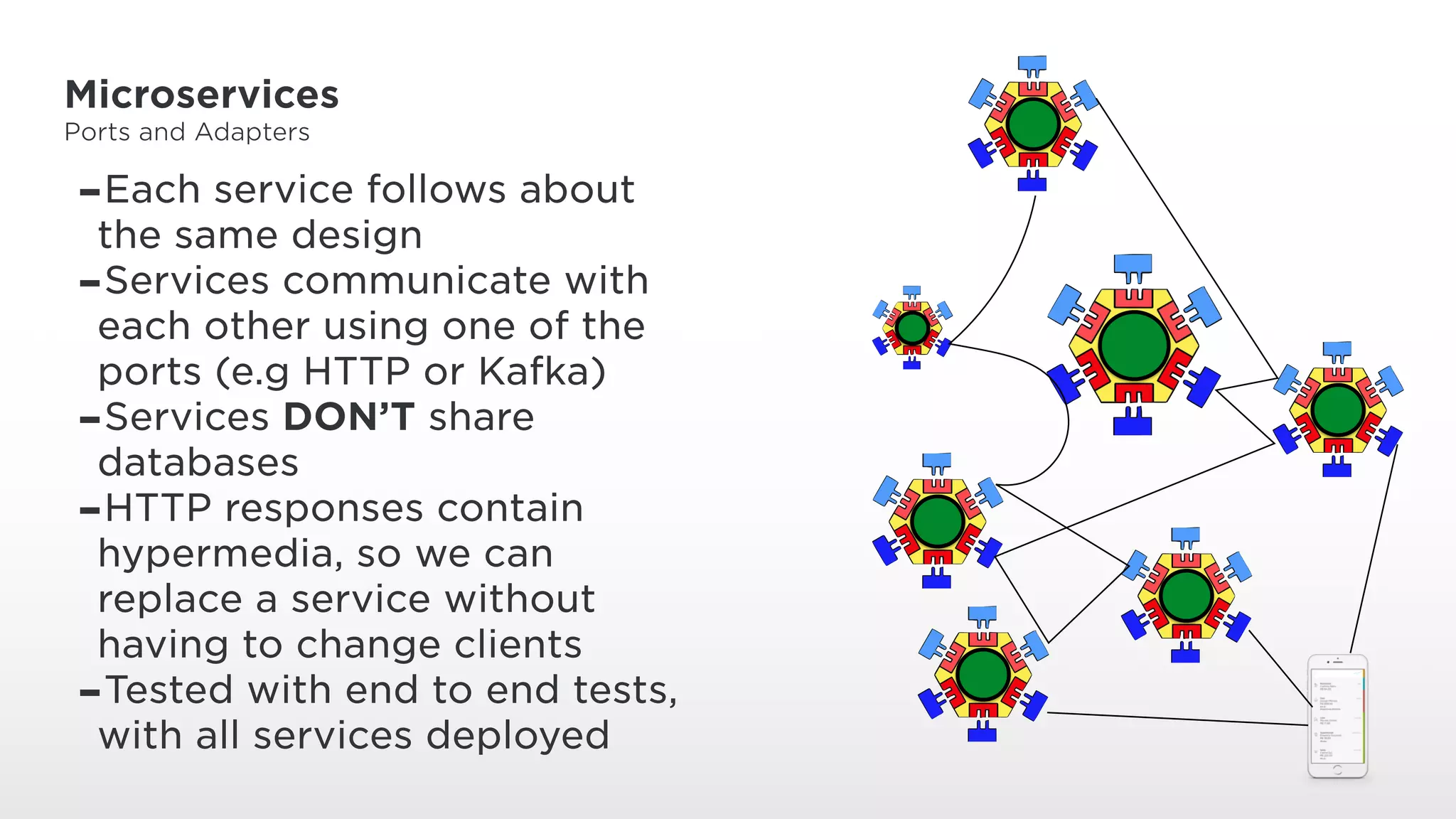
Microservices
Ports and Adapters
-Each service follows about
the same design
-Services communicate with
each other using one of the
ports (e.g HTTP or Kafka)
-Services DON’T share
databases
-HTTP responses contain
hypermedia, so we can
replace a service without
having to change clients
-Tested with end to end tests,
with all services deployed
Clojure is simple
Keep your design simple
Keep your architecture simple
SÃO PAULO, BRASIL
Lucas Cavalcanti

@lucascs
Thank you

Microservices in Clojure

  • 1.
  • 2.
    Context Microservices ~80 Clojure services ~60engineers ~10 teams 3.5 years old
  • 3.
    OOP Objects, the mainstreamabstraction Image @ http://www.eduardopires.net.br/2015/01/solid-teoria-e-pratica/
  • 4.
    What about FunctionalProgramming? SÃO PAULO, BRASIL
  • 5.
    TABLE OF CONTENTS Immutability Components PureFunctions Schemas Ports and Adapters SÃO PAULO, BRASIL
  • 6.
  • 7.
    Immutability Definition “If I’m givena value, it’s guaranteed that it won’t ever change”
  • 8.
  • 9.
    Clojure Immutability All default datastructures are immutable: -Maps, Lists, Sets -Records Mutability is explicit: atoms/refs @, dynamic vars *…*
  • 10.
    Datomic Immutability Datomic stores thechanges/transactions, not just the data -append only -db as a value -everything is data (transaction, schema, entities)
  • 11.
    Kafka Immutability Persistent Queues/Topics -each consumerhas its offset -ability to replay messages
  • 12.
    AWS + Docker Immutability Abilityto spin machines with a given image/ configuration -Each build generates a docker image -Each deploy spins a new machine with the new version -As soon as the new version is healthy, old version is killed. (blue-green deployment)
  • 13.
  • 14.
    Components https://github.com/stuartsierra/component (defprotocol Database
 (query [thisquery-str]))
 
 (defrecord SomeDatabase [config-1 config-2 other-components]
 component/Lifecycle
 (start [this]
 (assoc this :connection (connect! config-1 config-2 other-components)))
 
 (stop [this]
 (release! (:connection this))
 (dissoc this :connection))
 
 Database
 (query [this query-str] (do-query! (:connection this) query-str)))
  • 15.
    System map Components {:database #SomeDatabase{...}
 :http-client#HttpClient{...}
 :kafka #Kafka{...}
 :auth #AuthCredentials{...}
 ...} -Created at startup -Entrypoints (e.g http server or kafka consumers) have access to all components the business flows need -dependencies of a given flow are threaded from the entry point until the end, one by one if possible -Thus no static access to system map! (e.g via a global atom) -Any resemblance to objects and classes is just coincidence ;)
  • 16.
  • 17.
    Pure functions Definition "Given thesame inputs, it will always produce the same output"
  • 18.
    Simplicity Pure functions -easier toreason about, fewer moving pieces -easier to test, less need for mocking values -parallelizable by default, no need for locks or STMs
  • 19.
    Datomic Pure functions -Datomic’s dbas a value allows us to consider a function that queries the database as a pure function -db is a snapshot of the database at a certain point in time. -So, querying the same db instance will always produce the same result
  • 20.
    Impure functions Pure functions -functionsthat produce side effects should be marked as such. We use `!` at the end. -split code which handles and transforms data from code that handles side effects -should be moved to the borders of the flow, if possible -Consider returning a future/promise like value, so side effect results can be composed (e.g with manifold or finagle) https://github.com/ztellman/manifold https://github.com/twitter/finagle
  • 21.
  • 22.
    Schema Legacy Majority of ourcode base was written before clojure.spec existed, so I’ll be talking about the Schema library instead. Most principles apply to clojure.spec as well.
  • 23.
    Schema/Spec Documentation -Clojure doesn’t forceyou to write types -parameter names are not enough -declaring types helps a lot when glancing at the function -values can be verified against a schema
  • 24.
    Function declaration Schema/spec -All purefunctions declare schemas for parameters and return value -All impure functions declare for parameters and don’t declare output type if it’s not relevant. -Validated at runtime in dev/test environments, on every function call -Validation is off on production.
  • 25.
    Wire formats Schema/Spec -Internal schemasare your domain models -Wire schemas are how you expose data to other services/ clients -If they are different, you can evolve internal schemas without breaking clients -Need an adapter layer -wire schemas are always validated on entry/exit points, specially in production -single repository for all wire schemas (for all 60+ services) -caveat: this repository has a really high churn. Beware
  • 26.
    Growing Schemas Spec-ulation Please watchRich Hickey’s talk at Clojure Conj 2016 Spec-ulation: https://www.youtube.com/watch?v=oyLBGkS5ICk
  • 27.
    Ports and Adapters (a.k.aHexagonal Architecture) SOUTHEAST BRAZIL REGION FROM SPACE
  • 28.
    Ports and Adapters Definition Corelogic is independent to how we can call it (yellow) A port is an entry-point of the application (blue) An adapter is the bridge between a port and the core logic (red) http://www.dossier-andreas.net/software_architecture/ports_and_adapters.html http://alistair.cockburn.us/Hexagonal+architecture
  • 29.
    Ports and Adapters(Nubank version) Extended Definition Pure business logic (green) Controller logic wires the flow between the ports (yellow) A port is an entry-point of the application (blue) An adapter is the bridge between a port and the core logic (red)
  • 30.
    Ports (Components) Ports andAdapters -Ports are initialised at startup -Each port has a corresponding component -Serializes data to a transport format (e.g JSON, Transit) -Usually library code shared by all services -Tested via integration tests HTTP Kafka Datomic File Storage Metrics E-mail
  • 31.
    Adapters (Diplomat) Ports andAdapters -Adapters are the interface to ports -Contain HTTP and Kafka consumer handlers -Adapt wire schema to internal schema -Calls and is called by controller functions -Tested with fake versions of the port components, or mocks HTTP Kafka Datomic File Storage Metrics E-mail
  • 32.
    Controllers Ports and Adapters -Controllerswires the flow between entry-point and the side effects -Only deals with internal schemas -Delegates business logic to pure functions -Composes side effect results -Tested mostly with mocks HTTP Kafka Datomic File Storage Metrics E-mail
  • 33.
    Business Logic Ports andAdapters -Handles and transforms immutable data -Pure functions -Best place to enforce invariants and type checks (e.g using clojure.spec) -Can be tested using generative testing -Should be the largest part of the application HTTP Kafka Datomic File Storage Metrics E-mail
  • 34.
    Microservices Ports and Adapters -Eachservice follows about the same design -Services communicate with each other using one of the ports (e.g HTTP or Kafka) -Services DON’T share databases -HTTP responses contain hypermedia, so we can replace a service without having to change clients -Tested with end to end tests, with all services deployed
  • 35.
    Clojure is simple Keepyour design simple Keep your architecture simple SÃO PAULO, BRASIL
  • 36.