Microservices and FP
Michael Neale
@michaelneale
developer.cloudbees.com
Wednesday, 9 October 13
Microservices and FP
Given that:
We have lots of services
- Everything has an API
Functional programming:
- quality improvements, popular
- applied easily to “new” services/projects
Combine them!
Wednesday, 9 October 13
Definitions
Functional programming:
- avoid/manage side effects
- immutability over mutation
- higher order functions
- first class functions
- composition using functions over OO
Wednesday, 9 October 13
Definitions
Micro-service:
- remotely accessible service (typically http)
- does “one thing” (and does it well?)
- executes stand alone in a container (JVM - in this
case)
- may depend on other services
- can be composed into a larger service
Wednesday, 9 October 13
Definitions
Micro-service:
- “small”
- independently deployed
- loosely coupled
- not necessarily reusable (but may be)
Wednesday, 9 October 13
Definitions
Like a unix command line app that does ONE THING
AND ONE THING ONLY!
service1 | service2 | service3 ....
Wednesday, 9 October 13
Example scenario
Wednesday, 9 October 13
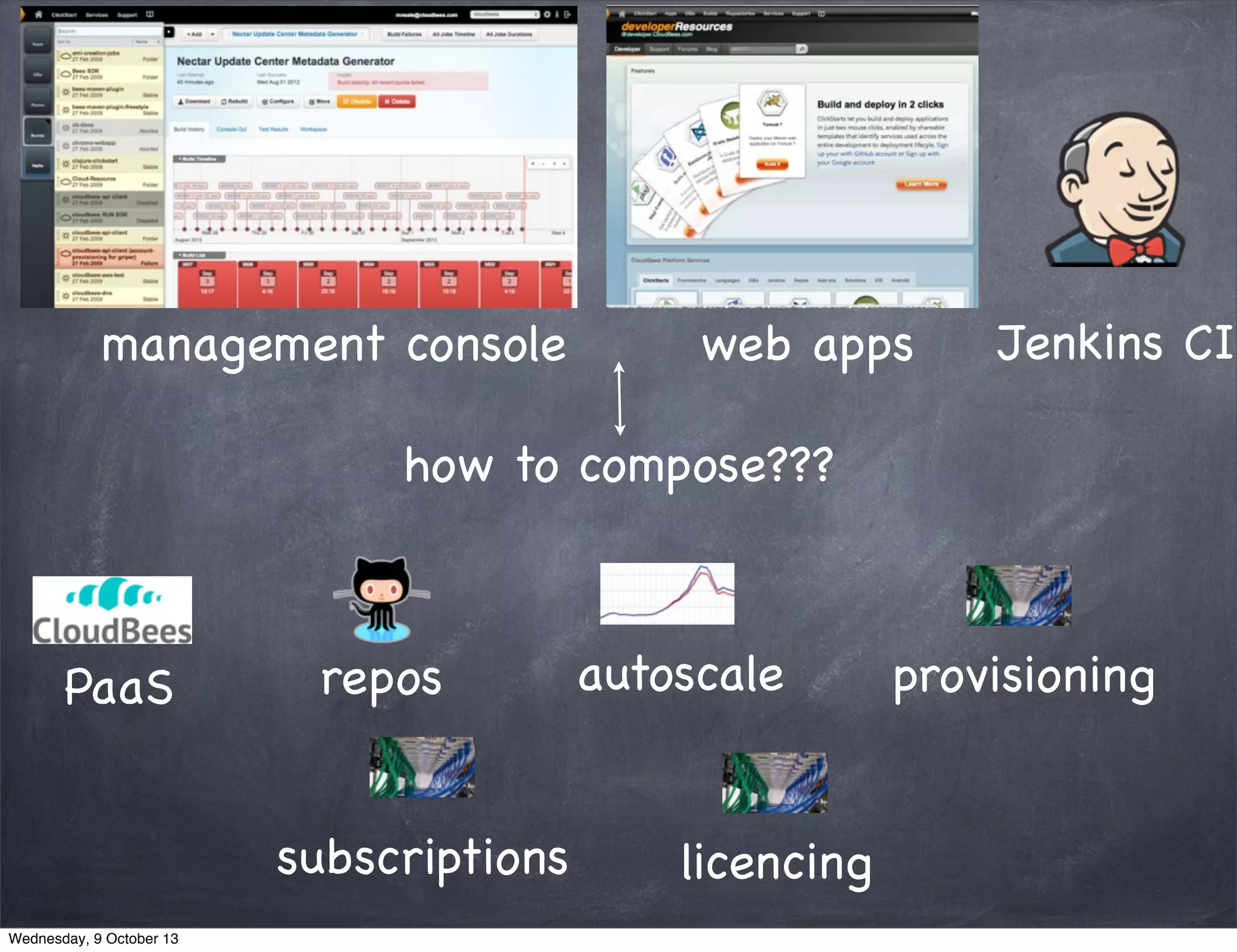
Jenkins CI
PaaS repos autoscale
management console web apps
how to compose???
provisioning
licencingsubscriptions
Wednesday, 9 October 13
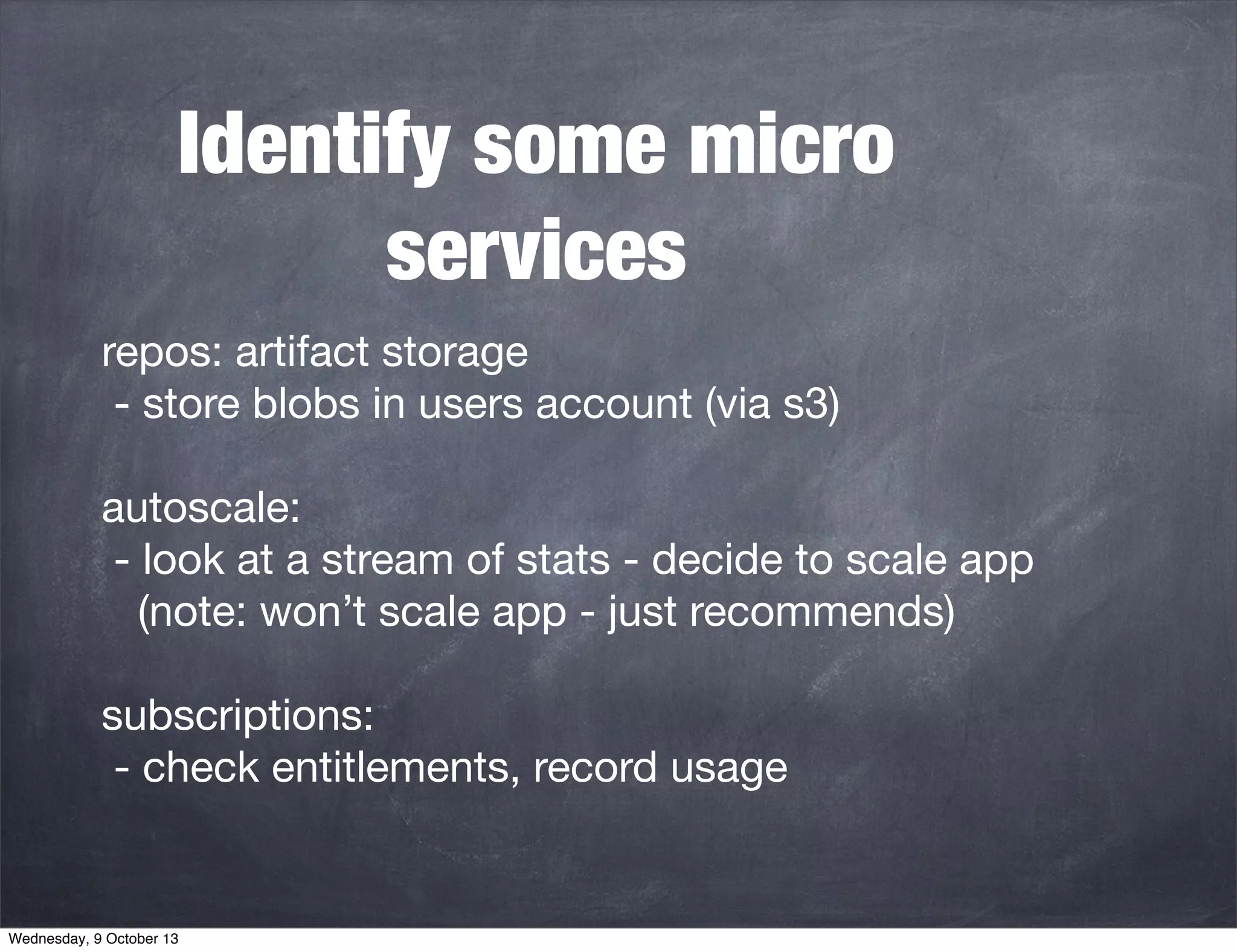
Identify some micro
services
repos: artifact storage
- store blobs in users account (via s3)
autoscale:
- look at a stream of stats - decide to scale app
(note: won’t scale app - just recommends)
subscriptions:
- check entitlements, record usage
Wednesday, 9 October 13
All in common:
All small!
All do one thing!
Wednesday, 9 October 13
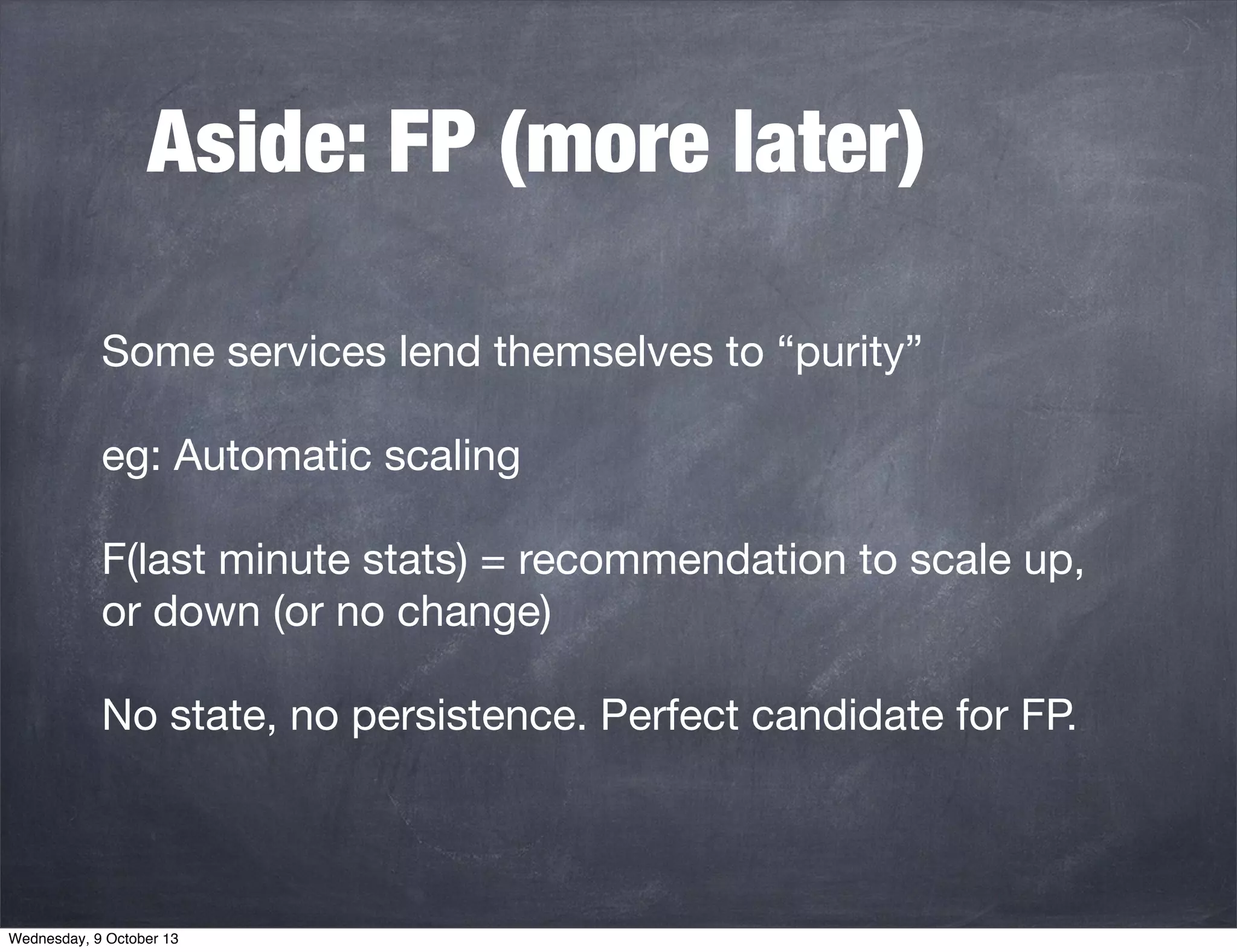
Aside: FP (more later)
Some services lend themselves to “purity”
eg: Automatic scaling
F(last minute stats) = recommendation to scale up,
or down (or no change)
No state, no persistence. Perfect candidate for FP.
Wednesday, 9 October 13
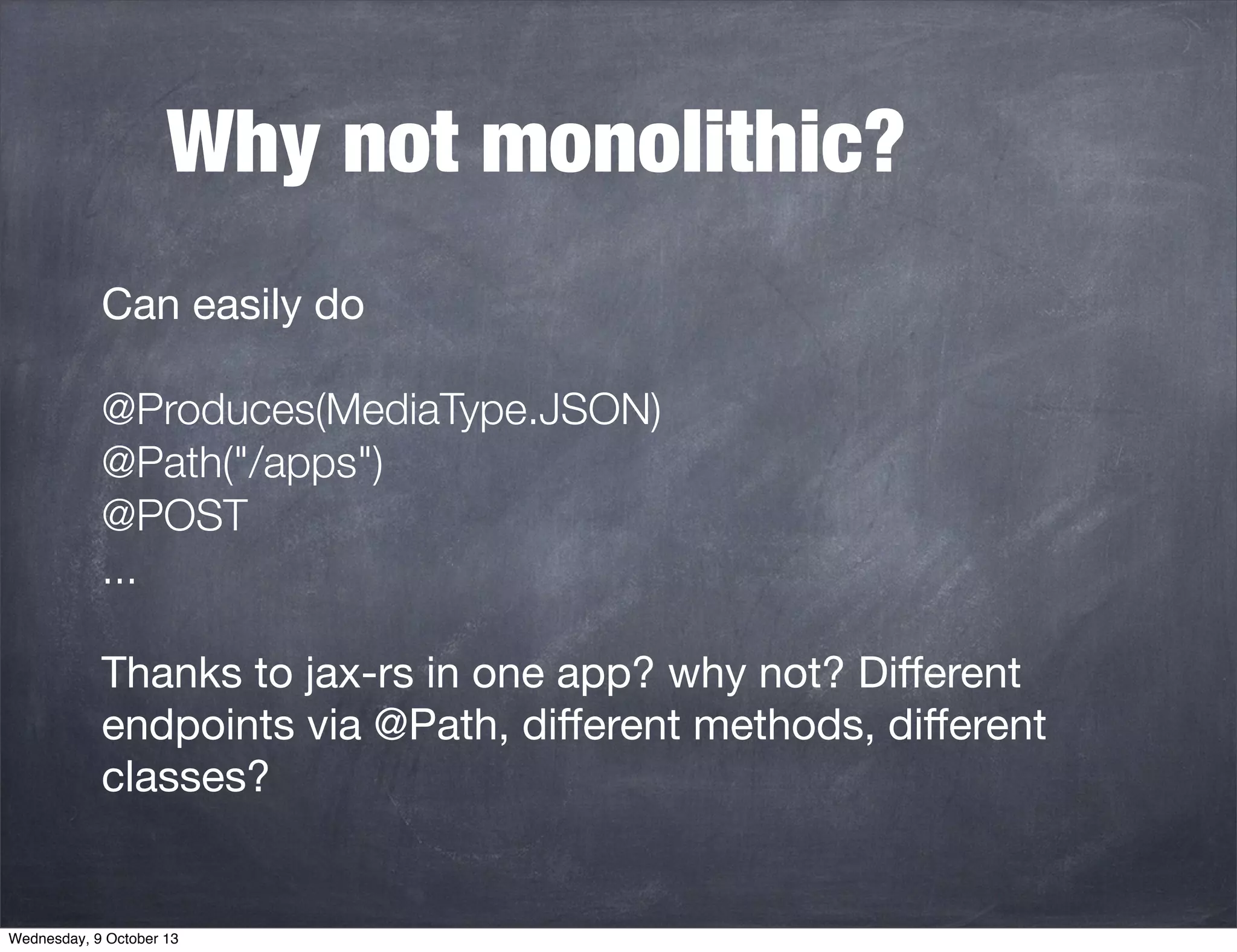
Why not monolithic?
Can easily do
@Produces(MediaType.JSON)
@Path("/apps")
@POST
...
Thanks to jax-rs in one app? why not? Different
endpoints via @Path, different methods, different
classes?
Wednesday, 9 October 13
Why not monolithic?
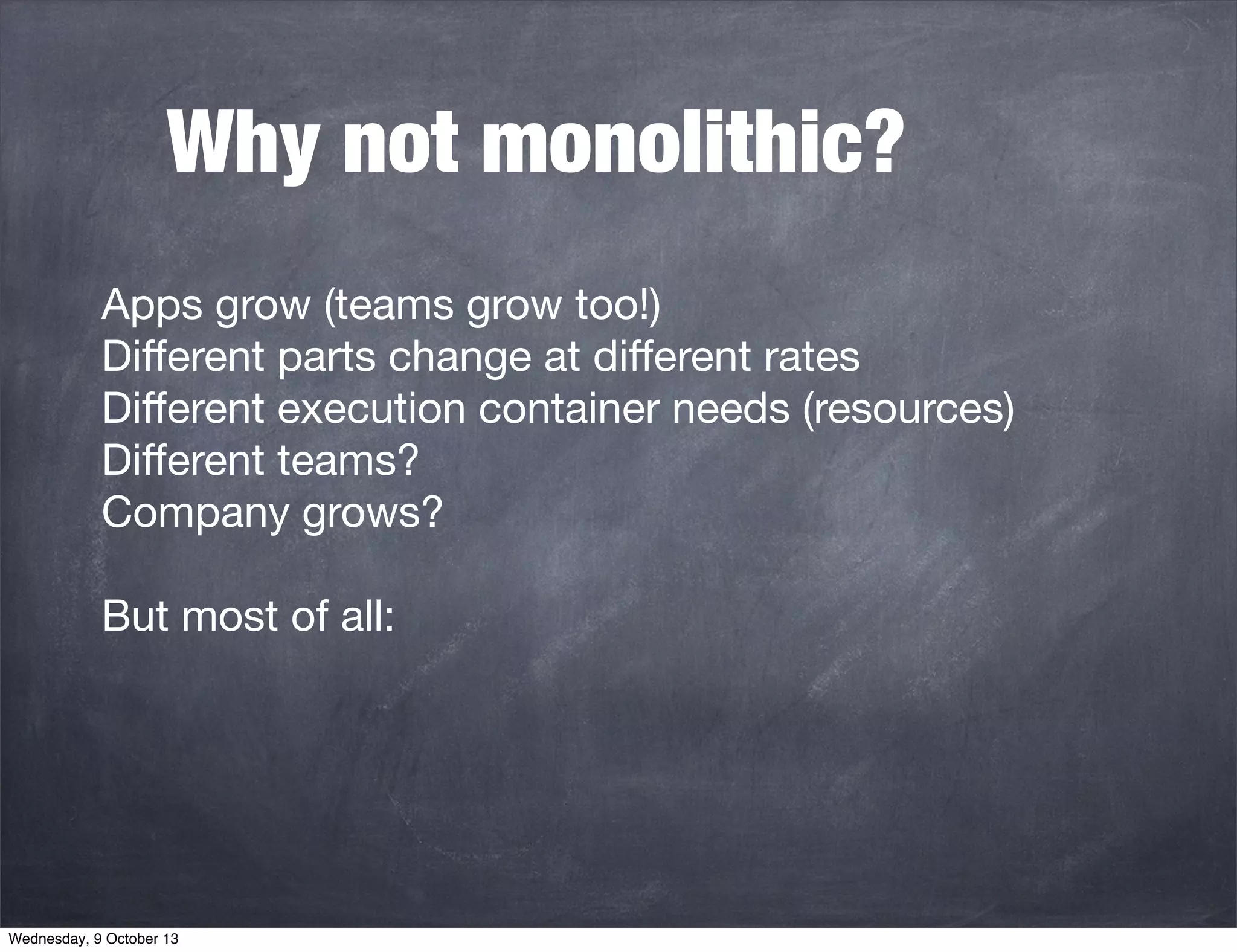
Apps grow (teams grow too!)
Different parts change at different rates
Different execution container needs (resources)
Different teams?
Company grows?
But most of all:
Wednesday, 9 October 13
Why not monolithic?
Fear.
Risk.
Fear of deploying a change.
Risk of trying a new technique, new framework.
Wednesday, 9 October 13
Why not monolithic?
Deploying a change to a microservice does not
increase blood pressure as much as deploying the
ONE MASSIVE APP THAT RUNS EVERYTHING
Wednesday, 9 October 13
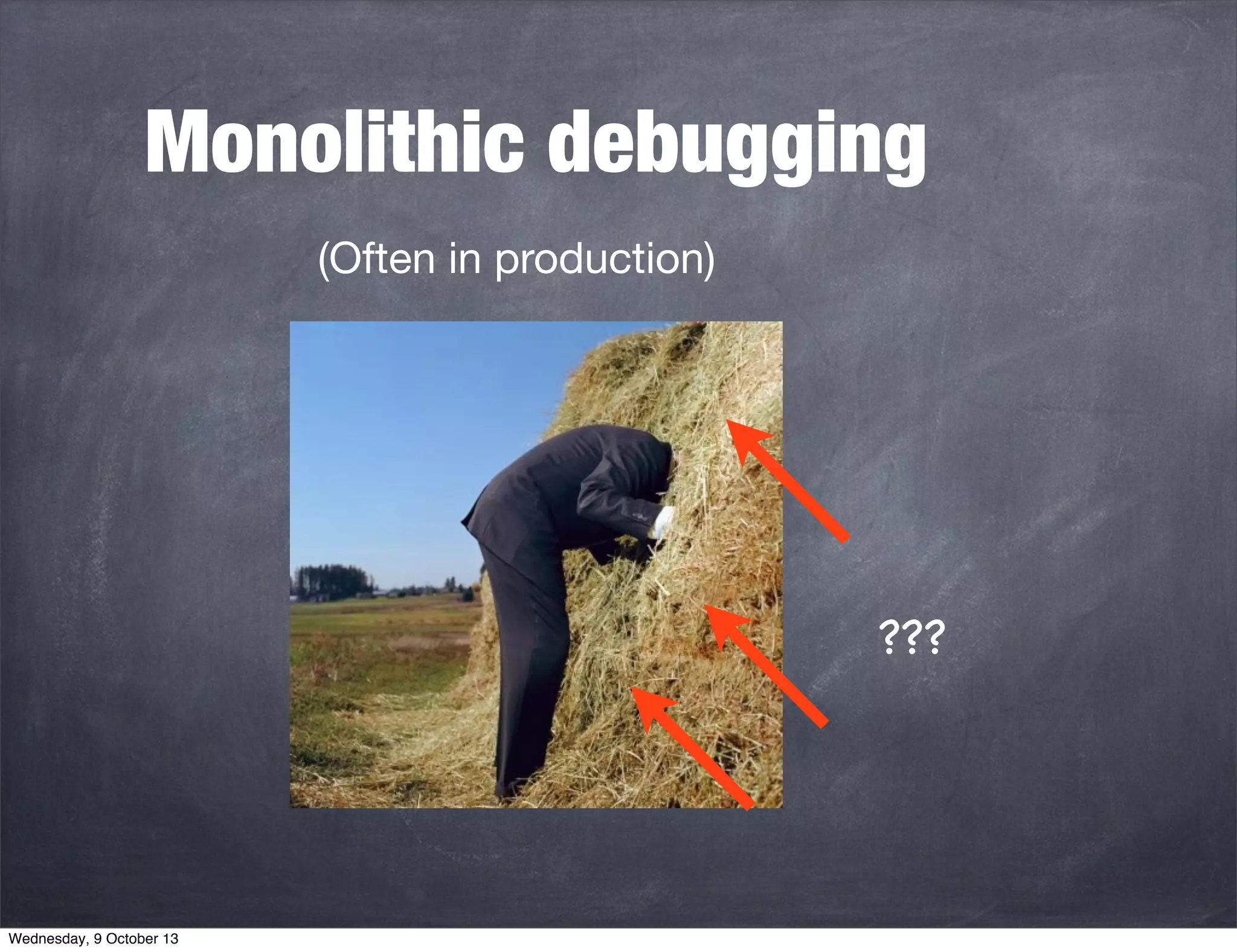
Monolithic debugging
(Often in production)
???
Wednesday, 9 October 13
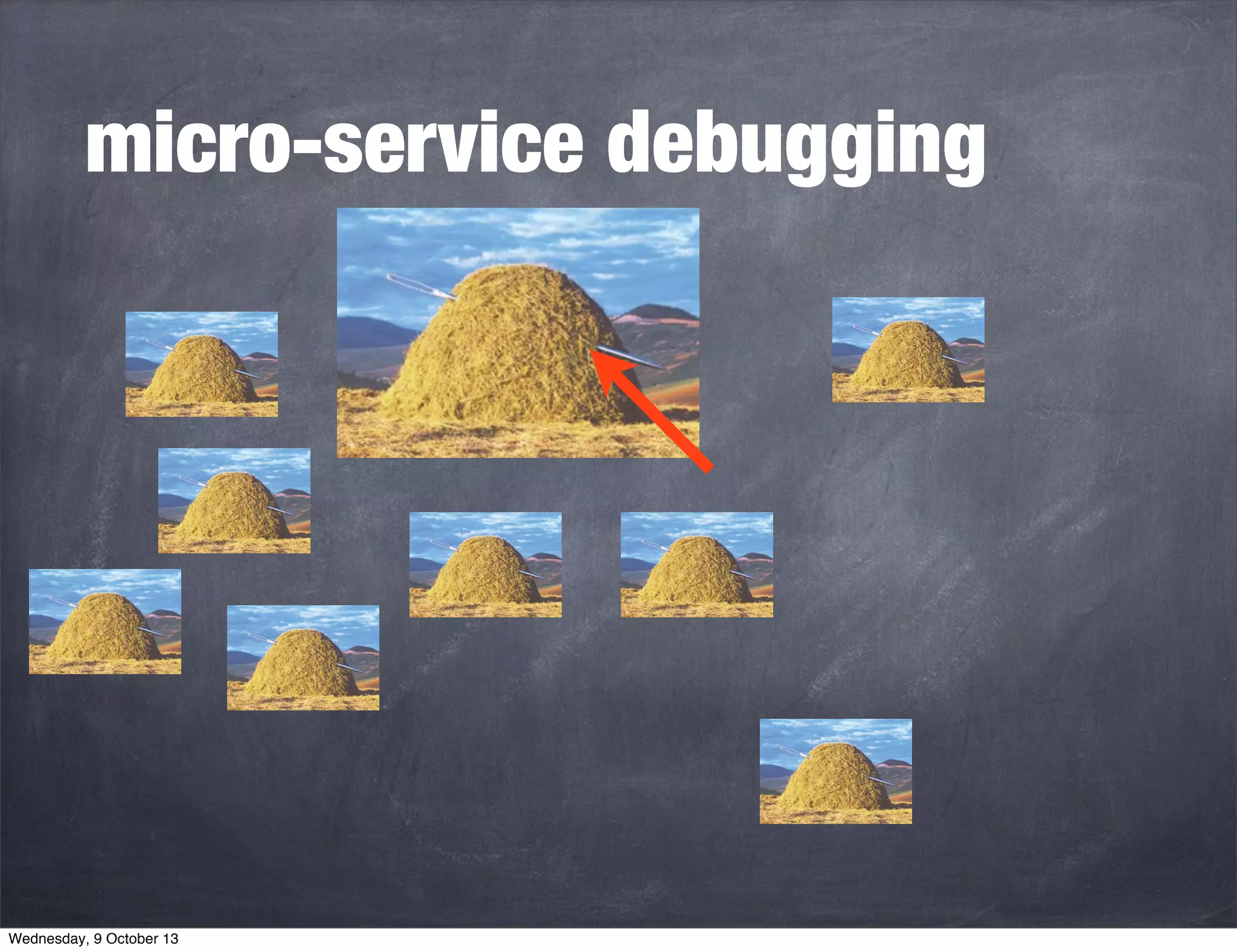
micro-service debugging
Wednesday, 9 October 13
Shift to dev-ops
More deployment expected
More *people* doing the deployment
Wednesday, 9 October 13
Smooth deployment
Microservices need:
- easy rollback
- no “over the wall” deployment
- easy as-needed deployment
- accessible deploy environment
A PaaS can help (private or public) - they were born
for this.
Wednesday, 9 October 13
Transport
Typically (but not always) HTTP
Typically (but not always) JSON
(autoscale service was message bus + thrift name/
value pairs)
But *are* always loosely coupled (ie never RMI)
Wednesday, 9 October 13
Containers
Execution environment:
- anything really
- consumers of APIs don’t care
- but developers do, deployers do
- JVM ideal: enough controls/constraints
- many languages
- many frameworks
If you had to pick one: JVM wins.
Wednesday, 9 October 13
Convinced?
By this point I hope I have convinced you
microservices are good.
Right?
Wednesday, 9 October 13
Functional Programming
with microservices
First, some background...
Wednesday, 9 October 13
Context
New Company
New Team
New Product
You might not be this “lucky”
Wednesday, 9 October 13
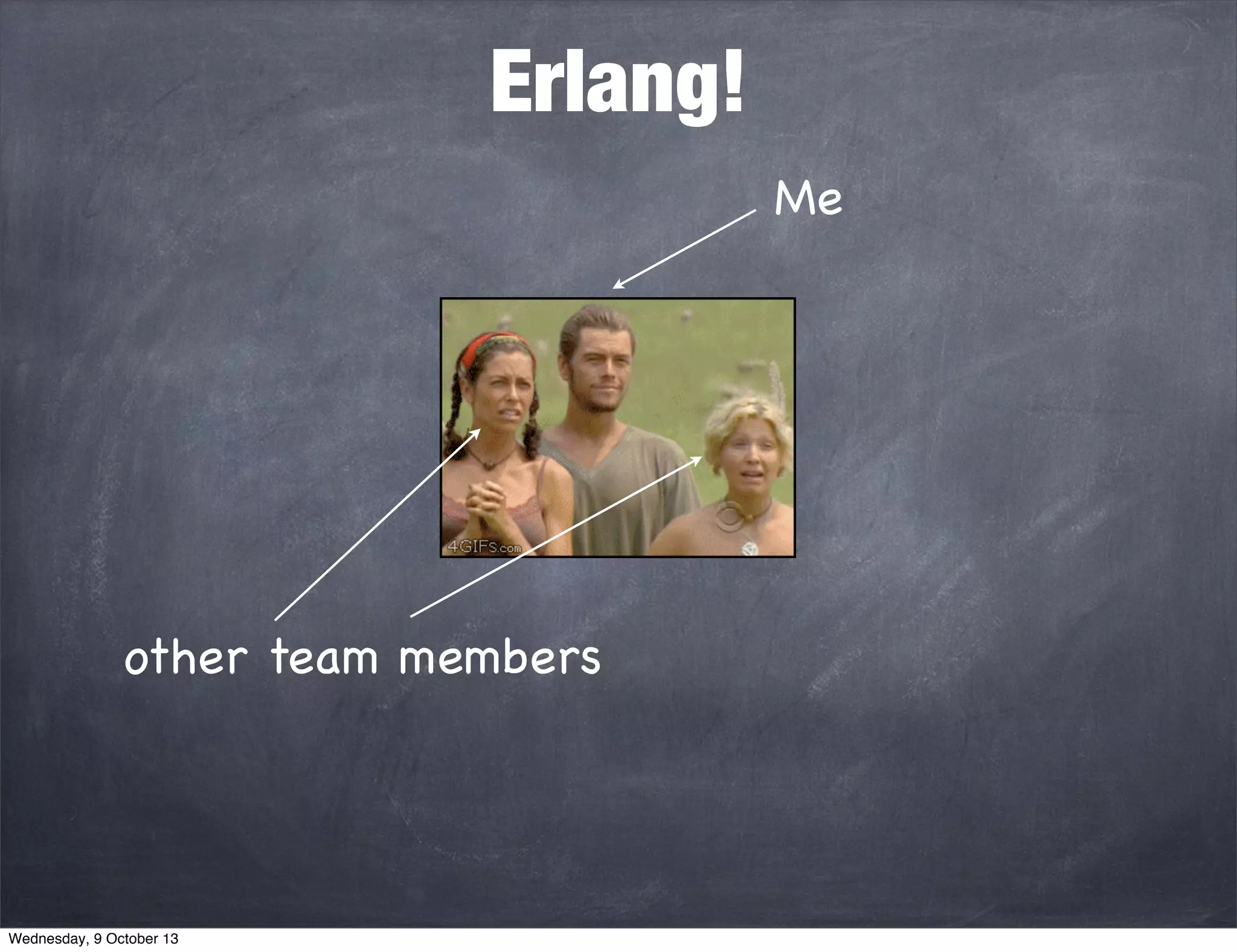
History
2010 Started: JVM stack parts - Scala not
controversial (I had experience) - working mostly
“lone wolf”
2011 - another team added - brought Erlang
Wednesday, 9 October 13
Erlang!
Me
other team members
Wednesday, 9 October 13
More FP
Given “success” with Scala, more FP (services,
languages) was not viewed as a great risk.
Wednesday, 9 October 13
Observation
FP means one person can do more &&
People like me like to work alone
∴ risk of staying with one-person-per micro service
(is this a bad thing?)
Wednesday, 9 October 13
Objections and resistance
Ask why:
- resistance to the “new” (unnecessary risk)
- resistance to FP ideas (hype?)
- polyglot fear
(realistically multiple languages will be used)
Wednesday, 9 October 13
Maintainability objection
It goes:
- how will anyone be able to maintain this after you?
My Experience:
- projects featuring FP handed over successfully
- new developers able to pick up FP easily
- seasoned developers too
Wednesday, 9 October 13
Where we may differ
Small teams - many systems.
∴ Little overlap in jobs.
We get to use a great PaaS !
(our own!) for all these micro services
Wednesday, 9 October 13
What did we do with FP
Manage horrendous public cloud APIs
Automatic scaling (microservice)
Github crawling (microservice)
Subscription/signup/entitlements (microservice)
... and microservices
Wednesday, 9 October 13
Surprisingly practical things
No real calculations, no explicit maths.
Just boring every day error prone stuff.
Wednesday, 9 October 13
For example (provisioning)
Wednesday, 9 October 13
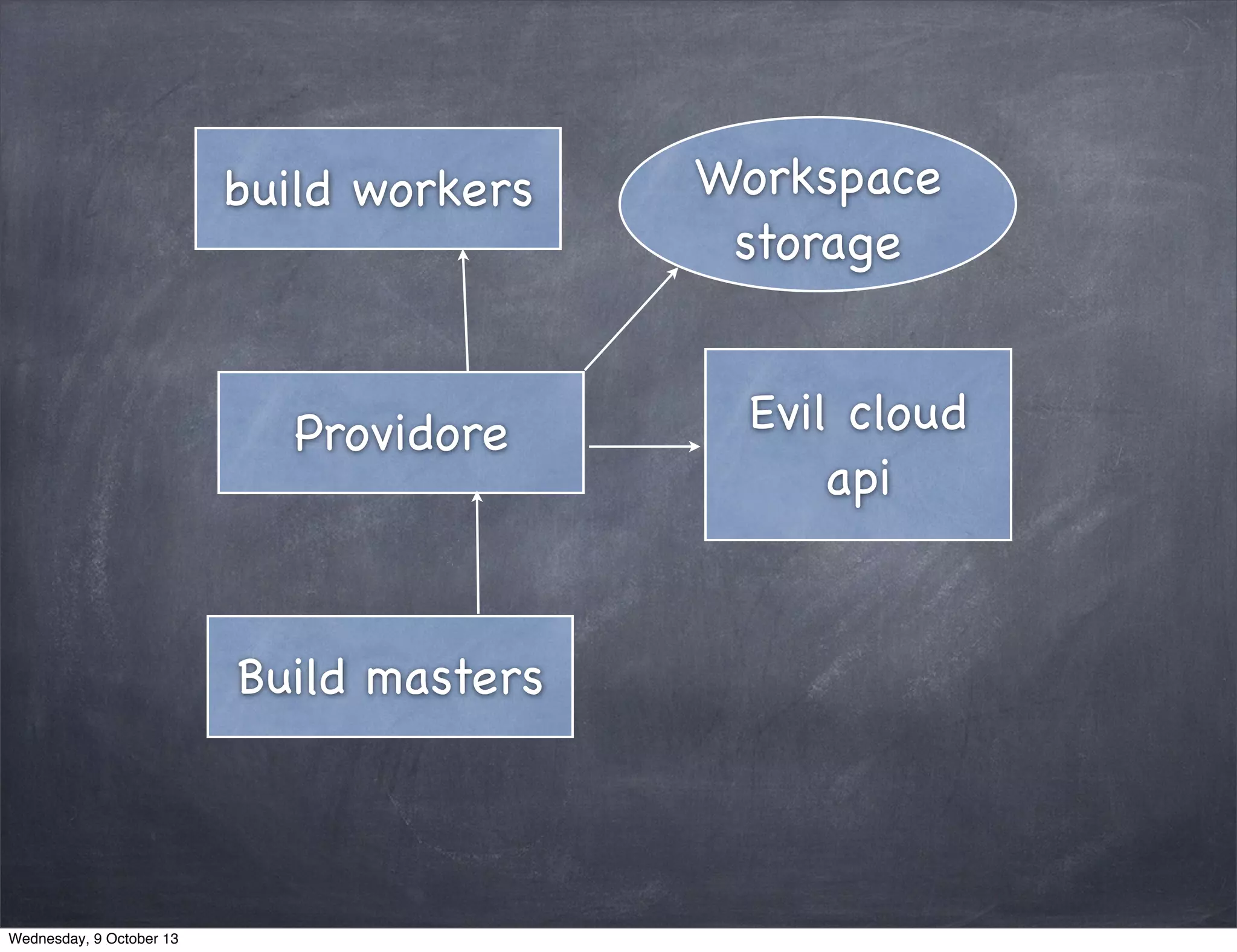
Providore Evil cloud
api
Build masters
build workers Workspace
storage
Wednesday, 9 October 13
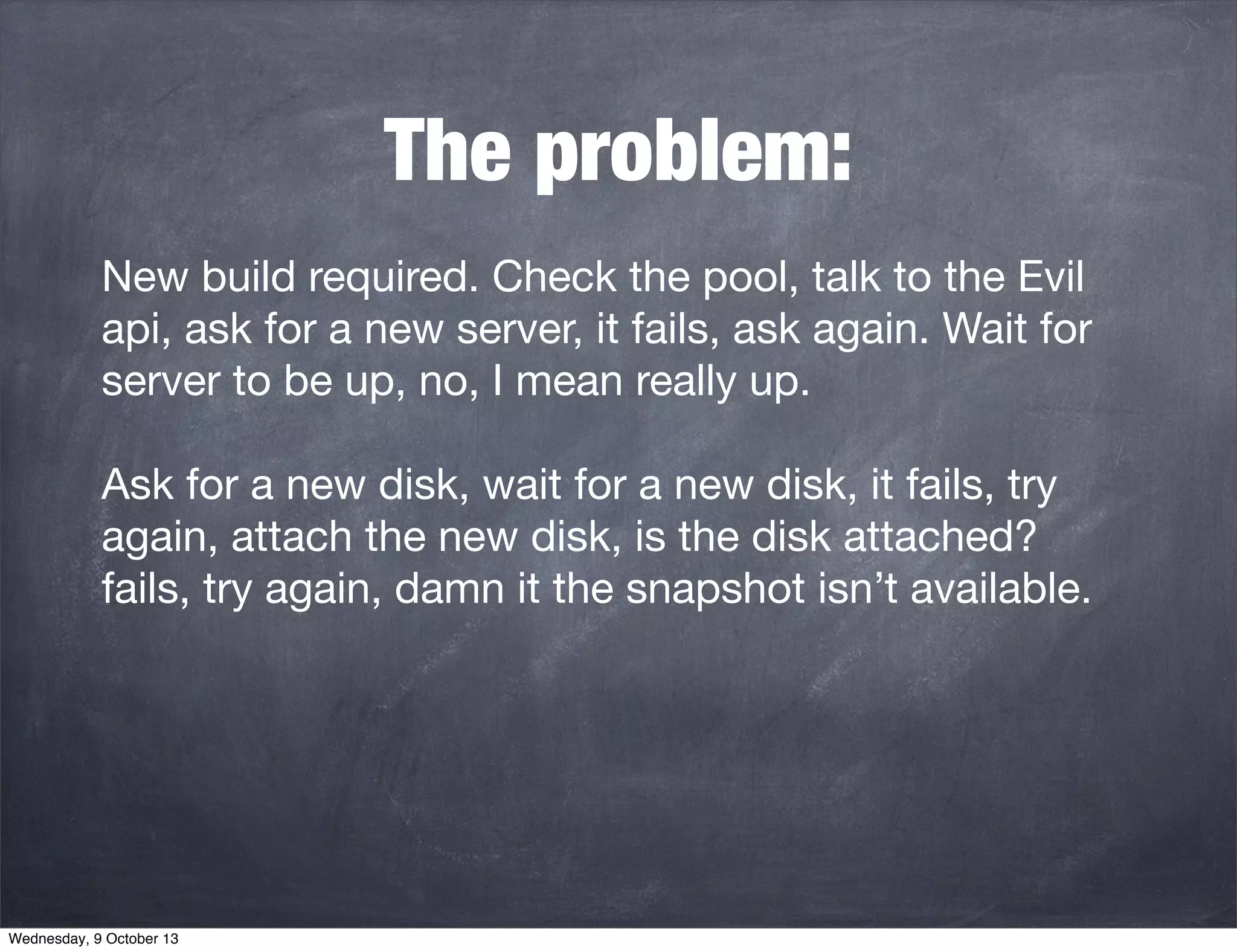
New build required. Check the pool, talk to the Evil
api, ask for a new server, it fails, ask again. Wait for
server to be up, no, I mean really up.
Ask for a new disk, wait for a new disk, it fails, try
again, attach the new disk, is the disk attached?
fails, try again, damn it the snapshot isn’t available.
The problem:
Wednesday, 9 October 13
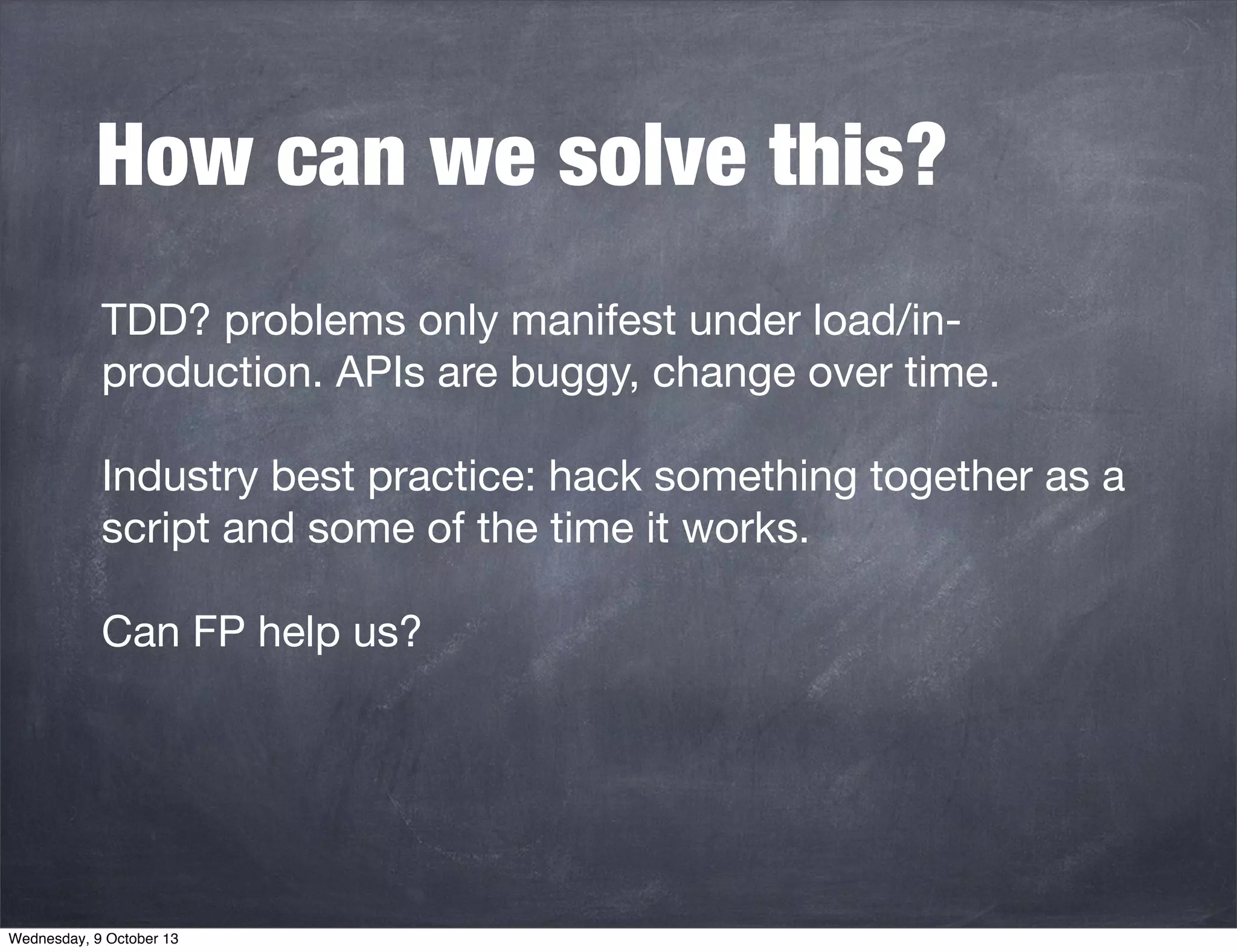
How can we solve this?
TDD? problems only manifest under load/in-
production. APIs are buggy, change over time.
Industry best practice: hack something together as a
script and some of the time it works.
Can FP help us?
Wednesday, 9 October 13
Yes
Types (providore is written in scala)
- Specifically: Option, Either
- Closed Data Types (servers only in so many states)
The M word: Monads
Currying
Wednesday, 9 October 13
Cloud API
launch_server: Server
at best hopes to be:
launch_server: Option[Server]
launch_server: Either[Server, OhGodWhyWhyWhy]
(not an actual pure function of course)
Wednesday, 9 October 13
Cloud Monad
Cloud APIs are like IO
Slow, horrible, misbehaving IO
...and then the APIs other people write
All want to be monadic
Wednesday, 9 October 13
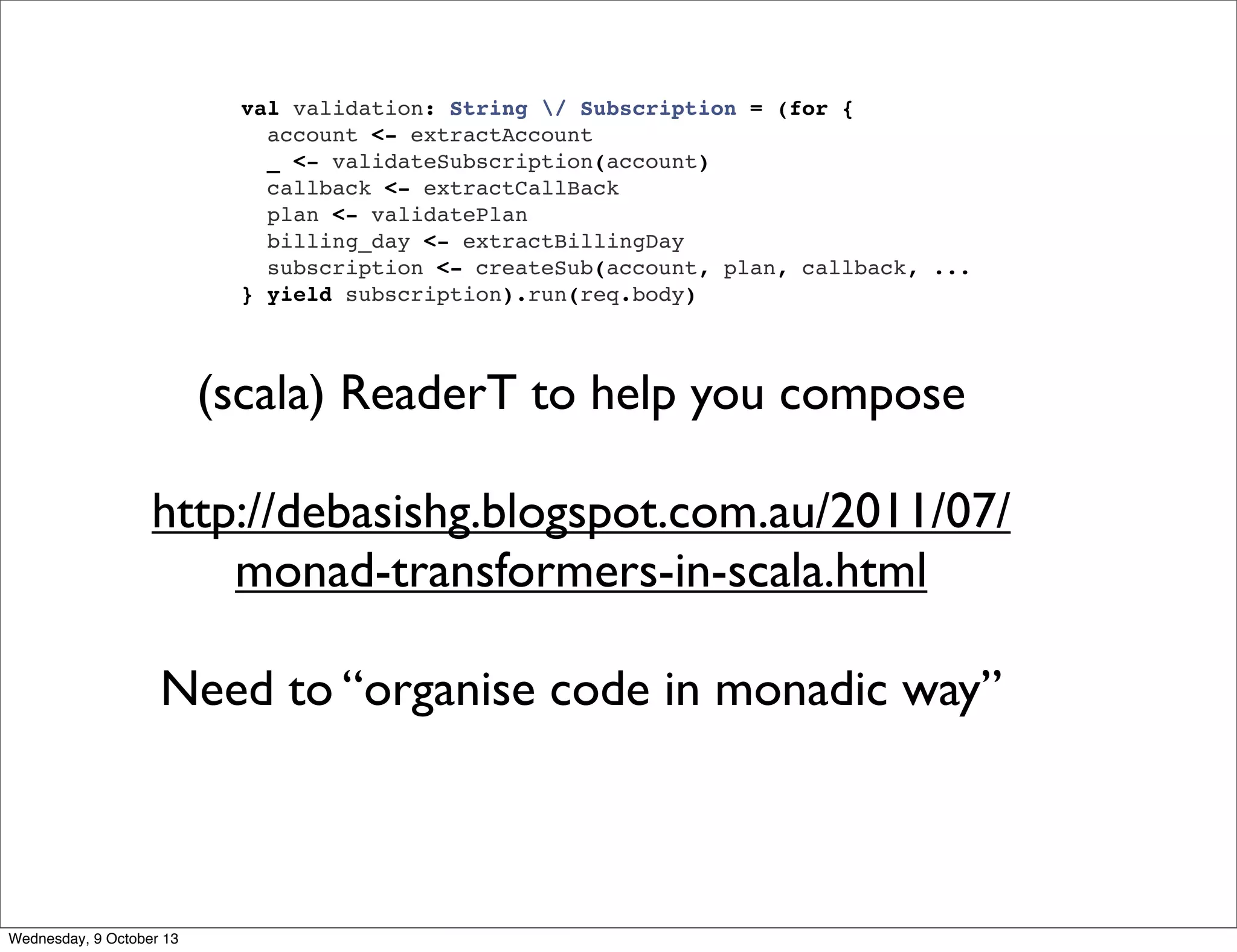
val validation: String / Subscription = (for {
account <- extractAccount
_ <- validateSubscription(account)
callback <- extractCallBack
plan <- validatePlan
billing_day <- extractBillingDay
subscription <- createSub(account, plan, callback, ...
} yield subscription).run(req.body)
(scala) ReaderT to help you compose
http://debasishg.blogspot.com.au/2011/07/
monad-transformers-in-scala.html
Need to “organise code in monadic way”
Wednesday, 9 October 13
Types
So hard to catch things without them
Monadic IO + types mean you catch things before
you try
Trying/experimenting can be $$ expensive...
(still learning this, all new to me)
Wednesday, 9 October 13
Types helped with
Ignored messages
Bad pattern matching
Misconfiguration/timing of server creation
Avoiding “stringly typed” messages
All “real world” things types have help us catch with
a friendly compile error**
** may not actually be friendly
Wednesday, 9 October 13
Types didn’t help with...
Wednesday, 9 October 13
def ec2
Fog::Compute.new(:provider => 'AWS',
:aws_secret_access_key => ENV['EC2_SECRET_KEY'],
:aws_access_key_id => ENV['EC2_ACCESS_KEY'])
end
 
def tenured? (instance)
instance.created_at && (instance.created_at < Chronic.parse('50 minutes
ago'))
end
 
def alive? (instance)
instance.state == 'running' or instance.state == 'stopped'
end
 
zombies = ec2.servers.select { |i| i.tags.empty? && tenured?(i) && alive?(i) }
Parallel.each(zombies, :in_threads => 15) do |zombie|
begin
puts "Terminating zombie node #{zombie.id}"
ec2.servers.get(zombie.id).destroy
end
end
Wednesday, 9 October 13
True story
Wednesday, 9 October 13
Currying
Server lifecycle: Reserved->Launching->Update
(user data)->Volume Create->Volume Attach-
>initialise/start
Accumulate setup data via partial application
Instead of an object that has mutating state, a
function you partially apply to accumulate data.
Good “beginner” FP concept (powerful, simple)
Wednesday, 9 October 13
Small things
But every little bit helps.
The pure FP is my ideal, rarely reached (so far)
Wednesday, 9 October 13
Another example
(autoscale)
Wednesday, 9 October 13
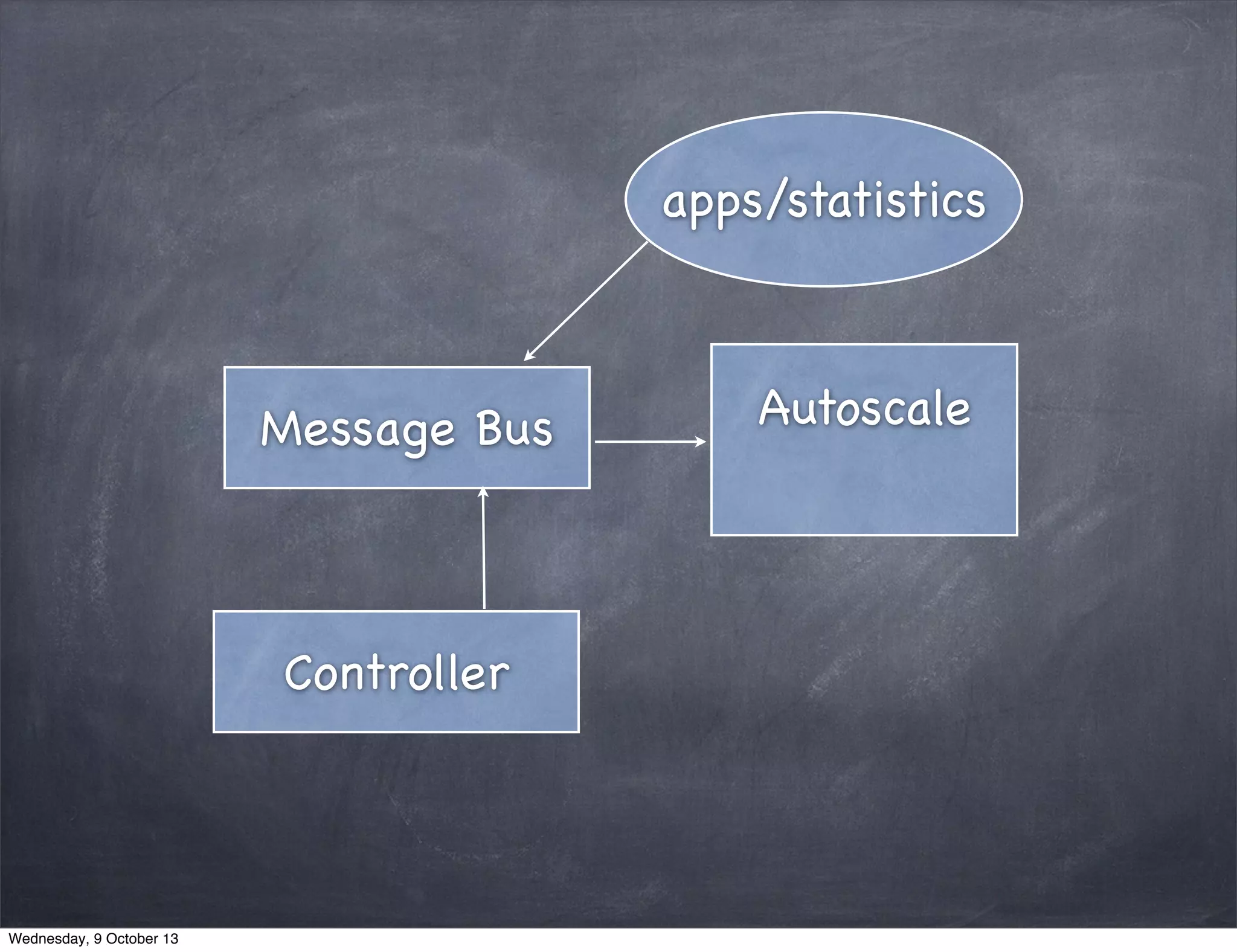
Message Bus Autoscale
Controller
apps/statistics
Wednesday, 9 October 13
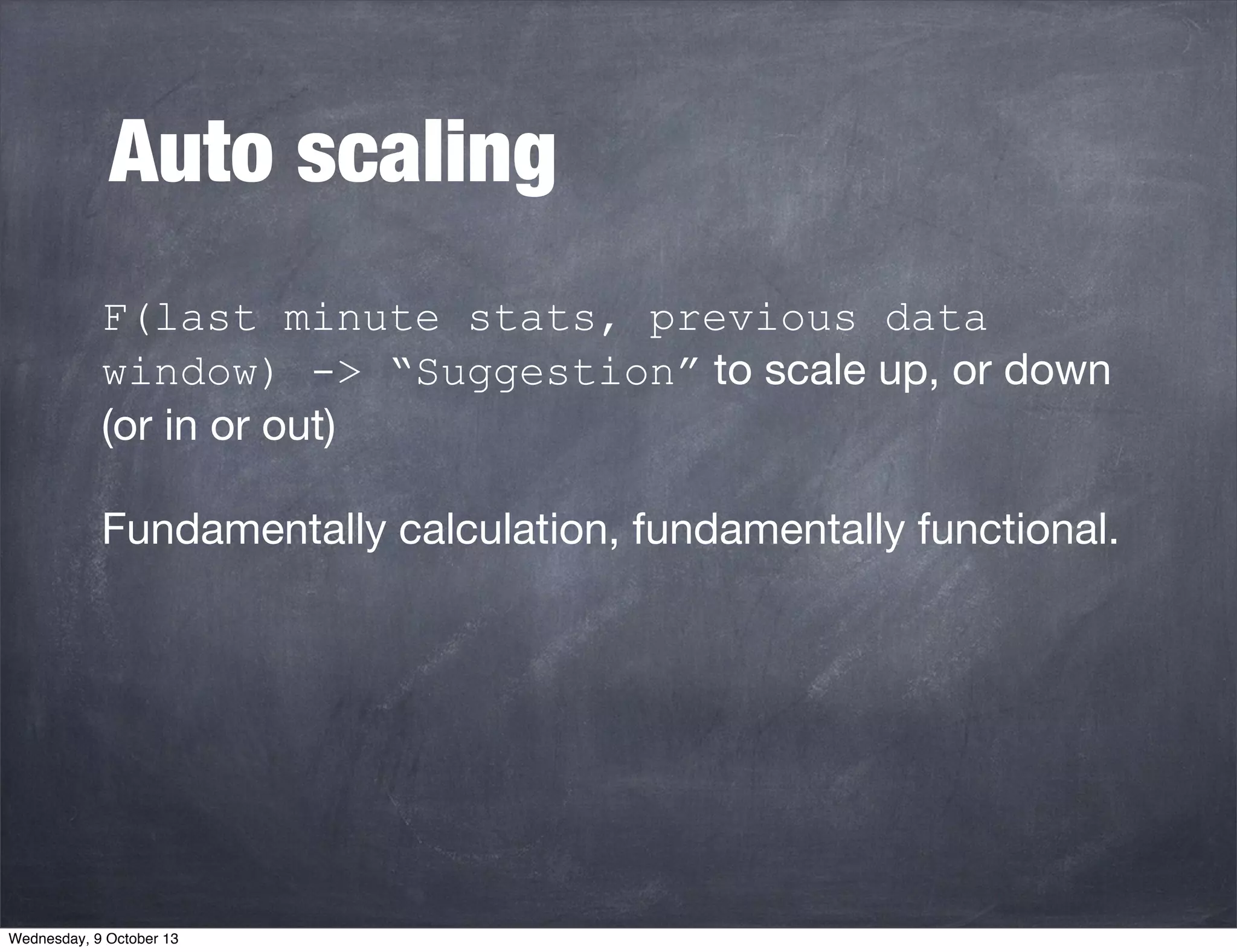
Auto scaling
F(last minute stats, previous data
window) -> “Suggestion” to scale up, or down
(or in or out)
Fundamentally calculation, fundamentally functional.
Wednesday, 9 October 13
Side effects
Push out side effects to other side of the message
bus
Let a nasty app handle the side effects
Messages are signals, suggestions, idempotent
Wednesday, 9 October 13
Advocating to Developers
Don’t “sell” to your developers by:
- saying monad too often
- saying “it’s easy”
- showing that it can be just as easy/familiar as what
they have
Instead...
Wednesday, 9 October 13
Find the functions
Find the functions in what they do
Find the calculations (eg core of autoscaling)
Advanced:
Separate the program definition from the execution
(monads)
Intermediate:
Currying, Higher order functions, Types (good ones)
Wednesday, 9 October 13
‘Unlearning’ OO
Clojure: excellent at teaching people to forget about
OO.
Scala: challenge. Temptation always there.
∴ Use object/package as namespace (avoid classes)
Aside: lack of implicit state allows “Erlang Magic”
Wednesday, 9 October 13
Some Frameworks for FP &
Microservices
Quick tour:
Wednesday, 9 October 13
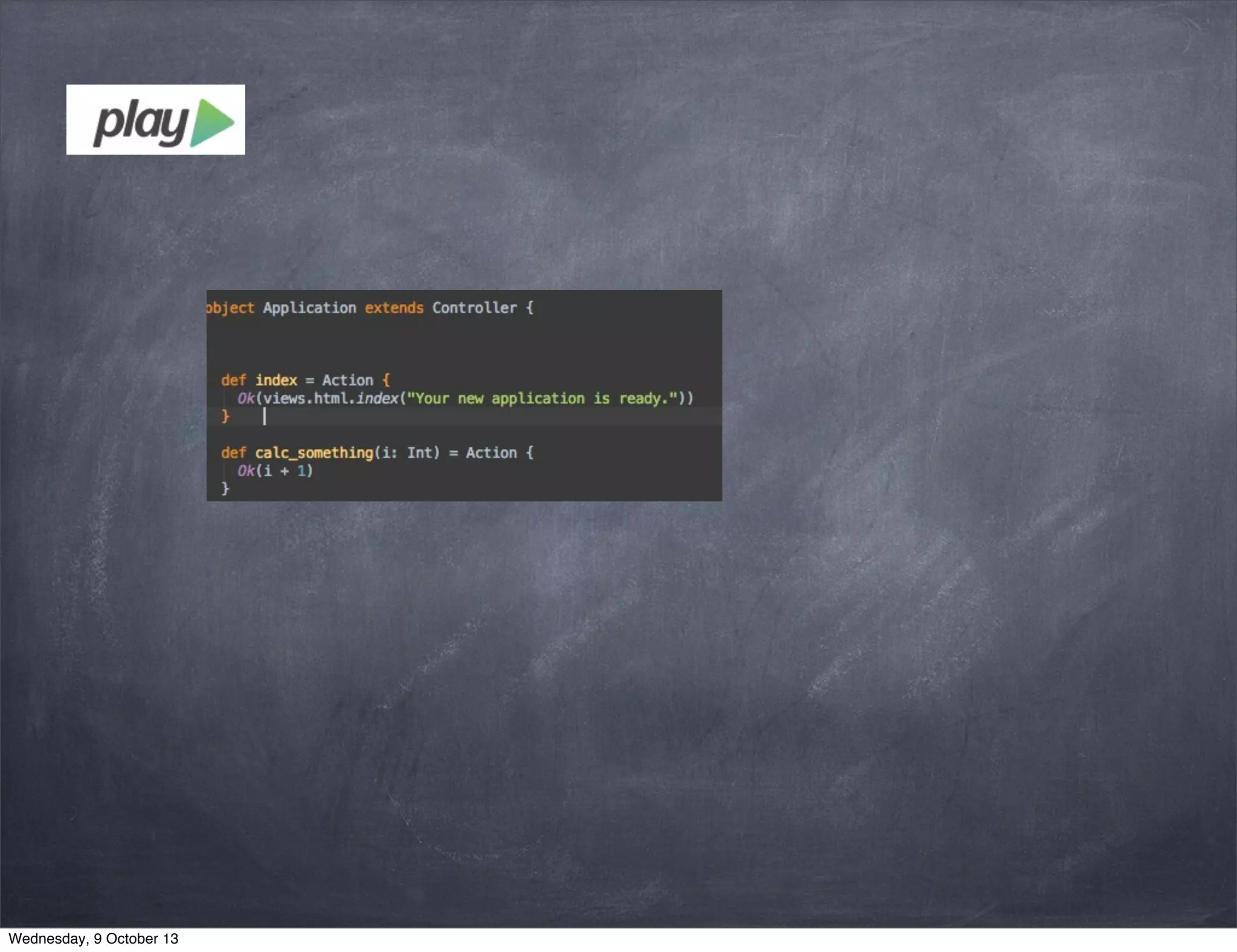
Quick development for web apps and APIs
RESTful by design
“batteries included” - has everything.
Easy reuse of all java libraries.
www.playframework.com
Wednesday, 9 October 13
Easy deployment (jar/zip file)
Can support DBs/evolution
Excellent JSON/http/web support
Security, Async, Background jobs, and more
Scala or Java.
Wednesday, 9 October 13
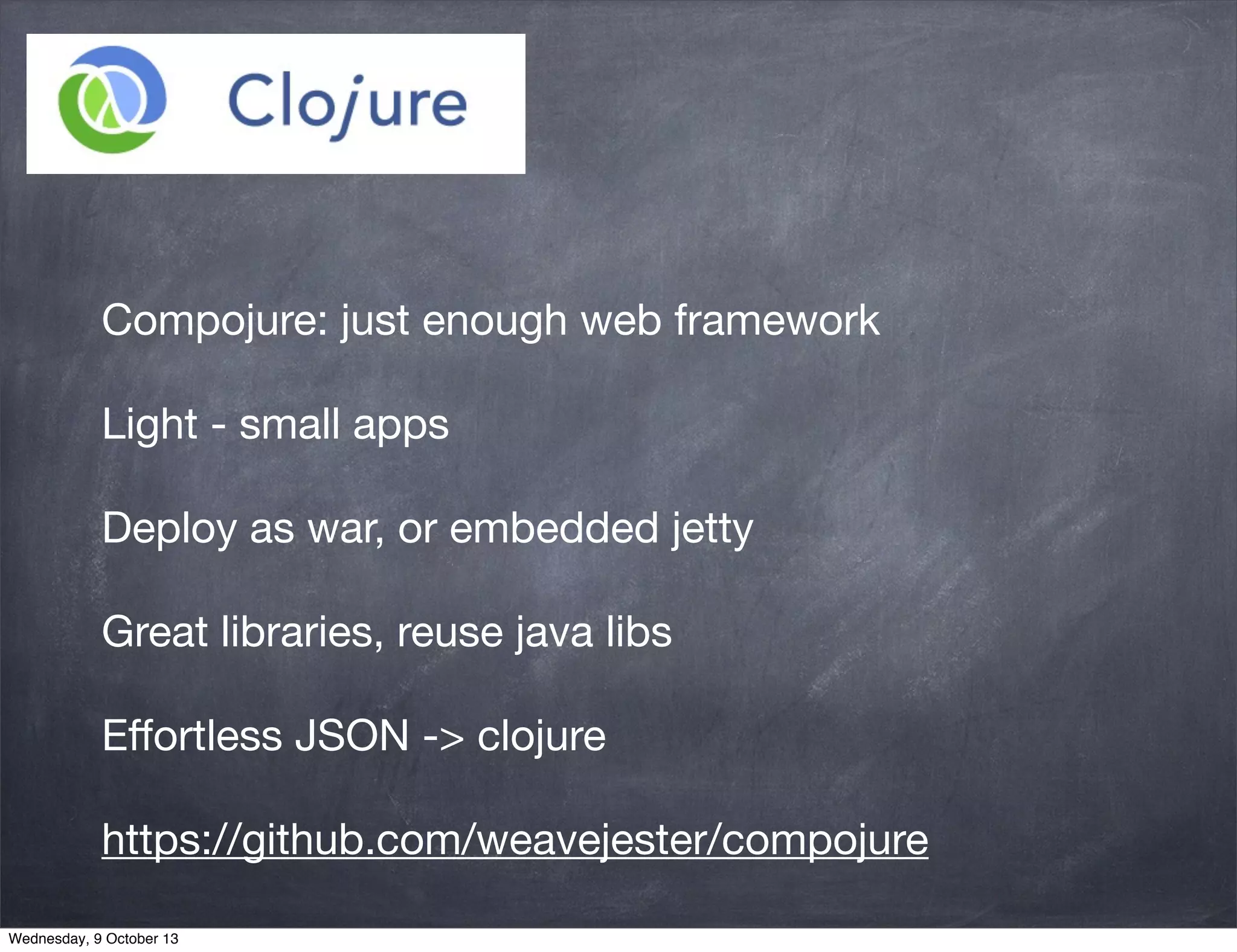
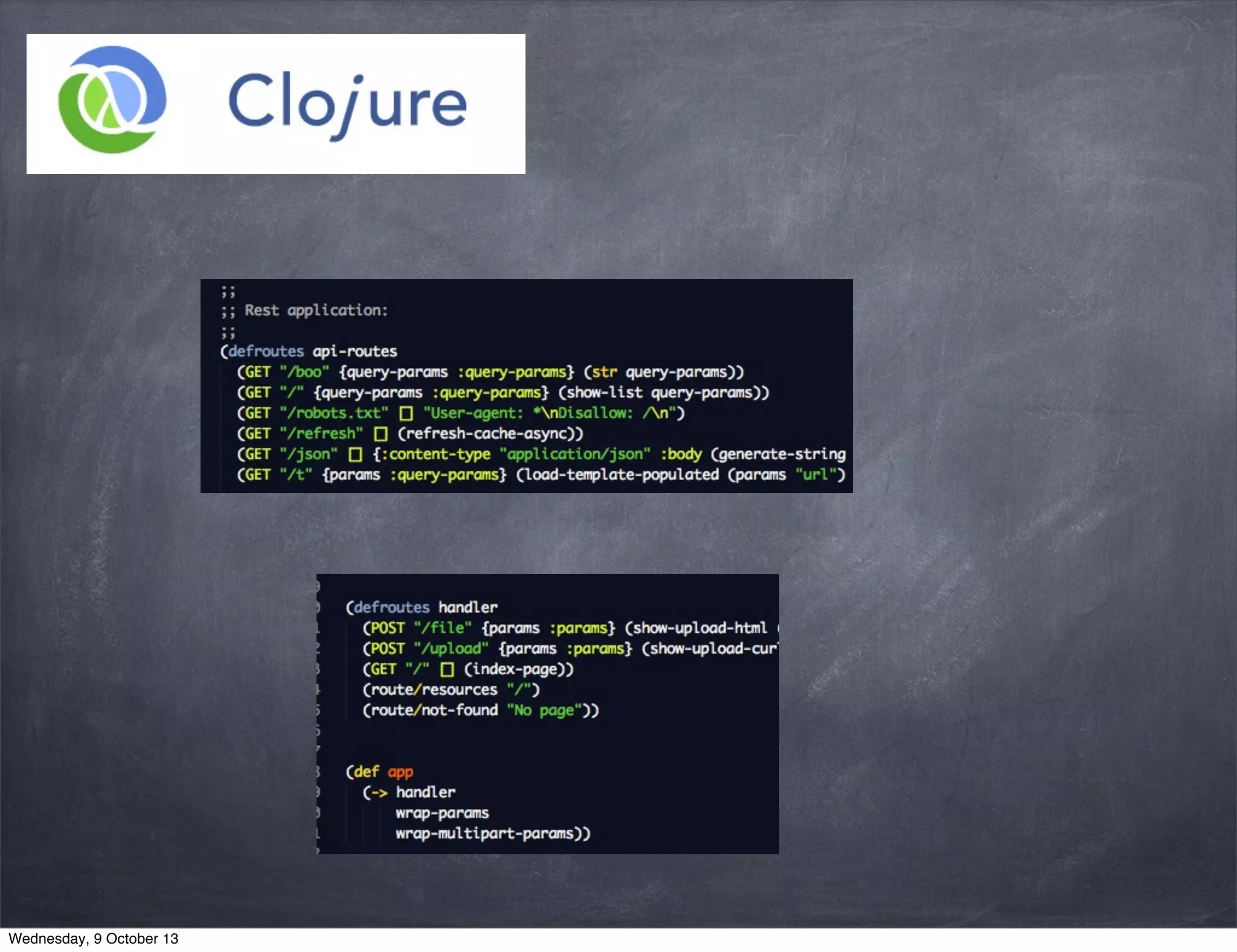
Compojure: just enough web framework
Light - small apps
Deploy as war, or embedded jetty
Great libraries, reuse java libs
Effortless JSON -> clojure
https://github.com/weavejester/compojure
Wednesday, 9 October 13
(:use cheshire.core)
(let [clojure-data (parse-string json-data)])
(generate-string clojure-data)
;;magic!
https://github.com/dakrone/cheshire
Wednesday, 9 October 13
To the Cloud!
Want to try things at your company:
Cloud Platforms (hint! vendor shilling!) make it easy
to try things out that may be used seriously.
Clojure anywhere, Scala anywhere
Say “cloud cloud” a lot and people will listen.
Wednesday, 9 October 13
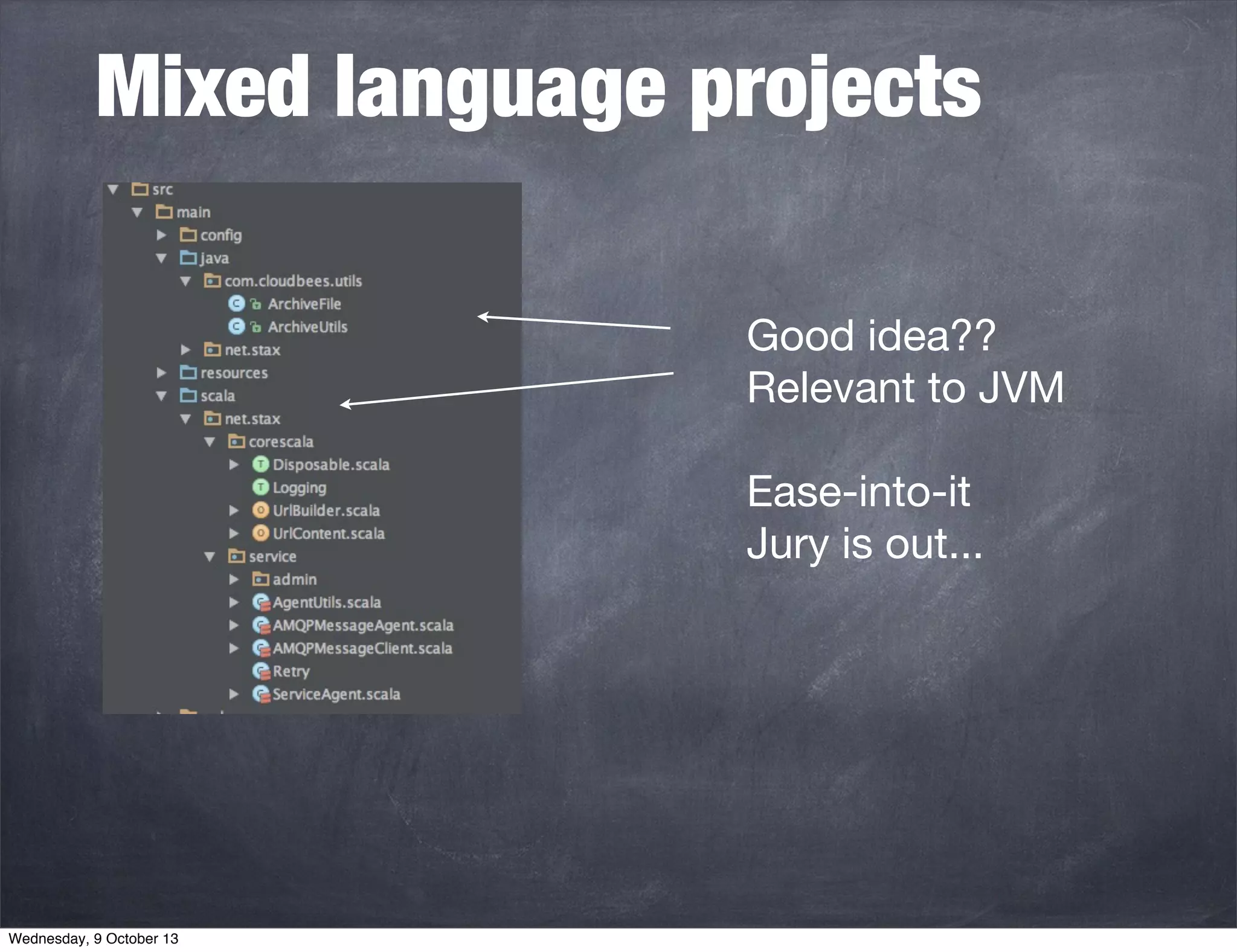
Mixed language projects
Good idea??
Relevant to JVM
Ease-into-it
Jury is out...
Wednesday, 9 October 13
Bad questions to hear
(when advocating)
If you hear these asked, probably will have a bad
time:
How will we hire people?
Does it work for large teams?
Wednesday, 9 October 13
Final Observation
Developers who have fondness for emacs/vim (over
IDE) find things easier
FP invites “change this small bit, see what happens”
exploration
No real tool barriers.
If I can do this, anyone can.
Wednesday, 9 October 13
Conclusion
FP and Microservices *naturally* go together
Can be about Risk Reduction in new rapid
deployment world
Cloud
A good place to try FP
Wednesday, 9 October 13
Thank you
Michael Neale
https://twitter.com/michaelneale
http://www.cloudbees.com
Wednesday, 9 October 13

Microservices and functional programming

  • 1.
    Microservices and FP MichaelNeale @michaelneale developer.cloudbees.com Wednesday, 9 October 13
  • 2.
    Microservices and FP Giventhat: We have lots of services - Everything has an API Functional programming: - quality improvements, popular - applied easily to “new” services/projects Combine them! Wednesday, 9 October 13
  • 3.
    Definitions Functional programming: - avoid/manageside effects - immutability over mutation - higher order functions - first class functions - composition using functions over OO Wednesday, 9 October 13
  • 4.
    Definitions Micro-service: - remotely accessibleservice (typically http) - does “one thing” (and does it well?) - executes stand alone in a container (JVM - in this case) - may depend on other services - can be composed into a larger service Wednesday, 9 October 13
  • 5.
    Definitions Micro-service: - “small” - independentlydeployed - loosely coupled - not necessarily reusable (but may be) Wednesday, 9 October 13
  • 6.
    Definitions Like a unixcommand line app that does ONE THING AND ONE THING ONLY! service1 | service2 | service3 .... Wednesday, 9 October 13
  • 7.
  • 8.
    Jenkins CI PaaS reposautoscale management console web apps how to compose??? provisioning licencingsubscriptions Wednesday, 9 October 13
  • 9.
    Identify some micro services repos:artifact storage - store blobs in users account (via s3) autoscale: - look at a stream of stats - decide to scale app (note: won’t scale app - just recommends) subscriptions: - check entitlements, record usage Wednesday, 9 October 13
  • 10.
    All in common: Allsmall! All do one thing! Wednesday, 9 October 13
  • 11.
    Aside: FP (morelater) Some services lend themselves to “purity” eg: Automatic scaling F(last minute stats) = recommendation to scale up, or down (or no change) No state, no persistence. Perfect candidate for FP. Wednesday, 9 October 13
  • 12.
    Why not monolithic? Caneasily do @Produces(MediaType.JSON) @Path("/apps") @POST ... Thanks to jax-rs in one app? why not? Different endpoints via @Path, different methods, different classes? Wednesday, 9 October 13
  • 13.
    Why not monolithic? Appsgrow (teams grow too!) Different parts change at different rates Different execution container needs (resources) Different teams? Company grows? But most of all: Wednesday, 9 October 13
  • 14.
    Why not monolithic? Fear. Risk. Fearof deploying a change. Risk of trying a new technique, new framework. Wednesday, 9 October 13
  • 15.
    Why not monolithic? Deployinga change to a microservice does not increase blood pressure as much as deploying the ONE MASSIVE APP THAT RUNS EVERYTHING Wednesday, 9 October 13
  • 16.
  • 17.
    Monolithic debugging (Often inproduction) ??? Wednesday, 9 October 13
  • 18.
  • 19.
    Shift to dev-ops Moredeployment expected More *people* doing the deployment Wednesday, 9 October 13
  • 20.
    Smooth deployment Microservices need: -easy rollback - no “over the wall” deployment - easy as-needed deployment - accessible deploy environment A PaaS can help (private or public) - they were born for this. Wednesday, 9 October 13
  • 21.
    Transport Typically (but notalways) HTTP Typically (but not always) JSON (autoscale service was message bus + thrift name/ value pairs) But *are* always loosely coupled (ie never RMI) Wednesday, 9 October 13
  • 22.
    Containers Execution environment: - anythingreally - consumers of APIs don’t care - but developers do, deployers do - JVM ideal: enough controls/constraints - many languages - many frameworks If you had to pick one: JVM wins. Wednesday, 9 October 13
  • 23.
    Convinced? By this pointI hope I have convinced you microservices are good. Right? Wednesday, 9 October 13
  • 24.
  • 25.
    Functional Programming with microservices First,some background... Wednesday, 9 October 13
  • 26.
    Context New Company New Team NewProduct You might not be this “lucky” Wednesday, 9 October 13
  • 27.
    History 2010 Started: JVMstack parts - Scala not controversial (I had experience) - working mostly “lone wolf” 2011 - another team added - brought Erlang Wednesday, 9 October 13
  • 28.
  • 29.
    More FP Given “success”with Scala, more FP (services, languages) was not viewed as a great risk. Wednesday, 9 October 13
  • 30.
    Observation FP means oneperson can do more && People like me like to work alone ∴ risk of staying with one-person-per micro service (is this a bad thing?) Wednesday, 9 October 13
  • 31.
    Objections and resistance Askwhy: - resistance to the “new” (unnecessary risk) - resistance to FP ideas (hype?) - polyglot fear (realistically multiple languages will be used) Wednesday, 9 October 13
  • 32.
    Maintainability objection It goes: -how will anyone be able to maintain this after you? My Experience: - projects featuring FP handed over successfully - new developers able to pick up FP easily - seasoned developers too Wednesday, 9 October 13
  • 33.
    Where we maydiffer Small teams - many systems. ∴ Little overlap in jobs. We get to use a great PaaS ! (our own!) for all these micro services Wednesday, 9 October 13
  • 34.
    What did wedo with FP Manage horrendous public cloud APIs Automatic scaling (microservice) Github crawling (microservice) Subscription/signup/entitlements (microservice) ... and microservices Wednesday, 9 October 13
  • 35.
    Surprisingly practical things Noreal calculations, no explicit maths. Just boring every day error prone stuff. Wednesday, 9 October 13
  • 36.
  • 37.
    Providore Evil cloud api Buildmasters build workers Workspace storage Wednesday, 9 October 13
  • 38.
    New build required.Check the pool, talk to the Evil api, ask for a new server, it fails, ask again. Wait for server to be up, no, I mean really up. Ask for a new disk, wait for a new disk, it fails, try again, attach the new disk, is the disk attached? fails, try again, damn it the snapshot isn’t available. The problem: Wednesday, 9 October 13
  • 39.
    How can wesolve this? TDD? problems only manifest under load/in- production. APIs are buggy, change over time. Industry best practice: hack something together as a script and some of the time it works. Can FP help us? Wednesday, 9 October 13
  • 40.
    Yes Types (providore iswritten in scala) - Specifically: Option, Either - Closed Data Types (servers only in so many states) The M word: Monads Currying Wednesday, 9 October 13
  • 41.
    Cloud API launch_server: Server atbest hopes to be: launch_server: Option[Server] launch_server: Either[Server, OhGodWhyWhyWhy] (not an actual pure function of course) Wednesday, 9 October 13
  • 42.
    Cloud Monad Cloud APIsare like IO Slow, horrible, misbehaving IO ...and then the APIs other people write All want to be monadic Wednesday, 9 October 13
  • 43.
    val validation: String/ Subscription = (for { account <- extractAccount _ <- validateSubscription(account) callback <- extractCallBack plan <- validatePlan billing_day <- extractBillingDay subscription <- createSub(account, plan, callback, ... } yield subscription).run(req.body) (scala) ReaderT to help you compose http://debasishg.blogspot.com.au/2011/07/ monad-transformers-in-scala.html Need to “organise code in monadic way” Wednesday, 9 October 13
  • 44.
    Types So hard tocatch things without them Monadic IO + types mean you catch things before you try Trying/experimenting can be $$ expensive... (still learning this, all new to me) Wednesday, 9 October 13
  • 45.
    Types helped with Ignoredmessages Bad pattern matching Misconfiguration/timing of server creation Avoiding “stringly typed” messages All “real world” things types have help us catch with a friendly compile error** ** may not actually be friendly Wednesday, 9 October 13
  • 46.
    Types didn’t helpwith... Wednesday, 9 October 13
  • 47.
    def ec2 Fog::Compute.new(:provider =>'AWS', :aws_secret_access_key => ENV['EC2_SECRET_KEY'], :aws_access_key_id => ENV['EC2_ACCESS_KEY']) end   def tenured? (instance) instance.created_at && (instance.created_at < Chronic.parse('50 minutes ago')) end   def alive? (instance) instance.state == 'running' or instance.state == 'stopped' end   zombies = ec2.servers.select { |i| i.tags.empty? && tenured?(i) && alive?(i) } Parallel.each(zombies, :in_threads => 15) do |zombie| begin puts "Terminating zombie node #{zombie.id}" ec2.servers.get(zombie.id).destroy end end Wednesday, 9 October 13
  • 48.
  • 49.
    Currying Server lifecycle: Reserved->Launching->Update (userdata)->Volume Create->Volume Attach- >initialise/start Accumulate setup data via partial application Instead of an object that has mutating state, a function you partially apply to accumulate data. Good “beginner” FP concept (powerful, simple) Wednesday, 9 October 13
  • 50.
    Small things But everylittle bit helps. The pure FP is my ideal, rarely reached (so far) Wednesday, 9 October 13
  • 51.
  • 52.
  • 53.
    Auto scaling F(last minutestats, previous data window) -> “Suggestion” to scale up, or down (or in or out) Fundamentally calculation, fundamentally functional. Wednesday, 9 October 13
  • 54.
    Side effects Push outside effects to other side of the message bus Let a nasty app handle the side effects Messages are signals, suggestions, idempotent Wednesday, 9 October 13
  • 55.
    Advocating to Developers Don’t“sell” to your developers by: - saying monad too often - saying “it’s easy” - showing that it can be just as easy/familiar as what they have Instead... Wednesday, 9 October 13
  • 56.
    Find the functions Findthe functions in what they do Find the calculations (eg core of autoscaling) Advanced: Separate the program definition from the execution (monads) Intermediate: Currying, Higher order functions, Types (good ones) Wednesday, 9 October 13
  • 57.
    ‘Unlearning’ OO Clojure: excellentat teaching people to forget about OO. Scala: challenge. Temptation always there. ∴ Use object/package as namespace (avoid classes) Aside: lack of implicit state allows “Erlang Magic” Wednesday, 9 October 13
  • 58.
    Some Frameworks forFP & Microservices Quick tour: Wednesday, 9 October 13
  • 59.
    Quick development forweb apps and APIs RESTful by design “batteries included” - has everything. Easy reuse of all java libraries. www.playframework.com Wednesday, 9 October 13
  • 60.
  • 61.
    Easy deployment (jar/zipfile) Can support DBs/evolution Excellent JSON/http/web support Security, Async, Background jobs, and more Scala or Java. Wednesday, 9 October 13
  • 62.
    Compojure: just enoughweb framework Light - small apps Deploy as war, or embedded jetty Great libraries, reuse java libs Effortless JSON -> clojure https://github.com/weavejester/compojure Wednesday, 9 October 13
  • 63.
  • 64.
    (:use cheshire.core) (let [clojure-data(parse-string json-data)]) (generate-string clojure-data) ;;magic! https://github.com/dakrone/cheshire Wednesday, 9 October 13
  • 65.
    To the Cloud! Wantto try things at your company: Cloud Platforms (hint! vendor shilling!) make it easy to try things out that may be used seriously. Clojure anywhere, Scala anywhere Say “cloud cloud” a lot and people will listen. Wednesday, 9 October 13
  • 66.
    Mixed language projects Goodidea?? Relevant to JVM Ease-into-it Jury is out... Wednesday, 9 October 13
  • 67.
    Bad questions tohear (when advocating) If you hear these asked, probably will have a bad time: How will we hire people? Does it work for large teams? Wednesday, 9 October 13
  • 68.
    Final Observation Developers whohave fondness for emacs/vim (over IDE) find things easier FP invites “change this small bit, see what happens” exploration No real tool barriers. If I can do this, anyone can. Wednesday, 9 October 13
  • 69.
    Conclusion FP and Microservices*naturally* go together Can be about Risk Reduction in new rapid deployment world Cloud A good place to try FP Wednesday, 9 October 13
  • 70.