Microprocessors
Microcontroller
Fundamentals
Presented By-
Diwaker Pant
Assistant Professor
ECE Department
7/16/2015 1By, Diwaker Pant
 Introduction
 Evolution of Microprocessor
 Block diagram & Architecture of Microprocessor
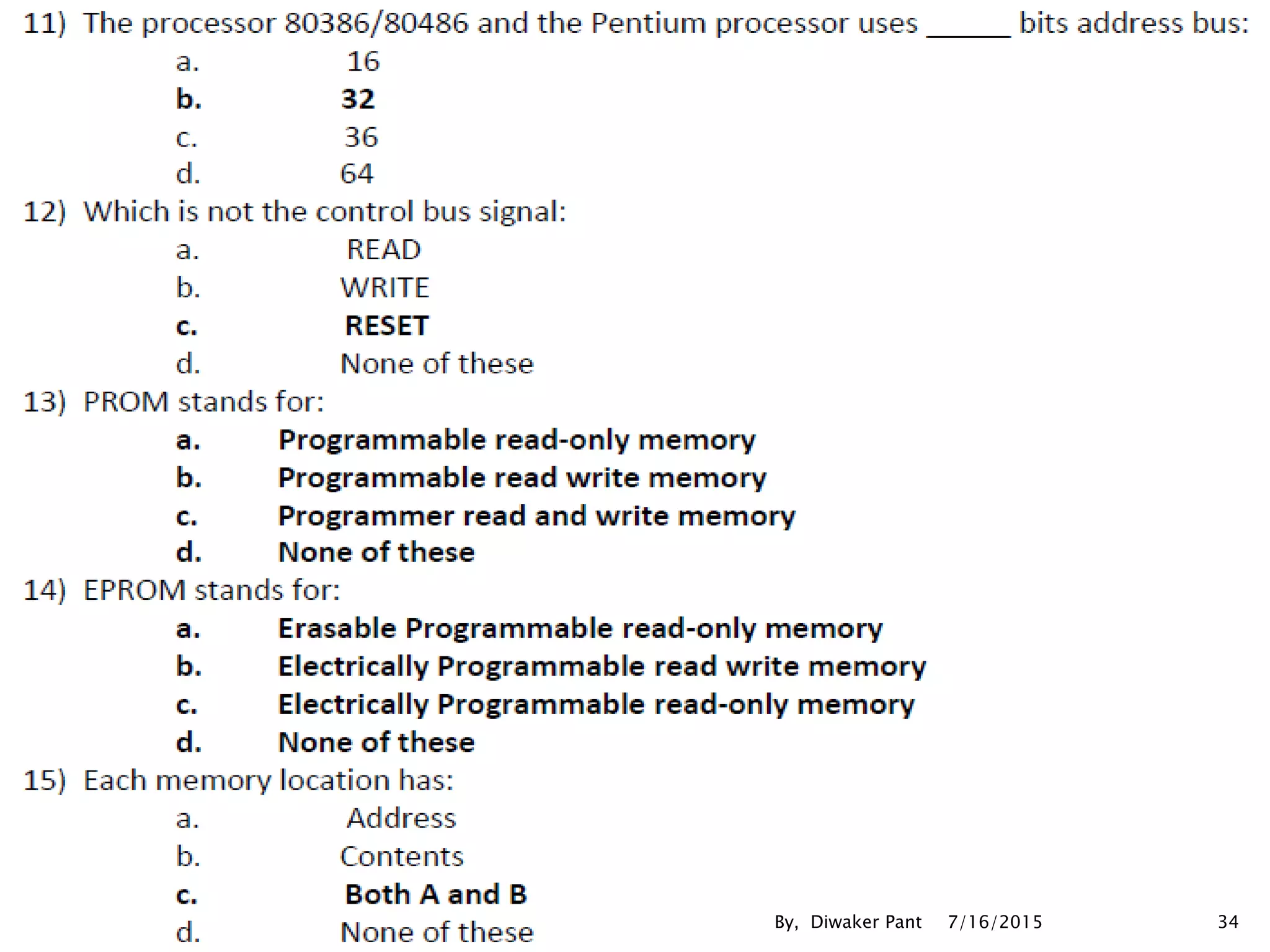
 Microcontroller Fundamentals
 Applications of Microprocessor and Microcontroller
 Manufacturers of Microprocessor and Microcontrollers
 Questions in Competitive examinations
 Conclusion
 References
7/16/2015 2By, Diwaker Pant
 Microprocessor :
o It is a clock driven
o Register based digital device
o Which takes binary instructions from the memory
o Takes the data from memory or input devices
o Process the data according to the instructions
o Save the result into memory or give it to some output devices.
 It is a silicon chip which is used for performing arithmetic and logical
operations.
7/16/2015 3By, Diwaker Pant
In the late 1960’s, processors were built using discrete elements like
vacuum tubes
These devices performed the required operation, but were too large and too
slow
In the early 1970’s the microchip was invented
All of the components that made up the processor were now placed on a
single piece of silicon IC
The size became several thousand times smaller and the speed became
several hundred times faster
The Micro-Processor was “born”
7/16/2015 4By, Diwaker Pant
 Fairchild Semiconductors (founded in 1957) invented the first IC in 1959.
 In 1968, Robert Noyce, Gordan Moore, Andrew Grove resigned from
Fairchild Semiconductors.
 They founded their own company Intel (Integrated Electronics).
 Intel grown from 3 man start-up in 1968 to industrial giant by 1981.
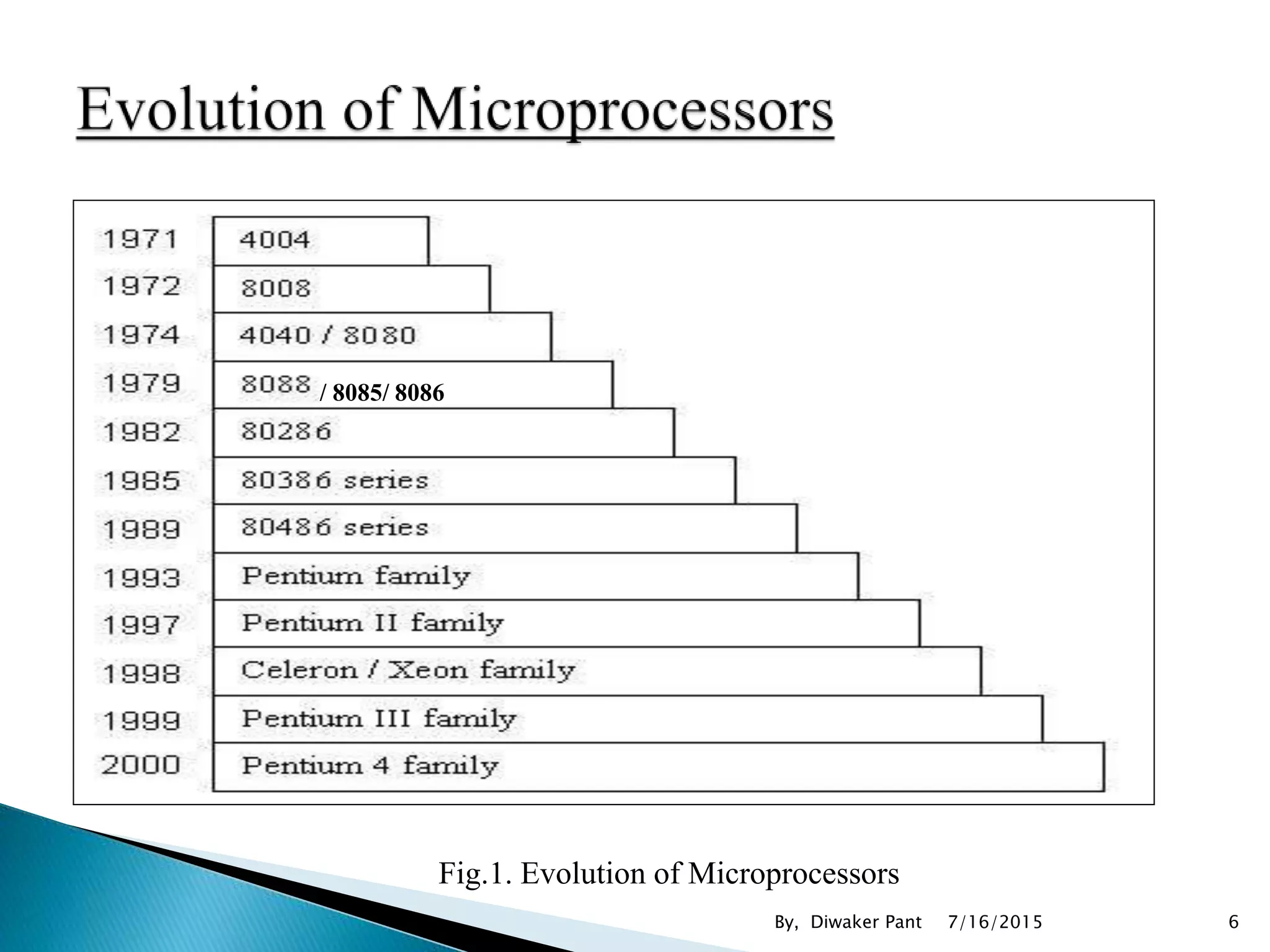
 The first microprocessor was 4 bit microprocessor manufactured by Intel.
 It was Intel’s 4004, capable of performing simple operations.
 At the same time some other organizations like Motorola , Hitachi and
National semiconductors introduces their microprocessors.
7/16/2015 5By, Diwaker Pant
Fig.1. Evolution of Microprocessors
/ 8085/ 8086
7/16/2015 6By, Diwaker Pant
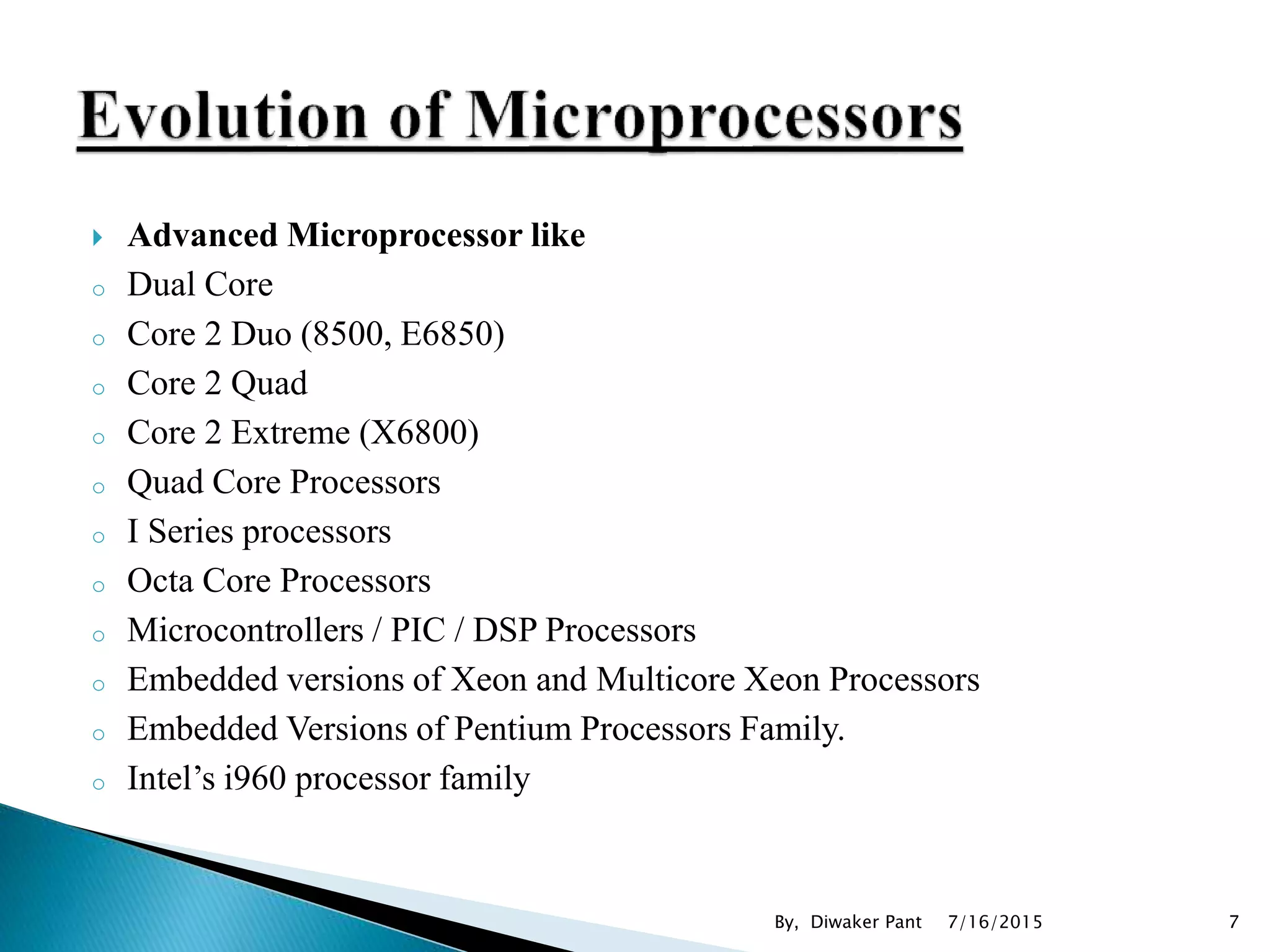
 Advanced Microprocessor like
o Dual Core
o Core 2 Duo (8500, E6850)
o Core 2 Quad
o Core 2 Extreme (X6800)
o Quad Core Processors
o I Series processors
o Octa Core Processors
o Microcontrollers / PIC / DSP Processors
o Embedded versions of Xeon and Multicore Xeon Processors
o Embedded Versions of Pentium Processors Family.
o Intel’s i960 processor family
7/16/2015 7By, Diwaker Pant
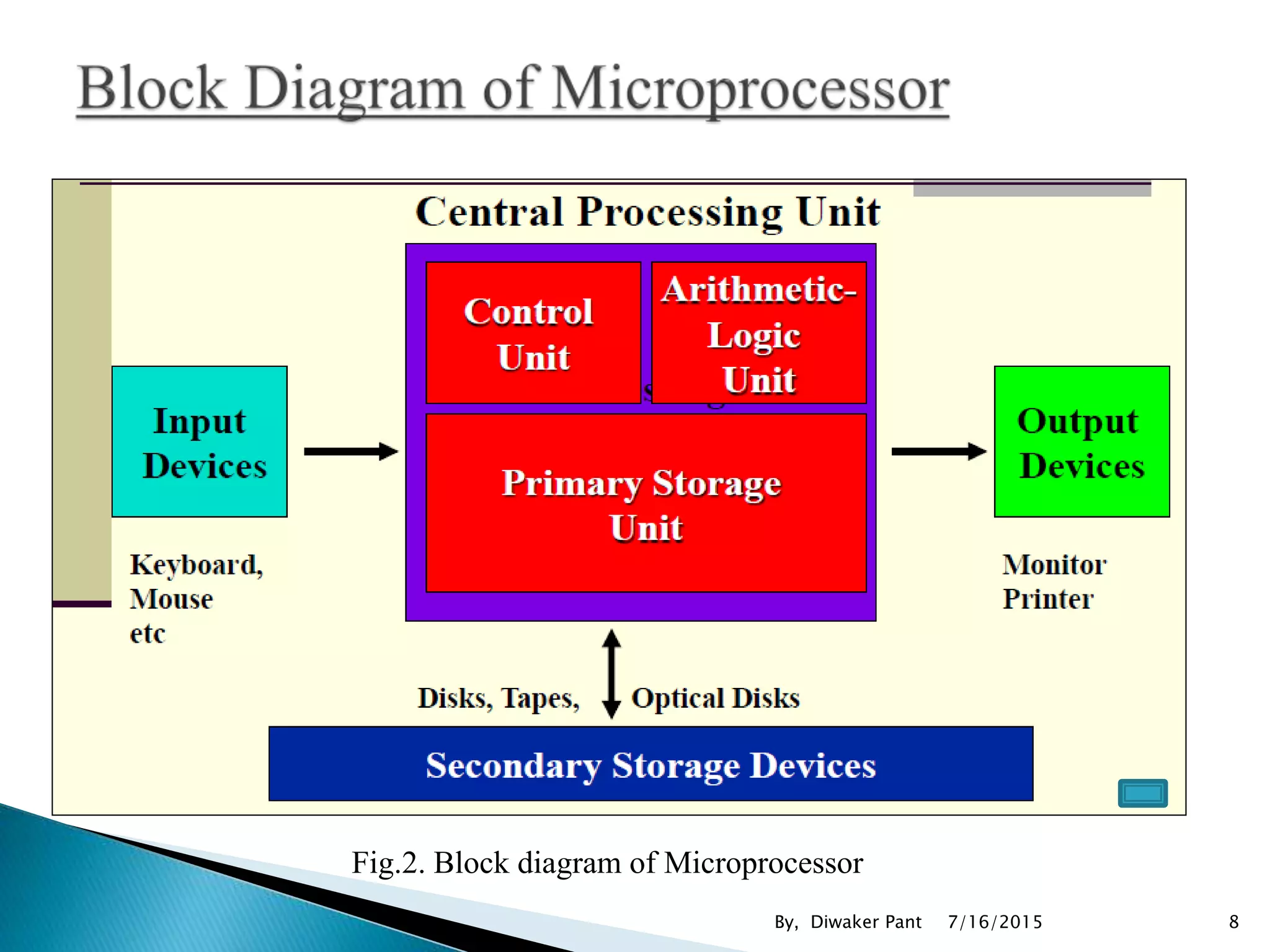
Fig.2. Block diagram of Microprocessor
7/16/2015 8By, Diwaker Pant
 CPU: A central processing unit (CPU), is the hardware within a computer system
which carries out the instructions of a computer program
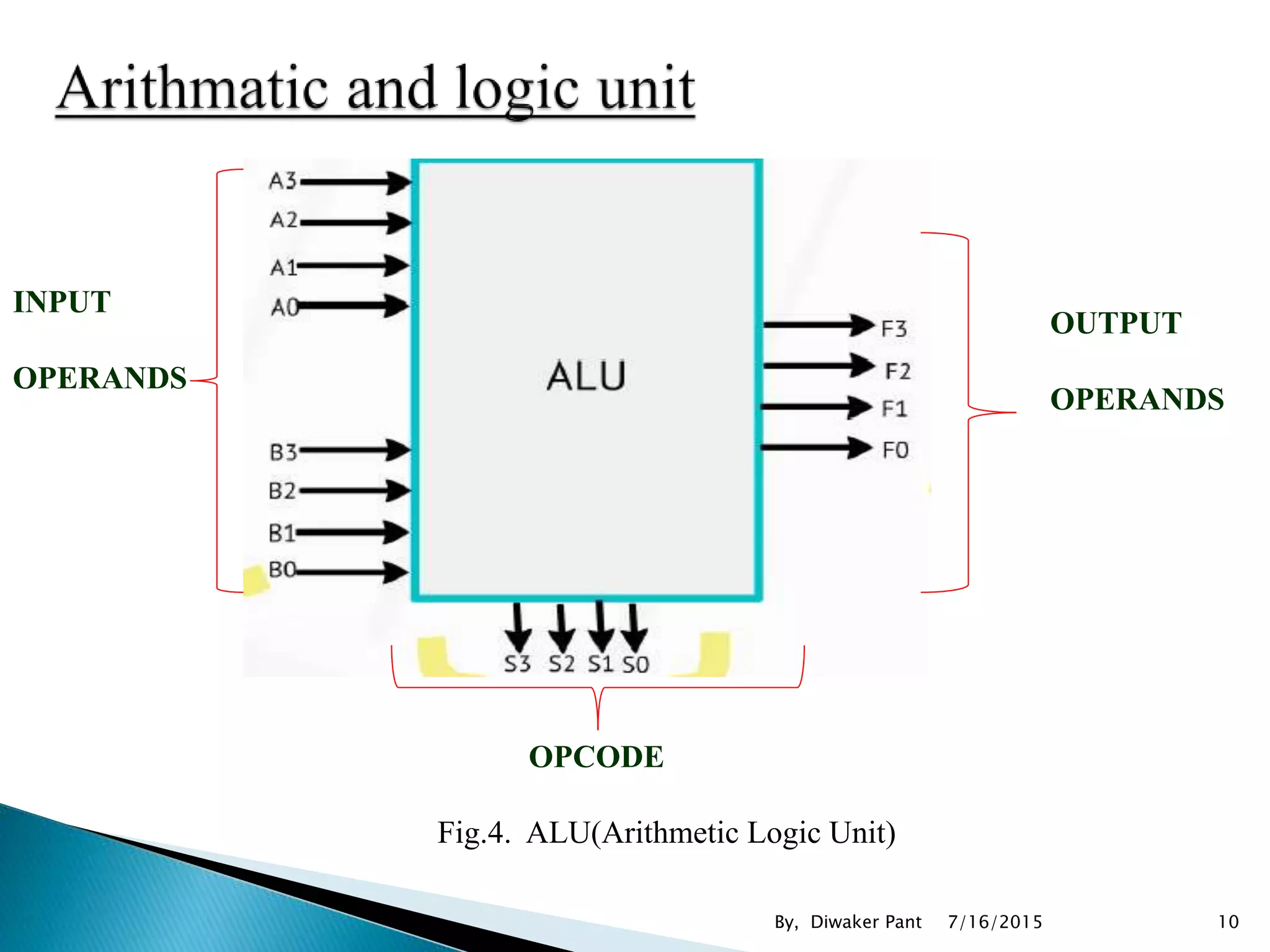
 ALU: In computing, an arithmetic and logic unit (ALU) is a digital circuit that
performs arithmetic and logical operations , also ALU is a fundamental building
block of the central processing unit of a computer, and even the simplest
microprocessors
 Memory: In computing, memory refers to the physical devices used to store
programs (sequences of instructions) or data (e.g. program state information) on a
temporary or permanent basis for use in a computer or other digital electronic
device
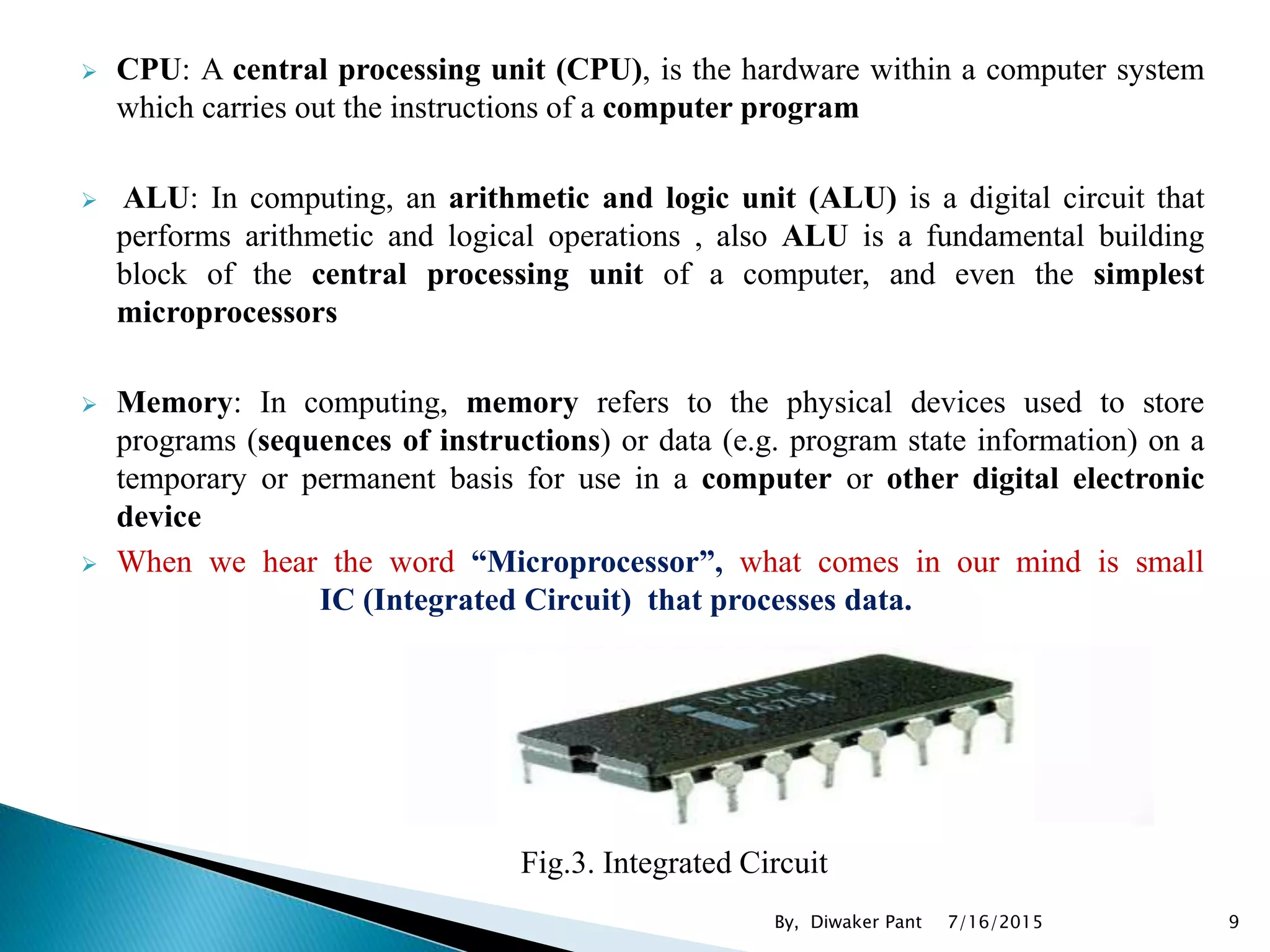
 When we hear the word “Microprocessor”, what comes in our mind is small
IC (Integrated Circuit) that processes data.
Fig.3. Integrated Circuit
7/16/2015 9By, Diwaker Pant
INPUT
OPERANDS
OUTPUT
OPERANDS
OPCODE
Fig.4. ALU(Arithmetic Logic Unit)
7/16/2015 10By, Diwaker Pant
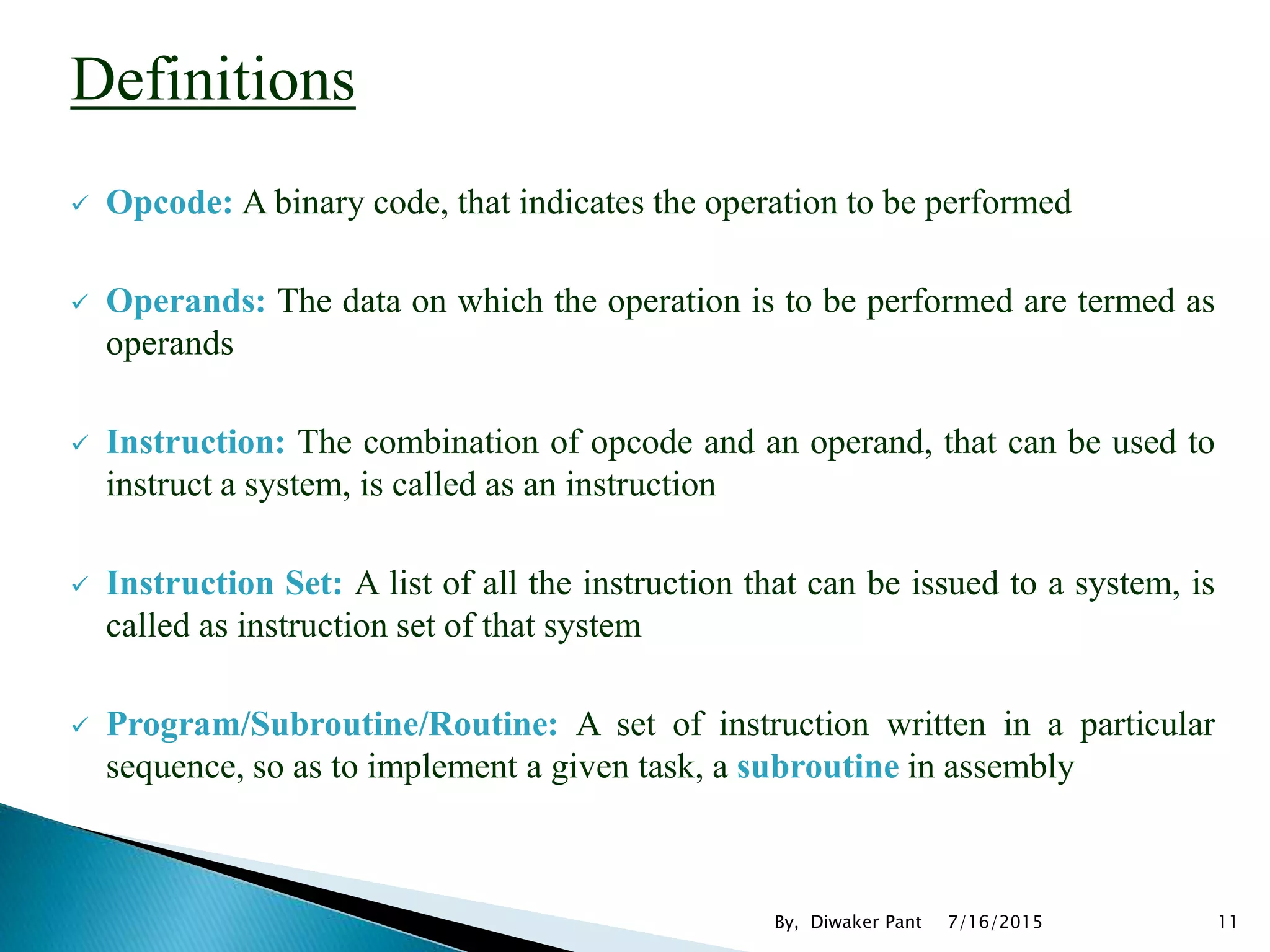
Definitions
 Opcode: A binary code, that indicates the operation to be performed
 Operands: The data on which the operation is to be performed are termed as
operands
 Instruction: The combination of opcode and an operand, that can be used to
instruct a system, is called as an instruction
 Instruction Set: A list of all the instruction that can be issued to a system, is
called as instruction set of that system
 Program/Subroutine/Routine: A set of instruction written in a particular
sequence, so as to implement a given task, a subroutine in assembly
7/16/2015 11By, Diwaker Pant
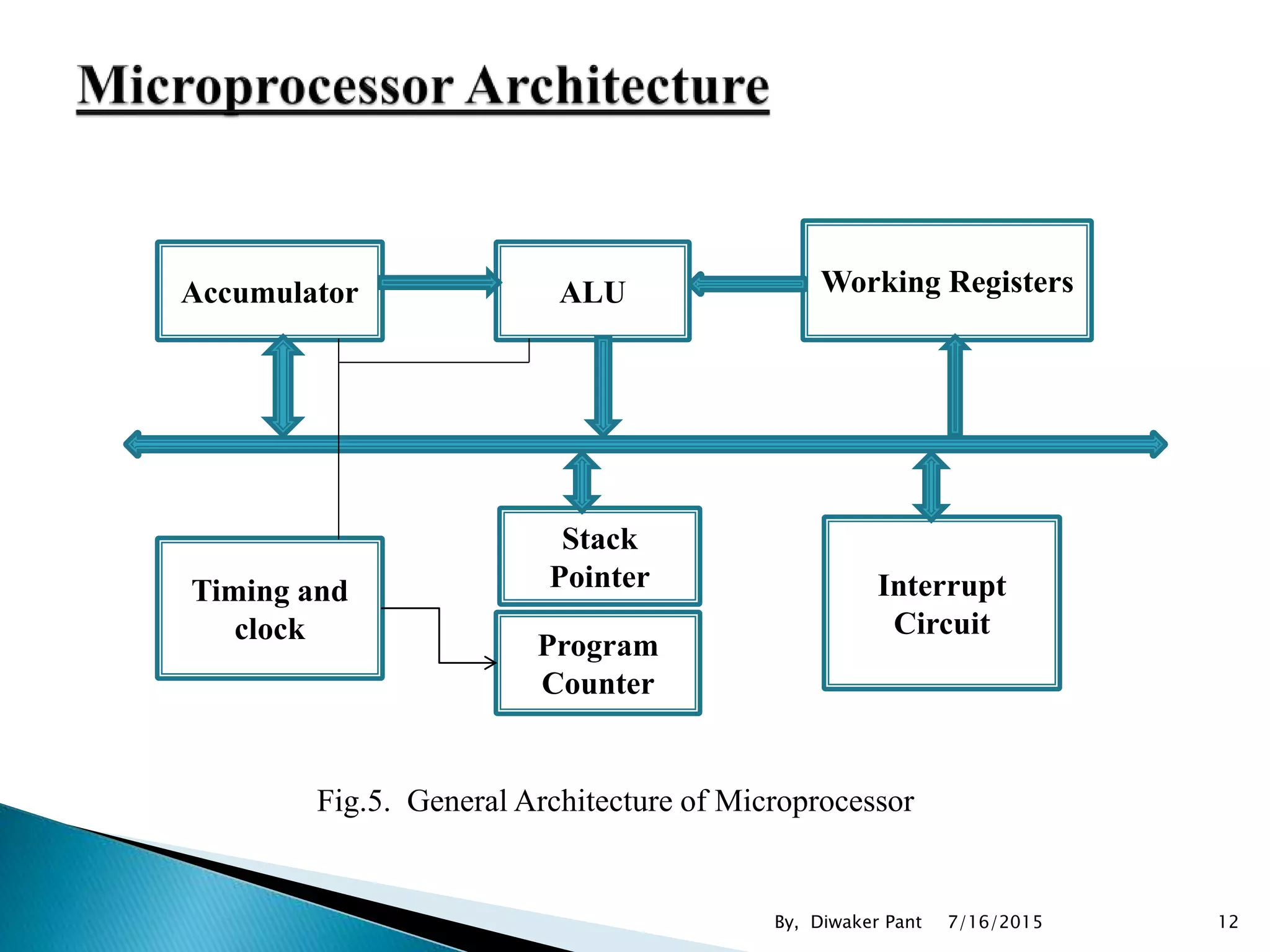
Accumulator ALU Working Registers
Timing and
clock
Stack
Pointer
Program
Counter
Interrupt
Circuit
Fig.5. General Architecture of Microprocessor
7/16/2015 12By, Diwaker Pant
 Accumulator: In a computer's central processing unit (CPU), an
accumulator is a register in which intermediate arithmetic and logic
results are stored
 ALU: In computing, an arithmetic and logic unit (ALU) is a digital
circuit that performs integer arithmetic and logical operation
 Working Registers: In computer architecture, a register is a small amount
of storage available as part of a CPU or other digital processor
 Clock signal: In electronics and especially synchronous digital circuits, a
clock signal is a particular type of signal that oscillates between a high and
a low state, microprocessor speed depends on the clock
 Interrupt Circuit: This block accepts different interrupt request
inputs
7/16/2015 13By, Diwaker Pant
 Stack Pointer: In a microprocessor, the stack can be used for both user
data (such as local variables and passed parameters) and CPU data (such as
return addresses when calling subroutines)
 The stack pointer stores the address of the most recent entry that was
pushed onto the stack
 To push a value onto the stack, the stack pointer is incremented to point to
the next physical memory address, and the new value is copied to that
address in memory
 When a valid interrupt request is present it informs control logic to take
action in response to each signal
7/16/2015 14By, Diwaker Pant
 Address Bus :
 The bus over which the CPU sends out the address of memory location is
called as Address Bus
 The address may be consist of 16, 20, 24 or 32 parallel signal lines
 If there are N address lines, then it can directly address 2N memory
locations
 Data Bus :
 The data bus consists of 8, 16 or 32 parallel lines
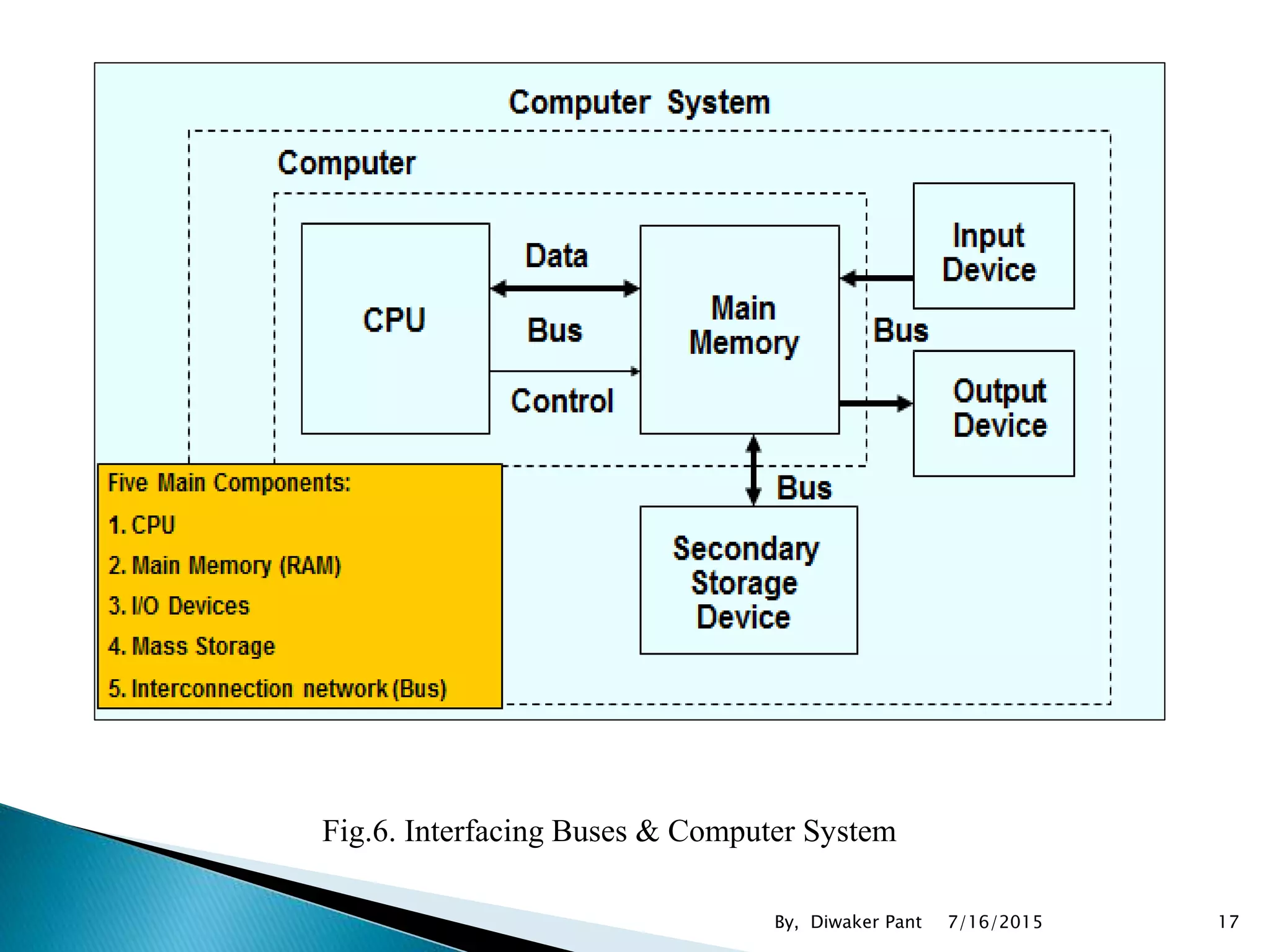
 The data bus is a bi-directional bus , that means the data can get
transferred from CPU to memory and vice-versa
 The data bus also connects the I/O ports and CPU
 The number of data lines used in the data bus is equal to the size of data
word that can be written or read
7/16/2015 15By, Diwaker Pant
 Control Bus :
 It is used for sending control signals to memory and I/O devices
 Some of the control bus signals are as follows:
a. Memory read
b. Memory write
c. I/O read
d. I/O write
7/16/2015 16By, Diwaker Pant
Fig.6. Interfacing Buses & Computer System
7/16/2015 17By, Diwaker Pant
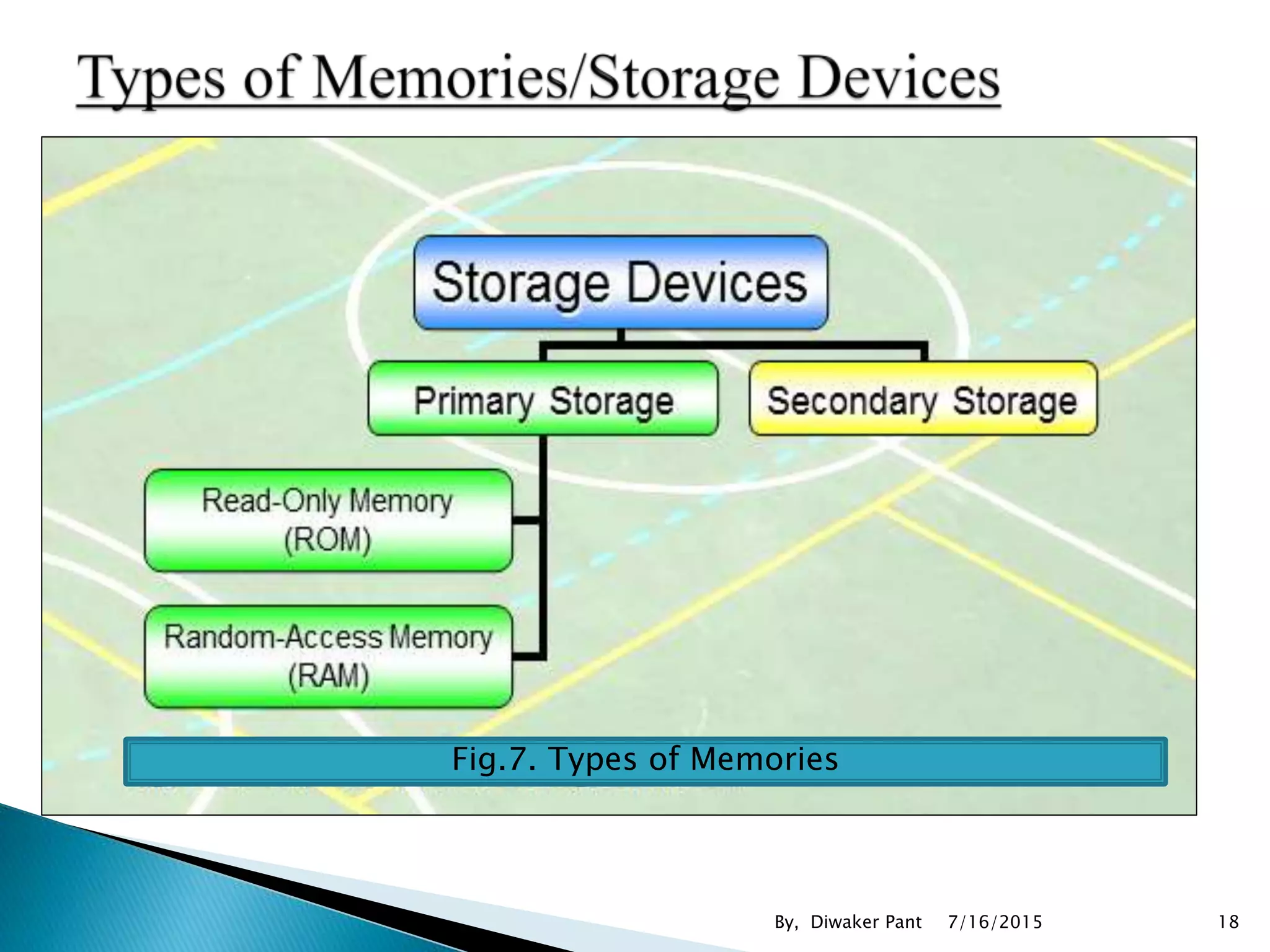
Fig.7. Types of Memories
7/16/2015 18By, Diwaker Pant
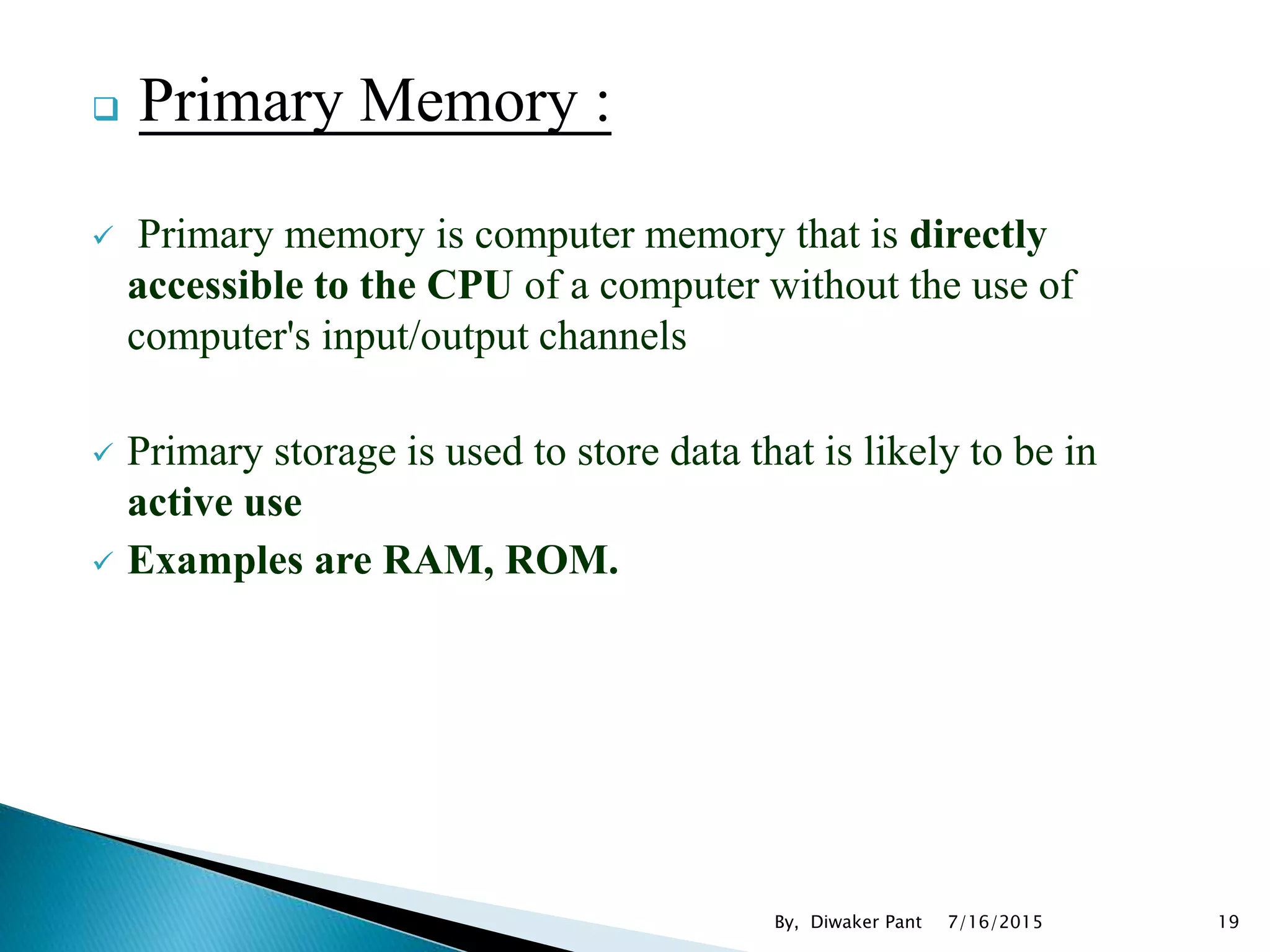
 Primary Memory :
 Primary memory is computer memory that is directly
accessible to the CPU of a computer without the use of
computer's input/output channels
 Primary storage is used to store data that is likely to be in
active use
 Examples are RAM, ROM.
7/16/2015 19By, Diwaker Pant
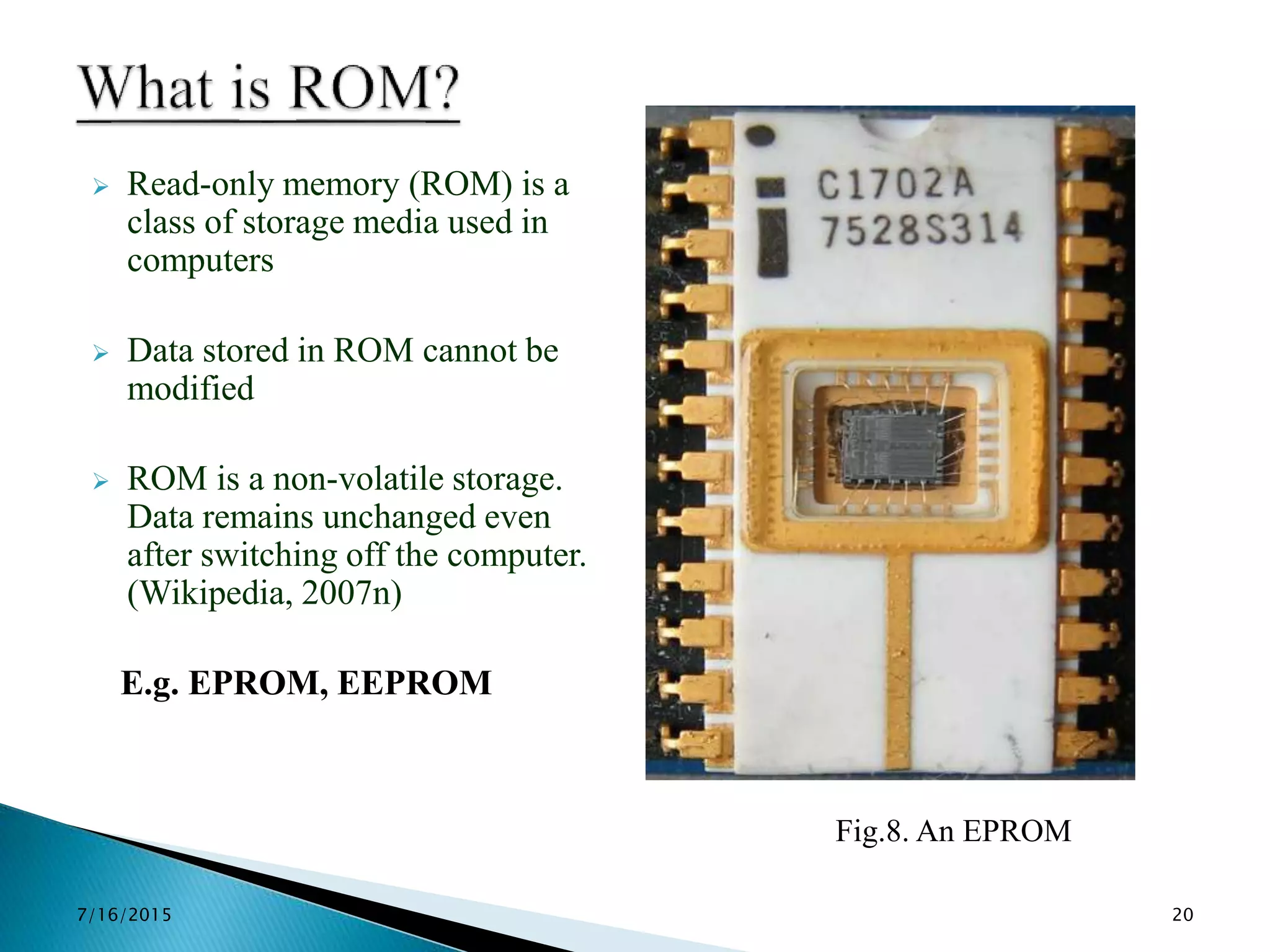
 Read-only memory (ROM) is a
class of storage media used in
computers
 Data stored in ROM cannot be
modified
 ROM is a non-volatile storage.
Data remains unchanged even
after switching off the computer.
(Wikipedia, 2007n)
E.g. EPROM, EEPROM
Fig.8. An EPROM
7/16/2015 20
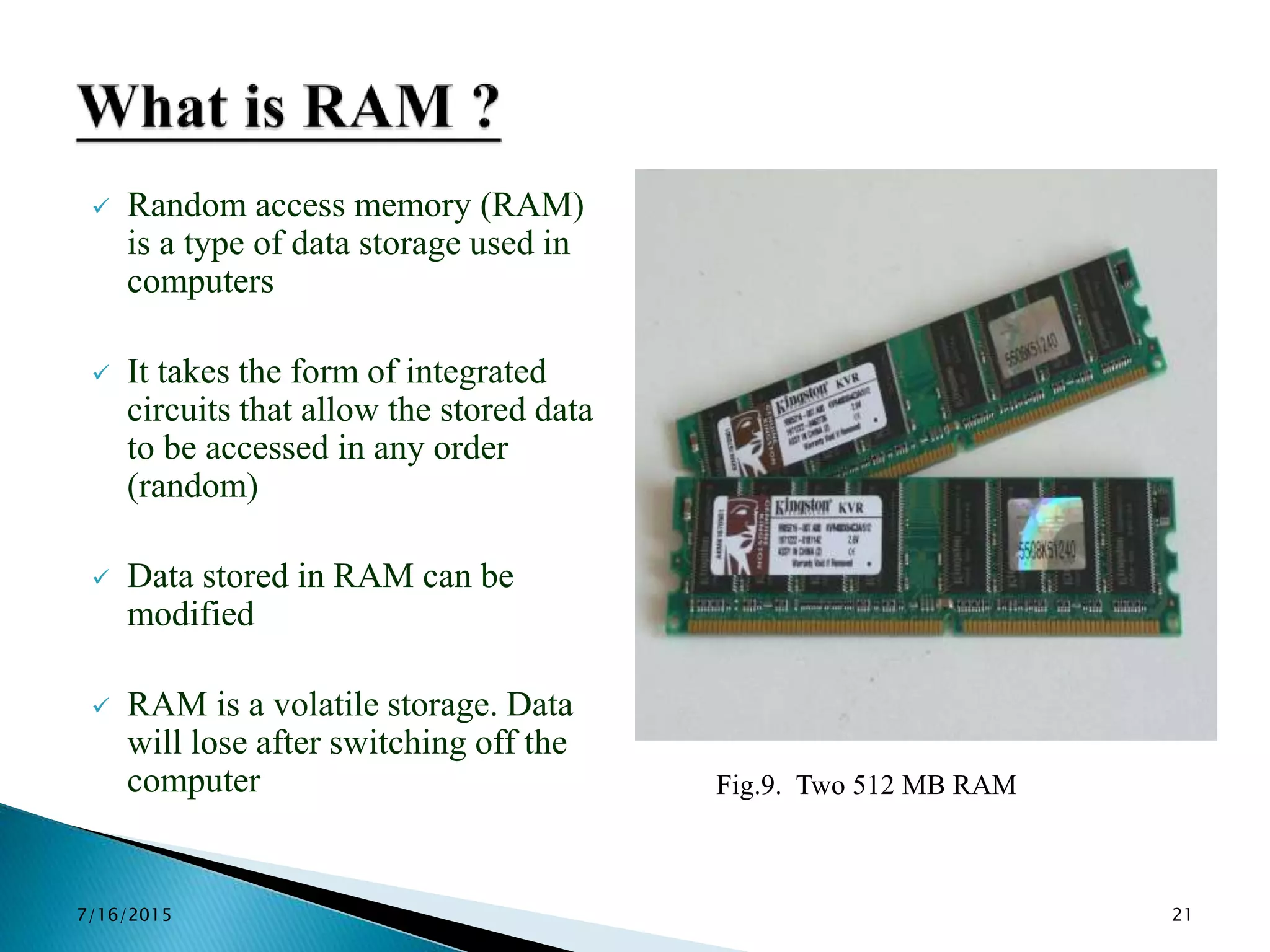
 Random access memory (RAM)
is a type of data storage used in
computers
 It takes the form of integrated
circuits that allow the stored data
to be accessed in any order
(random)
 Data stored in RAM can be
modified
 RAM is a volatile storage. Data
will lose after switching off the
computer Fig.9. Two 512 MB RAM
7/16/2015 21
 Secondary memory is computer memory that is not directly accessible to
the CPU of a computer
 It is used to store data that is NOT in active use
 It is usually slower than primary storage but it always has higher storage
capacity
 It is non-volatile. Data remains unchanged even after switching off the
computer
7/16/2015 22By, Diwaker Pant
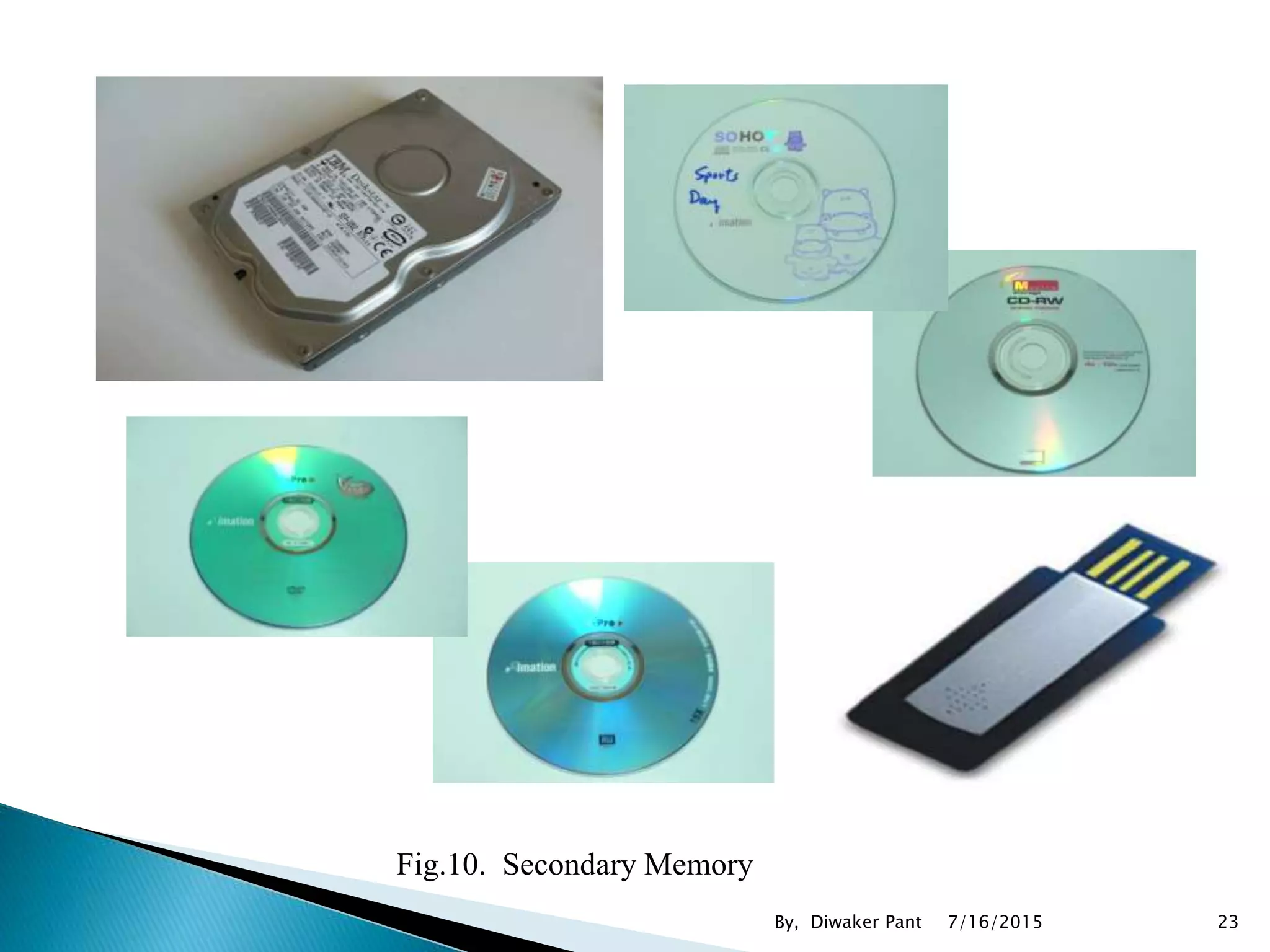
Fig.10. Secondary Memory
7/16/2015 23By, Diwaker Pant
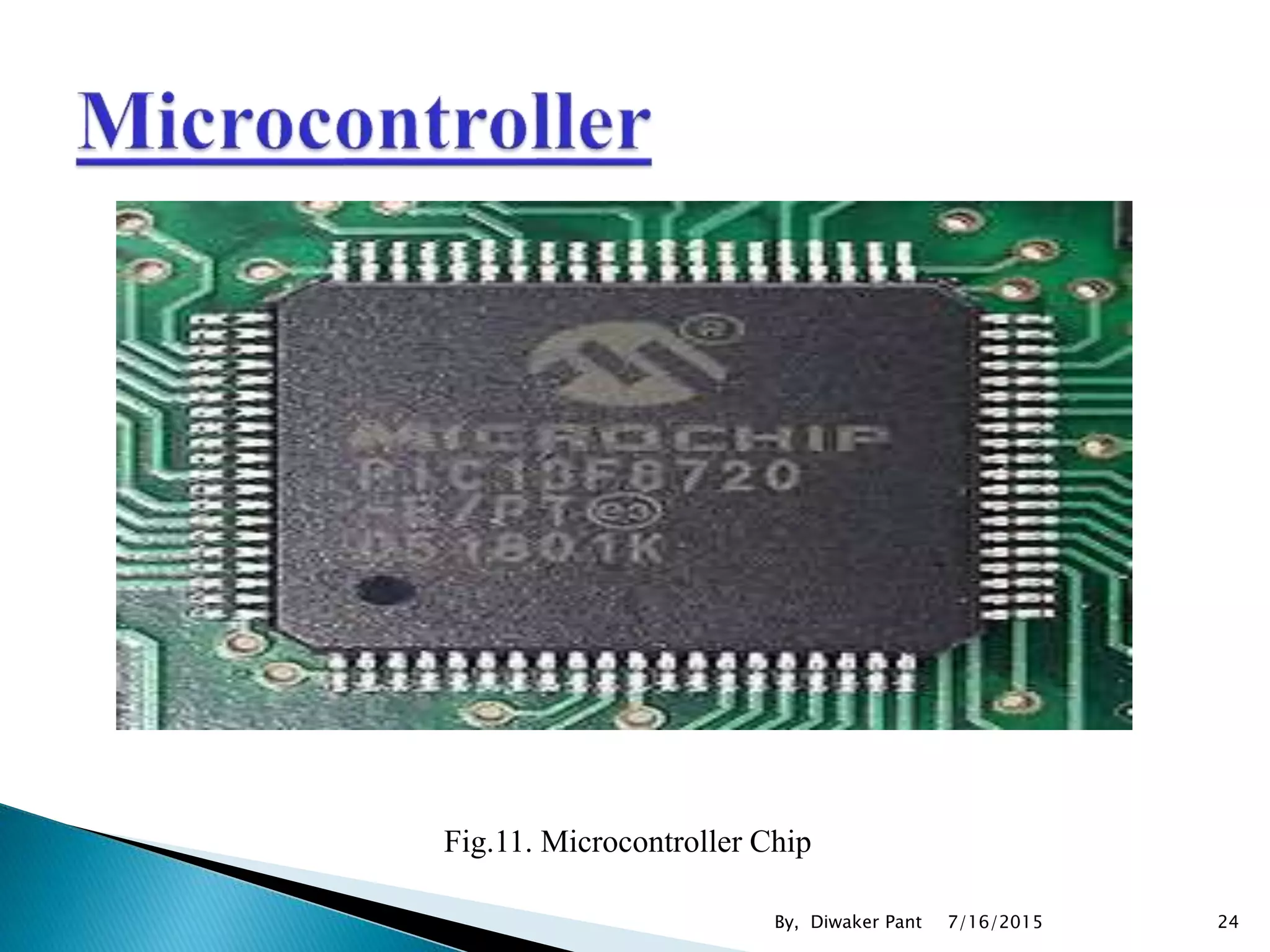
Fig.11. Microcontroller Chip
7/16/2015 24By, Diwaker Pant
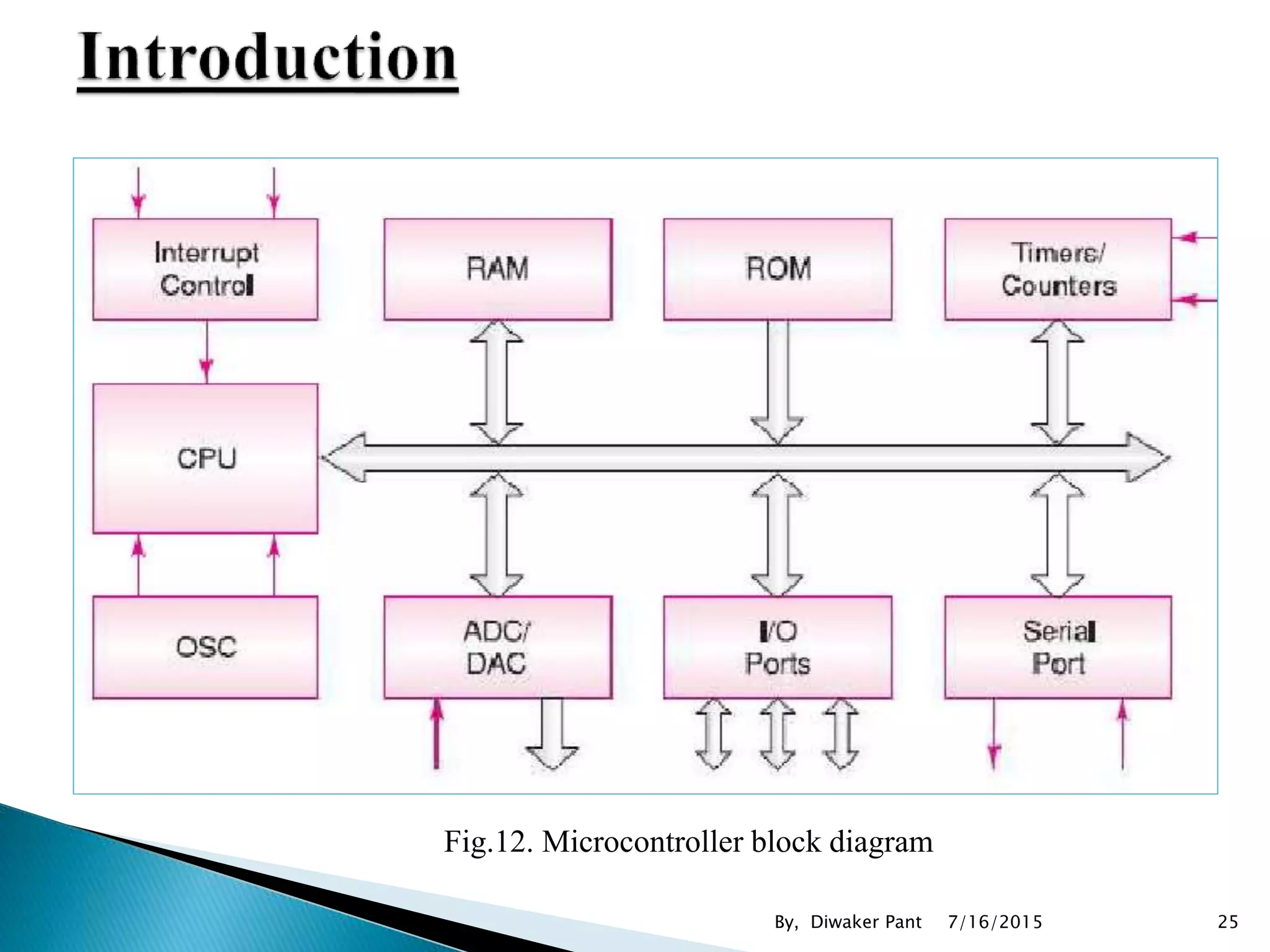
Fig.12. Microcontroller block diagram
7/16/2015 25By, Diwaker Pant
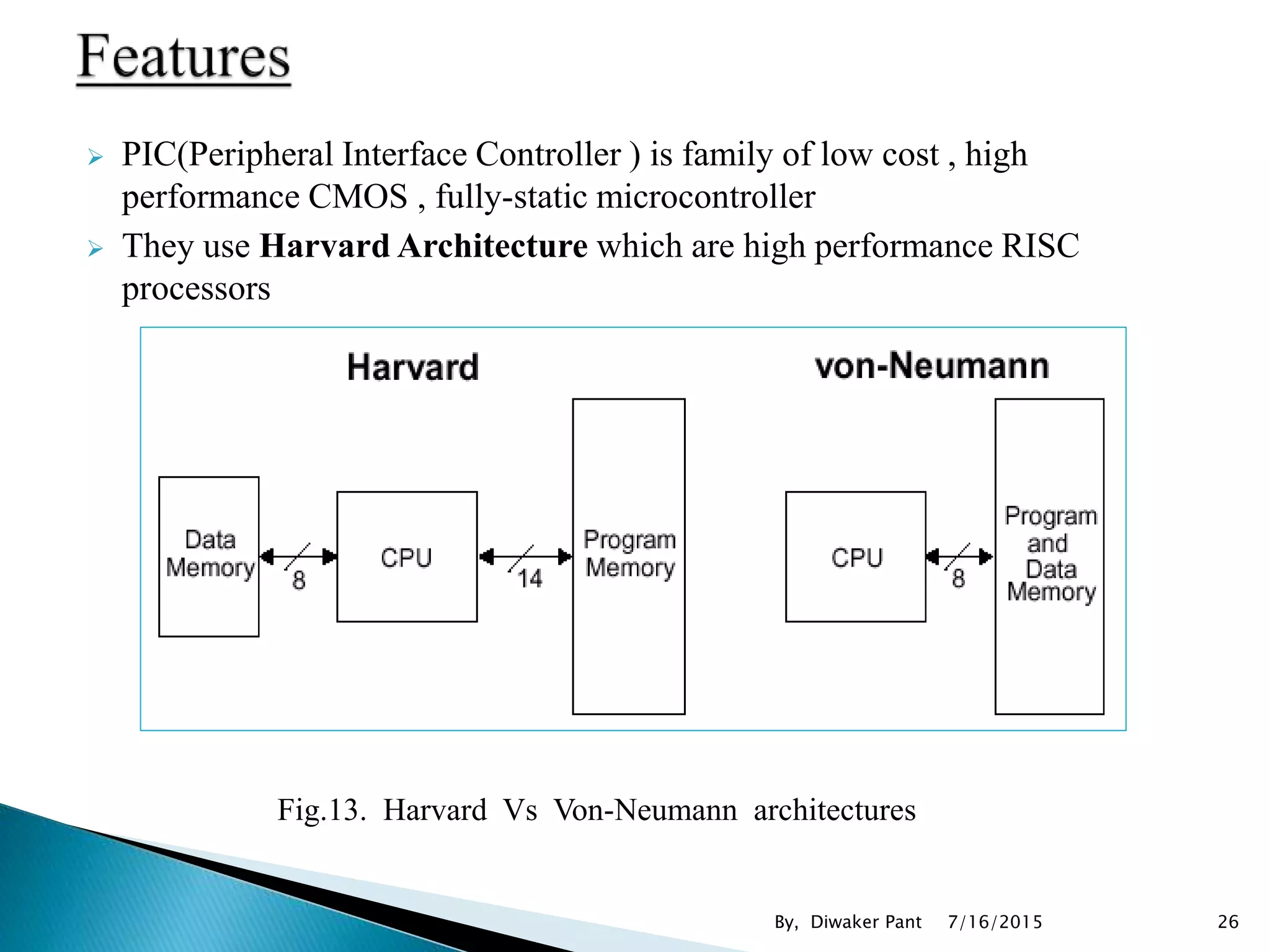
 PIC(Peripheral Interface Controller ) is family of low cost , high
performance CMOS , fully-static microcontroller
 They use Harvard Architecture which are high performance RISC
processors
Fig.13. Harvard Vs Von-Neumann architectures
7/16/2015 26By, Diwaker Pant
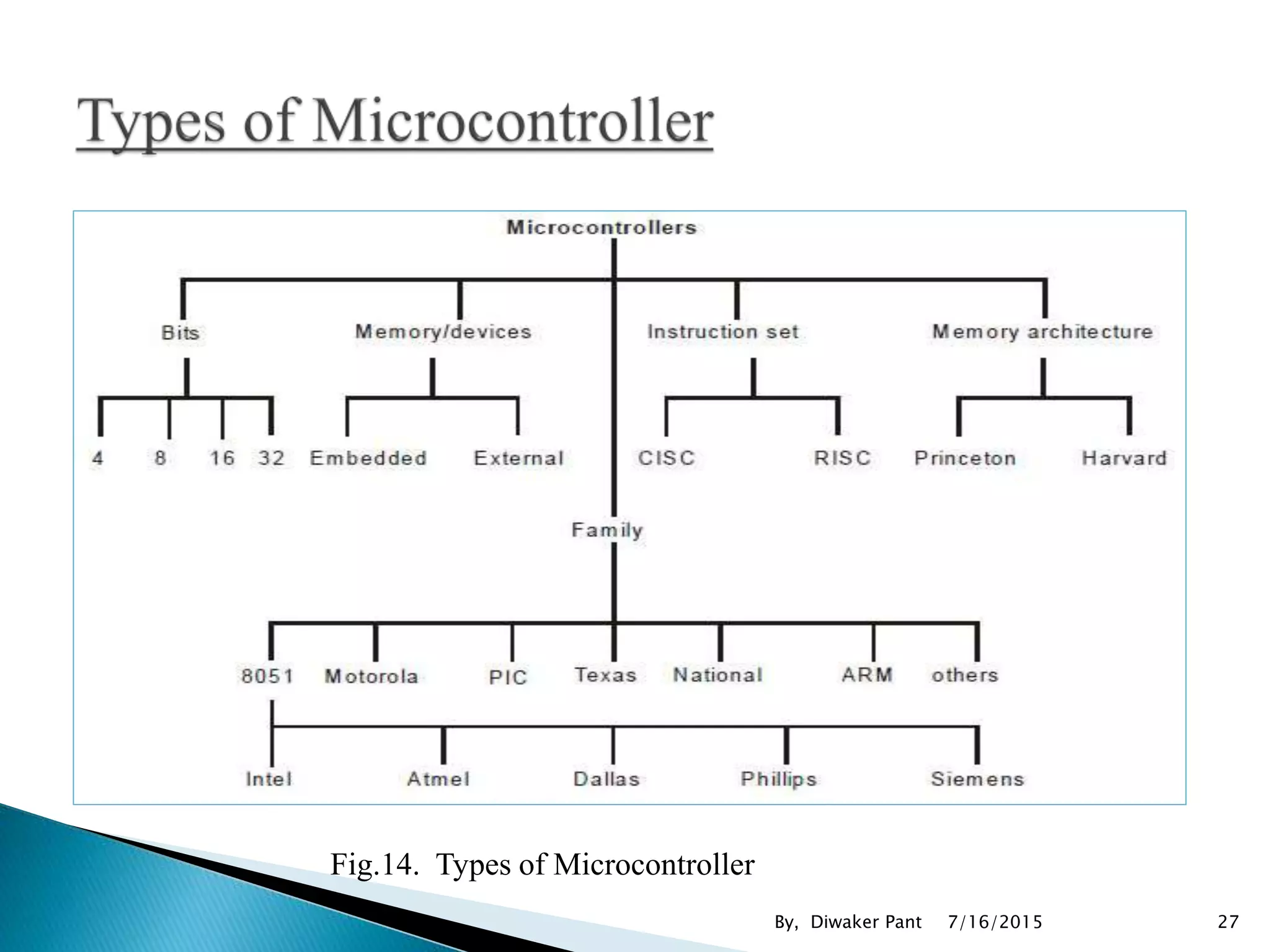
Fig.14. Types of Microcontroller
7/16/2015 27By, Diwaker Pant
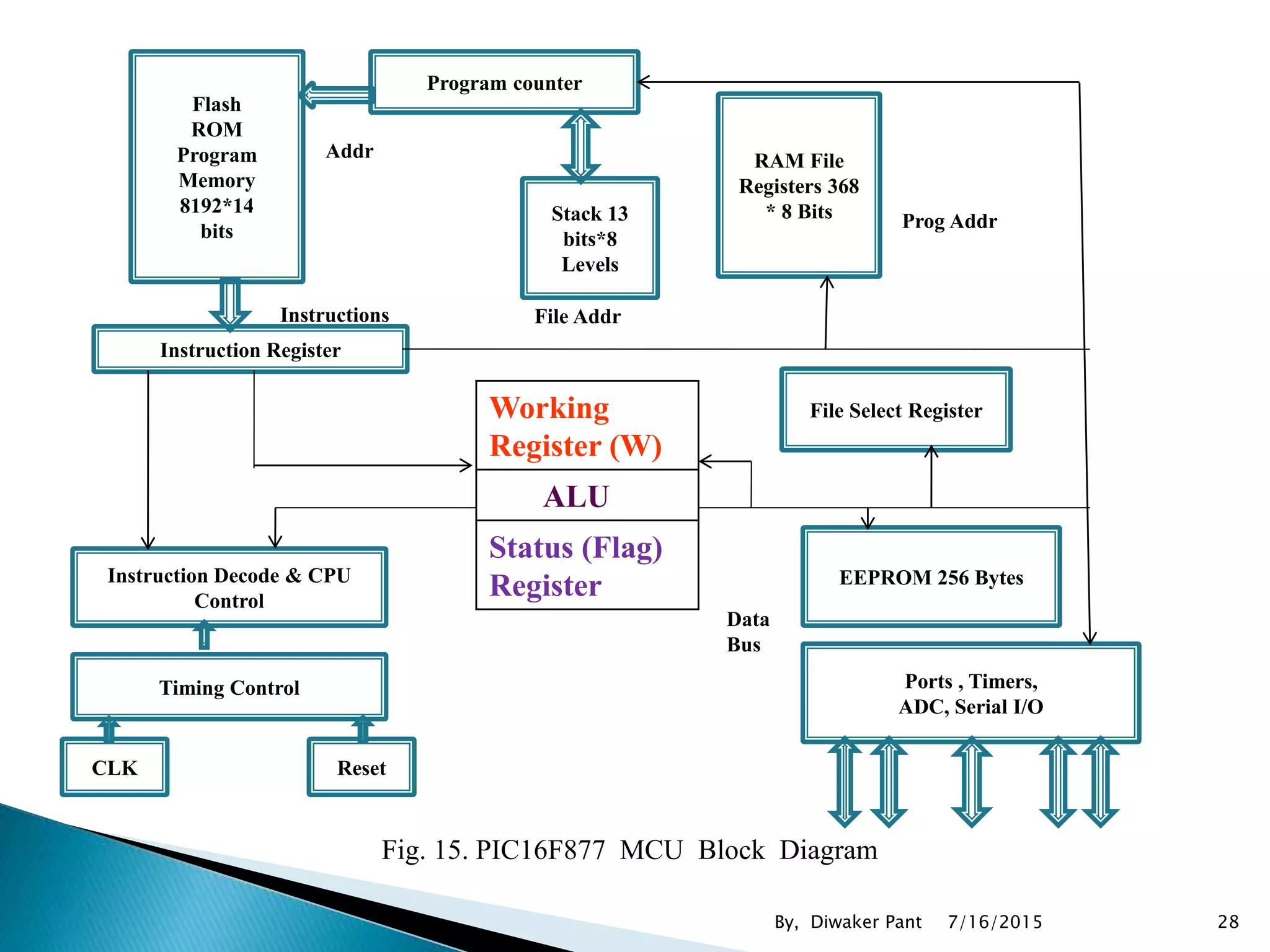
Working
Register (W)
ALU
Status (Flag)
Register
Flash
ROM
Program
Memory
8192*14
bits
Program counter
Stack 13
bits*8
Levels
RAM File
Registers 368
* 8 Bits
Instruction Register
EEPROM 256 BytesInstruction Decode & CPU
Control
Ports , Timers,
ADC, Serial I/O
Timing Control
File Select Register
CLK Reset
Addr
Instructions File Addr
Prog Addr
Data
Bus
Fig. 15. PIC16F877 MCU Block Diagram
7/16/2015 28By, Diwaker Pant
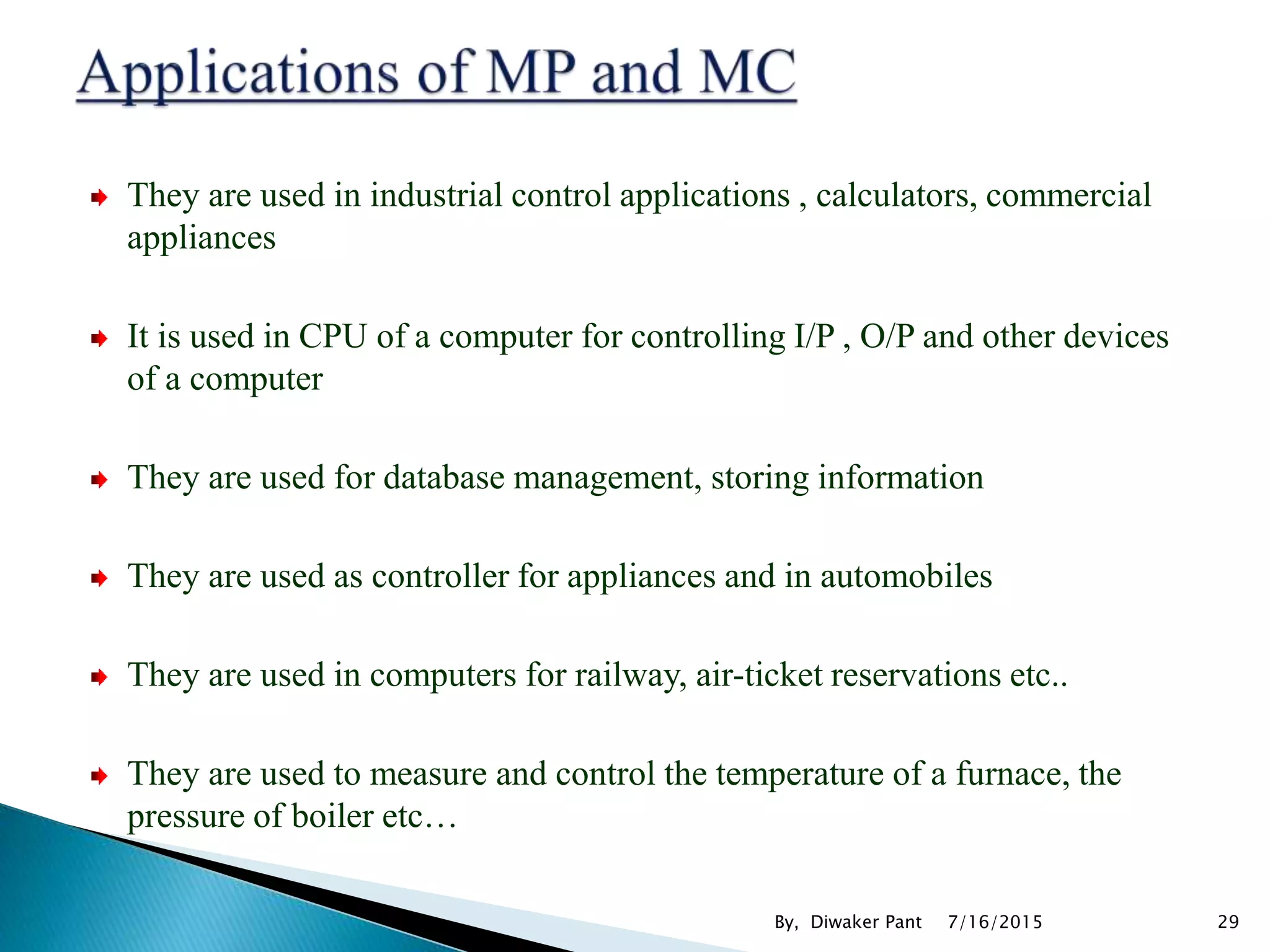
They are used in industrial control applications , calculators, commercial
appliances
It is used in CPU of a computer for controlling I/P , O/P and other devices
of a computer
They are used for database management, storing information
They are used as controller for appliances and in automobiles
They are used in computers for railway, air-ticket reservations etc..
They are used to measure and control the temperature of a furnace, the
pressure of boiler etc…
7/16/2015 29By, Diwaker Pant
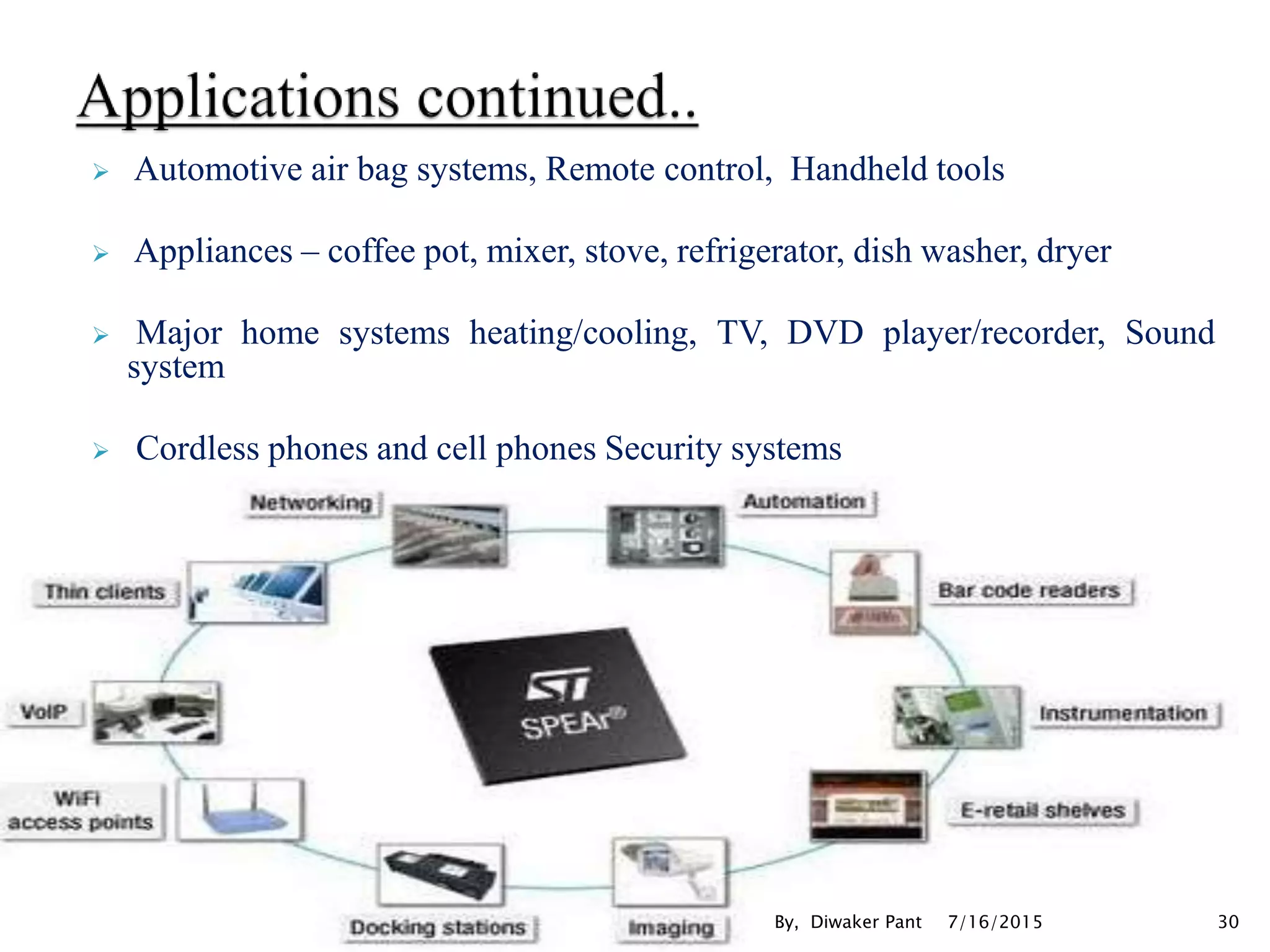
 Automotive air bag systems, Remote control, Handheld tools
 Appliances – coffee pot, mixer, stove, refrigerator, dish washer, dryer
 Major home systems heating/cooling, TV, DVD player/recorder, Sound
system
 Cordless phones and cell phones Security systems
7/16/2015 30By, Diwaker Pant
 Fairchild Semiconductors
 Freescale Semiconductors
 National Semiconductors, Hewlett-Packard
 Hitachi Corporations
 Intel
 Motorola Corporations
 LG, Samsung, IBM, Intersil, MIPS Technologies
 MOS technology, OpenCore, Renesas Electronics
 Texas Instuments, Zilog, Inmos Etc.
7/16/2015 31By, Diwaker Pant
7/16/2015 32By, Diwaker Pant
7/16/2015 33By, Diwaker Pant
7/16/2015 34By, Diwaker Pant
 Microprocessor and Microcontrollers are brain of all modern electronic
system.
 Microprocessors are generally used for general purpose systems while
microcontrollers are used for applications specific systems.
 If anything is automatic it must have a part of microprocessor in it.
 Modern embedded systems have microcontroller in it.
7/16/2015 35By, Diwaker Pant
 Microprocessor Architecture, Programming, and Applications with the
8085 by R. Gaonkar.
 Microprocessors: Principles and Applications by A. Pal.
 The 8051 Microcontroller and Embedded Systems : Using Assembly and C
by Muhammad Ali Mazidi.
 Advanced Microprocessors and Peripherals by A.K.Ray and
K.M.Bhurchandi.
 Microprocessors and Microcontrollers images: Contents available at
akihil.jain.worlspress.com
7/16/2015 36By, Diwaker Pant
7/16/2015 37By, Diwaker Pant

Microprocessor Fundamentals

  • 1.
  • 2.
     Introduction  Evolutionof Microprocessor  Block diagram & Architecture of Microprocessor  Microcontroller Fundamentals  Applications of Microprocessor and Microcontroller  Manufacturers of Microprocessor and Microcontrollers  Questions in Competitive examinations  Conclusion  References 7/16/2015 2By, Diwaker Pant
  • 3.
     Microprocessor : oIt is a clock driven o Register based digital device o Which takes binary instructions from the memory o Takes the data from memory or input devices o Process the data according to the instructions o Save the result into memory or give it to some output devices.  It is a silicon chip which is used for performing arithmetic and logical operations. 7/16/2015 3By, Diwaker Pant
  • 4.
    In the late1960’s, processors were built using discrete elements like vacuum tubes These devices performed the required operation, but were too large and too slow In the early 1970’s the microchip was invented All of the components that made up the processor were now placed on a single piece of silicon IC The size became several thousand times smaller and the speed became several hundred times faster The Micro-Processor was “born” 7/16/2015 4By, Diwaker Pant
  • 5.
     Fairchild Semiconductors(founded in 1957) invented the first IC in 1959.  In 1968, Robert Noyce, Gordan Moore, Andrew Grove resigned from Fairchild Semiconductors.  They founded their own company Intel (Integrated Electronics).  Intel grown from 3 man start-up in 1968 to industrial giant by 1981.  The first microprocessor was 4 bit microprocessor manufactured by Intel.  It was Intel’s 4004, capable of performing simple operations.  At the same time some other organizations like Motorola , Hitachi and National semiconductors introduces their microprocessors. 7/16/2015 5By, Diwaker Pant
  • 6.
    Fig.1. Evolution ofMicroprocessors / 8085/ 8086 7/16/2015 6By, Diwaker Pant
  • 7.
     Advanced Microprocessorlike o Dual Core o Core 2 Duo (8500, E6850) o Core 2 Quad o Core 2 Extreme (X6800) o Quad Core Processors o I Series processors o Octa Core Processors o Microcontrollers / PIC / DSP Processors o Embedded versions of Xeon and Multicore Xeon Processors o Embedded Versions of Pentium Processors Family. o Intel’s i960 processor family 7/16/2015 7By, Diwaker Pant
  • 8.
    Fig.2. Block diagramof Microprocessor 7/16/2015 8By, Diwaker Pant
  • 9.
     CPU: Acentral processing unit (CPU), is the hardware within a computer system which carries out the instructions of a computer program  ALU: In computing, an arithmetic and logic unit (ALU) is a digital circuit that performs arithmetic and logical operations , also ALU is a fundamental building block of the central processing unit of a computer, and even the simplest microprocessors  Memory: In computing, memory refers to the physical devices used to store programs (sequences of instructions) or data (e.g. program state information) on a temporary or permanent basis for use in a computer or other digital electronic device  When we hear the word “Microprocessor”, what comes in our mind is small IC (Integrated Circuit) that processes data. Fig.3. Integrated Circuit 7/16/2015 9By, Diwaker Pant
  • 10.
  • 11.
    Definitions  Opcode: Abinary code, that indicates the operation to be performed  Operands: The data on which the operation is to be performed are termed as operands  Instruction: The combination of opcode and an operand, that can be used to instruct a system, is called as an instruction  Instruction Set: A list of all the instruction that can be issued to a system, is called as instruction set of that system  Program/Subroutine/Routine: A set of instruction written in a particular sequence, so as to implement a given task, a subroutine in assembly 7/16/2015 11By, Diwaker Pant
  • 12.
    Accumulator ALU WorkingRegisters Timing and clock Stack Pointer Program Counter Interrupt Circuit Fig.5. General Architecture of Microprocessor 7/16/2015 12By, Diwaker Pant
  • 13.
     Accumulator: Ina computer's central processing unit (CPU), an accumulator is a register in which intermediate arithmetic and logic results are stored  ALU: In computing, an arithmetic and logic unit (ALU) is a digital circuit that performs integer arithmetic and logical operation  Working Registers: In computer architecture, a register is a small amount of storage available as part of a CPU or other digital processor  Clock signal: In electronics and especially synchronous digital circuits, a clock signal is a particular type of signal that oscillates between a high and a low state, microprocessor speed depends on the clock  Interrupt Circuit: This block accepts different interrupt request inputs 7/16/2015 13By, Diwaker Pant
  • 14.
     Stack Pointer:In a microprocessor, the stack can be used for both user data (such as local variables and passed parameters) and CPU data (such as return addresses when calling subroutines)  The stack pointer stores the address of the most recent entry that was pushed onto the stack  To push a value onto the stack, the stack pointer is incremented to point to the next physical memory address, and the new value is copied to that address in memory  When a valid interrupt request is present it informs control logic to take action in response to each signal 7/16/2015 14By, Diwaker Pant
  • 15.
     Address Bus:  The bus over which the CPU sends out the address of memory location is called as Address Bus  The address may be consist of 16, 20, 24 or 32 parallel signal lines  If there are N address lines, then it can directly address 2N memory locations  Data Bus :  The data bus consists of 8, 16 or 32 parallel lines  The data bus is a bi-directional bus , that means the data can get transferred from CPU to memory and vice-versa  The data bus also connects the I/O ports and CPU  The number of data lines used in the data bus is equal to the size of data word that can be written or read 7/16/2015 15By, Diwaker Pant
  • 16.
     Control Bus:  It is used for sending control signals to memory and I/O devices  Some of the control bus signals are as follows: a. Memory read b. Memory write c. I/O read d. I/O write 7/16/2015 16By, Diwaker Pant
  • 17.
    Fig.6. Interfacing Buses& Computer System 7/16/2015 17By, Diwaker Pant
  • 18.
    Fig.7. Types ofMemories 7/16/2015 18By, Diwaker Pant
  • 19.
     Primary Memory:  Primary memory is computer memory that is directly accessible to the CPU of a computer without the use of computer's input/output channels  Primary storage is used to store data that is likely to be in active use  Examples are RAM, ROM. 7/16/2015 19By, Diwaker Pant
  • 20.
     Read-only memory(ROM) is a class of storage media used in computers  Data stored in ROM cannot be modified  ROM is a non-volatile storage. Data remains unchanged even after switching off the computer. (Wikipedia, 2007n) E.g. EPROM, EEPROM Fig.8. An EPROM 7/16/2015 20
  • 21.
     Random accessmemory (RAM) is a type of data storage used in computers  It takes the form of integrated circuits that allow the stored data to be accessed in any order (random)  Data stored in RAM can be modified  RAM is a volatile storage. Data will lose after switching off the computer Fig.9. Two 512 MB RAM 7/16/2015 21
  • 22.
     Secondary memoryis computer memory that is not directly accessible to the CPU of a computer  It is used to store data that is NOT in active use  It is usually slower than primary storage but it always has higher storage capacity  It is non-volatile. Data remains unchanged even after switching off the computer 7/16/2015 22By, Diwaker Pant
  • 23.
  • 24.
  • 25.
    Fig.12. Microcontroller blockdiagram 7/16/2015 25By, Diwaker Pant
  • 26.
     PIC(Peripheral InterfaceController ) is family of low cost , high performance CMOS , fully-static microcontroller  They use Harvard Architecture which are high performance RISC processors Fig.13. Harvard Vs Von-Neumann architectures 7/16/2015 26By, Diwaker Pant
  • 27.
    Fig.14. Types ofMicrocontroller 7/16/2015 27By, Diwaker Pant
  • 28.
    Working Register (W) ALU Status (Flag) Register Flash ROM Program Memory 8192*14 bits Programcounter Stack 13 bits*8 Levels RAM File Registers 368 * 8 Bits Instruction Register EEPROM 256 BytesInstruction Decode & CPU Control Ports , Timers, ADC, Serial I/O Timing Control File Select Register CLK Reset Addr Instructions File Addr Prog Addr Data Bus Fig. 15. PIC16F877 MCU Block Diagram 7/16/2015 28By, Diwaker Pant
  • 29.
    They are usedin industrial control applications , calculators, commercial appliances It is used in CPU of a computer for controlling I/P , O/P and other devices of a computer They are used for database management, storing information They are used as controller for appliances and in automobiles They are used in computers for railway, air-ticket reservations etc.. They are used to measure and control the temperature of a furnace, the pressure of boiler etc… 7/16/2015 29By, Diwaker Pant
  • 30.
     Automotive airbag systems, Remote control, Handheld tools  Appliances – coffee pot, mixer, stove, refrigerator, dish washer, dryer  Major home systems heating/cooling, TV, DVD player/recorder, Sound system  Cordless phones and cell phones Security systems 7/16/2015 30By, Diwaker Pant
  • 31.
     Fairchild Semiconductors Freescale Semiconductors  National Semiconductors, Hewlett-Packard  Hitachi Corporations  Intel  Motorola Corporations  LG, Samsung, IBM, Intersil, MIPS Technologies  MOS technology, OpenCore, Renesas Electronics  Texas Instuments, Zilog, Inmos Etc. 7/16/2015 31By, Diwaker Pant
  • 32.
  • 33.
  • 34.
  • 35.
     Microprocessor andMicrocontrollers are brain of all modern electronic system.  Microprocessors are generally used for general purpose systems while microcontrollers are used for applications specific systems.  If anything is automatic it must have a part of microprocessor in it.  Modern embedded systems have microcontroller in it. 7/16/2015 35By, Diwaker Pant
  • 36.
     Microprocessor Architecture,Programming, and Applications with the 8085 by R. Gaonkar.  Microprocessors: Principles and Applications by A. Pal.  The 8051 Microcontroller and Embedded Systems : Using Assembly and C by Muhammad Ali Mazidi.  Advanced Microprocessors and Peripherals by A.K.Ray and K.M.Bhurchandi.  Microprocessors and Microcontrollers images: Contents available at akihil.jain.worlspress.com 7/16/2015 36By, Diwaker Pant
  • 37.