Data Communication
  Prepared By: MIHE IT Department
DEFINITION of DATA
         COMMUNICATION

“Data Communication is the exchange of Information
  from one entity to the other using a Transmission
  Medium”
LOCAL and REMOTE
        Communication
 LOCAL
   – Communicating devices are present in the same
     building or a similarly restricted geographical area.
   – When the source and destination are in the same
     network
Data Communication Definition
        (Modified)


“Data Communication is the exchange of data (in the
   form of 0’s and 1’s) between two devices
   (computers) via some form of the transmission
   medium.”
LOCAL and REMOTE
             Communication

 REMOTE
   – Communicating devices are present farther apart.
   – When the source and destination are in the different
     network.
Data Communication System

 For Data Communication to occur, communicating
  devices must be a part of a system made up of some
  specific kind of hardware and software. This system is
  known as

 “DATA COMMUNICATION SYSTEM”
Effectiveness of Data Comm.
          System
  Delivery (the data you send and it is received to the
   destination)

  Accuracy (what you send the same is received and
   there is no error)

  Timeliness (the data reach to the destination in good
   time).
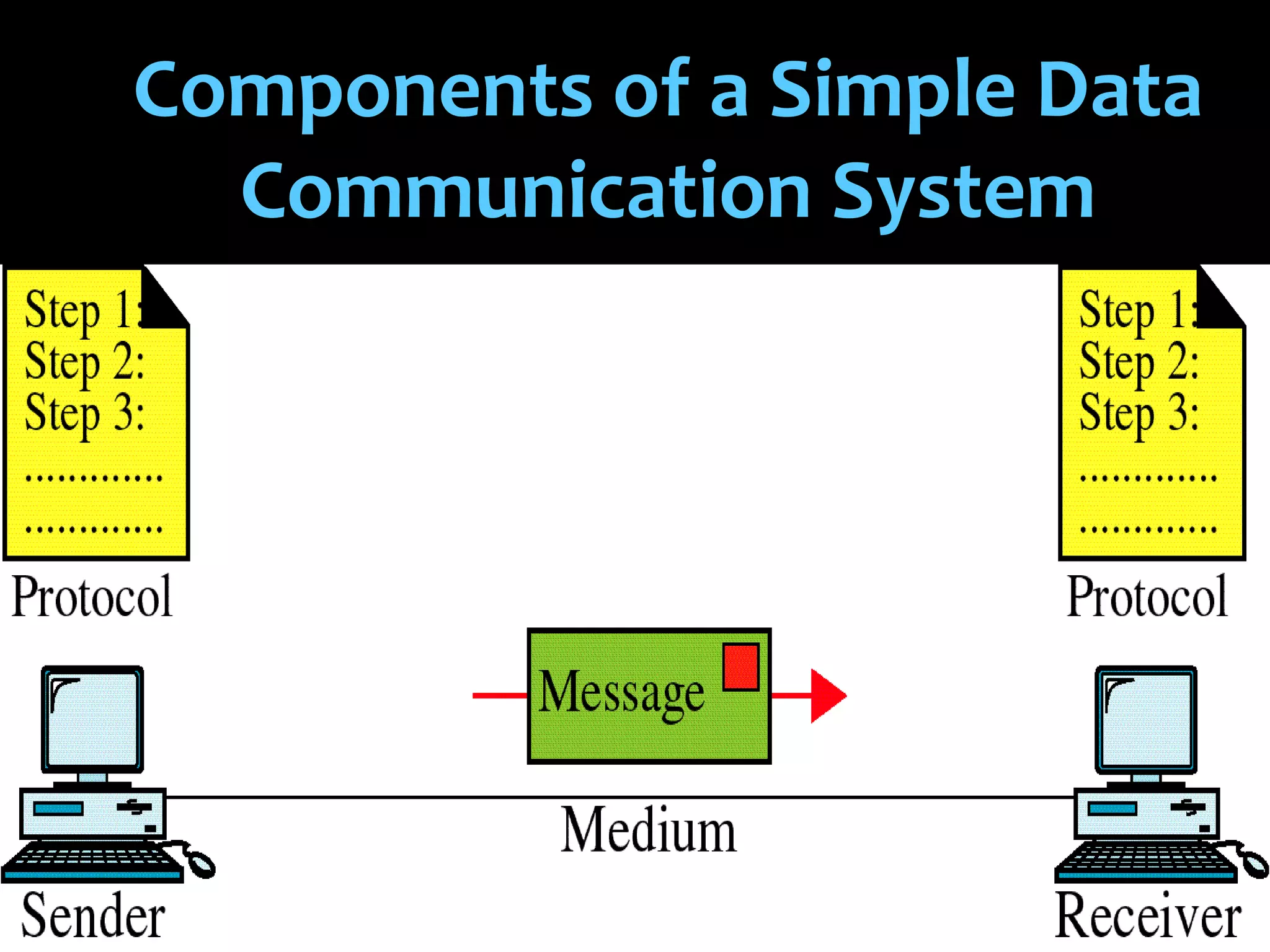
Components of a Simple Data
  Communication System
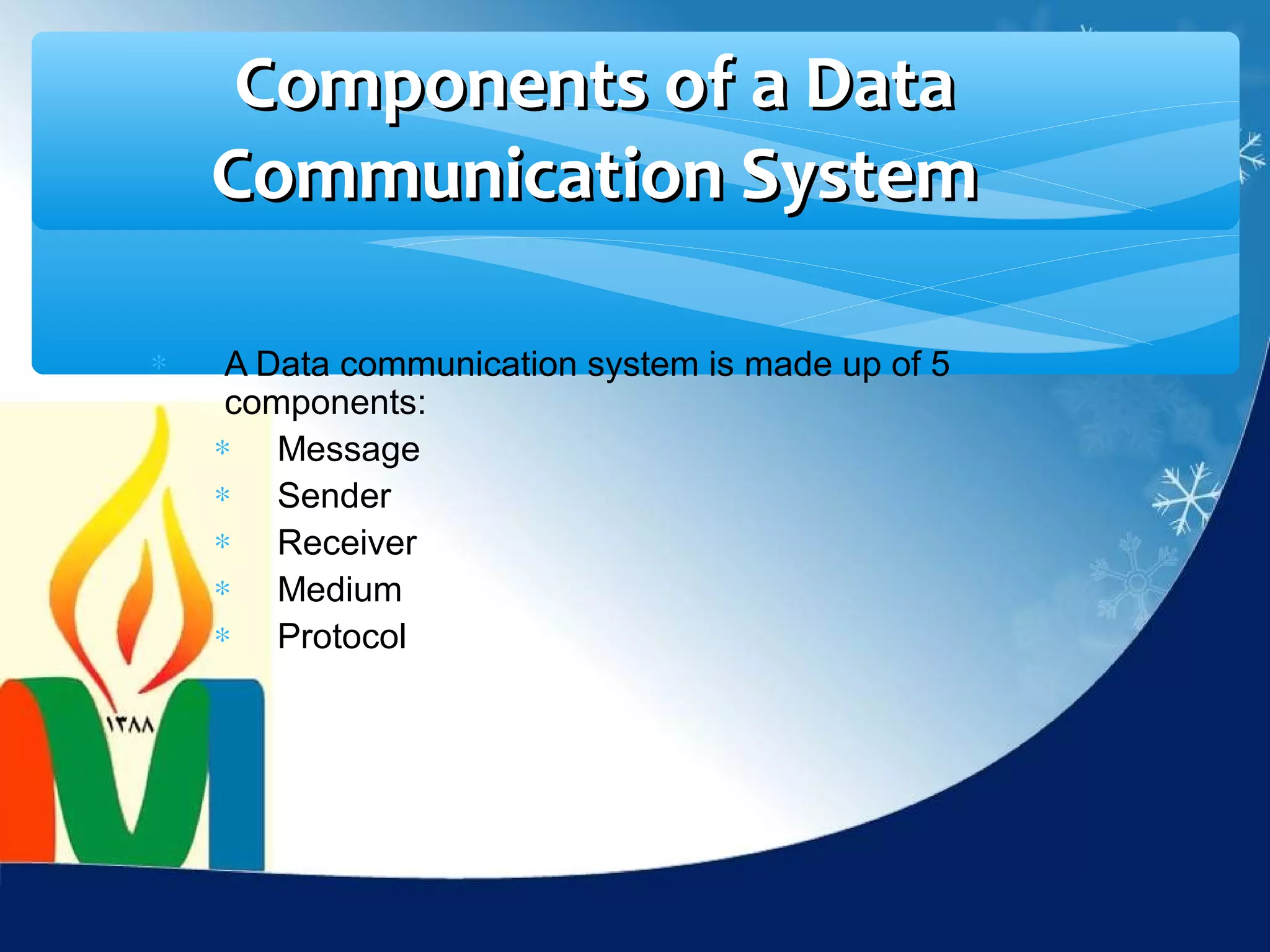
Components of a Data
    Communication System

∗    A Data communication system is made up of 5
     components:
    ∗ Message
    ∗ Sender
    ∗ Receiver
    ∗ Medium
    ∗ Protocol
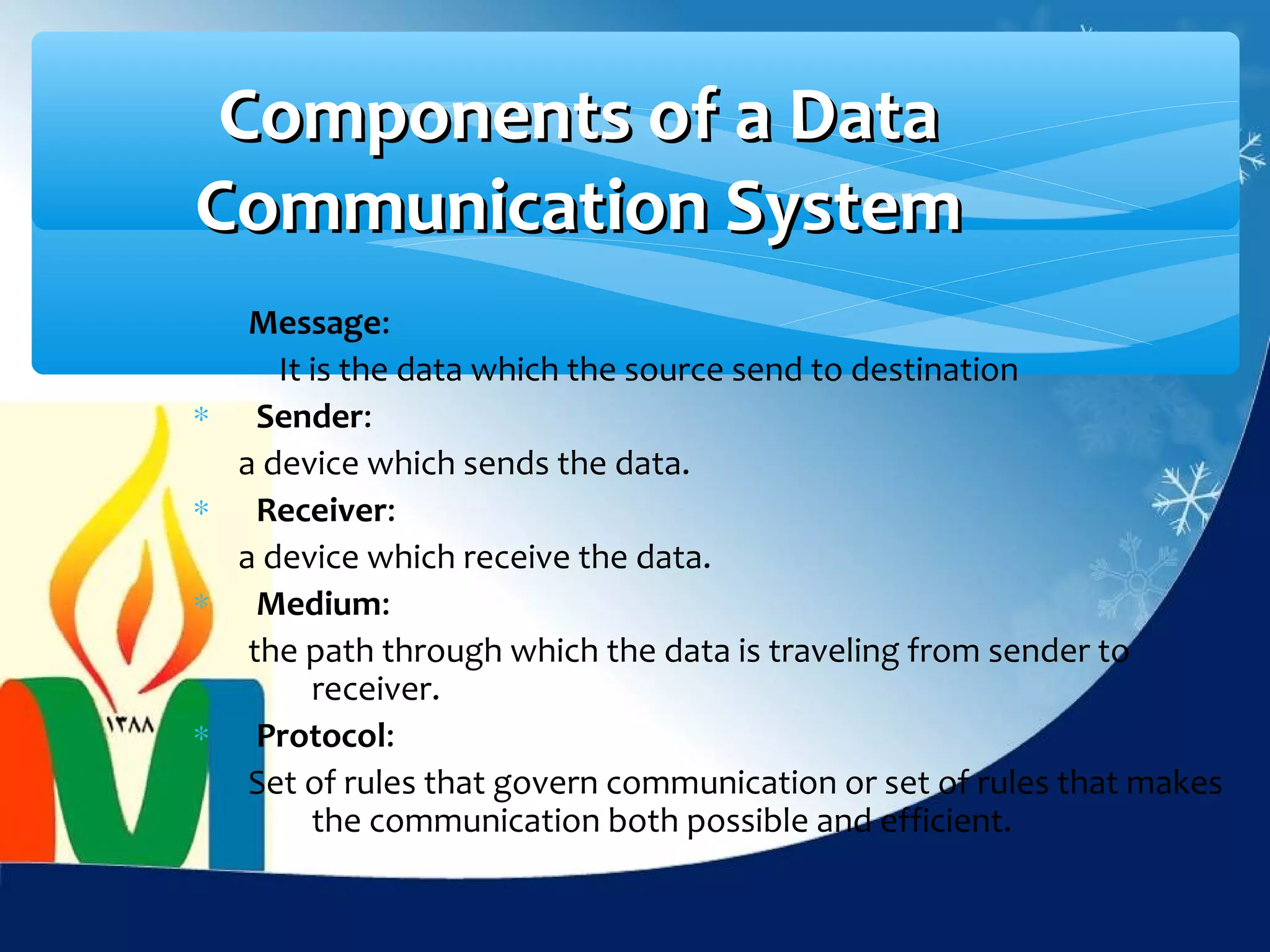
Components of a Data
Communication System
     Message:
       It is the data which the source send to destination
∗     Sender:
    a device which sends the data.
∗     Receiver:
    a device which receive the data.
∗     Medium:
     the path through which the data is traveling from sender to
          receiver.
∗     Protocol:
     Set of rules that govern communication or set of rules that makes
          the communication both possible and efficient.
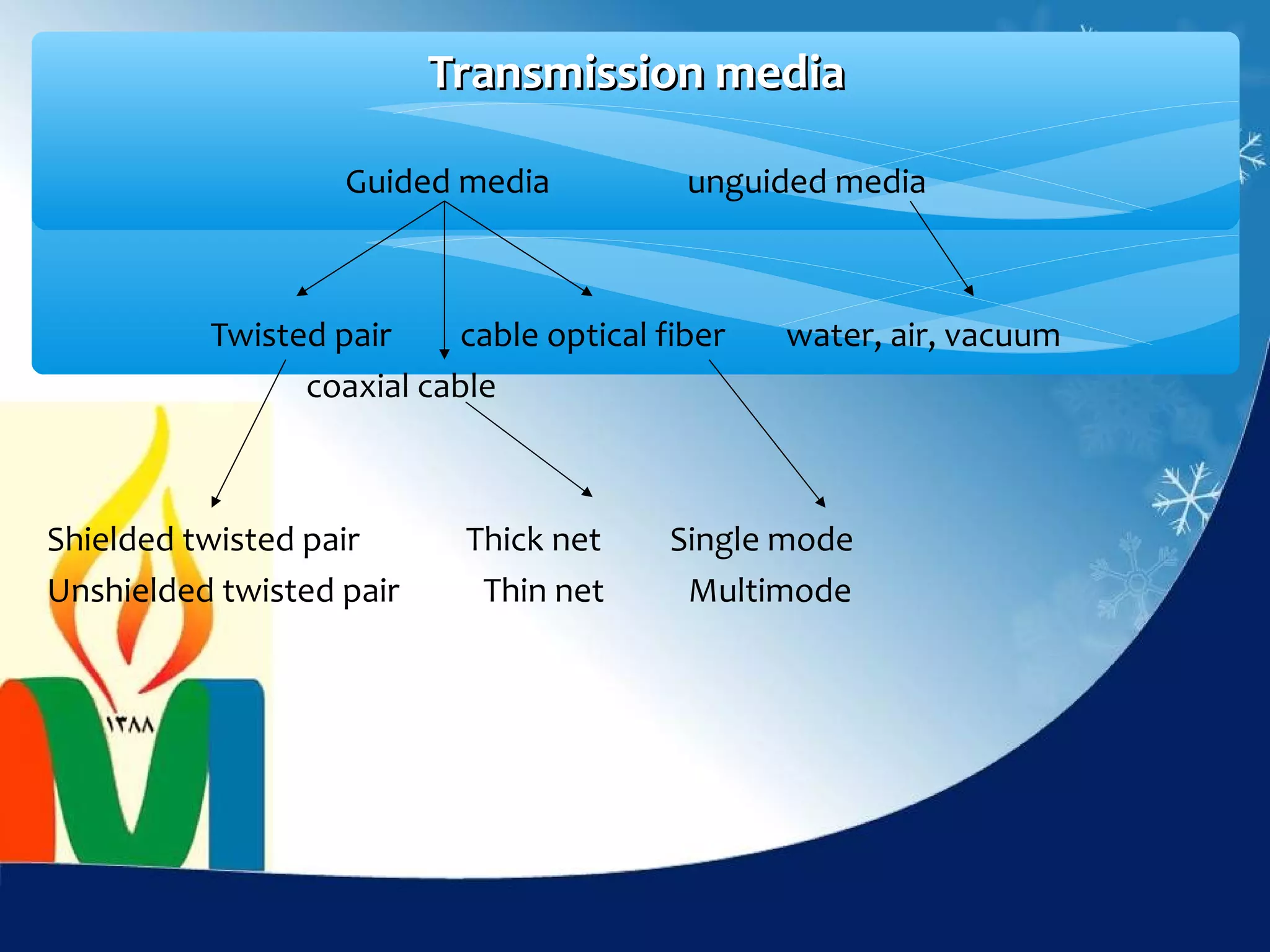
Transmission media

                   Guided media           unguided media


          Twisted pair    cable optical fiber   water, air, vacuum
                coaxial cable


Shielded twisted pair      Thick net     Single mode
Unshielded twisted pair     Thin net      Multimode
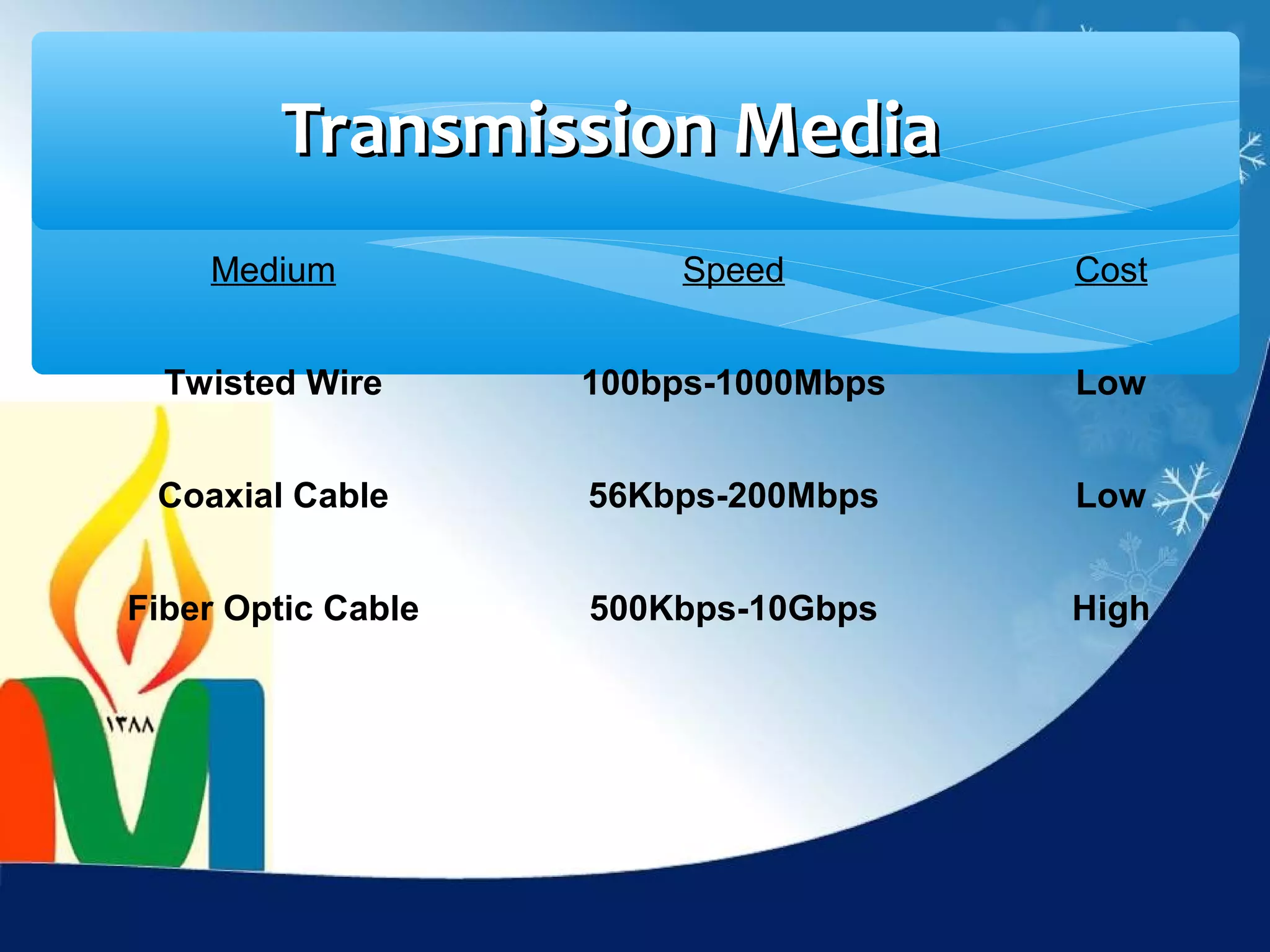
Transmission Media
    Medium              Speed         Cost


  Twisted Wire      100bps-1000Mbps   Low


 Coaxial Cable      56Kbps-200Mbps    Low


Fiber Optic Cable   500Kbps-10Gbps    High
Wire Based Media
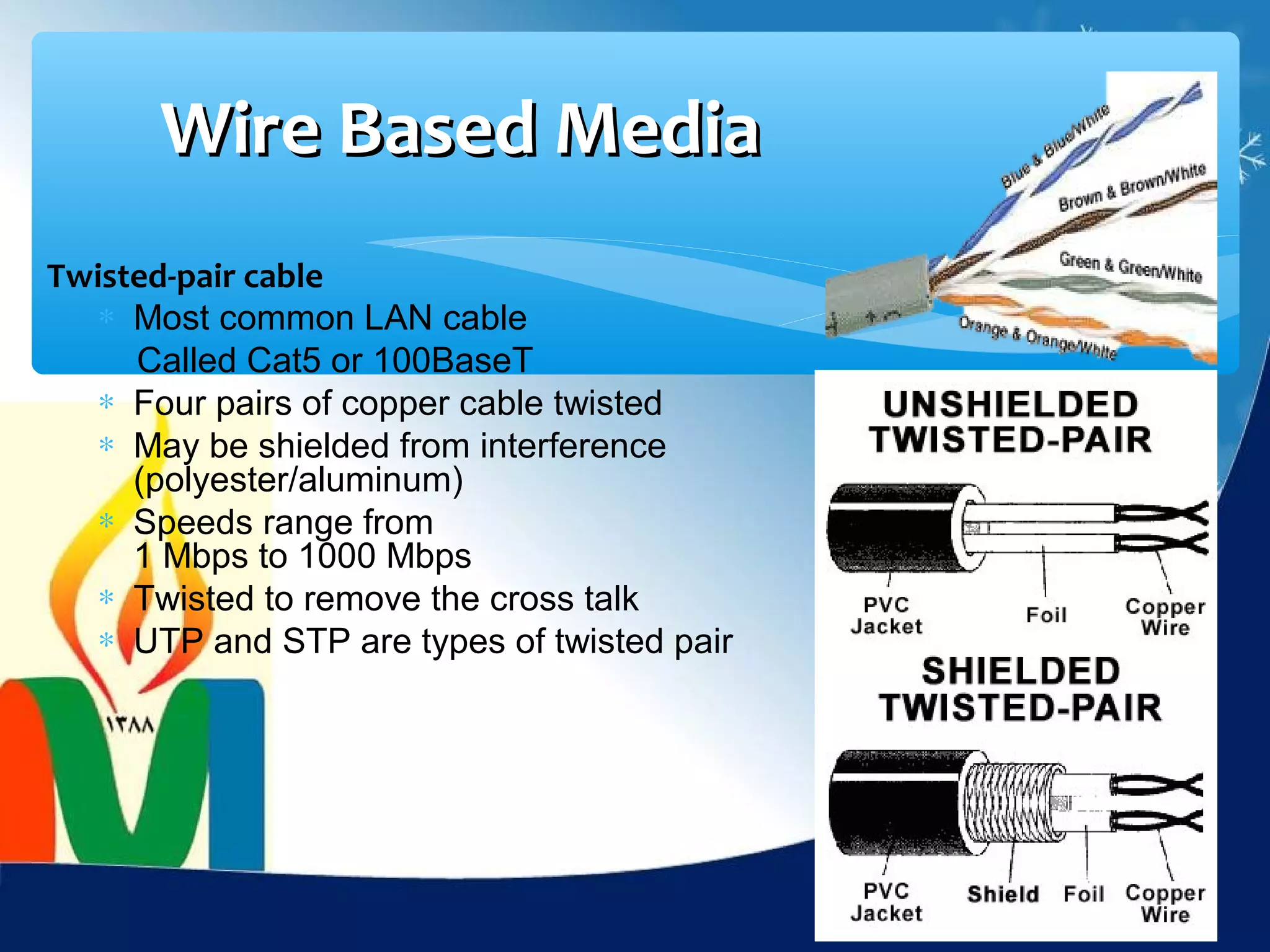
Twisted-pair cable
  ∗ Most common LAN cable
     Called Cat5 or 100BaseT
  ∗ Four pairs of copper cable twisted
  ∗ May be shielded from interference
     (polyester/aluminum)
  ∗ Speeds range from
     1 Mbps to 1000 Mbps
  ∗ Twisted to remove the cross talk
  ∗ UTP and STP are types of twisted pair
Wire Based Media
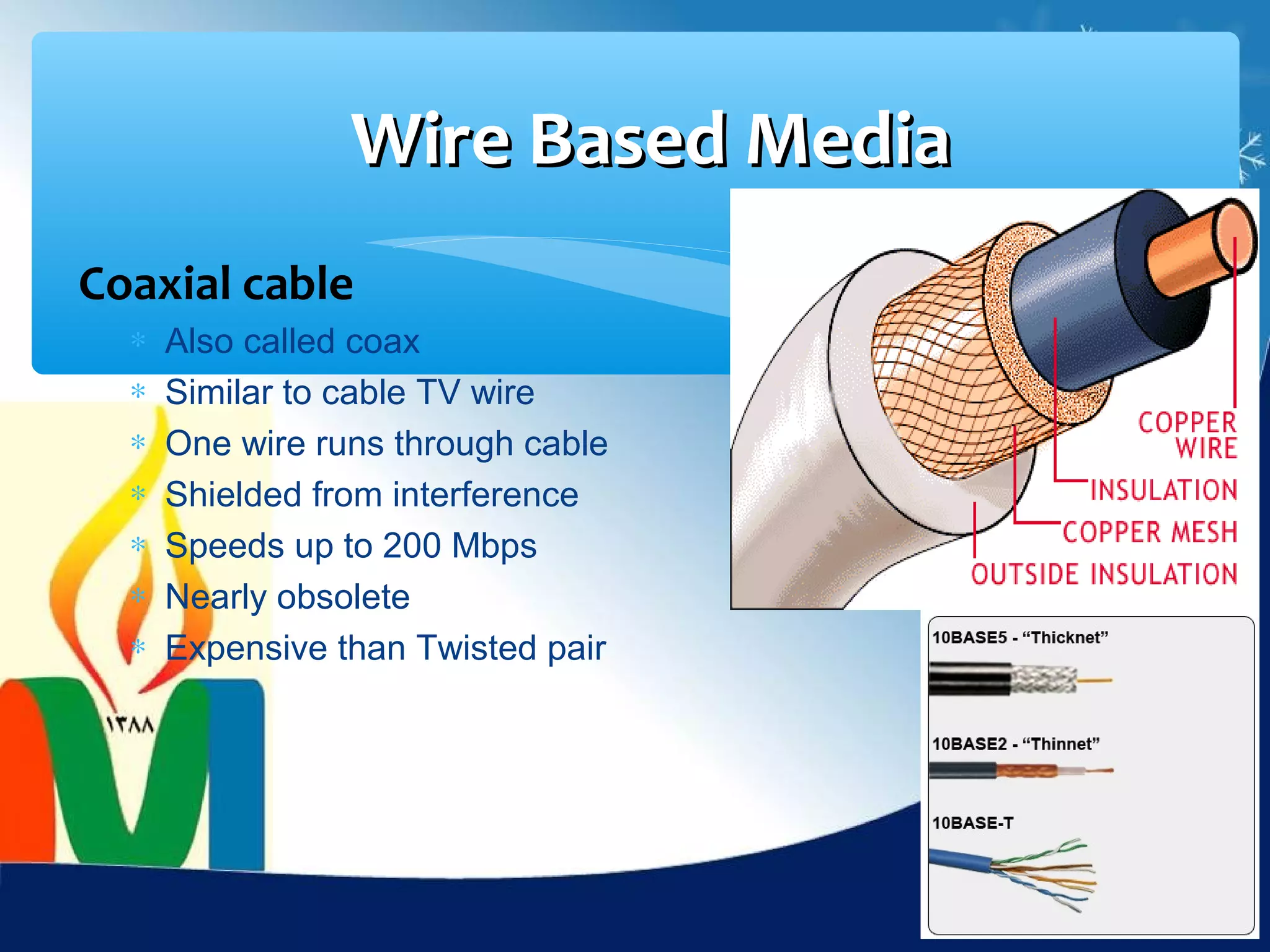
Coaxial cable
  ∗   Also called coax
  ∗   Similar to cable TV wire
  ∗   One wire runs through cable
  ∗   Shielded from interference
  ∗   Speeds up to 200 Mbps
  ∗   Nearly obsolete
  ∗   Expensive than Twisted pair
Wire Based Media
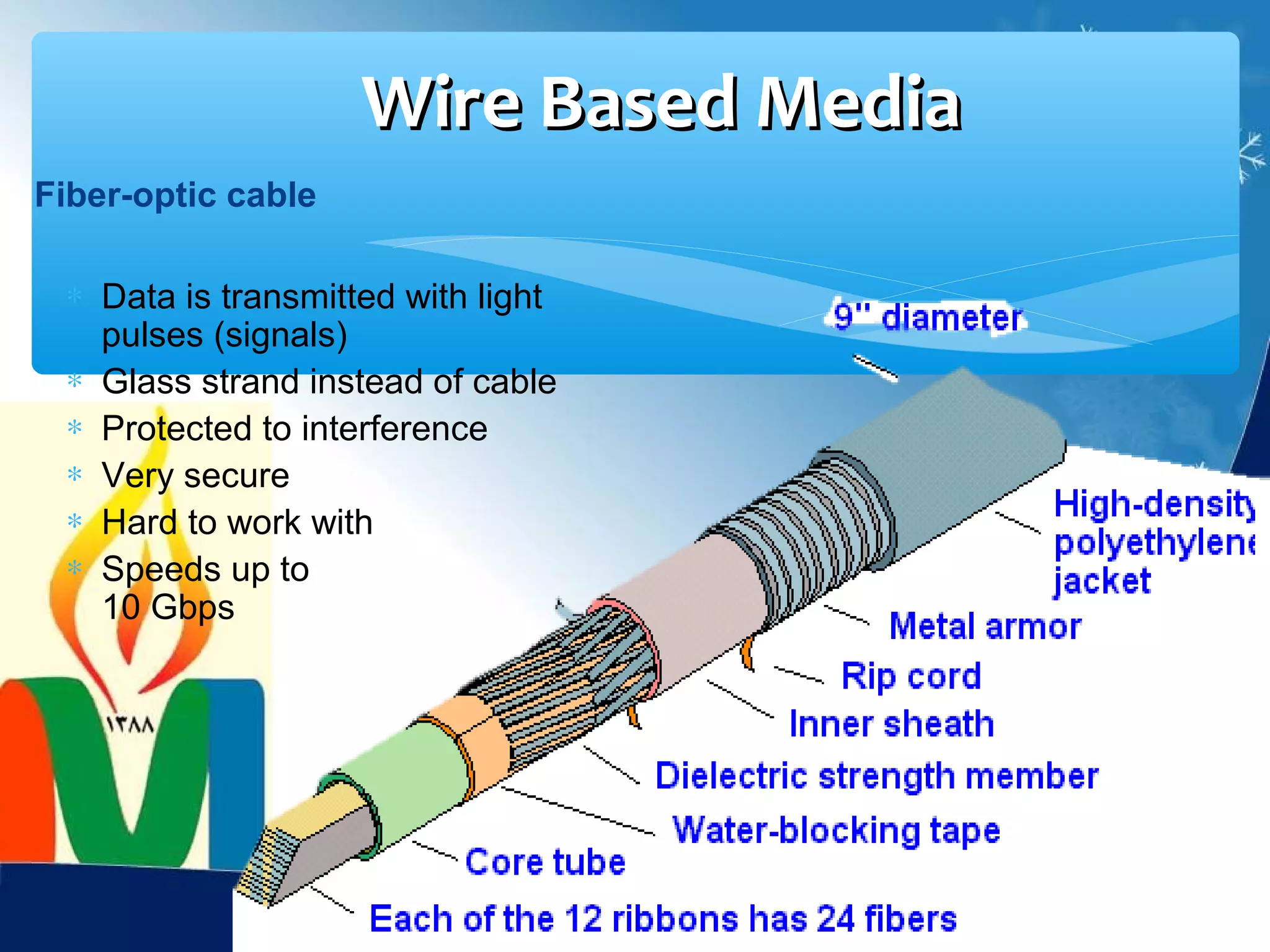
Fiber-optic cable

 ∗ Data is transmitted with light
   pulses (signals)
 ∗ Glass strand instead of cable
 ∗ Protected to interference
 ∗ Very secure
 ∗ Hard to work with
 ∗ Speeds up to
   10 Gbps
A Simple data communication
           Model
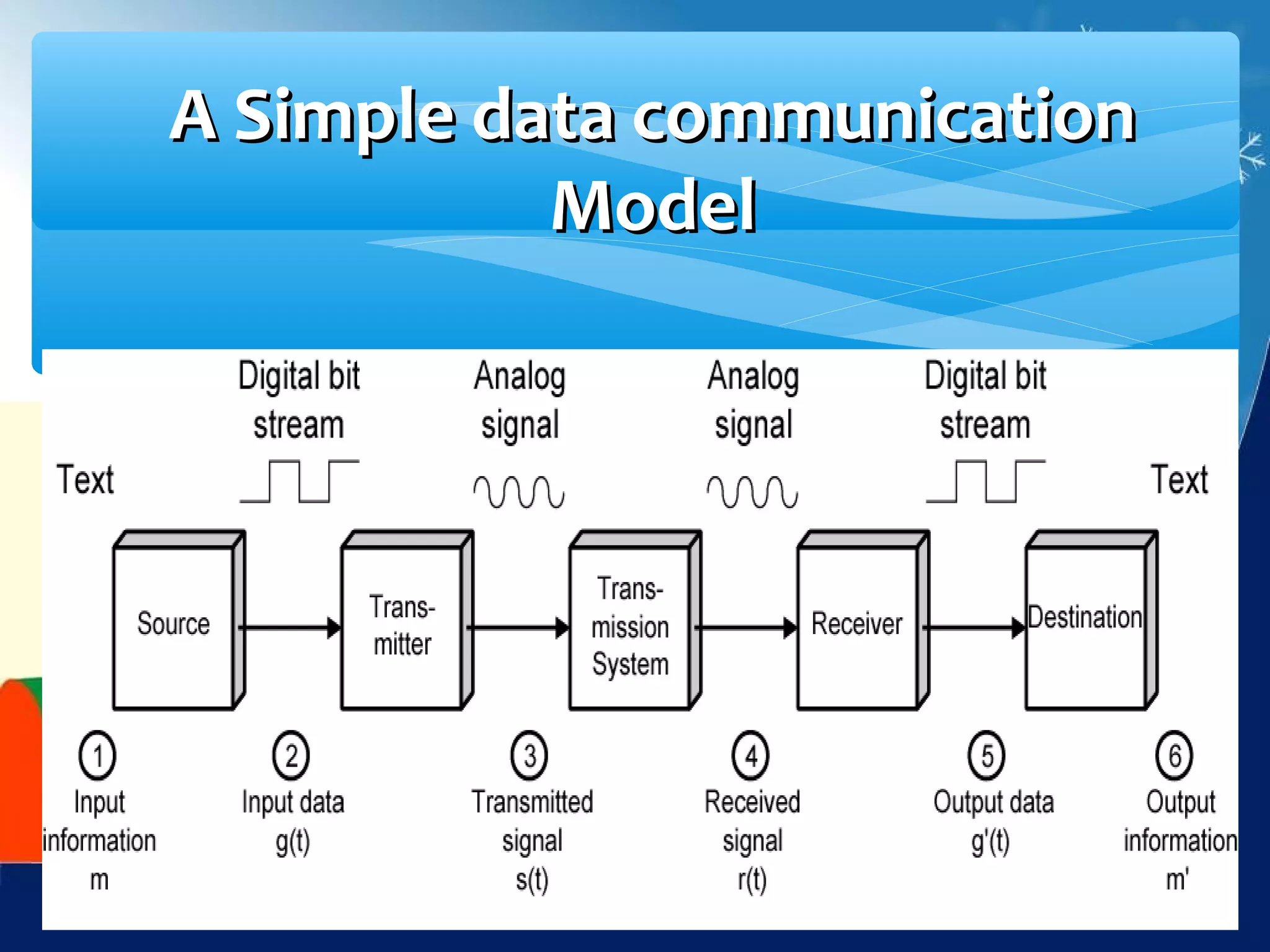
   Source
     A device which generate data

   Transmitter
     Is a device which takes data from source and convert it into a form
      that is transmutable over transmission media

   Transmission system
     Is the path available between source and destination and through
      which the data can travel.

   Receiver
     Is a device that takes data from transmission system and convert it
      into a form that is understandable by computer.

   Destination
     It is the final point of communication.
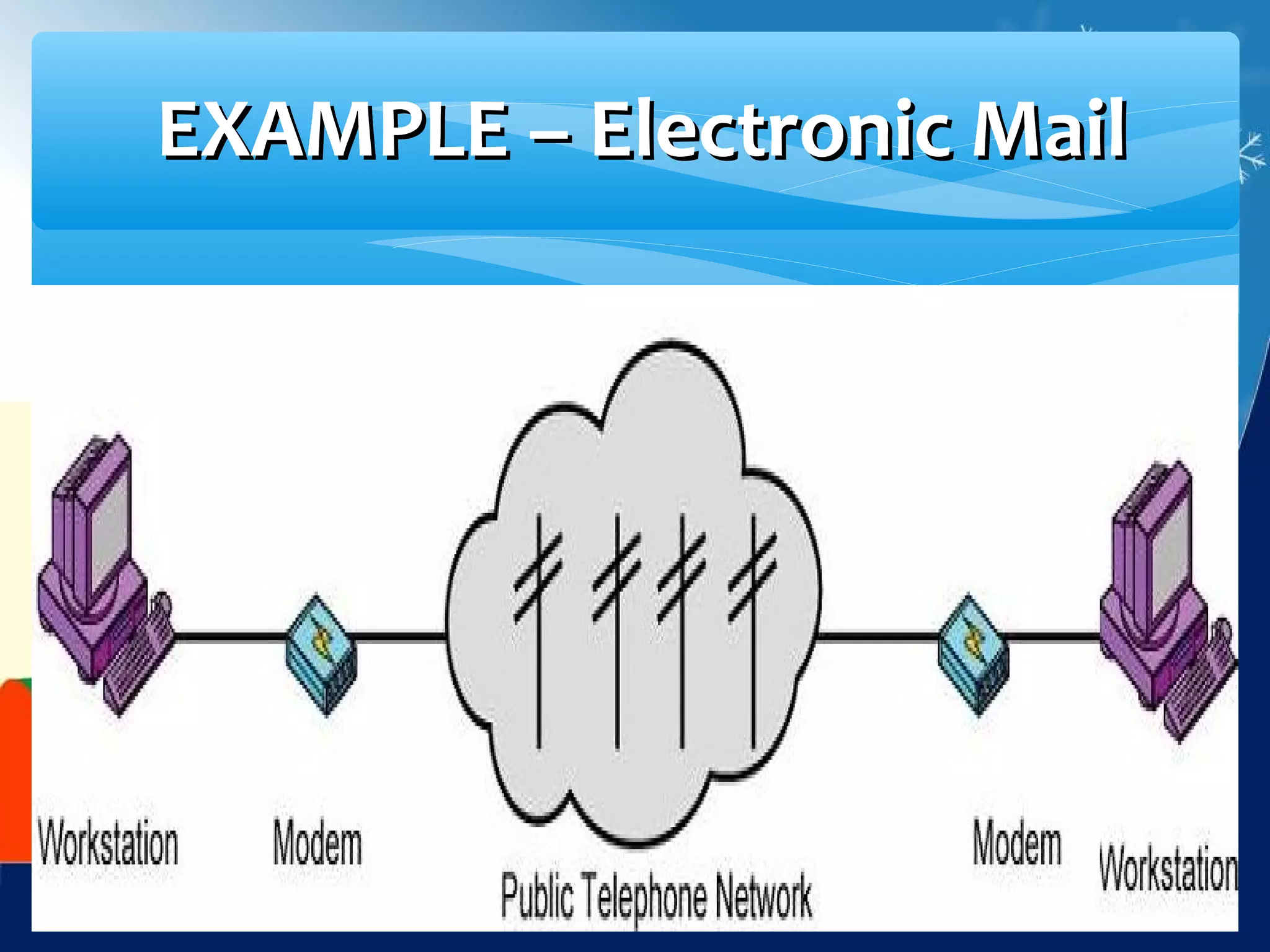
EXAMPLE – Electronic Mail
Key Data Communication Terminology

∗ Network: interconnected group of computers and communication
  devices.
   ∗ Can share the resources
   ∗ Can share the data


∗ Node: a network-attached device that can send and receive the data.
  E.g. Computer, router, Switch.
Key Data Communication Terminology

∗ Link: links are the path that connects adjacent nodes


∗ Path: end-to-end route within a network


∗ Circuit: the conduct over which data travels. Circuit is the path for
  current flow. Circuit can be open or close. Open circuit means that there
  is a break in the wire and current can not pass. A close circuit means
  that circuit is complete and current can pass
Key Data Communication Terminology

∗ Packetizing: dividing messages into fixed-length packets prior to
  transmission over a network’s communication media

∗ Routing: determining a message’s path from sending to receiving
  nodes

∗ Router: router is the device that perform the function of routing and
  switching
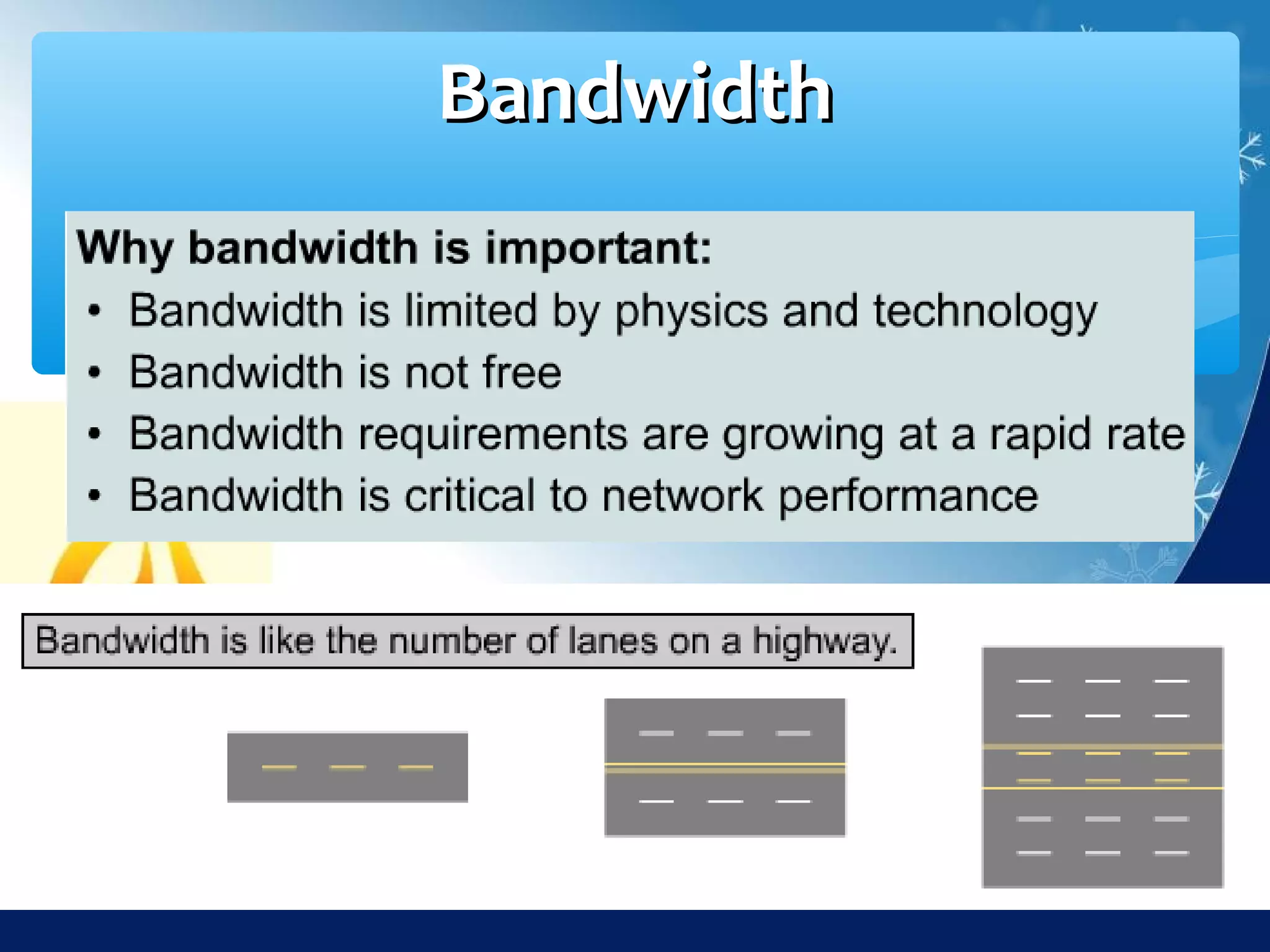
Bandwidth


    22
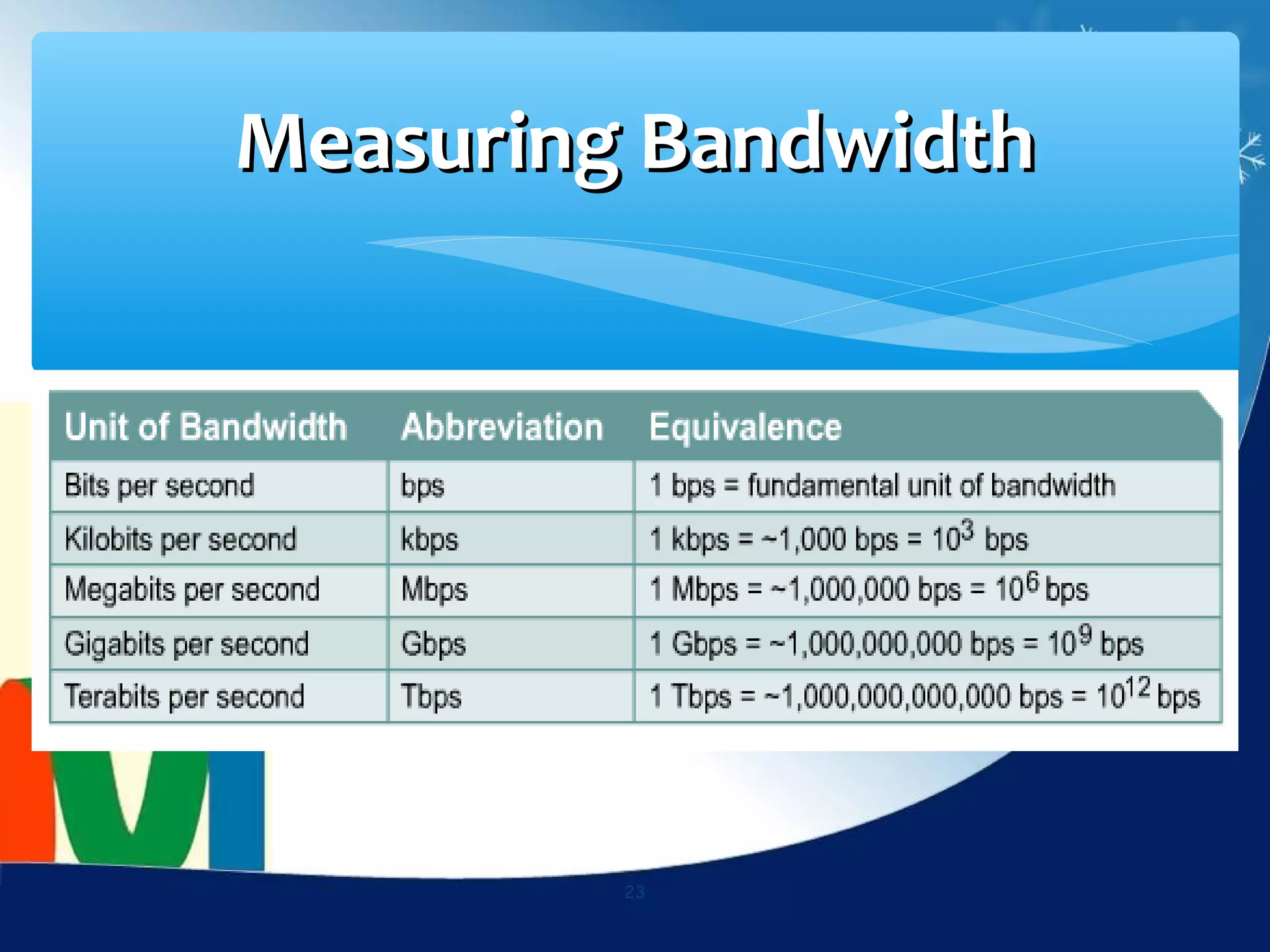
Measuring Bandwidth


         23
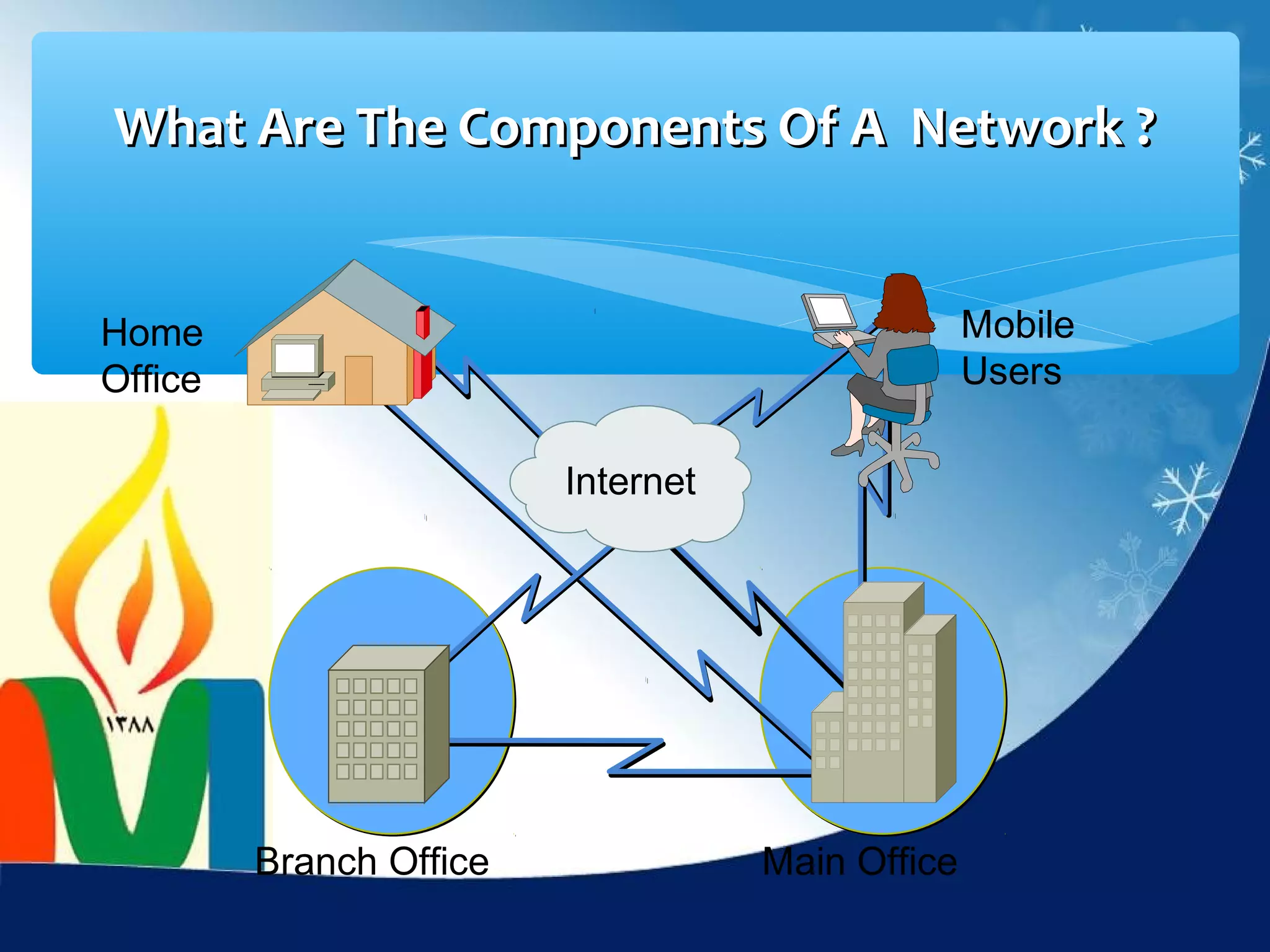
What Are The Components Of A Network ?


Home                                              Mobile
Office                                            Users

                         Internet


         Branch Office              Main Office

Mcitp lec 3

  • 1.
    Data Communication Prepared By: MIHE IT Department
  • 2.
    DEFINITION of DATA COMMUNICATION “Data Communication is the exchange of Information from one entity to the other using a Transmission Medium”
  • 3.
    LOCAL and REMOTE Communication  LOCAL – Communicating devices are present in the same building or a similarly restricted geographical area. – When the source and destination are in the same network
  • 4.
    Data Communication Definition (Modified) “Data Communication is the exchange of data (in the form of 0’s and 1’s) between two devices (computers) via some form of the transmission medium.”
  • 5.
    LOCAL and REMOTE Communication  REMOTE – Communicating devices are present farther apart. – When the source and destination are in the different network.
  • 6.
    Data Communication System For Data Communication to occur, communicating devices must be a part of a system made up of some specific kind of hardware and software. This system is known as “DATA COMMUNICATION SYSTEM”
  • 7.
    Effectiveness of DataComm. System  Delivery (the data you send and it is received to the destination)  Accuracy (what you send the same is received and there is no error)  Timeliness (the data reach to the destination in good time).
  • 8.
    Components of aSimple Data Communication System
  • 9.
    Components of aData Communication System ∗ A Data communication system is made up of 5 components: ∗ Message ∗ Sender ∗ Receiver ∗ Medium ∗ Protocol
  • 10.
    Components of aData Communication System Message: It is the data which the source send to destination ∗ Sender: a device which sends the data. ∗ Receiver: a device which receive the data. ∗ Medium: the path through which the data is traveling from sender to receiver. ∗ Protocol: Set of rules that govern communication or set of rules that makes the communication both possible and efficient.
  • 11.
    Transmission media Guided media unguided media Twisted pair cable optical fiber water, air, vacuum coaxial cable Shielded twisted pair Thick net Single mode Unshielded twisted pair Thin net Multimode
  • 12.
    Transmission Media Medium Speed Cost Twisted Wire 100bps-1000Mbps Low Coaxial Cable 56Kbps-200Mbps Low Fiber Optic Cable 500Kbps-10Gbps High
  • 13.
    Wire Based Media Twisted-paircable ∗ Most common LAN cable Called Cat5 or 100BaseT ∗ Four pairs of copper cable twisted ∗ May be shielded from interference (polyester/aluminum) ∗ Speeds range from 1 Mbps to 1000 Mbps ∗ Twisted to remove the cross talk ∗ UTP and STP are types of twisted pair
  • 14.
    Wire Based Media Coaxialcable ∗ Also called coax ∗ Similar to cable TV wire ∗ One wire runs through cable ∗ Shielded from interference ∗ Speeds up to 200 Mbps ∗ Nearly obsolete ∗ Expensive than Twisted pair
  • 15.
    Wire Based Media Fiber-opticcable ∗ Data is transmitted with light pulses (signals) ∗ Glass strand instead of cable ∗ Protected to interference ∗ Very secure ∗ Hard to work with ∗ Speeds up to 10 Gbps
  • 16.
    A Simple datacommunication Model
  • 17.
    Source  A device which generate data  Transmitter  Is a device which takes data from source and convert it into a form that is transmutable over transmission media  Transmission system  Is the path available between source and destination and through which the data can travel.  Receiver  Is a device that takes data from transmission system and convert it into a form that is understandable by computer.  Destination  It is the final point of communication.
  • 18.
  • 19.
    Key Data CommunicationTerminology ∗ Network: interconnected group of computers and communication devices. ∗ Can share the resources ∗ Can share the data ∗ Node: a network-attached device that can send and receive the data. E.g. Computer, router, Switch.
  • 20.
    Key Data CommunicationTerminology ∗ Link: links are the path that connects adjacent nodes ∗ Path: end-to-end route within a network ∗ Circuit: the conduct over which data travels. Circuit is the path for current flow. Circuit can be open or close. Open circuit means that there is a break in the wire and current can not pass. A close circuit means that circuit is complete and current can pass
  • 21.
    Key Data CommunicationTerminology ∗ Packetizing: dividing messages into fixed-length packets prior to transmission over a network’s communication media ∗ Routing: determining a message’s path from sending to receiving nodes ∗ Router: router is the device that perform the function of routing and switching
  • 22.
  • 23.
  • 24.
    What Are TheComponents Of A Network ? Home Mobile Office Users Internet Branch Office Main Office