Library Users
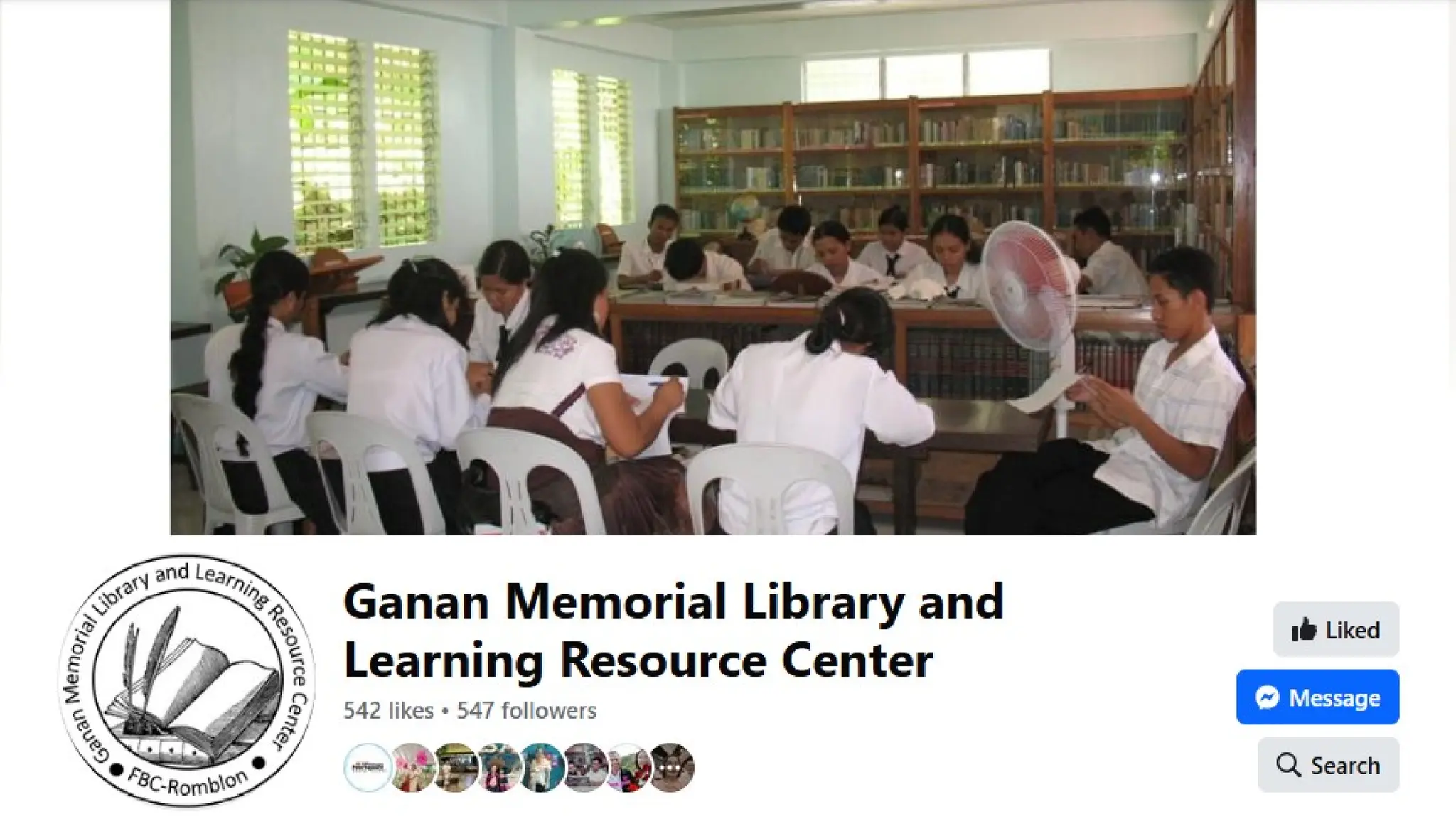
Due toits nature as a theological library, its clients are
mainly composed of:
1. Theology students of FBC-Romblon
2. Teaching and Non-Teaching staff of FBC-Romblon
3. Workers, Ministers, and Leaders of the Church of the
Foursquare Gospel and other denominations
4. Interested researchers especially in the area of
theology.
Rules and Etiquettes
•Maintainsilence in quiet zones
•Return books on time
•No food or drinks near computers
•Respect shared spaces
8.
Policies
•Present your borrower’scard whenever availing
library service. Lost Borrower’s card left inside
the library premises will be forfeited and shall be
redeemed for five pesos per day, excluding
Saturdays and Sundays.
9.
Policies
•General reference andhardbound
materials (encyclopedia, Bible,
commentaries, magazines, yearbooks,
dictionaries, and the like) are to be read inside
the library only. These materials are not to be
taken out.
10.
Policies
•Reference books (ifmultiple copies are available)
are lent for OVERNIGHT only, while other books
could be borrowed for a maximum of four days.
All books borrowed should be returned not later
than 9:00 a.m. excluding Saturdays and Sundays.
Ten (10) pesos per day and/or one (1) peso per
hour will be charged as fine if returned overdue.
11.
Policies
•Materials to bephotocopied are allowed for two
(2) hours only. Five (5) pesos per delayed hour
will be charged if returned late.
12.
Policies
•Proper attire shouldbe worn in the
library.
•Charging gadgets not specifically used in relation
to research are strictly prohibited in the library.
13.
Policies
•Lost or destroyedlibrary materials should be
replaced by the one responsible. Paying of the
lost and/or destroyed material is highly
discouraged.
14.
Library of CongressClassification System
•A system used to organize library materials
•Helps users locate items on the shelves
•Ensures subjects are grouped together
15.
Library of CongressClassification System
•Developed by the Library of Congress
(USA)
•Used mainly in academic and research
libraries
•Organizes materials by subject using letters
and numbers
16.
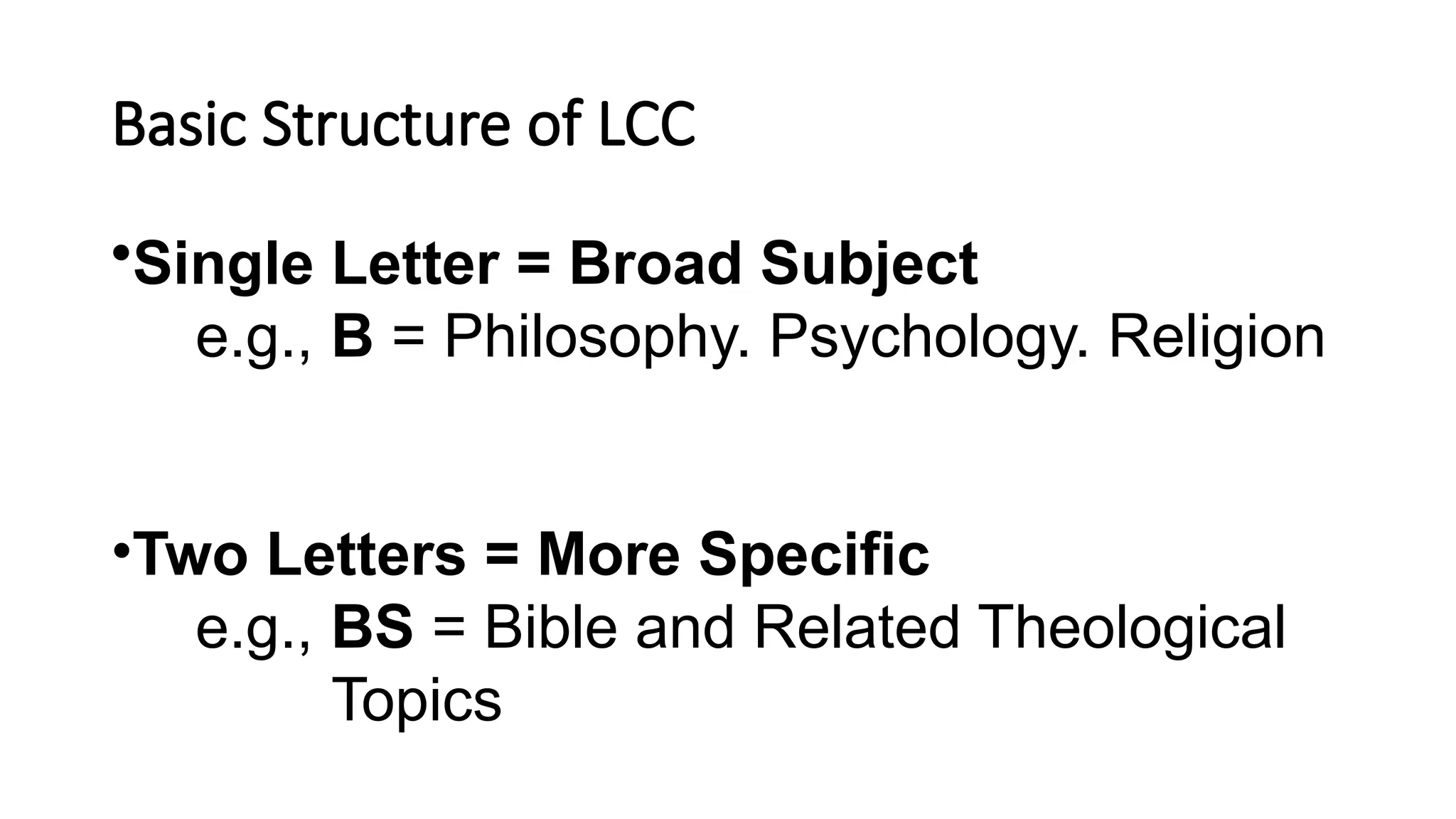
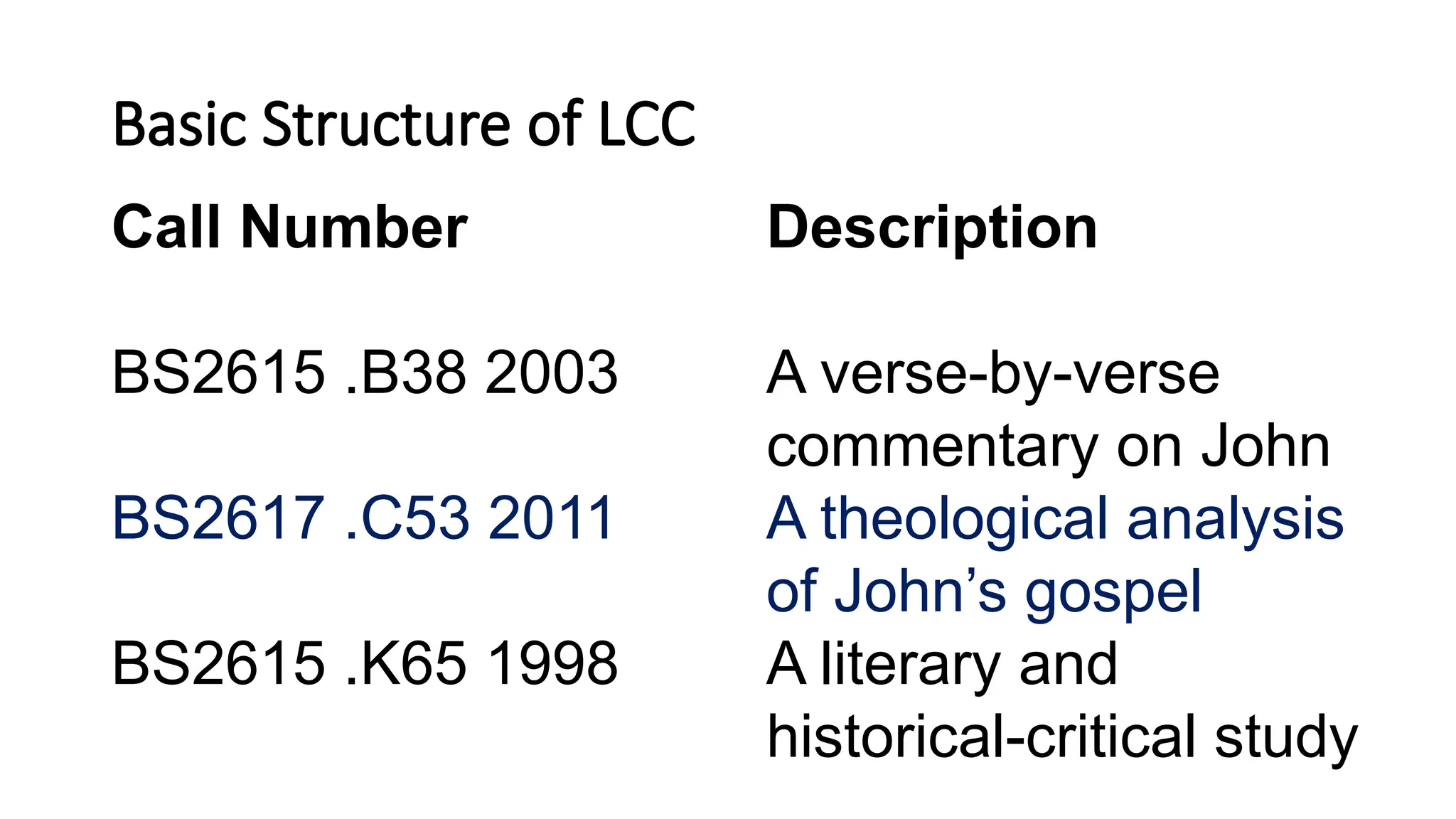
Basic Structure ofLCC
•Single Letter = Broad Subject
e.g., B = Philosophy. Psychology. Religion
•Two Letters = More Specific
e.g., BS = Bible and Related Theological
Topics
17.
Basic Structure ofLCC
Call Number Description
BS2615 .B38 2003 A verse-by-verse
commentary on John
BS2617 .C53 2011 A theological analysis
of John’s gospel
BS2615 .K65 1998 A literary and
historical-critical study
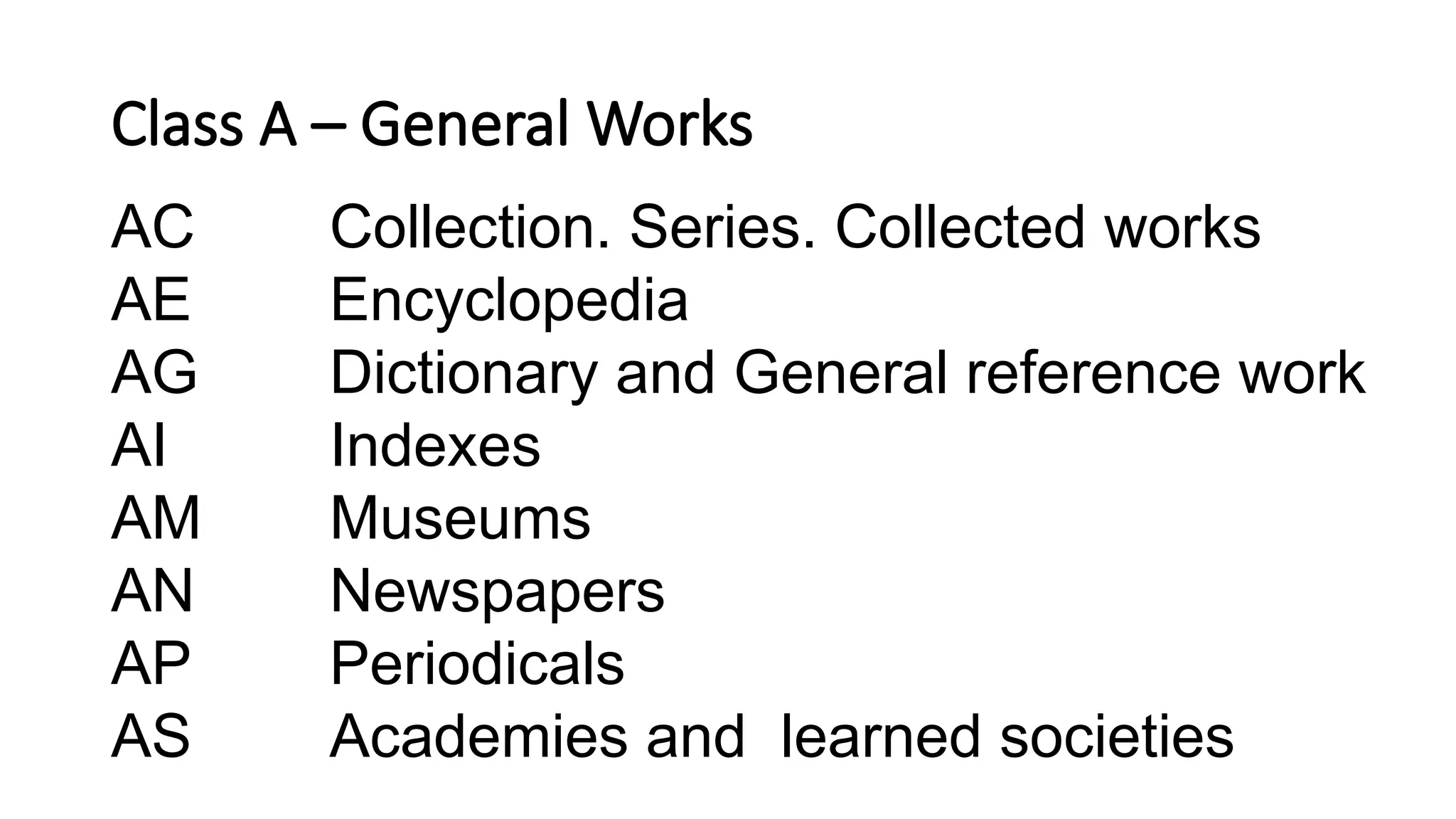
18.
Class A –General Works
AC Collection. Series. Collected works
AE Encyclopedia
AG Dictionary and General reference work
AI Indexes
AM Museums
AN Newspapers
AP Periodicals
AS Academies and learned societies
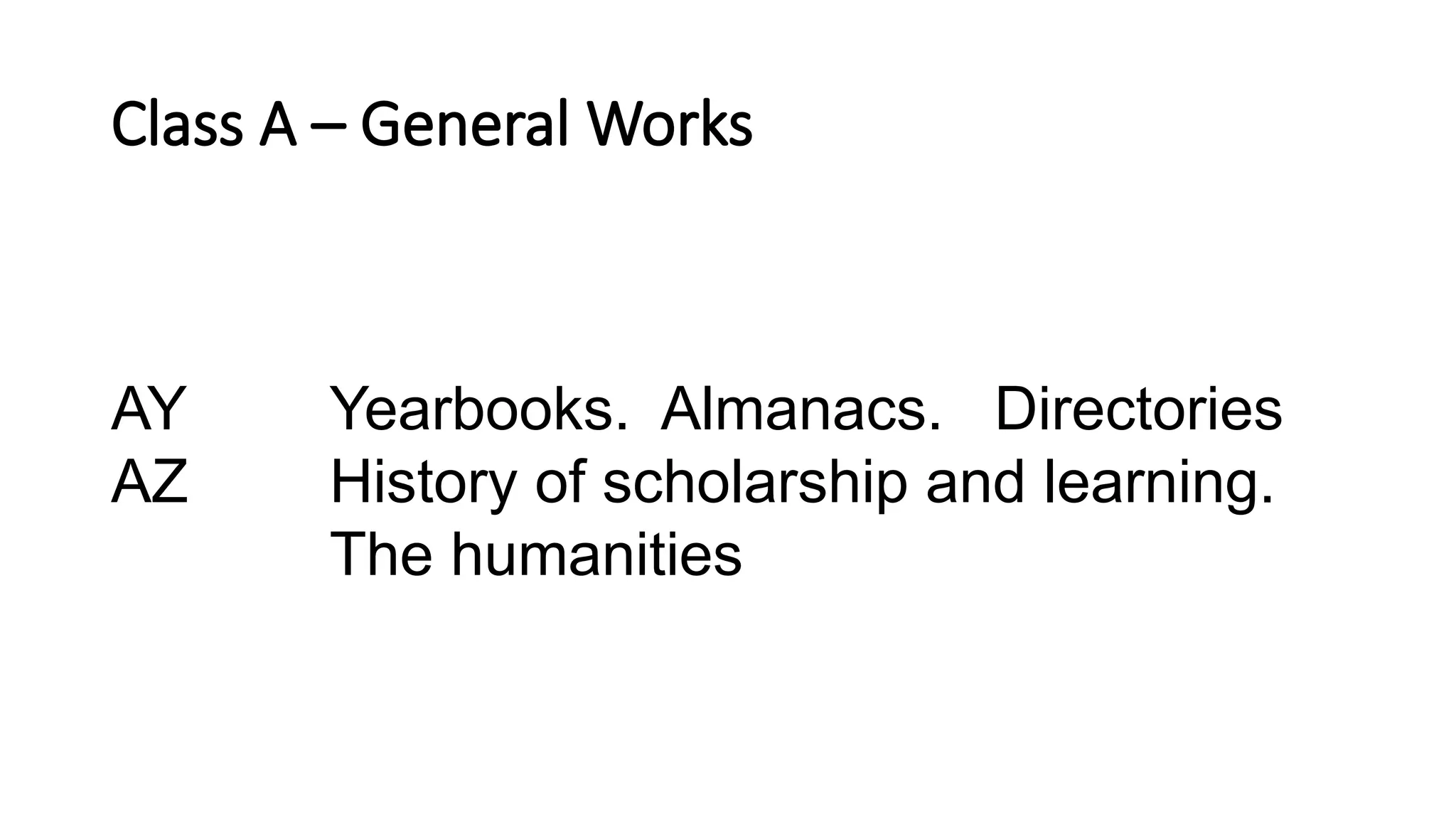
19.
Class A –General Works
AY Yearbooks. Almanacs. Directories
AZ History of scholarship and learning.
The humanities
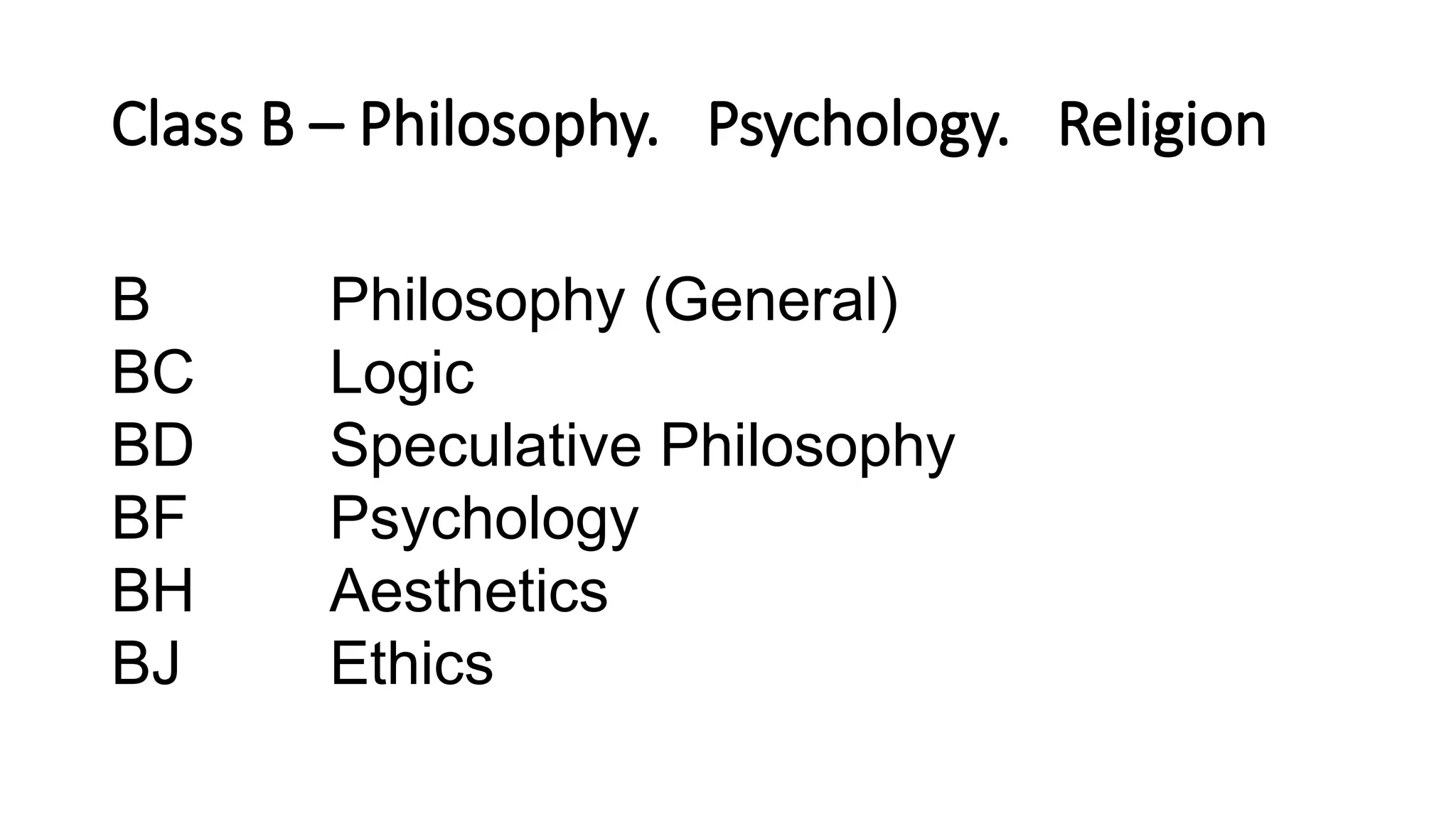
20.
Class B –Philosophy. Psychology. Religion
B Philosophy (General)
BC Logic
BD Speculative Philosophy
BF Psychology
BH Aesthetics
BJ Ethics
21.
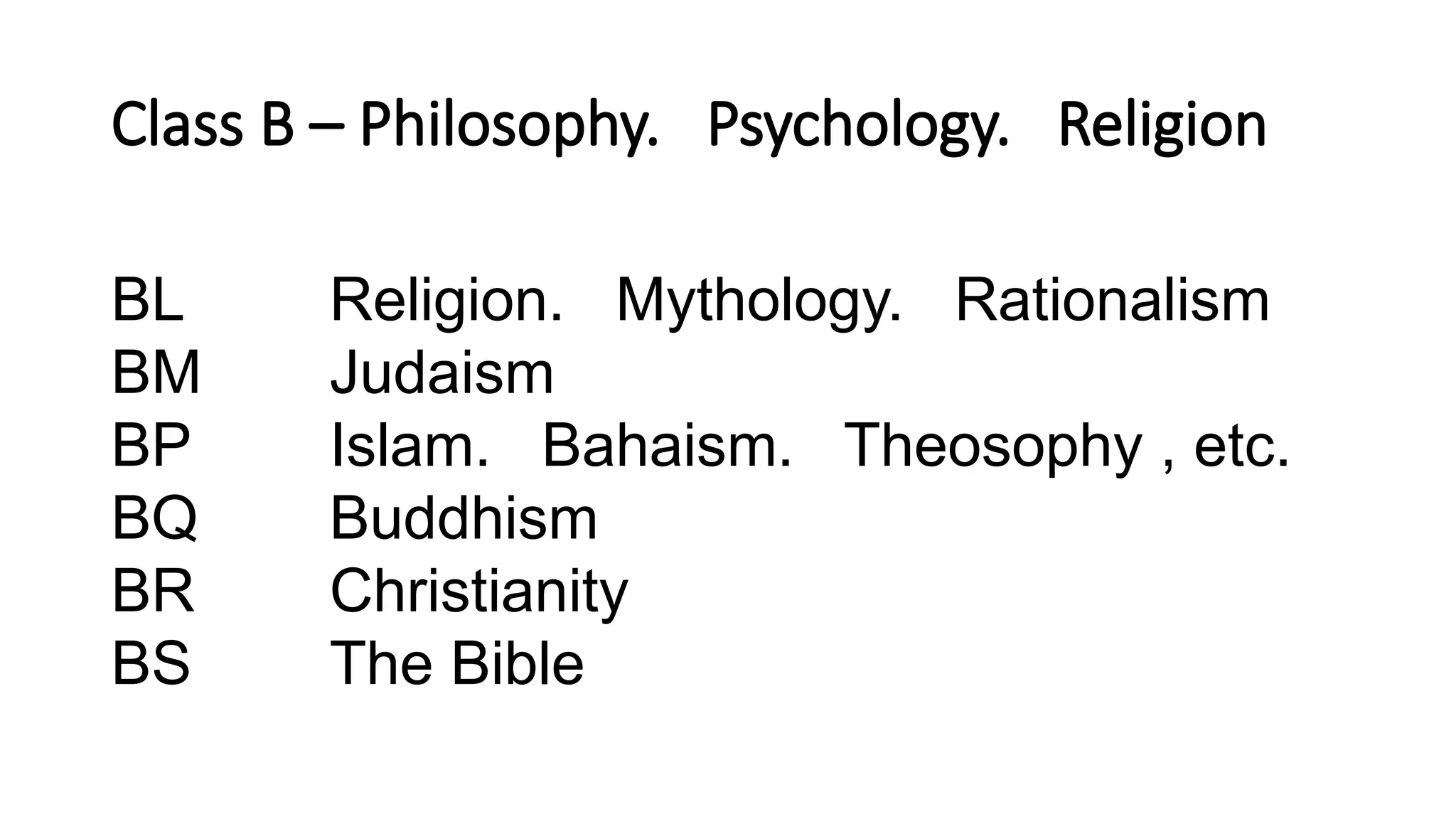
Class B –Philosophy. Psychology. Religion
BL Religion. Mythology. Rationalism
BM Judaism
BP Islam. Bahaism. Theosophy , etc.
BQ Buddhism
BR Christianity
BS The Bible
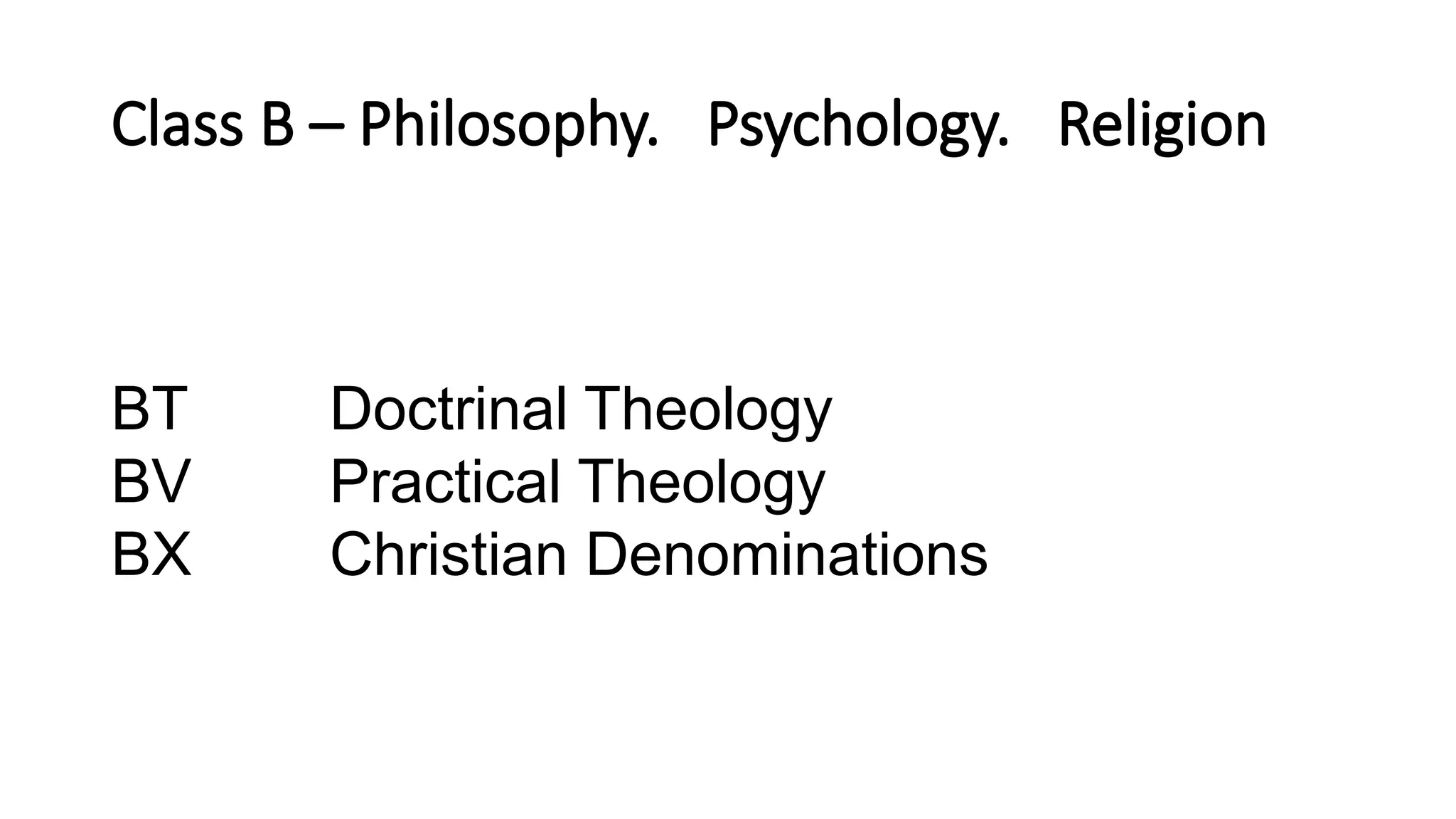
22.
Class B –Philosophy. Psychology. Religion
BT Doctrinal Theology
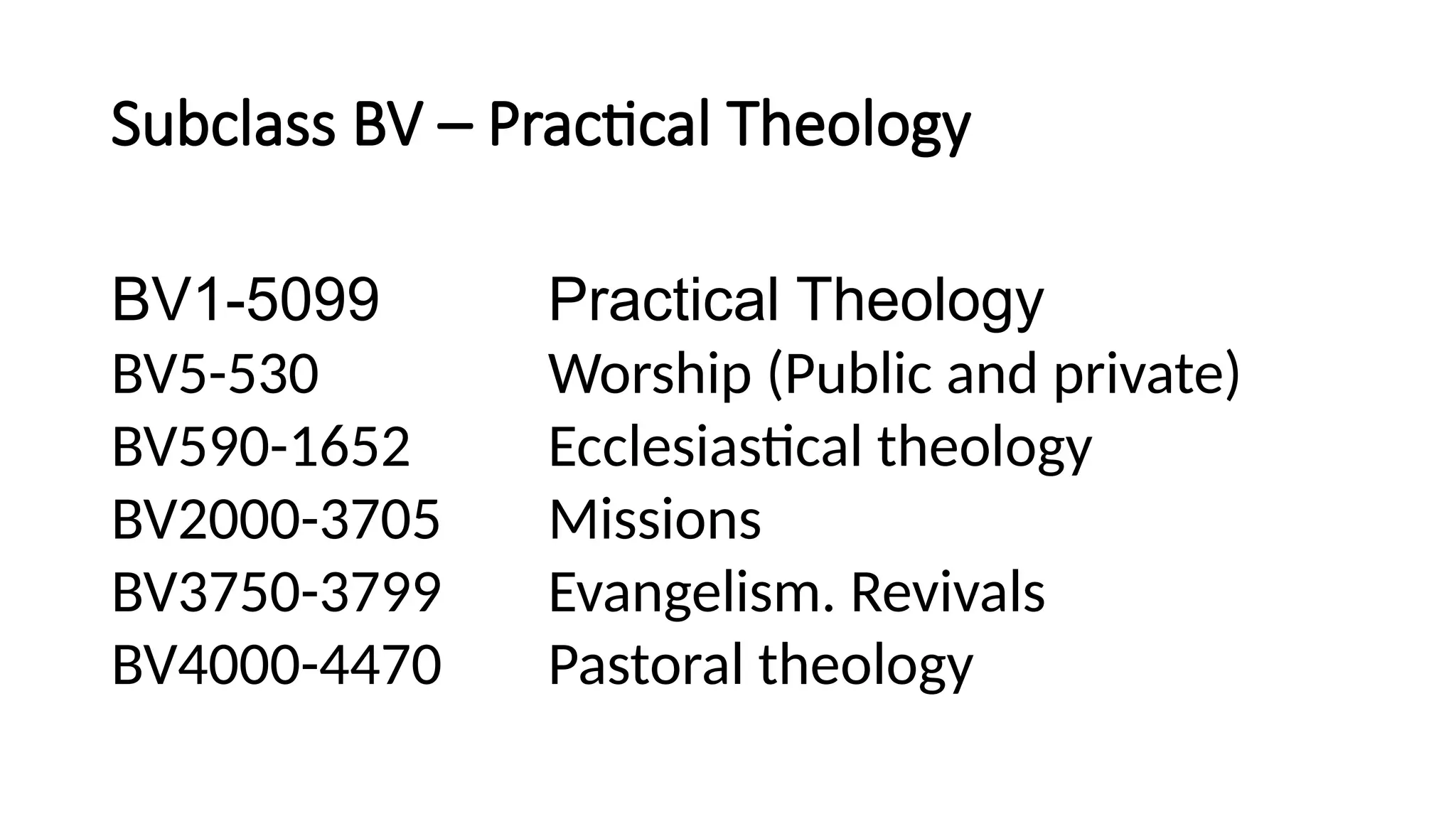
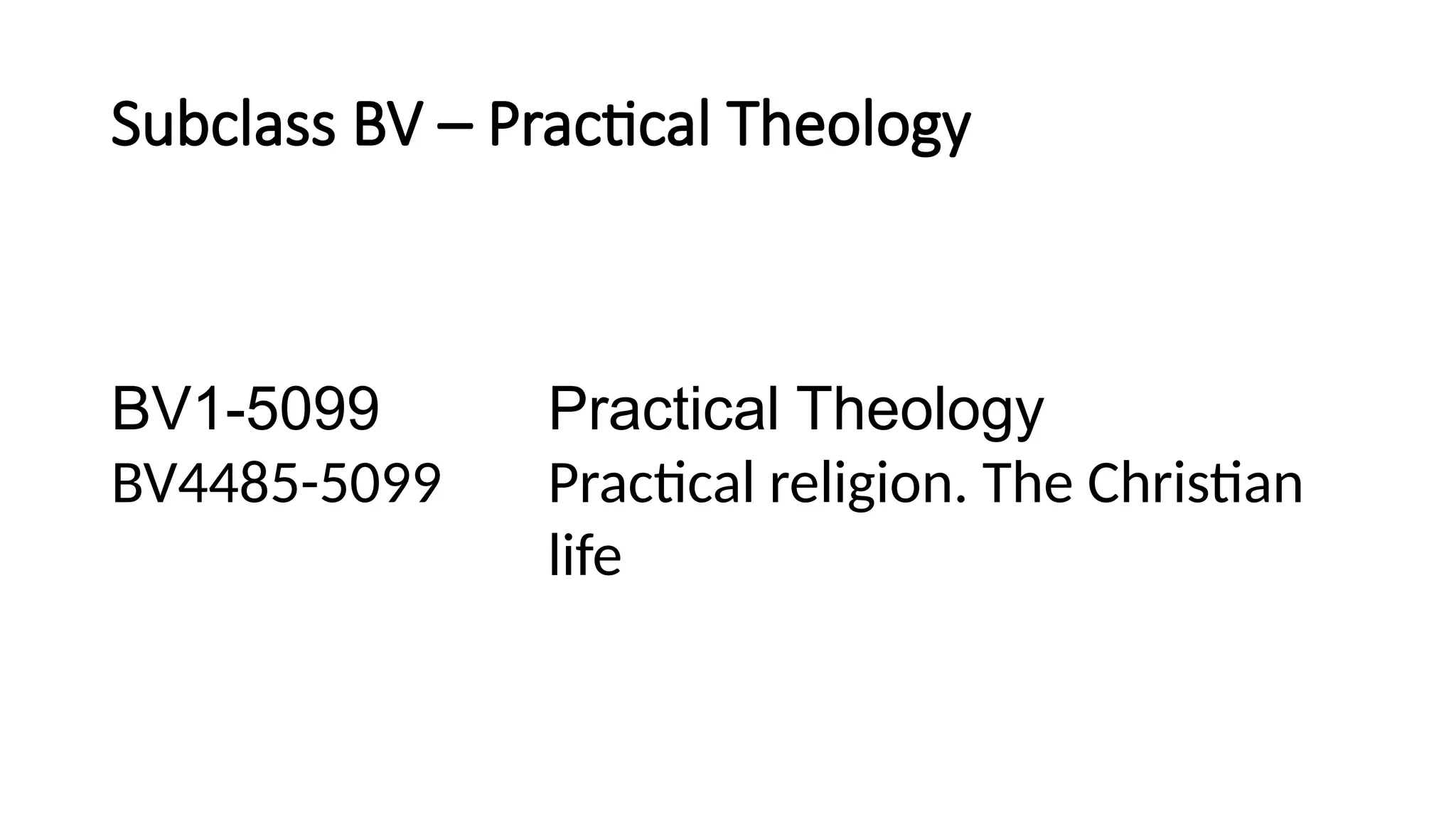
BV Practical Theology
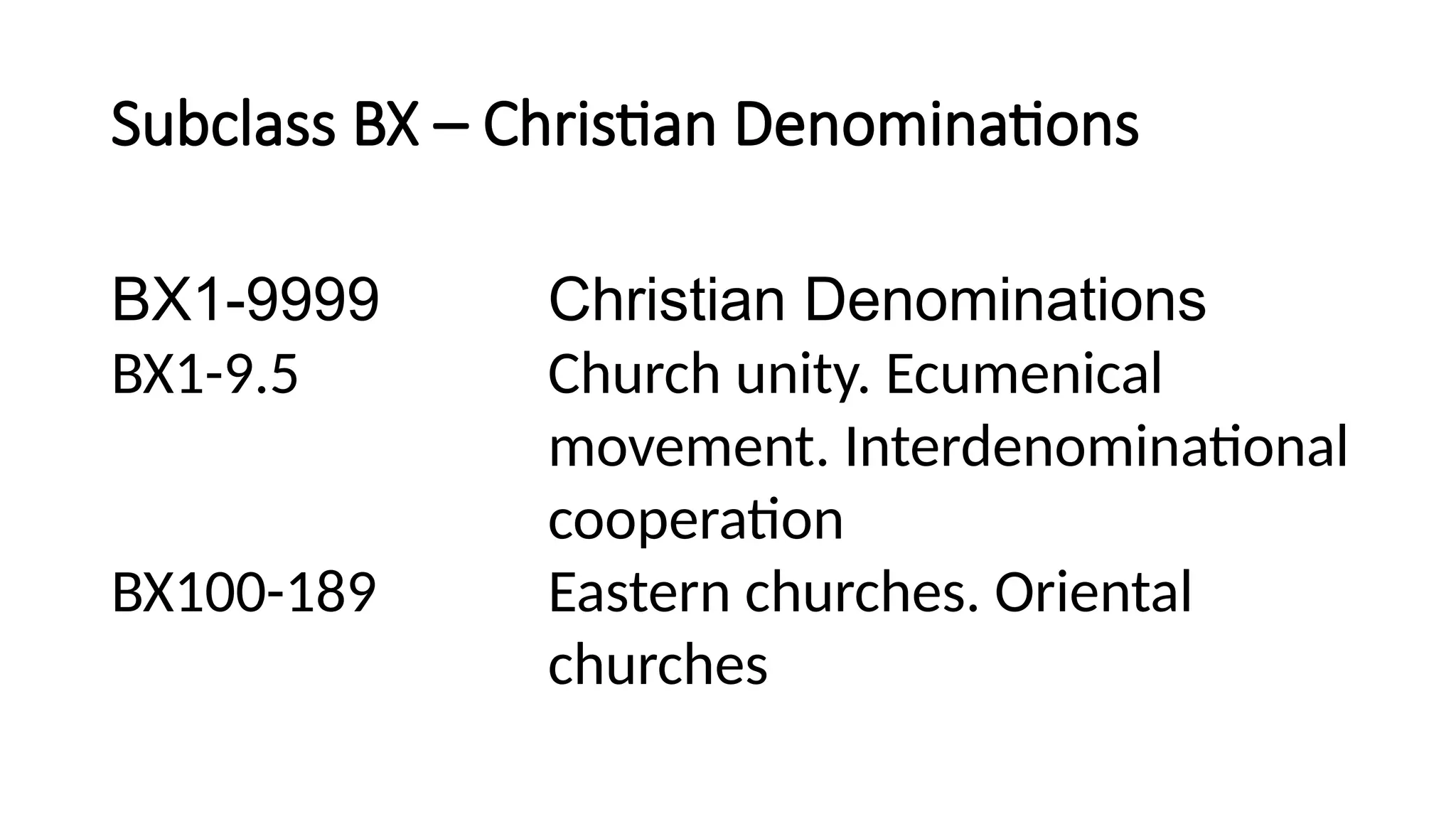
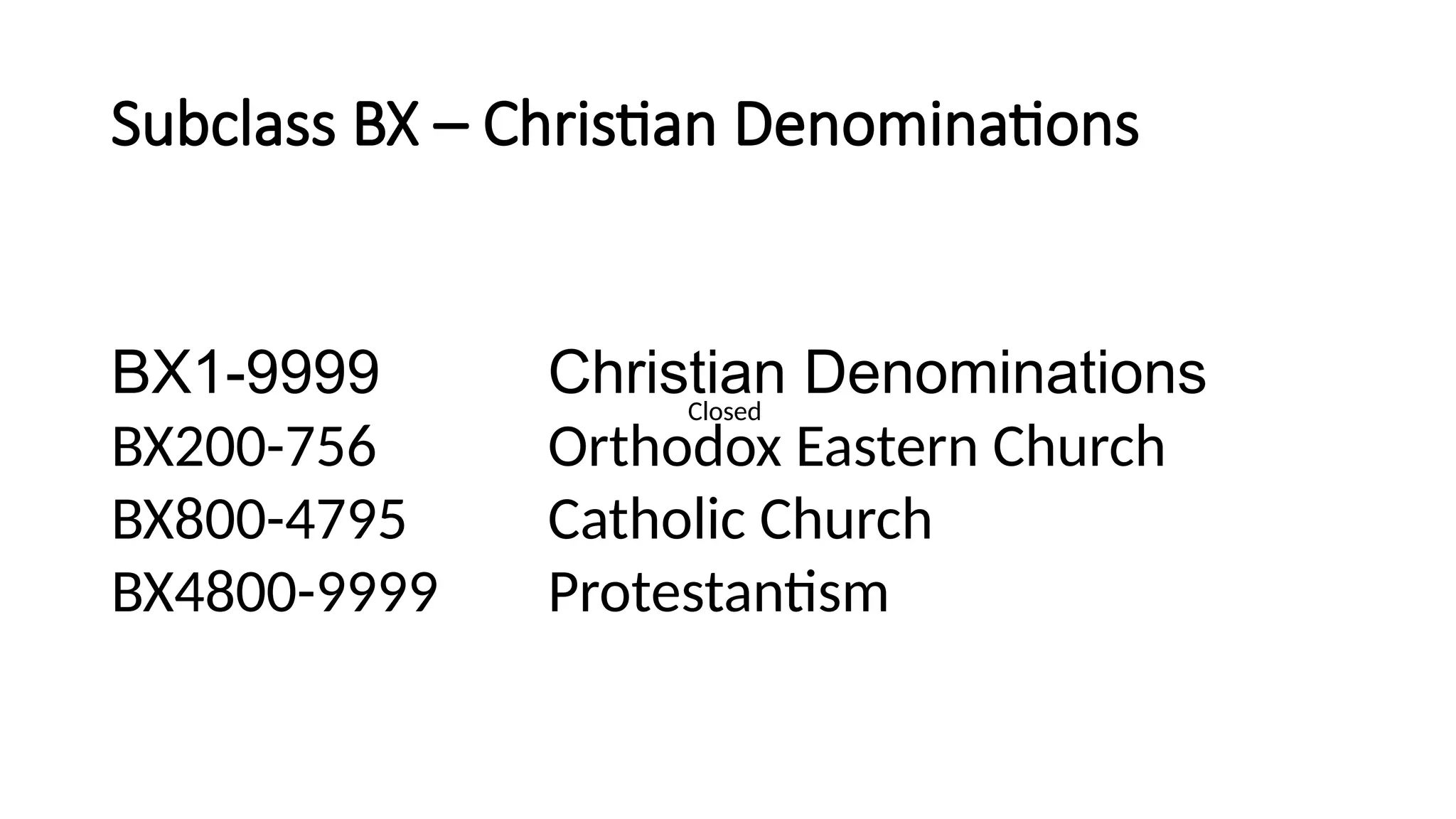
BX Christian Denominations
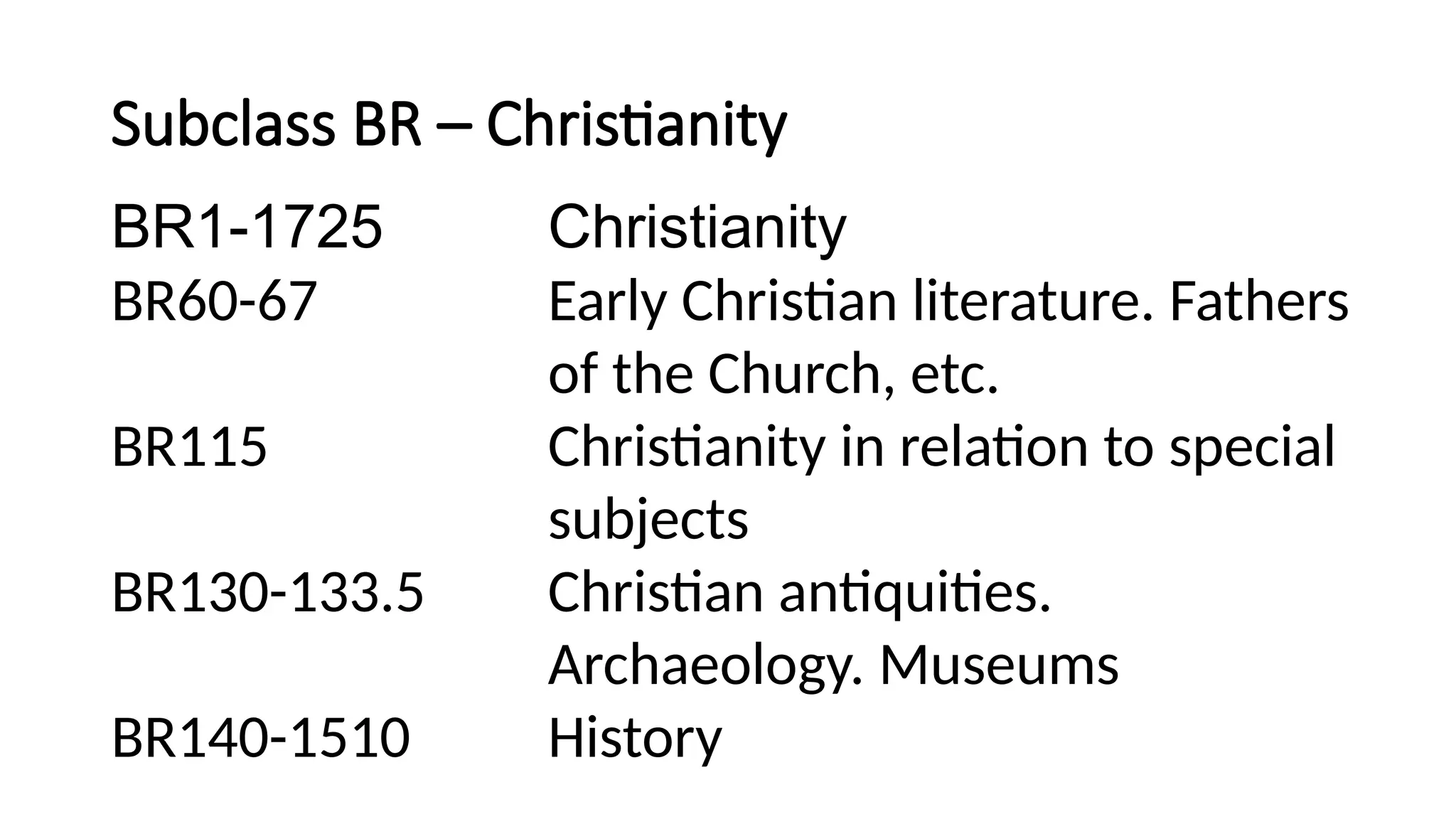
23.
Subclass BR –Christianity
BR1-1725 Christianity
BR60-67 Early Christian literature. Fathers
of the Church, etc.
BR115 Christianity in relation to special
subjects
BR130-133.5 Christian antiquities.
Archaeology. Museums
BR140-1510 History
Subclass BS –The Bible
BS1-2970 The Bible
BS11-115 Early versions
BS125-355 Modern texts and versions
BS410-680 Works about the Bible
BS701-1830 Old Testament
BS1901-2970 New Testament
26.
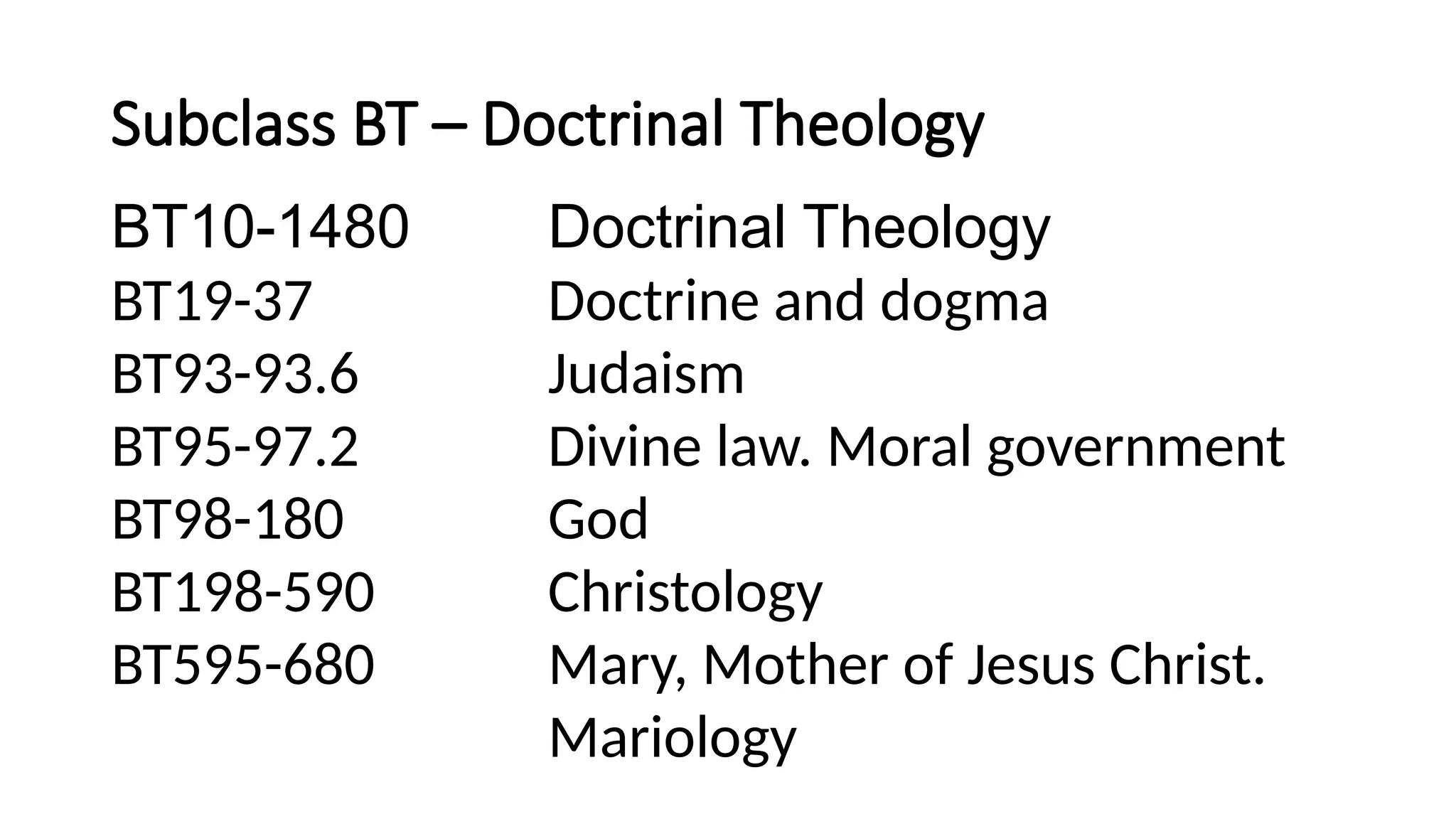
Subclass BT –Doctrinal Theology
BT10-1480 Doctrinal Theology
BT19-37 Doctrine and dogma
BT93-93.6 Judaism
BT95-97.2 Divine law. Moral government
BT98-180 God
BT198-590 Christology
BT595-680 Mary, Mother of Jesus Christ.
Mariology
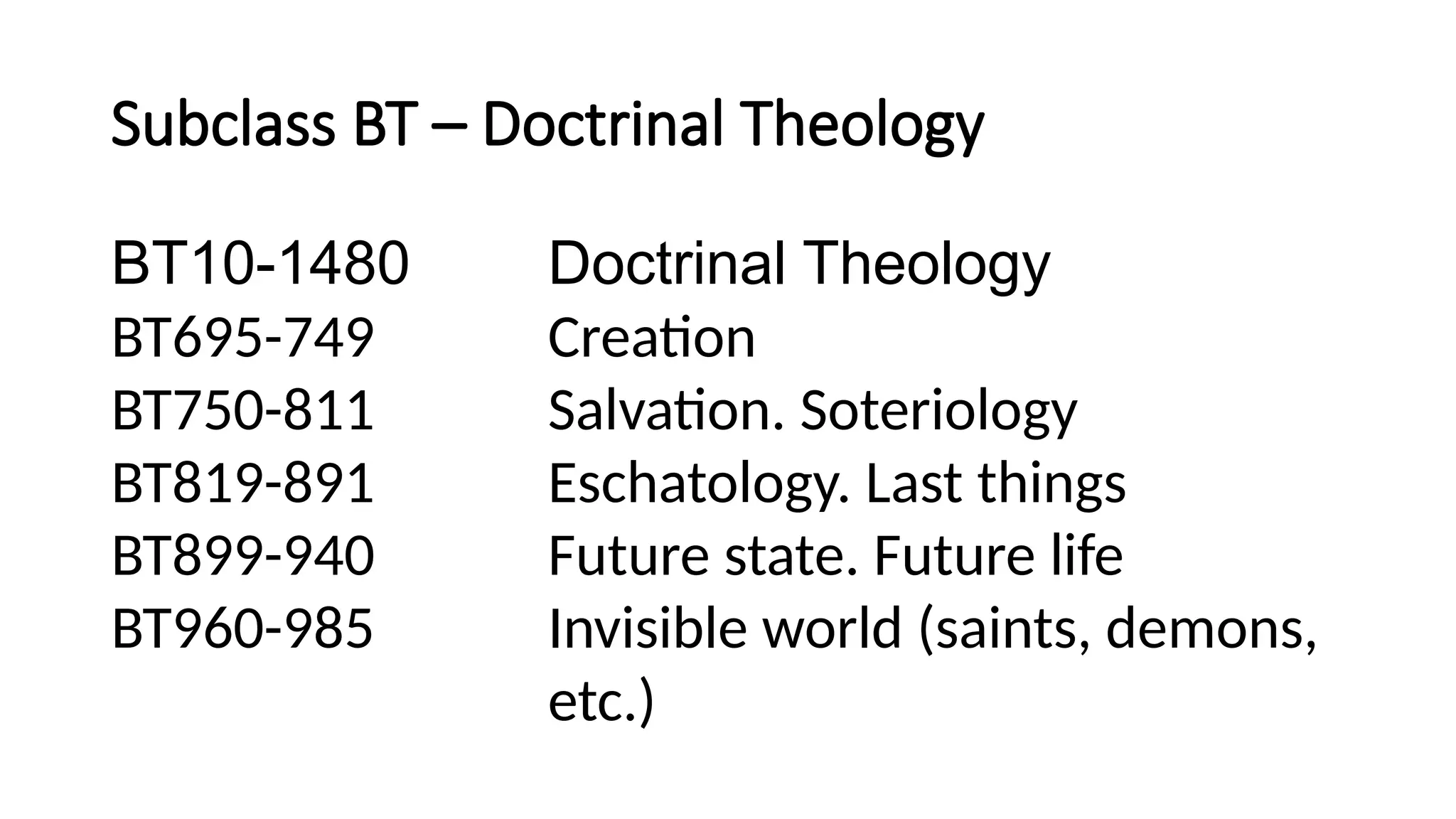
27.
Subclass BT –Doctrinal Theology
BT10-1480 Doctrinal Theology
BT695-749 Creation
BT750-811 Salvation. Soteriology
BT819-891 Eschatology. Last things
BT899-940 Future state. Future life
BT960-985 Invisible world (saints, demons,
etc.)
28.
Subclass BT –Doctrinal Theology
BT10-1480 Doctrinal Theology
BT990-1010 Creeds, confessions, covenants,
etc.
BT1029-1040 Catechisms
BT1095-1255 Apologetics. Evidences of
Christianity
29.
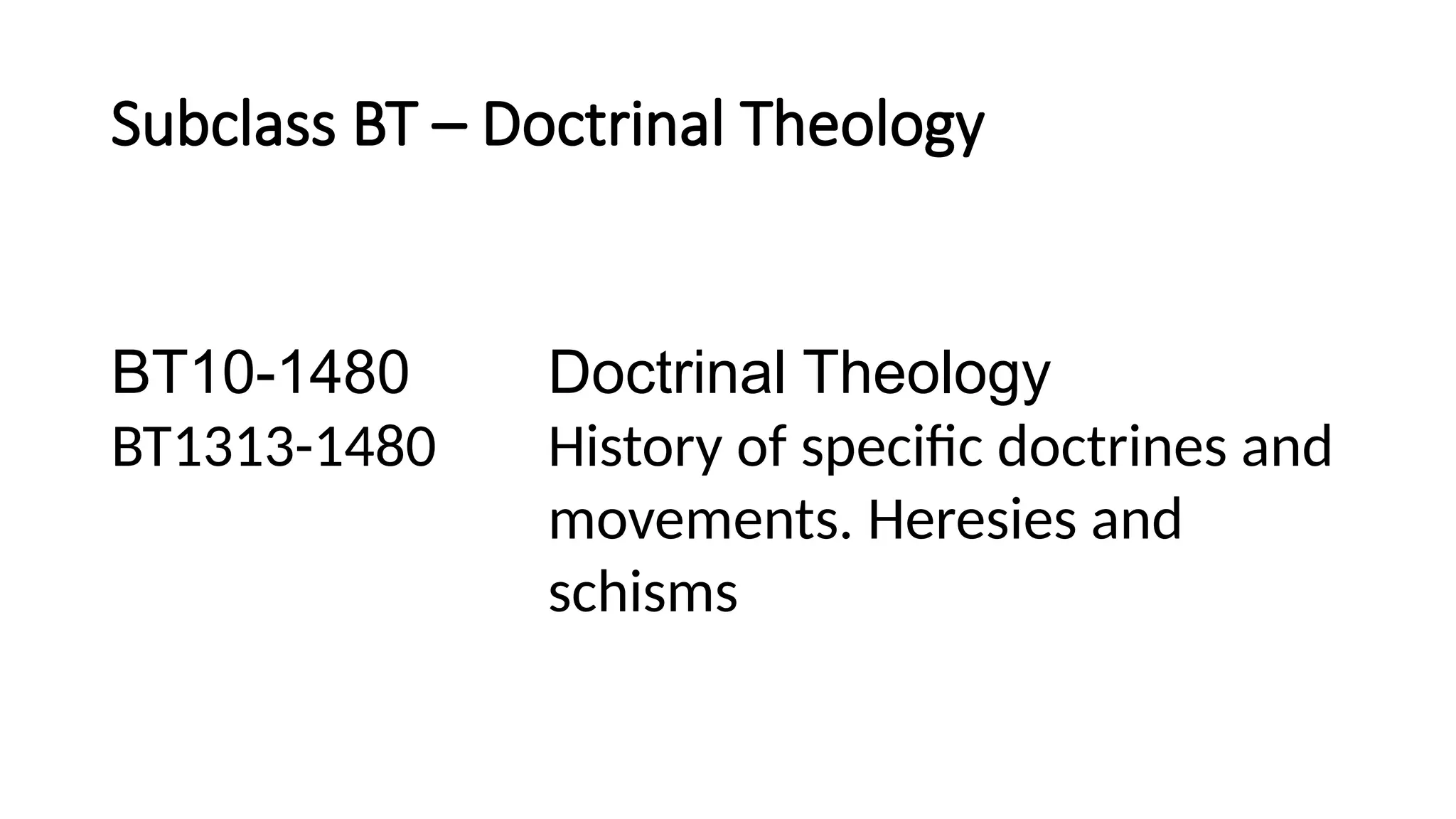
Subclass BT –Doctrinal Theology
BT10-1480 Doctrinal Theology
BT1313-1480 History of specific doctrines and
movements. Heresies and
schisms