Java Buzzwords
Java!
 Java is a language characterized by buzzwords
– buzzword: A trendy word or phrase that is used more
to impress than explain
 From Sun Microsystems, the developers of Java:
 What do all of those terms mean?
“Java is a simple, object-oriented, distributed,
interpreted, robust, secure, architecture-neutral,
portable, high performance, multi-threaded, and
dynamic language.”
 A programming language
– a vocabulary and set of syntactical (grammatical)
rules for instructing a computer to perform specific
tasks
– you can do most anything in any programming
language
– a particular language encourages one to do things
in a certain way
 Question: Is this a fair characterization?
“Java is a simple, object-oriented, distributed,
interpreted, robust, secure, architecture-neutral,
portable, high performance, multi-threaded, and
dynamic language.”
 Based on popular languages called C and C++
 C: old, pretty bare bones language
 C++: newer, more complicated language
 Start from C and add some of C++’s more useful
features
“Java omits many rarely used, poorly understood,
confusing features of C++ that in our experience
bring more grief than benefits” (Gosling)
 Question: Is Java really all that simple?
“Java is a simple, object-oriented, distributed,
interpreted, robust, secure, architecture-neutral,
portable, high performance, multi-threaded, and
dynamic language.”
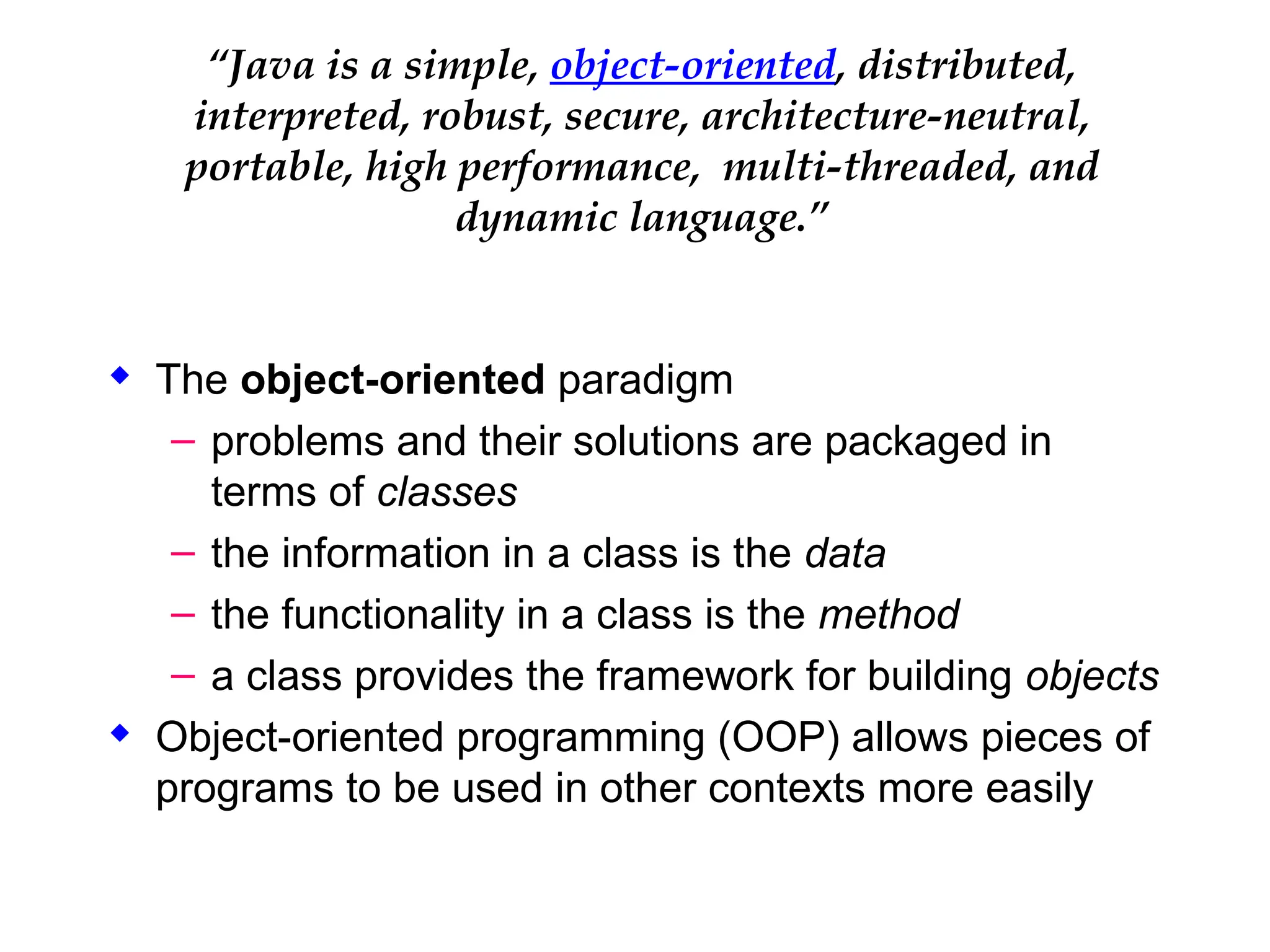
 The object-oriented paradigm
– problems and their solutions are packaged in
terms of classes
– the information in a class is the data
– the functionality in a class is the method
– a class provides the framework for building objects
 Object-oriented programming (OOP) allows pieces of
programs to be used in other contexts more easily
“Java is a simple, object-oriented, distributed,
interpreted, robust, secure, architecture-neutral,
portable, high performance, multi-threaded, and
dynamic language.”
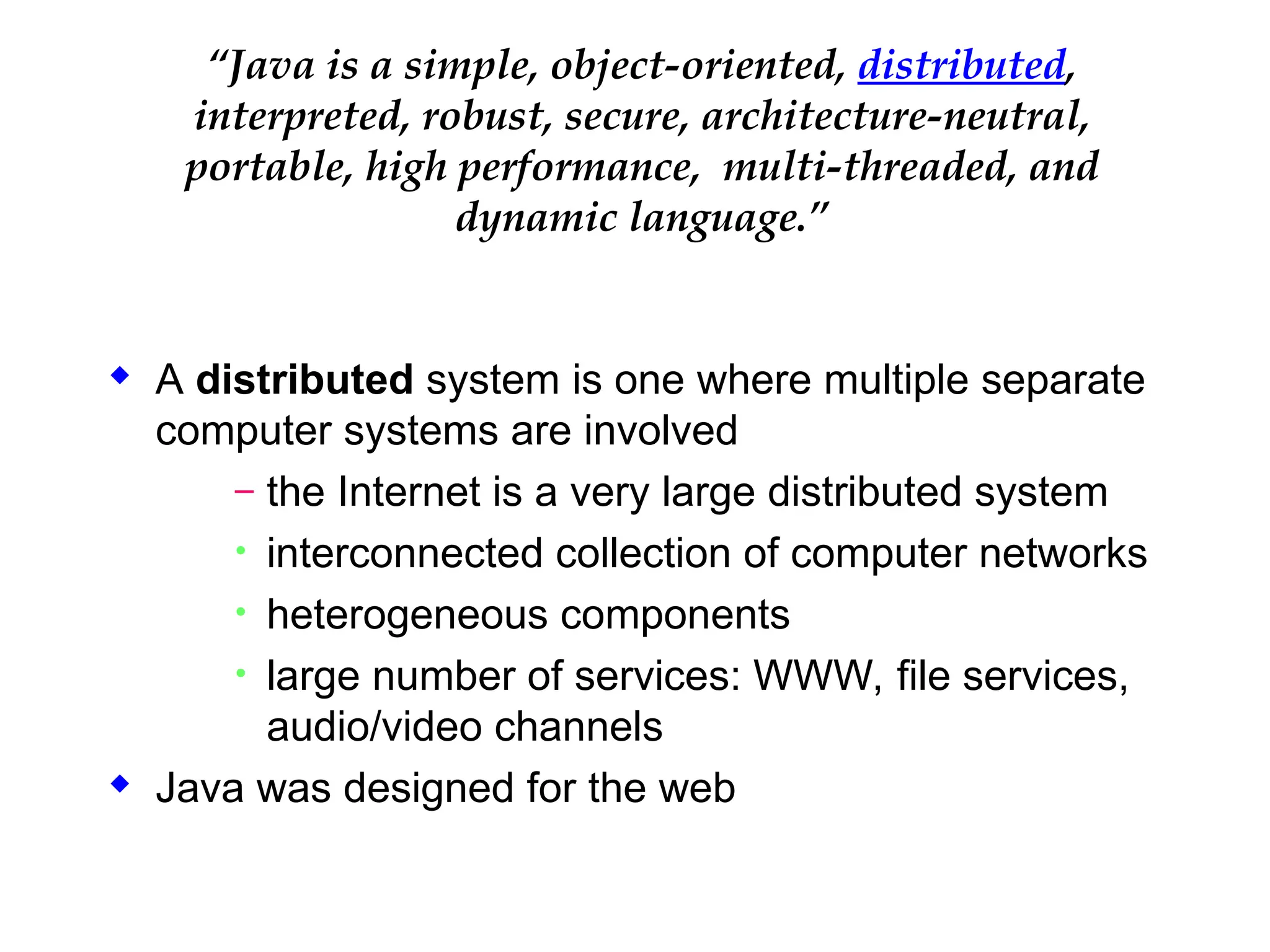
 A distributed system is one where multiple separate
computer systems are involved
– the Internet is a very large distributed system
• interconnected collection of computer networks
• heterogeneous components
• large number of services: WWW, file services,
audio/video channels
 Java was designed for the web
“Java is a simple, object-oriented, distributed,
interpreted, robust, secure, architecture-neutral,
portable, high performance, multi-threaded, and
dynamic language.”
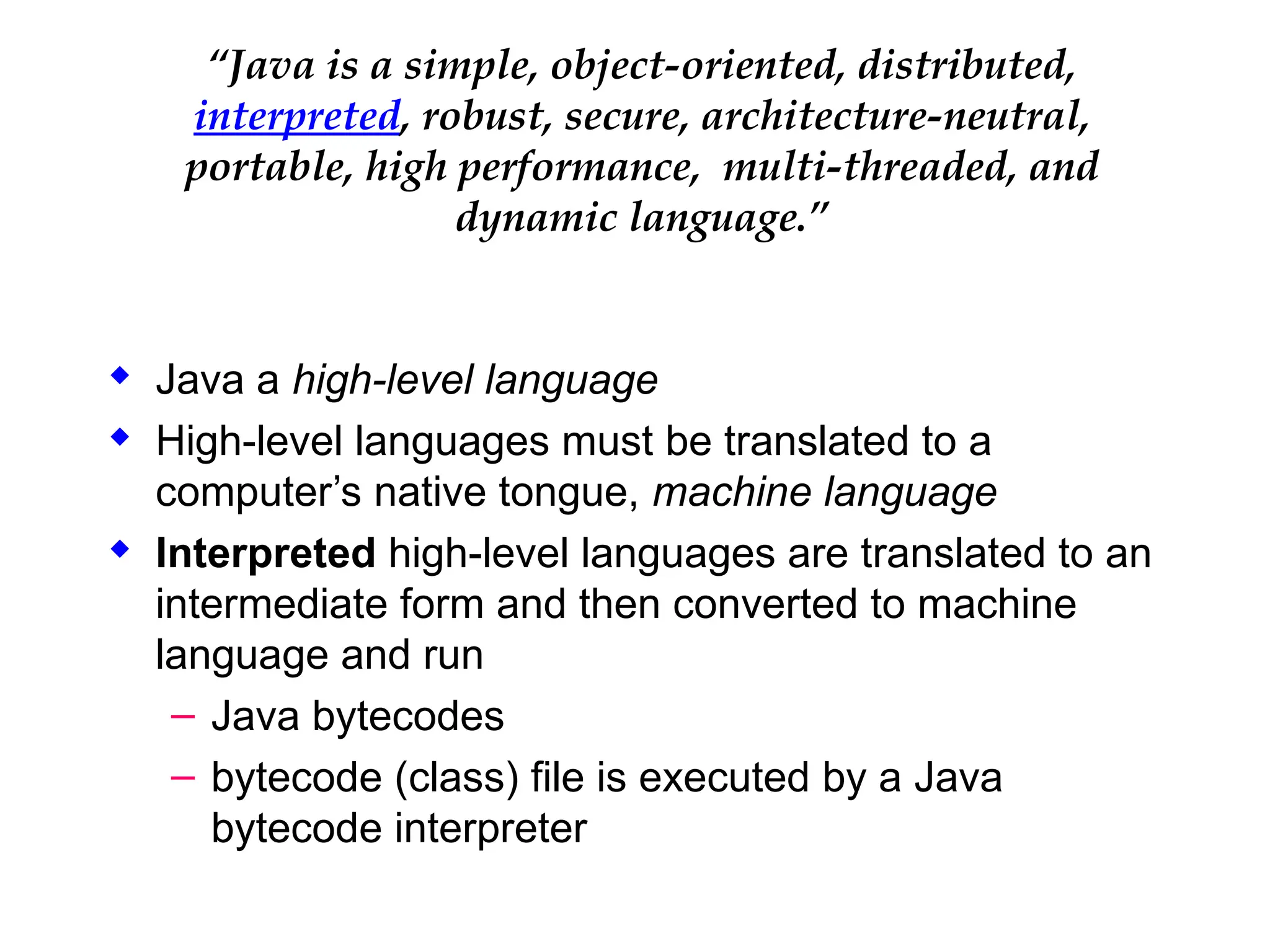
 Java a high-level language
 High-level languages must be translated to a
computer’s native tongue, machine language
 Interpreted high-level languages are translated to an
intermediate form and then converted to machine
language and run
– Java bytecodes
– bytecode (class) file is executed by a Java
bytecode interpreter
“Java is a simple, object-oriented, distributed,
interpreted, robust, secure, architecture-neutral,
portable, high performance, multi-threaded, and
dynamic language.”
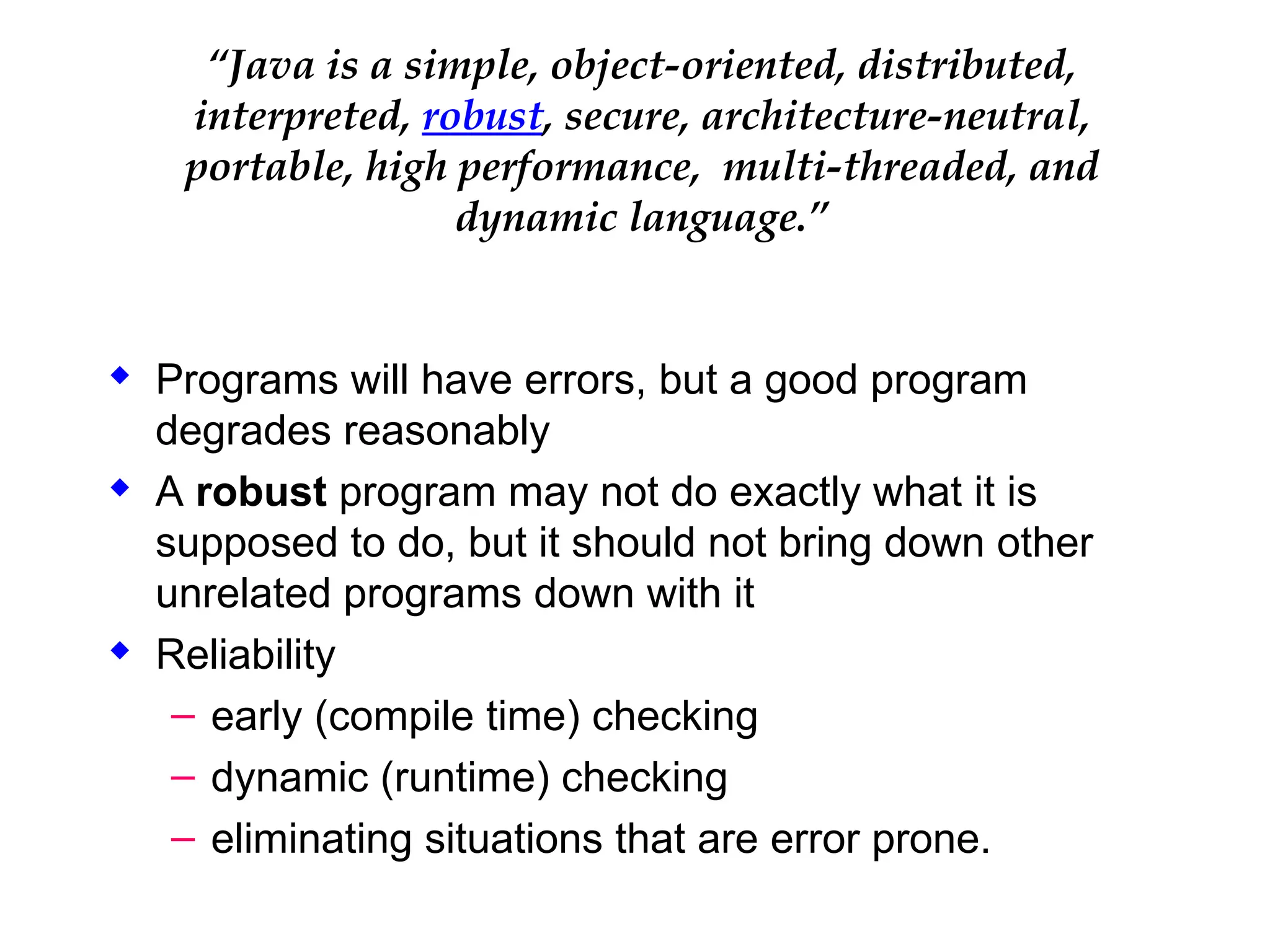
 Programs will have errors, but a good program
degrades reasonably
 A robust program may not do exactly what it is
supposed to do, but it should not bring down other
unrelated programs down with it
 Reliability
– early (compile time) checking
– dynamic (runtime) checking
– eliminating situations that are error prone.
“Java is a simple, object-oriented, distributed,
interpreted, robust, secure, architecture-neutral,
portable, high performance, multi-threaded, and
dynamic language.”
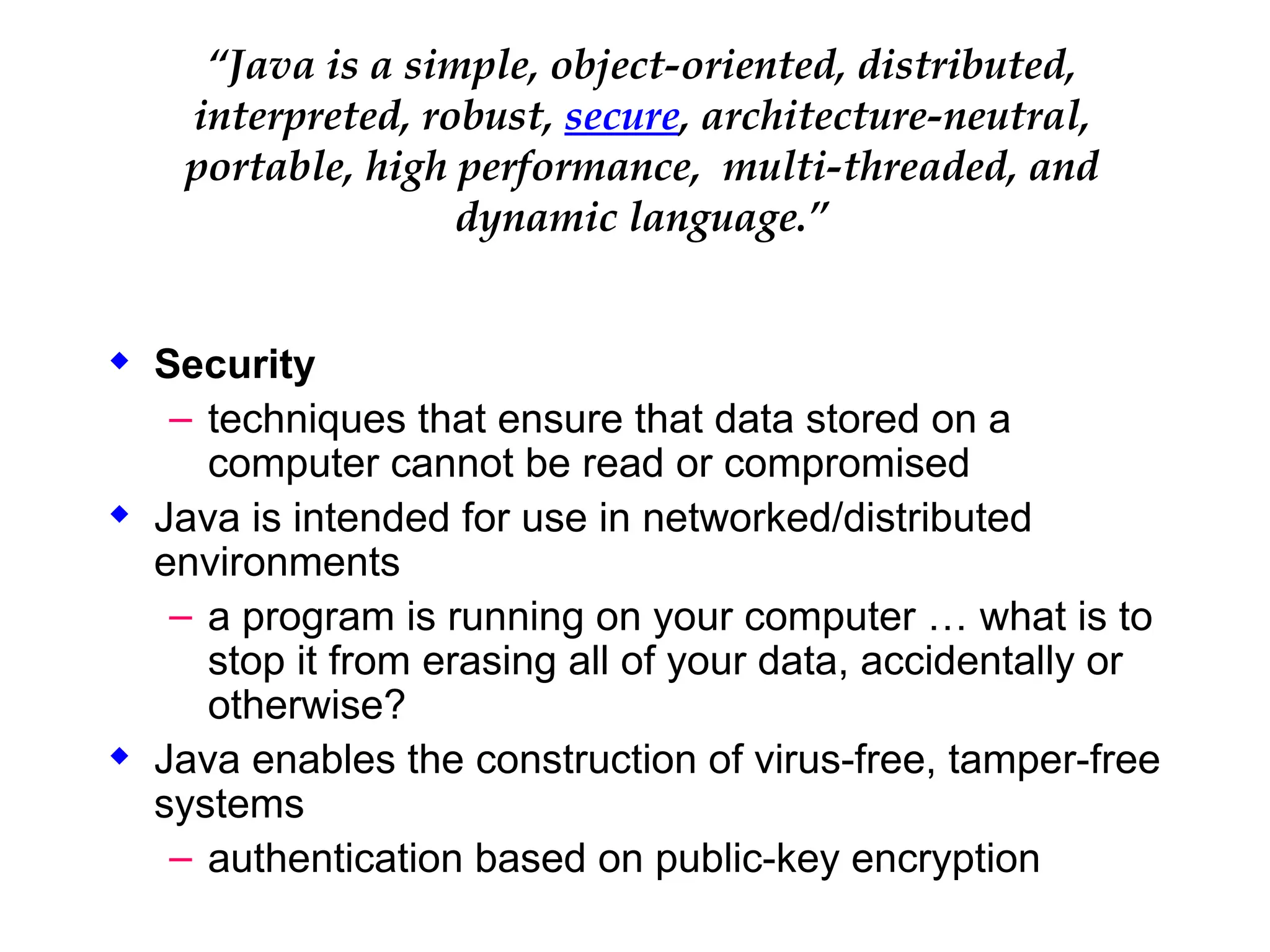
 Security
– techniques that ensure that data stored on a
computer cannot be read or compromised
 Java is intended for use in networked/distributed
environments
– a program is running on your computer … what is to
stop it from erasing all of your data, accidentally or
otherwise?
 Java enables the construction of virus-free, tamper-free
systems
– authentication based on public-key encryption
“Java is a simple, object-oriented, distributed,
interpreted, robust, secure, architecture-neutral,
portable, high performance, multi-threaded, and
dynamic language.”
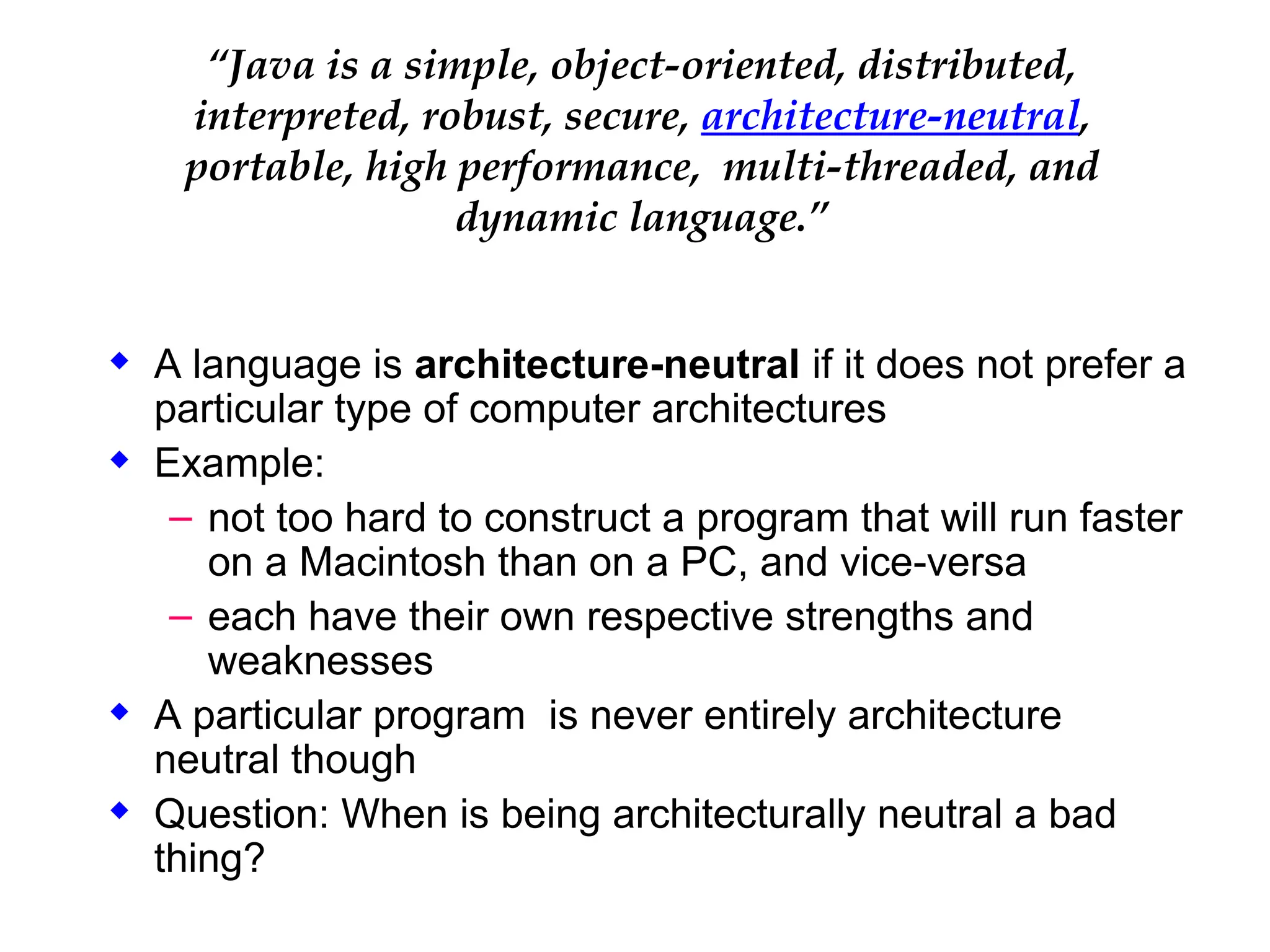
 A language is architecture-neutral if it does not prefer a
particular type of computer architectures
 Example:
– not too hard to construct a program that will run faster
on a Macintosh than on a PC, and vice-versa
– each have their own respective strengths and
weaknesses
 A particular program is never entirely architecture
neutral though
 Question: When is being architecturally neutral a bad
thing?
“Java is a simple, object-oriented, distributed,
interpreted, robust, secure, architecture-neutral,
portable, high performance, multi-threaded, and
dynamic language.”
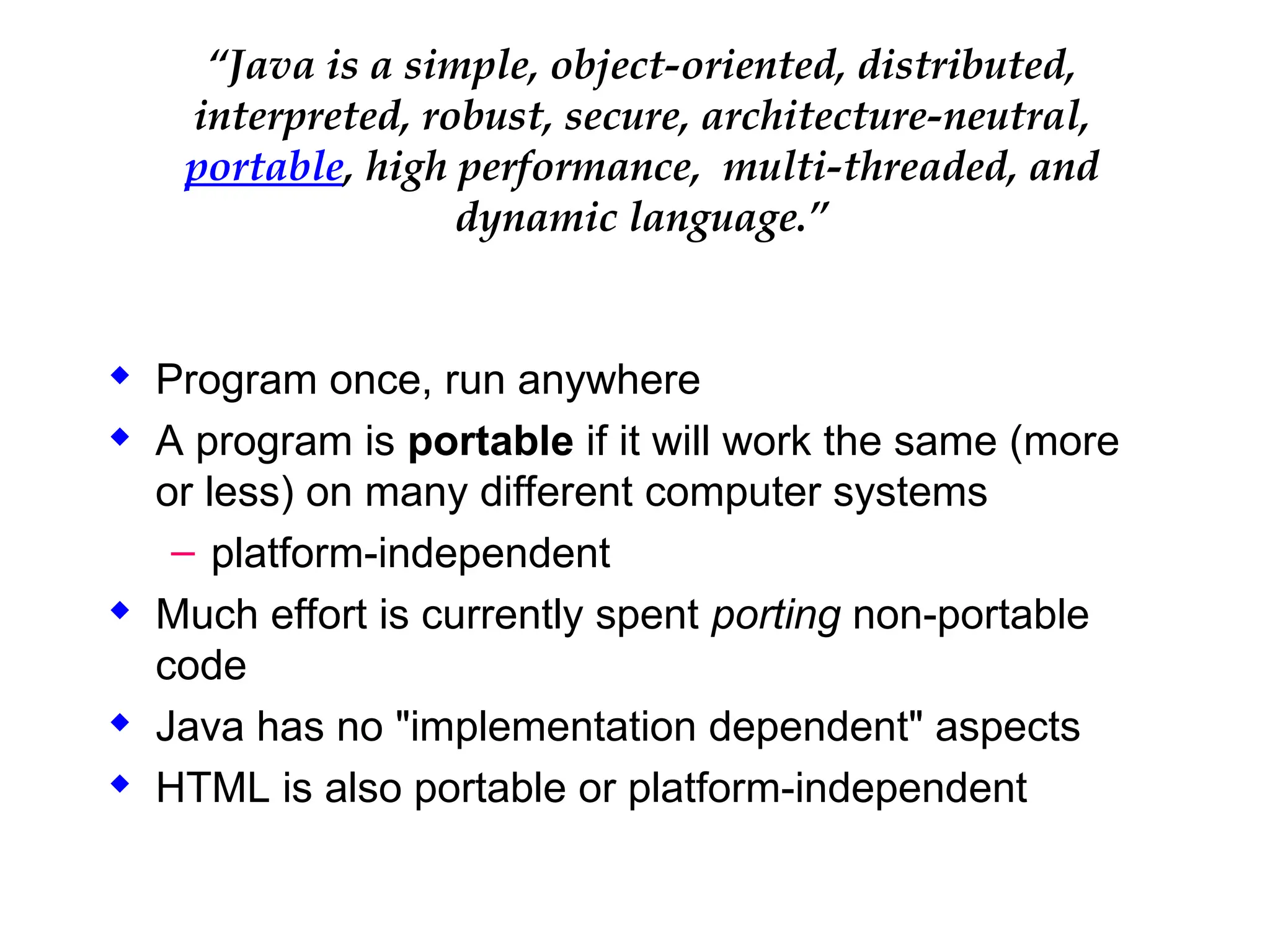
 Program once, run anywhere
 A program is portable if it will work the same (more
or less) on many different computer systems
– platform-independent
 Much effort is currently spent porting non-portable
code
 Java has no "implementation dependent" aspects
 HTML is also portable or platform-independent
“Java is a simple, object-oriented, distributed,
interpreted, robust, secure, architecture-neutral,
portable, high performance, multi-threaded, and
dynamic language.”
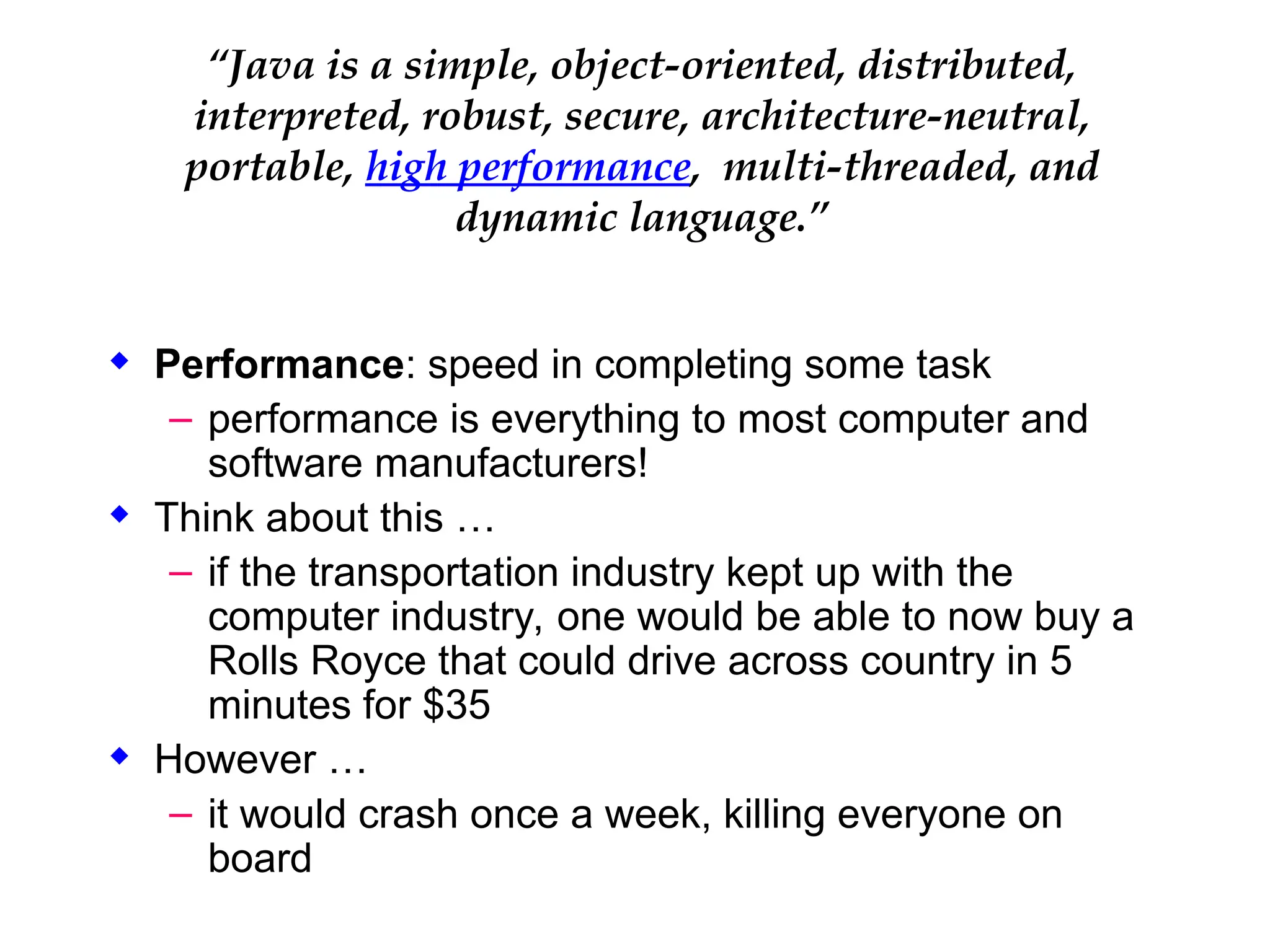
 Performance: speed in completing some task
– performance is everything to most computer and
software manufacturers!
 Think about this …
– if the transportation industry kept up with the
computer industry, one would be able to now buy a
Rolls Royce that could drive across country in 5
minutes for $35
 However …
– it would crash once a week, killing everyone on
board
“Java is a simple, object-oriented, distributed,
interpreted, robust, secure, architecture-neutral,
portable, high performance, multi-threaded, and
dynamic language.”
 A thread is a part of the program that can operate
independently of its other parts
 Multi-threaded programs can do multiple things at
once
– example:
• download a file from the web while still looking
at other web pages
 Question: What is the problem with multiple agents
working at the same time?
– synchronization
“Java is a simple, object-oriented, distributed,
interpreted, robust, secure, architecture-neutral,
portable, high performance, multi-threaded, and
dynamic language.”
 Dynamic: actions that take place at the moment they
are needed rather than in advance
– antonym: static
 A dynamic program can
– ask for more or less resources as it runs
– use the most recent version of some code that is
available
 Question: Why is being dynamic a good thing?
– upgrades
“Java is a simple, object-oriented, distributed,
interpreted, robust, secure, architecture-neutral,
portable, high performance, multi-threaded, and
dynamic language.”
Decision Trees
Trees
 Hierarchical data structure
 Set of elements or nodes
– one node as root
– every other node has a single predecessor (parent)
and zero or more successors (children)
– nodes without successors are called leaf nodes
 Nodes are connected by edges
 The level or depth of a node is the number of edges on
the path to the root
 The depth of the tree is the number of edges on the
longest path from root to any leaf
 A complete tree has all leaves at same level, all other
nodes have the same number of children
Example tree structure
 leaf
 leaf
 leaf
 leaf
 leaf
root 
 leaf
depth of tree = 3
 edge
Decision trees
 A decision tree begins with a decision you need to
make
– start with an initial decision node
– ask a question
 Structure for investigating options and the possible
outcomes of choosing those options
– result of a decision can be another decision
– outcome is a terminal node
 Tree should have unique paths from the decision node
to each of the terminal nodes.
– help you to choose between several courses of
action
Examples
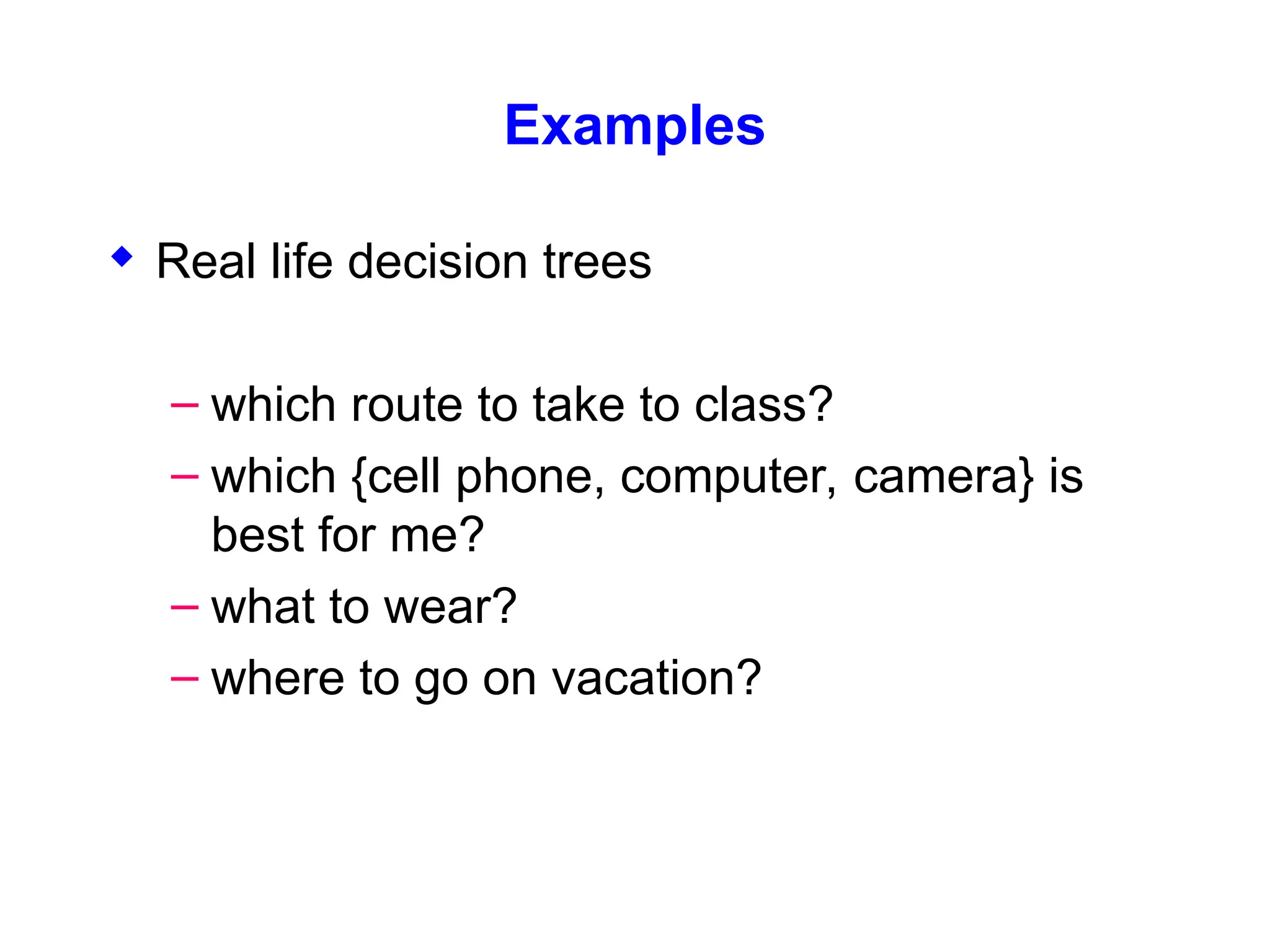
 Real life decision trees
– which route to take to class?
– which {cell phone, computer, camera} is
best for me?
– what to wear?
– where to go on vacation?
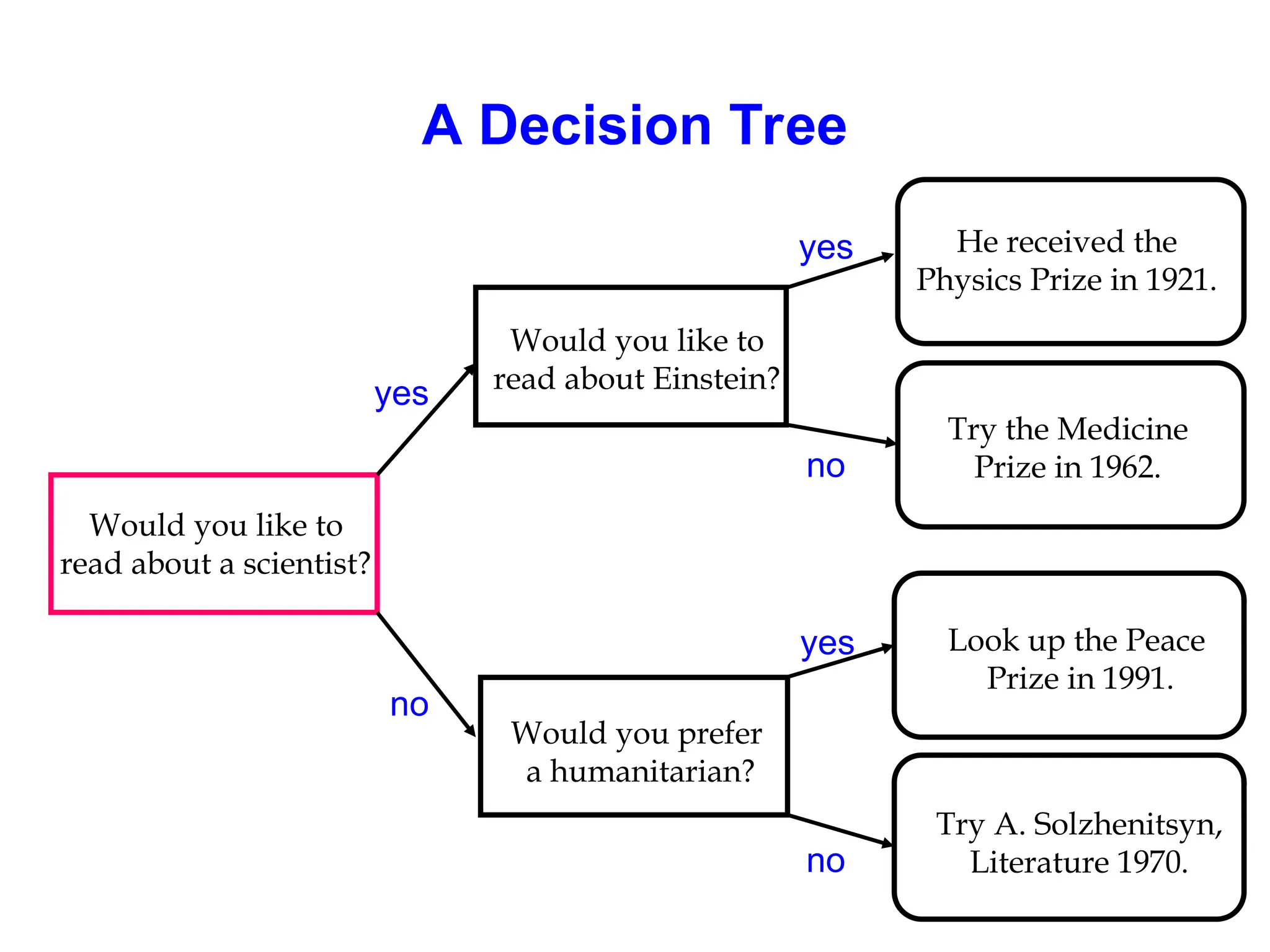
He received the
Physics Prize in 1921.
Try the Medicine
Prize in 1962.
Would you prefer
a humanitarian?
Would you like to
read about a scientist?
Would you like to
read about Einstein?
Try A. Solzhenitsyn,
Literature 1970.
Look up the Peace
Prize in 1991.
A Decision Tree
yes
yes
yes
no
no
no
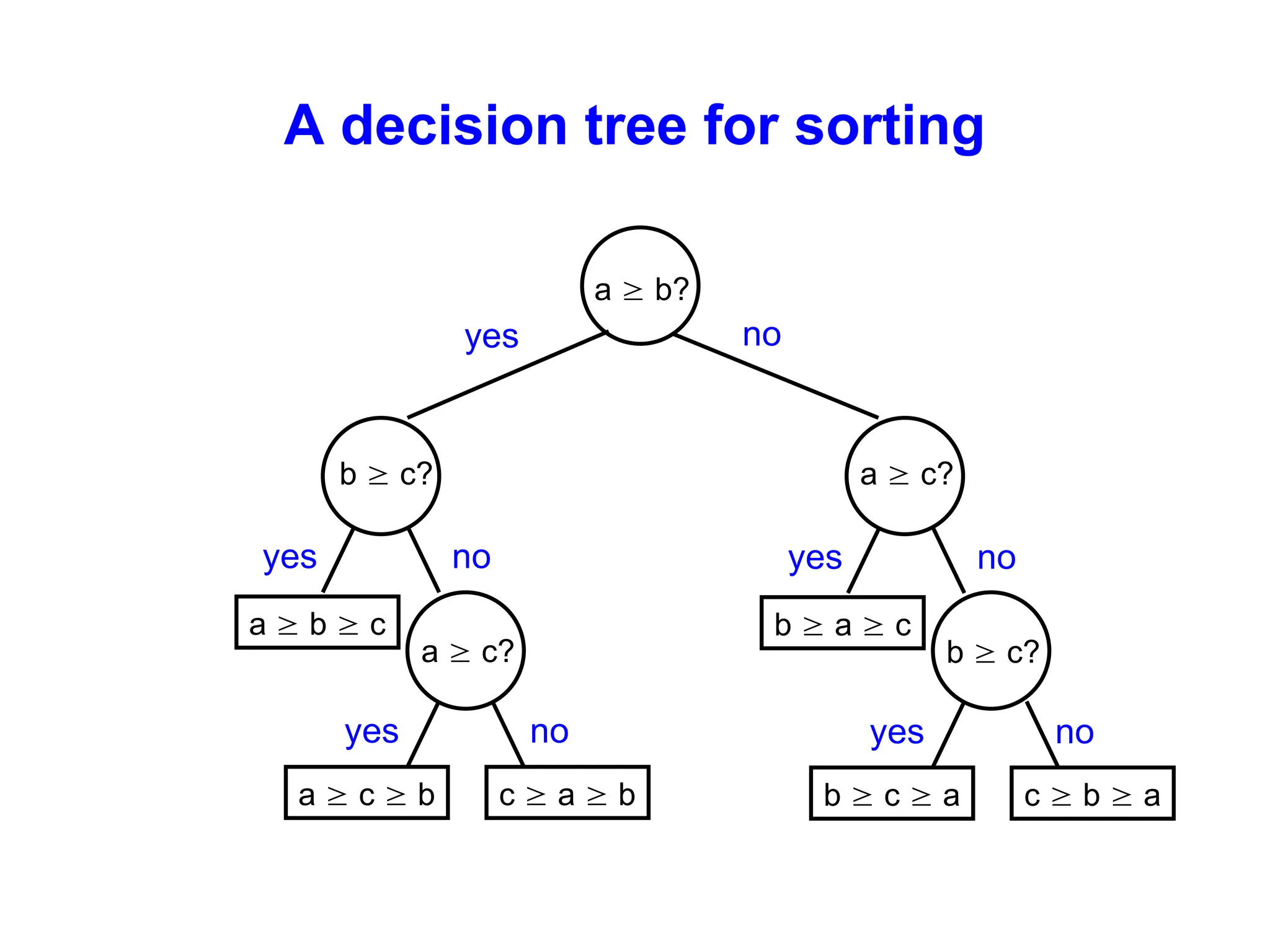
A decision tree for sorting
yes
a  b?
b  c? a  c?
no
yes no
a  b  c
a  c?
a  c  b c  a  b
yes no
yes no
b  a  c
b  c?
b  c  a c  b  a
yes no
Binary trees
 Nodes have at most two children
 In a complete binary tree of depth 3,
– how many nodes are in the tree?
– how many leaves are in the tree?
 In a complete binary tree of depth 4,
– how many nodes are in the tree?
– how many leaves are in the tree?
 How many nodes in a depth d tree?
 How many leaves in a depth d tree?

Lecture on object oriented programming.ppt

  • 1.
  • 2.
    Java!  Java isa language characterized by buzzwords – buzzword: A trendy word or phrase that is used more to impress than explain  From Sun Microsystems, the developers of Java:  What do all of those terms mean? “Java is a simple, object-oriented, distributed, interpreted, robust, secure, architecture-neutral, portable, high performance, multi-threaded, and dynamic language.”
  • 3.
     A programminglanguage – a vocabulary and set of syntactical (grammatical) rules for instructing a computer to perform specific tasks – you can do most anything in any programming language – a particular language encourages one to do things in a certain way  Question: Is this a fair characterization? “Java is a simple, object-oriented, distributed, interpreted, robust, secure, architecture-neutral, portable, high performance, multi-threaded, and dynamic language.”
  • 4.
     Based onpopular languages called C and C++  C: old, pretty bare bones language  C++: newer, more complicated language  Start from C and add some of C++’s more useful features “Java omits many rarely used, poorly understood, confusing features of C++ that in our experience bring more grief than benefits” (Gosling)  Question: Is Java really all that simple? “Java is a simple, object-oriented, distributed, interpreted, robust, secure, architecture-neutral, portable, high performance, multi-threaded, and dynamic language.”
  • 5.
     The object-orientedparadigm – problems and their solutions are packaged in terms of classes – the information in a class is the data – the functionality in a class is the method – a class provides the framework for building objects  Object-oriented programming (OOP) allows pieces of programs to be used in other contexts more easily “Java is a simple, object-oriented, distributed, interpreted, robust, secure, architecture-neutral, portable, high performance, multi-threaded, and dynamic language.”
  • 6.
     A distributedsystem is one where multiple separate computer systems are involved – the Internet is a very large distributed system • interconnected collection of computer networks • heterogeneous components • large number of services: WWW, file services, audio/video channels  Java was designed for the web “Java is a simple, object-oriented, distributed, interpreted, robust, secure, architecture-neutral, portable, high performance, multi-threaded, and dynamic language.”
  • 7.
     Java ahigh-level language  High-level languages must be translated to a computer’s native tongue, machine language  Interpreted high-level languages are translated to an intermediate form and then converted to machine language and run – Java bytecodes – bytecode (class) file is executed by a Java bytecode interpreter “Java is a simple, object-oriented, distributed, interpreted, robust, secure, architecture-neutral, portable, high performance, multi-threaded, and dynamic language.”
  • 8.
     Programs willhave errors, but a good program degrades reasonably  A robust program may not do exactly what it is supposed to do, but it should not bring down other unrelated programs down with it  Reliability – early (compile time) checking – dynamic (runtime) checking – eliminating situations that are error prone. “Java is a simple, object-oriented, distributed, interpreted, robust, secure, architecture-neutral, portable, high performance, multi-threaded, and dynamic language.”
  • 9.
     Security – techniquesthat ensure that data stored on a computer cannot be read or compromised  Java is intended for use in networked/distributed environments – a program is running on your computer … what is to stop it from erasing all of your data, accidentally or otherwise?  Java enables the construction of virus-free, tamper-free systems – authentication based on public-key encryption “Java is a simple, object-oriented, distributed, interpreted, robust, secure, architecture-neutral, portable, high performance, multi-threaded, and dynamic language.”
  • 10.
     A languageis architecture-neutral if it does not prefer a particular type of computer architectures  Example: – not too hard to construct a program that will run faster on a Macintosh than on a PC, and vice-versa – each have their own respective strengths and weaknesses  A particular program is never entirely architecture neutral though  Question: When is being architecturally neutral a bad thing? “Java is a simple, object-oriented, distributed, interpreted, robust, secure, architecture-neutral, portable, high performance, multi-threaded, and dynamic language.”
  • 11.
     Program once,run anywhere  A program is portable if it will work the same (more or less) on many different computer systems – platform-independent  Much effort is currently spent porting non-portable code  Java has no "implementation dependent" aspects  HTML is also portable or platform-independent “Java is a simple, object-oriented, distributed, interpreted, robust, secure, architecture-neutral, portable, high performance, multi-threaded, and dynamic language.”
  • 12.
     Performance: speedin completing some task – performance is everything to most computer and software manufacturers!  Think about this … – if the transportation industry kept up with the computer industry, one would be able to now buy a Rolls Royce that could drive across country in 5 minutes for $35  However … – it would crash once a week, killing everyone on board “Java is a simple, object-oriented, distributed, interpreted, robust, secure, architecture-neutral, portable, high performance, multi-threaded, and dynamic language.”
  • 13.
     A threadis a part of the program that can operate independently of its other parts  Multi-threaded programs can do multiple things at once – example: • download a file from the web while still looking at other web pages  Question: What is the problem with multiple agents working at the same time? – synchronization “Java is a simple, object-oriented, distributed, interpreted, robust, secure, architecture-neutral, portable, high performance, multi-threaded, and dynamic language.”
  • 14.
     Dynamic: actionsthat take place at the moment they are needed rather than in advance – antonym: static  A dynamic program can – ask for more or less resources as it runs – use the most recent version of some code that is available  Question: Why is being dynamic a good thing? – upgrades “Java is a simple, object-oriented, distributed, interpreted, robust, secure, architecture-neutral, portable, high performance, multi-threaded, and dynamic language.”
  • 15.
  • 16.
    Trees  Hierarchical datastructure  Set of elements or nodes – one node as root – every other node has a single predecessor (parent) and zero or more successors (children) – nodes without successors are called leaf nodes  Nodes are connected by edges  The level or depth of a node is the number of edges on the path to the root  The depth of the tree is the number of edges on the longest path from root to any leaf  A complete tree has all leaves at same level, all other nodes have the same number of children
  • 17.
    Example tree structure leaf  leaf  leaf  leaf  leaf root   leaf depth of tree = 3  edge
  • 18.
    Decision trees  Adecision tree begins with a decision you need to make – start with an initial decision node – ask a question  Structure for investigating options and the possible outcomes of choosing those options – result of a decision can be another decision – outcome is a terminal node  Tree should have unique paths from the decision node to each of the terminal nodes. – help you to choose between several courses of action
  • 19.
    Examples  Real lifedecision trees – which route to take to class? – which {cell phone, computer, camera} is best for me? – what to wear? – where to go on vacation?
  • 20.
    He received the PhysicsPrize in 1921. Try the Medicine Prize in 1962. Would you prefer a humanitarian? Would you like to read about a scientist? Would you like to read about Einstein? Try A. Solzhenitsyn, Literature 1970. Look up the Peace Prize in 1991. A Decision Tree yes yes yes no no no
  • 21.
    A decision treefor sorting yes a  b? b  c? a  c? no yes no a  b  c a  c? a  c  b c  a  b yes no yes no b  a  c b  c? b  c  a c  b  a yes no
  • 22.
    Binary trees  Nodeshave at most two children  In a complete binary tree of depth 3, – how many nodes are in the tree? – how many leaves are in the tree?  In a complete binary tree of depth 4, – how many nodes are in the tree? – how many leaves are in the tree?  How many nodes in a depth d tree?  How many leaves in a depth d tree?