Persuasive Messages
      Module 12
Common Persuasive
   Strategies
Direct Request
Problem-Solving
How do you decide
which strategy to use?
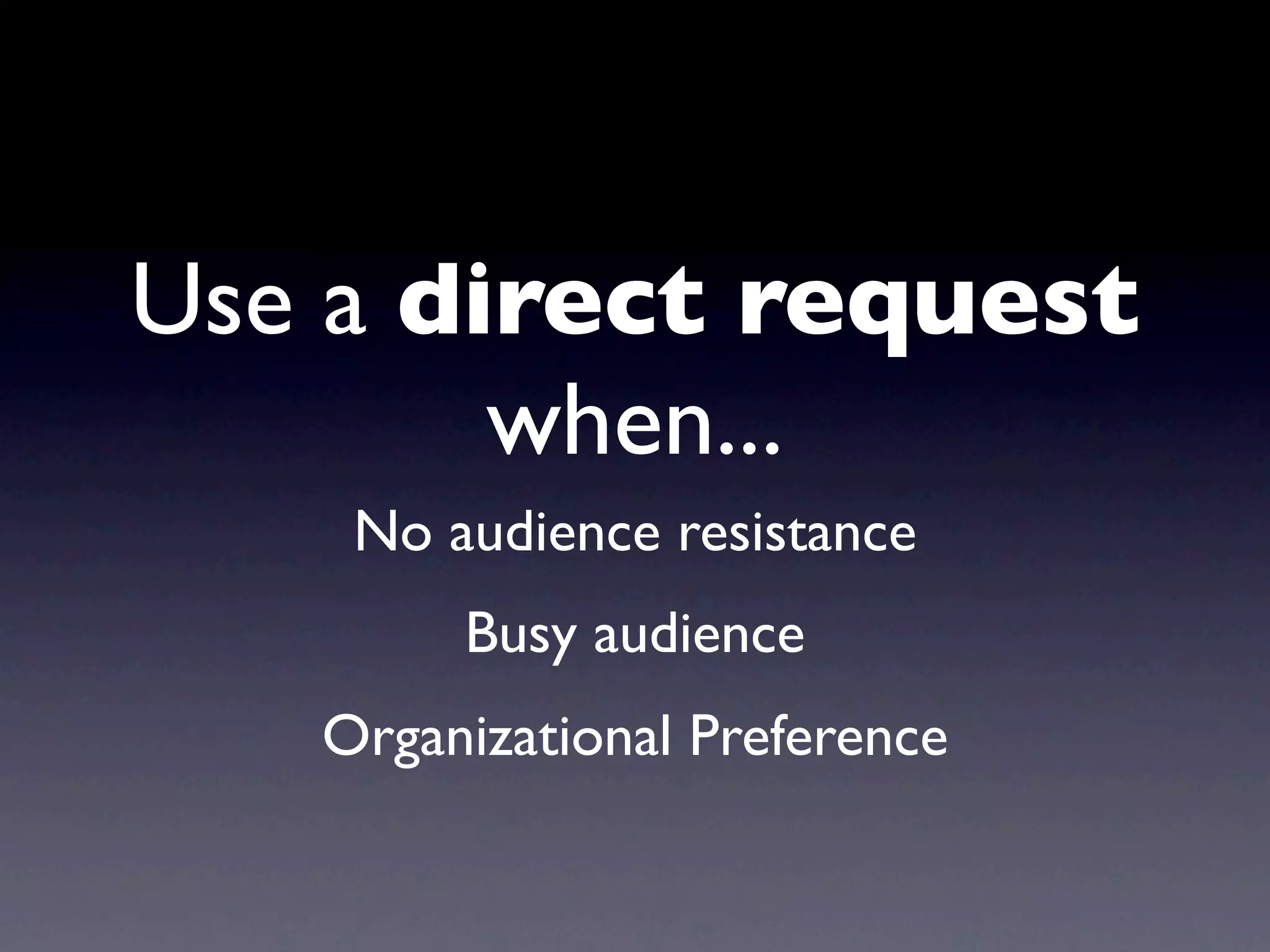
Use a direct request
        when...
    No audience resistance
        Busy audience
   Organizational Preference
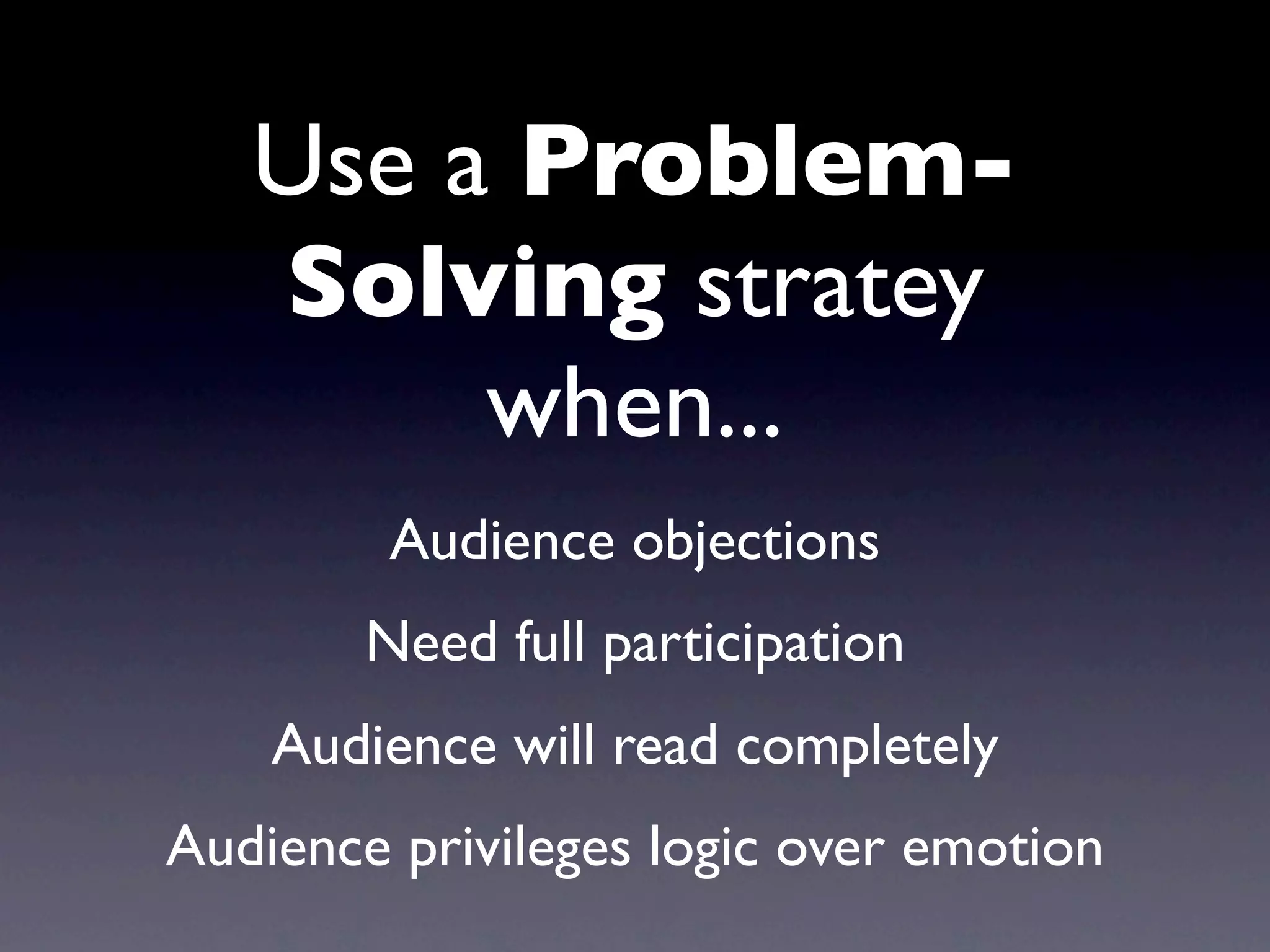
Use a Problem-
   Solving stratey
        when...
         Audience objections
        Need full participation
    Audience will read completely
Audience privileges logic over emotion
Subject lines for
persuasive messages?
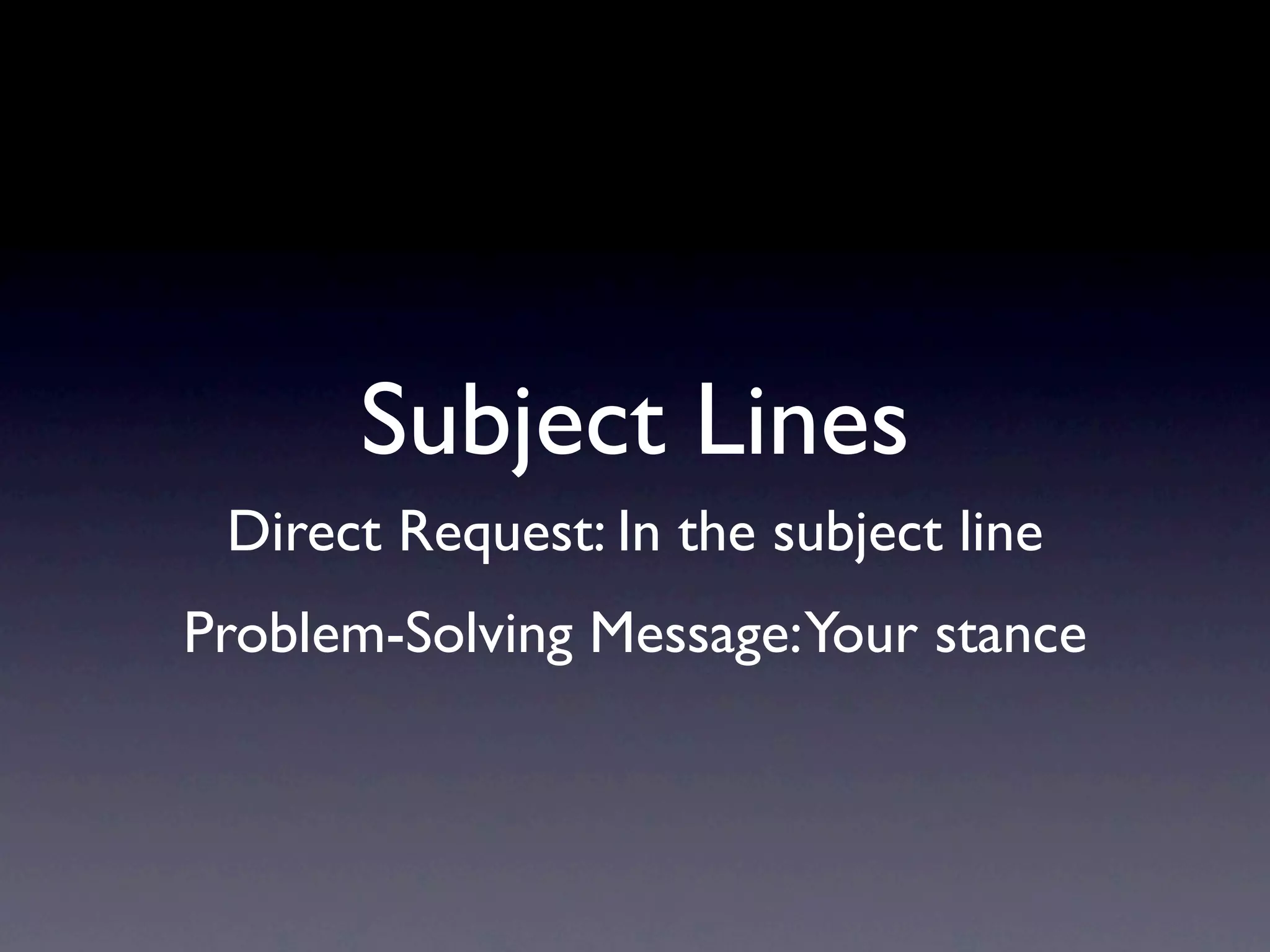
Subject Lines
 Direct Request: In the subject line
Problem-Solving Message: Your stance
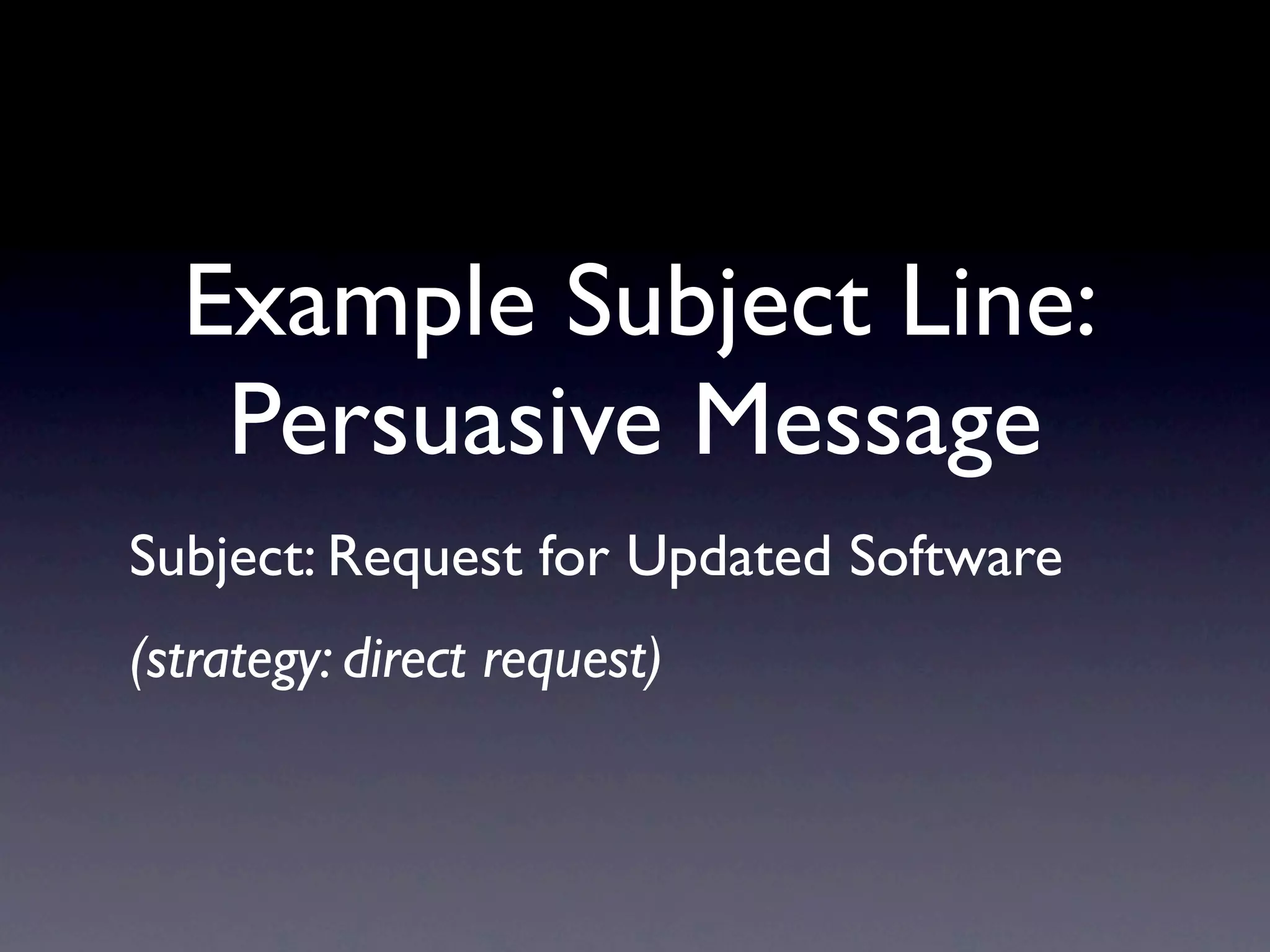
Example Subject Line:
   Persuasive Message
Subject: Request for Updated Software
(strategy: direct request)
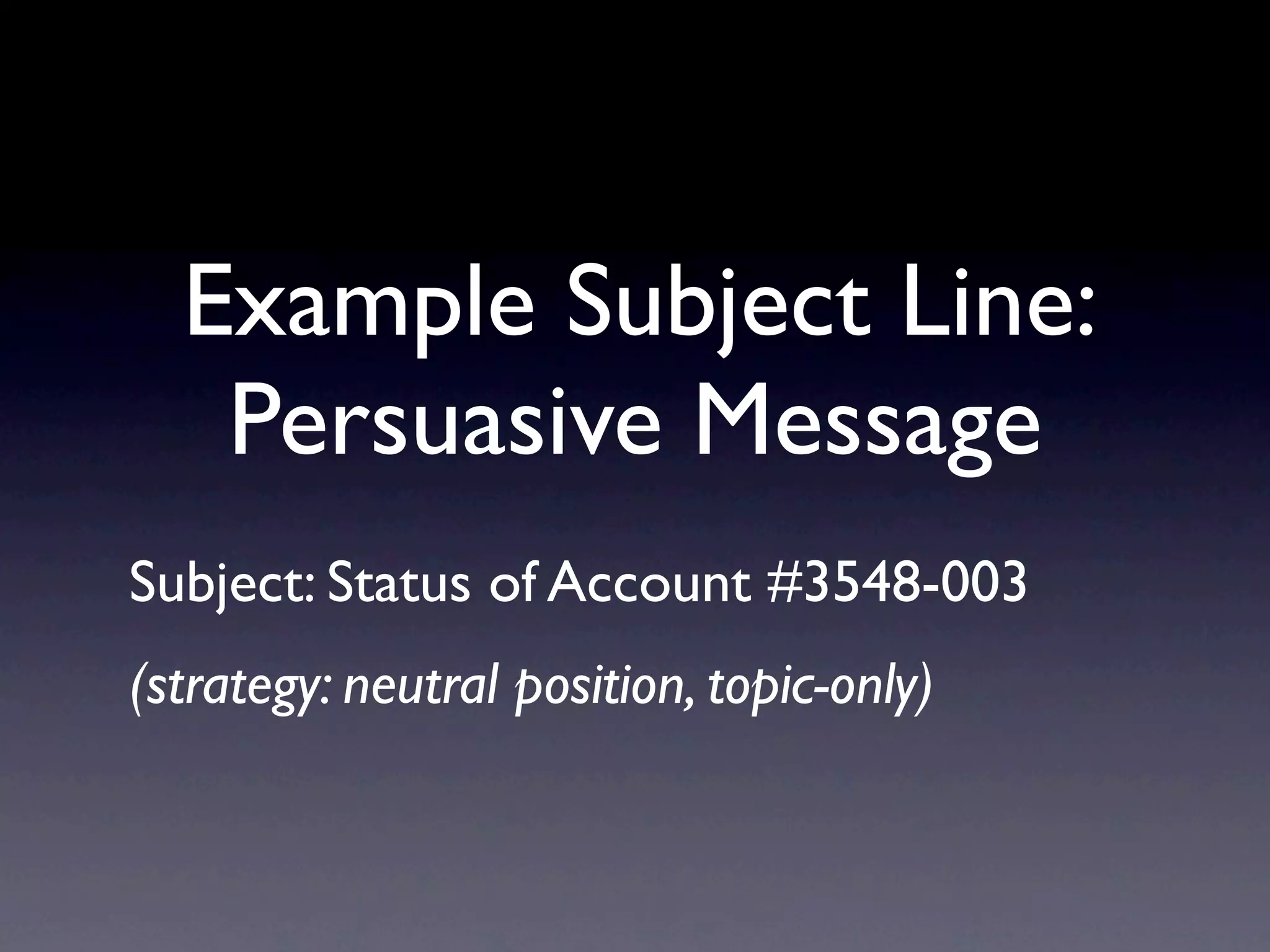
Example Subject Line:
   Persuasive Message
Subject: Status of Account #3548-003
(strategy: neutral position, topic-only)
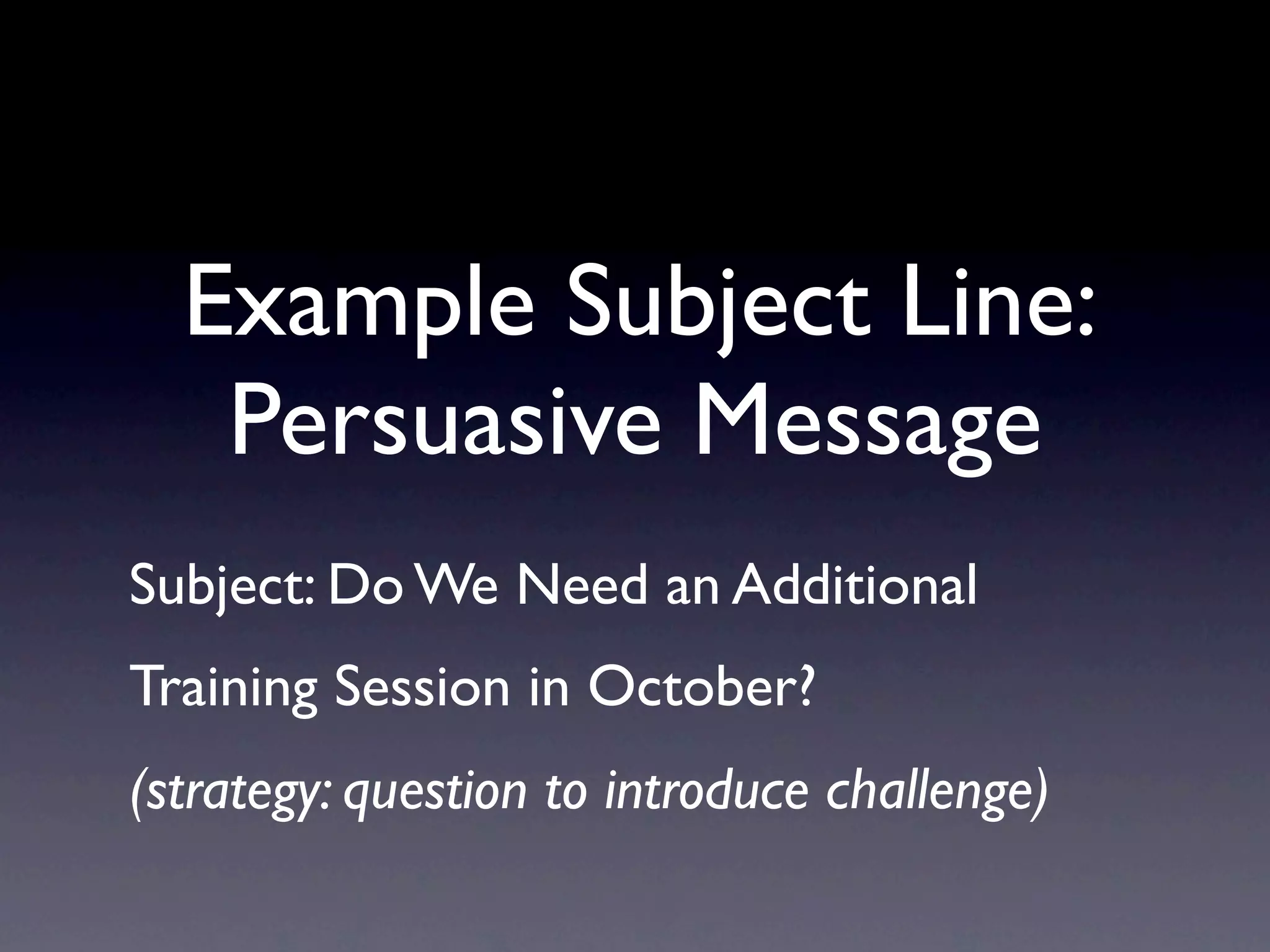
Example Subject Line:
   Persuasive Message
Subject: Do We Need an Additional
Training Session in October?
(strategy: question to introduce challenge)
Example Subject Line:
   Persuasive Message
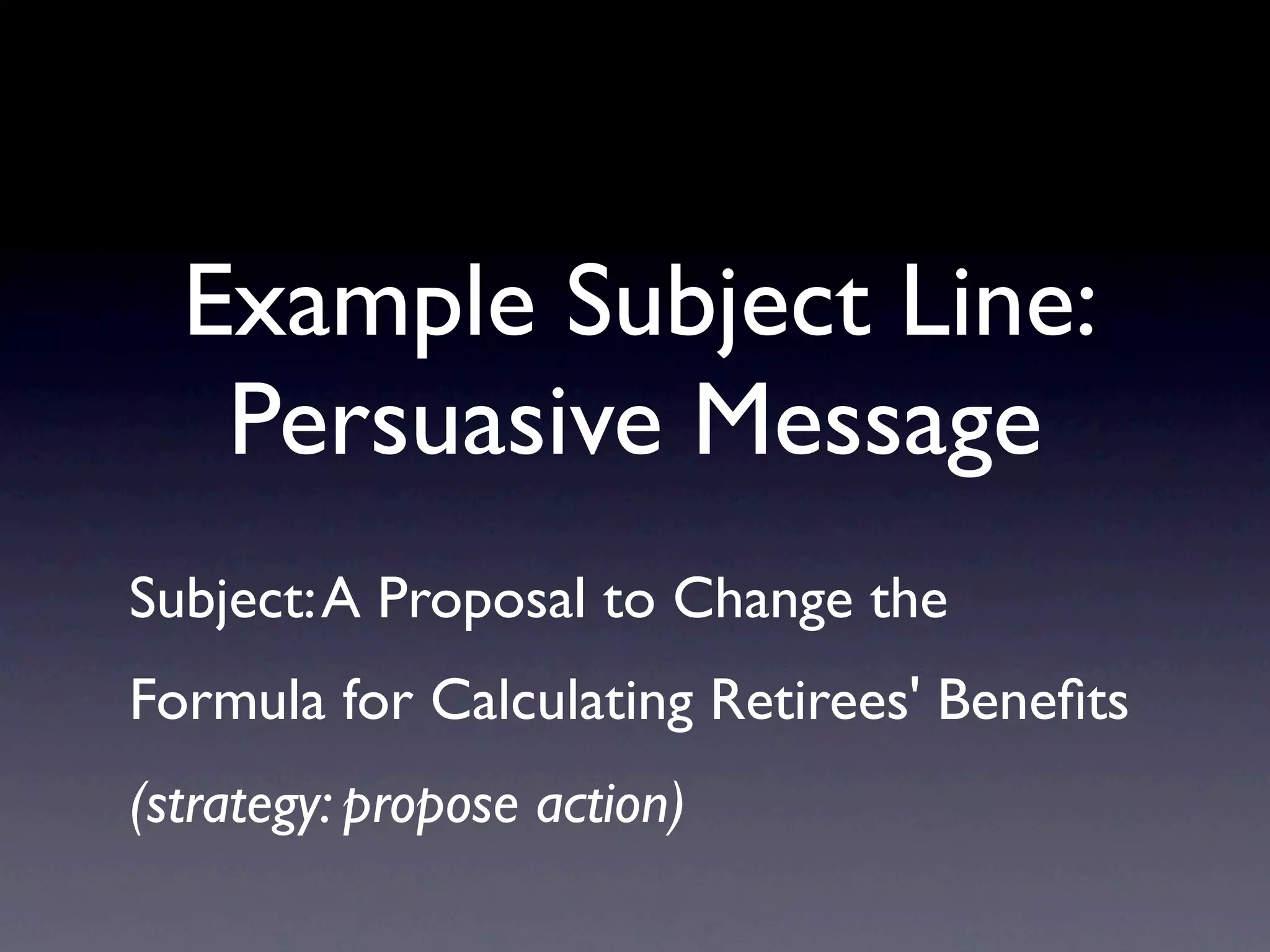
Subject: A Proposal to Change the
Formula for Calculating Retirees' Benefits
(strategy: propose action)
Example Subject Line:
   Persuasive Message
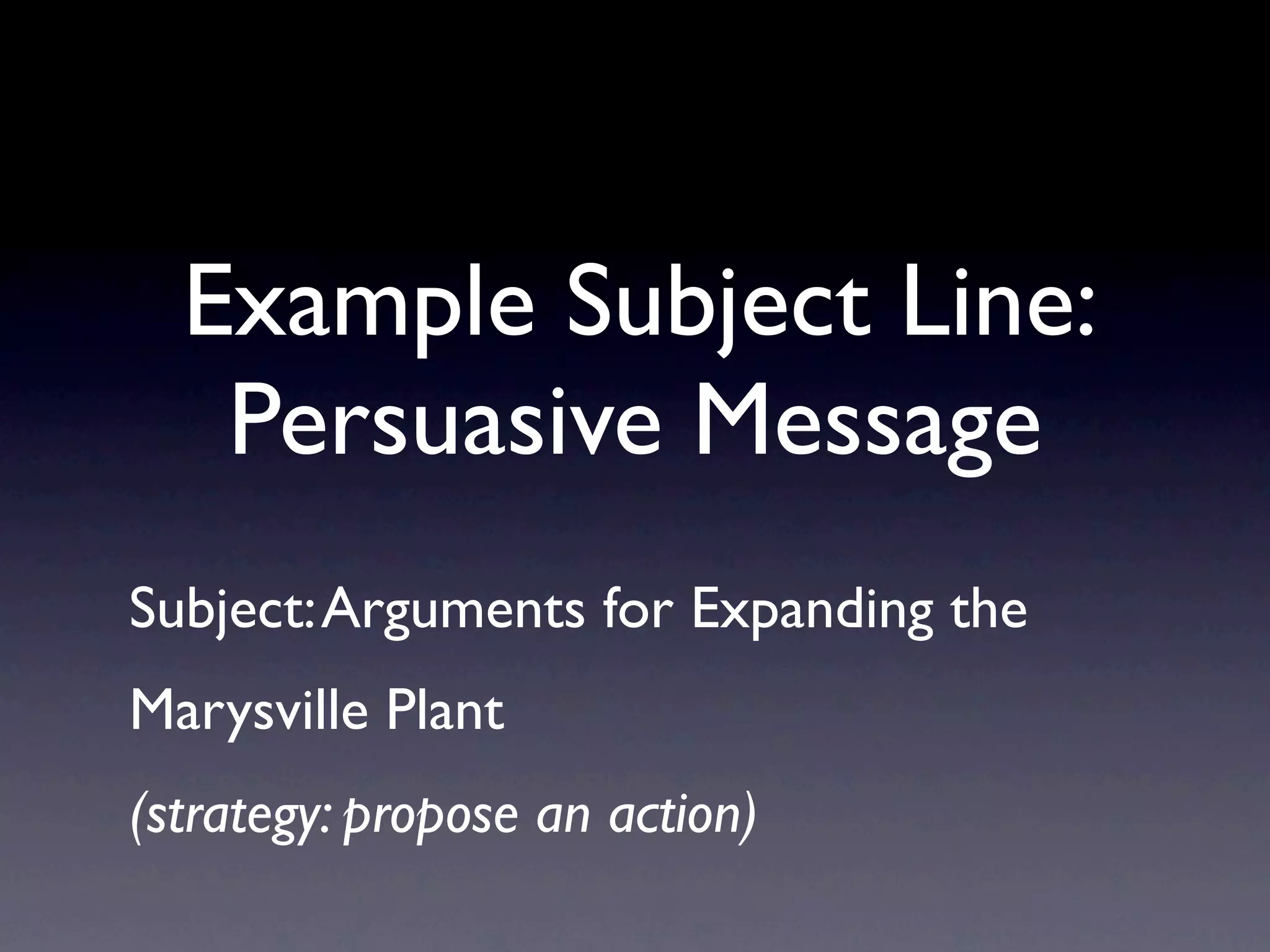
Subject: Arguments for Expanding the
Marysville Plant
(strategy: propose an action)
Example Subject Line:
   Persuasive Message
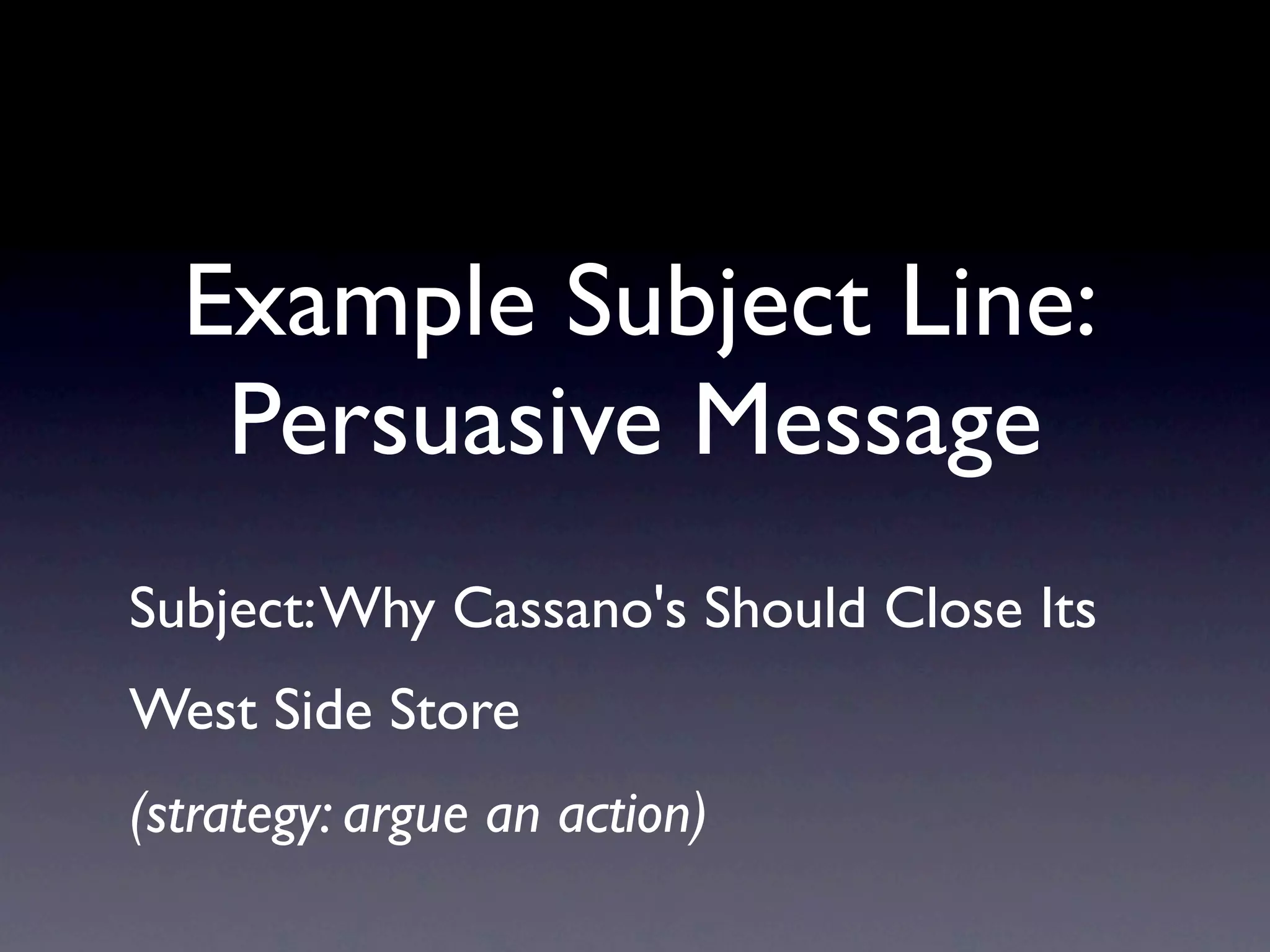
Subject: Why Cassano's Should Close Its
West Side Store
(strategy: argue an action)
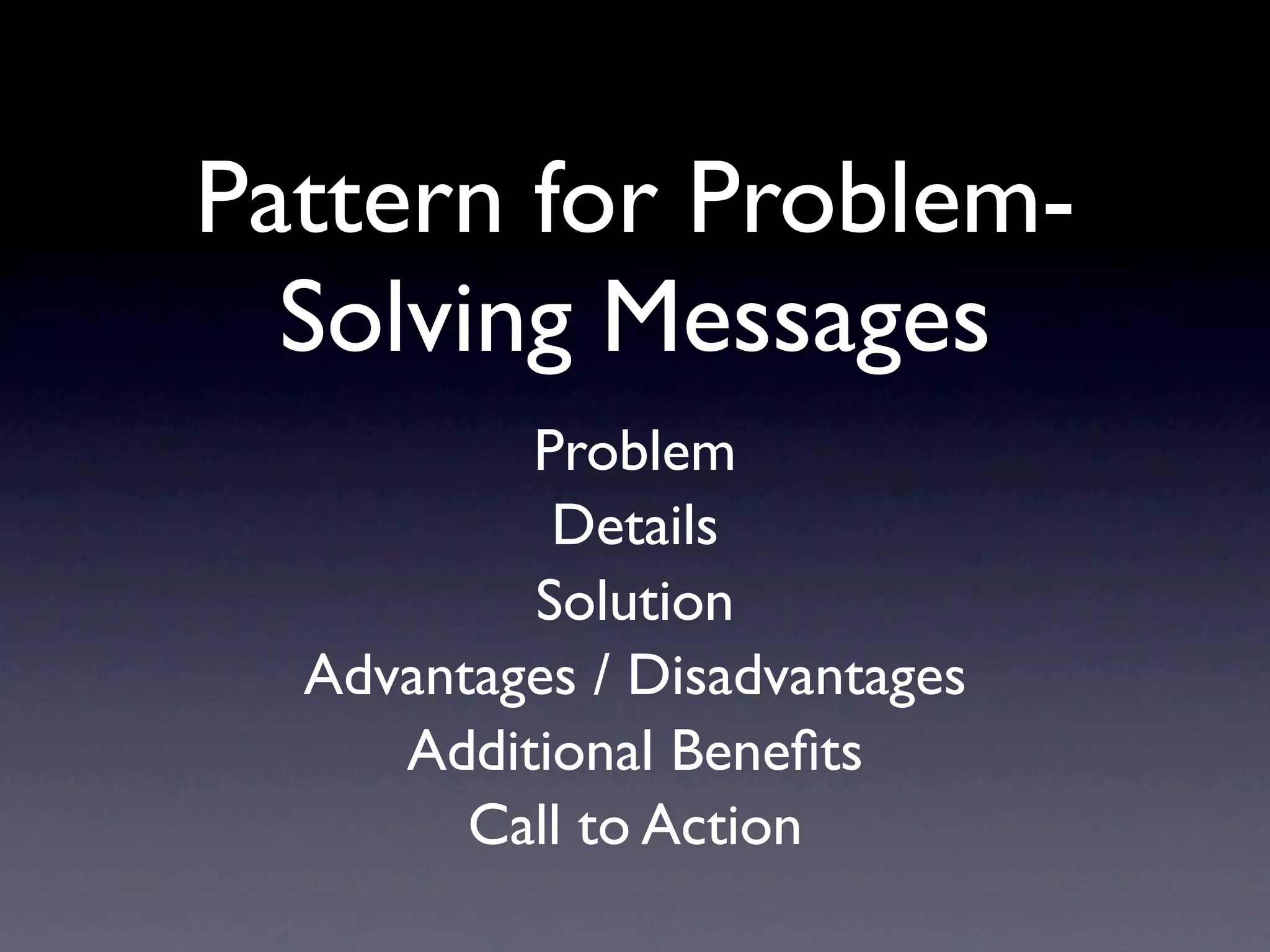
Pattern for Problem-
  Solving Messages
          Problem
           Details
          Solution
  Advantages / Disadvantages
     Additional Benefits
        Call to Action
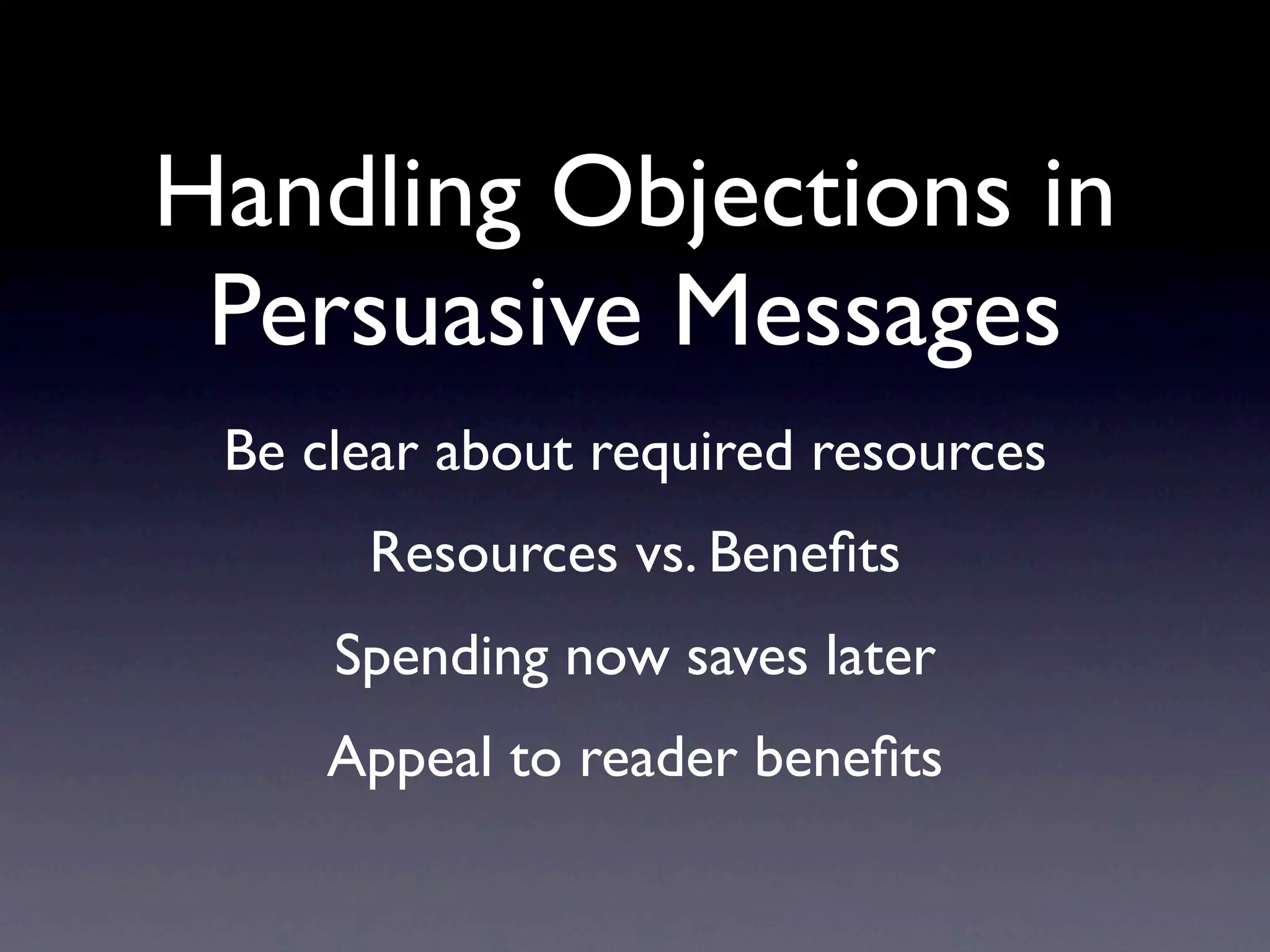
Handling Objections in
 Persuasive Messages
 Be clear about required resources
      Resources vs. Benefits
     Spending now saves later
     Appeal to reader benefits
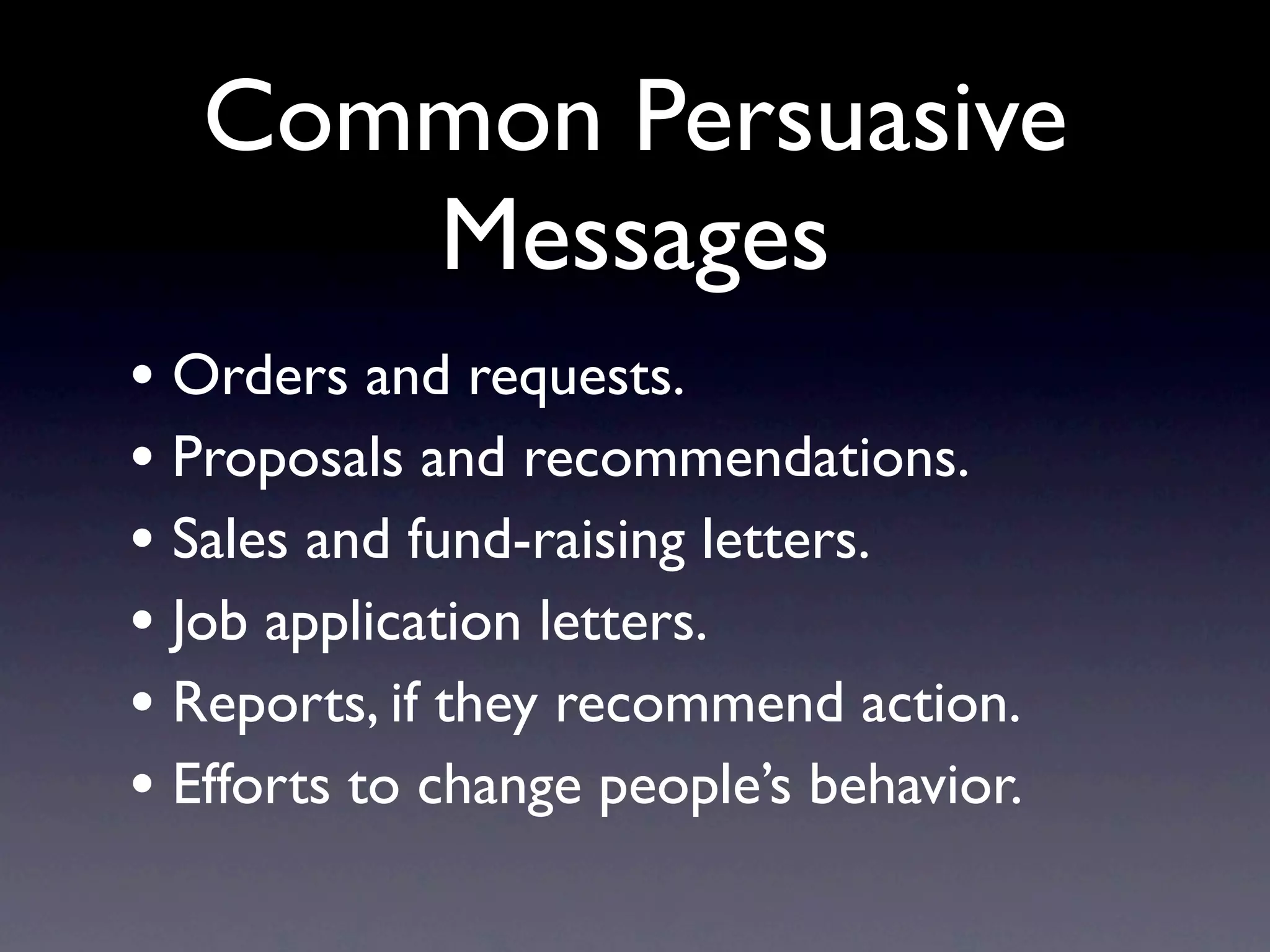
Common Persuasive
      Messages
• Orders and requests.
• Proposals and recommendations.
• Sales and fund-raising letters.
• Job application letters.
• Reports, if they recommend action.
• Efforts to change people’s behavior.
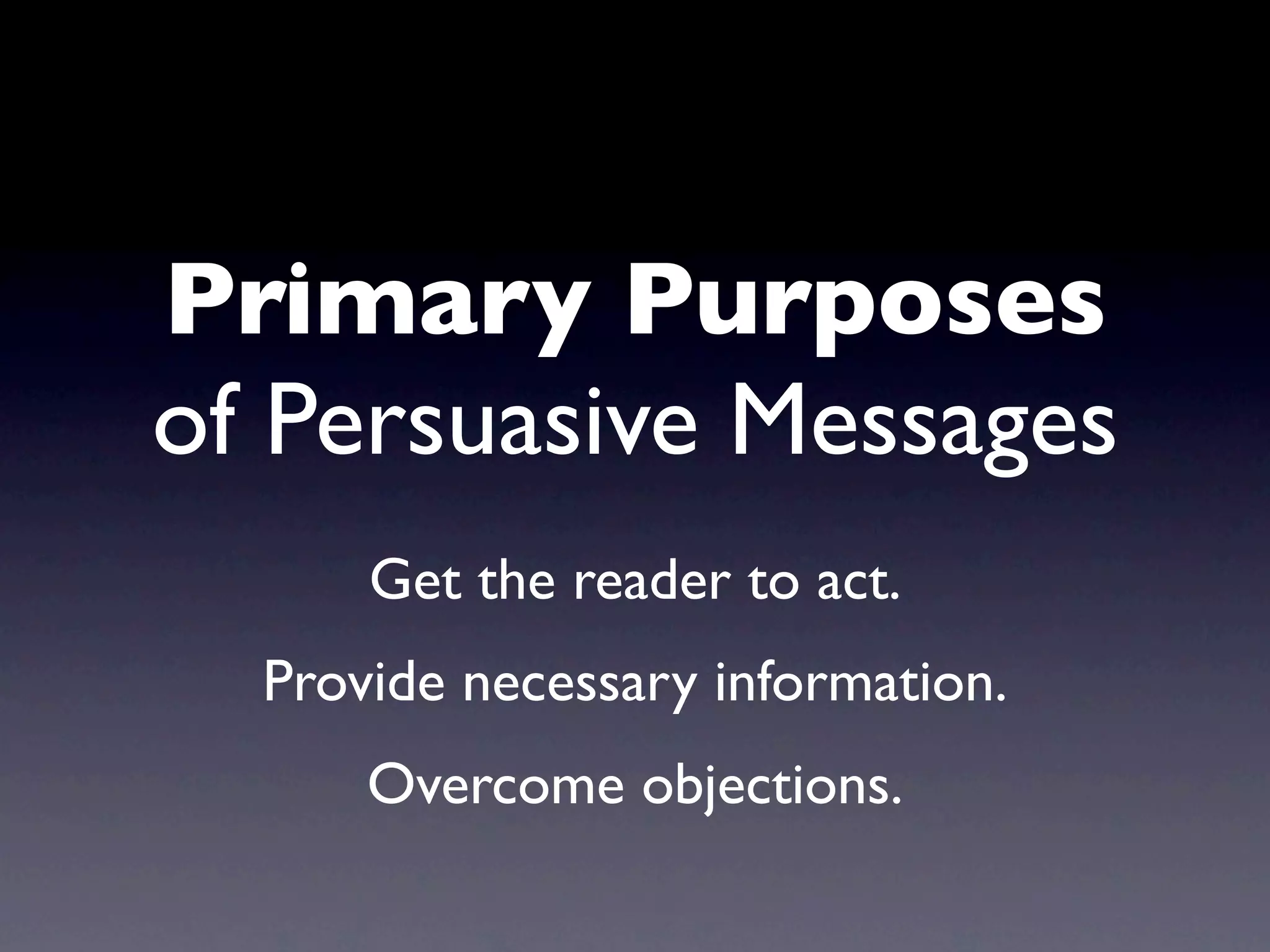
Primary Purposes
of Persuasive Messages
      Get the reader to act.
  Provide necessary information.
      Overcome objections.
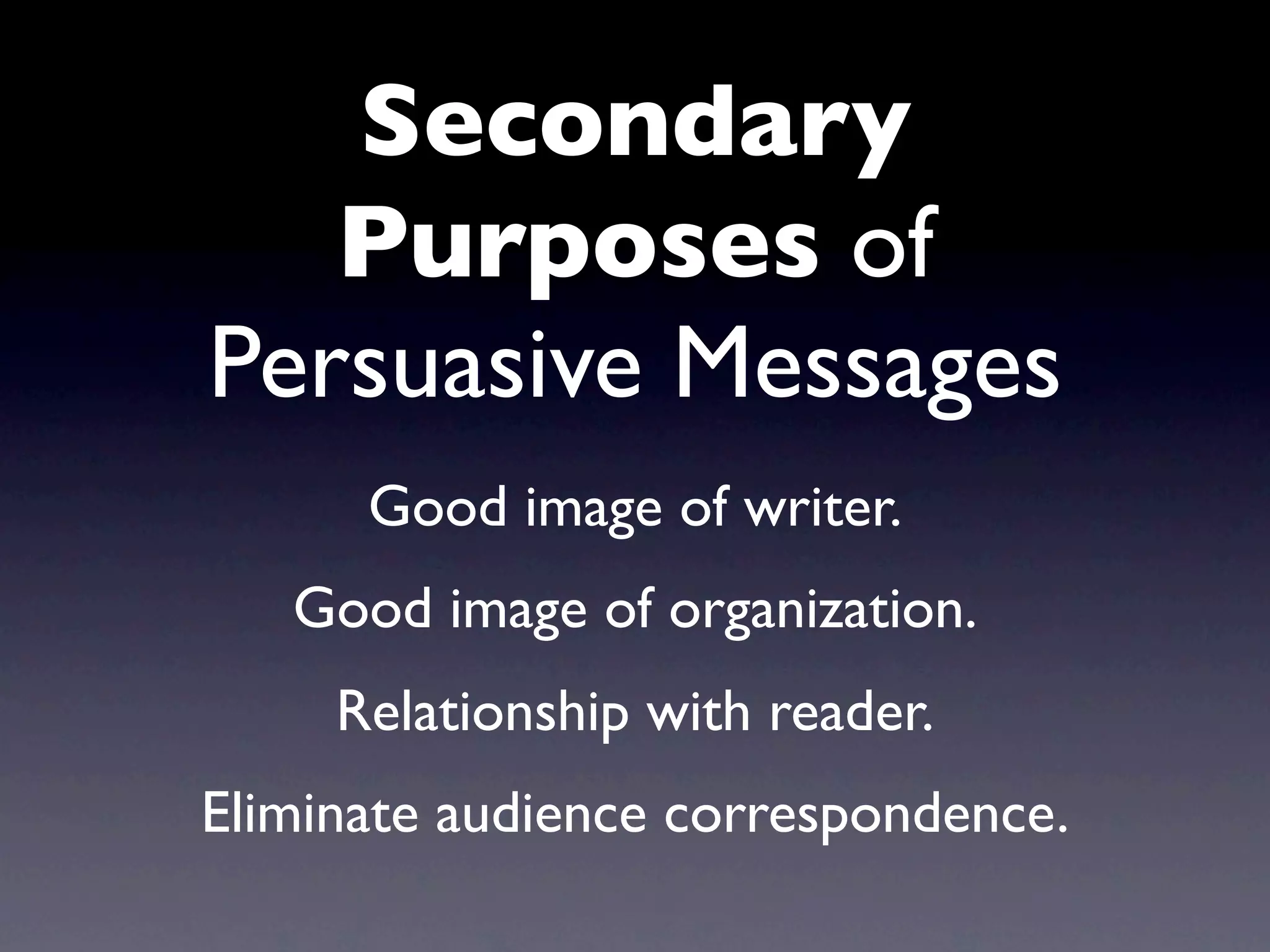
Secondary
   Purposes of
Persuasive Messages
      Good image of writer.
   Good image of organization.
     Relationship with reader.
Eliminate audience correspondence.
(12.2) How do you
organize a problem-
 solving persuasive
      message?
(12.3) How can you
  build credibility?
(12.18) How did you
respond to John Inoye’s
request regarding Peggy
        Chafez?

Lecture - Module 12

  • 1.
  • 2.
  • 3.
  • 4.
  • 5.
    How do youdecide which strategy to use?
  • 6.
    Use a directrequest when... No audience resistance Busy audience Organizational Preference
  • 7.
    Use a Problem- Solving stratey when... Audience objections Need full participation Audience will read completely Audience privileges logic over emotion
  • 8.
  • 9.
    Subject Lines DirectRequest: In the subject line Problem-Solving Message: Your stance
  • 10.
    Example Subject Line: Persuasive Message Subject: Request for Updated Software (strategy: direct request)
  • 11.
    Example Subject Line: Persuasive Message Subject: Status of Account #3548-003 (strategy: neutral position, topic-only)
  • 12.
    Example Subject Line: Persuasive Message Subject: Do We Need an Additional Training Session in October? (strategy: question to introduce challenge)
  • 13.
    Example Subject Line: Persuasive Message Subject: A Proposal to Change the Formula for Calculating Retirees' Benefits (strategy: propose action)
  • 14.
    Example Subject Line: Persuasive Message Subject: Arguments for Expanding the Marysville Plant (strategy: propose an action)
  • 15.
    Example Subject Line: Persuasive Message Subject: Why Cassano's Should Close Its West Side Store (strategy: argue an action)
  • 16.
    Pattern for Problem- Solving Messages Problem Details Solution Advantages / Disadvantages Additional Benefits Call to Action
  • 17.
    Handling Objections in Persuasive Messages Be clear about required resources Resources vs. Benefits Spending now saves later Appeal to reader benefits
  • 18.
    Common Persuasive Messages • Orders and requests. • Proposals and recommendations. • Sales and fund-raising letters. • Job application letters. • Reports, if they recommend action. • Efforts to change people’s behavior.
  • 19.
    Primary Purposes of PersuasiveMessages Get the reader to act. Provide necessary information. Overcome objections.
  • 20.
    Secondary Purposes of Persuasive Messages Good image of writer. Good image of organization. Relationship with reader. Eliminate audience correspondence.
  • 21.
    (12.2) How doyou organize a problem- solving persuasive message?
  • 22.
    (12.3) How canyou build credibility?
  • 23.
    (12.18) How didyou respond to John Inoye’s request regarding Peggy Chafez?

Editor's Notes

  • #2 \n
  • #3 \n
  • #4 \n\n
  • #5 \n
  • #6 \n
  • #7 The audience will do as you ask without any resistance.\nYou need a response only from the people who are willing to act. \nThe audience is busy and may not read all the messages received.\nYour organization’s culture prefers direct requests.\n
  • #8 The audience is likely to object to doing as you ask.\nYou need action from everyone.\nYou trust the audience to read the entire message.\nYou expect logic to be more important than emotion in the decision.\n\n
  • #9 The audience will do as you ask without any resistance.\nYou need a response only from the people who are willing to act. \nThe audience is busy and may not read all the messages received.\nYour organization’s culture prefers direct requests.\n
  • #10 In a direct request, put the request, the topic of the request, or a question in the subject line.\nIn a problem-solving message, use a directed subject line: one that makes your stance on the issue clear. \nYou can also use common ground or a reader benefit to show readers that the message will help them. \n
  • #11 \n
  • #12 \n
  • #13 \n
  • #14 \n
  • #15 \n
  • #16 \n
  • #17 Describe the problem you both share (which your request will solve).\nGive the details of the problem.\nExplain the solution to the problem.\nShow that any negative elements are outweighed by the disadvantages.\nSummarize any additional benefits of the solution.\nAsk for the action you want.\n\n
  • #18 Specify how much time and/or money is required.\nPut the time and/or money in the context of the benefits they bring.\nShow that money spent now will save money in the long run.\n
  • #19 \n
  • #20 To have the reader act.\nTo provide enough information so that the reader knows exactly what to do.\nTo overcome any objections that might prevent or delay action.\n
  • #21 To build a good image of the writer\nTo build a good image of the writer's organization.\nTo cement a good relationship between the writer and reader:\nTo reduce or eliminate future correspondence on the same subject so the message doesn't create more work for the writer.\n
  • #22 describe the problem you both share (which your request will solve)\ngive the details of the problem\nexplain the solution to the problem\nshow that any negative elements are outweighed by the disadvantages,\nsummarize any additional benefits of the solution\nask for the action you want.\n\n
  • #23 Be... \nfactual\nspecific\nreliable\n\n
  • #24 \n