LEAN METHODOLOGY
FOR STARTUPS: INTRO
Lecture prepared by Dr Gregory Prokopski
(Montreal / Canada) for EFYI 2016, Lódź, Poland
Conference organized by Poland Innovative
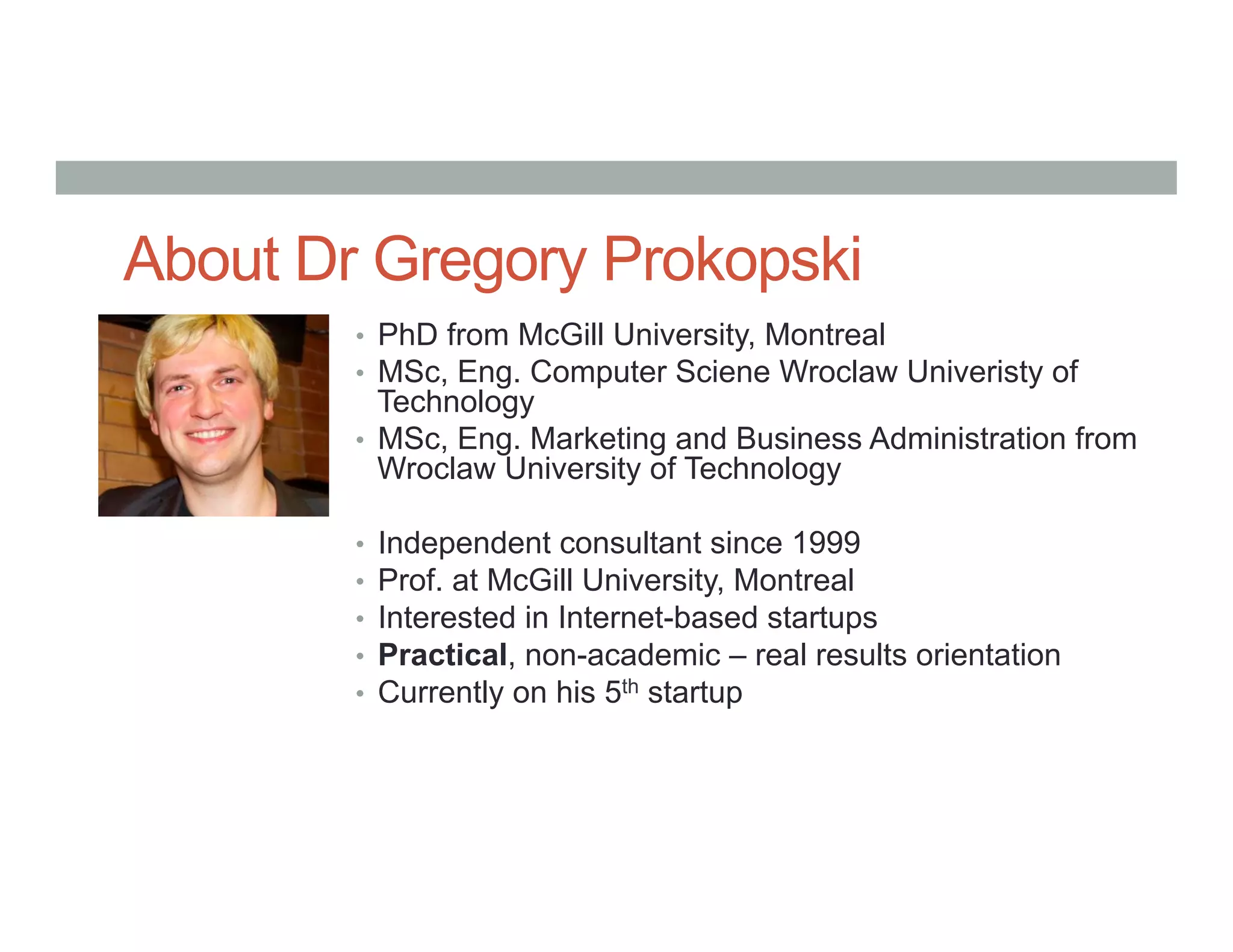
About Dr Gregory Prokopski
•  PhD from McGill University, Montreal
•  MSc, Eng. Computer Sciene Wroclaw Univeristy of
Technology
•  MSc, Eng. Marketing and Business Administration from
Wroclaw University of Technology
•  Independent consultant since 1999
•  Prof. at McGill University, Montreal
•  Interested in Internet-based startups
•  Practical, non-academic – real results orientation
•  Currently on his 5th startup
Content of this Workshop
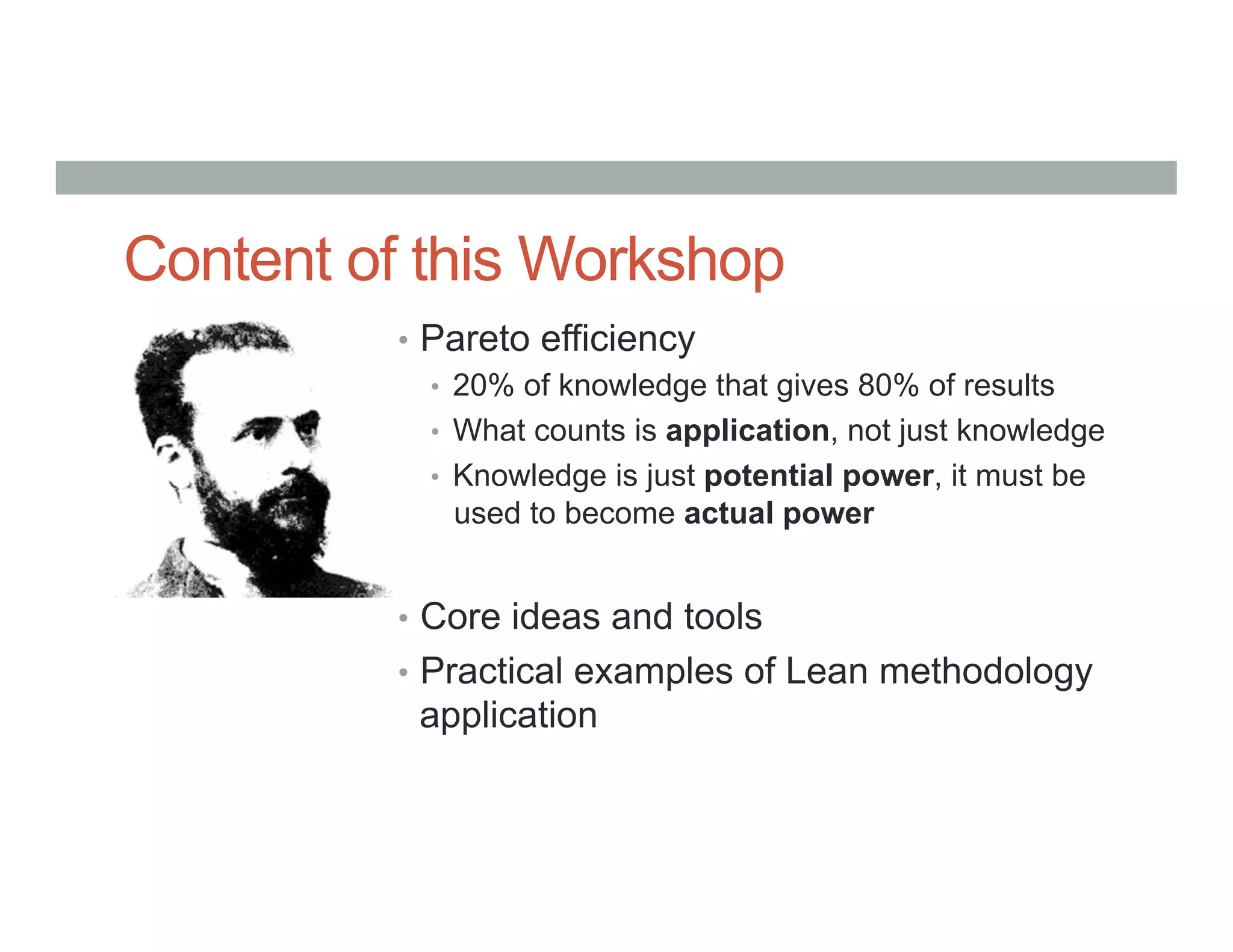
•  Pareto efficiency
•  20% of knowledge that gives 80% of results
•  What counts is application, not just knowledge
•  Knowledge is just potential power, it must be
used to become actual power
•  Core ideas and tools
•  Practical examples of Lean methodology
application
WHAT DOES *NOT* LEAD
TO SUCCESS
In business and beyond – review of common, ineffective
ways of thinking that prevent success.
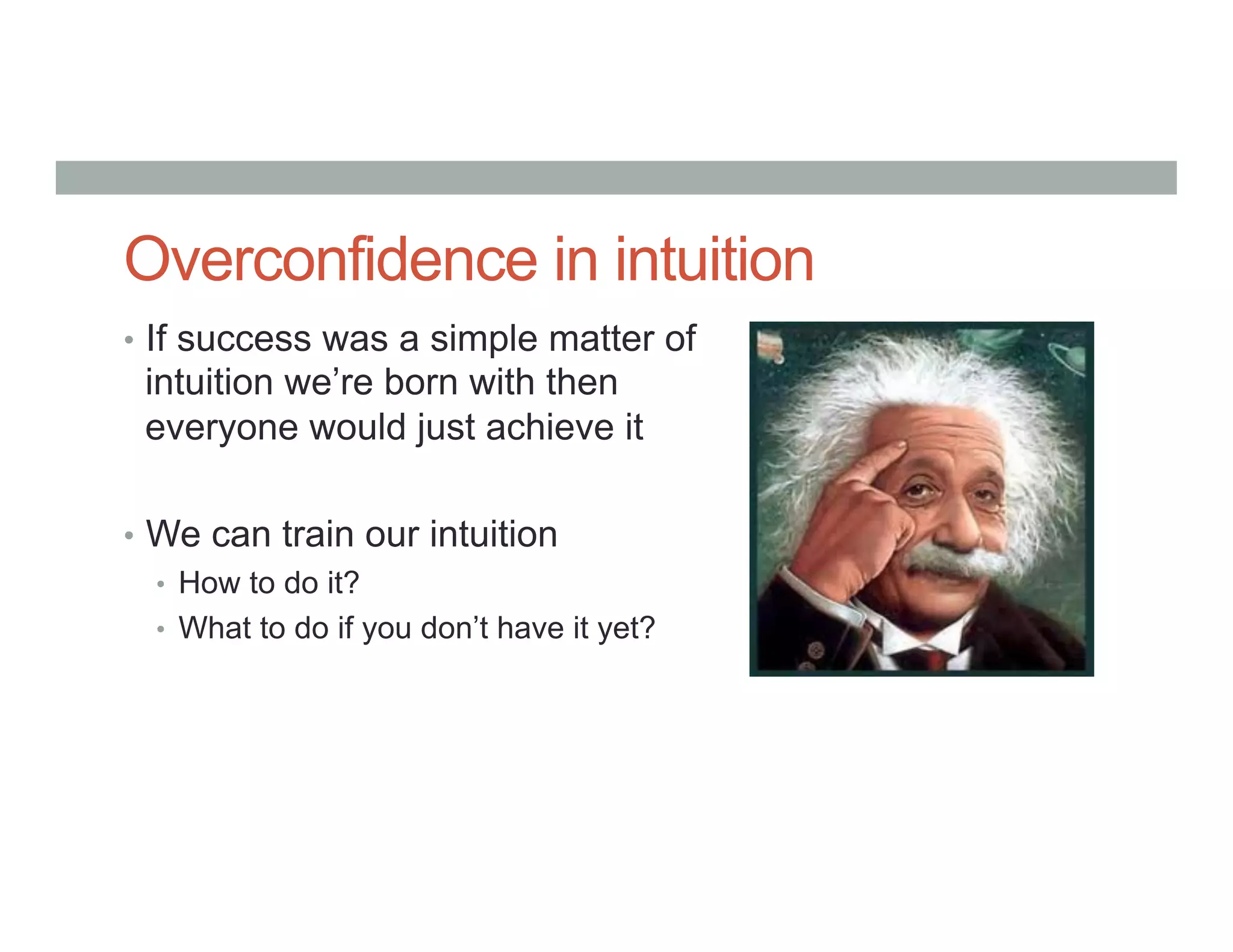
Overconfidence in intuition
•  If success was a simple matter of
intuition we’re born with then
everyone would just achieve it
•  We can train our intuition
•  How to do it?
•  What to do if you don’t have it yet?
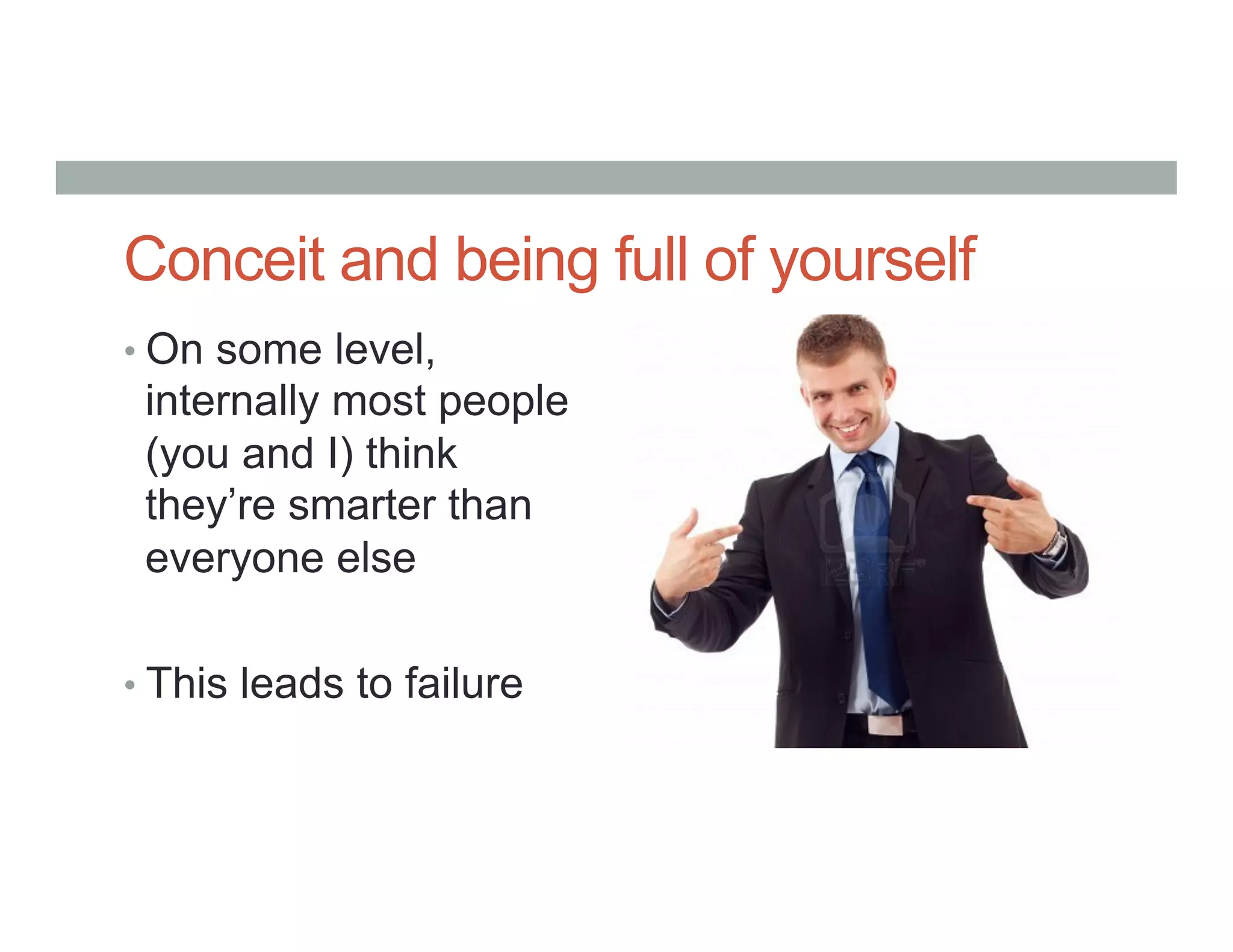
Conceit and being full of yourself
• On some level,
internally most people
(you and I) think
they’re smarter than
everyone else
• This leads to failure
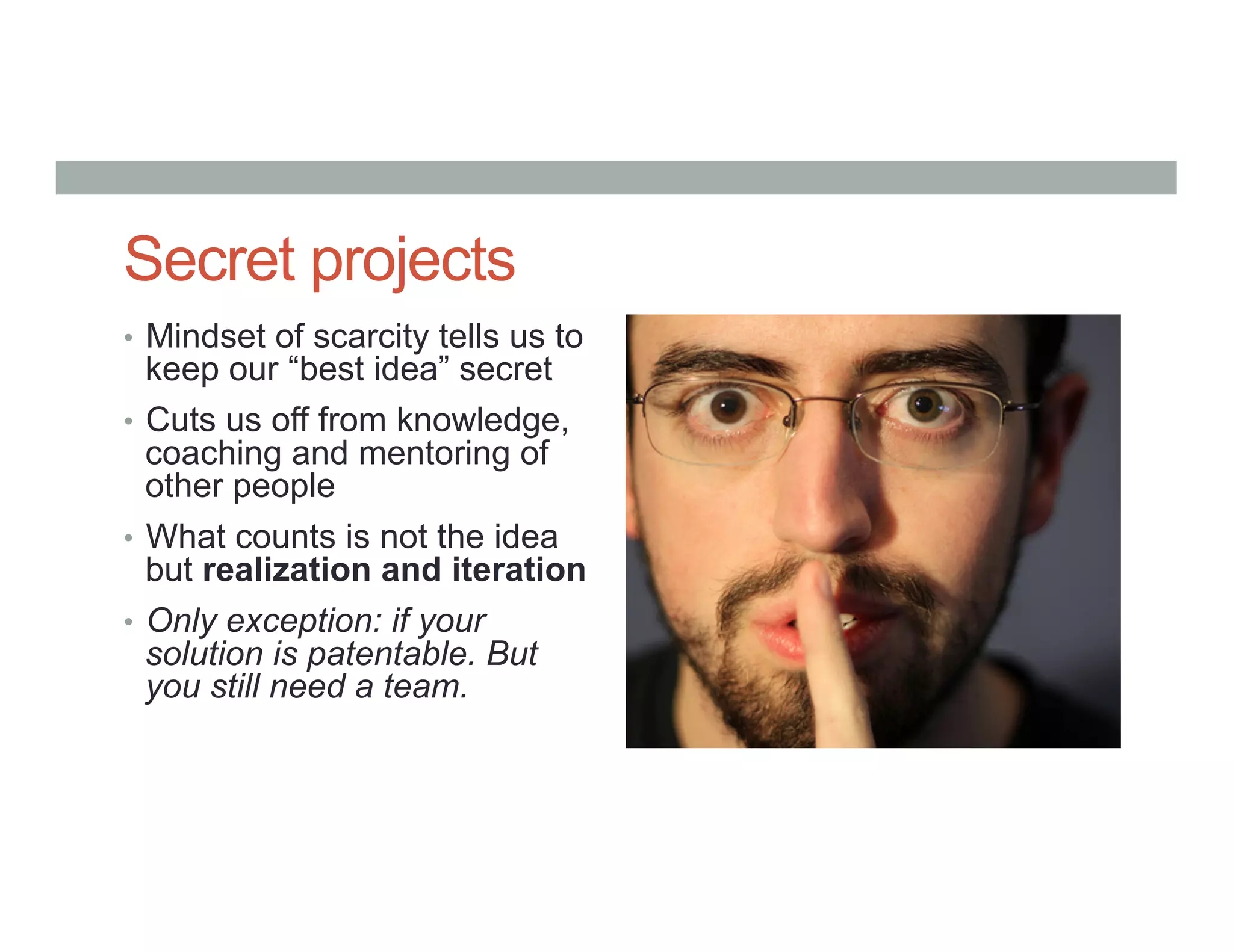
Secret projects
•  Mindset of scarcity tells us to
keep our “best idea” secret
•  Cuts us off from knowledge,
coaching and mentoring of
other people
•  What counts is not the idea
but realization and iteration
•  Only exception: if your
solution is patentable. But
you still need a team.
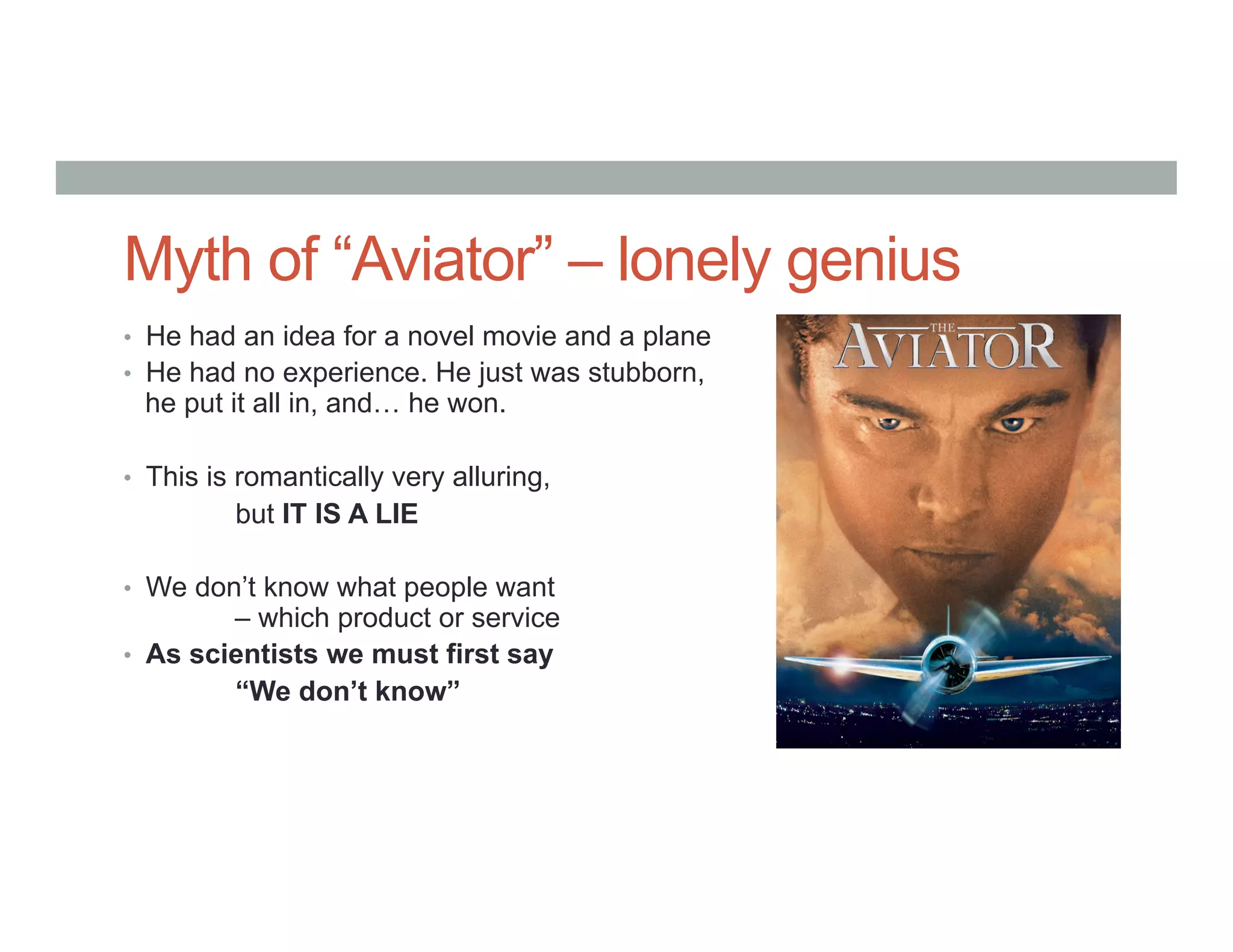
Myth of “Aviator” – lonely genius
•  He had an idea for a novel movie and a plane
•  He had no experience. He just was stubborn,
he put it all in, and… he won.
•  This is romantically very alluring,
but IT IS A LIE
•  We don’t know what people want
– which product or service
•  As scientists we must first say
“We don’t know”
PRINCIPLES, METHODS OF
THINKING AND TOOLS OF
LEAN METHODOLOGY
Mastery is practicing fundamentals
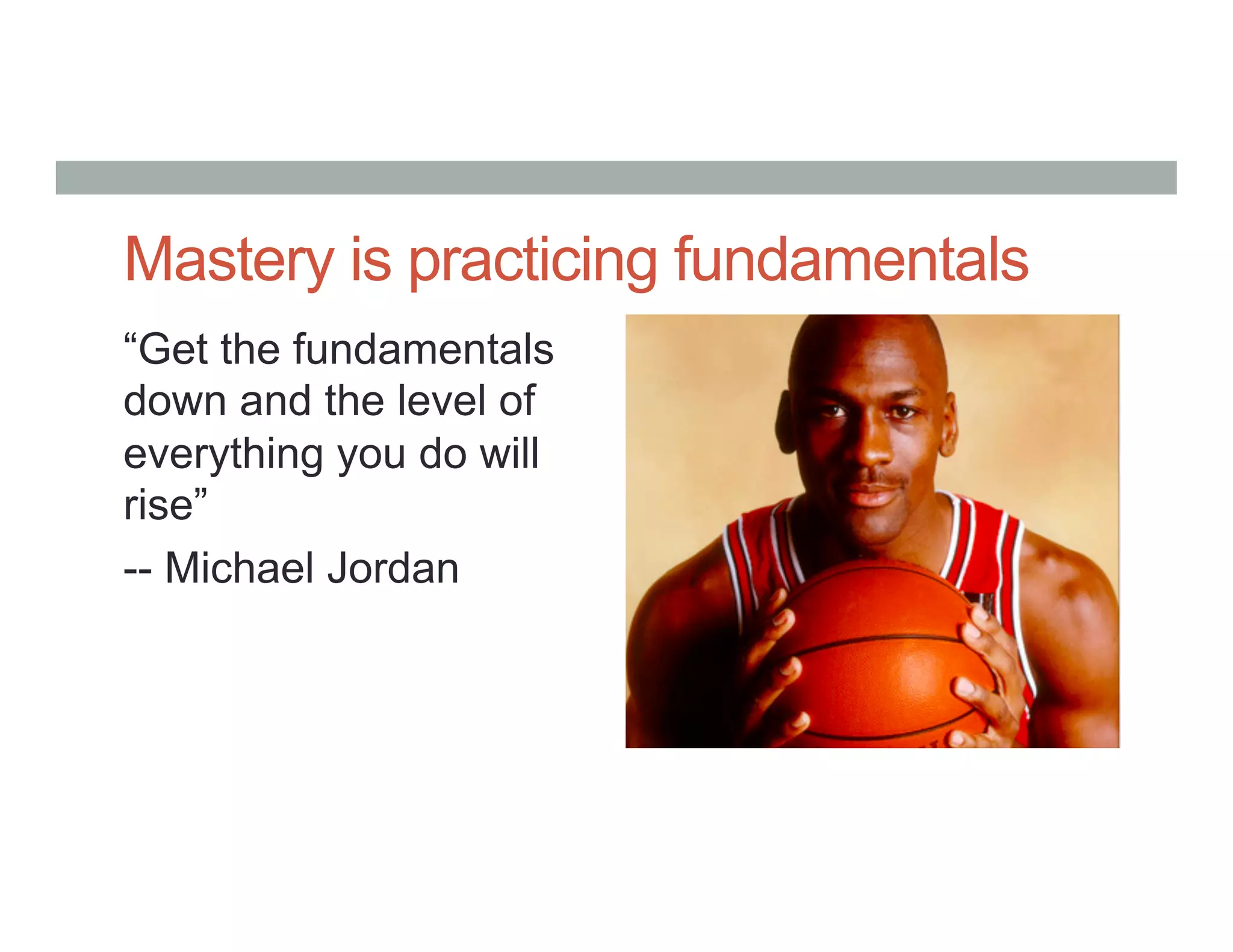
“Get the fundamentals
down and the level of
everything you do will
rise”
-- Michael Jordan
Lean Startup*
•  Is a set of such fundamentals
•  Is a way of thinking and acting when
managing a startup (as opposed to chaos)
•  It is an effective methodology tested by
hundreds of thousands of startups around
the world
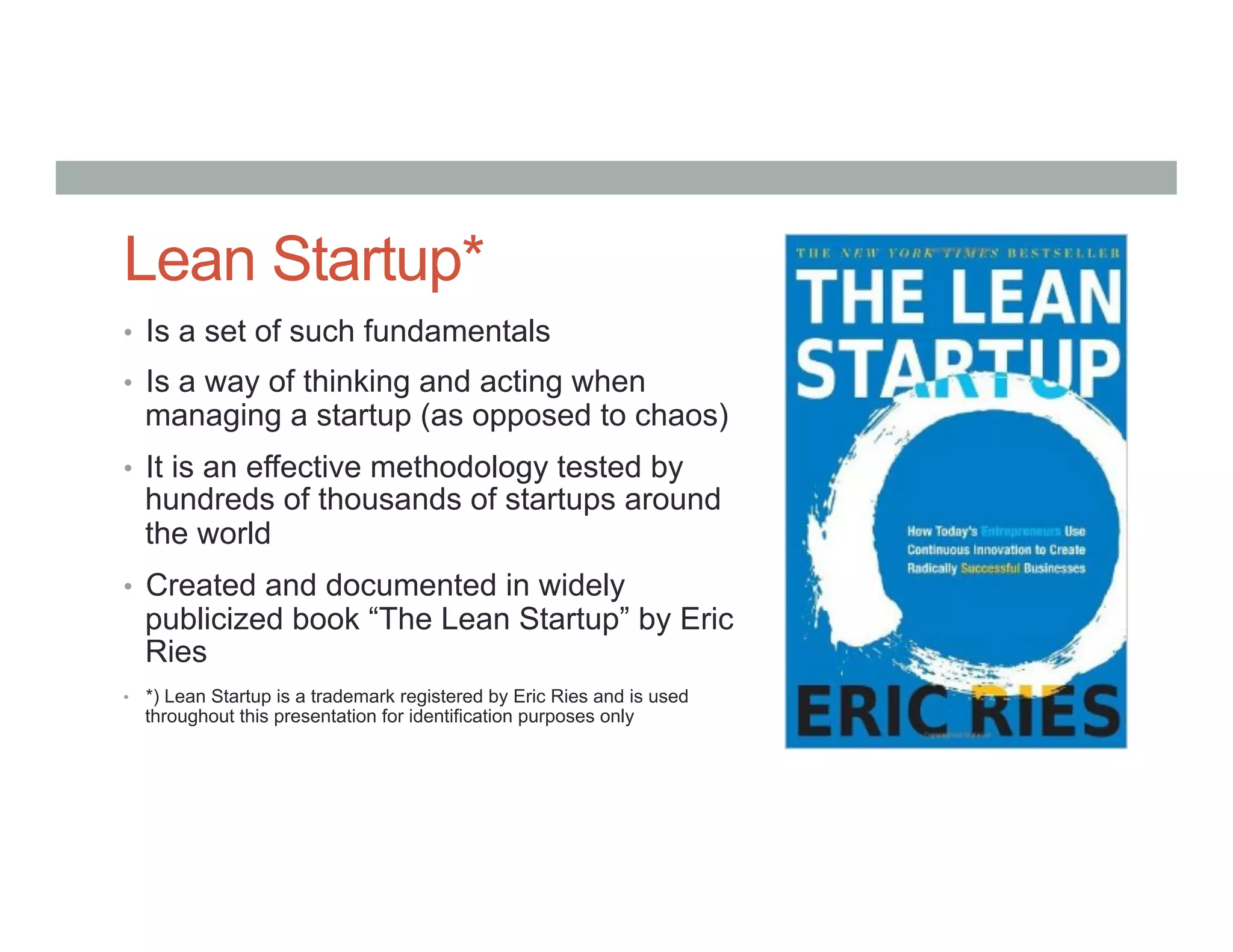
•  Created and documented in widely
publicized book “The Lean Startup” by Eric
Ries
•  *) Lean Startup is a trademark registered by Eric Ries and is used
throughout this presentation for identification purposes only
The Lean Startup - System
•  Systematic approach to managing startups
•  Instead of chaos (usual in startups) – order
•  You can learn this system – today!
•  Next, we will take a closer look at the main components of
this system
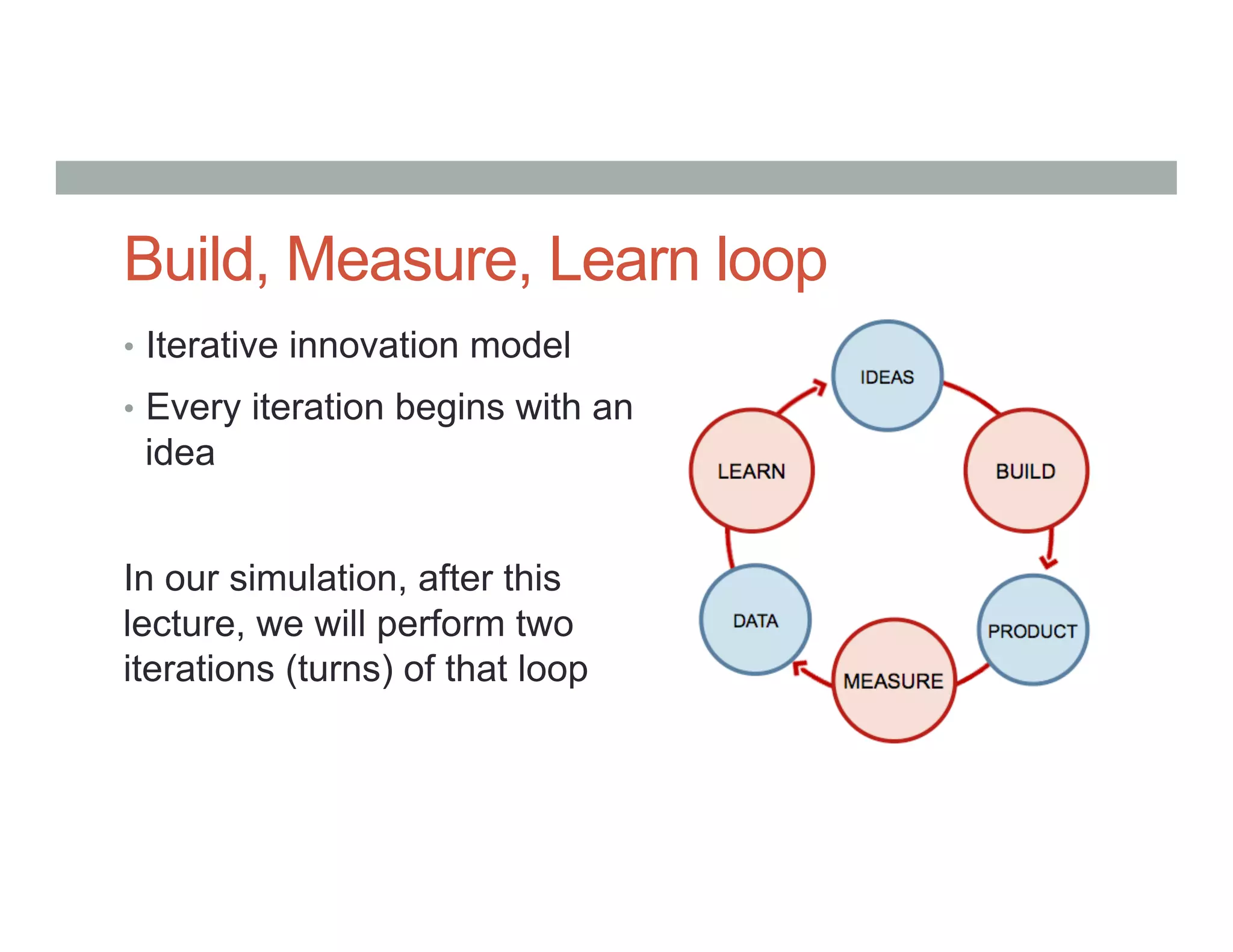
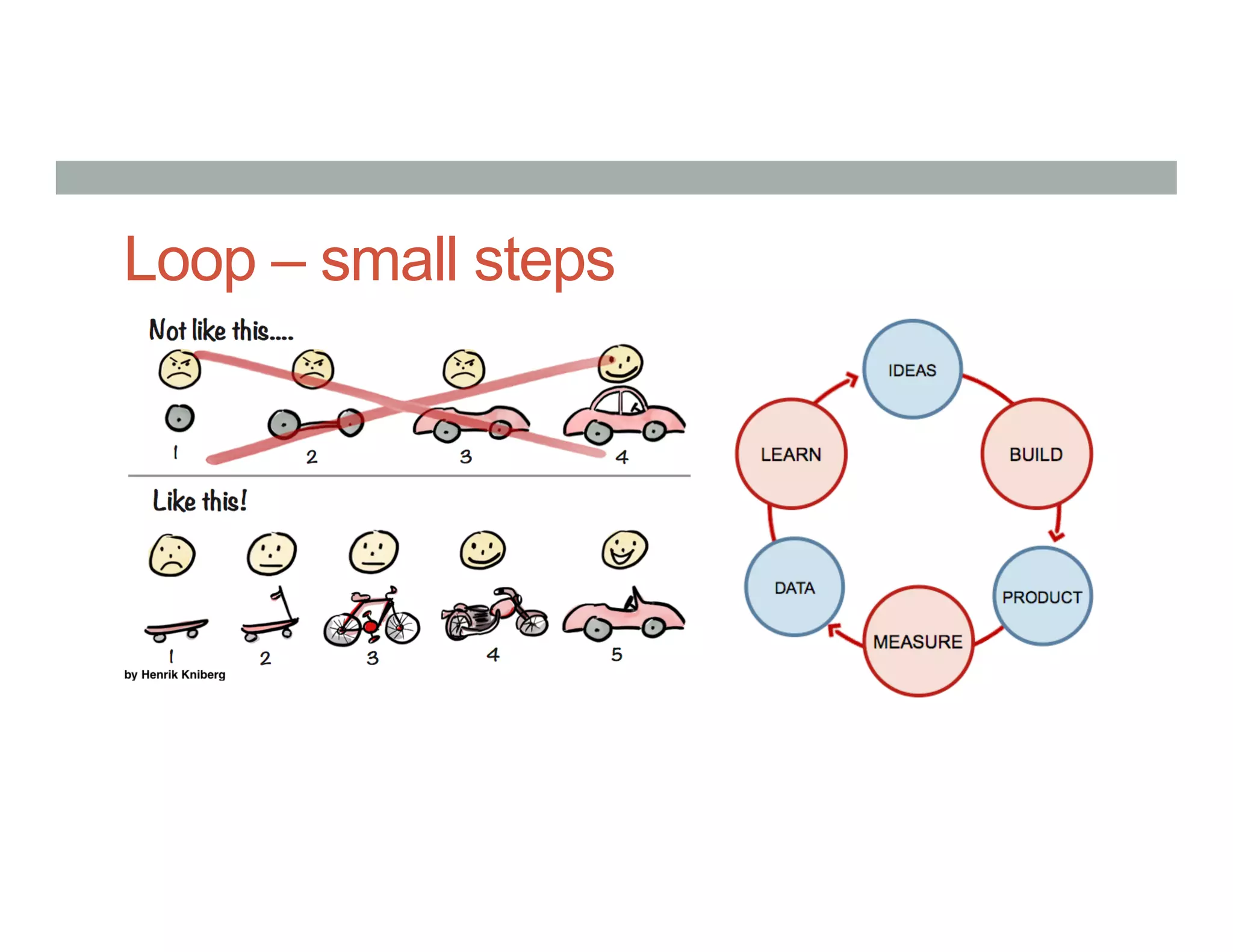
Build, Measure, Learn loop
•  Iterative innovation model
•  Every iteration begins with an
idea
In our simulation, after this
lecture, we will perform two
iterations (turns) of that loop
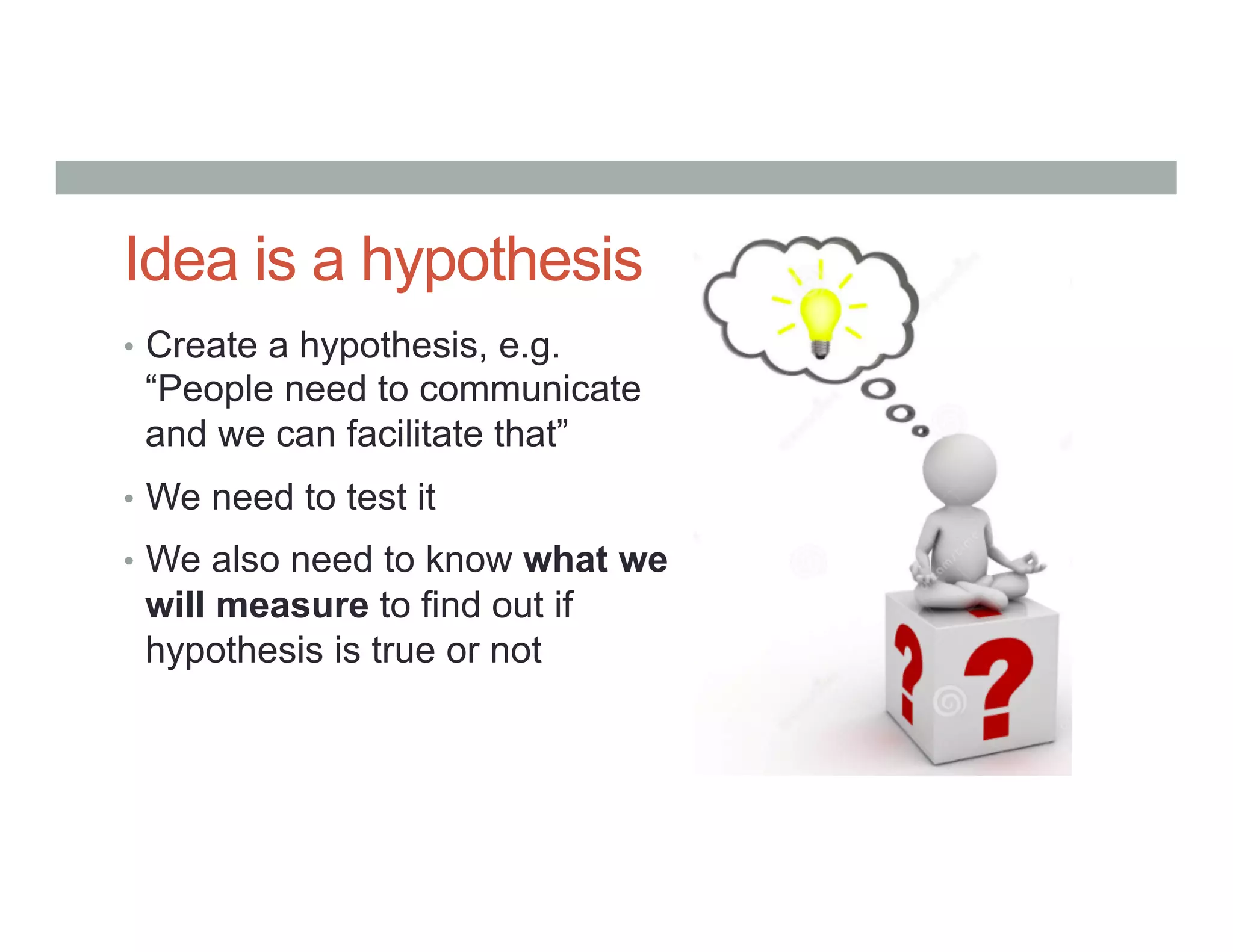
Idea is a hypothesis
•  Create a hypothesis, e.g.
“People need to communicate
and we can facilitate that”
•  We need to test it
•  We also need to know what we
will measure to find out if
hypothesis is true or not
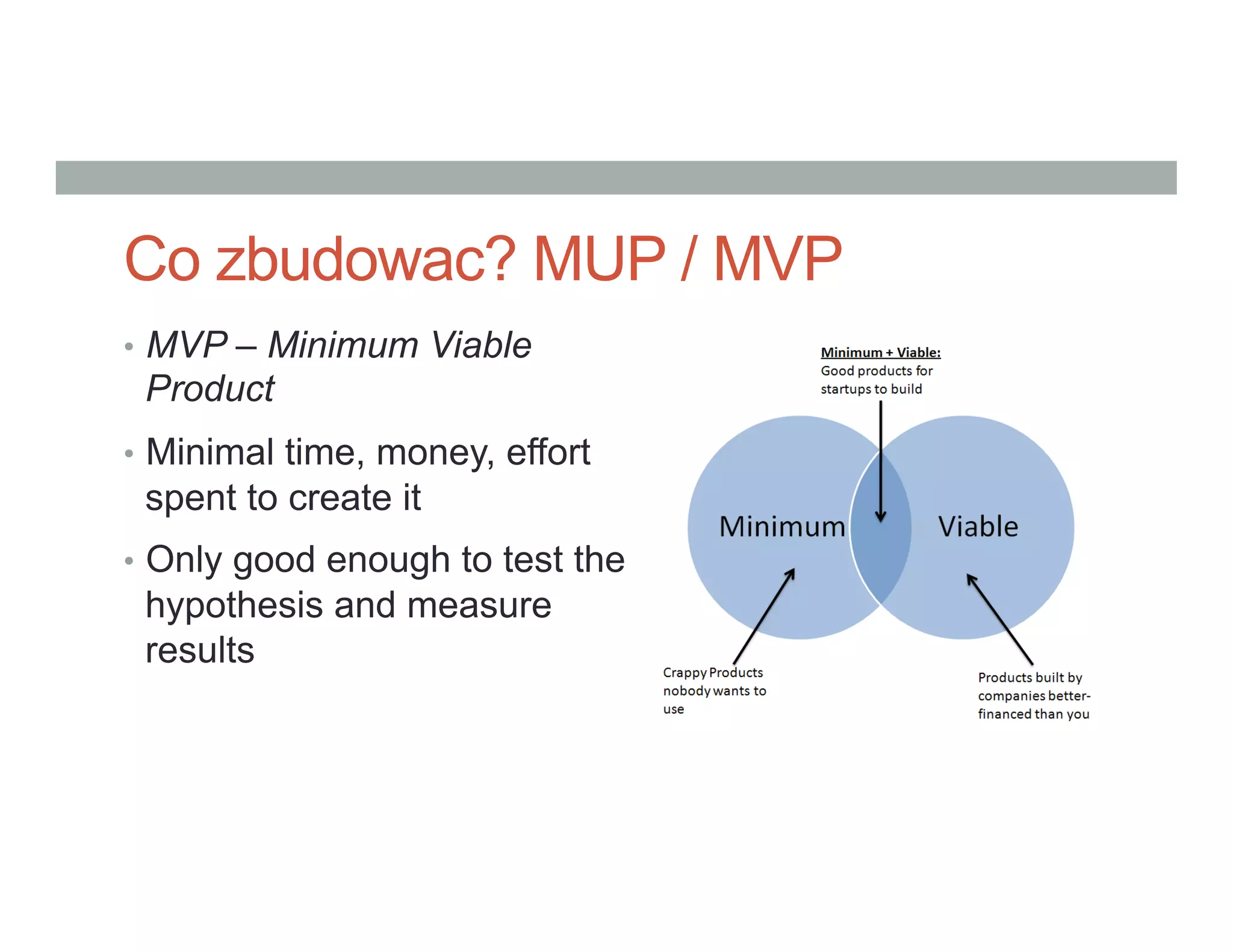
Co zbudowac? MUP / MVP
•  MVP – Minimum Viable
Product
•  Minimal time, money, effort
spent to create it
•  Only good enough to test the
hypothesis and measure
results
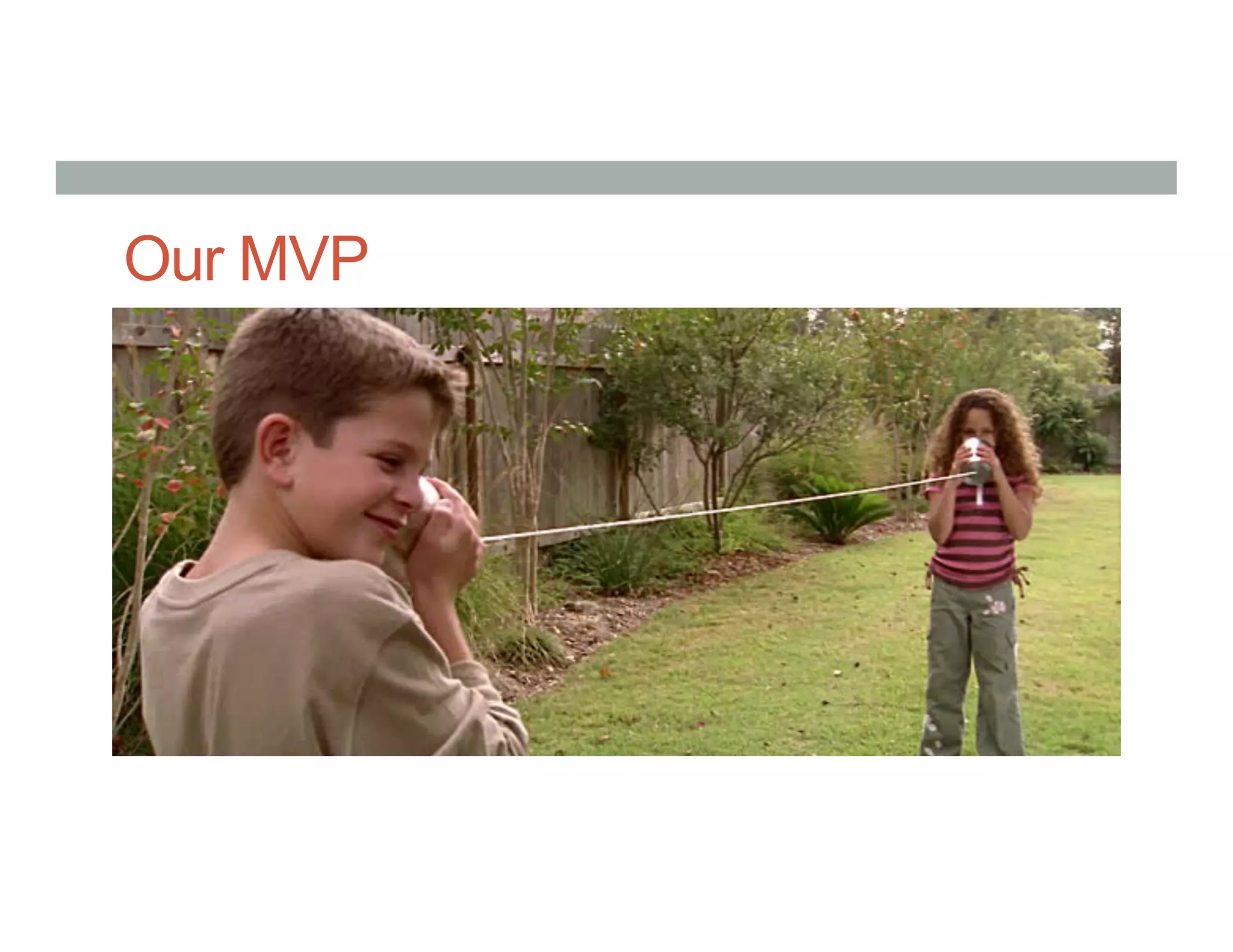
Our MVP
COMMON TYPES OF MVP
Real companies and products
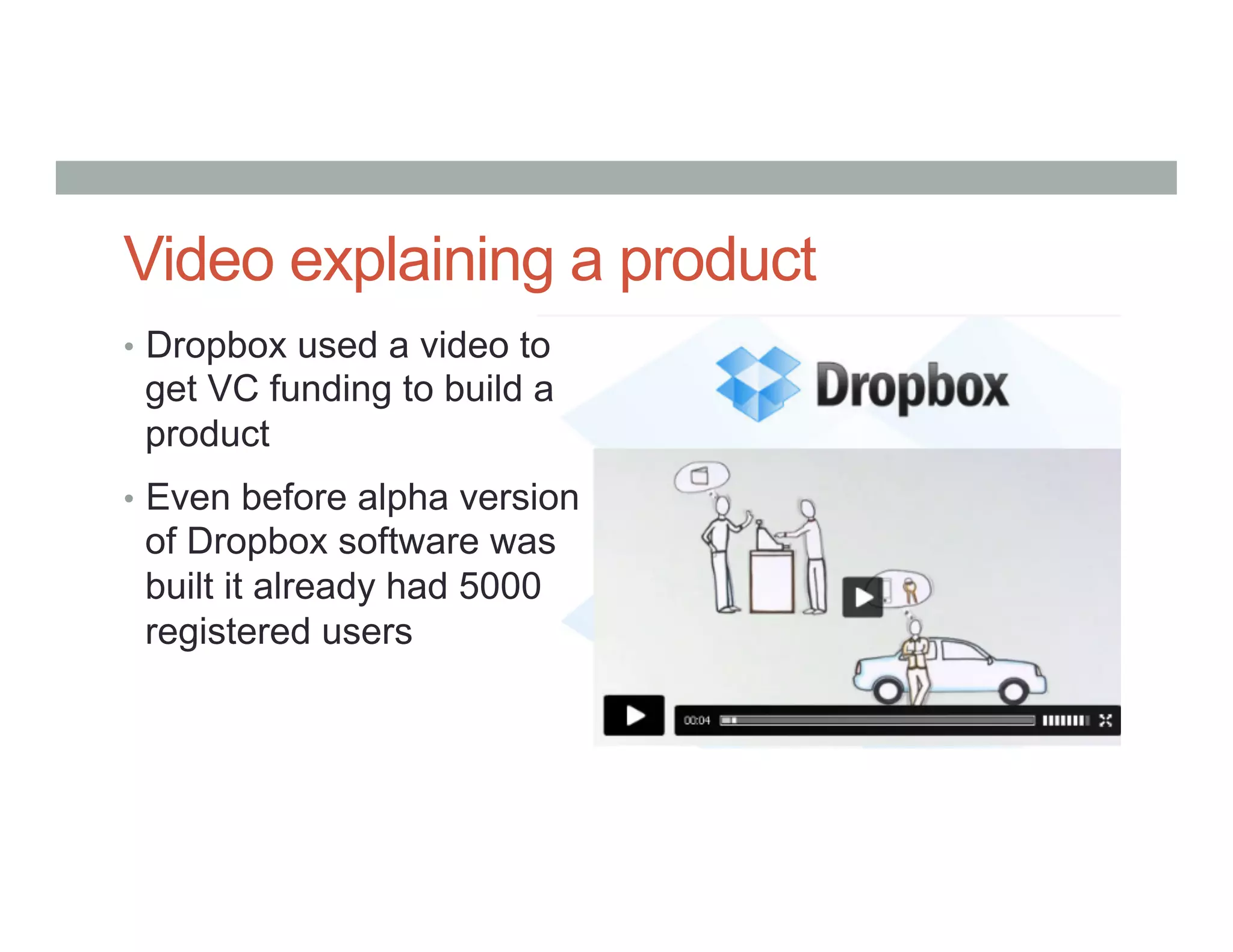
Video explaining a product
•  Dropbox used a video to
get VC funding to build a
product
•  Even before alpha version
of Dropbox software was
built it already had 5000
registered users
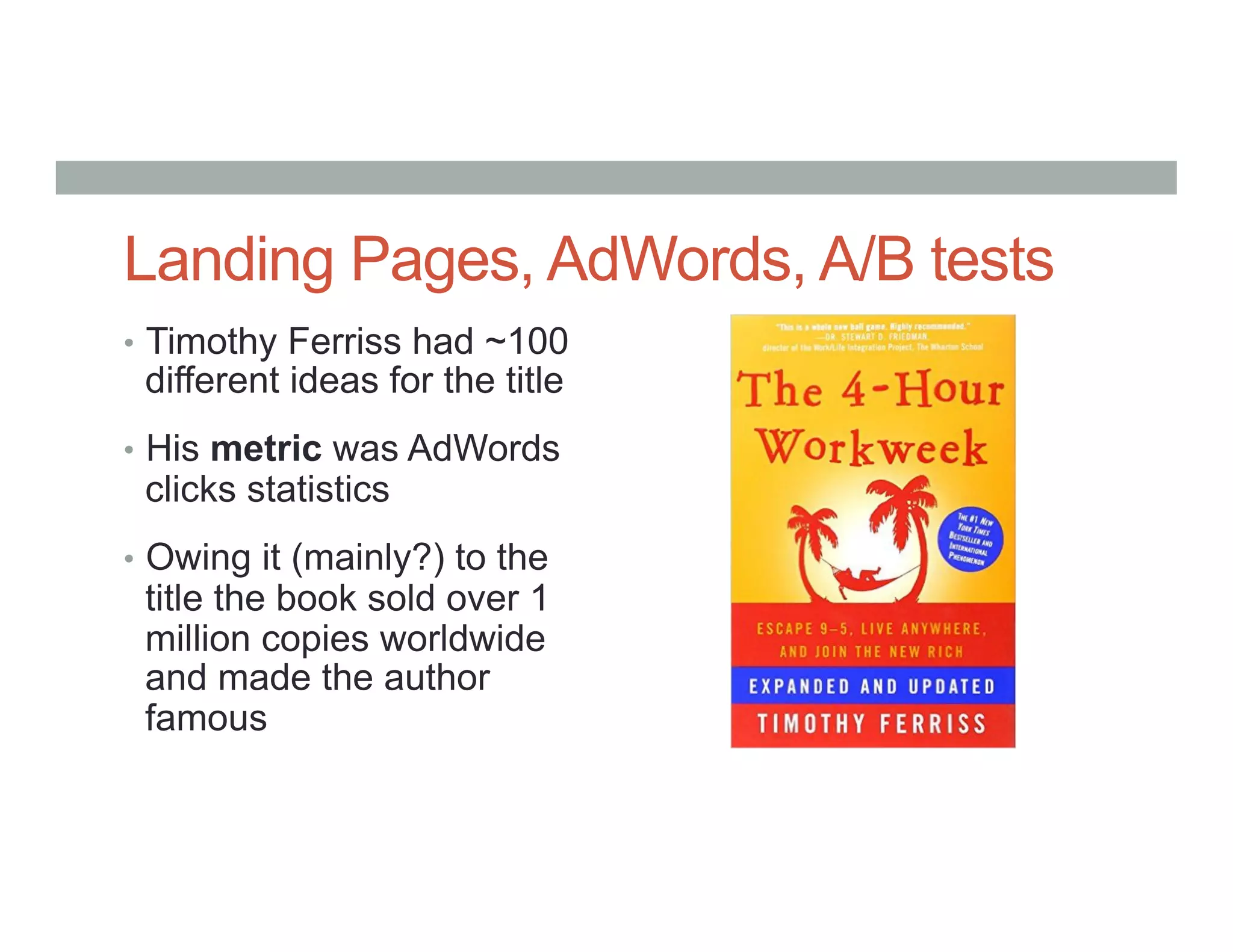
Landing Pages, AdWords, A/B tests
•  Timothy Ferriss had ~100
different ideas for the title
•  His metric was AdWords
clicks statistics
•  Owing it (mainly?) to the
title the book sold over 1
million copies worldwide
and made the author
famous
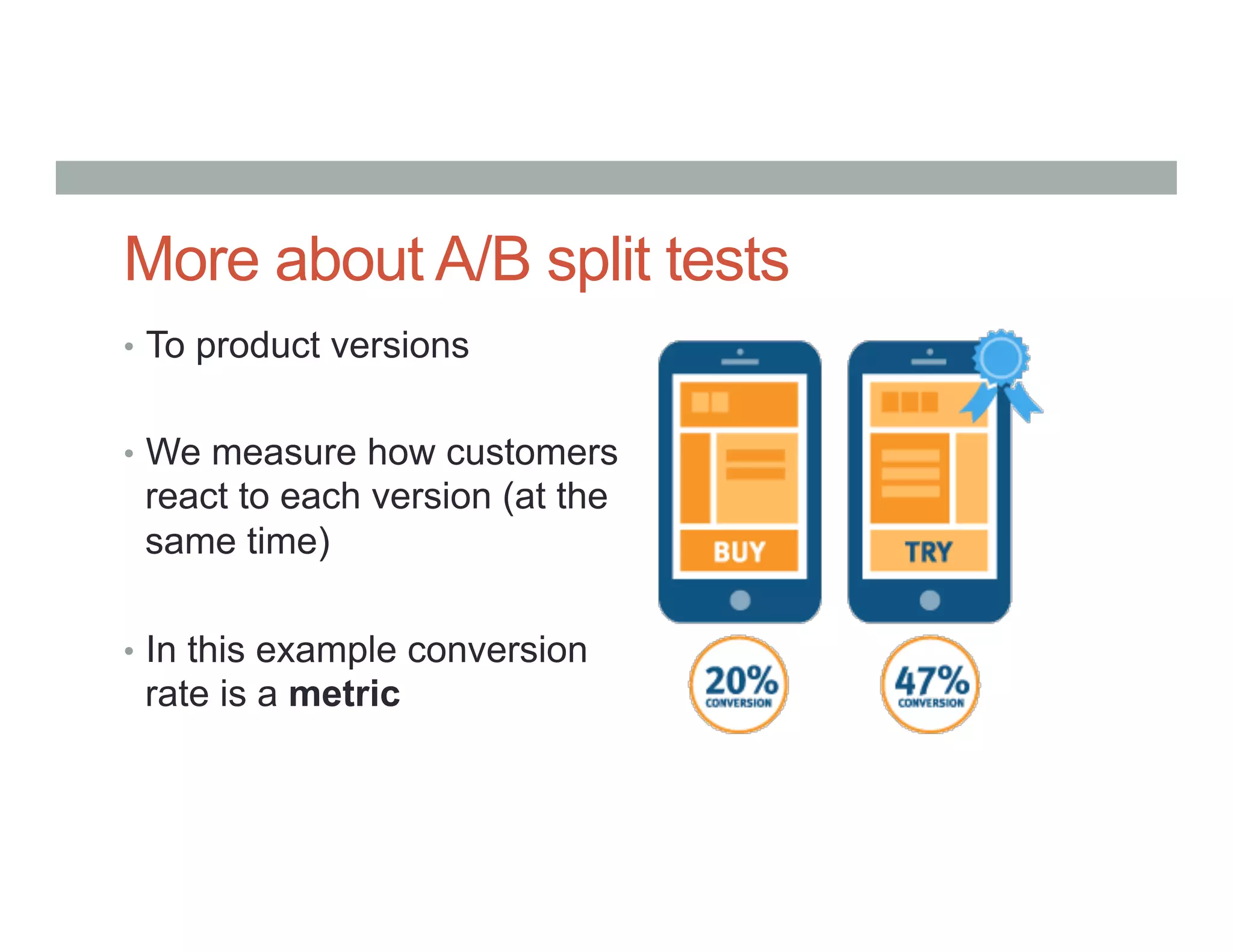
More about A/B split tests
•  To product versions
•  We measure how customers
react to each version (at the
same time)
•  In this example conversion
rate is a metric
Wizard of Oz
•  User thinks that everything
is automated
•  In reality everything is
done “behind the curtain”
and “by hand”
Private Concierge
•  We give users (the initial
adopters) VIP treatment
•  Individual attention
•  Few clients
•  Service is cheap but clients
take time to provide feedback
•  In such case feedback will be
our set of metrics
Many other types of MVP are possible
•  Piecemeal MVP
•  Collecting funds from future clients, e.g. Kickstarter or
IndieGoGo
•  MVP with just one function – Google initially only was
good to find information related to Linux OS
•  Blogs – measure post popularity and engagement
•  Interviews with potential customers
•  Make up your own!
Build, Measure, Learn loop
•  Iterative innovation model
•  Every iteration begins with an
idea
[ slide repeated ]
METRICS
What to measure and what not to
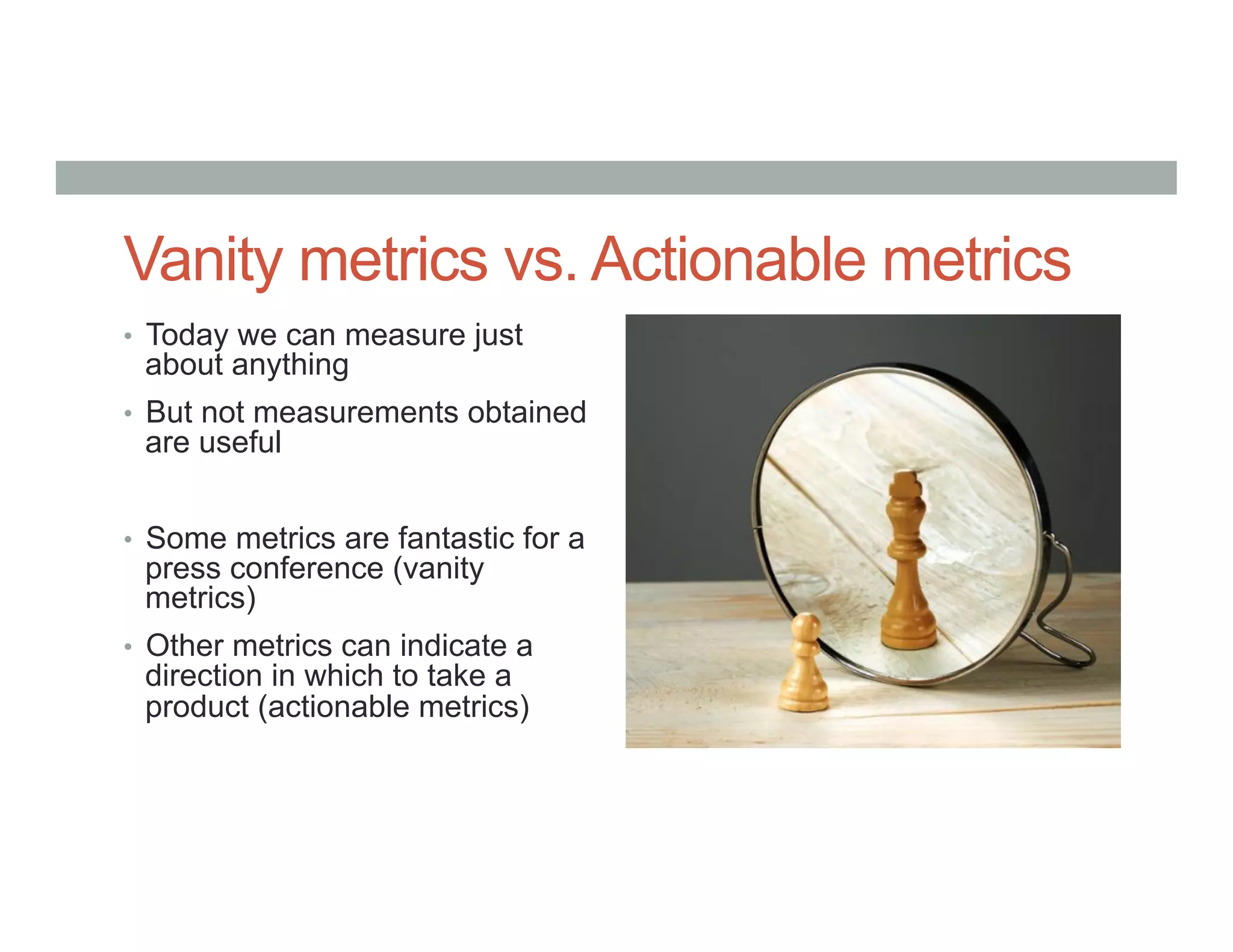
Vanity metrics vs. Actionable metrics
•  Today we can measure just
about anything
•  But not measurements obtained
are useful
•  Some metrics are fantastic for a
press conference (vanity
metrics)
•  Other metrics can indicate a
direction in which to take a
product (actionable metrics)
Vanity Metrics – Examples
1.  Our page was visited 100000 times last
week alone!
2.  Our product was downloaded 763
thousand times this year
3.  We have 1 million registered users
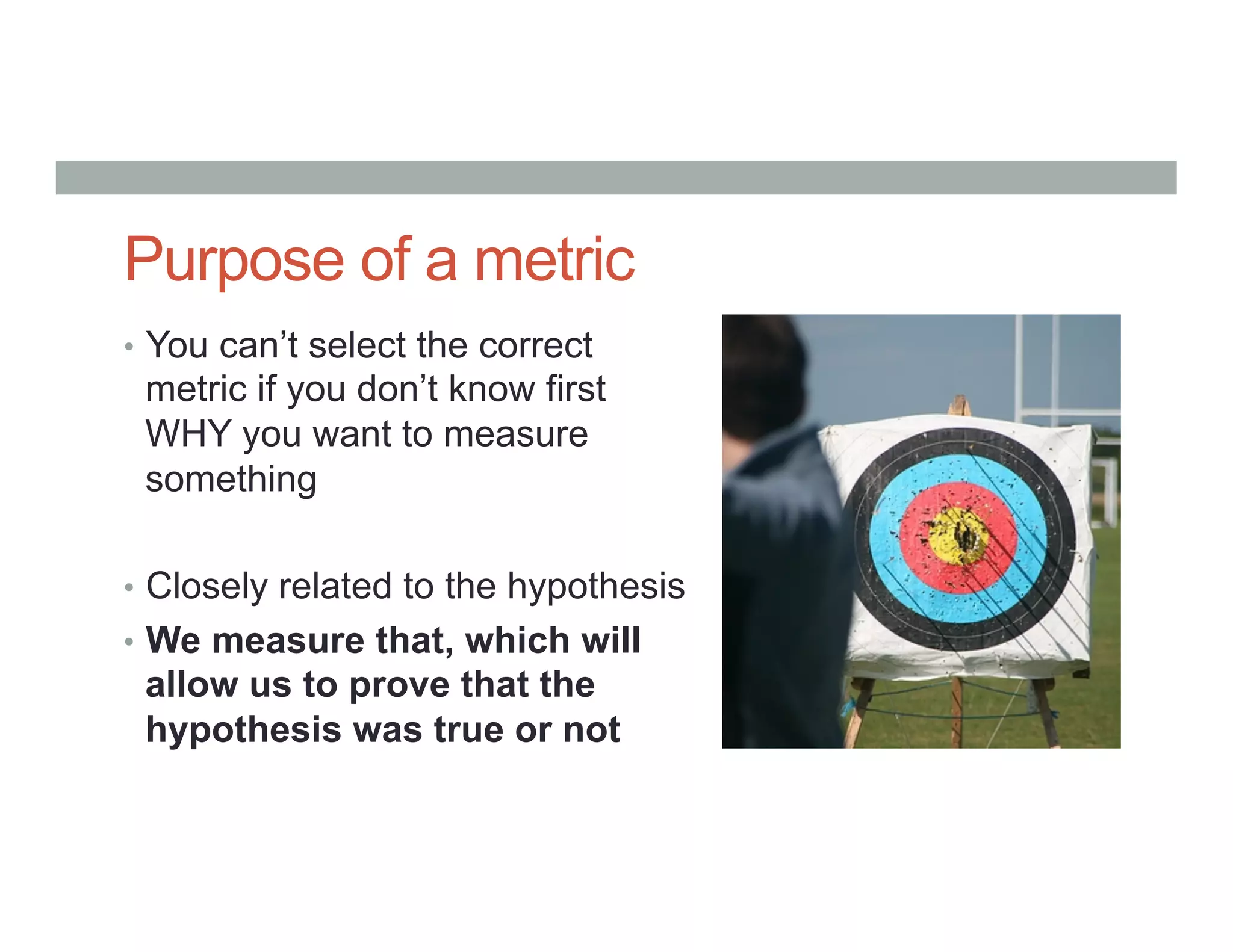
Purpose of a metric
•  You can’t select the correct
metric if you don’t know first
WHY you want to measure
something
•  Closely related to the hypothesis
•  We measure that, which will
allow us to prove that the
hypothesis was true or not
What to measure and why (1/2)
•  If the hypothesis was that the new version of the product
will be used more often…
•  Then we need to measure the engagement, e.g. how many times
per day users log into the site and perform actions, in comparison
with the existing version (simultaneous A/B test)
•  If the hypothesis was that the new packaging of the
product will attract new customers…
•  Then we need to measure how many new clients are coming in per
day (or week) compared to the previous version (cohorts)
What to measure and why (2/2)
•  If the hypothesis was that the new pricing strategy will
increase lifetime customer value…
•  Then we need to measure that value as A/B test
SECRET TO REMEMBER: pricing strategy is usually the
most important element you should be testing.
Most startups fail because they are not able to begin
generating profits in the short time before their funding
runs out.
LEARN
AND MAKE DECISIONS
Stay the course or change direction
Metrics results analysis (1/2)
•  If we chose correct metrics then we will be able to take
action – make a decision
•  E.g. in A/B test new internet site structure resulted in
lower user engagement
•  In such case we’ll keep the existing solution
Metric results analysis (2/2)
•  E.g. we increased the product price from 0 (free) to 10 Euro
and only 0.5% of our users bought the new product. Consider:
•  Does the product provide a real value to the customer?
•  Is the value communicated effectively?
•  Do we need a different product?
•  Do we need to find different customers with a different profile?
•  Should we focus on customers with the existing profile and find many
more of them?
•  Often, to answer that you will need a new thesis and new
iteration
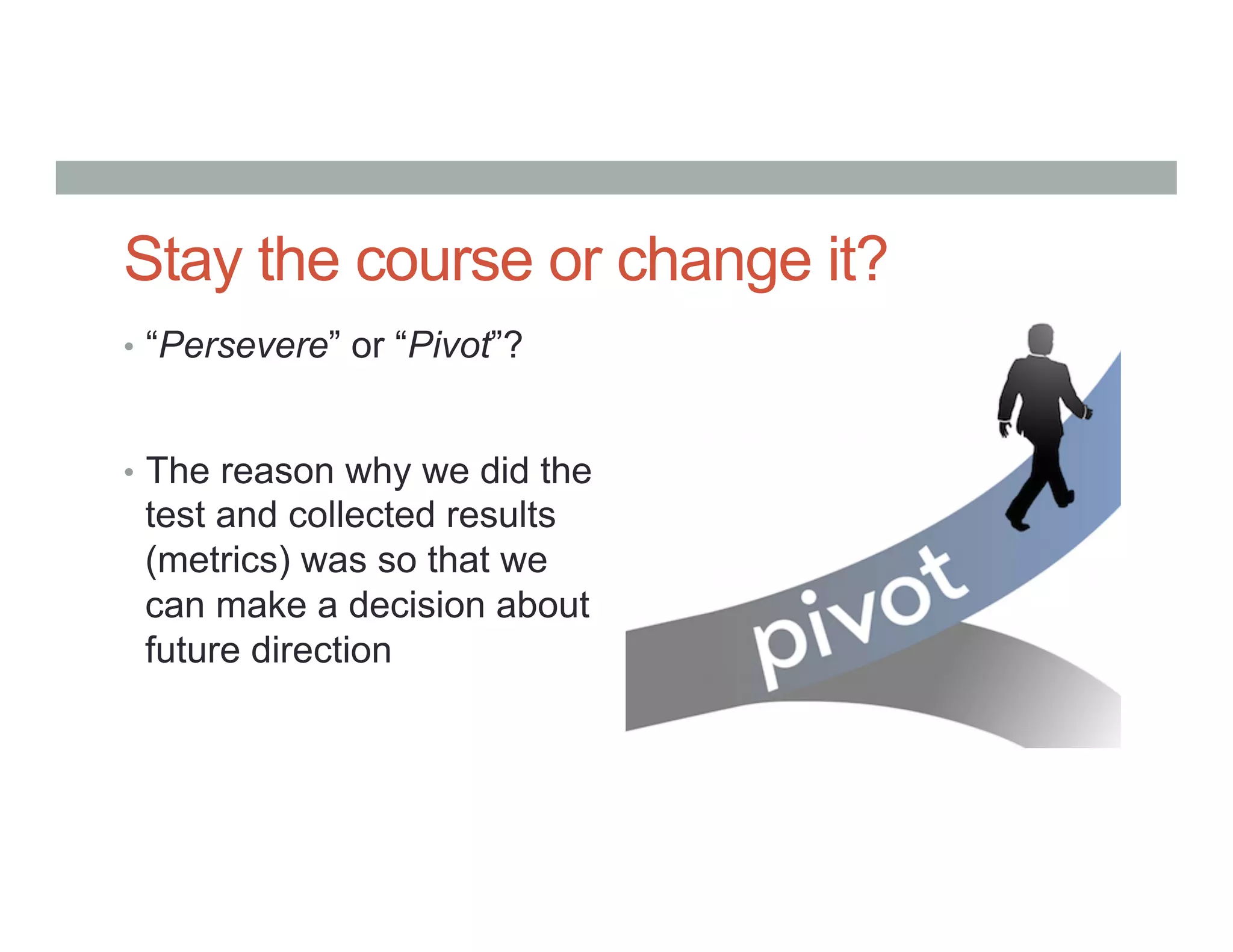
Stay the course or change it?
•  “Persevere” or “Pivot”?
•  The reason why we did the
test and collected results
(metrics) was so that we
can make a decision about
future direction
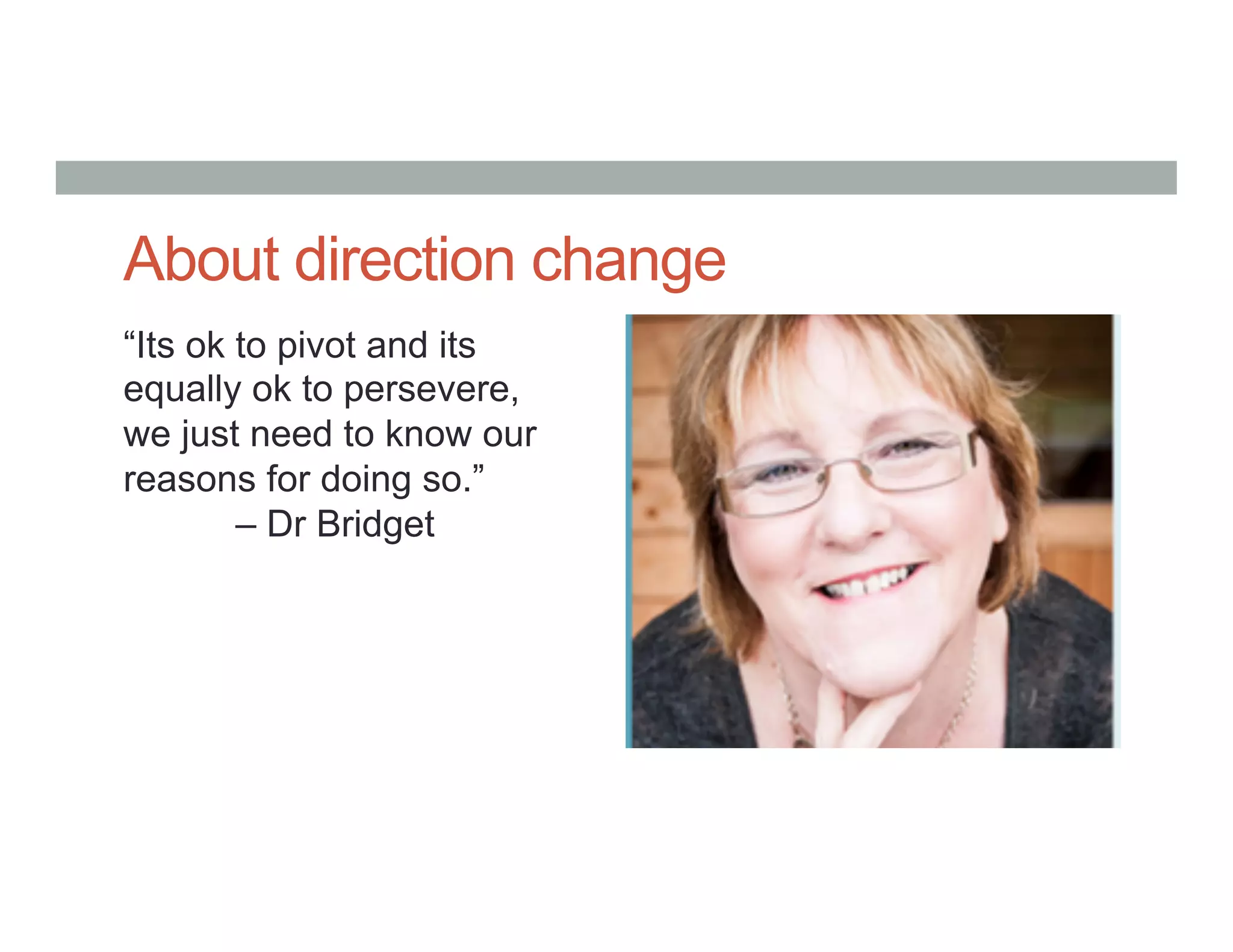
About direction change
“Its ok to pivot and its
equally ok to persevere,
we just need to know our
reasons for doing so.”
– Dr Bridget
SUMMARY
Loop – small steps
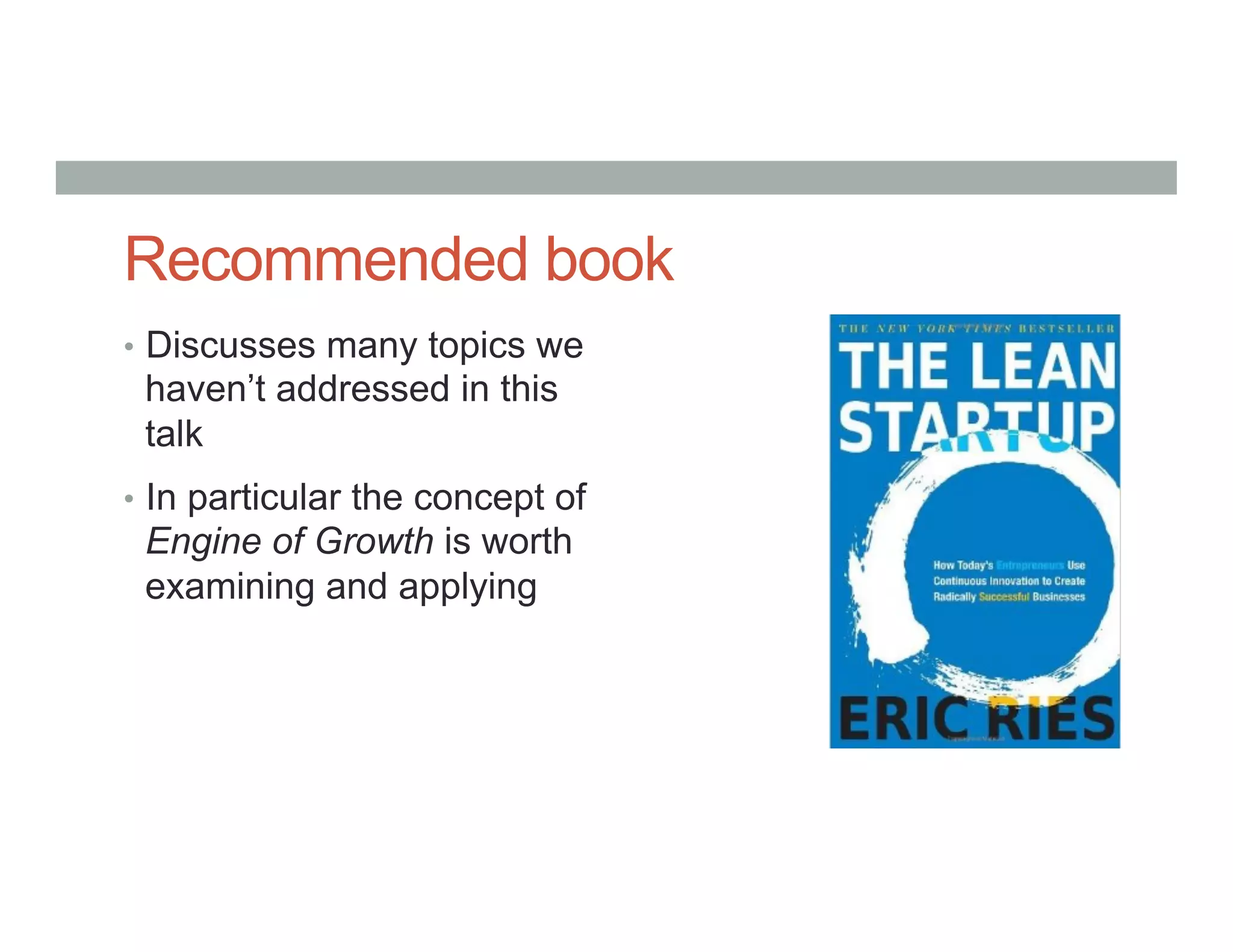
Recommended book
•  Discusses many topics we
haven’t addressed in this
talk
•  In particular the concept of
Engine of Growth is worth
examining and applying
Other Lean Startup book
•  Lean Analytics by Alistar Croll i Benjamin Yoskovitz
•  Lean UX by Jeff Gothelf
•  Running Lean by Ash Maurya
•  UX for Lean Startups by Laura Klein
•  Lean Enterprise by multiple authors
See http://theleanstartup.com/the-lean-series
THANK YOU
QUESTIONS PLEASE
After that – time for the workshop

Lean Startup Introduction - EFYI'16 - Slides

  • 1.
    LEAN METHODOLOGY FOR STARTUPS:INTRO Lecture prepared by Dr Gregory Prokopski (Montreal / Canada) for EFYI 2016, Lódź, Poland Conference organized by Poland Innovative
  • 2.
    About Dr GregoryProkopski •  PhD from McGill University, Montreal •  MSc, Eng. Computer Sciene Wroclaw Univeristy of Technology •  MSc, Eng. Marketing and Business Administration from Wroclaw University of Technology •  Independent consultant since 1999 •  Prof. at McGill University, Montreal •  Interested in Internet-based startups •  Practical, non-academic – real results orientation •  Currently on his 5th startup
  • 3.
    Content of thisWorkshop •  Pareto efficiency •  20% of knowledge that gives 80% of results •  What counts is application, not just knowledge •  Knowledge is just potential power, it must be used to become actual power •  Core ideas and tools •  Practical examples of Lean methodology application
  • 4.
    WHAT DOES *NOT*LEAD TO SUCCESS In business and beyond – review of common, ineffective ways of thinking that prevent success.
  • 5.
    Overconfidence in intuition • If success was a simple matter of intuition we’re born with then everyone would just achieve it •  We can train our intuition •  How to do it? •  What to do if you don’t have it yet?
  • 6.
    Conceit and beingfull of yourself • On some level, internally most people (you and I) think they’re smarter than everyone else • This leads to failure
  • 7.
    Secret projects •  Mindsetof scarcity tells us to keep our “best idea” secret •  Cuts us off from knowledge, coaching and mentoring of other people •  What counts is not the idea but realization and iteration •  Only exception: if your solution is patentable. But you still need a team.
  • 8.
    Myth of “Aviator”– lonely genius •  He had an idea for a novel movie and a plane •  He had no experience. He just was stubborn, he put it all in, and… he won. •  This is romantically very alluring, but IT IS A LIE •  We don’t know what people want – which product or service •  As scientists we must first say “We don’t know”
  • 9.
    PRINCIPLES, METHODS OF THINKINGAND TOOLS OF LEAN METHODOLOGY
  • 10.
    Mastery is practicingfundamentals “Get the fundamentals down and the level of everything you do will rise” -- Michael Jordan
  • 11.
    Lean Startup* •  Isa set of such fundamentals •  Is a way of thinking and acting when managing a startup (as opposed to chaos) •  It is an effective methodology tested by hundreds of thousands of startups around the world •  Created and documented in widely publicized book “The Lean Startup” by Eric Ries •  *) Lean Startup is a trademark registered by Eric Ries and is used throughout this presentation for identification purposes only
  • 12.
    The Lean Startup- System •  Systematic approach to managing startups •  Instead of chaos (usual in startups) – order •  You can learn this system – today! •  Next, we will take a closer look at the main components of this system
  • 13.
    Build, Measure, Learnloop •  Iterative innovation model •  Every iteration begins with an idea In our simulation, after this lecture, we will perform two iterations (turns) of that loop
  • 14.
    Idea is ahypothesis •  Create a hypothesis, e.g. “People need to communicate and we can facilitate that” •  We need to test it •  We also need to know what we will measure to find out if hypothesis is true or not
  • 15.
    Co zbudowac? MUP/ MVP •  MVP – Minimum Viable Product •  Minimal time, money, effort spent to create it •  Only good enough to test the hypothesis and measure results
  • 16.
  • 17.
    COMMON TYPES OFMVP Real companies and products
  • 18.
    Video explaining aproduct •  Dropbox used a video to get VC funding to build a product •  Even before alpha version of Dropbox software was built it already had 5000 registered users
  • 19.
    Landing Pages, AdWords,A/B tests •  Timothy Ferriss had ~100 different ideas for the title •  His metric was AdWords clicks statistics •  Owing it (mainly?) to the title the book sold over 1 million copies worldwide and made the author famous
  • 20.
    More about A/Bsplit tests •  To product versions •  We measure how customers react to each version (at the same time) •  In this example conversion rate is a metric
  • 21.
    Wizard of Oz • User thinks that everything is automated •  In reality everything is done “behind the curtain” and “by hand”
  • 22.
    Private Concierge •  Wegive users (the initial adopters) VIP treatment •  Individual attention •  Few clients •  Service is cheap but clients take time to provide feedback •  In such case feedback will be our set of metrics
  • 23.
    Many other typesof MVP are possible •  Piecemeal MVP •  Collecting funds from future clients, e.g. Kickstarter or IndieGoGo •  MVP with just one function – Google initially only was good to find information related to Linux OS •  Blogs – measure post popularity and engagement •  Interviews with potential customers •  Make up your own!
  • 24.
    Build, Measure, Learnloop •  Iterative innovation model •  Every iteration begins with an idea [ slide repeated ]
  • 25.
    METRICS What to measureand what not to
  • 26.
    Vanity metrics vs.Actionable metrics •  Today we can measure just about anything •  But not measurements obtained are useful •  Some metrics are fantastic for a press conference (vanity metrics) •  Other metrics can indicate a direction in which to take a product (actionable metrics)
  • 27.
    Vanity Metrics –Examples 1.  Our page was visited 100000 times last week alone! 2.  Our product was downloaded 763 thousand times this year 3.  We have 1 million registered users
  • 28.
    Purpose of ametric •  You can’t select the correct metric if you don’t know first WHY you want to measure something •  Closely related to the hypothesis •  We measure that, which will allow us to prove that the hypothesis was true or not
  • 29.
    What to measureand why (1/2) •  If the hypothesis was that the new version of the product will be used more often… •  Then we need to measure the engagement, e.g. how many times per day users log into the site and perform actions, in comparison with the existing version (simultaneous A/B test) •  If the hypothesis was that the new packaging of the product will attract new customers… •  Then we need to measure how many new clients are coming in per day (or week) compared to the previous version (cohorts)
  • 30.
    What to measureand why (2/2) •  If the hypothesis was that the new pricing strategy will increase lifetime customer value… •  Then we need to measure that value as A/B test SECRET TO REMEMBER: pricing strategy is usually the most important element you should be testing. Most startups fail because they are not able to begin generating profits in the short time before their funding runs out.
  • 31.
    LEARN AND MAKE DECISIONS Staythe course or change direction
  • 32.
    Metrics results analysis(1/2) •  If we chose correct metrics then we will be able to take action – make a decision •  E.g. in A/B test new internet site structure resulted in lower user engagement •  In such case we’ll keep the existing solution
  • 33.
    Metric results analysis(2/2) •  E.g. we increased the product price from 0 (free) to 10 Euro and only 0.5% of our users bought the new product. Consider: •  Does the product provide a real value to the customer? •  Is the value communicated effectively? •  Do we need a different product? •  Do we need to find different customers with a different profile? •  Should we focus on customers with the existing profile and find many more of them? •  Often, to answer that you will need a new thesis and new iteration
  • 34.
    Stay the courseor change it? •  “Persevere” or “Pivot”? •  The reason why we did the test and collected results (metrics) was so that we can make a decision about future direction
  • 35.
    About direction change “Itsok to pivot and its equally ok to persevere, we just need to know our reasons for doing so.” – Dr Bridget
  • 36.
  • 37.
  • 39.
    Recommended book •  Discussesmany topics we haven’t addressed in this talk •  In particular the concept of Engine of Growth is worth examining and applying
  • 40.
    Other Lean Startupbook •  Lean Analytics by Alistar Croll i Benjamin Yoskovitz •  Lean UX by Jeff Gothelf •  Running Lean by Ash Maurya •  UX for Lean Startups by Laura Klein •  Lean Enterprise by multiple authors See http://theleanstartup.com/the-lean-series
  • 42.
    THANK YOU QUESTIONS PLEASE Afterthat – time for the workshop