Presented By: Strictly Biz Inc. & Recycling Black Dollars

Presented By: Donyielle Holley, NLP
Co-Director, Coach, Consultant & Trainer
o

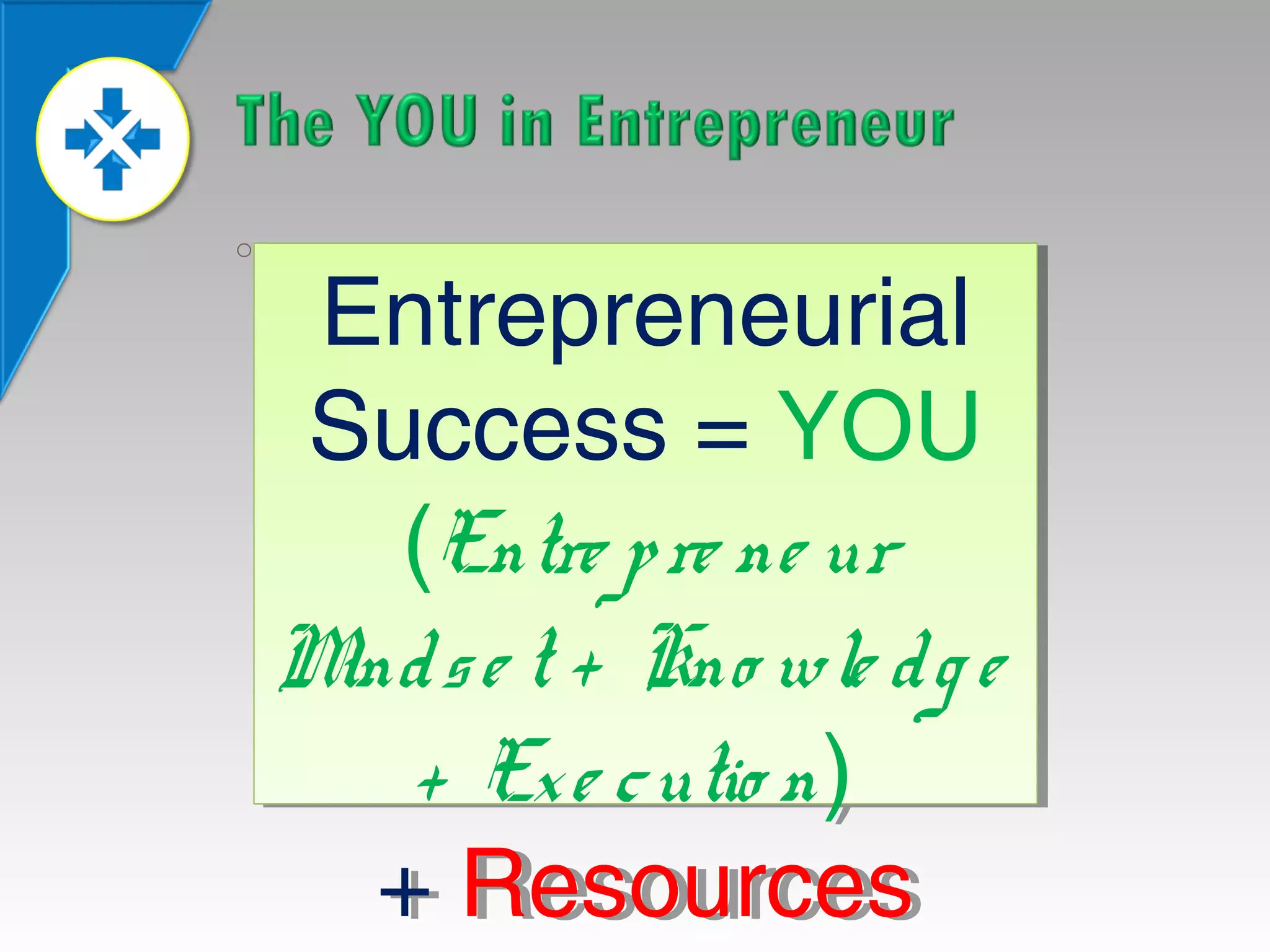
Entrepreneurial
Entrepreneurial
Success = YOU
Success = YOU
(Entre p re ne ur
(Entre p re ne ur
Mindssee tt + Kno wle d gg ee
ind
M
+ Kno wle d
+ Ex ee ccutio n)
+ Ex utio n)
+ Resources
+ Resources
Adopted from the Small Business Administration (SBA)
Questions to Ask Yourself to determine if you’re ready to go
out on your own:

Have you ever worked in a business similar to what you are
planning to start?
oWould people who know you say you are well-suited to be
self-employed?
oDo you have support for your business idea from your family
and friends?
oHave you ever taken a course or seminar on starting and
managing a small business?
oHave you discussed your business idea, business plan or
proposed business with a business coach or counselor?
oDo you have a relative, friend or mentor who is an
entrepreneur?
o
Evaluate Your Personality
Characteristics:

The more questions you answer favorably, the more
prepared you are mentally to begin.
oAre you a self-promoter?
oAre you a self-starter?
oDo you plan and organize well?
oCan you handle pressure?
oAre you comfortable with risk?
oAre you physically healthy?
oCan you work with opposite personalities?
oAre you passionate about your product or service?
Evaluate Your Personality
Characteristics:

The more questions you answer favorably, the more prepared you
are mentally to begin.

Is your drive strong enough?
oAre you encouraged by setbacks/challenges?
oAre you competitive?
oAre you optimistic?
oCan you handle criticism well?
oAre you patient?
oAre you decisive?
oHave you considered how the business will
impact your family?
o
o
o
o
o
o
o
o
o
o
o
o
o
o

Persistence
Desire for immediate feedback
Inquisitiveness
Strong drive to achieve
High energy level
Goal-oriented behavior
Independent
Demanding
Self-confident
Calculated risk taker
Creative
Innovative
Vision
o
o
o
o
o
o
o
o
o
o
o
o
o
o
o

Commitment
Problem solving skills
Tolerance for ambiguity
Strong integrity
Highly reliable
Personal initiative
Ability to consolidate resources
Strong management and organizational skills
Competitive
Change agent
Tolerance for failure
Desire to work hard
Decisive
Focus
Luck!
o

o

o
o
o
o

Everyone is not meant to be an employee
and everyone is not meant to be an
entrepreneur. If everyone chose to be an
entrepreneur, who would be the
employees?
How do employees differ from
entrepreneurs?
Planning vs. Doing
Business Controls and Necessities
Focus
Work Habits
Identify Limiting Beliefs
I need to work very hard to have enough money to live.
oNo pain – no gain!
oI need to be rich to be happy.
oSuccess takes a long time.
oI can’t trust anybody.
oMost people are luckier than me.
oIt’s hard to recover from a bad place in life.
oI’m not good with computers and this social media stuff.
oI can’t win without other people losing.
oI never get what I want.
oOther people are better than me.
oI do not deserve to succeed because __?__.
oI can’t get what I want.
oI have reached my limits.
oI am no good with money.
oI’m not good at learning things.
o
o

o
o

o

o

Managing change really means managing
people’s fear.
Change is natural. Change can be good.
Nothing can be as upsetting to you or your
team as CHANGE.
Resistance to change comes from the fear
of the unknown or an expectation of loss.
The ultimate acceptance of change
depends on how much resistance you have
and the quality of your coping skills and
support system.



How do you initially react to CHANGE?
What things are happening in your life
that impact your ability to CHANGE?
o

o
o

o

o

o
o

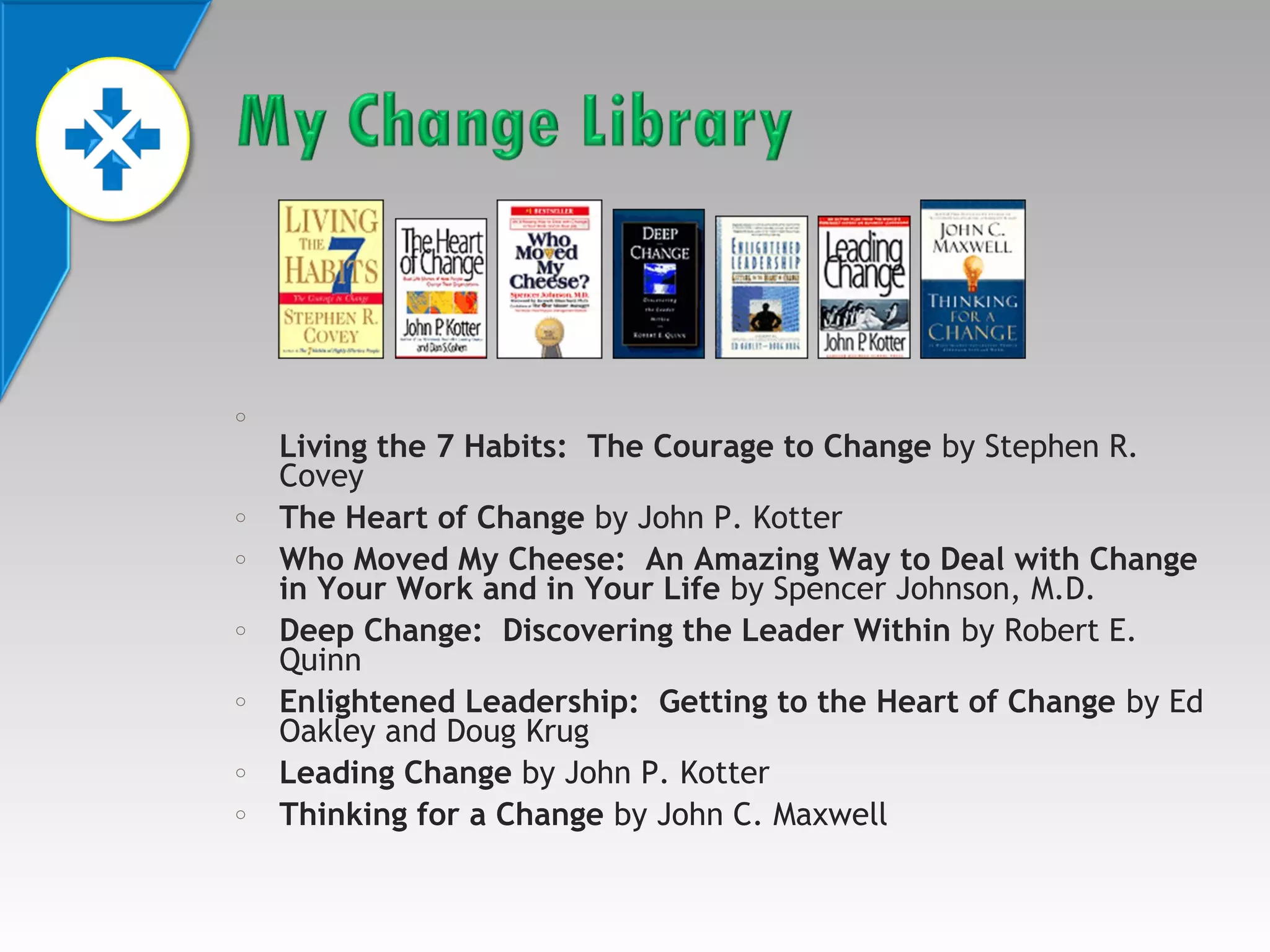
Living the 7 Habits: The Courage to Change by Stephen R.
Covey
The Heart of Change by John P. Kotter
Who Moved My Cheese: An Amazing Way to Deal with Change
in Your Work and in Your Life by Spencer Johnson, M.D.
Deep Change: Discovering the Leader Within by Robert E.
Quinn
Enlightened Leadership: Getting to the Heart of Change by Ed
Oakley and Doug Krug
Leading Change by John P. Kotter
Thinking for a Change by John C. Maxwell
o

o

o

o

o

Define, as specifically as possible, what the decision is that
needs to be made. Is this really your decision or someone
else's? Do you really need to make a decision? (If you do not
have at least two options, there is no decision to be made.)
When does the decision need to be made? Why is this decision
important to you?
Brainstorm, and write down as many alternatives as you can
think of. Be sure to use your resources (experienced friends
and family, the Internet, etc.) to find out more about the
implications of each option.
Visualize the outcome of each alternative. Do you feel more
satisfied with one outcome than with the others?
Do a reality check. Cross off those alternatives that most
likely will not occur.
Once you have made your decision, get moving on it.
Worrying or second-guessing yourself will only cause stress.
You have done your very best. Remember, no decision is set
in stone!
o

o

o

o

o

The fear of success can exist in your mind
subconsciously. Most often, what is feared is a
side effect of success. Certain concerns may
include:
If I am successful, will my friends become
jealous and treat me differently?
If I am successful, will my brother in law
expect me to pay for his dinner when we go
out?
If I am successful, what new responsibilities
will I now have?
Will I be able to maintain the new level of
expectations I create?




One of the strongest forces holding
people back from their potential.
Slide along with the status quo
“timing isn’t right” to “I don’t know
who would buy my product” to “I doubt
I could support myself” or “my job isn’t
that bad right now.”
o
o
o
o
o
o

Nurturing Your Mind & Spirit
Plan: Be In-Control of Your Day
Prayer/ Meditation
Positive Affirmations
Mental Feeding
Visualize
o

o

When I first created by business idea – What
did I hope for? What did I dream about?
What a vivid vision will do for your business.
o
o
o

o

Gives You Focus
Helps You Make Better Decisions
Keeps You On-Track

4 Steps to Creating a VIVID VISION
o
o
o
o

Have a POWERFUL “Why”! (Go Deep to your
Core)
Use no-limit thinking (No Buts or What-Ifs)
Visualize in great detail (Use All of Your
Senses!!)
Be flexible in your vision (See the End, Not the
Journey)
ARE YOU PREPARED
TO WORK AS HARD
ON YOURSELF
AS YOU WILL
ON YOUR BUSINESS?
Remember, an idea is only
viable if people are willing
to pay for it!
o

o

o

o

o

Is your idea fulfilling an unmet need in the
marketplace?
Will you provide a better executed service
than what currently exists?
Have you designed a product in a better
form that what is available?
Is your product or service less expensive
than your competitors?
Are you solving a problem or taking
advantage of an environmental trend?
o
o

o

o

o

o

o

Journals, demographic statistics.
Research and define your target market and buyer profile
by:
Geographic – Where by region, size/density, type of
environment.
Demographic - Who by age, gender, education,
occupation income, nationality/race, religion,
socioeconomic factors.
Psychographic – Profiles your customer by life styles,
personality, values, attitudes, morals.
Behavioral – Profiles by brand loyalty, use, benefits
sought, readiness to buy, decision making process and
profitability.
Competition: Who are they, where are they and what are
they?
HOW BADLY DO YOU
WANT YOUR BUSINESS?

Launch pad preparing for change in 2010

  • 1.
    Presented By: StrictlyBiz Inc. & Recycling Black Dollars Presented By: Donyielle Holley, NLP Co-Director, Coach, Consultant & Trainer
  • 2.
    o Entrepreneurial Entrepreneurial Success = YOU Success= YOU (Entre p re ne ur (Entre p re ne ur Mindssee tt + Kno wle d gg ee ind M + Kno wle d + Ex ee ccutio n) + Ex utio n) + Resources + Resources
  • 3.
    Adopted from theSmall Business Administration (SBA) Questions to Ask Yourself to determine if you’re ready to go out on your own: Have you ever worked in a business similar to what you are planning to start? oWould people who know you say you are well-suited to be self-employed? oDo you have support for your business idea from your family and friends? oHave you ever taken a course or seminar on starting and managing a small business? oHave you discussed your business idea, business plan or proposed business with a business coach or counselor? oDo you have a relative, friend or mentor who is an entrepreneur? o
  • 4.
    Evaluate Your Personality Characteristics: Themore questions you answer favorably, the more prepared you are mentally to begin. oAre you a self-promoter? oAre you a self-starter? oDo you plan and organize well? oCan you handle pressure? oAre you comfortable with risk? oAre you physically healthy? oCan you work with opposite personalities? oAre you passionate about your product or service?
  • 5.
    Evaluate Your Personality Characteristics: Themore questions you answer favorably, the more prepared you are mentally to begin. Is your drive strong enough? oAre you encouraged by setbacks/challenges? oAre you competitive? oAre you optimistic? oCan you handle criticism well? oAre you patient? oAre you decisive? oHave you considered how the business will impact your family? o
  • 6.
    o o o o o o o o o o o o o Persistence Desire for immediatefeedback Inquisitiveness Strong drive to achieve High energy level Goal-oriented behavior Independent Demanding Self-confident Calculated risk taker Creative Innovative Vision
  • 7.
    o o o o o o o o o o o o o o o Commitment Problem solving skills Tolerancefor ambiguity Strong integrity Highly reliable Personal initiative Ability to consolidate resources Strong management and organizational skills Competitive Change agent Tolerance for failure Desire to work hard Decisive Focus Luck!
  • 8.
    o o o o o o Everyone is notmeant to be an employee and everyone is not meant to be an entrepreneur. If everyone chose to be an entrepreneur, who would be the employees? How do employees differ from entrepreneurs? Planning vs. Doing Business Controls and Necessities Focus Work Habits
  • 9.
    Identify Limiting Beliefs Ineed to work very hard to have enough money to live. oNo pain – no gain! oI need to be rich to be happy. oSuccess takes a long time. oI can’t trust anybody. oMost people are luckier than me. oIt’s hard to recover from a bad place in life. oI’m not good with computers and this social media stuff. oI can’t win without other people losing. oI never get what I want. oOther people are better than me. oI do not deserve to succeed because __?__. oI can’t get what I want. oI have reached my limits. oI am no good with money. oI’m not good at learning things. o
  • 10.
    o o o o o Managing change reallymeans managing people’s fear. Change is natural. Change can be good. Nothing can be as upsetting to you or your team as CHANGE. Resistance to change comes from the fear of the unknown or an expectation of loss. The ultimate acceptance of change depends on how much resistance you have and the quality of your coping skills and support system.
  • 11.
      How do youinitially react to CHANGE? What things are happening in your life that impact your ability to CHANGE?
  • 12.
    o o o o o o o Living the 7Habits: The Courage to Change by Stephen R. Covey The Heart of Change by John P. Kotter Who Moved My Cheese: An Amazing Way to Deal with Change in Your Work and in Your Life by Spencer Johnson, M.D. Deep Change: Discovering the Leader Within by Robert E. Quinn Enlightened Leadership: Getting to the Heart of Change by Ed Oakley and Doug Krug Leading Change by John P. Kotter Thinking for a Change by John C. Maxwell
  • 13.
    o o o o o Define, as specificallyas possible, what the decision is that needs to be made. Is this really your decision or someone else's? Do you really need to make a decision? (If you do not have at least two options, there is no decision to be made.) When does the decision need to be made? Why is this decision important to you? Brainstorm, and write down as many alternatives as you can think of. Be sure to use your resources (experienced friends and family, the Internet, etc.) to find out more about the implications of each option. Visualize the outcome of each alternative. Do you feel more satisfied with one outcome than with the others? Do a reality check. Cross off those alternatives that most likely will not occur. Once you have made your decision, get moving on it. Worrying or second-guessing yourself will only cause stress. You have done your very best. Remember, no decision is set in stone!
  • 14.
    o o o o o The fear ofsuccess can exist in your mind subconsciously. Most often, what is feared is a side effect of success. Certain concerns may include: If I am successful, will my friends become jealous and treat me differently? If I am successful, will my brother in law expect me to pay for his dinner when we go out? If I am successful, what new responsibilities will I now have? Will I be able to maintain the new level of expectations I create?
  • 15.
       One of thestrongest forces holding people back from their potential. Slide along with the status quo “timing isn’t right” to “I don’t know who would buy my product” to “I doubt I could support myself” or “my job isn’t that bad right now.”
  • 16.
    o o o o o o Nurturing Your Mind& Spirit Plan: Be In-Control of Your Day Prayer/ Meditation Positive Affirmations Mental Feeding Visualize
  • 17.
    o o When I firstcreated by business idea – What did I hope for? What did I dream about? What a vivid vision will do for your business. o o o o Gives You Focus Helps You Make Better Decisions Keeps You On-Track 4 Steps to Creating a VIVID VISION o o o o Have a POWERFUL “Why”! (Go Deep to your Core) Use no-limit thinking (No Buts or What-Ifs) Visualize in great detail (Use All of Your Senses!!) Be flexible in your vision (See the End, Not the Journey)
  • 18.
    ARE YOU PREPARED TOWORK AS HARD ON YOURSELF AS YOU WILL ON YOUR BUSINESS?
  • 19.
    Remember, an ideais only viable if people are willing to pay for it!
  • 20.
    o o o o o Is your ideafulfilling an unmet need in the marketplace? Will you provide a better executed service than what currently exists? Have you designed a product in a better form that what is available? Is your product or service less expensive than your competitors? Are you solving a problem or taking advantage of an environmental trend?
  • 21.
    o o o o o o o Journals, demographic statistics. Researchand define your target market and buyer profile by: Geographic – Where by region, size/density, type of environment. Demographic - Who by age, gender, education, occupation income, nationality/race, religion, socioeconomic factors. Psychographic – Profiles your customer by life styles, personality, values, attitudes, morals. Behavioral – Profiles by brand loyalty, use, benefits sought, readiness to buy, decision making process and profitability. Competition: Who are they, where are they and what are they?
  • 22.
    HOW BADLY DOYOU WANT YOUR BUSINESS?