…in Java 8
...coming 2013
What’s a lambda function?
   A.K.A.:
       Anonymous function
       Anonymous method
       Function literal
       Function constant
       Closure
 Wikipedia: “a function (or a subroutine)
  defined, and possibly called, without being
  bound to an identifier”
 Typically can’t be recursive directly
 Simple example: (int x, int y) -> x + y
 Supported in a bunch of languages…
Already supported in…
   ActionScript, C#, C++, Clojure, Curl, D,
    Dart, Delphi, Dylan, Erlang, F#, Frink,
    Go, Groovy, Haskell, JavaScript, Lisp,
    Logtalk, Lua, Mathematica, Maple,
    Matlab, Maxima, Ocaml, Octave,
    Objective-C, Perl, PHP, Python, R,
    Racket, Ruby, Scala, Scheme,
    Smalltalk, Vala, Visual Basic, Visual
    Prolog…
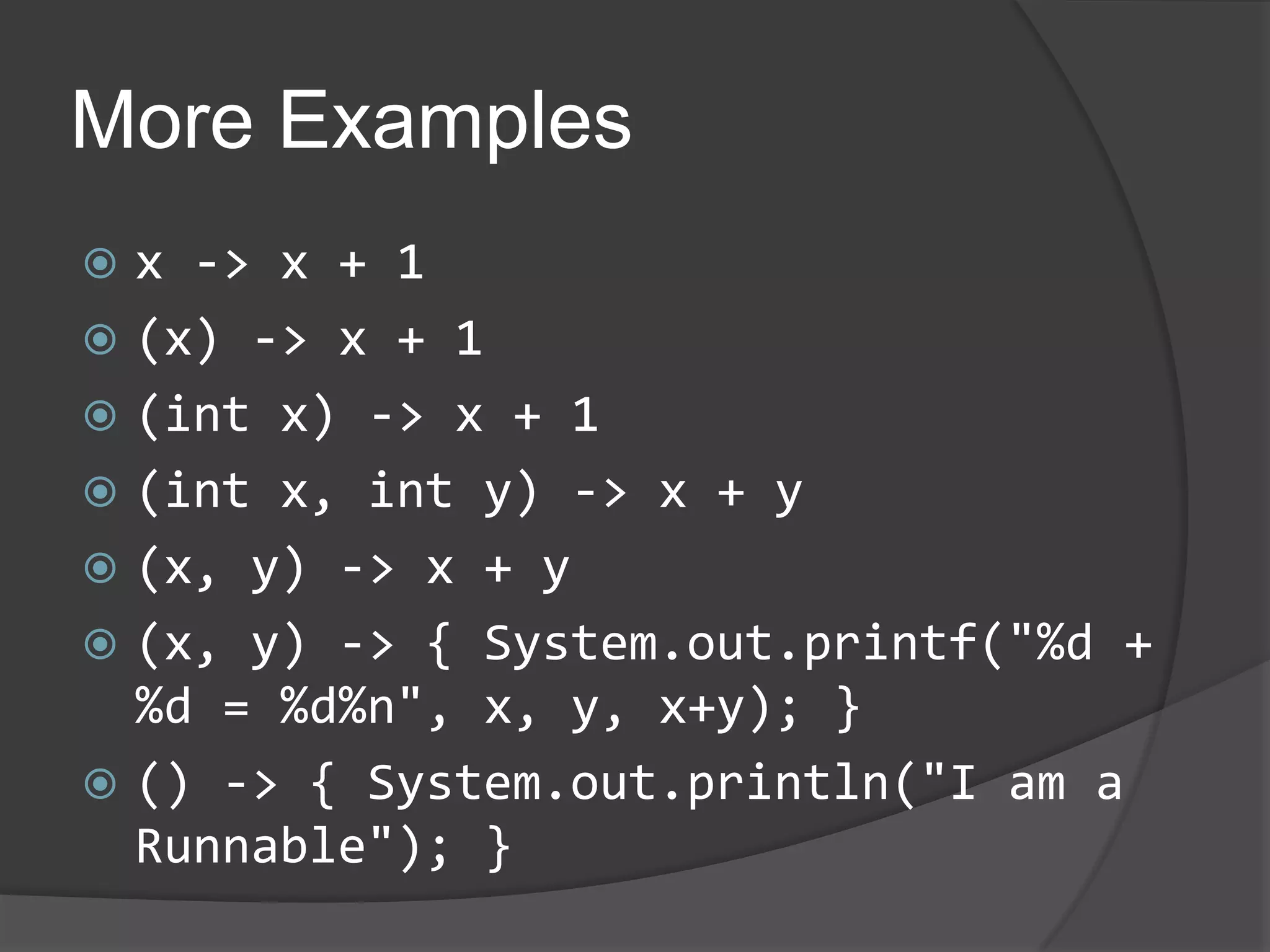
More Examples
 x -> x + 1
 (x) -> x + 1
 (int x) -> x + 1
 (int x, int y) -> x + y
 (x, y) -> x + y
 (x, y) -> { System.out.printf("%d +
  %d = %d%n", x, y, x+y); }
 () -> { System.out.println("I am a
  Runnable"); }
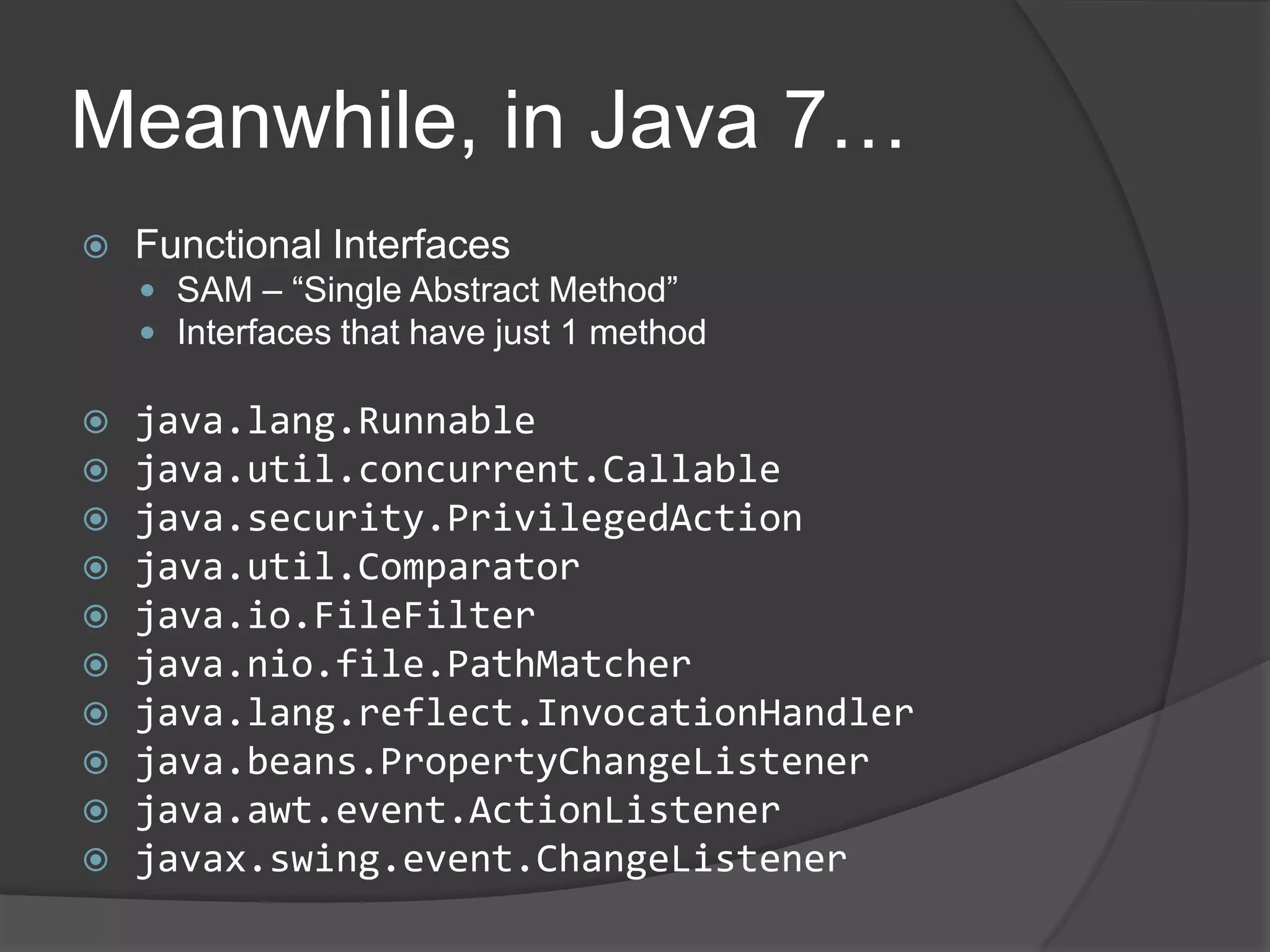
Meanwhile, in Java 7…
   Functional Interfaces
     SAM – “Single Abstract Method”
     Interfaces that have just 1 method

   java.lang.Runnable
   java.util.concurrent.Callable
   java.security.PrivilegedAction
   java.util.Comparator
   java.io.FileFilter
   java.nio.file.PathMatcher
   java.lang.reflect.InvocationHandler
   java.beans.PropertyChangeListener
   java.awt.event.ActionListener
   javax.swing.event.ChangeListener
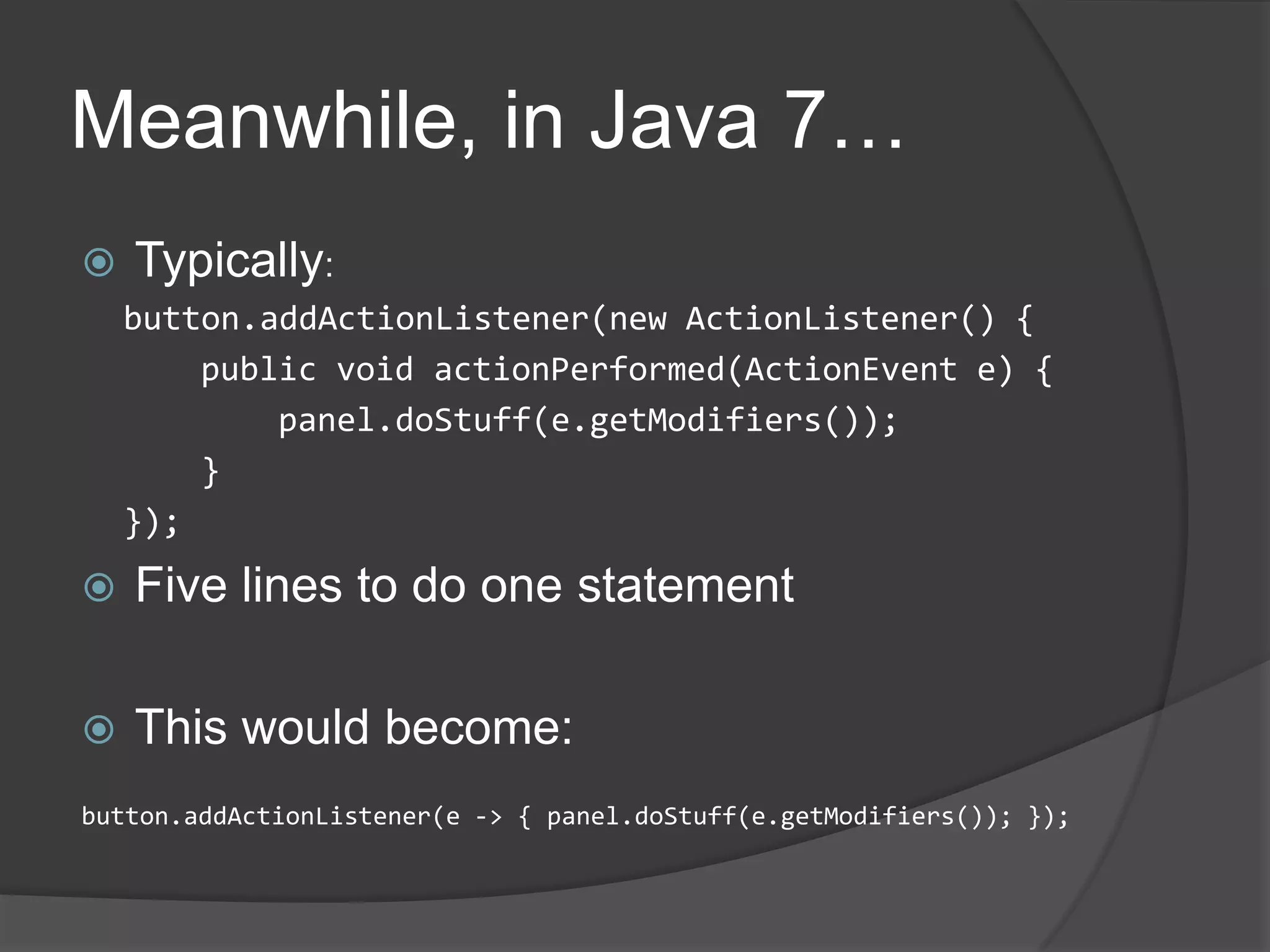
Meanwhile, in Java 7…
   Typically:
    button.addActionListener(new ActionListener() {
        public void actionPerformed(ActionEvent e) {
            panel.doStuff(e.getModifiers());
        }
    });
   Five lines to do one statement

   This would become:
button.addActionListener(e -> { panel.doStuff(e.getModifiers()); });
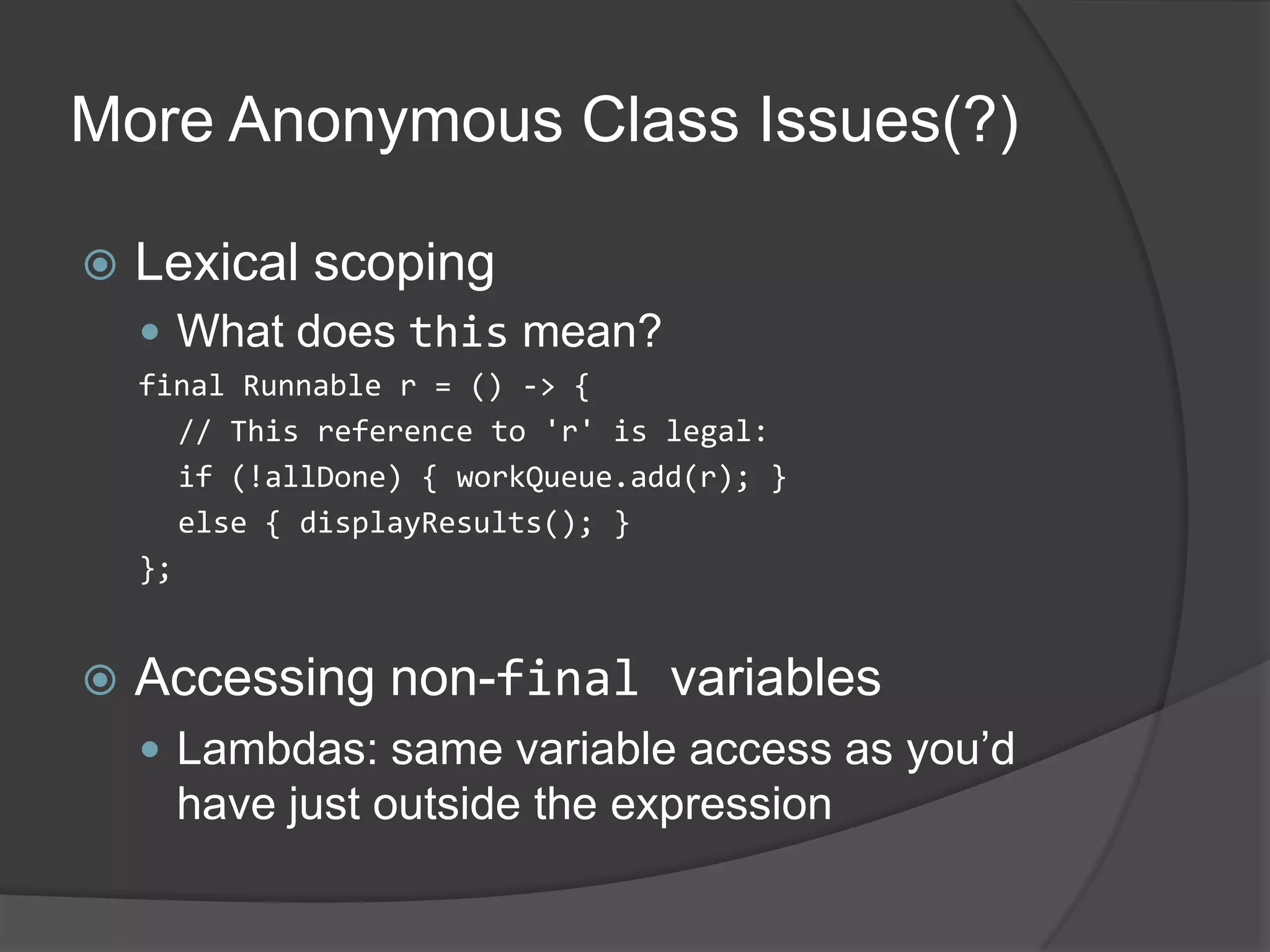
More Anonymous Class Issues(?)

   Lexical scoping
     What does this mean?
    final Runnable r = () -> {
       // This reference to 'r' is legal:
       if (!allDone) { workQueue.add(r); }
       else { displayResults(); }
    };


   Accessing non-final variables
     Lambdas: same variable access as you’d
      have just outside the expression
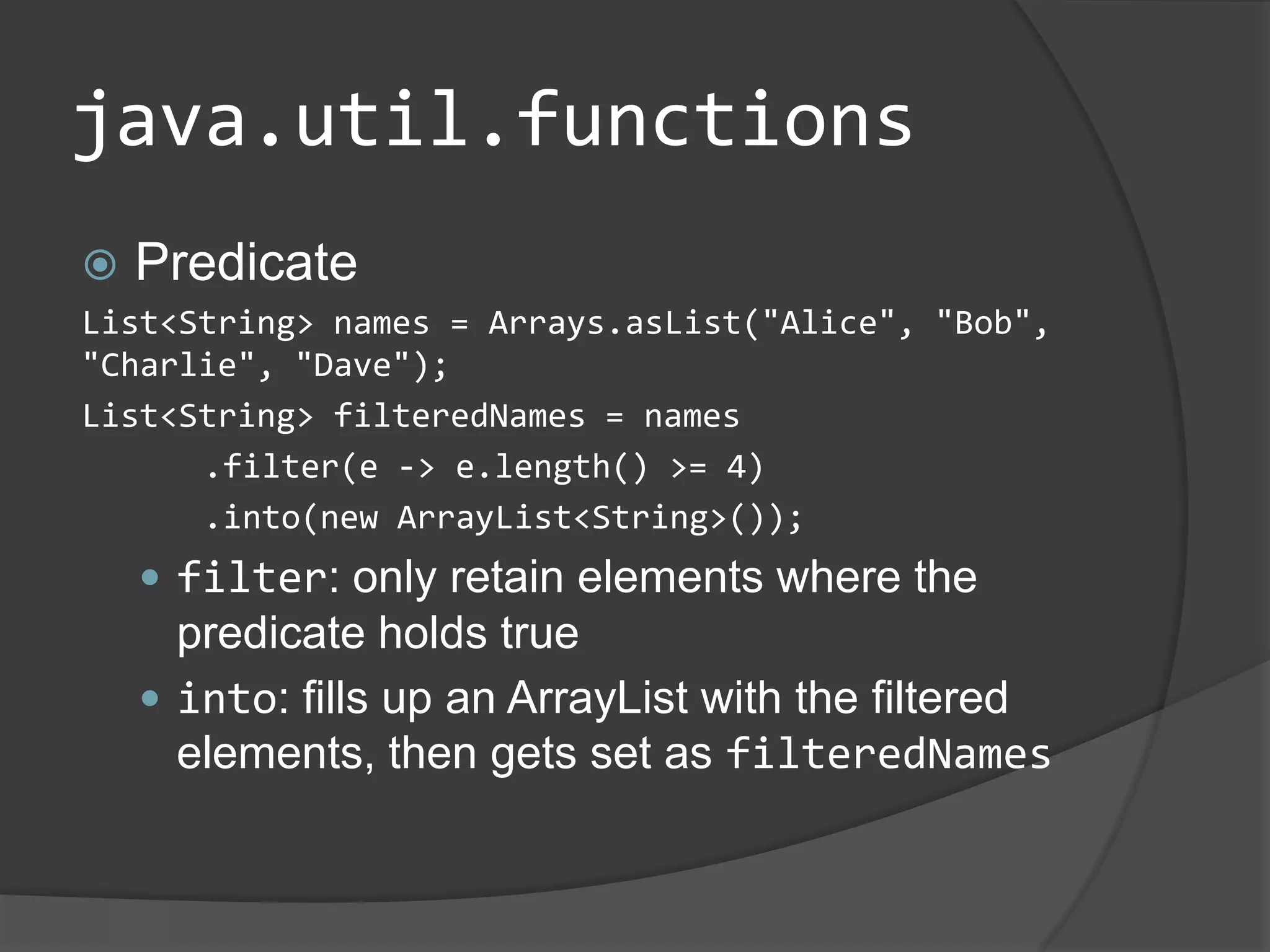
java.util.functions
   Predicate
List<String> names = Arrays.asList("Alice", "Bob",
"Charlie", "Dave");
List<String> filteredNames = names
      .filter(e -> e.length() >= 4)
      .into(new ArrayList<String>());
     filter: only retain elements where the
      predicate holds true
     into: fills up an ArrayList with the filtered
      elements, then gets set as filteredNames
java.util.functions
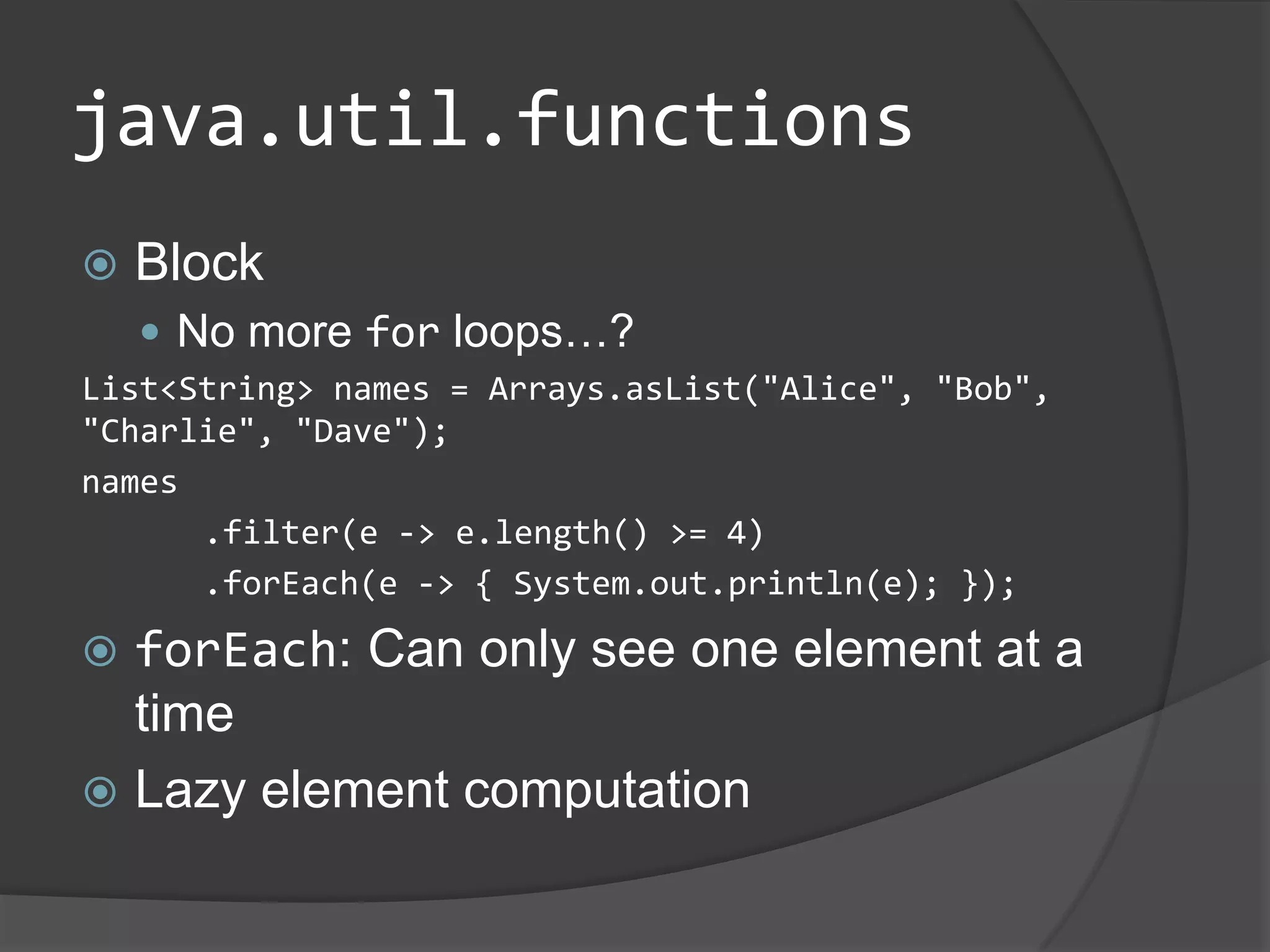
   Block
     No more for loops…?
List<String> names = Arrays.asList("Alice", "Bob",
"Charlie", "Dave");
names
      .filter(e -> e.length() >= 4)
      .forEach(e -> { System.out.println(e); });

 forEach: Can only see one element at a
  time
 Lazy element computation
java.util.functions
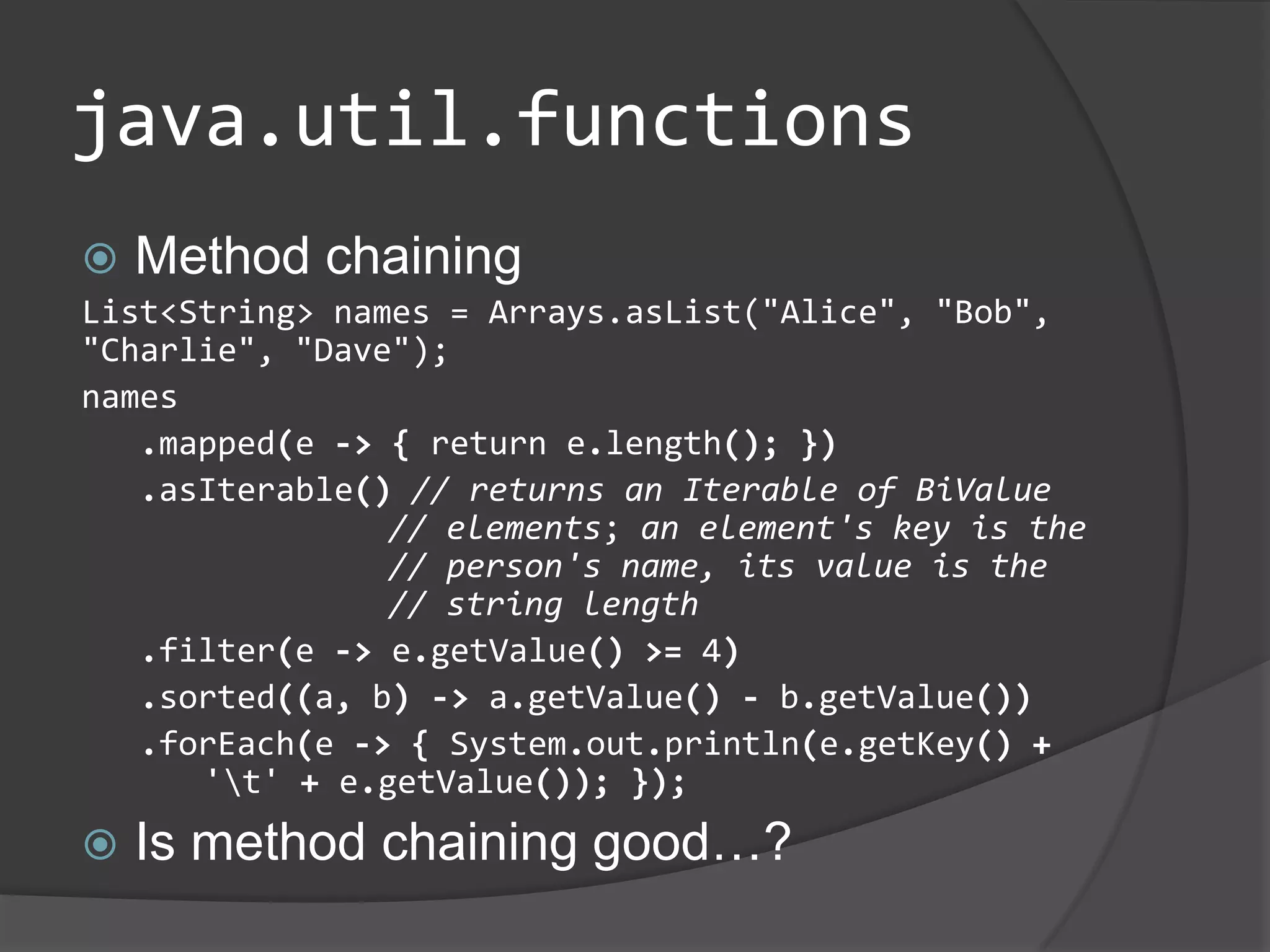
   Method chaining
List<String> names = Arrays.asList("Alice", "Bob",
"Charlie", "Dave");
names
   .mapped(e -> { return e.length(); })
   .asIterable() // returns an Iterable of BiValue
                // elements; an element's key is the
                // person's name, its value is the
                // string length
   .filter(e -> e.getValue() >= 4)
   .sorted((a, b) -> a.getValue() - b.getValue())
   .forEach(e -> { System.out.println(e.getKey() +
      't' + e.getValue()); });
   Is method chaining good…?
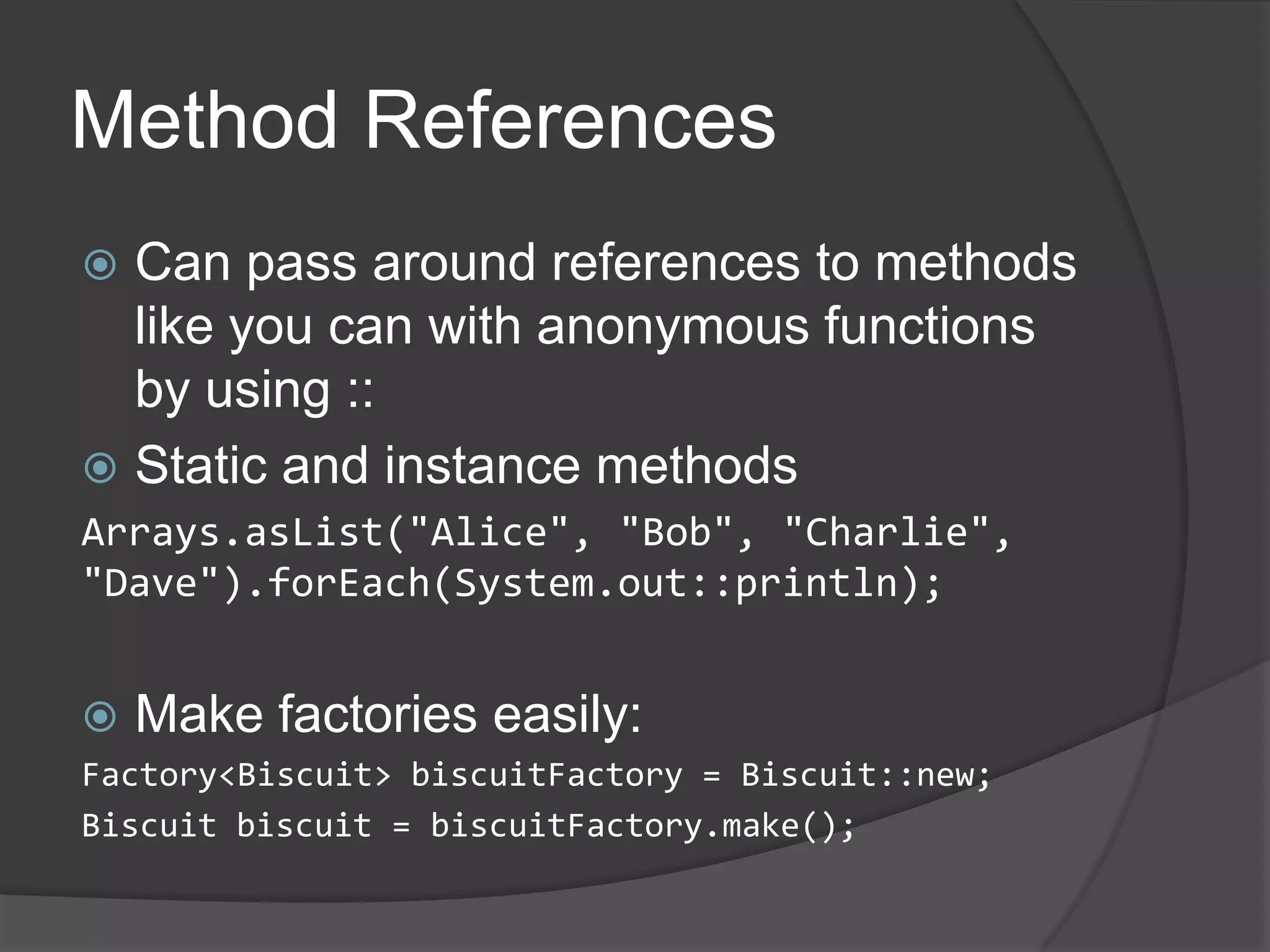
Method References
 Can pass around references to methods
  like you can with anonymous functions
  by using ::
 Static and instance methods
Arrays.asList("Alice", "Bob", "Charlie",
"Dave").forEach(System.out::println);


   Make factories easily:
Factory<Biscuit> biscuitFactory = Biscuit::new;
Biscuit biscuit = biscuitFactory.make();
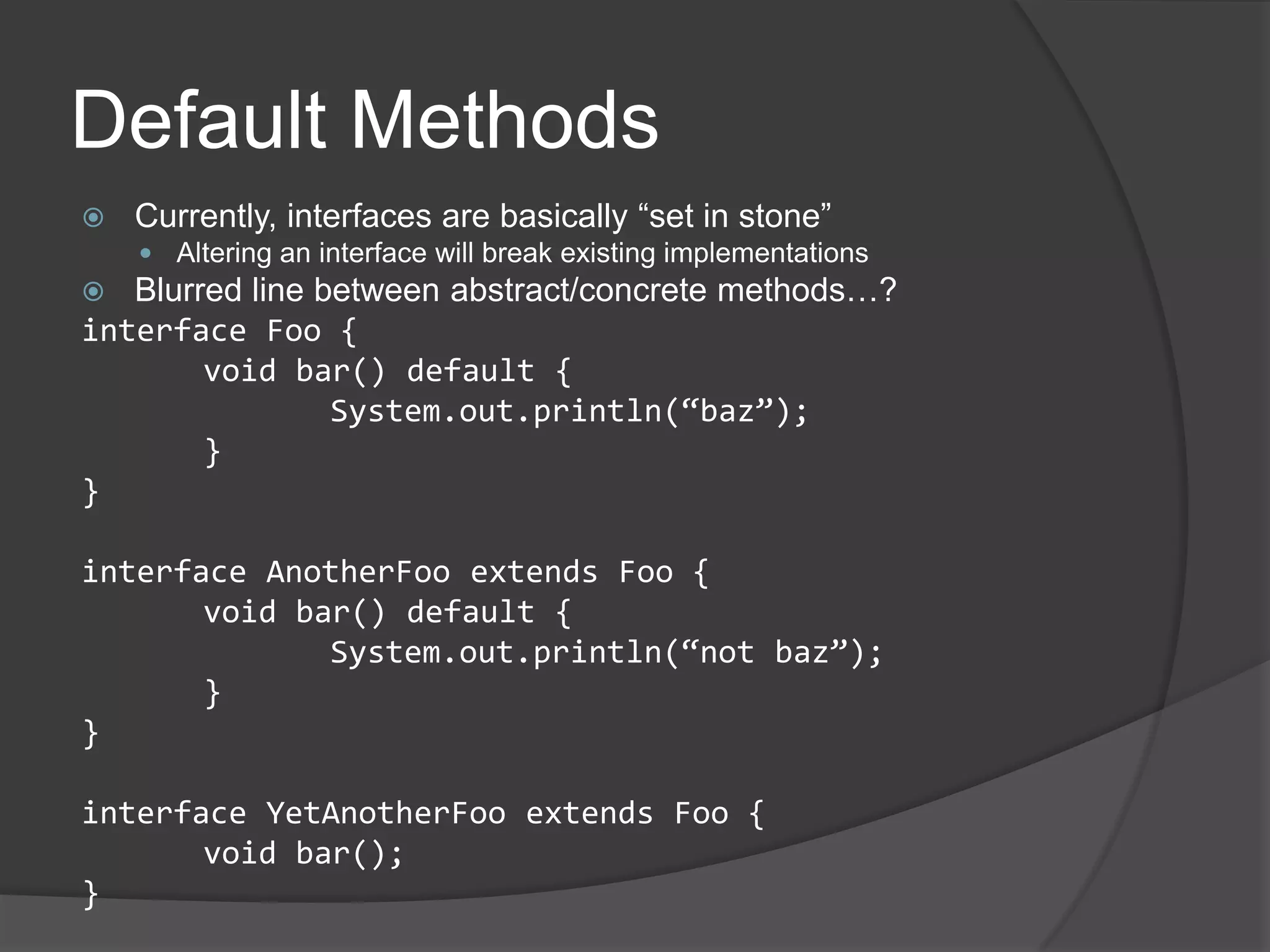
Default Methods
   Currently, interfaces are basically “set in stone”
     Altering an interface will break existing implementations
  Blurred line between abstract/concrete methods…?
interface Foo {
        void bar() default {
                 System.out.println(“baz”);
        }
}

interface AnotherFoo extends Foo {
       void bar() default {
              System.out.println(“not baz”);
       }
}

interface YetAnotherFoo extends Foo {
       void bar();
}
More Java 8 Stuff…
   http://openjdk.java.net/projects/jigsaw/

   Sources:
     http://java.dzone.com/news/java-8-lambda-
      syntax-closures
     http://datumedge.blogspot.ca/2012/06/java-
      8-lambdas.html
     http://cr.openjdk.java.net/~briangoetz/lambd
      a/lambda-state-4.html

Lambda functions in java 8

  • 1.
  • 2.
  • 3.
    What’s a lambdafunction?  A.K.A.:  Anonymous function  Anonymous method  Function literal  Function constant  Closure  Wikipedia: “a function (or a subroutine) defined, and possibly called, without being bound to an identifier”  Typically can’t be recursive directly  Simple example: (int x, int y) -> x + y  Supported in a bunch of languages…
  • 4.
    Already supported in…  ActionScript, C#, C++, Clojure, Curl, D, Dart, Delphi, Dylan, Erlang, F#, Frink, Go, Groovy, Haskell, JavaScript, Lisp, Logtalk, Lua, Mathematica, Maple, Matlab, Maxima, Ocaml, Octave, Objective-C, Perl, PHP, Python, R, Racket, Ruby, Scala, Scheme, Smalltalk, Vala, Visual Basic, Visual Prolog…
  • 5.
    More Examples  x-> x + 1  (x) -> x + 1  (int x) -> x + 1  (int x, int y) -> x + y  (x, y) -> x + y  (x, y) -> { System.out.printf("%d + %d = %d%n", x, y, x+y); }  () -> { System.out.println("I am a Runnable"); }
  • 6.
    Meanwhile, in Java7…  Functional Interfaces  SAM – “Single Abstract Method”  Interfaces that have just 1 method  java.lang.Runnable  java.util.concurrent.Callable  java.security.PrivilegedAction  java.util.Comparator  java.io.FileFilter  java.nio.file.PathMatcher  java.lang.reflect.InvocationHandler  java.beans.PropertyChangeListener  java.awt.event.ActionListener  javax.swing.event.ChangeListener
  • 7.
    Meanwhile, in Java7…  Typically: button.addActionListener(new ActionListener() { public void actionPerformed(ActionEvent e) { panel.doStuff(e.getModifiers()); } });  Five lines to do one statement  This would become: button.addActionListener(e -> { panel.doStuff(e.getModifiers()); });
  • 8.
    More Anonymous ClassIssues(?)  Lexical scoping  What does this mean? final Runnable r = () -> { // This reference to 'r' is legal: if (!allDone) { workQueue.add(r); } else { displayResults(); } };  Accessing non-final variables  Lambdas: same variable access as you’d have just outside the expression
  • 9.
    java.util.functions  Predicate List<String> names = Arrays.asList("Alice", "Bob", "Charlie", "Dave"); List<String> filteredNames = names .filter(e -> e.length() >= 4) .into(new ArrayList<String>());  filter: only retain elements where the predicate holds true  into: fills up an ArrayList with the filtered elements, then gets set as filteredNames
  • 10.
    java.util.functions  Block  No more for loops…? List<String> names = Arrays.asList("Alice", "Bob", "Charlie", "Dave"); names .filter(e -> e.length() >= 4) .forEach(e -> { System.out.println(e); });  forEach: Can only see one element at a time  Lazy element computation
  • 11.
    java.util.functions  Method chaining List<String> names = Arrays.asList("Alice", "Bob", "Charlie", "Dave"); names .mapped(e -> { return e.length(); }) .asIterable() // returns an Iterable of BiValue // elements; an element's key is the // person's name, its value is the // string length .filter(e -> e.getValue() >= 4) .sorted((a, b) -> a.getValue() - b.getValue()) .forEach(e -> { System.out.println(e.getKey() + 't' + e.getValue()); });  Is method chaining good…?
  • 12.
    Method References  Canpass around references to methods like you can with anonymous functions by using ::  Static and instance methods Arrays.asList("Alice", "Bob", "Charlie", "Dave").forEach(System.out::println);  Make factories easily: Factory<Biscuit> biscuitFactory = Biscuit::new; Biscuit biscuit = biscuitFactory.make();
  • 13.
    Default Methods  Currently, interfaces are basically “set in stone”  Altering an interface will break existing implementations  Blurred line between abstract/concrete methods…? interface Foo { void bar() default { System.out.println(“baz”); } } interface AnotherFoo extends Foo { void bar() default { System.out.println(“not baz”); } } interface YetAnotherFoo extends Foo { void bar(); }
  • 14.
    More Java 8Stuff…  http://openjdk.java.net/projects/jigsaw/  Sources:  http://java.dzone.com/news/java-8-lambda- syntax-closures  http://datumedge.blogspot.ca/2012/06/java- 8-lambdas.html  http://cr.openjdk.java.net/~briangoetz/lambd a/lambda-state-4.html

Editor's Notes

  • #4 -Alonzo Church: formulated lambda calculus as a formal system of expressing computation by way of function composition. Functional programming languages are the most prominent counterpart to lambda calculus, as well as proof theory.-Can’t be recursive because there’s no name associated with the function. Requires an anonymous fixpoint; a higher-order function that creates a fixed point of other functions-If you assign the lambda expression to a variable name, it can then reference itselffinal Runnable r = () -&gt; { // This reference to &apos;r&apos; is legal: if (!allDone) { workQueue.add(r); } else { displayResults(); } };
  • #7 Interfaces that have just 1 method: not including stuff inherited from Object, etc.
  • #8 -Compiler knows that the lambda must conform to the actionPerformed() signature; sees that it returns void, and that e is an ActionEvent
  • #9 -“this” when unqualified always means the inner class itself-For lambdas, “this” has the same meaning that it does just outside of the lambda-…meaning that the lambda can’t refer to itself directly
  • #12 -No need to store intermediate results, but you possibly lose the clarity that comes with giving everything a name