JS Execution on the 
Server, What Could 
Go Wrong? 
Brian Geffon 
Software Engineer, LinkedIn
Hello! 
2
Outline 
 Introductions 
 Brief History 
 The paradigm shift 
 Problems! 
 Where we are today 
 Closing thoughts and Questions 
3
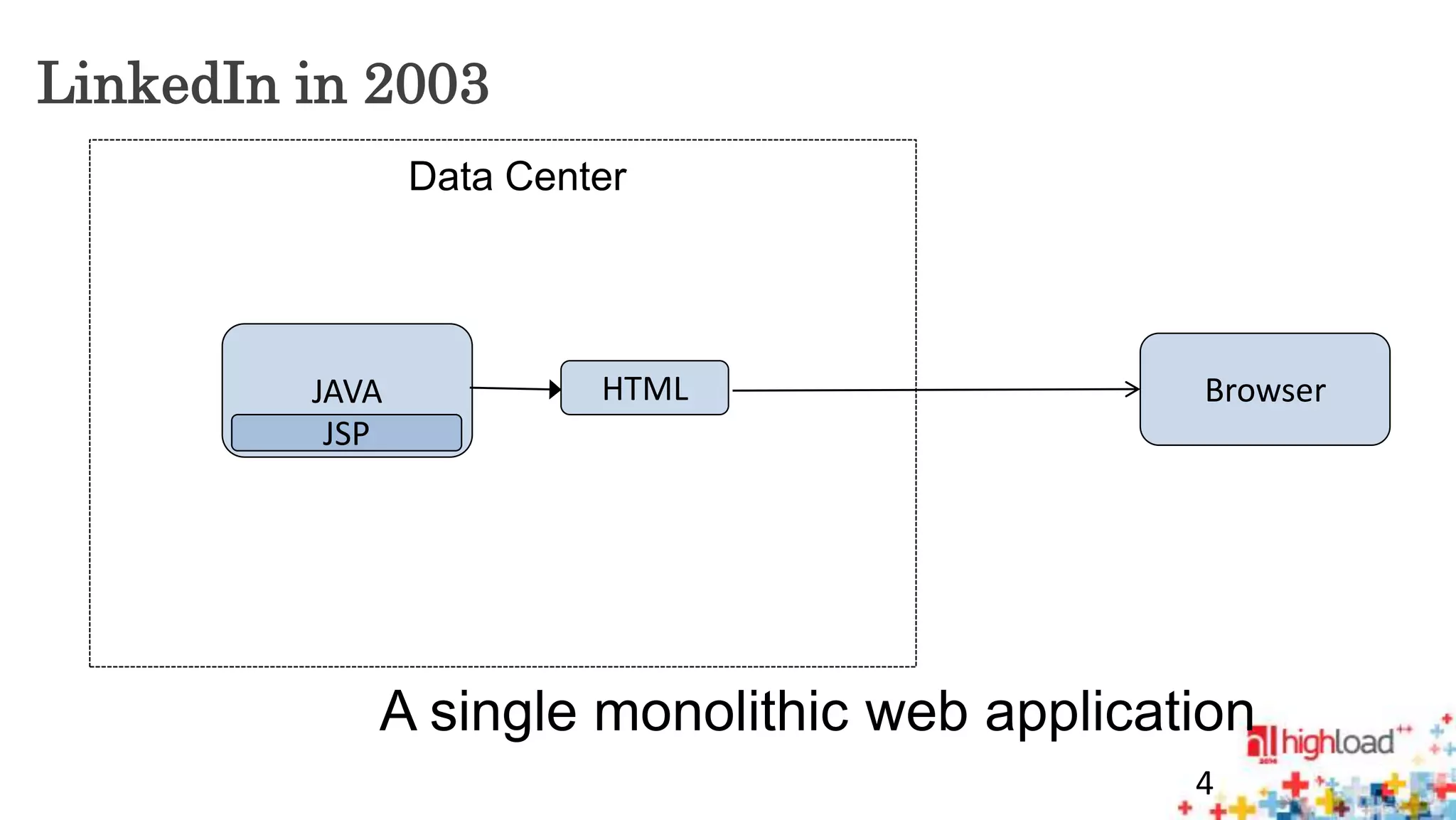
LinkedIn in 2003 
4 
JAVA 
JSP 
Data Center 
HTML 
Browser 
A single monolithic web application
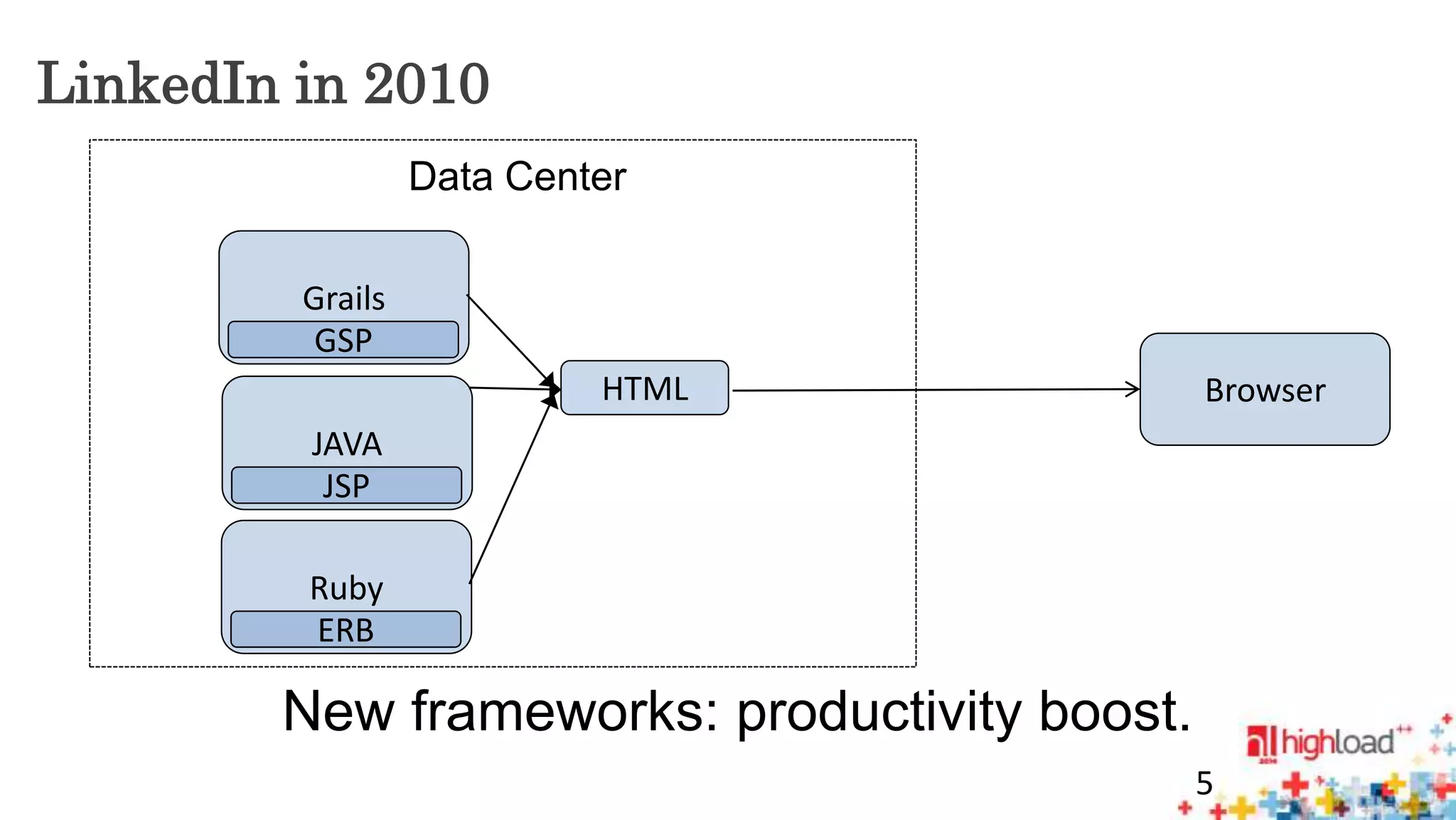
LinkedIn in 2010 
5 
Grails 
GSP 
JAVA 
JSP 
Data Center 
HTML 
Browser 
Ruby 
ERB 
New frameworks: productivity boost.
New Frameworks: Added productivity 
Added complexity 
 Difficult to maintain numerous versions of the same 
template 
 Make it difficult to share content between apps 
6
Solution: a single templating language 
 Do these web app frameworks share anything? 
 How can we ensure that we remain D.R.Y. 
 What language can be supported across each 
architecture? 
7
Solution: client side templating 
 Web applications return JSON data 
 Templates are compiled to JavaScript 
 JSON Data is consumed by JavaScript templates which 
will execute on the client side. 
8
Solution: client side templating, contd. 
 Webapps can share UI! 
 Ability to cache templates on the client 
– Better performance? 
9
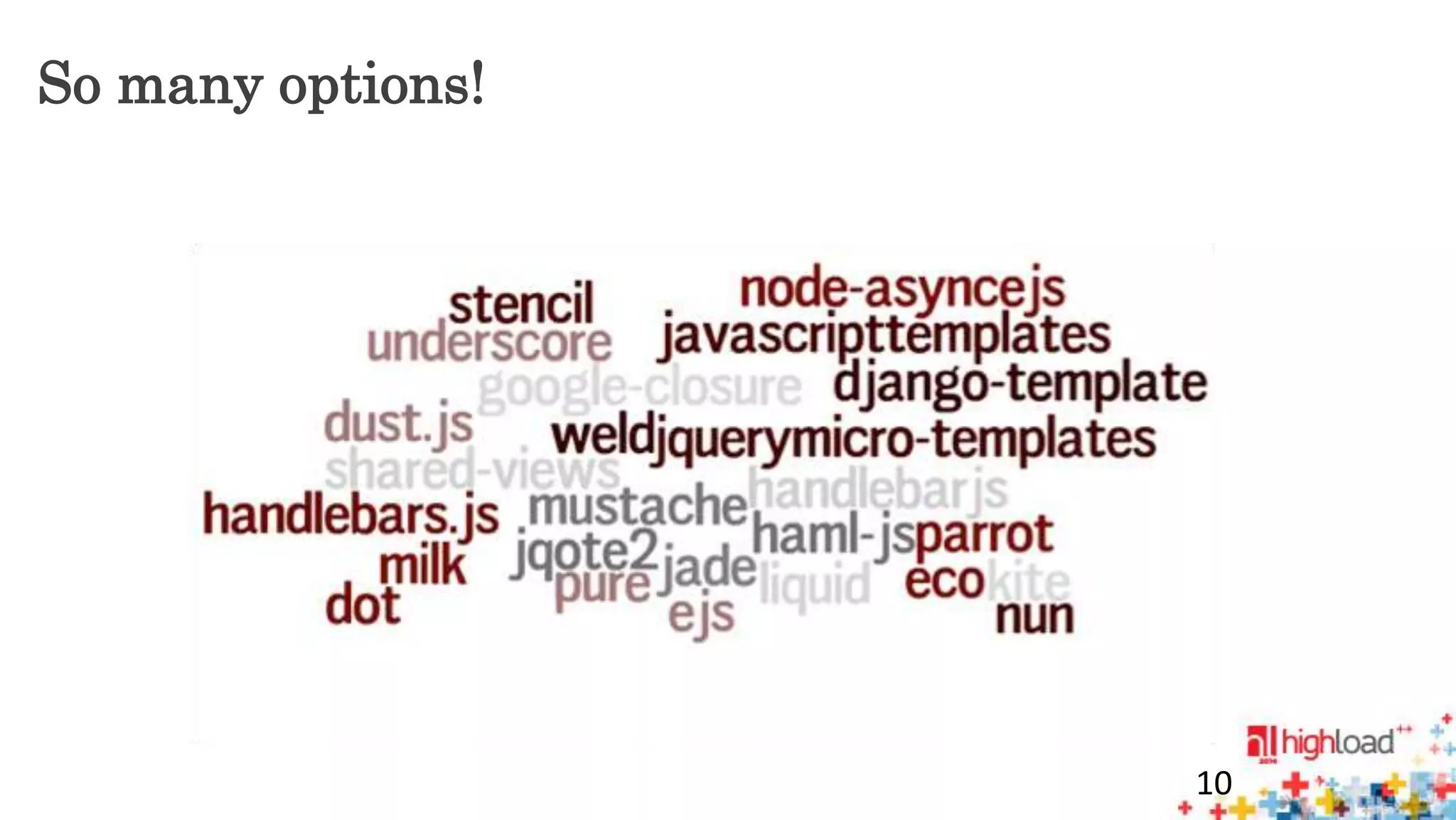
So many options! 
10
The winner: Dust.js 
 Dust is a logicless JavaScript templating language 
 Dust is extensible 
 Dust is inherently D.R.Y. 
https://github.com/linkedin/dustjs 
11
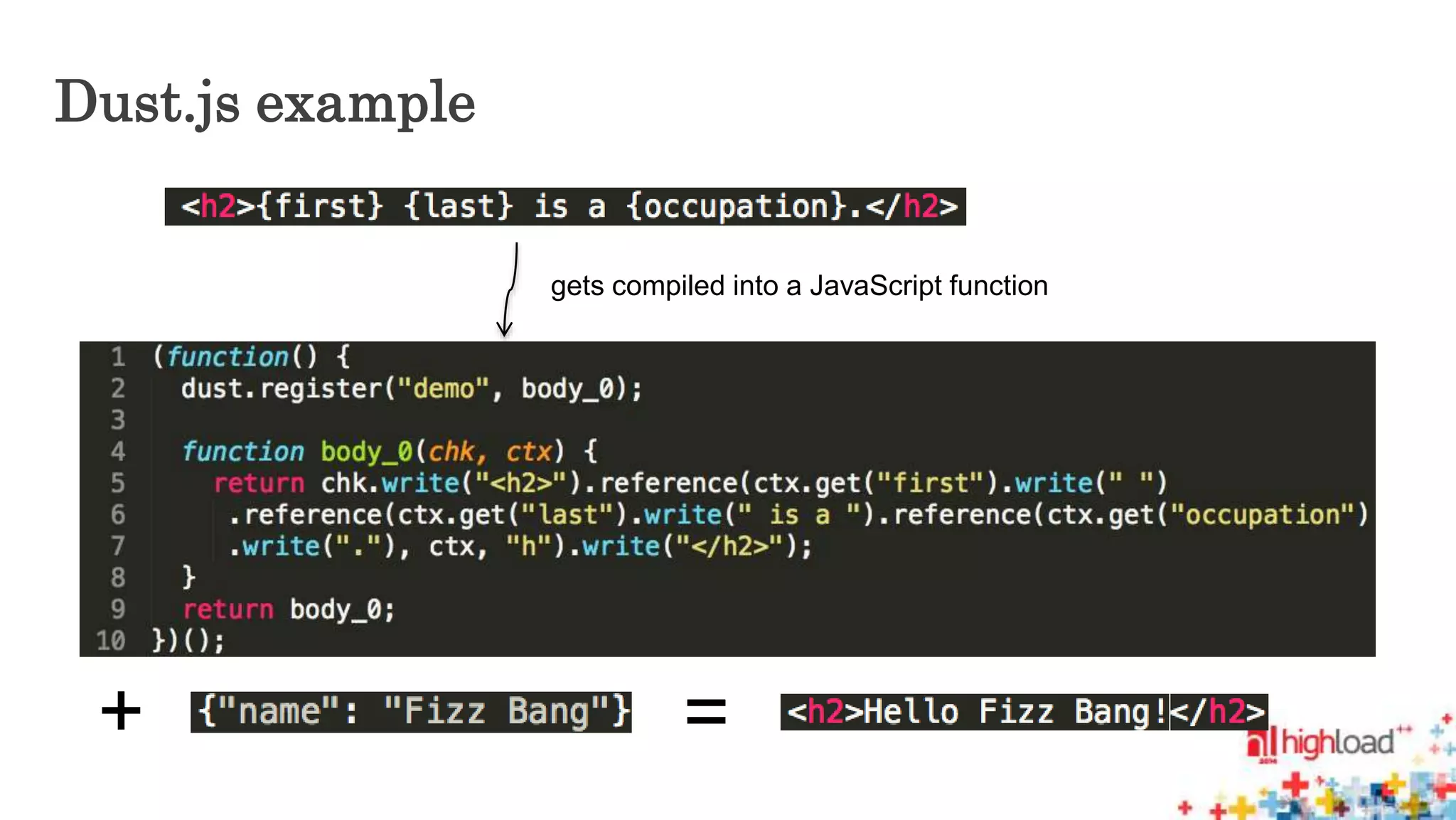
Dust.js example 
gets compiled into a JavaScript function 
+ =
Outline 
 Introductions 
 Brief History 
 The paradigm shift 
 Problems! 
 Where we are today 
 Closing thoughts and Questions 
13
The paradigm shift 
 Reusable UI gives rise to component sharing across apps 
 Components are now separated from data models 
 Ability to avoid RTT for components embedded in page. 
14
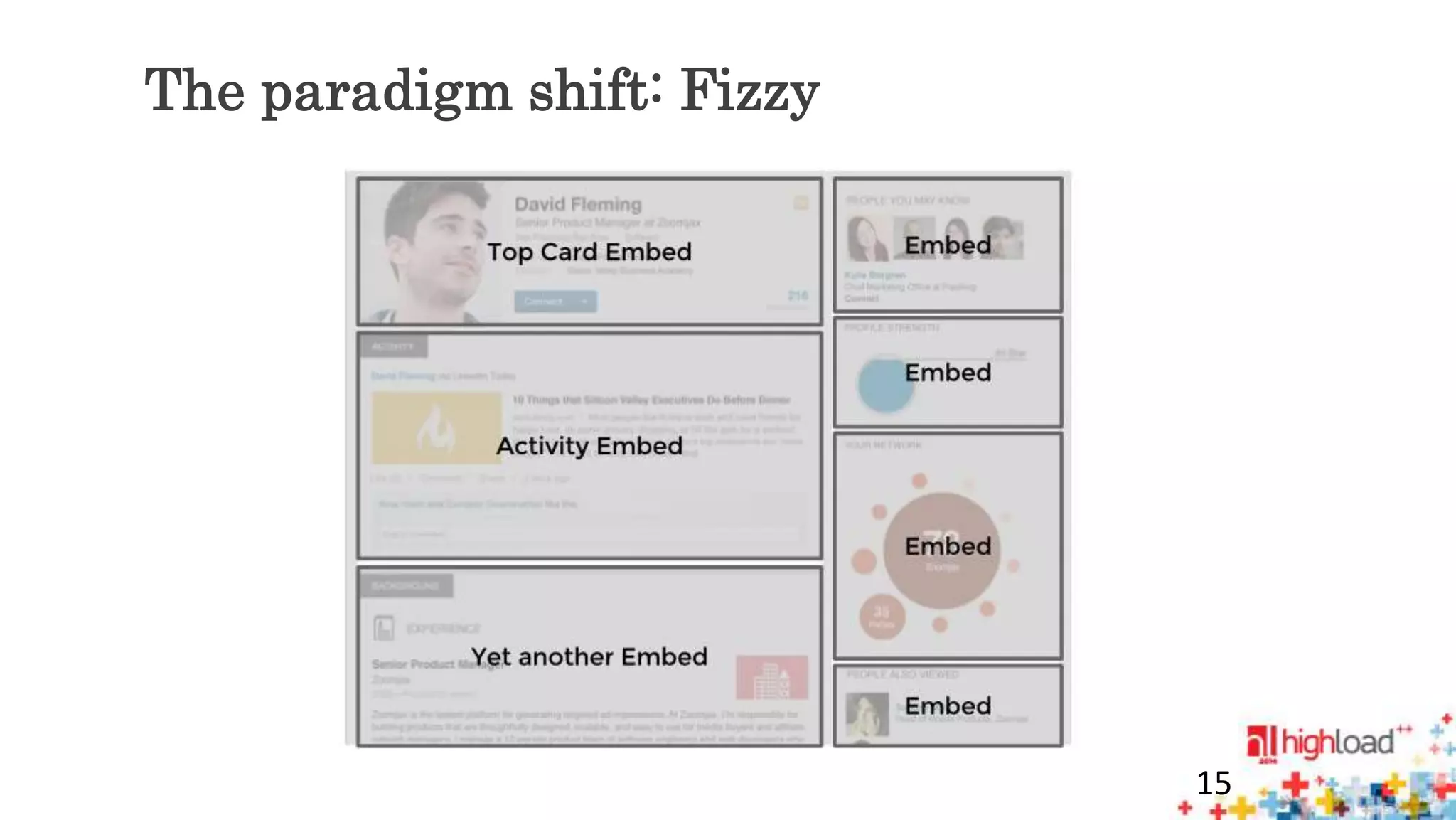
The paradigm shift: Fizzy 
15
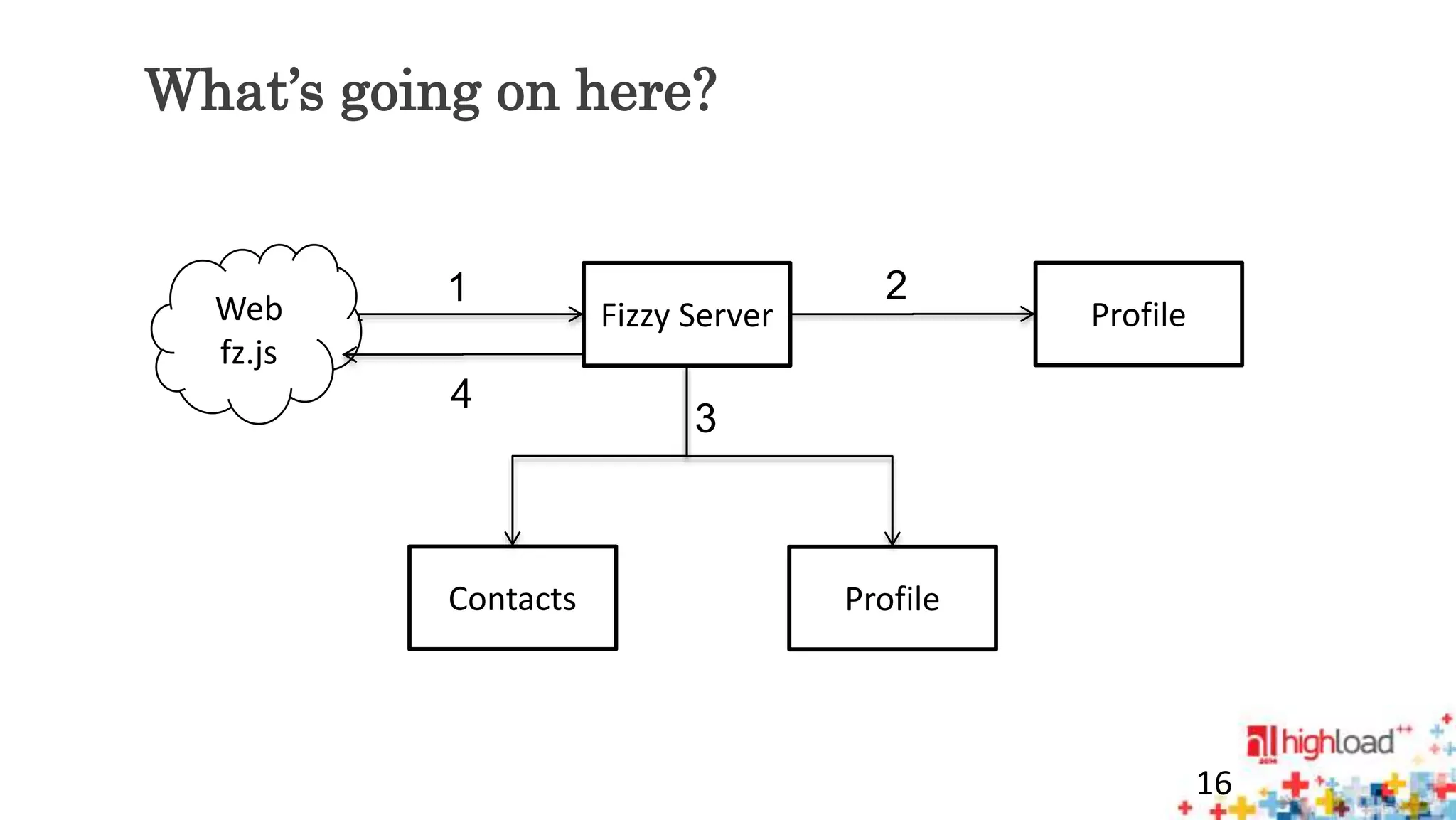
What’s going on here? 
16 
Web 
fz.js 
1 2 
Fizzy Server Profile 
3 
4 
Contacts Profile
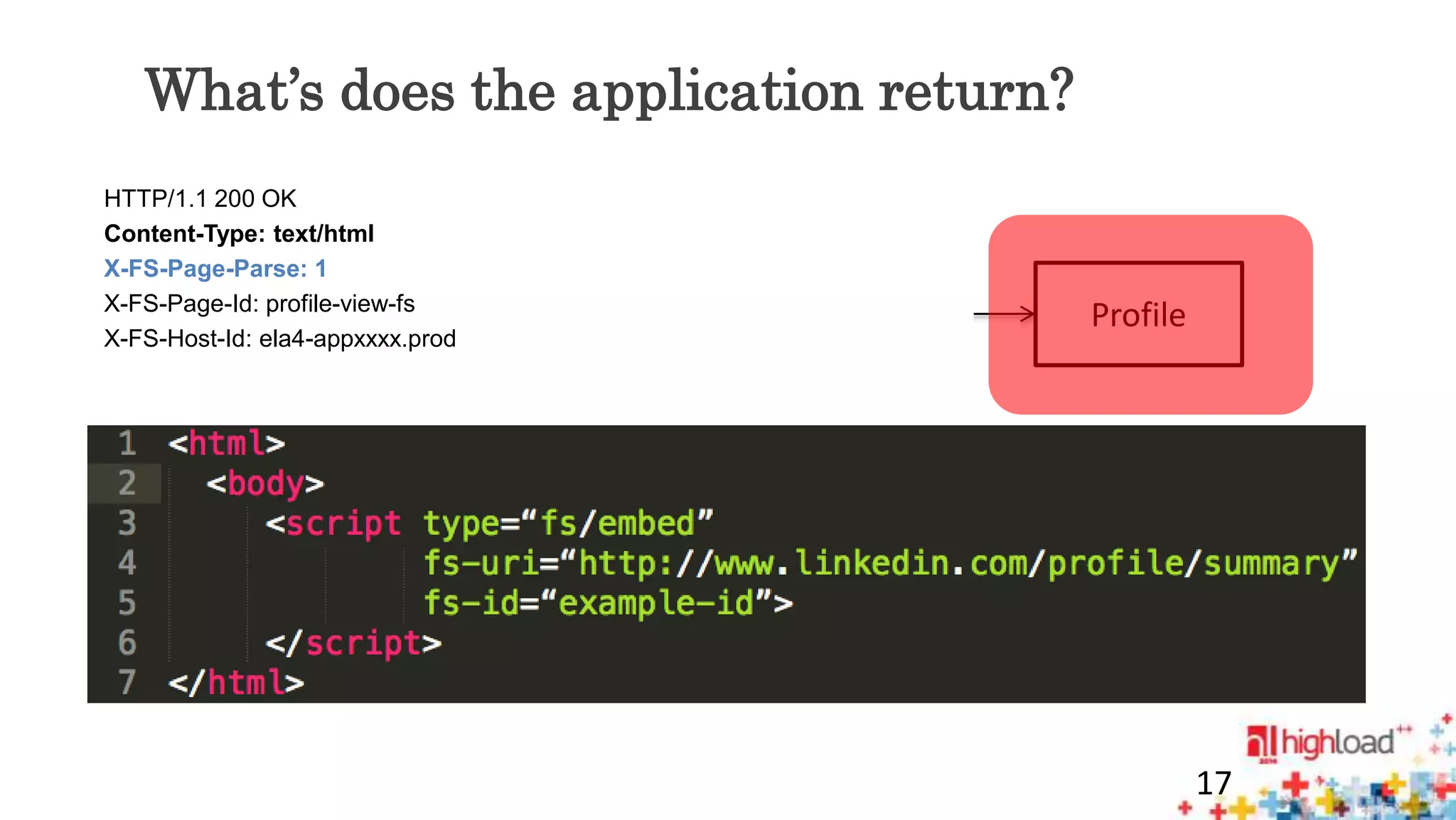
What’s does the application return? 
17 
HTTP/1.1 200 OK 
Content-Type: text/html 
X-FS-Page-Parse: 1 
X-FS-Page-Id: profile-view-fs 
X-FS-Host-Id: ela4-appxxxx.prod 
Web 
fz.js 
1 2 
Fizzy Server Profile 
3 
4 
Contacts Profile
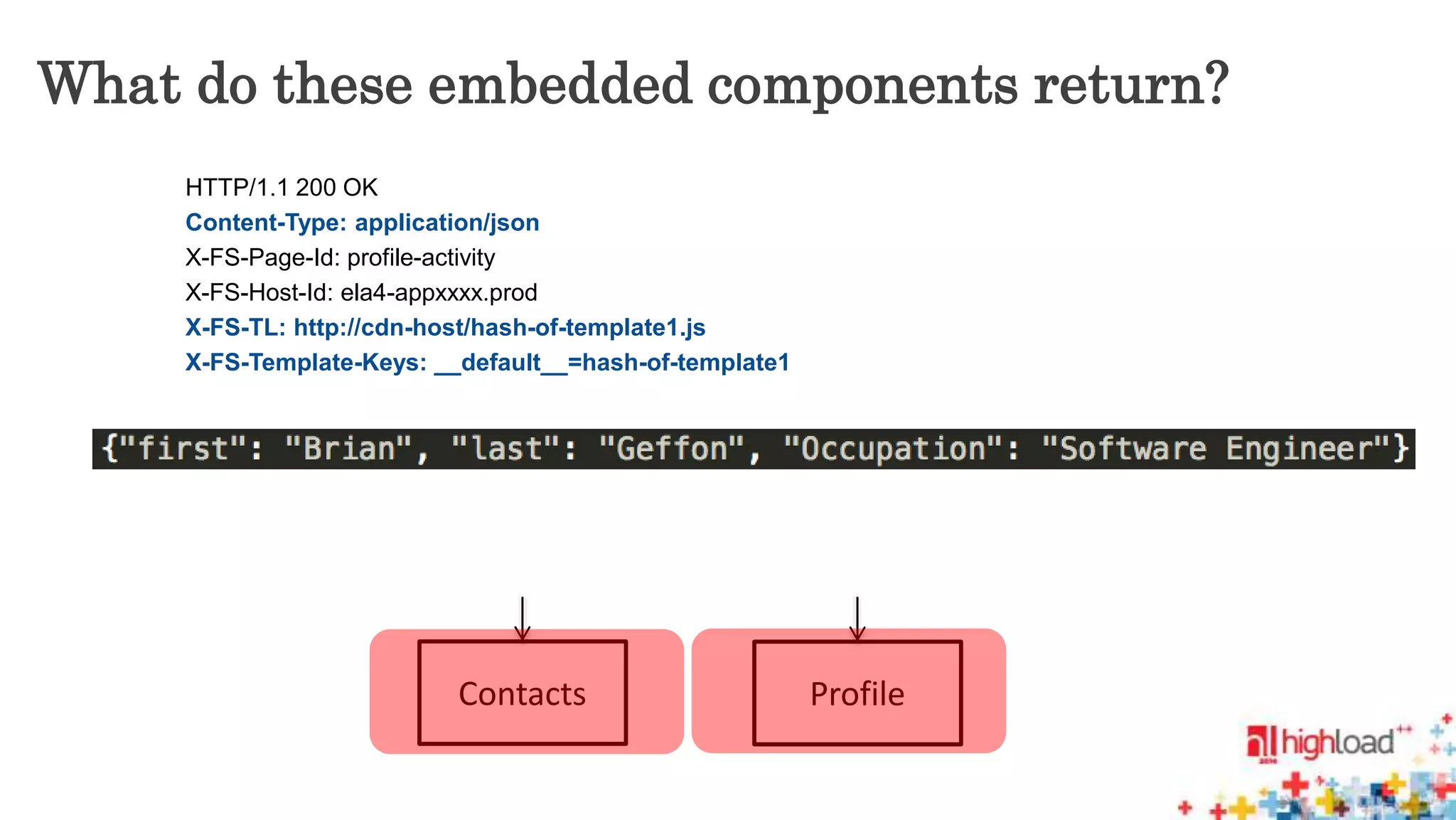
What do these embedded components return? 
HTTP/1.1 200 OK 
Content-Type: application/json 
X-FS-Page-Id: profile-activity 
X-FS-Web 
Host-Id: ela4-appxxxx.prod 
X-FS-TL: http://cdn-host/hash-of-template1.js 
X-FS-fz.Template-js 
Keys: __default__=hash-of-template1 
1 2 
Fizzy Server Profile 
3 
4 
Contacts Profile
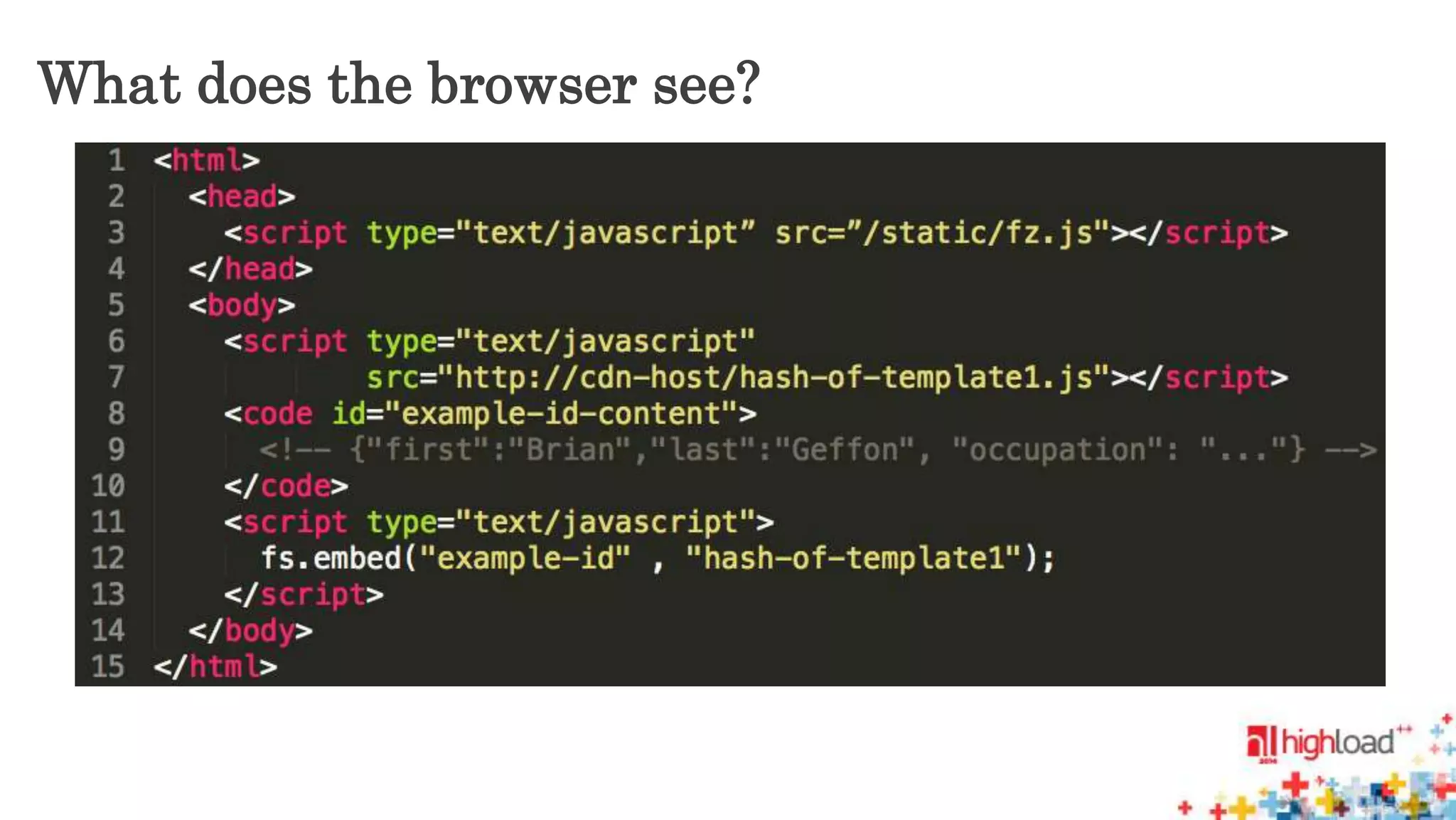
What does the browser see?
Yay! A fancy new web architecture 
 Components are now stand alone 
 Nice UI separation 
 Reusability 
20
What could possibly go wrong? 
 Large JSON payloads caused many problems with 
IE7 
– IE7 doesn’t have a native JSON parser! 
21
What could possibly go wrong? 
 Some older browsers would take a very long time 
executing JS 
– Many browsers didn’t have optimized JS engines 
22
What could possibly go wrong? 
 Search Engine Optimization 
– JS in GoogleBot Yes, many others: No 
23
Server Side Rendering (SSR) 
 Unfortunately we need a way to execute JavaScript on 
the server 
 Could potential performance improvements been seen 
across the board? 
24
The Pieces of SSR 
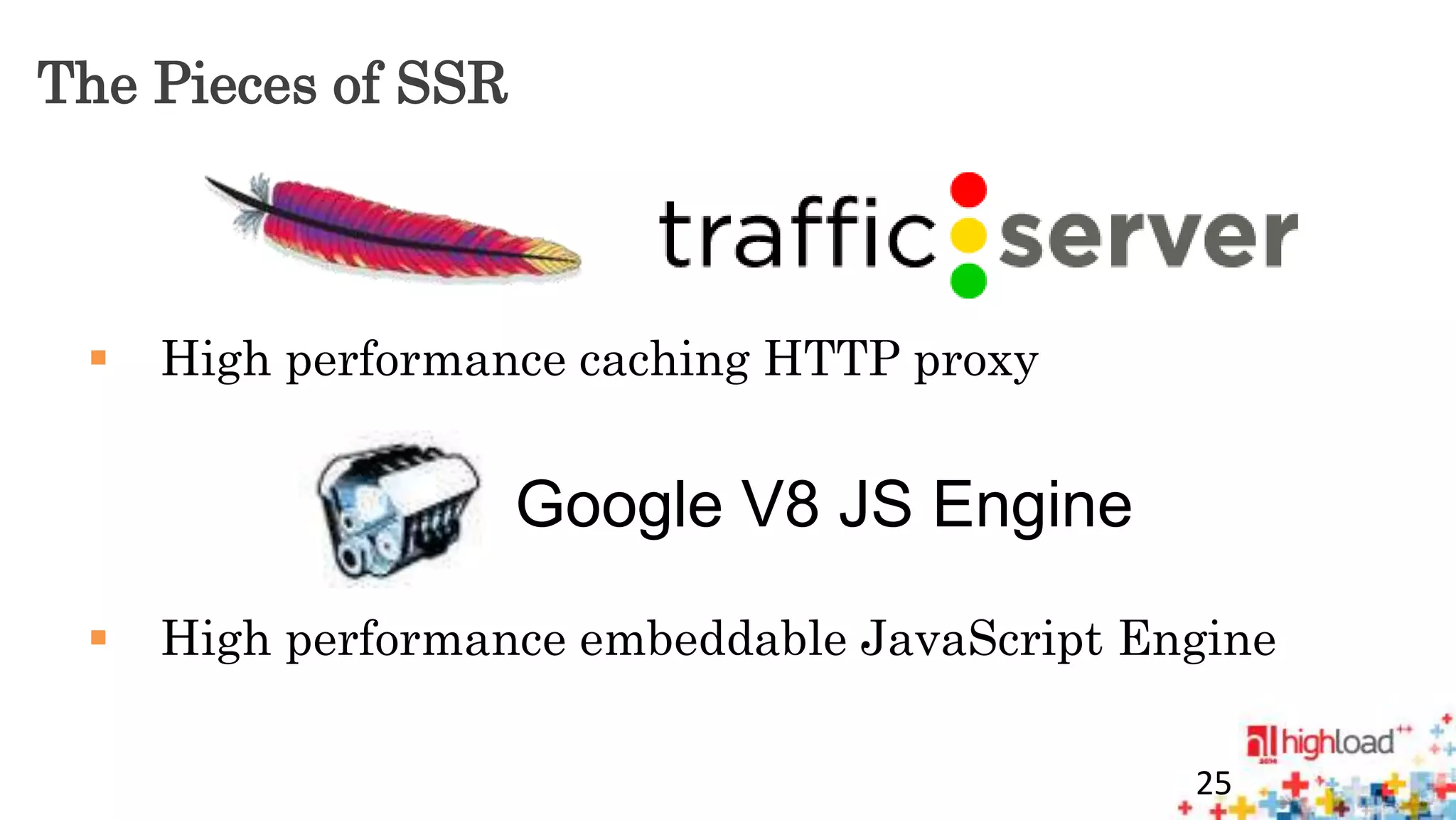
 High performance caching HTTP proxy 
 High performance embeddable JavaScript Engine 
25 
Google V8 JS Engine
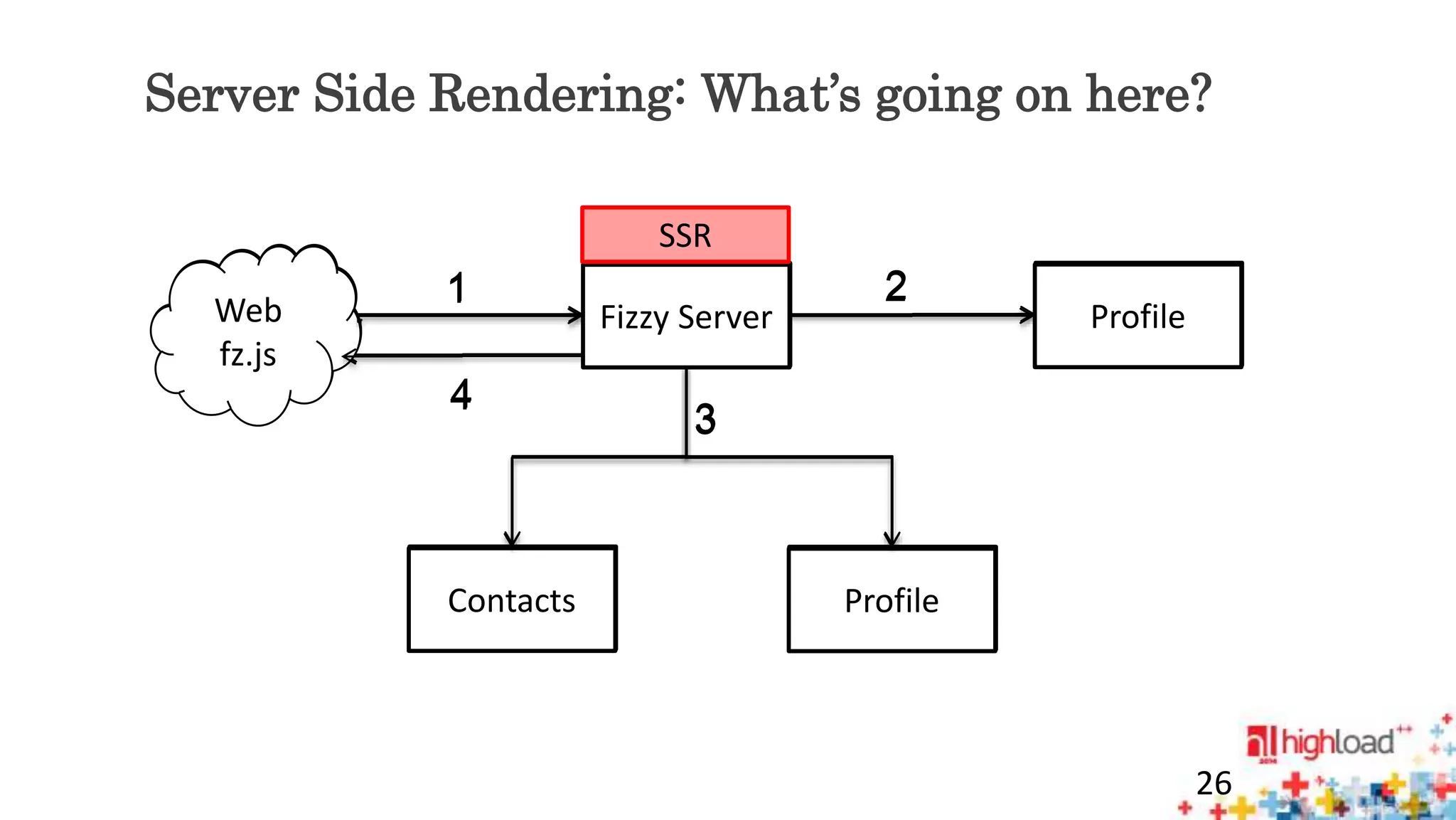
Server Side Rendering: What’s going on here? 
26 
Web 
fz.js 
SSR 
1 2 
Fizzy Server Profile 
3 
4 
Contacts Profile
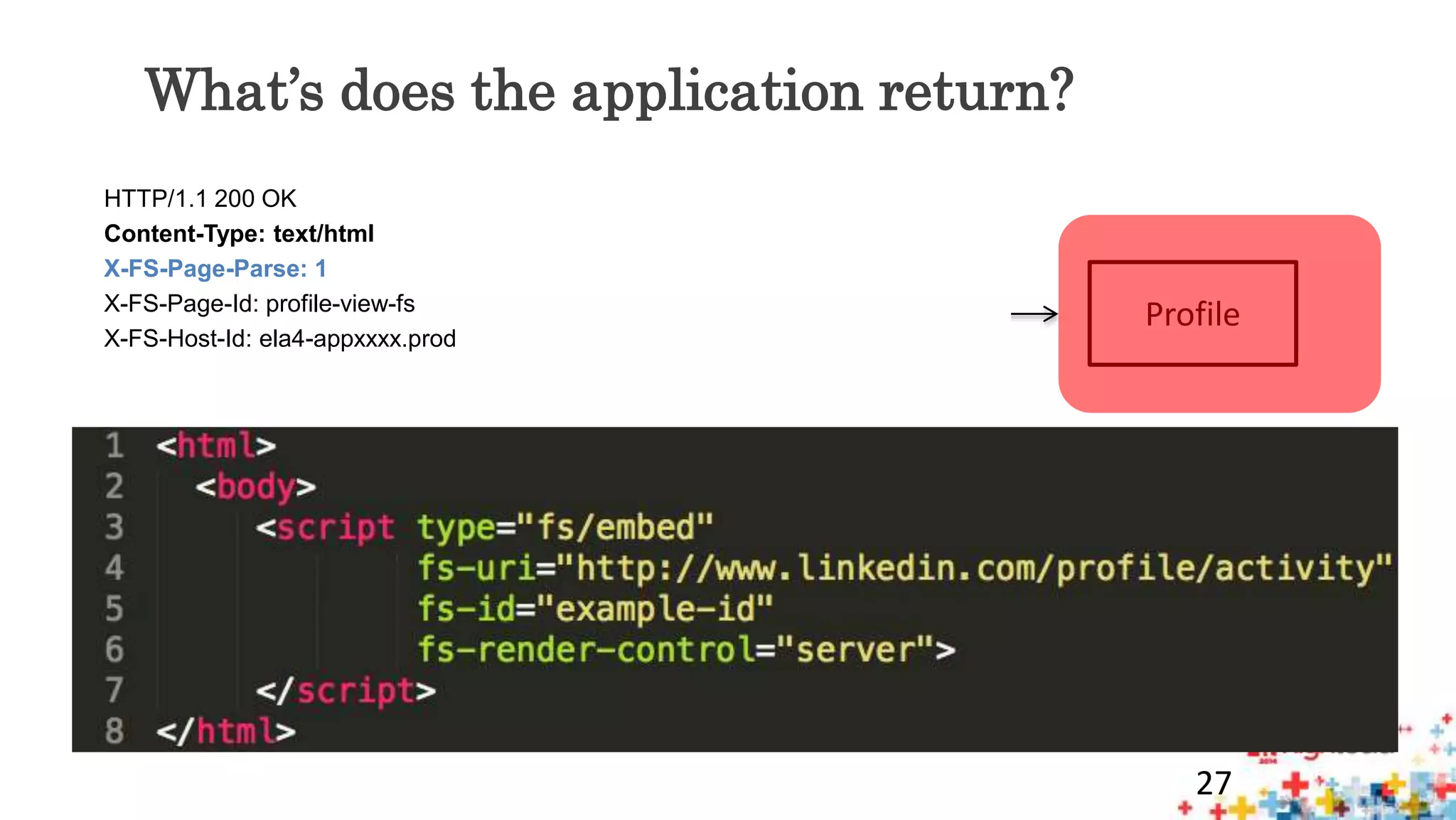
What’s does the application return? 
27 
Web 
fz.js 
1 2 
Fizzy Server 
3 
4 
Contacts Profile 
Profile 
SSR 
HTTP/1.1 200 OK 
Content-Type: text/html 
X-FS-Page-Parse: 1 
X-FS-Page-Id: profile-view-fs 
X-FS-Host-Id: ela4-appxxxx.prod
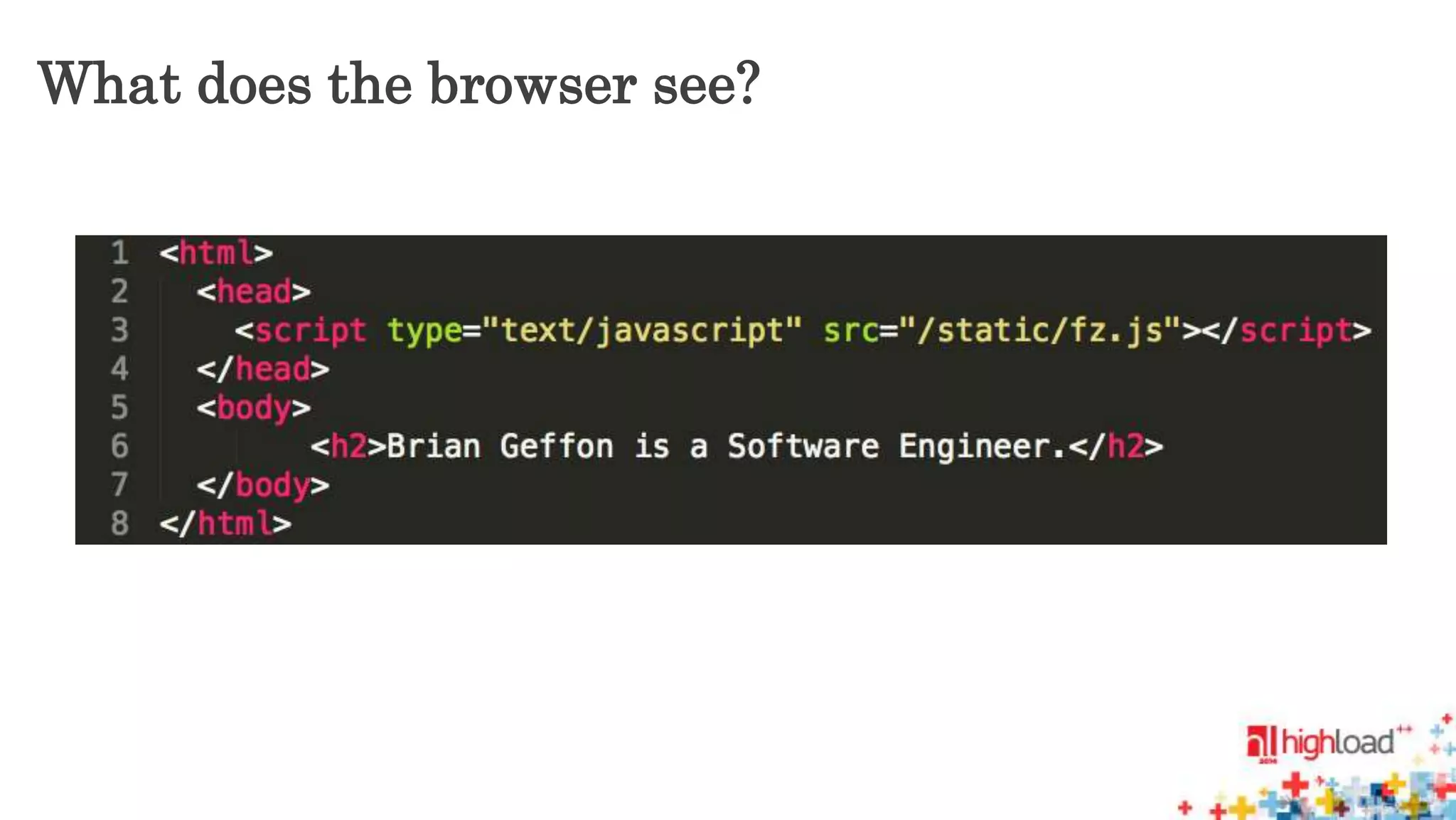
What does the browser see?
Yay! A fancy new web architecture 
 We can now support old web browsers 
 We can now gracefully handle SEO 
 It turns out that even for modern browsers sometimes we 
can execute JavaScript faster! 
29
Outline 
 Introductions 
 Brief History 
 The paradigm shift 
 Problems 
 Where we are today 
 Closing thoughts and Questions 
30
What could possibly go wrong? 
 A shared JS engine gives rise to issues and 
vulnerabilities that don’t affect browsers that 
execute JS. 
31
What could possibly go wrong? 
 Context Pollution 
– One malicious request can poison the context of another 
– This issue exists with any dynamic language 
32
Context Pollution 
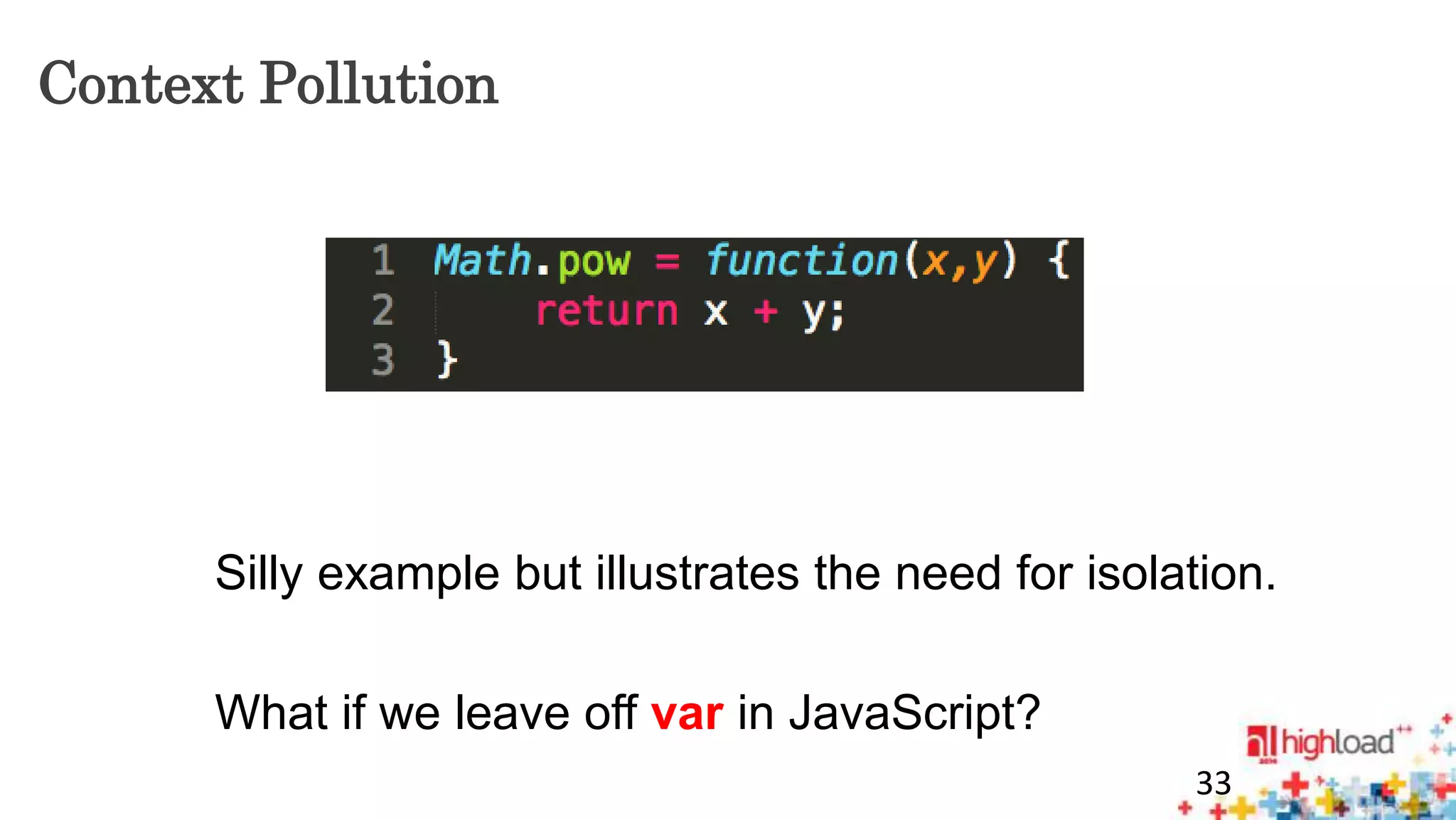
Silly example but illustrates the need for isolation. 
33 
What if we leave off var in JavaScript?
Context Pollution: The solution 
 Each request requires it’s own context 
– Completely reload the environment and bootstrap 
code 
 Performance Hits? 
34
What could possibly go wrong? 
 Poorly written JavaScript can take forever to 
execute! 
35
Poorly Written JavaScript: Infinite Loops, Recursion, etc. 
Although this is tail recursion and a silly example, 
It illustrates the need for stack protection and 
time limitations. 
36
Long Running JavaScript: The solution 
 Enforce stack size limits that allow you to 
gracefully kill a VM 
 Sandbox: accept that apps will misbehave and allow 
them to only hurt themselves. 
37
Long Running JavaScript: The solution 
 Execution limits (we use 1000ms) 
 Exponentially decay the execution limit to prevent taking 
down the entire site! 
38
What could possibly go wrong? 
 Garbage Collection! 
39
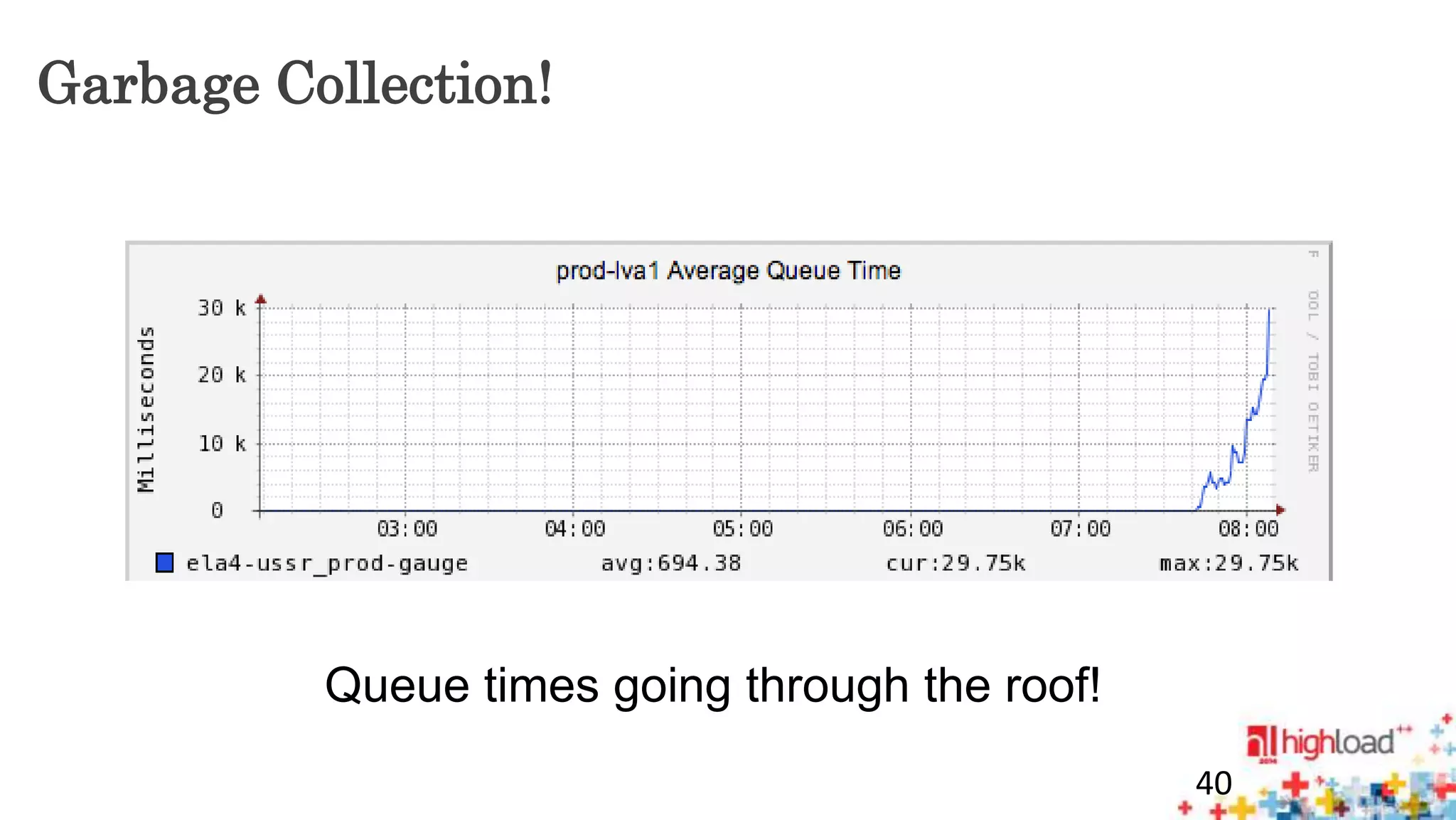
Garbage Collection! 
40 
Queue times going through the roof!
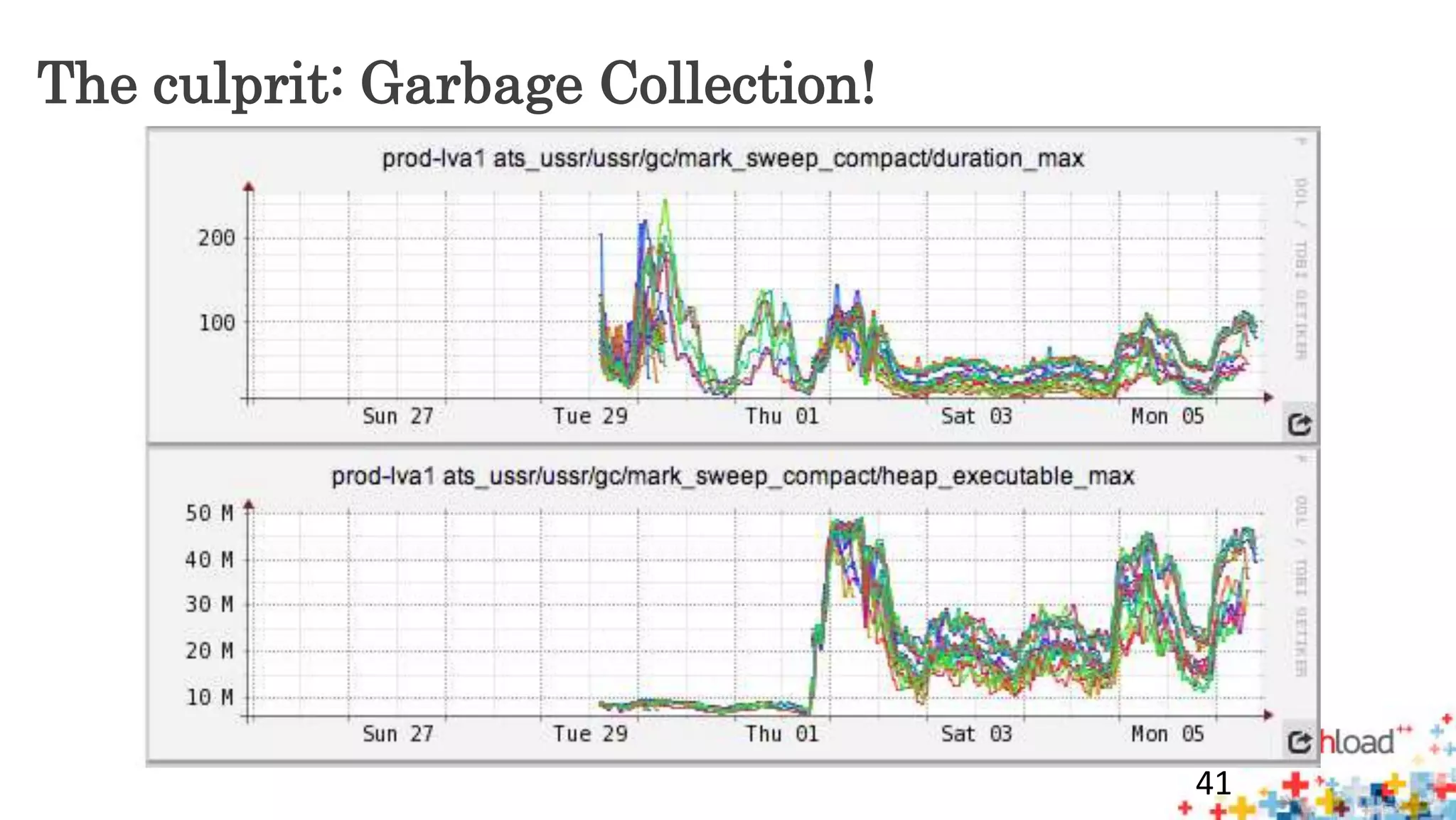
The culprit: Garbage Collection! 
41
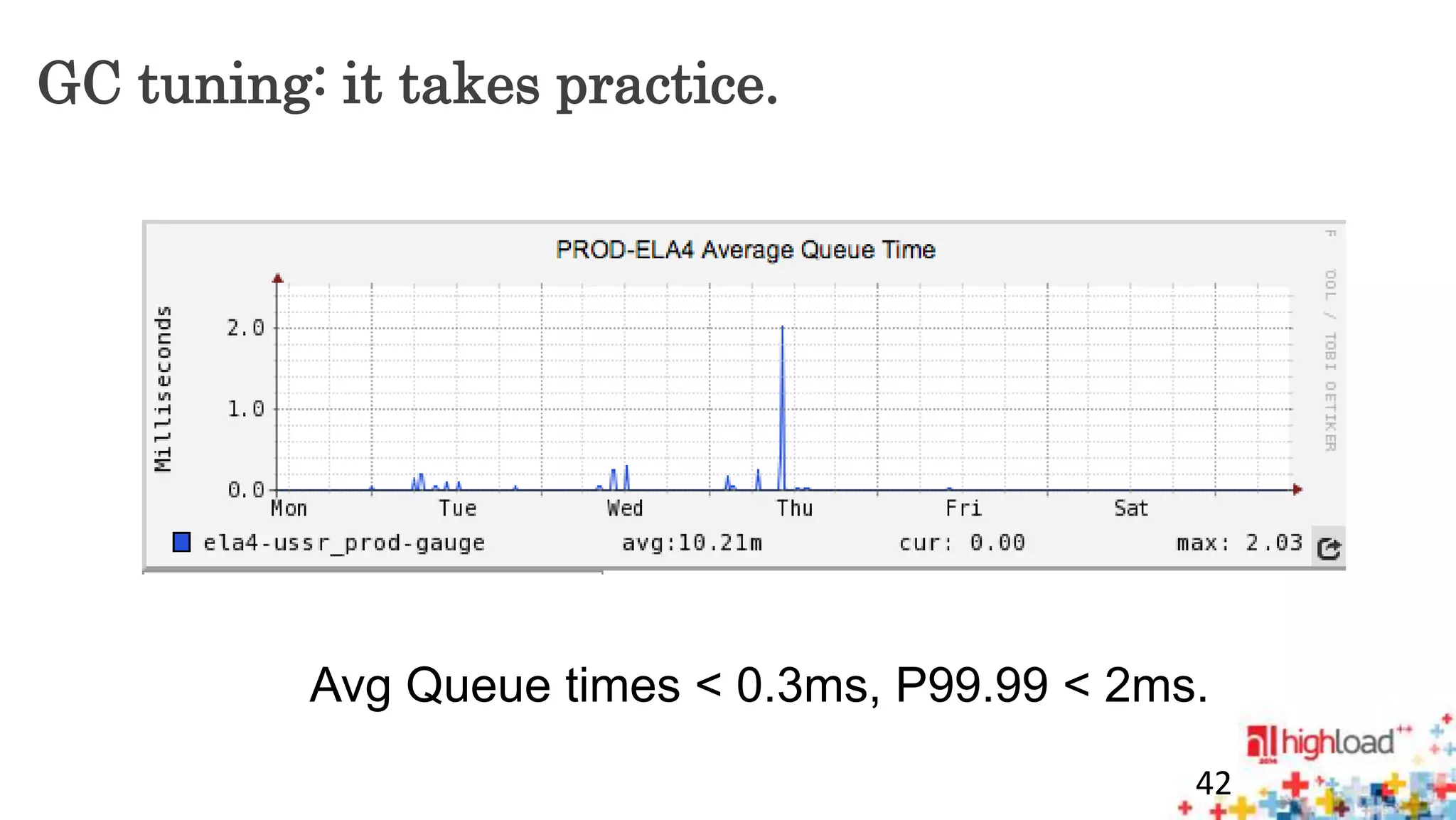
GC tuning: it takes practice. 
Avg Queue times < 0.3ms, P99.99 < 2ms. 
42
GC Tuning 
 Adjust old generation to be several order of 
magnitudes less than new generation 
 New generation is critical because of the short lived 
jobs and contexts. 
 More Threads! 
43
Ideas for the future 
 User load times are actually improved with SSR: do 
it 100% of the time. 
 A generic JS engine: allow apps to return any 
JavaScript, not just Dust.js 
44
Questions?

Исполнение JS на сервере при масштабировании - что может пойти не так, Brian Geffon (LinkedIn)

  • 1.
    JS Execution onthe Server, What Could Go Wrong? Brian Geffon Software Engineer, LinkedIn
  • 2.
  • 3.
    Outline  Introductions  Brief History  The paradigm shift  Problems!  Where we are today  Closing thoughts and Questions 3
  • 4.
    LinkedIn in 2003 4 JAVA JSP Data Center HTML Browser A single monolithic web application
  • 5.
    LinkedIn in 2010 5 Grails GSP JAVA JSP Data Center HTML Browser Ruby ERB New frameworks: productivity boost.
  • 6.
    New Frameworks: Addedproductivity Added complexity  Difficult to maintain numerous versions of the same template  Make it difficult to share content between apps 6
  • 7.
    Solution: a singletemplating language  Do these web app frameworks share anything?  How can we ensure that we remain D.R.Y.  What language can be supported across each architecture? 7
  • 8.
    Solution: client sidetemplating  Web applications return JSON data  Templates are compiled to JavaScript  JSON Data is consumed by JavaScript templates which will execute on the client side. 8
  • 9.
    Solution: client sidetemplating, contd.  Webapps can share UI!  Ability to cache templates on the client – Better performance? 9
  • 10.
  • 11.
    The winner: Dust.js  Dust is a logicless JavaScript templating language  Dust is extensible  Dust is inherently D.R.Y. https://github.com/linkedin/dustjs 11
  • 12.
    Dust.js example getscompiled into a JavaScript function + =
  • 13.
    Outline  Introductions  Brief History  The paradigm shift  Problems!  Where we are today  Closing thoughts and Questions 13
  • 14.
    The paradigm shift  Reusable UI gives rise to component sharing across apps  Components are now separated from data models  Ability to avoid RTT for components embedded in page. 14
  • 15.
  • 16.
    What’s going onhere? 16 Web fz.js 1 2 Fizzy Server Profile 3 4 Contacts Profile
  • 17.
    What’s does theapplication return? 17 HTTP/1.1 200 OK Content-Type: text/html X-FS-Page-Parse: 1 X-FS-Page-Id: profile-view-fs X-FS-Host-Id: ela4-appxxxx.prod Web fz.js 1 2 Fizzy Server Profile 3 4 Contacts Profile
  • 18.
    What do theseembedded components return? HTTP/1.1 200 OK Content-Type: application/json X-FS-Page-Id: profile-activity X-FS-Web Host-Id: ela4-appxxxx.prod X-FS-TL: http://cdn-host/hash-of-template1.js X-FS-fz.Template-js Keys: __default__=hash-of-template1 1 2 Fizzy Server Profile 3 4 Contacts Profile
  • 19.
    What does thebrowser see?
  • 20.
    Yay! A fancynew web architecture  Components are now stand alone  Nice UI separation  Reusability 20
  • 21.
    What could possiblygo wrong?  Large JSON payloads caused many problems with IE7 – IE7 doesn’t have a native JSON parser! 21
  • 22.
    What could possiblygo wrong?  Some older browsers would take a very long time executing JS – Many browsers didn’t have optimized JS engines 22
  • 23.
    What could possiblygo wrong?  Search Engine Optimization – JS in GoogleBot Yes, many others: No 23
  • 24.
    Server Side Rendering(SSR)  Unfortunately we need a way to execute JavaScript on the server  Could potential performance improvements been seen across the board? 24
  • 25.
    The Pieces ofSSR  High performance caching HTTP proxy  High performance embeddable JavaScript Engine 25 Google V8 JS Engine
  • 26.
    Server Side Rendering:What’s going on here? 26 Web fz.js SSR 1 2 Fizzy Server Profile 3 4 Contacts Profile
  • 27.
    What’s does theapplication return? 27 Web fz.js 1 2 Fizzy Server 3 4 Contacts Profile Profile SSR HTTP/1.1 200 OK Content-Type: text/html X-FS-Page-Parse: 1 X-FS-Page-Id: profile-view-fs X-FS-Host-Id: ela4-appxxxx.prod
  • 28.
    What does thebrowser see?
  • 29.
    Yay! A fancynew web architecture  We can now support old web browsers  We can now gracefully handle SEO  It turns out that even for modern browsers sometimes we can execute JavaScript faster! 29
  • 30.
    Outline  Introductions  Brief History  The paradigm shift  Problems  Where we are today  Closing thoughts and Questions 30
  • 31.
    What could possiblygo wrong?  A shared JS engine gives rise to issues and vulnerabilities that don’t affect browsers that execute JS. 31
  • 32.
    What could possiblygo wrong?  Context Pollution – One malicious request can poison the context of another – This issue exists with any dynamic language 32
  • 33.
    Context Pollution Sillyexample but illustrates the need for isolation. 33 What if we leave off var in JavaScript?
  • 34.
    Context Pollution: Thesolution  Each request requires it’s own context – Completely reload the environment and bootstrap code  Performance Hits? 34
  • 35.
    What could possiblygo wrong?  Poorly written JavaScript can take forever to execute! 35
  • 36.
    Poorly Written JavaScript:Infinite Loops, Recursion, etc. Although this is tail recursion and a silly example, It illustrates the need for stack protection and time limitations. 36
  • 37.
    Long Running JavaScript:The solution  Enforce stack size limits that allow you to gracefully kill a VM  Sandbox: accept that apps will misbehave and allow them to only hurt themselves. 37
  • 38.
    Long Running JavaScript:The solution  Execution limits (we use 1000ms)  Exponentially decay the execution limit to prevent taking down the entire site! 38
  • 39.
    What could possiblygo wrong?  Garbage Collection! 39
  • 40.
    Garbage Collection! 40 Queue times going through the roof!
  • 41.
    The culprit: GarbageCollection! 41
  • 42.
    GC tuning: ittakes practice. Avg Queue times < 0.3ms, P99.99 < 2ms. 42
  • 43.
    GC Tuning Adjust old generation to be several order of magnitudes less than new generation  New generation is critical because of the short lived jobs and contexts.  More Threads! 43
  • 44.
    Ideas for thefuture  User load times are actually improved with SSR: do it 100% of the time.  A generic JS engine: allow apps to return any JavaScript, not just Dust.js 44
  • 45.

Editor's Notes

  • #5 This simple monolithic architecture should look familiar to most people
  • #6 New frameworks provide a productivity boost, but at what cost? UI needs to remain consistent between pageviews Suppose you want to change your layout, your header and footer, because of the duplication of templates it requires a very coordinated rollout : many points of failure.\ Explain that this talk is where we are in 2014.
  • #8 What possible options do you really have? C? C is exposable for almost any language via bindings, but is this really the approach you should take?
  • #15 You start to approach an MVC architecture in that your views are now independent of your application logic.
  • #16 Many applications can be divided into very small pieces. This creates a nice abstraction.
  • #17 Obviously, now that you’re breaking your app up into smaller pieces you need to have an aggregation proxy sitting in front of each app. We called it Fizzy Server, Fizzy has no real significance we just picked that name while having a beer.
  • #18 Explain the decision to use a script tag as the marker, it allows us to potentially do tricks on the client side if the proxy in the middle wasn’t present. Because this doesn’t have a body or a src attribute the browser basically ignores it; however, with special bootstrap client code you could even do client assembly -> This is a big deal
  • #19 Remember these components may exist on the same webapp or another webapp, but since we’ve abstracted away the underlying webapp language we just return JSON. Note
  • #20 Explain each of the pieces of assembly.
  • #21 We have just taken our web application stack from a homogenous architecture to a heterogeneous, we now don’t care what technology application developers want to use. We were able to solve problem such as internationalization and localization (i18n) using client side templates and a separate translation component.
  • #23 Internet Explorer 6 and 7 are possibly the biggest pieces of junk ever created.
  • #30 DEMO?
  • #34 While this example is silly, but let’s consider the case with a helper, dust allows helpers, so if your helper snippet contains a global.
  • #37 If you do this you should be SHOT!
  • #41 Explain this graph
  • #42 Explain this graph
  • #43 --max-old-space-size=256 --max-new-space-size=4096 Explain p99.99
  • #44 --max-old-space-size=256 --max-new-space-size=4096
  • #45 --max-old-space-size=256 --max-new-space-size=4096