2009 Mats Bryntse
Contents What is JavaScript JavaScript Basics Functions Objects Bad parts Prototype Scope Ajax JSON Debugging Tools Performance Events Error handling Future of JavaScript
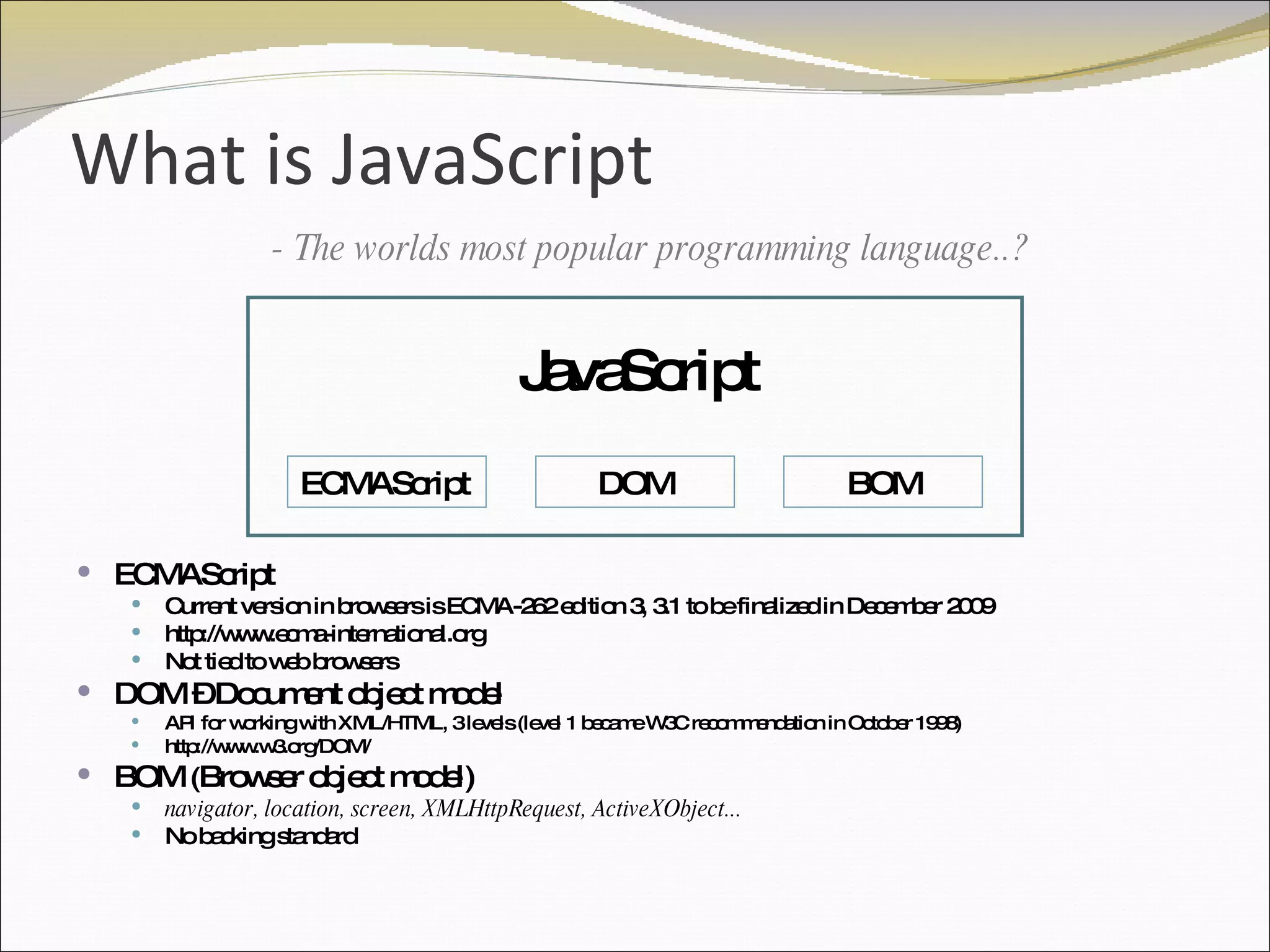
What is JavaScript ECMAScript  Current version in browsers is ECMA-262 edition 3, 3.1 to be finalized in December 2009 http://www.ecma-international.org Not tied to web browsers DOM – Document object model API for working with XML/HTML, 3 levels (level 1 became W3C recommendation in October 1998) http://www.w3.org/DOM/ BOM  ( Browser object model) navigator, location, screen, XMLHttpRequest, ActiveXObject... No backing standard ECMAScript DOM BOM JavaScript - The worlds most popular programming language..?
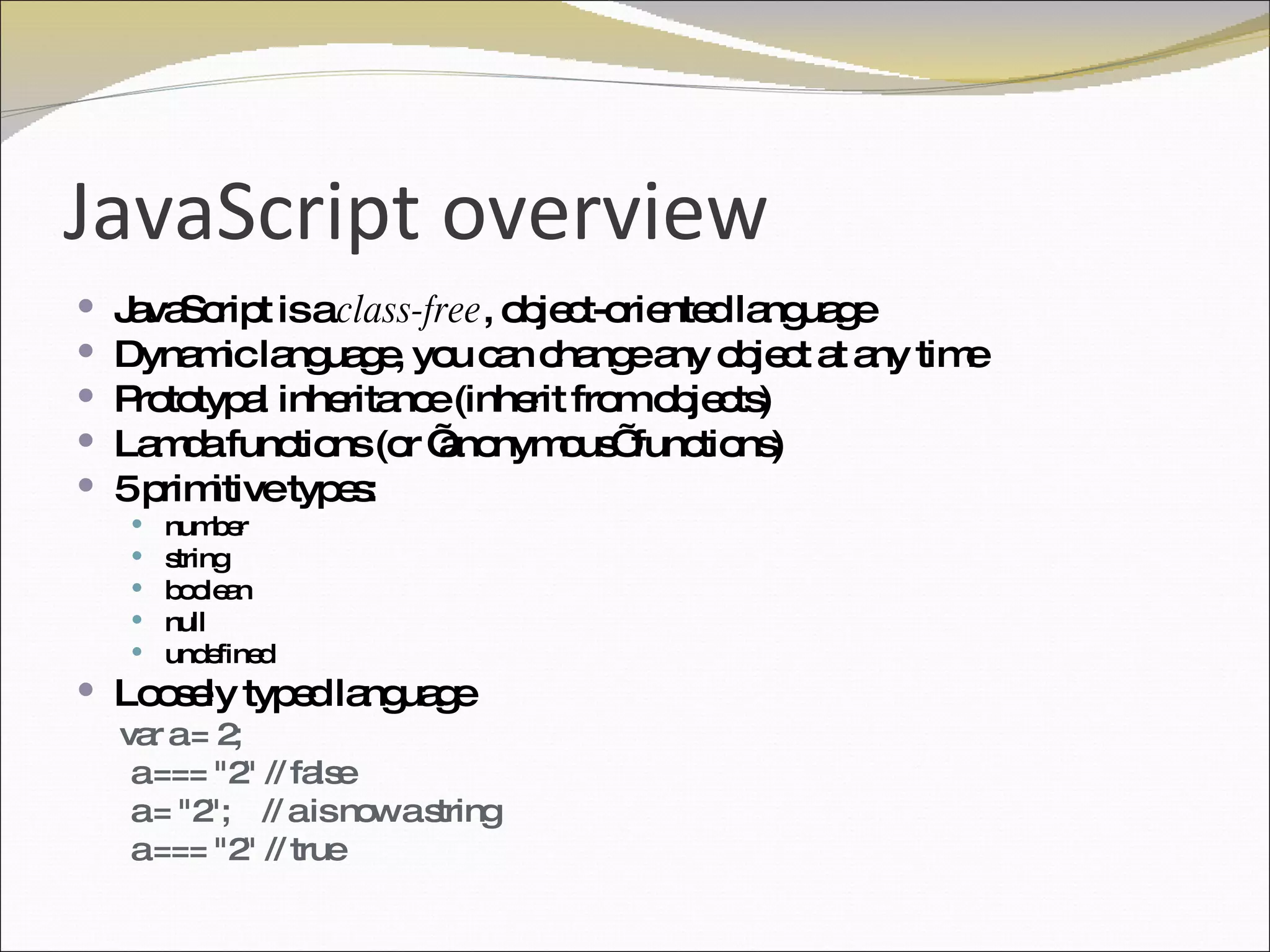
JavaScript overview JavaScript is a  class-free , object-oriented language Dynamic language, you can change any object at any time Prototypal inheritance (inherit from objects) Lamda functions (or ’anonymous’ functions) 5 primitive types: number string  boolean null undefined Loosely typed language   var a = 2; a === "2" // false a = "2";  // a is now a string a === "2" // true
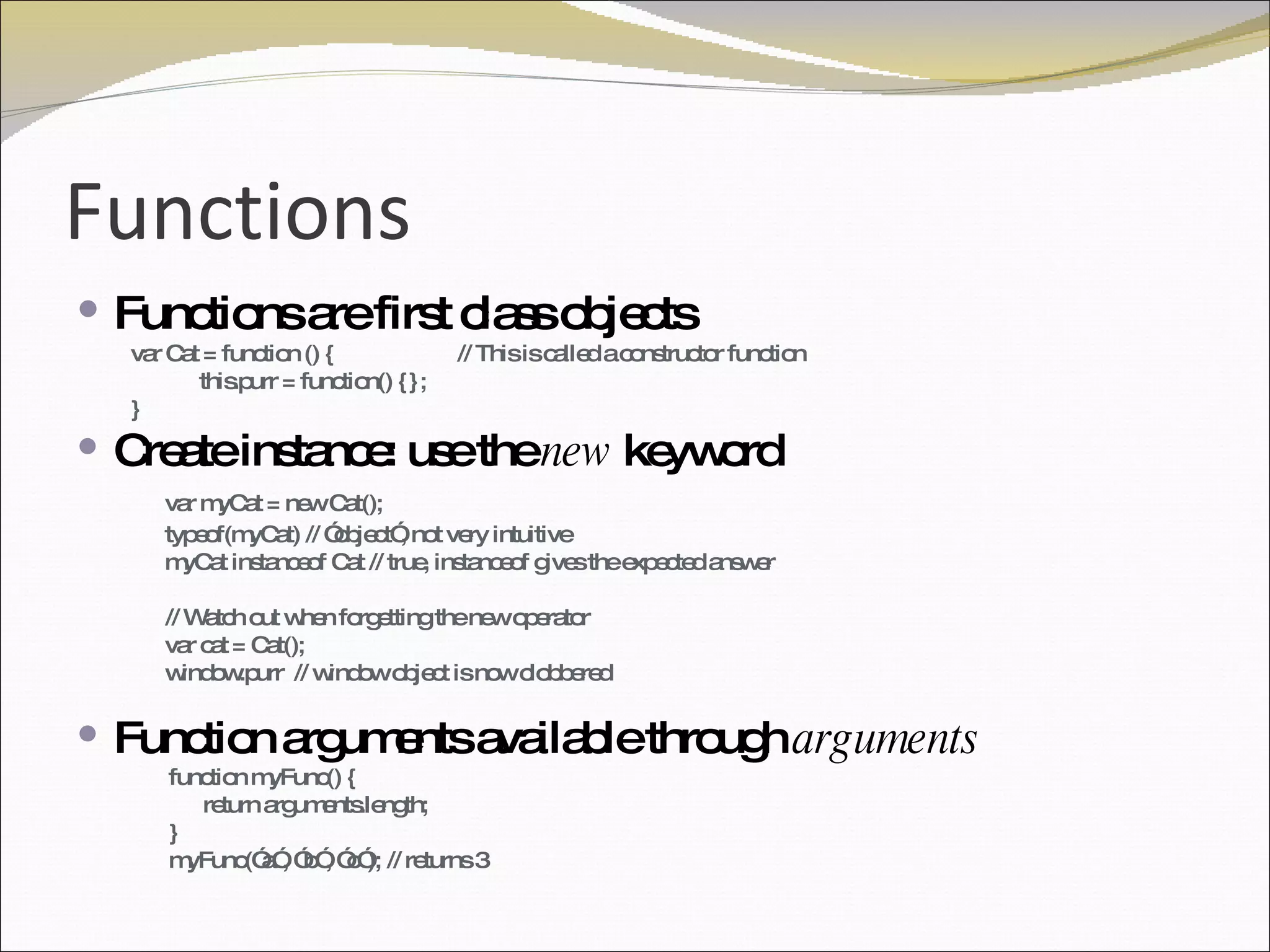
Functions Functions are first class objects  var Cat = function () { // This is called a constructor function this.purr = function() {}; } Create instance: use the  new  keyword var myCat = new Cat();  typeof(myCat) // ”object”, not very intuitive myCat instanceof Cat // true, instanceof gives the expected answer // Watch out when forgetting the new operator var cat = Cat(); window.purr  // window object is now clobbered Function arguments available through  arguments function myFunc() { return arguments.length; } myFunc(”a”, ”b”, ”c”); // returns 3
Objects and arrays Everything that is not a primitive derives from Object window.toString instanceof Object // = true Objects are associative arrays / hashtables var a = { text : 'test'}; a["text"] == a.text // true Testing for object property ” text” in a // true Enumerating object properties for (var o in window) { console.log(o + ':' + window[o]); } Array basics push  : adds an element length  concat  : join 2 arrays join(string) : string represenation of the array split by the argument slice(start, end) : returns elements between args sort ([function]) : sorts by alphabet or by function supplied as arg pop  : extracts last element
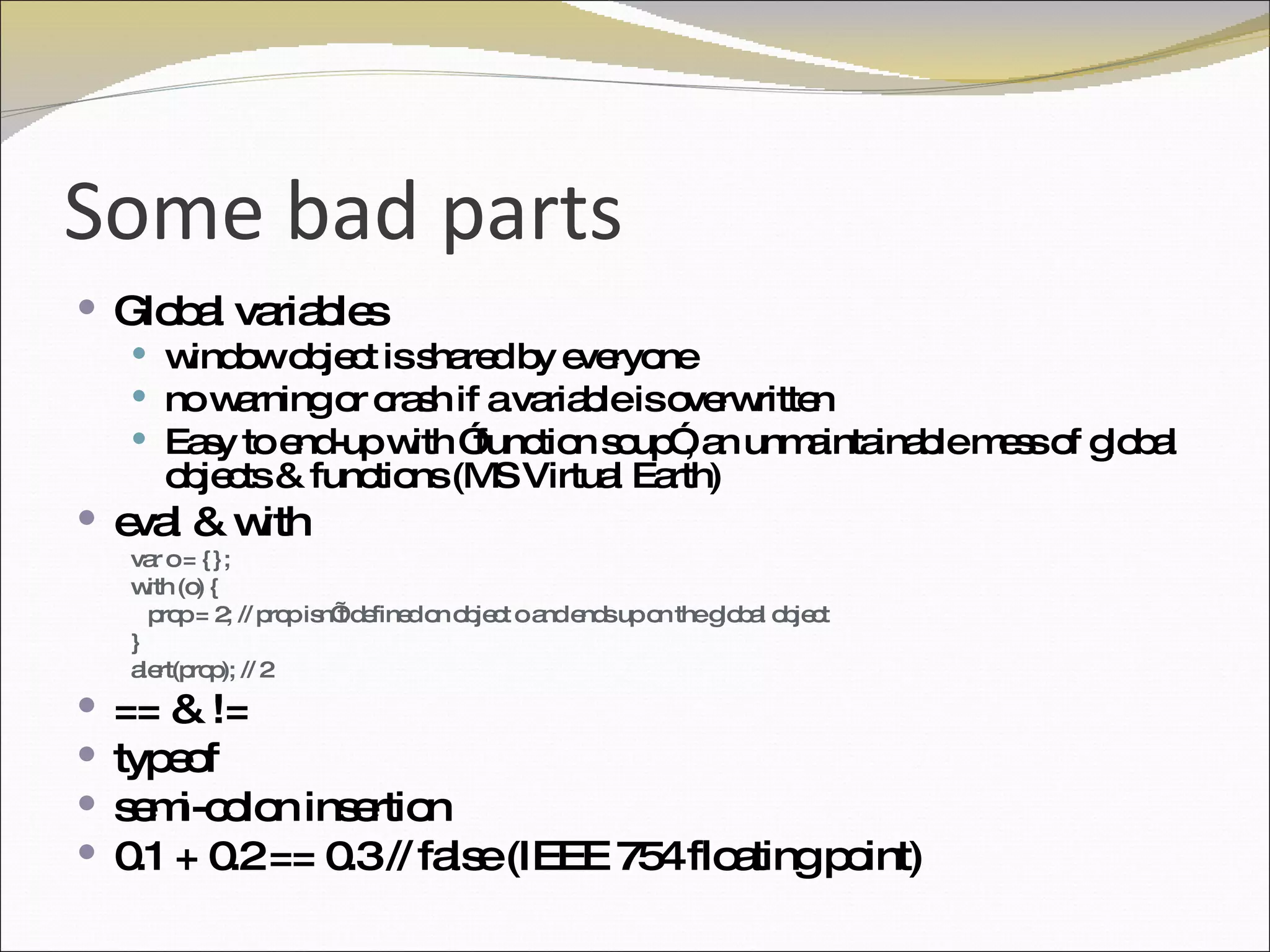
Some bad parts Global variables window object is shared by everyone no warning or crash if a variable is overwritten  Easy to end-up with ”function soup”, an unmaintainable mess of global objects & functions (MS Virtual Earth) eval & with var o = {}; with (o) { prop = 2; // prop isn’t defined on object o and ends up on the global object } alert(prop); // 2 == & != typeof semi-colon insertion 0.1 + 0.2 == 0.3 // false (IEEE 754 floating point)
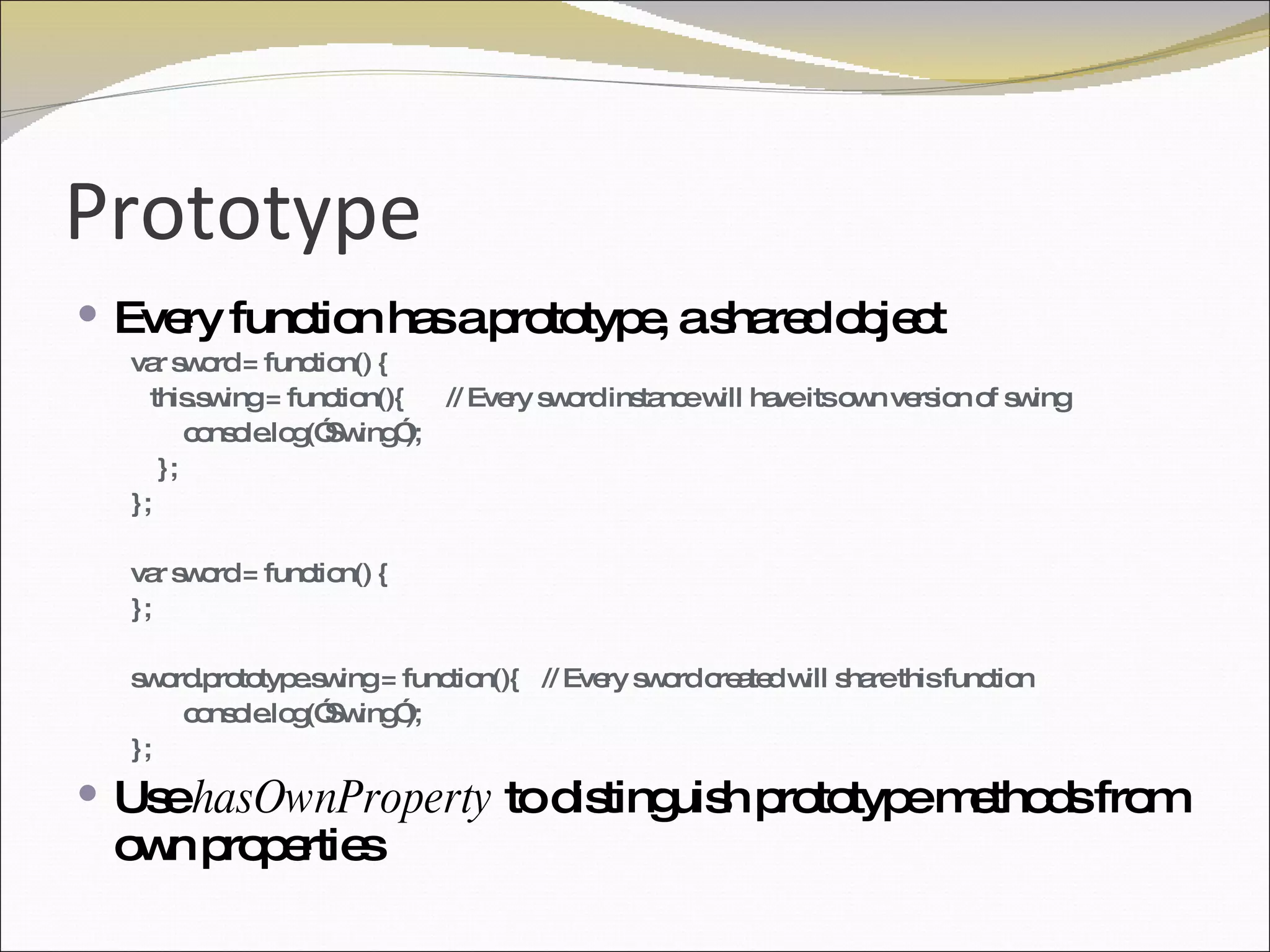
Prototype Every function has a prototype, a shared object var sword = function() { this.swing = function(){  // Every sword instance will have its own version of swing console.log(”Swing”); }; }; var sword = function() { }; sword.prototype.swing = function(){  // Every sword created will share this function console.log(”Swing”); }; Use  hasOwnProperty  to distinguish prototype methods from own properties
Execution Scope Scope is the execution context, the  this  property var obj = { number : 42, showNumber: function () { alert(this.number); } };  obj.showNumber();  // 42 document.body.onclick = obj.showNumber; // clicking the body shows ”undefined” call and apply can bind a new scope to a function var anotherObj = { number : ”blablabla” }; obj.showNumber.call(anotherObj);  // ”blablabla” call (scope, arg1, arg2, ...)  apply(scope, [arg1, arg2, ...])  Variable scope: function scope, not block scope for(var i = 0; i<5;i++) {} alert(i); // 5
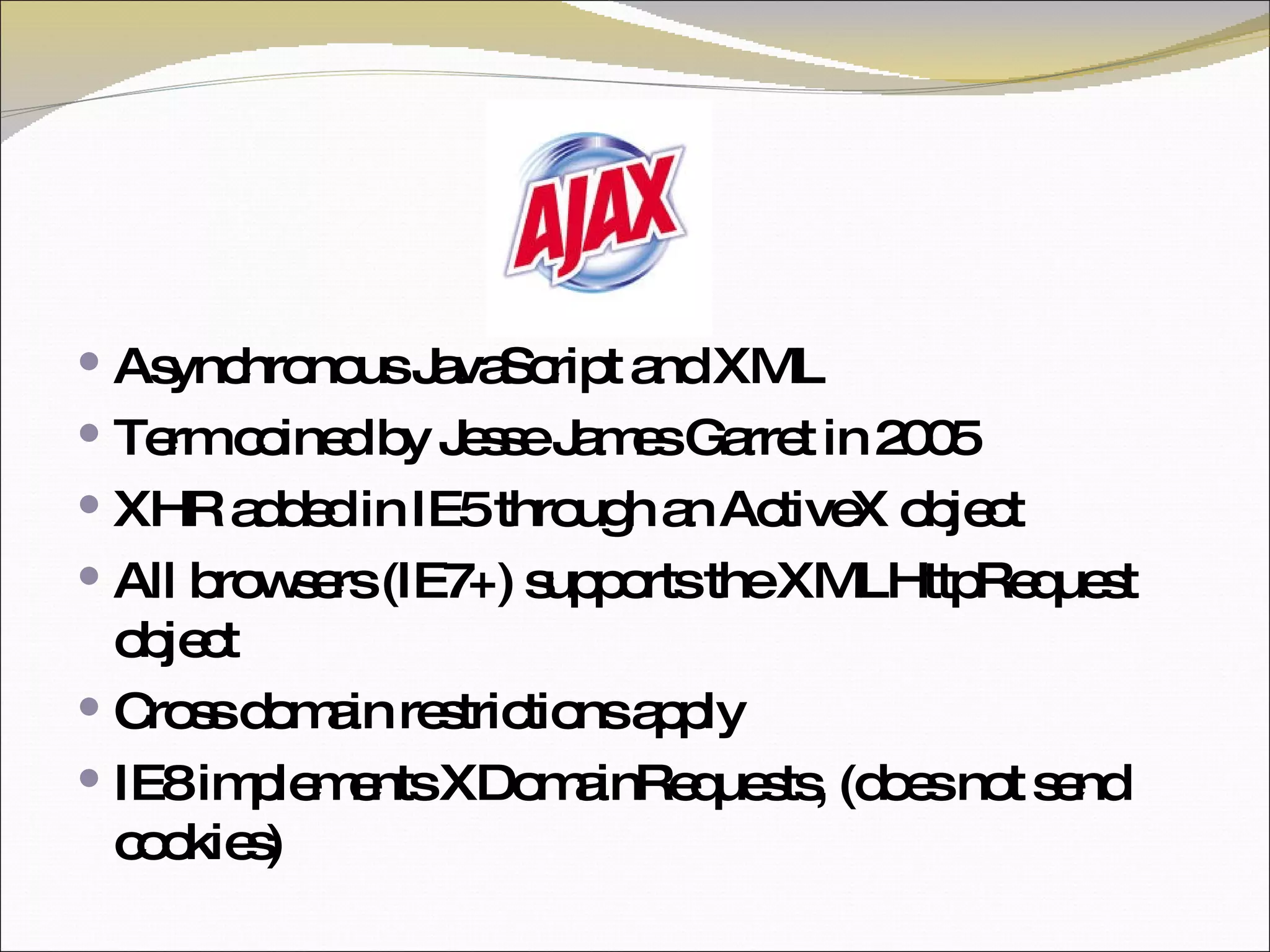
Asynchronous JavaScript and XML Term coined by Jesse James Garret in 2005 XHR added in IE5 through an ActiveX object All browsers (IE7+) supports the XMLHttpRequest object Cross domain restrictions apply IE8 implements XDomainRequests, (does not send cookies)
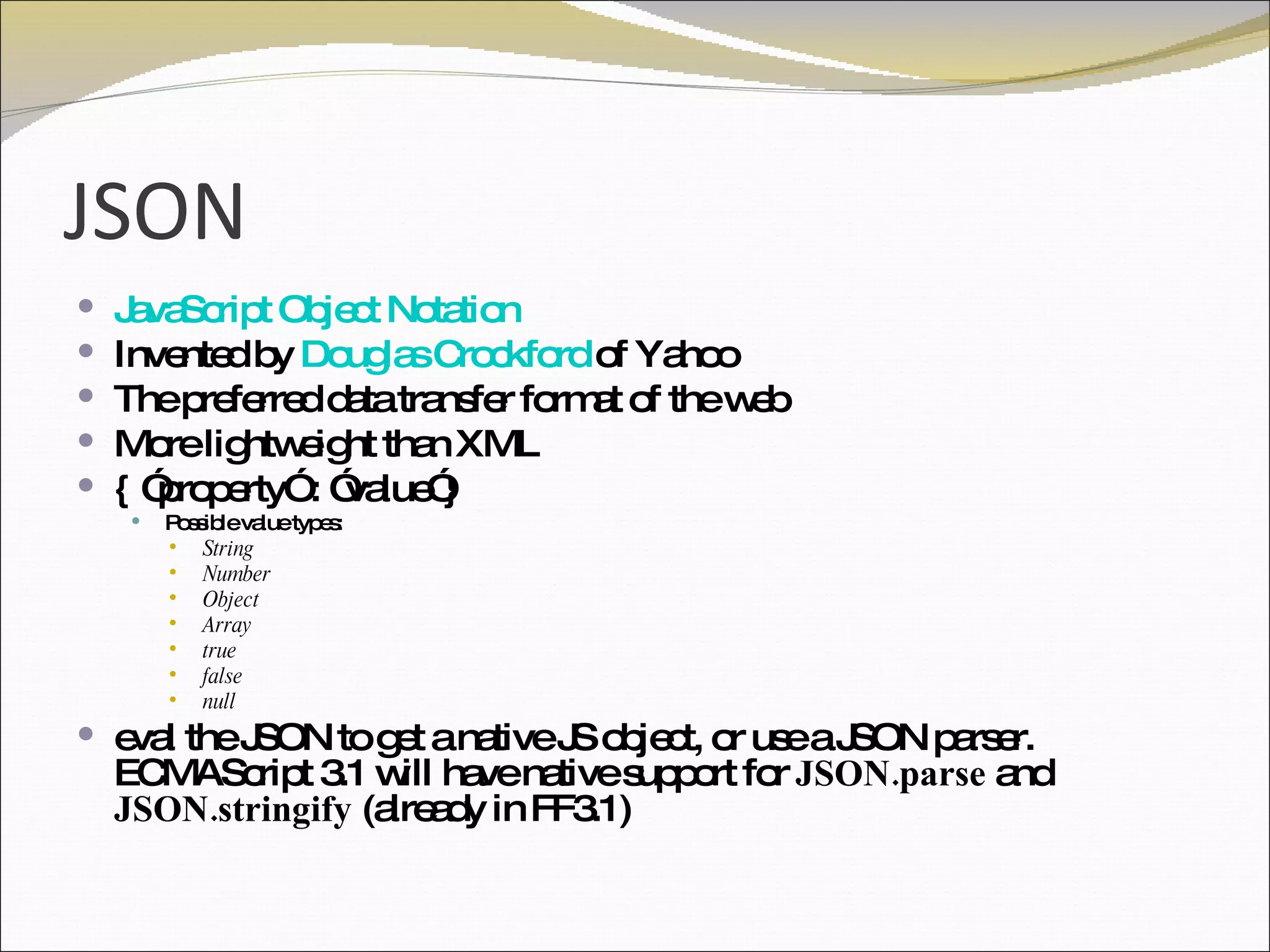
JSON JavaScript Object Notation Invented by  Douglas Crockford  of Yahoo The preferred data transfer format of the web More lightweight than XML { ”property” : ”value”} Possible value types: String Number Object Array true false null eval the JSON to get a native JS object, or use a JSON parser. ECMAScript 3.1 will have native support for  JSON.parse  and  JSON.stringify  (already in FF3.1)
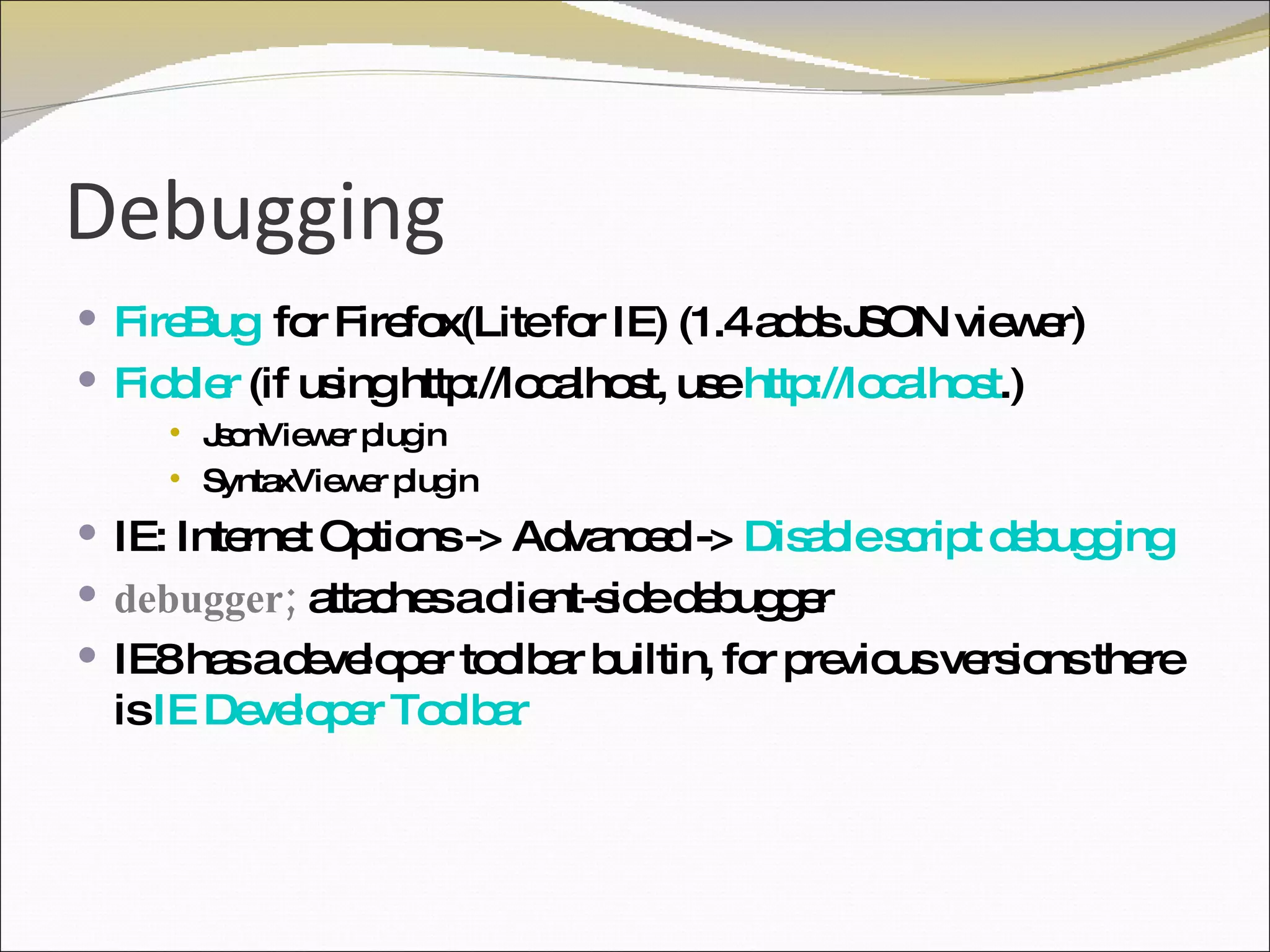
Debugging FireBug   for Firefox(Lite for IE) (1.4 adds JSON viewer) Fiddler  (if using http://localhost, use  http://localhost .) JsonViewer plugin SyntaxViewer plugin IE: Internet Options -> Advanced ->  Disable script debugging debugger;  attaches a client-side debugger IE8 has a developer toolbar builtin, for previous versions there is  IE Developer Toolbar
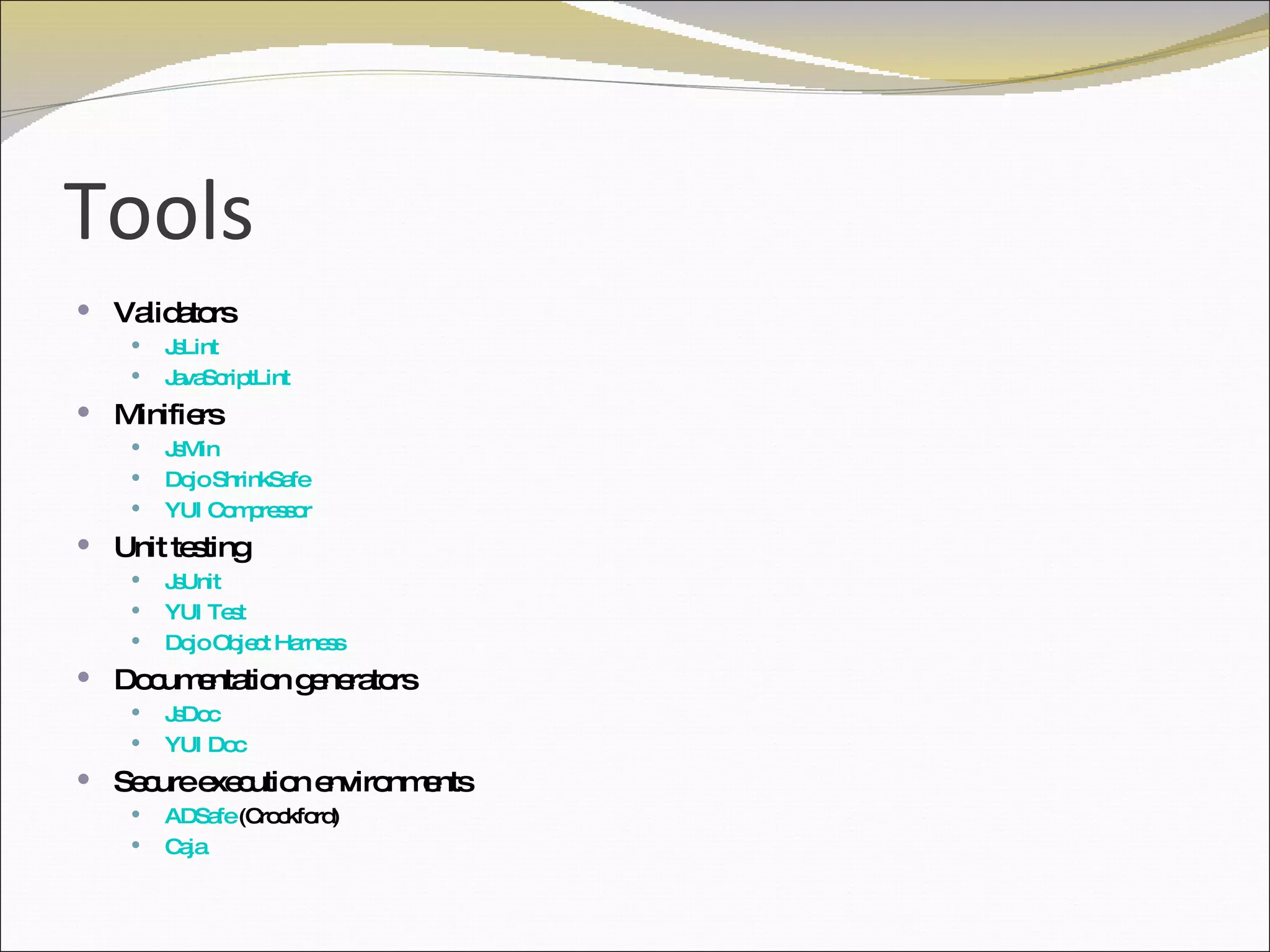
Tools Validators JsLint JavaScriptLint Minifiers JsMin Dojo ShrinkSafe YUI Compressor Unit testing JsUnit YUI Test Dojo Object Harness Documentation generators JsDoc YUI Doc Secure execution environments ADSafe  (Crockford) Caja
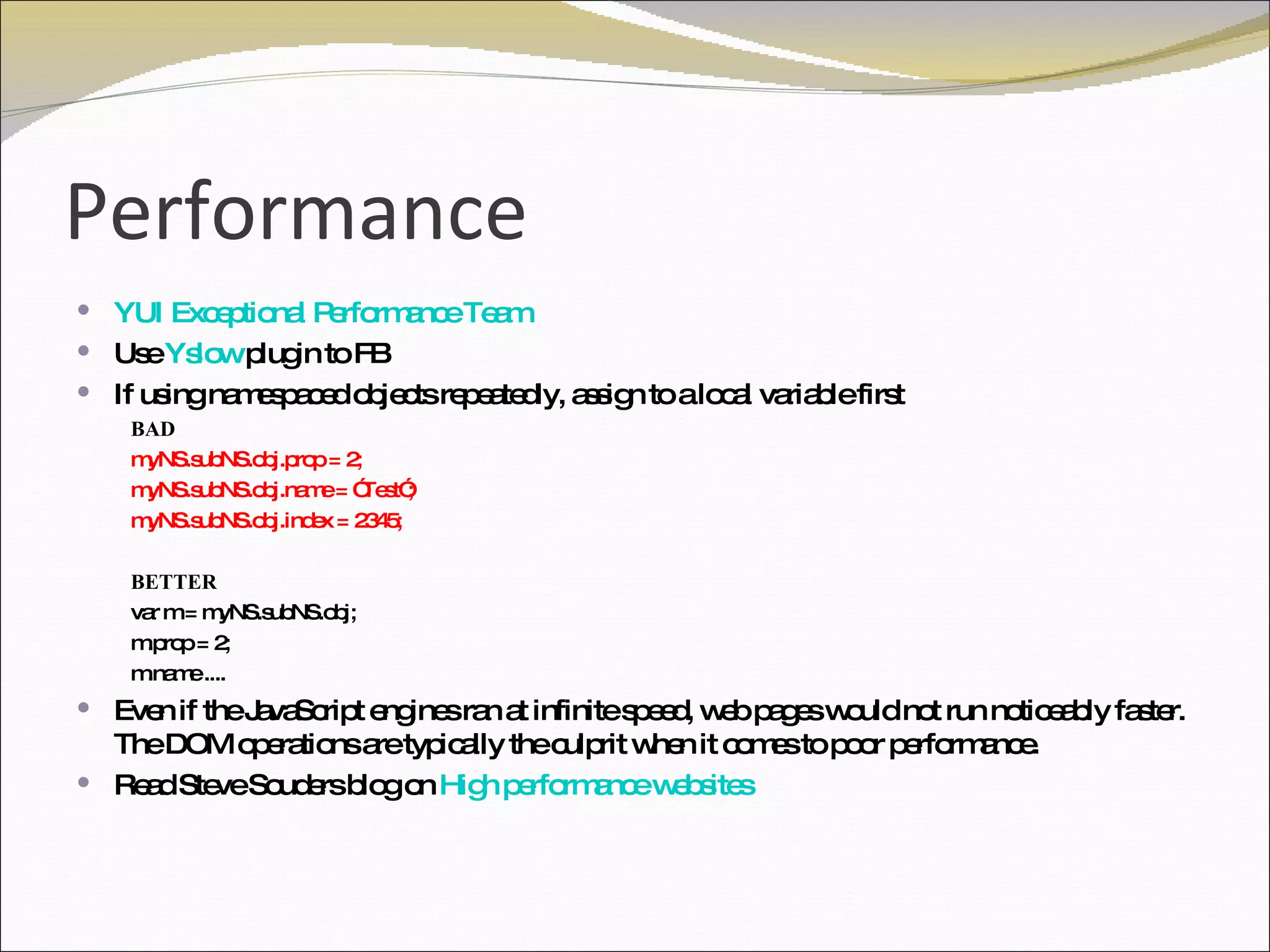
Performance YUI Exceptional Performance Team   Use  Yslow  plugin to FB If using namespaced objects repeatedly, assign to a local variable first BAD myNS.subNS.obj.prop = 2; myNS.subNS.obj.name = ”Test”; myNS.subNS.obj.index = 2345; BETTER var m = myNS.subNS.obj; m.prop = 2; m.name .... Even if the JavaScript engines ran at infinite speed, web pages would not run noticeably faster. The DOM operations are typically the culprit when it comes to poor performance. Read Steve Souders blog on  High performance websites
Events Events handling in the DOM is tricky, browser implementations vary.  Using a JS library that normalizes the event object is very helpful Registering events the old fashioned way (DOM level 0) <a href=&quot;http://www.facebook.com”  onclick =&quot;return fbs_click(this)&quot;>Facebook</a> element.onclick = function() {}  Only one listener can be registered, last listener assigned wins ” Correct” way of doing this W3C : element. addEventListener (’click’, fn, [executeInCapturePhase]) IE : element. attachEvent ('onclick', fn)  // flawed (this points to window in fn, useless)
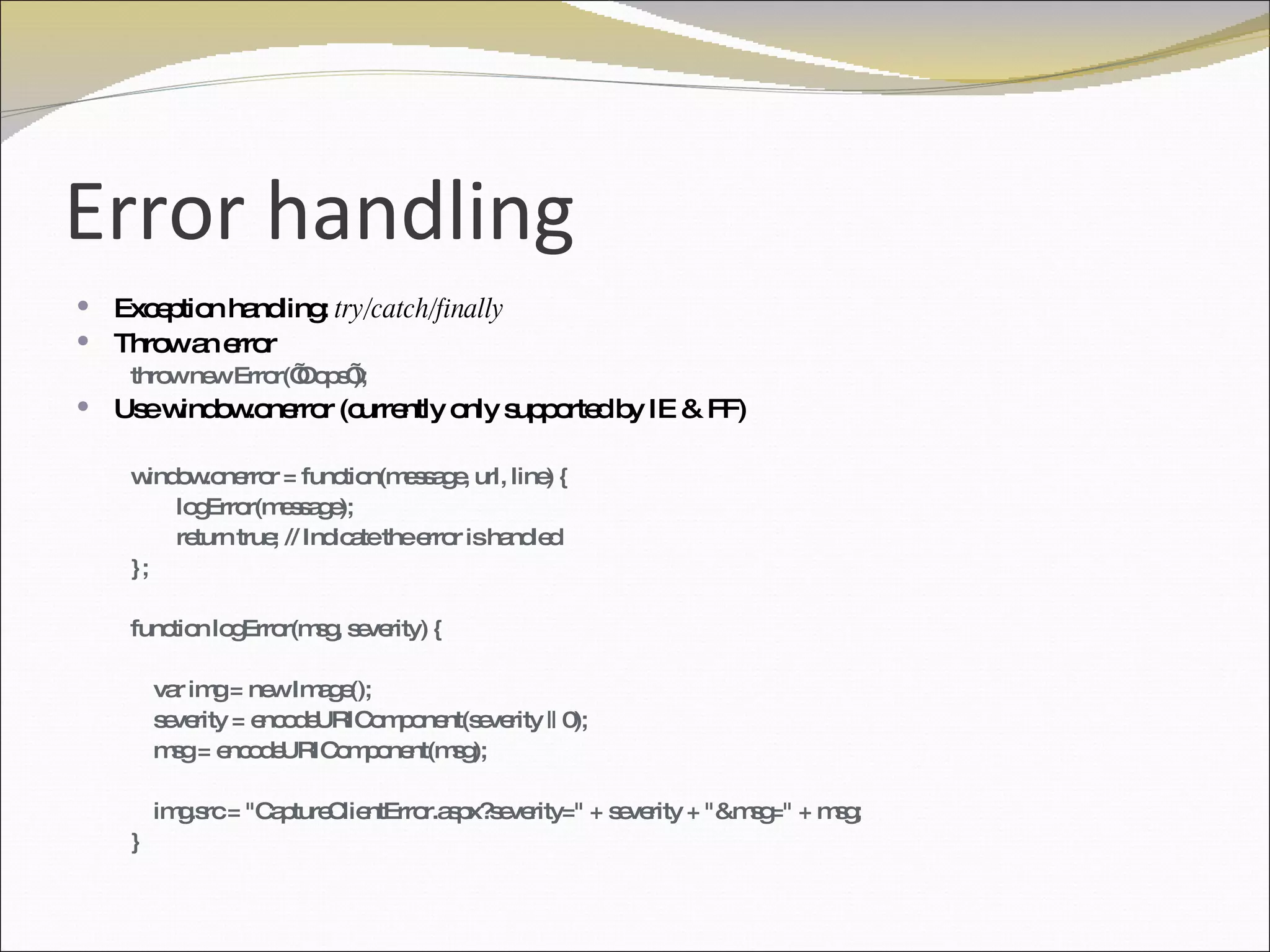
Error handling Exception handling:  try/catch/finally Throw an error  throw new Error(’Oops’); Use window.onerror (currently only supported by IE & FF) window.onerror = function(message, url, line) {  logError(message); return true; // Indicate the error is handled }; function logError(msg, severity) { var img = new Image(); severity = encodeURIComponent(severity || 0); msg = encodeURIComponent(msg); img.src = &quot;CaptureClientError.aspx?severity=&quot; + severity + &quot;&msg=&quot; + msg; }
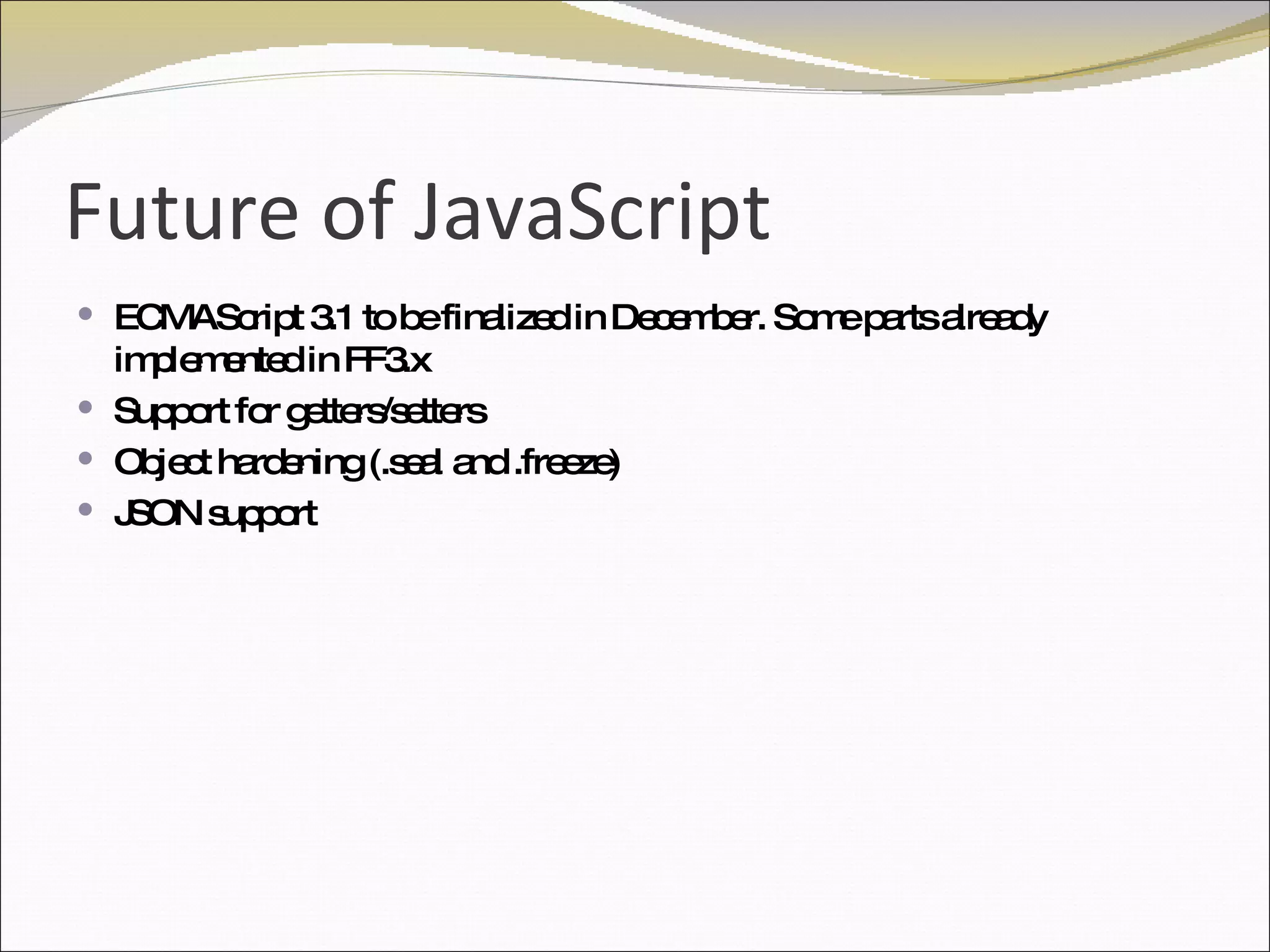
Future of JavaScript ECMAScript 3.1 to be finalized in December. Some parts already implemented in FF3.x Support for getters/setters Object hardening (.seal and .freeze) JSON support
Questions? [email_address]

JavaScript Basics

  • 1.
  • 2.
    Contents What isJavaScript JavaScript Basics Functions Objects Bad parts Prototype Scope Ajax JSON Debugging Tools Performance Events Error handling Future of JavaScript
  • 3.
    What is JavaScriptECMAScript Current version in browsers is ECMA-262 edition 3, 3.1 to be finalized in December 2009 http://www.ecma-international.org Not tied to web browsers DOM – Document object model API for working with XML/HTML, 3 levels (level 1 became W3C recommendation in October 1998) http://www.w3.org/DOM/ BOM ( Browser object model) navigator, location, screen, XMLHttpRequest, ActiveXObject... No backing standard ECMAScript DOM BOM JavaScript - The worlds most popular programming language..?
  • 4.
    JavaScript overview JavaScriptis a class-free , object-oriented language Dynamic language, you can change any object at any time Prototypal inheritance (inherit from objects) Lamda functions (or ’anonymous’ functions) 5 primitive types: number string boolean null undefined Loosely typed language var a = 2; a === &quot;2&quot; // false a = &quot;2&quot;; // a is now a string a === &quot;2&quot; // true
  • 5.
    Functions Functions arefirst class objects var Cat = function () { // This is called a constructor function this.purr = function() {}; } Create instance: use the new keyword var myCat = new Cat(); typeof(myCat) // ”object”, not very intuitive myCat instanceof Cat // true, instanceof gives the expected answer // Watch out when forgetting the new operator var cat = Cat(); window.purr // window object is now clobbered Function arguments available through arguments function myFunc() { return arguments.length; } myFunc(”a”, ”b”, ”c”); // returns 3
  • 6.
    Objects and arraysEverything that is not a primitive derives from Object window.toString instanceof Object // = true Objects are associative arrays / hashtables var a = { text : 'test'}; a[&quot;text&quot;] == a.text // true Testing for object property ” text” in a // true Enumerating object properties for (var o in window) { console.log(o + ':' + window[o]); } Array basics push : adds an element length concat : join 2 arrays join(string) : string represenation of the array split by the argument slice(start, end) : returns elements between args sort ([function]) : sorts by alphabet or by function supplied as arg pop : extracts last element
  • 7.
    Some bad partsGlobal variables window object is shared by everyone no warning or crash if a variable is overwritten Easy to end-up with ”function soup”, an unmaintainable mess of global objects & functions (MS Virtual Earth) eval & with var o = {}; with (o) { prop = 2; // prop isn’t defined on object o and ends up on the global object } alert(prop); // 2 == & != typeof semi-colon insertion 0.1 + 0.2 == 0.3 // false (IEEE 754 floating point)
  • 8.
    Prototype Every functionhas a prototype, a shared object var sword = function() { this.swing = function(){ // Every sword instance will have its own version of swing console.log(”Swing”); }; }; var sword = function() { }; sword.prototype.swing = function(){ // Every sword created will share this function console.log(”Swing”); }; Use hasOwnProperty to distinguish prototype methods from own properties
  • 9.
    Execution Scope Scopeis the execution context, the this property var obj = { number : 42, showNumber: function () { alert(this.number); } }; obj.showNumber(); // 42 document.body.onclick = obj.showNumber; // clicking the body shows ”undefined” call and apply can bind a new scope to a function var anotherObj = { number : ”blablabla” }; obj.showNumber.call(anotherObj); // ”blablabla” call (scope, arg1, arg2, ...) apply(scope, [arg1, arg2, ...]) Variable scope: function scope, not block scope for(var i = 0; i<5;i++) {} alert(i); // 5
  • 10.
    Asynchronous JavaScript andXML Term coined by Jesse James Garret in 2005 XHR added in IE5 through an ActiveX object All browsers (IE7+) supports the XMLHttpRequest object Cross domain restrictions apply IE8 implements XDomainRequests, (does not send cookies)
  • 11.
    JSON JavaScript ObjectNotation Invented by Douglas Crockford of Yahoo The preferred data transfer format of the web More lightweight than XML { ”property” : ”value”} Possible value types: String Number Object Array true false null eval the JSON to get a native JS object, or use a JSON parser. ECMAScript 3.1 will have native support for JSON.parse and JSON.stringify (already in FF3.1)
  • 12.
    Debugging FireBug for Firefox(Lite for IE) (1.4 adds JSON viewer) Fiddler (if using http://localhost, use http://localhost .) JsonViewer plugin SyntaxViewer plugin IE: Internet Options -> Advanced -> Disable script debugging debugger; attaches a client-side debugger IE8 has a developer toolbar builtin, for previous versions there is IE Developer Toolbar
  • 13.
    Tools Validators JsLintJavaScriptLint Minifiers JsMin Dojo ShrinkSafe YUI Compressor Unit testing JsUnit YUI Test Dojo Object Harness Documentation generators JsDoc YUI Doc Secure execution environments ADSafe (Crockford) Caja
  • 14.
    Performance YUI ExceptionalPerformance Team Use Yslow plugin to FB If using namespaced objects repeatedly, assign to a local variable first BAD myNS.subNS.obj.prop = 2; myNS.subNS.obj.name = ”Test”; myNS.subNS.obj.index = 2345; BETTER var m = myNS.subNS.obj; m.prop = 2; m.name .... Even if the JavaScript engines ran at infinite speed, web pages would not run noticeably faster. The DOM operations are typically the culprit when it comes to poor performance. Read Steve Souders blog on High performance websites
  • 15.
    Events Events handlingin the DOM is tricky, browser implementations vary. Using a JS library that normalizes the event object is very helpful Registering events the old fashioned way (DOM level 0) <a href=&quot;http://www.facebook.com” onclick =&quot;return fbs_click(this)&quot;>Facebook</a> element.onclick = function() {} Only one listener can be registered, last listener assigned wins ” Correct” way of doing this W3C : element. addEventListener (’click’, fn, [executeInCapturePhase]) IE : element. attachEvent ('onclick', fn) // flawed (this points to window in fn, useless)
  • 16.
    Error handling Exceptionhandling: try/catch/finally Throw an error throw new Error(’Oops’); Use window.onerror (currently only supported by IE & FF) window.onerror = function(message, url, line) { logError(message); return true; // Indicate the error is handled }; function logError(msg, severity) { var img = new Image(); severity = encodeURIComponent(severity || 0); msg = encodeURIComponent(msg); img.src = &quot;CaptureClientError.aspx?severity=&quot; + severity + &quot;&msg=&quot; + msg; }
  • 17.
    Future of JavaScriptECMAScript 3.1 to be finalized in December. Some parts already implemented in FF3.x Support for getters/setters Object hardening (.seal and .freeze) JSON support
  • 18.