JAVA-Hibernate(ORM
Implementation Tool)
By
Javawithease
Intro to HibernateIntro to Hibernate
 "Hibernate is an object/relational mapping tool for Java
environments. The term object/relational mapping (ORM)
refers to the technique of mapping a data representation
from an object model to a relational data model with a
SQL-based schema." -- Preface Hibernate
Documentation
 Hibernate supports many different relational databases.
 Many other open source tools use Hibernate as their
persistence layer.
 Hibernate includes tools to make O/R persistence an
integrated part of the build process.
Intro to Hibernate: ObjectivesIntro to Hibernate: Objectives
This presentation will consist of some
background information on Hibernate and
some complete examples that show the
basic functionality of Hibernate.
Obviously there is more than one way to use
Hibernate.
Hibernate BasicsHibernate Basics
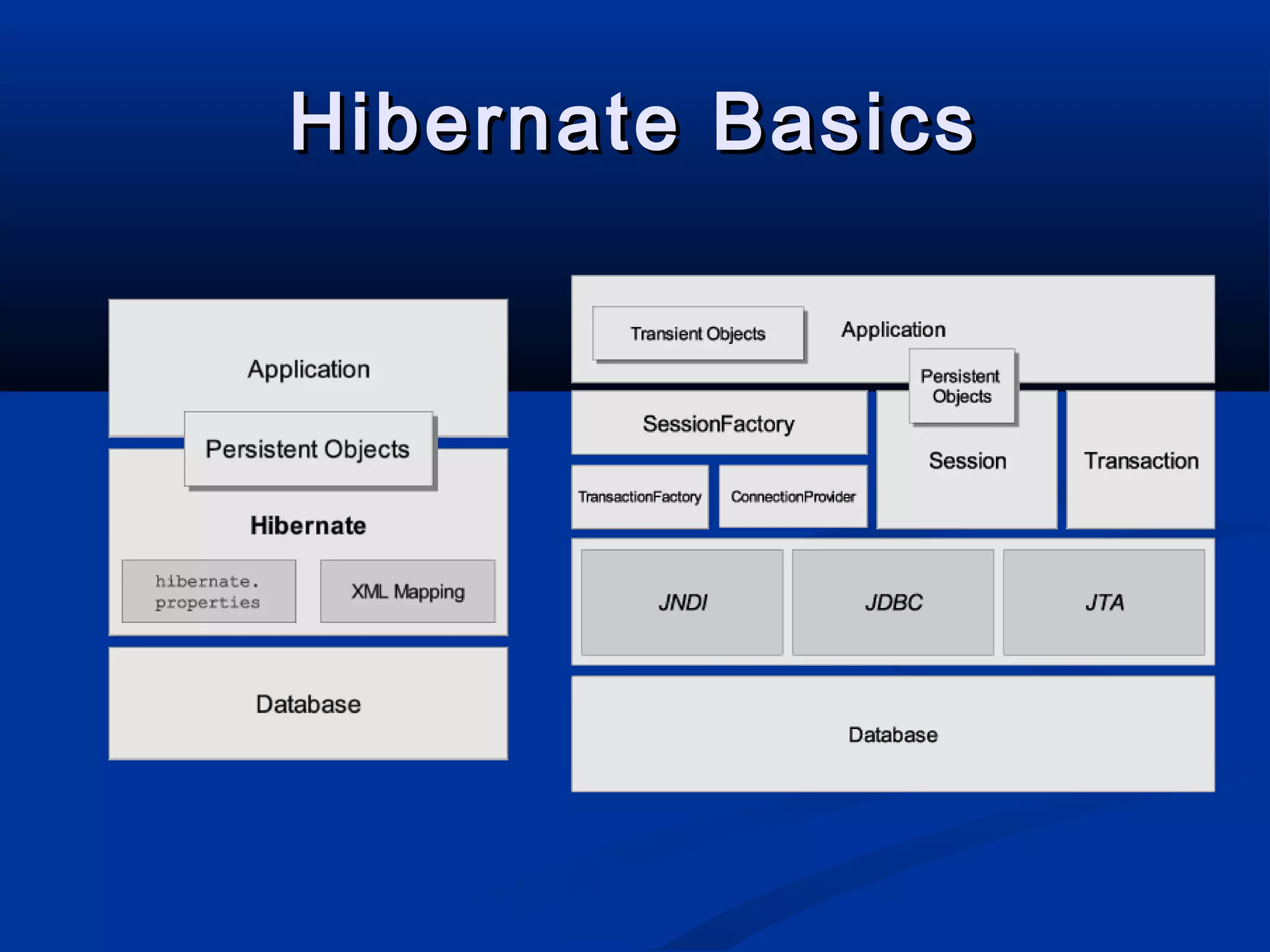
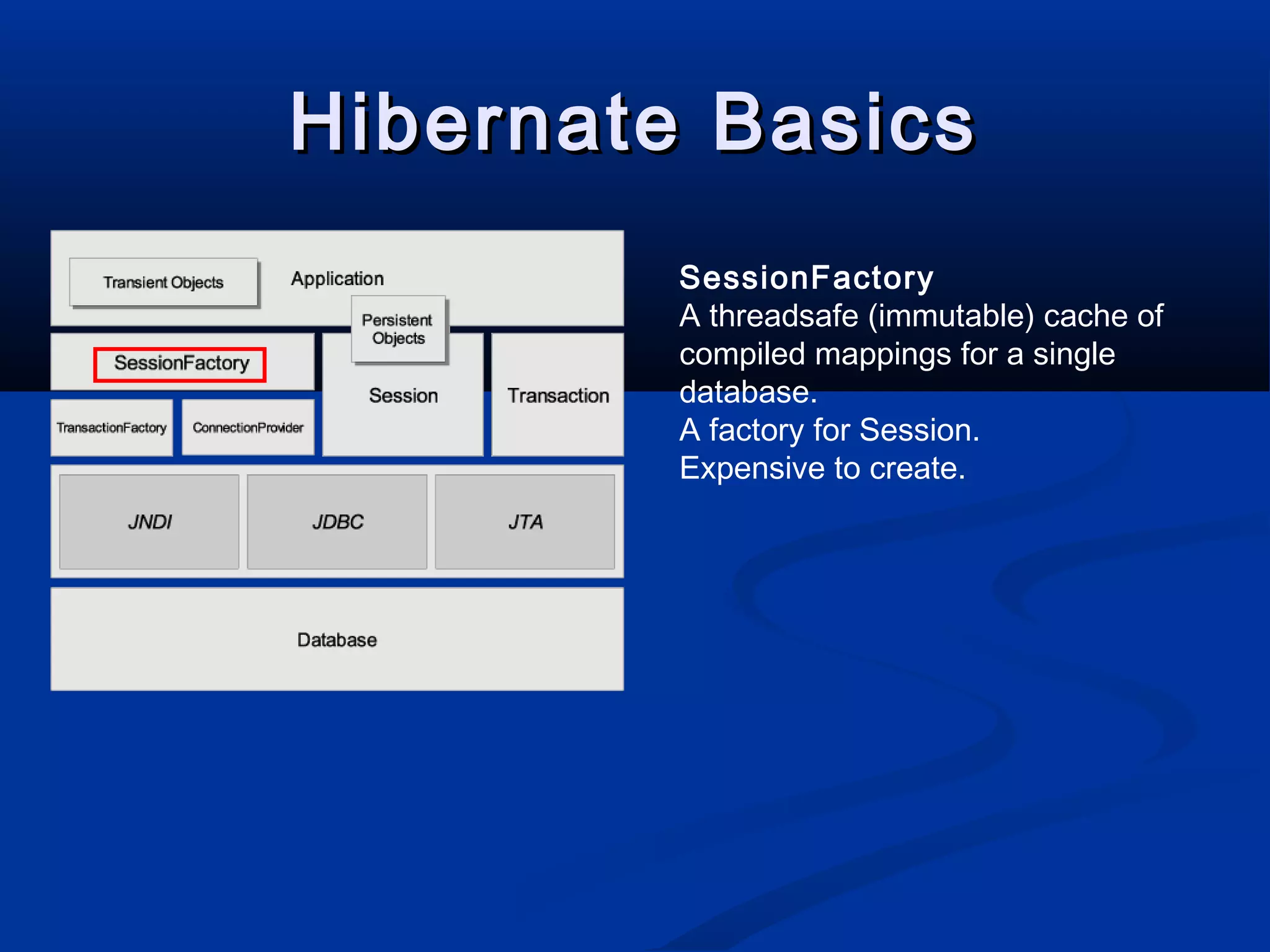
SessionFactory
A threadsafe (immutable) cache of
compiled mappings for a single
database.
A factory for Session.
Expensive to create.
Hibernate BasicsHibernate Basics
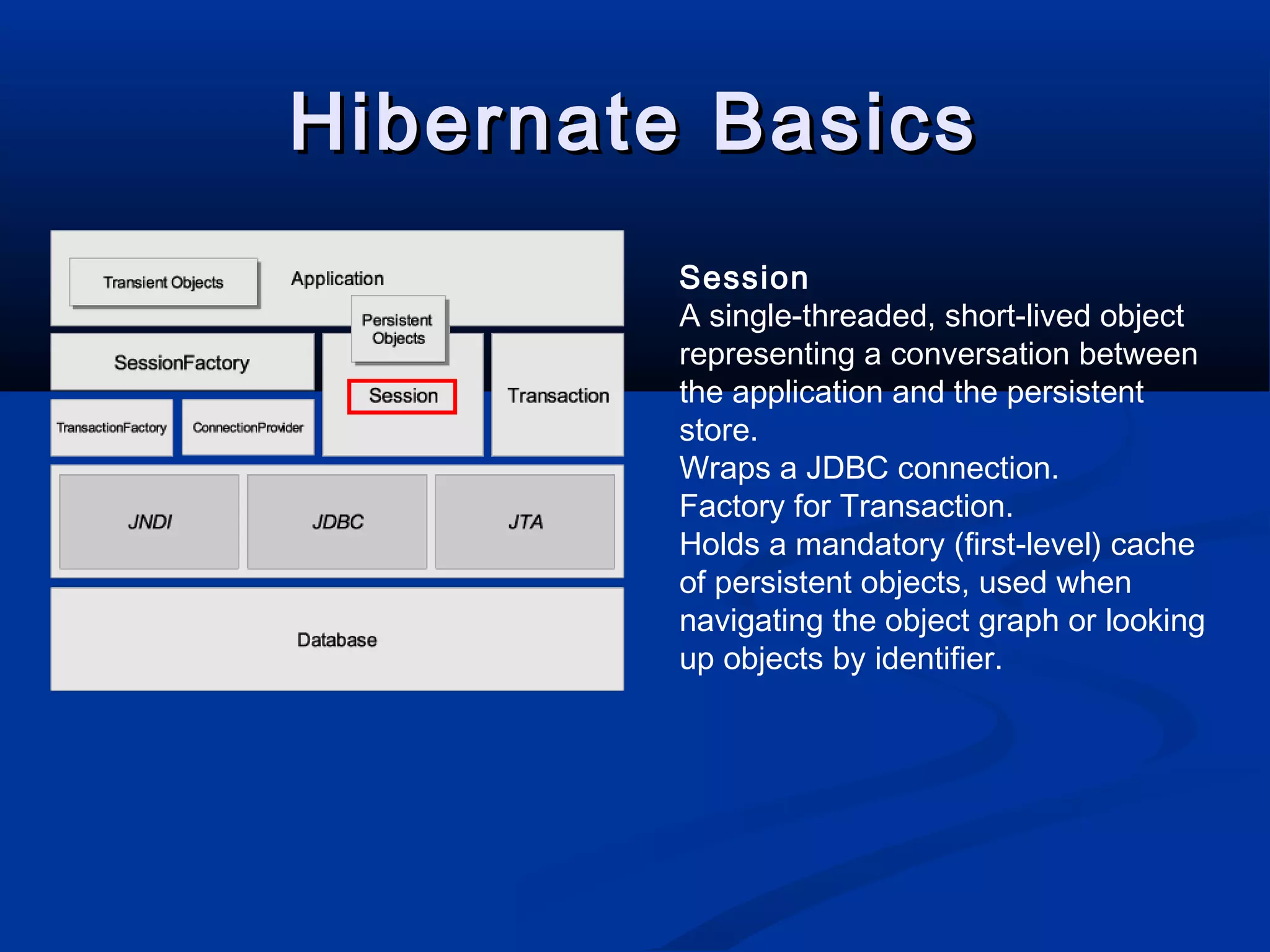
Session
A single-threaded, short-lived object
representing a conversation between
the application and the persistent
store.
Wraps a JDBC connection.
Factory for Transaction.
Holds a mandatory (first-level) cache
of persistent objects, used when
navigating the object graph or looking
up objects by identifier.
Hibernate BasicsHibernate Basics
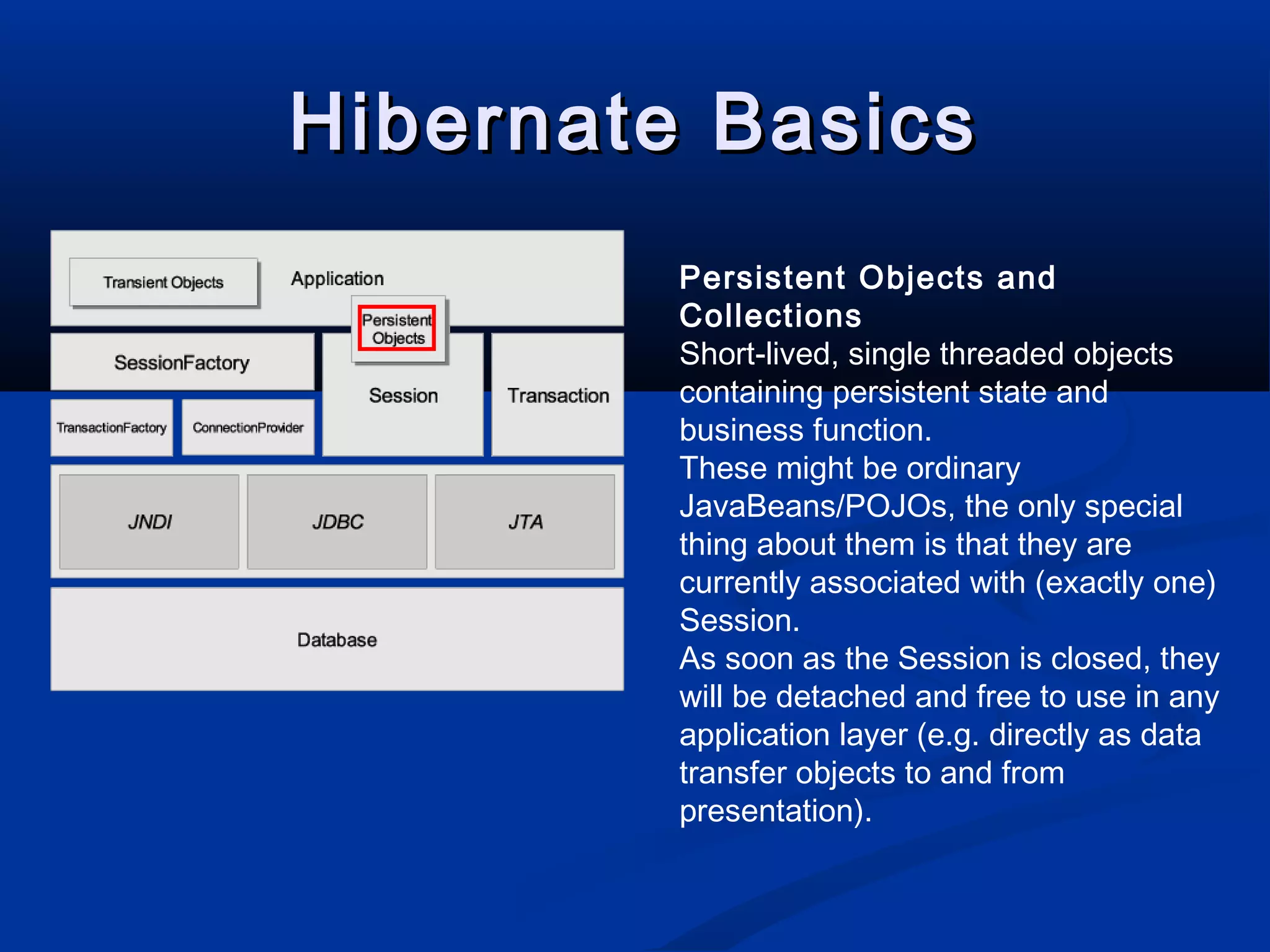
Persistent Objects and
Collections
Short-lived, single threaded objects
containing persistent state and
business function.
These might be ordinary
JavaBeans/POJOs, the only special
thing about them is that they are
currently associated with (exactly one)
Session.
As soon as the Session is closed, they
will be detached and free to use in any
application layer (e.g. directly as data
transfer objects to and from
presentation).
Hibernate BasicsHibernate Basics
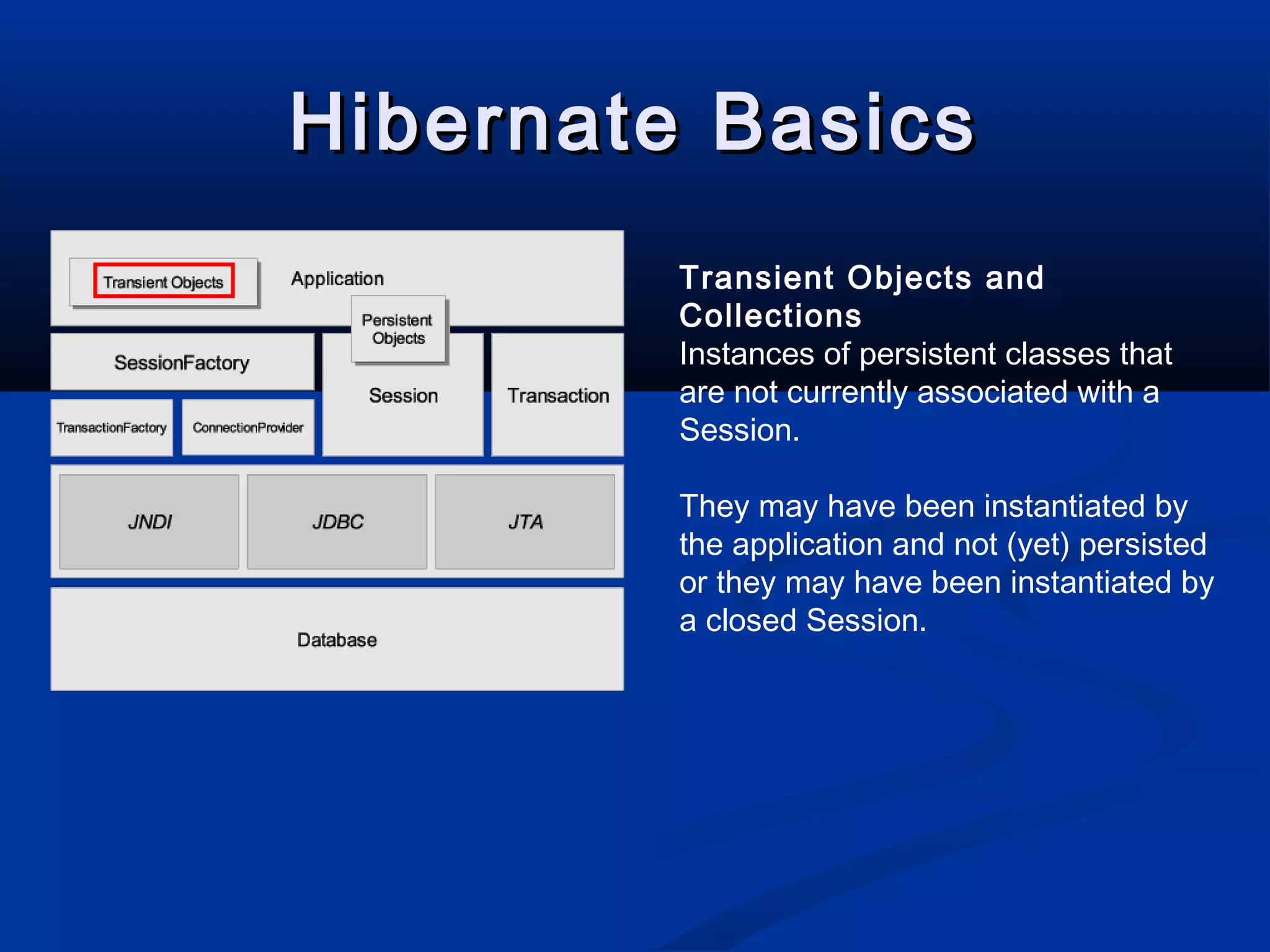
Transient Objects and
Collections
Instances of persistent classes that
are not currently associated with a
Session.
They may have been instantiated by
the application and not (yet) persisted
or they may have been instantiated by
a closed Session.
Hibernate BasicsHibernate Basics
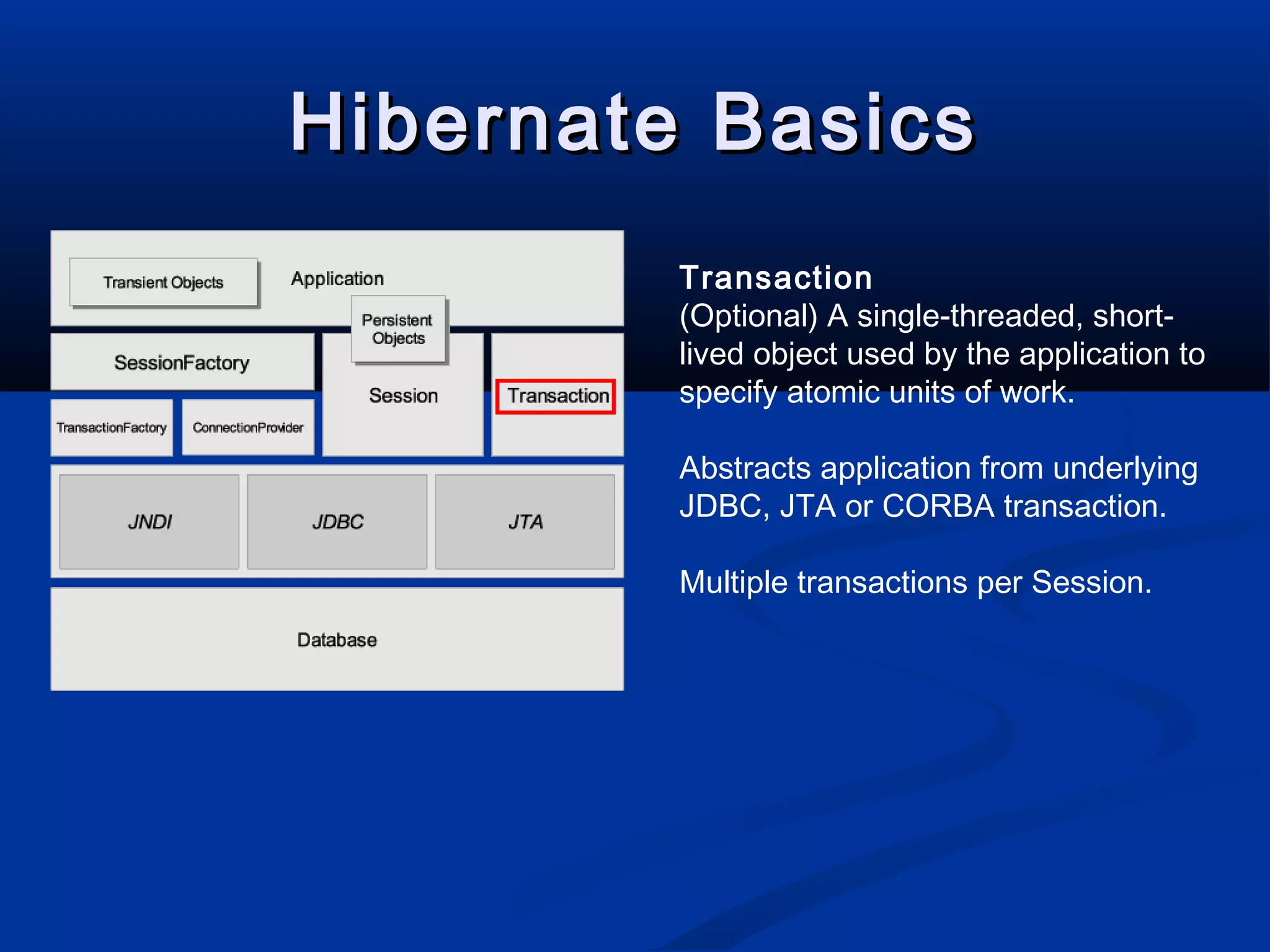
Transaction
(Optional) A single-threaded, short-
lived object used by the application to
specify atomic units of work.
Abstracts application from underlying
JDBC, JTA or CORBA transaction.
Multiple transactions per Session.
Hibernate BasicsHibernate Basics
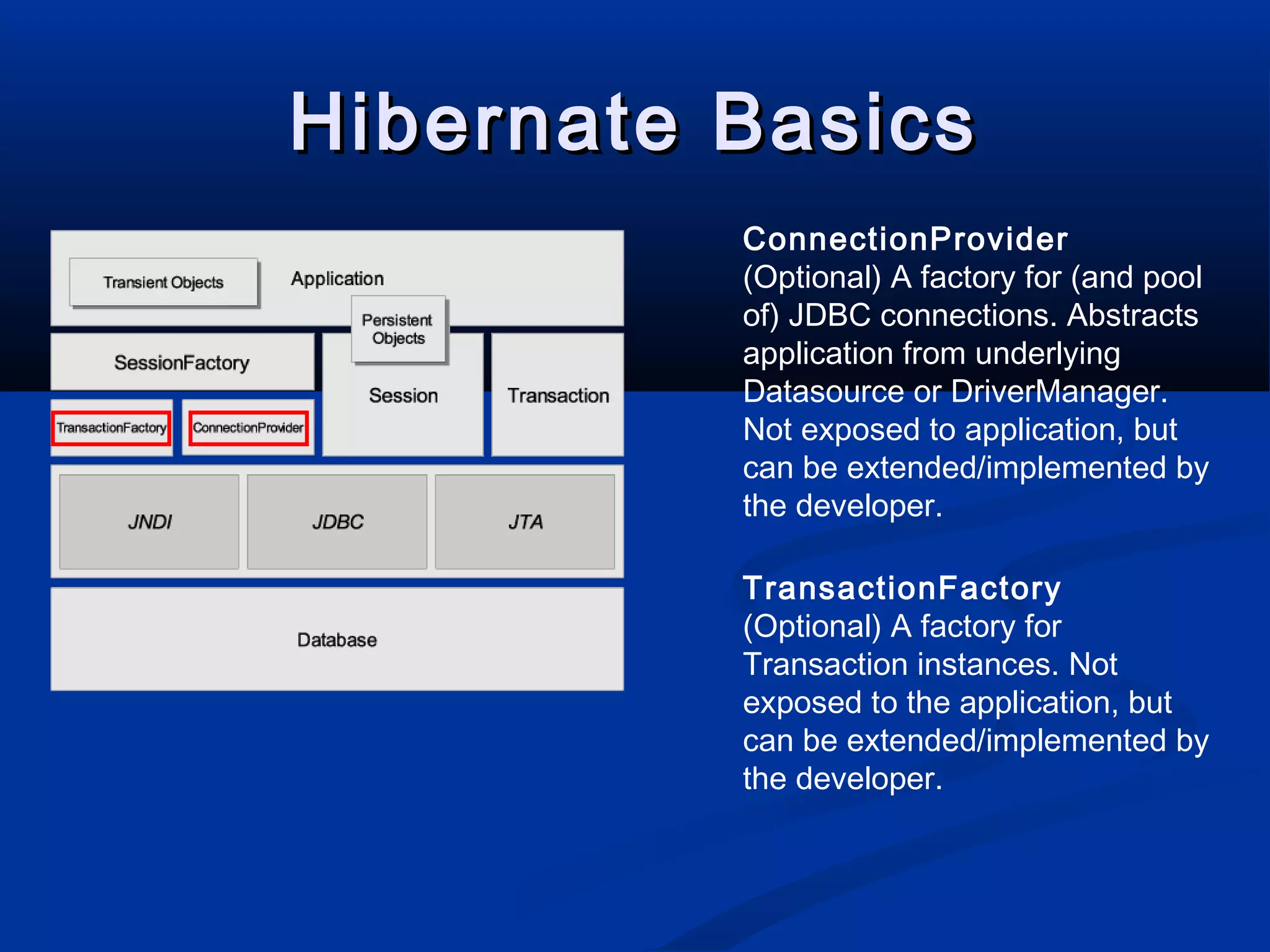
ConnectionProvider
(Optional) A factory for (and pool
of) JDBC connections. Abstracts
application from underlying
Datasource or DriverManager.
Not exposed to application, but
can be extended/implemented by
the developer.
TransactionFactory
(Optional) A factory for
Transaction instances. Not
exposed to the application, but
can be extended/implemented by
the developer.
Hibernate ToolsHibernate Tools
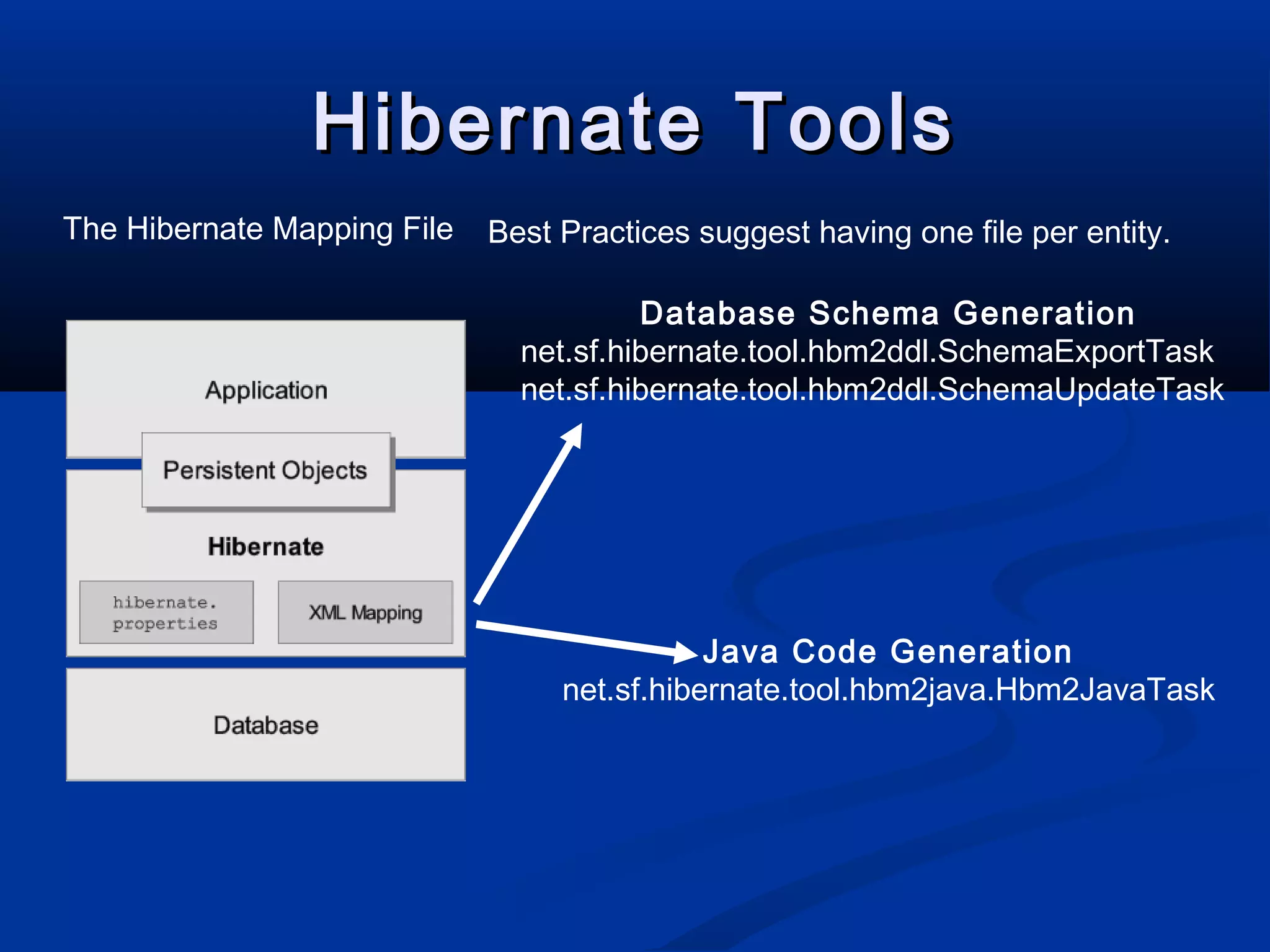
The Hibernate Mapping File
Database Schema Generation
net.sf.hibernate.tool.hbm2ddl.SchemaExportTask
net.sf.hibernate.tool.hbm2ddl.SchemaUpdateTask
Best Practices suggest having one file per entity.
Java Code Generation
net.sf.hibernate.tool.hbm2java.Hbm2JavaTask
Hibernate ToolsHibernate Tools
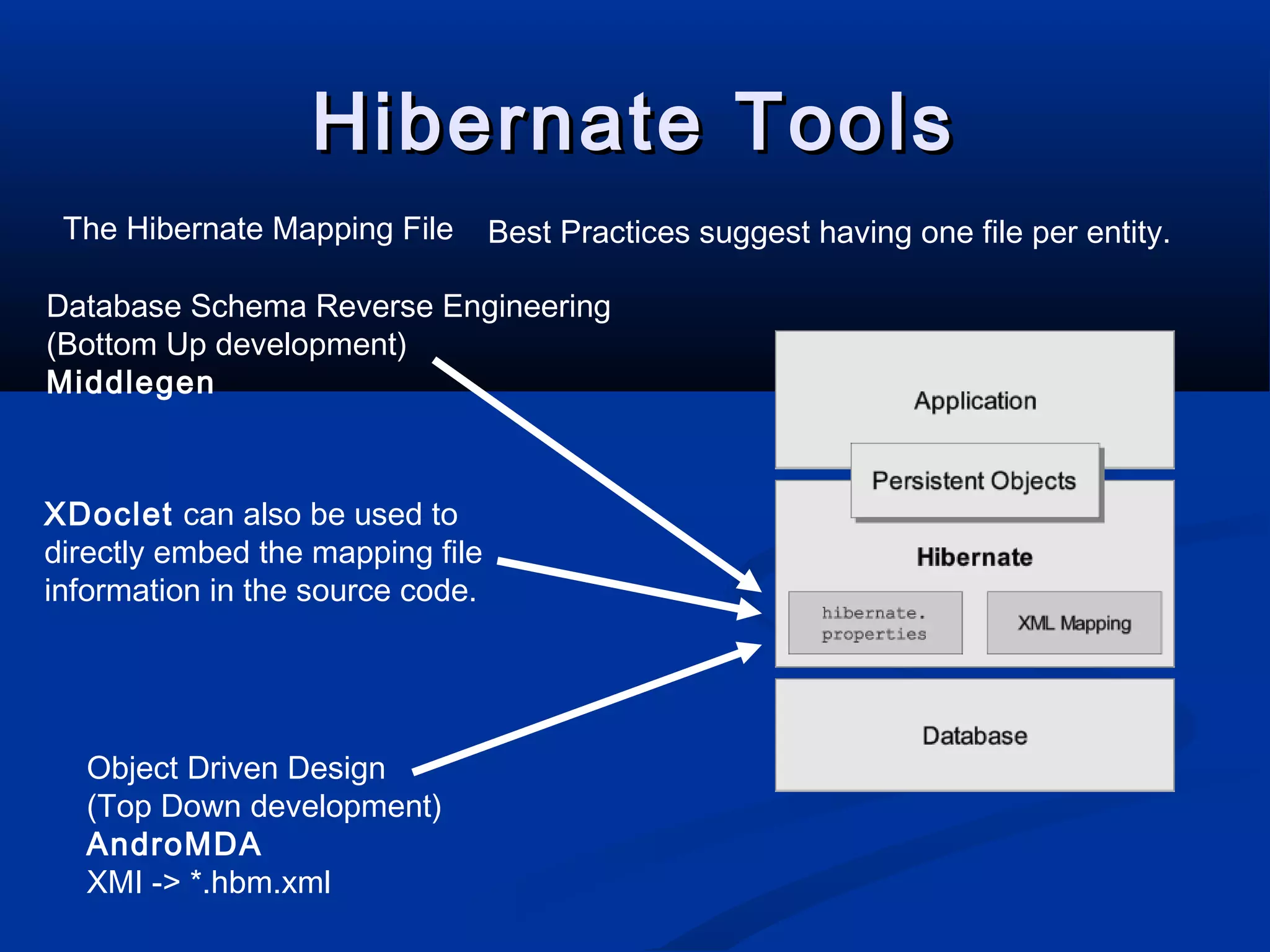
The Hibernate Mapping File Best Practices suggest having one file per entity.
Database Schema Reverse Engineering
(Bottom Up development)
Middlegen
Object Driven Design
(Top Down development)
AndroMDA
XMI -> *.hbm.xml
XDoclet can also be used to
directly embed the mapping file
information in the source code.
Hibernate ConfigurationHibernate Configuration
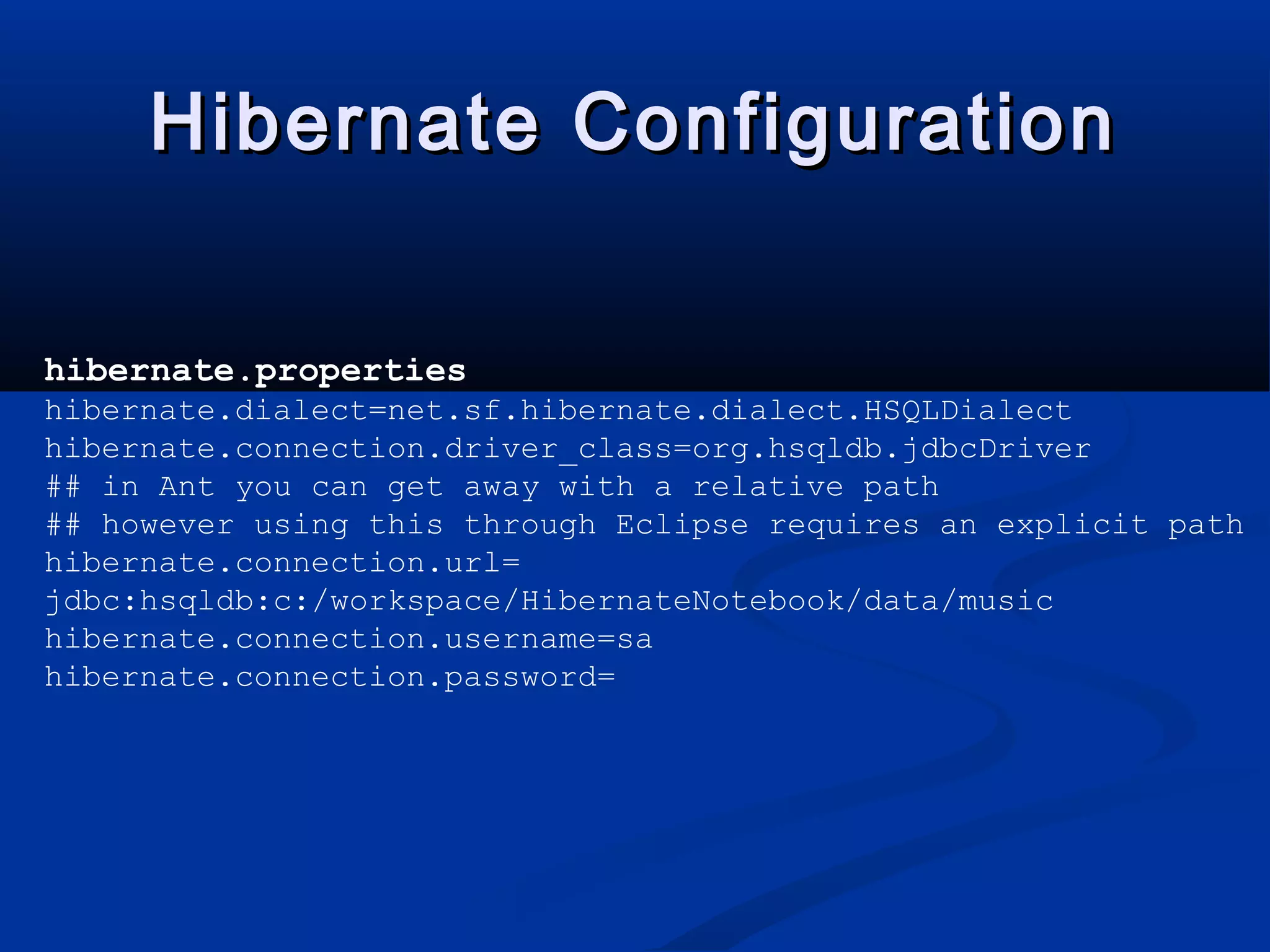
hibernate.properties
hibernate.dialect=net.sf.hibernate.dialect.HSQLDialect
hibernate.connection.driver_class=org.hsqldb.jdbcDriver
## in Ant you can get away with a relative path
## however using this through Eclipse requires an explicit path
hibernate.connection.url=
jdbc:hsqldb:c:/workspace/HibernateNotebook/data/music
hibernate.connection.username=sa
hibernate.connection.password=
Hibernate ConfigurationHibernate Configuration
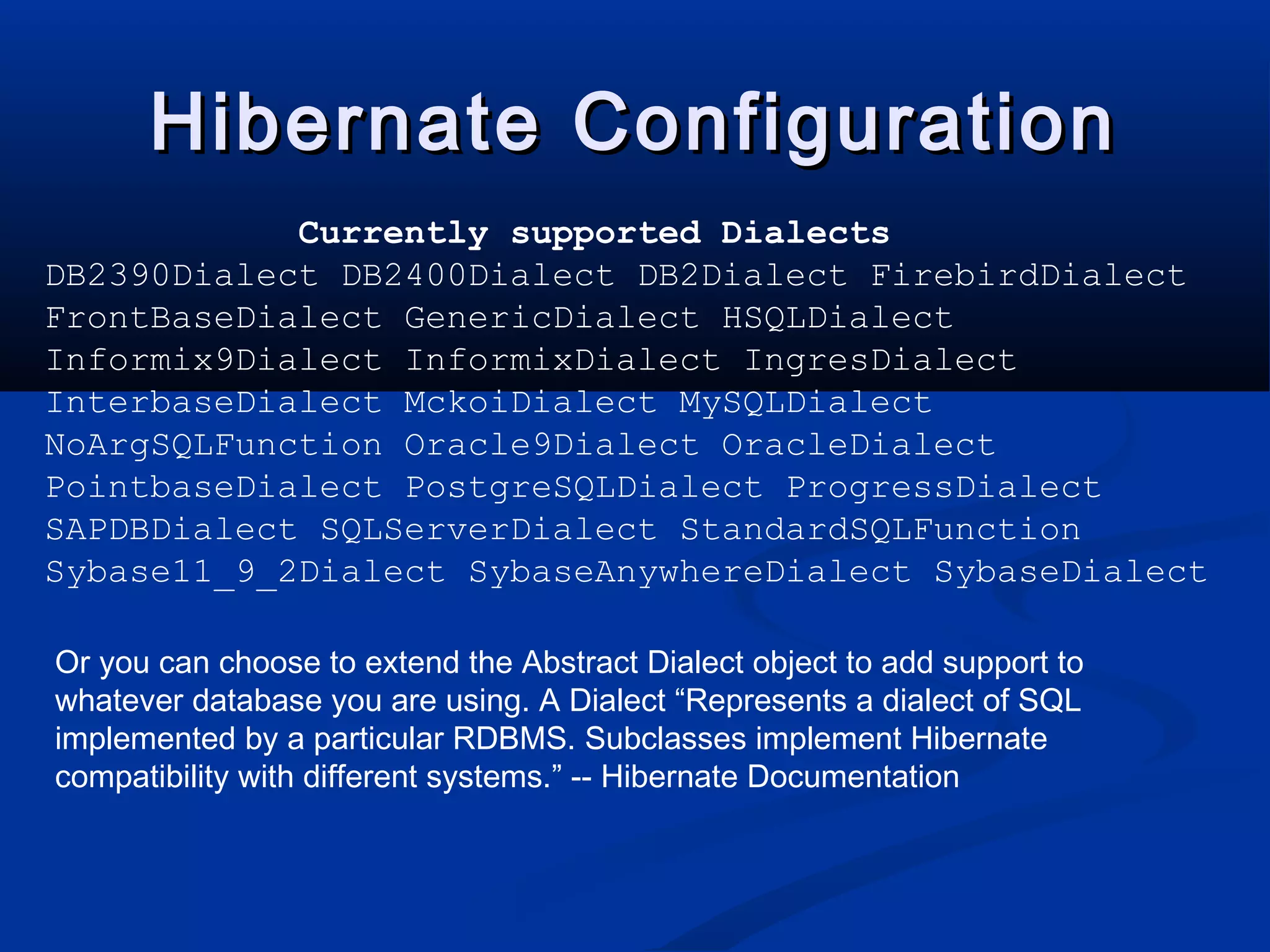
Currently supported Dialects
DB2390Dialect DB2400Dialect DB2Dialect FirebirdDialect
FrontBaseDialect GenericDialect HSQLDialect
Informix9Dialect InformixDialect IngresDialect
InterbaseDialect MckoiDialect MySQLDialect
NoArgSQLFunction Oracle9Dialect OracleDialect
PointbaseDialect PostgreSQLDialect ProgressDialect
SAPDBDialect SQLServerDialect StandardSQLFunction
Sybase11_9_2Dialect SybaseAnywhereDialect SybaseDialect
Or you can choose to extend the Abstract Dialect object to add support to
whatever database you are using. A Dialect “Represents a dialect of SQL
implemented by a particular RDBMS. Subclasses implement Hibernate
compatibility with different systems.” -- Hibernate Documentation
Hibernate Mapping FilesHibernate Mapping Files
*.hbm.xml*.hbm.xml
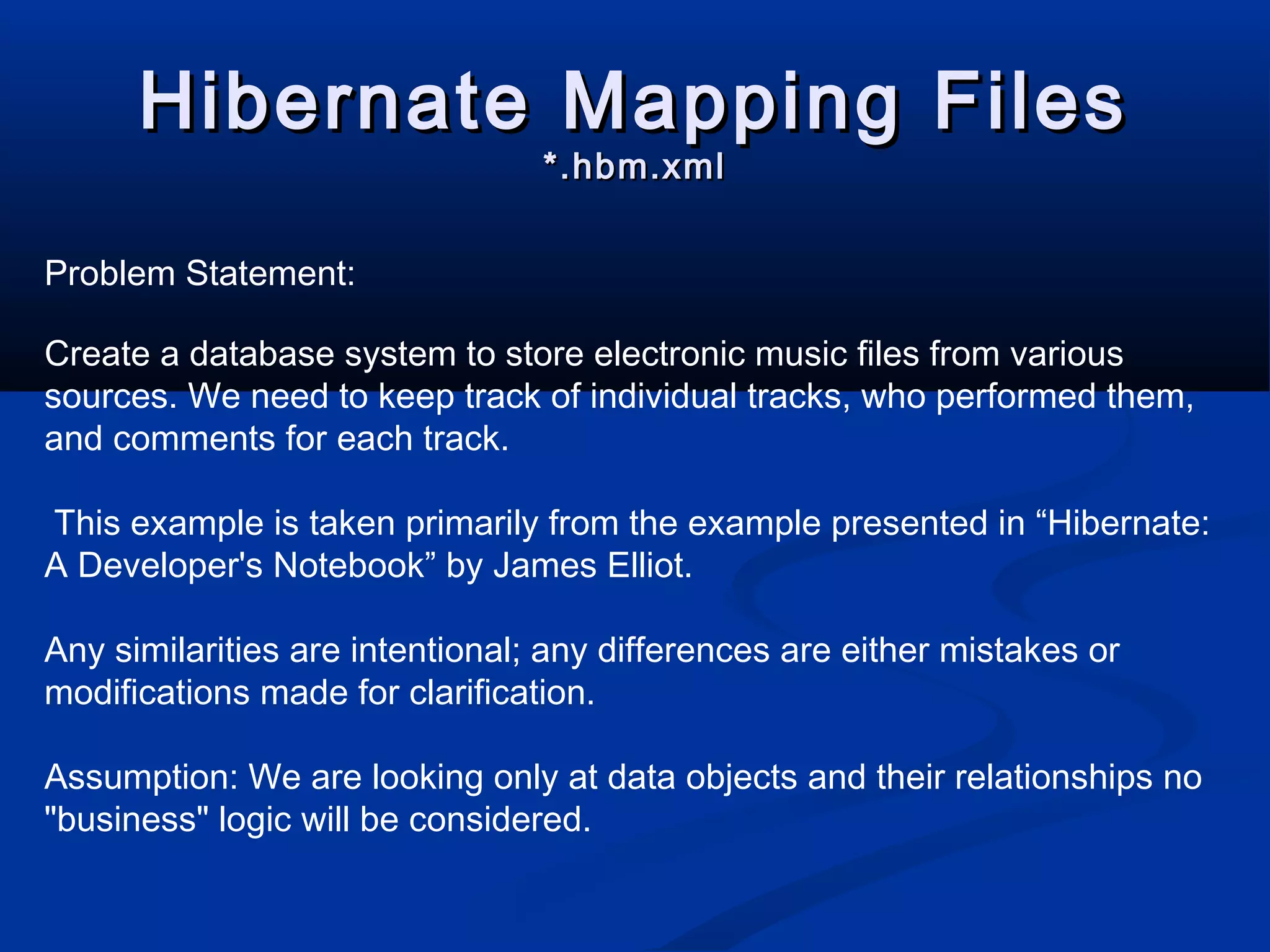
Problem Statement:
Create a database system to store electronic music files from various
sources. We need to keep track of individual tracks, who performed them,
and comments for each track.
This example is taken primarily from the example presented in “Hibernate:
A Developer's Notebook” by James Elliot.
Any similarities are intentional; any differences are either mistakes or
modifications made for clarification.
Assumption: We are looking only at data objects and their relationships no
"business" logic will be considered.
Hibernate Mapping FilesHibernate Mapping Files
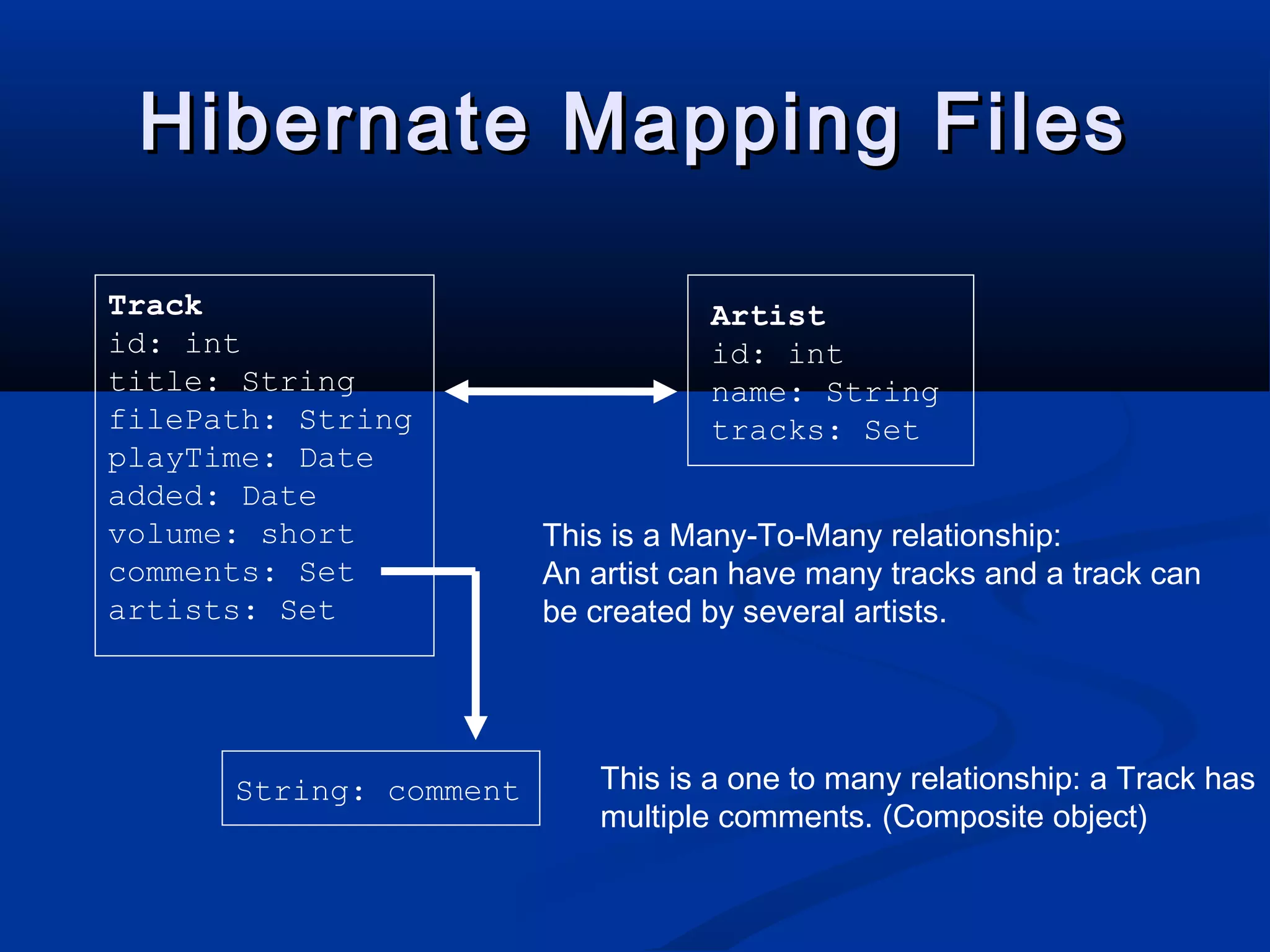
Track
id: int
title: String
filePath: String
playTime: Date
added: Date
volume: short
comments: Set
artists: Set
Artist
id: int
name: String
tracks: Set
This is a Many-To-Many relationship:
An artist can have many tracks and a track can
be created by several artists.
String: comment This is a one to many relationship: a Track has
multiple comments. (Composite object)
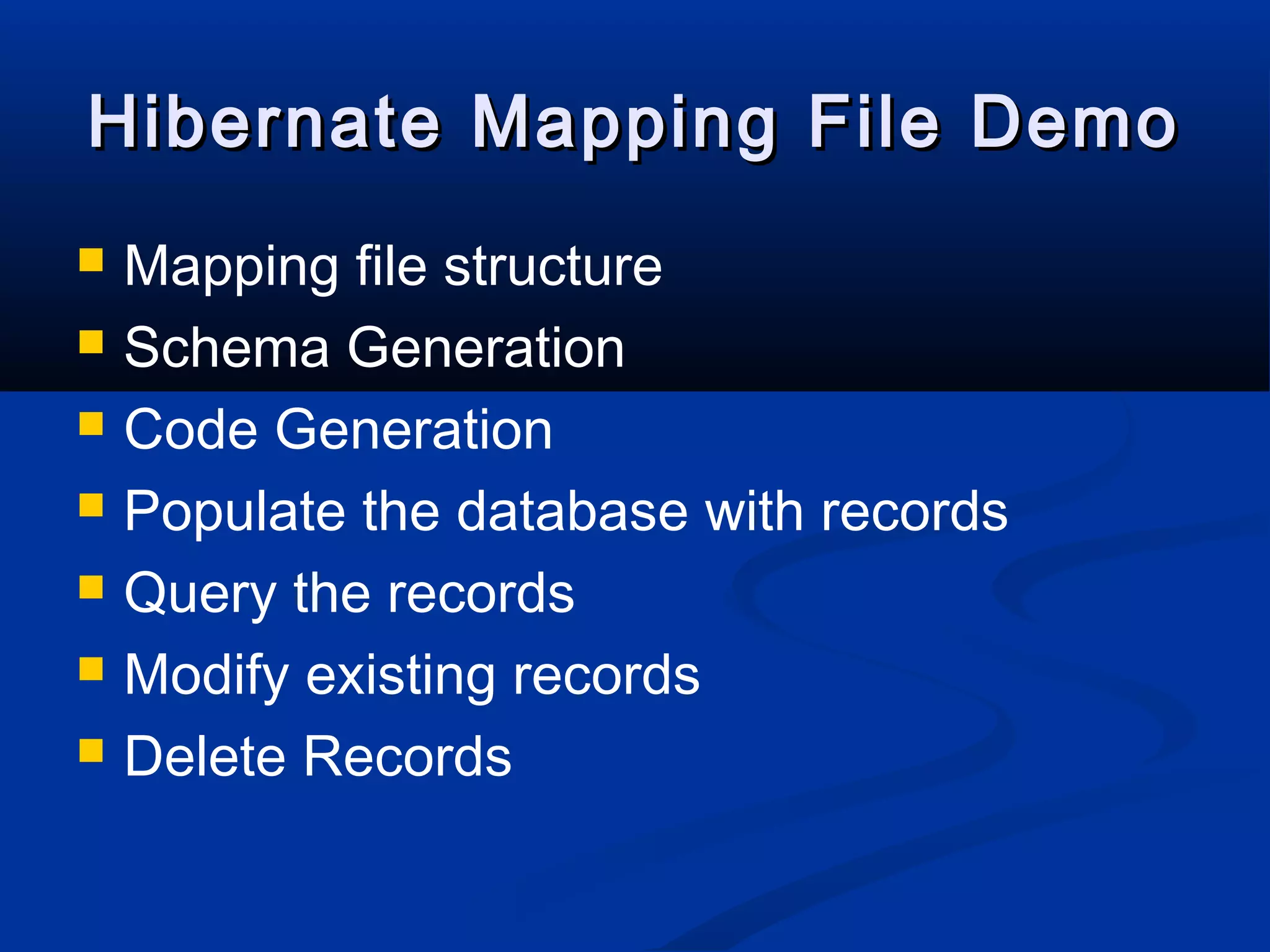
Hibernate Mapping File DemoHibernate Mapping File Demo
 Mapping file structure
 Schema Generation
 Code Generation
 Populate the database with records
 Query the records
 Modify existing records
 Delete Records

Java hibernate orm implementation tool

  • 1.
  • 2.
    Intro to HibernateIntroto Hibernate  "Hibernate is an object/relational mapping tool for Java environments. The term object/relational mapping (ORM) refers to the technique of mapping a data representation from an object model to a relational data model with a SQL-based schema." -- Preface Hibernate Documentation  Hibernate supports many different relational databases.  Many other open source tools use Hibernate as their persistence layer.  Hibernate includes tools to make O/R persistence an integrated part of the build process.
  • 3.
    Intro to Hibernate:ObjectivesIntro to Hibernate: Objectives This presentation will consist of some background information on Hibernate and some complete examples that show the basic functionality of Hibernate. Obviously there is more than one way to use Hibernate.
  • 4.
  • 5.
    Hibernate BasicsHibernate Basics SessionFactory Athreadsafe (immutable) cache of compiled mappings for a single database. A factory for Session. Expensive to create.
  • 6.
    Hibernate BasicsHibernate Basics Session Asingle-threaded, short-lived object representing a conversation between the application and the persistent store. Wraps a JDBC connection. Factory for Transaction. Holds a mandatory (first-level) cache of persistent objects, used when navigating the object graph or looking up objects by identifier.
  • 7.
    Hibernate BasicsHibernate Basics PersistentObjects and Collections Short-lived, single threaded objects containing persistent state and business function. These might be ordinary JavaBeans/POJOs, the only special thing about them is that they are currently associated with (exactly one) Session. As soon as the Session is closed, they will be detached and free to use in any application layer (e.g. directly as data transfer objects to and from presentation).
  • 8.
    Hibernate BasicsHibernate Basics TransientObjects and Collections Instances of persistent classes that are not currently associated with a Session. They may have been instantiated by the application and not (yet) persisted or they may have been instantiated by a closed Session.
  • 9.
    Hibernate BasicsHibernate Basics Transaction (Optional)A single-threaded, short- lived object used by the application to specify atomic units of work. Abstracts application from underlying JDBC, JTA or CORBA transaction. Multiple transactions per Session.
  • 10.
    Hibernate BasicsHibernate Basics ConnectionProvider (Optional)A factory for (and pool of) JDBC connections. Abstracts application from underlying Datasource or DriverManager. Not exposed to application, but can be extended/implemented by the developer. TransactionFactory (Optional) A factory for Transaction instances. Not exposed to the application, but can be extended/implemented by the developer.
  • 11.
    Hibernate ToolsHibernate Tools TheHibernate Mapping File Database Schema Generation net.sf.hibernate.tool.hbm2ddl.SchemaExportTask net.sf.hibernate.tool.hbm2ddl.SchemaUpdateTask Best Practices suggest having one file per entity. Java Code Generation net.sf.hibernate.tool.hbm2java.Hbm2JavaTask
  • 12.
    Hibernate ToolsHibernate Tools TheHibernate Mapping File Best Practices suggest having one file per entity. Database Schema Reverse Engineering (Bottom Up development) Middlegen Object Driven Design (Top Down development) AndroMDA XMI -> *.hbm.xml XDoclet can also be used to directly embed the mapping file information in the source code.
  • 13.
    Hibernate ConfigurationHibernate Configuration hibernate.properties hibernate.dialect=net.sf.hibernate.dialect.HSQLDialect hibernate.connection.driver_class=org.hsqldb.jdbcDriver ##in Ant you can get away with a relative path ## however using this through Eclipse requires an explicit path hibernate.connection.url= jdbc:hsqldb:c:/workspace/HibernateNotebook/data/music hibernate.connection.username=sa hibernate.connection.password=
  • 14.
    Hibernate ConfigurationHibernate Configuration Currentlysupported Dialects DB2390Dialect DB2400Dialect DB2Dialect FirebirdDialect FrontBaseDialect GenericDialect HSQLDialect Informix9Dialect InformixDialect IngresDialect InterbaseDialect MckoiDialect MySQLDialect NoArgSQLFunction Oracle9Dialect OracleDialect PointbaseDialect PostgreSQLDialect ProgressDialect SAPDBDialect SQLServerDialect StandardSQLFunction Sybase11_9_2Dialect SybaseAnywhereDialect SybaseDialect Or you can choose to extend the Abstract Dialect object to add support to whatever database you are using. A Dialect “Represents a dialect of SQL implemented by a particular RDBMS. Subclasses implement Hibernate compatibility with different systems.” -- Hibernate Documentation
  • 15.
    Hibernate Mapping FilesHibernateMapping Files *.hbm.xml*.hbm.xml Problem Statement: Create a database system to store electronic music files from various sources. We need to keep track of individual tracks, who performed them, and comments for each track. This example is taken primarily from the example presented in “Hibernate: A Developer's Notebook” by James Elliot. Any similarities are intentional; any differences are either mistakes or modifications made for clarification. Assumption: We are looking only at data objects and their relationships no "business" logic will be considered.
  • 16.
    Hibernate Mapping FilesHibernateMapping Files Track id: int title: String filePath: String playTime: Date added: Date volume: short comments: Set artists: Set Artist id: int name: String tracks: Set This is a Many-To-Many relationship: An artist can have many tracks and a track can be created by several artists. String: comment This is a one to many relationship: a Track has multiple comments. (Composite object)
  • 17.
    Hibernate Mapping FileDemoHibernate Mapping File Demo  Mapping file structure  Schema Generation  Code Generation  Populate the database with records  Query the records  Modify existing records  Delete Records