Java
Concurrency
By: Hithem Aly
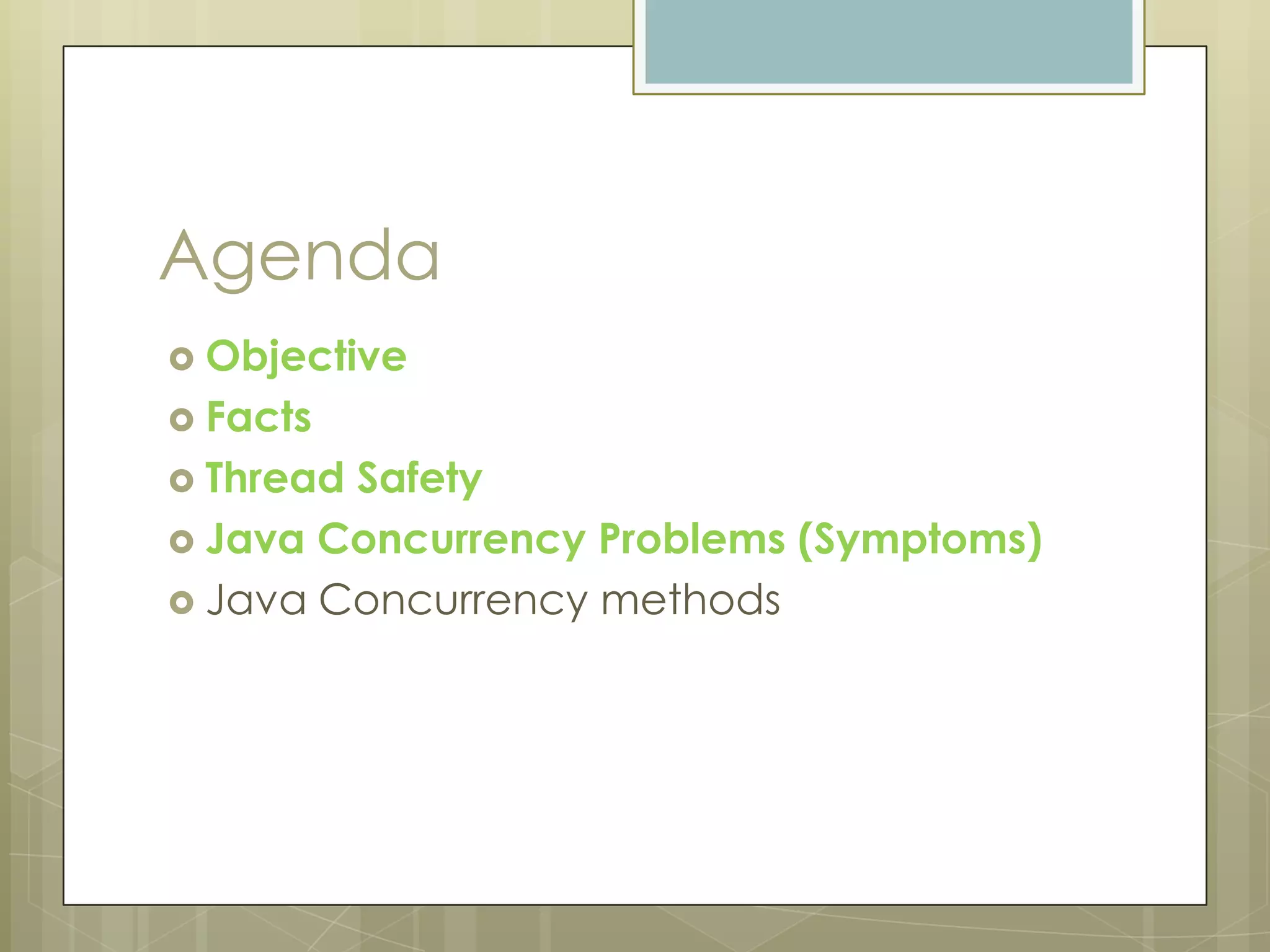
Agenda
 Objective
 Facts
 ThreadSafety
 Java Concurrency Problems (Symptoms)
 Java Concurrency methods
Objective
 Managing   shared state
Objective
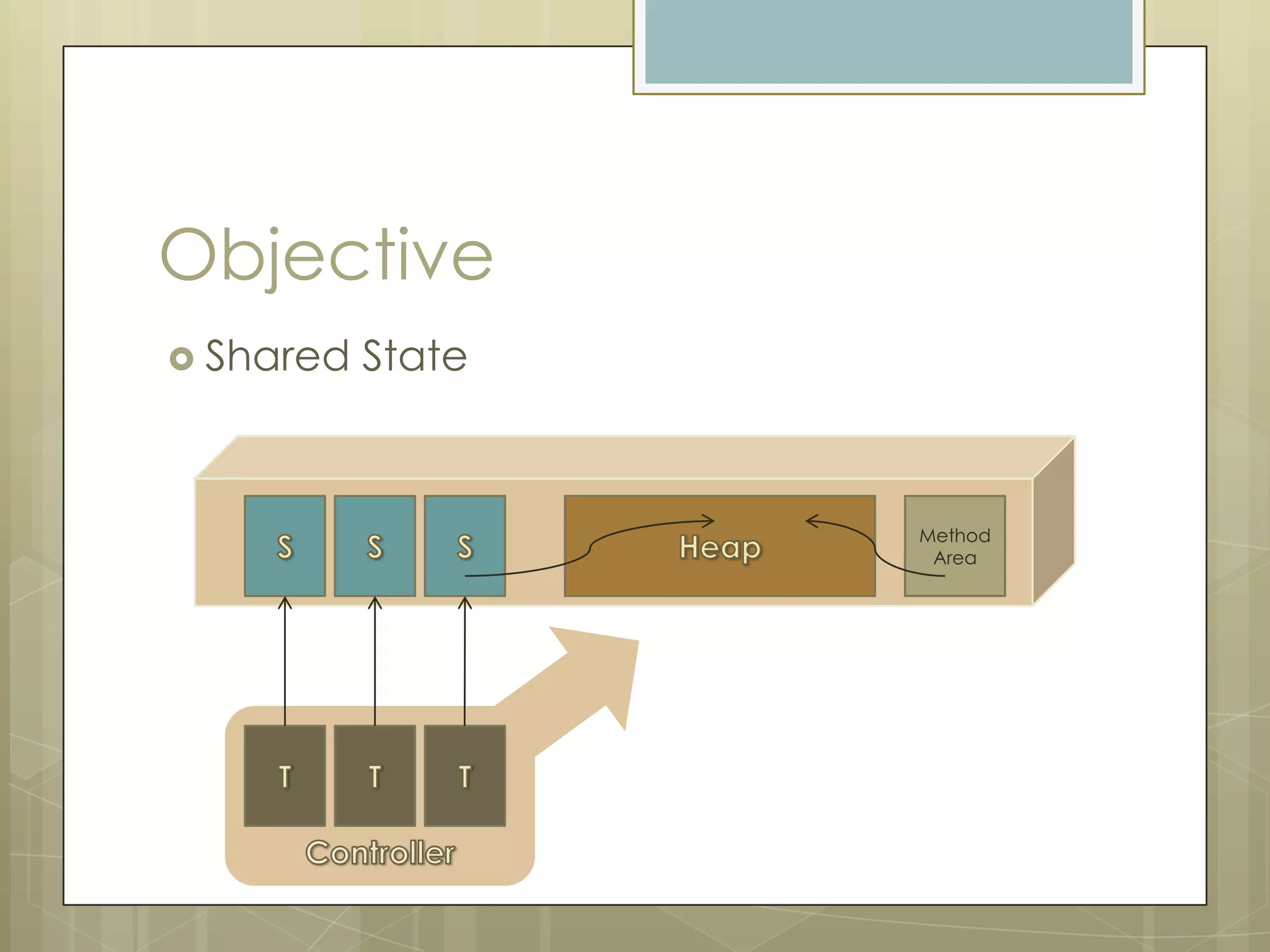
 Shared   State


                   Method
                    Area
Is That Thread Safe?
package com.thread;

class ApplicationThread implements Runnable{

     private int i = 0;

     @Override
     public void run() {
     System.out.println(++i);
     }
}

public class Main {

public static void main(String[] args) {

     for (int i = 0; i < 1000; i++)
     {
     Thread thread1 = new Thread(new ApplicationThread());
     thread1.start();
     }
     }
}
Is That Thread Safe?
package com.thread;

class ApplicationThread implements Runnable{

     private int i = 0;

     @Override
     public void run() {
     System.out.println(++i);
     }
}
public class Main {

     public static void main(String[] args) {

     Runnable runnable = new ApplicationThread();

     for (int i = 0; i < 100000; i++)
     {
     Thread thread1 = new Thread(runnable);
     thread1.start();
     }
     }
}
Agenda
 Objective
 Facts
 ThreadSafety
 Java Concurrency Problems (Symptoms)
 Java Concurrency methods
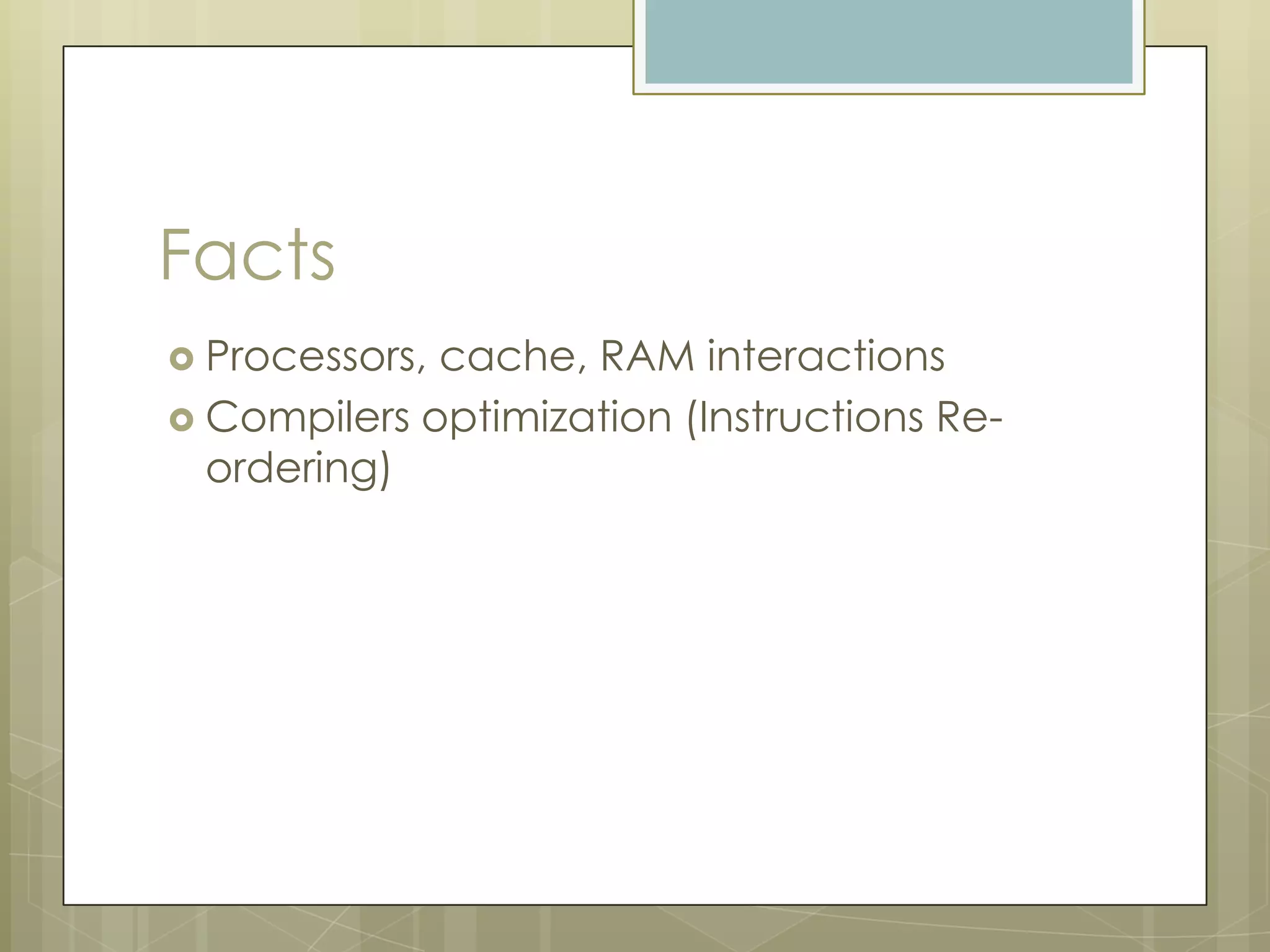
Facts
 Processors,cache, RAM interactions
 Compilers optimization (Instructions Re-
  ordering)
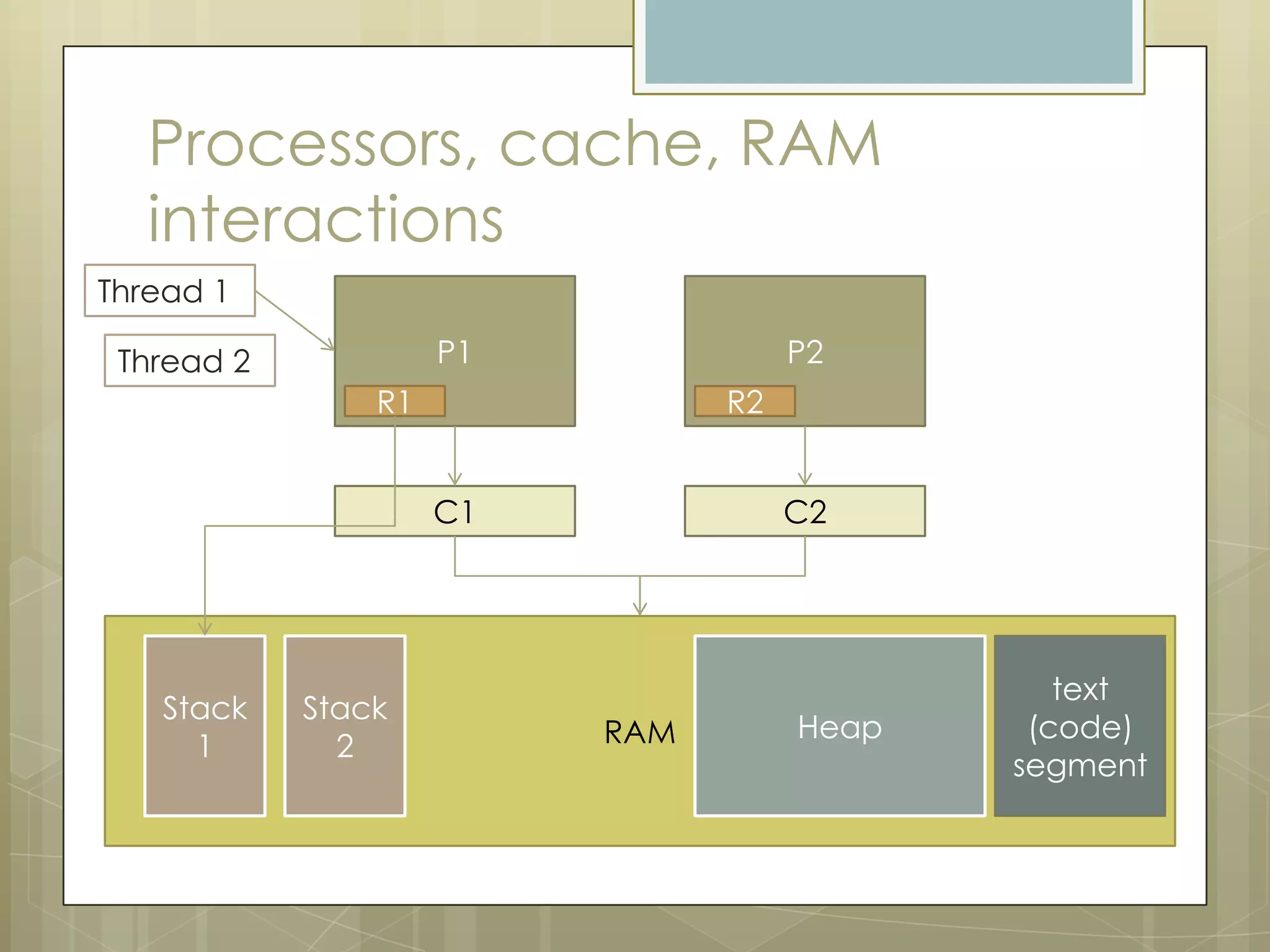
Processors, cache, RAM
   interactions
Thread 1

 Thread 2            P1              P2
                R1              R2


                     C1              C2


                                               text
   Stack    Stack
                          RAM        Heap    (code)
     1        2
                                            segment
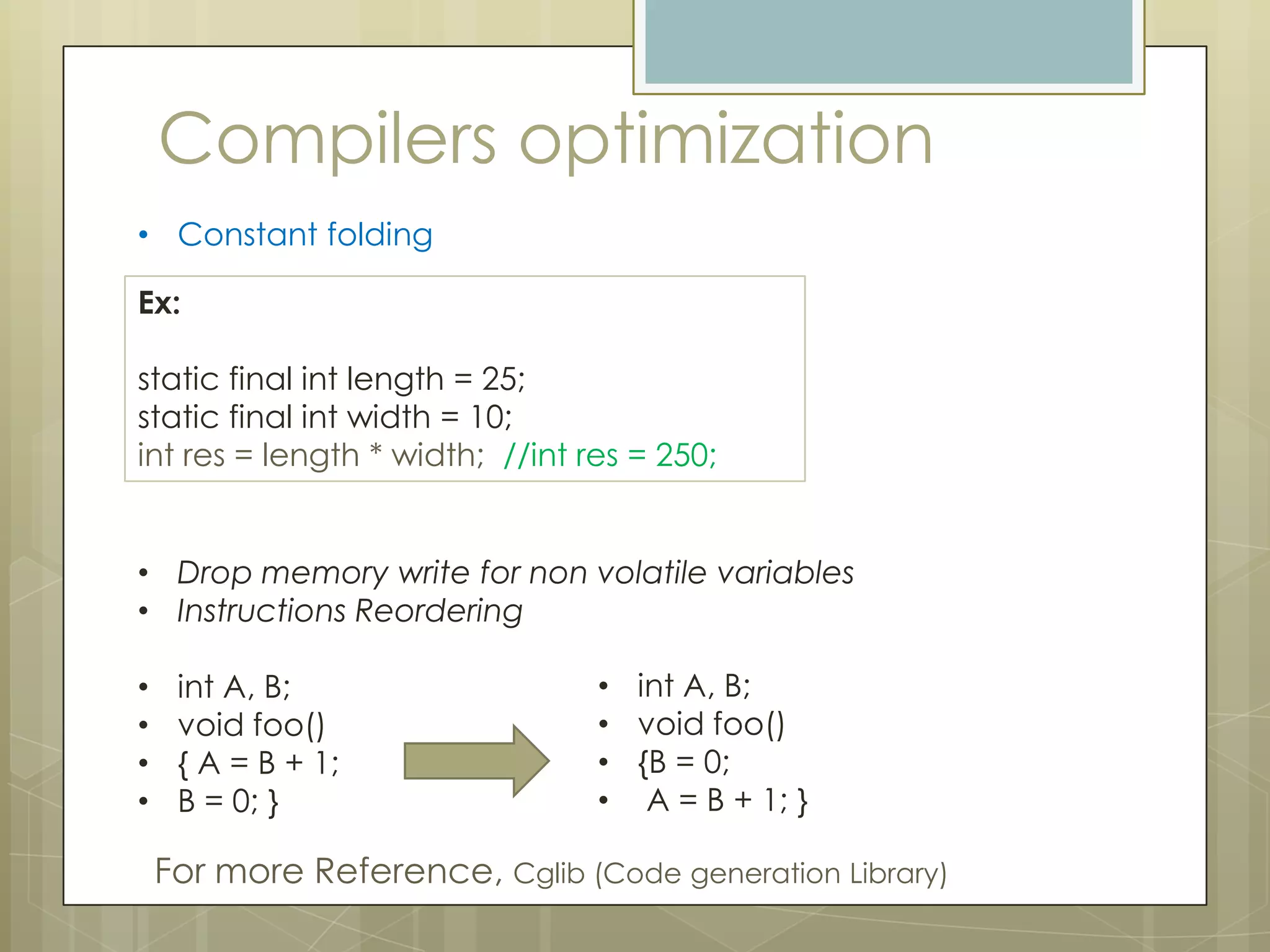
Compilers optimization
• Constant folding

Ex:

static final int length = 25;
static final int width = 10;
int res = length * width; //int res = 250;


• Drop memory write for non volatile variables
• Instructions Reordering

•    int A, B;                   • int A, B;
•    void foo()                  • void foo()
•    { A = B + 1;                • {B = 0;
•    B = 0; }                    • A = B + 1; }

    For more Reference, Cglib (Code generation Library)
Illustrative Example
public class NoVisibility
{
    private static boolean ready;
    private static int number;

    private static class ReaderThread extends Thread
    {
           public void run()
           {
                       while (!ready)
                       Thread.yield();
                       System.out.println(number);
           }
    }


    public static void main(String[] args)
    {
          new ReaderThread().start();
          number = 42;
          ready = true;
    }
}
Solution
public class NoVisibility
{
    private static volatile boolean ready;
    private static volatile int number;

    private static class ReaderThread extends Thread
    {
           public void run()
           {
                       while (!ready)
                       Thread.yield();
                       System.out.println(number);
           }
    }


    public static void main(String[] args)
    {
          new ReaderThread().start();
          number = 42;
          ready = true;
    }
}
Agenda
 Objective
 Facts
 ThreadSafety
 Java Concurrency Problems (Symptoms)
 Java Concurrency methods
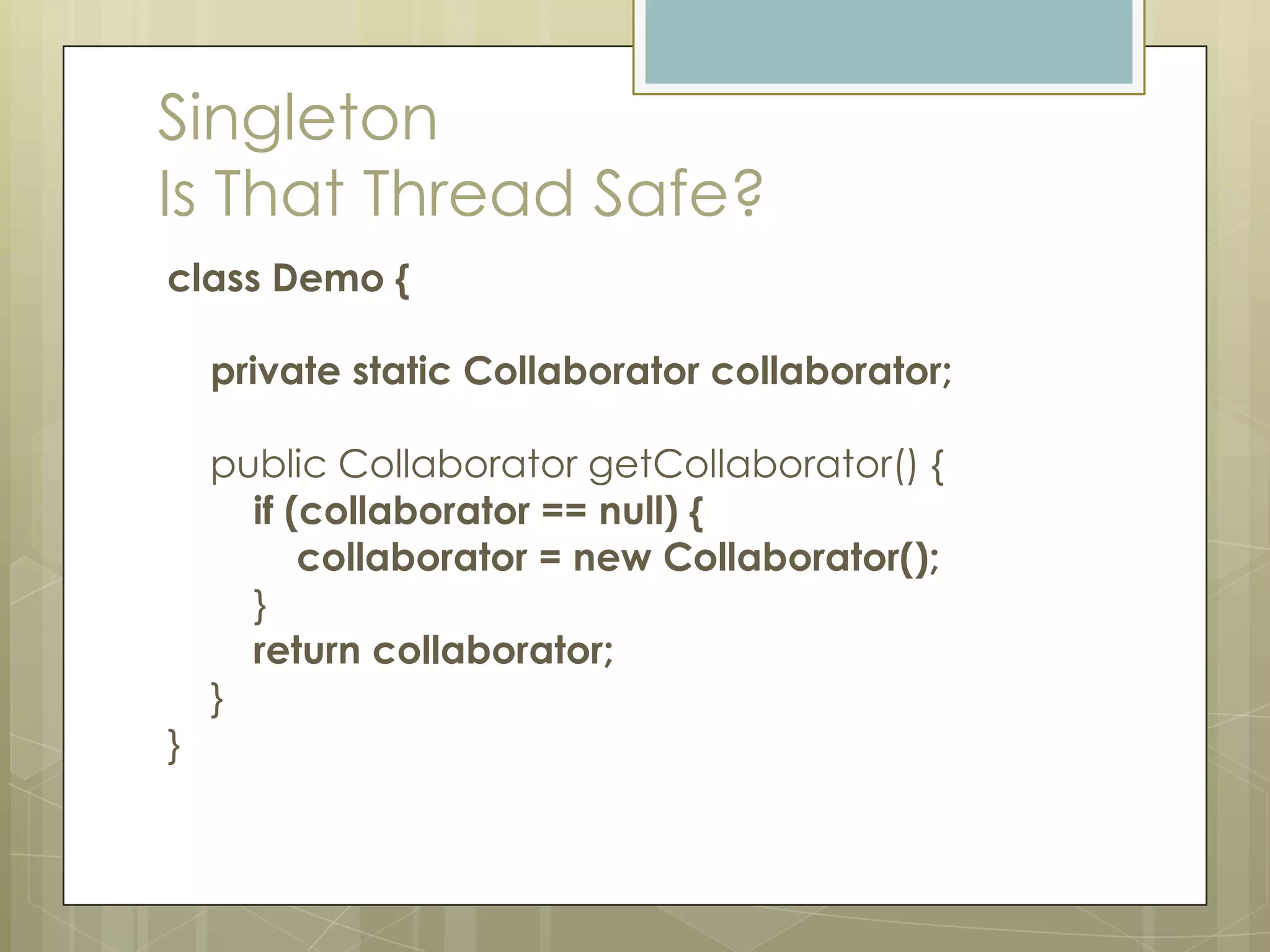
Singleton
Is That Thread Safe?
class Demo {

    private static Collaborator collaborator;

    public Collaborator getCollaborator() {
      if (collaborator == null) {
          collaborator = new Collaborator();
      }
      return collaborator;
    }
}
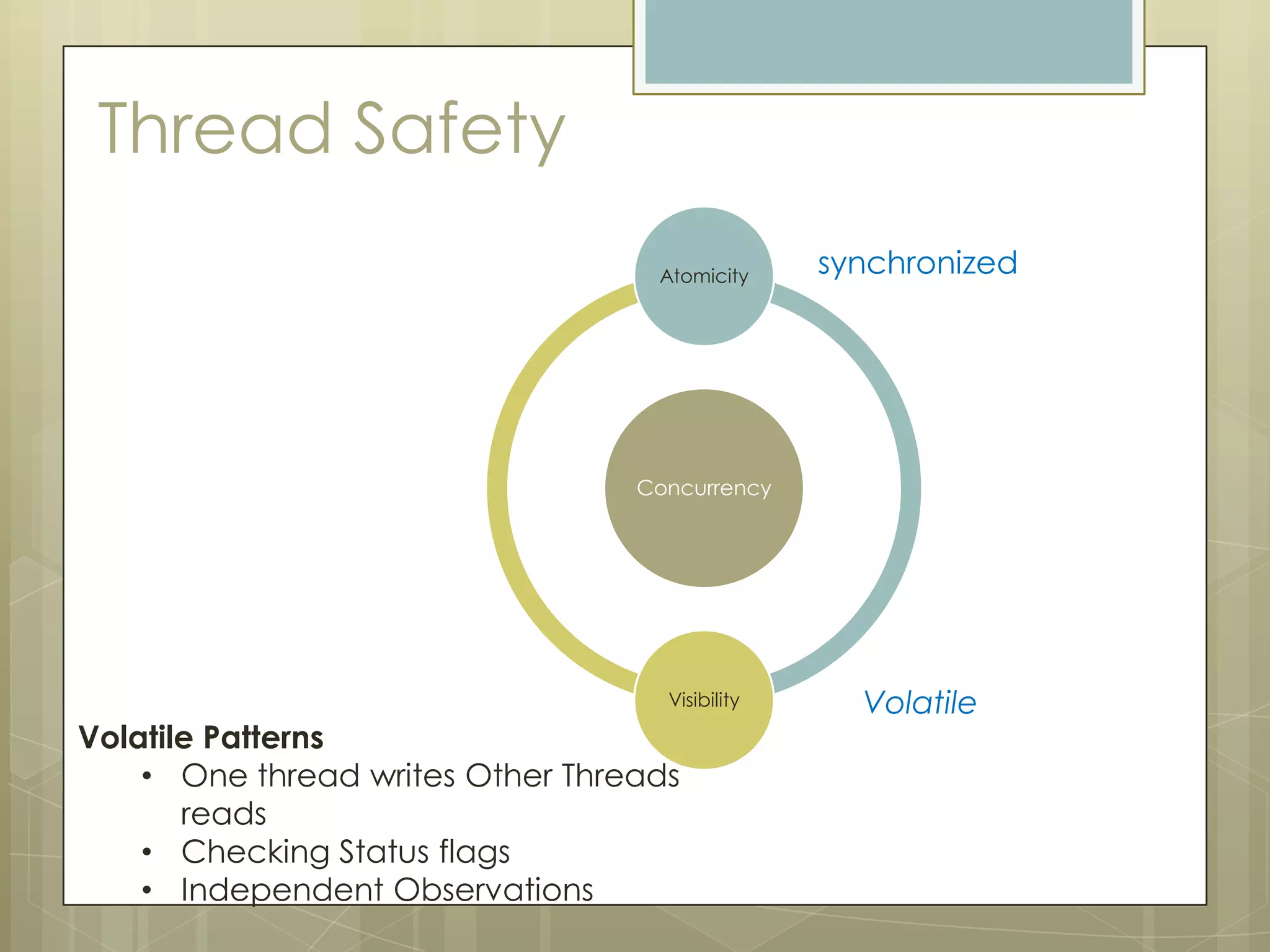
Thread Safety
                                   Atomicity     synchronized


                                  Concurrency


                                    Visibility     Volatile
Volatile Patterns
    • One thread writes Other Threads
       reads
    • Checking Status flags
    • Independent Observations
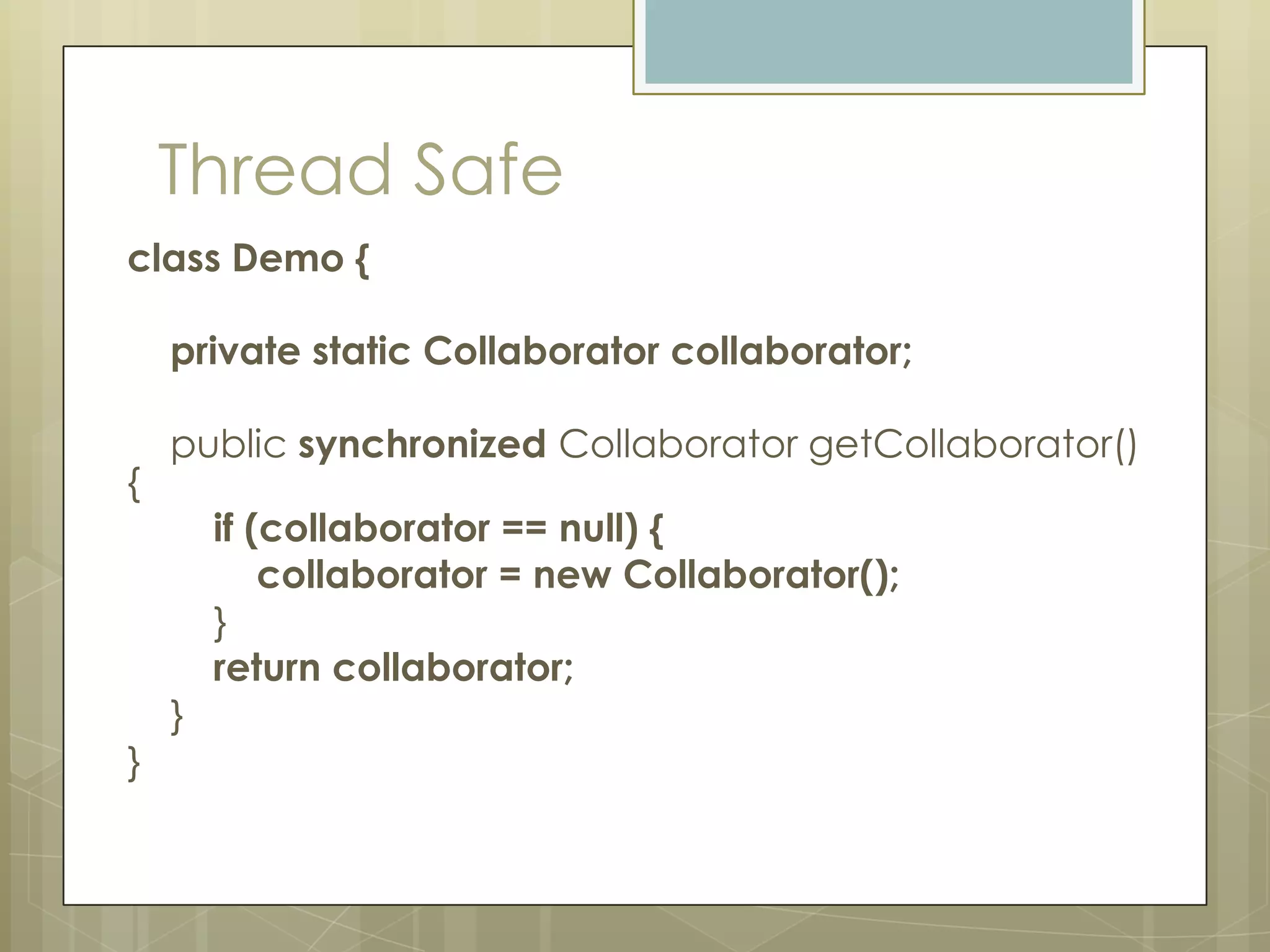
Thread Safe
class Demo {

    private static Collaborator collaborator;

    public synchronized Collaborator getCollaborator()
{
        if (collaborator == null) {
            collaborator = new Collaborator();
        }
        return collaborator;
    }
}
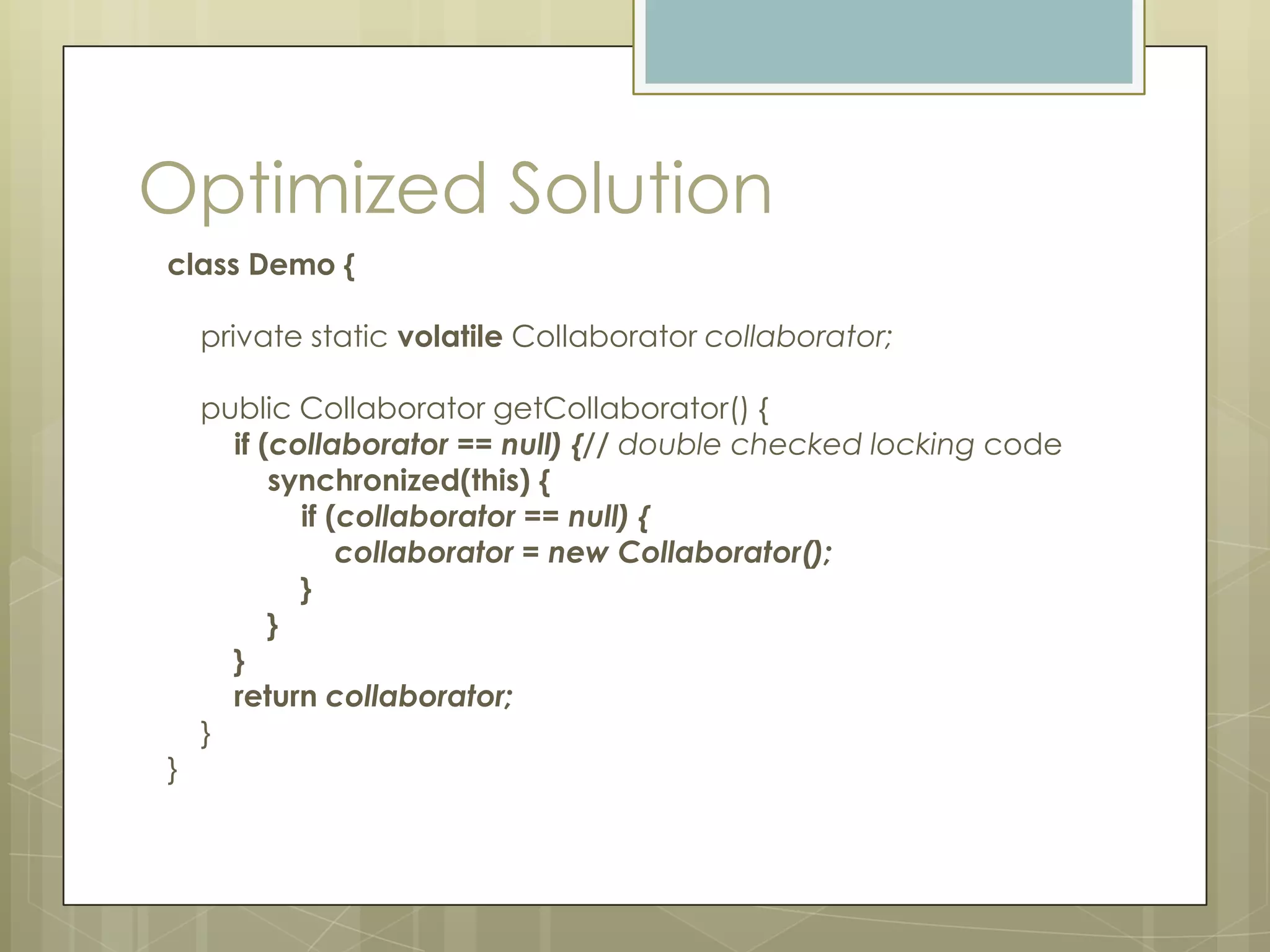
Optimized Solution
class Demo {

    private static volatile Collaborator collaborator;

    public Collaborator getCollaborator() {
      if (collaborator == null) {// double checked locking code
          synchronized(this) {
            if (collaborator == null) {
                collaborator = new Collaborator();
            }
          }
      }
      return collaborator;
    }
}
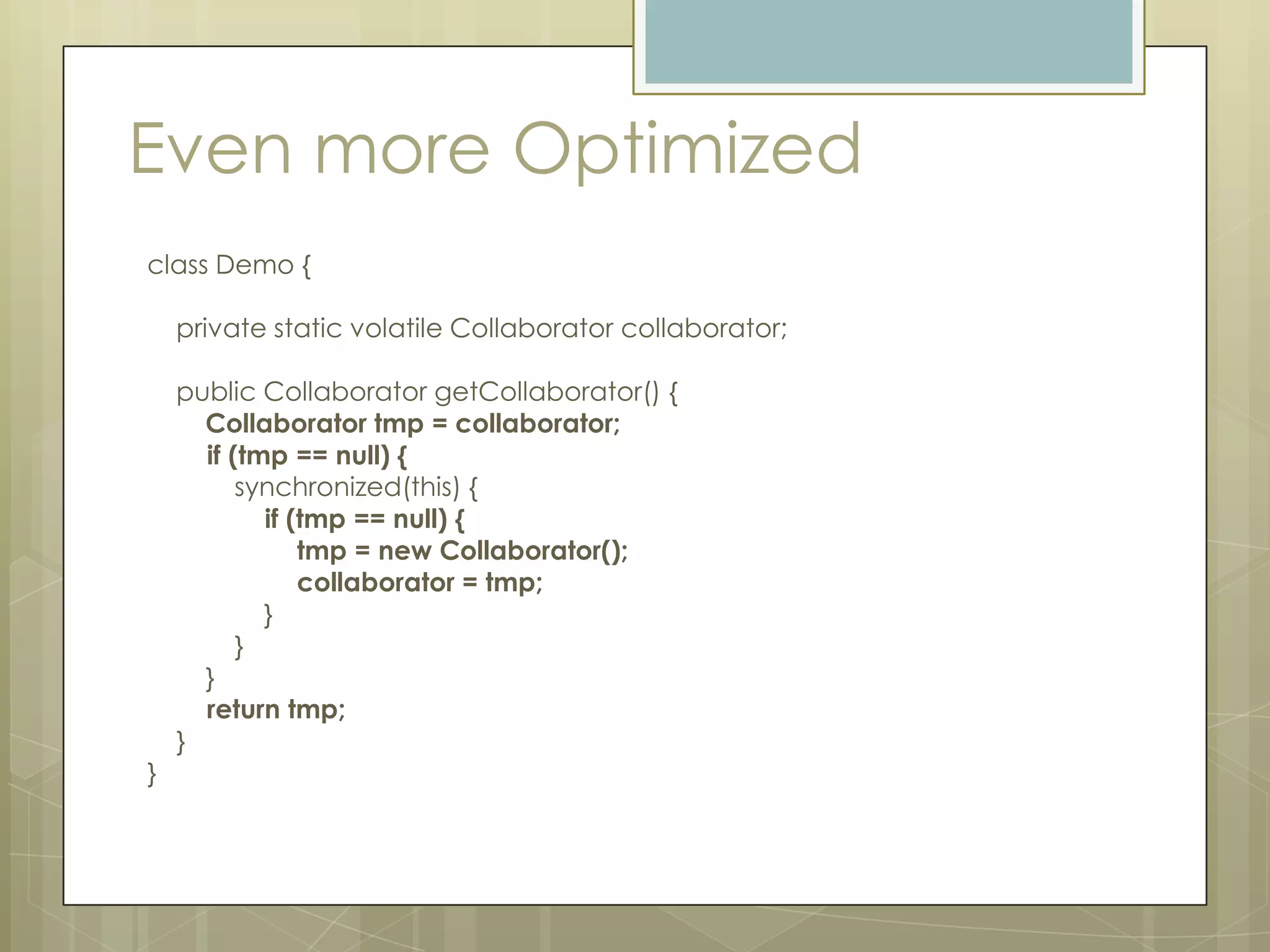
Even more Optimized
class Demo {

    private static volatile Collaborator collaborator;

    public Collaborator getCollaborator() {
      Collaborator tmp = collaborator;
      if (tmp == null) {
          synchronized(this) {
            if (tmp == null) {
                tmp = new Collaborator();
                collaborator = tmp;
            }
          }
      }
      return tmp;
    }
}
Agenda
 Objective
 Facts
 ThreadSafety
 Java Concurrency Problems (Symptoms)
 Java Concurrency methods
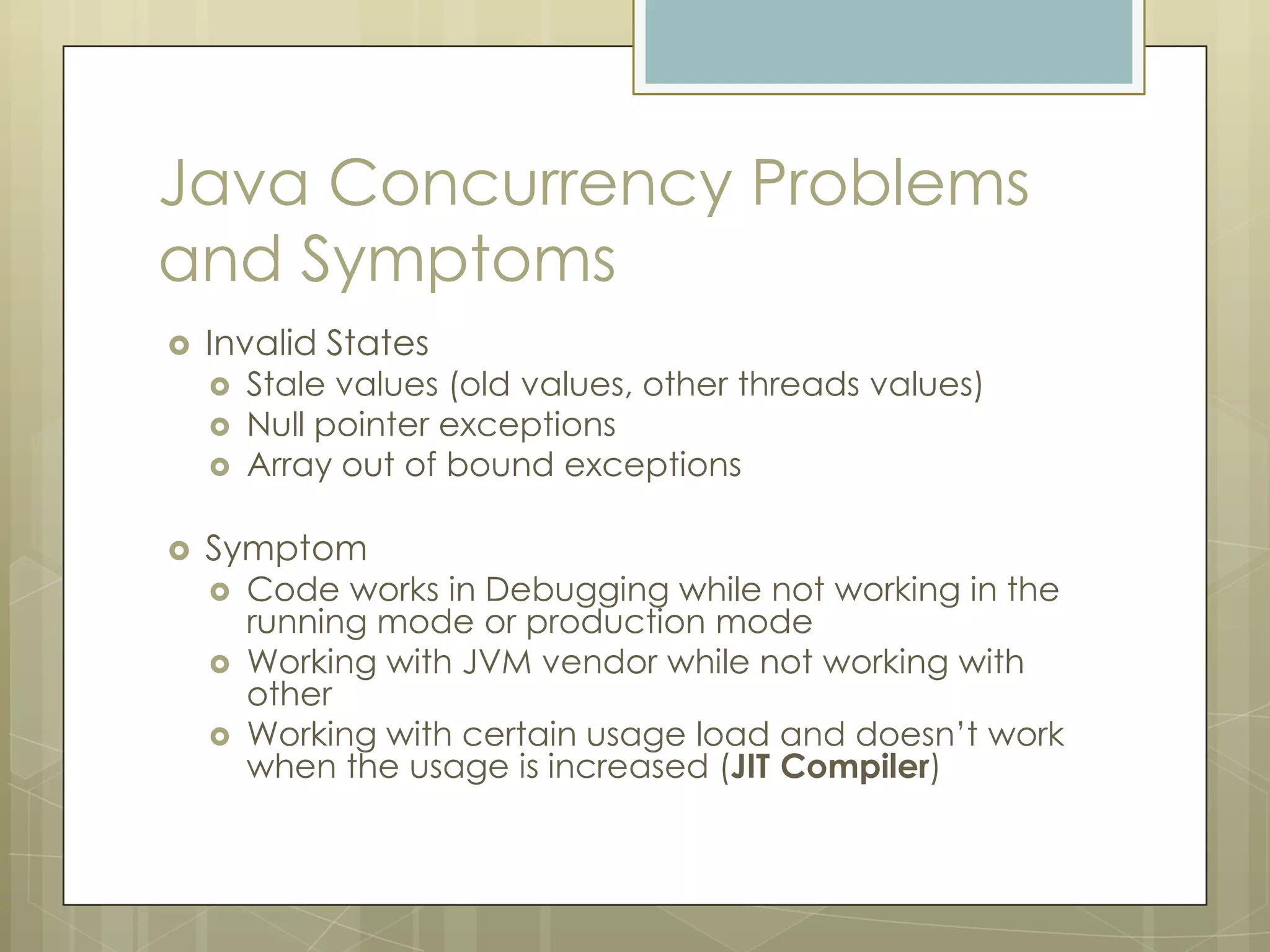
Java Concurrency Problems
and Symptoms
   Invalid States
       Stale values (old values, other threads values)
       Null pointer exceptions
       Array out of bound exceptions

   Symptom
       Code works in Debugging while not working in the
        running mode or production mode
       Working with JVM vendor while not working with
        other
       Working with certain usage load and doesn’t work
        when the usage is increased (JIT Compiler)
Agenda
 Objective
 Facts
 ThreadSafety
 Java Concurrency Problems (Symptoms)
 Java Concurrency methods
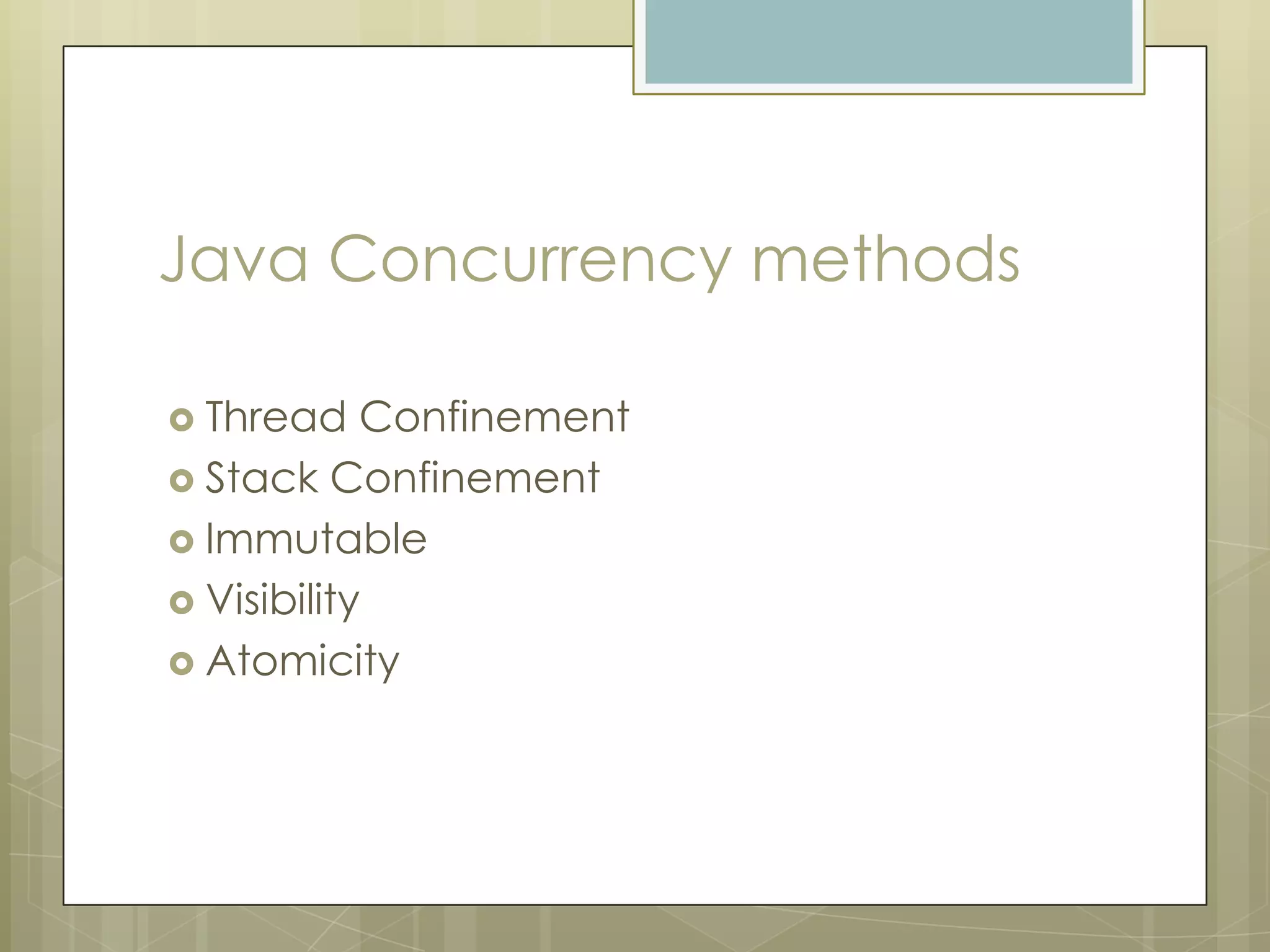
Java Concurrency methods

 Thread    Confinement
 Stack Confinement
 Immutable
 Visibility
 Atomicity
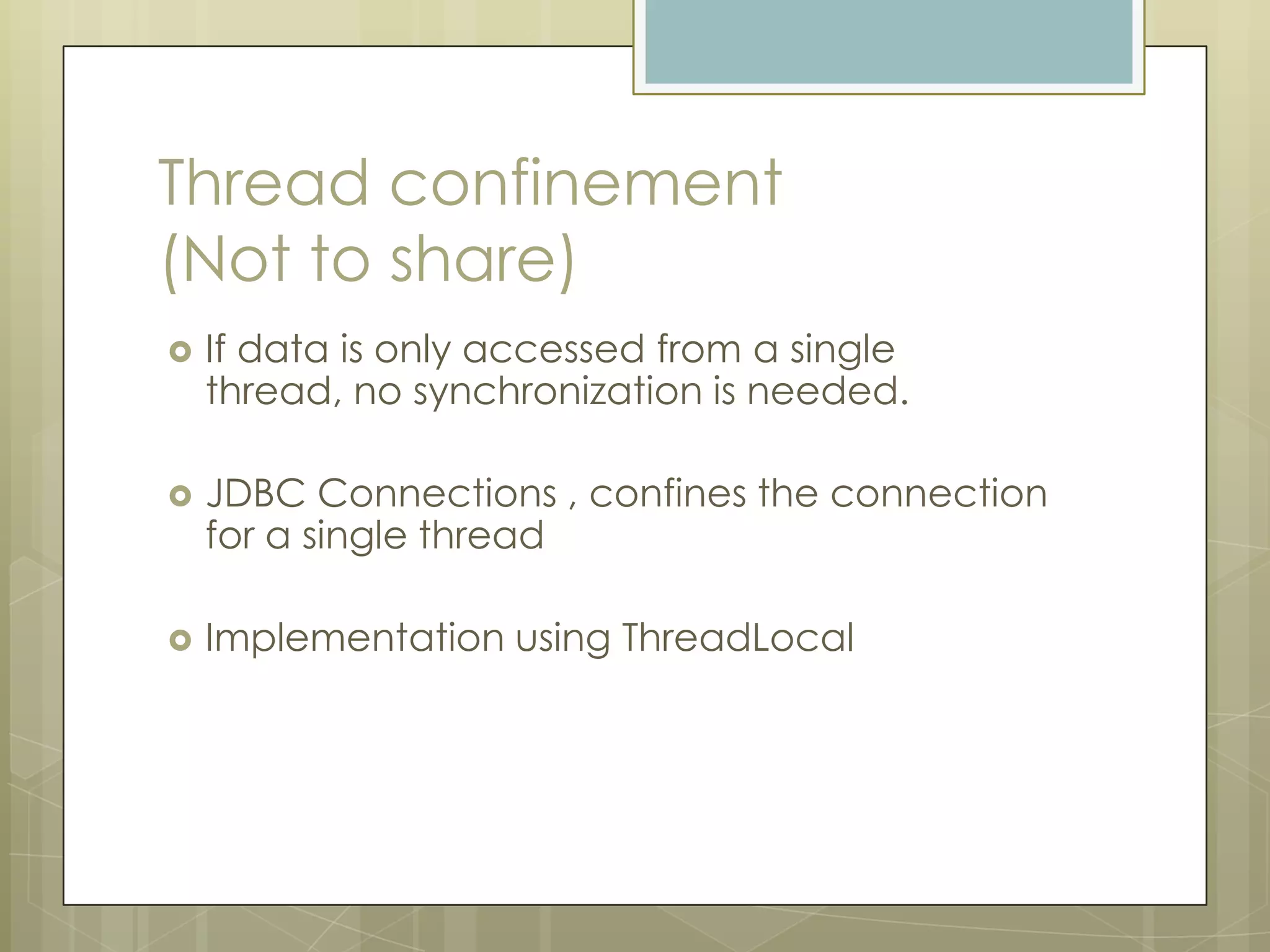
Thread confinement
(Not to share)
   If data is only accessed from a single
    thread, no synchronization is needed.

   JDBC Connections , confines the connection
    for a single thread

   Implementation using ThreadLocal
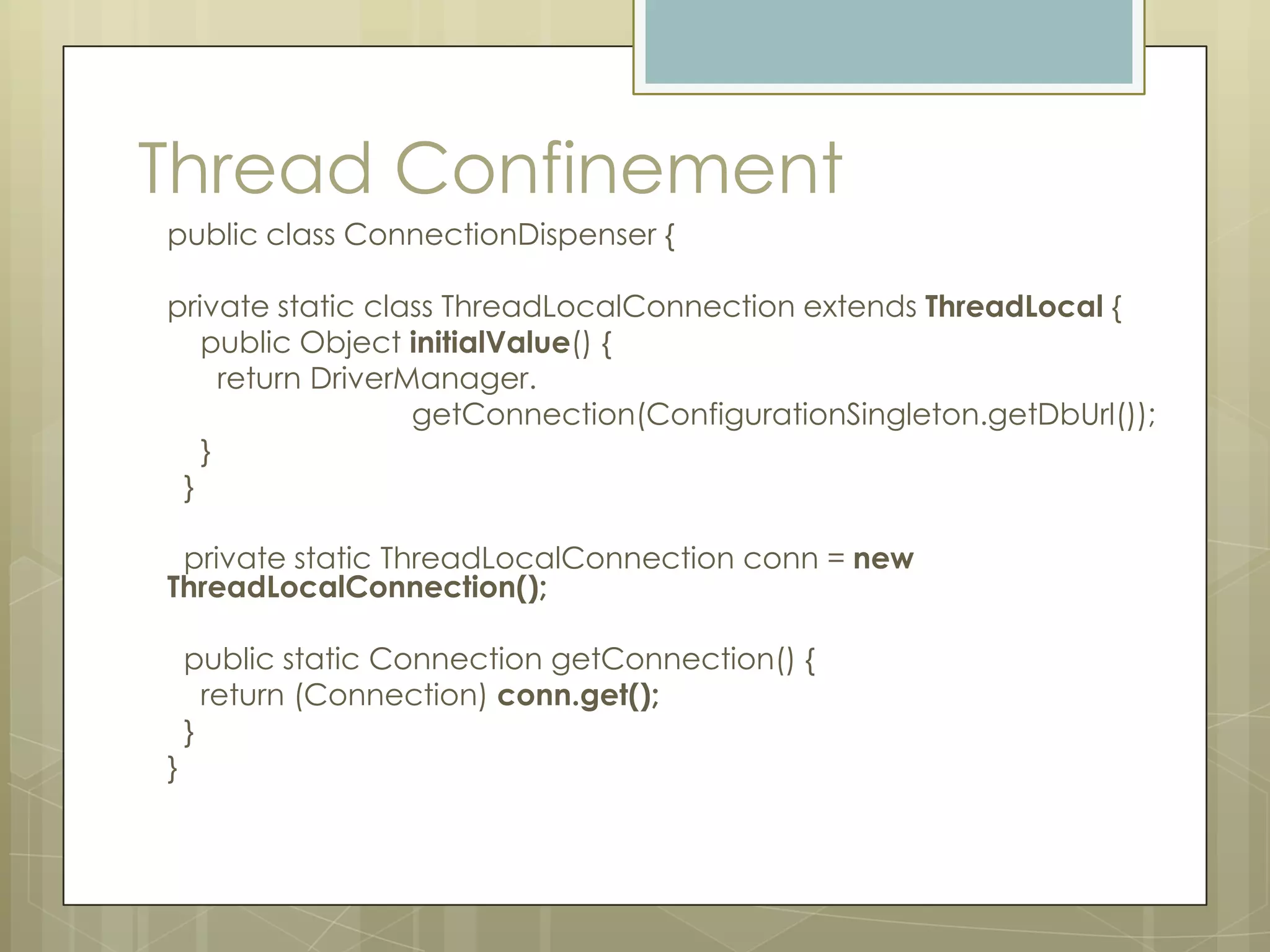
Thread Confinement
public class ConnectionDispenser {

private static class ThreadLocalConnection extends ThreadLocal {
   public Object initialValue() {
     return DriverManager.
                   getConnection(ConfigurationSingleton.getDbUrl());
   }
 }

 private static ThreadLocalConnection conn = new
ThreadLocalConnection();

    public static Connection getConnection() {
      return (Connection) conn.get();
    }
}
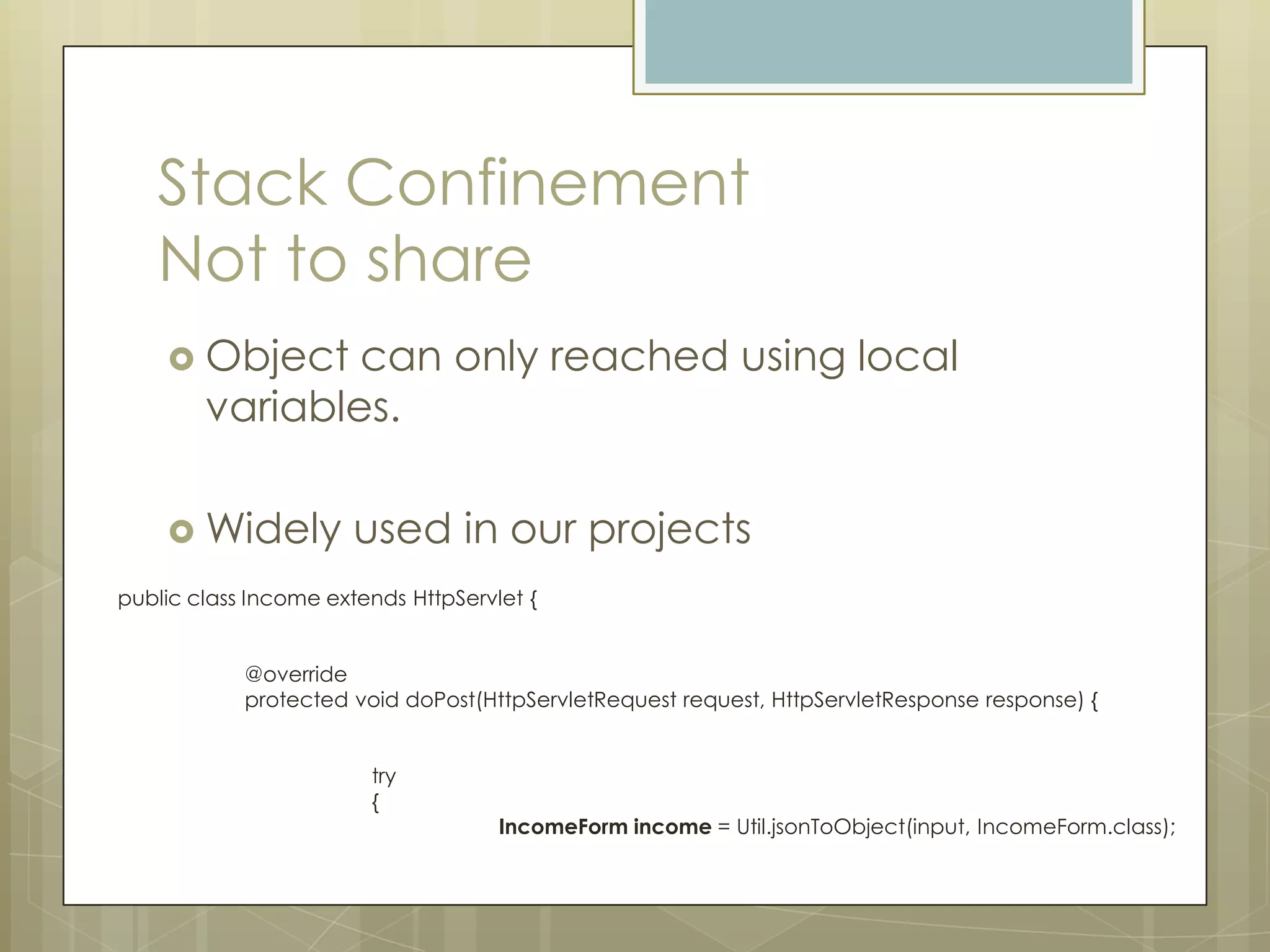
Stack Confinement
   Not to share
     Object    can only reached using local
        variables.

     Widely           used in our projects
public class Income extends HttpServlet {


            @override
            protected void doPost(HttpServletRequest request, HttpServletResponse response) {


                        try
                        {
                                     IncomeForm income = Util.jsonToObject(input, IncomeForm.class);
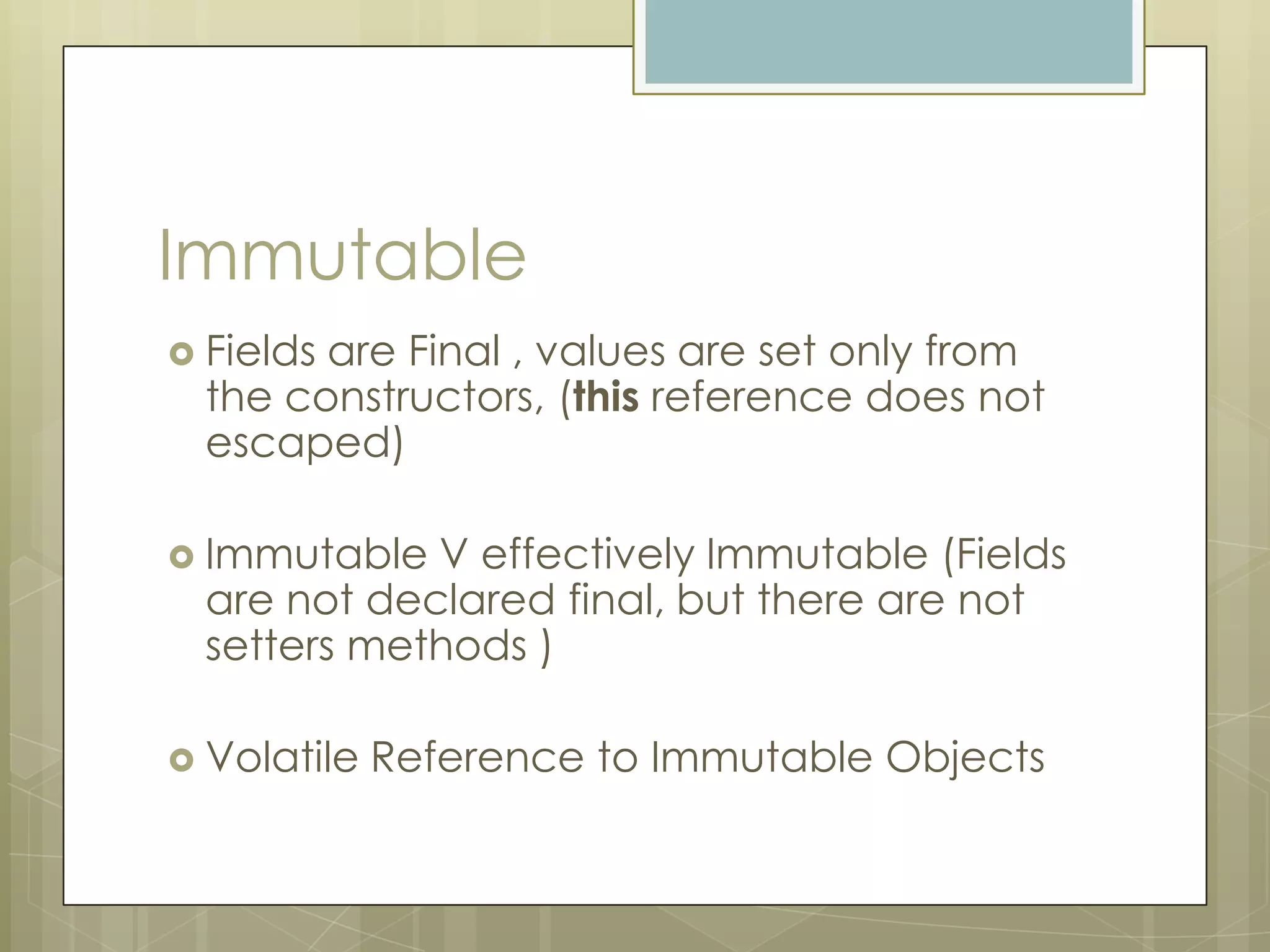
Immutable
 Fieldsare Final , values are set only from
  the constructors, (this reference does not
  escaped)

 Immutable  V effectively Immutable (Fields
  are not declared final, but there are not
  setters methods )

 Volatile   Reference to Immutable Objects
Illustrative example
@Immutable
class OneValueCache {
  private final BigInteger lastNumber;
  private final BigInteger[] lastFactors;

    public OneValueCache(BigInteger i,
                BigInteger[] factors) {
      lastNumber = i;
      lastFactors = Arrays.copyOf(factors, factors.length);
    }

    public BigInteger[] getFactors(BigInteger i) {
      if (lastNumber == null !lastNumber.equals(i))
          return null;
      else
          return Arrays.copyOf(lastFactors, lastFactors.length);
    }
}
Using volatile to publish
immutable objects
 @ThreadSafe
 public class VolatileCachedFactorizer implements Servlet {
   private volatile OneValueCache cache =
      new OneValueCache(null, null);

     public void service(ServletRequest req, ServletResponse resp) {
       BigInteger i = extractFromRequest(req);
       BigInteger[] factors = cache.getFactors(i); //Tip !!!
       if (factors == null) {
           factors = factor(i);
           cache = new OneValueCache(i, factors);
       }
       encodeIntoResponse(resp, factors);
     }
 }
Volatile
volatile boolean shutdownRequested;

...

public void shutdown() {
shutdownRequested = true; }

public void doWork() {
  while (!shutdownRequested) {
    // do stuff
  }
}
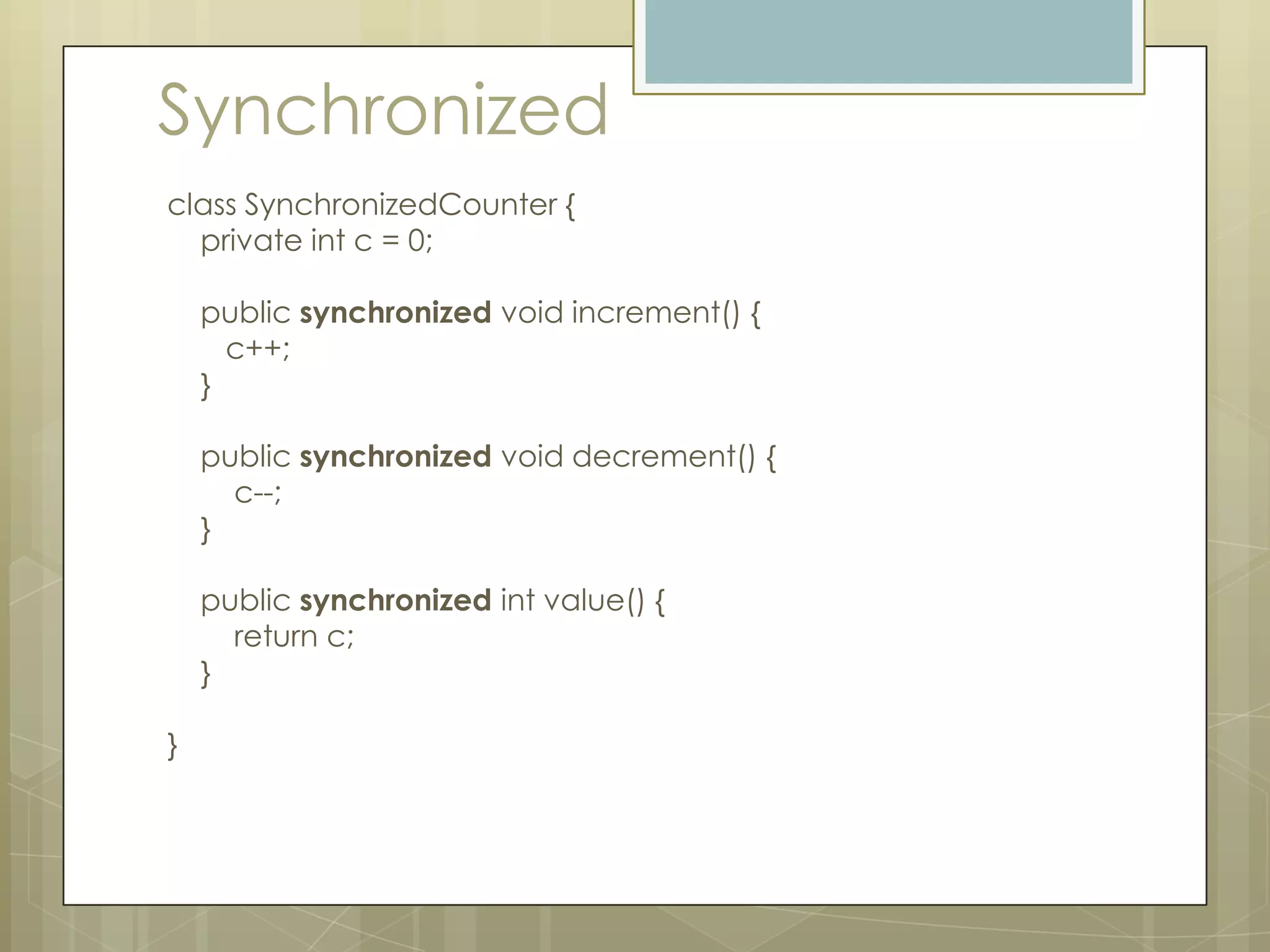
Synchronized
class SynchronizedCounter {
  private int c = 0;

    public synchronized void increment() {
      c++;
    }

    public synchronized void decrement() {
      c--;
    }

    public synchronized int value() {
      return c;
    }

}
Agenda
 Objective
 Facts
 ThreadSafety
 Java Concurrency Problems (Symptoms)
 Java Concurrency methods
References
 Java    Concurrency in Practice
 https://www.student.cs.uwaterloo.ca/~cs
  350/W11/notes/threads.pdf
 http://antrix.net/posts/2012/java-lazy-
  initialization/?c=1276

Java concurrency

  • 1.
  • 2.
    Agenda  Objective  Facts ThreadSafety  Java Concurrency Problems (Symptoms)  Java Concurrency methods
  • 3.
  • 4.
    Objective  Shared State Method Area
  • 5.
    Is That ThreadSafe? package com.thread; class ApplicationThread implements Runnable{ private int i = 0; @Override public void run() { System.out.println(++i); } } public class Main { public static void main(String[] args) { for (int i = 0; i < 1000; i++) { Thread thread1 = new Thread(new ApplicationThread()); thread1.start(); } } }
  • 6.
    Is That ThreadSafe? package com.thread; class ApplicationThread implements Runnable{ private int i = 0; @Override public void run() { System.out.println(++i); } } public class Main { public static void main(String[] args) { Runnable runnable = new ApplicationThread(); for (int i = 0; i < 100000; i++) { Thread thread1 = new Thread(runnable); thread1.start(); } } }
  • 7.
    Agenda  Objective  Facts ThreadSafety  Java Concurrency Problems (Symptoms)  Java Concurrency methods
  • 8.
    Facts  Processors,cache, RAMinteractions  Compilers optimization (Instructions Re- ordering)
  • 9.
    Processors, cache, RAM interactions Thread 1 Thread 2 P1 P2 R1 R2 C1 C2 text Stack Stack RAM Heap (code) 1 2 segment
  • 10.
    Compilers optimization • Constantfolding Ex: static final int length = 25; static final int width = 10; int res = length * width; //int res = 250; • Drop memory write for non volatile variables • Instructions Reordering • int A, B; • int A, B; • void foo() • void foo() • { A = B + 1; • {B = 0; • B = 0; } • A = B + 1; } For more Reference, Cglib (Code generation Library)
  • 11.
    Illustrative Example public classNoVisibility { private static boolean ready; private static int number; private static class ReaderThread extends Thread { public void run() { while (!ready) Thread.yield(); System.out.println(number); } } public static void main(String[] args) { new ReaderThread().start(); number = 42; ready = true; } }
  • 12.
    Solution public class NoVisibility { private static volatile boolean ready; private static volatile int number; private static class ReaderThread extends Thread { public void run() { while (!ready) Thread.yield(); System.out.println(number); } } public static void main(String[] args) { new ReaderThread().start(); number = 42; ready = true; } }
  • 13.
    Agenda  Objective  Facts ThreadSafety  Java Concurrency Problems (Symptoms)  Java Concurrency methods
  • 14.
    Singleton Is That ThreadSafe? class Demo { private static Collaborator collaborator; public Collaborator getCollaborator() { if (collaborator == null) { collaborator = new Collaborator(); } return collaborator; } }
  • 15.
    Thread Safety Atomicity synchronized Concurrency Visibility Volatile Volatile Patterns • One thread writes Other Threads reads • Checking Status flags • Independent Observations
  • 16.
    Thread Safe class Demo{ private static Collaborator collaborator; public synchronized Collaborator getCollaborator() { if (collaborator == null) { collaborator = new Collaborator(); } return collaborator; } }
  • 17.
    Optimized Solution class Demo{ private static volatile Collaborator collaborator; public Collaborator getCollaborator() { if (collaborator == null) {// double checked locking code synchronized(this) { if (collaborator == null) { collaborator = new Collaborator(); } } } return collaborator; } }
  • 18.
    Even more Optimized classDemo { private static volatile Collaborator collaborator; public Collaborator getCollaborator() { Collaborator tmp = collaborator; if (tmp == null) { synchronized(this) { if (tmp == null) { tmp = new Collaborator(); collaborator = tmp; } } } return tmp; } }
  • 19.
    Agenda  Objective  Facts ThreadSafety  Java Concurrency Problems (Symptoms)  Java Concurrency methods
  • 20.
    Java Concurrency Problems andSymptoms  Invalid States  Stale values (old values, other threads values)  Null pointer exceptions  Array out of bound exceptions  Symptom  Code works in Debugging while not working in the running mode or production mode  Working with JVM vendor while not working with other  Working with certain usage load and doesn’t work when the usage is increased (JIT Compiler)
  • 21.
    Agenda  Objective  Facts ThreadSafety  Java Concurrency Problems (Symptoms)  Java Concurrency methods
  • 22.
    Java Concurrency methods Thread Confinement  Stack Confinement  Immutable  Visibility  Atomicity
  • 23.
    Thread confinement (Not toshare)  If data is only accessed from a single thread, no synchronization is needed.  JDBC Connections , confines the connection for a single thread  Implementation using ThreadLocal
  • 24.
    Thread Confinement public classConnectionDispenser { private static class ThreadLocalConnection extends ThreadLocal { public Object initialValue() { return DriverManager. getConnection(ConfigurationSingleton.getDbUrl()); } } private static ThreadLocalConnection conn = new ThreadLocalConnection(); public static Connection getConnection() { return (Connection) conn.get(); } }
  • 25.
    Stack Confinement Not to share  Object can only reached using local variables.  Widely used in our projects public class Income extends HttpServlet { @override protected void doPost(HttpServletRequest request, HttpServletResponse response) { try { IncomeForm income = Util.jsonToObject(input, IncomeForm.class);
  • 26.
    Immutable  Fieldsare Final, values are set only from the constructors, (this reference does not escaped)  Immutable V effectively Immutable (Fields are not declared final, but there are not setters methods )  Volatile Reference to Immutable Objects
  • 27.
    Illustrative example @Immutable class OneValueCache{ private final BigInteger lastNumber; private final BigInteger[] lastFactors; public OneValueCache(BigInteger i, BigInteger[] factors) { lastNumber = i; lastFactors = Arrays.copyOf(factors, factors.length); } public BigInteger[] getFactors(BigInteger i) { if (lastNumber == null !lastNumber.equals(i)) return null; else return Arrays.copyOf(lastFactors, lastFactors.length); } }
  • 28.
    Using volatile topublish immutable objects @ThreadSafe public class VolatileCachedFactorizer implements Servlet { private volatile OneValueCache cache = new OneValueCache(null, null); public void service(ServletRequest req, ServletResponse resp) { BigInteger i = extractFromRequest(req); BigInteger[] factors = cache.getFactors(i); //Tip !!! if (factors == null) { factors = factor(i); cache = new OneValueCache(i, factors); } encodeIntoResponse(resp, factors); } }
  • 29.
    Volatile volatile boolean shutdownRequested; ... publicvoid shutdown() { shutdownRequested = true; } public void doWork() { while (!shutdownRequested) { // do stuff } }
  • 30.
    Synchronized class SynchronizedCounter { private int c = 0; public synchronized void increment() { c++; } public synchronized void decrement() { c--; } public synchronized int value() { return c; } }
  • 31.
    Agenda  Objective  Facts ThreadSafety  Java Concurrency Problems (Symptoms)  Java Concurrency methods
  • 32.
    References  Java Concurrency in Practice  https://www.student.cs.uwaterloo.ca/~cs 350/W11/notes/threads.pdf  http://antrix.net/posts/2012/java-lazy- initialization/?c=1276