iOS Development with Blocks Jeff Kelley (@jeff_r_kelley) MobiDevDay Detroit | February 19, 2011 Slides will be on blog.slaunchaman.com
Introduction Blocks What are blocks? Why should we use blocks? Grand Central Dispatch How does GCD help iOS development?
Blocks Apple extension to the C language Similar to closures, lambdas, etc. Encapsulate code like a function, but with extra “magic”
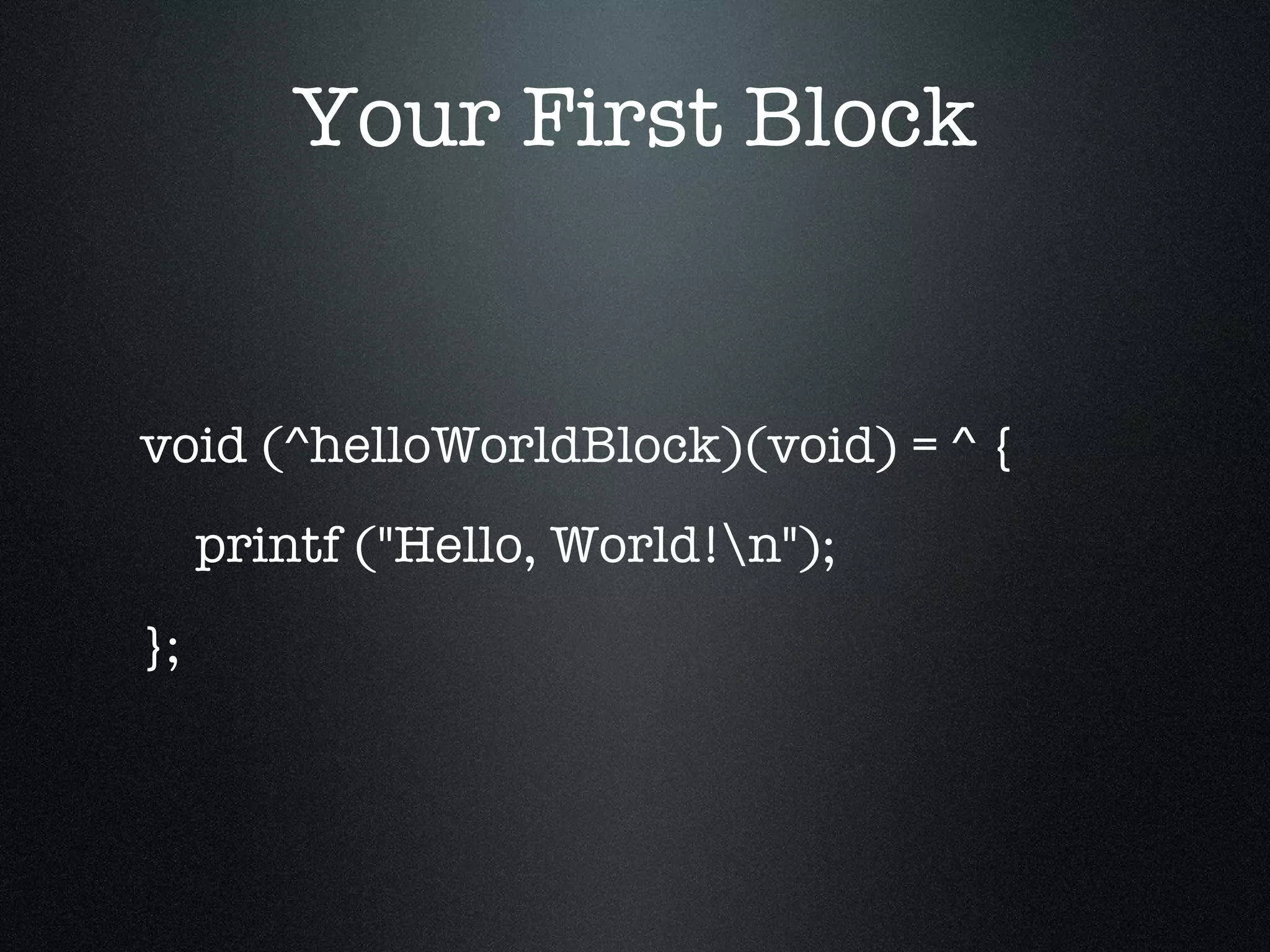
Your First Block void (^helloWorldBlock)(void) = ^ { printf ("Hello, World!\n"); };
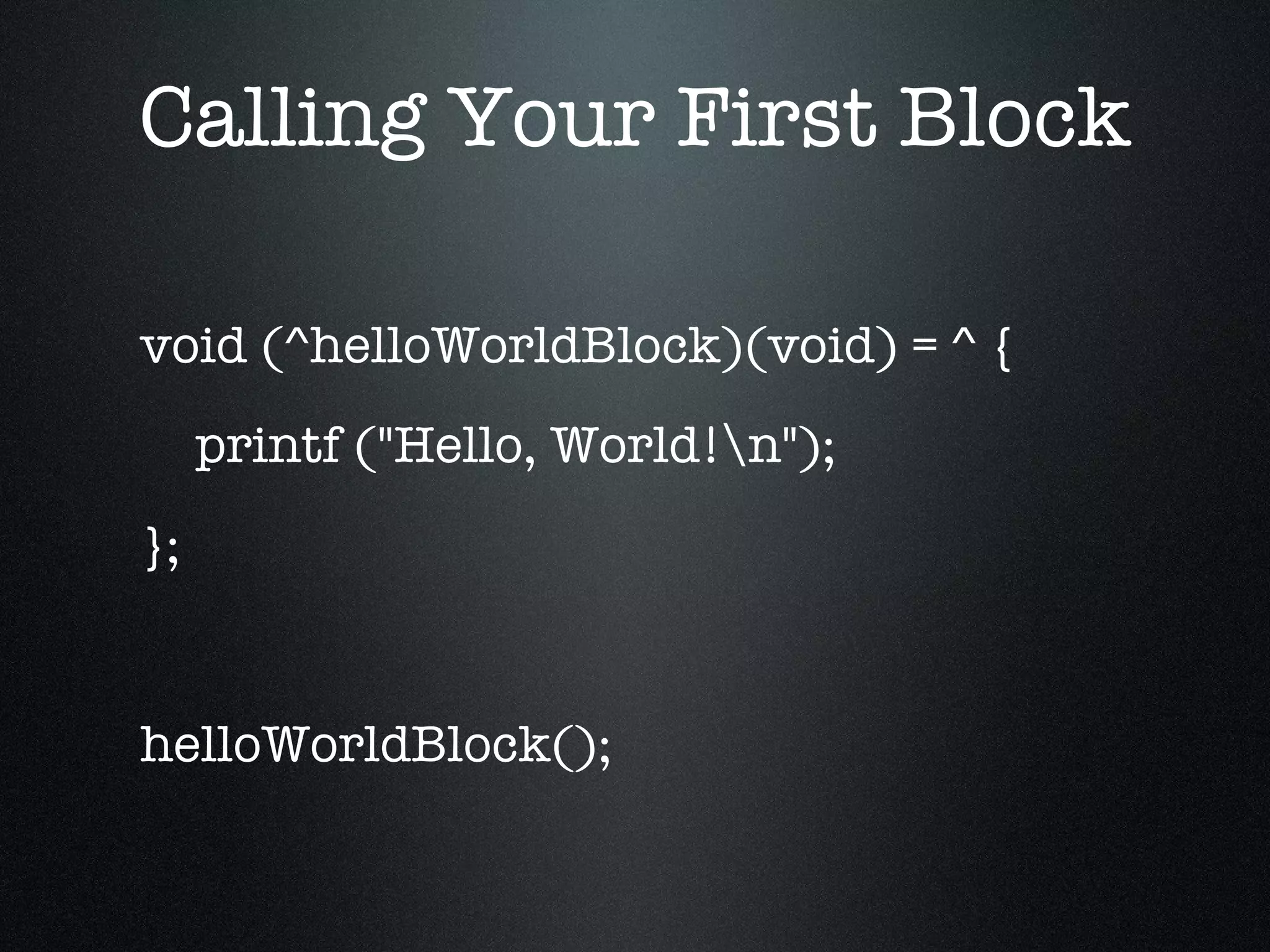
Calling Your First Block void (^helloWorldBlock)(void) = ^ { printf ("Hello, World!\n"); }; helloWorldBlock();
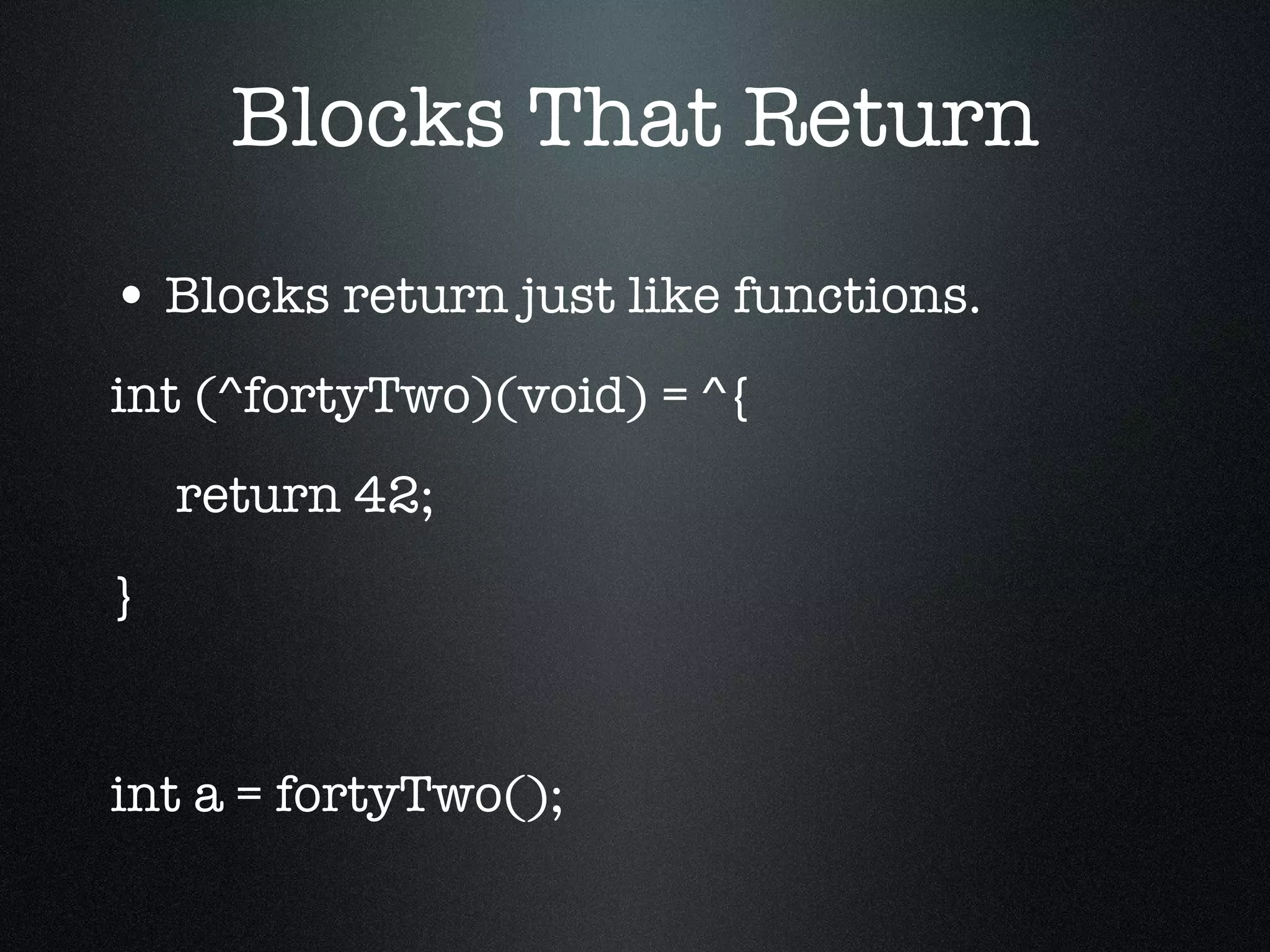
Blocks That Return Blocks return just like functions. int (^fortyTwo)(void) = ^{ return 42; } int a = fortyTwo();
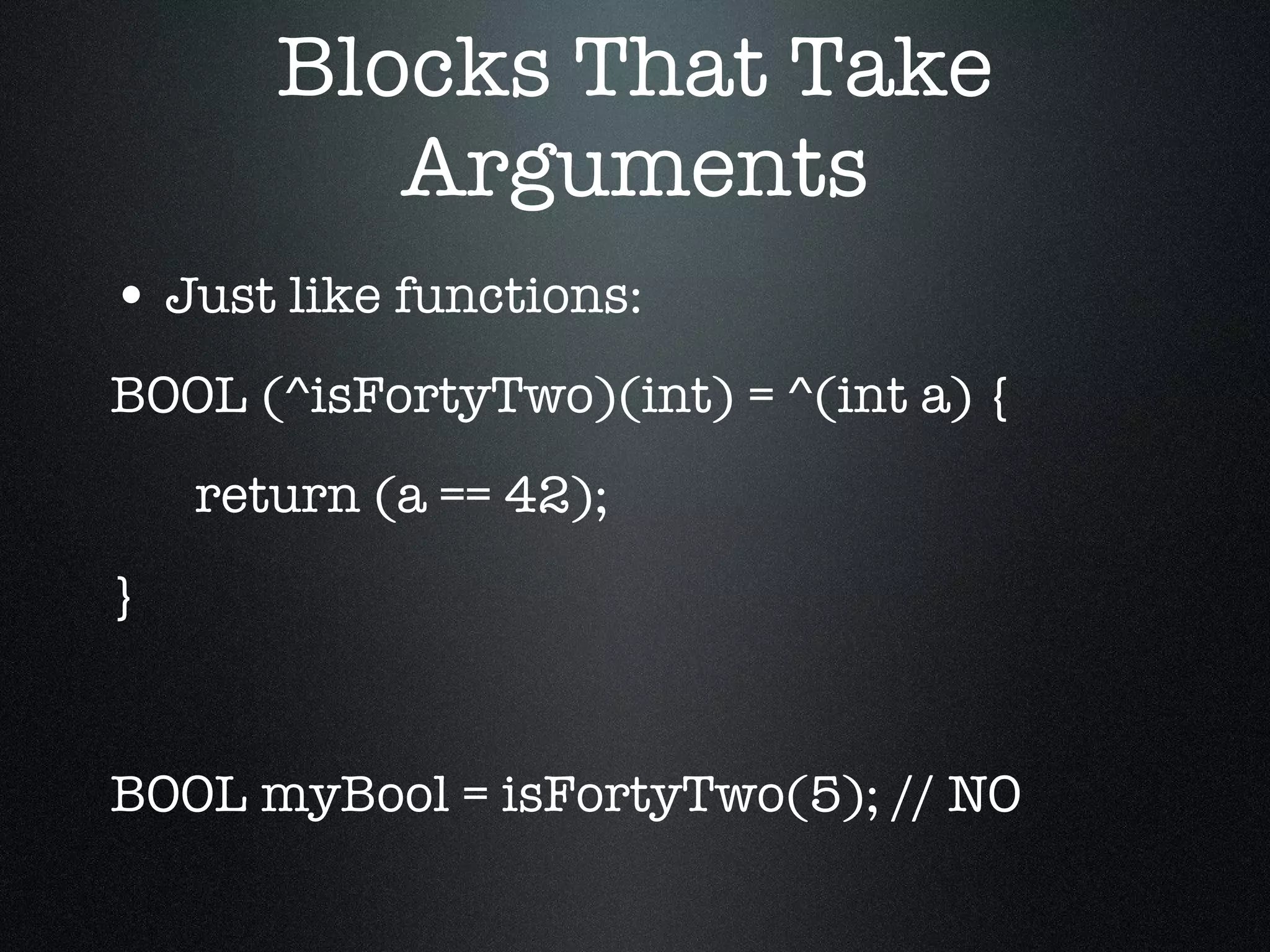
Blocks That Take Arguments Just like functions: BOOL (^isFortyTwo)(int) = ^(int a) { return (a == 42); } BOOL myBool = isFortyTwo(5); // NO
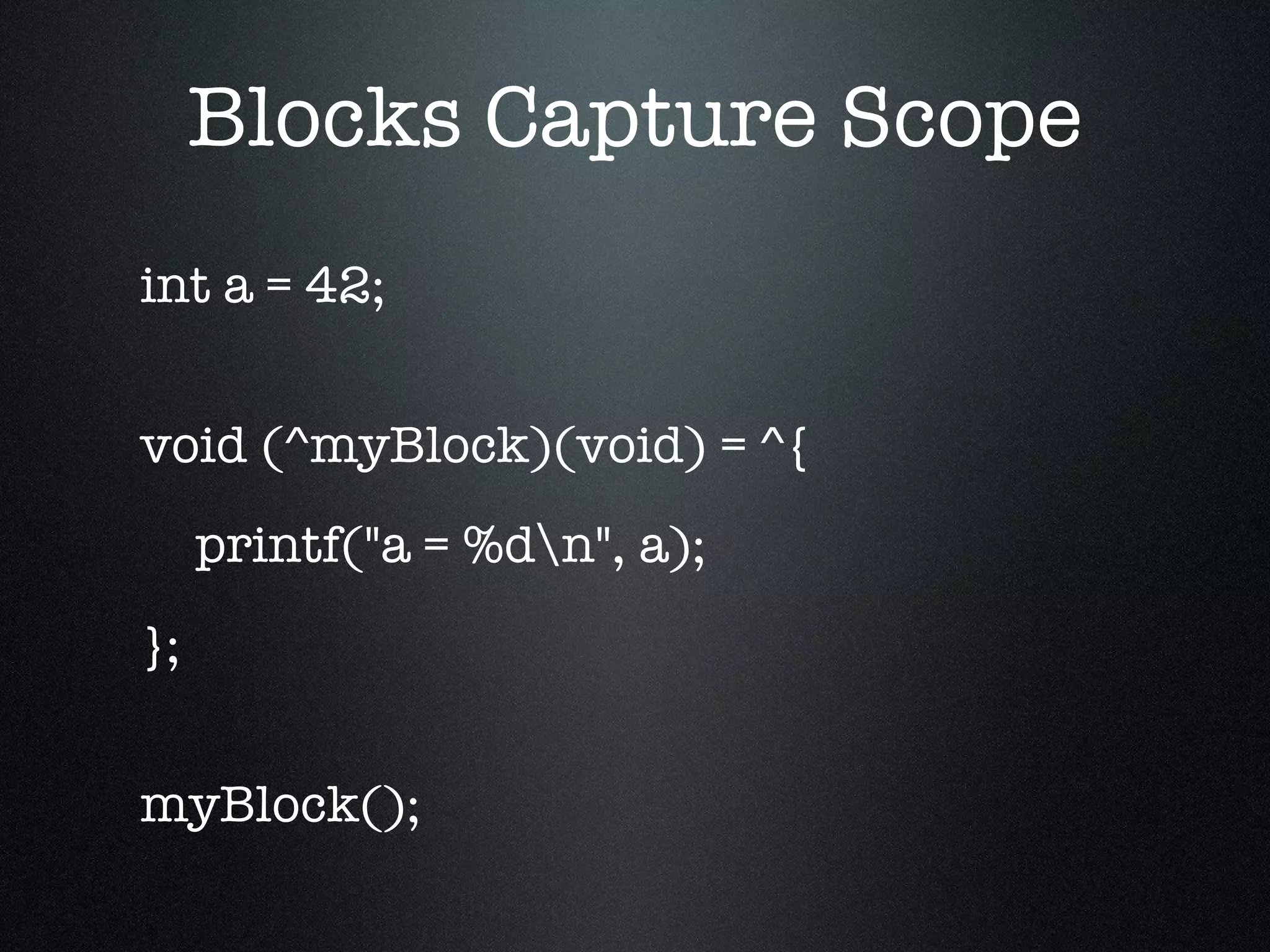
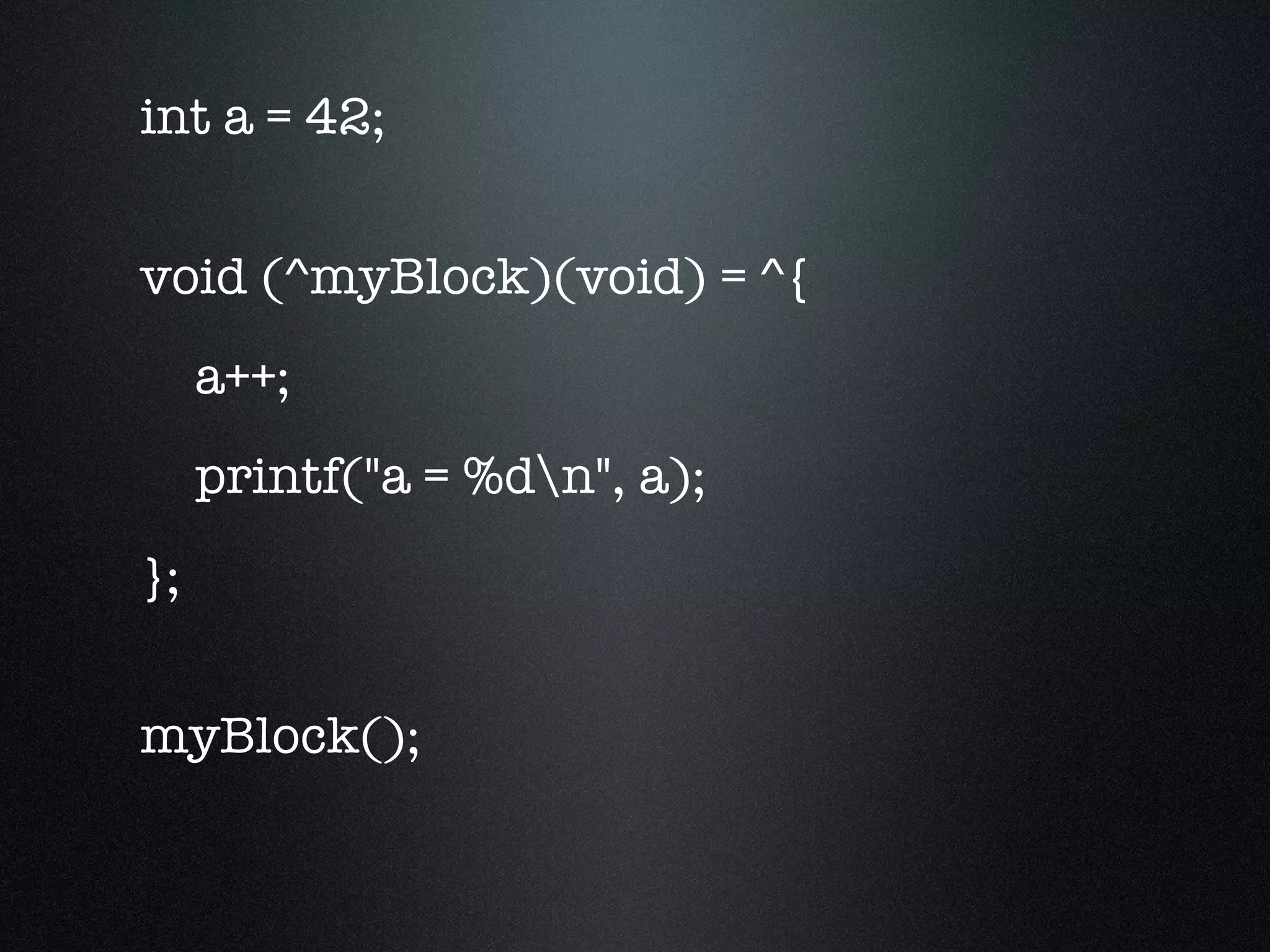
Blocks Capture Scope int a = 42; void (^myBlock)(void) = ^{ printf("a = %d\n", a); }; myBlock();
int a = 42; void (^myBlock)(void) = ^{ a++; printf("a = %d\n", a); }; myBlock();
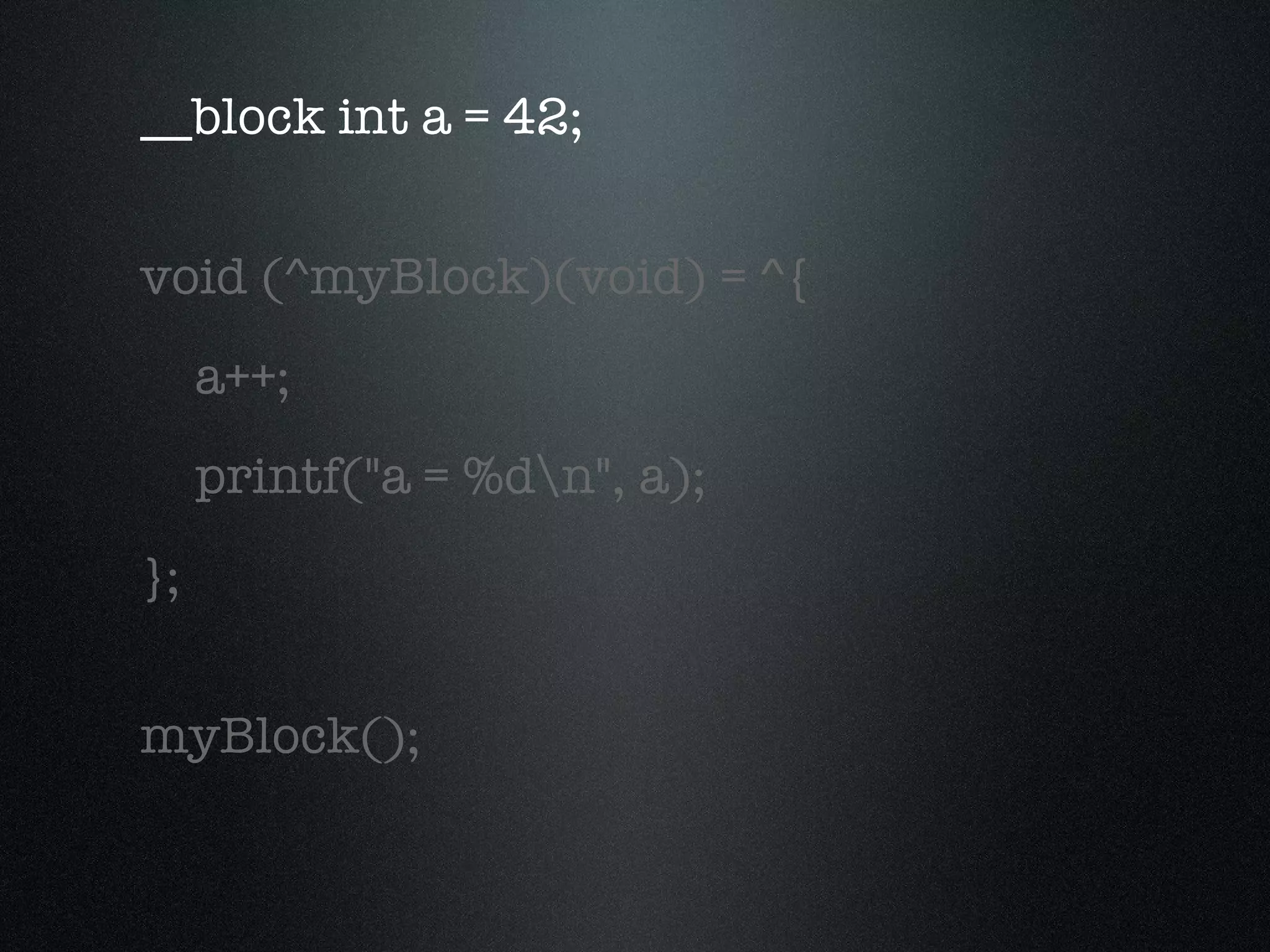
__block  int a = 42; void (^myBlock)(void) = ^{ a++; printf("a = %d\n", a); }; myBlock();
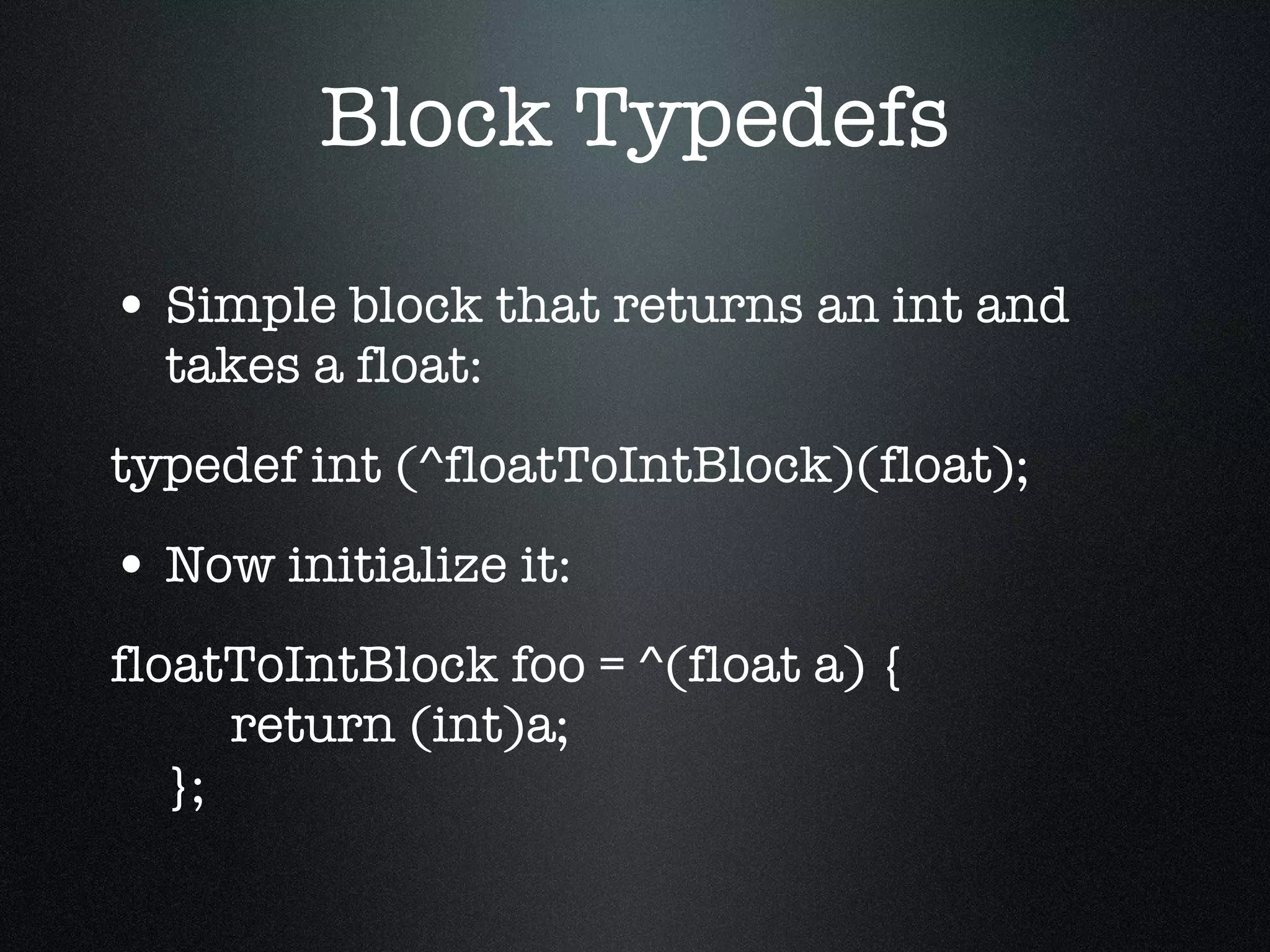
Block Typedefs Simple block that returns an int and takes a float: typedef int (^floatToIntBlock)(float); Now initialize it: floatToIntBlock foo = ^(float a) {   return (int)a; };
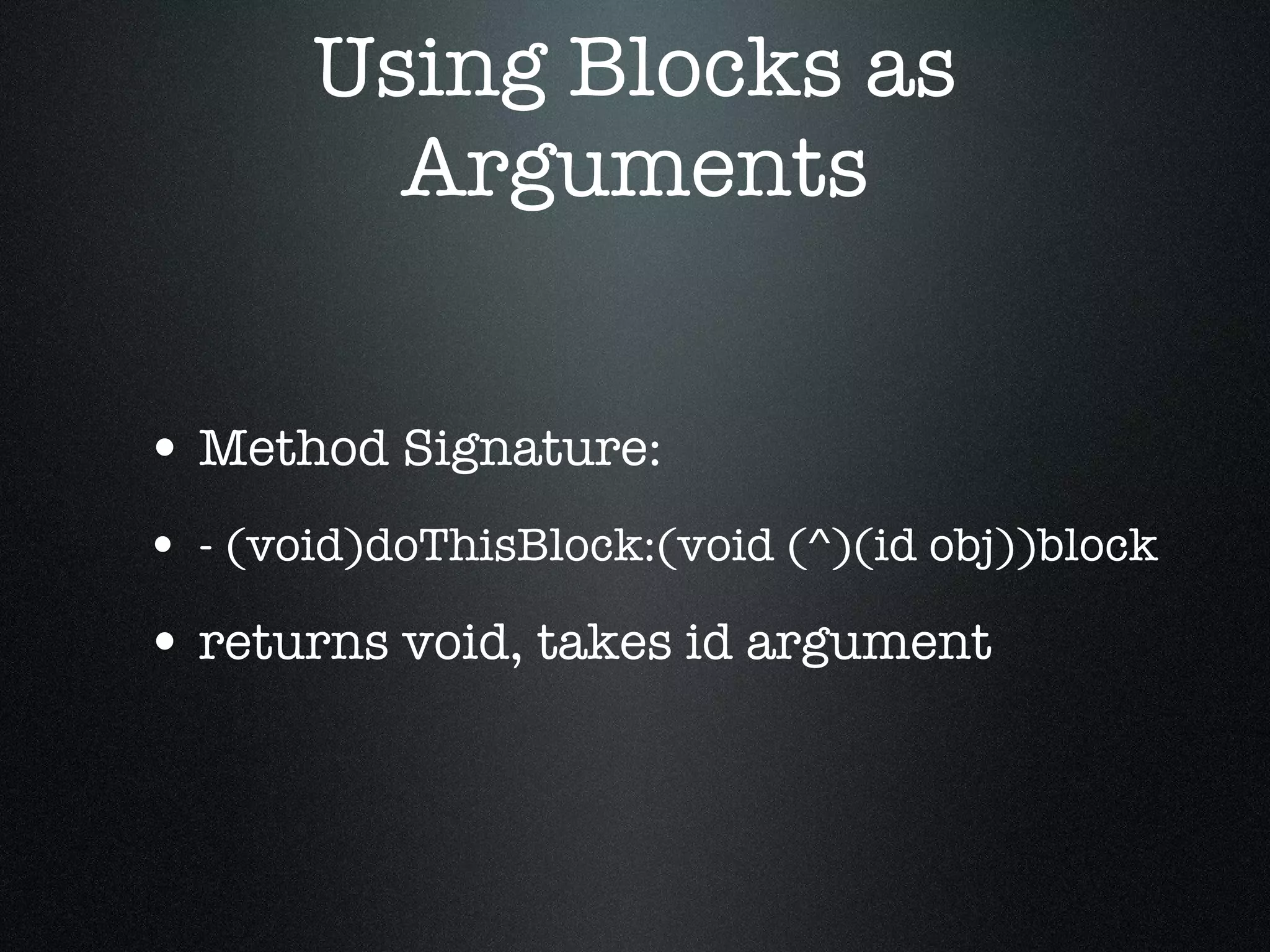
Using Blocks as Arguments Method Signature: - (void)doThisBlock:(void (^)(id obj))block returns void, takes id argument
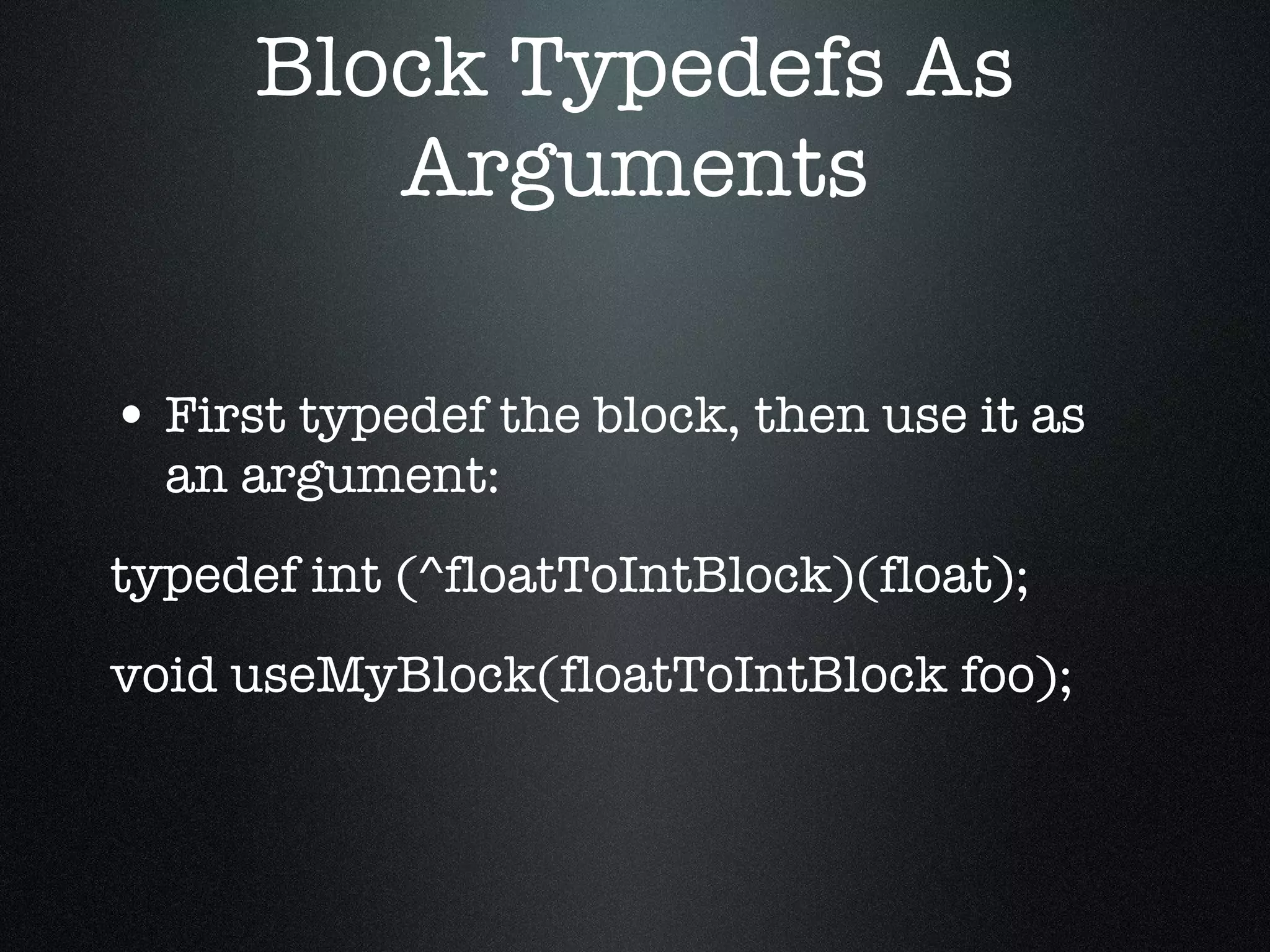
Block Typedefs As Arguments First typedef the block, then use it as an argument: typedef int (^floatToIntBlock)(float); void useMyBlock(floatToIntBlock foo);
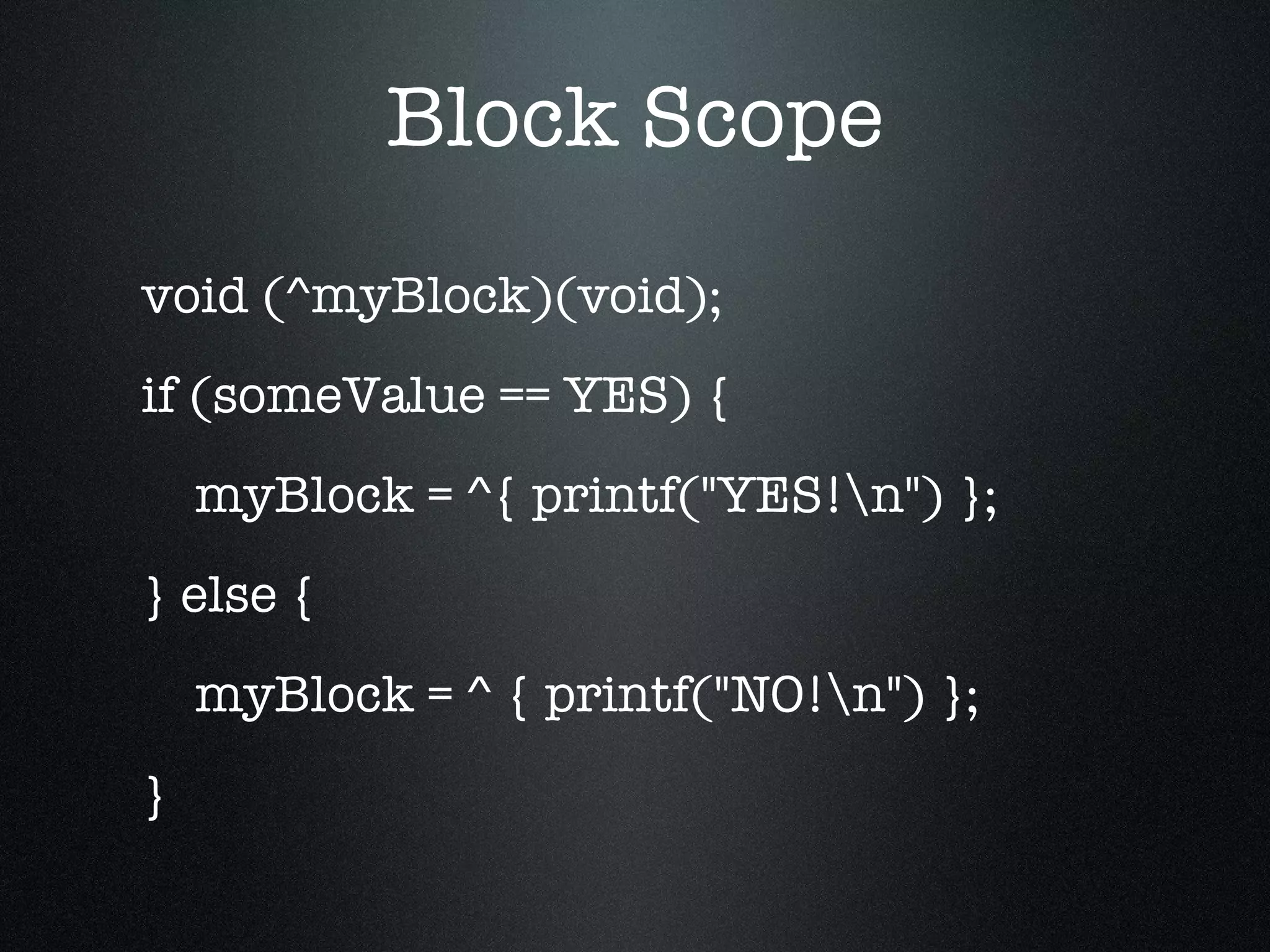
Block Scope void (^myBlock)(void); if (someValue == YES) { myBlock = ^{ printf("YES!\n") }; } else { myBlock = ^ { printf("NO!\n") }; }
Block Memory Management Block_copy() and Block_release() Copied onto heap Blocks are Objective-C objects! [myBlock copy]; [myBlock release];
Block Memory Management Unlike Objective-C objects, blocks are created on the stack Block_copy() moves them to the heap Block_retain()  does not . Can also call [myBlock autorelease]
NSString *helloWorld = [[NSString alloc] initWithString:@"Hello, World!"]; void (^helloBlock)(void) = ^{ NSLog(@"%@", helloWorld); }; [helloWorld release]; helloBlock(); Blocks Retain Objects
What Are Blocks Good For? Replacing Callbacks Notification Handlers Enumeration
Replacing Callbacks Old UIView animations: [UIView beginAnimations:@"foo" context:nil]; [UIView setAnimationDelegate:self]; [UIView setAnimationDidStopSelector:@selector(animationDidStop:finished:context:)]; Then you implement the callback
Replacing Callbacks - (void)animationDidStop:(NSString *)animationID finished:(NSNumber *)finished context:(void *)context { if ([animationID isEqualToString:kIDOne]) { … } else if ([animationID isEqualToString:kIDTwo]) { … } }
Replacing Callbacks New UIView Animations: [UIView animateWithDuration:0.3   animations:^{   [myView setAlpha:0.0f];   }   completion:^(BOOL finished) {   [self doSomething];   }];
Replacing Callbacks New UIView Animations: [UIView  animateWithDuration:0.3   animations:^{   [myView setAlpha:0.0f];   }   completion:^(BOOL finished) {   [self doSomething];   }];
Replacing Callbacks New UIView Animations: [UIView animateWithDuration:0.3   animations:^{   [myView setAlpha:0.0f];   }   completion:^(BOOL finished) {   [self doSomething];   }];
Replacing Callbacks New UIView Animations: [UIView animateWithDuration:0.3   animations:^{   [myView setAlpha:0.0f];   }   completion:^(BOOL finished) {   [self doSomething];   } ];
What Are Blocks Good For? Replacing Callbacks Notification Handlers Enumeration
Notification Handlers Old Notifications: [notificationCenter addObserver:self   selector:@selector(foo:)   name:kMyNotification   object:myObject];
Notification Handlers Old Notifications: Userinfo Dictionaries - (void)foo:(NSNotification *)aNotification {   NSDictionary *userInfo = [aNotification userInfo];   NSString *UID = [userInfo objectForKey:kIDKey];   NSNumber *value = [userInfo objectForKey:kValueKey]; }
Notification Handlers New Notification Handlers: [notificationCenter addObserverForName:kName   object:myObject   queue:nil   usingBlock:^(NSNotification *aNotification) {   [myObject doSomething]; }]; [myObject startLongTask];
What Are Blocks Good For? Replacing Callbacks Notification Handlers Enumeration
Enumeration Basic Enumeration for (int i = 0; i < [myArray count]; i++) { id obj = [myArray objectAtIndex:i]; [obj doSomething]; }
Enumeration But… for (int i = 0; i < [myArray count]; i++) {   id obj = [myArray objectAtIndex:i];   [obj doSomething];   for (int j = 0; j < [obj count]; j++) {   // Very interesting code here.   } }
Enumeration NSEnumerator NSArray *anArray = // ... ; NSEnumerator *enumerator = [anArray objectEnumerator]; id object; while ((object = [enumerator nextObject])) { // do something with object... }
Enumeration Fast Enumeration (10.5+) for (id obj in myArray) { [obj doSomething]; }
Enumeration Block-based enumeration [myArray enumerateObjectsUsingBlock: ^(id obj, NSUInteger idx, BOOL *stop) { [obj doSomething]; }];
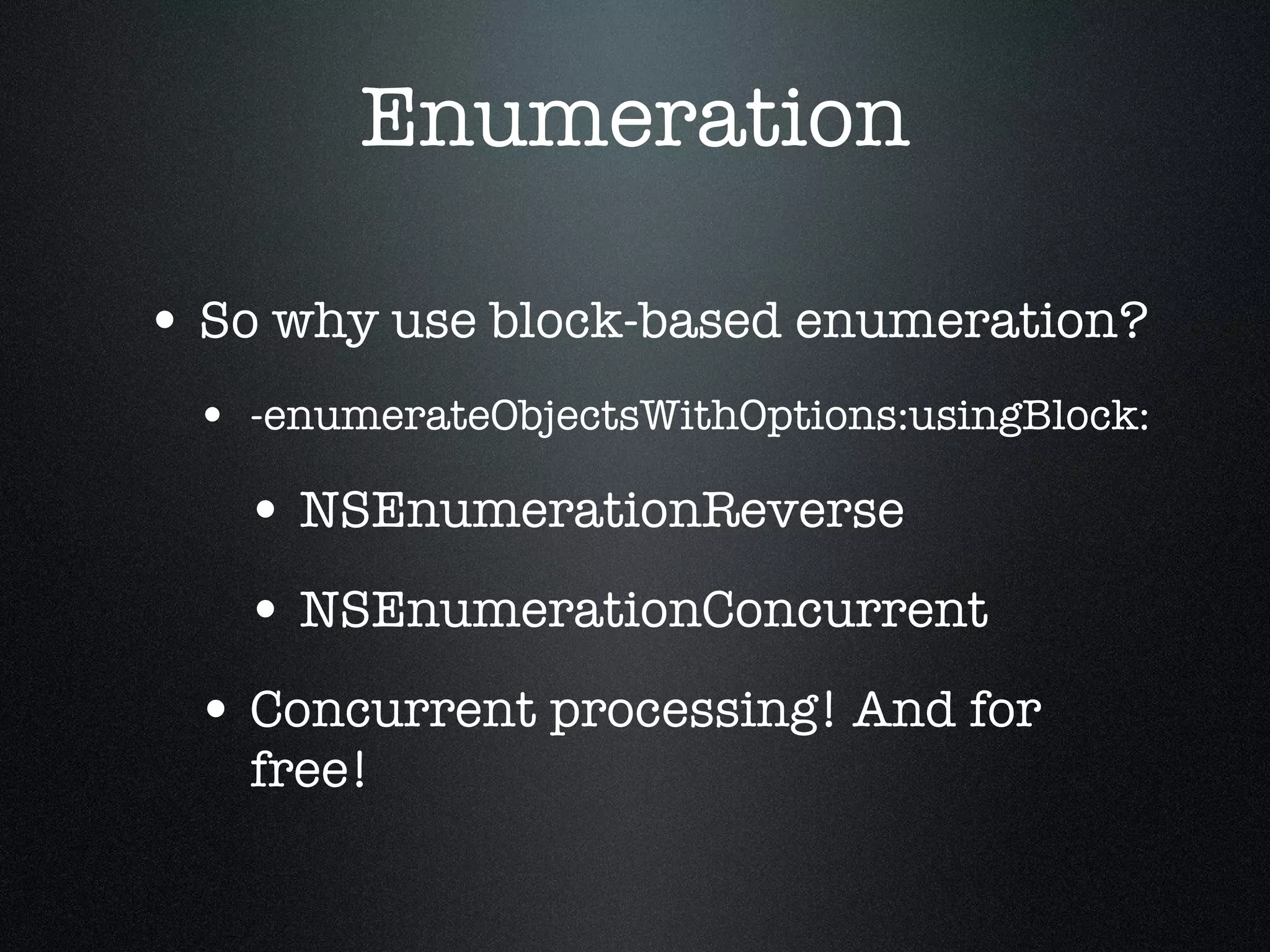
Enumeration So why use block-based enumeration? -enumerateObjectsWithOptions:usingBlock: NSEnumerationReverse NSEnumerationConcurrent Concurrent processing! And for free!
What Are Blocks Good For? Replacing Callbacks Notification Handlers Enumeration
What Are Blocks Good For? Replacing Callbacks Notification Handlers Enumeration Sorting
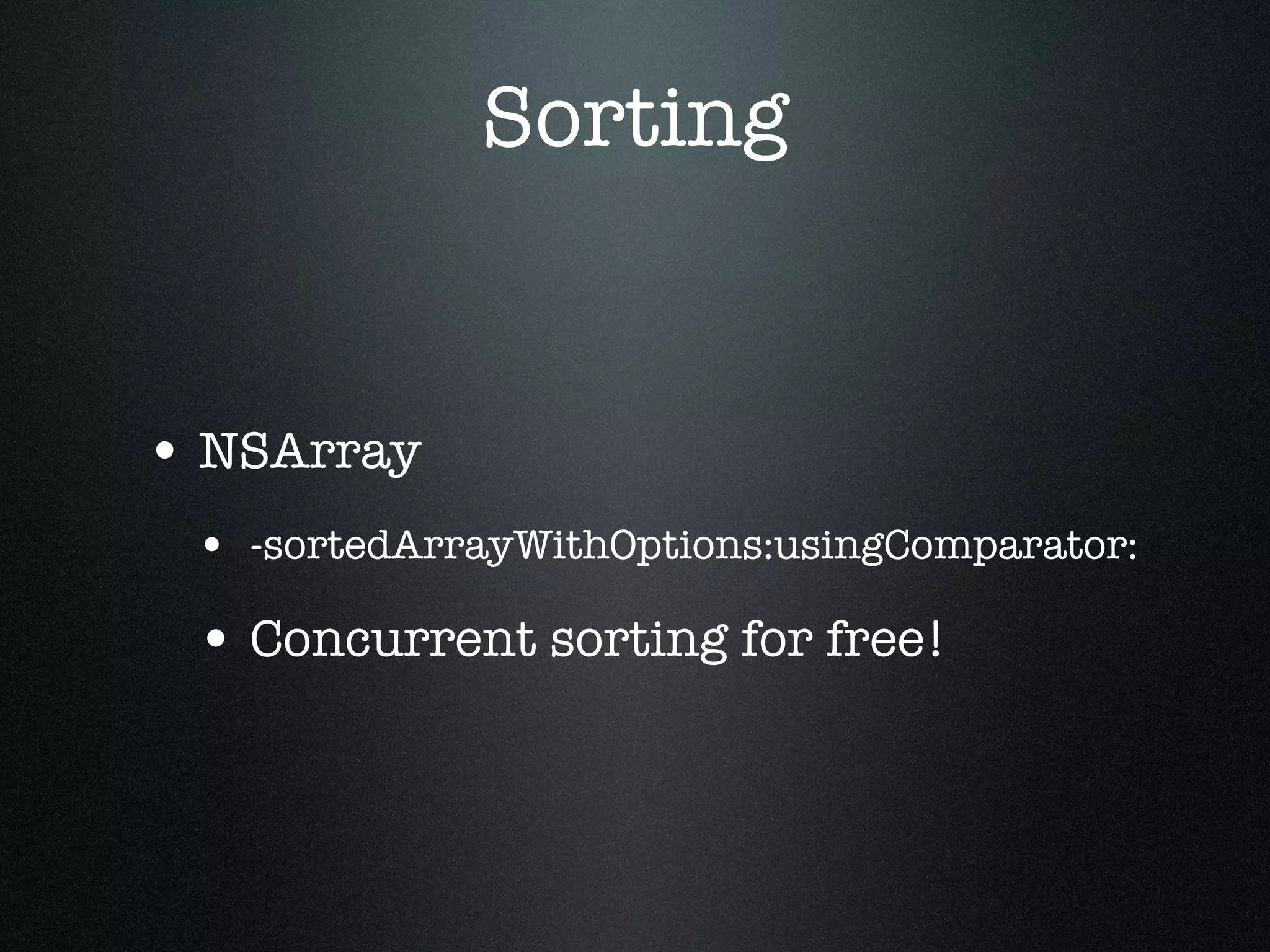
Sorting NSArray -sortedArrayWithOptions:usingComparator: Concurrent sorting for free!
Blocks Wrap-Up Carat Syntax  Block Memory Management Using Blocks as Arguments Replacing Callbacks, Notification Handlers, Enumeration, and Sorting
Intro to Grand Central Dispatch
Moore’s Law The quantity of transistors  that can be placed inexpensively on an  integrated circuit  has doubled approximately every two years. The trend has continued for more than half a century and is not expected to stop until 2015 or later. Wikipedia
Grand Central Dispatch (GCD) Open-source threading library (libdispatch) Apache license Automatically optimizes threading Provides queues, timers, event handlers, etc.
Simple GCD dispatch_queue_t queue = dispatch_get_global_queue(DISPATCH_QUEUE_PRIORITY_HIGH, 0ul); dispatch_async(queue, ^{ [self  performLongTask]; }
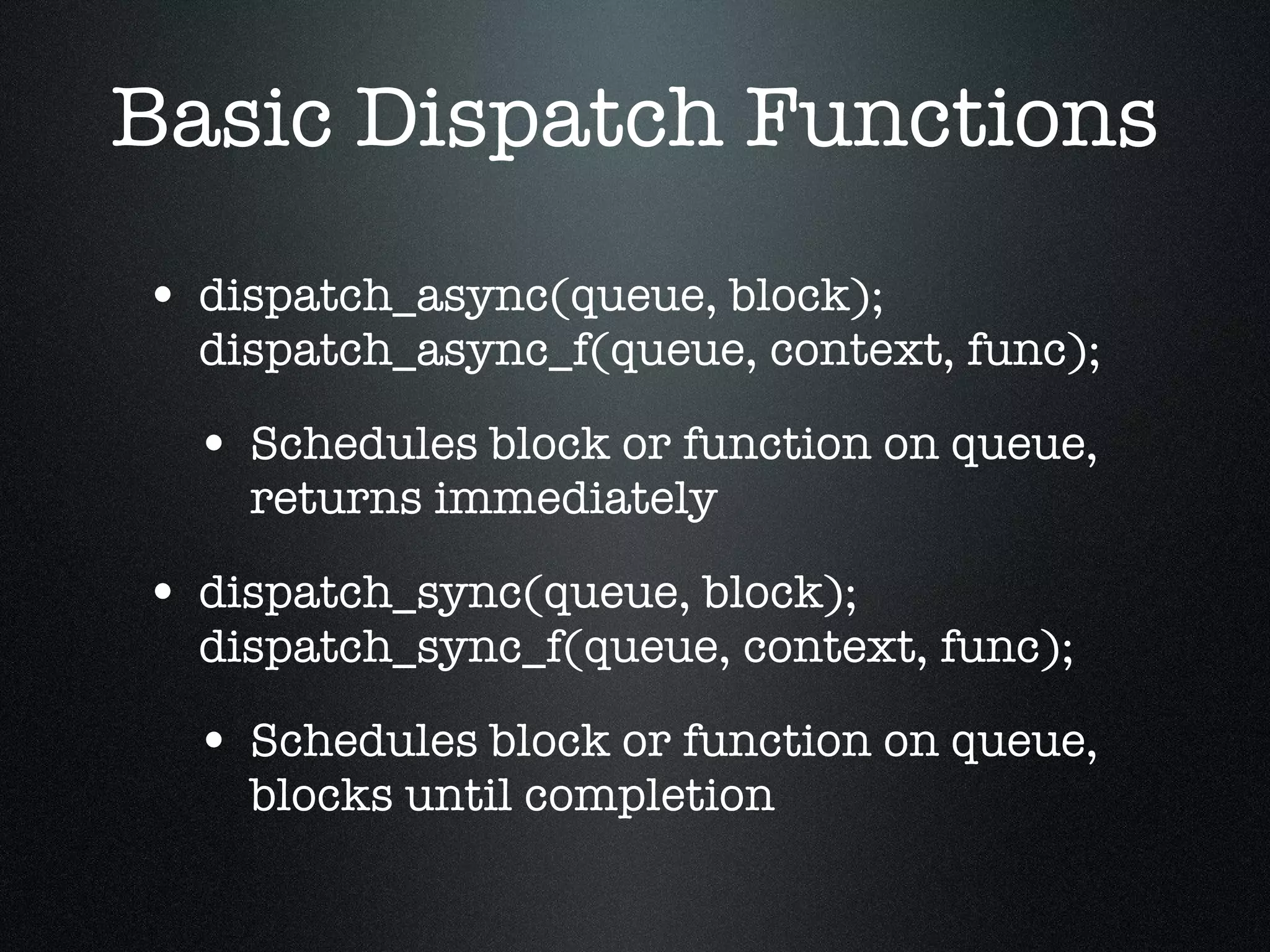
Basic Dispatch Functions dispatch_async(queue, block); dispatch_async_f(queue, context, func); Schedules block or function on queue, returns immediately dispatch_sync(queue, block); dispatch_sync_f(queue, context, func); Schedules block or function on queue, blocks until completion
Dispatch Queues dispatch_queue_t Main Queue Analogous to main thread (Do your UI operations here) dispatch_get_main_queue()
Global Queues dispatch_get_global_queue(priority, flags); priority is one of three constants: DISPATCH_QUEUE_PRIORITY_LOW DISPATCH_QUEUE_PRIORITY_NORMAL DISPATCH_QUEUE_PRIORITY_HIGH secong arg should always be 0ul (for now)
Making Queues dispatch_queue_create(label, attr) Use reverse DNS for label com.example.myQueue pass NULL for attr Be sure to use dispatch_release()
Using Queues Custom queues are serial First-in, first-out, one at a time Global queues are concurrent GCD automatically chooses how many (usually # of CPU cores)

iOS Development with Blocks

  • 1.
    iOS Development withBlocks Jeff Kelley (@jeff_r_kelley) MobiDevDay Detroit | February 19, 2011 Slides will be on blog.slaunchaman.com
  • 2.
    Introduction Blocks Whatare blocks? Why should we use blocks? Grand Central Dispatch How does GCD help iOS development?
  • 3.
    Blocks Apple extensionto the C language Similar to closures, lambdas, etc. Encapsulate code like a function, but with extra “magic”
  • 4.
    Your First Blockvoid (^helloWorldBlock)(void) = ^ { printf (&quot;Hello, World!\n&quot;); };
  • 5.
    Calling Your FirstBlock void (^helloWorldBlock)(void) = ^ { printf (&quot;Hello, World!\n&quot;); }; helloWorldBlock();
  • 6.
    Blocks That ReturnBlocks return just like functions. int (^fortyTwo)(void) = ^{ return 42; } int a = fortyTwo();
  • 7.
    Blocks That TakeArguments Just like functions: BOOL (^isFortyTwo)(int) = ^(int a) { return (a == 42); } BOOL myBool = isFortyTwo(5); // NO
  • 8.
    Blocks Capture Scopeint a = 42; void (^myBlock)(void) = ^{ printf(&quot;a = %d\n&quot;, a); }; myBlock();
  • 9.
    int a =42; void (^myBlock)(void) = ^{ a++; printf(&quot;a = %d\n&quot;, a); }; myBlock();
  • 10.
    __block inta = 42; void (^myBlock)(void) = ^{ a++; printf(&quot;a = %d\n&quot;, a); }; myBlock();
  • 11.
    Block Typedefs Simpleblock that returns an int and takes a float: typedef int (^floatToIntBlock)(float); Now initialize it: floatToIntBlock foo = ^(float a) { return (int)a; };
  • 12.
    Using Blocks asArguments Method Signature: - (void)doThisBlock:(void (^)(id obj))block returns void, takes id argument
  • 13.
    Block Typedefs AsArguments First typedef the block, then use it as an argument: typedef int (^floatToIntBlock)(float); void useMyBlock(floatToIntBlock foo);
  • 14.
    Block Scope void(^myBlock)(void); if (someValue == YES) { myBlock = ^{ printf(&quot;YES!\n&quot;) }; } else { myBlock = ^ { printf(&quot;NO!\n&quot;) }; }
  • 15.
    Block Memory ManagementBlock_copy() and Block_release() Copied onto heap Blocks are Objective-C objects! [myBlock copy]; [myBlock release];
  • 16.
    Block Memory ManagementUnlike Objective-C objects, blocks are created on the stack Block_copy() moves them to the heap Block_retain() does not . Can also call [myBlock autorelease]
  • 17.
    NSString *helloWorld =[[NSString alloc] initWithString:@&quot;Hello, World!&quot;]; void (^helloBlock)(void) = ^{ NSLog(@&quot;%@&quot;, helloWorld); }; [helloWorld release]; helloBlock(); Blocks Retain Objects
  • 18.
    What Are BlocksGood For? Replacing Callbacks Notification Handlers Enumeration
  • 19.
    What Are BlocksGood For? Replacing Callbacks Notification Handlers Enumeration
  • 20.
    Replacing Callbacks OldUIView animations: [UIView beginAnimations:@&quot;foo&quot; context:nil]; [UIView setAnimationDelegate:self]; [UIView setAnimationDidStopSelector:@selector(animationDidStop:finished:context:)]; Then you implement the callback
  • 21.
    Replacing Callbacks -(void)animationDidStop:(NSString *)animationID finished:(NSNumber *)finished context:(void *)context { if ([animationID isEqualToString:kIDOne]) { … } else if ([animationID isEqualToString:kIDTwo]) { … } }
  • 22.
    Replacing Callbacks NewUIView Animations: [UIView animateWithDuration:0.3 animations:^{ [myView setAlpha:0.0f]; } completion:^(BOOL finished) { [self doSomething]; }];
  • 23.
    Replacing Callbacks NewUIView Animations: [UIView animateWithDuration:0.3 animations:^{ [myView setAlpha:0.0f]; } completion:^(BOOL finished) { [self doSomething]; }];
  • 24.
    Replacing Callbacks NewUIView Animations: [UIView animateWithDuration:0.3 animations:^{ [myView setAlpha:0.0f]; } completion:^(BOOL finished) { [self doSomething]; }];
  • 25.
    Replacing Callbacks NewUIView Animations: [UIView animateWithDuration:0.3 animations:^{ [myView setAlpha:0.0f]; } completion:^(BOOL finished) { [self doSomething]; } ];
  • 26.
    What Are BlocksGood For? Replacing Callbacks Notification Handlers Enumeration
  • 27.
    Notification Handlers OldNotifications: [notificationCenter addObserver:self selector:@selector(foo:) name:kMyNotification object:myObject];
  • 28.
    Notification Handlers OldNotifications: Userinfo Dictionaries - (void)foo:(NSNotification *)aNotification { NSDictionary *userInfo = [aNotification userInfo]; NSString *UID = [userInfo objectForKey:kIDKey]; NSNumber *value = [userInfo objectForKey:kValueKey]; }
  • 29.
    Notification Handlers NewNotification Handlers: [notificationCenter addObserverForName:kName object:myObject queue:nil usingBlock:^(NSNotification *aNotification) { [myObject doSomething]; }]; [myObject startLongTask];
  • 30.
    What Are BlocksGood For? Replacing Callbacks Notification Handlers Enumeration
  • 31.
    Enumeration Basic Enumerationfor (int i = 0; i < [myArray count]; i++) { id obj = [myArray objectAtIndex:i]; [obj doSomething]; }
  • 32.
    Enumeration But… for(int i = 0; i < [myArray count]; i++) { id obj = [myArray objectAtIndex:i]; [obj doSomething]; for (int j = 0; j < [obj count]; j++) { // Very interesting code here. } }
  • 33.
    Enumeration NSEnumerator NSArray*anArray = // ... ; NSEnumerator *enumerator = [anArray objectEnumerator]; id object; while ((object = [enumerator nextObject])) { // do something with object... }
  • 34.
    Enumeration Fast Enumeration(10.5+) for (id obj in myArray) { [obj doSomething]; }
  • 35.
    Enumeration Block-based enumeration[myArray enumerateObjectsUsingBlock: ^(id obj, NSUInteger idx, BOOL *stop) { [obj doSomething]; }];
  • 36.
    Enumeration So whyuse block-based enumeration? -enumerateObjectsWithOptions:usingBlock: NSEnumerationReverse NSEnumerationConcurrent Concurrent processing! And for free!
  • 37.
    What Are BlocksGood For? Replacing Callbacks Notification Handlers Enumeration
  • 38.
    What Are BlocksGood For? Replacing Callbacks Notification Handlers Enumeration Sorting
  • 39.
    What Are BlocksGood For? Replacing Callbacks Notification Handlers Enumeration Sorting
  • 40.
  • 41.
    Blocks Wrap-Up CaratSyntax Block Memory Management Using Blocks as Arguments Replacing Callbacks, Notification Handlers, Enumeration, and Sorting
  • 42.
    Intro to GrandCentral Dispatch
  • 43.
    Moore’s Law Thequantity of transistors that can be placed inexpensively on an integrated circuit has doubled approximately every two years. The trend has continued for more than half a century and is not expected to stop until 2015 or later. Wikipedia
  • 44.
    Grand Central Dispatch(GCD) Open-source threading library (libdispatch) Apache license Automatically optimizes threading Provides queues, timers, event handlers, etc.
  • 45.
    Simple GCD dispatch_queue_tqueue = dispatch_get_global_queue(DISPATCH_QUEUE_PRIORITY_HIGH, 0ul); dispatch_async(queue, ^{ [self performLongTask]; }
  • 46.
    Basic Dispatch Functionsdispatch_async(queue, block); dispatch_async_f(queue, context, func); Schedules block or function on queue, returns immediately dispatch_sync(queue, block); dispatch_sync_f(queue, context, func); Schedules block or function on queue, blocks until completion
  • 47.
    Dispatch Queues dispatch_queue_tMain Queue Analogous to main thread (Do your UI operations here) dispatch_get_main_queue()
  • 48.
    Global Queues dispatch_get_global_queue(priority,flags); priority is one of three constants: DISPATCH_QUEUE_PRIORITY_LOW DISPATCH_QUEUE_PRIORITY_NORMAL DISPATCH_QUEUE_PRIORITY_HIGH secong arg should always be 0ul (for now)
  • 49.
    Making Queues dispatch_queue_create(label,attr) Use reverse DNS for label com.example.myQueue pass NULL for attr Be sure to use dispatch_release()
  • 50.
    Using Queues Customqueues are serial First-in, first-out, one at a time Global queues are concurrent GCD automatically chooses how many (usually # of CPU cores)

Editor's Notes

  • #2 -Straw Poll: Who here has done iOS development before? -C development?
  • #13 After: but that’s ugly. We can make this look better.