SWIFT BASICS (2) 
iOS Development using Swift 
Ahmed Ali
TODAY TOPICS 
• Data types 
• Strings 
• Mutability, comparison, and interpolation 
• Collection types 
• Arrays, dictionaries and their mutability 
• Control flow 
• Connecting UI Controls to Your Code 
Ahmed Ali
DATA TYPES 
• Integers 
• Int 
• UInt 
• Floating point 
• Float 
• Double 
• Boolean 
• Bool 
Ahmed Ali
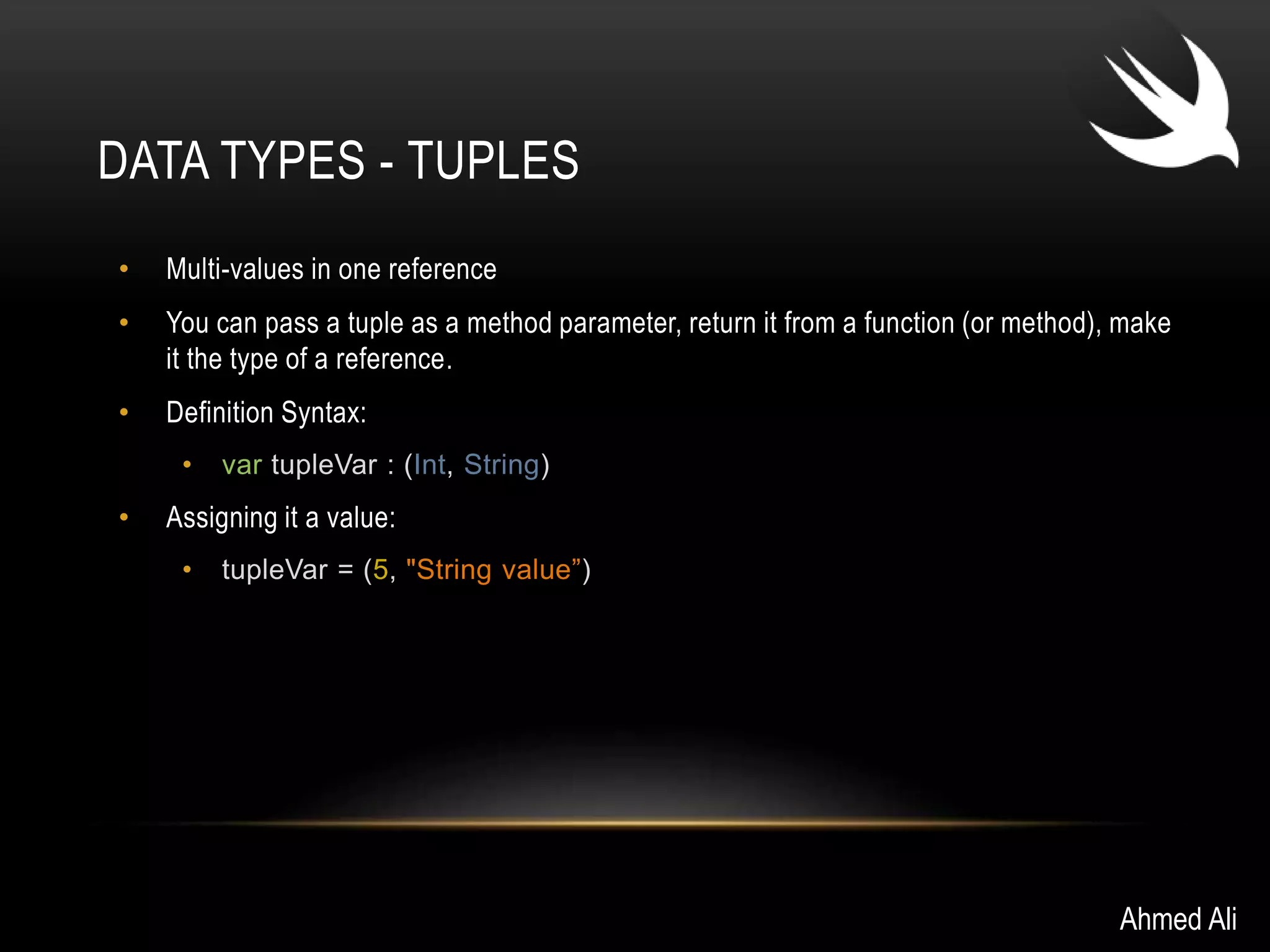
DATA TYPES - TUPLES 
• Multi-values in one reference 
• You can pass a tuple as a method parameter, return it from a function (or method), make 
it the type of a reference. 
• Definition Syntax: 
• var tupleVar : (Int, String) 
• Assigning it a value: 
• tupleVar = (5, "String value”) 
Ahmed Ali
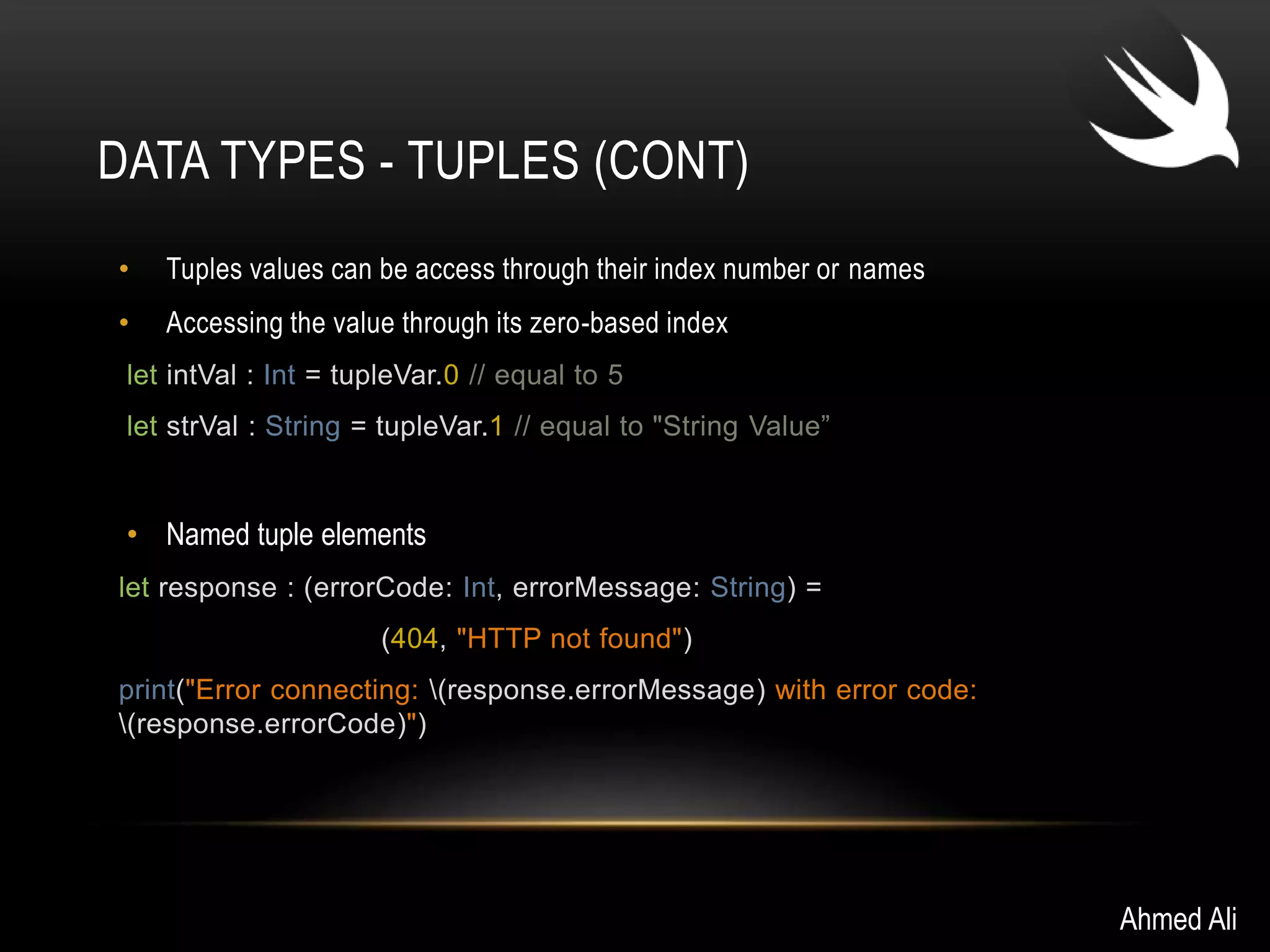
DATA TYPES - TUPLES (CONT) 
• Tuples values can be access through their index number or names 
• Accessing the value through its zero-based index 
let intVal : Int = tupleVar.0 // equal to 5 
let strVal : String = tupleVar.1 // equal to "String Value” 
• Named tuple elements 
let response : (errorCode: Int, errorMessage: String) = 
(404, "HTTP not found") 
print("Error connecting: (response.errorMessage) with error code: 
(response.errorCode)") 
Ahmed Ali
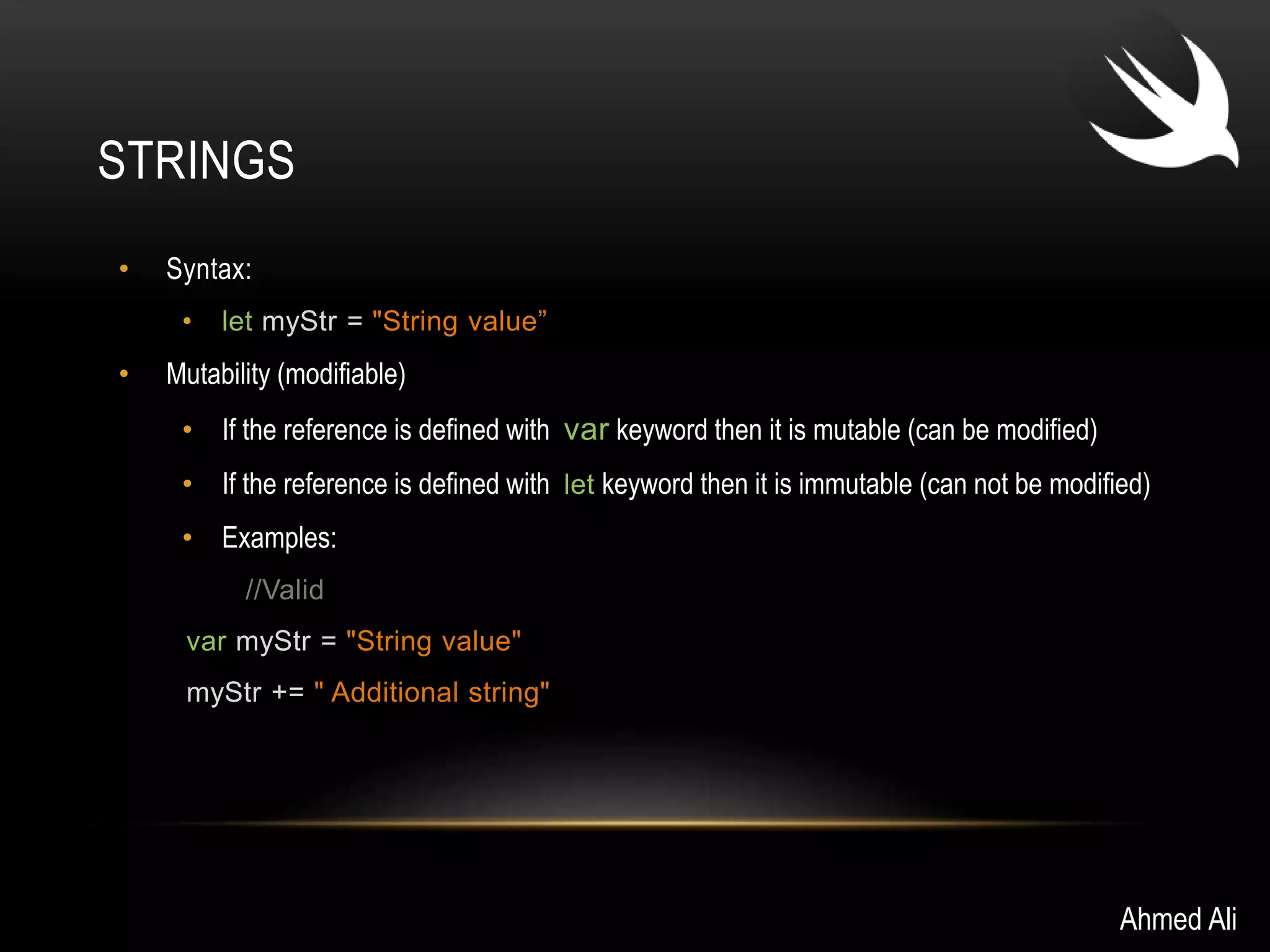
STRINGS 
• Syntax: 
• let myStr = "String value” 
• Mutability (modifiable) 
• If the reference is defined with var keyword then it is mutable (can be modified) 
• If the reference is defined with let keyword then it is immutable (can not be modified) 
• Examples: 
//Valid 
var myStr = "String value" 
myStr += " Additional string" 
Ahmed Ali
STRINGS (CONT) 
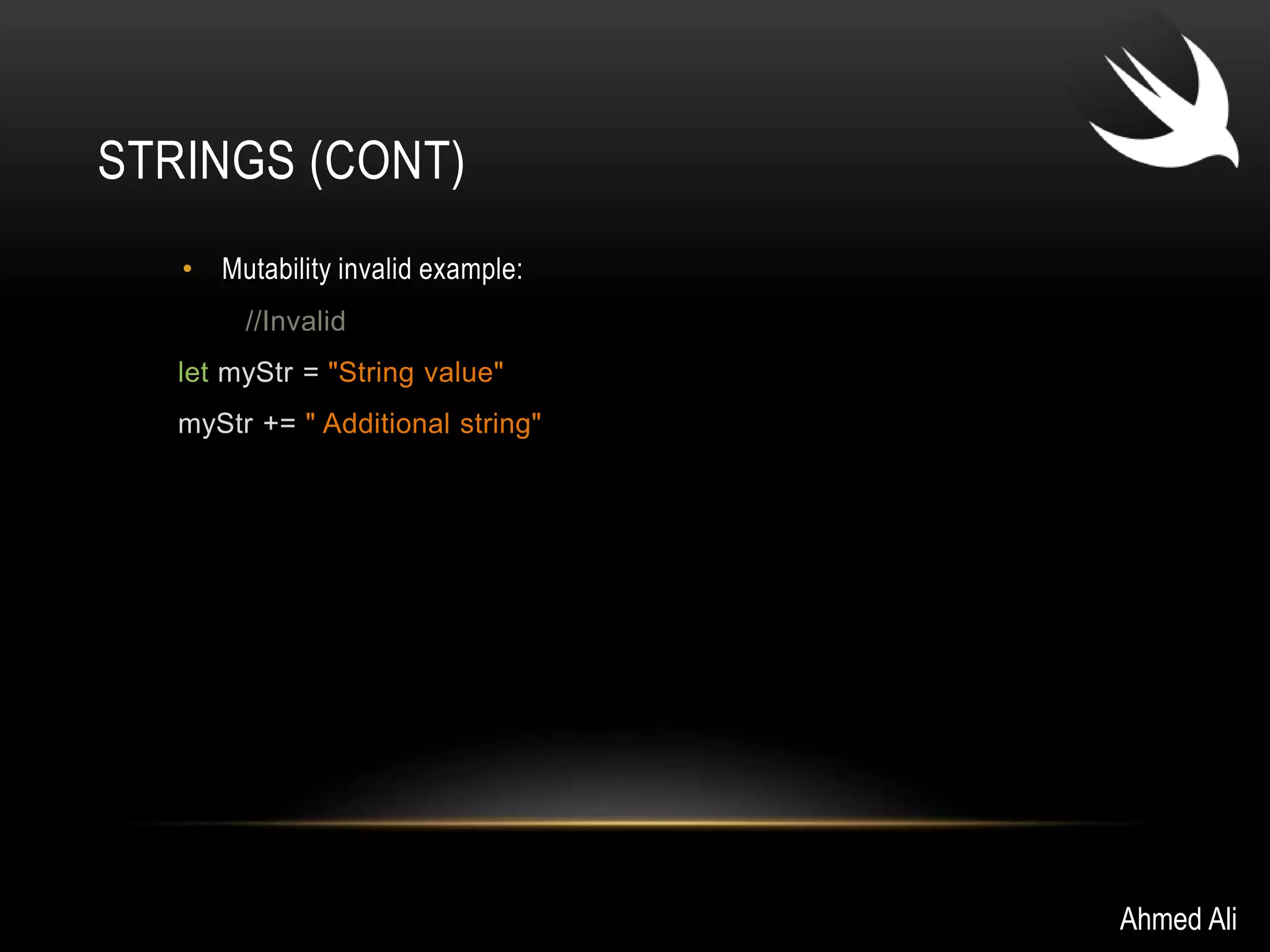
• Mutability invalid example: 
//Invalid 
let myStr = "String value" 
myStr += " Additional string" 
Ahmed Ali
STRINGS (CONT) 
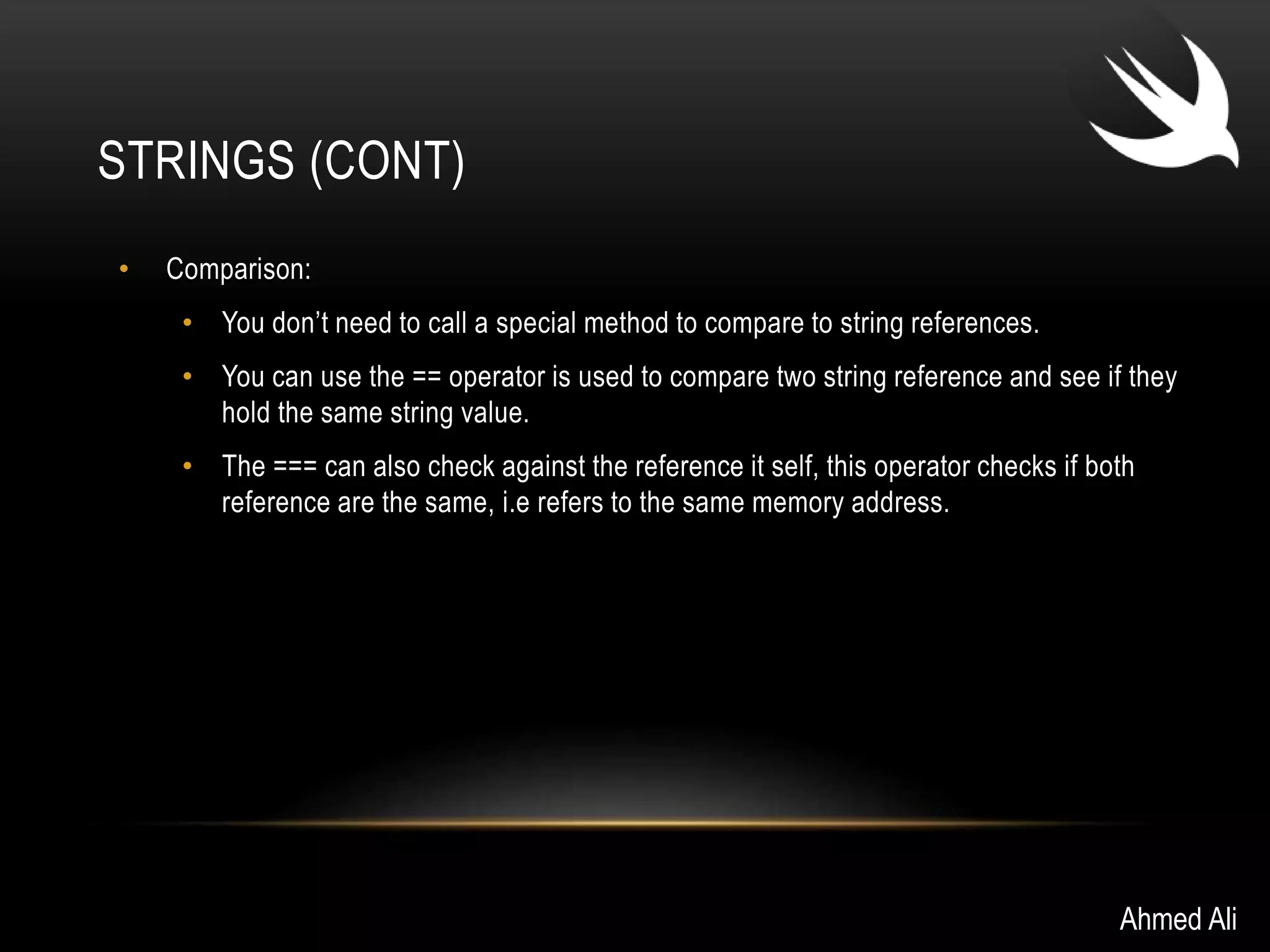
• Comparison: 
• You don’t need to call a special method to compare to string references. 
• You can use the == operator is used to compare two string reference and see if they 
hold the same string value. 
• The === can also check against the reference it self, this operator checks if both 
reference are the same, i.e refers to the same memory address. 
Ahmed Ali
STRINGS (CONT) 
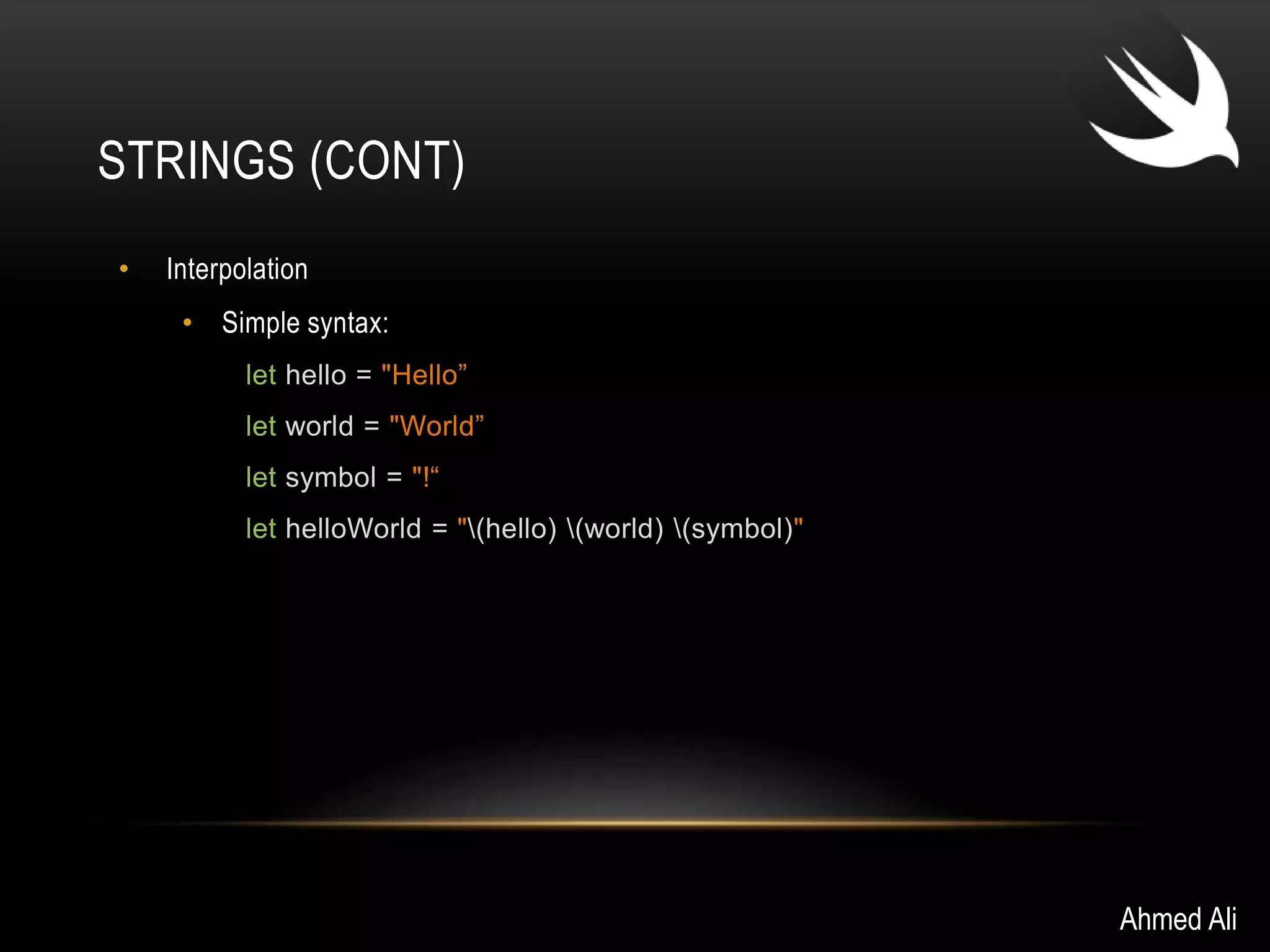
• Interpolation 
• Simple syntax: 
let hello = "Hello” 
let world = "World” 
let symbol = "!“ 
let helloWorld = "(hello) (world) (symbol)" 
Ahmed Ali
COLLECTION TYPES - ARRAYS 
• Can hold list of values of the same type. 
• Definition syntax: 
let arr : Array<String> = ["val 1", "val 2", "etc..."] 
//shorthand version 
let arr : [String] = ["val 1", "val 2", "etc..."] 
//Shorter version using type inference 
let arr = ["val 1", "val 2", "etc..."] 
Ahmed Ali
COLLECTION TYPES - ARRAYS (CONT) 
• Access and modify array content: 
//to be modified, it must be a variable 
var arr = ["v1", "v2", "v3"] 
println(arr[0]) //prints first element 
arr[0] = "newV1" //changes first element 
println(arr[0]) 
arr.removeAtIndex(1) //removes second element 
arr.append("anotherNewValue")//appends an element 
arr += ["v4", "v5"] //append more than one element 
Ahmed Ali
COLLECTION TYPES - DICTIONARIES 
• Can hold list of key : value pairs. 
• Definition syntax: 
let dict : Dictionary<String, Int> = ["A" : 15, 
"B" : 16] 
//shorthand version 
let dict : [String: Int] = ["A" : 15, "B" : 16] 
//Shorter version using type inference 
let dict = ["A" : 15, "B" : 16] 
Ahmed Ali
COLLECTION TYPES - DICTIONARIES (CONT) 
• Access and modify dictionary content: 
//to be modified, it must be a variable 
var dict : Dictionary<String, Int> = ["A" : 15, 
"B" : 16] 
println(dict["B"]) //prints 16 
dict["B"] = 30 //modifies the value of "B" key 
dict["C"] = 19 //adds new key : value pairs to the dictionary 
dict.removeValueForKey("A") //removes the key with its value 
Ahmed Ali
CONTROL FLOW - IF 
• Like any traditional if condition you are familiar with, with additional capabilities. 
• Optional binding: 
var dict = ["K" : 15, "G" : 16, ”A" : 5] 
if let value = dict["A"]{ 
println(value) 
} 
Ahmed Ali
CONTROL FLOW - IF (CONT) 
• If condition binding variable to a tuple 
• We can use optional binding to map tuple values to variables 
let params = ["name" : "Ahmed", "pass" : "123456"] 
if let (cached, response) = performHttpRequest("login", params){ 
} 
//or if only one value matters 
if let (_, response) = performHttpRequest("login", params){ 
} 
Ahmed Ali
CONTROL FLOW – FOR 
• Traditional for loop and varieties of for each 
• Traditional for loop: 
let arr = [1, 2, 3, 4, 5, 6, 7] 
//The parentheses here are mandatory in this old style for loop 
for (var i = 0; i < arr.count; i++){ 
} 
Ahmed Ali
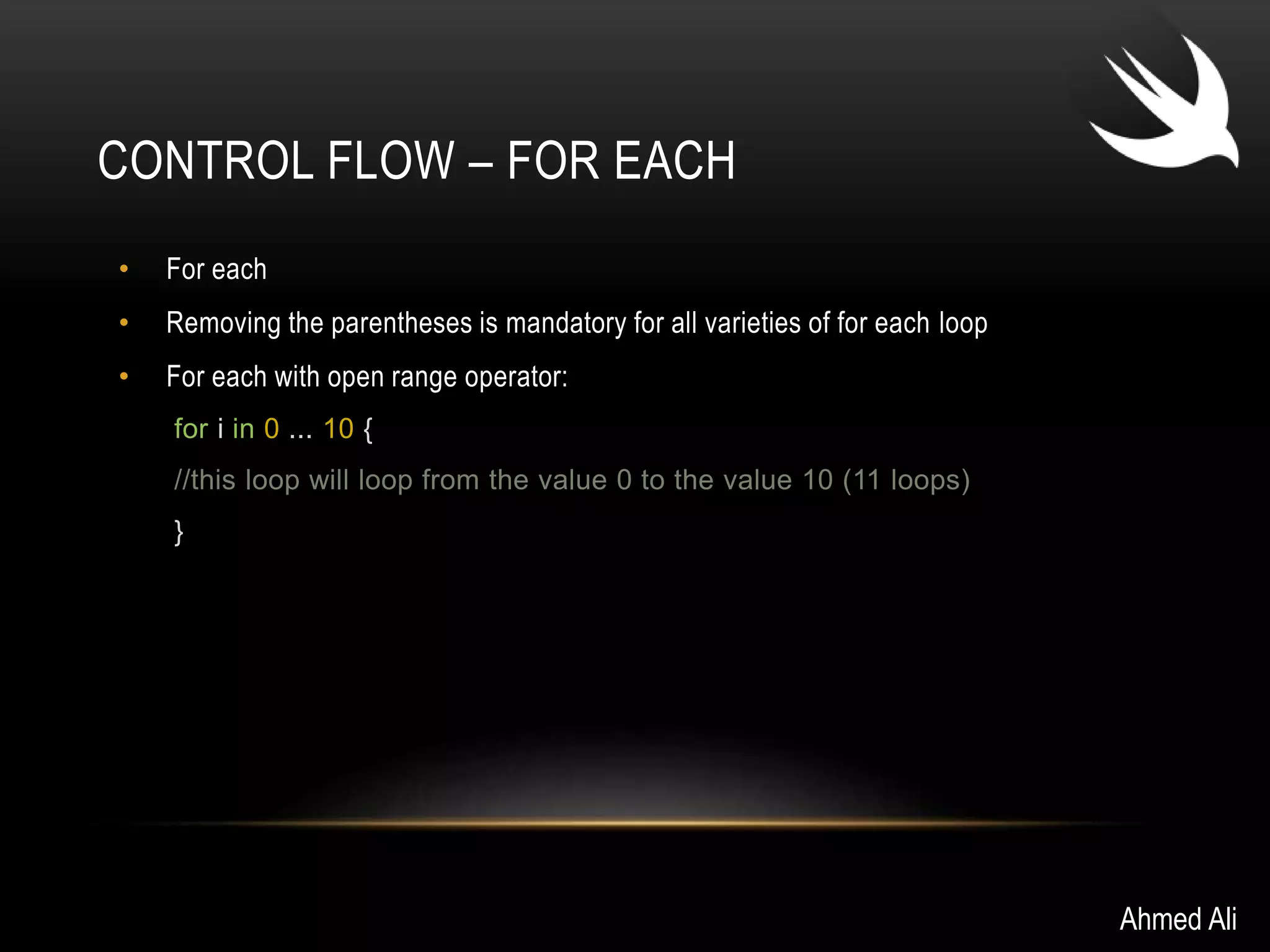
CONTROL FLOW – FOR EACH 
• For each 
• Removing the parentheses is mandatory for all varieties of for each loop 
• For each with open range operator: 
for i in 0 ... 10 { 
//this loop will loop from the value 0 to the value 10 (11 loops) 
} 
Ahmed Ali
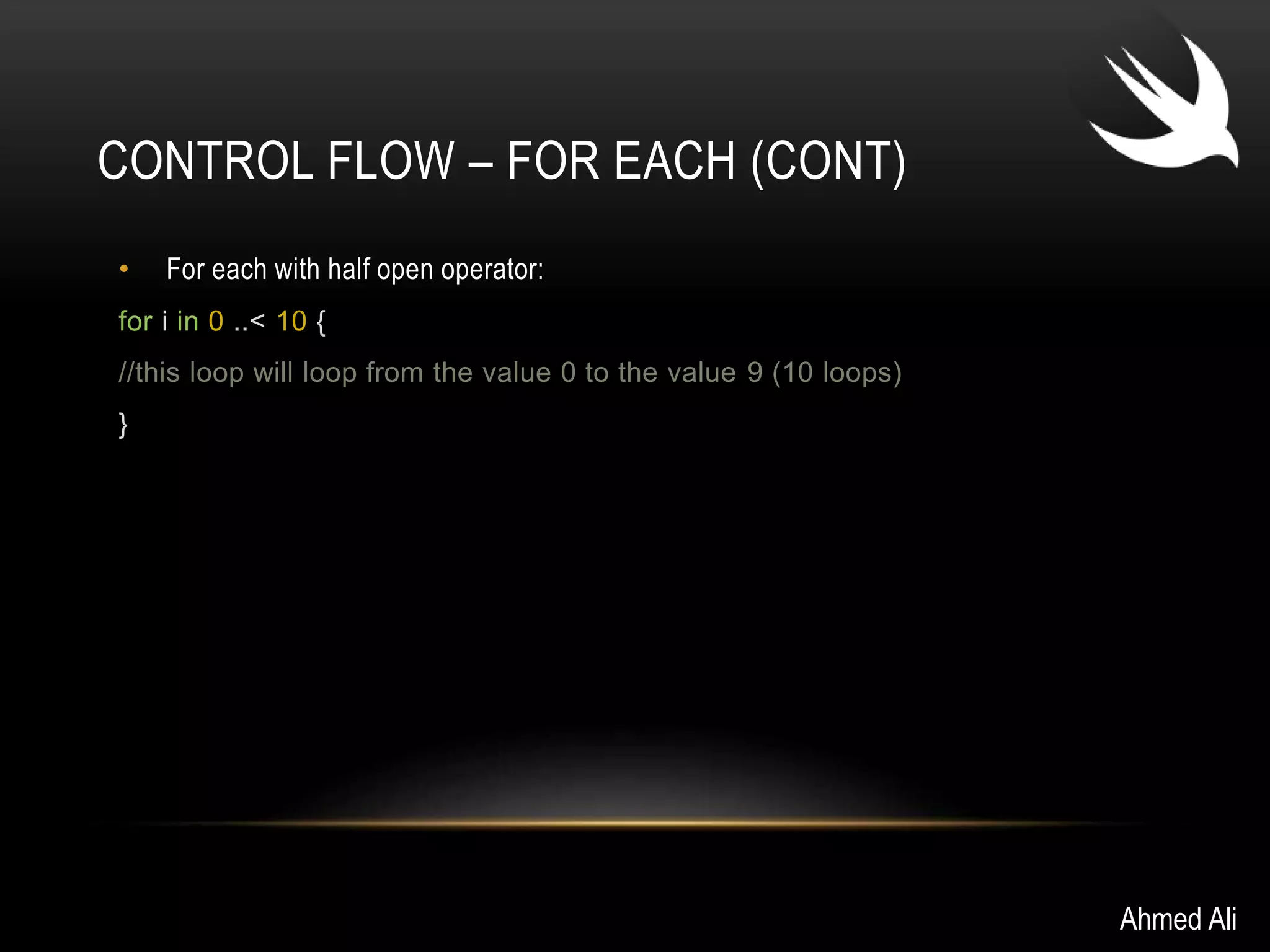
CONTROL FLOW – FOR EACH (CONT) 
• For each with half open operator: 
for i in 0 ..< 10 { 
//this loop will loop from the value 0 to the value 9 (10 loops) 
} 
Ahmed Ali
CONTROL FLOW – FOR EACH (CONT) 
• For each with arrays: 
let arr = [1, 2, 3, 4, 5, 6, 7] 
for element in arr{ 
} 
Ahmed Ali
CONTROL FLOW – WHILE AND DO .. WHILE 
• While and do .. While, has nothing different than what you already from Java, C, C++ or 
PHP. 
Ahmed Ali
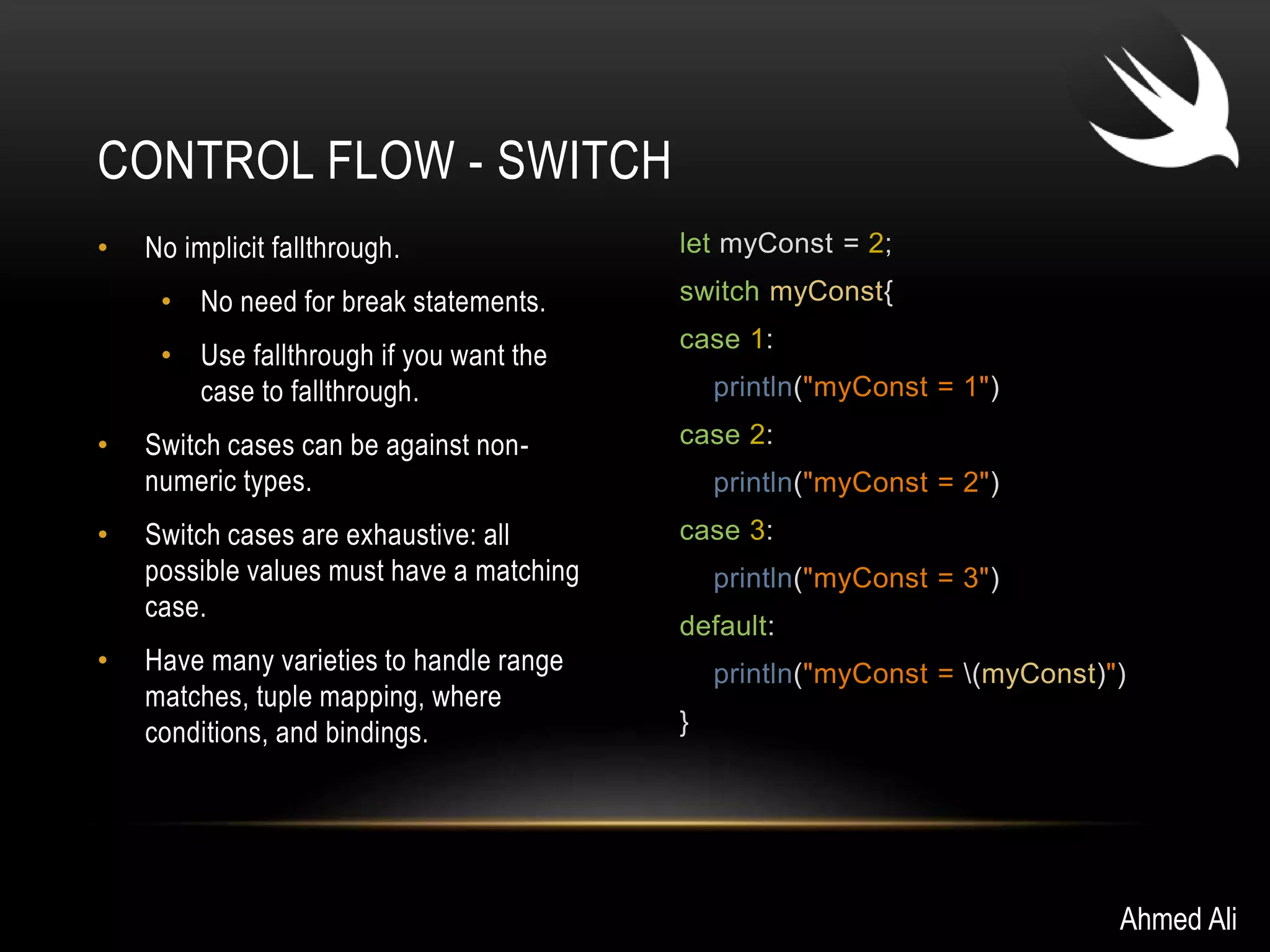
• No implicit fallthrough. 
• No need for break statements. 
• Use fallthrough if you want the 
case to fallthrough. 
• Switch cases can be against non-numeric 
types. 
• Switch cases are exhaustive: all 
possible values must have a matching 
case. 
• Have many varieties to handle range 
matches, tuple mapping, where 
conditions, and bindings. 
let myConst = 2; 
switch myConst{ 
case 1: 
println("myConst = 1") 
case 2: 
println("myConst = 2") 
case 3: 
println("myConst = 3") 
default: 
println("myConst = (myConst)") 
} 
CONTROL FLOW - SWITCH 
Ahmed Ali
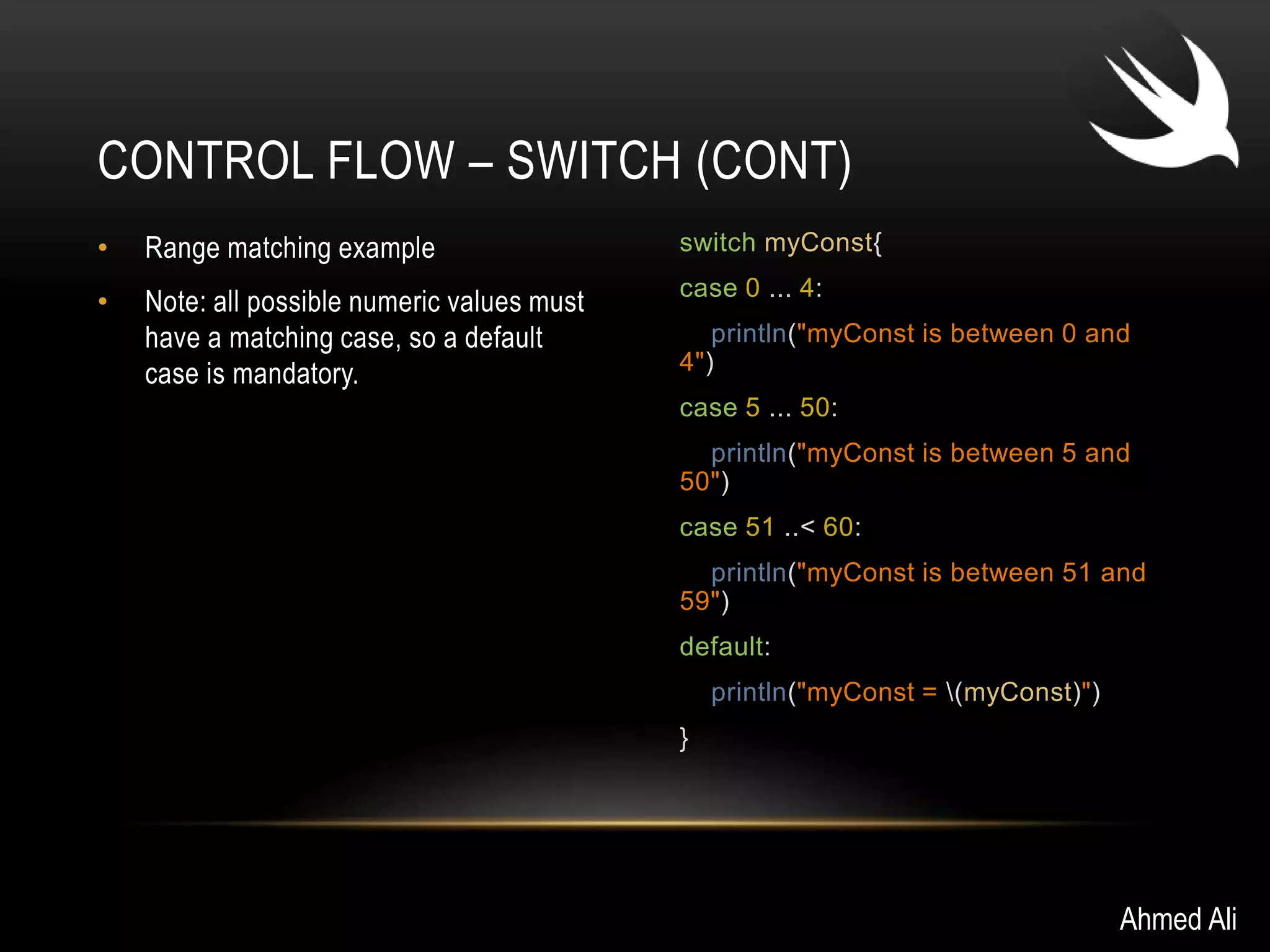
CONTROL FLOW – SWITCH (CONT) 
• Range matching example 
• Note: all possible numeric values must 
have a matching case, so a default 
case is mandatory. 
switch myConst{ 
case 0 ... 4: 
println("myConst is between 0 and 
4") 
case 5 ... 50: 
println("myConst is between 5 and 
50") 
case 51 ..< 60: 
println("myConst is between 51 and 
59") 
default: 
println("myConst = (myConst)") 
} 
Ahmed Ali
CONTROL FLOW – SWITCH (CONT) 
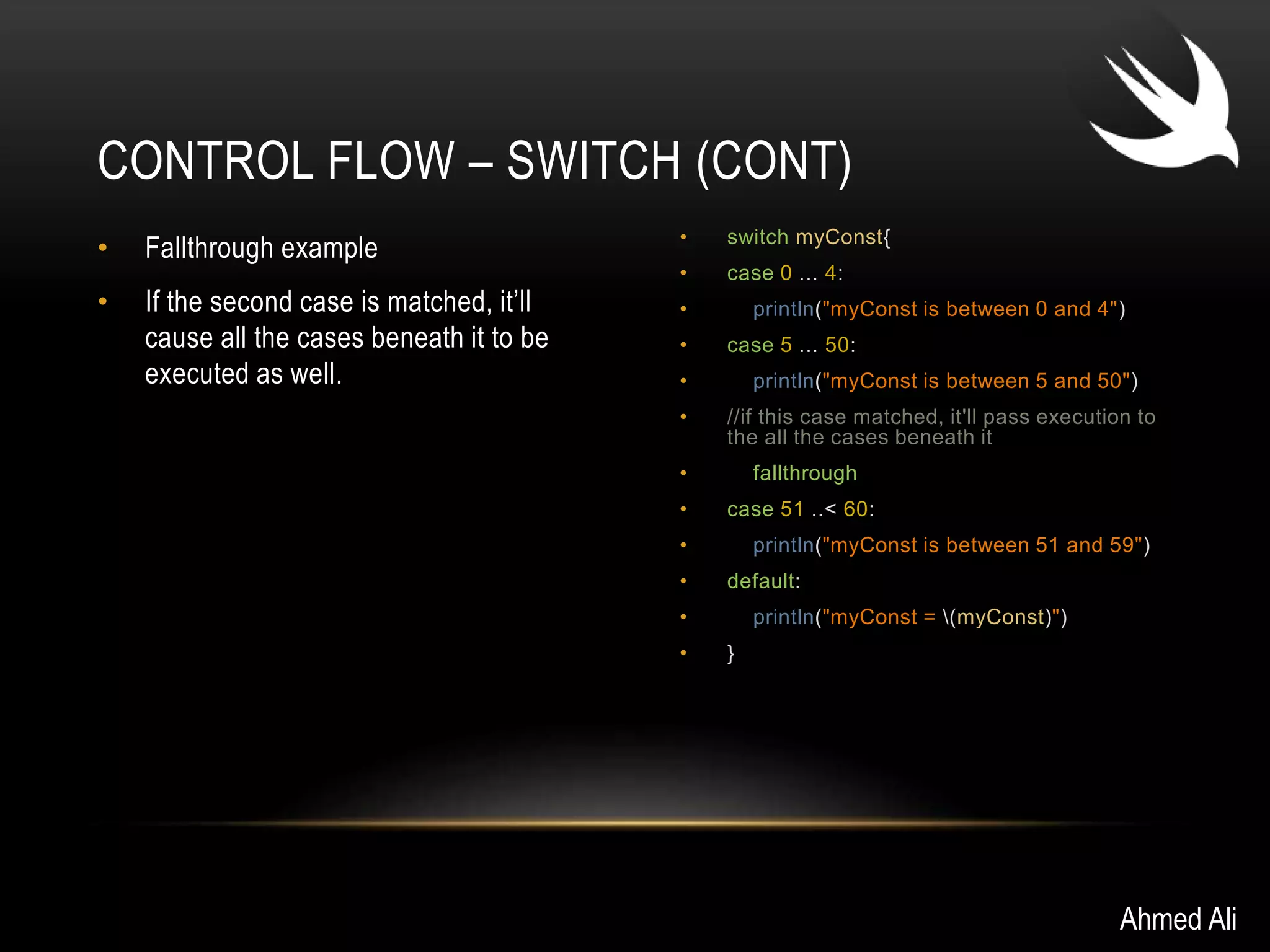
• Fallthrough example 
• If the second case is matched, it’ll 
cause all the cases beneath it to be 
executed as well. 
• switch myConst{ 
• case 0 ... 4: 
• println("myConst is between 0 and 4") 
• case 5 ... 50: 
• println("myConst is between 5 and 50") 
• //if this case matched, it'll pass execution to 
the all the cases beneath it 
• fallthrough 
• case 51 ..< 60: 
• println("myConst is between 51 and 59") 
• default: 
• println("myConst = (myConst)") 
• } 
Ahmed Ali
CONTROL FLOW – SWITCH (CONT) 
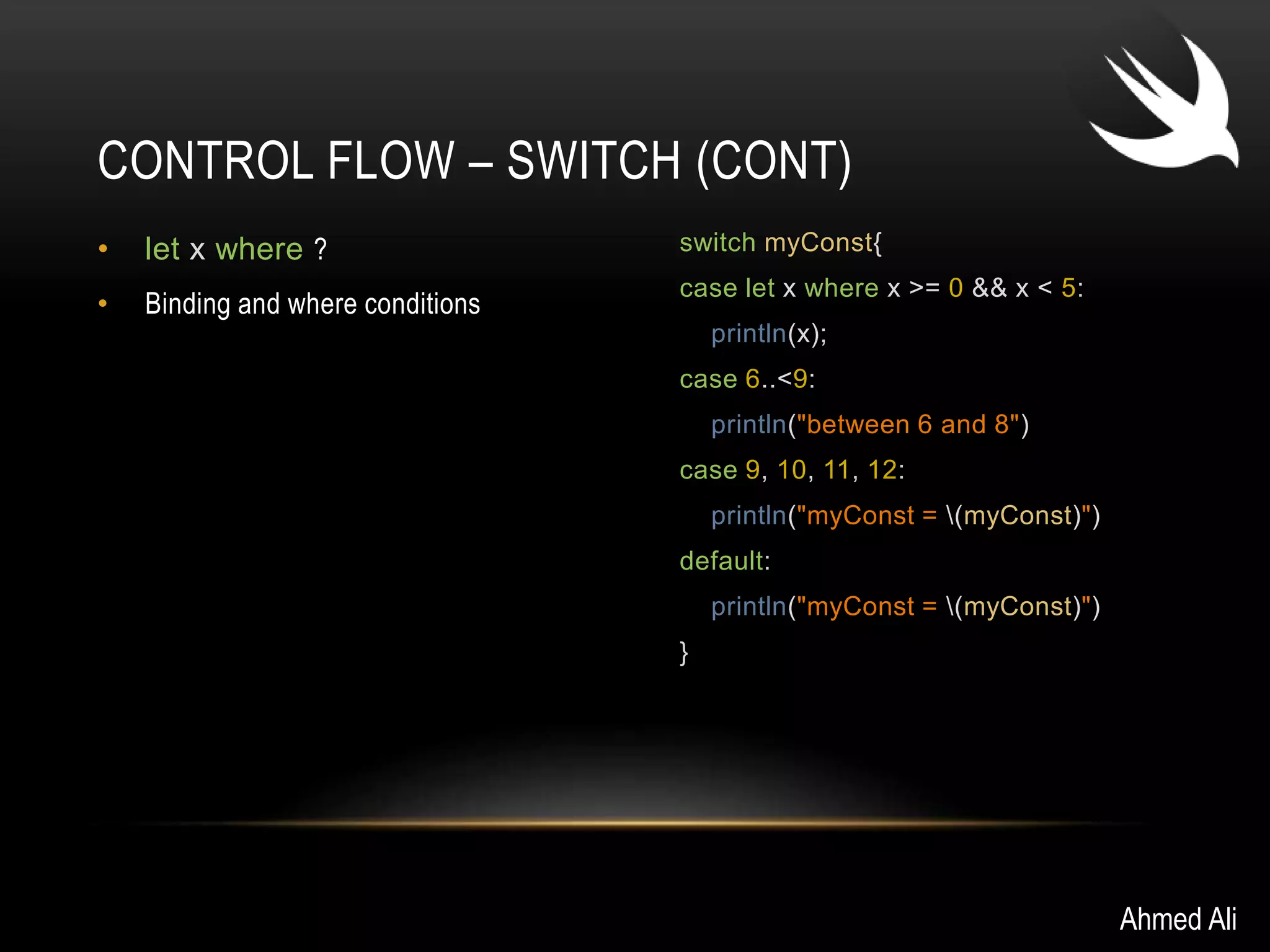
• let x where ? 
• Binding and where conditions 
switch myConst{ 
case let x where x >= 0 && x < 5: 
println(x); 
case 6..<9: 
println("between 6 and 8") 
case 9, 10, 11, 12: 
println("myConst = (myConst)") 
default: 
println("myConst = (myConst)") 
} 
Ahmed Ali
Connecting UI Controls to Your 
Code

iOS development using Swift - Swift Basics (2)

  • 1.
    SWIFT BASICS (2) iOS Development using Swift Ahmed Ali
  • 2.
    TODAY TOPICS •Data types • Strings • Mutability, comparison, and interpolation • Collection types • Arrays, dictionaries and their mutability • Control flow • Connecting UI Controls to Your Code Ahmed Ali
  • 3.
    DATA TYPES •Integers • Int • UInt • Floating point • Float • Double • Boolean • Bool Ahmed Ali
  • 4.
    DATA TYPES -TUPLES • Multi-values in one reference • You can pass a tuple as a method parameter, return it from a function (or method), make it the type of a reference. • Definition Syntax: • var tupleVar : (Int, String) • Assigning it a value: • tupleVar = (5, "String value”) Ahmed Ali
  • 5.
    DATA TYPES -TUPLES (CONT) • Tuples values can be access through their index number or names • Accessing the value through its zero-based index let intVal : Int = tupleVar.0 // equal to 5 let strVal : String = tupleVar.1 // equal to "String Value” • Named tuple elements let response : (errorCode: Int, errorMessage: String) = (404, "HTTP not found") print("Error connecting: (response.errorMessage) with error code: (response.errorCode)") Ahmed Ali
  • 6.
    STRINGS • Syntax: • let myStr = "String value” • Mutability (modifiable) • If the reference is defined with var keyword then it is mutable (can be modified) • If the reference is defined with let keyword then it is immutable (can not be modified) • Examples: //Valid var myStr = "String value" myStr += " Additional string" Ahmed Ali
  • 7.
    STRINGS (CONT) •Mutability invalid example: //Invalid let myStr = "String value" myStr += " Additional string" Ahmed Ali
  • 8.
    STRINGS (CONT) •Comparison: • You don’t need to call a special method to compare to string references. • You can use the == operator is used to compare two string reference and see if they hold the same string value. • The === can also check against the reference it self, this operator checks if both reference are the same, i.e refers to the same memory address. Ahmed Ali
  • 9.
    STRINGS (CONT) •Interpolation • Simple syntax: let hello = "Hello” let world = "World” let symbol = "!“ let helloWorld = "(hello) (world) (symbol)" Ahmed Ali
  • 10.
    COLLECTION TYPES -ARRAYS • Can hold list of values of the same type. • Definition syntax: let arr : Array<String> = ["val 1", "val 2", "etc..."] //shorthand version let arr : [String] = ["val 1", "val 2", "etc..."] //Shorter version using type inference let arr = ["val 1", "val 2", "etc..."] Ahmed Ali
  • 11.
    COLLECTION TYPES -ARRAYS (CONT) • Access and modify array content: //to be modified, it must be a variable var arr = ["v1", "v2", "v3"] println(arr[0]) //prints first element arr[0] = "newV1" //changes first element println(arr[0]) arr.removeAtIndex(1) //removes second element arr.append("anotherNewValue")//appends an element arr += ["v4", "v5"] //append more than one element Ahmed Ali
  • 12.
    COLLECTION TYPES -DICTIONARIES • Can hold list of key : value pairs. • Definition syntax: let dict : Dictionary<String, Int> = ["A" : 15, "B" : 16] //shorthand version let dict : [String: Int] = ["A" : 15, "B" : 16] //Shorter version using type inference let dict = ["A" : 15, "B" : 16] Ahmed Ali
  • 13.
    COLLECTION TYPES -DICTIONARIES (CONT) • Access and modify dictionary content: //to be modified, it must be a variable var dict : Dictionary<String, Int> = ["A" : 15, "B" : 16] println(dict["B"]) //prints 16 dict["B"] = 30 //modifies the value of "B" key dict["C"] = 19 //adds new key : value pairs to the dictionary dict.removeValueForKey("A") //removes the key with its value Ahmed Ali
  • 14.
    CONTROL FLOW -IF • Like any traditional if condition you are familiar with, with additional capabilities. • Optional binding: var dict = ["K" : 15, "G" : 16, ”A" : 5] if let value = dict["A"]{ println(value) } Ahmed Ali
  • 15.
    CONTROL FLOW -IF (CONT) • If condition binding variable to a tuple • We can use optional binding to map tuple values to variables let params = ["name" : "Ahmed", "pass" : "123456"] if let (cached, response) = performHttpRequest("login", params){ } //or if only one value matters if let (_, response) = performHttpRequest("login", params){ } Ahmed Ali
  • 16.
    CONTROL FLOW –FOR • Traditional for loop and varieties of for each • Traditional for loop: let arr = [1, 2, 3, 4, 5, 6, 7] //The parentheses here are mandatory in this old style for loop for (var i = 0; i < arr.count; i++){ } Ahmed Ali
  • 17.
    CONTROL FLOW –FOR EACH • For each • Removing the parentheses is mandatory for all varieties of for each loop • For each with open range operator: for i in 0 ... 10 { //this loop will loop from the value 0 to the value 10 (11 loops) } Ahmed Ali
  • 18.
    CONTROL FLOW –FOR EACH (CONT) • For each with half open operator: for i in 0 ..< 10 { //this loop will loop from the value 0 to the value 9 (10 loops) } Ahmed Ali
  • 19.
    CONTROL FLOW –FOR EACH (CONT) • For each with arrays: let arr = [1, 2, 3, 4, 5, 6, 7] for element in arr{ } Ahmed Ali
  • 20.
    CONTROL FLOW –WHILE AND DO .. WHILE • While and do .. While, has nothing different than what you already from Java, C, C++ or PHP. Ahmed Ali
  • 21.
    • No implicitfallthrough. • No need for break statements. • Use fallthrough if you want the case to fallthrough. • Switch cases can be against non-numeric types. • Switch cases are exhaustive: all possible values must have a matching case. • Have many varieties to handle range matches, tuple mapping, where conditions, and bindings. let myConst = 2; switch myConst{ case 1: println("myConst = 1") case 2: println("myConst = 2") case 3: println("myConst = 3") default: println("myConst = (myConst)") } CONTROL FLOW - SWITCH Ahmed Ali
  • 22.
    CONTROL FLOW –SWITCH (CONT) • Range matching example • Note: all possible numeric values must have a matching case, so a default case is mandatory. switch myConst{ case 0 ... 4: println("myConst is between 0 and 4") case 5 ... 50: println("myConst is between 5 and 50") case 51 ..< 60: println("myConst is between 51 and 59") default: println("myConst = (myConst)") } Ahmed Ali
  • 23.
    CONTROL FLOW –SWITCH (CONT) • Fallthrough example • If the second case is matched, it’ll cause all the cases beneath it to be executed as well. • switch myConst{ • case 0 ... 4: • println("myConst is between 0 and 4") • case 5 ... 50: • println("myConst is between 5 and 50") • //if this case matched, it'll pass execution to the all the cases beneath it • fallthrough • case 51 ..< 60: • println("myConst is between 51 and 59") • default: • println("myConst = (myConst)") • } Ahmed Ali
  • 24.
    CONTROL FLOW –SWITCH (CONT) • let x where ? • Binding and where conditions switch myConst{ case let x where x >= 0 && x < 5: println(x); case 6..<9: println("between 6 and 8") case 9, 10, 11, 12: println("myConst = (myConst)") default: println("myConst = (myConst)") } Ahmed Ali
  • 25.