

IOS DEVELOPMENT USING SWIFT 
Enums, ARC, Delegation, Closures 
Ahmed Ali
TODAY TOPICS 
• Enumerations 
• Automatic Reference Count (ARC) 
• Delegation pattern 
• Closures 
• Demo: 
• Table view 
• Move to another screen programmatically 
• Pass data between screens 
Ahmed Ali
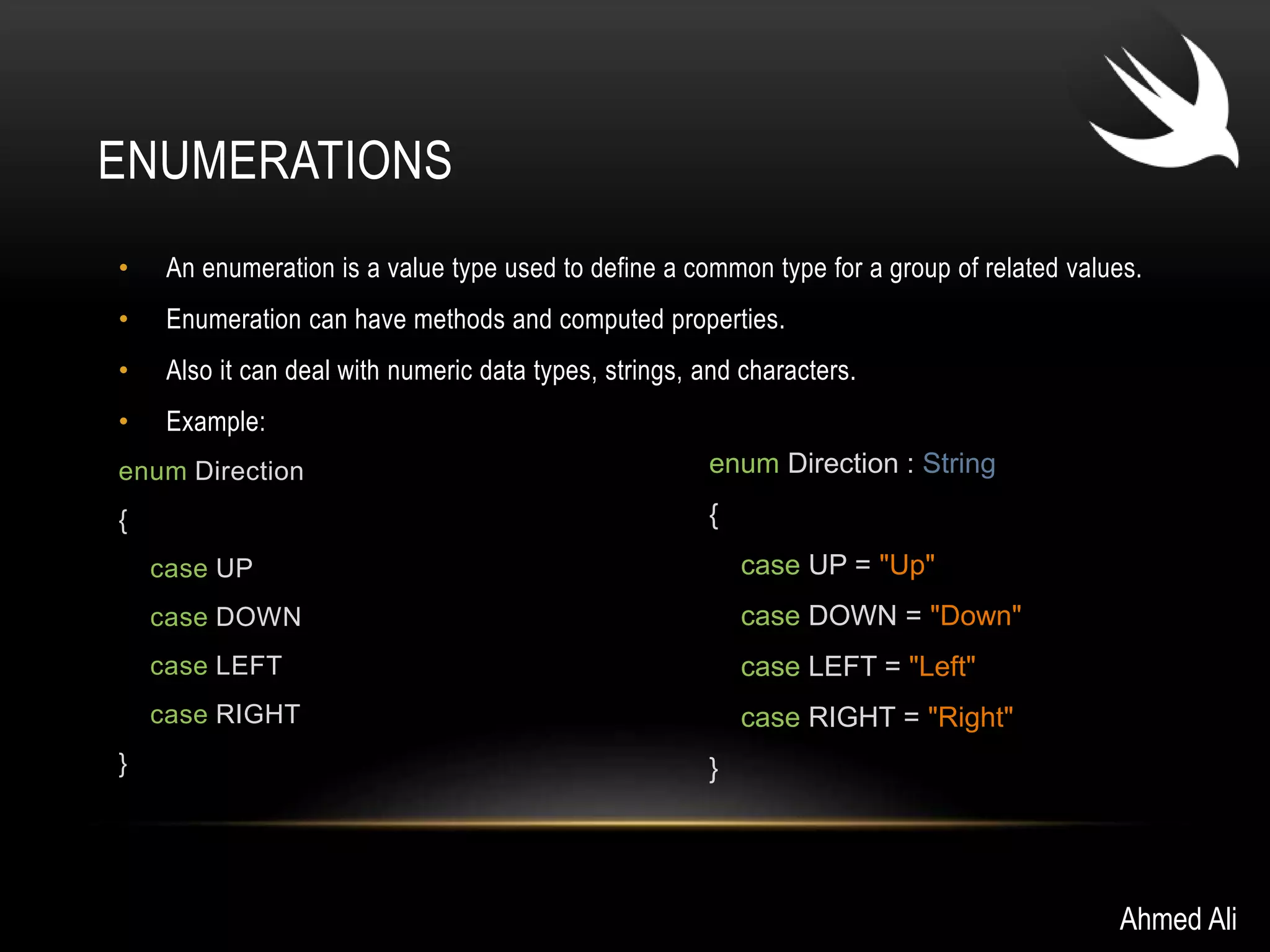
ENUMERATIONS 
• An enumeration is a value type used to define a common type for a group of related values. 
• Enumeration can have methods and computed properties. 
• Also it can deal with numeric data types, strings, and characters. 
• Example: 
enum Direction 
{ 
case UP 
case DOWN 
case LEFT 
case RIGHT 
} 
Ahmed Ali 
enum Direction : String 
{ 
case UP = "Up" 
case DOWN = "Down" 
case LEFT = "Left" 
case RIGHT = "Right" 
}
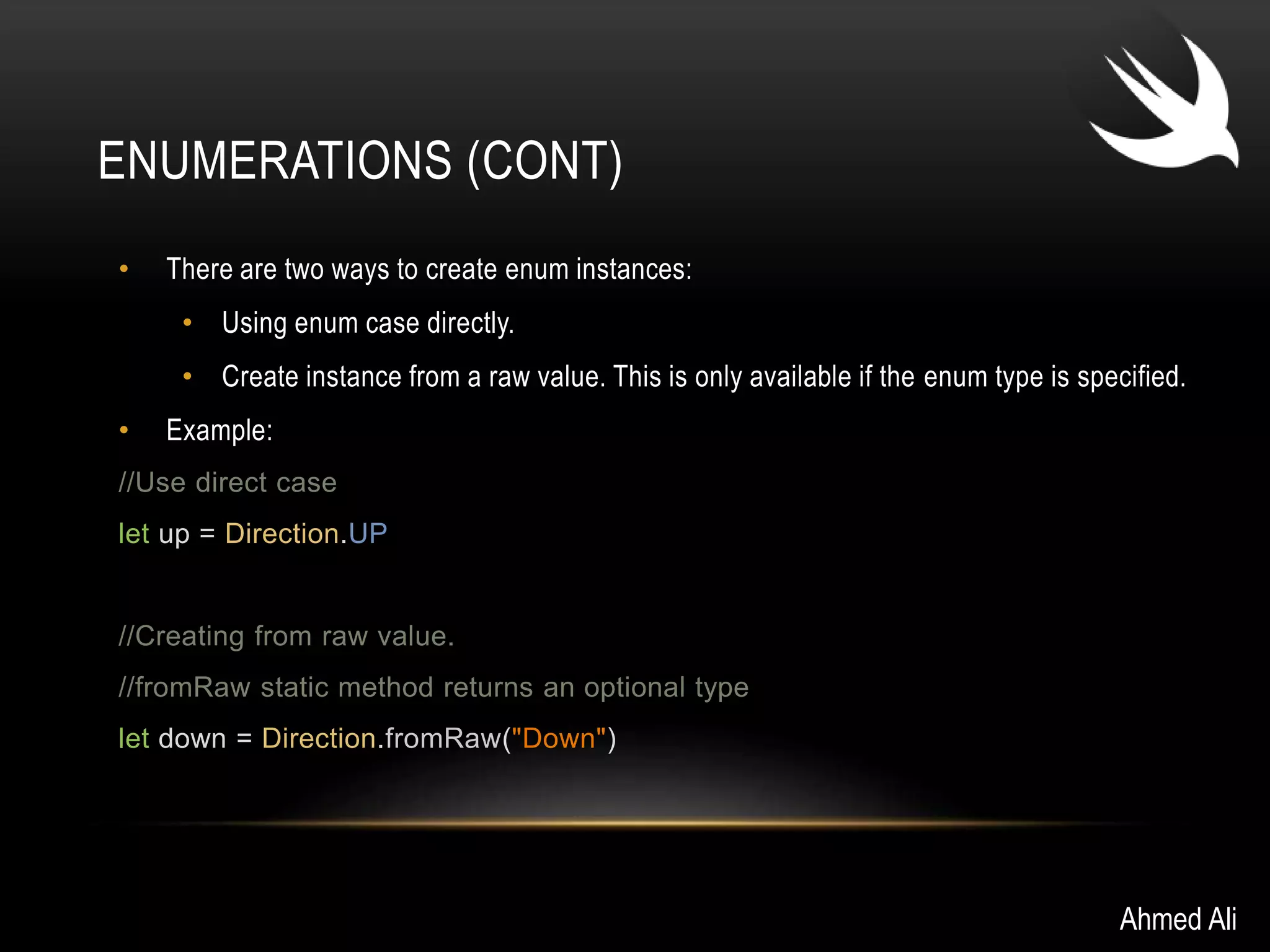
ENUMERATIONS (CONT) 
• There are two ways to create enum instances: 
• Using enum case directly. 
• Create instance from a raw value. This is only available if the enum type is specified. 
• Example: 
//Use direct case 
let up = Direction.UP 
//Creating from raw value. 
//fromRaw static method returns an optional type 
let down = Direction.fromRaw("Down") 
Ahmed Ali
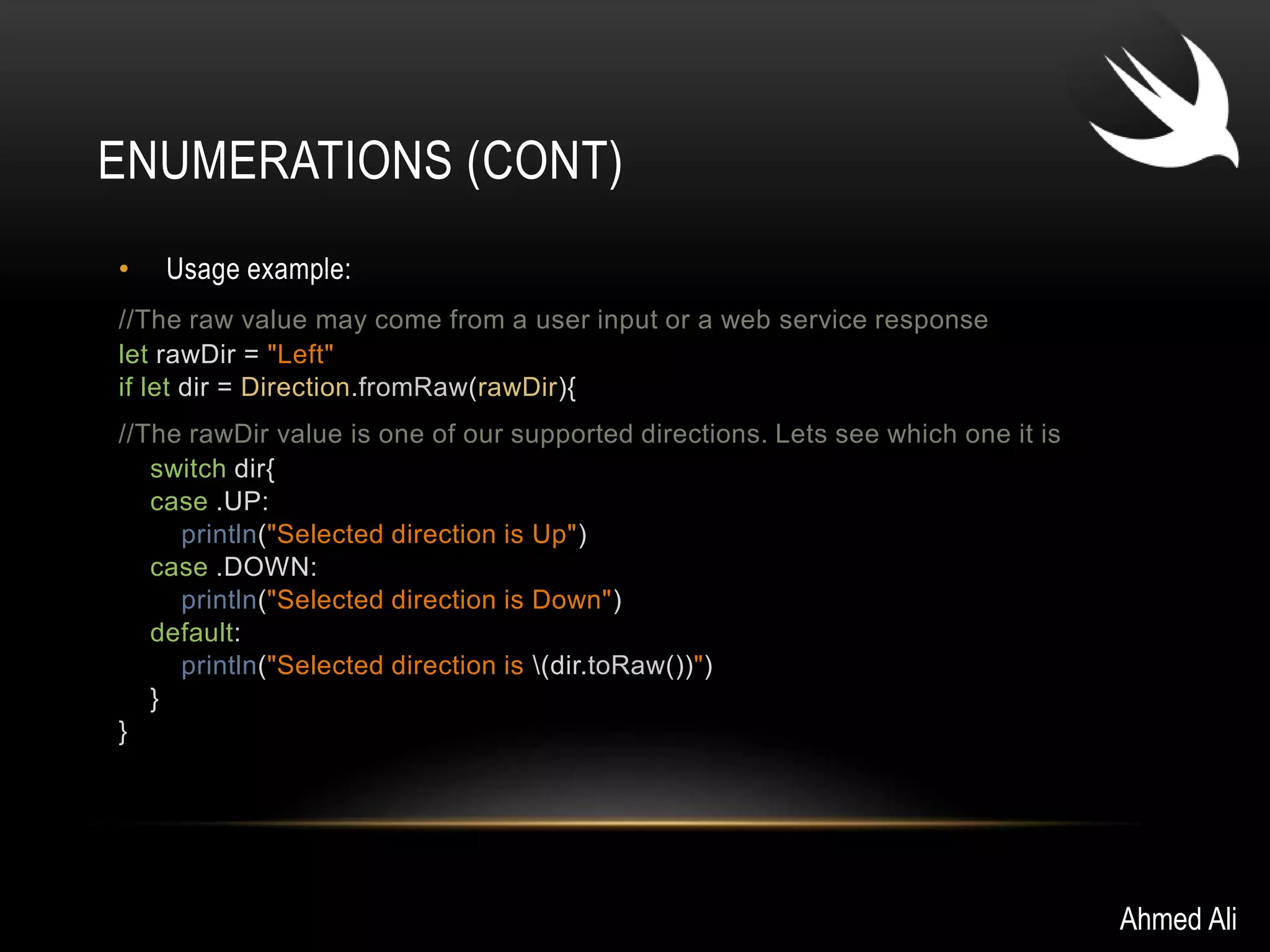
ENUMERATIONS (CONT) 
• Usage example: 
//The raw value may come from a user input or a web service response 
let rawDir = "Left" 
if let dir = Direction.fromRaw(rawDir){ 
//The rawDir value is one of our supported directions. Lets see which one it is 
switch dir{ 
case .UP: 
println("Selected direction is Up") 
case .DOWN: 
println("Selected direction is Down") 
default: 
println("Selected direction is (dir.toRaw())") 
} 
} 
Ahmed Ali
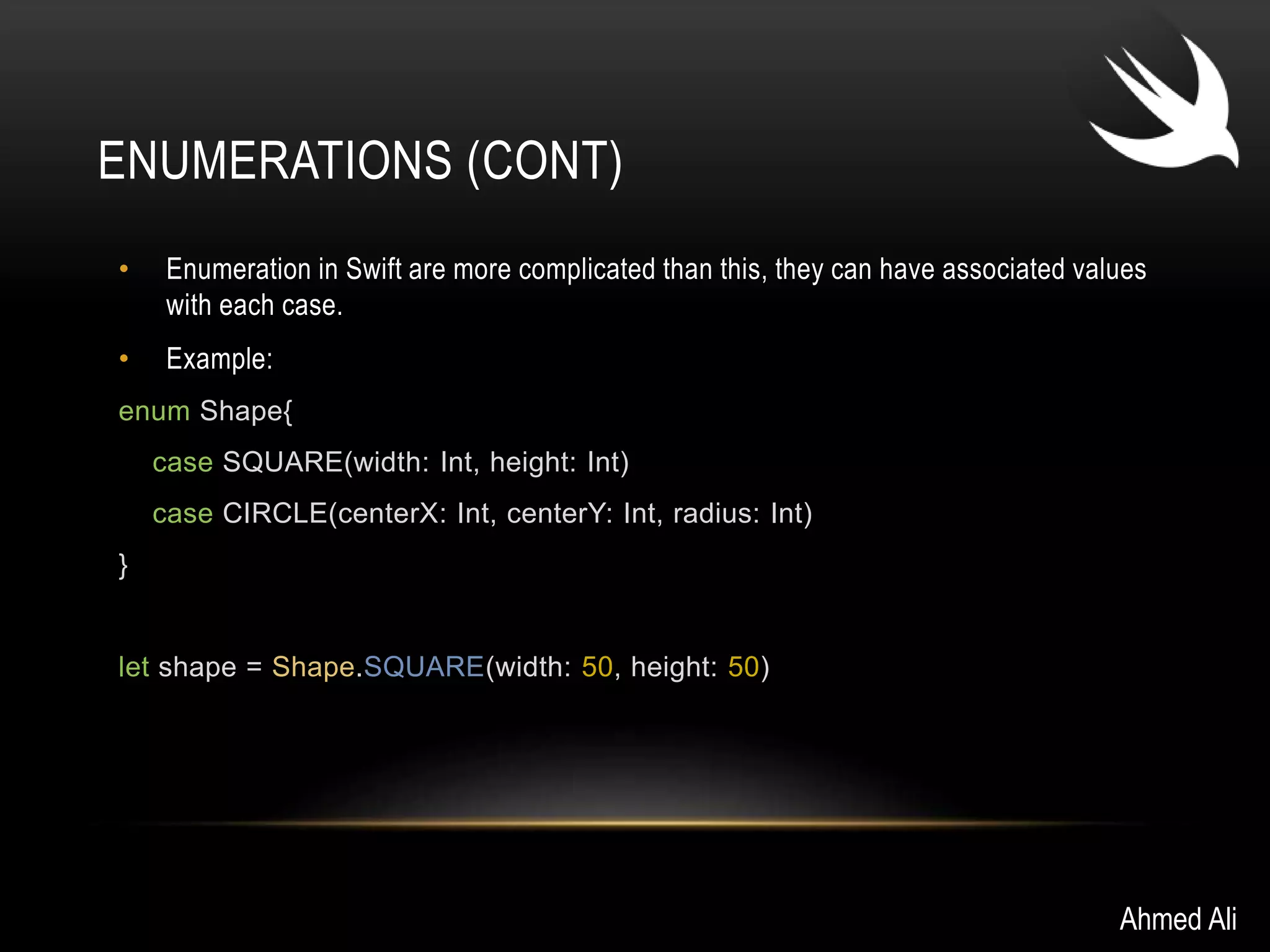
ENUMERATIONS (CONT) 
• Enumeration in Swift are more complicated than this, they can have associated values 
with each case. 
• Example: 
enum Shape{ 
case SQUARE(width: Int, height: Int) 
case CIRCLE(centerX: Int, centerY: Int, radius: Int) 
} 
let shape = Shape.SQUARE(width: 50, height: 50) 
Ahmed Ali
ENUMERATIONS (CONT) 
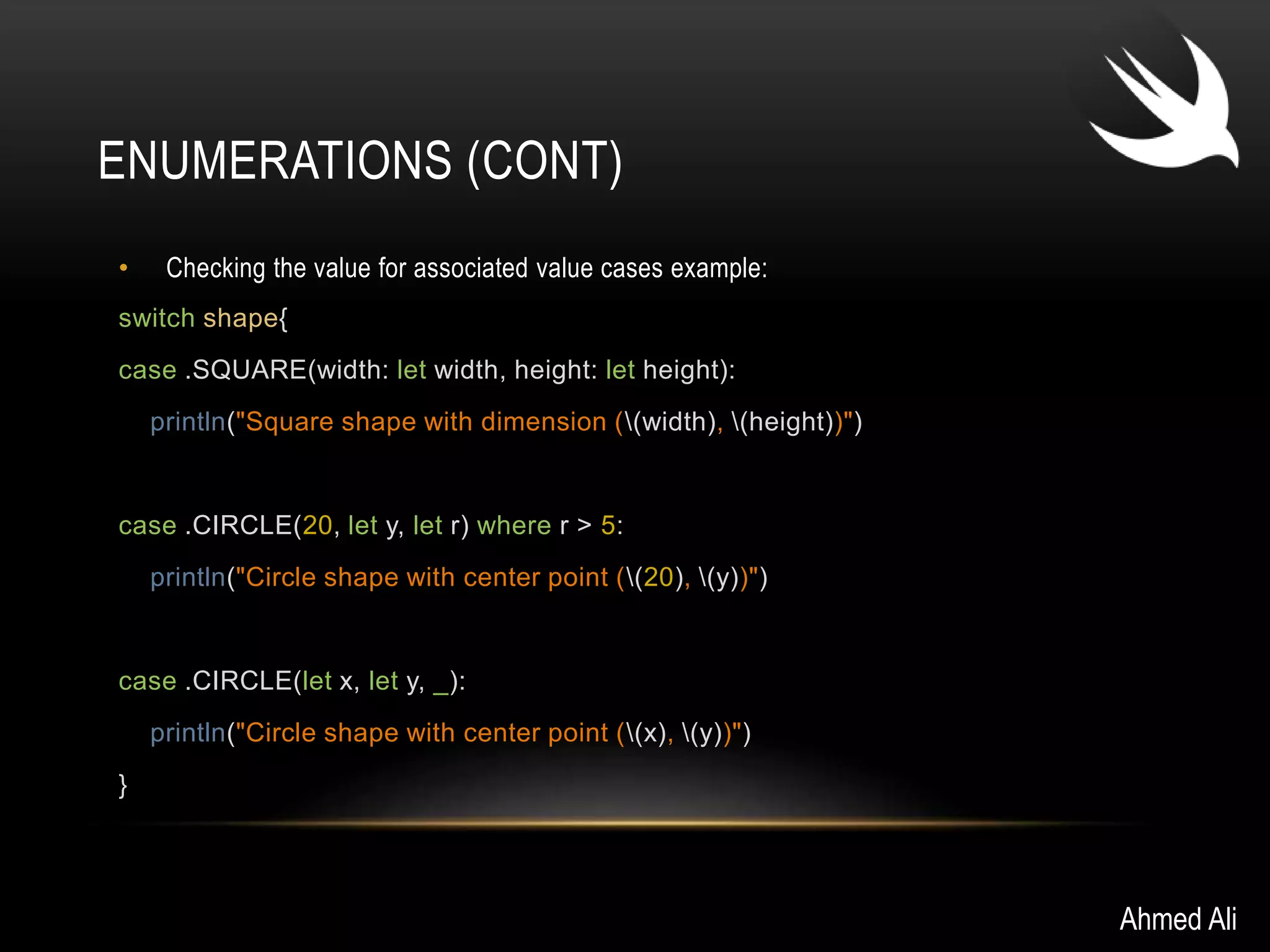
• Checking the value for associated value cases example: 
switch shape{ 
case .SQUARE(width: let width, height: let height): 
println("Square shape with dimension ((width), (height))") 
case .CIRCLE(20, let y, let r) where r > 5: 
println("Circle shape with center point ((20), (y))") 
case .CIRCLE(let x, let y, _): 
println("Circle shape with center point ((x), (y))") 
} 
Ahmed Ali
ARC 
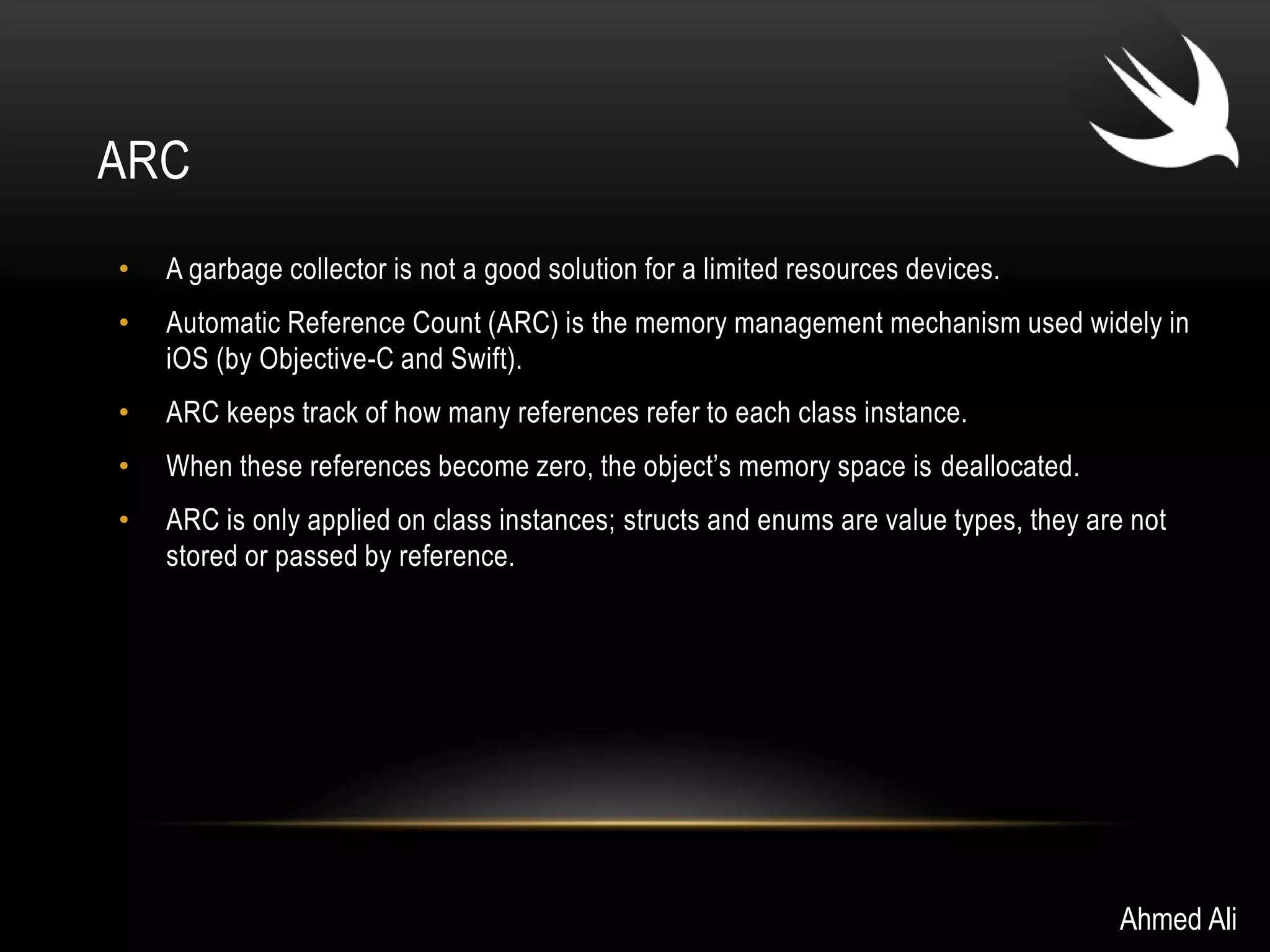
• A garbage collector is not a good solution for a limited resources devices. 
• Automatic Reference Count (ARC) is the memory management mechanism used widely in 
iOS (by Objective-C and Swift). 
• ARC keeps track of how many references refer to each class instance. 
• When these references become zero, the object’s memory space is deallocated. 
• ARC is only applied on class instances; structs and enums are value types, they are not 
stored or passed by reference. 
Ahmed Ali
ARC (CONT) 
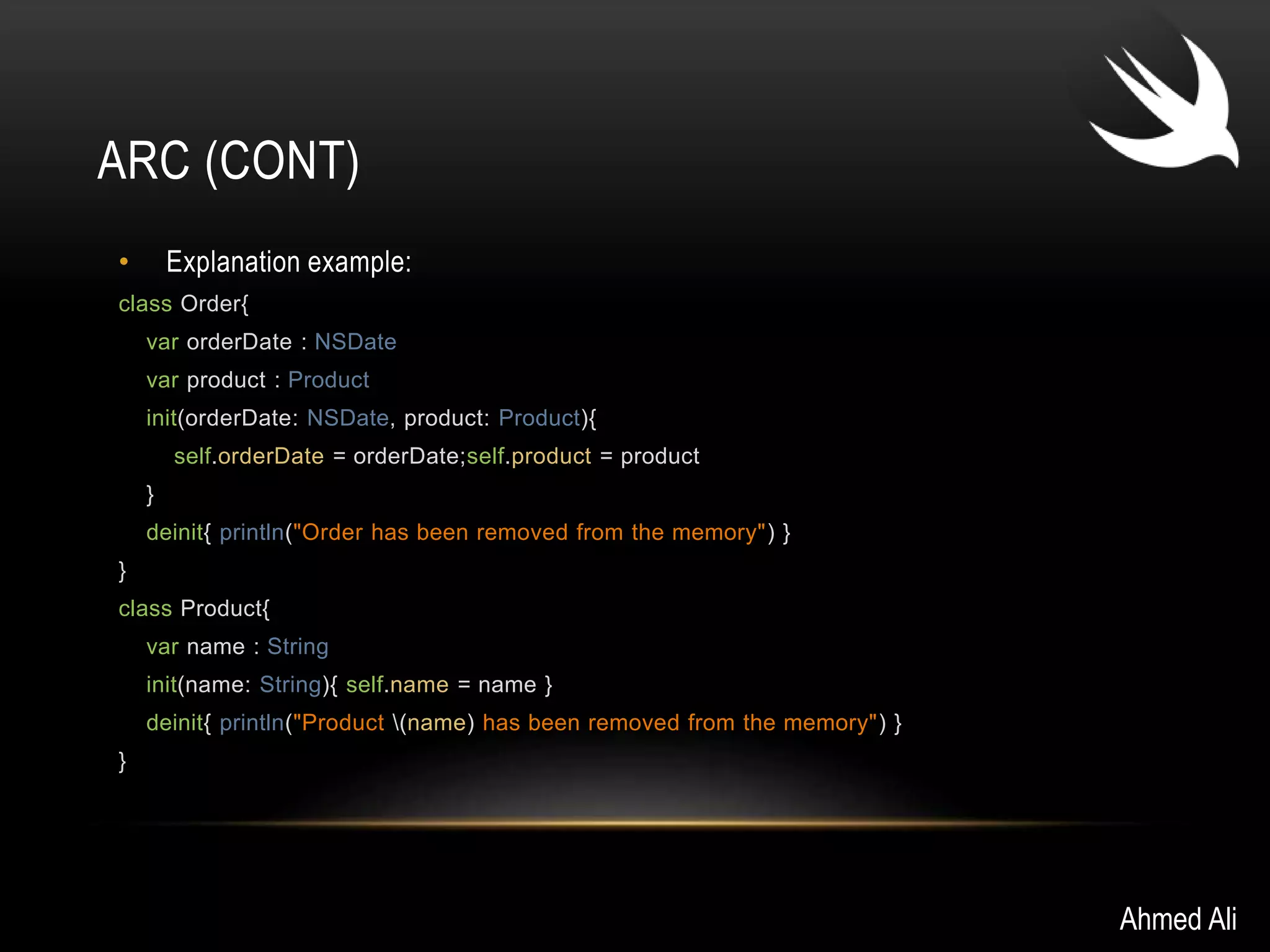
• Explanation example: 
class Order{ 
var orderDate : NSDate 
var product : Product 
init(orderDate: NSDate, product: Product){ 
self.orderDate = orderDate;self.product = product 
} 
deinit{ println("Order has been removed from the memory") } 
} 
class Product{ 
var name : String 
init(name: String){ self.name = name } 
deinit{ println("Product (name) has been removed from the memory") } 
} 
Ahmed Ali
ARC (CONT) 
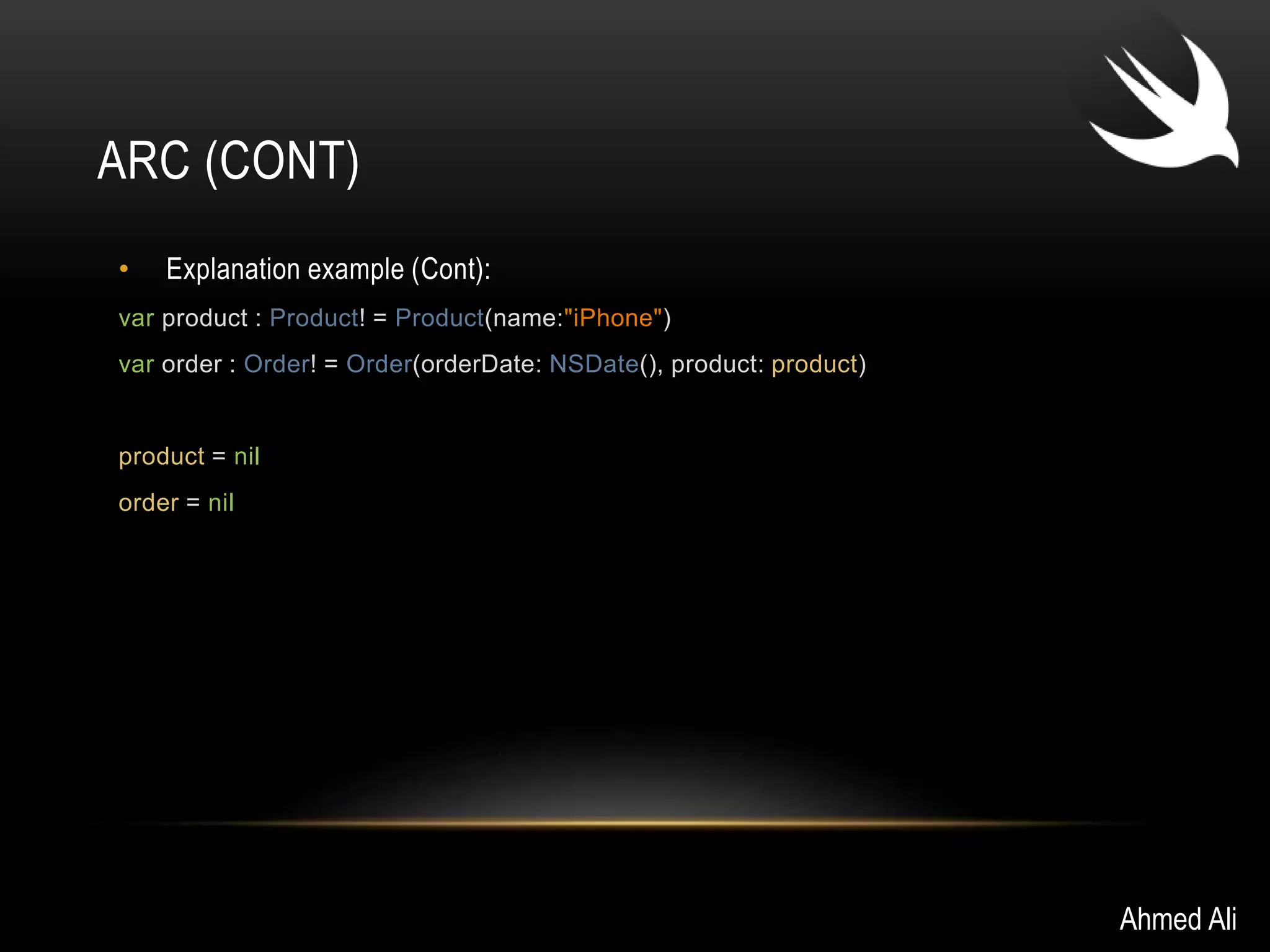
• Explanation example (Cont): 
var product : Product! = Product(name:"iPhone") 
var order : Order! = Order(orderDate: NSDate(), product: product) 
product = nil 
order = nil 
Ahmed Ali
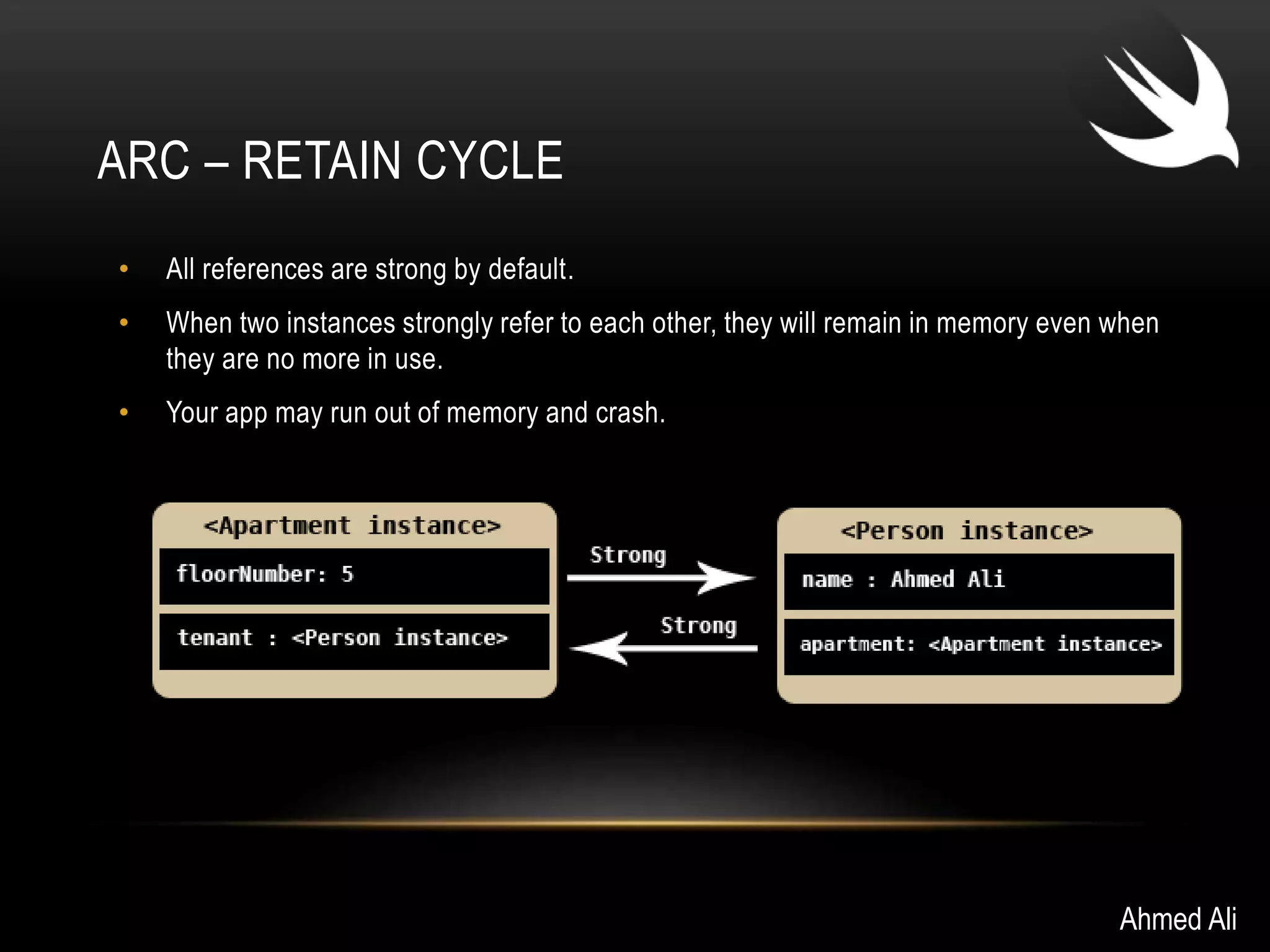
ARC – RETAIN CYCLE 
• All references are strong by default. 
• When two instances strongly refer to each other, they will remain in memory even when 
they are no more in use. 
• Your app may run out of memory and crash. 
Ahmed Ali
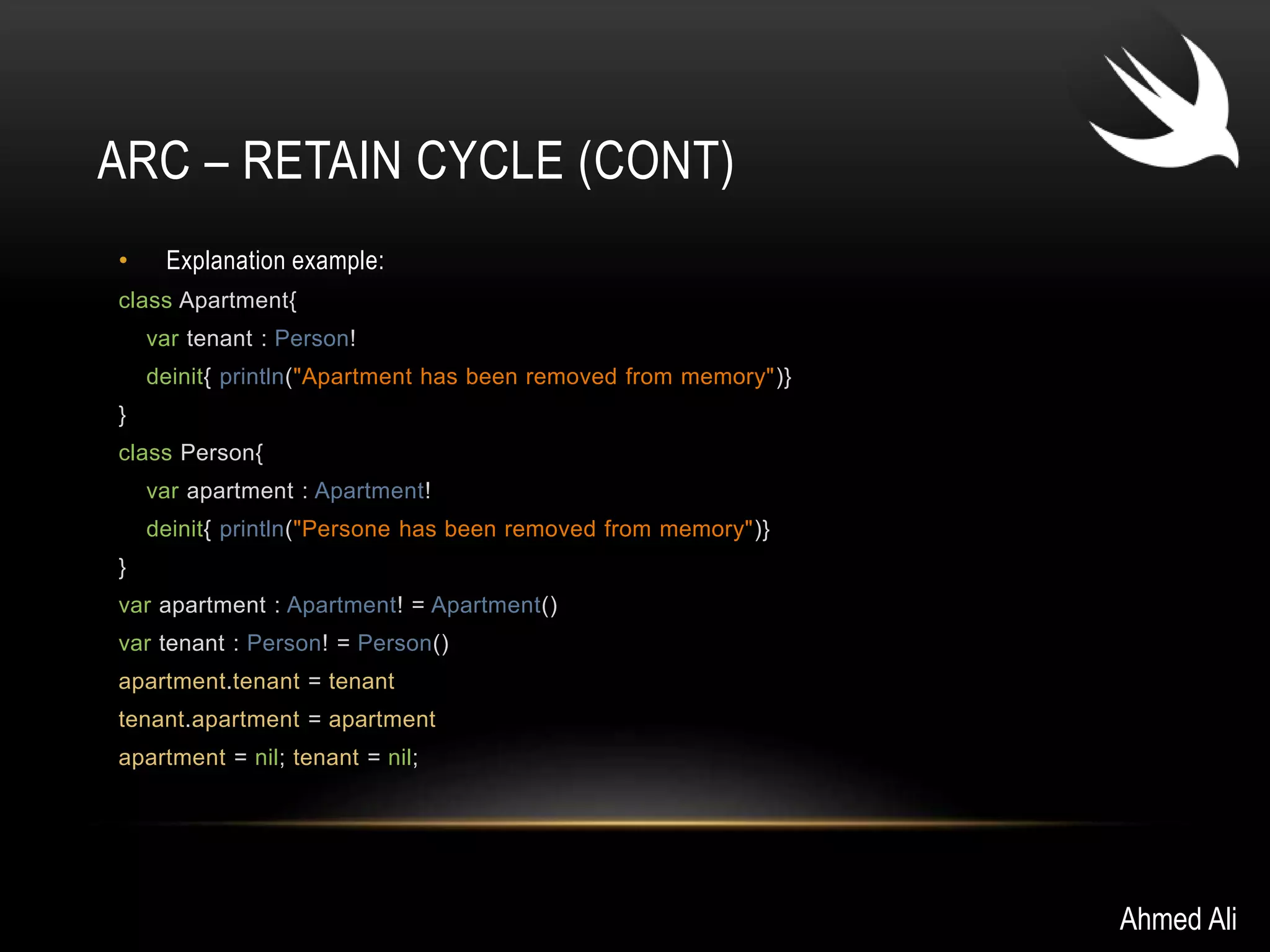
ARC – RETAIN CYCLE (CONT) 
• Explanation example: 
class Apartment{ 
var tenant : Person! 
deinit{ println("Apartment has been removed from memory")} 
} 
class Person{ 
var apartment : Apartment! 
deinit{ println("Persone has been removed from memory")} 
} 
var apartment : Apartment! = Apartment() 
var tenant : Person! = Person() 
apartment.tenant = tenant 
tenant.apartment = apartment 
apartment = nil; tenant = nil; 
Ahmed Ali
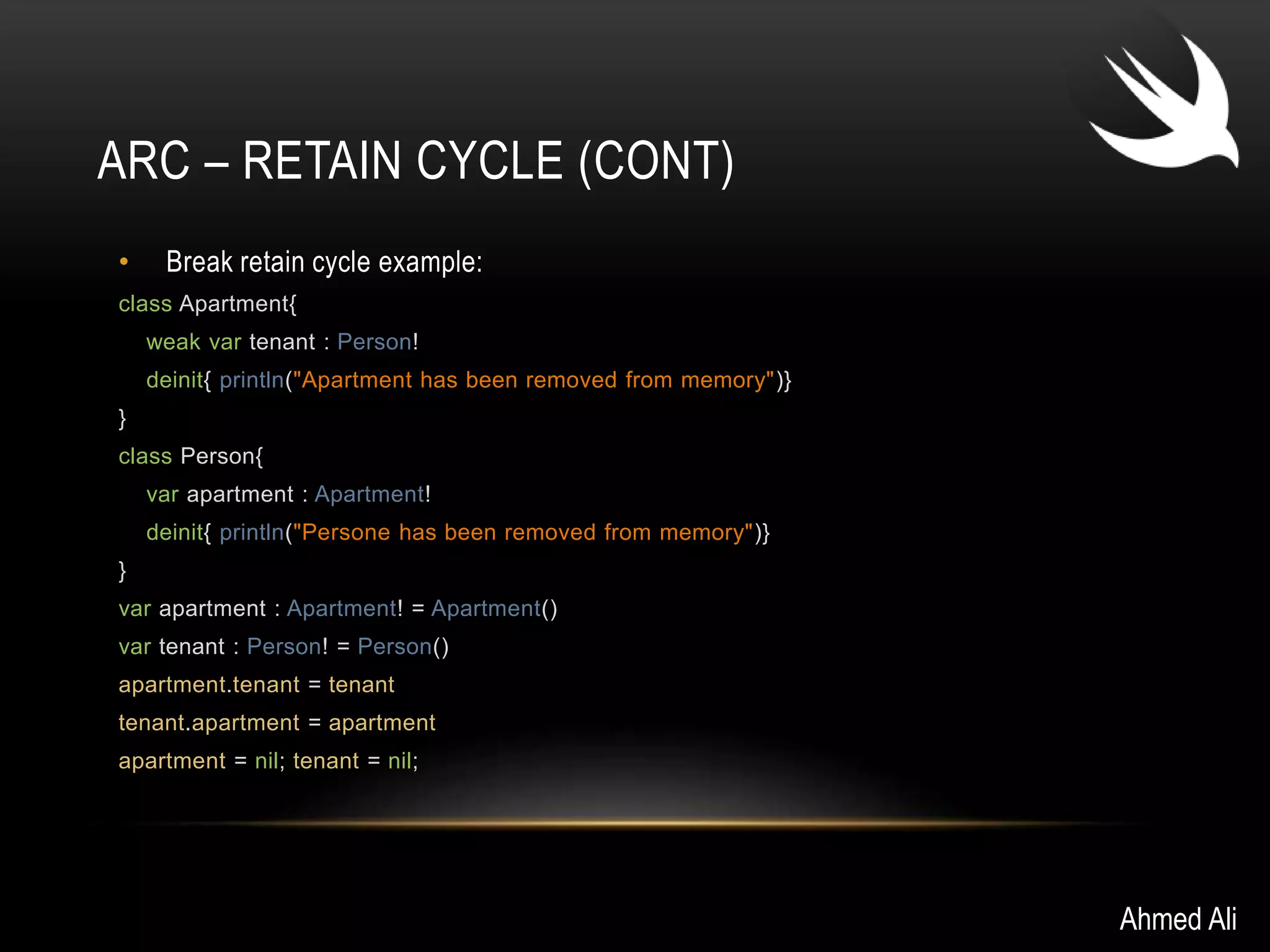
ARC – RETAIN CYCLE (CONT) 
• Break retain cycle example: 
class Apartment{ 
weak var tenant : Person! 
deinit{ println("Apartment has been removed from memory")} 
} 
class Person{ 
var apartment : Apartment! 
deinit{ println("Persone has been removed from memory")} 
} 
var apartment : Apartment! = Apartment() 
var tenant : Person! = Person() 
apartment.tenant = tenant 
tenant.apartment = apartment 
apartment = nil; tenant = nil; 
Ahmed Ali
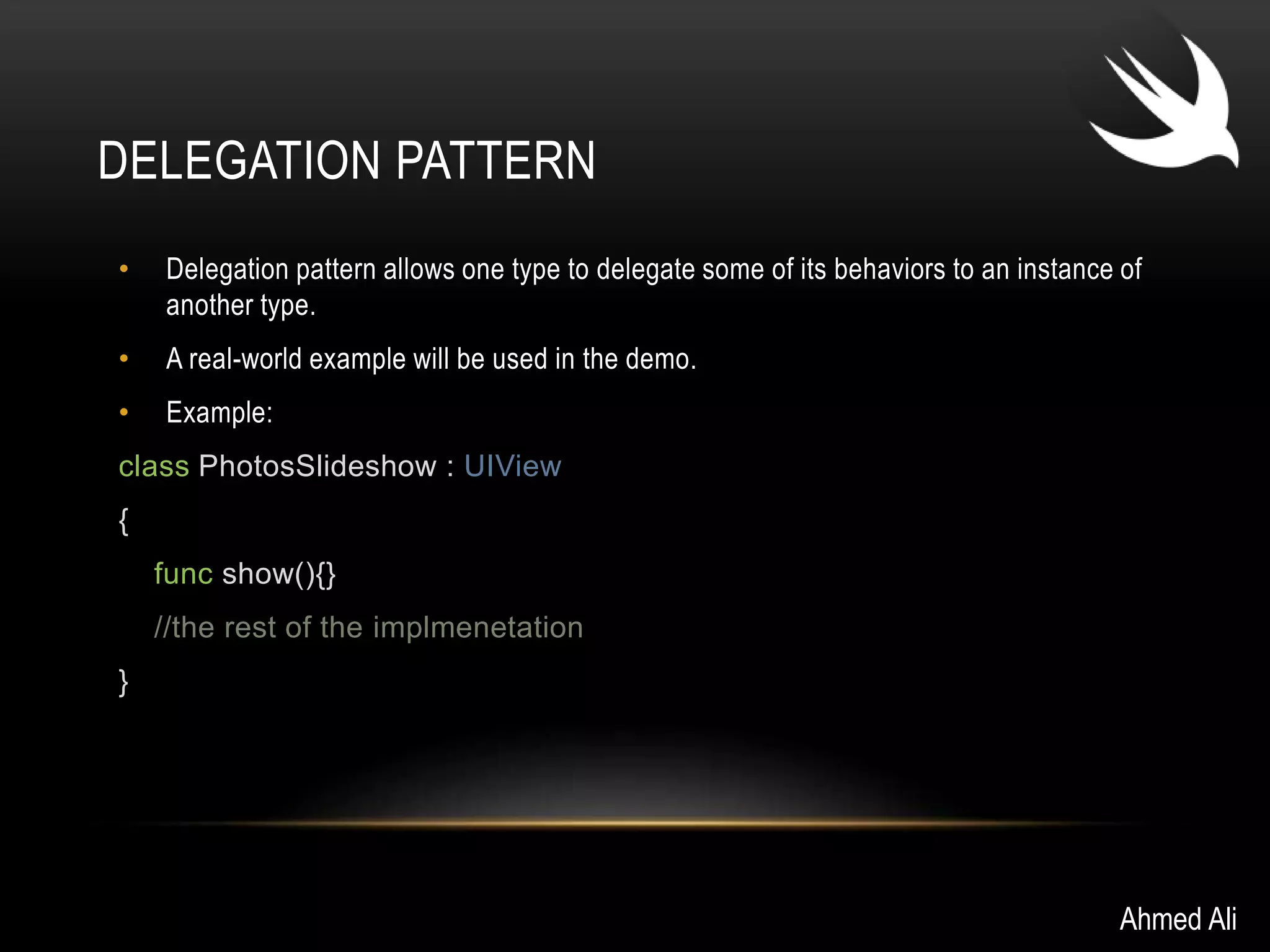
DELEGATION PATTERN 
• Delegation pattern allows one type to delegate some of its behaviors to an instance of 
another type. 
• A real-world example will be used in the demo. 
• Example: 
class PhotosSlideshow : UIView 
{ 
func show(){} 
//the rest of the implmenetation 
} 
Ahmed Ali
DELEGATION PATTERN (CONT) 
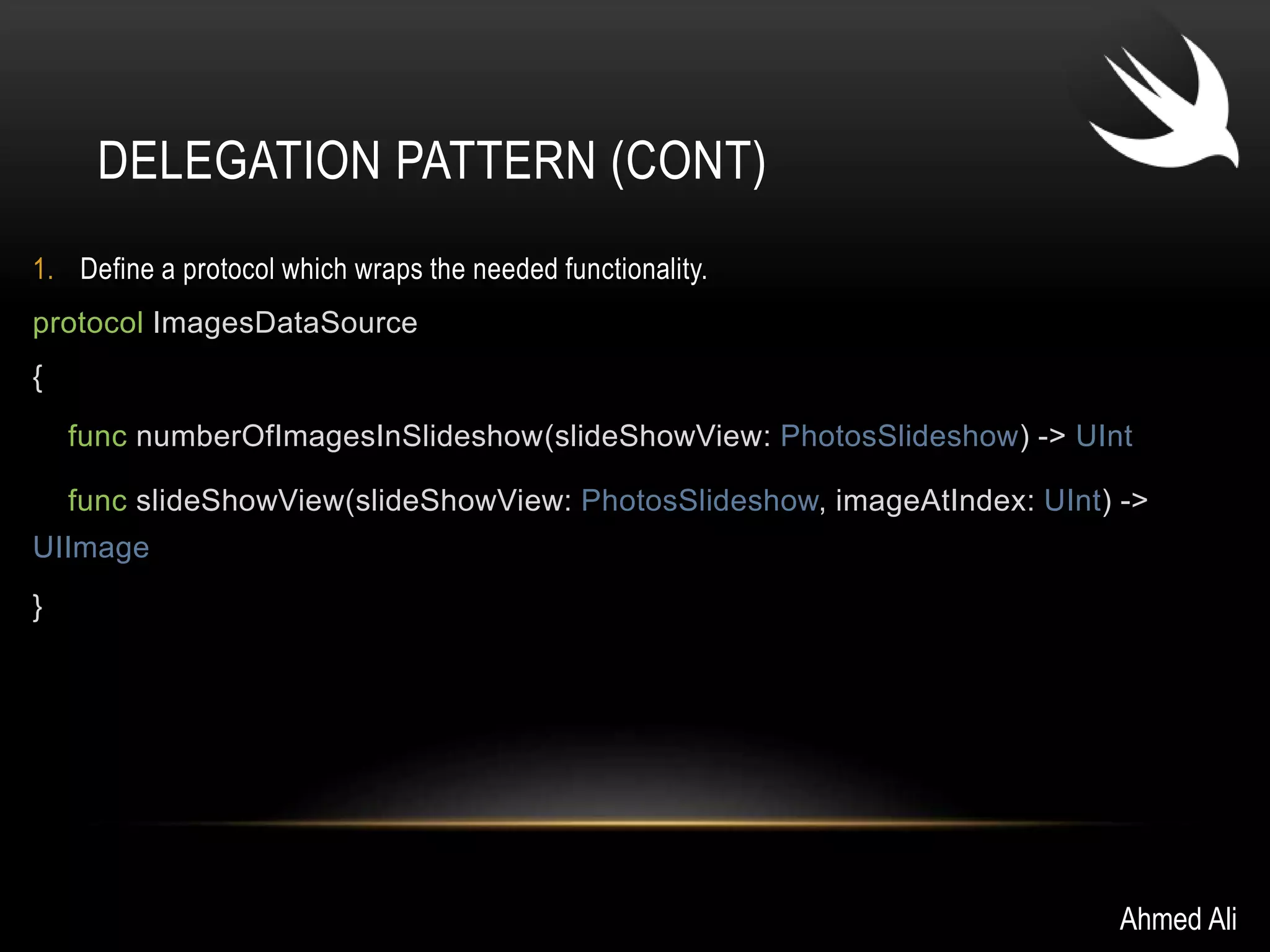
1. Define a protocol which wraps the needed functionality. 
protocol ImagesDataSource 
{ 
func numberOfImagesInSlideshow(slideShowView: PhotosSlideshow) -> UInt 
func slideShowView(slideShowView: PhotosSlideshow, imageAtIndex: UInt) -> 
UIImage 
} 
Ahmed Ali
DELEGATION PATTERN (CONT) 
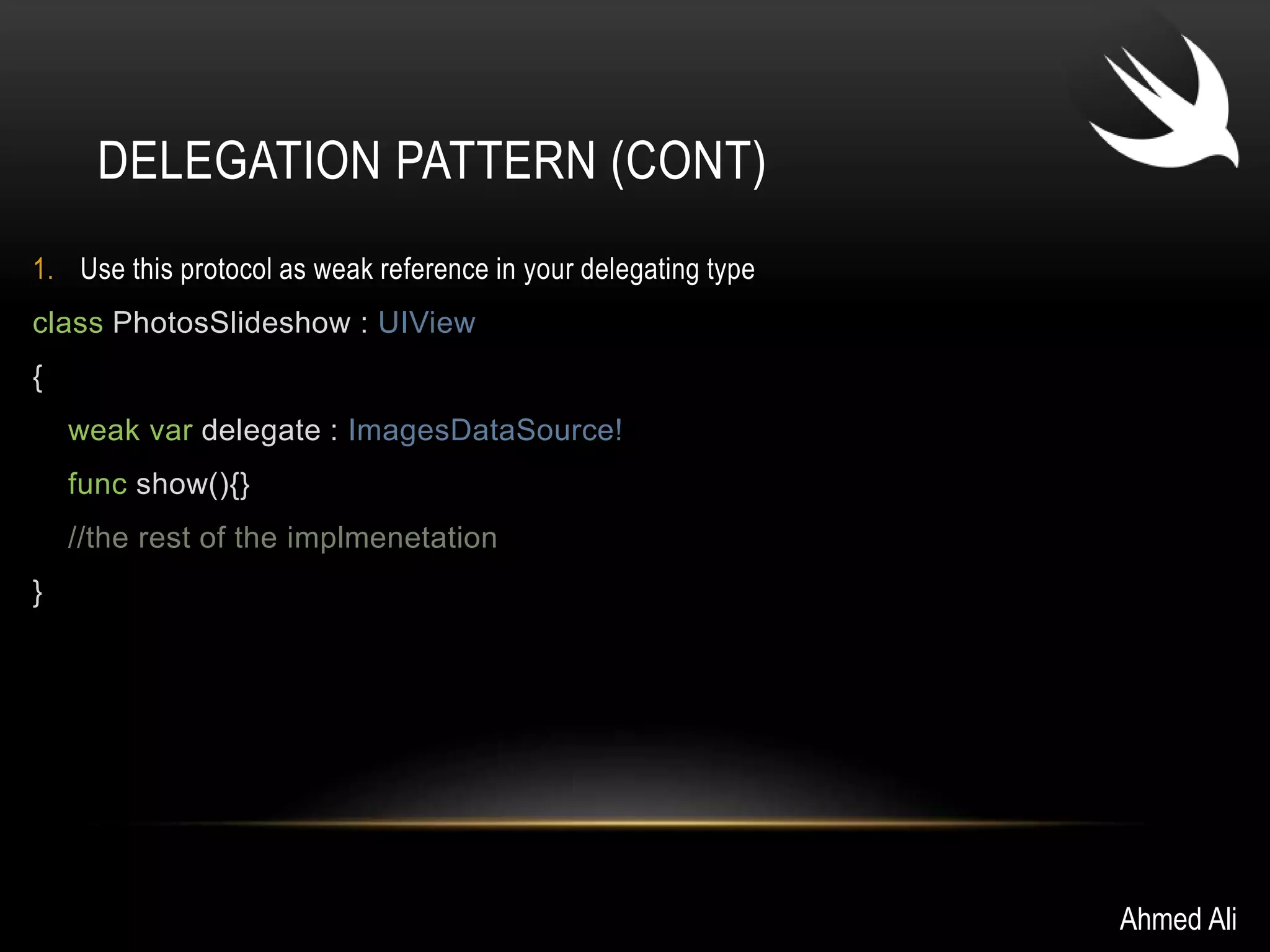
1. Use this protocol as weak reference in your delegating type 
class PhotosSlideshow : UIView 
{ 
weak var delegate : ImagesDataSource! 
func show(){} 
//the rest of the implmenetation 
} 
Ahmed Ali
DELEGATION PATTERN (CONT) 
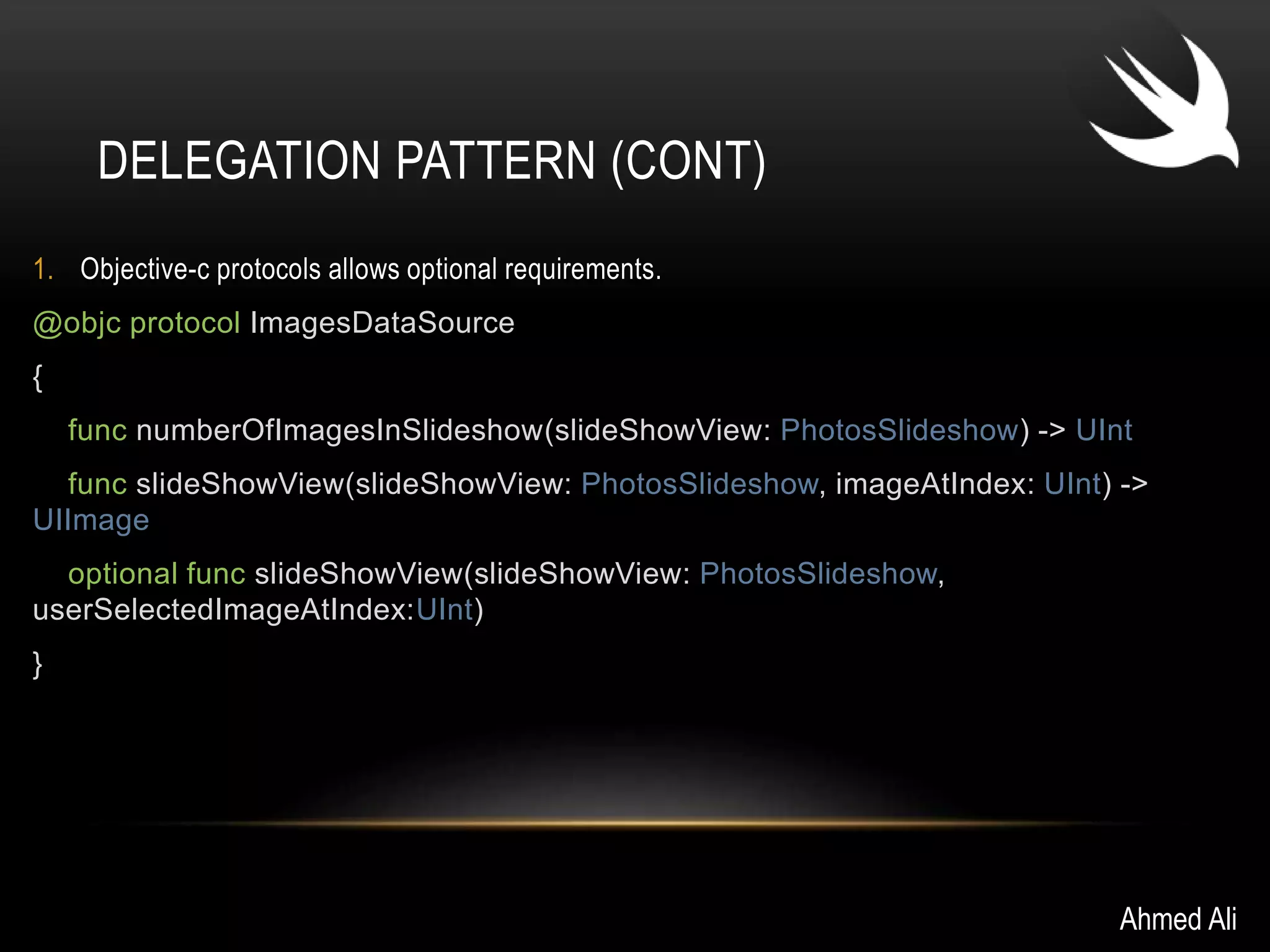
1. Objective-c protocols allows optional requirements. 
@objc protocol ImagesDataSource 
{ 
func numberOfImagesInSlideshow(slideShowView: PhotosSlideshow) -> UInt 
func slideShowView(slideShowView: PhotosSlideshow, imageAtIndex: UInt) -> 
UIImage 
optional func slideShowView(slideShowView: PhotosSlideshow, 
userSelectedImageAtIndex:UInt) 
} 
Ahmed Ali
DELEGATION PATTERN (CONT) 
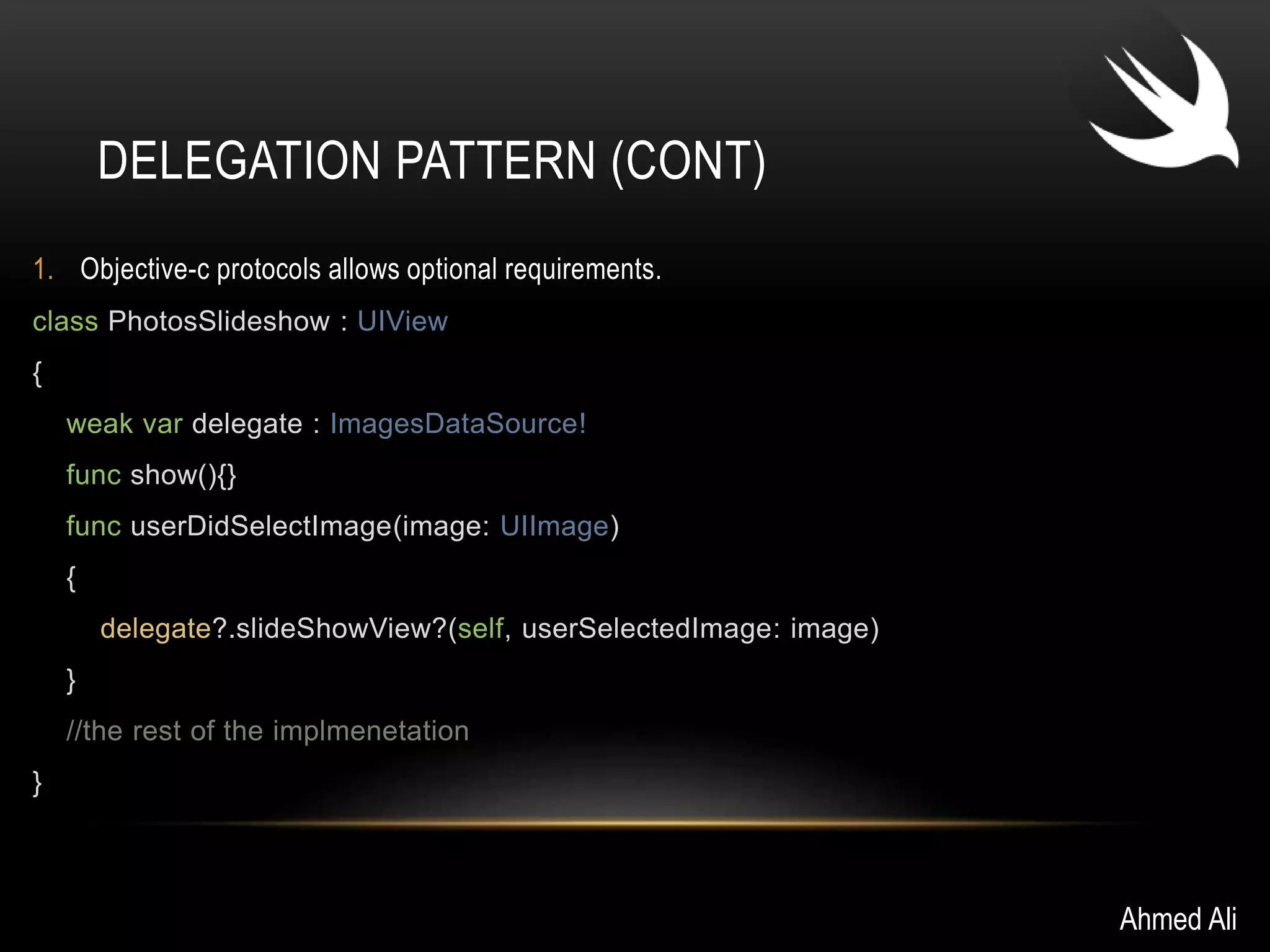
1. Objective-c protocols allows optional requirements. 
class PhotosSlideshow : UIView 
{ 
weak var delegate : ImagesDataSource! 
func show(){} 
func userDidSelectImage(image: UIImage) 
{ 
delegate?.slideShowView?(self, userSelectedImage: image) 
} 
//the rest of the implmenetation 
} 
Ahmed Ali
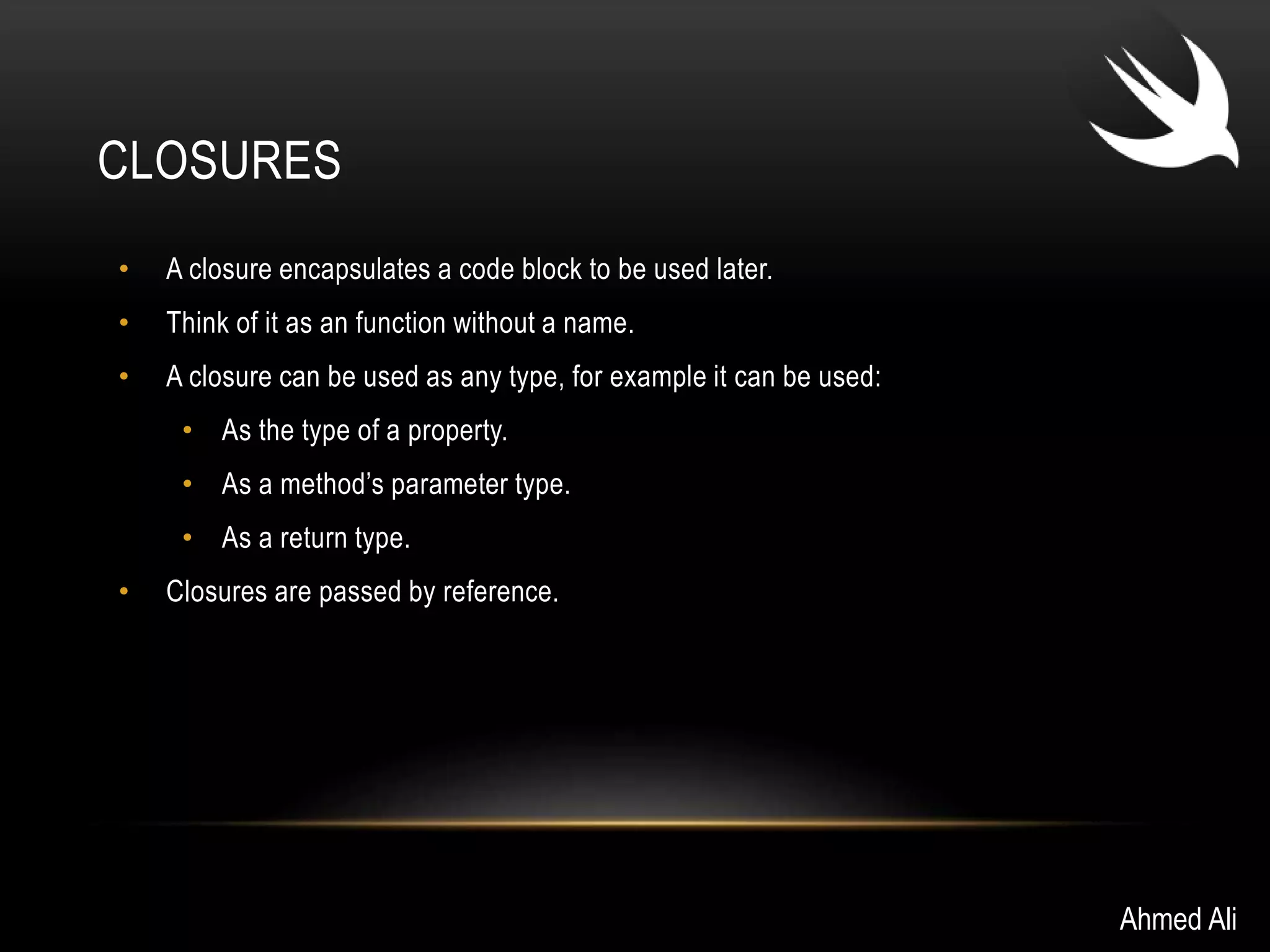
CLOSURES 
• A closure encapsulates a code block to be used later. 
• Think of it as an function without a name. 
• A closure can be used as any type, for example it can be used: 
• As the type of a property. 
• As a method’s parameter type. 
• As a return type. 
• Closures are passed by reference. 
Ahmed Ali
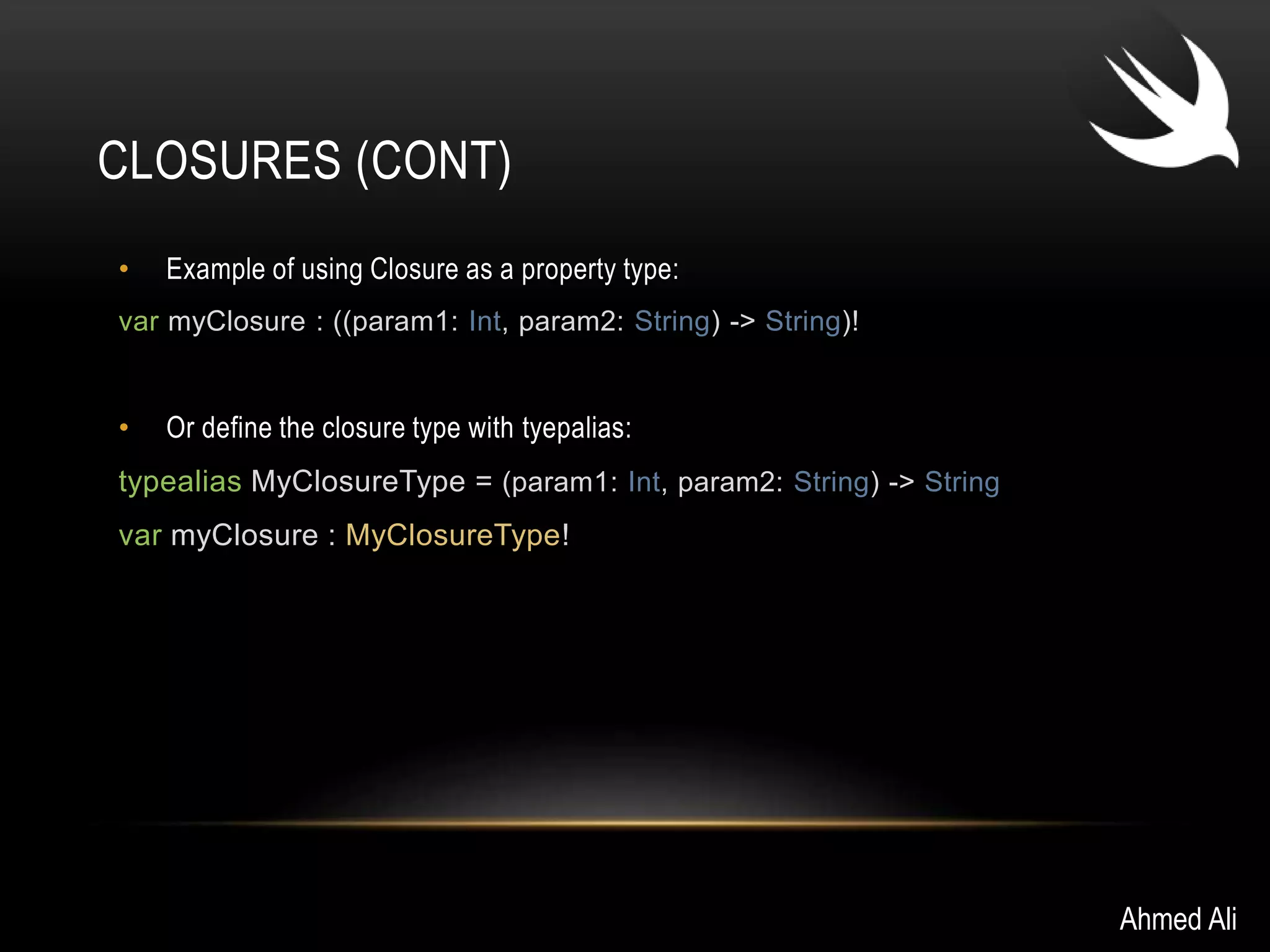
CLOSURES (CONT) 
• Example of using Closure as a property type: 
var myClosure : ((param1: Int, param2: String) -> String)! 
• Or define the closure type with tyepalias: 
typealias MyClosureType = (param1: Int, param2: String) -> String 
var myClosure : MyClosureType! 
Ahmed Ali
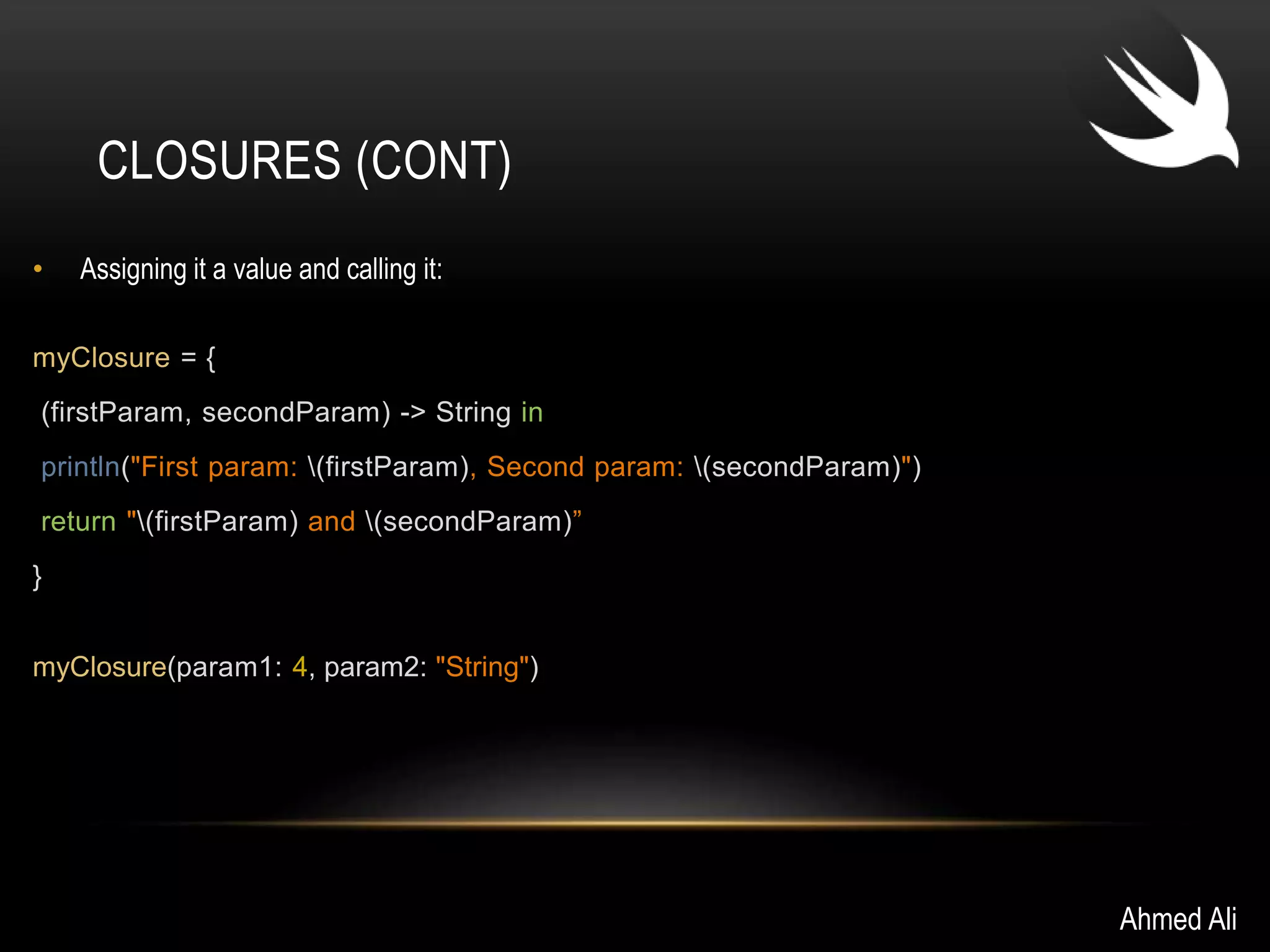
CLOSURES (CONT) 
• Assigning it a value and calling it: 
myClosure = { 
(firstParam, secondParam) -> String in 
println("First param: (firstParam), Second param: (secondParam)") 
return "(firstParam) and (secondParam)” 
} 
myClosure(param1: 4, param2: "String") 
Ahmed Ali
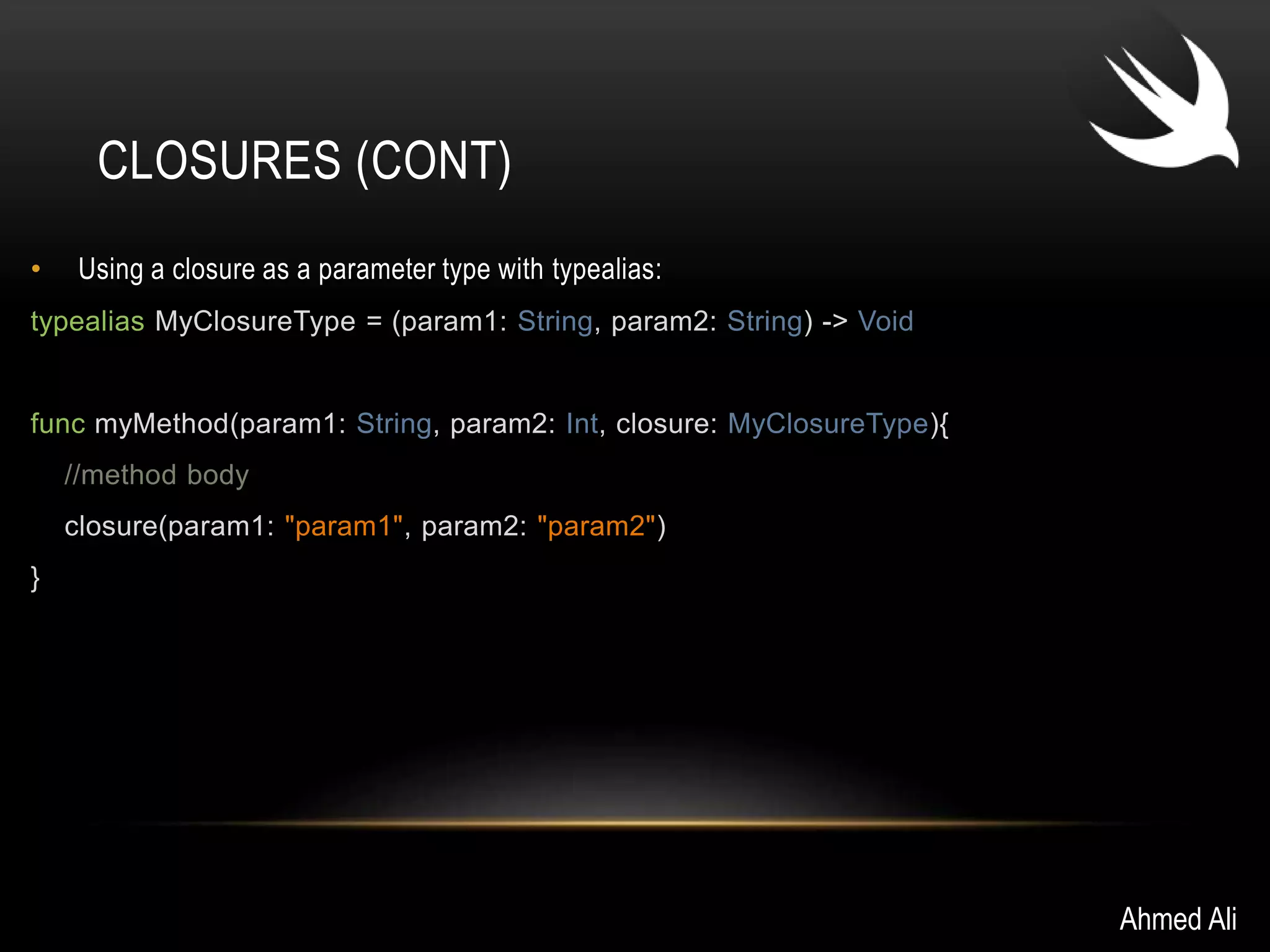
CLOSURES (CONT) 
• Using a closure as a parameter type with typealias: 
typealias MyClosureType = (param1: String, param2: String) -> Void 
func myMethod(param1: String, param2: Int, closure: MyClosureType){ 
//method body 
closure(param1: "param1", param2: "param2") 
} 
Ahmed Ali
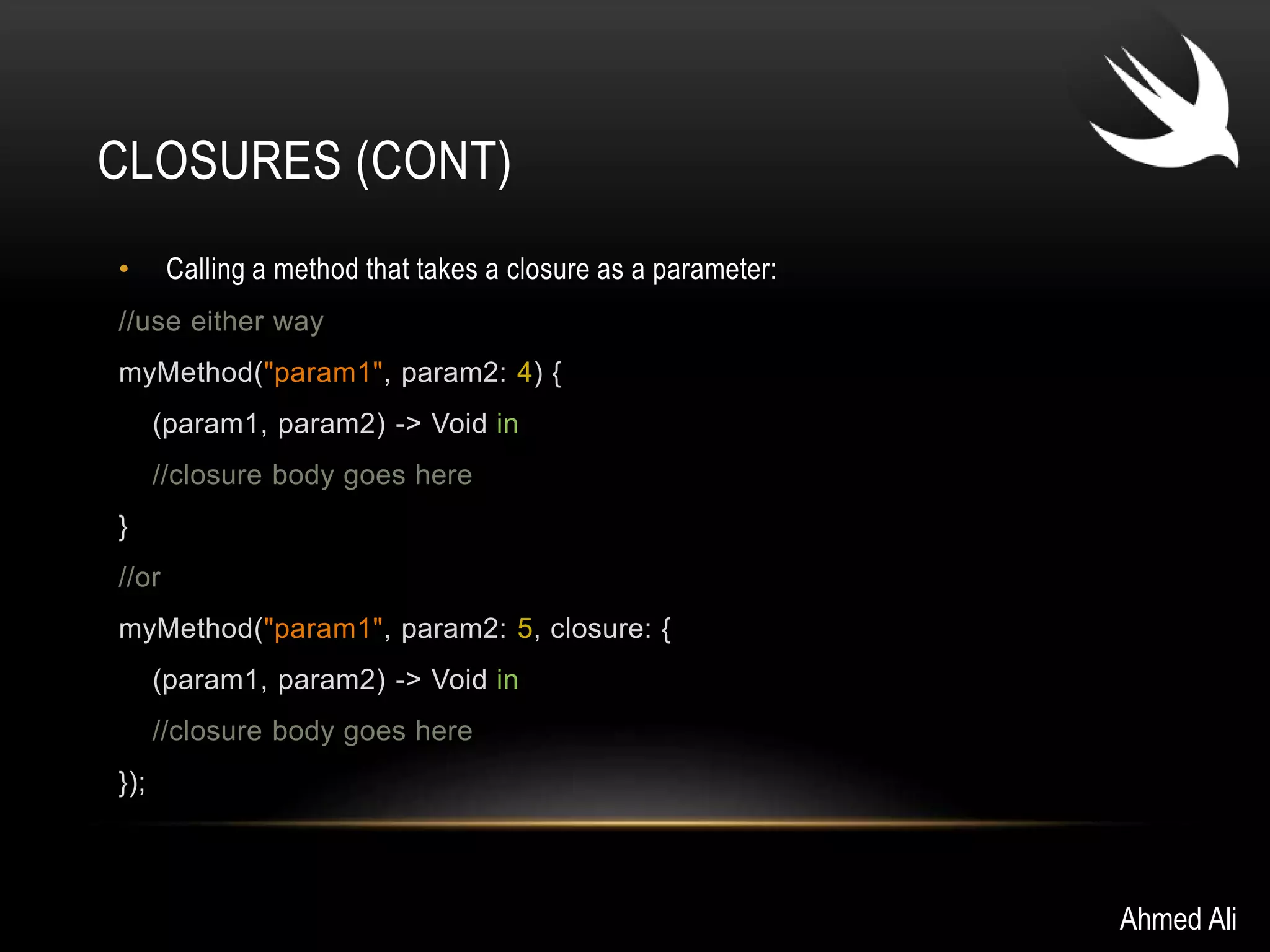
CLOSURES (CONT) 
• Calling a method that takes a closure as a parameter: 
//use either way 
myMethod("param1", param2: 4) { 
(param1, param2) -> Void in 
//closure body goes here 
} 
//or 
myMethod("param1", param2: 5, closure: { 
(param1, param2) -> Void in 
//closure body goes here 
}); 
Ahmed Ali
CLOSURES (CONT) 
• Closure capture their body references. 
• Can cause retain cycles if it refers strongly to the instance that refers strongly to it. 
• Use weak reference to break the retain cycle. 
myMethod("param1", param2: 4) { 
[weak self] (param1, param2) -> Void in 
} 
Ahmed Ali
DEMO 
Ahmed Ali

iOS Development using Swift: Enums, ARC, Delegation, Closures, Table View and more

  • 1.
    IOS DEVELOPMENT USINGSWIFT Enums, ARC, Delegation, Closures Ahmed Ali
  • 2.
    TODAY TOPICS •Enumerations • Automatic Reference Count (ARC) • Delegation pattern • Closures • Demo: • Table view • Move to another screen programmatically • Pass data between screens Ahmed Ali
  • 3.
    ENUMERATIONS • Anenumeration is a value type used to define a common type for a group of related values. • Enumeration can have methods and computed properties. • Also it can deal with numeric data types, strings, and characters. • Example: enum Direction { case UP case DOWN case LEFT case RIGHT } Ahmed Ali enum Direction : String { case UP = "Up" case DOWN = "Down" case LEFT = "Left" case RIGHT = "Right" }
  • 4.
    ENUMERATIONS (CONT) •There are two ways to create enum instances: • Using enum case directly. • Create instance from a raw value. This is only available if the enum type is specified. • Example: //Use direct case let up = Direction.UP //Creating from raw value. //fromRaw static method returns an optional type let down = Direction.fromRaw("Down") Ahmed Ali
  • 5.
    ENUMERATIONS (CONT) •Usage example: //The raw value may come from a user input or a web service response let rawDir = "Left" if let dir = Direction.fromRaw(rawDir){ //The rawDir value is one of our supported directions. Lets see which one it is switch dir{ case .UP: println("Selected direction is Up") case .DOWN: println("Selected direction is Down") default: println("Selected direction is (dir.toRaw())") } } Ahmed Ali
  • 6.
    ENUMERATIONS (CONT) •Enumeration in Swift are more complicated than this, they can have associated values with each case. • Example: enum Shape{ case SQUARE(width: Int, height: Int) case CIRCLE(centerX: Int, centerY: Int, radius: Int) } let shape = Shape.SQUARE(width: 50, height: 50) Ahmed Ali
  • 7.
    ENUMERATIONS (CONT) •Checking the value for associated value cases example: switch shape{ case .SQUARE(width: let width, height: let height): println("Square shape with dimension ((width), (height))") case .CIRCLE(20, let y, let r) where r > 5: println("Circle shape with center point ((20), (y))") case .CIRCLE(let x, let y, _): println("Circle shape with center point ((x), (y))") } Ahmed Ali
  • 8.
    ARC • Agarbage collector is not a good solution for a limited resources devices. • Automatic Reference Count (ARC) is the memory management mechanism used widely in iOS (by Objective-C and Swift). • ARC keeps track of how many references refer to each class instance. • When these references become zero, the object’s memory space is deallocated. • ARC is only applied on class instances; structs and enums are value types, they are not stored or passed by reference. Ahmed Ali
  • 9.
    ARC (CONT) •Explanation example: class Order{ var orderDate : NSDate var product : Product init(orderDate: NSDate, product: Product){ self.orderDate = orderDate;self.product = product } deinit{ println("Order has been removed from the memory") } } class Product{ var name : String init(name: String){ self.name = name } deinit{ println("Product (name) has been removed from the memory") } } Ahmed Ali
  • 10.
    ARC (CONT) •Explanation example (Cont): var product : Product! = Product(name:"iPhone") var order : Order! = Order(orderDate: NSDate(), product: product) product = nil order = nil Ahmed Ali
  • 11.
    ARC – RETAINCYCLE • All references are strong by default. • When two instances strongly refer to each other, they will remain in memory even when they are no more in use. • Your app may run out of memory and crash. Ahmed Ali
  • 12.
    ARC – RETAINCYCLE (CONT) • Explanation example: class Apartment{ var tenant : Person! deinit{ println("Apartment has been removed from memory")} } class Person{ var apartment : Apartment! deinit{ println("Persone has been removed from memory")} } var apartment : Apartment! = Apartment() var tenant : Person! = Person() apartment.tenant = tenant tenant.apartment = apartment apartment = nil; tenant = nil; Ahmed Ali
  • 13.
    ARC – RETAINCYCLE (CONT) • Break retain cycle example: class Apartment{ weak var tenant : Person! deinit{ println("Apartment has been removed from memory")} } class Person{ var apartment : Apartment! deinit{ println("Persone has been removed from memory")} } var apartment : Apartment! = Apartment() var tenant : Person! = Person() apartment.tenant = tenant tenant.apartment = apartment apartment = nil; tenant = nil; Ahmed Ali
  • 14.
    DELEGATION PATTERN •Delegation pattern allows one type to delegate some of its behaviors to an instance of another type. • A real-world example will be used in the demo. • Example: class PhotosSlideshow : UIView { func show(){} //the rest of the implmenetation } Ahmed Ali
  • 15.
    DELEGATION PATTERN (CONT) 1. Define a protocol which wraps the needed functionality. protocol ImagesDataSource { func numberOfImagesInSlideshow(slideShowView: PhotosSlideshow) -> UInt func slideShowView(slideShowView: PhotosSlideshow, imageAtIndex: UInt) -> UIImage } Ahmed Ali
  • 16.
    DELEGATION PATTERN (CONT) 1. Use this protocol as weak reference in your delegating type class PhotosSlideshow : UIView { weak var delegate : ImagesDataSource! func show(){} //the rest of the implmenetation } Ahmed Ali
  • 17.
    DELEGATION PATTERN (CONT) 1. Objective-c protocols allows optional requirements. @objc protocol ImagesDataSource { func numberOfImagesInSlideshow(slideShowView: PhotosSlideshow) -> UInt func slideShowView(slideShowView: PhotosSlideshow, imageAtIndex: UInt) -> UIImage optional func slideShowView(slideShowView: PhotosSlideshow, userSelectedImageAtIndex:UInt) } Ahmed Ali
  • 18.
    DELEGATION PATTERN (CONT) 1. Objective-c protocols allows optional requirements. class PhotosSlideshow : UIView { weak var delegate : ImagesDataSource! func show(){} func userDidSelectImage(image: UIImage) { delegate?.slideShowView?(self, userSelectedImage: image) } //the rest of the implmenetation } Ahmed Ali
  • 19.
    CLOSURES • Aclosure encapsulates a code block to be used later. • Think of it as an function without a name. • A closure can be used as any type, for example it can be used: • As the type of a property. • As a method’s parameter type. • As a return type. • Closures are passed by reference. Ahmed Ali
  • 20.
    CLOSURES (CONT) •Example of using Closure as a property type: var myClosure : ((param1: Int, param2: String) -> String)! • Or define the closure type with tyepalias: typealias MyClosureType = (param1: Int, param2: String) -> String var myClosure : MyClosureType! Ahmed Ali
  • 21.
    CLOSURES (CONT) •Assigning it a value and calling it: myClosure = { (firstParam, secondParam) -> String in println("First param: (firstParam), Second param: (secondParam)") return "(firstParam) and (secondParam)” } myClosure(param1: 4, param2: "String") Ahmed Ali
  • 22.
    CLOSURES (CONT) •Using a closure as a parameter type with typealias: typealias MyClosureType = (param1: String, param2: String) -> Void func myMethod(param1: String, param2: Int, closure: MyClosureType){ //method body closure(param1: "param1", param2: "param2") } Ahmed Ali
  • 23.
    CLOSURES (CONT) •Calling a method that takes a closure as a parameter: //use either way myMethod("param1", param2: 4) { (param1, param2) -> Void in //closure body goes here } //or myMethod("param1", param2: 5, closure: { (param1, param2) -> Void in //closure body goes here }); Ahmed Ali
  • 24.
    CLOSURES (CONT) •Closure capture their body references. • Can cause retain cycles if it refers strongly to the instance that refers strongly to it. • Use weak reference to break the retain cycle. myMethod("param1", param2: 4) { [weak self] (param1, param2) -> Void in } Ahmed Ali
  • 25.