The Clojure
Programming
Language
CS571ProgrammingLanguages
Brian Gracin
Jenny Pawlak
Jacquelyn S Victoria
90 Second Overview…..
Clojure is…..
- A dialect of Lisp
- General purpose language
- Emphasizes functional programming
- Runs on the Java Virtual Machine
- Designed for Concurrency
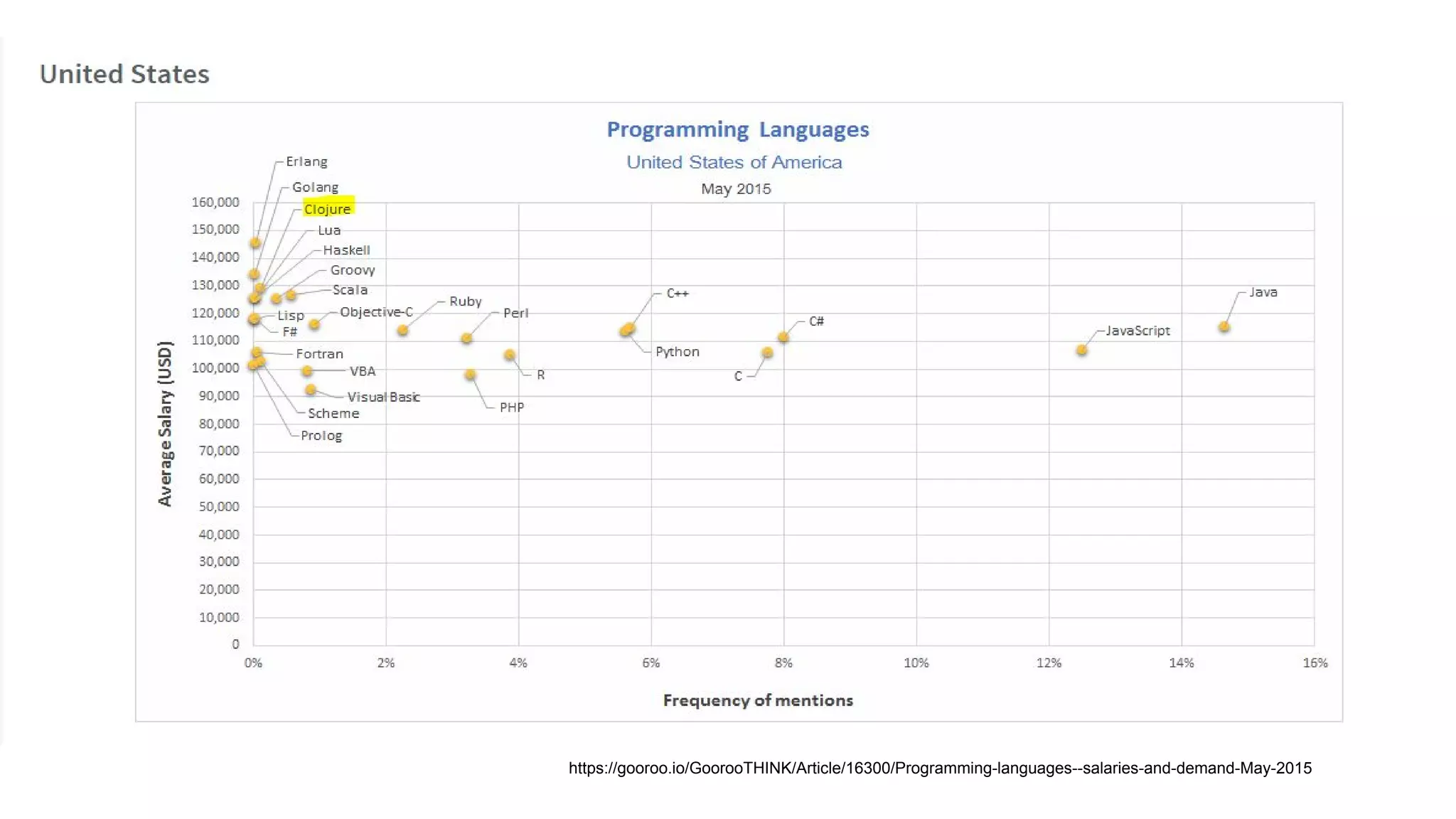
- Used in industry -- CapitalOne, Amazon, Facebook, Oracle
https://gooroo.io/GoorooTHINK/Article/16300/Programming-languages--salaries-and-demand-May-2015
Background
Simplicity
“We suffer from so much incidental complexity in traditional OO languages, both
syntactic and semantic, that I don’t think we even realise it anymore. I wanted to
make ‘doing the right thing’ not a matter of convention and discipline, but the
default. I wanted a solid concurrency story and great interoperability with existing
Java libraries,.” -Rich Hickey, creator of Clojure
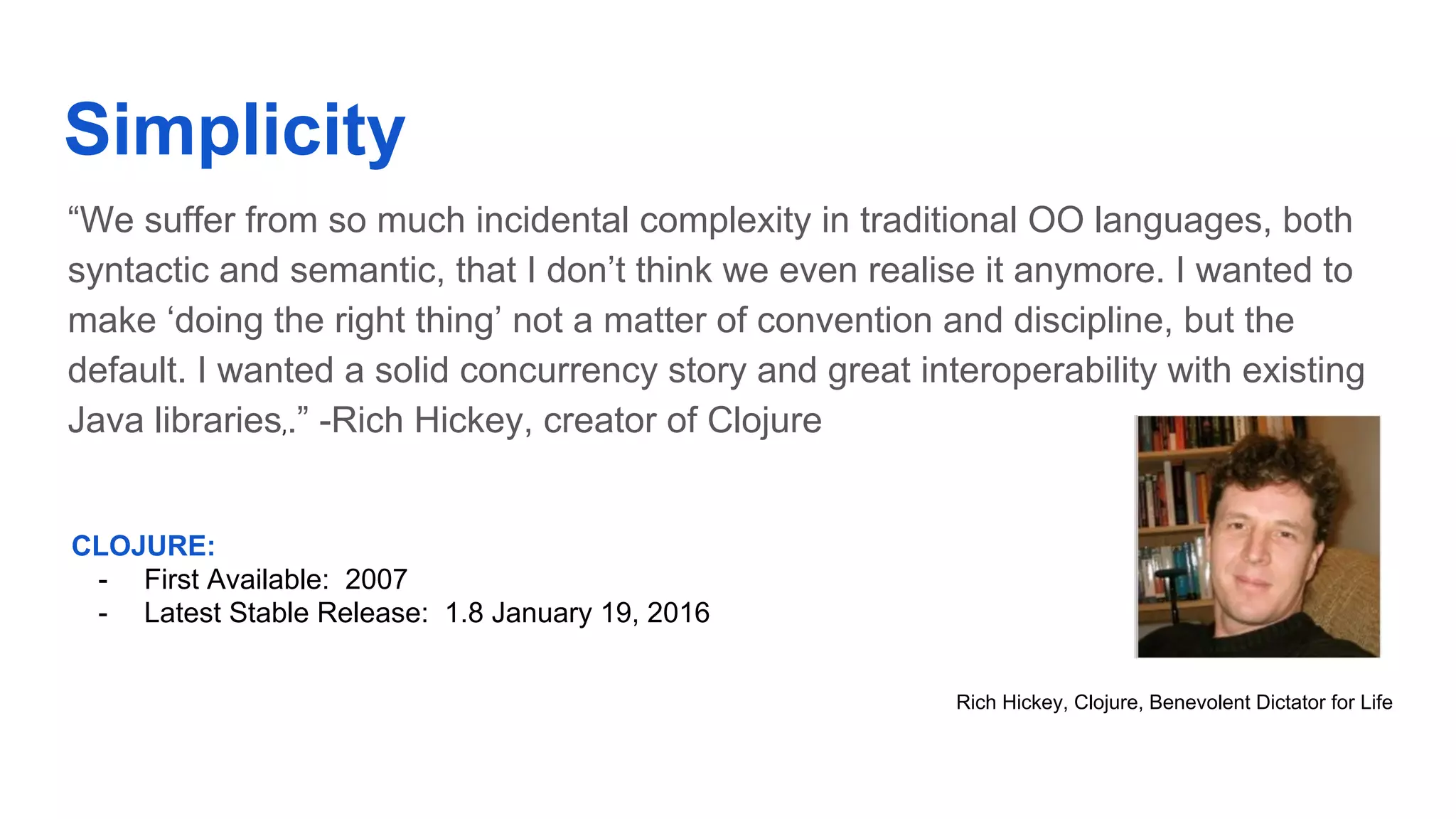
Rich Hickey, Clojure, Benevolent Dictator for Life
CLOJURE:
- First Available: 2007
- Latest Stable Release: 1.8 January 19, 2016
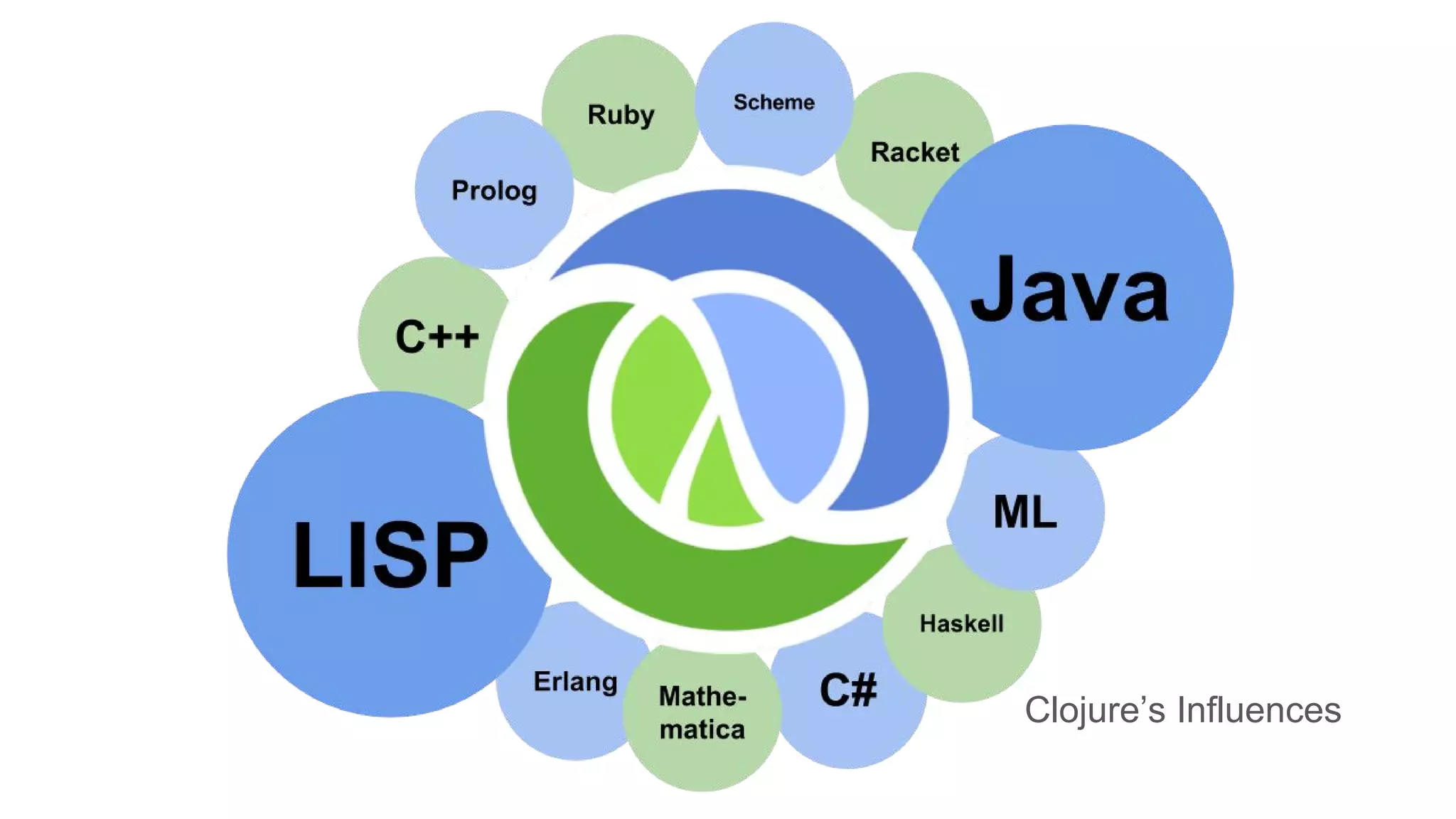
Clojure’s Influences
Why Lisp?
● Entire Language:
○ 7 functions
○ 2 labels
Why JVM?
● Familiar - run just like Java apps
● Use some familiar Java objects
● Many available libraries
● Established track record
● Now open-sourced.
http://www.braveclojure.com/java/ (Chapter 12)
clojure.org/about/rationale
What are Clojure’s Characteristics?
● Functional - succinct, understandable, reusable
● Defaults to Immutability
○ Simplifies reasoning and testing
○ Easier to share objects
○ Thread safe
● but allows mutability!
● Code-as-Data (Homoiconicity)
● Syntactic Abstraction
Immutable objects are always thread safe.
—Brian Goetz, Java Concurrency in Practice
The Joy of Clojure Chapter 6.
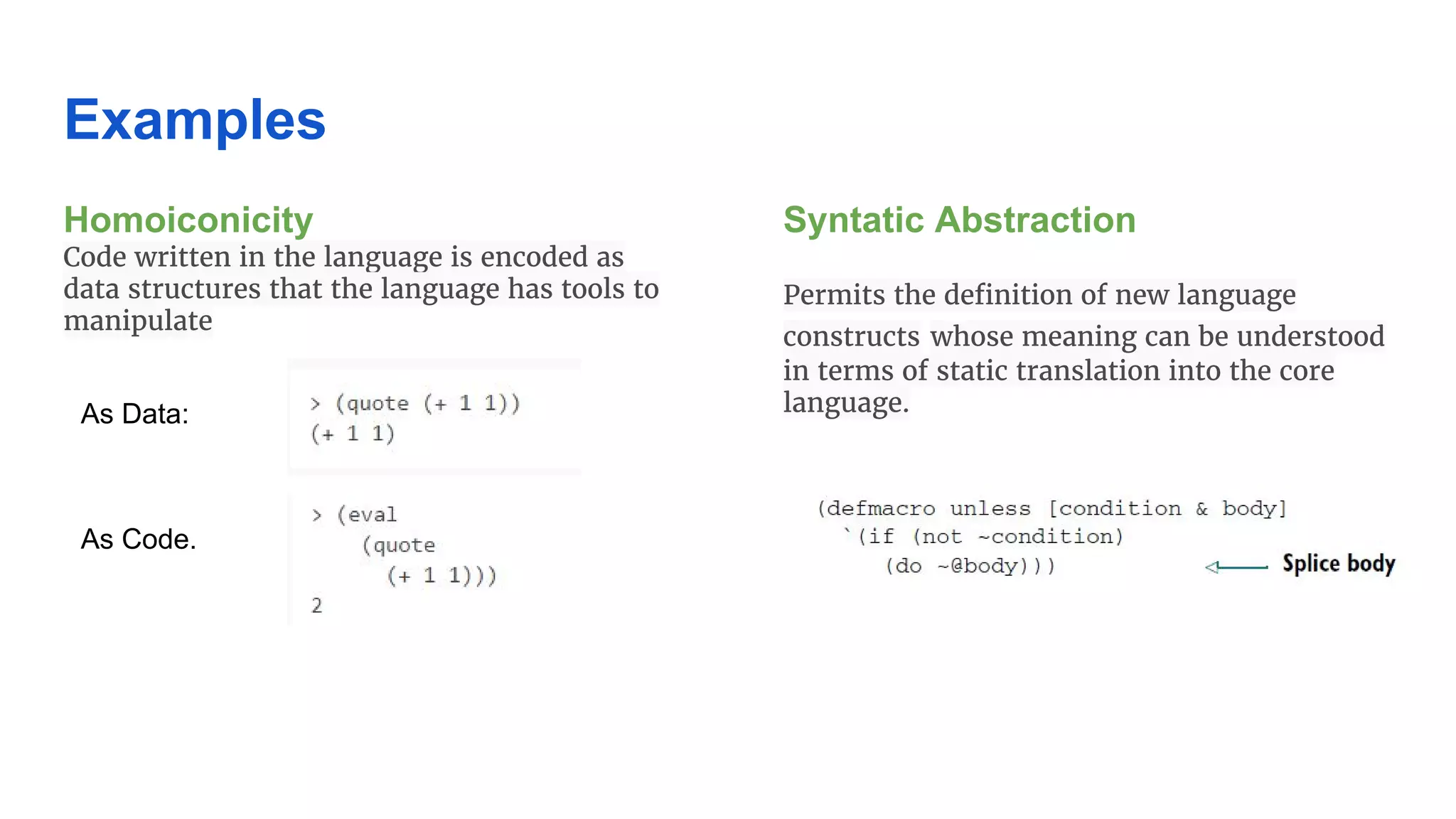
Examples
Homoiconicity
Code written in the language is encoded as
data structures that the language has tools to
manipulate
Syntatic Abstraction
Permits the definition of new language
constructs whose meaning can be understood
in terms of static translation into the core
language.As Data:
As Code.
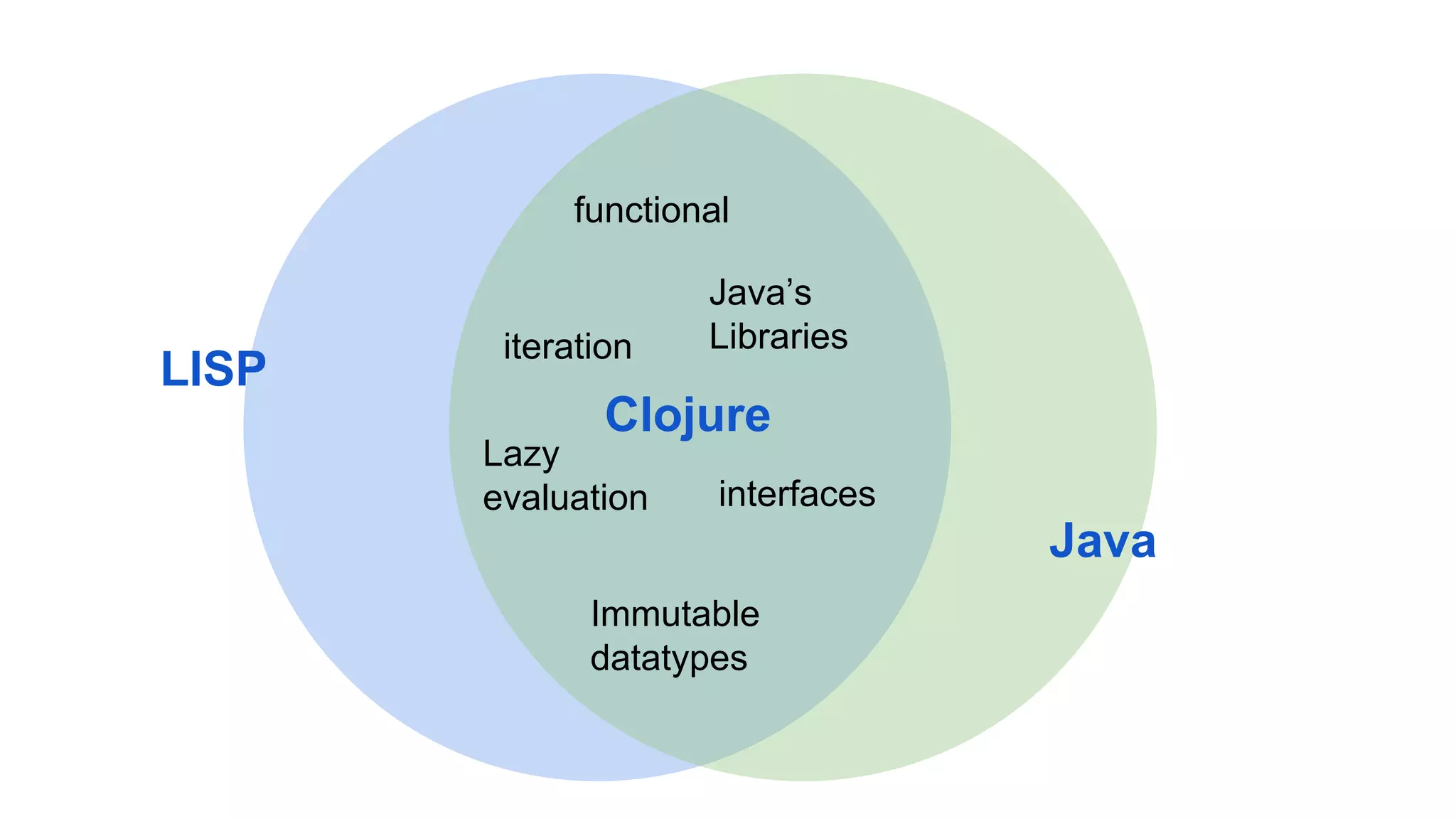
LISP
Java
functional
Java’s
Librariesiteration
interfaces
Immutable
datatypes
Lazy
evaluation
Clojure
Core
Truthiness
What is truthy?
● true
● 1
● (= 1 1)
● 0
● “False”
● []
● Literally any value but false or nil
What is falsey?
● false
● nil
● (= 3 1)
Nil Punning: Handling Clojure’s
empty sequences that are Truthy
Every[thing] is "true" all the time, unless it is nil or false.
—Brian Goetz,
The Joy of Clojure
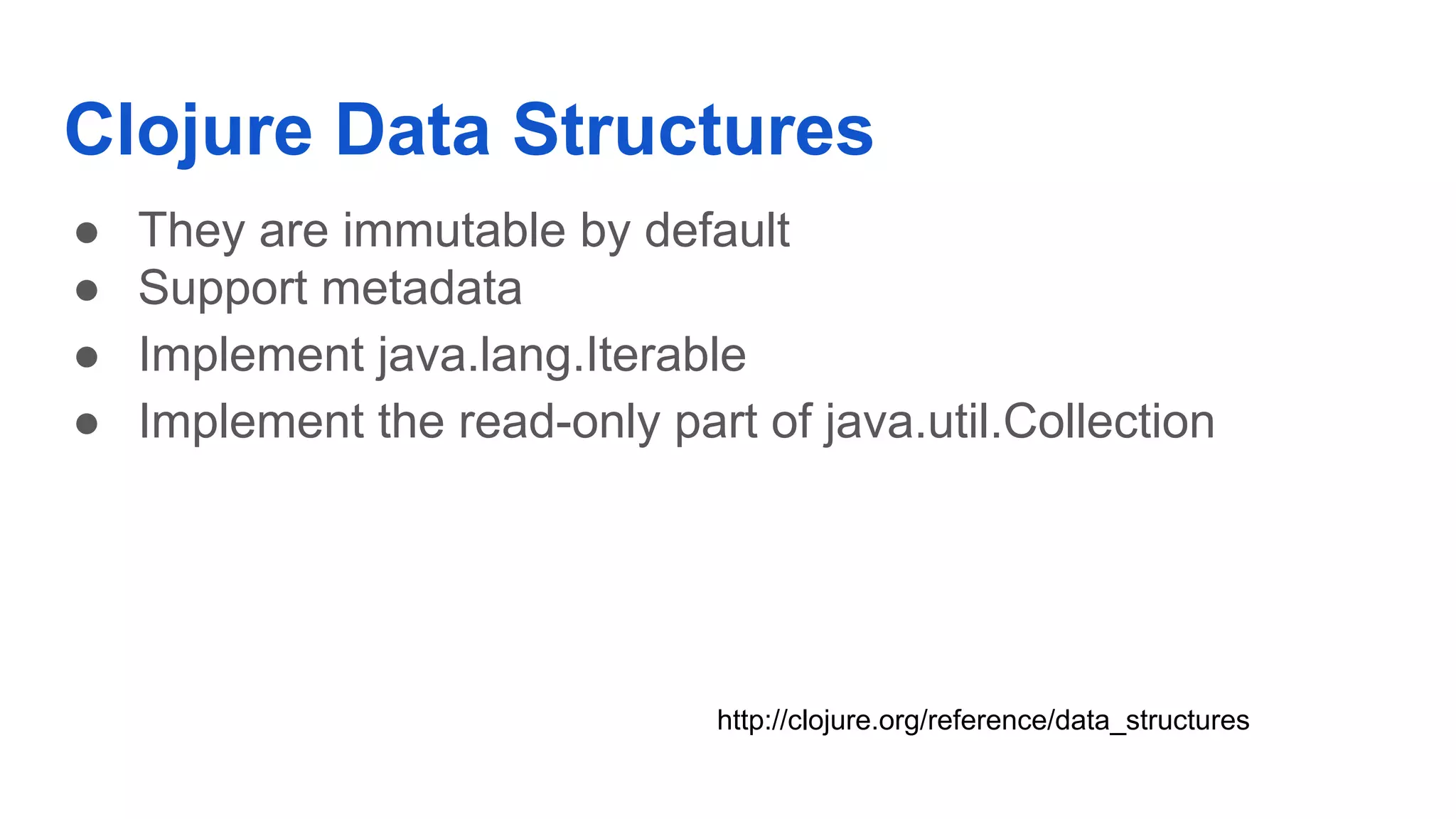
Clojure Data Structures
● They are immutable by default
● Support metadata
● Implement java.lang.Iterable
● Implement the read-only part of java.util.Collection
http://clojure.org/reference/data_structures
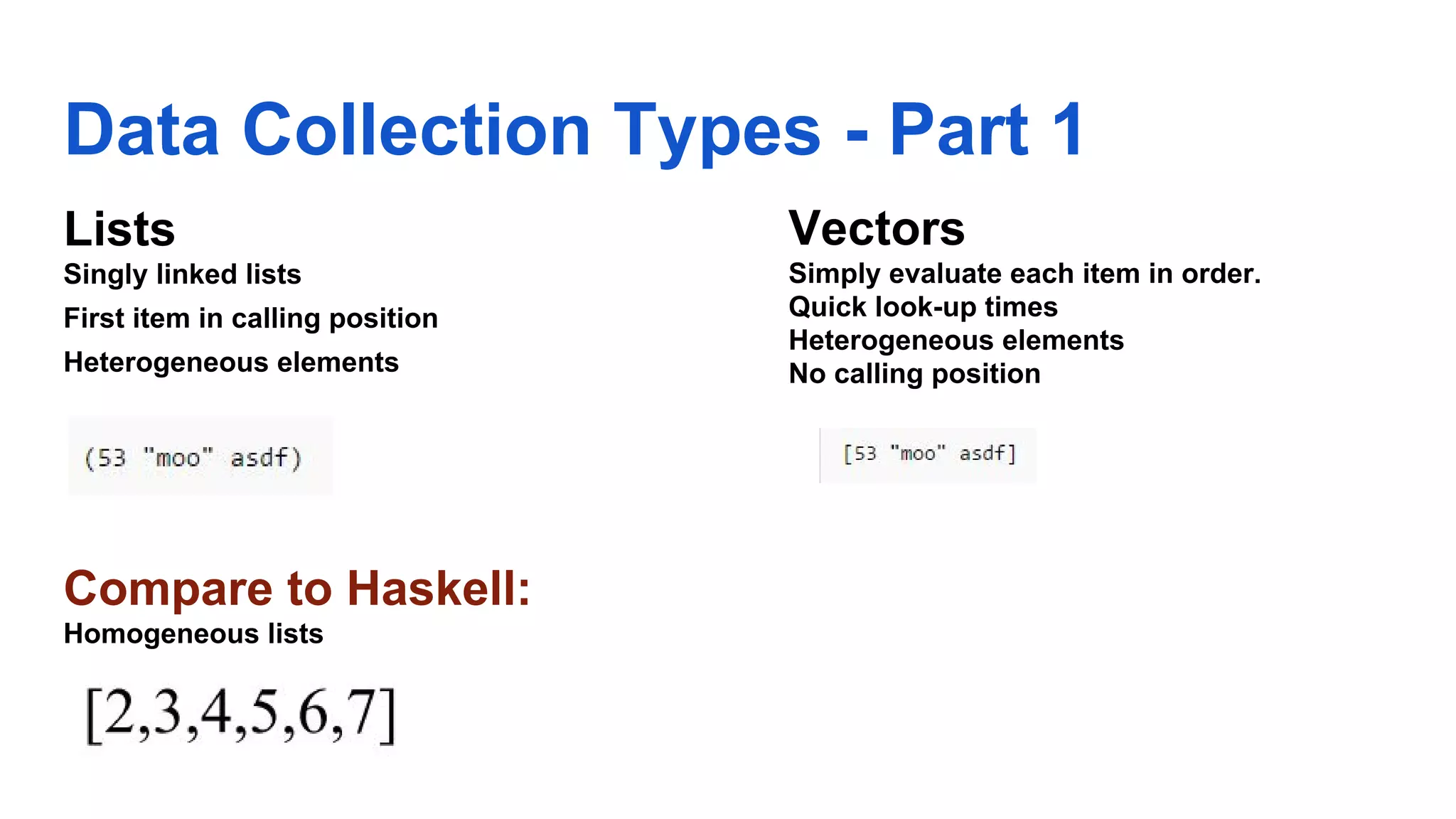
Data Collection Types - Part 1
Lists
Singly linked lists
First item in calling position
Heterogeneous elements
Compare to Haskell:
Homogeneous lists
Vectors
Simply evaluate each item in order.
Quick look-up times
Heterogeneous elements
No calling position
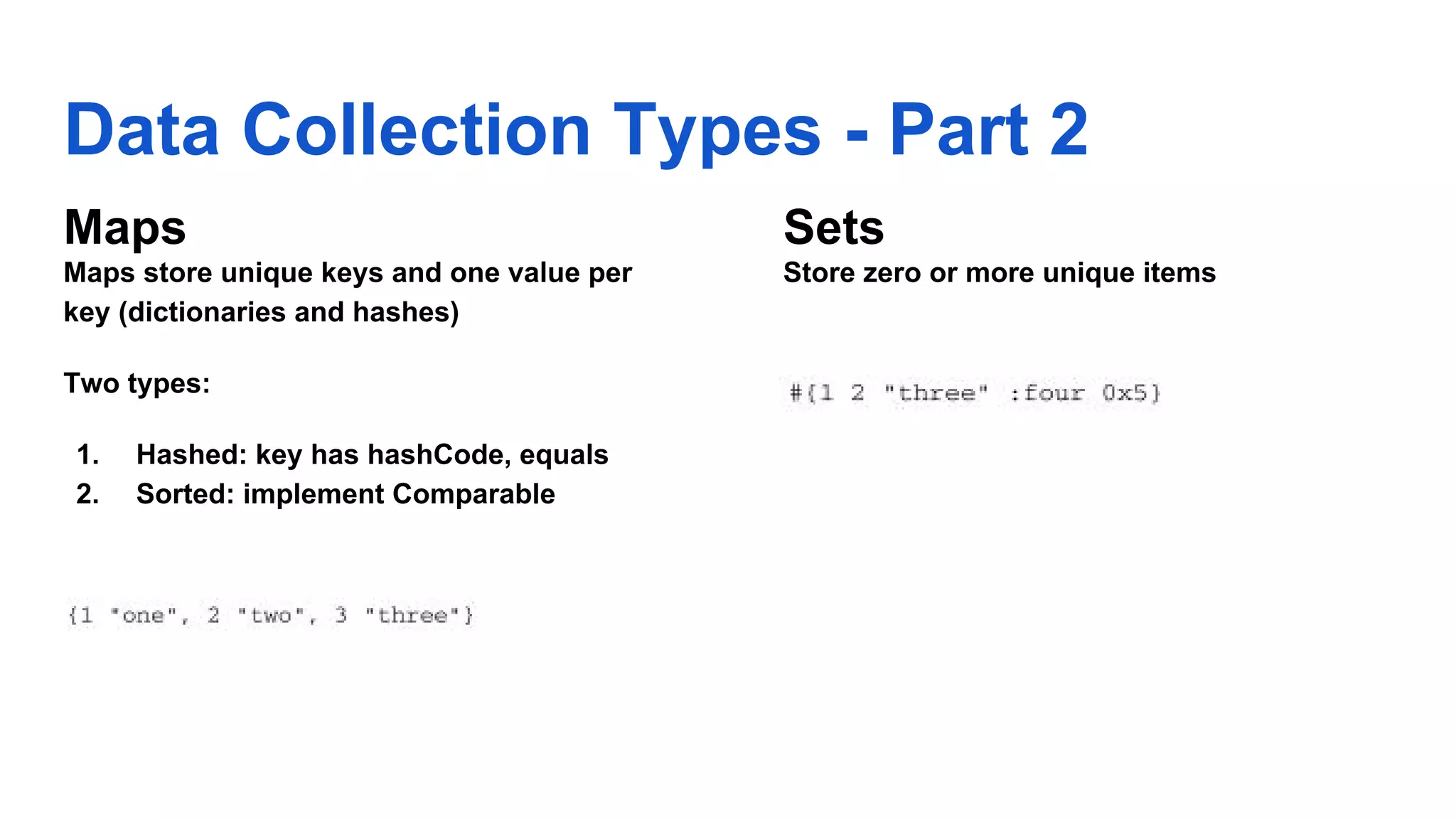
Data Collection Types - Part 2
Maps
Maps store unique keys and one value per
key (dictionaries and hashes)
Two types:
1. Hashed: key has hashCode, equals
2. Sorted: implement Comparable
Sets
Store zero or more unique items
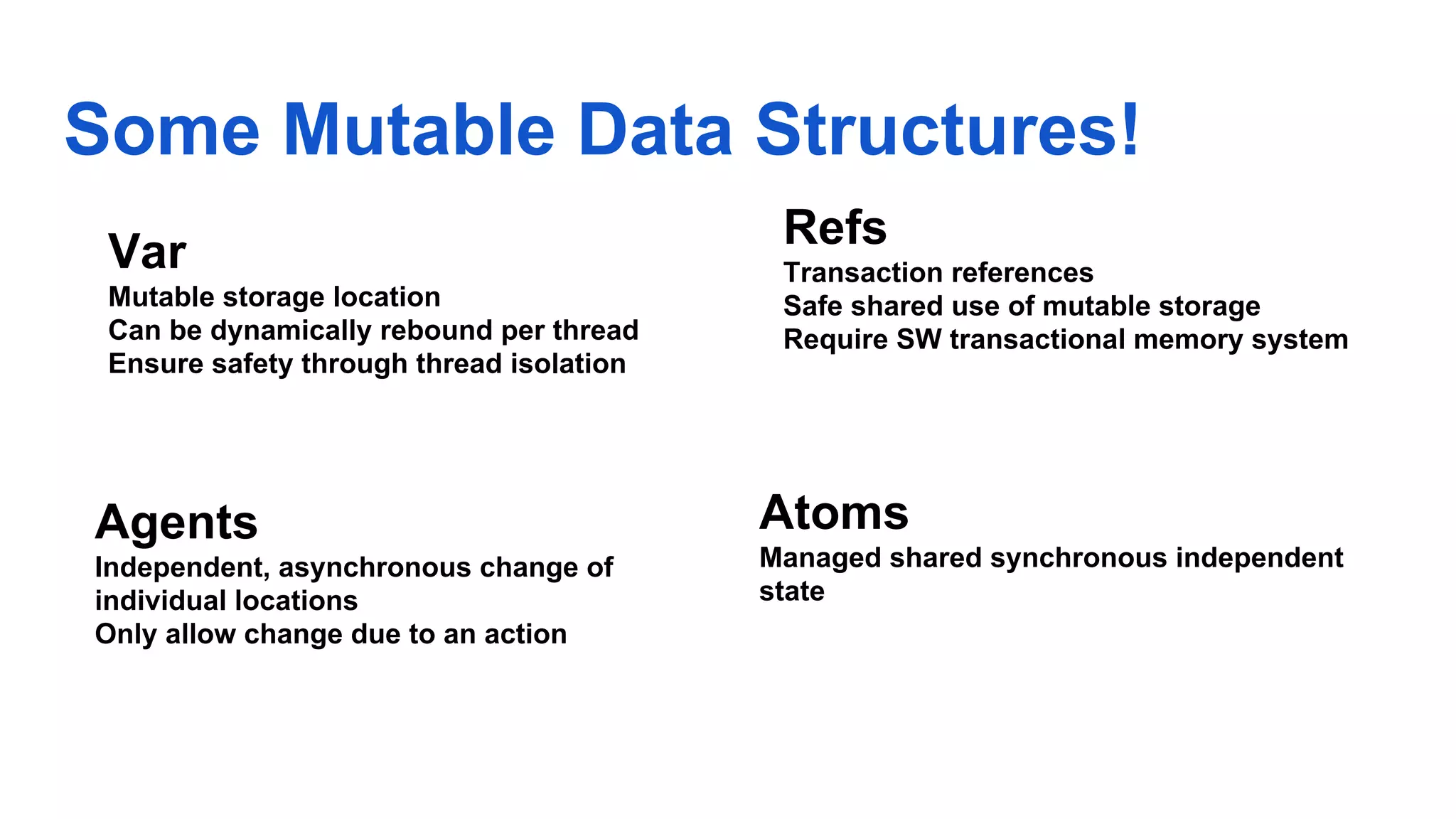
Some Mutable Data Structures!
Atoms
Managed shared synchronous independent
state
Refs
Transaction references
Safe shared use of mutable storage
Require SW transactional memory system
Agents
Independent, asynchronous change of
individual locations
Only allow change due to an action
Var
Mutable storage location
Can be dynamically rebound per thread
Ensure safety through thread isolation
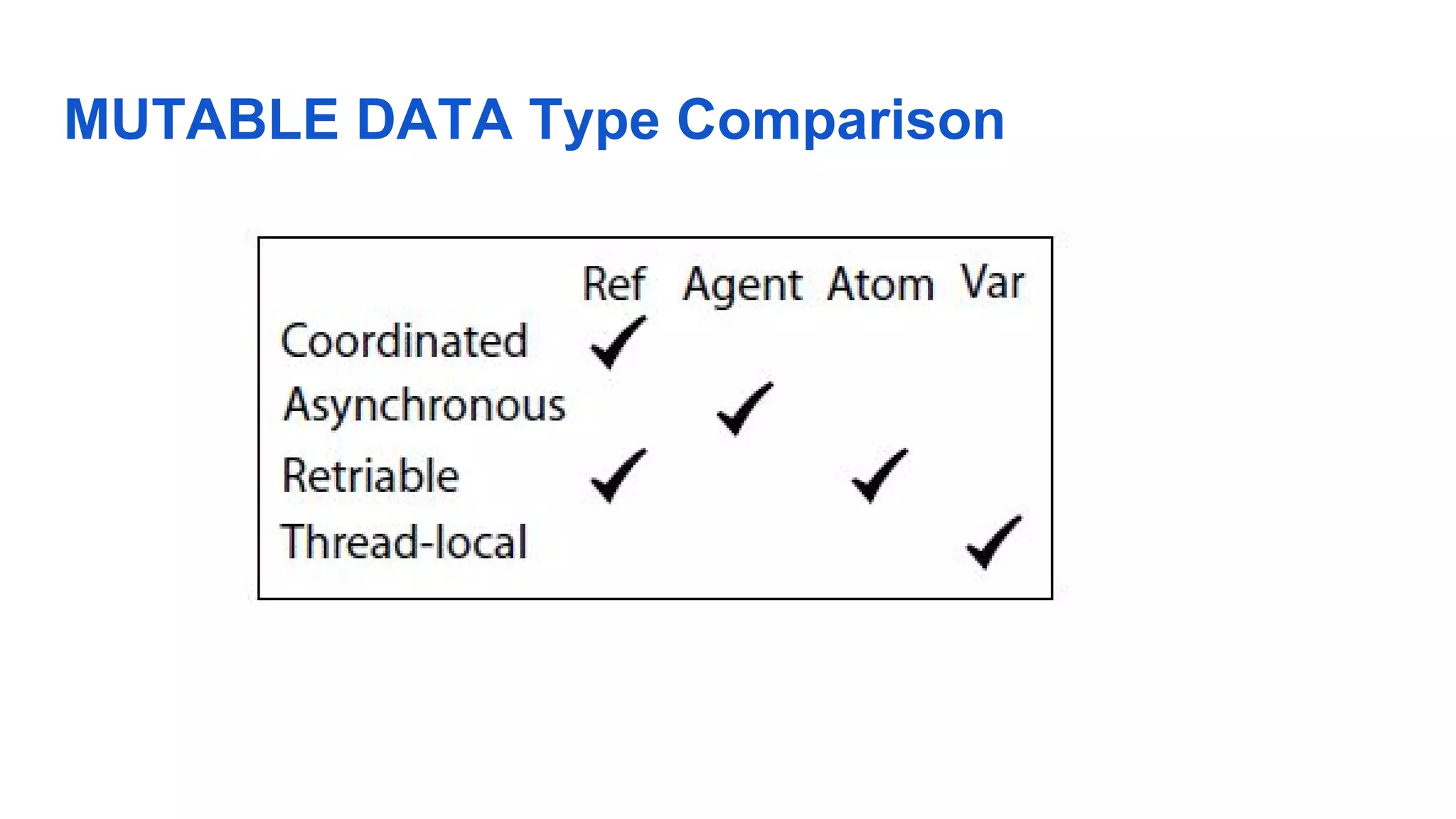
MUTABLE DATA Type Comparison
Functions
First Class
Created on demand
Stored in a data structure
Passed as an argument
Returned as a value
Higher-Order
Takes one or more function args
Returns function as result
Pure Functions
ALWAYS return same result
No observable side effects
(defn
[arg1 arg2]
(;function code
))
def or defn?
● Both bind a symbol or name
● def is only evaluated once
● defn is evaluated every time it is called
Examples
Quick Comparison
Haskell:
average numbers = (fold (+) (numbers) ) / (length(numbers))
Clojure:
(defn average [numbers] (/ (reduce + numbers) (count numbers)))
Quick Comparison
Haskell:
fact x = if x == 0 then 1 else x * fact(x-1)
Clojure:
(defn factorial [n] (if (= n 0) 1 (* n (factorial (dec n)))))
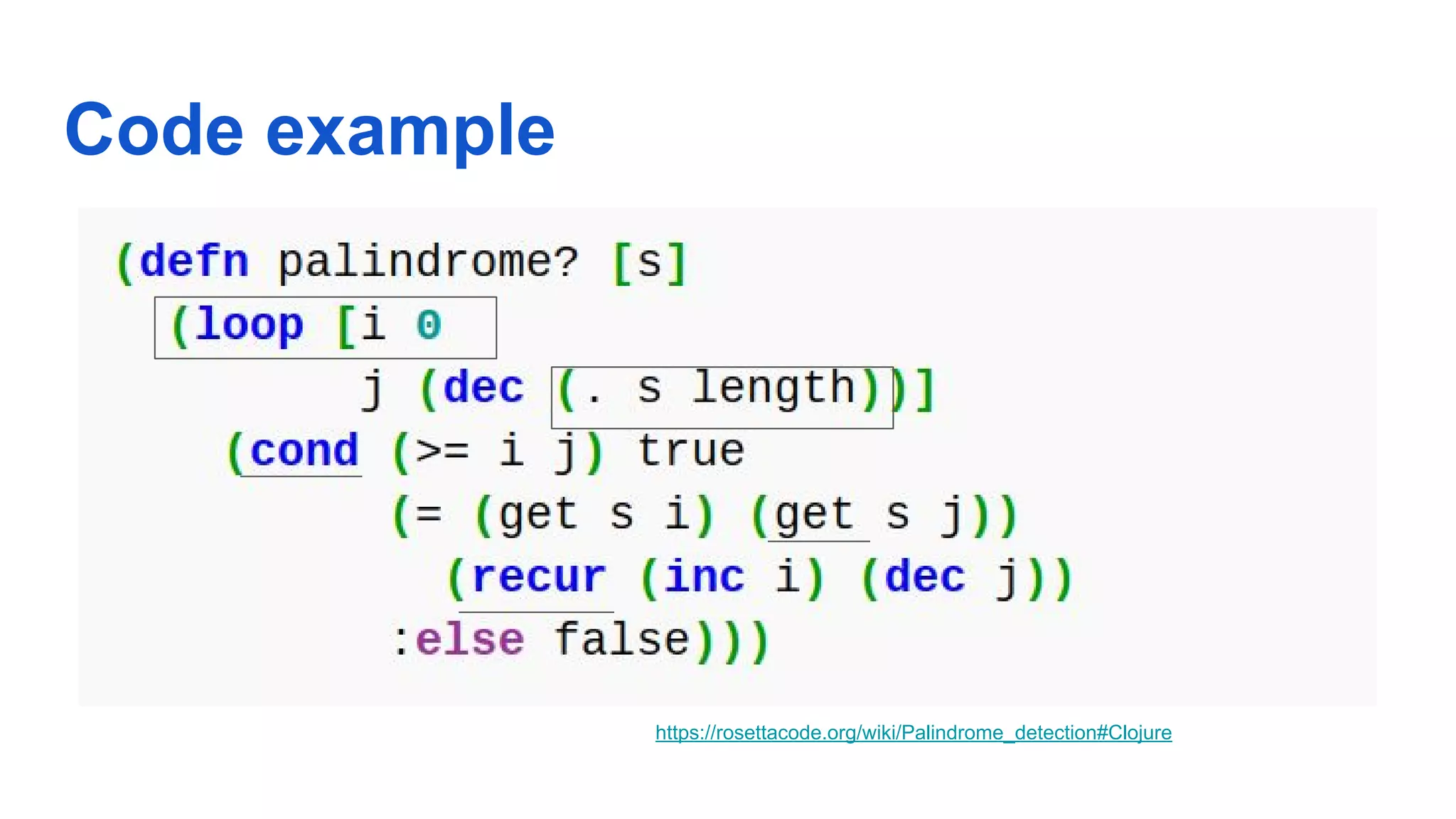
Code example
https://rosettacode.org/wiki/Palindrome_detection#Clojure
Intermediate
Higher-Order Functions
Map
>(map * [1 2 3 4] [5 6 7 8])
(5 12 21 32)
Reduce
>(reduce max [0 -3 10 48])
48
Comp
((comp str - +) 4 5) is equivalent to
(str ( - ( + 4 5)))
Partial
(defn add10 (partial + 10))
>(add10 3)
13
>(add10 3 4 8)
25
Anonymous Functions
Fn
>(map (fn [x] (* x x)) (range 1 10))
(1 4 9 16 25 36 49 64 81)
Macros
(defmacro infix
[infixed]
(list (second infixed)
(first infixed)
(last infixed)))
>(1 + 2)
error
>(infix (1 + 2))
3
Java Interop
Accessing member functions
>(.toUpperCase "fred")
"FRED"
>(Math/pow 2 4)
16
( proxy [class-and-interfaces] [args]
fs+)
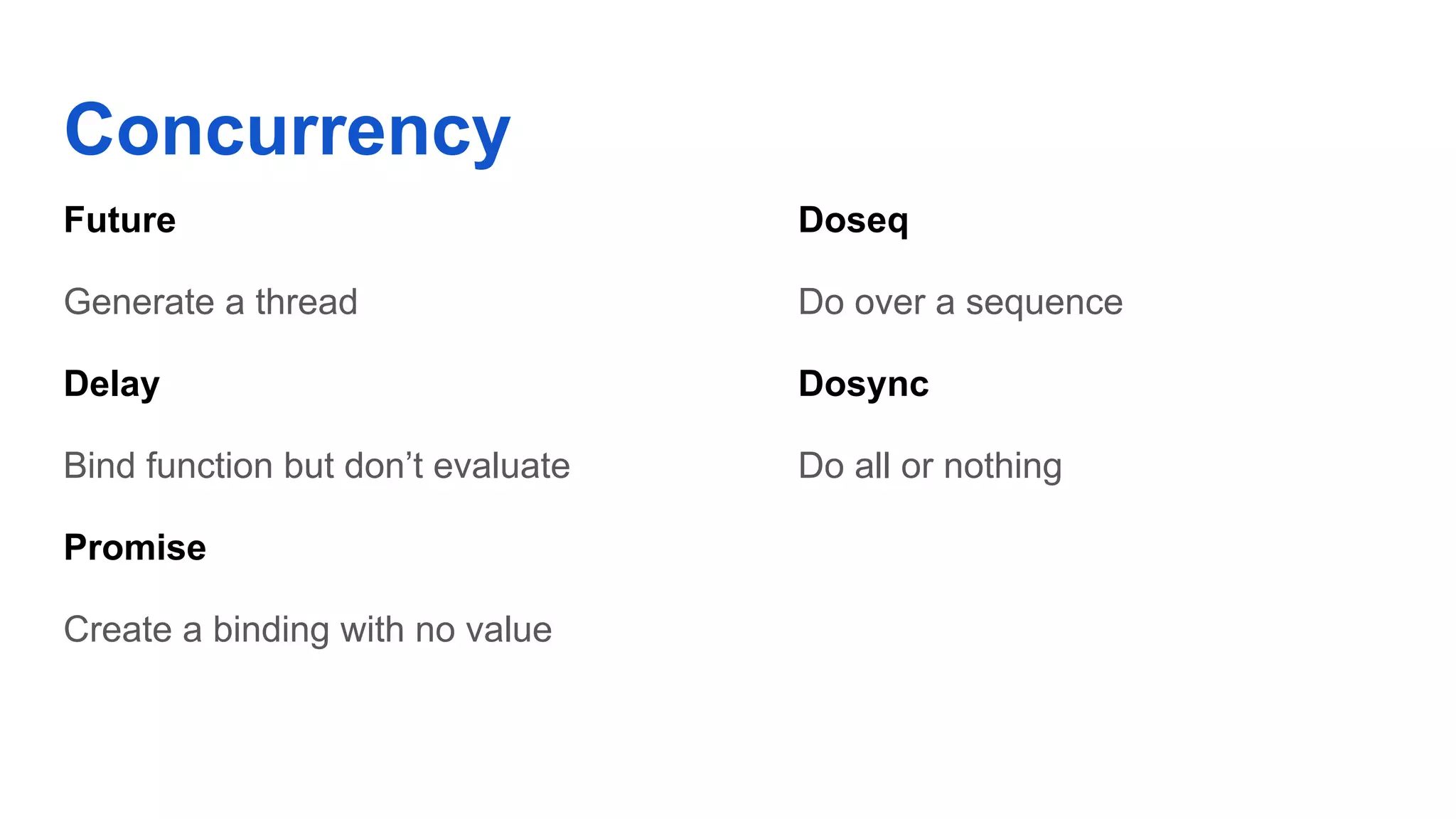
Concurrency
Doseq
Do over a sequence
Dosync
Do all or nothing
Future
Generate a thread
Delay
Bind function but don’t evaluate
Promise
Create a binding with no value
Uses
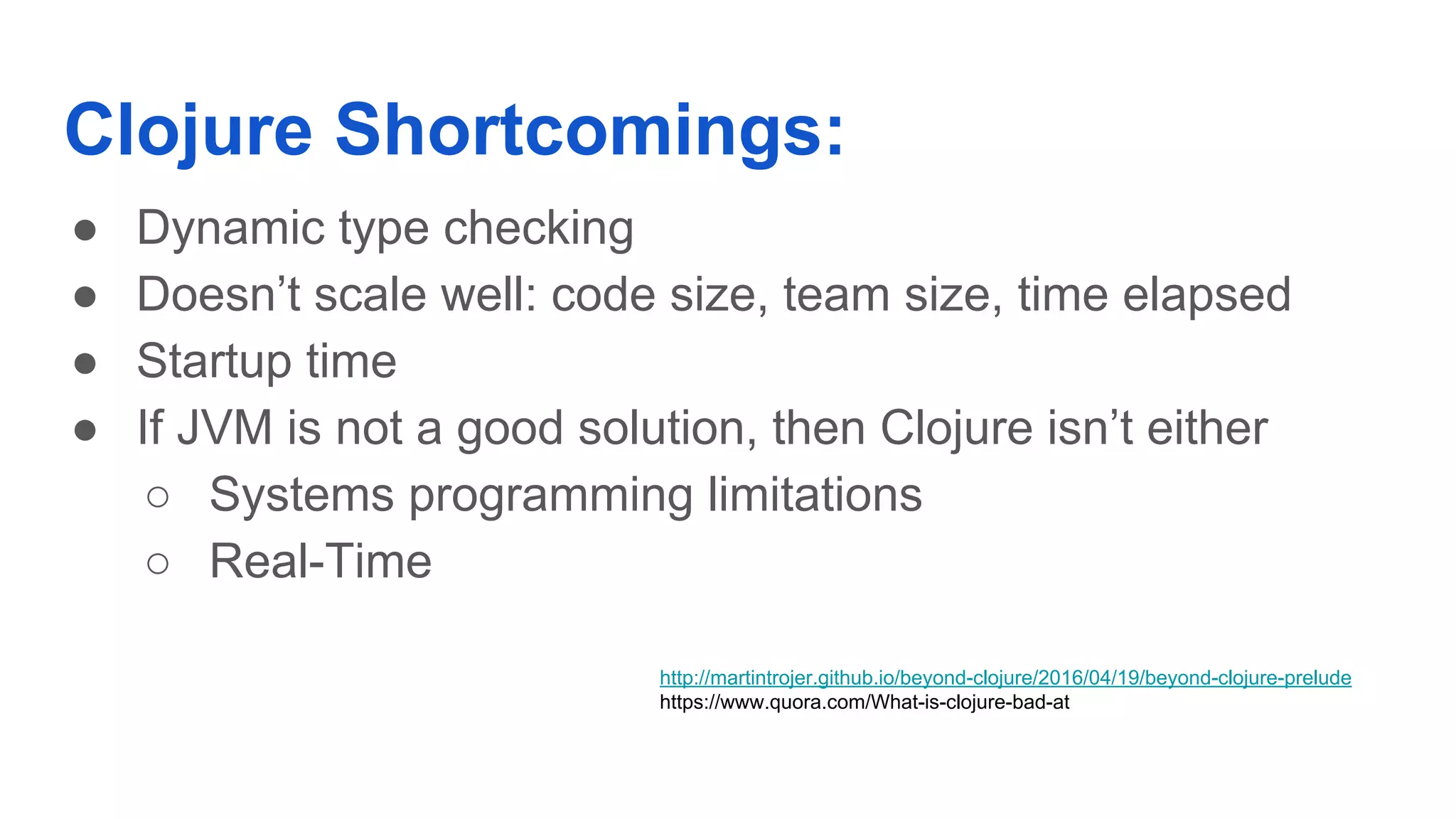
Clojure Shortcomings:
● Dynamic type checking
● Doesn’t scale well: code size, team size, time elapsed
● Startup time
● If JVM is not a good solution, then Clojure isn’t either
○ Systems programming limitations
○ Real-Time
http://martintrojer.github.io/beyond-clojure/2016/04/19/beyond-clojure-prelude
https://www.quora.com/What-is-clojure-bad-at
Clojure in Industry
Clojure in Industry
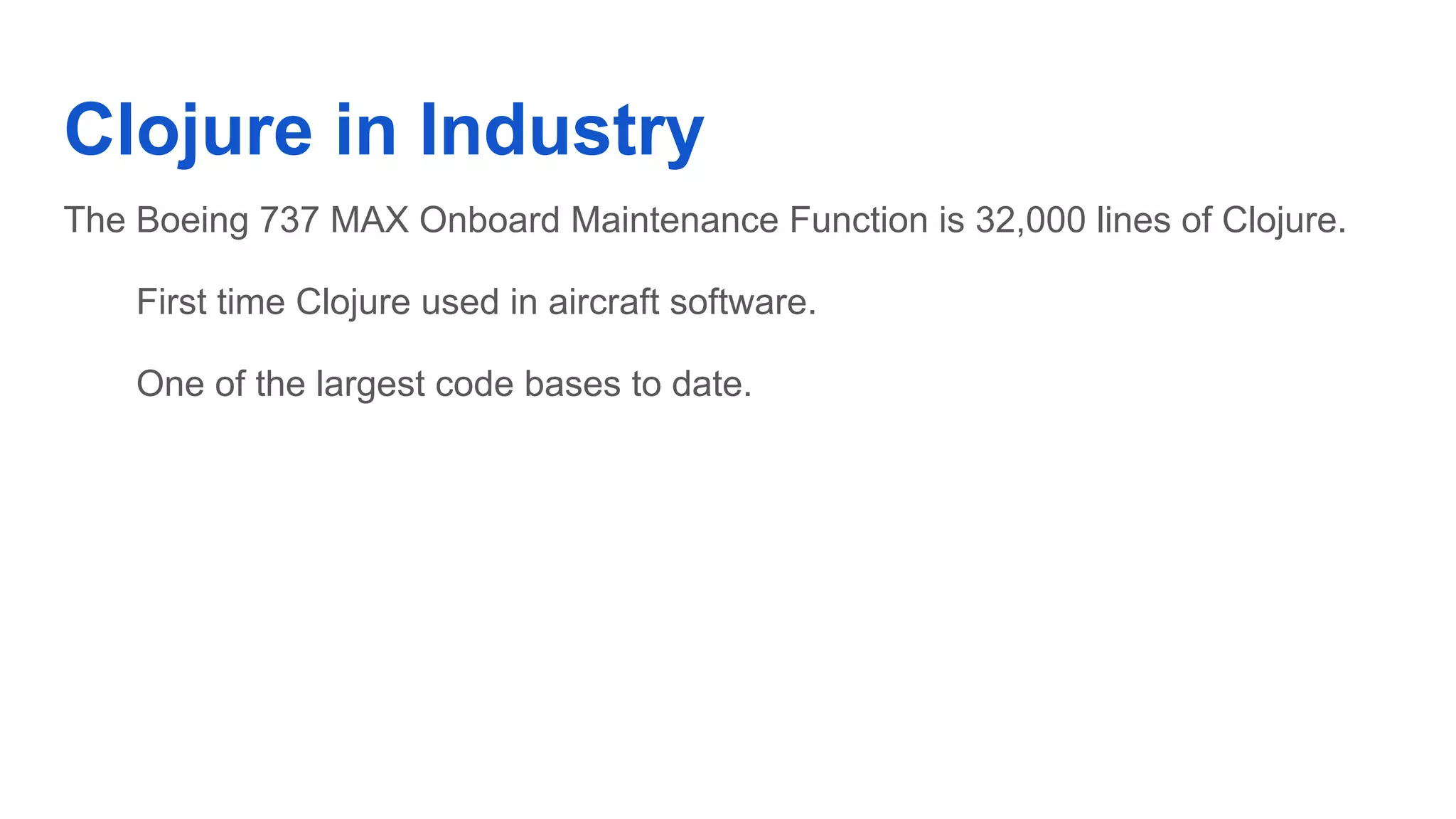
The Boeing 737 MAX Onboard Maintenance Function is 32,000 lines of Clojure.
First time Clojure used in aircraft software.
One of the largest code bases to date.
When to choose Clojure?
Handle large amounts of data with significant hardware limitations.
When you want more concise code, easier to test and debug.
Easier to get over 90% coverage with unit testing.
When JVM or CLR can be used.
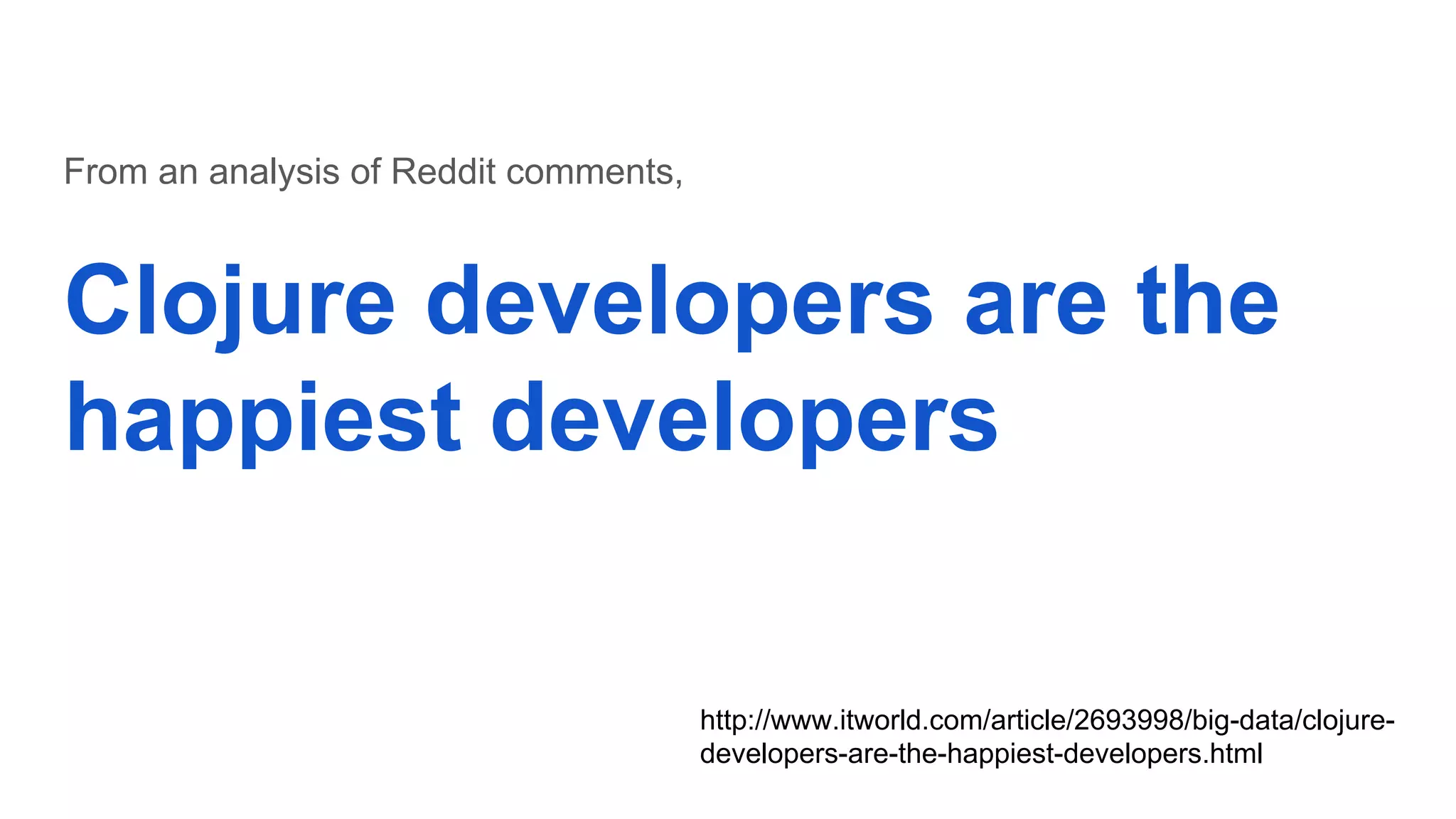
Clojure developers are the
happiest developers
From an analysis of Reddit comments,
http://www.itworld.com/article/2693998/big-data/clojure-
developers-are-the-happiest-developers.html
Online Resources/Tutorials
Clojure.org
Clojuredocs.org
Clojure-doc.org
Clojure-by-example
ClojureTV (Youtube channel)
Clojure for the Brave and True
Further Info
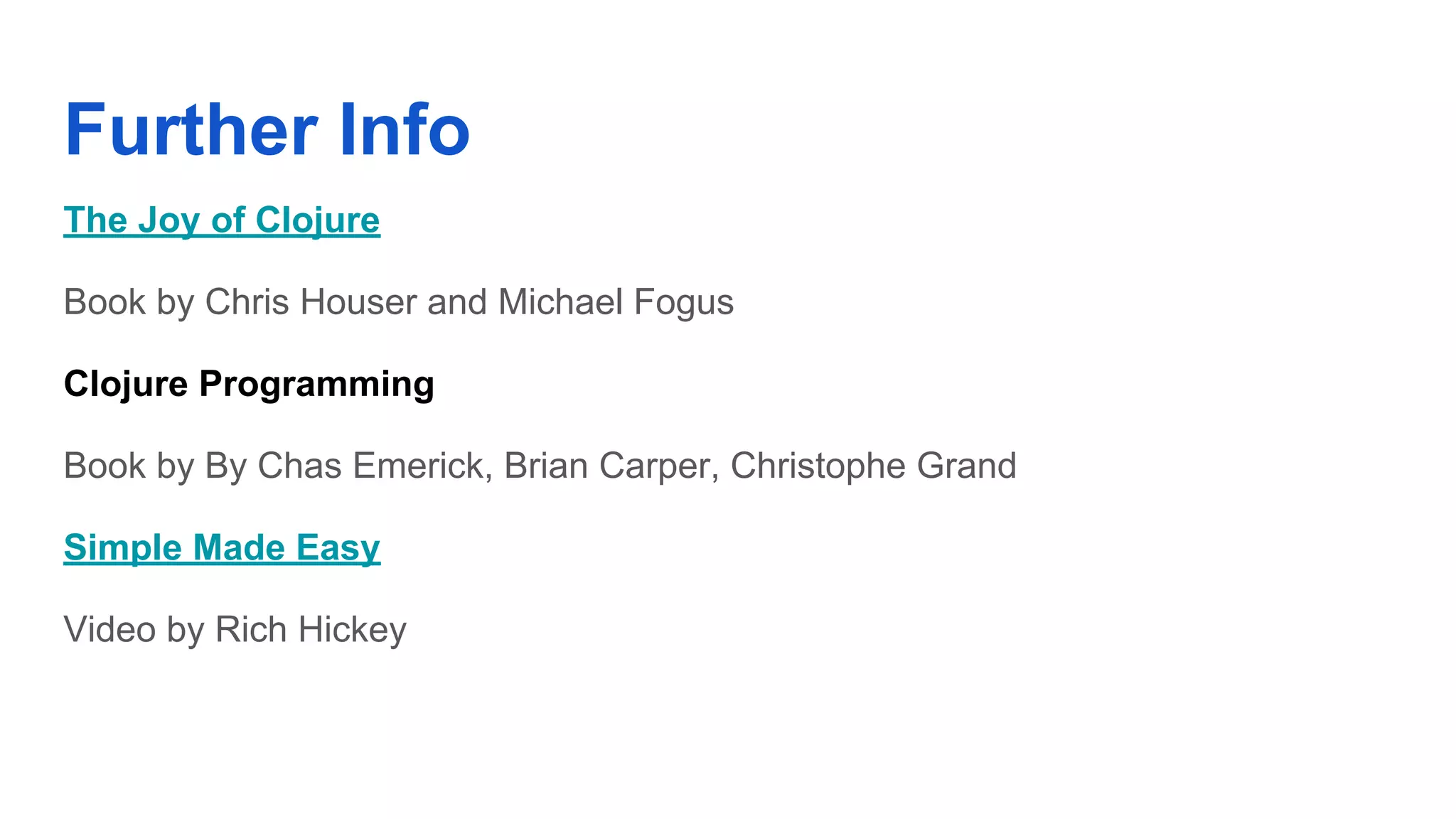
The Joy of Clojure
Book by Chris Houser and Michael Fogus
Clojure Programming
Book by By Chas Emerick, Brian Carper, Christophe Grand
Simple Made Easy
Video by Rich Hickey

Introductory Clojure Presentation

  • 1.
  • 2.
    90 Second Overview….. Clojureis….. - A dialect of Lisp - General purpose language - Emphasizes functional programming - Runs on the Java Virtual Machine - Designed for Concurrency - Used in industry -- CapitalOne, Amazon, Facebook, Oracle
  • 3.
  • 4.
  • 5.
    Simplicity “We suffer fromso much incidental complexity in traditional OO languages, both syntactic and semantic, that I don’t think we even realise it anymore. I wanted to make ‘doing the right thing’ not a matter of convention and discipline, but the default. I wanted a solid concurrency story and great interoperability with existing Java libraries,.” -Rich Hickey, creator of Clojure Rich Hickey, Clojure, Benevolent Dictator for Life CLOJURE: - First Available: 2007 - Latest Stable Release: 1.8 January 19, 2016
  • 6.
  • 7.
    Why Lisp? ● EntireLanguage: ○ 7 functions ○ 2 labels
  • 8.
    Why JVM? ● Familiar- run just like Java apps ● Use some familiar Java objects ● Many available libraries ● Established track record ● Now open-sourced. http://www.braveclojure.com/java/ (Chapter 12) clojure.org/about/rationale
  • 9.
    What are Clojure’sCharacteristics? ● Functional - succinct, understandable, reusable ● Defaults to Immutability ○ Simplifies reasoning and testing ○ Easier to share objects ○ Thread safe ● but allows mutability! ● Code-as-Data (Homoiconicity) ● Syntactic Abstraction Immutable objects are always thread safe. —Brian Goetz, Java Concurrency in Practice The Joy of Clojure Chapter 6.
  • 10.
    Examples Homoiconicity Code written inthe language is encoded as data structures that the language has tools to manipulate Syntatic Abstraction Permits the definition of new language constructs whose meaning can be understood in terms of static translation into the core language.As Data: As Code.
  • 11.
  • 12.
  • 13.
    Truthiness What is truthy? ●true ● 1 ● (= 1 1) ● 0 ● “False” ● [] ● Literally any value but false or nil What is falsey? ● false ● nil ● (= 3 1) Nil Punning: Handling Clojure’s empty sequences that are Truthy Every[thing] is "true" all the time, unless it is nil or false. —Brian Goetz, The Joy of Clojure
  • 14.
    Clojure Data Structures ●They are immutable by default ● Support metadata ● Implement java.lang.Iterable ● Implement the read-only part of java.util.Collection http://clojure.org/reference/data_structures
  • 15.
    Data Collection Types- Part 1 Lists Singly linked lists First item in calling position Heterogeneous elements Compare to Haskell: Homogeneous lists Vectors Simply evaluate each item in order. Quick look-up times Heterogeneous elements No calling position
  • 16.
    Data Collection Types- Part 2 Maps Maps store unique keys and one value per key (dictionaries and hashes) Two types: 1. Hashed: key has hashCode, equals 2. Sorted: implement Comparable Sets Store zero or more unique items
  • 17.
    Some Mutable DataStructures! Atoms Managed shared synchronous independent state Refs Transaction references Safe shared use of mutable storage Require SW transactional memory system Agents Independent, asynchronous change of individual locations Only allow change due to an action Var Mutable storage location Can be dynamically rebound per thread Ensure safety through thread isolation
  • 18.
  • 19.
    Functions First Class Created ondemand Stored in a data structure Passed as an argument Returned as a value Higher-Order Takes one or more function args Returns function as result Pure Functions ALWAYS return same result No observable side effects (defn [arg1 arg2] (;function code )) def or defn? ● Both bind a symbol or name ● def is only evaluated once ● defn is evaluated every time it is called
  • 20.
  • 21.
    Quick Comparison Haskell: average numbers= (fold (+) (numbers) ) / (length(numbers)) Clojure: (defn average [numbers] (/ (reduce + numbers) (count numbers)))
  • 22.
    Quick Comparison Haskell: fact x= if x == 0 then 1 else x * fact(x-1) Clojure: (defn factorial [n] (if (= n 0) 1 (* n (factorial (dec n)))))
  • 23.
  • 24.
  • 25.
    Higher-Order Functions Map >(map *[1 2 3 4] [5 6 7 8]) (5 12 21 32) Reduce >(reduce max [0 -3 10 48]) 48 Comp ((comp str - +) 4 5) is equivalent to (str ( - ( + 4 5))) Partial (defn add10 (partial + 10)) >(add10 3) 13 >(add10 3 4 8) 25
  • 26.
    Anonymous Functions Fn >(map (fn[x] (* x x)) (range 1 10)) (1 4 9 16 25 36 49 64 81)
  • 27.
    Macros (defmacro infix [infixed] (list (secondinfixed) (first infixed) (last infixed))) >(1 + 2) error >(infix (1 + 2)) 3
  • 28.
    Java Interop Accessing memberfunctions >(.toUpperCase "fred") "FRED" >(Math/pow 2 4) 16 ( proxy [class-and-interfaces] [args] fs+)
  • 29.
    Concurrency Doseq Do over asequence Dosync Do all or nothing Future Generate a thread Delay Bind function but don’t evaluate Promise Create a binding with no value
  • 30.
  • 31.
    Clojure Shortcomings: ● Dynamictype checking ● Doesn’t scale well: code size, team size, time elapsed ● Startup time ● If JVM is not a good solution, then Clojure isn’t either ○ Systems programming limitations ○ Real-Time http://martintrojer.github.io/beyond-clojure/2016/04/19/beyond-clojure-prelude https://www.quora.com/What-is-clojure-bad-at
  • 32.
  • 33.
    Clojure in Industry TheBoeing 737 MAX Onboard Maintenance Function is 32,000 lines of Clojure. First time Clojure used in aircraft software. One of the largest code bases to date.
  • 34.
    When to chooseClojure? Handle large amounts of data with significant hardware limitations. When you want more concise code, easier to test and debug. Easier to get over 90% coverage with unit testing. When JVM or CLR can be used.
  • 35.
    Clojure developers arethe happiest developers From an analysis of Reddit comments, http://www.itworld.com/article/2693998/big-data/clojure- developers-are-the-happiest-developers.html
  • 36.
  • 37.
    Further Info The Joyof Clojure Book by Chris Houser and Michael Fogus Clojure Programming Book by By Chas Emerick, Brian Carper, Christophe Grand Simple Made Easy Video by Rich Hickey