1
Green University of Bangladesh
Presented by:
Ajharul Abedeen
Department of Computer Science and Engineering
2
3
PATTERN
RECOGNITION
Introductory Facts
3
Contents
 What is a pattern?
 What is A pattern Class?
 What is pattern recognition?
 Human Perception
 Examples of applications
 Human and Machine Perception
 Pattern Recognition
 Pattern Recognition Process
 Case Study
 Tools
4
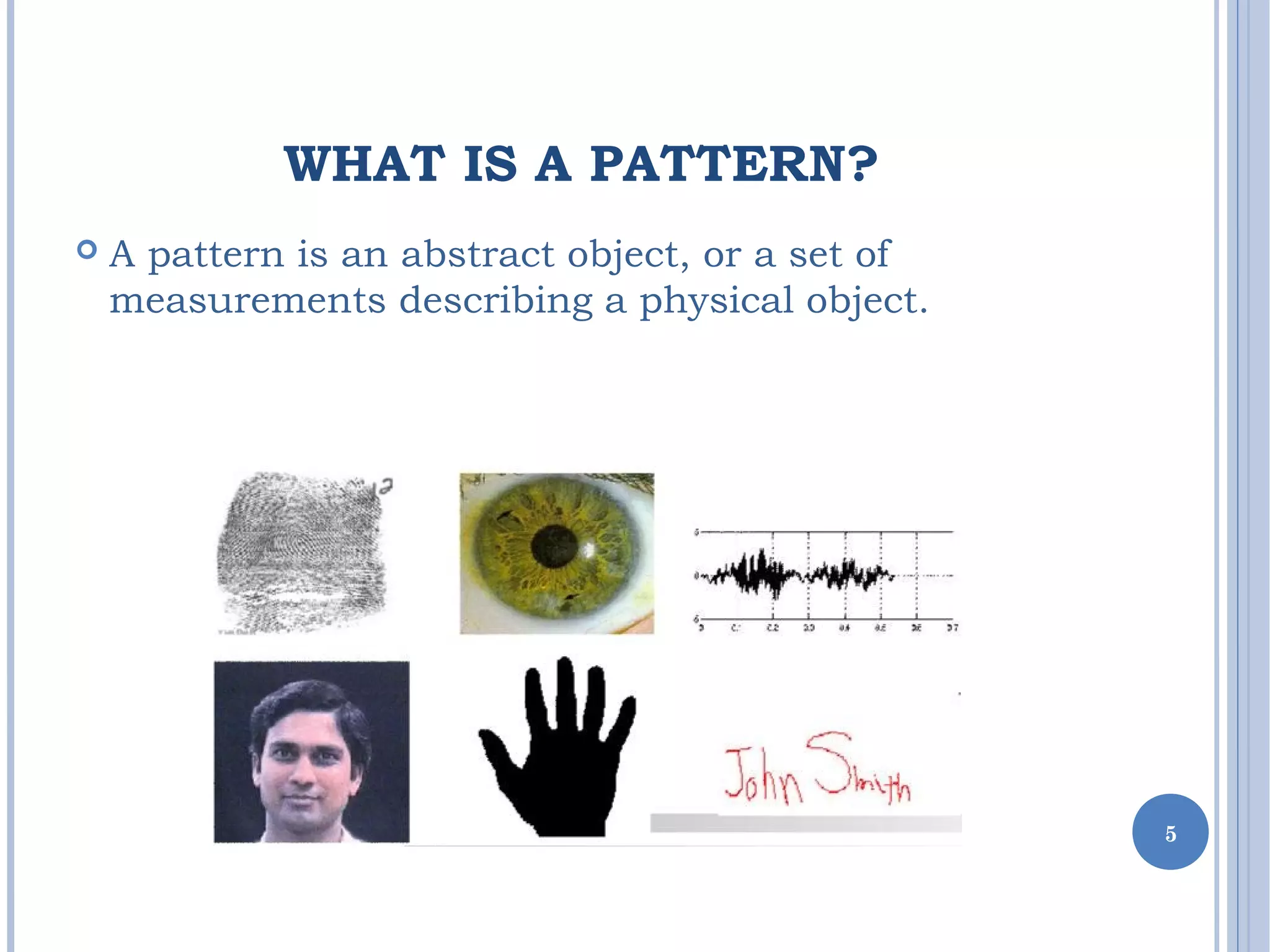
WHAT IS A PATTERN?
 A pattern is an abstract object, or a set of
measurements describing a physical object.
5
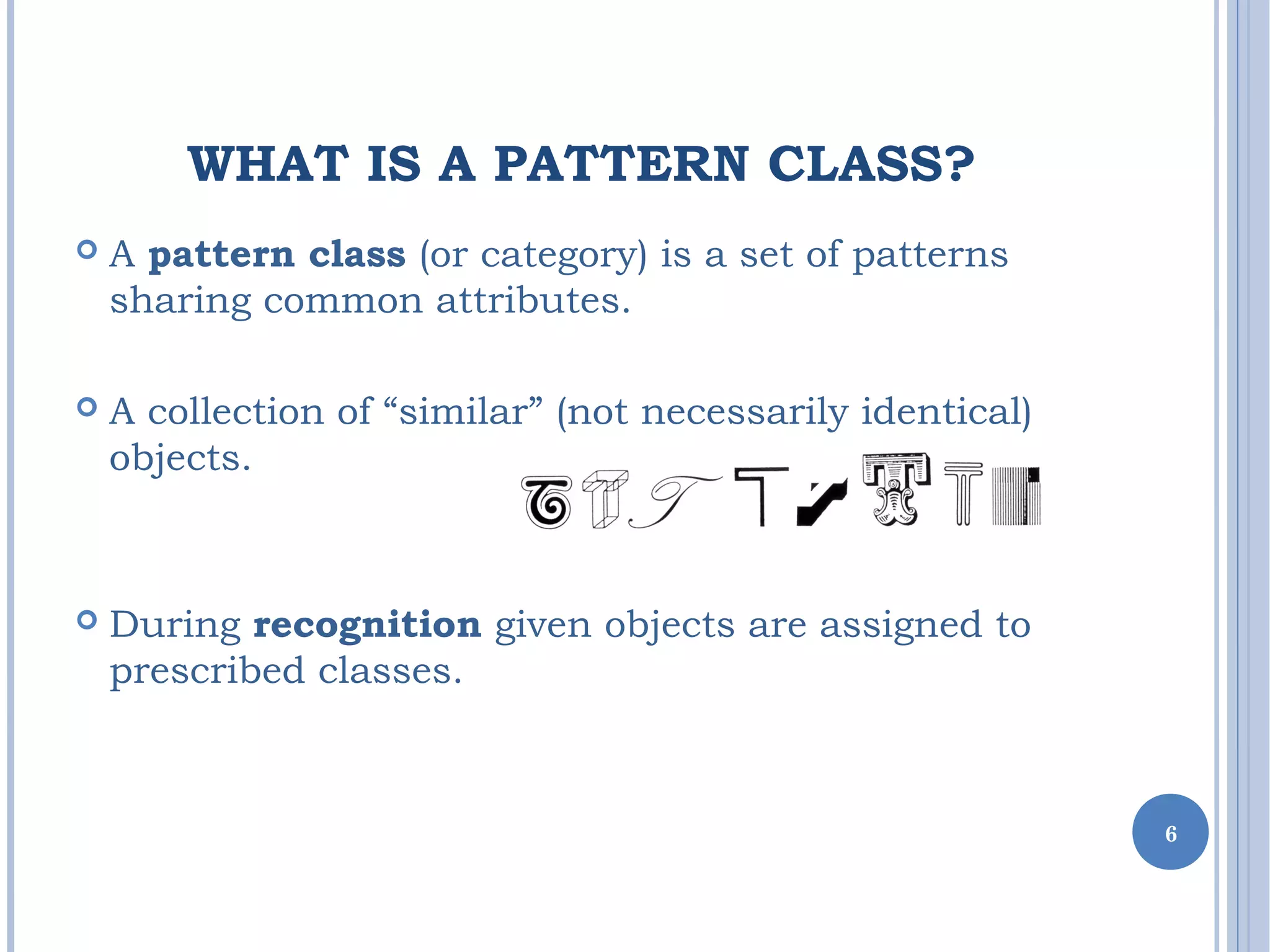
WHAT IS A PATTERN CLASS?
 A pattern class (or category) is a set of patterns
sharing common attributes.
 A collection of “similar” (not necessarily identical)
objects.
 During recognition given objects are assigned to
prescribed classes.
6
WHAT IS PATTERN RECOGNITION?
 Theory, Algorithms, Systems to put Patterns into
Categories
 Relate Perceived Pattern to Previously Perceived
Patterns
 Learn to distinguish patterns of interest from their
background
7
HUMAN PERCEPTION
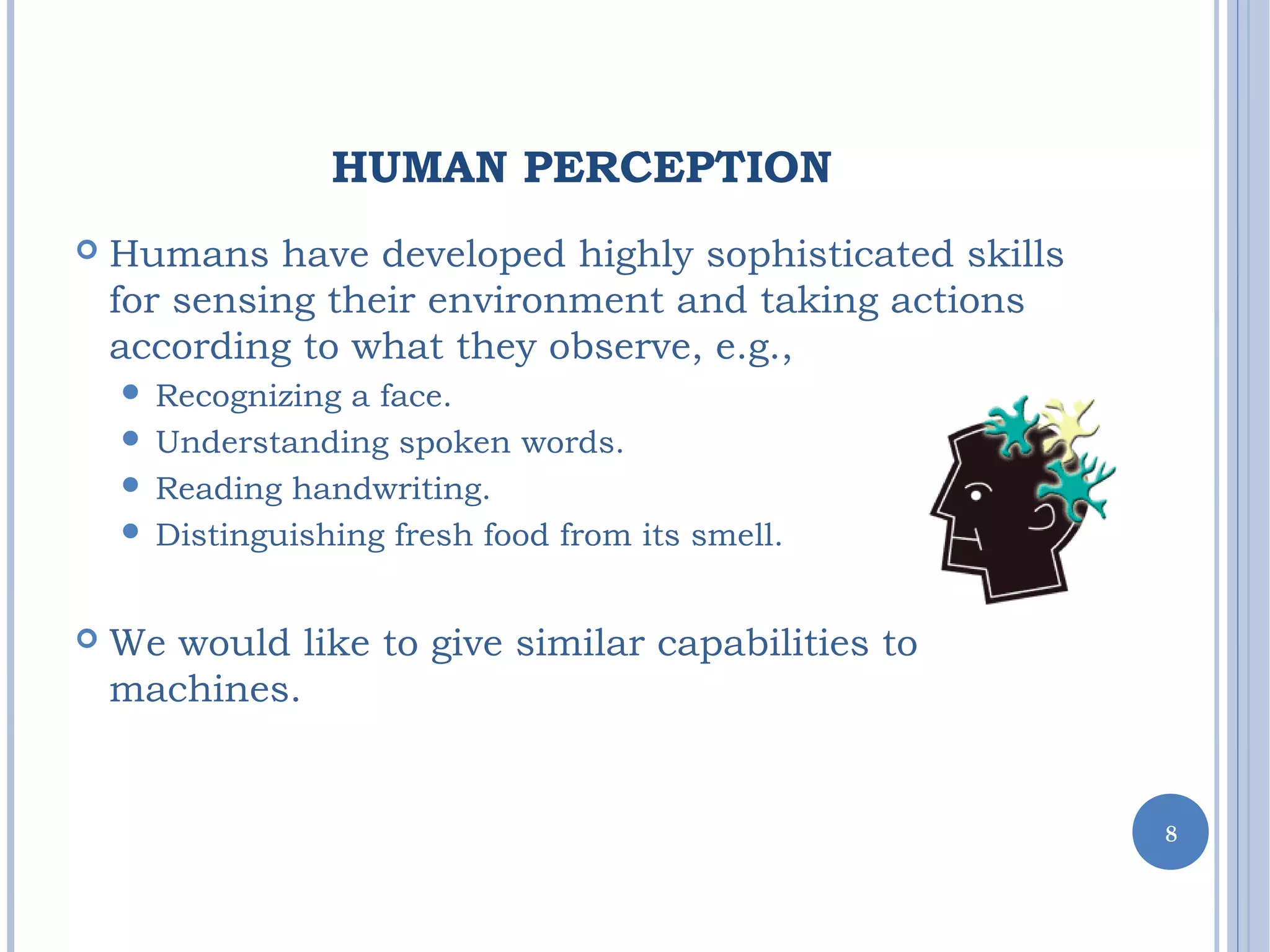
 Humans have developed highly sophisticated skills
for sensing their environment and taking actions
according to what they observe, e.g.,
 Recognizing a face.
 Understanding spoken words.
 Reading handwriting.
 Distinguishing fresh food from its smell.
 We would like to give similar capabilities to
machines.
8
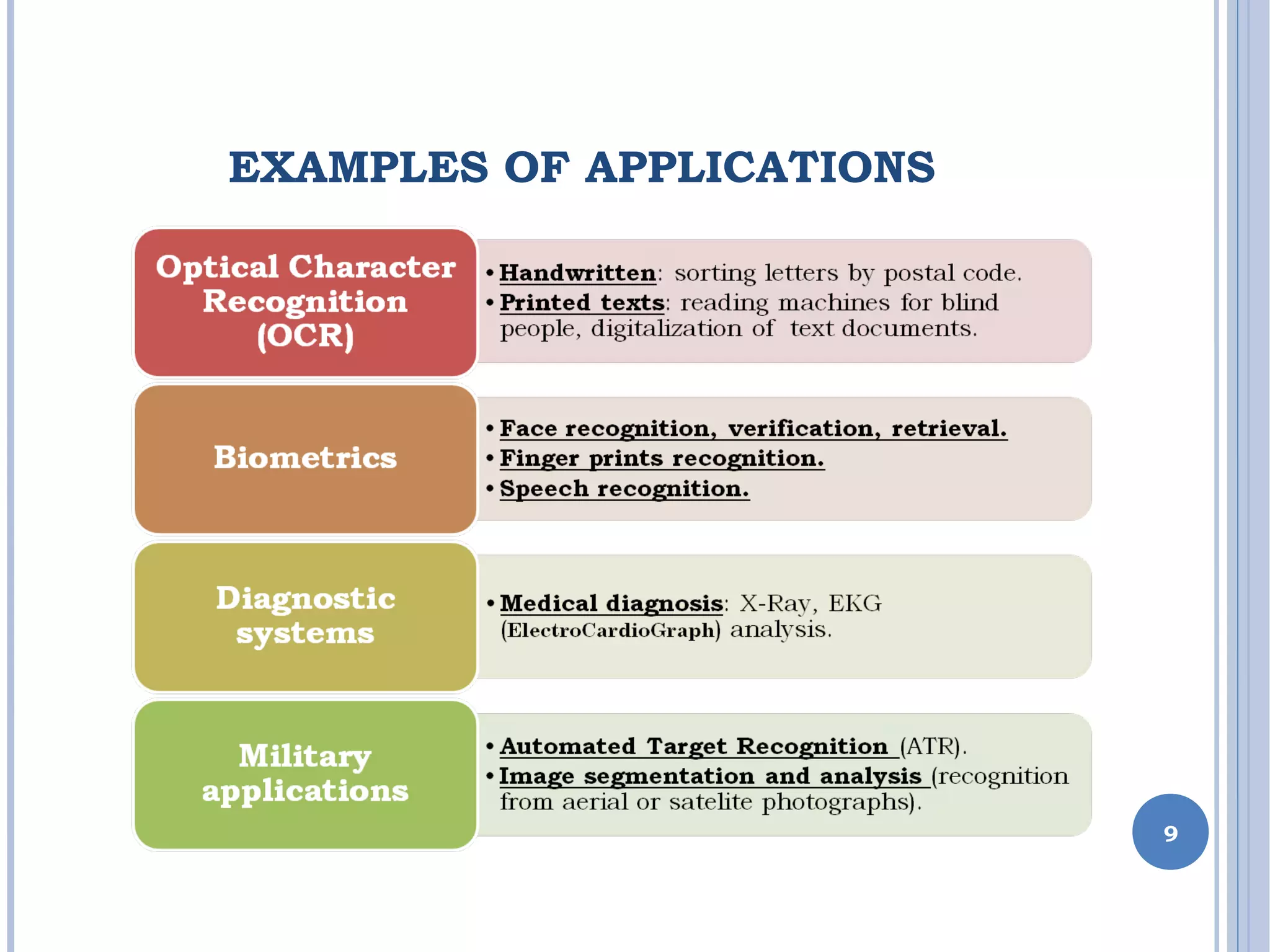
EXAMPLES OF APPLICATIONS
9
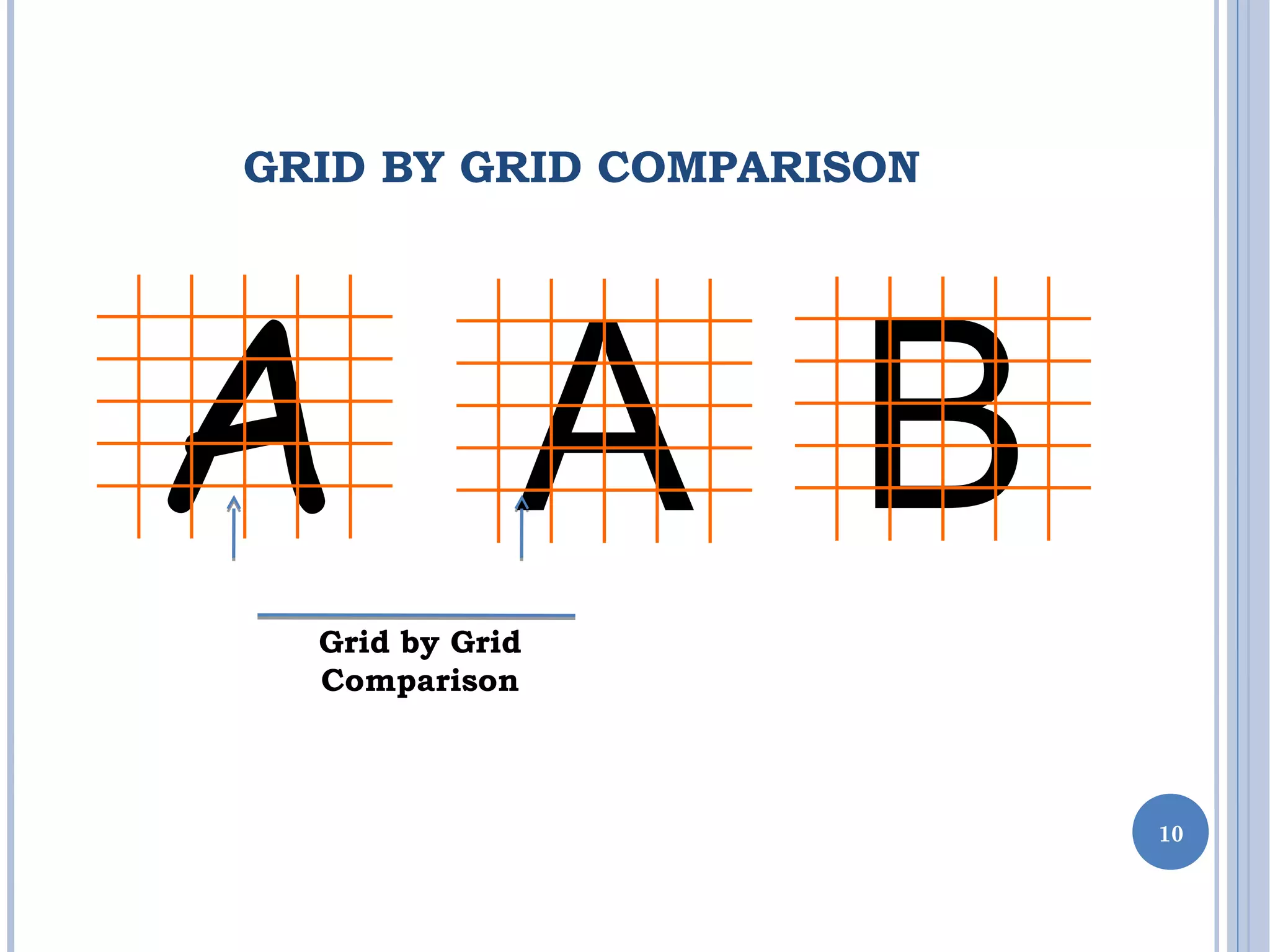
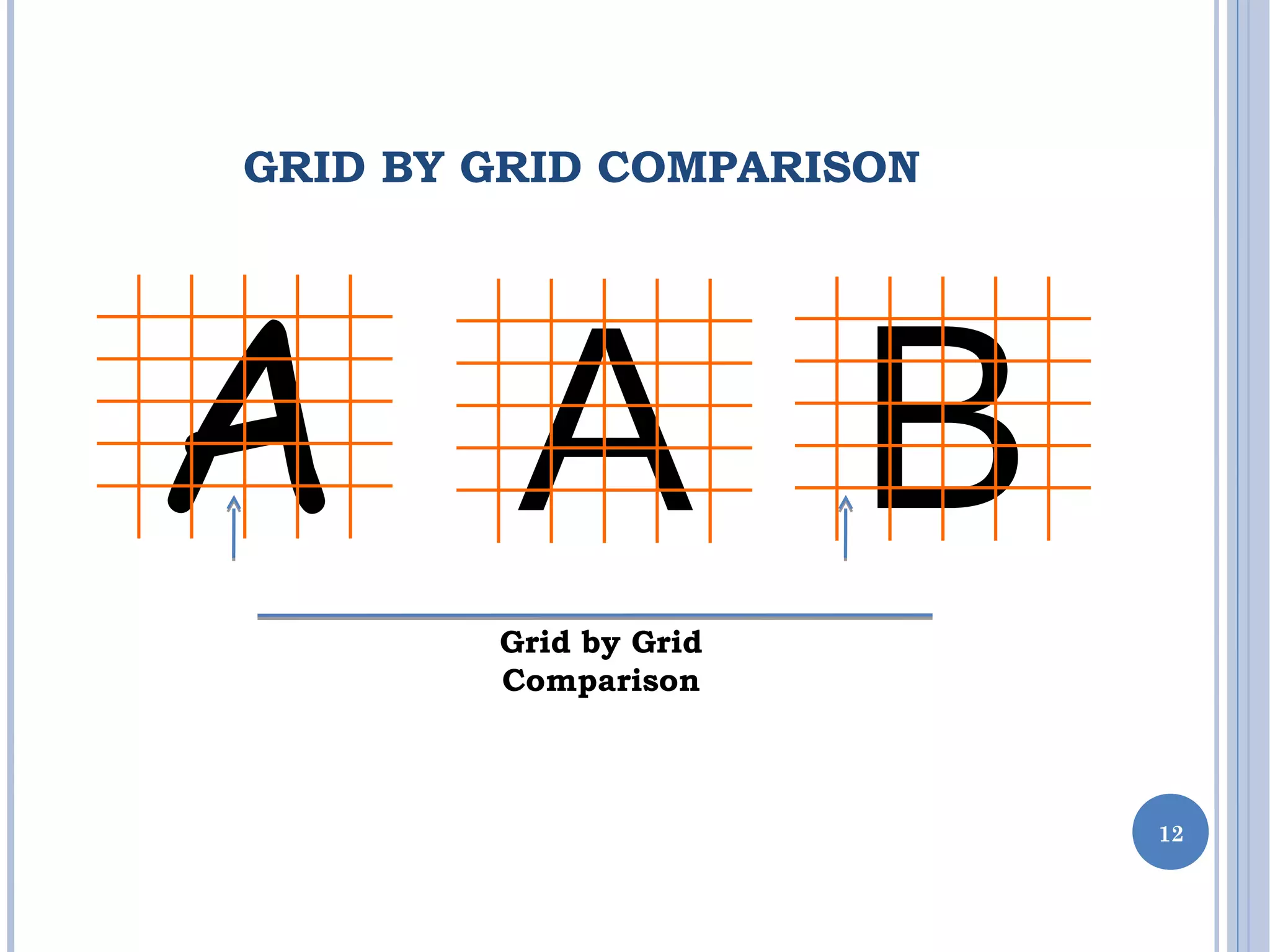
GRID BY GRID COMPARISON
A A B
Grid by Grid
Comparison
10
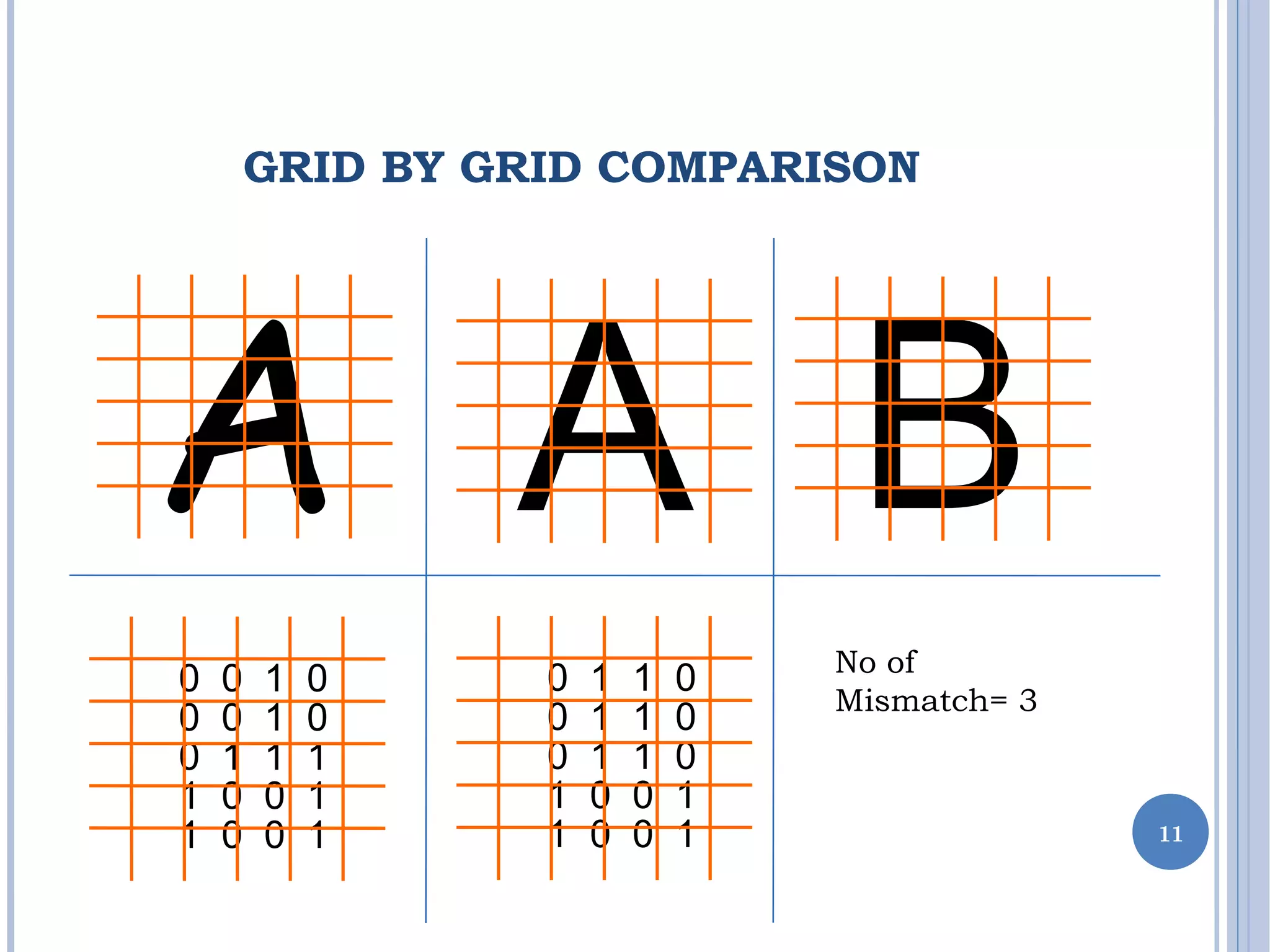
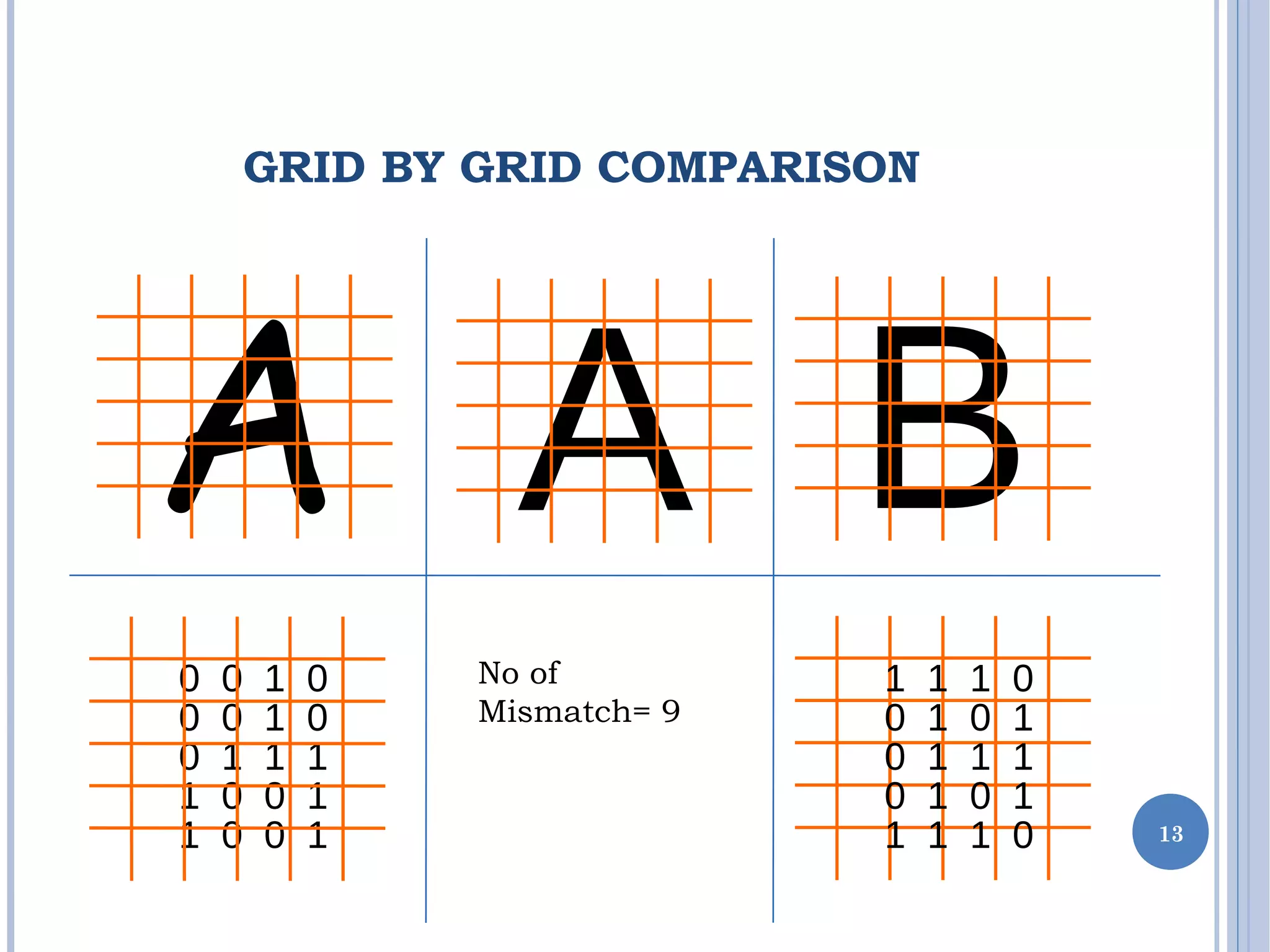
GRID BY GRID COMPARISON
A A B
11
0 0 1 0
0 0 1 0
0 1 1 1
1 0 0 1
1 0 0 1
0 1 1 0
0 1 1 0
0 1 1 0
1 0 0 1
1 0 0 1
No of
Mismatch= 3
GRID BY GRID COMPARISON
A A B
Grid by Grid
Comparison
12
GRID BY GRID COMPARISON
A A B
13
0 0 1 0
0 0 1 0
0 1 1 1
1 0 0 1
1 0 0 1
1 1 1 0
0 1 0 1
0 1 1 1
0 1 0 1
1 1 1 0
No of
Mismatch= 9
HUMAN AND MACHINE PERCEPTION
 We are often influenced by the knowledge of how patterns are
modeled and recognized in nature when we develop pattern
recognition algorithms.
 Research on machine perception also helps us gain deeper
understanding and appreciation for pattern recognition
systems in nature.
 Yet, we also apply many techniques that are purely numerical
and do not have any correspondence in natural systems.
14
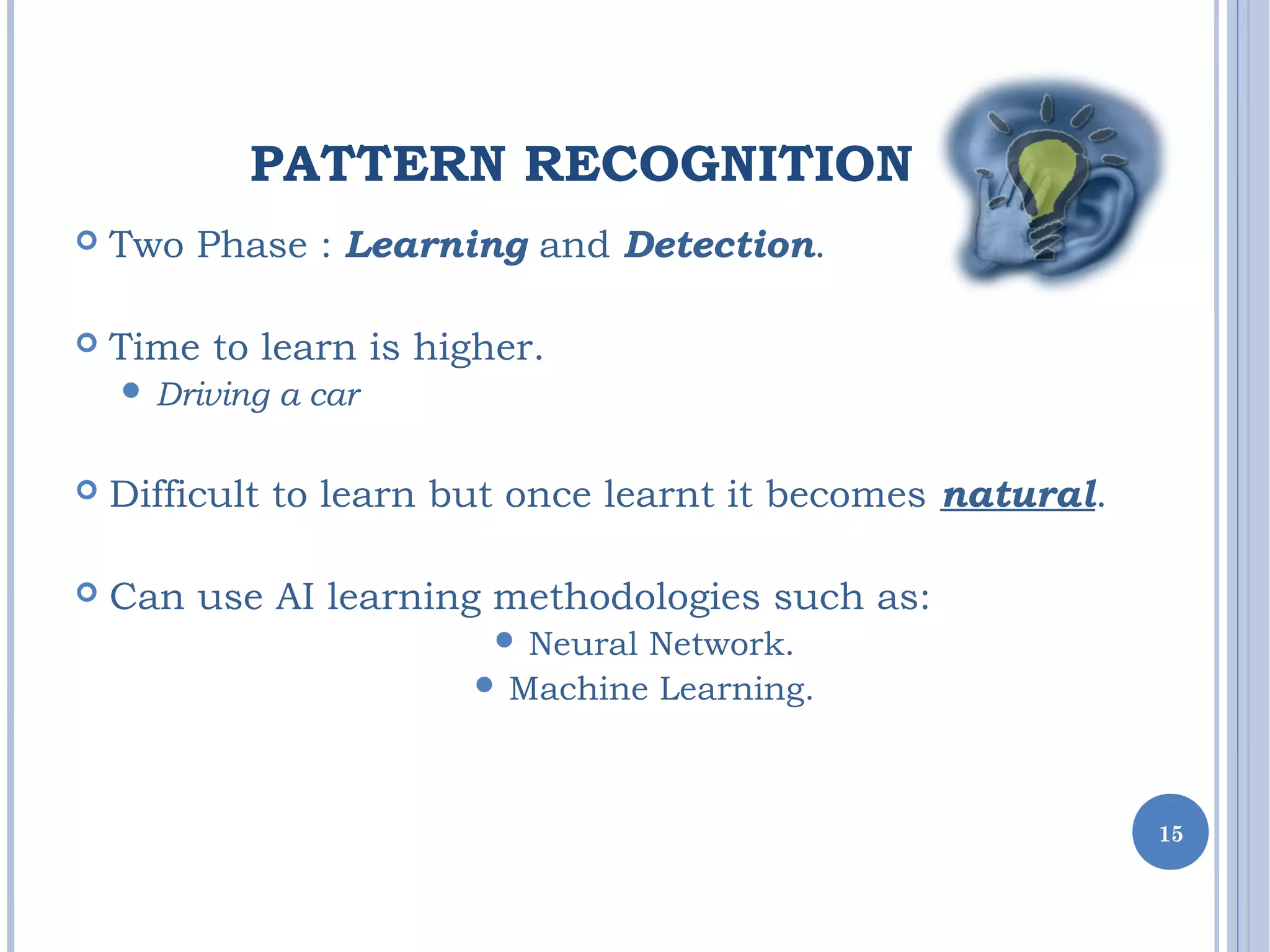
PATTERN RECOGNITION
 Two Phase : Learning and Detection.
 Time to learn is higher.
 Driving a car
 Difficult to learn but once learnt it becomes natural.
 Can use AI learning methodologies such as:
 Neural Network.
 Machine Learning.
15
LEARNING
 How can machine learn the rule from data?
 Supervised learning: a teacher provides a category label or cost for
each pattern in the training set.
 Unsupervised learning: the system forms clusters or natural
groupings of the input patterns.
16
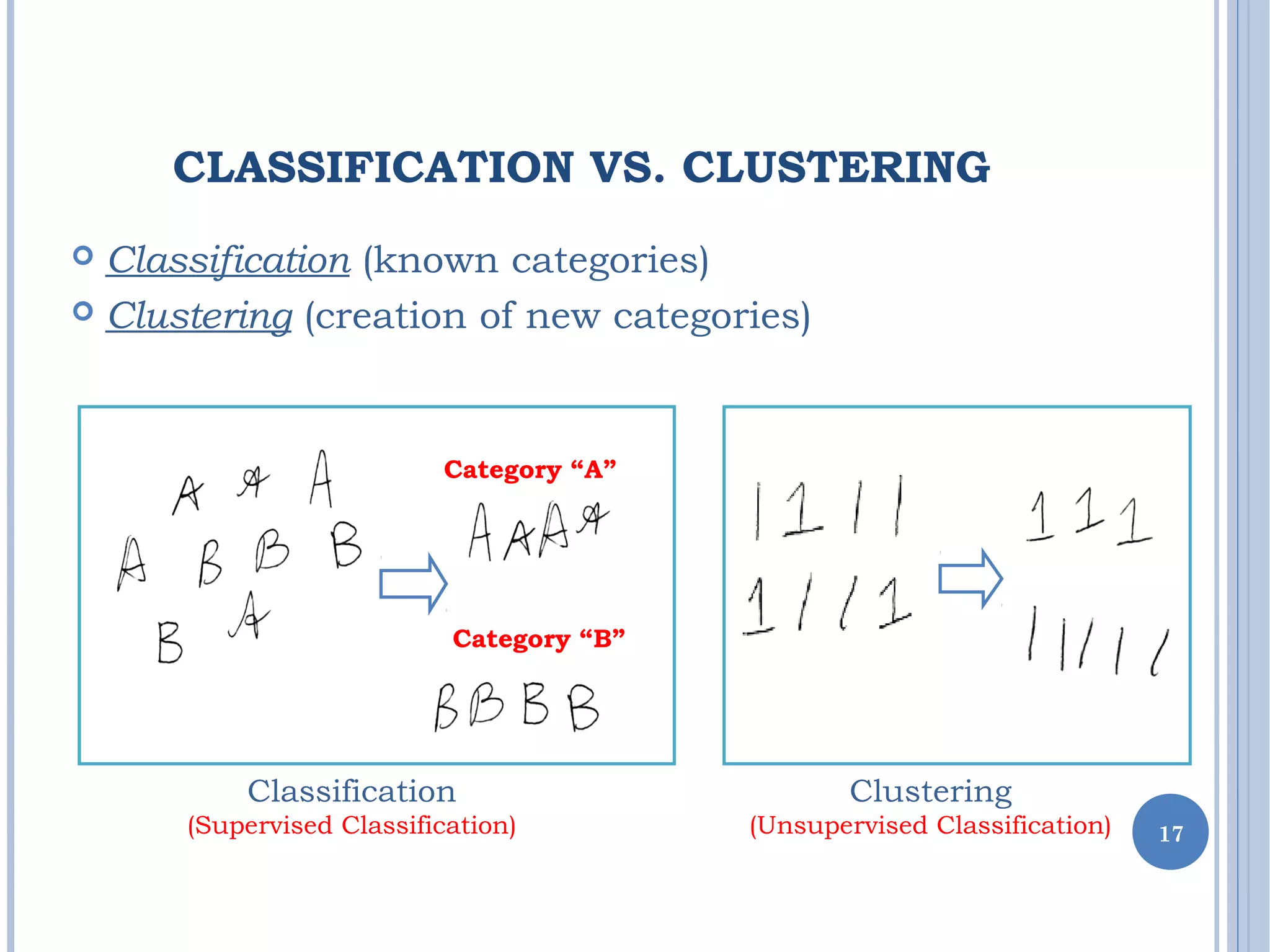
 Classification (known categories)
 Clustering (creation of new categories)
CLASSIFICATION VS. CLUSTERING
17
Category “A”
Category “B”
Clustering
(Unsupervised Classification)
Classification
(Supervised Classification)
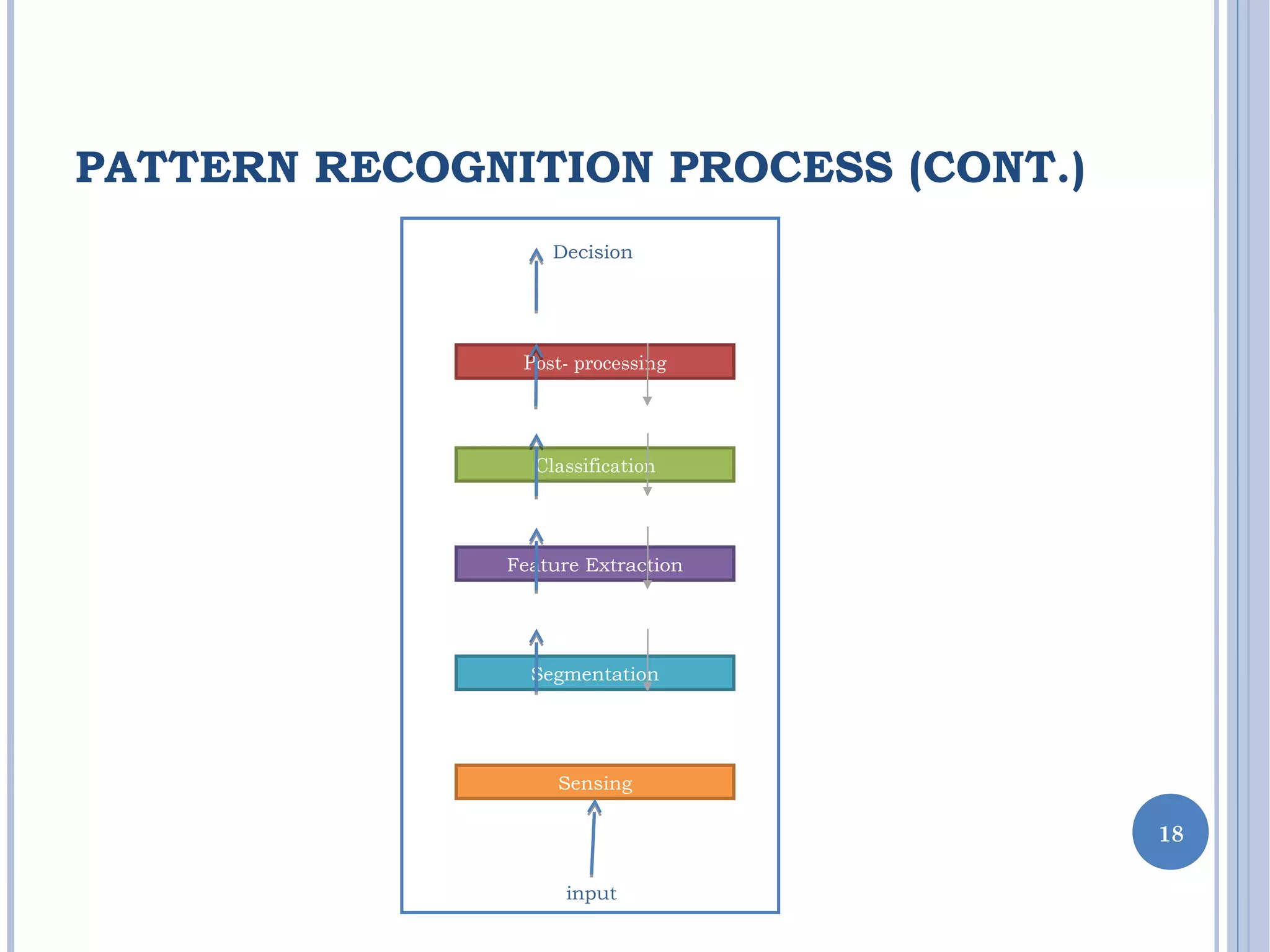
PATTERN RECOGNITION PROCESS (CONT.)
18
Post- processing
Classification
Feature Extraction
Segmentation
Sensing
input
Decision
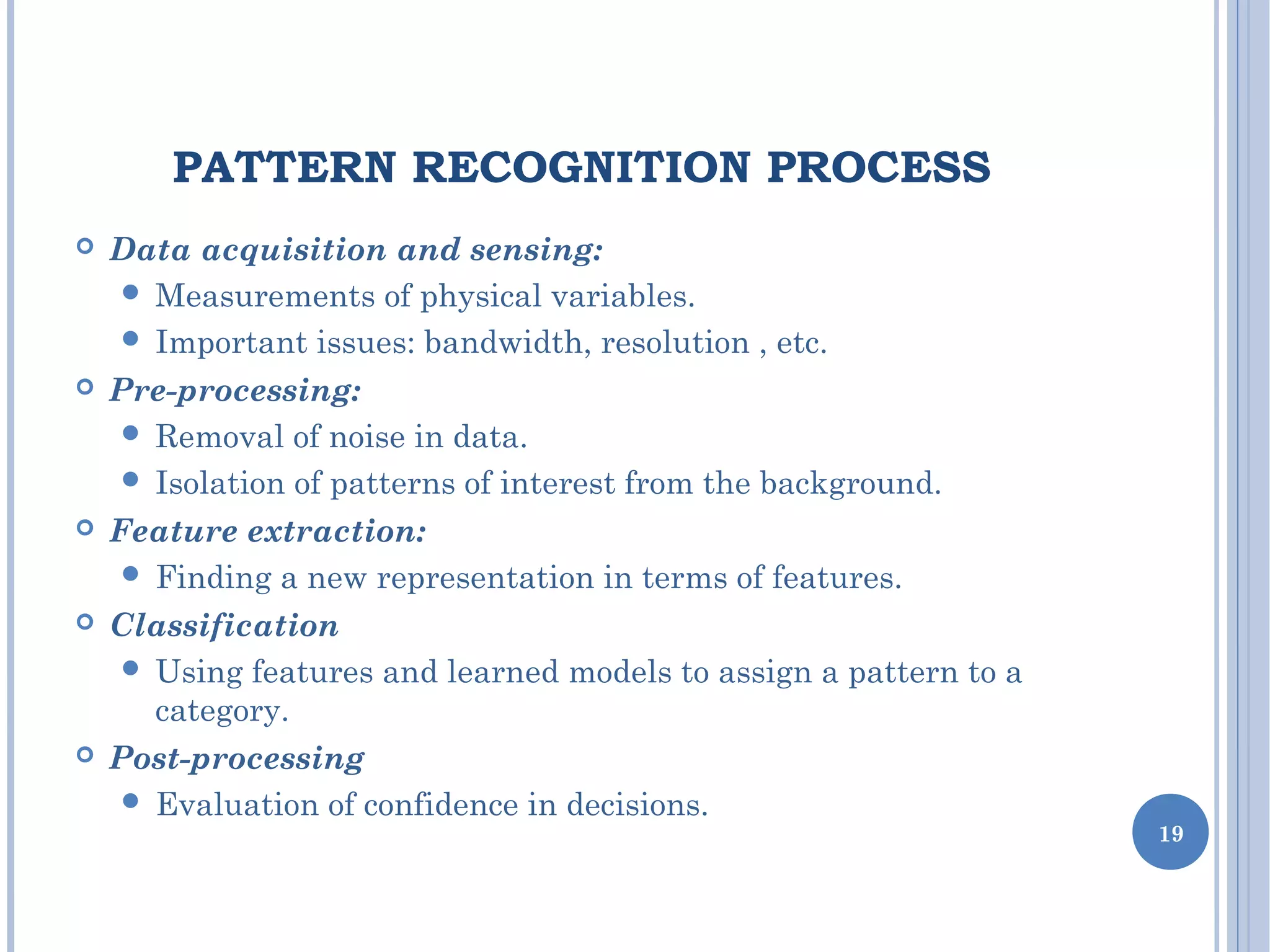
PATTERN RECOGNITION PROCESS
 Data acquisition and sensing:
 Measurements of physical variables.
 Important issues: bandwidth, resolution , etc.
 Pre-processing:
 Removal of noise in data.
 Isolation of patterns of interest from the background.
 Feature extraction:
 Finding a new representation in terms of features.
 Classification
 Using features and learned models to assign a pattern to a
category.
 Post-processing
 Evaluation of confidence in decisions.
19
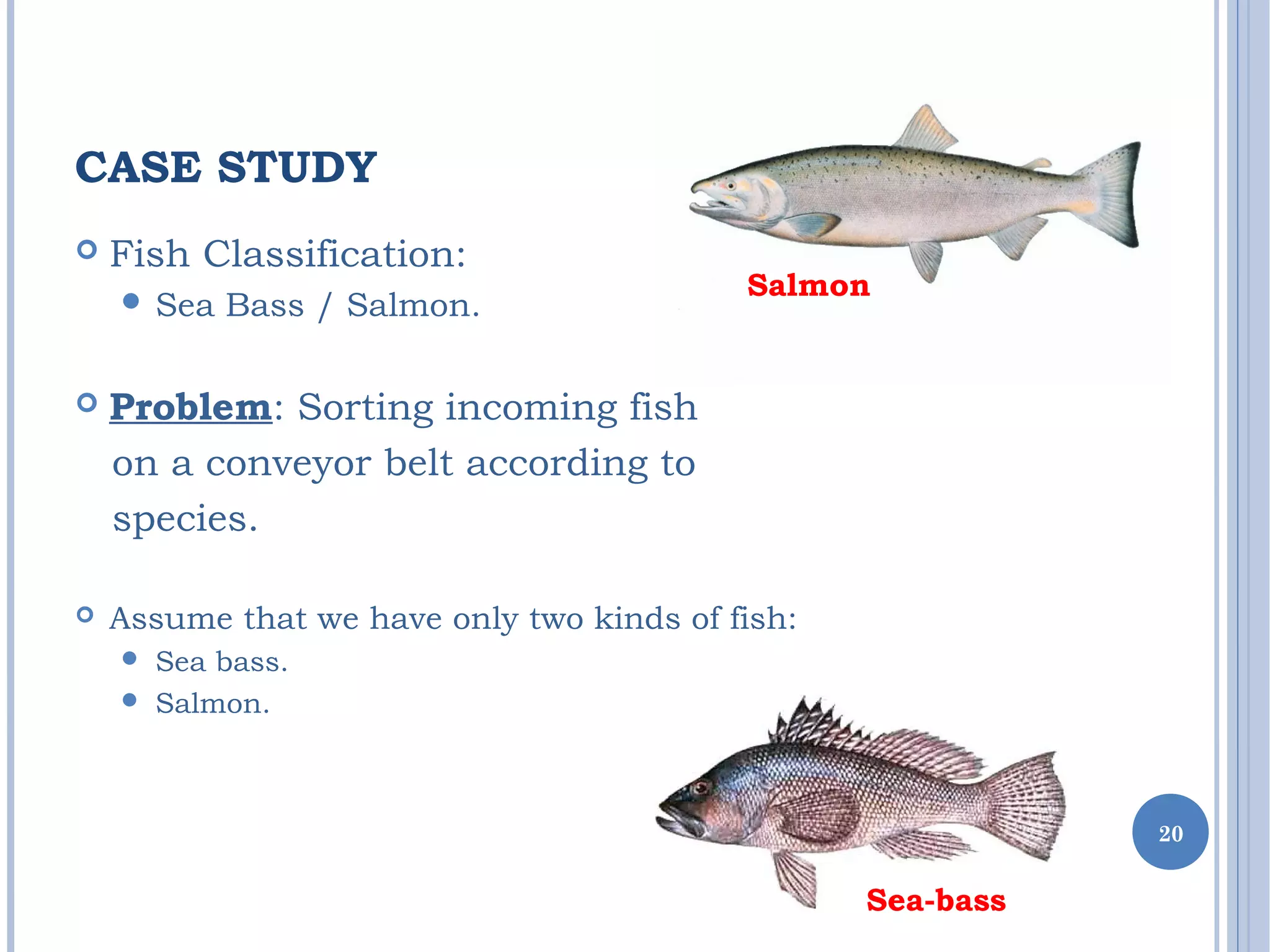
CASE STUDY
 Fish Classification:
 Sea Bass / Salmon.
 Problem: Sorting incoming fish
on a conveyor belt according to
species.
 Assume that we have only two kinds of fish:
 Sea bass.
 Salmon.
20
Salmon
Sea-bass
CASE STUDY (CONT.)
 What can cause problems during sensing?
 Lighting conditions.
 Position of fish on the conveyor belt.
 Camera noise.
 etc…
 What are the steps in the process?
1. Capture image.
2. Isolate fish
3. Take measurements
4. Make decision
21
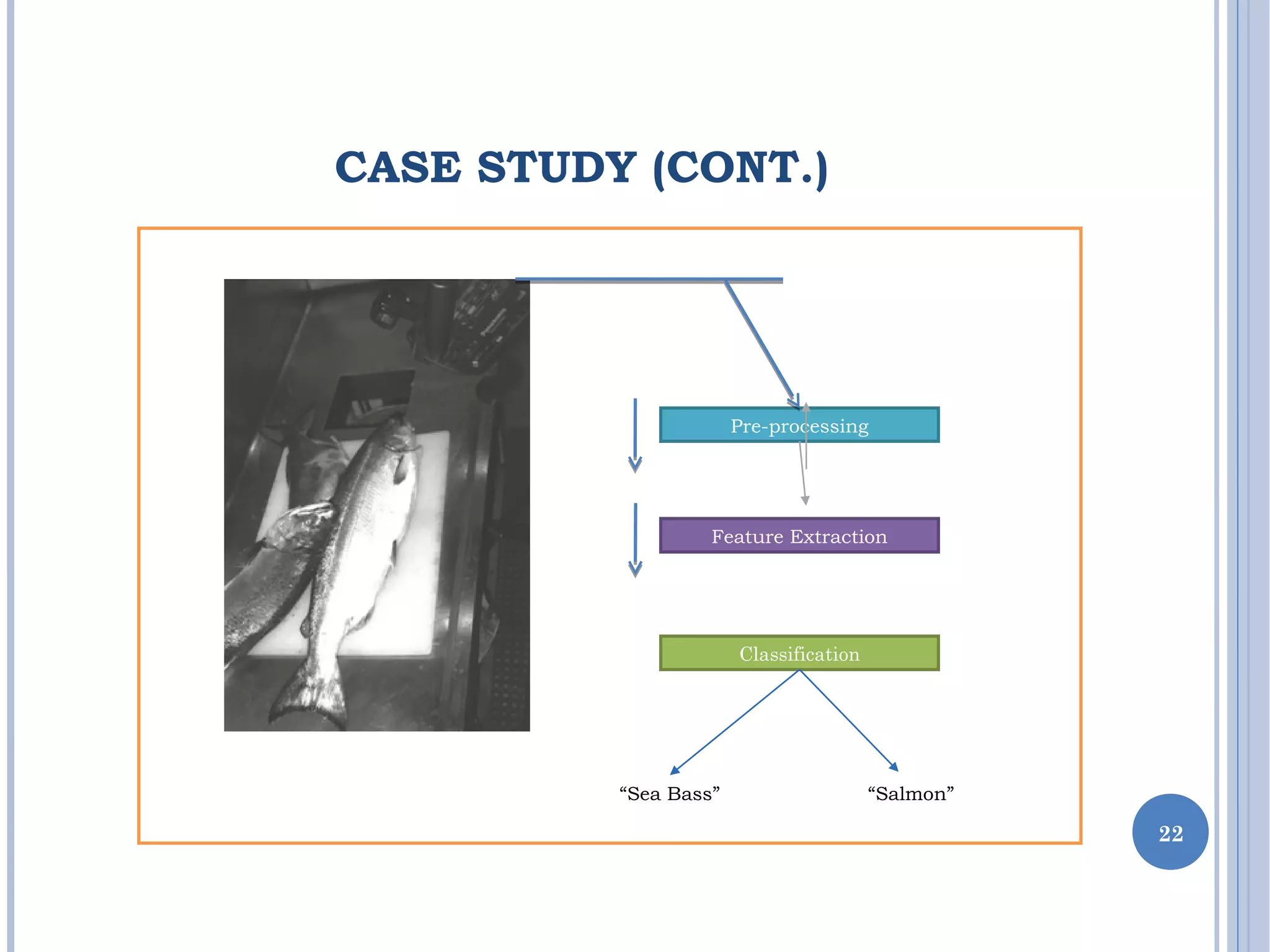
CASE STUDY (CONT.)
22
Classification
Feature Extraction
Pre-processing
“Sea Bass” “Salmon”
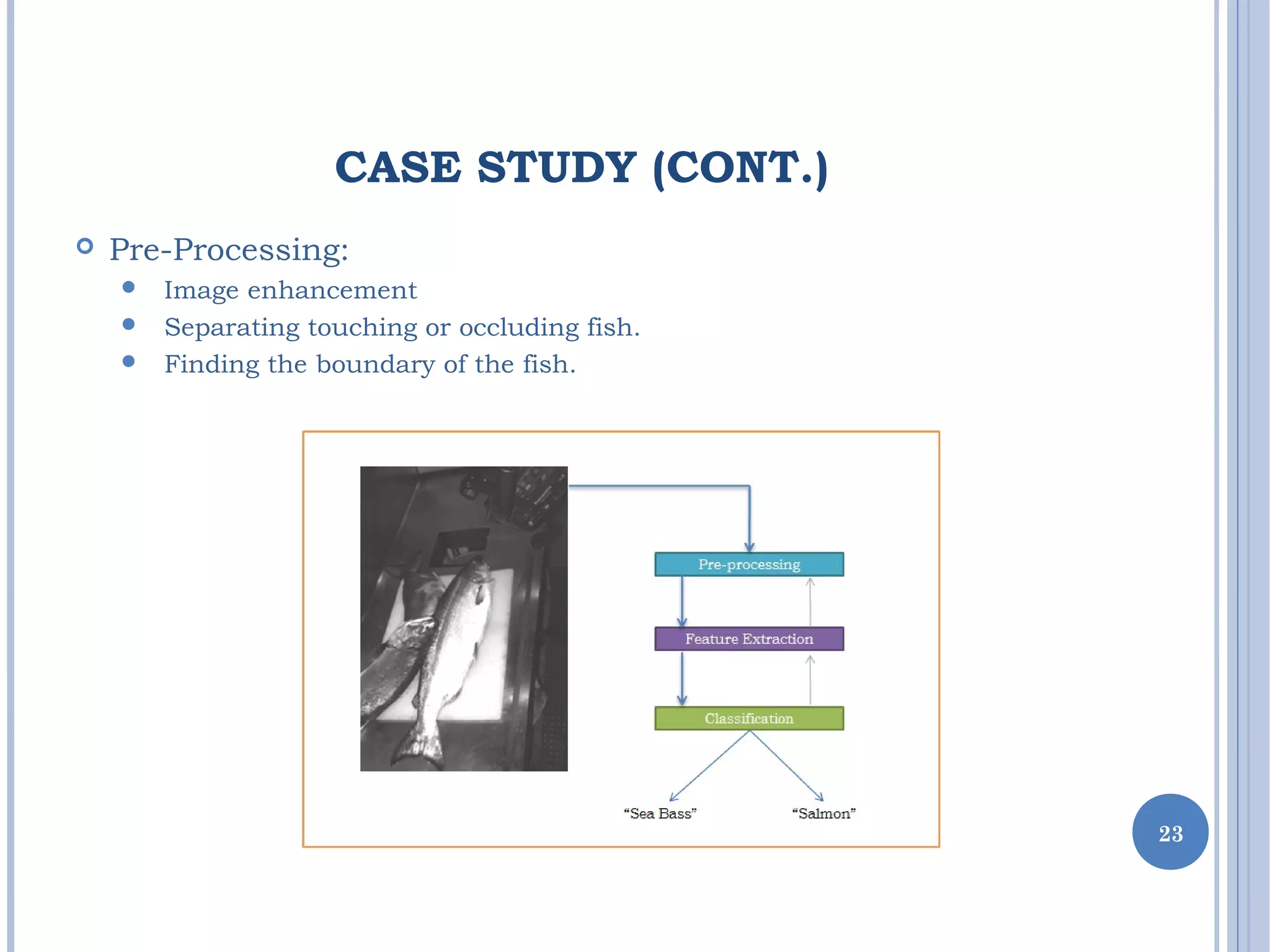
CASE STUDY (CONT.)
 Pre-Processing:
 Image enhancement
 Separating touching or occluding fish.
 Finding the boundary of the fish.
23
HOW TO SEPARATE
SEA BASS FROM SALMON?
 Possible features to be used:
 Length
 Lightness
 Width
 Number and shape of fins
 Position of the mouth
 Etc …
 Assume a fisherman told us that a “sea bass” is generally
longer than a “salmon”.
 Even though “sea bass” is longer than “salmon” on the
average, there are many examples of fish where this
observation does not hold.
24
25
Image Tagging.
Friend Suggestion
Product Suggestion
Social Networking Engines
26
Tools
MATLAB
R
WEKA
Q & A
27
THANK
YOU
28

Introduction to pattern recognization

  • 1.
    1 Green University ofBangladesh Presented by: Ajharul Abedeen Department of Computer Science and Engineering
  • 2.
  • 3.
  • 4.
    Contents  What isa pattern?  What is A pattern Class?  What is pattern recognition?  Human Perception  Examples of applications  Human and Machine Perception  Pattern Recognition  Pattern Recognition Process  Case Study  Tools 4
  • 5.
    WHAT IS APATTERN?  A pattern is an abstract object, or a set of measurements describing a physical object. 5
  • 6.
    WHAT IS APATTERN CLASS?  A pattern class (or category) is a set of patterns sharing common attributes.  A collection of “similar” (not necessarily identical) objects.  During recognition given objects are assigned to prescribed classes. 6
  • 7.
    WHAT IS PATTERNRECOGNITION?  Theory, Algorithms, Systems to put Patterns into Categories  Relate Perceived Pattern to Previously Perceived Patterns  Learn to distinguish patterns of interest from their background 7
  • 8.
    HUMAN PERCEPTION  Humanshave developed highly sophisticated skills for sensing their environment and taking actions according to what they observe, e.g.,  Recognizing a face.  Understanding spoken words.  Reading handwriting.  Distinguishing fresh food from its smell.  We would like to give similar capabilities to machines. 8
  • 9.
  • 10.
    GRID BY GRIDCOMPARISON A A B Grid by Grid Comparison 10
  • 11.
    GRID BY GRIDCOMPARISON A A B 11 0 0 1 0 0 0 1 0 0 1 1 1 1 0 0 1 1 0 0 1 0 1 1 0 0 1 1 0 0 1 1 0 1 0 0 1 1 0 0 1 No of Mismatch= 3
  • 12.
    GRID BY GRIDCOMPARISON A A B Grid by Grid Comparison 12
  • 13.
    GRID BY GRIDCOMPARISON A A B 13 0 0 1 0 0 0 1 0 0 1 1 1 1 0 0 1 1 0 0 1 1 1 1 0 0 1 0 1 0 1 1 1 0 1 0 1 1 1 1 0 No of Mismatch= 9
  • 14.
    HUMAN AND MACHINEPERCEPTION  We are often influenced by the knowledge of how patterns are modeled and recognized in nature when we develop pattern recognition algorithms.  Research on machine perception also helps us gain deeper understanding and appreciation for pattern recognition systems in nature.  Yet, we also apply many techniques that are purely numerical and do not have any correspondence in natural systems. 14
  • 15.
    PATTERN RECOGNITION  TwoPhase : Learning and Detection.  Time to learn is higher.  Driving a car  Difficult to learn but once learnt it becomes natural.  Can use AI learning methodologies such as:  Neural Network.  Machine Learning. 15
  • 16.
    LEARNING  How canmachine learn the rule from data?  Supervised learning: a teacher provides a category label or cost for each pattern in the training set.  Unsupervised learning: the system forms clusters or natural groupings of the input patterns. 16
  • 17.
     Classification (knowncategories)  Clustering (creation of new categories) CLASSIFICATION VS. CLUSTERING 17 Category “A” Category “B” Clustering (Unsupervised Classification) Classification (Supervised Classification)
  • 18.
    PATTERN RECOGNITION PROCESS(CONT.) 18 Post- processing Classification Feature Extraction Segmentation Sensing input Decision
  • 19.
    PATTERN RECOGNITION PROCESS Data acquisition and sensing:  Measurements of physical variables.  Important issues: bandwidth, resolution , etc.  Pre-processing:  Removal of noise in data.  Isolation of patterns of interest from the background.  Feature extraction:  Finding a new representation in terms of features.  Classification  Using features and learned models to assign a pattern to a category.  Post-processing  Evaluation of confidence in decisions. 19
  • 20.
    CASE STUDY  FishClassification:  Sea Bass / Salmon.  Problem: Sorting incoming fish on a conveyor belt according to species.  Assume that we have only two kinds of fish:  Sea bass.  Salmon. 20 Salmon Sea-bass
  • 21.
    CASE STUDY (CONT.) What can cause problems during sensing?  Lighting conditions.  Position of fish on the conveyor belt.  Camera noise.  etc…  What are the steps in the process? 1. Capture image. 2. Isolate fish 3. Take measurements 4. Make decision 21
  • 22.
    CASE STUDY (CONT.) 22 Classification FeatureExtraction Pre-processing “Sea Bass” “Salmon”
  • 23.
    CASE STUDY (CONT.) Pre-Processing:  Image enhancement  Separating touching or occluding fish.  Finding the boundary of the fish. 23
  • 24.
    HOW TO SEPARATE SEABASS FROM SALMON?  Possible features to be used:  Length  Lightness  Width  Number and shape of fins  Position of the mouth  Etc …  Assume a fisherman told us that a “sea bass” is generally longer than a “salmon”.  Even though “sea bass” is longer than “salmon” on the average, there are many examples of fish where this observation does not hold. 24
  • 25.
    25 Image Tagging. Friend Suggestion ProductSuggestion Social Networking Engines
  • 26.
  • 27.
  • 28.