Simon Bagreev
Twitter: @status_200
Github: semmin
Email: simon.bagreev@employmentguide.com
Programs must be written for people to read, and onlyPrograms must be written for people to read, and only
incidentally for machines to execute.incidentally for machines to execute.
Abelson and SussmanAbelson and Sussman
... We are the masters. They are the slaves.... We are the masters. They are the slaves.
Yukihiro Matsumoto, creator of RubyYukihiro Matsumoto, creator of Ruby
on people and machineson people and machines
Knowing Rails != Knowing Ruby
simple and efficient
duck-typed
functional
metaprogramming
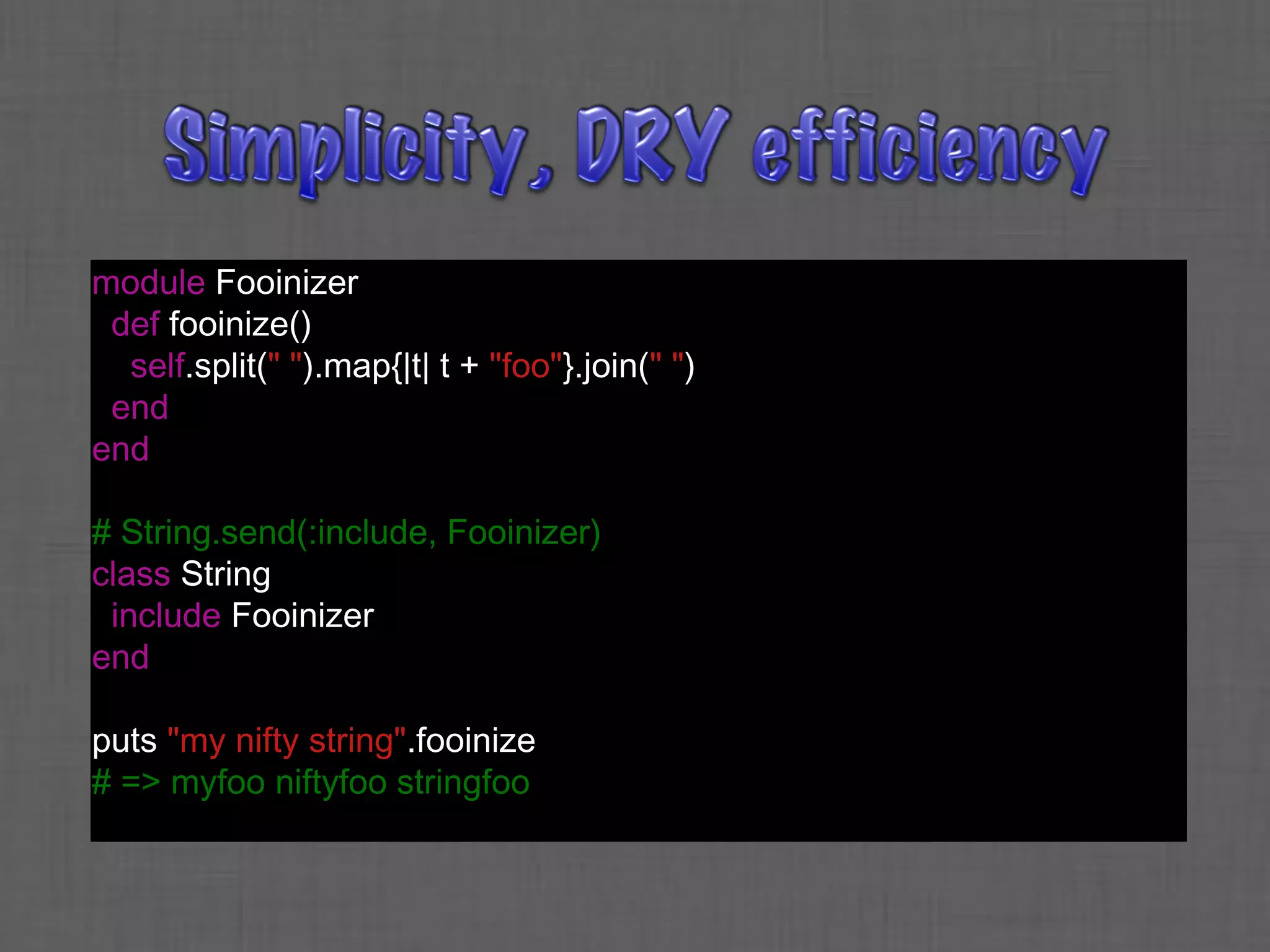
module Fooinizer
def fooinize()
self.split(" ").map{|t| t + "foo"}.join(" ")
end
end
# String.send(:include, Fooinizer)
class String
include Fooinizer
end
puts "my nifty string".fooinize
# => myfoo niftyfoo stringfoo
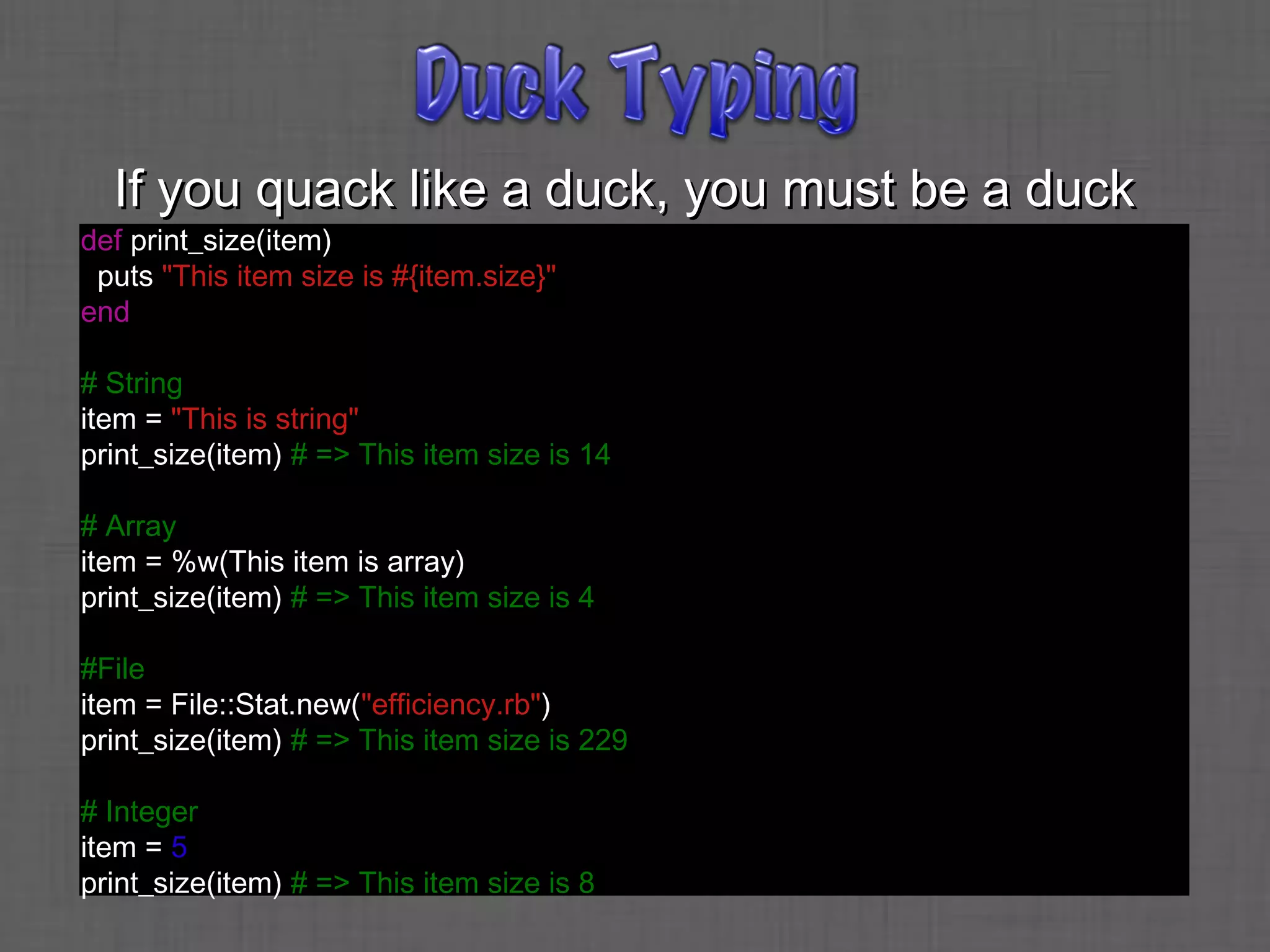
If you quack like a duck, you must be a duckIf you quack like a duck, you must be a duck
def print_size(item)
puts "This item size is #{item.size}"
end
# String
item = "This is string"
print_size(item) # => This item size is 14
# Array
item = %w(This item is array)
print_size(item) # => This item size is 4
#File
item = File::Stat.new("efficiency.rb")
print_size(item) # => This item size is 229
# Integer
item = 5
print_size(item) # => This item size is 8
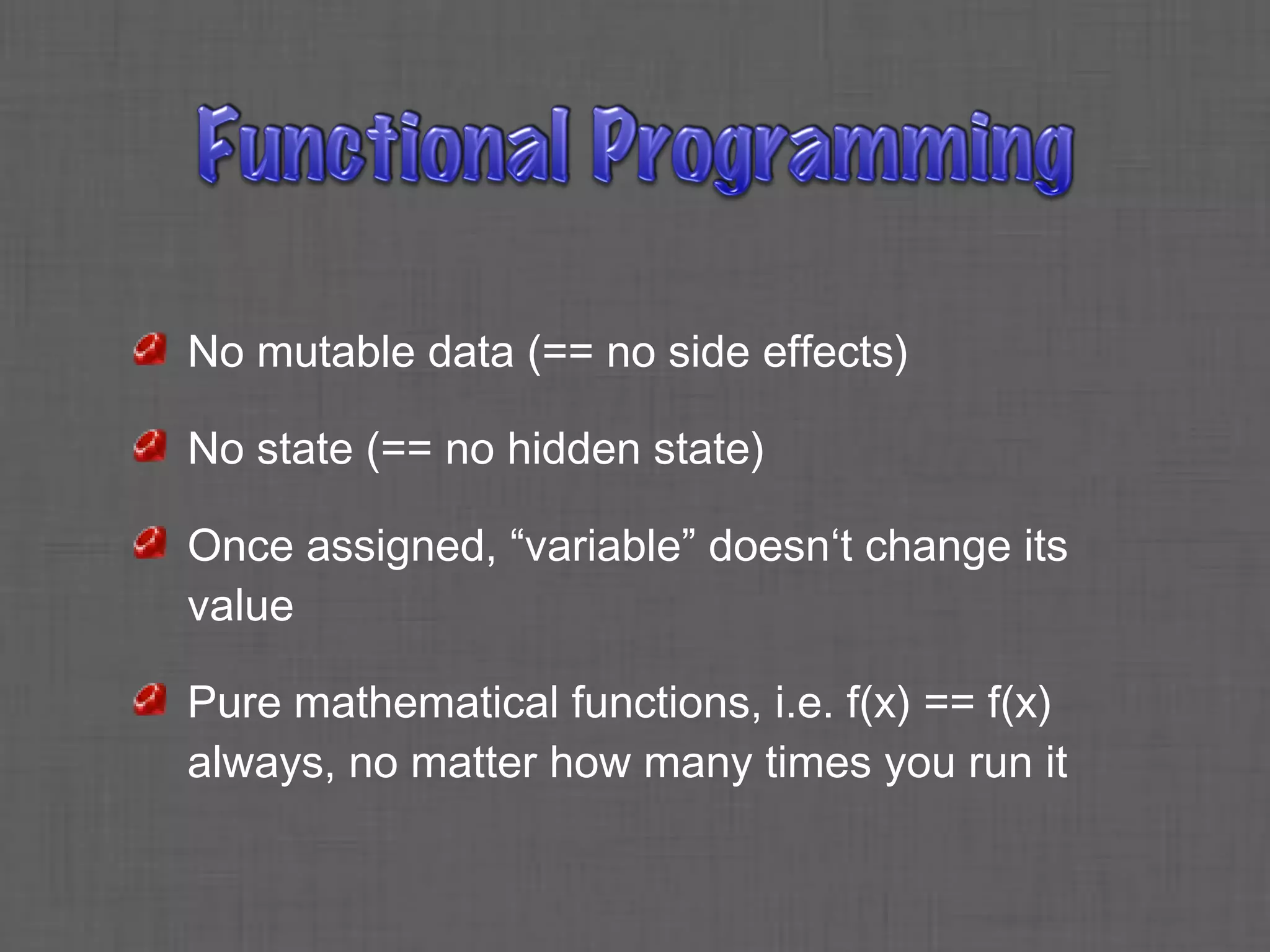
No mutable data (== no side effects)
No state (== no hidden state)
Once assigned, “variable” doesn‘t change its
value
Pure mathematical functions, i.e. f(x) == f(x)
always, no matter how many times you run it
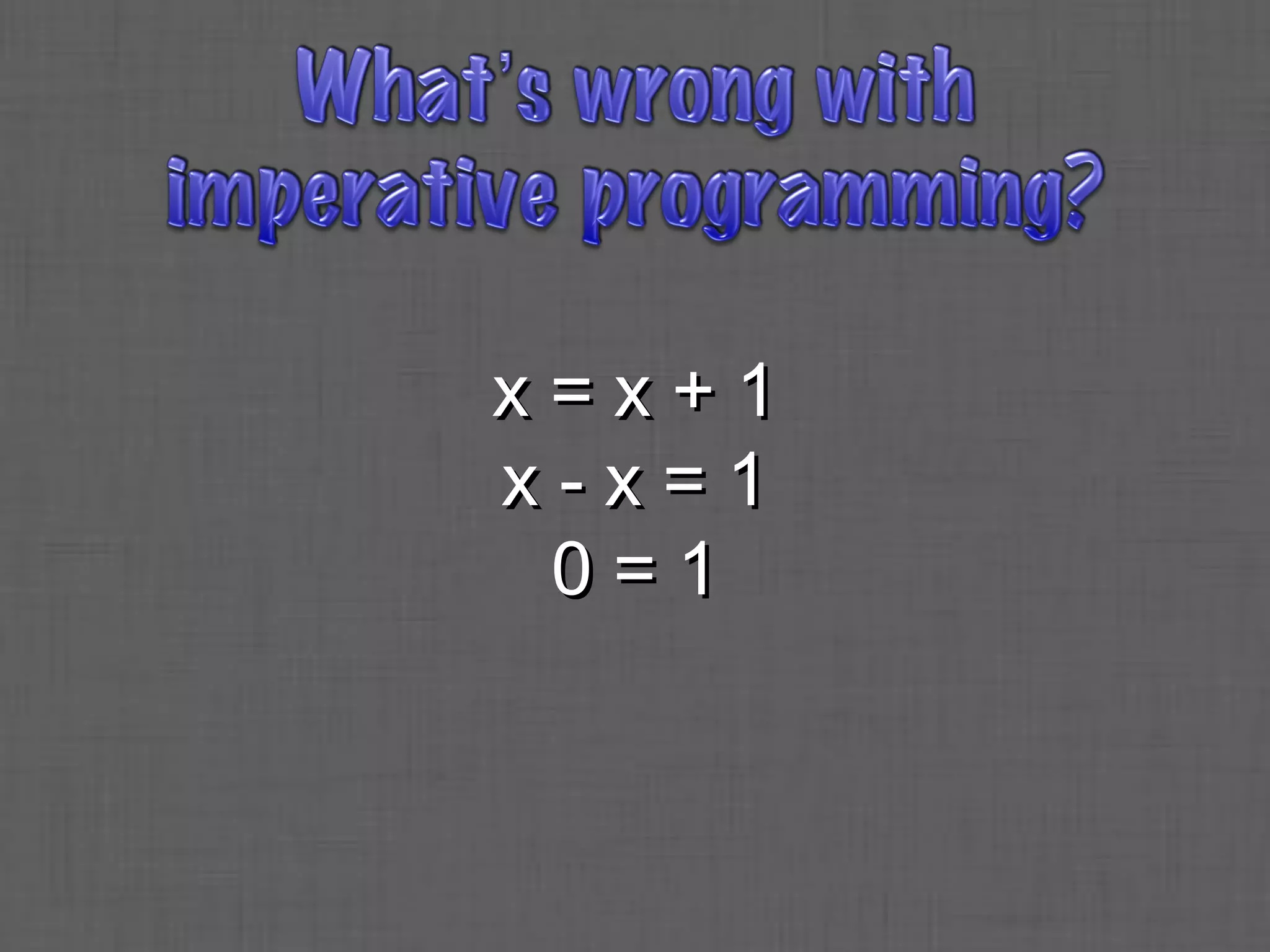
x = x + 1x = x + 1
x - x = 1x - x = 1
0 = 10 = 1
Programmer has a choice between imperative and functionalProgrammer has a choice between imperative and functional
# Imperative
days = %w(Mon Tue Wed)
days << "Thu"
days += ["Fri", "Sat", "Sun"]
days # ["Mon", "Tue", "Wed", "Thu", "Fri", "Sat", "Sun"]
# Functional
days = %w(Mon Tue Wed)
all_days = days + ["Thu"] + ["Fri", "Sat", "Sun"]
all_days # ["Mon", "Tue", "Wed", "Thu", "Fri", "Sat", "Sun"]
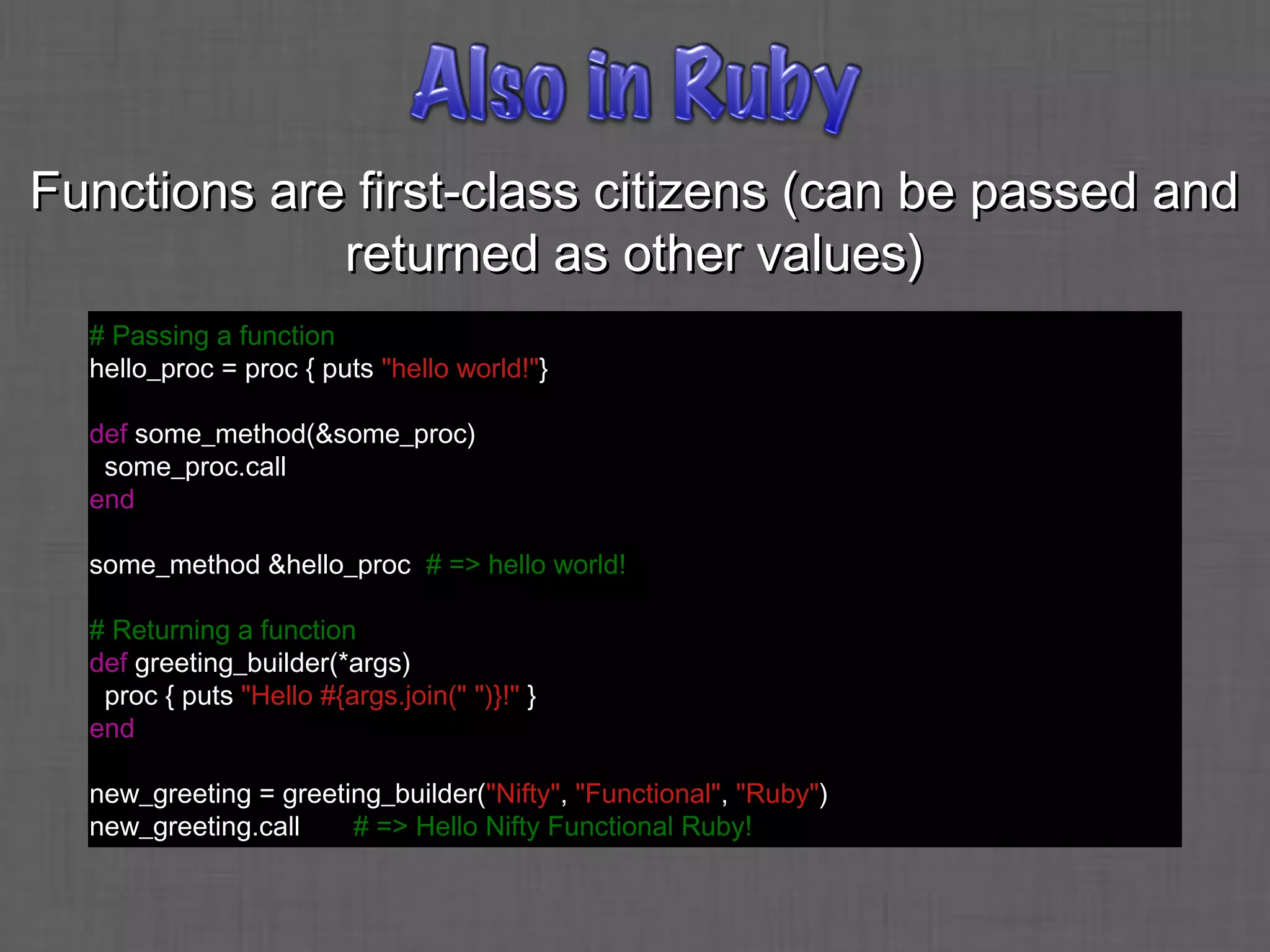
Functions are first-class citizens (can be passed andFunctions are first-class citizens (can be passed and
returned as other values)returned as other values)
# Passing a function
hello_proc = proc { puts "hello world!"}
def some_method(&some_proc)
some_proc.call
end
some_method &hello_proc # => hello world!
# Returning a function
def greeting_builder(*args)
proc { puts "Hello #{args.join(" ")}!" }
end
new_greeting = greeting_builder("Nifty", "Functional", "Ruby")
new_greeting.call # => Hello Nifty Functional Ruby!
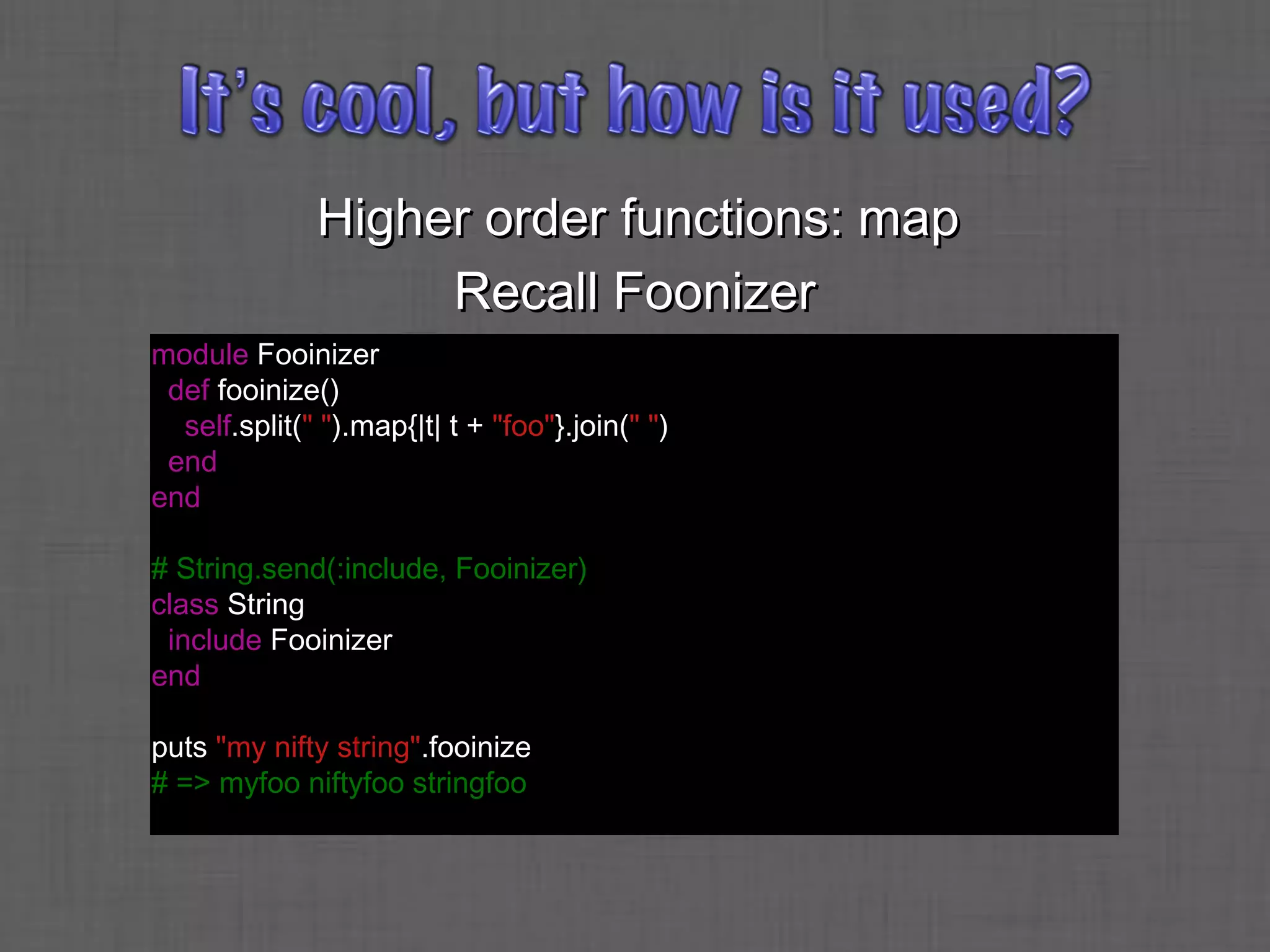
Recall FoonizerRecall Foonizer
module Fooinizer
def fooinize()
self.split(" ").map{|t| t + "foo"}.join(" ")
end
end
# String.send(:include, Fooinizer)
class String
include Fooinizer
end
puts "my nifty string".fooinize
# => myfoo niftyfoo stringfoo
Higher order functions: mapHigher order functions: map
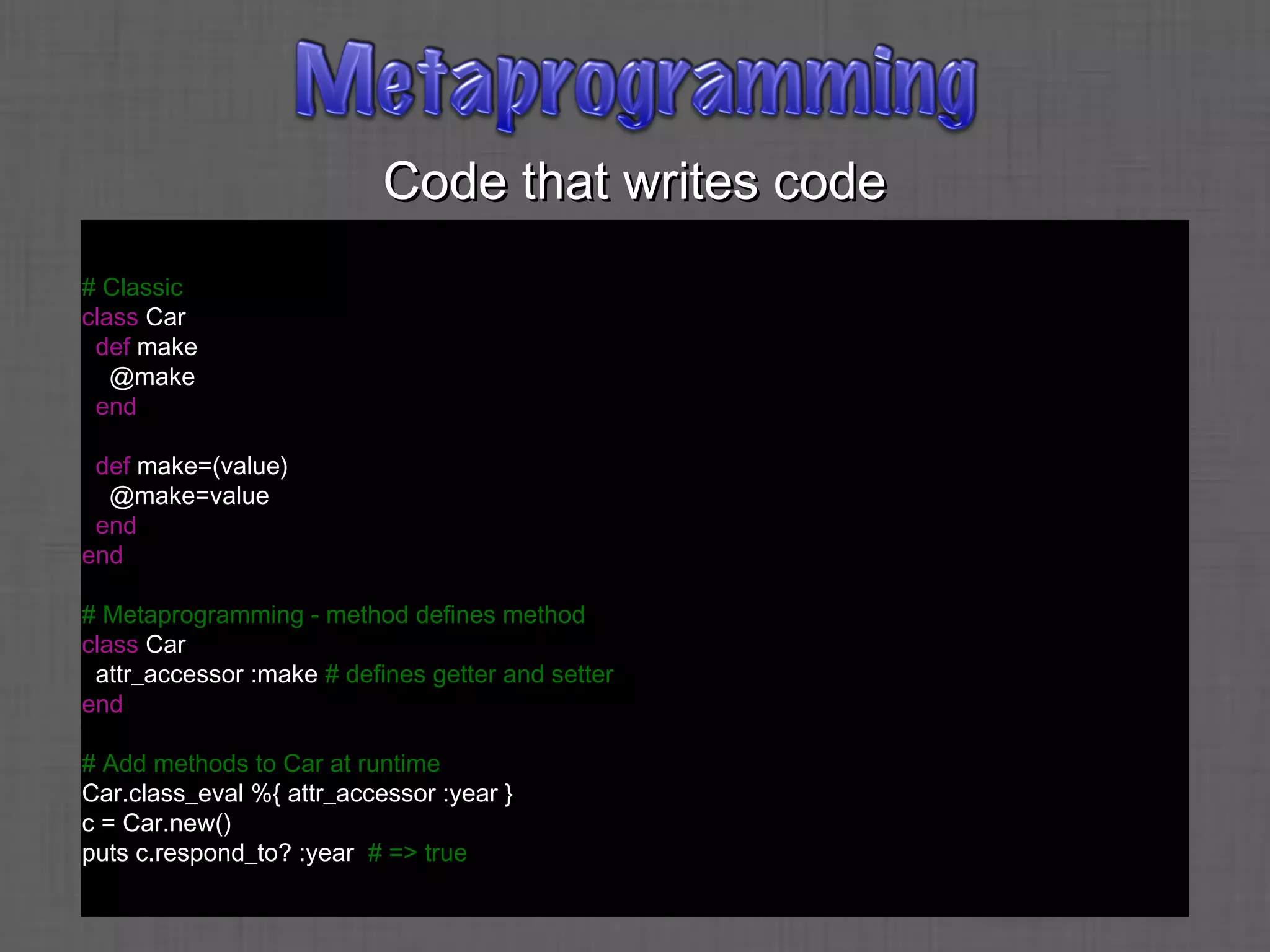
Code that writes codeCode that writes code
# Classic
class Car
def make
@make
end
def make=(value)
@make=value
end
end
# Metaprogramming - method defines method
class Car
attr_accessor :make # defines getter and setter
end
# Add methods to Car at runtime
Car.class_eval %{ attr_accessor :year }
c = Car.new()
puts c.respond_to? :year # => true
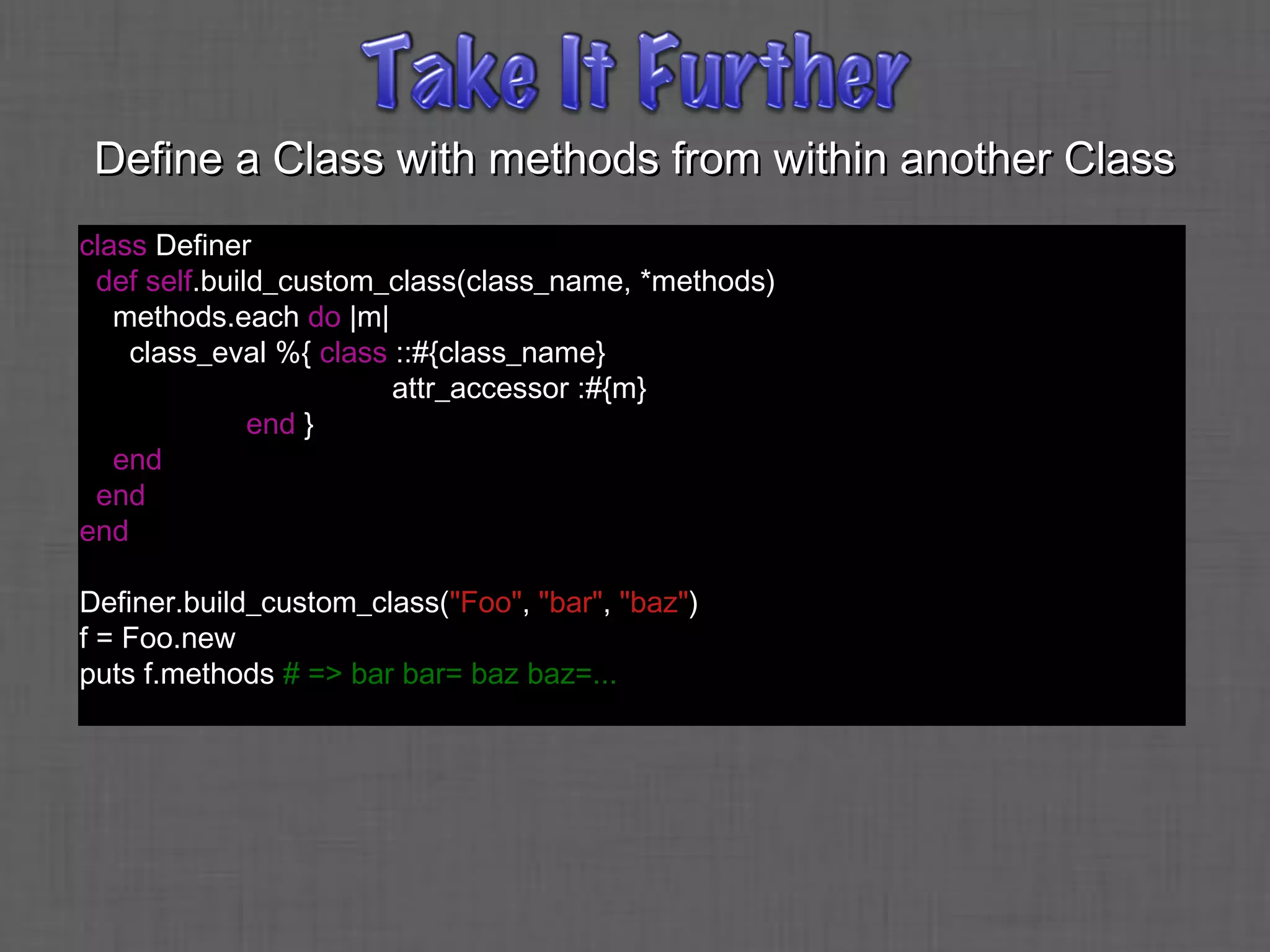
Define a Class with methods from within another ClassDefine a Class with methods from within another Class
class Definer
def self.build_custom_class(class_name, *methods)
methods.each do |m|
class_eval %{ class ::#{class_name}
attr_accessor :#{m}
end }
end
end
end
Definer.build_custom_class("Foo", "bar", "baz")
f = Foo.new
puts f.methods # => bar bar= baz baz=...
Framework does things for youFramework does things for you
== awesome== awesome
Don’t Repeat YourselfDon’t Repeat Yourself
Convention Over ConfigurationConvention Over Configuration
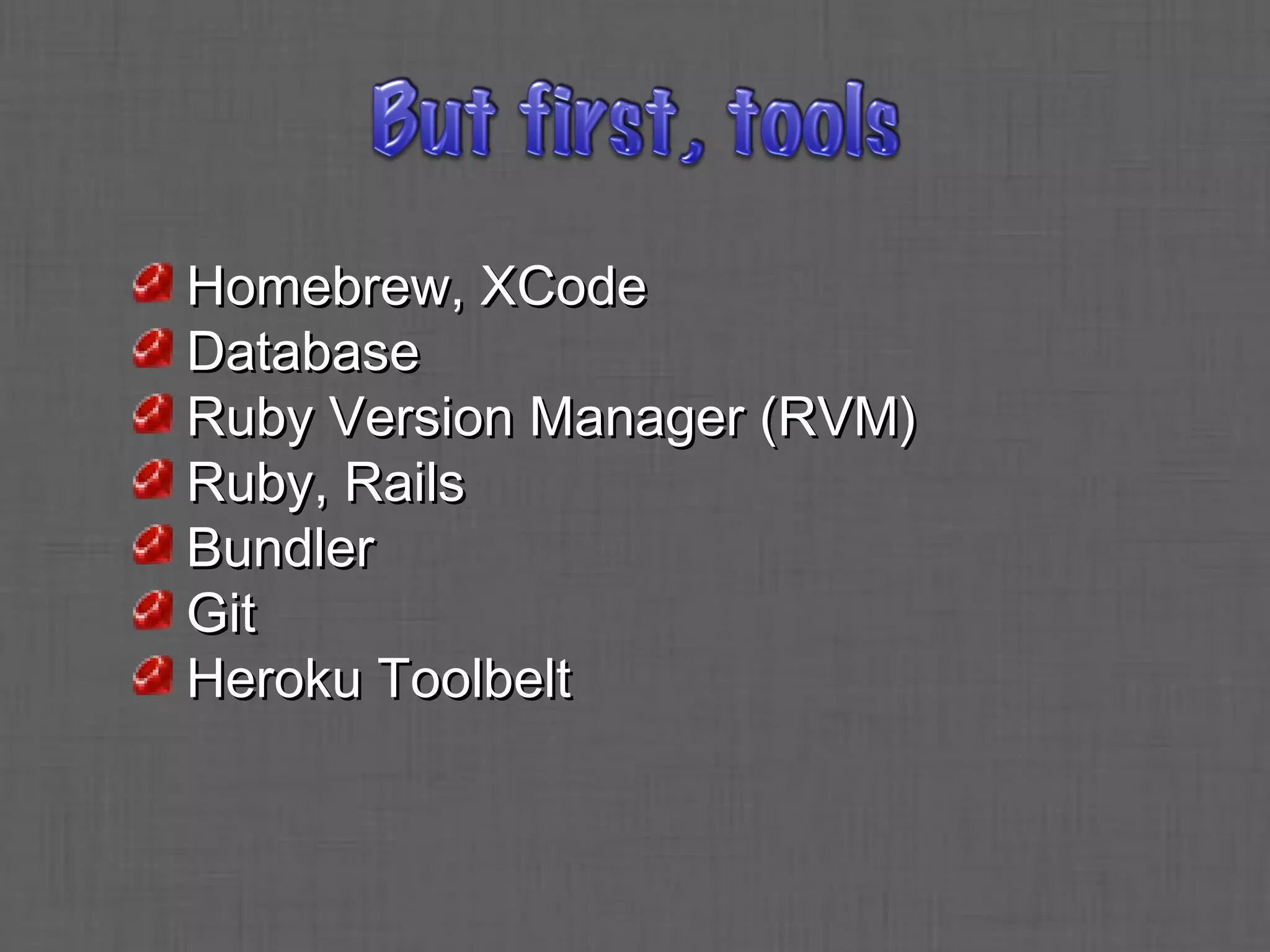
Homebrew, XCodeHomebrew, XCode
DatabaseDatabase
Ruby Version Manager (RVM)Ruby Version Manager (RVM)
Ruby, RailsRuby, Rails
BundlerBundler
GitGit
Heroku ToolbeltHeroku Toolbelt
You are ready to build your first RailsYou are ready to build your first Rails
application!application!
ruby.railstutorial.org/ruby-on-rails-tutorial-bookruby.railstutorial.org/ruby-on-rails-tutorial-book
edgeguides.rubyonrails.orgedgeguides.rubyonrails.org
tryruby.orgtryruby.org
railsforzombies.orgrailsforzombies.org
railscasts.comrailscasts.com
github.com/rails/rails – rails source codegithub.com/rails/rails – rails source code
github.com/semmin/intro-to-ror-preso – thisgithub.com/semmin/intro-to-ror-preso – this
presentationpresentation
Arkin, McAnally, Ruby in Practice, Manning Publications, March 5, 2008Arkin, McAnally, Ruby in Practice, Manning Publications, March 5, 2008
Khell’s blog, khelll.com/blog/ruby/ruby-and-functional-programmingKhell’s blog, khelll.com/blog/ruby/ruby-and-functional-programming
Stuart, www.rubyinside.com/functional-programming-in-ruby-2713.htmlStuart, www.rubyinside.com/functional-programming-in-ruby-2713.html
Thank You!Thank You!

Introduction to Ruby, Rails, and Ruby on Rails

  • 1.
    Simon Bagreev Twitter: @status_200 Github:semmin Email: simon.bagreev@employmentguide.com
  • 2.
    Programs must bewritten for people to read, and onlyPrograms must be written for people to read, and only incidentally for machines to execute.incidentally for machines to execute. Abelson and SussmanAbelson and Sussman ... We are the masters. They are the slaves.... We are the masters. They are the slaves. Yukihiro Matsumoto, creator of RubyYukihiro Matsumoto, creator of Ruby on people and machineson people and machines
  • 3.
    Knowing Rails !=Knowing Ruby
  • 4.
  • 5.
    module Fooinizer def fooinize() self.split("").map{|t| t + "foo"}.join(" ") end end # String.send(:include, Fooinizer) class String include Fooinizer end puts "my nifty string".fooinize # => myfoo niftyfoo stringfoo
  • 6.
    If you quacklike a duck, you must be a duckIf you quack like a duck, you must be a duck def print_size(item) puts "This item size is #{item.size}" end # String item = "This is string" print_size(item) # => This item size is 14 # Array item = %w(This item is array) print_size(item) # => This item size is 4 #File item = File::Stat.new("efficiency.rb") print_size(item) # => This item size is 229 # Integer item = 5 print_size(item) # => This item size is 8
  • 7.
    No mutable data(== no side effects) No state (== no hidden state) Once assigned, “variable” doesn‘t change its value Pure mathematical functions, i.e. f(x) == f(x) always, no matter how many times you run it
  • 8.
    x = x+ 1x = x + 1 x - x = 1x - x = 1 0 = 10 = 1
  • 9.
    Programmer has achoice between imperative and functionalProgrammer has a choice between imperative and functional # Imperative days = %w(Mon Tue Wed) days << "Thu" days += ["Fri", "Sat", "Sun"] days # ["Mon", "Tue", "Wed", "Thu", "Fri", "Sat", "Sun"] # Functional days = %w(Mon Tue Wed) all_days = days + ["Thu"] + ["Fri", "Sat", "Sun"] all_days # ["Mon", "Tue", "Wed", "Thu", "Fri", "Sat", "Sun"]
  • 10.
    Functions are first-classcitizens (can be passed andFunctions are first-class citizens (can be passed and returned as other values)returned as other values) # Passing a function hello_proc = proc { puts "hello world!"} def some_method(&some_proc) some_proc.call end some_method &hello_proc # => hello world! # Returning a function def greeting_builder(*args) proc { puts "Hello #{args.join(" ")}!" } end new_greeting = greeting_builder("Nifty", "Functional", "Ruby") new_greeting.call # => Hello Nifty Functional Ruby!
  • 11.
    Recall FoonizerRecall Foonizer moduleFooinizer def fooinize() self.split(" ").map{|t| t + "foo"}.join(" ") end end # String.send(:include, Fooinizer) class String include Fooinizer end puts "my nifty string".fooinize # => myfoo niftyfoo stringfoo Higher order functions: mapHigher order functions: map
  • 12.
    Code that writescodeCode that writes code # Classic class Car def make @make end def make=(value) @make=value end end # Metaprogramming - method defines method class Car attr_accessor :make # defines getter and setter end # Add methods to Car at runtime Car.class_eval %{ attr_accessor :year } c = Car.new() puts c.respond_to? :year # => true
  • 13.
    Define a Classwith methods from within another ClassDefine a Class with methods from within another Class class Definer def self.build_custom_class(class_name, *methods) methods.each do |m| class_eval %{ class ::#{class_name} attr_accessor :#{m} end } end end end Definer.build_custom_class("Foo", "bar", "baz") f = Foo.new puts f.methods # => bar bar= baz baz=...
  • 15.
    Framework does thingsfor youFramework does things for you == awesome== awesome
  • 16.
    Don’t Repeat YourselfDon’tRepeat Yourself Convention Over ConfigurationConvention Over Configuration
  • 17.
    Homebrew, XCodeHomebrew, XCode DatabaseDatabase RubyVersion Manager (RVM)Ruby Version Manager (RVM) Ruby, RailsRuby, Rails BundlerBundler GitGit Heroku ToolbeltHeroku Toolbelt
  • 18.
    You are readyto build your first RailsYou are ready to build your first Rails application!application!
  • 19.
  • 20.
    Arkin, McAnally, Rubyin Practice, Manning Publications, March 5, 2008Arkin, McAnally, Ruby in Practice, Manning Publications, March 5, 2008 Khell’s blog, khelll.com/blog/ruby/ruby-and-functional-programmingKhell’s blog, khelll.com/blog/ruby/ruby-and-functional-programming Stuart, www.rubyinside.com/functional-programming-in-ruby-2713.htmlStuart, www.rubyinside.com/functional-programming-in-ruby-2713.html
  • 21.

Editor's Notes

  • #8 Functional programming is a programming paradigm that treats computation as the evaluation of mathematical functions and avoids state and mutable data. It emphasizes the application of functions, in contrast to the imperative programming style, which emphasizes changes in state.