PYTHON
Information available in audio.
PRESENTED TO
PRESENTED BY
Introduction to Python
Agenda
• What is Python?
• History of Python
• Frameworks for Python
• Flavors of Python
• Why Python
• Data Types and Variables
• String
• Tuple
• Lists
What is Python
An interpreted, high-level programming language for general-purpose
programming
• Platform independent
• Dynamic typing
• Automatic memory management
• Adding or changing functions at runtime
• may use elements of natural language
• Strong abstraction
• Closer to end-user
History of Python
1980-Conception
1989-Implementation
2000-Python 2.0 Release
2008-Python 3.0 Release
2017-Python 2.7 to Go Transcompiler
1991-OfficiallyReleased
2020-End of life: Python 2.7
Guido Van Rossum
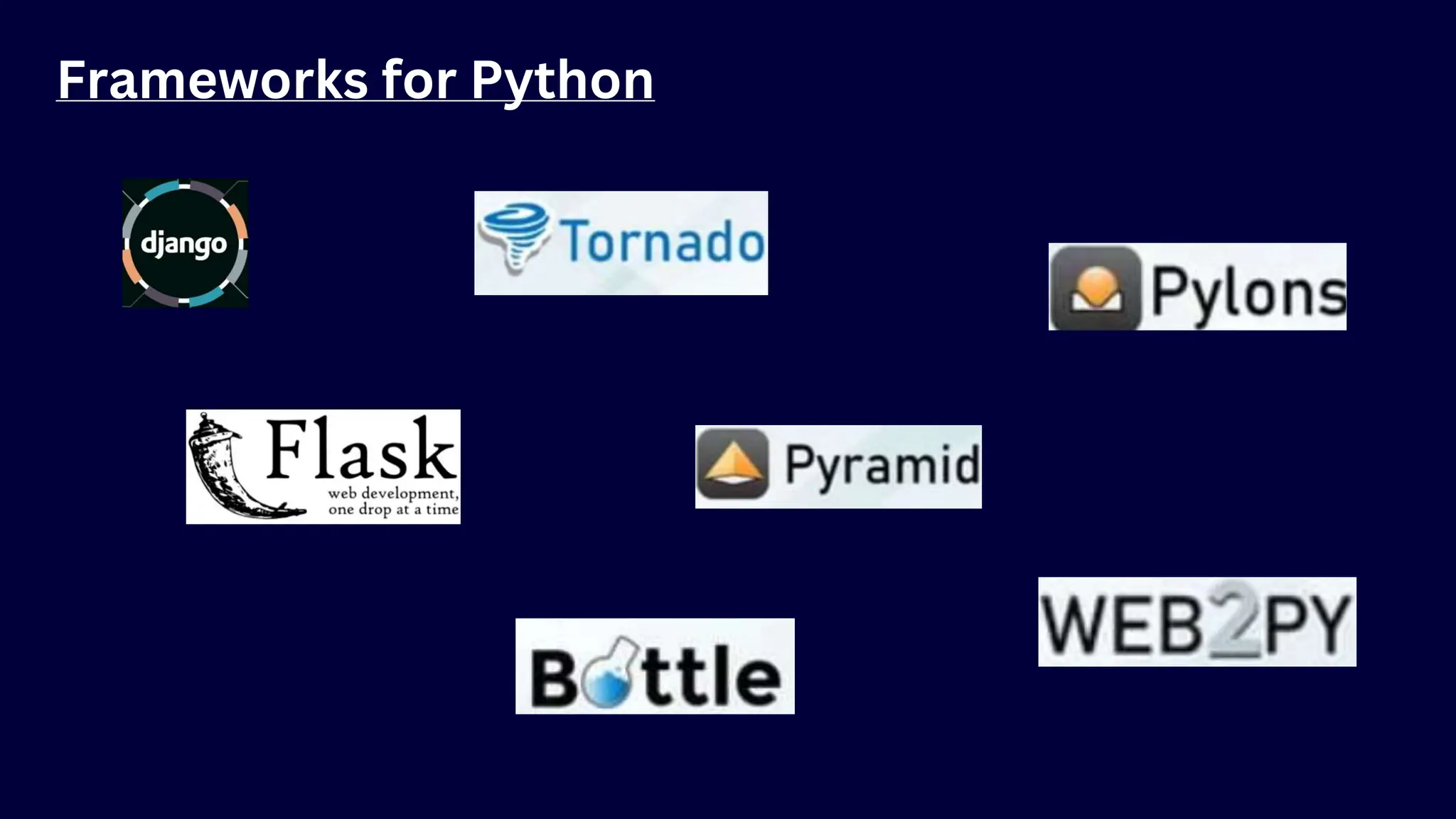
Frameworks for Python
Flavours of Python
Flavors of Python refers to the different types of Python compilers. These flavors
are useful to integrate various programming language into Python.
• CPython: Python -> C language
• Jython: Python -> Java language
• IronPython: Python -> C# (.NET framework)
• PyPy: Python -> Python
• RubyPython: Python -> Ruby
Data Type
It is a characteristics that tells the Compiler how a programmer intends
to use the data
Booleans are either True or False.
Numbers can be integers, floats, fractions, or complex numbers.
Strings are sequence of Unicode characters.
Bytes and byte arrays, e.g. JPEG image file .
Lists are ordered sequence.
Tuples are ordered, immutable sequence of values.
Sets are unordered bags of values.
Variable
Ex: Counter = 100 # An Integer
point name = “John” # A String
Variables are reserved memory locations to store values.
String
It is a collection of letters, or sequence of characters.
String operations:
• “hello”+ “world” “helloworld” #concatenation
• “hello”*3 “hellohellohello” #repetition
• “hello”[0] “h” #indexing
• “hello”[-1] “o” # from end
Operators
• Add two operands or unary plus +
• Subtract or unary minus -
• Multiply two operands *
• Division operator /
• Modulus - remainder of the division %
• Floor division- division that results into
whole number
• Exponent **
//
Tuple
s
Tuples are used to store multiple items in a single variable. A tuples is a
collection of immutable Python objects
Tuple Functions:
• Compares elements of both tuples cmp(tuple1, tuple2)
2. Gives the totoal length of the tuple len(tuple)
3. Returns item from the tuple with max value max(tuple)
4. Returns item from the tuple with min value min(tuple)
5. Converts a list into tuple tuple(seq)
Lists
Lists are one of 4 built in data type in Python used to collection of
data.
List item are ordered, changeable, and allow duplicate values.
Built-in List Function and Methods:
4. Returns the lowest index in list that obj appears list.index(obj)
1. Compares elements of bothe lists. cmp(list1, list2)
2. Gives the total length of the list. len(list)
5. Appends objects obj to list list.append(obj)
3. Returns item from the list with max value max(list)
6. Sorts objects of list, use compare function of given list.sort(func)
Why Python?
• Python works on different platforms ( Windows,Mac, Linux, Raspberry
Pi etc).
• Python has syntax that allows developers to write programs with fewer
lines than some other programming languages.
Java
public class SwapNumbers {
public static void main(String[] args) {
float first = 12.0f, second = 24.5f;
System.out.println("--Before swap--");
System.out.println("First number = " +
first);
System.out.println("Second number = " +
second);
first = first - second;
second = first + second;
first = second - first;
System.out.println("--After swap--");
System.out.println("First number = " +
first);
System.out.println("Second number = " +
second);
}
}
C++
#include <iostream>
using namespace std;
int main(){
int a = 5, b = 10, temp;
cout << "Before swapping." << endl;
cout << "a = " << a << ", b = " << b << endl;
temp = a;
a = b;
b = temp;
cout << "nAfter swapping." << endl;
cout << "a = " << a << ", b = " << b << endl;
return 0;
}
Pytho
n
x = 5
y = 10
x, y = y, x
print("x =", x)
print("y =", y)
Swapping of two numbers
Introduction to Python Programming .pptx

Introduction to Python Programming .pptx

  • 1.
    PYTHON Information available inaudio. PRESENTED TO PRESENTED BY Introduction to Python
  • 2.
    Agenda • What isPython? • History of Python • Frameworks for Python • Flavors of Python • Why Python • Data Types and Variables • String • Tuple • Lists
  • 3.
    What is Python Aninterpreted, high-level programming language for general-purpose programming • Platform independent • Dynamic typing • Automatic memory management • Adding or changing functions at runtime • may use elements of natural language • Strong abstraction • Closer to end-user
  • 4.
    History of Python 1980-Conception 1989-Implementation 2000-Python2.0 Release 2008-Python 3.0 Release 2017-Python 2.7 to Go Transcompiler 1991-OfficiallyReleased 2020-End of life: Python 2.7 Guido Van Rossum
  • 5.
  • 6.
    Flavours of Python Flavorsof Python refers to the different types of Python compilers. These flavors are useful to integrate various programming language into Python. • CPython: Python -> C language • Jython: Python -> Java language • IronPython: Python -> C# (.NET framework) • PyPy: Python -> Python • RubyPython: Python -> Ruby
  • 7.
    Data Type It isa characteristics that tells the Compiler how a programmer intends to use the data Booleans are either True or False. Numbers can be integers, floats, fractions, or complex numbers. Strings are sequence of Unicode characters. Bytes and byte arrays, e.g. JPEG image file . Lists are ordered sequence. Tuples are ordered, immutable sequence of values. Sets are unordered bags of values.
  • 8.
    Variable Ex: Counter =100 # An Integer point name = “John” # A String Variables are reserved memory locations to store values. String It is a collection of letters, or sequence of characters. String operations: • “hello”+ “world” “helloworld” #concatenation • “hello”*3 “hellohellohello” #repetition • “hello”[0] “h” #indexing • “hello”[-1] “o” # from end
  • 9.
    Operators • Add twooperands or unary plus + • Subtract or unary minus - • Multiply two operands * • Division operator / • Modulus - remainder of the division % • Floor division- division that results into whole number • Exponent ** //
  • 10.
    Tuple s Tuples are usedto store multiple items in a single variable. A tuples is a collection of immutable Python objects Tuple Functions: • Compares elements of both tuples cmp(tuple1, tuple2) 2. Gives the totoal length of the tuple len(tuple) 3. Returns item from the tuple with max value max(tuple) 4. Returns item from the tuple with min value min(tuple) 5. Converts a list into tuple tuple(seq)
  • 11.
    Lists Lists are oneof 4 built in data type in Python used to collection of data. List item are ordered, changeable, and allow duplicate values. Built-in List Function and Methods: 4. Returns the lowest index in list that obj appears list.index(obj) 1. Compares elements of bothe lists. cmp(list1, list2) 2. Gives the total length of the list. len(list) 5. Appends objects obj to list list.append(obj) 3. Returns item from the list with max value max(list) 6. Sorts objects of list, use compare function of given list.sort(func)
  • 12.
    Why Python? • Pythonworks on different platforms ( Windows,Mac, Linux, Raspberry Pi etc). • Python has syntax that allows developers to write programs with fewer lines than some other programming languages. Java public class SwapNumbers { public static void main(String[] args) { float first = 12.0f, second = 24.5f; System.out.println("--Before swap--"); System.out.println("First number = " + first); System.out.println("Second number = " + second); first = first - second; second = first + second; first = second - first; System.out.println("--After swap--"); System.out.println("First number = " + first); System.out.println("Second number = " + second); } } C++ #include <iostream> using namespace std; int main(){ int a = 5, b = 10, temp; cout << "Before swapping." << endl; cout << "a = " << a << ", b = " << b << endl; temp = a; a = b; b = temp; cout << "nAfter swapping." << endl; cout << "a = " << a << ", b = " << b << endl; return 0; } Pytho n x = 5 y = 10 x, y = y, x print("x =", x) print("y =", y) Swapping of two numbers