Introduc)on	
  to	
  Objec)ve-­‐C	
  

             Jussi	
  Pohjolainen	
  
 Tampere	
  University	
  of	
  Applied	
  Sciences	
  
QUICKSTART	
  
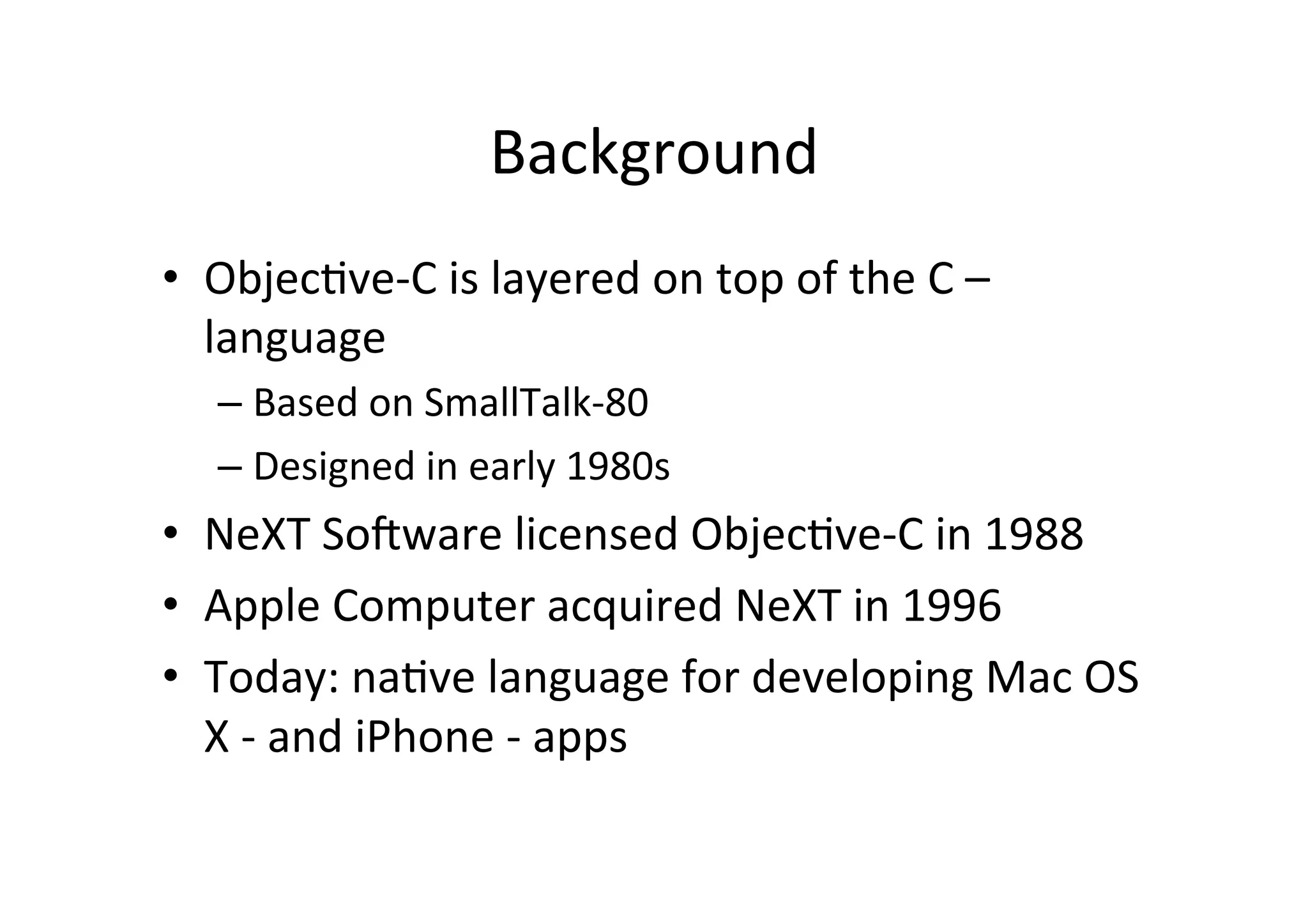
Background	
  
•  Objec)ve-­‐C	
  is	
  layered	
  on	
  top	
  of	
  the	
  C	
  –	
  
   language	
  
    –  Based	
  on	
  SmallTalk-­‐80	
  
    –  Designed	
  in	
  early	
  1980s	
  
•  NeXT	
  SoLware	
  licensed	
  Objec)ve-­‐C	
  in	
  1988	
  
•  Apple	
  Computer	
  acquired	
  NeXT	
  in	
  1996	
  
•  Today:	
  na)ve	
  language	
  for	
  developing	
  Mac	
  OS	
  
   X	
  -­‐	
  and	
  iPhone	
  -­‐	
  apps	
  
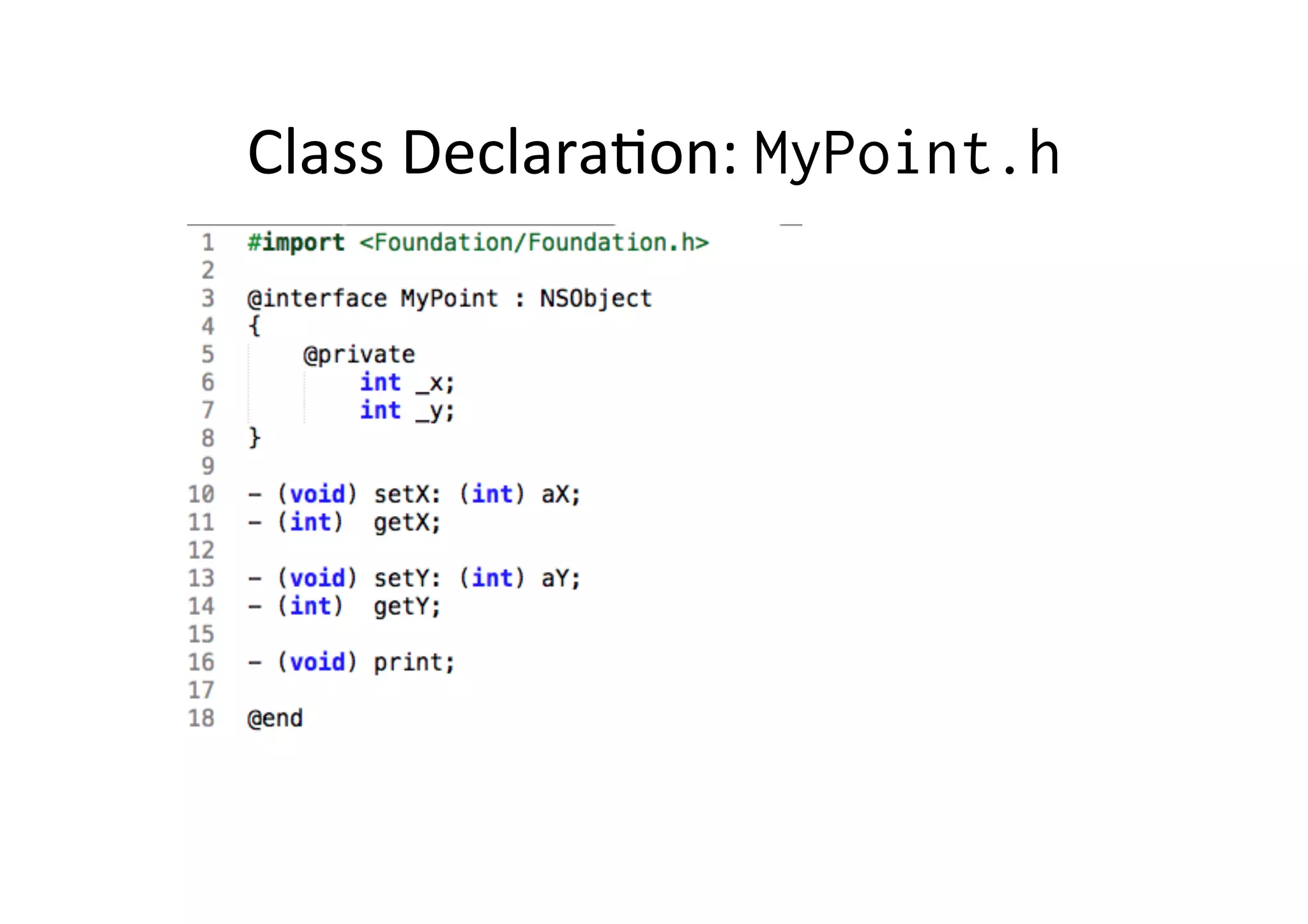
Class	
  Declara)on:	
  MyPoint.h
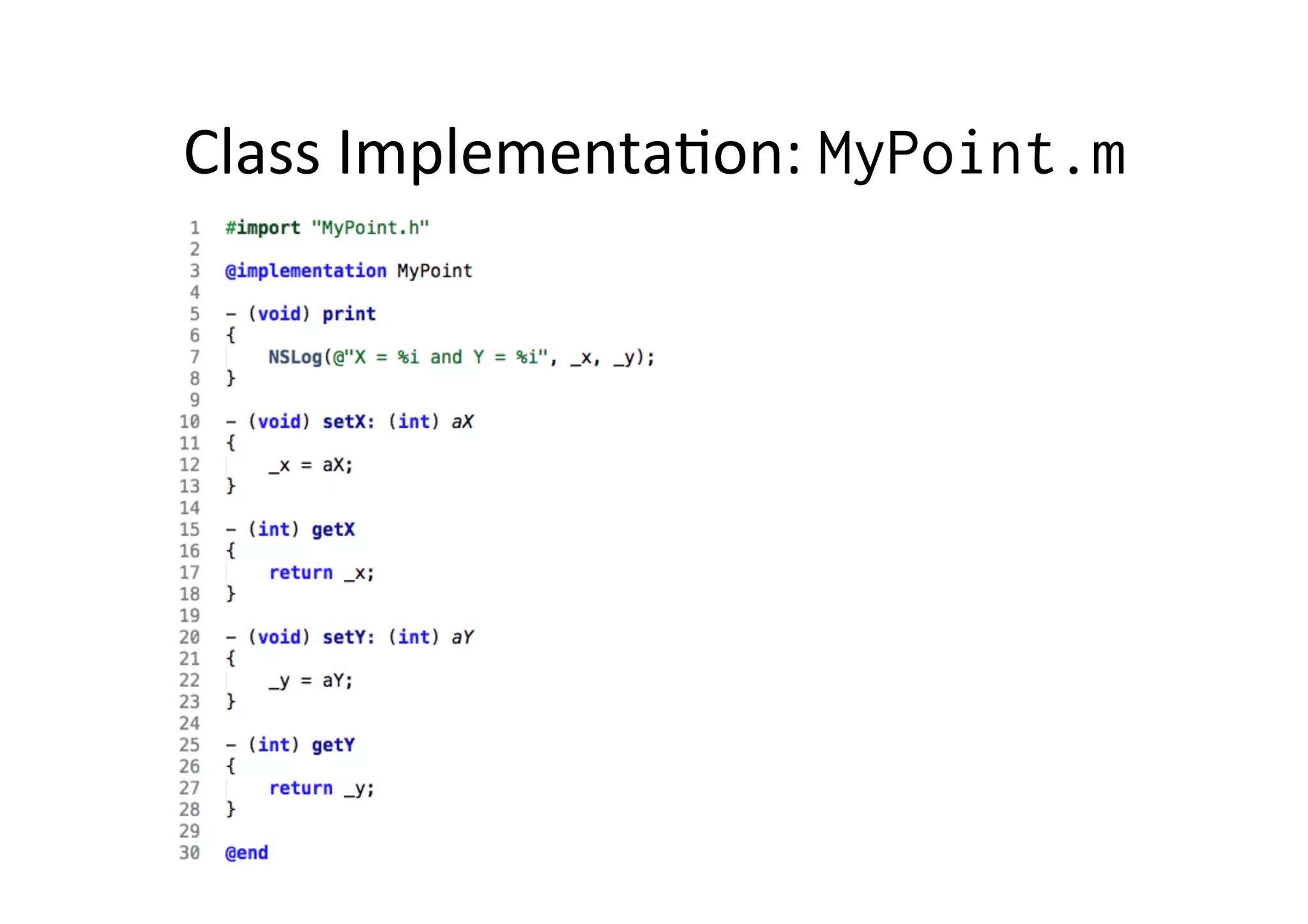
Class	
  Implementa)on:	
  MyPoint.m
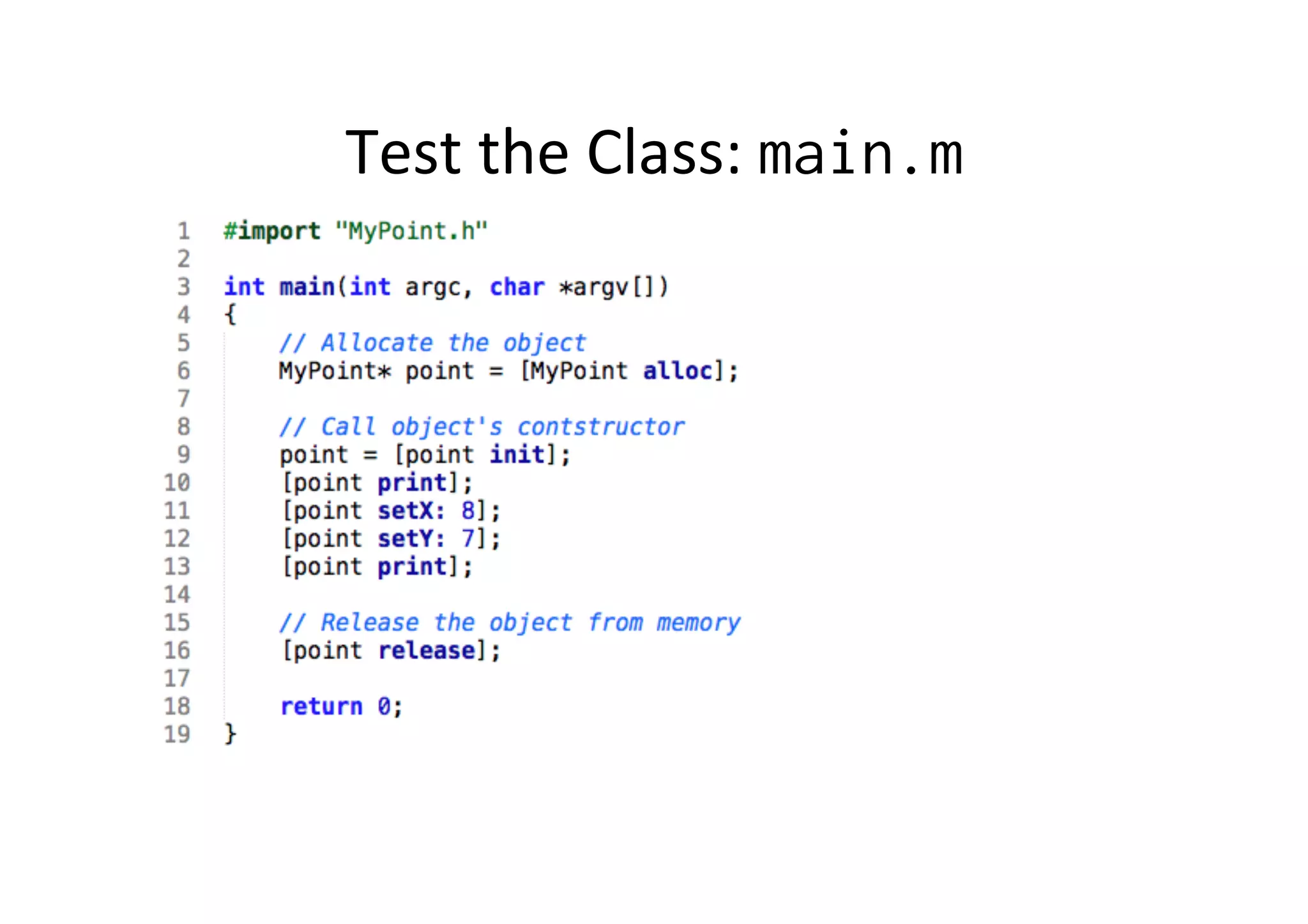
Test	
  the	
  Class:	
  main.m
Simple	
  makefile	
  
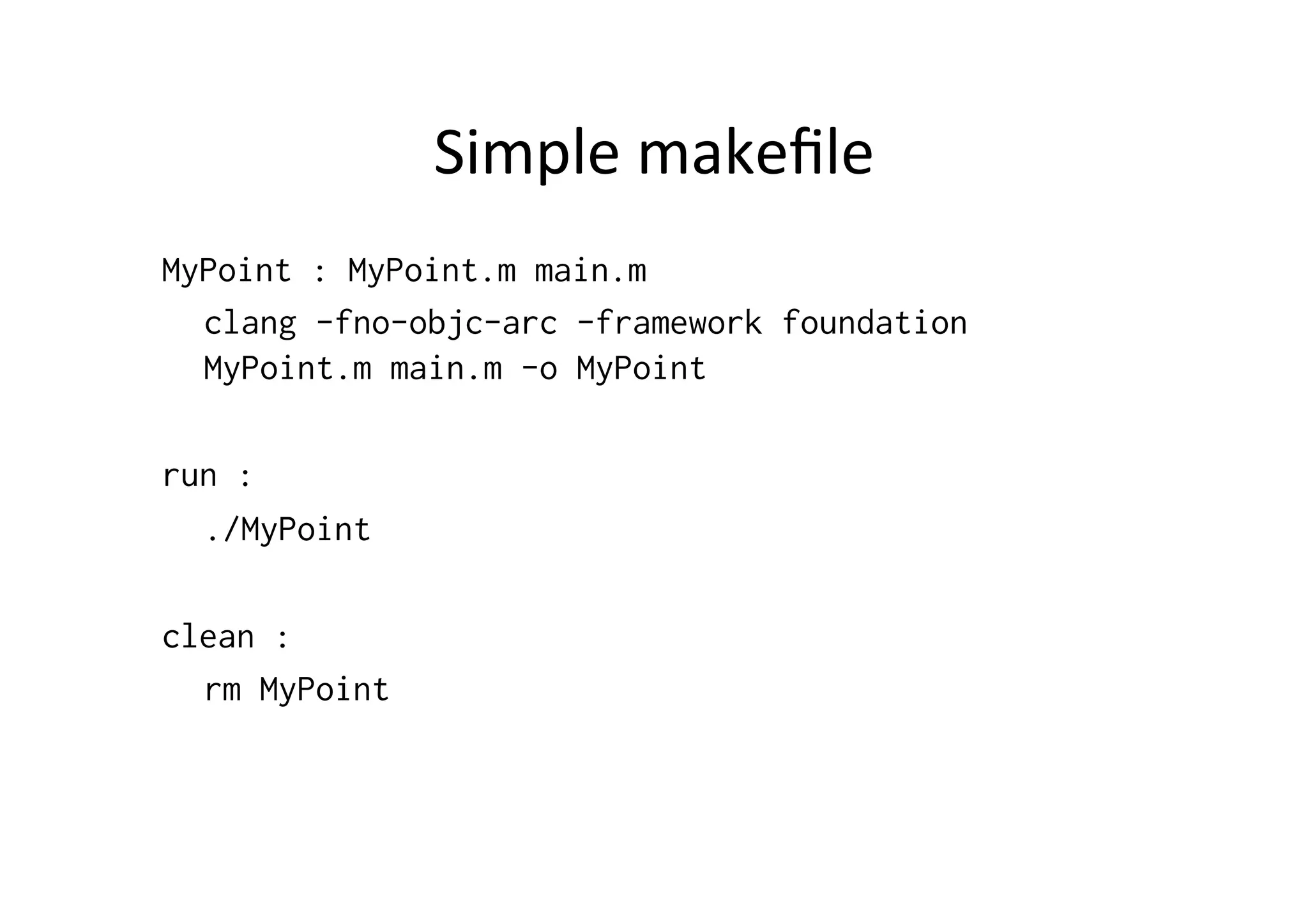
MyPoint : MyPoint.m main.m
  clang -fno-objc-arc -framework foundation
  MyPoint.m main.m -o MyPoint

run :
  ./MyPoint

clean :
  rm MyPoint
Compiling	
  and	
  Running	
  
TB308POHJUS-L-2:point pohjus$ ls -al
total 32
drwxr-xr-x 6 pohjus staff 204 18 Tou 15:32 .
drwxr-xr-x 3 pohjus staff 102 18 Tou 14:52 ..
-rw-r--r--@ 1 pohjus staff 196 18 Tou 15:25 MyPoint.h
-rw-r--r--@ 1 pohjus staff 268 18 Tou 15:23 MyPoint.m
-rw-r--r--@ 1 pohjus staff 339 18 Tou 15:25 main.m
-rw-r--r--@ 1 pohjus staff 120 18 Tou 15:14 makefile
TB308POHJUS-L-2:point pohjus$ make
clang -fno-objc-arc -framework foundation MyPoint.m main.m -o MyPoint
TB308POHJUS-L-2:point pohjus$ make run
./MyPoint
2009-05-18 15:32:46.339 MyPoint[8725:807] X = 0 and Y = 0
2009-05-18 15:32:46.341 MyPoint[8725:807] X = 8 and Y = 7
TB308POHJUS-L-2:point pohjus$
Instan)a)ng	
  an	
  Object	
  
// Declare a pointer to the object
MyPoint* point;

// Allocate memory for the object
point = [MyPoint alloc];

// Initialize the object
point = [point init];
Instan)a)ng	
  an	
  Object:	
  One	
  Liner	
  
// Allocate and initialize the object
MyPoint* point1 = [[MyPoint alloc] init];
Messages	
  (Methods)	
  

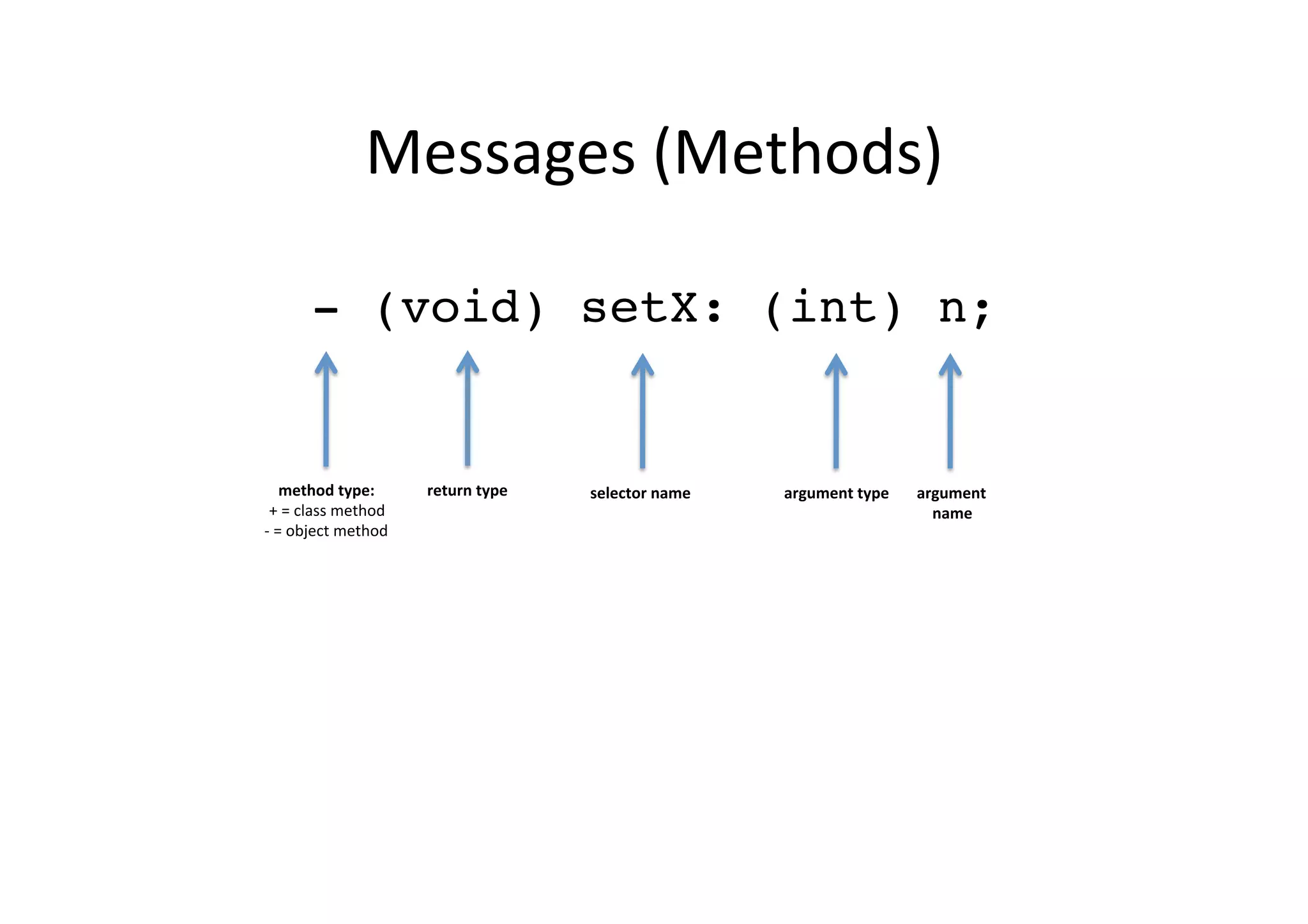
           - (void) setX: (int) n;!


        method	
  type:	
          return	
  type	
     selector	
  name	
     argument	
  type	
     argument	
  
   +	
  =	
  class	
  method	
                                 	
                   	
                  name	
  
-­‐	
  =	
  object	
  method	
                                                                            	
  
Messages,	
  with	
  Two	
  Arguments	
  

Declara=on	
  
   - (void) setXAndY: (int) x: (int) y
Usage	
  
   [object setXAndY: 5: 6];
Declara=on,	
  be@er	
  way	
  
   - (void) setX: (int) x andY: (int) y
Usage	
  
   [object setX: 5 andY: 6];
EXERCISES	
  
MEMORY	
  MANAGEMENT	
  AND	
  OBJECT	
  
LIFECYCLE	


Memory	
  Handling	
  in	
  General	
  
•  When	
  allocate	
  something	
  it	
  must	
  be	
  released	
  
    –  Memory	
  consump)on	
  
•  In	
  Java,	
  garbage	
  collector	
  takes	
  care	
  of	
  the	
  
   release.	
  Separate	
  thread	
  looking	
  for	
  objects	
  
   that	
  can	
  be	
  released	
  
•  In	
  Obj-­‐C	
  and	
  C/C++,	
  programmer	
  is	
  
   responsible	
  about	
  the	
  release.	
  
About	
  Pointers	
  
•  int	
  a	
  =	
  5;	
  
      –  Holds	
  one	
  integer	
  value	
  
      –  The	
  integer	
  is	
  stored	
  in	
  some	
  memory	
  address	
  
•  Where?	
  
      –  You	
  can	
  get	
  the	
  memory	
  address	
  by	
  using	
  &	
  in	
  
         front	
  of	
  the	
  variable:	
  &a	
  
Example	
  of	
  Memory	
  Address	
  
int main(int argc, char *argv[])
{
    int a = 5;

    // prints 5
    NSLog(@"%i", a);

    // prints something like 0x7fff5fbff9cc
    NSLog(@"%p", &a);

    return 0;
}
Pointers	
  
•  Pointer	
  is	
  a	
  variable	
  that	
  stores	
  memory	
  
   address	
  
•  int	
  a;	
  
     –  holds	
  integer	
  variable	
  
•  int*	
  b;	
  
     –  holds	
  memory	
  address	
  that	
  points	
  to	
  integer	
  value	
  
•  int*	
  b	
  =	
  &a;	
  
     –  Now	
  b	
  has	
  the	
  memory	
  address	
  of	
  a	
  
Example	
  about	
  Pointers	
  
#import "MyPoint.h"

int main(int   argc, char *argv[])
{
    int a =    5;
    // Store   a's memory address to variable b
    int *b =   &a;

    // prints 5
    NSLog(@"%i", a);

    // prints something like 0x7fff5fbff9cc
    NSLog(@"%p", &a);

    // prints something like 0x7fff5fbff9cc
    NSLog(@"%p", b);

    // prints 5
    NSLog(@"%i", *b);

    return 0;
}
What	
  is	
  the	
  result	
  now?	
  
int main(int   argc, char *argv[])
{
    int a =    5;
    // Store   a's memory address to variable b
    int *b =   &a;

    if(b == &a)
    {
        NSLog(@"Do we go here?");
    }

    if(*b == a)
    {
        NSLog(@"What about here?");
    }

    return 0;
}
What	
  is	
  the	
  result	
  now?	
  
int main(int argc, char *argv[])
{
    int a = 5;
    int *b = &a;

    *b = 10;

    NSLog(@"%i", a);

    return 0;
}
Memory	
  Areas	
  
•  Memory	
  can	
  be	
  divided	
  into	
  three	
  categories	
  
   1.  Global	
  or	
  sta)c	
  
   2.  Stack	
  
   3.  Heap	
  
Sta)c	
  
•  When	
  something	
  is	
  in	
  sta)c	
  memory,	
  it's	
  there	
  
   all	
  the	
  )me	
  when	
  app	
  is	
  running	
  
•  So	
  when	
  star)ng	
  the	
  app,	
  the	
  memory	
  is	
  
   allocated	
  an	
  when	
  the	
  app	
  closes,	
  the	
  memory	
  
   is	
  deallocated	
  
•  The	
  variable	
  is	
  stored	
  in	
  the	
  same	
  memory	
  
   address	
  all	
  the	
  )me.	
  
Example	
  of	
  Sta)c	
  Memory	
  
int thisIsStoredInStaticMemory = 5;

int main(int argc, char *argv[])
{
    static int thisIsAlsoStoredInStaticMemory = 10;

    NSLog(@"My number = %i", thisIsStoredInStaticMemory);
    NSLog(@"My number = %i", thisIsAlsoStoredInStaticMemory);

    return 0;
}
Stack	
  -­‐	
  Memory	
  
•  Stack	
  –	
  memoryarea	
  is	
  usually	
  small	
  
•  If	
  you	
  put	
  too	
  much	
  "stuff"	
  into	
  stack,	
  you	
  
   might	
  get	
  stack	
  overflow	
  
•  Local	
  variables	
  are	
  stored	
  in	
  stack!	
  
•  Variables	
  are	
  released	
  when	
  out	
  of	
  scope	
  
Example	
  of	
  Stack	
  Memory	
  
int main(int argc, char *argv[])
{
    int stack1 = 3;

    NSLog(@"My number = %i", stack1);

    if(YES)
    {
        int stack2 = 4;
        NSLog(@"My number = %i", stack2);
        // stack2 is released from memory now.
    }

    // stack1 is released from memory now.
    return 0;
}
Example	
  of	
  Stack	
  Memory	
  
int main(int argc, char *argv[])
{
    if(YES)
    {
        int stack2 = 4;
    }

    // Does this work?
    NSLog(@"My number = %i", stack2);
    return 0;
}
Heap	
  -­‐	
  Memory	
  
•  Heap	
  –	
  memory	
  is	
  the	
  large	
  memory	
  area	
  
   where	
  almost	
  all	
  of	
  the	
  objects	
  go.	
  
•  Programmer	
  is	
  responsible	
  for	
  releasing	
  the	
  
   objects!	
  	
  
Example	
  of	
  Heap	
  -­‐	
  memory	
  
#import "MyPoint.h"

int main(int argc, char *argv[])
{
    MyPoint* point = [MyPoint alloc];
    //...
    [point release];

    return 0;
}
Crea)ng	
  a	
  Object	
  
•  The	
  crea)on	
  of	
  an	
  object	
  is	
  done	
  in	
  two	
  parts	
  
•  1)	
  Alloca)ng	
  memory	
  
    –  MyPoint* point = [MyPoint alloc];
•  2)	
  Ini)alize	
  object	
  state	
  
    –  point = [point init];
•  Combined	
  
    –  MyPoint* point = [[MyPoint alloc] init];
•  ó	
  
    –  MyPoint* point = [MyPoint new];
What	
  happens	
  in	
  Memory?	
  
•  What	
  happens	
  in	
  here?	
  
    –  MyPoint* p = [MyPoint alloc];
•  Two	
  things!	
  
    –  MyPoint* p;
    –  p = [MyPoint alloc];
•  p	
  is	
  in	
  stack	
  –	
  memory!	
  
•  MyPoint	
  object	
  is	
  in	
  heap	
  memory!	
  
Problem?	
  
#import "MyPoint.h"

int main(int argc, char *argv[])
{
    if(YES)
    {
          MyPoint* point = [MyPoint alloc];
    }

    [point release];

    return 0;
}
Problem?	
  
#import "MyPoint.h"

int main(int argc, char *argv[])
{
    MyPoint* point = [MyPoint alloc];
    point = [MyPoint alloc];

    [point release];

    return 0;
}
init-­‐method?	
  
•  init-­‐method	
  is	
  implemented	
  in	
  NSObject
•  You	
  can	
  however	
  implement	
  your	
  own	
  init-­‐
   method	
  

- (id) initWithName: (NSString*) aName
{
    if(self = [super init])
    {
         name = aName;
    }
    return self;
}
Other	
  init-­‐methods	
  
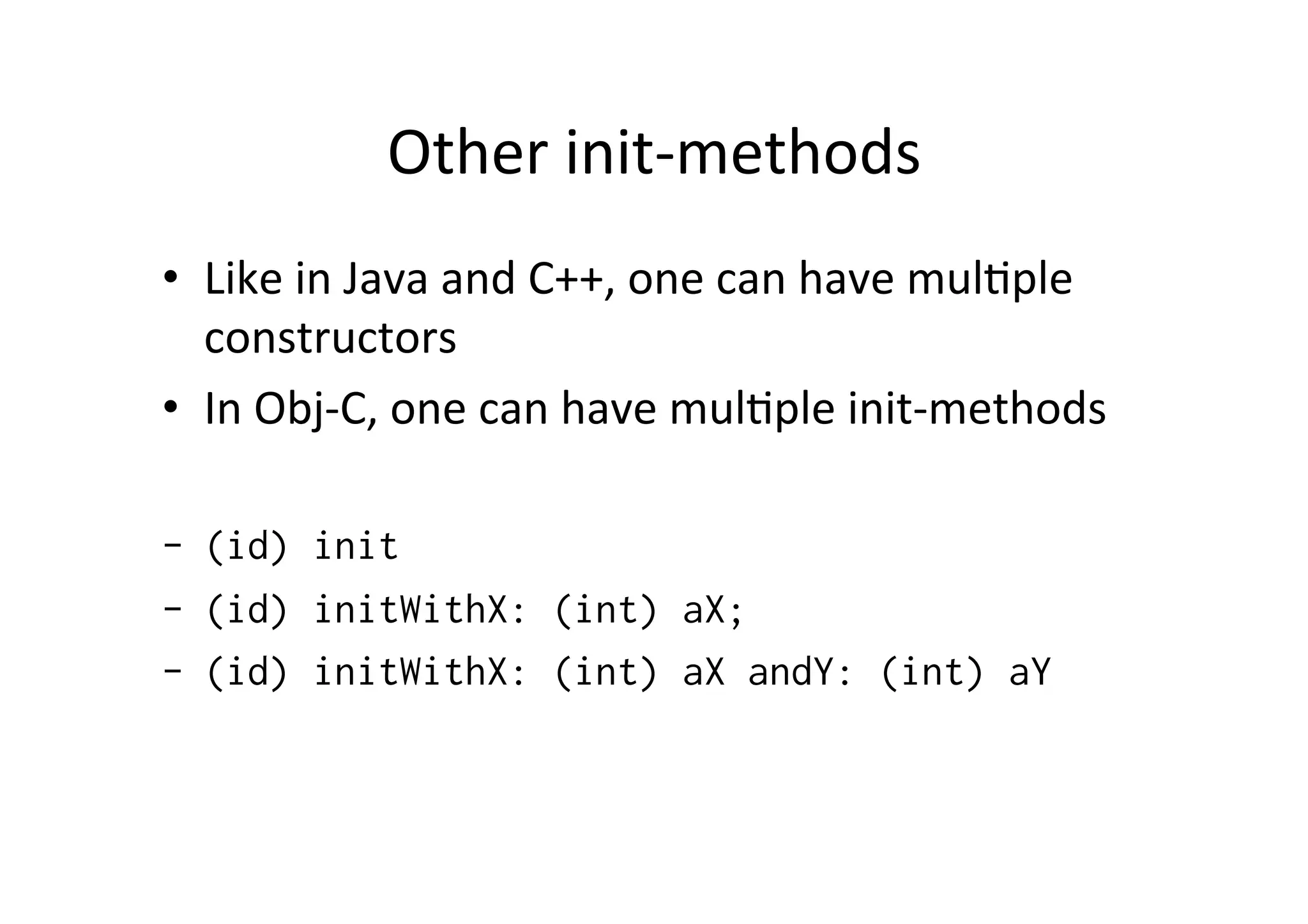
•  Like	
  in	
  Java	
  and	
  C++,	
  one	
  can	
  have	
  mul)ple	
  
   constructors	
  
•  In	
  Obj-­‐C,	
  one	
  can	
  have	
  mul)ple	
  init-­‐methods	
  

-  (id) init
-  (id) initWithX: (int) aX;
-  (id) initWithX: (int) aX andY: (int) aY
Deallocing	
  Object	
  and	
  Reference	
  Count	
  

•  Rules	
  about	
  reference	
  coun=ng	
  
    –  When	
  object	
  is	
  created	
  its	
  reference	
  count	
  is	
  set	
  to	
  1	
  
    –  Incremen)ng	
  the	
  reference	
  count:	
  
          •  [point retain];
    –  Decreasing	
  reference	
  count	
  
          •  [point release];
    –  When	
  reference	
  count	
  reaches	
  to	
  0,	
  dealloca=ng	
  occurs	
  
•  ARC	
  will	
  save	
  you	
  from	
  this!	
  
Reference	
  Count	
  Example	
  
#import <Foundation/Foundation.h>

@interface Cat : NSObject
{

}

- (void) printMyRetainCount;

@end

@implementation Cat

- (void) printMyRetainCount
{
    NSLog(@"Retain count = %i", [self retainCount]);
}

@end
Reference	
  Count	
  Example	
  
int main(int argc, char *argv[])
{
    Cat* myCat = [[Cat alloc] init];
    [myCat printMyRetainCount]; // Retain count = 1

    Cat* reference = myCat;
    [reference retain];
    [myCat printMyRetainCount]; // Retain count = 2

    [myCat release];
    [myCat printMyRetainCount]; // Retain count = 1
    [myCat release];            // Deallocation

    return 0;
}
dealloc
•  You	
  can	
  implement	
  a	
  dealloc	
  method	
  

(void) dealloc
{
   // Some code
   [super dealloc];
}
Reference	
  Count	
  Example	
  
#import <Foundation/Foundation.h>        int main(int argc, char *argv[])
                                         {
@interface Cat : NSObject                   ....
{                                           Cat* mirri = [[Cat alloc] init];
    NSString* name;                         [mirri setName: someName];
}                                           // What happens now?
                                            [someName release];
- (void) setName: (NSString *) theName
                                         }
@end                                                Since	
  reference	
  count	
  is	
  
                                                     0,	
  dealloca)on	
  occurs.	
  
@implementation Cat                                 This	
  means,	
  that	
  the	
  Cat	
  
                                                     does	
  not	
  have	
  a	
  name	
  
- (void) setName: (NSString *) theName                         anymore.	
  
{
   name = theName;
}
@end
Reference	
  Count	
  Example	
  
#import <Foundation/Foundation.h>        int main(int argc, char *argv[])
                                         {
@interface Cat : NSObject                   ....
{                                           Cat* mirri = [[Cat alloc] init];
    NSString* name;                         [mirri setName: someName];
}                                           // What happens now?
                                            [someName release];
- (void) setName: (NSString *) theName
                                         }
@end
                                                    Since	
  reference	
  count	
  is	
  
                                                    1,	
  dealloca)on	
  does	
  not	
  
@implementation Cat
                                                     occur	
  and	
  the	
  Cat	
  s)ll	
  
                                                            has	
  it's	
  name.	
  
- (void) setName: (NSString *) theName
{
   [name release];
   name = theName;
   [name retain];
}
@end
Copying	
  a	
  Object	
  
- (void)setName:(NSString *)theName
}
    [name release];
    name = [theName copy];
}
Autorelease	
  Pool	
  
•  Every	
  Founda)on	
  program	
  must	
  set	
  up	
  
   autorelease	
  pool	
  for	
  the	
  Founda)on	
  objects	
  
•  Pool	
  keeps	
  track	
  of	
  your	
  objects	
  for	
  later	
  
   release	
  
    –  NSAutoreleasePool *pool = [[NSAutoreleasePool
       alloc] init];
    –  ...
    –  [pool drain];
Method	
  Names	
  
•  If	
  method	
  name	
  includes	
  alloc	
  or	
  copy,	
  it	
  
   returns	
  a	
  object	
  that	
  must	
  be	
  released	
  
    –    // Must be released
    –    NSObject* object = [[NSObject alloc] init];
    –    // Must be released
    –    NSObject* copy = [object copy];
    –    // Do not have to release
    –    NSMutableString* string = [NSMutableString string];
•  The	
  above	
  string	
  is	
  released	
  in	
  Autorelease	
  Pool!
Problem	
  
// Programmer A code
[[someObject giveCat] eat];


// Programmer B code
- (Cat*) giveCat
{
    // Must be released!
    Cat* myCat = [[Cat alloc] init];

     // But where? Should the programmer who calls this method be
     // responsible for deallocation of the Cat? How does the programmer
     // know this?
     return myCat;
}

..
Solu)on	
  
// Programmer A code
[[someObject giveCat] eat];


// Programmer B code
- (Cat*) giveCat
{
    // Must be released!
    Cat* myCat = [[Cat alloc] init];

    // But where? When autopool is drained!
    [myCat autorelease];
    return myCat;
}
Delayed	
  Release	
  
•  Autorelease	
  means	
  "send	
  release	
  message	
  
   later".	
  
•  Release	
  message	
  is	
  sent	
  when	
  Autorelease	
  
   Pool	
  is	
  released	
  
•  Autorelease	
  Pool	
  is	
  created	
  and	
  released	
  in	
  
   UIKit	
  programs	
  automa=cally!	
  
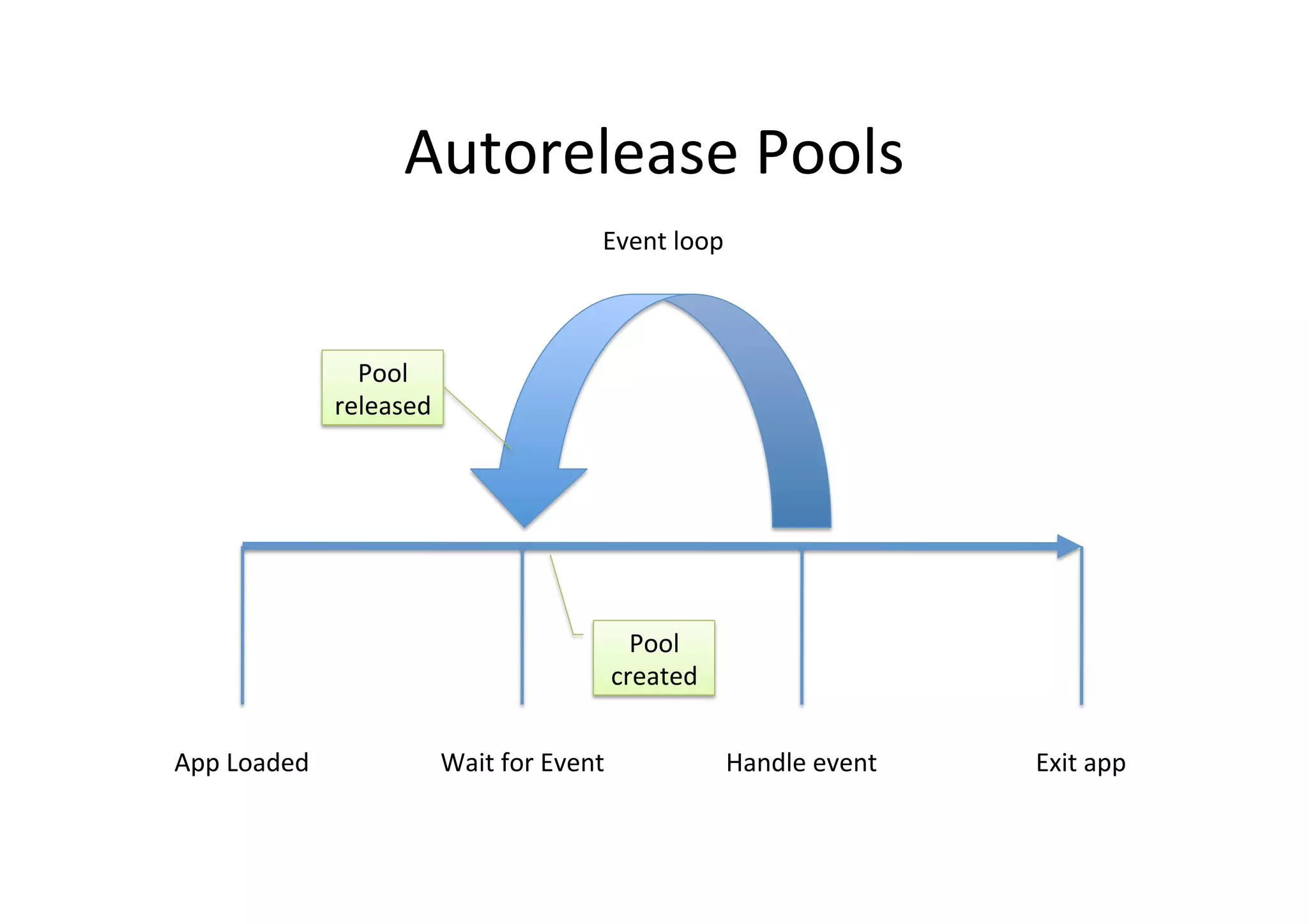
    –  Pool	
  is	
  created	
  at	
  the	
  beginning	
  of	
  an	
  event	
  cycle	
  
    –  Pool	
  is	
  released	
  at	
  the	
  end	
  of	
  an	
  event	
  cycle	
  
Autorelease	
  Pools	
  
                                                         Event	
  loop	


                      Pool	
  
                    released	


                                                                Pool	
  
                                                              created	


App	
  Loaded	
                    Wait	
  for	
  Event	
                   Handle	
  event	
     Exit	
  app	
  
Autorelease	
  Pool	
  Usage	
  
// Method
- (Cat*) giveCat
{
    // Must be released!
    Cat* myCat = [[Cat alloc] init];

    // But where? When autopool is drained!
    [myCat autorelease];
    return myCat;
}
// Usage
Cat* someCat = [object giveCat];
// someCat will be released in some time, so if you want to hold it, use
// retain
[someCat retain];
Rules	
  
•  If	
  method	
  name	
  contains	
  "alloc",	
  "new"	
  or	
  
   "copy",	
  you	
  must	
  remember	
  to	
  use	
  release
   or	
  autorelease
   –  Example:	
  alloc, newObject, mutableCopy
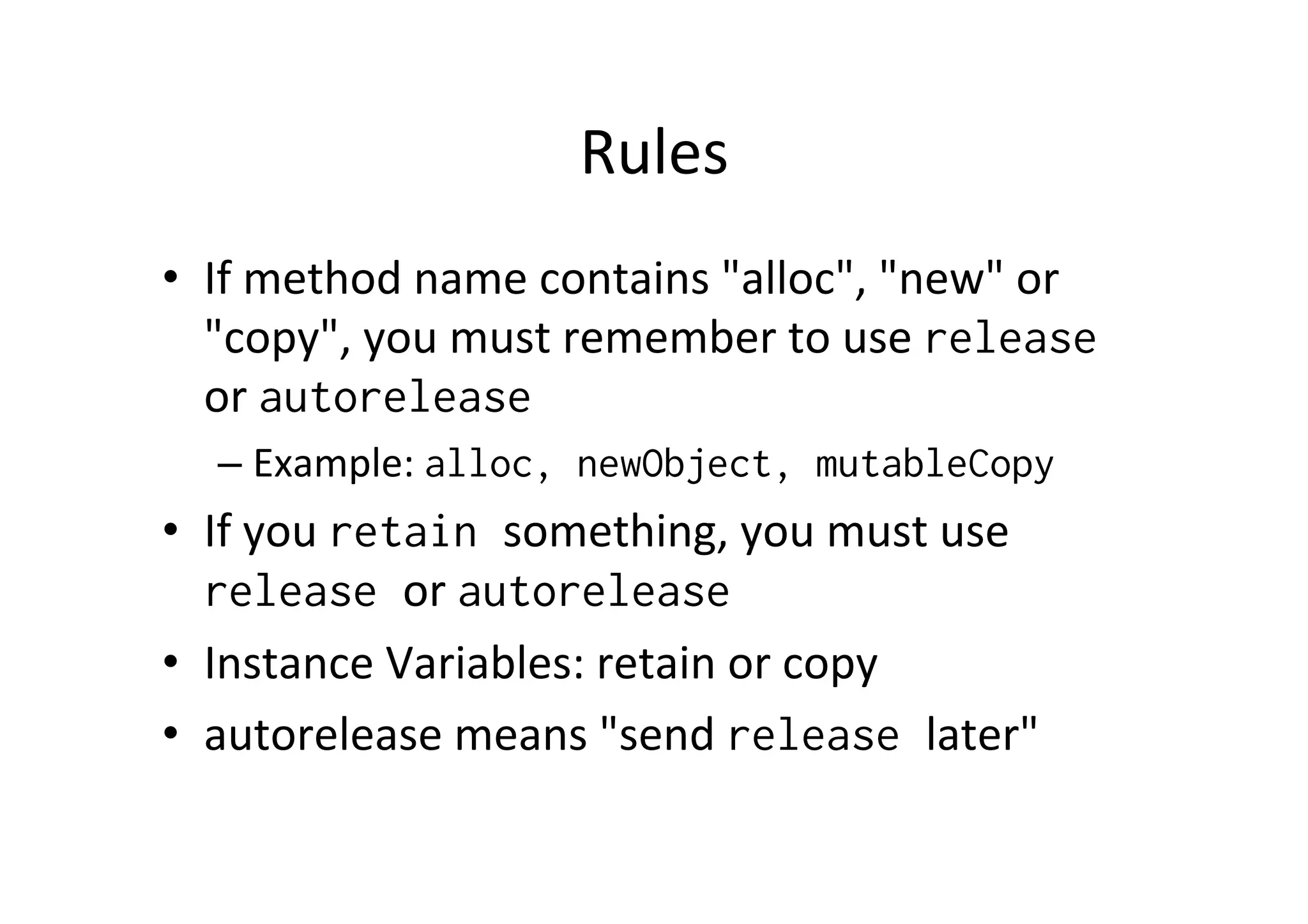
•  If	
  you	
  retain something,	
  you	
  must	
  use	
  
   release or	
  autorelease
•  Instance	
  Variables:	
  retain	
  or	
  copy	
  
•  autorelease	
  means	
  "send	
  release later"	
  
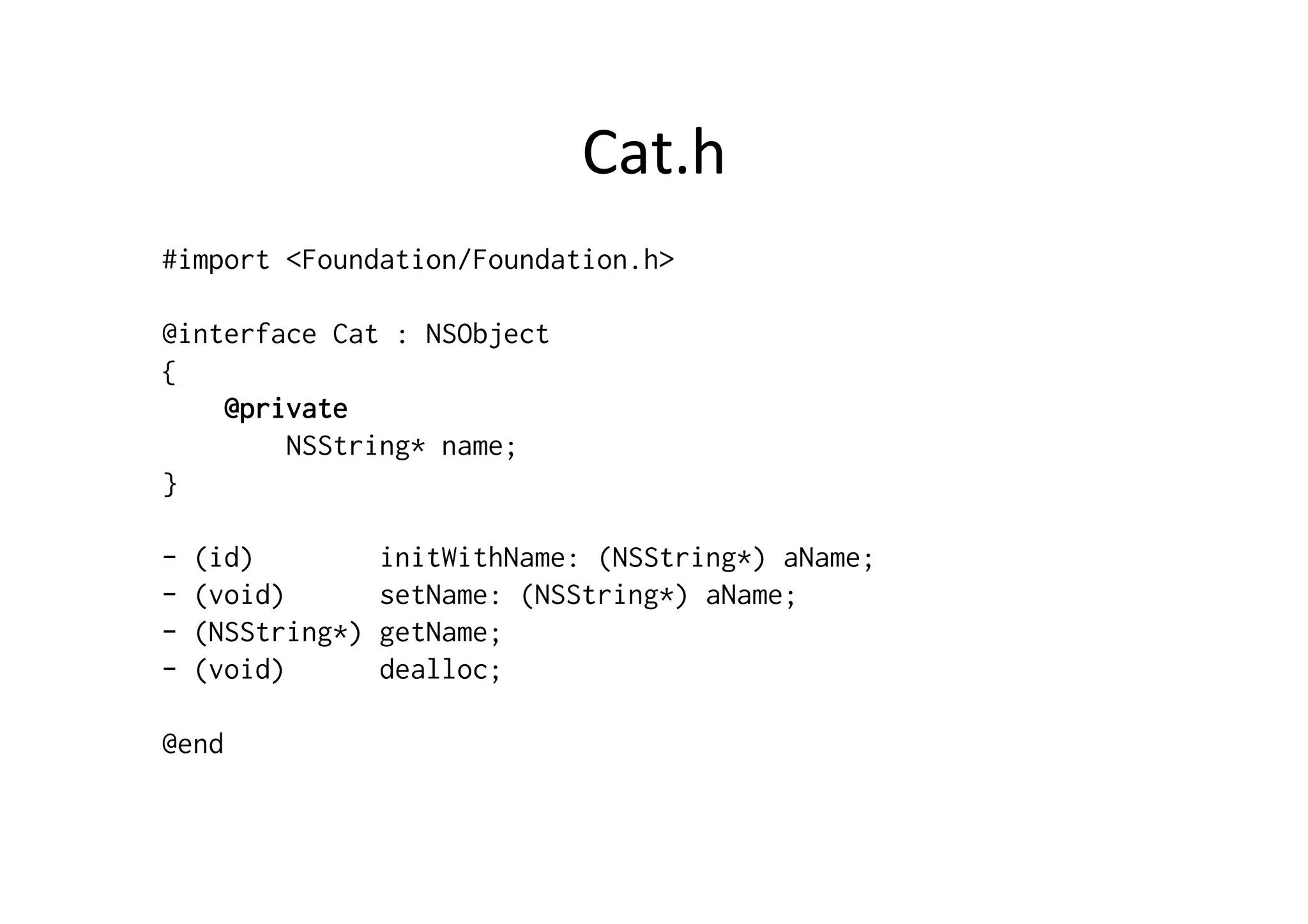
Cat.h	
  
#import <Foundation/Foundation.h>

@interface Cat : NSObject
{
    @private
        NSString* name;
}

-   (id)          initWithName: (NSString*) aName;
-   (void)        setName: (NSString*) aName;
-   (NSString*)   getName;
-   (void)        dealloc;

@end
Cat.m	
  
#import "Cat.h"                          - (void) setName: (NSString*) aName
                                         {
@implementation Cat                          if(aName != name)
                                             {
- (id) initWithName: (NSString*) aName           [name release];
{                                                name = aName;
    if(self = [super init])                      [name retain];
    {                                        }
        [self setName: aName];           }
    }
    return self;
}                                        - (void) dealloc
                                         {
- (NSString*) getName                        [name release];
{                                            [super dealloc];
    return name;                         }
}
                                         @end
main.m	
  
#import "Cat.h"                                 // Get the name
                                                NSString* name = [cat getName];
int main(int argc, char *argv[])
{                                               // Print the name
    NSAutoreleasePool *pool =                   NSLog(name);
    [[NSAutoreleasePool alloc] init];
                                                // Release name and cat
   // Create the string                         [cat release];
   NSString* catName = [[NSString
   alloc] initWithString: @"Jack"];
                                                [pool drain];
   // Create cat with the string                return 0;
   Cat* cat = [[Cat alloc]              }	
  
   initWithName: catName];

   // Just testing. This does not
   deallocate catName!
   [catName release];
ARC	
  to	
  the	
  rescue!	
  

MANAGING	
  MEMORY	
  WITH	
  ARC	
  
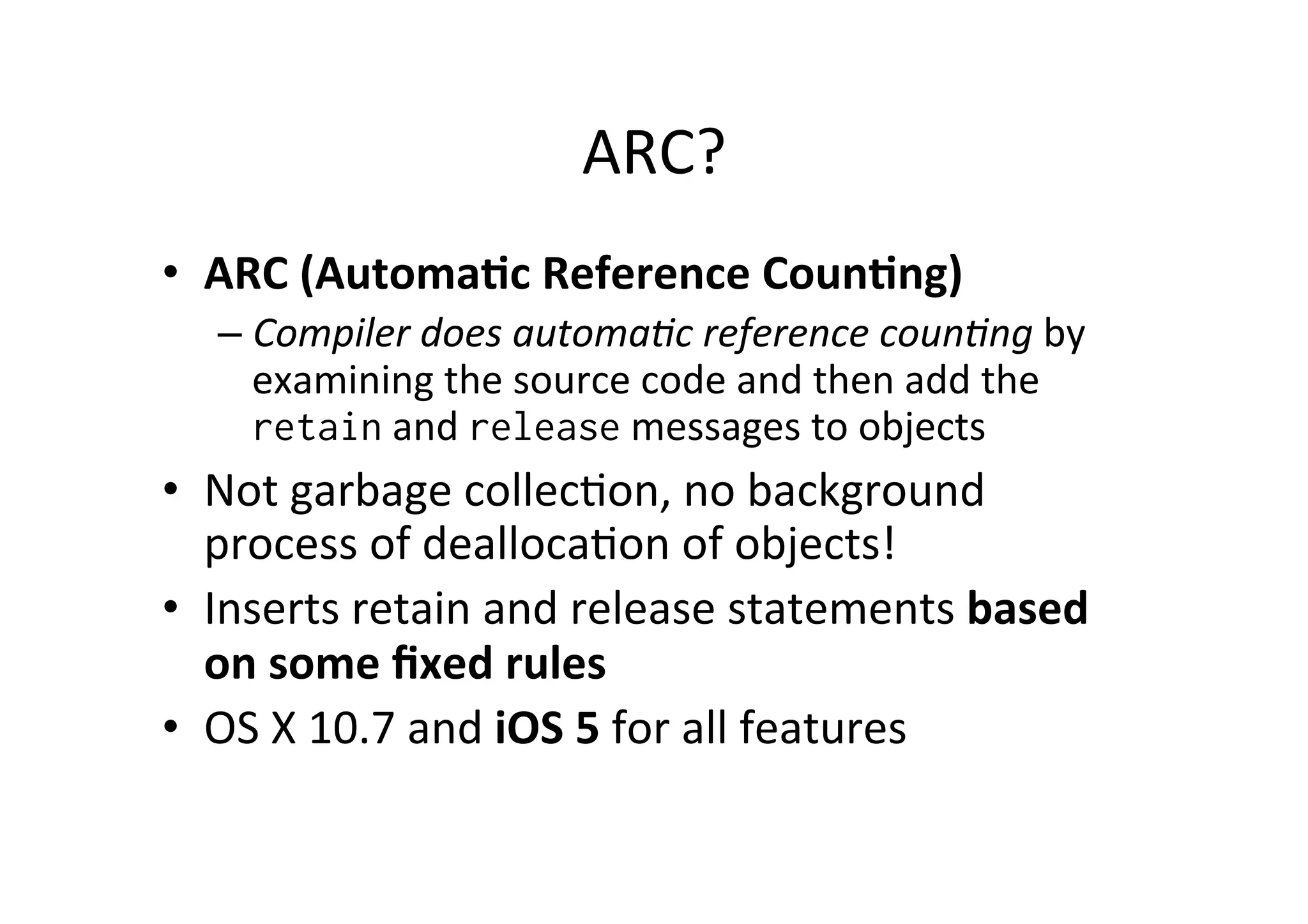
ARC?	
  
•  ARC	
  (Automa=c	
  Reference	
  Coun=ng)	
  
   –  Compiler	
  does	
  automa/c	
  reference	
  coun/ng	
  by	
  
      examining	
  the	
  source	
  code	
  and	
  then	
  add	
  the	
  
      retain	
  and	
  release	
  messages	
  to	
  objects	
  
•  Not	
  garbage	
  collec)on,	
  no	
  background	
  
   process	
  of	
  dealloca)on	
  of	
  objects!	
  
•  Inserts	
  retain	
  and	
  release	
  statements	
  based	
  
   on	
  some	
  fixed	
  rules	
  
•  OS	
  X	
  10.7	
  and	
  iOS	
  5	
  for	
  all	
  features	
  
Object	
  lose	
  owners	
  
// Scenario 1
Person* jack = [[Person alloc] init];
jack = [[Person alloc] init];

// Scenario 2
Person* tina = [[Person alloc] init];
tina = nil;

// Scenario 3
if(yes) {
   Person* dave = [[Person alloc] init];
}
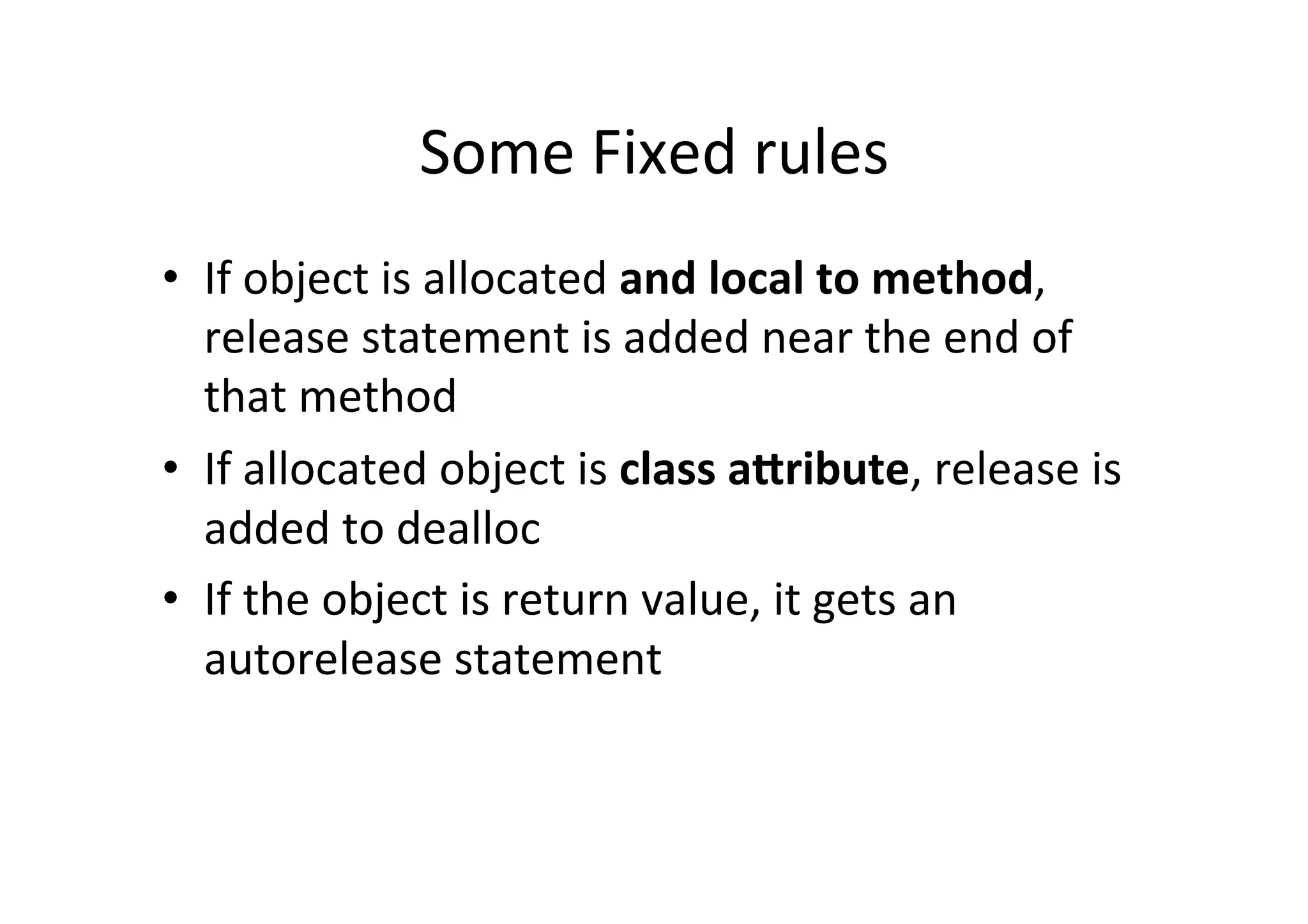
Some	
  Fixed	
  rules	
  
•  If	
  object	
  is	
  allocated	
  and	
  local	
  to	
  method,	
  
   release	
  statement	
  is	
  added	
  near	
  the	
  end	
  of	
  
   that	
  method	
  
•  If	
  allocated	
  object	
  is	
  class	
  a@ribute,	
  release	
  is	
  
   added	
  to	
  dealloc	
  
•  If	
  the	
  object	
  is	
  return	
  value,	
  it	
  gets	
  an	
  
   autorelease	
  statement	
  
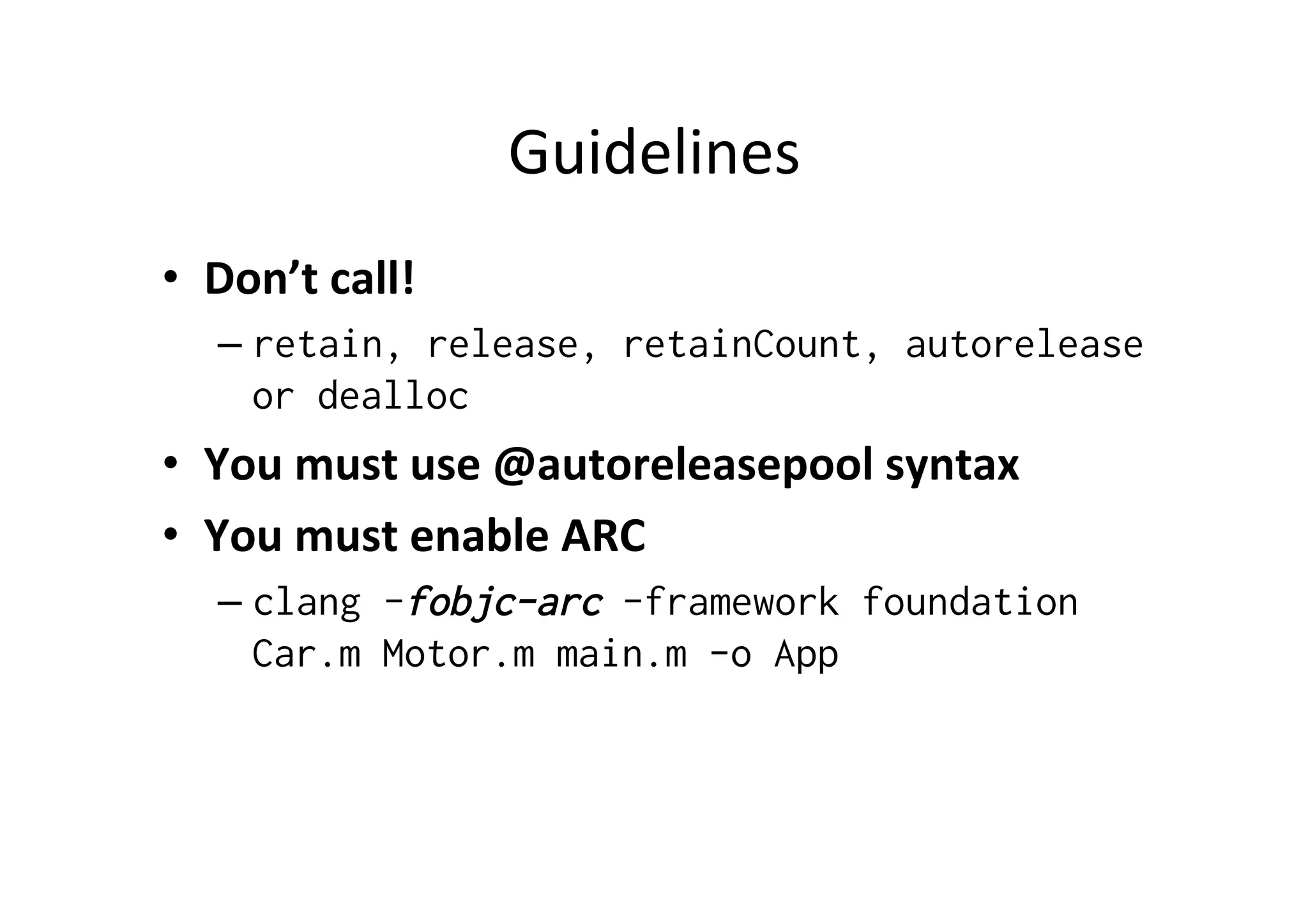
Guidelines	
  
•  Don’t	
  call!	
  
    –  retain, release, retainCount, autorelease
       or dealloc
•  You	
  must	
  use	
  @autoreleasepool	
  syntax	
  
•  You	
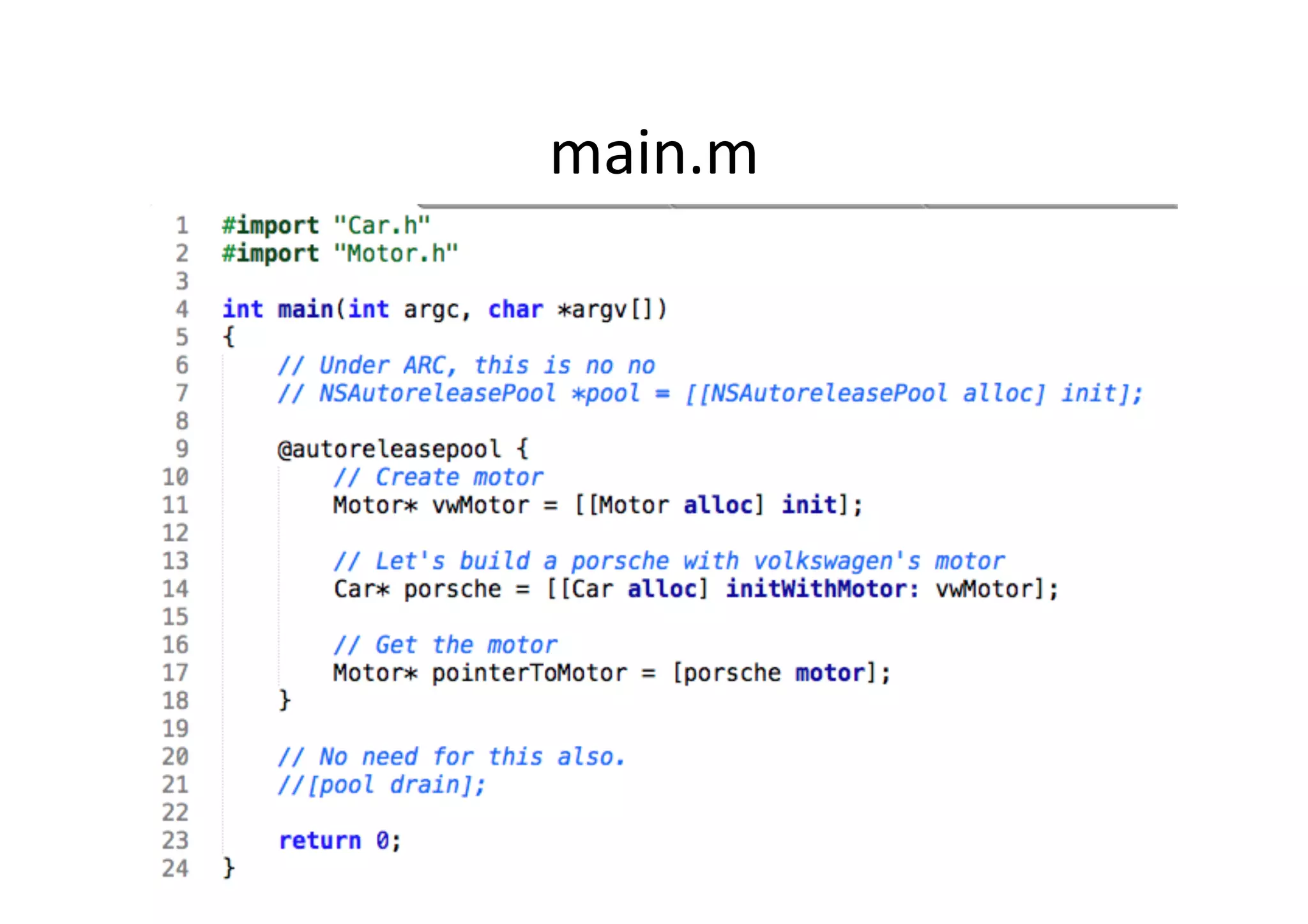
  must	
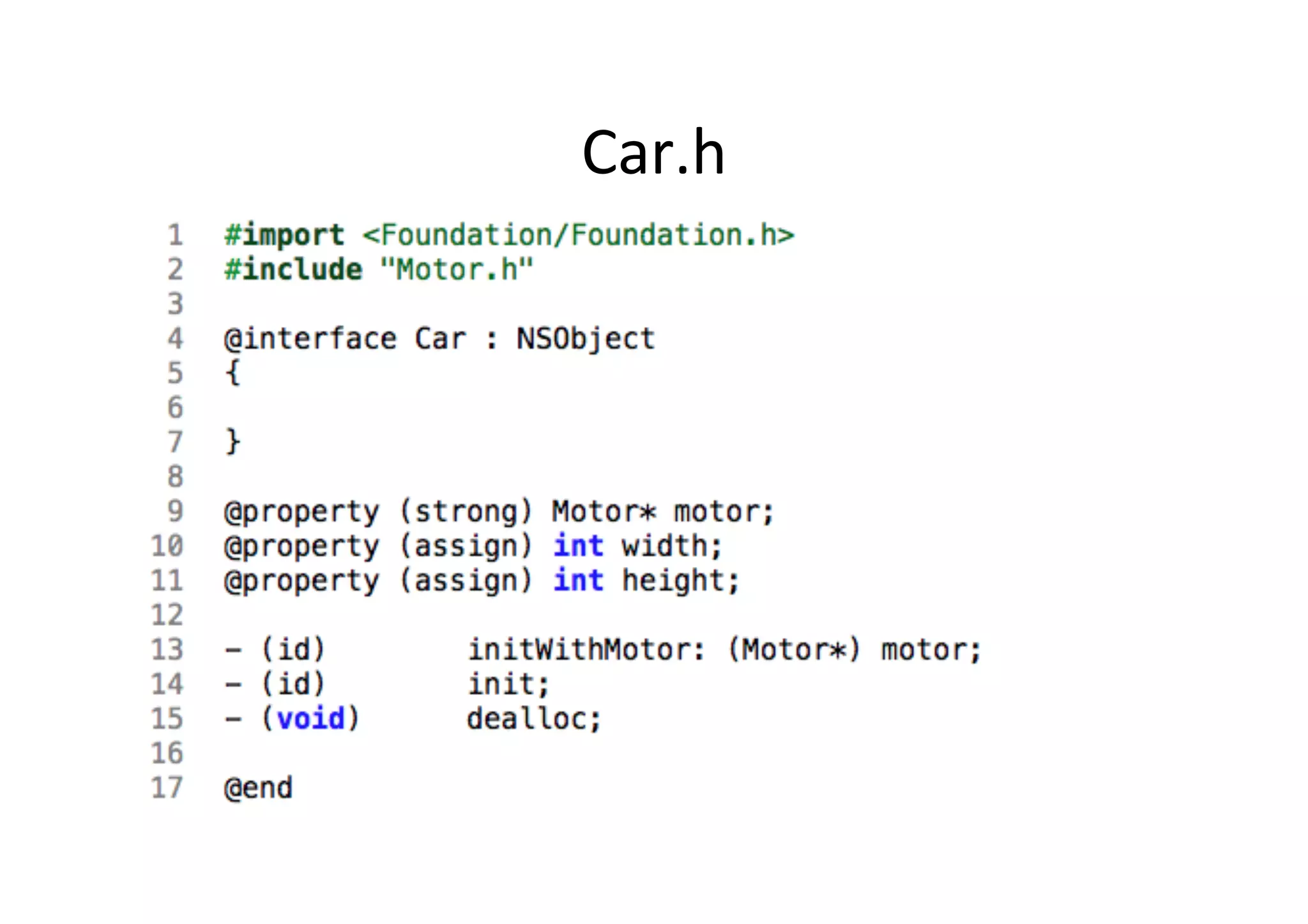
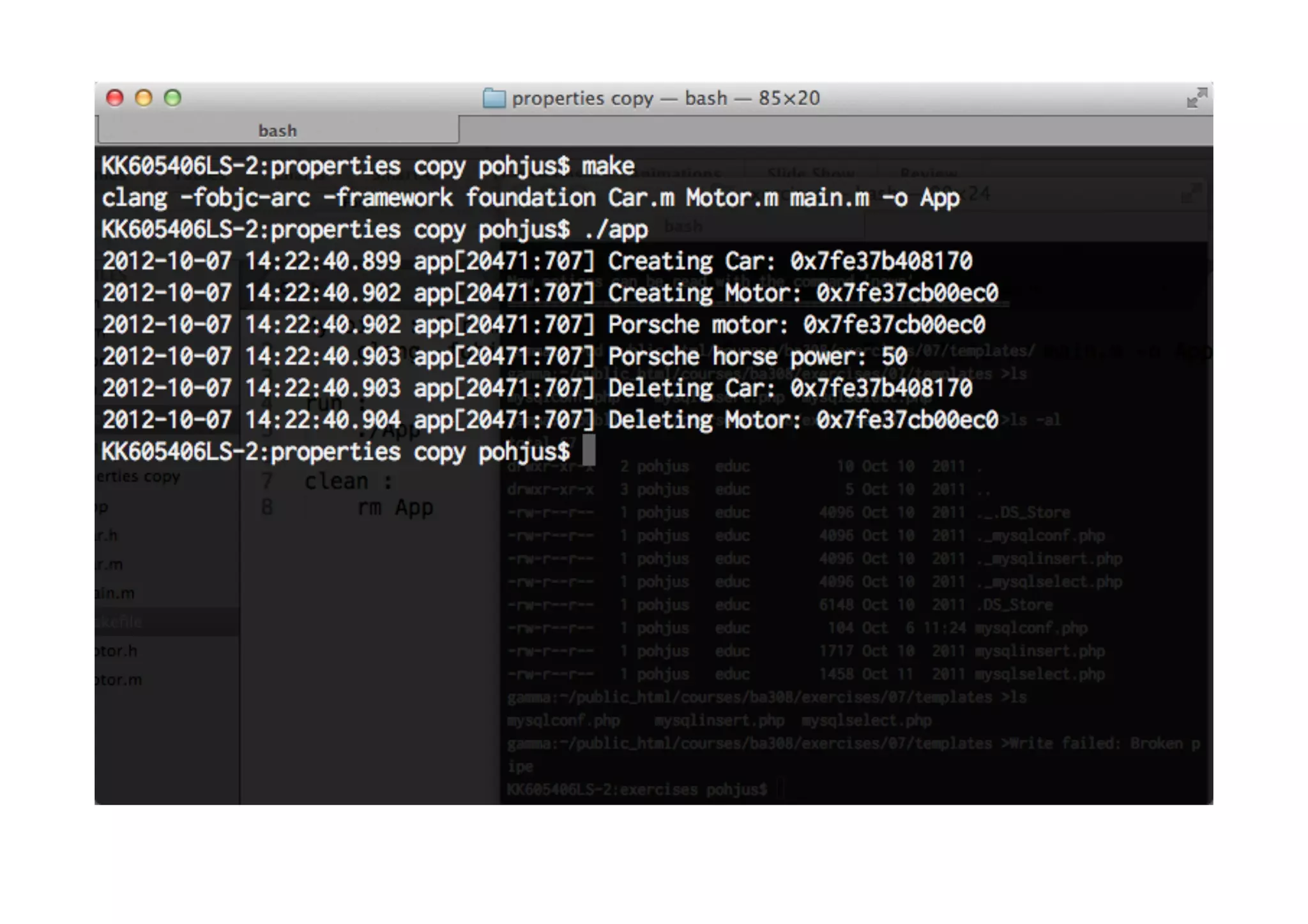
  enable	
  ARC	
  
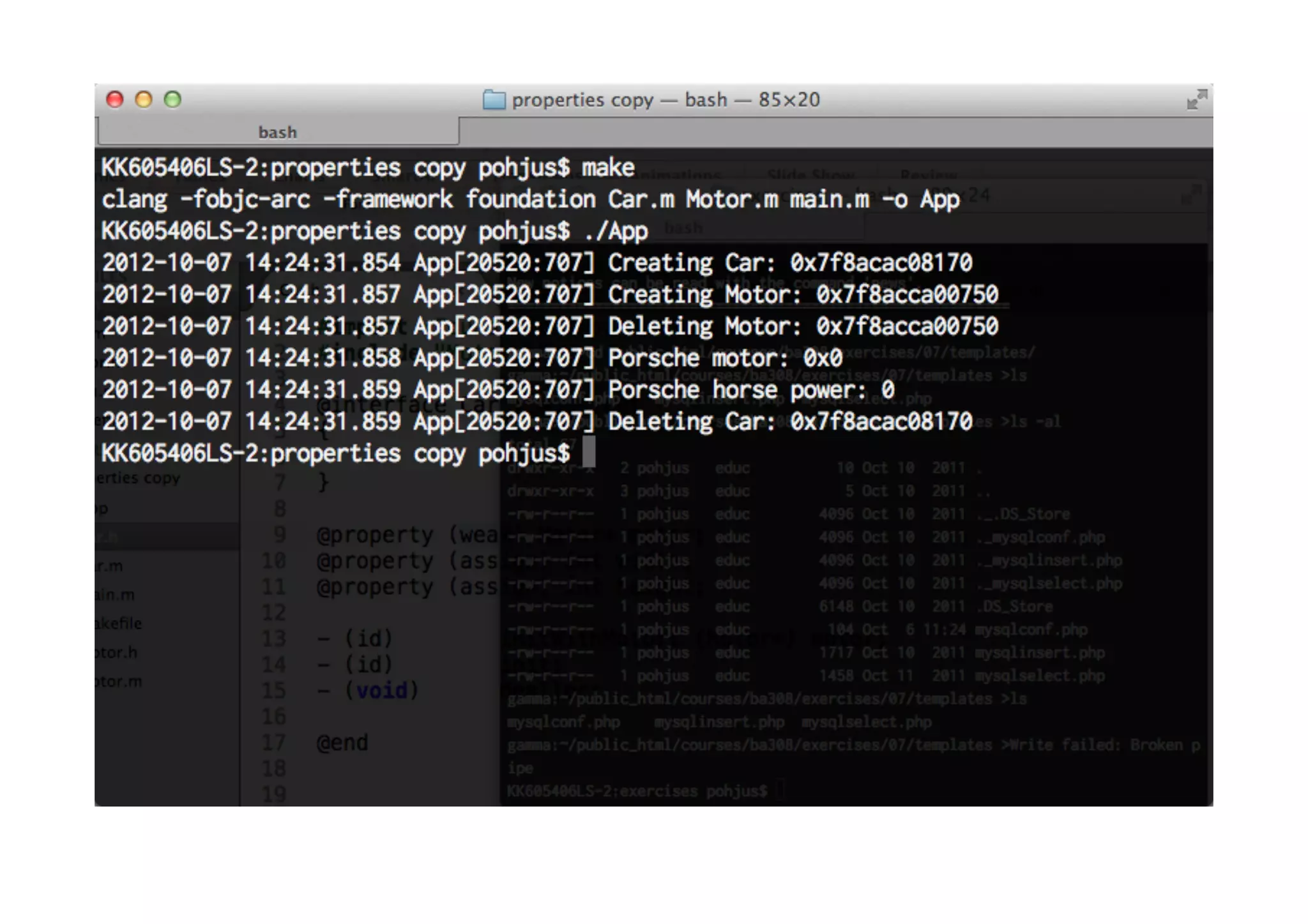
    –  clang -fobjc-arc -framework foundation
       Car.m Motor.m main.m -o App
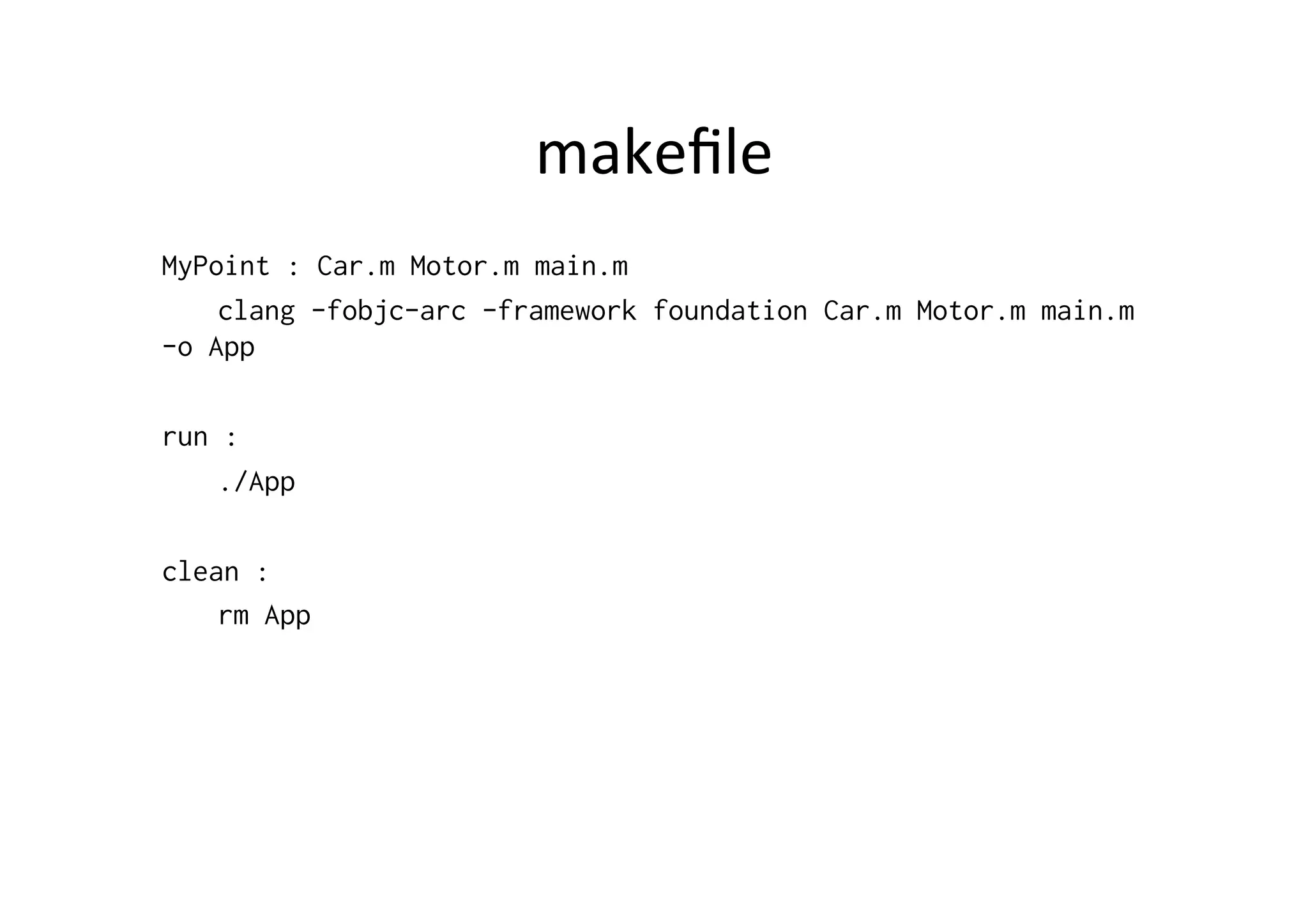
makefile	
  
MyPoint : Car.m Motor.m main.m
    clang -fobjc-arc -framework foundation Car.m Motor.m main.m
-o App

run :
    ./App

clean :
    rm App
main.m	
  
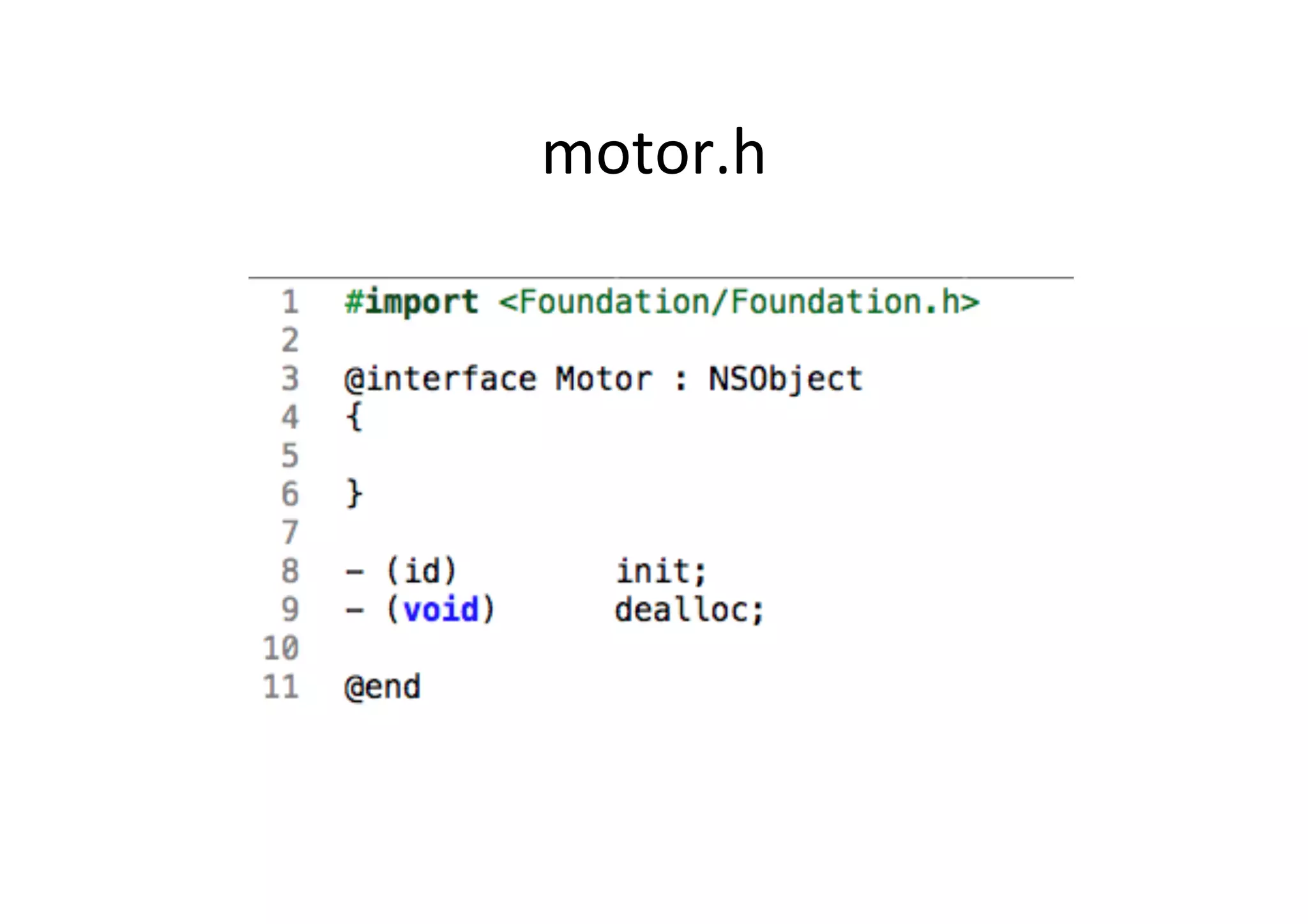
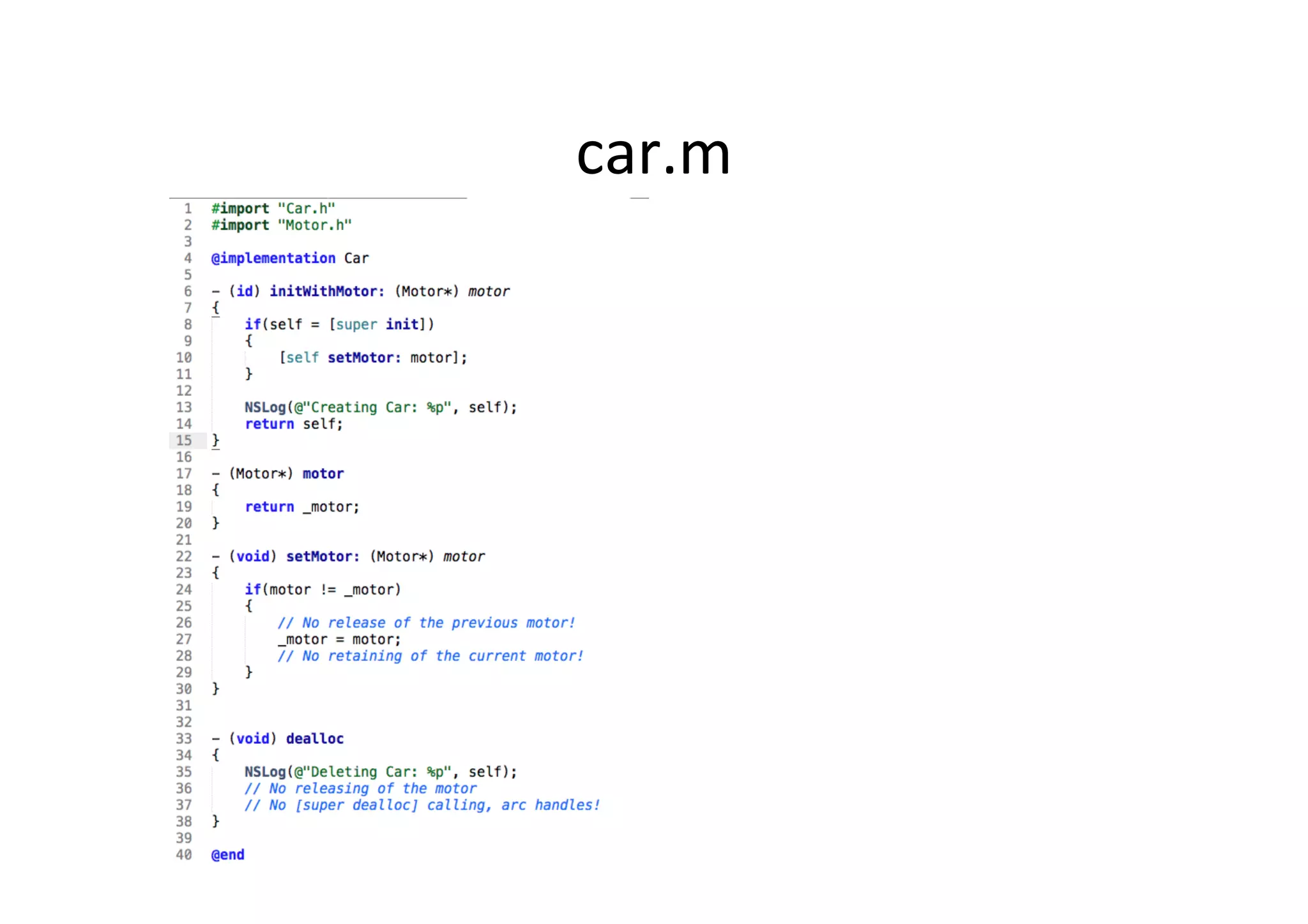
motor.h	
  
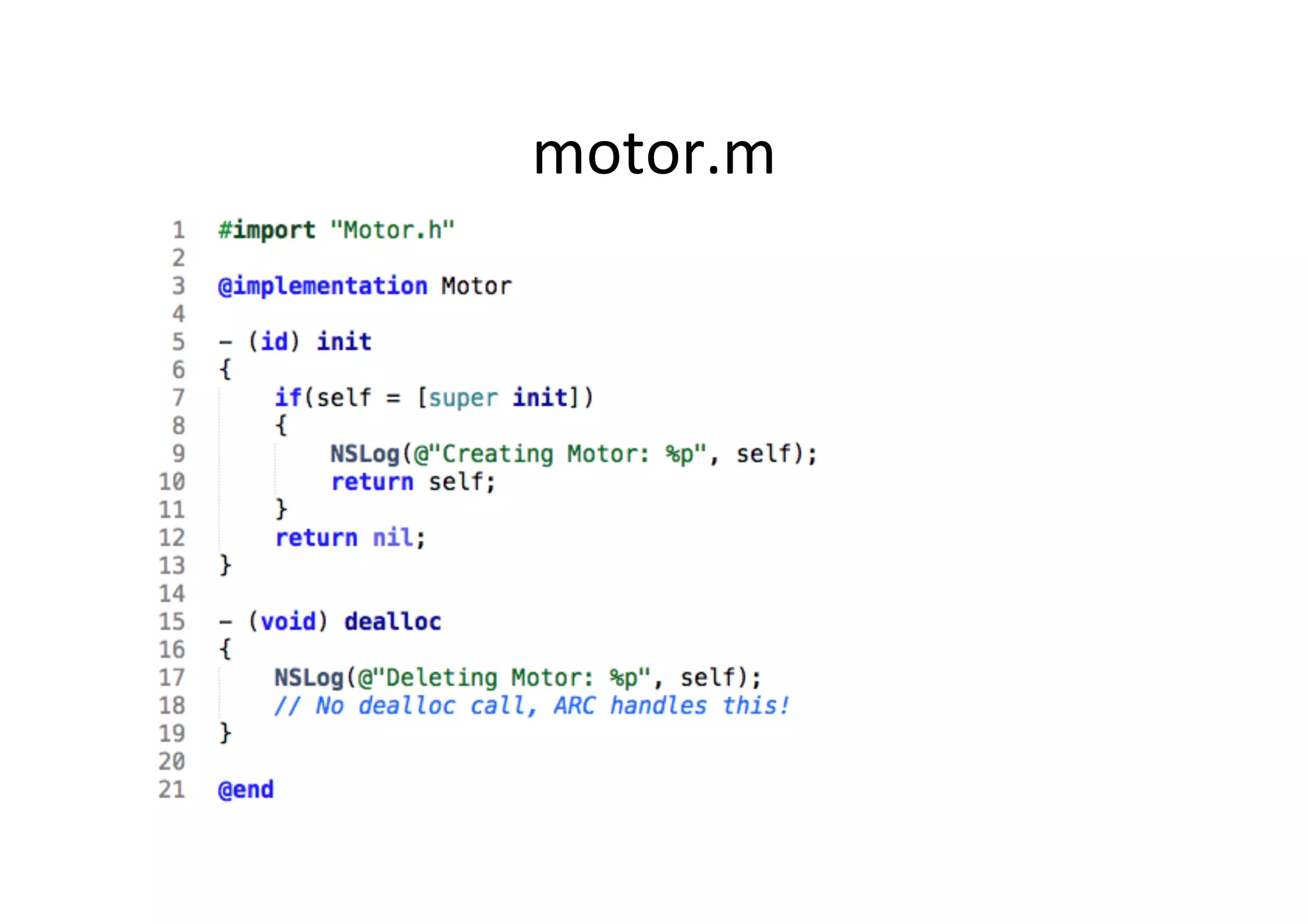
motor.m	
  
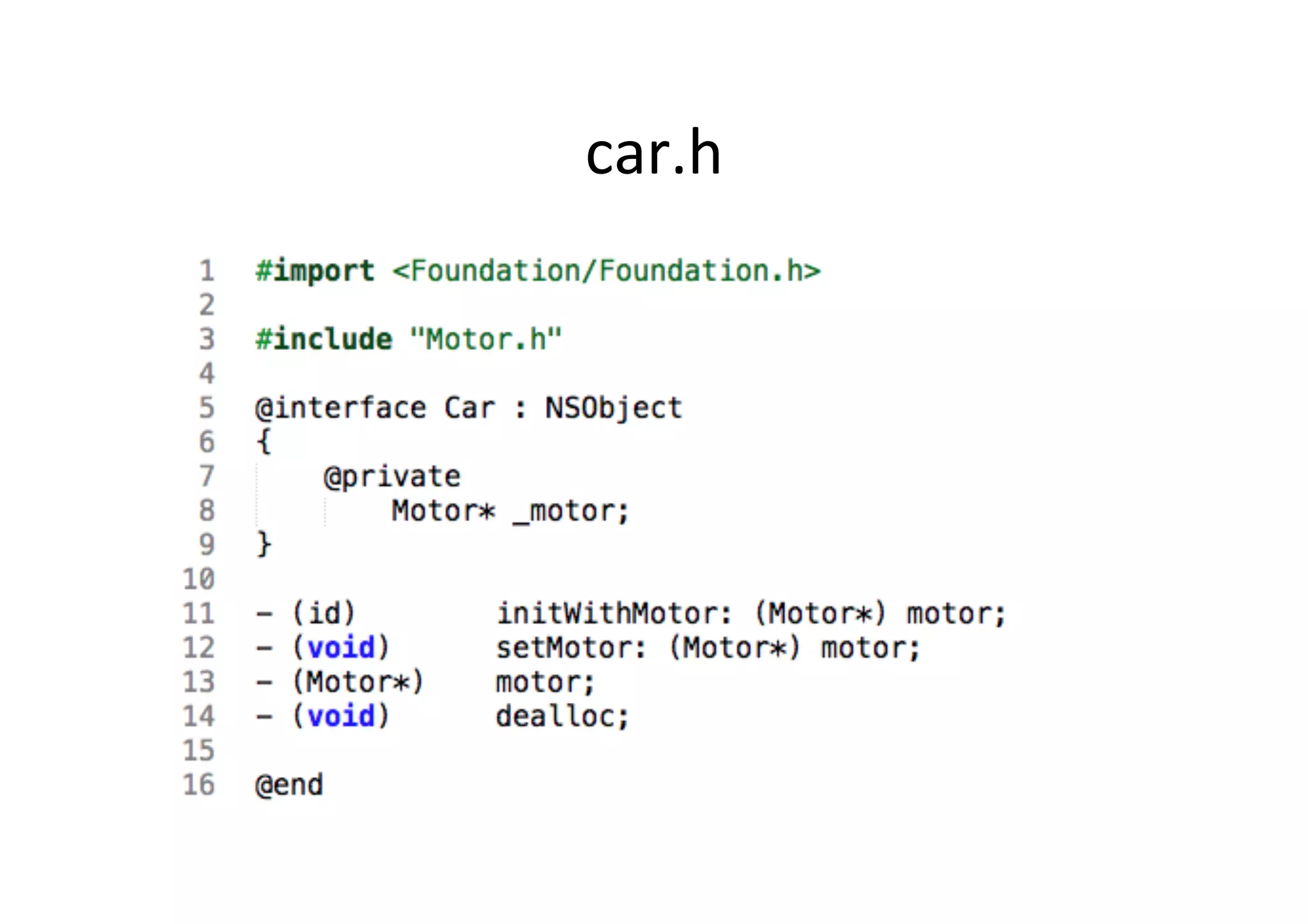
car.h	
  
car.m	
  
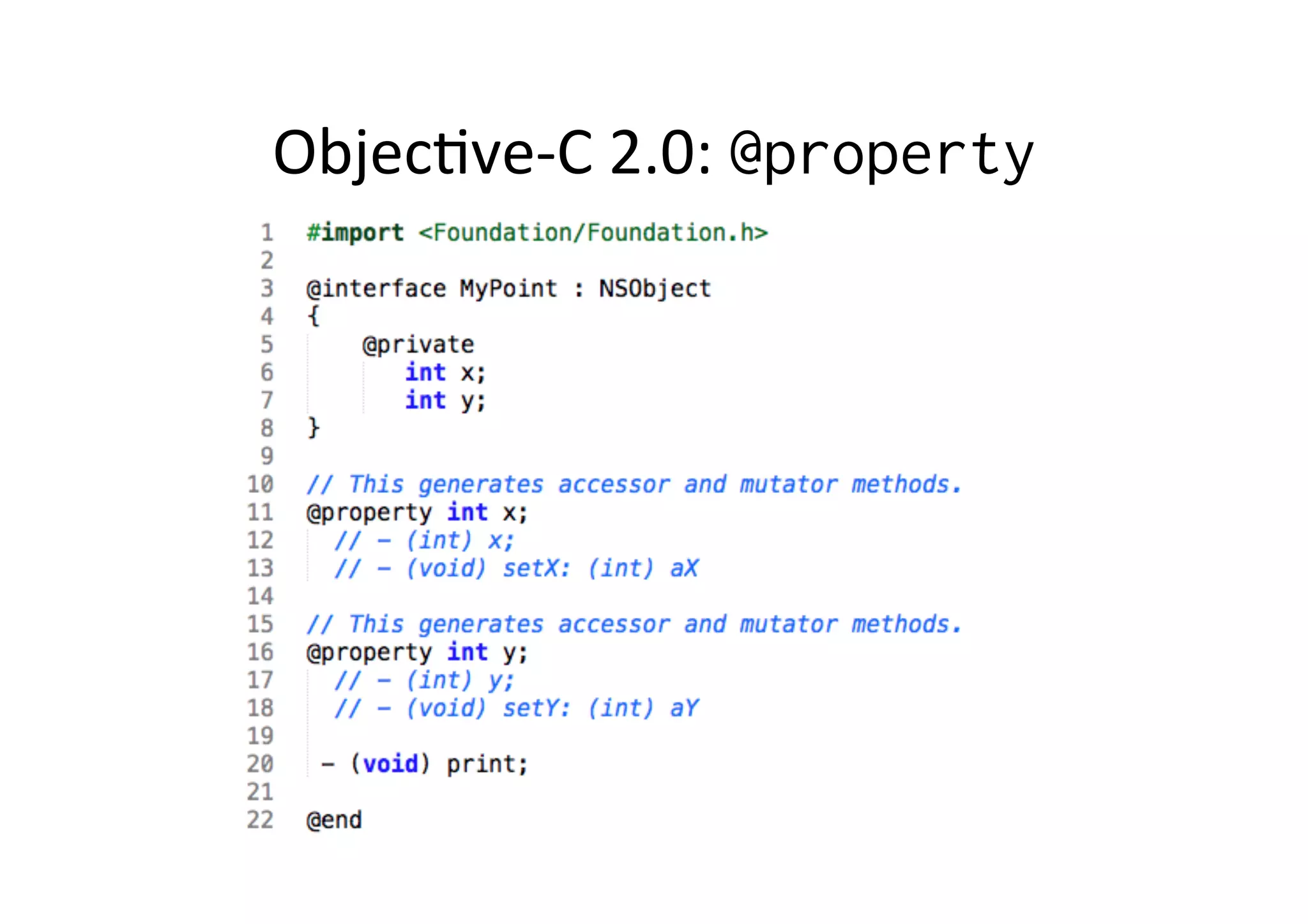
PROPERTIES	
  
Objec)ve-­‐C	
  2.0:	
  @property
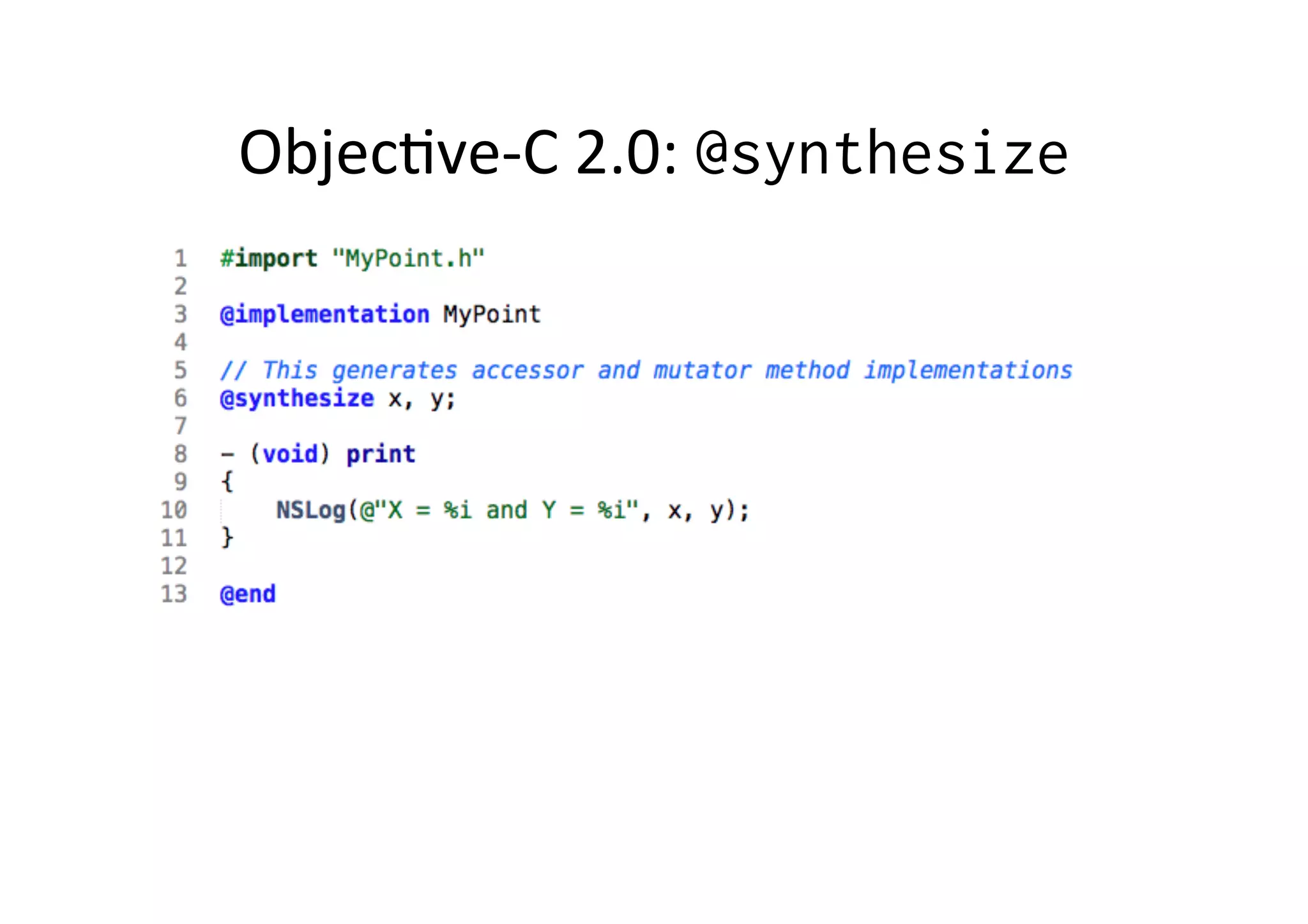
Objec)ve-­‐C	
  2.0:	
  @synthesize
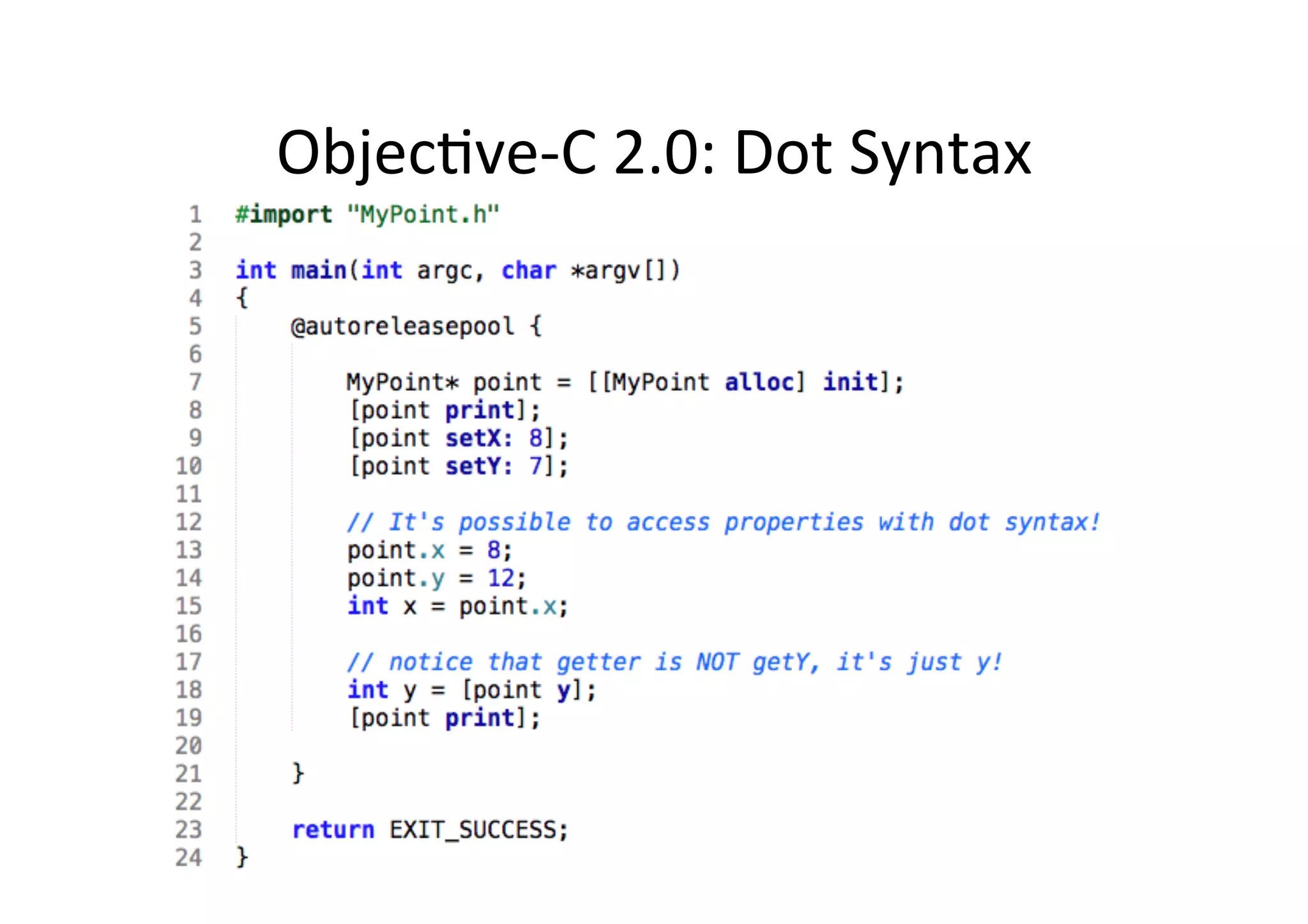
Objec)ve-­‐C	
  2.0:	
  Dot	
  Syntax	
  
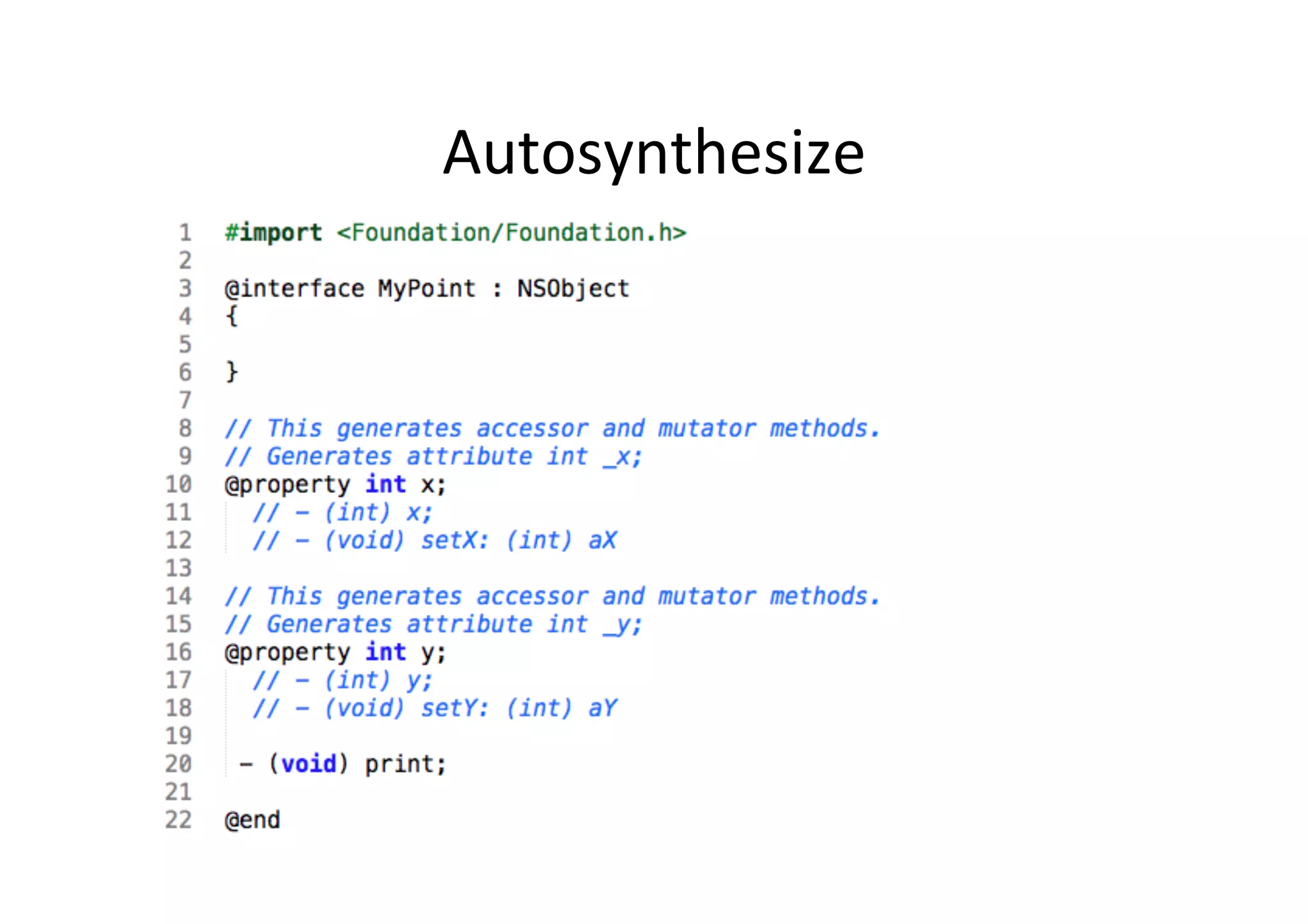
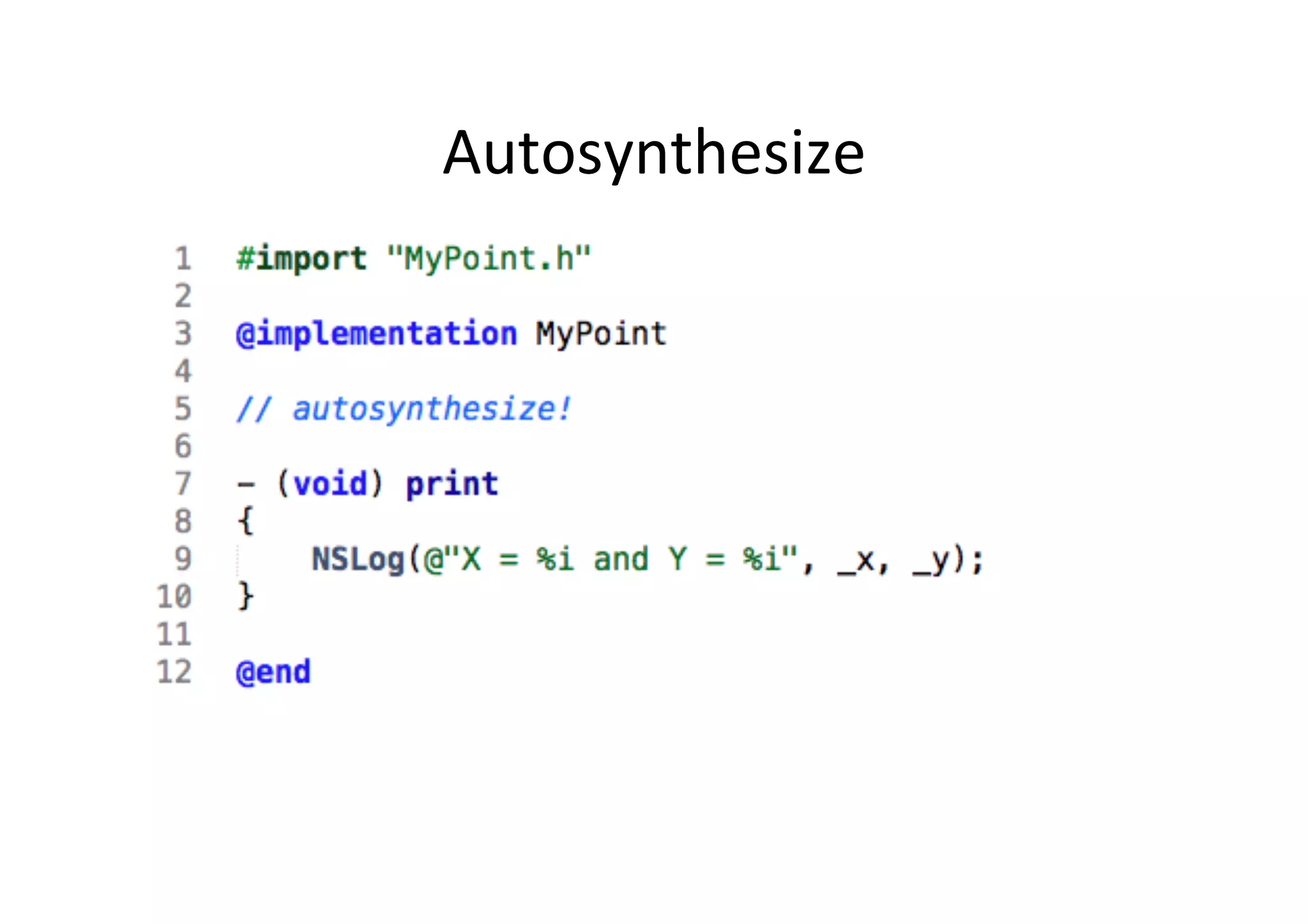
Autosynthesize	
  
Autosynthesize	
  
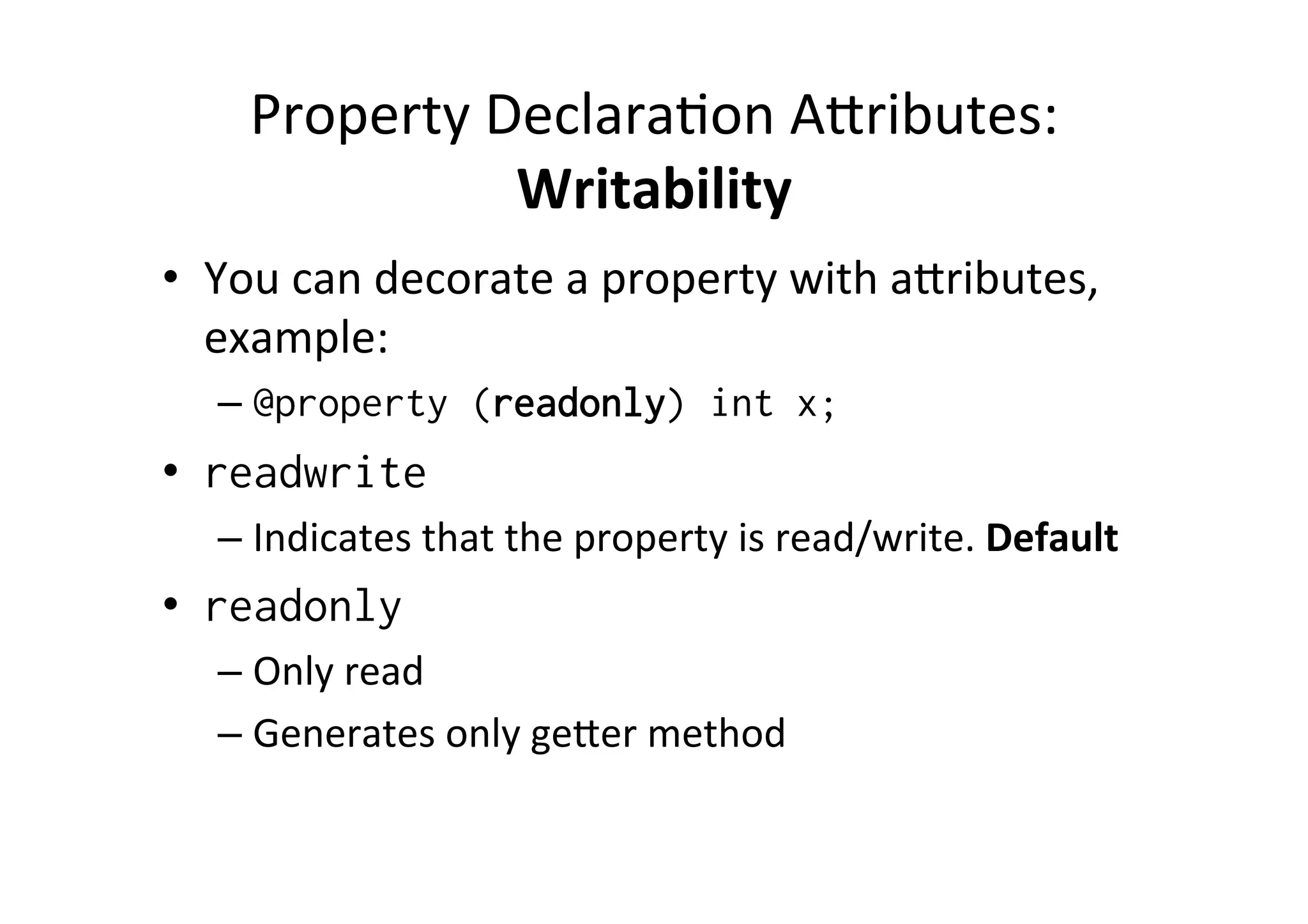
Property	
  Declara)on	
  Aoributes:	
  
                   Writability	
  
•  You	
  can	
  decorate	
  a	
  property	
  with	
  aoributes,	
  
   example:	
  
    –  @property (readonly) int x;
•  readwrite
    –  Indicates	
  that	
  the	
  property	
  is	
  read/write.	
  Default	
  
•  readonly
    –  Only	
  read	
  
    –  Generates	
  only	
  geoer	
  method	
  
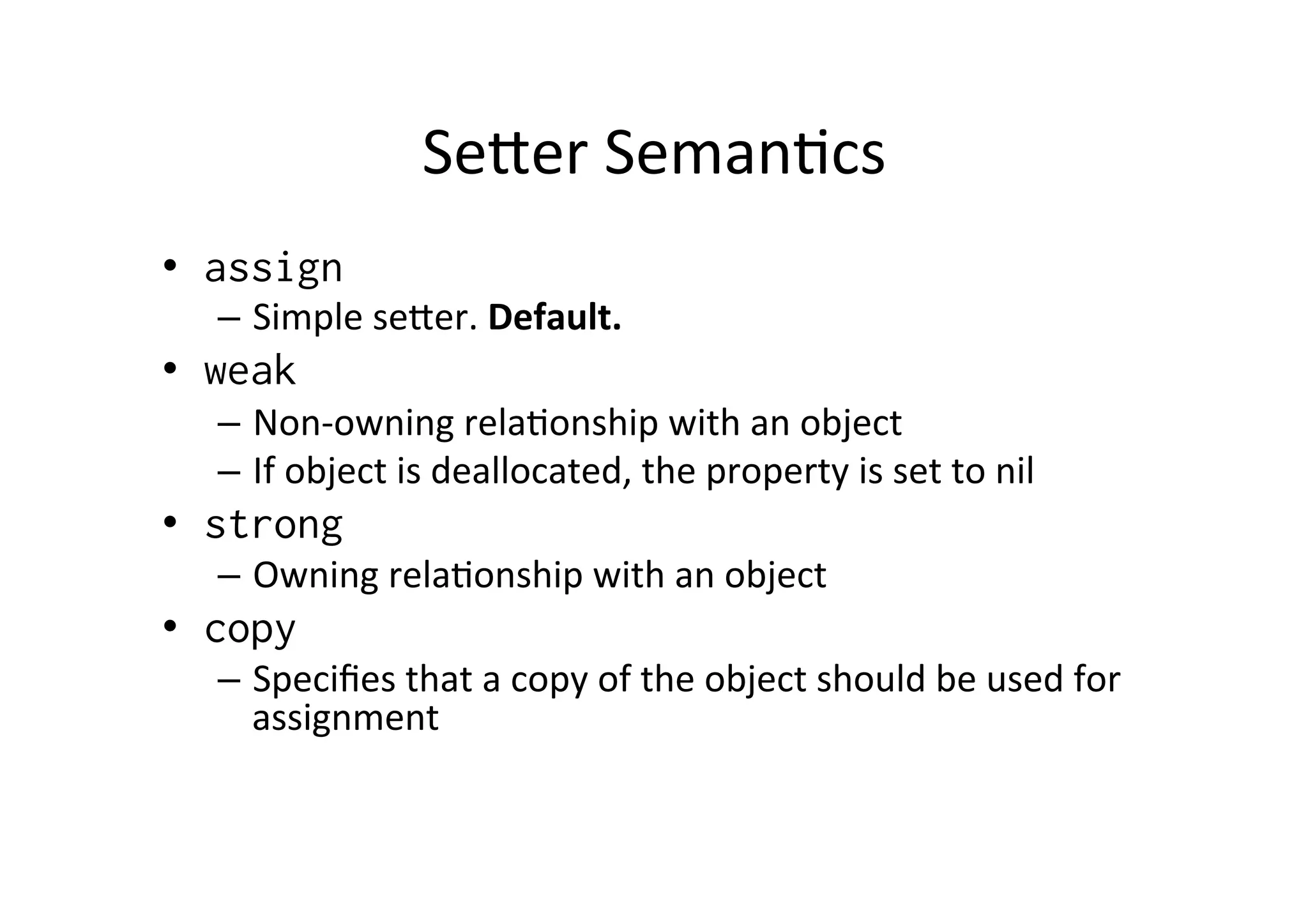
Seoer	
  Seman)cs	
  
•  assign
  –  Simple	
  seoer.	
  Default.	
  
•  weak
  –  Non-­‐owning	
  rela)onship	
  with	
  an	
  object	
  
  –  If	
  object	
  is	
  deallocated,	
  the	
  property	
  is	
  set	
  to	
  nil	
  
•  strong
  –  Owning	
  rela)onship	
  with	
  an	
  object	
  
•  copy
  –  Specifies	
  that	
  a	
  copy	
  of	
  the	
  object	
  should	
  be	
  used	
  for	
  
     assignment	
  
Seoer	
  Seman)cs	
  Examples	
  
// assign
property = newValue;

// copy
if (property != newValue)
{
   [property release];
   property = [newValue copy];
}
Atomicity	
  
•  nonatomic
   –  Specifies	
  that	
  accessor	
  are	
  non-­‐atomic.	
  	
  
•  Proper)es	
  are	
  atomic	
  by	
  default:	
  
   –  [_internal lock];
   –  id result = [[value retain] autorelease];
   –  [_internal unlock];
   –  return id;
Car.h	
  
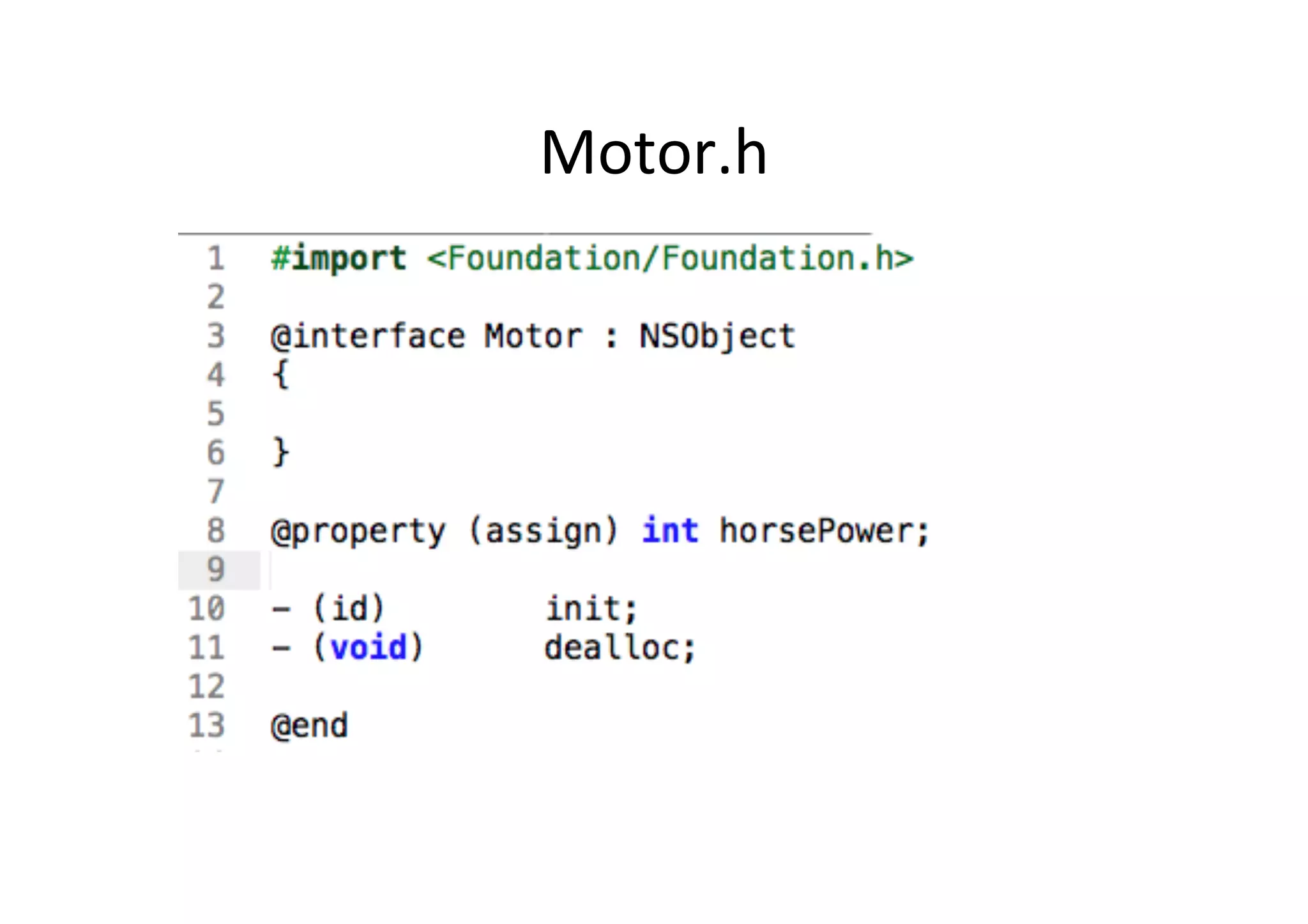
Motor.h	
  
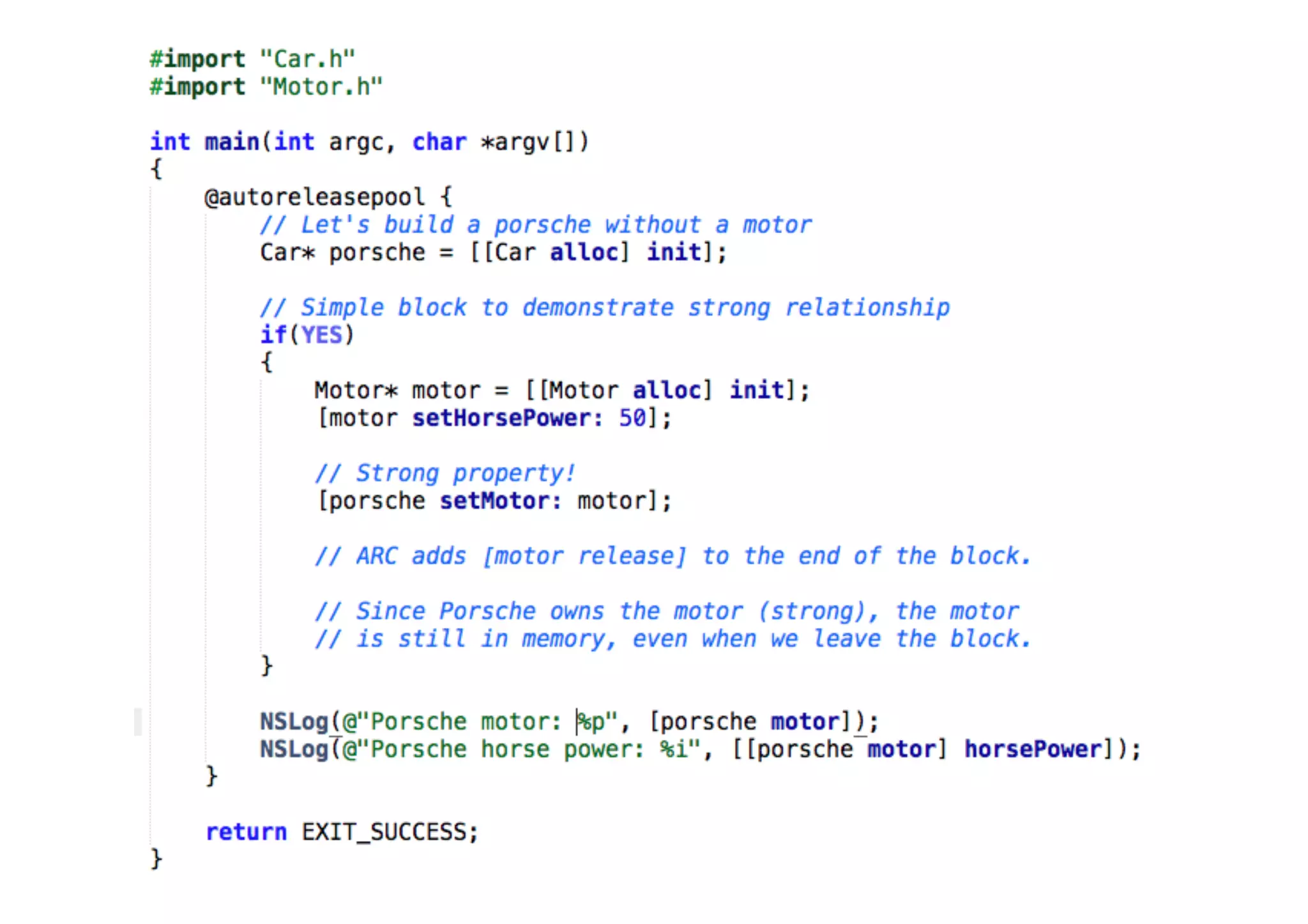
Main.m	
  
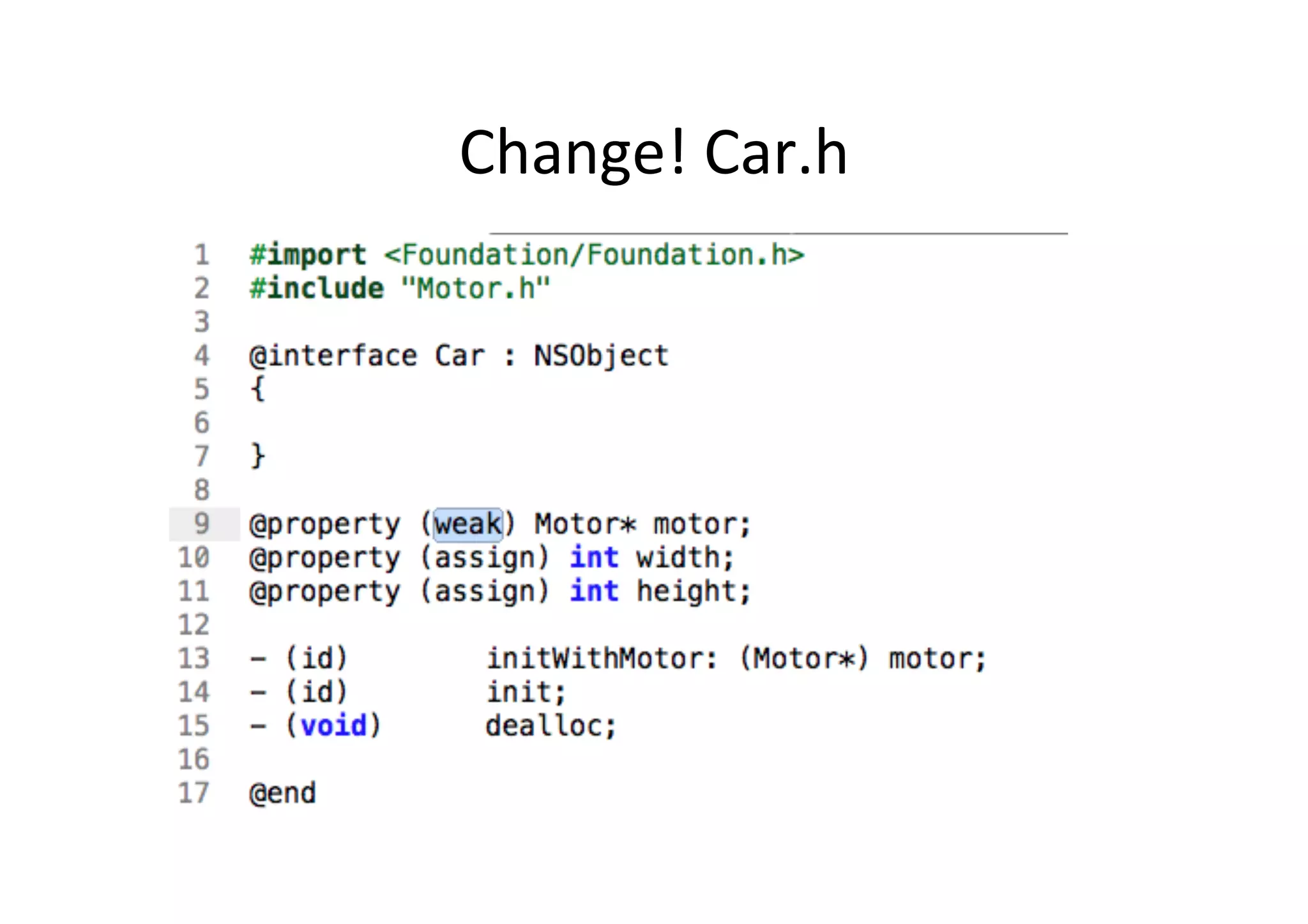
Change!	
  Car.h	
  
STRINGS	
  
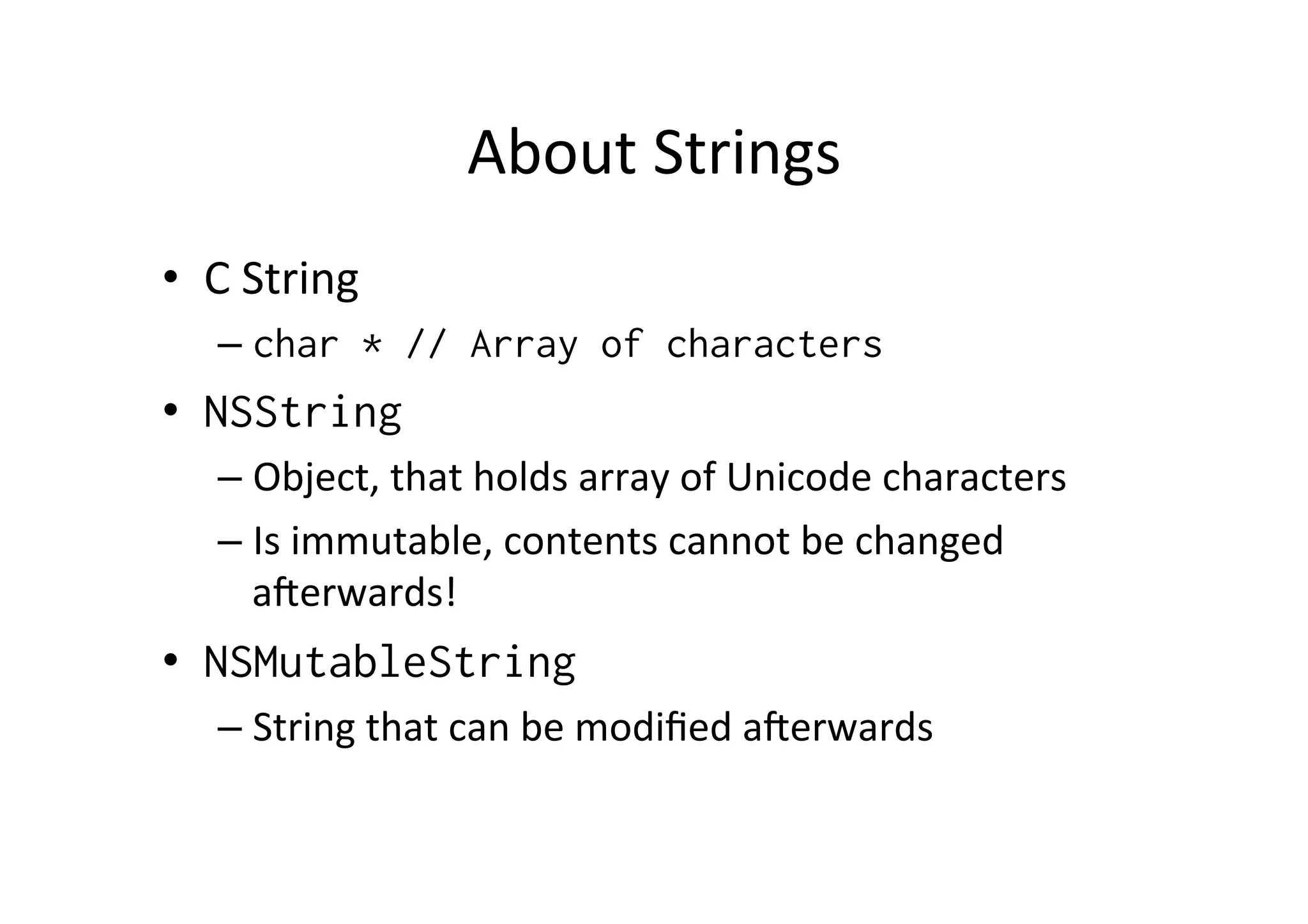
About	
  Strings	
  
•  C	
  String	
  
    –  char * // Array of characters
•  NSString
    –  Object,	
  that	
  holds	
  array	
  of	
  Unicode	
  characters	
  
    –  Is	
  immutable,	
  contents	
  cannot	
  be	
  changed	
  
       aLerwards!	
  
•  NSMutableString
    –  String	
  that	
  can	
  be	
  modified	
  aLerwards	
  
Crea)ng	
  Strings	
  
// Simple way
NSString *temp1 = @"Hello World!";

// Appending, notice that this produces new string
NSString *beginning = @"beginning";
NSString *alphaAndOmega = [beginning
  stringByAppendingString:@" and end"];
Formapng	
  
•  Formapng	
  
   –  NSString *string1 = [NSString stringWithFormat:@"A
      string: %@, a float: %1.2f", @"string", 31415.9265];
   –  // string1 is "A string: string, a float: 31415.93"

•  Format	
  Specifiers?	
  
   –  http://developer.apple.com/iphone/
      library/documentation/Cocoa/Conceptual/
      Strings/Articles/formatSpecifiers.html#//
      apple_ref/doc/uid/TP40004265-SW1
NSString	
  methods	
  
•  See:	
  
    –  http://developer.apple.com/documentation/
       Cocoa/Reference/Foundation/Classes/
       NSString_Class/Reference/NSString.html
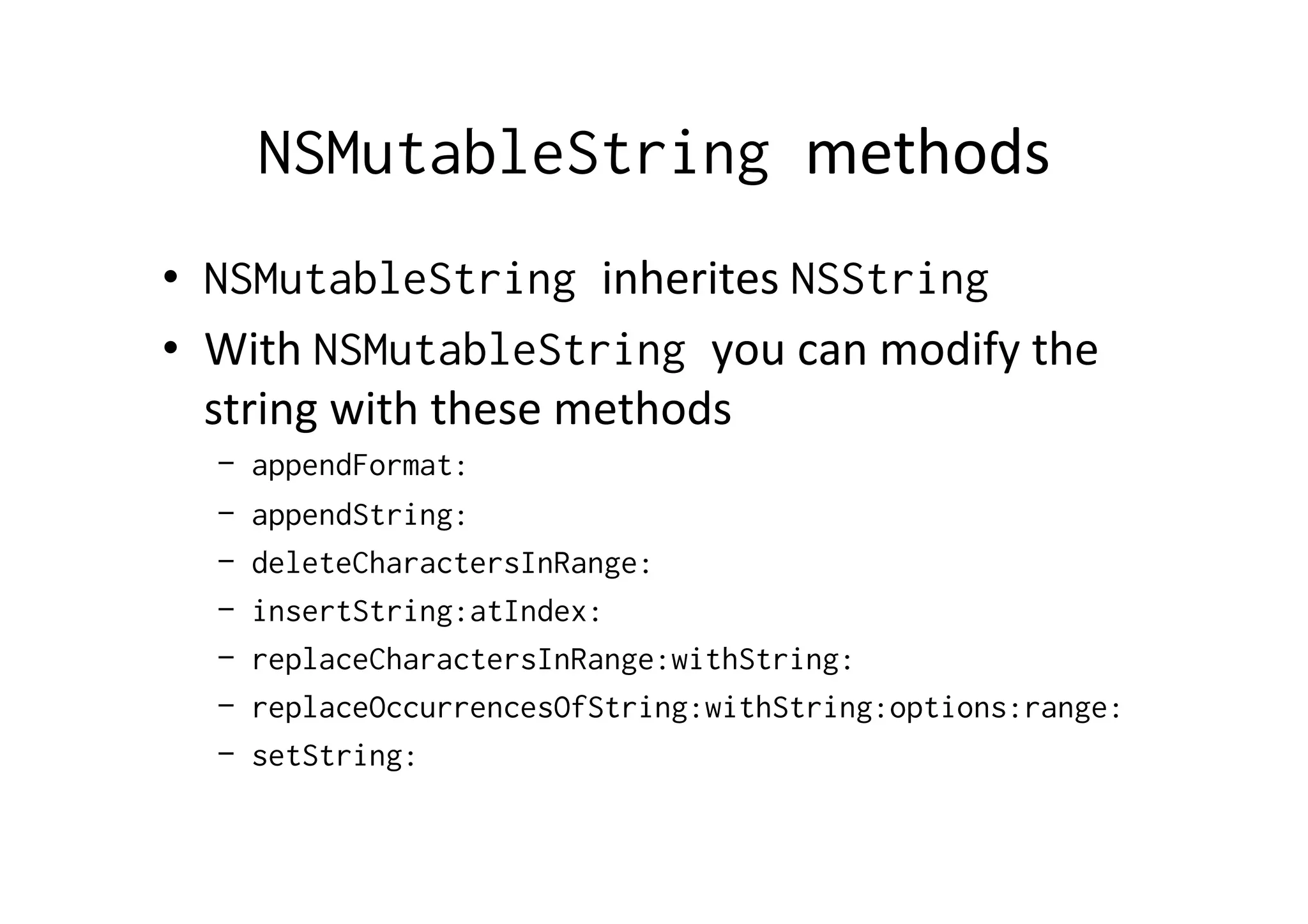
NSMutableString methods	
  
•  NSMutableString inherites	
  NSString
•  With	
  NSMutableString you	
  can	
  modify	
  the	
  
   string	
  with	
  these	
  methods	
  
   – appendFormat:
   – appendString:
   – deleteCharactersInRange:
   – insertString:atIndex:
   – replaceCharactersInRange:withString:
   – replaceOccurrencesOfString:withString:options:range:
   – setString:
PROTOCOLS	
  
Protocols?	
  
•  Compared	
  to	
  Java,	
  protocols	
  are	
  interfaces	
  
•  You	
  define	
  methods	
  that	
  some	
  object	
  must	
  
     implement	


Using	
  Protocols	
  
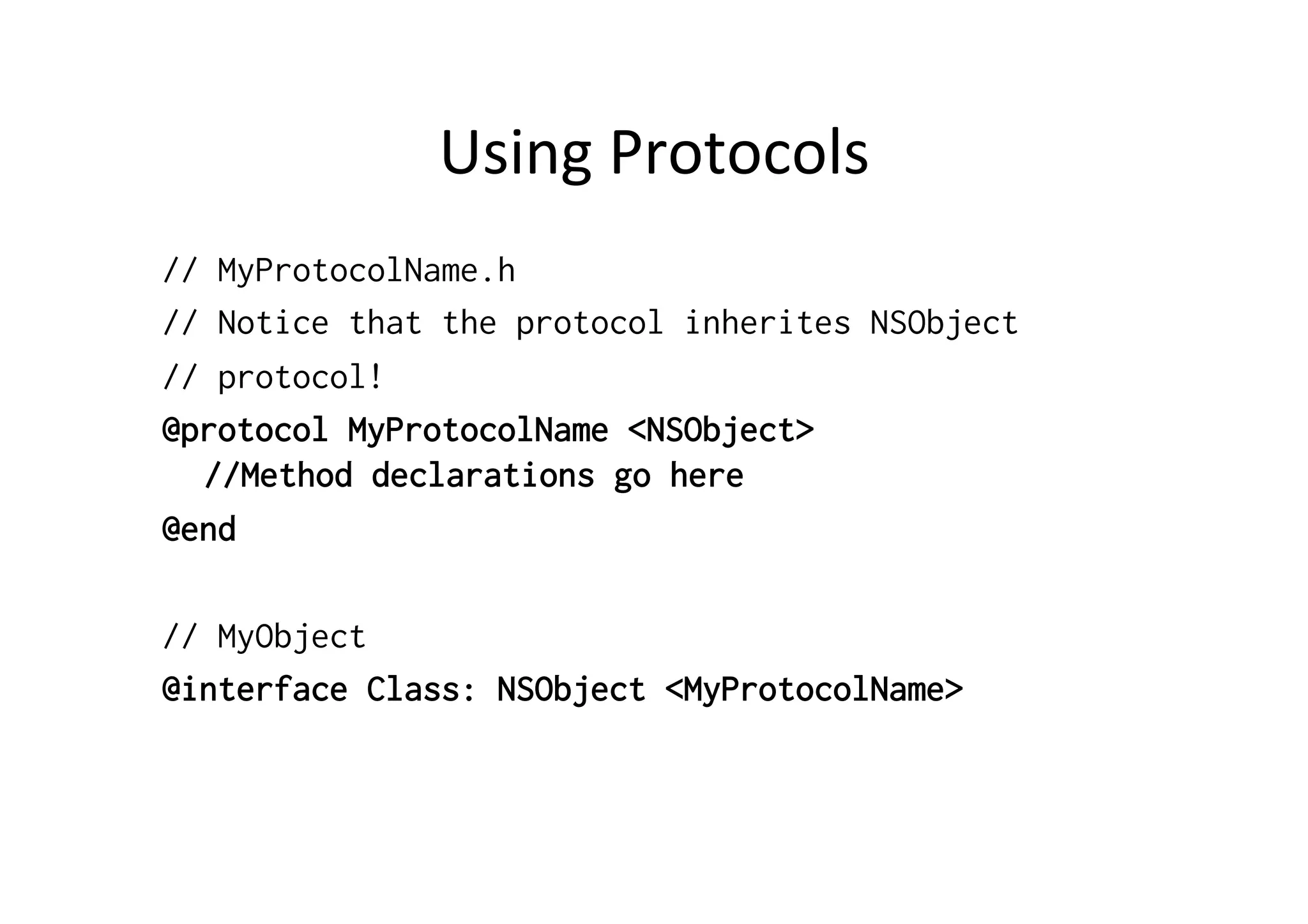
// MyProtocolName.h
// Notice that the protocol inherites NSObject
// protocol!
@protocol MyProtocolName <NSObject>
  //Method declarations go here
@end

// MyObject
@interface Class: NSObject <MyProtocolName>
	
  
Protocol	
  as	
  Variable	
  
•  In	
  Java	
  
     –  MyInterface object = new MyObject();
•  In	
  Obj-­‐C	
  
     –  id<MyProtocolName> object = [[MyObject
        alloc] init];
•  As	
  a	
  method	
  argument	
  
     –  (void) doSomethingWithThisObject:
        (id<MyProtocolName>) aObject
•  ID	
  is	
  a	
  predefined	
  pointer	
  type	
  for	
  an	
  arbitrary	
  
   object	


FOUNDATION	
  CLASSES	
  
NSObject	
  
•  NSObject	
  is	
  the	
  root	
  class	
  of	
  Most	
  Obj-­‐C	
  
     classes	
  
•  Crea)ng,	
  copying,	
  dealloca)ng	
  objects	


Collec)ons	
  
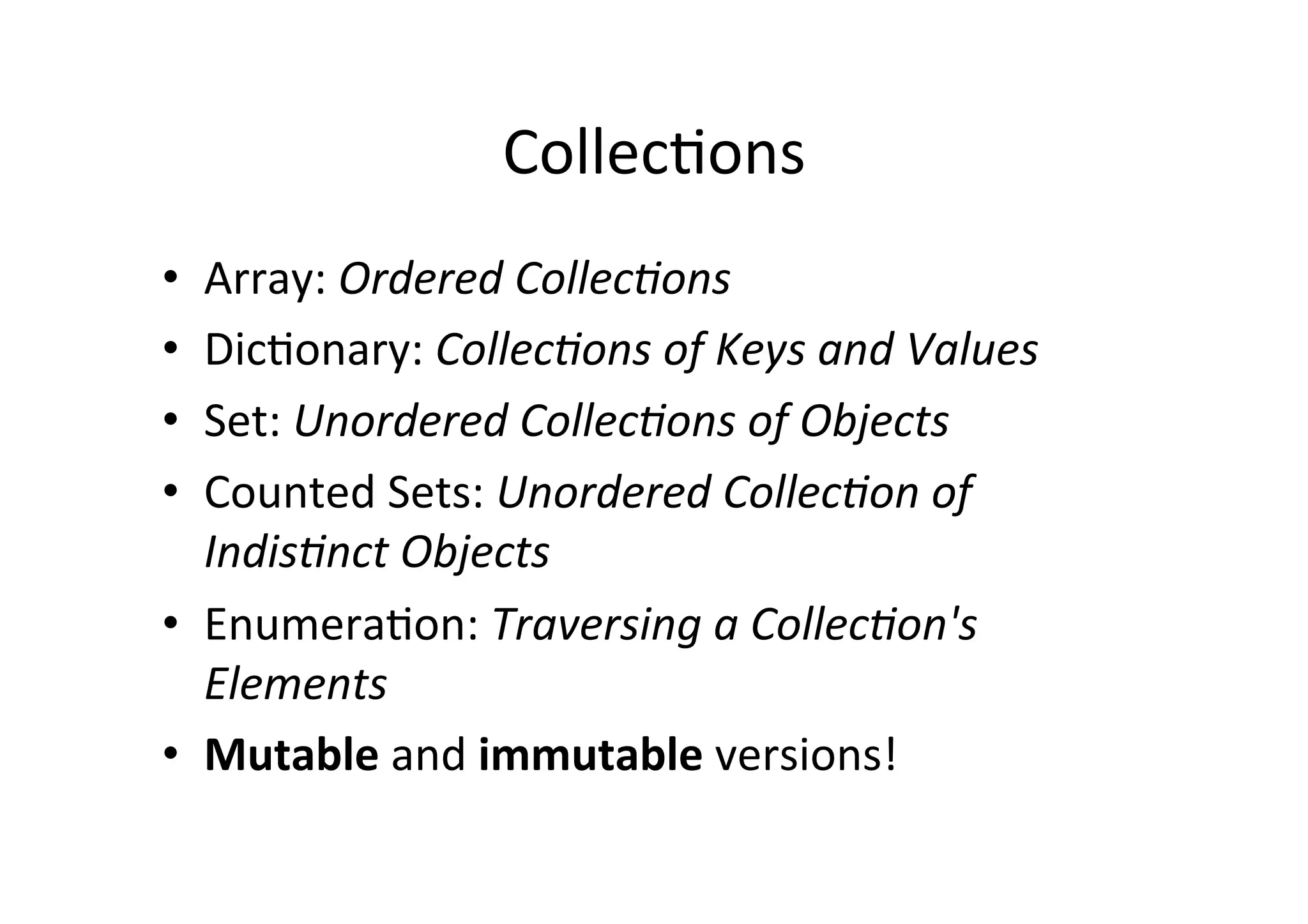
•  Array:	
  Ordered	
  Collec/ons	
  
•  Dic)onary:	
  Collec/ons	
  of	
  Keys	
  and	
  Values	
  
•  Set:	
  Unordered	
  Collec/ons	
  of	
  Objects	
  
•  Counted	
  Sets:	
  Unordered	
  Collec/on	
  of	
  
   Indis/nct	
  Objects	
  
•  Enumera)on:	
  Traversing	
  a	
  Collec/on's	
  
   Elements	
  
•  Mutable	
  and	
  immutable	
  versions!	
  
Other	
  Classes	
  
•  NSNumber,	
  wrapper	
  for	
  standard	
  number	
  
   types	
  
•  NSDate,	
  NSCalendarDate	
  

Introduction to Objective - C

  • 1.
    Introduc)on  to  Objec)ve-­‐C   Jussi  Pohjolainen   Tampere  University  of  Applied  Sciences  
  • 2.
  • 3.
    Background   •  Objec)ve-­‐C  is  layered  on  top  of  the  C  –   language   –  Based  on  SmallTalk-­‐80   –  Designed  in  early  1980s   •  NeXT  SoLware  licensed  Objec)ve-­‐C  in  1988   •  Apple  Computer  acquired  NeXT  in  1996   •  Today:  na)ve  language  for  developing  Mac  OS   X  -­‐  and  iPhone  -­‐  apps  
  • 4.
  • 5.
  • 6.
  • 7.
    Simple  makefile   MyPoint: MyPoint.m main.m clang -fno-objc-arc -framework foundation MyPoint.m main.m -o MyPoint run : ./MyPoint clean : rm MyPoint
  • 8.
    Compiling  and  Running   TB308POHJUS-L-2:point pohjus$ ls -al total 32 drwxr-xr-x 6 pohjus staff 204 18 Tou 15:32 . drwxr-xr-x 3 pohjus staff 102 18 Tou 14:52 .. -rw-r--r--@ 1 pohjus staff 196 18 Tou 15:25 MyPoint.h -rw-r--r--@ 1 pohjus staff 268 18 Tou 15:23 MyPoint.m -rw-r--r--@ 1 pohjus staff 339 18 Tou 15:25 main.m -rw-r--r--@ 1 pohjus staff 120 18 Tou 15:14 makefile TB308POHJUS-L-2:point pohjus$ make clang -fno-objc-arc -framework foundation MyPoint.m main.m -o MyPoint TB308POHJUS-L-2:point pohjus$ make run ./MyPoint 2009-05-18 15:32:46.339 MyPoint[8725:807] X = 0 and Y = 0 2009-05-18 15:32:46.341 MyPoint[8725:807] X = 8 and Y = 7 TB308POHJUS-L-2:point pohjus$
  • 9.
    Instan)a)ng  an  Object   // Declare a pointer to the object MyPoint* point; // Allocate memory for the object point = [MyPoint alloc]; // Initialize the object point = [point init];
  • 10.
    Instan)a)ng  an  Object:  One  Liner   // Allocate and initialize the object MyPoint* point1 = [[MyPoint alloc] init];
  • 11.
    Messages  (Methods)   - (void) setX: (int) n;! method  type:   return  type   selector  name   argument  type   argument   +  =  class  method       name   -­‐  =  object  method    
  • 12.
    Messages,  with  Two  Arguments   Declara=on   - (void) setXAndY: (int) x: (int) y Usage   [object setXAndY: 5: 6]; Declara=on,  be@er  way   - (void) setX: (int) x andY: (int) y Usage   [object setX: 5 andY: 6];
  • 13.
  • 14.
    MEMORY  MANAGEMENT  AND  OBJECT   LIFECYCLE    
  • 15.
    Memory  Handling  in  General   •  When  allocate  something  it  must  be  released   –  Memory  consump)on   •  In  Java,  garbage  collector  takes  care  of  the   release.  Separate  thread  looking  for  objects   that  can  be  released   •  In  Obj-­‐C  and  C/C++,  programmer  is   responsible  about  the  release.  
  • 16.
    About  Pointers   • int  a  =  5;   –  Holds  one  integer  value   –  The  integer  is  stored  in  some  memory  address   •  Where?   –  You  can  get  the  memory  address  by  using  &  in   front  of  the  variable:  &a  
  • 17.
    Example  of  Memory  Address   int main(int argc, char *argv[]) { int a = 5; // prints 5 NSLog(@"%i", a); // prints something like 0x7fff5fbff9cc NSLog(@"%p", &a); return 0; }
  • 18.
    Pointers   •  Pointer  is  a  variable  that  stores  memory   address   •  int  a;   –  holds  integer  variable   •  int*  b;   –  holds  memory  address  that  points  to  integer  value   •  int*  b  =  &a;   –  Now  b  has  the  memory  address  of  a  
  • 19.
    Example  about  Pointers   #import "MyPoint.h" int main(int argc, char *argv[]) { int a = 5; // Store a's memory address to variable b int *b = &a; // prints 5 NSLog(@"%i", a); // prints something like 0x7fff5fbff9cc NSLog(@"%p", &a); // prints something like 0x7fff5fbff9cc NSLog(@"%p", b); // prints 5 NSLog(@"%i", *b); return 0; }
  • 20.
    What  is  the  result  now?   int main(int argc, char *argv[]) { int a = 5; // Store a's memory address to variable b int *b = &a; if(b == &a) { NSLog(@"Do we go here?"); } if(*b == a) { NSLog(@"What about here?"); } return 0; }
  • 21.
    What  is  the  result  now?   int main(int argc, char *argv[]) { int a = 5; int *b = &a; *b = 10; NSLog(@"%i", a); return 0; }
  • 22.
    Memory  Areas   • Memory  can  be  divided  into  three  categories   1.  Global  or  sta)c   2.  Stack   3.  Heap  
  • 23.
    Sta)c   •  When  something  is  in  sta)c  memory,  it's  there   all  the  )me  when  app  is  running   •  So  when  star)ng  the  app,  the  memory  is   allocated  an  when  the  app  closes,  the  memory   is  deallocated   •  The  variable  is  stored  in  the  same  memory   address  all  the  )me.  
  • 24.
    Example  of  Sta)c  Memory   int thisIsStoredInStaticMemory = 5; int main(int argc, char *argv[]) { static int thisIsAlsoStoredInStaticMemory = 10; NSLog(@"My number = %i", thisIsStoredInStaticMemory); NSLog(@"My number = %i", thisIsAlsoStoredInStaticMemory); return 0; }
  • 25.
    Stack  -­‐  Memory   •  Stack  –  memoryarea  is  usually  small   •  If  you  put  too  much  "stuff"  into  stack,  you   might  get  stack  overflow   •  Local  variables  are  stored  in  stack!   •  Variables  are  released  when  out  of  scope  
  • 26.
    Example  of  Stack  Memory   int main(int argc, char *argv[]) { int stack1 = 3; NSLog(@"My number = %i", stack1); if(YES) { int stack2 = 4; NSLog(@"My number = %i", stack2); // stack2 is released from memory now. } // stack1 is released from memory now. return 0; }
  • 27.
    Example  of  Stack  Memory   int main(int argc, char *argv[]) { if(YES) { int stack2 = 4; } // Does this work? NSLog(@"My number = %i", stack2); return 0; }
  • 28.
    Heap  -­‐  Memory   •  Heap  –  memory  is  the  large  memory  area   where  almost  all  of  the  objects  go.   •  Programmer  is  responsible  for  releasing  the   objects!    
  • 29.
    Example  of  Heap  -­‐  memory   #import "MyPoint.h" int main(int argc, char *argv[]) { MyPoint* point = [MyPoint alloc]; //... [point release]; return 0; }
  • 30.
    Crea)ng  a  Object   •  The  crea)on  of  an  object  is  done  in  two  parts   •  1)  Alloca)ng  memory   –  MyPoint* point = [MyPoint alloc]; •  2)  Ini)alize  object  state   –  point = [point init]; •  Combined   –  MyPoint* point = [[MyPoint alloc] init]; •  ó   –  MyPoint* point = [MyPoint new];
  • 31.
    What  happens  in  Memory?   •  What  happens  in  here?   –  MyPoint* p = [MyPoint alloc]; •  Two  things!   –  MyPoint* p; –  p = [MyPoint alloc]; •  p  is  in  stack  –  memory!   •  MyPoint  object  is  in  heap  memory!  
  • 32.
    Problem?   #import "MyPoint.h" intmain(int argc, char *argv[]) { if(YES) { MyPoint* point = [MyPoint alloc]; } [point release]; return 0; }
  • 33.
    Problem?   #import "MyPoint.h" intmain(int argc, char *argv[]) { MyPoint* point = [MyPoint alloc]; point = [MyPoint alloc]; [point release]; return 0; }
  • 34.
    init-­‐method?   •  init-­‐method  is  implemented  in  NSObject •  You  can  however  implement  your  own  init-­‐ method   - (id) initWithName: (NSString*) aName { if(self = [super init]) { name = aName; } return self; }
  • 35.
    Other  init-­‐methods   • Like  in  Java  and  C++,  one  can  have  mul)ple   constructors   •  In  Obj-­‐C,  one  can  have  mul)ple  init-­‐methods   -  (id) init -  (id) initWithX: (int) aX; -  (id) initWithX: (int) aX andY: (int) aY
  • 36.
    Deallocing  Object  and  Reference  Count   •  Rules  about  reference  coun=ng   –  When  object  is  created  its  reference  count  is  set  to  1   –  Incremen)ng  the  reference  count:   •  [point retain]; –  Decreasing  reference  count   •  [point release]; –  When  reference  count  reaches  to  0,  dealloca=ng  occurs   •  ARC  will  save  you  from  this!  
  • 37.
    Reference  Count  Example   #import <Foundation/Foundation.h> @interface Cat : NSObject { } - (void) printMyRetainCount; @end @implementation Cat - (void) printMyRetainCount { NSLog(@"Retain count = %i", [self retainCount]); } @end
  • 38.
    Reference  Count  Example   int main(int argc, char *argv[]) { Cat* myCat = [[Cat alloc] init]; [myCat printMyRetainCount]; // Retain count = 1 Cat* reference = myCat; [reference retain]; [myCat printMyRetainCount]; // Retain count = 2 [myCat release]; [myCat printMyRetainCount]; // Retain count = 1 [myCat release]; // Deallocation return 0; }
  • 39.
    dealloc •  You  can  implement  a  dealloc  method   (void) dealloc { // Some code [super dealloc]; }
  • 40.
    Reference  Count  Example   #import <Foundation/Foundation.h> int main(int argc, char *argv[]) { @interface Cat : NSObject .... { Cat* mirri = [[Cat alloc] init]; NSString* name; [mirri setName: someName]; } // What happens now? [someName release]; - (void) setName: (NSString *) theName } @end Since  reference  count  is   0,  dealloca)on  occurs.   @implementation Cat This  means,  that  the  Cat   does  not  have  a  name   - (void) setName: (NSString *) theName anymore.   { name = theName; } @end
  • 41.
    Reference  Count  Example   #import <Foundation/Foundation.h> int main(int argc, char *argv[]) { @interface Cat : NSObject .... { Cat* mirri = [[Cat alloc] init]; NSString* name; [mirri setName: someName]; } // What happens now? [someName release]; - (void) setName: (NSString *) theName } @end Since  reference  count  is   1,  dealloca)on  does  not   @implementation Cat occur  and  the  Cat  s)ll   has  it's  name.   - (void) setName: (NSString *) theName { [name release]; name = theName; [name retain]; } @end
  • 42.
    Copying  a  Object   - (void)setName:(NSString *)theName } [name release]; name = [theName copy]; }
  • 43.
    Autorelease  Pool   • Every  Founda)on  program  must  set  up   autorelease  pool  for  the  Founda)on  objects   •  Pool  keeps  track  of  your  objects  for  later   release   –  NSAutoreleasePool *pool = [[NSAutoreleasePool alloc] init]; –  ... –  [pool drain];
  • 44.
    Method  Names   • If  method  name  includes  alloc  or  copy,  it   returns  a  object  that  must  be  released   –  // Must be released –  NSObject* object = [[NSObject alloc] init]; –  // Must be released –  NSObject* copy = [object copy]; –  // Do not have to release –  NSMutableString* string = [NSMutableString string]; •  The  above  string  is  released  in  Autorelease  Pool!
  • 45.
    Problem   // ProgrammerA code [[someObject giveCat] eat]; // Programmer B code - (Cat*) giveCat { // Must be released! Cat* myCat = [[Cat alloc] init]; // But where? Should the programmer who calls this method be // responsible for deallocation of the Cat? How does the programmer // know this? return myCat; } ..
  • 46.
    Solu)on   // ProgrammerA code [[someObject giveCat] eat]; // Programmer B code - (Cat*) giveCat { // Must be released! Cat* myCat = [[Cat alloc] init]; // But where? When autopool is drained! [myCat autorelease]; return myCat; }
  • 47.
    Delayed  Release   • Autorelease  means  "send  release  message   later".   •  Release  message  is  sent  when  Autorelease   Pool  is  released   •  Autorelease  Pool  is  created  and  released  in   UIKit  programs  automa=cally!   –  Pool  is  created  at  the  beginning  of  an  event  cycle   –  Pool  is  released  at  the  end  of  an  event  cycle  
  • 48.
    Autorelease  Pools   Event  loop   Pool   released   Pool   created   App  Loaded   Wait  for  Event   Handle  event   Exit  app  
  • 49.
    Autorelease  Pool  Usage   // Method - (Cat*) giveCat { // Must be released! Cat* myCat = [[Cat alloc] init]; // But where? When autopool is drained! [myCat autorelease]; return myCat; } // Usage Cat* someCat = [object giveCat]; // someCat will be released in some time, so if you want to hold it, use // retain [someCat retain];
  • 50.
    Rules   •  If  method  name  contains  "alloc",  "new"  or   "copy",  you  must  remember  to  use  release or  autorelease –  Example:  alloc, newObject, mutableCopy •  If  you  retain something,  you  must  use   release or  autorelease •  Instance  Variables:  retain  or  copy   •  autorelease  means  "send  release later"  
  • 51.
    Cat.h   #import <Foundation/Foundation.h> @interfaceCat : NSObject { @private NSString* name; } - (id) initWithName: (NSString*) aName; - (void) setName: (NSString*) aName; - (NSString*) getName; - (void) dealloc; @end
  • 52.
    Cat.m   #import "Cat.h" - (void) setName: (NSString*) aName { @implementation Cat if(aName != name) { - (id) initWithName: (NSString*) aName [name release]; { name = aName; if(self = [super init]) [name retain]; { } [self setName: aName]; } } return self; } - (void) dealloc { - (NSString*) getName [name release]; { [super dealloc]; return name; } } @end
  • 53.
    main.m   #import "Cat.h" // Get the name NSString* name = [cat getName]; int main(int argc, char *argv[]) { // Print the name NSAutoreleasePool *pool = NSLog(name); [[NSAutoreleasePool alloc] init]; // Release name and cat // Create the string [cat release]; NSString* catName = [[NSString alloc] initWithString: @"Jack"]; [pool drain]; // Create cat with the string return 0; Cat* cat = [[Cat alloc] }   initWithName: catName]; // Just testing. This does not deallocate catName! [catName release];
  • 54.
    ARC  to  the  rescue!   MANAGING  MEMORY  WITH  ARC  
  • 55.
    ARC?   •  ARC  (Automa=c  Reference  Coun=ng)   –  Compiler  does  automa/c  reference  coun/ng  by   examining  the  source  code  and  then  add  the   retain  and  release  messages  to  objects   •  Not  garbage  collec)on,  no  background   process  of  dealloca)on  of  objects!   •  Inserts  retain  and  release  statements  based   on  some  fixed  rules   •  OS  X  10.7  and  iOS  5  for  all  features  
  • 56.
    Object  lose  owners   // Scenario 1 Person* jack = [[Person alloc] init]; jack = [[Person alloc] init]; // Scenario 2 Person* tina = [[Person alloc] init]; tina = nil; // Scenario 3 if(yes) { Person* dave = [[Person alloc] init]; }
  • 57.
    Some  Fixed  rules   •  If  object  is  allocated  and  local  to  method,   release  statement  is  added  near  the  end  of   that  method   •  If  allocated  object  is  class  a@ribute,  release  is   added  to  dealloc   •  If  the  object  is  return  value,  it  gets  an   autorelease  statement  
  • 58.
    Guidelines   •  Don’t  call!   –  retain, release, retainCount, autorelease or dealloc •  You  must  use  @autoreleasepool  syntax   •  You  must  enable  ARC   –  clang -fobjc-arc -framework foundation Car.m Motor.m main.m -o App
  • 59.
    makefile   MyPoint :Car.m Motor.m main.m clang -fobjc-arc -framework foundation Car.m Motor.m main.m -o App run : ./App clean : rm App
  • 60.
  • 61.
  • 62.
  • 63.
  • 64.
  • 65.
  • 66.
  • 67.
  • 68.
  • 69.
  • 70.
  • 71.
    Property  Declara)on  Aoributes:   Writability   •  You  can  decorate  a  property  with  aoributes,   example:   –  @property (readonly) int x; •  readwrite –  Indicates  that  the  property  is  read/write.  Default   •  readonly –  Only  read   –  Generates  only  geoer  method  
  • 72.
    Seoer  Seman)cs   • assign –  Simple  seoer.  Default.   •  weak –  Non-­‐owning  rela)onship  with  an  object   –  If  object  is  deallocated,  the  property  is  set  to  nil   •  strong –  Owning  rela)onship  with  an  object   •  copy –  Specifies  that  a  copy  of  the  object  should  be  used  for   assignment  
  • 73.
    Seoer  Seman)cs  Examples   // assign property = newValue; // copy if (property != newValue) { [property release]; property = [newValue copy]; }
  • 74.
    Atomicity   •  nonatomic –  Specifies  that  accessor  are  non-­‐atomic.     •  Proper)es  are  atomic  by  default:   –  [_internal lock]; –  id result = [[value retain] autorelease]; –  [_internal unlock]; –  return id;
  • 75.
  • 76.
  • 77.
  • 79.
  • 81.
  • 82.
    About  Strings   • C  String   –  char * // Array of characters •  NSString –  Object,  that  holds  array  of  Unicode  characters   –  Is  immutable,  contents  cannot  be  changed   aLerwards!   •  NSMutableString –  String  that  can  be  modified  aLerwards  
  • 83.
    Crea)ng  Strings   //Simple way NSString *temp1 = @"Hello World!"; // Appending, notice that this produces new string NSString *beginning = @"beginning"; NSString *alphaAndOmega = [beginning stringByAppendingString:@" and end"];
  • 84.
    Formapng   •  Formapng   –  NSString *string1 = [NSString stringWithFormat:@"A string: %@, a float: %1.2f", @"string", 31415.9265]; –  // string1 is "A string: string, a float: 31415.93" •  Format  Specifiers?   –  http://developer.apple.com/iphone/ library/documentation/Cocoa/Conceptual/ Strings/Articles/formatSpecifiers.html#// apple_ref/doc/uid/TP40004265-SW1
  • 85.
    NSString  methods   • See:   –  http://developer.apple.com/documentation/ Cocoa/Reference/Foundation/Classes/ NSString_Class/Reference/NSString.html
  • 86.
    NSMutableString methods   • NSMutableString inherites  NSString •  With  NSMutableString you  can  modify  the   string  with  these  methods   – appendFormat: – appendString: – deleteCharactersInRange: – insertString:atIndex: – replaceCharactersInRange:withString: – replaceOccurrencesOfString:withString:options:range: – setString:
  • 87.
  • 88.
    Protocols?   •  Compared  to  Java,  protocols  are  interfaces   •  You  define  methods  that  some  object  must   implement      
  • 89.
    Using  Protocols   //MyProtocolName.h // Notice that the protocol inherites NSObject // protocol! @protocol MyProtocolName <NSObject> //Method declarations go here @end // MyObject @interface Class: NSObject <MyProtocolName>  
  • 90.
    Protocol  as  Variable   •  In  Java   –  MyInterface object = new MyObject(); •  In  Obj-­‐C   –  id<MyProtocolName> object = [[MyObject alloc] init]; •  As  a  method  argument   –  (void) doSomethingWithThisObject: (id<MyProtocolName>) aObject •  ID  is  a  predefined  pointer  type  for  an  arbitrary   object    
  • 91.
  • 92.
    NSObject   •  NSObject  is  the  root  class  of  Most  Obj-­‐C   classes   •  Crea)ng,  copying,  dealloca)ng  objects    
  • 93.
    Collec)ons   •  Array:  Ordered  Collec/ons   •  Dic)onary:  Collec/ons  of  Keys  and  Values   •  Set:  Unordered  Collec/ons  of  Objects   •  Counted  Sets:  Unordered  Collec/on  of   Indis/nct  Objects   •  Enumera)on:  Traversing  a  Collec/on's   Elements   •  Mutable  and  immutable  versions!  
  • 94.
    Other  Classes   • NSNumber,  wrapper  for  standard  number   types   •  NSDate,  NSCalendarDate