Introduction to NHibernate By Andrew Smith
The Basics Object Relation Mapper Maps POCOs to database tables Based on Java Hibernate. V stable Generates SQL at run time Database agnostic
Entity definitions “ Persistence ignorance” No need for special base class No need to implement special interfaces Default constructor Identity property (Primary key) To support lazy loading, public properties and methods must be virtual Collection properties must be declared as an interface type
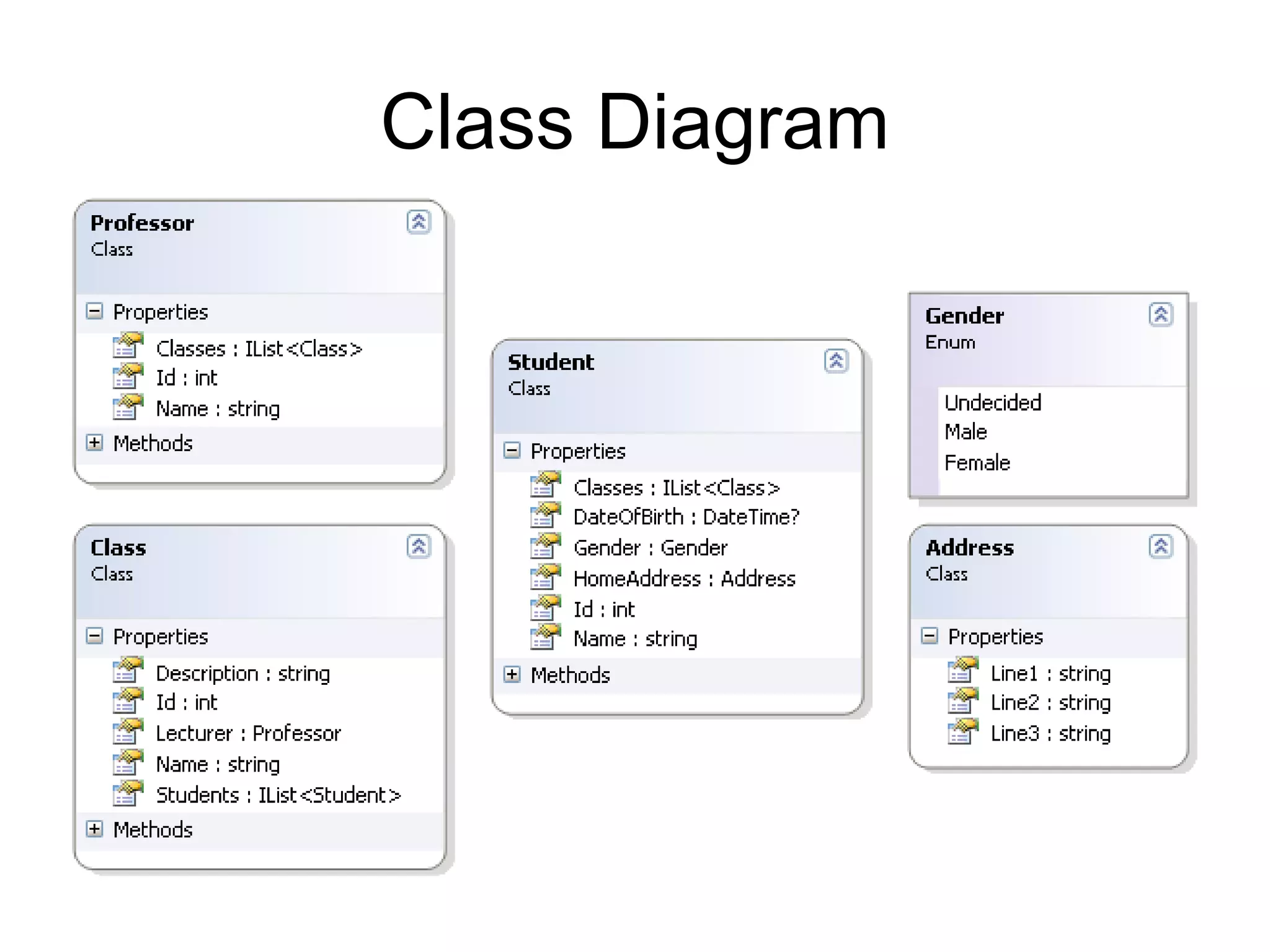
Class Diagram
Configuration Multiple options – Xml, ActiveRecord, Fluent NH Xml: 1 overall configuration section Multiple “<entityname>.hbm.xml” embedded resource files Intellisense: Place .xsd files in “Microsoft Visual Studio 9.0\Xml\Schemas”
Sessions Very quick to create session Disposable (may hold a DB connection open) Web: session per request. (Also, ‘long conversations’ - check out NHibernate Burrow)
Mappings: Primary keys Entities must be identifiable Multiple strategies for PK Use ‘native’ as best-guess Recommended way is “HiLo” to save round-tripping to DB
Mappings: Properties Maps database columns to properties/fields on entity Can map columns to nested types Control insert/update per column Default is to insert/update all columns, but can be dynamic
Demo: The basics Fetching single entity by ID Updating Inserting
Mappings: Relations Many types. Most common: bag and set Assuming bi-directional relations and simple bag collections In a bi-directional association, only one end can be the ‘owner’ Identify the ‘non-owner’ end of collection by setting Inverse=“true”
Mappings: 1-* Relations Professor (1) – Class (*) Bi-directional: <bag> and < many-to-one > Declare the many-valued end inverse=&quot;true“ Use ‘ not-found =ignore’ for bad, legacy data
Mappings: *-* Relations Student (*) – Class (*) Bi-directional: 2 <bag> elements with link table name Arbitrarily choose 1 end to set as Inverse=“true” Demo
Cascades Don’t have to explicitly call save / update / delete on related entities Cascade types: none, save-update, delete, all,  all-delete-orphan Can define a default cascade Q’s?
Proxies Enables lazy loading - Just in time loading of data Lazy loaded collections Lazy loaded entities (the single-end of a relation) Controlled via mappings or code Watch for N+1 issue
Querying Lots of options: Criteria DetachedCriteria HQL Linq SQL
Querying: ICriteria Out-of-the-box method for building up a query in code Requires an active session Weakly typed nhlambdaextensions project adds typesafe lambda expressions
Querying: Projections By default NH selects all mapped properties of entity Projections allow control over the ‘select’ part of generated SQL
Querying: Aliases / Subcriteria Alias relations to refer to them later Need to use them to reference multi-level relations. E.g. OrderItem.OrderHeader.Customer.Name
Querying: DetachedCriteria Same capabilities as ICriteria Does not require active session Can be ‘attached’ to any session at any time to execute query
Querying: MultiCriteria Enables multiple criteria to be evaluated in the one round trip to DB Very useful for paging
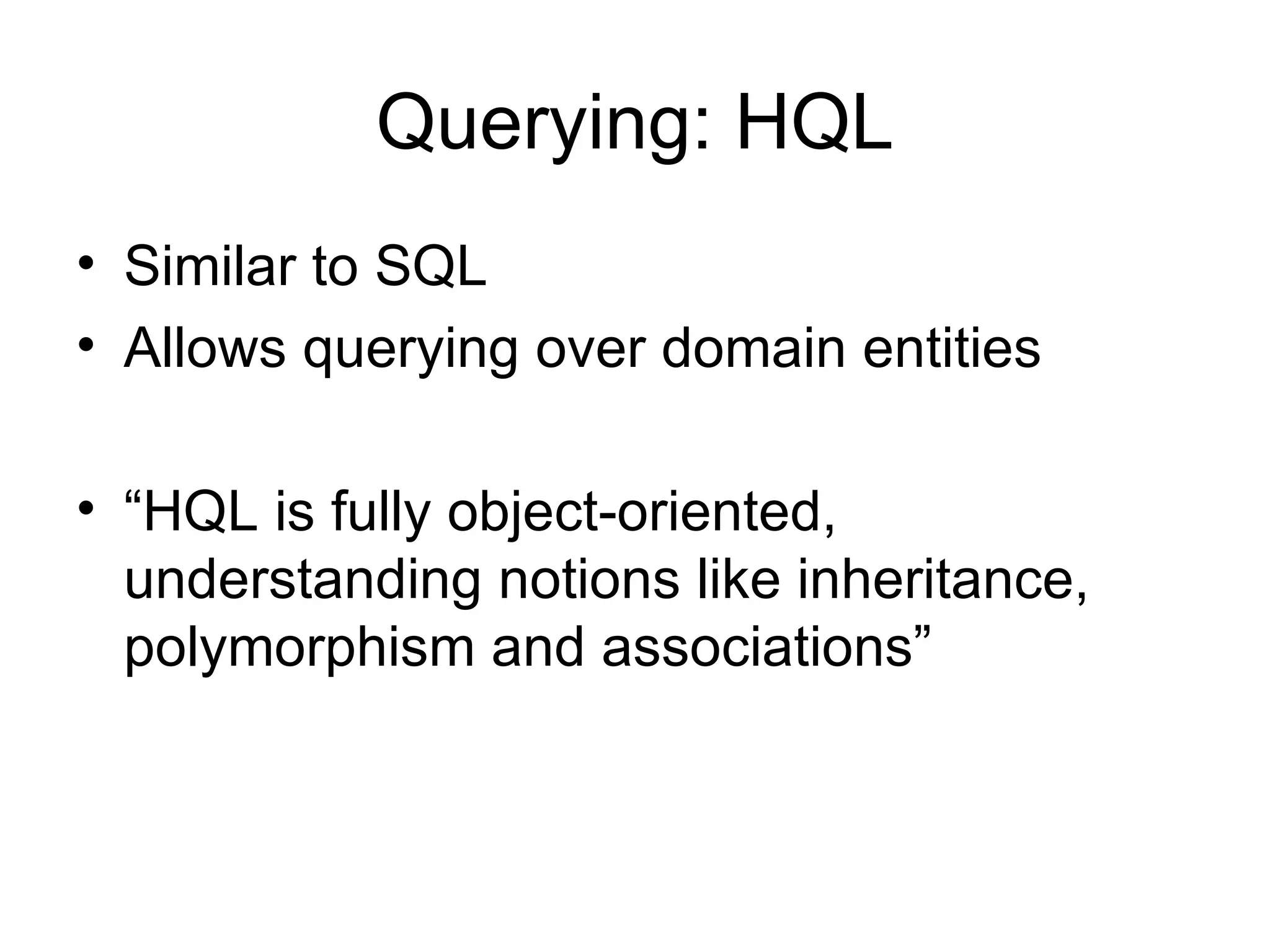
Querying: HQL Similar to SQL Allows querying over domain entities “ HQL is fully object-oriented, understanding notions like inheritance, polymorphism and associations”
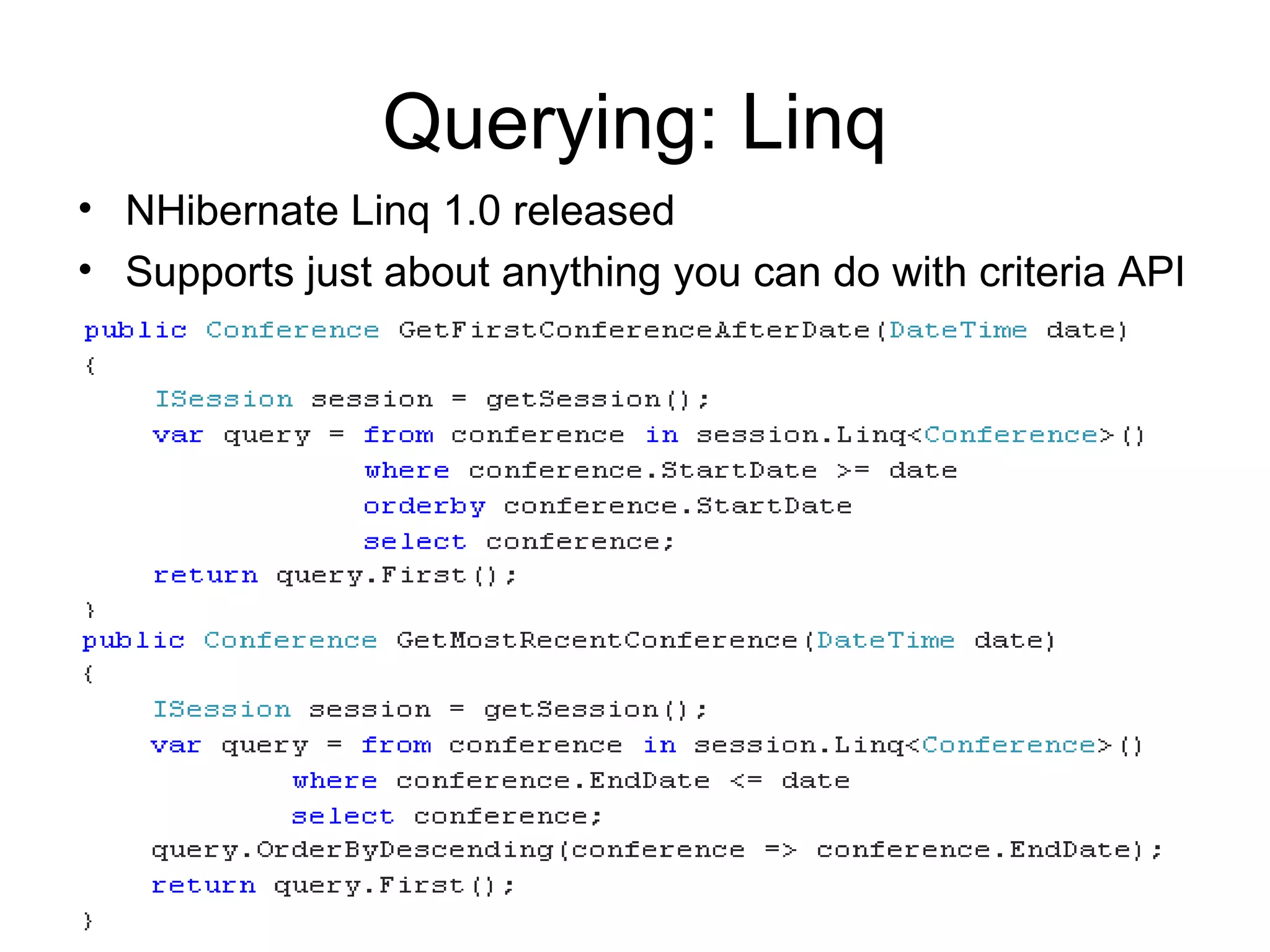
Querying: Linq NHibernate Linq 1.0 released Supports just about anything you can do with criteria API
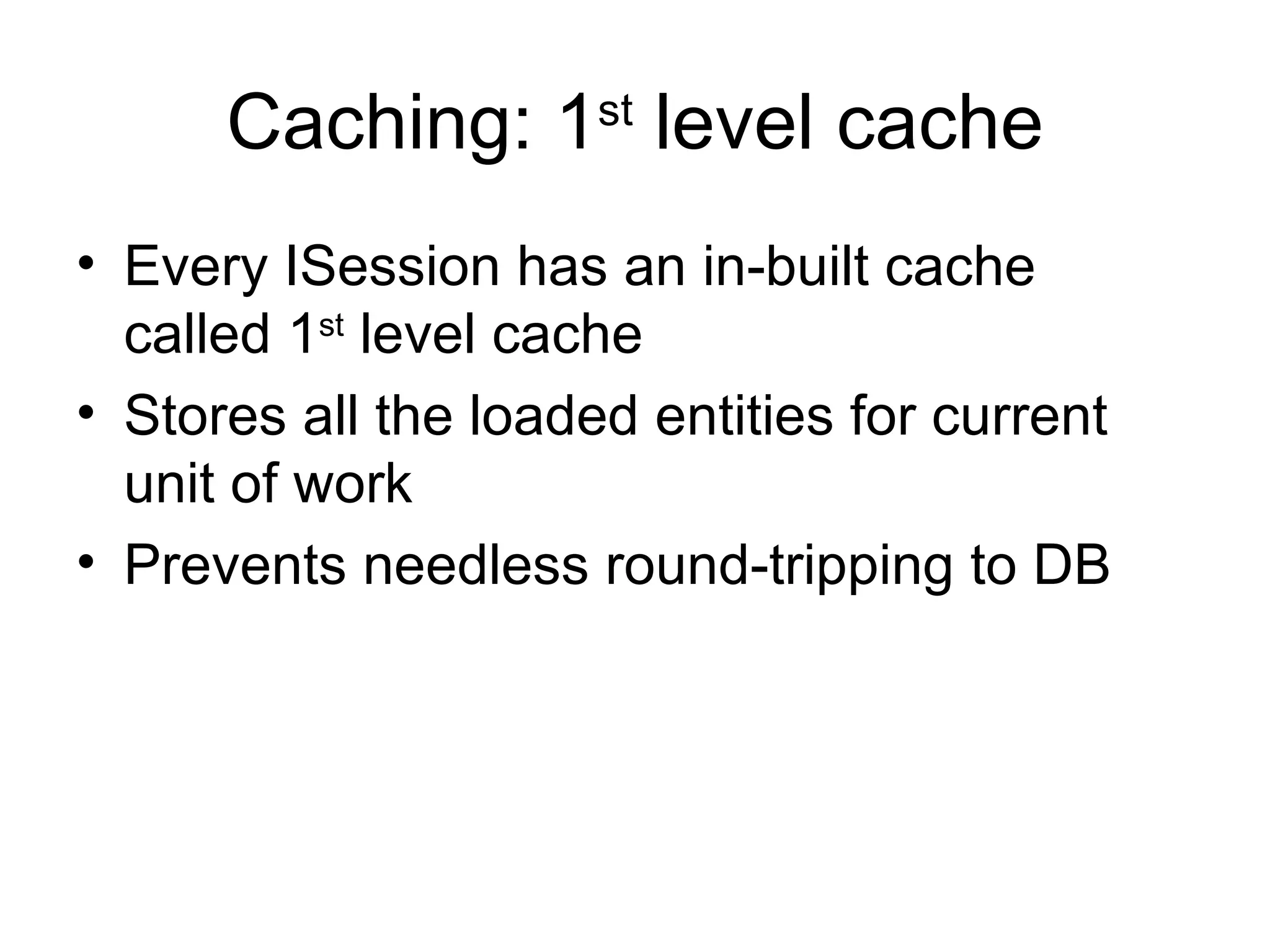
Caching: 1 st  level cache Every ISession has an in-built cache called 1 st  level cache Stores all the loaded entities for current unit of work Prevents needless round-tripping to DB
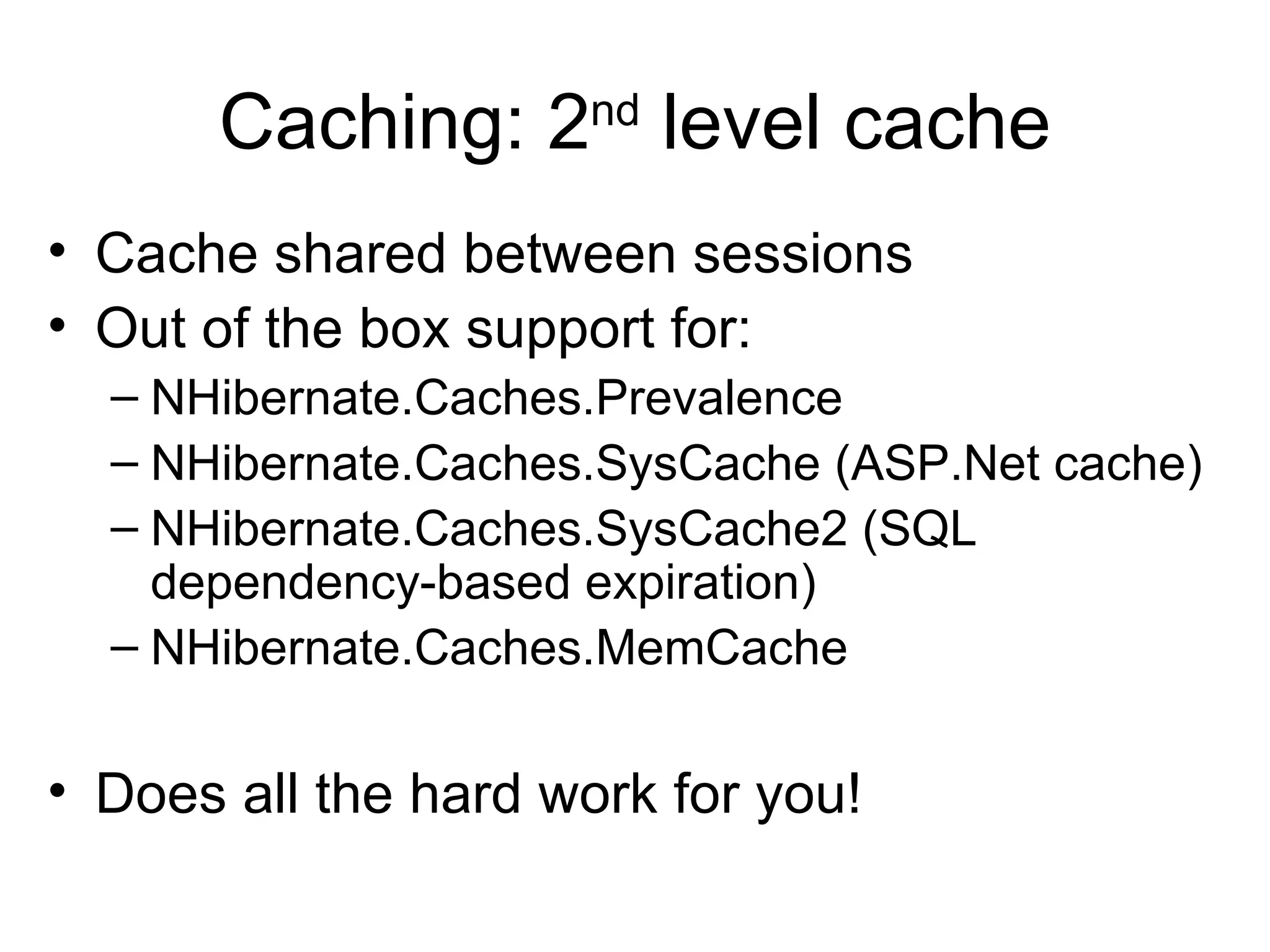
Caching: 2 nd  level cache Cache shared between sessions Out of the box support for: NHibernate.Caches.Prevalence  NHibernate.Caches.SysCache (ASP.Net cache) NHibernate.Caches.SysCache2 (SQL dependency-based expiration) NHibernate.Caches.MemCache Does all the hard work for you!
Querying: Future Queries Executes a batch of queries in one round trip to DB
Why use it? Reduces repetitive, error prone data access code Enables use of OOP Very flexible Stable, widely used Speed up development time Single place to add behaviour such as auditing / INotifyPropertyChanged / Filters etc Testing: Easier integration tests Security: Uses parameterised queries by default
Resources Book: NHibernate In Action (v 1.2) NHForge.org NHibernate blog Nhibernate FAQ blog Very active users group (nhusers) ayende.com Dimecast and “Summer of NHibernate” videos

Introduction to NHibernate

  • 1.
  • 2.
    The Basics ObjectRelation Mapper Maps POCOs to database tables Based on Java Hibernate. V stable Generates SQL at run time Database agnostic
  • 3.
    Entity definitions “Persistence ignorance” No need for special base class No need to implement special interfaces Default constructor Identity property (Primary key) To support lazy loading, public properties and methods must be virtual Collection properties must be declared as an interface type
  • 4.
  • 5.
    Configuration Multiple options– Xml, ActiveRecord, Fluent NH Xml: 1 overall configuration section Multiple “<entityname>.hbm.xml” embedded resource files Intellisense: Place .xsd files in “Microsoft Visual Studio 9.0\Xml\Schemas”
  • 6.
    Sessions Very quickto create session Disposable (may hold a DB connection open) Web: session per request. (Also, ‘long conversations’ - check out NHibernate Burrow)
  • 7.
    Mappings: Primary keysEntities must be identifiable Multiple strategies for PK Use ‘native’ as best-guess Recommended way is “HiLo” to save round-tripping to DB
  • 8.
    Mappings: Properties Mapsdatabase columns to properties/fields on entity Can map columns to nested types Control insert/update per column Default is to insert/update all columns, but can be dynamic
  • 9.
    Demo: The basicsFetching single entity by ID Updating Inserting
  • 10.
    Mappings: Relations Manytypes. Most common: bag and set Assuming bi-directional relations and simple bag collections In a bi-directional association, only one end can be the ‘owner’ Identify the ‘non-owner’ end of collection by setting Inverse=“true”
  • 11.
    Mappings: 1-* RelationsProfessor (1) – Class (*) Bi-directional: <bag> and < many-to-one > Declare the many-valued end inverse=&quot;true“ Use ‘ not-found =ignore’ for bad, legacy data
  • 12.
    Mappings: *-* RelationsStudent (*) – Class (*) Bi-directional: 2 <bag> elements with link table name Arbitrarily choose 1 end to set as Inverse=“true” Demo
  • 13.
    Cascades Don’t haveto explicitly call save / update / delete on related entities Cascade types: none, save-update, delete, all, all-delete-orphan Can define a default cascade Q’s?
  • 14.
    Proxies Enables lazyloading - Just in time loading of data Lazy loaded collections Lazy loaded entities (the single-end of a relation) Controlled via mappings or code Watch for N+1 issue
  • 15.
    Querying Lots ofoptions: Criteria DetachedCriteria HQL Linq SQL
  • 16.
    Querying: ICriteria Out-of-the-boxmethod for building up a query in code Requires an active session Weakly typed nhlambdaextensions project adds typesafe lambda expressions
  • 17.
    Querying: Projections Bydefault NH selects all mapped properties of entity Projections allow control over the ‘select’ part of generated SQL
  • 18.
    Querying: Aliases /Subcriteria Alias relations to refer to them later Need to use them to reference multi-level relations. E.g. OrderItem.OrderHeader.Customer.Name
  • 19.
    Querying: DetachedCriteria Samecapabilities as ICriteria Does not require active session Can be ‘attached’ to any session at any time to execute query
  • 20.
    Querying: MultiCriteria Enablesmultiple criteria to be evaluated in the one round trip to DB Very useful for paging
  • 21.
    Querying: HQL Similarto SQL Allows querying over domain entities “ HQL is fully object-oriented, understanding notions like inheritance, polymorphism and associations”
  • 22.
    Querying: Linq NHibernateLinq 1.0 released Supports just about anything you can do with criteria API
  • 23.
    Caching: 1 st level cache Every ISession has an in-built cache called 1 st level cache Stores all the loaded entities for current unit of work Prevents needless round-tripping to DB
  • 24.
    Caching: 2 nd level cache Cache shared between sessions Out of the box support for: NHibernate.Caches.Prevalence NHibernate.Caches.SysCache (ASP.Net cache) NHibernate.Caches.SysCache2 (SQL dependency-based expiration) NHibernate.Caches.MemCache Does all the hard work for you!
  • 25.
    Querying: Future QueriesExecutes a batch of queries in one round trip to DB
  • 26.
    Why use it?Reduces repetitive, error prone data access code Enables use of OOP Very flexible Stable, widely used Speed up development time Single place to add behaviour such as auditing / INotifyPropertyChanged / Filters etc Testing: Easier integration tests Security: Uses parameterised queries by default
  • 27.
    Resources Book: NHibernateIn Action (v 1.2) NHForge.org NHibernate blog Nhibernate FAQ blog Very active users group (nhusers) ayende.com Dimecast and “Summer of NHibernate” videos