
Introduction to Java
Todays Agenda
What is java
History
Features of Java
Java Virtual Machine
How Java works?
Development Process with Java
Java Development Kit (JDK)
Java Platform Editions
Java is Everywhere!
What is Java?
 Java is an innovative programming language to run on a variety of
different computer systems.
 Write Once and Run Anywhere!
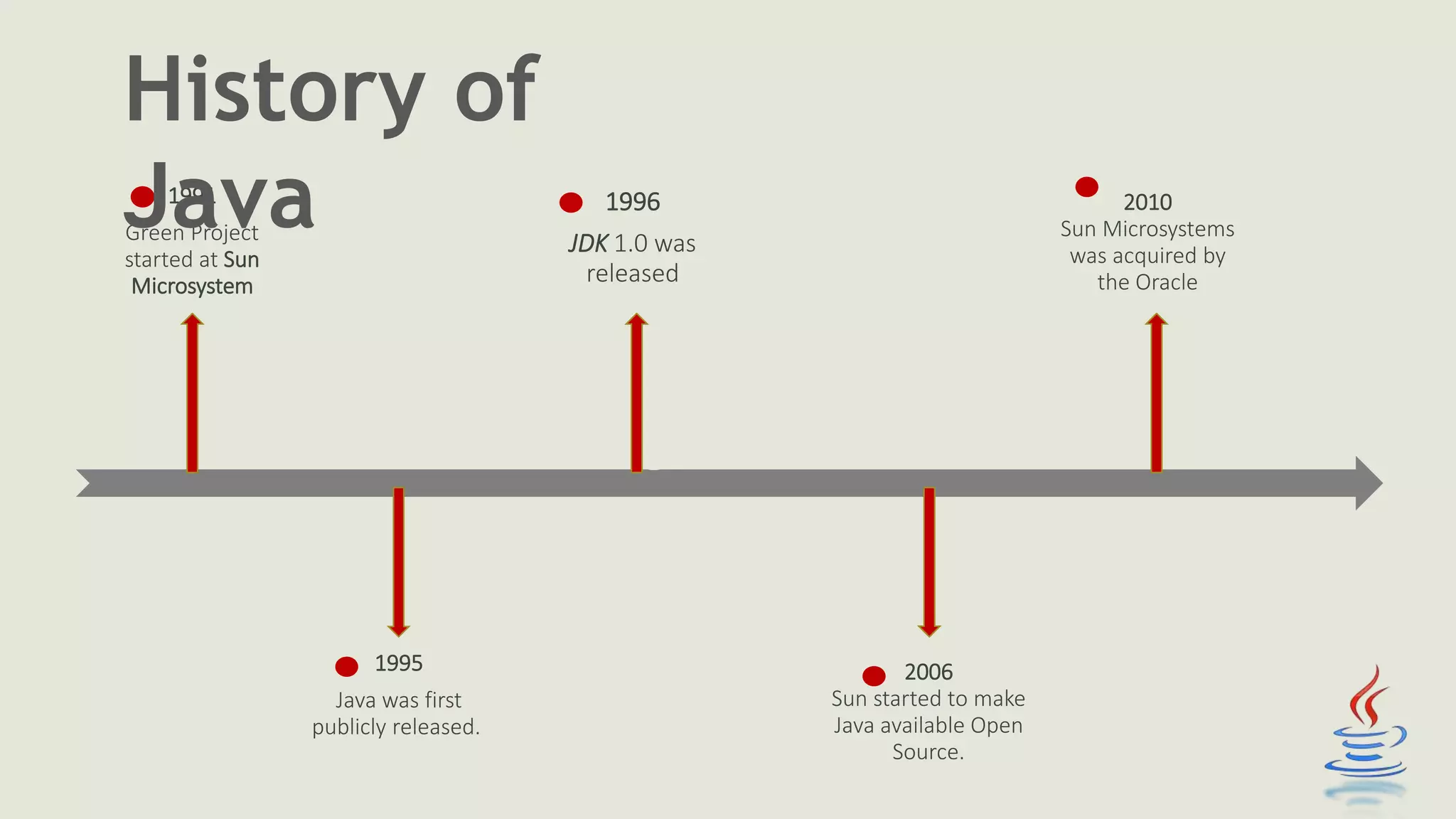
1991
Green Project
started at Sun
Microsystem
1995
Java was first
publicly released.
1996
JDK 1.0 was
released
2006
Sun started to make
Java available Open
Source.
2010
Sun Microsystems
was acquired by
the Oracle
History of
Java
Features Of Java
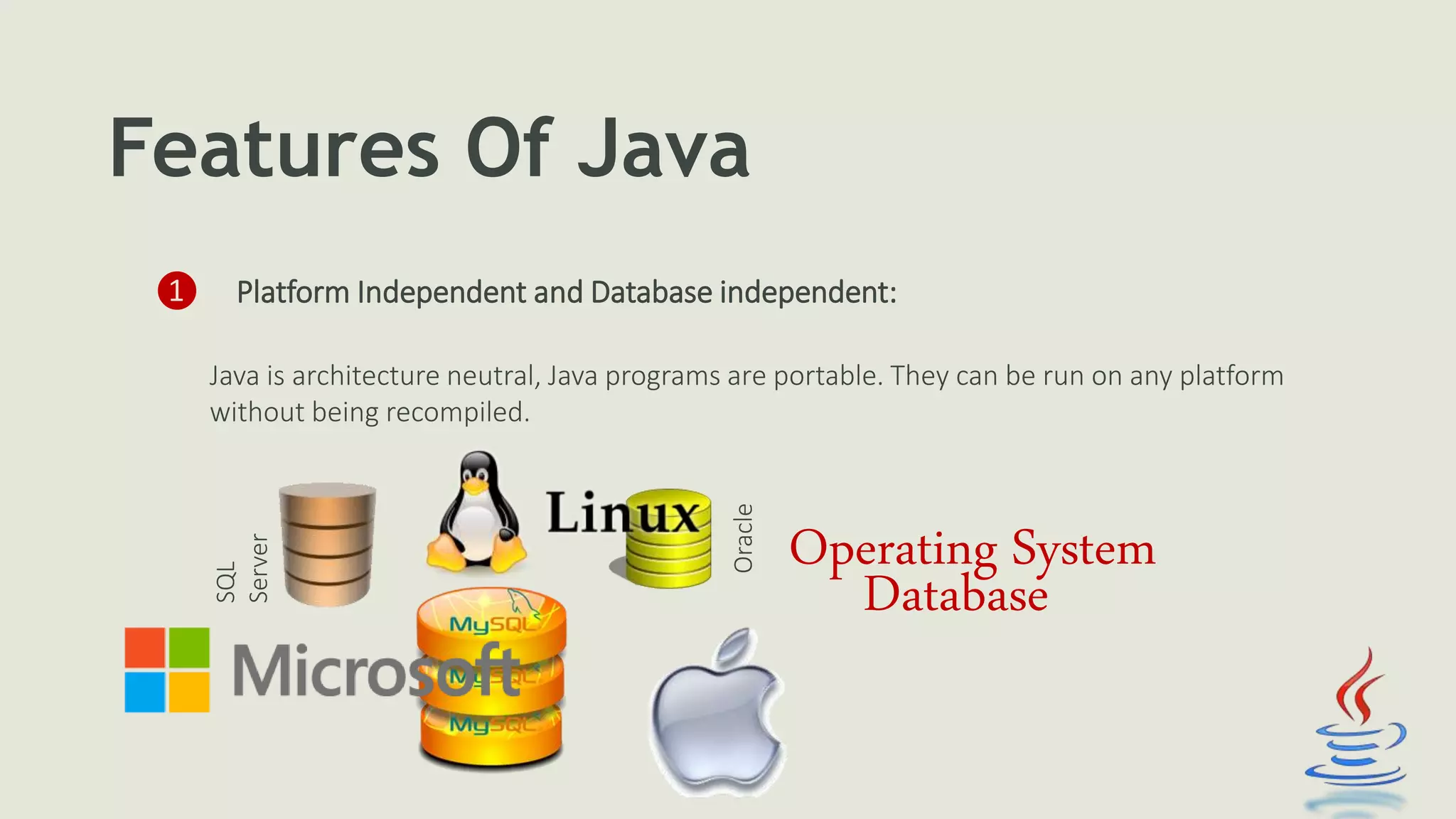
❶ Platform Independent and Database independent:
Java is architecture neutral, Java programs are portable. They can be run on any platform
without being recompiled.
SQL
Server
Oracle
Database
Operating System
Features Of Java
❷ Object Oriented Programming Language:
Java is “pure” Object Oriented programming Language
 Reusable code
 Improved software maintainability
 Reduce software complexity
Features Of Java
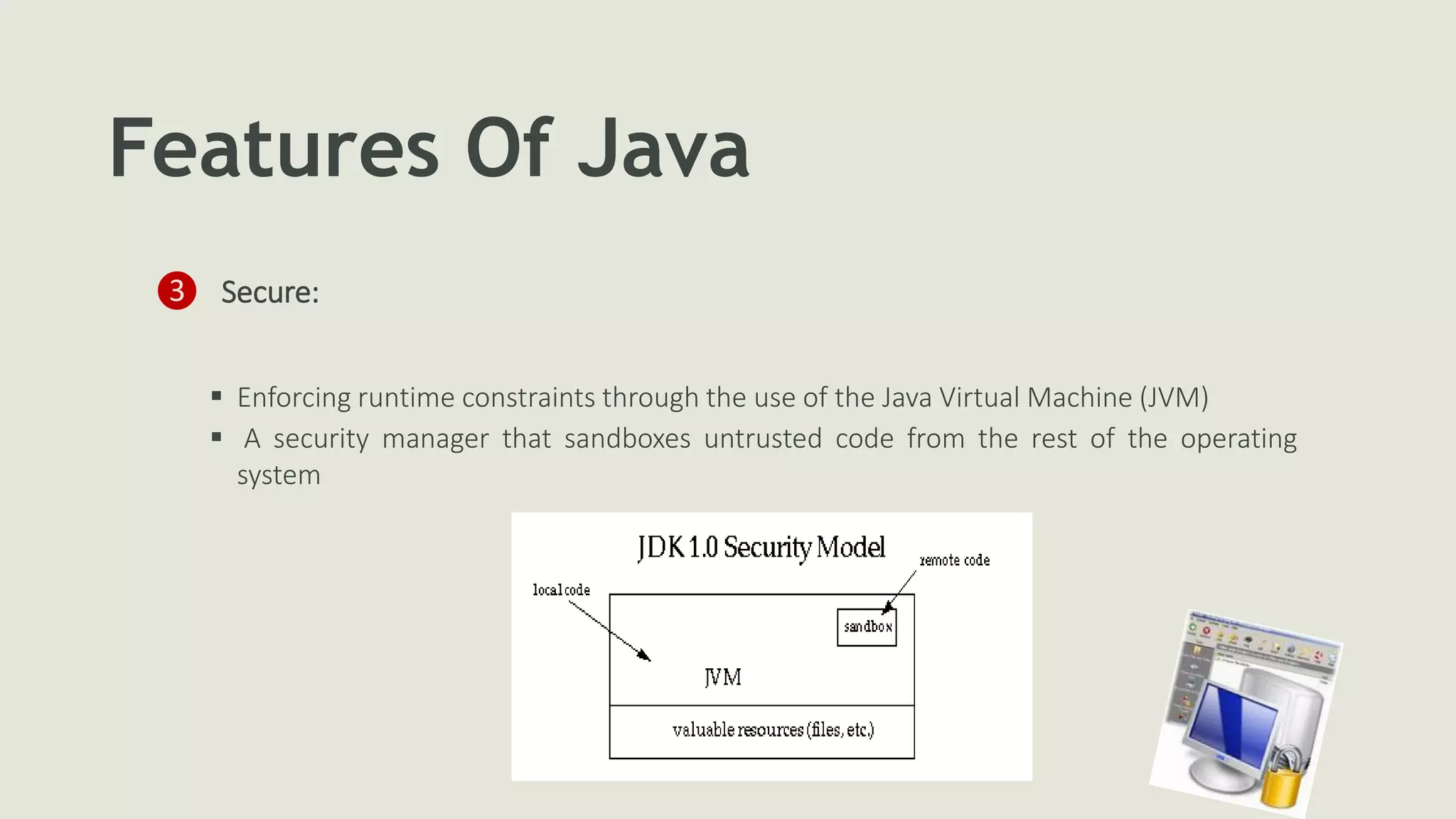
❸ Secure:
 Enforcing runtime constraints through the use of the Java Virtual Machine (JVM)
 A security manager that sandboxes untrusted code from the rest of the operating
system
Features Of Java
❹ Automatic memory management:
 Java manages the memory allocation and de-allocation for creating new objects.
 The program does not have direct access to the memory.
Features Of Java
❺ Robust:
 Java compilers can detect many problems before execution
 Java has a runtime exception-handling feature to provide programming support for
robustness.
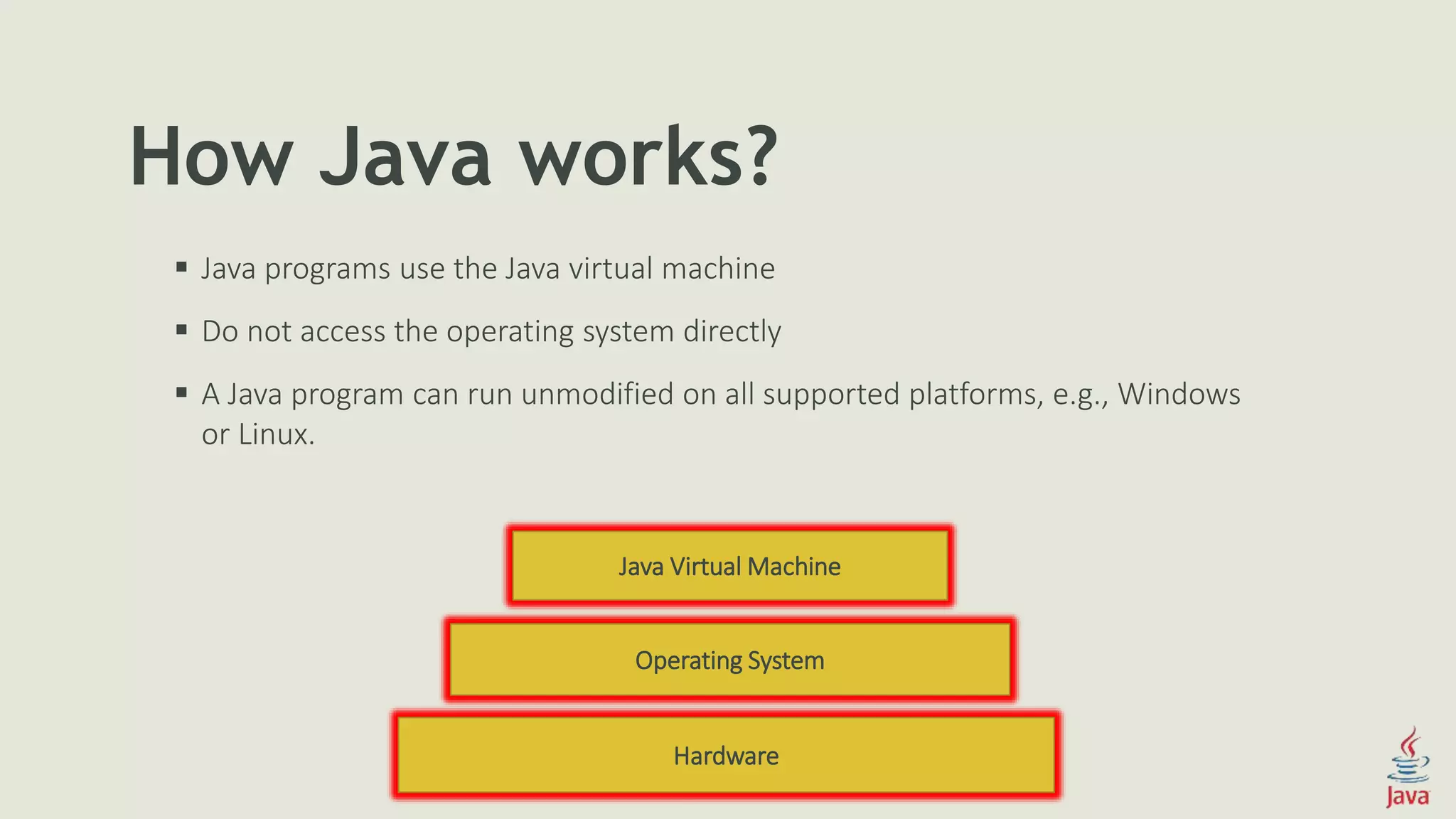
Operating System
How Java works?
 Java programs use the Java virtual machine
 Do not access the operating system directly
 A Java program can run unmodified on all supported platforms, e.g., Windows
or Linux.
Java Virtual Machine
Hardware
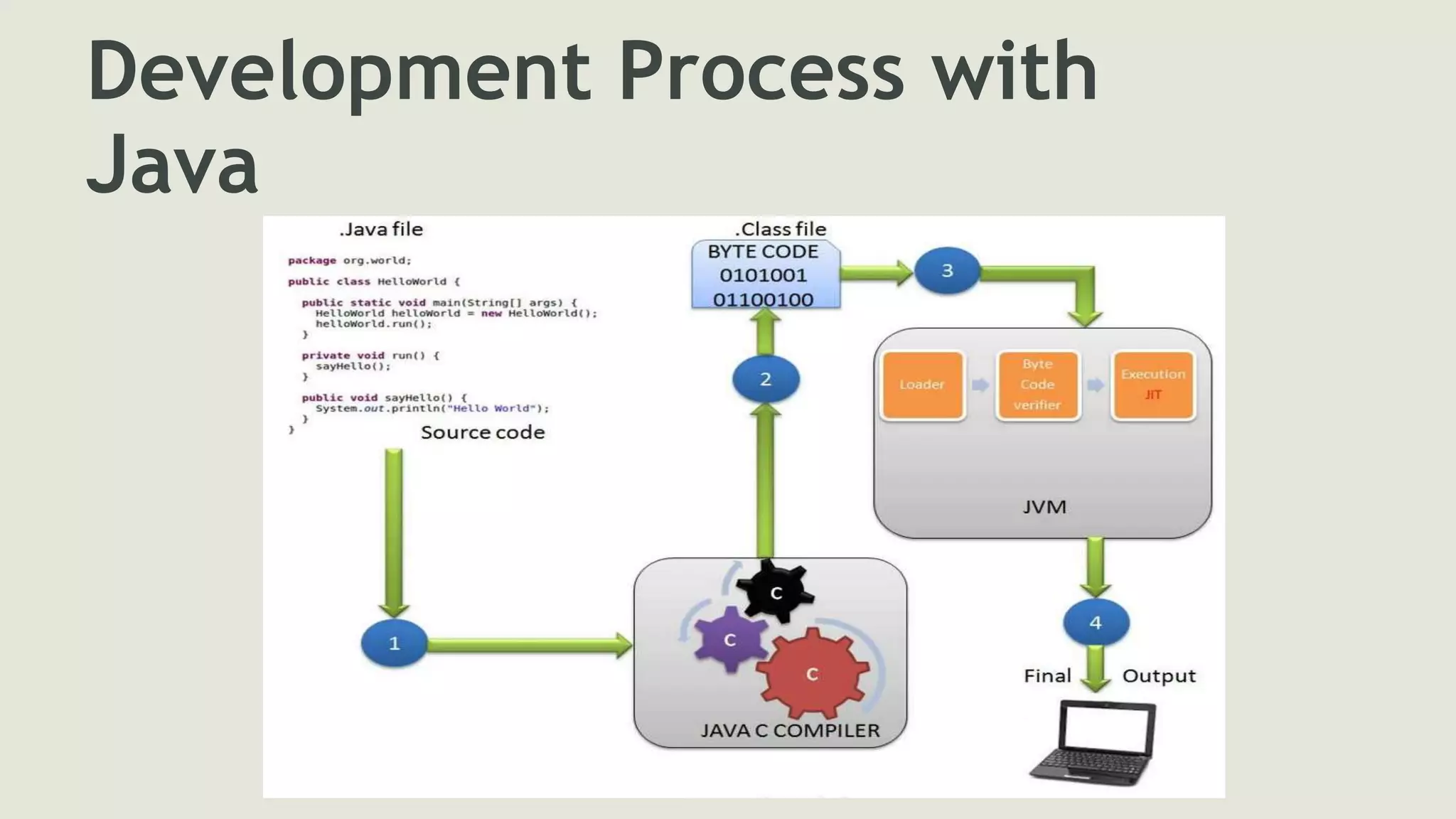
Development Process with
Java
12
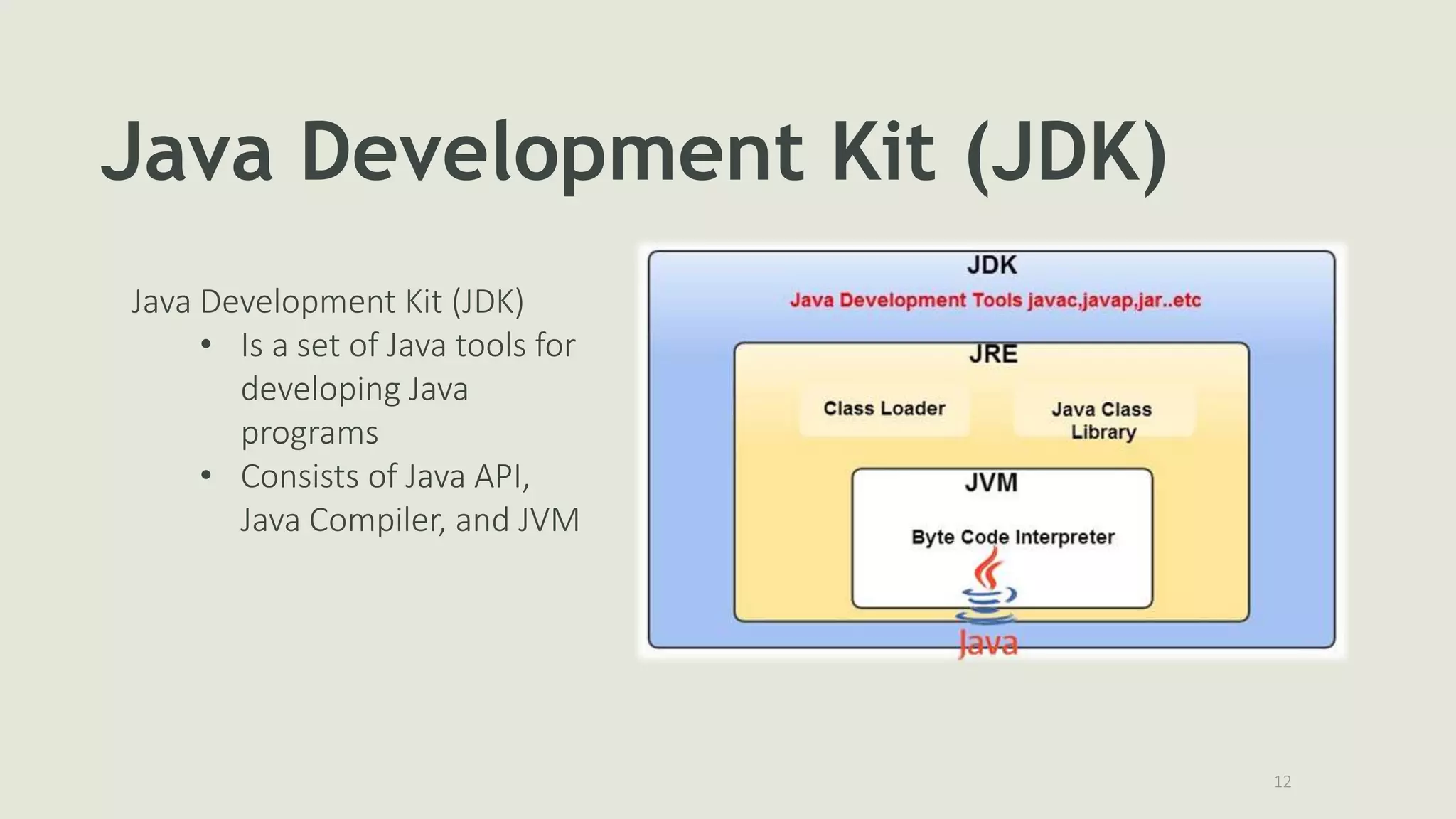
Java Development Kit (JDK)
• Is a set of Java tools for
developing Java
programs
• Consists of Java API,
Java Compiler, and JVM
JRE vs. JDK
 A Java distribution typically comes in two flavors,
 Java Runtime Environment (JRE)
 Java Development Kit (JDK)
 The Java runtime environment (JRE) consists of the JVM and the Java class
libraries.
 The JDK additionally contains the development tools necessary to create Java
programs.
Java Platform Editions
A Java Platform is the set of APIs, class libraries, and other programs used in developing Java
programs for specific applications
 There are 3 Java Platform Editions
 Java 2 Platform, Standard Edition (J2SE)
• Core Java Platform targeting applications running on workstations
 Java 2 Platform, Enterprise Edition (J2EE)
• Component-based approach to developing distributed, multi-tier enterprise
applications
 Java 2 Platform, Micro Edition (J2ME)
• Targeted at small, stand-alone or connectable consumer and embedded devices
Why Software Developers
Choose Java?
 Write software on one platform and run it on virtually any other platform
 Create programs that can run within a web browser and access available web
services
 Develop server-side applications
 Write powerful and efficient applications for
 Mobile phones
 Remote processors
 Microcontrollers
 Wireless modules and practically any other electronic device
Java is Everywhere!
 From laptops to datacenters, game consoles to scientific supercomputers, cell
phones to the Internet, Java is everywhere!
 97% of Enterprise Desktops Run Java
 89% of Desktops (or Computers) in the U.S. Run Java
 9 Million Java Developers Worldwide
 3 Billion Mobile Phones Run Java
 100% of Blu-ray Disc Players Ship with Java
 5 Billion Java Cards in Use
 125 million TV devices run Java
 5 of the Top 5 Original Equipment Manufacturers Ship Java ME
Thank
You

Introduction to java

  • 1.
  • 2.
    Todays Agenda What isjava History Features of Java Java Virtual Machine How Java works? Development Process with Java Java Development Kit (JDK) Java Platform Editions Java is Everywhere!
  • 3.
    What is Java? Java is an innovative programming language to run on a variety of different computer systems.  Write Once and Run Anywhere!
  • 4.
    1991 Green Project started atSun Microsystem 1995 Java was first publicly released. 1996 JDK 1.0 was released 2006 Sun started to make Java available Open Source. 2010 Sun Microsystems was acquired by the Oracle History of Java
  • 5.
    Features Of Java ❶Platform Independent and Database independent: Java is architecture neutral, Java programs are portable. They can be run on any platform without being recompiled. SQL Server Oracle Database Operating System
  • 6.
    Features Of Java ❷Object Oriented Programming Language: Java is “pure” Object Oriented programming Language  Reusable code  Improved software maintainability  Reduce software complexity
  • 7.
    Features Of Java ❸Secure:  Enforcing runtime constraints through the use of the Java Virtual Machine (JVM)  A security manager that sandboxes untrusted code from the rest of the operating system
  • 8.
    Features Of Java ❹Automatic memory management:  Java manages the memory allocation and de-allocation for creating new objects.  The program does not have direct access to the memory.
  • 9.
    Features Of Java ❺Robust:  Java compilers can detect many problems before execution  Java has a runtime exception-handling feature to provide programming support for robustness.
  • 10.
    Operating System How Javaworks?  Java programs use the Java virtual machine  Do not access the operating system directly  A Java program can run unmodified on all supported platforms, e.g., Windows or Linux. Java Virtual Machine Hardware
  • 11.
  • 12.
    12 Java Development Kit(JDK) Java Development Kit (JDK) • Is a set of Java tools for developing Java programs • Consists of Java API, Java Compiler, and JVM
  • 13.
    JRE vs. JDK A Java distribution typically comes in two flavors,  Java Runtime Environment (JRE)  Java Development Kit (JDK)  The Java runtime environment (JRE) consists of the JVM and the Java class libraries.  The JDK additionally contains the development tools necessary to create Java programs.
  • 14.
    Java Platform Editions AJava Platform is the set of APIs, class libraries, and other programs used in developing Java programs for specific applications  There are 3 Java Platform Editions  Java 2 Platform, Standard Edition (J2SE) • Core Java Platform targeting applications running on workstations  Java 2 Platform, Enterprise Edition (J2EE) • Component-based approach to developing distributed, multi-tier enterprise applications  Java 2 Platform, Micro Edition (J2ME) • Targeted at small, stand-alone or connectable consumer and embedded devices
  • 15.
    Why Software Developers ChooseJava?  Write software on one platform and run it on virtually any other platform  Create programs that can run within a web browser and access available web services  Develop server-side applications  Write powerful and efficient applications for  Mobile phones  Remote processors  Microcontrollers  Wireless modules and practically any other electronic device
  • 16.
    Java is Everywhere! From laptops to datacenters, game consoles to scientific supercomputers, cell phones to the Internet, Java is everywhere!  97% of Enterprise Desktops Run Java  89% of Desktops (or Computers) in the U.S. Run Java  9 Million Java Developers Worldwide  3 Billion Mobile Phones Run Java  100% of Blu-ray Disc Players Ship with Java  5 Billion Java Cards in Use  125 million TV devices run Java  5 of the Top 5 Original Equipment Manufacturers Ship Java ME
  • 17.

Editor's Notes