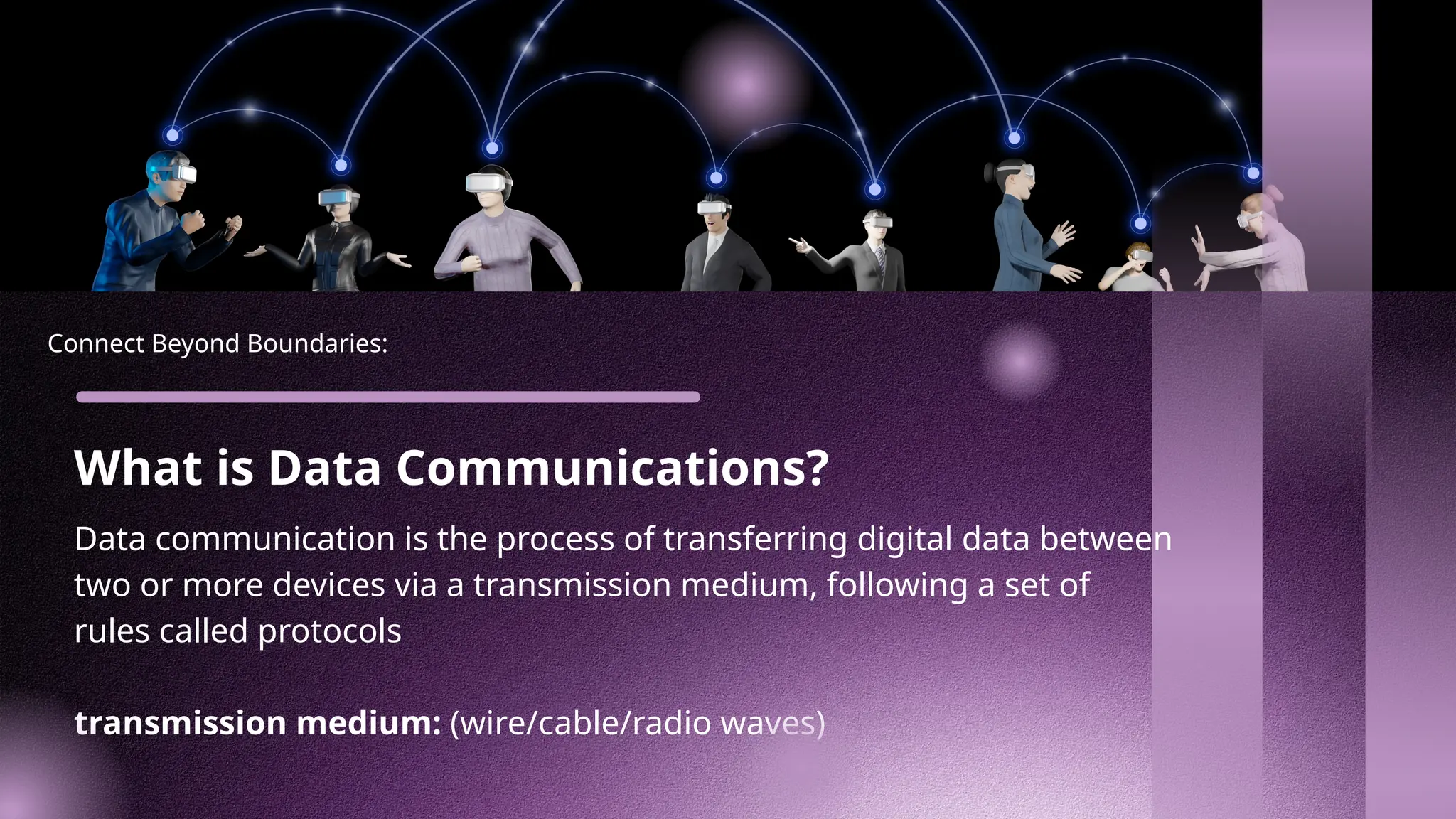
Connect Beyond Boundaries:
Whatis Data Communications?
Data communication is the process of transferring digital data between
two or more devices via a transmission medium, following a set of
rules called protocols
transmission medium: (wire/cable/radio waves)
5.
IMPORTANCE OF
DATA COMMUNICATION
•Used in business, science, education, and
daily life
• Enables rapid decision-making
• Supports global connectivity
• Foundation of the Internet and modern
communication systems
6.
Characteristics of an
EffectiveCommunication System
DELIVERY
The system must deliver data to the
correct destination. Data must be
received by the intended device or user
and only by that device or user.
ACCURACY
The system must deliver the data
accuracy. Data that have been altered
in transmission and left uncorrected
are unusable.
The system must deliver data in a
timely manner. Data delivered late
are useless. In the case of video
and audio, timely delivery means
delivering data as they are
produced, in the same order that
they are produced, and without
significant delay. This kind of
delivery is called real-time
transmission.
TIMELINESS
JITTER
It refers to the variation in the packet arrival time. It is the uneven
delay in the delivery of audio or video packets. For example, let us
assume that video packets are sent every 30 ms. If some of the
packets arrive with 30-ms delay and others with 40-ms delay, an
uneven quality in the video is the result.
7.
Components of
Data Communication
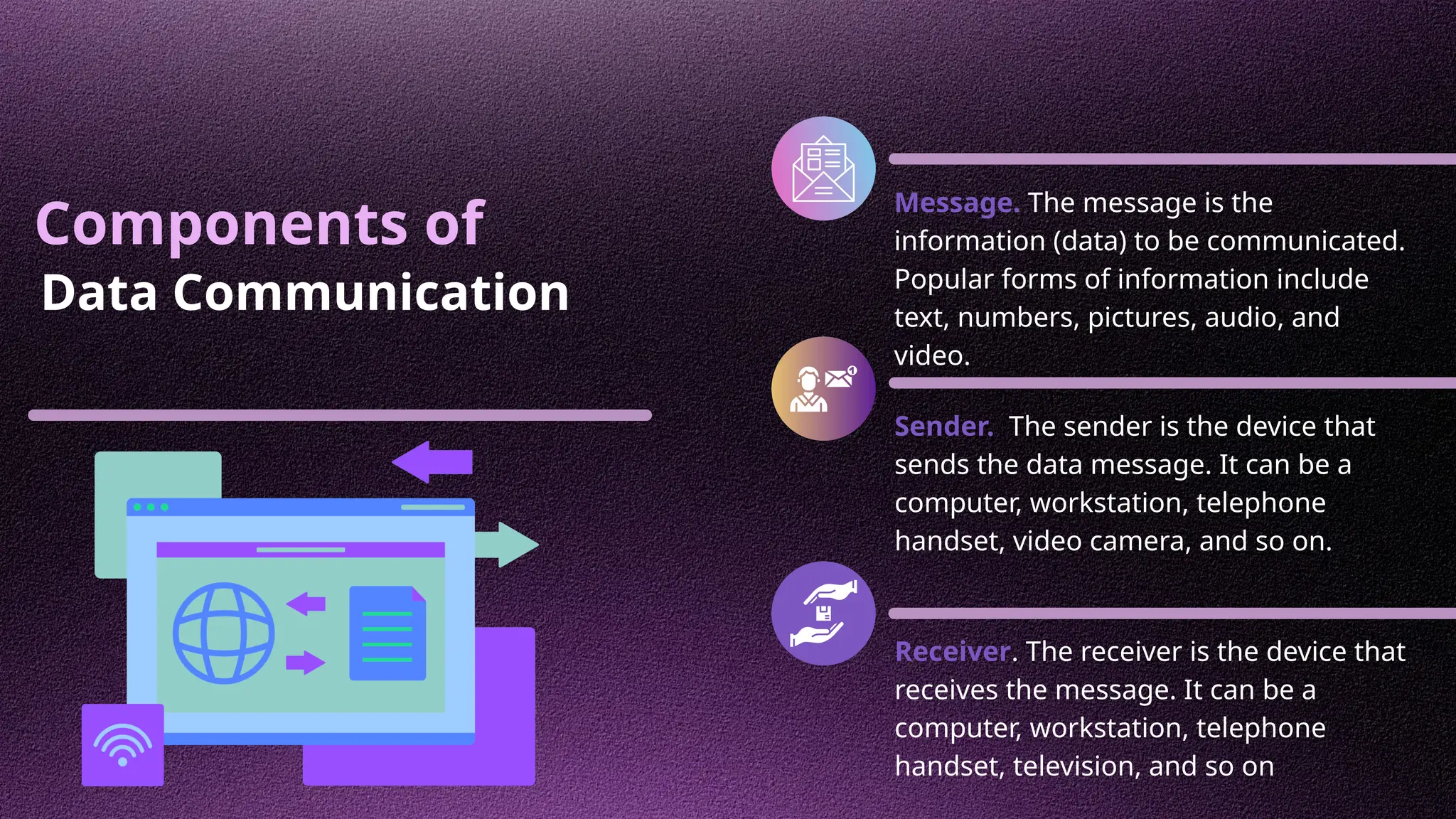
Message.The message is the
information (data) to be communicated.
Popular forms of information include
text, numbers, pictures, audio, and
video.
Sender. The sender is the device that
sends the data message. It can be a
computer, workstation, telephone
handset, video camera, and so on.
Receiver. The receiver is the device that
receives the message. It can be a
computer, workstation, telephone
handset, television, and so on
8.
Components of
Data Communication
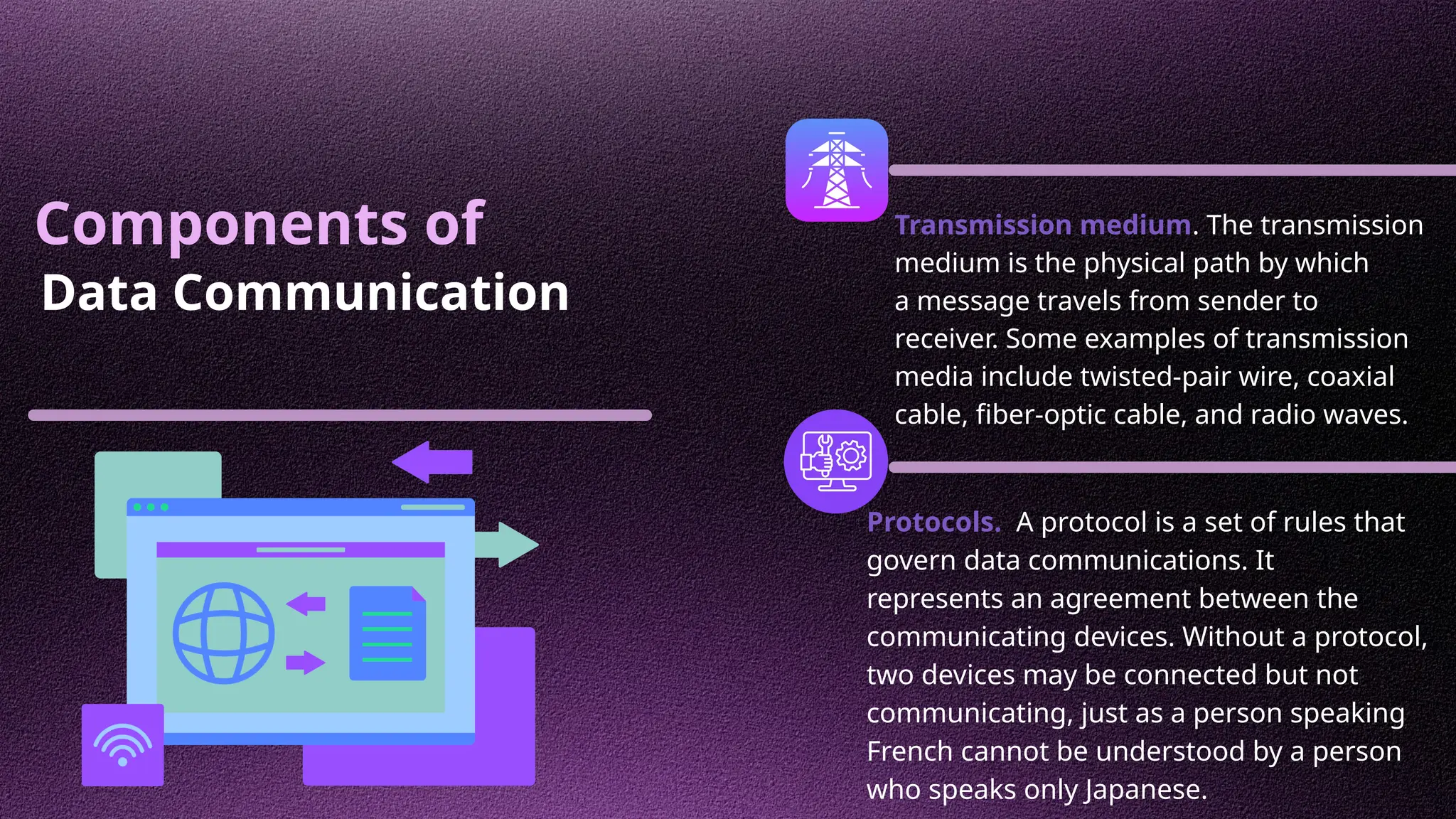
Transmissionmedium. The transmission
medium is the physical path by which
a message travels from sender to
receiver. Some examples of transmission
media include twisted-pair wire, coaxial
cable, fiber-optic cable, and radio waves.
Protocols. A protocol is a set of rules that
govern data communications. It
represents an agreement between the
communicating devices. Without a protocol,
two devices may be connected but not
communicating, just as a person speaking
French cannot be understood by a person
who speaks only Japanese.
9.
Data Flow Types
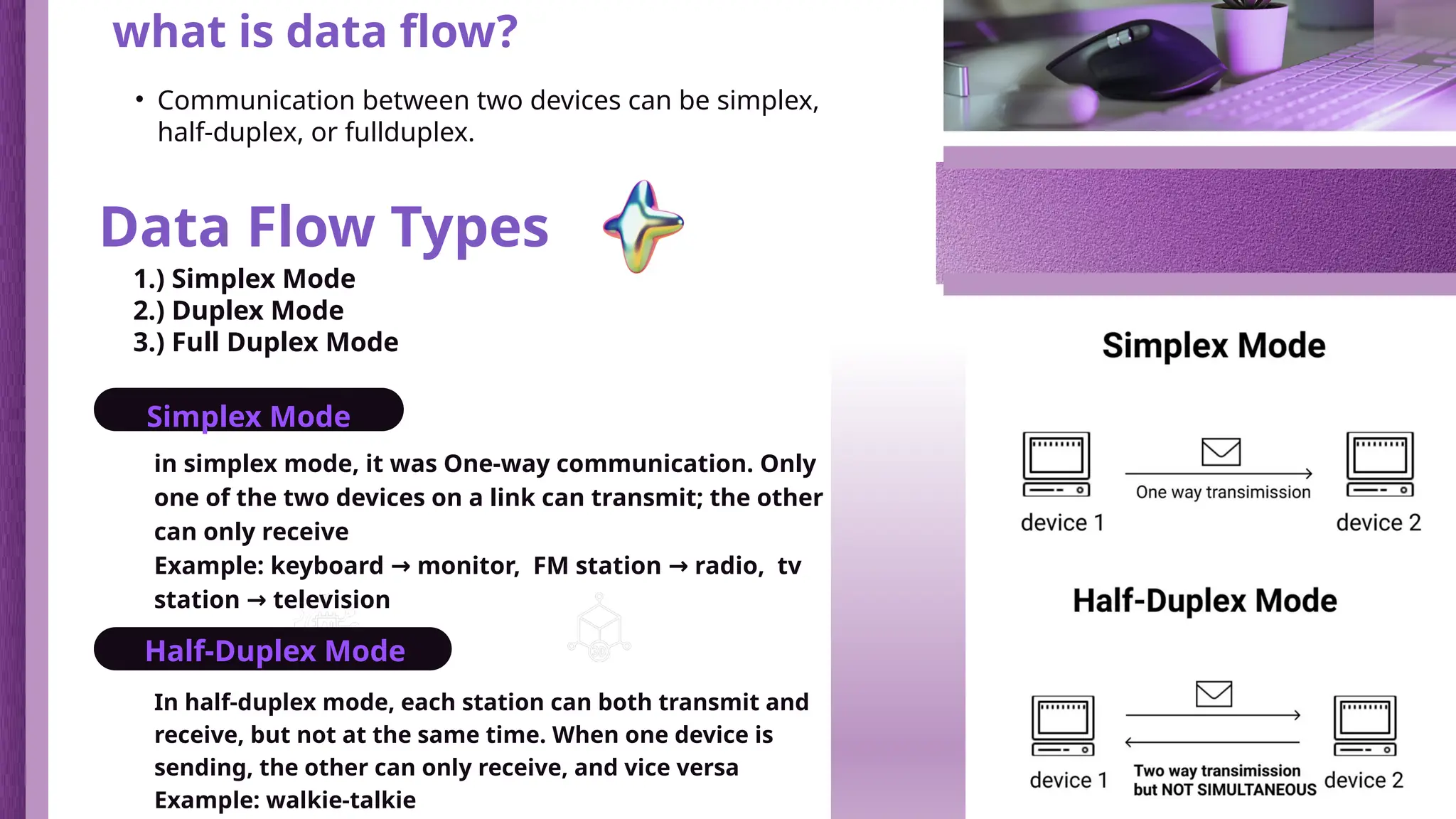
insimplex mode, it was One-way communication. Only
one of the two devices on a link can transmit; the other
can only receive
Example: keyboard monitor, FM station radio, tv
→ →
station television
→
Blockchain and
NFTs
3D Modeling and
Rendering
what is data flow?
• Communication between two devices can be simplex,
half-duplex, or fullduplex.
1.) Simplex Mode
2.) Duplex Mode
3.) Full Duplex Mode
Simplex Mode
In half-duplex mode, each station can both transmit and
receive, but not at the same time. When one device is
sending, the other can only receive, and vice versa
Example: walkie-talkie
Half-Duplex Mode
10.
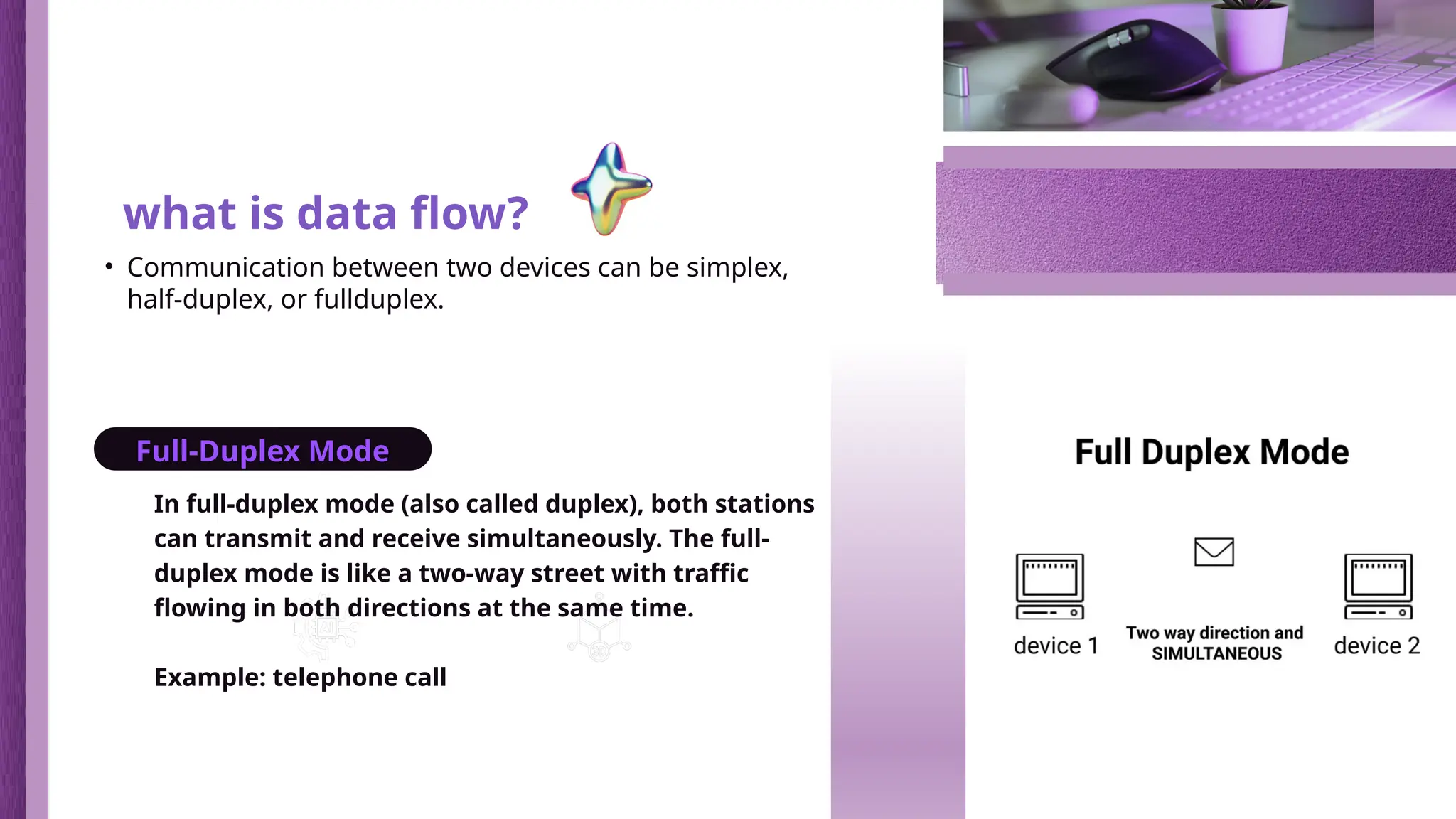
In full-duplex mode(also called duplex), both stations
can transmit and receive simultaneously. The full-
duplex mode is like a two-way street with traffic
flowing in both directions at the same time.
Example: telephone call
Blockchain and
NFTs
3D Modeling and
Rendering
what is data flow?
• Communication between two devices can be simplex,
half-duplex, or fullduplex.
Full-Duplex Mode
11.
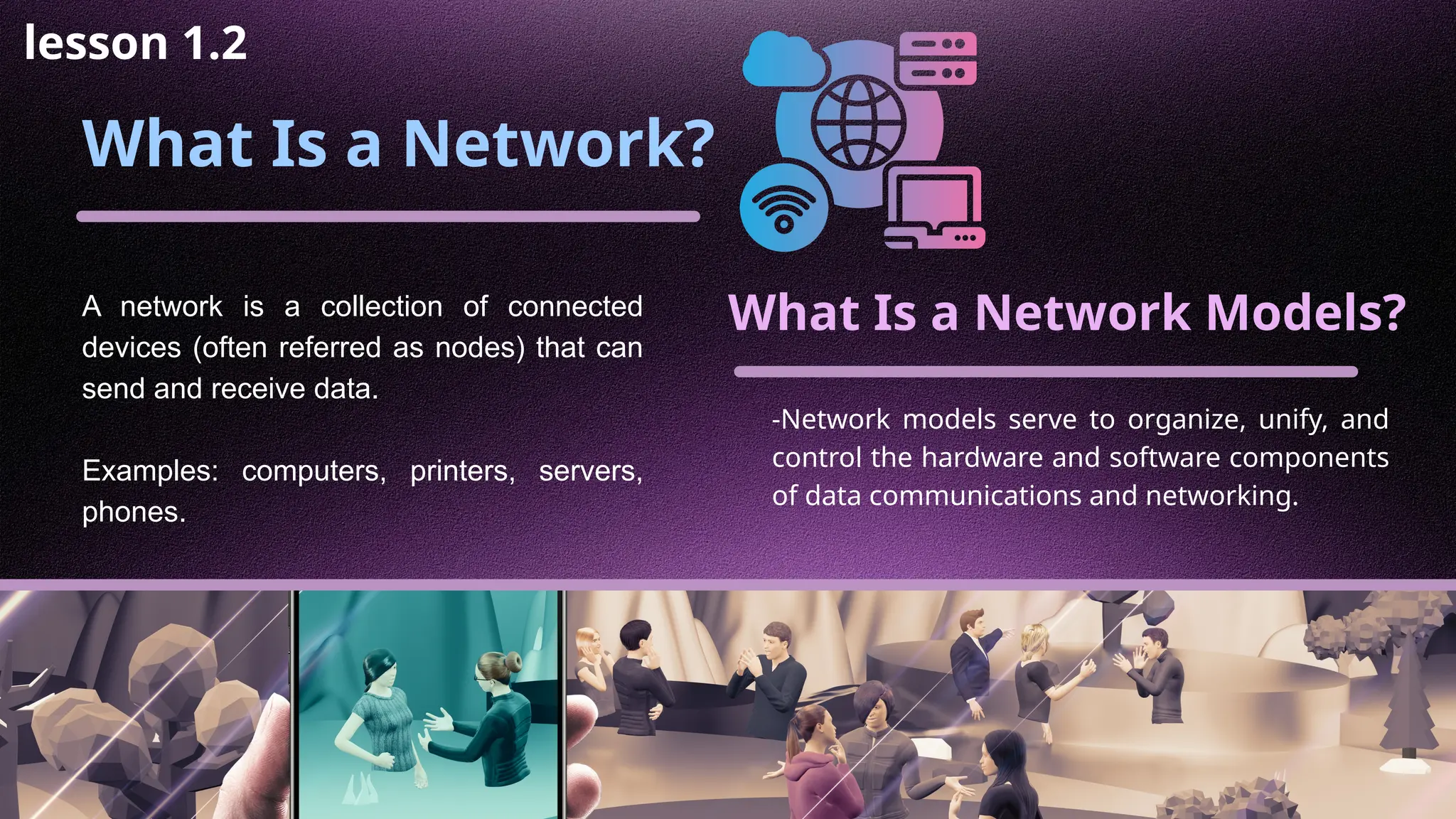
A network isa collection of connected
devices (often referred as nodes) that can
send and receive data.
Examples: computers, printers, servers,
phones.
What Is a Network?
-Network models serve to organize, unify, and
control the hardware and software components
of data communications and networking.
lesson 1.2
What Is a Network Models?
12.
fACTS:
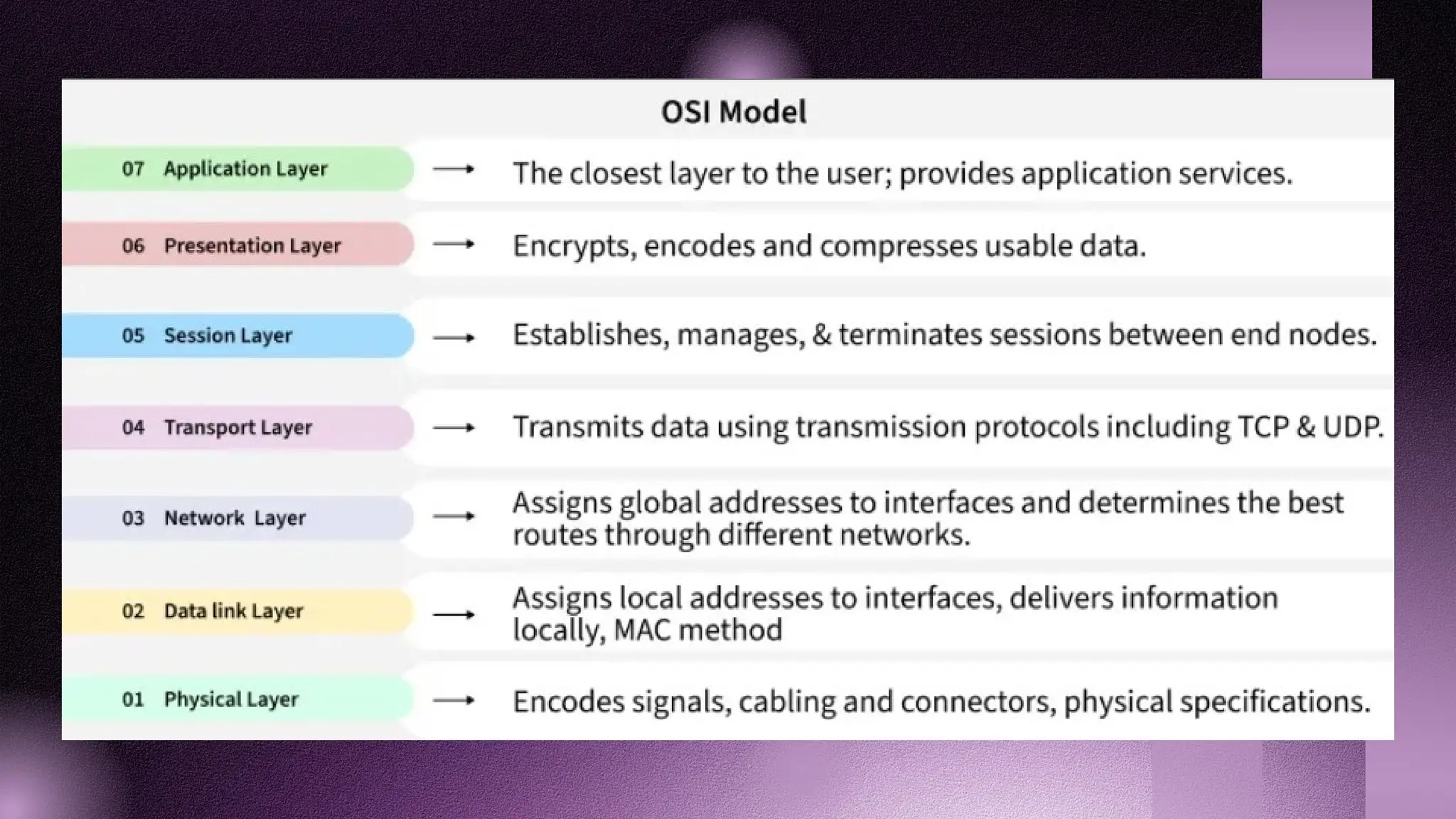
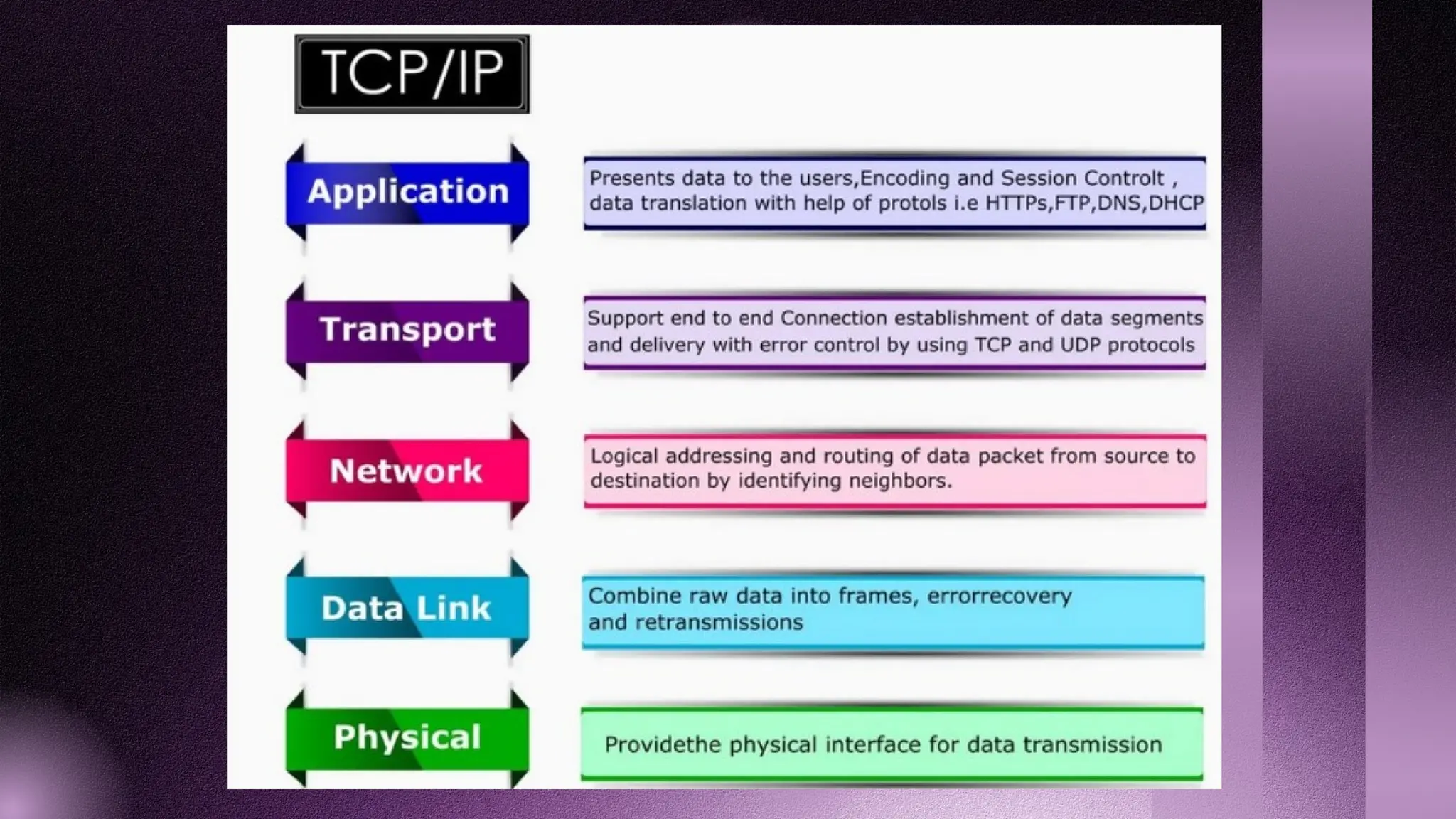
what are thetwo dominant networking models?
The OSI model is a 7-layer conceptual framework for understanding
network communication,
while the TCP/IP model is a 4-layer practical model that the internet is
built on
15.
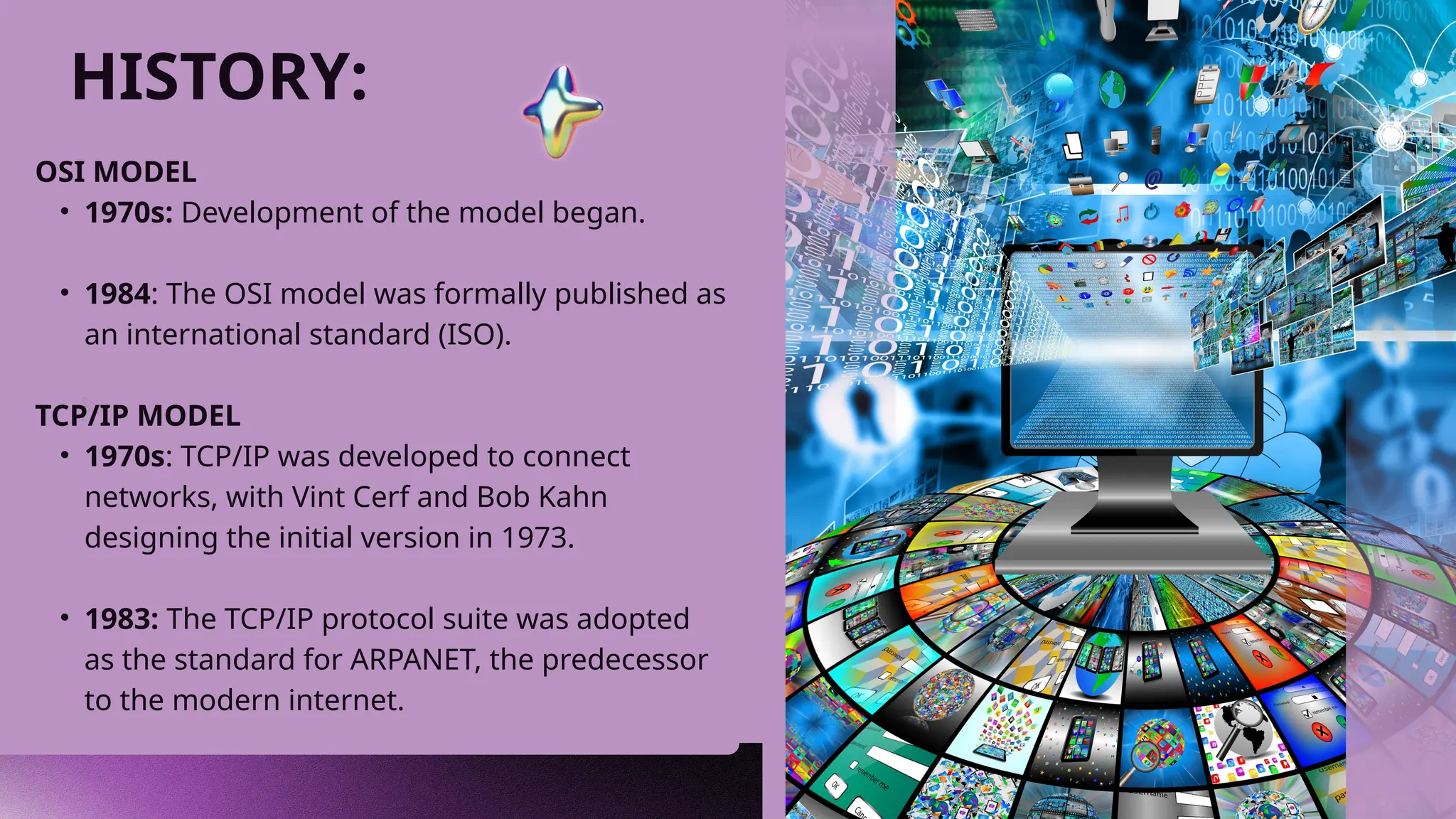
HISTORY:
OSI MODEL
• 1970s:Development of the model began.
• 1984: The OSI model was formally published as
an international standard (ISO).
TCP/IP MODEL
• 1970s: TCP/IP was developed to connect
networks, with Vint Cerf and Bob Kahn
designing the initial version in 1973.
• 1983: The TCP/IP protocol suite was adopted
as the standard for ARPANET, the predecessor
to the modern internet.
16.
Network Criteria.
LESSON 1.3
WHATIS NETWORK CRITERIA?
A network must be able to meet a certain number of
criteria. The most important of these are performance,
reliability, and security.
17.
.
Performance
• Measured bytransit time & response time
• Transit time is the amount of time required for a message to travel
from one device to another.
• Response time is the elapsed time between an
inquiry and a response.
Uses metrics: throughput (higher is better), delay (lower is better)
Performance depends on:
• Number of users
• Type of transmission medium
• Hardware capability
• Software efficiency
18.
Reliability
• network reliabilityis measured by the frequency of failure, the time it
takes a link to recover from a failure, and the network’s robustness in a
catastrophe/disasters
Security
• Protection from unauthorized access
• Preventing data damage or loss
• Policies for recovery
19.
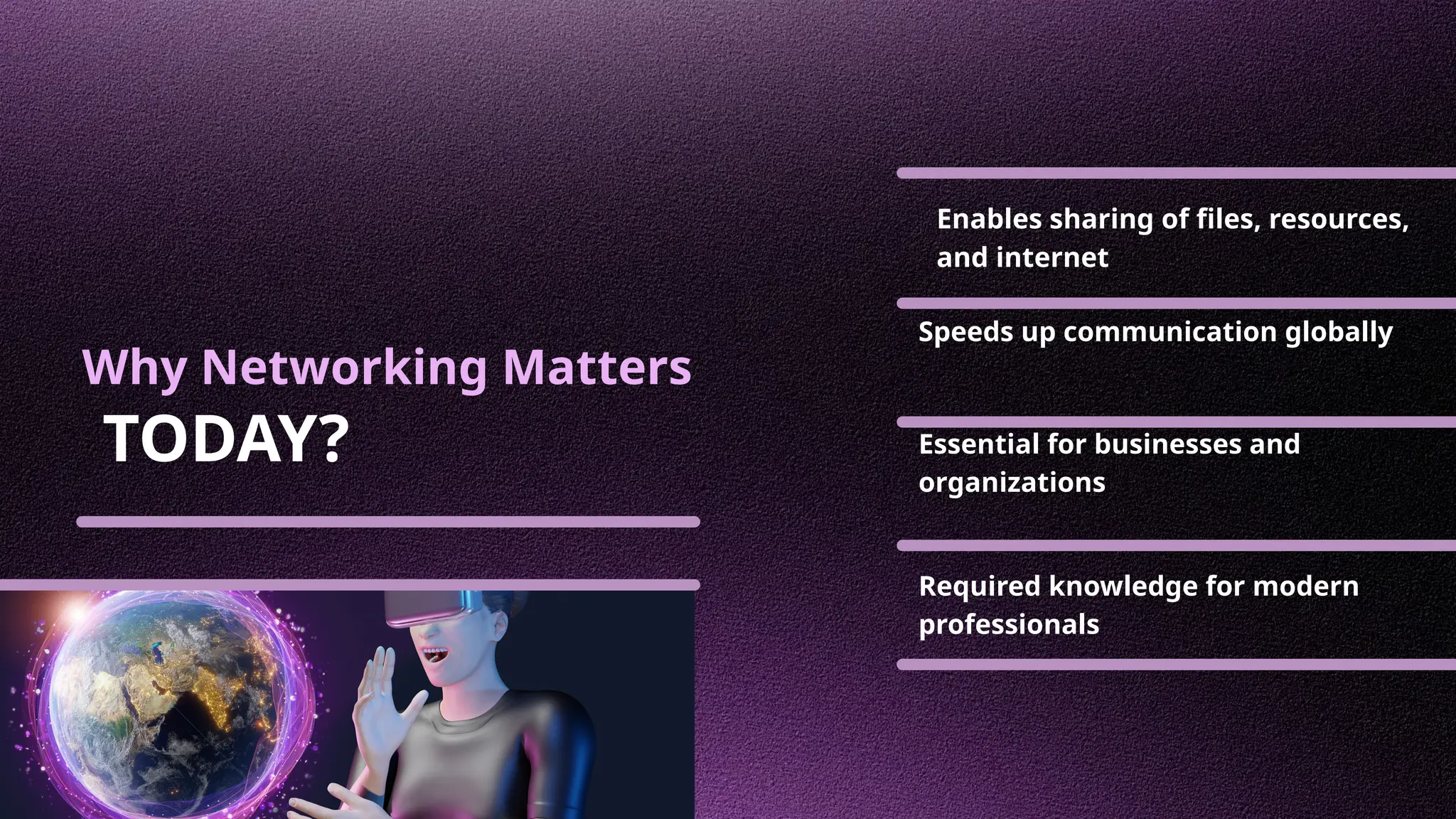
Why Networking Matters
TODAY?
Enablessharing of files, resources,
and internet
Speeds up communication globally
Essential for businesses and
organizations
Required knowledge for modern
professionals


![[DSC Europe 25] Jovan Bogicevic - Legacy to AI-Driven Defense: Transforming D...](https://cdn.slidesharecdn.com/ss_thumbnails/rsarluadt563hntyfc8q-3-251211083849-3e7bc4c0-thumbnail.jpg?width=640&height=640&fit=bounds)
![[DSC Europe 25] Hans Kleinsman - The Compliance Gearbox: How Tax Tech Mediate...](https://cdn.slidesharecdn.com/ss_thumbnails/dxdytie1toel0hr90bjs-2-251212103250-174fdbe7-thumbnail.jpg?width=640&height=640&fit=bounds)
![[DSC Europe 25] Nikolay Burlutskiy - Best Practices for Building Enterprise M...](https://cdn.slidesharecdn.com/ss_thumbnails/uirvaiuvq8y1w8hzd9tx-7-251212103249-2619edb4-thumbnail.jpg?width=640&height=640&fit=bounds)


![[DSC Europe 25] Behzad Hosseini - AI Agents in the Wild: Deploying Models tha...](https://cdn.slidesharecdn.com/ss_thumbnails/3qtejajvsjqrzwfept2c-10-251212103250-7f2b1068-thumbnail.jpg?width=640&height=640&fit=bounds)
![[DSC Europe 25] Miodrag Pesovic & Vladislav Radonjic - Federated Data Archite...](https://cdn.slidesharecdn.com/ss_thumbnails/gsbe3y5it5uhndi4e08e-1-251212103249-f1008e0c-thumbnail.jpg?width=640&height=640&fit=bounds)


![[DSC Europe 25] Ivan Peric - Intelligence Swarm Logic and Techno-Functional M...](https://cdn.slidesharecdn.com/ss_thumbnails/7my7c97fsduiccadgavw-2-251212103249-5a03f7c6-thumbnail.jpg?width=640&height=640&fit=bounds)
![[DSC Europe 25] Bassam Maharmeh - Artificial Intelligence: Opportunities and ...](https://cdn.slidesharecdn.com/ss_thumbnails/thhfmr2fqpawzj7hsjpg-5-251211083048-2c23204f-thumbnail.jpg?width=640&height=640&fit=bounds)


![[DSC Europe 25] Uros Pesic - The Reality of AI in Marketing.pdf](https://cdn.slidesharecdn.com/ss_thumbnails/rtkodnmtycovsllvzsyn-9-251215095918-b0c6bfe3-thumbnail.jpg?width=640&height=640&fit=bounds)
![[DSC Europe 25] Branko Urosevic -Rethinking Financial Talent: Integrating Cod...](https://cdn.slidesharecdn.com/ss_thumbnails/8jjrus8ttko6qj64f58f-3-251212103250-642c6374-thumbnail.jpg?width=640&height=640&fit=bounds)
![[DSC Europe 25] Katherine Forrest - AI NOW: Understanding the Velocity of Cha...](https://cdn.slidesharecdn.com/ss_thumbnails/wvvbruqfrci0sfq9xwgb-4-251212104007-e5ad1987-thumbnail.jpg?width=640&height=640&fit=bounds)