Data Communication
V Sem B.E. Computer Sc. & Engg
Department of Computer Science & Engineering
Priyadarshini Bhagwati College of Engineering,
Nagpur
(Odd 2021)
K N Hande
Head of the Department
Text Books
1. Data Communications and Networking by
Behrouz A. Forouzan, 4thEdition, Tata
McGraw Hill
2. Packet guide to core network protocol by
Bruce Hartpence, Oreilly
3. Electronic Communication Systems by
Kennedy
4. Understanding Data Communications
and Networks by William A. Shay, 2nd
Edition, Vikas Publishing House.
K N Hande
UNIT I - CONTENTS
1. Analog And Digital Signals
2. Periodic And Non Periodic Signals
3. Composite Signals
4. Frequency Spectrum And Bandwidth
5. Transmission Modes
K N Hande
Data and Signals
• One of the major functions of the physical
layer is to move data in the form of
electromagnetic signals across a transmission
medium.
medium.
• Transmission media work by conducting
energy along a physical path
• To be transmitted, data must be
transformed to electromagnetic signals.
K N Hande
Analog and Digital
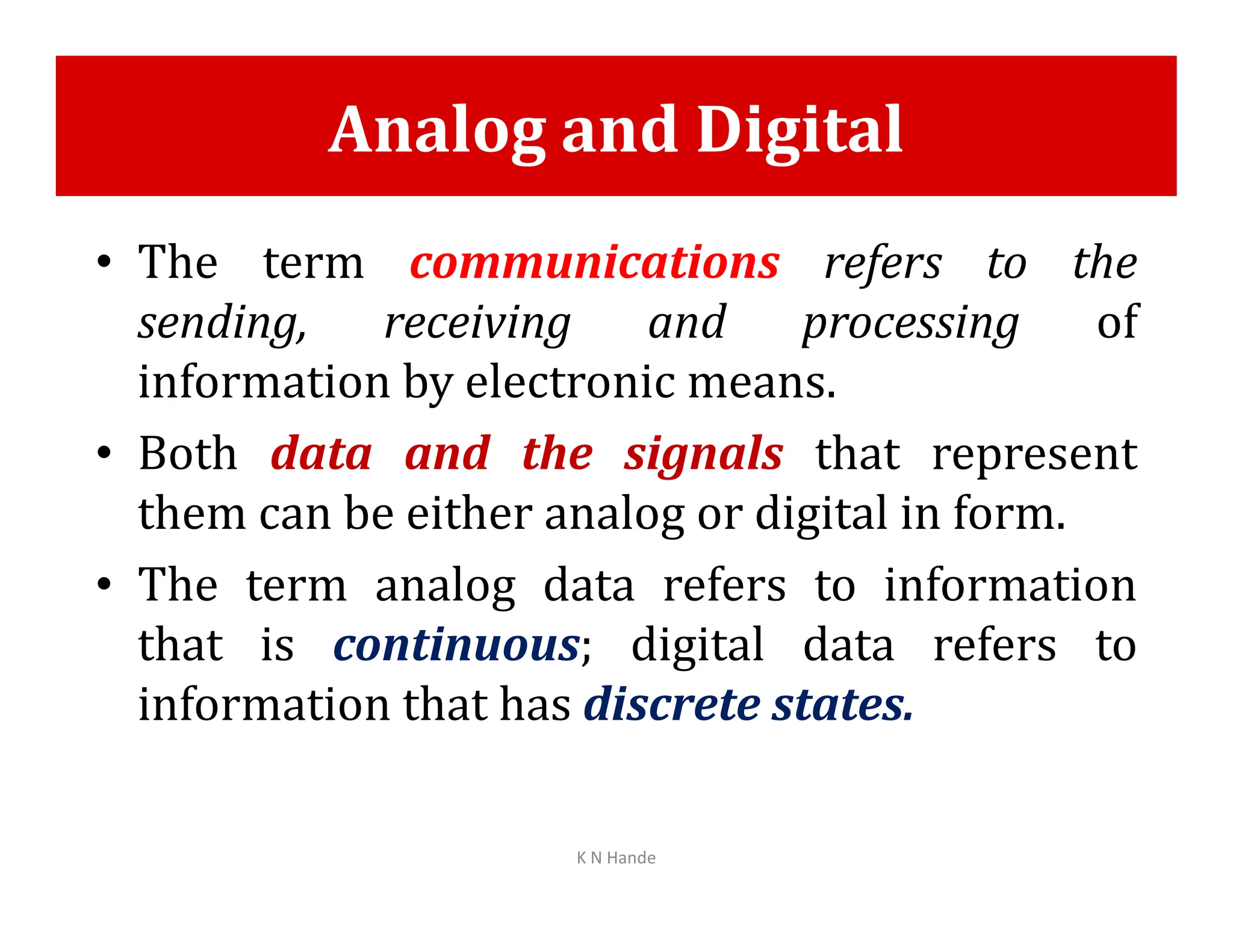
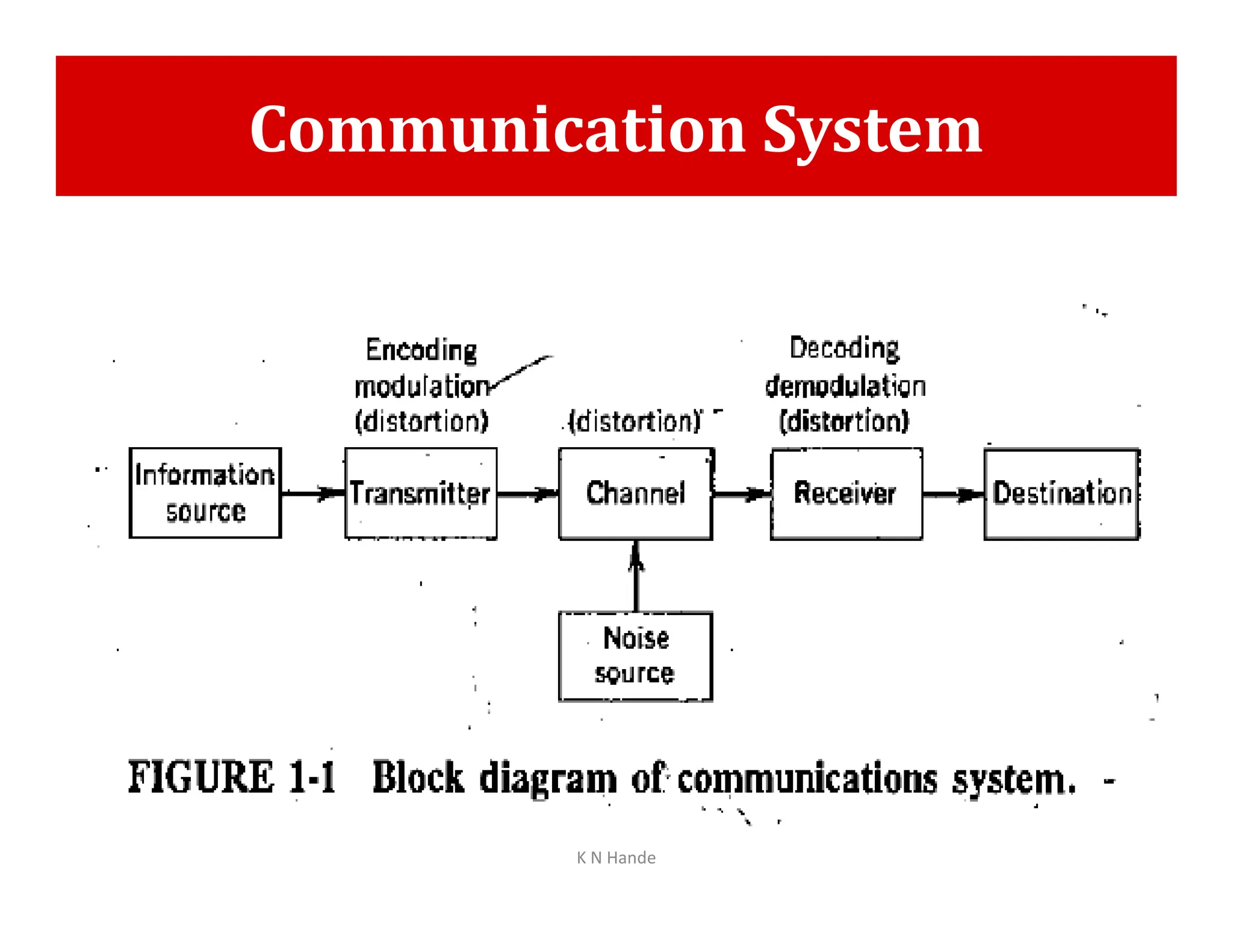
• The term communications refers to the
sending, receiving and processing of
information by electronic means.
• Both data and the signals that represent
them can be either analog or digital in form.
• The term analog data refers to information
that is continuous; digital data refers to
information that has discrete states.
K N Hande
Communication System
K N Hande
Analog and Digital Signals
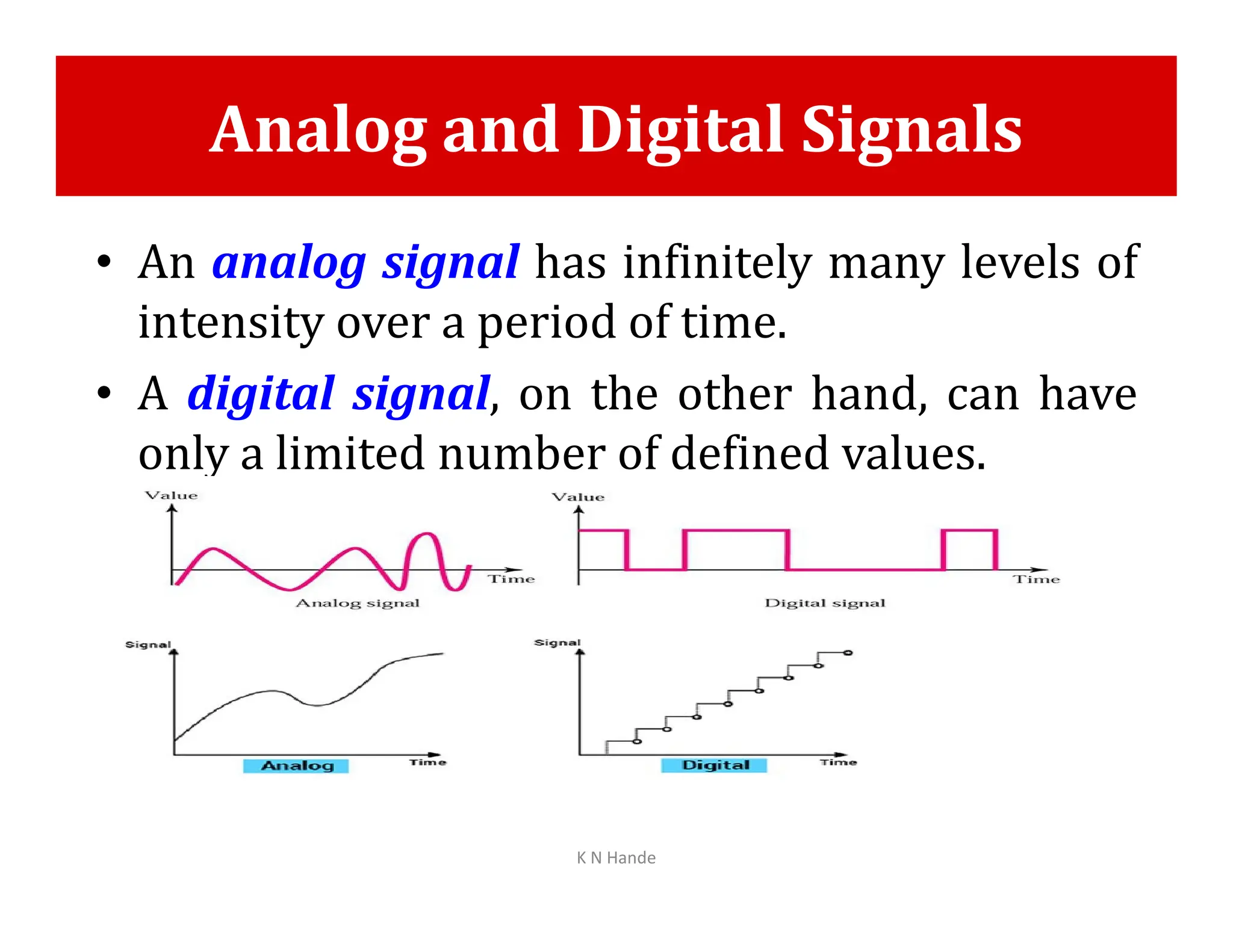
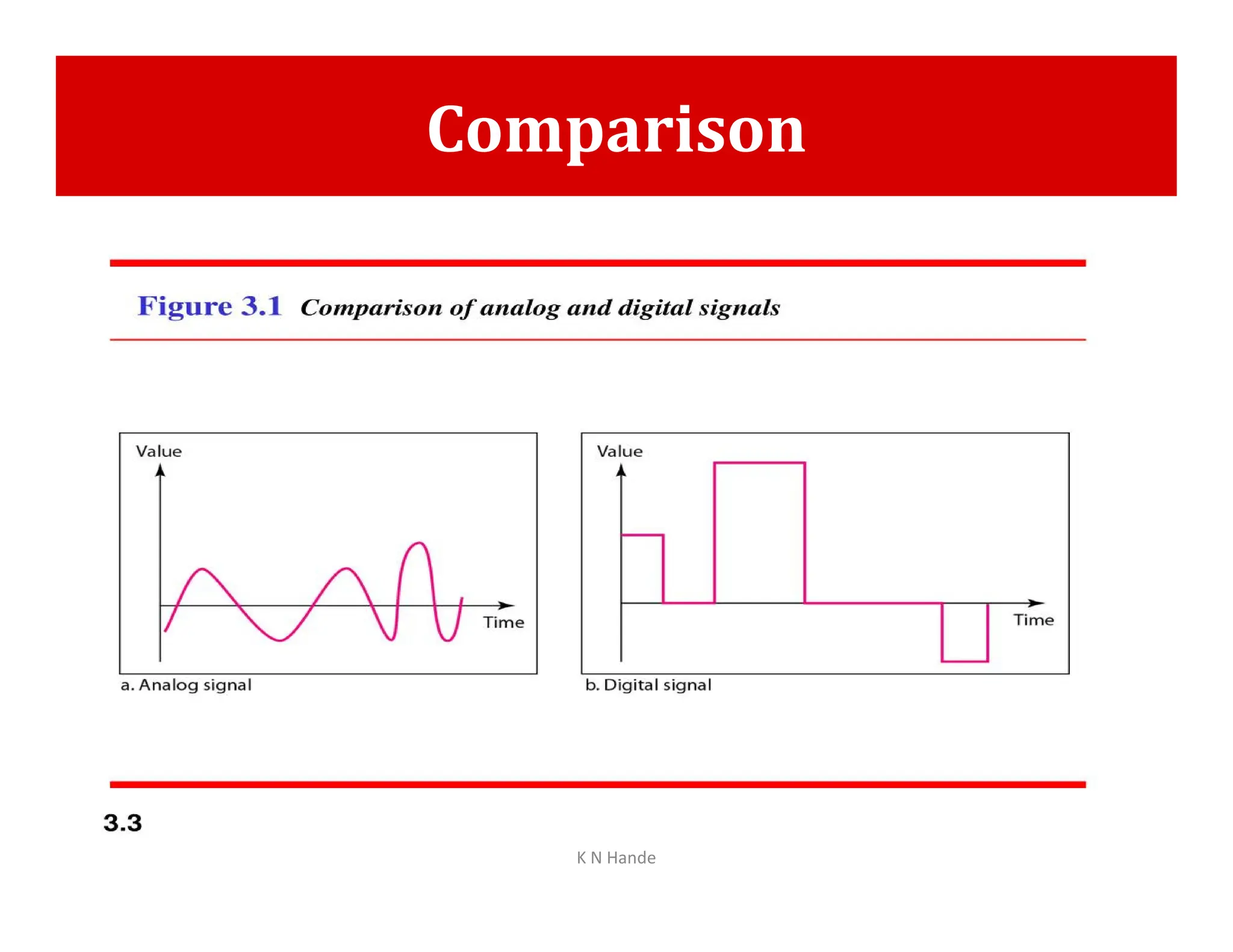
• An analog signal has infinitely many levels of
intensity over a period of time.
• A digital signal, on the other hand, can have
only a limited number of defined values.
K N Hande
Comparison
K N Hande
Periodic and Non-periodic Signals
• A periodic signal completes a pattern within a
measurable time frame, called a period
• A nonperiodic signal changes without
exhibiting a pattern or cycle that repeats over
time.
• Both analog and digital signals can be periodic
or nonperiodic.
K N Hande
Periodic Analog Signals
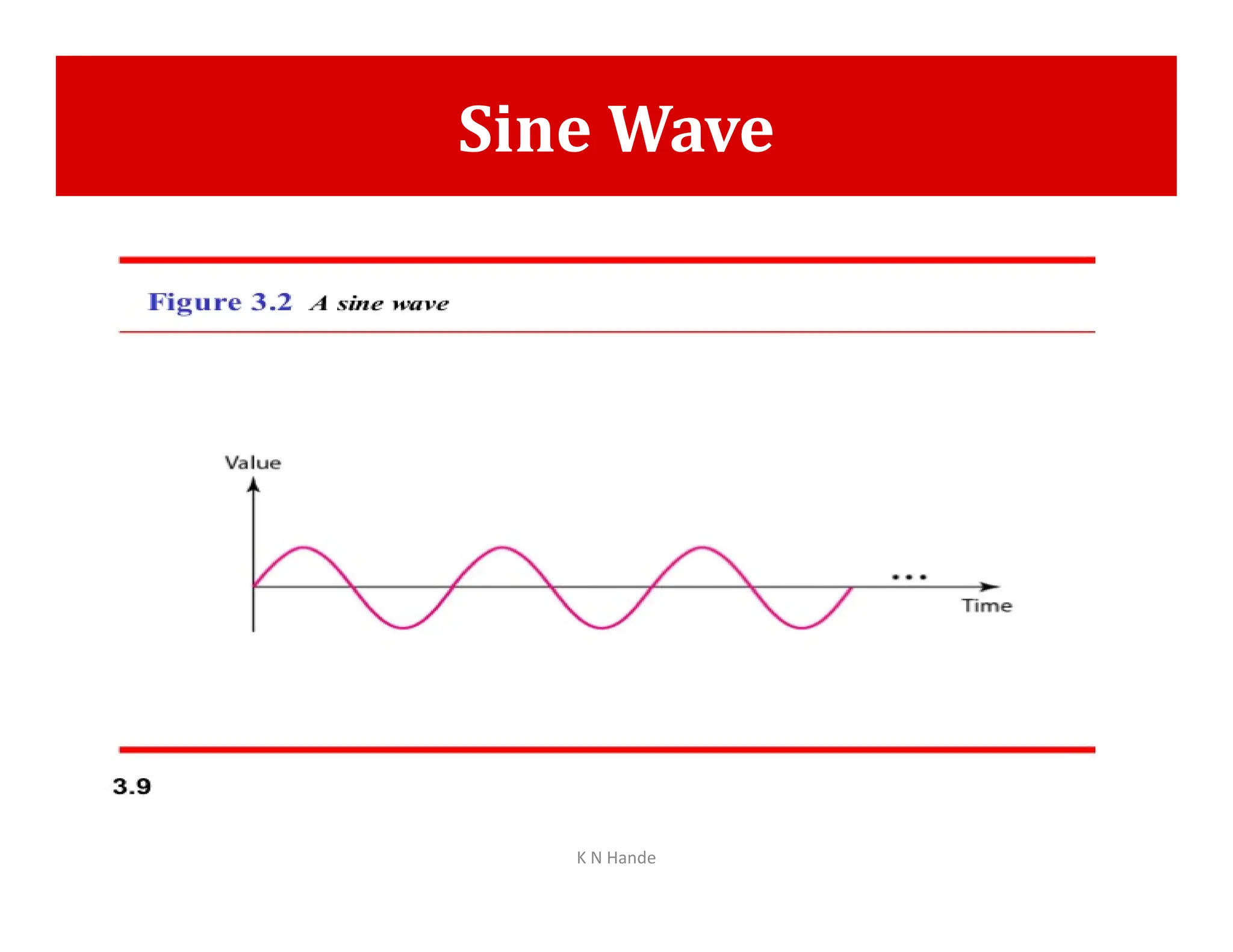
• Periodic analog signals can be classified as simple or
composite. A simple periodic analog signal, a sine
wave, cannot be decomposed into simpler signals. A
composite periodic analog signal is composed of
multiple sine waves.
• The sine wave is the most fundamental form of a
periodic analog signal.
• Each cycle consists of a single arc above the time axis
followed by a single arc below it.
K N Hande
Sine Wave
K N Hande
Sine Wave
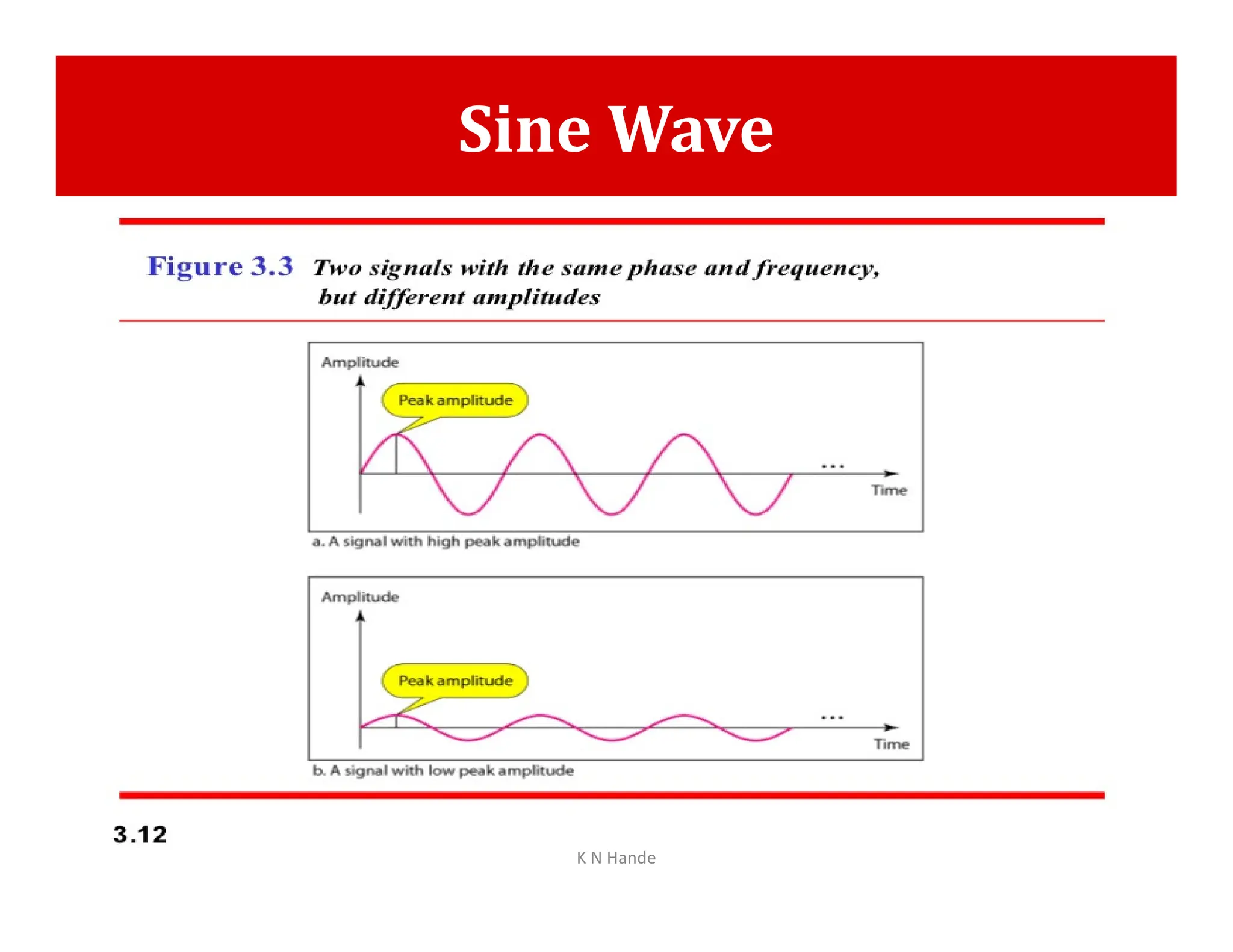
• A sine wave can be represented by three parameters:
the peak amplitude, the frequency, and the
phase.
• The peak amplitude of a signal is the absolute value of
its highest intensity, proportional to the energy it
carries. For electric signals, peak amplitude is
normally measured in volts.
K N Hande
Sine Wave
K N Hande
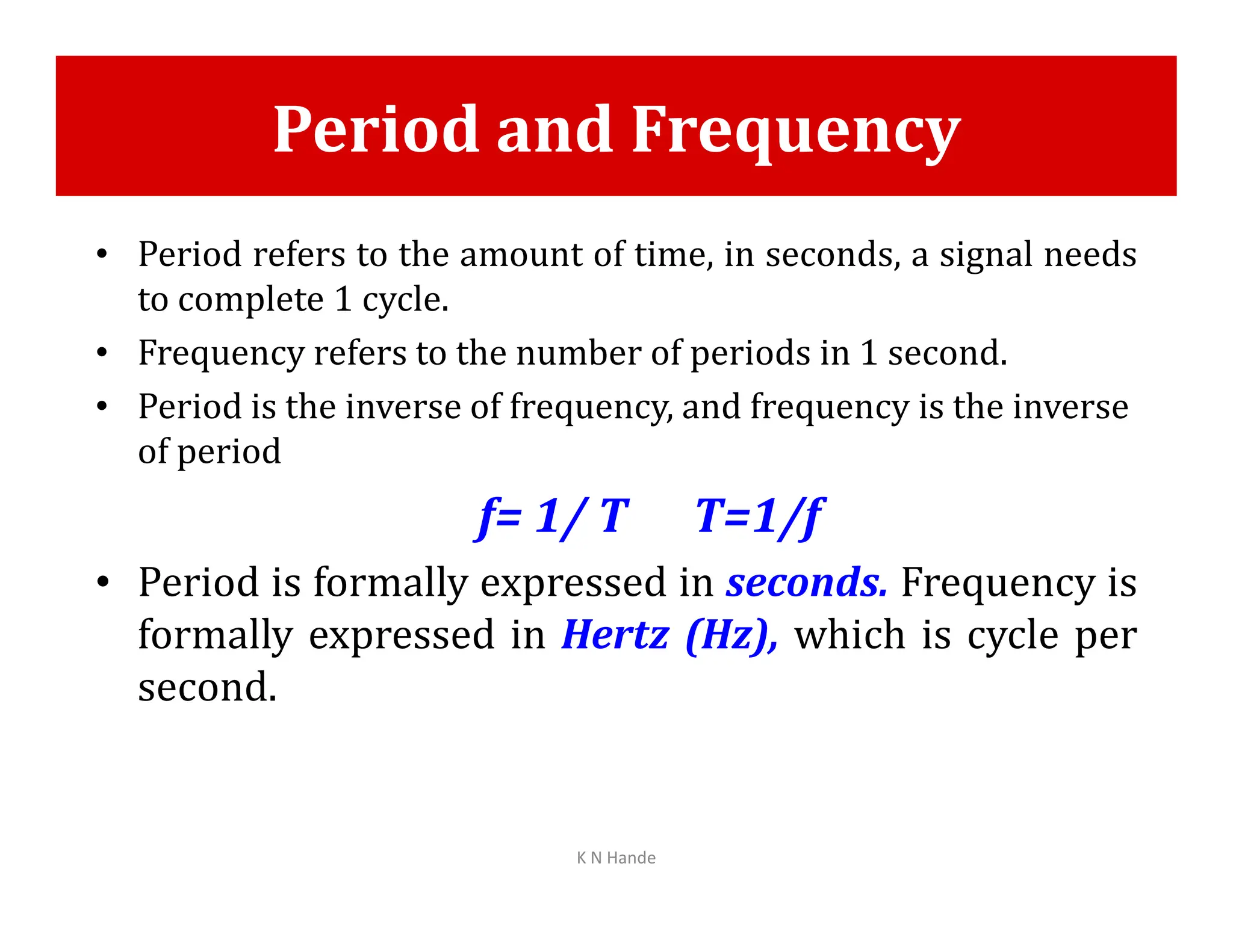
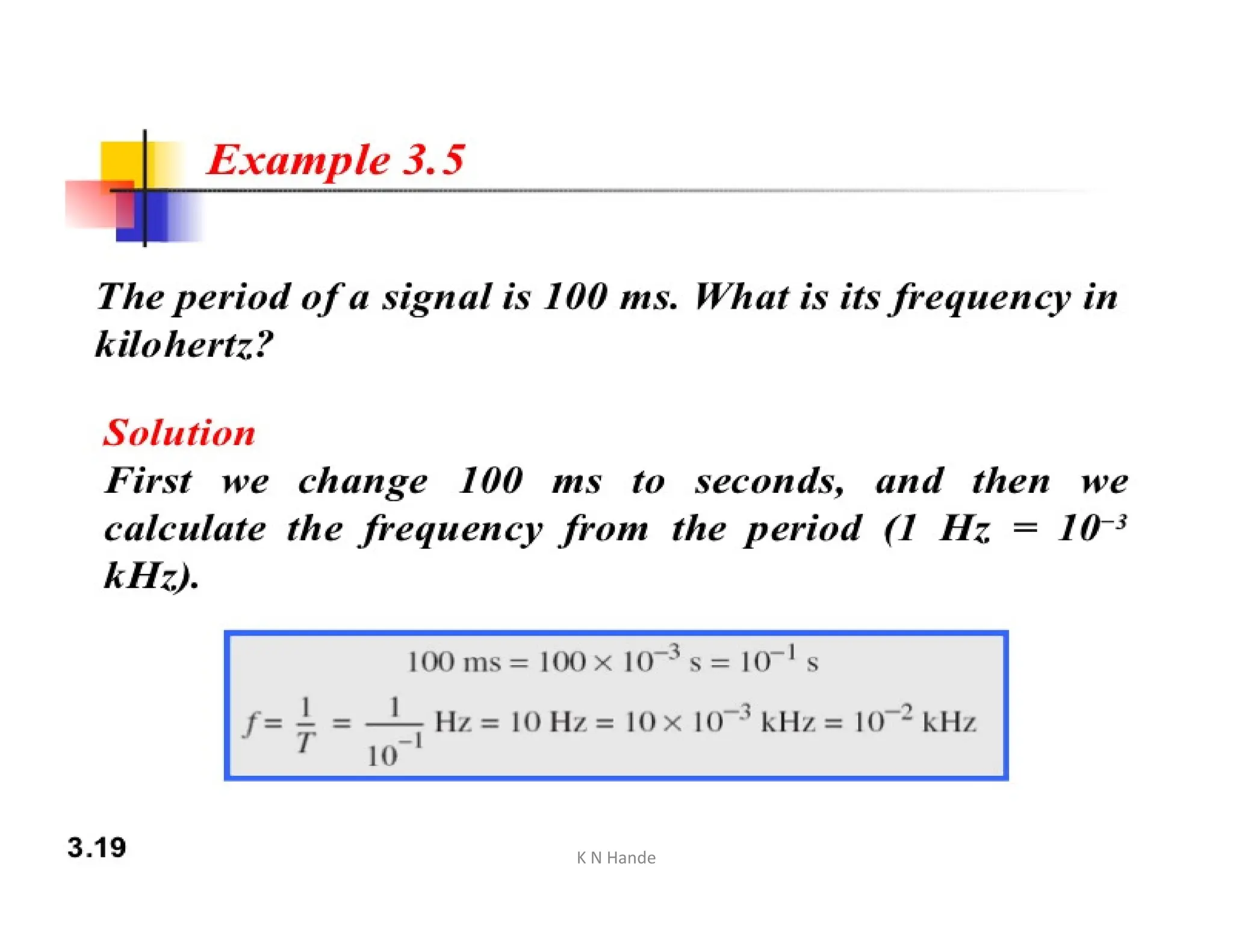
Period and Frequency
• Period refers to the amount of time, in seconds, a signal needs
to complete 1 cycle.
• Frequency refers to the number of periods in 1 second.
• Period is the inverse of frequency, and frequency is the inverse
of period
f= 1/ T T=1/f
• Period is formally expressed in seconds. Frequency is
formally expressed in Hertz (Hz), which is cycle per
second.
K N Hande
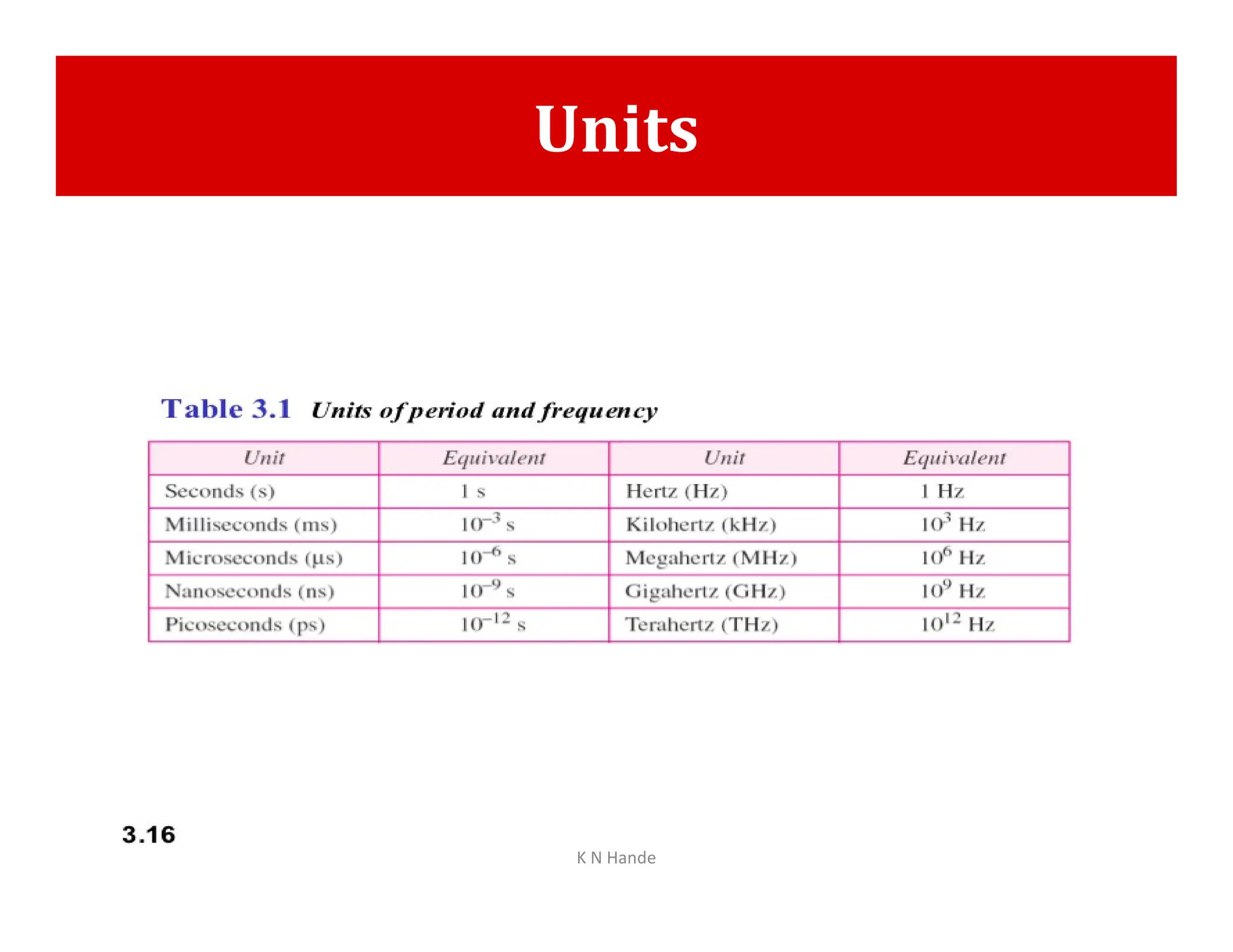
Units
K N Hande
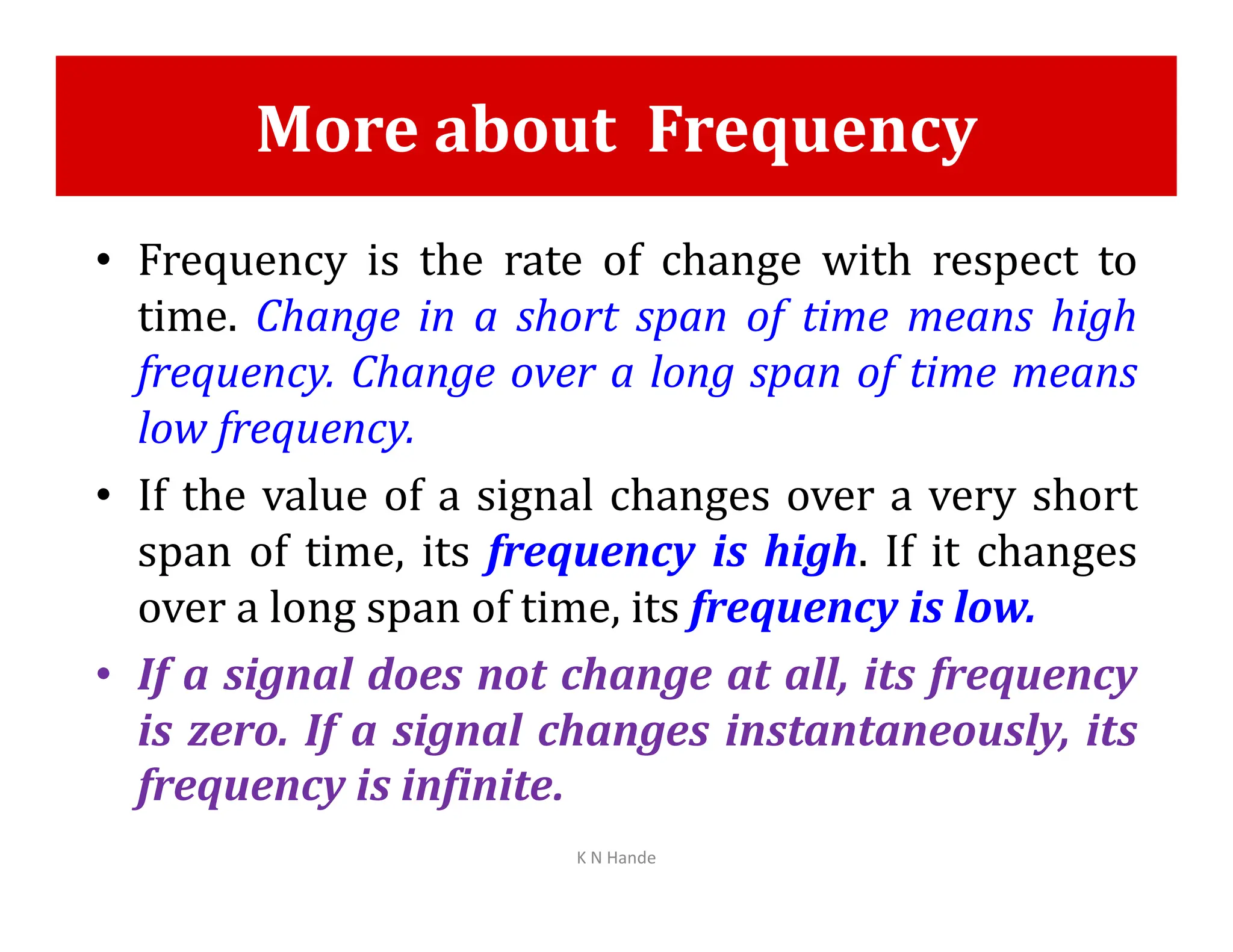
More about Frequency
• Frequency is the rate of change with respect to
time. Change in a short span of time means high
frequency. Change over a long span of time means
low frequency.
• If the value of a signal changes over a very short
span of time, its frequency is high. If it changes
over a long span of time, its frequency is low.
• If a signal does not change at all, its frequency
is zero. If a signal changes instantaneously, its
frequency is infinite.
K N Hande
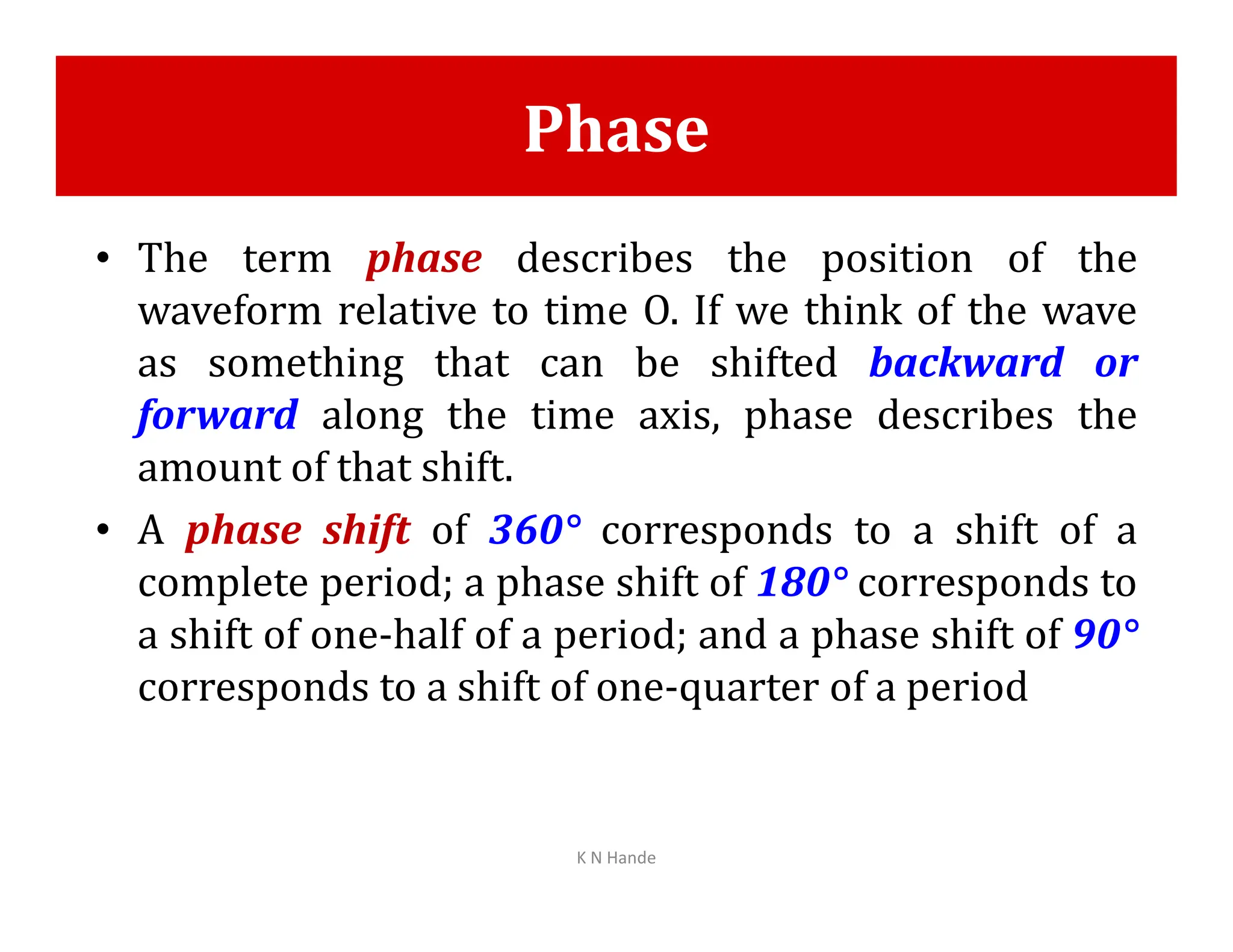
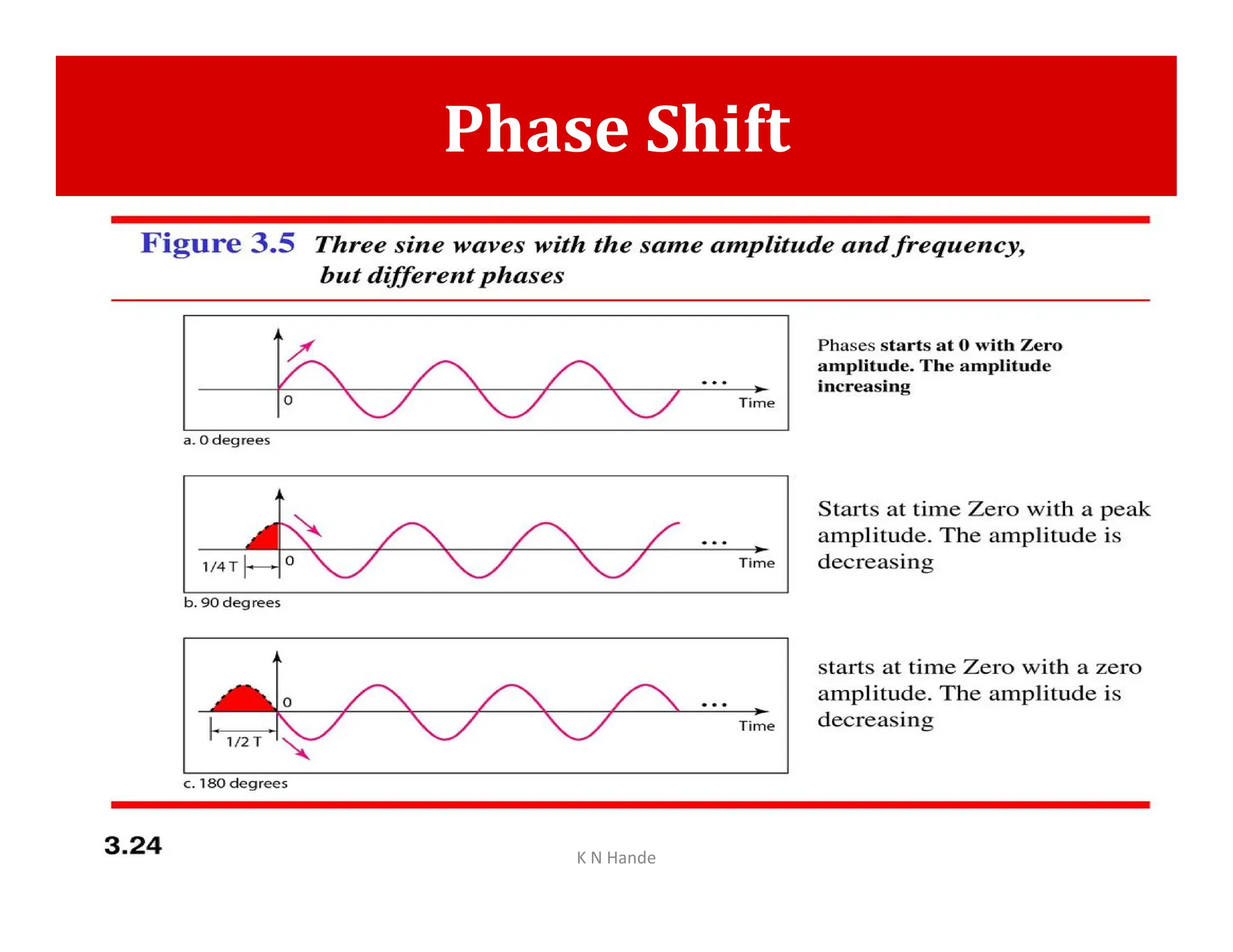
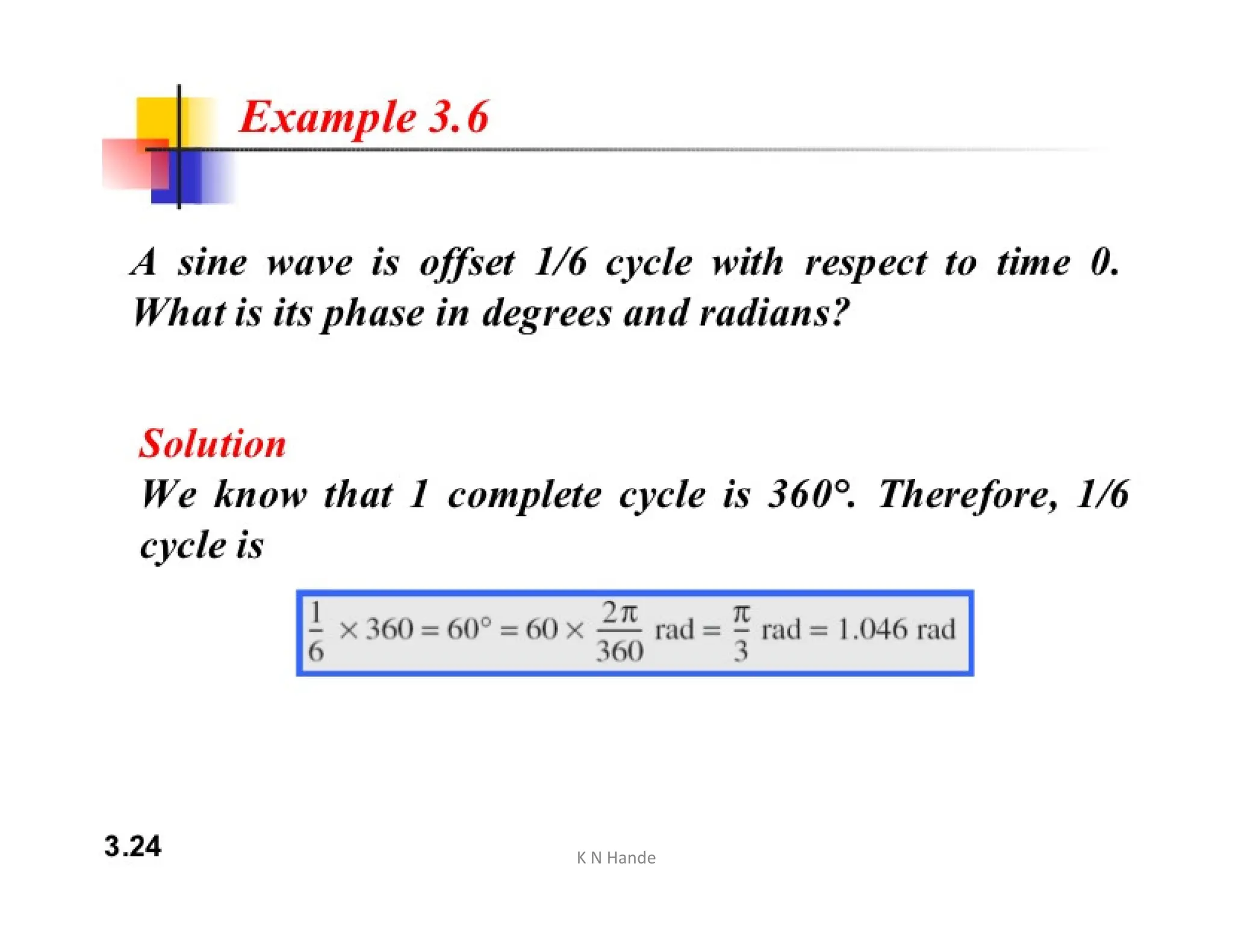
Phase
• The term phase describes the position of the
waveform relative to time O. If we think of the wave
as something that can be shifted backward or
forward along the time axis, phase describes the
amount of that shift.
• A phase shift of 360° corresponds to a shift of a
complete period; a phase shift of 180° corresponds to
a shift of one-half of a period; and a phase shift of 90°
corresponds to a shift of one-quarter of a period
K N Hande
Phase Shift
K N Hande
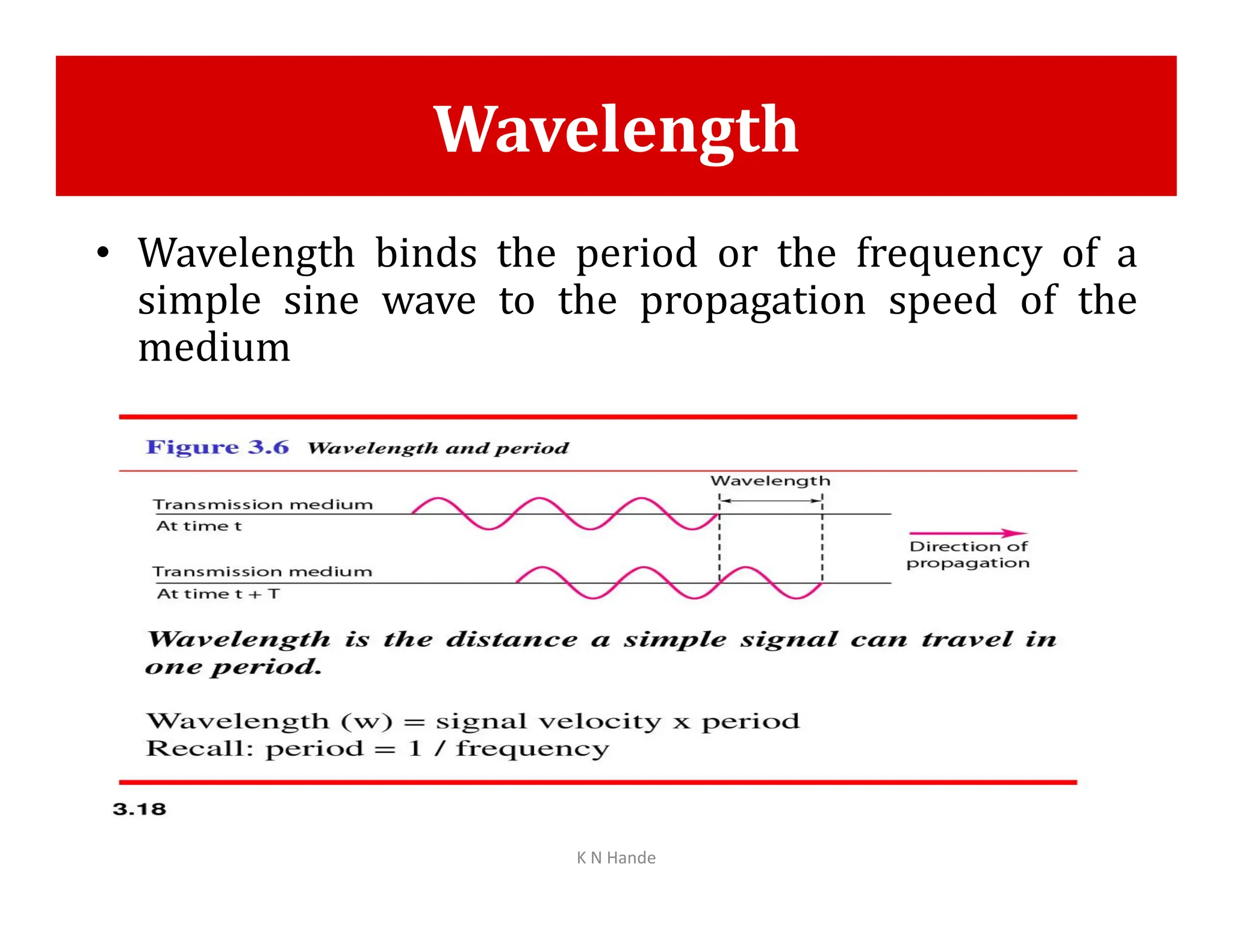
Wavelength
• Wavelength binds the period or the frequency of a
simple sine wave to the propagation speed of the
medium
K N Hande
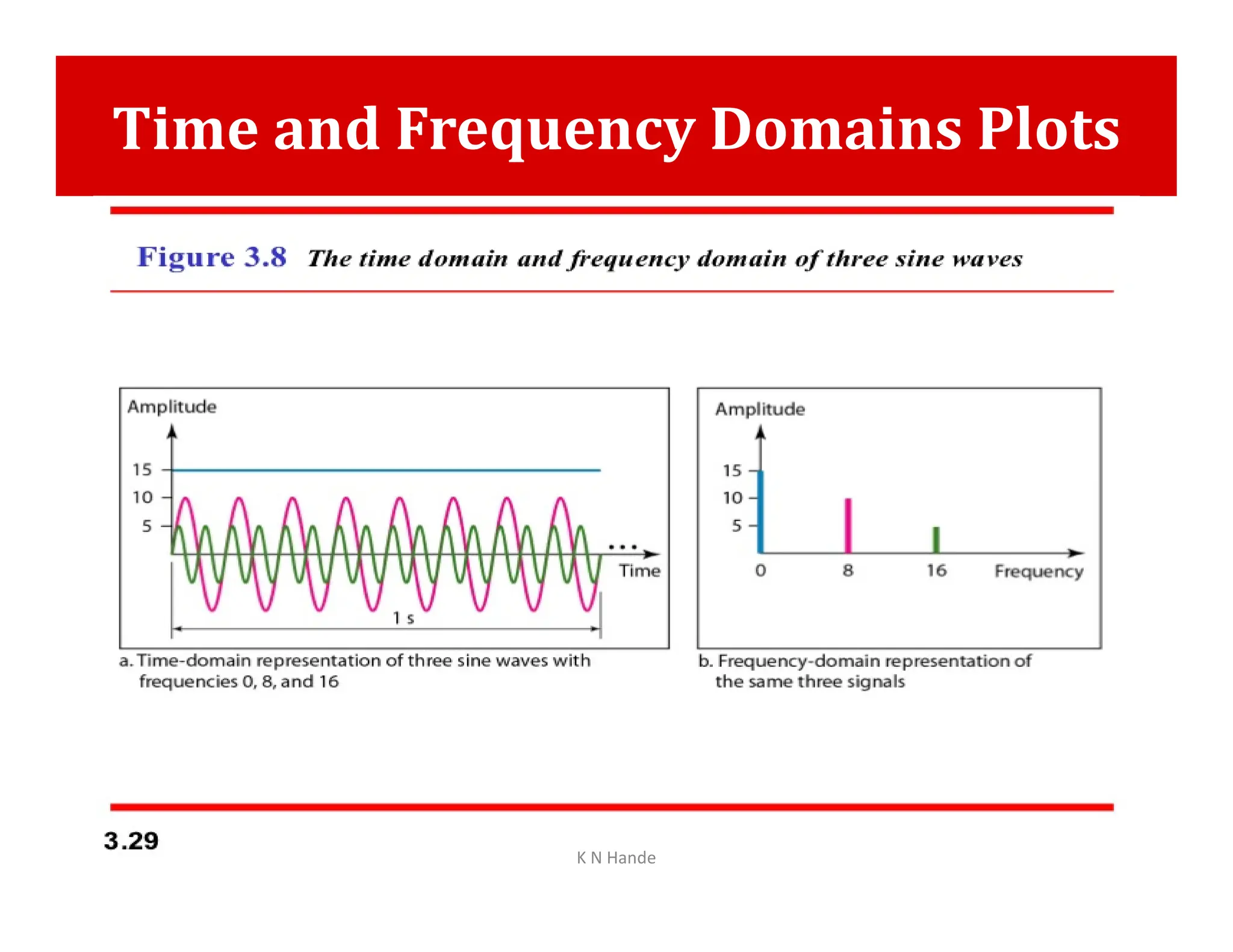
Time and Frequency Domains
• We have been showing a sine wave by using what is
called a time-domain plot.
• The time-domain plot shows changes in signal
amplitude with respect to time (it is an amplitude-
versus-time plot)
versus-time plot)
• To show the relationship between amplitude and
frequency, we can use what is called a frequency-
domain plot. A frequency-domain plot is concerned
with only the peak value and the frequency.
K N Hande
Time and Frequency Domains Plots
K N Hande
Time and Frequency Domains
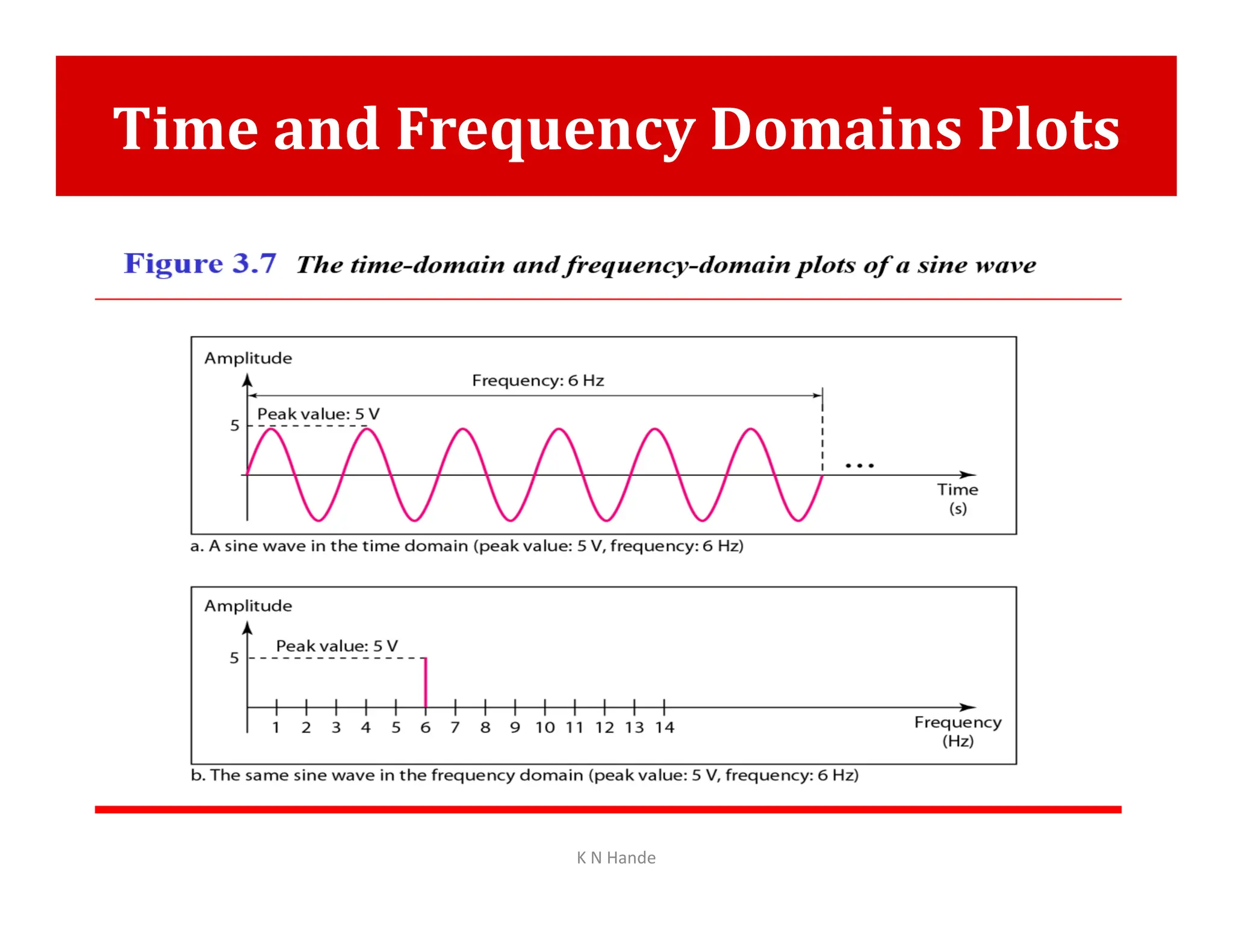
• A complete sine wave is represented by one spike.
The position of the spike shows the frequency; its
height shows the peak amplitude.
• A complete sine wave in the time domain can be
represented by one single spike in the frequency
domain.
• The frequency domain is more compact and useful
when we are dealing with more than one sine wave.
K N Hande
Time and Frequency Domains Plots
K N Hande
Composite Signals
• We need to send a composite signal to communicate
data.
• A composite signal is made of many simple sine
waves.
• A single frequency sine wave is not useful in data
communications; we need to send a composite signal,
a signal made of many simple sine waves.
• In the early 1900s, the French mathematician Jean-
Baptiste Fourier showed that any composite signal
is actually a combination of simple sine waves with
different frequencies, amplitudes, and phases.
K N Hande
Composite Signals
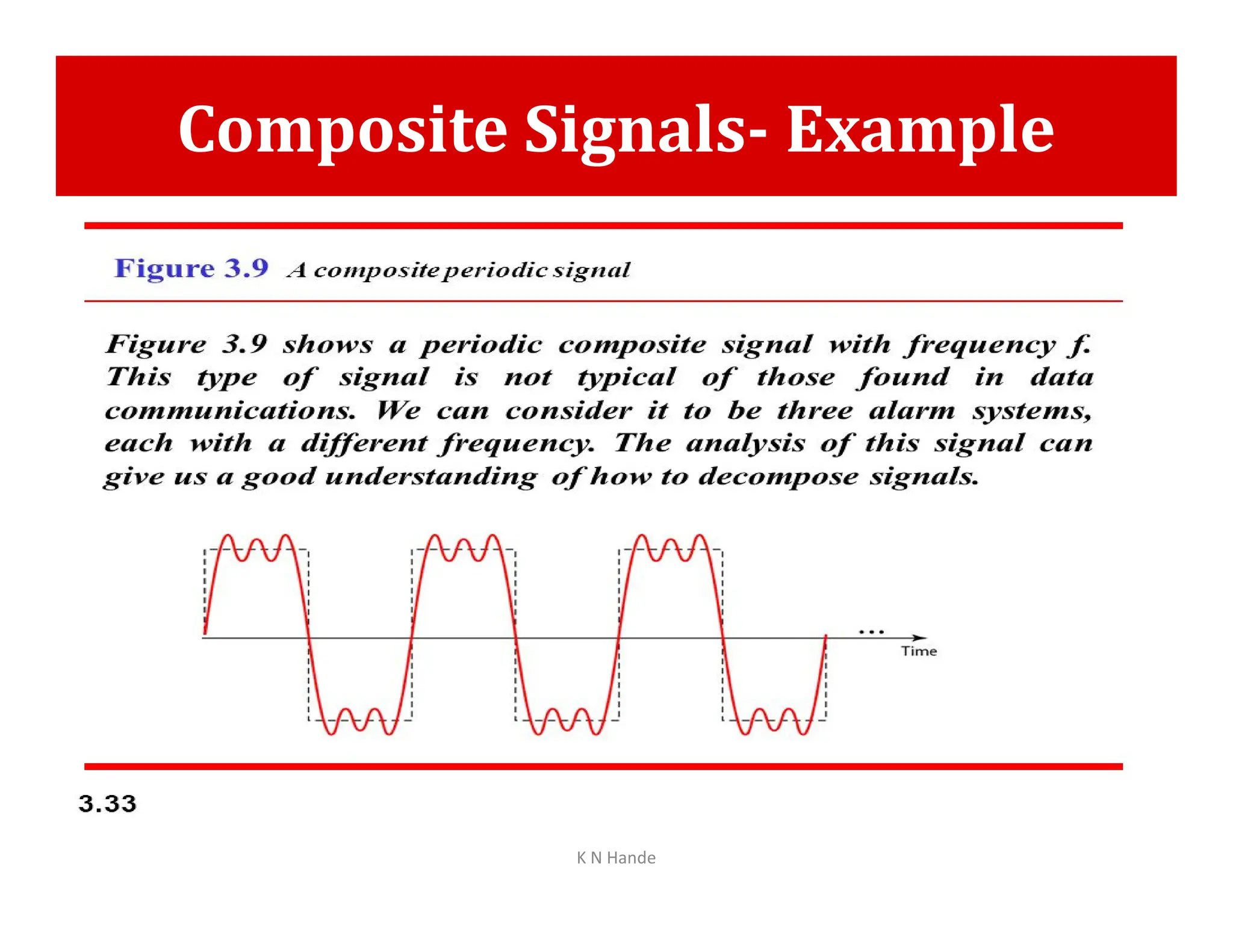
• A composite signal can be periodic or nonperiodic.
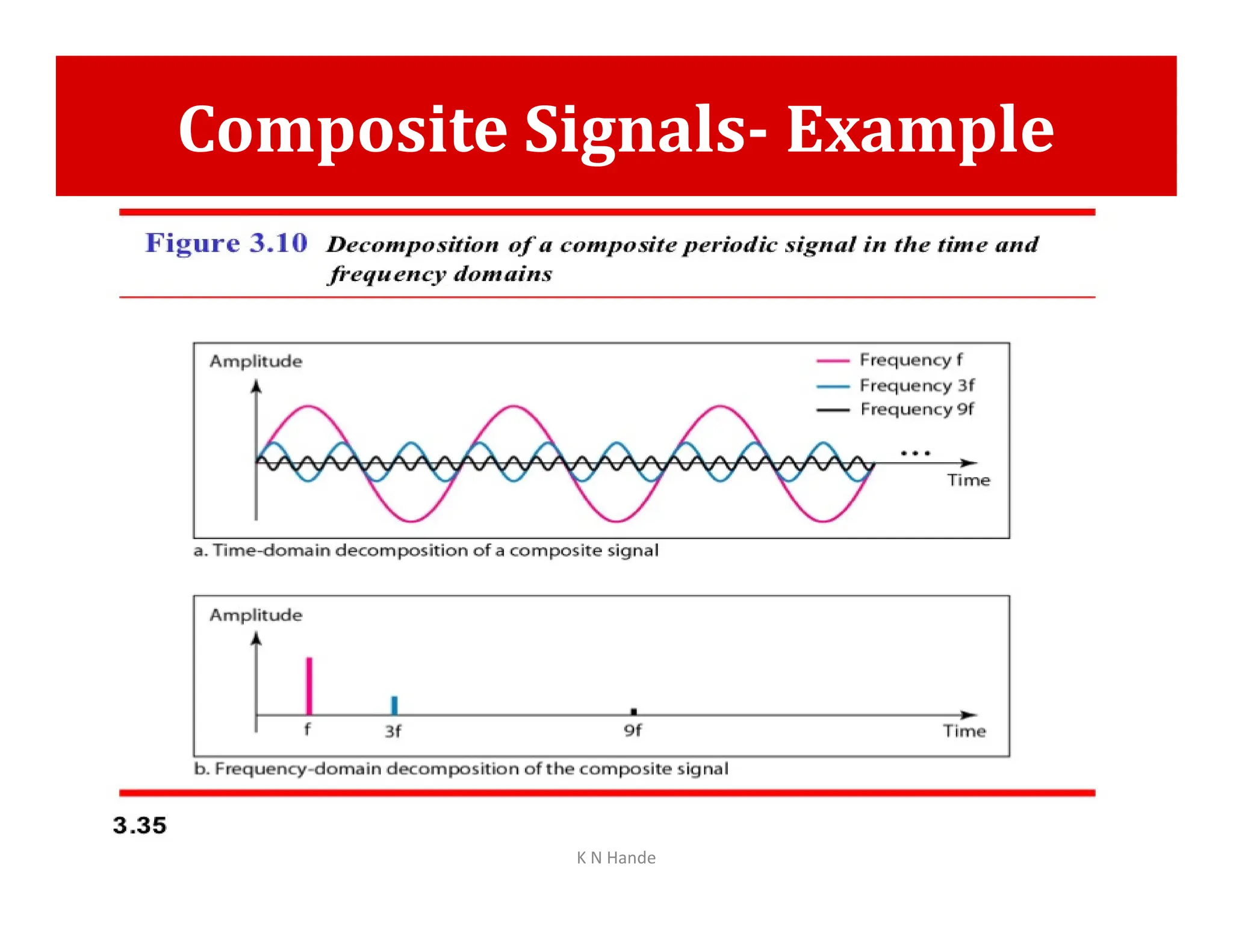
• A periodic composite signal can be decomposed into
a series of simple sine waves with discrete
frequencies, frequencies that have integer values
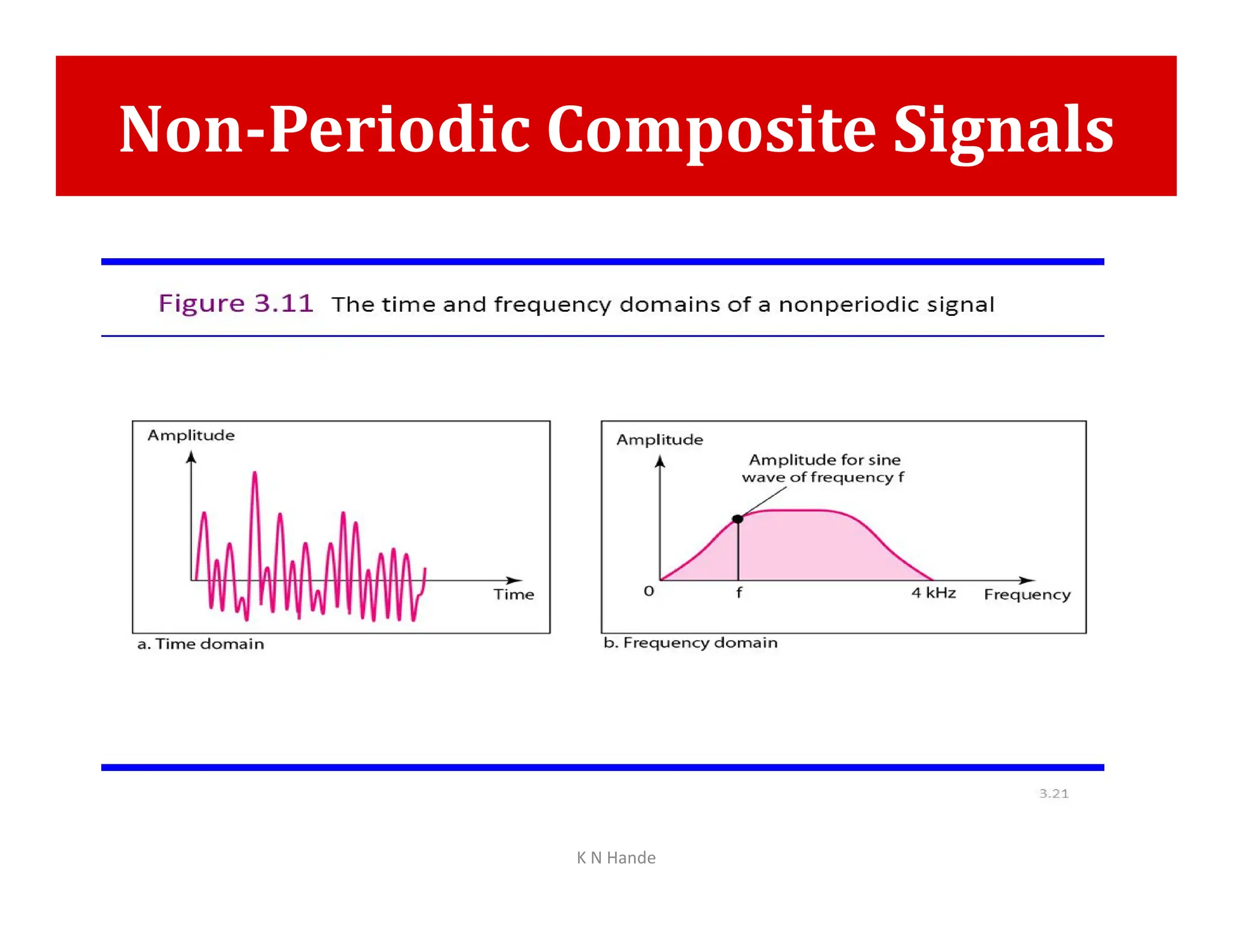
• A nonperiodic composite signal can be decomposed
into a combination of an infinite number of simple
sine waves with continuous frequencies, frequencies
that have real values.
K N Hande
Composite Signals- Example
K N Hande
Composite Signals- Example
K N Hande
Composite Signals
• The frequency of the sine wave with frequency f is the
same as the frequency of the composite signal; it is
called the fundamental frequency, or first
harmonic.
• The sine wave with frequency 3f has a frequency of 3
times the fundamental frequency; it is called the third
harmonic.
• Note that the frequency decomposition of the signal is
discrete; it has frequencies f, 3f, and 9f Because f is
an integral number, 3f and 9f are also integral
numbers.
K N Hande
Non-Periodic Composite Signals
K N Hande
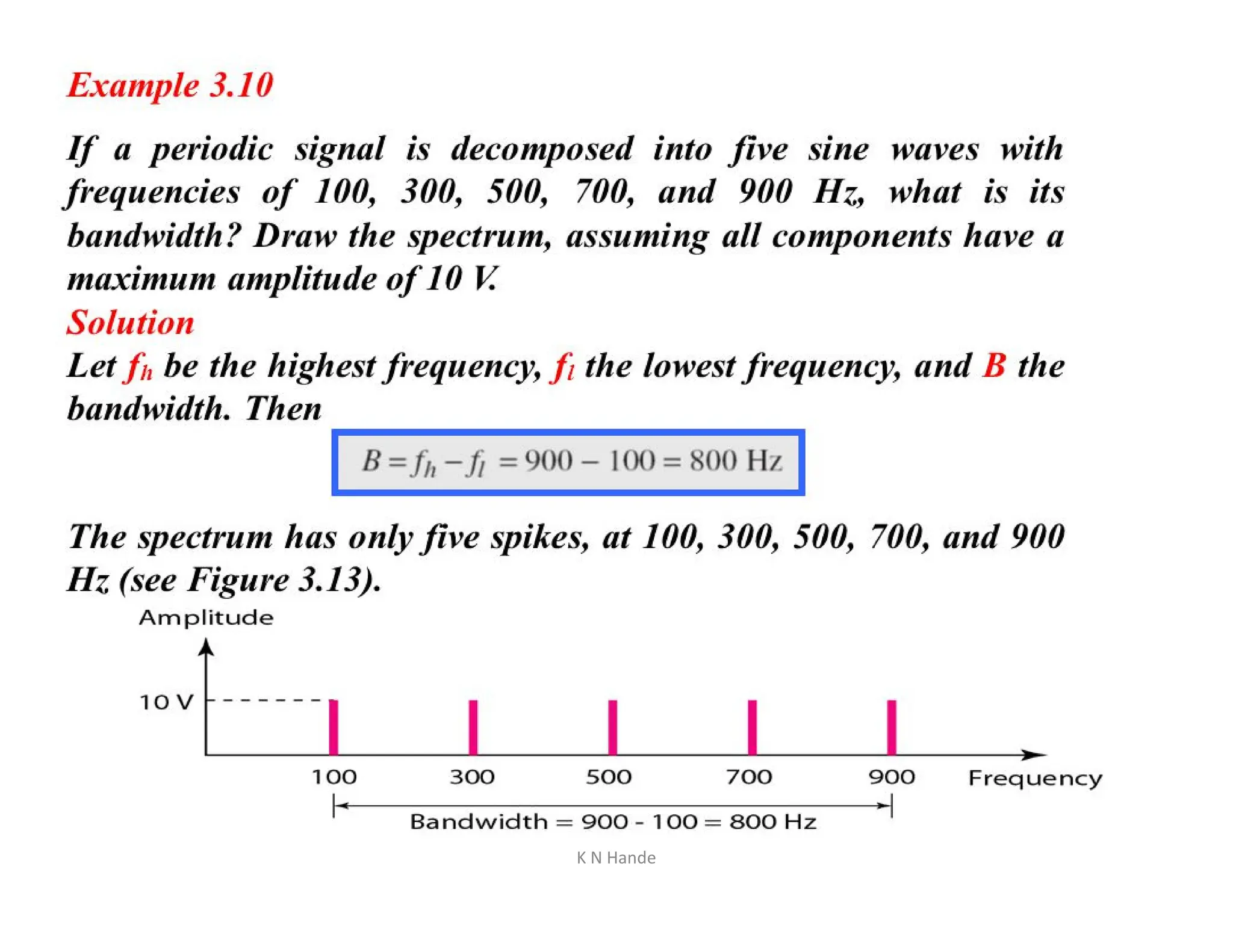
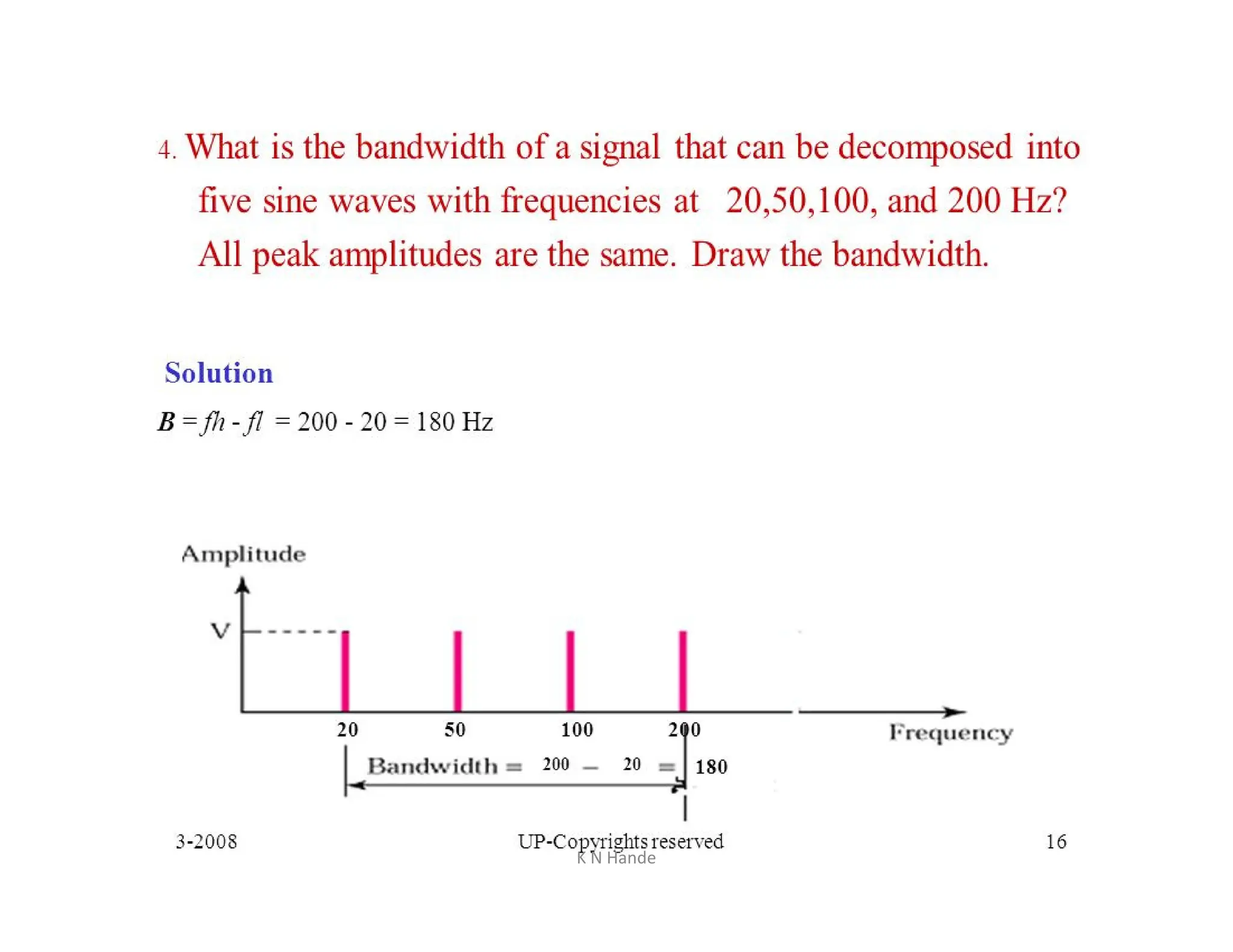
Bandwidth
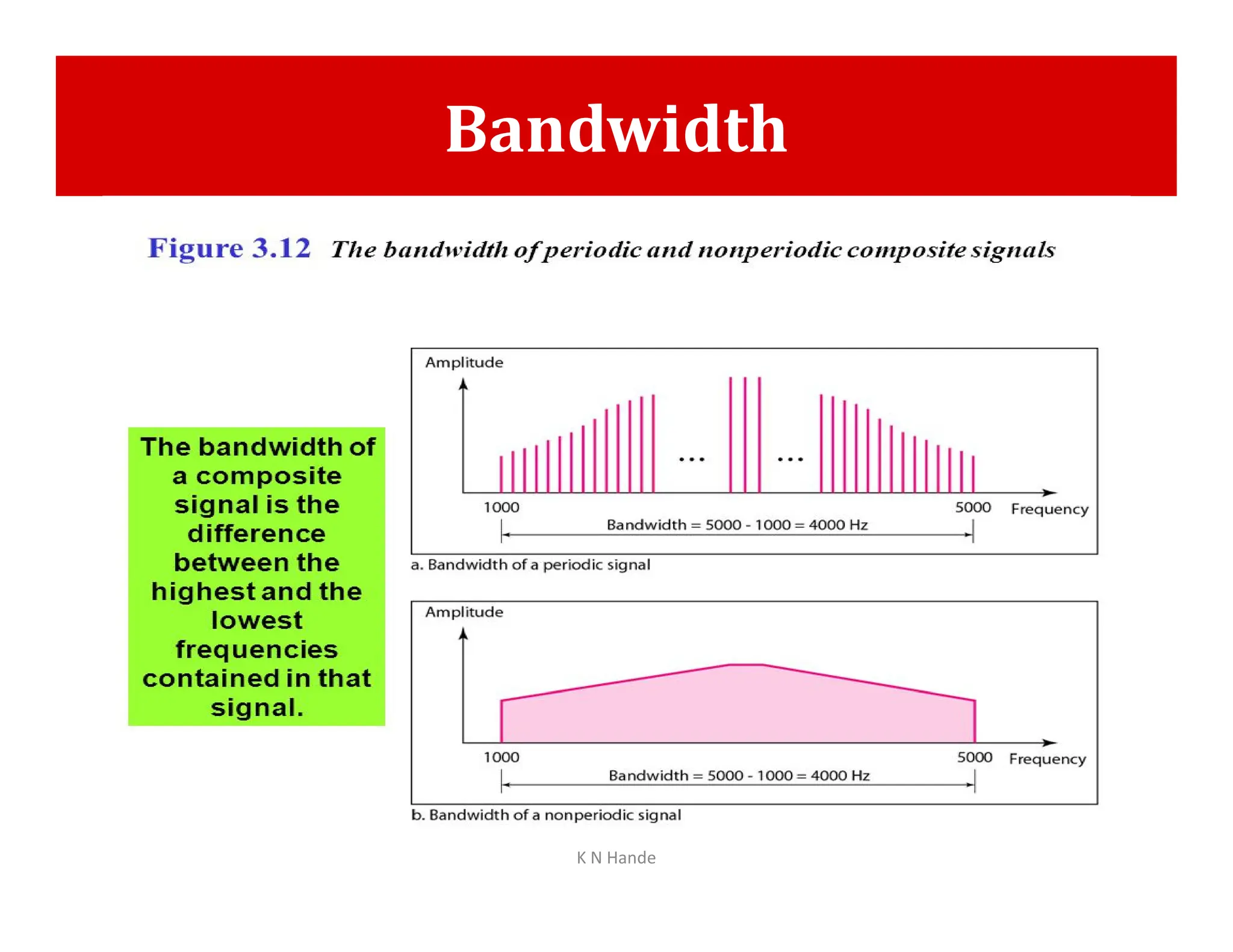
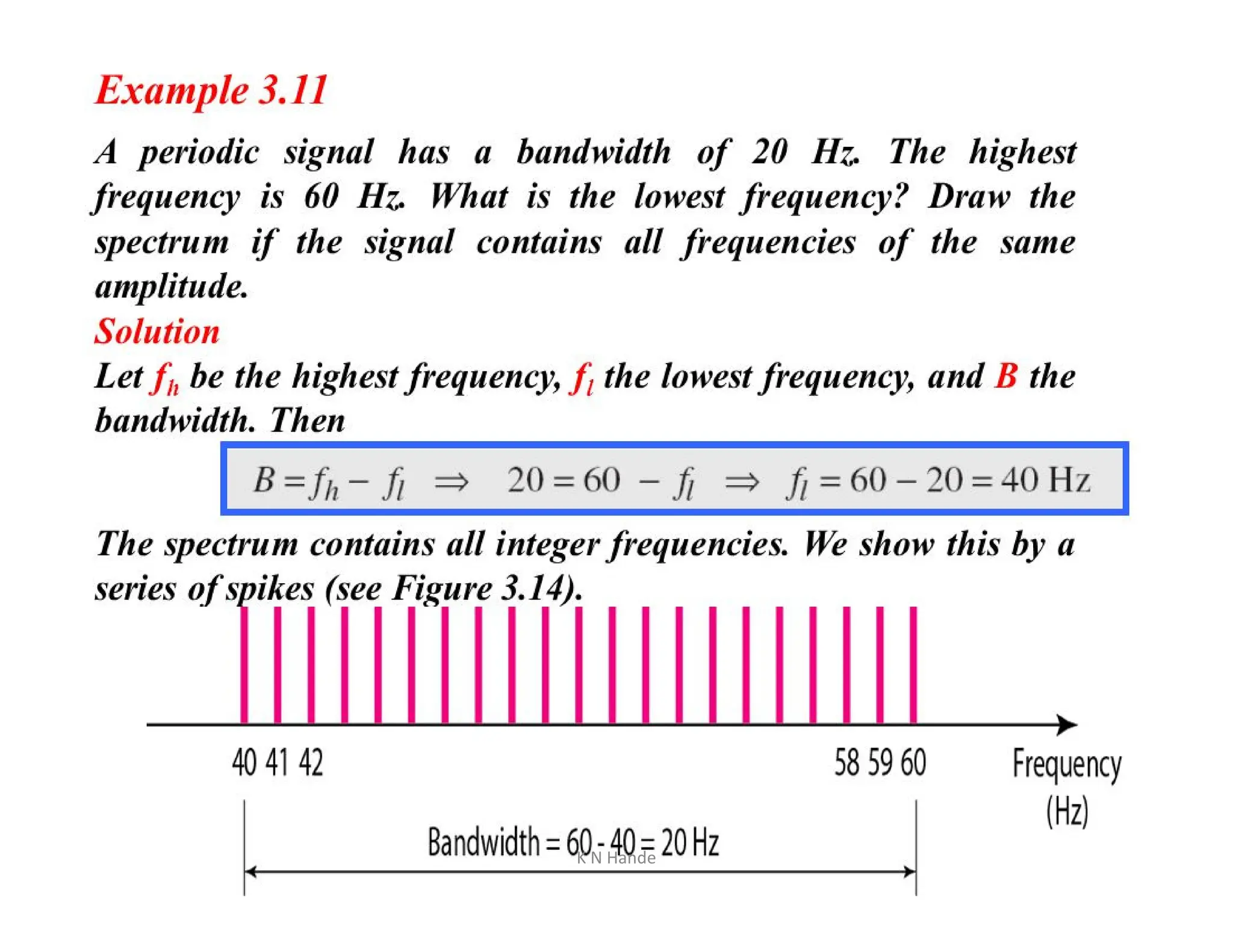
• The range of frequencies contained in a composite
signal is its bandwidth.
• The bandwidth of a composite signal is the difference
between the highest and the lowest frequencies
contained in that signal.
• The bandwidth is normally a difference between two
numbers.
K N Hande
Bandwidth
K N Hande
Digital Signals
• Information can also be represented by a digital
signal.
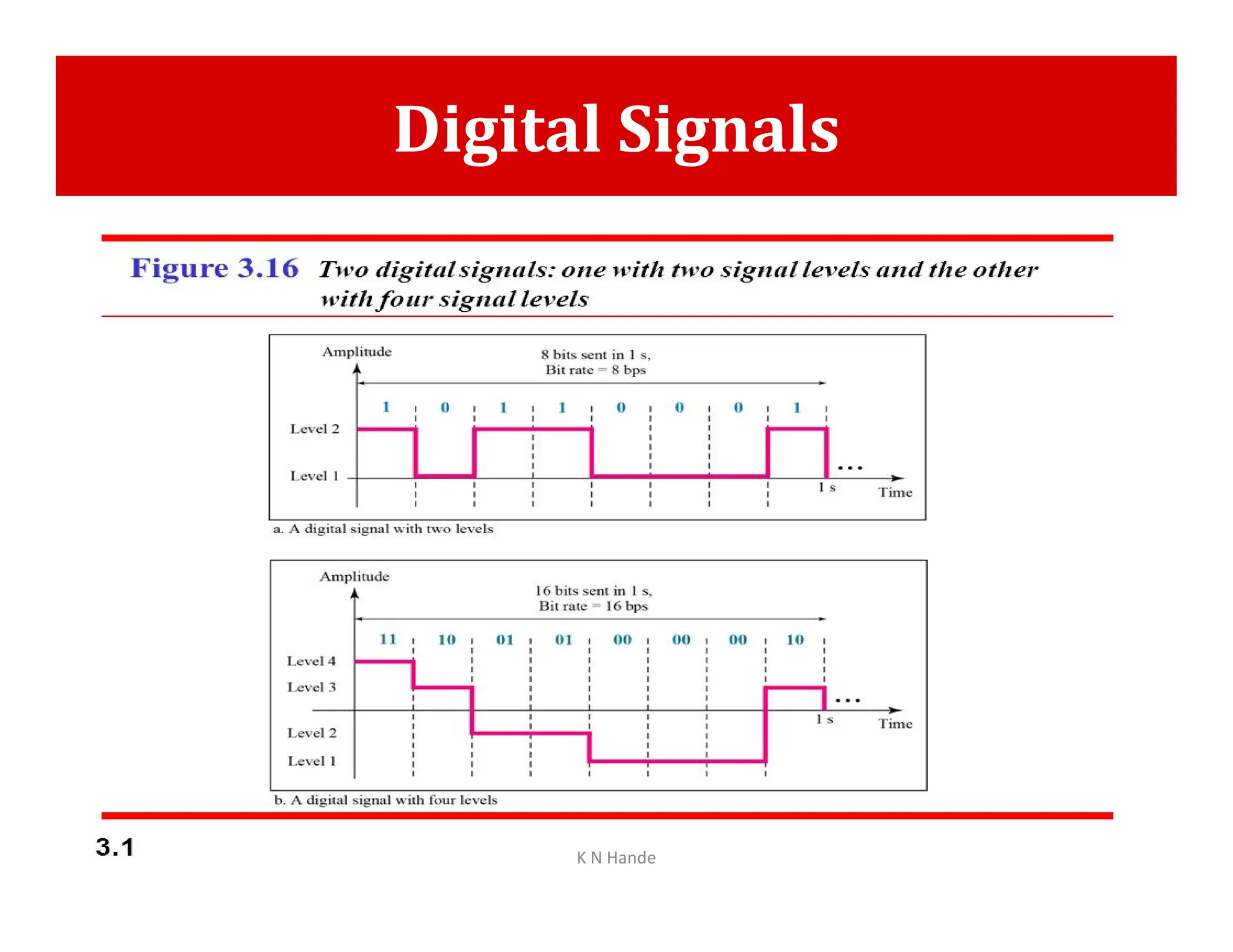
• A digital signal can have more than two levels.
• In general, if a signal has L levels, each level needs
log L bits.
log2L bits.
• Bit Rate: Most digital signals are nonperiodic, and
thus period and frequency are not appropriate
characteristics.
• The bit rate is the number of bits sent in 1 sec,
expressed in bits per second (bps).
K N Hande
Digital Signals
K N Hande
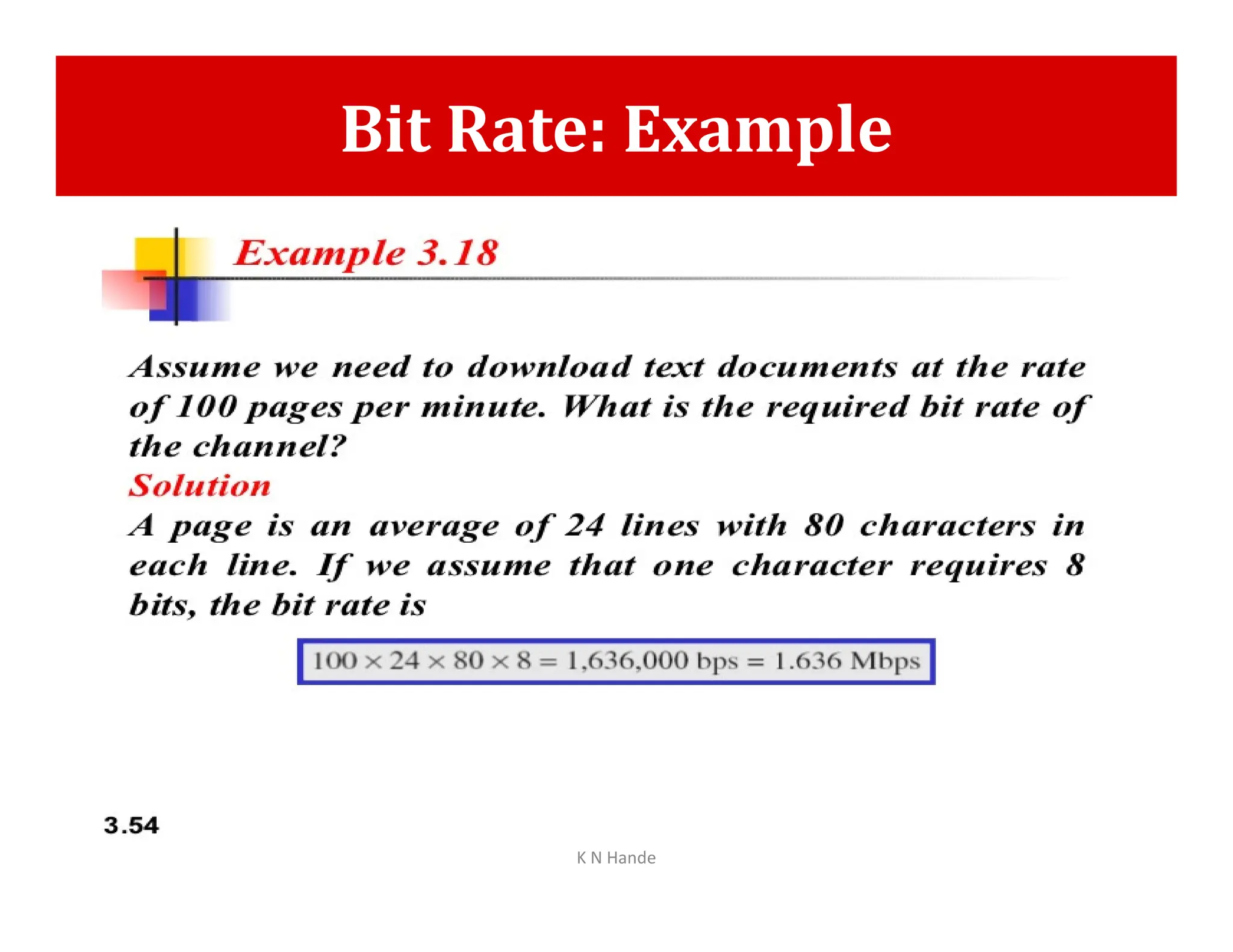
Bit Rate: Example
K N Hande
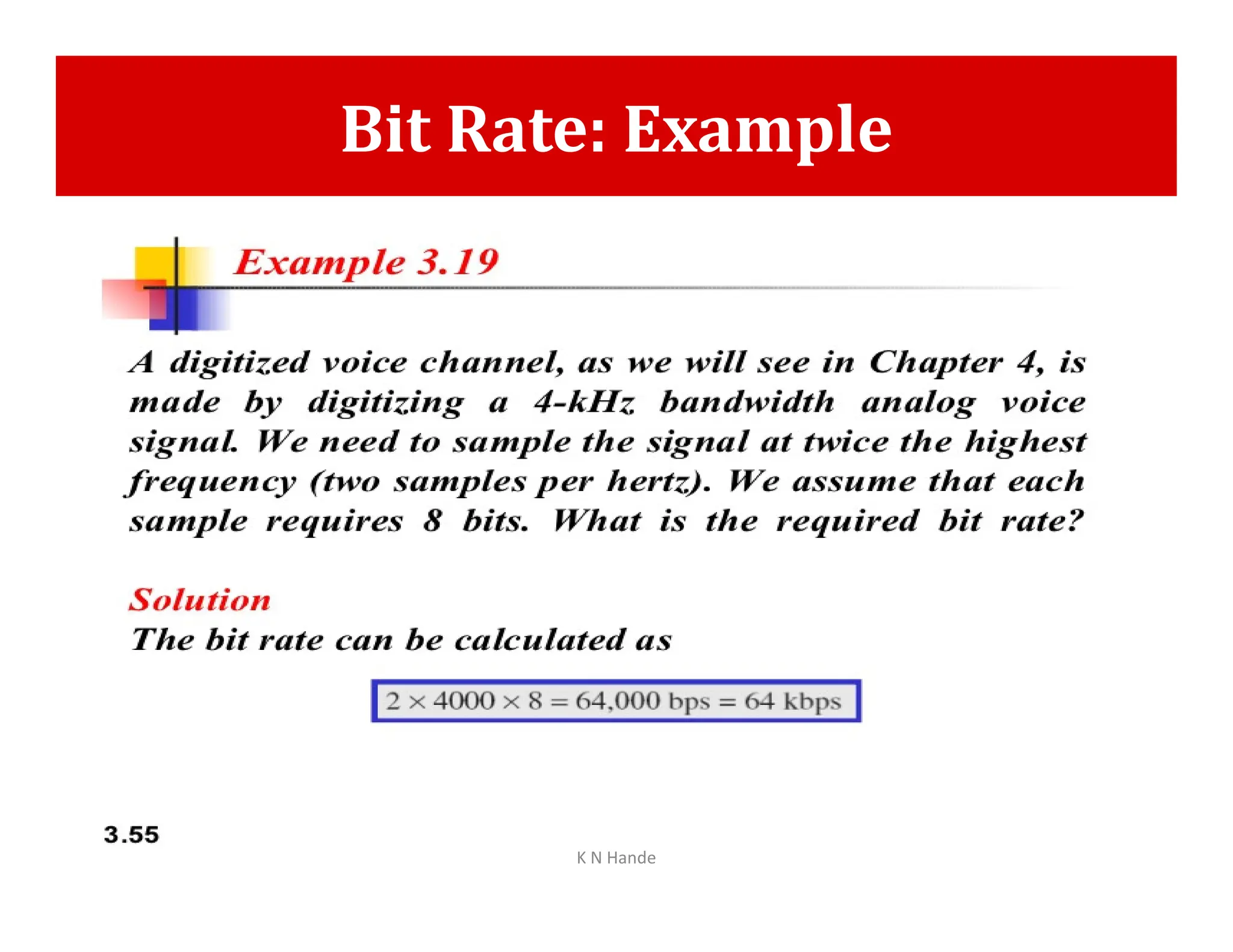
Bit Rate: Example
K N Hande
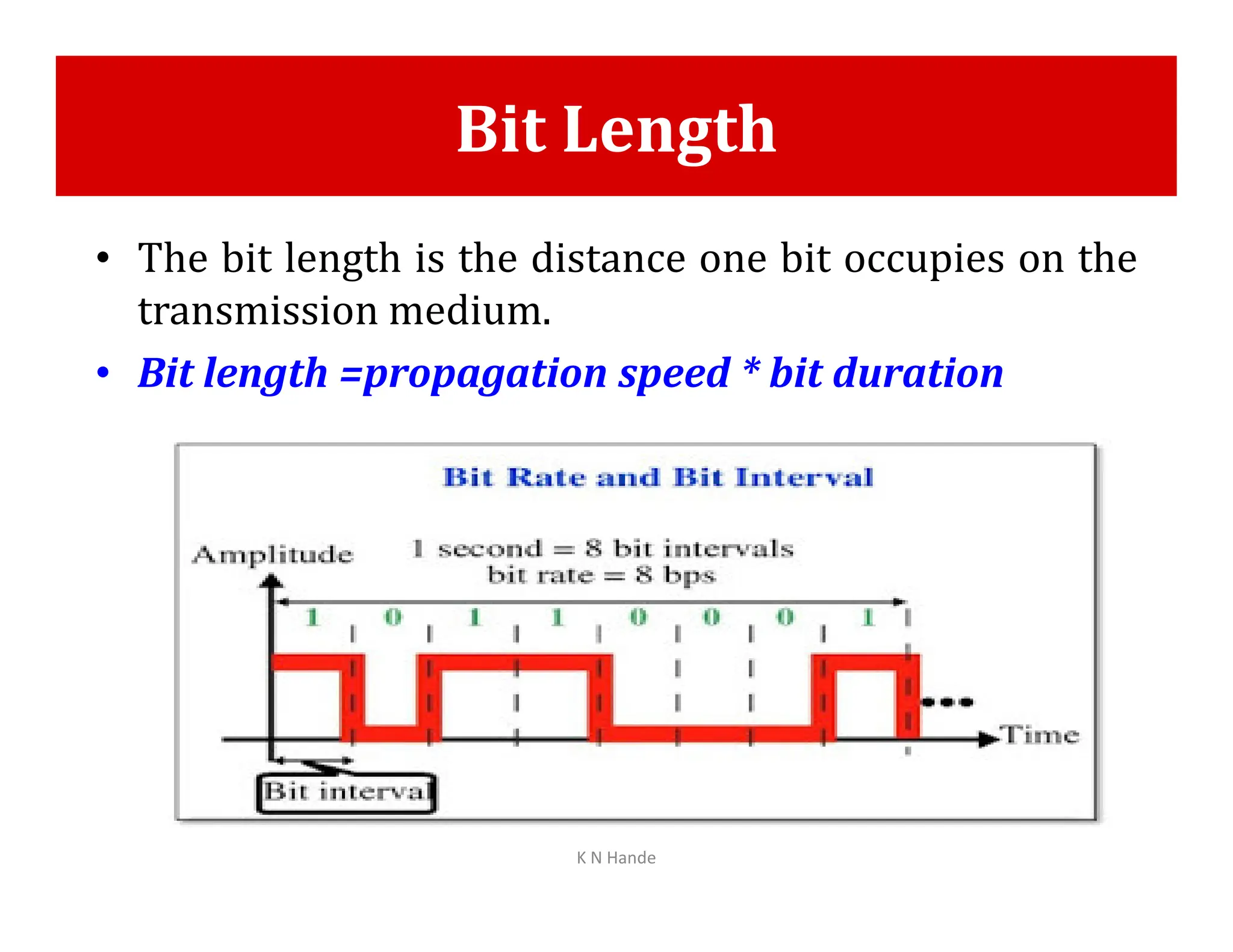
Bit Length
• The bit length is the distance one bit occupies on the
transmission medium.
• Bit length =propagation speed * bit duration
K N Hande
Performance
• Bandwidth: bandwidth in hertz and bandwidth in
bits per second.
• The term bandwidth can also refer to the number of
bits per second that a channel, a link, or even a
network can transmit.
• Basically, an increase in bandwidth in hertz means an
increase in bandwidth in bits per second.
• The throughput is a measure of how fast we can
actually send data through a network.
K N Hande
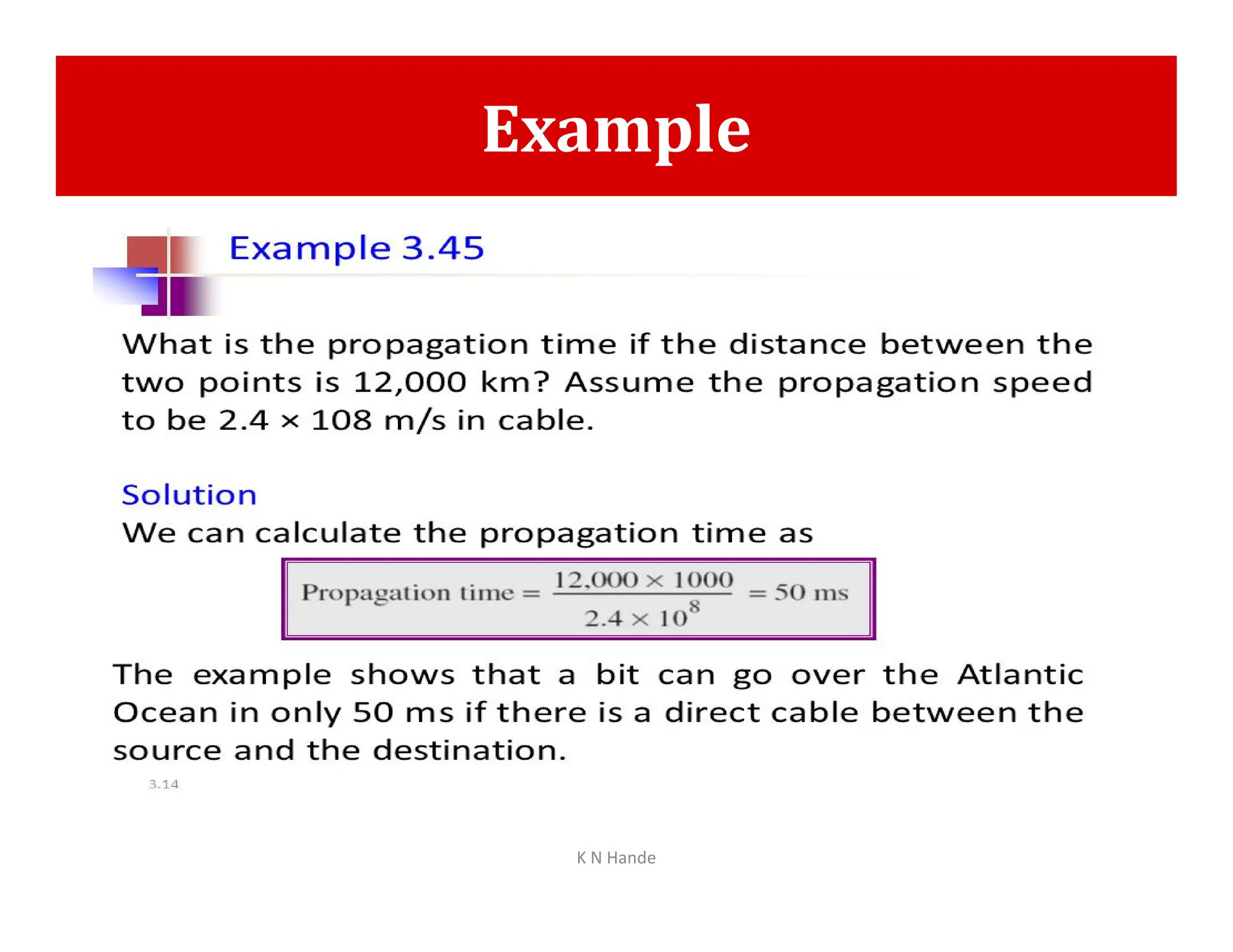
Example
K N Hande
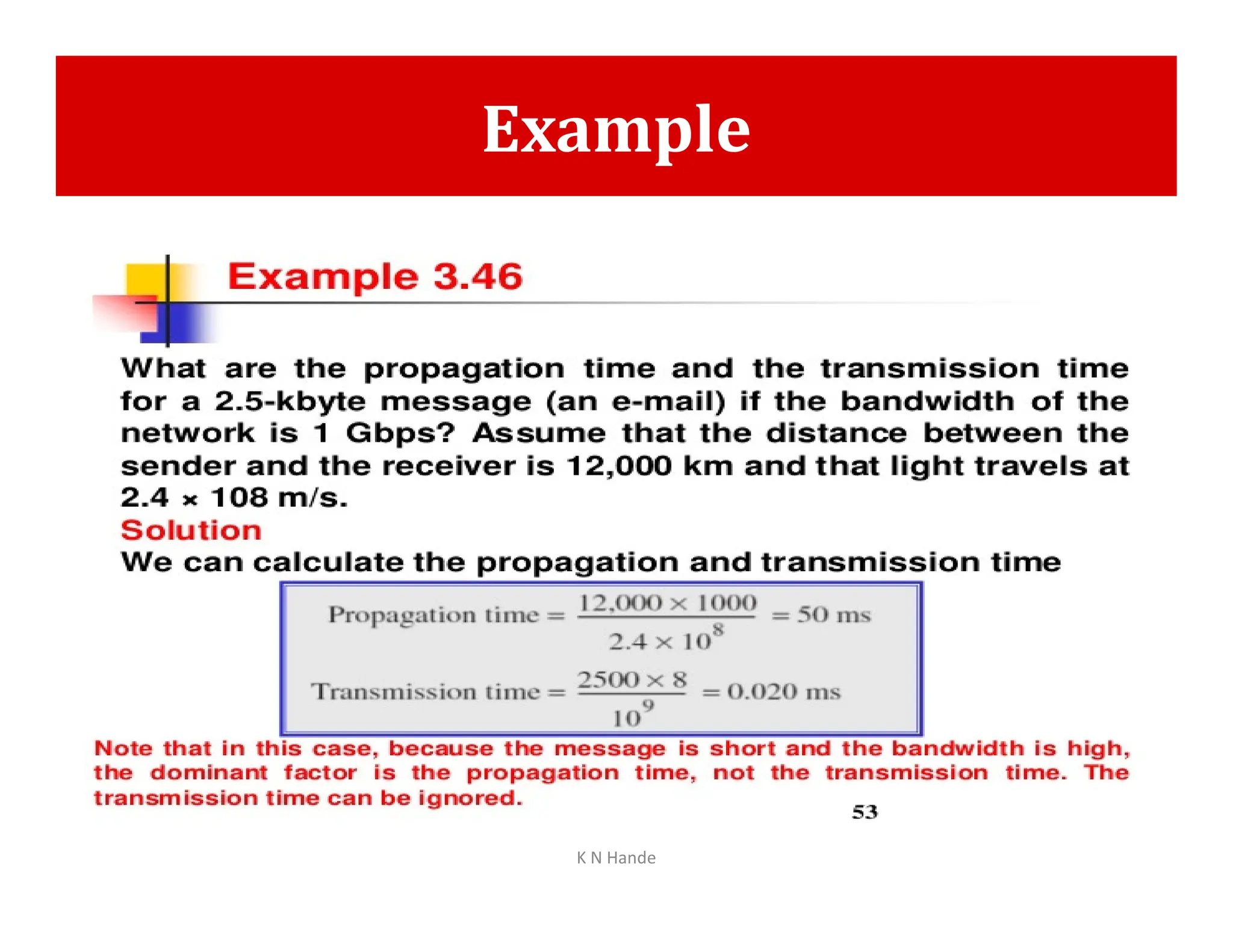
Example
K N Hande
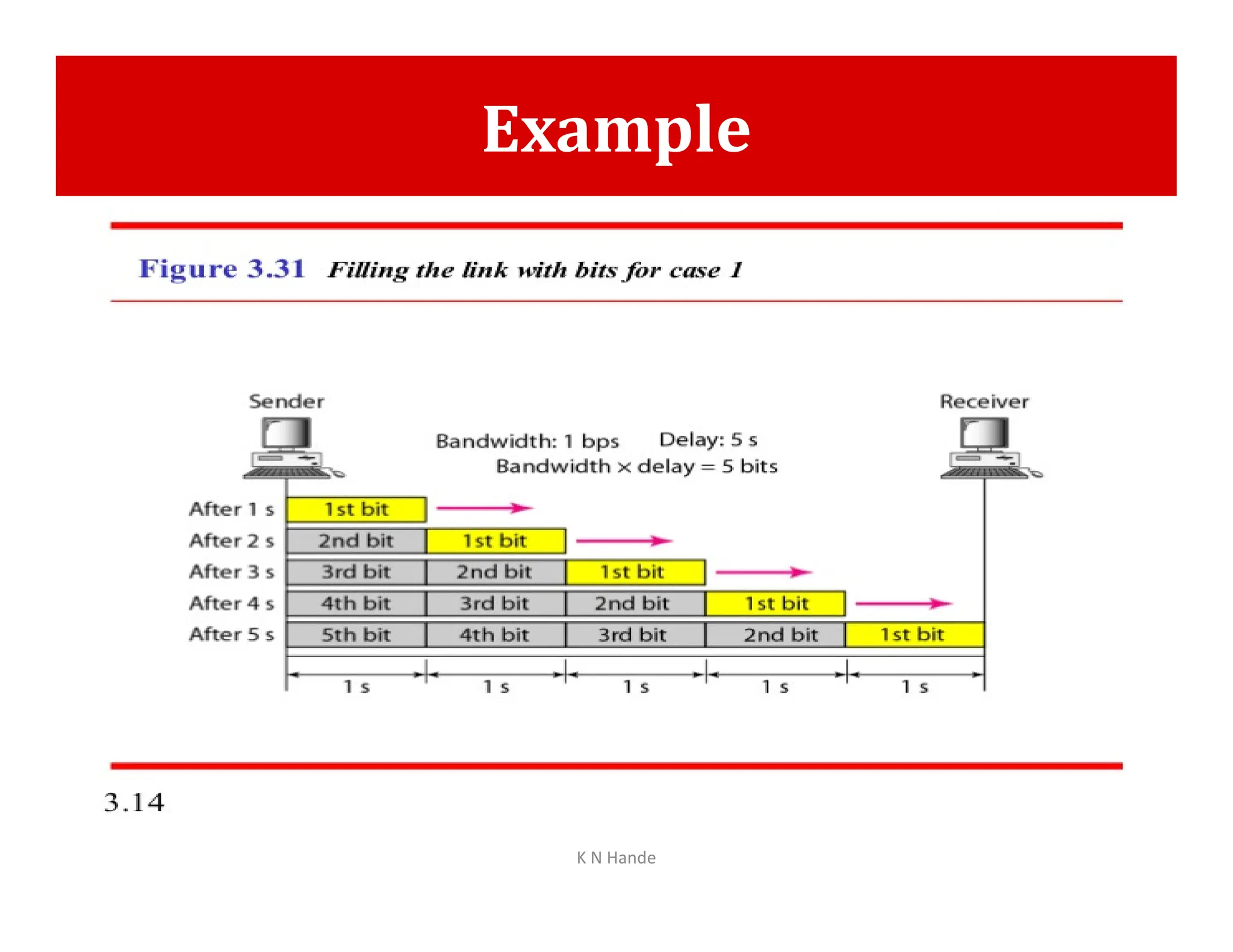
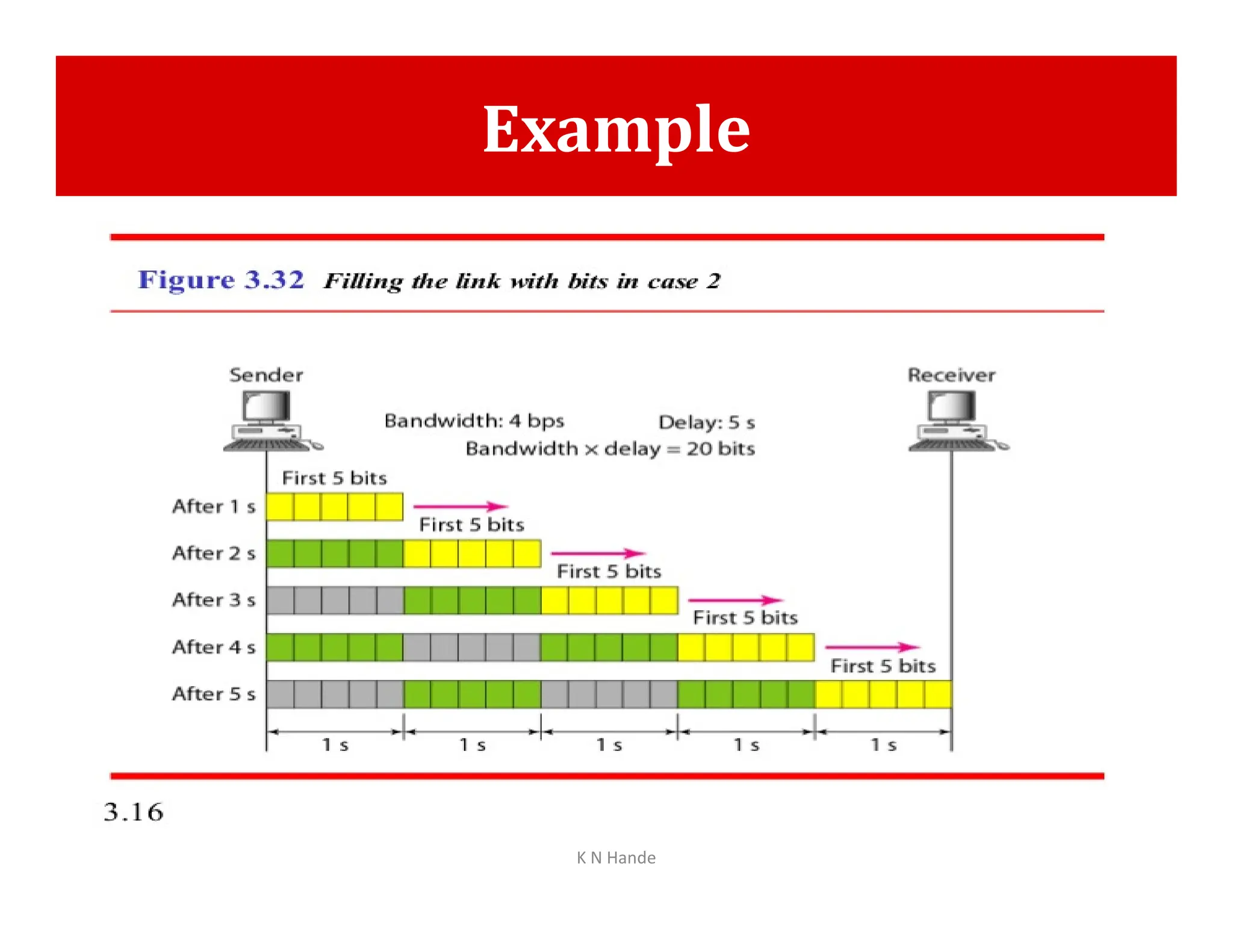
Bandwidth Delay Product
• Bandwidth delay product is calculated as the product
of the link capacity of the channel and the round –
trip delay time of transmission.
• The bandwidth-delay product defines the number of
bits that can fill the link.
K N Hande
Example
K N Hande
Example
K N Hande
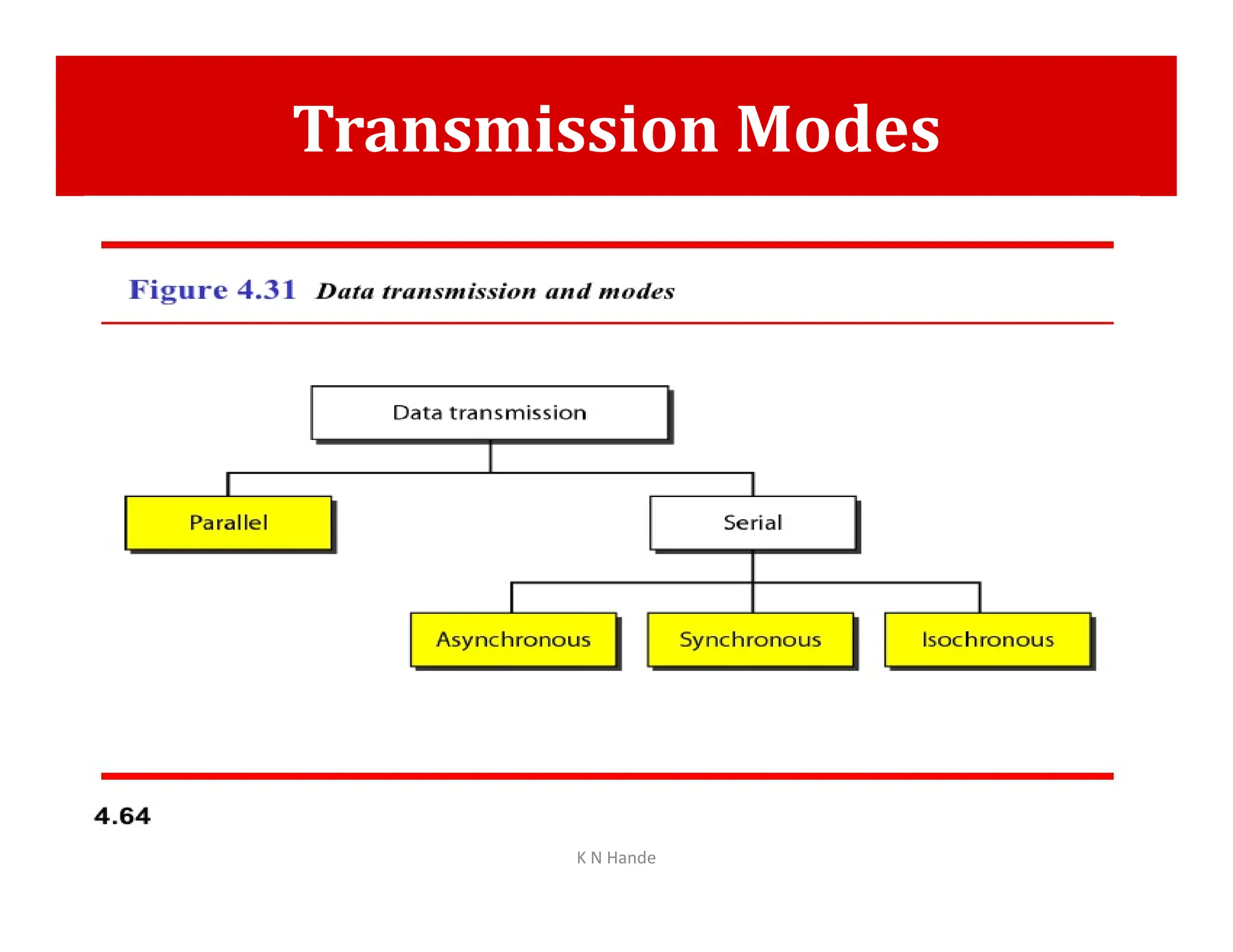
Transmission Modes
• The transmission of binary data across a link can be
accomplished in either parallel or serial mode.
• In parallel mode, multiple bits are sent with each
clock tick. In serial mode, 1 bit is sent with each clock
tick.
tick.
• While there is only one way to send parallel data,
there are three subclasses of serial transmission:
Asynchronous, synchronous, and isochronous
K N Hande
Transmission Modes
K N Hande
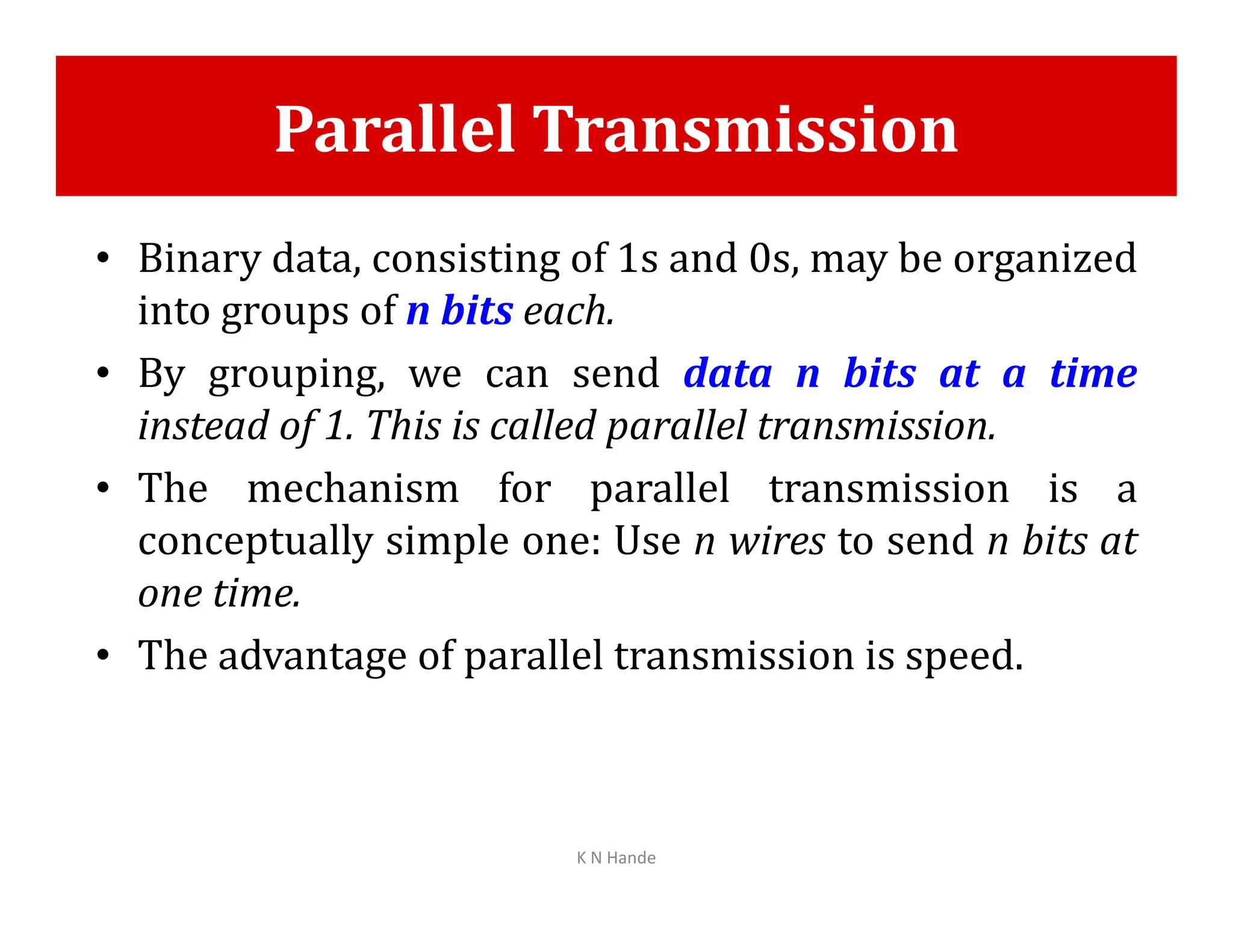
Parallel Transmission
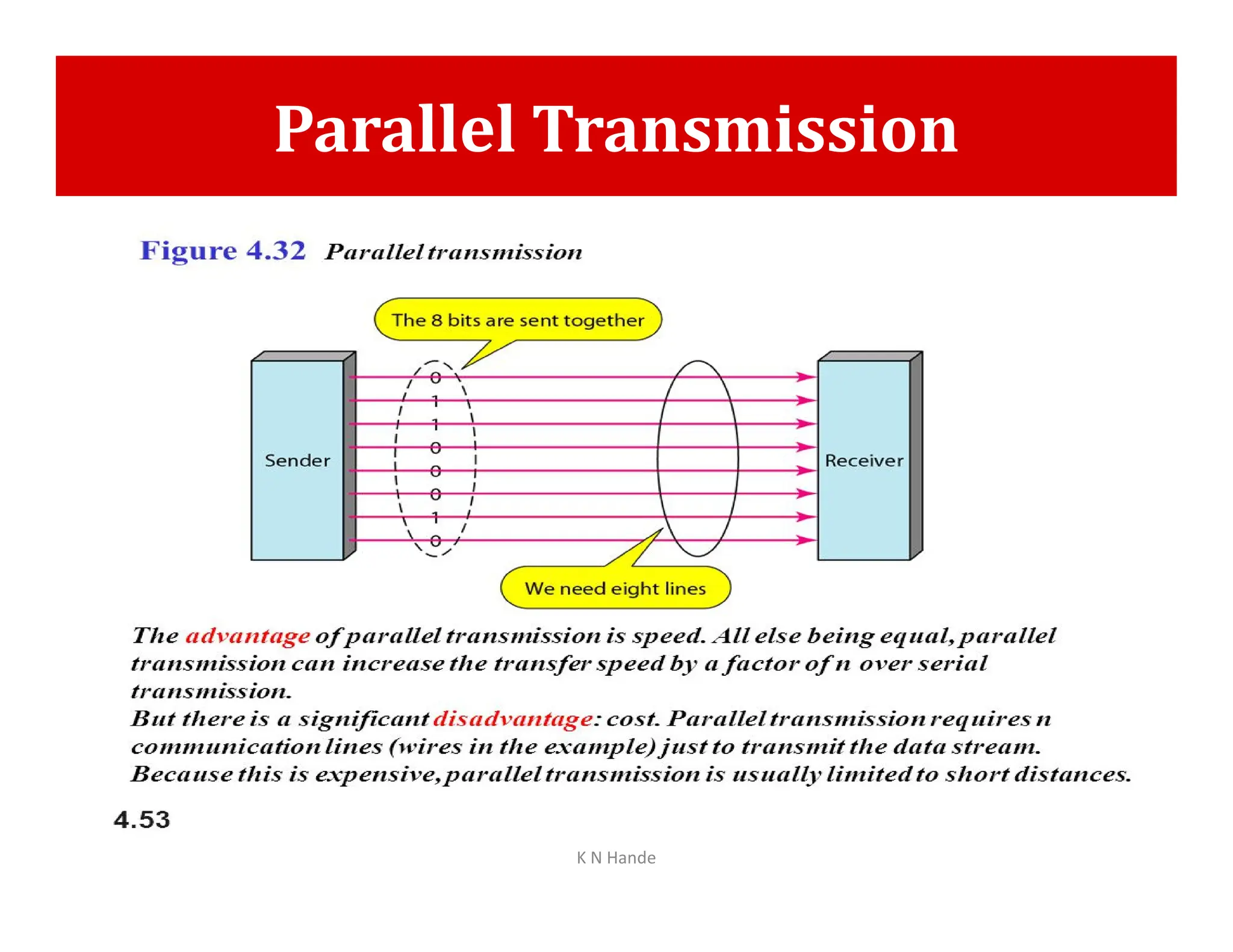
• Binary data, consisting of 1s and 0s, may be organized
into groups of n bits each.
• By grouping, we can send data n bits at a time
instead of 1. This is called parallel transmission.
• The mechanism for parallel transmission is a
conceptually simple one: Use n wires to send n bits at
one time.
• The advantage of parallel transmission is speed.
K N Hande
Parallel Transmission
K N Hande
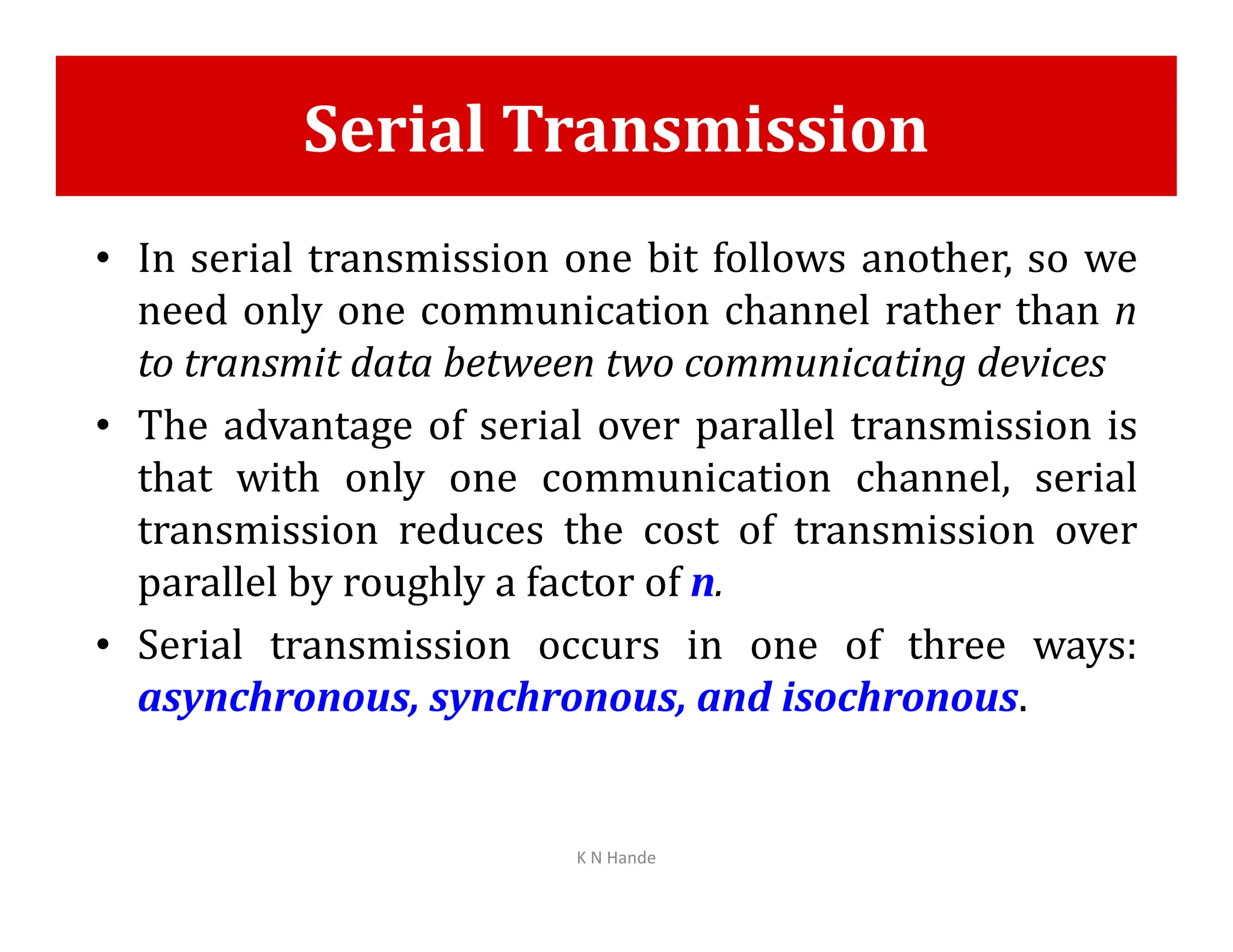
Serial Transmission
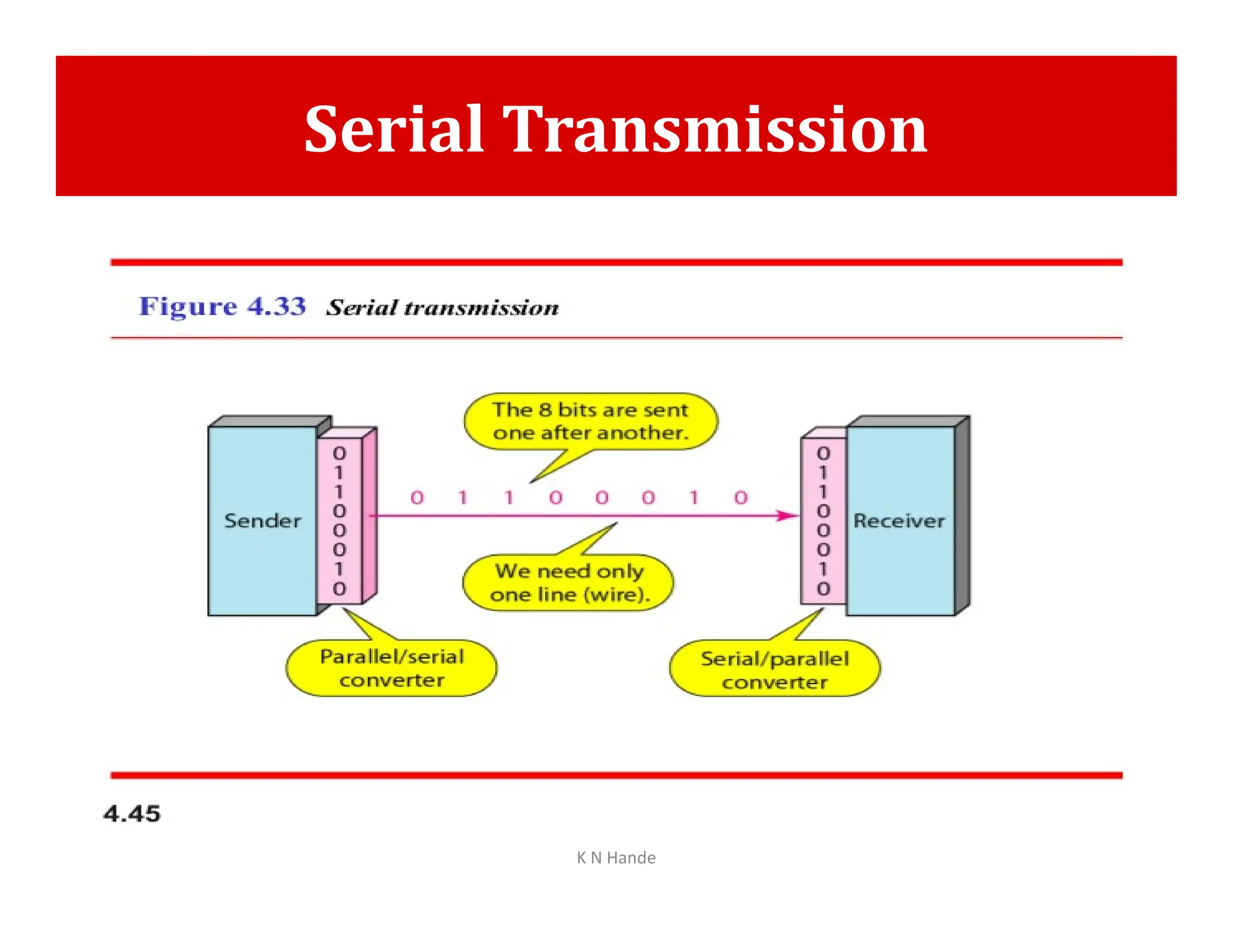
• In serial transmission one bit follows another, so we
need only one communication channel rather than n
to transmit data between two communicating devices
• The advantage of serial over parallel transmission is
that with only one communication channel, serial
transmission reduces the cost of transmission over
parallel by roughly a factor of n.
• Serial transmission occurs in one of three ways:
asynchronous, synchronous, and isochronous.
K N Hande
Serial Transmission
K N Hande
Asynchronous Transmission
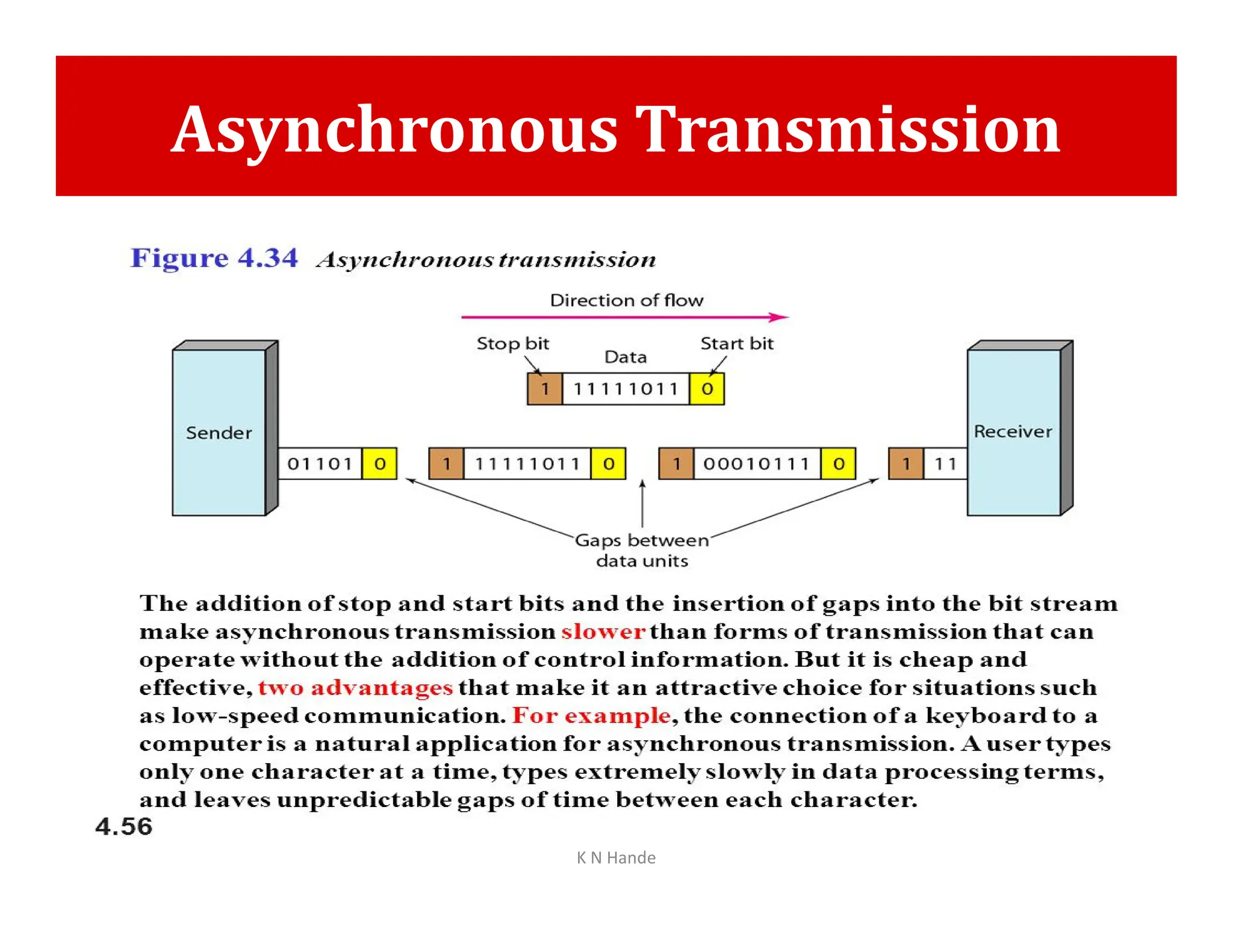
• Asynchronous transmission is so named because the
timing of a signal is unimportant.
• Instead, information is received and translated by
agreed upon patterns.
• Without synchronization, the receiver cannot use
timing to predict when the next group will arrive.
• In asynchronous transmission, we send 1 start bit
(0) at the beginning and 1 or more stop bits (1s) at
the end of each byte. There may be a gap between
each byte.
K N Hande
Asynchronous Transmission
• Asynchronous here means "asynchronous at the
byte level”, but the bits are still synchronized; their
durations are the same.
K N Hande
Asynchronous Transmission
K N Hande
Synchronous Transmission
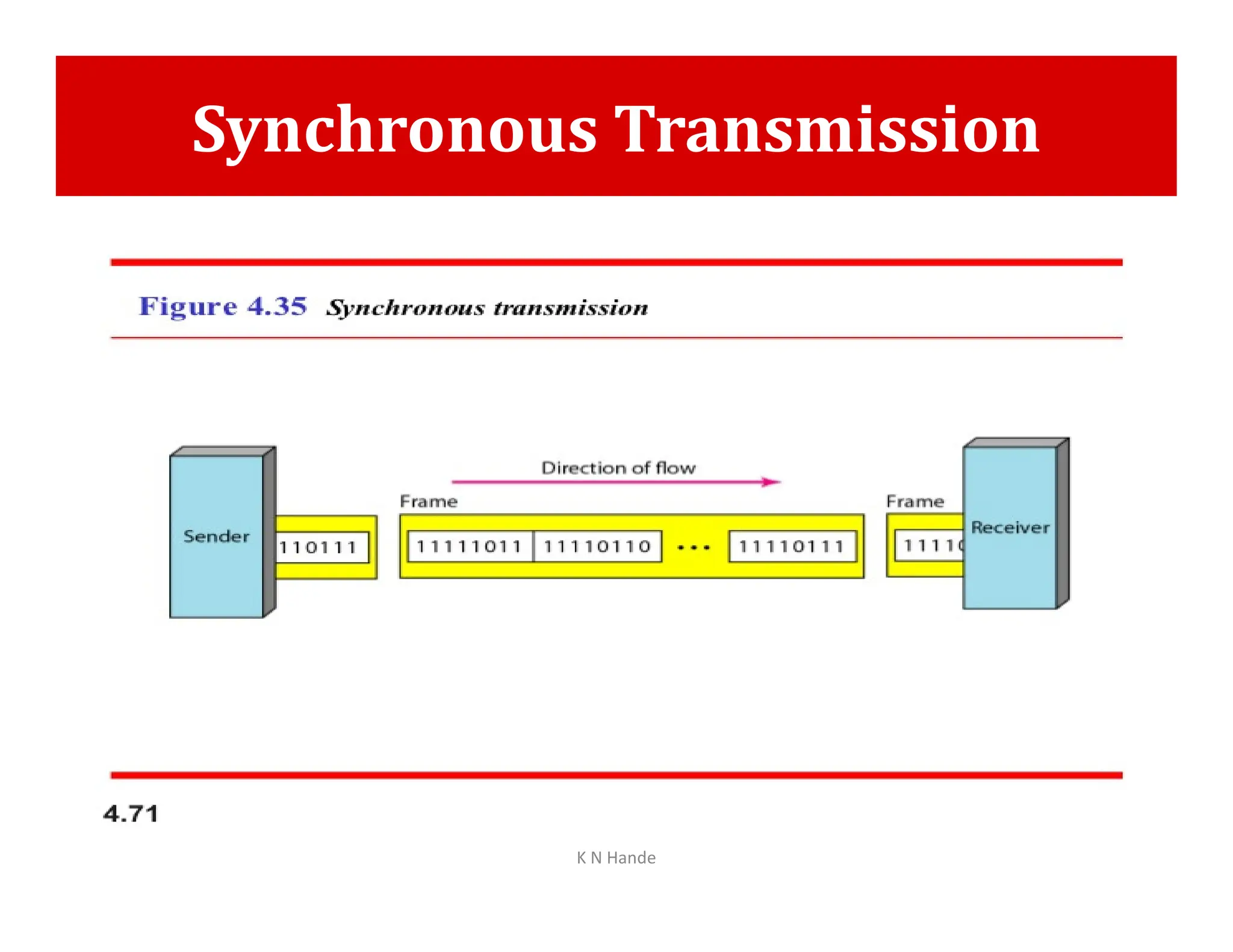
• In synchronous transmission, the bit stream is
combined into longer "frames," which may contain
multiple bytes.
• In synchronous transmission, we send bits one after
another without start or stop bits or gaps. It is the
responsibility of the receiver to group the bits.
• The advantage of synchronous transmission is speed.
• Although there is no gap between characters in
synchronous serial transmission, there may be
uneven gaps between frames.
K N Hande
Synchronous Transmission
K N Hande
Isochronous Transmission
• In real-time audio and video, in which uneven delays
between frames are not acceptable, synchronous
transmission fails.
• The isochronous transmission guarantees that the
data arrive at a fixed rate.
K N Hande
K N Hande
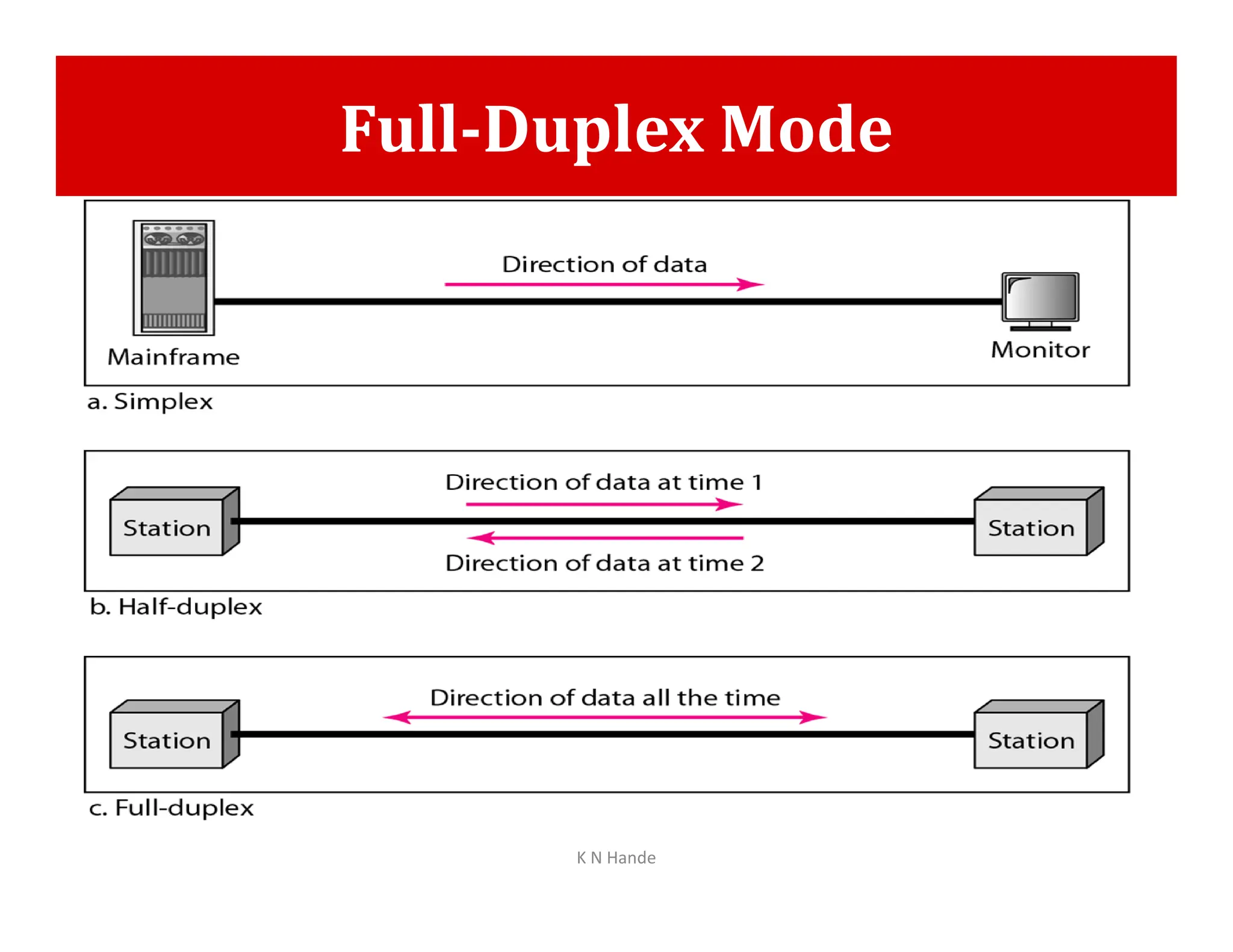
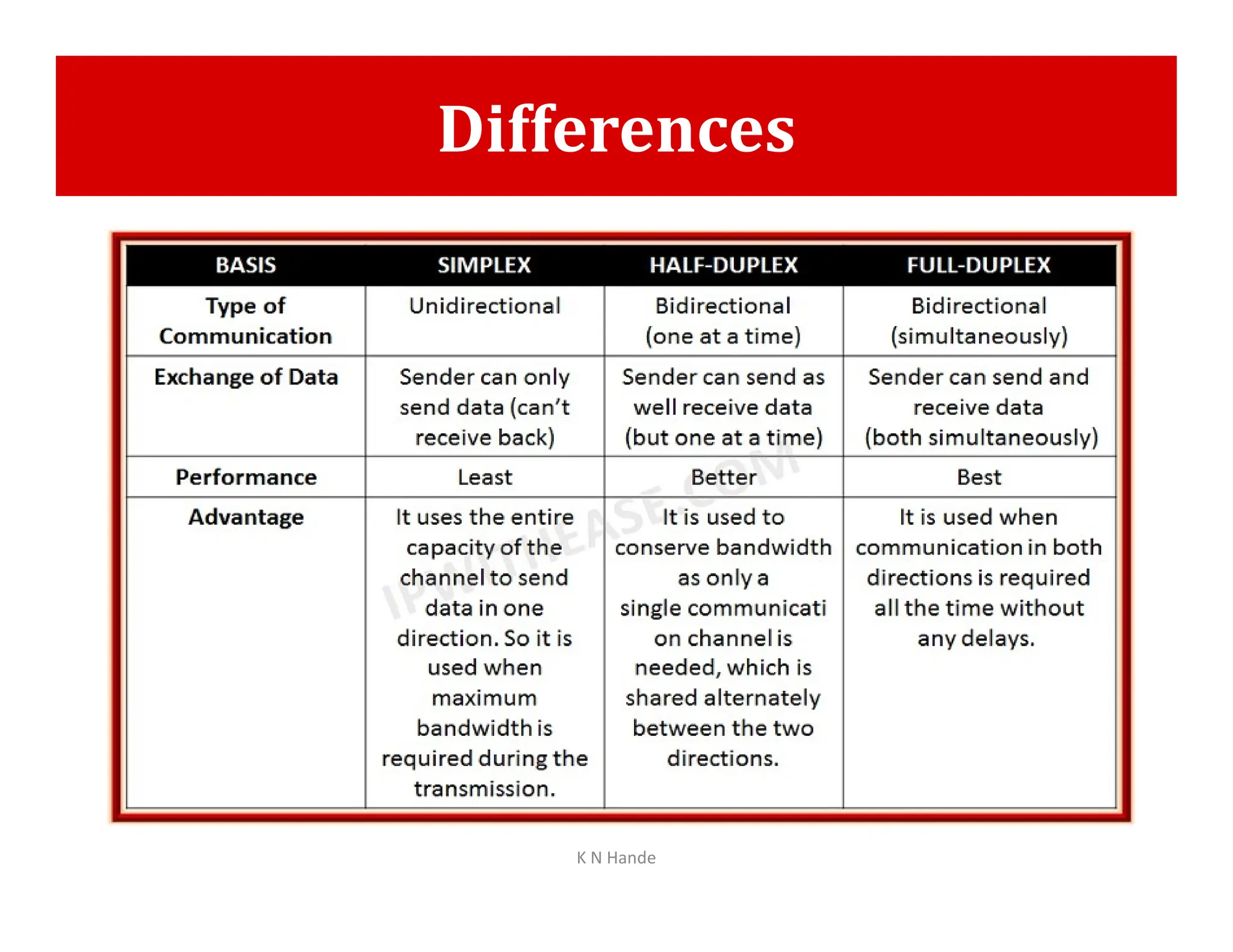
Data Flow
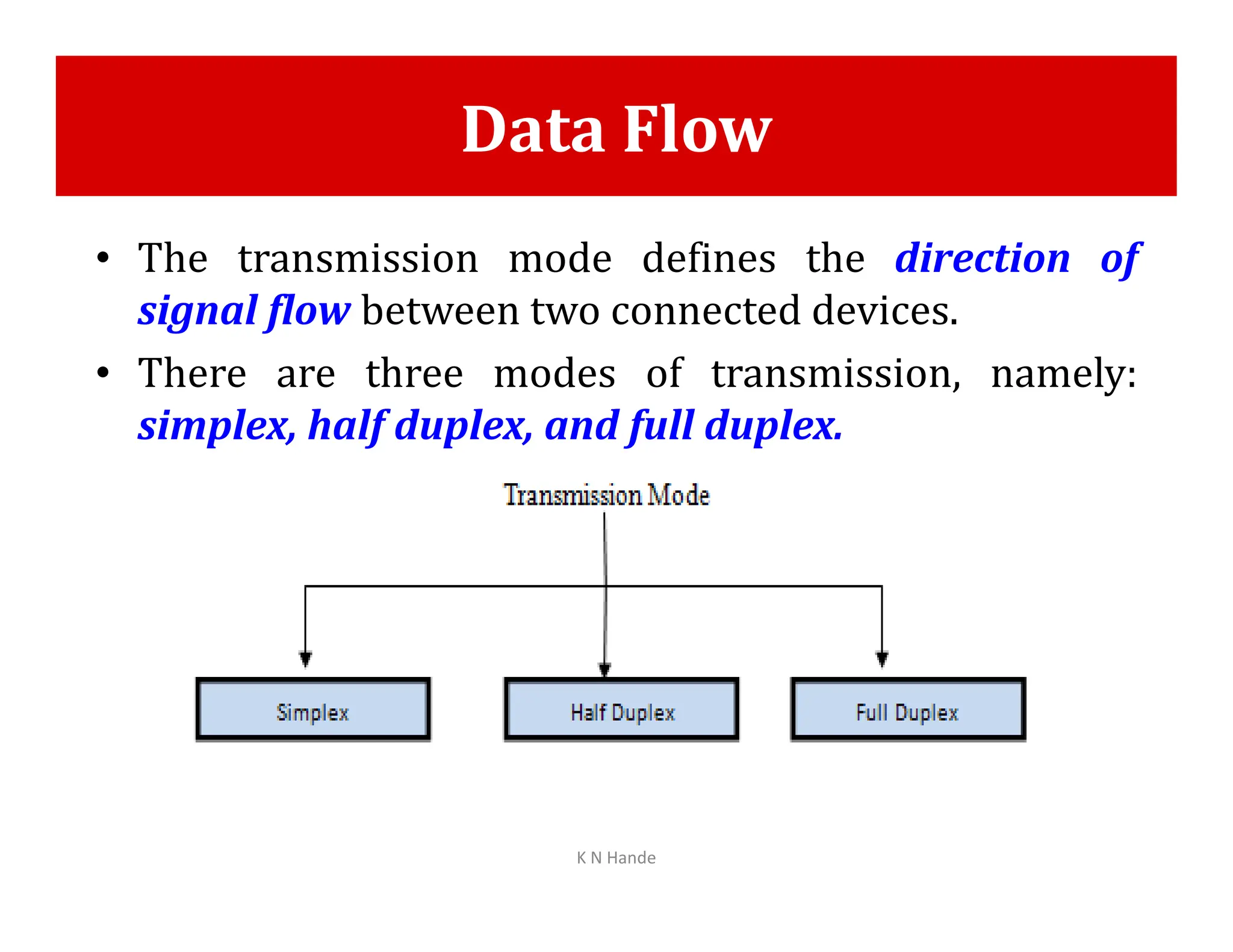
• The transmission mode defines the direction of
signal flow between two connected devices.
• There are three modes of transmission, namely:
simplex, half duplex, and full duplex.
K N Hande
Simplex Mode
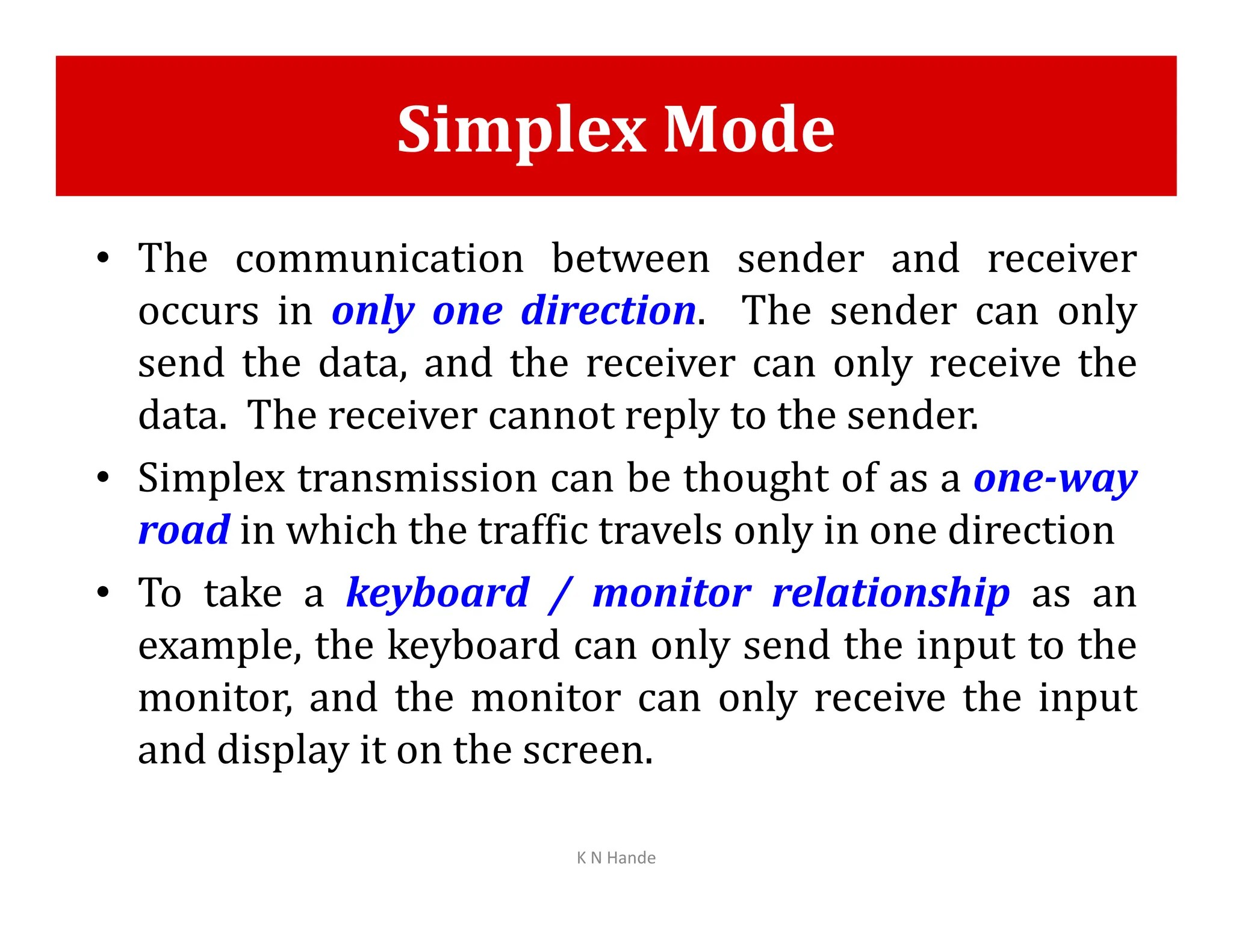
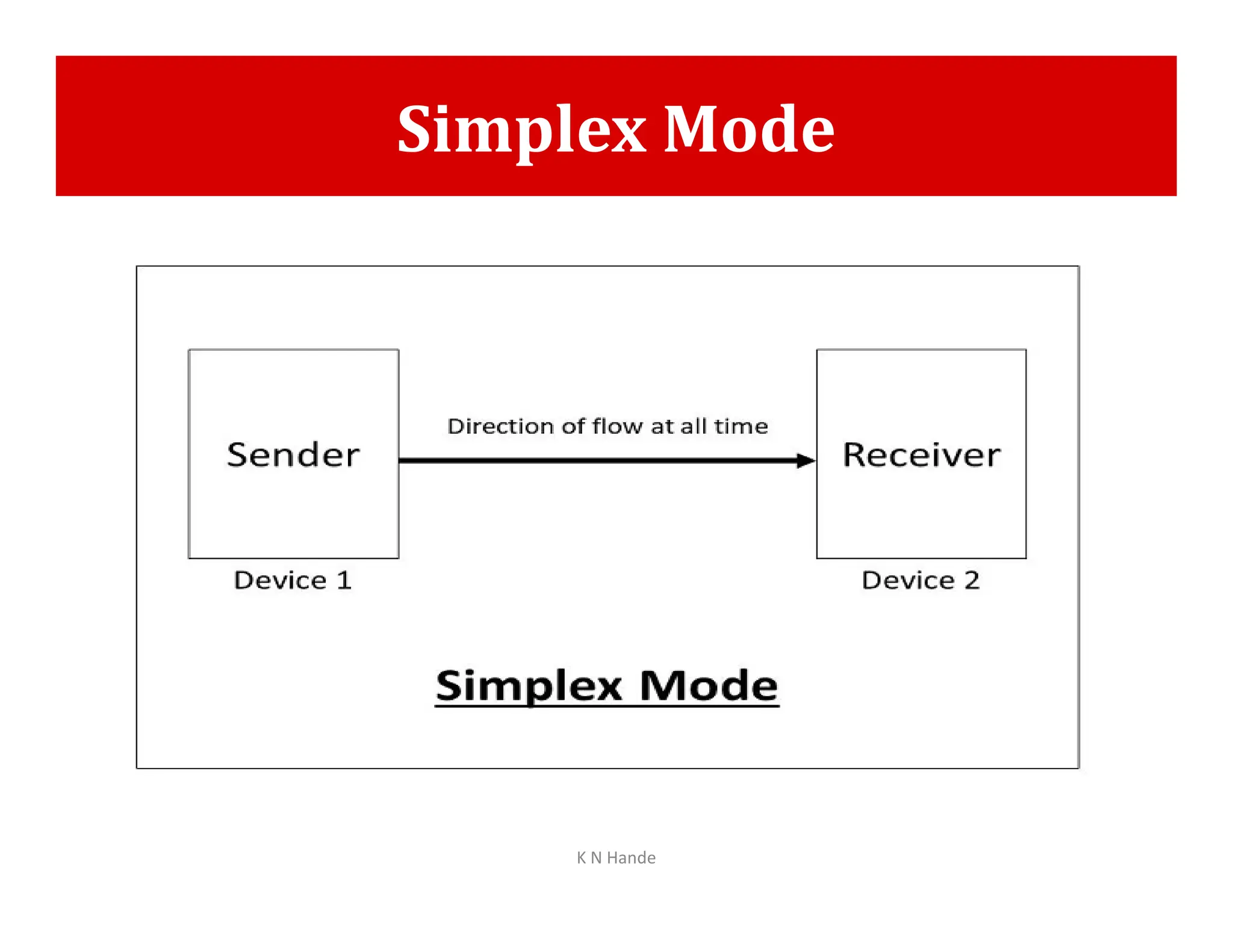
• The communication between sender and receiver
occurs in only one direction. The sender can only
send the data, and the receiver can only receive the
data. The receiver cannot reply to the sender.
• Simplex transmission can be thought of as a one-way
road in which the traffic travels only in one direction
• To take a keyboard / monitor relationship as an
example, the keyboard can only send the input to the
monitor, and the monitor can only receive the input
and display it on the screen.
K N Hande
Simplex Mode
K N Hande
Half-Duplex Mode
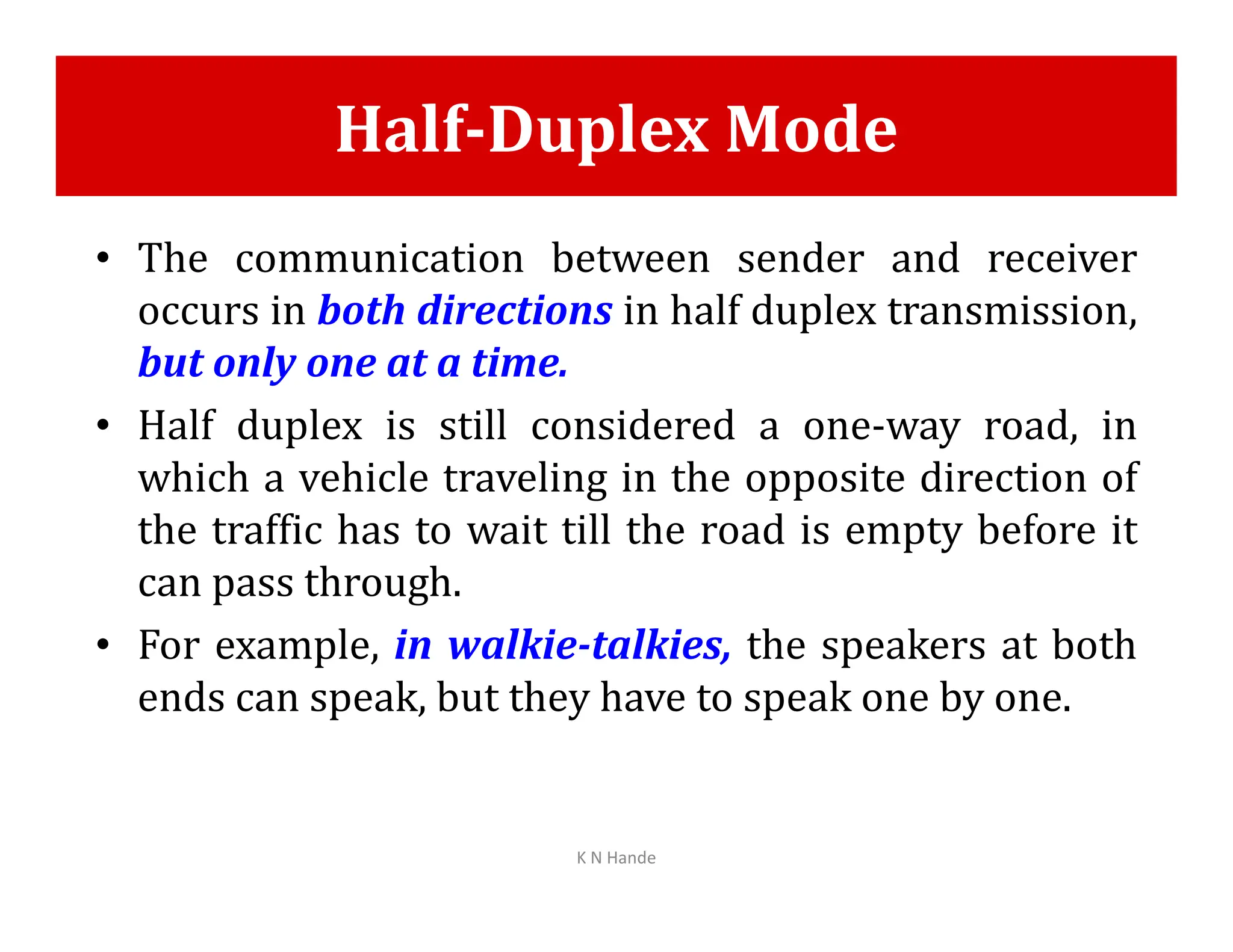
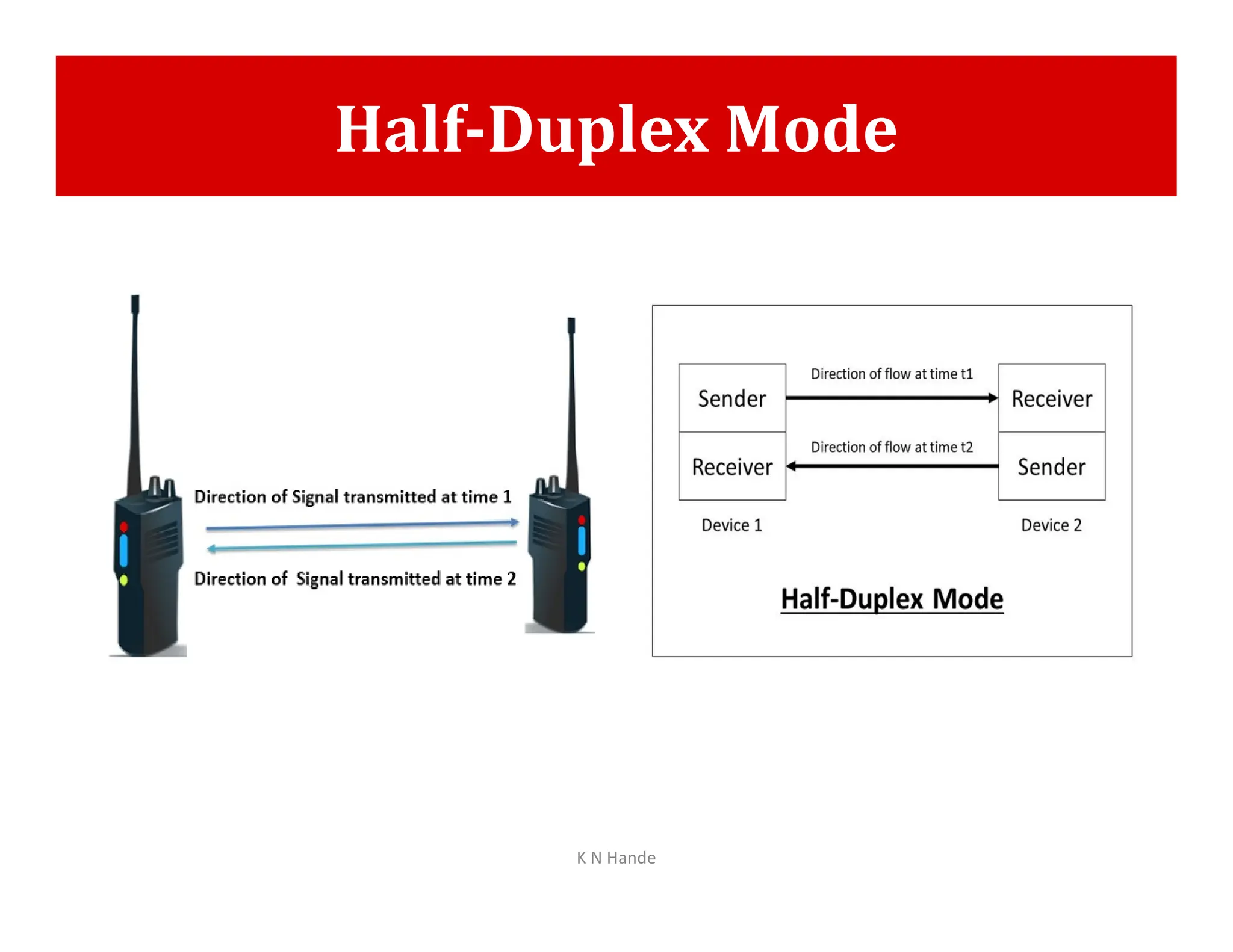
• The communication between sender and receiver
occurs in both directions in half duplex transmission,
but only one at a time.
• Half duplex is still considered a one-way road, in
which a vehicle traveling in the opposite direction of
the traffic has to wait till the road is empty before it
can pass through.
• For example, in walkie-talkies, the speakers at both
ends can speak, but they have to speak one by one.
K N Hande
Half-Duplex Mode
K N Hande
Full-Duplex Mode
• In full duplex transmission mode, the communication
between sender and receiver can occur
simultaneously.
• The sender and receiver can both transmit and
receive at the same time.
• For example, in a telephone conversation, two
people communicate, and both are free to speak and
listen at the same time.
K N Hande
Full-Duplex Mode
K N Hande
Differences
K N Hande
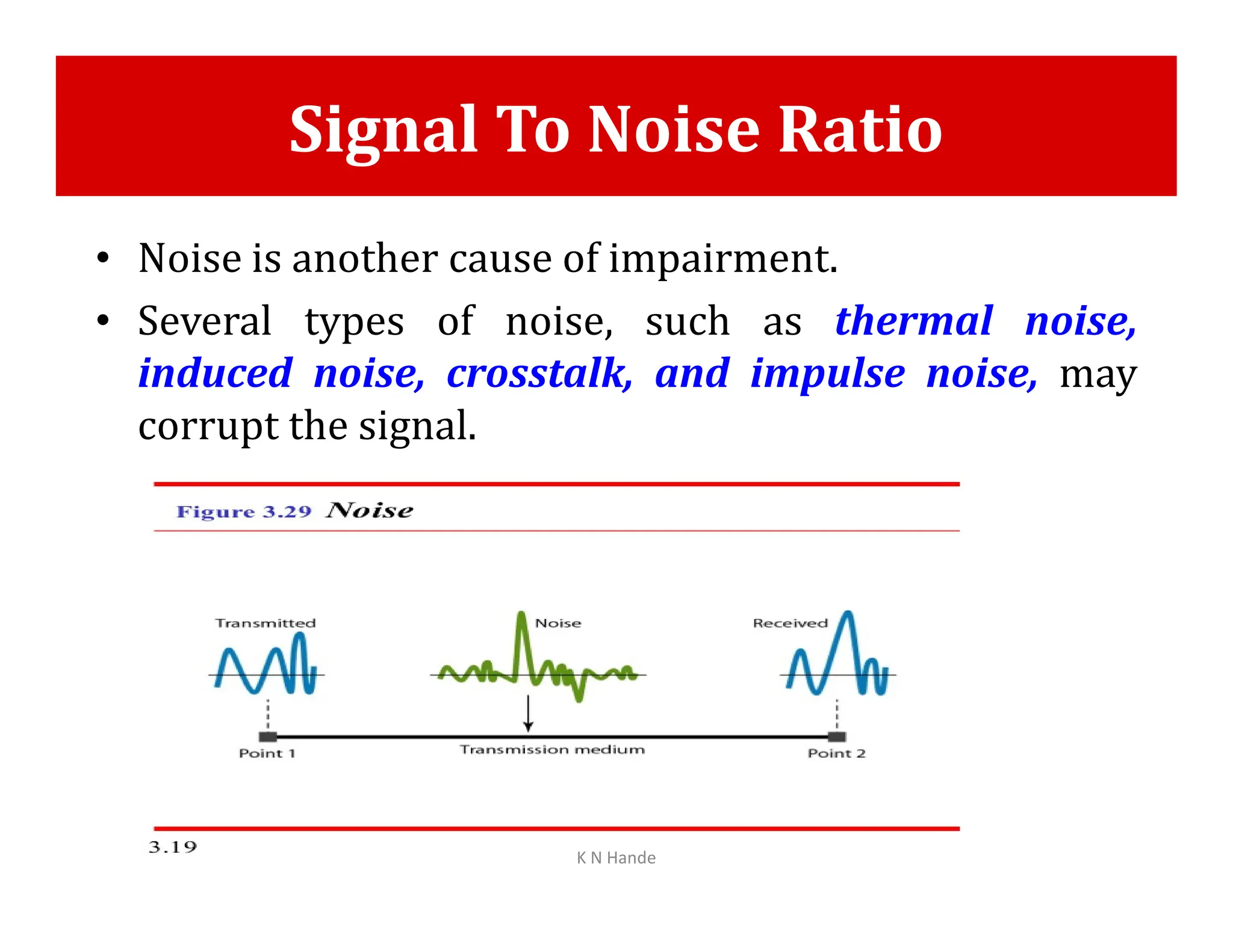
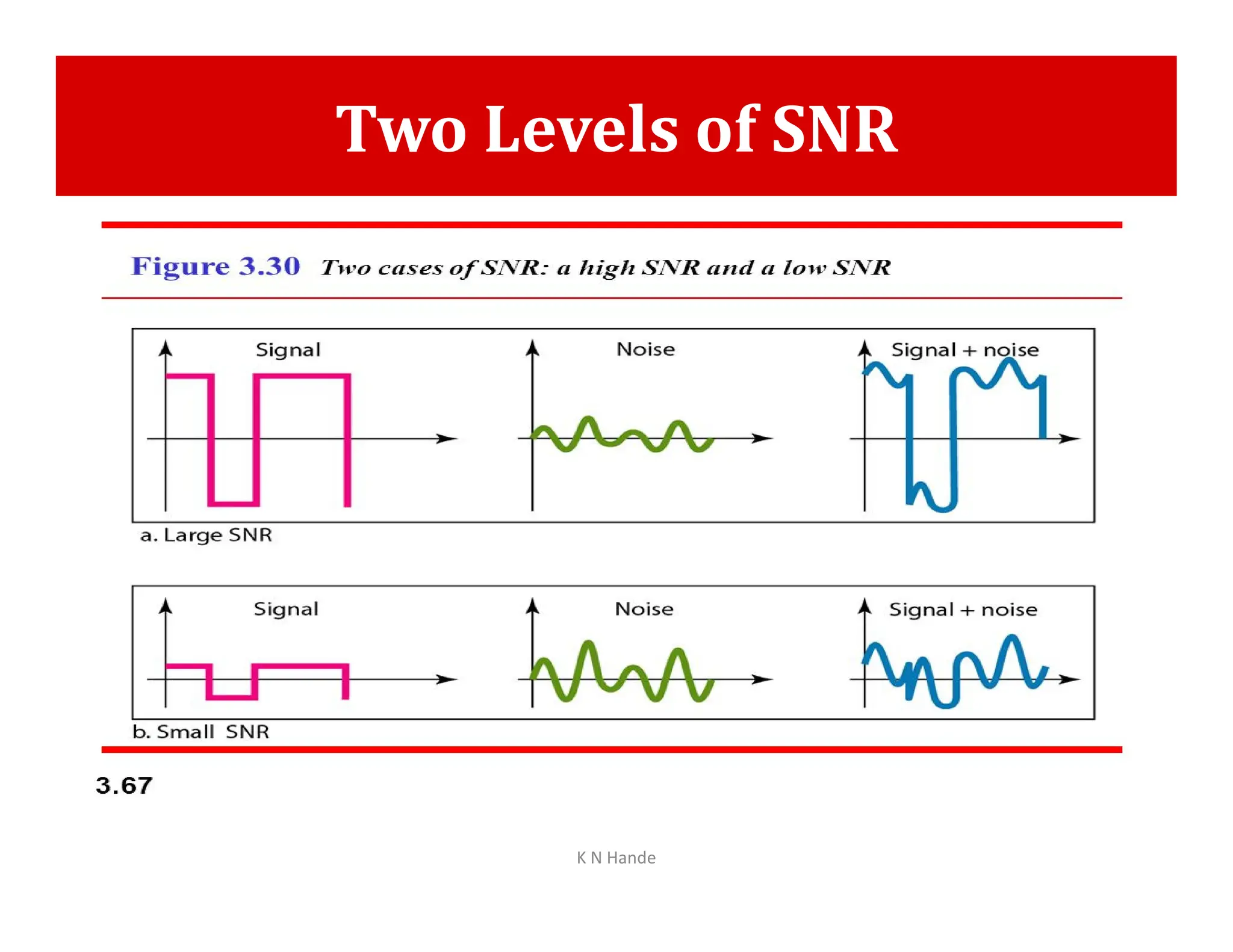
Signal To Noise Ratio
• Noise is another cause of impairment.
• Several types of noise, such as thermal noise,
induced noise, crosstalk, and impulse noise, may
corrupt the signal.
K N Hande
Signal To Noise Ratio
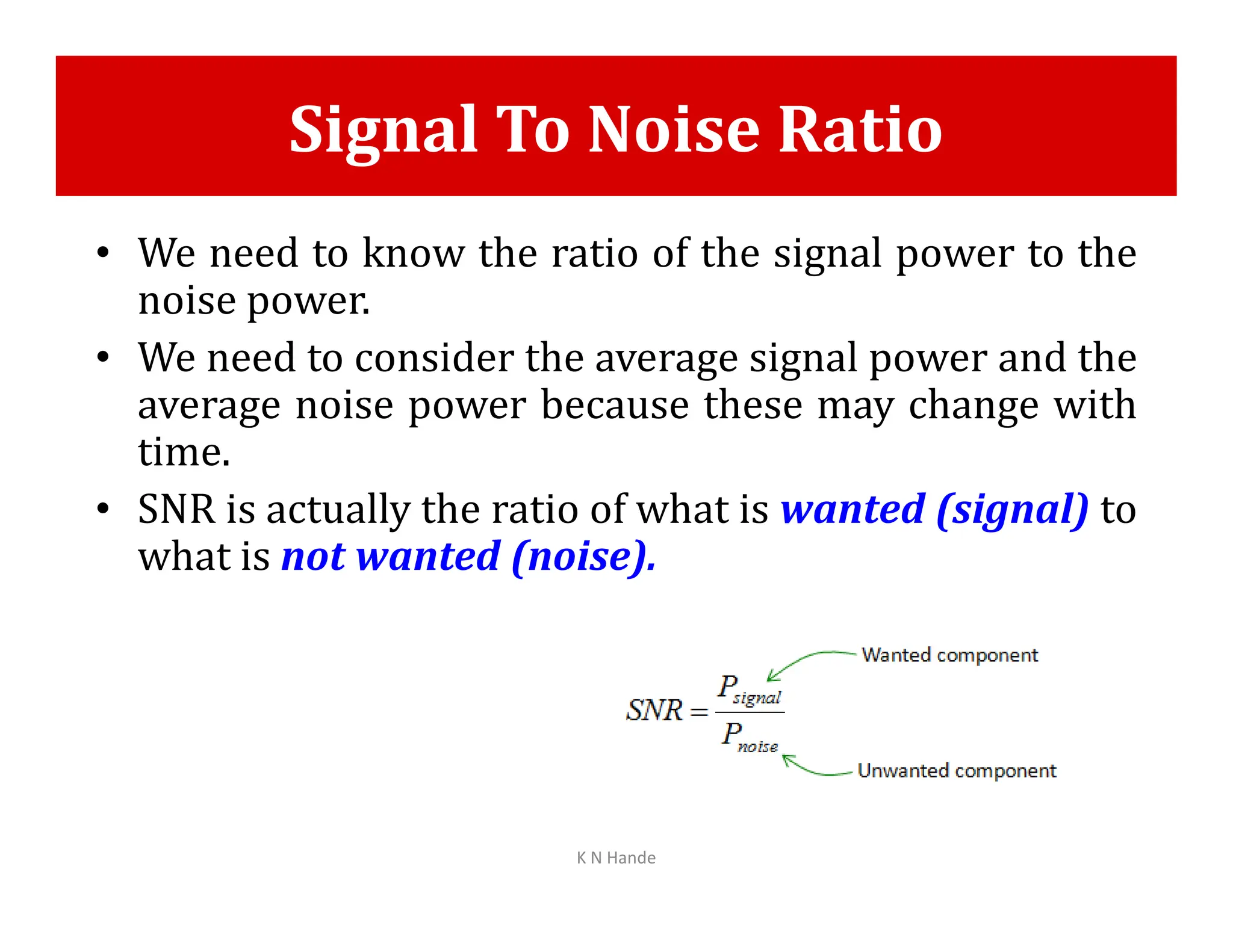
• We need to know the ratio of the signal power to the
noise power.
• We need to consider the average signal power and the
average noise power because these may change with
time.
• SNR is actually the ratio of what is wanted (signal) to
what is not wanted (noise).
K N Hande
Signal To Noise Ratio
• A high SNR means the signal is less corrupted by
noise; a low SNR means the signal is more corrupted
by noise.
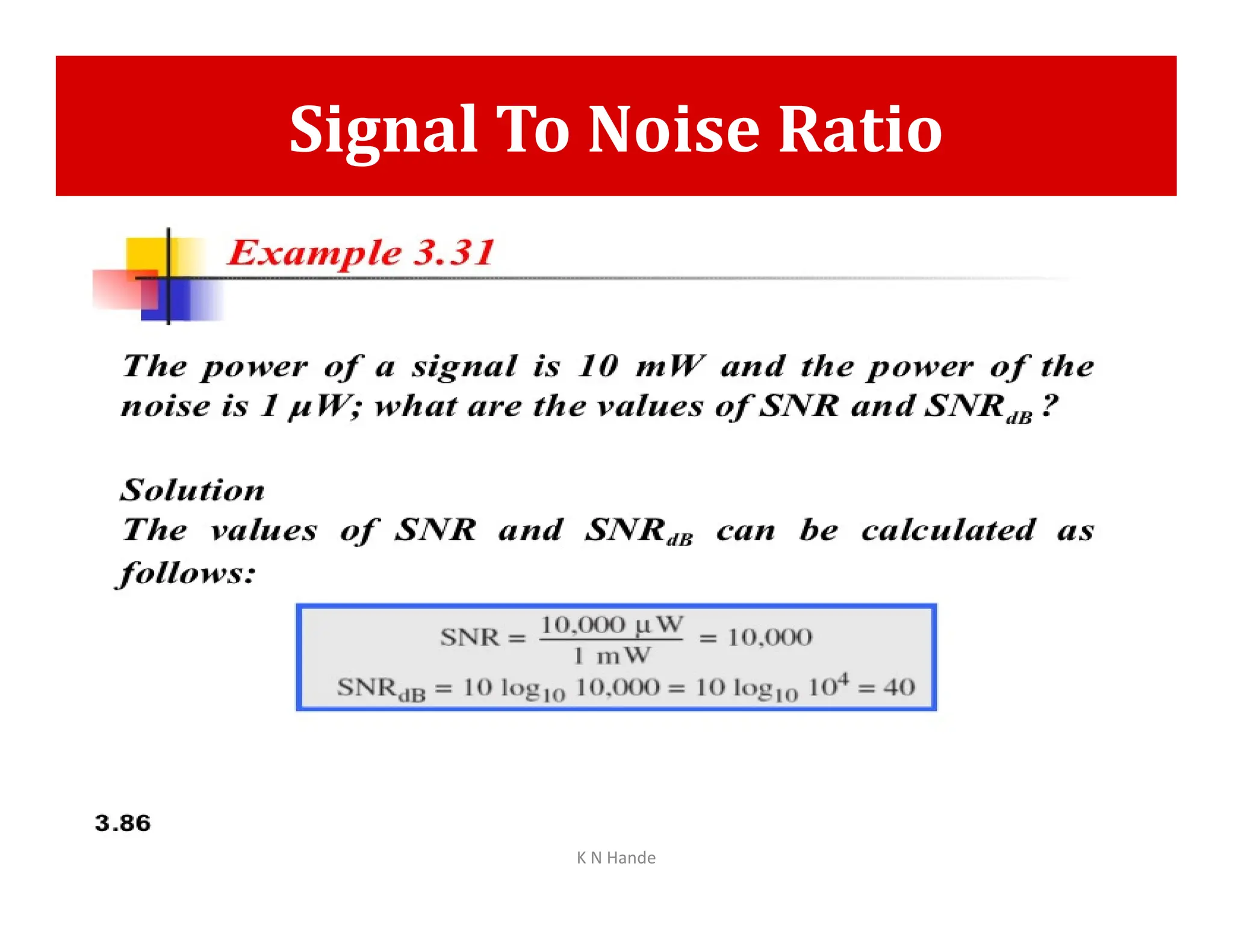
• Because SNR is the ratio of two powers, it is often
described in decibel units.
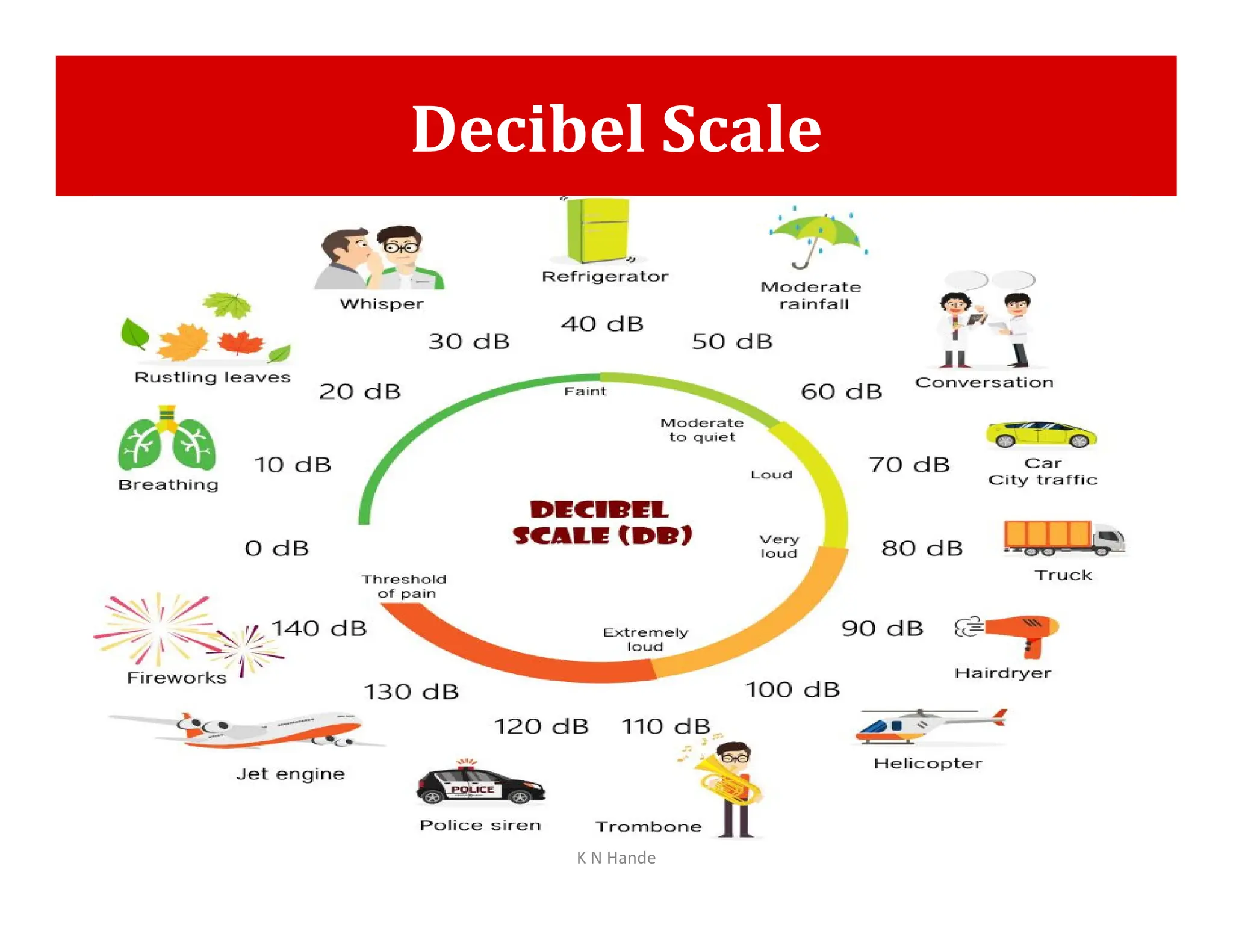
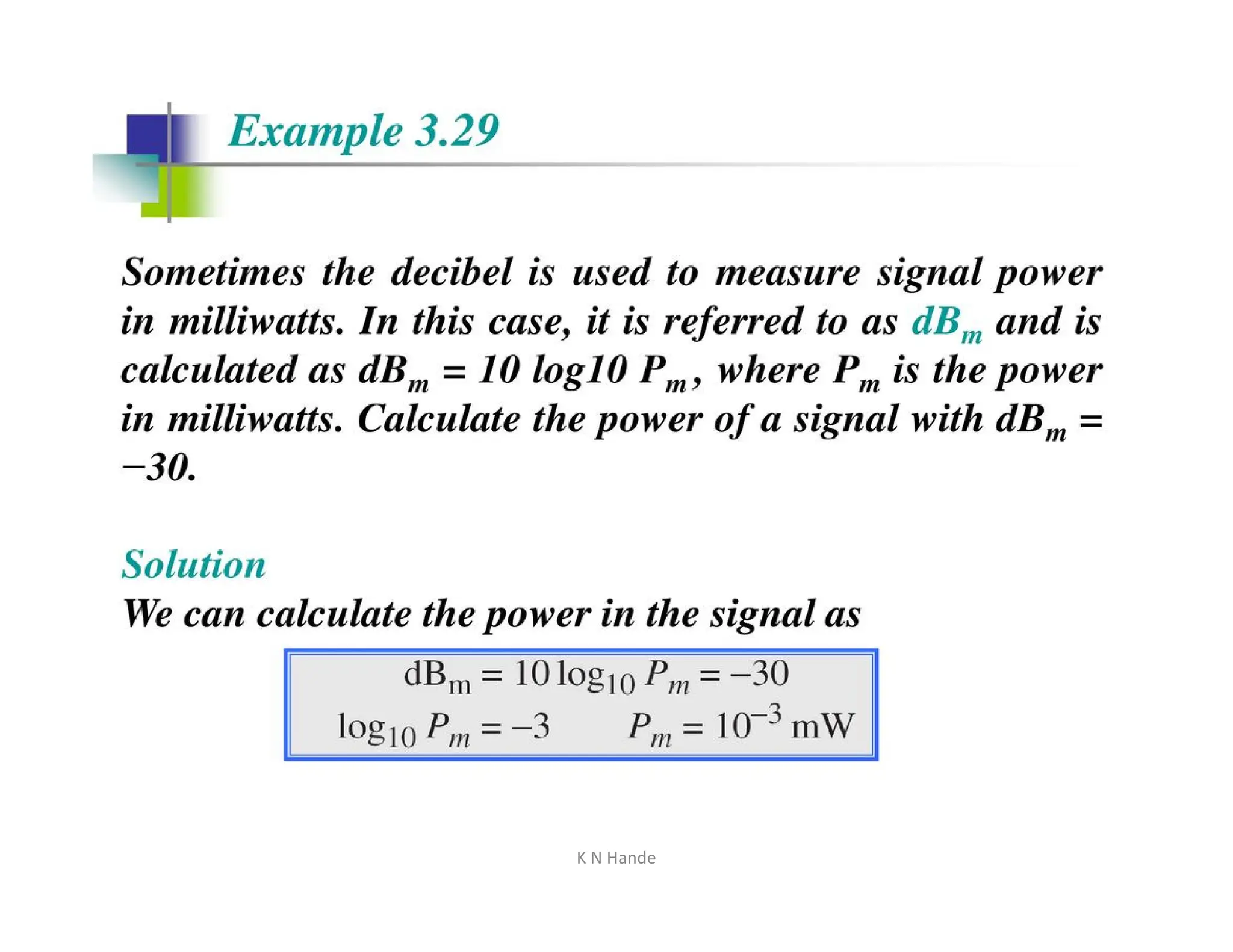
• The deciBel, dB utilizes a logarithmic scale based to
compare two quantities. It is a convenient way of
comparing two physical quantities like electrical
power, intensity, or even current, or voltage.
• The deciBel, dB or deci-Bel is actually a tenth of a Bel
- a unit that is seldom used.
K N Hande
Decibel Scale
K N Hande
Signal To Noise Ratio
K N Hande
Two Levels of SNR
K N Hande
Solved
examples based
examples based
on Topics
Covered
K N Hande
K N Hande
K N Hande
K N Hande
K N Hande
K N Hande
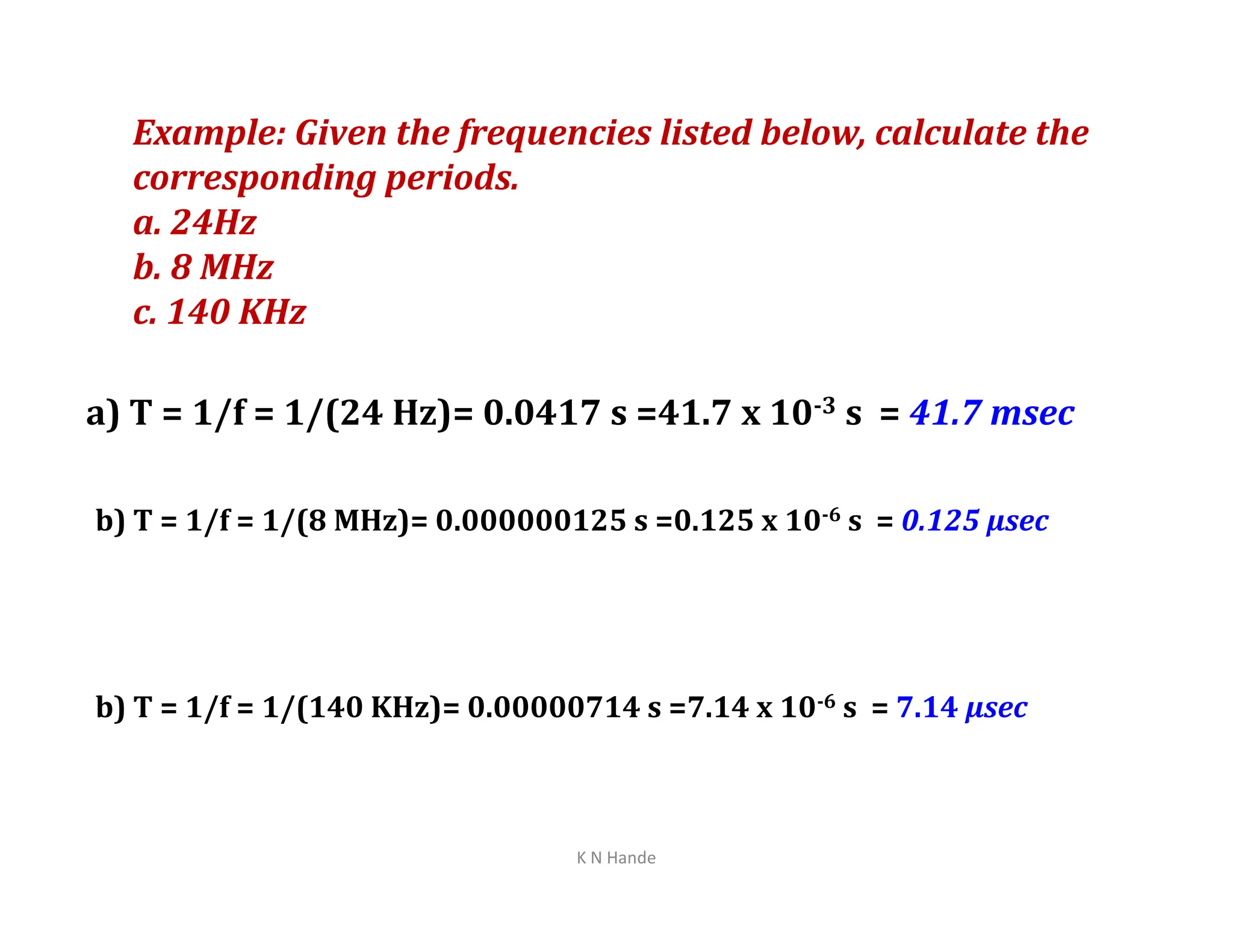
Example: Given the frequencies listed below, calculate the
corresponding periods.
a. 24Hz
b. 8 MHz
c. 140 KHz
a) T = 1/f = 1/(24 Hz)= 0.0417 s =41.7 x 10⁻³ s = 41.7 msec
b) T = 1/f = 1/(8 MHz)= 0.000000125 s =0.125 x 10⁻⁶ s = 0.125 µsec
b) T = 1/f = 1/(140 KHz)= 0.00000714 s =7.14 x 10⁻⁶ s = 7.14 µsec
K N Hande
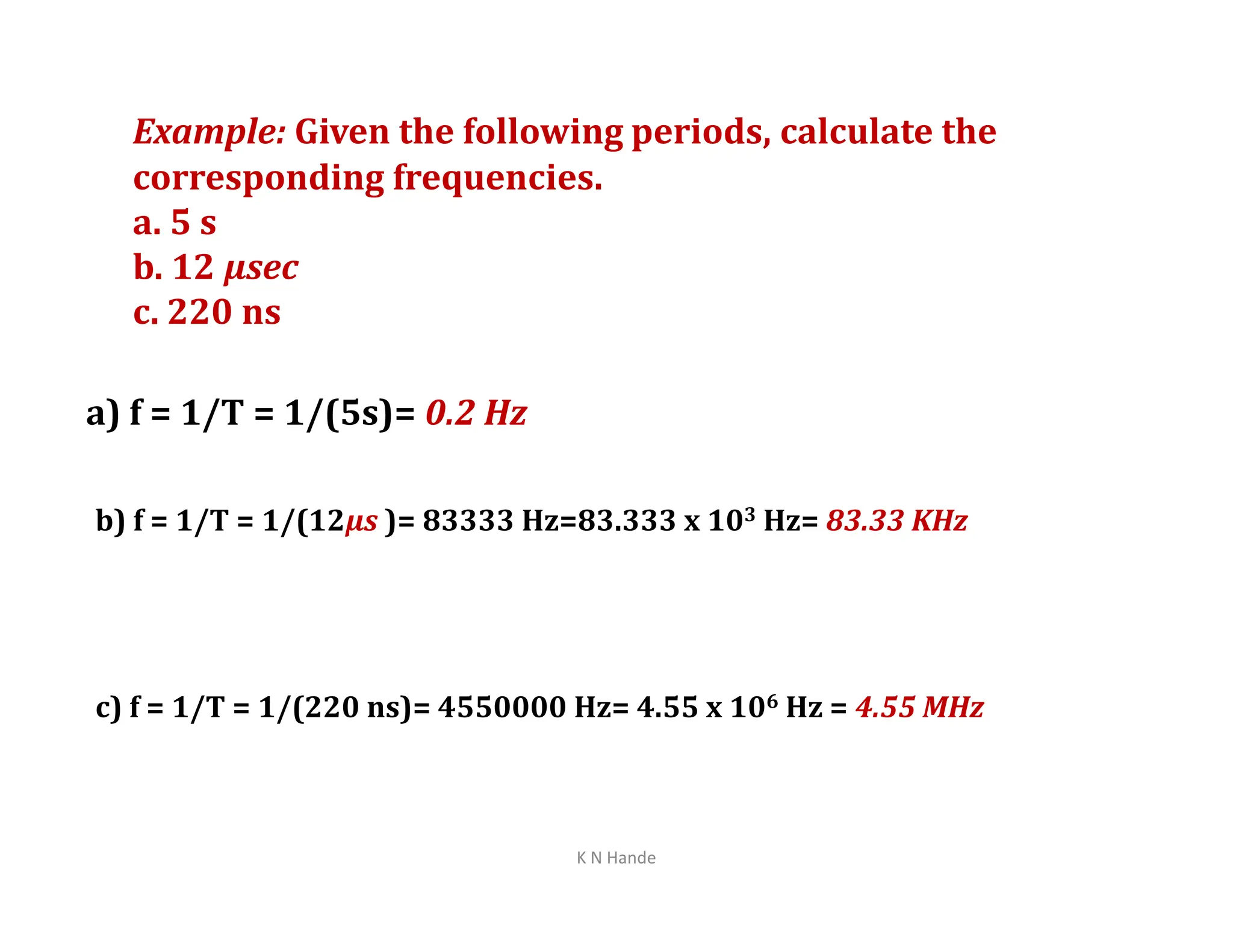
Example: Given the following periods, calculate the
corresponding frequencies.
a. 5 s
b. 12 µsec
c. 220 ns
a) f = 1/T = 1/(5s)= 0.2 Hz
b) f = 1/T = 1/(12µs )= 83333 Hz=83.333 x 10³ Hz= 83.33 KHz
c) f = 1/T = 1/(220 ns)= 4550000 Hz= 4.55 x 10⁶ Hz = 4.55 MHz
K N Hande
K N Hande
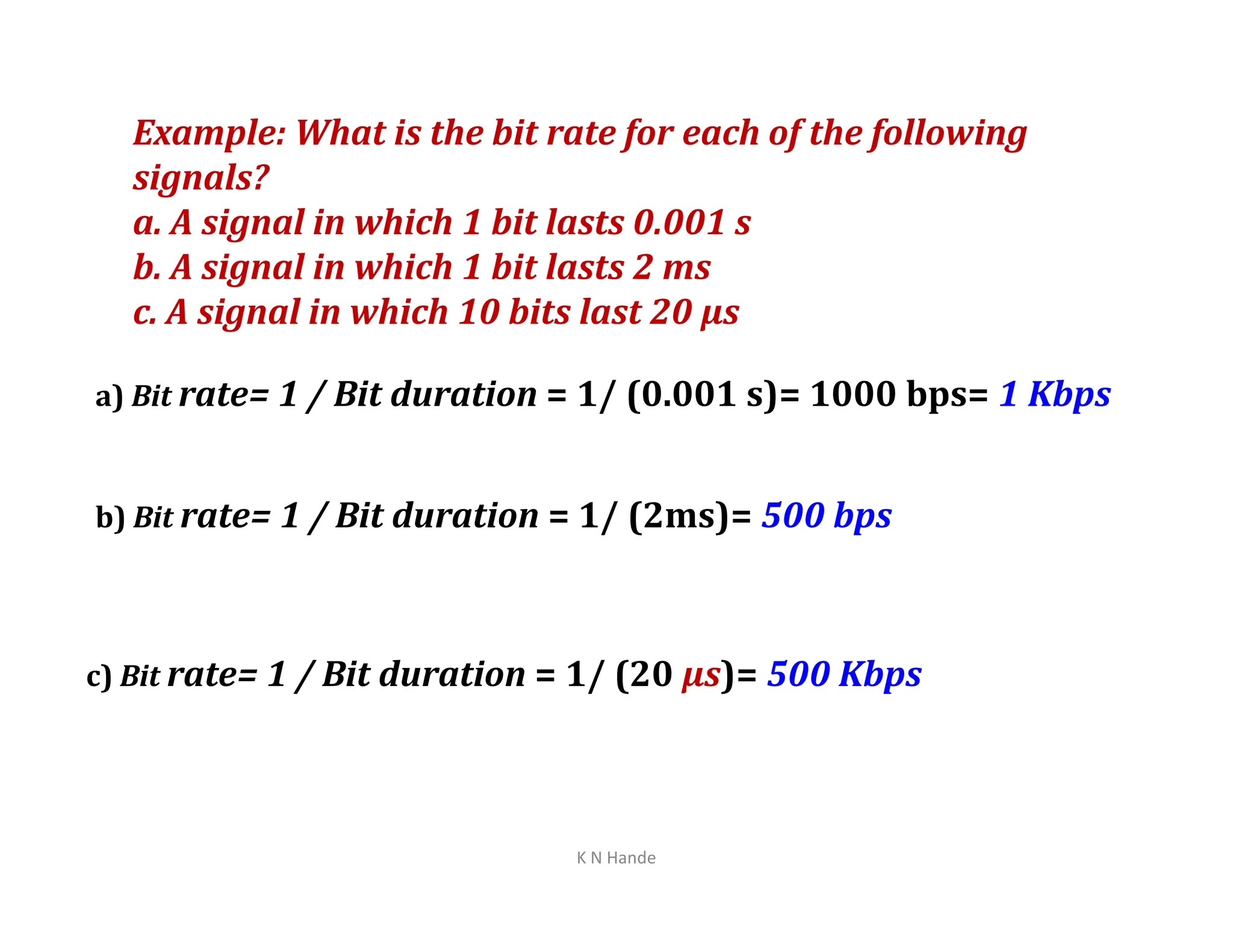
Example: What is the bit rate for each of the following
signals?
a. A signal in which 1 bit lasts 0.001 s
b. A signal in which 1 bit lasts 2 ms
c. A signal in which 10 bits last 20 µs
a) Bit rate= 1 / Bit duration = 1/ (0.001 s)= 1000 bps= 1 Kbps
b) Bit rate= 1 / Bit duration = 1/ (2ms)= 500 bps
c) Bit rate= 1 / Bit duration = 1/ (20 µs)= 500 Kbps
K N Hande
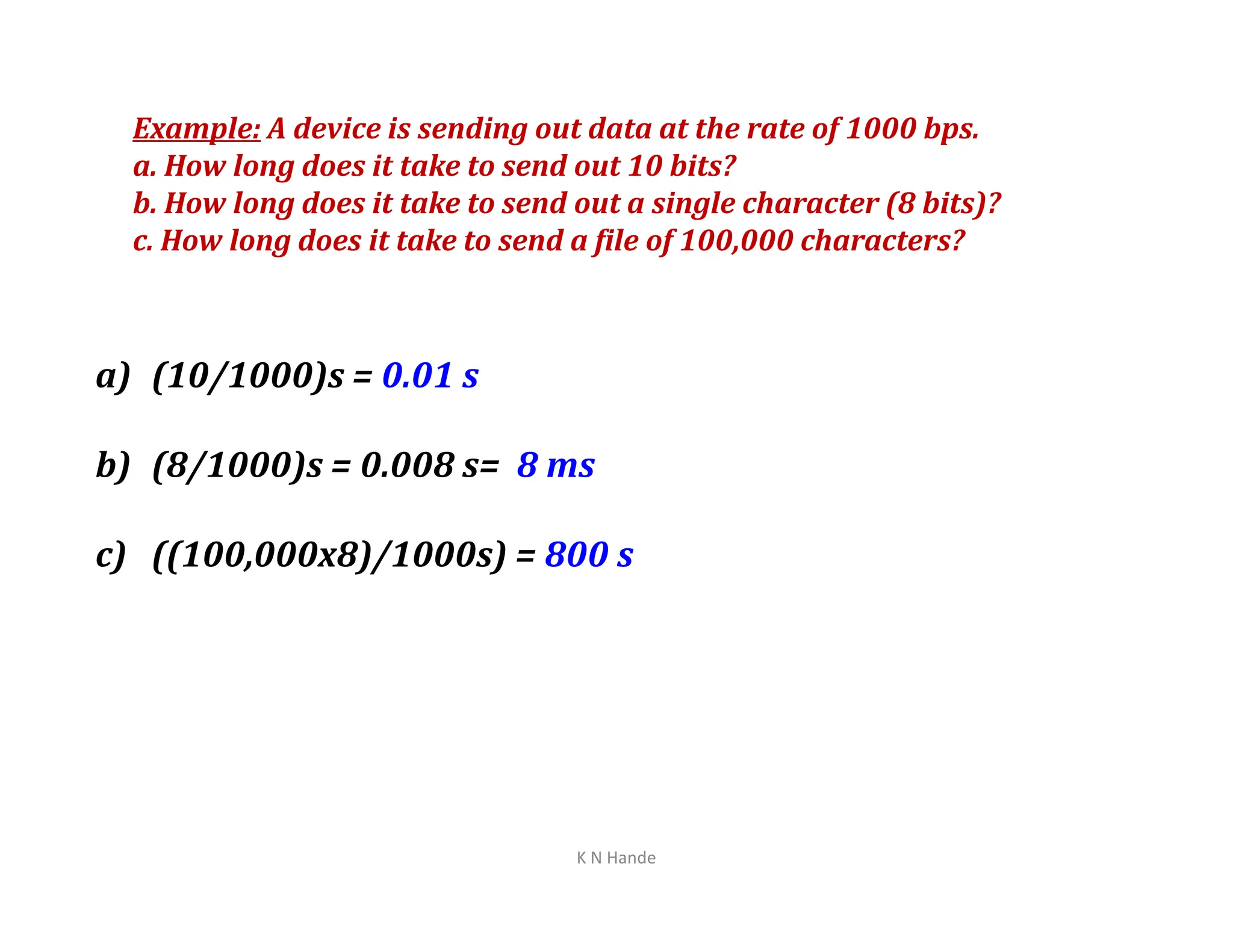
Example: A device is sending out data at the rate of 1000 bps.
a. How long does it take to send out 10 bits?
b. How long does it take to send out a single character (8 bits)?
c. How long does it take to send a file of 100,000 characters?
a) (10/1000)s = 0.01 s
b) (8/1000)s = 0.008 s= 8 ms
c) ((100,000x8)/1000s) = 800 s
K N Hande
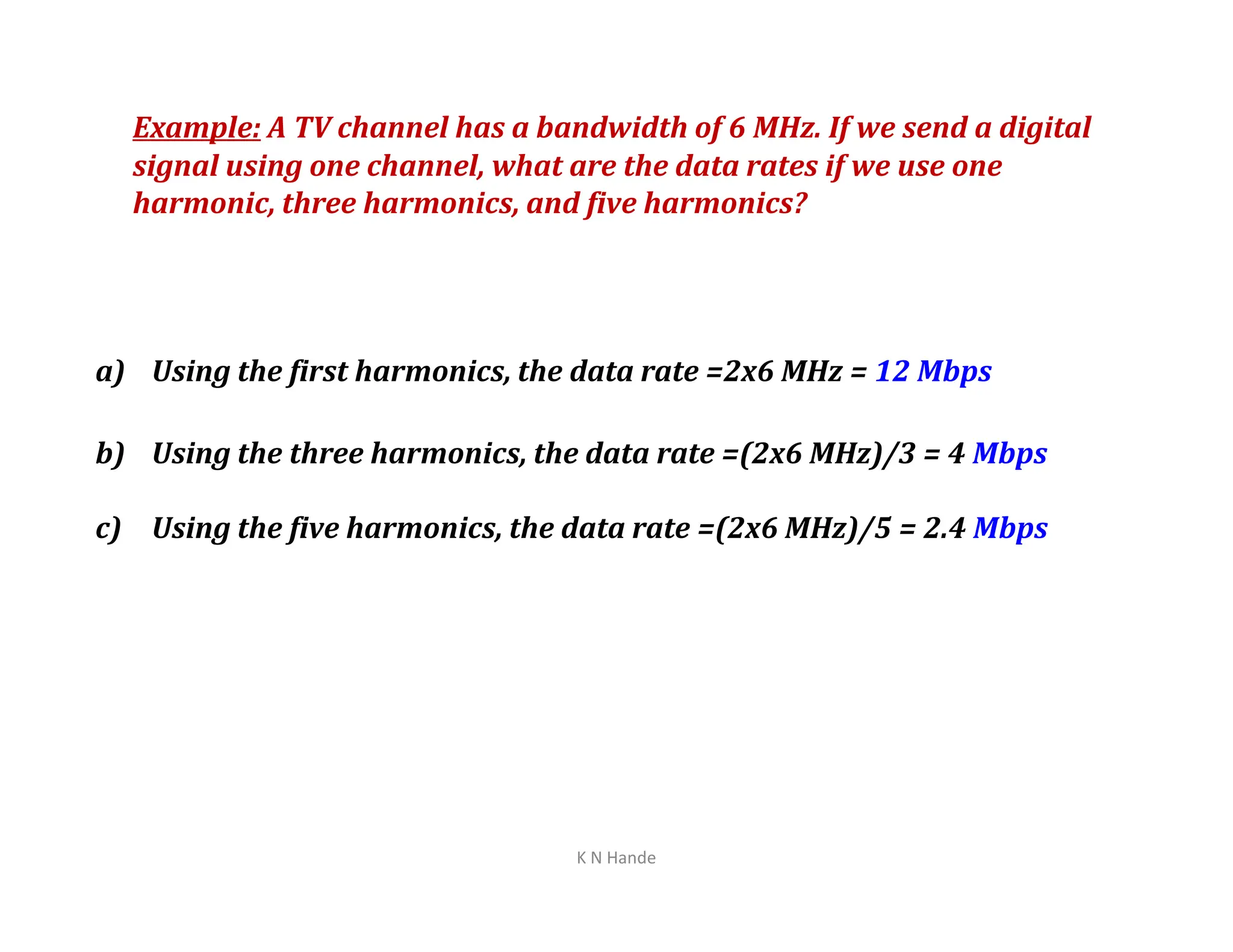
Example: A TV channel has a bandwidth of 6 MHz. If we send a digital
signal using one channel, what are the data rates if we use one
harmonic, three harmonics, and five harmonics?
a) Using the first harmonics, the data rate =2x6 MHz = 12 Mbps
b) Using the three harmonics, the data rate =(2x6 MHz)/3 = 4 Mbps
c) Using the five harmonics, the data rate =(2x6 MHz)/5 = 2.4 Mbps
K N Hande
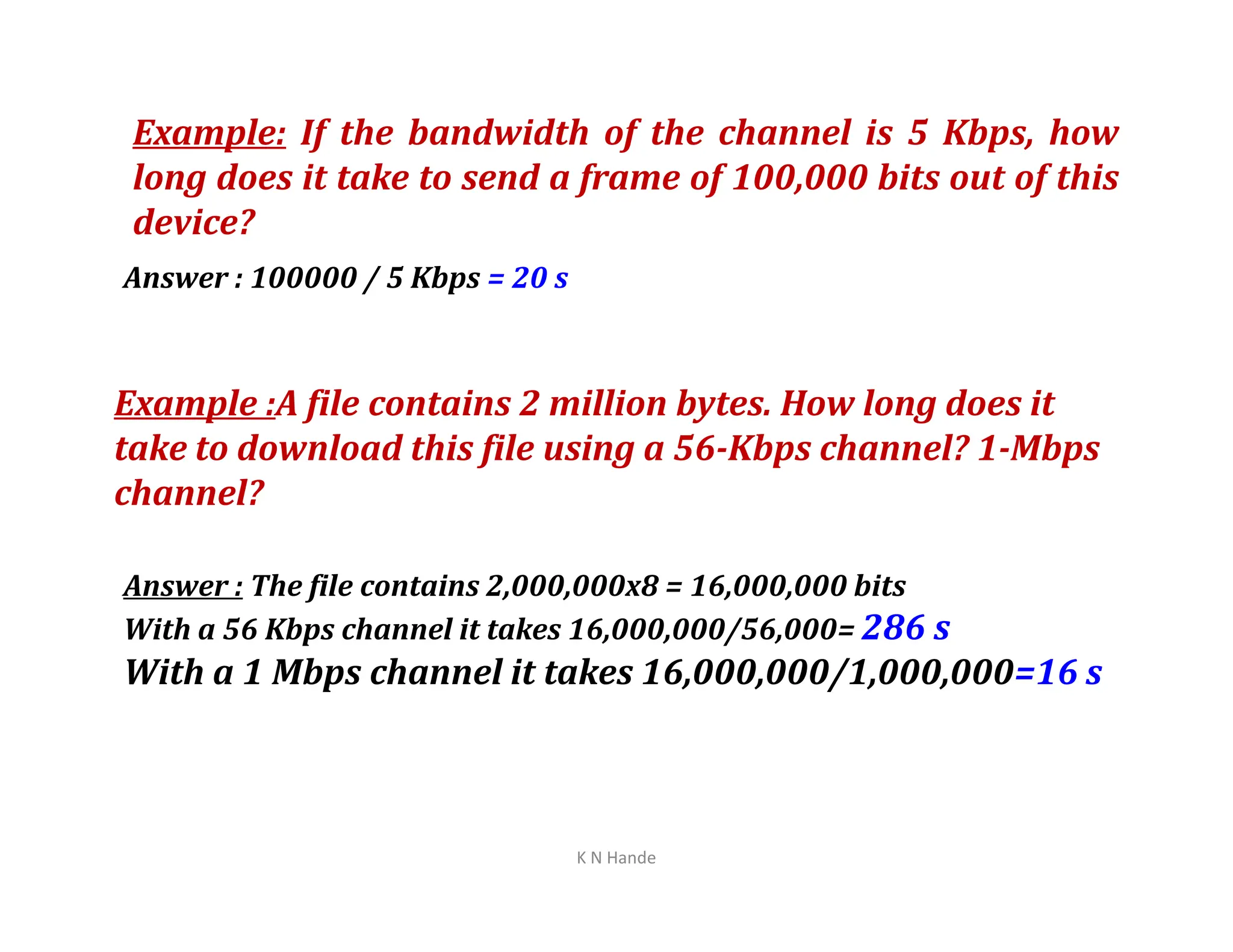
Example: If the bandwidth of the channel is 5 Kbps, how
long does it take to send a frame of 100,000 bits out of this
device?
Answer : 100000 / 5 Kbps = 20 s
Example :A file contains 2 million bytes. How long does it
take to download this file using a 56-Kbps channel? 1-Mbps
channel?
K N Hande
channel?
Answer : The file contains 2,000,000x8 = 16,000,000 bits
With a 56 Kbps channel it takes 16,000,000/56,000= 286 s
With a 1 Mbps channel it takes 16,000,000/1,000,000=16 s
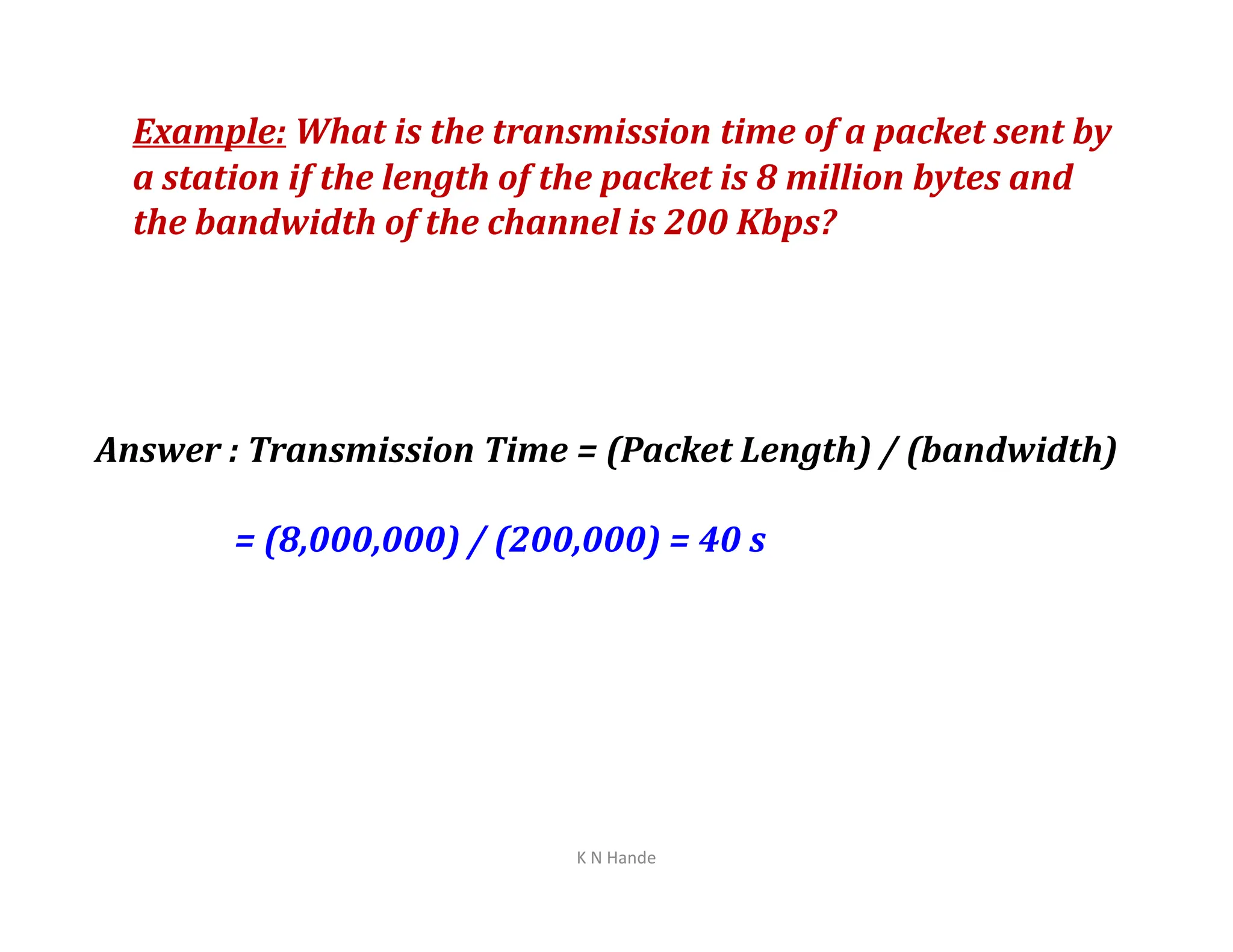
Example: What is the transmission time of a packet sent by
a station if the length of the packet is 8 million bytes and
the bandwidth of the channel is 200 Kbps?
Answer : Transmission Time = (Packet Length) / (bandwidth)
= (8,000,000) / (200,000) = 40 s
K N Hande
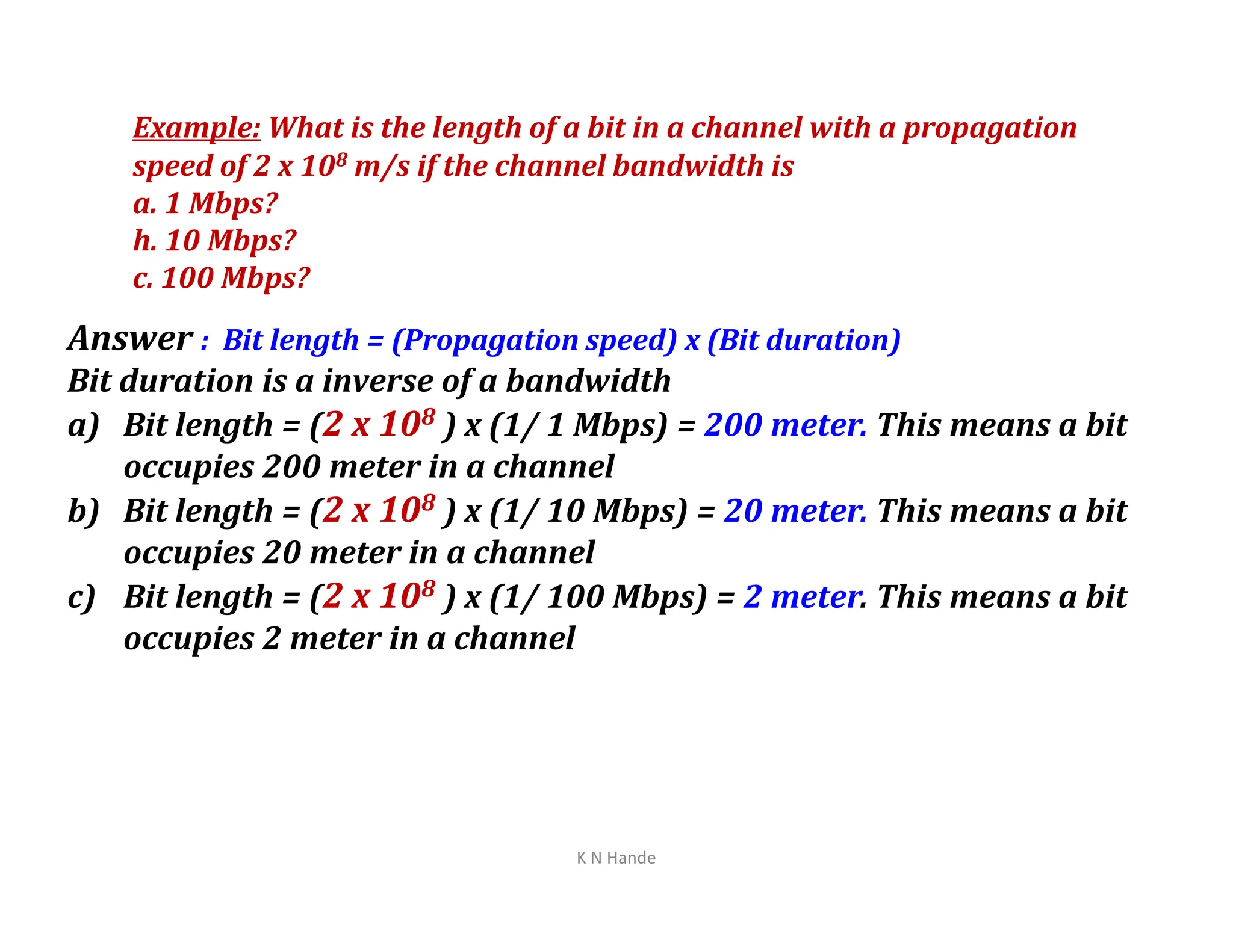
Example: What is the length of a bit in a channel with a propagation
speed of 2 x 10⁸ m/s if the channel bandwidth is
a. 1 Mbps?
h. 10 Mbps?
c. 100 Mbps?
Answer : Bit length = (Propagation speed) x (Bit duration)
Bit duration is a inverse of a bandwidth
a) Bit length = (2 x 10⁸ ) x (1/ 1 Mbps) = 200 meter. This means a bit
occupies 200 meter in a channel
b) Bit length = (2 x 10⁸ ) x (1/ 10 Mbps) = 20 meter. This means a bit
occupies 20 meter in a channel
c) Bit length = (2 x 10⁸ ) x (1/ 100 Mbps) = 2 meter. This means a bit
occupies 2 meter in a channel
K N Hande
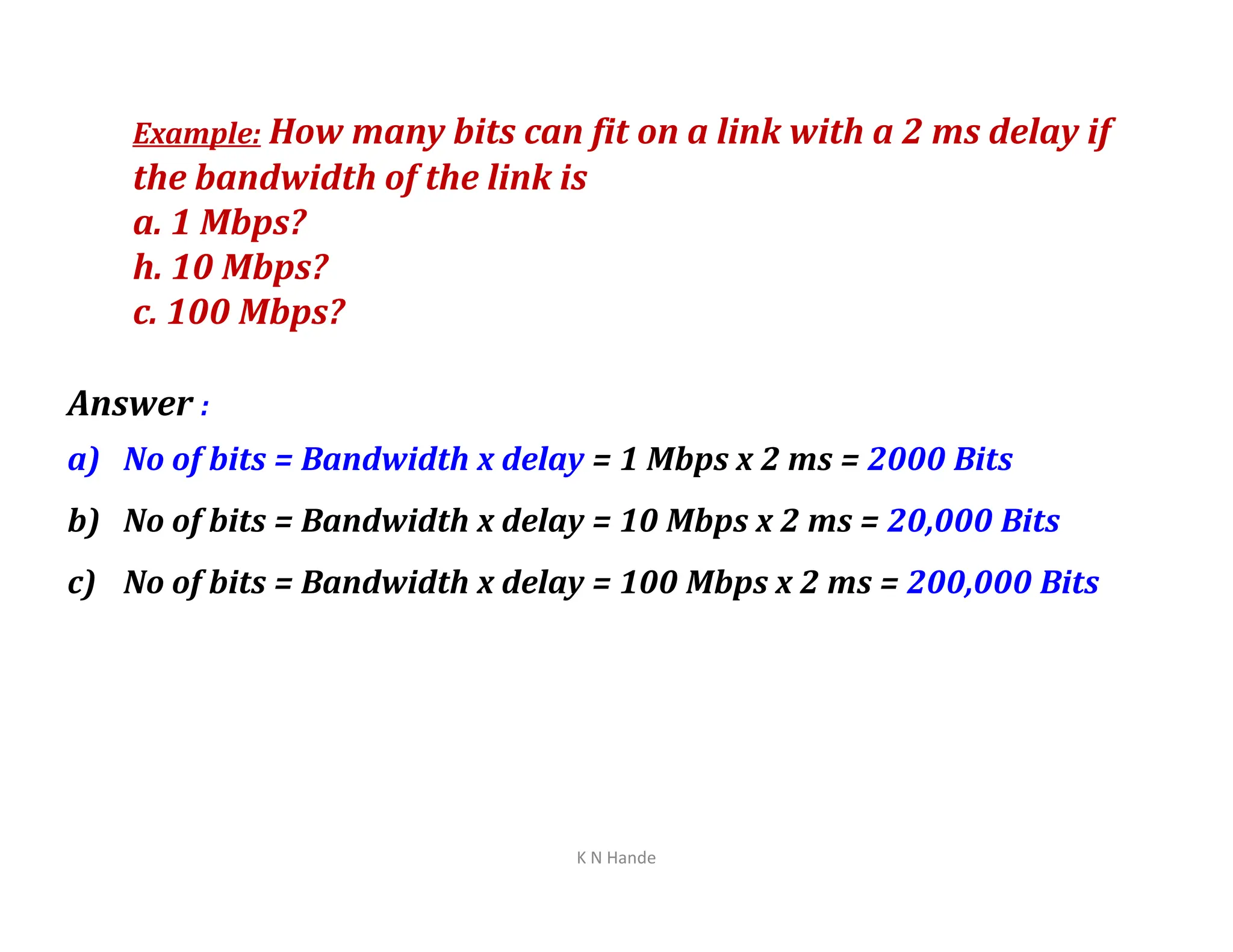
Example: How many bits can fit on a link with a 2 ms delay if
the bandwidth of the link is
a. 1 Mbps?
h. 10 Mbps?
c. 100 Mbps?
Answer :
a) No of bits = Bandwidth x delay = 1 Mbps x 2 ms = 2000 Bits
b) No of bits = Bandwidth x delay = 10 Mbps x 2 ms = 20,000 Bits
c) No of bits = Bandwidth x delay = 100 Mbps x 2 ms = 200,000 Bits
K N Hande
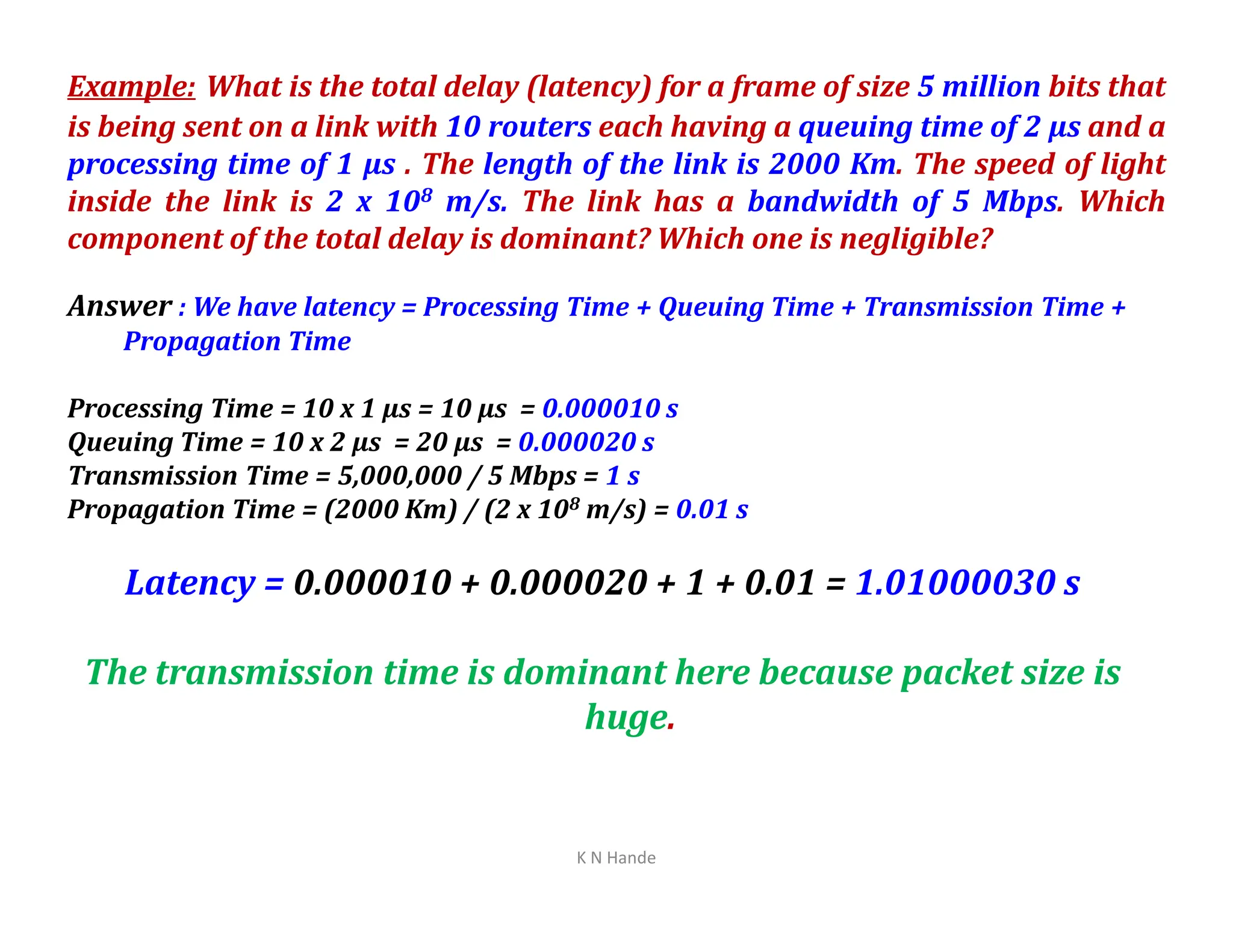
Example: What is the total delay (latency) for a frame of size 5 million bits that
is being sent on a link with 10 routers each having a queuing time of 2 µs and a
processing time of 1 µs . The length of the link is 2000 Km. The speed of light
inside the link is 2 x 10⁸ m/s. The link has a bandwidth of 5 Mbps. Which
component of the total delay is dominant? Which one is negligible?
Answer : We have latency = Processing Time + Queuing Time + Transmission Time +
Propagation Time
Processing Time = 10 x 1 µs = 10 µs = 0.000010 s
Queuing Time = 10 x 2 µs = 20 µs = 0.000020 s
Transmission Time = 5,000,000 / 5 Mbps = 1 s
K N Hande
Transmission Time = 5,000,000 / 5 Mbps = 1 s
Propagation Time = (2000 Km) / (2 x 10⁸ m/s) = 0.01 s
Latency = 0.000010 + 0.000020 + 1 + 0.01 = 1.01000030 s
The transmission time is dominant here because packet size is
huge.
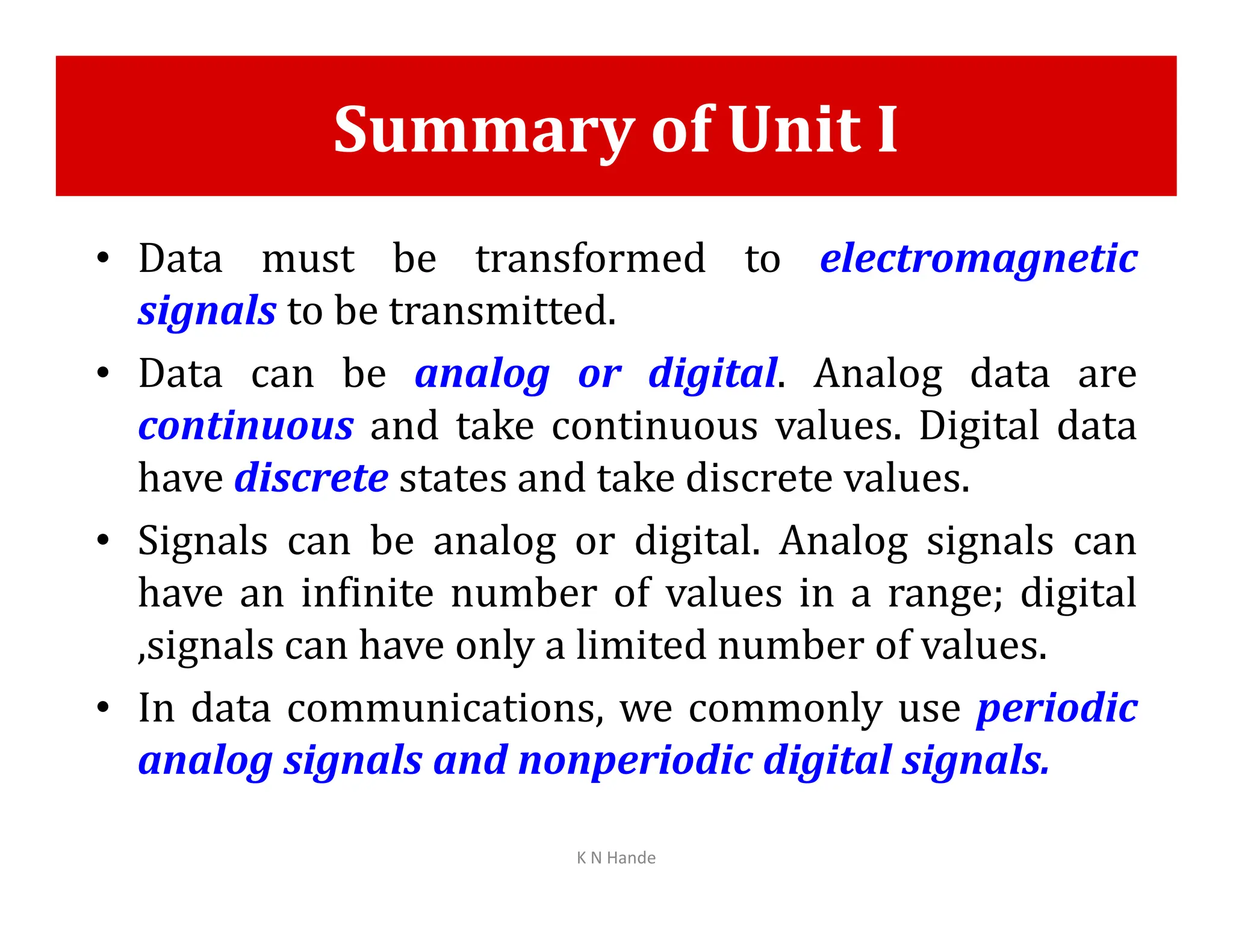
Summary of Unit I
• Data must be transformed to electromagnetic
signals to be transmitted.
• Data can be analog or digital. Analog data are
continuous and take continuous values. Digital data
have discrete states and take discrete values.
• Signals can be analog or digital. Analog signals can
have an infinite number of values in a range; digital
,signals can have only a limited number of values.
• In data communications, we commonly use periodic
analog signals and nonperiodic digital signals.
K N Hande
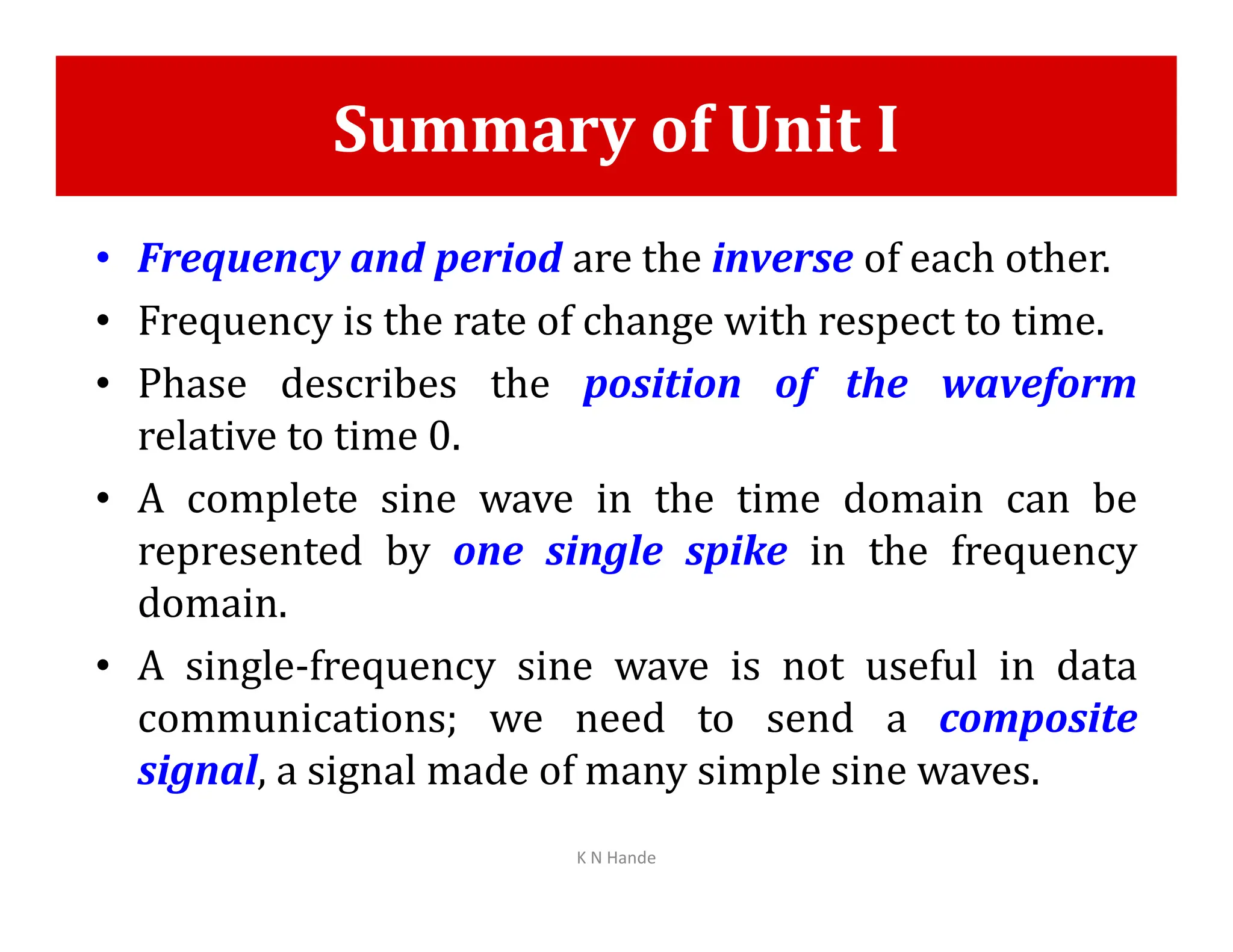
Summary of Unit I
• Frequency and period are the inverse of each other.
• Frequency is the rate of change with respect to time.
• Phase describes the position of the waveform
relative to time 0.
• A complete sine wave in the time domain can be
represented by one single spike in the frequency
domain.
• A single-frequency sine wave is not useful in data
communications; we need to send a composite
signal, a signal made of many simple sine waves.
K N Hande
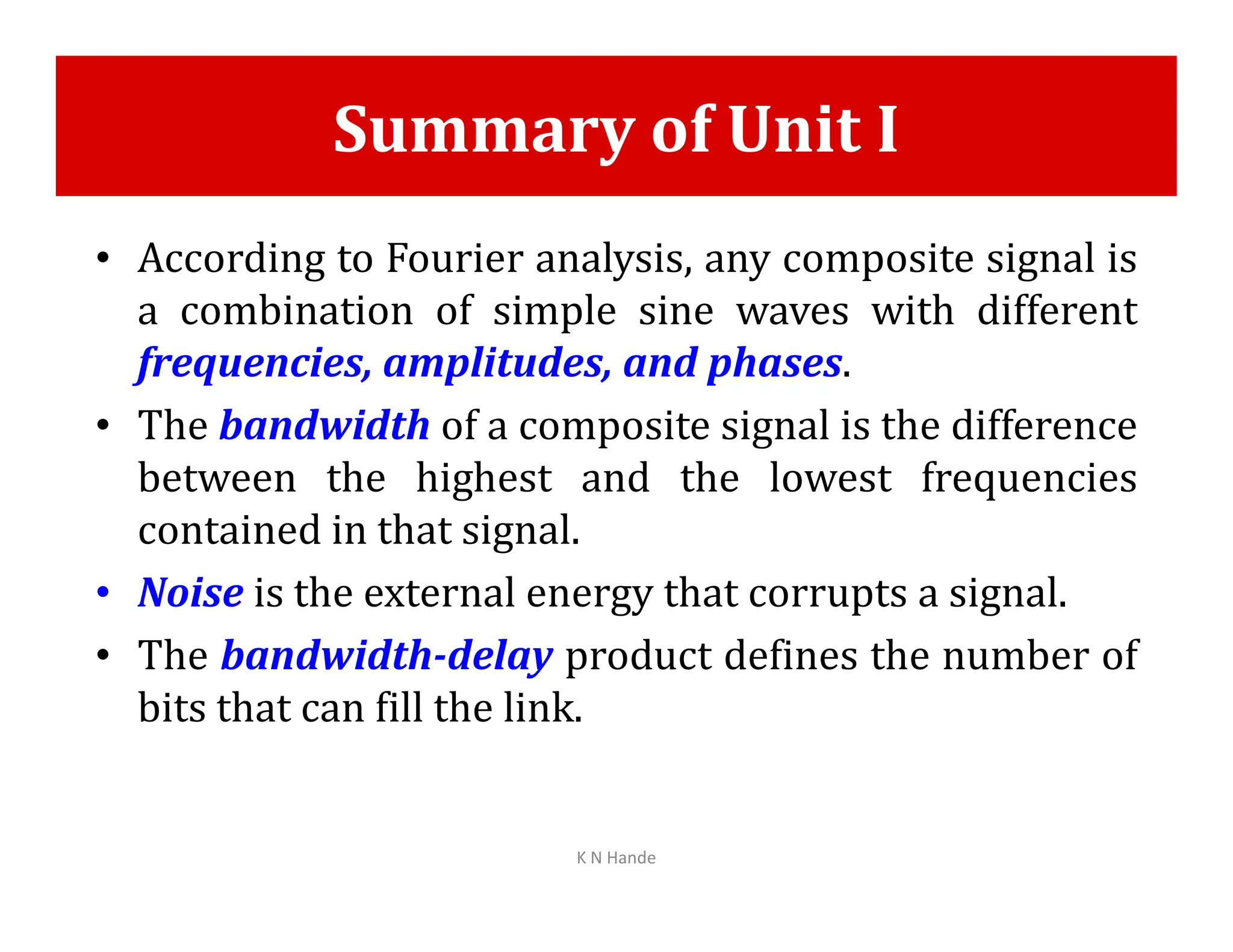
Summary of Unit I
• According to Fourier analysis, any composite signal is
a combination of simple sine waves with different
frequencies, amplitudes, and phases.
• The bandwidth of a composite signal is the difference
between the highest and the lowest frequencies
contained in that signal.
• Noise is the external energy that corrupts a signal.
• The bandwidth-delay product defines the number of
bits that can fill the link.
K N Hande
Introduction to Data Communication concepts

Introduction to Data Communication concepts

  • 1.
    Data Communication V SemB.E. Computer Sc. & Engg Department of Computer Science & Engineering Priyadarshini Bhagwati College of Engineering, Nagpur (Odd 2021) K N Hande Head of the Department
  • 2.
    Text Books 1. DataCommunications and Networking by Behrouz A. Forouzan, 4thEdition, Tata McGraw Hill 2. Packet guide to core network protocol by Bruce Hartpence, Oreilly Bruce Hartpence, Oreilly 3. Electronic Communication Systems by Kennedy 4. Understanding Data Communications and Networks by William A. Shay, 2nd Edition, Vikas Publishing House. K N Hande
  • 3.
    UNIT I -CONTENTS 1. Analog And Digital Signals 2. Periodic And Non Periodic Signals 3. Composite Signals 4. Frequency Spectrum And Bandwidth 4. Frequency Spectrum And Bandwidth 5. Transmission Modes K N Hande
  • 4.
    Data and Signals •One of the major functions of the physical layer is to move data in the form of electromagnetic signals across a transmission medium. medium. • Transmission media work by conducting energy along a physical path • To be transmitted, data must be transformed to electromagnetic signals. K N Hande
  • 5.
    Analog and Digital •The term communications refers to the sending, receiving and processing of information by electronic means. • Both data and the signals that represent • Both data and the signals that represent them can be either analog or digital in form. • The term analog data refers to information that is continuous; digital data refers to information that has discrete states. K N Hande
  • 6.
  • 7.
    Analog and DigitalSignals • An analog signal has infinitely many levels of intensity over a period of time. • A digital signal, on the other hand, can have only a limited number of defined values. only a limited number of defined values. K N Hande
  • 8.
  • 9.
    Periodic and Non-periodicSignals • A periodic signal completes a pattern within a measurable time frame, called a period • A nonperiodic signal changes without exhibiting a pattern or cycle that repeats over exhibiting a pattern or cycle that repeats over time. • Both analog and digital signals can be periodic or nonperiodic. K N Hande
  • 10.
    Periodic Analog Signals •Periodic analog signals can be classified as simple or composite. A simple periodic analog signal, a sine wave, cannot be decomposed into simpler signals. A composite periodic analog signal is composed of multiple sine waves. multiple sine waves. • The sine wave is the most fundamental form of a periodic analog signal. • Each cycle consists of a single arc above the time axis followed by a single arc below it. K N Hande
  • 11.
  • 12.
    Sine Wave • Asine wave can be represented by three parameters: the peak amplitude, the frequency, and the phase. • The peak amplitude of a signal is the absolute value of its highest intensity, proportional to the energy it its highest intensity, proportional to the energy it carries. For electric signals, peak amplitude is normally measured in volts. K N Hande
  • 13.
  • 14.
    Period and Frequency •Period refers to the amount of time, in seconds, a signal needs to complete 1 cycle. • Frequency refers to the number of periods in 1 second. • Period is the inverse of frequency, and frequency is the inverse of period f= 1/ T T=1/f • Period is formally expressed in seconds. Frequency is formally expressed in Hertz (Hz), which is cycle per second. K N Hande
  • 15.
  • 16.
    More about Frequency •Frequency is the rate of change with respect to time. Change in a short span of time means high frequency. Change over a long span of time means low frequency. • If the value of a signal changes over a very short • If the value of a signal changes over a very short span of time, its frequency is high. If it changes over a long span of time, its frequency is low. • If a signal does not change at all, its frequency is zero. If a signal changes instantaneously, its frequency is infinite. K N Hande
  • 17.
    Phase • The termphase describes the position of the waveform relative to time O. If we think of the wave as something that can be shifted backward or forward along the time axis, phase describes the amount of that shift. amount of that shift. • A phase shift of 360° corresponds to a shift of a complete period; a phase shift of 180° corresponds to a shift of one-half of a period; and a phase shift of 90° corresponds to a shift of one-quarter of a period K N Hande
  • 18.
  • 19.
    Wavelength • Wavelength bindsthe period or the frequency of a simple sine wave to the propagation speed of the medium K N Hande
  • 20.
    Time and FrequencyDomains • We have been showing a sine wave by using what is called a time-domain plot. • The time-domain plot shows changes in signal amplitude with respect to time (it is an amplitude- versus-time plot) versus-time plot) • To show the relationship between amplitude and frequency, we can use what is called a frequency- domain plot. A frequency-domain plot is concerned with only the peak value and the frequency. K N Hande
  • 21.
    Time and FrequencyDomains Plots K N Hande
  • 22.
    Time and FrequencyDomains • A complete sine wave is represented by one spike. The position of the spike shows the frequency; its height shows the peak amplitude. • A complete sine wave in the time domain can be represented by one single spike in the frequency represented by one single spike in the frequency domain. • The frequency domain is more compact and useful when we are dealing with more than one sine wave. K N Hande
  • 23.
    Time and FrequencyDomains Plots K N Hande
  • 24.
    Composite Signals • Weneed to send a composite signal to communicate data. • A composite signal is made of many simple sine waves. • A single frequency sine wave is not useful in data • A single frequency sine wave is not useful in data communications; we need to send a composite signal, a signal made of many simple sine waves. • In the early 1900s, the French mathematician Jean- Baptiste Fourier showed that any composite signal is actually a combination of simple sine waves with different frequencies, amplitudes, and phases. K N Hande
  • 25.
    Composite Signals • Acomposite signal can be periodic or nonperiodic. • A periodic composite signal can be decomposed into a series of simple sine waves with discrete frequencies, frequencies that have integer values • A nonperiodic composite signal can be decomposed • A nonperiodic composite signal can be decomposed into a combination of an infinite number of simple sine waves with continuous frequencies, frequencies that have real values. K N Hande
  • 26.
  • 27.
  • 28.
    Composite Signals • Thefrequency of the sine wave with frequency f is the same as the frequency of the composite signal; it is called the fundamental frequency, or first harmonic. • The sine wave with frequency 3f has a frequency of 3 • The sine wave with frequency 3f has a frequency of 3 times the fundamental frequency; it is called the third harmonic. • Note that the frequency decomposition of the signal is discrete; it has frequencies f, 3f, and 9f Because f is an integral number, 3f and 9f are also integral numbers. K N Hande
  • 29.
  • 30.
    Bandwidth • The rangeof frequencies contained in a composite signal is its bandwidth. • The bandwidth of a composite signal is the difference between the highest and the lowest frequencies contained in that signal. contained in that signal. • The bandwidth is normally a difference between two numbers. K N Hande
  • 31.
  • 32.
    Digital Signals • Informationcan also be represented by a digital signal. • A digital signal can have more than two levels. • In general, if a signal has L levels, each level needs log L bits. log2L bits. • Bit Rate: Most digital signals are nonperiodic, and thus period and frequency are not appropriate characteristics. • The bit rate is the number of bits sent in 1 sec, expressed in bits per second (bps). K N Hande
  • 33.
  • 34.
  • 35.
  • 36.
    Bit Length • Thebit length is the distance one bit occupies on the transmission medium. • Bit length =propagation speed * bit duration K N Hande
  • 37.
    Performance • Bandwidth: bandwidthin hertz and bandwidth in bits per second. • The term bandwidth can also refer to the number of bits per second that a channel, a link, or even a network can transmit. network can transmit. • Basically, an increase in bandwidth in hertz means an increase in bandwidth in bits per second. • The throughput is a measure of how fast we can actually send data through a network. K N Hande
  • 38.
  • 39.
  • 40.
    Bandwidth Delay Product •Bandwidth delay product is calculated as the product of the link capacity of the channel and the round – trip delay time of transmission. • The bandwidth-delay product defines the number of • The bandwidth-delay product defines the number of bits that can fill the link. K N Hande
  • 41.
  • 42.
  • 43.
    Transmission Modes • Thetransmission of binary data across a link can be accomplished in either parallel or serial mode. • In parallel mode, multiple bits are sent with each clock tick. In serial mode, 1 bit is sent with each clock tick. tick. • While there is only one way to send parallel data, there are three subclasses of serial transmission: Asynchronous, synchronous, and isochronous K N Hande
  • 44.
  • 45.
    Parallel Transmission • Binarydata, consisting of 1s and 0s, may be organized into groups of n bits each. • By grouping, we can send data n bits at a time instead of 1. This is called parallel transmission. • The mechanism for parallel transmission is a • The mechanism for parallel transmission is a conceptually simple one: Use n wires to send n bits at one time. • The advantage of parallel transmission is speed. K N Hande
  • 46.
  • 47.
    Serial Transmission • Inserial transmission one bit follows another, so we need only one communication channel rather than n to transmit data between two communicating devices • The advantage of serial over parallel transmission is that with only one communication channel, serial that with only one communication channel, serial transmission reduces the cost of transmission over parallel by roughly a factor of n. • Serial transmission occurs in one of three ways: asynchronous, synchronous, and isochronous. K N Hande
  • 48.
  • 49.
    Asynchronous Transmission • Asynchronoustransmission is so named because the timing of a signal is unimportant. • Instead, information is received and translated by agreed upon patterns. • Without synchronization, the receiver cannot use • Without synchronization, the receiver cannot use timing to predict when the next group will arrive. • In asynchronous transmission, we send 1 start bit (0) at the beginning and 1 or more stop bits (1s) at the end of each byte. There may be a gap between each byte. K N Hande
  • 50.
    Asynchronous Transmission • Asynchronoushere means "asynchronous at the byte level”, but the bits are still synchronized; their durations are the same. K N Hande
  • 51.
  • 52.
    Synchronous Transmission • Insynchronous transmission, the bit stream is combined into longer "frames," which may contain multiple bytes. • In synchronous transmission, we send bits one after another without start or stop bits or gaps. It is the another without start or stop bits or gaps. It is the responsibility of the receiver to group the bits. • The advantage of synchronous transmission is speed. • Although there is no gap between characters in synchronous serial transmission, there may be uneven gaps between frames. K N Hande
  • 53.
  • 54.
    Isochronous Transmission • Inreal-time audio and video, in which uneven delays between frames are not acceptable, synchronous transmission fails. • The isochronous transmission guarantees that the data arrive at a fixed rate. data arrive at a fixed rate. K N Hande
  • 55.
  • 56.
    Data Flow • Thetransmission mode defines the direction of signal flow between two connected devices. • There are three modes of transmission, namely: simplex, half duplex, and full duplex. K N Hande
  • 57.
    Simplex Mode • Thecommunication between sender and receiver occurs in only one direction. The sender can only send the data, and the receiver can only receive the data. The receiver cannot reply to the sender. • Simplex transmission can be thought of as a one-way • Simplex transmission can be thought of as a one-way road in which the traffic travels only in one direction • To take a keyboard / monitor relationship as an example, the keyboard can only send the input to the monitor, and the monitor can only receive the input and display it on the screen. K N Hande
  • 58.
  • 59.
    Half-Duplex Mode • Thecommunication between sender and receiver occurs in both directions in half duplex transmission, but only one at a time. • Half duplex is still considered a one-way road, in which a vehicle traveling in the opposite direction of which a vehicle traveling in the opposite direction of the traffic has to wait till the road is empty before it can pass through. • For example, in walkie-talkies, the speakers at both ends can speak, but they have to speak one by one. K N Hande
  • 60.
  • 61.
    Full-Duplex Mode • Infull duplex transmission mode, the communication between sender and receiver can occur simultaneously. • The sender and receiver can both transmit and receive at the same time. receive at the same time. • For example, in a telephone conversation, two people communicate, and both are free to speak and listen at the same time. K N Hande
  • 62.
  • 63.
  • 64.
    Signal To NoiseRatio • Noise is another cause of impairment. • Several types of noise, such as thermal noise, induced noise, crosstalk, and impulse noise, may corrupt the signal. K N Hande
  • 65.
    Signal To NoiseRatio • We need to know the ratio of the signal power to the noise power. • We need to consider the average signal power and the average noise power because these may change with time. • SNR is actually the ratio of what is wanted (signal) to what is not wanted (noise). K N Hande
  • 66.
    Signal To NoiseRatio • A high SNR means the signal is less corrupted by noise; a low SNR means the signal is more corrupted by noise. • Because SNR is the ratio of two powers, it is often described in decibel units. • The deciBel, dB utilizes a logarithmic scale based to compare two quantities. It is a convenient way of comparing two physical quantities like electrical power, intensity, or even current, or voltage. • The deciBel, dB or deci-Bel is actually a tenth of a Bel - a unit that is seldom used. K N Hande
  • 67.
  • 68.
    Signal To NoiseRatio K N Hande
  • 69.
    Two Levels ofSNR K N Hande
  • 70.
  • 71.
  • 72.
  • 73.
  • 74.
  • 75.
  • 76.
    Example: Given thefrequencies listed below, calculate the corresponding periods. a. 24Hz b. 8 MHz c. 140 KHz a) T = 1/f = 1/(24 Hz)= 0.0417 s =41.7 x 10⁻³ s = 41.7 msec b) T = 1/f = 1/(8 MHz)= 0.000000125 s =0.125 x 10⁻⁶ s = 0.125 µsec b) T = 1/f = 1/(140 KHz)= 0.00000714 s =7.14 x 10⁻⁶ s = 7.14 µsec K N Hande
  • 77.
    Example: Given thefollowing periods, calculate the corresponding frequencies. a. 5 s b. 12 µsec c. 220 ns a) f = 1/T = 1/(5s)= 0.2 Hz b) f = 1/T = 1/(12µs )= 83333 Hz=83.333 x 10³ Hz= 83.33 KHz c) f = 1/T = 1/(220 ns)= 4550000 Hz= 4.55 x 10⁶ Hz = 4.55 MHz K N Hande
  • 78.
  • 79.
    Example: What isthe bit rate for each of the following signals? a. A signal in which 1 bit lasts 0.001 s b. A signal in which 1 bit lasts 2 ms c. A signal in which 10 bits last 20 µs a) Bit rate= 1 / Bit duration = 1/ (0.001 s)= 1000 bps= 1 Kbps b) Bit rate= 1 / Bit duration = 1/ (2ms)= 500 bps c) Bit rate= 1 / Bit duration = 1/ (20 µs)= 500 Kbps K N Hande
  • 80.
    Example: A deviceis sending out data at the rate of 1000 bps. a. How long does it take to send out 10 bits? b. How long does it take to send out a single character (8 bits)? c. How long does it take to send a file of 100,000 characters? a) (10/1000)s = 0.01 s b) (8/1000)s = 0.008 s= 8 ms b) (8/1000)s = 0.008 s= 8 ms c) ((100,000x8)/1000s) = 800 s K N Hande
  • 81.
    Example: A TVchannel has a bandwidth of 6 MHz. If we send a digital signal using one channel, what are the data rates if we use one harmonic, three harmonics, and five harmonics? a) Using the first harmonics, the data rate =2x6 MHz = 12 Mbps b) Using the three harmonics, the data rate =(2x6 MHz)/3 = 4 Mbps c) Using the five harmonics, the data rate =(2x6 MHz)/5 = 2.4 Mbps K N Hande
  • 82.
    Example: If thebandwidth of the channel is 5 Kbps, how long does it take to send a frame of 100,000 bits out of this device? Answer : 100000 / 5 Kbps = 20 s Example :A file contains 2 million bytes. How long does it take to download this file using a 56-Kbps channel? 1-Mbps channel? K N Hande channel? Answer : The file contains 2,000,000x8 = 16,000,000 bits With a 56 Kbps channel it takes 16,000,000/56,000= 286 s With a 1 Mbps channel it takes 16,000,000/1,000,000=16 s
  • 83.
    Example: What isthe transmission time of a packet sent by a station if the length of the packet is 8 million bytes and the bandwidth of the channel is 200 Kbps? Answer : Transmission Time = (Packet Length) / (bandwidth) = (8,000,000) / (200,000) = 40 s K N Hande
  • 84.
    Example: What isthe length of a bit in a channel with a propagation speed of 2 x 10⁸ m/s if the channel bandwidth is a. 1 Mbps? h. 10 Mbps? c. 100 Mbps? Answer : Bit length = (Propagation speed) x (Bit duration) Bit duration is a inverse of a bandwidth a) Bit length = (2 x 10⁸ ) x (1/ 1 Mbps) = 200 meter. This means a bit occupies 200 meter in a channel occupies 200 meter in a channel b) Bit length = (2 x 10⁸ ) x (1/ 10 Mbps) = 20 meter. This means a bit occupies 20 meter in a channel c) Bit length = (2 x 10⁸ ) x (1/ 100 Mbps) = 2 meter. This means a bit occupies 2 meter in a channel K N Hande
  • 85.
    Example: How manybits can fit on a link with a 2 ms delay if the bandwidth of the link is a. 1 Mbps? h. 10 Mbps? c. 100 Mbps? Answer : a) No of bits = Bandwidth x delay = 1 Mbps x 2 ms = 2000 Bits a) No of bits = Bandwidth x delay = 1 Mbps x 2 ms = 2000 Bits b) No of bits = Bandwidth x delay = 10 Mbps x 2 ms = 20,000 Bits c) No of bits = Bandwidth x delay = 100 Mbps x 2 ms = 200,000 Bits K N Hande
  • 86.
    Example: What isthe total delay (latency) for a frame of size 5 million bits that is being sent on a link with 10 routers each having a queuing time of 2 µs and a processing time of 1 µs . The length of the link is 2000 Km. The speed of light inside the link is 2 x 10⁸ m/s. The link has a bandwidth of 5 Mbps. Which component of the total delay is dominant? Which one is negligible? Answer : We have latency = Processing Time + Queuing Time + Transmission Time + Propagation Time Processing Time = 10 x 1 µs = 10 µs = 0.000010 s Queuing Time = 10 x 2 µs = 20 µs = 0.000020 s Transmission Time = 5,000,000 / 5 Mbps = 1 s K N Hande Transmission Time = 5,000,000 / 5 Mbps = 1 s Propagation Time = (2000 Km) / (2 x 10⁸ m/s) = 0.01 s Latency = 0.000010 + 0.000020 + 1 + 0.01 = 1.01000030 s The transmission time is dominant here because packet size is huge.
  • 87.
    Summary of UnitI • Data must be transformed to electromagnetic signals to be transmitted. • Data can be analog or digital. Analog data are continuous and take continuous values. Digital data have discrete states and take discrete values. have discrete states and take discrete values. • Signals can be analog or digital. Analog signals can have an infinite number of values in a range; digital ,signals can have only a limited number of values. • In data communications, we commonly use periodic analog signals and nonperiodic digital signals. K N Hande
  • 88.
    Summary of UnitI • Frequency and period are the inverse of each other. • Frequency is the rate of change with respect to time. • Phase describes the position of the waveform relative to time 0. • A complete sine wave in the time domain can be • A complete sine wave in the time domain can be represented by one single spike in the frequency domain. • A single-frequency sine wave is not useful in data communications; we need to send a composite signal, a signal made of many simple sine waves. K N Hande
  • 89.
    Summary of UnitI • According to Fourier analysis, any composite signal is a combination of simple sine waves with different frequencies, amplitudes, and phases. • The bandwidth of a composite signal is the difference between the highest and the lowest frequencies between the highest and the lowest frequencies contained in that signal. • Noise is the external energy that corrupts a signal. • The bandwidth-delay product defines the number of bits that can fill the link. K N Hande