Snowmantw
: Vimmer
/ LinuxUser
λ Haskell Learner
G Self-Studier
$ Javascript Developer
@ snowmantw at gmail.com
✍ Master's Degree Student
→ Dept. of Computer Science, NCCU snowmantw.github.com
C C+
+
PHP JS Haskell Java
4.
Outline
• YAMI –Yet Another Monad Introduction
• Monad vs. Arrow
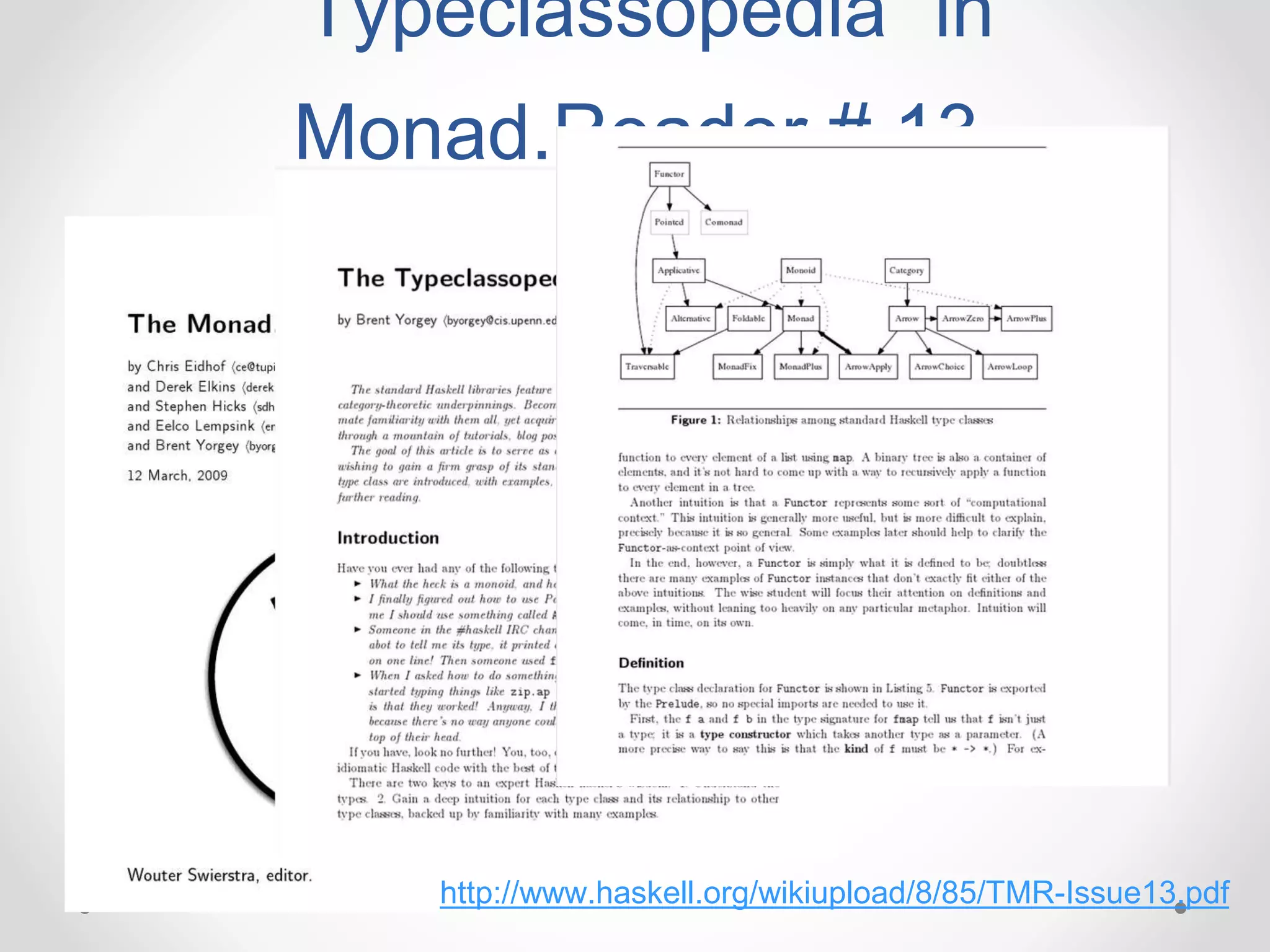
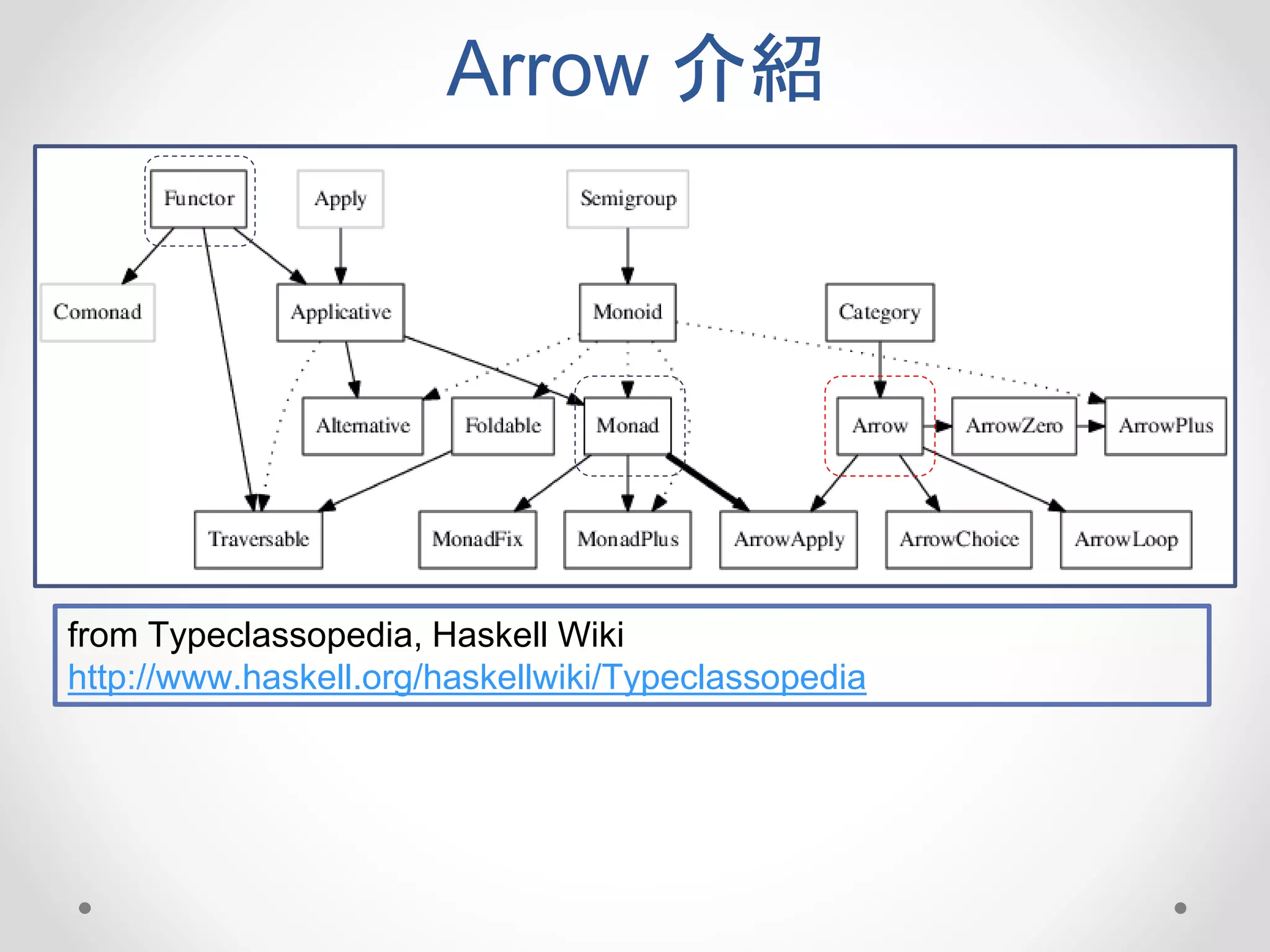
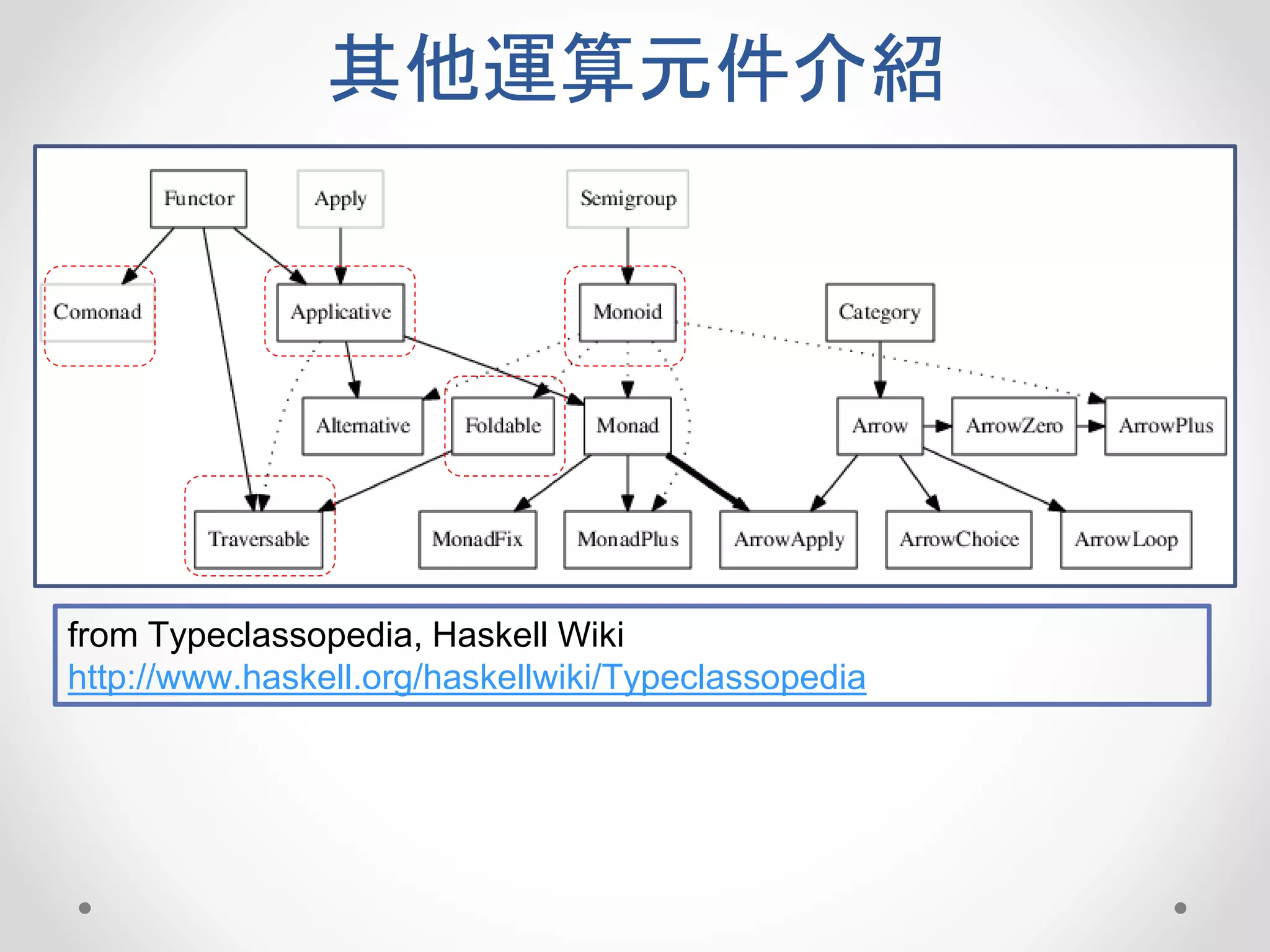
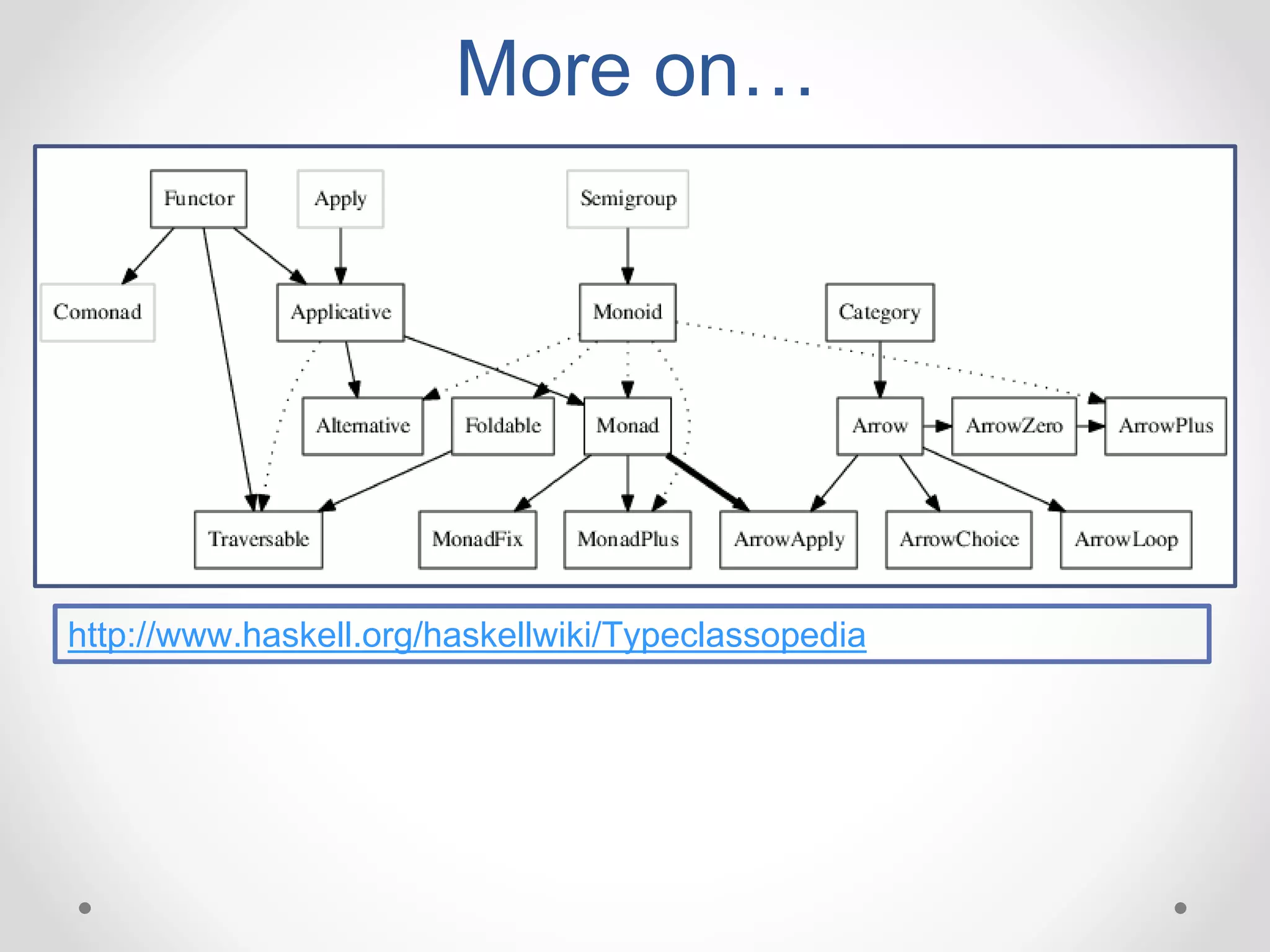
• Other Type Classes in Typeclassopedia
• Beyond Haskell – Patterns in Functional Programming
What is aMonad ?
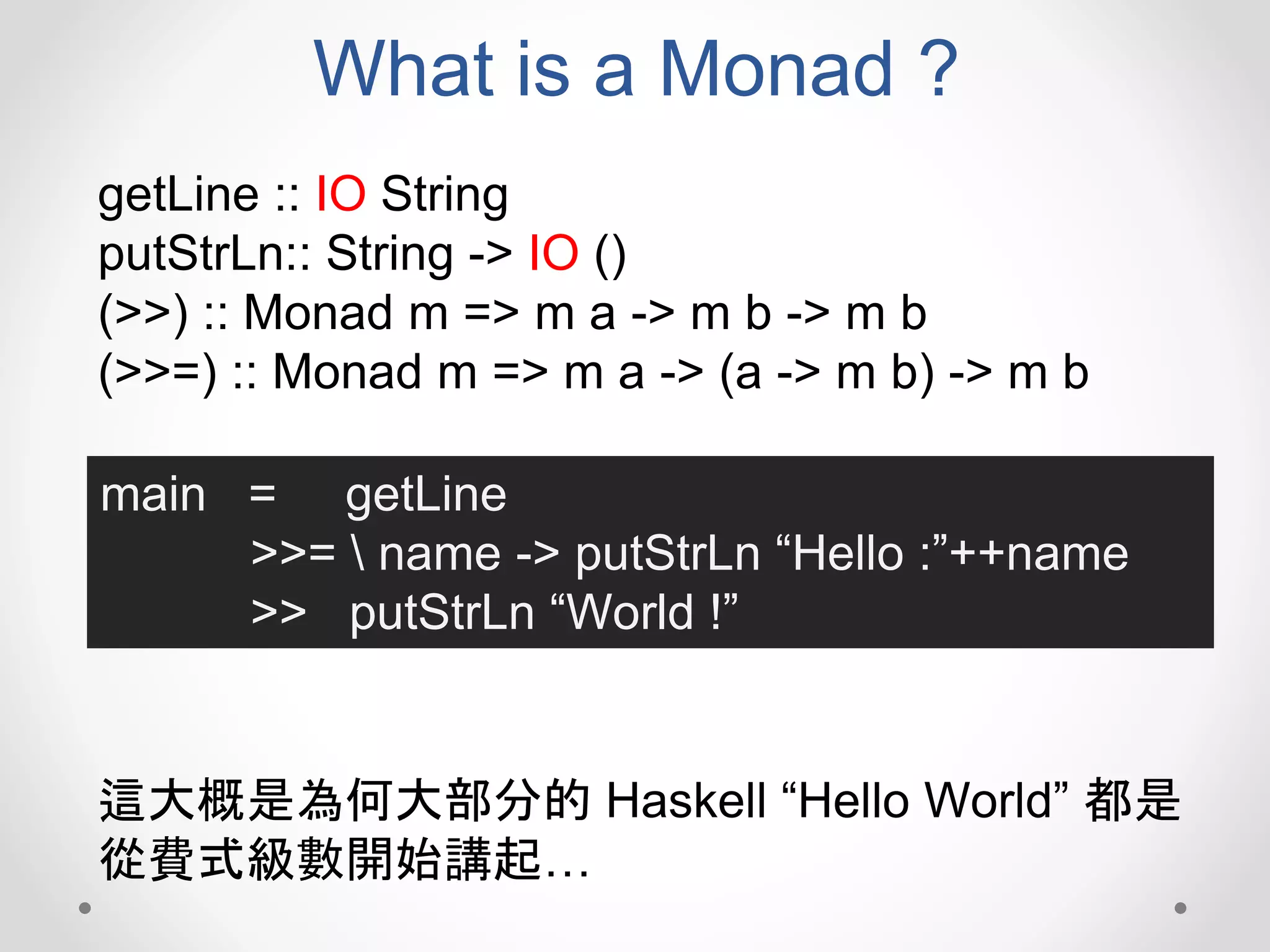
getLine :: IO String
putStrLn:: String -> IO ()
(>>) :: Monad m => m a -> m b -> m b
(>>=) :: Monad m => m a -> (a -> m b) -> m b
main = getLine
>>= name -> putStrLn “Hello :”++name
>> putStrLn “World !”
這大概是為何大部分的 Haskell “Hello World” 都是
從費式級數開始講起…
8.
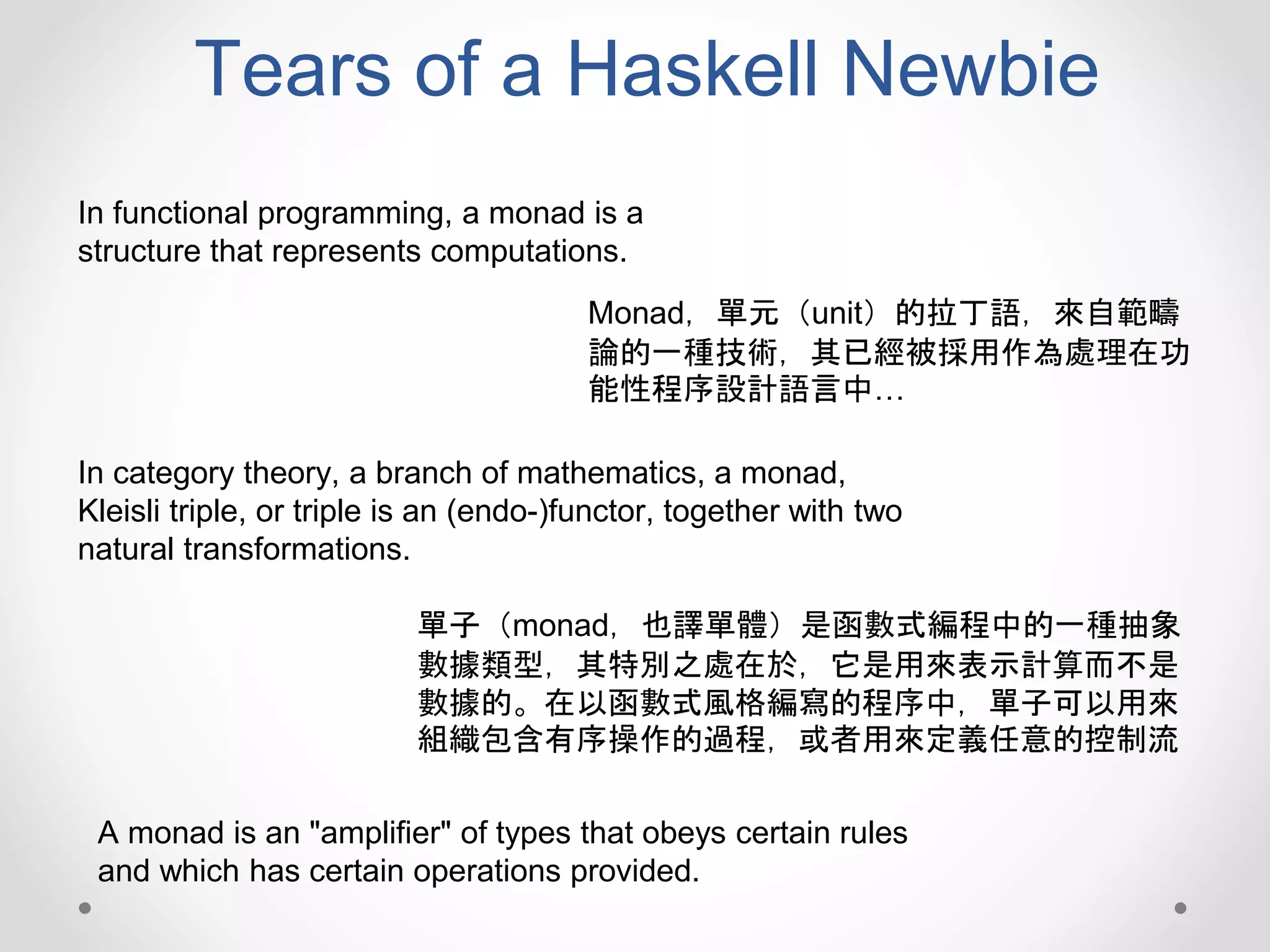
Tears of aHaskell Newbie
Monad,單元(unit)的拉丁語,來自範疇
論的一種技術,其已經被採用作為處理在功
能性程序設計語言中…
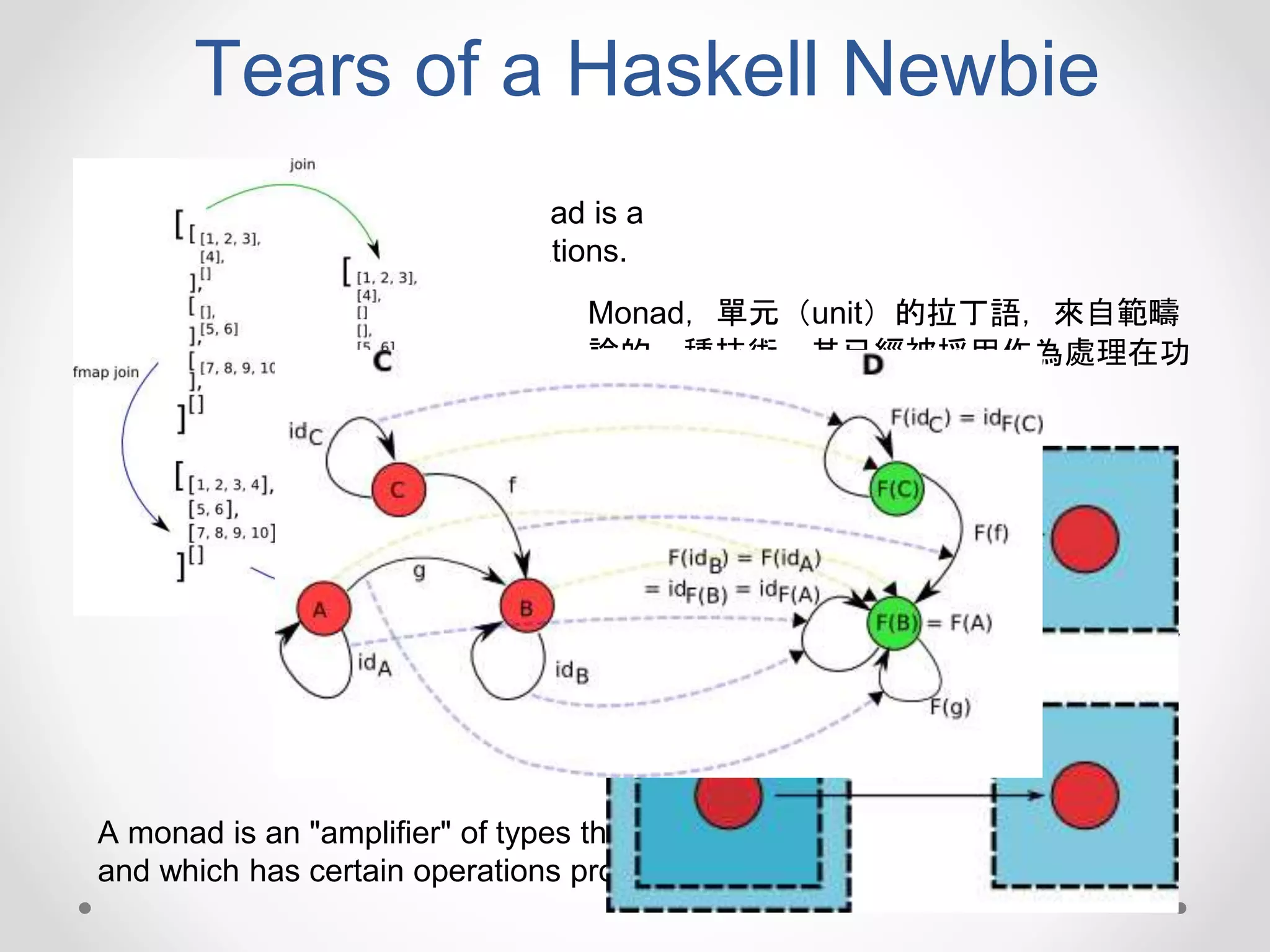
In functional programming, a monad is a
structure that represents computations.
In category theory, a branch of mathematics, a monad,
Kleisli triple, or triple is an (endo-)functor, together with two
natural transformations.
A monad is an "amplifier" of types that obeys certain rules
and which has certain operations provided.
單子(monad,也譯單體)是函數式編程中的一種抽象
數據類型,其特別之處在於,它是用來表示計算而不是
數據的。在以函數式風格編寫的程序中,單子可以用來
組織包含有序操作的過程,或者用來定義任意的控制流
9.
Monad,單元(unit)的拉丁語,來自範疇
論的一種技術,其已經被採用作為處理在功
能性程序設計語言中…
In functional programming,a monad is a
structure that represents computations.
In category theory, a branch of mathematics, a monad,
Kleisli triple, or triple is an (endo-)functor, together with two
natural transformations.
A monad is an "amplifier" of types that obeys certain rules
and which has certain operations provided.
單子(monad,也譯單體)是函數式編程中的一種抽象
數據類型,其特別之處在於,它是用來表示計算而不是
數據的。在以函數式風格編寫的程序中,單子可以用來
組織包含有序操作的過程,或者用來定義任意的控制流
Tears of a Haskell Newbie
Begin from PureFunctions
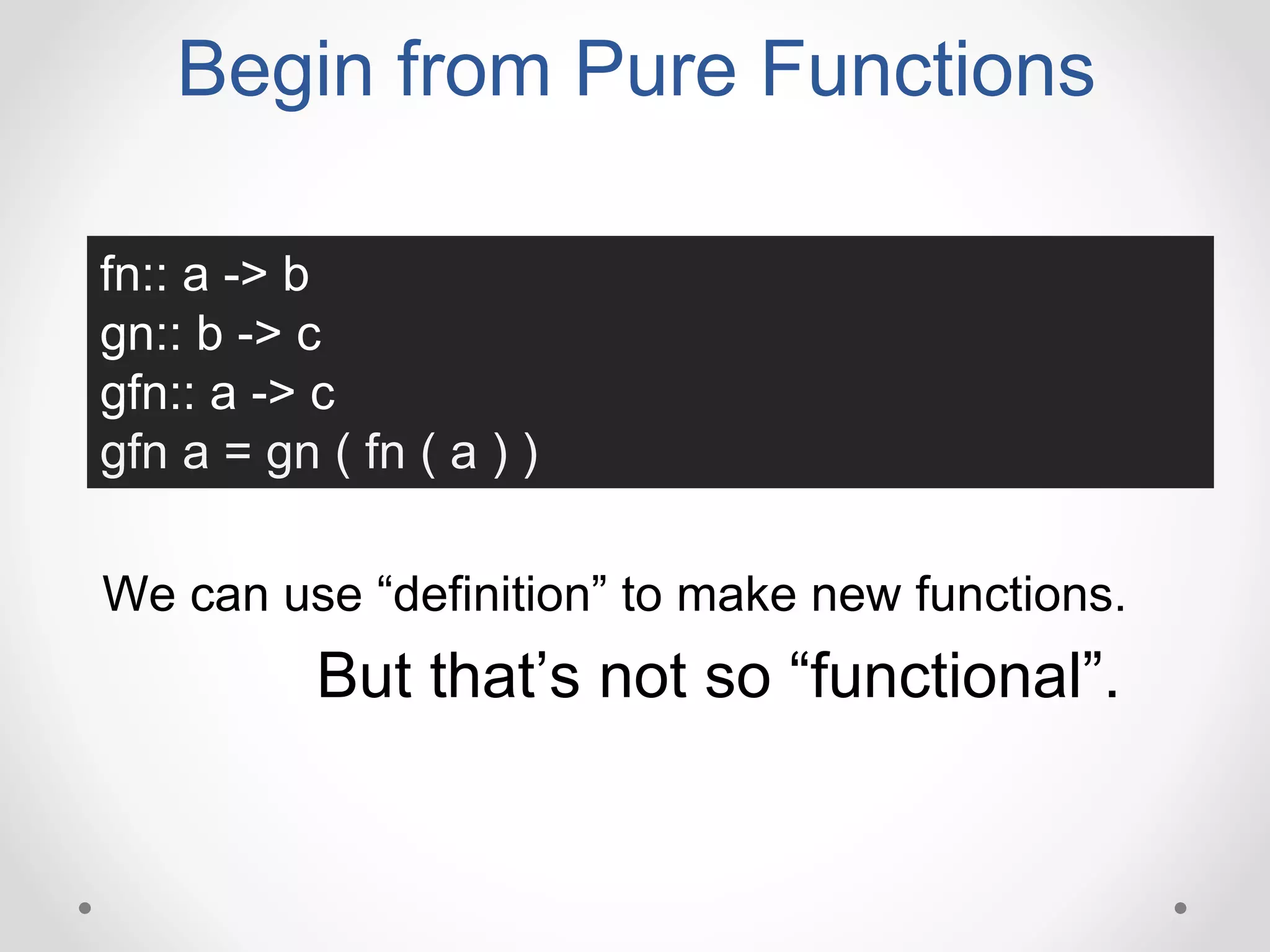
fn:: a -> b
gn:: b -> c
gfn:: a -> c
gfn a = gn ( fn ( a ) )
We can use “definition” to make new functions.
But that’s not so “functional”.
15.
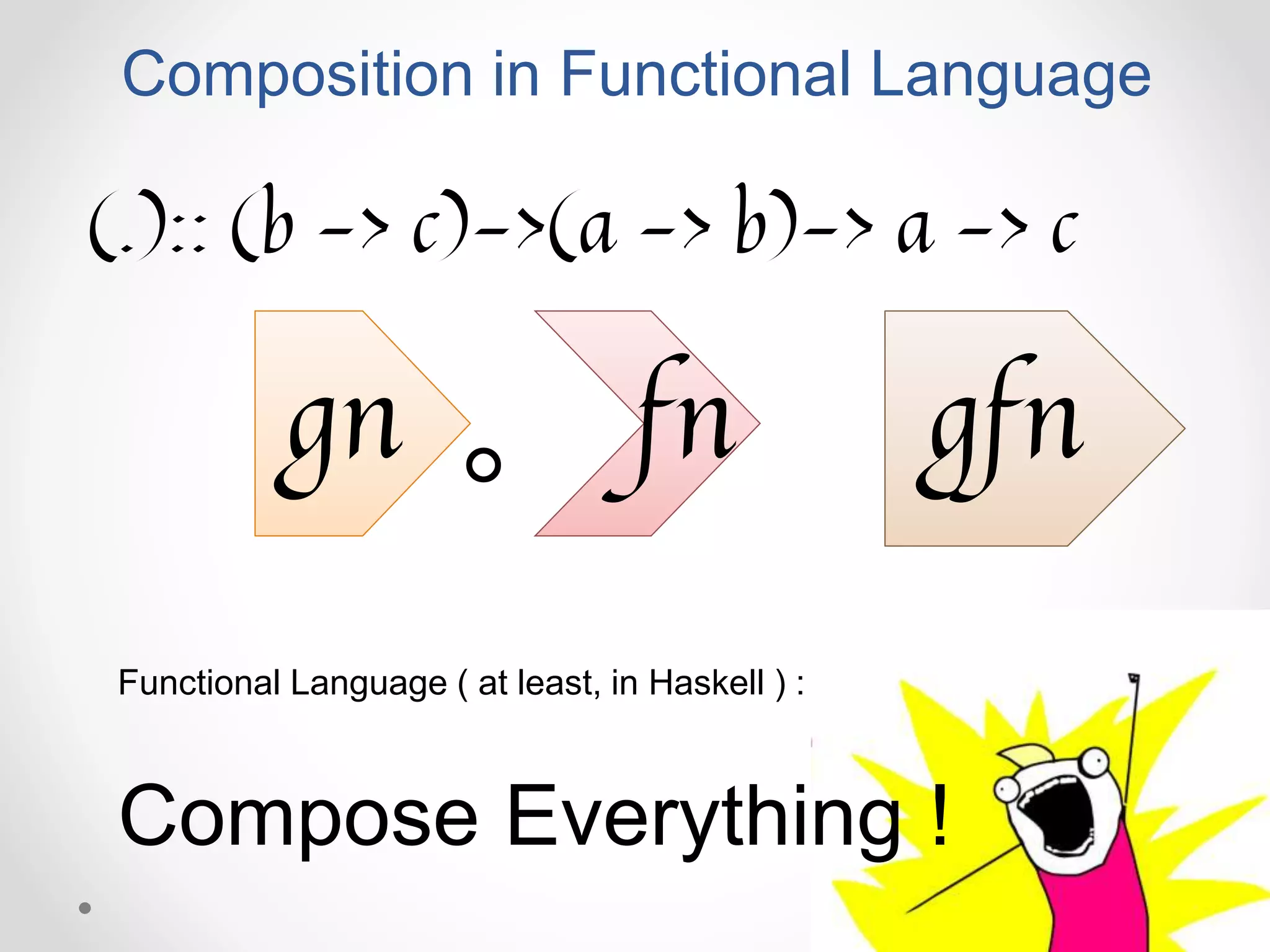
Composition in FunctionalLanguage
(.):: (b -> c)->(a -> b)-> a -> c
fngn 。 gfn
Functional Language ( at least, in Haskell ) :
Compose Everything !
Problem: Data ina Nutshell
(+4).(+5):: Int -> Int
Int: 4 Int: 12
((+4).(+5)) 4 == 12
+4 +5
When Int: 4 ~> [Int: 4]
19.
Problem: Data ina Nutshell
(+4).(+5):: Int -> Int
[Int]: [4]
((+4).(+5)) [4] -- Error !
+4 +5 X
函式無法處理帶 context 性質的值
每種 context 都有其意義
20.
Problem: Data ina Nutshell
• Maybe a:: 代表不確定性運算
• Either e a:: 代表有可能會例外的運算
• [a]:: 代表不確定性運算 -- 可能性更多
• IO a:: 代表會對 RealWorld 做出影響
常見的 Context
使用 context 觀點會比容器觀點更加適切
21.
Problem: Data ina Nutshell
(+4).(+5):: Int -> Int
Solution #1
plus45 = (+4).(+5)
plus45Special [ x ] = plus45 x -- use pattern matching
為該函式定義一特別的 “unwrap” 版本
有多少 context 就要定義多少版本…
22.
Problem: Data ina Nutshell
(+4).(+5):: Int -> Int
Solution #1
plus45 = (+4).(+5)
plus45Special [ x ] = plus45 x
plus45SpMaybe (Just x) = plus45 x
plus45SpIO (IO x) = plus45 x
……..
23.
Problem: Data ina Nutshell
(+4).(+5):: Int -> Int
Solution #1
plus45 = (+4).(+5)
plus45Special [ x ] = plus45 x
plus45SpMaybe (Just x) = plus45 x
plus45SpIO (IO x) = plus45 x
……..
pure
with context
實際上分為處理 context 與運算兩部分
24.
Problem: Data ina Nutshell
(+4).(+5):: Int -> Int
Solution #2
每種 context 定義出自己的包裹函式
代為處理包裹與「解包」的問題
(+4).(+5)
[ 4 ] 4 12 [ 12 ]
fmap:: (a->b)->f a -> f b
25.
Problem: Data ina Nutshell
(+4).(+5):: Int -> Int
Solution #2
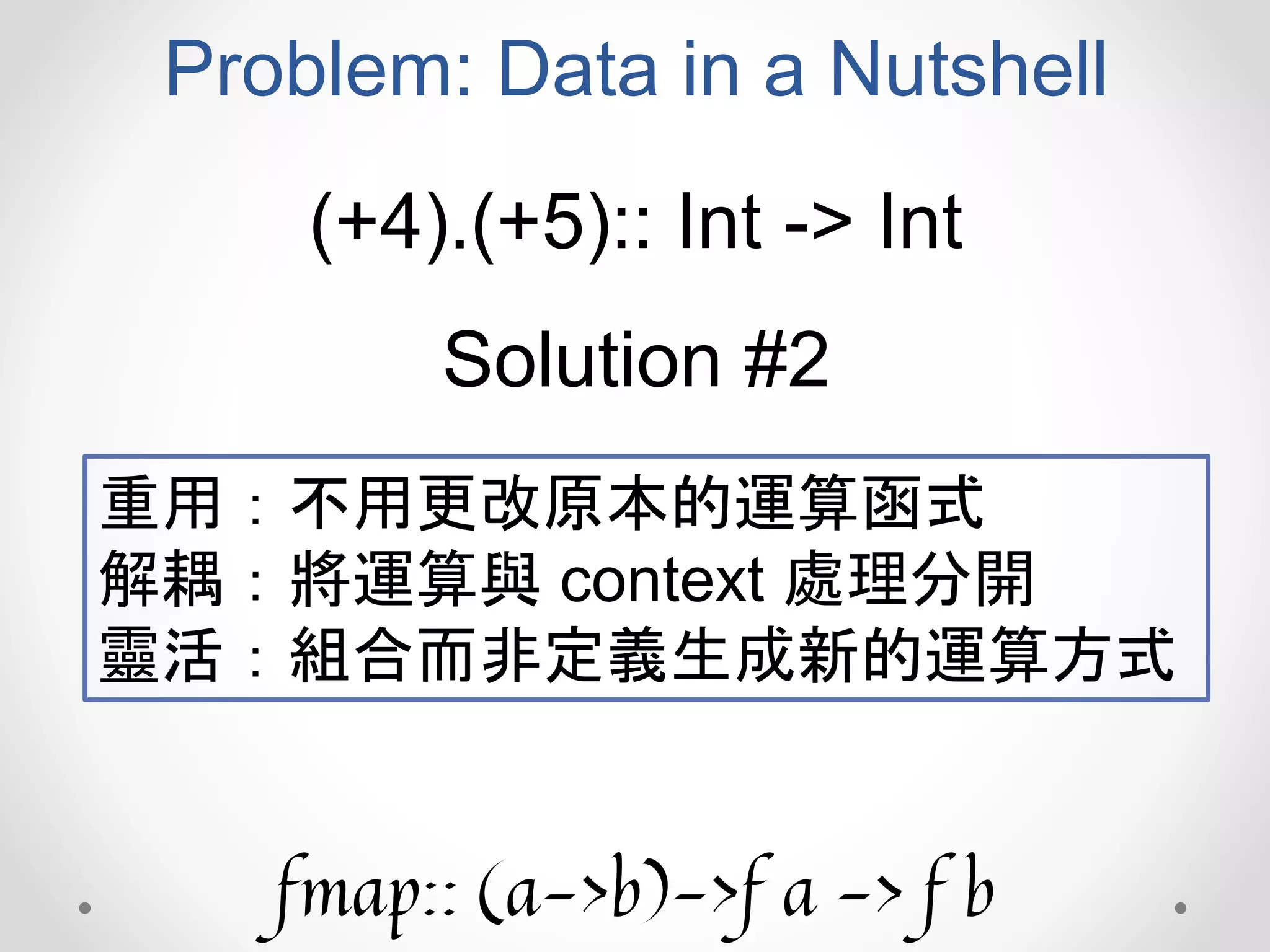
重用:不用更改原本的運算函式
解耦:將運算與 context 處理分開
靈活:組合而非定義生成新的運算方式
fmap:: (a->b)->f a -> f b
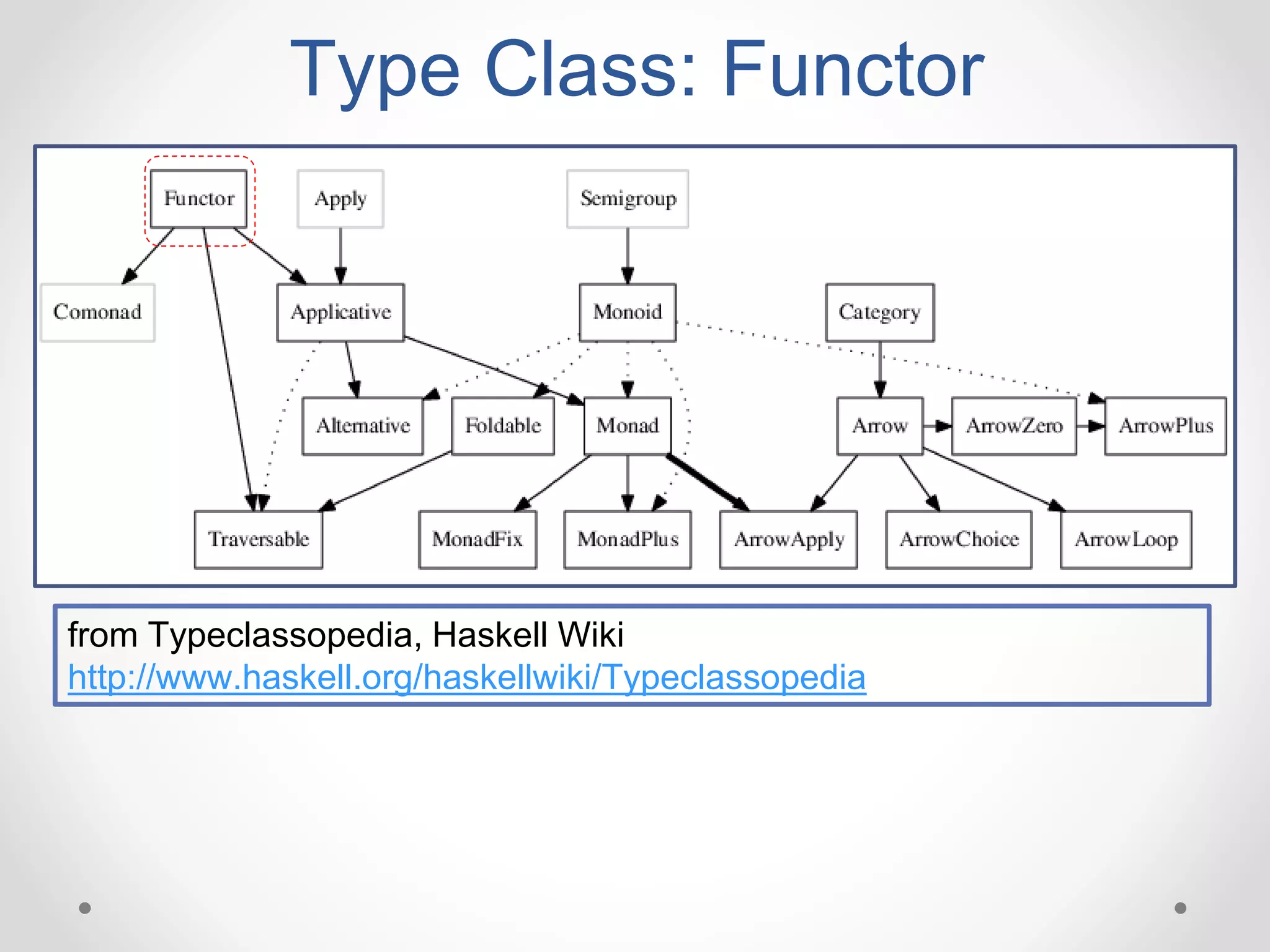
Type Class: Functor
fromTypeclassopedia, Haskell Wiki
http://www.haskell.org/haskellwiki/Typeclassopedia
28.
Type Class: Functor
classFunctor f where
fmap:: ( a -> b ) -> f a -> f b
帶有 fmap 函式定義的 context
fmap 的定義要懂得包裹與解包
fmap = map -- Functor [ ]
fmap _ Nothing = Nothing
fmap f ( Just a ) = Just ( f a ) -- Functor Maybe
fmap f x = x >>= ( return . f) -- * Functor IO
29.
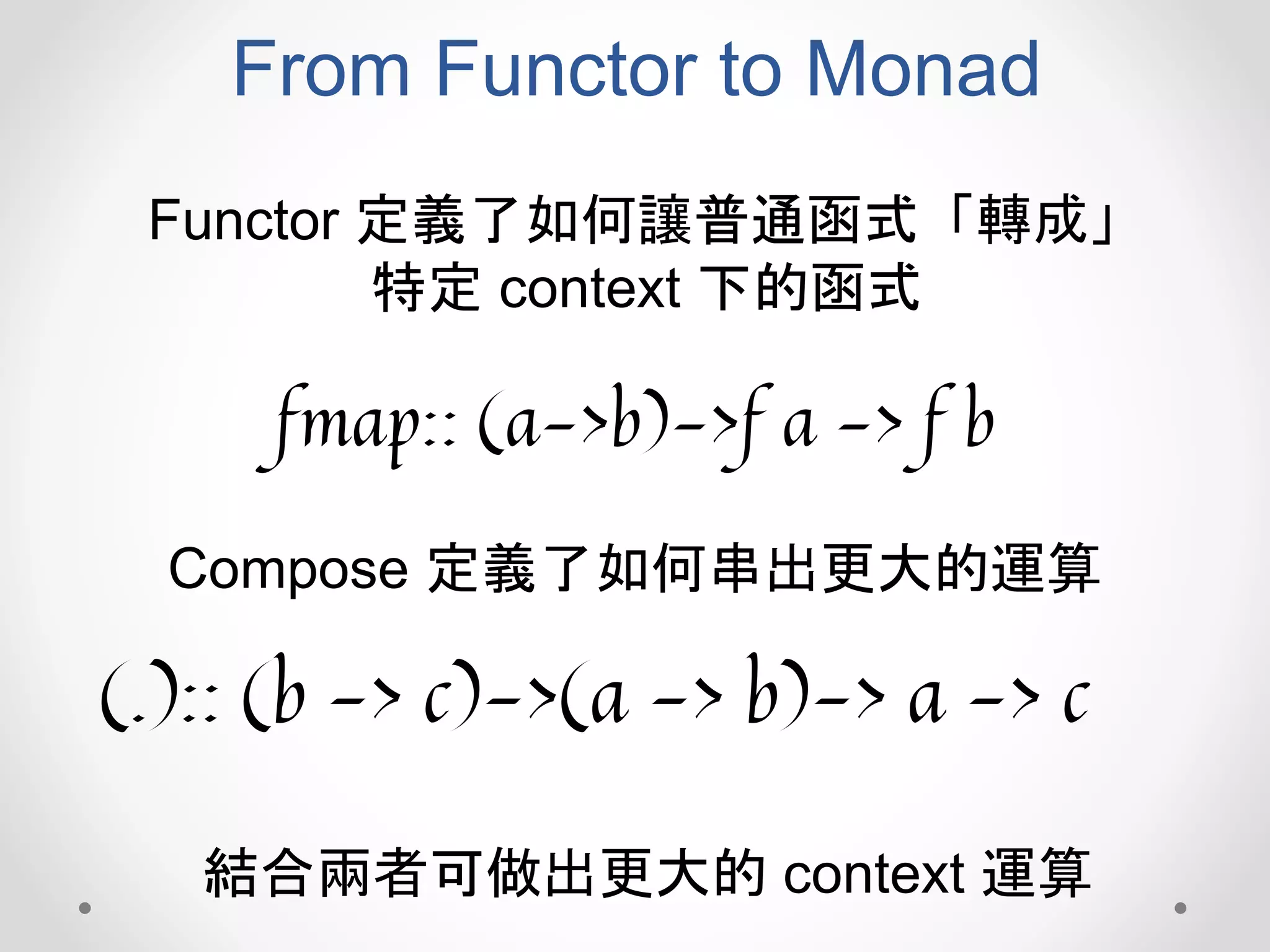
From Functor toMonad
Functor 定義了如何讓普通函式「轉成」
特定 context 下的函式
fmap:: (a->b)->f a -> f b
(.):: (b -> c)->(a -> b)-> a -> c
Compose 定義了如何串出更大的運算
結合兩者可做出更大的 context 運算
30.
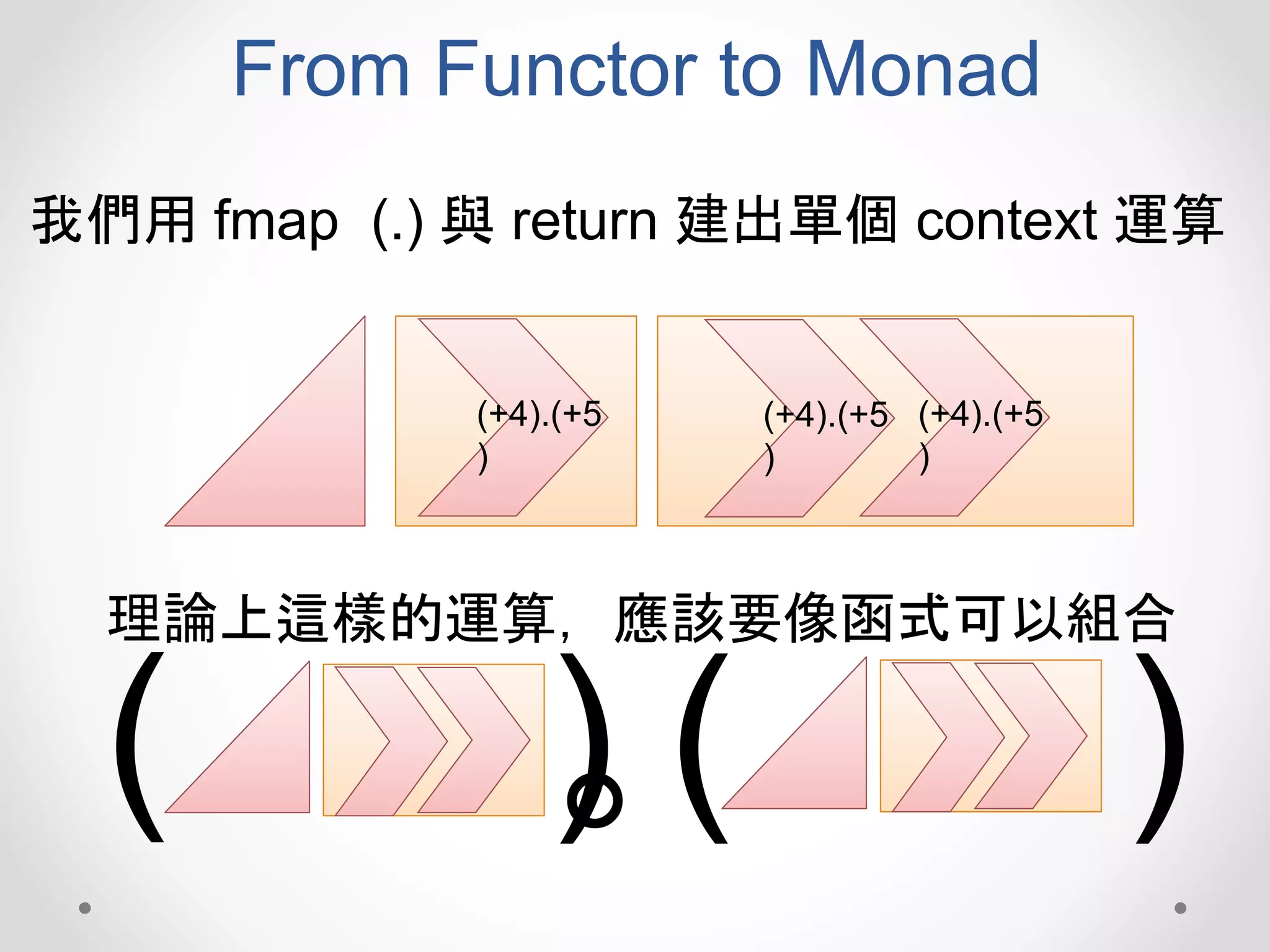
From Functor toMonad
從一個普通值帶到某 context 運算
4 → [ 4 ] [ 21 ]
(+4).(+5
)
(+4).(+5
)
(+4).(+5
)
值一但被包裹理論上就不會被解包(特例)
這整條運算:a -> m a ( m :: Context )
可稱為 action ( from IO Monad )
fmap AND (.)
31.
From Functor toMonad
還缺少把值變成 context 值的抽象函式
4 → [ 4 ] [ 21 ]
(+4).(+5
)
(+4).(+5
)
(+4).(+5
)
return:: a -> m a
* 這個名字很不幸與許多程式語言的保留關鍵字相同,然而應該
注意其意義幾乎完全不同!
* return 幾乎就等於 Data Constructor 了,例如 Just a
[ a ] -> [ c ]
32.
From Functor toMonad
不僅僅是 [ ] :抽象概念互通
4 → [ 4 ] [ 31 ]
(+4).(+5
)
(+4).(+5
)
(+4).(+5
)
4 → Maybe 4 Maybe 31
4 → IO 4 IO 31
m a -> m c
都是從一個值 -> 運算後且帶 context 的值
From Functor toMonad
阻礙:型別不通
。( ) ( )
[ c ] c -> [ d ]
(>>=):: m a -> (a -> m b ) -> m b
這個奇怪的 bind 運算子幫我們搭了橋
35.
From Functor toMonad
有了 bind 運算子我們可以任意組合同型 context 運算
。( ) ( )
[ c ] c -> [ d ]
(>>=):: m a -> (a -> m b ) -> m b
效果:把前一個 context 值私下解包後,傳給下個運算
36.
From Functor toMonad
。( ) ( )
[ c ] c -> [ d ]
(>>=):: m a -> (a -> m b ) -> m b
find even [1,2] >>= return . ((!!) [1,2,4]) -- Maybe
[‘3’,’4’,’5’]>>= digitToInt >>= return . even -- [ ]
getLine >>= putStr.((++) “Hi, user [”) >> putStrLn “] !” -- IO
37.
From Functor toMonad
(>>=):: m a -> (a -> m b ) -> m b
find even [1,2] >>= return . ((!!) [1,2,4])
找到為偶數的值:Just 2 找到 index#2 的值,並包裝之
find:: (a->Bool)->[a]->Maybe a
even:: Integral a => a -> Bool
(!!):: [a]->Int->a ; (!!) [1,2,4] :: Int -> a
return:: a -> m a ; return . ( (!!) [1,2,4] ) :: Int -> m b
return 夠抽象,所以可以視其正在
哪個 context 中用不同的 instance
38.
From Functor toMonad
(>>=):: m a -> (a -> m b ) -> m b
[‘3’,’4’,’5’]>>= return . digitToInt >>= return . even
( 為了方便示範 ) 各字元轉換成整數 各奇偶數轉成 Bool
getLine >>= putStr.((++) “Hi, user [”) >> putStrLn “] !”
從 IO 取得一行 組合傳入字串並從 IO 輸出 不管前面結果而印出
抽象:注意每個 context 對 bind 詮釋都不同,但用法都相同
bind 表現的效果之一是不用管傳值,只要專注把運算組合即可
(>>):: m a -> m b -> m b -- 不管前面結果,自己執行出 m b
39.
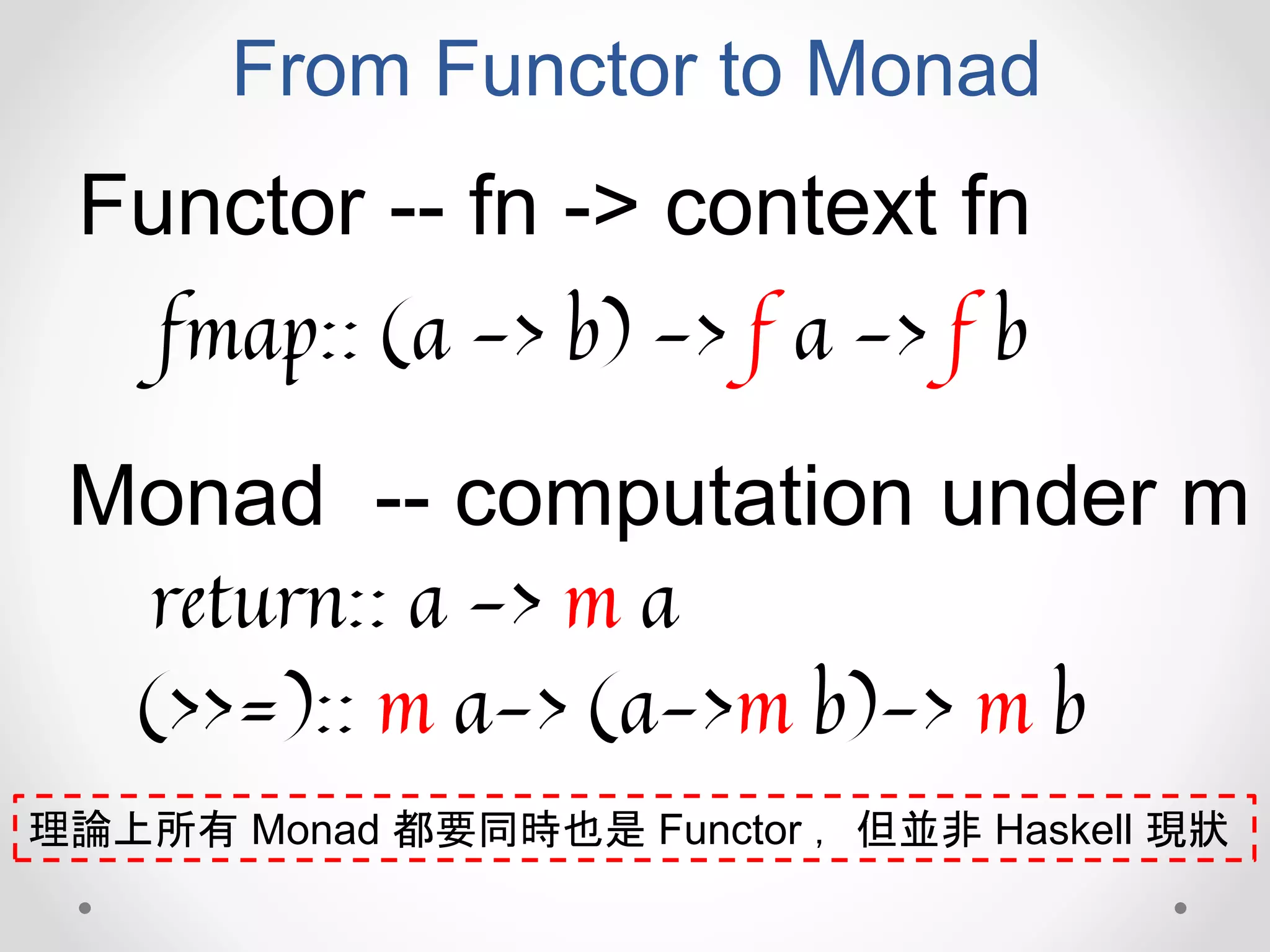
From Functor toMonad
Functor -- fn -> context fn
fmap:: (a -> b) -> f a -> f b
Monad -- computation under m
return:: a -> m a
(>>=):: m a-> (a->m b)-> m b
理論上所有 Monad 都要同時也是 Functor ,但並非 Haskell 現狀
40.
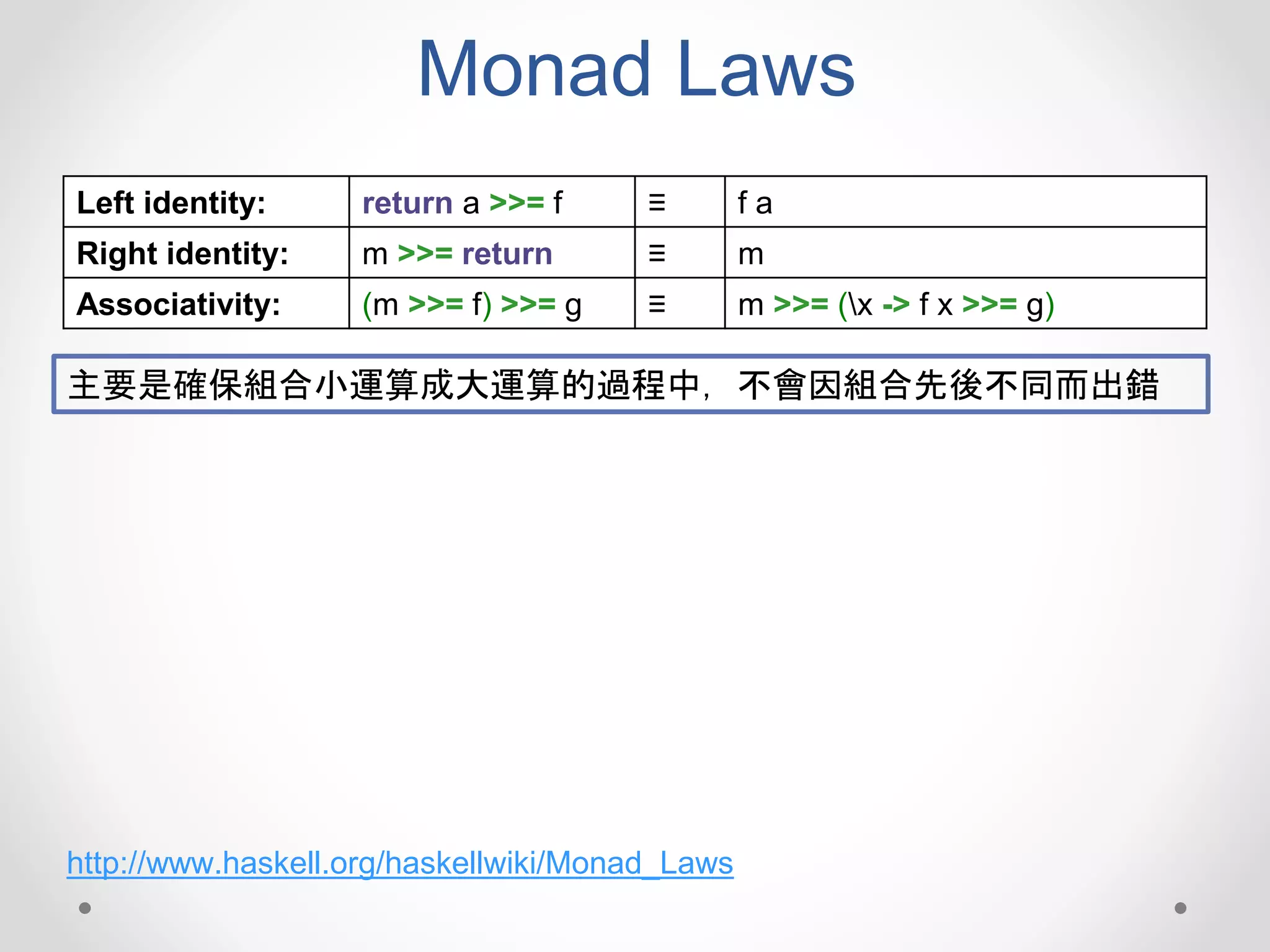
Monad Laws
Left identity:return a >>= f ≡ f a
Right identity: m >>= return ≡ m
Associativity: (m >>= f) >>= g ≡ m >>= (x -> f x >>= g)
主要是確保組合小運算成大運算的過程中,不會因組合先後不同而出錯
http://www.haskell.org/haskellwiki/Monad_Laws
41.
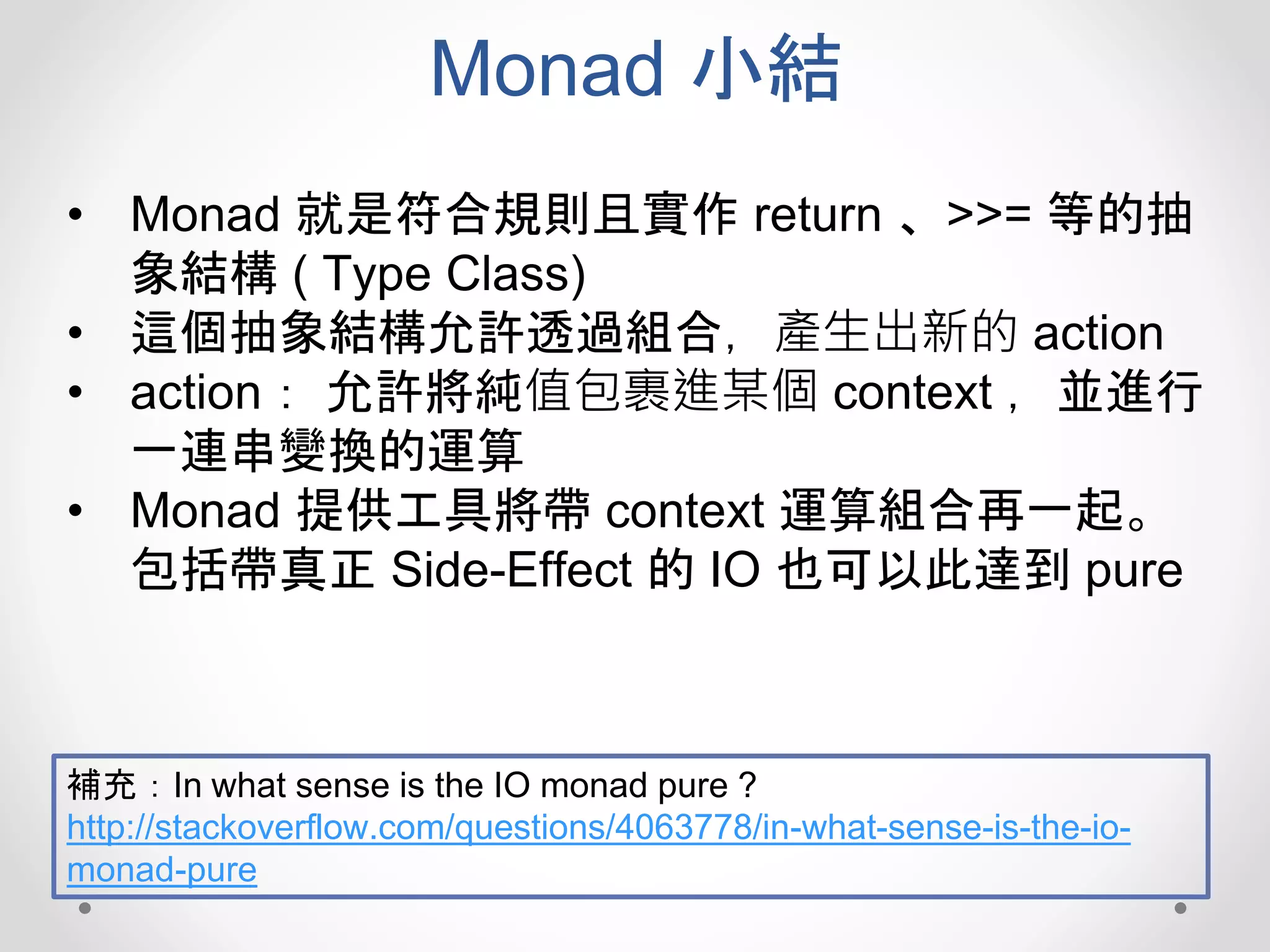
Monad 與 Pure
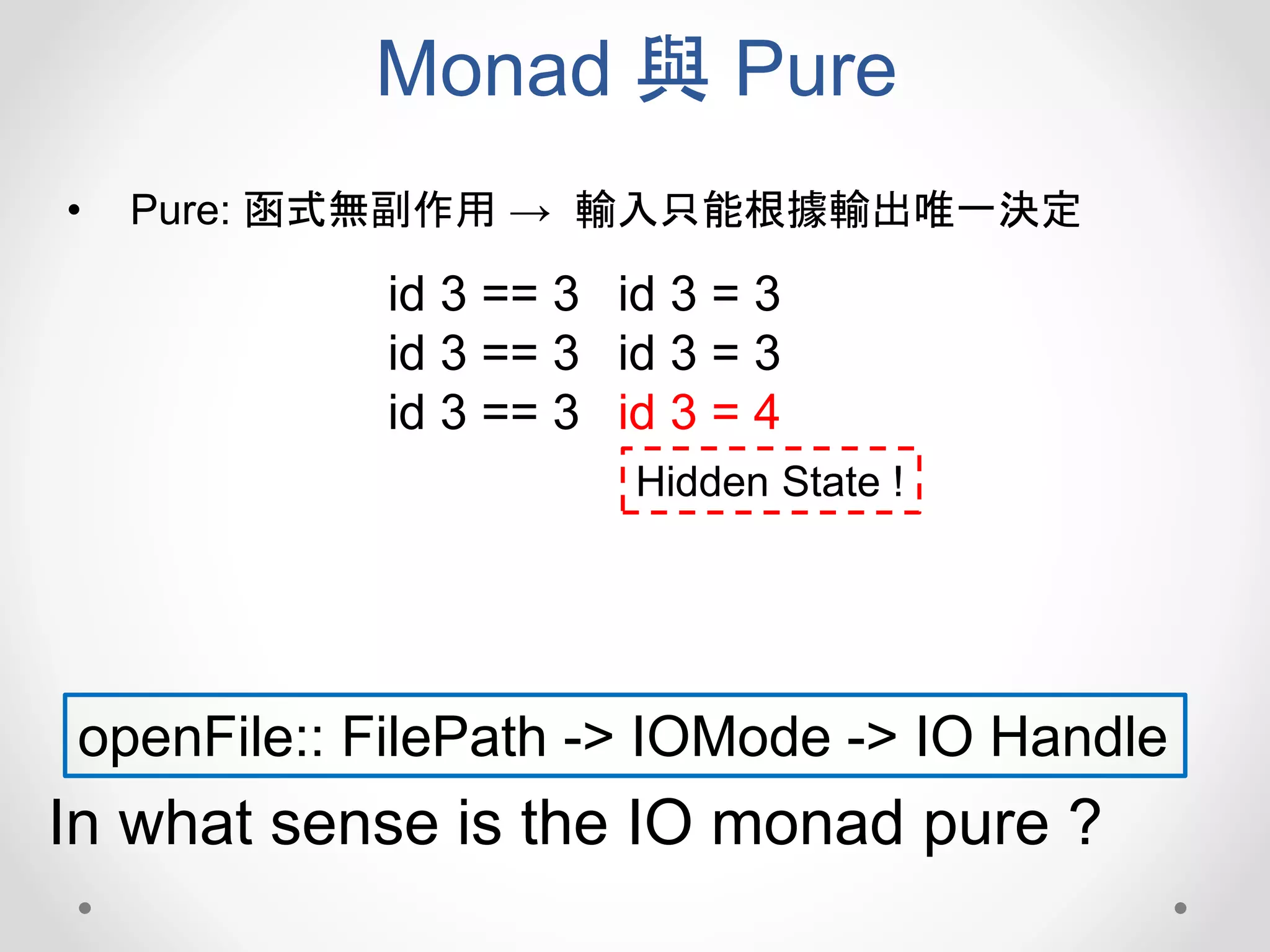
•Pure: 函式無副作用 → 輸入只能根據輸出唯一決定
openFile:: FilePath -> IOMode -> IO Handle
In what sense is the IO monad pure ?
id 3 == 3
id 3 == 3
id 3 == 3
id 3 = 3
id 3 = 3
id 3 = 4
Hidden State !
42.
Monad 與 Pure:IO Monad
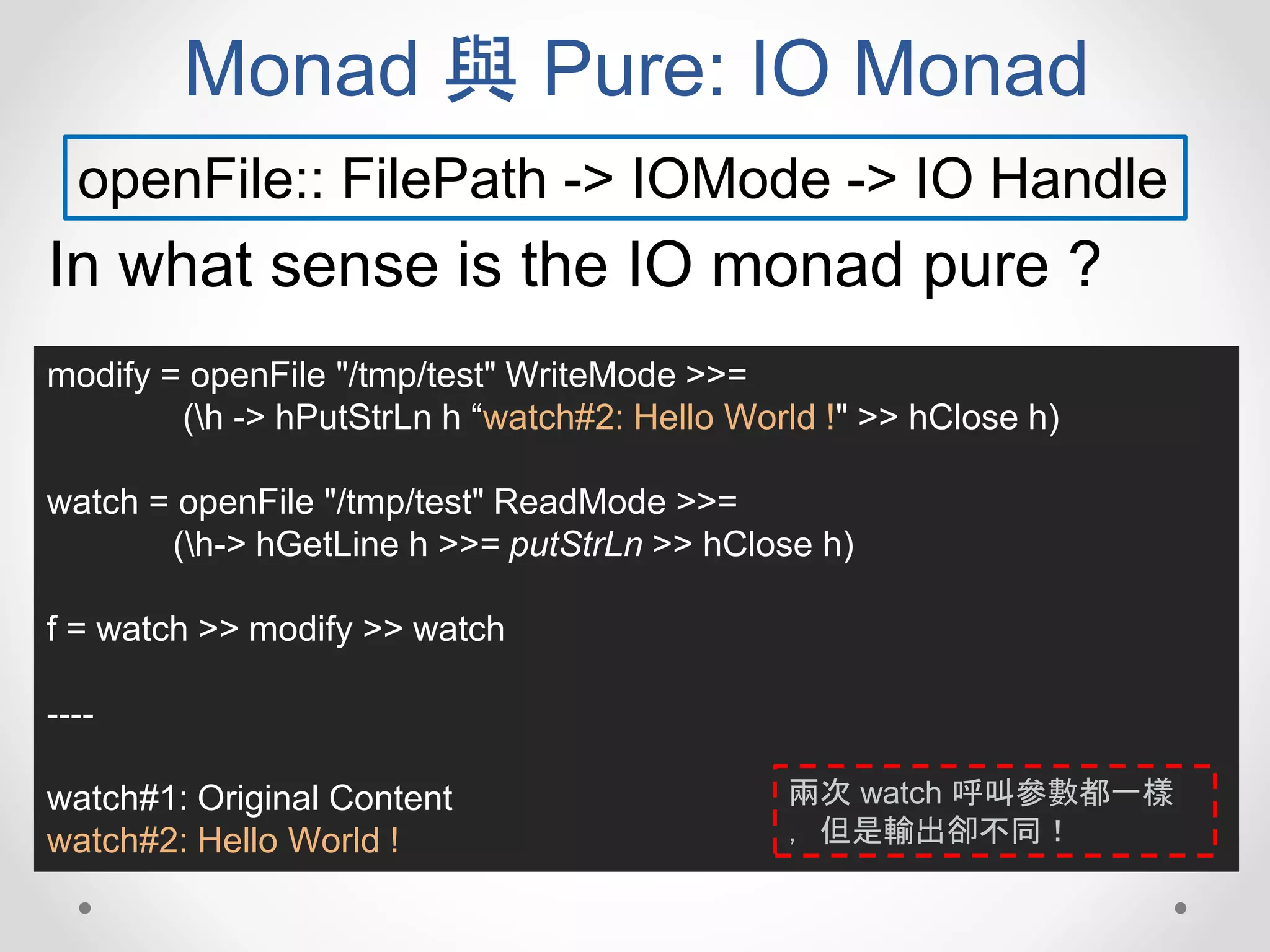
openFile:: FilePath -> IOMode -> IO Handle
In what sense is the IO monad pure ?
modify = openFile "/tmp/test" WriteMode >>=
(h -> hPutStrLn h “watch#2: Hello World !" >> hClose h)
watch = openFile "/tmp/test" ReadMode >>=
(h-> hGetLine h >>= putStrLn >> hClose h)
f = watch >> modify >> watch
----
watch#1: Original Content
watch#2: Hello World !
兩次 watch 呼叫參數都一樣
,但是輸出卻不同!
43.
Monad 與 Pure:IO Monad
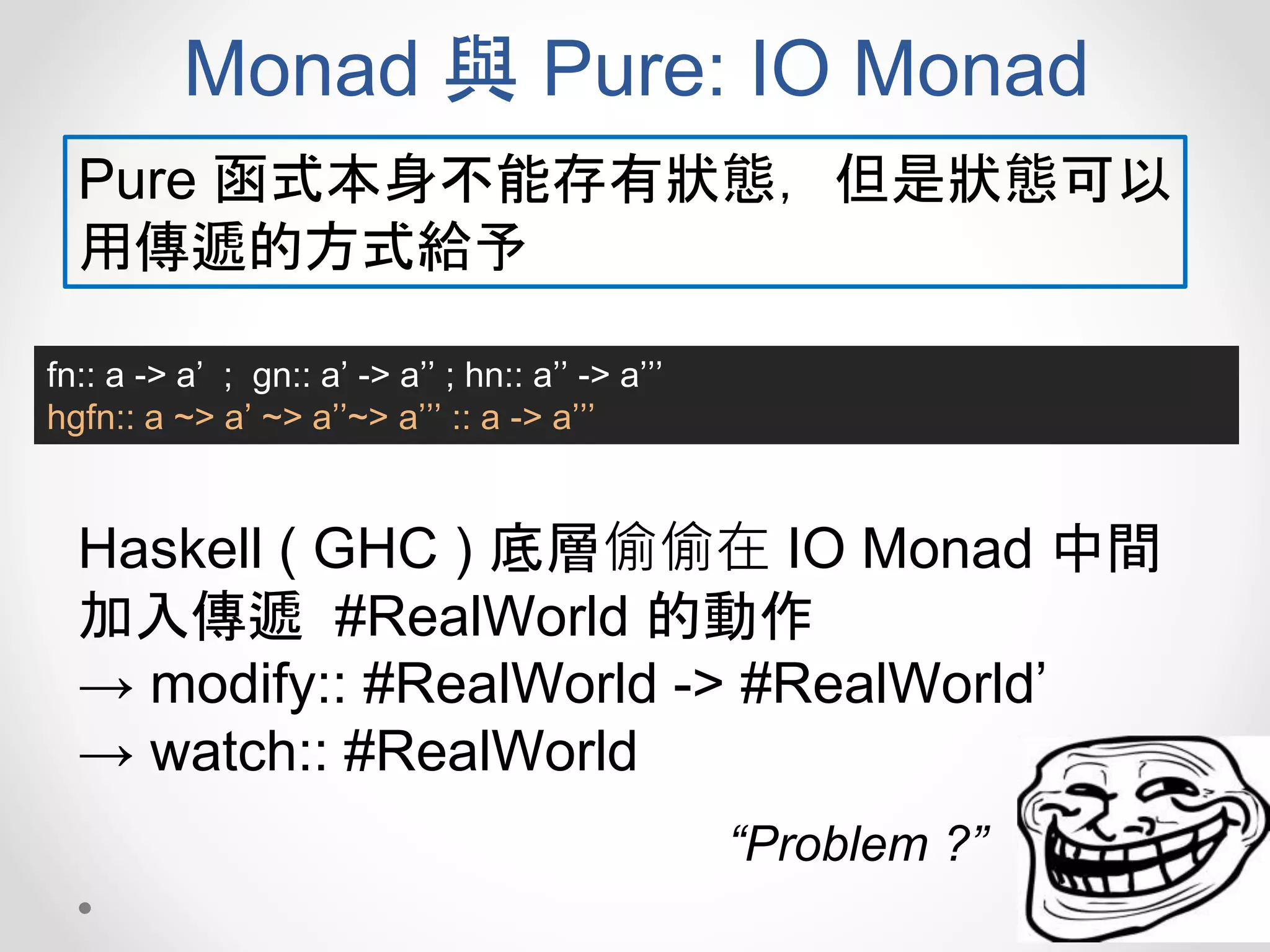
fn:: a -> a’ ; gn:: a’ -> a’’ ; hn:: a’’ -> a’’’
hgfn:: a ~> a’ ~> a’’~> a’’’ :: a -> a’’’
Pure 函式本身不能存有狀態,但是狀態可以
用傳遞的方式給予
Haskell ( GHC ) 底層偷偷在 IO Monad 中間
加入傳遞 #RealWorld 的動作
→ modify:: #RealWorld -> #RealWorld’
→ watch:: #RealWorld
“Problem ?”
44.
Monad 與 Pure:IO Monad
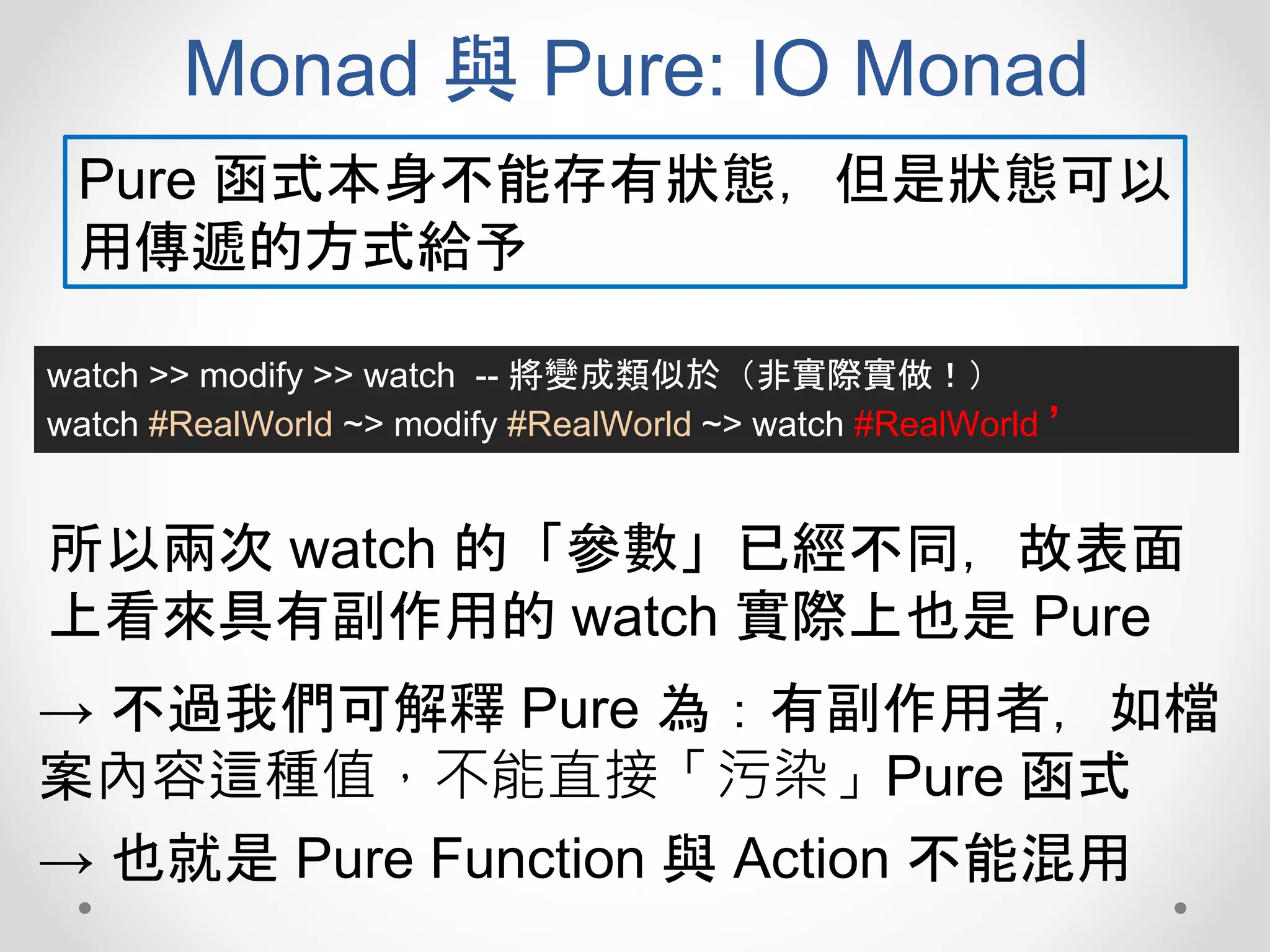
watch >> modify >> watch -- 將變成類似於(非實際實做!)
watch #RealWorld ~> modify #RealWorld ~> watch #RealWorld ’
Pure 函式本身不能存有狀態,但是狀態可以
用傳遞的方式給予
所以兩次 watch 的「參數」已經不同,故表面
上看來具有副作用的 watch 實際上也是 Pure
→ 不過我們可解釋 Pure 為:有副作用者,如檔
案內容這種值,不能直接「污染」Pure 函式
→ 也就是 Pure Function 與 Action 不能混用
45.
Monad 與 Pure:IO Monad
[a] -> a --:: head, tail, foldl, maximum, minimum …
Maybe a -> a --:: fromJust, fromMaybe defaultValue …
----
IO a -> a --:: ( NO SUCH FUNCTION !! )
Haskell 利用 context 概念永久包住帶
「副作用」的 IO 值: a -> IO a -> …… IO z
一般 Monad 多少都有 unwrap function,也就
是在該 context 內部可以是 Impure 的處理。但
離開 context 的值必須只能是 Pure : m a -> a
→ 一入 IO ,永為 IO :因沒有 unwrapper,
所有要處理 IO 者都必須嵌入該 context 內
How to makean Arrow
This is a normal function…
fn:: a -> b
… and this is an Arrow
fn::(->) a b
Just like any other data type
Maybe[ ] Int
Book Id Price
- 這個 Arrow -
接收:a
給出:b
Tip: 可以表達運
算與可以執行運
算是兩件事
51.
From Monad toArrow
getLine :: IO String
putStr, putStrLn :: IO ()
main :: IO ()
main = getLine >>= putStr.((++) “Hi, user [”) >> putStrLn “] !”
Monad 型別意義:m a 代表「這個 monad 會產生 a 型別的值
」因此,Monad 封裝出完整、不依賴外部的 operation ( 所以叫「單子」 )
持有一個 Monad a: 持有一個「值」 ( 內部一連串運算得出)
Arrow 型別意義:a b c 代表「這個 arrow 接收 b 傳出 c」
因此,Arrow 封裝的是一個 transformation ( 有接受端)
持有一個 Arrow b c: 持有一個「會從 b 到 c 的變換」
→ 若以 `b` Apply 此 Arrow,就等於 ( M b ) ( Arrow 不一定都可 Apply)
Monad 把資料連同運算封裝,模糊了 object 與 transformation
Arrow 只封裝運算,並提供了「針對運算的運算」
52.
From Monad toArrow
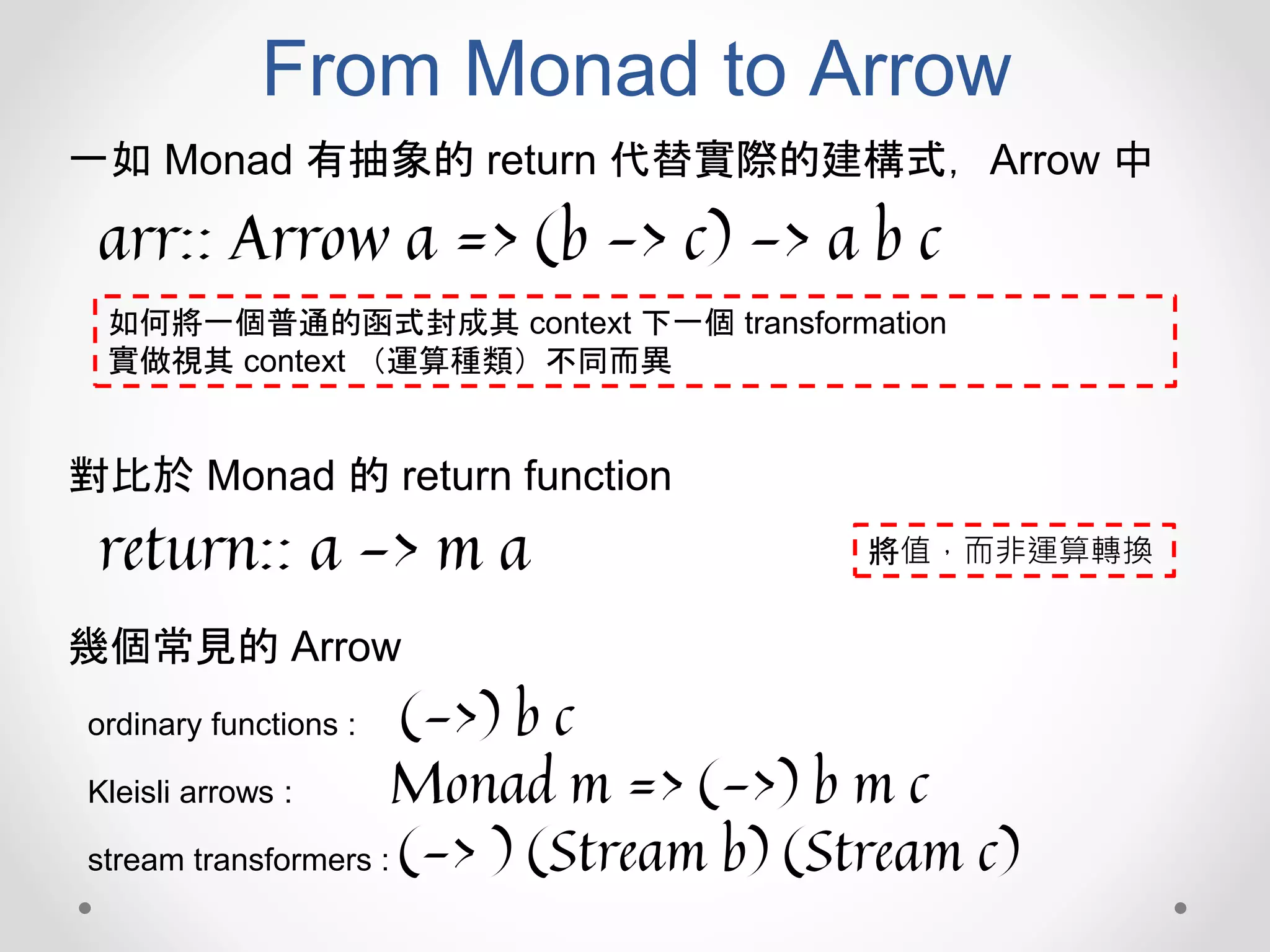
一如 Monad 有抽象的 return 代替實際的建構式,Arrow 中
arr:: Arrow a => (b -> c) -> a b c
如何將一個普通的函式封成其 context 下一個 transformation
實做視其 context (運算種類)不同而異
幾個常見的 Arrow
ordinary functions : (->) b c
Kleisli arrows : Monad m => (->) b m c
stream transformers : (-> ) (Stream b) (Stream c)
return:: a -> m a
對比於 Monad 的 return function
將值,而非運算轉換
53.
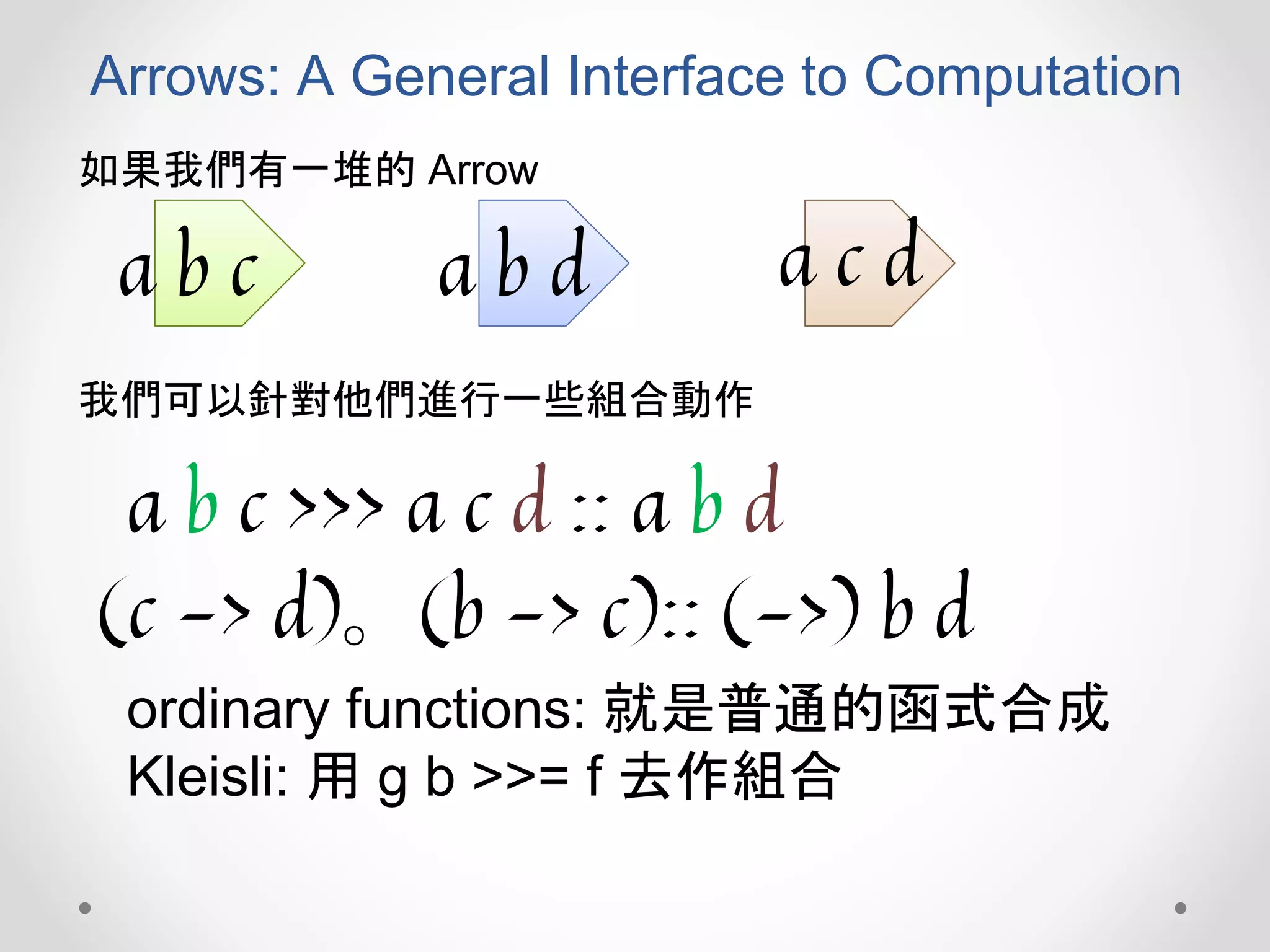
Arrows: A GeneralInterface to Computation
如果我們有一堆的 Arrow
a b c
我們可以針對他們進行一些組合動作
a b d a c d
a b c >>> a c d :: a b d
(c -> d)。(b -> c):: (->) b d
ordinary functions: 就是普通的函式合成
Kleisli: 用 g b >>= f 去作組合
54.
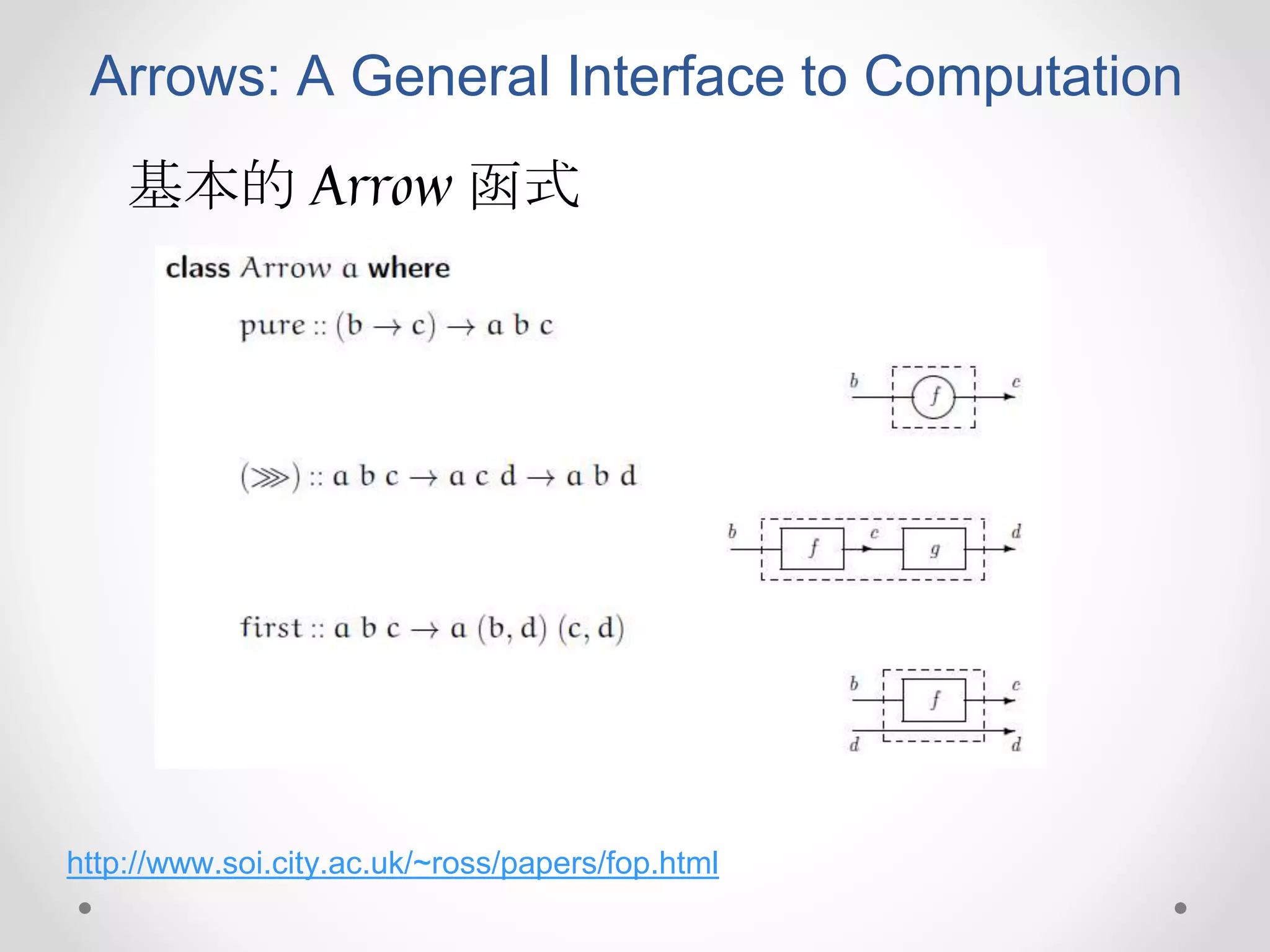
Arrows: A GeneralInterface to Computation
基本的 Arrow 函式
http://www.soi.city.ac.uk/~ross/papers/fop.html
55.
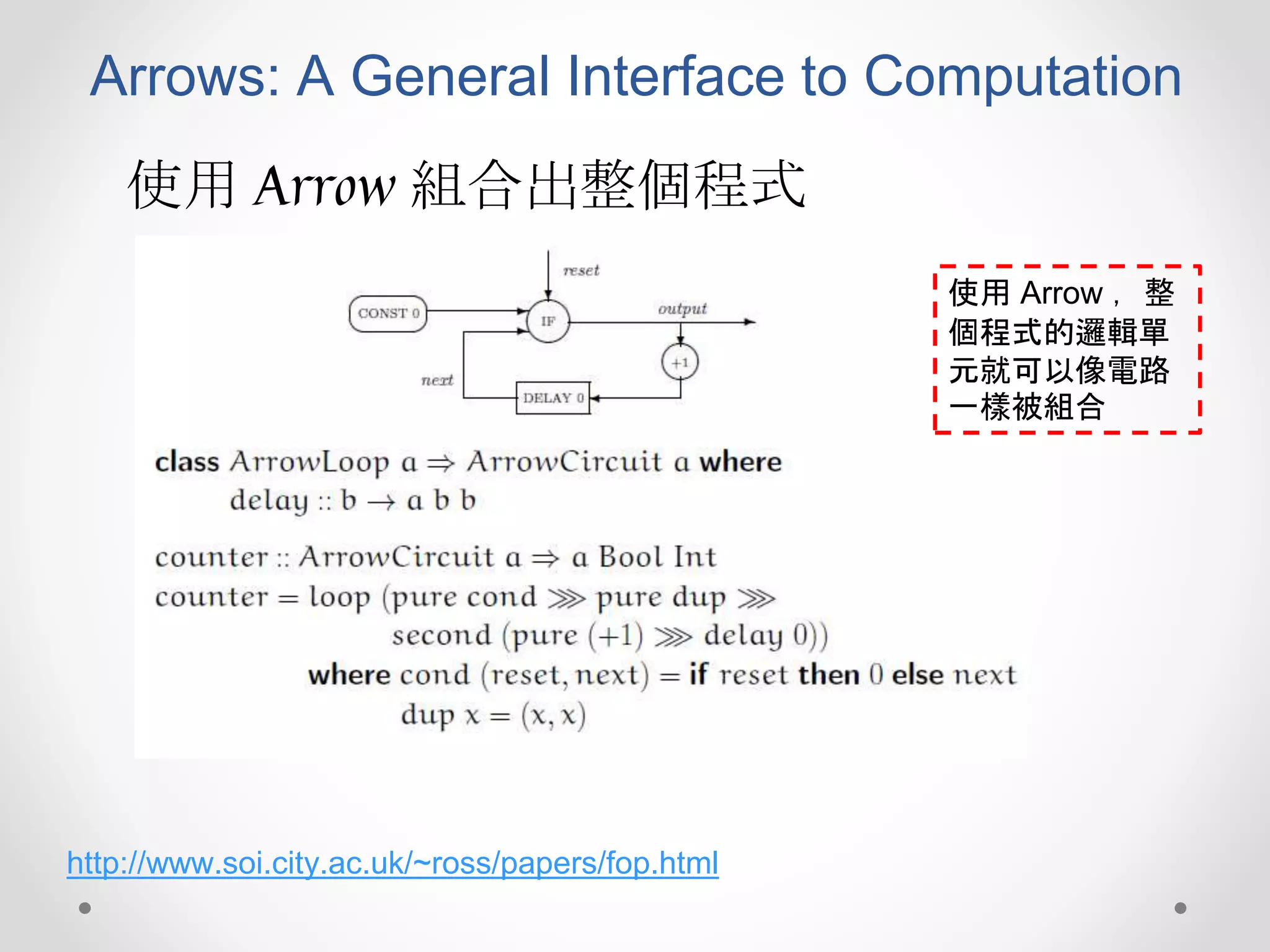
Arrows: A GeneralInterface to Computation
使用 Arrow 組合出整個程式
http://www.soi.city.ac.uk/~ross/papers/fop.html
使用 Arrow ,整
個程式的邏輯單
元就可以像電路
一樣被組合
56.
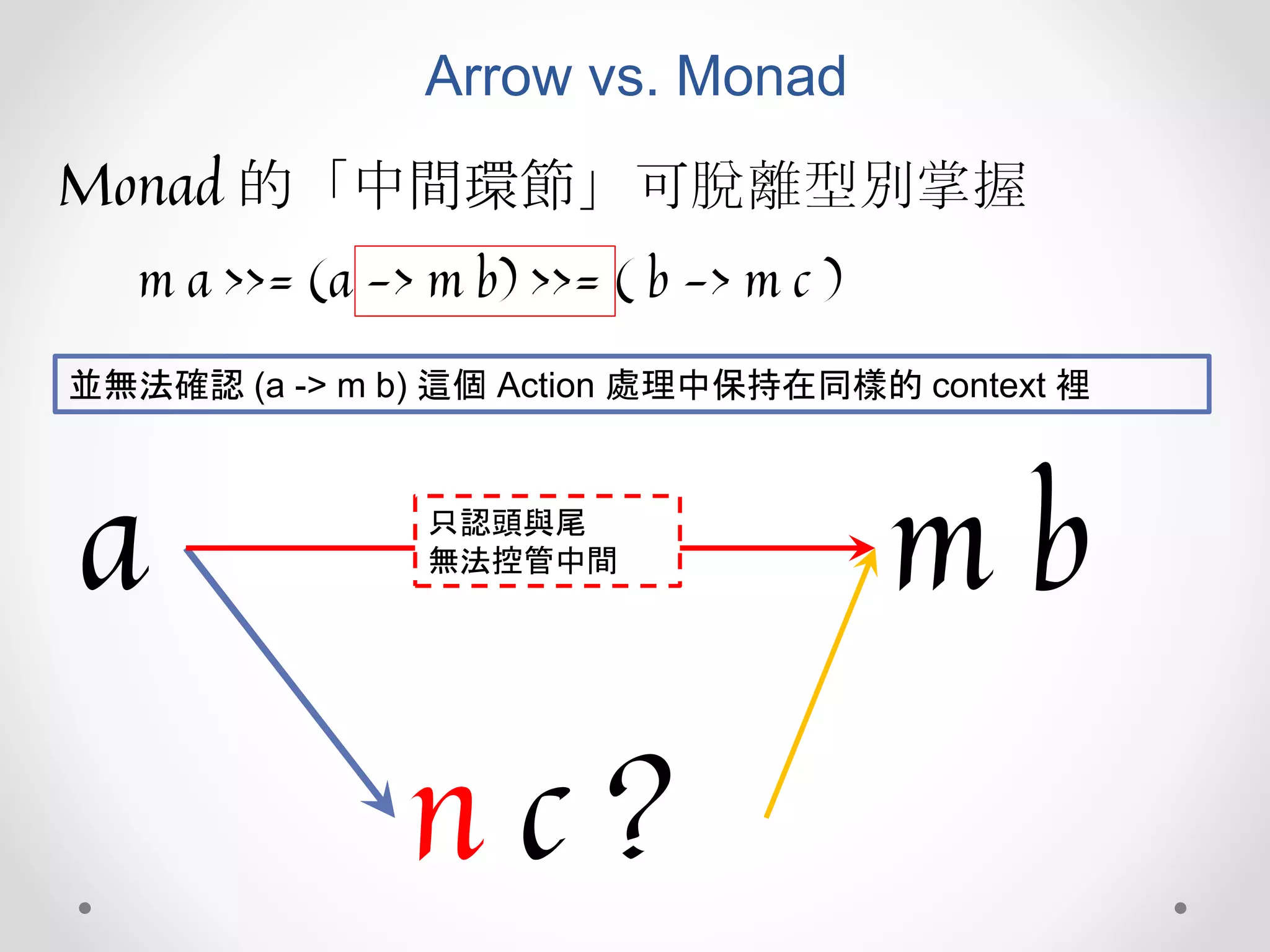
Arrow vs. Monad
Monad的「中間環節」可脫離型別掌握
m a >>= (a -> m b) >>= ( b -> m c )
並無法確認 (a -> m b) 這個 Action 處理中保持在同樣的 context 裡
a m b
n c ?
只認頭與尾
無法控管中間
57.
Arrow vs. Monad
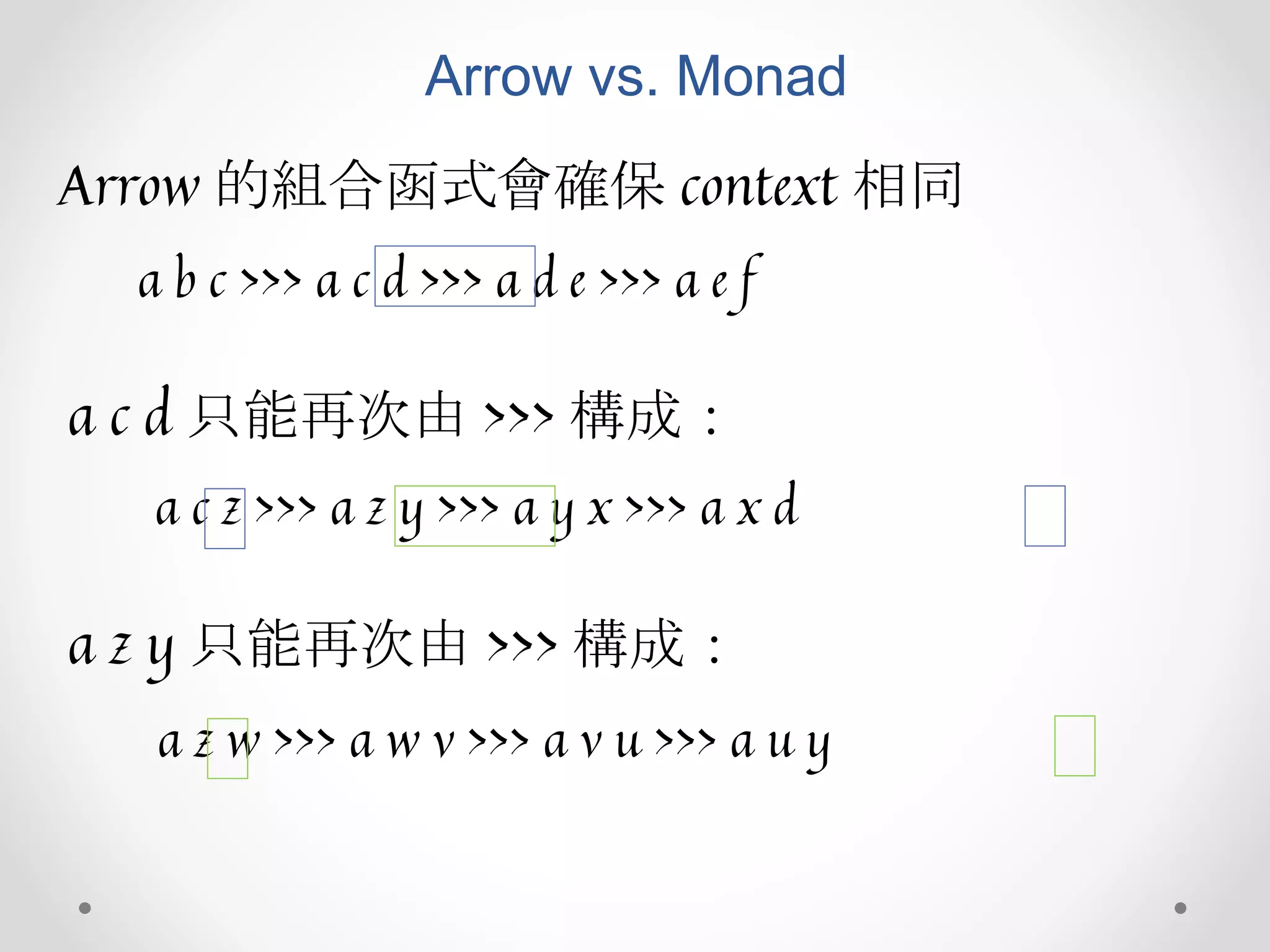
Arrow的組合函式會確保 context 相同
a b c >>> a c d >>> a d e >>> a e f
a c d 只能再次由 >>> 構成:
a c z >>> a z y >>> a y x >>> a x d
a z y 只能再次由 >>> 構成:
a z w >>> a w v >>> a v u >>> a u y
58.
Arrow vs. Monad
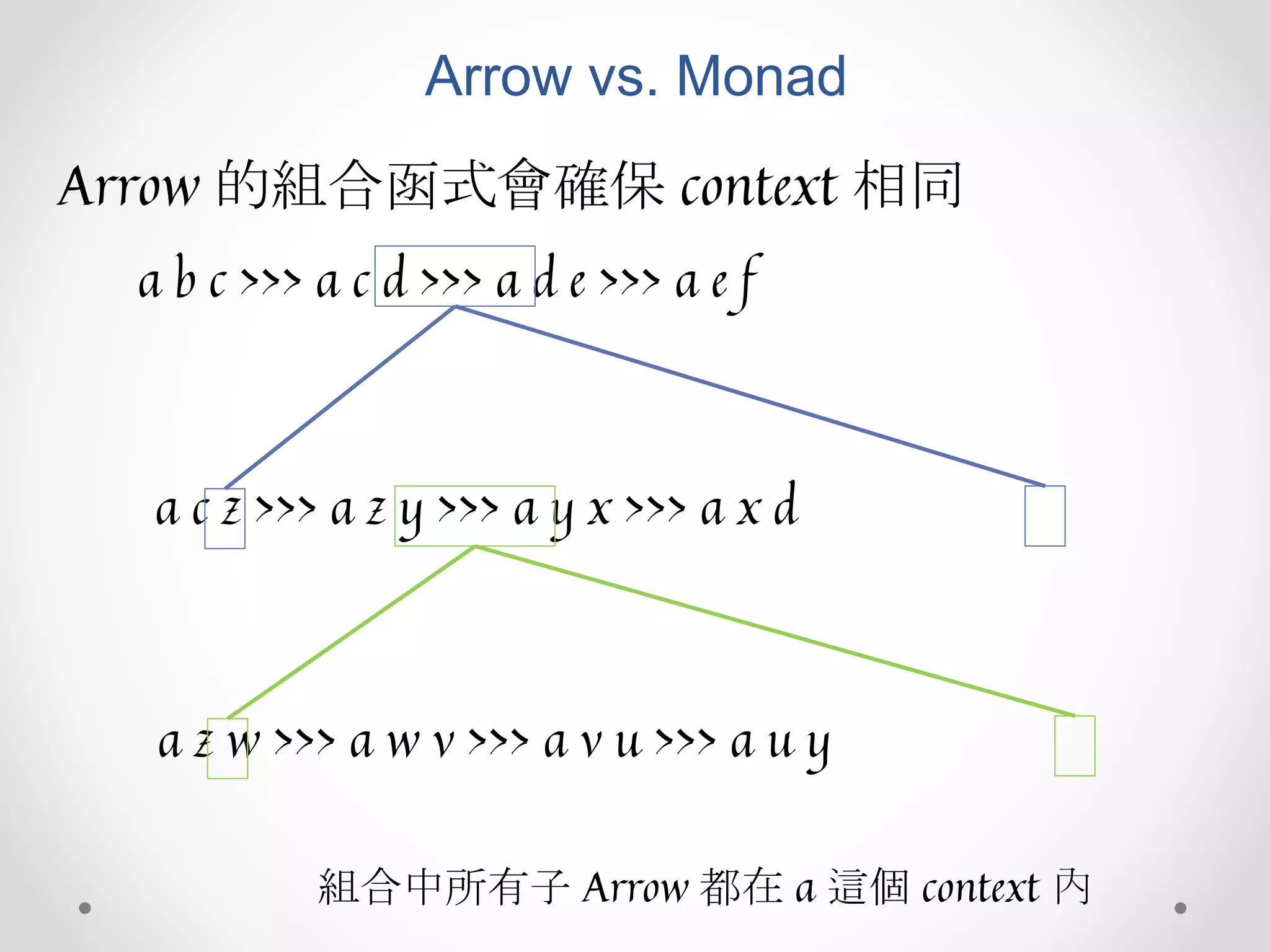
Arrow的組合函式會確保 context 相同
a b c >>> a c d >>> a d e >>> a e f
a c z >>> a z y >>> a y x >>> a x d
a z w >>> a w v >>> a v u >>> a u y
組合中所有子 Arrow 都在 a 這個 context 內
59.
Arrow vs. Monad
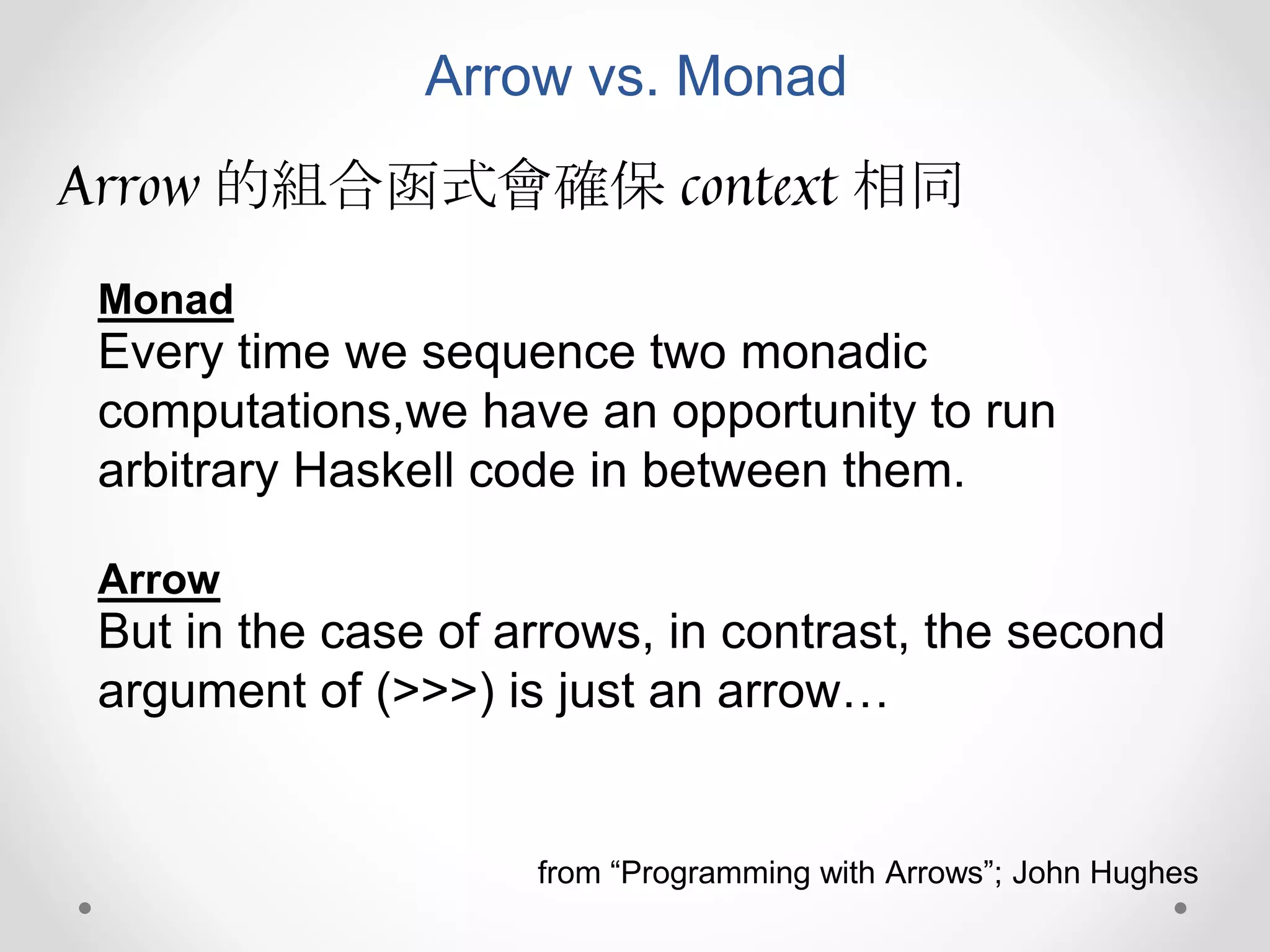
Arrow的組合函式會確保 context 相同
Every time we sequence two monadic
computations,we have an opportunity to run
arbitrary Haskell code in between them.
Monad
But in the case of arrows, in contrast, the second
argument of (>>>) is just an arrow…
Arrow
from “Programming with Arrows”; John Hughes
Applicative
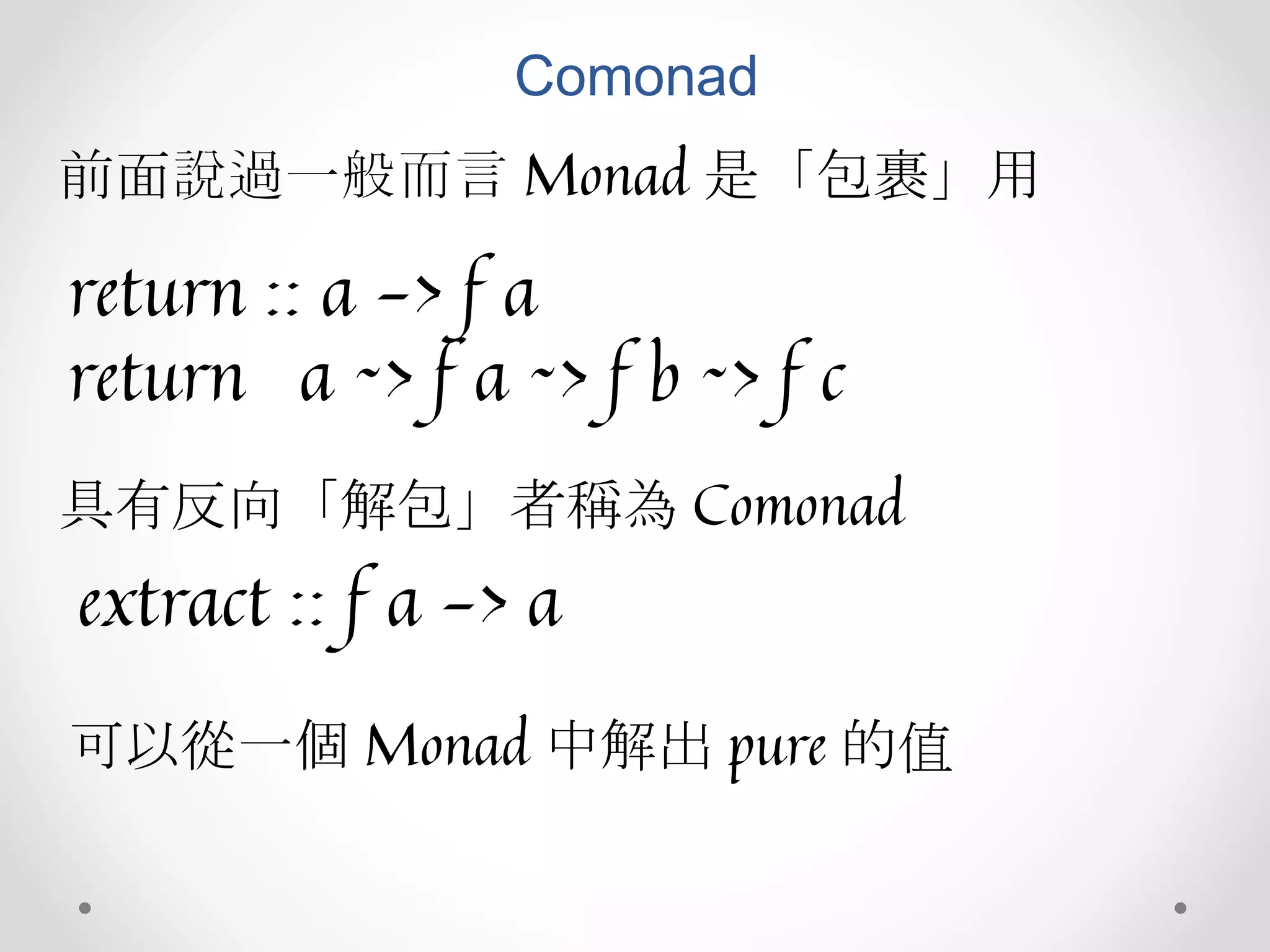
Applicative 提供了如何 apply的解決方式
pure :: a -> f a
(<*>) :: f (a -> b) -> f a -> f b
fn = fmap (+) -- 假設以 [] 為 context
fn:: [ ] Integer -> [ Integer -> Integer ]
fn [4] :: [Integer -> Integer] -- 無法進一步 apply [5] 給 (+)
(<*>) (fn [4]) :: [ ] Integer -> [ ] Integer -- 可以給予參數了!
fmap (+) [4] <*> [5] -- [9]
將被放在 context 內的變換轉出來,變成可給予的參數
66.
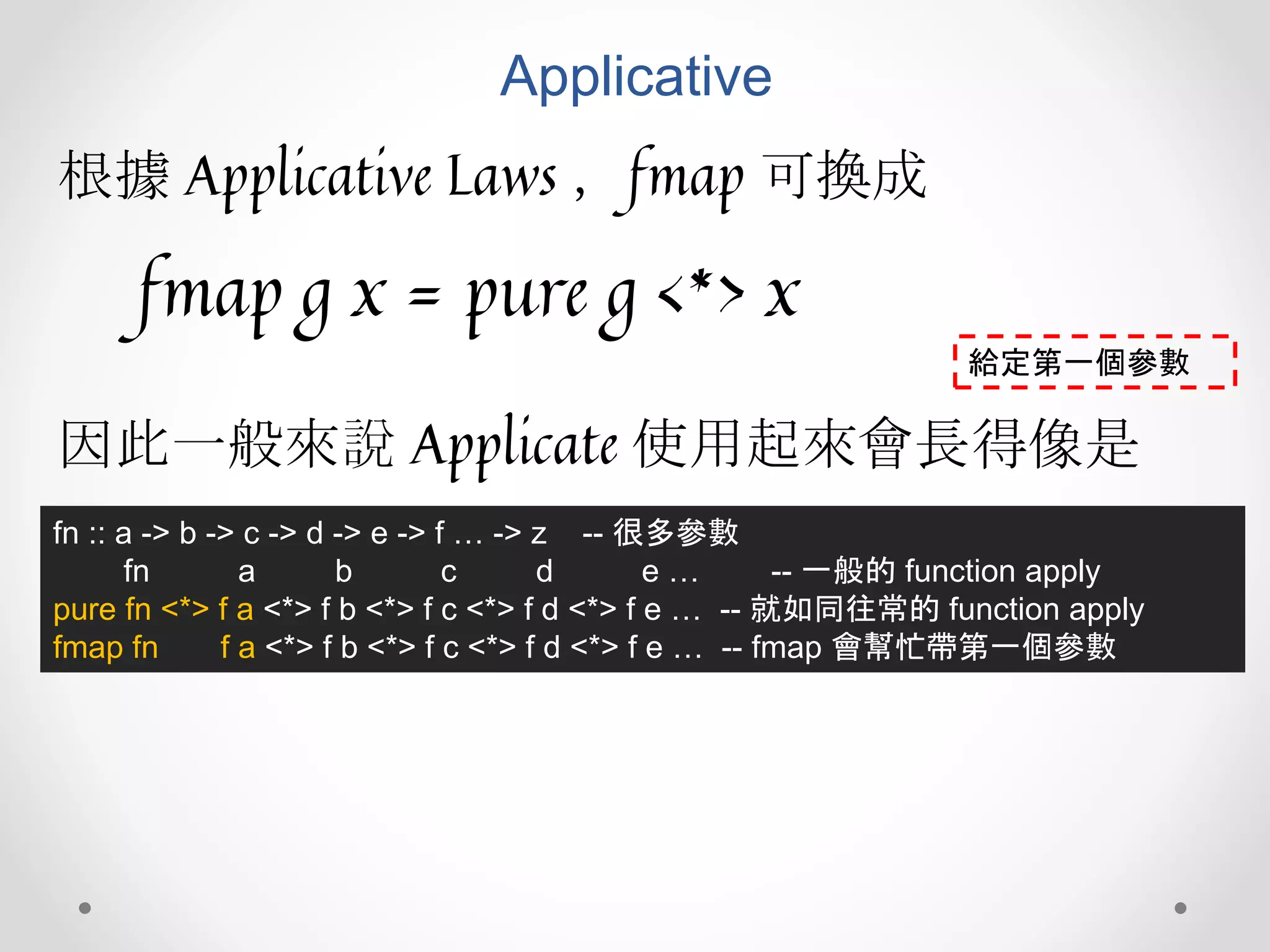
Applicative
根據 Applicative Laws,fmap 可換成
fmap g x = pure g <*> x
fn :: a -> b -> c -> d -> e -> f … -> z -- 很多參數
fn a b c d e … -- 一般的 function apply
pure fn <*> f a <*> f b <*> f c <*> f d <*> f e … -- 就如同往常的 function apply
fmap fn f a <*> f b <*> f c <*> f d <*> f e … -- fmap 會幫忙帶第一個參數
因此一般來說 Applicate 使用起來會長得像是
給定第一個參數
Monoid
Monoid: 可以作「加法」的類別
mzero ::m a -- [ ] ,Nothing
mplus :: m a -> m a -> m a -- (++)
Nothing `mplus` Nothing = Nothing -- 0 solutions + 0 solutions = 0 solutions
Just x `mplus` Nothing = Just x -- 1 solution + 0 solutions = 1 solution
Nothing `mplus` Just x = Just x -- 0 solutions + 1 solution = 1 solution
Just x `mplus` Just y = Just x -- 1 solution + 1 solution = 2 solutions,
Maybe 的 mplus 定義有點繁瑣
http://stackoverflow.com/questions/4504489/monadplus-definition-for-haskell-io
* 「為何 IO 不是 MonadPlus ? 」->
‘mzero’ would necessarily represent an IO computation that never returns.
Foldable
Foldable :可以從一個結構 ->「加」成一個值
fold :: Monoid m => t m -> m
Prelude> foldr (x y -> concat ["(",x,"+",y,")"]) "0" (map show [1..13])
"(1+(2+(3+(4+(5+(6+(7+(8+(9+(10+(11+(12+(13+0)))))))))))))"
Prelude> foldl (x y -> concat ["(",x,"+",y,")"]) "0" (map show [1..13])
"(((((((((((((0+1)+2)+3)+4)+5)+6)+7)+8)+9)+10)+11)+12)+13)"
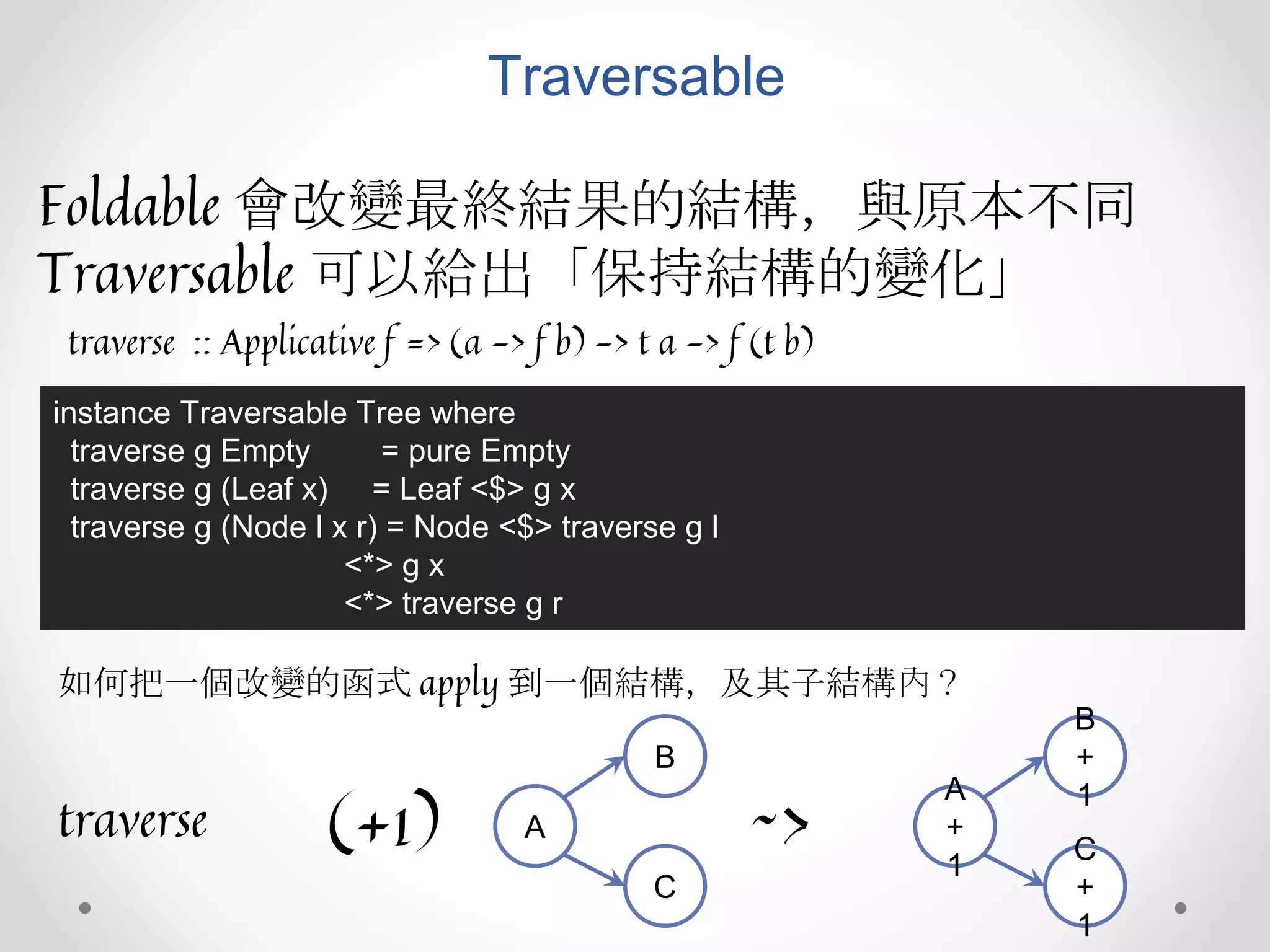
Traversable
Foldable 會改變最終結果的結構,與原本不同
Traversable 可以給出「保持結構的變化」
traverse:: Applicative f => (a -> f b) -> t a -> f (t b)
instance Traversable Tree where
traverse g Empty = pure Empty
traverse g (Leaf x) = Leaf <$> g x
traverse g (Node l x r) = Node <$> traverse g l
<*> g x
<*> traverse g r
如何把一個改變的函式 apply 到一個結構,及其子結構內?
A
B
C
traverse (+1)
A
+
1
B
+
1
C
+
1
~>
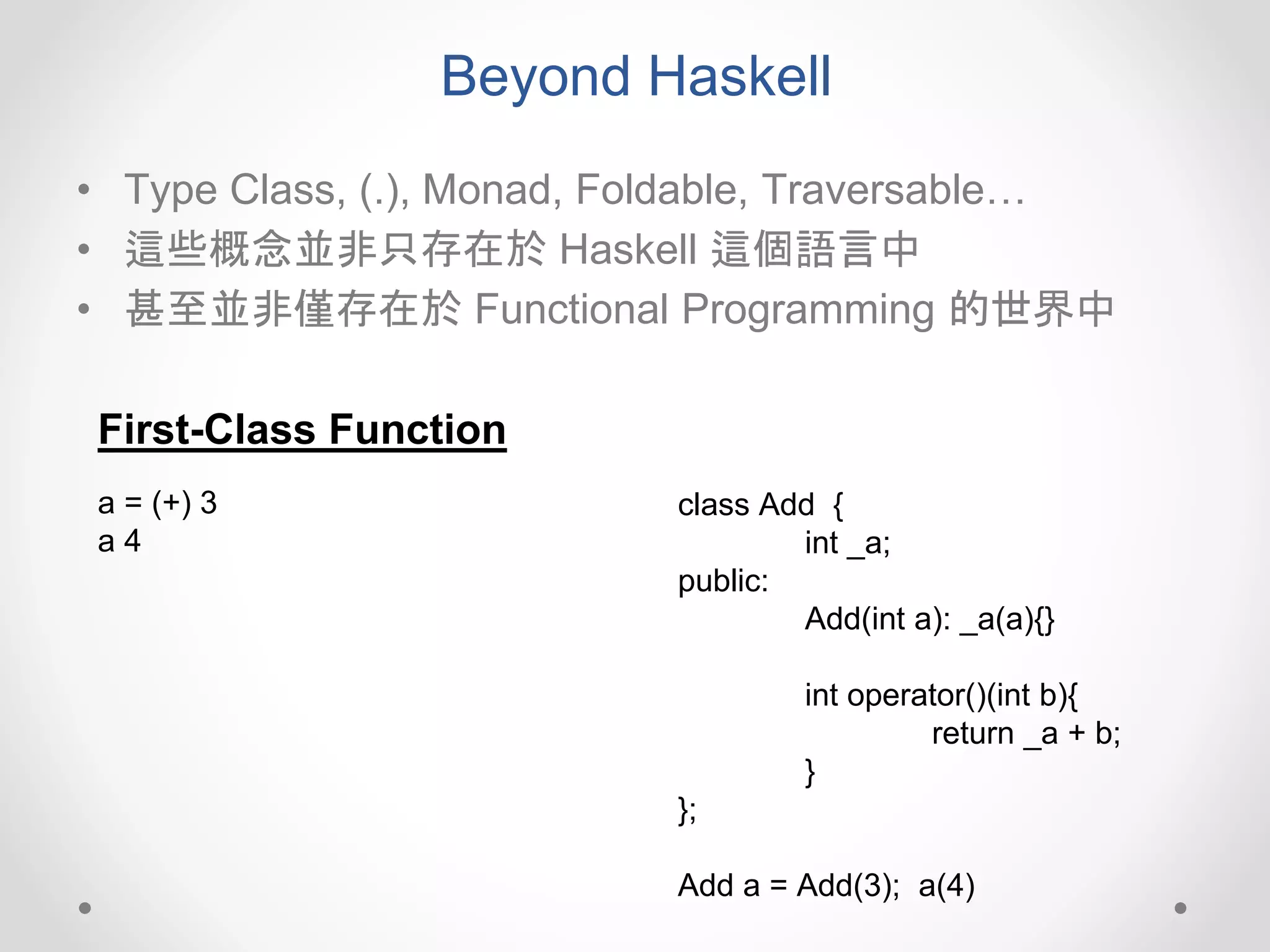
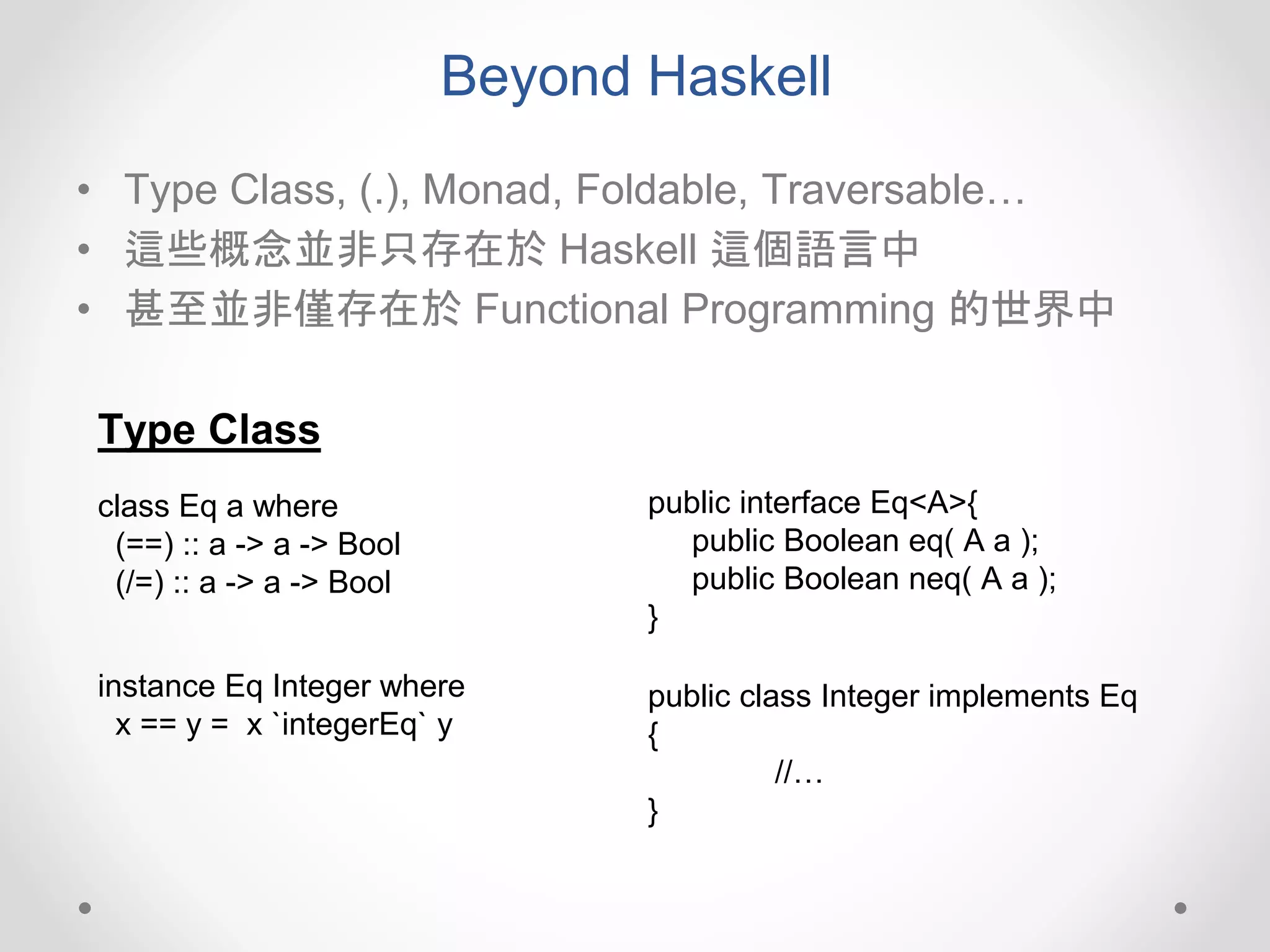
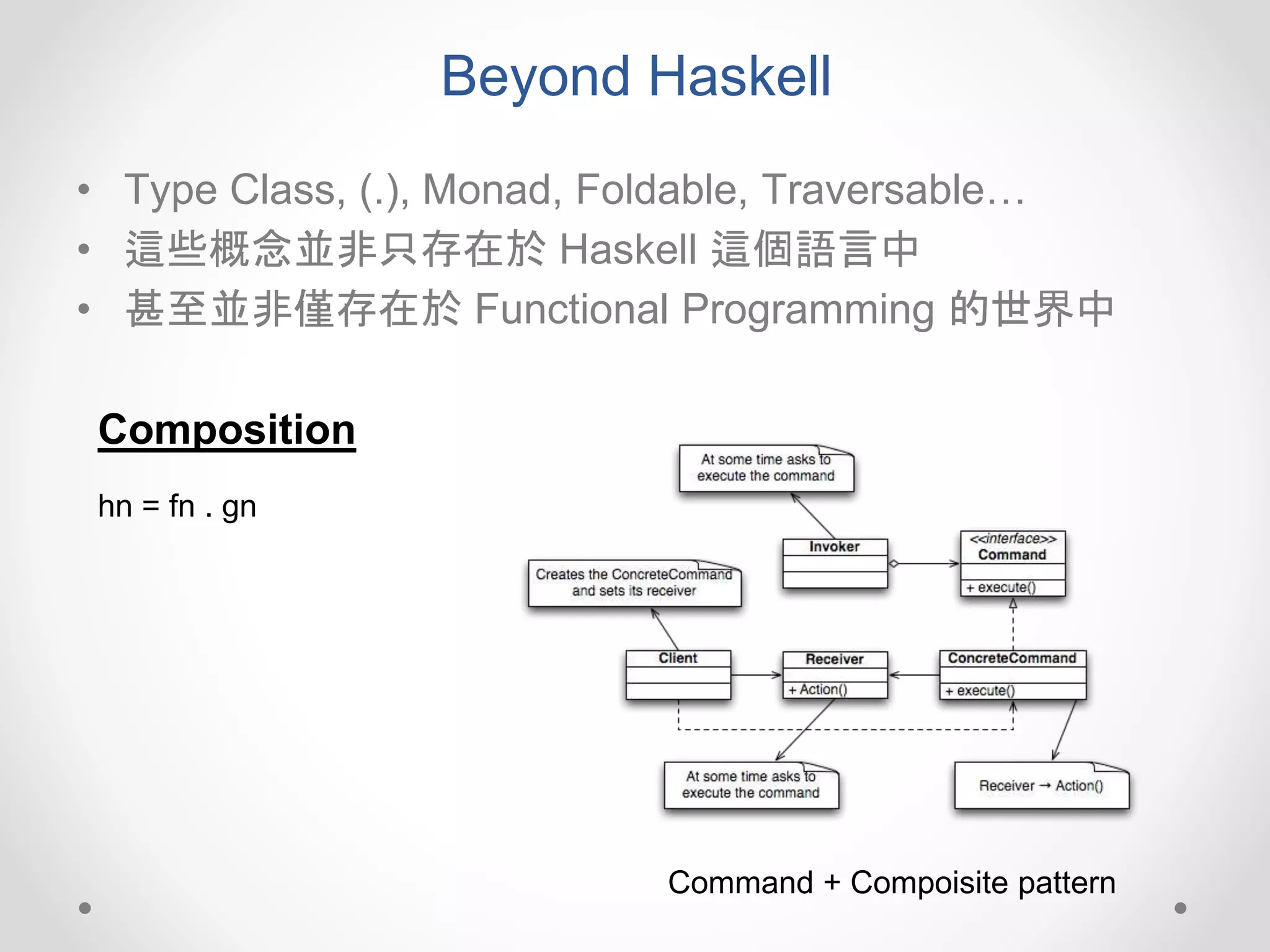
Beyond Haskell
• TypeClass, (.), Monad, Foldable, Traversable…
• 這些概念並非只存在於 Haskell 這個語言中
• 甚至並非僅存在於 Functional Programming 的世界中
First-Class Function
class Add {
int _a;
public:
Add(int a): _a(a){}
int operator()(int b){
return _a + b;
}
};
Add a = Add(3); a(4)
a = (+) 3
a 4
79.
Beyond Haskell
• TypeClass, (.), Monad, Foldable, Traversable…
• 這些概念並非只存在於 Haskell 這個語言中
• 甚至並非僅存在於 Functional Programming 的世界中
class Eq a where
(==) :: a -> a -> Bool
(/=) :: a -> a -> Bool
public interface Eq<A>{
public Boolean eq( A a );
public Boolean neq( A a );
}
instance Eq Integer where
x == y = x `integerEq` y
public class Integer implements Eq
{
//…
}
Type Class
![Problem: Data in a Nutshell
(+4).(+5):: Int -> Int
Int: 4 Int: 12
((+4).(+5)) 4 == 12
+4 +5
When Int: 4 ~> [Int: 4]](https://image.slidesharecdn.com/haskellcomponents-160602130757/75/Introduction-to-Basic-Haskell-Components-In-Chinese-18-2048.jpg)
![Problem: Data in a Nutshell
(+4).(+5):: Int -> Int
[Int]: [4]
((+4).(+5)) [4] -- Error !
+4 +5 X
函式無法處理帶 context 性質的值
每種 context 都有其意義](https://image.slidesharecdn.com/haskellcomponents-160602130757/75/Introduction-to-Basic-Haskell-Components-In-Chinese-19-2048.jpg)
![Problem: Data in a Nutshell
• Maybe a:: 代表不確定性運算
• Either e a:: 代表有可能會例外的運算
• [a]:: 代表不確定性運算 -- 可能性更多
• IO a:: 代表會對 RealWorld 做出影響
常見的 Context
使用 context 觀點會比容器觀點更加適切](https://image.slidesharecdn.com/haskellcomponents-160602130757/75/Introduction-to-Basic-Haskell-Components-In-Chinese-20-2048.jpg)
![Problem: Data in a Nutshell
(+4).(+5):: Int -> Int
Solution #1
plus45 = (+4).(+5)
plus45Special [ x ] = plus45 x -- use pattern matching
為該函式定義一特別的 “unwrap” 版本
有多少 context 就要定義多少版本…](https://image.slidesharecdn.com/haskellcomponents-160602130757/75/Introduction-to-Basic-Haskell-Components-In-Chinese-21-2048.jpg)
![Problem: Data in a Nutshell
(+4).(+5):: Int -> Int
Solution #1
plus45 = (+4).(+5)
plus45Special [ x ] = plus45 x
plus45SpMaybe (Just x) = plus45 x
plus45SpIO (IO x) = plus45 x
……..](https://image.slidesharecdn.com/haskellcomponents-160602130757/75/Introduction-to-Basic-Haskell-Components-In-Chinese-22-2048.jpg)
![Problem: Data in a Nutshell
(+4).(+5):: Int -> Int
Solution #1
plus45 = (+4).(+5)
plus45Special [ x ] = plus45 x
plus45SpMaybe (Just x) = plus45 x
plus45SpIO (IO x) = plus45 x
……..
pure
with context
實際上分為處理 context 與運算兩部分](https://image.slidesharecdn.com/haskellcomponents-160602130757/75/Introduction-to-Basic-Haskell-Components-In-Chinese-23-2048.jpg)
![Problem: Data in a Nutshell
(+4).(+5):: Int -> Int
Solution #2
每種 context 定義出自己的包裹函式
代為處理包裹與「解包」的問題
(+4).(+5)
[ 4 ] 4 12 [ 12 ]
fmap:: (a->b)->f a -> f b](https://image.slidesharecdn.com/haskellcomponents-160602130757/75/Introduction-to-Basic-Haskell-Components-In-Chinese-24-2048.jpg)
![Type Class: Functor
class Functor f where
fmap:: ( a -> b ) -> f a -> f b
帶有 fmap 函式定義的 context
fmap 的定義要懂得包裹與解包
fmap = map -- Functor [ ]
fmap _ Nothing = Nothing
fmap f ( Just a ) = Just ( f a ) -- Functor Maybe
fmap f x = x >>= ( return . f) -- * Functor IO](https://image.slidesharecdn.com/haskellcomponents-160602130757/75/Introduction-to-Basic-Haskell-Components-In-Chinese-28-2048.jpg)
![From Functor to Monad
從一個普通值帶到某 context 運算
4 → [ 4 ] [ 21 ]
(+4).(+5
)
(+4).(+5
)
(+4).(+5
)
值一但被包裹理論上就不會被解包(特例)
這整條運算:a -> m a ( m :: Context )
可稱為 action ( from IO Monad )
fmap AND (.)](https://image.slidesharecdn.com/haskellcomponents-160602130757/75/Introduction-to-Basic-Haskell-Components-In-Chinese-30-2048.jpg)
![From Functor to Monad
還缺少把值變成 context 值的抽象函式
4 → [ 4 ] [ 21 ]
(+4).(+5
)
(+4).(+5
)
(+4).(+5
)
return:: a -> m a
* 這個名字很不幸與許多程式語言的保留關鍵字相同,然而應該
注意其意義幾乎完全不同!
* return 幾乎就等於 Data Constructor 了,例如 Just a
[ a ] -> [ c ]](https://image.slidesharecdn.com/haskellcomponents-160602130757/75/Introduction-to-Basic-Haskell-Components-In-Chinese-31-2048.jpg)
![From Functor to Monad
不僅僅是 [ ] :抽象概念互通
4 → [ 4 ] [ 31 ]
(+4).(+5
)
(+4).(+5
)
(+4).(+5
)
4 → Maybe 4 Maybe 31
4 → IO 4 IO 31
m a -> m c
都是從一個值 -> 運算後且帶 context 的值](https://image.slidesharecdn.com/haskellcomponents-160602130757/75/Introduction-to-Basic-Haskell-Components-In-Chinese-32-2048.jpg)
![From Functor to Monad
阻礙:型別不通
。( ) ( )
[ c ] c -> [ d ]
(>>=):: m a -> (a -> m b ) -> m b
這個奇怪的 bind 運算子幫我們搭了橋](https://image.slidesharecdn.com/haskellcomponents-160602130757/75/Introduction-to-Basic-Haskell-Components-In-Chinese-34-2048.jpg)
![From Functor to Monad
有了 bind 運算子我們可以任意組合同型 context 運算
。( ) ( )
[ c ] c -> [ d ]
(>>=):: m a -> (a -> m b ) -> m b
效果:把前一個 context 值私下解包後,傳給下個運算](https://image.slidesharecdn.com/haskellcomponents-160602130757/75/Introduction-to-Basic-Haskell-Components-In-Chinese-35-2048.jpg)
![From Functor to Monad
。( ) ( )
[ c ] c -> [ d ]
(>>=):: m a -> (a -> m b ) -> m b
find even [1,2] >>= return . ((!!) [1,2,4]) -- Maybe
[‘3’,’4’,’5’]>>= digitToInt >>= return . even -- [ ]
getLine >>= putStr.((++) “Hi, user [”) >> putStrLn “] !” -- IO](https://image.slidesharecdn.com/haskellcomponents-160602130757/75/Introduction-to-Basic-Haskell-Components-In-Chinese-36-2048.jpg)
![From Functor to Monad
(>>=):: m a -> (a -> m b ) -> m b
find even [1,2] >>= return . ((!!) [1,2,4])
找到為偶數的值:Just 2 找到 index#2 的值,並包裝之
find:: (a->Bool)->[a]->Maybe a
even:: Integral a => a -> Bool
(!!):: [a]->Int->a ; (!!) [1,2,4] :: Int -> a
return:: a -> m a ; return . ( (!!) [1,2,4] ) :: Int -> m b
return 夠抽象,所以可以視其正在
哪個 context 中用不同的 instance](https://image.slidesharecdn.com/haskellcomponents-160602130757/75/Introduction-to-Basic-Haskell-Components-In-Chinese-37-2048.jpg)
![From Functor to Monad
(>>=):: m a -> (a -> m b ) -> m b
[‘3’,’4’,’5’]>>= return . digitToInt >>= return . even
( 為了方便示範 ) 各字元轉換成整數 各奇偶數轉成 Bool
getLine >>= putStr.((++) “Hi, user [”) >> putStrLn “] !”
從 IO 取得一行 組合傳入字串並從 IO 輸出 不管前面結果而印出
抽象:注意每個 context 對 bind 詮釋都不同,但用法都相同
bind 表現的效果之一是不用管傳值,只要專注把運算組合即可
(>>):: m a -> m b -> m b -- 不管前面結果,自己執行出 m b](https://image.slidesharecdn.com/haskellcomponents-160602130757/75/Introduction-to-Basic-Haskell-Components-In-Chinese-38-2048.jpg)
![Monad 與 Pure: IO Monad
[a] -> a --:: head, tail, foldl, maximum, minimum …
Maybe a -> a --:: fromJust, fromMaybe defaultValue …
----
IO a -> a --:: ( NO SUCH FUNCTION !! )
Haskell 利用 context 概念永久包住帶
「副作用」的 IO 值: a -> IO a -> …… IO z
一般 Monad 多少都有 unwrap function,也就
是在該 context 內部可以是 Impure 的處理。但
離開 context 的值必須只能是 Pure : m a -> a
→ 一入 IO ,永為 IO :因沒有 unwrapper,
所有要處理 IO 者都必須嵌入該 context 內](https://image.slidesharecdn.com/haskellcomponents-160602130757/75/Introduction-to-Basic-Haskell-Components-In-Chinese-45-2048.jpg)
![Monad 小結
Pure Function
。
with Context
value wrapper :: a -> m a
>>=( ) ( )
[ c ] c -> [ d ]](https://image.slidesharecdn.com/haskellcomponents-160602130757/75/Introduction-to-Basic-Haskell-Components-In-Chinese-46-2048.jpg)
![How to make an Arrow
This is a normal function…
fn:: a -> b
… and this is an Arrow
fn::(->) a b
Just like any other data type
Maybe[ ] Int
Book Id Price
- 這個 Arrow -
接收:a
給出:b
Tip: 可以表達運
算與可以執行運
算是兩件事](https://image.slidesharecdn.com/haskellcomponents-160602130757/75/Introduction-to-Basic-Haskell-Components-In-Chinese-50-2048.jpg)
![From Monad to Arrow
getLine :: IO String
putStr, putStrLn :: IO ()
main :: IO ()
main = getLine >>= putStr.((++) “Hi, user [”) >> putStrLn “] !”
Monad 型別意義:m a 代表「這個 monad 會產生 a 型別的值
」因此,Monad 封裝出完整、不依賴外部的 operation ( 所以叫「單子」 )
持有一個 Monad a: 持有一個「值」 ( 內部一連串運算得出)
Arrow 型別意義:a b c 代表「這個 arrow 接收 b 傳出 c」
因此,Arrow 封裝的是一個 transformation ( 有接受端)
持有一個 Arrow b c: 持有一個「會從 b 到 c 的變換」
→ 若以 `b` Apply 此 Arrow,就等於 ( M b ) ( Arrow 不一定都可 Apply)
Monad 把資料連同運算封裝,模糊了 object 與 transformation
Arrow 只封裝運算,並提供了「針對運算的運算」](https://image.slidesharecdn.com/haskellcomponents-160602130757/75/Introduction-to-Basic-Haskell-Components-In-Chinese-51-2048.jpg)
![Applicative
Functor : 可以讓一個函式被「context 化」
(+4).(+5)
[ 4 ] 4 12 [ 12 ]
fmap:: (a->b)->f a -> f b
但是僅限於只有一個參數的函式](https://image.slidesharecdn.com/haskellcomponents-160602130757/75/Introduction-to-Basic-Haskell-Components-In-Chinese-63-2048.jpg)
![Applicative
fmap 的函式如何給予一個以上的參數?
(+):: Int -> (Int -> Int)
fmap (+) :: f a -> f (Int -> Int)
fn = fmap (+) -- 假設以 [] 為 context
fn:: [ ] Integer -> [ Integer -> Integer ]
fn [4] :: [Integer -> Integer] -- 無法進一步 apply [5] 給 (+)
fn [4] [5] -- Error ! ( fn [4] 「滿了」,已經無法再給參數)](https://image.slidesharecdn.com/haskellcomponents-160602130757/75/Introduction-to-Basic-Haskell-Components-In-Chinese-64-2048.jpg)
![Applicative
Applicative 提供了如何 apply 的解決方式
pure :: a -> f a
(<*>) :: f (a -> b) -> f a -> f b
fn = fmap (+) -- 假設以 [] 為 context
fn:: [ ] Integer -> [ Integer -> Integer ]
fn [4] :: [Integer -> Integer] -- 無法進一步 apply [5] 給 (+)
(<*>) (fn [4]) :: [ ] Integer -> [ ] Integer -- 可以給予參數了!
fmap (+) [4] <*> [5] -- [9]
將被放在 context 內的變換轉出來,變成可給予的參數](https://image.slidesharecdn.com/haskellcomponents-160602130757/75/Introduction-to-Basic-Haskell-Components-In-Chinese-65-2048.jpg)
![Monoid
Monoid: 可以作「加法」的類別
mzero :: m a -- [ ] ,Nothing
mplus :: m a -> m a -> m a -- (++)
Nothing `mplus` Nothing = Nothing -- 0 solutions + 0 solutions = 0 solutions
Just x `mplus` Nothing = Just x -- 1 solution + 0 solutions = 1 solution
Nothing `mplus` Just x = Just x -- 0 solutions + 1 solution = 1 solution
Just x `mplus` Just y = Just x -- 1 solution + 1 solution = 2 solutions,
Maybe 的 mplus 定義有點繁瑣
http://stackoverflow.com/questions/4504489/monadplus-definition-for-haskell-io
* 「為何 IO 不是 MonadPlus ? 」->
‘mzero’ would necessarily represent an IO computation that never returns.](https://image.slidesharecdn.com/haskellcomponents-160602130757/75/Introduction-to-Basic-Haskell-Components-In-Chinese-68-2048.jpg)
![Foldable
Foldable :可以從一個結構 -> 「加」成一個值
fold :: Monoid m => t m -> m
Prelude> foldr (x y -> concat ["(",x,"+",y,")"]) "0" (map show [1..13])
"(1+(2+(3+(4+(5+(6+(7+(8+(9+(10+(11+(12+(13+0)))))))))))))"
Prelude> foldl (x y -> concat ["(",x,"+",y,")"]) "0" (map show [1..13])
"(((((((((((((0+1)+2)+3)+4)+5)+6)+7)+8)+9)+10)+11)+12)+13)"](https://image.slidesharecdn.com/haskellcomponents-160602130757/75/Introduction-to-Basic-Haskell-Components-In-Chinese-70-2048.jpg)

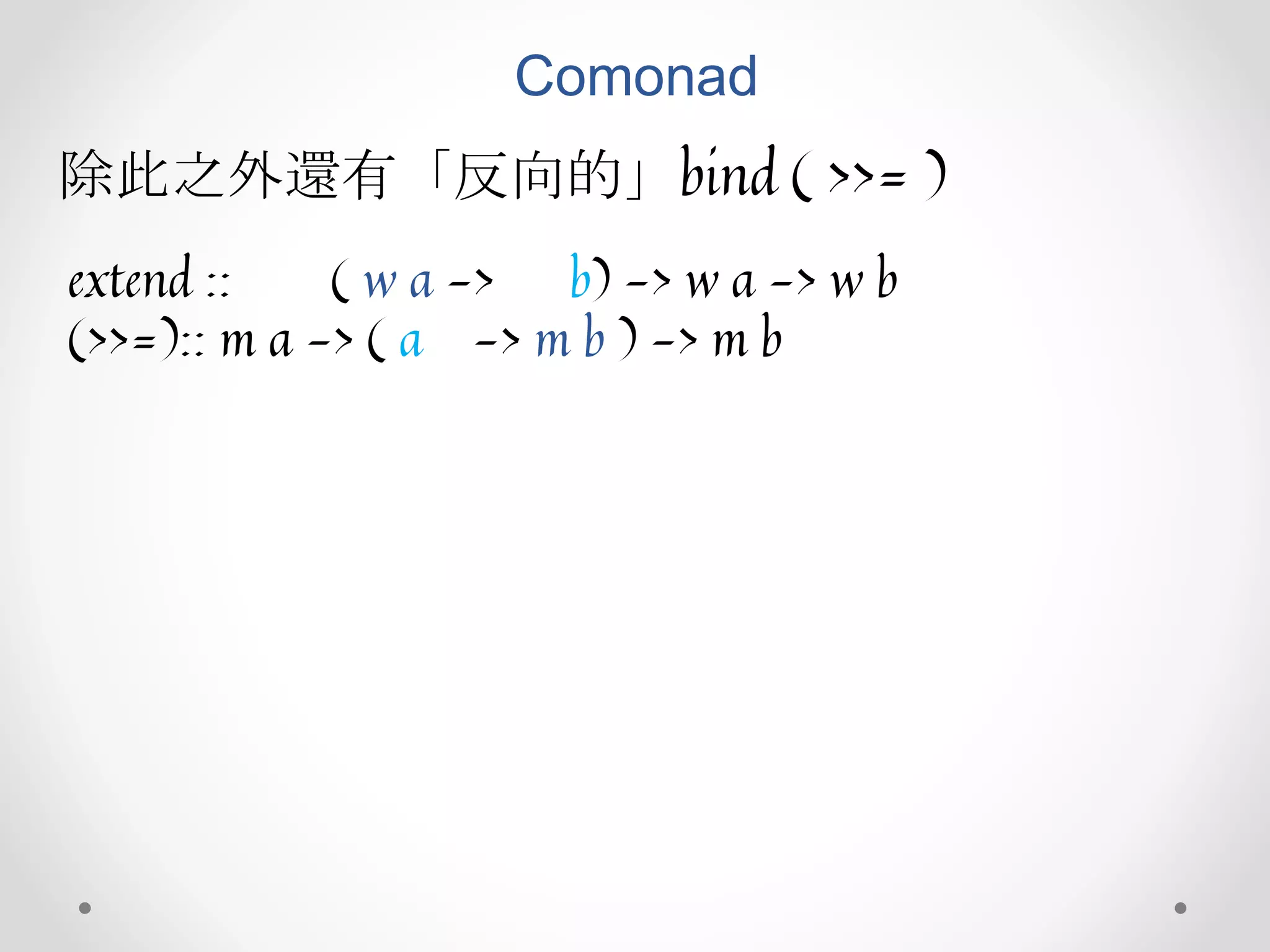
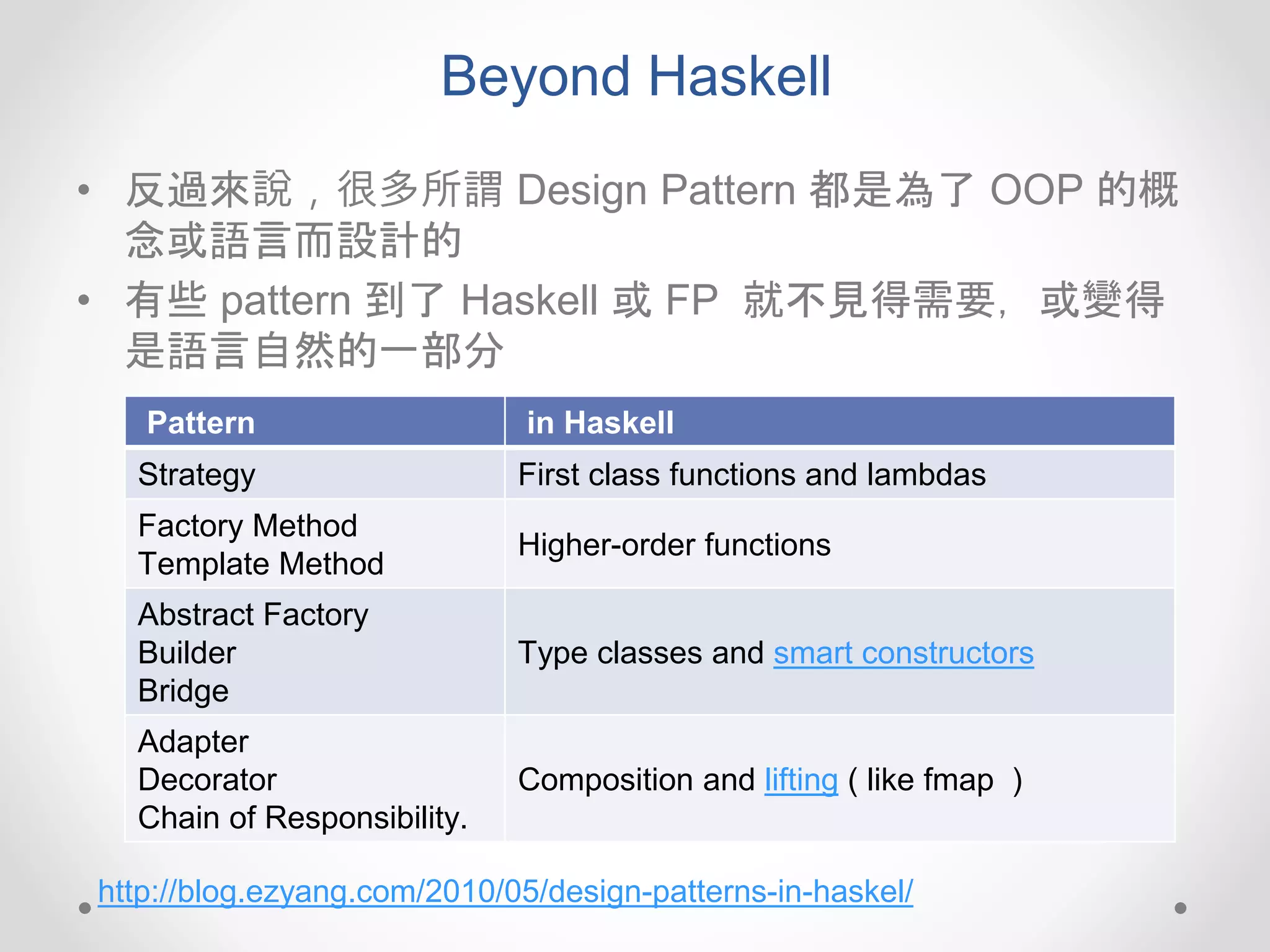
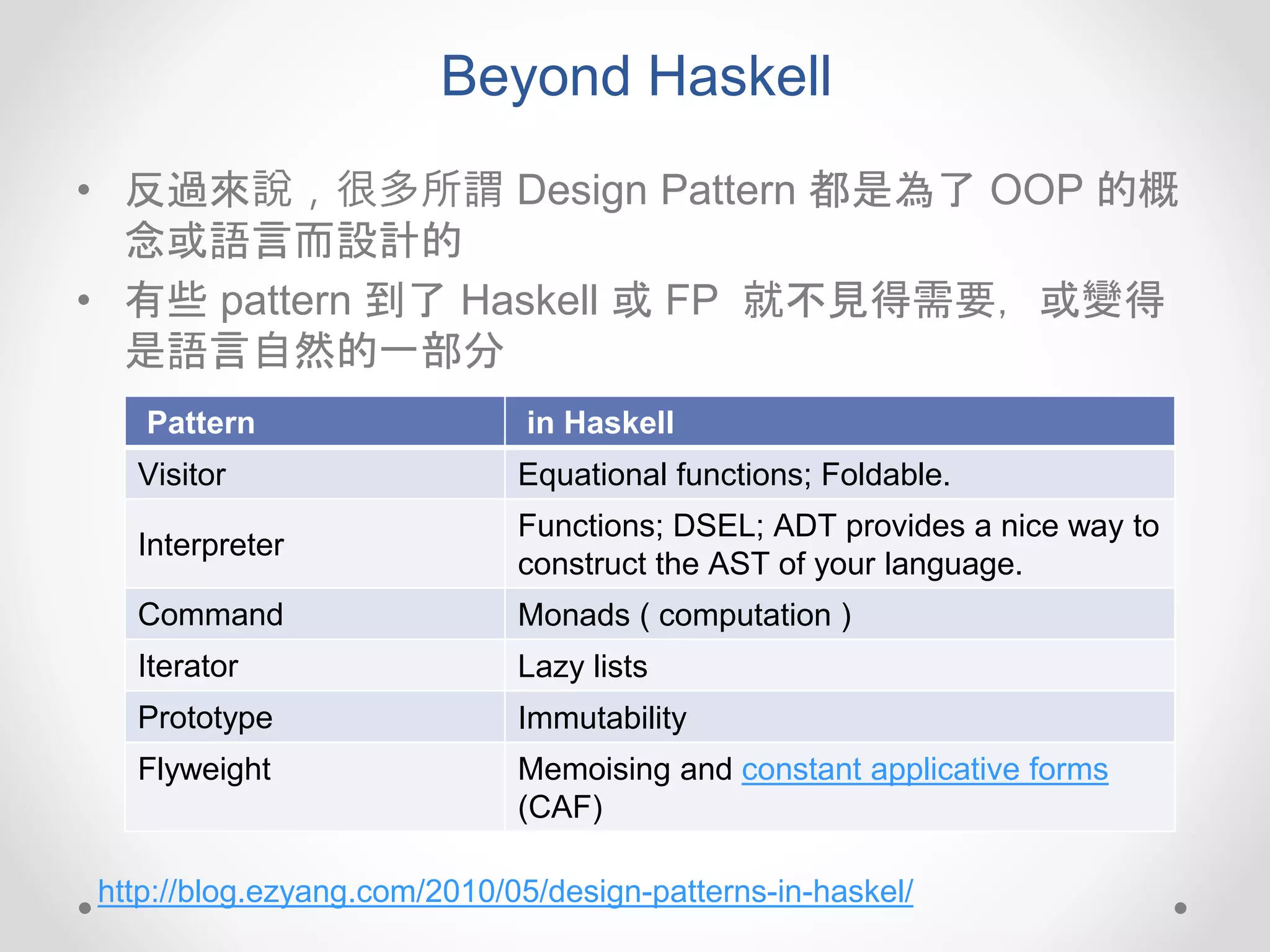
![Beyond Haskell
• Type Class, (.), Monad, Foldable, Traversable…
• 這些概念並非只存在於 Haskell 這個語言中
• 甚至並非僅存在於 Functional Programming 的世界中
Monad
main = getLine >>=
putStr.((++) “Hi, user [”) >>
putStrLn “] !”
$(dom).find(‘.subdom’)
.hide()
.append(some_dom)
.addClass(‘show’);
.fadeIn()
http://importantshock.wordpress.com/2009/01/18/jquery-is-a-monad/
“jQuery is a monad”
…OR any fluent interface +
context computation
http://en.wikipedia.org/wiki/Fluent_interface](https://image.slidesharecdn.com/haskellcomponents-160602130757/75/Introduction-to-Basic-Haskell-Components-In-Chinese-81-2048.jpg)
![Beyond Haskell
• Type Class, (.), Monad, Foldable, Traversable…
• 這些概念並非只存在於 Haskell 這個語言中
• 甚至並非僅存在於 Functional Programming 的世界中
Monad
main = getLine >>=
putStr.((++) “Hi, user [”) >>
putStrLn “] !”
“Monad in Scala”
“Monad in F#”
“Monad in Java”
(some terrible codes )
“Monad in C++”
(with C++11 lambda)
“Monad in Ruby”
(lambda, again)
“Monad in Python”
(「with-nice-syntax」)](https://image.slidesharecdn.com/haskellcomponents-160602130757/75/Introduction-to-Basic-Haskell-Components-In-Chinese-82-2048.jpg)



![[Effective Kotlin 讀書會] 第八章 Efficient collection processing 導讀](https://cdn.slidesharecdn.com/ss_thumbnails/effective-kotlin-chapter8-221208155318-f914a841-thumbnail.jpg?width=640&height=640&fit=bounds)


