Introduction: Securing Data
Communication
Securingdata transmission is critical in today's digital world.
This presentation covers digital signatures and hash functions.
Examples include e-commerce, legal documents, and software
distribution.
KS
by Khalid Shafaq
2.
Data Communication
Fundamentals
Data Model
Sendertransmits data
through a channel to
receiver.
Risks
• Eavesdropping
• Data tampering
• Spoofing attacks
Security Goals
• Confidentiality
• Integrity
• Authentication
• Non-repudiation
3.
Cryptography Basics
Symmetric
Cryptography
Same keyencrypts and
decrypts data.
Asymmetric
Cryptography
Uses public and private
key pairs for encryption.
Public Key
Infrastructure
Manages keys and digital
certificates for trust.
Key Details
• 2048-bit RSA for
encryption
• 256-bit AES for data
4.
Digital Signatures: Concept
andPurpose
What They Are
Electronic equivalent of
handwritten signatures.
Security Functions
Ensure message
authentication and
integrity.
Non-repudiation
Sender cannot deny sending the message.
5.
Digital Signature Creation
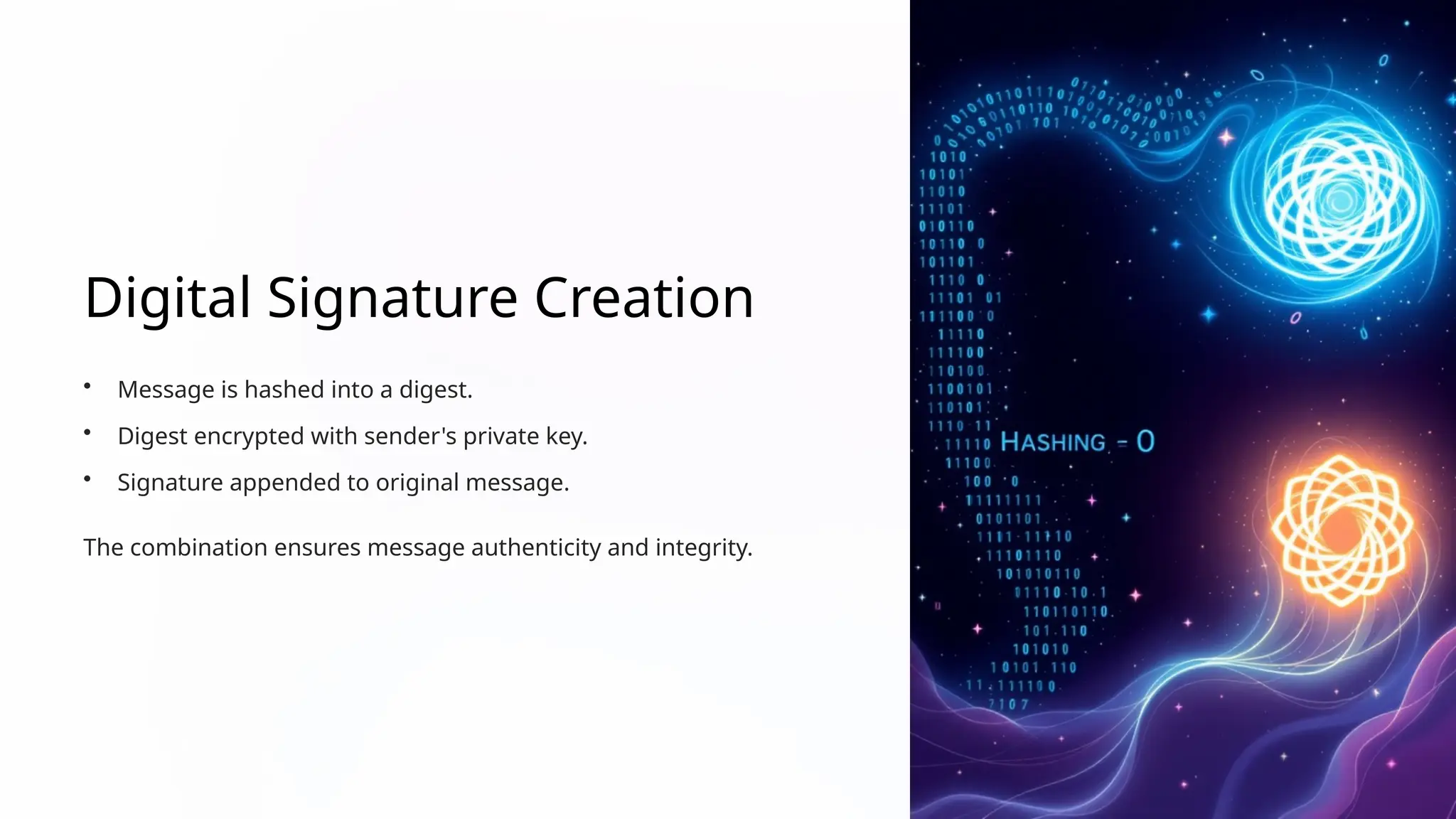
•Message is hashed into a digest.
• Digest encrypted with sender's private key.
• Signature appended to original message.
The combination ensures message authenticity and integrity.
6.
Digital Signature Verification
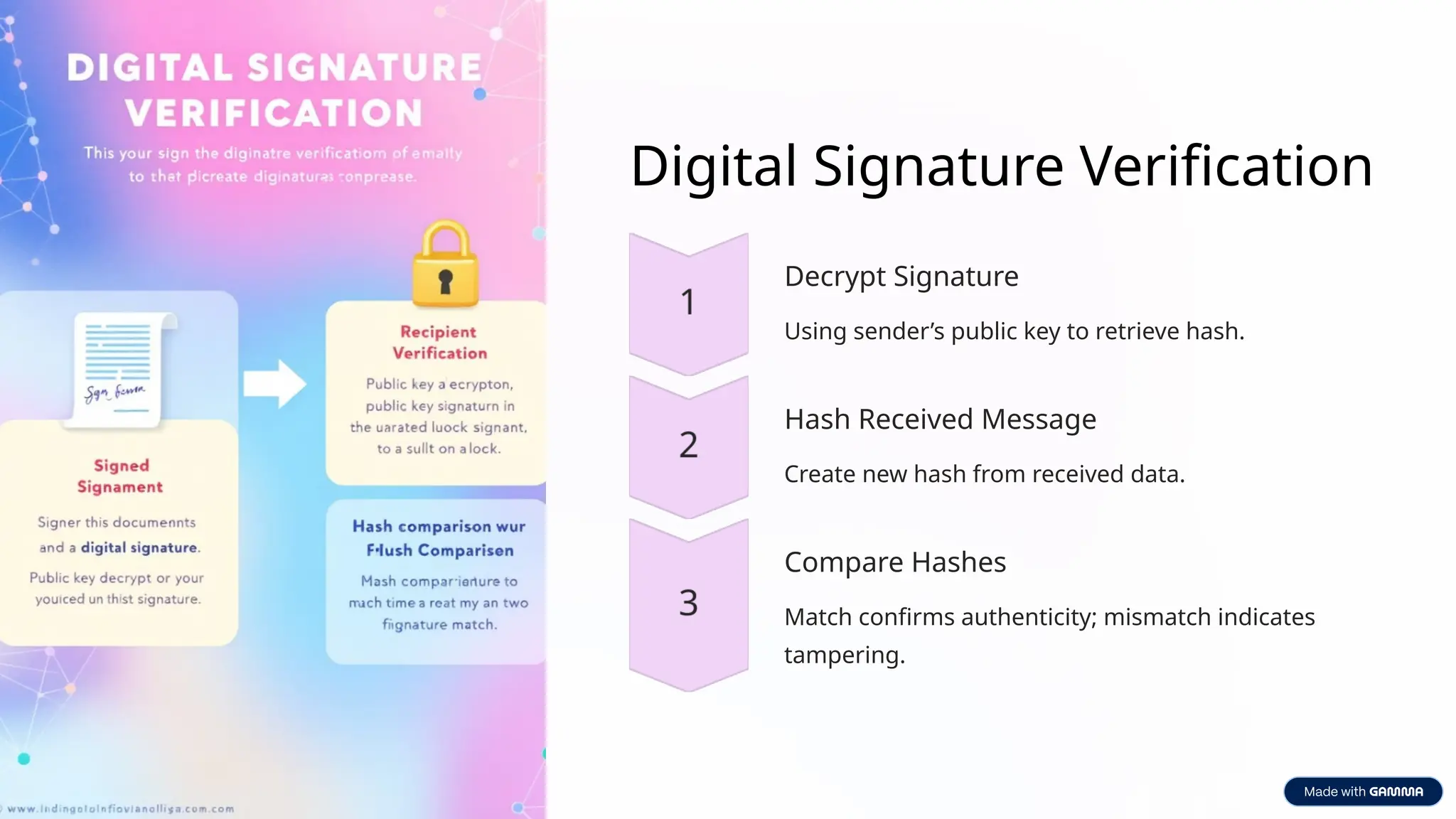
DecryptSignature
Using sender’s public key to retrieve hash.
Hash Received Message
Create new hash from received data.
Compare Hashes
Match confirms authenticity; mismatch indicates
tampering.
7.
Hash Functions: CorePrinciples
One-way
Irreversible calculation
process.
Deterministic
Same input gives same
output.
Collision-resistant
Hard to find two inputs
with same hash.
Common
Algorithms
• SHA-256
• SHA-3
• MD5 (legacy)
8.
Hash Functions: Applications
DataIntegrity
Detect any changes in files or
messages.
Password Storage
Securely store user passwords
with hashes.
Message Authentication
Codes
Combine hashing with
symmetric keys for
authentication.
9.
Real-World Examples
Secure Email
UseS/MIME and PGP to sign emails
digitally.
Software Distribution
Verify authenticity with digital
signatures.
Blockchain
Use hash functions to ensure block
integrity and link blocks.
10.
Conclusion: Enhancing Trust
inDigital Communication
1 Essential Tools
Digital signatures and
hash functions secure
communications.
2 Benefits
Improve security, trust,
and legal validity.
3 Future Trends
Quantum-resistant cryptography and advanced signatures
emerging.