Polymorphism
&
Abstract Class
Polymorphism
 Polymorphism is an object-oriented concept that allows us
to create versatile software designs that deals with multiple
objects.
 The term polymorphism literally means "having many
forms“ – can refer to multiple types of related objects over
time in consistence way.
 Polymorphism is one of the most elegant uses of
inheritance.
 A polymorphic reference is a variable that can refer to
different types of objects at different points in time.
Specifically, a reference variable of a superclass type can
refer to any object of its subclasses in the inheritance
hierarchy.
Polymorphic Reference
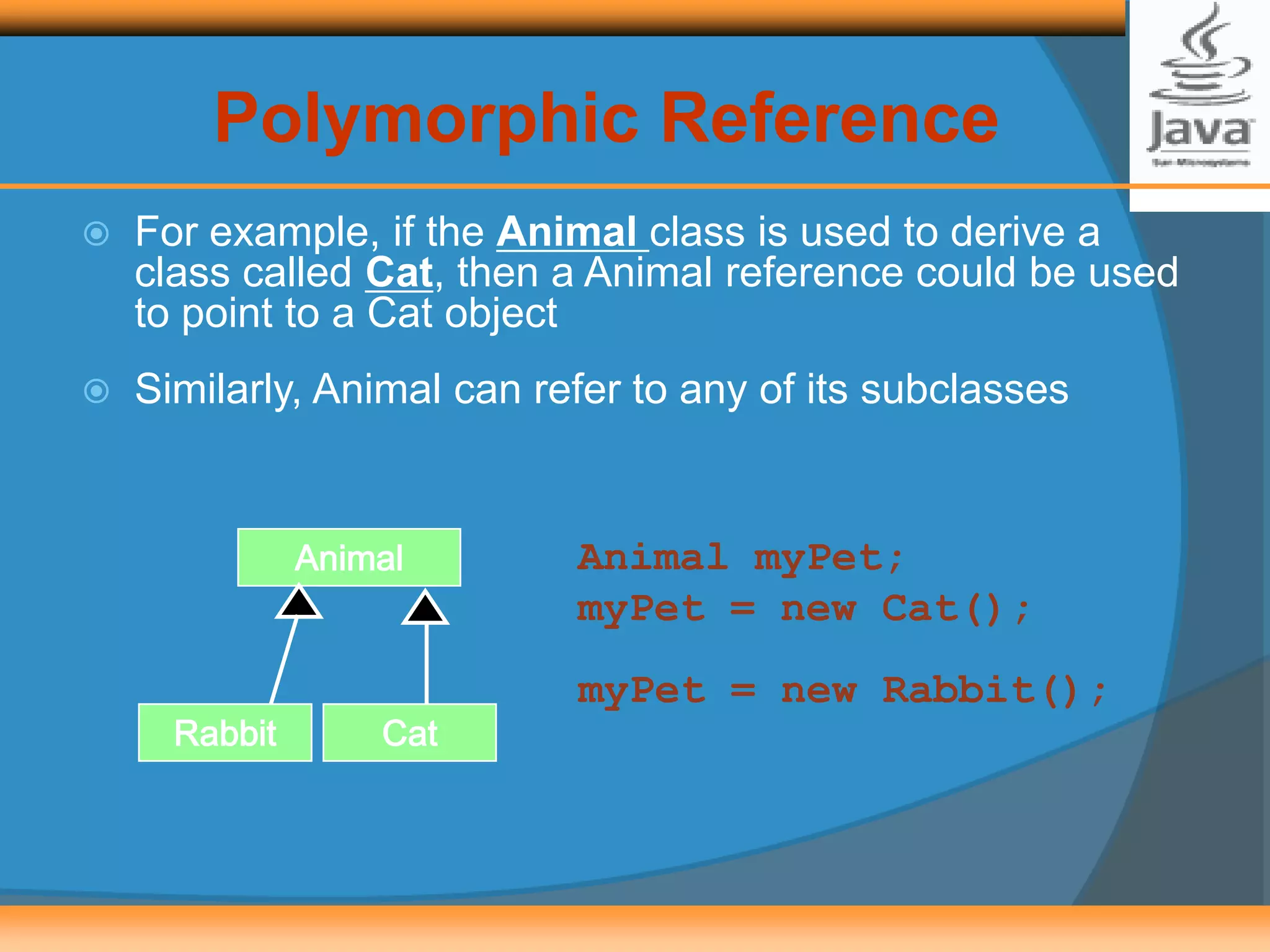
 For example, if the Animal class is used to derive a
class called Cat, then a Animal reference could be used
to point to a Cat object
 Similarly, Animal can refer to any of its subclasses
Animal myPet;
myPet = new Cat();
Animal
CatRabbit
myPet = new Rabbit();
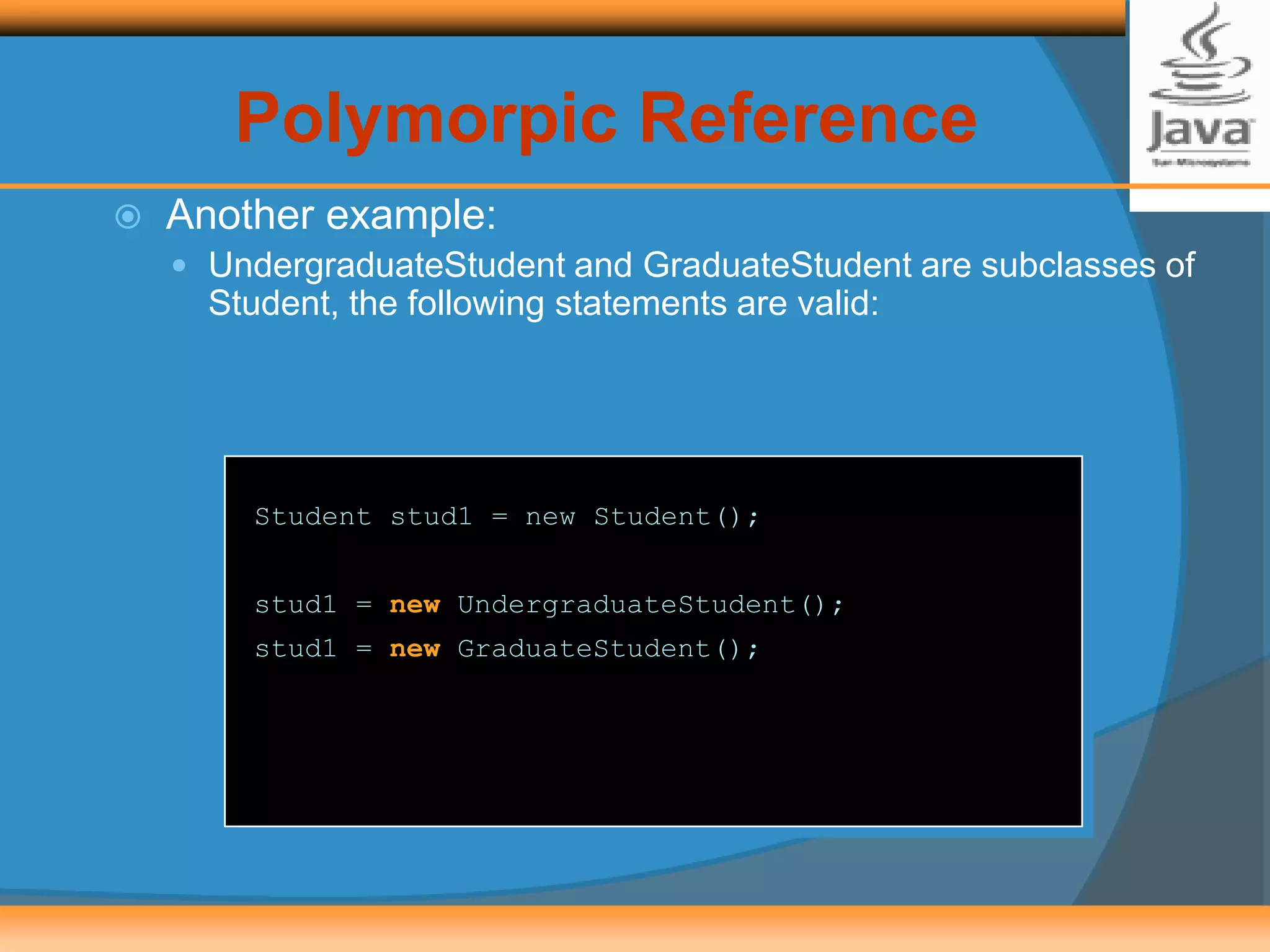
 Another example:
 UndergraduateStudent and GraduateStudent are subclasses of
Student, the following statements are valid:
Student stud1 = new Student();
stud1 = new UndergraduateStudent();
stud1 = new GraduateStudent();
Polymorpic Reference
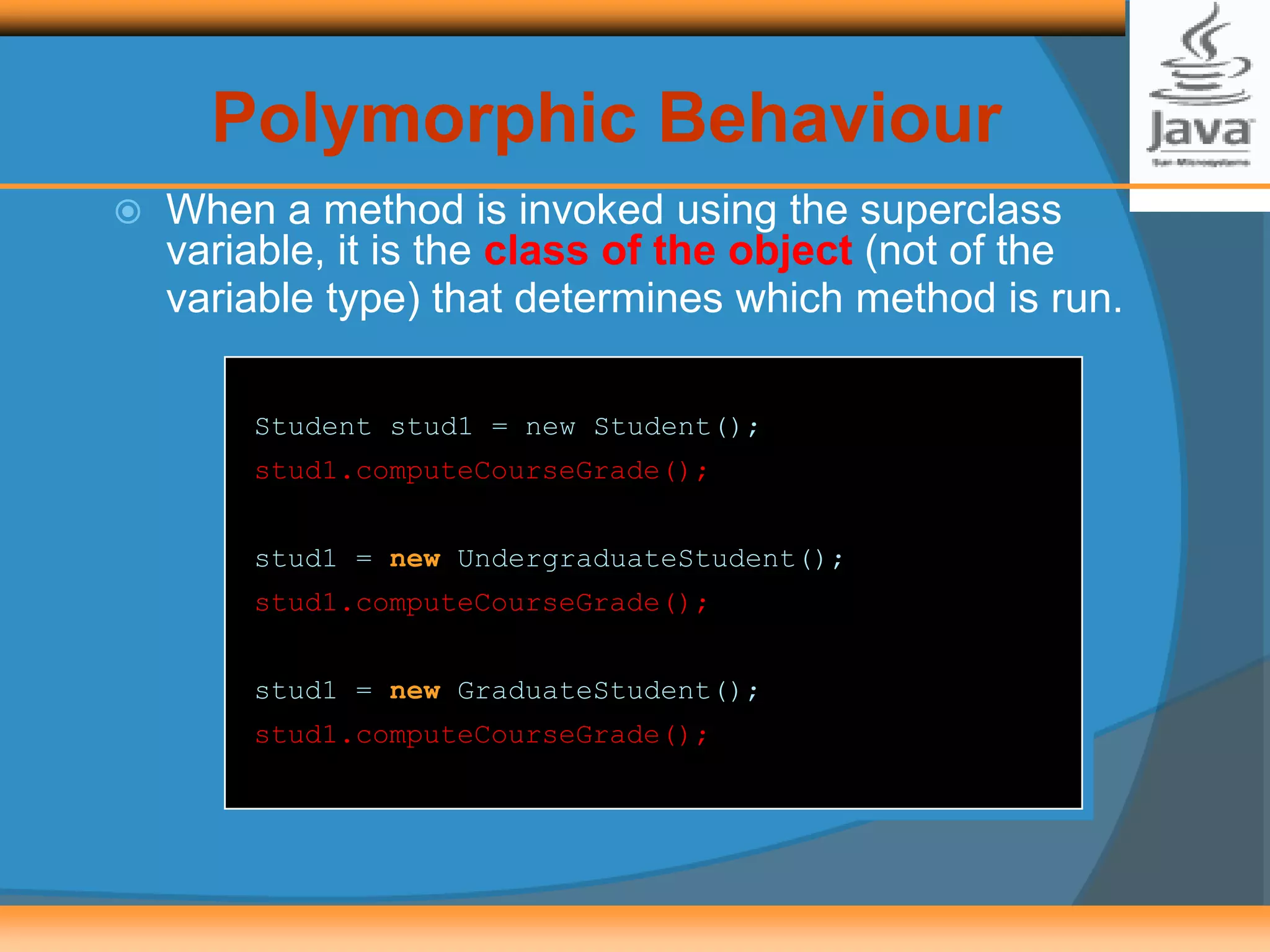
 When a method is invoked using the superclass
variable, it is the class of the object (not of the
variable type) that determines which method is run.
Student stud1 = new Student();
stud1.computeCourseGrade();
stud1 = new UndergraduateStudent();
stud1.computeCourseGrade();
stud1 = new GraduateStudent();
stud1.computeCourseGrade();
Polymorphic Behaviour
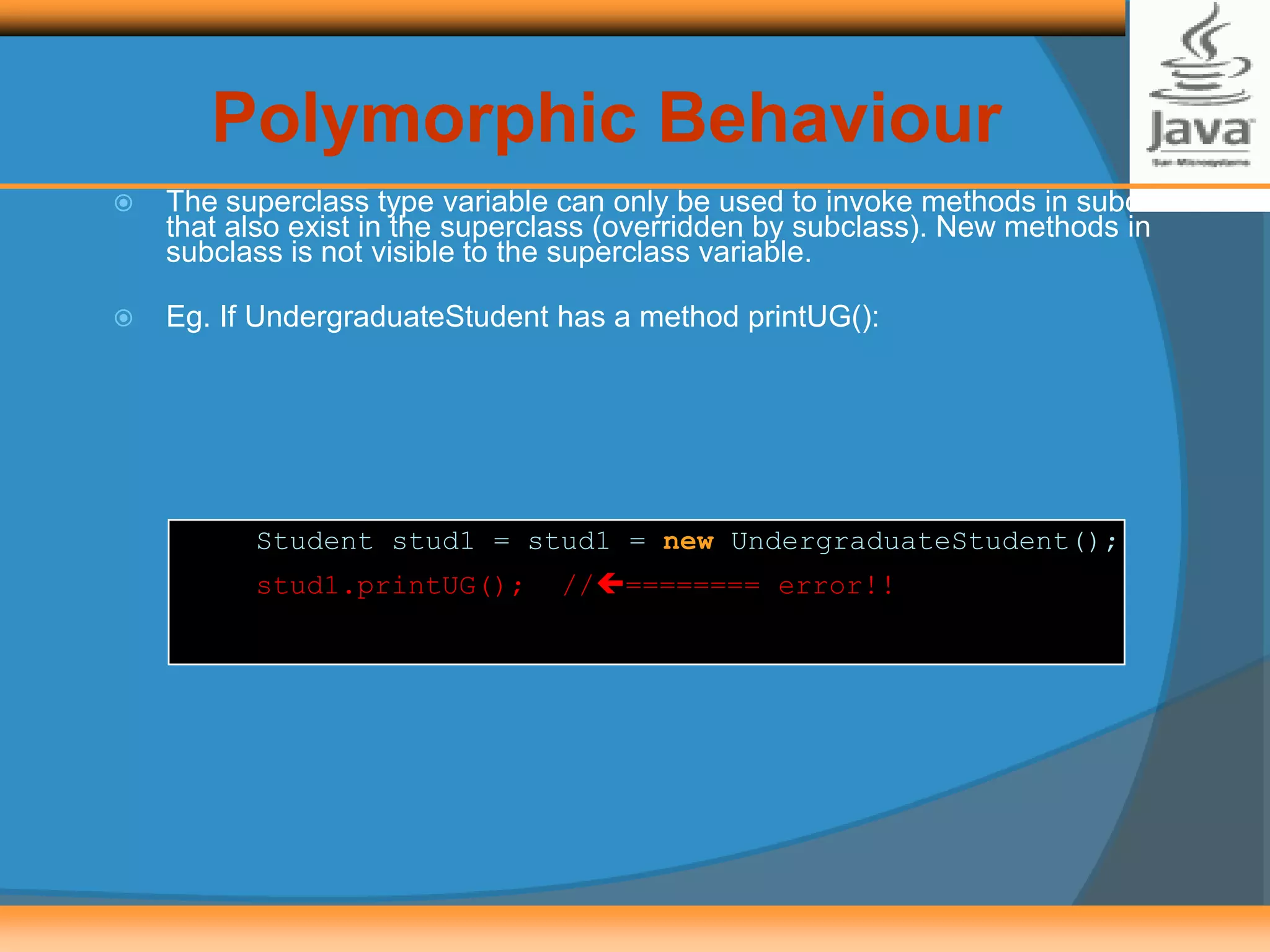
 The superclass type variable can only be used to invoke methods in subclass
that also exist in the superclass (overridden by subclass). New methods in
subclass is not visible to the superclass variable.
 Eg. If UndergraduateStudent has a method printUG():
Student stud1 = stud1 = new UndergraduateStudent();
stud1.printUG(); //======== error!!
Polymorphic Behaviour
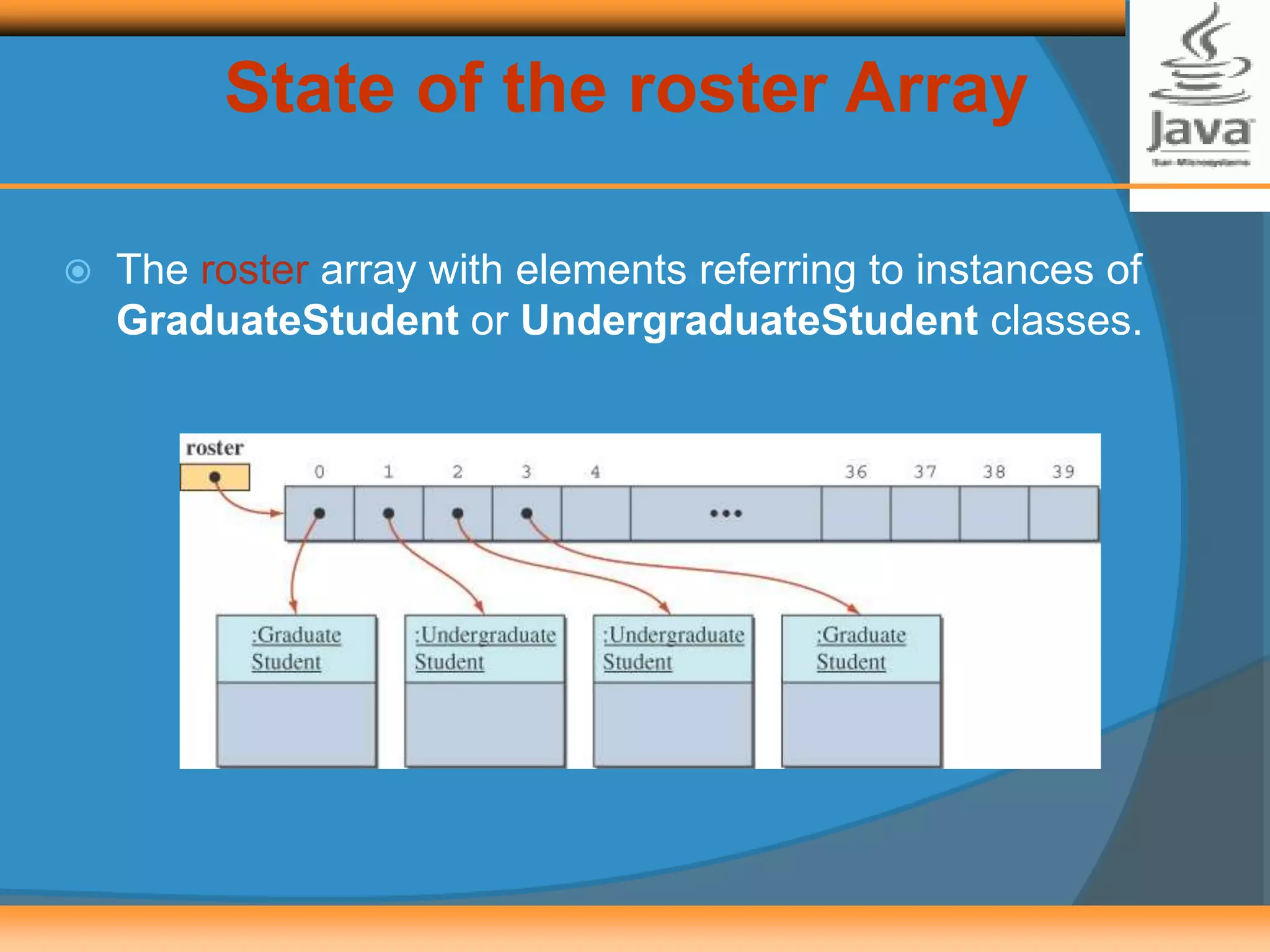
Creating the roster Array
 We can maintain our class roster using an array, combining
objects from the Student, UndergraduateStudent, and
GraduateStudent classes.
Student roster = new Student[40];
. . .
roster[0] = new GraduateStudent();
roster[1] = new UndergraduateStudent();
roster[2] = new UndergraduateStudent();
. . .
State of the roster Array
 The roster array with elements referring to instances of
GraduateStudent or UndergraduateStudent classes.
Sample Polymorphic Message
 To compute the course grade using the roster array, we execute
 If roster[i] refers to a GraduateStudent, then the computeCourseGrade
method of the GraduateStudent class is executed.
 If roster[i] refers to an UndergraduateStudent, then the
computeCourseGrade method of the UndergraduateStudent class is
executed.
for (int i = 0; i < numberOfStudents; i++) {
roster[i].computeCourseGrade();
}
The instanceof Operator
 The instanceof operator can help us learn the class of
an object.
 The following code counts the number of undergraduate
students.
int undergradCount = 0;
for (int i = 0; i < numberOfStudents; i++) {
if ( roster[i] instanceof UndergraduateStudent ) {
undergradCount++;
}
}
Abstract class
 a class that cannot be instantiated but that can be
the parent of other classes.
 objects can ONLY be created from subclass that
inherits from the abstract super (parent) class
 the subclass is forced to implement the abstract
method inherited from the super class through the
overriding process
Java Abstract classes
 An abstract class is a class that is declared with the reserved
word abstract in its heading.
abstract class ClassName {
. . . . . // definitions of methods and variables
}
Abstract classes rules
 An abstract class can contain instance variables, constructors,
the finalizer, and nonabstract methods
 An abstract class can contain abstract method(s).
 If a class contains an abstract method, then the class must be
declared abstract.
 We cannot instantiate an object from abstract class. We can only
declare a reference variable of an abstract class type.
 We can instantiate an object of a subsclass of an abstract class,
but only if the class gives the definitions of all the abstract
methods of the superclass.
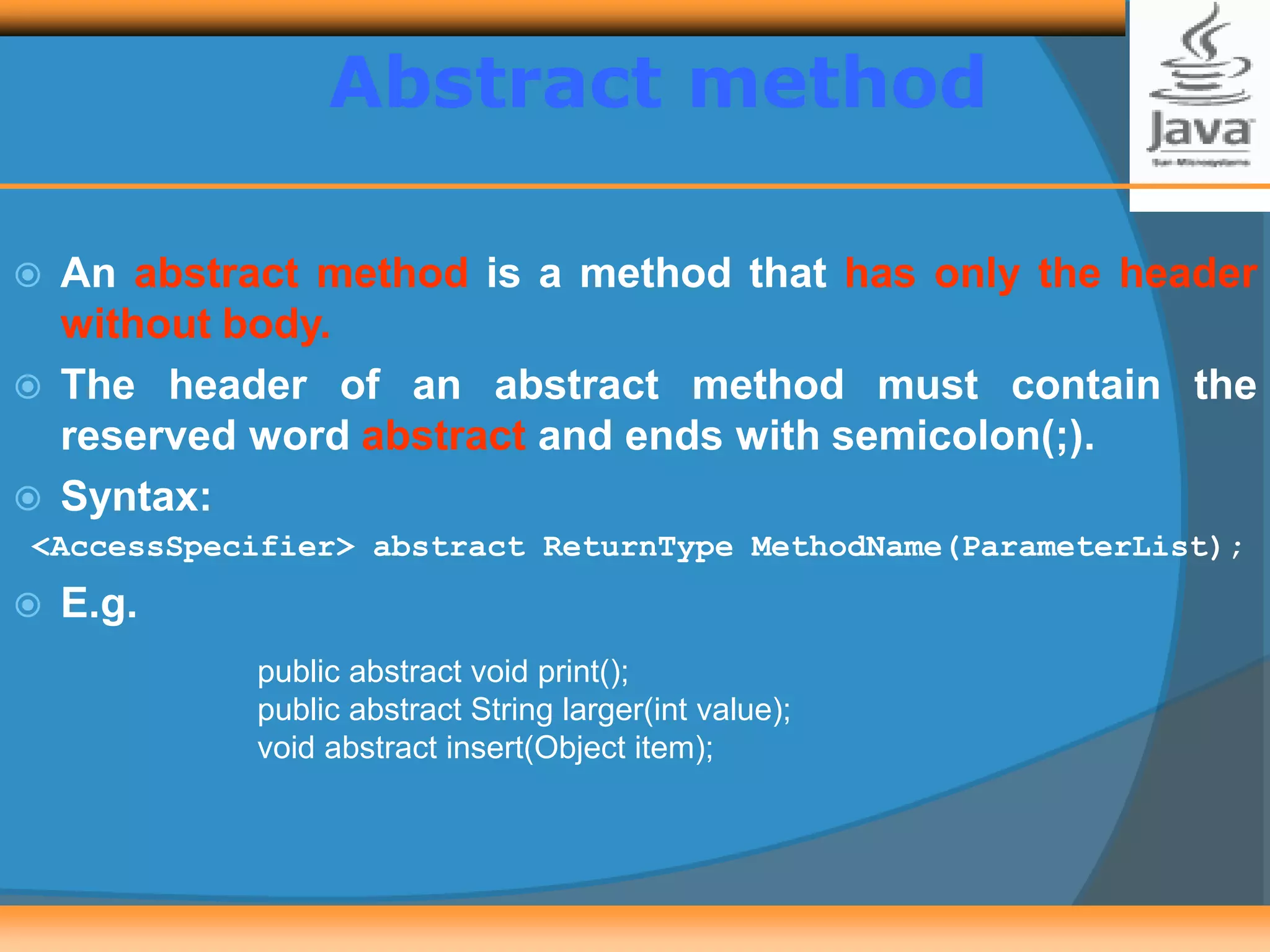
 An abstract method is a method that has only the header
without body.
 The header of an abstract method must contain the
reserved word abstract and ends with semicolon(;).
 Syntax:
<AccessSpecifier> abstract ReturnType MethodName(ParameterList);
 E.g.
public abstract void print();
public abstract String larger(int value);
void abstract insert(Object item);
Abstract method
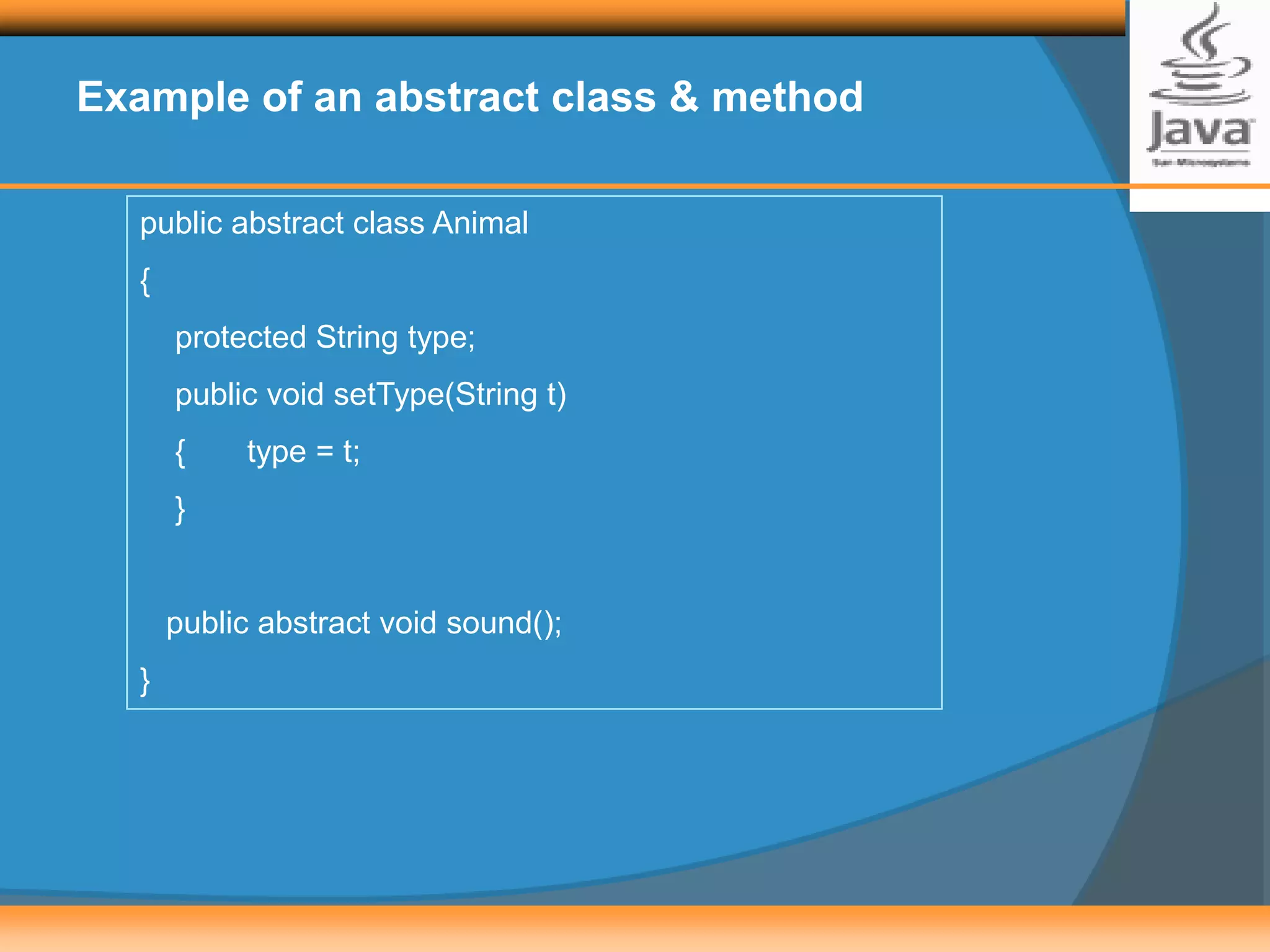
Example of an abstract class & method
public abstract class Animal
{
protected String type;
public void setType(String t)
{ type = t;
}
public abstract void sound();
}
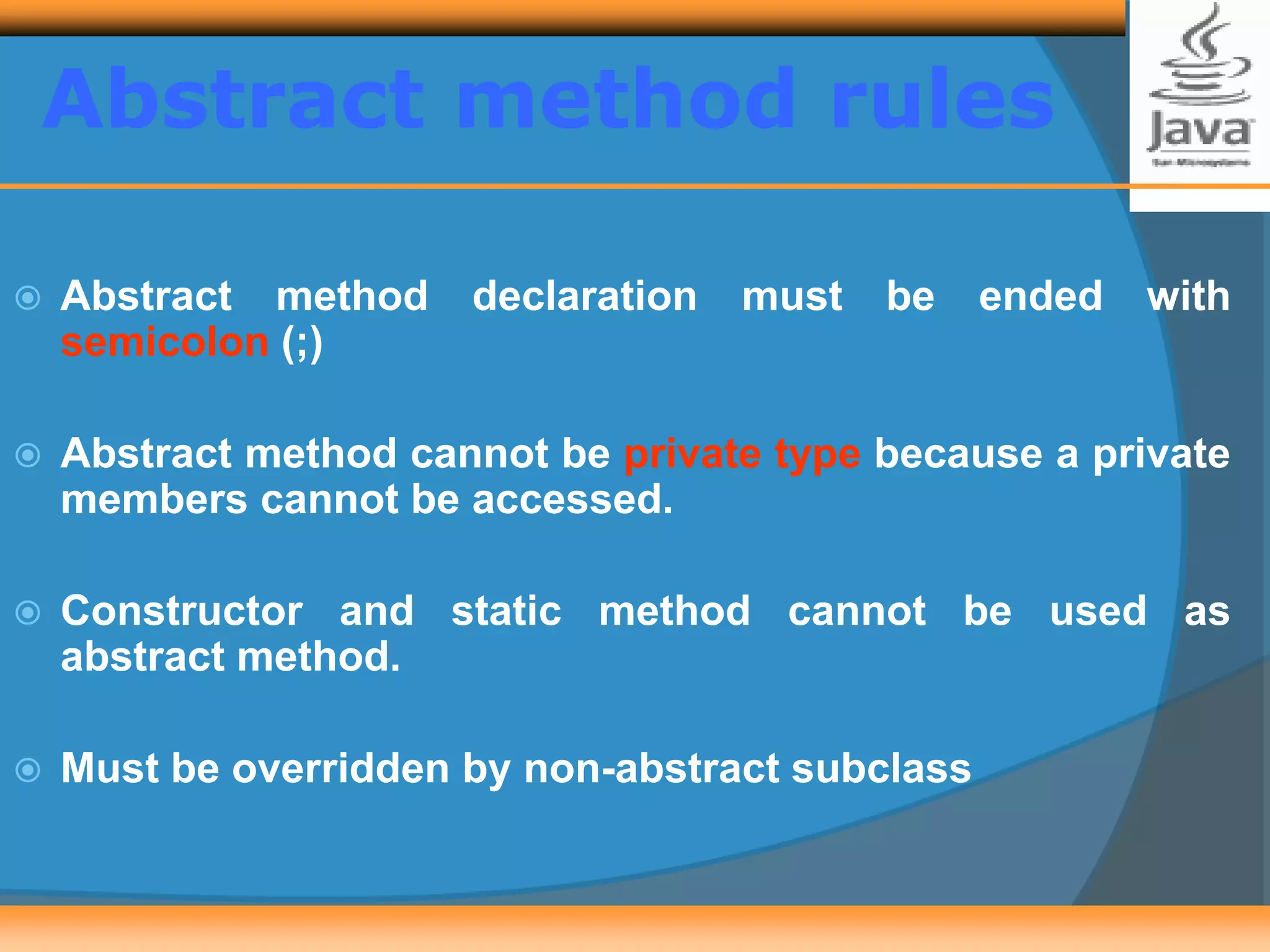
Abstract method rules
 Abstract method declaration must be ended with
semicolon (;)
 Abstract method cannot be private type because a private
members cannot be accessed.
 Constructor and static method cannot be used as
abstract method.
 Must be overridden by non-abstract subclass
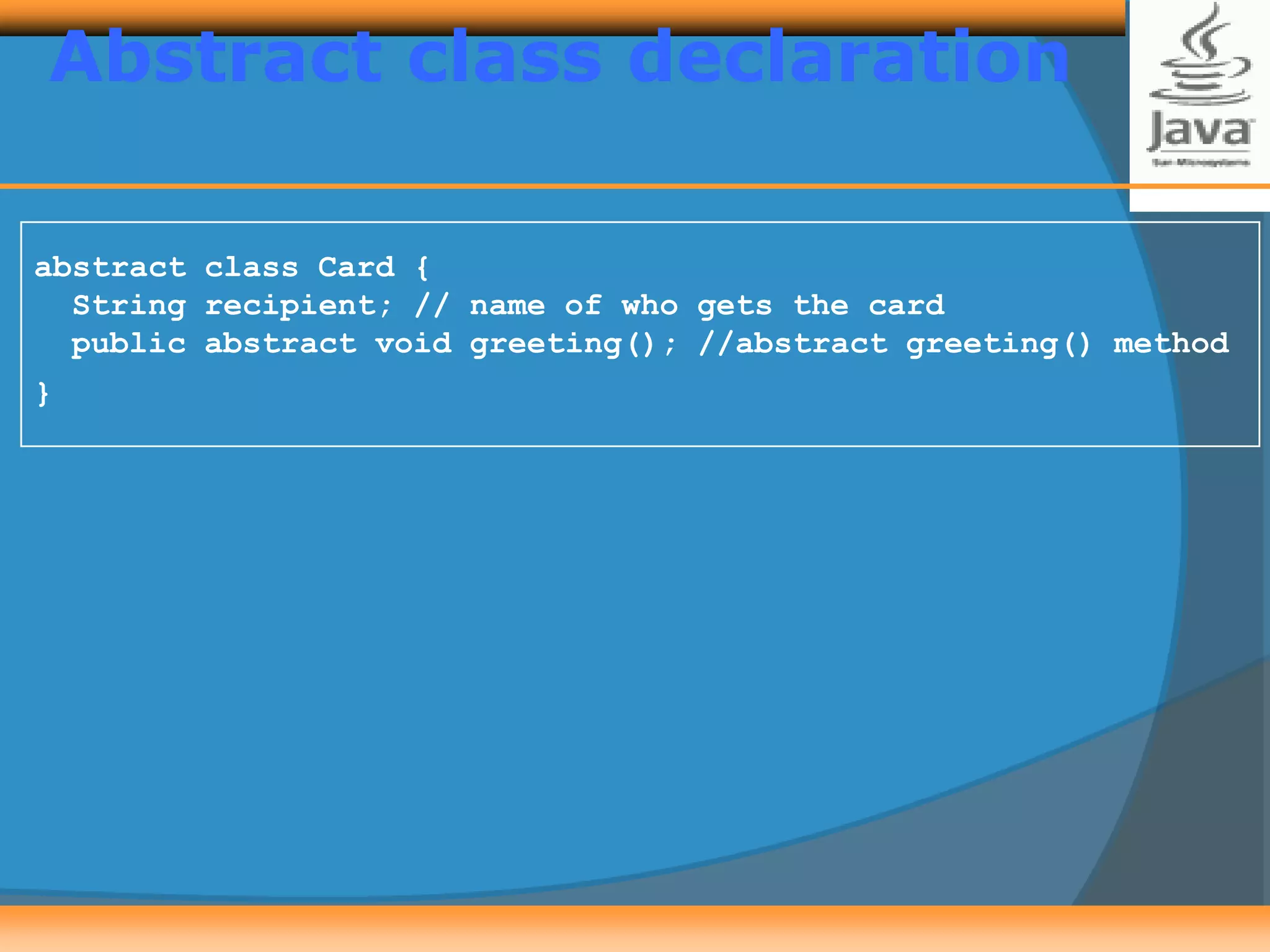
Abstract class declaration
abstract class Card {
String recipient; // name of who gets the card
public abstract void greeting(); //abstract greeting() method
}
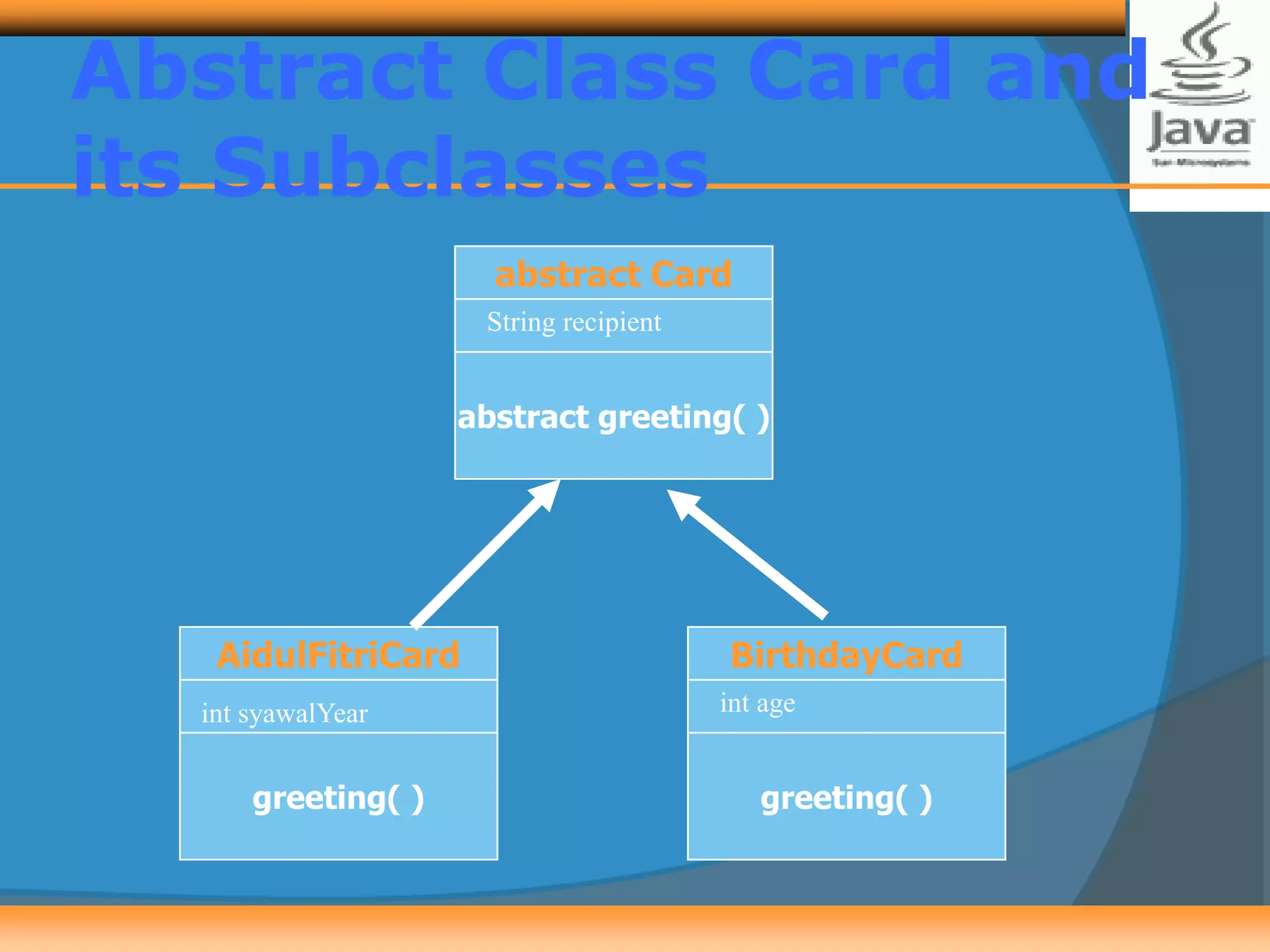
Abstract Class Card and
its Subclasses
abstract Card
abstract greeting( )
AidulFitriCard
greeting( )
BirthdayCard
greeting( )
String recipient
int ageint syawalYear
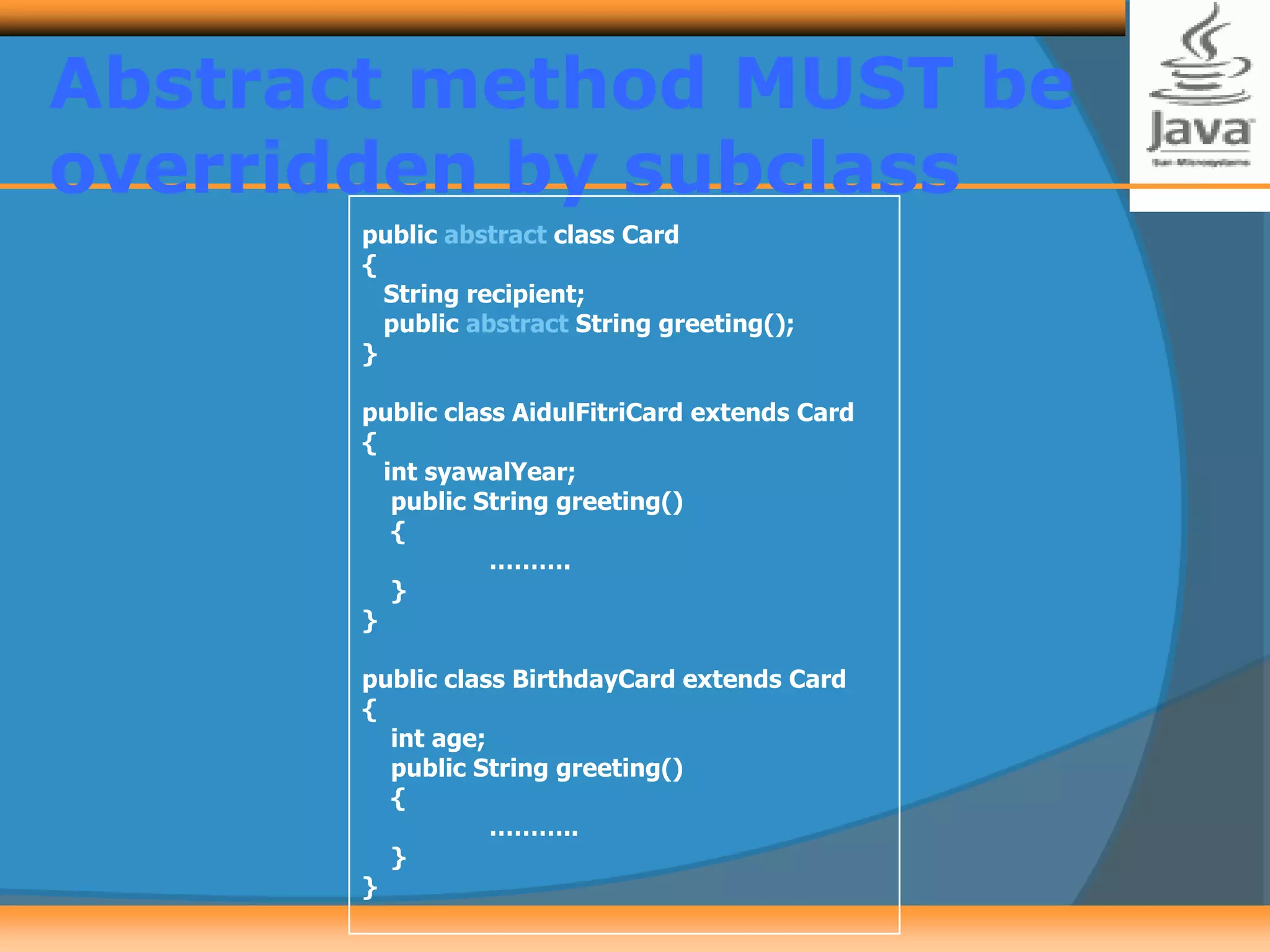
Abstract method MUST be
overridden by subclass
public abstract class Card
{
String recipient;
public abstract String greeting();
}
public class AidulFitriCard extends Card
{
int syawalYear;
public String greeting()
{
……….
}
}
public class BirthdayCard extends Card
{
int age;
public String greeting()
{
………..
}
}
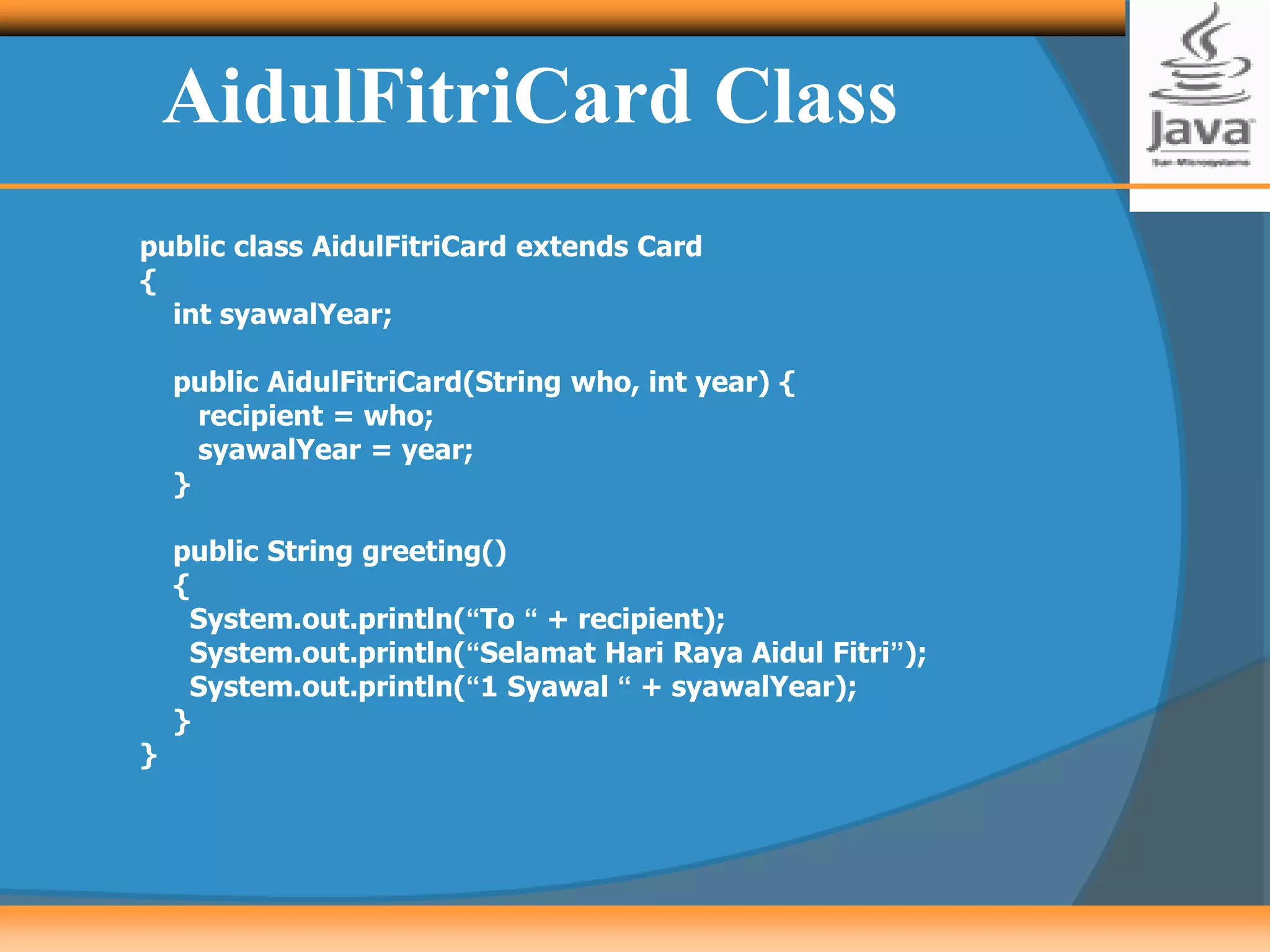
AidulFitriCard Class
public class AidulFitriCard extends Card
{
int syawalYear;
public AidulFitriCard(String who, int year) {
recipient = who;
syawalYear = year;
}
public String greeting()
{
System.out.println(“To “ + recipient);
System.out.println(“Selamat Hari Raya Aidul Fitri”);
System.out.println(“1 Syawal “ + syawalYear);
}
}
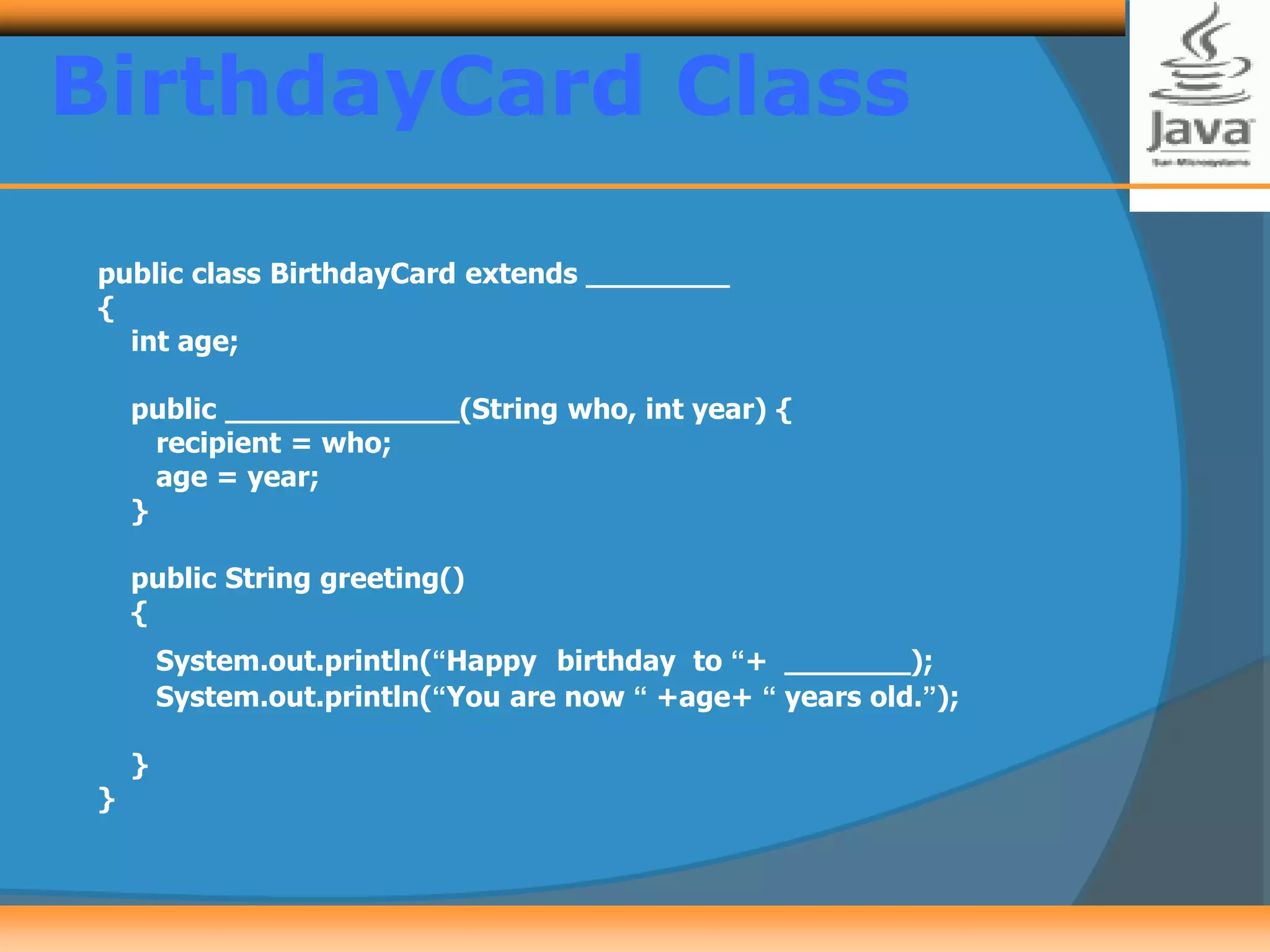
BirthdayCard Class
public class BirthdayCard extends ________
{
int age;
public _____________(String who, int year) {
recipient = who;
age = year;
}
public String greeting()
{
System.out.println(“Happy birthday to “+ _______);
System.out.println(“You are now “ +age+ “ years old.”);
}
}
CardTester Program
public class CardTester {
public static void main ( String[] args ) {
String name;
Scanner input = new Scanner(System.in);
System.out.print(“Your name please>");
name = input.nextLine();
Card myCard = new AidulFitri( me, 1429 );
myCard.greeting();
myCard = new BirthdayCard( me, 35 );
myCard.greeting();
}
}
- Demonstrate abstract class and polymorphism

Inheritance & Polymorphism - 2

  • 1.
  • 2.
    Polymorphism  Polymorphism isan object-oriented concept that allows us to create versatile software designs that deals with multiple objects.  The term polymorphism literally means "having many forms“ – can refer to multiple types of related objects over time in consistence way.  Polymorphism is one of the most elegant uses of inheritance.  A polymorphic reference is a variable that can refer to different types of objects at different points in time. Specifically, a reference variable of a superclass type can refer to any object of its subclasses in the inheritance hierarchy.
  • 3.
    Polymorphic Reference  Forexample, if the Animal class is used to derive a class called Cat, then a Animal reference could be used to point to a Cat object  Similarly, Animal can refer to any of its subclasses Animal myPet; myPet = new Cat(); Animal CatRabbit myPet = new Rabbit();
  • 4.
     Another example: UndergraduateStudent and GraduateStudent are subclasses of Student, the following statements are valid: Student stud1 = new Student(); stud1 = new UndergraduateStudent(); stud1 = new GraduateStudent(); Polymorpic Reference
  • 5.
     When amethod is invoked using the superclass variable, it is the class of the object (not of the variable type) that determines which method is run. Student stud1 = new Student(); stud1.computeCourseGrade(); stud1 = new UndergraduateStudent(); stud1.computeCourseGrade(); stud1 = new GraduateStudent(); stud1.computeCourseGrade(); Polymorphic Behaviour
  • 6.
     The superclasstype variable can only be used to invoke methods in subclass that also exist in the superclass (overridden by subclass). New methods in subclass is not visible to the superclass variable.  Eg. If UndergraduateStudent has a method printUG(): Student stud1 = stud1 = new UndergraduateStudent(); stud1.printUG(); //======== error!! Polymorphic Behaviour
  • 7.
    Creating the rosterArray  We can maintain our class roster using an array, combining objects from the Student, UndergraduateStudent, and GraduateStudent classes. Student roster = new Student[40]; . . . roster[0] = new GraduateStudent(); roster[1] = new UndergraduateStudent(); roster[2] = new UndergraduateStudent(); . . .
  • 8.
    State of theroster Array  The roster array with elements referring to instances of GraduateStudent or UndergraduateStudent classes.
  • 9.
    Sample Polymorphic Message To compute the course grade using the roster array, we execute  If roster[i] refers to a GraduateStudent, then the computeCourseGrade method of the GraduateStudent class is executed.  If roster[i] refers to an UndergraduateStudent, then the computeCourseGrade method of the UndergraduateStudent class is executed. for (int i = 0; i < numberOfStudents; i++) { roster[i].computeCourseGrade(); }
  • 10.
    The instanceof Operator The instanceof operator can help us learn the class of an object.  The following code counts the number of undergraduate students. int undergradCount = 0; for (int i = 0; i < numberOfStudents; i++) { if ( roster[i] instanceof UndergraduateStudent ) { undergradCount++; } }
  • 11.
    Abstract class  aclass that cannot be instantiated but that can be the parent of other classes.  objects can ONLY be created from subclass that inherits from the abstract super (parent) class  the subclass is forced to implement the abstract method inherited from the super class through the overriding process
  • 12.
    Java Abstract classes An abstract class is a class that is declared with the reserved word abstract in its heading. abstract class ClassName { . . . . . // definitions of methods and variables }
  • 13.
    Abstract classes rules An abstract class can contain instance variables, constructors, the finalizer, and nonabstract methods  An abstract class can contain abstract method(s).  If a class contains an abstract method, then the class must be declared abstract.  We cannot instantiate an object from abstract class. We can only declare a reference variable of an abstract class type.  We can instantiate an object of a subsclass of an abstract class, but only if the class gives the definitions of all the abstract methods of the superclass.
  • 14.
     An abstractmethod is a method that has only the header without body.  The header of an abstract method must contain the reserved word abstract and ends with semicolon(;).  Syntax: <AccessSpecifier> abstract ReturnType MethodName(ParameterList);  E.g. public abstract void print(); public abstract String larger(int value); void abstract insert(Object item); Abstract method
  • 15.
    Example of anabstract class & method public abstract class Animal { protected String type; public void setType(String t) { type = t; } public abstract void sound(); }
  • 16.
    Abstract method rules Abstract method declaration must be ended with semicolon (;)  Abstract method cannot be private type because a private members cannot be accessed.  Constructor and static method cannot be used as abstract method.  Must be overridden by non-abstract subclass
  • 17.
    Abstract class declaration abstractclass Card { String recipient; // name of who gets the card public abstract void greeting(); //abstract greeting() method }
  • 18.
    Abstract Class Cardand its Subclasses abstract Card abstract greeting( ) AidulFitriCard greeting( ) BirthdayCard greeting( ) String recipient int ageint syawalYear
  • 19.
    Abstract method MUSTbe overridden by subclass public abstract class Card { String recipient; public abstract String greeting(); } public class AidulFitriCard extends Card { int syawalYear; public String greeting() { ………. } } public class BirthdayCard extends Card { int age; public String greeting() { ……….. } }
  • 20.
    AidulFitriCard Class public classAidulFitriCard extends Card { int syawalYear; public AidulFitriCard(String who, int year) { recipient = who; syawalYear = year; } public String greeting() { System.out.println(“To “ + recipient); System.out.println(“Selamat Hari Raya Aidul Fitri”); System.out.println(“1 Syawal “ + syawalYear); } }
  • 21.
    BirthdayCard Class public classBirthdayCard extends ________ { int age; public _____________(String who, int year) { recipient = who; age = year; } public String greeting() { System.out.println(“Happy birthday to “+ _______); System.out.println(“You are now “ +age+ “ years old.”); } }
  • 22.
    CardTester Program public classCardTester { public static void main ( String[] args ) { String name; Scanner input = new Scanner(System.in); System.out.print(“Your name please>"); name = input.nextLine(); Card myCard = new AidulFitri( me, 1429 ); myCard.greeting(); myCard = new BirthdayCard( me, 35 ); myCard.greeting(); } } - Demonstrate abstract class and polymorphism