Private and Confidential
Moving to the C-Suite
July 2016
David Finke
Stephanie Fujii
Art Hopkins
Tuck Rickards
Jackie Ross
Private and Confidential 2
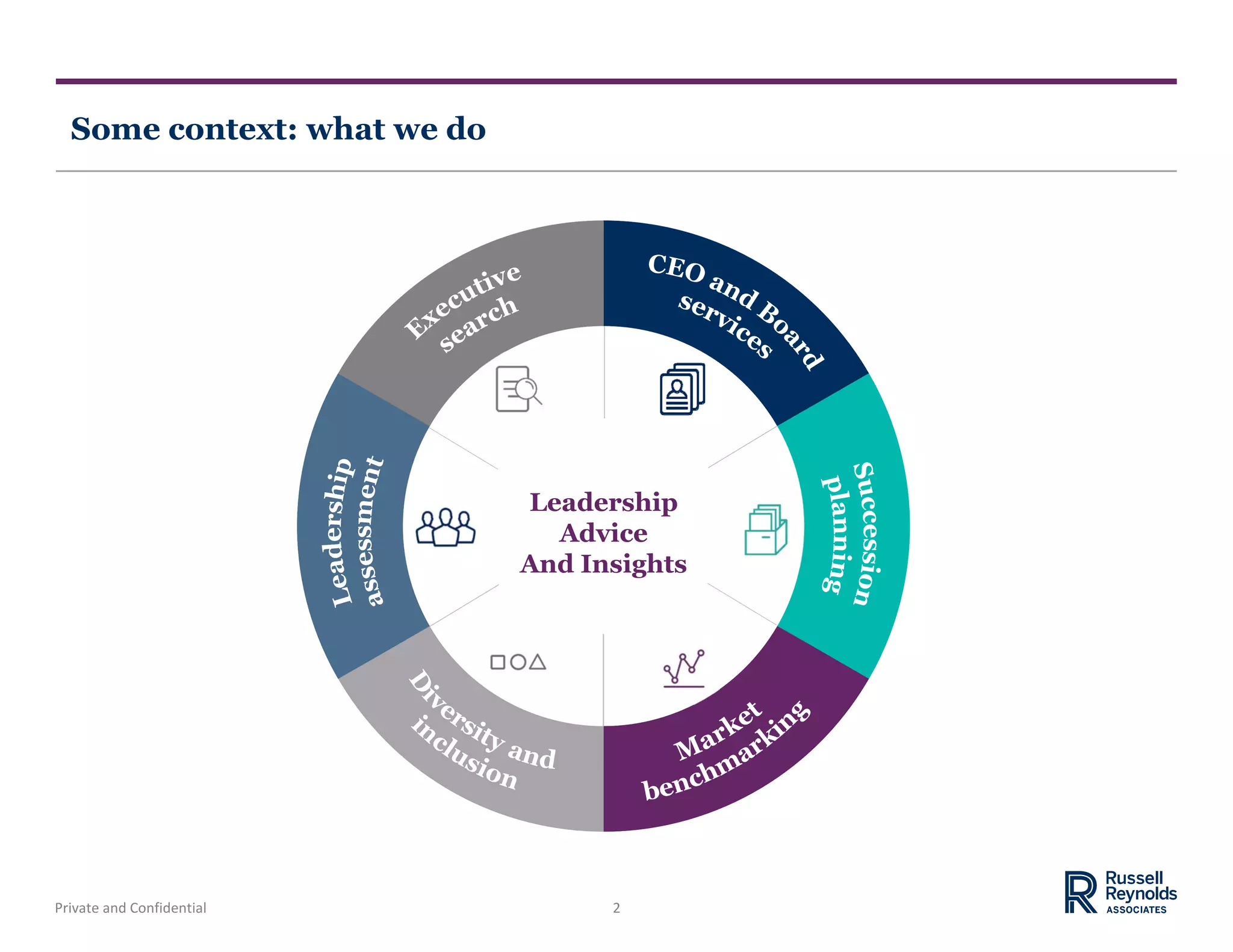
Some context: what we do
Leadership
Advice
And Insights
Private and Confidential 3
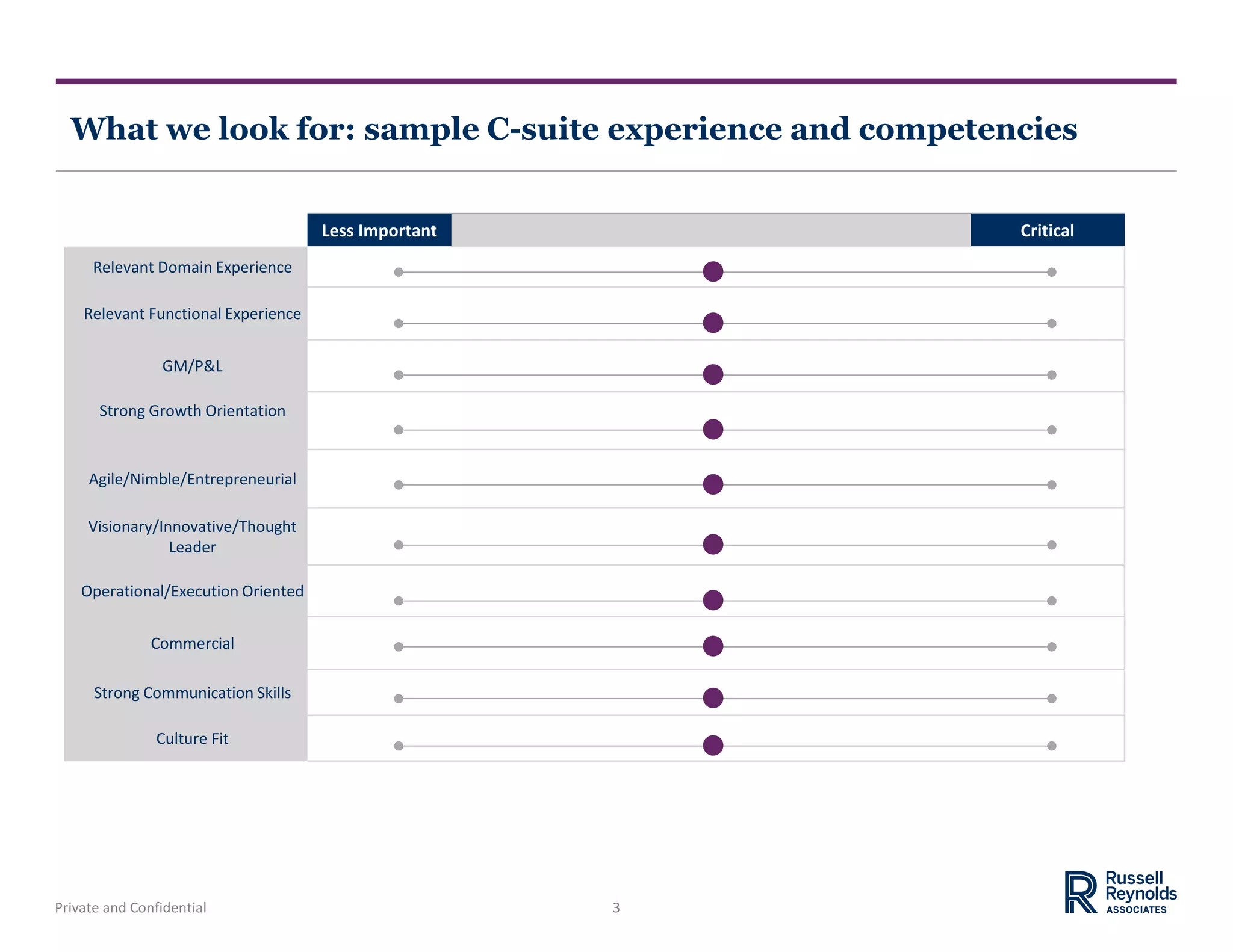
What we look for: sample C-suite experience and competencies
Less Important Critical
Relevant Domain Experience
Relevant Functional Experience
GM/P&L
Strong Growth Orientation
Agile/Nimble/Entrepreneurial
Visionary/Innovative/Thought
Leader
Operational/Execution Oriented
Commercial
Strong Communication Skills
Culture Fit
Private and Confidential 4
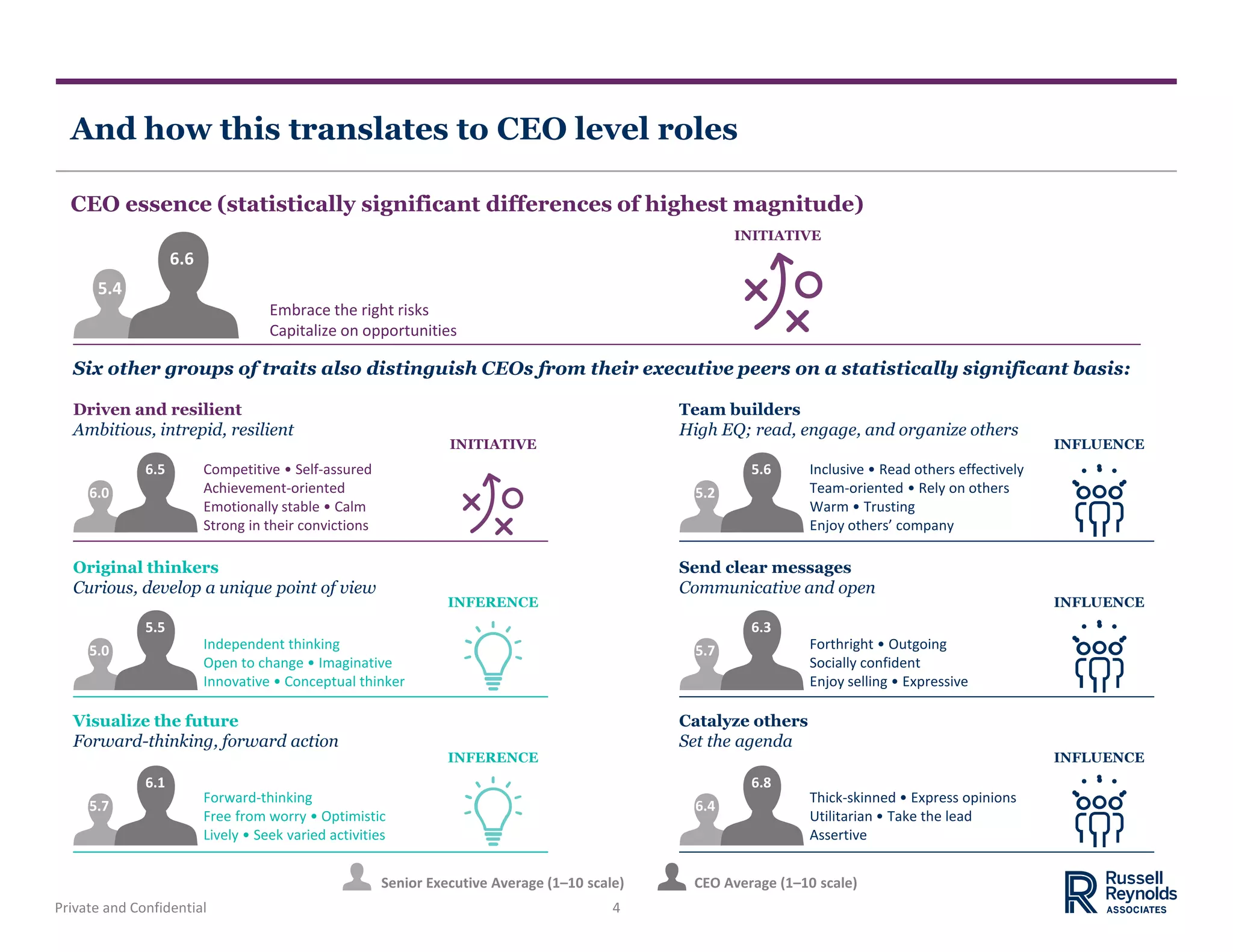
And how this translates to CEO level roles
CEO essence (statistically significant differences of highest magnitude)
5.4
6.6
Embrace the right risks
Capitalize on opportunities
Competitive • Self-assured
Achievement-oriented
Emotionally stable • Calm
Strong in their convictions
6.0
6.5
INITIATIVE
Independent thinking
Open to change • Imaginative
Innovative • Conceptual thinker
5.0
5.5
INFERENCE
Forward-thinking
Free from worry • Optimistic
Lively • Seek varied activities
5.7
6.1
INFERENCE
Visualize the future
Forward-thinking, forward action
Original thinkers
Curious, develop a unique point of view
Driven and resilient
Ambitious, intrepid, resilient
Inclusive • Read others effectively
Team-oriented • Rely on others
Warm • Trusting
Enjoy others’ company
5.2
5.6
INFLUENCE
Forthright • Outgoing
Socially confident
Enjoy selling • Expressive
5.7
6.3
INFLUENCE
Thick-skinned • Express opinions
Utilitarian • Take the lead
Assertive
6.4
6.8
INFLUENCE
Catalyze others
Set the agenda
Send clear messages
Communicative and open
Team builders
High EQ; read, engage, and organize others
Six other groups of traits also distinguish CEOs from their executive peers on a statistically significant basis:
INITIATIVE
Senior Executive Average (1–10 scale) CEO Average (1–10 scale)
Private and Confidential 5
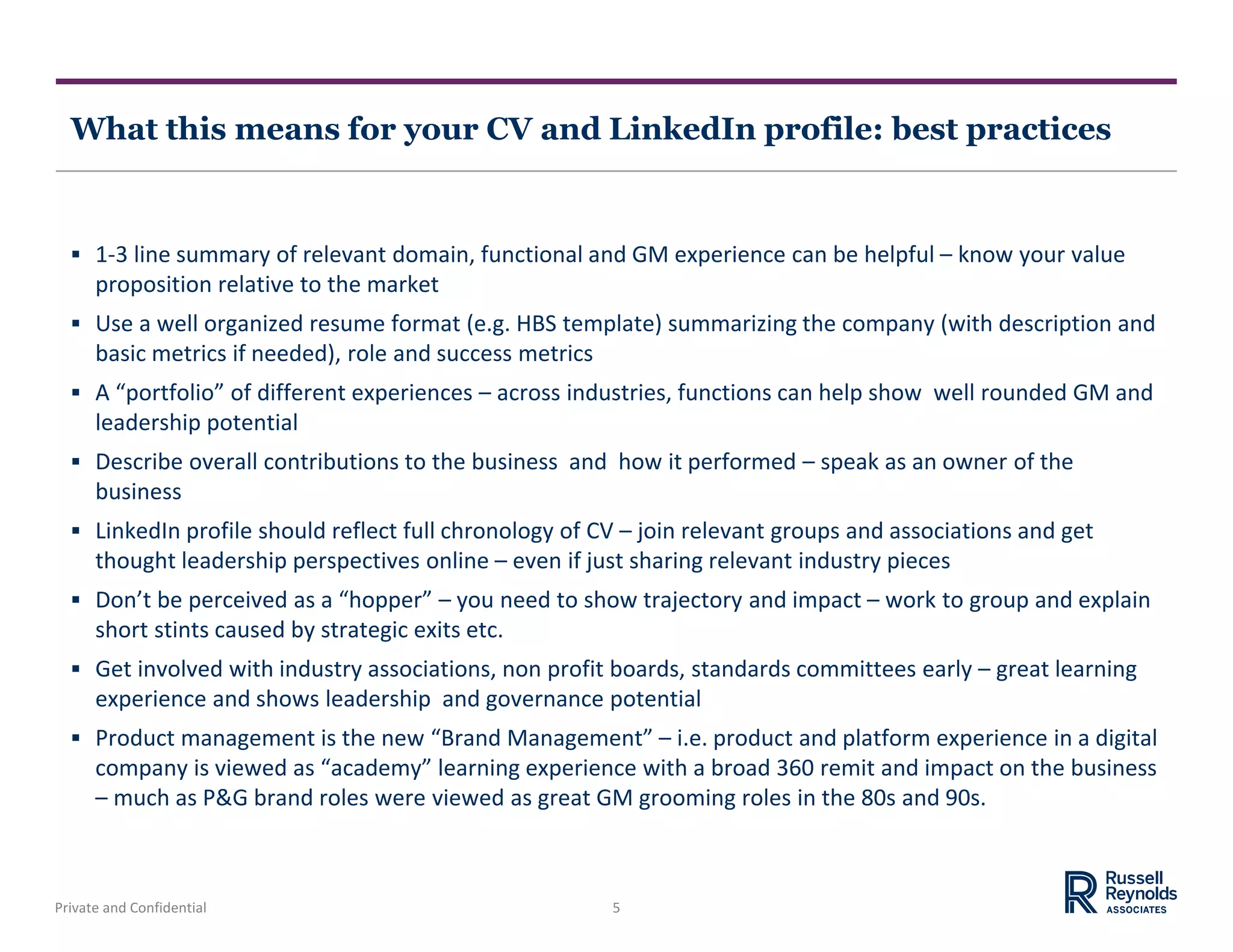
What this means for your CV and LinkedIn profile: best practices
 1-3 line summary of relevant domain, functional and GM experience can be helpful – know your value
proposition relative to the market
 Use a well organized resume format (e.g. HBS template) summarizing the company (with description and
basic metrics if needed), role and success metrics
 A “portfolio” of different experiences – across industries, functions can help show well rounded GM and
leadership potential
 Describe overall contributions to the business and how it performed – speak as an owner of the
business
 LinkedIn profile should reflect full chronology of CV – join relevant groups and associations and get
thought leadership perspectives online – even if just sharing relevant industry pieces
 Don’t be perceived as a “hopper” – you need to show trajectory and impact – work to group and explain
short stints caused by strategic exits etc.
 Get involved with industry associations, non profit boards, standards committees early – great learning
experience and shows leadership and governance potential
 Product management is the new “Brand Management” – i.e. product and platform experience in a digital
company is viewed as “academy” learning experience with a broad 360 remit and impact on the business
– much as P&G brand roles were viewed as great GM grooming roles in the 80s and 90s.
Private and Confidential 6
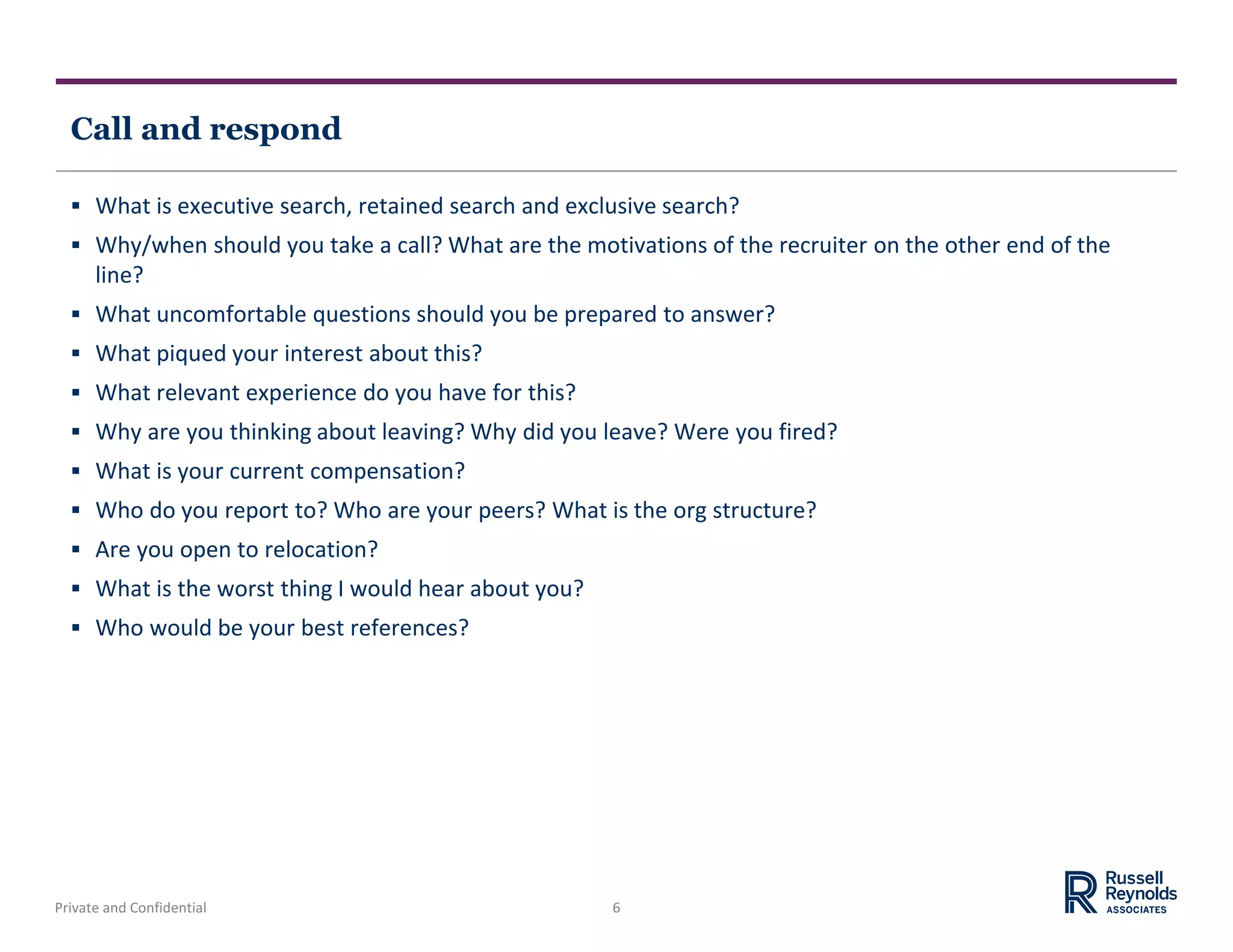
Call and respond
 What is executive search, retained search and exclusive search?
 Why/when should you take a call? What are the motivations of the recruiter on the other end of the
line?
 What uncomfortable questions should you be prepared to answer?
 What piqued your interest about this?
 What relevant experience do you have for this?
 Why are you thinking about leaving? Why did you leave? Were you fired?
 What is your current compensation?
 Who do you report to? Who are your peers? What is the org structure?
 Are you open to relocation?
 What is the worst thing I would hear about you?
 Who would be your best references?
Private and Confidential 7
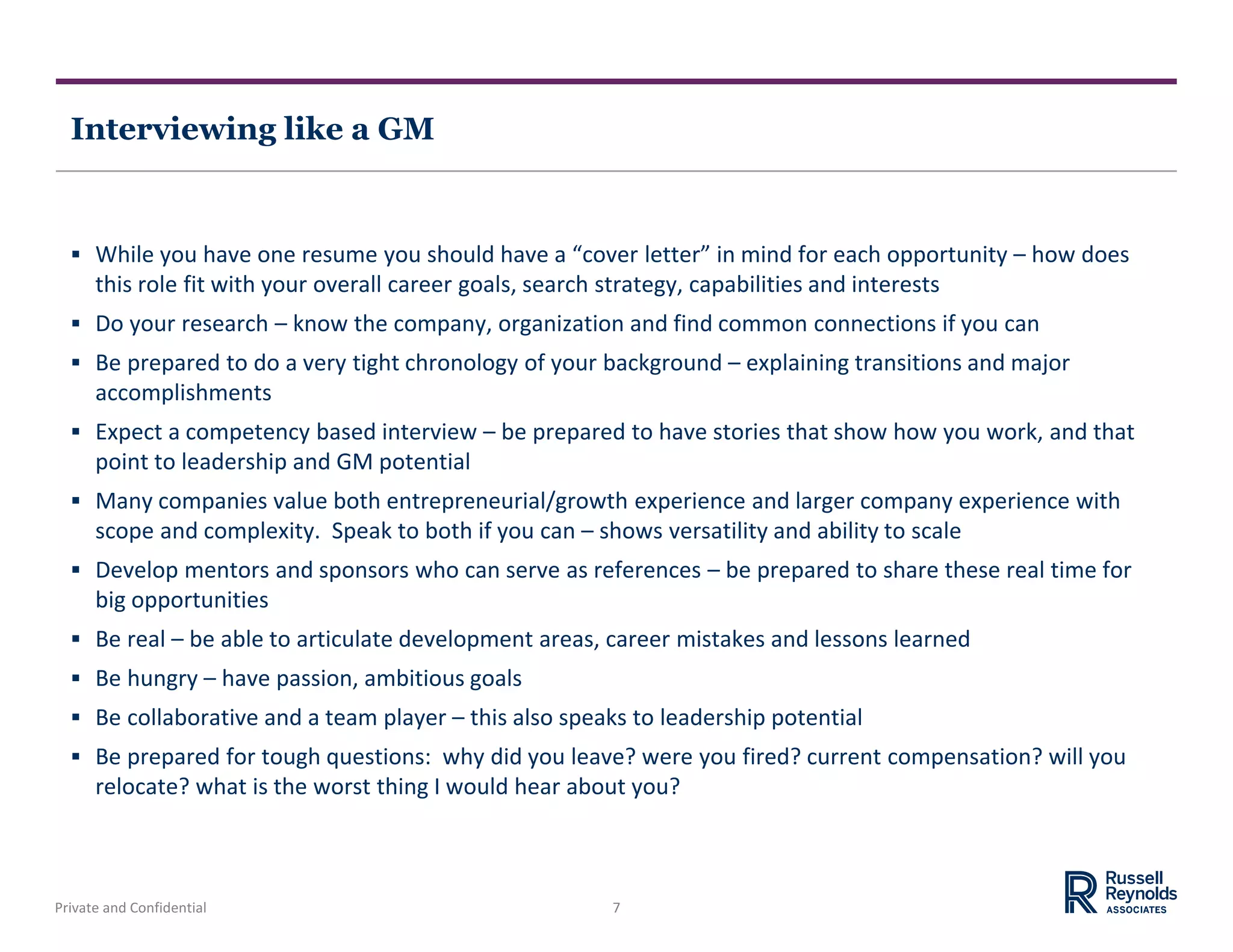
Interviewing like a GM
 While you have one resume you should have a “cover letter” in mind for each opportunity – how does
this role fit with your overall career goals, search strategy, capabilities and interests
 Do your research – know the company, organization and find common connections if you can
 Be prepared to do a very tight chronology of your background – explaining transitions and major
accomplishments
 Expect a competency based interview – be prepared to have stories that show how you work, and that
point to leadership and GM potential
 Many companies value both entrepreneurial/growth experience and larger company experience with
scope and complexity. Speak to both if you can – shows versatility and ability to scale
 Develop mentors and sponsors who can serve as references – be prepared to share these real time for
big opportunities
 Be real – be able to articulate development areas, career mistakes and lessons learned
 Be hungry – have passion, ambitious goals
 Be collaborative and a team player – this also speaks to leadership potential
 Be prepared for tough questions: why did you leave? were you fired? current compensation? will you
relocate? what is the worst thing I would hear about you?

How to move to the C-Suite

  • 1.
    Private and Confidential Movingto the C-Suite July 2016 David Finke Stephanie Fujii Art Hopkins Tuck Rickards Jackie Ross
  • 2.
    Private and Confidential2 Some context: what we do Leadership Advice And Insights
  • 3.
    Private and Confidential3 What we look for: sample C-suite experience and competencies Less Important Critical Relevant Domain Experience Relevant Functional Experience GM/P&L Strong Growth Orientation Agile/Nimble/Entrepreneurial Visionary/Innovative/Thought Leader Operational/Execution Oriented Commercial Strong Communication Skills Culture Fit
  • 4.
    Private and Confidential4 And how this translates to CEO level roles CEO essence (statistically significant differences of highest magnitude) 5.4 6.6 Embrace the right risks Capitalize on opportunities Competitive • Self-assured Achievement-oriented Emotionally stable • Calm Strong in their convictions 6.0 6.5 INITIATIVE Independent thinking Open to change • Imaginative Innovative • Conceptual thinker 5.0 5.5 INFERENCE Forward-thinking Free from worry • Optimistic Lively • Seek varied activities 5.7 6.1 INFERENCE Visualize the future Forward-thinking, forward action Original thinkers Curious, develop a unique point of view Driven and resilient Ambitious, intrepid, resilient Inclusive • Read others effectively Team-oriented • Rely on others Warm • Trusting Enjoy others’ company 5.2 5.6 INFLUENCE Forthright • Outgoing Socially confident Enjoy selling • Expressive 5.7 6.3 INFLUENCE Thick-skinned • Express opinions Utilitarian • Take the lead Assertive 6.4 6.8 INFLUENCE Catalyze others Set the agenda Send clear messages Communicative and open Team builders High EQ; read, engage, and organize others Six other groups of traits also distinguish CEOs from their executive peers on a statistically significant basis: INITIATIVE Senior Executive Average (1–10 scale) CEO Average (1–10 scale)
  • 5.
    Private and Confidential5 What this means for your CV and LinkedIn profile: best practices  1-3 line summary of relevant domain, functional and GM experience can be helpful – know your value proposition relative to the market  Use a well organized resume format (e.g. HBS template) summarizing the company (with description and basic metrics if needed), role and success metrics  A “portfolio” of different experiences – across industries, functions can help show well rounded GM and leadership potential  Describe overall contributions to the business and how it performed – speak as an owner of the business  LinkedIn profile should reflect full chronology of CV – join relevant groups and associations and get thought leadership perspectives online – even if just sharing relevant industry pieces  Don’t be perceived as a “hopper” – you need to show trajectory and impact – work to group and explain short stints caused by strategic exits etc.  Get involved with industry associations, non profit boards, standards committees early – great learning experience and shows leadership and governance potential  Product management is the new “Brand Management” – i.e. product and platform experience in a digital company is viewed as “academy” learning experience with a broad 360 remit and impact on the business – much as P&G brand roles were viewed as great GM grooming roles in the 80s and 90s.
  • 6.
    Private and Confidential6 Call and respond  What is executive search, retained search and exclusive search?  Why/when should you take a call? What are the motivations of the recruiter on the other end of the line?  What uncomfortable questions should you be prepared to answer?  What piqued your interest about this?  What relevant experience do you have for this?  Why are you thinking about leaving? Why did you leave? Were you fired?  What is your current compensation?  Who do you report to? Who are your peers? What is the org structure?  Are you open to relocation?  What is the worst thing I would hear about you?  Who would be your best references?
  • 7.
    Private and Confidential7 Interviewing like a GM  While you have one resume you should have a “cover letter” in mind for each opportunity – how does this role fit with your overall career goals, search strategy, capabilities and interests  Do your research – know the company, organization and find common connections if you can  Be prepared to do a very tight chronology of your background – explaining transitions and major accomplishments  Expect a competency based interview – be prepared to have stories that show how you work, and that point to leadership and GM potential  Many companies value both entrepreneurial/growth experience and larger company experience with scope and complexity. Speak to both if you can – shows versatility and ability to scale  Develop mentors and sponsors who can serve as references – be prepared to share these real time for big opportunities  Be real – be able to articulate development areas, career mistakes and lessons learned  Be hungry – have passion, ambitious goals  Be collaborative and a team player – this also speaks to leadership potential  Be prepared for tough questions: why did you leave? were you fired? current compensation? will you relocate? what is the worst thing I would hear about you?