#WFwebinar
The presentation will begin at the top of the hour.
A dial in number will not be provided.
Listen to today’s webinar using your computer’s
speakers or headphones.
Welcome to the webinar!
#WFwebinar


Tools You Can Use
Audio Control
–  A dial in number will not be provided.
–  Adjust the volume by sliding the
indicator in the Media Player box to the
right.
–  Also check your computer’s volume for
external speakers or headsets.
#WFwebinar
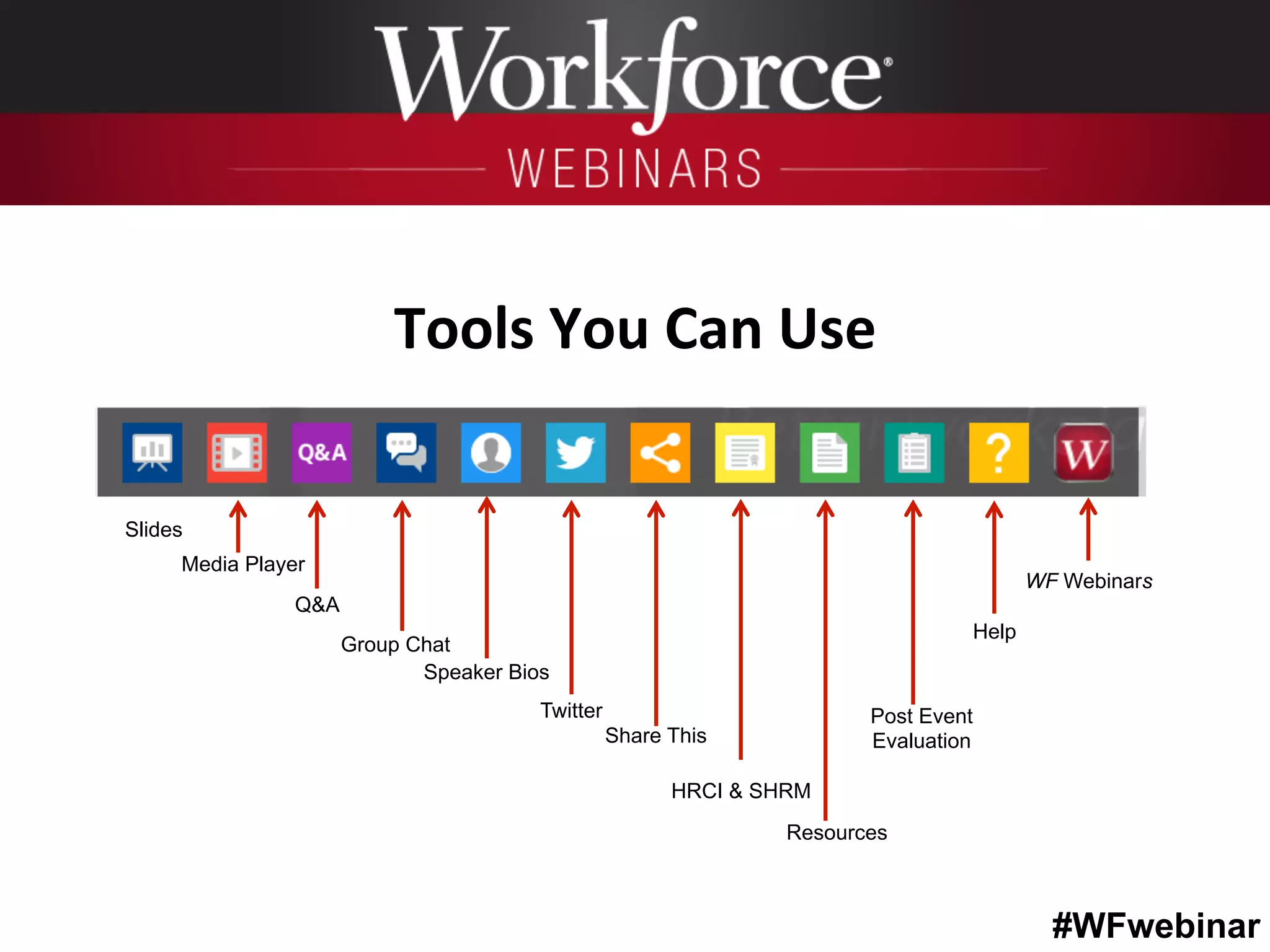
Tools	
  You	
  Can	
  Use	
  
Speaker Bios
Resources
Media Player
Q&A
Slides
Twitter
Help
Post Event
EvaluationShare This
Group Chat
HRCI & SHRM
WF Webinars
#WFwebinar


Tools You Can Use
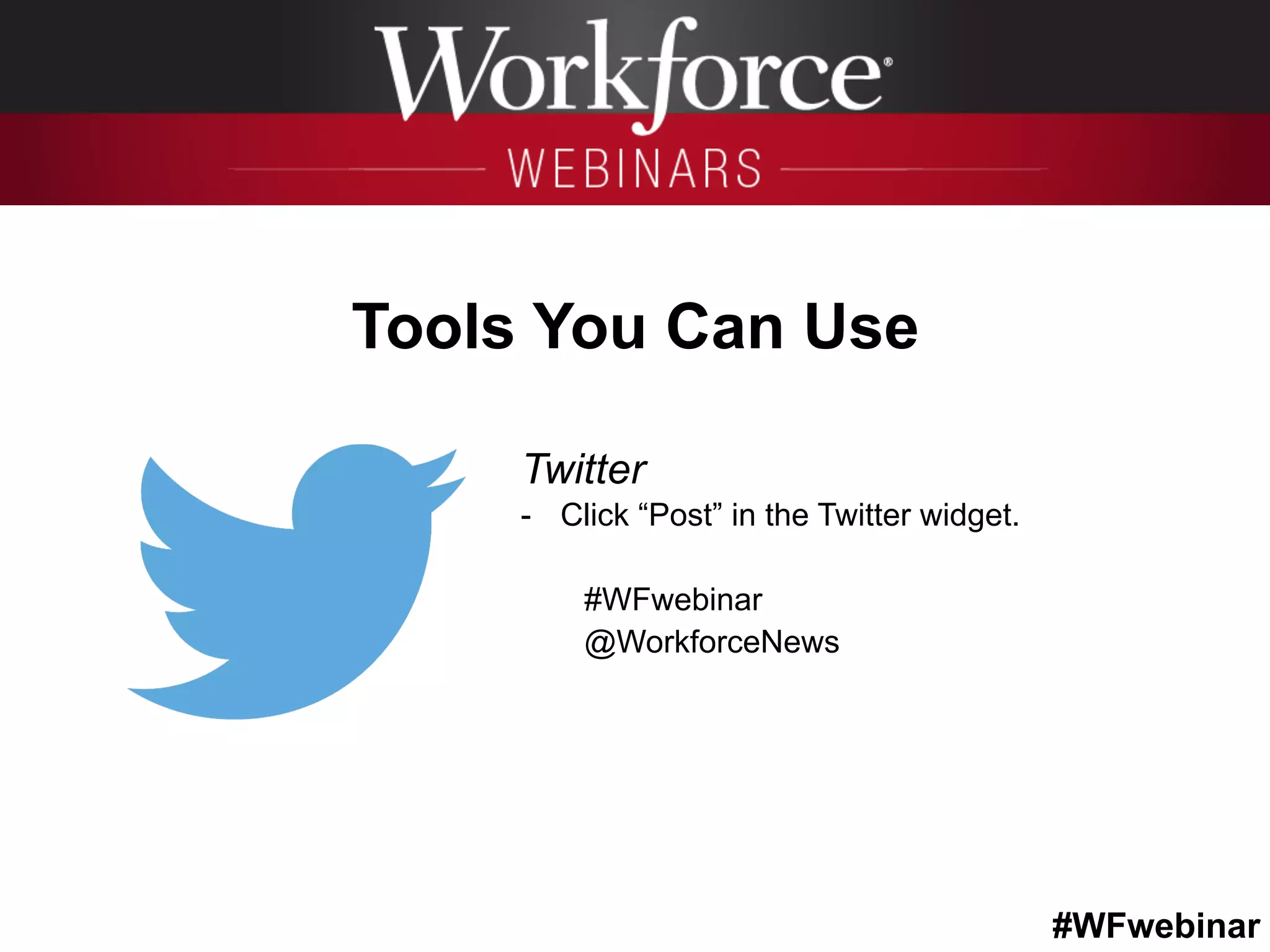
Twitter
-  Click “Post” in the Twitter widget.
#WFwebinar
@WorkforceNews
#WFwebinar


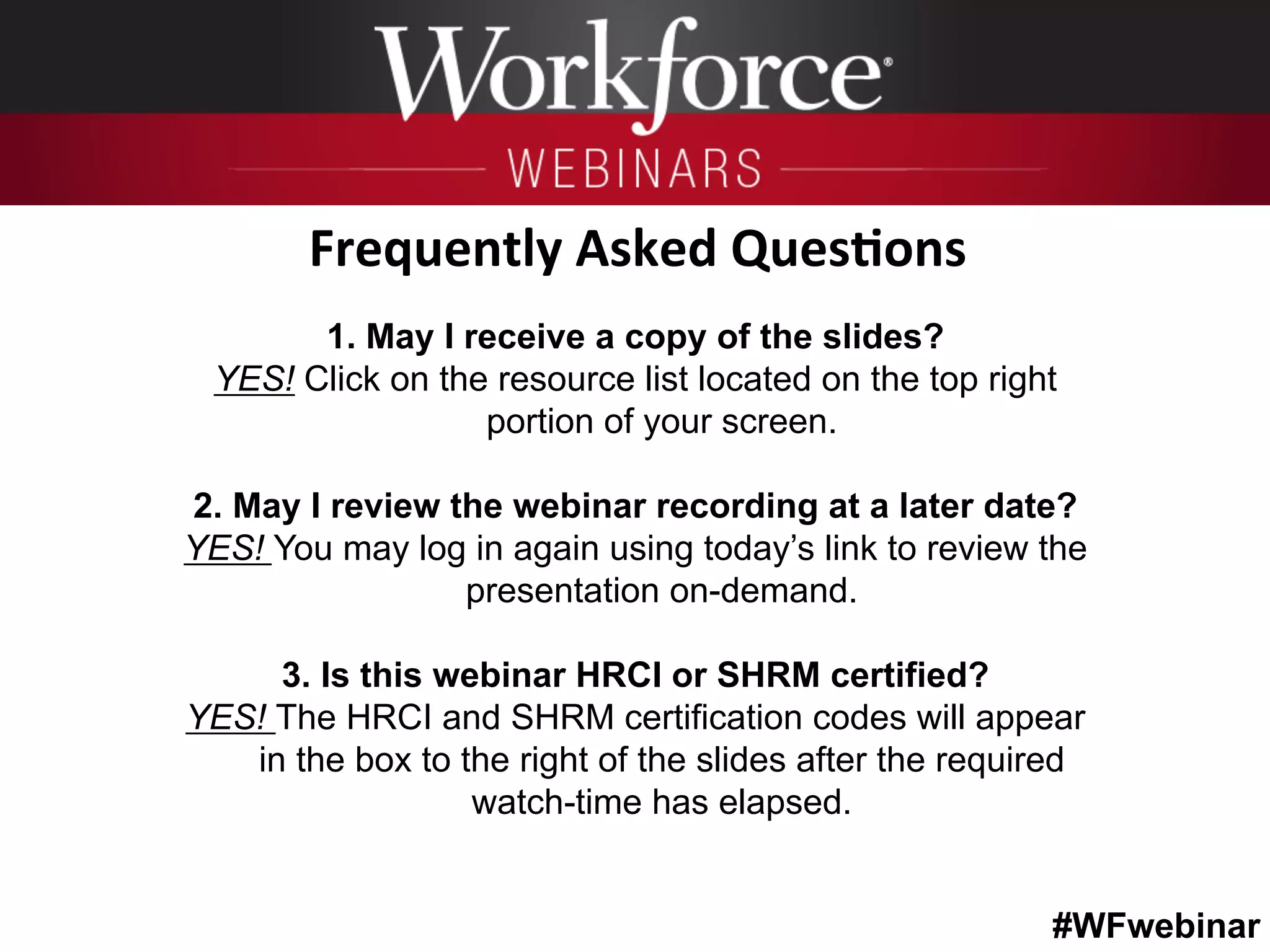
1. May I receive a copy of the slides?
YES! Click on the resource list located on the top right
portion of your screen.
2. May I review the webinar recording at a later date?
YES! You may log in again using today’s link to review the
presentation on-demand.
3. Is this webinar HRCI or SHRM certified?
YES! The HRCI and SHRM certification codes will appear
in the box to the right of the slides after the required
watch-time has elapsed.
Frequently	
  Asked	
  Ques6ons	
  
How Soft Skills
Power
Organizational
Performance
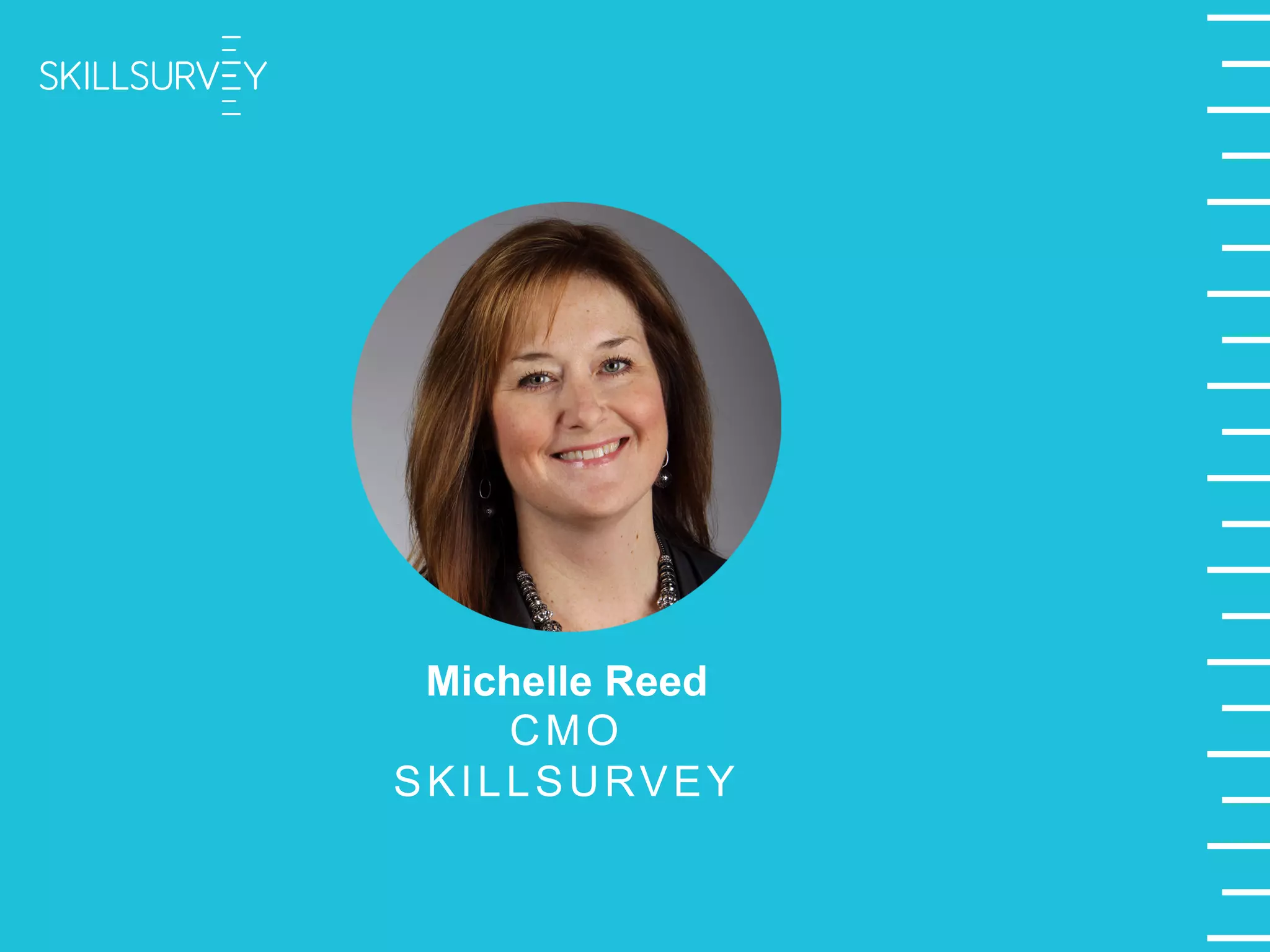
Michelle Reed
CMO
SKILLSURVEY
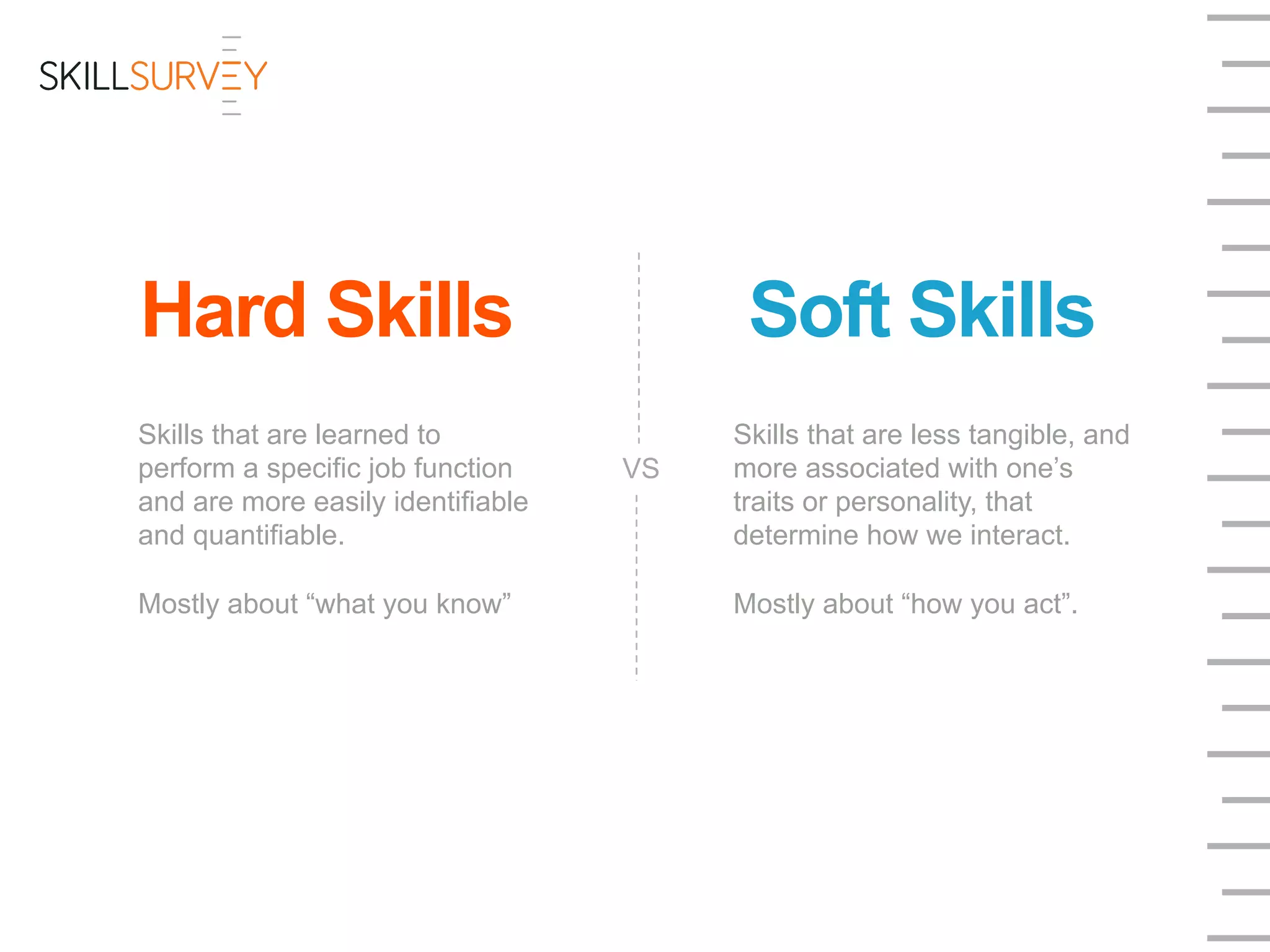
Hard Skills
Skills that are learned to
perform a specific job function
and are more easily identifiable
and quantifiable.
Mostly about “what you know”
VS
Soft Skills
Skills that are less tangible, and
more associated with one’s
traits or personality, that
determine how we interact.
Mostly about “how you act”.
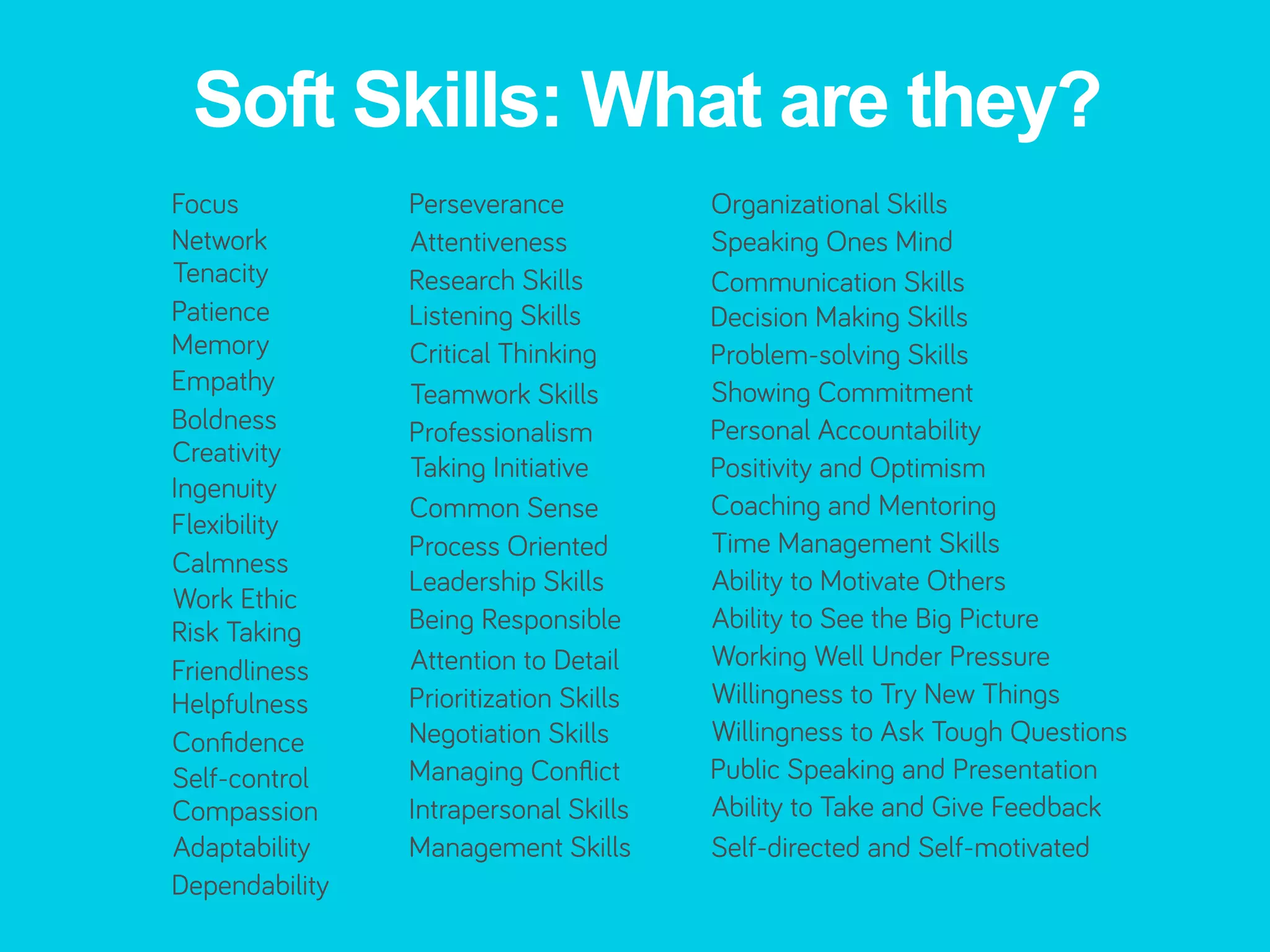
Soft Skills: What are they?
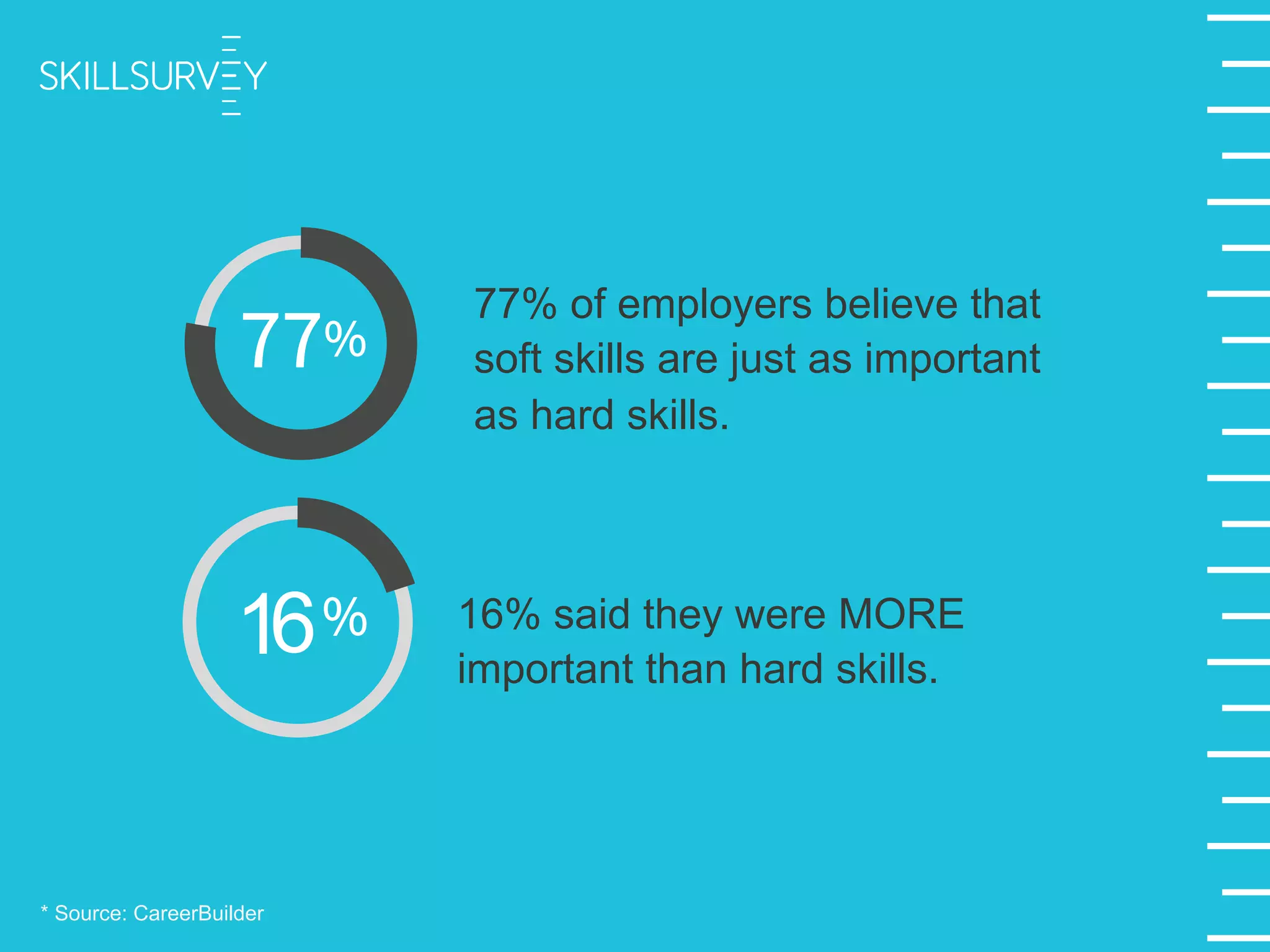
77% of employers believe that
soft skills are just as important
as hard skills.
16% said they were MORE
important than hard skills.
* Source: CareerBuilder
16
A national survey of job seekers
and HR professionals…
43% said that “cultural fit” was
the single most important
determining factor when
making a new hire.
* Source: Millennial Branding and Beyond.com
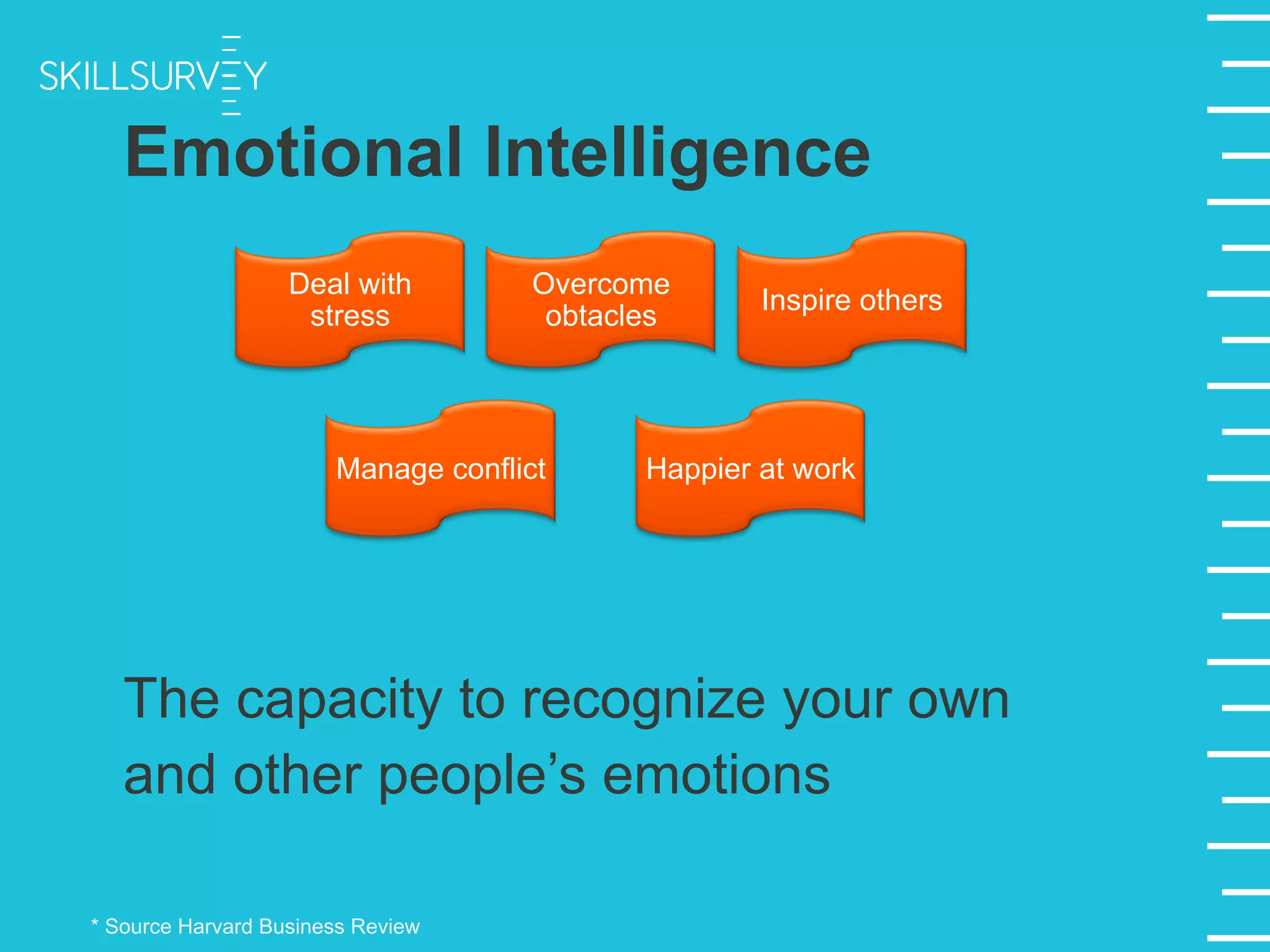
* Source Harvard Business Review
Emotional Intelligence
The capacity to recognize your own
and other people’s emotions
Deal with
stress
Overcome
obtacles
Inspire others
Manage conflict Happier at work
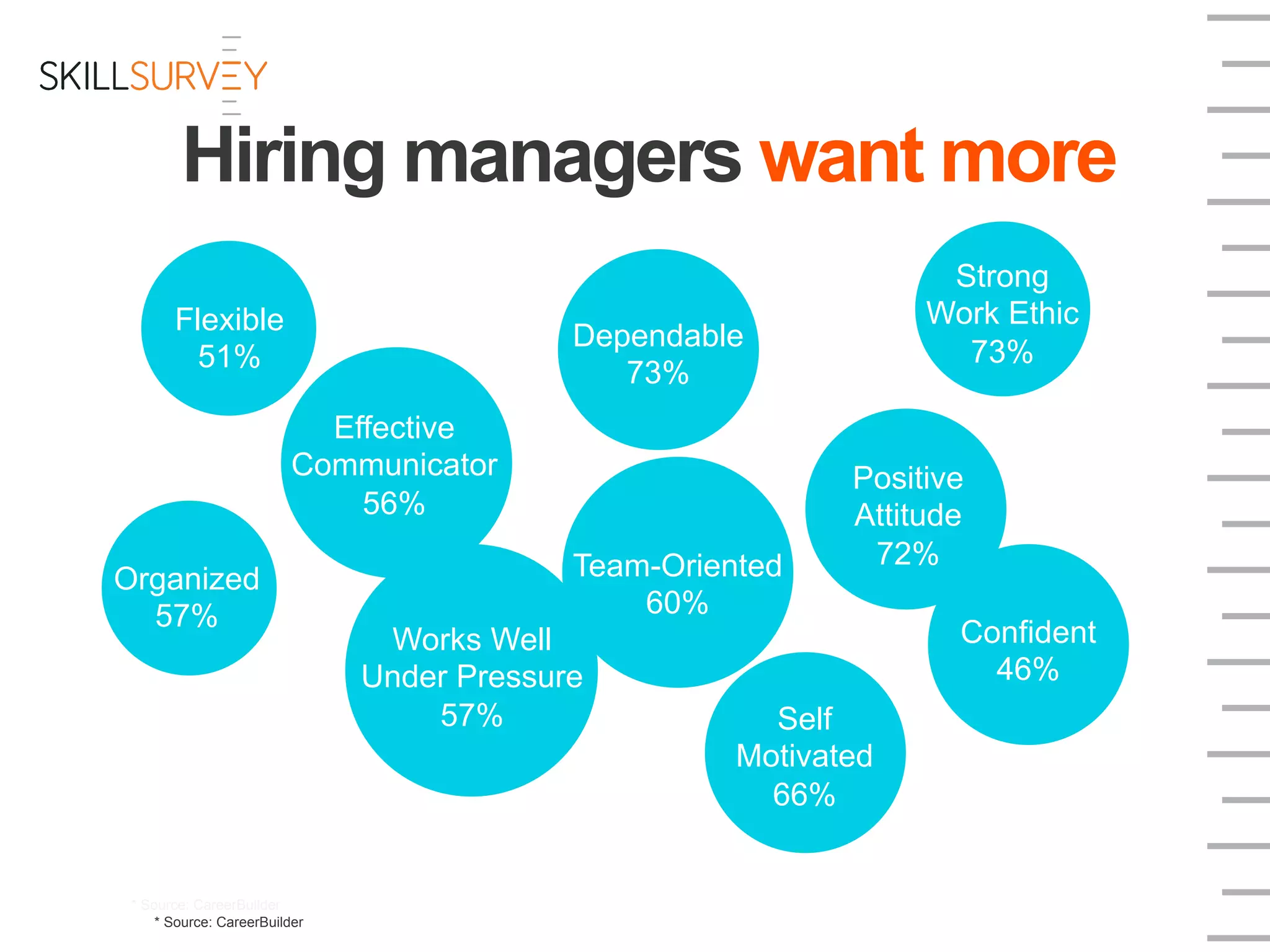
* Source: CareerBuilder
Flexible
51%
Self
Motivated
66%
Strong
Work Ethic
73%
Dependable
73%
Positive
Attitude
72%Team-Oriented
60%
Organized
57%
Works Well
Under Pressure
57%
Effective
Communicator
56%
Confident
46%
Hiring managers want more
* Source: CareerBuilder
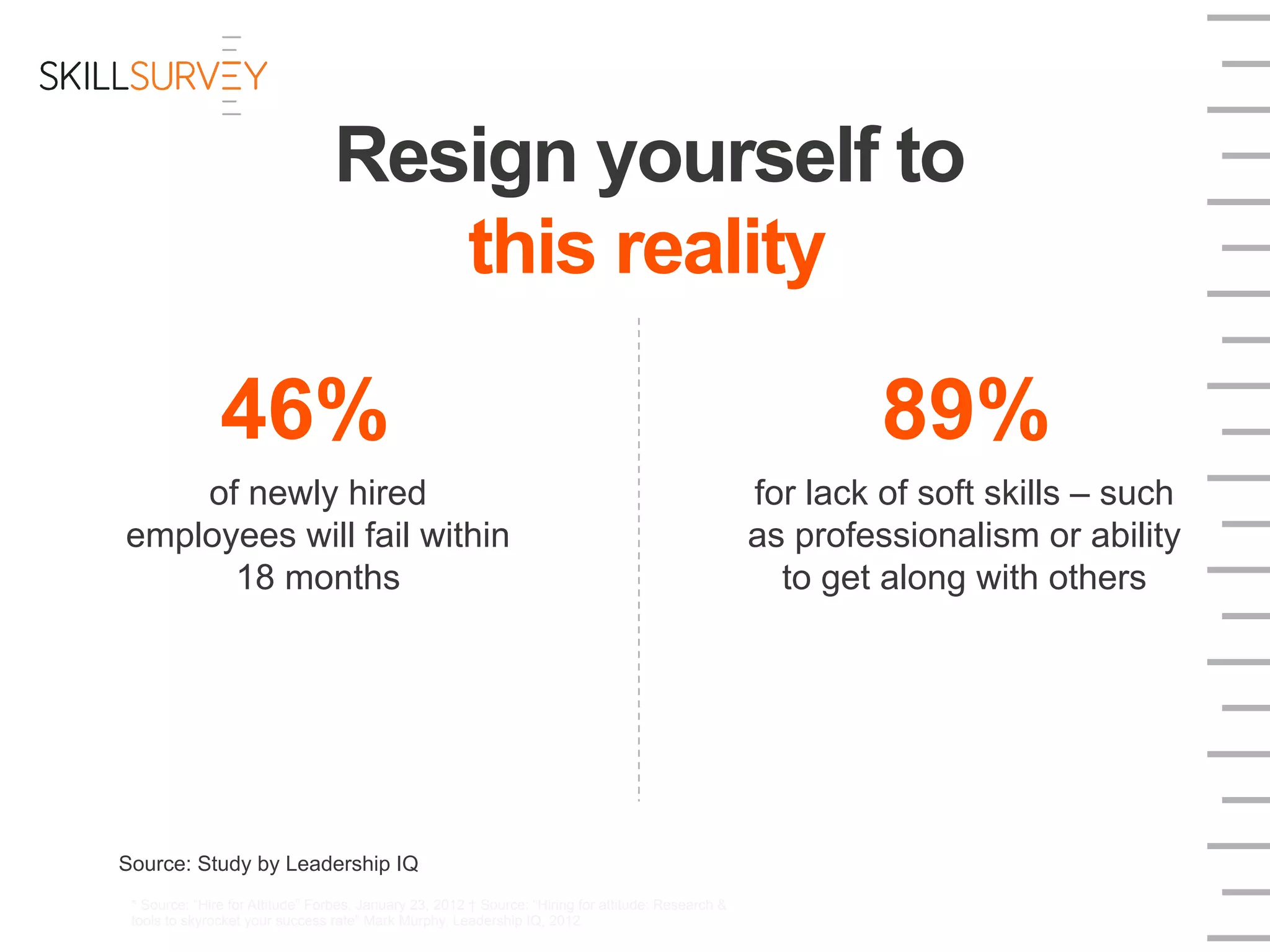
of newly hired
employees will fail within
18 months
* Source: “Hire for Attitude” Forbes, January 23, 2012 † Source: “Hiring for attitude: Research &
tools to skyrocket your success rate” Mark Murphy, Leadership IQ, 2012
for lack of soft skills – such
as professionalism or ability
to get along with others
Resign yourself to
this reality
89%46%
Source: Study by Leadership IQ
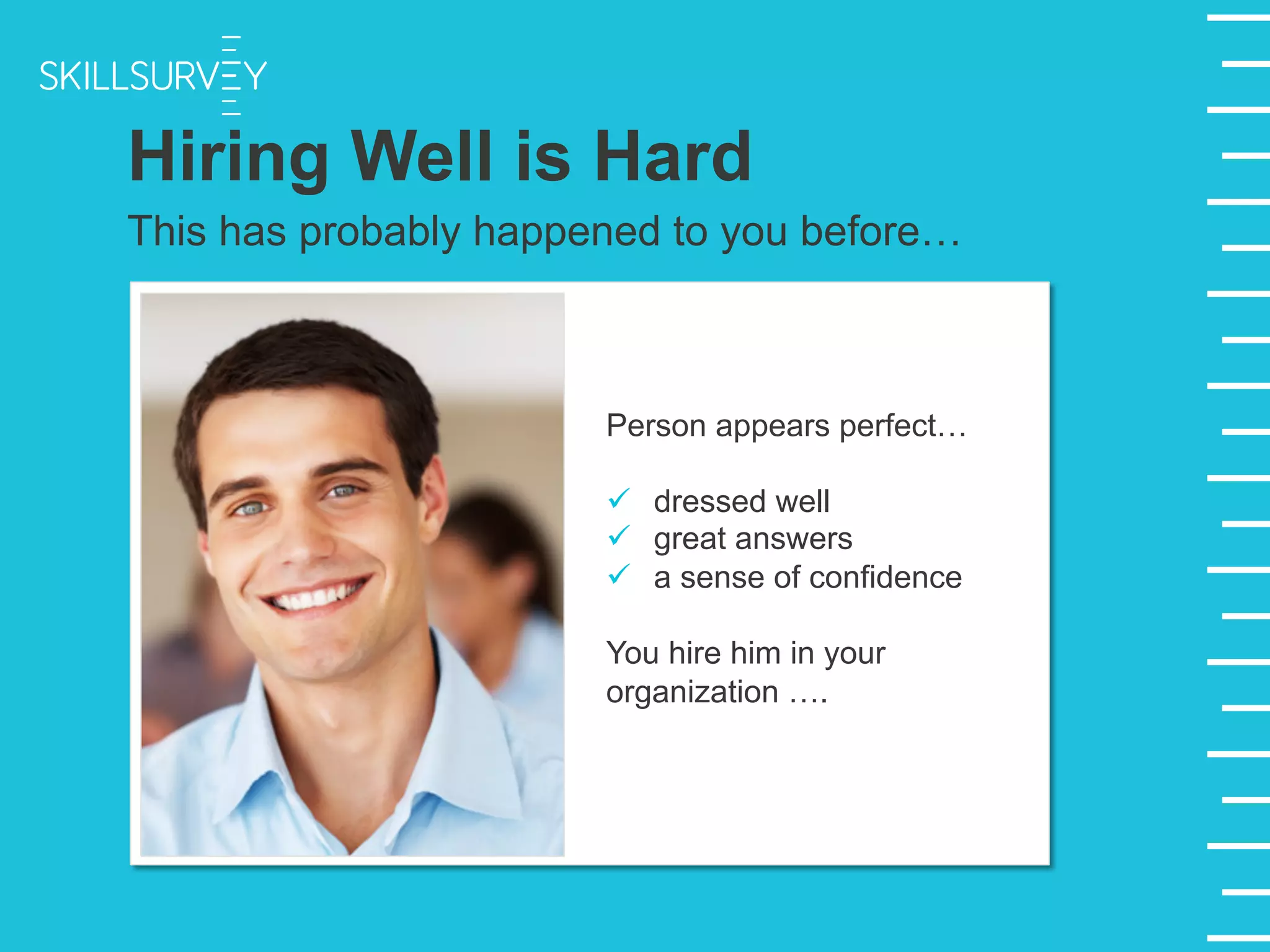
Hiring Well is Hard
This has probably happened to you before…
Person appears perfect…
ü  dressed well
ü  great answers
ü  a sense of confidence
You hire him in your
organization ….
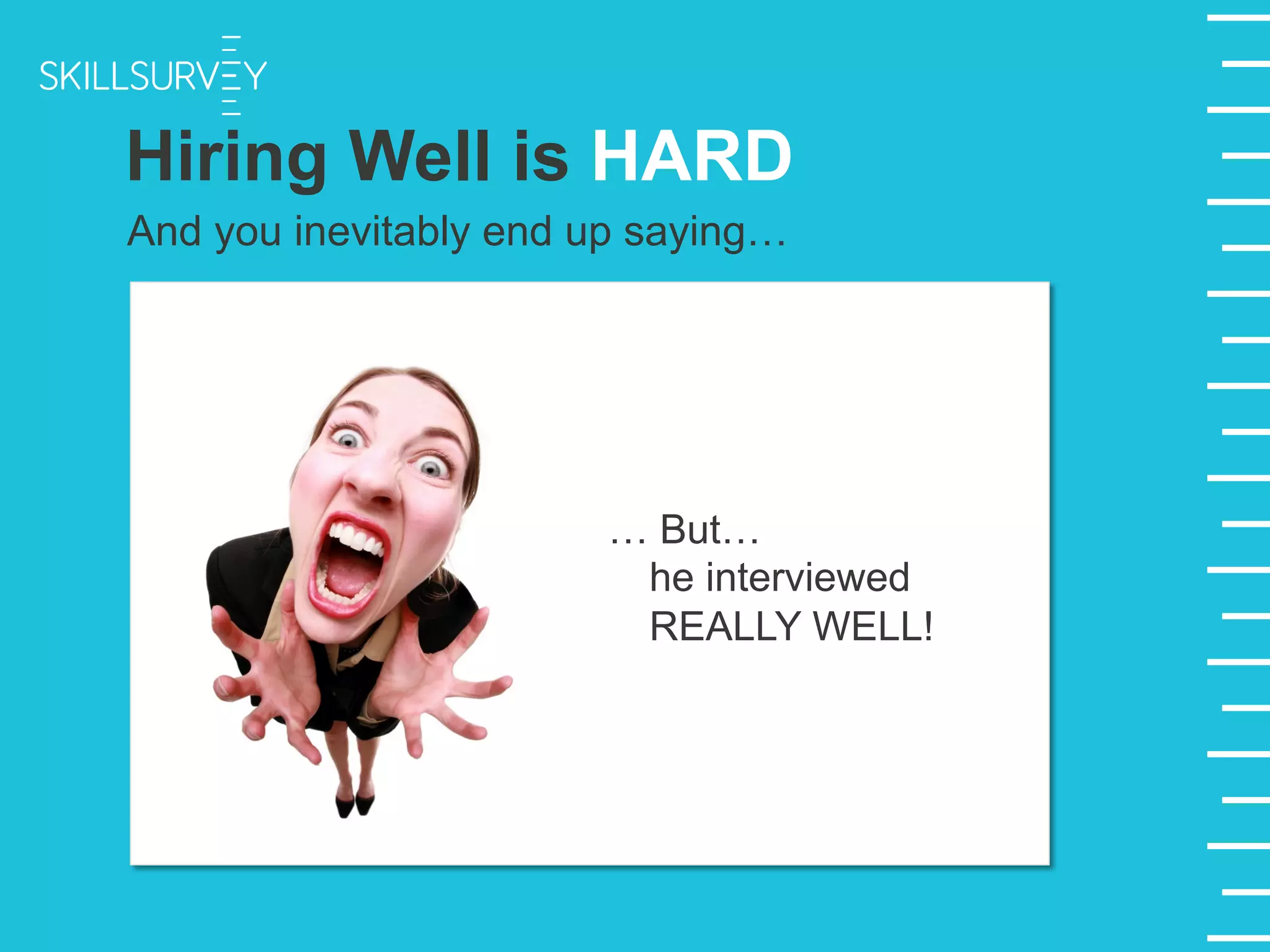
And you inevitably end up saying…
… But…
he interviewed
REALLY WELL!
Hiring Well is HARD
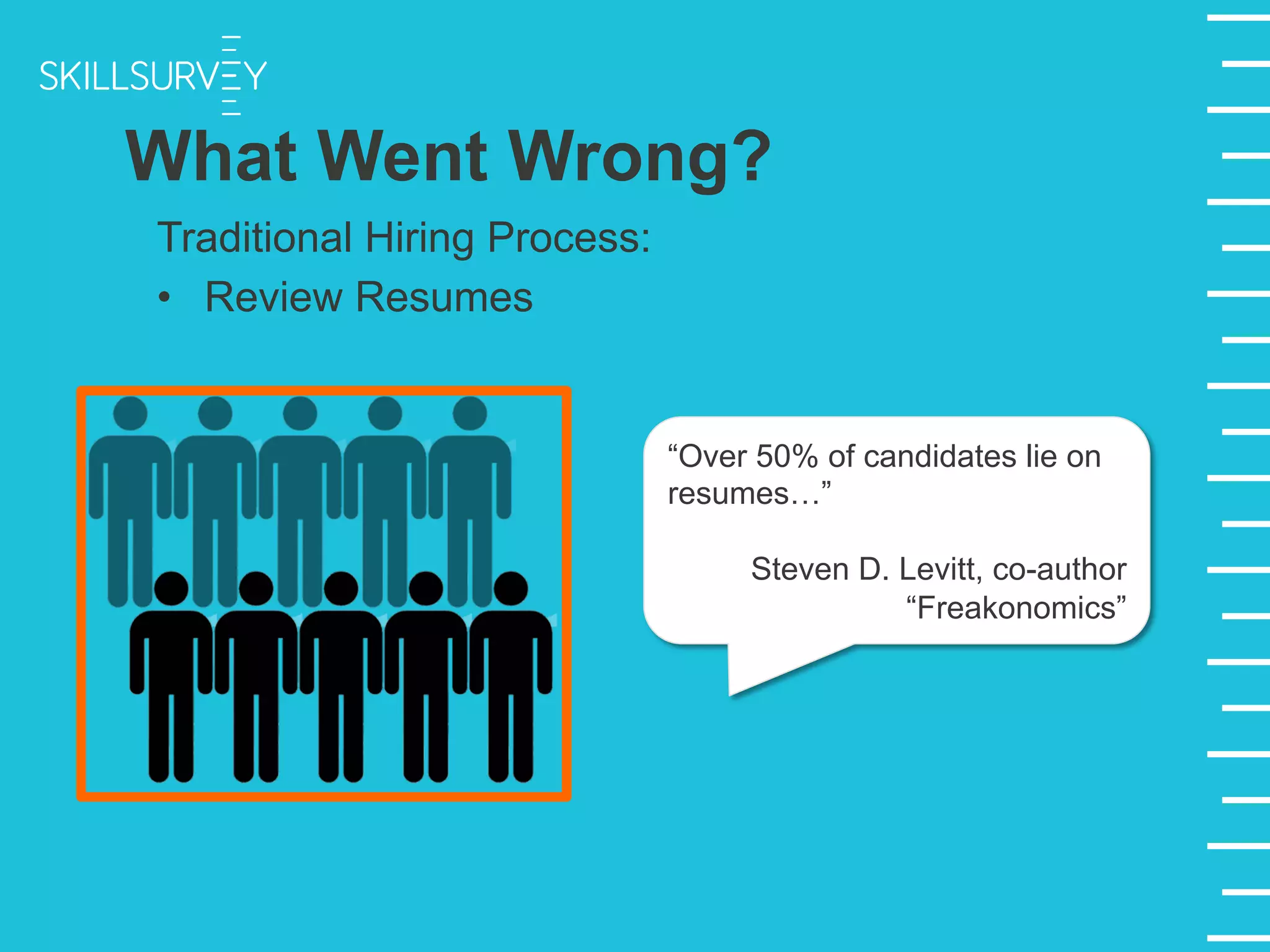
What Went Wrong?
Traditional Hiring Process:
•  Review Resumes
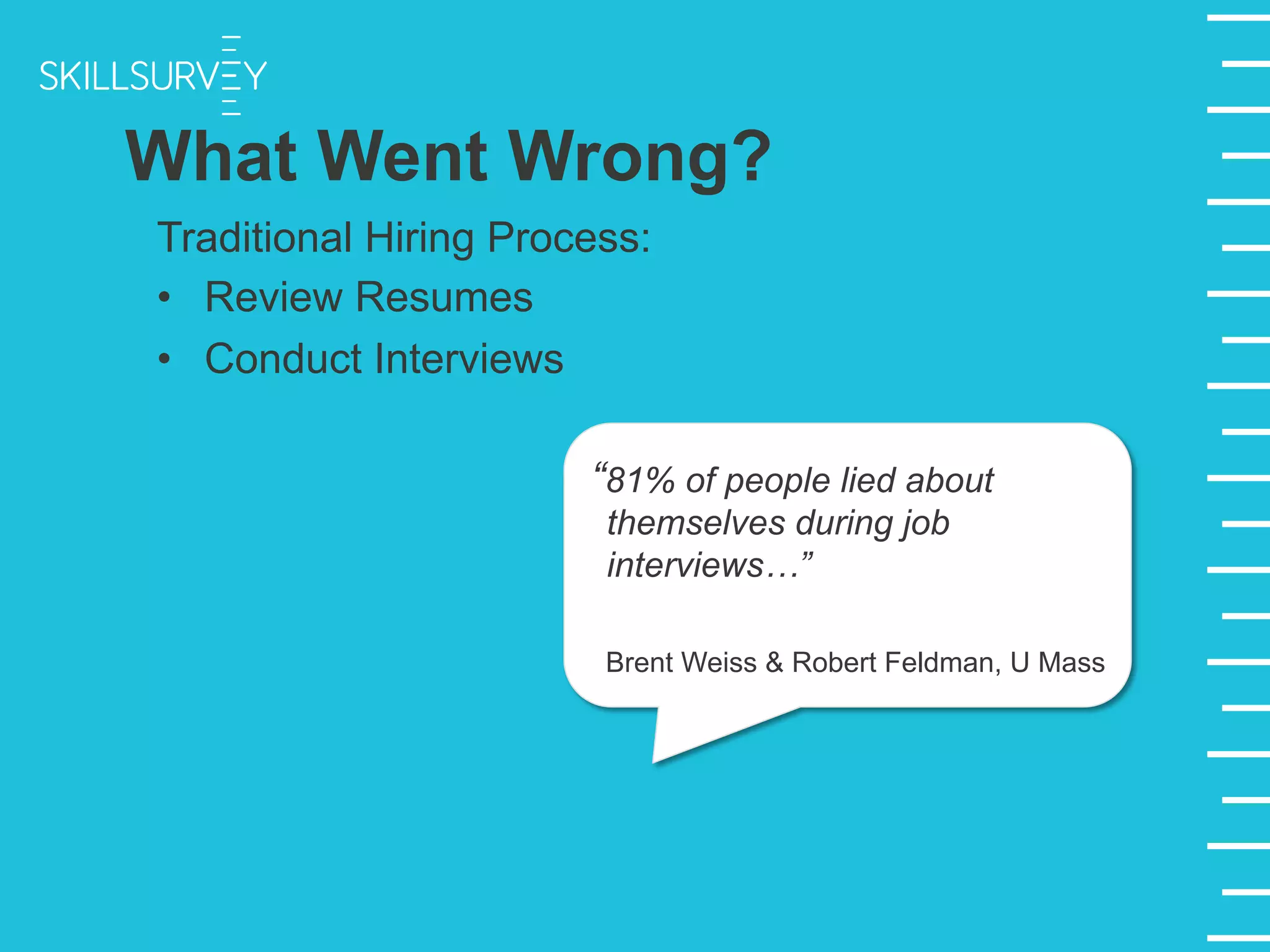
“Over 50% of candidates lie on
resumes…”
Steven D. Levitt, co-author
“Freakonomics”
“81% of people lied about
themselves during job
interviews…”
Brent Weiss & Robert Feldman, U Mass
What Went Wrong?
Traditional Hiring Process:
•  Review Resumes
•  Conduct Interviews
Polling Question /
What Went Wrong?
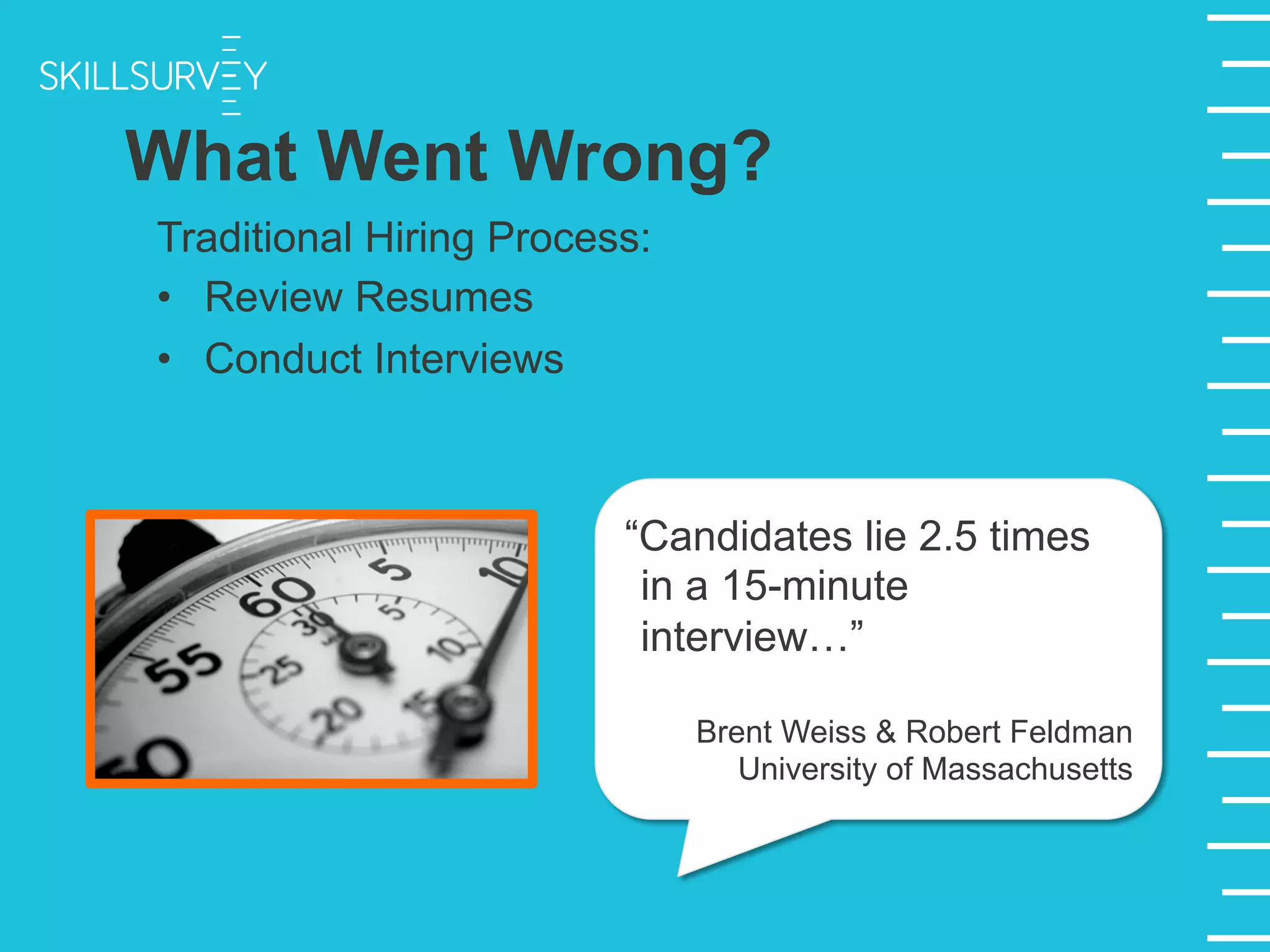
“Candidates lie 2.5 times
in a 15-minute
interview…”
Brent Weiss & Robert Feldman
University of Massachusetts
Traditional Hiring Process:
•  Review Resumes
•  Conduct Interviews
“Research consistently
demonstrates that
candidates are able to fake
personality measures …”
International Journal of Selection and
Assessment
What Went Wrong?
“Cognitive ability tests have
a high adverse impact for
minorities…”
SHRM Foundation’s Effective Practice Guidelines
Traditional Hiring Process:
•  Review Resumes
•  Conduct Interviews
•  Self Assessments
Soft Skills are the Hard Part
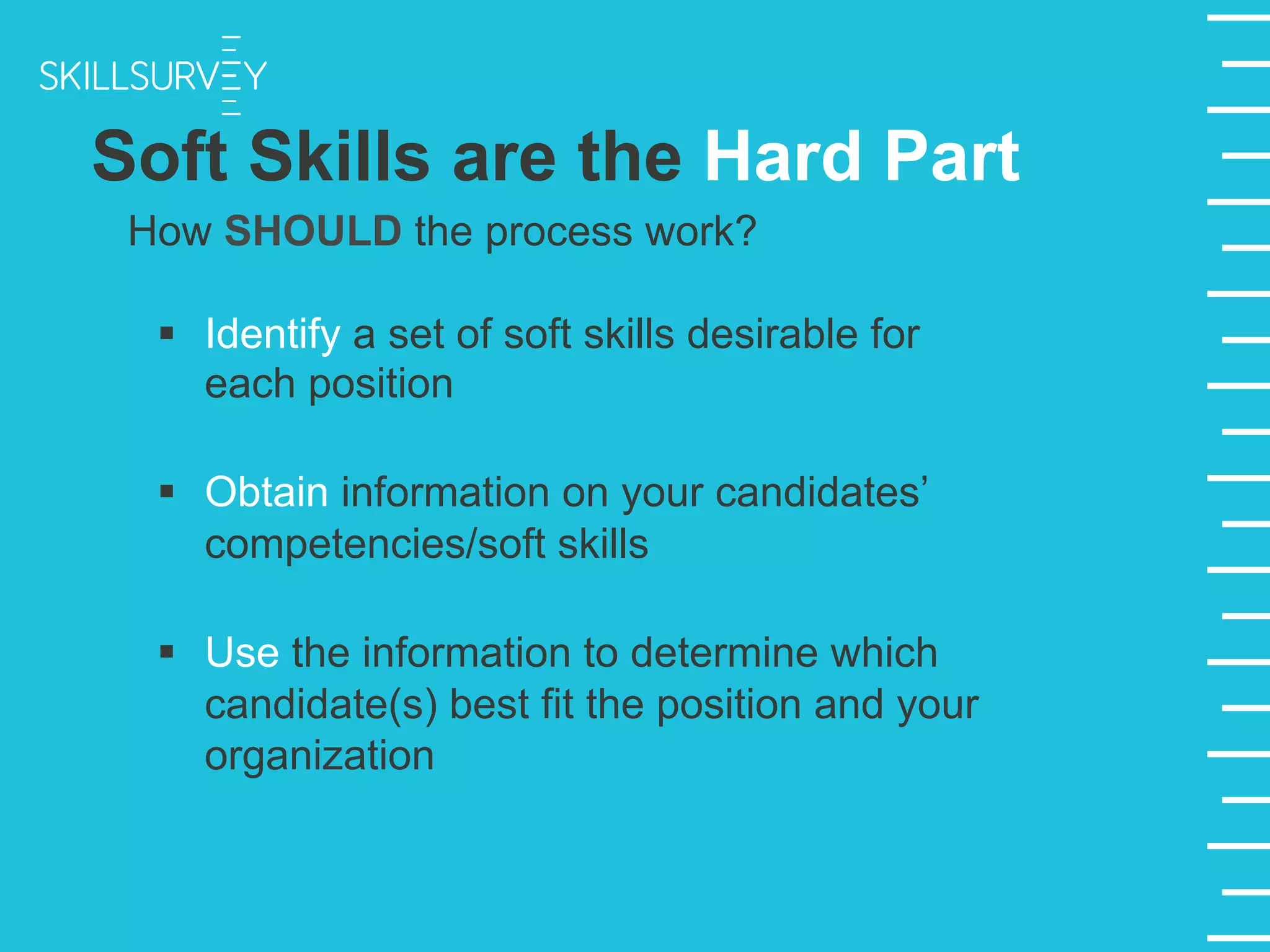
How SHOULD the process work?
§  Identify a set of soft skills desirable for
each position
§  Obtain information on your candidates’
competencies/soft skills
§  Use the information to determine which
candidate(s) best fit the position and your
organization
Which soft skills are the right
soft skills?
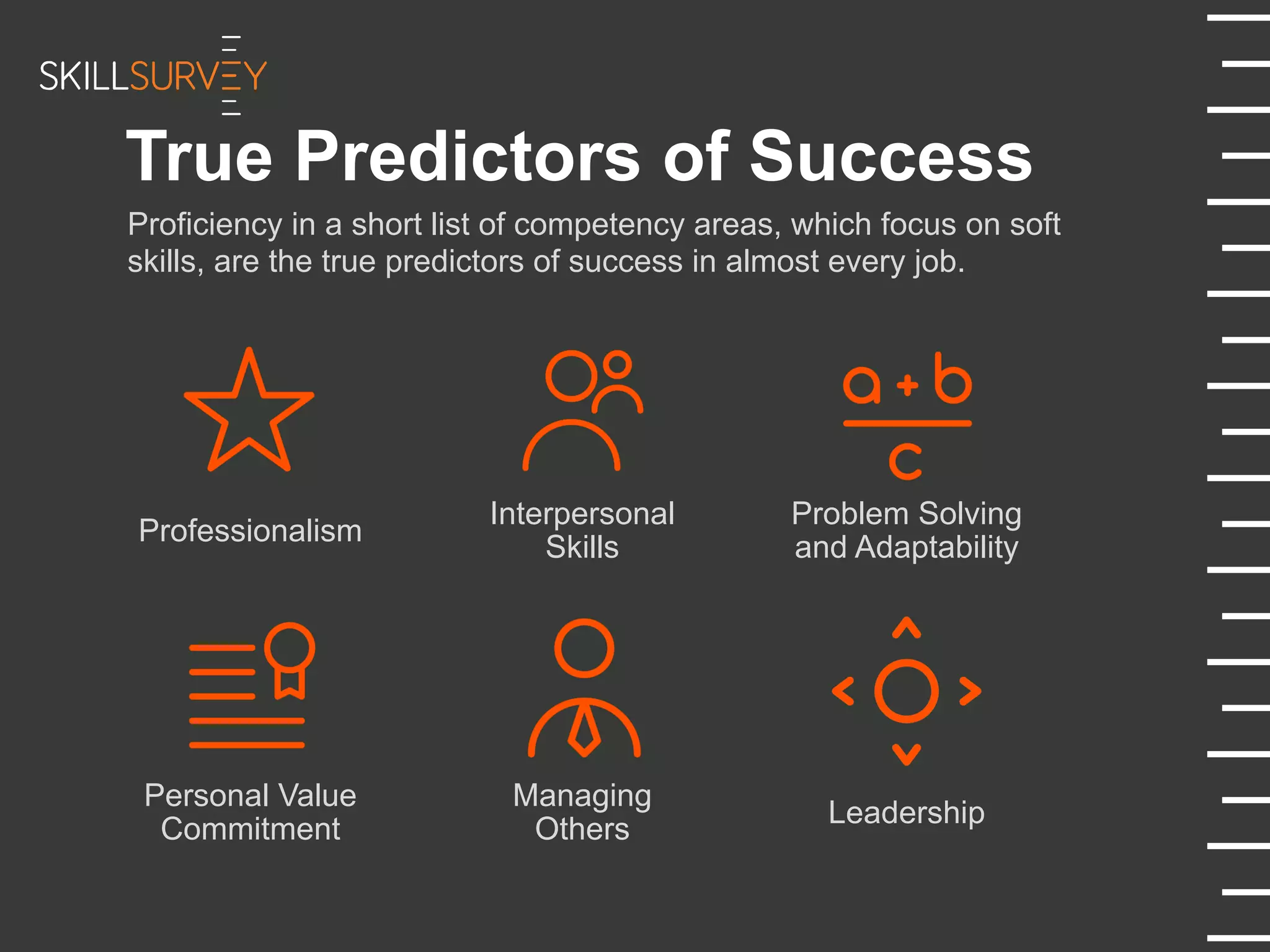
Professionalism
Interpersonal
Skills
Problem Solving
and Adaptability
Personal Value
Commitment
Managing
Others
Leadership
True Predictors of Success
Proficiency in a short list of competency areas, which focus on soft
skills, are the true predictors of success in almost every job.
Professionalism
It’s the “price of entry” and consists of a wide variety
of behaviors and skills. Some apply to jobs across the
board:
- Dependability
- Following instructions
- Work ethic
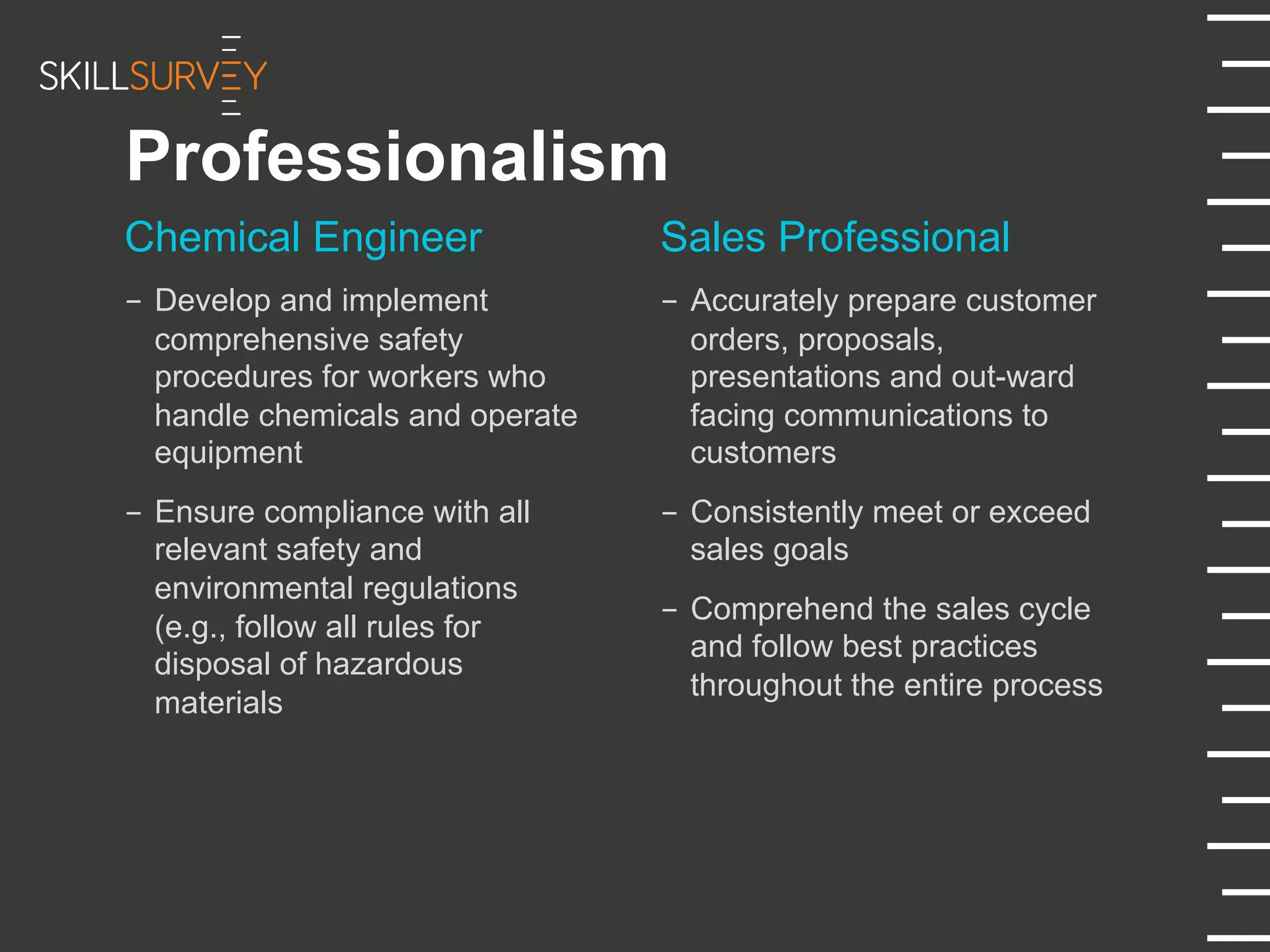
Professionalism
Chemical Engineer
-  Develop and implement
comprehensive safety
procedures for workers who
handle chemicals and operate
equipment
-  Ensure compliance with all
relevant safety and
environmental regulations
(e.g., follow all rules for
disposal of hazardous
materials
Sales Professional
-  Accurately prepare customer
orders, proposals,
presentations and out-ward
facing communications to
customers
-  Consistently meet or exceed
sales goals
-  Comprehend the sales cycle
and follow best practices
throughout the entire process
Interpersonal Skills
Having interpersonal skills like the
following will make a candidate far more
likely to succeed:
-  Listening
-  Relationship-building
-  Collaboration
Interpersonal Skills
Housekeeper
-  Provide a high level of service
to all guests
-  Remain calm and helpful
when handling complains
from guests
Registered Nurse
-  Provide others with personal
assistance, medical attention,
and emotional support in a
caring and compassionate
manner
-  Listen carefully to patients
and co-workers, taking time to
understand and ask
appropriate questions without
interrupting
Every job essentially requires the ability to assess
and analyze issues as well as adaptability to changing
conditions:
-  Analyzing and summarizing information
-  Making decisions
-  Adapting to change
Problem Solving
and Adaptability
Problem Solving
and Adaptability
Help Desk Support
-  Remain flexible and adapt to
variety on the job (e.g.,
effectively handle unexpected
situations and changing
conditions)
-  Handle multiple projects
effectively in a fast-paced
environment
Payroll Clerk
-  Make high-quality decisions
based upon facts and
business priorities
-  Know when to escalate
issues to manager in order to
ensure prompt resolution to
problems
Personal Value Commitment
A candidate’s commitment to values and ethics is a key
driver of your own risk exposure. It’s important to know to
what degree and applicant possesses:
-  Integrity
-  Respect for others
-  Adherence to standards
and policies
There are positions that provide
employees with access to sensitive
personal, financial or security data.
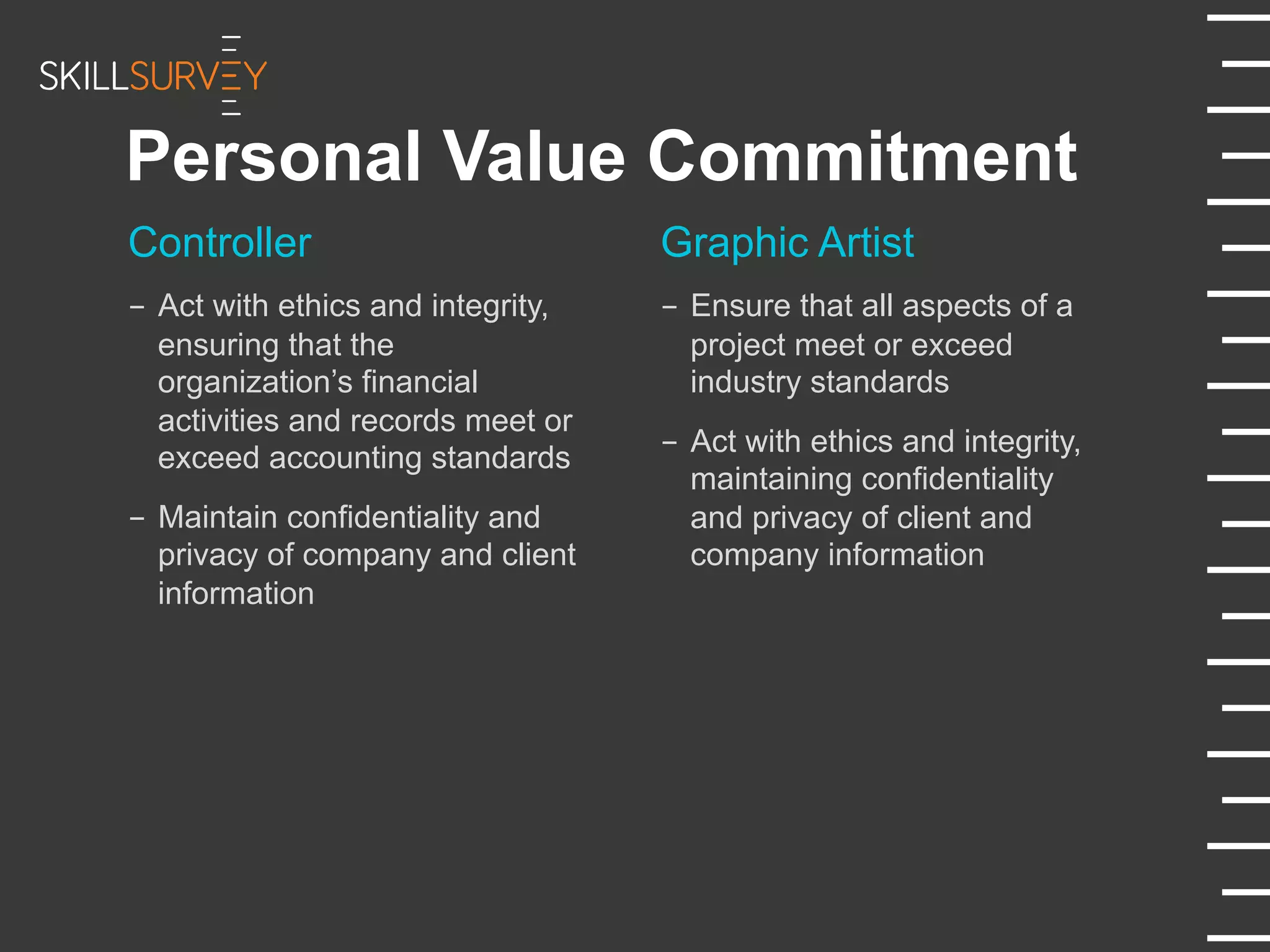
Personal Value Commitment
Graphic Artist
-  Ensure that all aspects of a
project meet or exceed
industry standards
-  Act with ethics and integrity,
maintaining confidentiality
and privacy of client and
company information
Controller
-  Act with ethics and integrity,
ensuring that the
organization’s financial
activities and records meet or
exceed accounting standards
-  Maintain confidentiality and
privacy of company and client
information
Hiring Someone to Be
in a Position of Power?
If so, you’re probably going to
need to understand two additional
competencies and apply them
to determine job success.
Managing Others
While many jobs clearly demand management skills,
many others will call on them at times.
Skills needed include:
-  Selecting and retaining talent
-  Leading a team
-  Holding others accountable
Leadership
The truly high profile positions call for an even larger
set of competencies.
Skills needed include:
-  Setting direction
-  Managing change
-  Motivating others
Leadership
Chief Financial Officer
-  Work with the executive team to develop short and long-term financial
plans, objectives, policies and actions
-  Serve as a trusted advisor to the President and others on challenging
solutions
Chief Information Officer
-  Act as a catalyst, communicating the need for change and inspiring
action
-  Create the vision to master information technology as a competitive
tool
Professionalism
Interpersonal
Skills
Problem Solving
and Adaptability
Personal Value
Commitment
Managing
Others
Leadership
True Predictors of Success
Proficiency in a short list of competency areas, which focus on soft
skills, are the true predictors of success in almost every job.
Soft Skills are the Hard Part
How SHOULD the process work?
§  Identify a set of soft skills desirable for
each position
§  Obtain information on your candidates’
competencies/soft skills
§  Use the information to determine which
candidate(s) best fit the position and your
organization
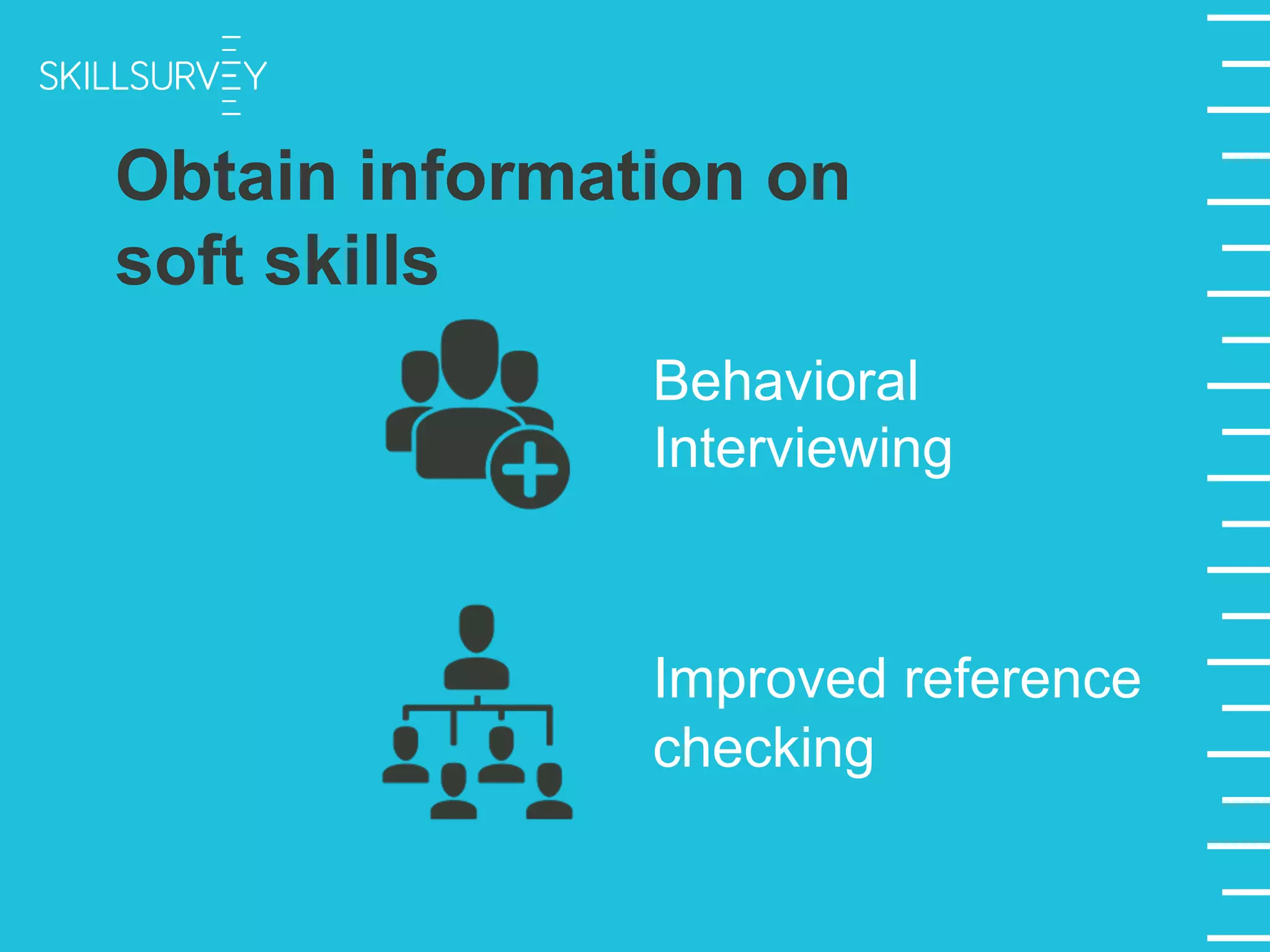
Obtain information on
soft skills
Behavioral
Interviewing
Improved reference
checking
Behavioral Interviewing
1.  Make the candidate feel comfortable
2.  Ask some traditional questions
3.  Ask for a recent situation that included a difficult challenge that she
had to solve… ended in SUCCESS
ü  Ask him/her to tell story briefly
ü  Then you review the entire story asking questions about what he/she
thought, felt, and did throughout
ü  Example: Describe a problem you faced that was almost overwhelming,
and how you got through it.
4.  Ask for another that ended in FAILURE, but he/she learned from it
ü  Example: Give me an example of a time when something you tried to
accomplish failed. What did you learn?
5.  End on a positive… ask for another success story
Behavioral Interviewing
§  Hear how the candidate thinks in situations that involve
stress
§  Get information on how the candidate felt, and if he is
aware of his own feelings
§  Hear how he managed these feelings and the extent to
which he was aware of his impact on others
Behavioral
Interviewing
Improved reference
checking
Obtain information on
soft skills
Feedback related to past work
performance is the single best
predictor of future job success.
“When the criterion was academic achievement or job
performance, other-ratings yielded predictive validities
substantially greater than and incremental to self-ratings.”
Connelly & Ones, 2010, p. 1092
“Nothing in the science of prediction and selection beats
observing actual performance in an equivalent role.”
Peter Cappelli, Director, Center for Human Resources
The Wharton School
Best-in Class Organizations
Get the idea
The Aberdeen Group’s 2015 Report
Best-in-Class
organizations are
2.1 times more
likely to use online
reference checking
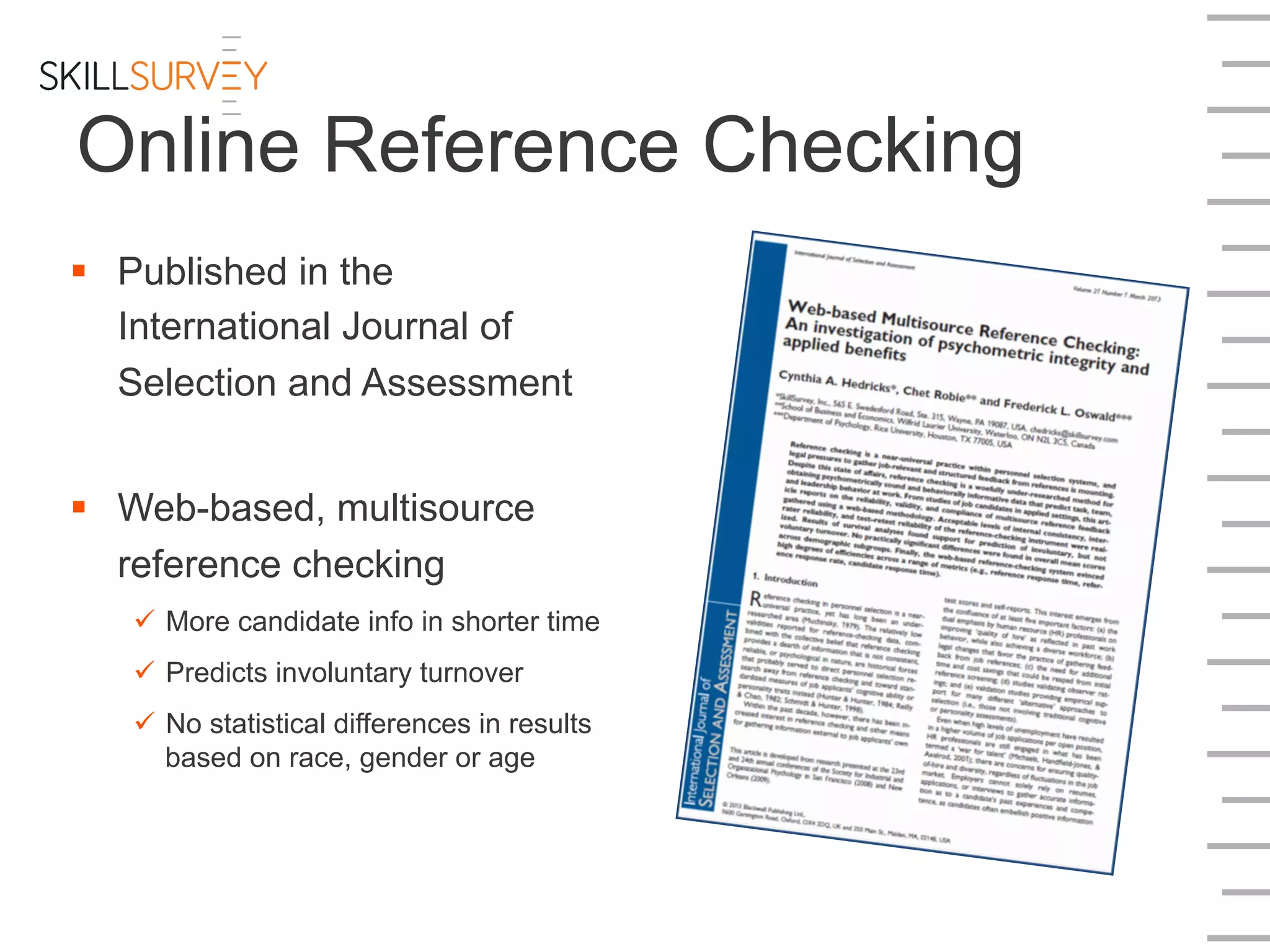
§  Published in the
International Journal of
Selection and Assessment
§  Web-based, multisource
reference checking
ü  More candidate info in shorter time
ü  Predicts involuntary turnover
ü  No statistical differences in results
based on race, gender or age
Online Reference Checking
Reference Checking Tips
§ Ask for 5 references—2 managers and 3 co-workers
§ Ask very specific questions
§ “Considering how Sarah compares to others who have worked in this
same position..”
§ “On a scale of 1 to 7, how would you rate Sarah on her ability to
demonstrate high personal standards in dealing with others?”
§ Ask the hard questions
§ “Starting with the most important, please comment on the top 3 ways in
which Sarah can improve her performance. We realize no one is perfect;
in fact, we find that the majority of references provide helpful information
in this area.”
Question?
Michelle Reed
CHIEF MARKETING OFFICER
SKILLSURVEY
@reedmichelle13
mreed@skillsurvey.com
ww.linkedin.com/in/reedmichelle13
Thank You
Improve your selection process
through feedback from references
on soft-skills
Try it out for free:
www.skillsurvey.com/tryit
#WFwebinar


Please complete the
webinar evaluation.
#WFwebinar


Register for the next Webinar!
Key principles to maximize
employee satisfaction and
contribution in your organization
Wednesday, August 17, 2016
Webinars start at 2 p.m. Eastern / 11 a.m. Pacific
Register for all upcoming Workforce Webinars at
events.workforce.com/webinars
OR click the icon on the widget bar!

How Soft Skills Power Organizational Performance

  • 1.
    #WFwebinar The presentation willbegin at the top of the hour. A dial in number will not be provided. Listen to today’s webinar using your computer’s speakers or headphones. Welcome to the webinar!
  • 2.
    #WFwebinar         Tools You Can Use Audio Control –  A dial in number will not be provided. –  Adjust the volume by sliding the indicator in the Media Player box to the right. –  Also check your computer’s volume for external speakers or headsets.
  • 3.
    #WFwebinar Tools  You  Can  Use   Speaker Bios Resources Media Player Q&A Slides Twitter Help Post Event EvaluationShare This Group Chat HRCI & SHRM WF Webinars
  • 4.
    #WFwebinar         Tools You Can Use Twitter -  Click “Post” in the Twitter widget. #WFwebinar @WorkforceNews
  • 5.
    #WFwebinar         1. May I receive a copy of the slides? YES! Click on the resource list located on the top right portion of your screen. 2. May I review the webinar recording at a later date? YES! You may log in again using today’s link to review the presentation on-demand. 3. Is this webinar HRCI or SHRM certified? YES! The HRCI and SHRM certification codes will appear in the box to the right of the slides after the required watch-time has elapsed. Frequently  Asked  Ques6ons  
  • 6.
  • 7.
  • 8.
    Hard Skills Skills thatare learned to perform a specific job function and are more easily identifiable and quantifiable. Mostly about “what you know” VS Soft Skills Skills that are less tangible, and more associated with one’s traits or personality, that determine how we interact. Mostly about “how you act”.
  • 9.
  • 10.
    77% of employersbelieve that soft skills are just as important as hard skills. 16% said they were MORE important than hard skills. * Source: CareerBuilder 16
  • 11.
    A national surveyof job seekers and HR professionals… 43% said that “cultural fit” was the single most important determining factor when making a new hire. * Source: Millennial Branding and Beyond.com
  • 12.
    * Source HarvardBusiness Review Emotional Intelligence The capacity to recognize your own and other people’s emotions Deal with stress Overcome obtacles Inspire others Manage conflict Happier at work
  • 13.
    * Source: CareerBuilder Flexible 51% Self Motivated 66% Strong WorkEthic 73% Dependable 73% Positive Attitude 72%Team-Oriented 60% Organized 57% Works Well Under Pressure 57% Effective Communicator 56% Confident 46% Hiring managers want more * Source: CareerBuilder
  • 14.
    of newly hired employeeswill fail within 18 months * Source: “Hire for Attitude” Forbes, January 23, 2012 † Source: “Hiring for attitude: Research & tools to skyrocket your success rate” Mark Murphy, Leadership IQ, 2012 for lack of soft skills – such as professionalism or ability to get along with others Resign yourself to this reality 89%46% Source: Study by Leadership IQ
  • 15.
    Hiring Well isHard This has probably happened to you before… Person appears perfect… ü  dressed well ü  great answers ü  a sense of confidence You hire him in your organization ….
  • 16.
    And you inevitablyend up saying… … But… he interviewed REALLY WELL! Hiring Well is HARD
  • 17.
    What Went Wrong? TraditionalHiring Process: •  Review Resumes “Over 50% of candidates lie on resumes…” Steven D. Levitt, co-author “Freakonomics”
  • 18.
    “81% of peoplelied about themselves during job interviews…” Brent Weiss & Robert Feldman, U Mass What Went Wrong? Traditional Hiring Process: •  Review Resumes •  Conduct Interviews
  • 19.
  • 20.
    What Went Wrong? “Candidateslie 2.5 times in a 15-minute interview…” Brent Weiss & Robert Feldman University of Massachusetts Traditional Hiring Process: •  Review Resumes •  Conduct Interviews
  • 21.
    “Research consistently demonstrates that candidatesare able to fake personality measures …” International Journal of Selection and Assessment What Went Wrong? “Cognitive ability tests have a high adverse impact for minorities…” SHRM Foundation’s Effective Practice Guidelines Traditional Hiring Process: •  Review Resumes •  Conduct Interviews •  Self Assessments
  • 22.
    Soft Skills arethe Hard Part How SHOULD the process work? §  Identify a set of soft skills desirable for each position §  Obtain information on your candidates’ competencies/soft skills §  Use the information to determine which candidate(s) best fit the position and your organization
  • 23.
    Which soft skillsare the right soft skills?
  • 24.
    Professionalism Interpersonal Skills Problem Solving and Adaptability PersonalValue Commitment Managing Others Leadership True Predictors of Success Proficiency in a short list of competency areas, which focus on soft skills, are the true predictors of success in almost every job.
  • 25.
    Professionalism It’s the “priceof entry” and consists of a wide variety of behaviors and skills. Some apply to jobs across the board: - Dependability - Following instructions - Work ethic
  • 26.
    Professionalism Chemical Engineer -  Developand implement comprehensive safety procedures for workers who handle chemicals and operate equipment -  Ensure compliance with all relevant safety and environmental regulations (e.g., follow all rules for disposal of hazardous materials Sales Professional -  Accurately prepare customer orders, proposals, presentations and out-ward facing communications to customers -  Consistently meet or exceed sales goals -  Comprehend the sales cycle and follow best practices throughout the entire process
  • 27.
    Interpersonal Skills Having interpersonalskills like the following will make a candidate far more likely to succeed: -  Listening -  Relationship-building -  Collaboration
  • 28.
    Interpersonal Skills Housekeeper -  Providea high level of service to all guests -  Remain calm and helpful when handling complains from guests Registered Nurse -  Provide others with personal assistance, medical attention, and emotional support in a caring and compassionate manner -  Listen carefully to patients and co-workers, taking time to understand and ask appropriate questions without interrupting
  • 29.
    Every job essentiallyrequires the ability to assess and analyze issues as well as adaptability to changing conditions: -  Analyzing and summarizing information -  Making decisions -  Adapting to change Problem Solving and Adaptability
  • 30.
    Problem Solving and Adaptability HelpDesk Support -  Remain flexible and adapt to variety on the job (e.g., effectively handle unexpected situations and changing conditions) -  Handle multiple projects effectively in a fast-paced environment Payroll Clerk -  Make high-quality decisions based upon facts and business priorities -  Know when to escalate issues to manager in order to ensure prompt resolution to problems
  • 31.
    Personal Value Commitment Acandidate’s commitment to values and ethics is a key driver of your own risk exposure. It’s important to know to what degree and applicant possesses: -  Integrity -  Respect for others -  Adherence to standards and policies There are positions that provide employees with access to sensitive personal, financial or security data.
  • 32.
    Personal Value Commitment GraphicArtist -  Ensure that all aspects of a project meet or exceed industry standards -  Act with ethics and integrity, maintaining confidentiality and privacy of client and company information Controller -  Act with ethics and integrity, ensuring that the organization’s financial activities and records meet or exceed accounting standards -  Maintain confidentiality and privacy of company and client information
  • 33.
    Hiring Someone toBe in a Position of Power? If so, you’re probably going to need to understand two additional competencies and apply them to determine job success.
  • 34.
    Managing Others While manyjobs clearly demand management skills, many others will call on them at times. Skills needed include: -  Selecting and retaining talent -  Leading a team -  Holding others accountable
  • 35.
    Leadership The truly highprofile positions call for an even larger set of competencies. Skills needed include: -  Setting direction -  Managing change -  Motivating others
  • 36.
    Leadership Chief Financial Officer - Work with the executive team to develop short and long-term financial plans, objectives, policies and actions -  Serve as a trusted advisor to the President and others on challenging solutions Chief Information Officer -  Act as a catalyst, communicating the need for change and inspiring action -  Create the vision to master information technology as a competitive tool
  • 37.
    Professionalism Interpersonal Skills Problem Solving and Adaptability PersonalValue Commitment Managing Others Leadership True Predictors of Success Proficiency in a short list of competency areas, which focus on soft skills, are the true predictors of success in almost every job.
  • 38.
    Soft Skills arethe Hard Part How SHOULD the process work? §  Identify a set of soft skills desirable for each position §  Obtain information on your candidates’ competencies/soft skills §  Use the information to determine which candidate(s) best fit the position and your organization
  • 39.
    Obtain information on softskills Behavioral Interviewing Improved reference checking
  • 40.
    Behavioral Interviewing 1.  Makethe candidate feel comfortable 2.  Ask some traditional questions 3.  Ask for a recent situation that included a difficult challenge that she had to solve… ended in SUCCESS ü  Ask him/her to tell story briefly ü  Then you review the entire story asking questions about what he/she thought, felt, and did throughout ü  Example: Describe a problem you faced that was almost overwhelming, and how you got through it. 4.  Ask for another that ended in FAILURE, but he/she learned from it ü  Example: Give me an example of a time when something you tried to accomplish failed. What did you learn? 5.  End on a positive… ask for another success story
  • 41.
    Behavioral Interviewing §  Hearhow the candidate thinks in situations that involve stress §  Get information on how the candidate felt, and if he is aware of his own feelings §  Hear how he managed these feelings and the extent to which he was aware of his impact on others
  • 42.
  • 43.
    Feedback related topast work performance is the single best predictor of future job success. “When the criterion was academic achievement or job performance, other-ratings yielded predictive validities substantially greater than and incremental to self-ratings.” Connelly & Ones, 2010, p. 1092 “Nothing in the science of prediction and selection beats observing actual performance in an equivalent role.” Peter Cappelli, Director, Center for Human Resources The Wharton School
  • 44.
    Best-in Class Organizations Getthe idea The Aberdeen Group’s 2015 Report Best-in-Class organizations are 2.1 times more likely to use online reference checking
  • 45.
    §  Published inthe International Journal of Selection and Assessment §  Web-based, multisource reference checking ü  More candidate info in shorter time ü  Predicts involuntary turnover ü  No statistical differences in results based on race, gender or age Online Reference Checking
  • 46.
    Reference Checking Tips § Askfor 5 references—2 managers and 3 co-workers § Ask very specific questions § “Considering how Sarah compares to others who have worked in this same position..” § “On a scale of 1 to 7, how would you rate Sarah on her ability to demonstrate high personal standards in dealing with others?” § Ask the hard questions § “Starting with the most important, please comment on the top 3 ways in which Sarah can improve her performance. We realize no one is perfect; in fact, we find that the majority of references provide helpful information in this area.”
  • 47.
    Question? Michelle Reed CHIEF MARKETINGOFFICER SKILLSURVEY @reedmichelle13 mreed@skillsurvey.com ww.linkedin.com/in/reedmichelle13
  • 48.
    Thank You Improve yourselection process through feedback from references on soft-skills Try it out for free: www.skillsurvey.com/tryit
  • 49.
    #WFwebinar         Please complete the webinar evaluation.
  • 50.
    #WFwebinar         Register for the next Webinar! Key principles to maximize employee satisfaction and contribution in your organization Wednesday, August 17, 2016 Webinars start at 2 p.m. Eastern / 11 a.m. Pacific Register for all upcoming Workforce Webinars at events.workforce.com/webinars OR click the icon on the widget bar!