HOME AUTOMATION SYSTEM USING
RADIO FREQUENCY
PRESENTED BY –
SUDIP KUMAR PAUL
B.TECH ( ELECTRONICSAND COMMUNICATION ENGINEERING )
DURGAPUR,WEST BENGAL, INDIA
INTRODUCTION
■ This is a simple type remote control by using RF communication without
microcontroller. In this project a remote has been designed for various home
appliances like fan, lights, etc. It gives lot of comfort to the user since we can
operate it by staying at one place. We can control any of the appliances by using
this remote.
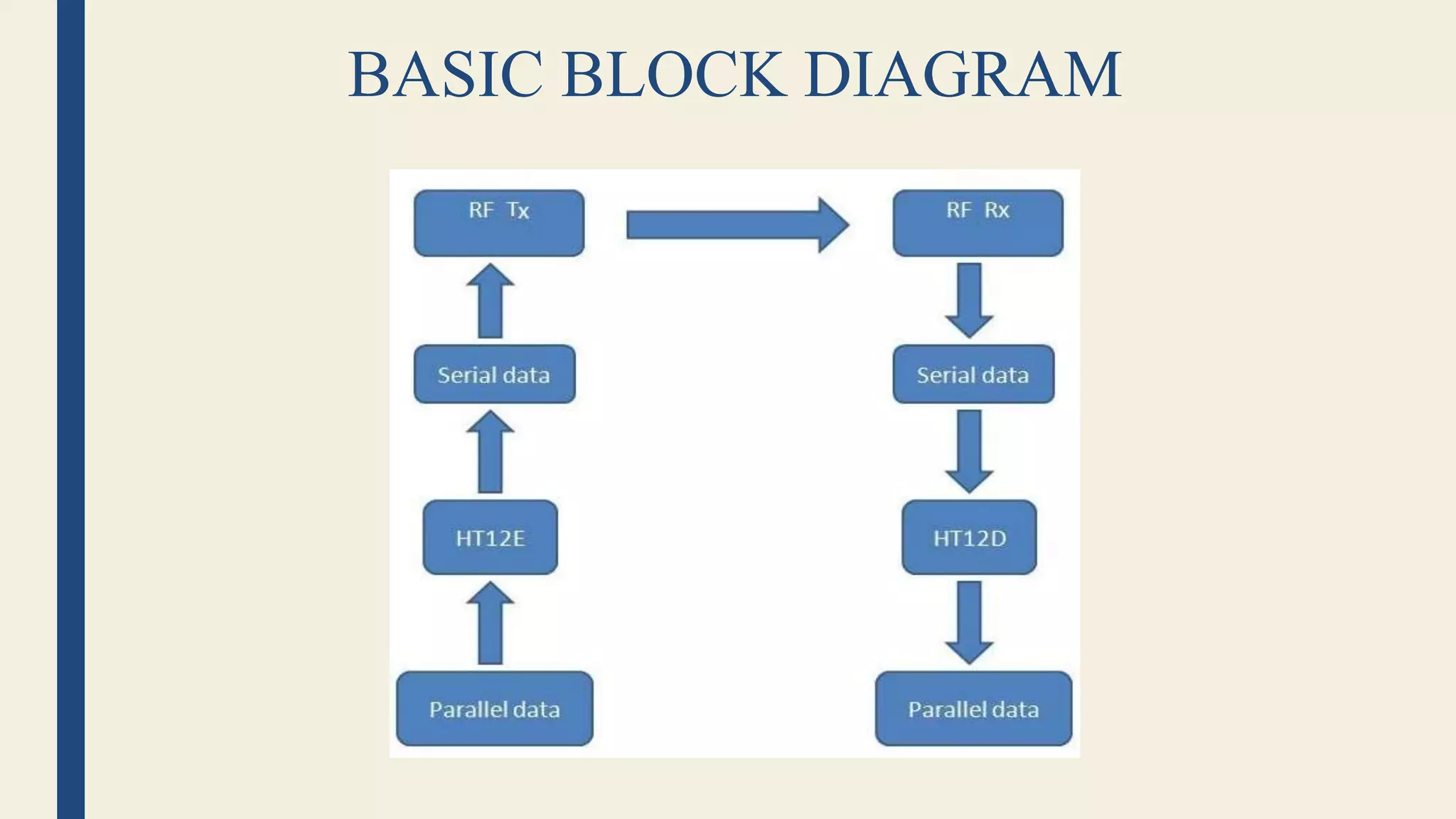
■ In this project consist of two sections, transmitter and receiver section. Whenever
we are pressing any key in the remote it generates the corresponding RF signals,
and these signals are received by the receiver unit.
■ ASK transmitter and receiver is used as transmitter and receiver. HT12E, HT12D
encoders and decoders are used in this electronic circuit.
BASIC BLOCK DIAGRAM
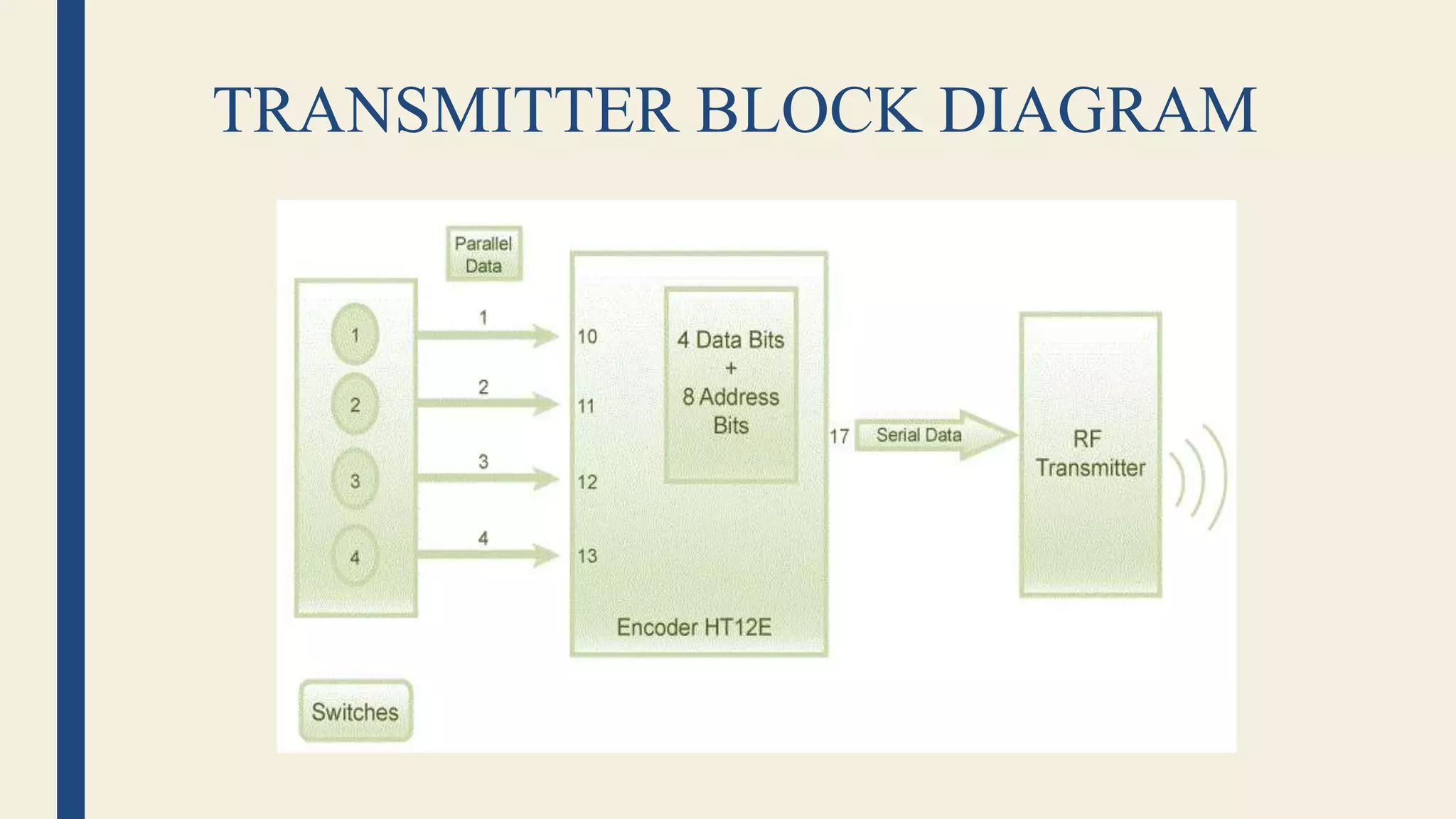
TRANSMITTER BLOCK DIAGRAM
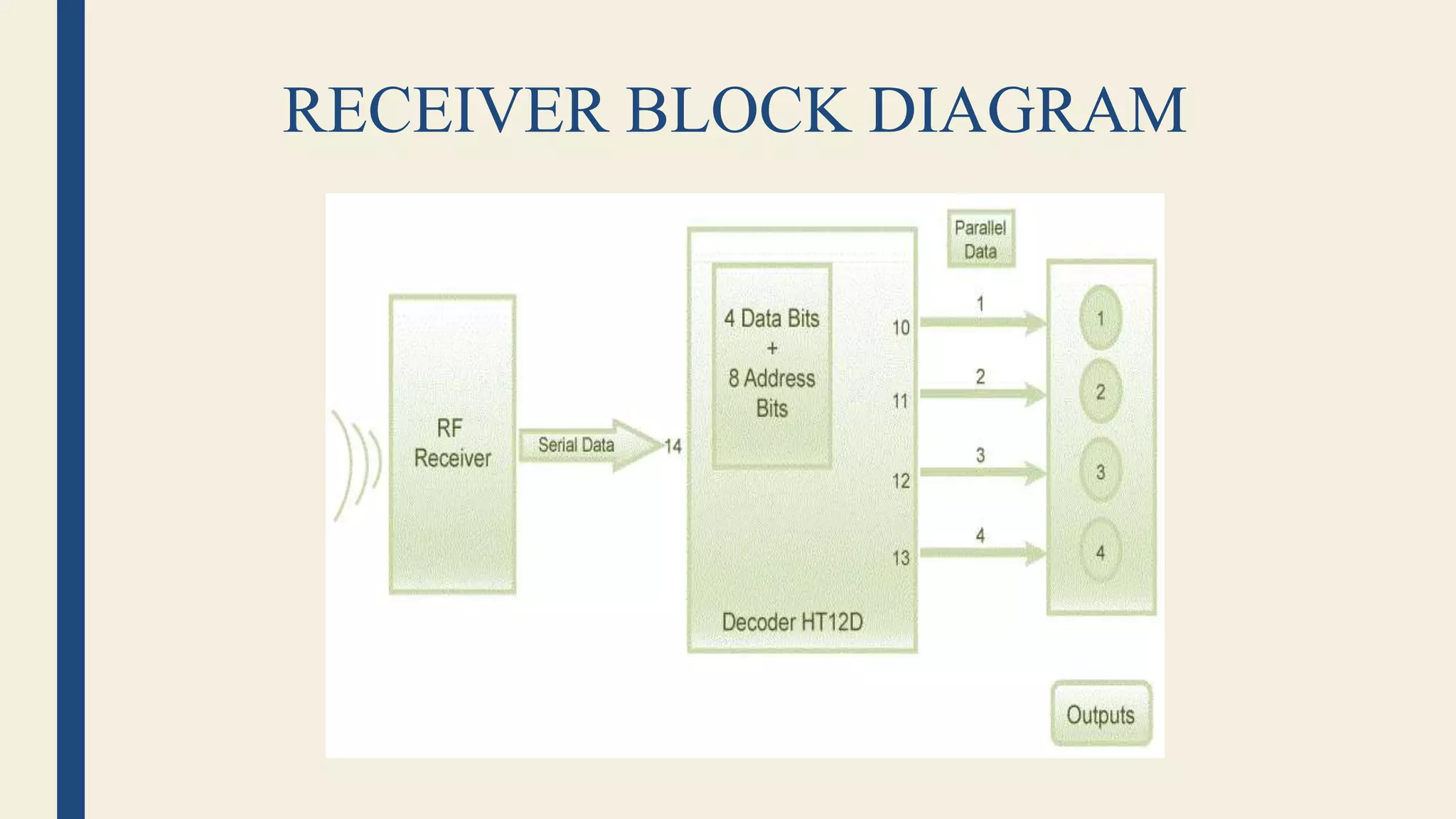
RECEIVER BLOCK DIAGRAM
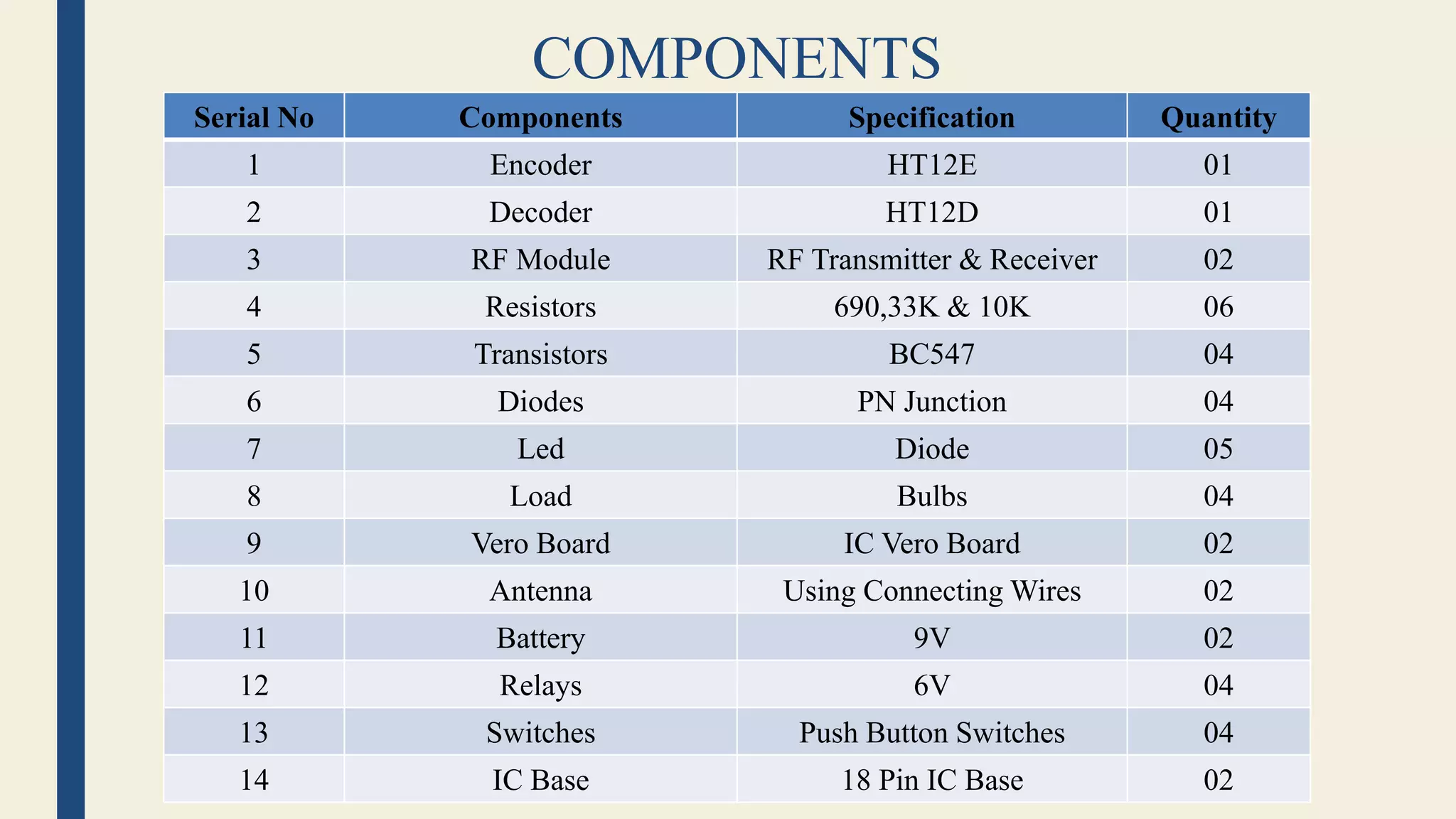
COMPONENTS
Serial No Components Specification Quantity
1 Encoder HT12E 01
2 Decoder HT12D 01
3 RF Module RF Transmitter & Receiver 02
4 Resistors 690,33K & 10K 06
5 Transistors BC547 04
6 Diodes PN Junction 04
7 Led Diode 05
8 Load Bulbs 04
9 Vero Board IC Vero Board 02
10 Antenna Using Connecting Wires 02
11 Battery 9V 02
12 Relays 6V 04
13 Switches Push Button Switches 04
14 IC Base 18 Pin IC Base 02
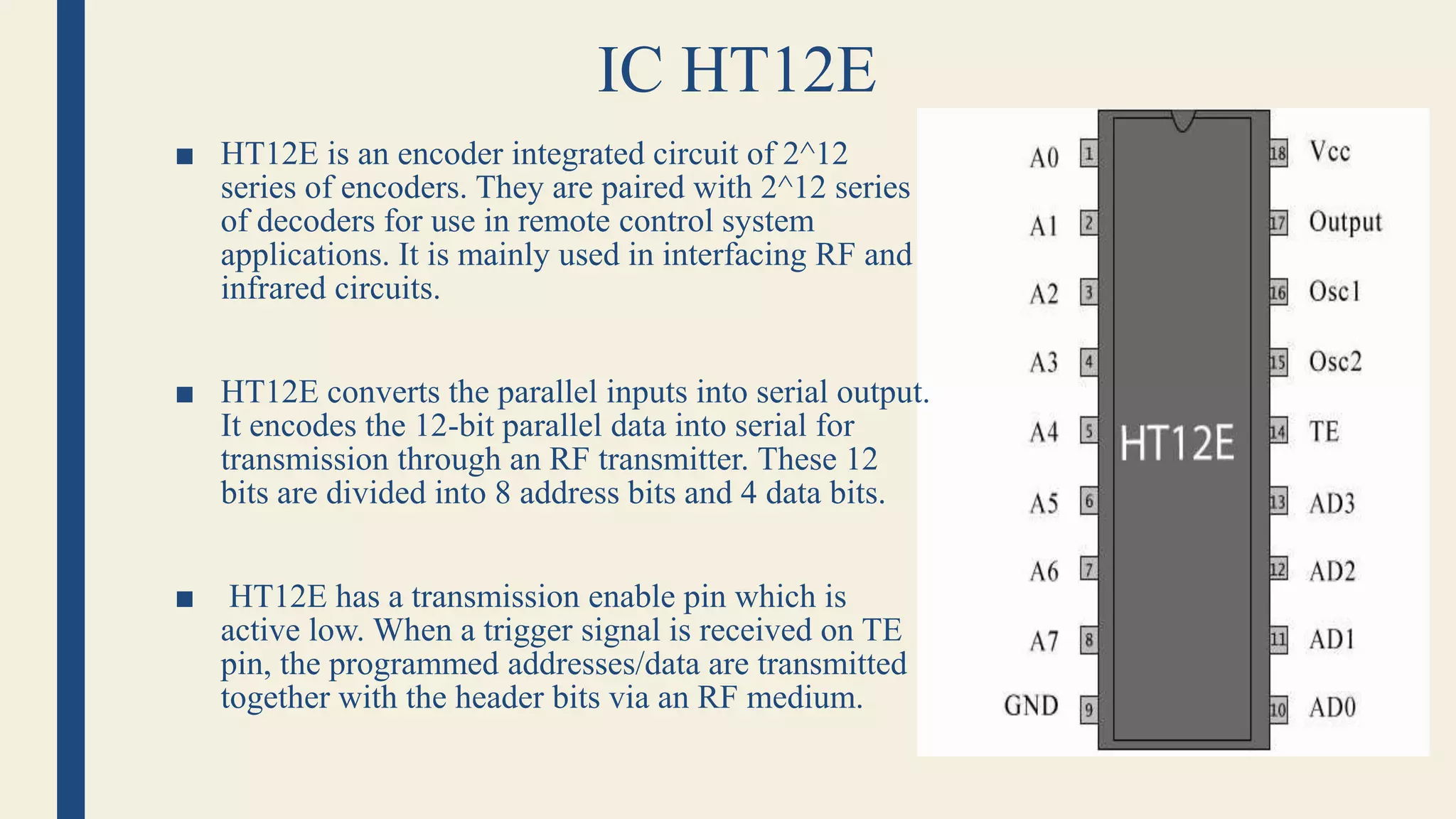
IC HT12E
■ HT12E is an encoder integrated circuit of 2^12
series of encoders. They are paired with 2^12 series
of decoders for use in remote control system
applications. It is mainly used in interfacing RF and
infrared circuits.
■ HT12E converts the parallel inputs into serial output.
It encodes the 12-bit parallel data into serial for
transmission through an RF transmitter. These 12
bits are divided into 8 address bits and 4 data bits.
■ HT12E has a transmission enable pin which is
active low. When a trigger signal is received on TE
pin, the programmed addresses/data are transmitted
together with the header bits via an RF medium.
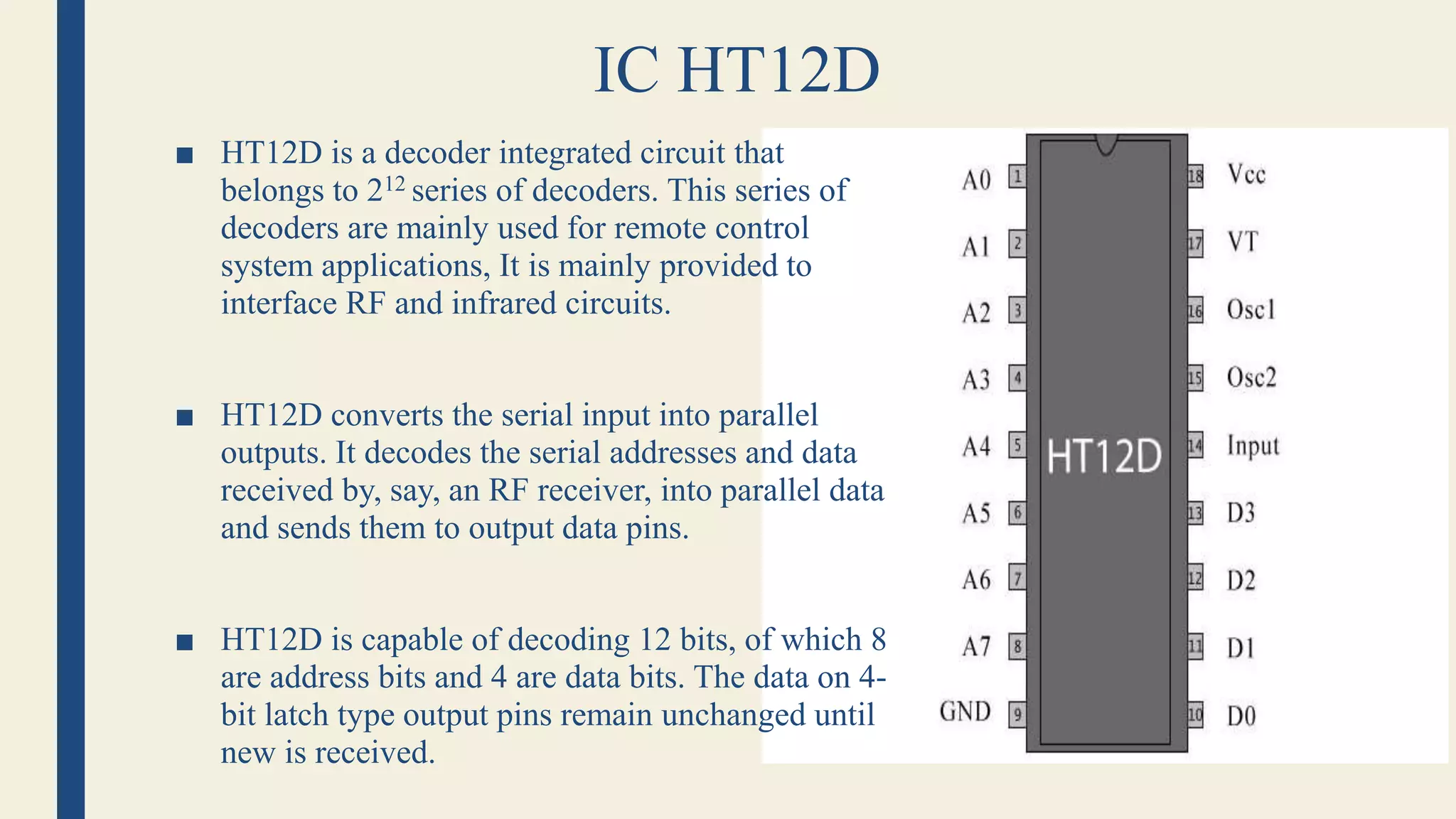
IC HT12D
■ HT12D is a decoder integrated circuit that
belongs to 212 series of decoders. This series of
decoders are mainly used for remote control
system applications, It is mainly provided to
interface RF and infrared circuits.
■ HT12D converts the serial input into parallel
outputs. It decodes the serial addresses and data
received by, say, an RF receiver, into parallel data
and sends them to output data pins.
■ HT12D is capable of decoding 12 bits, of which 8
are address bits and 4 are data bits. The data on 4-
bit latch type output pins remain unchanged until
new is received.
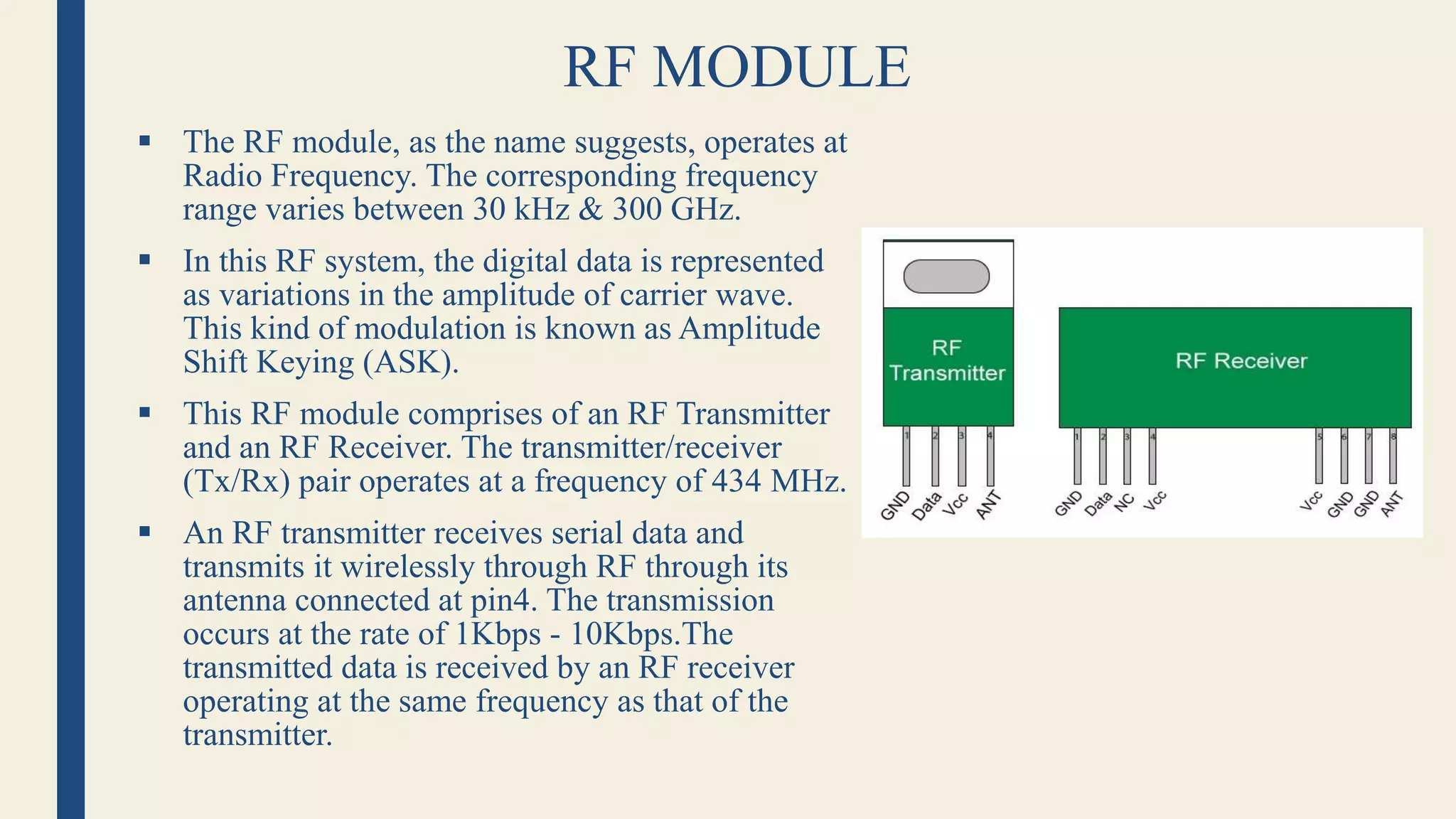
RF MODULE
 The RF module, as the name suggests, operates at
Radio Frequency. The corresponding frequency
range varies between 30 kHz & 300 GHz.
 In this RF system, the digital data is represented
as variations in the amplitude of carrier wave.
This kind of modulation is known as Amplitude
Shift Keying (ASK).
 This RF module comprises of an RF Transmitter
and an RF Receiver. The transmitter/receiver
(Tx/Rx) pair operates at a frequency of 434 MHz.
 An RF transmitter receives serial data and
transmits it wirelessly through RF through its
antenna connected at pin4. The transmission
occurs at the rate of 1Kbps - 10Kbps.The
transmitted data is received by an RF receiver
operating at the same frequency as that of the
transmitter.
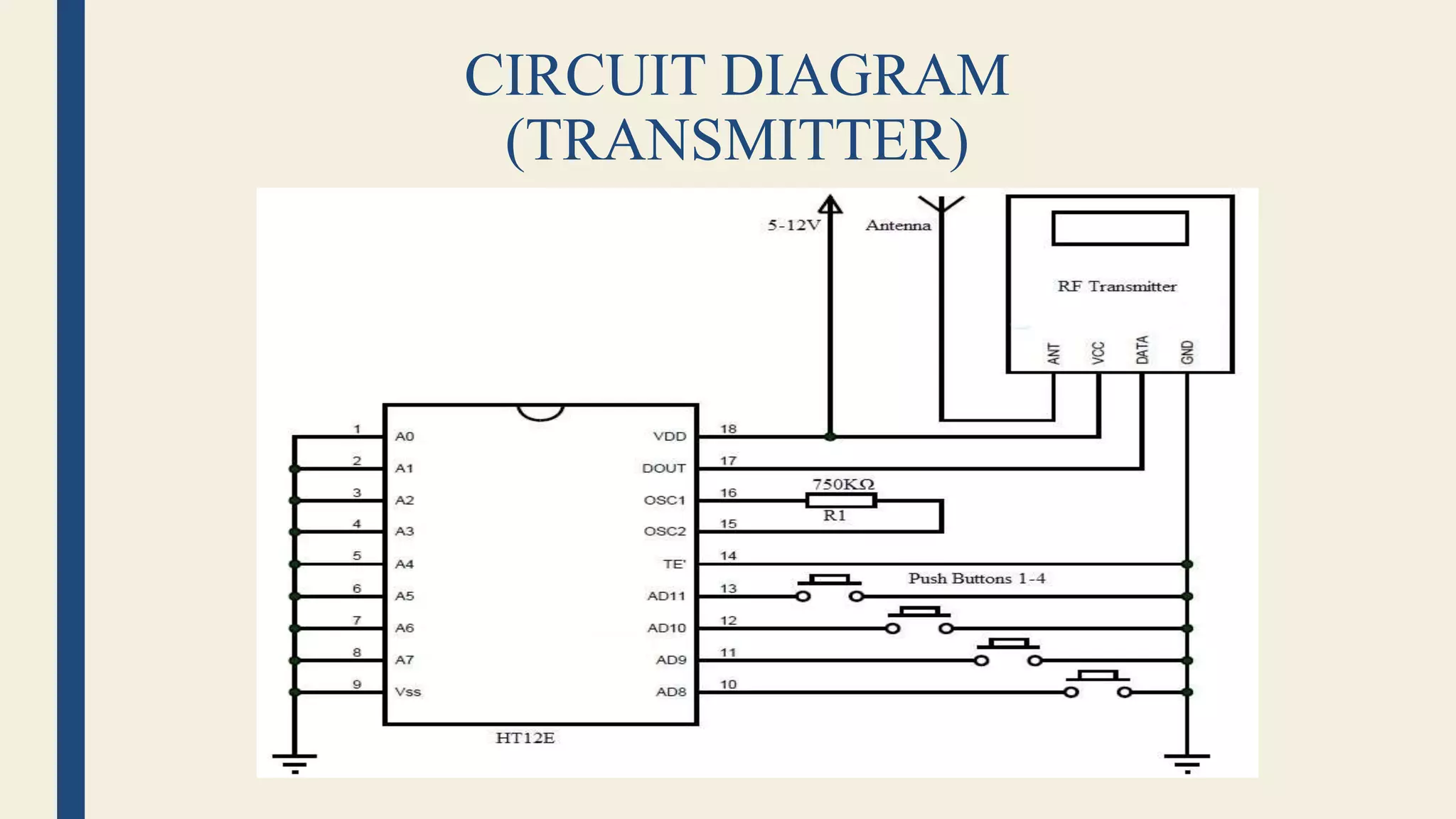
CIRCUIT DIAGRAM
(TRANSMITTER)
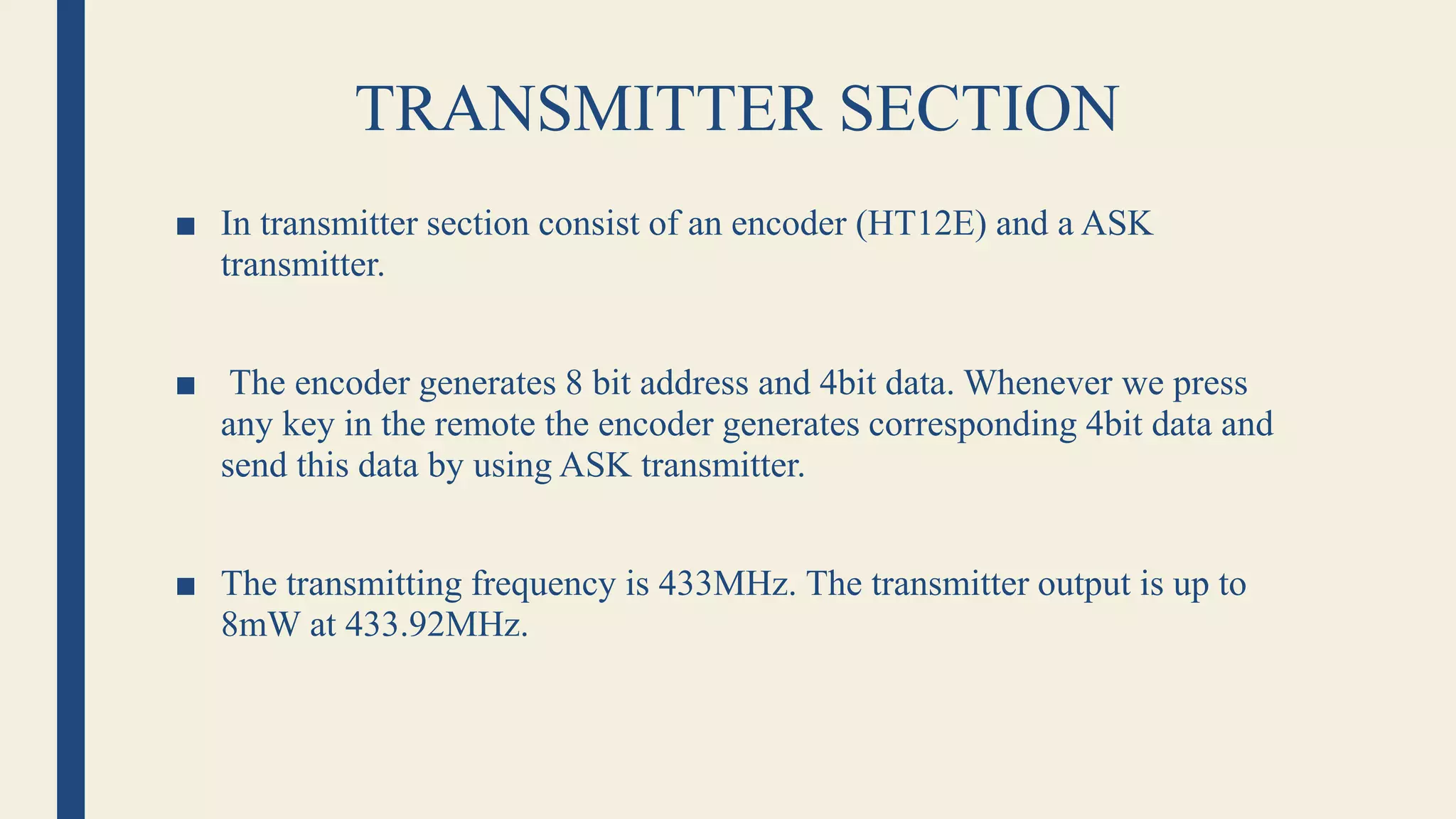
TRANSMITTER SECTION
■ In transmitter section consist of an encoder (HT12E) and a ASK
transmitter.
■ The encoder generates 8 bit address and 4bit data. Whenever we press
any key in the remote the encoder generates corresponding 4bit data and
send this data by using ASK transmitter.
■ The transmitting frequency is 433MHz. The transmitter output is up to
8mW at 433.92MHz.
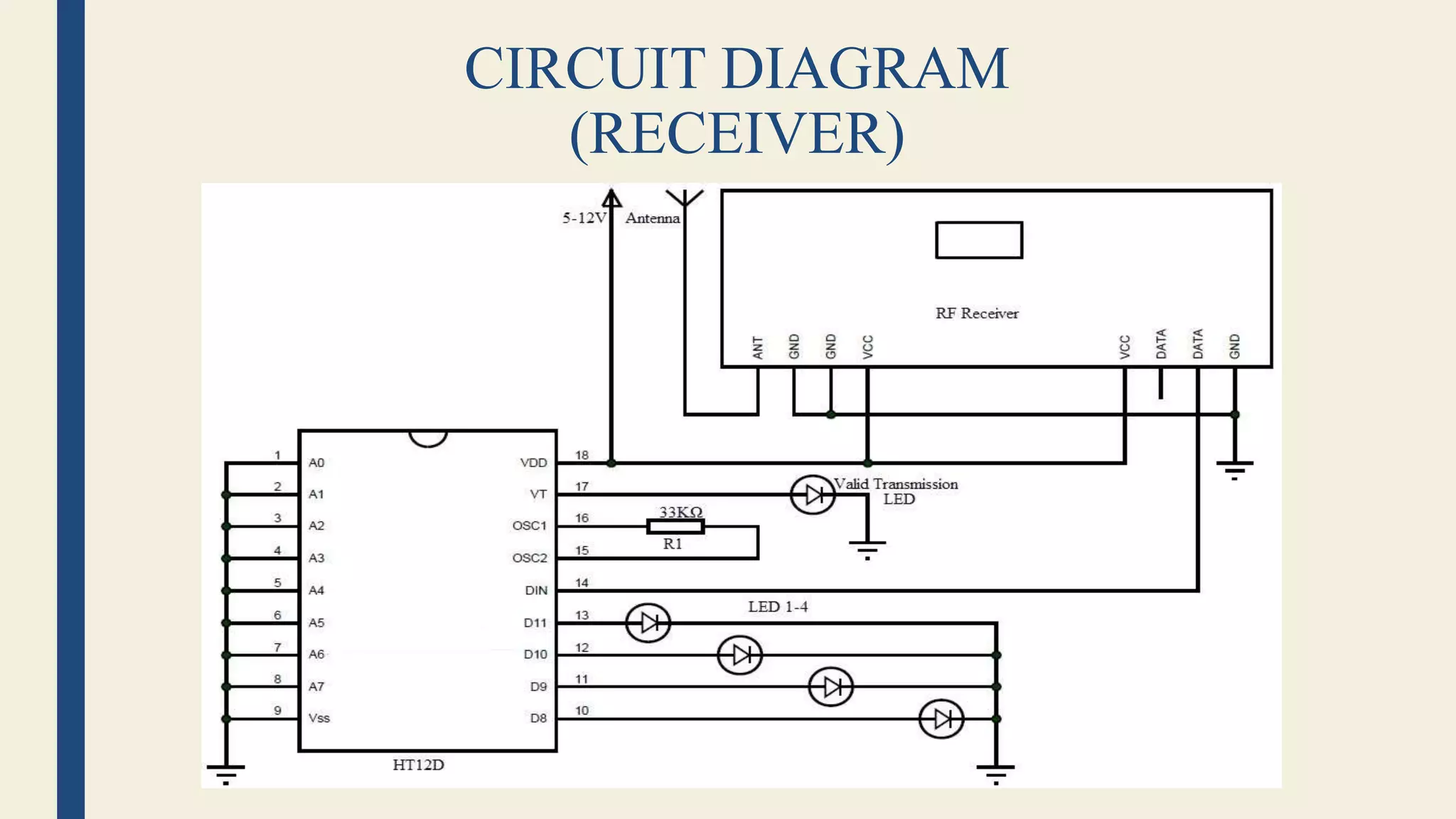
CIRCUIT DIAGRAM
(RECEIVER)
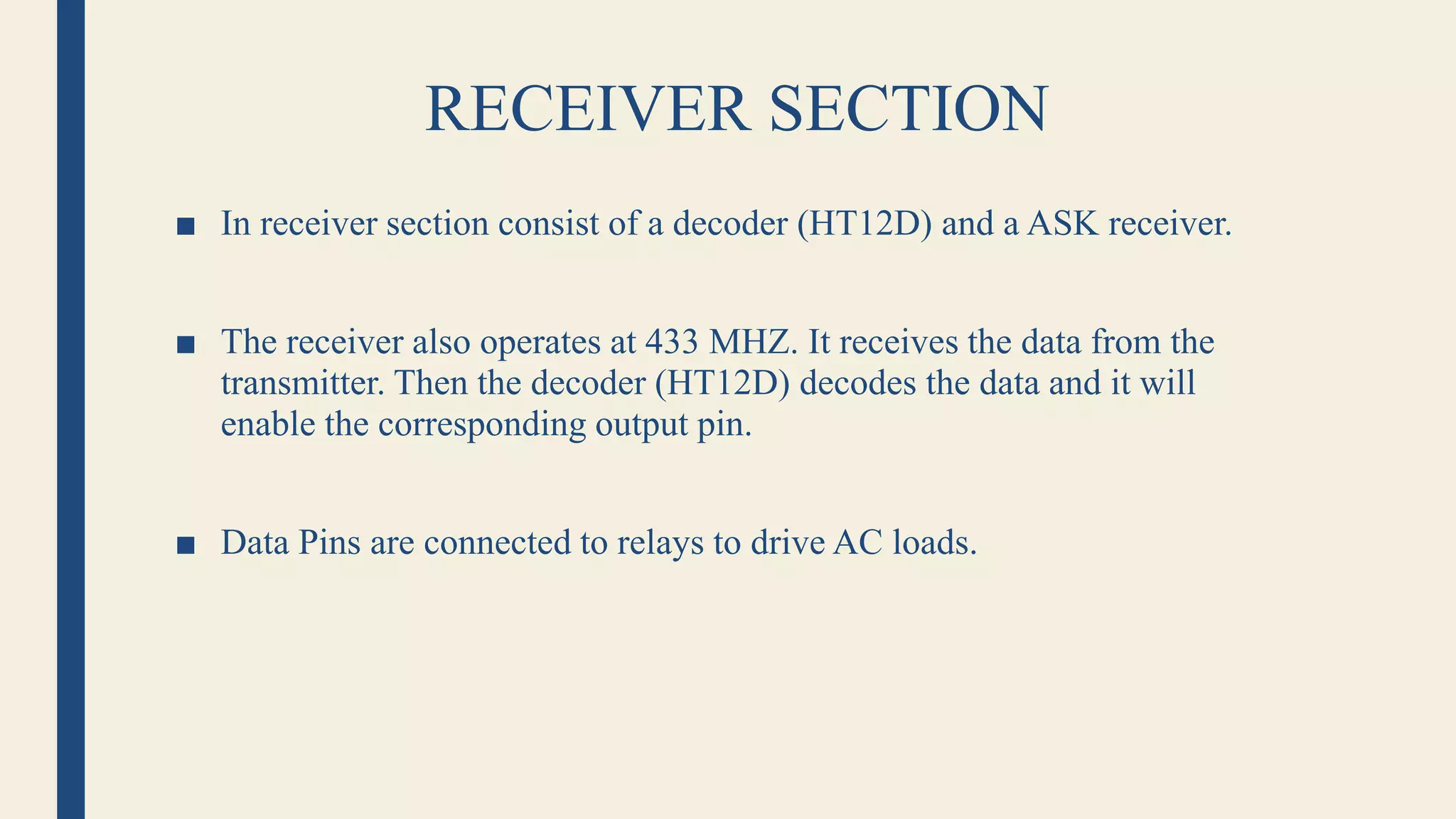
RECEIVER SECTION
■ In receiver section consist of a decoder (HT12D) and a ASK receiver.
■ The receiver also operates at 433 MHZ. It receives the data from the
transmitter. Then the decoder (HT12D) decodes the data and it will
enable the corresponding output pin.
■ Data Pins are connected to relays to drive AC loads.
WORKING
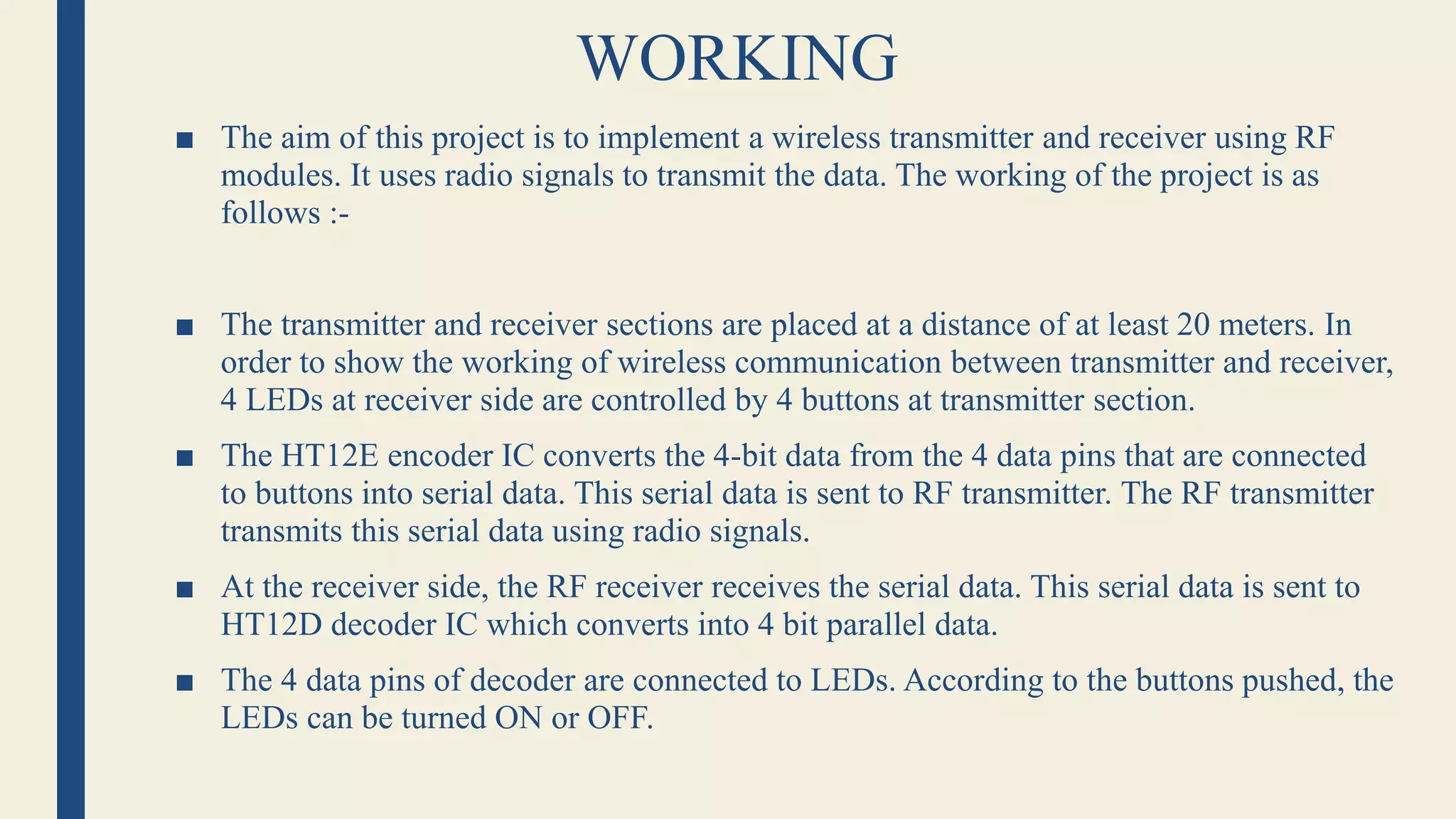
■ The aim of this project is to implement a wireless transmitter and receiver using RF
modules. It uses radio signals to transmit the data. The working of the project is as
follows :-
■ The transmitter and receiver sections are placed at a distance of at least 20 meters. In
order to show the working of wireless communication between transmitter and receiver,
4 LEDs at receiver side are controlled by 4 buttons at transmitter section.
■ The HT12E encoder IC converts the 4-bit data from the 4 data pins that are connected
to buttons into serial data. This serial data is sent to RF transmitter. The RF transmitter
transmits this serial data using radio signals.
■ At the receiver side, the RF receiver receives the serial data. This serial data is sent to
HT12D decoder IC which converts into 4 bit parallel data.
■ The 4 data pins of decoder are connected to LEDs. According to the buttons pushed, the
LEDs can be turned ON or OFF.
APPLICATION
■ Used for remote control applications like burglar alarm, car door alarm,
calling bell, security systems, etc.
■ They can also be used in home automation systems.
ADVANTAGES
■ As RF Modules doesn’t require line of sight communication, the
transmitter and receiver can be isolated over a distance and data can be
transmitted successfully.
■ Works for longer distances as compared to IR.
■ RF signals can travel even there is an obstruction between transmitter and
receiver.
REFERENES
■ http://www.electronicshub.org/rf-remote-control-circuit-for-home-appliances/
■ http://arif‐ece.blogspot.com/2010/05/tv‐remote‐controlled‐home‐appliance.html
■ http://www.electronicshub.org/wireless-transmitter-and-receiver-using-rf-
modules.html
■ http://www.circuitstoday.com/category/remote‐circuits
THANKYOU

HOME AUTOMATION SYSTEM USING RADIO FREQUENCY

  • 1.
    HOME AUTOMATION SYSTEMUSING RADIO FREQUENCY PRESENTED BY – SUDIP KUMAR PAUL B.TECH ( ELECTRONICSAND COMMUNICATION ENGINEERING ) DURGAPUR,WEST BENGAL, INDIA
  • 2.
    INTRODUCTION ■ This isa simple type remote control by using RF communication without microcontroller. In this project a remote has been designed for various home appliances like fan, lights, etc. It gives lot of comfort to the user since we can operate it by staying at one place. We can control any of the appliances by using this remote. ■ In this project consist of two sections, transmitter and receiver section. Whenever we are pressing any key in the remote it generates the corresponding RF signals, and these signals are received by the receiver unit. ■ ASK transmitter and receiver is used as transmitter and receiver. HT12E, HT12D encoders and decoders are used in this electronic circuit.
  • 3.
  • 4.
  • 5.
  • 6.
    COMPONENTS Serial No ComponentsSpecification Quantity 1 Encoder HT12E 01 2 Decoder HT12D 01 3 RF Module RF Transmitter & Receiver 02 4 Resistors 690,33K & 10K 06 5 Transistors BC547 04 6 Diodes PN Junction 04 7 Led Diode 05 8 Load Bulbs 04 9 Vero Board IC Vero Board 02 10 Antenna Using Connecting Wires 02 11 Battery 9V 02 12 Relays 6V 04 13 Switches Push Button Switches 04 14 IC Base 18 Pin IC Base 02
  • 7.
    IC HT12E ■ HT12Eis an encoder integrated circuit of 2^12 series of encoders. They are paired with 2^12 series of decoders for use in remote control system applications. It is mainly used in interfacing RF and infrared circuits. ■ HT12E converts the parallel inputs into serial output. It encodes the 12-bit parallel data into serial for transmission through an RF transmitter. These 12 bits are divided into 8 address bits and 4 data bits. ■ HT12E has a transmission enable pin which is active low. When a trigger signal is received on TE pin, the programmed addresses/data are transmitted together with the header bits via an RF medium.
  • 8.
    IC HT12D ■ HT12Dis a decoder integrated circuit that belongs to 212 series of decoders. This series of decoders are mainly used for remote control system applications, It is mainly provided to interface RF and infrared circuits. ■ HT12D converts the serial input into parallel outputs. It decodes the serial addresses and data received by, say, an RF receiver, into parallel data and sends them to output data pins. ■ HT12D is capable of decoding 12 bits, of which 8 are address bits and 4 are data bits. The data on 4- bit latch type output pins remain unchanged until new is received.
  • 9.
    RF MODULE  TheRF module, as the name suggests, operates at Radio Frequency. The corresponding frequency range varies between 30 kHz & 300 GHz.  In this RF system, the digital data is represented as variations in the amplitude of carrier wave. This kind of modulation is known as Amplitude Shift Keying (ASK).  This RF module comprises of an RF Transmitter and an RF Receiver. The transmitter/receiver (Tx/Rx) pair operates at a frequency of 434 MHz.  An RF transmitter receives serial data and transmits it wirelessly through RF through its antenna connected at pin4. The transmission occurs at the rate of 1Kbps - 10Kbps.The transmitted data is received by an RF receiver operating at the same frequency as that of the transmitter.
  • 10.
  • 11.
    TRANSMITTER SECTION ■ Intransmitter section consist of an encoder (HT12E) and a ASK transmitter. ■ The encoder generates 8 bit address and 4bit data. Whenever we press any key in the remote the encoder generates corresponding 4bit data and send this data by using ASK transmitter. ■ The transmitting frequency is 433MHz. The transmitter output is up to 8mW at 433.92MHz.
  • 12.
  • 13.
    RECEIVER SECTION ■ Inreceiver section consist of a decoder (HT12D) and a ASK receiver. ■ The receiver also operates at 433 MHZ. It receives the data from the transmitter. Then the decoder (HT12D) decodes the data and it will enable the corresponding output pin. ■ Data Pins are connected to relays to drive AC loads.
  • 14.
    WORKING ■ The aimof this project is to implement a wireless transmitter and receiver using RF modules. It uses radio signals to transmit the data. The working of the project is as follows :- ■ The transmitter and receiver sections are placed at a distance of at least 20 meters. In order to show the working of wireless communication between transmitter and receiver, 4 LEDs at receiver side are controlled by 4 buttons at transmitter section. ■ The HT12E encoder IC converts the 4-bit data from the 4 data pins that are connected to buttons into serial data. This serial data is sent to RF transmitter. The RF transmitter transmits this serial data using radio signals. ■ At the receiver side, the RF receiver receives the serial data. This serial data is sent to HT12D decoder IC which converts into 4 bit parallel data. ■ The 4 data pins of decoder are connected to LEDs. According to the buttons pushed, the LEDs can be turned ON or OFF.
  • 15.
    APPLICATION ■ Used forremote control applications like burglar alarm, car door alarm, calling bell, security systems, etc. ■ They can also be used in home automation systems. ADVANTAGES ■ As RF Modules doesn’t require line of sight communication, the transmitter and receiver can be isolated over a distance and data can be transmitted successfully. ■ Works for longer distances as compared to IR. ■ RF signals can travel even there is an obstruction between transmitter and receiver.
  • 16.
    REFERENES ■ http://www.electronicshub.org/rf-remote-control-circuit-for-home-appliances/ ■ http://arif‐ece.blogspot.com/2010/05/tv‐remote‐controlled‐home‐appliance.html ■http://www.electronicshub.org/wireless-transmitter-and-receiver-using-rf- modules.html ■ http://www.circuitstoday.com/category/remote‐circuits
  • 17.