http://nesreenahmed.com
§ This  talk  is  NOT about  graph  processing  systems  
• (e.g.,  graphx,  Giraph,  …).
§ This  talk  is  NOT about  graph  processing  systems  
• (e.g.,  graphx,  Giraph,  …).
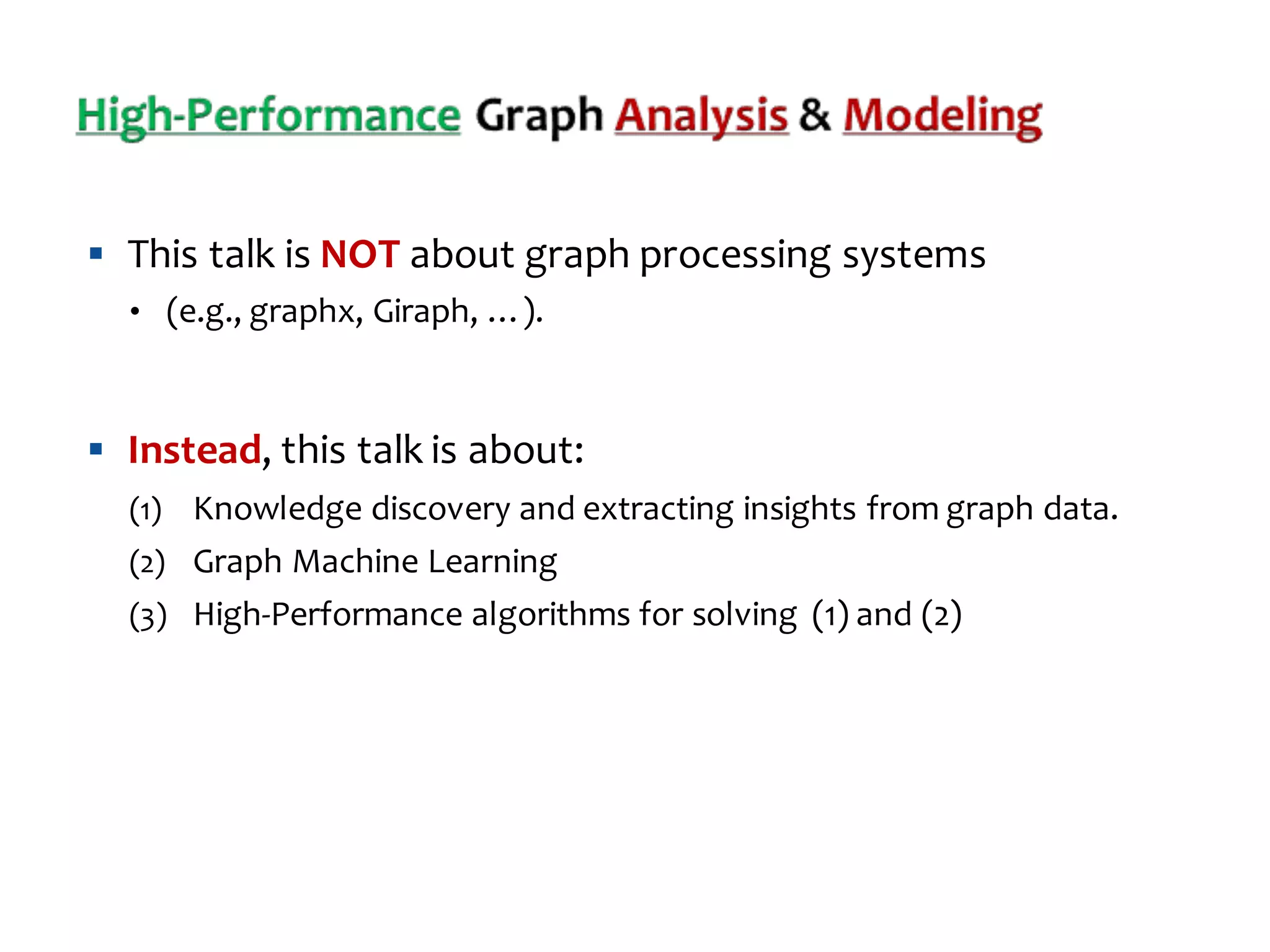
§ Instead,  this  talk  is  about:
(1) Knowledge  discovery  and  extracting  insights  from  graph  data.
(2) Graph  Machine  Learning  
(3) High-­‐Performance  algorithms  for  solving    (1)  and  (2)
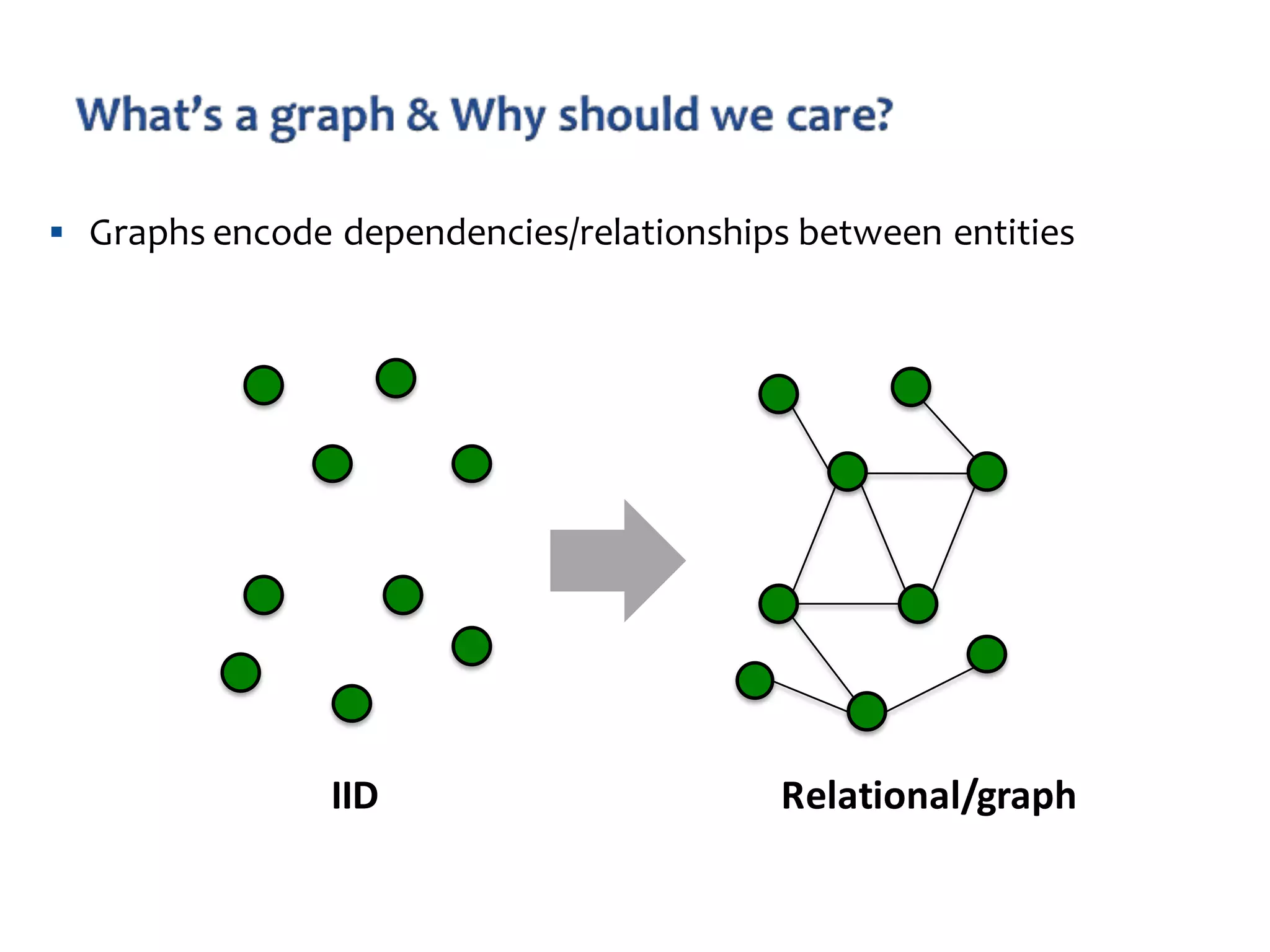
§ Graphs  encode  dependencies/relationships  between  entities
IID Relational/graph
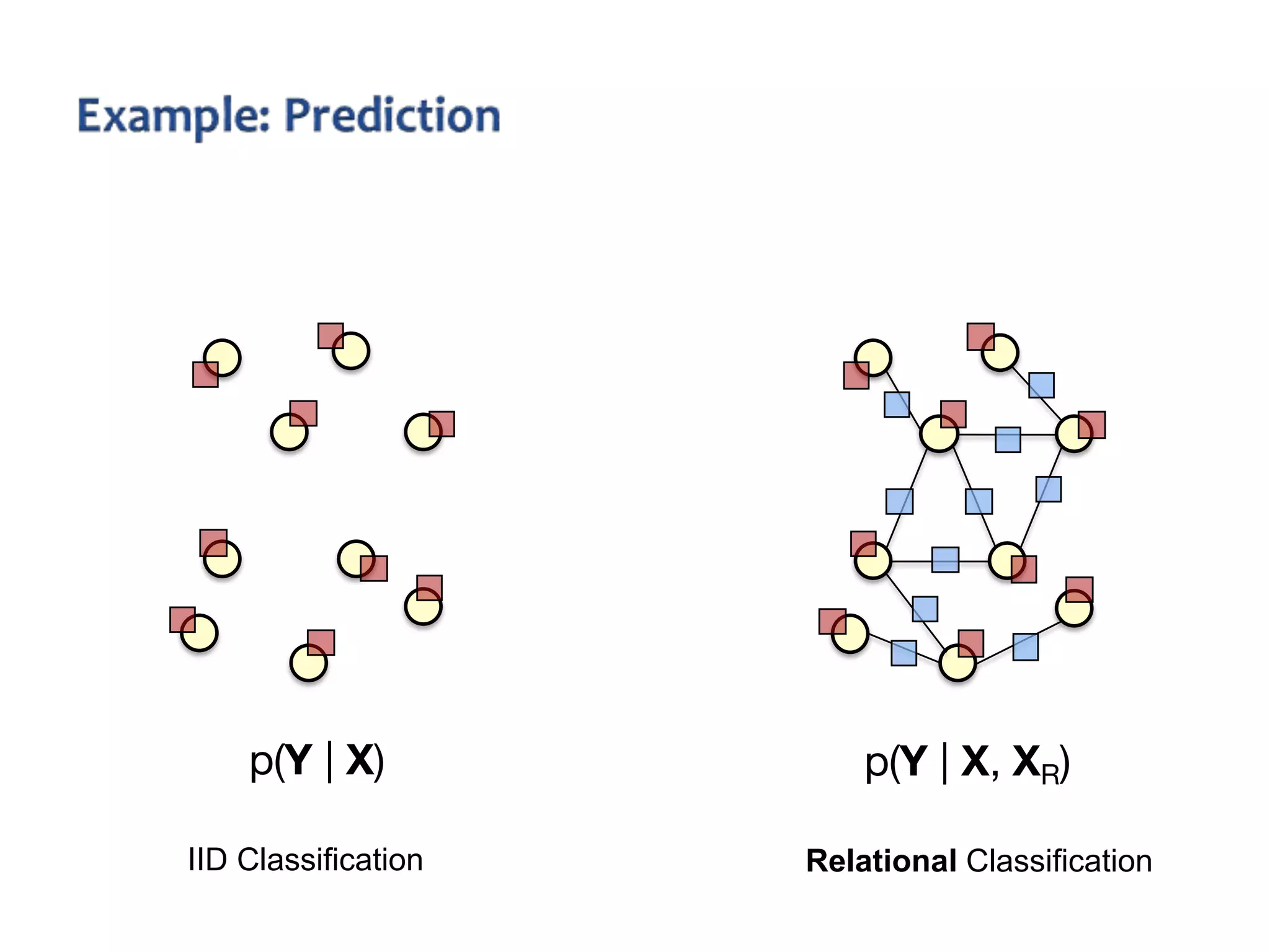
p(Y | X) p(Y | X, XR)
IID  Classification Relational Classification
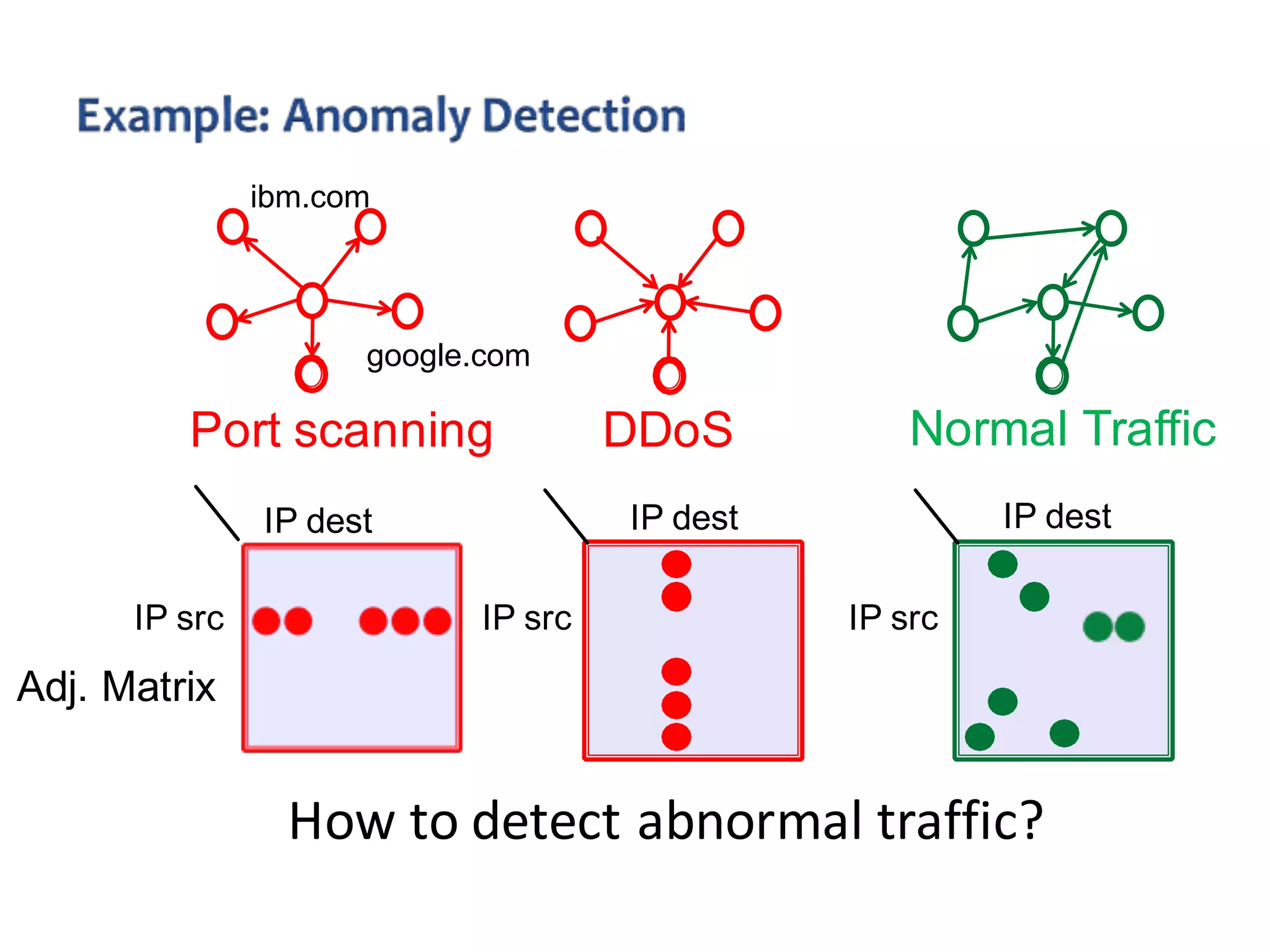
How	
  to	
  detect	
  abnormal	
  traffic?
Port  scanning DDoS Normal  Traffic
Adj.  Matrix
ibm.com
google.com
IP  src
IP  dest
IP  src
IP  dest
IP  src
IP  dest
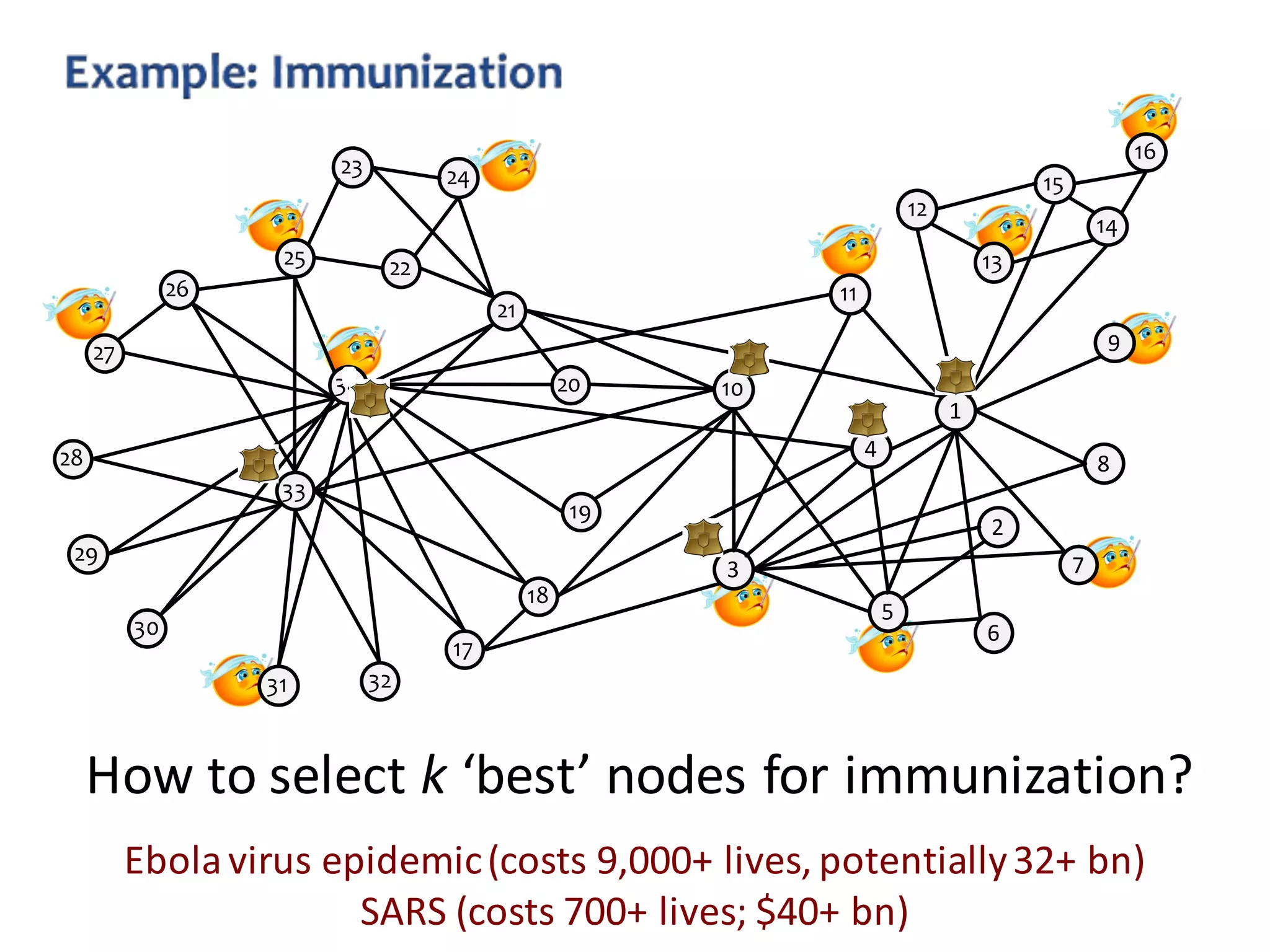
How	
  to	
  select	
  k ‘best’ nodes	
  for	
  immunization?
34
33
25
26
27
28
29
30
31 32
22
21
20
19
18
17
23 24
12
13
14
15
16
1
9
10
11
3
4
5
6
7
8
2
Ebola	
  virus	
  epidemic	
  (costs	
  9,000+	
  lives,	
  potentially	
  32+	
  bn)
SARS	
  (costs	
  700+	
  lives;	
  $40+	
  bn)
-­‐
-­‐
-­‐
-­‐
-­‐
Social  network  
Human  Disease  Network  
[Barabasi 2007]
Food  Web  [2007]
Terrorist  Network
[Krebs  2002]Internet  (AS)  [2005]
Gene  Regulatory  Network  
[Decourty 2008]
Protein  Interactions  
[breast  cancer]
Political  blogs
Power  grid
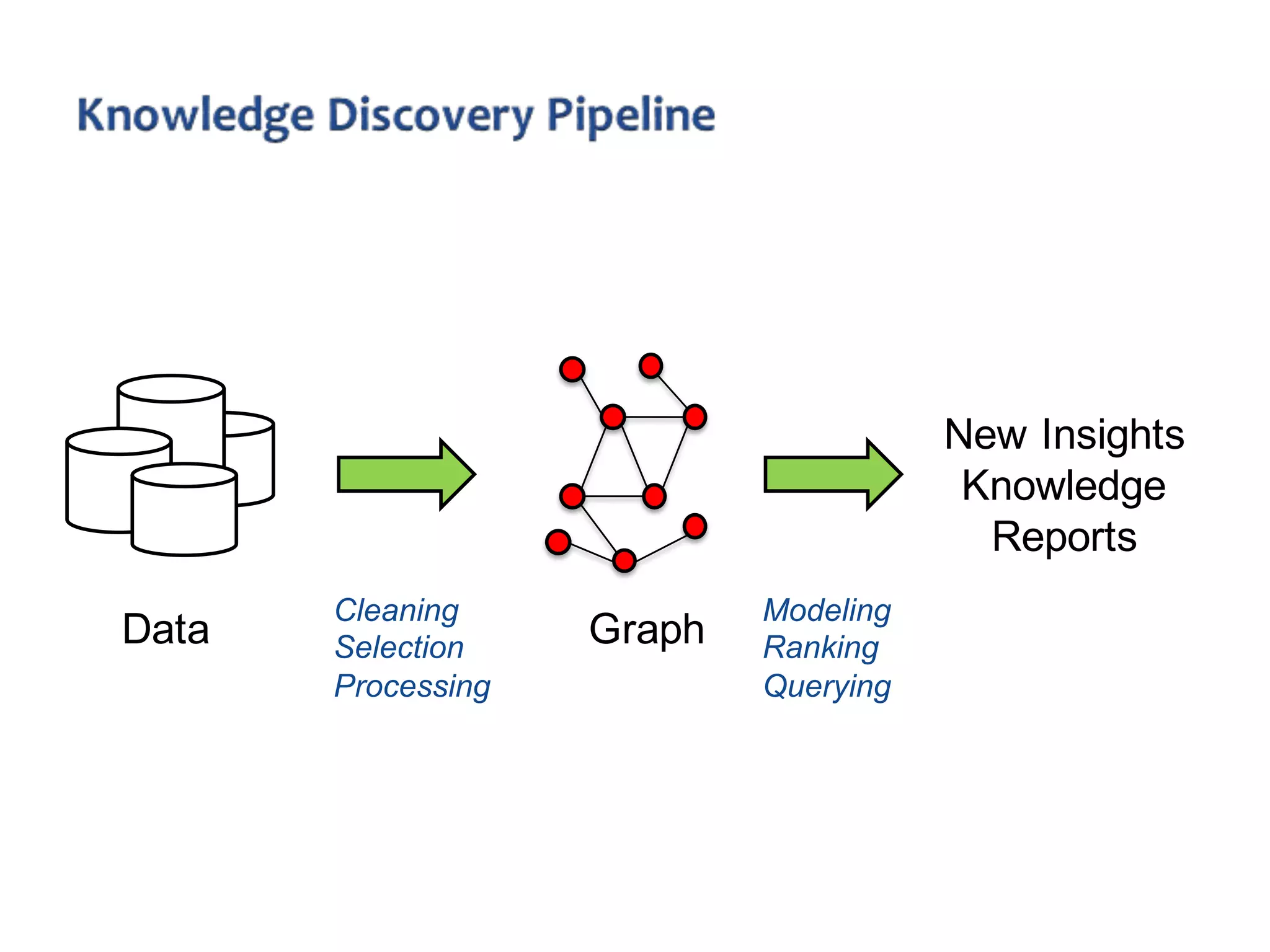
New  Insights
Knowledge
Reports
Data Graph
Cleaning  
Selection
Processing
Modeling  
Ranking  
Querying
New  Insights
Knowledge
Reports
Data Graph
Cleaning  
Selection
Processing
Modeling  
Ranking  
Querying
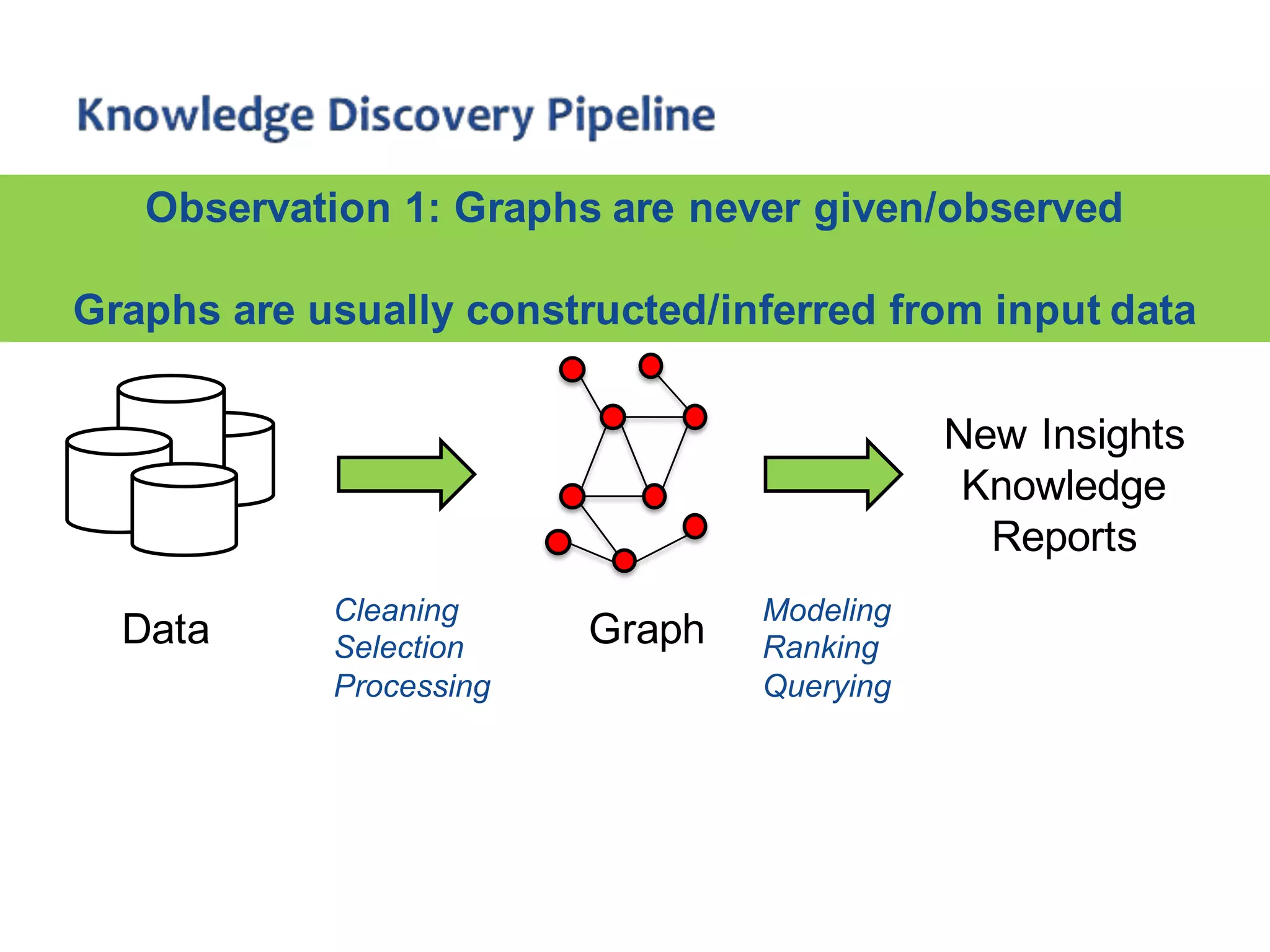
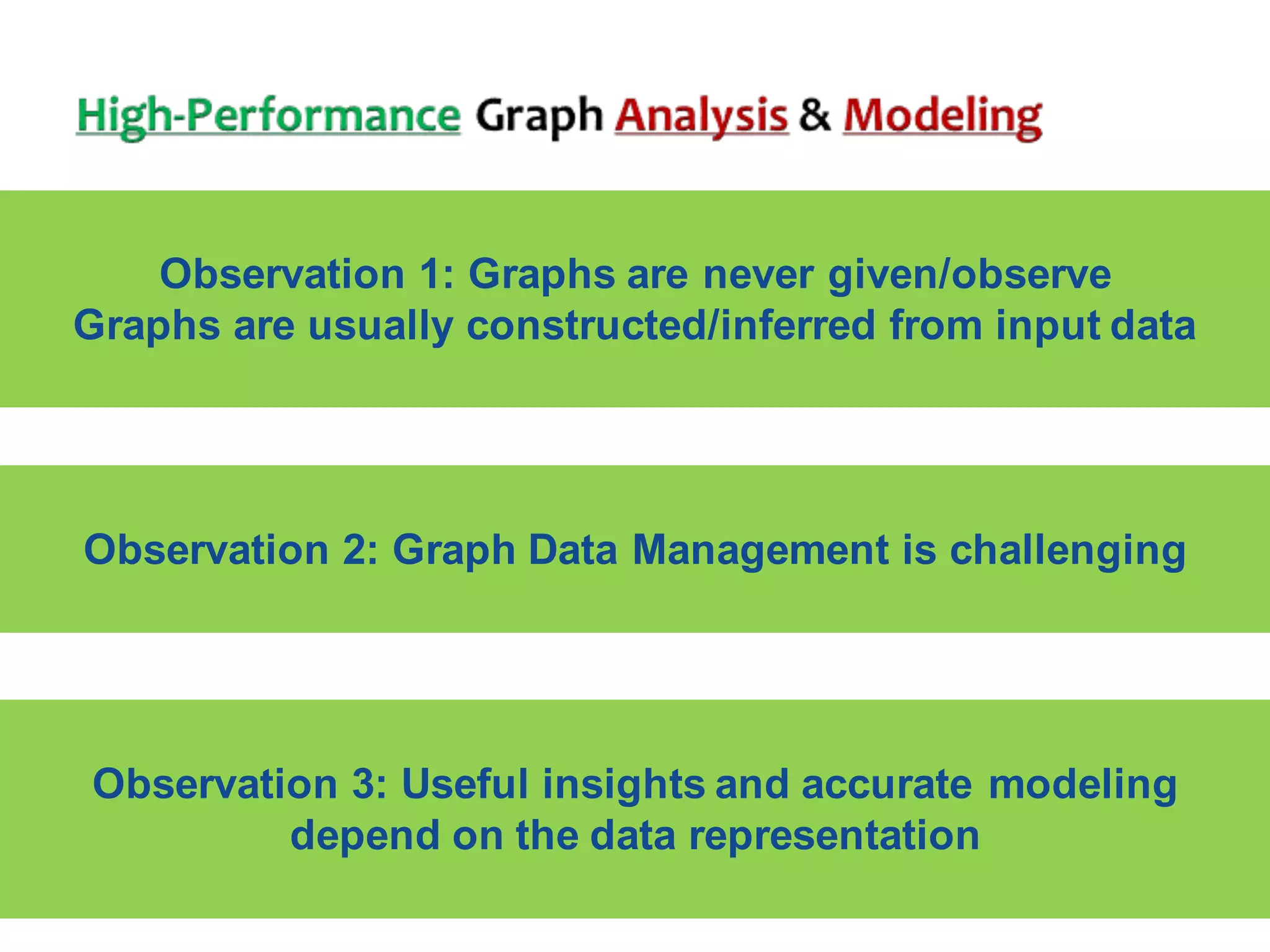
Observation  1:  Graphs  are  never  given/observed
Graphs  are  usually  constructed/inferred  from  input  data
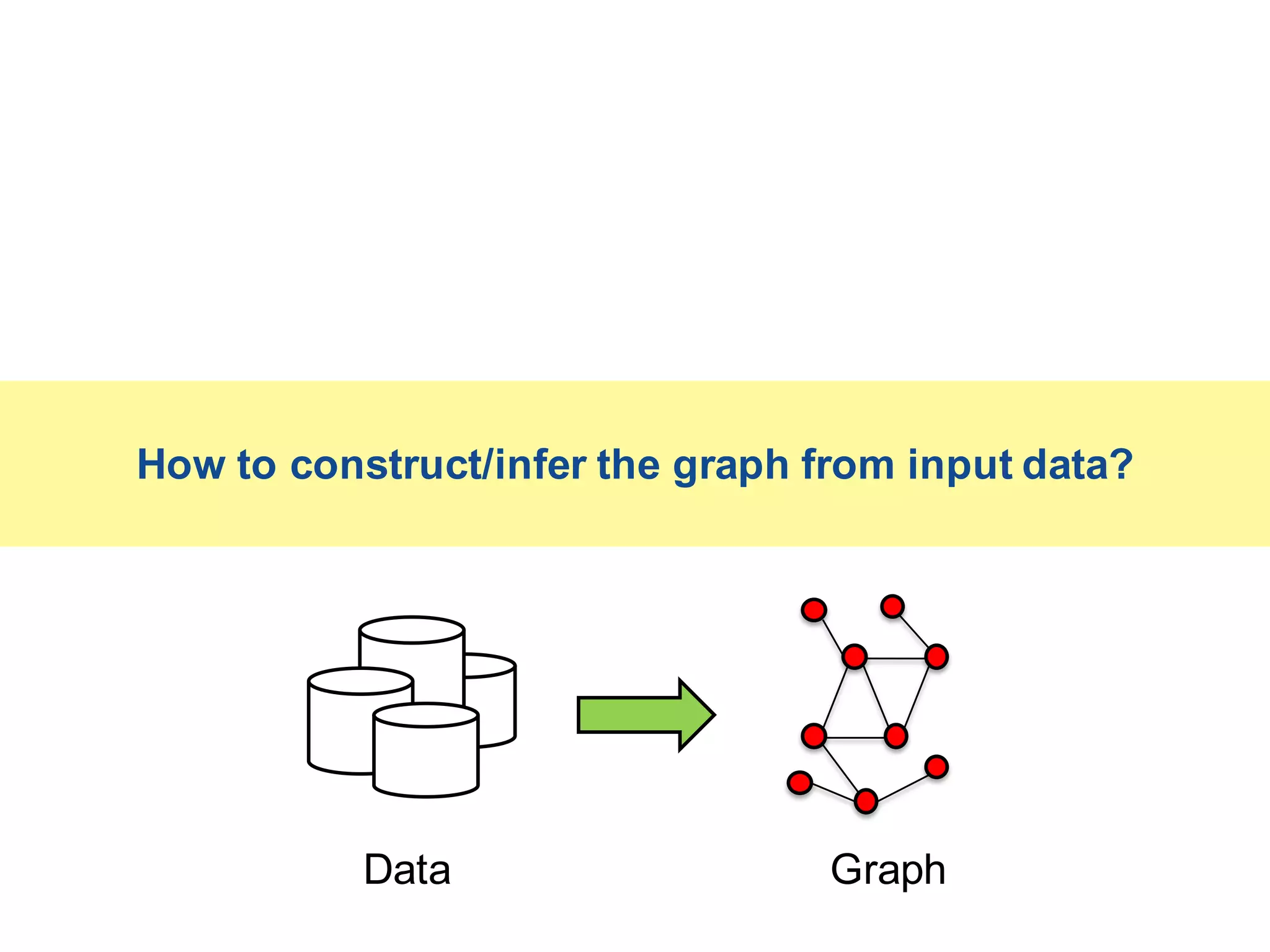
How  to  construct/infer  the  graph  from  input  data?
Data Graph
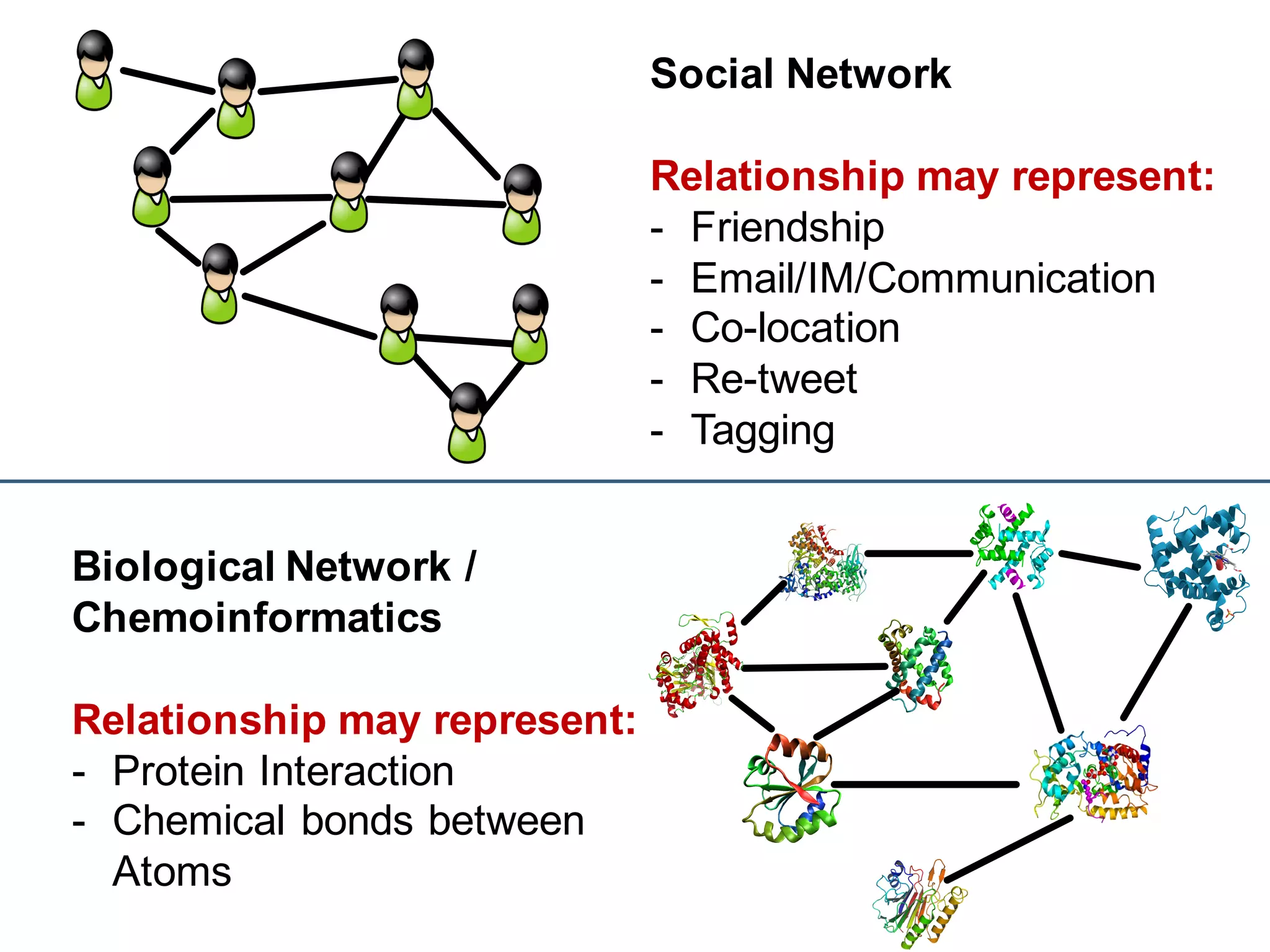
Social  Network
Relationship  may  represent:
-­ Friendship
-­ Email/IM/Communication
-­ Co-­location
-­ Re-­tweet
-­ Tagging
Biological  Network  /  
Chemoinformatics
Relationship  may  represent:
-­ Protein  Interaction
-­ Chemical  bonds  between  
Atoms
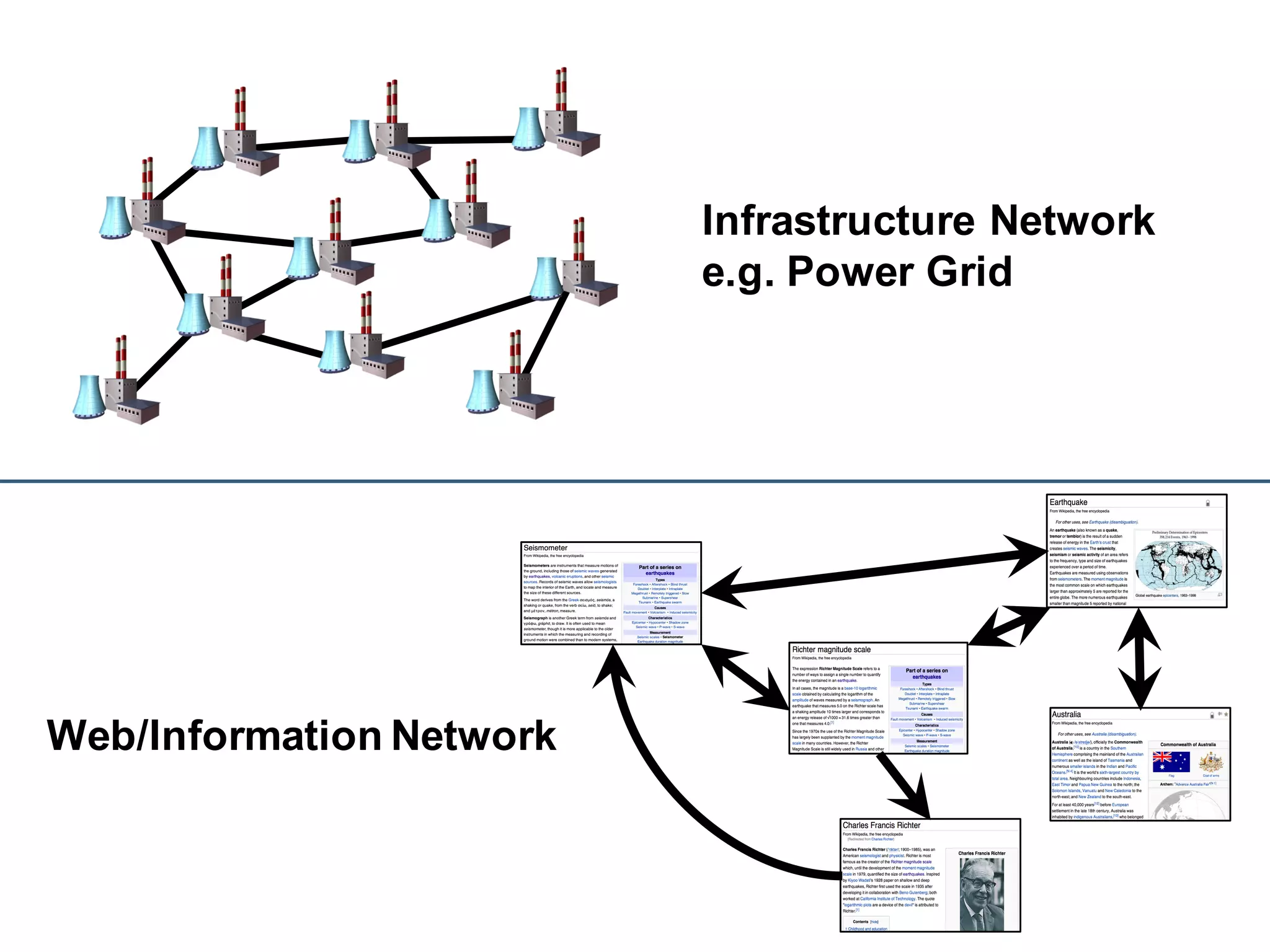
Infrastructure  Network
e.g.  Power  Grid
Web/Information  Network
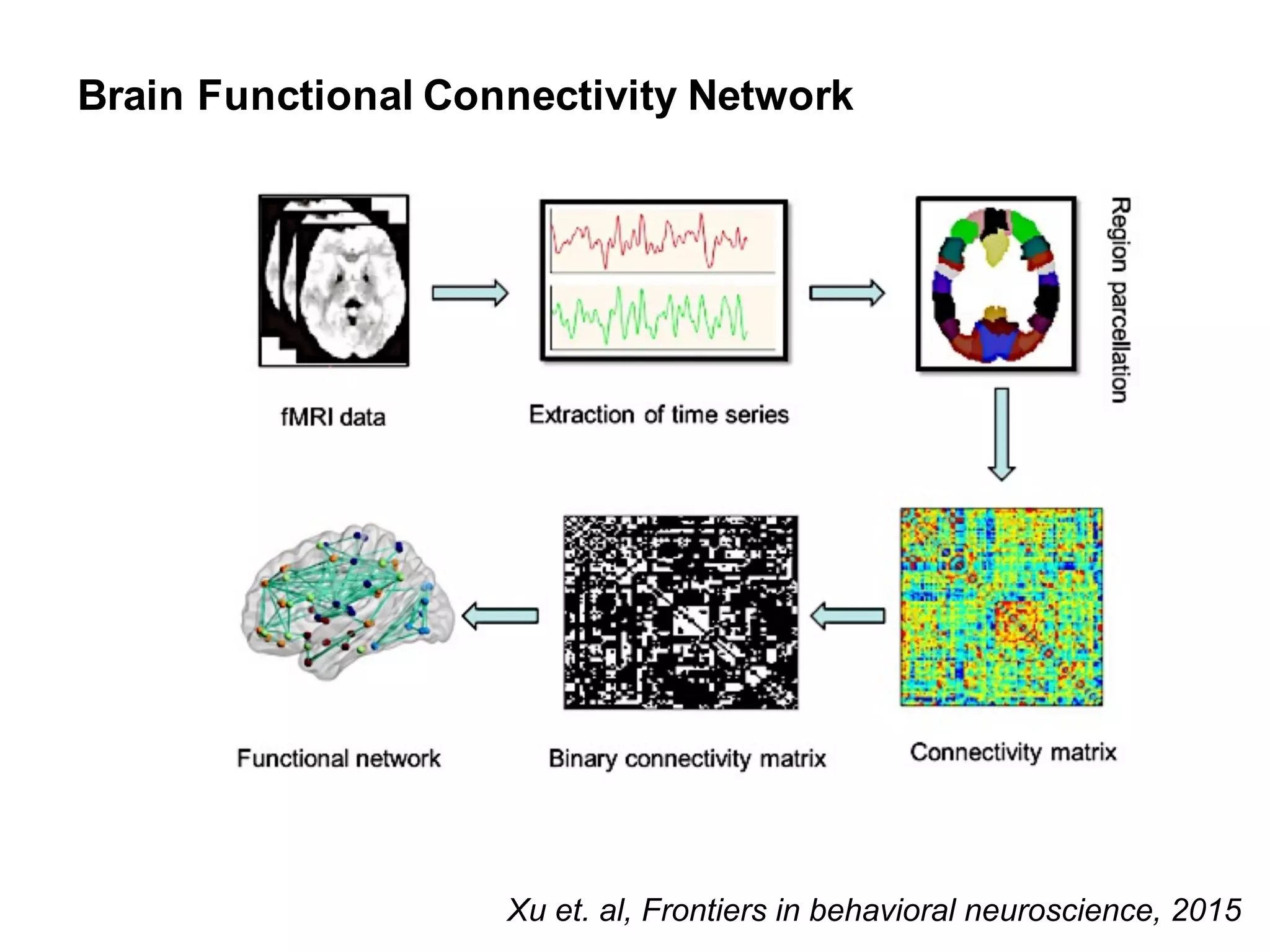
Xu  et.  al,  Frontiers  in  behavioral  neuroscience,  2015
Brain  Functional  Connectivity  Network
New  Insights
Knowledge
Reports
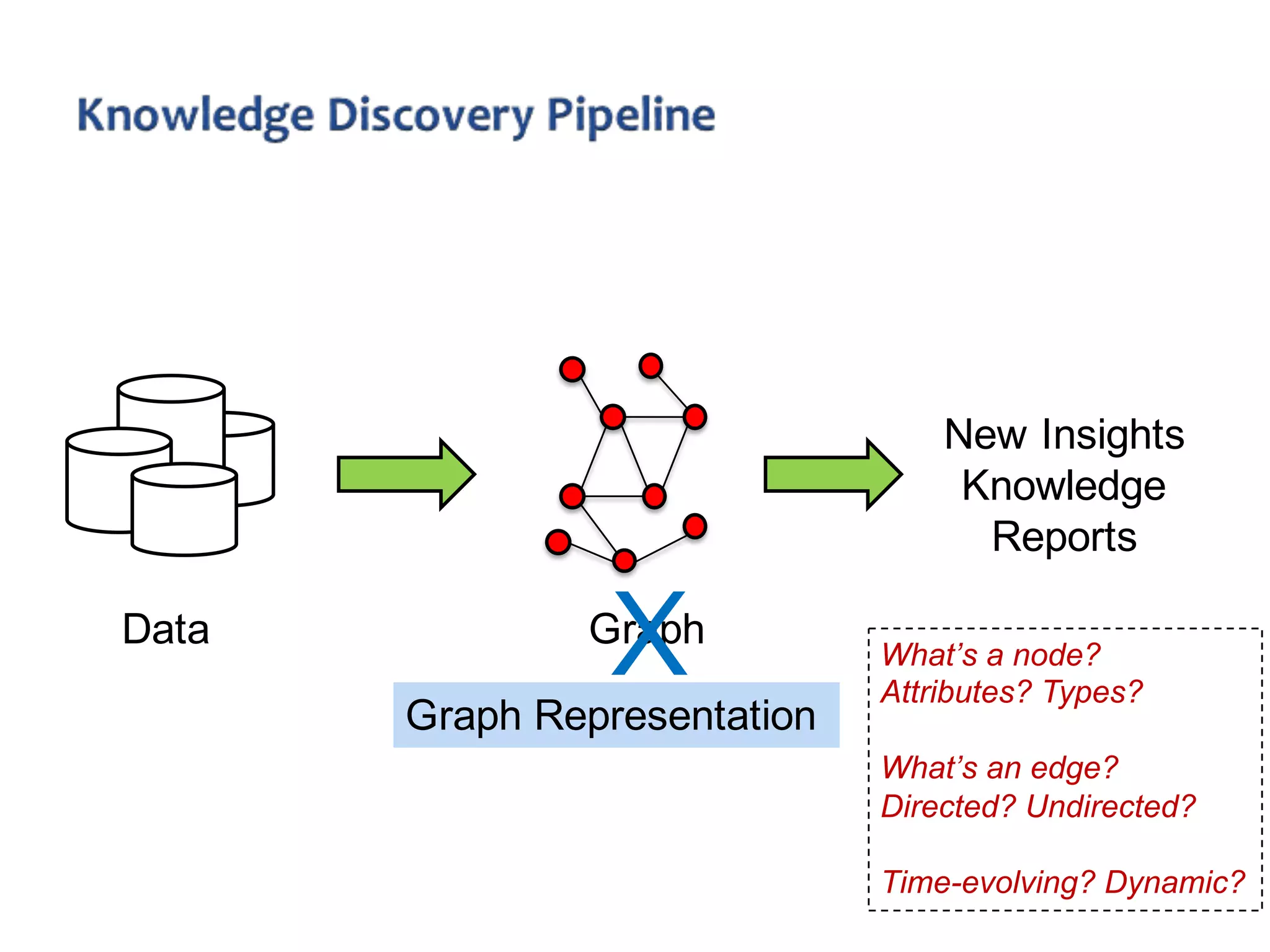
Data Graph
XGraph  Representation
What’s  a  node?
Attributes?  Types?
What’s  an  edge?
Directed?  Undirected?
Time-­evolving?  Dynamic?
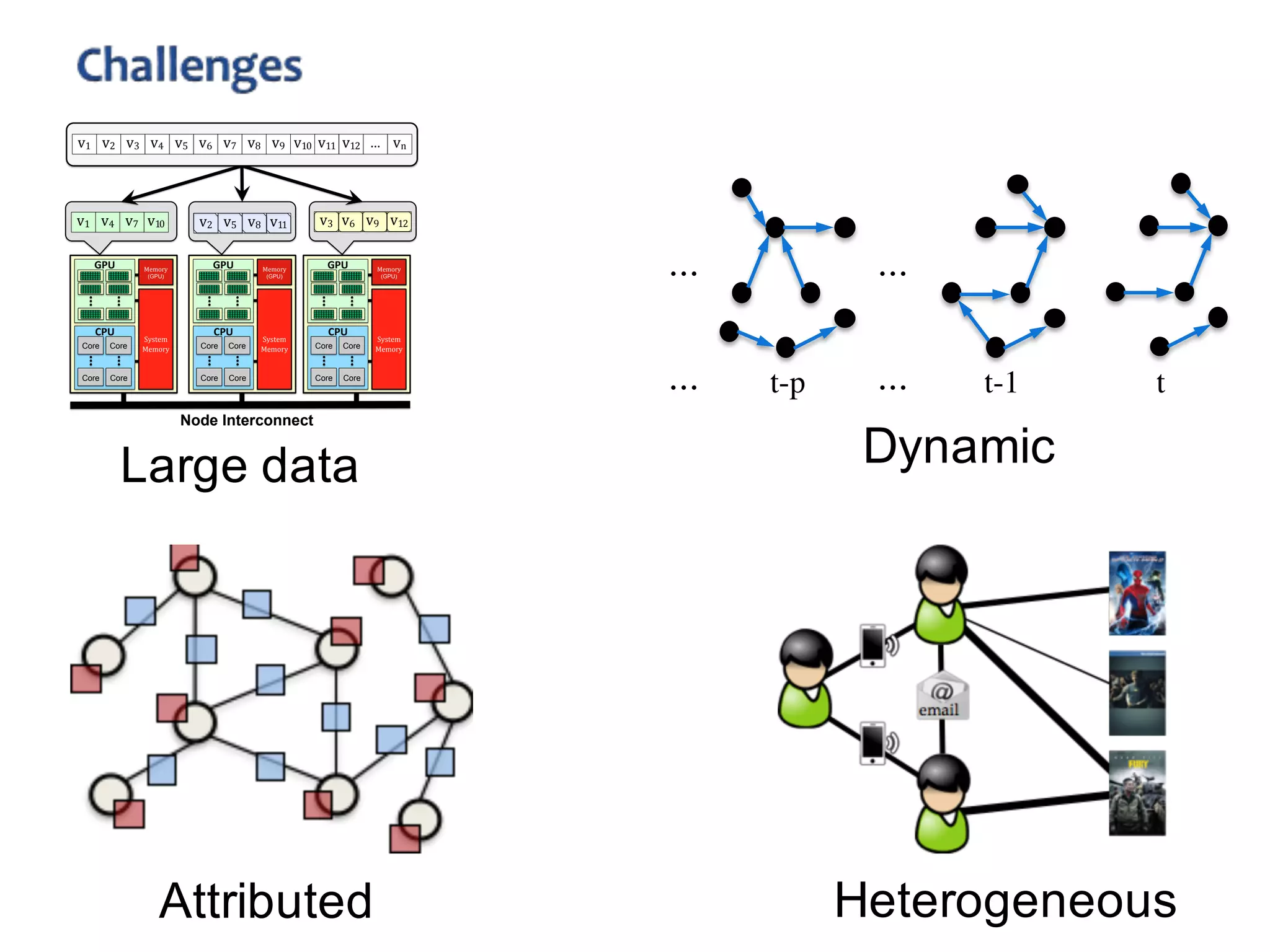
Observation  2:  Graph  Data  Management  is  challenging
GPU$
CPU$
Core Core
Core Core
System'
Memory''
Memory'
(GPU)
GPU$
CPU$
Core Core
Core Core
System'
Memory''
Memory'
(GPU)
Node Interconnect
v1 ! v4 ! v7 !v10 ! v2 ! v5 ! v8 !v11 ! v3 !v6 ! v9 ! v12 !
GPU$
CPU$
Core Core
Core Core
System'
Memory''
Memory'
(GPU)
v1 ! v2 ! v3 ! v4 ! v5 ! v6 ! v7 ! v8 ! v9 !v10 !v11 !v12 ! …"" vn !
t-p t-1 t
⋯
⋯
⋯
⋯
Large  data
Attributed
Dynamic
Heterogeneous
GPU$
CPU$
Core Core
Core Core
System'
Memory''
Memory'
(GPU)
GPU$
CPU$
Core Core
Core Core
System'
Memory''
Memory'
(GPU)
Node Interconnect
v1 ! v4 ! v7 !v10 ! v2 ! v5 ! v8 !v11 ! v3 !v6 ! v9 ! v12 !
GPU$
CPU$
Core Core
Core Core
System'
Memory''
Memory'
(GPU)
v1 ! v2 ! v3 ! v4 ! v5 ! v6 ! v7 ! v8 ! v9 !v10 !v11 !v12 ! …"" vn !
t-p t-1 t
⋯
⋯
⋯
⋯
Large  data
Attributed
Dynamic
Heterogeneous
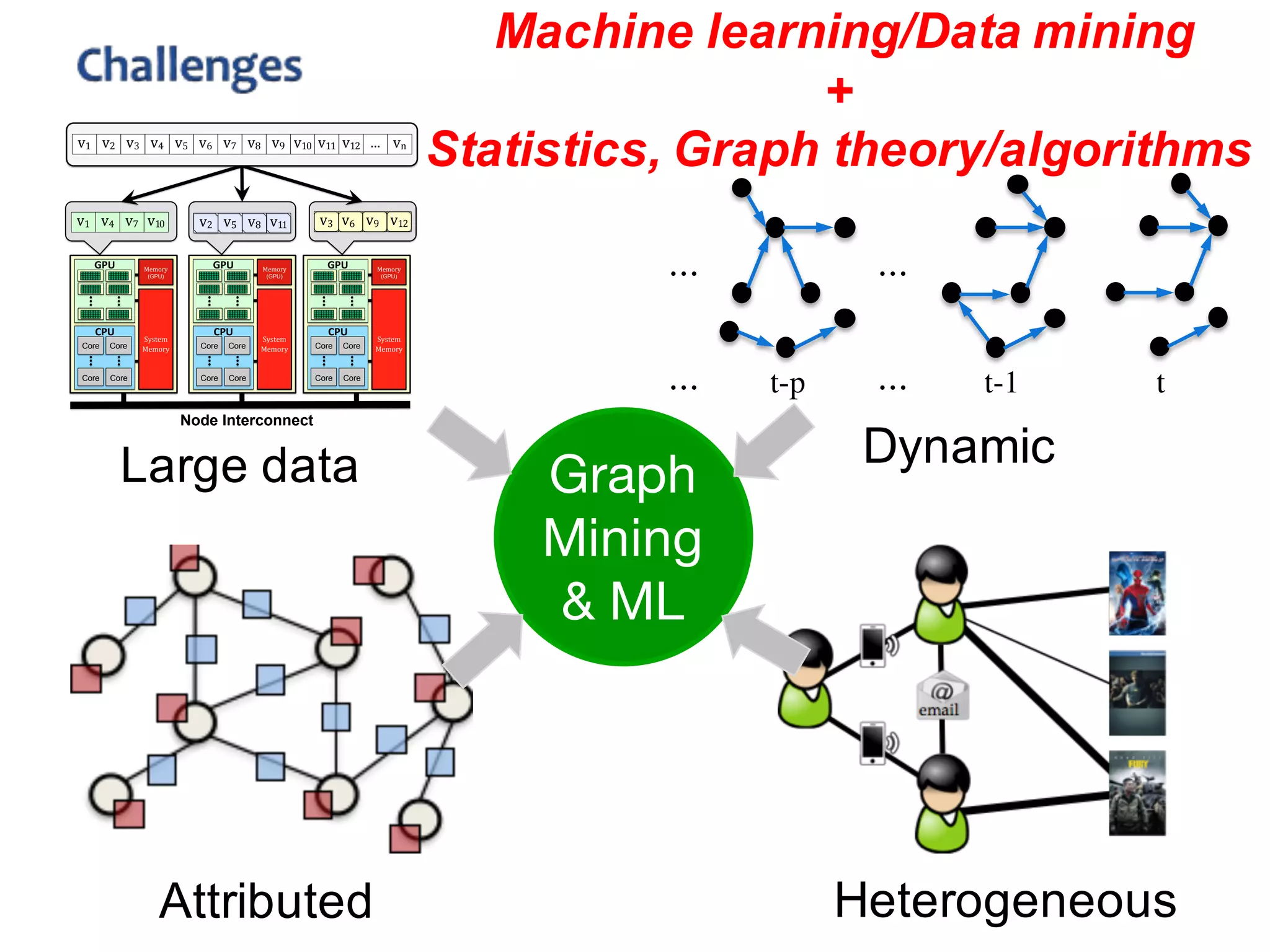
Graph
Mining
& ML
Machine  learning/Data  mining
+
Statistics,  Graph  theory/algorithms  
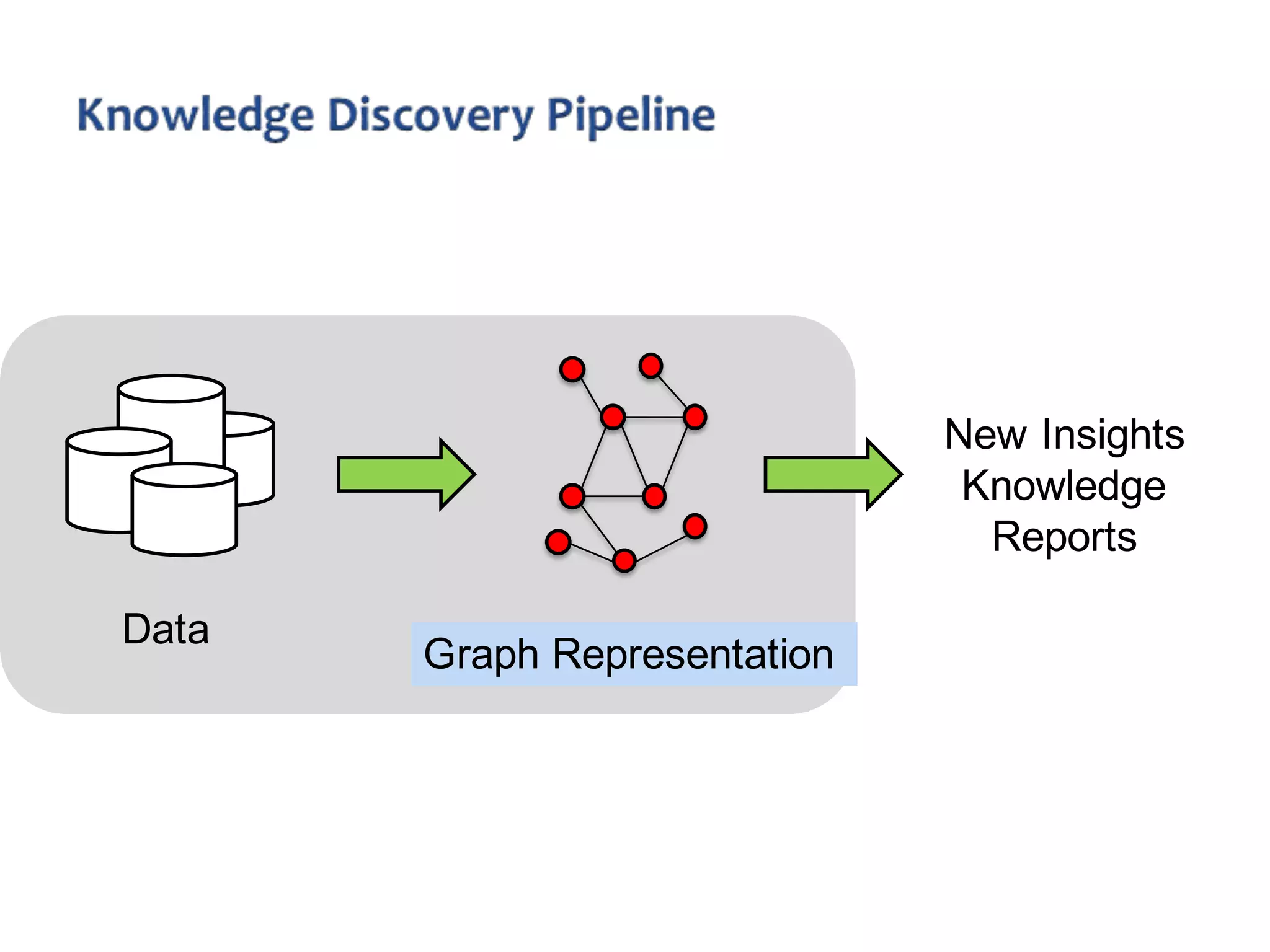
New  Insights
Knowledge
Reports
Data
Graph  Representation
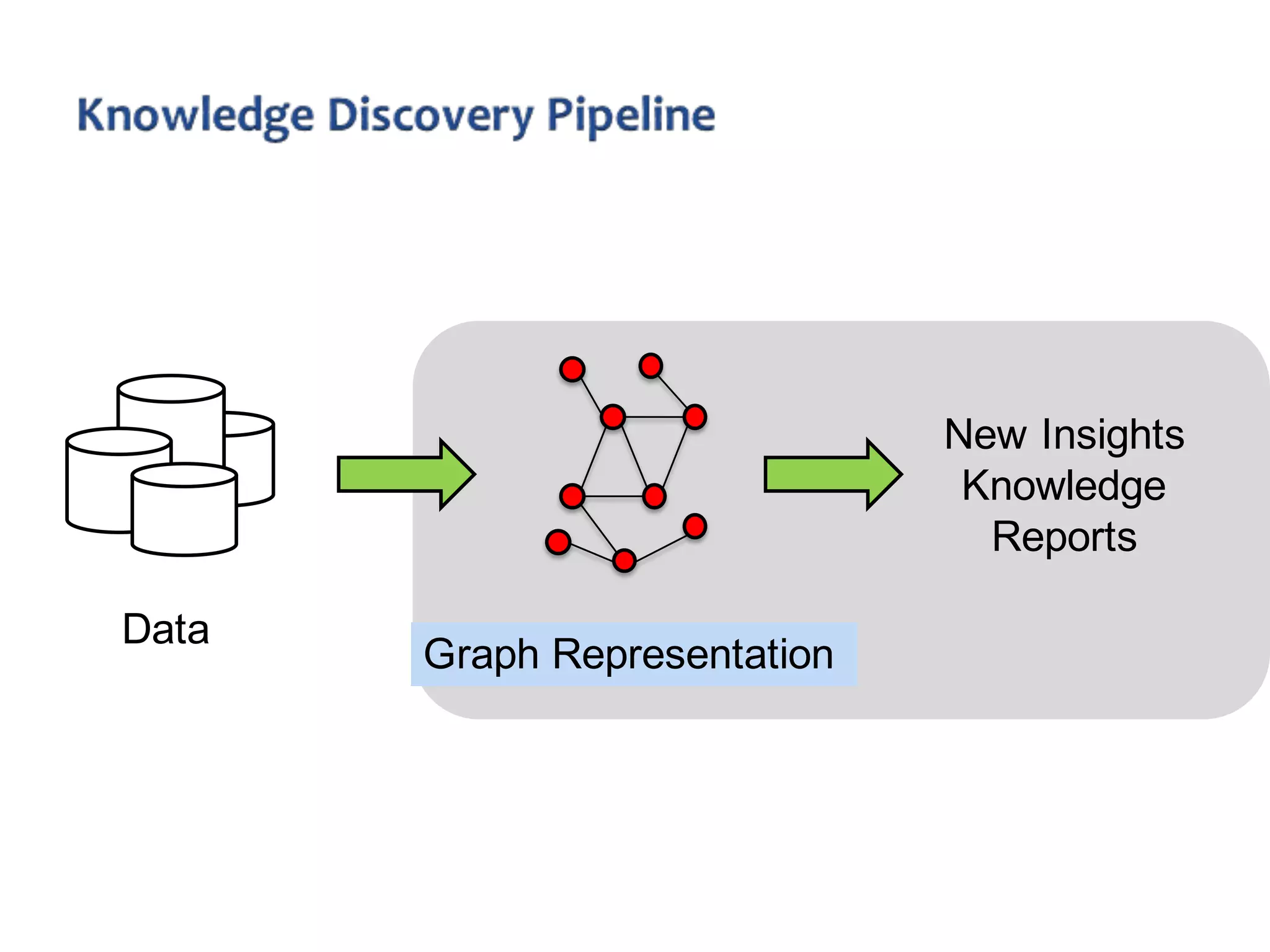
New  Insights
Knowledge
Reports
Data
Graph  Representation
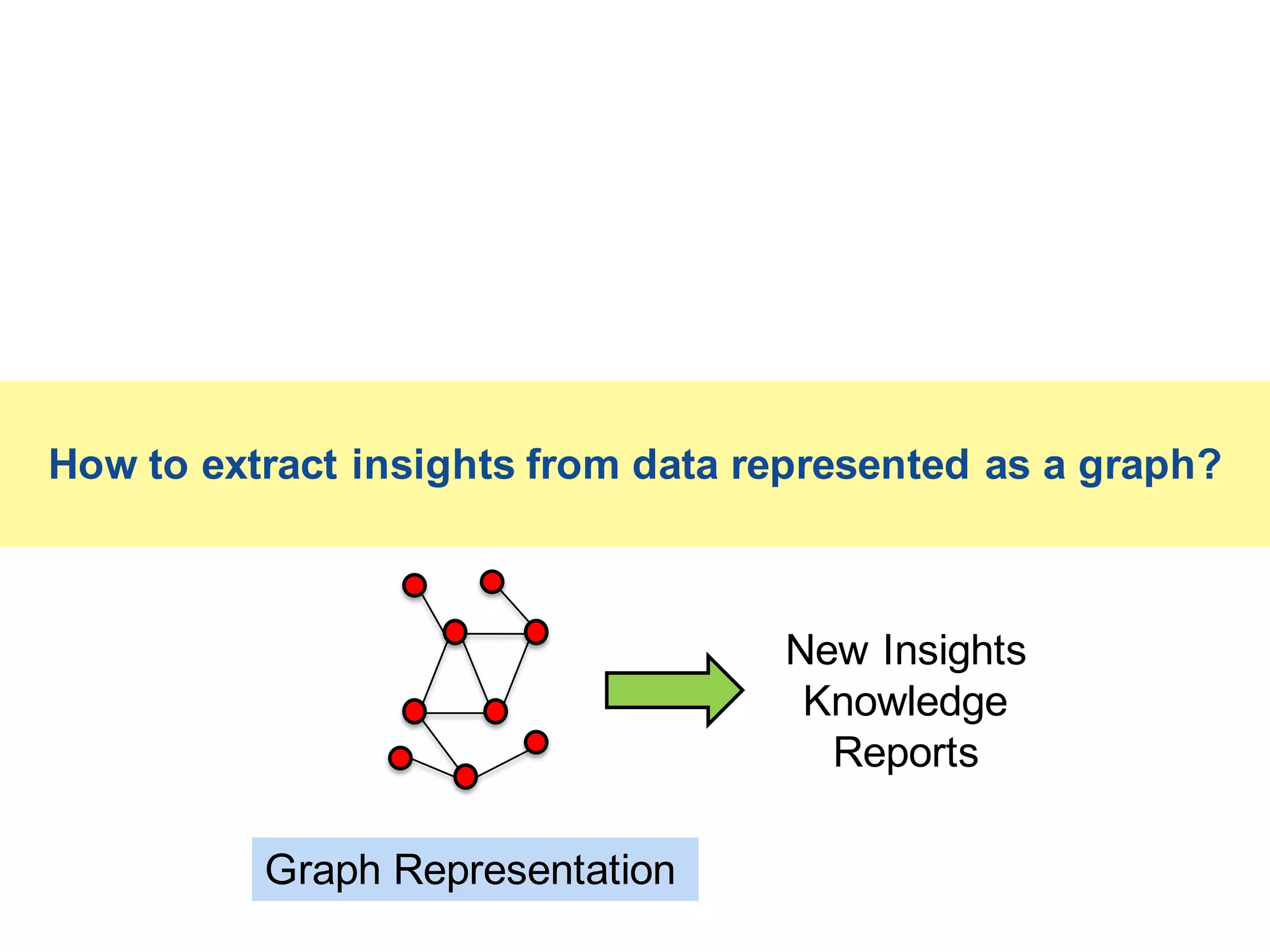
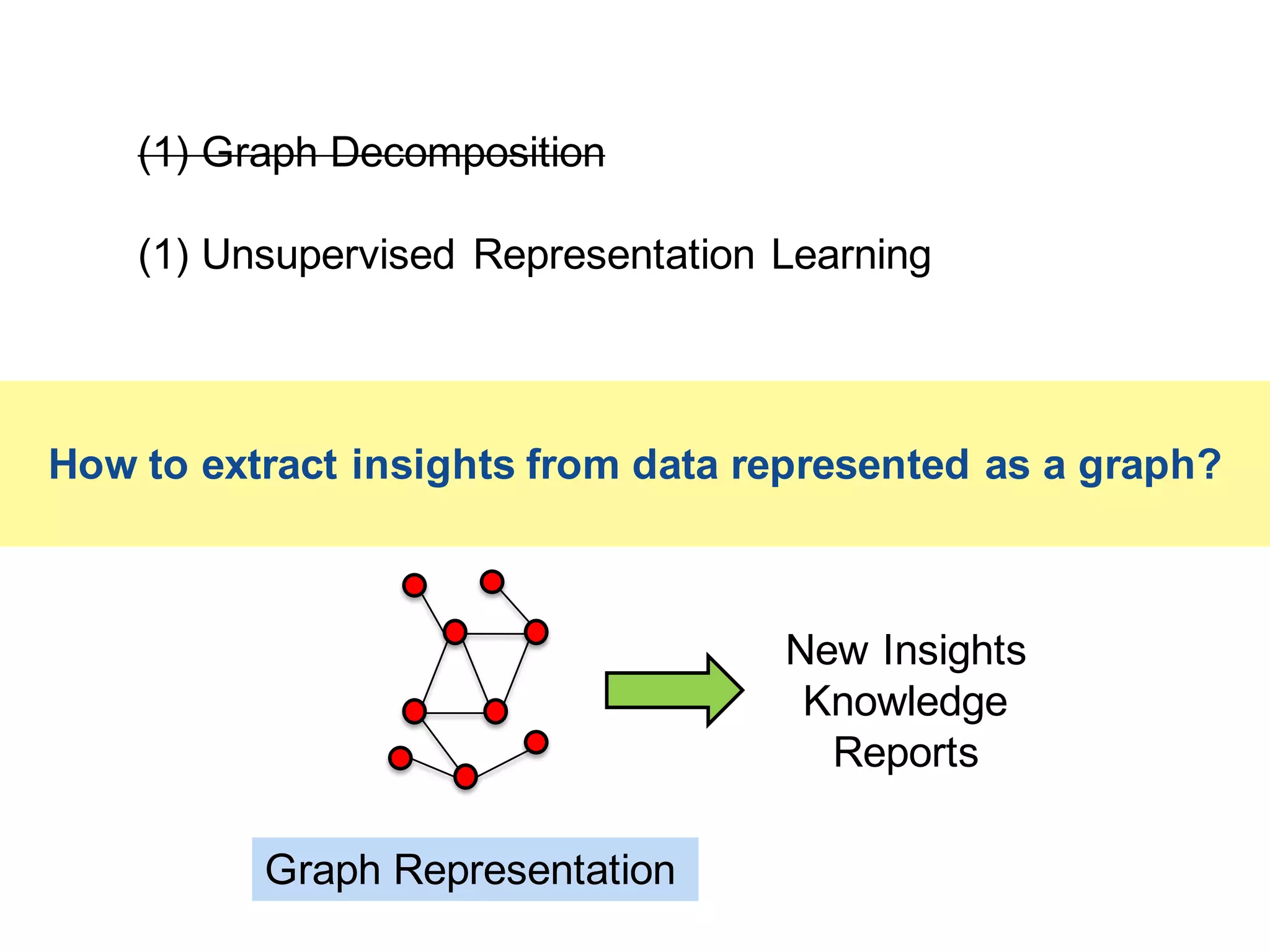
How  to  extract  insights  from  data  represented  as  a  graph?
New  Insights
Knowledge
Reports
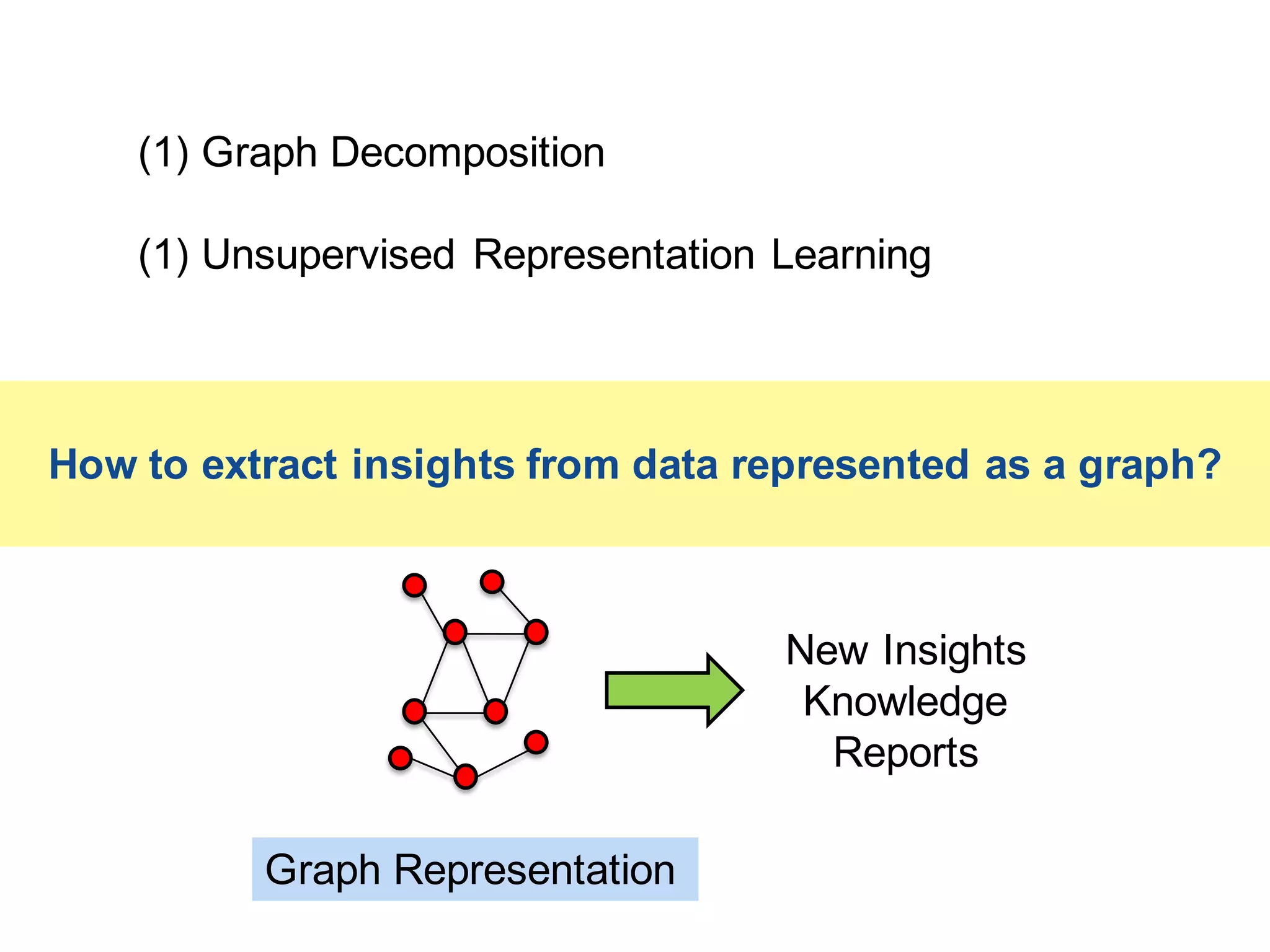
Graph  Representation
How  to  extract  insights  from  data  represented  as  a  graph?
New  Insights
Knowledge
Reports
Graph  Representation
(1) Graph  Decomposition
(1) Unsupervised  Representation  Learning  
Network  Motifs:  Simple  Building  Blocks  of  Complex  Networks  – [Milo  et.  al  – Science  2002]
The  Structure  and  Function  of  Complex  Networks  – [Newman  – Siam  Review  2003]
2-­node  
Graphlets
3-­node  
Graphlets
4-­node  
Graphlets
Connected  
Disconnected
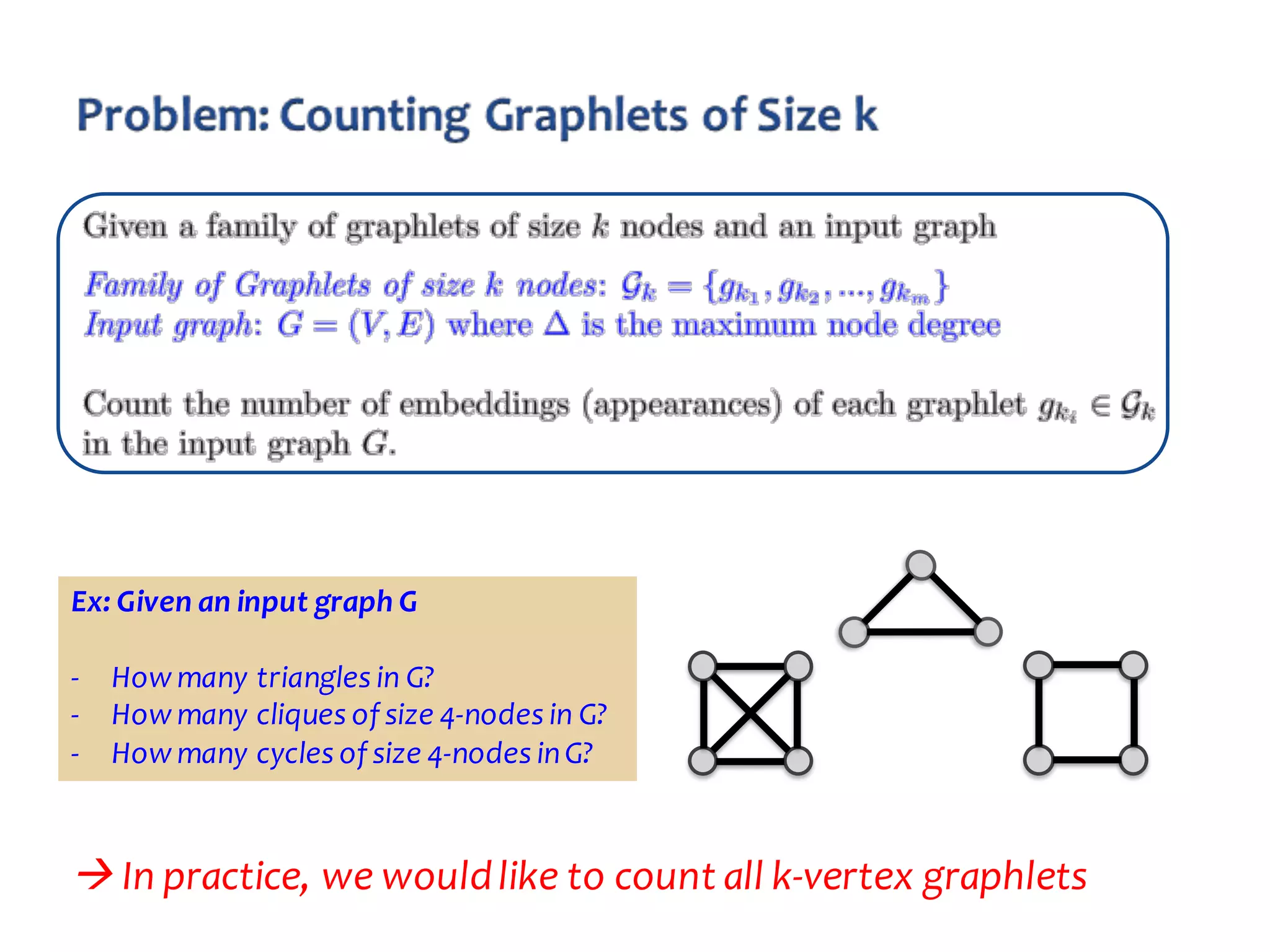
Ex:  Given  an  input  graph  G
-­‐ How  many  triangles  in  G?
-­‐ How  many  cliques  of  size  4-­‐nodes  in  G?
-­‐ How  many  cycles  of  size  4-­‐nodes  in  G?
à In  practice,  we  would  like  to  count  all  k-­‐vertex  graphlets
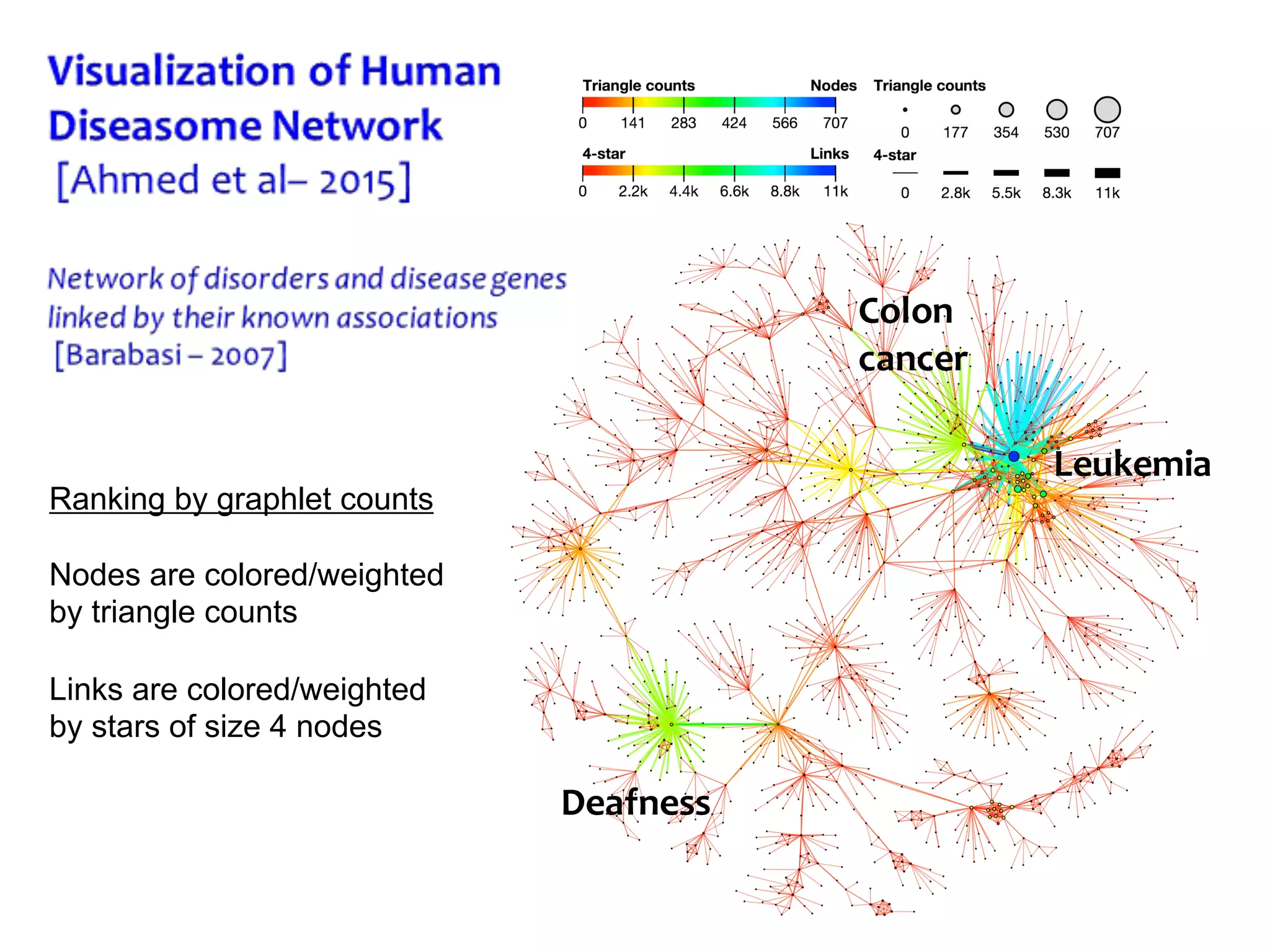
Ranking  by  graphlet counts
Nodes  are  colored/weighted  
by  triangle  counts
Links  are  colored/weighted  
by  stars  of  size  4  nodes
Leukemia
Colon  
cancer
Deafness
§ Enumerate  all  possible  graphlets
à Exhaustive  enumeration  is  too  expensive  
§ Count  graphlets for  each  node  – and  combine  all  node  counts
à Still  expensive  for  relatively  large  k   [Shervashidze et.  al  – AISTAT  2009]  
§ Other  recent  work  counts  only  connected  graphlets of  size  k=4
[Marcus  &  Shavitt – Computer  Networks  2012]  
Not  practical  – scales  only  for  small  graphs  with  few  
hundred/thousand  nodes/edges
-­‐ taking  2400  secs for  a  graph  with  26K  nodes
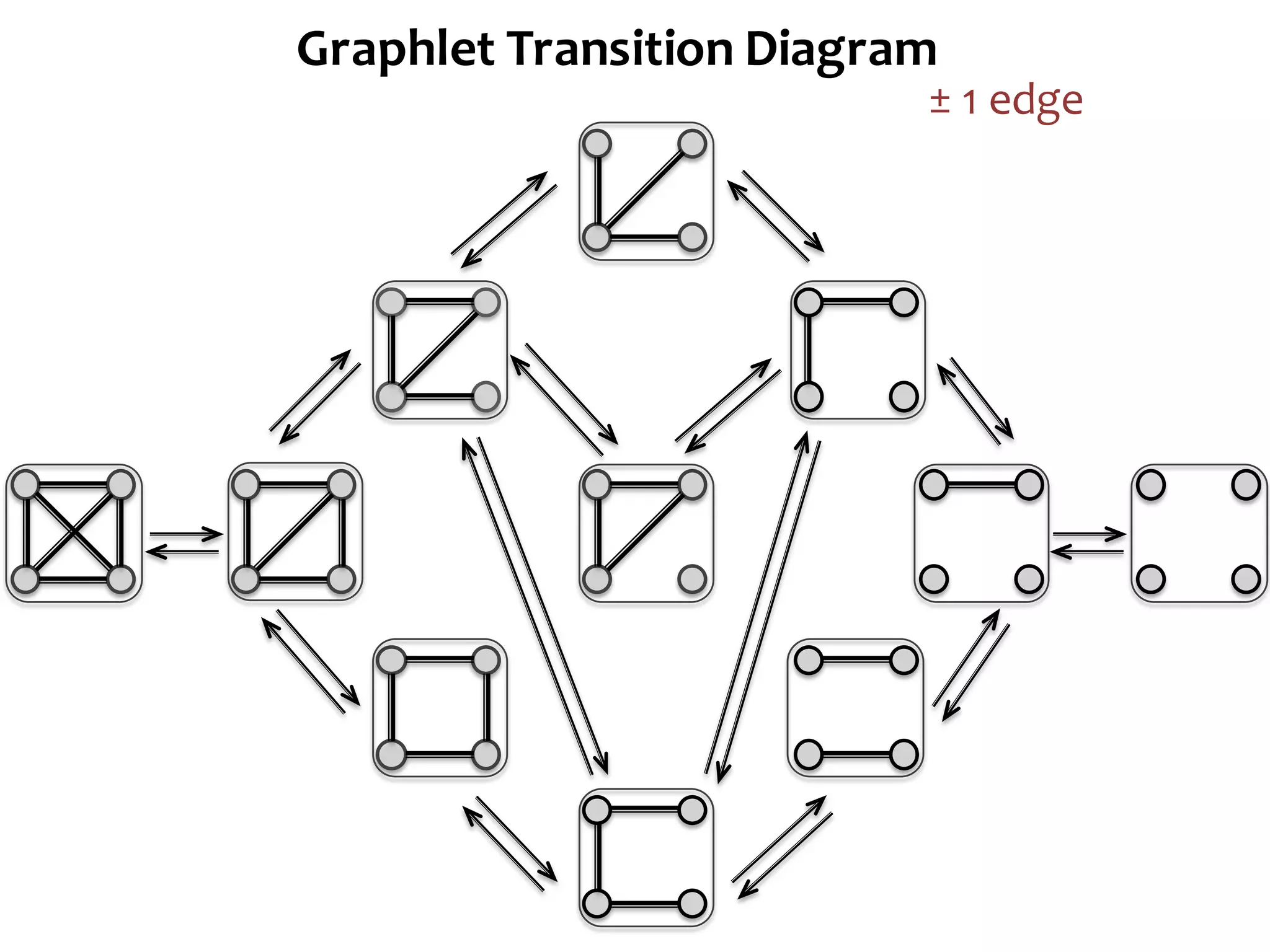
± 1  edge
Graphlet Transition  Diagram  
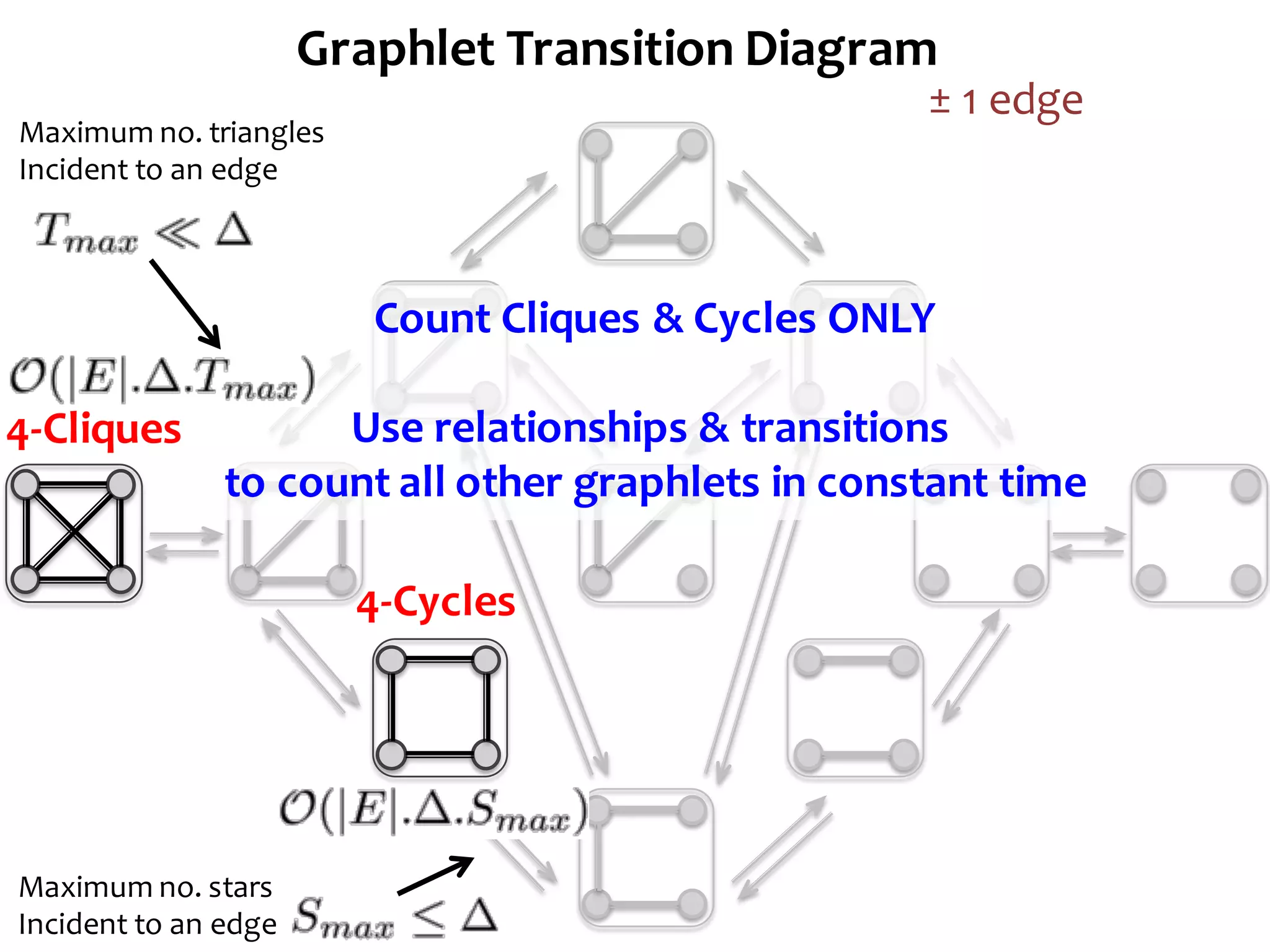
± 1  edge
Count  Cliques  &  Cycles  ONLY
Use  relationships  &  transitions  
to  count  all  other  graphlets in  constant  time
4-­‐Cliques
4-­‐Cycles
Maximum  no.  triangles  
Incident  to  an  edge
Maximum  no.  stars
Incident  to  an  edge
Graphlet Transition  Diagram  
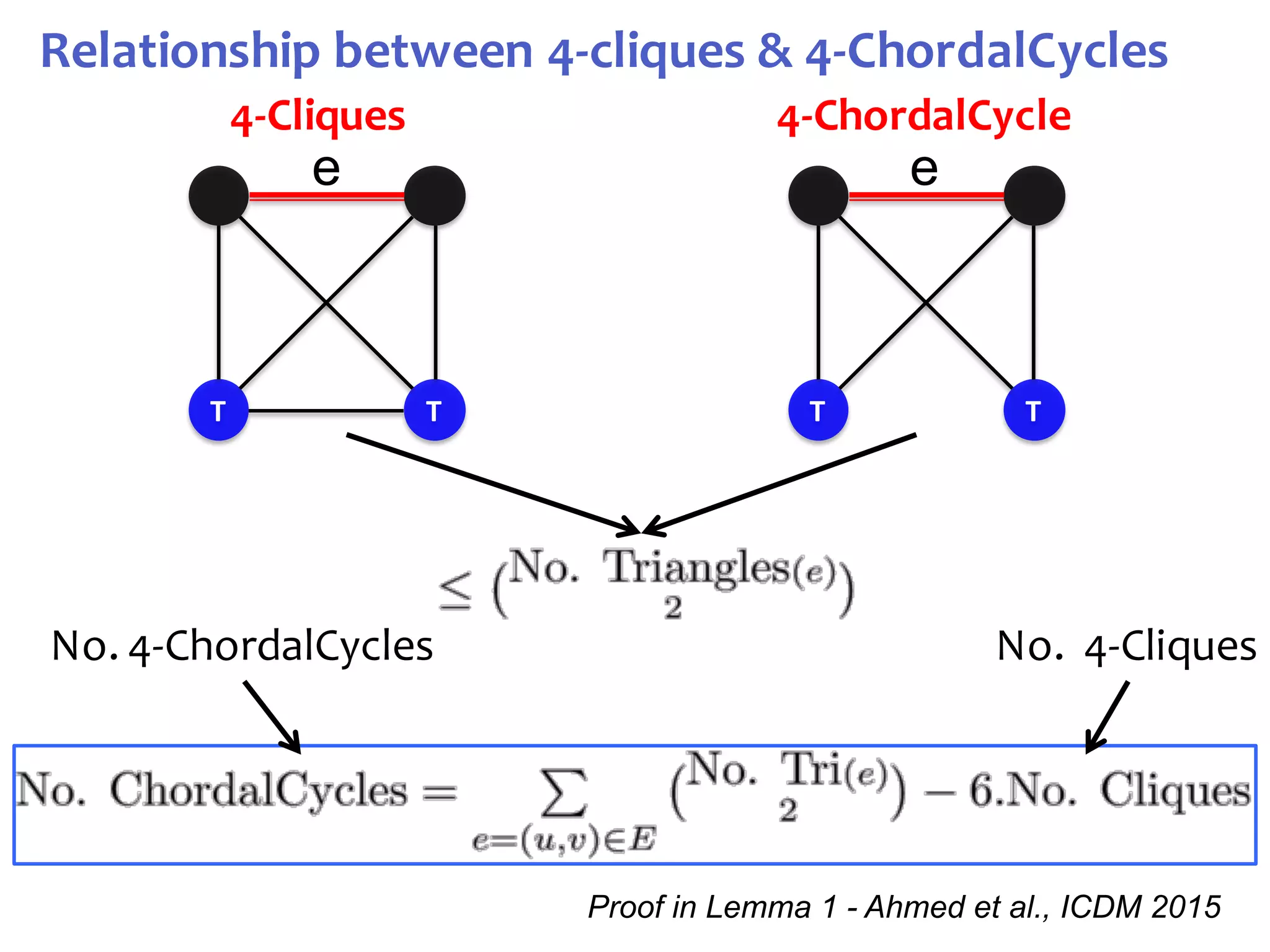
T T
Relationship  between  4-­‐cliques  &  4-­‐ChordalCycles
4-­‐Cliques 4-­‐ChordalCycle
e
T T
e
No.  4-­‐ChordalCycles No.    4-­‐Cliques
Proof  in  Lemma  1  -­ Ahmed  et  al.,  ICDM  2015
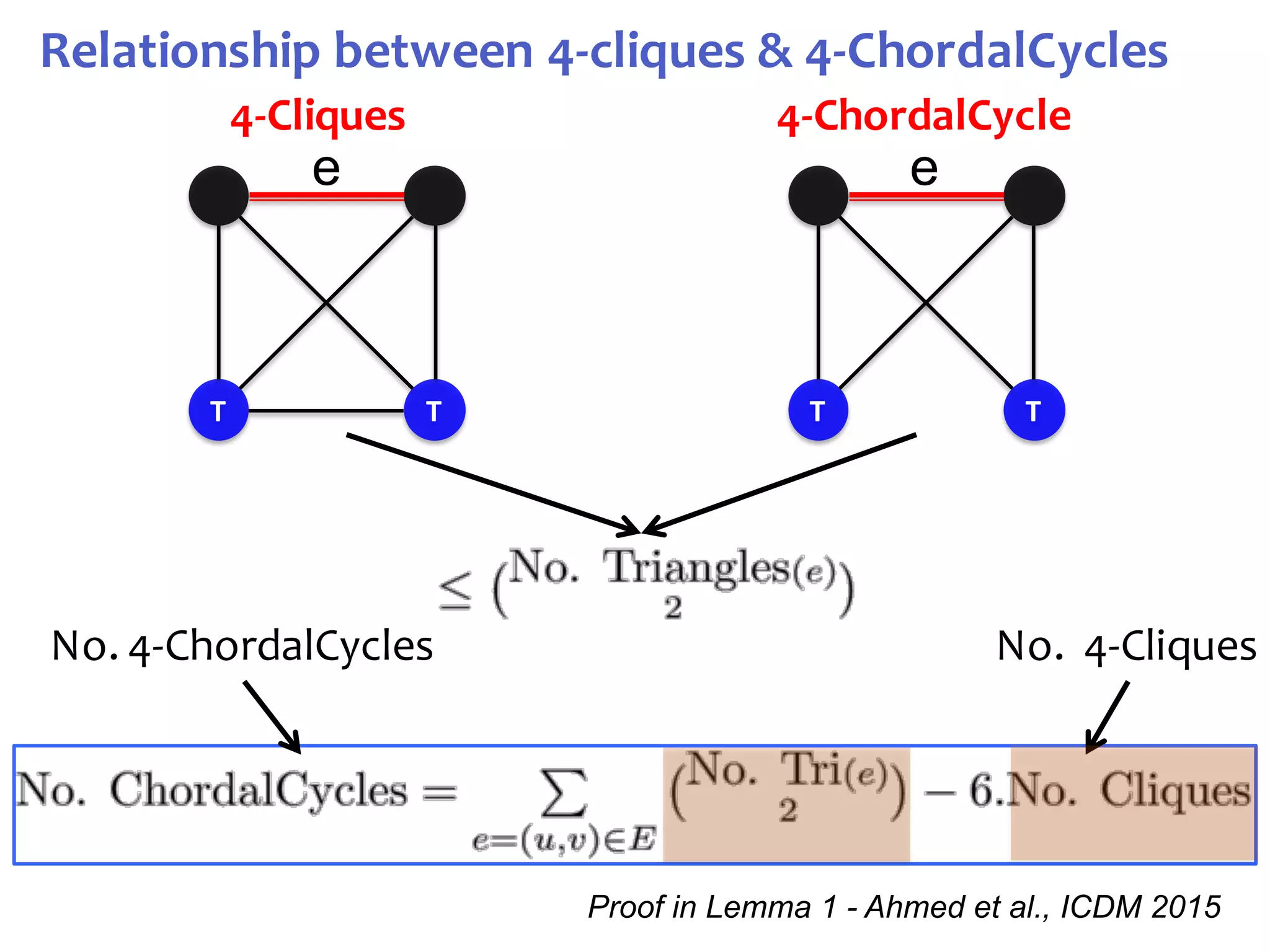
T T
Relationship  between  4-­‐cliques  &  4-­‐ChordalCycles
T T
No.  4-­‐ChordalCycles No.    4-­‐Cliques
4-­‐Cliques 4-­‐ChordalCycle
e e
Proof  in  Lemma  1  -­ Ahmed  et  al.,  ICDM  2015
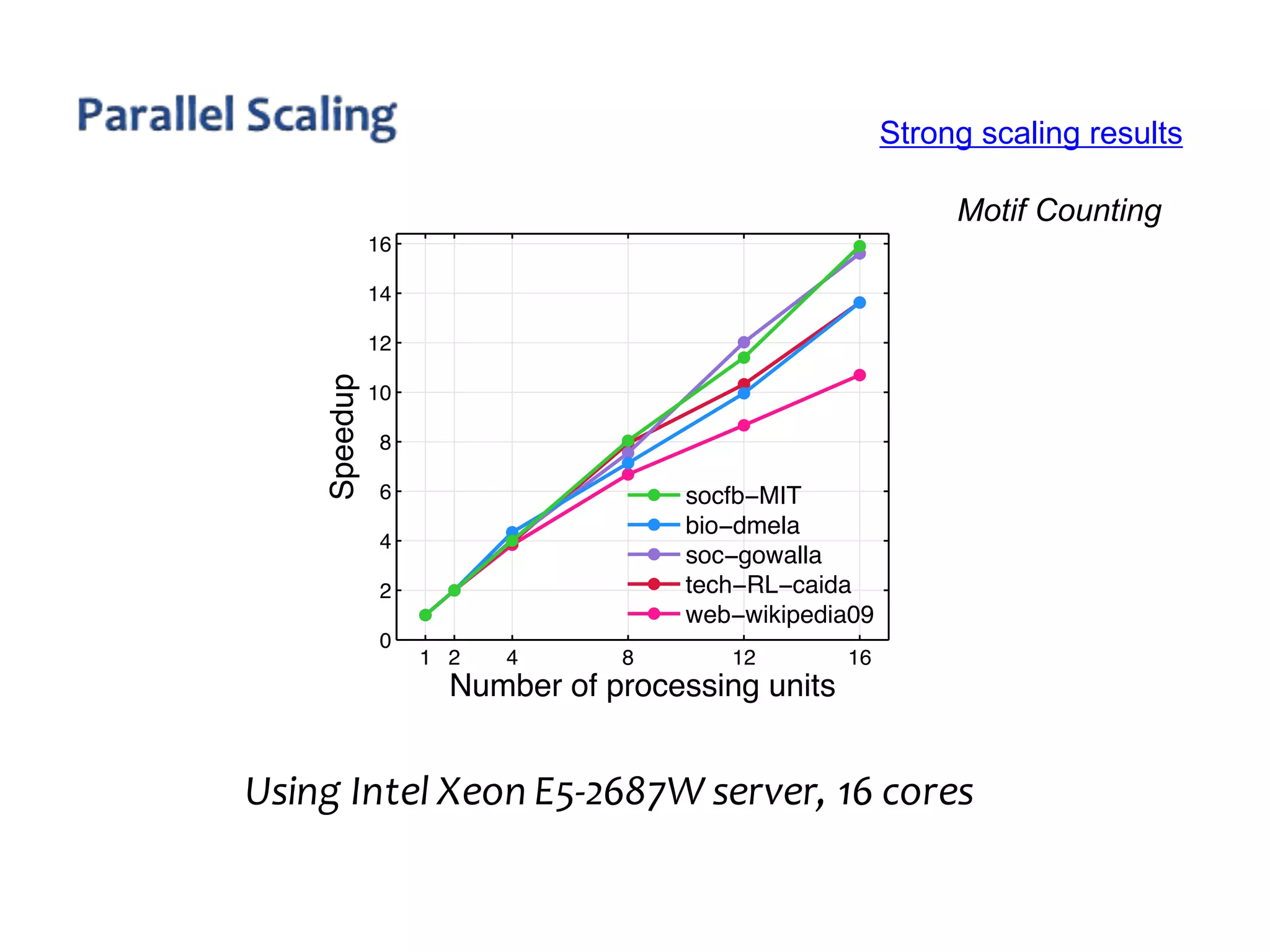
1 2 4 8 12 16
0
2
4
6
8
10
12
14
16
Number of processing units
Speedup
socfb−MIT
bio−dmela
soc−gowalla
tech−RL−caida
web−wikipedia09
1 2 4 8 12 16
0
2
4
6
8
10
12
14
16
Number of processing units
Speedup
Strong  scaling  results
Using  Intel  Xeon  E5-­‐2687W  server,  16  cores
Motif  Counting
How  to  extract  insights  from  data  represented  as  a  graph?
New  Insights
Knowledge
Reports
Graph  Representation
(1) Graph  Decomposition
(1) Unsupervised  Representation  Learning  
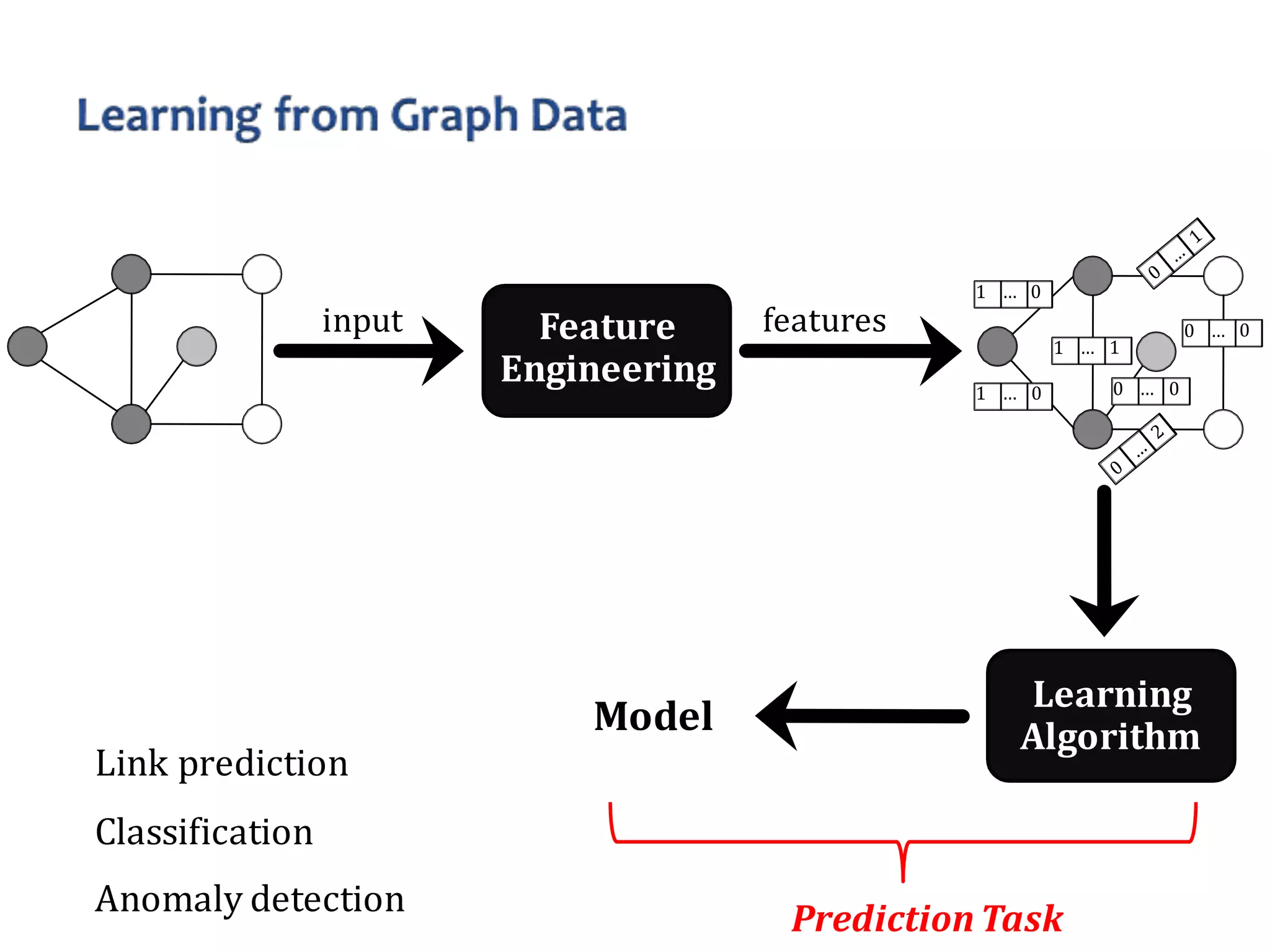
input 0 …
1 …
0 …
Feature	
  
Engineering
features
1 …
1 … 0
0
1
0
0
Learning	
  
AlgorithmModel
Prediction	
  Task
Link	
  prediction
Classification	
  
Anomaly	
  detection
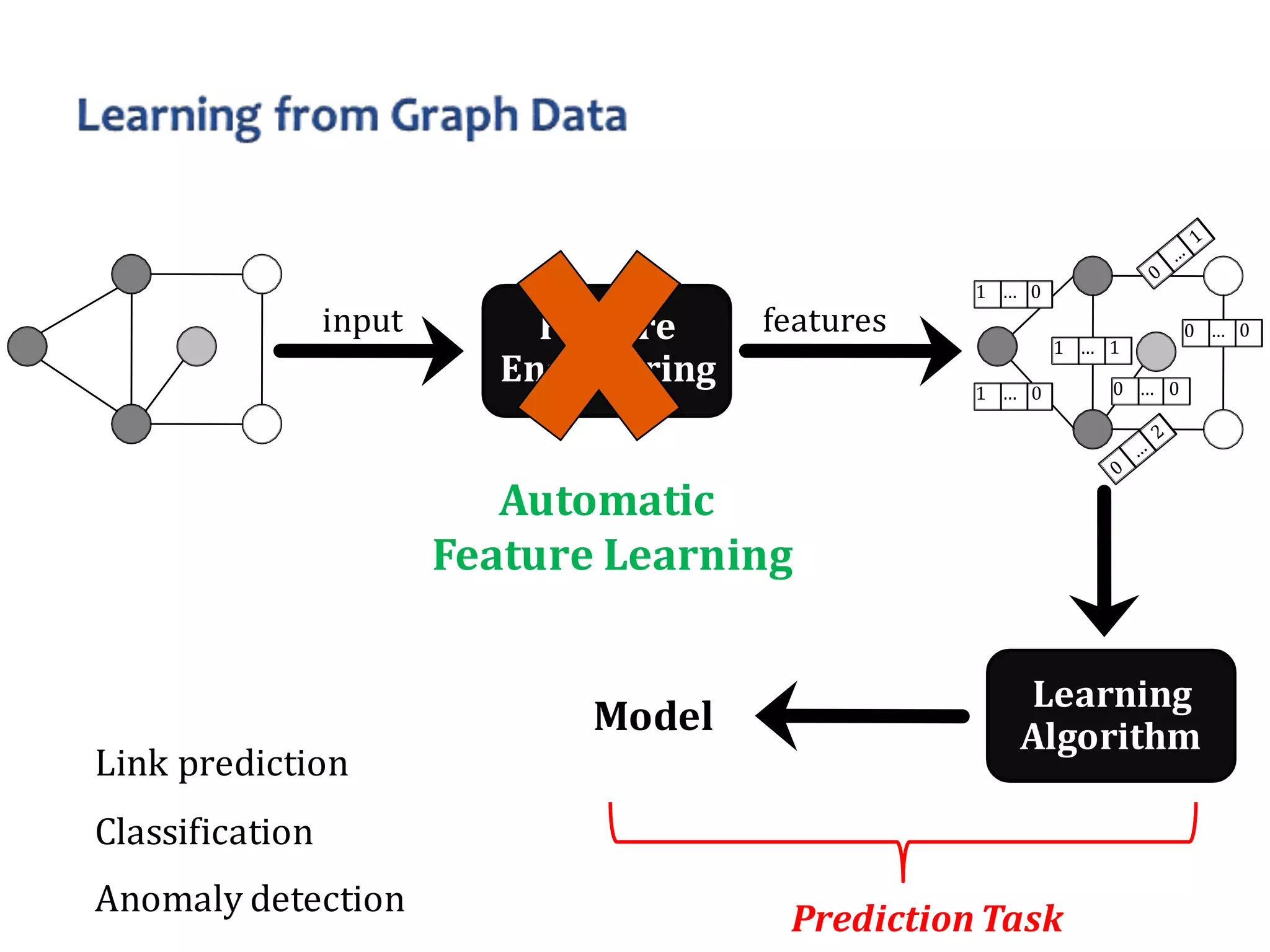
input 0 …
1 …
0 …
Feature	
  
Engineering
features
1 …
1 … 0
0
1
0
0
Learning	
  
AlgorithmModel
Prediction	
  Task
Automatic	
  
Feature	
  Learning
Link	
  prediction
Classification	
  
Anomaly	
  detection
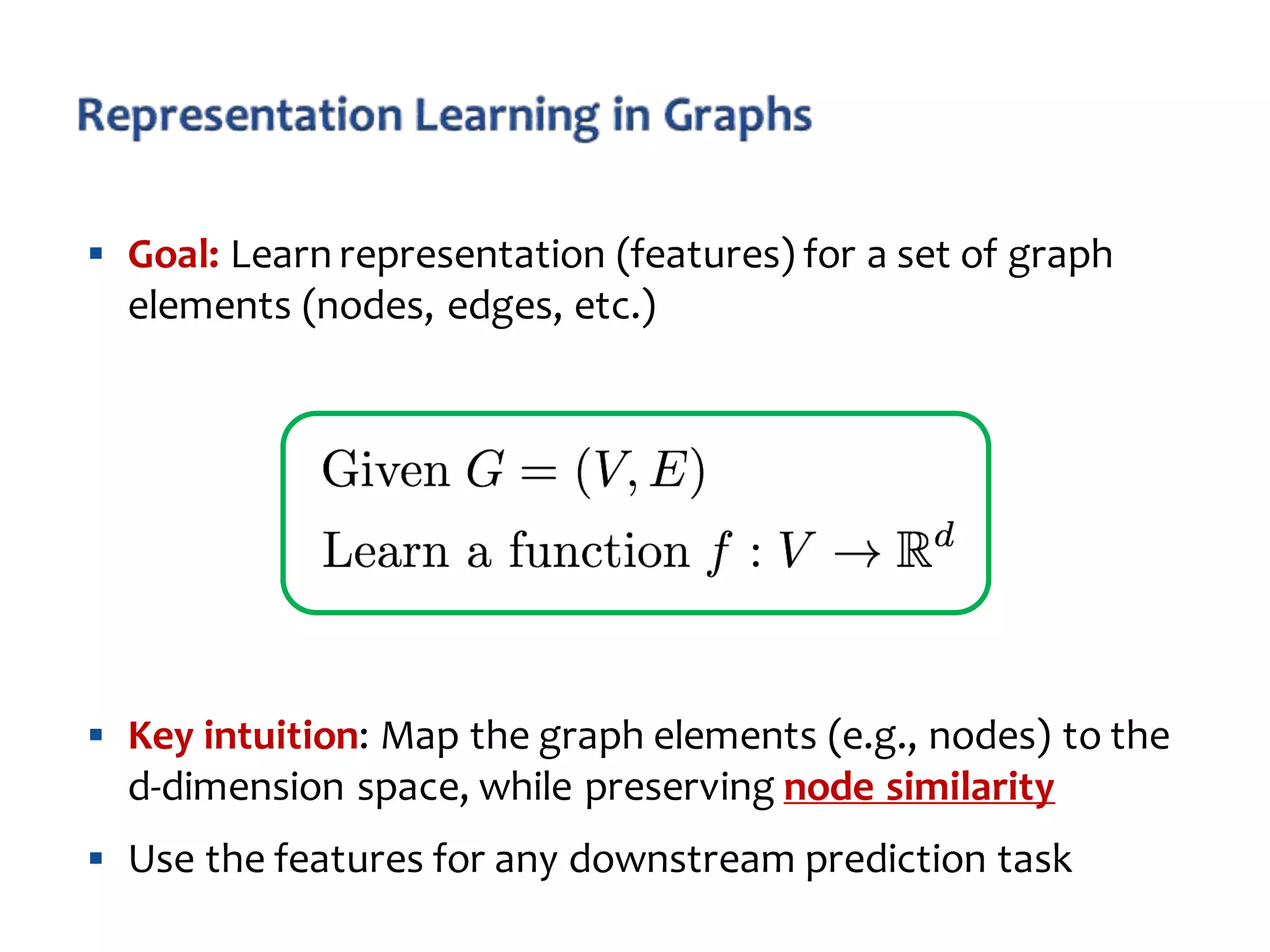
§ Goal:  Learn  representation  (features)  for  a  set  of  graph  
elements  (nodes,  edges,  etc.)
§ Key  intuition:  Map  the  graph  elements  (e.g.,  nodes)  to  the  
d-­‐dimension  space,  while  preserving  node  similarity
§ Use  the  features  for  any  downstream  prediction  task
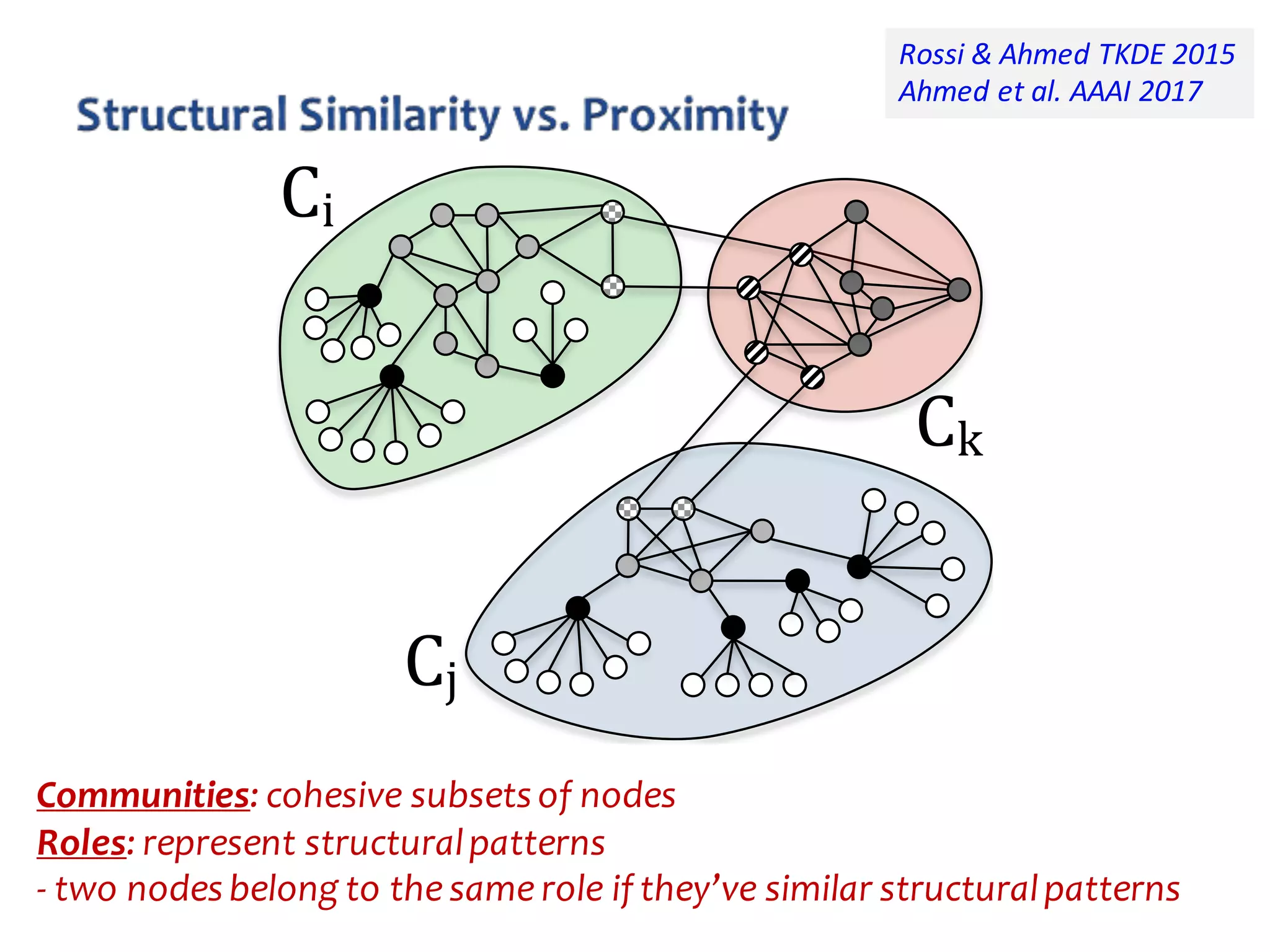
Communities:  cohesive  subsets  of  nodes
Roles:  represent  structural  patterns
-­‐ two  nodes  belong  to  the  same  role  if  they’ve  similar  structural  patterns
Cj#
Ci#
Ck#
Rossi	
  &	
  Ahmed	
  TKDE	
  2015
Ahmed	
  et	
  al.	
  AAAI	
  2017
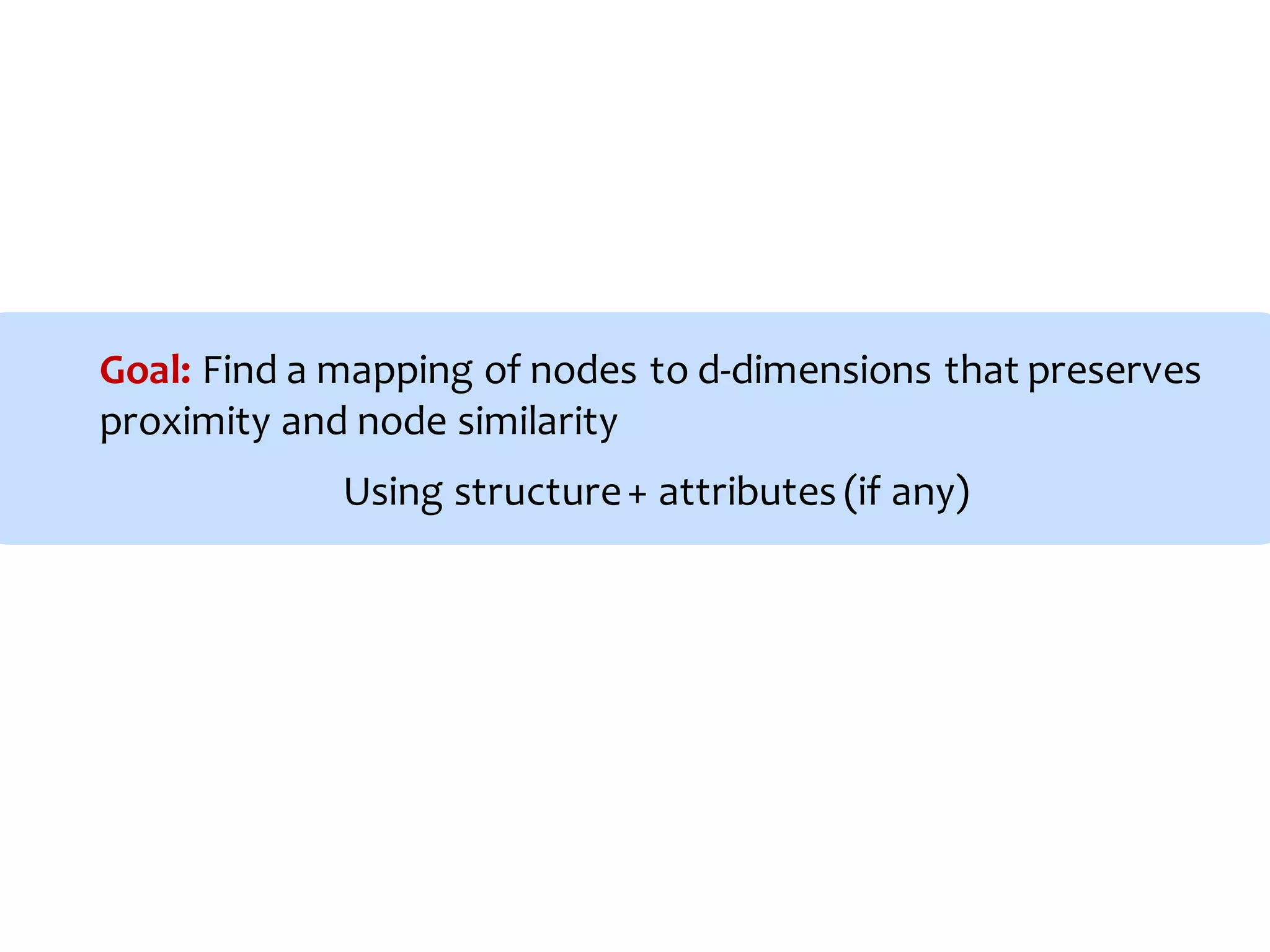
Goal:  Find  a  mapping  of  nodes  to  d-­‐dimensions  that  preserves  
proximity  and  node  similarity
Using  structure  +  attributes  (if  any)
Ahmed	
  et.	
  al	
  2017
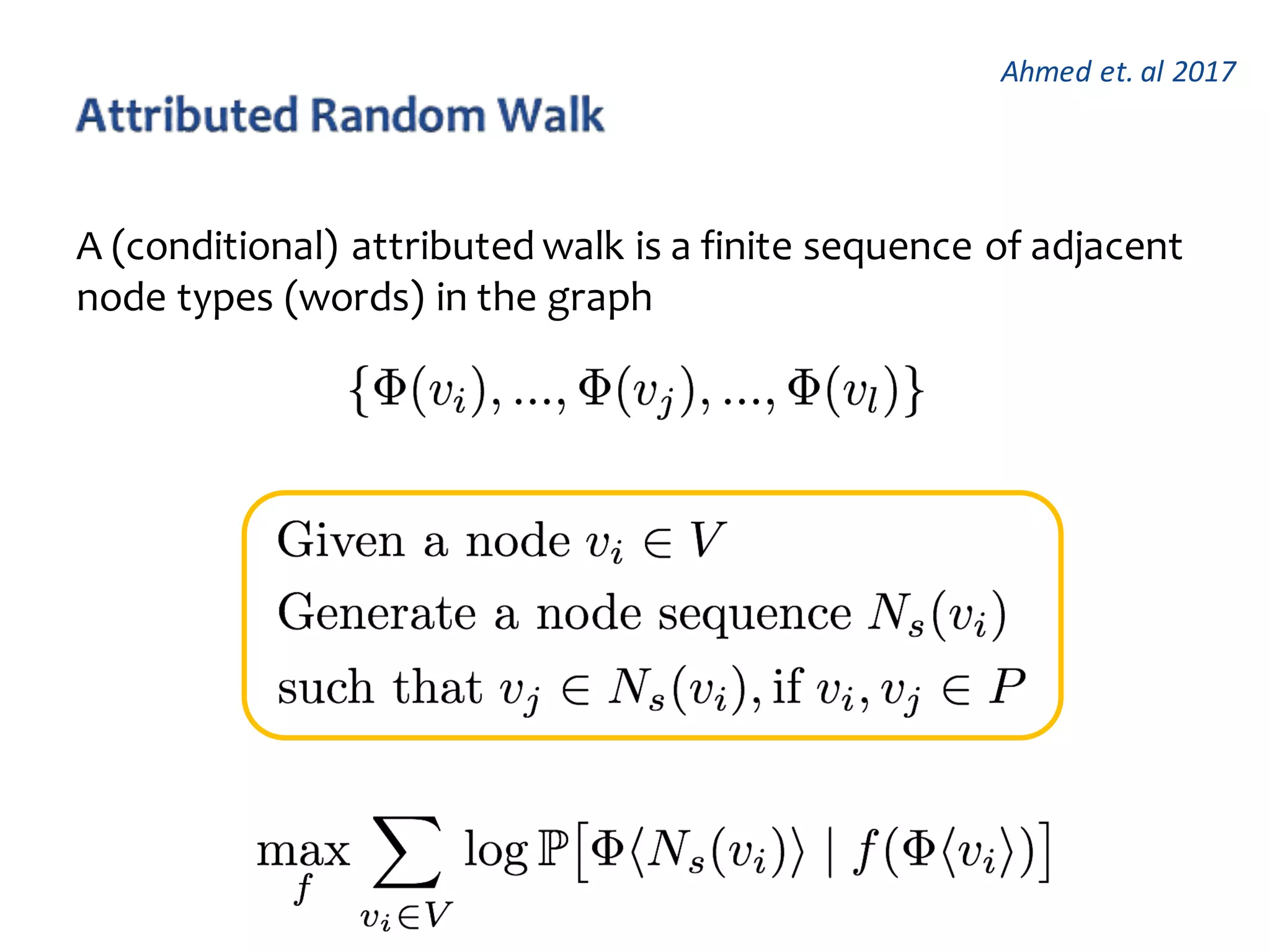
A  (conditional)  attributed  walk  is  a  finite  sequence  of  adjacent  
node  types  (words)  in  the  graph
Ahmed	
  et.	
  al	
  2017
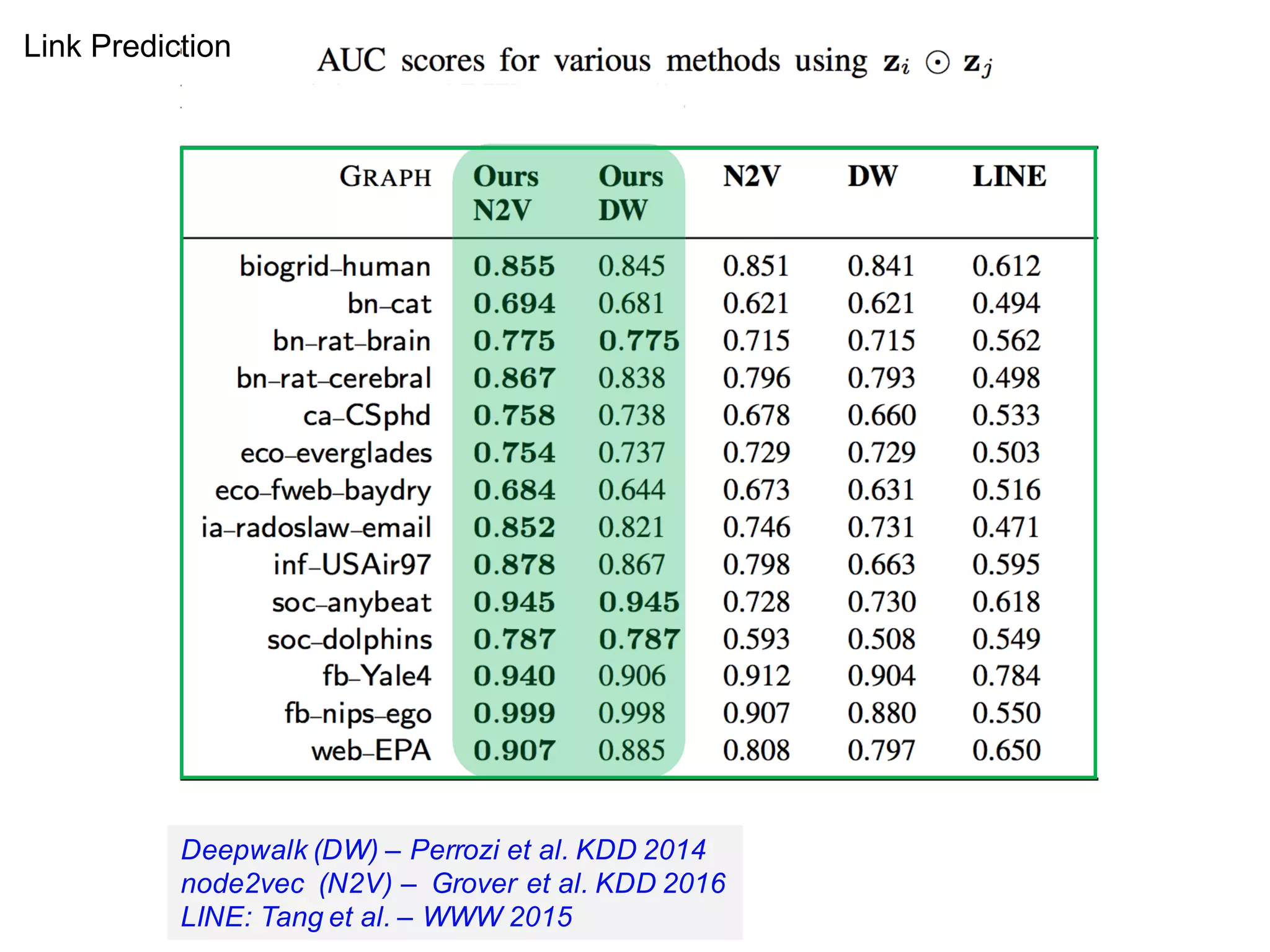
Deepwalk (DW)  – Perrozi et  al.  KDD  2014
node2vec    (N2V)  – Grover  et  al.  KDD  2016
LINE:  Tang  et  al.  – WWW  2015
Link  Prediction
Observation  3:  Useful  insights  and  accurate  modeling  
depend  on  the  data  representation
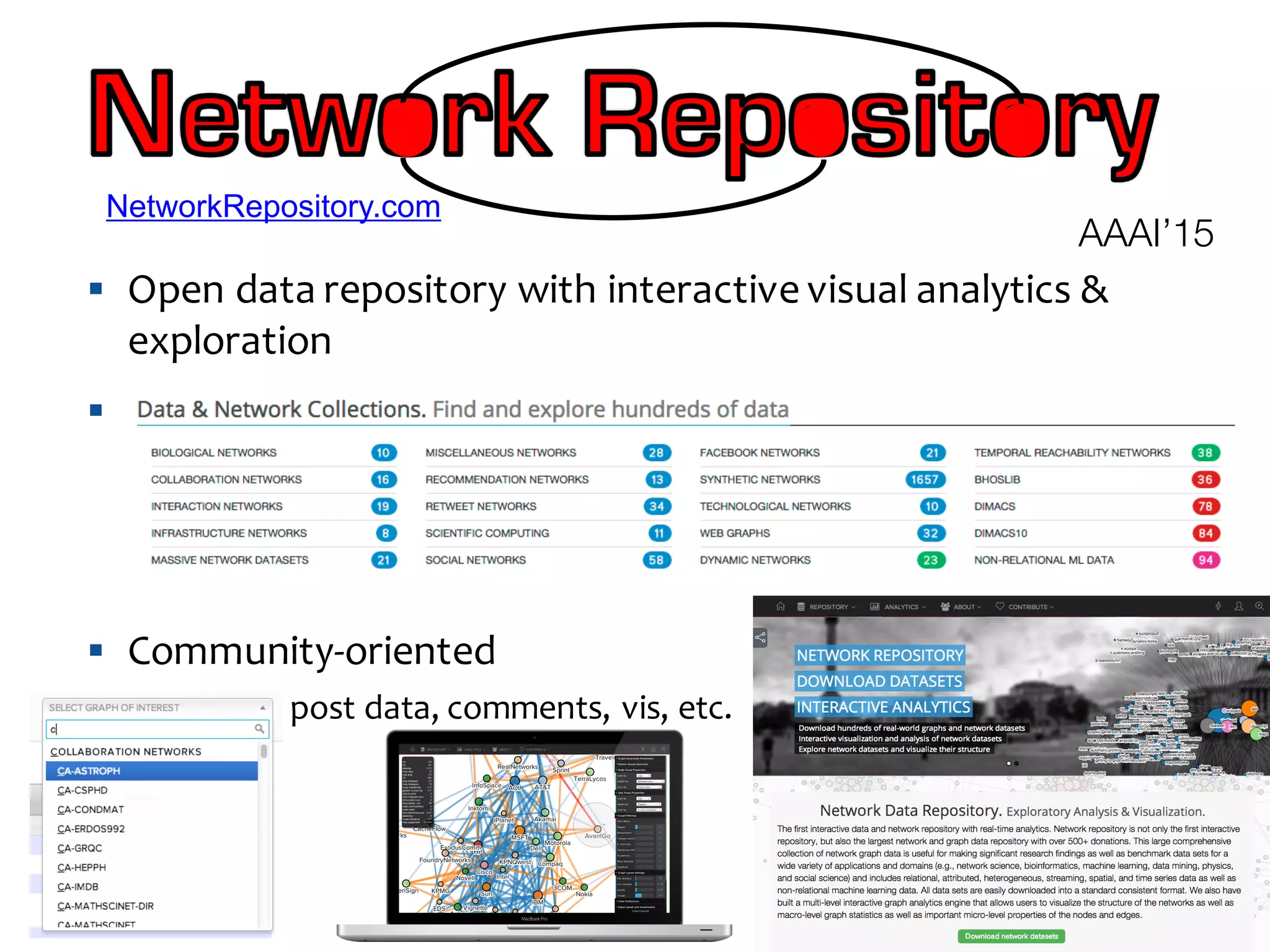
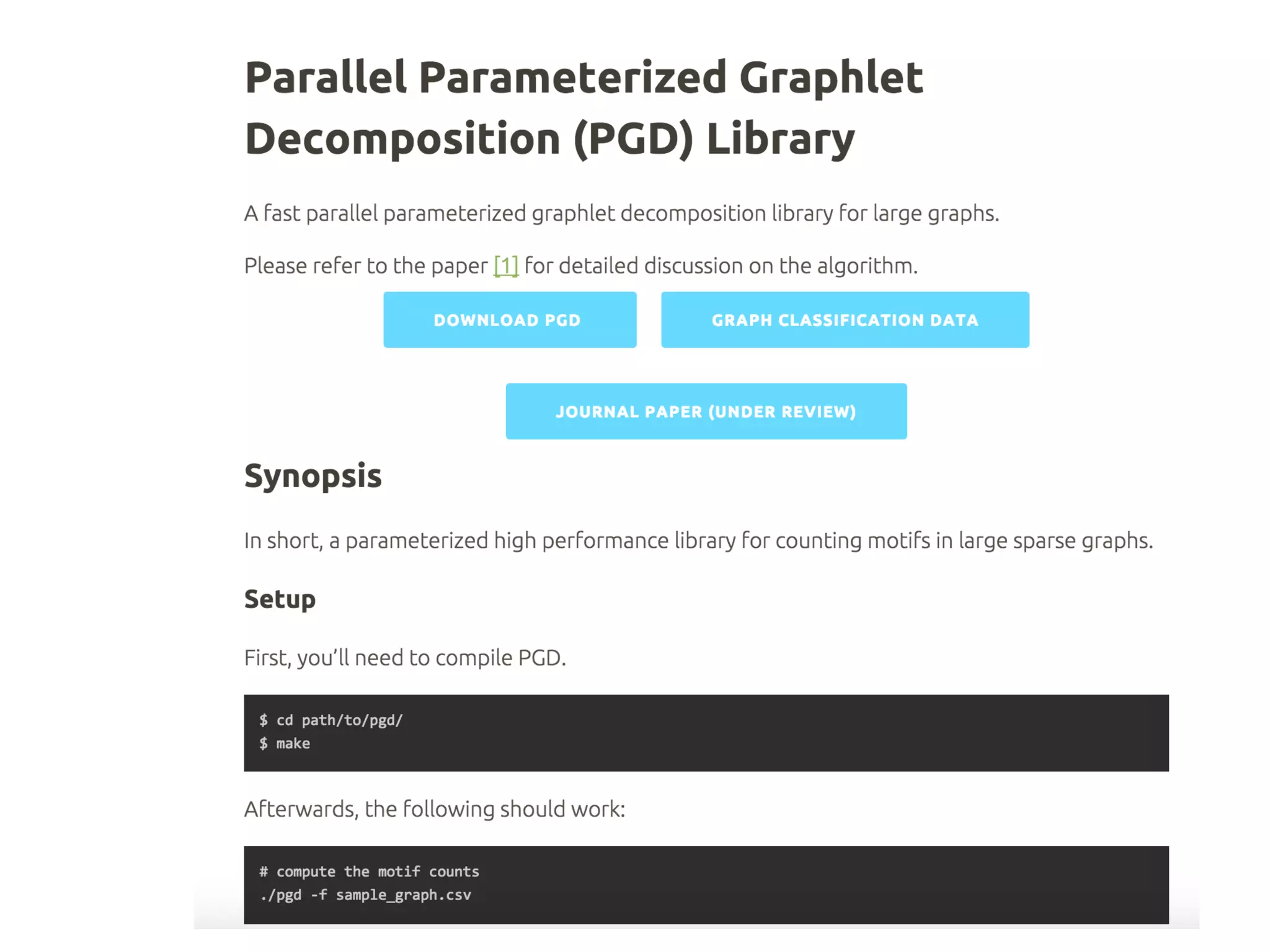
Open  Source/data  Tools
§ Open  data  repository  with  interactive  visual  analytics  &  
exploration
§ Largest  with  500+  graphs,  over  20+  collections  
§ Community-­‐oriented  
• discuss,  post  data,  comments,  vis,  etc.
AAAI’15
NetworkRepository.com
Observation  3:  Useful  insights  and  accurate  modeling  
depend  on  the  data  representation
Observation  2:  Graph  Data  Management  is  challenging
Observation  1:  Graphs  are  never  given/observe
Graphs  are  usually  constructed/inferred  from  input  data
§ Efficient  estimation  of  word  representations  in  vector  space.  ICLR  2013  [Mikolov et.  al]
§ A  Framework  for  Generalizing  Graph-­‐based  Representation  Learning  Methods.  arXiv:1709.04596    2017  [Ahmed  et.  al]
§ Role  Discovery  in  Networks.  TKDE  2015  [Rossi  &  Ahmed]
§ A  Higher-­‐order  Latent  Space  Network  Model.  AAAI  2017  [Ahmed,  Rossi,  Willke,  Zhou]
§ node2vec:  Scalable  Feature  Learning  for  Networks.  KDD  2016  [Grover,  Leskovec]
§ DeepWalk:  online  learning  of  social  representations.  KDD  2014  [Perozzi,  Al-­‐Rafou,  Skiena]
§ Efficient  Graphlet Counting  for  Large  Networks.  ICDM  2015,  [Ahmed  et  al.]
§ Graphlet Decomposition:  Framework,  Algorithms,  and  Applications.  J.  Know.  &  Info.  2016  [Ahmed  et  al.]
§ Network  Motifs:  Simple  Building  Blocks  of  Complex  Networks.  Science  2002,  [Milo  et  al.]
§ Uncovering  Biological  Network  Function  via  Graphlet Degree  Signatures.  Cancer  Informatics  2008  [Milenković-­‐Pržulj]
§ Graph  Kernels.  JMLR  2010,  [Vishwanathan et  al.]
§ The  Structure   and  Function  of  Complex  Networks.  SIAM  Review  2003,  [Newman]
§ Biological  network  comparison  using  graphlet degree  distribution.  Bioinformatics  2007  [Pržulj]
§ Efficient  Graphlet Kernels  for  Large  Graph  Comparison.  AISTAT  2009  [Shervashidze et  al.]
§ Local  structure   in  social  networks.  Sociological  methodology  1976,  [Holland-­‐Leinhardt]
§ The  strength   of  weak  ties:  A  network  theory  revisited.  Sociological  theory 1983  [Granovetter]
Thank  you!
Questions?
nesreen.k.ahmed@intel.com
http://nesreenahmed.com

High-Performance Graph Analysis and Modeling

  • 1.
  • 3.
    § This  talk is  NOT about  graph  processing  systems   • (e.g.,  graphx,  Giraph,  …).
  • 4.
    § This  talk is  NOT about  graph  processing  systems   • (e.g.,  graphx,  Giraph,  …). § Instead,  this  talk  is  about: (1) Knowledge  discovery  and  extracting  insights  from  graph  data. (2) Graph  Machine  Learning   (3) High-­‐Performance  algorithms  for  solving    (1)  and  (2)
  • 5.
    § Graphs  encode dependencies/relationships  between  entities IID Relational/graph
  • 6.
    p(Y | X)p(Y | X, XR) IID  Classification Relational Classification
  • 7.
    How  to  detect  abnormal  traffic? Port  scanning DDoS Normal  Traffic Adj.  Matrix ibm.com google.com IP  src IP  dest IP  src IP  dest IP  src IP  dest
  • 8.
    How  to  select  k ‘best’ nodes  for  immunization? 34 33 25 26 27 28 29 30 31 32 22 21 20 19 18 17 23 24 12 13 14 15 16 1 9 10 11 3 4 5 6 7 8 2 Ebola  virus  epidemic  (costs  9,000+  lives,  potentially  32+  bn) SARS  (costs  700+  lives;  $40+  bn)
  • 9.
    -­‐ -­‐ -­‐ -­‐ -­‐ Social  network   Human Disease  Network   [Barabasi 2007] Food  Web  [2007] Terrorist  Network [Krebs  2002]Internet  (AS)  [2005] Gene  Regulatory  Network   [Decourty 2008] Protein  Interactions   [breast  cancer] Political  blogs Power  grid
  • 10.
    New  Insights Knowledge Reports Data Graph Cleaning  Selection Processing Modeling   Ranking   Querying
  • 11.
    New  Insights Knowledge Reports Data Graph Cleaning  Selection Processing Modeling   Ranking   Querying Observation  1:  Graphs  are  never  given/observed Graphs  are  usually  constructed/inferred  from  input  data
  • 12.
    How  to  construct/infer the  graph  from  input  data? Data Graph
  • 13.
    Social  Network Relationship  may represent: -­ Friendship -­ Email/IM/Communication -­ Co-­location -­ Re-­tweet -­ Tagging Biological  Network  /   Chemoinformatics Relationship  may  represent: -­ Protein  Interaction -­ Chemical  bonds  between   Atoms
  • 14.
    Infrastructure  Network e.g.  Power Grid Web/Information  Network
  • 15.
    Xu  et.  al, Frontiers  in  behavioral  neuroscience,  2015 Brain  Functional  Connectivity  Network
  • 16.
    New  Insights Knowledge Reports Data Graph XGraph Representation What’s  a  node? Attributes?  Types? What’s  an  edge? Directed?  Undirected? Time-­evolving?  Dynamic?
  • 17.
    Observation  2:  Graph Data  Management  is  challenging
  • 18.
    GPU$ CPU$ Core Core Core Core System' Memory'' Memory' (GPU) GPU$ CPU$ CoreCore Core Core System' Memory'' Memory' (GPU) Node Interconnect v1 ! v4 ! v7 !v10 ! v2 ! v5 ! v8 !v11 ! v3 !v6 ! v9 ! v12 ! GPU$ CPU$ Core Core Core Core System' Memory'' Memory' (GPU) v1 ! v2 ! v3 ! v4 ! v5 ! v6 ! v7 ! v8 ! v9 !v10 !v11 !v12 ! …"" vn ! t-p t-1 t ⋯ ⋯ ⋯ ⋯ Large  data Attributed Dynamic Heterogeneous
  • 19.
    GPU$ CPU$ Core Core Core Core System' Memory'' Memory' (GPU) GPU$ CPU$ CoreCore Core Core System' Memory'' Memory' (GPU) Node Interconnect v1 ! v4 ! v7 !v10 ! v2 ! v5 ! v8 !v11 ! v3 !v6 ! v9 ! v12 ! GPU$ CPU$ Core Core Core Core System' Memory'' Memory' (GPU) v1 ! v2 ! v3 ! v4 ! v5 ! v6 ! v7 ! v8 ! v9 !v10 !v11 !v12 ! …"" vn ! t-p t-1 t ⋯ ⋯ ⋯ ⋯ Large  data Attributed Dynamic Heterogeneous Graph Mining & ML Machine  learning/Data  mining + Statistics,  Graph  theory/algorithms  
  • 20.
  • 21.
  • 22.
    How  to  extract insights  from  data  represented  as  a  graph? New  Insights Knowledge Reports Graph  Representation
  • 23.
    How  to  extract insights  from  data  represented  as  a  graph? New  Insights Knowledge Reports Graph  Representation (1) Graph  Decomposition (1) Unsupervised  Representation  Learning  
  • 24.
    Network  Motifs:  Simple Building  Blocks  of  Complex  Networks  – [Milo  et.  al  – Science  2002] The  Structure  and  Function  of  Complex  Networks  – [Newman  – Siam  Review  2003] 2-­node   Graphlets 3-­node   Graphlets 4-­node   Graphlets Connected   Disconnected
  • 25.
    Ex:  Given  an input  graph  G -­‐ How  many  triangles  in  G? -­‐ How  many  cliques  of  size  4-­‐nodes  in  G? -­‐ How  many  cycles  of  size  4-­‐nodes  in  G? à In  practice,  we  would  like  to  count  all  k-­‐vertex  graphlets
  • 26.
    Ranking  by  graphletcounts Nodes  are  colored/weighted   by  triangle  counts Links  are  colored/weighted   by  stars  of  size  4  nodes Leukemia Colon   cancer Deafness
  • 27.
    § Enumerate  all possible  graphlets à Exhaustive  enumeration  is  too  expensive   § Count  graphlets for  each  node  – and  combine  all  node  counts à Still  expensive  for  relatively  large  k   [Shervashidze et.  al  – AISTAT  2009]   § Other  recent  work  counts  only  connected  graphlets of  size  k=4 [Marcus  &  Shavitt – Computer  Networks  2012]   Not  practical  – scales  only  for  small  graphs  with  few   hundred/thousand  nodes/edges -­‐ taking  2400  secs for  a  graph  with  26K  nodes
  • 28.
    ± 1  edge GraphletTransition  Diagram  
  • 29.
    ± 1  edge Count Cliques  &  Cycles  ONLY Use  relationships  &  transitions   to  count  all  other  graphlets in  constant  time 4-­‐Cliques 4-­‐Cycles Maximum  no.  triangles   Incident  to  an  edge Maximum  no.  stars Incident  to  an  edge Graphlet Transition  Diagram  
  • 30.
    T T Relationship  between 4-­‐cliques  &  4-­‐ChordalCycles 4-­‐Cliques 4-­‐ChordalCycle e T T e No.  4-­‐ChordalCycles No.    4-­‐Cliques Proof  in  Lemma  1  -­ Ahmed  et  al.,  ICDM  2015
  • 31.
    T T Relationship  between 4-­‐cliques  &  4-­‐ChordalCycles T T No.  4-­‐ChordalCycles No.    4-­‐Cliques 4-­‐Cliques 4-­‐ChordalCycle e e Proof  in  Lemma  1  -­ Ahmed  et  al.,  ICDM  2015
  • 32.
    1 2 48 12 16 0 2 4 6 8 10 12 14 16 Number of processing units Speedup socfb−MIT bio−dmela soc−gowalla tech−RL−caida web−wikipedia09 1 2 4 8 12 16 0 2 4 6 8 10 12 14 16 Number of processing units Speedup Strong  scaling  results Using  Intel  Xeon  E5-­‐2687W  server,  16  cores Motif  Counting
  • 33.
    How  to  extract insights  from  data  represented  as  a  graph? New  Insights Knowledge Reports Graph  Representation (1) Graph  Decomposition (1) Unsupervised  Representation  Learning  
  • 34.
    input 0 … 1… 0 … Feature   Engineering features 1 … 1 … 0 0 1 0 0 Learning   AlgorithmModel Prediction  Task Link  prediction Classification   Anomaly  detection
  • 35.
    input 0 … 1… 0 … Feature   Engineering features 1 … 1 … 0 0 1 0 0 Learning   AlgorithmModel Prediction  Task Automatic   Feature  Learning Link  prediction Classification   Anomaly  detection
  • 36.
    § Goal:  Learn representation  (features)  for  a  set  of  graph   elements  (nodes,  edges,  etc.) § Key  intuition:  Map  the  graph  elements  (e.g.,  nodes)  to  the   d-­‐dimension  space,  while  preserving  node  similarity § Use  the  features  for  any  downstream  prediction  task
  • 37.
    Communities:  cohesive  subsets of  nodes Roles:  represent  structural  patterns -­‐ two  nodes  belong  to  the  same  role  if  they’ve  similar  structural  patterns Cj# Ci# Ck# Rossi  &  Ahmed  TKDE  2015 Ahmed  et  al.  AAAI  2017
  • 38.
    Goal:  Find  a mapping  of  nodes  to  d-­‐dimensions  that  preserves   proximity  and  node  similarity Using  structure  +  attributes  (if  any)
  • 39.
  • 40.
    A  (conditional)  attributed walk  is  a  finite  sequence  of  adjacent   node  types  (words)  in  the  graph Ahmed  et.  al  2017
  • 41.
    Deepwalk (DW)  –Perrozi et  al.  KDD  2014 node2vec    (N2V)  – Grover  et  al.  KDD  2016 LINE:  Tang  et  al.  – WWW  2015 Link  Prediction
  • 42.
    Observation  3:  Useful insights  and  accurate  modeling   depend  on  the  data  representation
  • 43.
  • 44.
    § Open  data repository  with  interactive  visual  analytics  &   exploration § Largest  with  500+  graphs,  over  20+  collections   § Community-­‐oriented   • discuss,  post  data,  comments,  vis,  etc. AAAI’15 NetworkRepository.com
  • 46.
    Observation  3:  Useful insights  and  accurate  modeling   depend  on  the  data  representation Observation  2:  Graph  Data  Management  is  challenging Observation  1:  Graphs  are  never  given/observe Graphs  are  usually  constructed/inferred  from  input  data
  • 47.
    § Efficient  estimation of  word  representations  in  vector  space.  ICLR  2013  [Mikolov et.  al] § A  Framework  for  Generalizing  Graph-­‐based  Representation  Learning  Methods.  arXiv:1709.04596    2017  [Ahmed  et.  al] § Role  Discovery  in  Networks.  TKDE  2015  [Rossi  &  Ahmed] § A  Higher-­‐order  Latent  Space  Network  Model.  AAAI  2017  [Ahmed,  Rossi,  Willke,  Zhou] § node2vec:  Scalable  Feature  Learning  for  Networks.  KDD  2016  [Grover,  Leskovec] § DeepWalk:  online  learning  of  social  representations.  KDD  2014  [Perozzi,  Al-­‐Rafou,  Skiena] § Efficient  Graphlet Counting  for  Large  Networks.  ICDM  2015,  [Ahmed  et  al.] § Graphlet Decomposition:  Framework,  Algorithms,  and  Applications.  J.  Know.  &  Info.  2016  [Ahmed  et  al.] § Network  Motifs:  Simple  Building  Blocks  of  Complex  Networks.  Science  2002,  [Milo  et  al.] § Uncovering  Biological  Network  Function  via  Graphlet Degree  Signatures.  Cancer  Informatics  2008  [Milenković-­‐Pržulj] § Graph  Kernels.  JMLR  2010,  [Vishwanathan et  al.] § The  Structure   and  Function  of  Complex  Networks.  SIAM  Review  2003,  [Newman] § Biological  network  comparison  using  graphlet degree  distribution.  Bioinformatics  2007  [Pržulj] § Efficient  Graphlet Kernels  for  Large  Graph  Comparison.  AISTAT  2009  [Shervashidze et  al.] § Local  structure   in  social  networks.  Sociological  methodology  1976,  [Holland-­‐Leinhardt] § The  strength   of  weak  ties:  A  network  theory  revisited.  Sociological  theory 1983  [Granovetter]
  • 48.