Hibernate Training
Conversations
• Introduction to Hibernate
• Hibernate in Action
• Object Relational Mapping (ORM)
o Association Mappings
o Inheritance Mappings
• HQL (Hibernate Query Language)
o Joining Associations in HQL
• Spring Hibernate Integration
Hello Hibernate
Inherent differences in Object and Relational Model:
• Java Objects have associations
• RDBMS tables have relations with foreign keys
Questions to consider:
• How do we implement inheritance in RDBMS tables?
• Are your Form beans (to be used on views) different from entity
beans? Do you do data transfer from one type of bean to another?
• Do you manually associate objects because data is retrieved from
RDBMS using join queries?
• How much time programmers spend on persistence and data
retrieval tasks?
Can all this boilerplate persistence code be automated?
Why Hibernate?
• Open Source persistence technology
o relieve developers from majority of common data persistence
related programming tasks
• ORM framework
o follow natural Object-oriented idioms including inheritance,
polymorphism, association, composition, and the Java
collections framework.
• Comprehensive Query Facilities:
o support for Hibernate Query Language (HQL), Java Persistence
Query Language (JPAQL), Criteria queries, and "native SQL"
queries; all of which can be scrolled and paginated to suit your
exact performance needs.
Why Hibernate?
• High Performance:
o lazy initialization, many fetching strategies
o optimistic locking with automatic versioning/ time stamping
o Hibernate requires no special database tables or fields and
generates much of the SQL at system initialization time instead
of runtime.
• Reliability and Scalability:
o proven by the acceptance and use by tens of thousands of Java
developers
o designed to work in an application server cluster and deliver a
highly scalable architecture
Hibernate in action
Code Demo....
• Annotations: @Entity, @Table, @Id, @Column,
@GeneratedValue,
Methods:
• persist() vs save()
• update vs saveOrUpdate()
• load() vs get()
• createQuery().list()
• delete()
Hibernate in action
• Concurrency Control: @Version
• Sorting: @OrderBy, @Sort
• Pagination
• Lazy vs Eager Fetching: fetch = FetchType.EAGER
• @Transient, @Lob
Reference:
• http://docs.jboss.org/hibernate/annotations/3.5/reference/en/html_s
ingle/
• http://www.techferry.com/articles/hibernate-jpa-annotations.html
Association Mappings
Types of Associations:
• @OneToOne
• @ManyToOne
• @OneToMany
• @ManyToMany
RDBMS Implementations:
• Shared Primary Key
• Foreign Key
• Association Table
Relationship Types:
• Uni-directional
• Bi-directional
@OneToOne
• @PrimaryKeyJoinColumn - associated entries share the same
primary key.
• @JoinColumn & @OneToOne mappedBy attribute - foreign key
is held by one of the entities.
• @JoinTable and mappedBy - association table
• Persist two entities with shared key: @MapsId
@ManyToOne
• @JoinColumn - foreign key is held by one of the entities.
• @JoinTable - association table
@OneToMany
• mappedBy attribute for bi-directional associations with
ManyToOne being the owner.
• OneToMany being the owner or unidirectional with foreign key -
try to avoid such associations but can be achieved with
@JoinColumn
• @JoinTable for Unidirectional with association table
@ManyToMany
• @JoinTable - association table.
• mappedBy attribute for bi-directional association.
Mapping Inheritance
• table per class hierarchy
o single table per Class Hierarchy Strategy: the <subclass>
element in Hibernate
• table per class/subclass
o joined subclass Strategy: the <joined-subclass> element in
Hibernate
• table per concrete class
o table per Class Strategy: the <union-class> element in
Hibernate
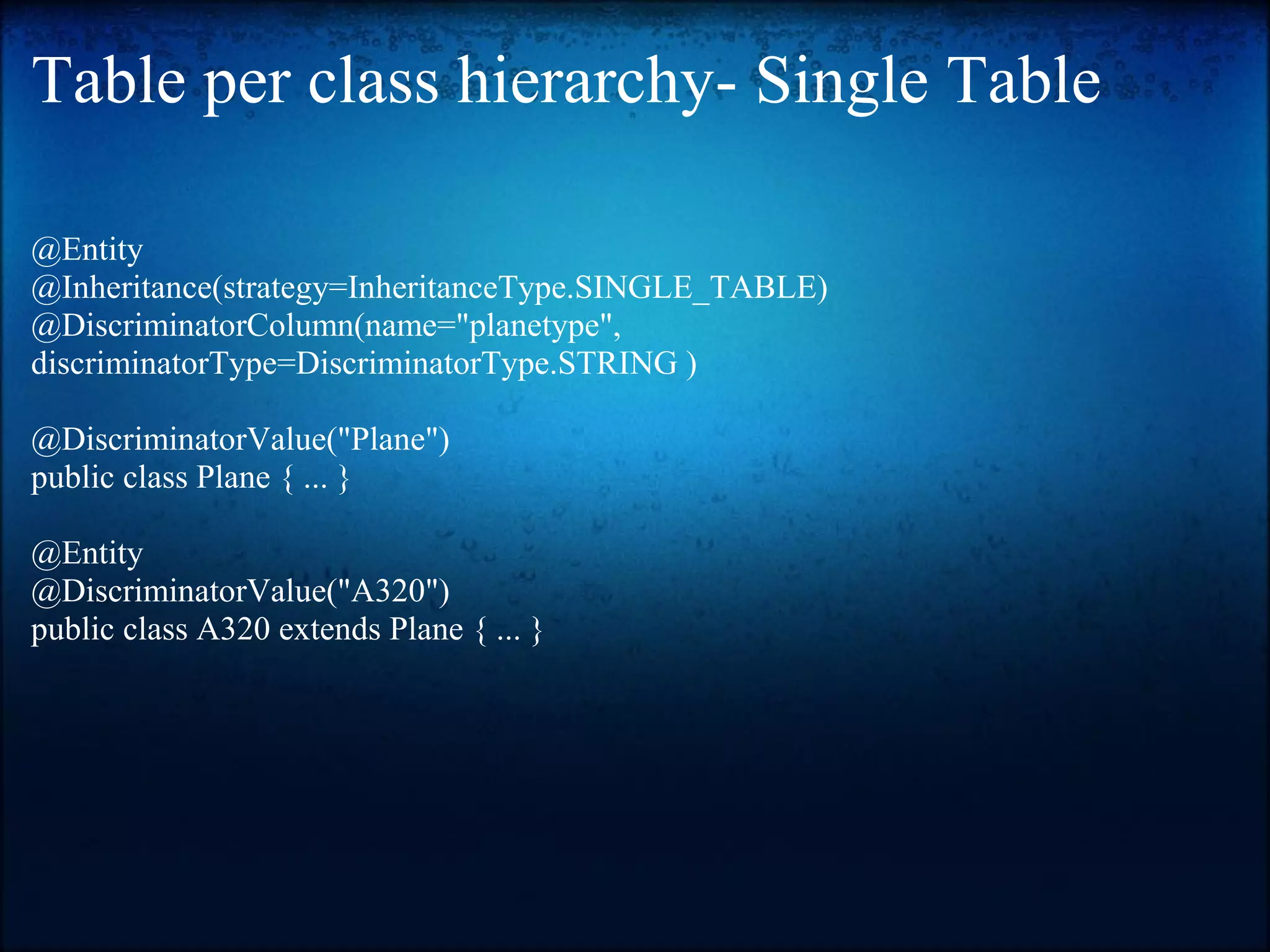
Table per class hierarchy- Single Table
@Entity
@Inheritance(strategy=InheritanceType.SINGLE_TABLE)
@DiscriminatorColumn(name="planetype",
discriminatorType=DiscriminatorType.STRING )
@DiscriminatorValue("Plane")
public class Plane { ... }
@Entity
@DiscriminatorValue("A320")
public class A320 extends Plane { ... }
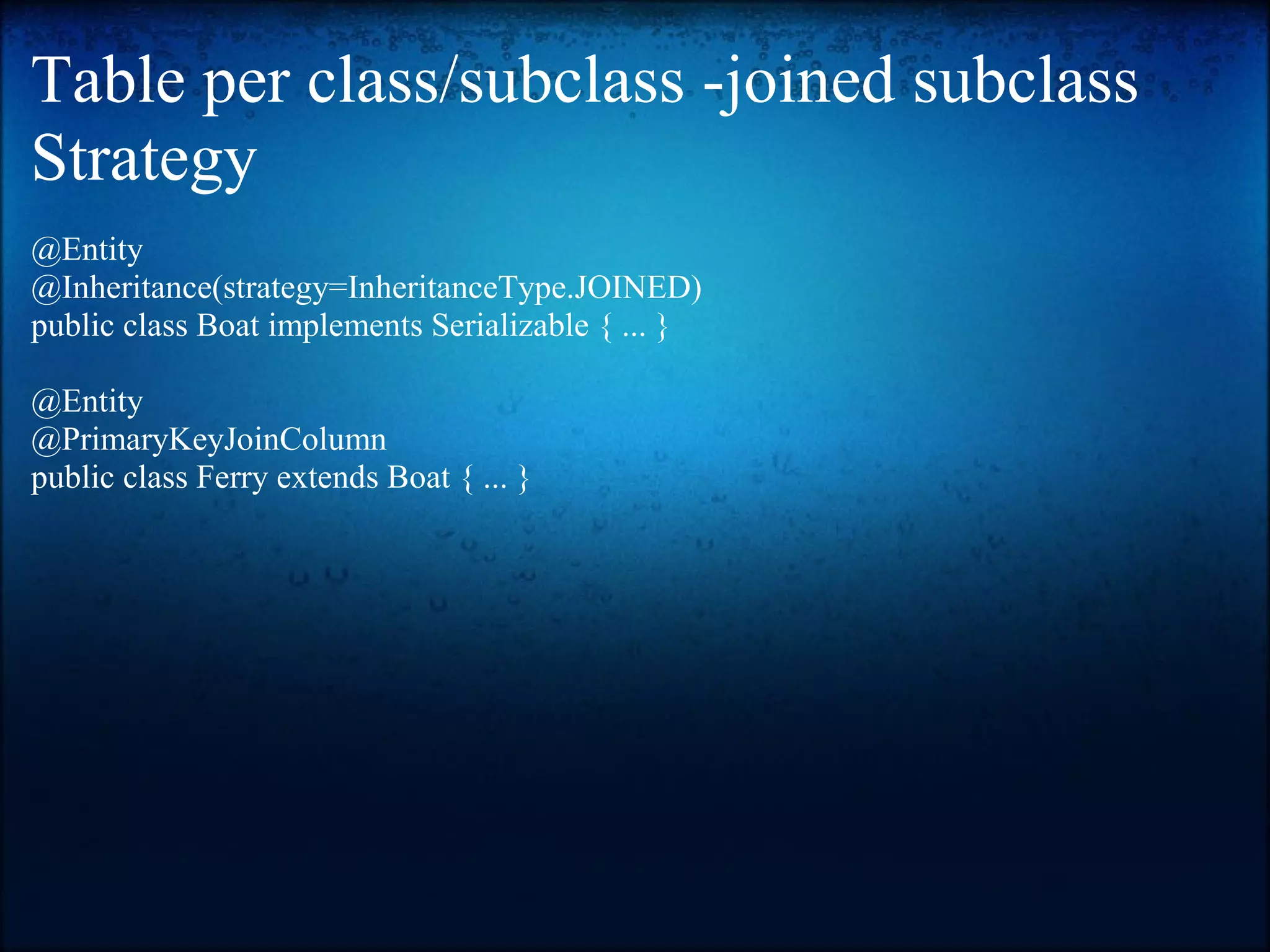
Table per class/subclass -joined subclass
Strategy
@Entity
@Inheritance(strategy=InheritanceType.JOINED)
public class Boat implements Serializable { ... }
@Entity
@PrimaryKeyJoinColumn
public class Ferry extends Boat { ... }
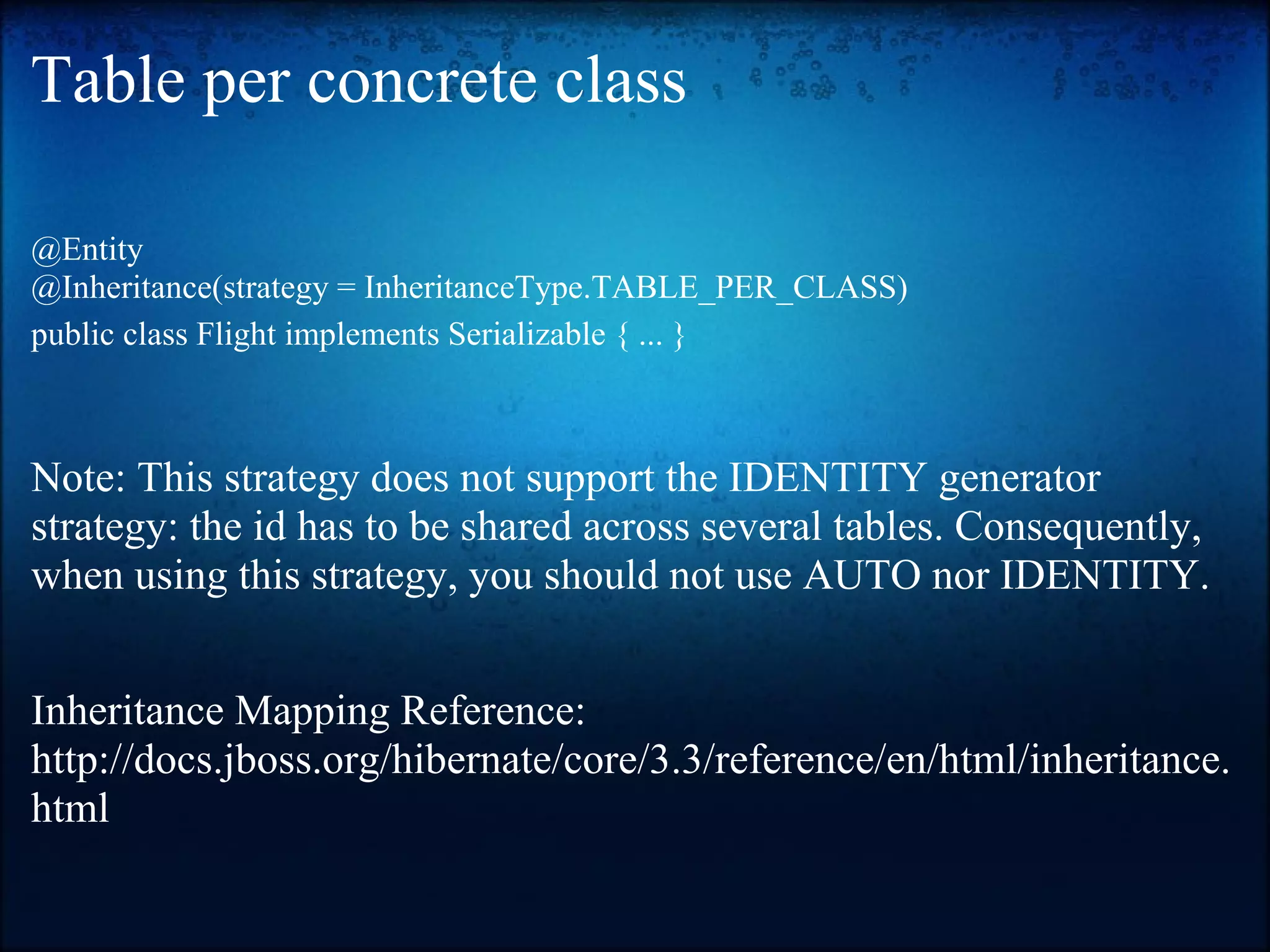
Table per concrete class
@Entity
@Inheritance(strategy = InheritanceType.TABLE_PER_CLASS)
public class Flight implements Serializable { ... }
Note: This strategy does not support the IDENTITY generator
strategy: the id has to be shared across several tables. Consequently,
when using this strategy, you should not use AUTO nor IDENTITY.
Inheritance Mapping Reference:
http://docs.jboss.org/hibernate/core/3.3/reference/en/html/inheritance.
html
HQL
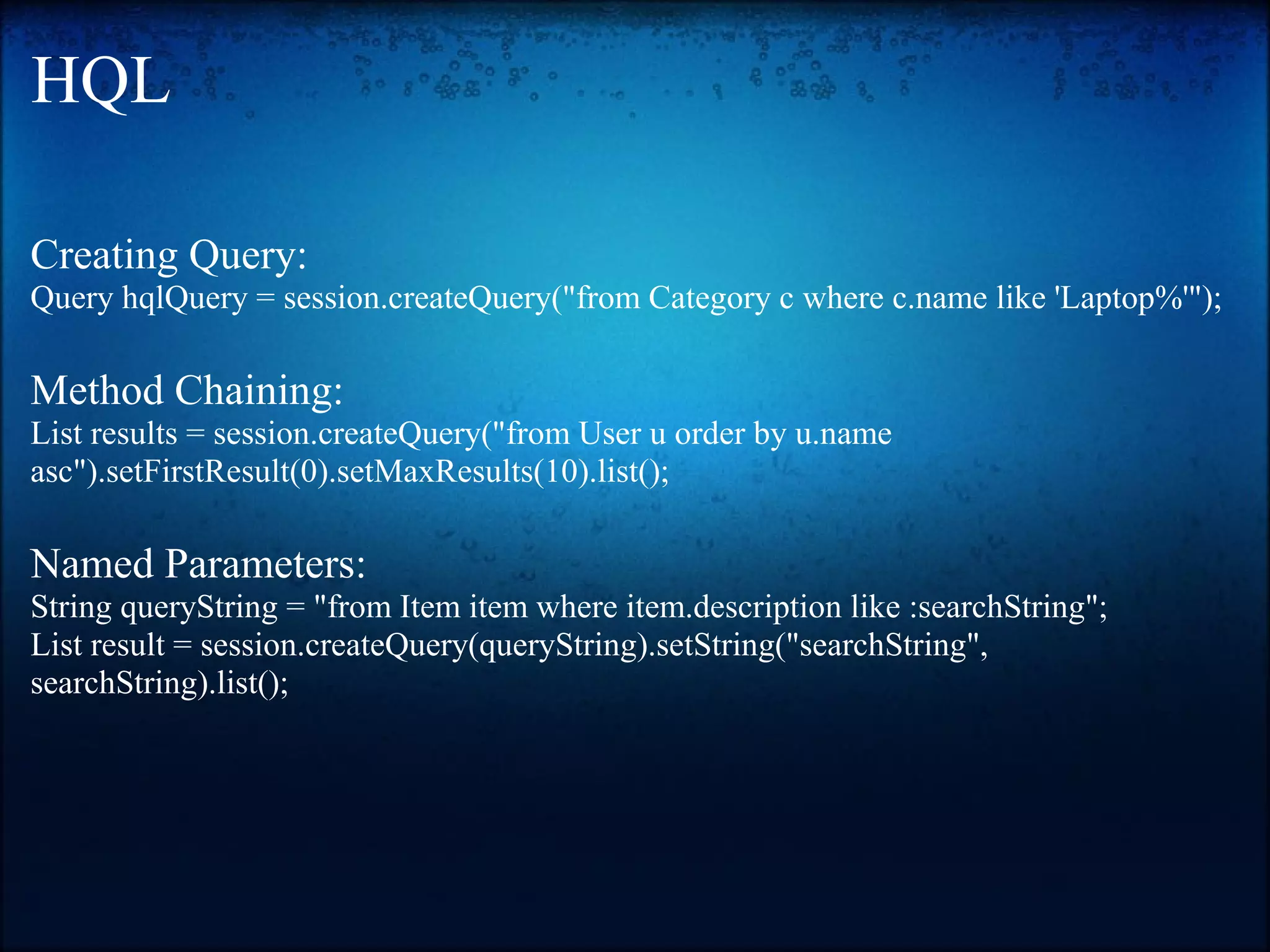
Creating Query:
Query hqlQuery = session.createQuery("from Category c where c.name like 'Laptop%'");
Method Chaining:
List results = session.createQuery("from User u order by u.name
asc").setFirstResult(0).setMaxResults(10).list();
Named Parameters:
String queryString = "from Item item where item.description like :searchString";
List result = session.createQuery(queryString).setString("searchString",
searchString).list();
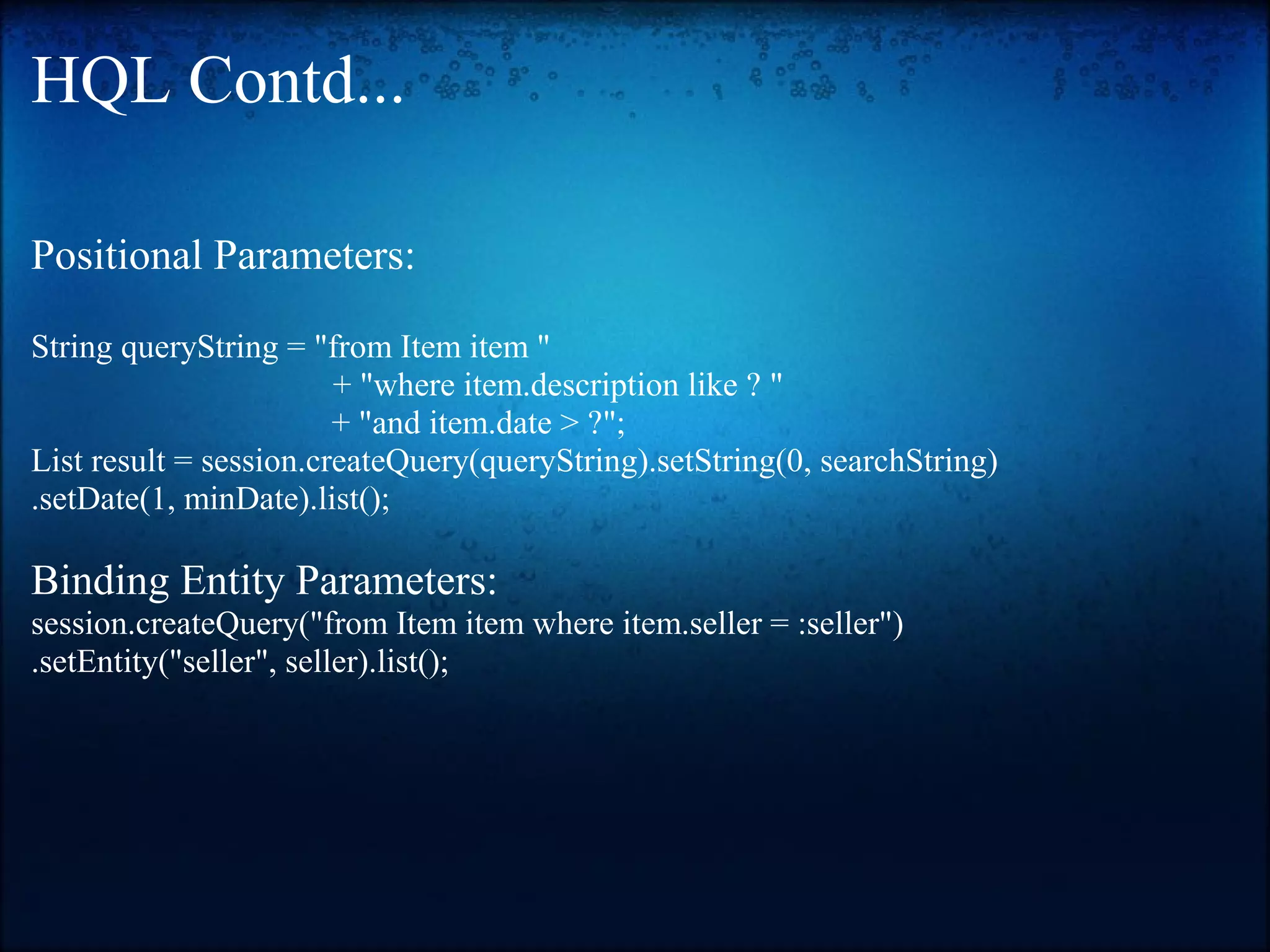
HQL Contd...
Positional Parameters:
String queryString = "from Item item "
+ "where item.description like ? "
+ "and item.date > ?";
List result = session.createQuery(queryString).setString(0, searchString)
.setDate(1, minDate).list();
Binding Entity Parameters:
session.createQuery("from Item item where item.seller = :seller")
.setEntity("seller", seller).list();
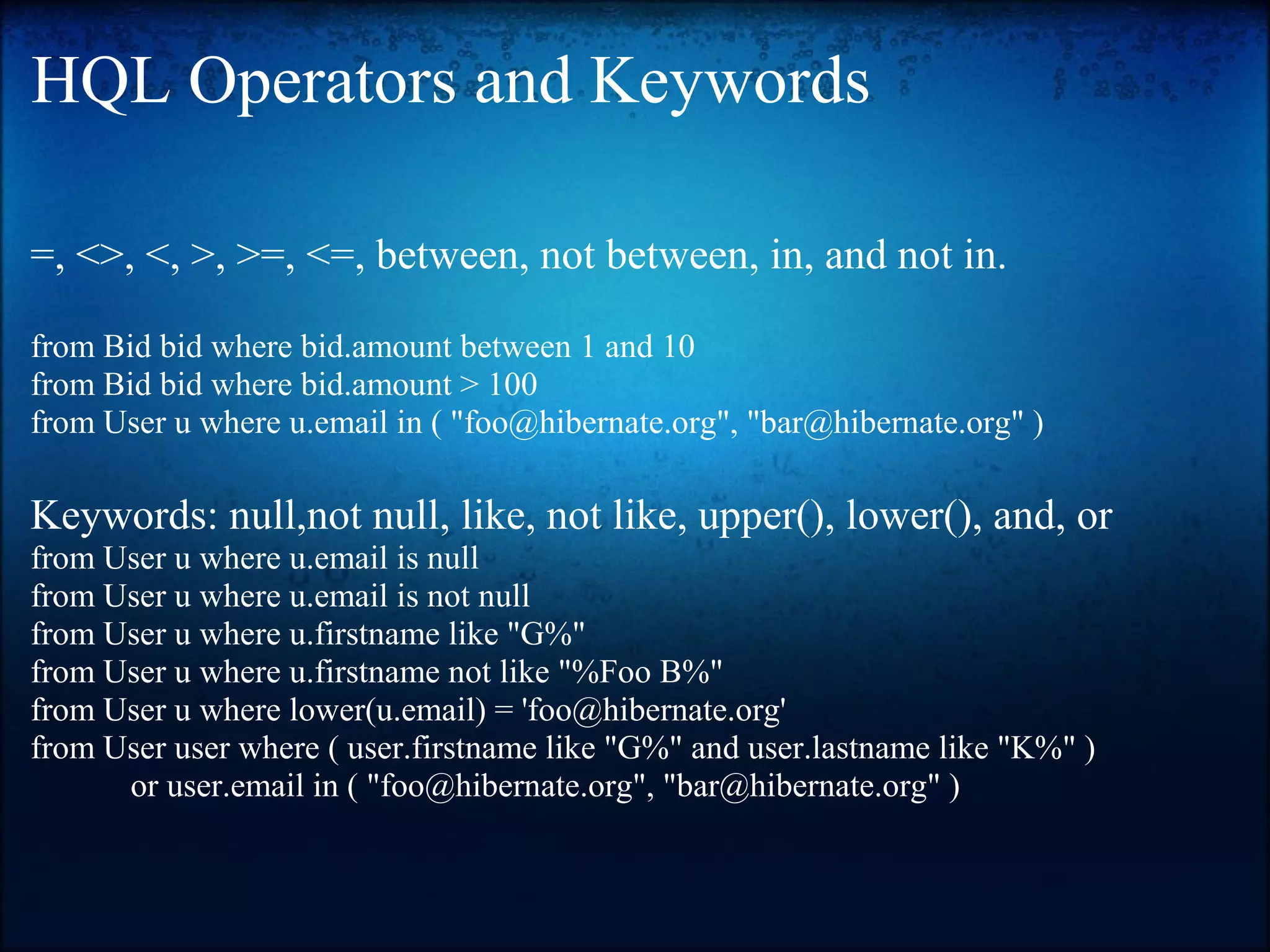
HQL Operators and Keywords
=, <>, <, >, >=, <=, between, not between, in, and not in.
from Bid bid where bid.amount between 1 and 10
from Bid bid where bid.amount > 100
from User u where u.email in ( "foo@hibernate.org", "bar@hibernate.org" )
Keywords: null,not null, like, not like, upper(), lower(), and, or
from User u where u.email is null
from User u where u.email is not null
from User u where u.firstname like "G%"
from User u where u.firstname not like "%Foo B%"
from User u where lower(u.email) = 'foo@hibernate.org'
from User user where ( user.firstname like "G%" and user.lastname like "K%" )
or user.email in ( "foo@hibernate.org", "bar@hibernate.org" )
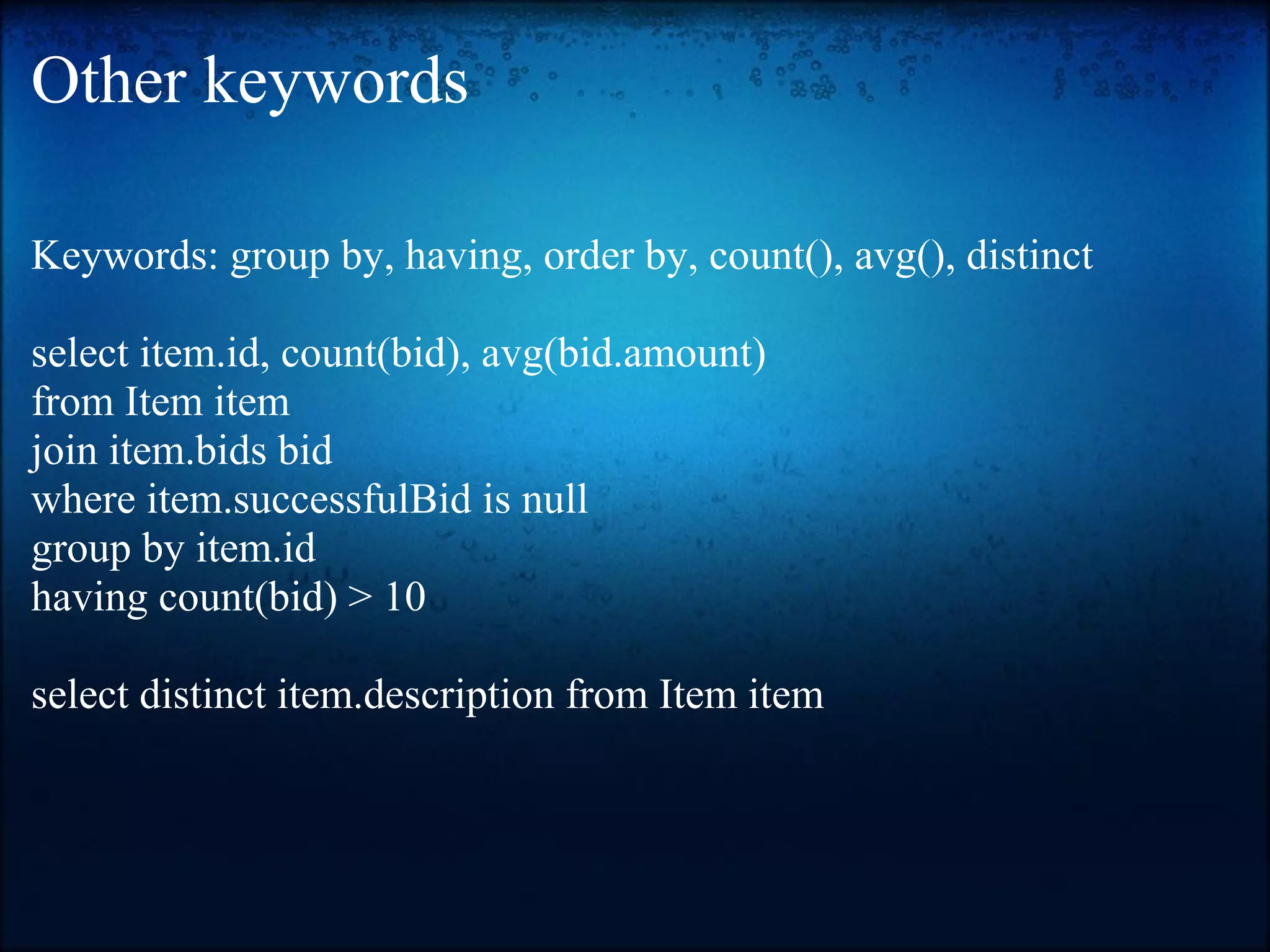
Other keywords
Keywords: group by, having, order by, count(), avg(), distinct
select item.id, count(bid), avg(bid.amount)
from Item item
join item.bids bid
where item.successfulBid is null
group by item.id
having count(bid) > 10
select distinct item.description from Item item
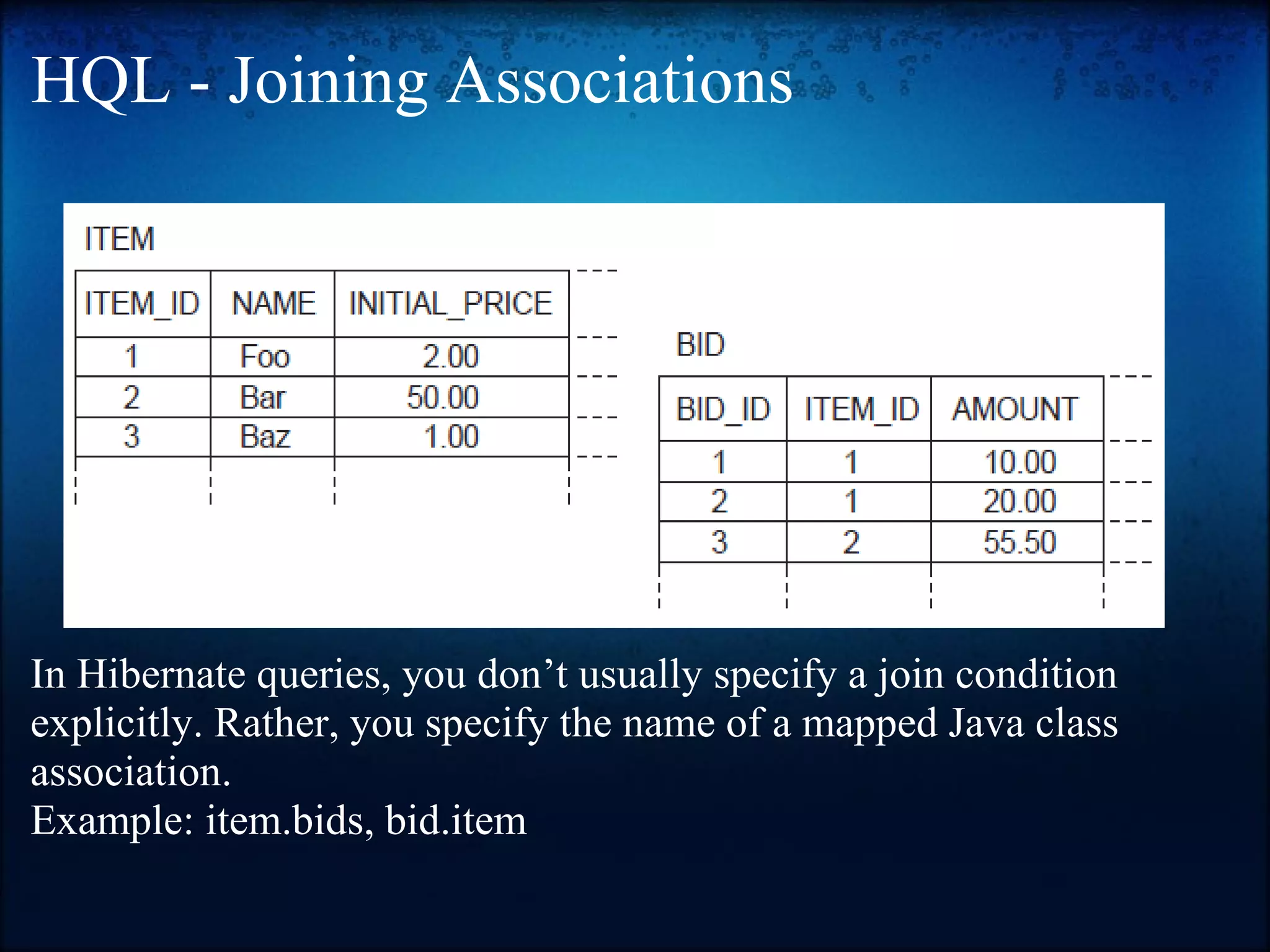
HQL - Joining Associations
In Hibernate queries, you don’t usually specify a join condition
explicitly. Rather, you specify the name of a mapped Java class
association.
Example: item.bids, bid.item
HQL Joins
HQL provides four ways of expressing (inner and outer) joins:
An ordinary join in the from clause■
A fetch join in the from clause■
■ An implicit association join
A theta-style join in the where clause■
Ordinary Join in the from clause
from Item item
join item.bids bid
where item.description like '%gc%'
and bid.amount > 100
Query q = session.createQuery("from Item item join item.bids bid");
Iterator pairs = q.list().iterator();
while ( pairs.hasNext() ) {
Object[] pair = (Object[]) pairs.next();
Item item = (Item) pair[0];
Bid bid = (Bid) pair[1];
}
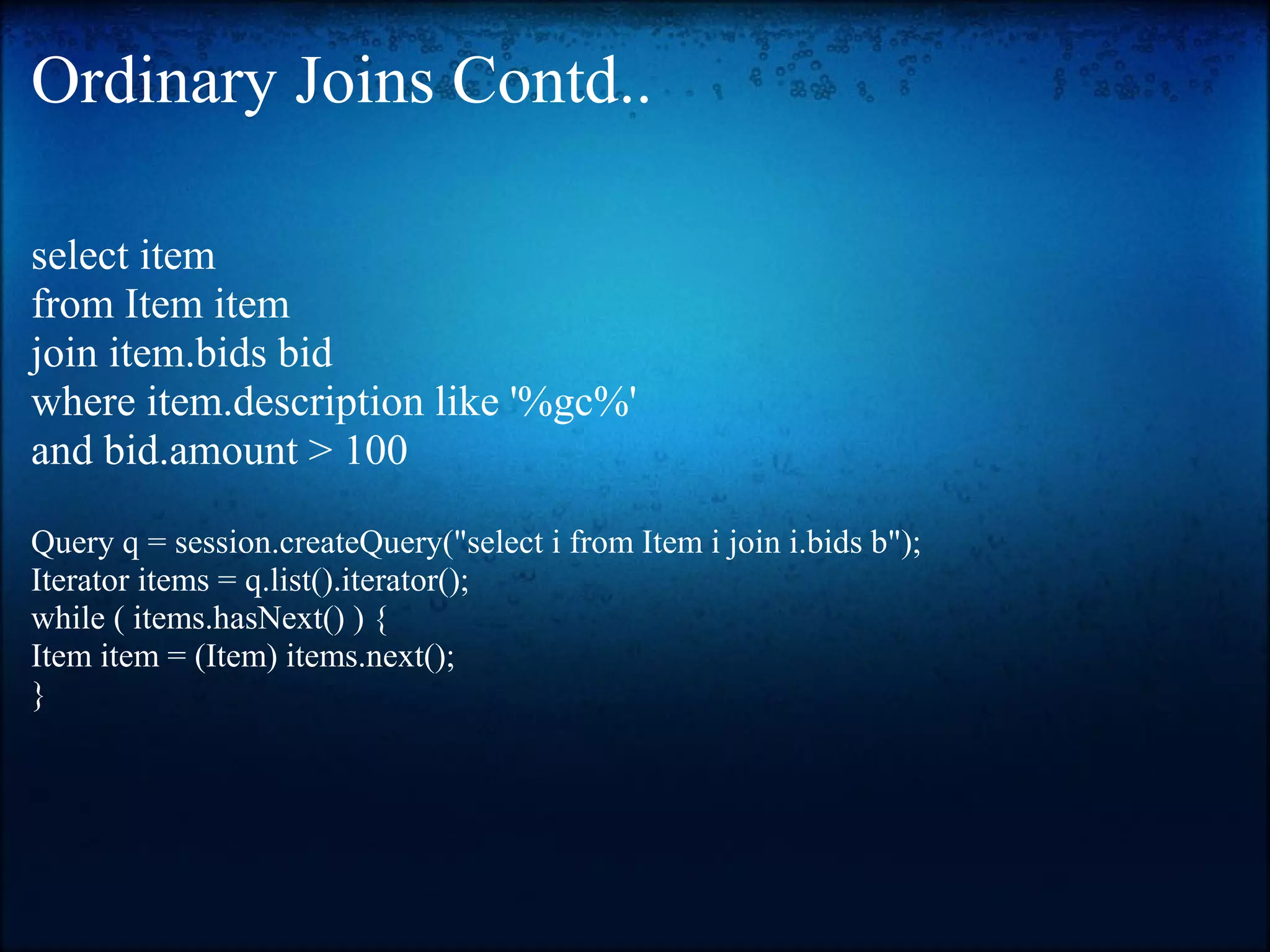
Ordinary Joins Contd..
select item
from Item item
join item.bids bid
where item.description like '%gc%'
and bid.amount > 100
Query q = session.createQuery("select i from Item i join i.bids b");
Iterator items = q.list().iterator();
while ( items.hasNext() ) {
Item item = (Item) items.next();
}
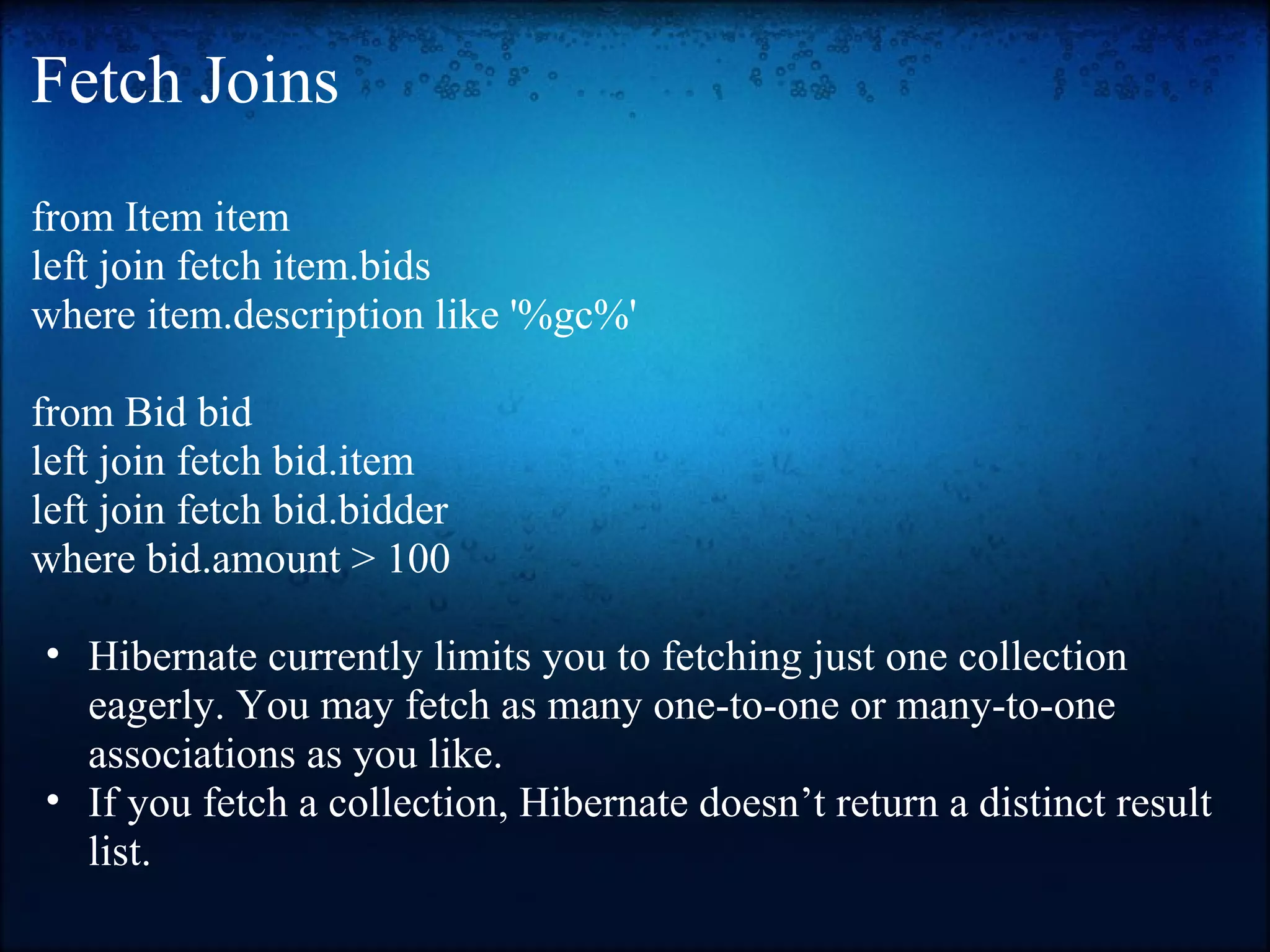
Fetch Joins
from Item item
left join fetch item.bids
where item.description like '%gc%'
from Bid bid
left join fetch bid.item
left join fetch bid.bidder
where bid.amount > 100
• Hibernate currently limits you to fetching just one collection
eagerly. You may fetch as many one-to-one or many-to-one
associations as you like.
• If you fetch a collection, Hibernate doesn’t return a distinct result
list.
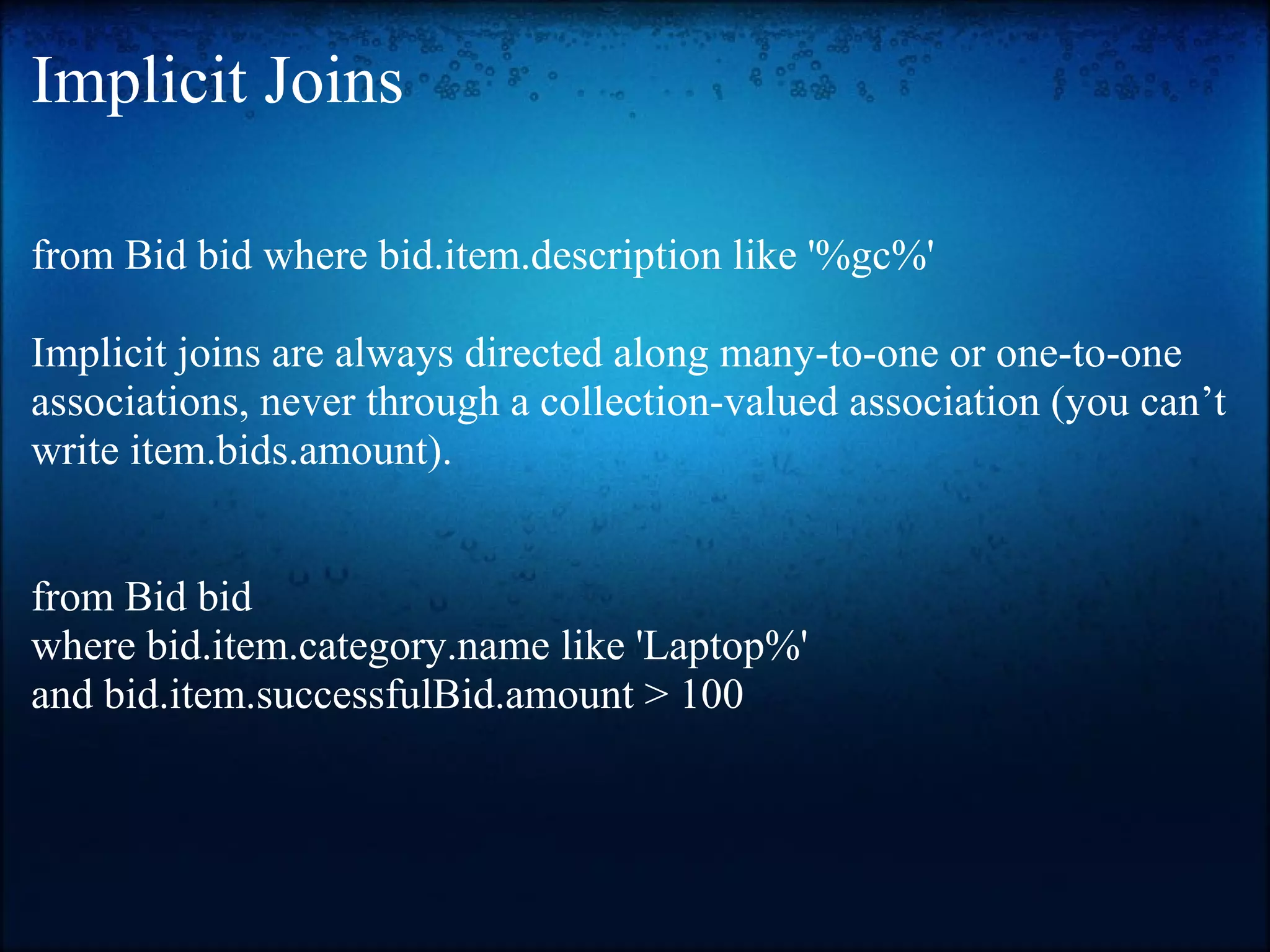
Implicit Joins
from Bid bid where bid.item.description like '%gc%'
Implicit joins are always directed along many-to-one or one-to-one
associations, never through a collection-valued association (you can’t
write item.bids.amount).
from Bid bid
where bid.item.category.name like 'Laptop%'
and bid.item.successfulBid.amount > 100
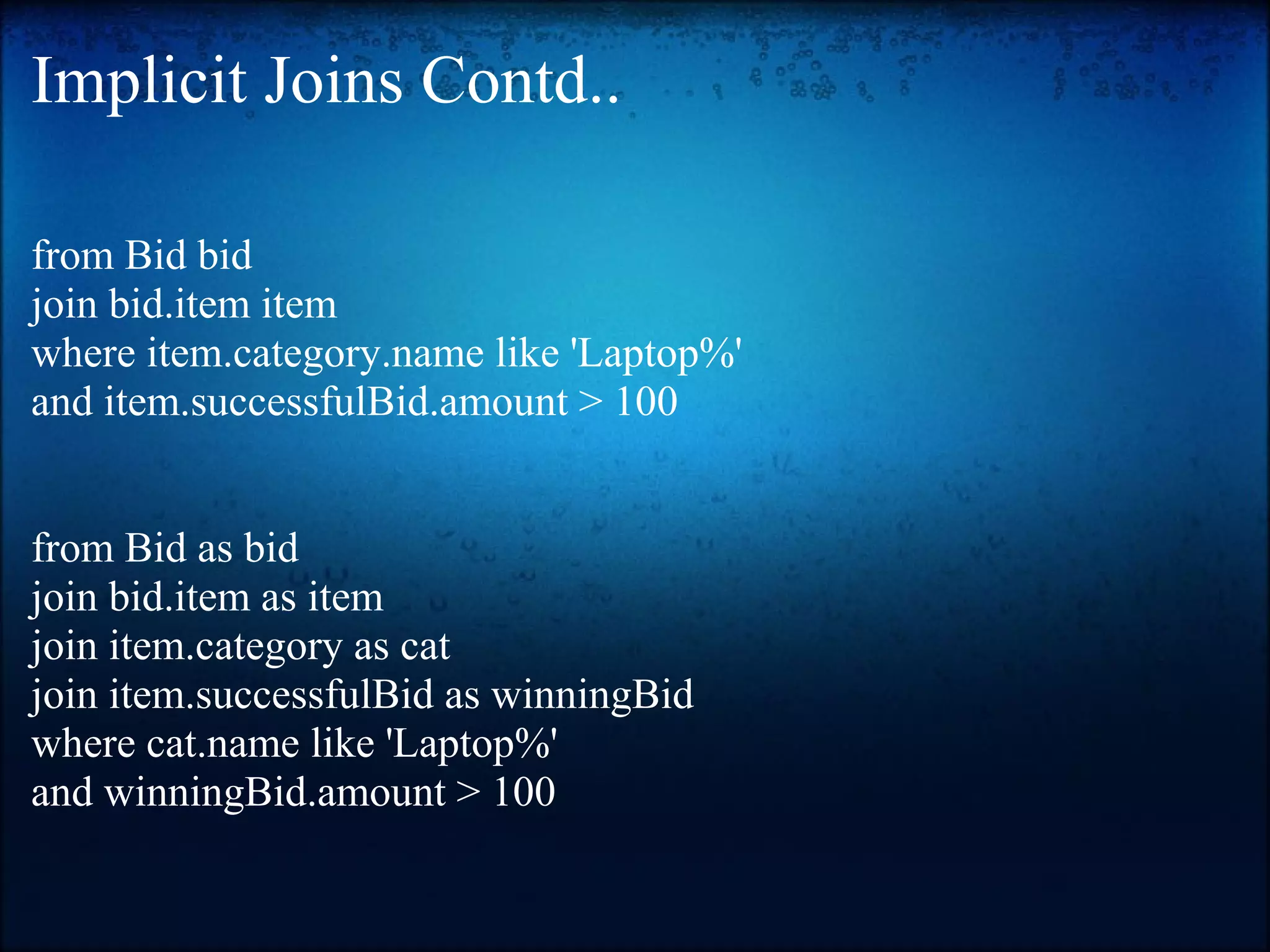
Implicit Joins Contd..
from Bid bid
join bid.item item
where item.category.name like 'Laptop%'
and item.successfulBid.amount > 100
from Bid as bid
join bid.item as item
join item.category as cat
join item.successfulBid as winningBid
where cat.name like 'Laptop%'
and winningBid.amount > 100
Theta Style Joins
When the association is not defined.
from User user, LogRecord log where user.username = log.username
Iterator i = session.createQuery(
"from User user, LogRecord log " +
"where user.username = log.username"
)
.list().iterator();
while ( i.hasNext() ) {
Object[] pair = (Object[]) i.next();
User user = (User) pair[0];
LogRecord log = (LogRecord) pair[1];
}
Spring Hibernate Integration
• Injecting Hibernate SessionFactory in @Repository classes.
• Spring's HibernateTemplate
• JPA EntityManager
Thank You and Questions?

Hibernate Tutorial for beginners

  • 1.
  • 2.
    Conversations • Introduction toHibernate • Hibernate in Action • Object Relational Mapping (ORM) o Association Mappings o Inheritance Mappings • HQL (Hibernate Query Language) o Joining Associations in HQL • Spring Hibernate Integration
  • 3.
    Hello Hibernate Inherent differencesin Object and Relational Model: • Java Objects have associations • RDBMS tables have relations with foreign keys Questions to consider: • How do we implement inheritance in RDBMS tables? • Are your Form beans (to be used on views) different from entity beans? Do you do data transfer from one type of bean to another? • Do you manually associate objects because data is retrieved from RDBMS using join queries? • How much time programmers spend on persistence and data retrieval tasks? Can all this boilerplate persistence code be automated?
  • 4.
    Why Hibernate? • OpenSource persistence technology o relieve developers from majority of common data persistence related programming tasks • ORM framework o follow natural Object-oriented idioms including inheritance, polymorphism, association, composition, and the Java collections framework. • Comprehensive Query Facilities: o support for Hibernate Query Language (HQL), Java Persistence Query Language (JPAQL), Criteria queries, and "native SQL" queries; all of which can be scrolled and paginated to suit your exact performance needs.
  • 5.
    Why Hibernate? • HighPerformance: o lazy initialization, many fetching strategies o optimistic locking with automatic versioning/ time stamping o Hibernate requires no special database tables or fields and generates much of the SQL at system initialization time instead of runtime. • Reliability and Scalability: o proven by the acceptance and use by tens of thousands of Java developers o designed to work in an application server cluster and deliver a highly scalable architecture
  • 6.
    Hibernate in action CodeDemo.... • Annotations: @Entity, @Table, @Id, @Column, @GeneratedValue, Methods: • persist() vs save() • update vs saveOrUpdate() • load() vs get() • createQuery().list() • delete()
  • 7.
    Hibernate in action •Concurrency Control: @Version • Sorting: @OrderBy, @Sort • Pagination • Lazy vs Eager Fetching: fetch = FetchType.EAGER • @Transient, @Lob Reference: • http://docs.jboss.org/hibernate/annotations/3.5/reference/en/html_s ingle/ • http://www.techferry.com/articles/hibernate-jpa-annotations.html
  • 8.
    Association Mappings Types ofAssociations: • @OneToOne • @ManyToOne • @OneToMany • @ManyToMany RDBMS Implementations: • Shared Primary Key • Foreign Key • Association Table Relationship Types: • Uni-directional • Bi-directional
  • 9.
    @OneToOne • @PrimaryKeyJoinColumn -associated entries share the same primary key. • @JoinColumn & @OneToOne mappedBy attribute - foreign key is held by one of the entities. • @JoinTable and mappedBy - association table • Persist two entities with shared key: @MapsId
  • 10.
    @ManyToOne • @JoinColumn -foreign key is held by one of the entities. • @JoinTable - association table
  • 11.
    @OneToMany • mappedBy attributefor bi-directional associations with ManyToOne being the owner. • OneToMany being the owner or unidirectional with foreign key - try to avoid such associations but can be achieved with @JoinColumn • @JoinTable for Unidirectional with association table
  • 12.
    @ManyToMany • @JoinTable -association table. • mappedBy attribute for bi-directional association.
  • 13.
    Mapping Inheritance • tableper class hierarchy o single table per Class Hierarchy Strategy: the <subclass> element in Hibernate • table per class/subclass o joined subclass Strategy: the <joined-subclass> element in Hibernate • table per concrete class o table per Class Strategy: the <union-class> element in Hibernate
  • 14.
    Table per classhierarchy- Single Table @Entity @Inheritance(strategy=InheritanceType.SINGLE_TABLE) @DiscriminatorColumn(name="planetype", discriminatorType=DiscriminatorType.STRING ) @DiscriminatorValue("Plane") public class Plane { ... } @Entity @DiscriminatorValue("A320") public class A320 extends Plane { ... }
  • 15.
    Table per class/subclass-joined subclass Strategy @Entity @Inheritance(strategy=InheritanceType.JOINED) public class Boat implements Serializable { ... } @Entity @PrimaryKeyJoinColumn public class Ferry extends Boat { ... }
  • 16.
    Table per concreteclass @Entity @Inheritance(strategy = InheritanceType.TABLE_PER_CLASS) public class Flight implements Serializable { ... } Note: This strategy does not support the IDENTITY generator strategy: the id has to be shared across several tables. Consequently, when using this strategy, you should not use AUTO nor IDENTITY. Inheritance Mapping Reference: http://docs.jboss.org/hibernate/core/3.3/reference/en/html/inheritance. html
  • 17.
    HQL Creating Query: Query hqlQuery= session.createQuery("from Category c where c.name like 'Laptop%'"); Method Chaining: List results = session.createQuery("from User u order by u.name asc").setFirstResult(0).setMaxResults(10).list(); Named Parameters: String queryString = "from Item item where item.description like :searchString"; List result = session.createQuery(queryString).setString("searchString", searchString).list();
  • 18.
    HQL Contd... Positional Parameters: StringqueryString = "from Item item " + "where item.description like ? " + "and item.date > ?"; List result = session.createQuery(queryString).setString(0, searchString) .setDate(1, minDate).list(); Binding Entity Parameters: session.createQuery("from Item item where item.seller = :seller") .setEntity("seller", seller).list();
  • 19.
    HQL Operators andKeywords =, <>, <, >, >=, <=, between, not between, in, and not in. from Bid bid where bid.amount between 1 and 10 from Bid bid where bid.amount > 100 from User u where u.email in ( "foo@hibernate.org", "bar@hibernate.org" ) Keywords: null,not null, like, not like, upper(), lower(), and, or from User u where u.email is null from User u where u.email is not null from User u where u.firstname like "G%" from User u where u.firstname not like "%Foo B%" from User u where lower(u.email) = 'foo@hibernate.org' from User user where ( user.firstname like "G%" and user.lastname like "K%" ) or user.email in ( "foo@hibernate.org", "bar@hibernate.org" )
  • 20.
    Other keywords Keywords: groupby, having, order by, count(), avg(), distinct select item.id, count(bid), avg(bid.amount) from Item item join item.bids bid where item.successfulBid is null group by item.id having count(bid) > 10 select distinct item.description from Item item
  • 21.
    HQL - JoiningAssociations In Hibernate queries, you don’t usually specify a join condition explicitly. Rather, you specify the name of a mapped Java class association. Example: item.bids, bid.item
  • 22.
    HQL Joins HQL providesfour ways of expressing (inner and outer) joins: An ordinary join in the from clause■ A fetch join in the from clause■ ■ An implicit association join A theta-style join in the where clause■
  • 23.
    Ordinary Join inthe from clause from Item item join item.bids bid where item.description like '%gc%' and bid.amount > 100 Query q = session.createQuery("from Item item join item.bids bid"); Iterator pairs = q.list().iterator(); while ( pairs.hasNext() ) { Object[] pair = (Object[]) pairs.next(); Item item = (Item) pair[0]; Bid bid = (Bid) pair[1]; }
  • 24.
    Ordinary Joins Contd.. selectitem from Item item join item.bids bid where item.description like '%gc%' and bid.amount > 100 Query q = session.createQuery("select i from Item i join i.bids b"); Iterator items = q.list().iterator(); while ( items.hasNext() ) { Item item = (Item) items.next(); }
  • 25.
    Fetch Joins from Itemitem left join fetch item.bids where item.description like '%gc%' from Bid bid left join fetch bid.item left join fetch bid.bidder where bid.amount > 100 • Hibernate currently limits you to fetching just one collection eagerly. You may fetch as many one-to-one or many-to-one associations as you like. • If you fetch a collection, Hibernate doesn’t return a distinct result list.
  • 26.
    Implicit Joins from Bidbid where bid.item.description like '%gc%' Implicit joins are always directed along many-to-one or one-to-one associations, never through a collection-valued association (you can’t write item.bids.amount). from Bid bid where bid.item.category.name like 'Laptop%' and bid.item.successfulBid.amount > 100
  • 27.
    Implicit Joins Contd.. fromBid bid join bid.item item where item.category.name like 'Laptop%' and item.successfulBid.amount > 100 from Bid as bid join bid.item as item join item.category as cat join item.successfulBid as winningBid where cat.name like 'Laptop%' and winningBid.amount > 100
  • 28.
    Theta Style Joins Whenthe association is not defined. from User user, LogRecord log where user.username = log.username Iterator i = session.createQuery( "from User user, LogRecord log " + "where user.username = log.username" ) .list().iterator(); while ( i.hasNext() ) { Object[] pair = (Object[]) i.next(); User user = (User) pair[0]; LogRecord log = (LogRecord) pair[1]; }
  • 29.
    Spring Hibernate Integration •Injecting Hibernate SessionFactory in @Repository classes. • Spring's HibernateTemplate • JPA EntityManager
  • 30.
    Thank You andQuestions?

Editor's Notes

  • #7 persist() is well defined. It makes a transient instance persistent. However, it doesn&amp;apos;t guarantee that the identifier value will be assigned to the persistent instance immediately, the assignment might happen at flush time. The spec doesn&amp;apos;t say that, which is the problem I have with persist(). persist() also guarantees that it will not execute an INSERT statement if it is called outside of transaction boundaries. This is useful in long-running conversations with an extended Session/persistence context. A method like persist() is required. save() does not guarantee the same, it returns an identifier, and if an INSERT has to be executed to get the identifier (e.g. &amp;quot;identity&amp;quot; generator, not &amp;quot;sequence&amp;quot;), this INSERT happens immediately, no matter if you are inside or outside of a transaction. This is not good in a long-running conversation with an extended Session/persistence context.