Generating Headless Javascript
    Tests for Validations

             js.chi
         2009/06/25
        Kurt Stephens
        CashNetUSA

    http://kurtstephens.com/
 files/headless_js_testing.pdf
Problem

   Many Views.
   Many Abstract Data Types (ADT).
   Many Models that the same ADTs.
   Many different validations on each ADT
    depending on the context (localization).
   Client and Server-side validation required.
   Client and Server are different platforms (JS
    .vs. RoR).
   Traditional JS testing in a browser eats humans
    alive.
Issues and Tech

   MVC
   Ruby and Rails
   JavaScript (aka ECMAScript)
   Localization
   Client-side and Server-side validations
   Rspec
   Seamonkey Stand-alone interpreter
       apt-get install smjs
Overview

   Server- and Client-side Validations
   Widgets
   Localization
   Validations and Regular Expressions
   Translating Ruby Regexp to JS RegExp
   Test generation and Execution
Layers
Server-Side Validation

  Controller              3. flash[:error] << person.errors
                                   4. view.render
                                                              HTML
           1. person.valid?                                 <input ...>
                                                     <span class=”error”>...</>

   Model                           View


      2. current.convert.phone.valid?(self.phone_number)


CnuLocale                                                 CnuControl
Many Views beget Widgets

  Controller             Model                 View

     1. cnu_control(person, :home_phone, ...)
  2. get_config(model.class, :home_phone)

cnu_control.yml:                                           HTML
person:                                     CnuControl   <input ...>
 home_phone:
  type: phone

    3. rx = current.convert.phone.rx
                                                             JS
                           4. js << rx.to_js


   CnuLocale                   Cnu::Ecmascript::Regexp
Overkill?
Localization

   CnuLocale
       ADTs
            Phone Number, Date, Money, Passport, etc.
       Validations
            Is user input valid?
            Uses Regexp, but can be programatic.
       Normalization
            ”+61 02 1234 5678” => ”161212345678”
       Presentation
            ”161212345678” => AU ”(02) 1234 5678”
            ”161212345678” => US ”+1 61212345678”
This Can Happen To You!
Australian Phone Number
def phone_number_au
  @@phone_number_au ||=
    begin
      sep = "[-.s]"
    /
    # +CC: +61 | 61 | b
    ((?:+|b)s*((?# country_code) 61)#{sep}?)?
    # m[:digits] will contain digits and formatting, without the + country code.
    ((?# digits)
    # 04 1234 5678      => 04 1234 5678
    # 0412345678        => 04 1234 5678
      ((?# area_code) 0?[234578]) #{sep}?((?# prefix) d{4})#{sep}?((?# suffix) d{4})
    |
    # (04) 1234 5678    => 04 1234 5678
    # (04)12345678      => 04 1234 5678
    (((?# area_code) 0?[234578]))#{sep}?((?# prefix) d{4})#{sep}?((?# suffix) d{4})
    |
    # 0412 345 678      => 04 1234 5678
    # 0412 345678       => 04 1234 5678
      ((?# area_code) 0?[234578])((?# prefix) d{2} #{sep} d{2})((?# suffix) d{1}#{sep}?d{3})
    |
    # (0412) 345 678    => 04 1234 5678
    # (0412)345 678     => 04 1234 5678
    # (0412)345678      => 04 1234 5678
    (((?# area_code) 0?[234578])((?# prefix) d{2})#{sep}?d{2})((?# suffix) d{1}#{sep}?d{3})
    |
    # 1800 123 456      => 1800 123 456
    # 1800123456        => 1800 123 456
      ((?# area_code) 1[38]00) #{sep}?((?# prefix) d{3})#{sep}?((?# suffix) d{3})
    |
    # ... A BUNCH MORE HERE! ...
    # 18 1234           => 18 '' 1234
    # 181234            => 18 '' 1234
      ((?# area_code) 1[38]) #{sep}?((?# prefix) )((?# suffix) d{4})
    )
    b
    /x.tag!
    end
end
Keeping it Managable
Elements of Style

   Optional '+' and or country code prefix:
    
        /((?:+|b)s*((?# country_code) 61)#{sep}?)?/

   Zero-length non-word assertions:
    
        /b((?# digits) d+)b/

   Tagged Captures:
    
        /((?# area_code) 0?[234578])   #{sep}?((?# prefix) d{4})#{sep}?((?#
        suffix) d{4})/

   Extended Syntax:
    
        /something else/x

   Tag Transformation:
    
        (”foo1234bar” =~ /foo((?# digits) d+)bar/.tag!)[:digits] => ”1234”
Standards: Everyone's Got One

   Ruby Regexp
       Handles (?# comments).
       Use ((?# tag) captured expr) for naming captures.
       //x enables insignificant whitespace and #
        comments.
   JS RegExp
       Does not handle //x or comments.
       b does not match BOL and EOL.
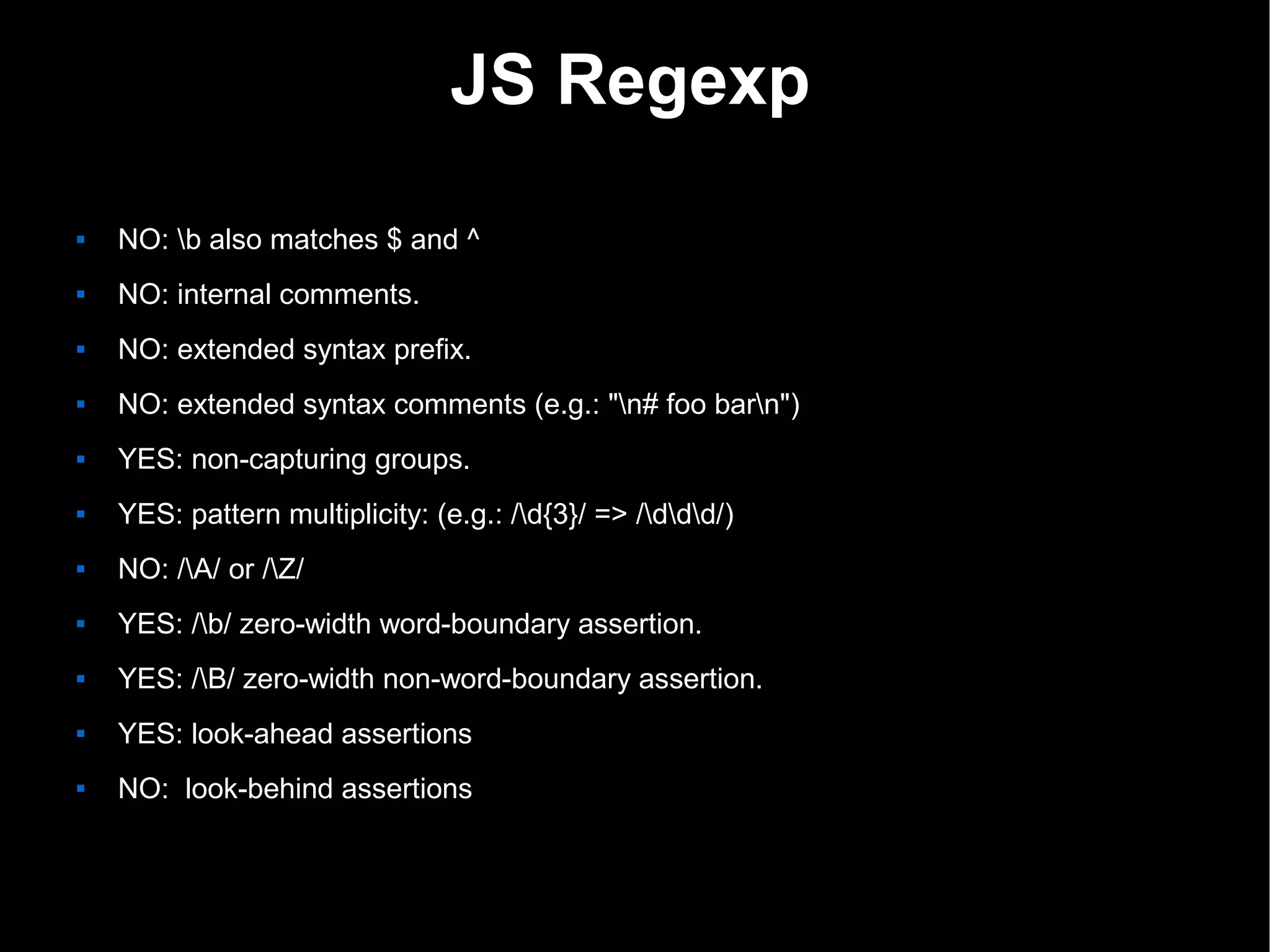
JS Regexp
   NO: b also matches $ and ^
   NO: internal comments.
   NO: extended syntax prefix.
   NO: extended syntax comments (e.g.: "n# foo barn")
   YES: non-capturing groups.
   YES: pattern multiplicity: (e.g.: /d{3}/ => /ddd/)
   NO: /A/ or /Z/
   YES: /b/ zero-width word-boundary assertion.
   YES: /B/ zero-width non-word-boundary assertion.
   YES: look-ahead assertions
   NO: look-behind assertions
Basics
Regexp in the Wild
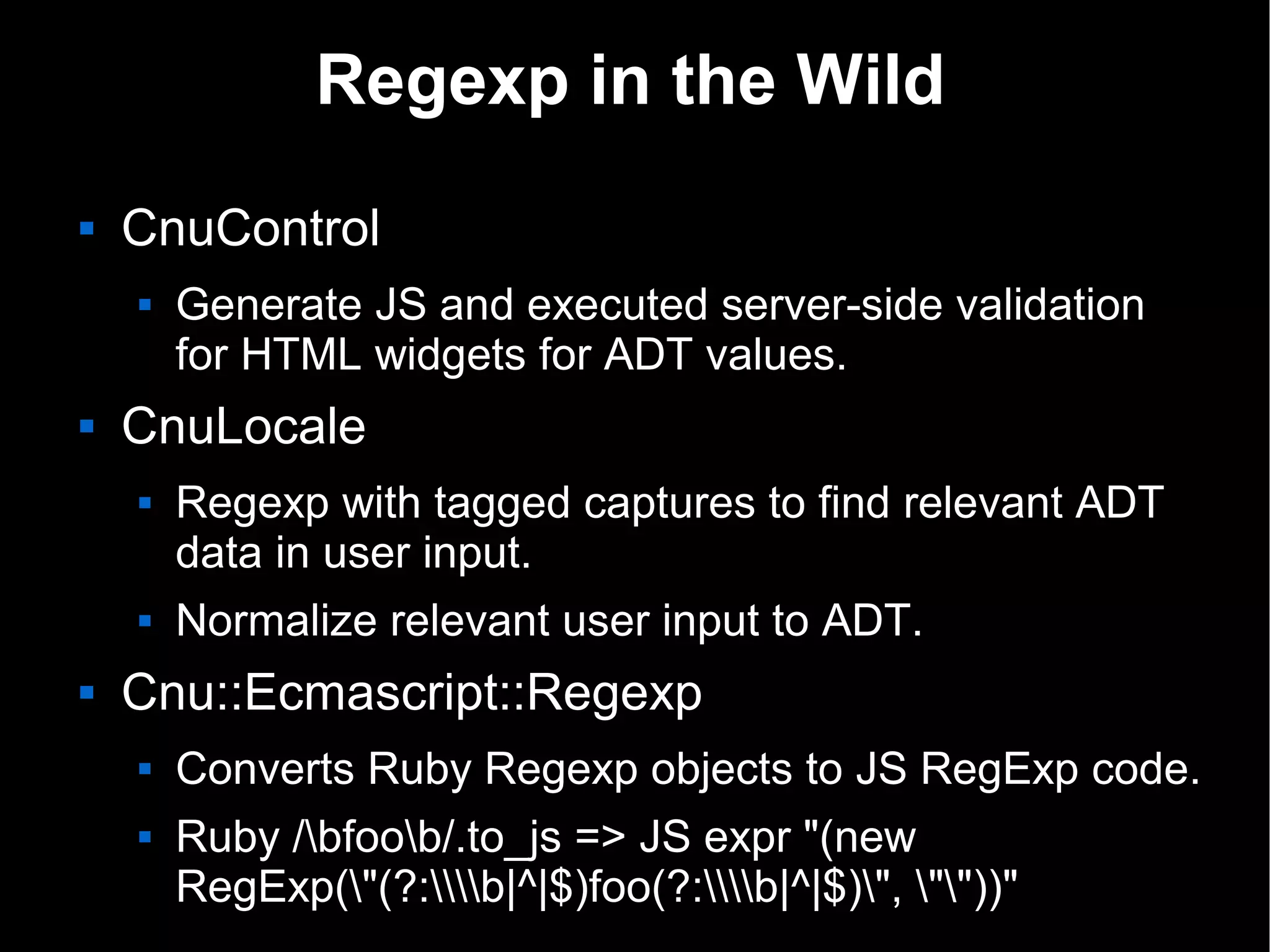
   CnuControl
       Generate JS and executed server-side validation
        for HTML widgets for ADT values.
   CnuLocale
       Regexp with tagged captures to find relevant ADT
        data in user input.
       Normalize relevant user input to ADT.
   Cnu::Ecmascript::Regexp
       Converts Ruby Regexp objects to JS RegExp code.
       Ruby /bfoob/.to_js => JS expr "(new
        RegExp("(?:b|^|$)foo(?:b|^|$)", ""))"
My Wookie is Also My Bookie


   http://www.morningstar.nildram.co.uk/A_New_Sith.html
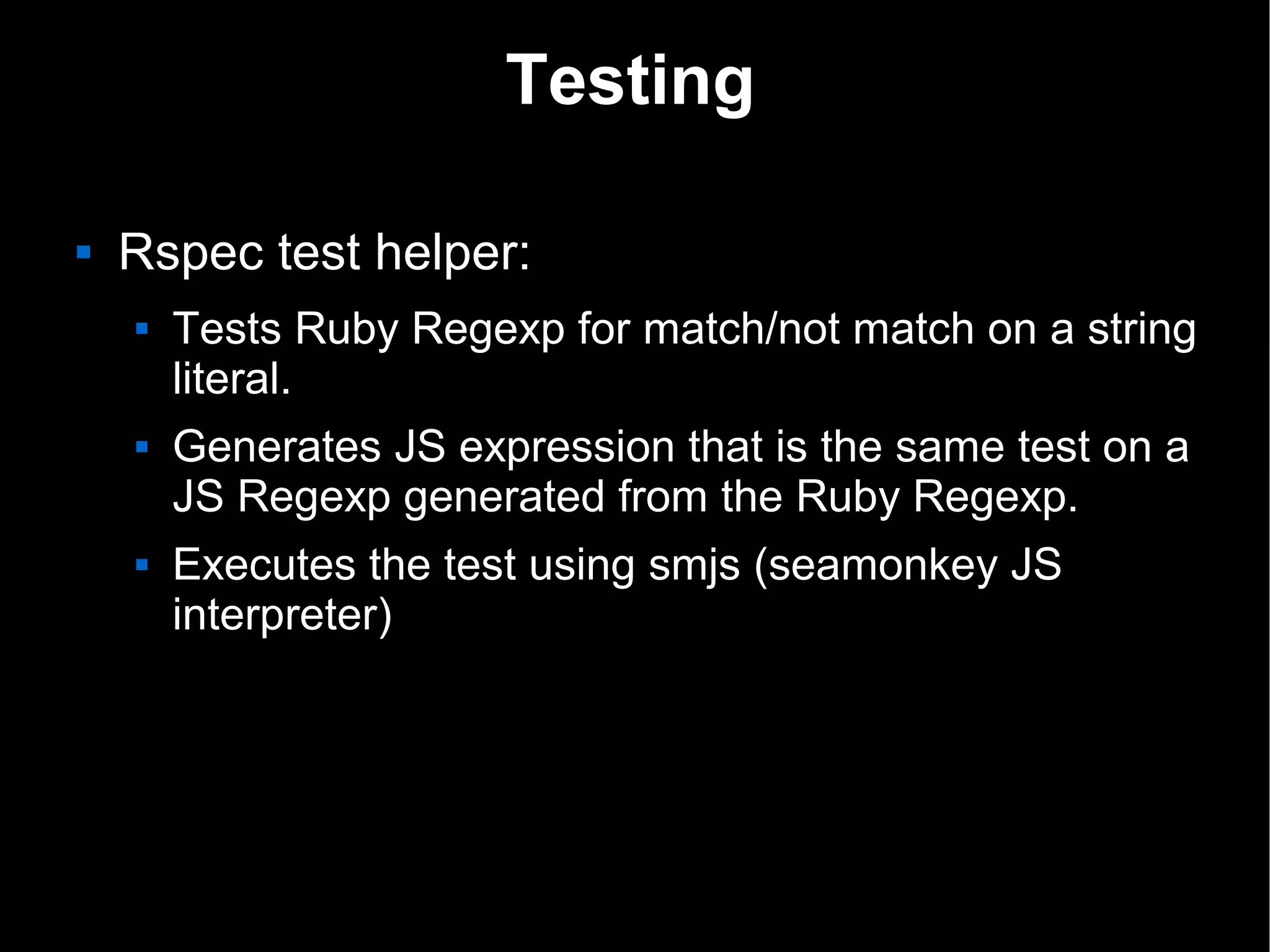
Testing

   Rspec test helper:
       Tests Ruby Regexp for match/not match on a string
        literal.
       Generates JS expression that is the same test on a
        JS Regexp generated from the Ruby Regexp.
       Executes the test using smjs (seamonkey JS
        interpreter)
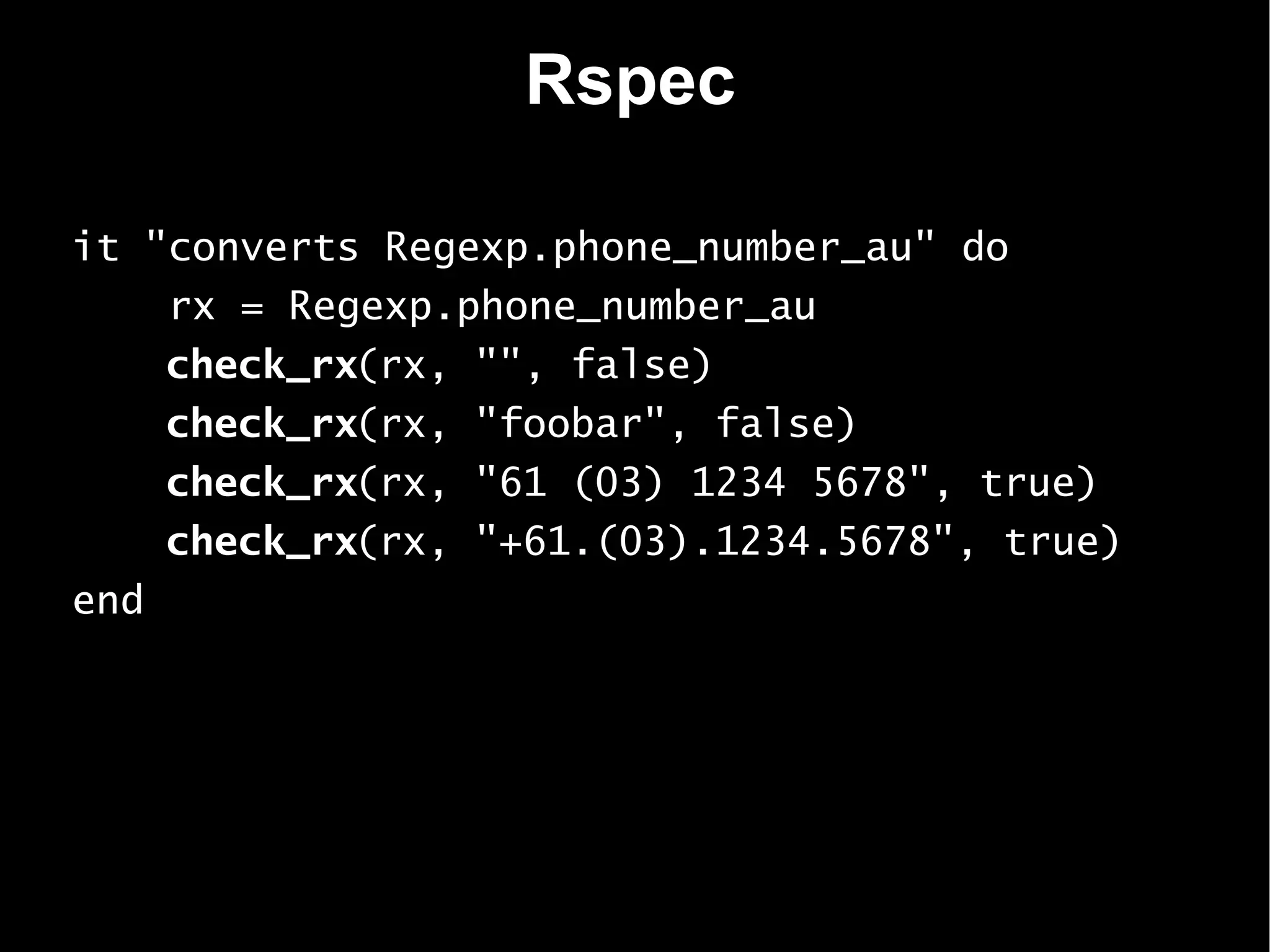
Rspec

it "converts Regexp.phone_number_au" do
    rx = Regexp.phone_number_au
    check_rx(rx, "", false)
    check_rx(rx, "foobar", false)
    check_rx(rx, "61 (03) 1234 5678", true)
    check_rx(rx, "+61.(03).1234.5678", true)
end
Generated Ruby and JS Tests

check_rx(rx, “foobar”, false) =>


 (rx === “foobar”).should == nil


 cnu_assert(
  "(new RegExp("...", "")).test("foobar") == false",
  (new RegExp("((?:+|(?:b|^|$))s*(61)[-.s]?)?((0?[234578])[-.s]?
(d{4})[-.s]?(d{4})|((0?[234578]))[-.s]?(d{4})[-.s]?
(d{4})|(0?[234578])(d{2}[-.s]d{2})(d{1}[-.s]?d{3})|((0?
[234578])(d{2})[-.s]?d{2})(d{1}[-.s]?d{3})|(1[38]00)[-.s]?
(d{3})[-.s]?(d{3})|((1[38]00))[-.s]?(d{3})[-.s]?(d{3})|
(1[38]0)[-.s]?()(d{4})|((1[38]0))[-.s]?()(d{4})|((1[38]))
[-.s]?()(d{4})|(1[38])[-.s]?()(d{4}))(?:b|^|$)",
"")).test("foobar"),
  "==",
  false);

Headless Js Testing

  • 1.
    Generating Headless Javascript Tests for Validations js.chi 2009/06/25 Kurt Stephens CashNetUSA http://kurtstephens.com/ files/headless_js_testing.pdf
  • 2.
    Problem  Many Views.  Many Abstract Data Types (ADT).  Many Models that the same ADTs.  Many different validations on each ADT depending on the context (localization).  Client and Server-side validation required.  Client and Server are different platforms (JS .vs. RoR).  Traditional JS testing in a browser eats humans alive.
  • 3.
    Issues and Tech  MVC  Ruby and Rails  JavaScript (aka ECMAScript)  Localization  Client-side and Server-side validations  Rspec  Seamonkey Stand-alone interpreter  apt-get install smjs
  • 4.
    Overview  Server- and Client-side Validations  Widgets  Localization  Validations and Regular Expressions  Translating Ruby Regexp to JS RegExp  Test generation and Execution
  • 5.
  • 6.
    Server-Side Validation Controller 3. flash[:error] << person.errors 4. view.render HTML 1. person.valid? <input ...> <span class=”error”>...</> Model View 2. current.convert.phone.valid?(self.phone_number) CnuLocale CnuControl
  • 7.
    Many Views begetWidgets Controller Model View 1. cnu_control(person, :home_phone, ...) 2. get_config(model.class, :home_phone) cnu_control.yml: HTML person: CnuControl <input ...> home_phone: type: phone 3. rx = current.convert.phone.rx JS 4. js << rx.to_js CnuLocale Cnu::Ecmascript::Regexp
  • 8.
  • 9.
    Localization  CnuLocale  ADTs  Phone Number, Date, Money, Passport, etc.  Validations  Is user input valid?  Uses Regexp, but can be programatic.  Normalization  ”+61 02 1234 5678” => ”161212345678”  Presentation  ”161212345678” => AU ”(02) 1234 5678”  ”161212345678” => US ”+1 61212345678”
  • 10.
  • 11.
    Australian Phone Number defphone_number_au @@phone_number_au ||= begin sep = "[-.s]" / # +CC: +61 | 61 | b ((?:+|b)s*((?# country_code) 61)#{sep}?)? # m[:digits] will contain digits and formatting, without the + country code. ((?# digits) # 04 1234 5678 => 04 1234 5678 # 0412345678 => 04 1234 5678 ((?# area_code) 0?[234578]) #{sep}?((?# prefix) d{4})#{sep}?((?# suffix) d{4}) | # (04) 1234 5678 => 04 1234 5678 # (04)12345678 => 04 1234 5678 (((?# area_code) 0?[234578]))#{sep}?((?# prefix) d{4})#{sep}?((?# suffix) d{4}) | # 0412 345 678 => 04 1234 5678 # 0412 345678 => 04 1234 5678 ((?# area_code) 0?[234578])((?# prefix) d{2} #{sep} d{2})((?# suffix) d{1}#{sep}?d{3}) | # (0412) 345 678 => 04 1234 5678 # (0412)345 678 => 04 1234 5678 # (0412)345678 => 04 1234 5678 (((?# area_code) 0?[234578])((?# prefix) d{2})#{sep}?d{2})((?# suffix) d{1}#{sep}?d{3}) | # 1800 123 456 => 1800 123 456 # 1800123456 => 1800 123 456 ((?# area_code) 1[38]00) #{sep}?((?# prefix) d{3})#{sep}?((?# suffix) d{3}) | # ... A BUNCH MORE HERE! ... # 18 1234 => 18 '' 1234 # 181234 => 18 '' 1234 ((?# area_code) 1[38]) #{sep}?((?# prefix) )((?# suffix) d{4}) ) b /x.tag! end end
  • 12.
  • 13.
    Elements of Style  Optional '+' and or country code prefix:  /((?:+|b)s*((?# country_code) 61)#{sep}?)?/  Zero-length non-word assertions:  /b((?# digits) d+)b/  Tagged Captures:  /((?# area_code) 0?[234578]) #{sep}?((?# prefix) d{4})#{sep}?((?# suffix) d{4})/  Extended Syntax:  /something else/x  Tag Transformation:  (”foo1234bar” =~ /foo((?# digits) d+)bar/.tag!)[:digits] => ”1234”
  • 14.
    Standards: Everyone's GotOne  Ruby Regexp  Handles (?# comments).  Use ((?# tag) captured expr) for naming captures.  //x enables insignificant whitespace and # comments.  JS RegExp  Does not handle //x or comments.  b does not match BOL and EOL.
  • 15.
    JS Regexp  NO: b also matches $ and ^  NO: internal comments.  NO: extended syntax prefix.  NO: extended syntax comments (e.g.: "n# foo barn")  YES: non-capturing groups.  YES: pattern multiplicity: (e.g.: /d{3}/ => /ddd/)  NO: /A/ or /Z/  YES: /b/ zero-width word-boundary assertion.  YES: /B/ zero-width non-word-boundary assertion.  YES: look-ahead assertions  NO: look-behind assertions
  • 16.
  • 17.
    Regexp in theWild  CnuControl  Generate JS and executed server-side validation for HTML widgets for ADT values.  CnuLocale  Regexp with tagged captures to find relevant ADT data in user input.  Normalize relevant user input to ADT.  Cnu::Ecmascript::Regexp  Converts Ruby Regexp objects to JS RegExp code.  Ruby /bfoob/.to_js => JS expr "(new RegExp("(?:b|^|$)foo(?:b|^|$)", ""))"
  • 18.
    My Wookie isAlso My Bookie http://www.morningstar.nildram.co.uk/A_New_Sith.html
  • 19.
    Testing  Rspec test helper:  Tests Ruby Regexp for match/not match on a string literal.  Generates JS expression that is the same test on a JS Regexp generated from the Ruby Regexp.  Executes the test using smjs (seamonkey JS interpreter)
  • 20.
    Rspec it "converts Regexp.phone_number_au"do rx = Regexp.phone_number_au check_rx(rx, "", false) check_rx(rx, "foobar", false) check_rx(rx, "61 (03) 1234 5678", true) check_rx(rx, "+61.(03).1234.5678", true) end
  • 21.
    Generated Ruby andJS Tests check_rx(rx, “foobar”, false) => (rx === “foobar”).should == nil cnu_assert( "(new RegExp("...", "")).test("foobar") == false", (new RegExp("((?:+|(?:b|^|$))s*(61)[-.s]?)?((0?[234578])[-.s]? (d{4})[-.s]?(d{4})|((0?[234578]))[-.s]?(d{4})[-.s]? (d{4})|(0?[234578])(d{2}[-.s]d{2})(d{1}[-.s]?d{3})|((0? [234578])(d{2})[-.s]?d{2})(d{1}[-.s]?d{3})|(1[38]00)[-.s]? (d{3})[-.s]?(d{3})|((1[38]00))[-.s]?(d{3})[-.s]?(d{3})| (1[38]0)[-.s]?()(d{4})|((1[38]0))[-.s]?()(d{4})|((1[38])) [-.s]?()(d{4})|(1[38])[-.s]?()(d{4}))(?:b|^|$)", "")).test("foobar"), "==", false);