page.1

Introduction

Graph-based Methods

Graph-based Pattern Recognition
Nicola Strisciuglio
University of Groningen
n.strisciuglio@rug.nl

28/10/2013

Conclusions
page.2

Introduction

Graph-based Methods

Statistical vs. Graph-based PR

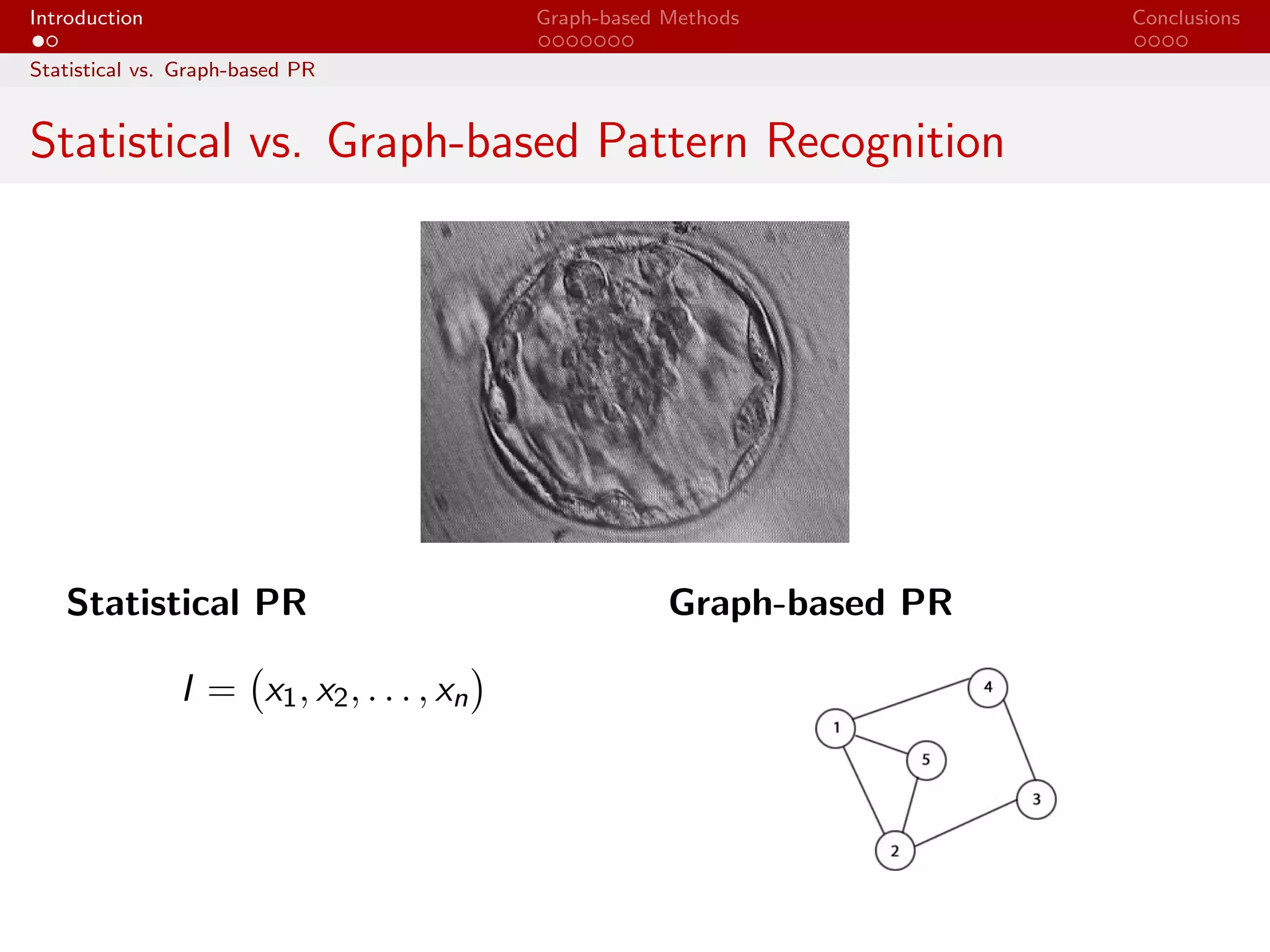
Statistical vs. Graph-based Pattern Recognition

Statistical PR
I = x1 , x2 , . . . , xn

Graph-based PR

Conclusions
page.3

Introduction

Graph-based Methods

Statistical vs. Graph-based PR

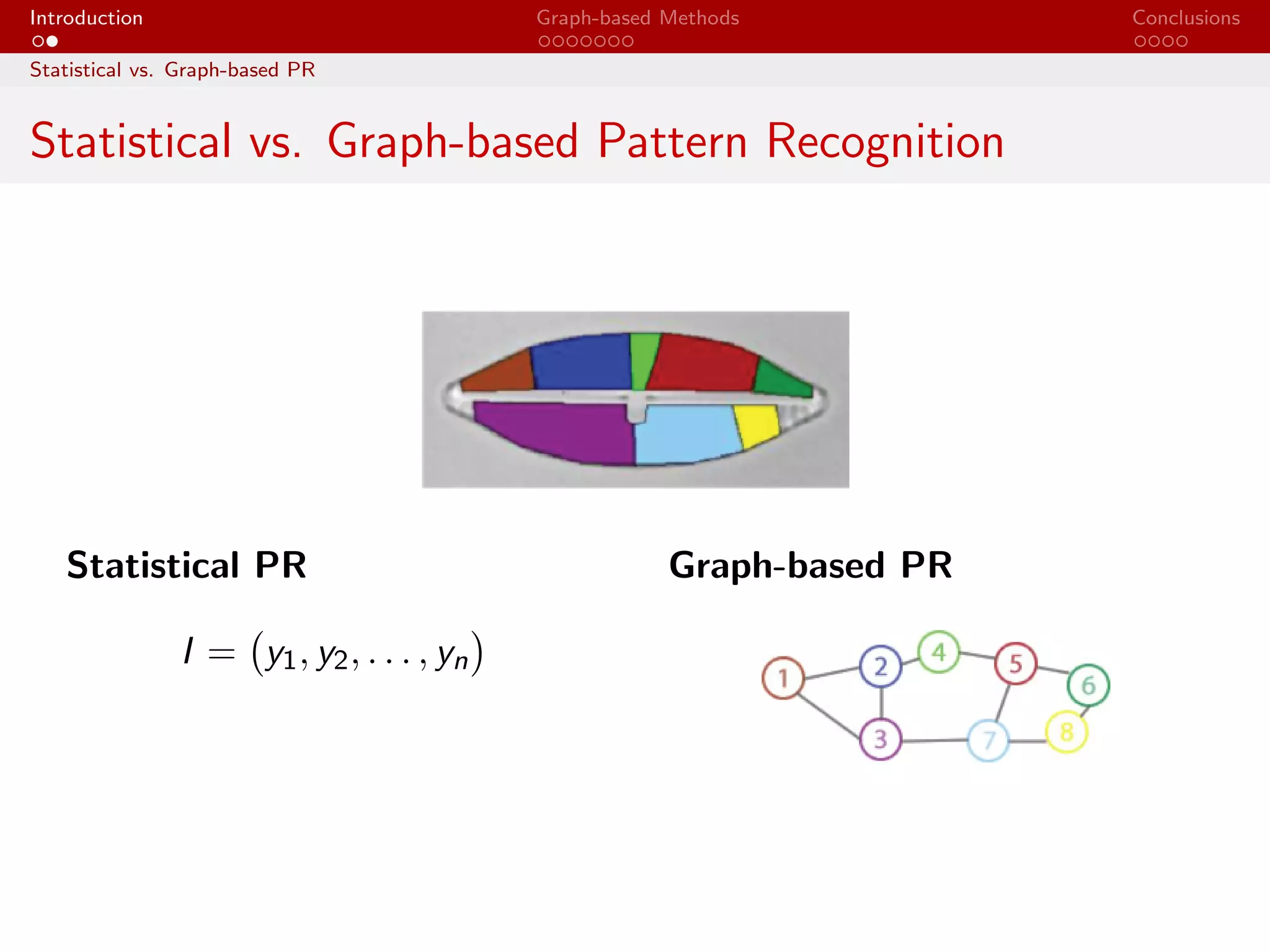
Statistical vs. Graph-based Pattern Recognition

Statistical PR
I = y1 , y2 , . . . , yn

Graph-based PR

Conclusions
page.4

Introduction

Graph-based Methods

Conclusions

Pure Impure and Extreme Methods

Graph-based Methods
Pure Methods
Learning and classification problems are faced directly in the graph
space.

Impure Methods
Transposition of the methods of Statistical Pattern Recognition to
graph space.

Extreme Methods
Transformation of graphs into vectors. Use of the well estabilished
learning and classification techniques.
page.5

Introduction

Graph-based Methods

Pure Impure and Extreme Methods

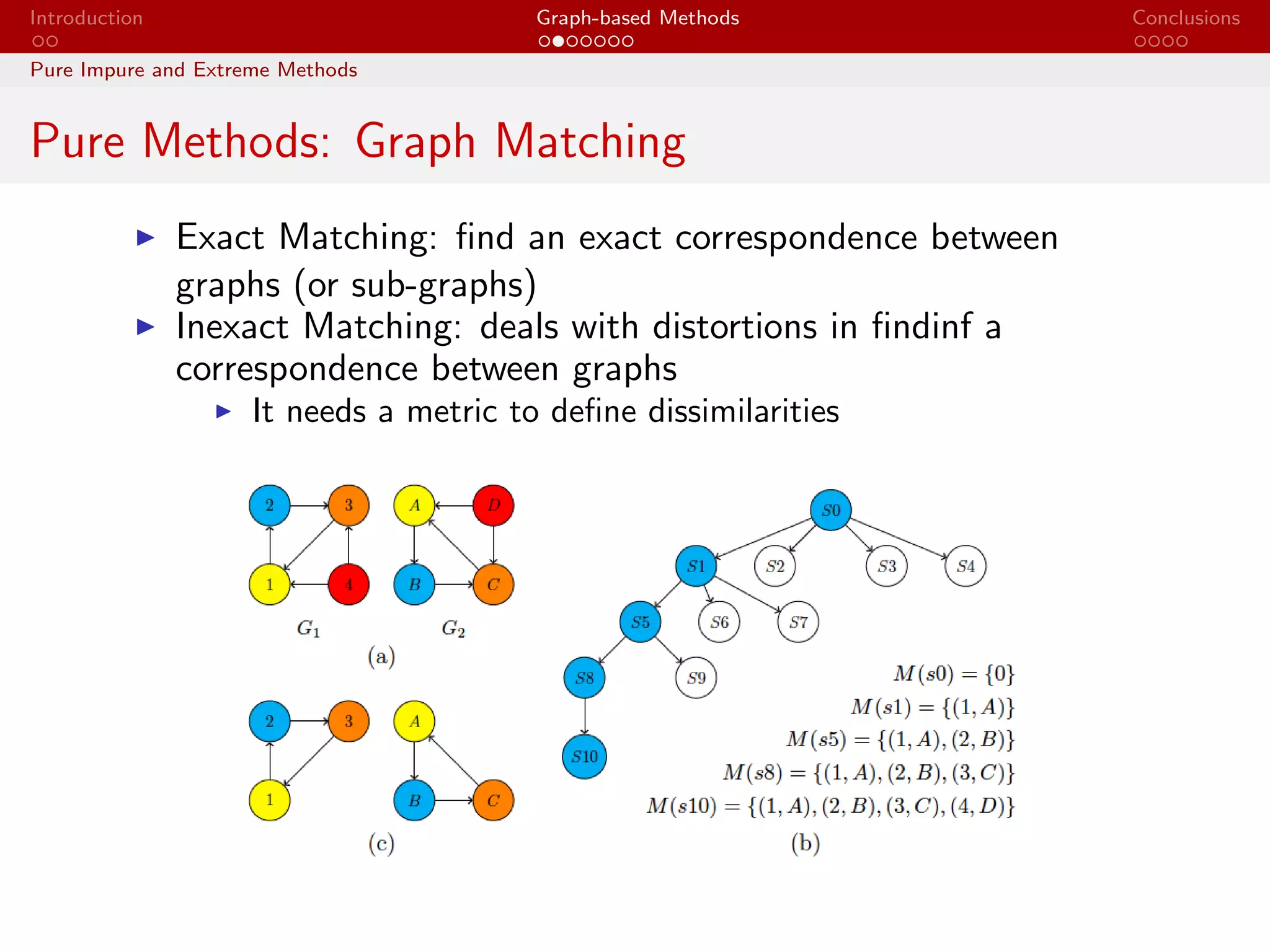
Pure Methods: Graph Matching
Exact Matching: find an exact correspondence between
graphs (or sub-graphs)
Inexact Matching: deals with distortions in findinf a
correspondence between graphs
It needs a metric to define dissimilarities

Conclusions
page.6

Introduction

Graph-based Methods

Conclusions

Pure Impure and Extreme Methods

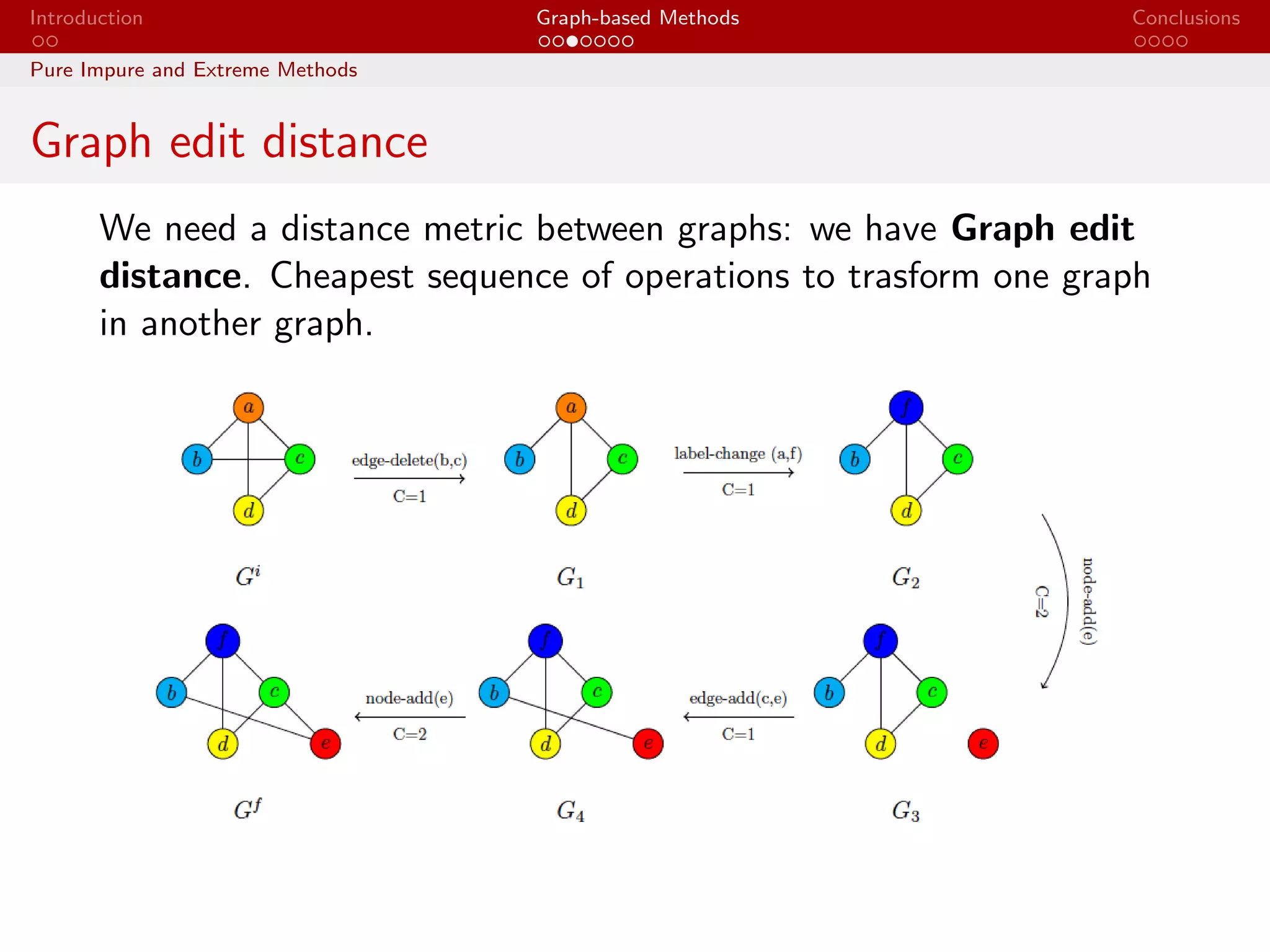
Graph edit distance
We need a distance metric between graphs: we have Graph edit
distance. Cheapest sequence of operations to trasform one graph
in another graph.
page.7

Introduction

Graph-based Methods

Conclusions

Pure Impure and Extreme Methods

Impure Methods: k-NN

The reference set is made by a collection of graphs, instead of
points in a m-dimensional space
For a graph to classify, the graph edit distance is computed
with respect to each of the graphs in the reference set
The decision is taken as majority voting on the K nearest
graphs
Generally, the time needed for a classification is very high
page.8

Introduction

Graph-based Methods

Conclusions

Pure Impure and Extreme Methods

Impure Methods: k-Means
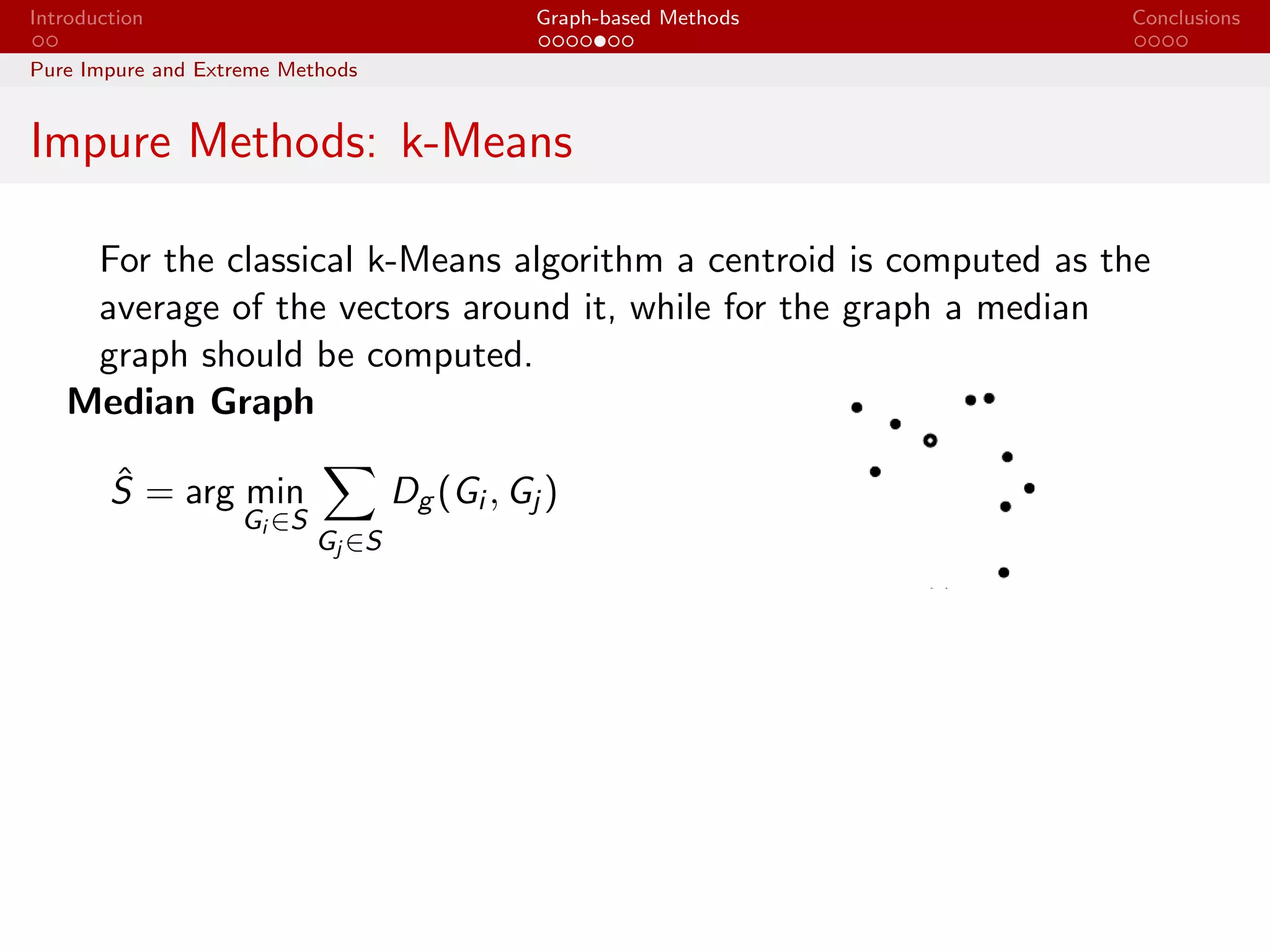
For the classical k-Means algorithm a centroid is computed as the
average of the vectors around it, while for the graph a median
graph should be computed.
page.9

Introduction

Graph-based Methods

Conclusions

Pure Impure and Extreme Methods

Impure Methods: k-Means
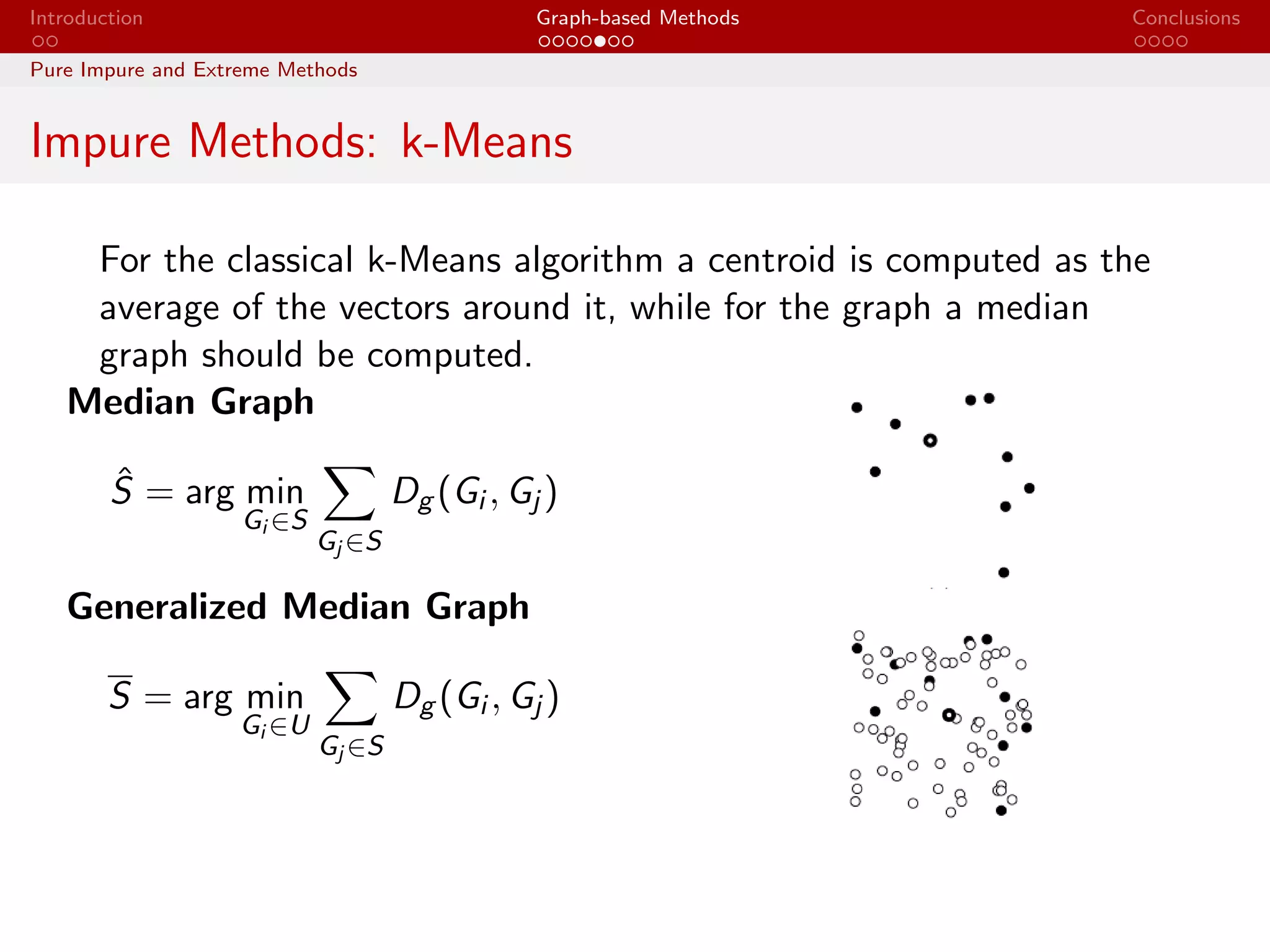
For the classical k-Means algorithm a centroid is computed as the
average of the vectors around it, while for the graph a median
graph should be computed.
Median Graph
ˆ
S = arg min

Gi ∈S

Dg (Gi , Gj )
Gj ∈S
page.10

Introduction

Graph-based Methods

Conclusions

Pure Impure and Extreme Methods

Impure Methods: k-Means
For the classical k-Means algorithm a centroid is computed as the
average of the vectors around it, while for the graph a median
graph should be computed.
Median Graph
ˆ
S = arg min

Gi ∈S

Dg (Gi , Gj )
Gj ∈S

Generalized Median Graph
Dg (Gi , Gj )

S = arg min

Gi ∈U

Gj ∈S
page.11

Introduction

Graph-based Methods

Conclusions

Pure Impure and Extreme Methods

Impure Methods: LVQ

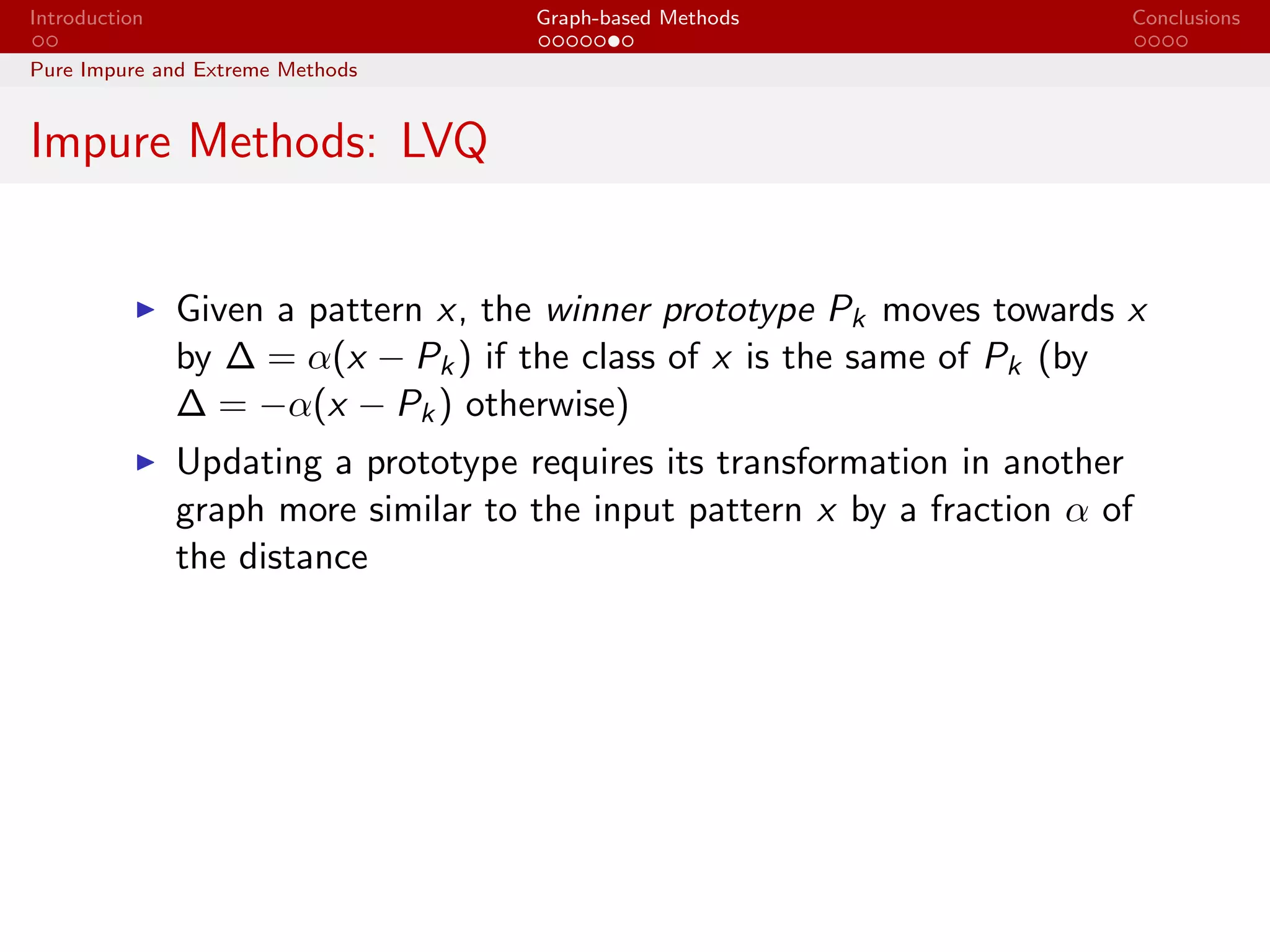
Given a pattern x, the winner prototype Pk moves towards x
by ∆ = α(x − Pk ) if the class of x is the same of Pk (by
∆ = −α(x − Pk ) otherwise)
Updating a prototype requires its transformation in another
graph more similar to the input pattern x by a fraction α of
the distance
page.12

Introduction

Graph-based Methods

Conclusions

Pure Impure and Extreme Methods

Impure Methods: LVQ

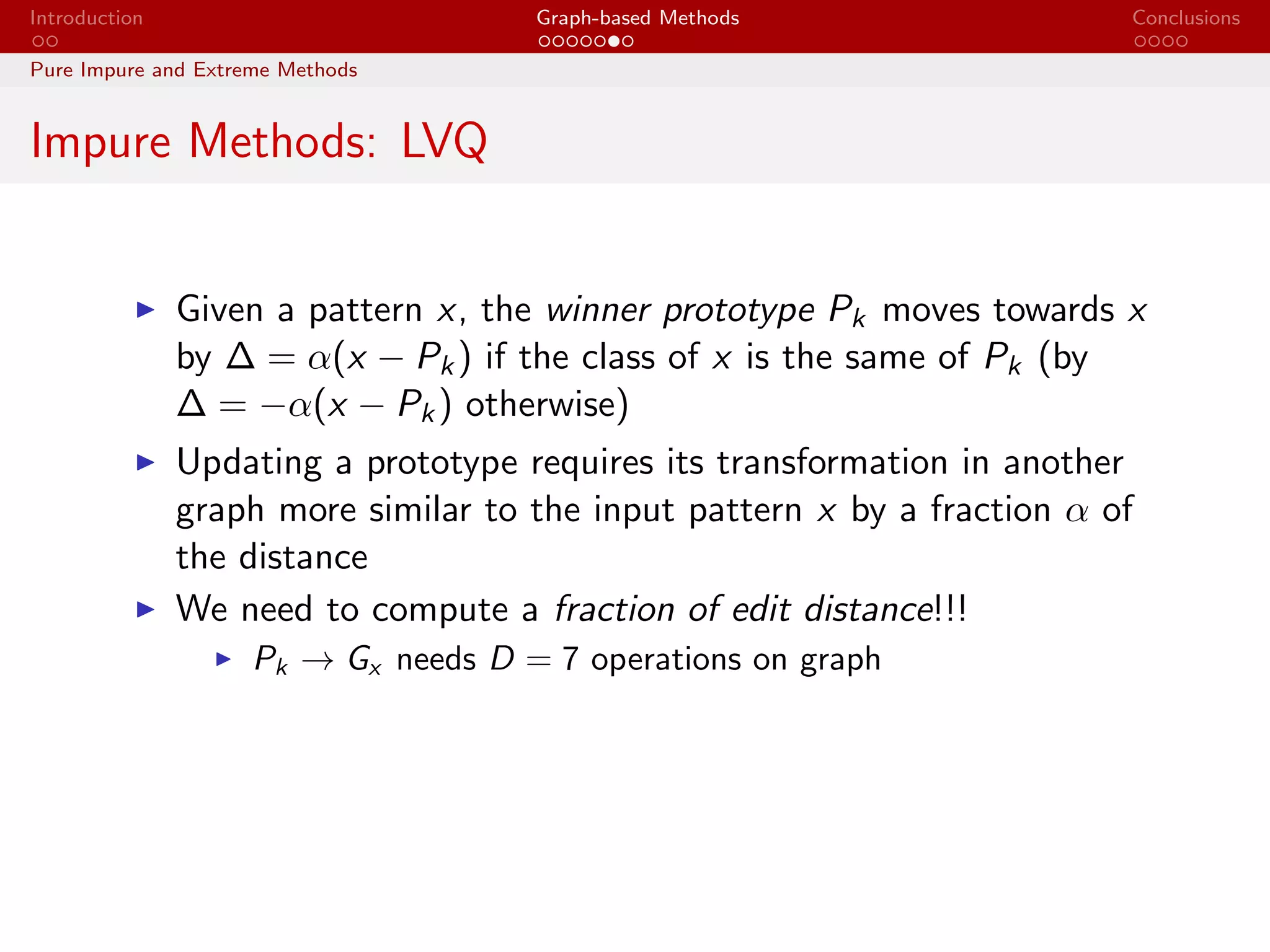
Given a pattern x, the winner prototype Pk moves towards x
by ∆ = α(x − Pk ) if the class of x is the same of Pk (by
∆ = −α(x − Pk ) otherwise)
Updating a prototype requires its transformation in another
graph more similar to the input pattern x by a fraction α of
the distance
We need to compute a fraction of edit distance!!!
Pk → Gx needs D = 7 operations on graph
page.13

Introduction

Graph-based Methods

Conclusions

Pure Impure and Extreme Methods

Impure Methods: LVQ

Given a pattern x, the winner prototype Pk moves towards x
by ∆ = α(x − Pk ) if the class of x is the same of Pk (by
∆ = −α(x − Pk ) otherwise)
Updating a prototype requires its transformation in another
graph more similar to the input pattern x by a fraction α of
the distance
We need to compute a fraction of edit distance!!!
Pk → Gx needs D = 7 operations on graph
If α = 0.3, we do D ∗ α = 2 operations to move Pk to an
intermediate graph
page.14

Introduction

Graph-based Methods

Conclusions

Pure Impure and Extreme Methods

Extreme methods: Graph Embedding

Represent a graph as a point in a suitable feature space
Use of the classical statistical pattern recognition tools
The similarity of graph in graph space should be preserved in
the vector space
The translation of a graph (including all the attributes and
relations) into a fixed-lenght vector is difficult
page.15

Introduction

Graph-based Methods

Conclusions

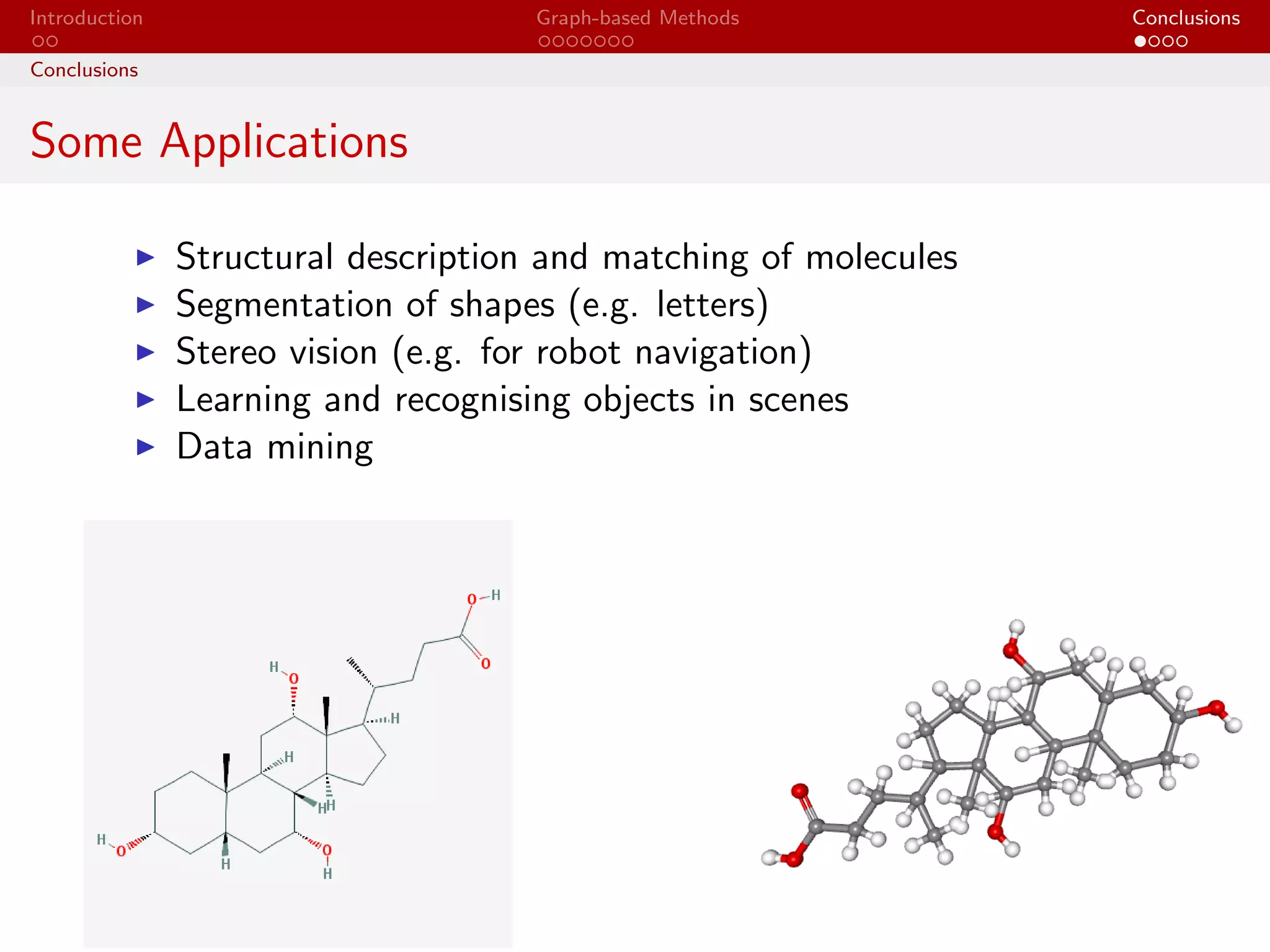
Some Applications
Structural description and matching of molecules
Segmentation of shapes (e.g. letters)
Stereo vision (e.g. for robot navigation)
Learning and recognising objects in scenes
Data mining

Conclusions
page.16

Introduction

Graph-based Methods

Conclusions

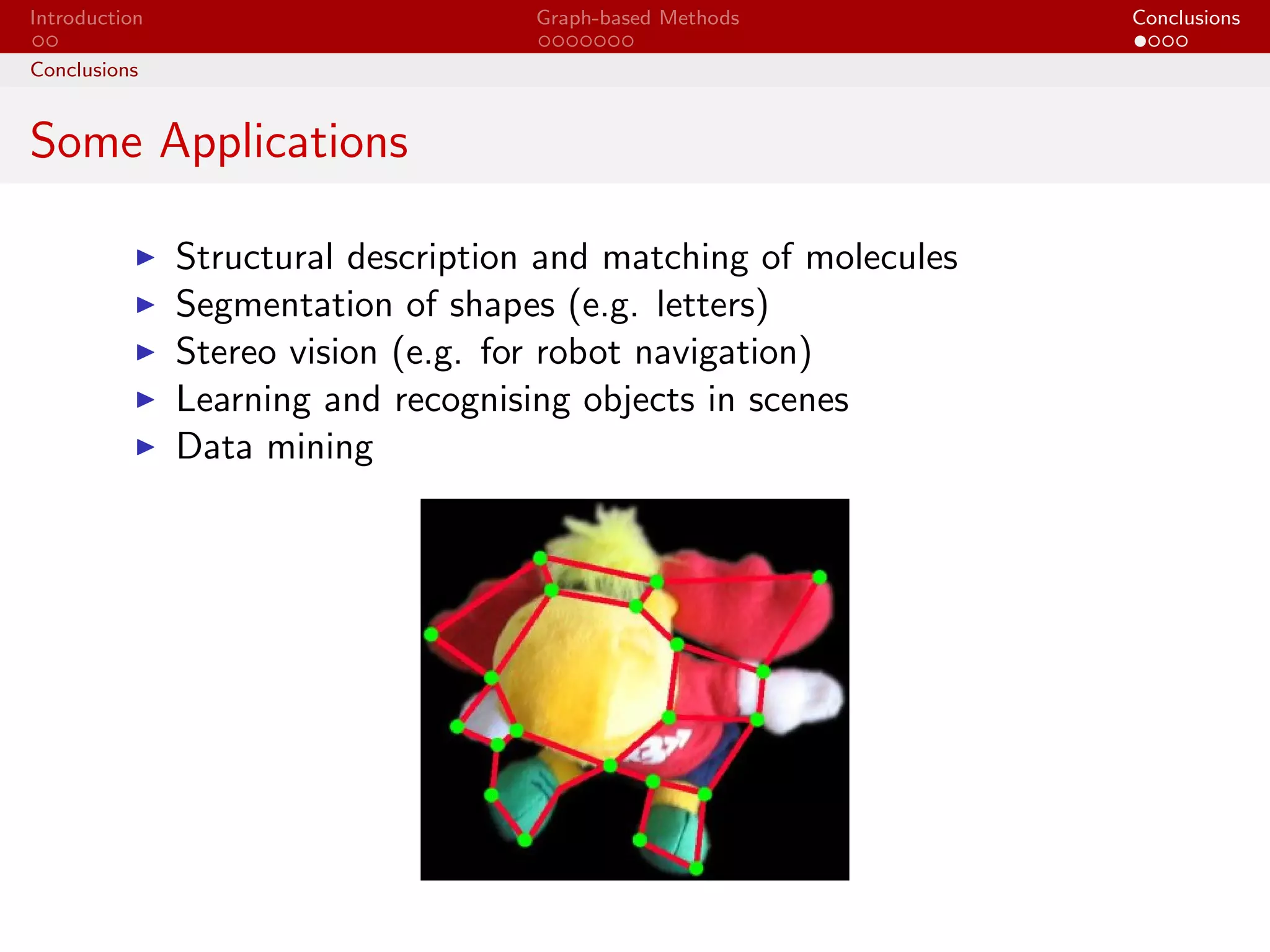
Some Applications
Structural description and matching of molecules
Segmentation of shapes (e.g. letters)
Stereo vision (e.g. for robot navigation)
Learning and recognising objects in scenes
Data mining

Conclusions
page.17

Introduction

Graph-based Methods

Conclusions

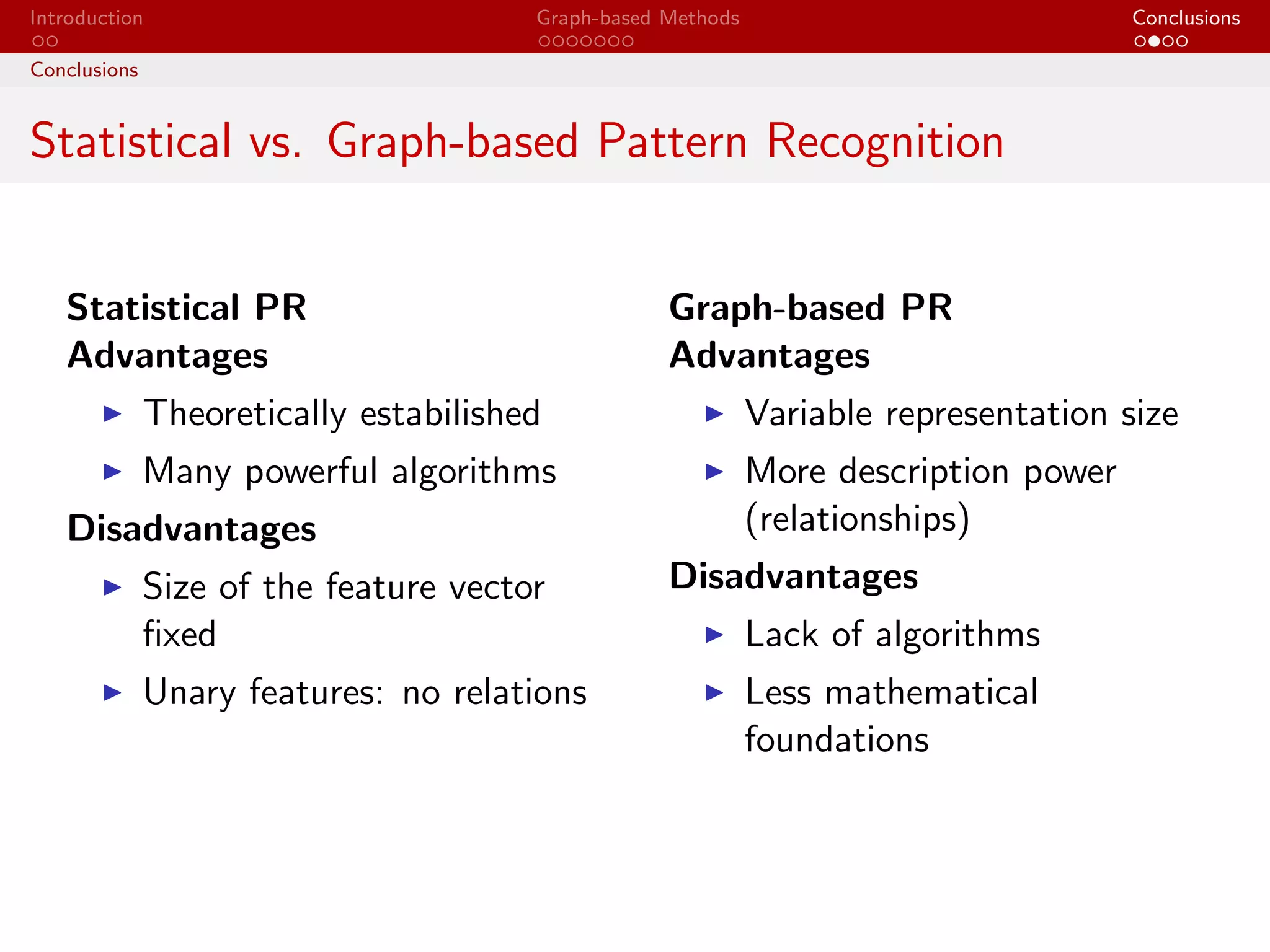
Conclusions

Statistical vs. Graph-based Pattern Recognition

Statistical PR
Advantages

Graph-based PR
Advantages

Theoretically estabilished

Variable representation size

Many powerful algorithms

More description power
(relationships)

Disadvantages
Size of the feature vector
fixed
Unary features: no relations

Disadvantages
Lack of algorithms
Less mathematical
foundations
page.18

Introduction

Graph-based Methods

Conclusions

References
Mario Vento (2013)
A long trip in the charming world of graphs for Pattern Recognition
Pattern Recognition

Conclusions
page.19

Introduction

Graph-based Methods

Conclusions

Thank you!!!

Conclusions

Graph Based Pattern Recognition