Getting Started in Tech:
Building a Great Career
February 2017
http://bit.ly/thinkful-hired-in-tech
About me
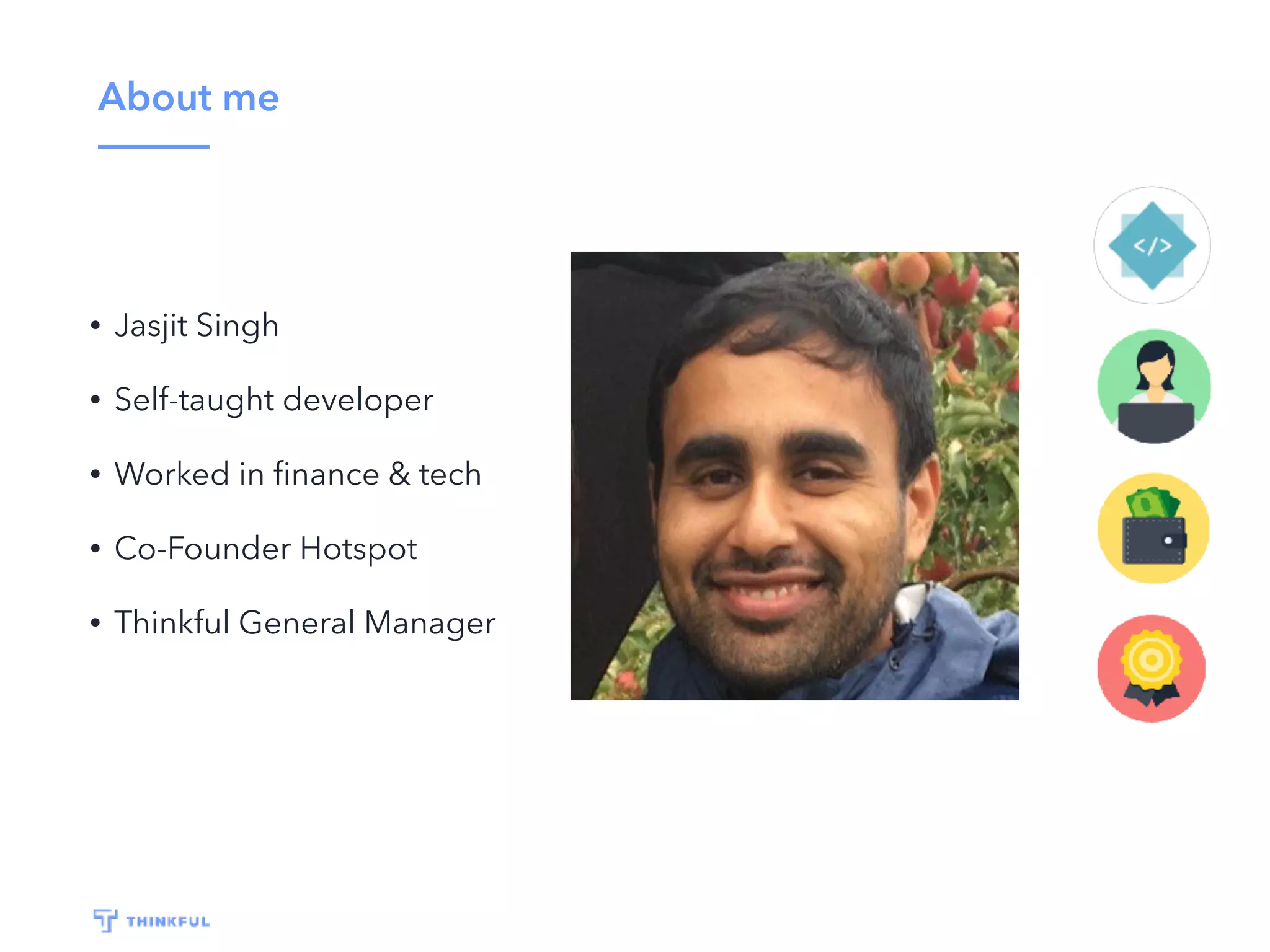
• Jasjit Singh
• Self-taught developer
• Worked in finance & tech
• Co-Founder Hotspot
• Thinkful General Manager
About us
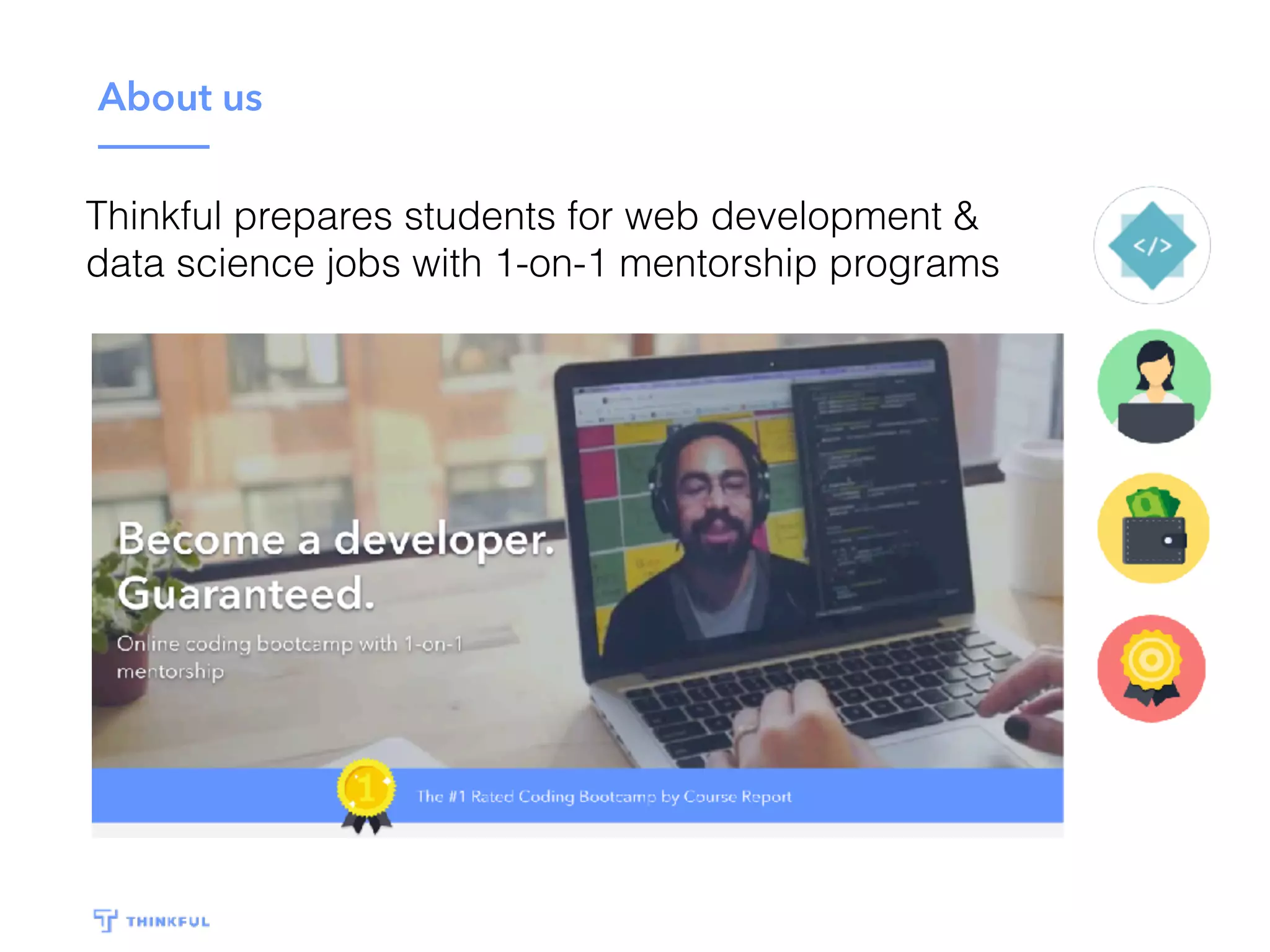
Thinkful prepares students for web development &
data science jobs with 1-on-1 mentorship programs
What is “tech”?
Tech isn’t just one industry anymore — it’s the new
business model. Every company is now a tech
company.
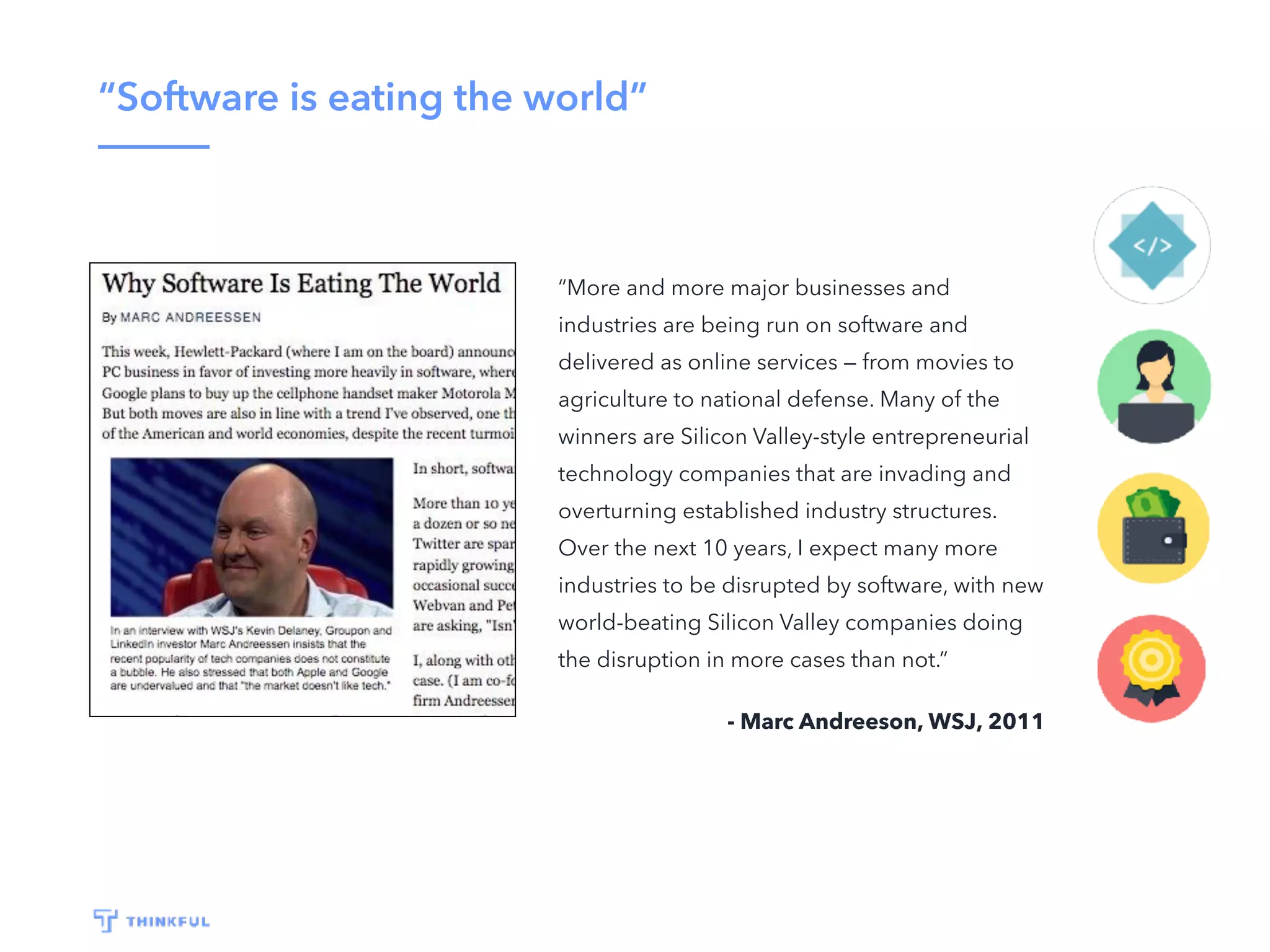
“Software is eating the world”
“More and more major businesses and
industries are being run on software and
delivered as online services — from movies to
agriculture to national defense. Many of the
winners are Silicon Valley-style entrepreneurial
technology companies that are invading and
overturning established industry structures.
Over the next 10 years, I expect many more
industries to be disrupted by software, with new
world-beating Silicon Valley companies doing
the disruption in more cases than not.”
- Marc Andreeson, WSJ, 2011
Some examples
• Largest retailer => Amazon
• Best movie production => Pixar
• Biggest media => Facebook & Google
Netflix
“Our goal is to become HBO faster than HBO can become us”
- Ted Sarandos, Chief Content Officer of Netflix, 2013
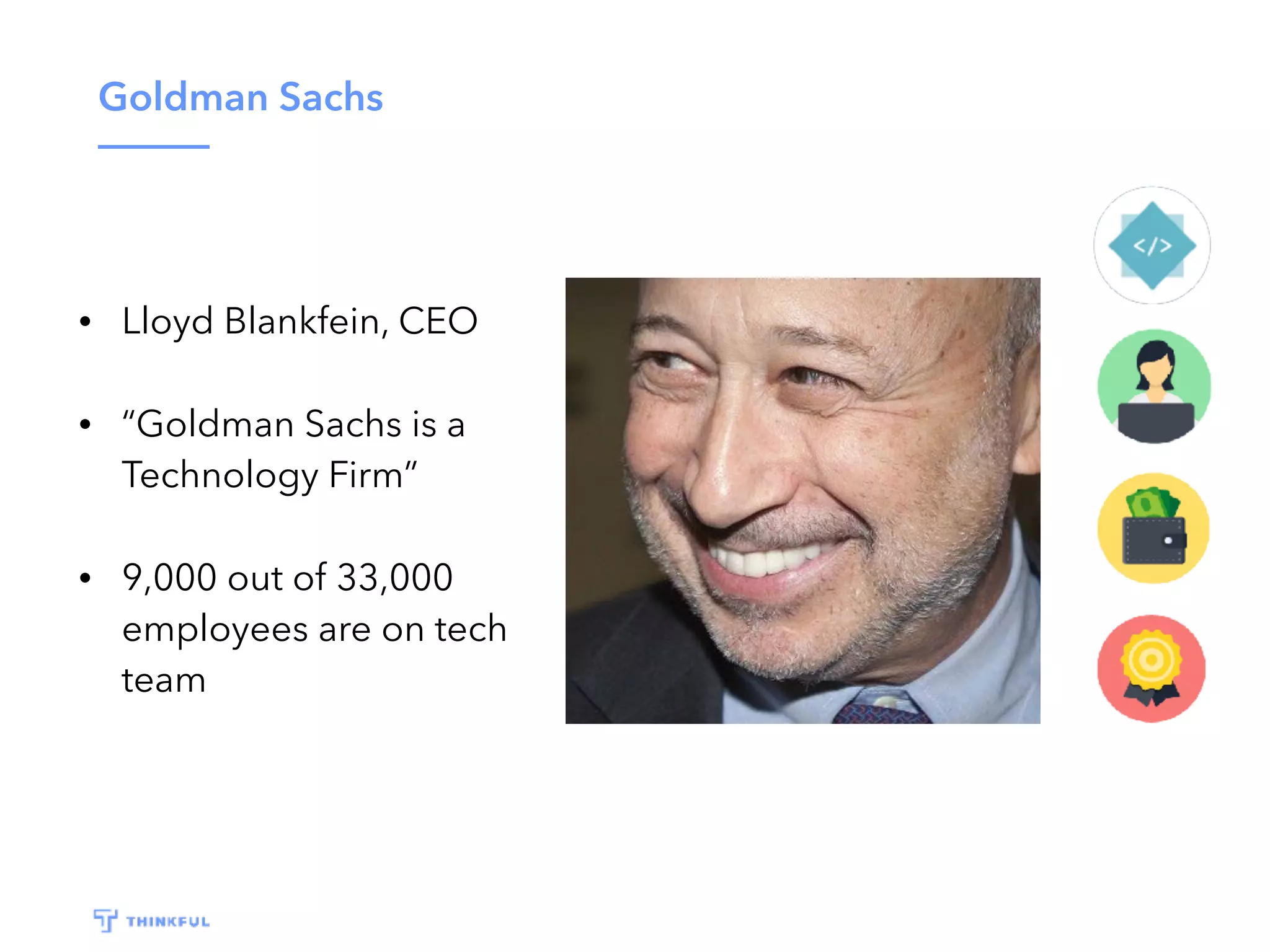
Goldman Sachs
• Lloyd Blankfein, CEO
• “Goldman Sachs is a
Technology Firm”
• 9,000 out of 33,000
employees are on tech
team
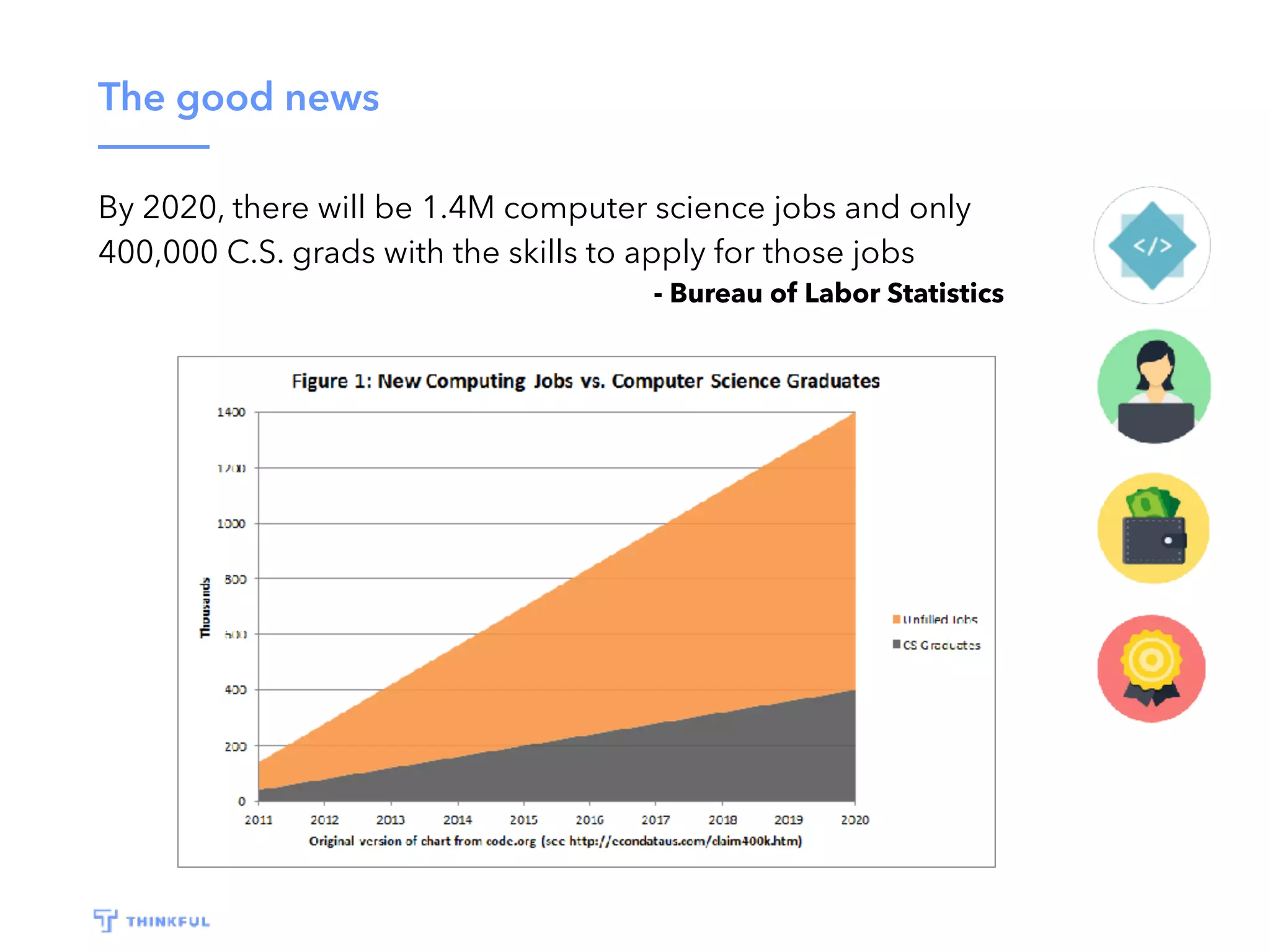
The good news
By 2020, there will be 1.4M computer science jobs and only
400,000 C.S. grads with the skills to apply for those jobs
- Bureau of Labor Statistics
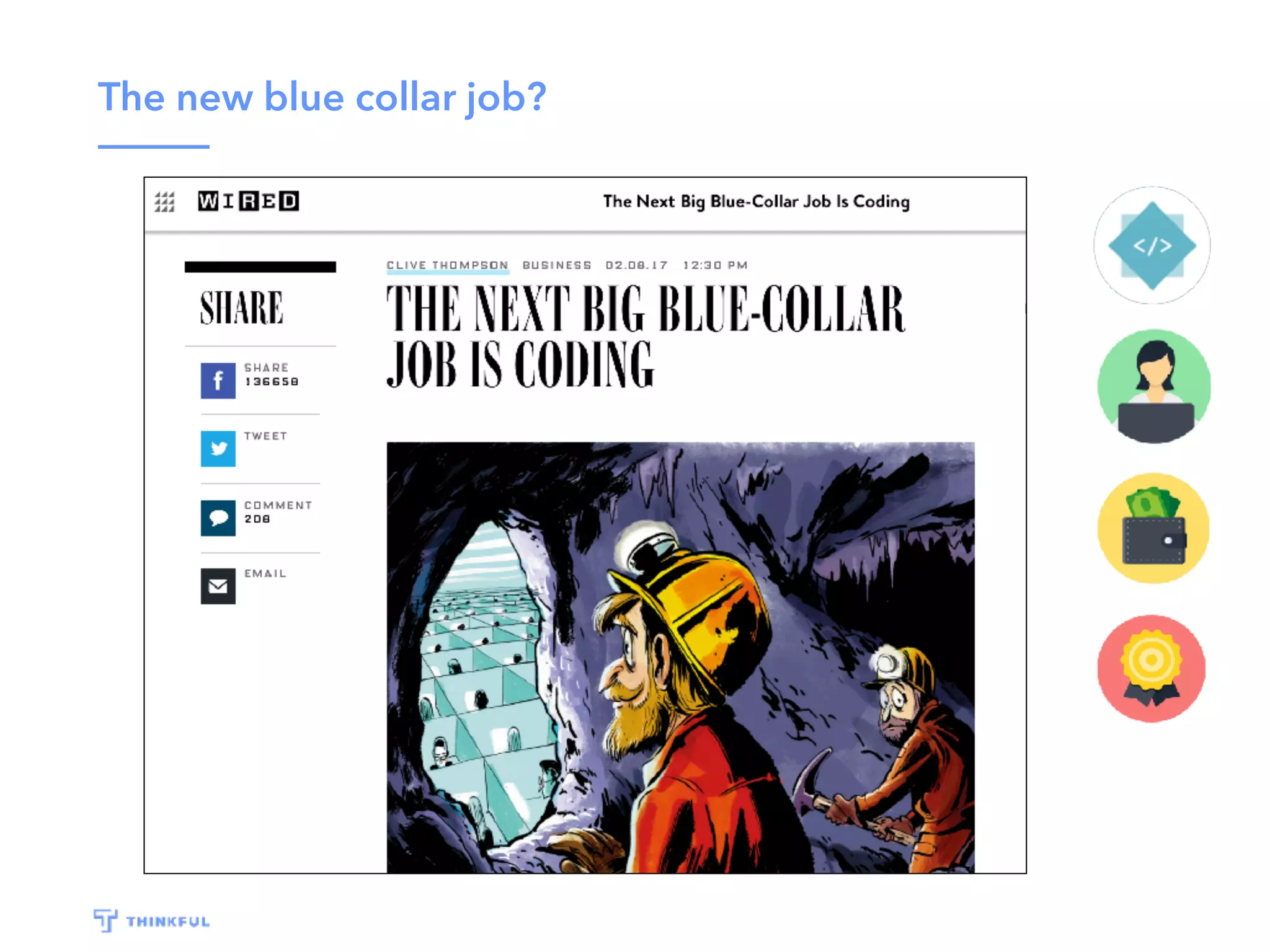
The new blue collar job?
The implications for jobs
• Increased demand in for technical skills
• Creation of new “software plus” jobs
• Diffusion of tech organizational culture, roles,
and processes
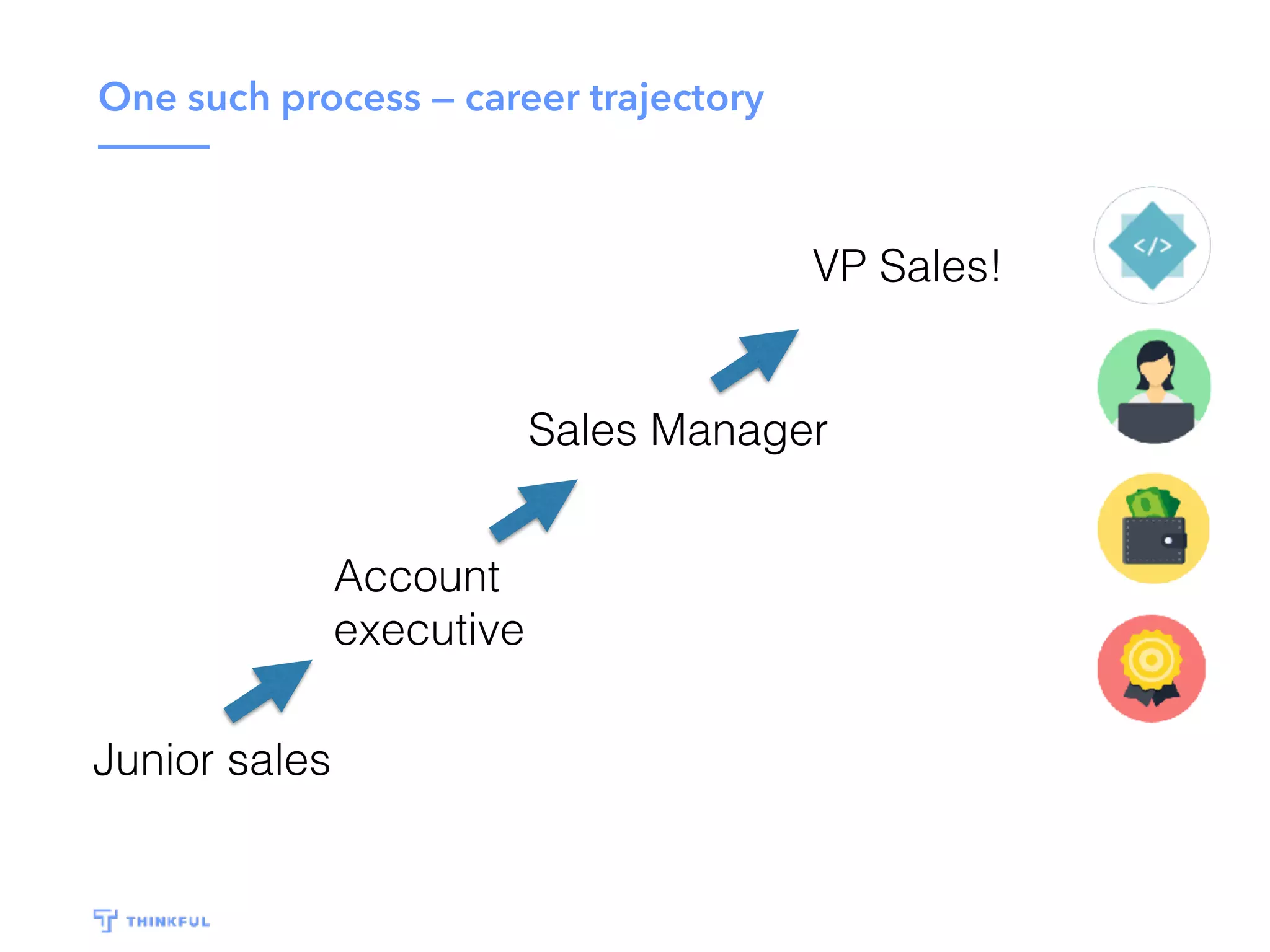
One such process — career trajectory
Junior sales
Account
executive
Sales Manager
VP Sales!
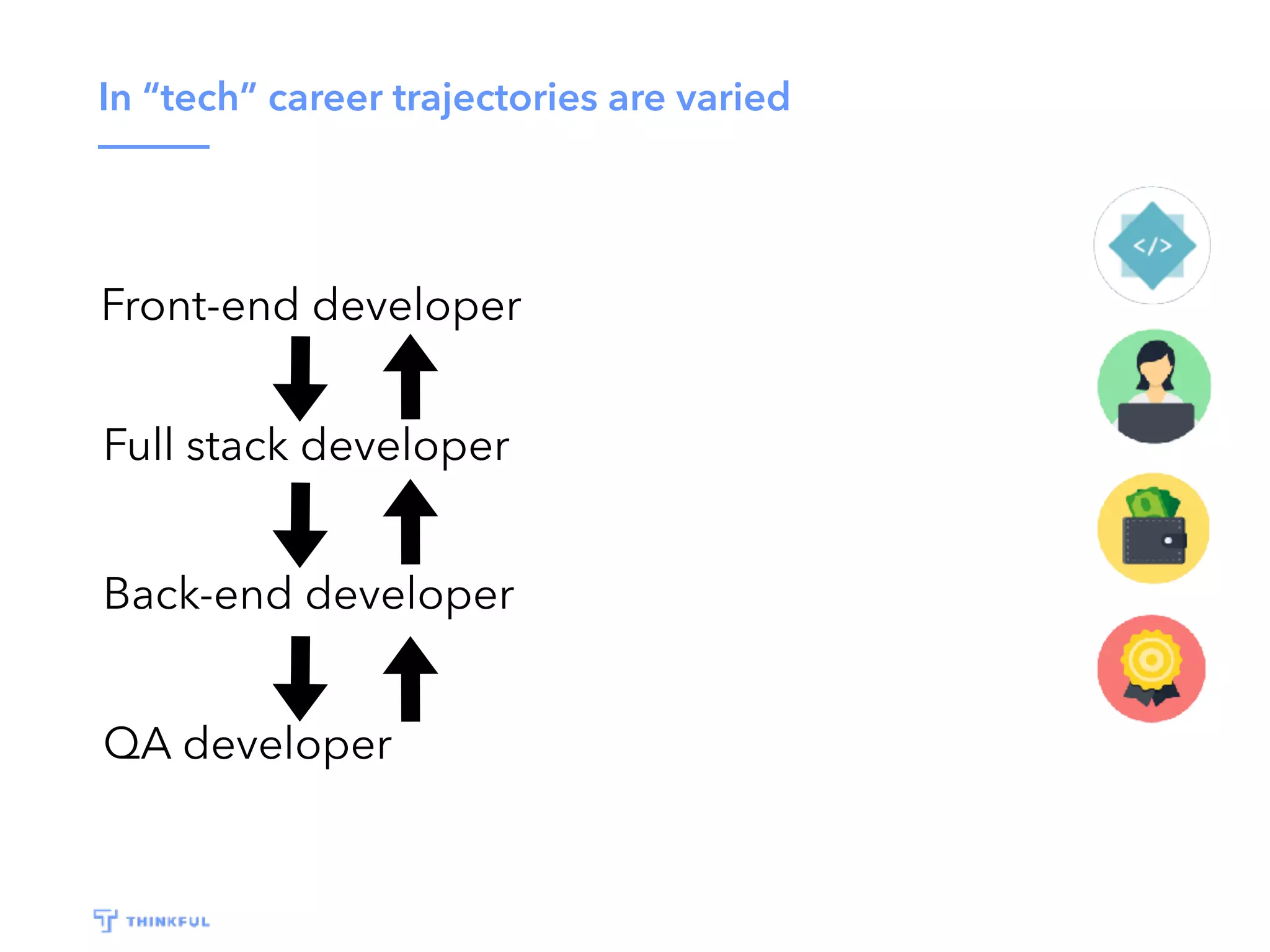
In “tech” career trajectories are varied
Full stack developer
Front-end developer
Back-end developer
QA developer
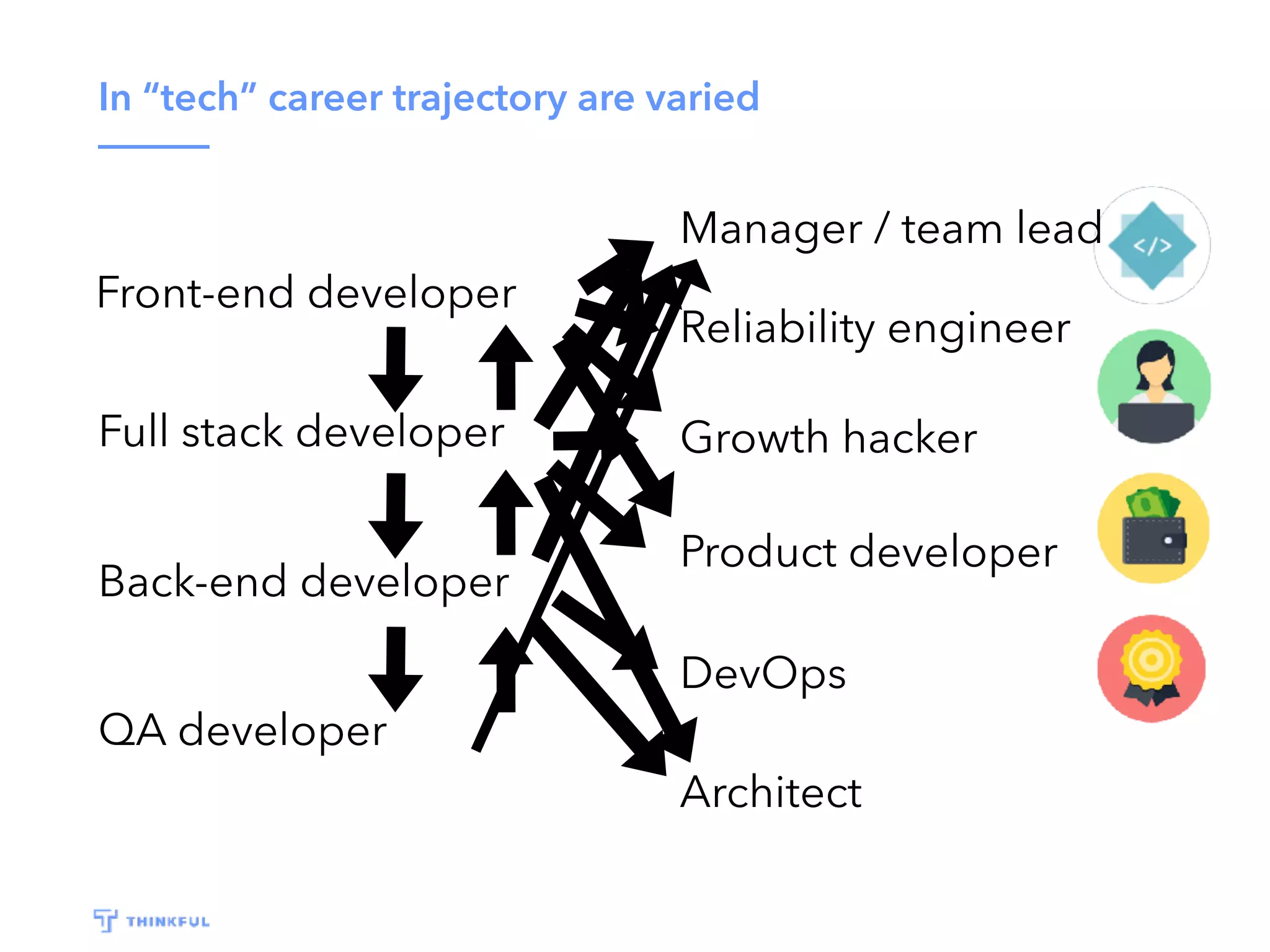
In “tech” career trajectory are varied
Full stack developer
Front-end developer
Back-end developer
QA developer
DevOps
Product developer
Growth hacker
Reliability engineer
Architect
Manager / team lead
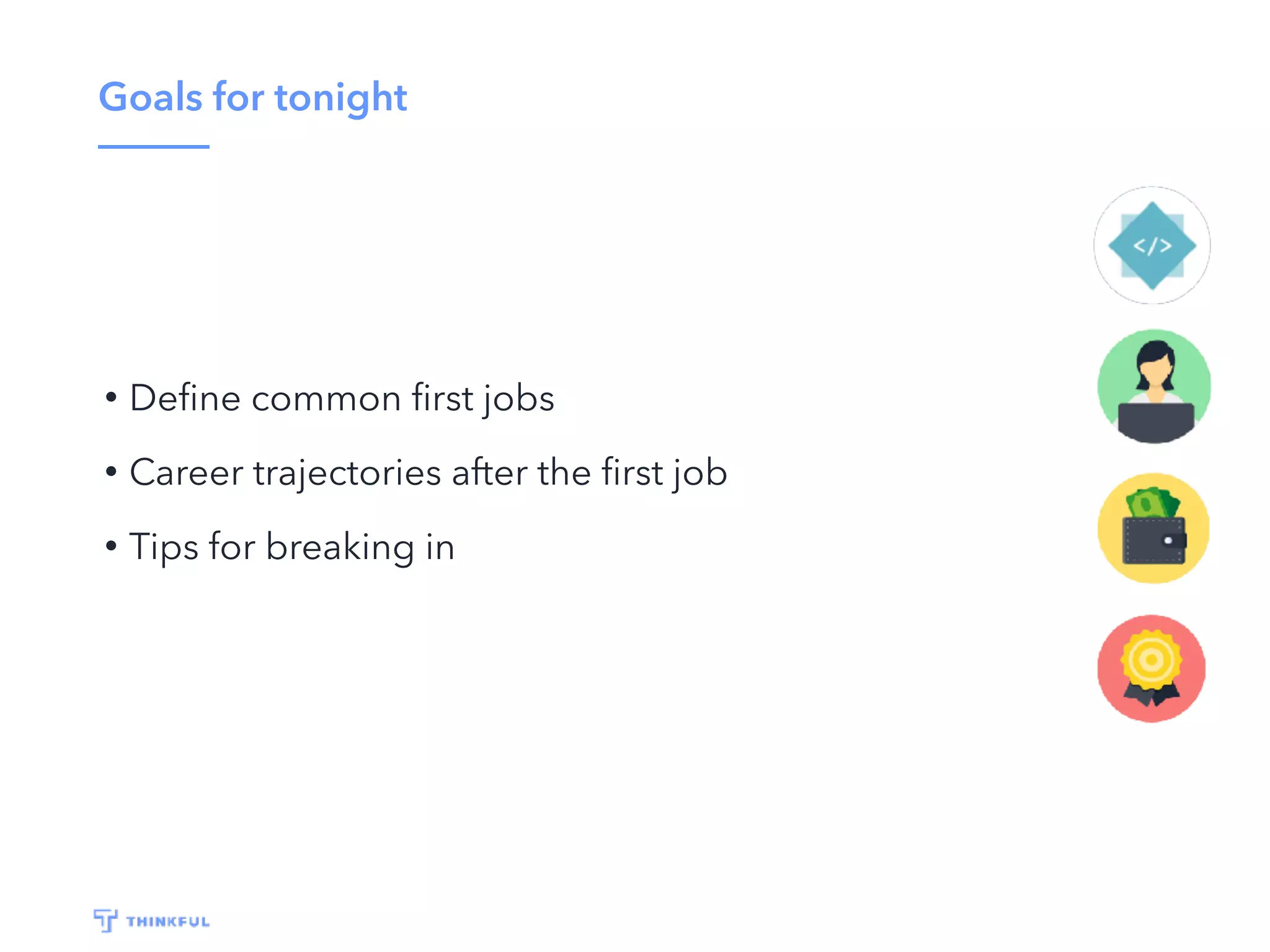
Goals for tonight
• Define common first jobs
• Career trajectories after the first job
• Tips for breaking in
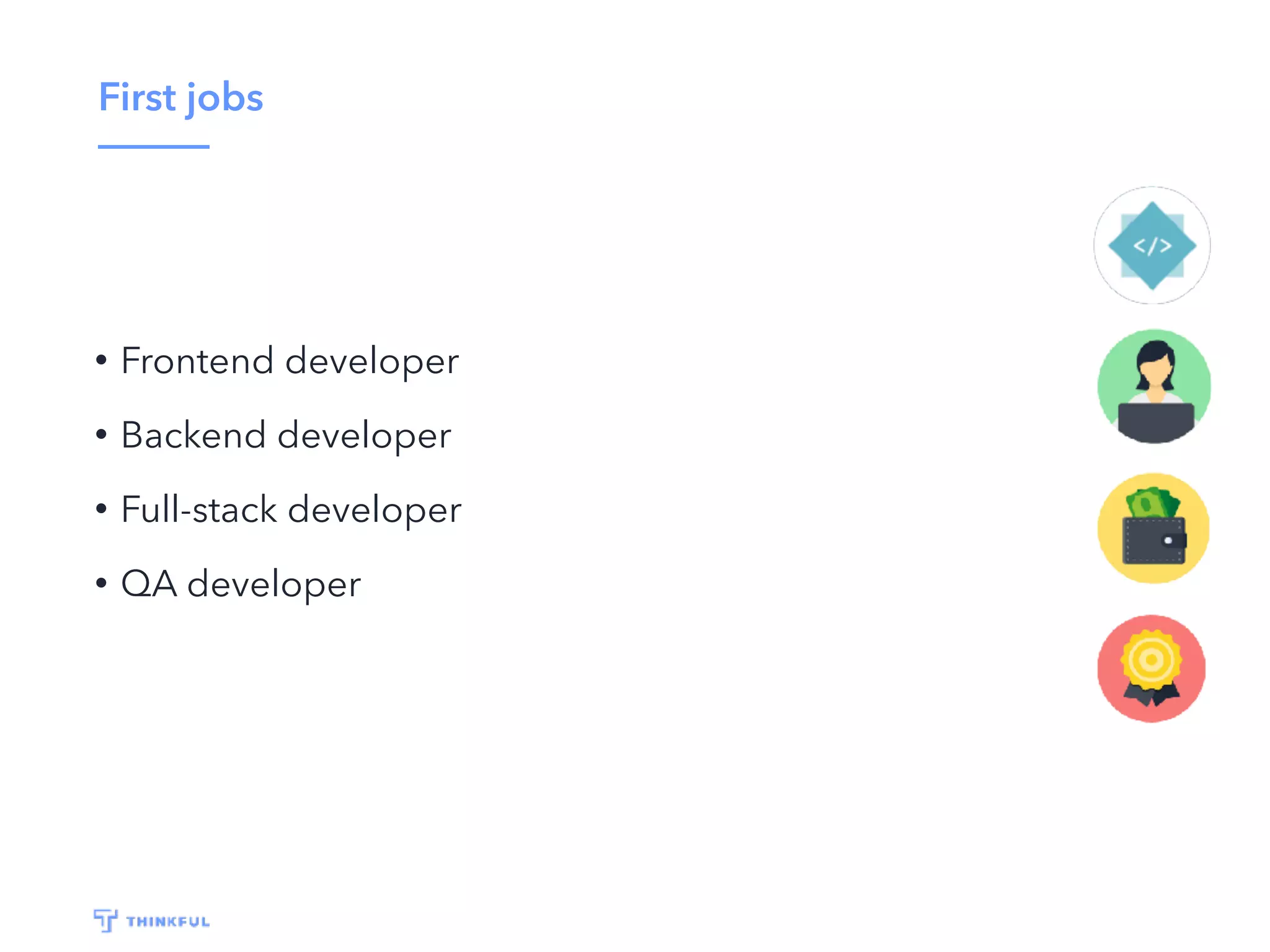
First jobs
• Frontend developer
• Backend developer
• Full-stack developer
• QA developer
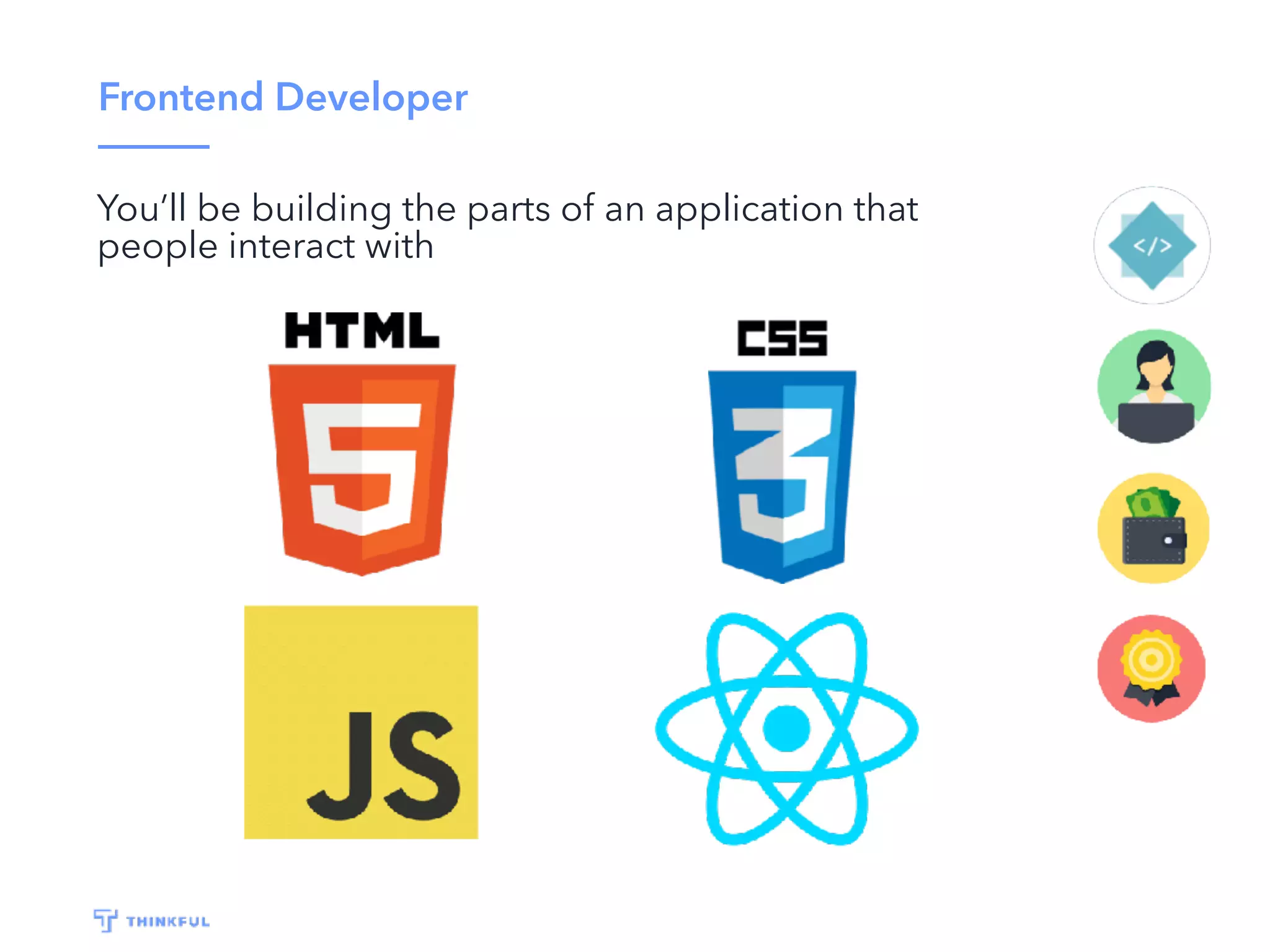
Frontend Developer
You’ll be building the parts of an application that
people interact with
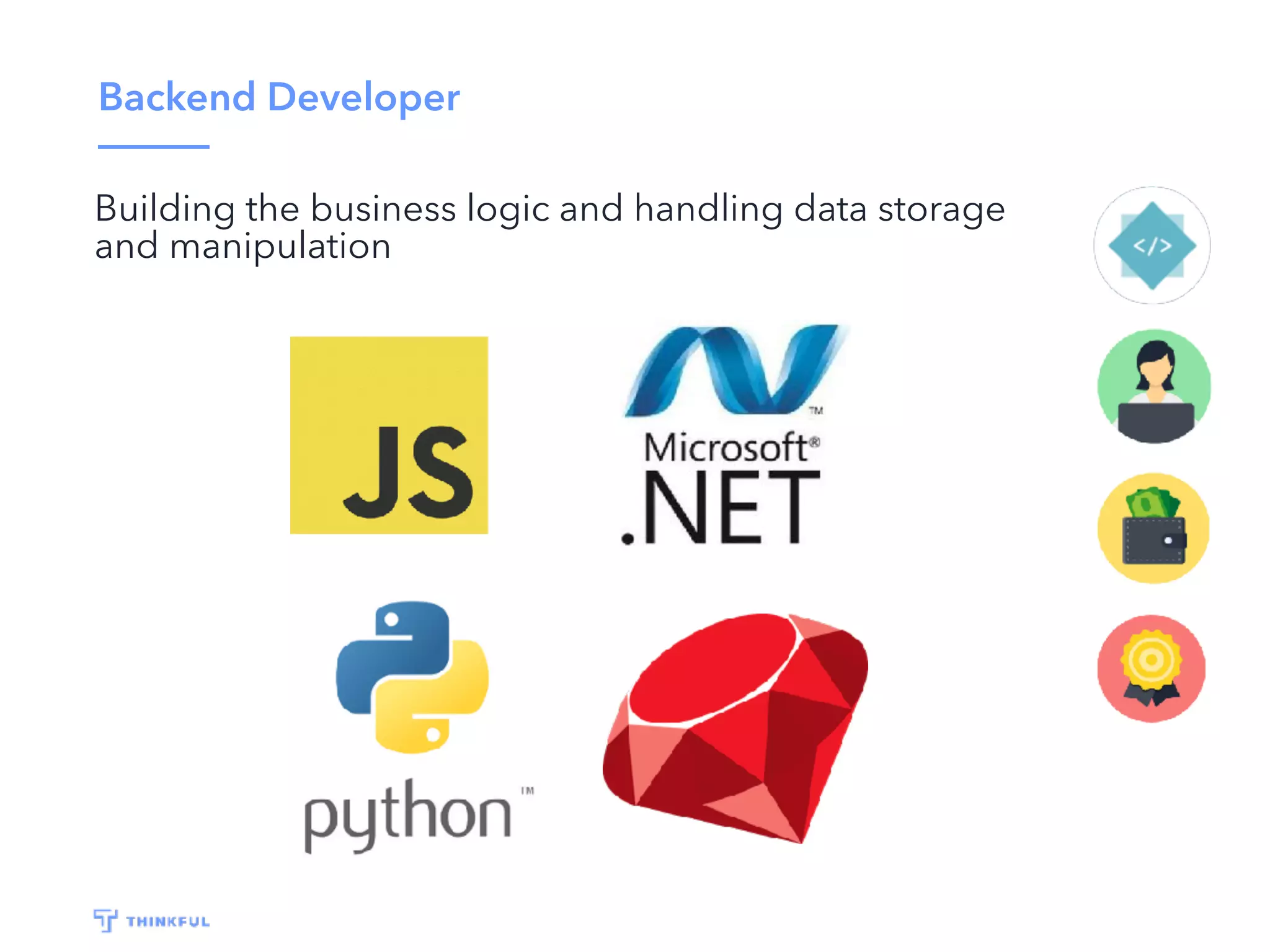
Backend Developer
Building the business logic and handling data storage
and manipulation
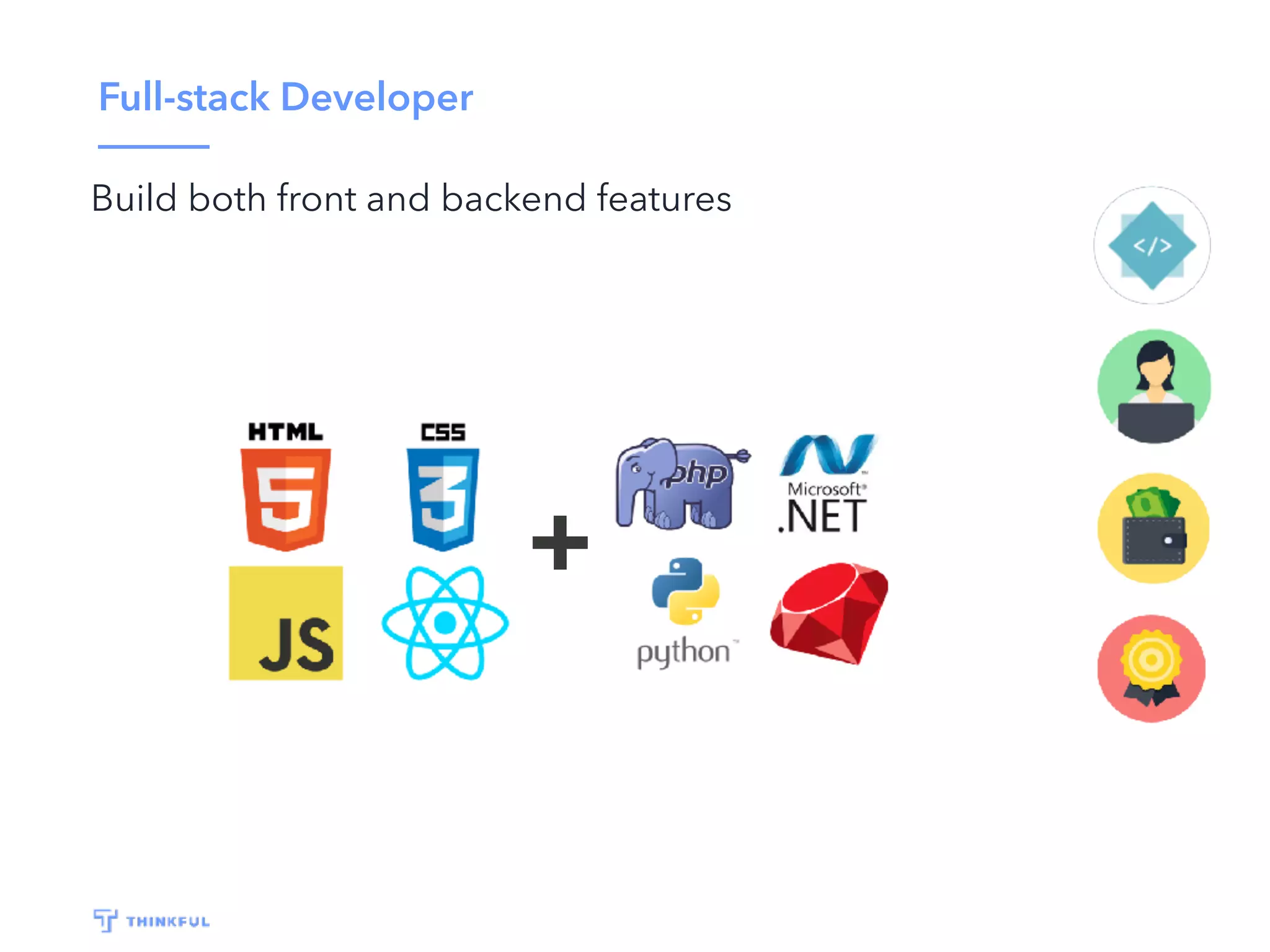
Full-stack Developer
Build both front and backend features
+
QA Developer
Write software tests and conduct manual tests to catch
bugs before they’re shipped
Next step: Senior Developer
Everything that came before with the ability to estimate
your work accurately, handle challenging problems with
less support, and add support for junior colleagues
Coding plus Roles
• Coding + Product = Product Manager
• Coding + Marketing = Growth Hacker
• Coding + Community = Developer Evangelist
• Coding + Sales = Sales Engineer
• Coding + Data = Data Scientist
Product Manager (Coding + Product)
Turn business goals into product requirements. Work
with designers & developers to deliver — measure
success
Skills & Tools
• Customer research
• Customer development
• User stories
• Wireframes
• Project management
• Analytics
Growth Hacker (Coding + Marketing)
Design & implement experiments to drive customer
acquisition and engagement
Skills & Tools
• Rapid prototyping
• Analytics
• Communication
Developer Evangelist (Coding + Community)
Build community around a technology by helping
customers, creating content and participating at events
Skills & Tools
• Specific technical expertise
• Teaching/Mentoring
• Customer support
Sales Engineer (Coding + Sales)
Sell complex technical product by helping customer
understand how it works and how they’ll use it
Skills & Tools
• Communication
• Customer support
Data Scientist (Coding + Data)
Use statistics and programming to find valuable insights
from extremely large datasets
Skills & Tools
• Curiosity
• Statistics
• Analytics
• Machine Learning
The Good News
• Massive shortages in tech industry
• Hiring is based on skills, not credentials
• Anyone can learn with a growth mindset
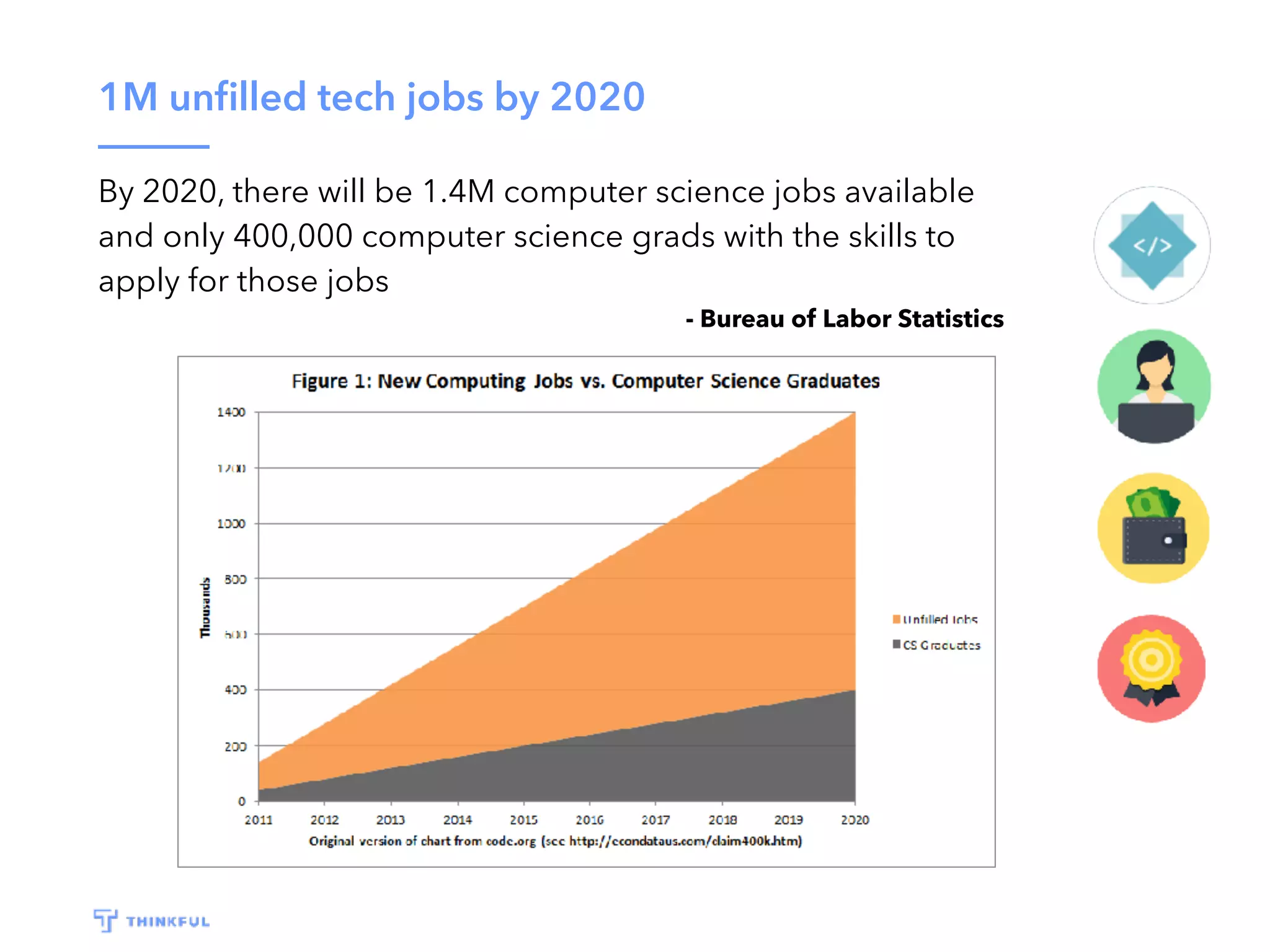
1M unfilled tech jobs by 2020
By 2020, there will be 1.4M computer science jobs available
and only 400,000 computer science grads with the skills to
apply for those jobs
- Bureau of Labor Statistics
Many firms recruit from code challenge sites
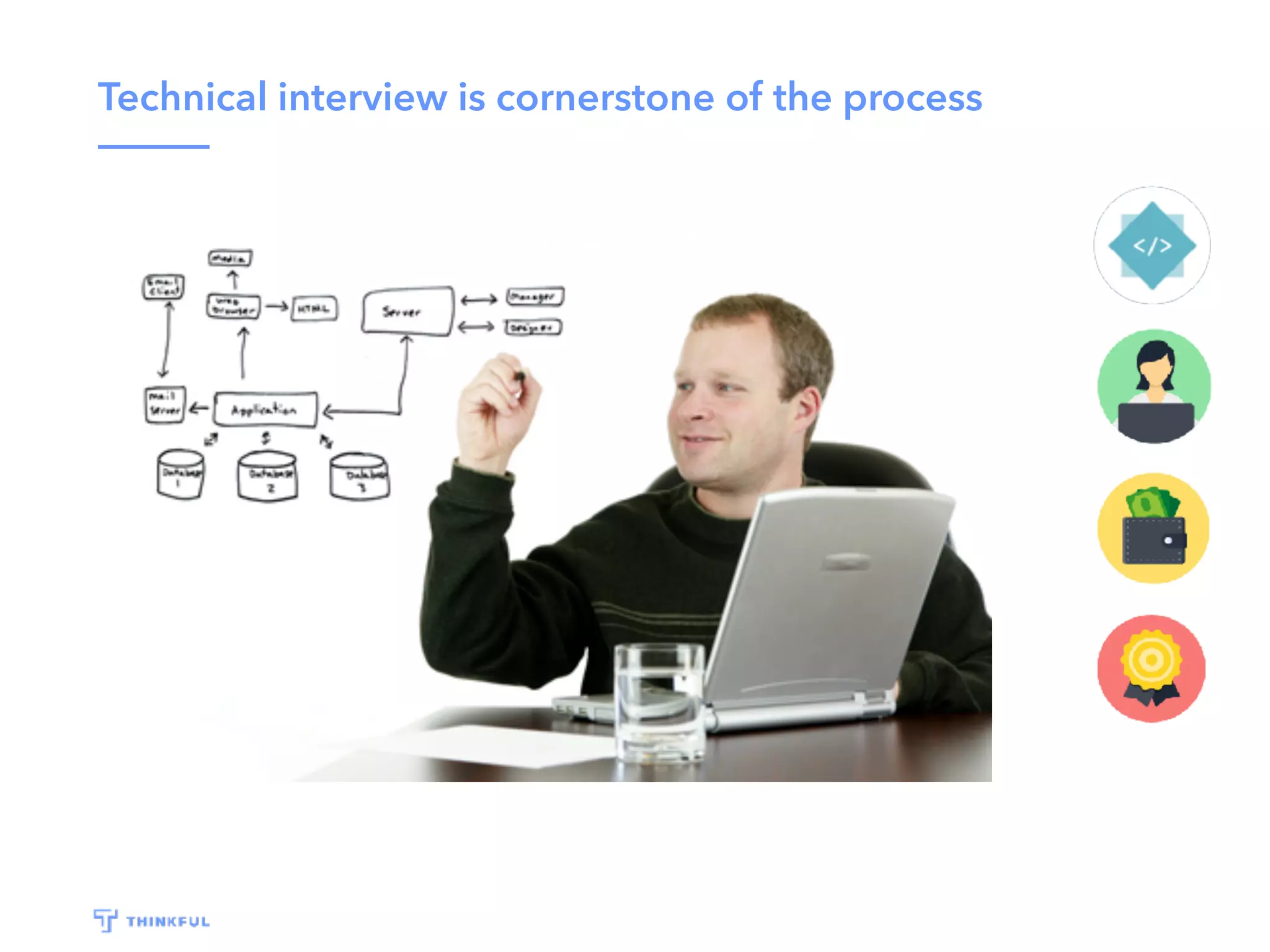
Technical interview is cornerstone of the process
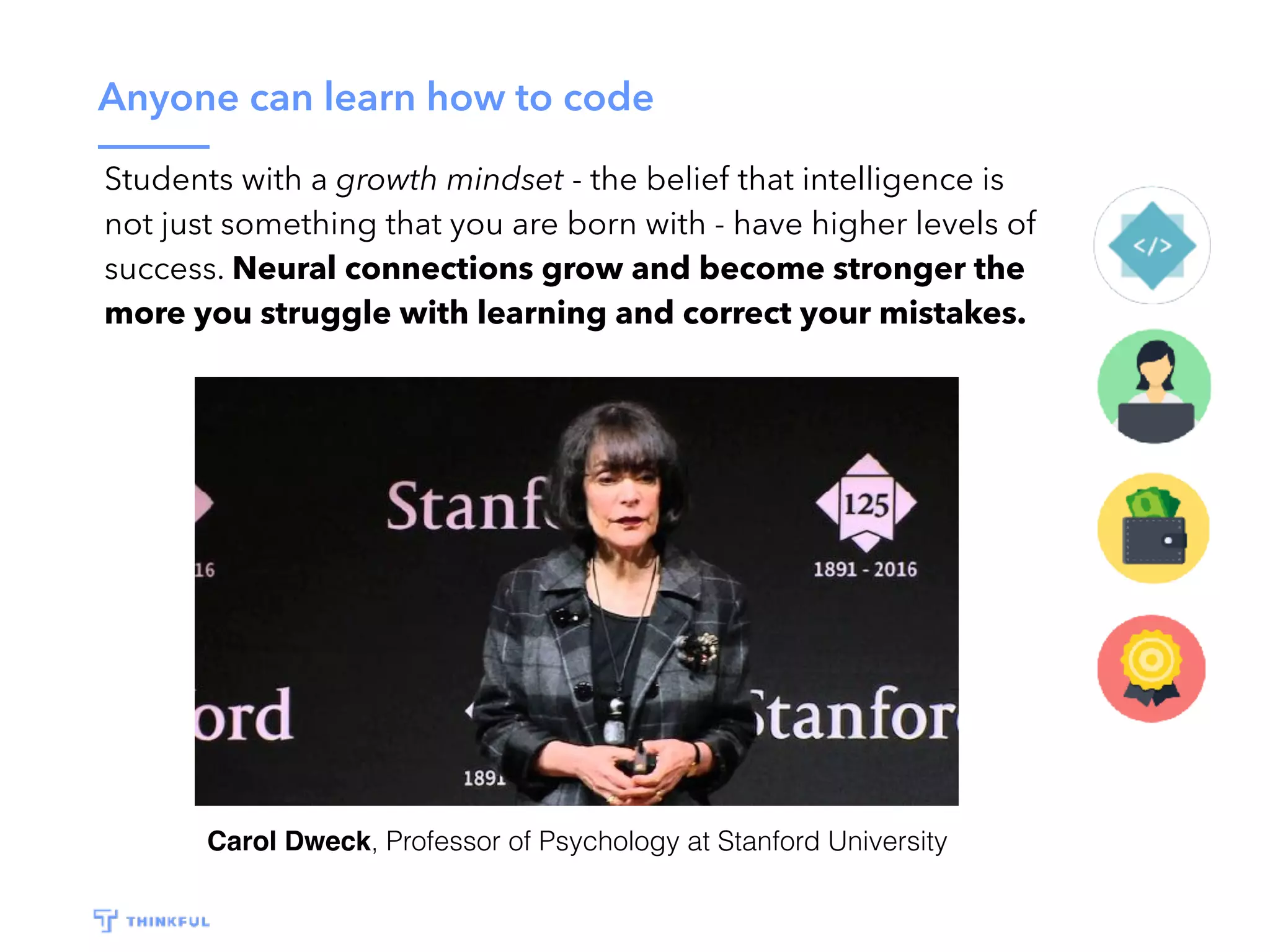
Anyone can learn how to code
Students with a growth mindset - the belief that intelligence is
not just something that you are born with - have higher levels of
success. Neural connections grow and become stronger the
more you struggle with learning and correct your mistakes.
Carol Dweck, Professor of Psychology at Stanford University
How to get in the door?
• Learn the skills
• Build a portfolio of high quality work
• Develop a relevant network
• Prep for technical interviews
Learning the skills
• Build stuff + Google
• Free online resources (e.g. CodeAcademy)
• Flexible coding bootcamps (e.g Thinkful)
• Full-time coding bootcamps (e.g. GA)
• Full degree programs (Georgia Tech)
Building your portfolio
• Find a niche (based on your background)
• Build a personal website
• Get your portfolio on GitHub
• Try and find contract work
• Have professionals guide & review your work
Networking the right way
• 80% of job openings are never advertised
• 120 average applicants per job posted
• 20% get an interview
*https://www.forbes.com/sites/jacquelynsmith/2013/04/26/why-every-job-seeker-should-have-a-personal-
website-and-what-it-should-include/#578fbf6f119e
Networking the right way
• Cold applications suck!
• Figure out what you want (size, industry, role, etc)
• Reach out to someone that works at company
• Ask them about their work, genuine interest, build
a relationship
• Eventually (1-2 months in), ask for referral
Tech recruiters
• Tech recruiters serve as your agent
• Can leverage their relationships to arrange
interviews
• They are incentivized to find you a job
• You might get less say in where, but are helpful
• Can be great in getting you feedback
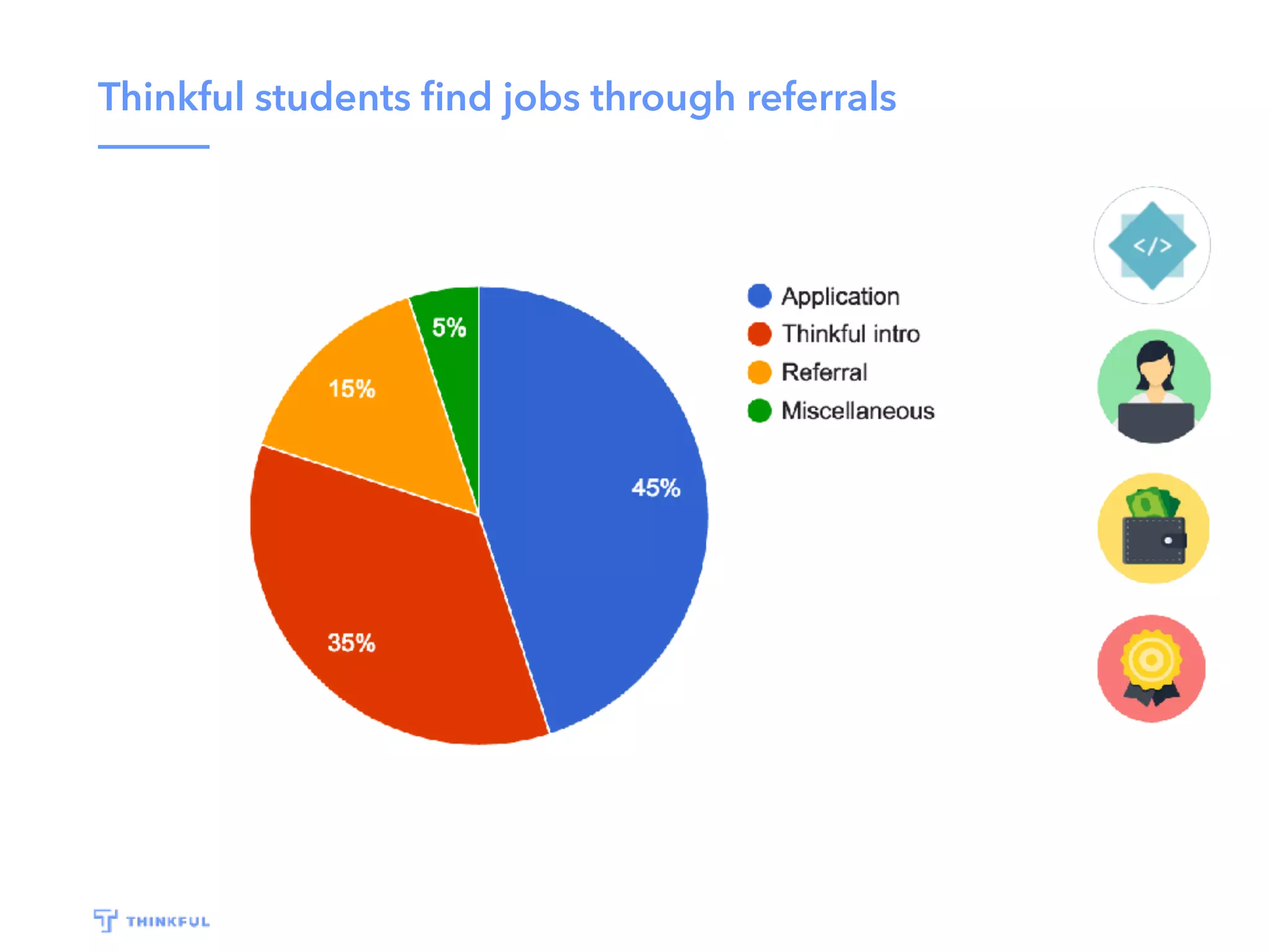
Thinkful students find jobs through referrals
The technical interview
• Phone screen
• Take home tech challenge
• In-person interviews
Resources
• Prep sites (e.g. Interview Cake)
• Books (e.g. Cracking the Coding Interview)
• Mock interviews with technical friends
More about Thinkful
• Anyone who’s committed can learn to code
• 1-on-1 mentorship is the best way to learn
• Flexibility matters — learn anywhere, anytime
•We only makes money when you get a job
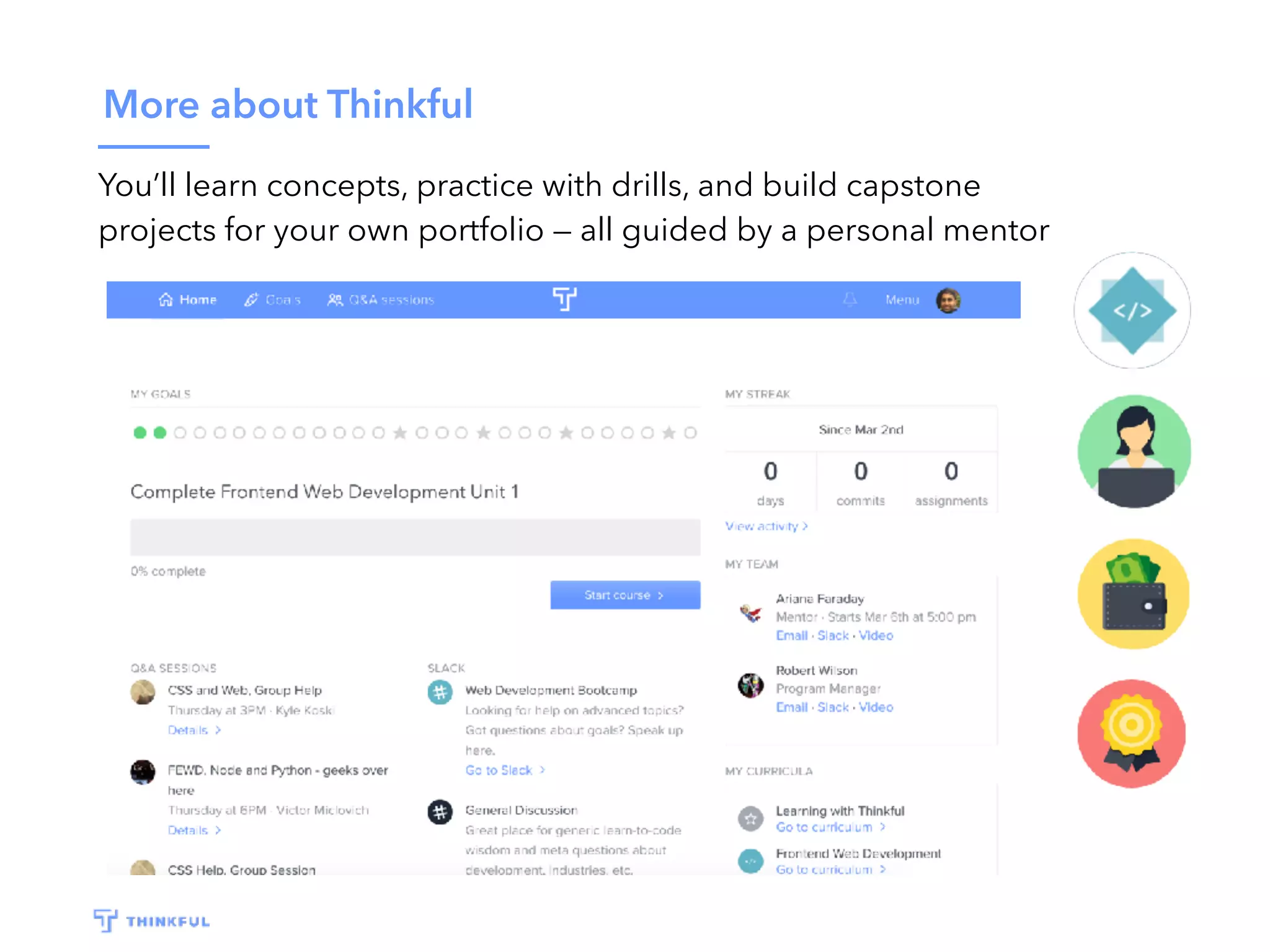
More about Thinkful
You’ll learn concepts, practice with drills, and build capstone
projects for your own portfolio — all guided by a personal mentor
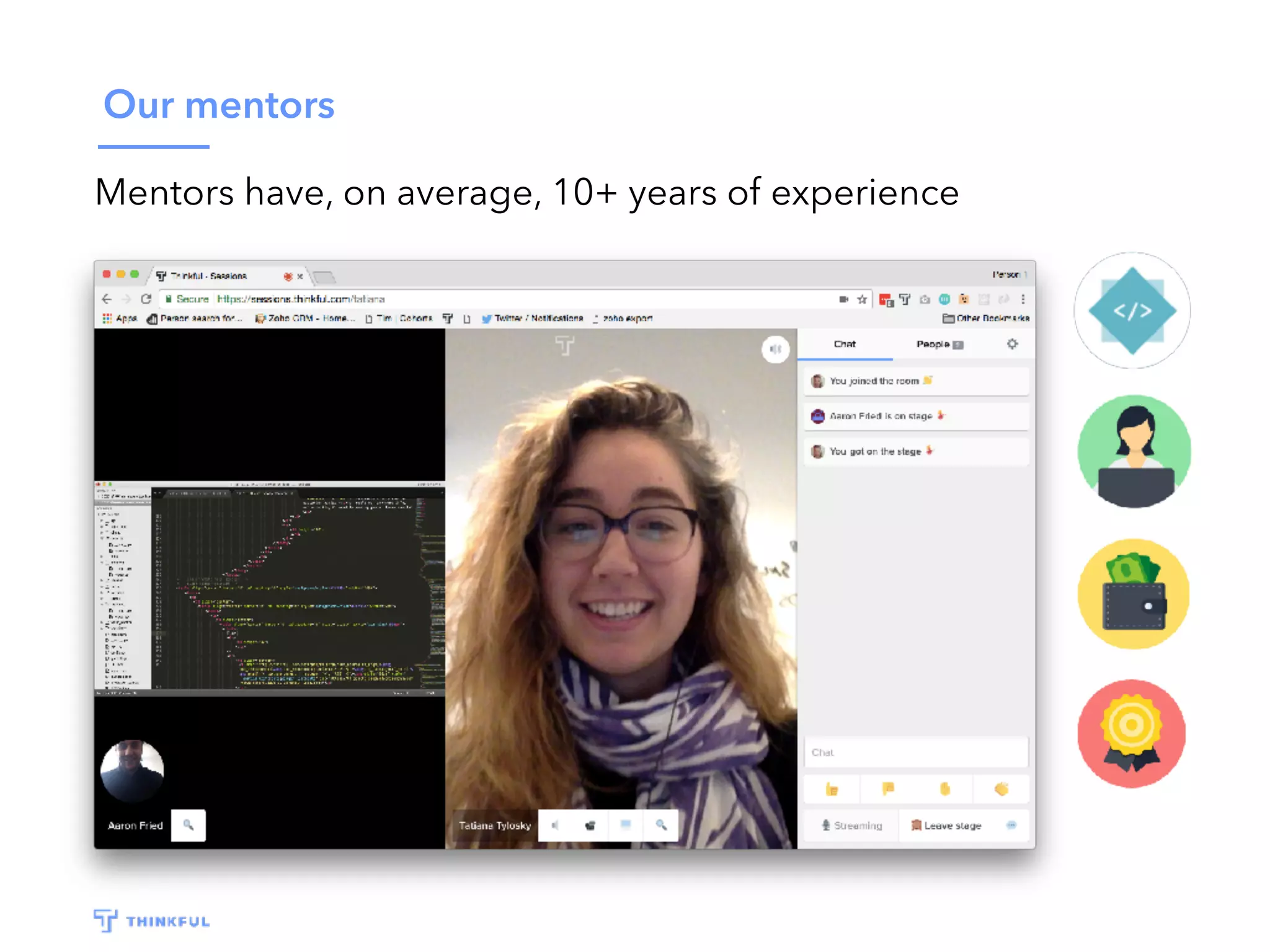
Our mentors
Mentors have, on average, 10+ years of experience
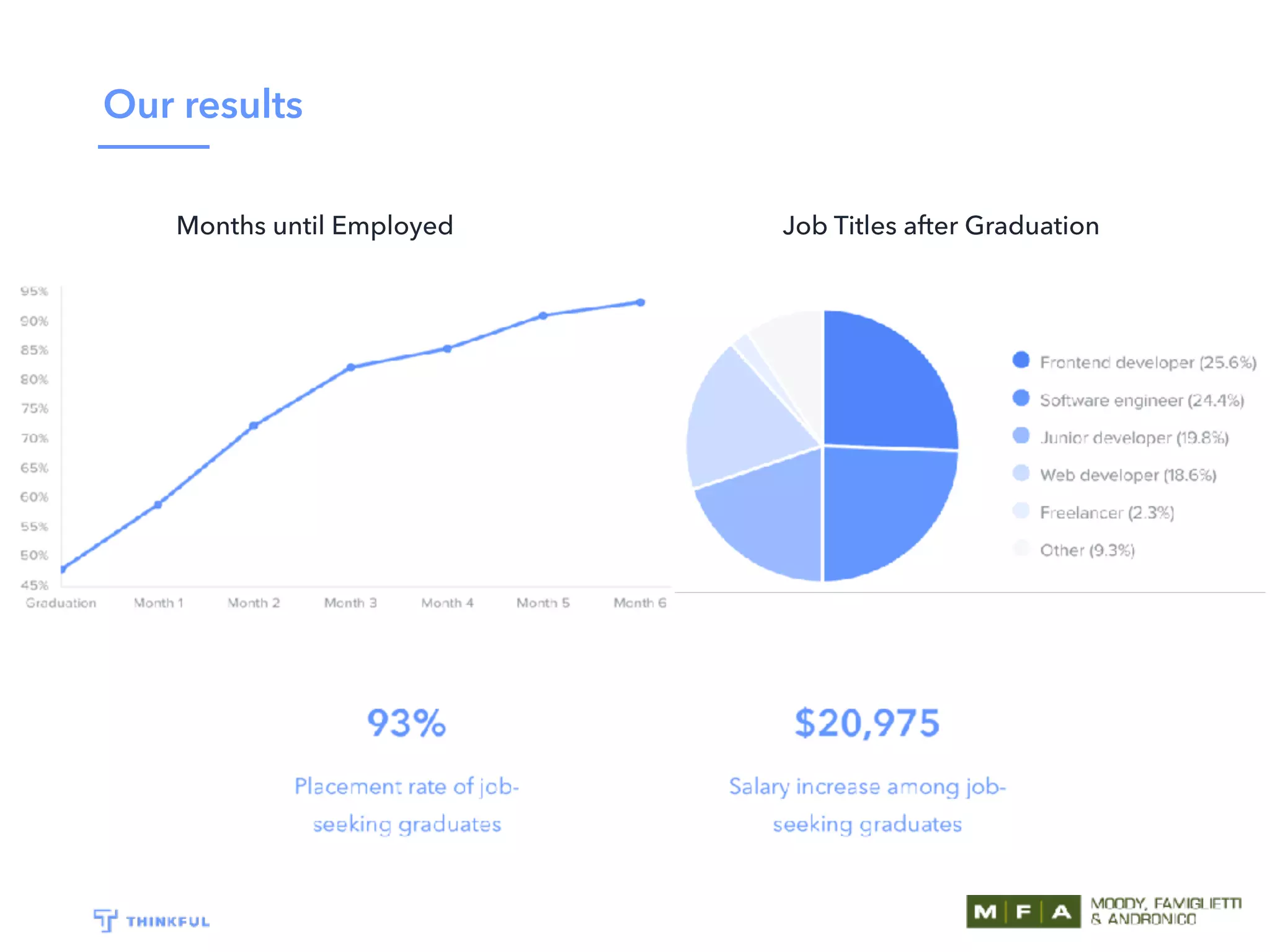
Our results
Job Titles after GraduationMonths until Employed
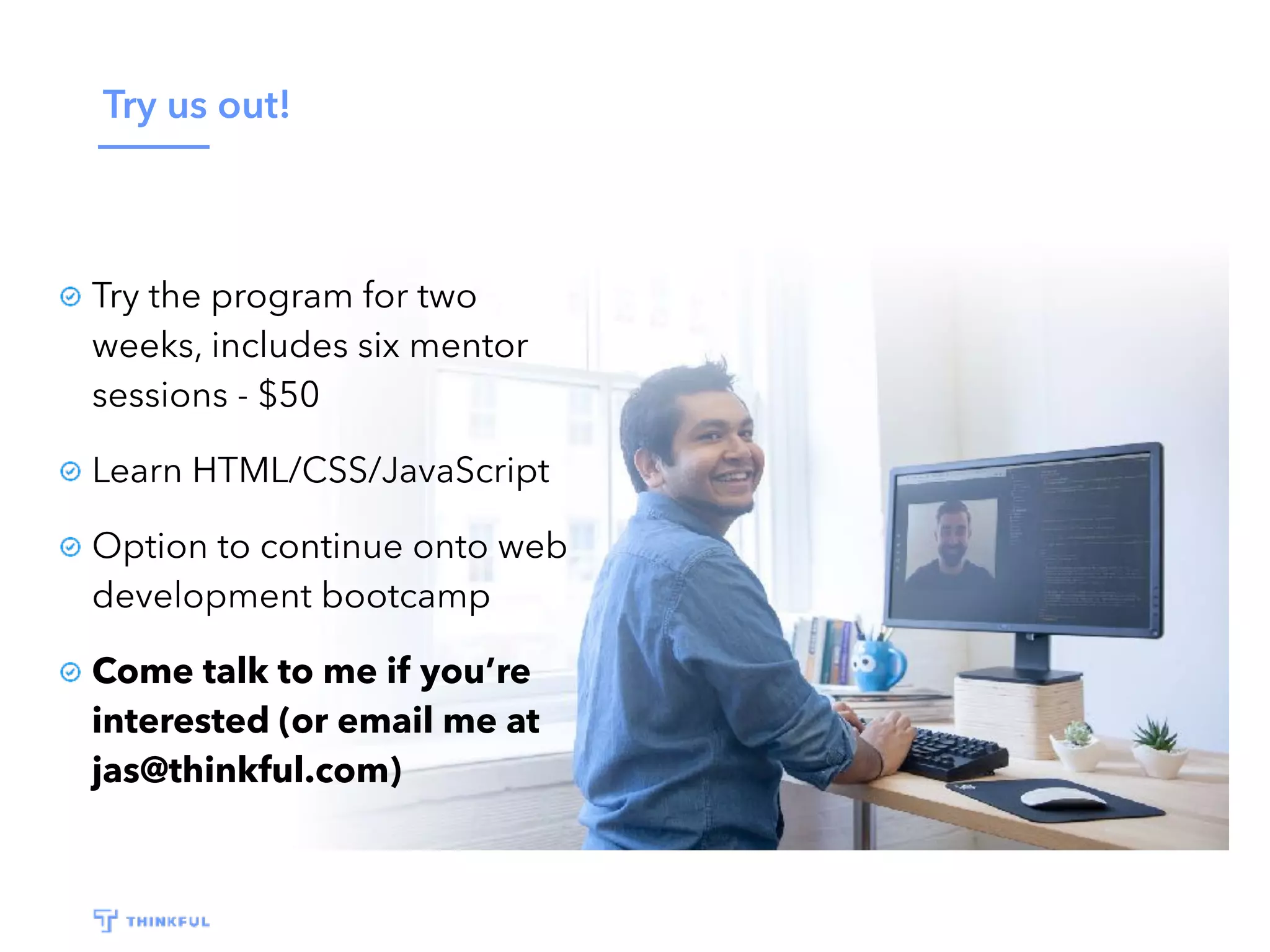
Try us out!
Try the program for two
weeks, includes six mentor
sessions - $50
Learn HTML/CSS/JavaScript
Option to continue onto web
development bootcamp
Come talk to me if you’re
interested (or email me at
jas@thinkful.com)
Questions?
email me at jas@thinkful.com

Getting started in tech (4:27)

  • 1.
    Getting Started inTech: Building a Great Career February 2017 http://bit.ly/thinkful-hired-in-tech
  • 2.
    About me • JasjitSingh • Self-taught developer • Worked in finance & tech • Co-Founder Hotspot • Thinkful General Manager
  • 3.
    About us Thinkful preparesstudents for web development & data science jobs with 1-on-1 mentorship programs
  • 4.
    What is “tech”? Techisn’t just one industry anymore — it’s the new business model. Every company is now a tech company.
  • 5.
    “Software is eatingthe world” “More and more major businesses and industries are being run on software and delivered as online services — from movies to agriculture to national defense. Many of the winners are Silicon Valley-style entrepreneurial technology companies that are invading and overturning established industry structures. Over the next 10 years, I expect many more industries to be disrupted by software, with new world-beating Silicon Valley companies doing the disruption in more cases than not.” - Marc Andreeson, WSJ, 2011
  • 6.
    Some examples • Largestretailer => Amazon • Best movie production => Pixar • Biggest media => Facebook & Google
  • 7.
    Netflix “Our goal isto become HBO faster than HBO can become us” - Ted Sarandos, Chief Content Officer of Netflix, 2013
  • 8.
    Goldman Sachs • LloydBlankfein, CEO • “Goldman Sachs is a Technology Firm” • 9,000 out of 33,000 employees are on tech team
  • 9.
    The good news By2020, there will be 1.4M computer science jobs and only 400,000 C.S. grads with the skills to apply for those jobs - Bureau of Labor Statistics
  • 10.
    The new bluecollar job?
  • 11.
    The implications forjobs • Increased demand in for technical skills • Creation of new “software plus” jobs • Diffusion of tech organizational culture, roles, and processes
  • 12.
    One such process— career trajectory Junior sales Account executive Sales Manager VP Sales!
  • 13.
    In “tech” careertrajectories are varied Full stack developer Front-end developer Back-end developer QA developer
  • 14.
    In “tech” careertrajectory are varied Full stack developer Front-end developer Back-end developer QA developer DevOps Product developer Growth hacker Reliability engineer Architect Manager / team lead
  • 15.
    Goals for tonight •Define common first jobs • Career trajectories after the first job • Tips for breaking in
  • 16.
    First jobs • Frontenddeveloper • Backend developer • Full-stack developer • QA developer
  • 17.
    Frontend Developer You’ll bebuilding the parts of an application that people interact with
  • 18.
    Backend Developer Building thebusiness logic and handling data storage and manipulation
  • 19.
    Full-stack Developer Build bothfront and backend features +
  • 20.
    QA Developer Write softwaretests and conduct manual tests to catch bugs before they’re shipped
  • 21.
    Next step: SeniorDeveloper Everything that came before with the ability to estimate your work accurately, handle challenging problems with less support, and add support for junior colleagues
  • 22.
    Coding plus Roles •Coding + Product = Product Manager • Coding + Marketing = Growth Hacker • Coding + Community = Developer Evangelist • Coding + Sales = Sales Engineer • Coding + Data = Data Scientist
  • 23.
    Product Manager (Coding+ Product) Turn business goals into product requirements. Work with designers & developers to deliver — measure success Skills & Tools • Customer research • Customer development • User stories • Wireframes • Project management • Analytics
  • 24.
    Growth Hacker (Coding+ Marketing) Design & implement experiments to drive customer acquisition and engagement Skills & Tools • Rapid prototyping • Analytics • Communication
  • 25.
    Developer Evangelist (Coding+ Community) Build community around a technology by helping customers, creating content and participating at events Skills & Tools • Specific technical expertise • Teaching/Mentoring • Customer support
  • 26.
    Sales Engineer (Coding+ Sales) Sell complex technical product by helping customer understand how it works and how they’ll use it Skills & Tools • Communication • Customer support
  • 27.
    Data Scientist (Coding+ Data) Use statistics and programming to find valuable insights from extremely large datasets Skills & Tools • Curiosity • Statistics • Analytics • Machine Learning
  • 28.
    The Good News •Massive shortages in tech industry • Hiring is based on skills, not credentials • Anyone can learn with a growth mindset
  • 29.
    1M unfilled techjobs by 2020 By 2020, there will be 1.4M computer science jobs available and only 400,000 computer science grads with the skills to apply for those jobs - Bureau of Labor Statistics
  • 30.
    Many firms recruitfrom code challenge sites
  • 31.
    Technical interview iscornerstone of the process
  • 32.
    Anyone can learnhow to code Students with a growth mindset - the belief that intelligence is not just something that you are born with - have higher levels of success. Neural connections grow and become stronger the more you struggle with learning and correct your mistakes. Carol Dweck, Professor of Psychology at Stanford University
  • 33.
    How to getin the door? • Learn the skills • Build a portfolio of high quality work • Develop a relevant network • Prep for technical interviews
  • 34.
    Learning the skills •Build stuff + Google • Free online resources (e.g. CodeAcademy) • Flexible coding bootcamps (e.g Thinkful) • Full-time coding bootcamps (e.g. GA) • Full degree programs (Georgia Tech)
  • 35.
    Building your portfolio •Find a niche (based on your background) • Build a personal website • Get your portfolio on GitHub • Try and find contract work • Have professionals guide & review your work
  • 36.
    Networking the rightway • 80% of job openings are never advertised • 120 average applicants per job posted • 20% get an interview *https://www.forbes.com/sites/jacquelynsmith/2013/04/26/why-every-job-seeker-should-have-a-personal- website-and-what-it-should-include/#578fbf6f119e
  • 37.
    Networking the rightway • Cold applications suck! • Figure out what you want (size, industry, role, etc) • Reach out to someone that works at company • Ask them about their work, genuine interest, build a relationship • Eventually (1-2 months in), ask for referral
  • 38.
    Tech recruiters • Techrecruiters serve as your agent • Can leverage their relationships to arrange interviews • They are incentivized to find you a job • You might get less say in where, but are helpful • Can be great in getting you feedback
  • 39.
    Thinkful students findjobs through referrals
  • 40.
    The technical interview •Phone screen • Take home tech challenge • In-person interviews
  • 41.
    Resources • Prep sites(e.g. Interview Cake) • Books (e.g. Cracking the Coding Interview) • Mock interviews with technical friends
  • 42.
    More about Thinkful •Anyone who’s committed can learn to code • 1-on-1 mentorship is the best way to learn • Flexibility matters — learn anywhere, anytime •We only makes money when you get a job
  • 43.
    More about Thinkful You’lllearn concepts, practice with drills, and build capstone projects for your own portfolio — all guided by a personal mentor
  • 44.
    Our mentors Mentors have,on average, 10+ years of experience
  • 45.
    Our results Job Titlesafter GraduationMonths until Employed
  • 46.
    Try us out! Trythe program for two weeks, includes six mentor sessions - $50 Learn HTML/CSS/JavaScript Option to continue onto web development bootcamp Come talk to me if you’re interested (or email me at jas@thinkful.com)
  • 47.
    Questions? email me atjas@thinkful.com