Game Programming
AI
Nick Prühs, Christian Oeing
Objectives
• To understand the importance of AI in games
• To learn about different approaches to game AI architectures
• To take a closer look at behavior trees in particular
2 / 90
Why AI?
• Enemies
• Allies
• Challanges
• Vivid game world
• Toy
3 / 22
Early Example: Pac Man
“This is the heart of the game. I wanted each ghostly enemy to have a
specific character and its own particular movements, so they weren’t all
just chasing after Pac Man in single file, which would have been
tiresome and flat.”
- Toru Iwatani, Pac-Man creator
4 / 22
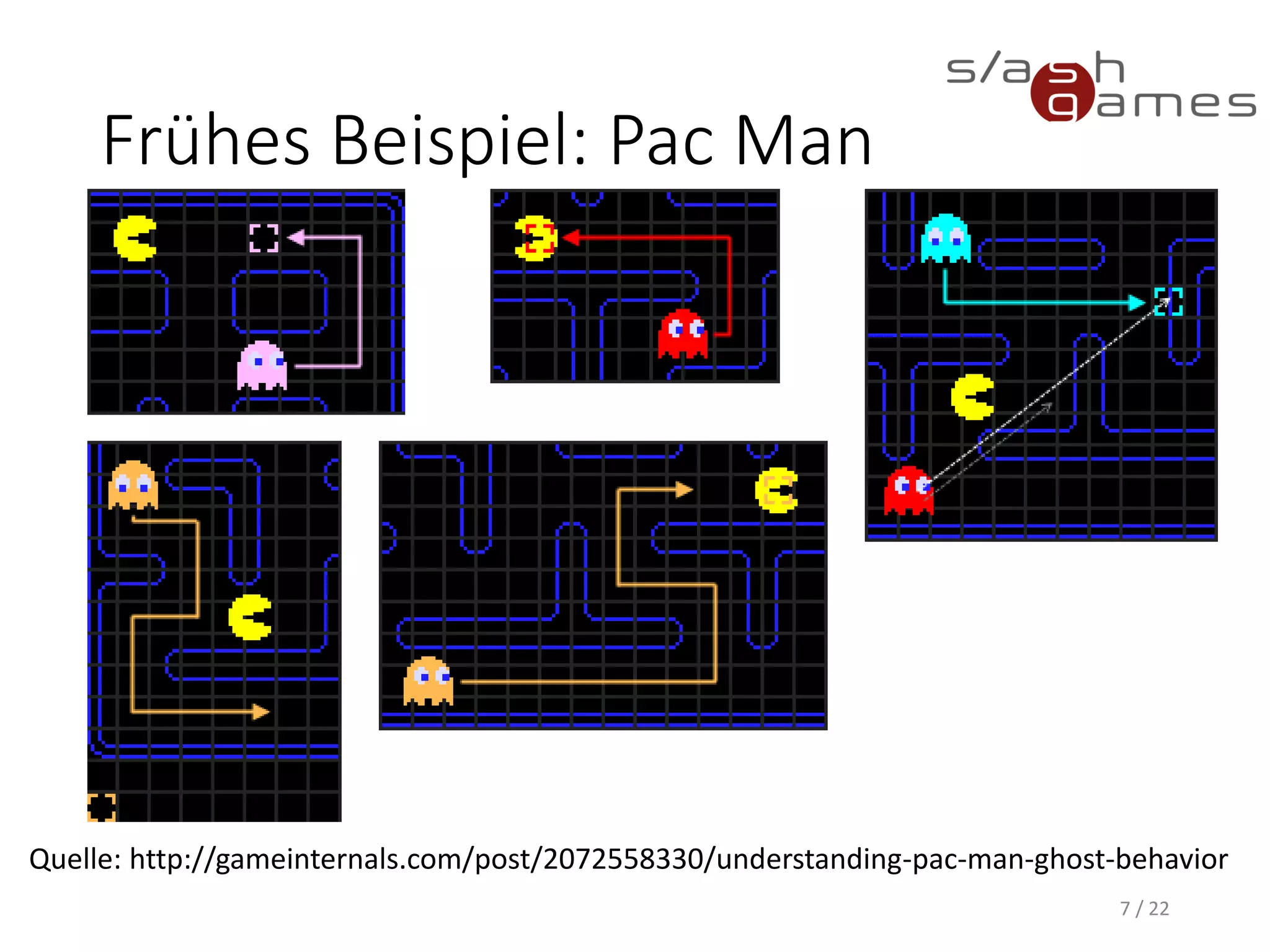
Early Example: Pac Man
5 / 22
http://gameinternals.com/post/2072558330/understanding-pac-man-ghost-behavior
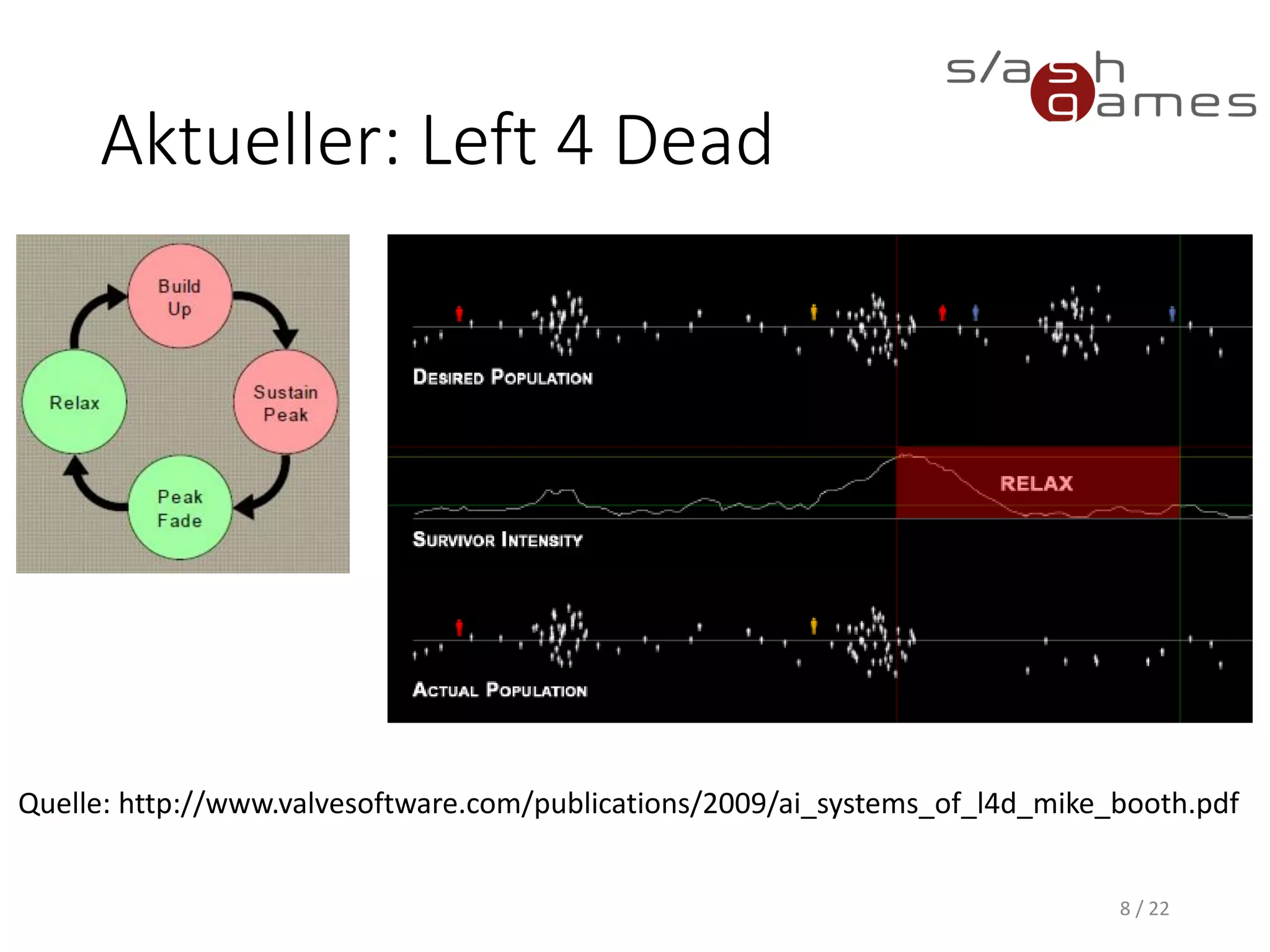
Left 4 Dead
6 / 22
http://www.valvesoftware.com/publications/2009/ai_systems_of_l4d_mike_booth.pdf
Naive Approach: Hard-Coded Rules
• If-Then-Else
• Hard-coded
• Fast to implement
• Access to whole data model
• No fixed structure
7 / 22
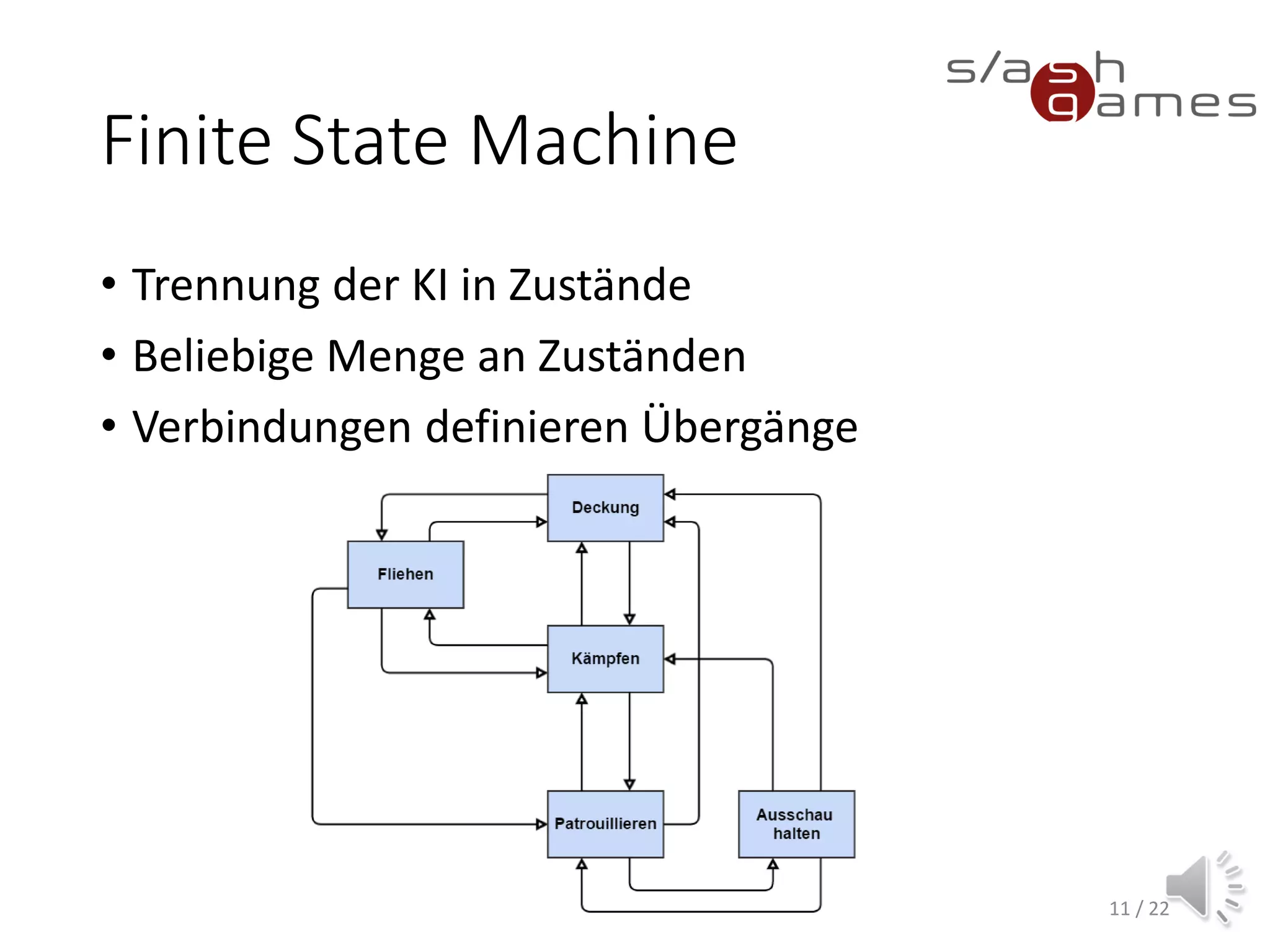
Finite State Machine
• Splitting AI into different states
• Arbitrary number of states
• Well-defined state transitions
8 / 22
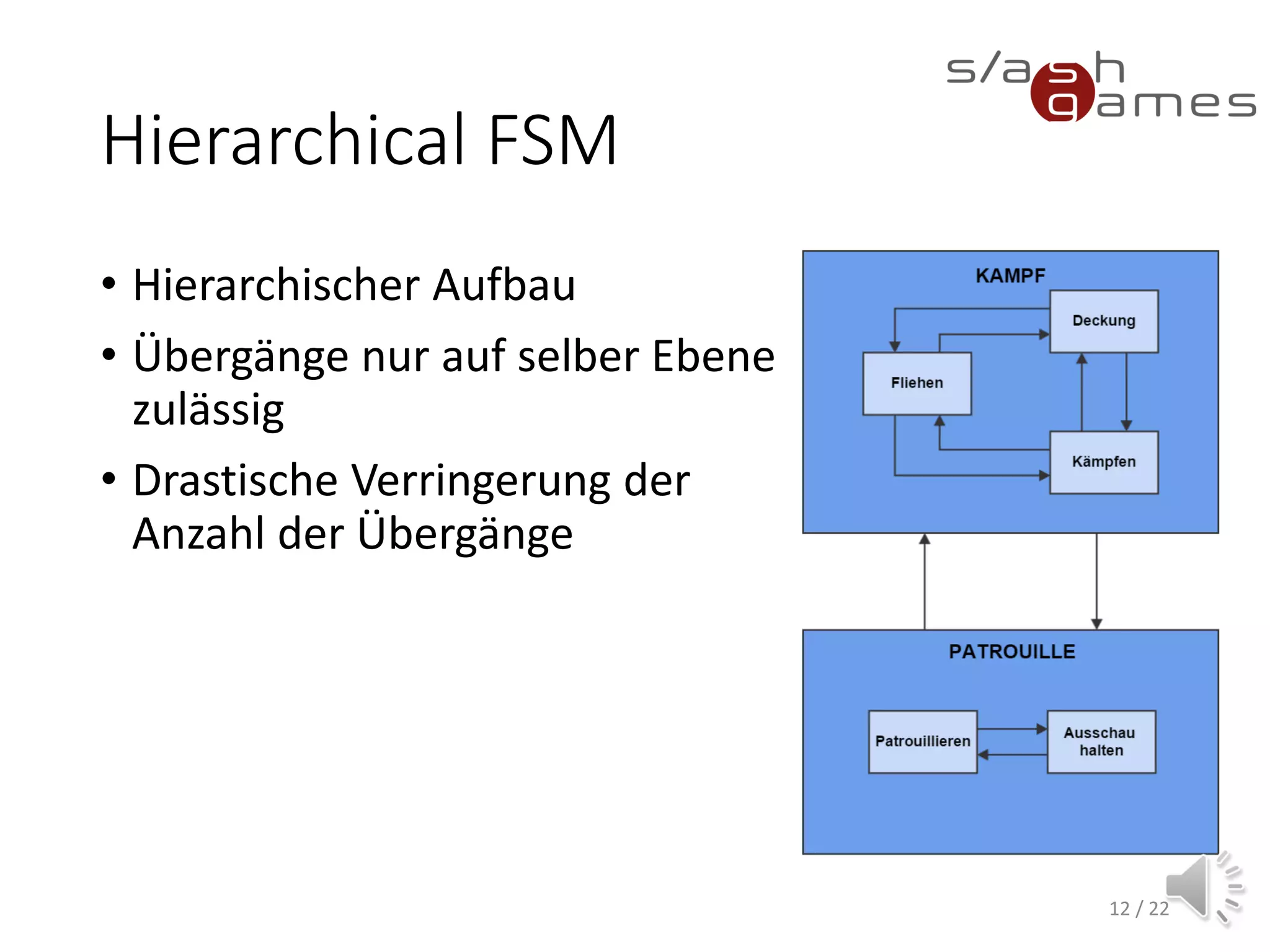
Hierarchical FSM
9 / 22
• Hierarchical Structure
• Allows transitions at same level, only
• Drastically reduces the total number
of transitions
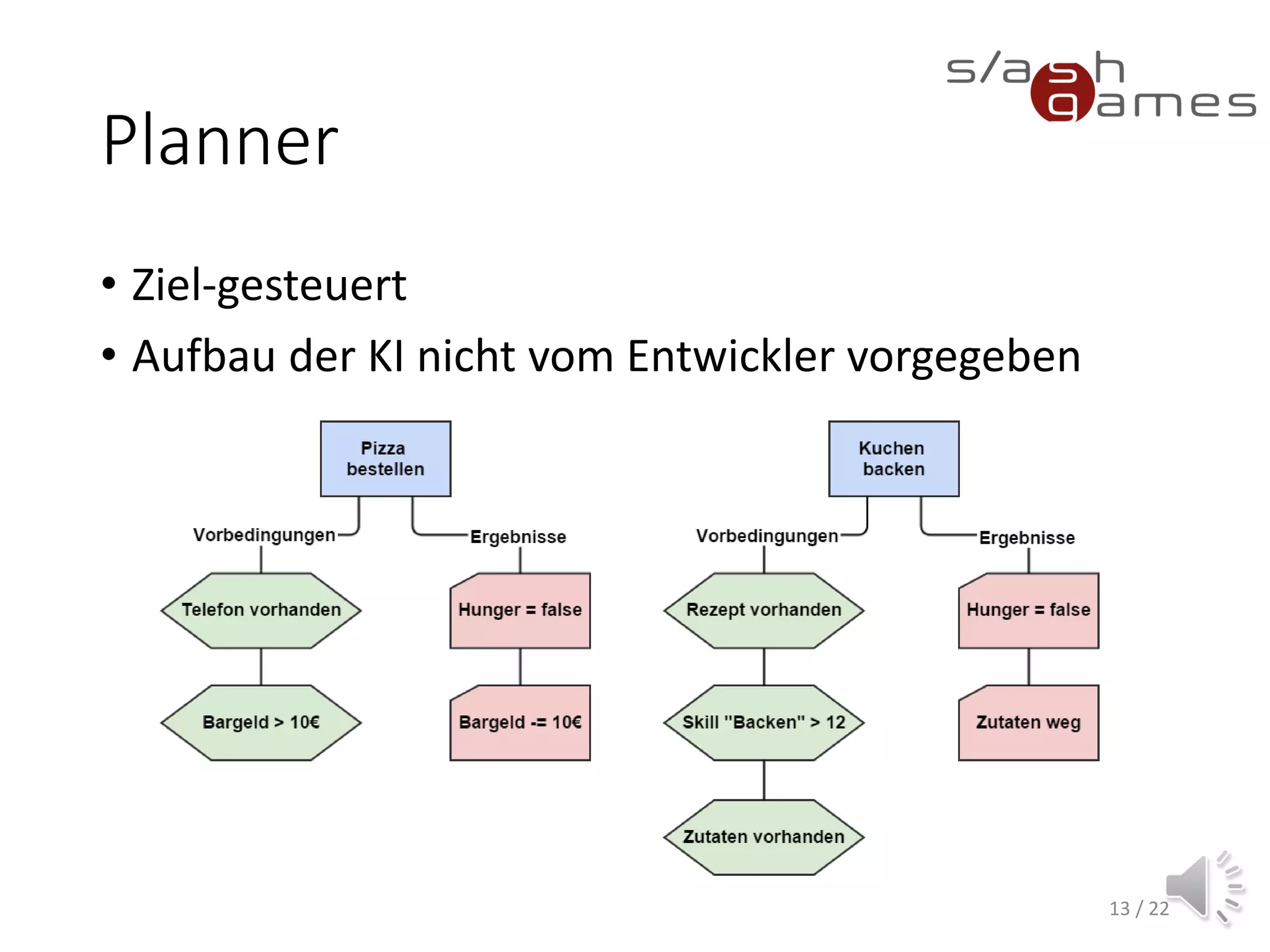
Planner
• Goal-oriented
• Specific AI not defined by developer
10 / 22
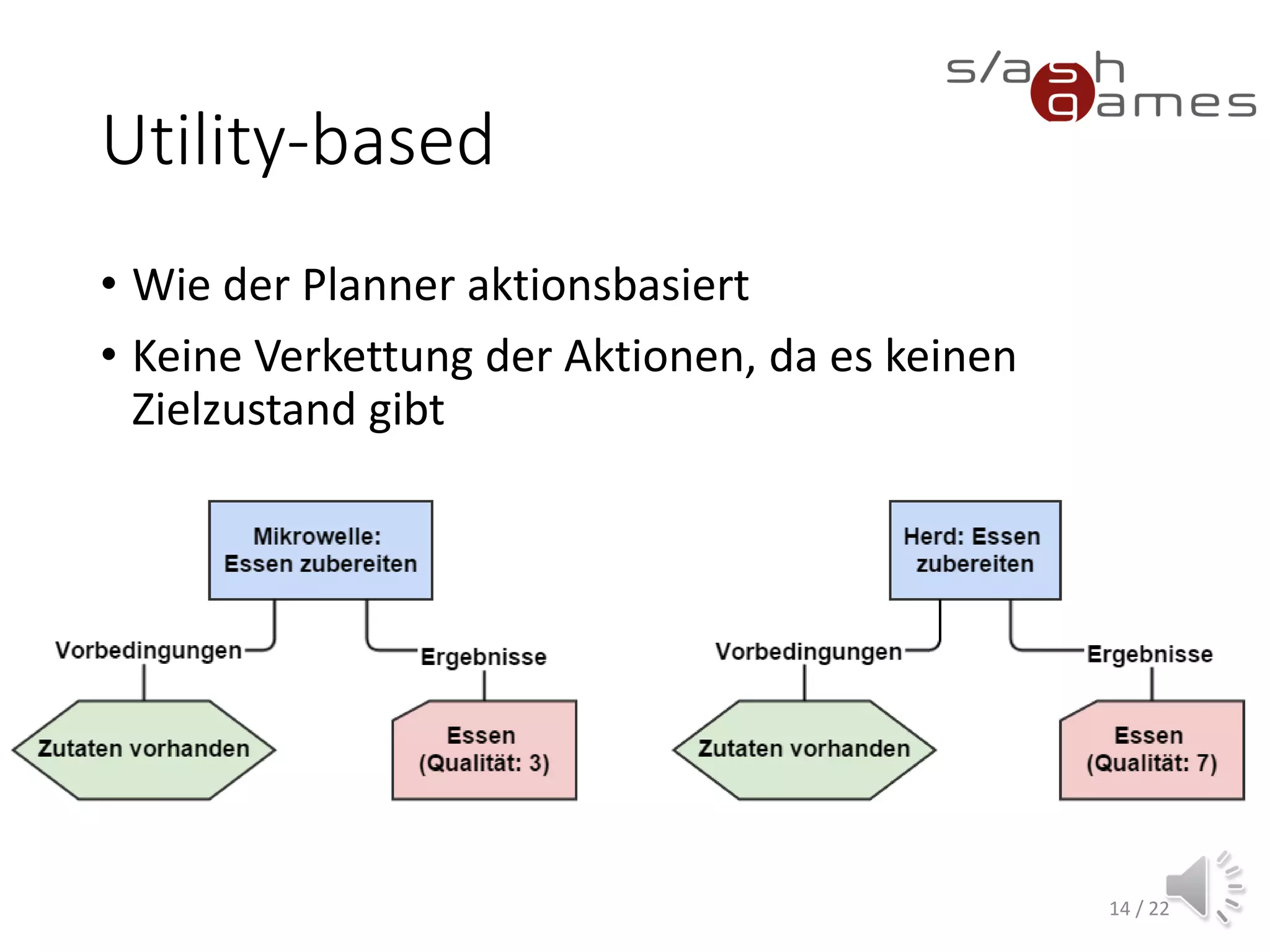
Utility-based
• Action-based, similar to planner
• No goal, thus no action chains
11 / 22
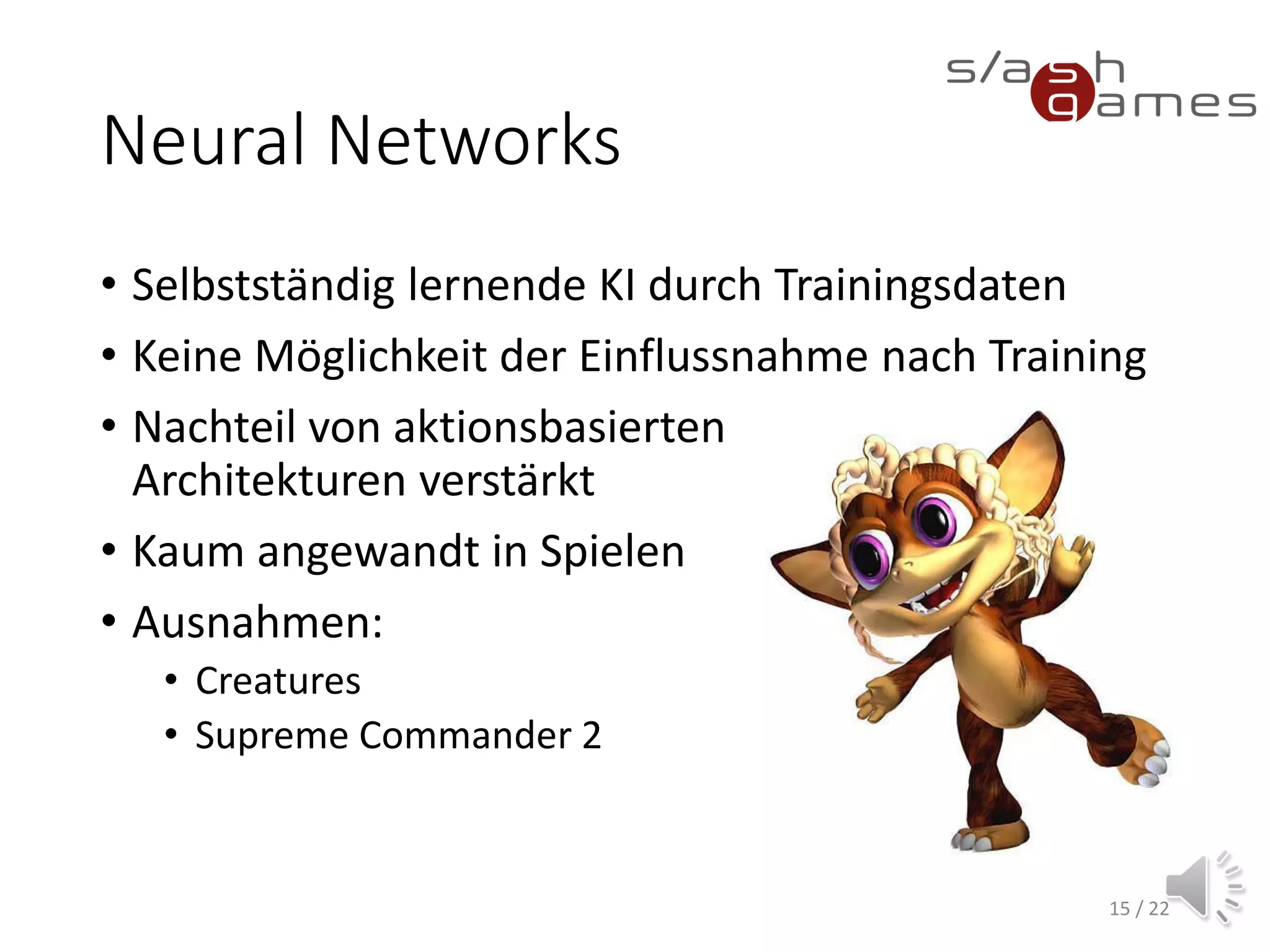
Neural Networks
• Improving AI through training data
• No way of modifying the AI after
training
• Further reinforces the
disadvantages of action-based
architectures
• Rarely applied in games
• Exceptions:
▪ Creatures
▪ Supreme Commander 2
12 / 22
Behaviour Trees: History
• Became popular in 2005 with Halo 2
• Successfully implemented in
▪ Halo 2 + 3
▪ Spore
▪ Swords & Soldiers
▪ GTA: Chinatown Wars
▪ The Bourne Conspiracy
▪ SWAT 4
▪ Bioshock
▪ Dark Sector
▪ … and more
13 / 22
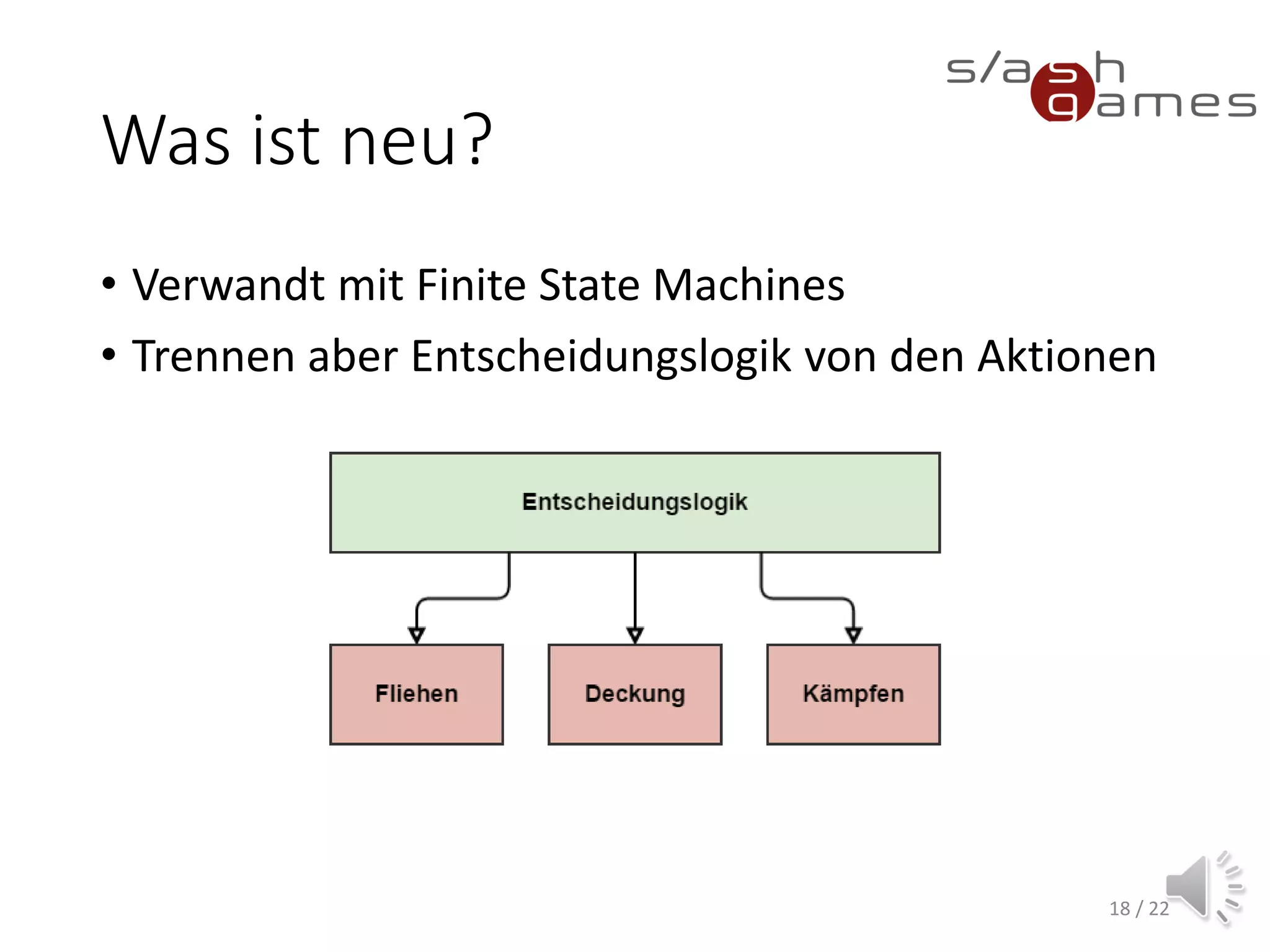
Behaviour Trees: What‘s new?
• Similar to Finite State Machines
• Split decision logic from actual actions
14 / 22
Behaviour Tree Structure
• Directed tree
▪ Single root node
▪ Inner nodes = decision logic
▪ Leafs = Actions
15 / 12
Behaviour Tree Ticks
• Tick starts at root node
• Current node executes its logic
• Node state is reported back to parent node:
▪ Success
▪ Running
▪ Failure
16 / 12
Behaviour Tree Tick Example
17 / 12
Prioritized Structure
• Children are executed left-to-right
18 / 12
Modular Structure
• Adding new nodes possible everywhere
19 / 12
Parametrized Structure
• Node defines parameters and their types
• Parameters definie actual execution
• Increases reusability
• Example: Move to position
20 / 12
Data Exchange
• Achieved thorugh a blackboard
• Dynamically defines parameters of other nodes
• Nodes remain independent of each other
• Simple implementation, e.g. Dictionary or Hashtable
21 / 12
Node: Selector
• Arbitrary number of children
• Only one child node active at the same time
• Selects first child that doesn‘t return Failure
22 / 12
Node: Sequence
• Arbitrary number of children
• Only one child node active at the same time
• Selects children one after another until one returns Failure
23 / 12
Combining Sequences and Selectors
24 / 12
Node: Decorator
• Single child
25 / 12
Blackboard
• AI memory
• Exchanges data between nodes
26 / 12
Blackboard
• Keys need to be unique
• May cause conflicts
27 / 12
Picklock
• Easiest way to enter building: Open door!
28 / 12
Picklock
• Not always that easy
29 / 12
Picklock
• Generic way of entering a building through any kind of entrance
30 / 12
Picklock
• There are many ways to get in
31 / 12
Crafting
• Using ingredients to create new items
• Ingredients need to be available
• What to do, if missing any ingredients?
• Ingredients might be crafted as well
32 / 12
Crafting
33 / 12
More Examples
• Combat: Fighting, healing, running, taking cover
• Survival: Running, guarding, fighting, eating
• Strategy: Training workers, building structures, training fighters
• Dialogues: Conditional answers, linked answers
34 / 12
Data Driven
• Structure allows building a generic visual editor
• Usable by game designers as well
• Can be used in multiple projects
35 / 12
Available Tools
• Unity3D
▪ Behave 2 (Angry Ant)
▪ Behavior Designer (Opsive)
• Unreal Engine
▪ Built-in
• Cry Engine
▪ Built-in
36 / 12
Custom Tools
• Define data structure
▪ e.g. XML, easy to read and edit
38 / 12
<BehaviorTree Name="CraftItem">
<Sequence>
<Action Type="HasRecipe" List="Ingredients" />
<Decorator Type="Iteration" List="Ingredients" Iterator="Ingredient" >
<Sequence>
<Selector>
<Action Type="TakeItemFromInventory" ItemRef="Ingredient" StoreIn="IngredientItem" />
<Action Type="SearchItem" ItemRef="Ingredient" Distance="50" StoreIn="IngredientItem" />
<BehaviorTreeRef Name="CraftItem" ItemRef="Ingredient" StoreIn="IngredientItem" />
<Action Type="SearchItem" ItemRef="Ingredient" Distance="500" StoreIn="IngredientItem" />
</Selector>
<Action Type="PutItemInList" ItemRef="IngredientItem" List="IngredientItems" />
</Sequence>
</Decorator>
<Action Type="MixIngredients" List="IngredientItems" />
</Sequence>
</BehaviorTree>
Custom Tools
• Generic approach
• How to make game-specific actions available to generic editor?
▪ Use editor to add actions
▪ Export from game and import in editor
▪ Generic actions
▪ Import from DLL using reflection
39 / 12
Behaviour Tree Summary
• Generic structure leads to many applications
▪ Reuse of decision logic and game-specific actions
▪ Common editor for multiple projects
▪ Learn once, apply again and again
• Strictly follows rules
▪ No dynamic AI, such as when using Planner
40 / 12
Conclusion
• Many different architectures
▪ (Hierarchical) Finite State Machines
▪ Planner
▪ Utility-based
▪ Neural Network
▪ Behavior Trees
• Choice depends on actual game
• Each architecture is better than no architecture!
41 / 22
References
• Heiko Klinge. Warum KI in Spielen stagniert.
http://www.tecchannel.de/webtechnik/entwicklung/1744817/warum_kuenstliche_intelligenz_ki_in_
spielen_stagniert/
• Chad Birch. Pac Man AI. http://gameinternals.com/post/2072558330/understanding-pac-man-
ghost-behavior
• Don Hodges. Pac Man AI Bug. http://donhodges.com/pacman_pinky_explanation.htm
• Alex Champandard. Top AI Games. http://aigamedev.com/open/highlights/top-ai-games/
• Mike Robbins. Neural Network in Supreme Commander 2. http://twvideo01.ubm-
us.net/o1/vault/gdc2012/slides/Summit_AI/Robbins_Michael_Off%20the%20Beaten.pdf
• Mike Booth. The AI systems of Left 4 Dead.
http://www.valvesoftware.com/publications/2009/ai_systems_of_l4d_mike_booth.pdf
• Damian Isla. Handling Complexity in the Halo 2 AI.
http://www.gamasutra.com/view/feature/130663/gdc_2005_proceeding_handling_.php
• Alex Champandard. Behavior Trees: Three Ways of Cultivating AI.
http://www.gdcvault.com/play/1012744/Behavior-Trees-Three-Ways-of
References
• Chris Simpson. Behavior Trees for AI.
http://www.gamasutra.com/blogs/ChrisSimpson/20140717/221339/Behavior_trees_for_AI_How_t
hey_work.php
• Cry Engine. Coordinating Agents with Behavior Trees.
http://docs.cryengine.com/display/SDKDOC4/Coordinating+Agents+with+Behavior+Trees
• Chris Hecker. My Liner Notes for Spore.
http://chrishecker.com/My_Liner_Notes_for_Spore#Behavior_Tree_AI
• Joost "Oogst" van Dongen. AI in Swords & Soldiers. http://joostdevblog.blogspot.de/2010/12/ai-in-
swords-soldiers-part-1.html
• Unreal Engine. Behavior Trees.
https://docs.unrealengine.com/latest/INT/Engine/AI/BehaviorTrees/index.html
• Cry Engine. Modular Behavior Tree.
http://docs.cryengine.com/display/SDKDOC4/Modular+Behavior+Tree
Thank you!
http://www.npruehs.de
https://github.com/npruehs
@npruehs
nick.pruehs@daedalic.com
5 Minute Review Session
• Name a few applications of AI in general!
• How do finite state machines work?
• How do hierarchical state machines improve on that?
• What other AI architectures do you know?
• What’s the basic structure of a behavior tree?
• How do sequences and selectors work?
• What’s a decorator node?
• How do nodes exchange data?

Game Programming 09 - AI

  • 1.
  • 2.
    Objectives • To understandthe importance of AI in games • To learn about different approaches to game AI architectures • To take a closer look at behavior trees in particular 2 / 90
  • 3.
    Why AI? • Enemies •Allies • Challanges • Vivid game world • Toy 3 / 22
  • 4.
    Early Example: PacMan “This is the heart of the game. I wanted each ghostly enemy to have a specific character and its own particular movements, so they weren’t all just chasing after Pac Man in single file, which would have been tiresome and flat.” - Toru Iwatani, Pac-Man creator 4 / 22
  • 5.
    Early Example: PacMan 5 / 22 http://gameinternals.com/post/2072558330/understanding-pac-man-ghost-behavior
  • 6.
    Left 4 Dead 6/ 22 http://www.valvesoftware.com/publications/2009/ai_systems_of_l4d_mike_booth.pdf
  • 7.
    Naive Approach: Hard-CodedRules • If-Then-Else • Hard-coded • Fast to implement • Access to whole data model • No fixed structure 7 / 22
  • 8.
    Finite State Machine •Splitting AI into different states • Arbitrary number of states • Well-defined state transitions 8 / 22
  • 9.
    Hierarchical FSM 9 /22 • Hierarchical Structure • Allows transitions at same level, only • Drastically reduces the total number of transitions
  • 10.
    Planner • Goal-oriented • SpecificAI not defined by developer 10 / 22
  • 11.
    Utility-based • Action-based, similarto planner • No goal, thus no action chains 11 / 22
  • 12.
    Neural Networks • ImprovingAI through training data • No way of modifying the AI after training • Further reinforces the disadvantages of action-based architectures • Rarely applied in games • Exceptions: ▪ Creatures ▪ Supreme Commander 2 12 / 22
  • 13.
    Behaviour Trees: History •Became popular in 2005 with Halo 2 • Successfully implemented in ▪ Halo 2 + 3 ▪ Spore ▪ Swords & Soldiers ▪ GTA: Chinatown Wars ▪ The Bourne Conspiracy ▪ SWAT 4 ▪ Bioshock ▪ Dark Sector ▪ … and more 13 / 22
  • 14.
    Behaviour Trees: What‘snew? • Similar to Finite State Machines • Split decision logic from actual actions 14 / 22
  • 15.
    Behaviour Tree Structure •Directed tree ▪ Single root node ▪ Inner nodes = decision logic ▪ Leafs = Actions 15 / 12
  • 16.
    Behaviour Tree Ticks •Tick starts at root node • Current node executes its logic • Node state is reported back to parent node: ▪ Success ▪ Running ▪ Failure 16 / 12
  • 17.
    Behaviour Tree TickExample 17 / 12
  • 18.
    Prioritized Structure • Childrenare executed left-to-right 18 / 12
  • 19.
    Modular Structure • Addingnew nodes possible everywhere 19 / 12
  • 20.
    Parametrized Structure • Nodedefines parameters and their types • Parameters definie actual execution • Increases reusability • Example: Move to position 20 / 12
  • 21.
    Data Exchange • Achievedthorugh a blackboard • Dynamically defines parameters of other nodes • Nodes remain independent of each other • Simple implementation, e.g. Dictionary or Hashtable 21 / 12
  • 22.
    Node: Selector • Arbitrarynumber of children • Only one child node active at the same time • Selects first child that doesn‘t return Failure 22 / 12
  • 23.
    Node: Sequence • Arbitrarynumber of children • Only one child node active at the same time • Selects children one after another until one returns Failure 23 / 12
  • 24.
    Combining Sequences andSelectors 24 / 12
  • 25.
  • 26.
    Blackboard • AI memory •Exchanges data between nodes 26 / 12
  • 27.
    Blackboard • Keys needto be unique • May cause conflicts 27 / 12
  • 28.
    Picklock • Easiest wayto enter building: Open door! 28 / 12
  • 29.
    Picklock • Not alwaysthat easy 29 / 12
  • 30.
    Picklock • Generic wayof entering a building through any kind of entrance 30 / 12
  • 31.
    Picklock • There aremany ways to get in 31 / 12
  • 32.
    Crafting • Using ingredientsto create new items • Ingredients need to be available • What to do, if missing any ingredients? • Ingredients might be crafted as well 32 / 12
  • 33.
  • 34.
    More Examples • Combat:Fighting, healing, running, taking cover • Survival: Running, guarding, fighting, eating • Strategy: Training workers, building structures, training fighters • Dialogues: Conditional answers, linked answers 34 / 12
  • 35.
    Data Driven • Structureallows building a generic visual editor • Usable by game designers as well • Can be used in multiple projects 35 / 12
  • 36.
    Available Tools • Unity3D ▪Behave 2 (Angry Ant) ▪ Behavior Designer (Opsive) • Unreal Engine ▪ Built-in • Cry Engine ▪ Built-in 36 / 12
  • 38.
    Custom Tools • Definedata structure ▪ e.g. XML, easy to read and edit 38 / 12 <BehaviorTree Name="CraftItem"> <Sequence> <Action Type="HasRecipe" List="Ingredients" /> <Decorator Type="Iteration" List="Ingredients" Iterator="Ingredient" > <Sequence> <Selector> <Action Type="TakeItemFromInventory" ItemRef="Ingredient" StoreIn="IngredientItem" /> <Action Type="SearchItem" ItemRef="Ingredient" Distance="50" StoreIn="IngredientItem" /> <BehaviorTreeRef Name="CraftItem" ItemRef="Ingredient" StoreIn="IngredientItem" /> <Action Type="SearchItem" ItemRef="Ingredient" Distance="500" StoreIn="IngredientItem" /> </Selector> <Action Type="PutItemInList" ItemRef="IngredientItem" List="IngredientItems" /> </Sequence> </Decorator> <Action Type="MixIngredients" List="IngredientItems" /> </Sequence> </BehaviorTree>
  • 39.
    Custom Tools • Genericapproach • How to make game-specific actions available to generic editor? ▪ Use editor to add actions ▪ Export from game and import in editor ▪ Generic actions ▪ Import from DLL using reflection 39 / 12
  • 40.
    Behaviour Tree Summary •Generic structure leads to many applications ▪ Reuse of decision logic and game-specific actions ▪ Common editor for multiple projects ▪ Learn once, apply again and again • Strictly follows rules ▪ No dynamic AI, such as when using Planner 40 / 12
  • 41.
    Conclusion • Many differentarchitectures ▪ (Hierarchical) Finite State Machines ▪ Planner ▪ Utility-based ▪ Neural Network ▪ Behavior Trees • Choice depends on actual game • Each architecture is better than no architecture! 41 / 22
  • 42.
    References • Heiko Klinge.Warum KI in Spielen stagniert. http://www.tecchannel.de/webtechnik/entwicklung/1744817/warum_kuenstliche_intelligenz_ki_in_ spielen_stagniert/ • Chad Birch. Pac Man AI. http://gameinternals.com/post/2072558330/understanding-pac-man- ghost-behavior • Don Hodges. Pac Man AI Bug. http://donhodges.com/pacman_pinky_explanation.htm • Alex Champandard. Top AI Games. http://aigamedev.com/open/highlights/top-ai-games/ • Mike Robbins. Neural Network in Supreme Commander 2. http://twvideo01.ubm- us.net/o1/vault/gdc2012/slides/Summit_AI/Robbins_Michael_Off%20the%20Beaten.pdf • Mike Booth. The AI systems of Left 4 Dead. http://www.valvesoftware.com/publications/2009/ai_systems_of_l4d_mike_booth.pdf • Damian Isla. Handling Complexity in the Halo 2 AI. http://www.gamasutra.com/view/feature/130663/gdc_2005_proceeding_handling_.php • Alex Champandard. Behavior Trees: Three Ways of Cultivating AI. http://www.gdcvault.com/play/1012744/Behavior-Trees-Three-Ways-of
  • 43.
    References • Chris Simpson.Behavior Trees for AI. http://www.gamasutra.com/blogs/ChrisSimpson/20140717/221339/Behavior_trees_for_AI_How_t hey_work.php • Cry Engine. Coordinating Agents with Behavior Trees. http://docs.cryengine.com/display/SDKDOC4/Coordinating+Agents+with+Behavior+Trees • Chris Hecker. My Liner Notes for Spore. http://chrishecker.com/My_Liner_Notes_for_Spore#Behavior_Tree_AI • Joost "Oogst" van Dongen. AI in Swords & Soldiers. http://joostdevblog.blogspot.de/2010/12/ai-in- swords-soldiers-part-1.html • Unreal Engine. Behavior Trees. https://docs.unrealengine.com/latest/INT/Engine/AI/BehaviorTrees/index.html • Cry Engine. Modular Behavior Tree. http://docs.cryengine.com/display/SDKDOC4/Modular+Behavior+Tree
  • 44.
  • 45.
    5 Minute ReviewSession • Name a few applications of AI in general! • How do finite state machines work? • How do hierarchical state machines improve on that? • What other AI architectures do you know? • What’s the basic structure of a behavior tree? • How do sequences and selectors work? • What’s a decorator node? • How do nodes exchange data?