SRM Institute of Science and Technology
School of Computing
Advanced Programming Practice-18CSC207J
Paradigm types
Unit IV
– Functional Programming Paradigm [Text Book :1]
– Logic Programming Paradigm [Text Book : 1& 3]
– Dependent Type Programming Paradigm
– Network Programming Paradigm [ Text Book :4]
Text Book:
1. Elad Shalom, A Review of Programming Paradigms throughout the History: With a
suggestion Toward a Future Approach, Kindle Edition, 2018
2. John Goerzen, Brandon Rhodes, Foundations of Python Network Programming:
The comprehensive guide to building network applications with Python, 2nd ed.,
Kindle Edition, 2010
3. Amit Saha, Doing Math with Python: Use Programming to Explore Algebra,
Statistics,Calculus and More, Kindle Edition, 2015
Functional Programming Paradigm
Unit-III (15 Session)
Session 11-15 cover the following topics:-
– Definition - S11-SLO1
– Sequence of Commands – S11-SLO2
– map(), reduce(), filter(), lambda – S12-SLO1
– partial, functools – S12-SLO2
– Other languages:F#, Clojure, Haskell – S13-SLO1
– Demo: Functional Programming in Python - S13-SLO2
Lab 9: Functional Programming ( Case Study) (S14-15)
Assignment : Comparative study of Functional programming in F#,
Clojure, Haskell
– TextBook: Shalom, Elad. A Review of Programming Paradigms
Throughout the History: With a Suggestion Toward a Future Approach,
Kindle Edition
Functional Programming Paradigm ( TF1)
Definition
• Mainly treat computation to evaluate mathematical Functions
• Avoids changing-state and mutable data
• Called as declarative programming paradigm
• Output depends on argument passing
• Calling same function several times with same values produces
same result
• Uses expressions or declarations rather than statements as in
imperative languages
Concepts
• It views all subprograms as functions in the mathematical
sense
• Take in arguments and return a single solution.
• Solution returned is based entirely on input, and the time at
which a function is called has no relevance.
• The computational model is therefore one of function
application and reduction.
Characteristics of Functional Programming
• Functional programming method focuses on results, not the
process
• Emphasis is on what is to be computed
• Data is immutable
• Functional programming Decompose the problem into
'functions
• It is built on the concept of mathematical functions which
uses conditional expressions and recursion to do perform the
calculation
• It does not support iteration like loop statements and
conditional statements like If-Else
History
• The foundation for Functional Programming is Lambda Calculus.
It was developed in the 1930s for the functional application,
definition, and recursion
• LISP was the first functional programming language. McCarthy
designed it in 1960
• In the late 70's researchers at the University of Edinburgh defined
the ML(Meta Language)
• In the early 80's Hope language adds algebraic data types for
recursion and equational reasoning
• In the year 2004 Innovation of Functional language 'Scala.'
Real Time applications
• Database processing
• Financial modeling
• Statistical analysis and
• Bio-informatics
Functional Programming Languages
• Haskell
• SML
• Clojure
• Scala
• Erlang
• Clean
• F#
• ML/OCaml Lisp / Scheme
• XSLT
• SQL
• Mathematica
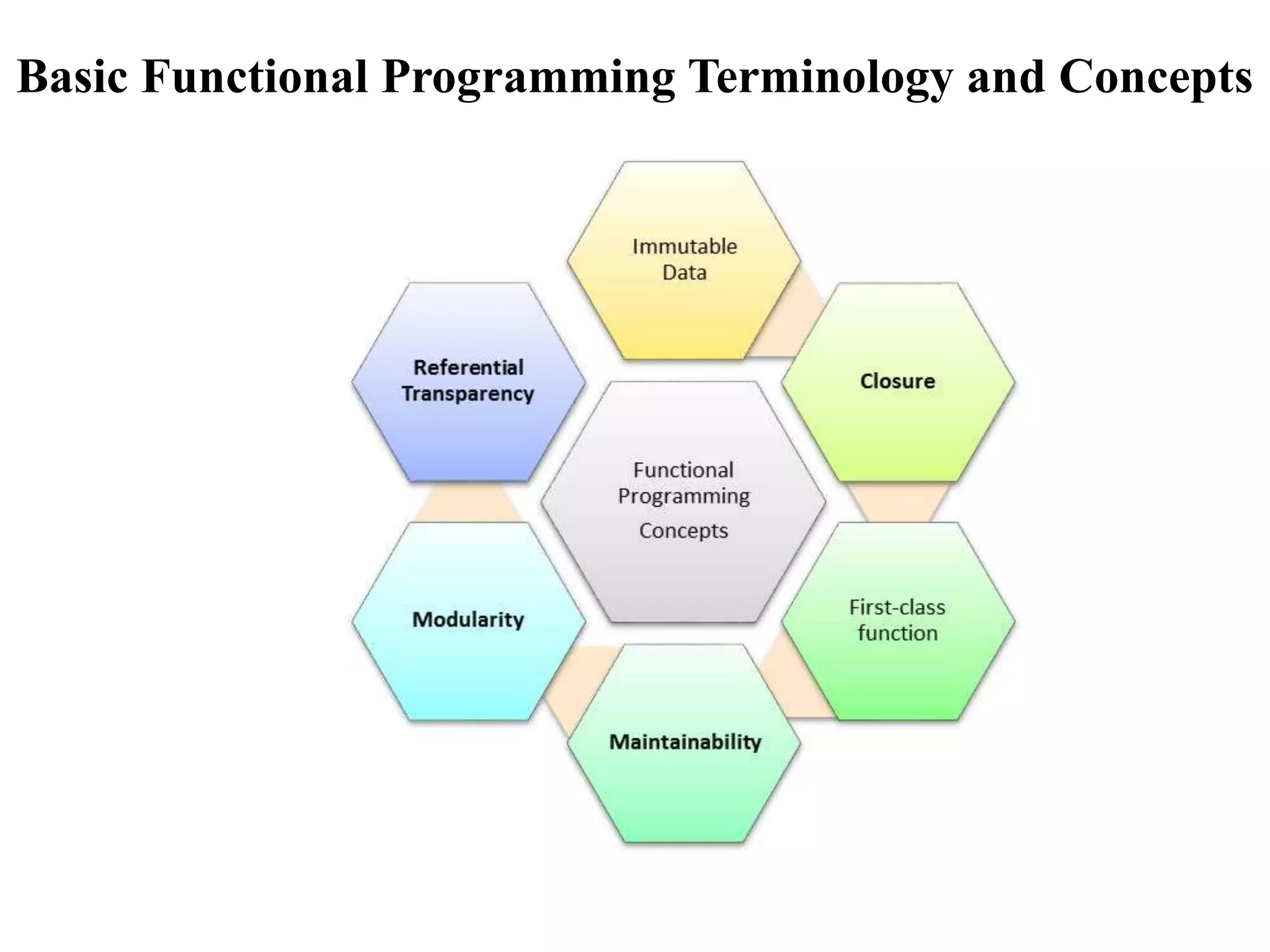
Basic Functional Programming Terminology and Concepts
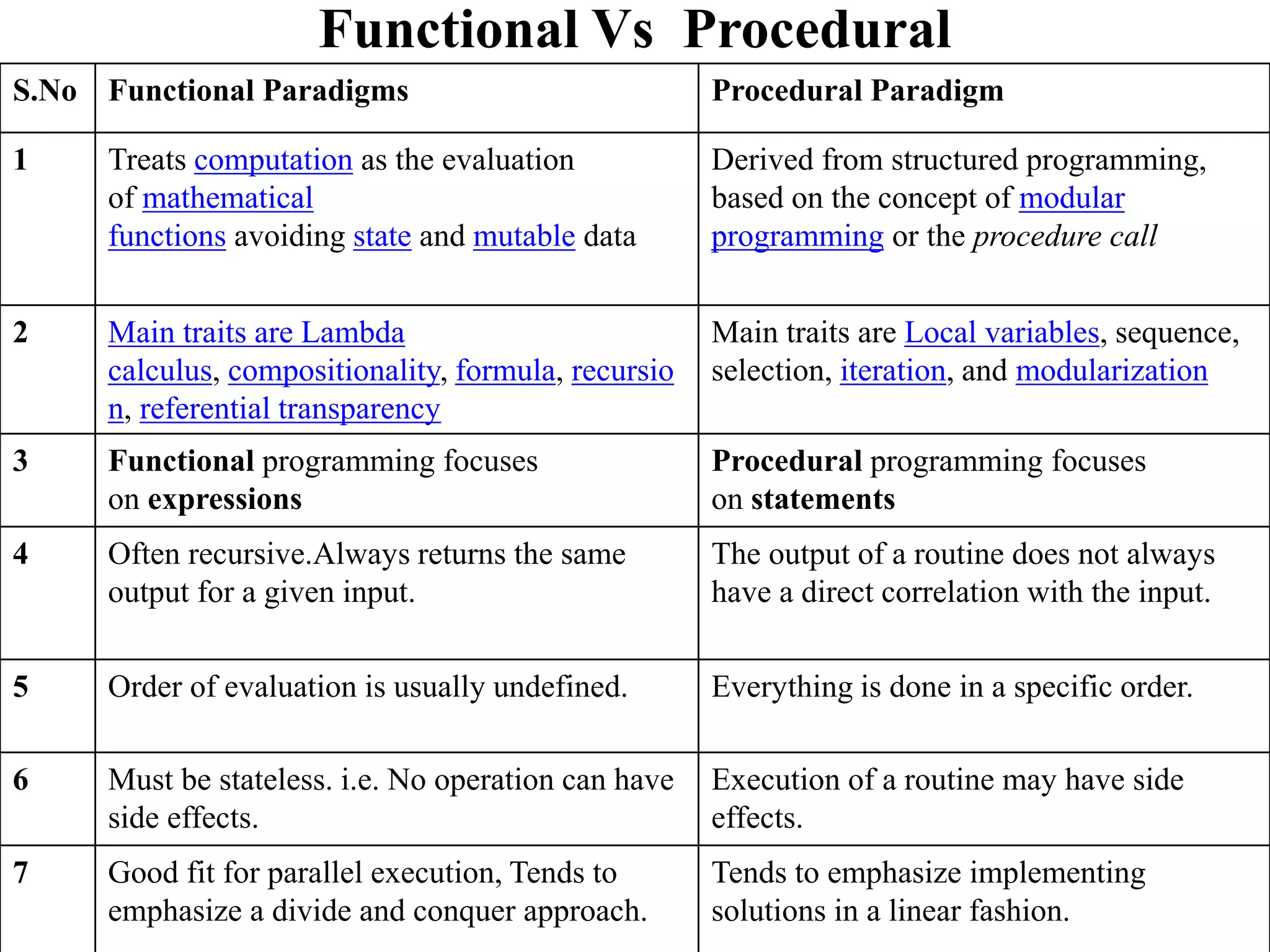
Functional Vs Procedural
S.No Functional Paradigms Procedural Paradigm
1 Treats computation as the evaluation
of mathematical
functions avoiding state and mutable data
Derived from structured programming,
based on the concept of modular
programming or the procedure call
2 Main traits are Lambda
calculus, compositionality, formula, recursio
n, referential transparency
Main traits are Local variables, sequence,
selection, iteration, and modularization
3 Functional programming focuses
on expressions
Procedural programming focuses
on statements
4 Often recursive.Always returns the same
output for a given input.
The output of a routine does not always
have a direct correlation with the input.
5 Order of evaluation is usually undefined. Everything is done in a specific order.
6 Must be stateless. i.e. No operation can have
side effects.
Execution of a routine may have side
effects.
7 Good fit for parallel execution, Tends to
emphasize a divide and conquer approach.
Tends to emphasize implementing
solutions in a linear fashion.
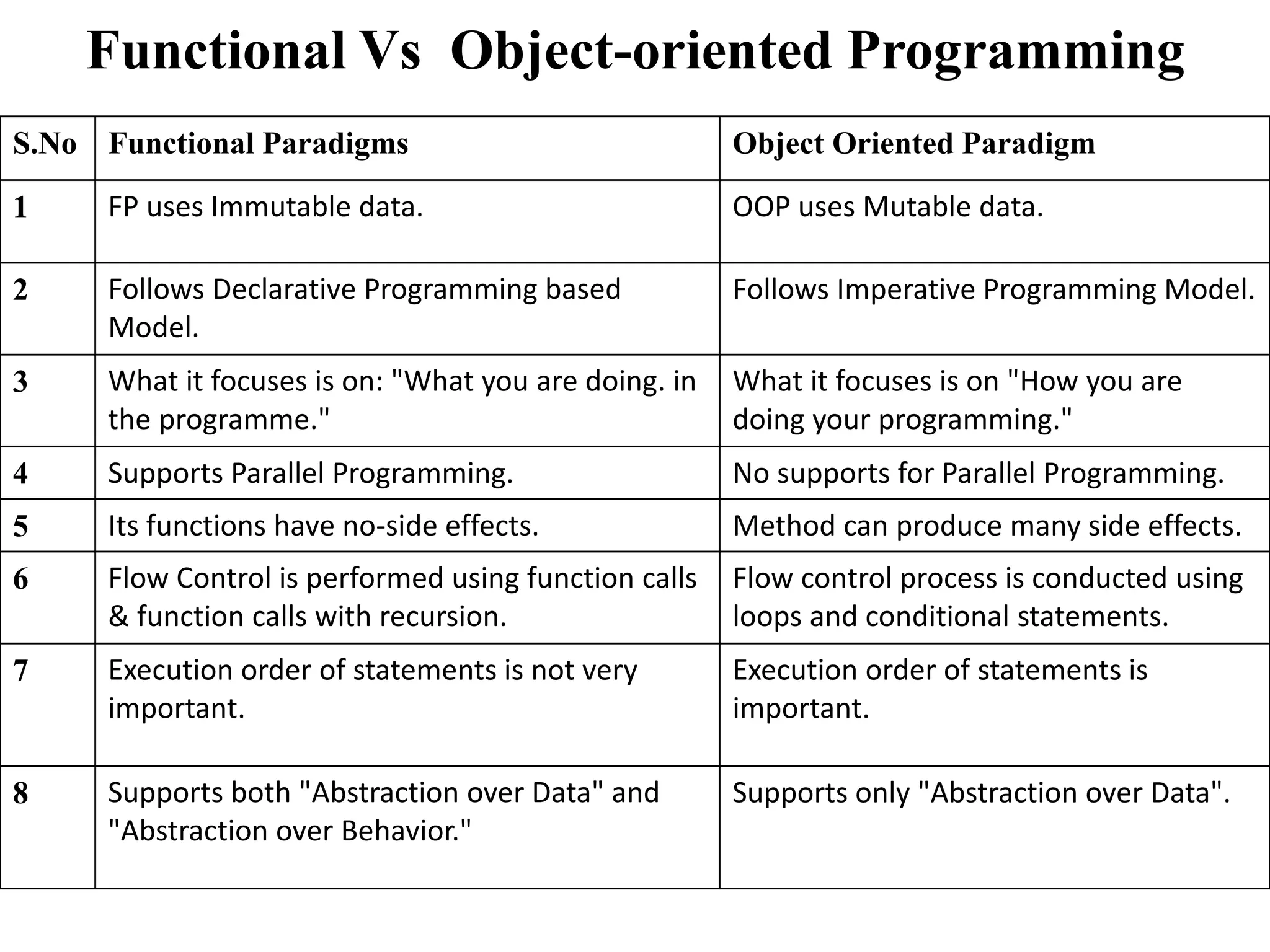
Functional Vs Object-oriented Programming
S.No Functional Paradigms Object Oriented Paradigm
1 FP uses Immutable data. OOP uses Mutable data.
2 Follows Declarative Programming based
Model.
Follows Imperative Programming Model.
3 What it focuses is on: "What you are doing. in
the programme."
What it focuses is on "How you are
doing your programming."
4 Supports Parallel Programming. No supports for Parallel Programming.
5 Its functions have no-side effects. Method can produce many side effects.
6 Flow Control is performed using function calls
& function calls with recursion.
Flow control process is conducted using
loops and conditional statements.
7 Execution order of statements is not very
important.
Execution order of statements is
important.
8 Supports both "Abstraction over Data" and
"Abstraction over Behavior."
Supports only "Abstraction over Data".
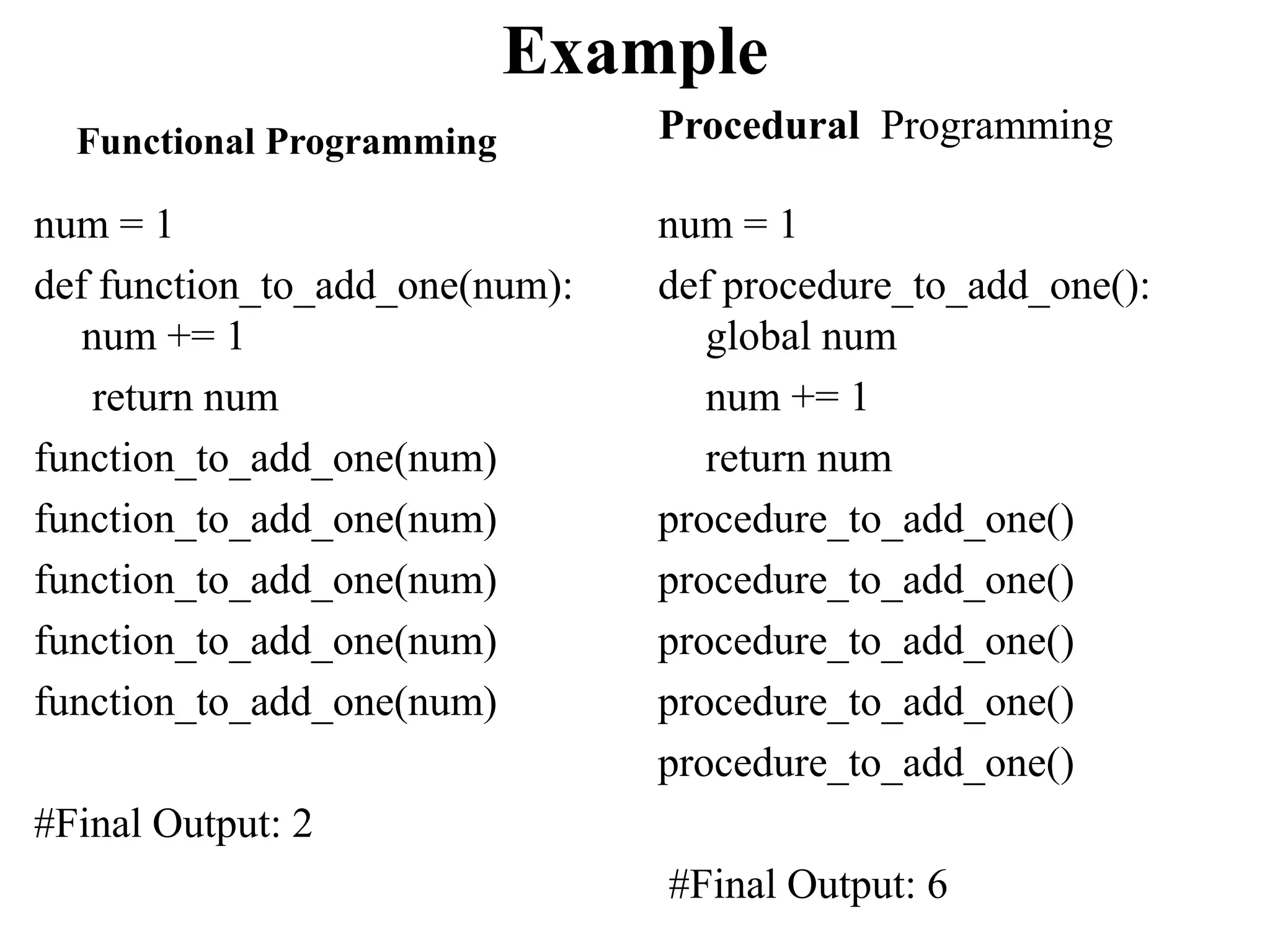
Example
Functional Programming
num = 1
def function_to_add_one(num):
num += 1
return num
function_to_add_one(num)
#Final Output: 2
Procedural Programming
num = 1
def procedure_to_add_one():
global num
num += 1
return num
procedure_to_add_one()
#Final Output: 6
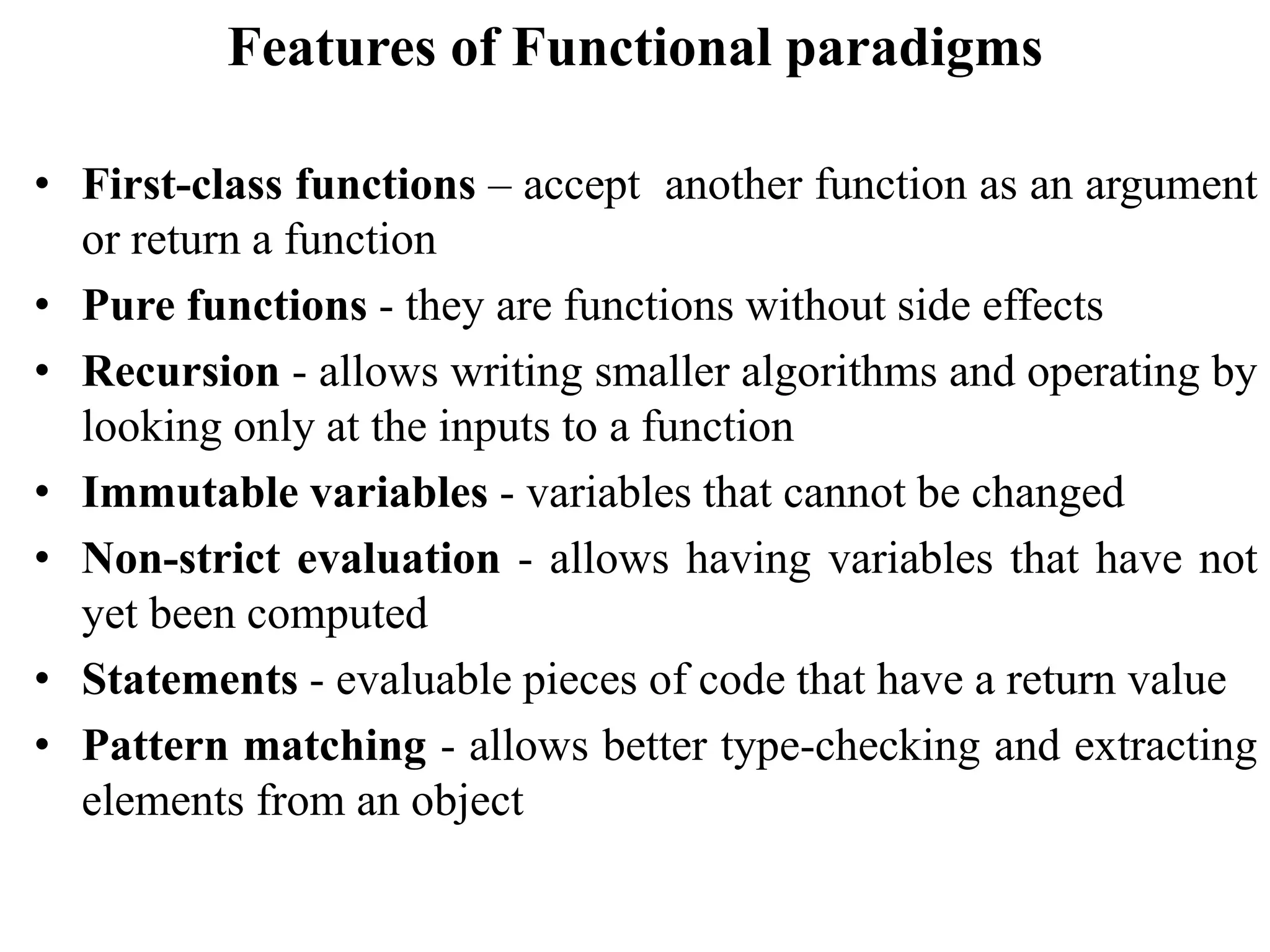
Features of Functional paradigms
• First-class functions – accept another function as an argument
or return a function
• Pure functions - they are functions without side effects
• Recursion - allows writing smaller algorithms and operating by
looking only at the inputs to a function
• Immutable variables - variables that cannot be changed
• Non-strict evaluation - allows having variables that have not
yet been computed
• Statements - evaluable pieces of code that have a return value
• Pattern matching - allows better type-checking and extracting
elements from an object
Functions as first class objects in python
• Using functions as first class objects means to
use them in the same manner that you use
data.
• So, You can pass them as parameters like
passing a function to another function as an
argument.
• >>> list(map(int, ["1", "2", "3"])) [1, 2, 3]
Pure Functions
• is idempotent — returns the same result if provided
the same arguments,
• has no side effects.
• If a function uses an object from a higher scope or
random numbers, communicates with files and so on,
it might be impure
• Since its result doesn’t depend only on its arguments.
Example
def multiply_2_pure(numbers):
new_numbers = []
for n in numbers:
new_numbers.append(n * 2)
return new_numbers
original_numbers = [1, 3, 5, 10]
changed_numbers =
multiply_2_pure(original_numbers)
print(original_numbers) # [1, 3, 5, 10]
print(changed_numbers) # [2, 6, 10, 20]
Anonymous Functions
• Anonymous (lambda) functions can be very convenient
for functional programming constructs.
• They don’t have names and usually are created ad-hoc,
with a single purpose.
• Exp1: lambda x, y: x + y
• Exp 2: >>> f = lambda x, y: x + y
>>> def g(x, y):
return x + y
Examples
Anonymous function assigned to a variable. Easy to pass around and
invoke when needed.
const myVar = function(){console.log(‘Anonymous function here!’)}
myVar()
Anonymous function as argument
• setInterval(function(){console.log(new Date().getTime())}, 1000);
Anonymous functions within a higher order function
function mealCall(meal){
return function(message){
return console.log(message + “ “ + meal + ‘!!’) }
}
const announceDinner = mealCall(‘dinner’)
const announceLunch = mealCall(‘breakfast’)
announceDinner(‘hey!, come and get your’)
announceLunch(‘Rise and shine! time for’)
Mathematical Background
• For example, if f(x)=x2and x is 3, the ordered pair is (-3,
9).
• A function is defined by its set of inputs, called the
domain.
• A set containing the set of outputs, and possibly
additional elements as members, is called its codomain.
• The set of all input-output pairs is called its graph.
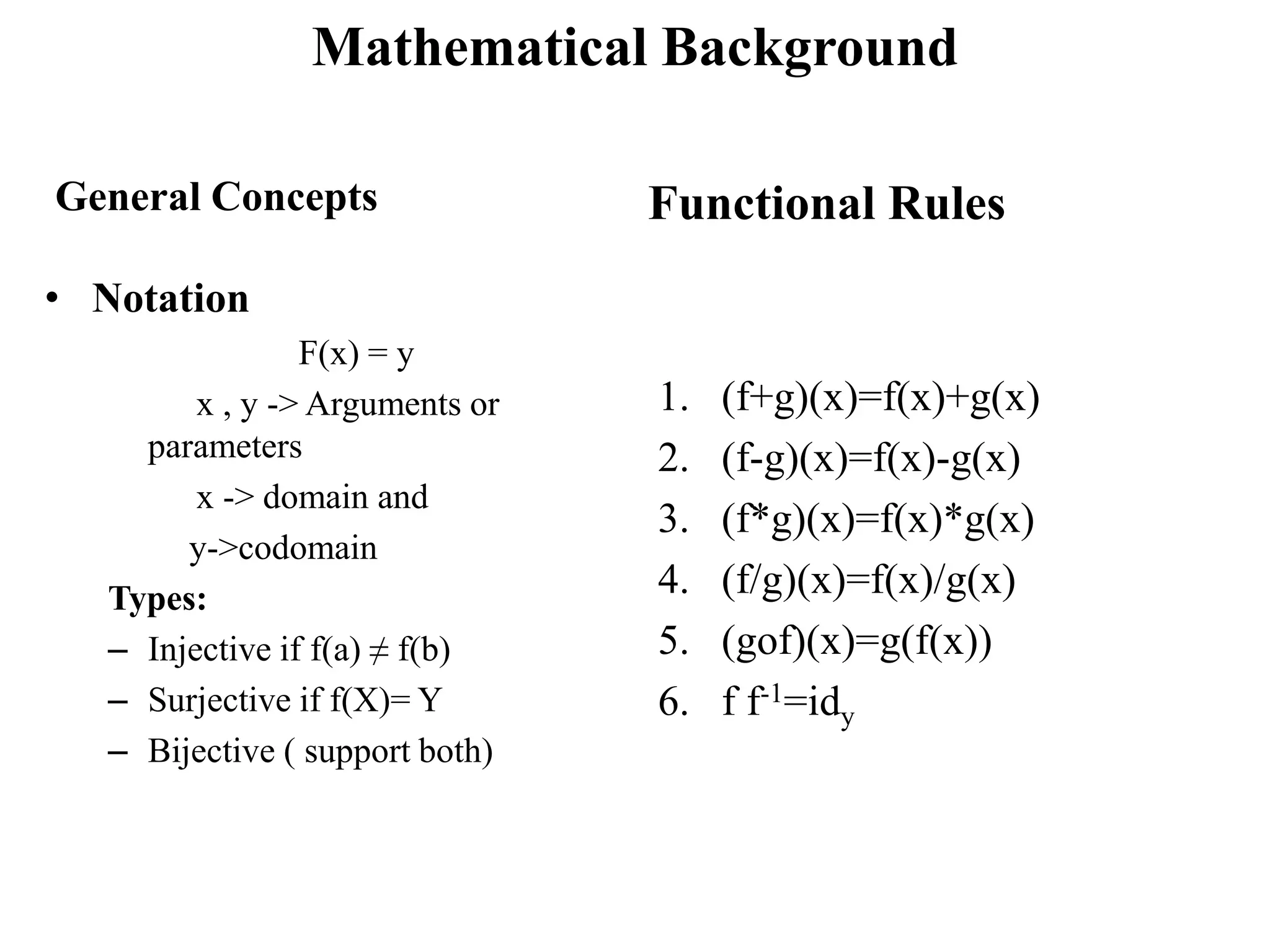
Mathematical Background
General Concepts
• Notation
F(x) = y
x , y -> Arguments or
parameters
x -> domain and
y->codomain
Types:
– Injective if f(a) ≠ f(b)
– Surjective if f(X)= Y
– Bijective ( support both)
Functional Rules
1. (f+g)(x)=f(x)+g(x)
2. (f-g)(x)=f(x)-g(x)
3. (f*g)(x)=f(x)*g(x)
4. (f/g)(x)=f(x)/g(x)
5. (gof)(x)=g(f(x))
6. f f-1=idy
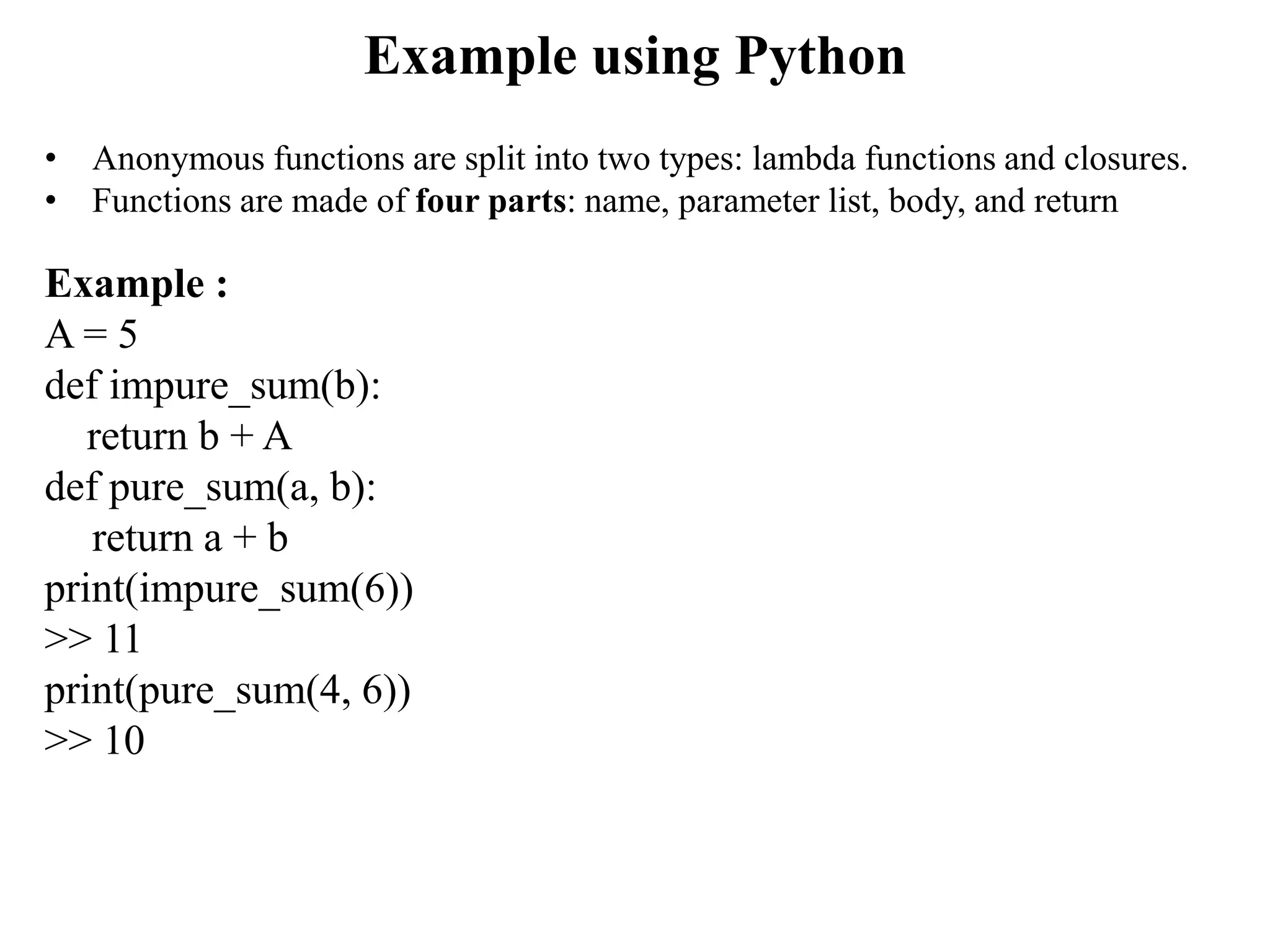
Example using Python
• Anonymous functions are split into two types: lambda functions and closures.
• Functions are made of four parts: name, parameter list, body, and return
Example :
A = 5
def impure_sum(b):
return b + A
def pure_sum(a, b):
return a + b
print(impure_sum(6))
>> 11
print(pure_sum(4, 6))
>> 10
Example Code
Function for computing the
average of two numbers:
(defun avg(X Y) (/ (+ X Y)
2.0))
Function is called by:
> (avg 10.0 20.0)
Function returns:
15.0
Functional style of getting a sum of a list:
new_lst = [1, 2, 3, 4]
def sum_list(lst):
if len(lst) == 1:
return lst[0]
else:
return lst[0] + sum_list(lst[1:])
print(sum_list(new_lst))
# or the pure functional way in python using
higher order function
import functools
print(functools.reduce(lambda x, y: x + y, new_lst))
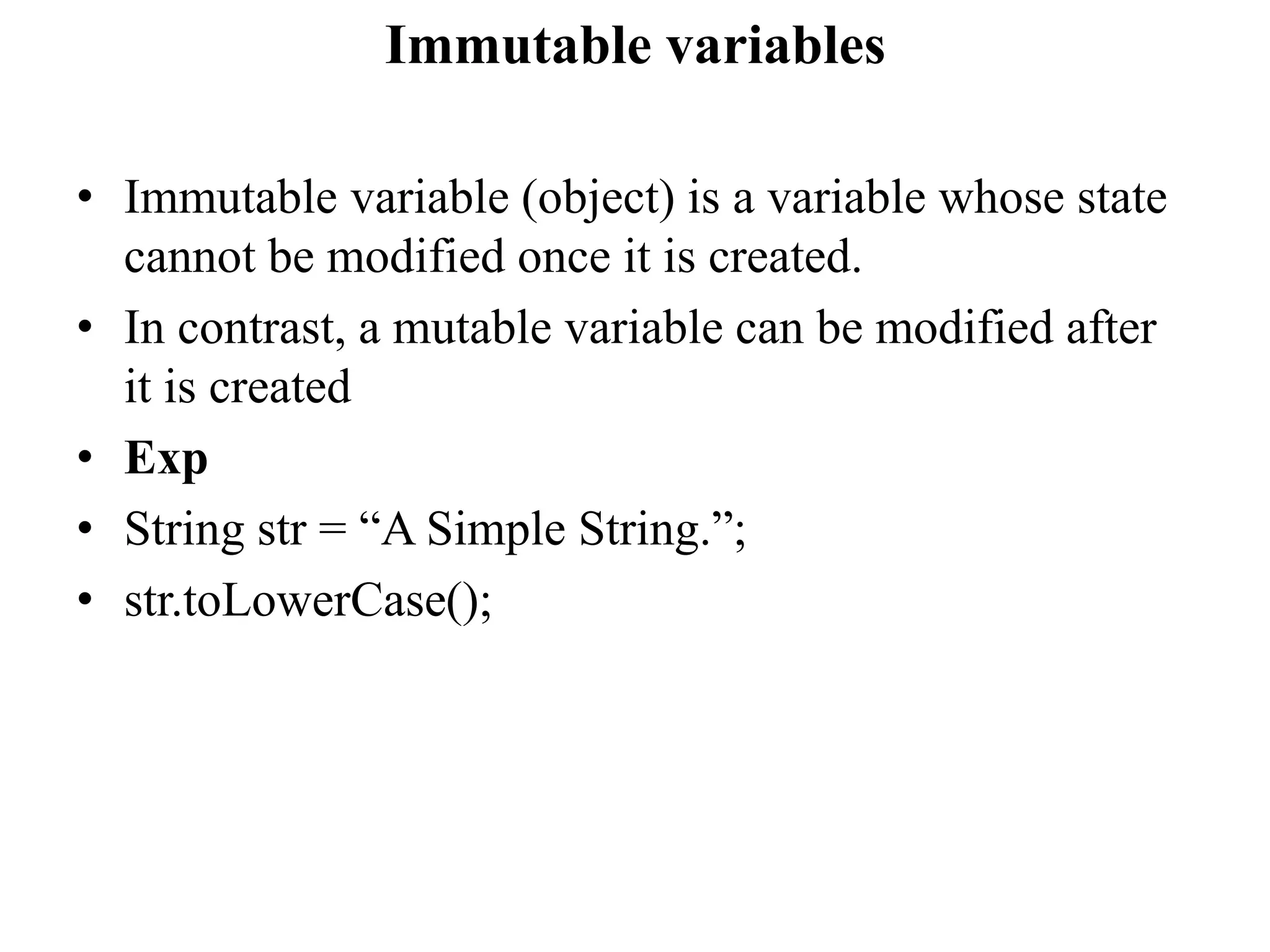
Immutable variables
• Immutable variable (object) is a variable whose state
cannot be modified once it is created.
• In contrast, a mutable variable can be modified after
it is created
• Exp
• String str = “A Simple String.”;
• str.toLowerCase();
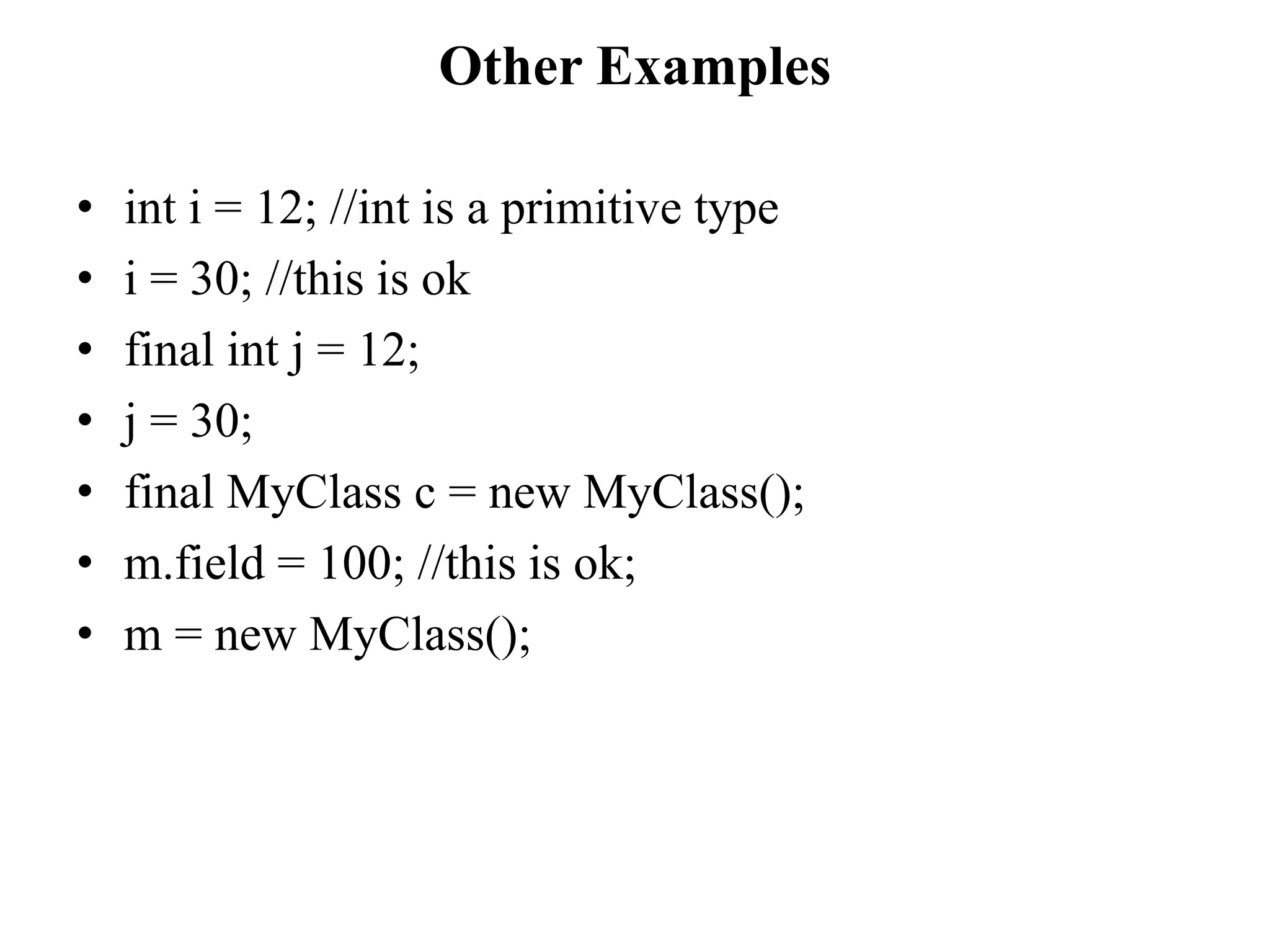
Other Examples
• int i = 12; //int is a primitive type
• i = 30; //this is ok
• final int j = 12;
• j = 30;
• final MyClass c = new MyClass();
• m.field = 100; //this is ok;
• m = new MyClass();
First-class function
• First-class functions are functions treated as objects
themselves,
• Meaning they can be passed as a parameter to another
function, returned as a result of a function
• It is said that a programming language has first-class
functions if it treats functions as first-class citizens.
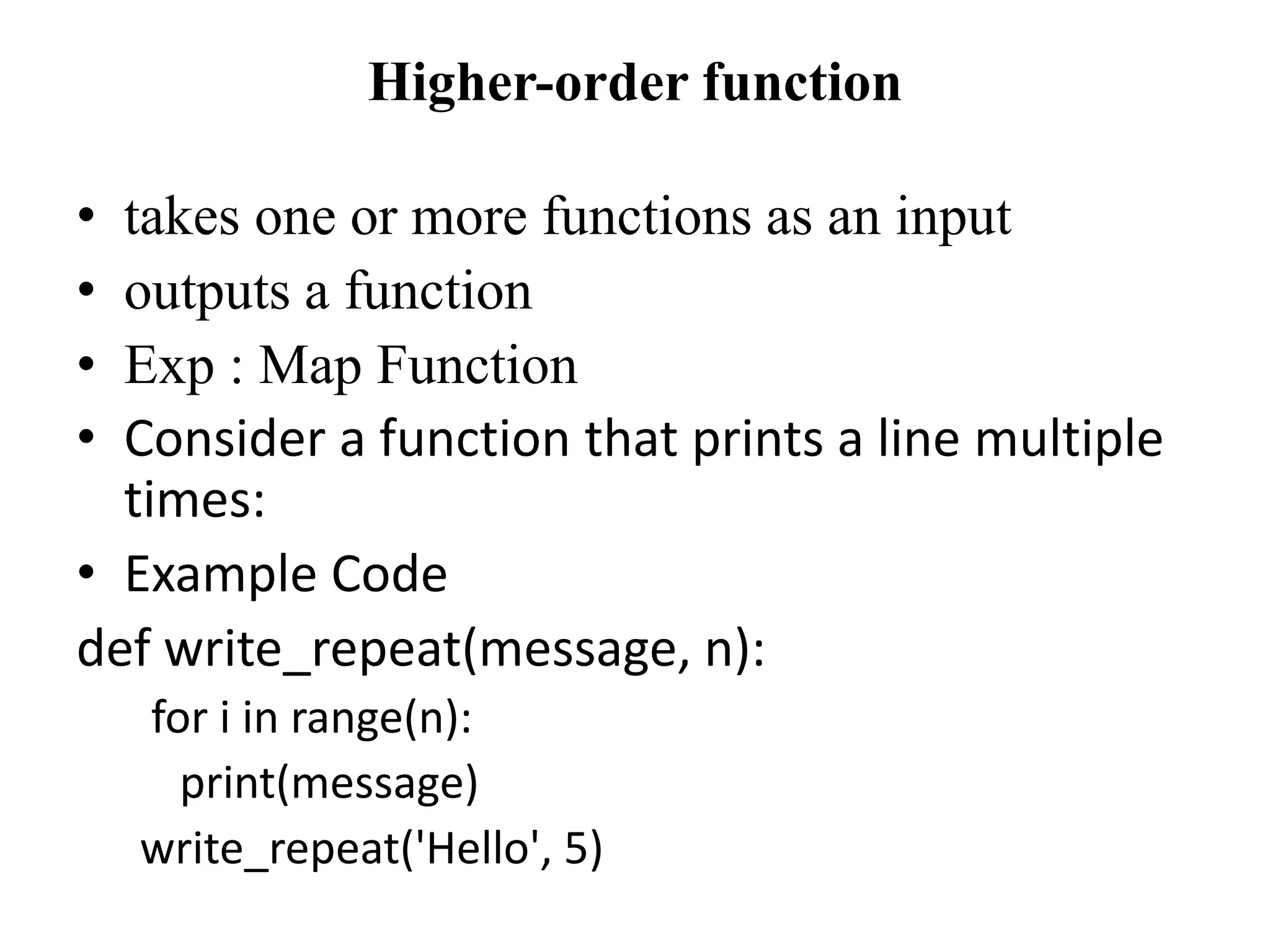
Higher-order function
• takes one or more functions as an input
• outputs a function
• Exp : Map Function
• Consider a function that prints a line multiple
times:
• Example Code
def write_repeat(message, n):
for i in range(n):
print(message)
write_repeat('Hello', 5)
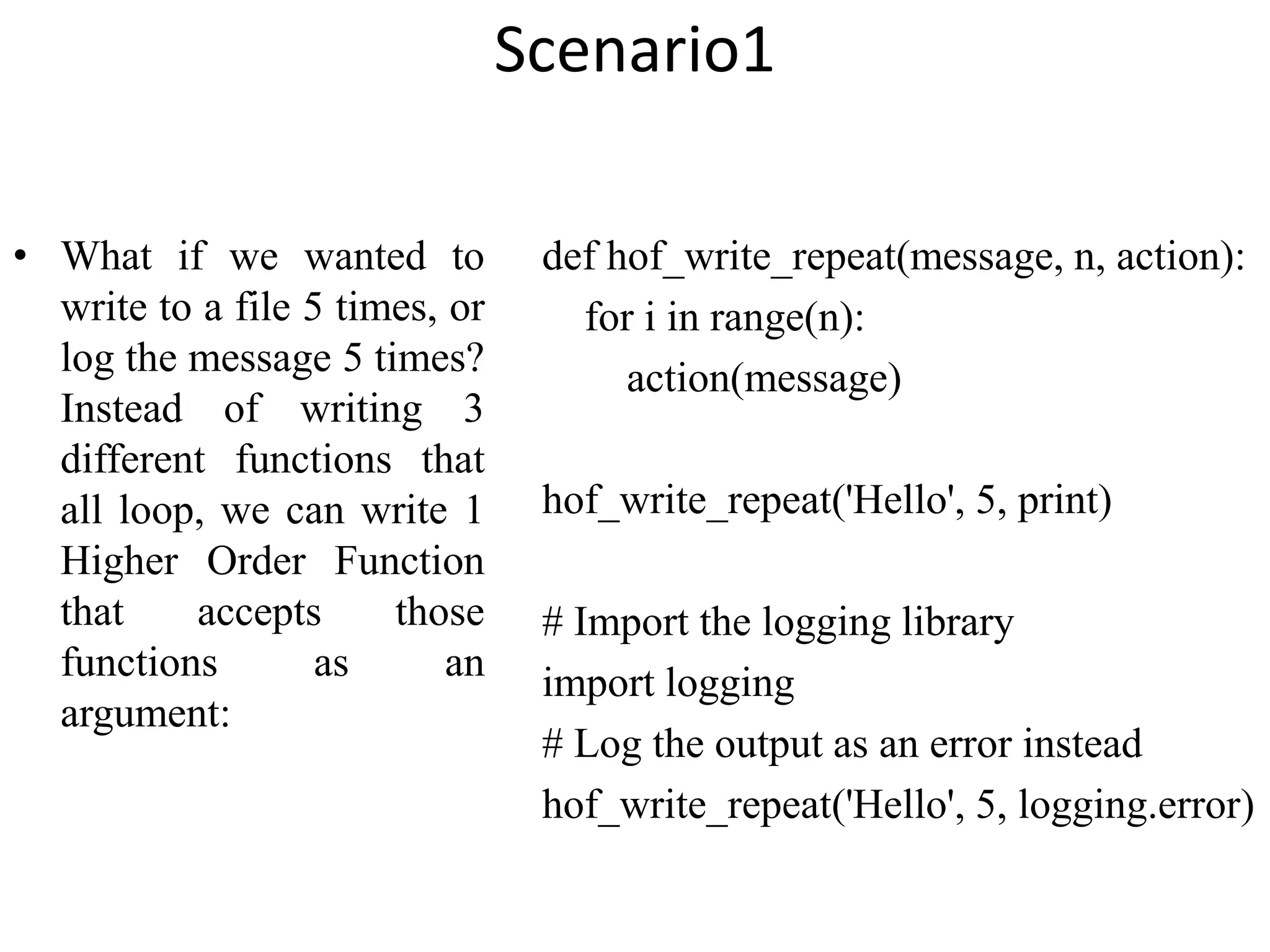
Scenario1
• What if we wanted to
write to a file 5 times, or
log the message 5 times?
Instead of writing 3
different functions that
all loop, we can write 1
Higher Order Function
that accepts those
functions as an
argument:
def hof_write_repeat(message, n, action):
for i in range(n):
action(message)
hof_write_repeat('Hello', 5, print)
# Import the logging library
import logging
# Log the output as an error instead
hof_write_repeat('Hello', 5, logging.error)
Scenario2
• Imagine that we're tasked
with creating functions
that increment numbers
in a list by 2, 5, and 10.
So instead of creating
many different increment
functions, we create 1
Higher Order Function:
def hof_add(increment):
# Create a function that loops and adds
the increment
def add_increment(numbers):
new_numbers = []
for n in numbers:
new_numbers.append(n +
increment)
return new_numbers
# We return the function as we do any
other value
return add_increment
add2=hof_add(2)
print(add2([23, 88])) # [25, 90]
add5 = hof_add(5)
print(add5([23, 88])) # [28, 93]
add10 = hof_add(10)
print(add10([23, 88])) # [33, 98]
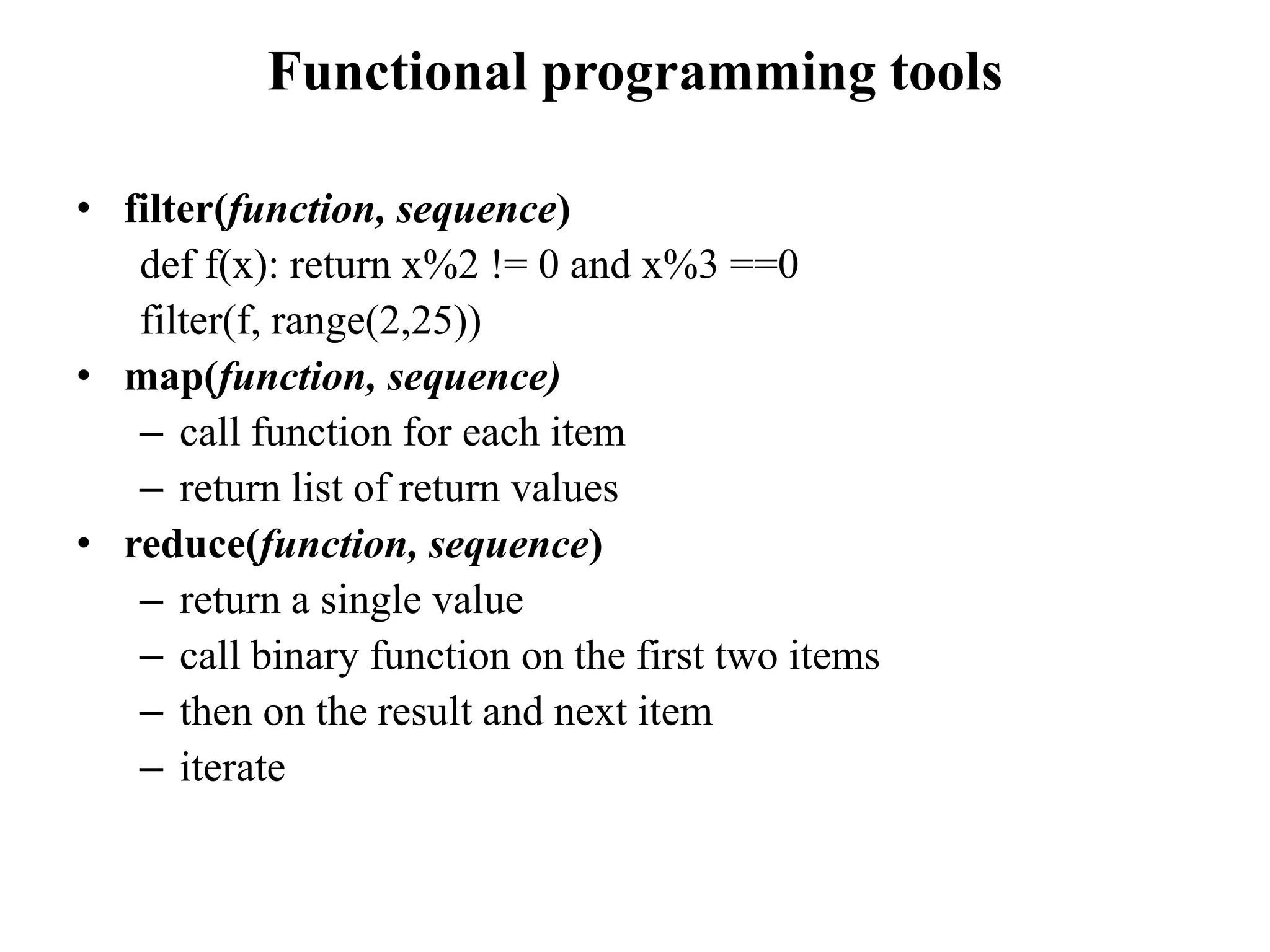
Functional programming tools
• filter(function, sequence)
def f(x): return x%2 != 0 and x%3 ==0
filter(f, range(2,25))
• map(function, sequence)
– call function for each item
– return list of return values
• reduce(function, sequence)
– return a single value
– call binary function on the first two items
– then on the result and next item
– iterate
Lambda Expression
# Using `def` (old way).
def old_add(a, b):
return a + b
# Using `lambda` (new way).
new_add = lambda a, b: a + b old_add(10, 5) == new_add(10, 5)
>> True
unsorted = [('b', 6), ('a', 10), ('d', 0), ('c', 4)]
print(sorted(unsorted, key=lambda x: x[1]))
>> [('d', 0), ('c', 4), ('b', 6), ('a', 10)]
Map Function
# Pseudocode for map.
def map(func, seq):
return Map(
func(x)
for x in seq
)
Example:
values = [1, 2, 3, 4, 5]
add_10 = list(map(lambda x: x + 10, values))
add_20 = list(map(lambda x: x + 20, values))
print(add_10)
>> [11, 12, 13, 14, 15]
print(add_20)
>> [21, 22, 23, 24, 25]
•Takes in an iterable (ie. list), and creates a new iterable object, a
special map object.
• The new object has the first-class function applied to every element.
Filter Function
# Pseudocode for map.
return Map(
x for x in seq
if evaluate(x) is True
)
Example:
even = list(filter(lambda x: x % 2 == 0, values))
odd = list(filter(lambda x: x % 2 == 1, values))
print(even)
>> [2, 4, 6, 8, 10]
print(odd)
>> [1, 3, 5, 7, 9]
•Takes in an iterable (ie. list), and creates a new iterable object
• The new object has the first-class function applied to every element.
Advantages
• Allows you to avoid confusing problems and errors in the code
• Easier to test and execute Unit testing and debug FP Code.
• Parallel processing and concurrency
• Hot code deployment and fault tolerance
• Offers better modularity with a shorter code
• Increased productivity of the developer
• Supports Nested Functions
• Functional Constructs like Lazy Map & Lists, etc.
• Allows effective use of Lambda Calculus
Disadvantages
• Perhaps less efficiency
• Problems involving many variables or a lot of sequential
activity are sometimes easier to handle imperatively
• Functional programming paradigm is not easy, so it is
difficult to understand for the beginner
• Hard to maintain as many objects evolve during the
coding
• Needs lots of mocking and extensive environmental setup
• Re-use is very complicated and needs constantly
refactoring
• Objects may not represent the problem correctly
Transforming code from imperative to functional
1. Introduce higher-order functions.
2. Convert existing methods into pure functions.
3. Convert loops over to recursive/tail-recursive
methods (if possible).
4. Convert mutable variables into immutable
variables.
5. Use pattern matching (if possible).
Sample Scenario
1) (The MyTriangle module) Create a module named MyTriangle that contains the
following two functions:
# Returns true if the sum of any two sides is greater than the third side.
def isValid(side1, side2, side3):
# Returns the area of the triangle.
def area(side1, side2, side3):
Write a test program that reads three sides for a triangle and computes the area if the
input is valid. Otherwise, it displays that the input is invalid.
2) A prime number is called a Mersenne prime if it can be written in the form for some
positive integer p. Write a program that finds all Mersenne primes with and displays the
output as follows:
p 2^p - 1
2 3
3 7
5 31
37
Sample Scenarios
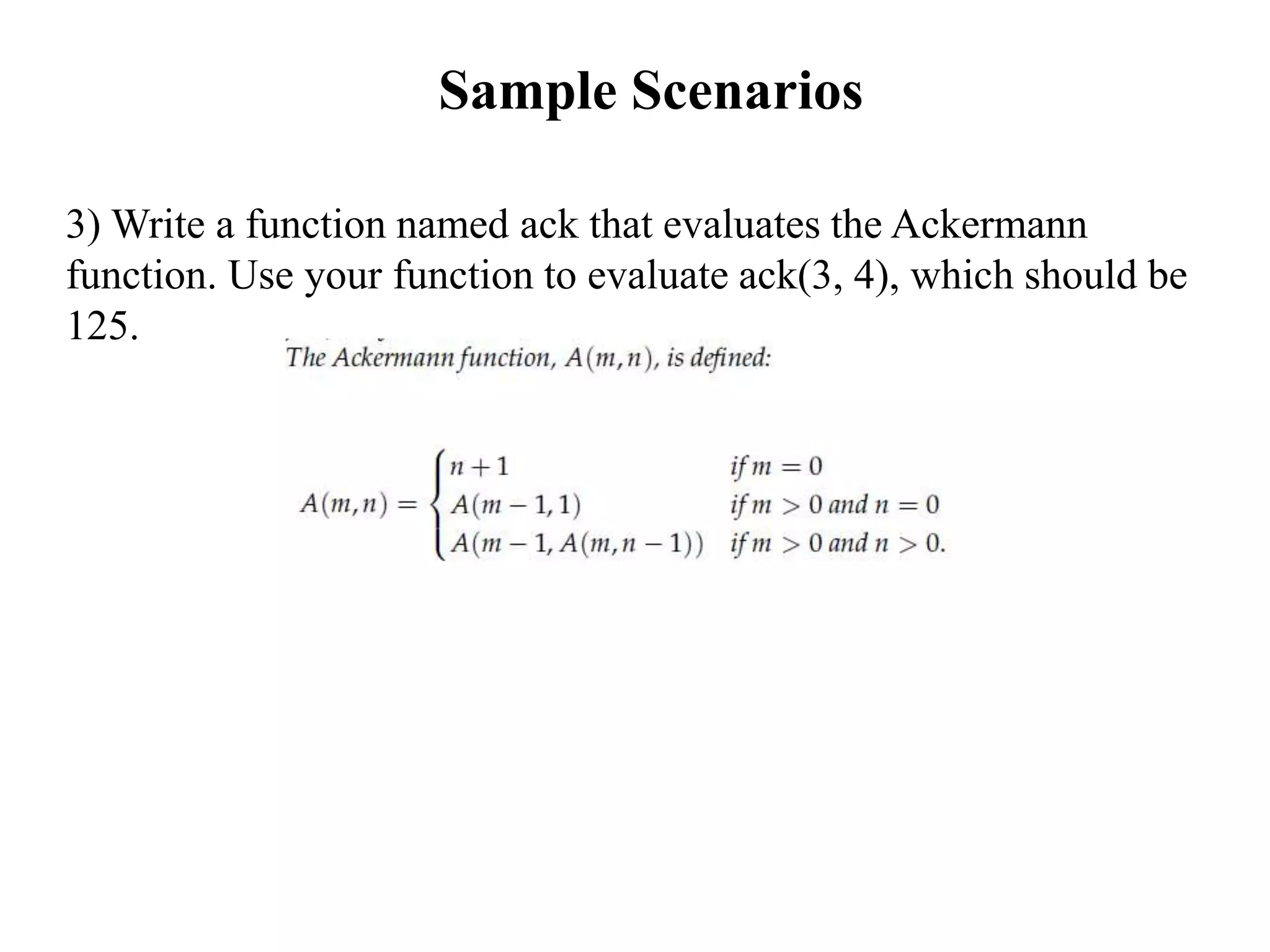
3) Write a function named ack that evaluates the Ackermann
function. Use your function to evaluate ack(3, 4), which should be
125.
Thank you

Functional Programming.pptx

  • 1.
    SRM Institute ofScience and Technology School of Computing Advanced Programming Practice-18CSC207J
  • 2.
    Paradigm types Unit IV –Functional Programming Paradigm [Text Book :1] – Logic Programming Paradigm [Text Book : 1& 3] – Dependent Type Programming Paradigm – Network Programming Paradigm [ Text Book :4] Text Book: 1. Elad Shalom, A Review of Programming Paradigms throughout the History: With a suggestion Toward a Future Approach, Kindle Edition, 2018 2. John Goerzen, Brandon Rhodes, Foundations of Python Network Programming: The comprehensive guide to building network applications with Python, 2nd ed., Kindle Edition, 2010 3. Amit Saha, Doing Math with Python: Use Programming to Explore Algebra, Statistics,Calculus and More, Kindle Edition, 2015
  • 3.
    Functional Programming Paradigm Unit-III(15 Session) Session 11-15 cover the following topics:- – Definition - S11-SLO1 – Sequence of Commands – S11-SLO2 – map(), reduce(), filter(), lambda – S12-SLO1 – partial, functools – S12-SLO2 – Other languages:F#, Clojure, Haskell – S13-SLO1 – Demo: Functional Programming in Python - S13-SLO2 Lab 9: Functional Programming ( Case Study) (S14-15) Assignment : Comparative study of Functional programming in F#, Clojure, Haskell – TextBook: Shalom, Elad. A Review of Programming Paradigms Throughout the History: With a Suggestion Toward a Future Approach, Kindle Edition
  • 4.
    Functional Programming Paradigm( TF1) Definition • Mainly treat computation to evaluate mathematical Functions • Avoids changing-state and mutable data • Called as declarative programming paradigm • Output depends on argument passing • Calling same function several times with same values produces same result • Uses expressions or declarations rather than statements as in imperative languages
  • 5.
    Concepts • It viewsall subprograms as functions in the mathematical sense • Take in arguments and return a single solution. • Solution returned is based entirely on input, and the time at which a function is called has no relevance. • The computational model is therefore one of function application and reduction.
  • 6.
    Characteristics of FunctionalProgramming • Functional programming method focuses on results, not the process • Emphasis is on what is to be computed • Data is immutable • Functional programming Decompose the problem into 'functions • It is built on the concept of mathematical functions which uses conditional expressions and recursion to do perform the calculation • It does not support iteration like loop statements and conditional statements like If-Else
  • 7.
    History • The foundationfor Functional Programming is Lambda Calculus. It was developed in the 1930s for the functional application, definition, and recursion • LISP was the first functional programming language. McCarthy designed it in 1960 • In the late 70's researchers at the University of Edinburgh defined the ML(Meta Language) • In the early 80's Hope language adds algebraic data types for recursion and equational reasoning • In the year 2004 Innovation of Functional language 'Scala.'
  • 8.
    Real Time applications •Database processing • Financial modeling • Statistical analysis and • Bio-informatics
  • 9.
    Functional Programming Languages •Haskell • SML • Clojure • Scala • Erlang • Clean • F# • ML/OCaml Lisp / Scheme • XSLT • SQL • Mathematica
  • 10.
    Basic Functional ProgrammingTerminology and Concepts
  • 11.
    Functional Vs Procedural S.NoFunctional Paradigms Procedural Paradigm 1 Treats computation as the evaluation of mathematical functions avoiding state and mutable data Derived from structured programming, based on the concept of modular programming or the procedure call 2 Main traits are Lambda calculus, compositionality, formula, recursio n, referential transparency Main traits are Local variables, sequence, selection, iteration, and modularization 3 Functional programming focuses on expressions Procedural programming focuses on statements 4 Often recursive.Always returns the same output for a given input. The output of a routine does not always have a direct correlation with the input. 5 Order of evaluation is usually undefined. Everything is done in a specific order. 6 Must be stateless. i.e. No operation can have side effects. Execution of a routine may have side effects. 7 Good fit for parallel execution, Tends to emphasize a divide and conquer approach. Tends to emphasize implementing solutions in a linear fashion.
  • 12.
    Functional Vs Object-orientedProgramming S.No Functional Paradigms Object Oriented Paradigm 1 FP uses Immutable data. OOP uses Mutable data. 2 Follows Declarative Programming based Model. Follows Imperative Programming Model. 3 What it focuses is on: "What you are doing. in the programme." What it focuses is on "How you are doing your programming." 4 Supports Parallel Programming. No supports for Parallel Programming. 5 Its functions have no-side effects. Method can produce many side effects. 6 Flow Control is performed using function calls & function calls with recursion. Flow control process is conducted using loops and conditional statements. 7 Execution order of statements is not very important. Execution order of statements is important. 8 Supports both "Abstraction over Data" and "Abstraction over Behavior." Supports only "Abstraction over Data".
  • 13.
    Example Functional Programming num =1 def function_to_add_one(num): num += 1 return num function_to_add_one(num) function_to_add_one(num) function_to_add_one(num) function_to_add_one(num) function_to_add_one(num) #Final Output: 2 Procedural Programming num = 1 def procedure_to_add_one(): global num num += 1 return num procedure_to_add_one() procedure_to_add_one() procedure_to_add_one() procedure_to_add_one() procedure_to_add_one() #Final Output: 6
  • 14.
    Features of Functionalparadigms • First-class functions – accept another function as an argument or return a function • Pure functions - they are functions without side effects • Recursion - allows writing smaller algorithms and operating by looking only at the inputs to a function • Immutable variables - variables that cannot be changed • Non-strict evaluation - allows having variables that have not yet been computed • Statements - evaluable pieces of code that have a return value • Pattern matching - allows better type-checking and extracting elements from an object
  • 15.
    Functions as firstclass objects in python • Using functions as first class objects means to use them in the same manner that you use data. • So, You can pass them as parameters like passing a function to another function as an argument. • >>> list(map(int, ["1", "2", "3"])) [1, 2, 3]
  • 16.
    Pure Functions • isidempotent — returns the same result if provided the same arguments, • has no side effects. • If a function uses an object from a higher scope or random numbers, communicates with files and so on, it might be impure • Since its result doesn’t depend only on its arguments.
  • 17.
    Example def multiply_2_pure(numbers): new_numbers =[] for n in numbers: new_numbers.append(n * 2) return new_numbers original_numbers = [1, 3, 5, 10] changed_numbers = multiply_2_pure(original_numbers) print(original_numbers) # [1, 3, 5, 10] print(changed_numbers) # [2, 6, 10, 20]
  • 18.
    Anonymous Functions • Anonymous(lambda) functions can be very convenient for functional programming constructs. • They don’t have names and usually are created ad-hoc, with a single purpose. • Exp1: lambda x, y: x + y • Exp 2: >>> f = lambda x, y: x + y >>> def g(x, y): return x + y
  • 19.
    Examples Anonymous function assignedto a variable. Easy to pass around and invoke when needed. const myVar = function(){console.log(‘Anonymous function here!’)} myVar() Anonymous function as argument • setInterval(function(){console.log(new Date().getTime())}, 1000); Anonymous functions within a higher order function function mealCall(meal){ return function(message){ return console.log(message + “ “ + meal + ‘!!’) } } const announceDinner = mealCall(‘dinner’) const announceLunch = mealCall(‘breakfast’) announceDinner(‘hey!, come and get your’) announceLunch(‘Rise and shine! time for’)
  • 20.
    Mathematical Background • Forexample, if f(x)=x2and x is 3, the ordered pair is (-3, 9). • A function is defined by its set of inputs, called the domain. • A set containing the set of outputs, and possibly additional elements as members, is called its codomain. • The set of all input-output pairs is called its graph.
  • 21.
    Mathematical Background General Concepts •Notation F(x) = y x , y -> Arguments or parameters x -> domain and y->codomain Types: – Injective if f(a) ≠ f(b) – Surjective if f(X)= Y – Bijective ( support both) Functional Rules 1. (f+g)(x)=f(x)+g(x) 2. (f-g)(x)=f(x)-g(x) 3. (f*g)(x)=f(x)*g(x) 4. (f/g)(x)=f(x)/g(x) 5. (gof)(x)=g(f(x)) 6. f f-1=idy
  • 22.
    Example using Python •Anonymous functions are split into two types: lambda functions and closures. • Functions are made of four parts: name, parameter list, body, and return Example : A = 5 def impure_sum(b): return b + A def pure_sum(a, b): return a + b print(impure_sum(6)) >> 11 print(pure_sum(4, 6)) >> 10
  • 23.
    Example Code Function forcomputing the average of two numbers: (defun avg(X Y) (/ (+ X Y) 2.0)) Function is called by: > (avg 10.0 20.0) Function returns: 15.0 Functional style of getting a sum of a list: new_lst = [1, 2, 3, 4] def sum_list(lst): if len(lst) == 1: return lst[0] else: return lst[0] + sum_list(lst[1:]) print(sum_list(new_lst)) # or the pure functional way in python using higher order function import functools print(functools.reduce(lambda x, y: x + y, new_lst))
  • 24.
    Immutable variables • Immutablevariable (object) is a variable whose state cannot be modified once it is created. • In contrast, a mutable variable can be modified after it is created • Exp • String str = “A Simple String.”; • str.toLowerCase();
  • 25.
    Other Examples • inti = 12; //int is a primitive type • i = 30; //this is ok • final int j = 12; • j = 30; • final MyClass c = new MyClass(); • m.field = 100; //this is ok; • m = new MyClass();
  • 26.
    First-class function • First-classfunctions are functions treated as objects themselves, • Meaning they can be passed as a parameter to another function, returned as a result of a function • It is said that a programming language has first-class functions if it treats functions as first-class citizens.
  • 27.
    Higher-order function • takesone or more functions as an input • outputs a function • Exp : Map Function • Consider a function that prints a line multiple times: • Example Code def write_repeat(message, n): for i in range(n): print(message) write_repeat('Hello', 5)
  • 28.
    Scenario1 • What ifwe wanted to write to a file 5 times, or log the message 5 times? Instead of writing 3 different functions that all loop, we can write 1 Higher Order Function that accepts those functions as an argument: def hof_write_repeat(message, n, action): for i in range(n): action(message) hof_write_repeat('Hello', 5, print) # Import the logging library import logging # Log the output as an error instead hof_write_repeat('Hello', 5, logging.error)
  • 29.
    Scenario2 • Imagine thatwe're tasked with creating functions that increment numbers in a list by 2, 5, and 10. So instead of creating many different increment functions, we create 1 Higher Order Function: def hof_add(increment): # Create a function that loops and adds the increment def add_increment(numbers): new_numbers = [] for n in numbers: new_numbers.append(n + increment) return new_numbers # We return the function as we do any other value return add_increment add2=hof_add(2) print(add2([23, 88])) # [25, 90] add5 = hof_add(5) print(add5([23, 88])) # [28, 93] add10 = hof_add(10) print(add10([23, 88])) # [33, 98]
  • 30.
    Functional programming tools •filter(function, sequence) def f(x): return x%2 != 0 and x%3 ==0 filter(f, range(2,25)) • map(function, sequence) – call function for each item – return list of return values • reduce(function, sequence) – return a single value – call binary function on the first two items – then on the result and next item – iterate
  • 31.
    Lambda Expression # Using`def` (old way). def old_add(a, b): return a + b # Using `lambda` (new way). new_add = lambda a, b: a + b old_add(10, 5) == new_add(10, 5) >> True unsorted = [('b', 6), ('a', 10), ('d', 0), ('c', 4)] print(sorted(unsorted, key=lambda x: x[1])) >> [('d', 0), ('c', 4), ('b', 6), ('a', 10)]
  • 32.
    Map Function # Pseudocodefor map. def map(func, seq): return Map( func(x) for x in seq ) Example: values = [1, 2, 3, 4, 5] add_10 = list(map(lambda x: x + 10, values)) add_20 = list(map(lambda x: x + 20, values)) print(add_10) >> [11, 12, 13, 14, 15] print(add_20) >> [21, 22, 23, 24, 25] •Takes in an iterable (ie. list), and creates a new iterable object, a special map object. • The new object has the first-class function applied to every element.
  • 33.
    Filter Function # Pseudocodefor map. return Map( x for x in seq if evaluate(x) is True ) Example: even = list(filter(lambda x: x % 2 == 0, values)) odd = list(filter(lambda x: x % 2 == 1, values)) print(even) >> [2, 4, 6, 8, 10] print(odd) >> [1, 3, 5, 7, 9] •Takes in an iterable (ie. list), and creates a new iterable object • The new object has the first-class function applied to every element.
  • 34.
    Advantages • Allows youto avoid confusing problems and errors in the code • Easier to test and execute Unit testing and debug FP Code. • Parallel processing and concurrency • Hot code deployment and fault tolerance • Offers better modularity with a shorter code • Increased productivity of the developer • Supports Nested Functions • Functional Constructs like Lazy Map & Lists, etc. • Allows effective use of Lambda Calculus
  • 35.
    Disadvantages • Perhaps lessefficiency • Problems involving many variables or a lot of sequential activity are sometimes easier to handle imperatively • Functional programming paradigm is not easy, so it is difficult to understand for the beginner • Hard to maintain as many objects evolve during the coding • Needs lots of mocking and extensive environmental setup • Re-use is very complicated and needs constantly refactoring • Objects may not represent the problem correctly
  • 36.
    Transforming code fromimperative to functional 1. Introduce higher-order functions. 2. Convert existing methods into pure functions. 3. Convert loops over to recursive/tail-recursive methods (if possible). 4. Convert mutable variables into immutable variables. 5. Use pattern matching (if possible).
  • 37.
    Sample Scenario 1) (TheMyTriangle module) Create a module named MyTriangle that contains the following two functions: # Returns true if the sum of any two sides is greater than the third side. def isValid(side1, side2, side3): # Returns the area of the triangle. def area(side1, side2, side3): Write a test program that reads three sides for a triangle and computes the area if the input is valid. Otherwise, it displays that the input is invalid. 2) A prime number is called a Mersenne prime if it can be written in the form for some positive integer p. Write a program that finds all Mersenne primes with and displays the output as follows: p 2^p - 1 2 3 3 7 5 31 37
  • 38.
    Sample Scenarios 3) Writea function named ack that evaluates the Ackermann function. Use your function to evaluate ack(3, 4), which should be 125.
  • 39.