Functional Design Patterns
@ScottWlaschin
fsharpforfunandprofit.com
DevTernity 2018 Edition
This talk
A whirlwind tour of many sights
Don't worry if you don't understand everything
HOW I GOT HERE
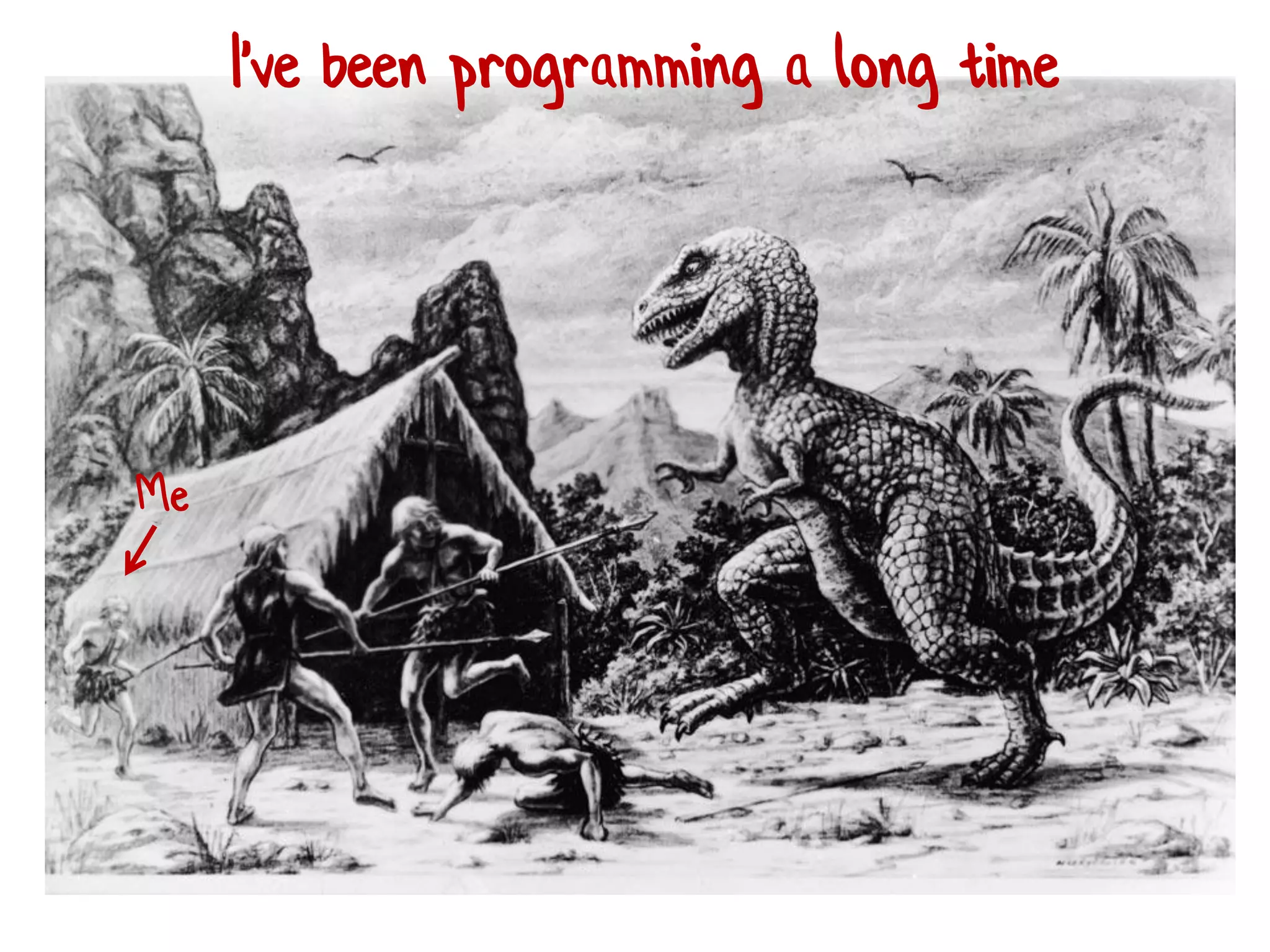
Me
I've been programming a long time
I used to be a normal programmer...
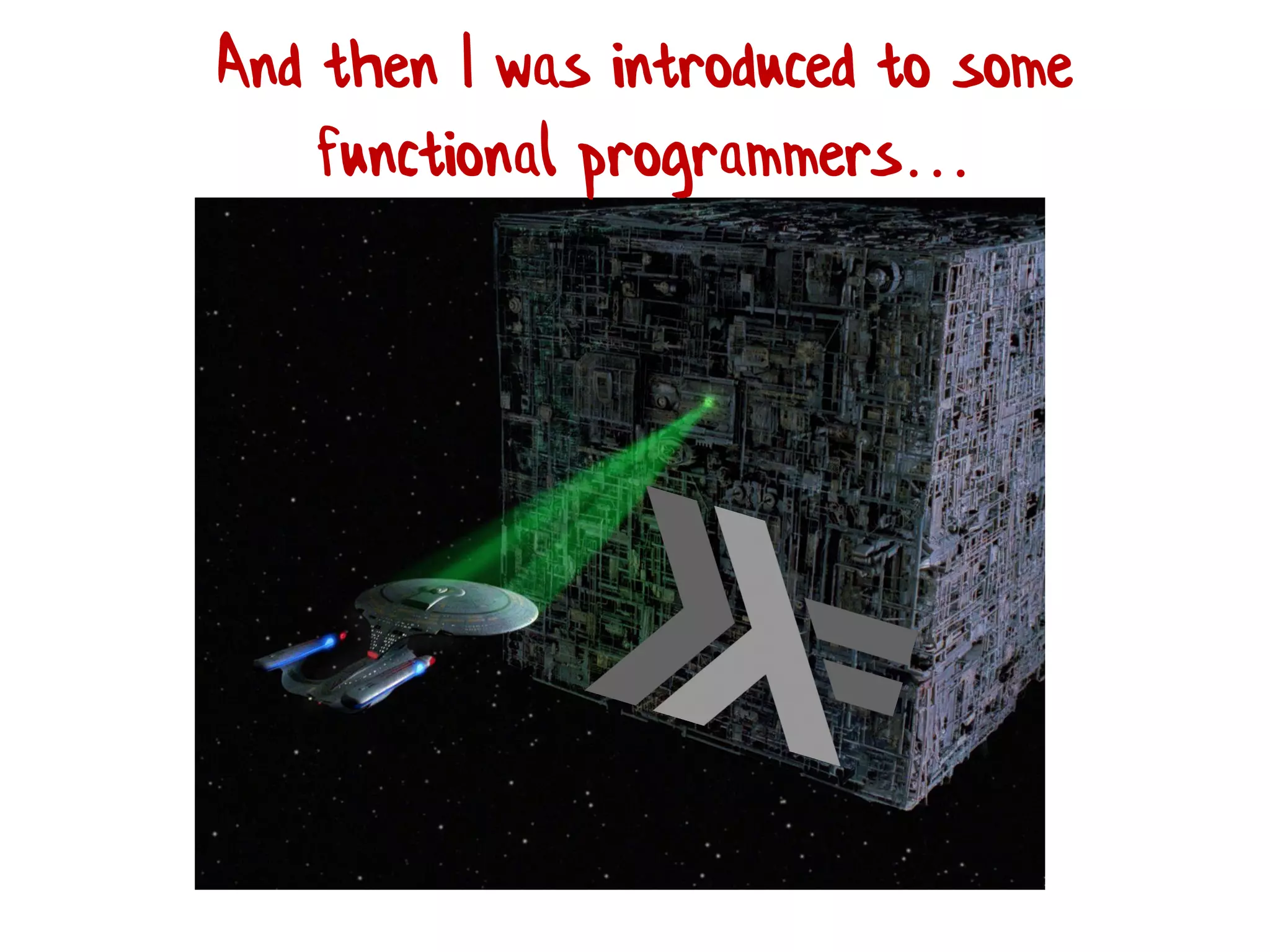
And then I was introduced to some
functional programmers…
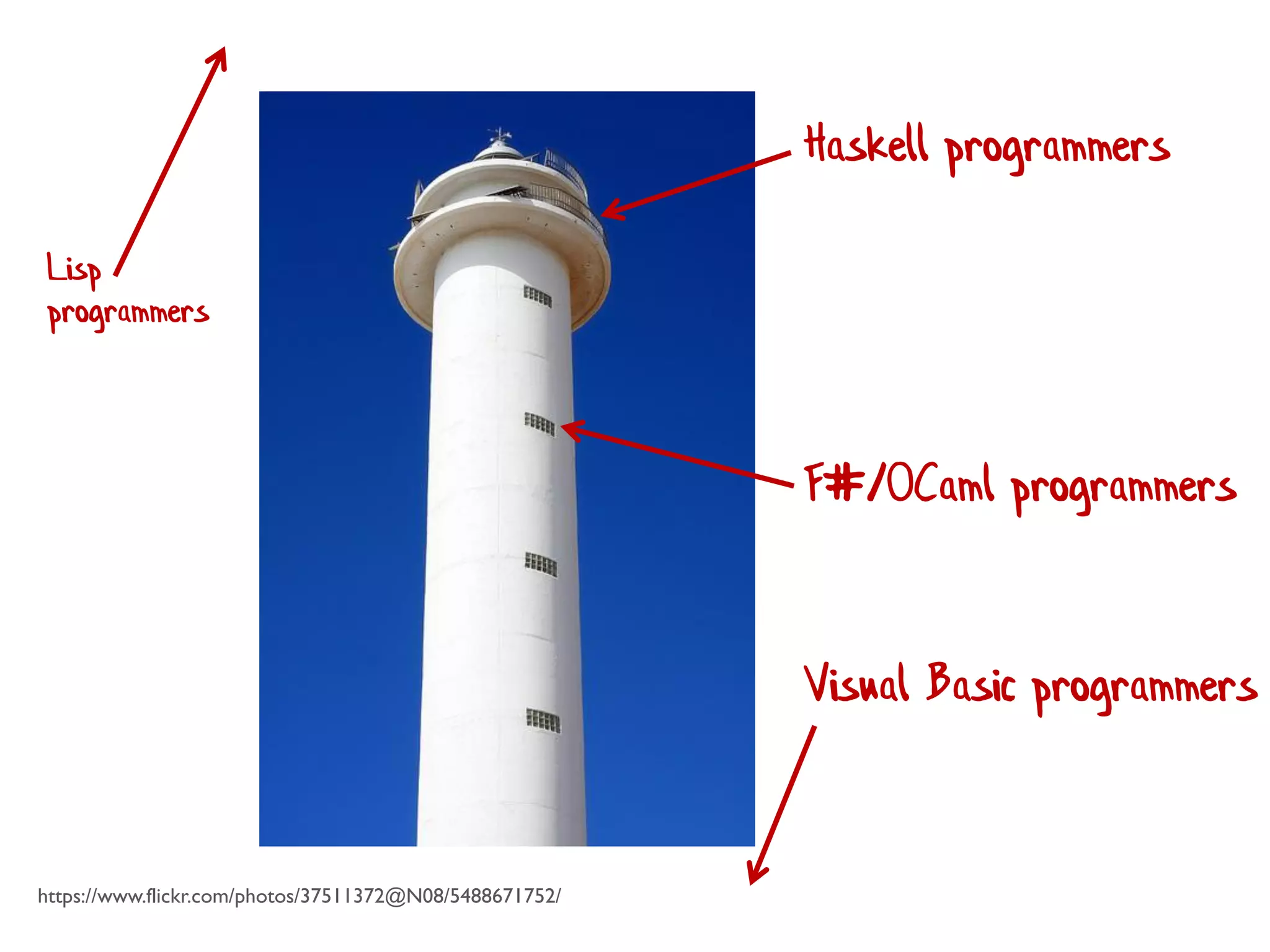
https://www.flickr.com/photos/37511372@N08/5488671752/
Haskell programmers
F#/OCaml programmers
Visual Basic programmers
Lisp
programmers
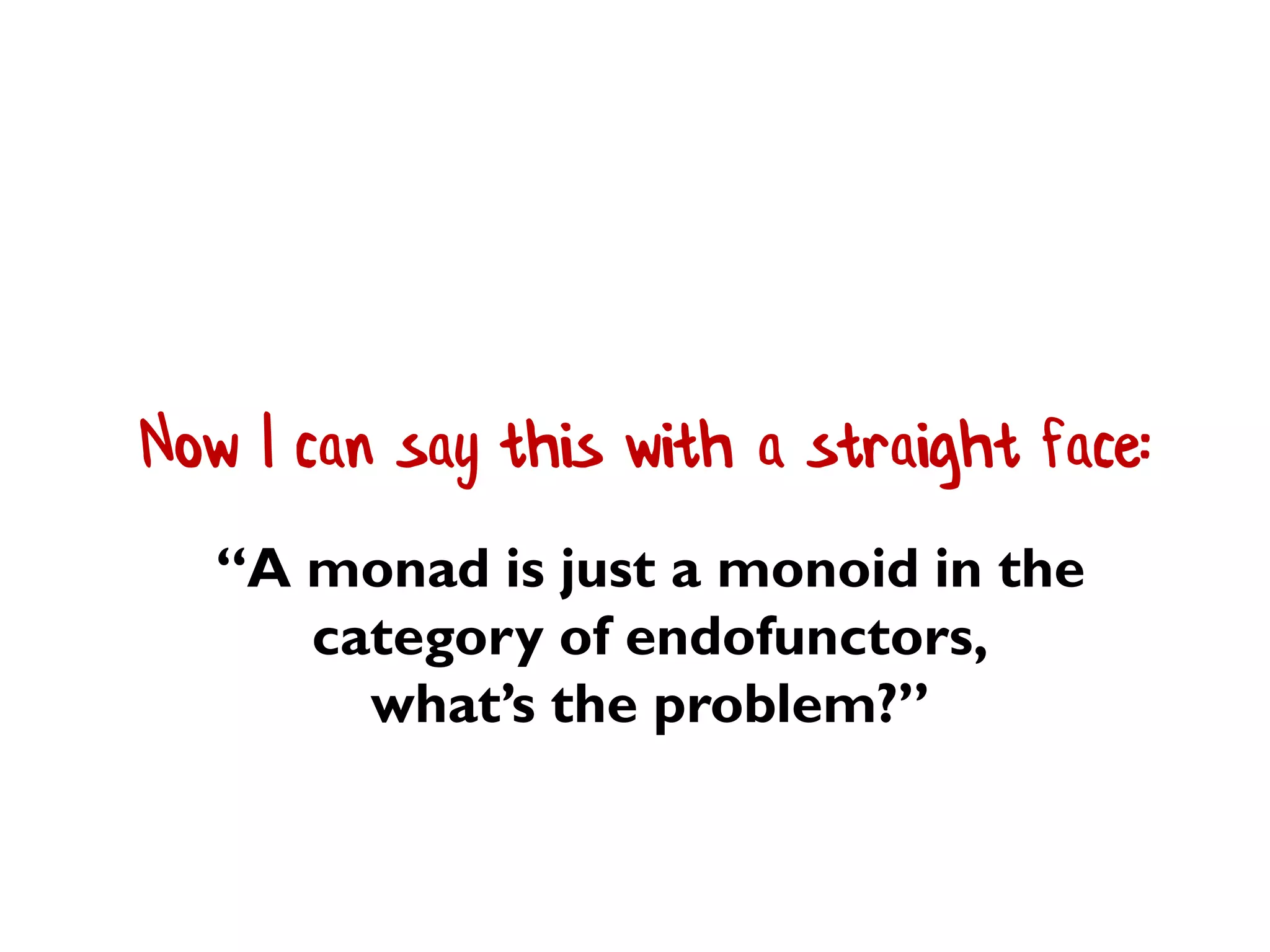
Now I can say this with a straight face:
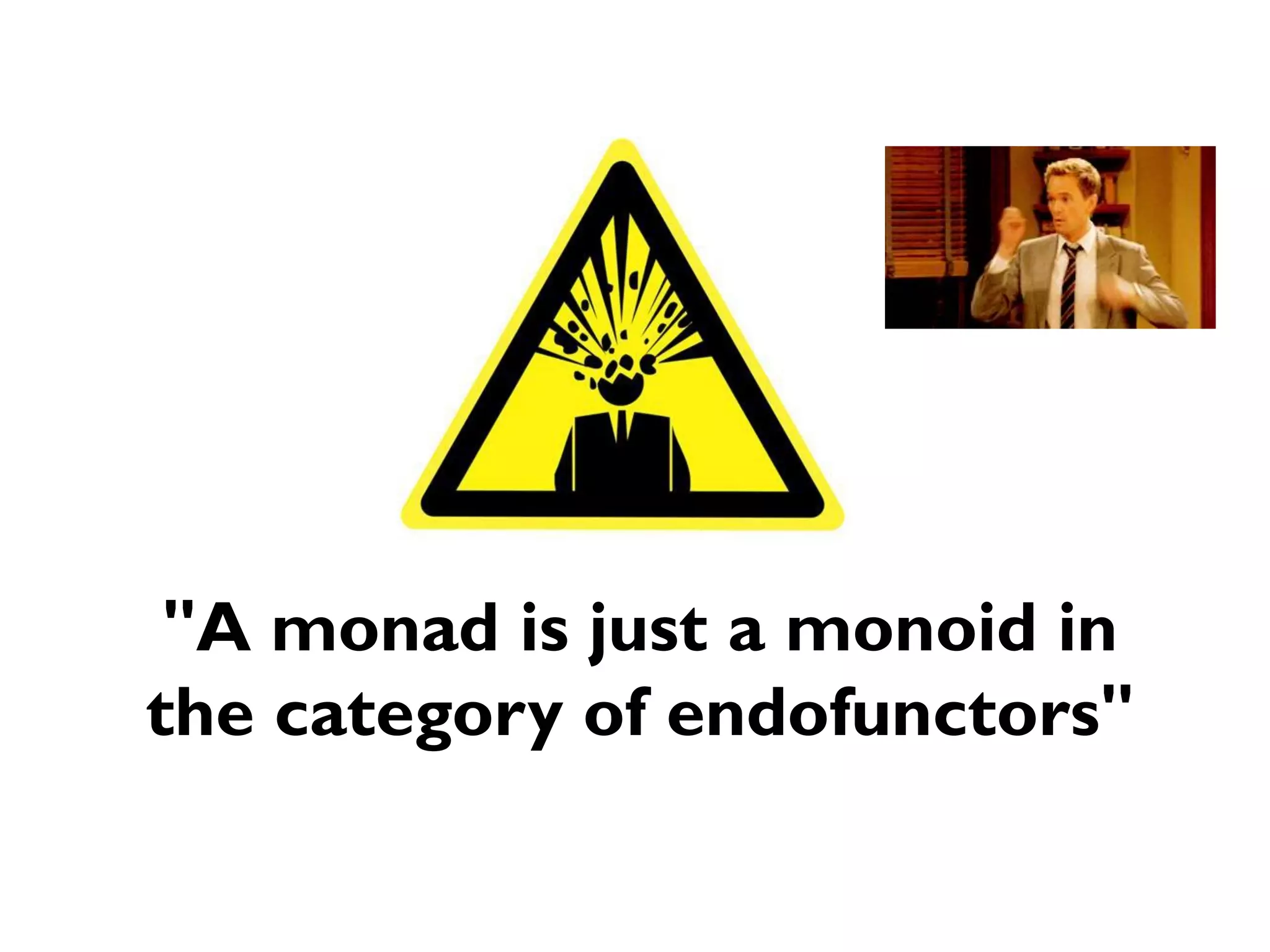
“A monad is just a monoid in the
category of endofunctors,
what’s the problem?”
FP DESIGN PATTERNS
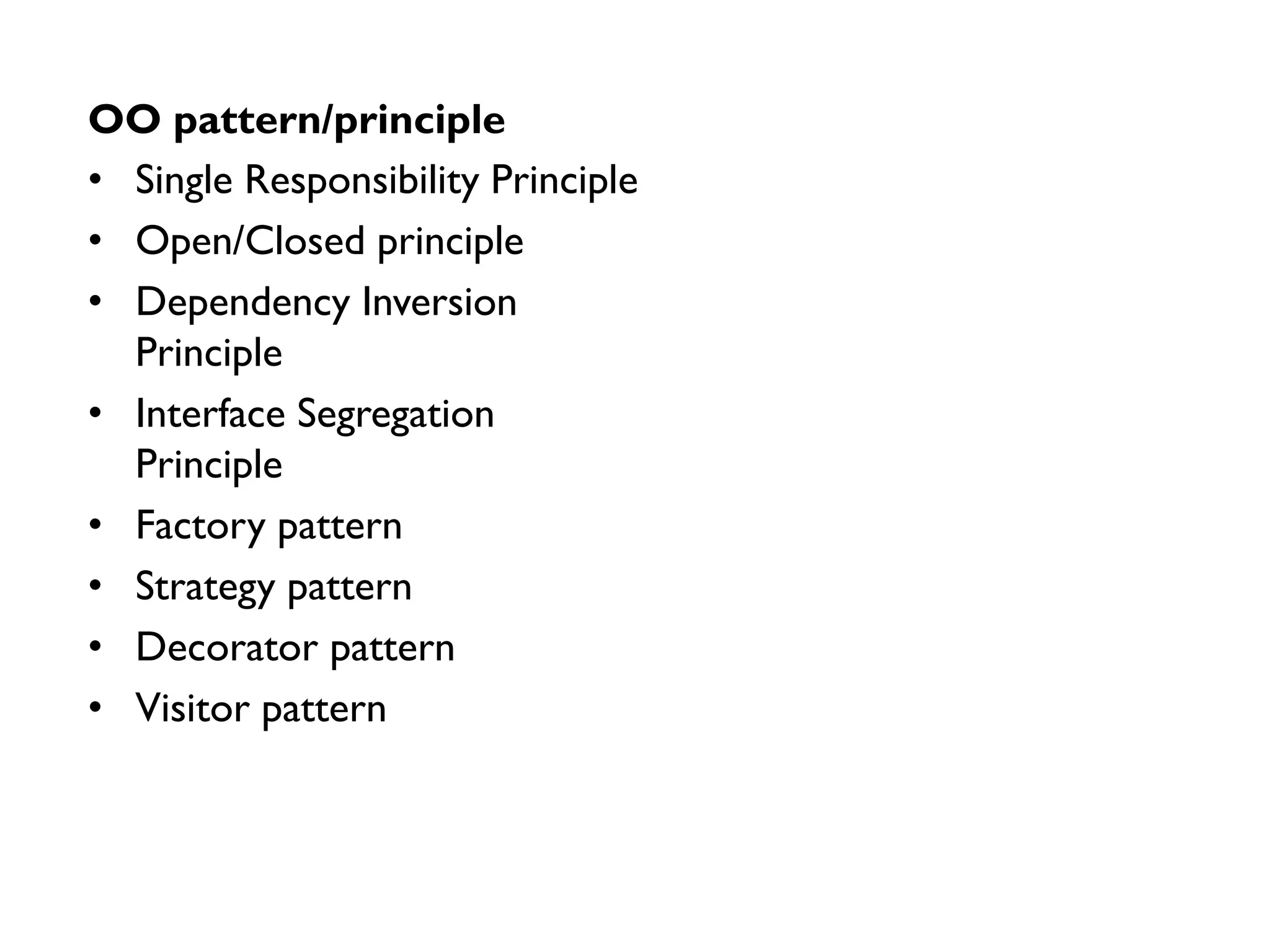
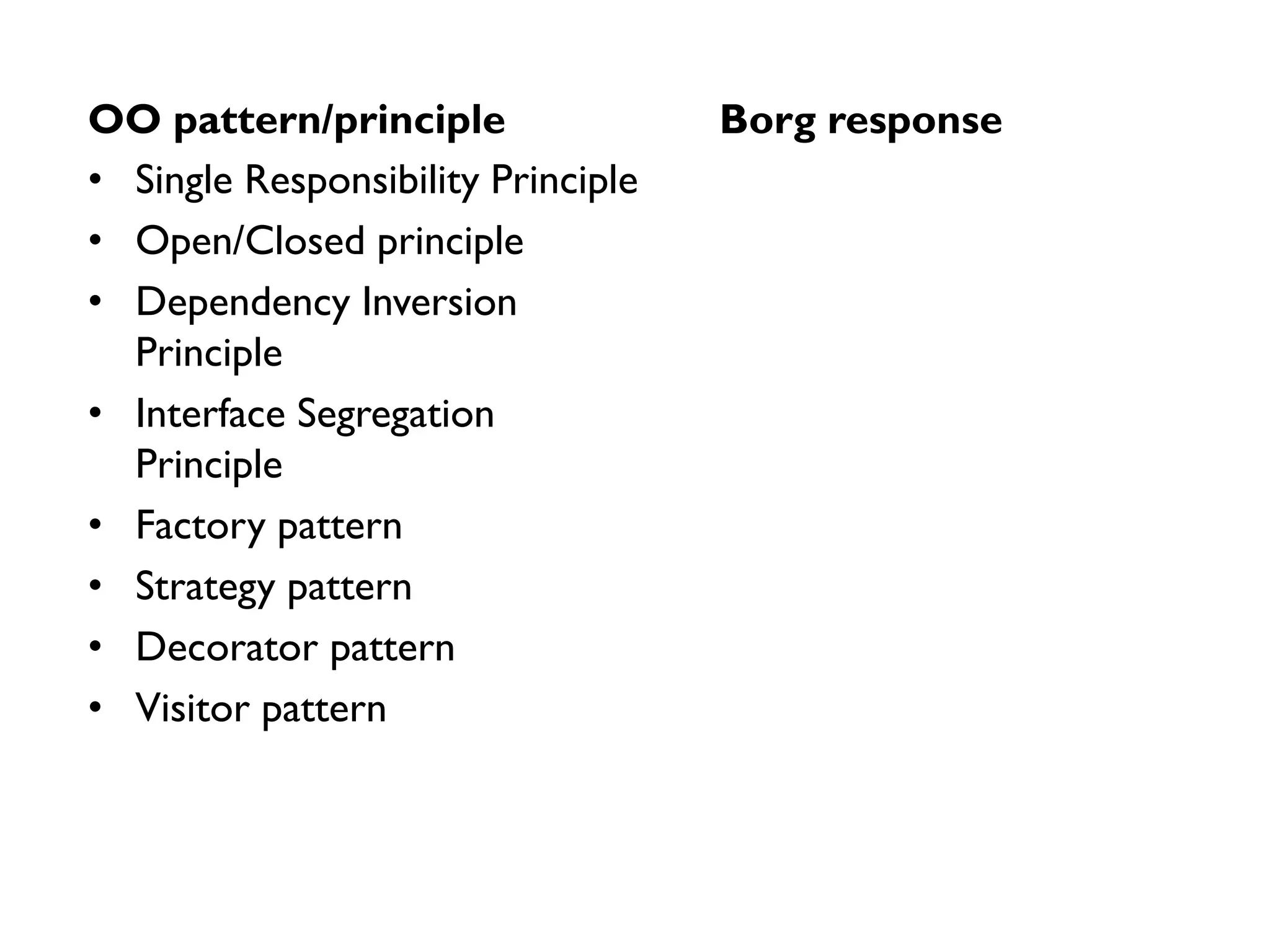
• Single Responsibility Principle
• Open/Closed principle
• Dependency Inversion
Principle
• Interface Segregation
Principle
• Factory pattern
• Strategy pattern
• Decorator pattern
• Visitor pattern
OO pattern/principle
• Single Responsibility Principle
• Open/Closed principle
• Dependency Inversion
Principle
• Interface Segregation
Principle
• Factory pattern
• Strategy pattern
• Decorator pattern
• Visitor pattern
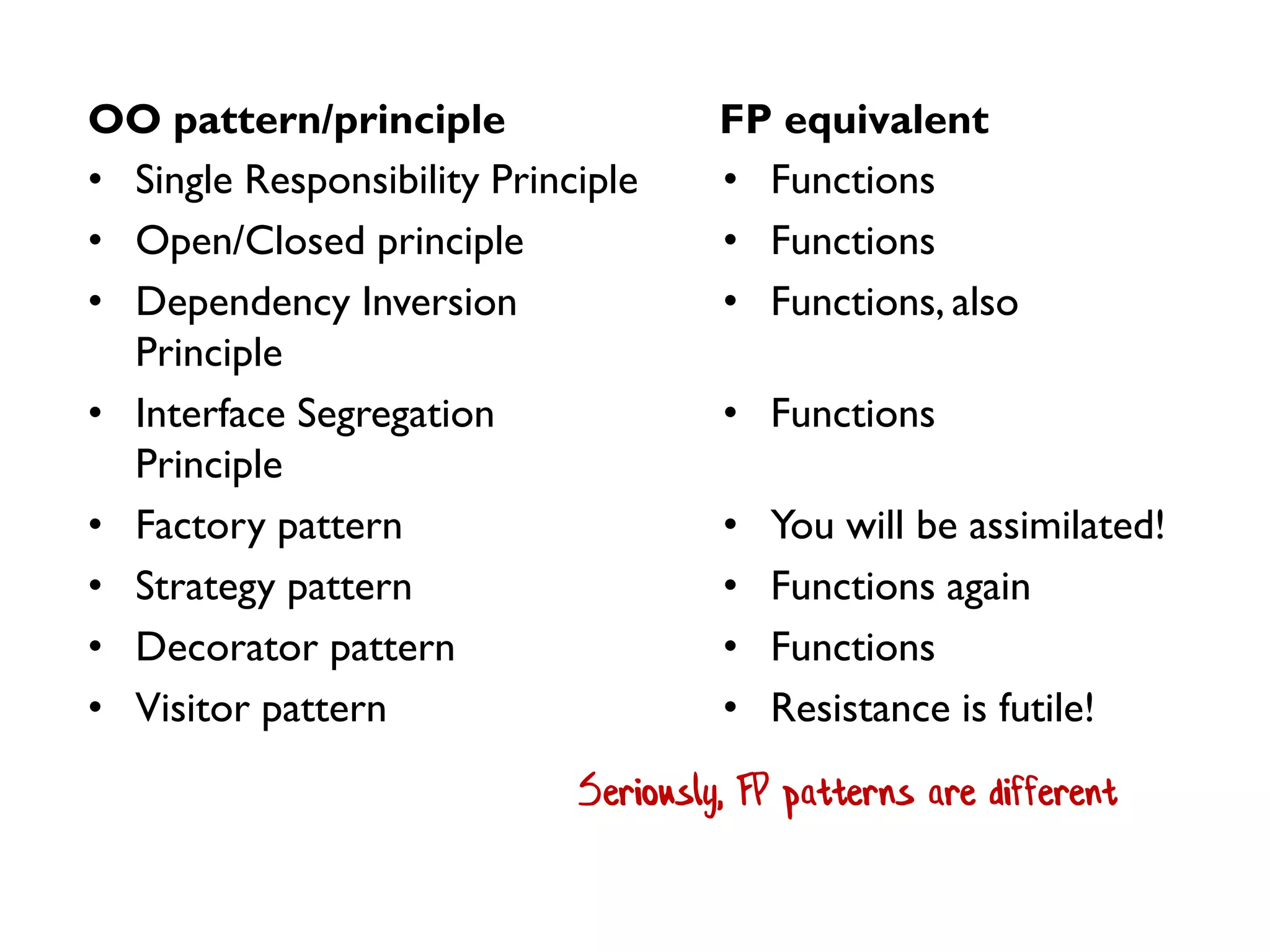
OO pattern/principle Borg response
• Single Responsibility Principle
• Open/Closed principle
• Dependency Inversion
Principle
• Interface Segregation
Principle
• Factory pattern
• Strategy pattern
• Decorator pattern
• Visitor pattern
• Functions
• Functions
• Functions, also
• Functions
• You will be assimilated!
• Functions again
• Functions
• Resistance is futile!
OO pattern/principle FP equivalent
Seriously, FP patterns are different
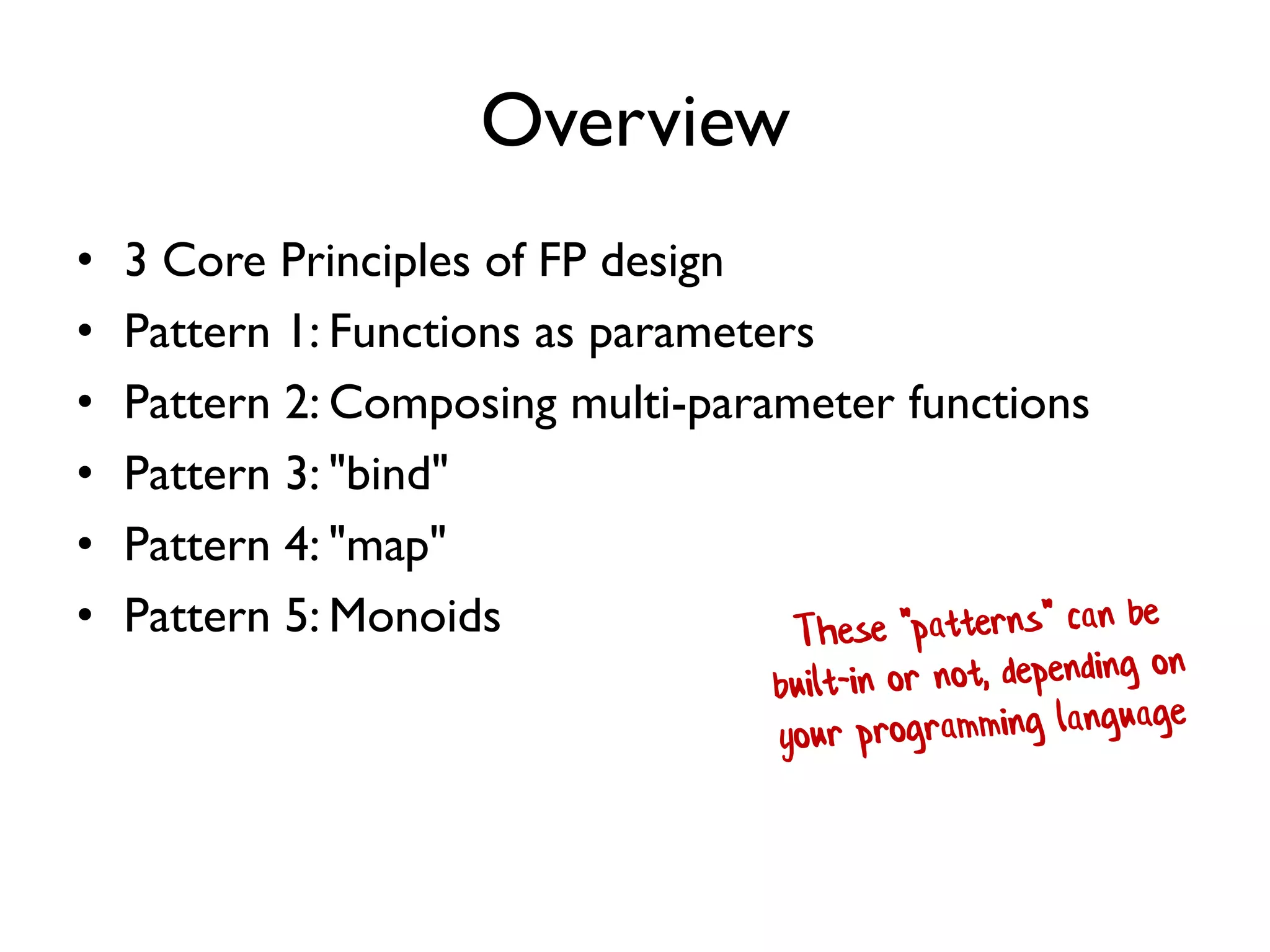
Overview
• 3 Core Principles of FP design
• Pattern 1: Functions as parameters
• Pattern 2: Composing multi-parameter functions
• Pattern 3: "bind"
• Pattern 4: "map"
• Pattern 5: Monoids
THREE CORE PRINCIPLES OF
FUNCTIONAL PROGRAMMING
There are more...
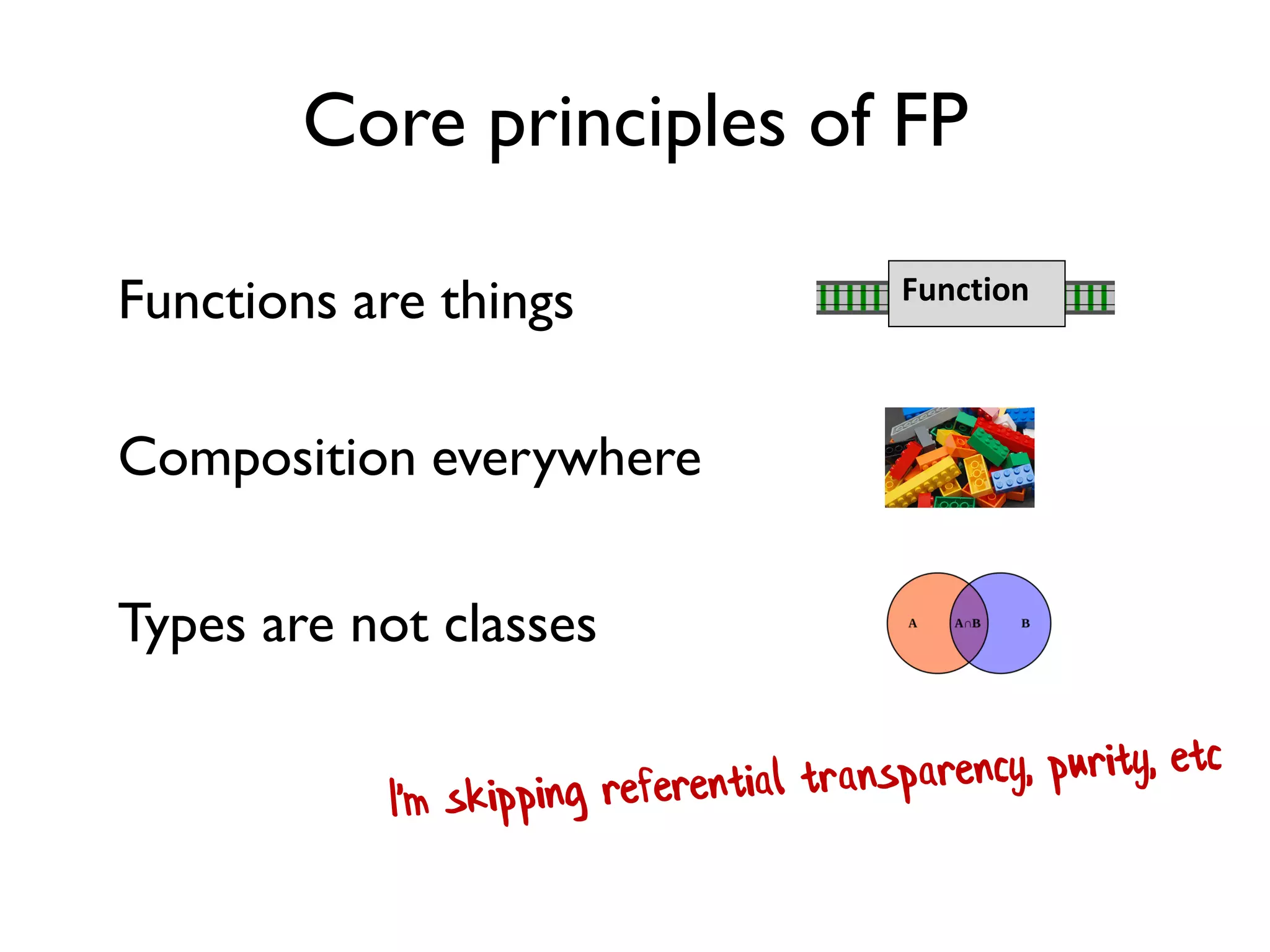
Core principles of FP
Function
Types are not classes
Functions are things
Composition everywhere
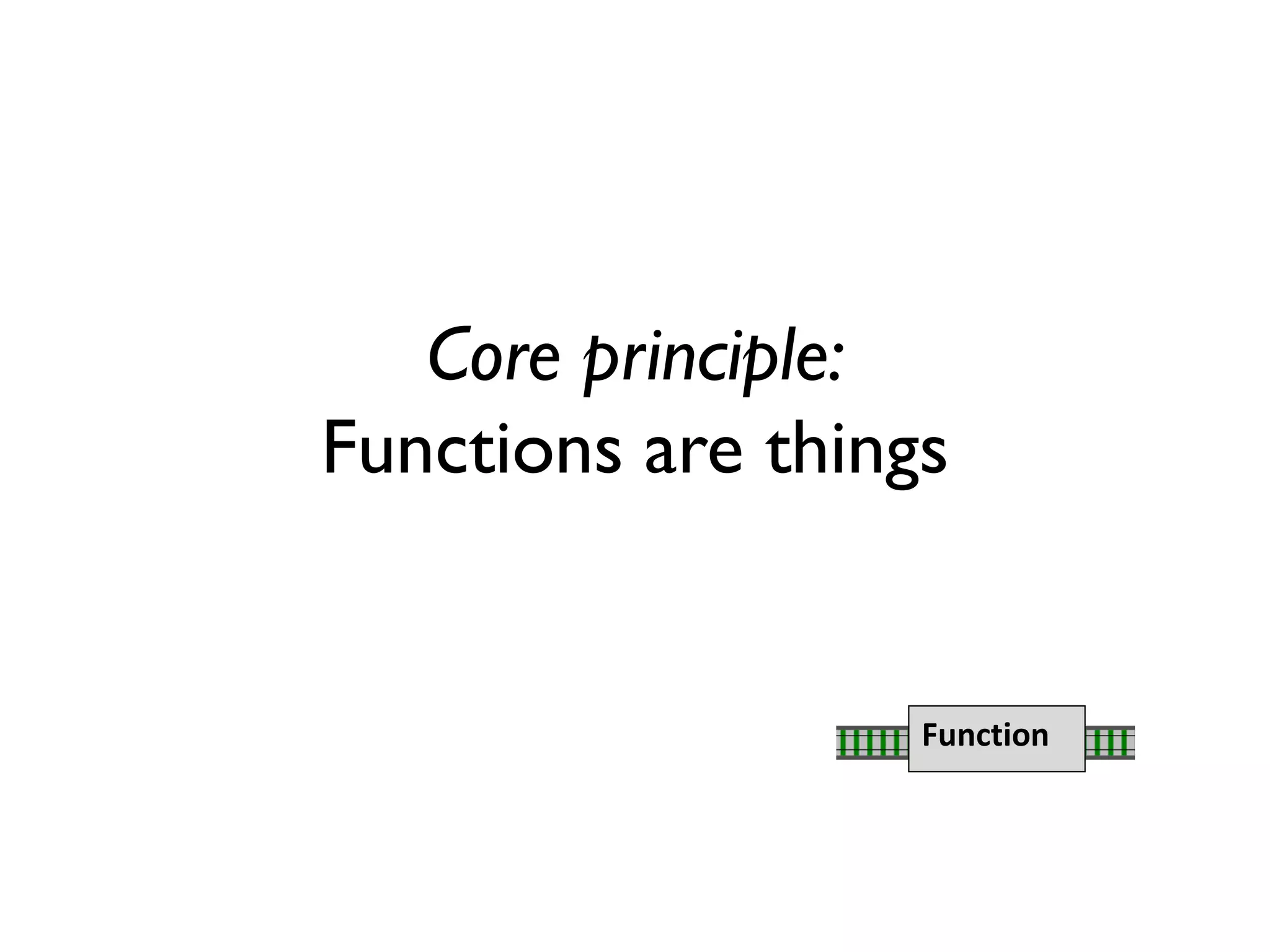
Core principle:
Functions are things
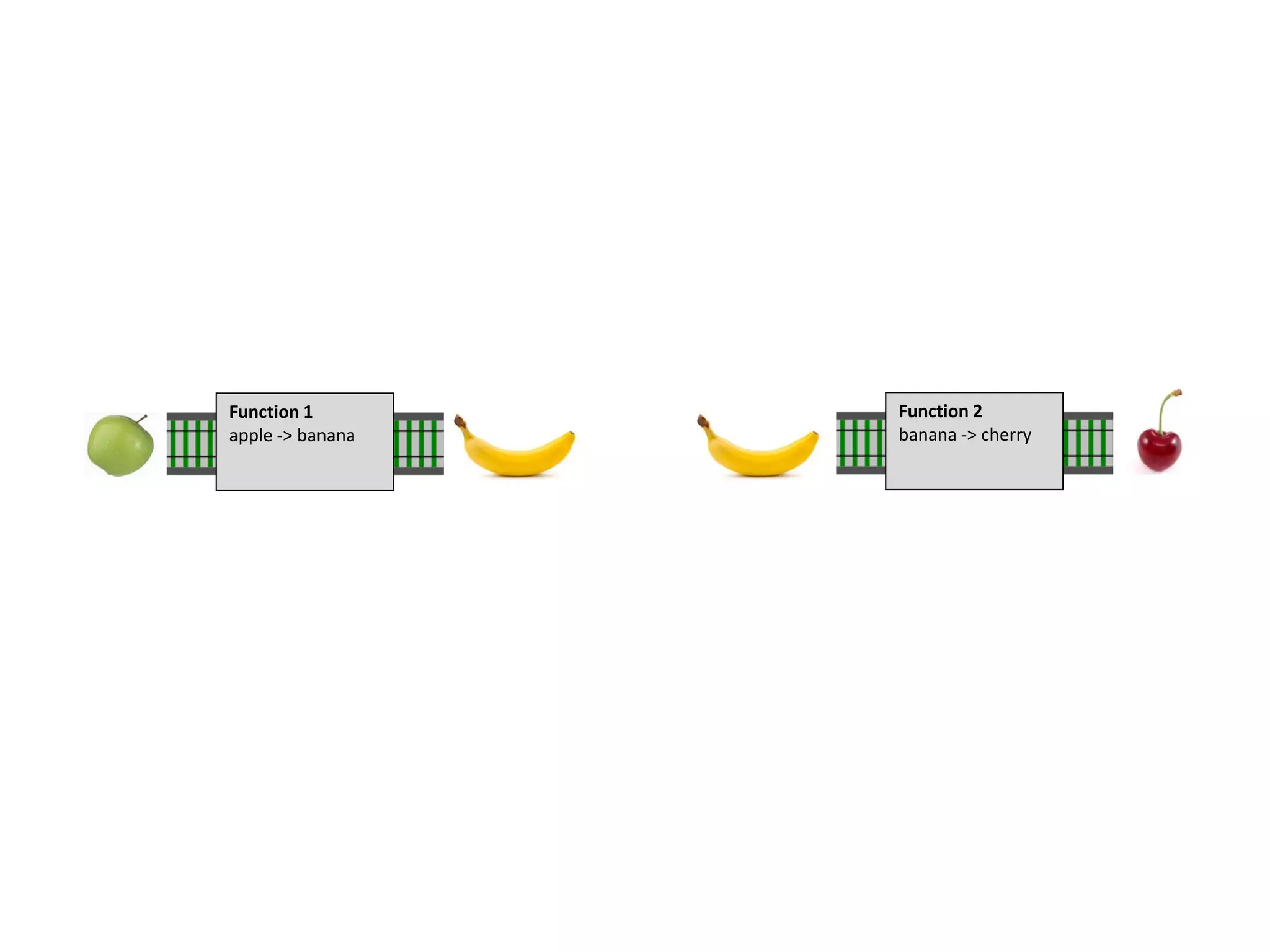
Function
The Tunnel of
Transformation
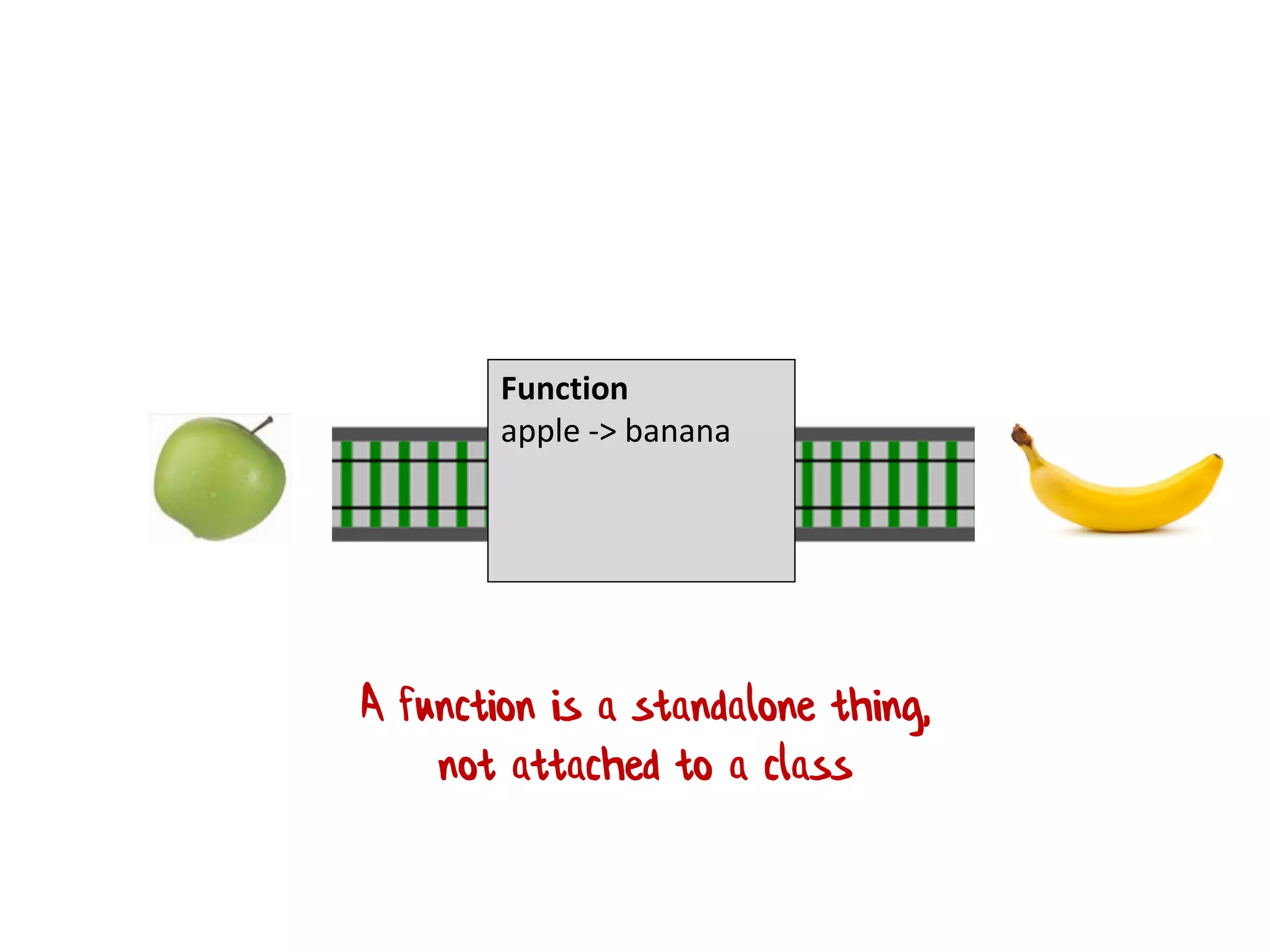
Function
apple -> banana
A function is a standalone thing,
not attached to a class
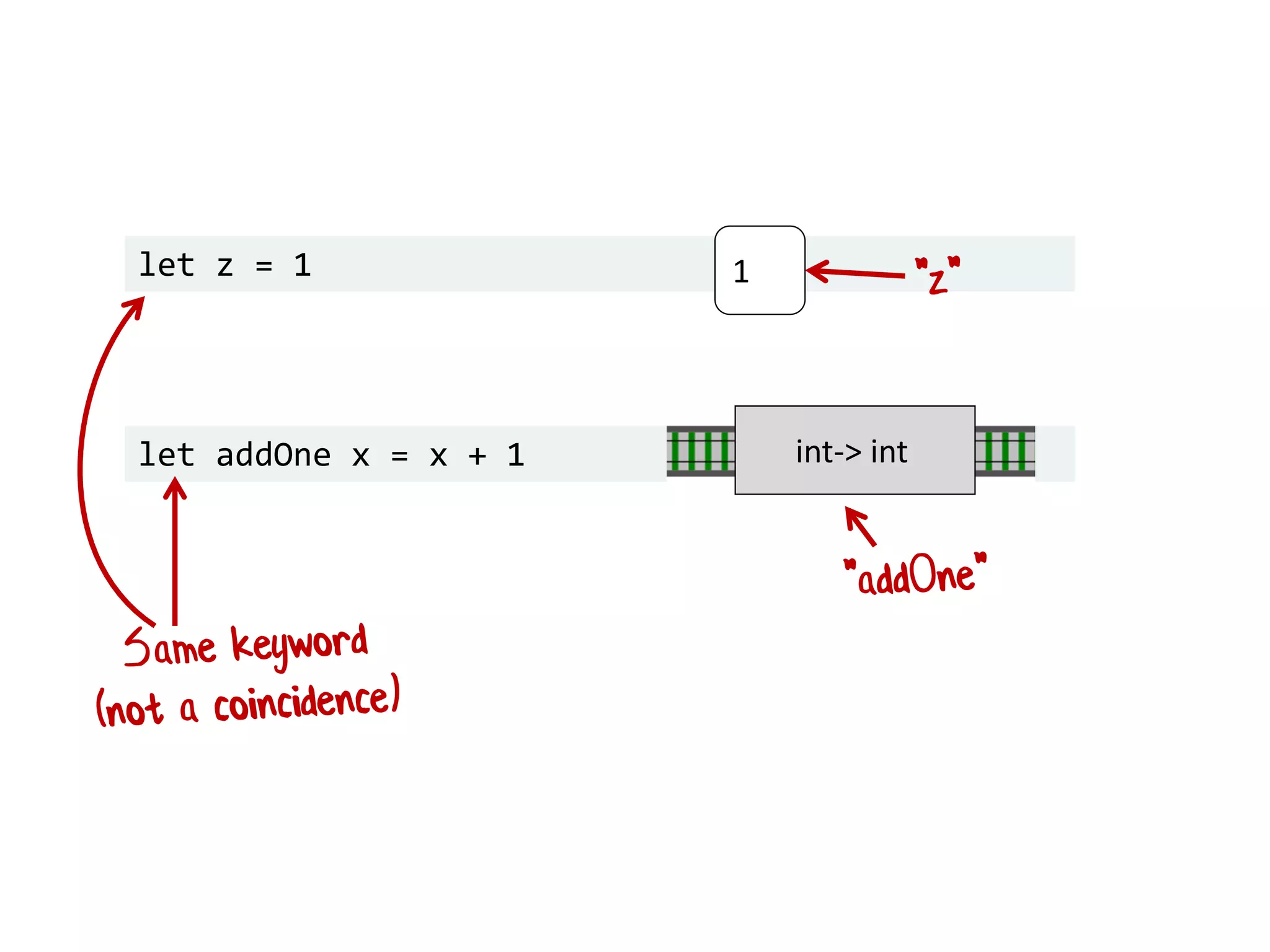
let z = 1 1
let addOne x = x + 1 int-> int
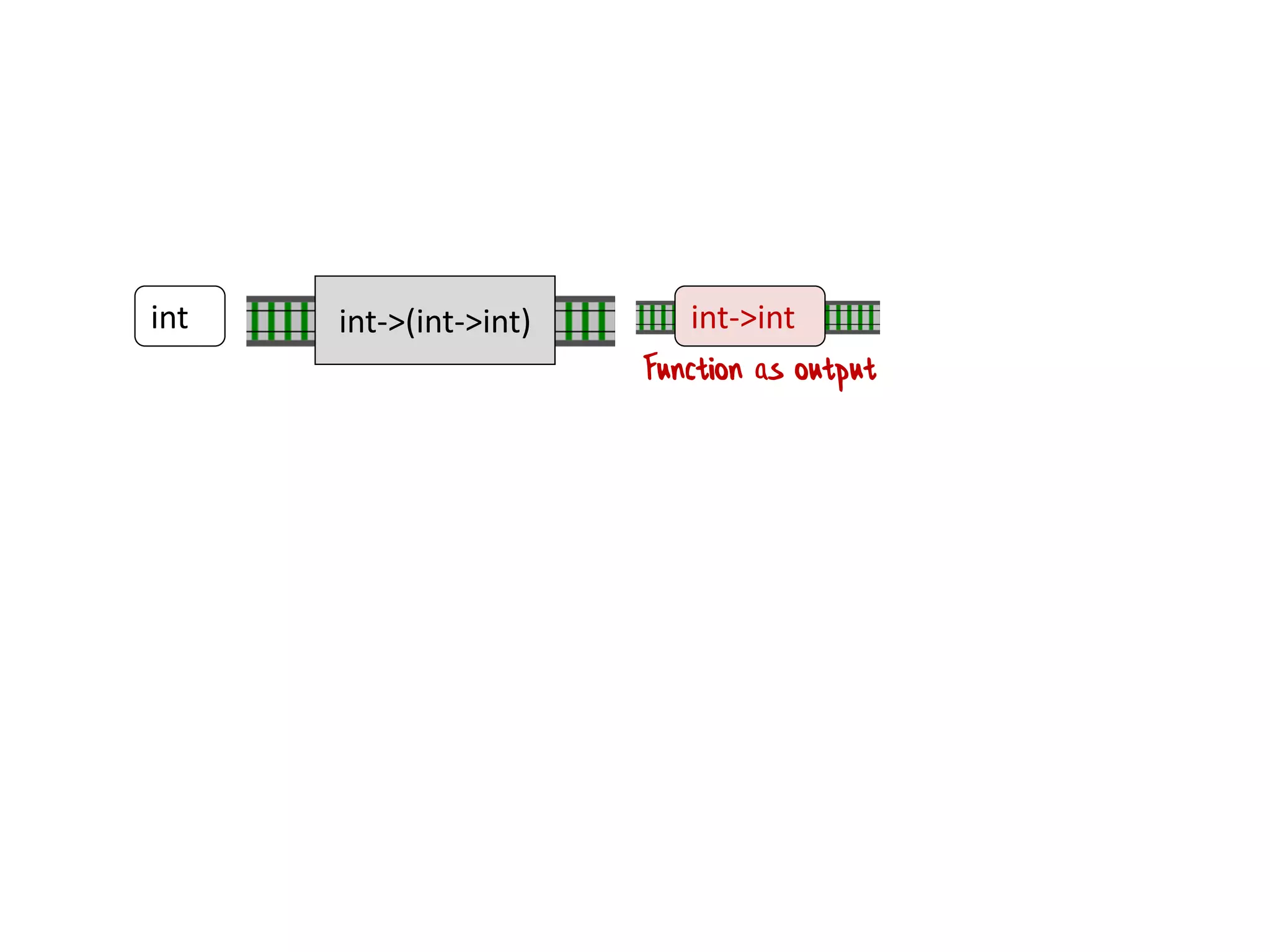
int->(int->int)int int->int
Function as output
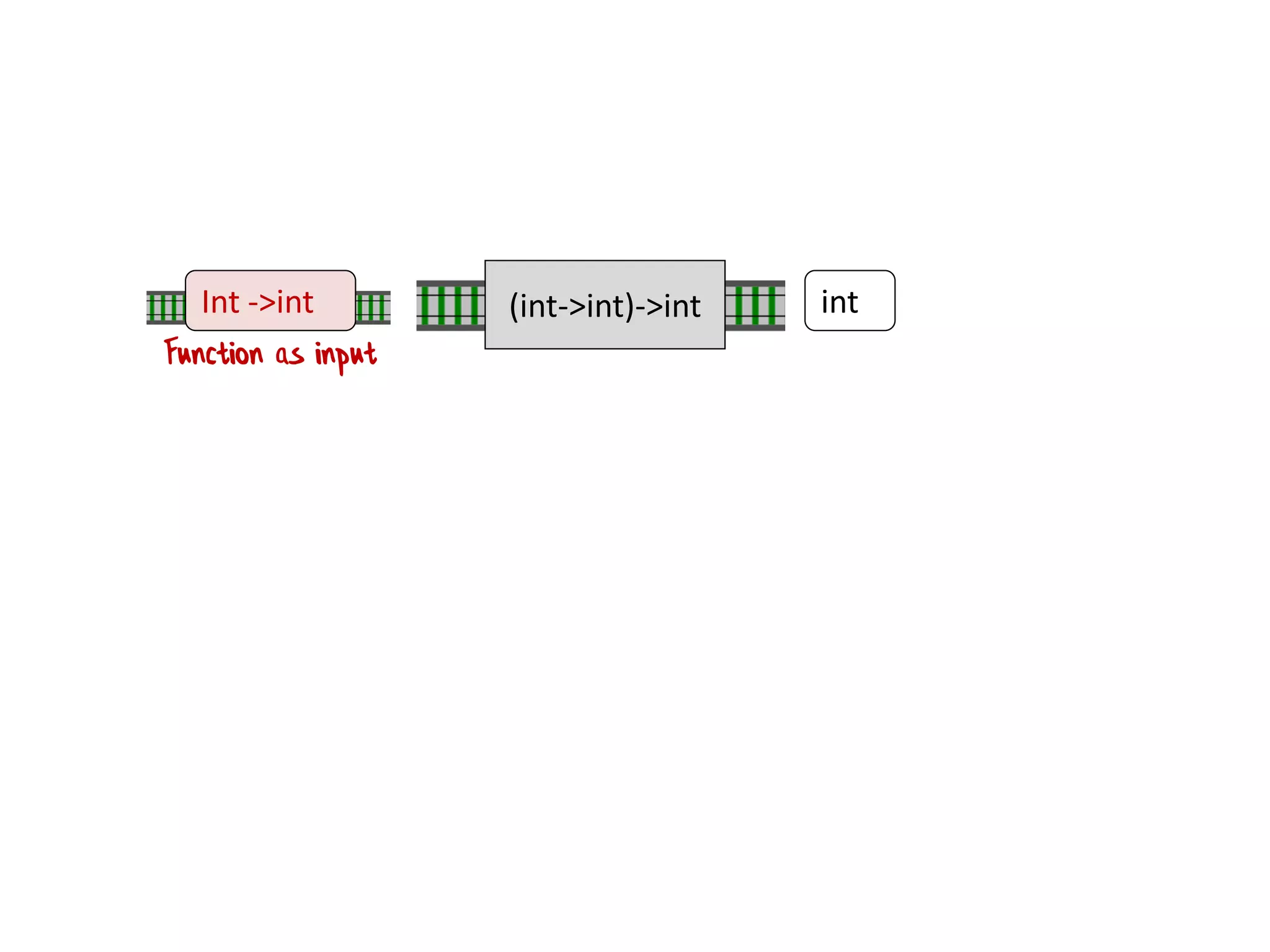
intInt ->int
Function as input
(int->int)->int
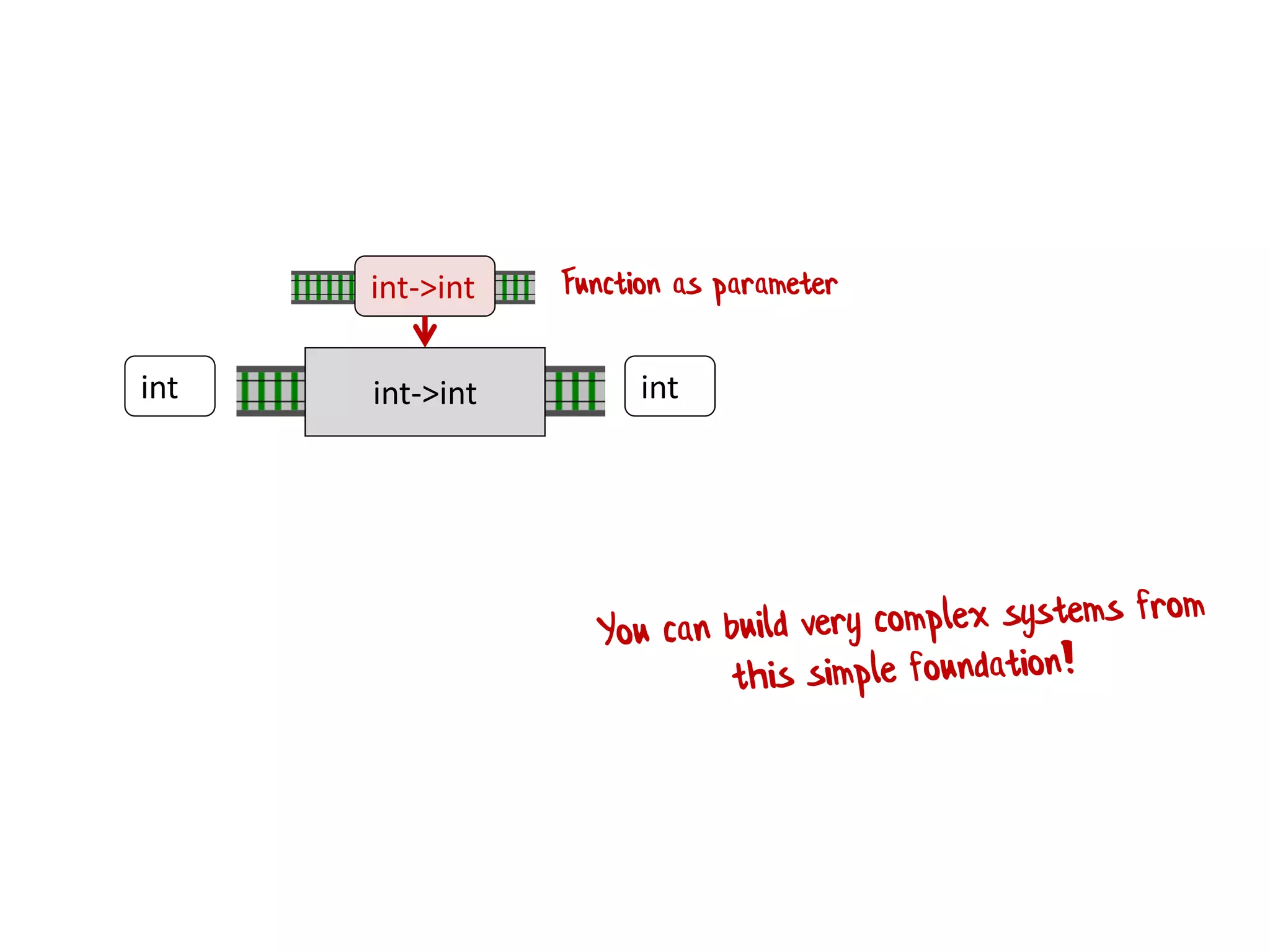
int int
Function as parameterint->int
int->int
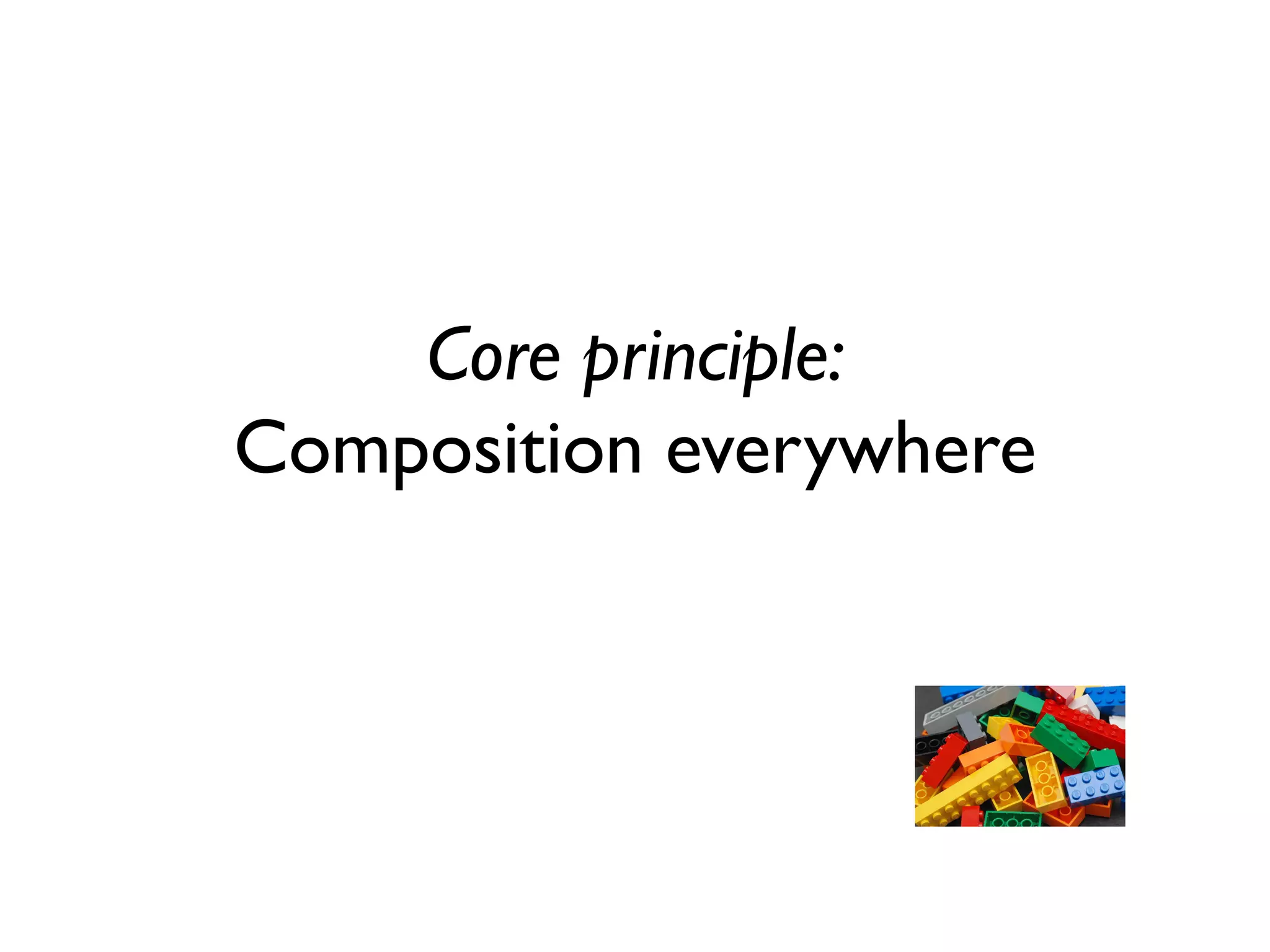
Core principle:
Composition everywhere
Function 1
apple -> banana
Function 2
banana -> cherry
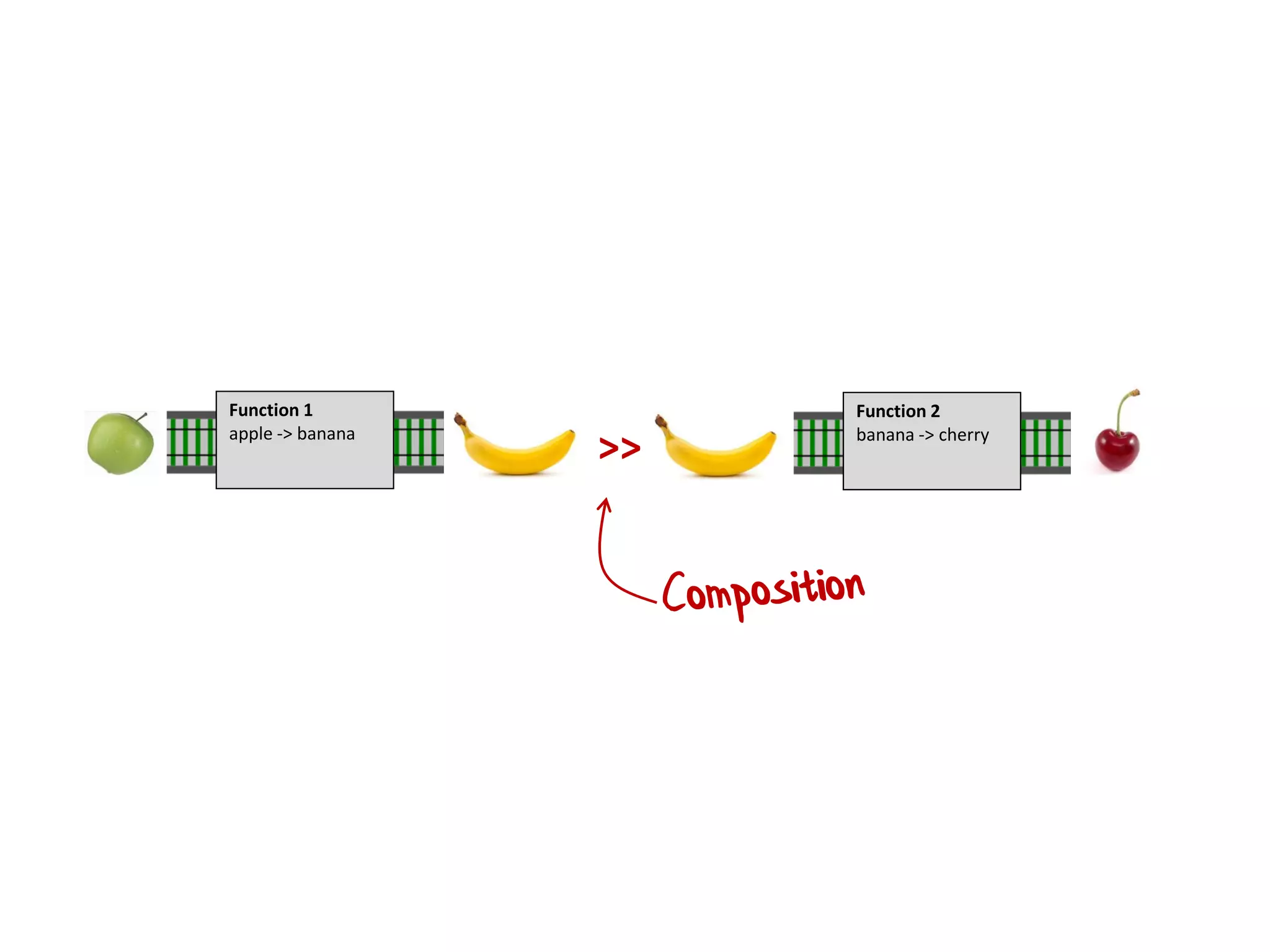
>>
Function 1
apple -> banana
Function 2
banana -> cherry
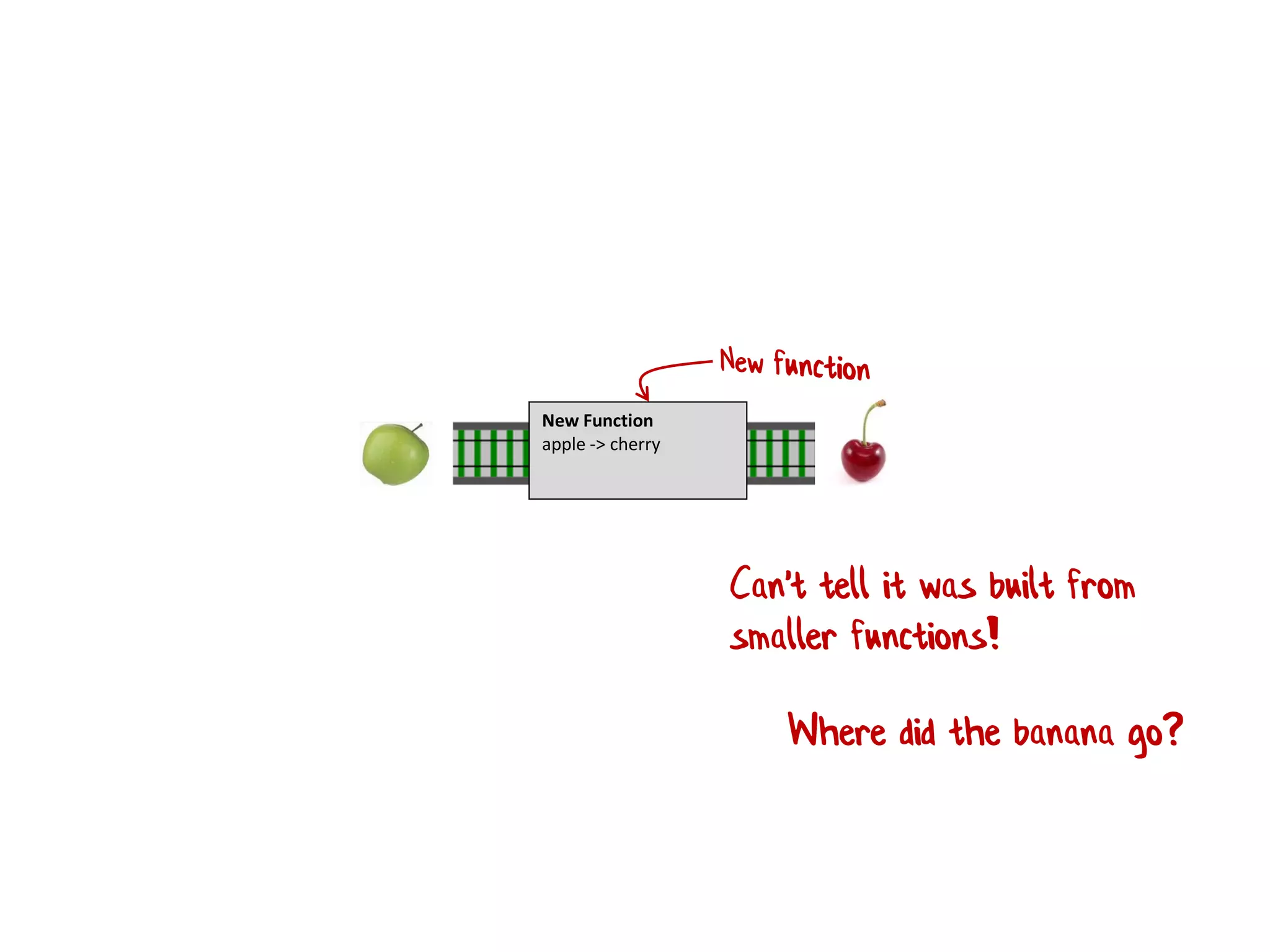
New Function
apple -> cherry
Can't tell it was built from
smaller functions!
Where did the banana go?
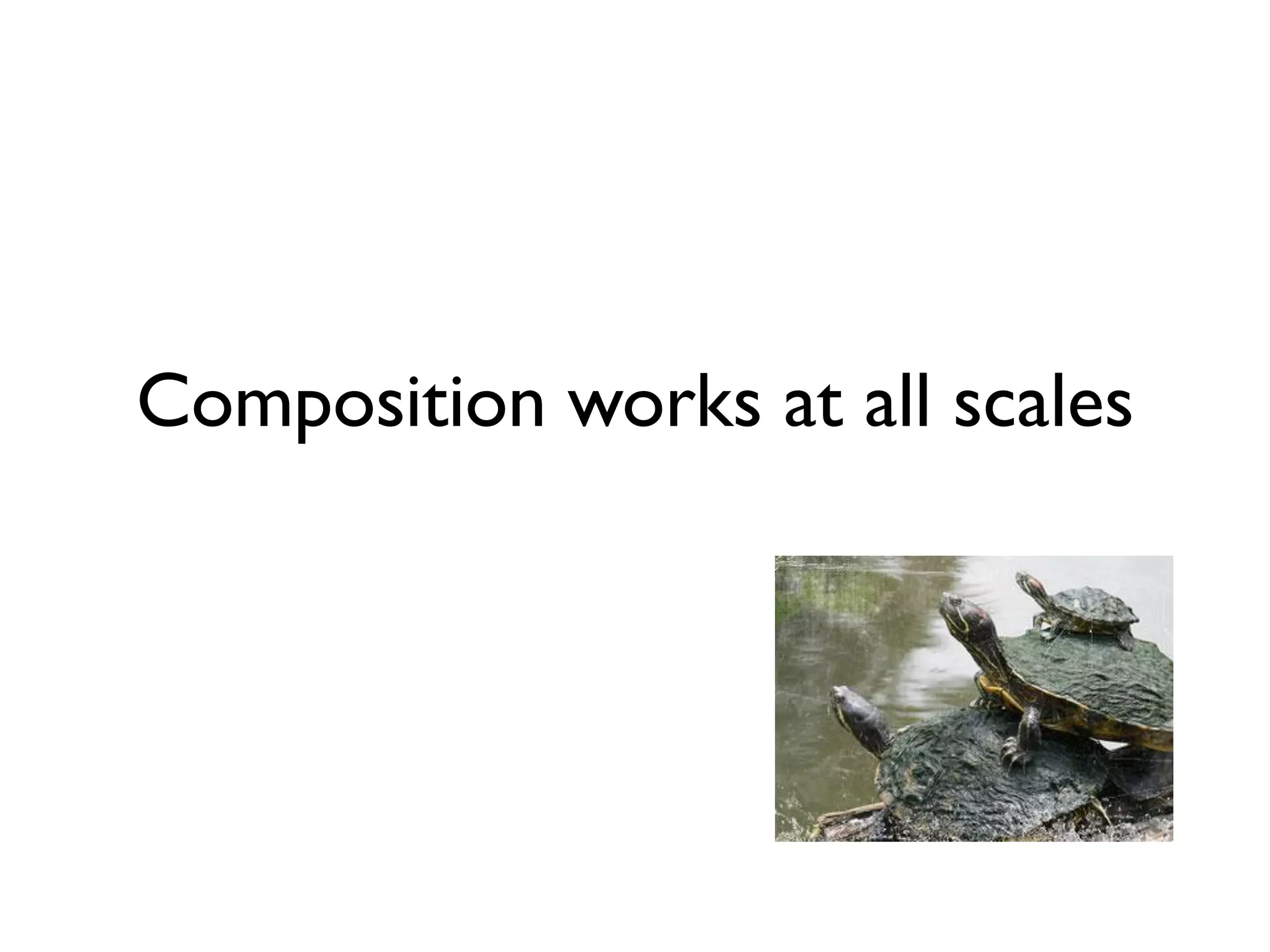
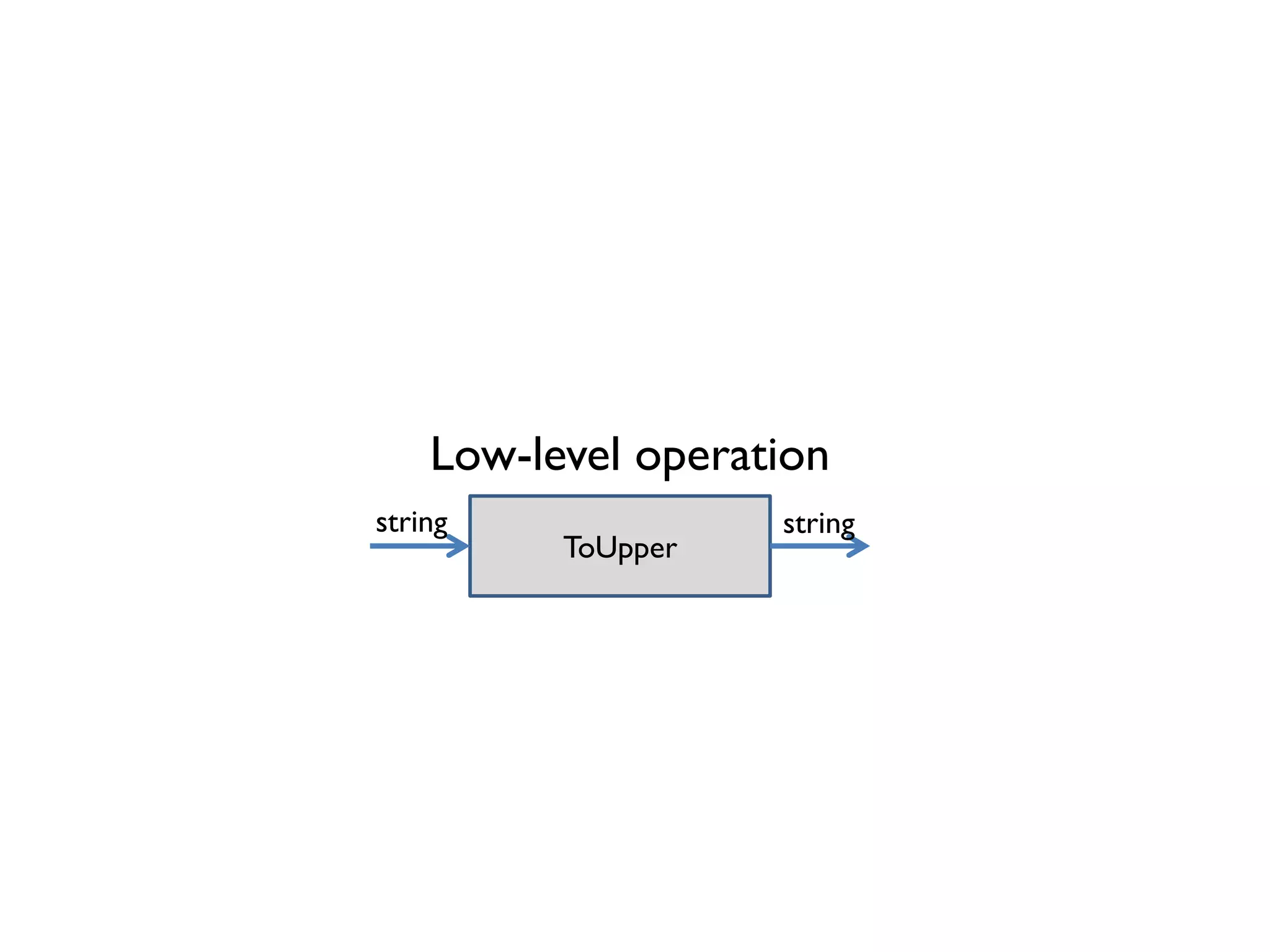
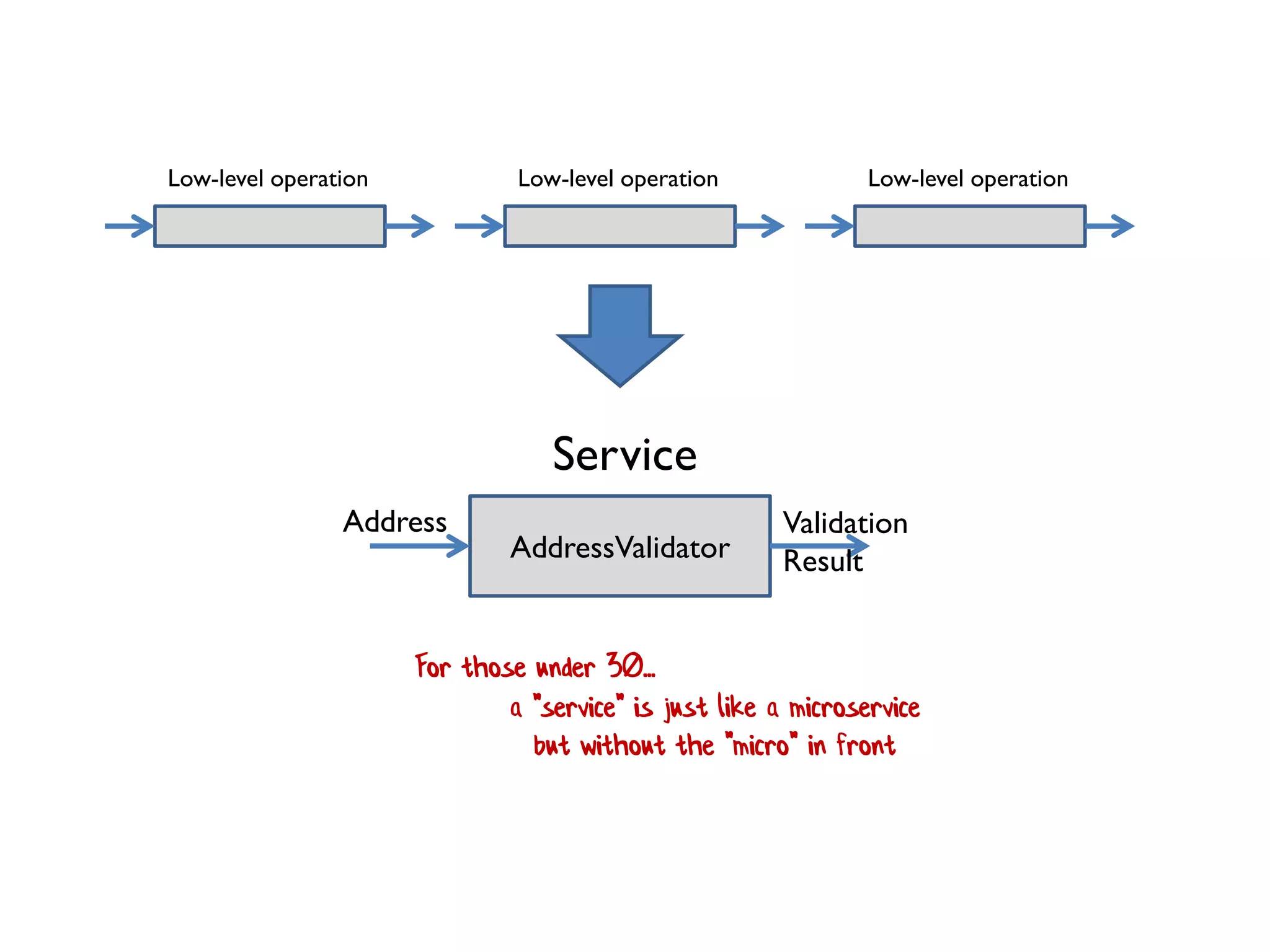
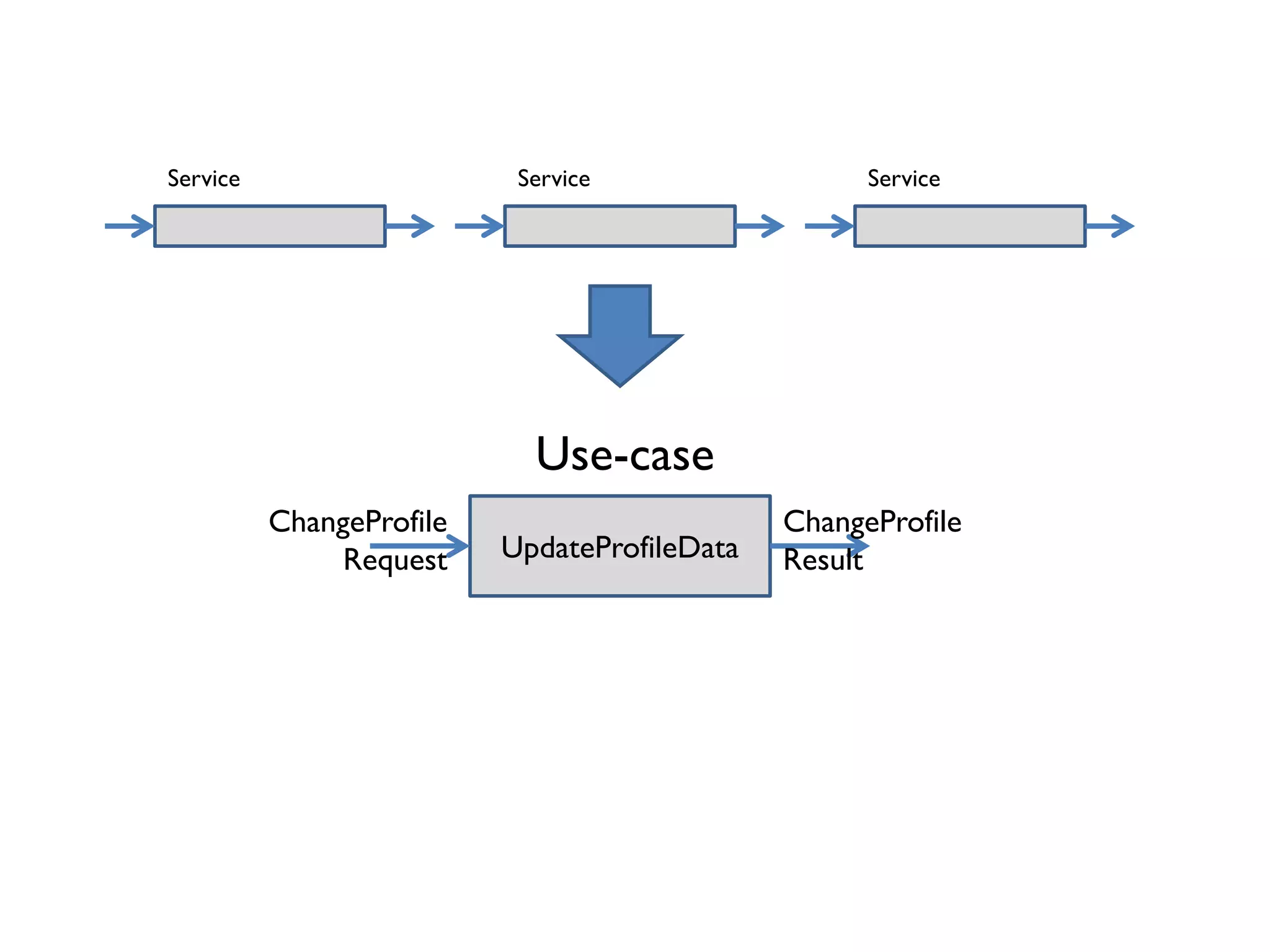
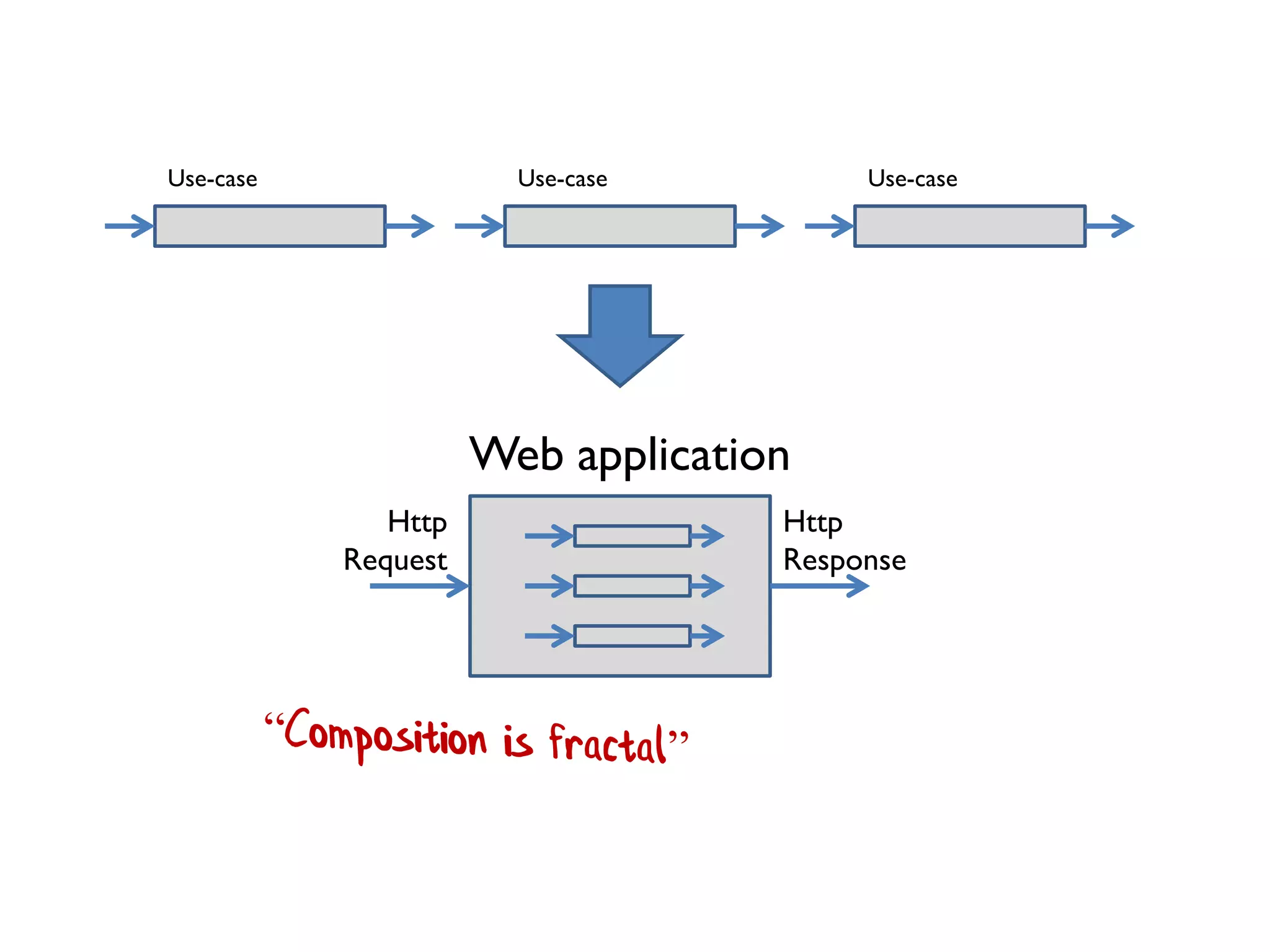
Composition works at all scales
Low-level operation
ToUpper
stringstring
Low-level operation
Service
AddressValidator
For those under 30...
Validation
Result
Address
Low-level operation Low-level operation
a "service" is just like a microservice
but without the "micro" in front
Service
Use-case
UpdateProfileData
ChangeProfile
Result
ChangeProfile
Request
Service Service
Use-case
Web application
Http
Response
Http
Request
Use-case Use-case
Core principle:
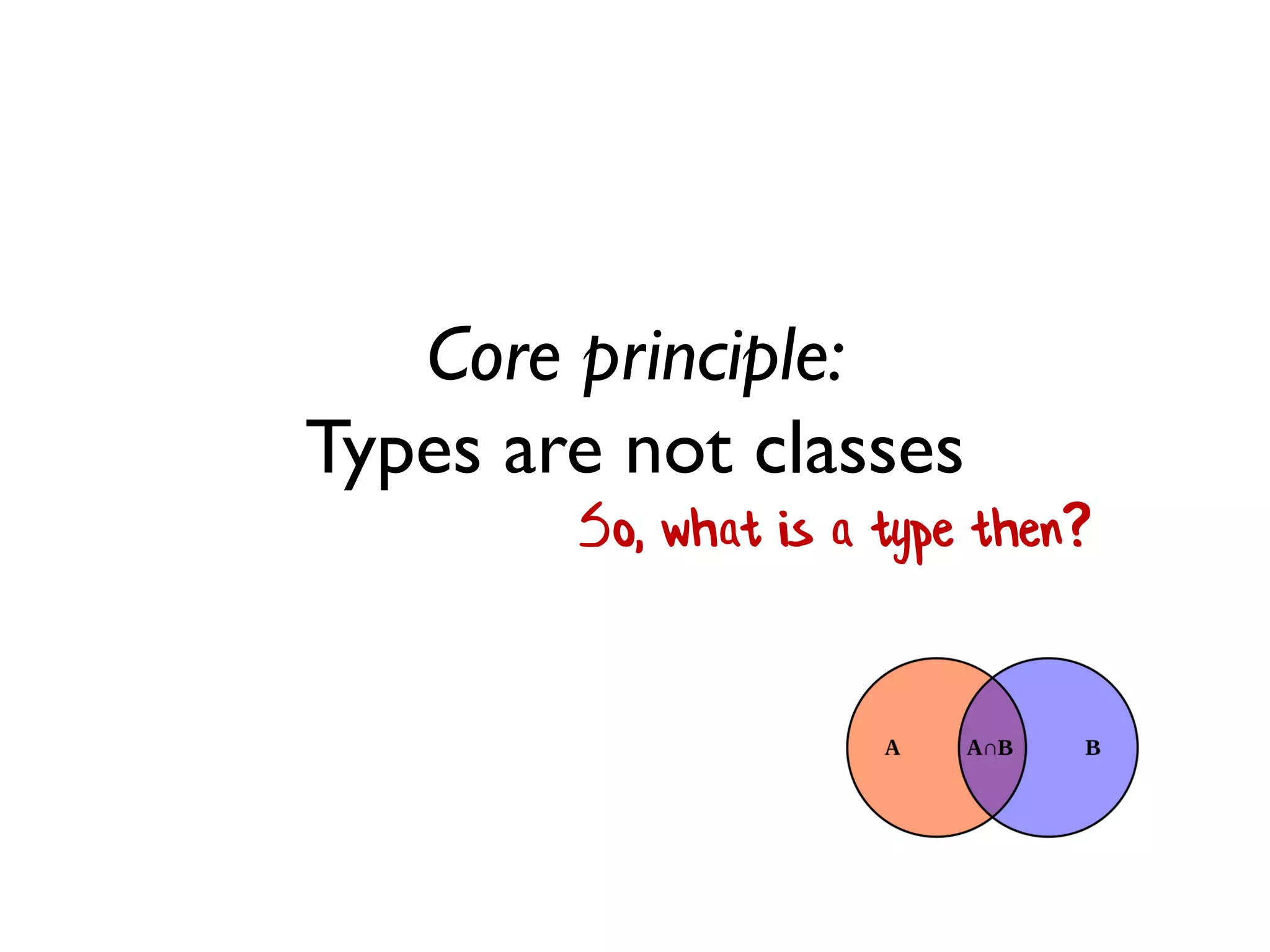
Types are not classes
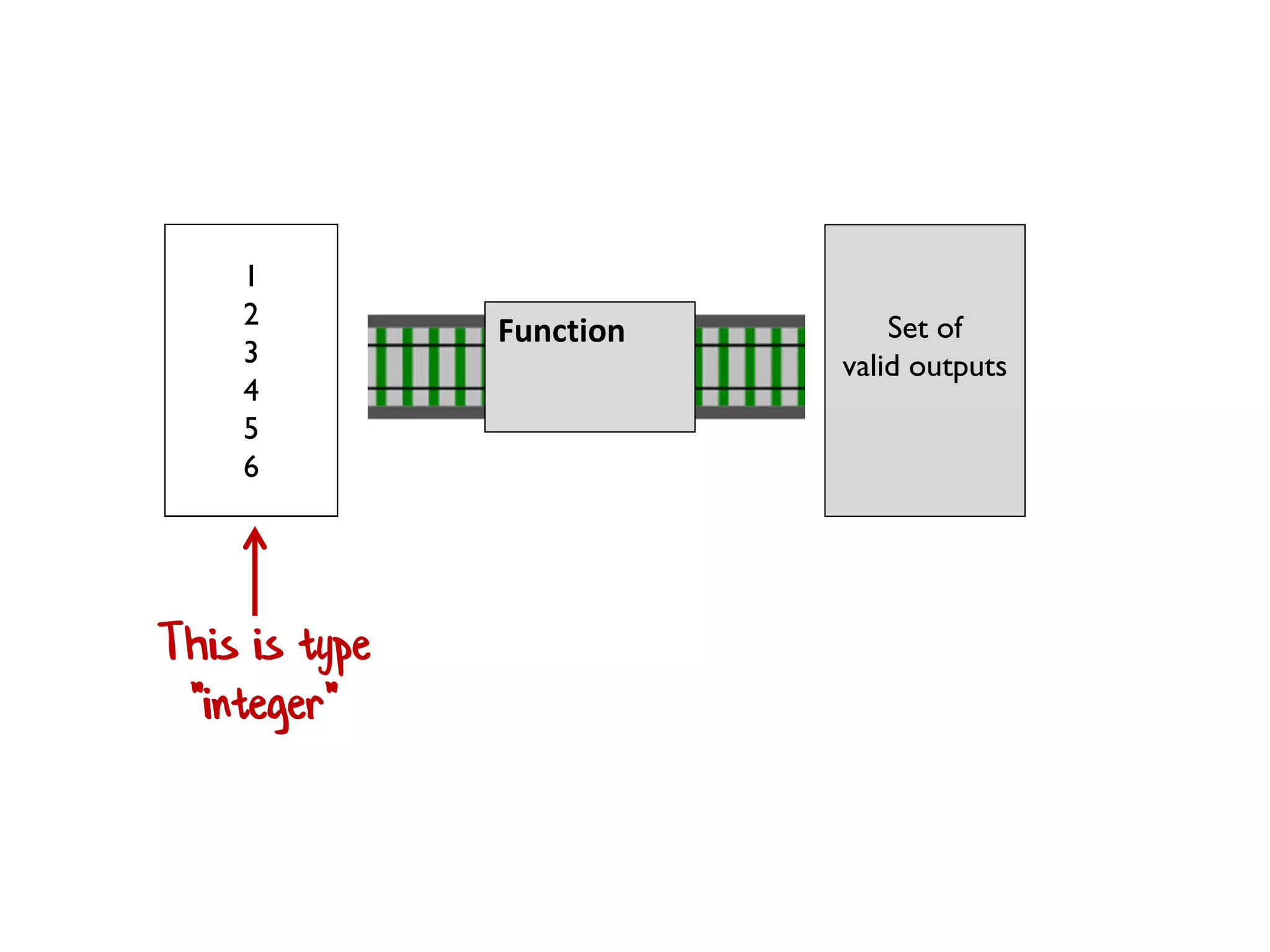
So, what is a type then?
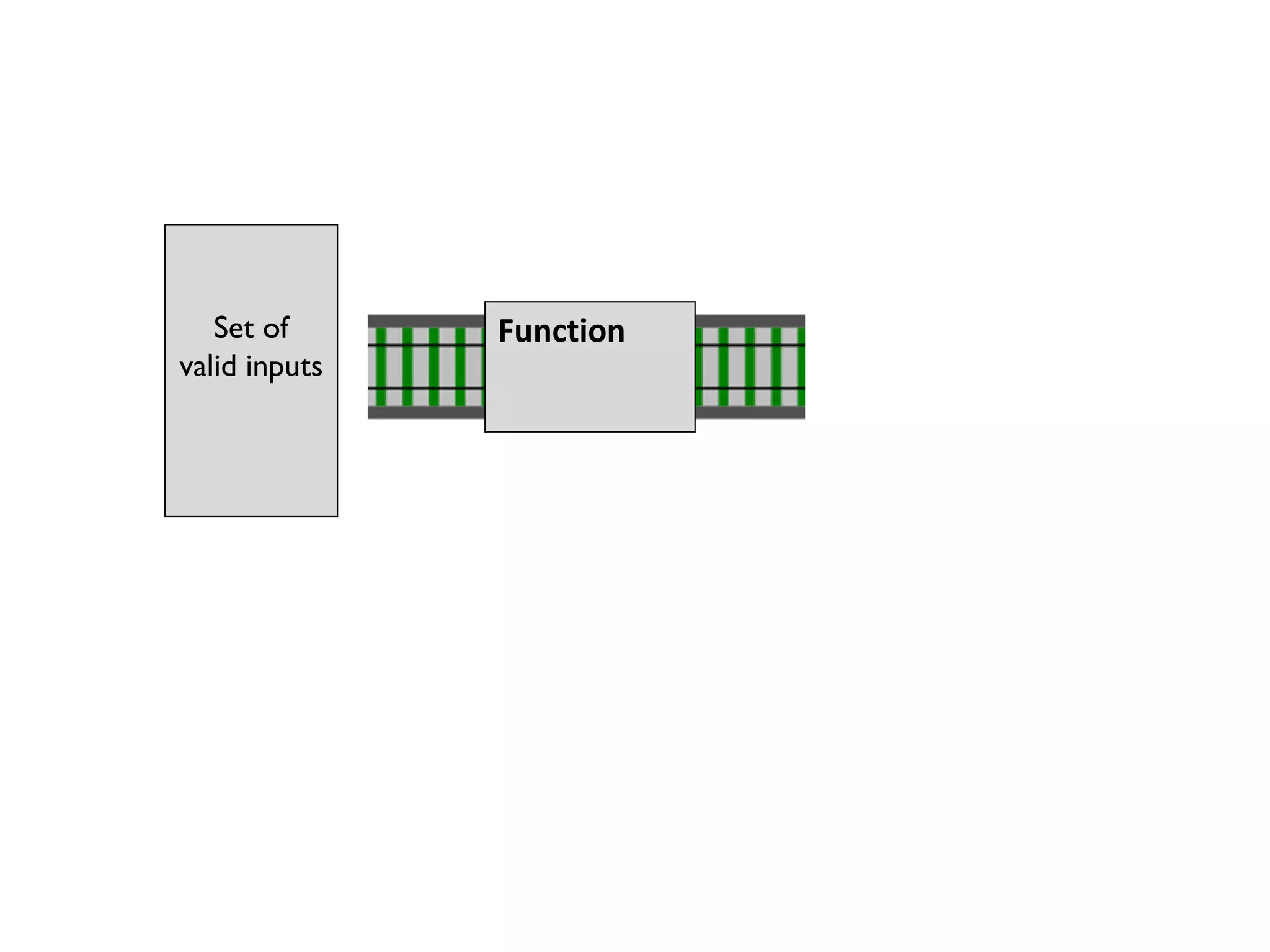
Set of
valid inputs
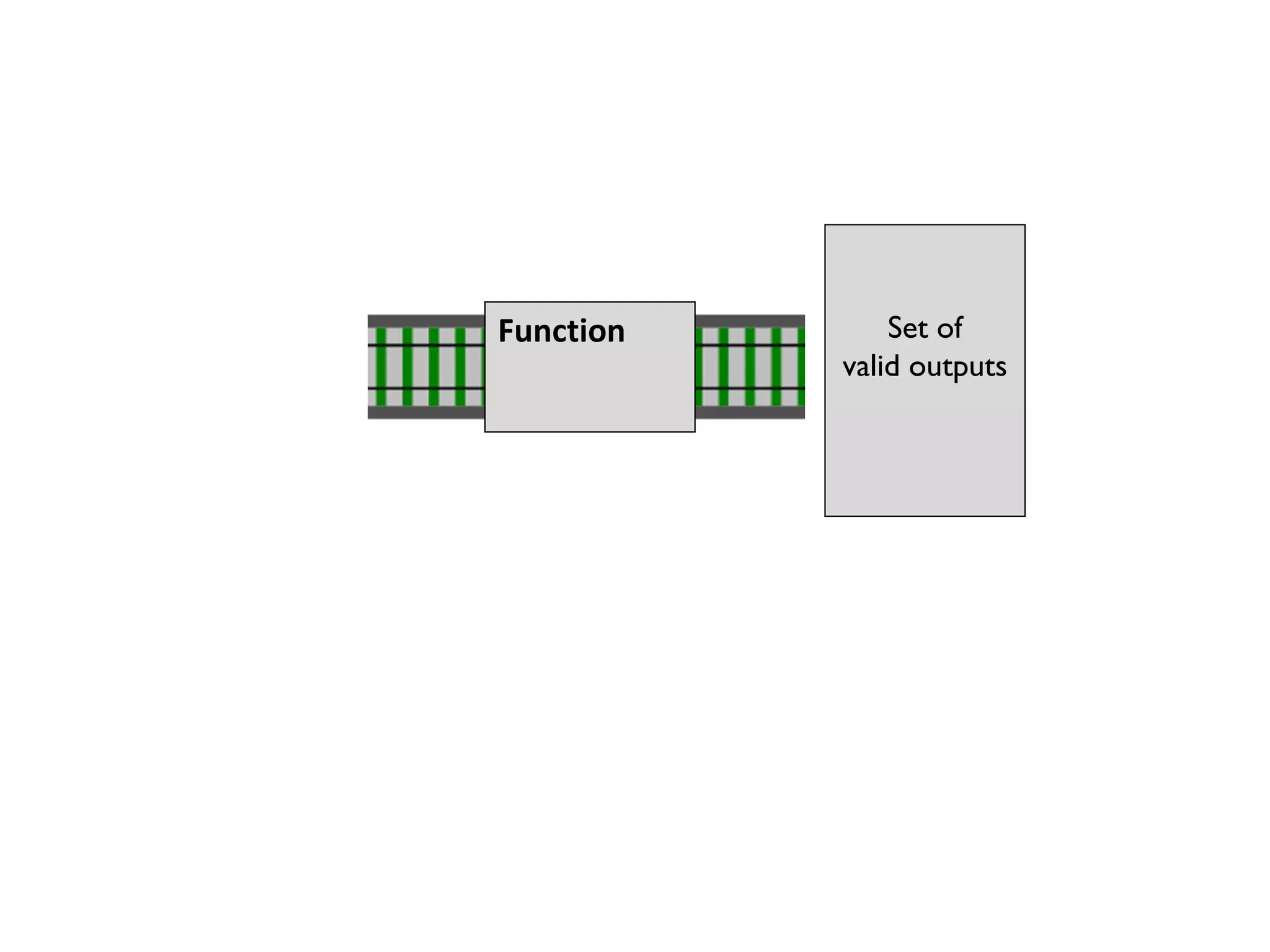
Function
Set of
valid outputs
Function
Set of
valid inputs
Set of
valid outputs
Function
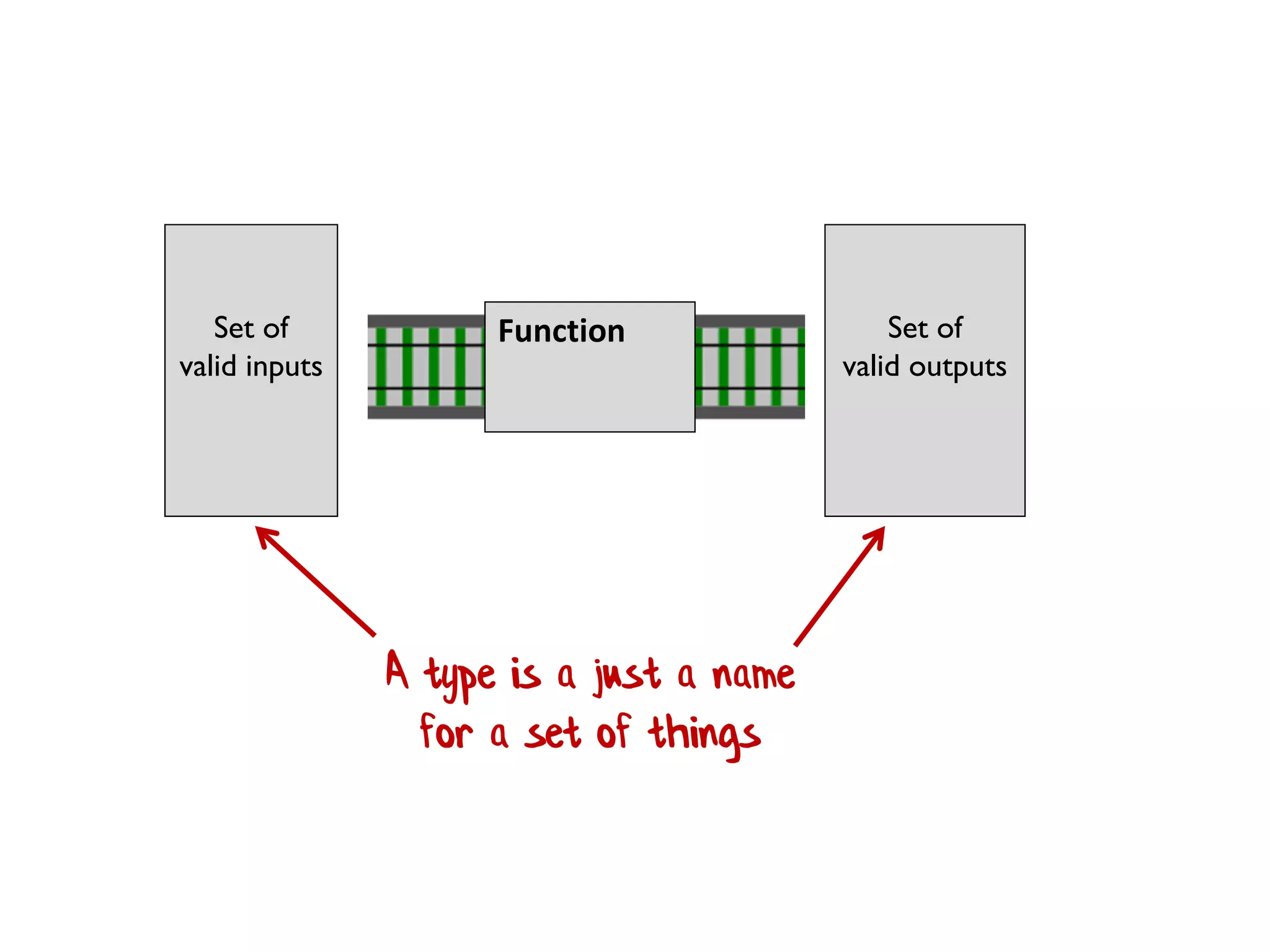
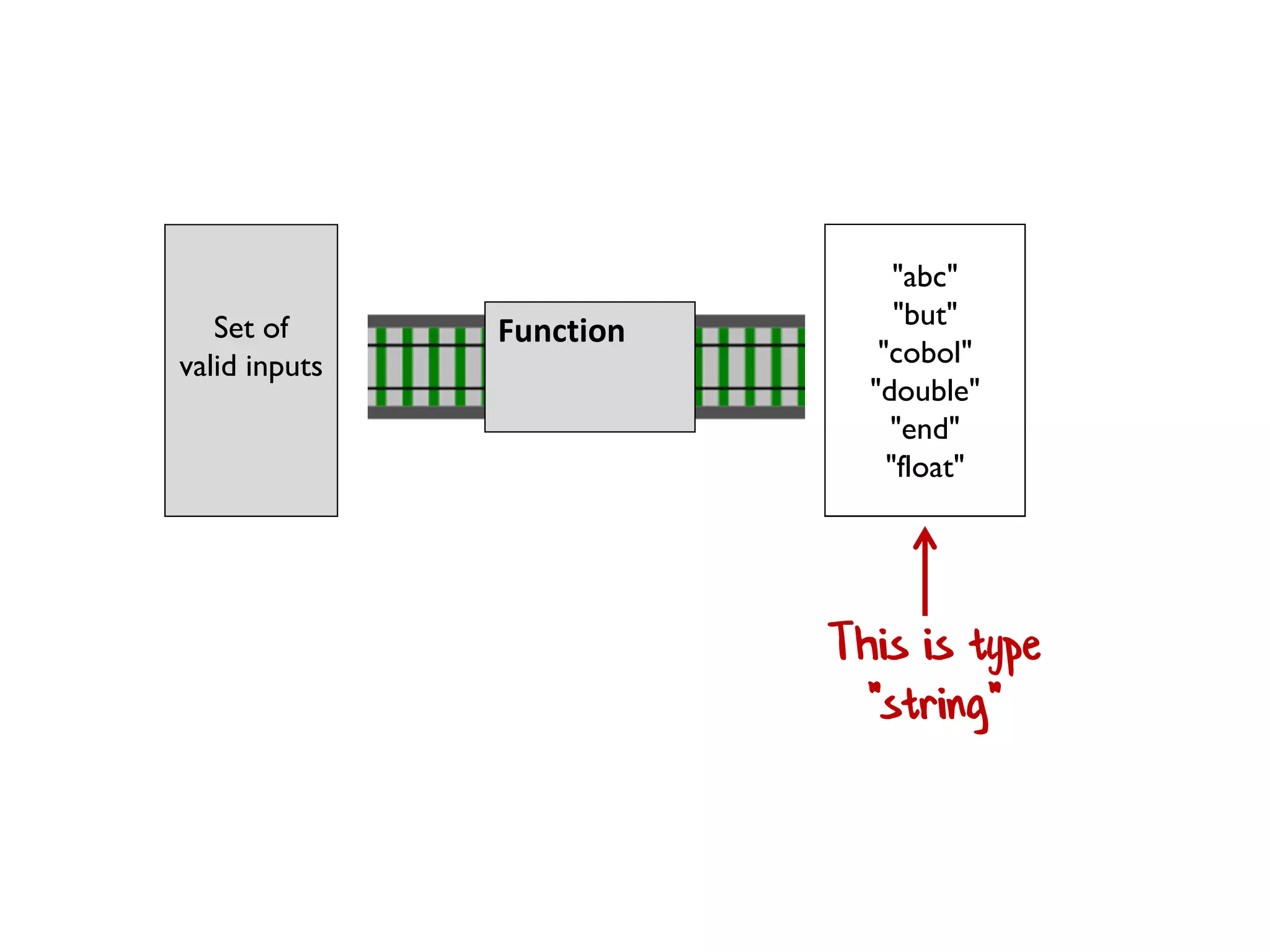
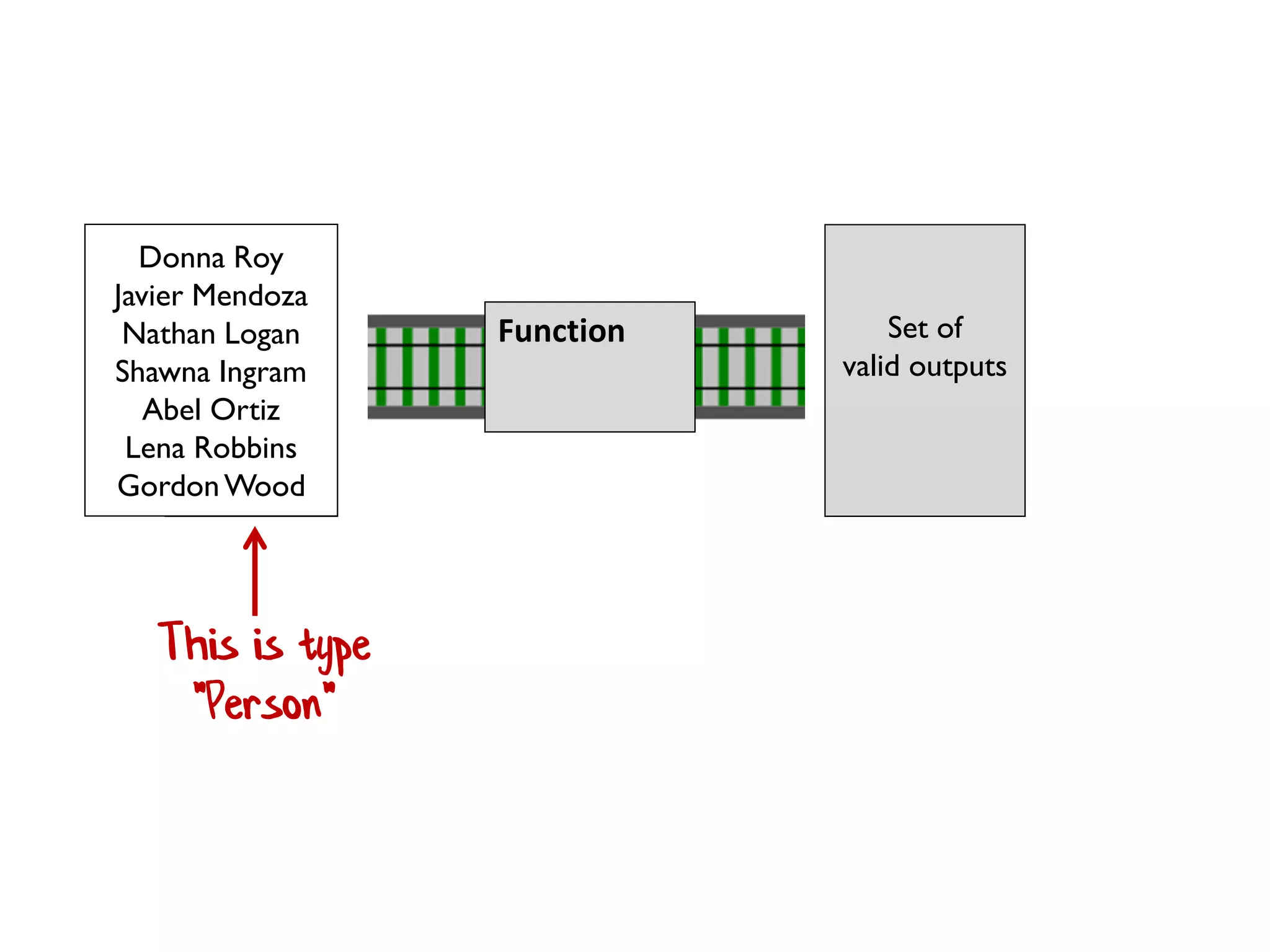
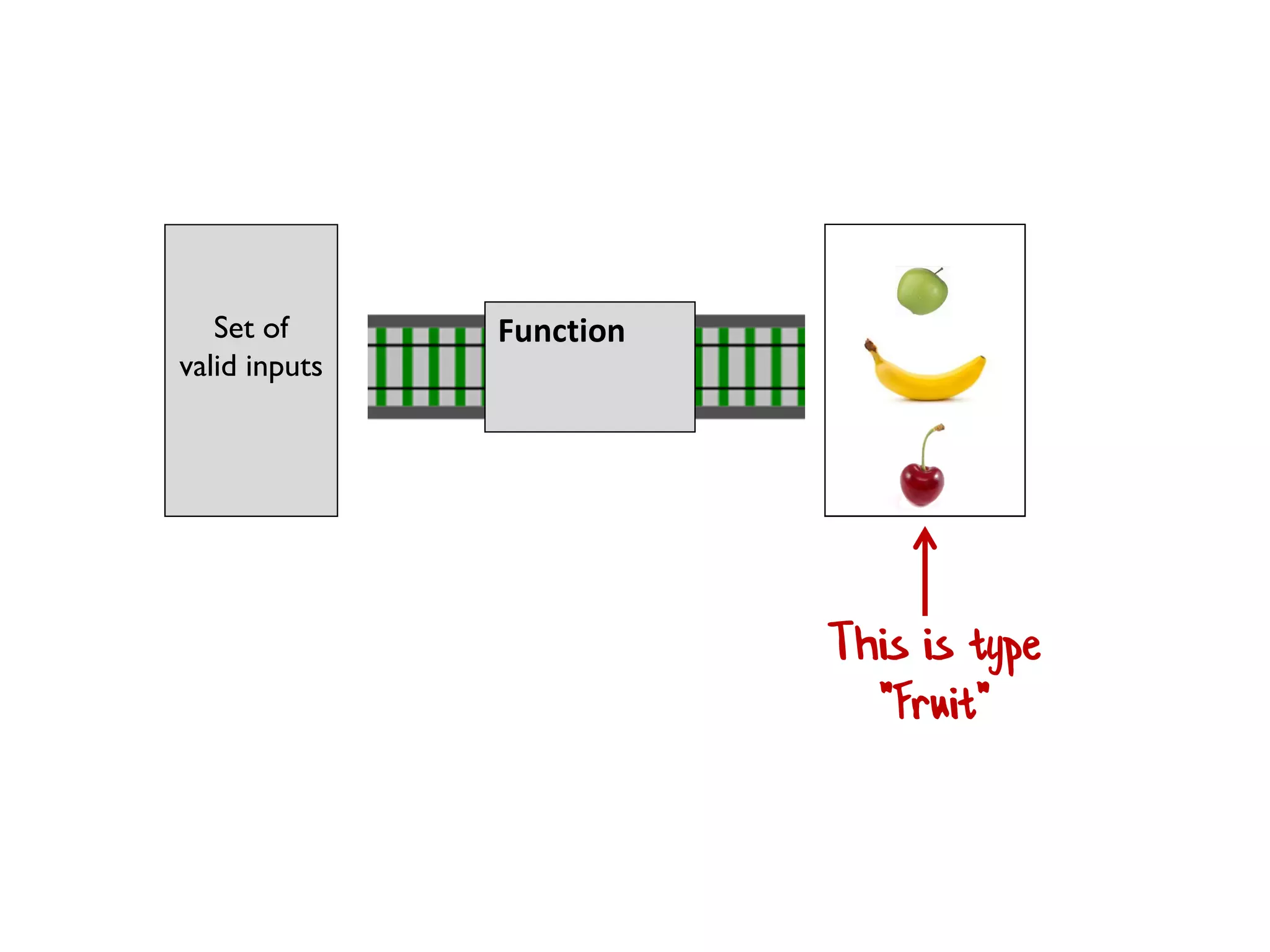
A type is a just a name
for a set of things
Set of
valid inputs
Set of
valid outputs
Function
1
2
3
4
5
6
This is type
"integer"
Set of
valid inputs
Set of
valid outputs
Function
This is type
"string"
"abc"
"but"
"cobol"
"double"
"end"
"float"
Set of
valid inputs
Set of
valid outputs
Function
This is type
"Person"
Donna Roy
Javier Mendoza
Nathan Logan
Shawna Ingram
Abel Ortiz
Lena Robbins
GordonWood
Set of
valid inputs
Set of
valid outputs
Function
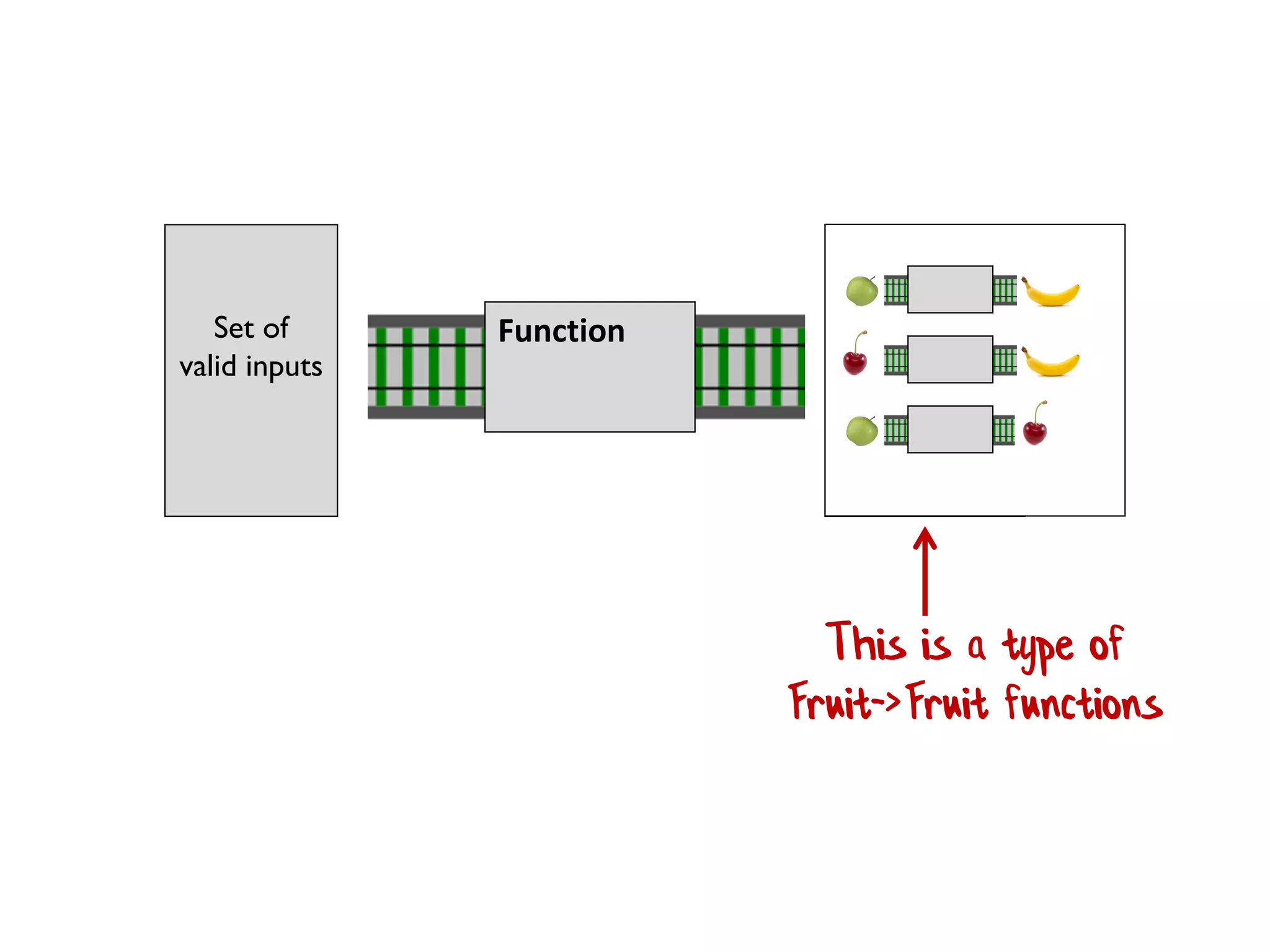
This is type
"Fruit"
Set of
valid inputs
Set of
valid outputs
Function
This is a type of
Fruit->Fruit functions
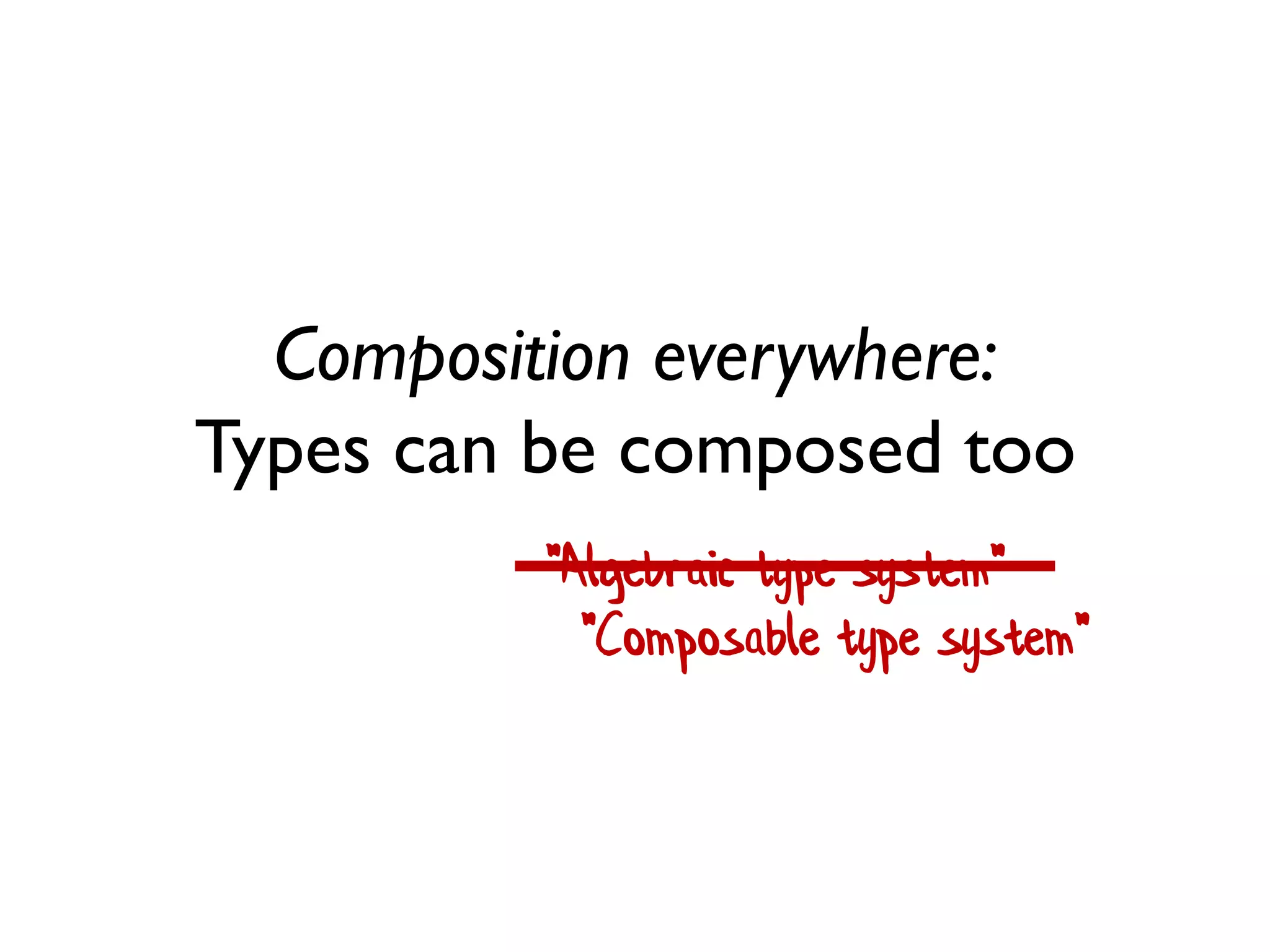
Composition everywhere:
Types can be composed too
"Algebraic type system"
"Composable type system"
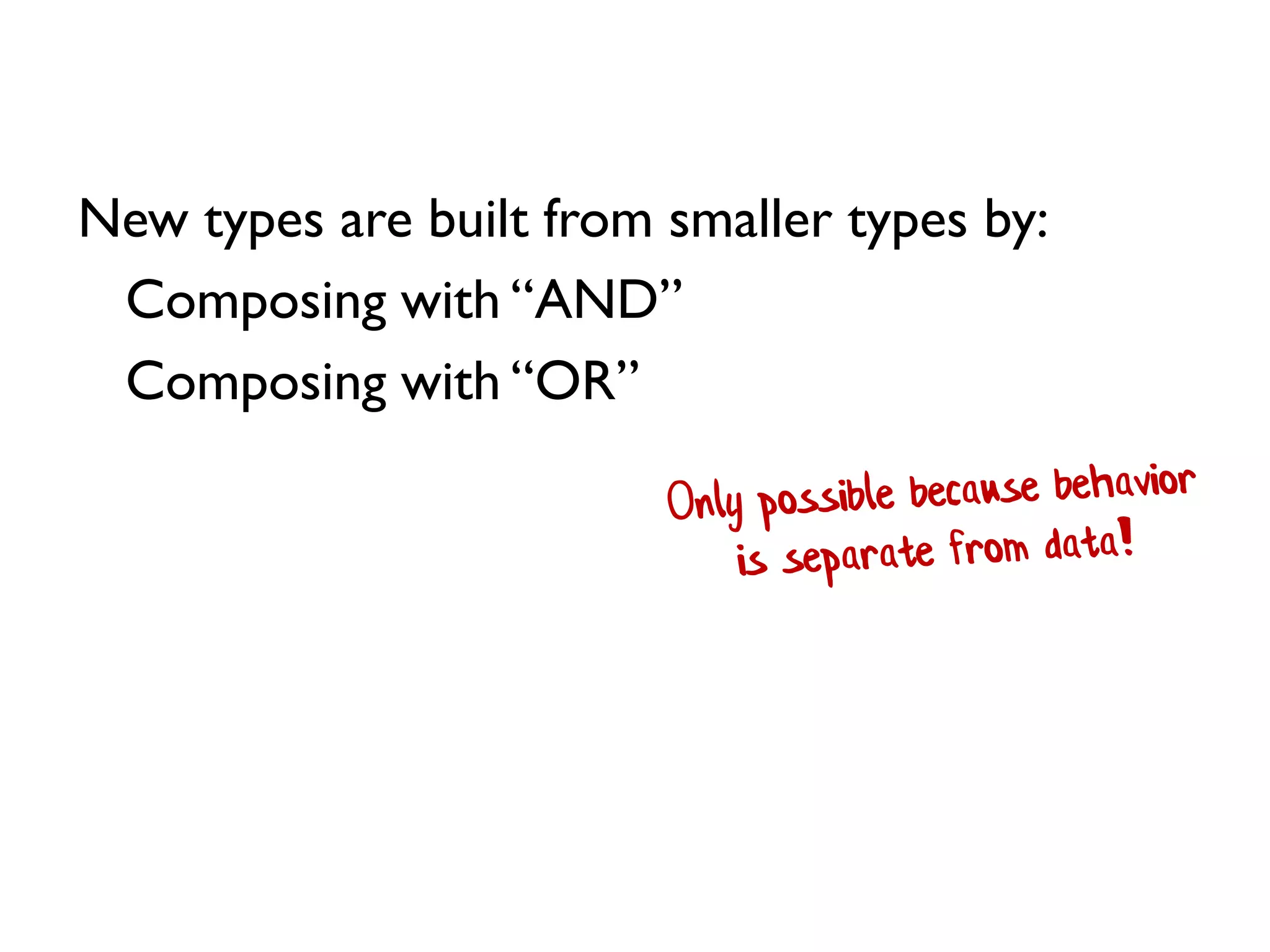
New types are built from smaller types by:
Composing with “AND”
Composing with “OR”
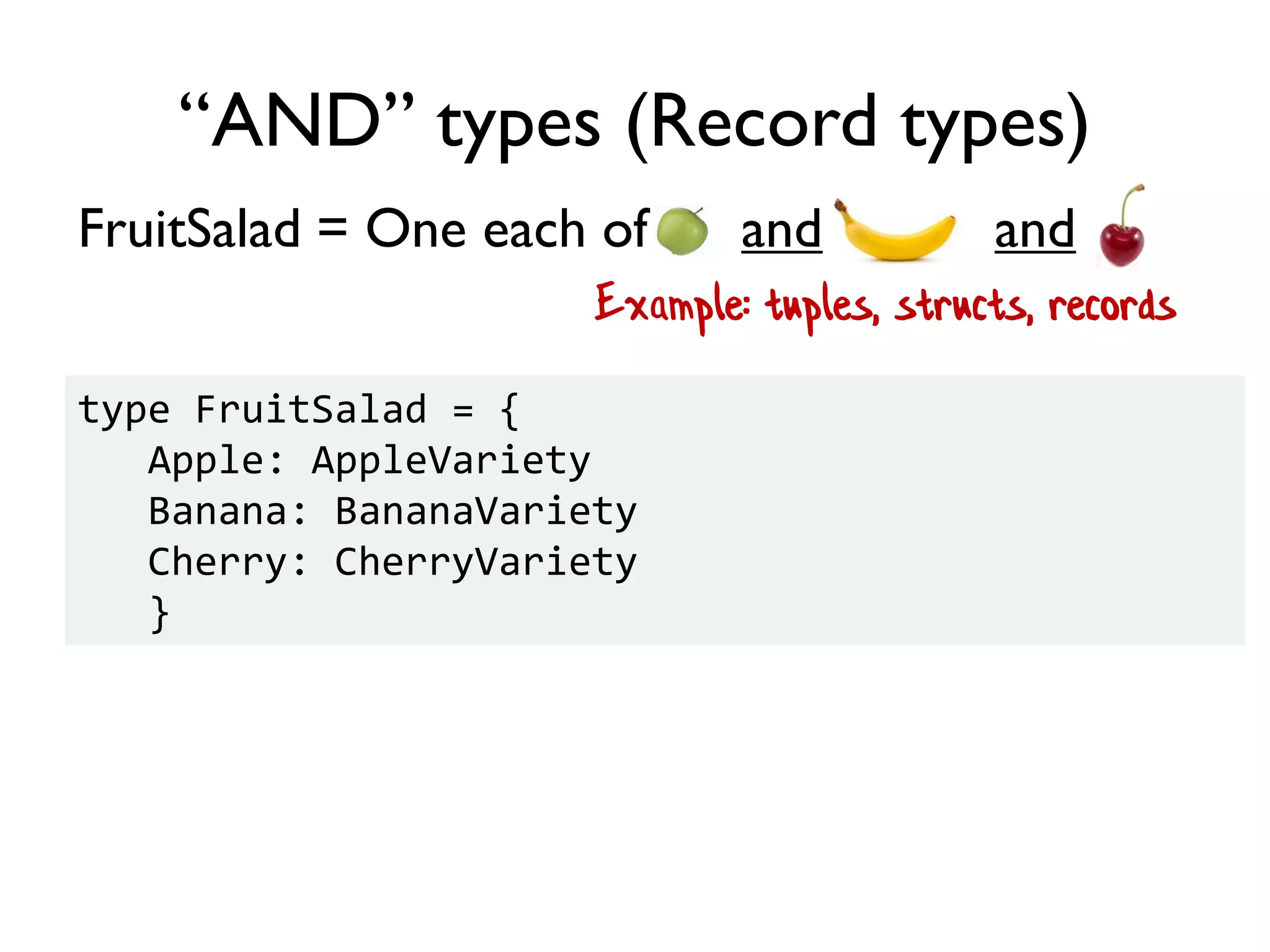
Example: tuples, structs, records
FruitSalad = One each of and and
“AND” types (Record types)
type FruitSalad = {
Apple: AppleVariety
Banana: BananaVariety
Cherry: CherryVariety
}
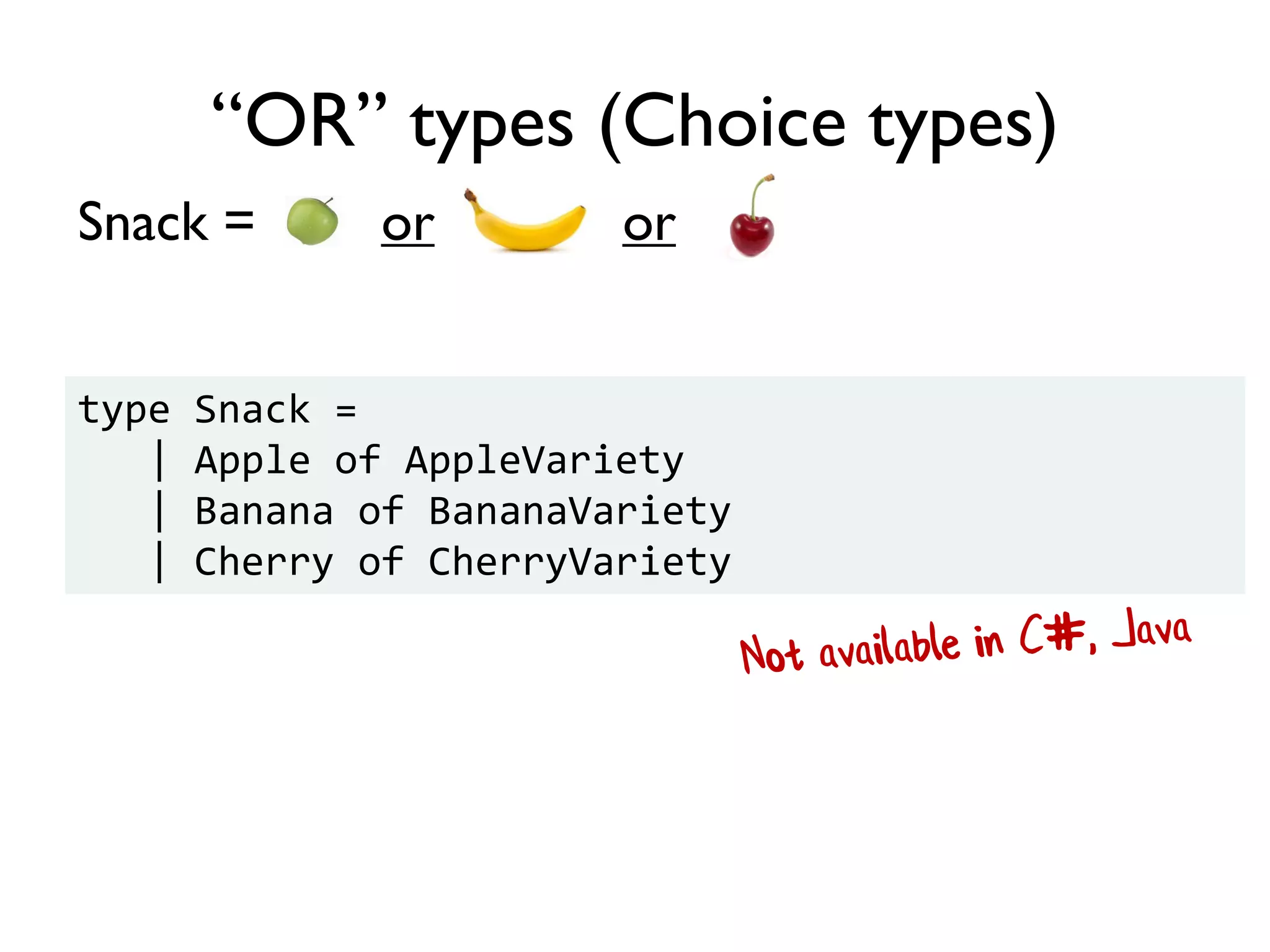
Snack = or or
“OR” types (Choice types)
type Snack =
| Apple of AppleVariety
| Banana of BananaVariety
| Cherry of CherryVariety
Real world example
of type composition
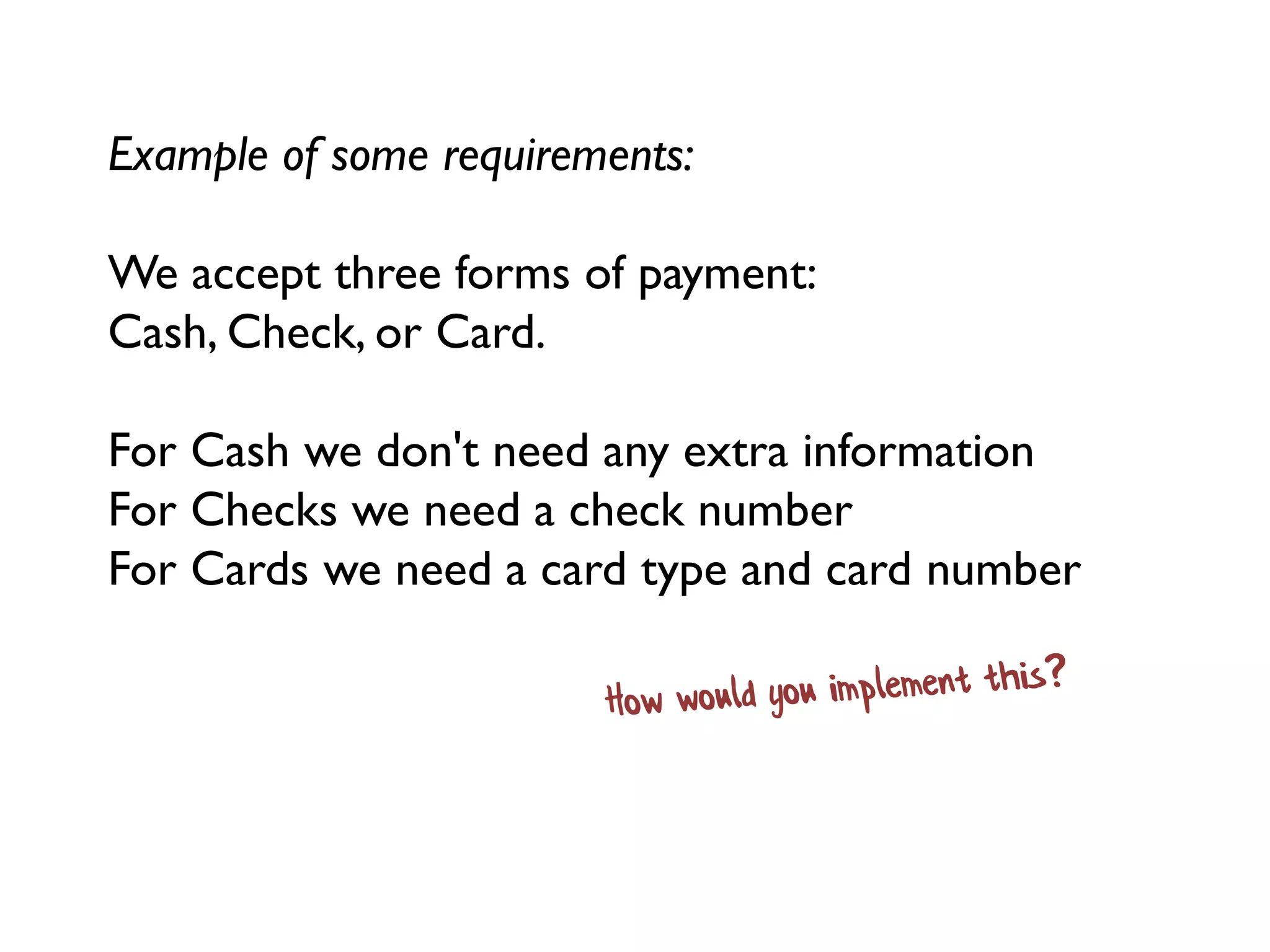
Example of some requirements:
We accept three forms of payment:
Cash, Check, or Card.
For Cash we don't need any extra information
For Checks we need a check number
For Cards we need a card type and card number
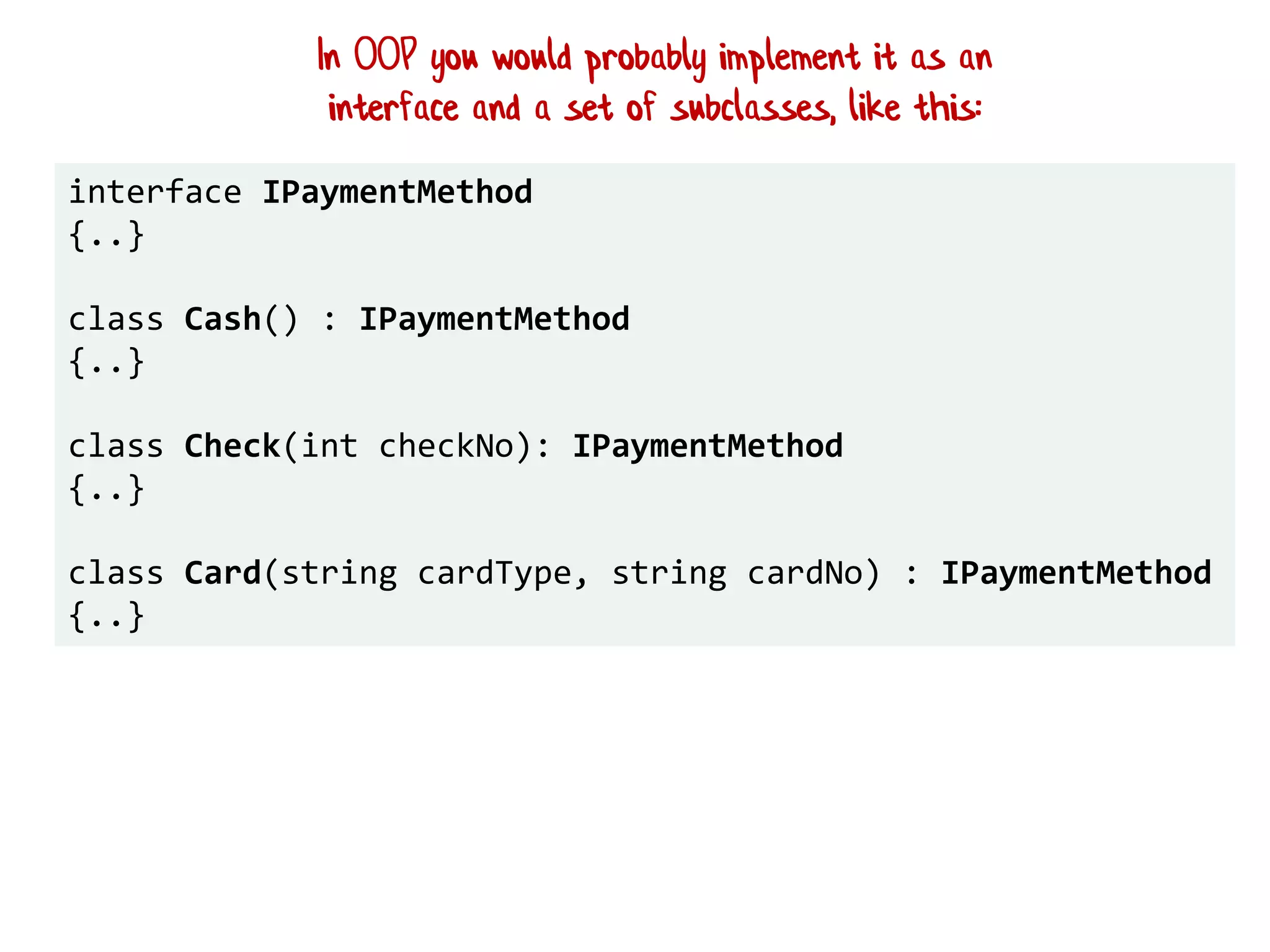
interface IPaymentMethod
{..}
class Cash() : IPaymentMethod
{..}
class Check(int checkNo): IPaymentMethod
{..}
class Card(string cardType, string cardNo) : IPaymentMethod
{..}
In OOP you would probably implement it as an
interface and a set of subclasses, like this:
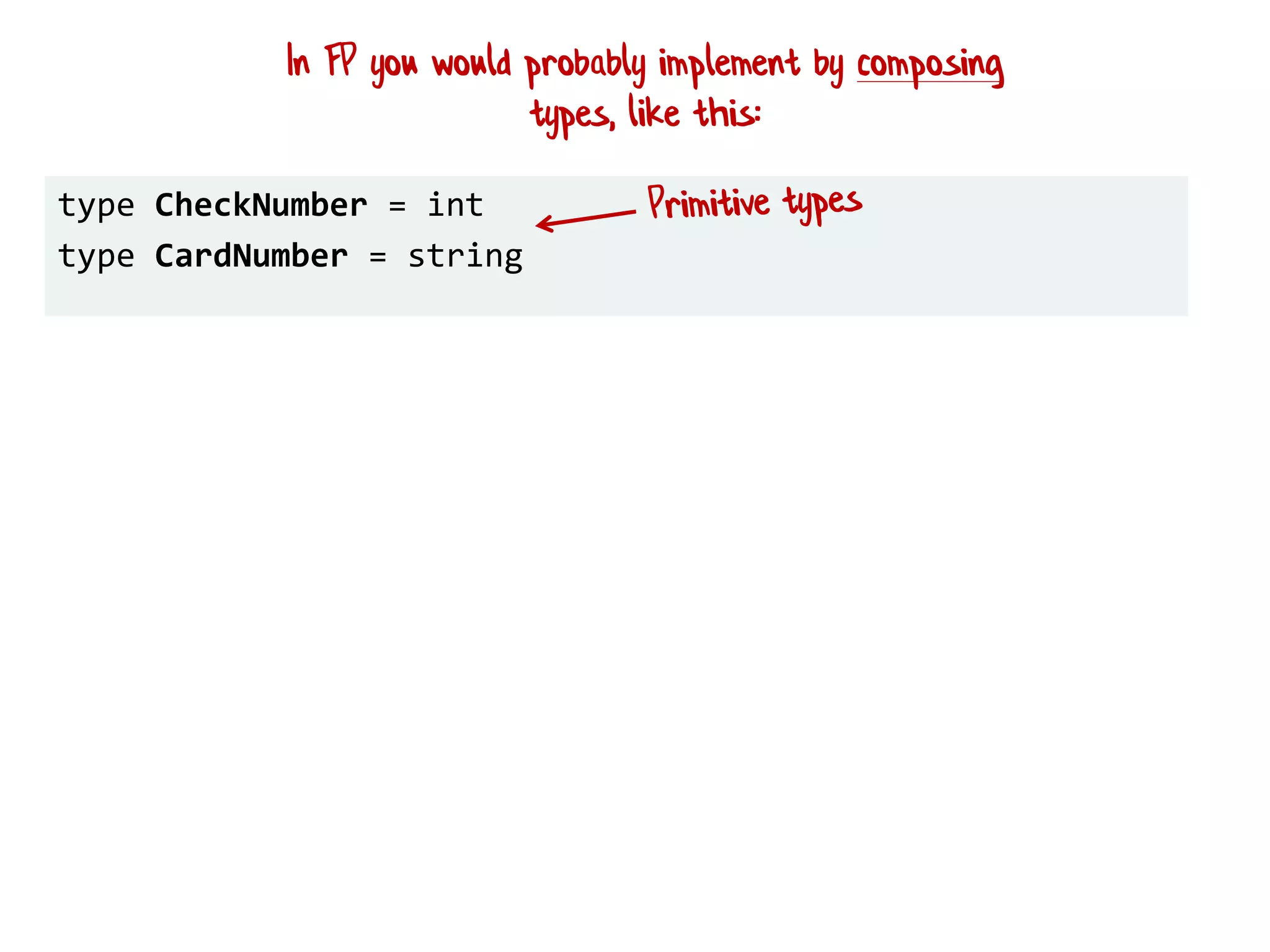
type CheckNumber = int
type CardNumber = string
In FP you would probably implement by composing
types, like this:
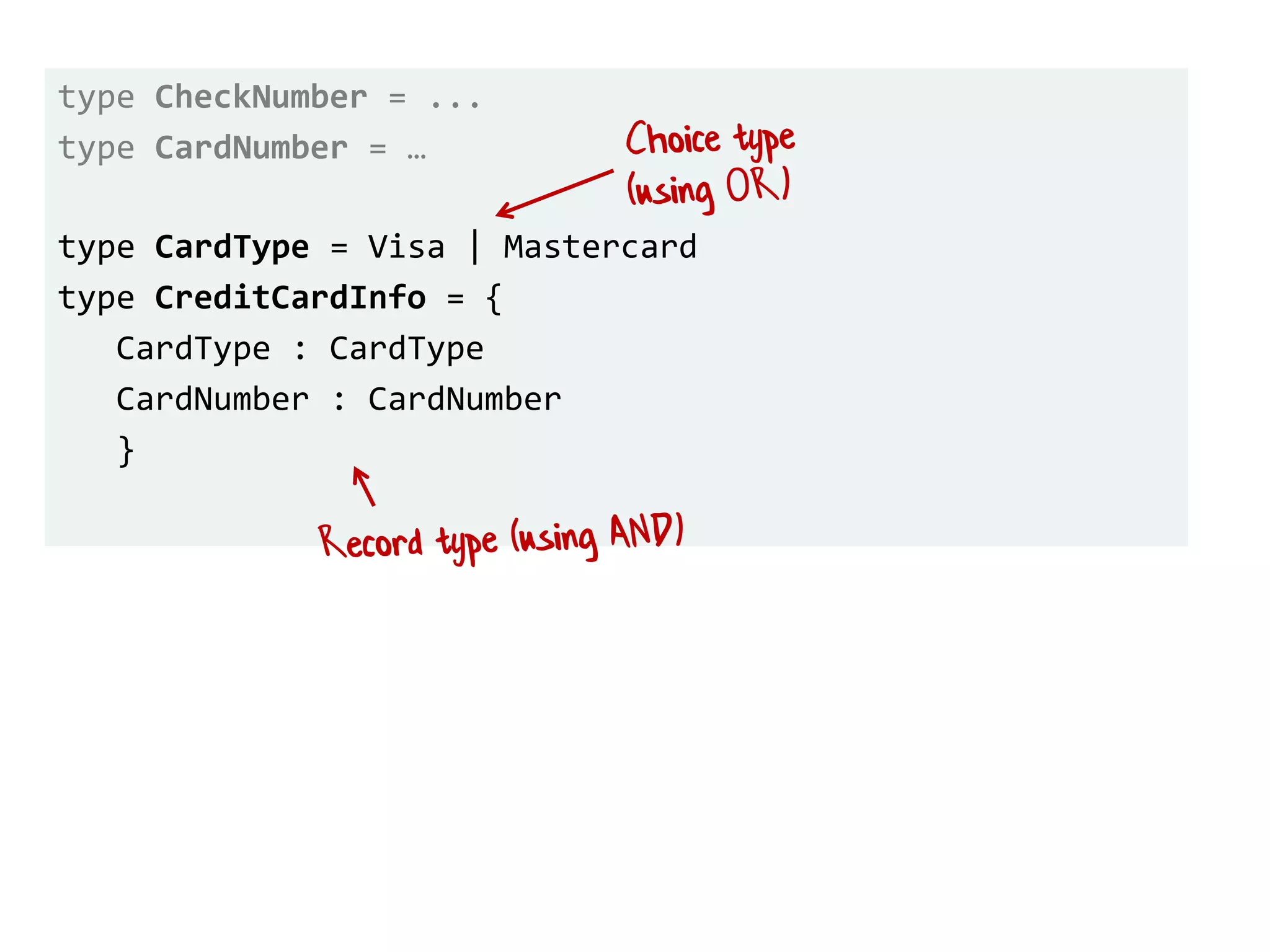
type CheckNumber = ...
type CardNumber = …
type CardType = Visa | Mastercard
type CreditCardInfo = {
CardType : CardType
CardNumber : CardNumber
}
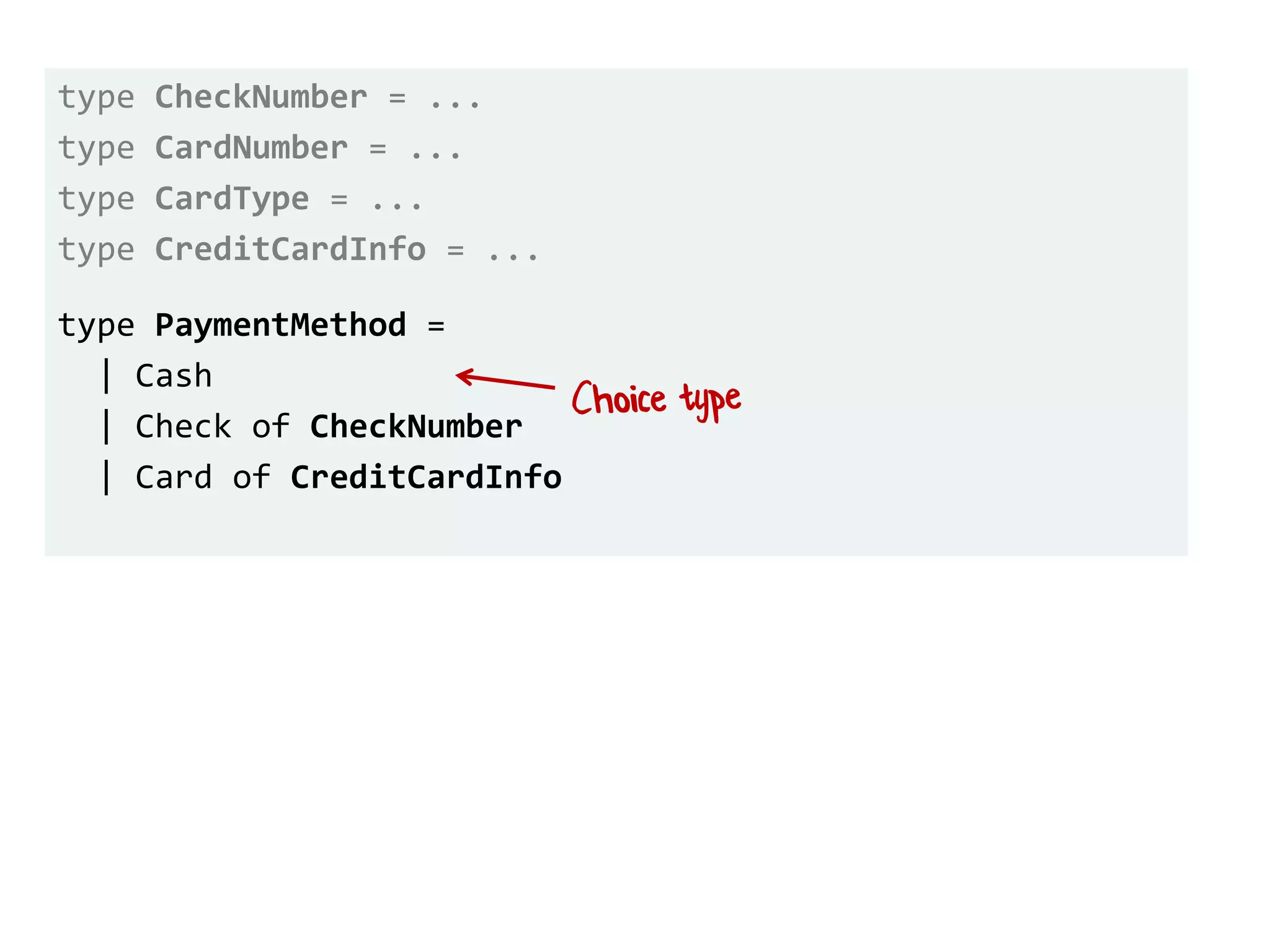
type CheckNumber = ...
type CardNumber = ...
type CardType = ...
type CreditCardInfo = ...
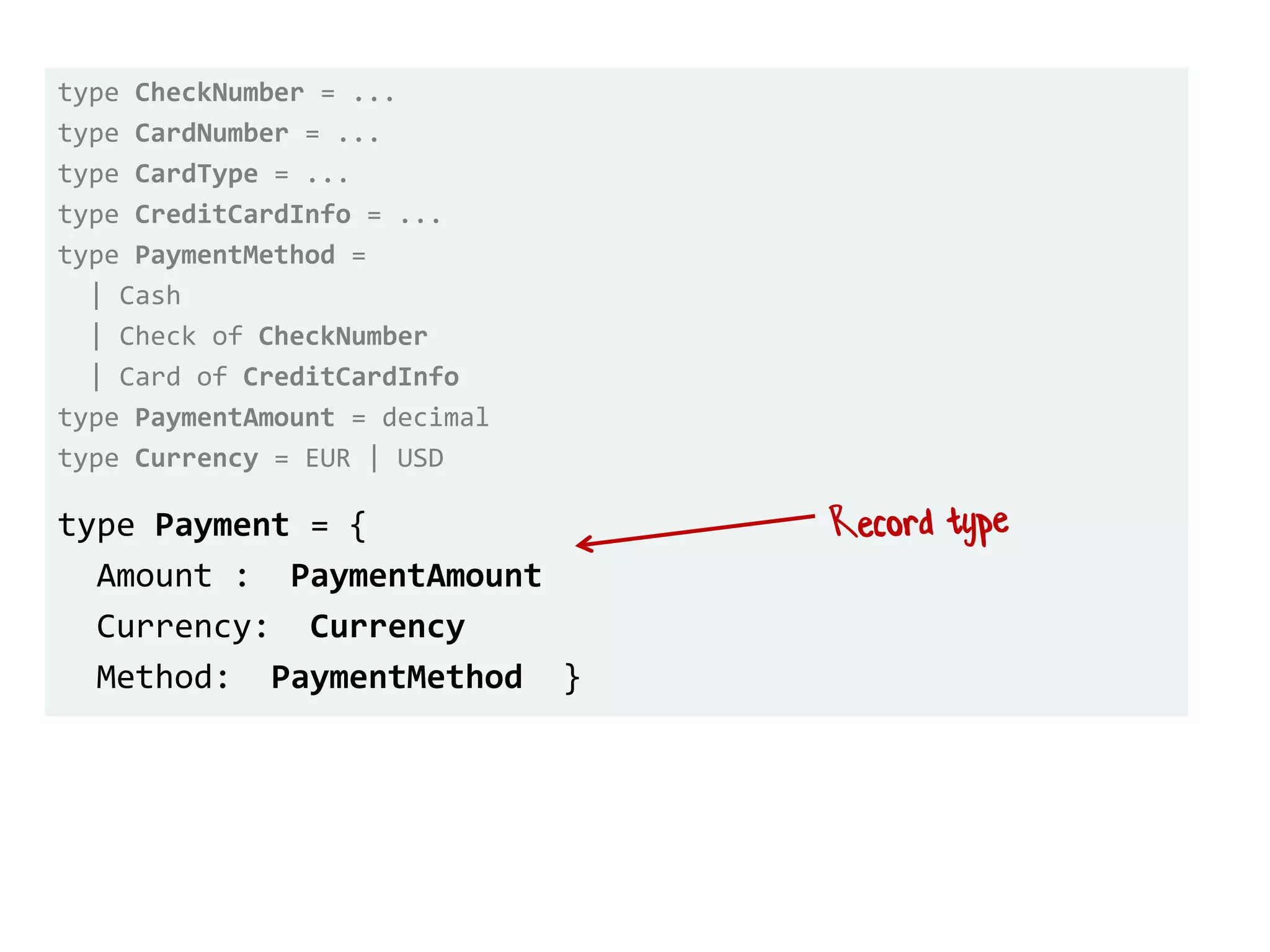
type PaymentMethod =
| Cash
| Check of CheckNumber
| Card of CreditCardInfo
type CheckNumber = ...
type CardNumber = ...
type CardType = ...
type CreditCardInfo = ...
type PaymentMethod =
| Cash
| Check of CheckNumber
| Card of CreditCardInfo
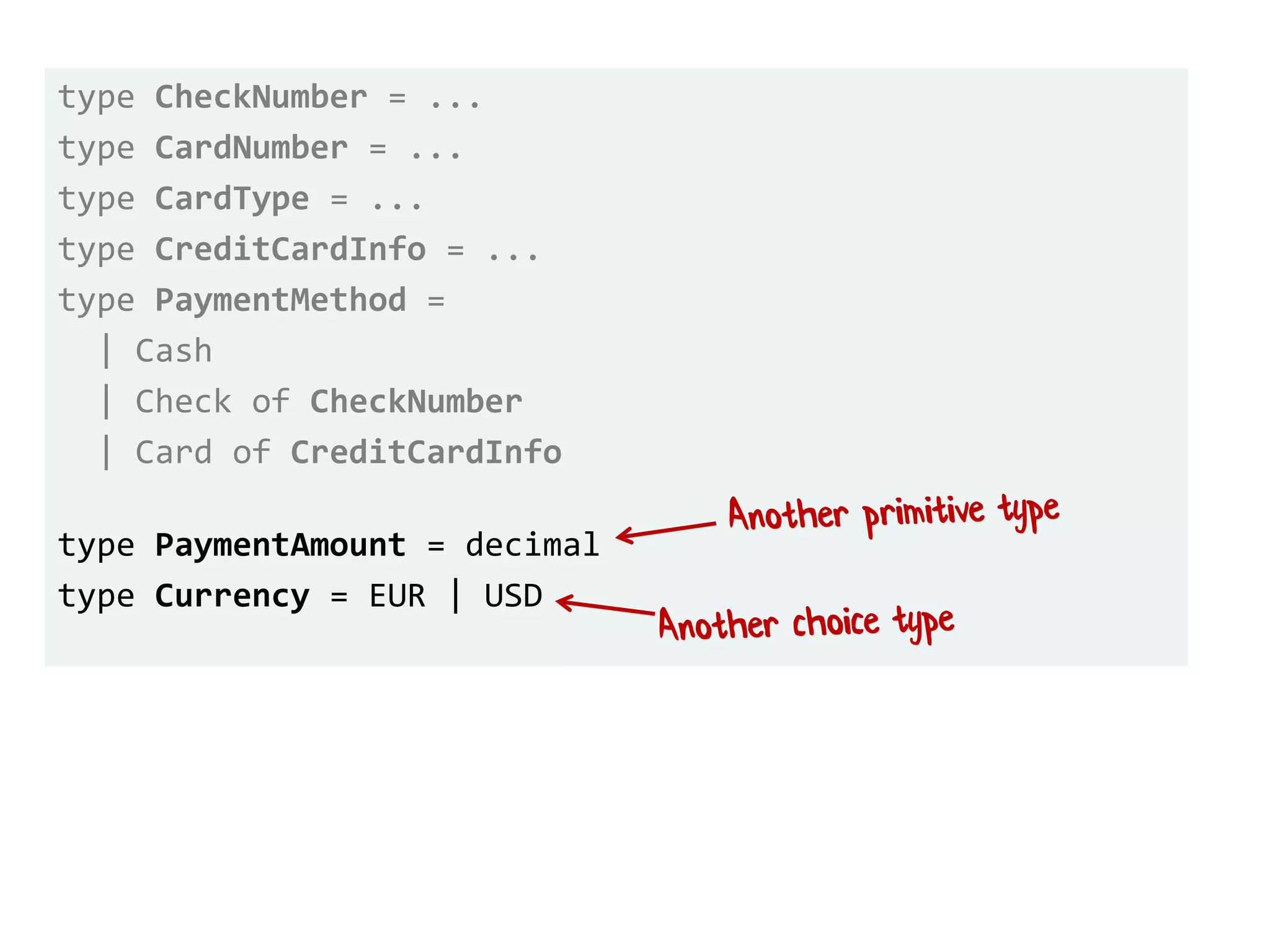
type PaymentAmount = decimal
type Currency = EUR | USD
type CheckNumber = ...
type CardNumber = ...
type CardType = ...
type CreditCardInfo = ...
type PaymentMethod =
| Cash
| Check of CheckNumber
| Card of CreditCardInfo
type PaymentAmount = decimal
type Currency = EUR | USD
type Payment = {
Amount : PaymentAmount
Currency: Currency
Method: PaymentMethod }
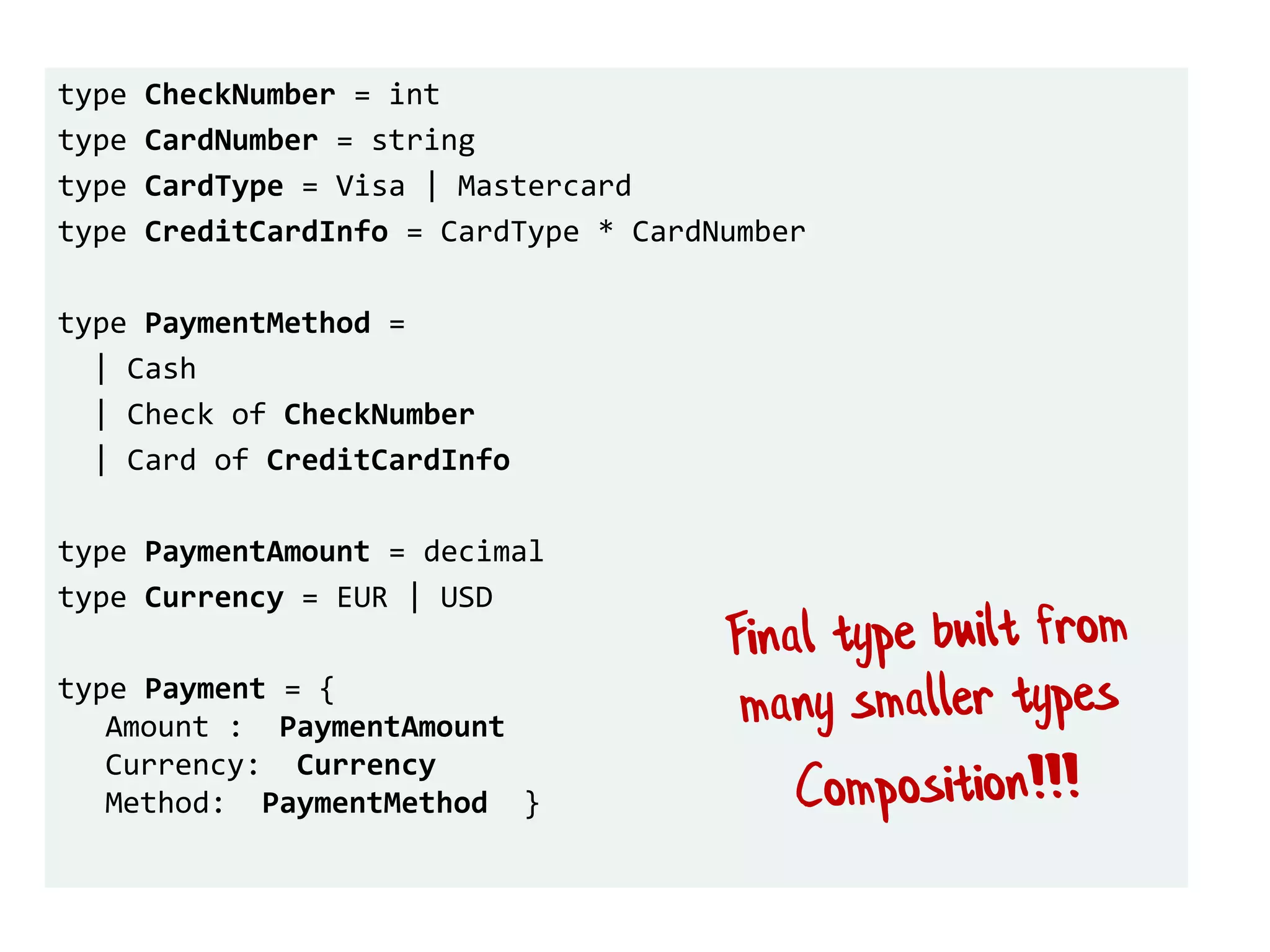
type CheckNumber = int
type CardNumber = string
type CardType = Visa | Mastercard
type CreditCardInfo = CardType * CardNumber
type PaymentMethod =
| Cash
| Check of CheckNumber
| Card of CreditCardInfo
type PaymentAmount = decimal
type Currency = EUR | USD
type Payment = {
Amount : PaymentAmount
Currency: Currency
Method: PaymentMethod }
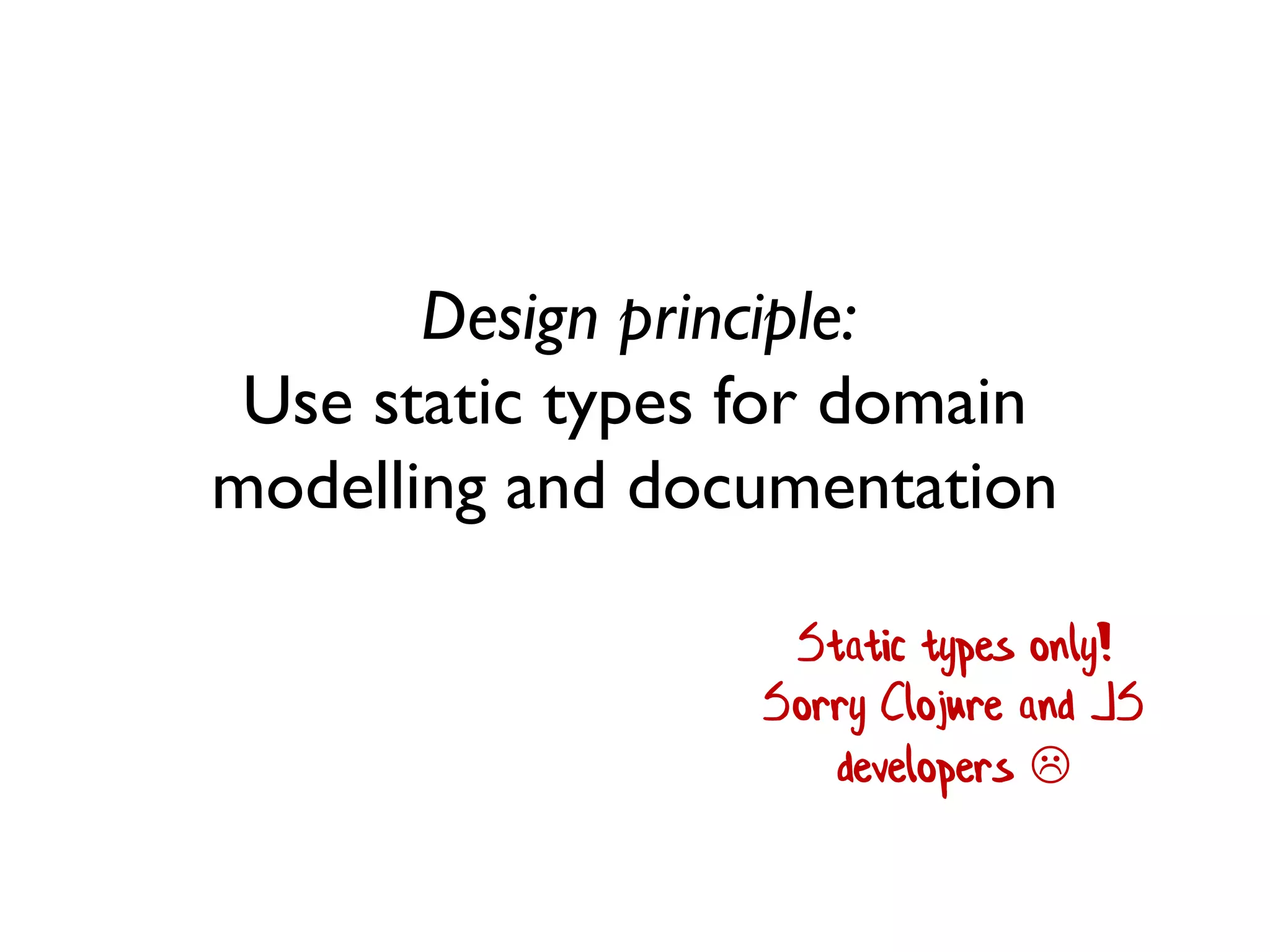
Design principle:
Use static types for domain
modelling and documentation
Static types only!
Sorry Clojure and JS
developers 
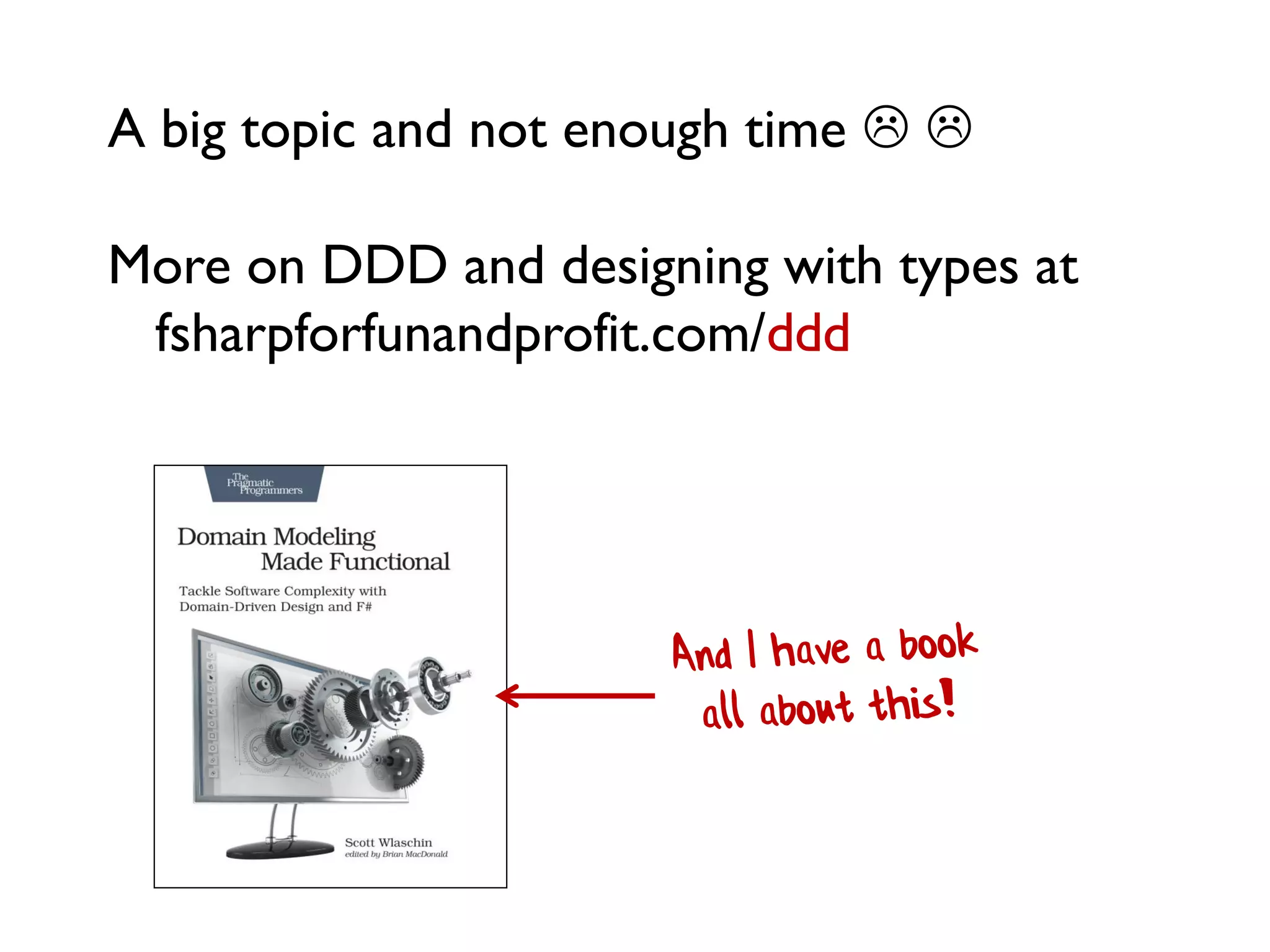
A big topic and not enough time  
More on DDD and designing with types at
fsharpforfunandprofit.com/ddd
PATTERN 1:
FUNCTIONS AS PARAMETERS
Guideline:
Parameterize all the things
let printList() =
for i in [1..10] do
printfn "the number is %i" i
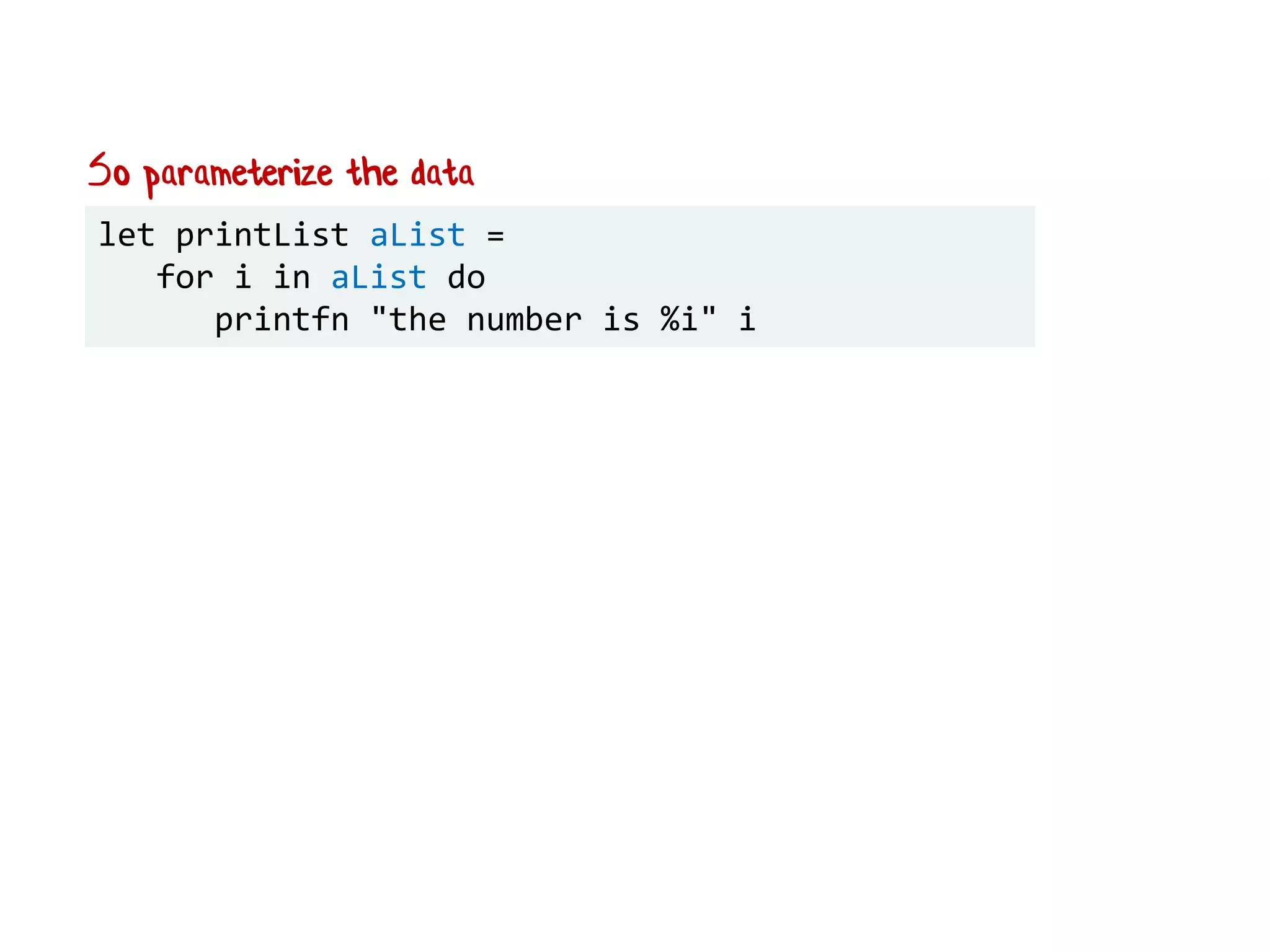
So parameterize the data
let printList aList =
for i in aList do
printfn "the number is %i" i
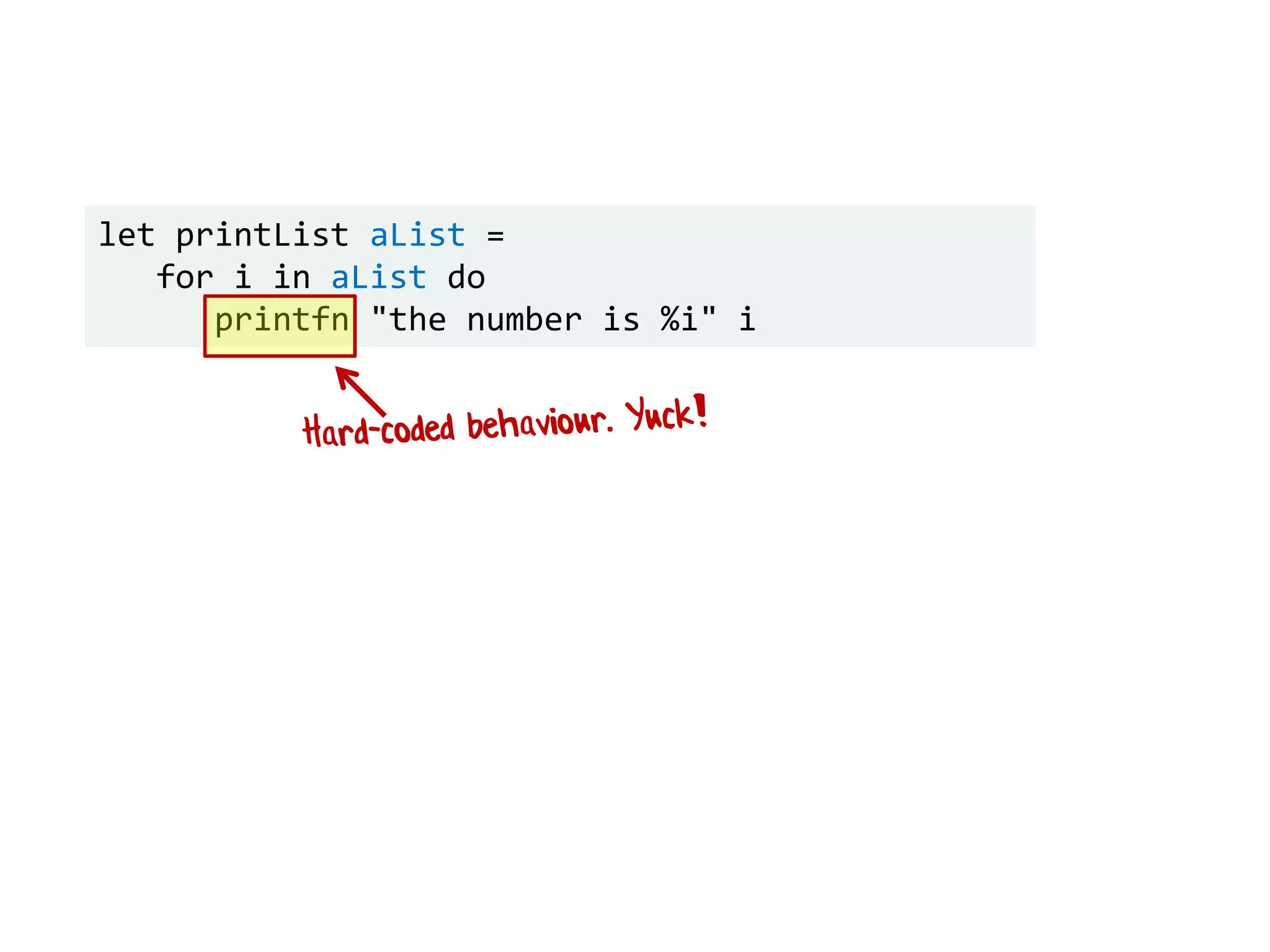
let printList aList =
for i in aList do
printfn "the number is %i" i
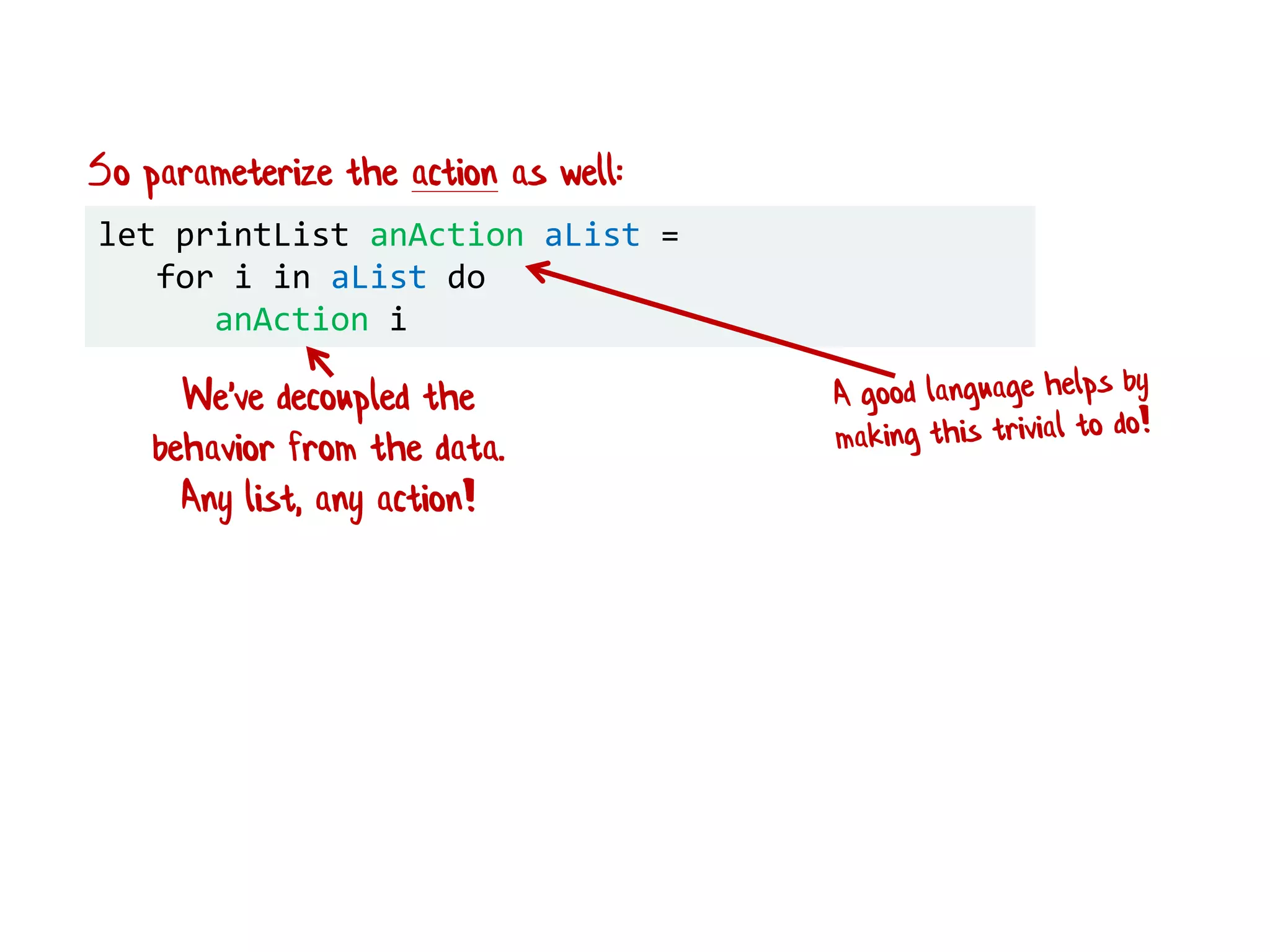
let printList anAction aList =
for i in aList do
anAction i
So parameterize the action as well:
We've decoupled the
behavior from the data.
Any list, any action!
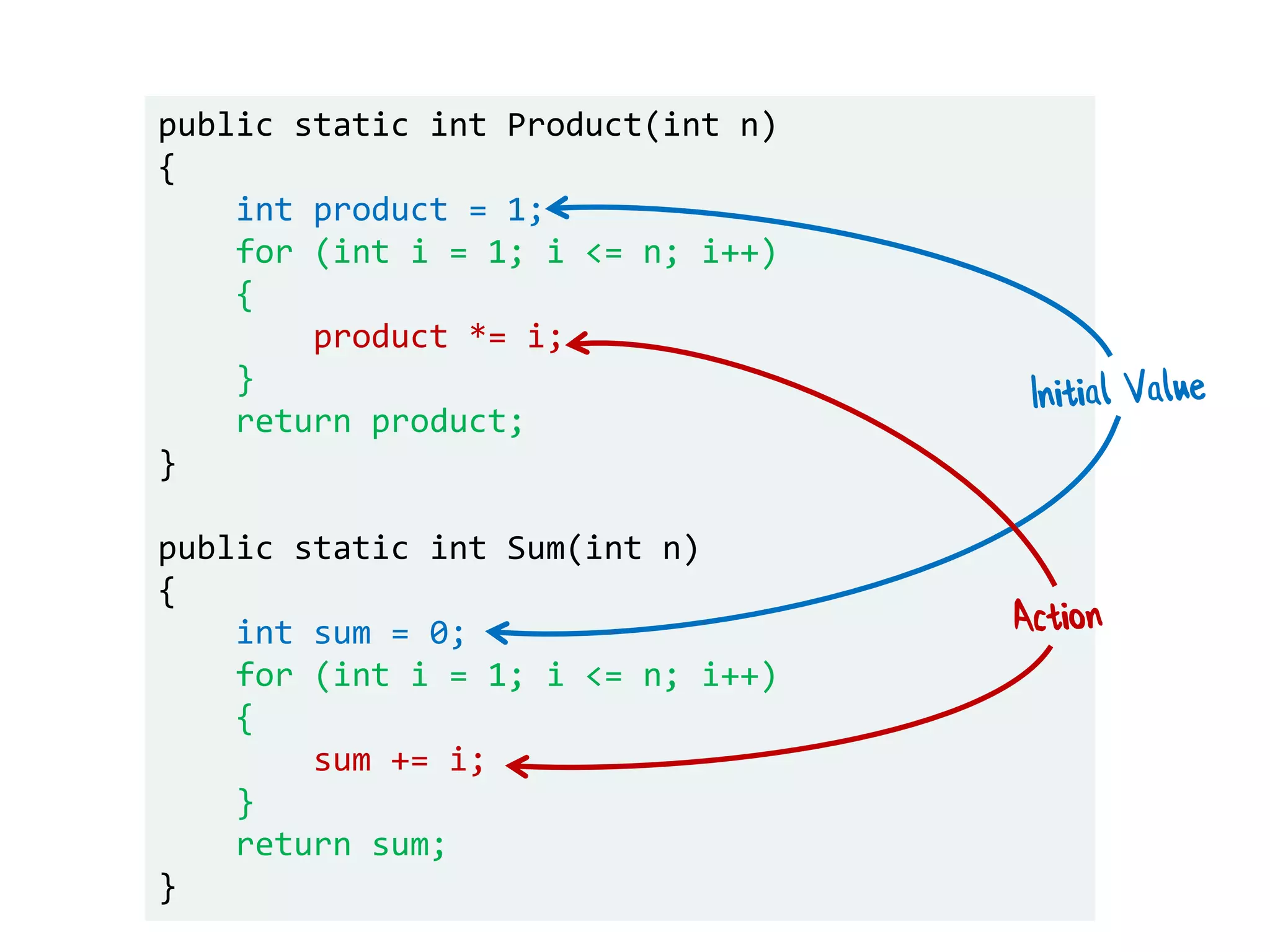
C# parameterization example
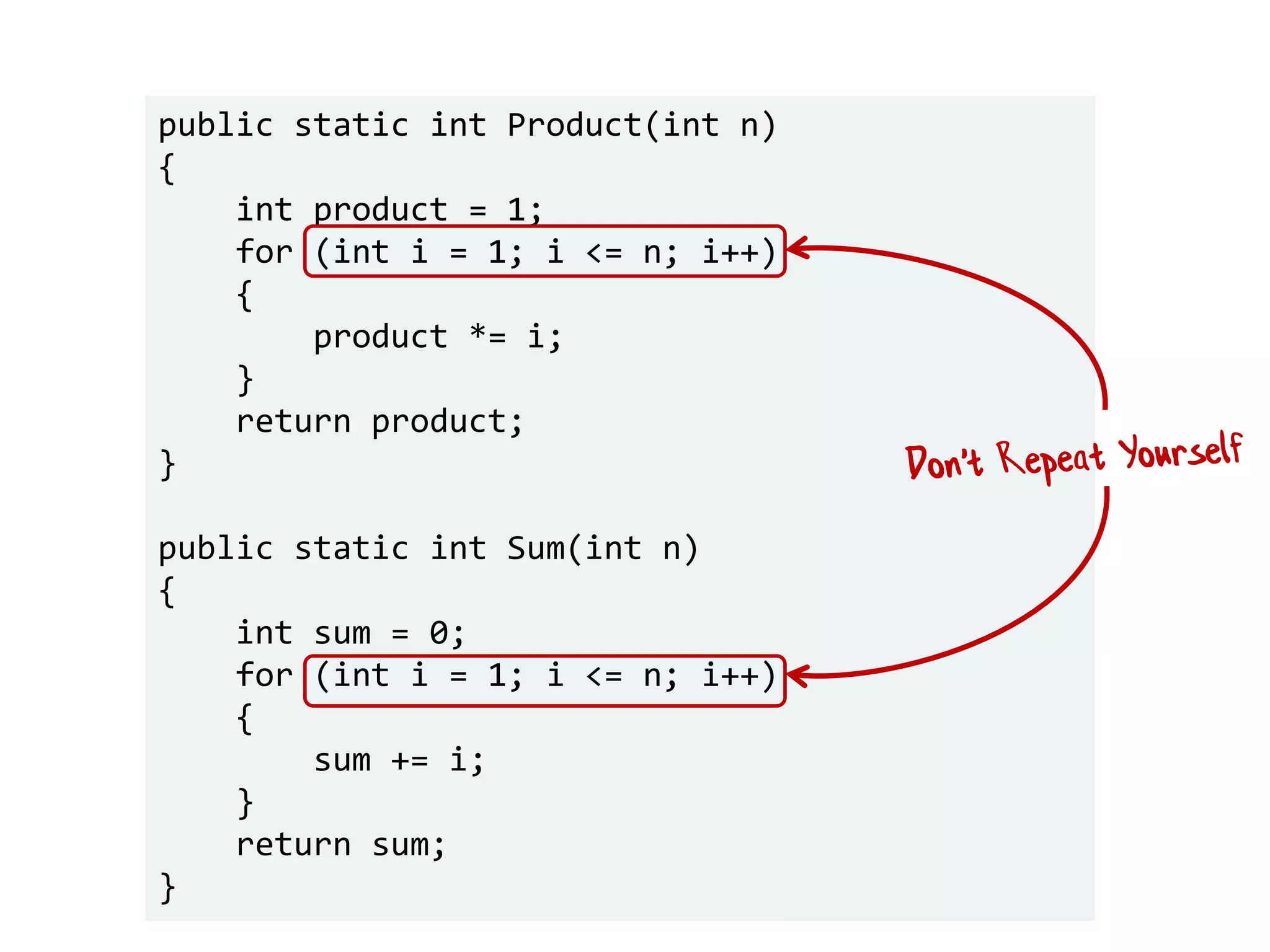
public static int Product(int n)
{
int product = 1;
for (int i = 1; i <= n; i++)
{
product *= i;
}
return product;
}
public static int Sum(int n)
{
int sum = 0;
for (int i = 1; i <= n; i++)
{
sum += i;
}
return sum;
}
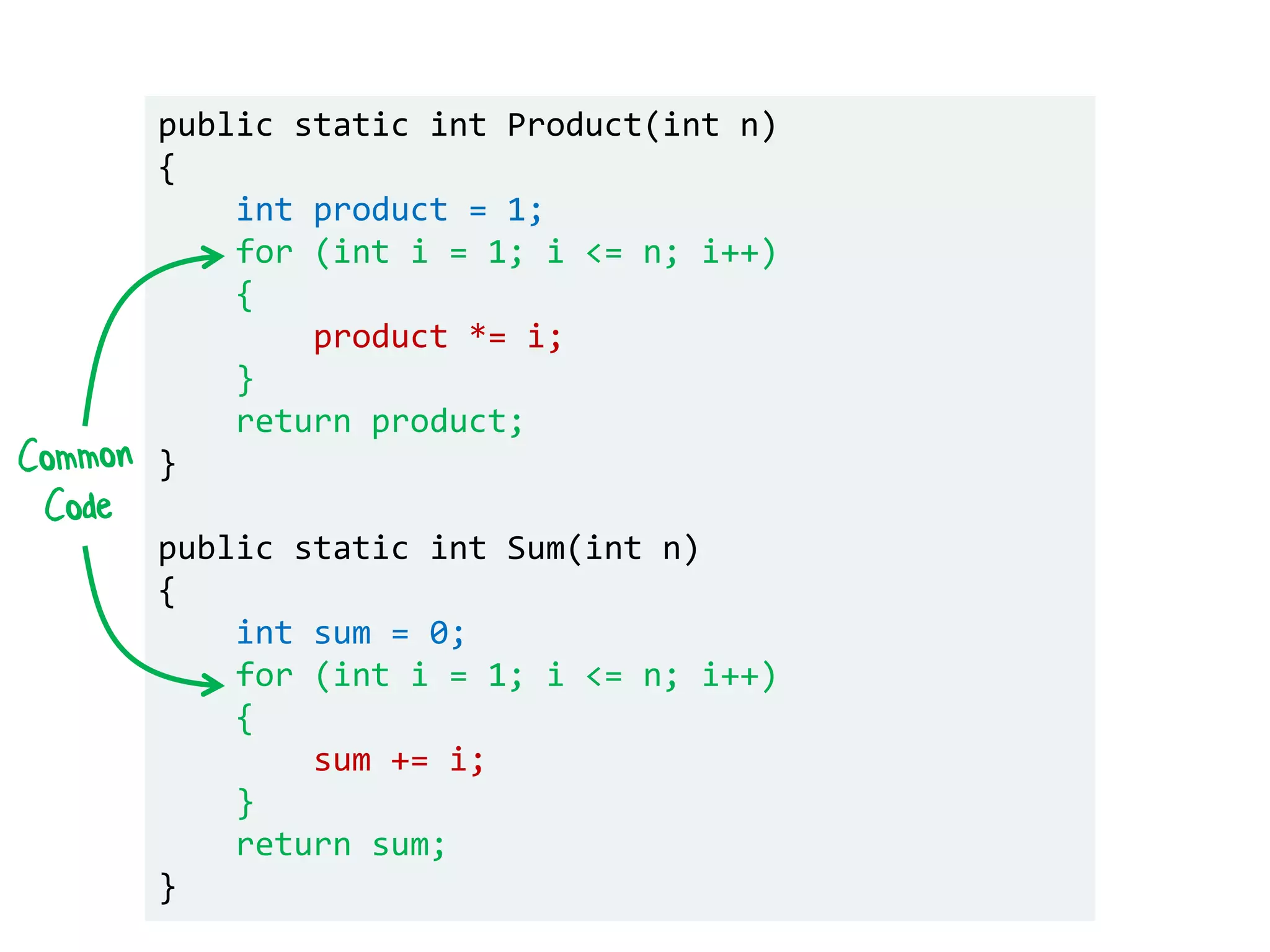
public static int Product(int n)
{
int product = 1;
for (int i = 1; i <= n; i++)
{
product *= i;
}
return product;
}
public static int Sum(int n)
{
int sum = 0;
for (int i = 1; i <= n; i++)
{
sum += i;
}
return sum;
}
public static int Product(int n)
{
int product = 1;
for (int i = 1; i <= n; i++)
{
product *= i;
}
return product;
}
public static int Sum(int n)
{
int sum = 0;
for (int i = 1; i <= n; i++)
{
sum += i;
}
return sum;
}
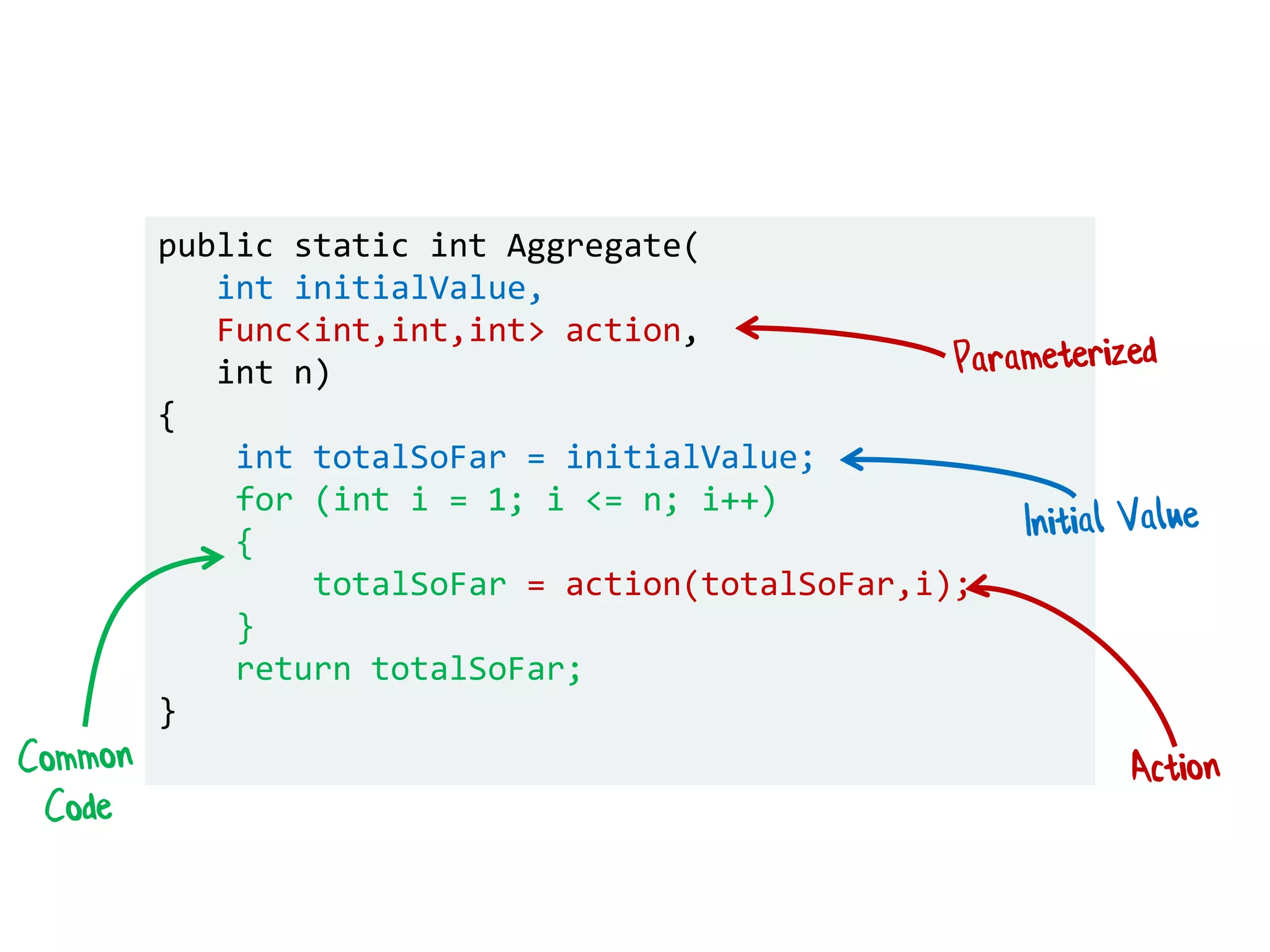
After parameterization
public static int Aggregate(
int initialValue,
Func<int,int,int> action,
int n)
{
int totalSoFar = initialValue;
for (int i = 1; i <= n; i++)
{
totalSoFar = action(totalSoFar,i);
}
return totalSoFar;
}
Tip:
Function types are "interfaces"
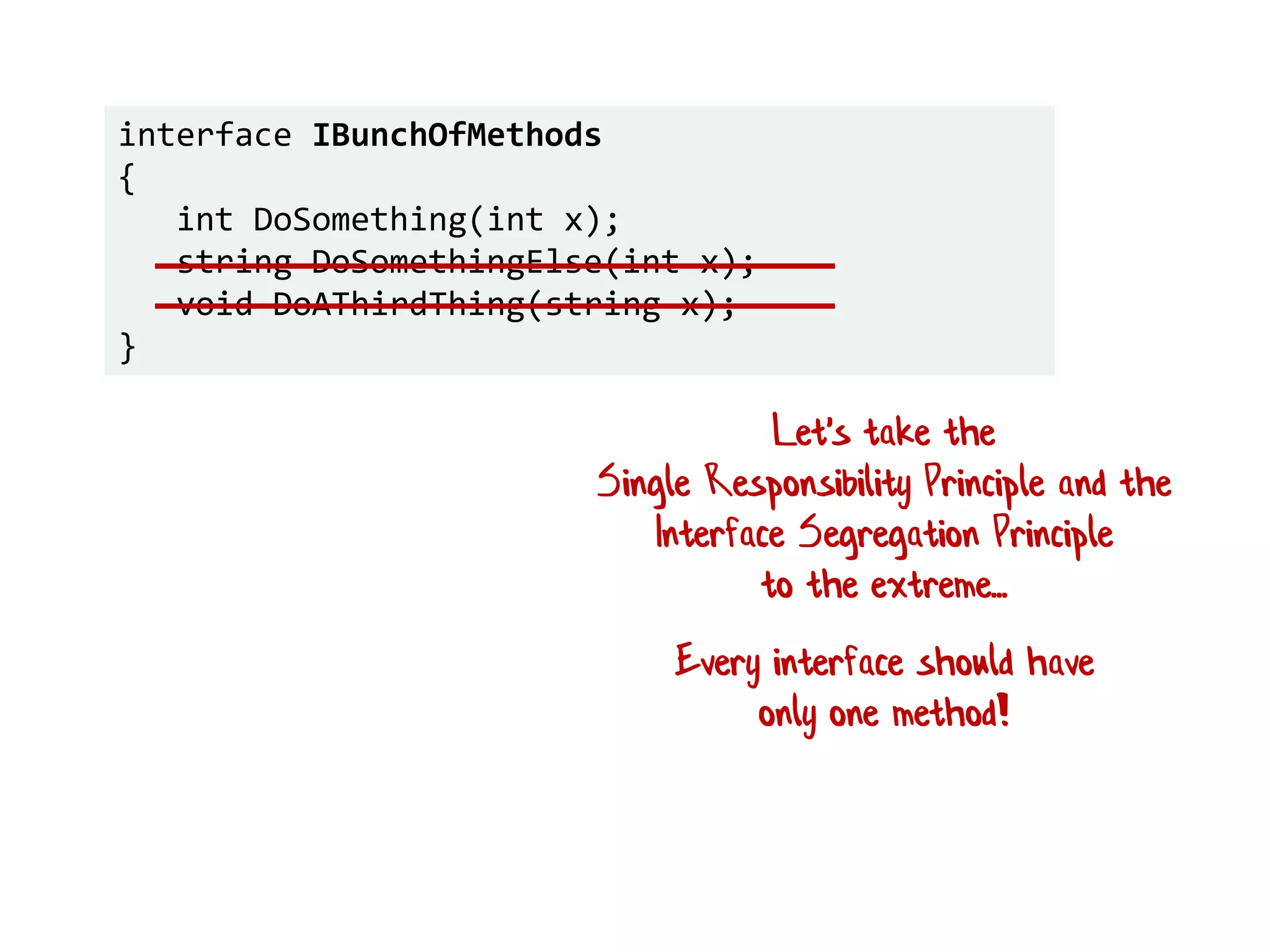
interface IBunchOfMethods
{
int DoSomething(int x);
string DoSomethingElse(int x);
void DoAThirdThing(string x);
}
Let's take the
Single Responsibility Principle and the
Interface Segregation Principle
to the extreme...
Every interface should have
only one method!
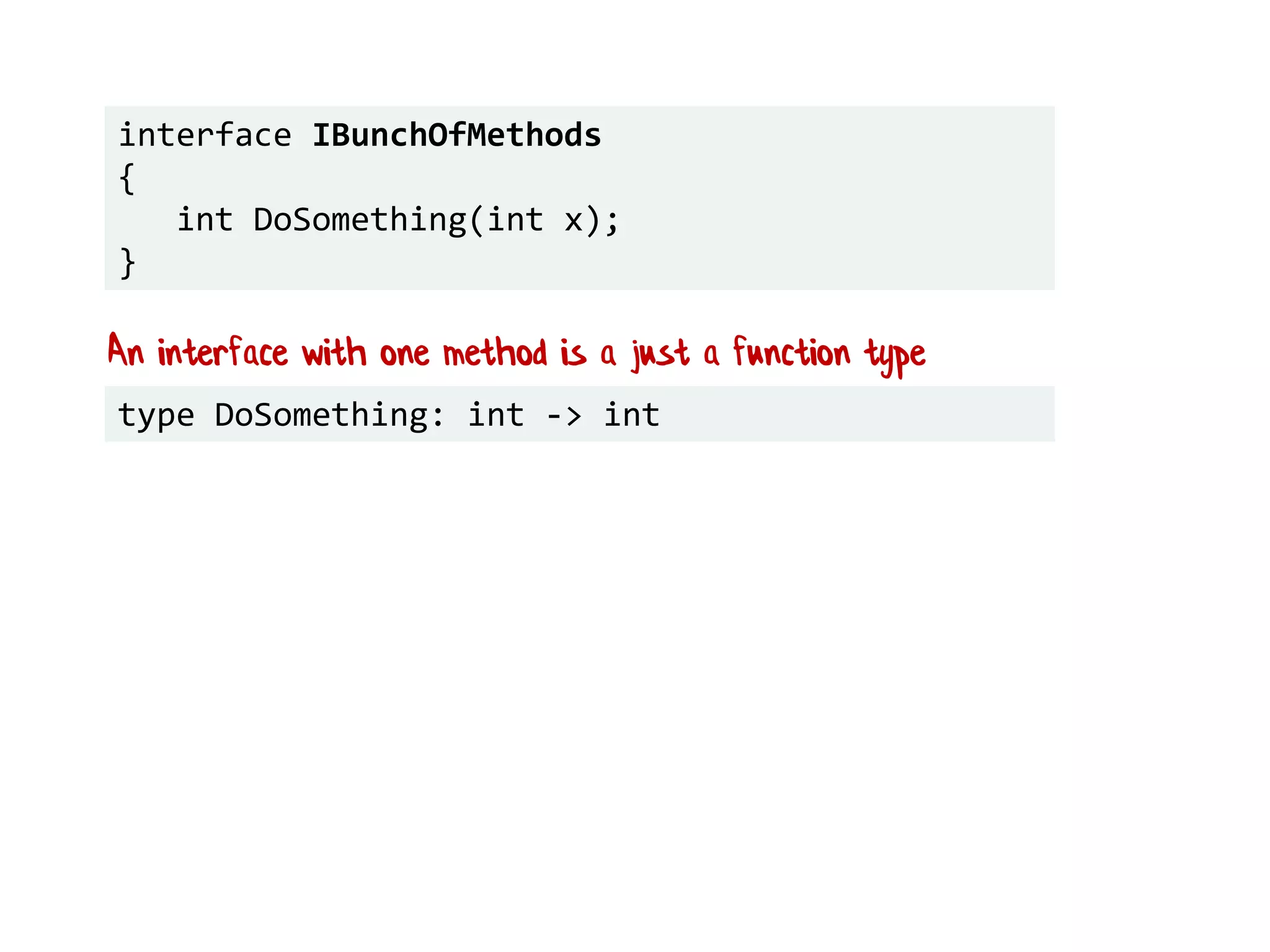
interface IBunchOfMethods
{
int DoSomething(int x);
}
An interface with one method is a just a function type
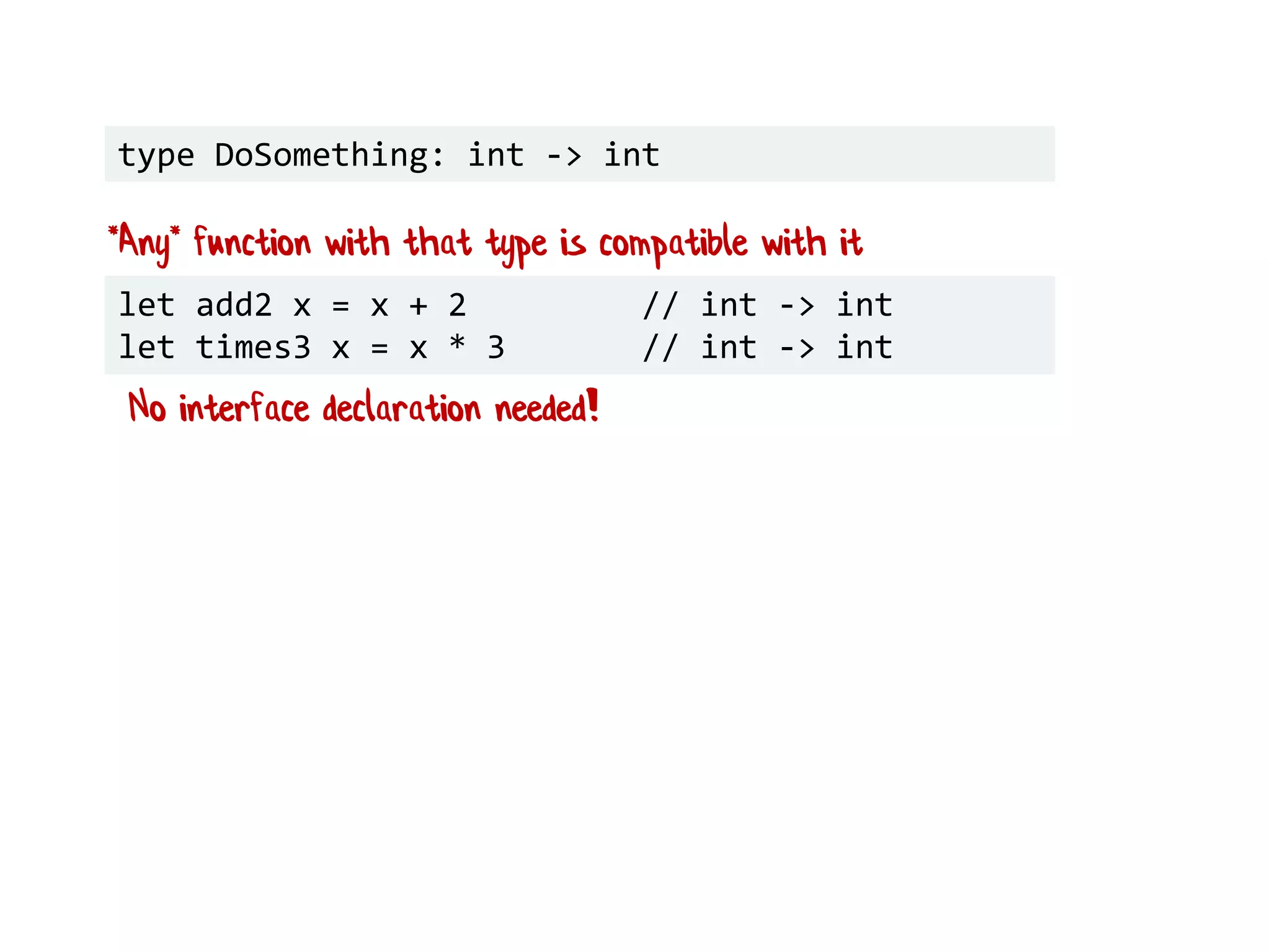
type DoSomething: int -> int
*Any* function with that type is compatible with it
let add2 x = x + 2 // int -> int
let times3 x = x * 3 // int -> int
No interface declaration needed!
Example:
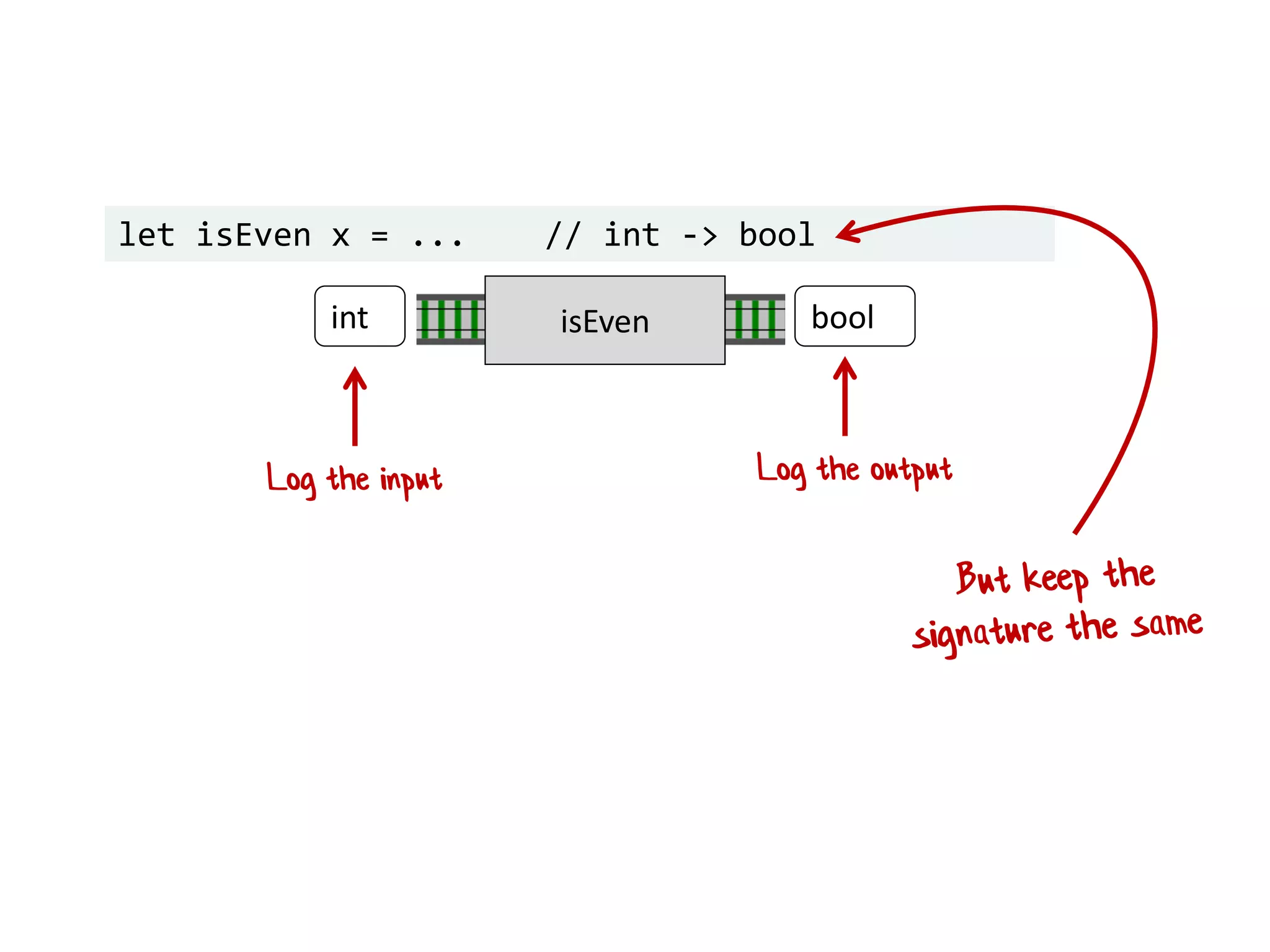
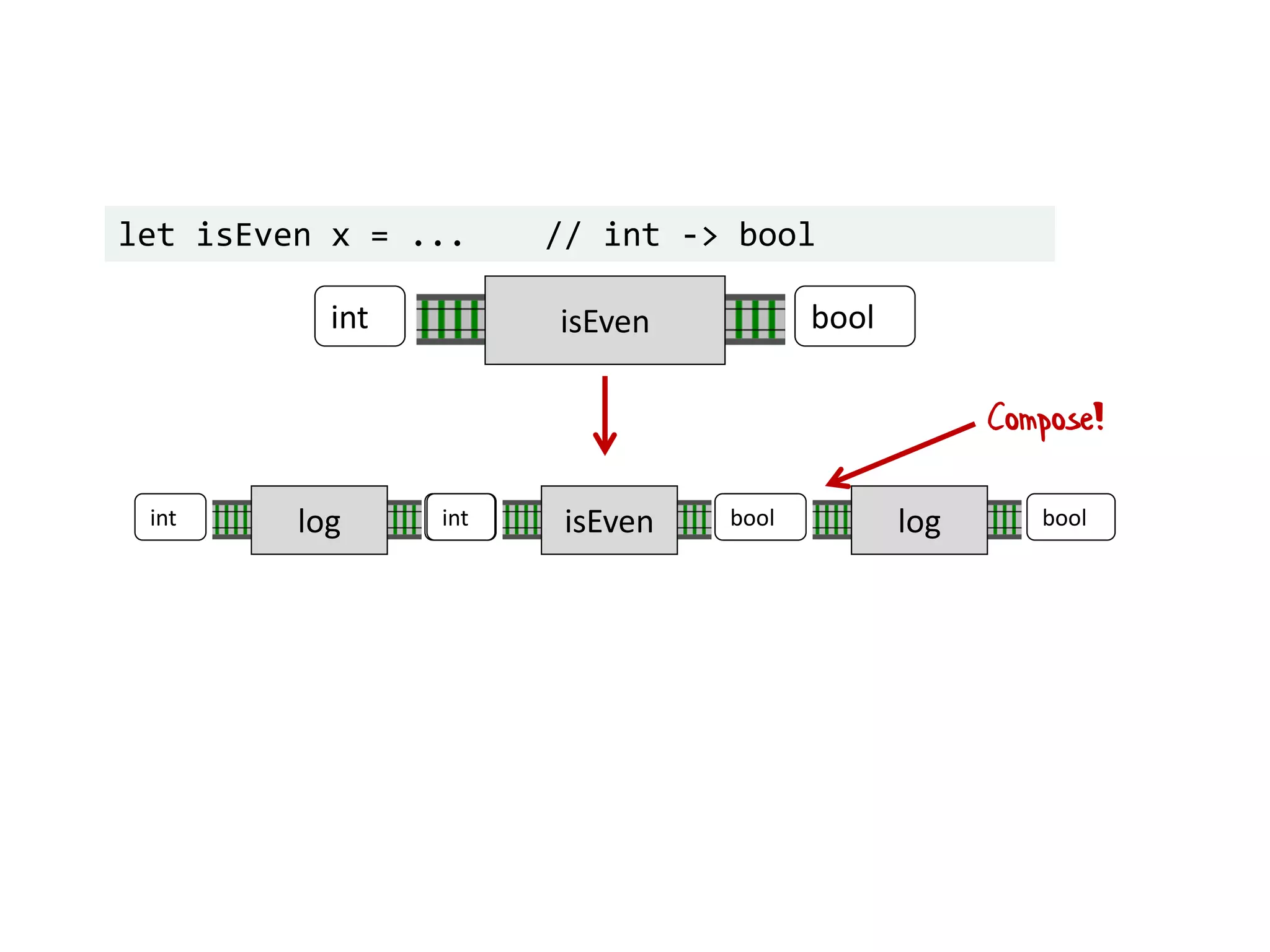
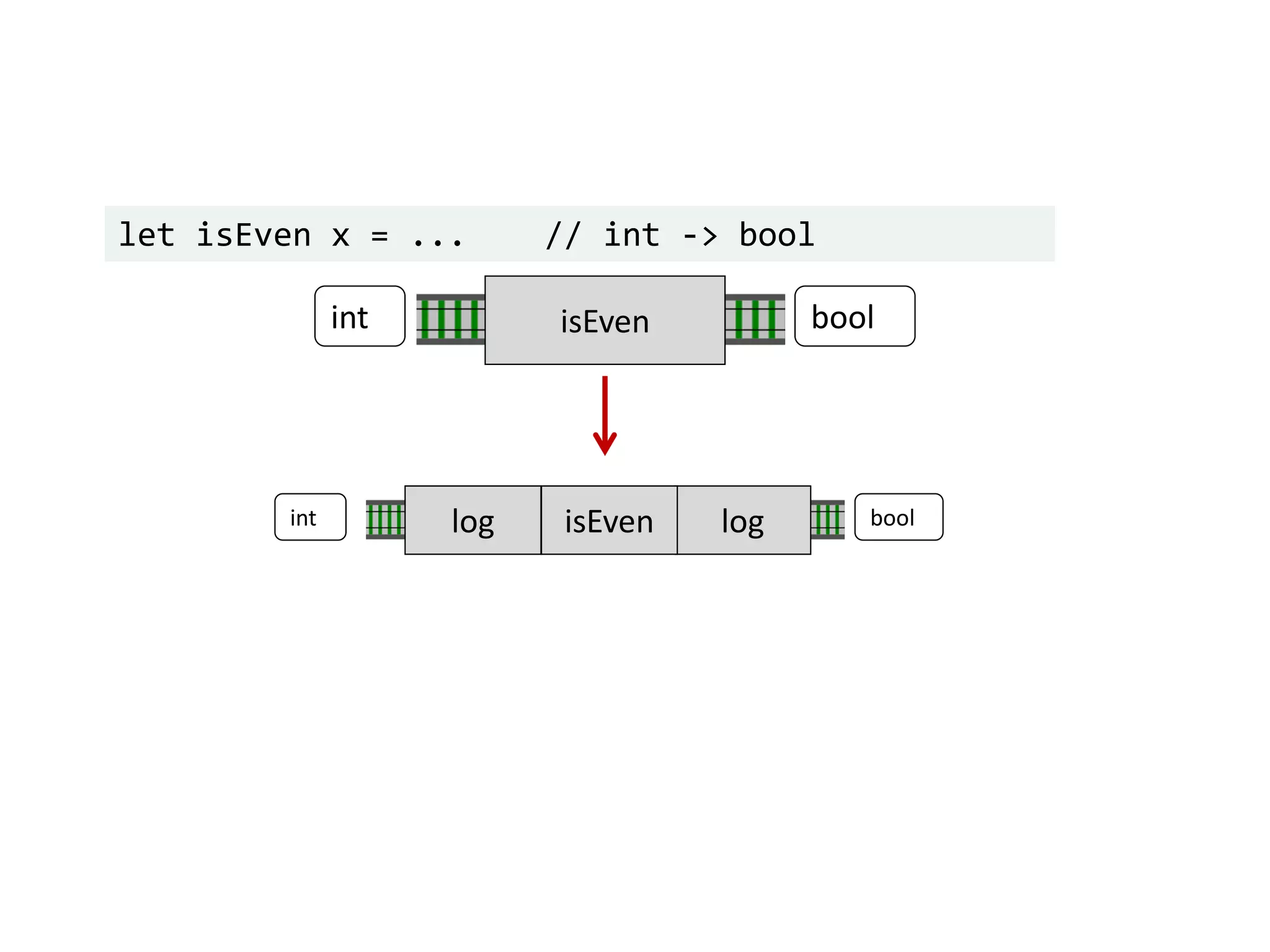
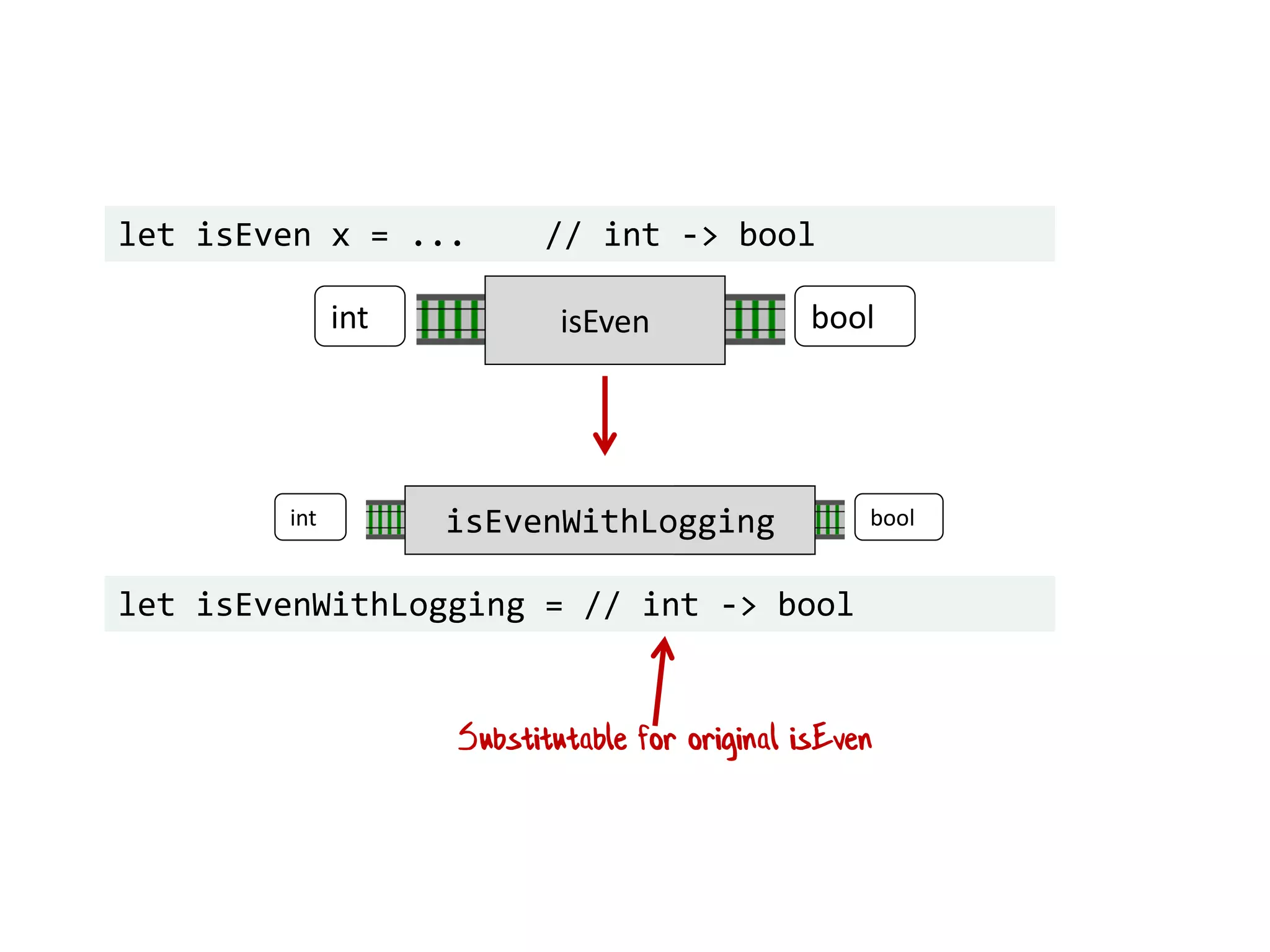
Decorator pattern
let isEven x = ... // int -> bool
isEvenint bool
Log the input Log the output
let isEven x = ... // int -> bool
isEvenint bool
isEvenint boollogint int logbool bool
Compose!
let isEven x = ... // int -> bool
isEvenint bool
logint log boolisEven
let isEven x = ... // int -> bool
isEvenint bool
int log bool
let isEvenWithLogging = // int -> bool
Substitutable for original isEven
isEvenWithLogging
Tip:
"Use interfaces for loose coupling"
Use function parameters for loose coupling
PATTERN 2:
COMPOSING MULTI-PARAMETER FUNCTIONS
Bad news:
Composition patterns
only work for functions that
have one parameter! 
Good news!
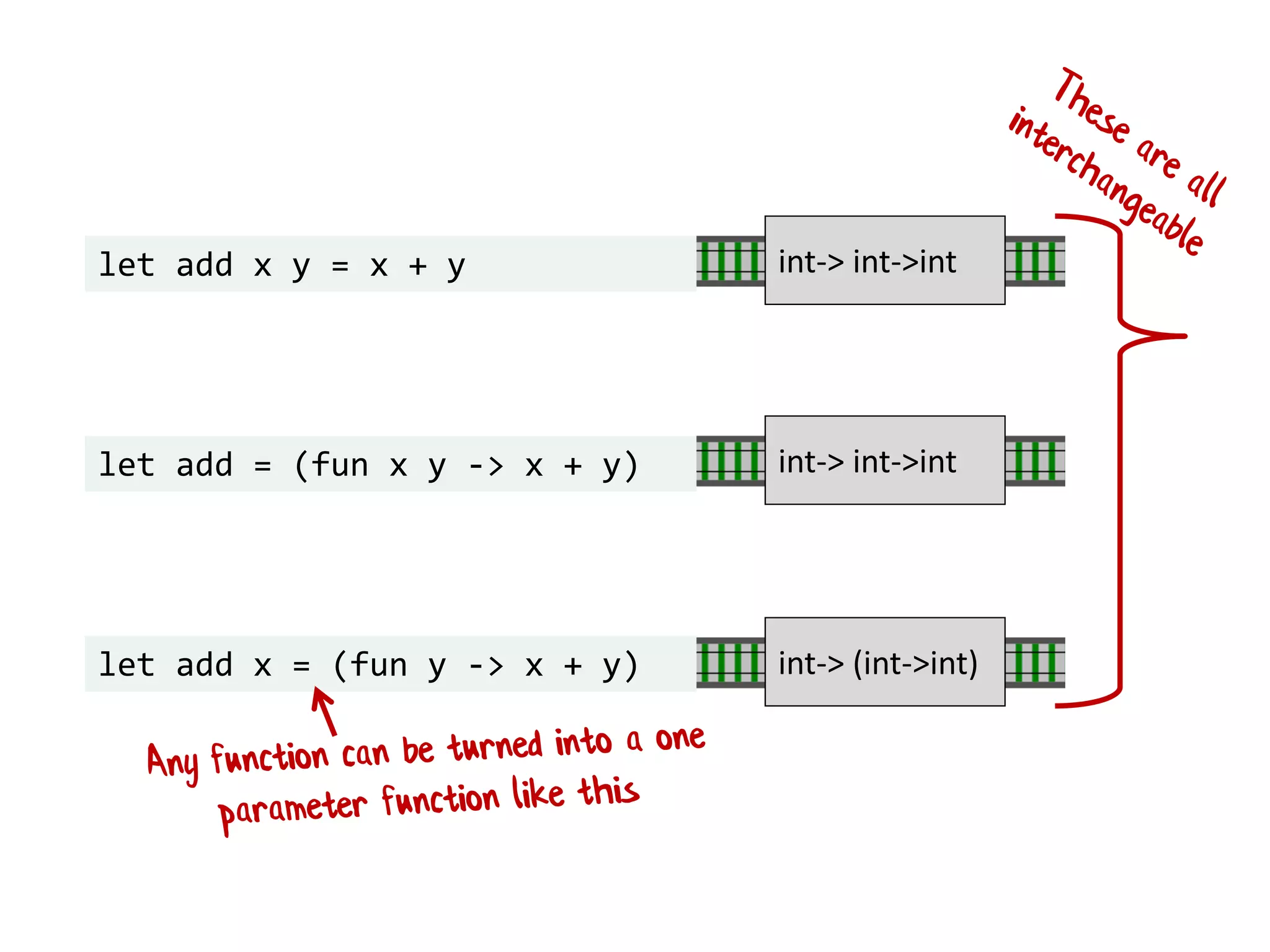
Every function can be turned into a
one parameter function 
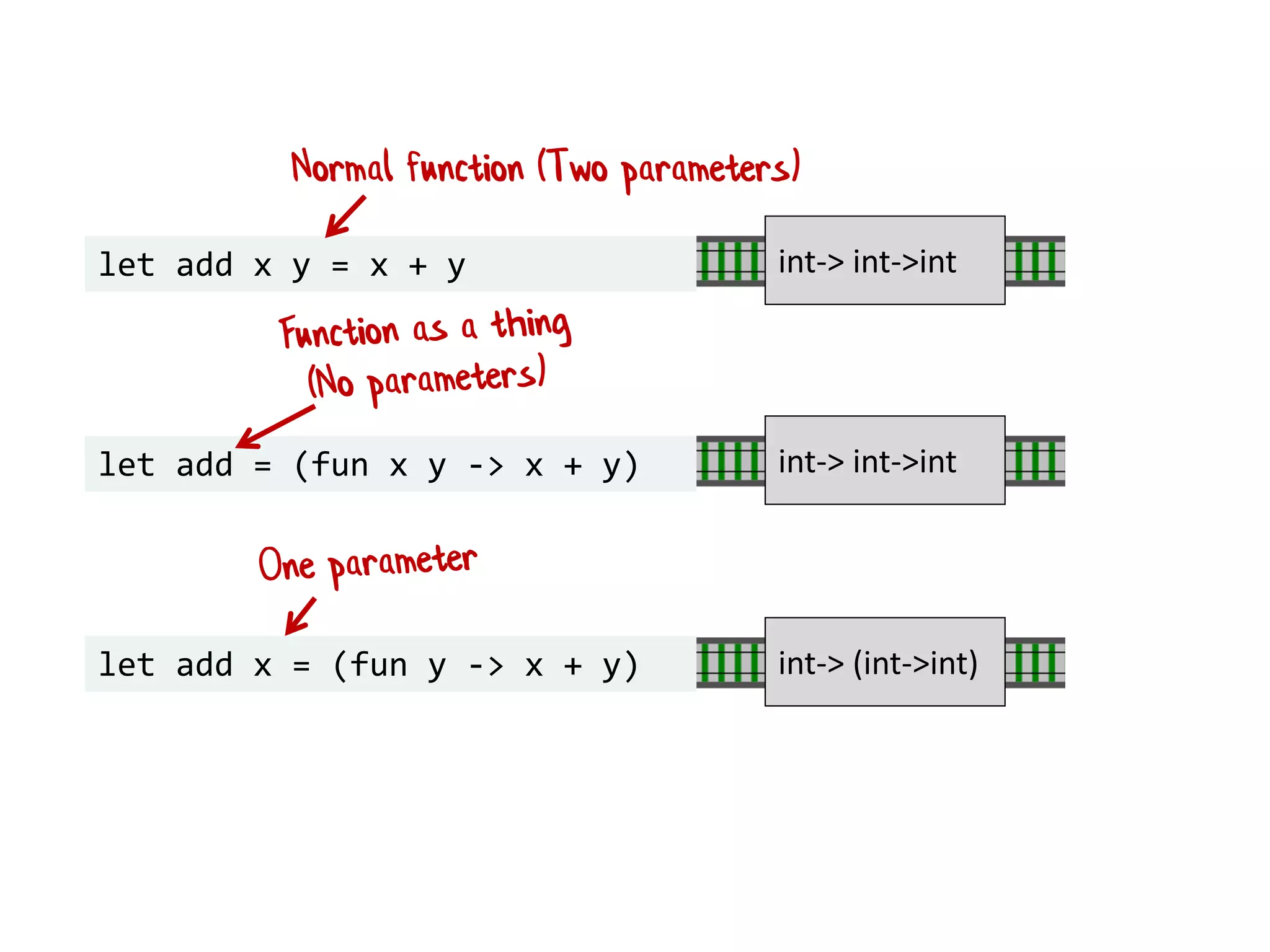
let add x y = x + y
let add = (fun x y -> x + y)
let add x = (fun y -> x + y)
int-> int->int
int-> int->int
int-> (int->int)
Normal function (Two parameters)
let add x y = x + y
let add = (fun x y -> x + y)
let add x = (fun y -> x + y)
int-> int->int
int-> int->int
int-> (int->int)
Pattern:
Partial application
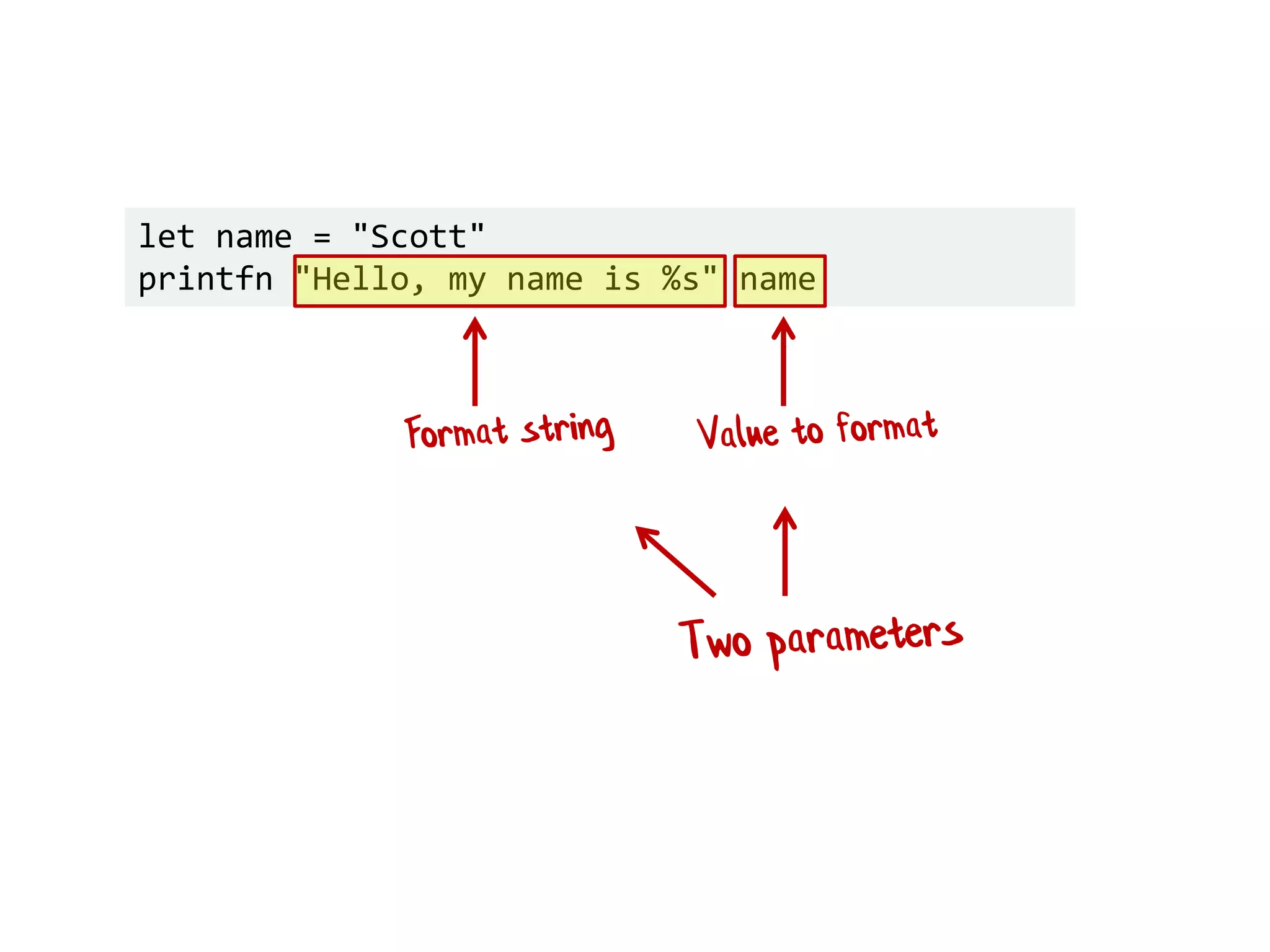
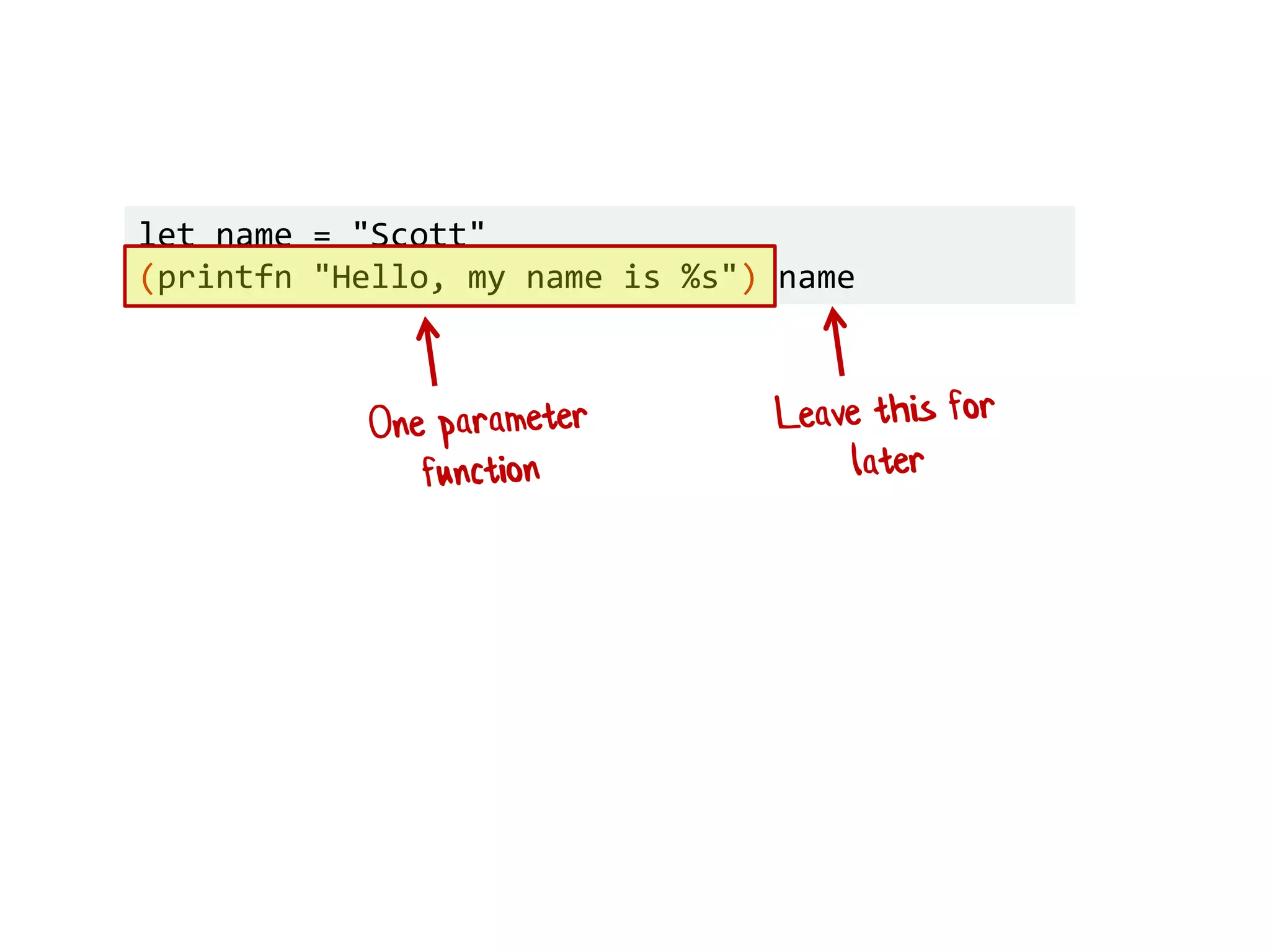
let name = "Scott"
printfn "Hello, my name is %s" name
let name = "Scott"
(printfn "Hello, my name is %s") name
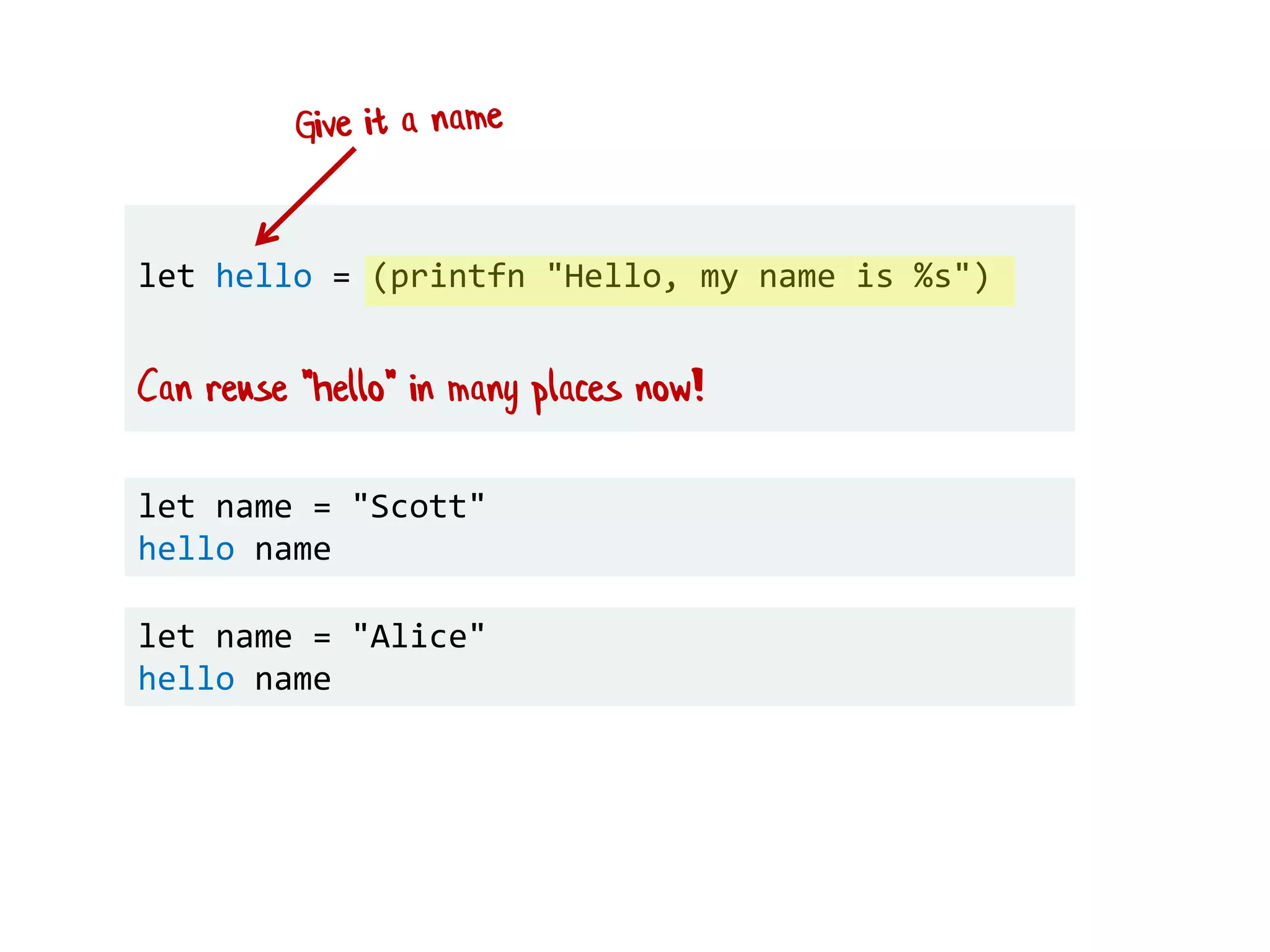
let hello = (printfn "Hello, my name is %s")
Can reuse "hello" in many places now!
let name = "Scott"
hello name
let name = "Alice"
hello name
Example:
Partial application with lists
let names = ["Alice"; "Bob"; "Scott"]
List.iter hello names //foreach name in names
let hello = printfn "Hello, my name is %s"
let add1 = (+) 1
let equals2 = (=) 2
[1..100]
|> List.map add1
|> List.filter equals2
PATTERN 3
"BIND"
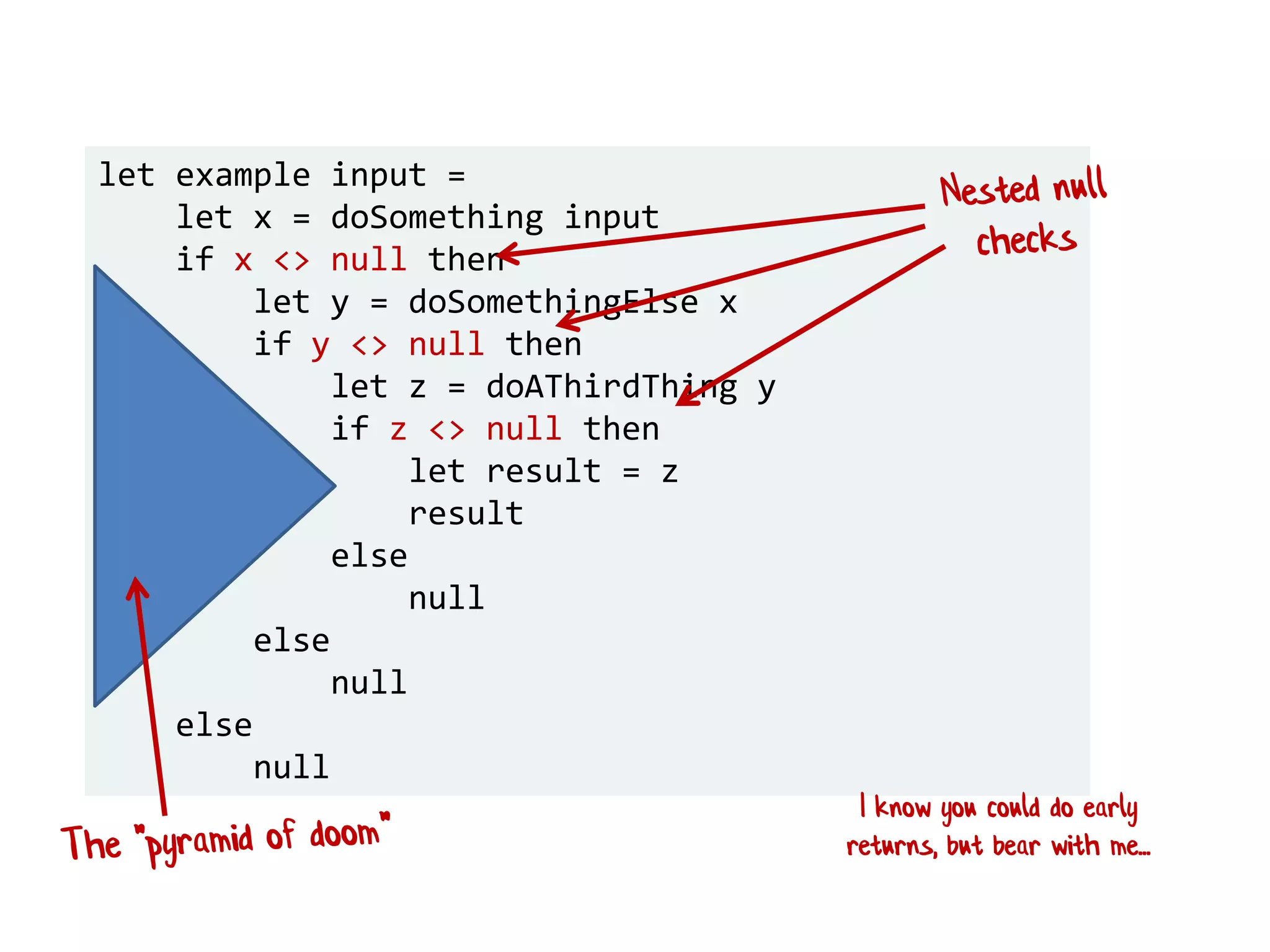
Taming the "pyramid of doom"
let example input =
let x = doSomething input
if x <> null then
let y = doSomethingElse x
if y <> null then
let z = doAThirdThing y
if z <> null then
let result = z
result
else
null
else
null
else
null
I know you could do early
returns, but bear with me...
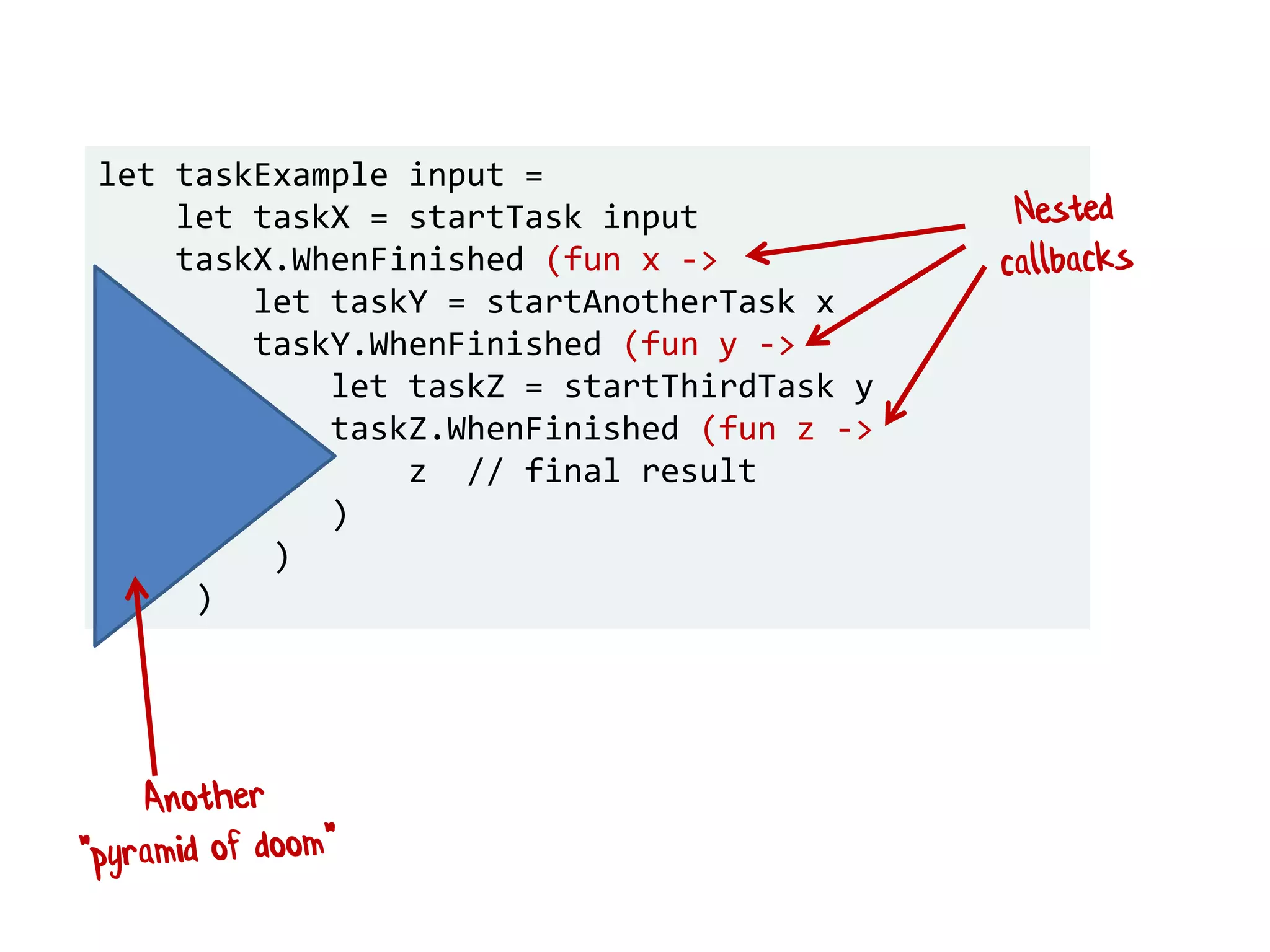
let taskExample input =
let taskX = startTask input
taskX.WhenFinished (fun x ->
let taskY = startAnotherTask x
taskY.WhenFinished (fun y ->
let taskZ = startThirdTask y
taskZ.WhenFinished (fun z ->
z // final result
)
)
)
let example input =
let x = doSomething input
if x <> null then
let y = doSomethingElse x
if y <> null then
let z = doAThirdThing y
if z <> null then
let result = z
result
else
null
else
null
else
null
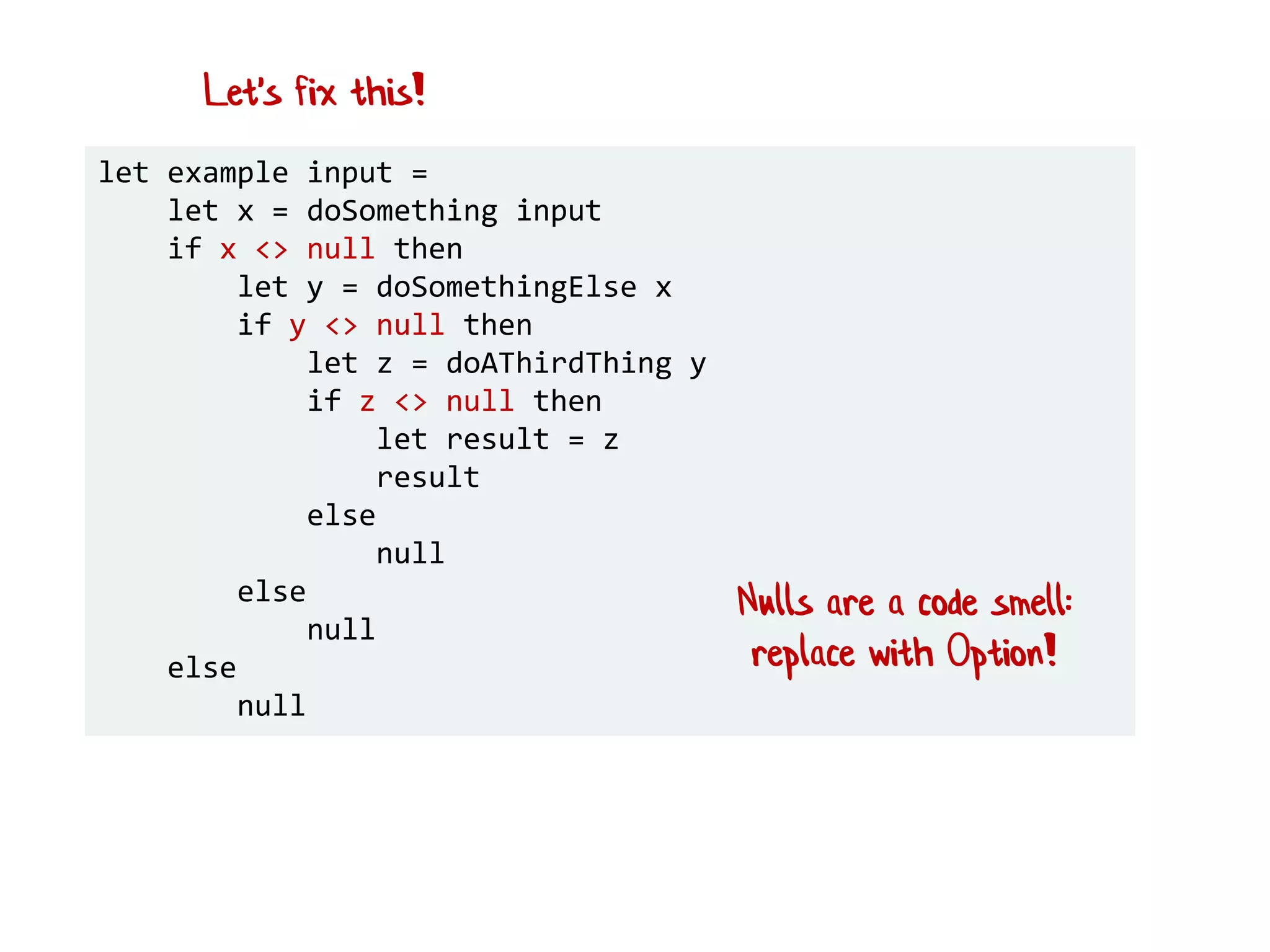
Nulls are a code smell:
replace with Option!
Let's fix this!
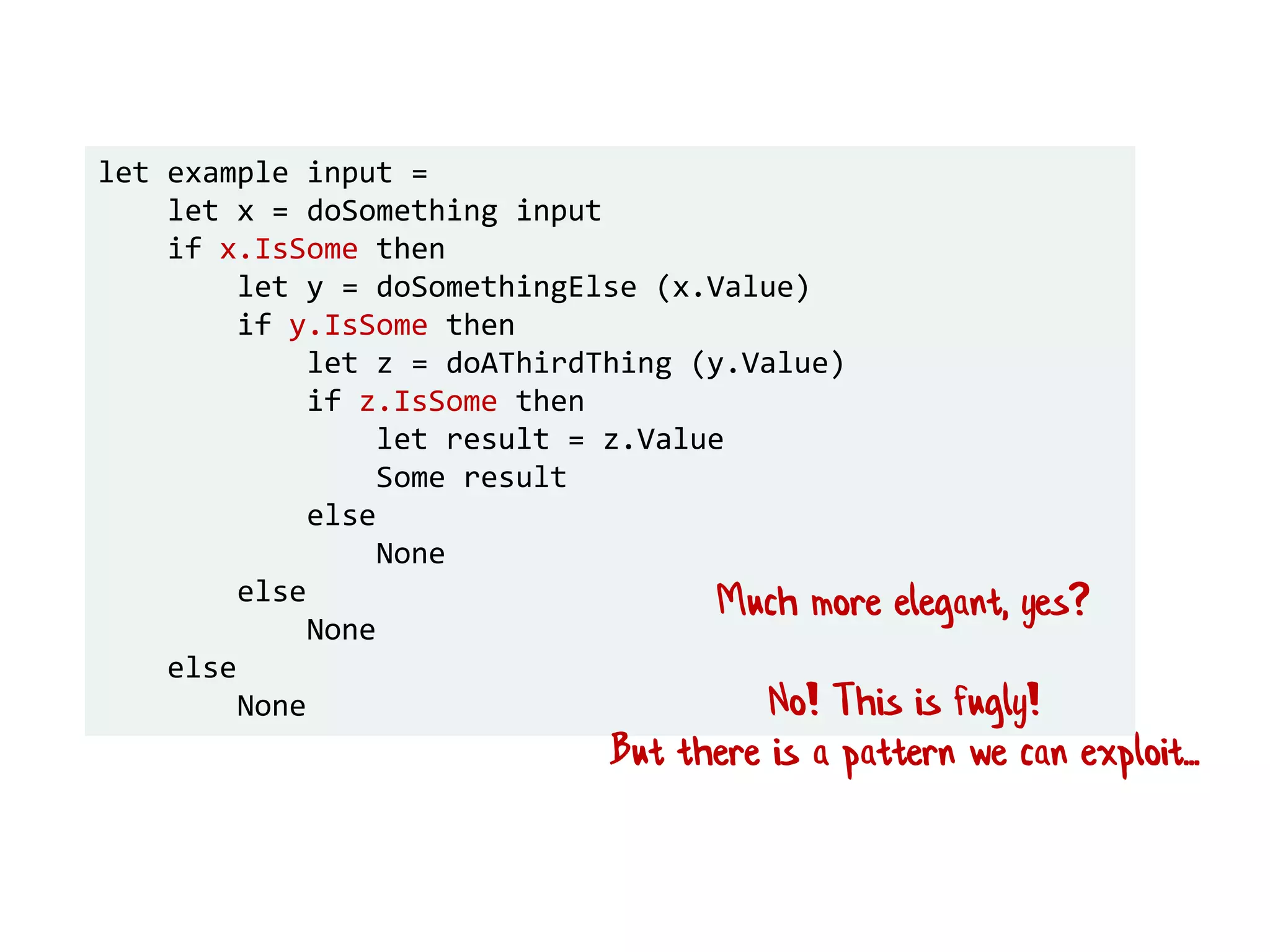
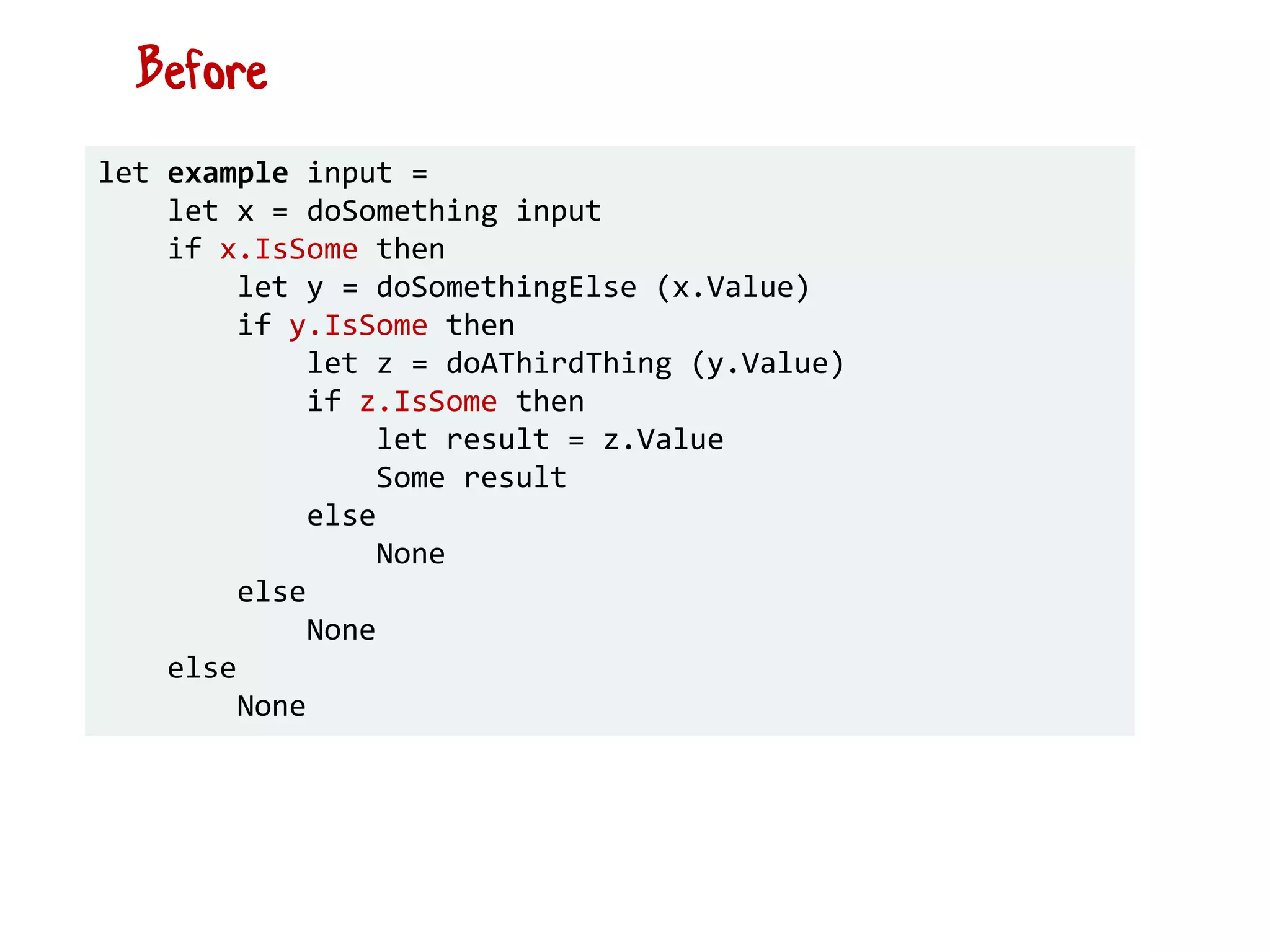
let example input =
let x = doSomething input
if x.IsSome then
let y = doSomethingElse (x.Value)
if y.IsSome then
let z = doAThirdThing (y.Value)
if z.IsSome then
let result = z.Value
Some result
else
None
else
None
else
None
Much more elegant, yes?
No! This is fugly!
But there is a pattern we can exploit...
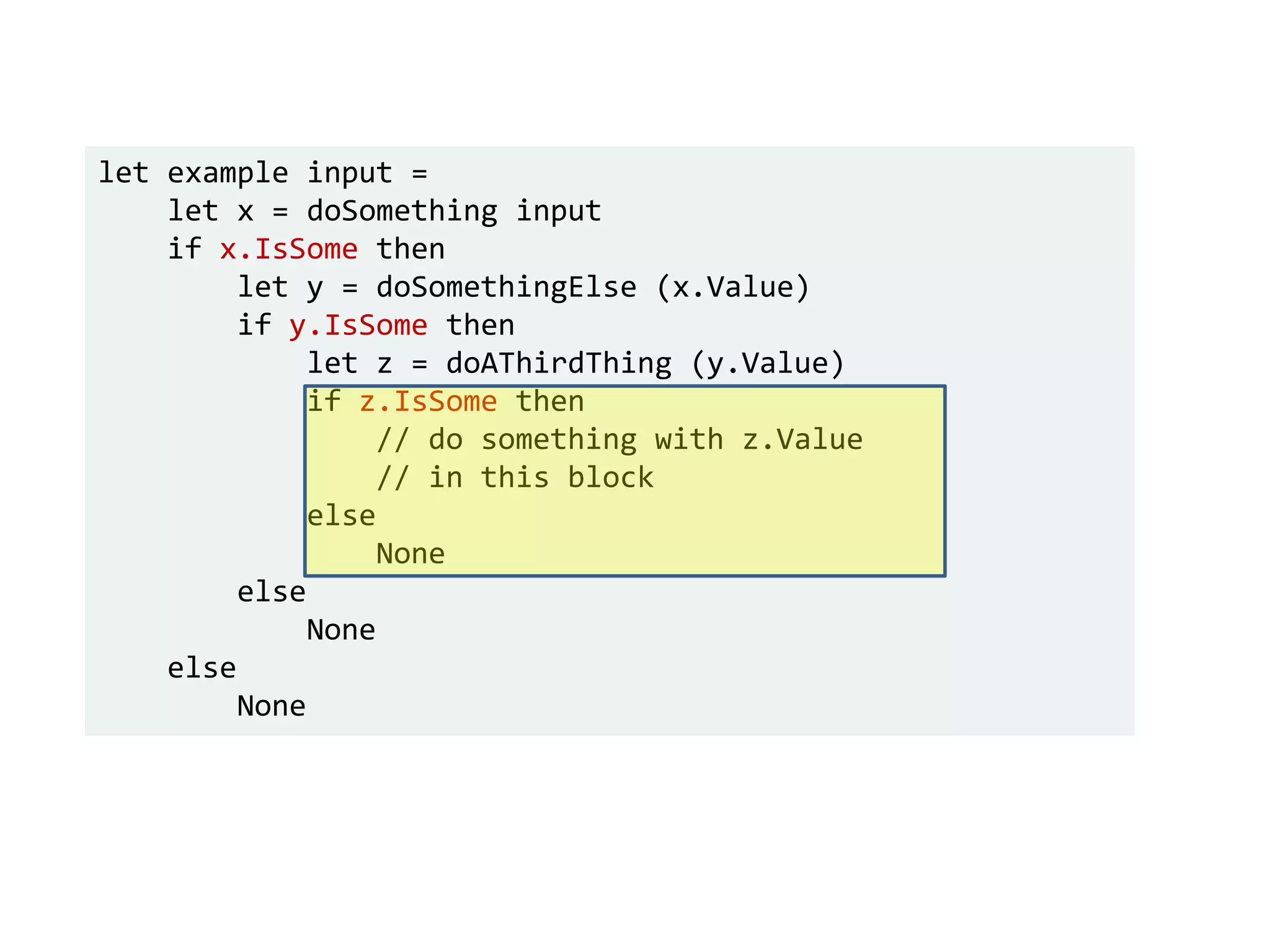
let example input =
let x = doSomething input
if x.IsSome then
let y = doSomethingElse (x.Value)
if y.IsSome then
let z = doAThirdThing (y.Value)
if z.IsSome then
// do something with z.Value
// in this block
else
None
else
None
else
None
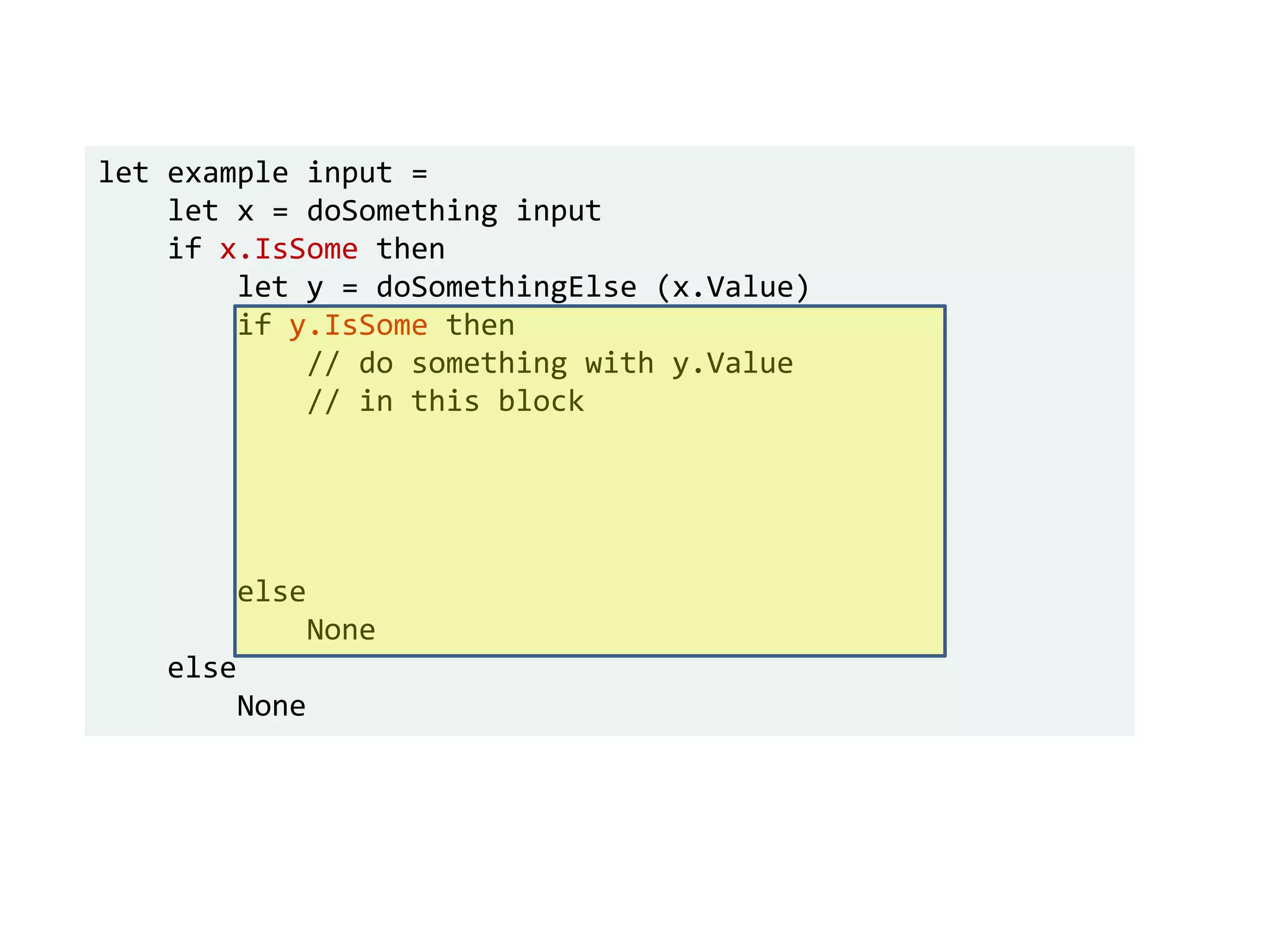
let example input =
let x = doSomething input
if x.IsSome then
let y = doSomethingElse (x.Value)
if y.IsSome then
// do something with y.Value
// in this block
else
None
else
None
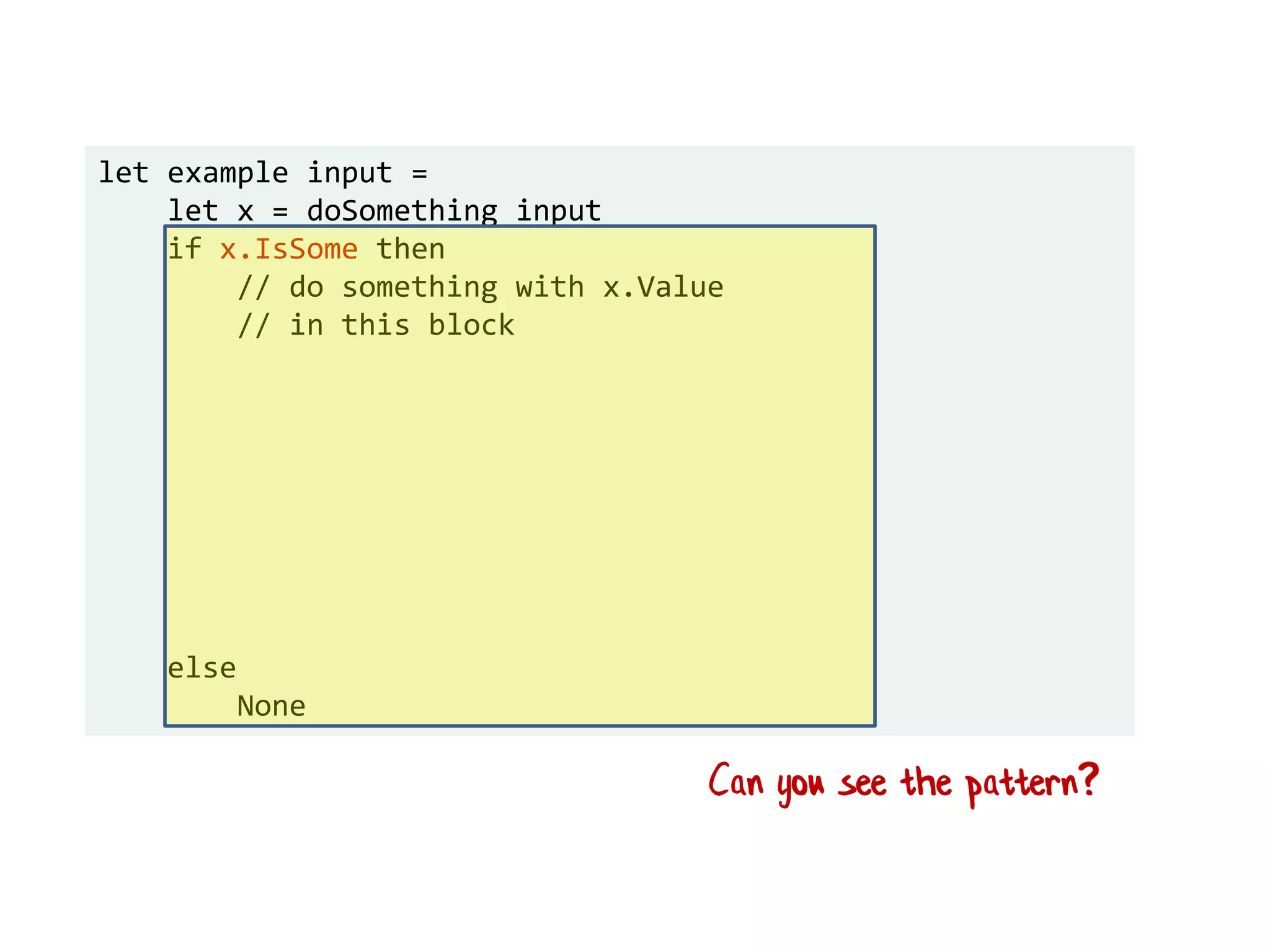
let example input =
let x = doSomething input
if x.IsSome then
// do something with x.Value
// in this block
else
None
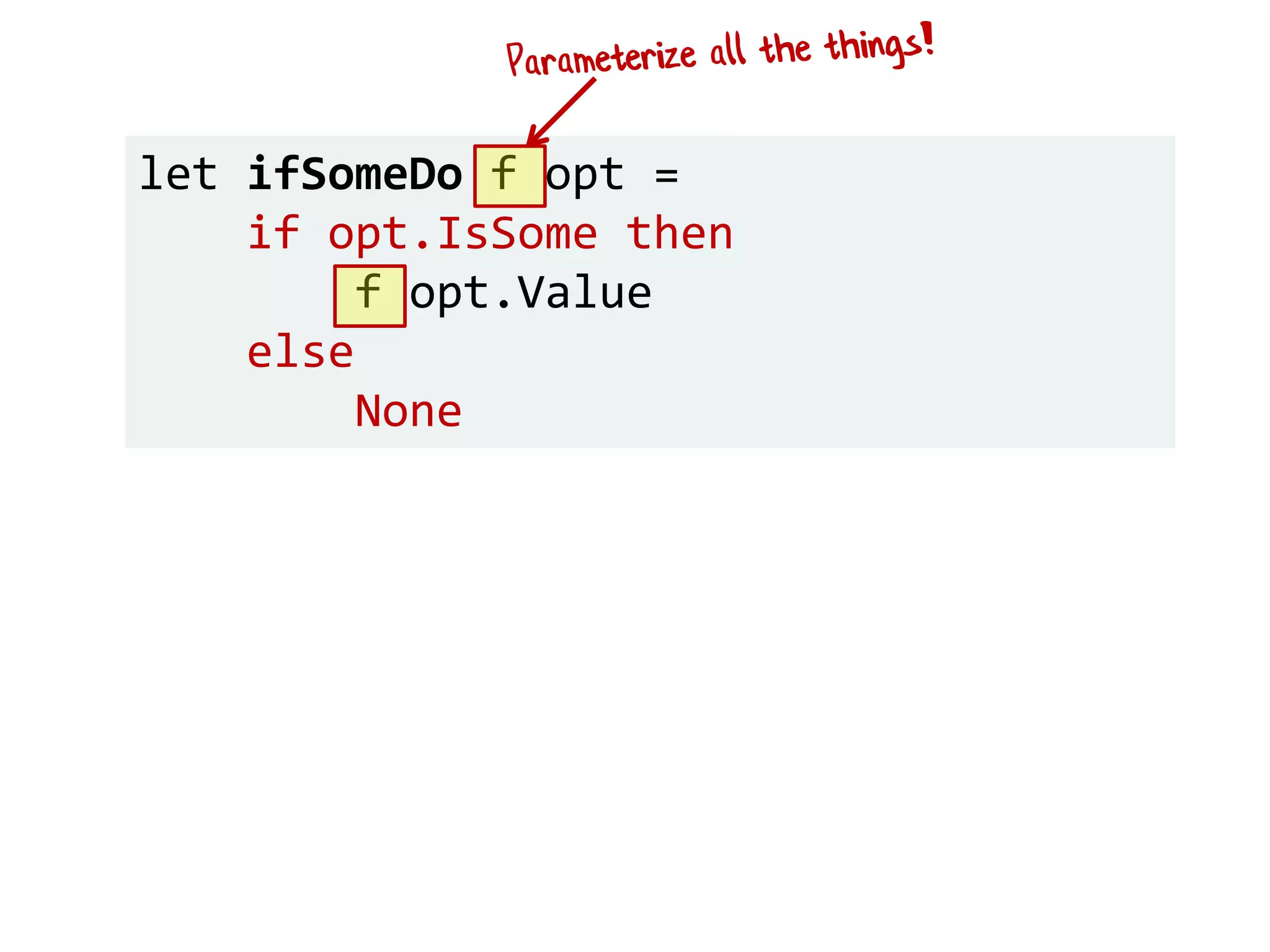
Can you see the pattern?
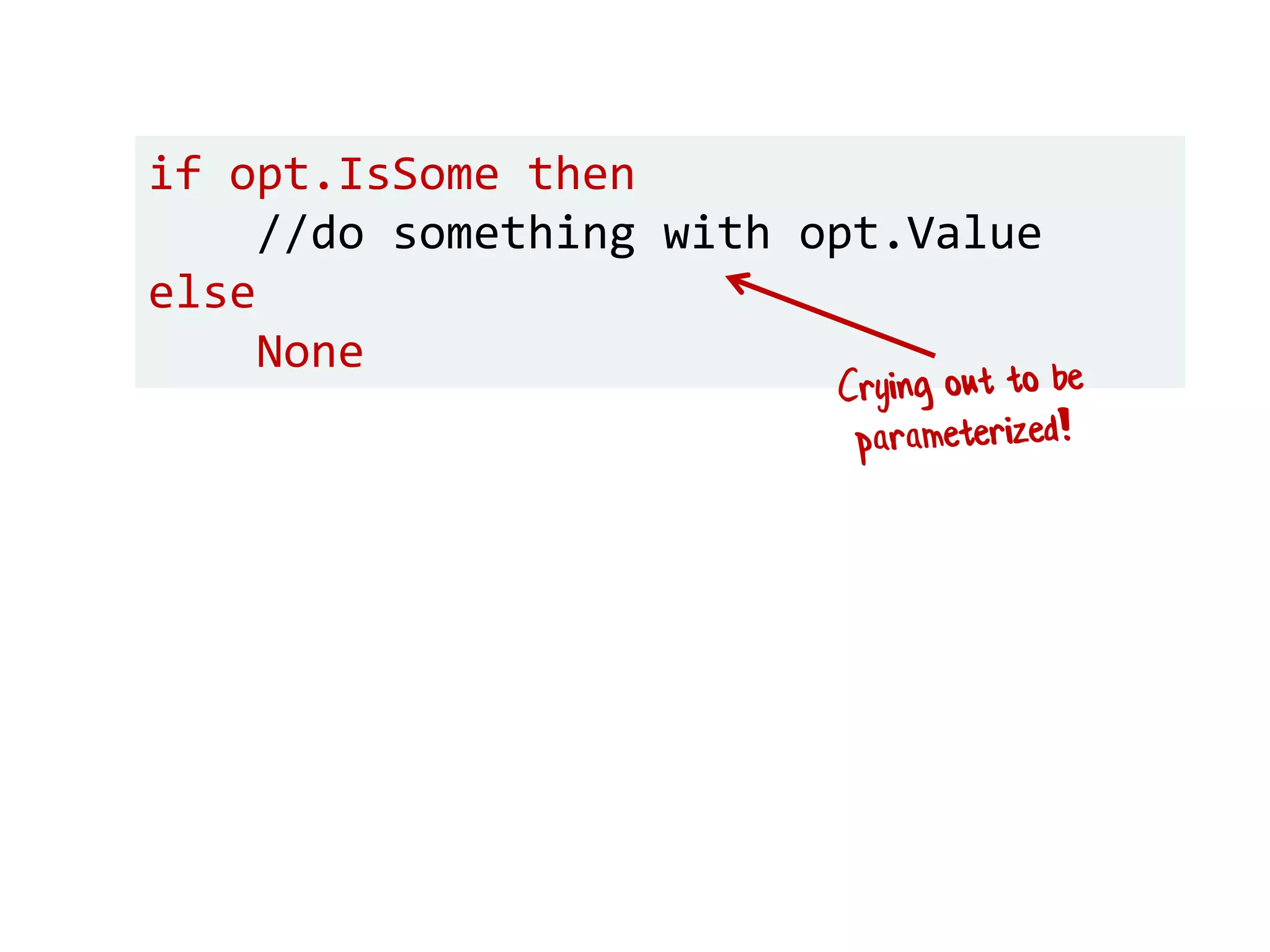
if opt.IsSome then
//do something with opt.Value
else
None
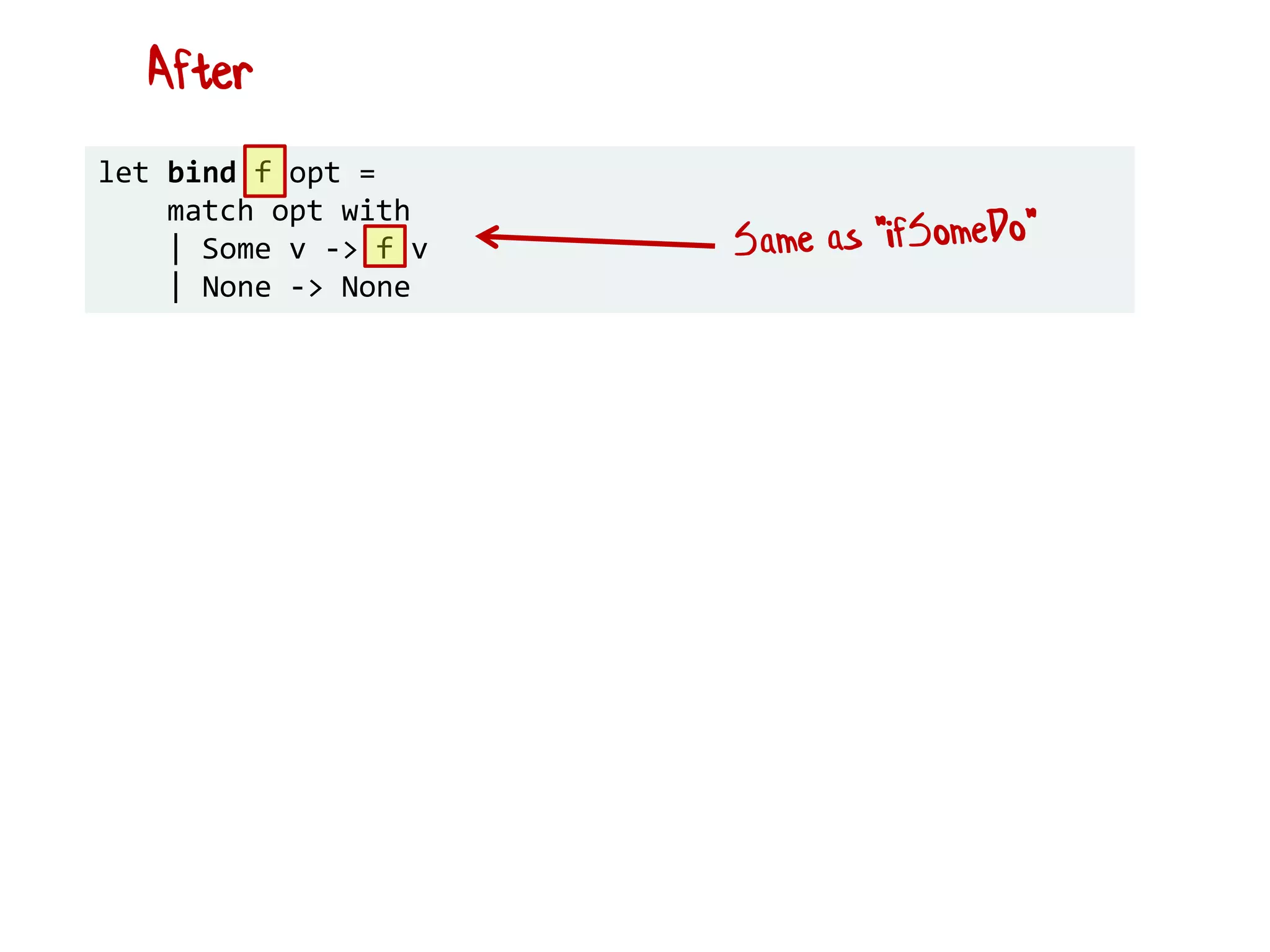
let ifSomeDo f opt =
if opt.IsSome then
f opt.Value
else
None
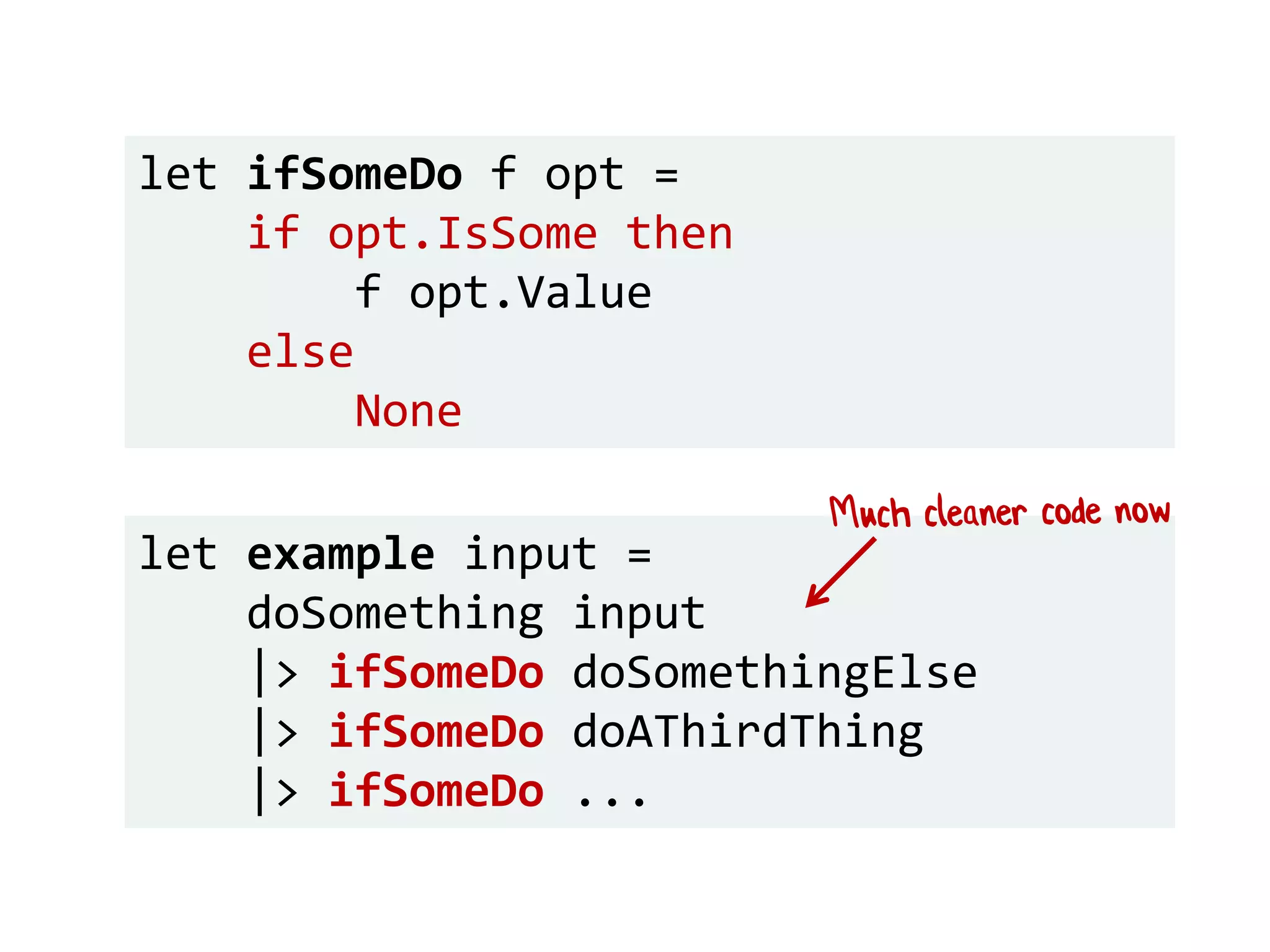
let example input =
doSomething input
|> ifSomeDo doSomethingElse
|> ifSomeDo doAThirdThing
|> ifSomeDo ...
let ifSomeDo f opt =
if opt.IsSome then
f opt.Value
else
None
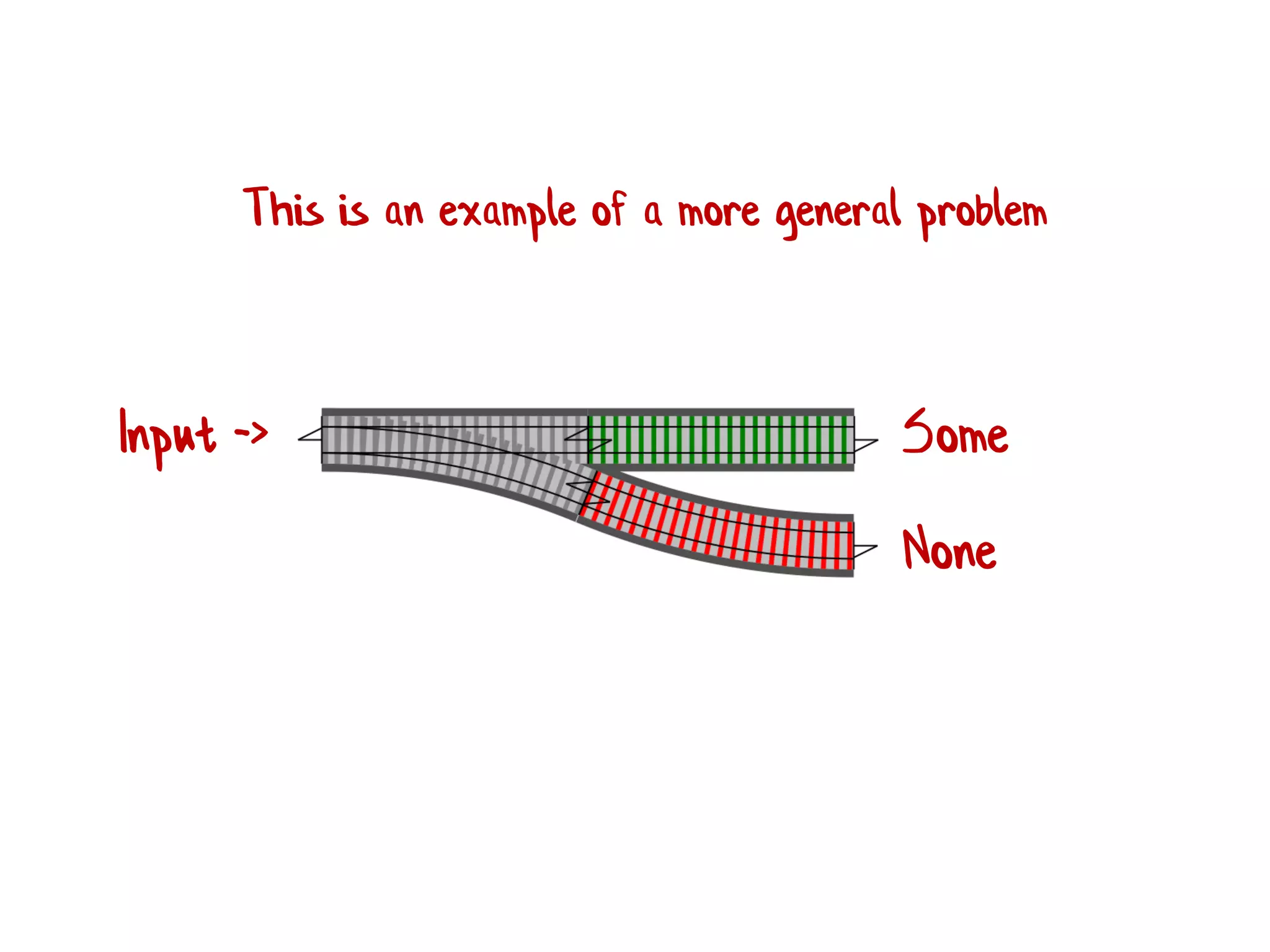
Some
None
Input ->
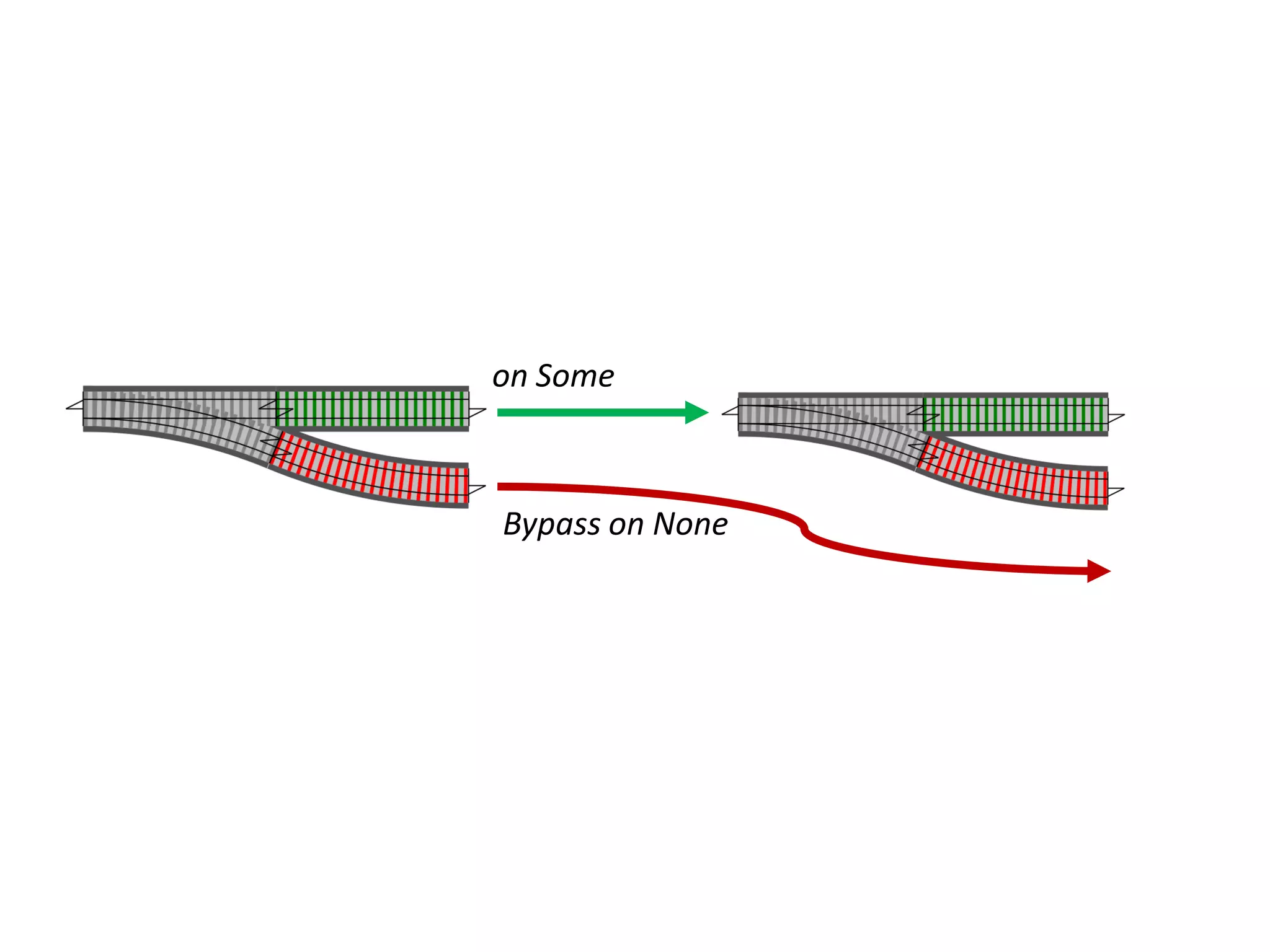
This is an example of a more general problem
on Some
Bypass on None
>> >>
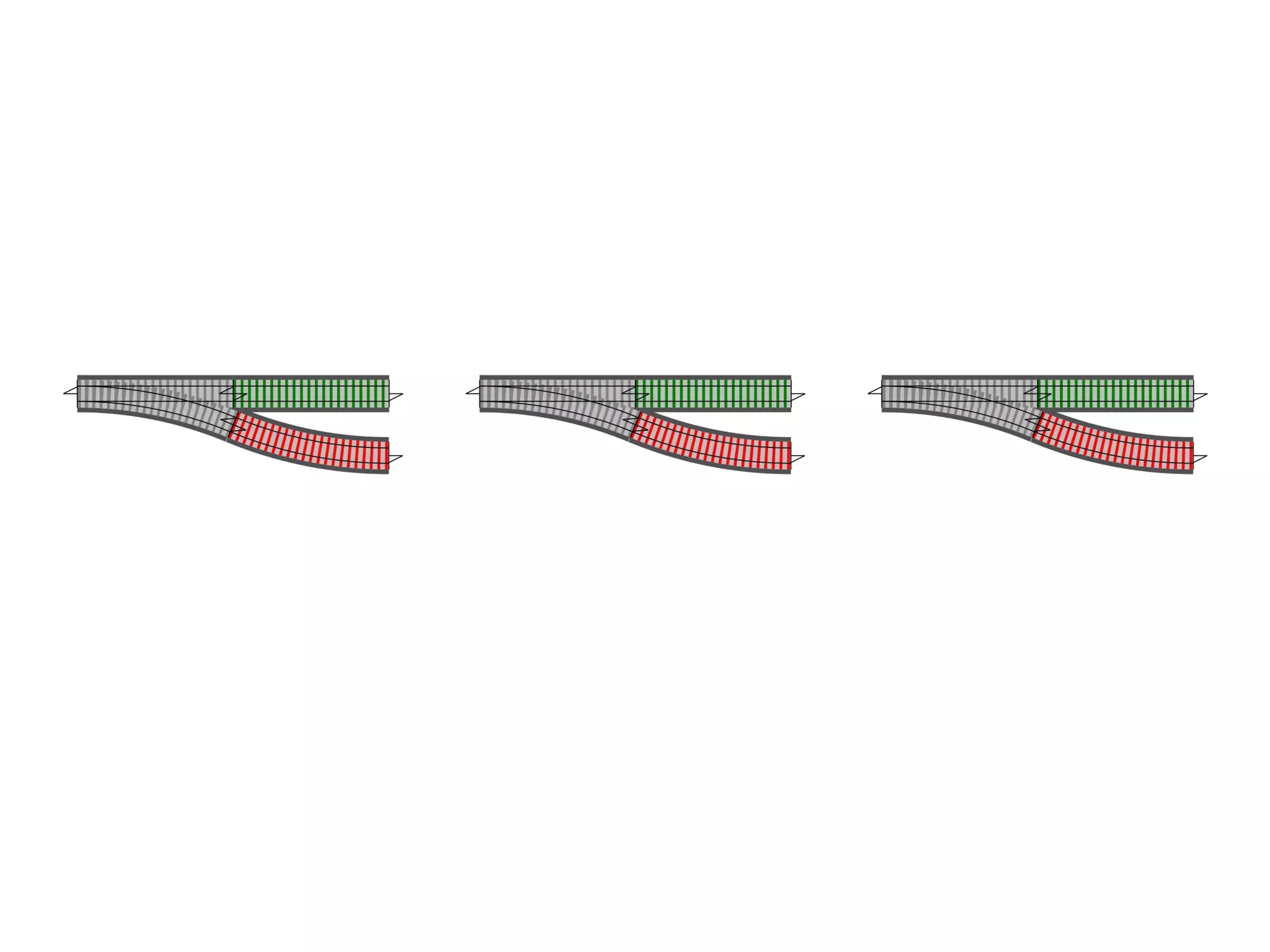
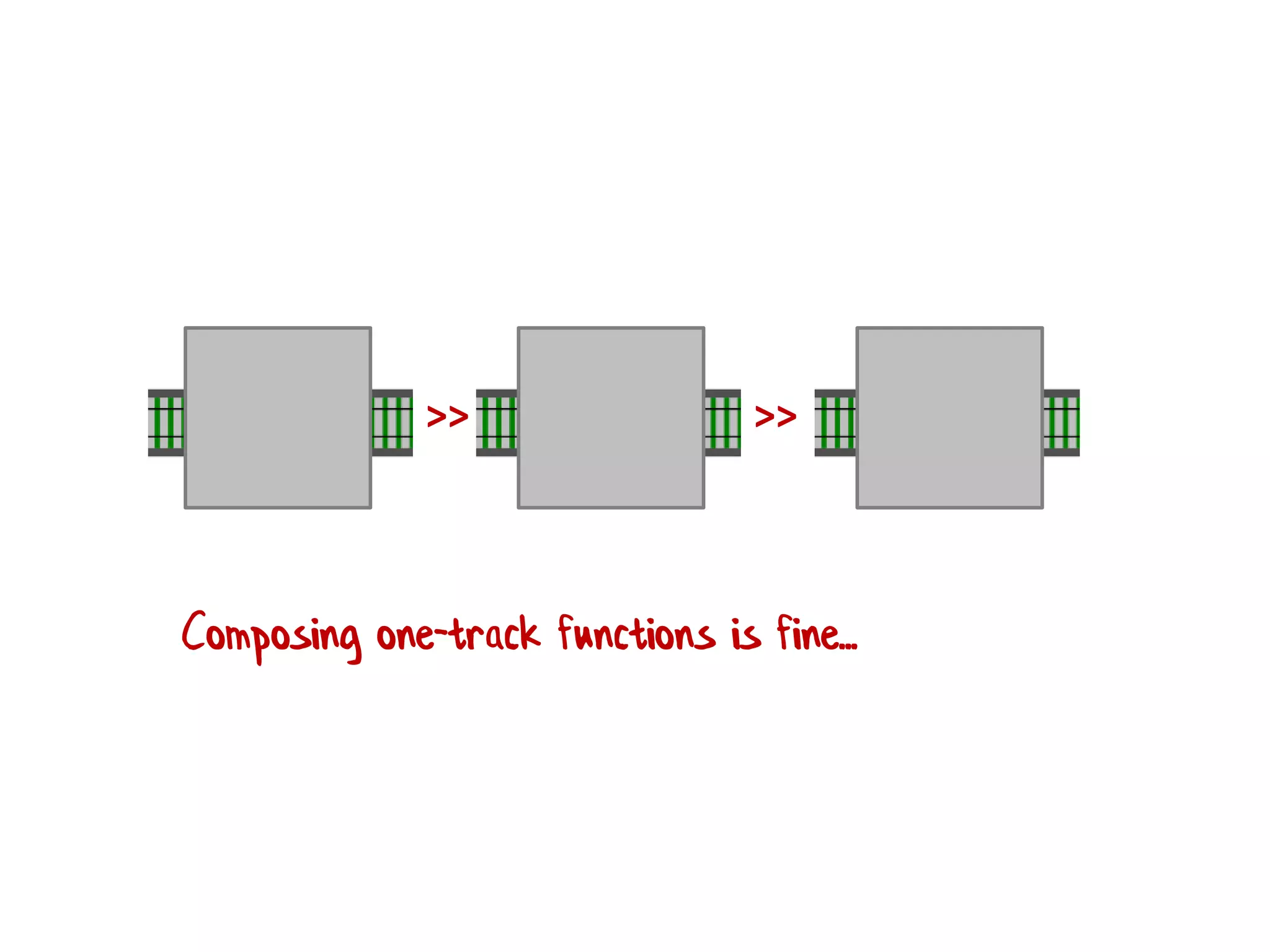
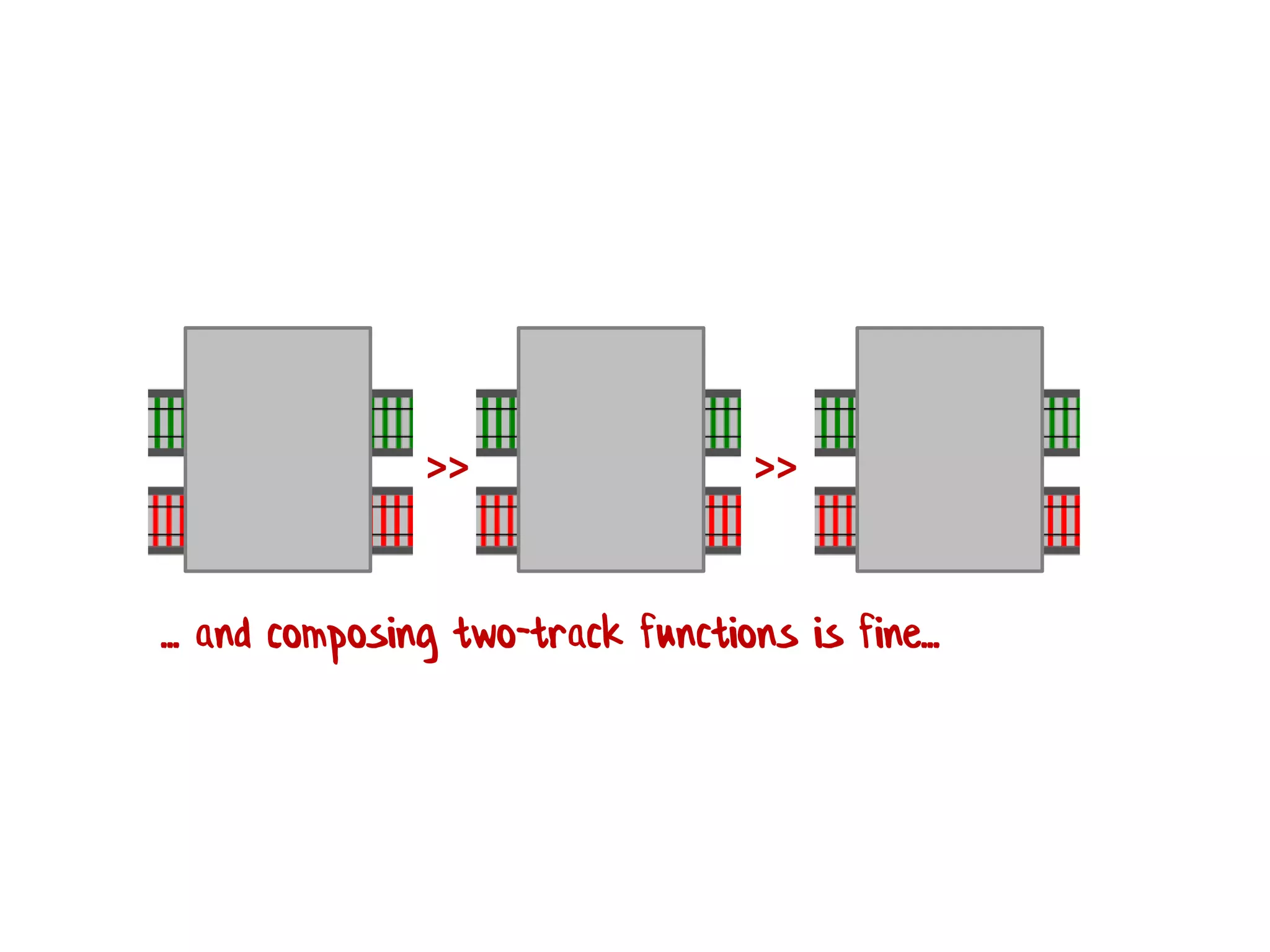
Composing one-track functions is fine...
>> >>
... and composing two-track functions is fine...
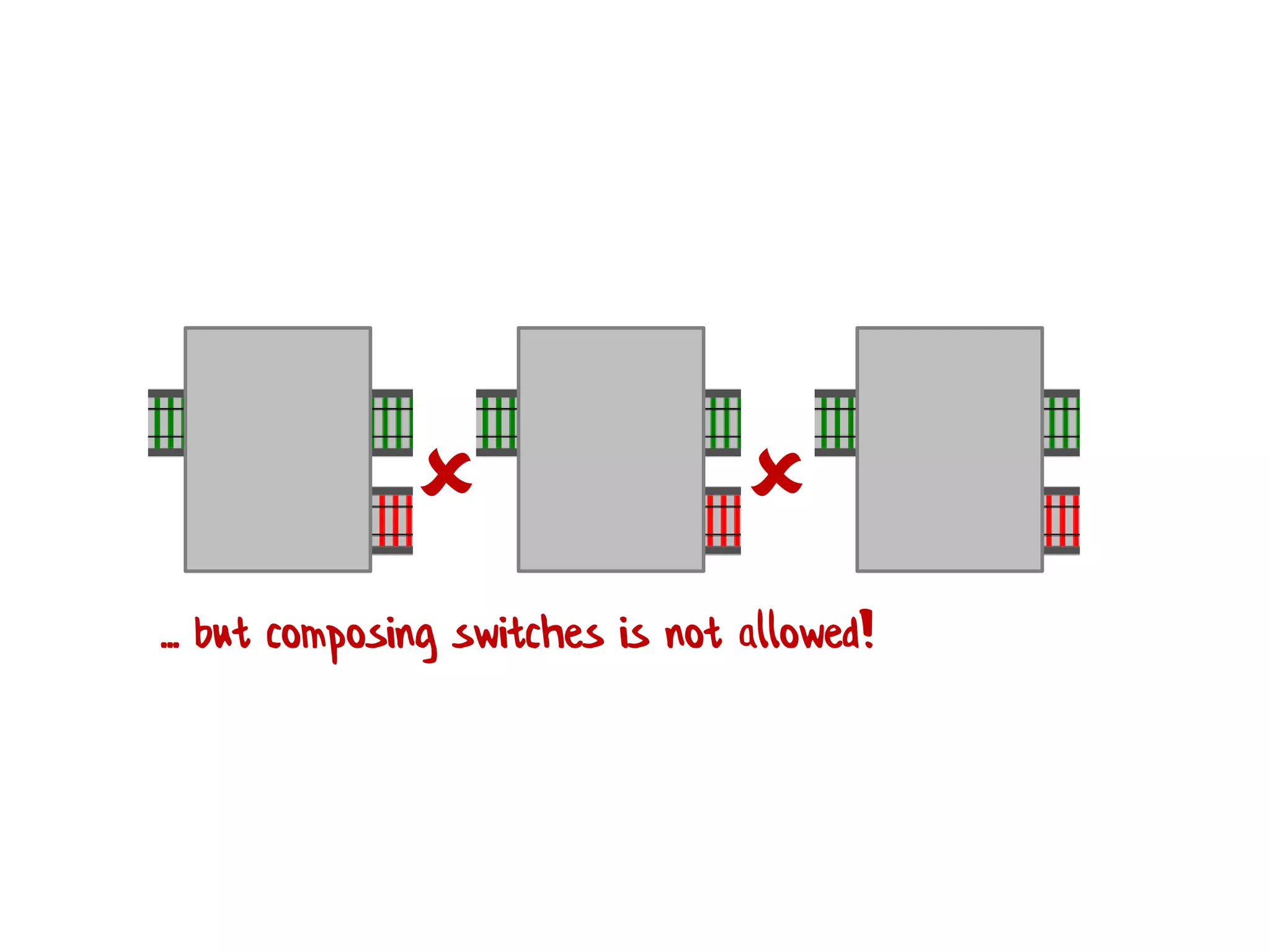
 
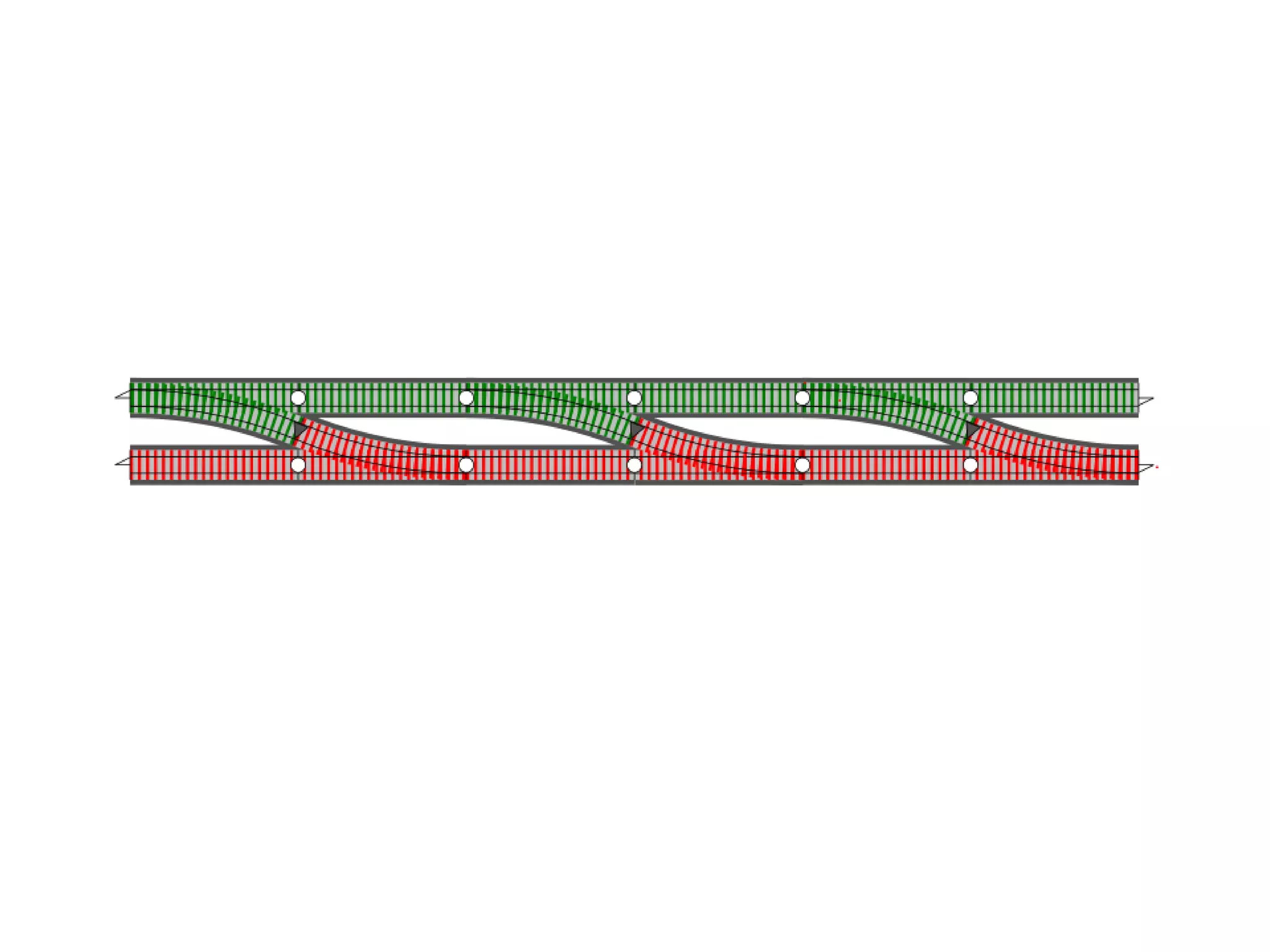
... but composing switches is not allowed!
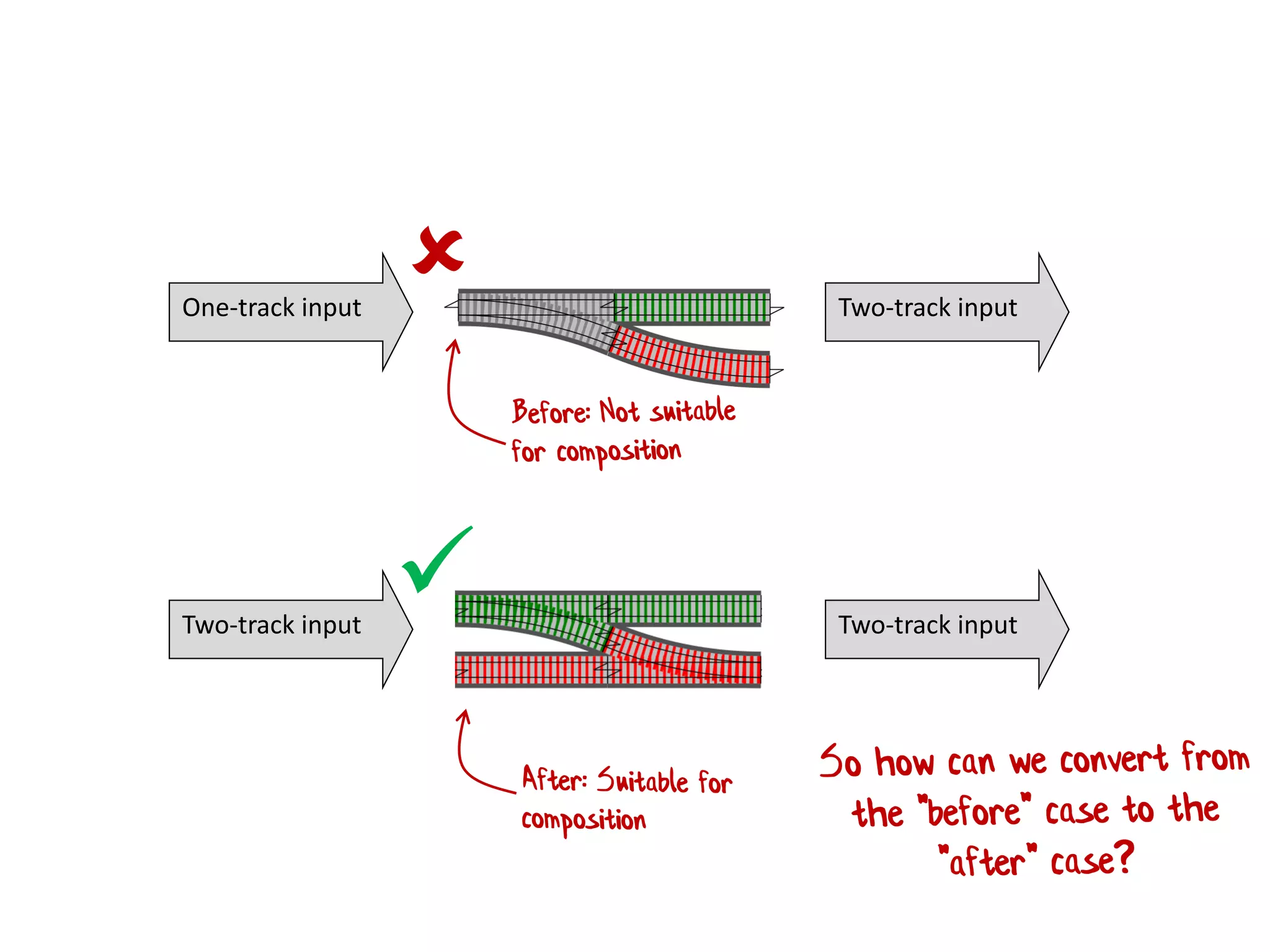
How to combine the
mismatched functions?
“Bind” is the answer!
Bind all the things!
Two-track input Two-track input
One-track input Two-track input


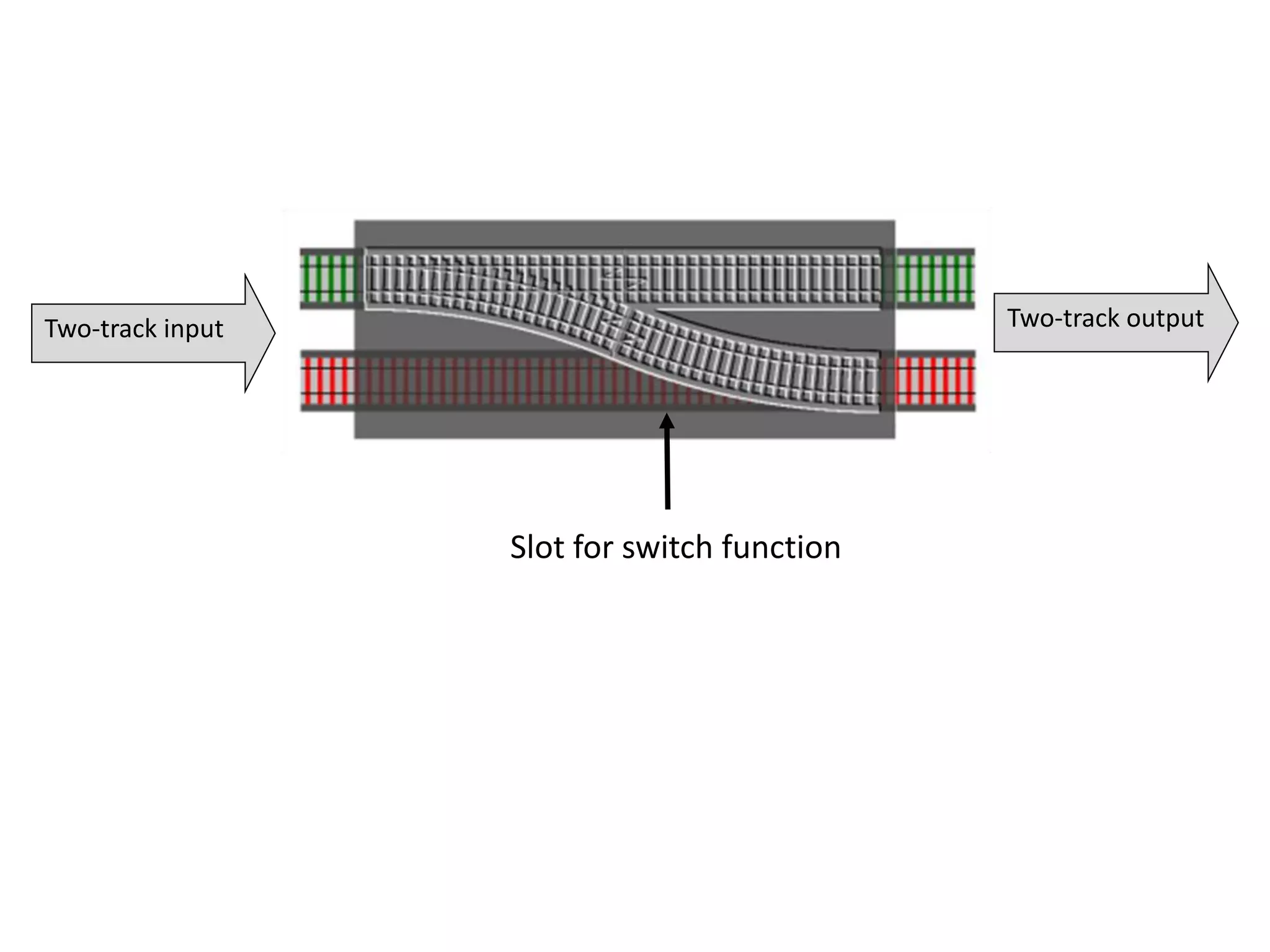
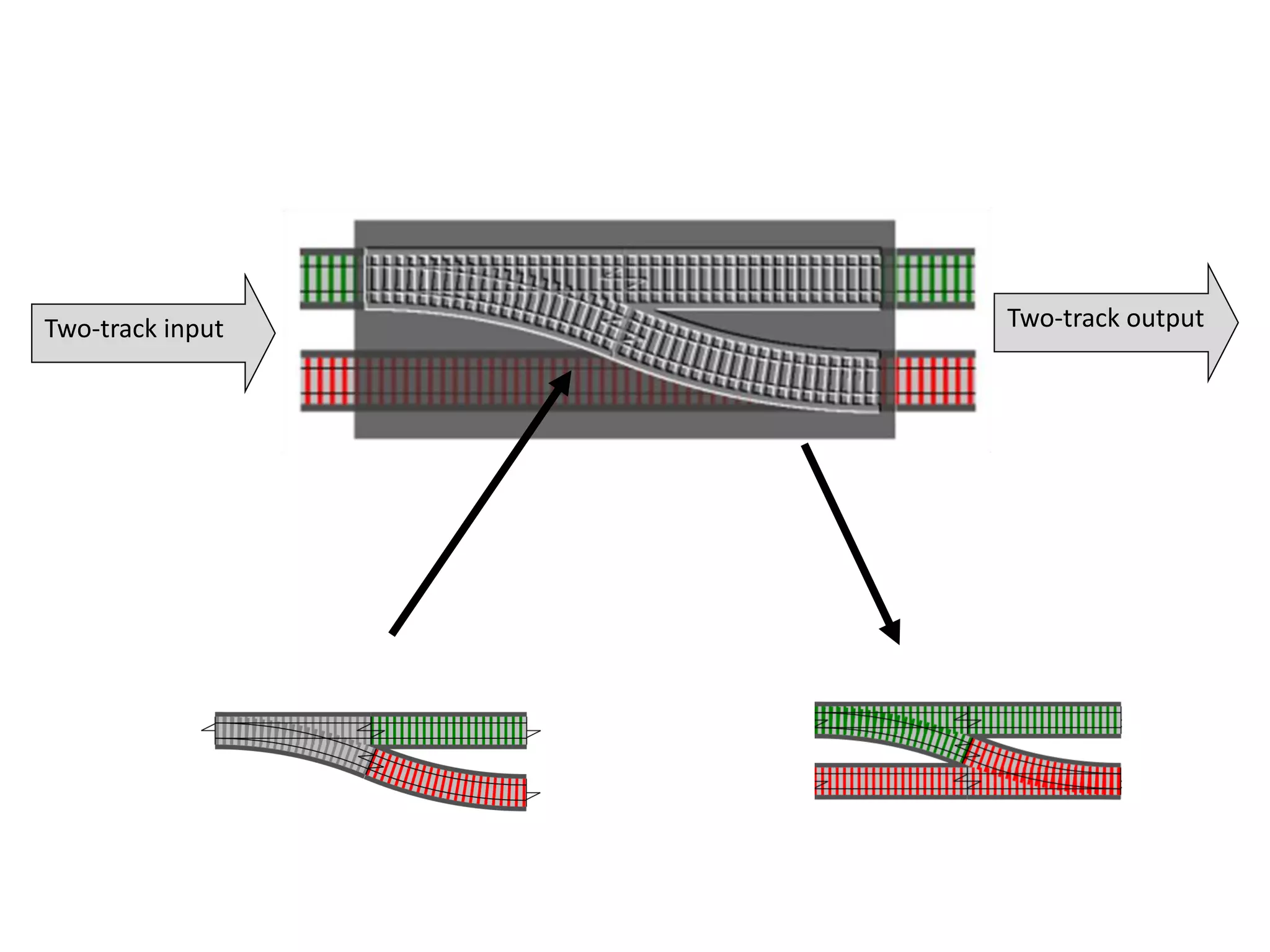
Two-track input
Slot for switch function
Two-track output
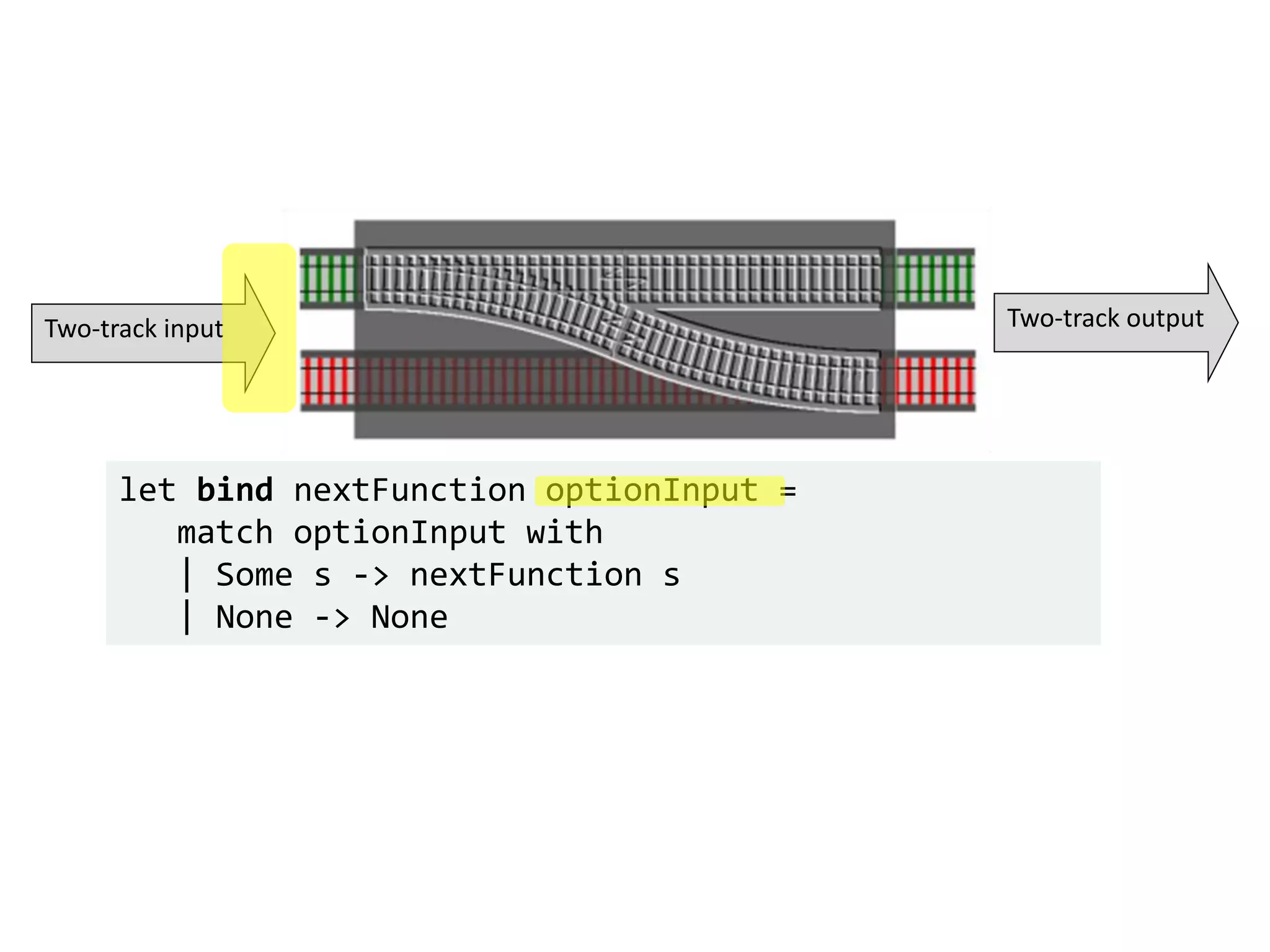
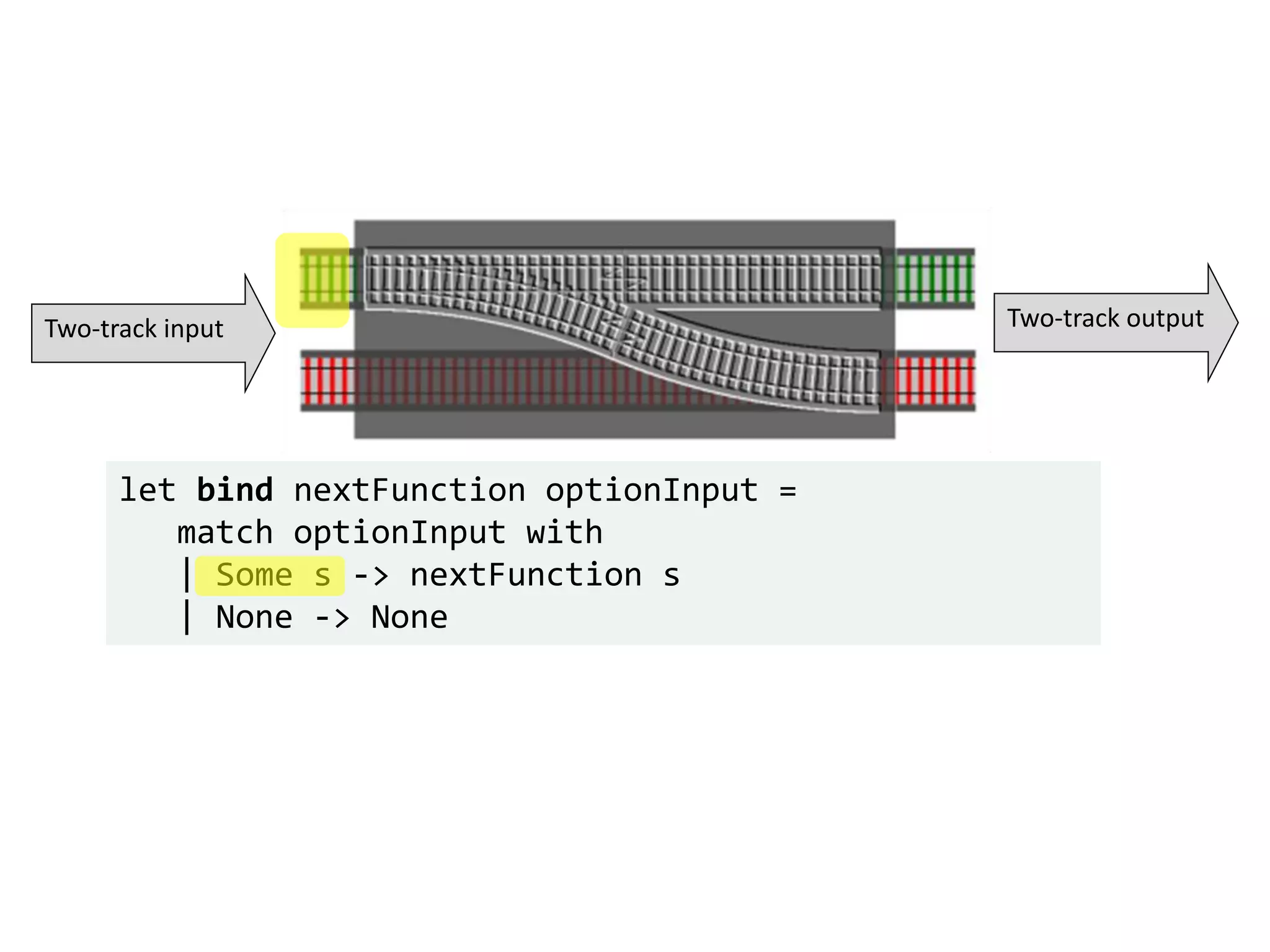
Two-track input Two-track output
let bind nextFunction optionInput =
match optionInput with
| Some s -> nextFunction s
| None -> None
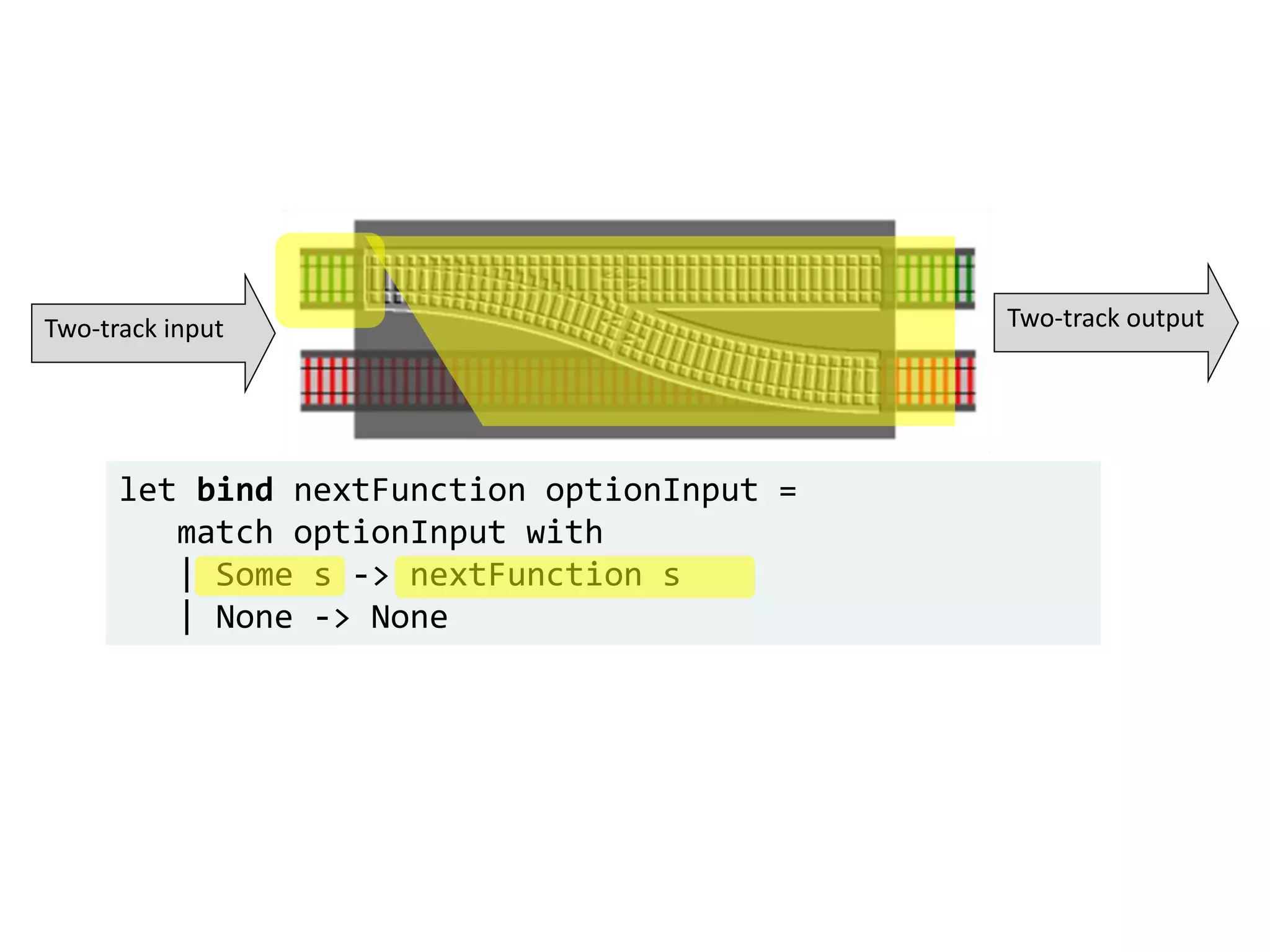
Two-track input Two-track output
let bind nextFunction optionInput =
match optionInput with
| Some s -> nextFunction s
| None -> None
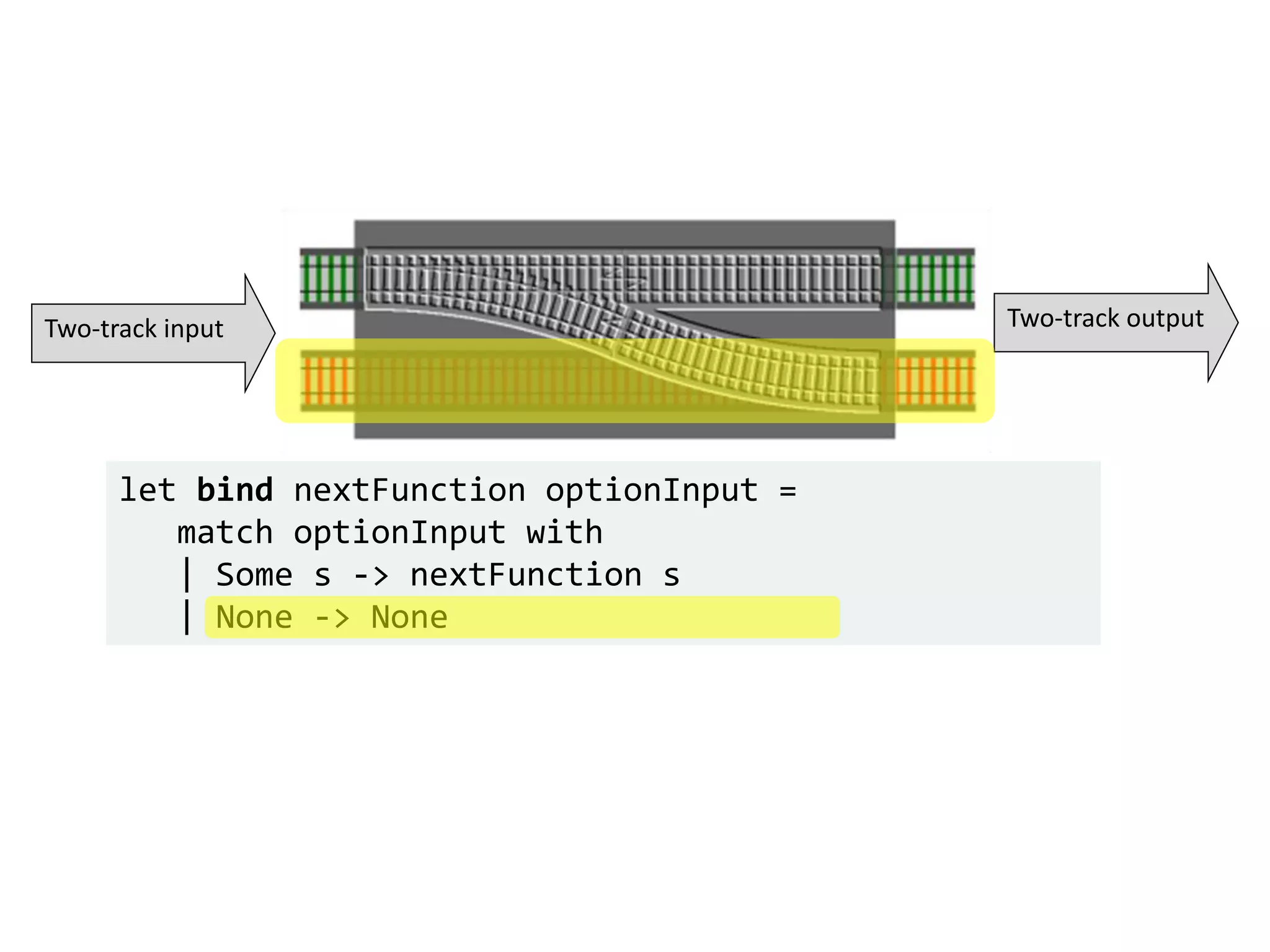
Two-track input Two-track output
let bind nextFunction optionInput =
match optionInput with
| Some s -> nextFunction s
| None -> None
Two-track input Two-track output
let bind nextFunction optionInput =
match optionInput with
| Some s -> nextFunction s
| None -> None
Two-track input Two-track output
Pattern:
Use bind to chain options
let example input =
let x = doSomething input
if x.IsSome then
let y = doSomethingElse (x.Value)
if y.IsSome then
let z = doAThirdThing (y.Value)
if z.IsSome then
let result = z.Value
Some result
else
None
else
None
else
None
Before
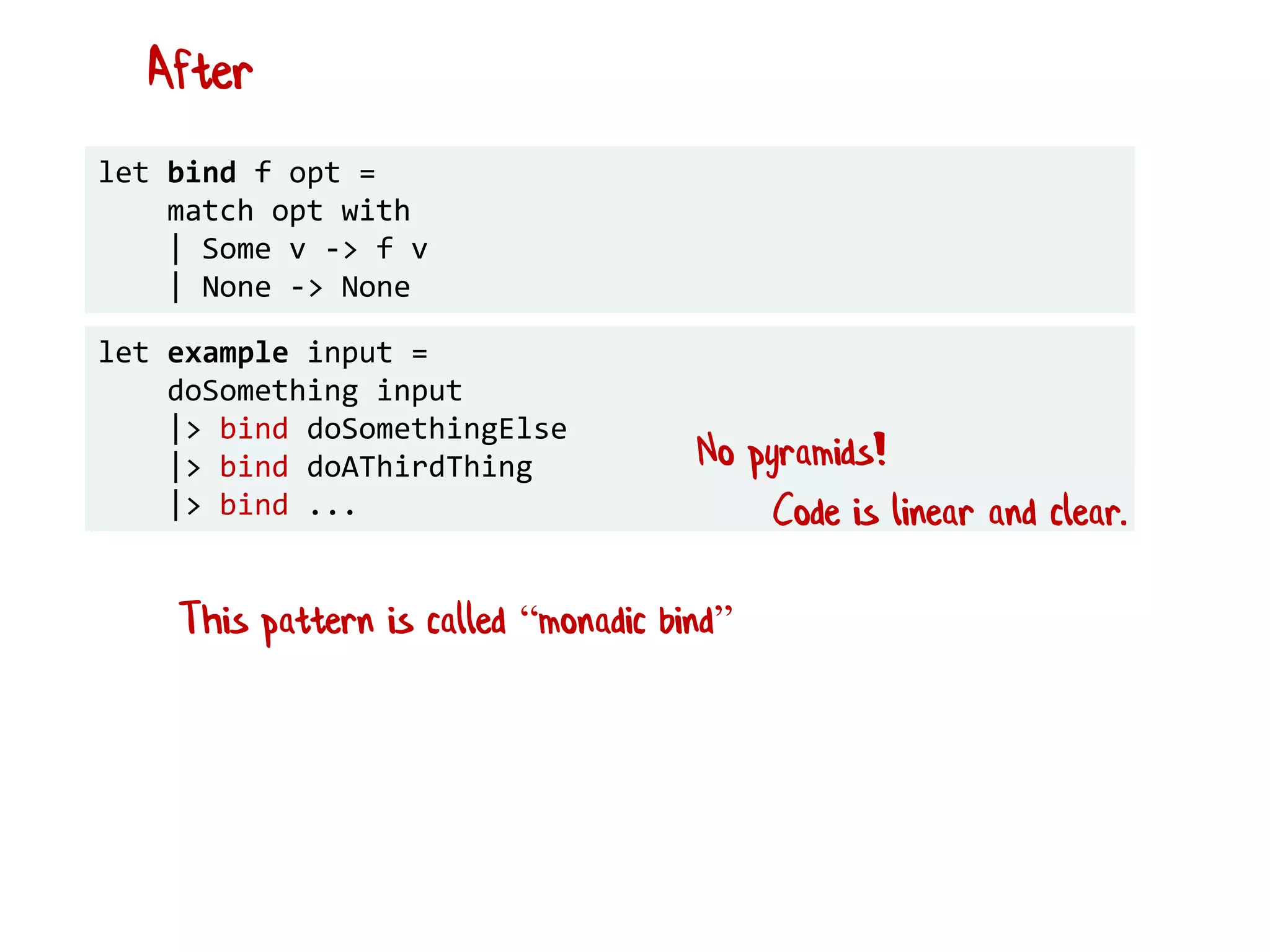
let bind f opt =
match opt with
| Some v -> f v
| None -> None
After
let example input =
doSomething input
|> bind doSomethingElse
|> bind doAThirdThing
|> bind ...
let bind f opt =
match opt with
| Some v -> f v
| None -> None
No pyramids!
Code is linear and clear.
This pattern is called “monadic bind”
After
Pattern:
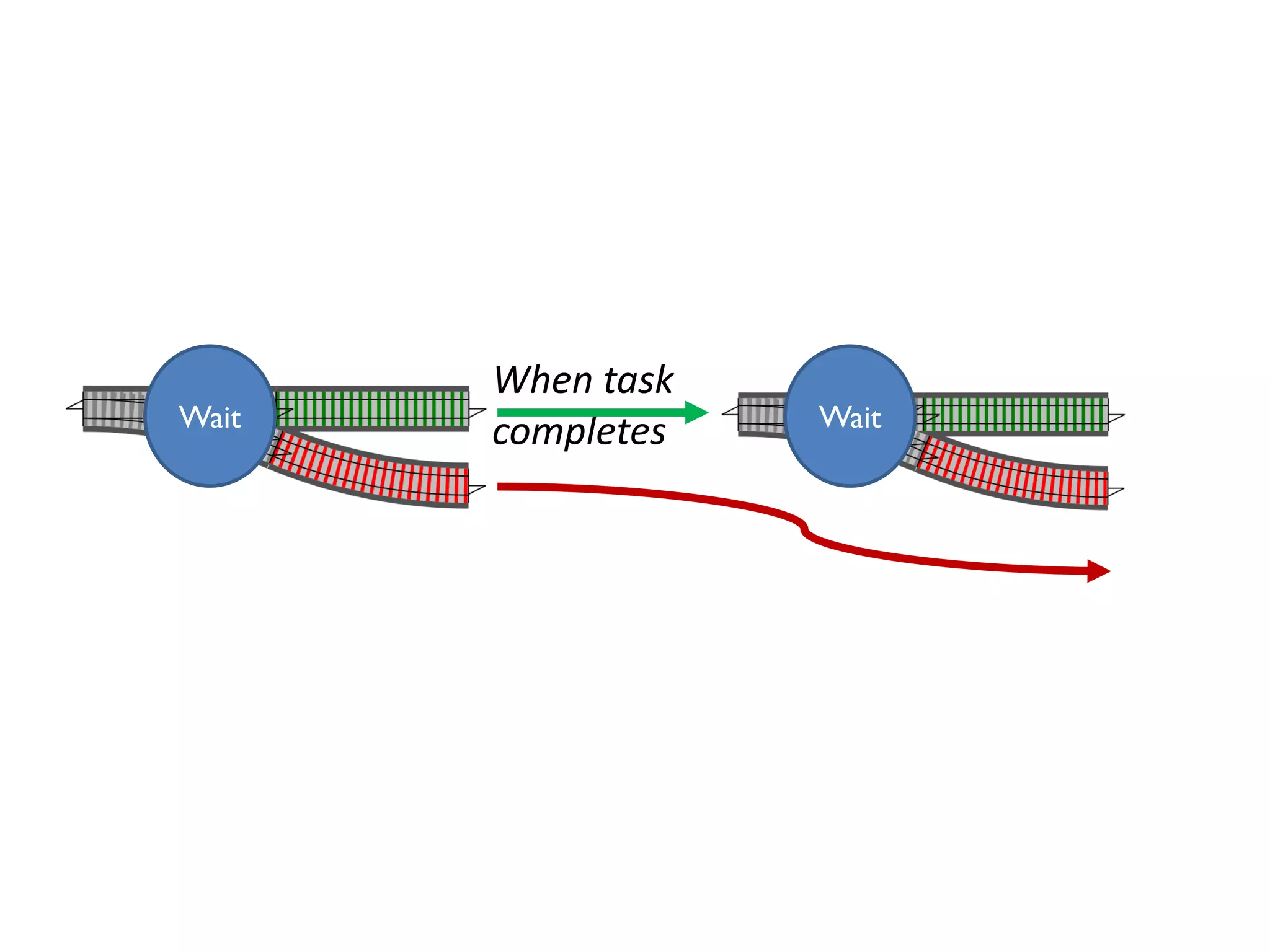
Use bind to chain tasks
a.k.a "promise" "future"
When task
completesWait Wait
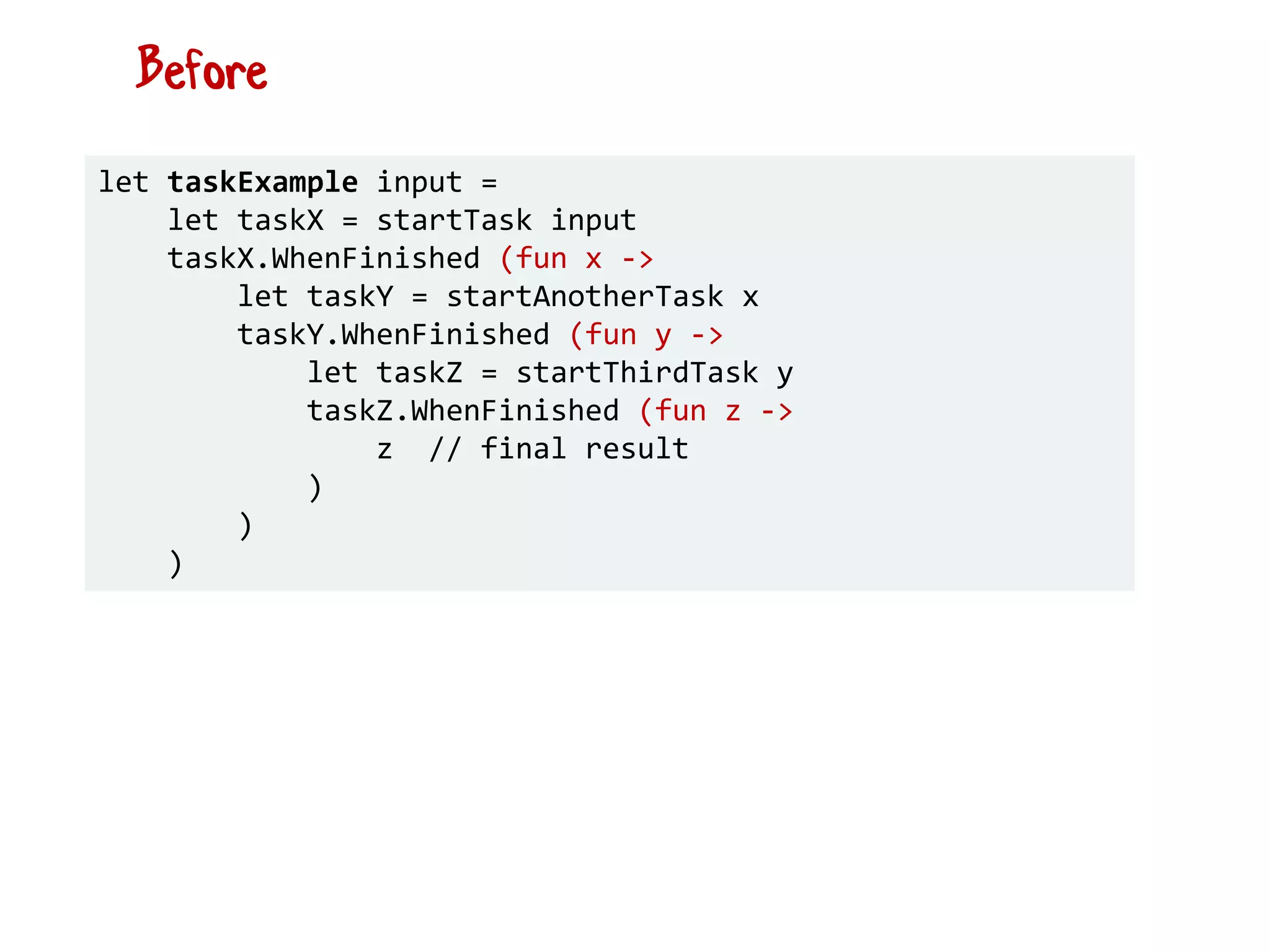
let taskExample input =
let taskX = startTask input
taskX.WhenFinished (fun x ->
let taskY = startAnotherTask x
taskY.WhenFinished (fun y ->
let taskZ = startThirdTask y
taskZ.WhenFinished (fun z ->
z // final result
)
)
)
Before
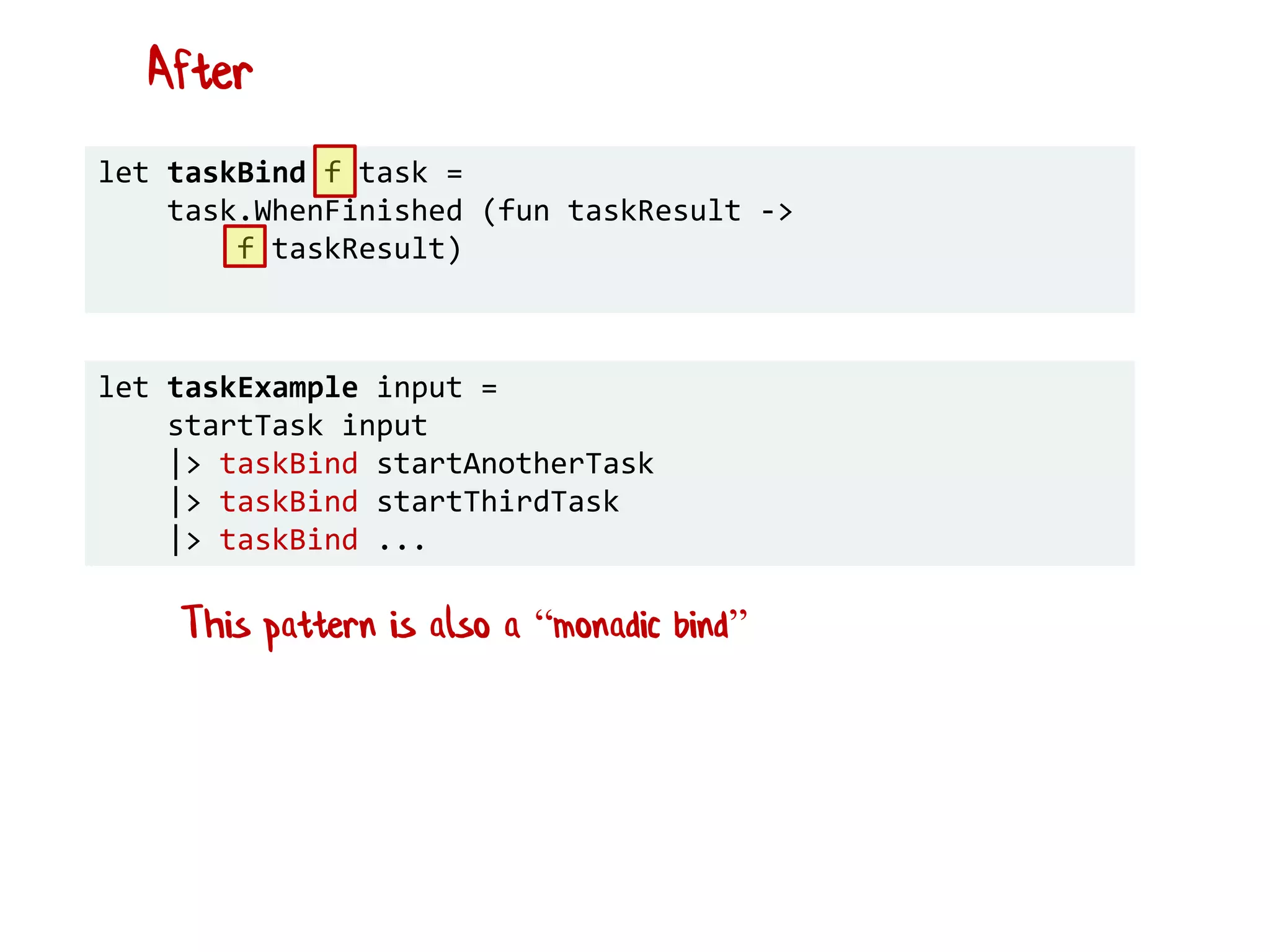
let taskBind f task =
task.WhenFinished (fun taskResult ->
f taskResult)
let taskExample input =
startTask input
|> taskBind startAnotherTask
|> taskBind startThirdTask
|> taskBind ...
This pattern is also a “monadic bind”
After
Pattern:
Use bind to chain error handlers
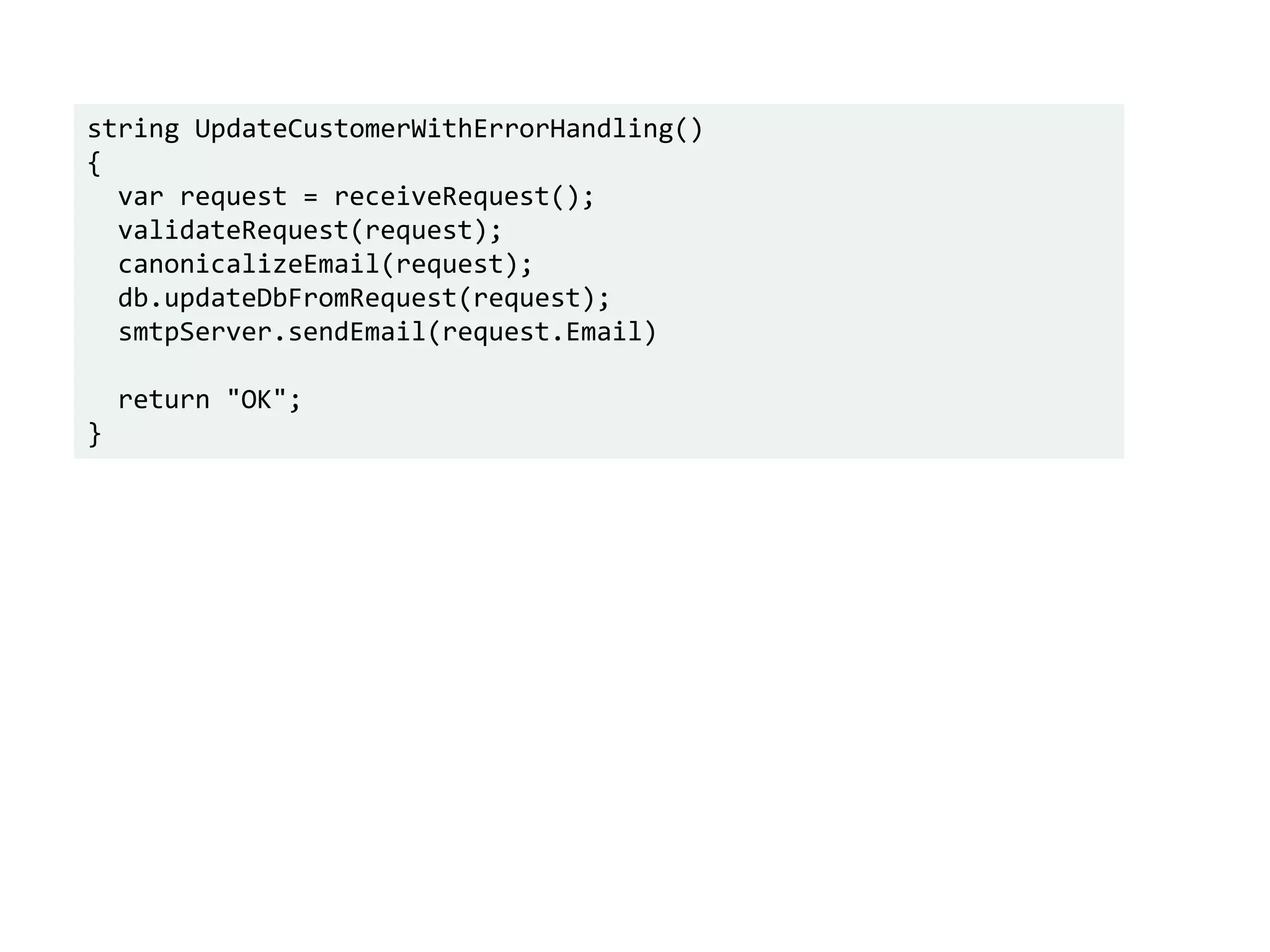
string UpdateCustomerWithErrorHandling()
{
var request = receiveRequest();
validateRequest(request);
canonicalizeEmail(request);
db.updateDbFromRequest(request);
smtpServer.sendEmail(request.Email)
return "OK";
}
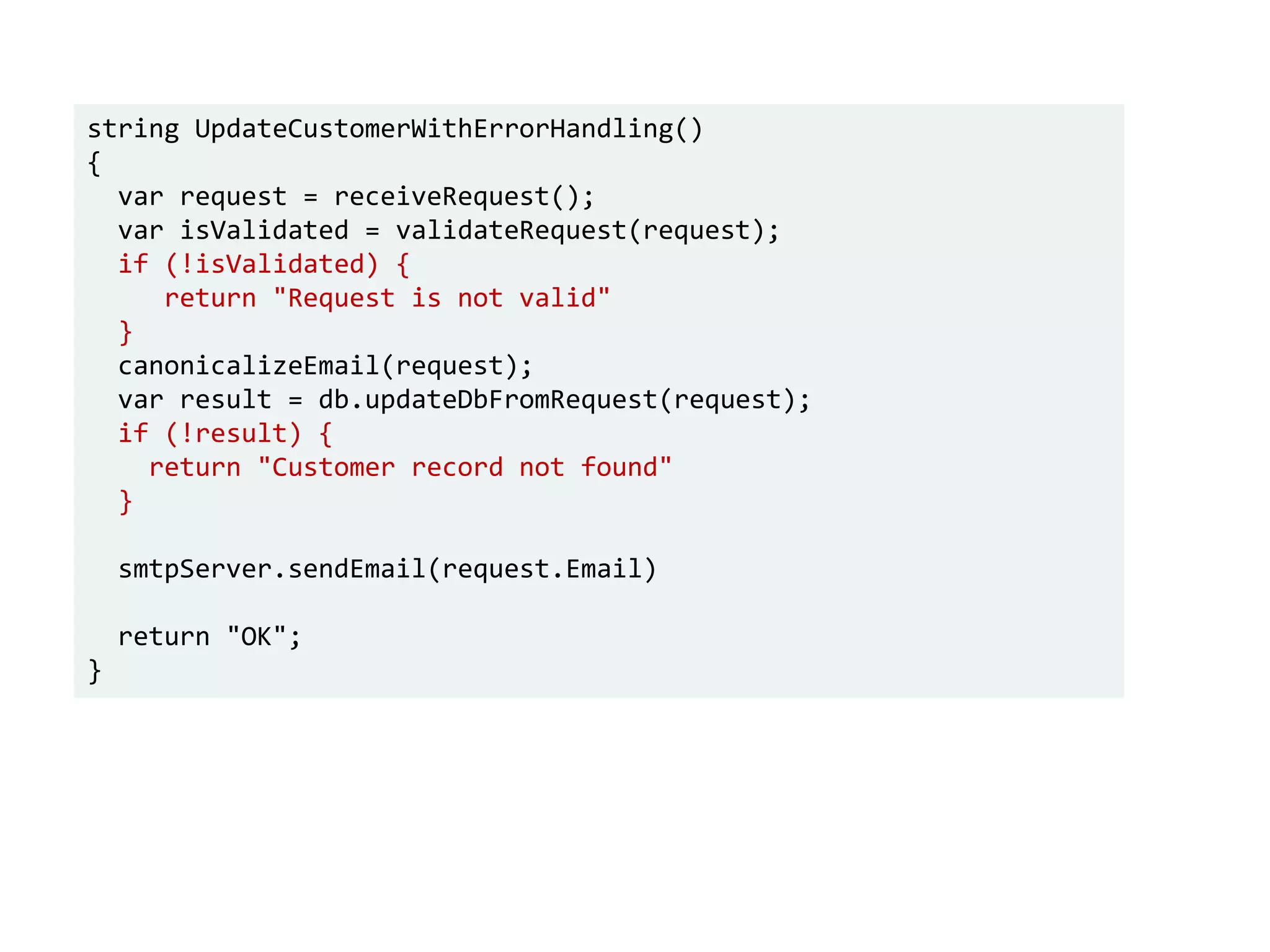
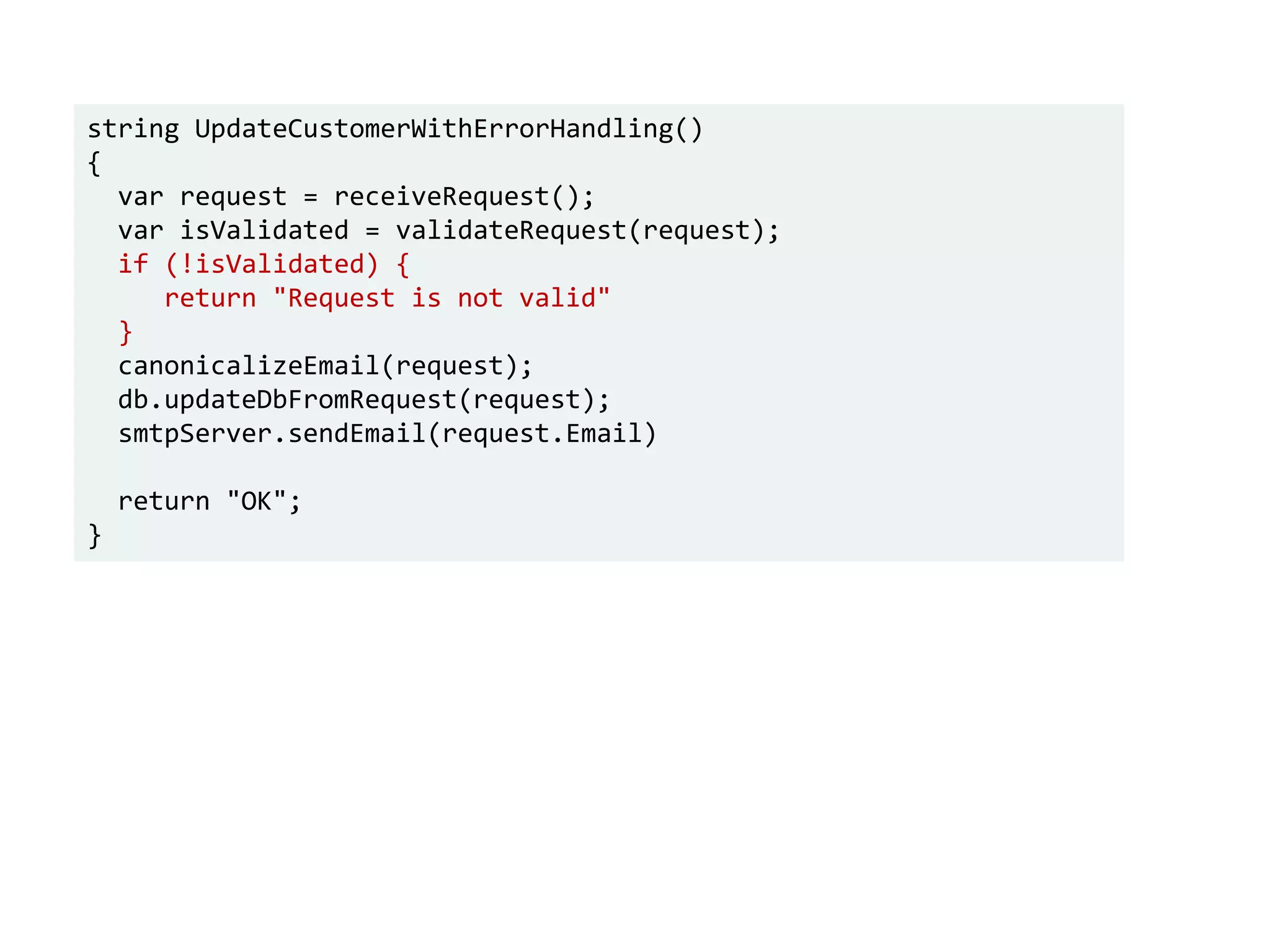
string UpdateCustomerWithErrorHandling()
{
var request = receiveRequest();
var isValidated = validateRequest(request);
if (!isValidated) {
return "Request is not valid"
}
canonicalizeEmail(request);
db.updateDbFromRequest(request);
smtpServer.sendEmail(request.Email)
return "OK";
}
string UpdateCustomerWithErrorHandling()
{
var request = receiveRequest();
var isValidated = validateRequest(request);
if (!isValidated) {
return "Request is not valid"
}
canonicalizeEmail(request);
var result = db.updateDbFromRequest(request);
if (!result) {
return "Customer record not found"
}
smtpServer.sendEmail(request.Email)
return "OK";
}
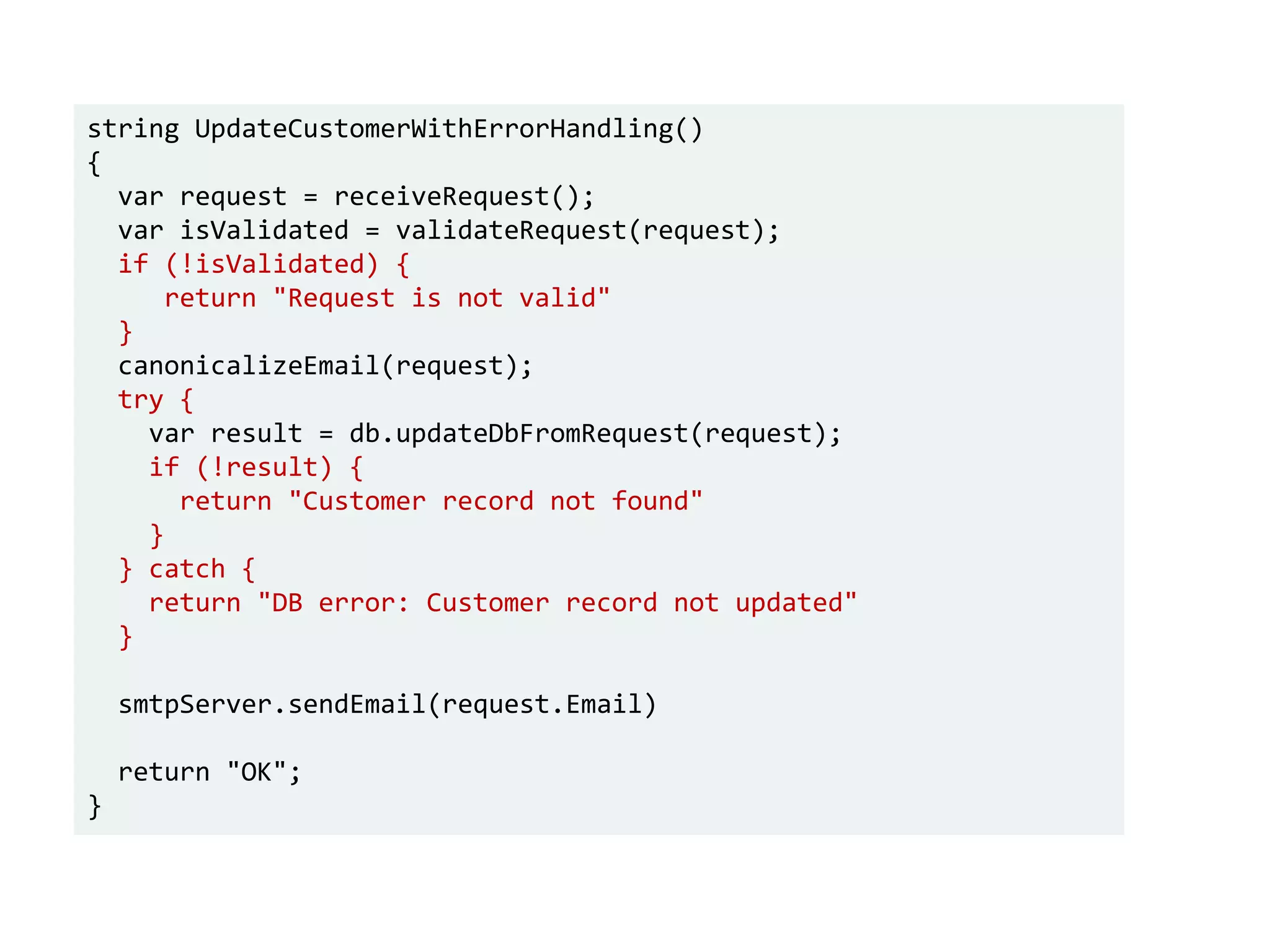
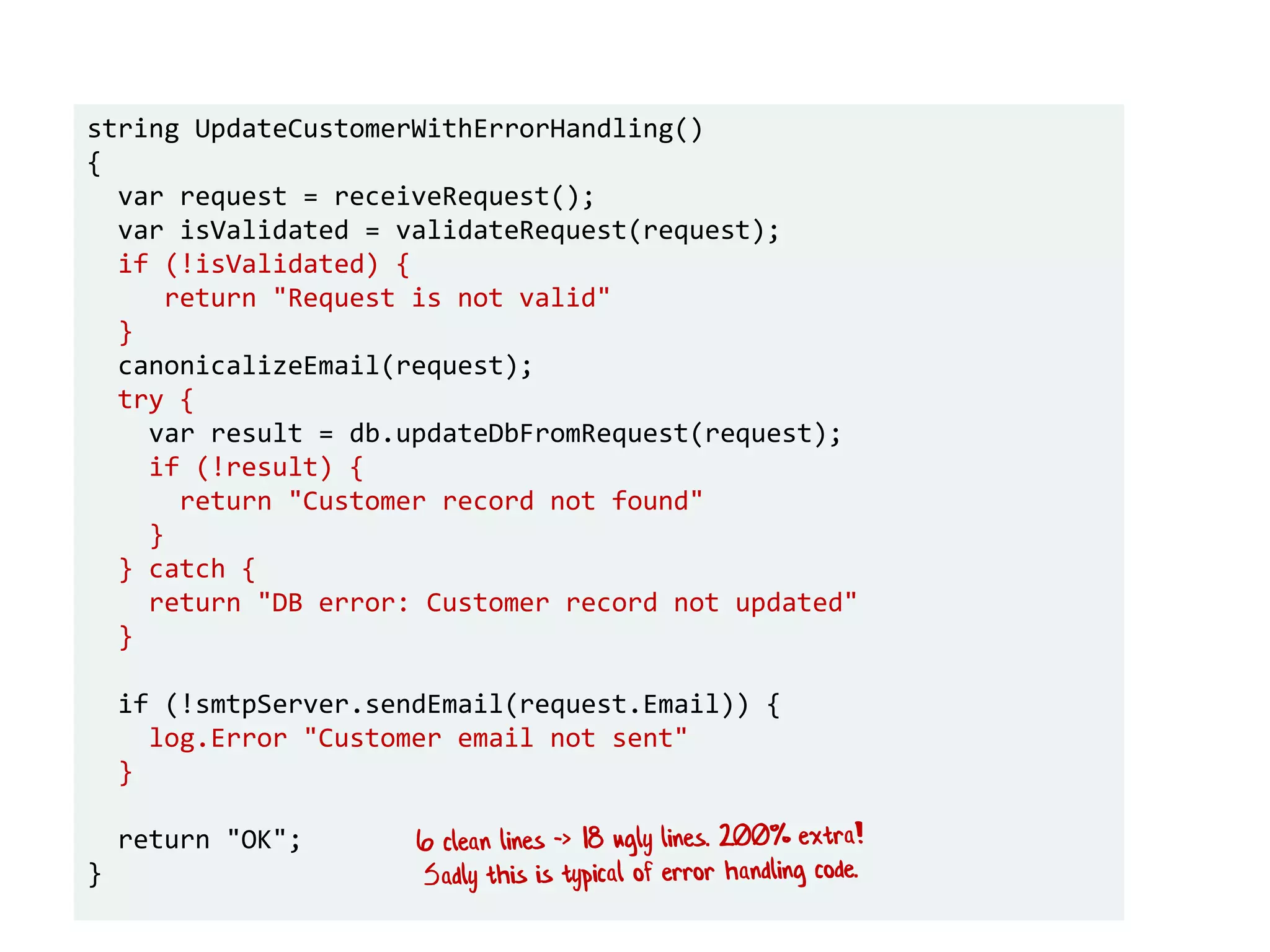
string UpdateCustomerWithErrorHandling()
{
var request = receiveRequest();
var isValidated = validateRequest(request);
if (!isValidated) {
return "Request is not valid"
}
canonicalizeEmail(request);
try {
var result = db.updateDbFromRequest(request);
if (!result) {
return "Customer record not found"
}
} catch {
return "DB error: Customer record not updated"
}
smtpServer.sendEmail(request.Email)
return "OK";
}
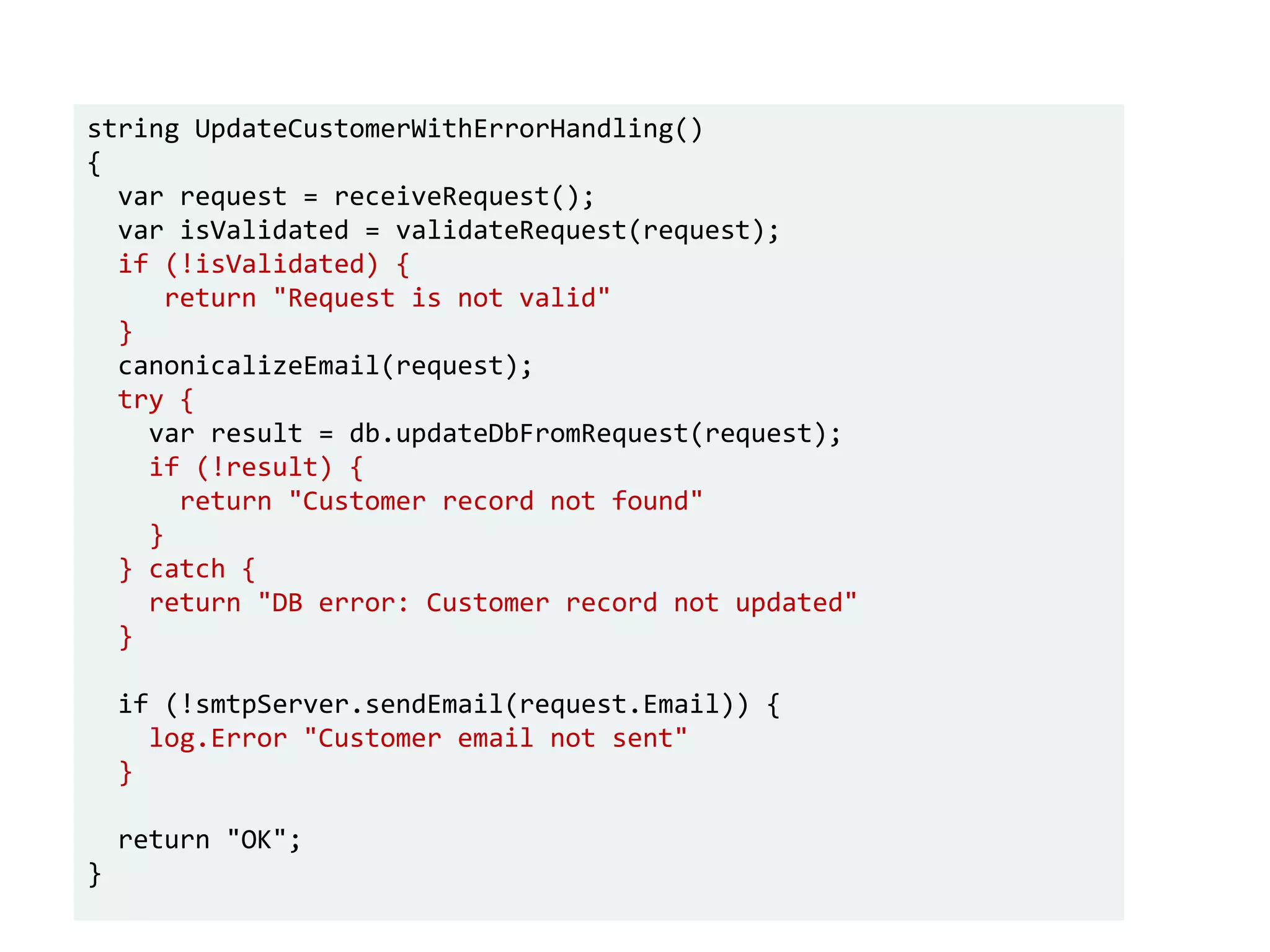
string UpdateCustomerWithErrorHandling()
{
var request = receiveRequest();
var isValidated = validateRequest(request);
if (!isValidated) {
return "Request is not valid"
}
canonicalizeEmail(request);
try {
var result = db.updateDbFromRequest(request);
if (!result) {
return "Customer record not found"
}
} catch {
return "DB error: Customer record not updated"
}
if (!smtpServer.sendEmail(request.Email)) {
log.Error "Customer email not sent"
}
return "OK";
}
string UpdateCustomerWithErrorHandling()
{
var request = receiveRequest();
var isValidated = validateRequest(request);
if (!isValidated) {
return "Request is not valid"
}
canonicalizeEmail(request);
try {
var result = db.updateDbFromRequest(request);
if (!result) {
return "Customer record not found"
}
} catch {
return "DB error: Customer record not updated"
}
if (!smtpServer.sendEmail(request.Email)) {
log.Error "Customer email not sent"
}
return "OK";
}
Tip:
Use a Result type for error handling
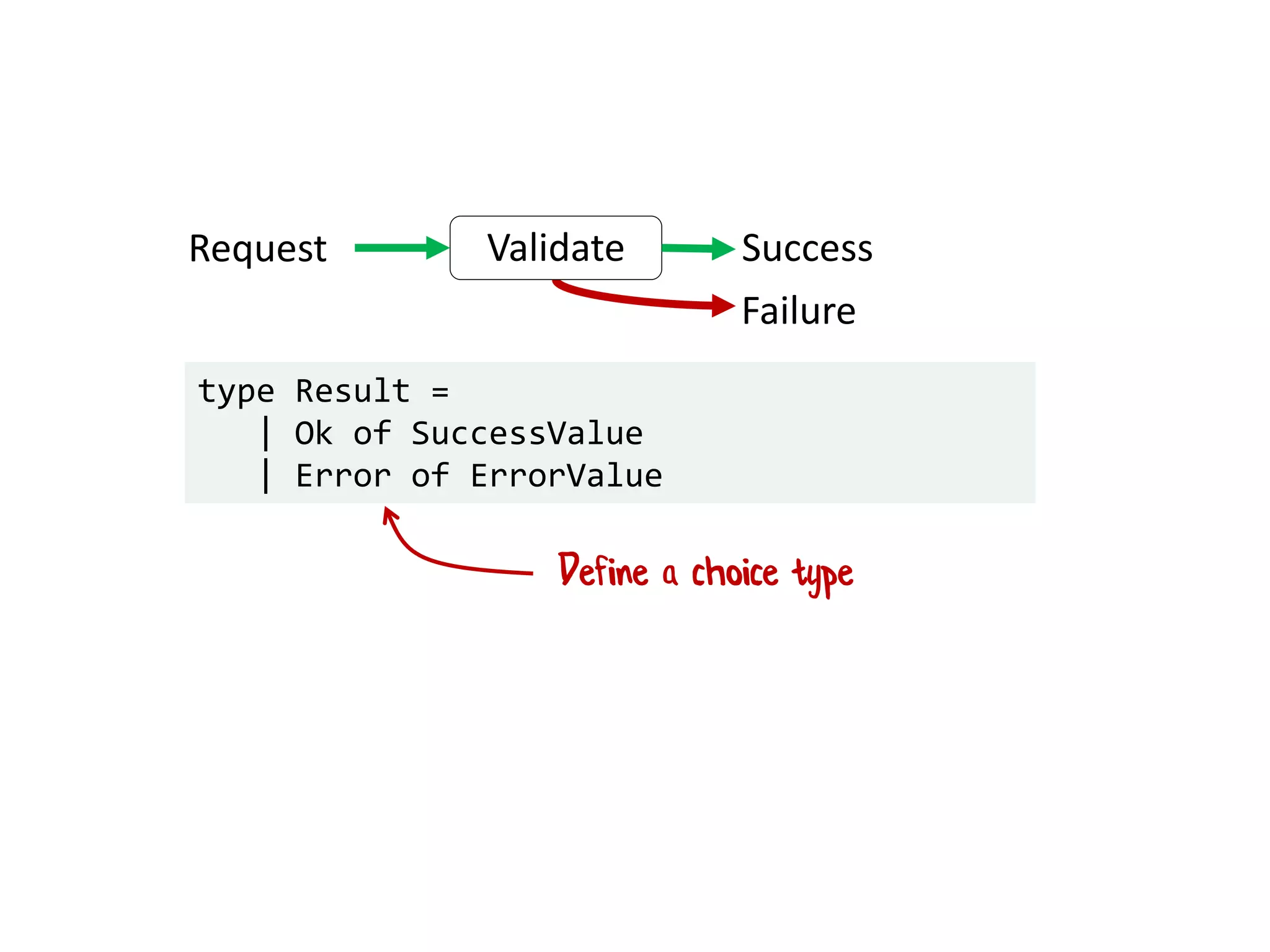
Request SuccessValidate
Failure
type Result =
| Ok of SuccessValue
| Error of ErrorValue
Define a choice type
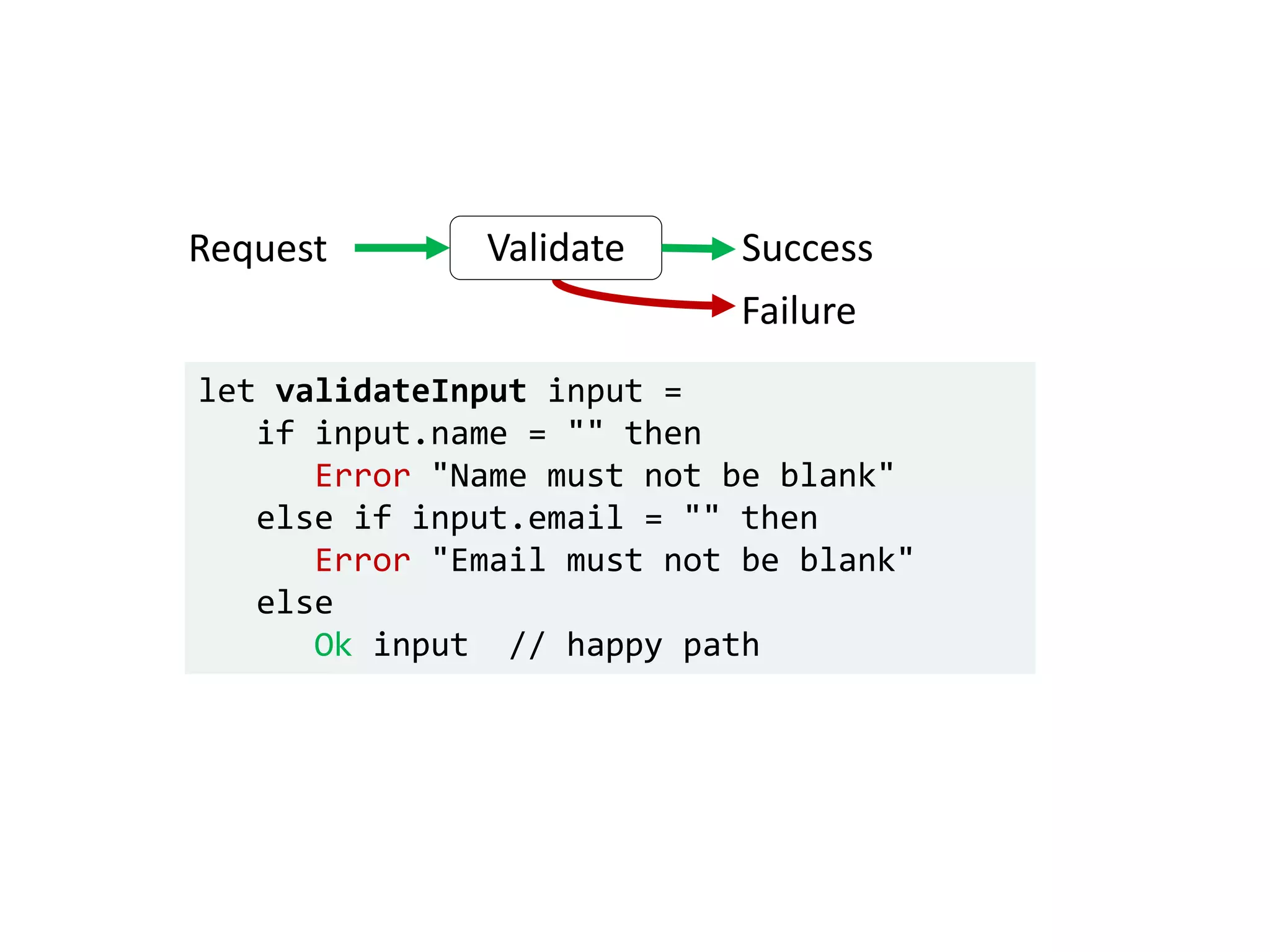
Request SuccessValidate
Failure
let validateInput input =
if input.name = "" then
Error "Name must not be blank"
else if input.email = "" then
Error "Email must not be blank"
else
Ok input // happy path
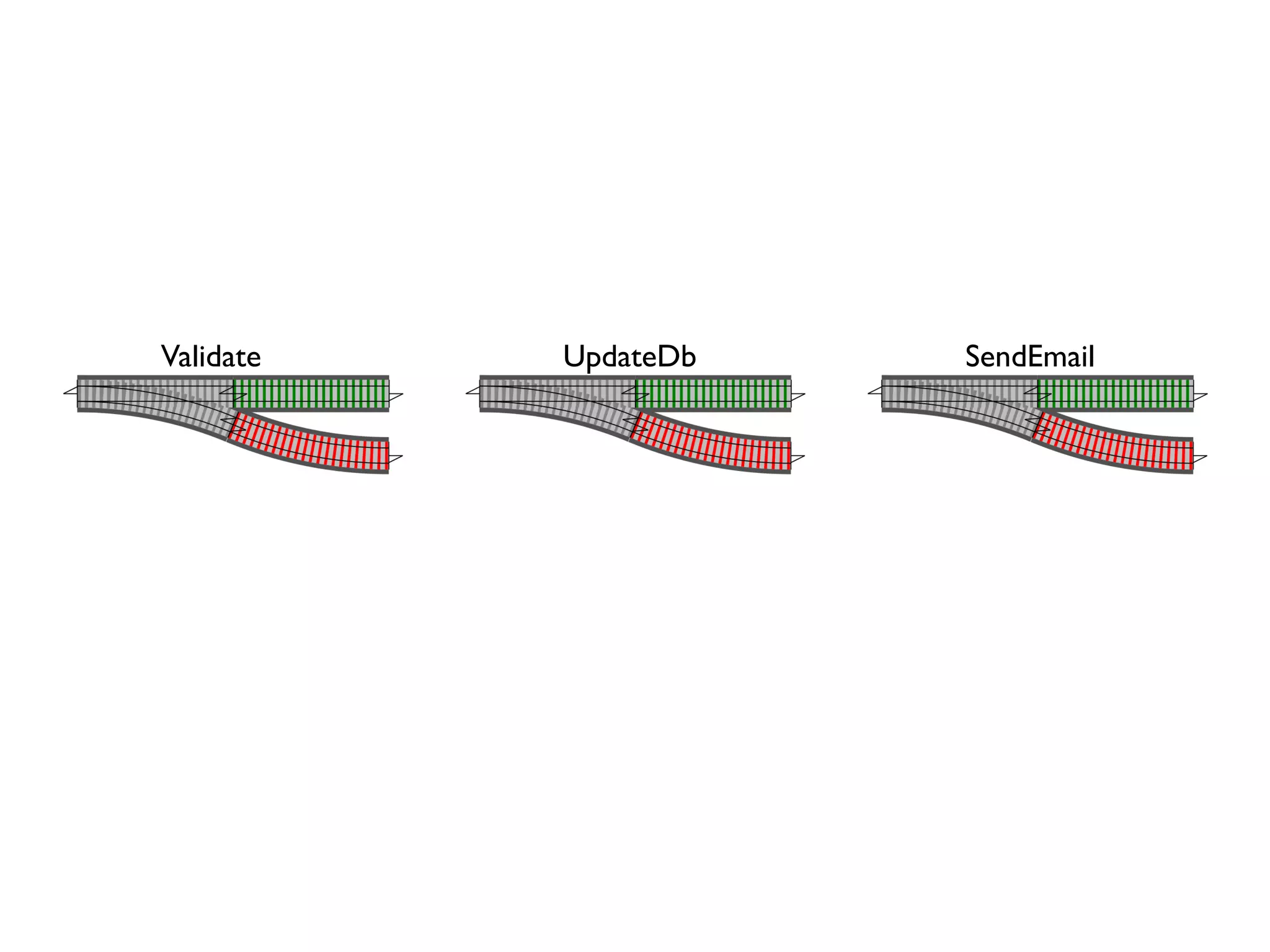
Validate UpdateDb SendEmail
Functional flow without error handling
let updateCustomer =
receiveRequest()
|> validateRequest
|> canonicalizeEmail
|> updateDbFromRequest
|> sendEmail
|> returnMessage
Before
One track
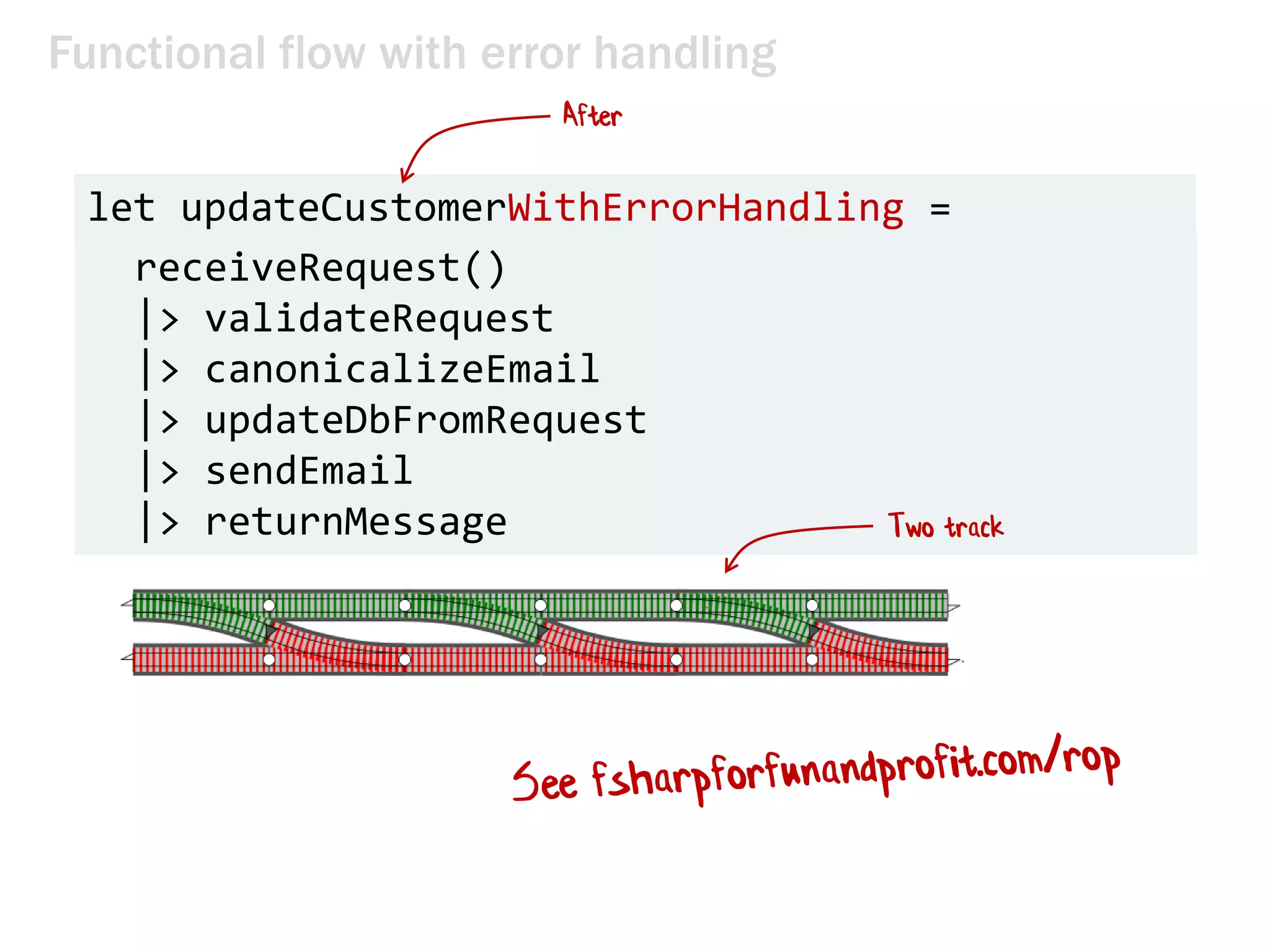
let updateCustomerWithErrorHandling =
receiveRequest()
|> validateRequest
|> canonicalizeEmail
|> updateDbFromRequest
|> sendEmail
|> returnMessage
Functional flow with error handling
After
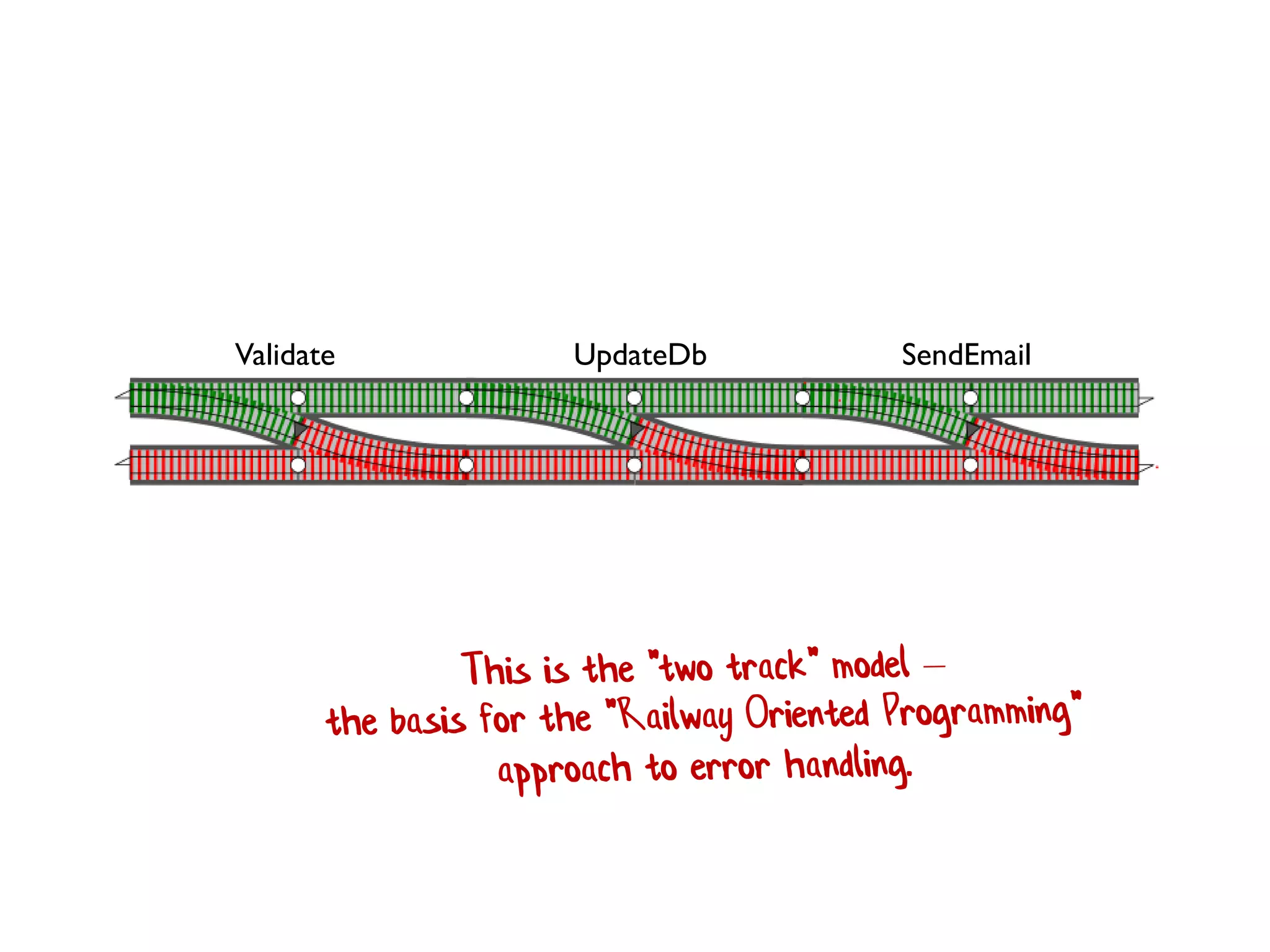
Two track
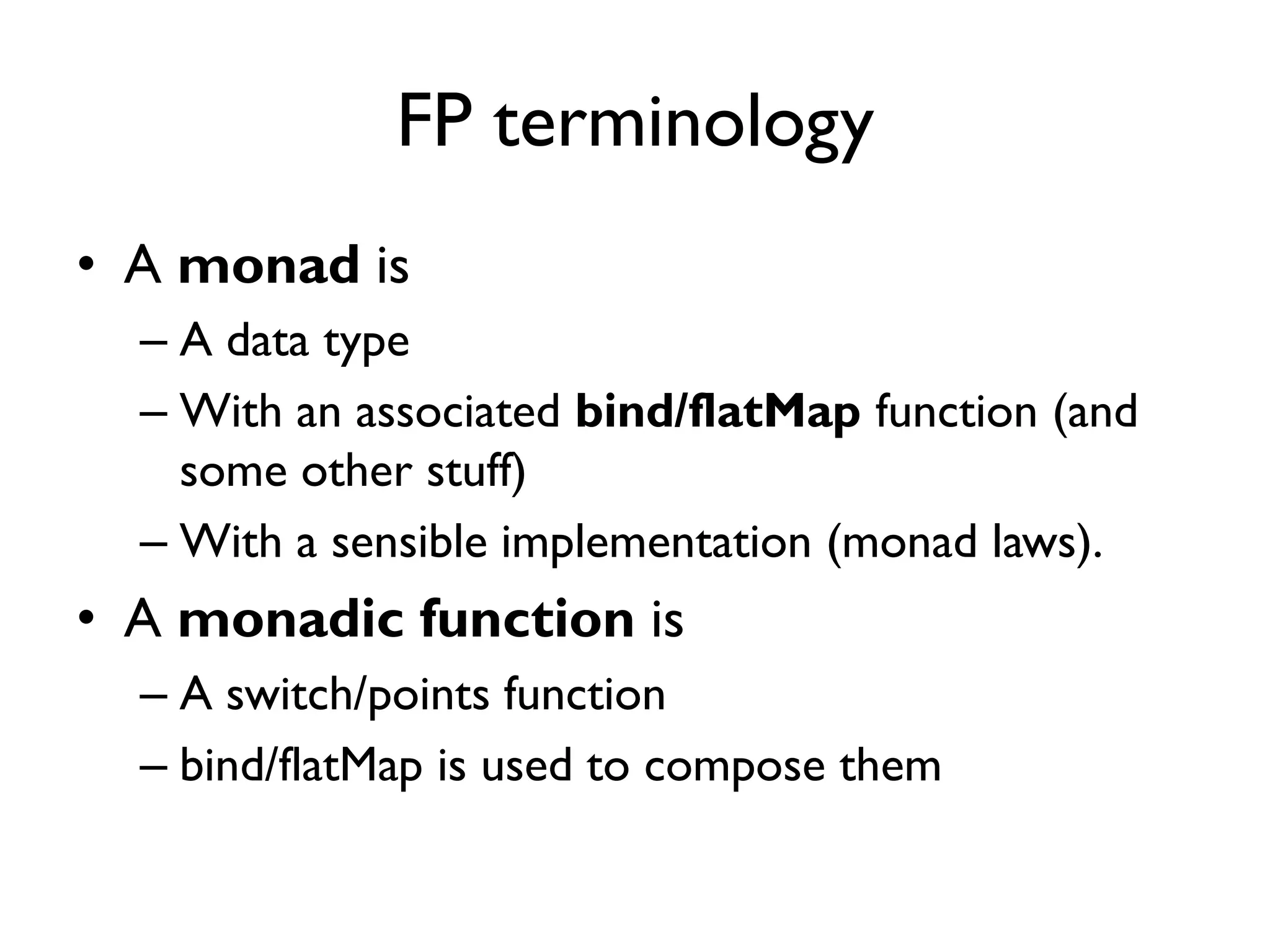
FP terminology
• A monad is
– A data type
– With an associated bind/flatMap function (and
some other stuff)
– With a sensible implementation (monad laws).
• A monadic function is
– A switch/points function
– bind/flatMap is used to compose them
Tip:
Monads are a general purpose way
of composing functions with
complex outputs
PATTERN 4
"MAP"
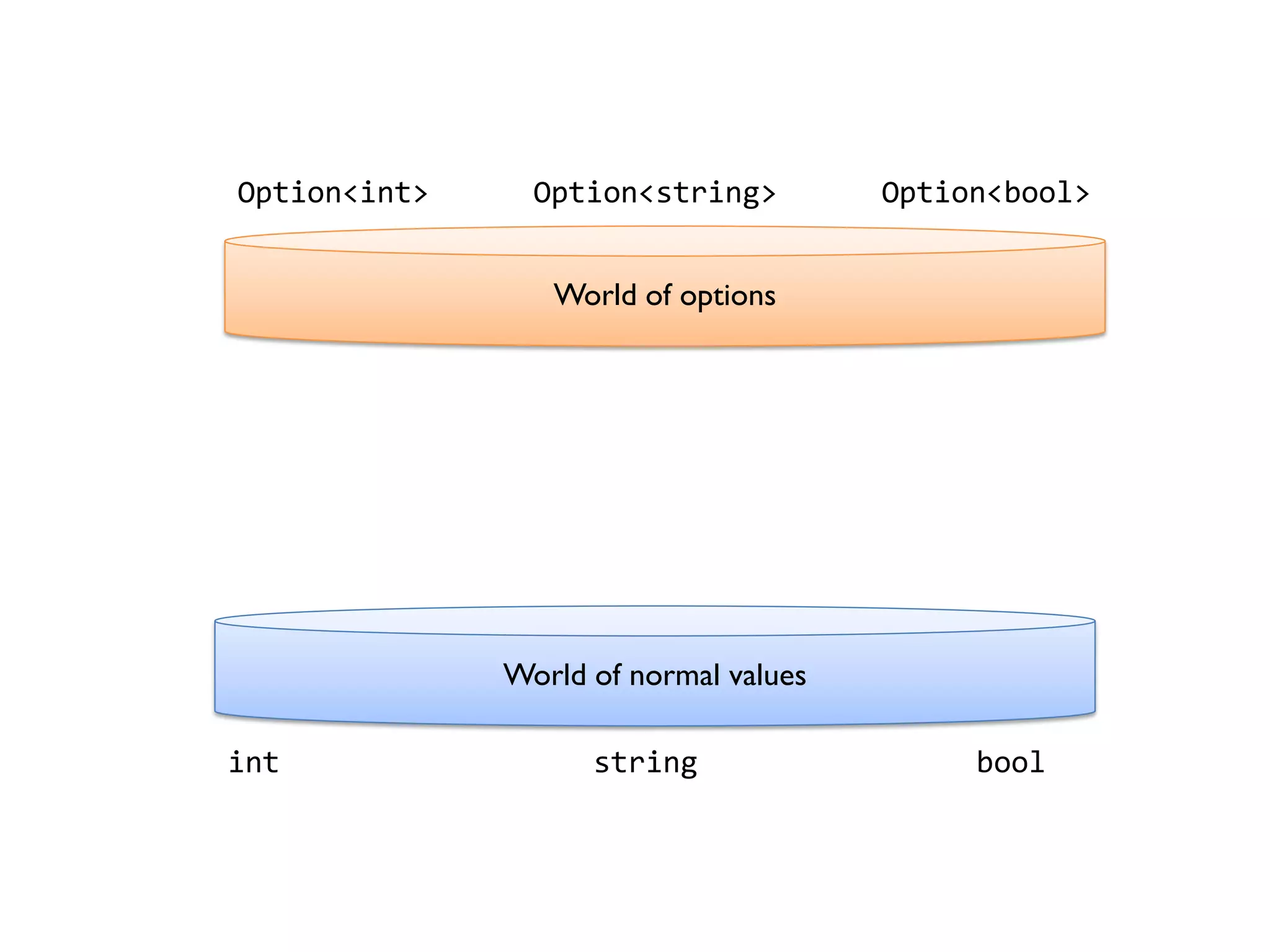
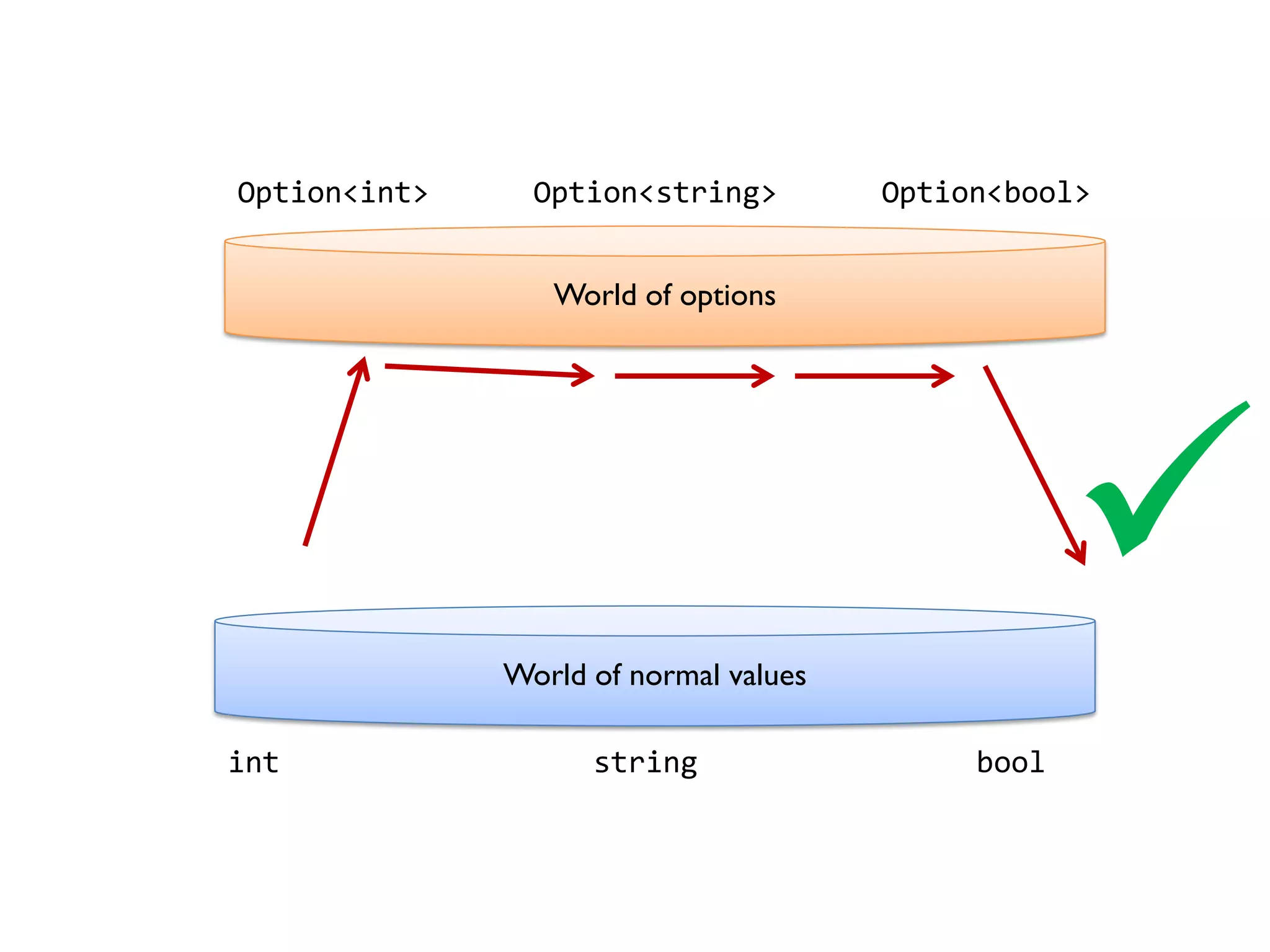
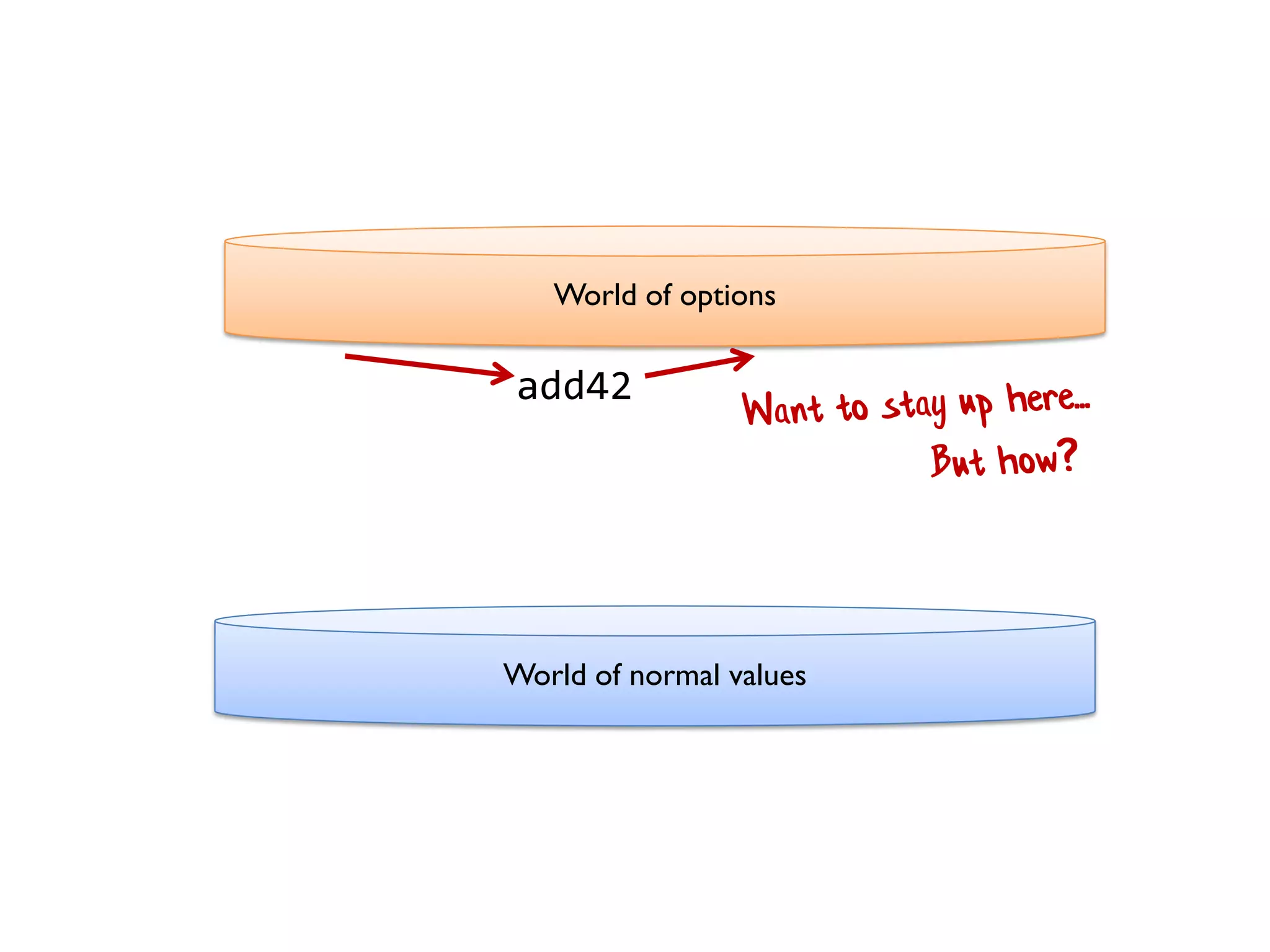
World of normal values
int string bool
World of options
Option<int> Option<string> Option<bool>
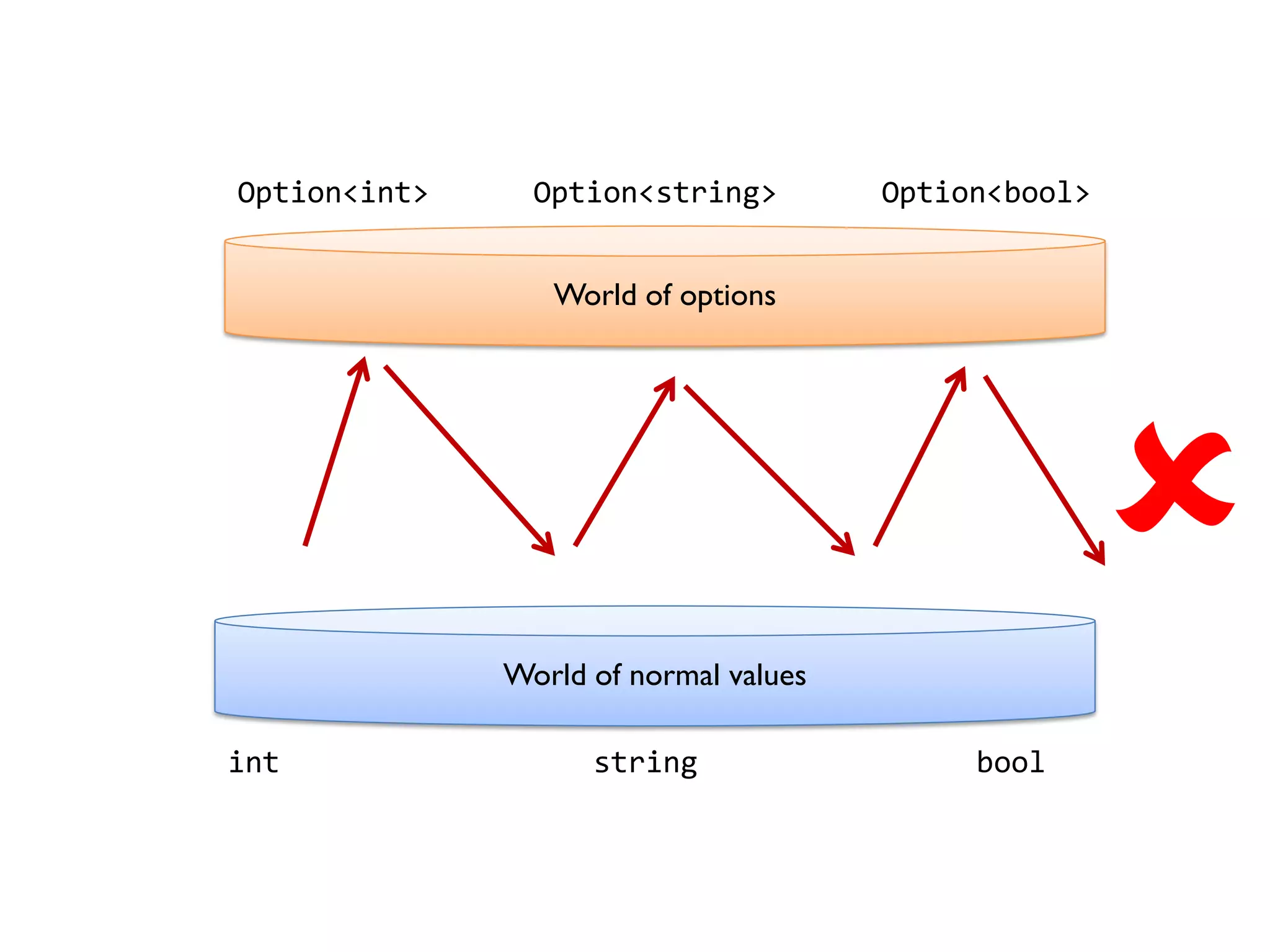
World of options
World of normal values
int string bool
Option<int> Option<string> Option<bool>

World of options
World of normal values
Option<int> Option<string> Option<bool>

int string bool
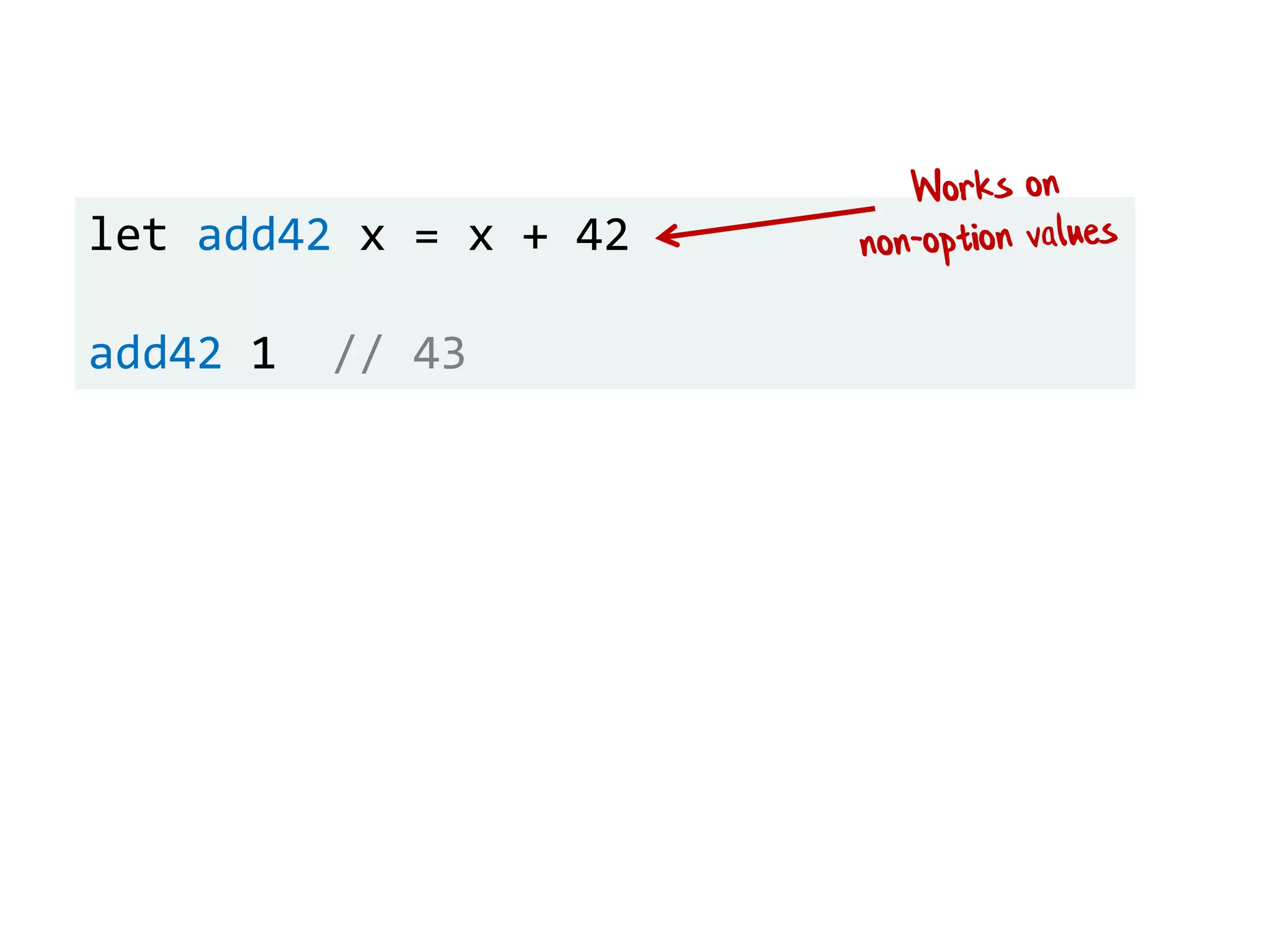
let add42 x = x + 42
add42 1 // 43
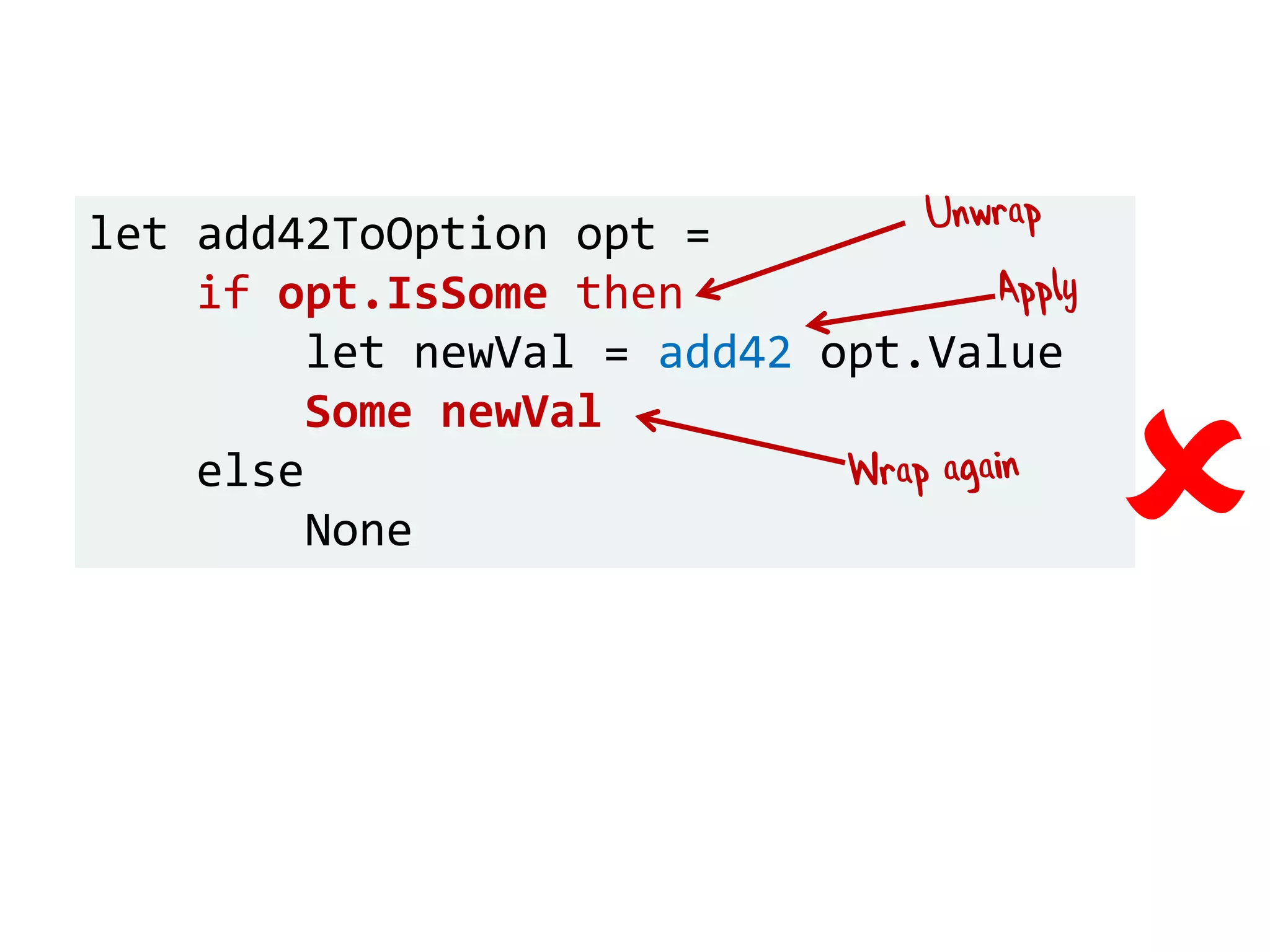
let add42ToOption opt =
if opt.IsSome then
let newVal = add42 opt.Value
Some newVal
else
None 
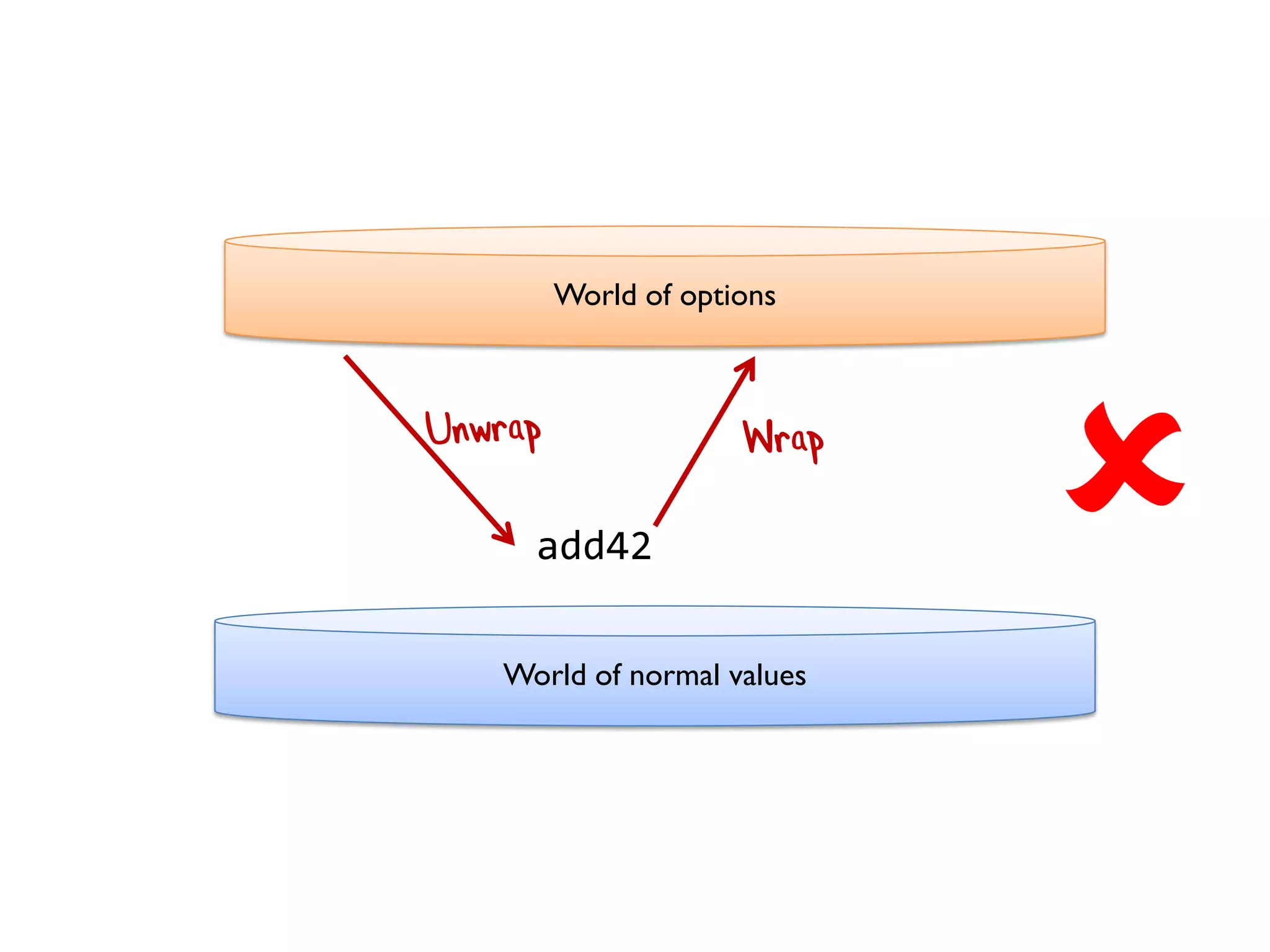
World of options
World of normal values
add42 
World of options
World of normal values
add42
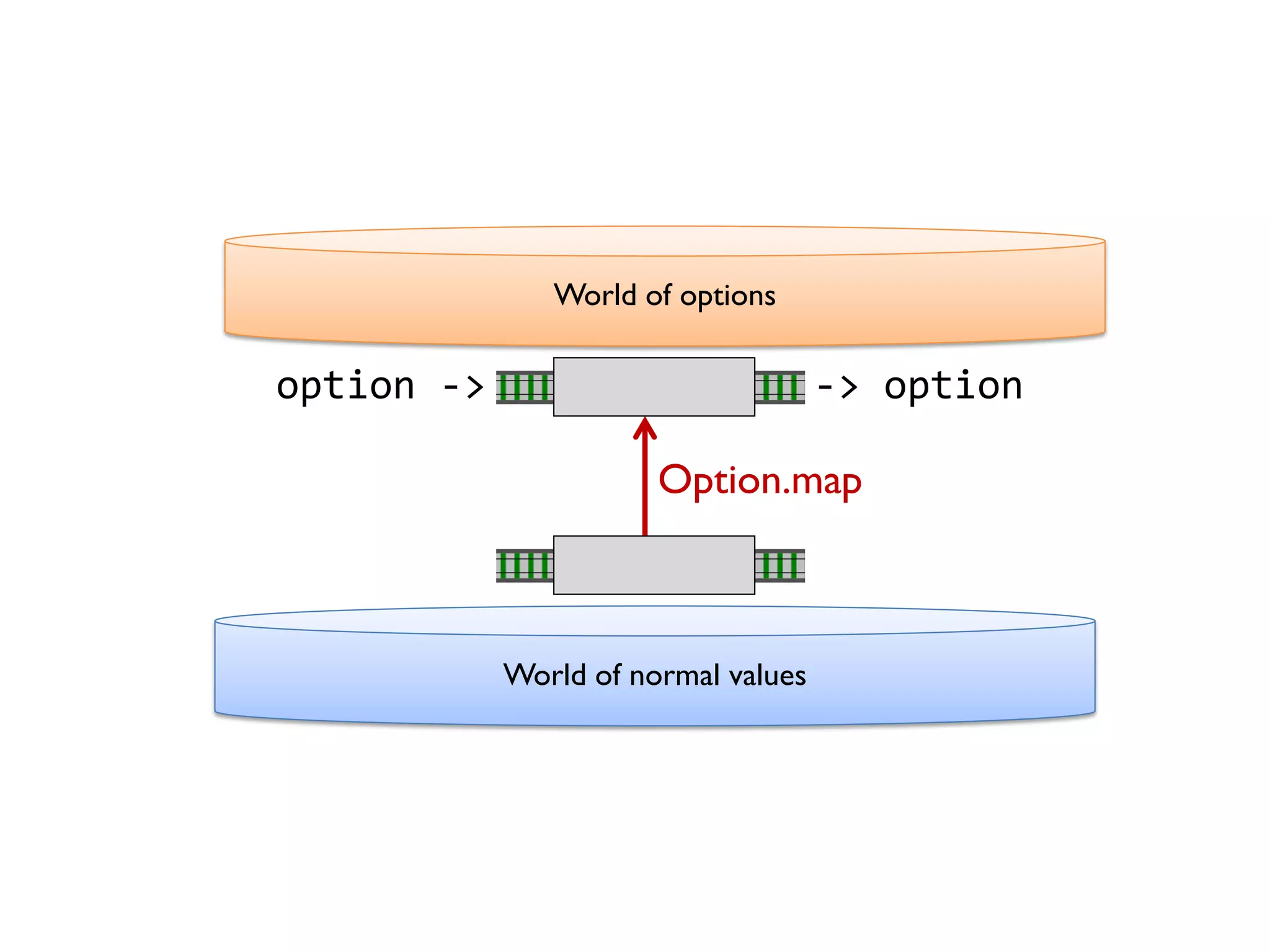
World of options
World of normal values
option -> -> option
Option.map
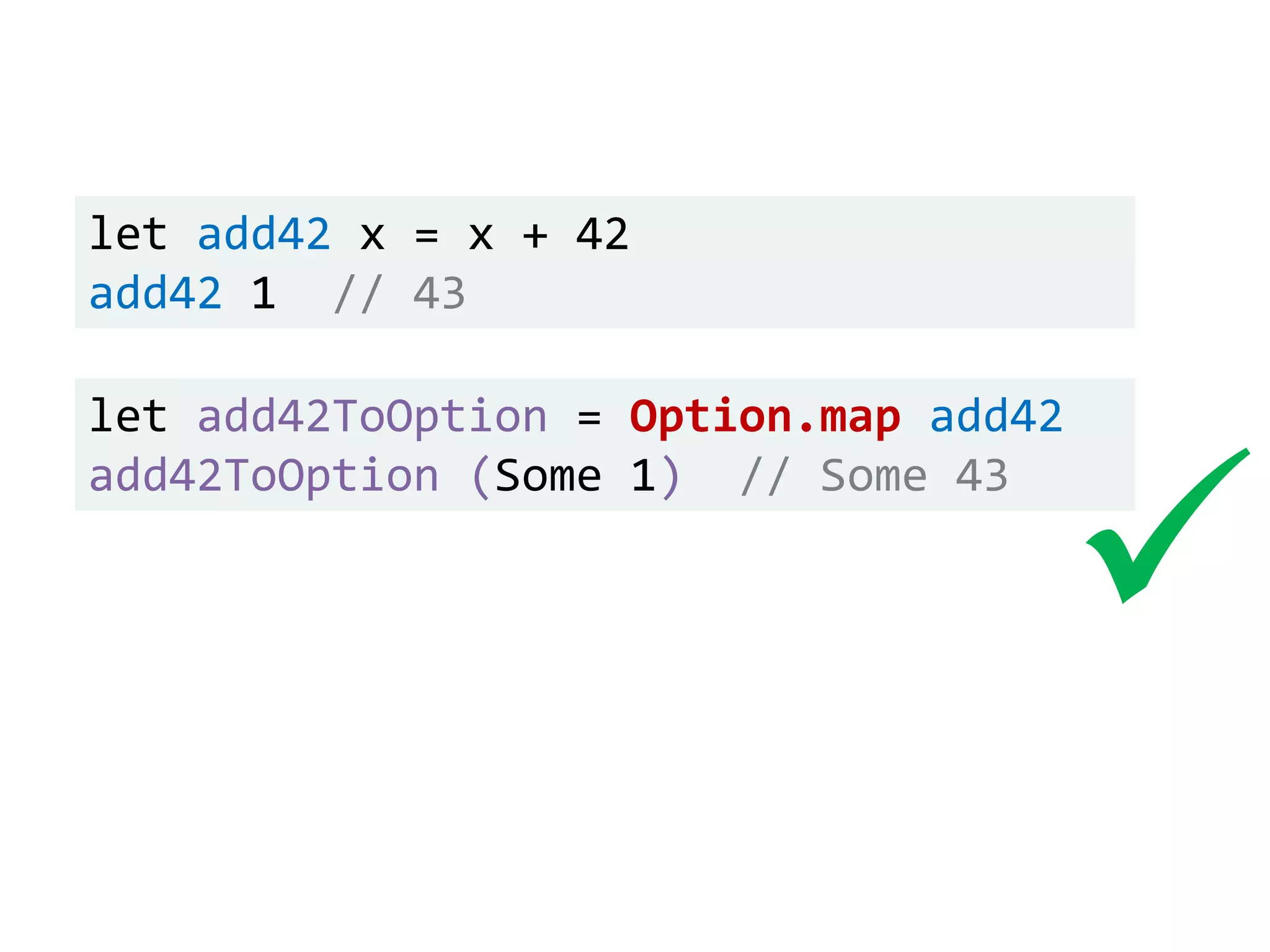
let add42 x = x + 42
add42 1 // 43
let add42ToOption = Option.map add42
add42ToOption (Some 1) // Some 43

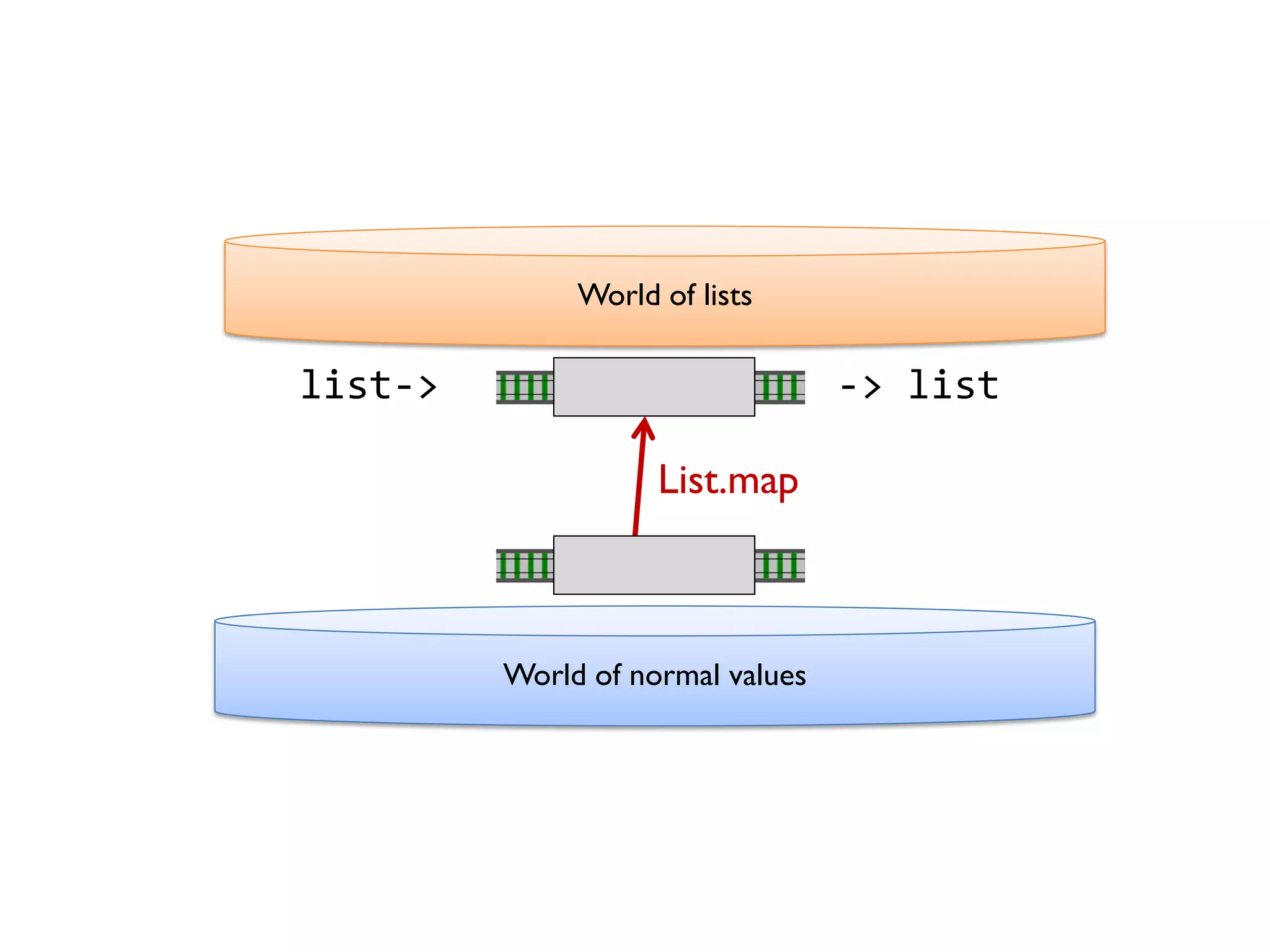
World of lists
World of normal values
List.map
list-> -> list
let add42ToEach = List.map add42
add42ToEach [1;2;3] // [43;44;45]
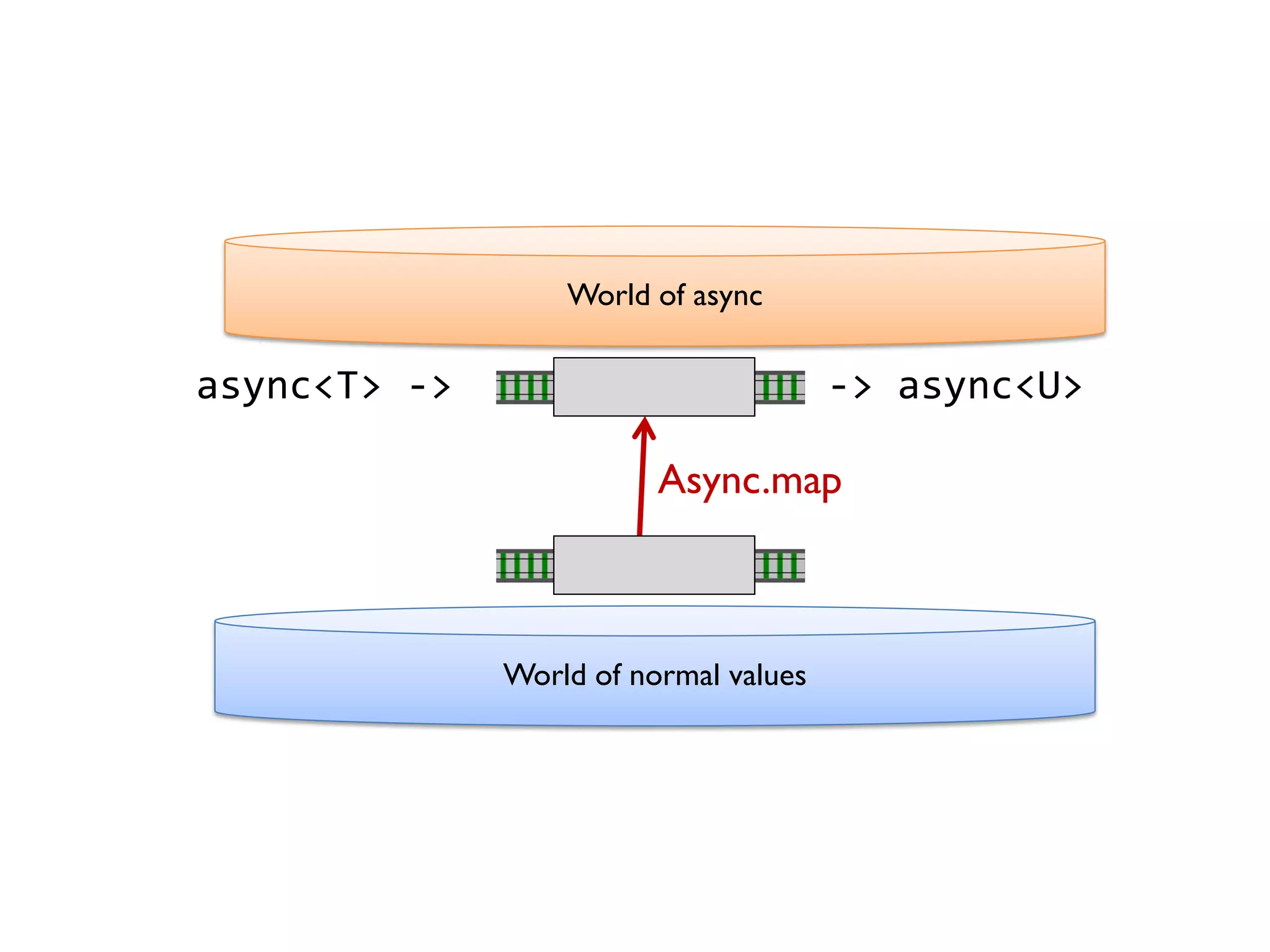
World of async
World of normal values
async<T> -> -> async<U>
Async.map
Guideline:
Most wrapped generic types
have a “map”. Use it!
Guideline:
If you create your own generic type,
create a “map” for it.
FP terminology
• A functor is
– A data type
– With an associated "map" function
(with a sensible implementation)
PATTERN 5:
MONOIDS
Mathematics
Ahead
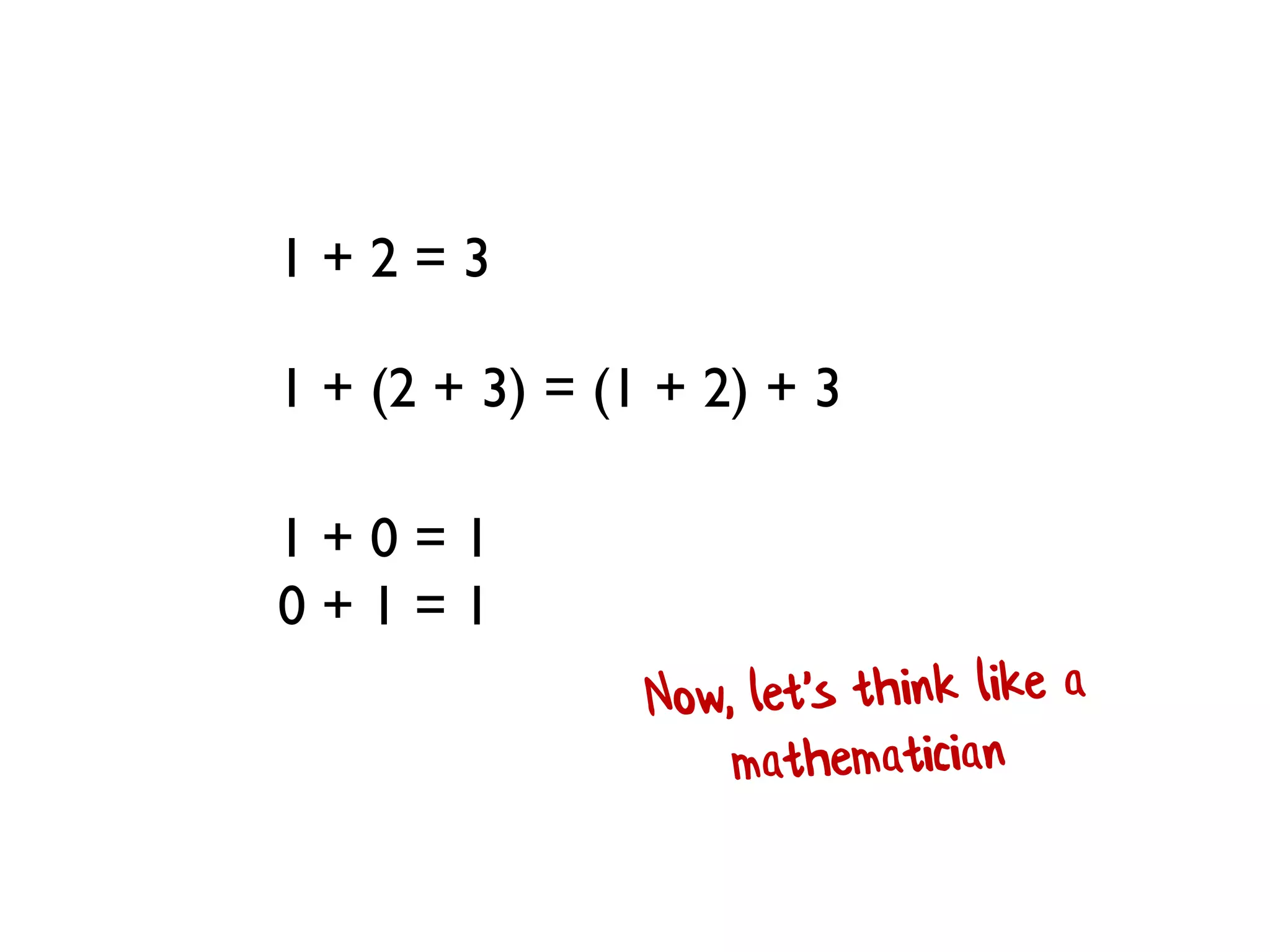
1 + 2 = 3
1 + (2 + 3) = (1 + 2) + 3
1 + 0 = 1
0 + 1 = 1
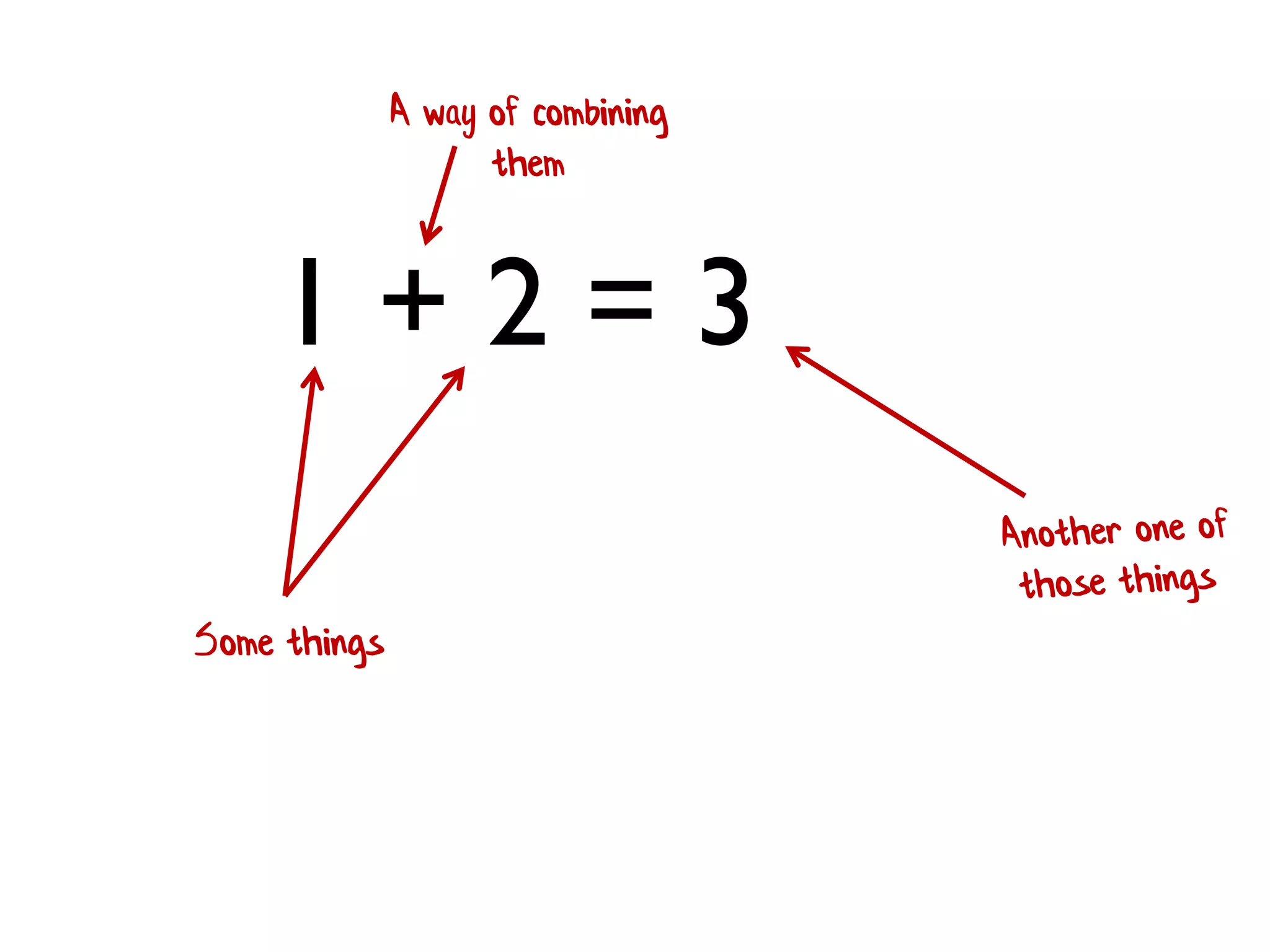
1 + 2 = 3
Some things
A way of combining
them
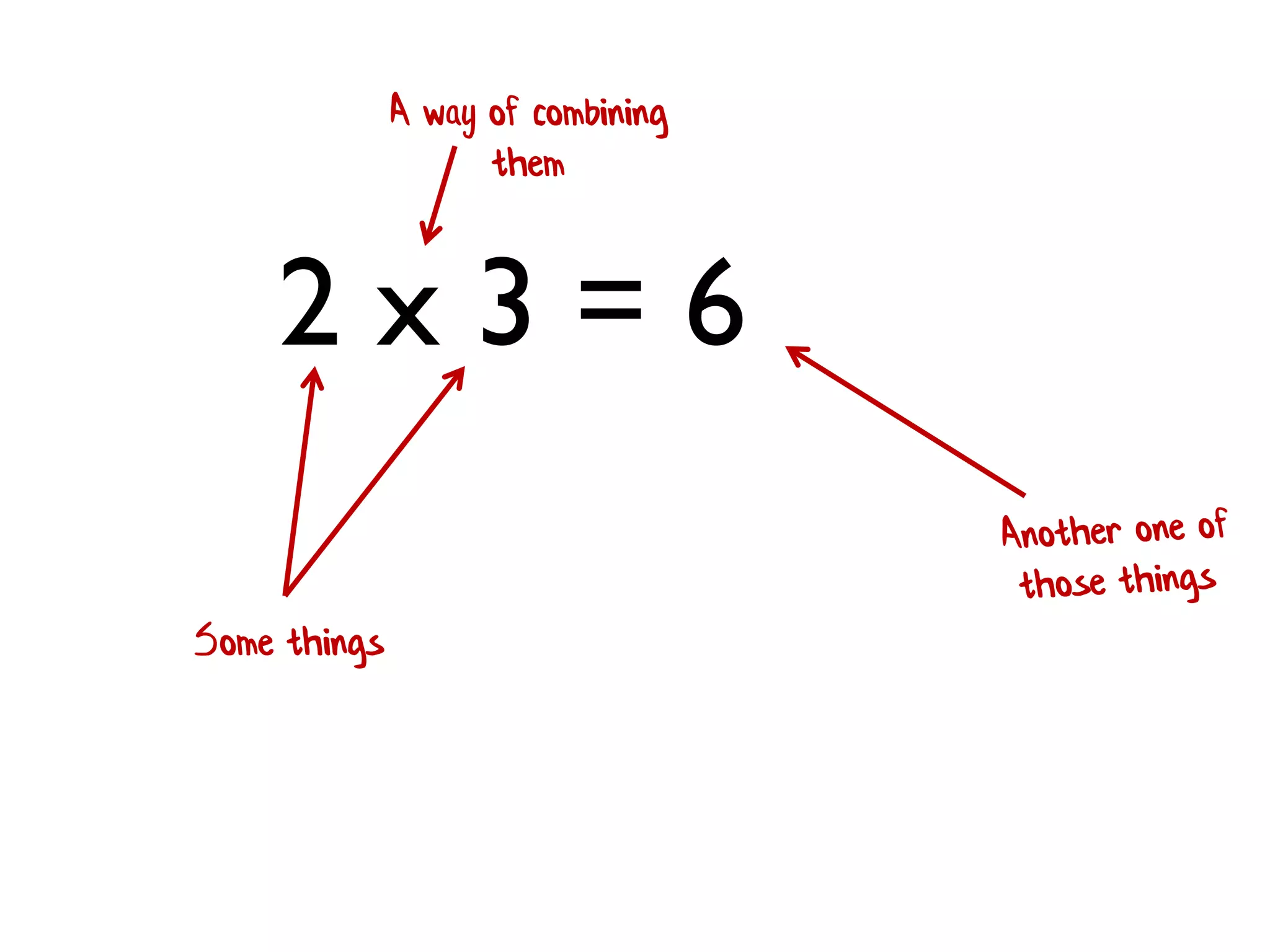
2 x 3 = 6
Some things
A way of combining
them
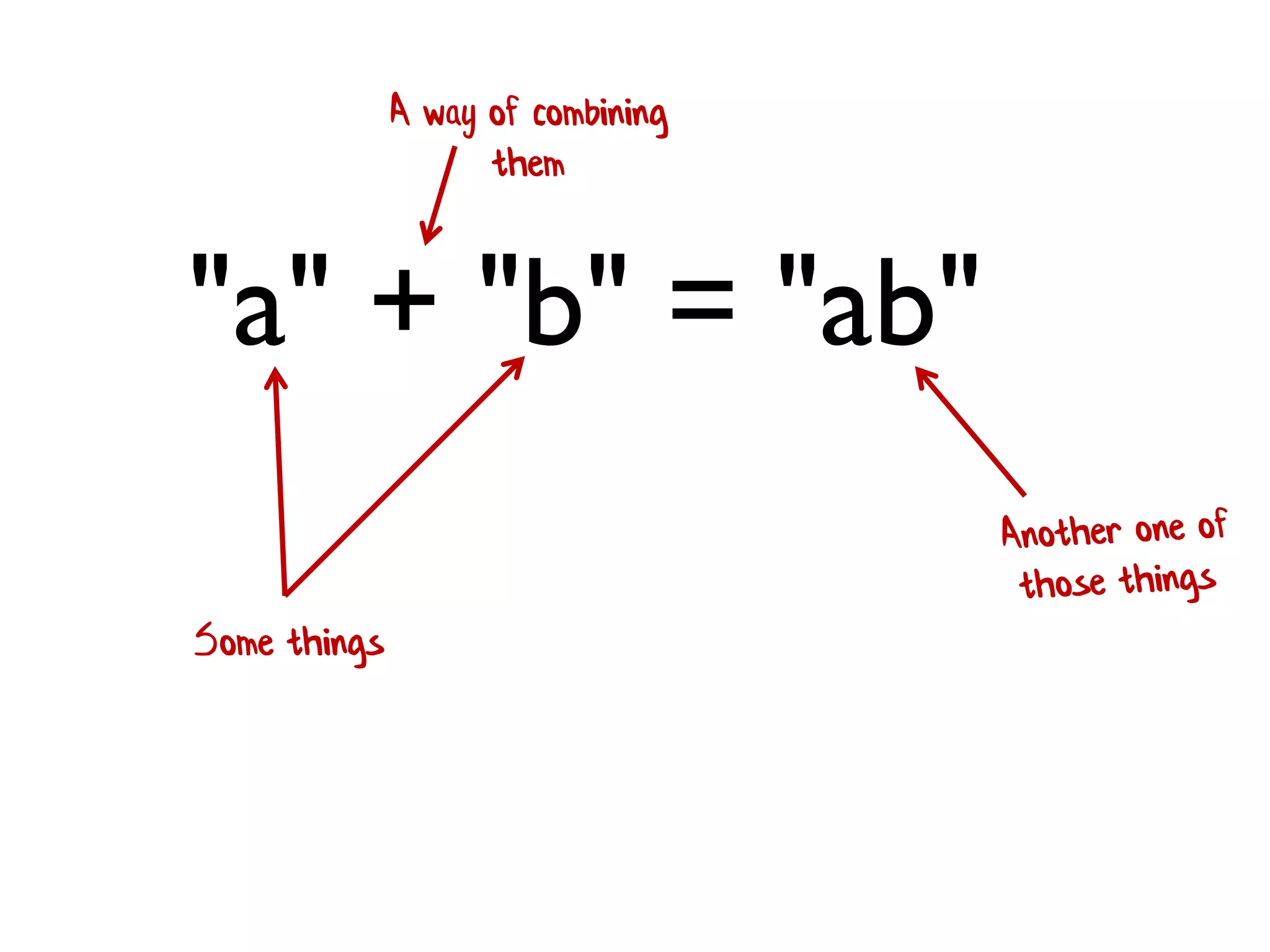
"a" + "b" = "ab"
Some things
A way of combining
them
concat([a],[b]) = [a; b]
Some things
A way of combining
them
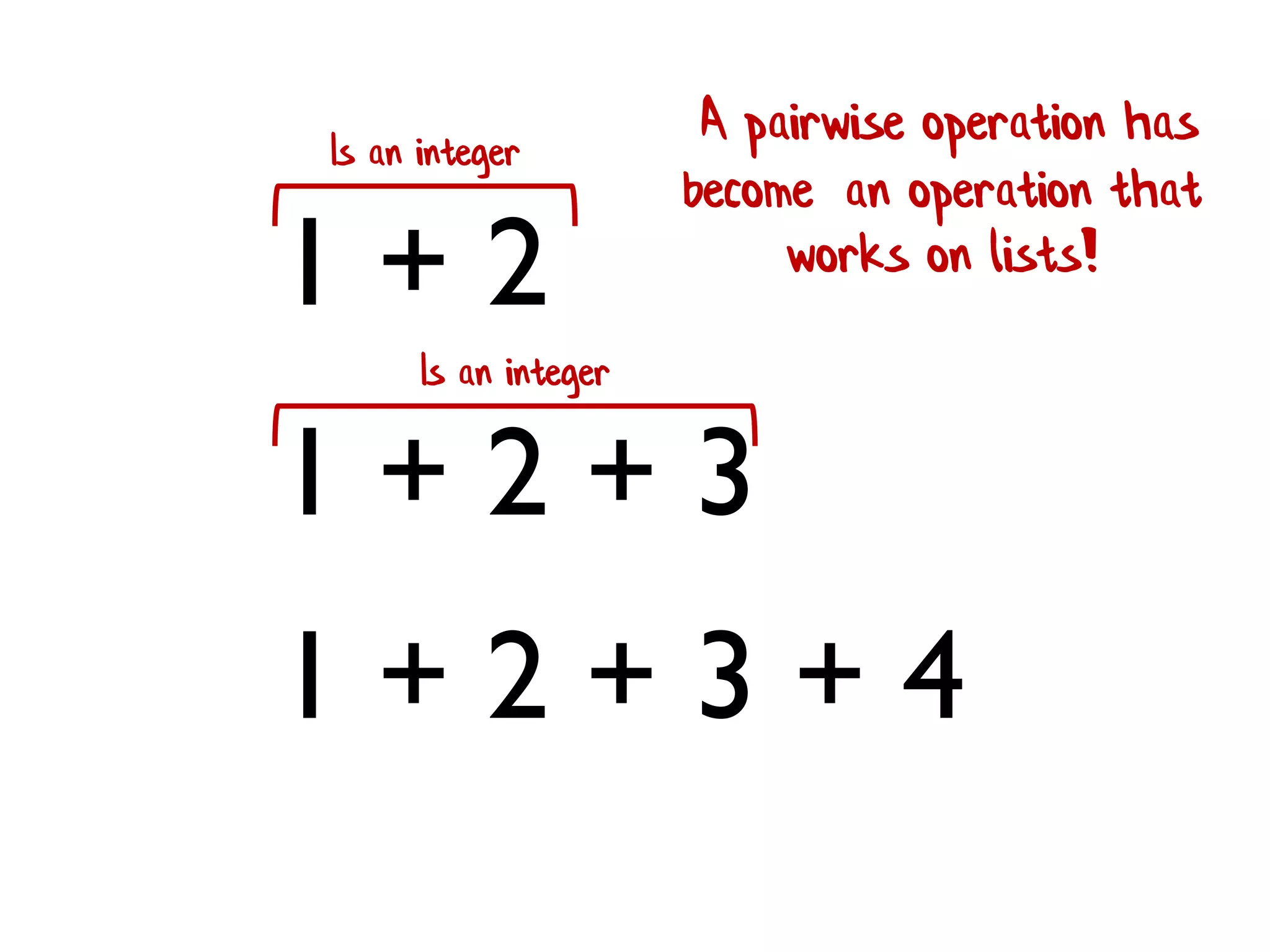
1 + 2
1 + 2 + 3
1 + 2 + 3 + 4
Is an integer
Is an integer
A pairwise operation has
become an operation that
works on lists!
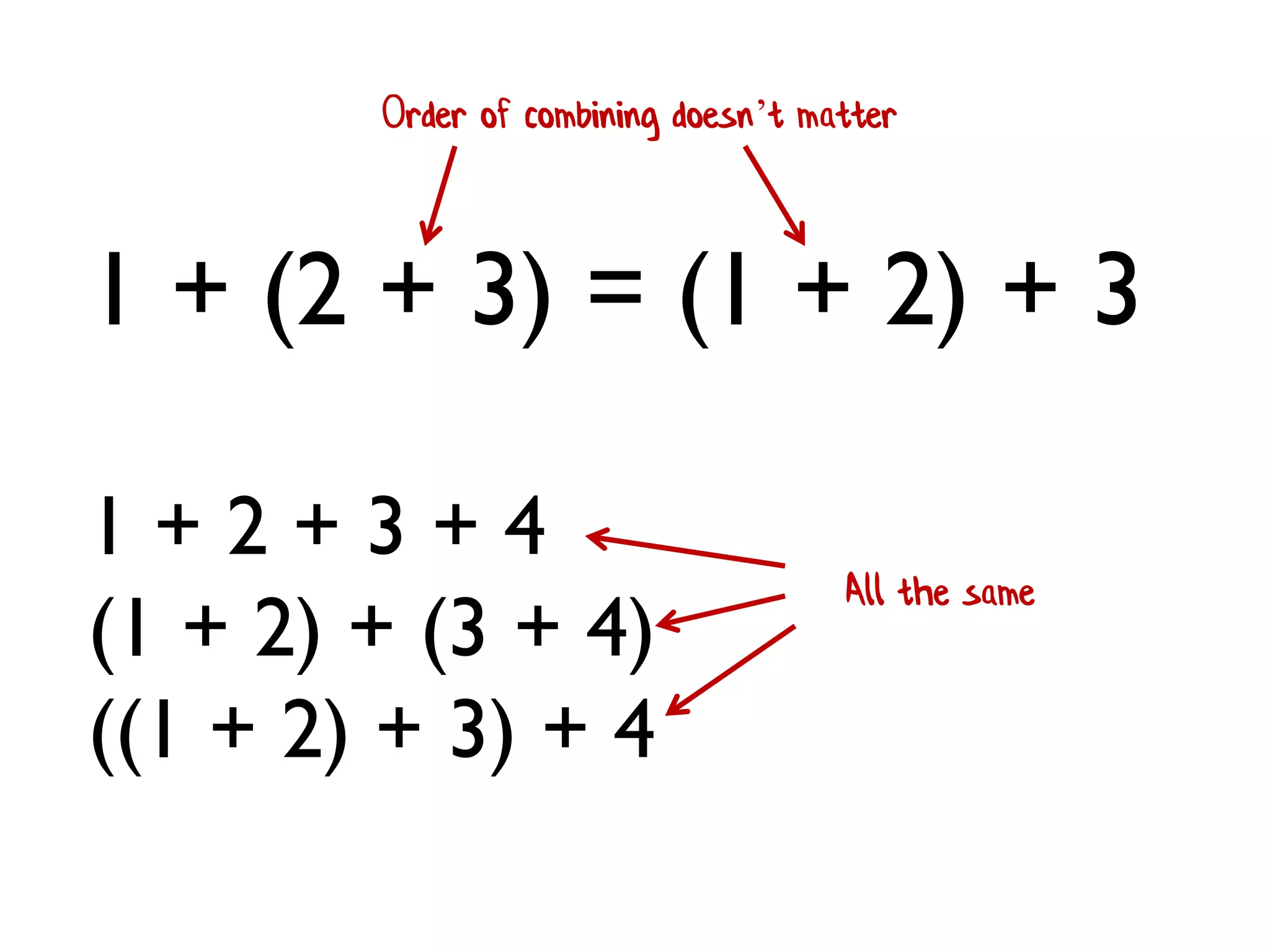
1 + (2 + 3) = (1 + 2) + 3
Order of combining doesn’t matter
1 + 2 + 3 + 4
(1 + 2) + (3 + 4)
((1 + 2) + 3) + 4
All the same
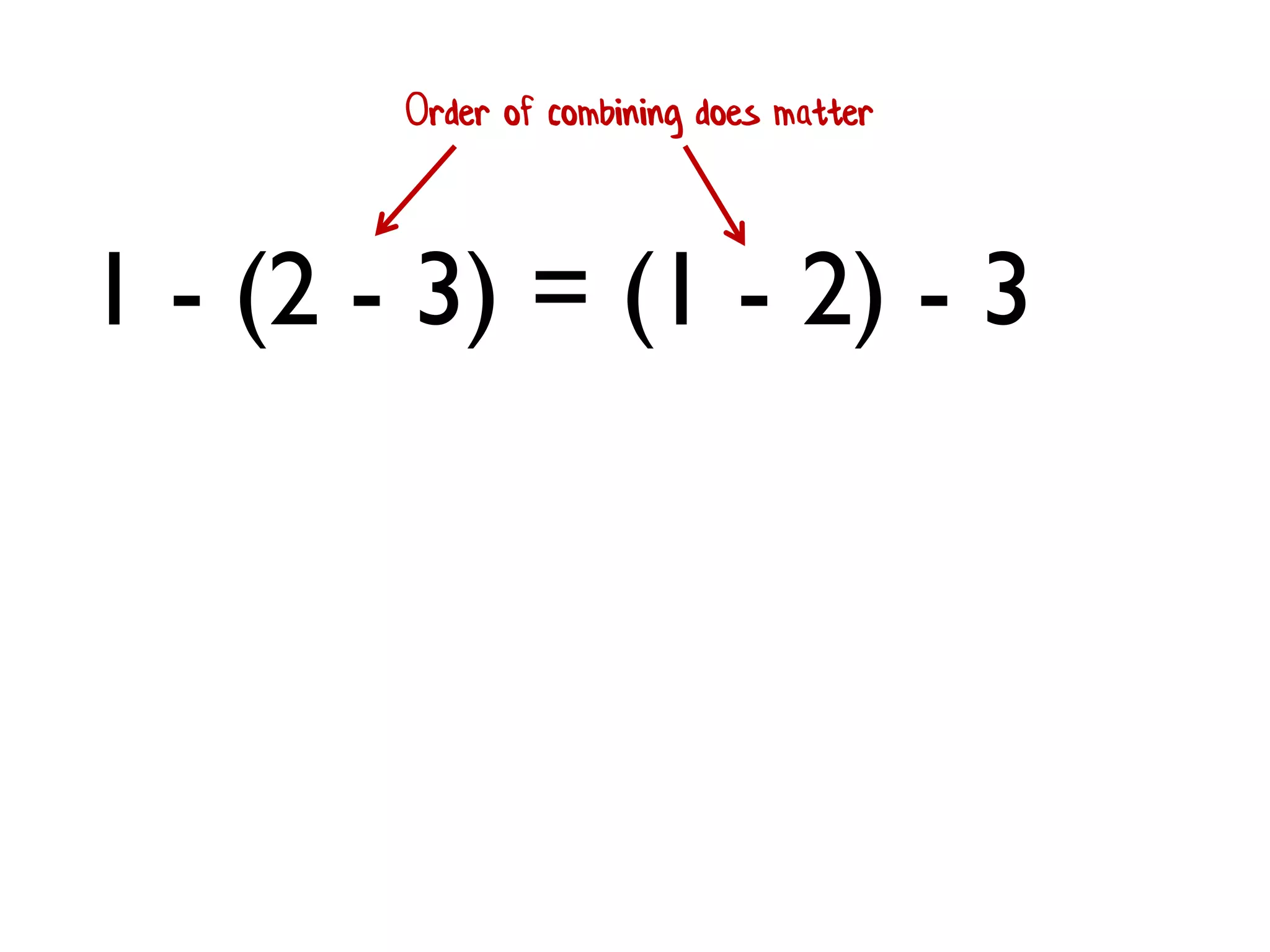
1 - (2 - 3) = (1 - 2) - 3
Order of combining does matter
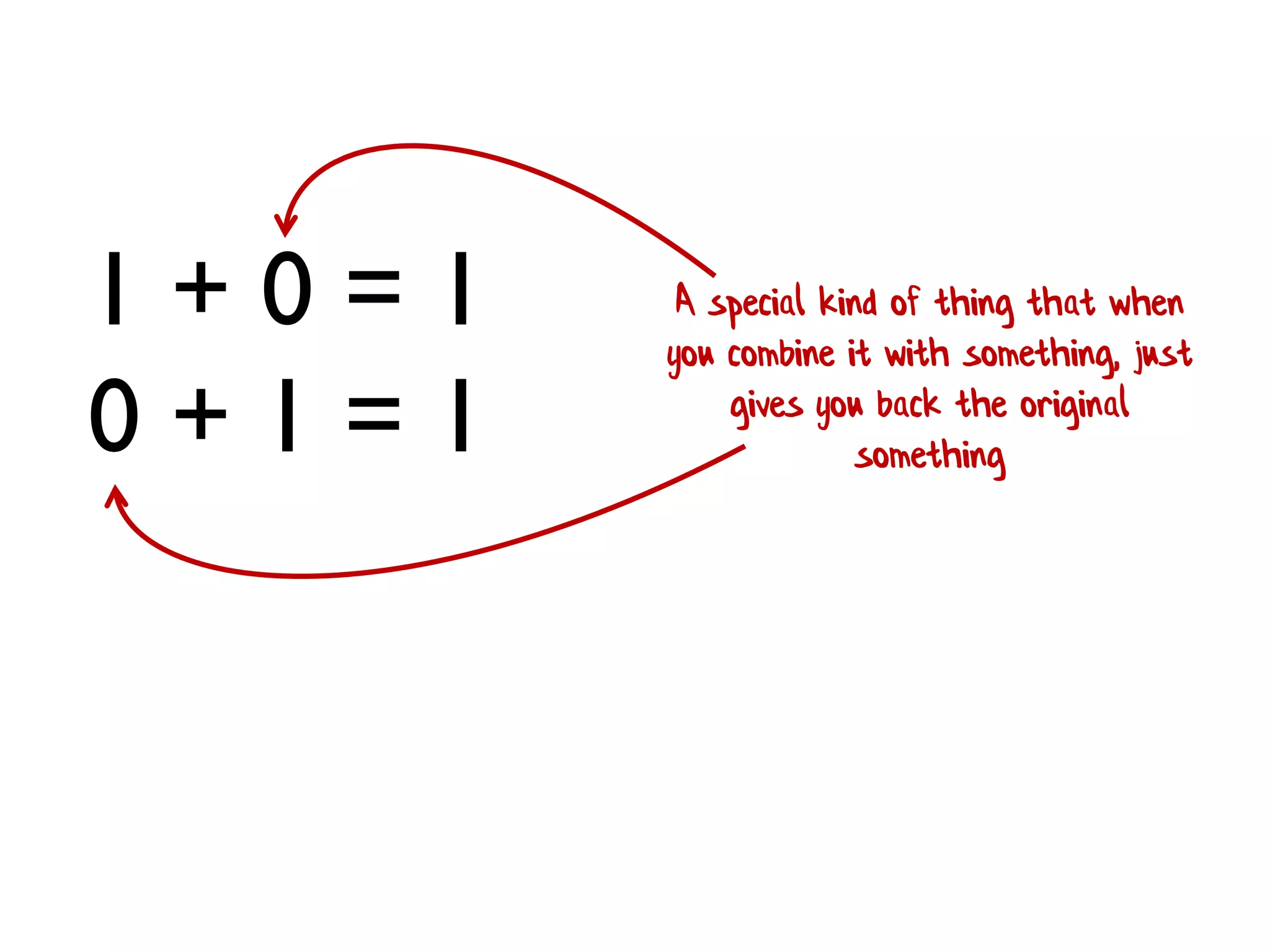
1 + 0 = 1
0 + 1 = 1
A special kind of thing that when
you combine it with something, just
gives you back the original
something
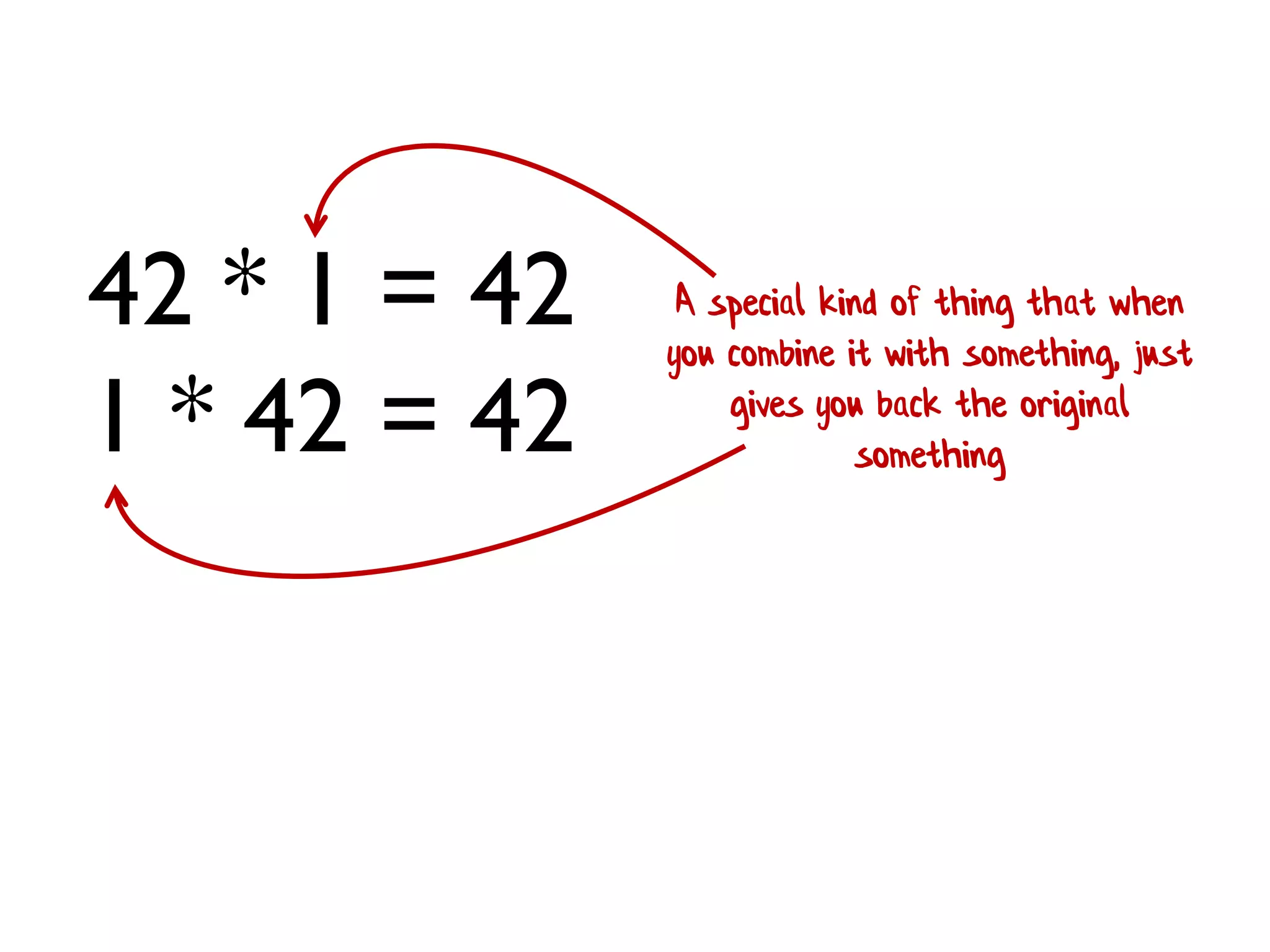
42 * 1 = 42
1 * 42 = 42
A special kind of thing that when
you combine it with something, just
gives you back the original
something
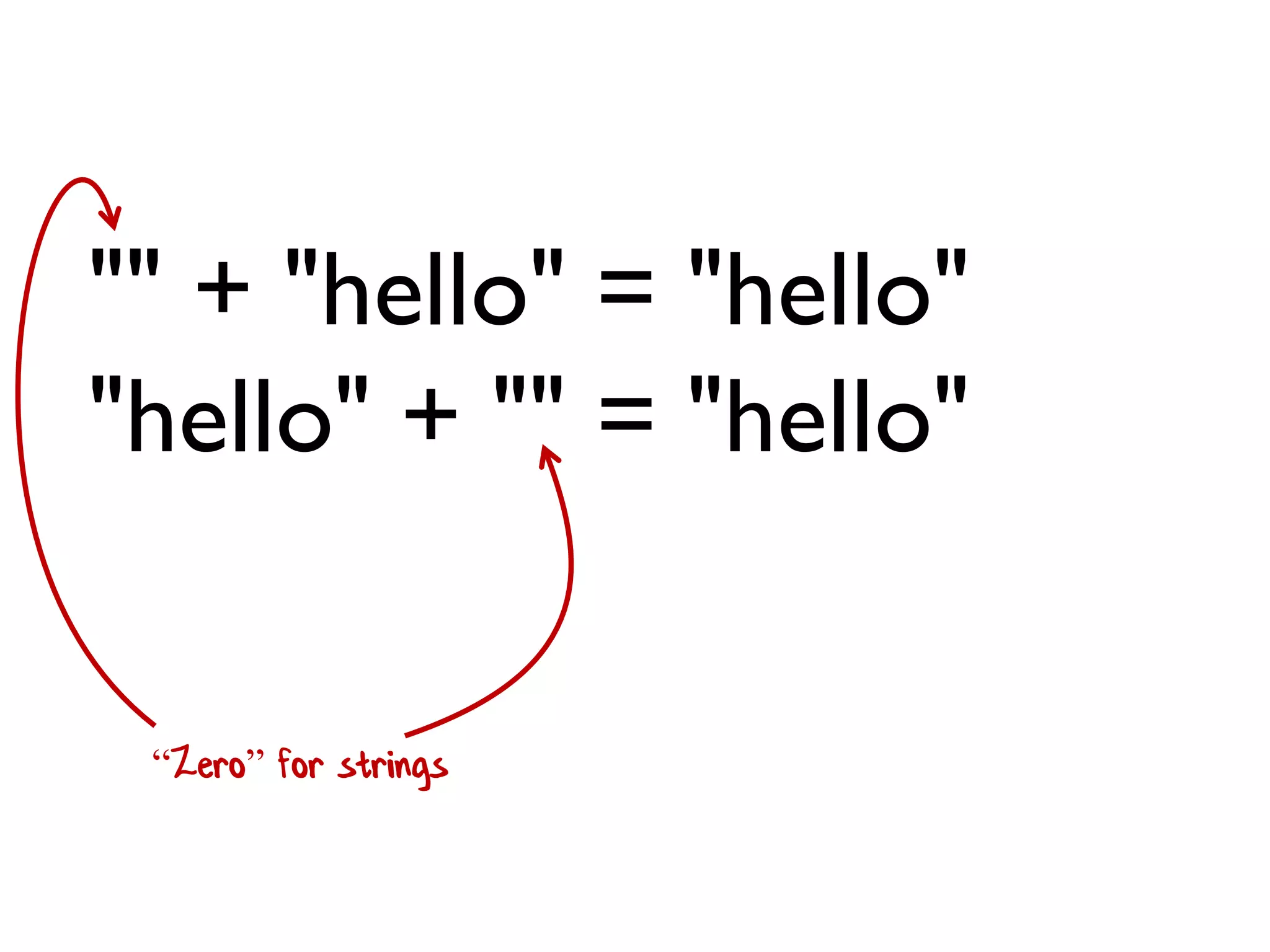
"" + "hello" = "hello"
"hello" + "" = "hello"
“Zero” for strings
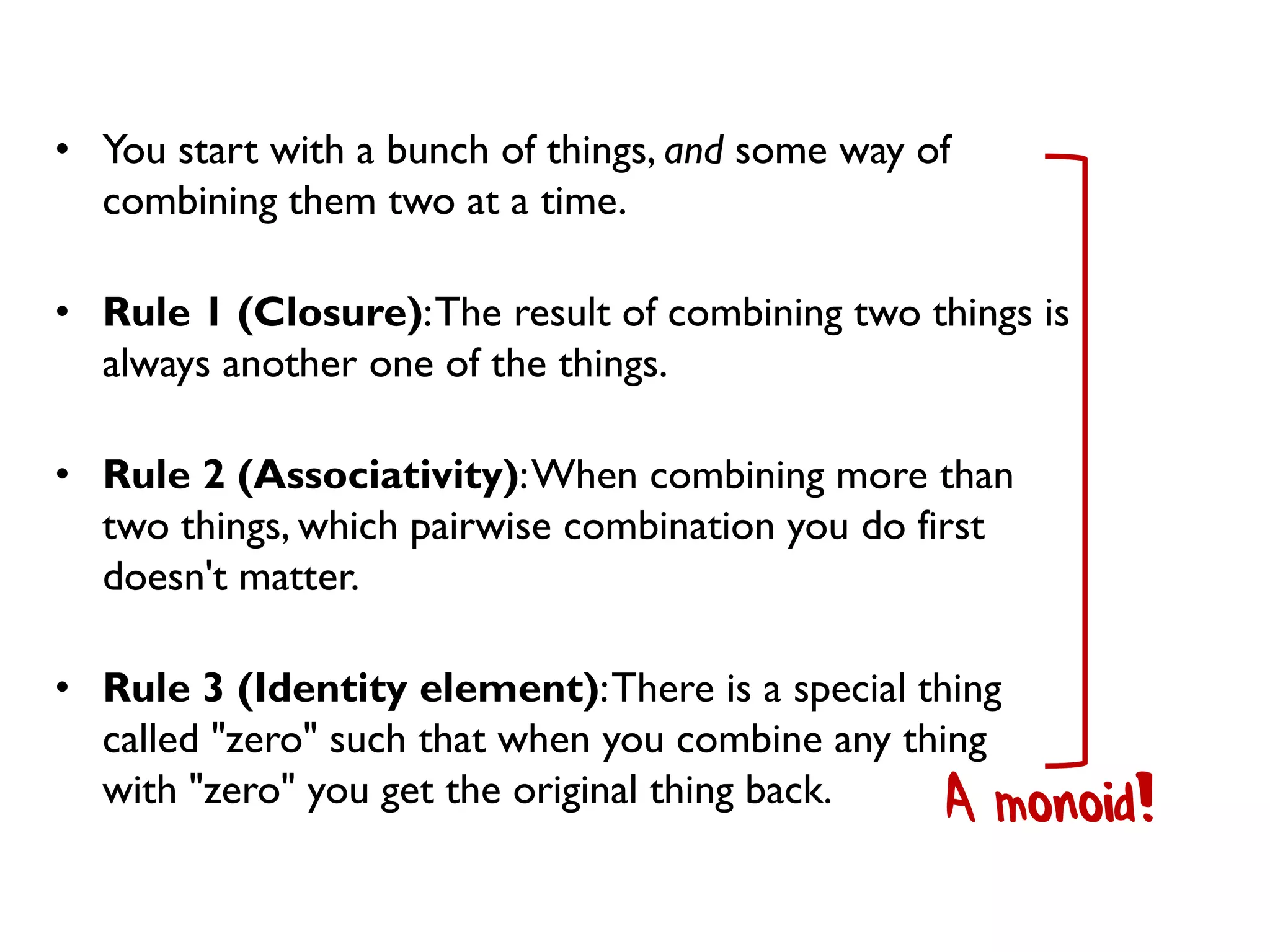
• You start with a bunch of things, and some way of
combining them two at a time.
• Rule 1 (Closure):The result of combining two things is
always another one of the things.
• Rule 2 (Associativity):When combining more than
two things, which pairwise combination you do first
doesn't matter.
• Rule 3 (Identity element):There is a special thing
called "zero" such that when you combine any thing
with "zero" you get the original thing back. A monoid!
• Rule 1 (Closure):The result of combining two
things is always another one of the things.
• Benefit: converts pairwise operations into
operations that work on lists.
1 + 2 + 3 + 4
[ 1; 2; 3; 4 ] |> List.reduce (+)
We'll see
this a lot!
1 * 2 * 3 * 4
[ 1; 2; 3; 4 ] |> List.reduce (*)
• Rule 1 (Closure):The result of combining two
things is always another one of the things.
• Benefit: converts pairwise operations into
operations that work on lists.
"a" + "b" + "c" + "d"
[ "a"; "b"; "c"; "d" ] |> List.reduce (+)
• Rule 1 (Closure):The result of combining two
things is always another one of the things.
• Benefit: converts pairwise operations into
operations that work on lists.
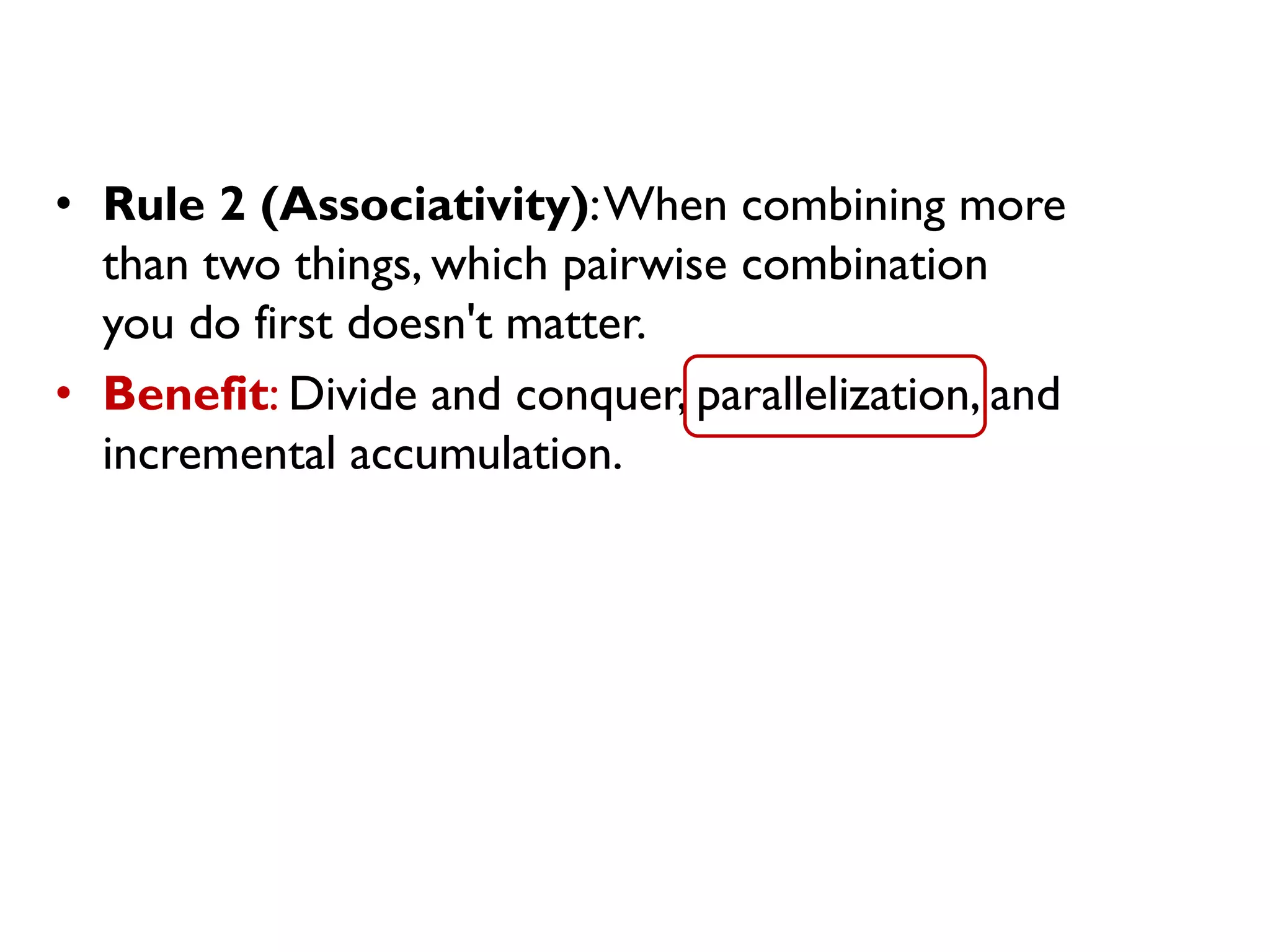
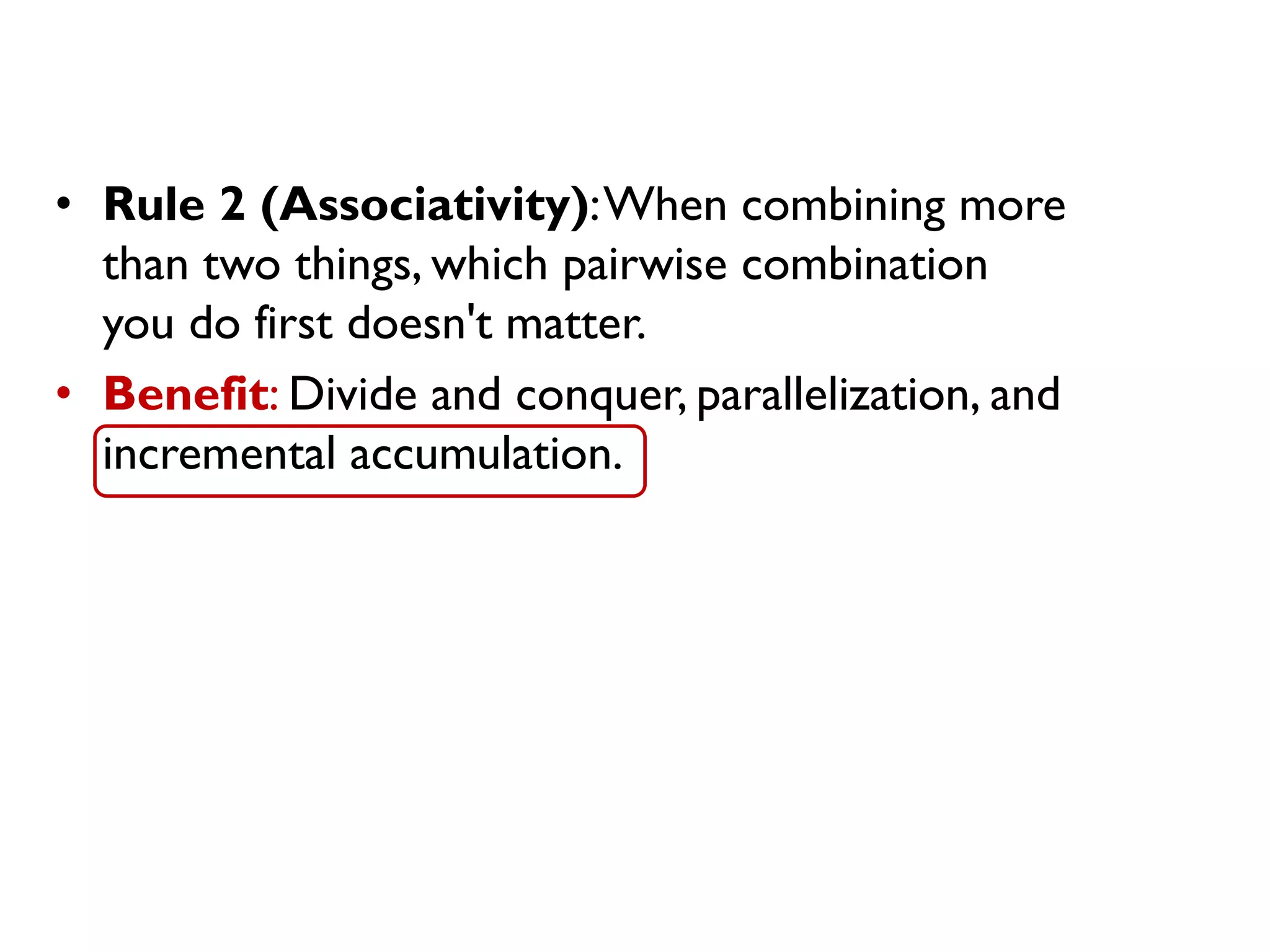
• Rule 2 (Associativity):When combining more
than two things, which pairwise combination
you do first doesn't matter.
• Benefit: Divide and conquer, parallelization, and
incremental accumulation.
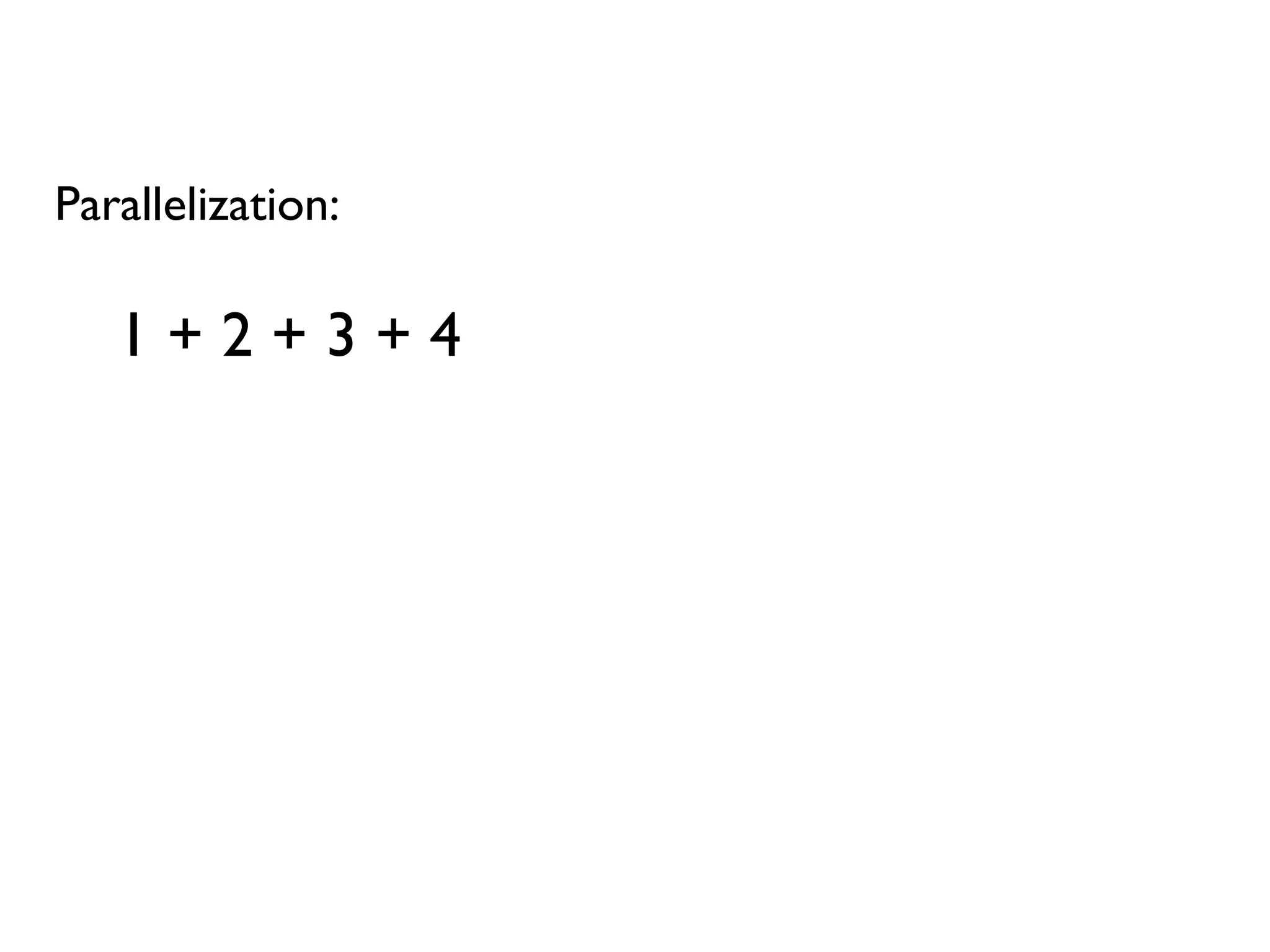
Parallelization:
1 + 2 + 3 + 4
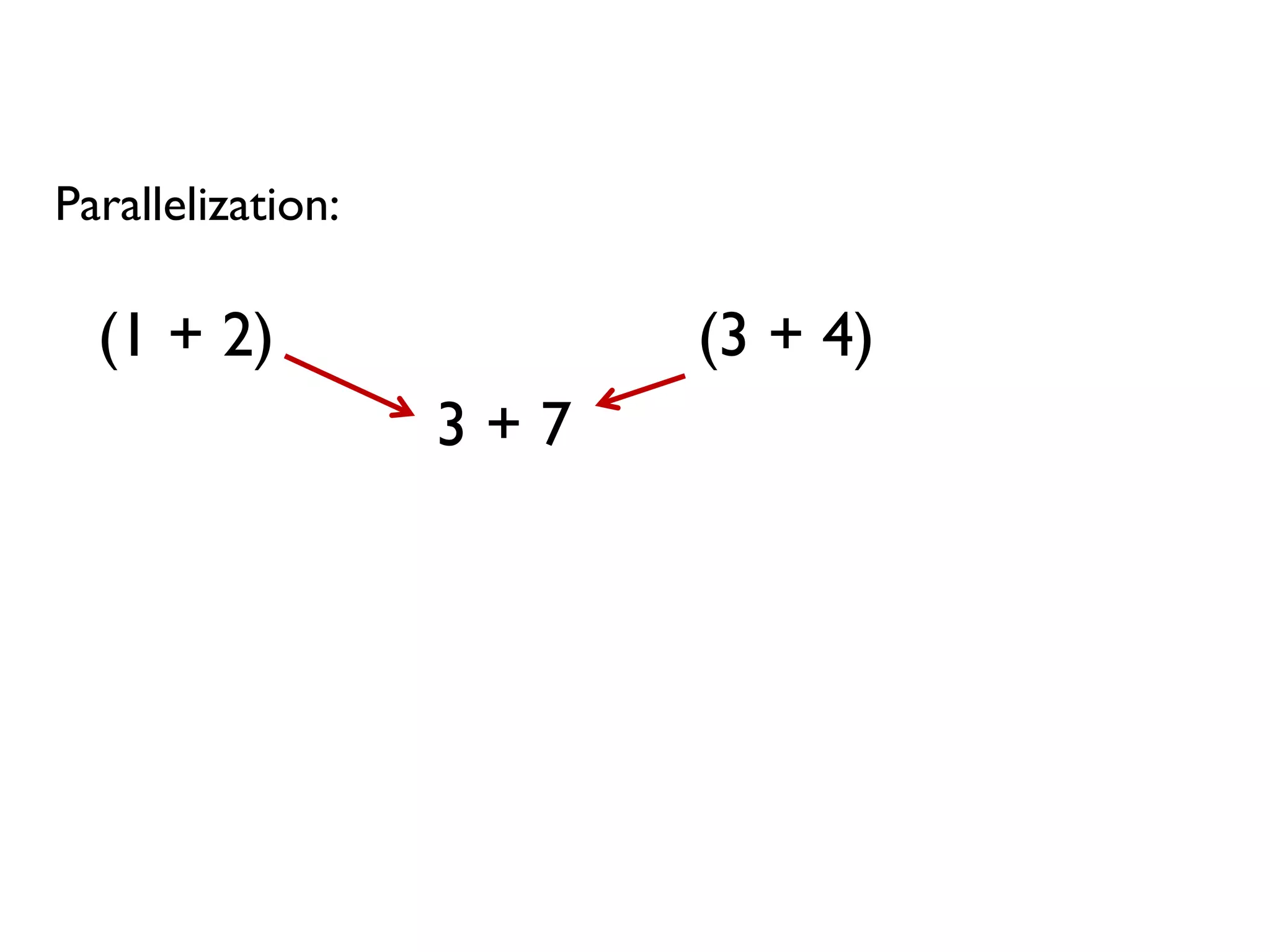
Parallelization:
(1 + 2) (3 + 4)
3 + 7
• Rule 2 (Associativity):When combining more
than two things, which pairwise combination
you do first doesn't matter.
• Benefit: Divide and conquer, parallelization, and
incremental accumulation.
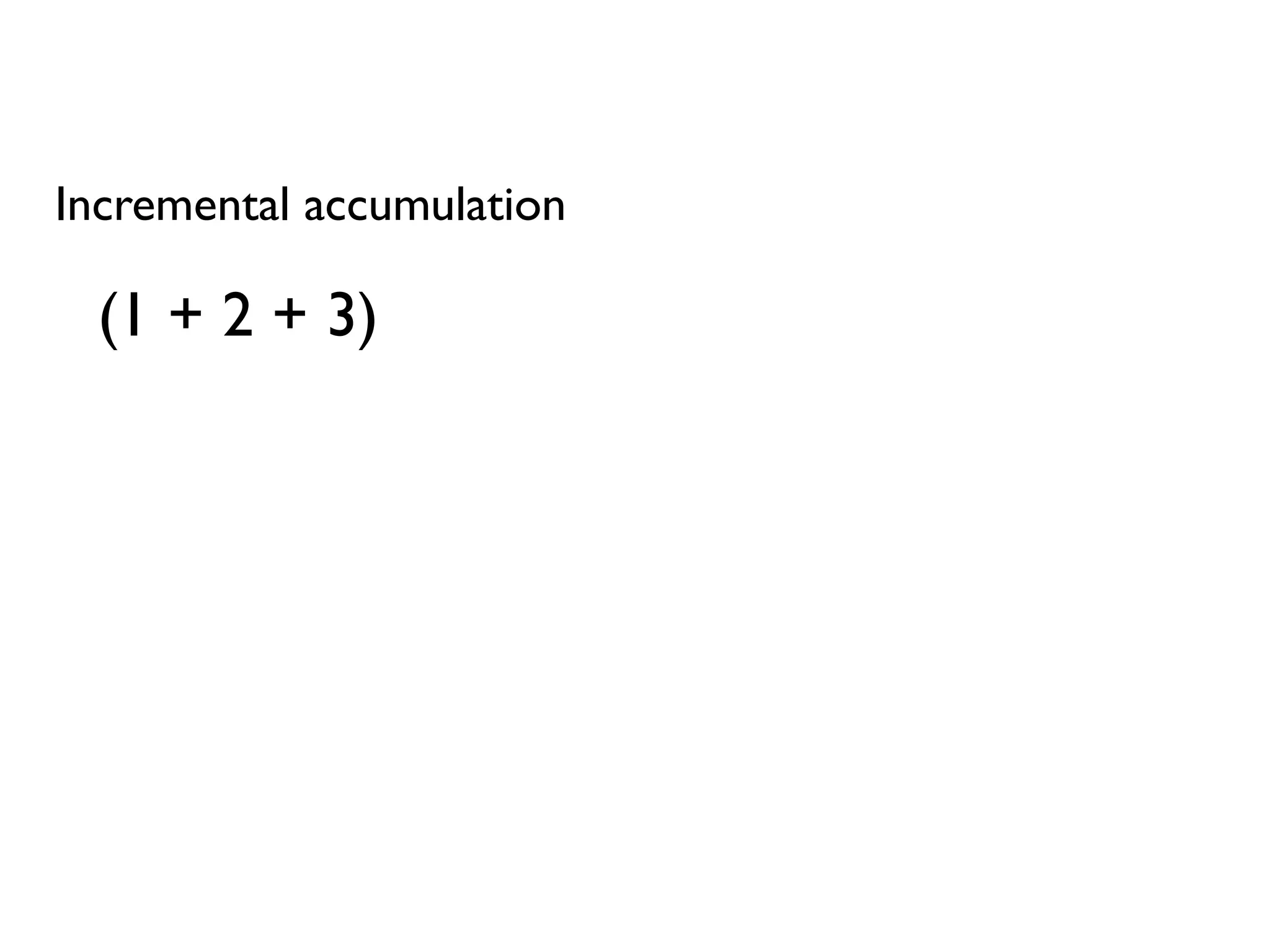
Incremental accumulation
(1 + 2 + 3)
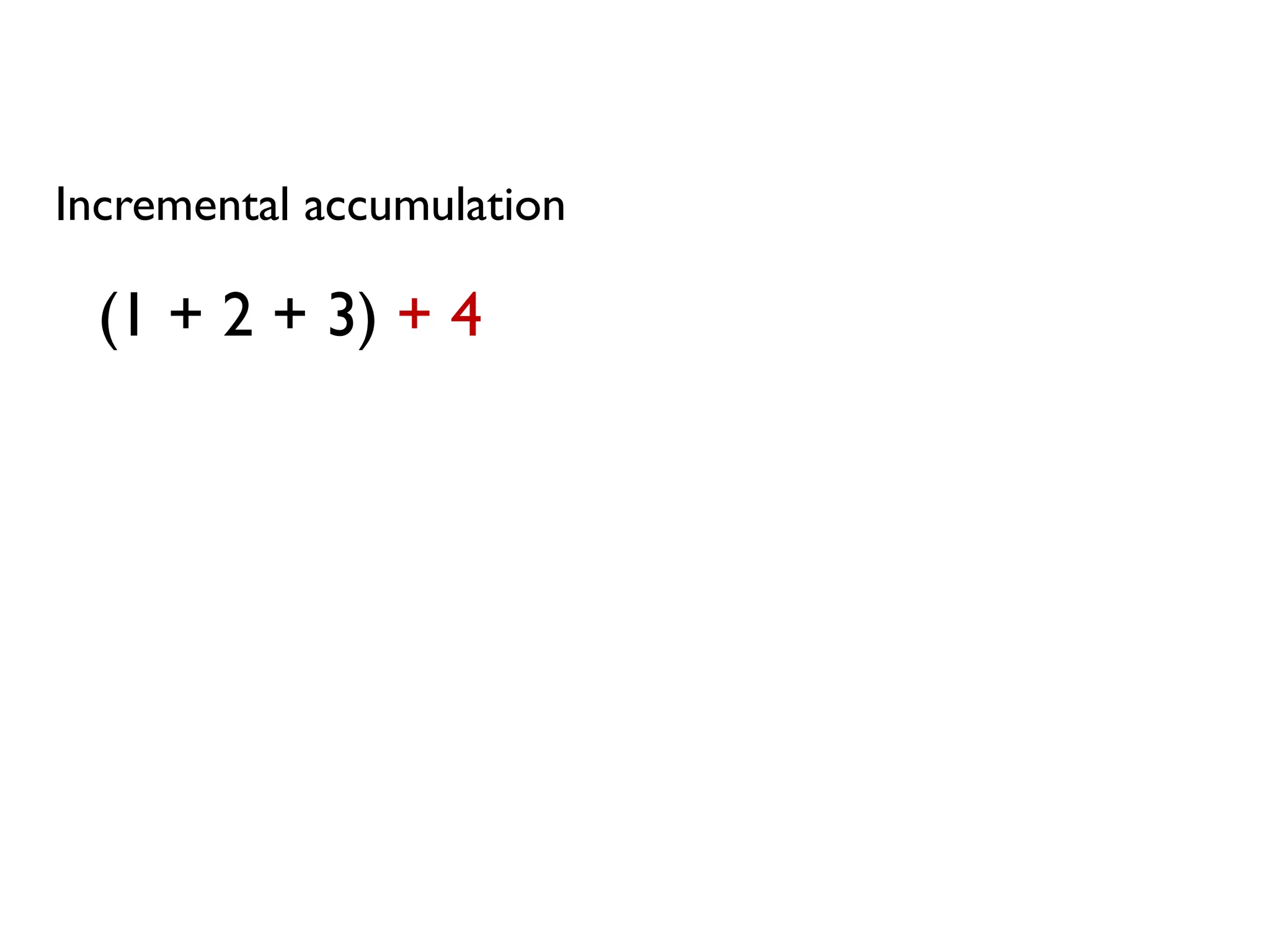
Incremental accumulation
(1 + 2 + 3) + 4
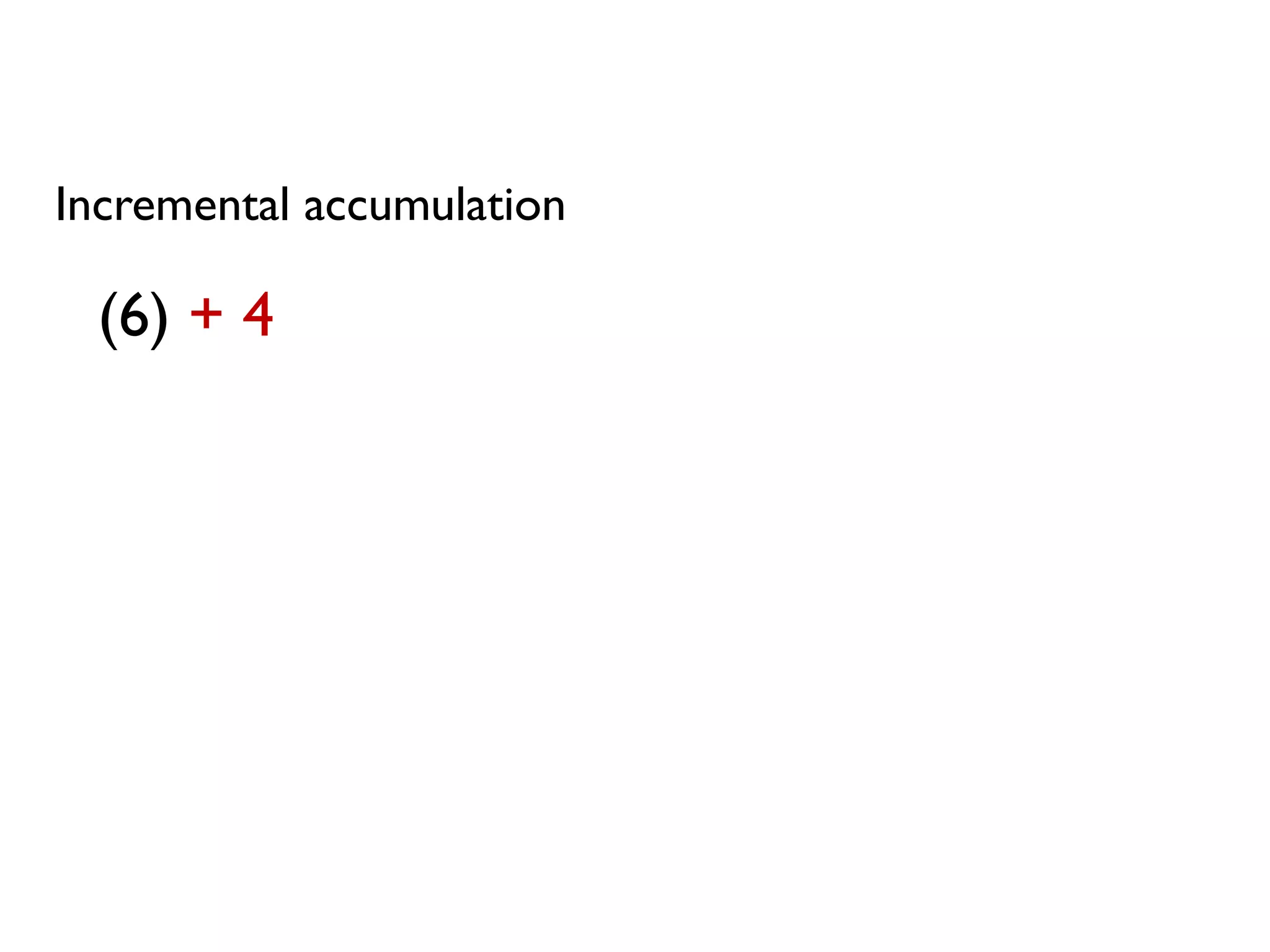
Incremental accumulation
(6) + 4
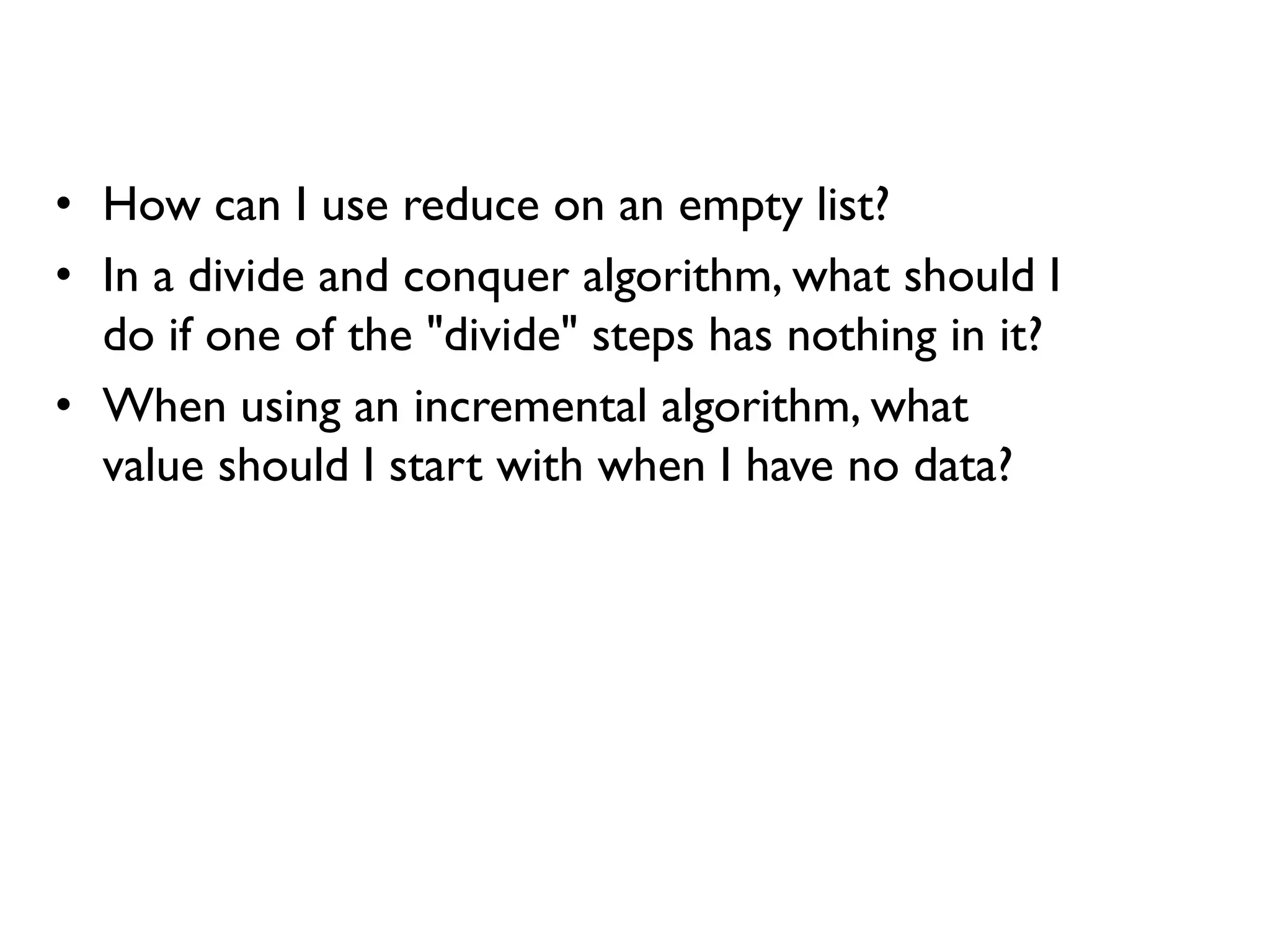
• How can I use reduce on an empty list?
• In a divide and conquer algorithm, what should I
do if one of the "divide" steps has nothing in it?
• When using an incremental algorithm, what
value should I start with when I have no data?
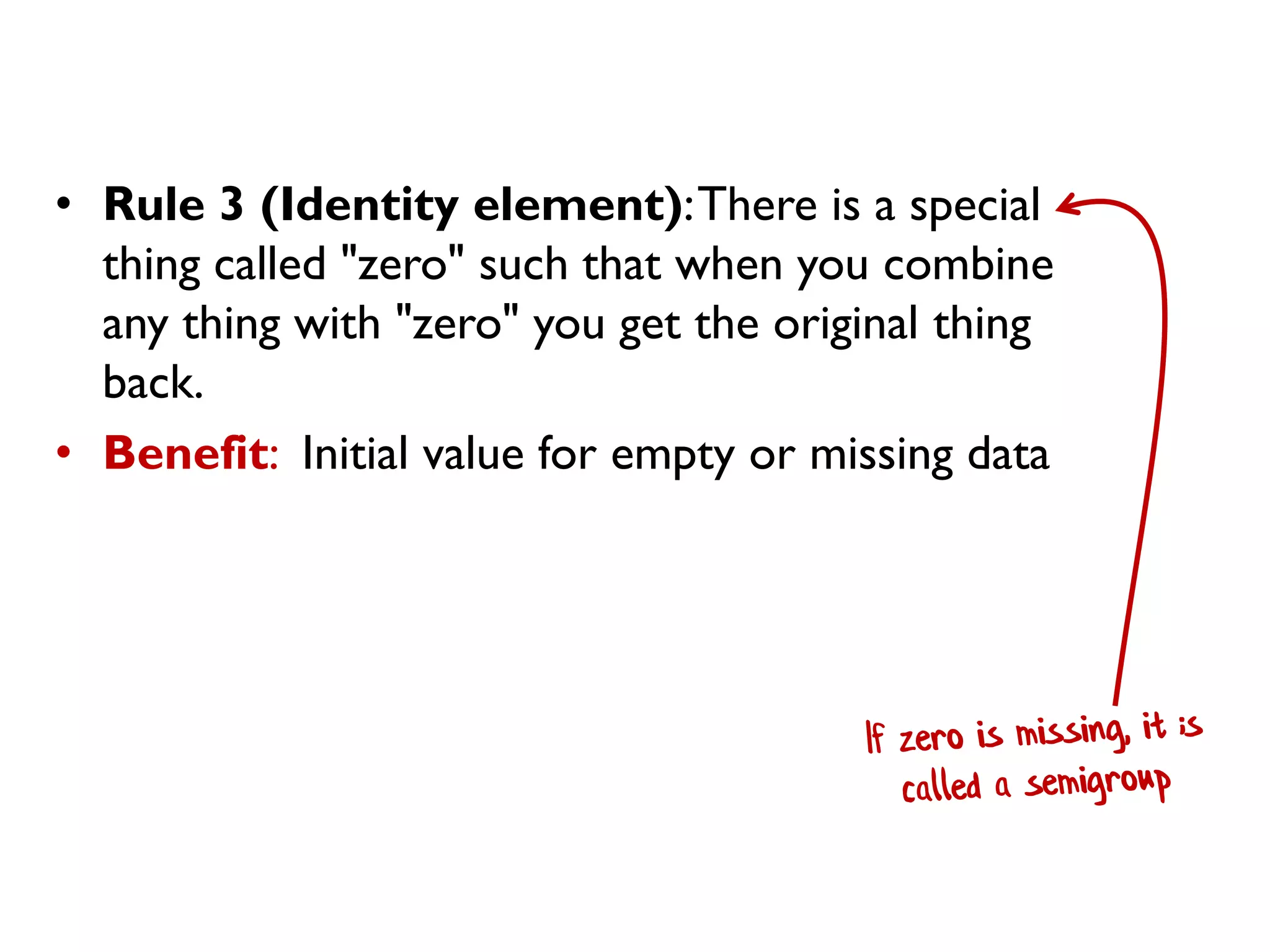
• Rule 3 (Identity element):There is a special
thing called "zero" such that when you combine
any thing with "zero" you get the original thing
back.
• Benefit: Initial value for empty or missing data
Tip:
Simplify aggregation code with monoids
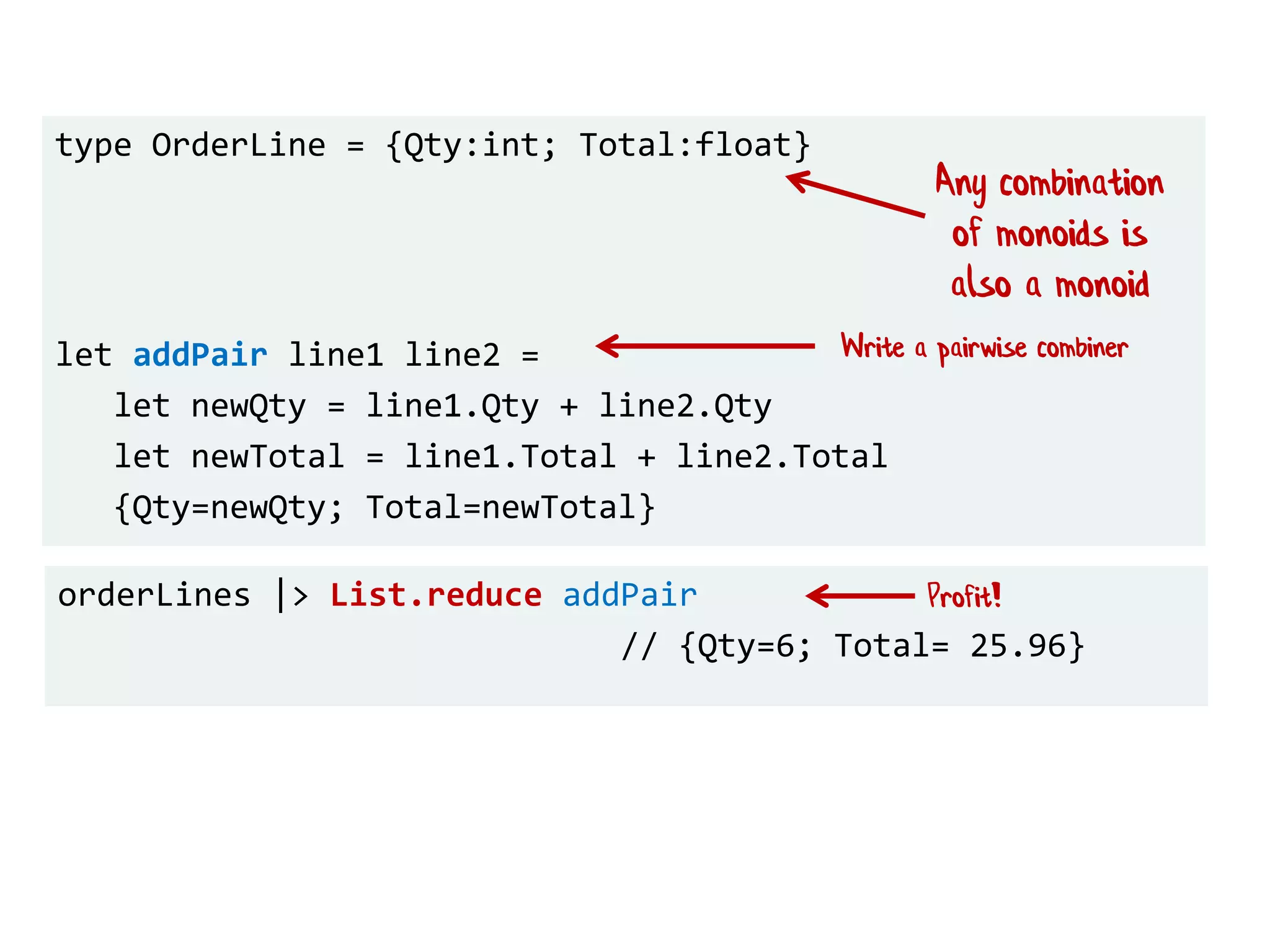
type OrderLine = {Qty:int; Total:float}
let orderLines = [
{Qty=2; Total=19.98}
{Qty=1; Total= 1.99}
{Qty=3; Total= 3.99} ]
How to add them up?
type OrderLine = {Qty:int; Total:float}
let addPair line1 line2 =
let newQty = line1.Qty + line2.Qty
let newTotal = line1.Total + line2.Total
{Qty=newQty; Total=newTotal}
orderLines |> List.reduce addPair
// {Qty=6; Total= 25.96}
Any combination
of monoids is
also a monoid
Write a pairwise combiner
Profit!
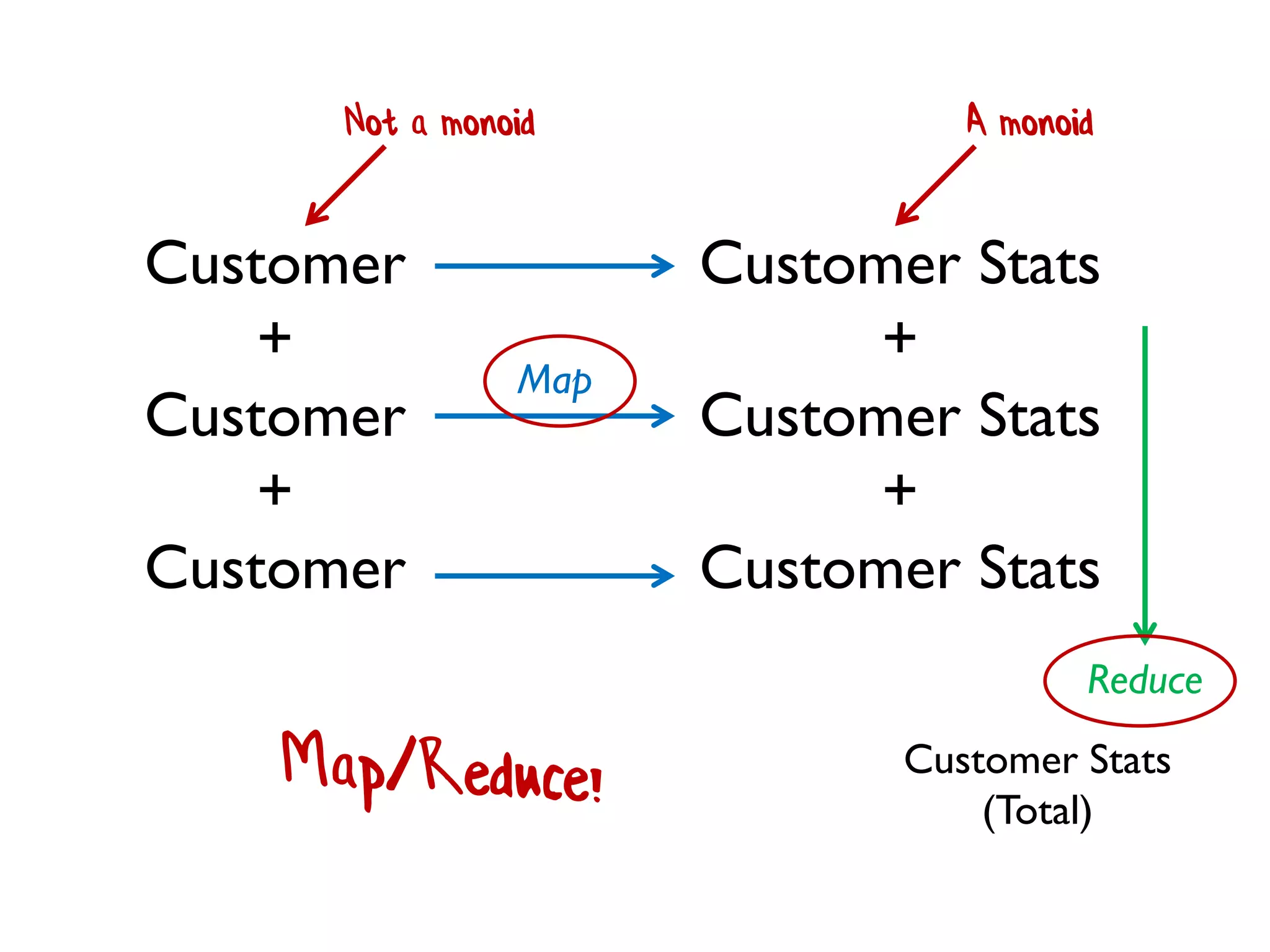
Pattern:
Convert non-monoids to monoids
Customer
+
Customer
+
Customer
Customer Stats
+
Customer Stats
+
Customer Stats
Reduce
Map
Not a monoid A monoid
Customer Stats
(Total)
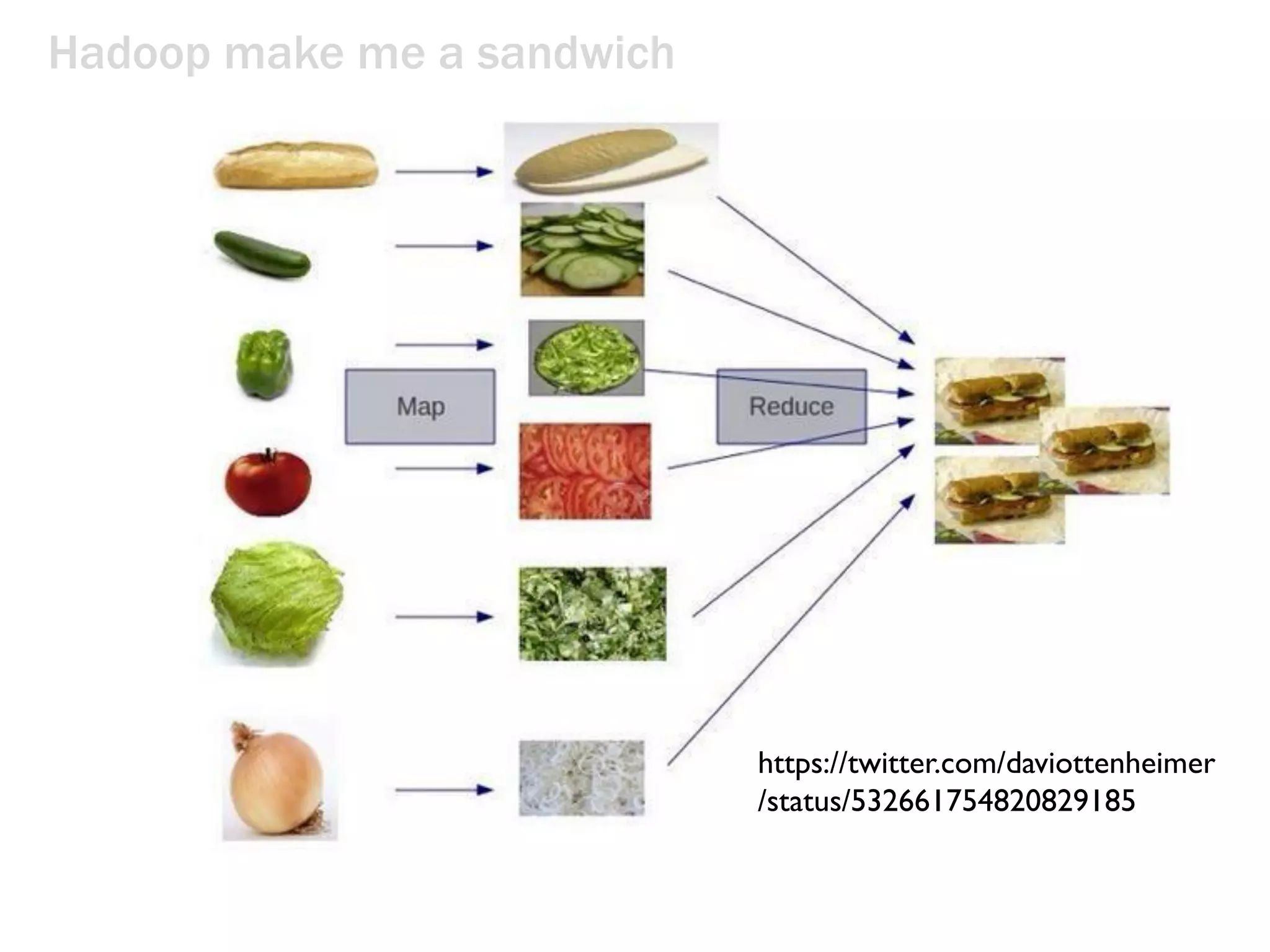
Hadoop make me a sandwich
https://twitter.com/daviottenheimer
/status/532661754820829185
Pattern:
Seeing monoids everywhere
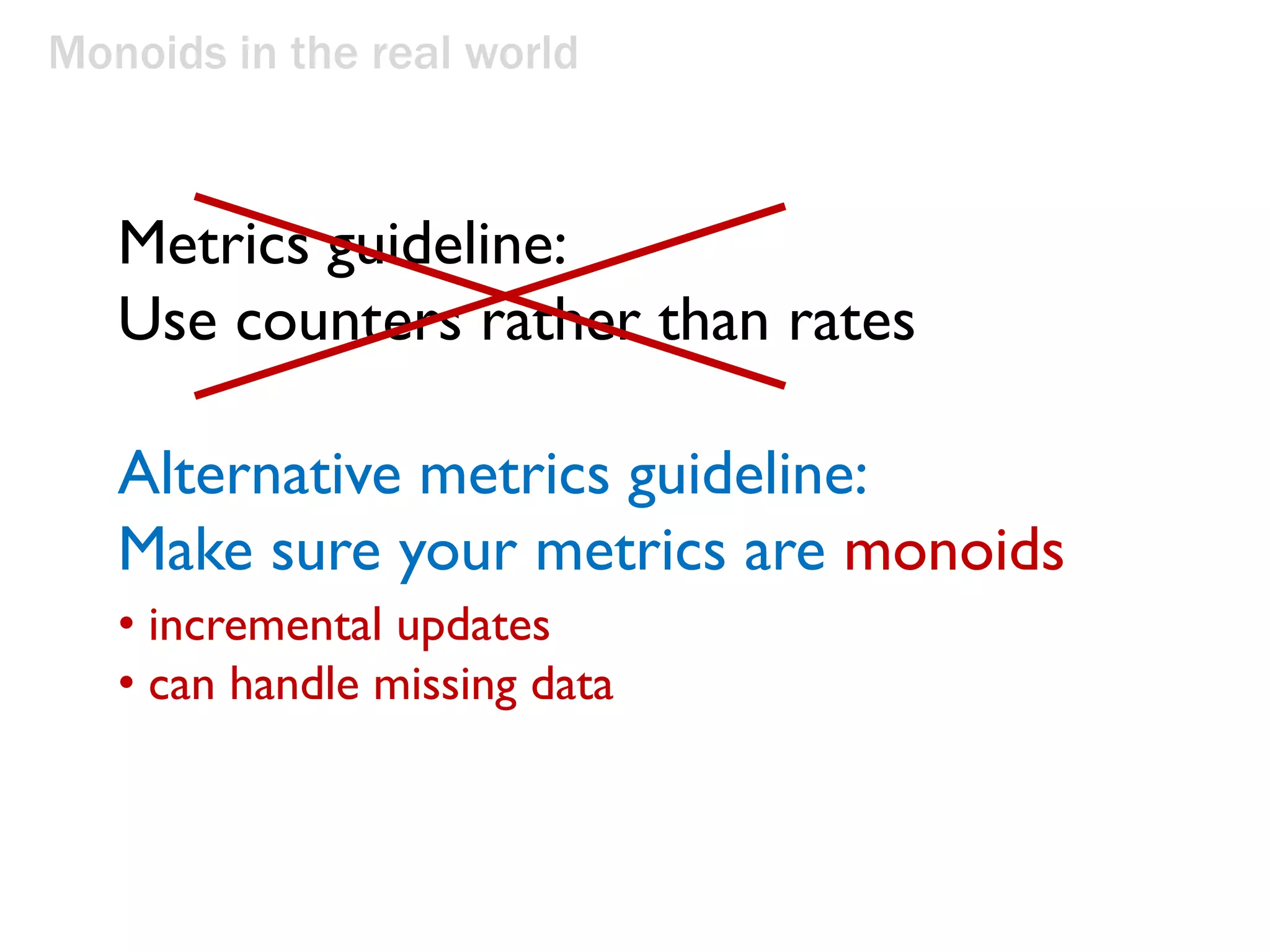
Monoids in the real world
Metrics guideline:
Use counters rather than rates
Alternative metrics guideline:
Make sure your metrics are monoids
• incremental updates
• can handle missing data
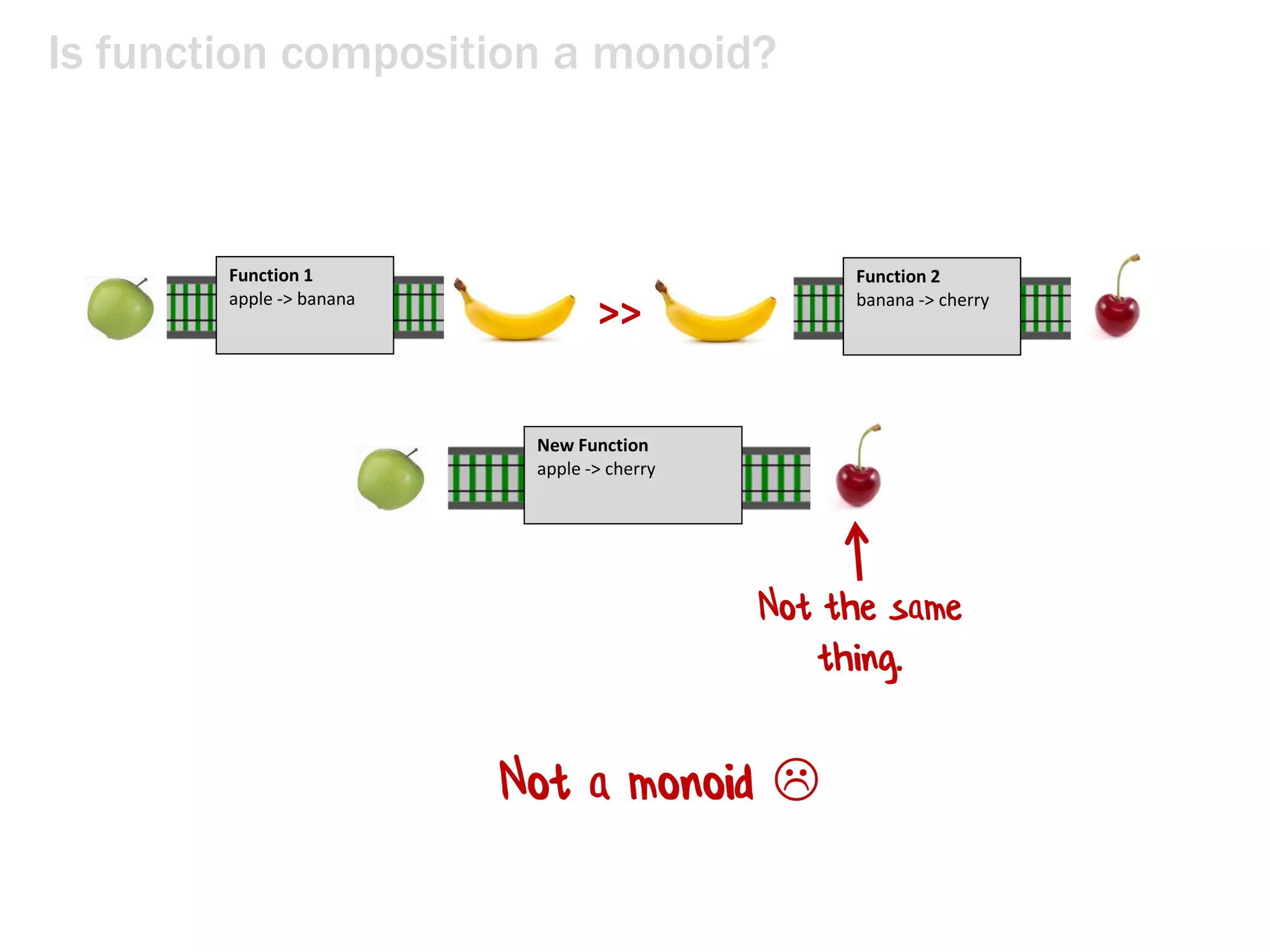
Is function composition a monoid?
>>
Function 1
apple -> banana
Function 2
banana -> cherry
New Function
apple -> cherry
Not the same
thing.
Not a monoid 
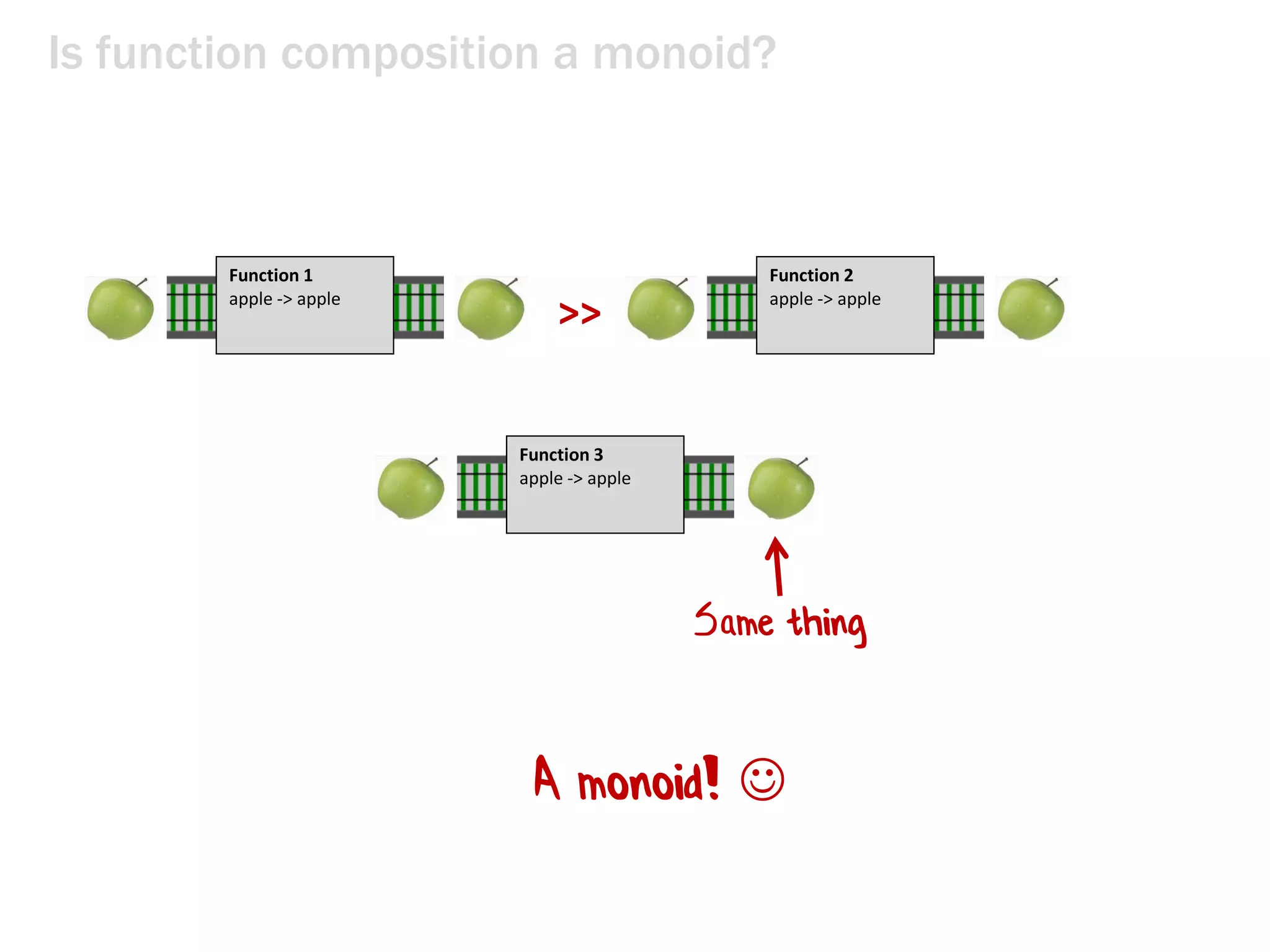
Is function composition a monoid?
>>
Function 1
apple -> apple
Same thing
Function 2
apple -> apple
Function 3
apple -> apple
A monoid! 
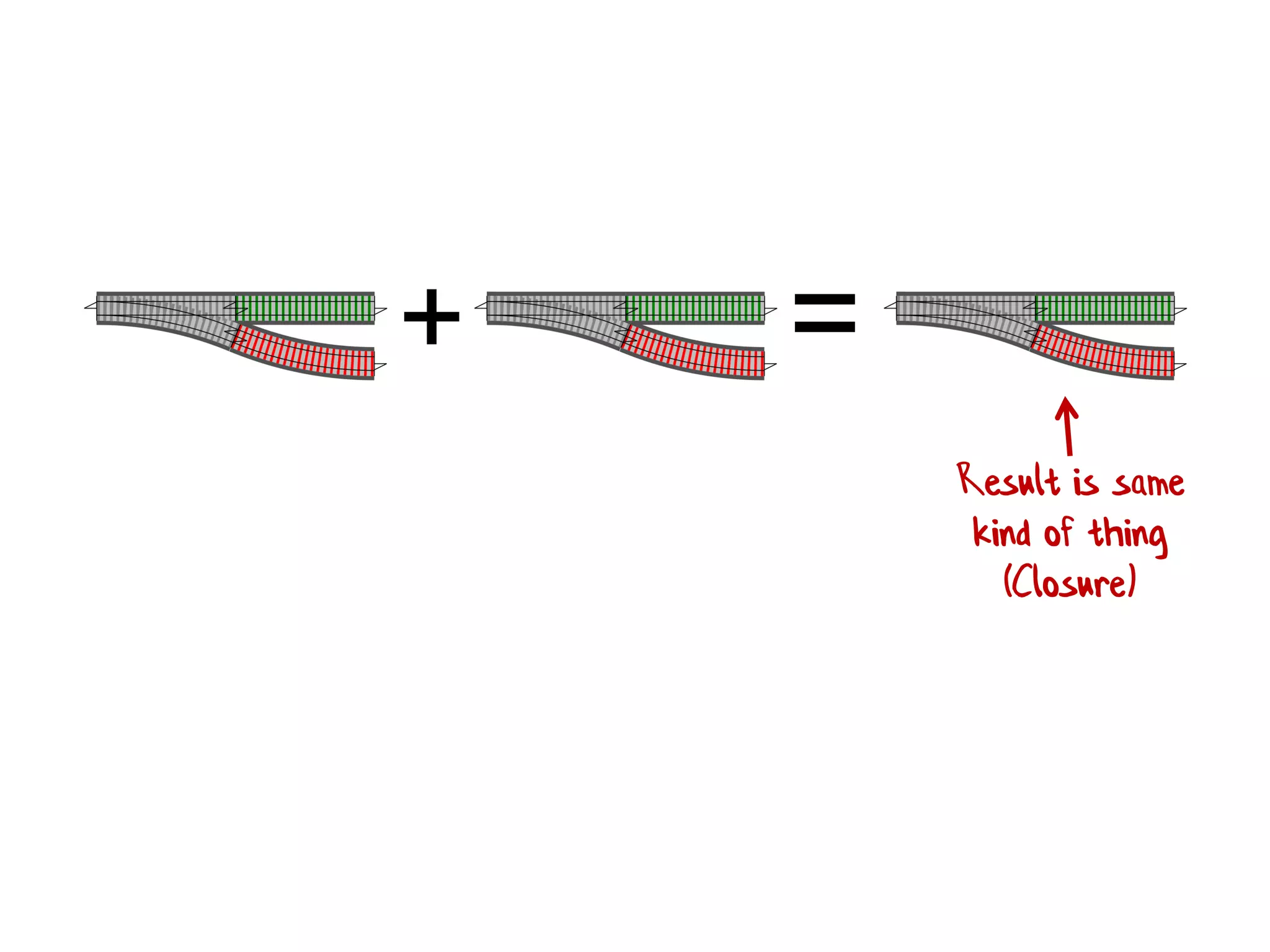
Monads vs. monoids?
=+
Result is same
kind of thing
(Closure)
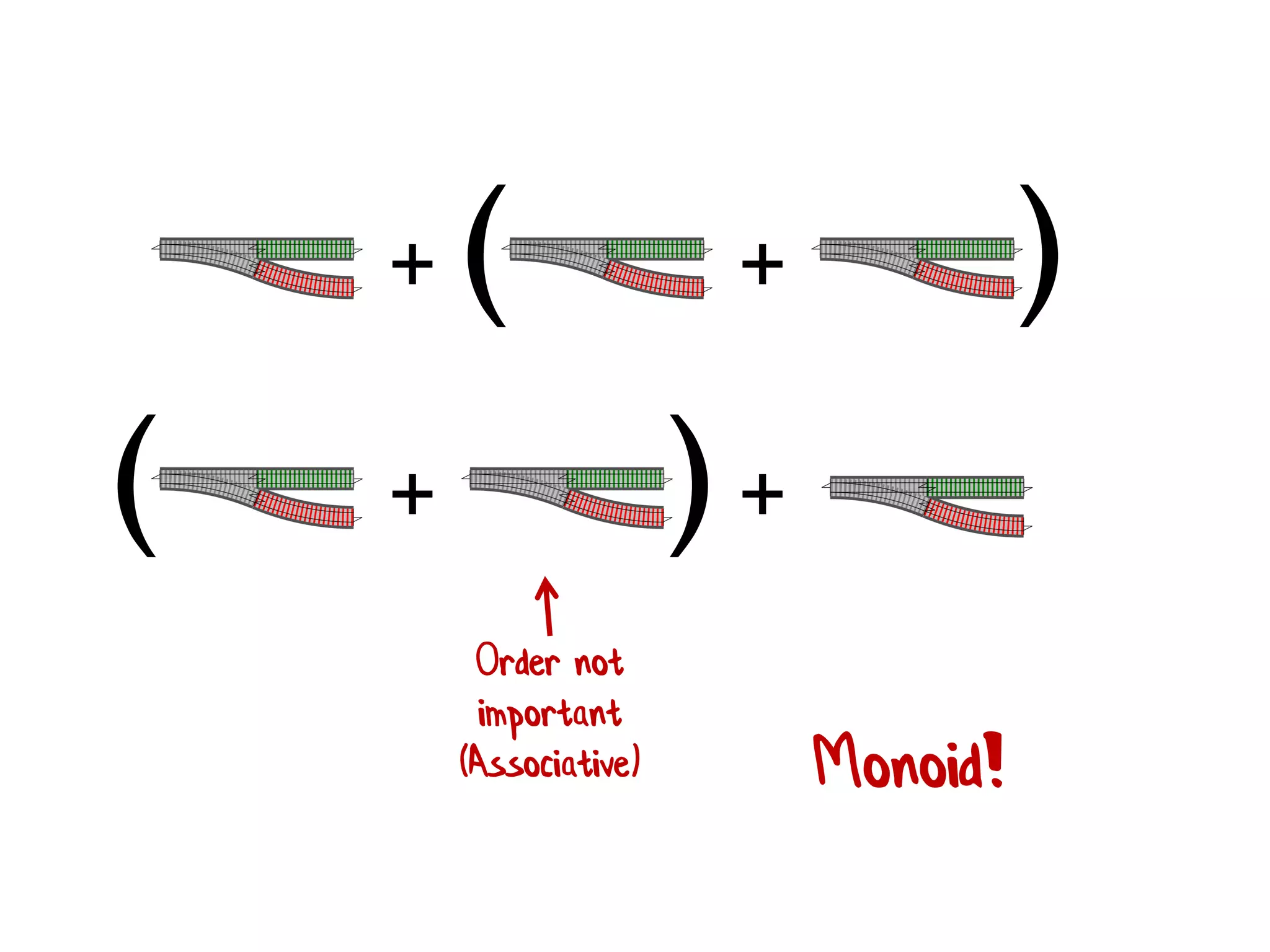
+
Order not
important
(Associative) Monoid!
+( )
++( )
Monad laws
• Closure, Associativity, Identity
– The monad laws are just the monoid definitions in
diguise
• What happens if you break the monad laws?
– You go to jail
– You lose monoid benefits such as aggregation
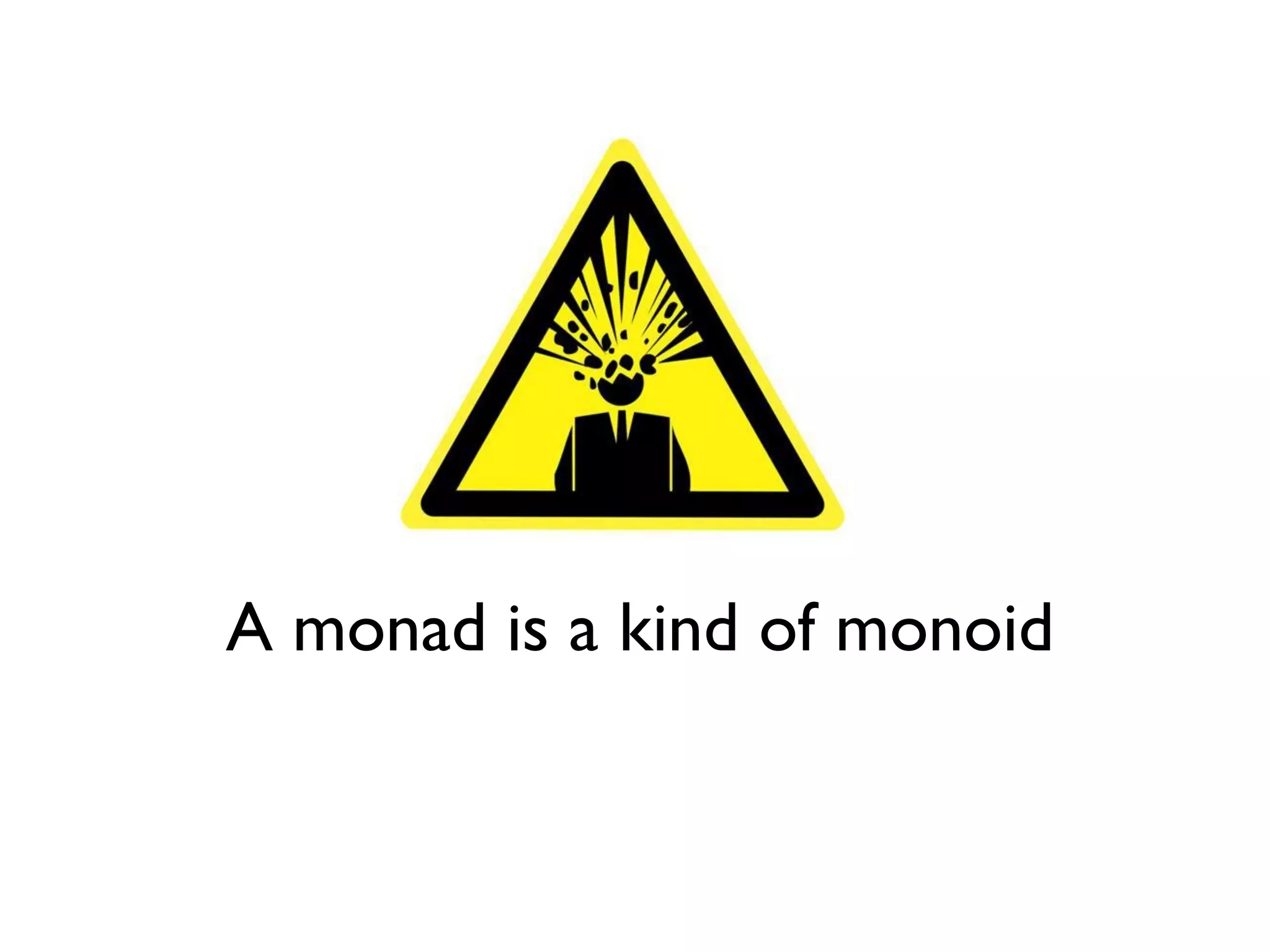
A monad is a kind of monoid
"A monad is just a monoid in
the category of endofunctors"
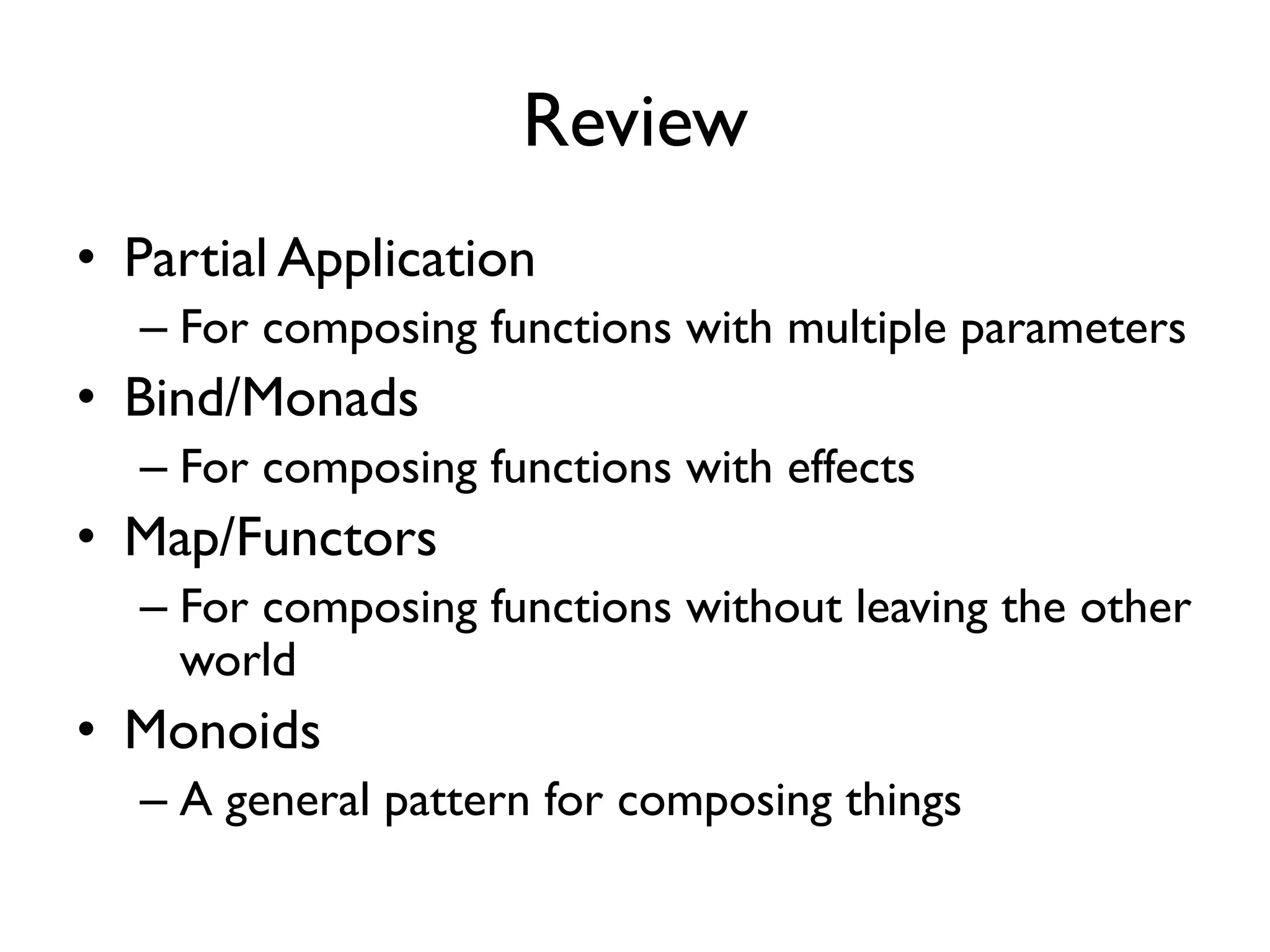
Review
• Partial Application
– For composing functions with multiple parameters
• Bind/Monads
– For composing functions with effects
• Map/Functors
– For composing functions without leaving the other
world
• Monoids
– A general pattern for composing things
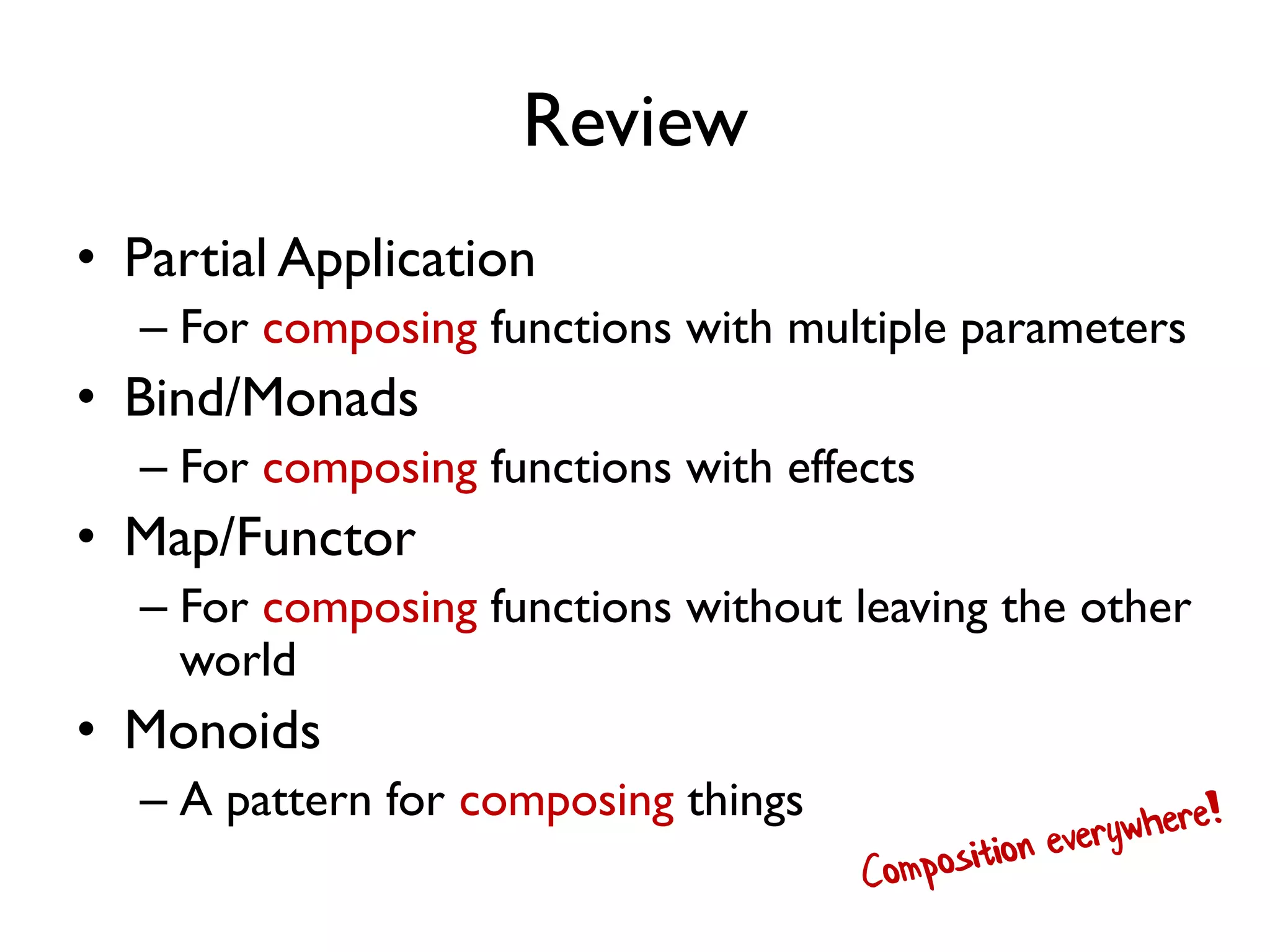
Review
• Partial Application
– For composing functions with multiple parameters
• Bind/Monads
– For composing functions with effects
• Map/Functor
– For composing functions without leaving the other
world
• Monoids
– A pattern for composing things
Slides and video here
fsharpforfunandprofit.com/fppatterns
Functional Design Patterns
Thank you!

Functional Design Patterns (DevTernity 2018)

  • 1.
  • 2.
    This talk A whirlwindtour of many sights Don't worry if you don't understand everything
  • 3.
  • 4.
  • 5.
    I used tobe a normal programmer...
  • 6.
    And then Iwas introduced to some functional programmers…
  • 7.
  • 8.
    Now I cansay this with a straight face: “A monad is just a monoid in the category of endofunctors, what’s the problem?”
  • 9.
  • 10.
    • Single ResponsibilityPrinciple • Open/Closed principle • Dependency Inversion Principle • Interface Segregation Principle • Factory pattern • Strategy pattern • Decorator pattern • Visitor pattern OO pattern/principle
  • 11.
    • Single ResponsibilityPrinciple • Open/Closed principle • Dependency Inversion Principle • Interface Segregation Principle • Factory pattern • Strategy pattern • Decorator pattern • Visitor pattern OO pattern/principle Borg response
  • 12.
    • Single ResponsibilityPrinciple • Open/Closed principle • Dependency Inversion Principle • Interface Segregation Principle • Factory pattern • Strategy pattern • Decorator pattern • Visitor pattern • Functions • Functions • Functions, also • Functions • You will be assimilated! • Functions again • Functions • Resistance is futile! OO pattern/principle FP equivalent Seriously, FP patterns are different
  • 13.
    Overview • 3 CorePrinciples of FP design • Pattern 1: Functions as parameters • Pattern 2: Composing multi-parameter functions • Pattern 3: "bind" • Pattern 4: "map" • Pattern 5: Monoids
  • 14.
    THREE CORE PRINCIPLESOF FUNCTIONAL PROGRAMMING There are more...
  • 15.
    Core principles ofFP Function Types are not classes Functions are things Composition everywhere
  • 16.
  • 17.
    The Tunnel of Transformation Function apple-> banana A function is a standalone thing, not attached to a class
  • 18.
    let z =1 1 let addOne x = x + 1 int-> int
  • 19.
  • 20.
    intInt ->int Function asinput (int->int)->int
  • 21.
    int int Function asparameterint->int int->int
  • 22.
  • 23.
    Function 1 apple ->banana Function 2 banana -> cherry
  • 24.
    >> Function 1 apple ->banana Function 2 banana -> cherry
  • 25.
    New Function apple ->cherry Can't tell it was built from smaller functions! Where did the banana go?
  • 26.
  • 27.
  • 28.
    Low-level operation Service AddressValidator For thoseunder 30... Validation Result Address Low-level operation Low-level operation a "service" is just like a microservice but without the "micro" in front
  • 29.
  • 30.
  • 31.
    Core principle: Types arenot classes So, what is a type then?
  • 32.
  • 33.
  • 34.
    Set of valid inputs Setof valid outputs Function A type is a just a name for a set of things
  • 35.
    Set of valid inputs Setof valid outputs Function 1 2 3 4 5 6 This is type "integer"
  • 36.
    Set of valid inputs Setof valid outputs Function This is type "string" "abc" "but" "cobol" "double" "end" "float"
  • 37.
    Set of valid inputs Setof valid outputs Function This is type "Person" Donna Roy Javier Mendoza Nathan Logan Shawna Ingram Abel Ortiz Lena Robbins GordonWood
  • 38.
    Set of valid inputs Setof valid outputs Function This is type "Fruit"
  • 39.
    Set of valid inputs Setof valid outputs Function This is a type of Fruit->Fruit functions
  • 40.
    Composition everywhere: Types canbe composed too "Algebraic type system" "Composable type system"
  • 42.
    New types arebuilt from smaller types by: Composing with “AND” Composing with “OR”
  • 43.
    Example: tuples, structs,records FruitSalad = One each of and and “AND” types (Record types) type FruitSalad = { Apple: AppleVariety Banana: BananaVariety Cherry: CherryVariety }
  • 44.
    Snack = oror “OR” types (Choice types) type Snack = | Apple of AppleVariety | Banana of BananaVariety | Cherry of CherryVariety
  • 45.
    Real world example oftype composition
  • 46.
    Example of somerequirements: We accept three forms of payment: Cash, Check, or Card. For Cash we don't need any extra information For Checks we need a check number For Cards we need a card type and card number
  • 47.
    interface IPaymentMethod {..} class Cash(): IPaymentMethod {..} class Check(int checkNo): IPaymentMethod {..} class Card(string cardType, string cardNo) : IPaymentMethod {..} In OOP you would probably implement it as an interface and a set of subclasses, like this:
  • 48.
    type CheckNumber =int type CardNumber = string In FP you would probably implement by composing types, like this:
  • 49.
    type CheckNumber =... type CardNumber = … type CardType = Visa | Mastercard type CreditCardInfo = { CardType : CardType CardNumber : CardNumber }
  • 50.
    type CheckNumber =... type CardNumber = ... type CardType = ... type CreditCardInfo = ... type PaymentMethod = | Cash | Check of CheckNumber | Card of CreditCardInfo
  • 51.
    type CheckNumber =... type CardNumber = ... type CardType = ... type CreditCardInfo = ... type PaymentMethod = | Cash | Check of CheckNumber | Card of CreditCardInfo type PaymentAmount = decimal type Currency = EUR | USD
  • 52.
    type CheckNumber =... type CardNumber = ... type CardType = ... type CreditCardInfo = ... type PaymentMethod = | Cash | Check of CheckNumber | Card of CreditCardInfo type PaymentAmount = decimal type Currency = EUR | USD type Payment = { Amount : PaymentAmount Currency: Currency Method: PaymentMethod }
  • 53.
    type CheckNumber =int type CardNumber = string type CardType = Visa | Mastercard type CreditCardInfo = CardType * CardNumber type PaymentMethod = | Cash | Check of CheckNumber | Card of CreditCardInfo type PaymentAmount = decimal type Currency = EUR | USD type Payment = { Amount : PaymentAmount Currency: Currency Method: PaymentMethod }
  • 54.
    Design principle: Use statictypes for domain modelling and documentation Static types only! Sorry Clojure and JS developers 
  • 55.
    A big topicand not enough time   More on DDD and designing with types at fsharpforfunandprofit.com/ddd
  • 56.
  • 57.
  • 58.
    let printList() = fori in [1..10] do printfn "the number is %i" i
  • 59.
    So parameterize thedata let printList aList = for i in aList do printfn "the number is %i" i
  • 60.
    let printList aList= for i in aList do printfn "the number is %i" i
  • 61.
    let printList anActionaList = for i in aList do anAction i So parameterize the action as well: We've decoupled the behavior from the data. Any list, any action!
  • 62.
  • 63.
    public static intProduct(int n) { int product = 1; for (int i = 1; i <= n; i++) { product *= i; } return product; } public static int Sum(int n) { int sum = 0; for (int i = 1; i <= n; i++) { sum += i; } return sum; }
  • 64.
    public static intProduct(int n) { int product = 1; for (int i = 1; i <= n; i++) { product *= i; } return product; } public static int Sum(int n) { int sum = 0; for (int i = 1; i <= n; i++) { sum += i; } return sum; }
  • 65.
    public static intProduct(int n) { int product = 1; for (int i = 1; i <= n; i++) { product *= i; } return product; } public static int Sum(int n) { int sum = 0; for (int i = 1; i <= n; i++) { sum += i; } return sum; }
  • 66.
  • 67.
    public static intAggregate( int initialValue, Func<int,int,int> action, int n) { int totalSoFar = initialValue; for (int i = 1; i <= n; i++) { totalSoFar = action(totalSoFar,i); } return totalSoFar; }
  • 68.
  • 69.
    interface IBunchOfMethods { int DoSomething(intx); string DoSomethingElse(int x); void DoAThirdThing(string x); } Let's take the Single Responsibility Principle and the Interface Segregation Principle to the extreme... Every interface should have only one method!
  • 70.
    interface IBunchOfMethods { int DoSomething(intx); } An interface with one method is a just a function type type DoSomething: int -> int
  • 71.
    type DoSomething: int-> int *Any* function with that type is compatible with it let add2 x = x + 2 // int -> int let times3 x = x * 3 // int -> int No interface declaration needed!
  • 72.
  • 73.
    let isEven x= ... // int -> bool isEvenint bool Log the input Log the output
  • 74.
    let isEven x= ... // int -> bool isEvenint bool isEvenint boollogint int logbool bool Compose!
  • 75.
    let isEven x= ... // int -> bool isEvenint bool logint log boolisEven
  • 76.
    let isEven x= ... // int -> bool isEvenint bool int log bool let isEvenWithLogging = // int -> bool Substitutable for original isEven isEvenWithLogging
  • 77.
    Tip: "Use interfaces forloose coupling" Use function parameters for loose coupling
  • 78.
  • 79.
    Bad news: Composition patterns onlywork for functions that have one parameter! 
  • 80.
    Good news! Every functioncan be turned into a one parameter function 
  • 81.
    let add xy = x + y let add = (fun x y -> x + y) let add x = (fun y -> x + y) int-> int->int int-> int->int int-> (int->int) Normal function (Two parameters)
  • 82.
    let add xy = x + y let add = (fun x y -> x + y) let add x = (fun y -> x + y) int-> int->int int-> int->int int-> (int->int)
  • 83.
  • 84.
    let name ="Scott" printfn "Hello, my name is %s" name
  • 85.
    let name ="Scott" (printfn "Hello, my name is %s") name
  • 86.
    let hello =(printfn "Hello, my name is %s") Can reuse "hello" in many places now! let name = "Scott" hello name let name = "Alice" hello name
  • 87.
  • 88.
    let names =["Alice"; "Bob"; "Scott"] List.iter hello names //foreach name in names let hello = printfn "Hello, my name is %s"
  • 89.
    let add1 =(+) 1 let equals2 = (=) 2 [1..100] |> List.map add1 |> List.filter equals2
  • 90.
  • 91.
  • 92.
    let example input= let x = doSomething input if x <> null then let y = doSomethingElse x if y <> null then let z = doAThirdThing y if z <> null then let result = z result else null else null else null I know you could do early returns, but bear with me...
  • 93.
    let taskExample input= let taskX = startTask input taskX.WhenFinished (fun x -> let taskY = startAnotherTask x taskY.WhenFinished (fun y -> let taskZ = startThirdTask y taskZ.WhenFinished (fun z -> z // final result ) ) )
  • 94.
    let example input= let x = doSomething input if x <> null then let y = doSomethingElse x if y <> null then let z = doAThirdThing y if z <> null then let result = z result else null else null else null Nulls are a code smell: replace with Option! Let's fix this!
  • 95.
    let example input= let x = doSomething input if x.IsSome then let y = doSomethingElse (x.Value) if y.IsSome then let z = doAThirdThing (y.Value) if z.IsSome then let result = z.Value Some result else None else None else None Much more elegant, yes? No! This is fugly! But there is a pattern we can exploit...
  • 96.
    let example input= let x = doSomething input if x.IsSome then let y = doSomethingElse (x.Value) if y.IsSome then let z = doAThirdThing (y.Value) if z.IsSome then // do something with z.Value // in this block else None else None else None
  • 97.
    let example input= let x = doSomething input if x.IsSome then let y = doSomethingElse (x.Value) if y.IsSome then // do something with y.Value // in this block else None else None
  • 98.
    let example input= let x = doSomething input if x.IsSome then // do something with x.Value // in this block else None Can you see the pattern?
  • 99.
    if opt.IsSome then //dosomething with opt.Value else None
  • 100.
    let ifSomeDo fopt = if opt.IsSome then f opt.Value else None
  • 101.
    let example input= doSomething input |> ifSomeDo doSomethingElse |> ifSomeDo doAThirdThing |> ifSomeDo ... let ifSomeDo f opt = if opt.IsSome then f opt.Value else None
  • 102.
    Some None Input -> This isan example of a more general problem
  • 103.
  • 106.
    >> >> Composing one-trackfunctions is fine...
  • 107.
    >> >> ... andcomposing two-track functions is fine...
  • 108.
      ... butcomposing switches is not allowed!
  • 109.
    How to combinethe mismatched functions?
  • 110.
    “Bind” is theanswer! Bind all the things!
  • 111.
    Two-track input Two-trackinput One-track input Two-track input  
  • 112.
    Two-track input Slot forswitch function Two-track output
  • 113.
  • 114.
    let bind nextFunctionoptionInput = match optionInput with | Some s -> nextFunction s | None -> None Two-track input Two-track output
  • 115.
    let bind nextFunctionoptionInput = match optionInput with | Some s -> nextFunction s | None -> None Two-track input Two-track output
  • 116.
    let bind nextFunctionoptionInput = match optionInput with | Some s -> nextFunction s | None -> None Two-track input Two-track output
  • 117.
    let bind nextFunctionoptionInput = match optionInput with | Some s -> nextFunction s | None -> None Two-track input Two-track output
  • 118.
    Pattern: Use bind tochain options
  • 119.
    let example input= let x = doSomething input if x.IsSome then let y = doSomethingElse (x.Value) if y.IsSome then let z = doAThirdThing (y.Value) if z.IsSome then let result = z.Value Some result else None else None else None Before
  • 120.
    let bind fopt = match opt with | Some v -> f v | None -> None After
  • 121.
    let example input= doSomething input |> bind doSomethingElse |> bind doAThirdThing |> bind ... let bind f opt = match opt with | Some v -> f v | None -> None No pyramids! Code is linear and clear. This pattern is called “monadic bind” After
  • 122.
    Pattern: Use bind tochain tasks a.k.a "promise" "future"
  • 123.
  • 124.
    let taskExample input= let taskX = startTask input taskX.WhenFinished (fun x -> let taskY = startAnotherTask x taskY.WhenFinished (fun y -> let taskZ = startThirdTask y taskZ.WhenFinished (fun z -> z // final result ) ) ) Before
  • 125.
    let taskBind ftask = task.WhenFinished (fun taskResult -> f taskResult) let taskExample input = startTask input |> taskBind startAnotherTask |> taskBind startThirdTask |> taskBind ... This pattern is also a “monadic bind” After
  • 126.
    Pattern: Use bind tochain error handlers
  • 127.
    string UpdateCustomerWithErrorHandling() { var request= receiveRequest(); validateRequest(request); canonicalizeEmail(request); db.updateDbFromRequest(request); smtpServer.sendEmail(request.Email) return "OK"; }
  • 128.
    string UpdateCustomerWithErrorHandling() { var request= receiveRequest(); var isValidated = validateRequest(request); if (!isValidated) { return "Request is not valid" } canonicalizeEmail(request); db.updateDbFromRequest(request); smtpServer.sendEmail(request.Email) return "OK"; }
  • 129.
    string UpdateCustomerWithErrorHandling() { var request= receiveRequest(); var isValidated = validateRequest(request); if (!isValidated) { return "Request is not valid" } canonicalizeEmail(request); var result = db.updateDbFromRequest(request); if (!result) { return "Customer record not found" } smtpServer.sendEmail(request.Email) return "OK"; }
  • 130.
    string UpdateCustomerWithErrorHandling() { var request= receiveRequest(); var isValidated = validateRequest(request); if (!isValidated) { return "Request is not valid" } canonicalizeEmail(request); try { var result = db.updateDbFromRequest(request); if (!result) { return "Customer record not found" } } catch { return "DB error: Customer record not updated" } smtpServer.sendEmail(request.Email) return "OK"; }
  • 131.
    string UpdateCustomerWithErrorHandling() { var request= receiveRequest(); var isValidated = validateRequest(request); if (!isValidated) { return "Request is not valid" } canonicalizeEmail(request); try { var result = db.updateDbFromRequest(request); if (!result) { return "Customer record not found" } } catch { return "DB error: Customer record not updated" } if (!smtpServer.sendEmail(request.Email)) { log.Error "Customer email not sent" } return "OK"; }
  • 132.
    string UpdateCustomerWithErrorHandling() { var request= receiveRequest(); var isValidated = validateRequest(request); if (!isValidated) { return "Request is not valid" } canonicalizeEmail(request); try { var result = db.updateDbFromRequest(request); if (!result) { return "Customer record not found" } } catch { return "DB error: Customer record not updated" } if (!smtpServer.sendEmail(request.Email)) { log.Error "Customer email not sent" } return "OK"; }
  • 133.
    Tip: Use a Resulttype for error handling
  • 134.
    Request SuccessValidate Failure type Result= | Ok of SuccessValue | Error of ErrorValue Define a choice type
  • 135.
    Request SuccessValidate Failure let validateInputinput = if input.name = "" then Error "Name must not be blank" else if input.email = "" then Error "Email must not be blank" else Ok input // happy path
  • 136.
  • 137.
  • 138.
    Functional flow withouterror handling let updateCustomer = receiveRequest() |> validateRequest |> canonicalizeEmail |> updateDbFromRequest |> sendEmail |> returnMessage Before One track
  • 139.
    let updateCustomerWithErrorHandling = receiveRequest() |>validateRequest |> canonicalizeEmail |> updateDbFromRequest |> sendEmail |> returnMessage Functional flow with error handling After Two track
  • 140.
    FP terminology • Amonad is – A data type – With an associated bind/flatMap function (and some other stuff) – With a sensible implementation (monad laws). • A monadic function is – A switch/points function – bind/flatMap is used to compose them
  • 141.
    Tip: Monads are ageneral purpose way of composing functions with complex outputs
  • 142.
  • 143.
    World of normalvalues int string bool World of options Option<int> Option<string> Option<bool>
  • 144.
    World of options Worldof normal values int string bool Option<int> Option<string> Option<bool> 
  • 145.
    World of options Worldof normal values Option<int> Option<string> Option<bool>  int string bool
  • 146.
    let add42 x= x + 42 add42 1 // 43
  • 147.
    let add42ToOption opt= if opt.IsSome then let newVal = add42 opt.Value Some newVal else None 
  • 148.
    World of options Worldof normal values add42 
  • 149.
    World of options Worldof normal values add42
  • 150.
    World of options Worldof normal values option -> -> option Option.map
  • 151.
    let add42 x= x + 42 add42 1 // 43 let add42ToOption = Option.map add42 add42ToOption (Some 1) // Some 43 
  • 152.
    World of lists Worldof normal values List.map list-> -> list
  • 153.
    let add42ToEach =List.map add42 add42ToEach [1;2;3] // [43;44;45]
  • 154.
    World of async Worldof normal values async<T> -> -> async<U> Async.map
  • 155.
    Guideline: Most wrapped generictypes have a “map”. Use it!
  • 156.
    Guideline: If you createyour own generic type, create a “map” for it.
  • 157.
    FP terminology • Afunctor is – A data type – With an associated "map" function (with a sensible implementation)
  • 158.
  • 159.
  • 160.
    1 + 2= 3 1 + (2 + 3) = (1 + 2) + 3 1 + 0 = 1 0 + 1 = 1
  • 161.
    1 + 2= 3 Some things A way of combining them
  • 162.
    2 x 3= 6 Some things A way of combining them
  • 163.
    "a" + "b"= "ab" Some things A way of combining them
  • 164.
    concat([a],[b]) = [a;b] Some things A way of combining them
  • 165.
    1 + 2 1+ 2 + 3 1 + 2 + 3 + 4 Is an integer Is an integer A pairwise operation has become an operation that works on lists!
  • 166.
    1 + (2+ 3) = (1 + 2) + 3 Order of combining doesn’t matter 1 + 2 + 3 + 4 (1 + 2) + (3 + 4) ((1 + 2) + 3) + 4 All the same
  • 167.
    1 - (2- 3) = (1 - 2) - 3 Order of combining does matter
  • 168.
    1 + 0= 1 0 + 1 = 1 A special kind of thing that when you combine it with something, just gives you back the original something
  • 169.
    42 * 1= 42 1 * 42 = 42 A special kind of thing that when you combine it with something, just gives you back the original something
  • 170.
    "" + "hello"= "hello" "hello" + "" = "hello" “Zero” for strings
  • 171.
    • You startwith a bunch of things, and some way of combining them two at a time. • Rule 1 (Closure):The result of combining two things is always another one of the things. • Rule 2 (Associativity):When combining more than two things, which pairwise combination you do first doesn't matter. • Rule 3 (Identity element):There is a special thing called "zero" such that when you combine any thing with "zero" you get the original thing back. A monoid!
  • 172.
    • Rule 1(Closure):The result of combining two things is always another one of the things. • Benefit: converts pairwise operations into operations that work on lists. 1 + 2 + 3 + 4 [ 1; 2; 3; 4 ] |> List.reduce (+) We'll see this a lot!
  • 173.
    1 * 2* 3 * 4 [ 1; 2; 3; 4 ] |> List.reduce (*) • Rule 1 (Closure):The result of combining two things is always another one of the things. • Benefit: converts pairwise operations into operations that work on lists.
  • 174.
    "a" + "b"+ "c" + "d" [ "a"; "b"; "c"; "d" ] |> List.reduce (+) • Rule 1 (Closure):The result of combining two things is always another one of the things. • Benefit: converts pairwise operations into operations that work on lists.
  • 175.
    • Rule 2(Associativity):When combining more than two things, which pairwise combination you do first doesn't matter. • Benefit: Divide and conquer, parallelization, and incremental accumulation.
  • 176.
  • 177.
  • 178.
    • Rule 2(Associativity):When combining more than two things, which pairwise combination you do first doesn't matter. • Benefit: Divide and conquer, parallelization, and incremental accumulation.
  • 179.
  • 180.
  • 181.
  • 182.
    • How canI use reduce on an empty list? • In a divide and conquer algorithm, what should I do if one of the "divide" steps has nothing in it? • When using an incremental algorithm, what value should I start with when I have no data?
  • 183.
    • Rule 3(Identity element):There is a special thing called "zero" such that when you combine any thing with "zero" you get the original thing back. • Benefit: Initial value for empty or missing data
  • 184.
  • 185.
    type OrderLine ={Qty:int; Total:float} let orderLines = [ {Qty=2; Total=19.98} {Qty=1; Total= 1.99} {Qty=3; Total= 3.99} ] How to add them up?
  • 186.
    type OrderLine ={Qty:int; Total:float} let addPair line1 line2 = let newQty = line1.Qty + line2.Qty let newTotal = line1.Total + line2.Total {Qty=newQty; Total=newTotal} orderLines |> List.reduce addPair // {Qty=6; Total= 25.96} Any combination of monoids is also a monoid Write a pairwise combiner Profit!
  • 187.
  • 188.
    Customer + Customer + Customer Customer Stats + Customer Stats + CustomerStats Reduce Map Not a monoid A monoid Customer Stats (Total)
  • 189.
    Hadoop make mea sandwich https://twitter.com/daviottenheimer /status/532661754820829185
  • 190.
  • 191.
    Monoids in thereal world Metrics guideline: Use counters rather than rates Alternative metrics guideline: Make sure your metrics are monoids • incremental updates • can handle missing data
  • 192.
    Is function compositiona monoid? >> Function 1 apple -> banana Function 2 banana -> cherry New Function apple -> cherry Not the same thing. Not a monoid 
  • 193.
    Is function compositiona monoid? >> Function 1 apple -> apple Same thing Function 2 apple -> apple Function 3 apple -> apple A monoid! 
  • 194.
  • 195.
    =+ Result is same kindof thing (Closure)
  • 196.
  • 197.
    Monad laws • Closure,Associativity, Identity – The monad laws are just the monoid definitions in diguise • What happens if you break the monad laws? – You go to jail – You lose monoid benefits such as aggregation
  • 198.
    A monad isa kind of monoid
  • 199.
    "A monad isjust a monoid in the category of endofunctors"
  • 200.
    Review • Partial Application –For composing functions with multiple parameters • Bind/Monads – For composing functions with effects • Map/Functors – For composing functions without leaving the other world • Monoids – A general pattern for composing things
  • 201.
    Review • Partial Application –For composing functions with multiple parameters • Bind/Monads – For composing functions with effects • Map/Functor – For composing functions without leaving the other world • Monoids – A pattern for composing things
  • 202.
    Slides and videohere fsharpforfunandprofit.com/fppatterns Functional Design Patterns Thank you!